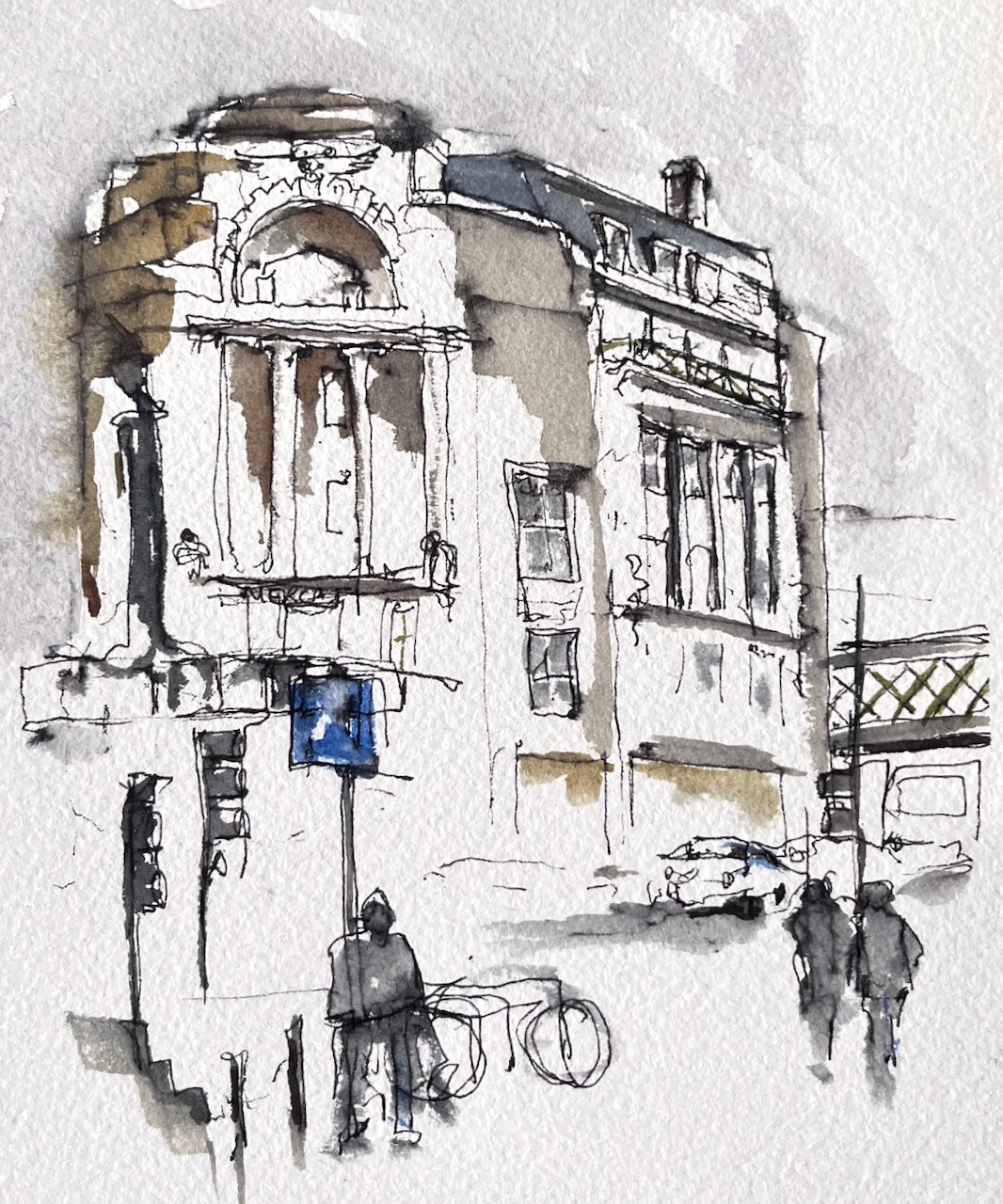
Mercat Building, Glasgow, G1 5AB

On my way up to the West of Scotland I had a day in Glasgow. The overnight train had arrived at 07:30 and the bus to Oban didn’t leave until 18:05. I emerged from Glasgow Central into the mist and fine rain, and walked up the hill to find the “Buchanan Bus Station”. My idea was to stash my bag in the Left Luggage facility and then spend my time exploring Glasgow.

Glasgow at 07:30 on a wet morning in March is not so very enticing. I had the lowest possible expectations as I entered the bus station. Although huge, the bus station had been difficult to find, hidden as it is behind a monumental building called “Buchanan Galleries”. This is neither a “gallery” of the art sort, nor a shopping centre, as far as I could work out. It is a multi-story car-park. Every shop I had passed on the way up had been closed, possibly permanently, or so it seemed to me. There was a wind, I was getting wet, and I was hungry. Despite the confident announcements on its website, I was starting to think that the Left Luggage at Buchanan Bus Station would be closed.

But, contrary to all expectations, the Left Luggage Office was lit up, the door open, and everything looked new and clean inside. Even better, a cheerful man in a beanie hat soon appeared behind the desk, took charge of my pack, and efficiently operated the locker system. I exchanged a £5 note for a receipt with a code, put the receipt deep within my pockets, and set off into the grey morning feeling a lot more cheerful.

This came to typify my experience of Glasgow: a grey and wet city enlivened by cheerful welcoming people.
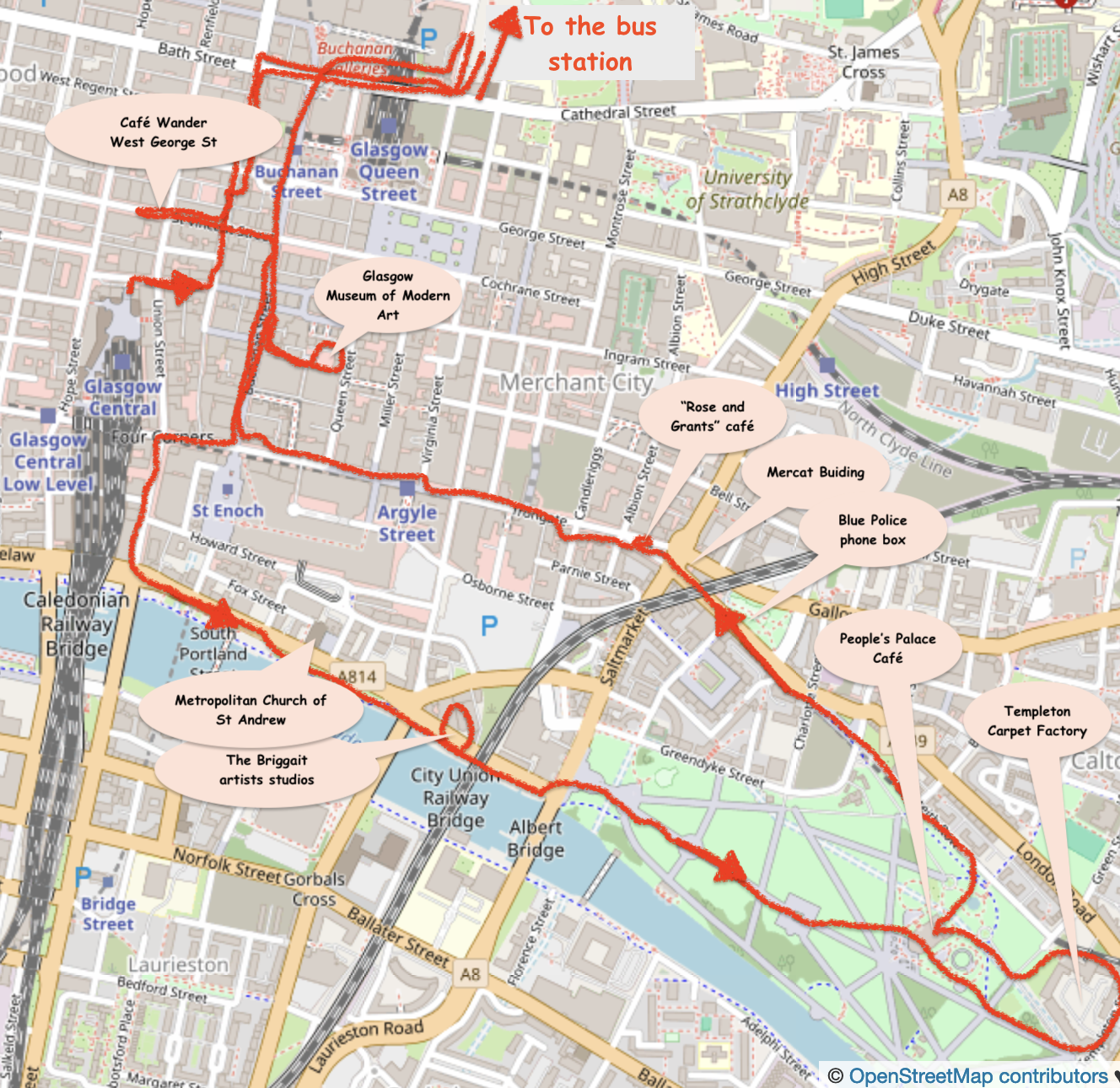
My wanderings around Glasgow. Positions of monuments and cafés are approximate. Map (c) Open Street Map Contributors.

Walking out of the bus station, and wandering at random through the grid of streets, I spotted the “Café Wander” in a basement. This is at 110 West George St and was a great find: welcoming people, a big mug of tea, food, and a charging point for my phone. No rush, I could think and sketch, and feel as though I’d arrived. I decided to head for the river. A river tells you about a city.
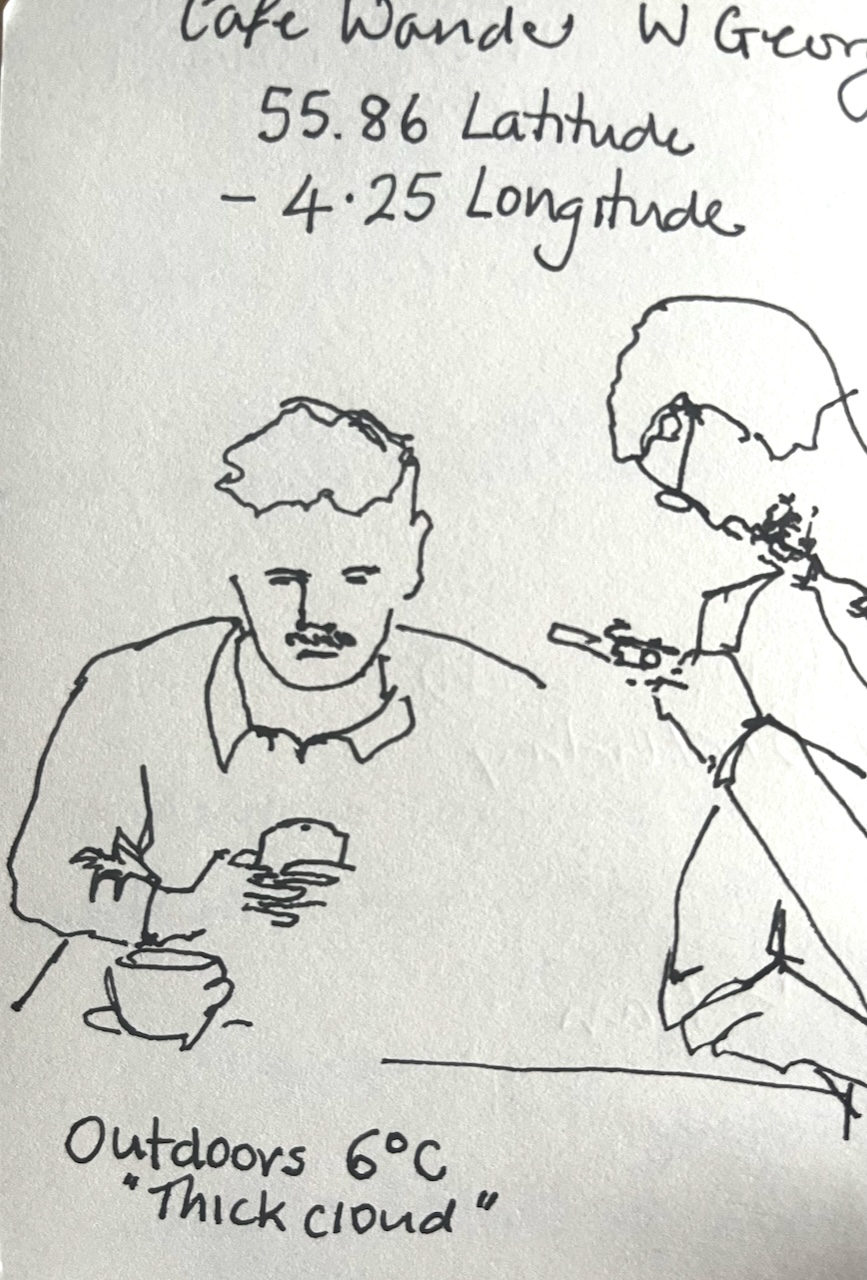
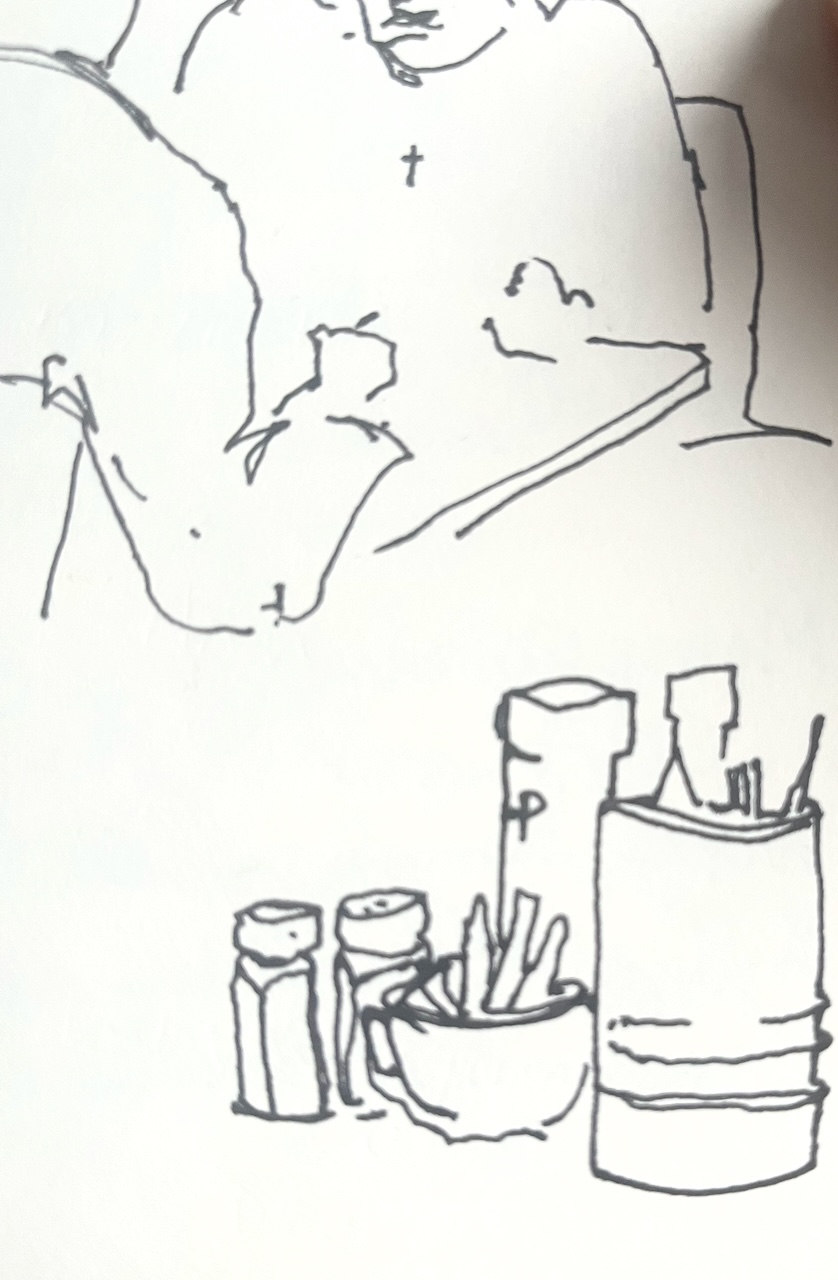
The amazing thing about Glasgow is that there are these magnificent buildings, and a lot of them are apparently empty. Or at least they are empty from the 2nd floor up. At street level there is a band of multi-coloured shopfronts, some shuttered. Higher up the Victorian optimism and wealth proclaims itself in ornamented facades, fancy windows, sculptures, and carved names of proud institutions: “St Vincents Chambers”, “Bank of Scotland”. But these higher floors are deserted. The windows are dusty, the facades chipped, the statues dark with dust. But still.

The river told me nothing about Glasgow, except that Glasgow seems to ignore its river. There is a main road, a magnificently restored catholic church, and a succession of buildings which in London would be converted to luxury flats but which in Glasgow remain as buildings awaiting their future. By the time I reached the park, I was really cold. Hacking my way against what was now a biting wind, I encountered a small round woman with a small round dog, coming the other way. She caught my eye and laughed, holding firmly on to the dog’s lead as though it anchored her to the ground. “Bitter!” she announced, still laughing. I agreed that it was.

I wanted to ask her some important questions, such as whether the “People’s Palace” had a café, and what was that brightly coloured building in the misty distance? But conversation was going to be impossible in that wind, so she and I passed each other in amicable silence, allies against the elements.

The brightly coloured building was called “Templeton Buildings”. It had no café, and no information. There was a bar, predictably closed. I circumnavigated it, and then set off for the “People’s Palace”. In the distance I’d seen someone come out, but they could have been a builder or a janitor.

It was now raining in earnest. All my papers, tickets and art equipment were in dry-bags inside my backpack, which had been a good precaution. I’ve been in Scotland before. The People’s Palace appeared out of the mist, a huge Victorian edifice, looking formidable and very closed. It was not closed. There was a board outside. A café! I pushed open the door, ready to be rebuffed at any moment, but no, inside was warmth and light, a museum of some sort, public toilets, and a café.

The “People’s Palace” Glasgow Green.

I more or less fell into the café. The friendly person at the counter gave me a guided tour of the home-made cakes, evidently from personal experience. Since he looked like someone who knew his cakes, I accepted his recommendation for the coconut sponge and took a window seat by an old fashioned radiator that was pumping out heat. From there, I watched through the window at coach tours who arrived to look at a fountain in the rain. This is the Doulton Fountain, gifted to Glasgow in 1888 by the Doulton Pottery in Lambeth, London. It would look very nice in the sun: a good sketching subject.

The friendly cake-expert directed me to information panels which told me about Templeton Buildings. This is the former Templeton Carpet Factory, which ceased operation only in 1980.
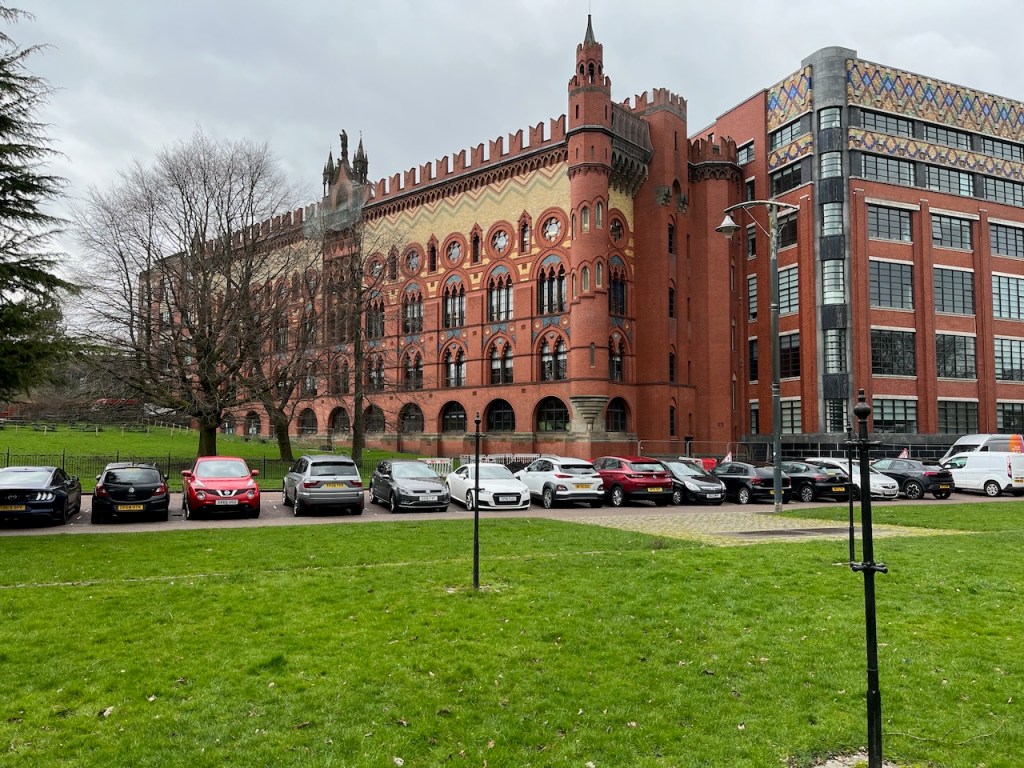
photo of Templeton Buildings

Eventually, fortified by cake, I was off again in the rain which had abated slightly. I was determined to sketch at least one of the Glasgow buildings. I came to the end of a long road, there was the Mercat Building.

Mercat Building, 26-36 Gallowgate, Glasgow, G1 5AB: 1928-31 designed by Andrew Graham Henderson who lived and worked in Glasgow 1882 – 1963

This was a very quick sketch, on an A5 card, done from a doorway as the rain came down. I stopped before all the colours ran together and retreated into “Rose and Grant”, another welcoming café where the people were not atall put out by my washing my brushes in their water glass and spreading out my watercolour equipment on the table, making copious use of the supplied paper napkins for art purposes.

My tour of Glasgow included the Museum of Modern Art, which has a peaceful library in the basement, as well as small galleries where the pictures have commendably large-type curation. Not crowded. Easy to navigate. Friendly.

I ended up back at Buchanan Street Bus Station, successfully retrieved my pack and was early for my bus.

Glasgow is definitely a City to return to.
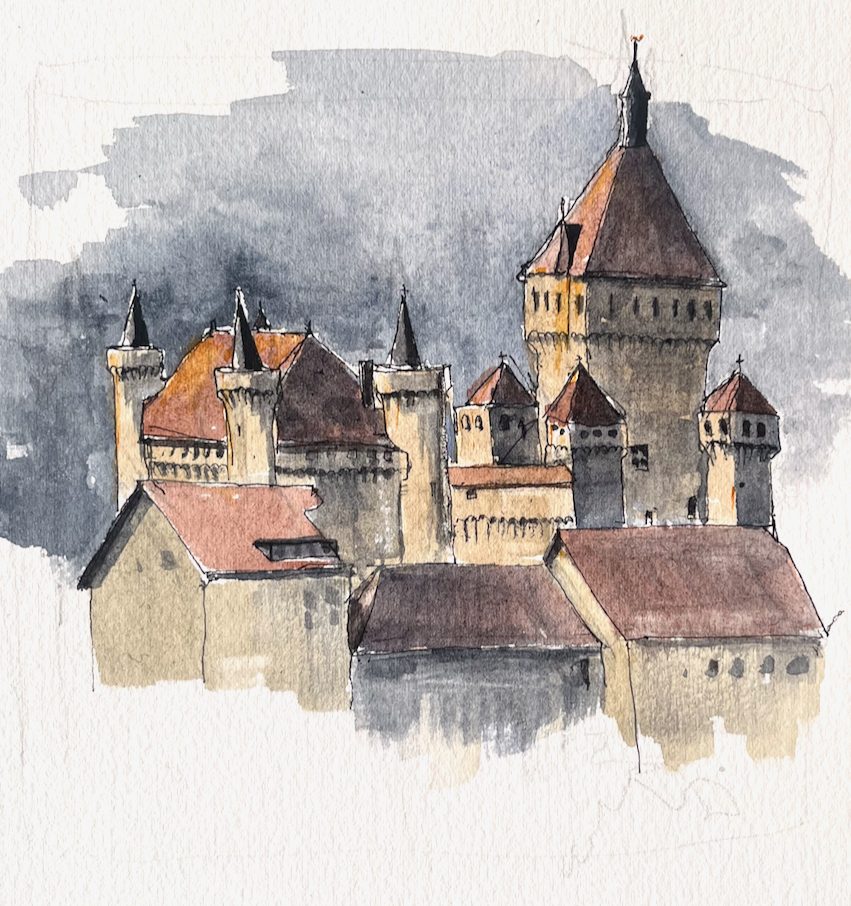
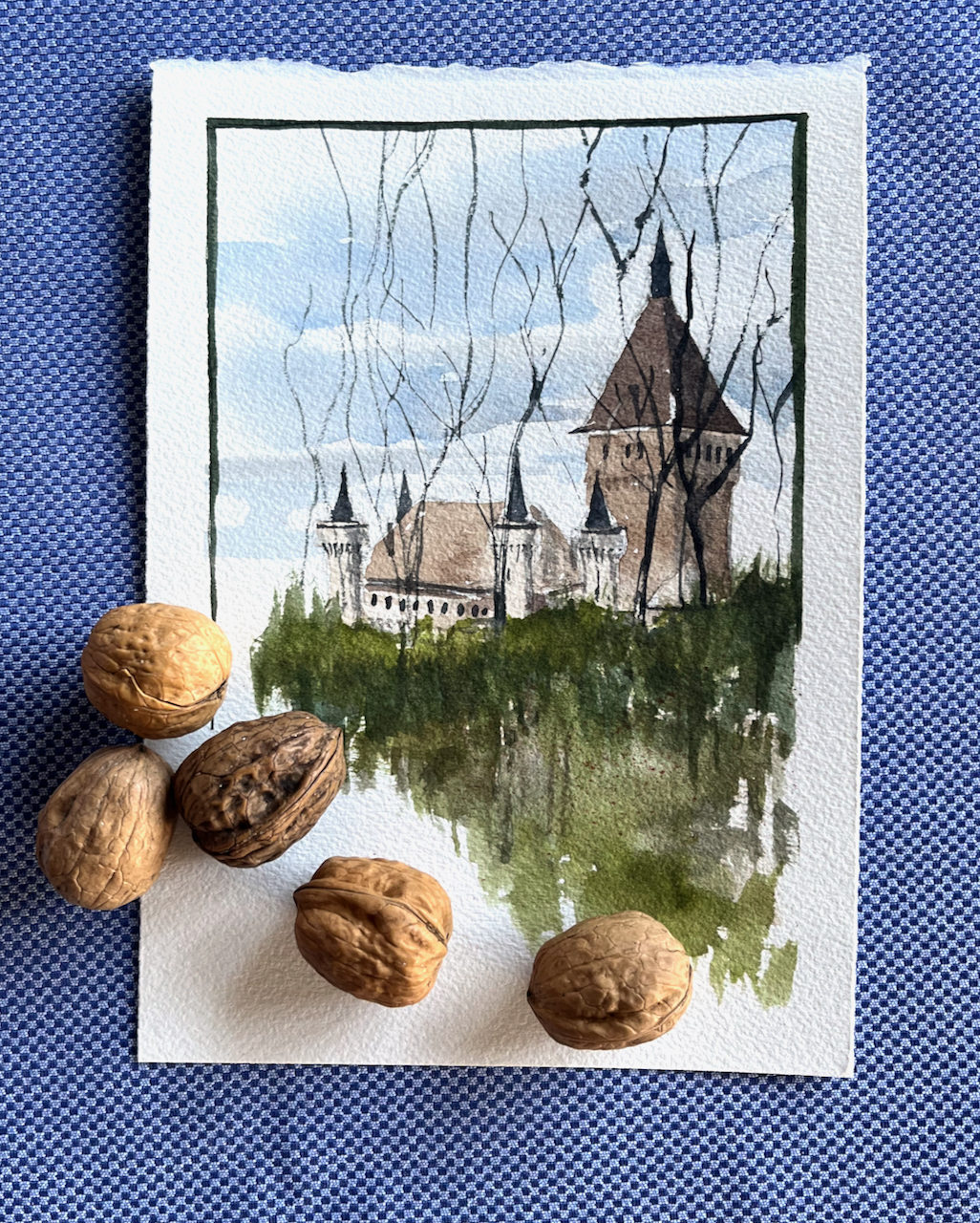
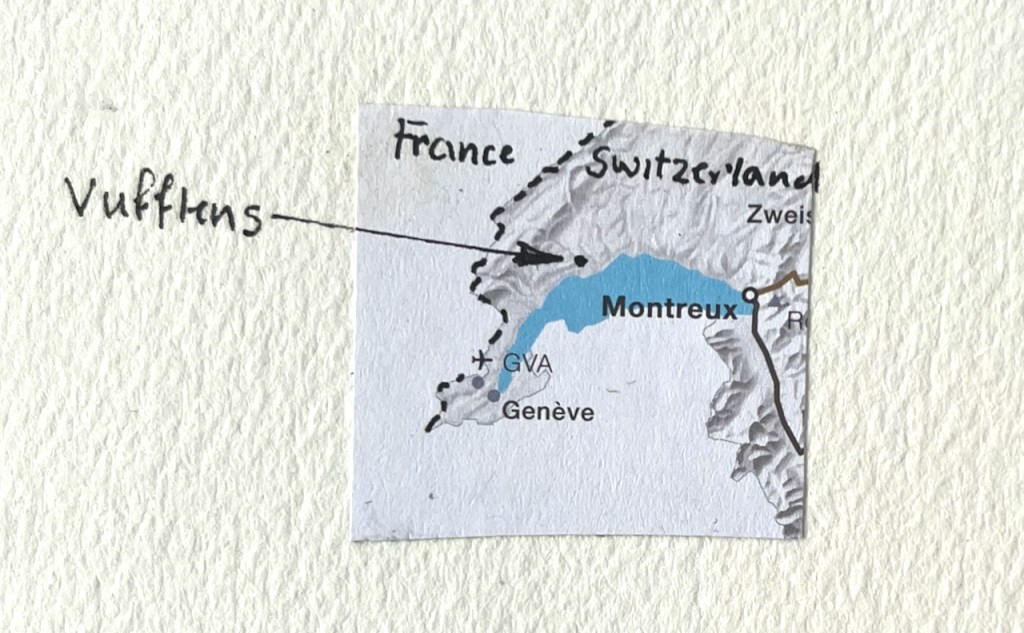
Château de Vufflens, Vaud, Switzerland

Fine rain started as I sketched the Château de Vufflens. At first I thought I could keep sketching. But then rain arrived in large-size drops, some containing ice. I took refuge under an archway. There was a view of the castle from there, but a different view. Also, standing there, I was, very possibly, in someone’s garden. I am not sure about Swiss laws on trespass. All I was sure of was that there would be laws. I assembled suitable French phrases in my head, to be ready to explain and apologise. And I restarted the sketch from this new angle. Then the rain stopped.

I inspected the sky suspiciously. I watched the cloud movements. Clouds just appear here, over the mountains, as from a volcano. They don’t proceed in an orderly succession as they do over the Atlantic. However all seemed more lightweight and friendly than it did earlier. I exited from the archway, and resumed my place on the public roadway. There are probably laws about sketching on the public roadway too.

But no-one even walked past. Not a car. Not a person. Not a dog. So that was alright. I finished the sketch. And then the rain started again.

Château de Vufflens in the morning, 24 March 2024 11:15 in Sketchbook 14

This castle is privately owned. It is on a rock in the valley, surrounded by high walls. Houses cluster at the bases of the walls. if you know the work of Mervyn Peake, think “Gormenghast”.

It was originally constructed in the middle ages, 1420-1430, for Henri de Colombier, an adviser to Duke Amadeus VIII of Savoy, I was told. It looks well maintained, and vast.

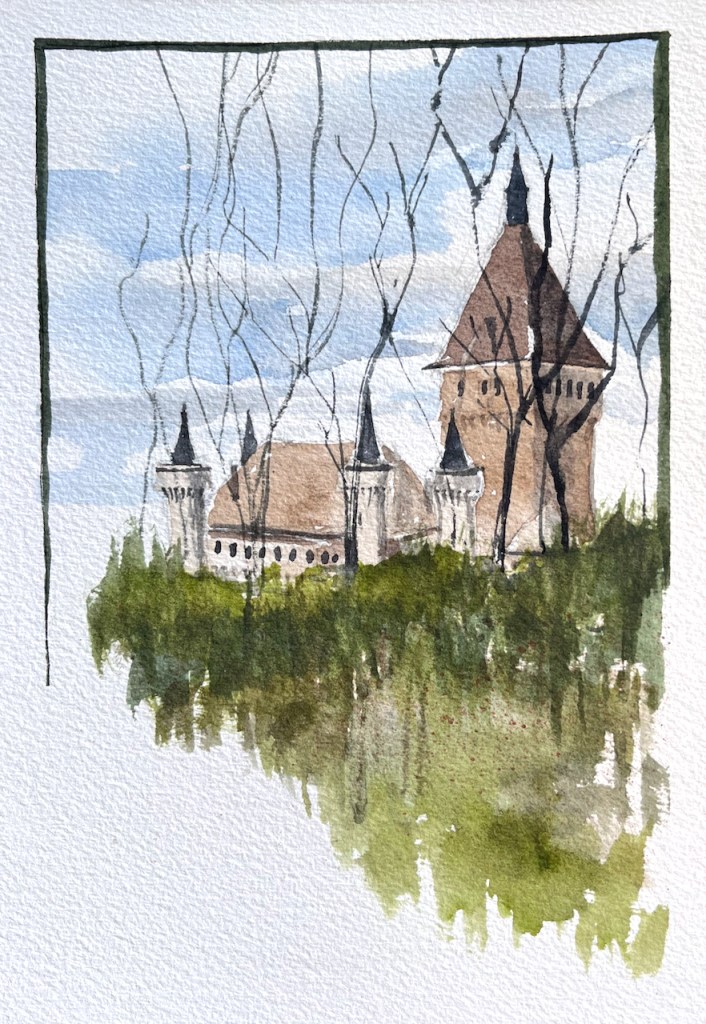
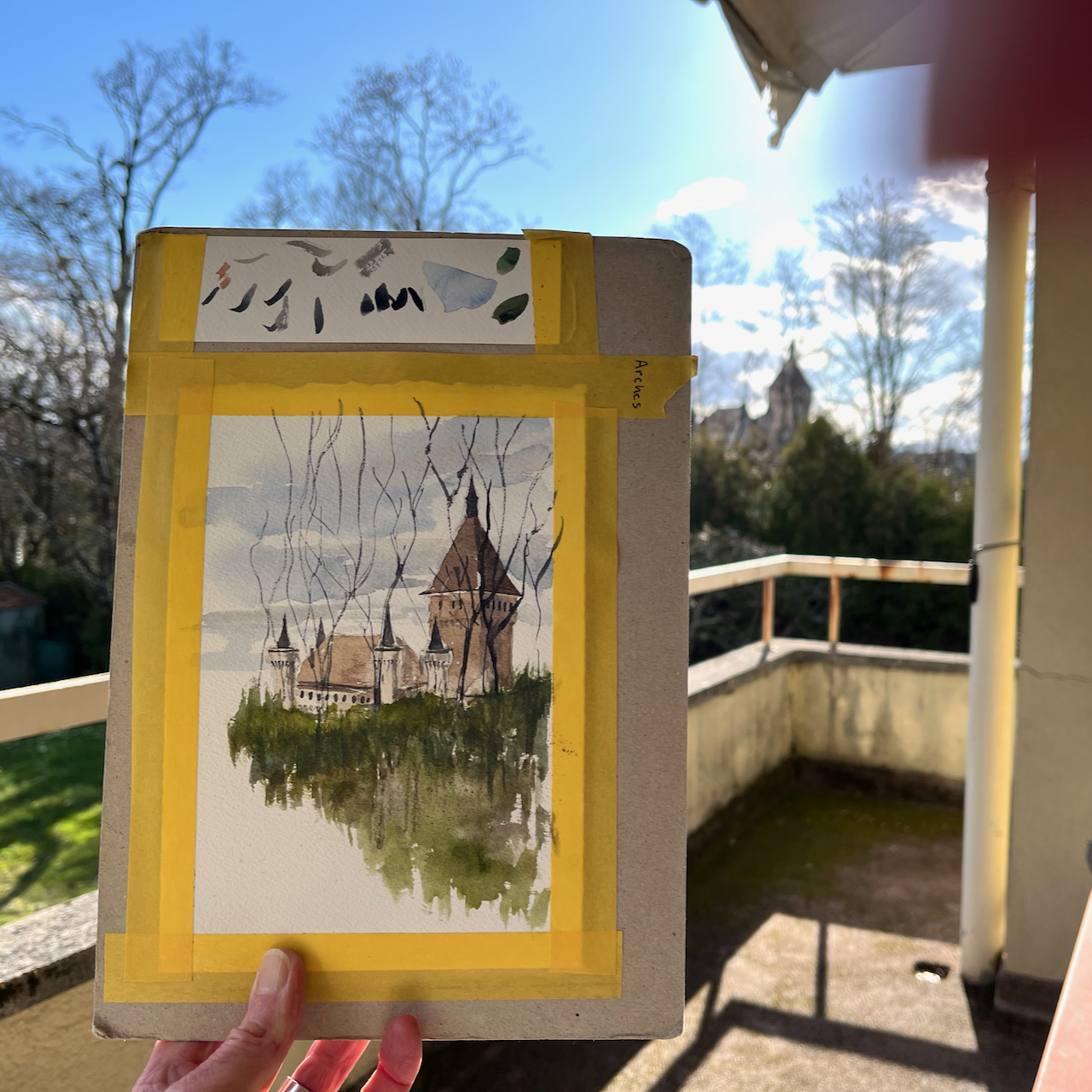
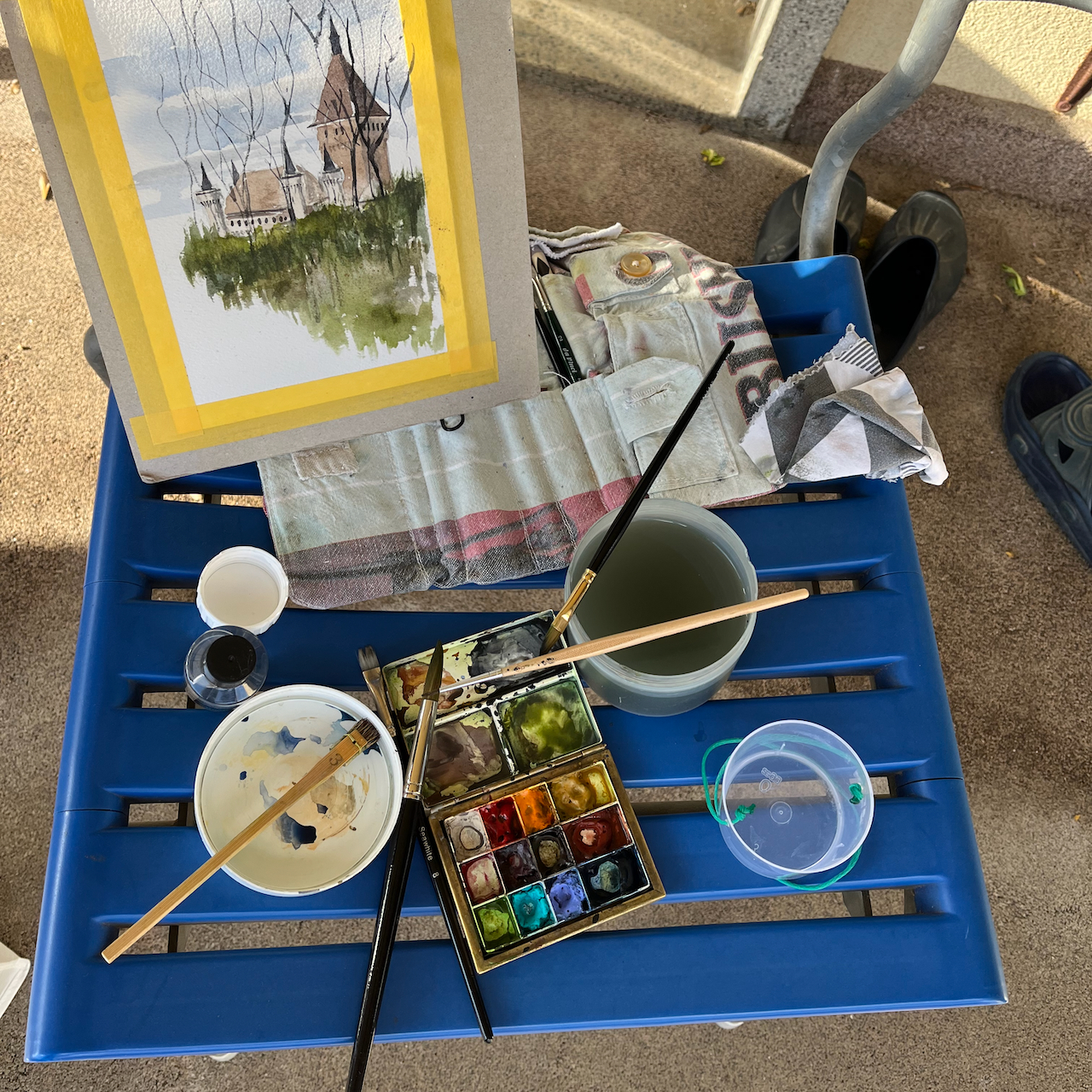
Later that day I made another attempt at drawing the castle, from a different angle. From this new viewpoint I could be under cover, but there were trees. I put the trees in.

Château de Vufflens in the afternoon. 24th March 2024, 4pm. 6″ x 8″ on Arches Aquarelle card

The walnuts came from the trees.

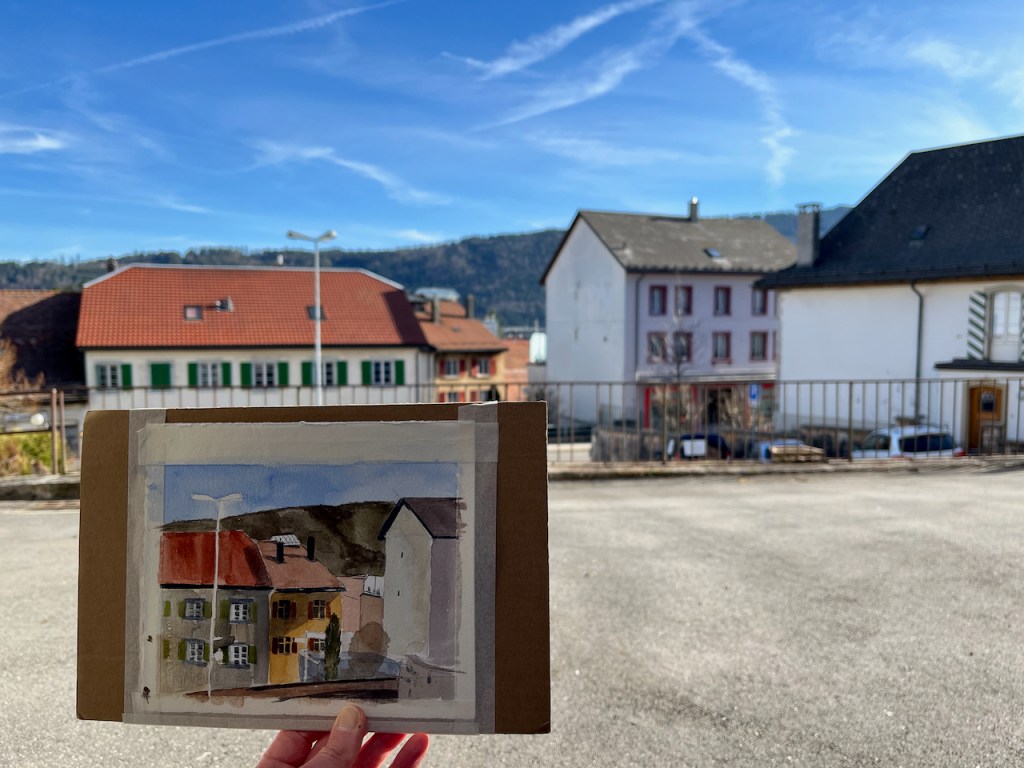
Sainte-Croix houses

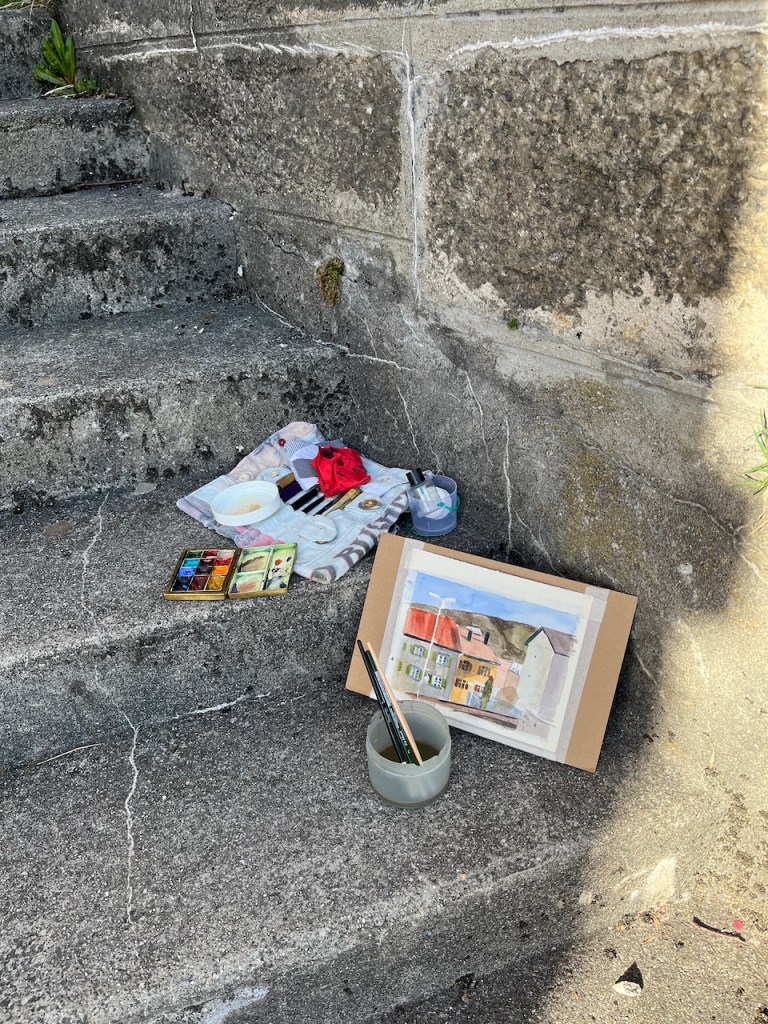
In the afternoon I sat down on the stone steps and sketched the houses that were in front of me.

Sainte-Croix houses, 8″ x 6″ postcard on Arches Aquarelle 300gsm paper. March 2024

I was struck by how the afternoon sun cast shadows on that glass screen, centre left, and illuminated the little greenhouse-type roof on the house in the centre. These are solid Swiss houses, with heavy tiled roofs and properly operational shutters. Some of the metalwork, such as the guttering and the surroundings of the chimney stacks, is in actual copper. Even the downpipes are copper.

One tree was a fir tree and was opaque. The other tree was twigs, and was transparent.

Although it was spring, this is at 1200m, and it was cold. The deciduous trees are still bare. The hill is the background is Mont-de-Baulmes. Many of the trees up there are deciduous larch.

I painted this picture in watercolour-only. Usually I use pen. Here, I did a quick pencil sketch and then straight on with the colour. It was too cold to try to get any details or do any penmanship. The solid plainness of the houses seemed to demand flat colour washes. I deliberately left lines of white between the slabs of colour – the sun always catches edges.

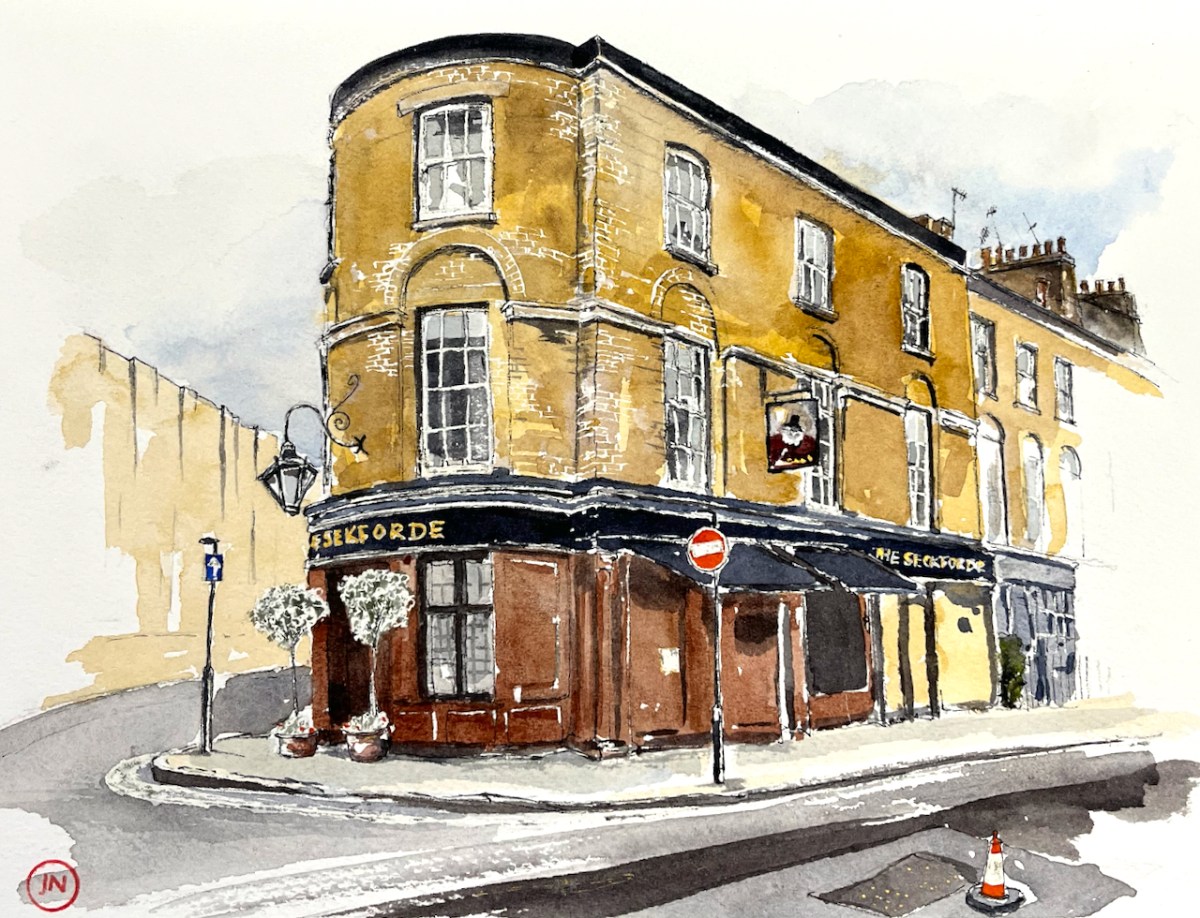
The Sekforde – a commission

The Sekforde EC1R 0HA, Clerkenwell, sketched March 2024 12″ x 9″ [commission]

This watercolour was specially commissioned to celebrate a happy event.

The colours are:

  • Mars Yellow
  • Fired Gold Ochre
  • Ultramarine Blue
  • Burnt Umber
  • plus some Horadam Random Grey, some Daniel Smith Green Serpentine Genuine, and Pyrrol Red for the street sign and road marker.
  • Gold paint for the lettering.

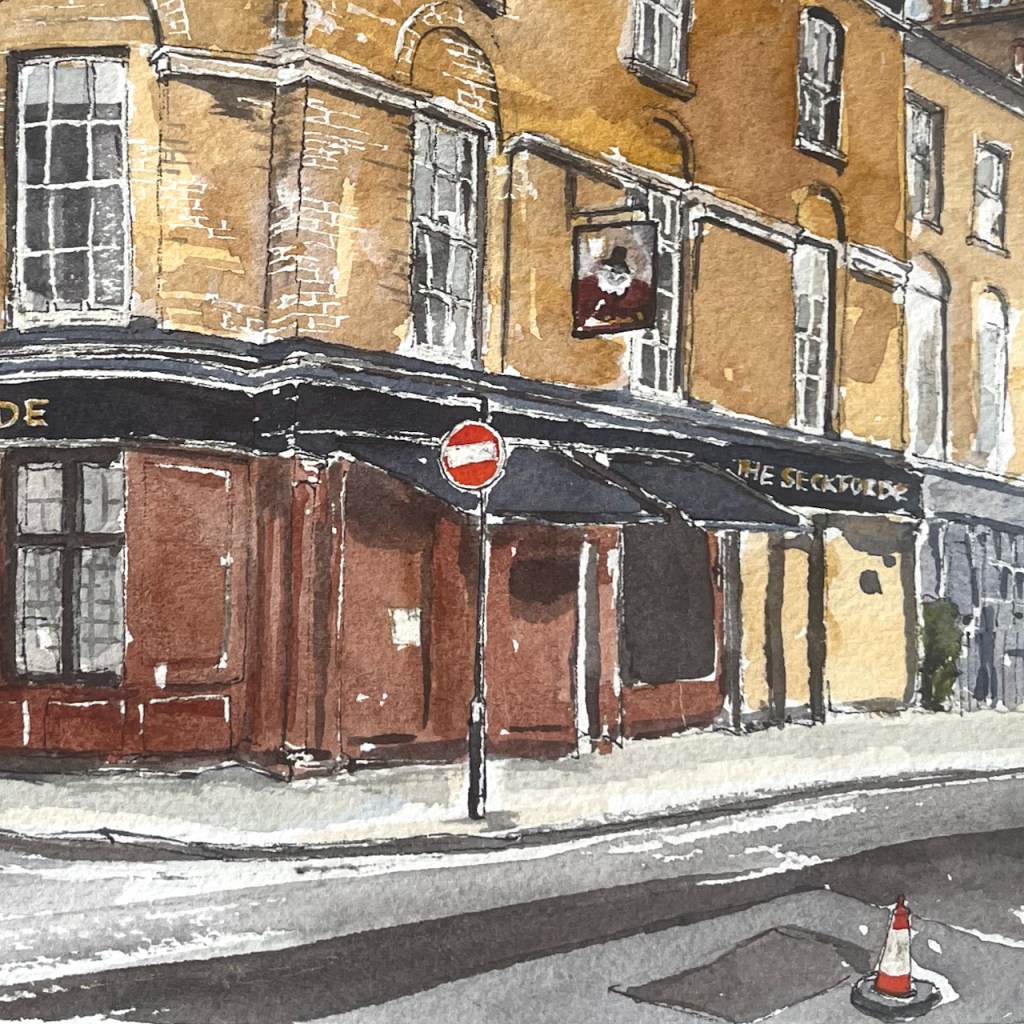
Admire the bricks! I am very pleased with this effect. It was done by applying a rubber resist, “pebeo drawing gum” to the paper before I did any painting. The paint does not adhere to the rubber resist. When I had done all the colour, I rubbed off the rubber resist and hey presto! bricks.

Thank you to my client for their encouraging words and for inspiring me to make this picture of The Sekforde. Here are some details of the drawing.

I have sketched The Sekforde previously, see this link: The Sekforde, Clerkenwell

UPDATE:

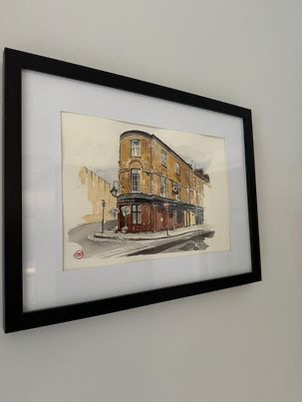
My client kindly sent me photos of the framed picture!

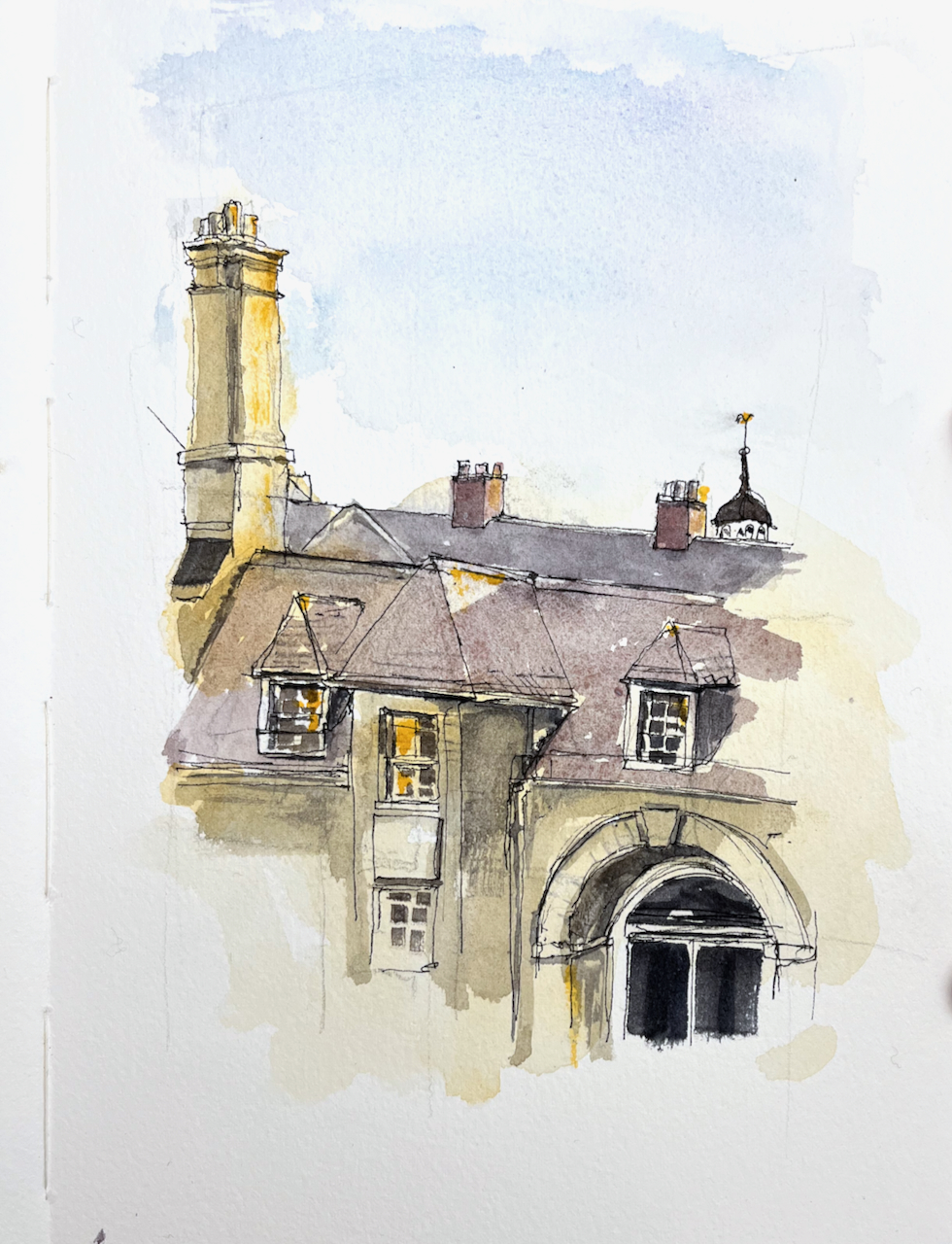
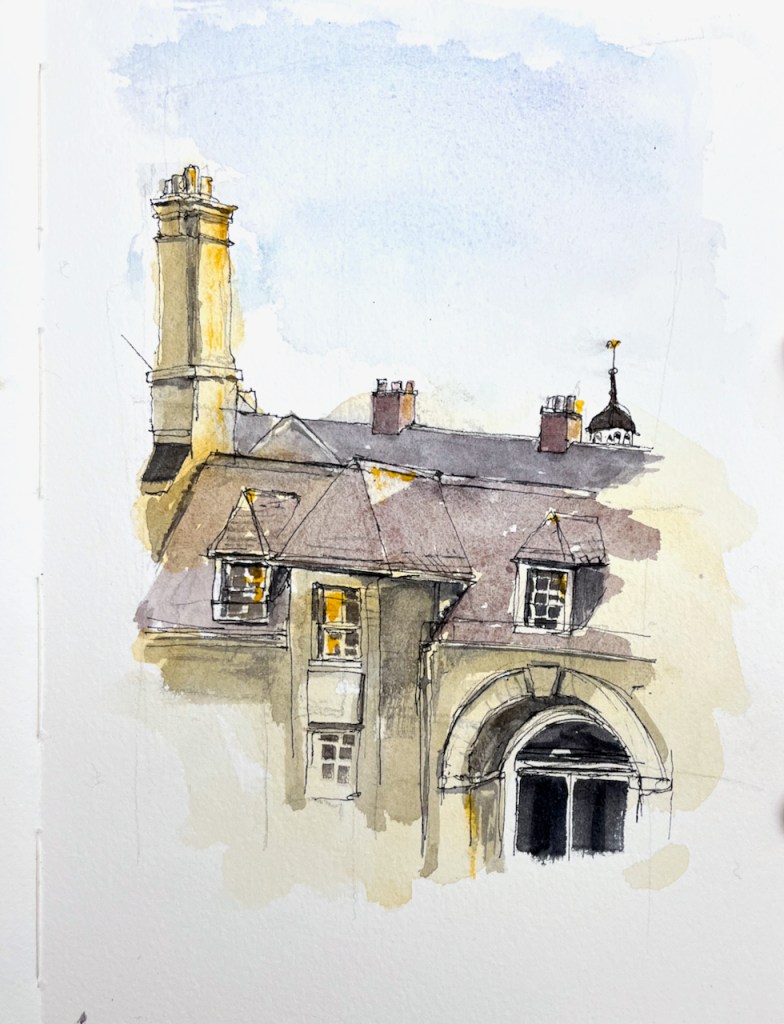
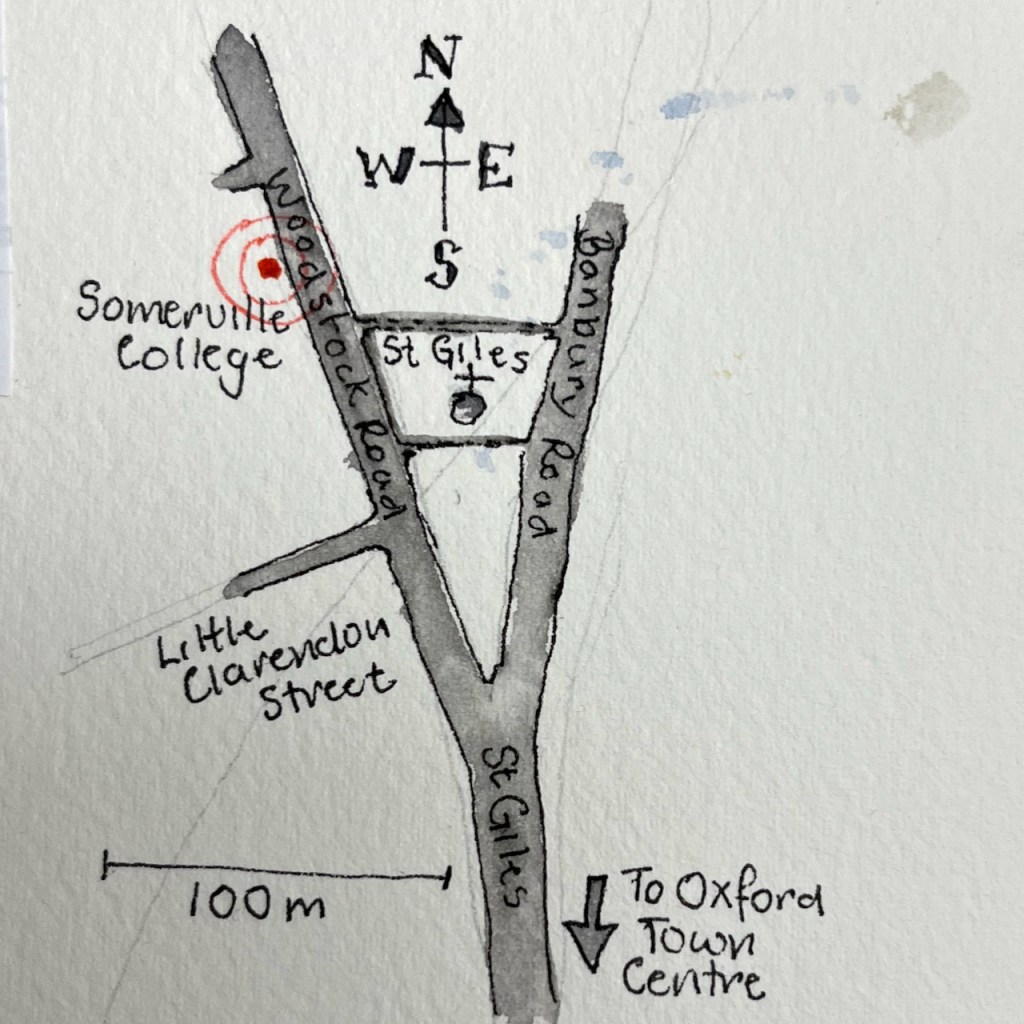
Somerville College, Oxford: Porters’ Lodge

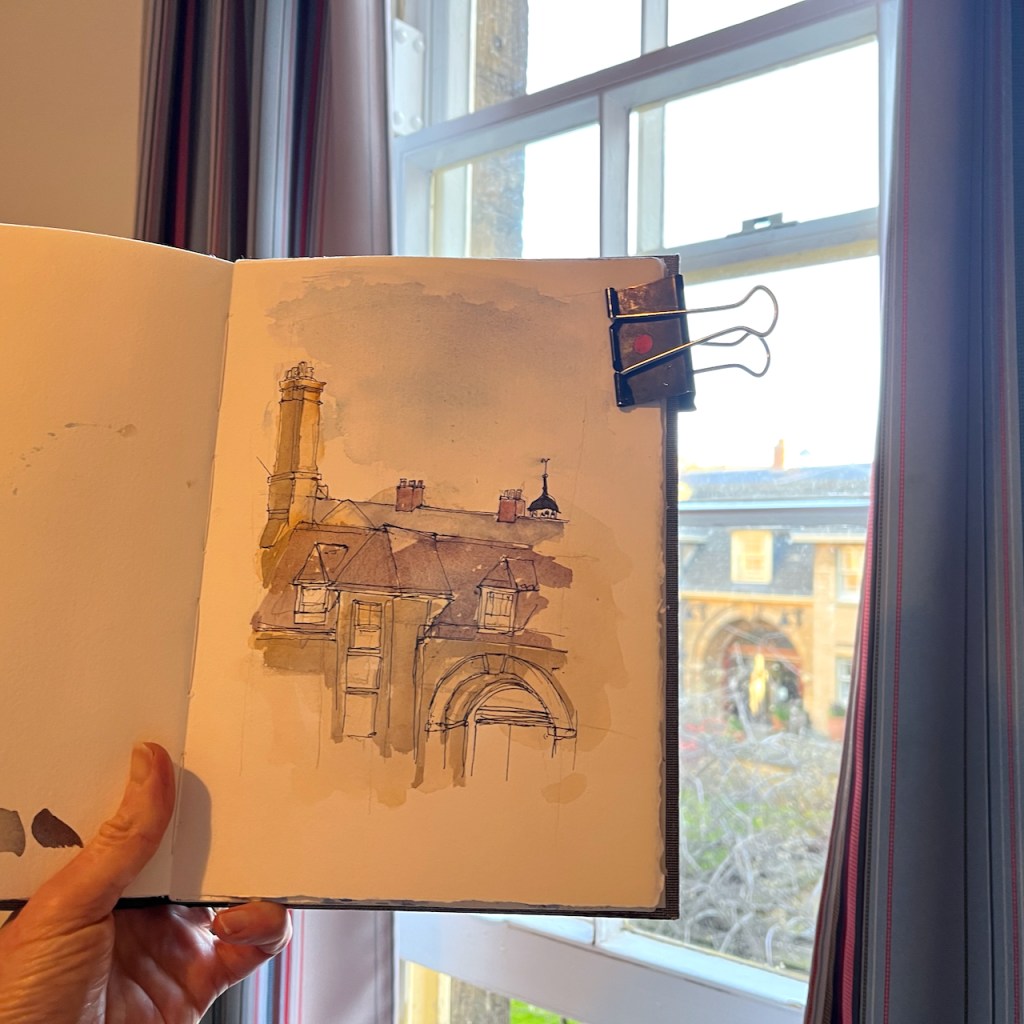
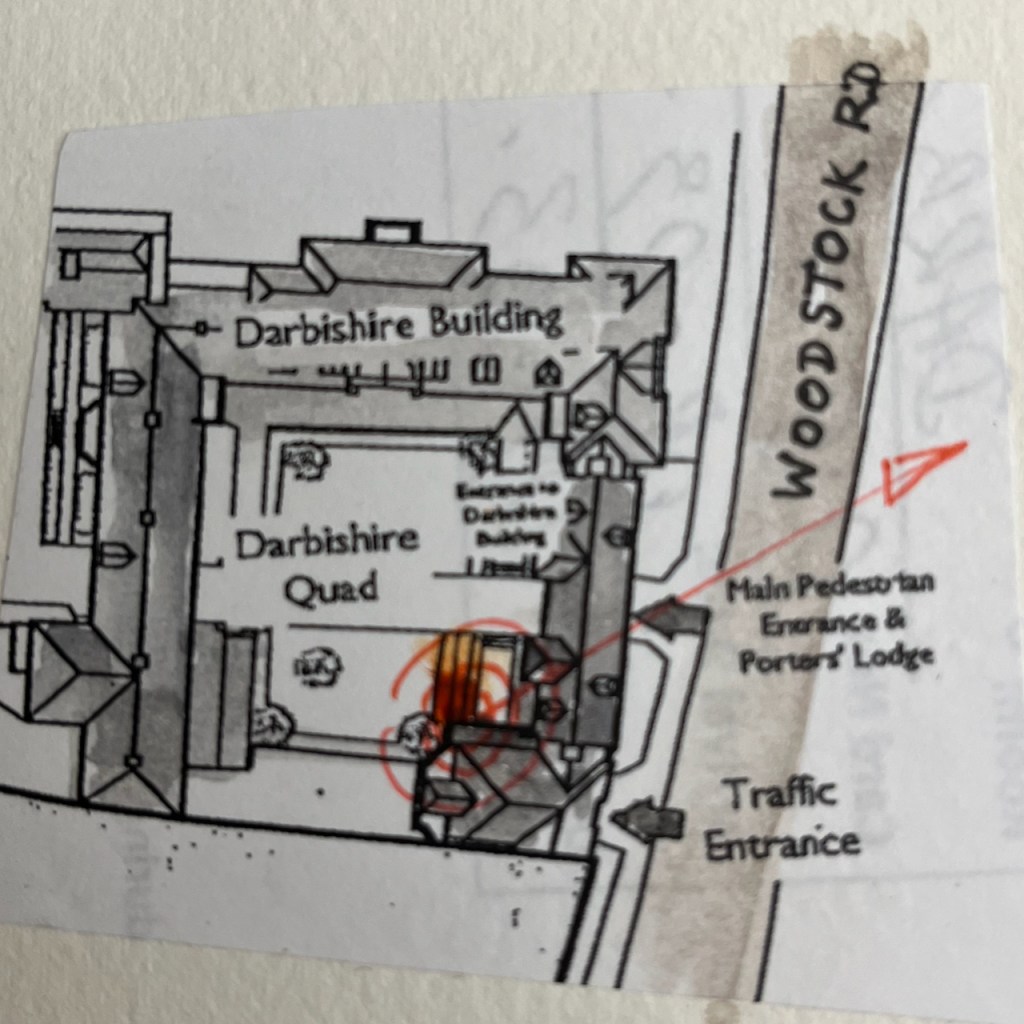
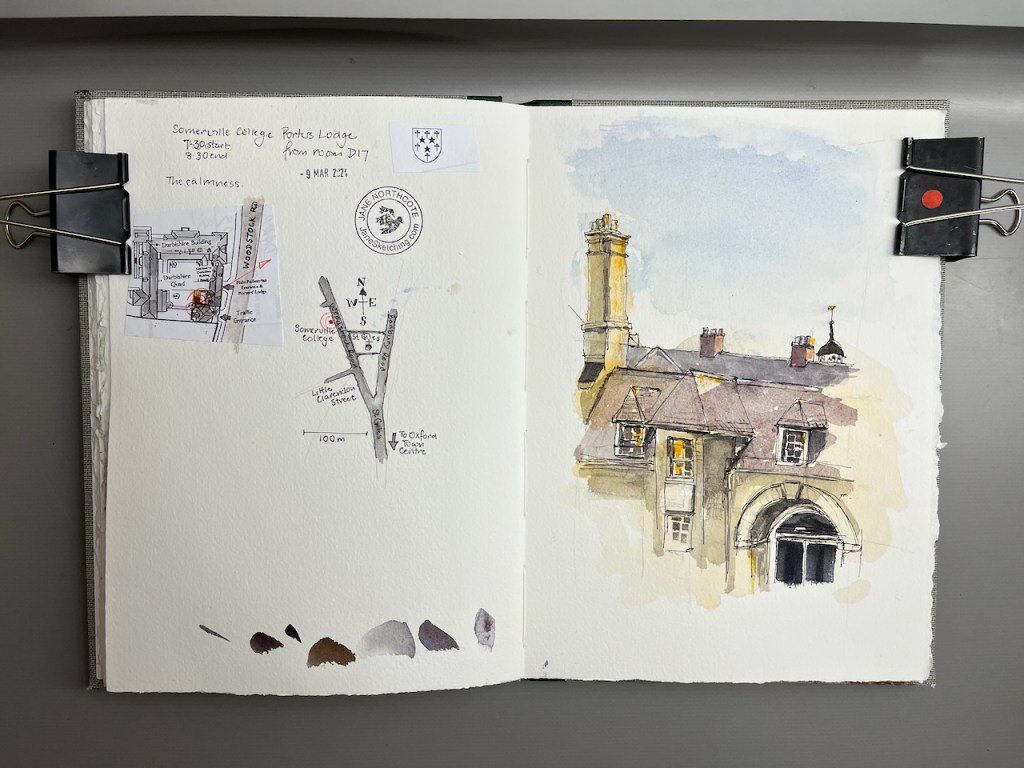
Here is the view from room D17 in Somerville College, OX2 6HD.

View from D17, Somerville College Porters’ Lodge. 9th March 2024, 07:30am, in Sketchbook 14

I sketched it quickly, before leaving, just as the sun was coming up.

Somerville College was women-only for the first 115 years of its existence. It started to admit men in 1994.

Vauxhall Tea House Theatre SE11

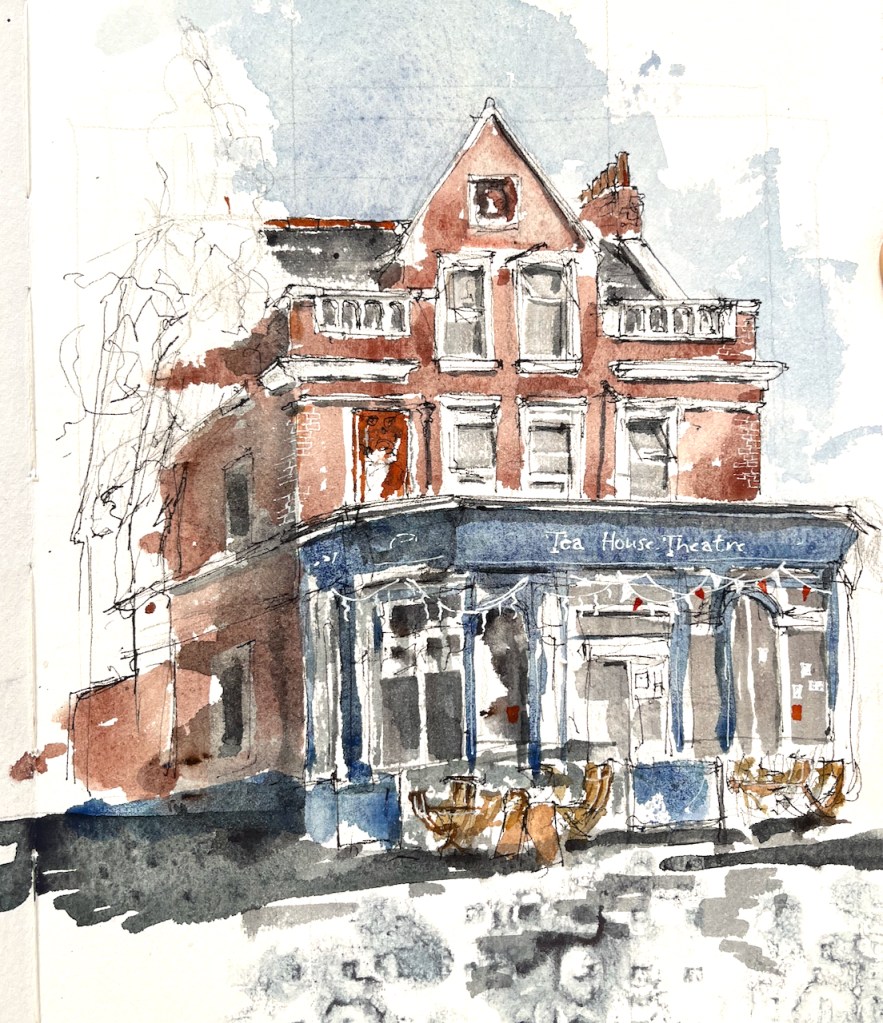
Here is a civilised place in London. It’s the Vauxhall Tea House Theatre.

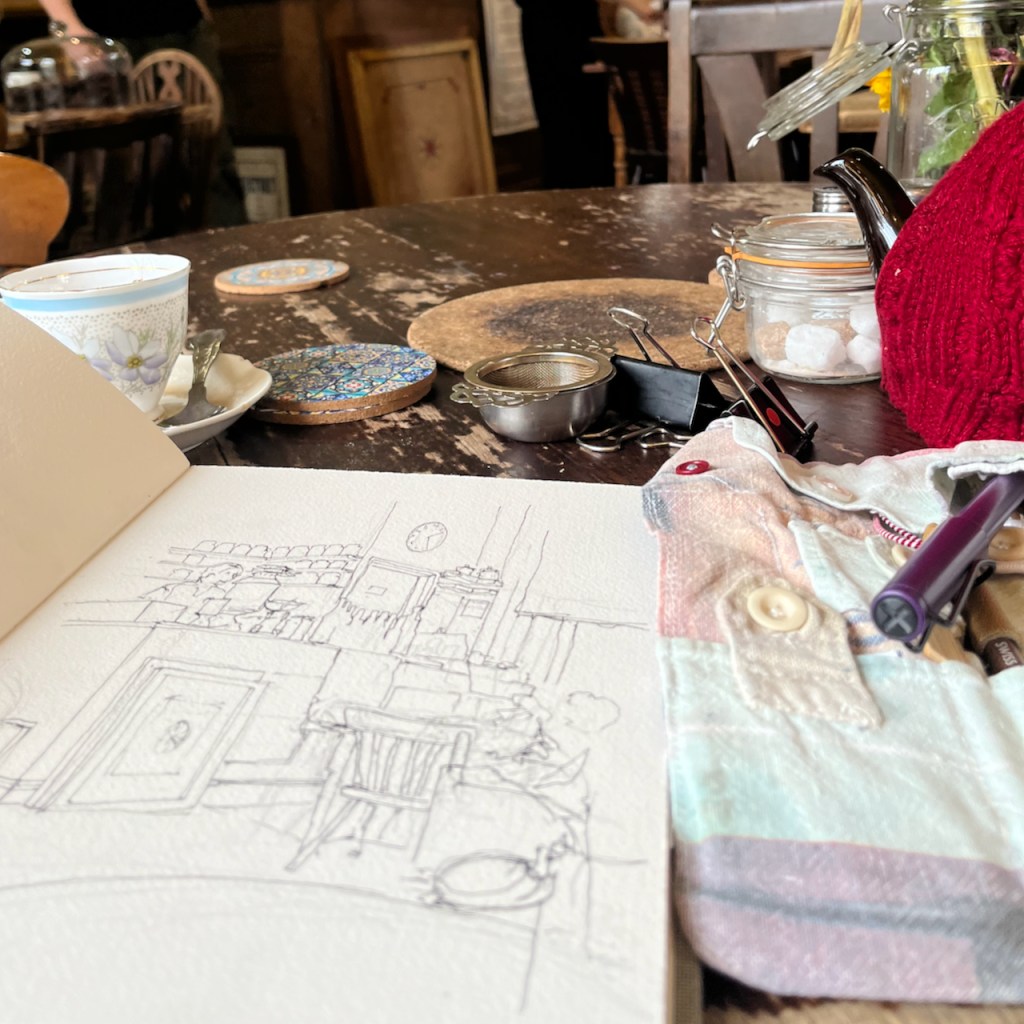
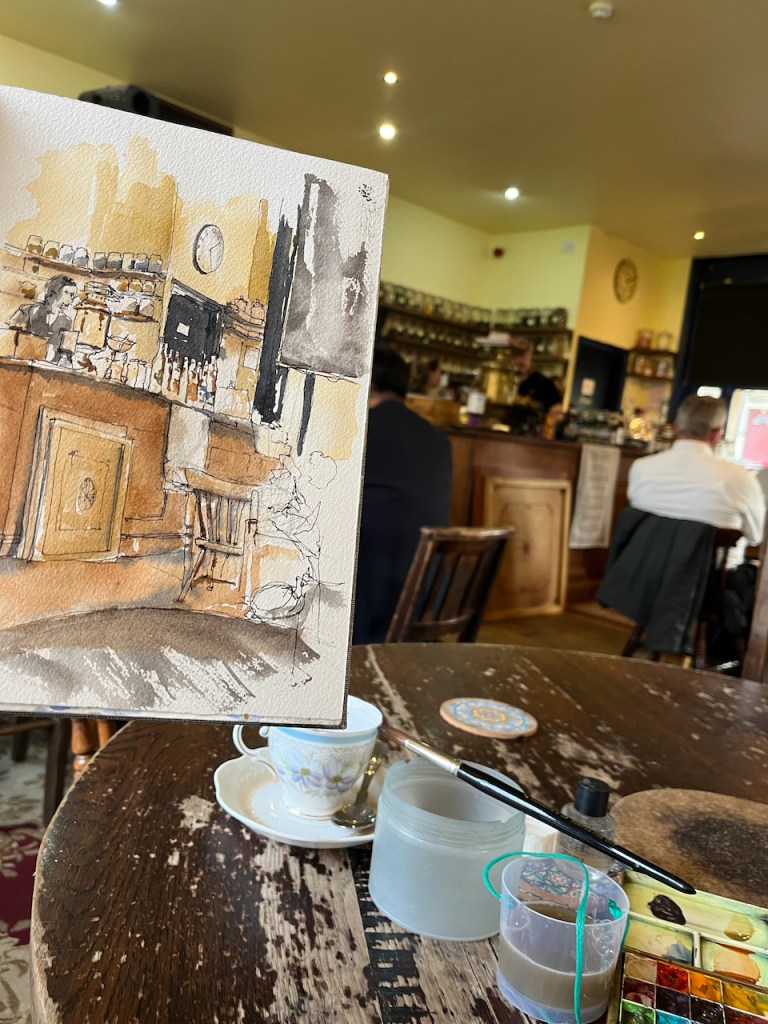
This is a picture I sketched there last week:

Vauxhall Tea House – 2:30pm 7 March 2024, in sketchbook 14

The tea I drank was their “Russian Smoky Tea”.

I’ve visited the Tea House many times. Here is an outside view from June 2022

Tea House Theatre, external view, June 2022 in Sketchbook 12

They have all sorts of theatrical events on their tiny stage. I enjoy “Don’t Go Into The Dungeon” where talented actor Jonathan Goodwin plays all of the characters to amazing effect. He specialises in Victorian mysteries. The next one is “The Hound of the Baskervilles”. Dinner is served before the performance. With scones for dessert.

Here’s where it is, just a 5 minute walk from Vauxhall Station.

And in more detail:

Here’s my sketchbook page:

Sketchbook 14

Cambridge Hall, Tin Tabernacle, Kilburn NW6 5BA

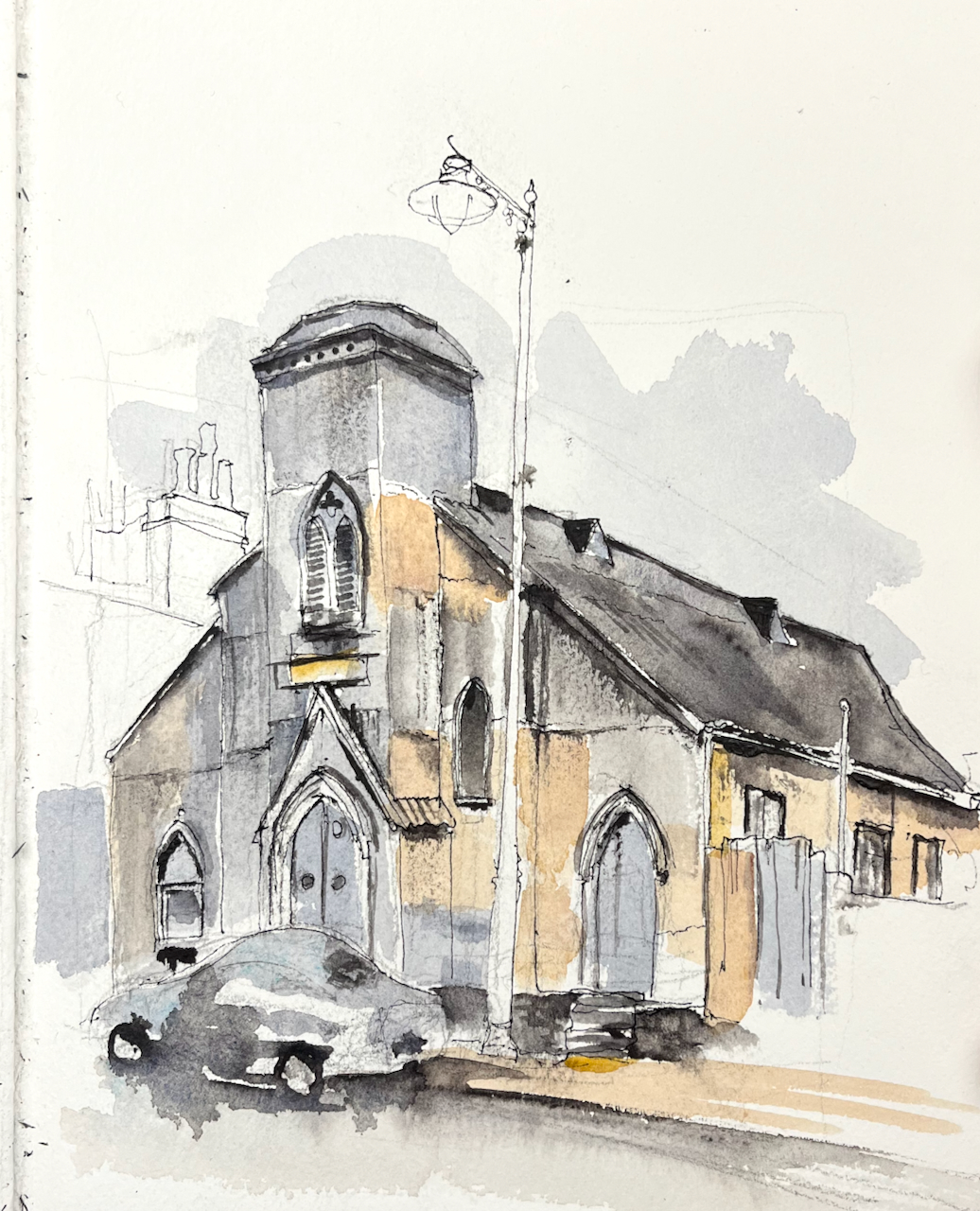
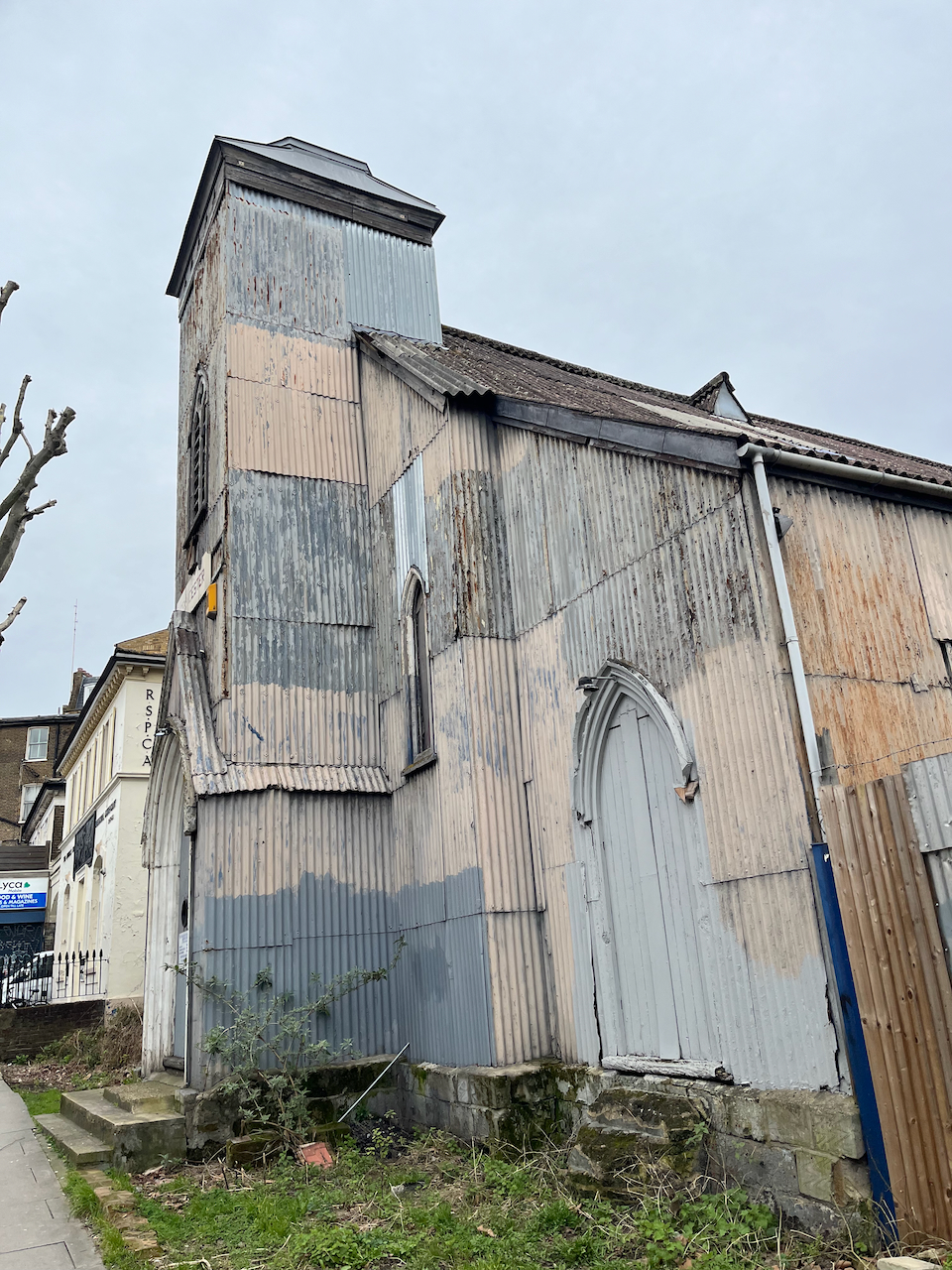
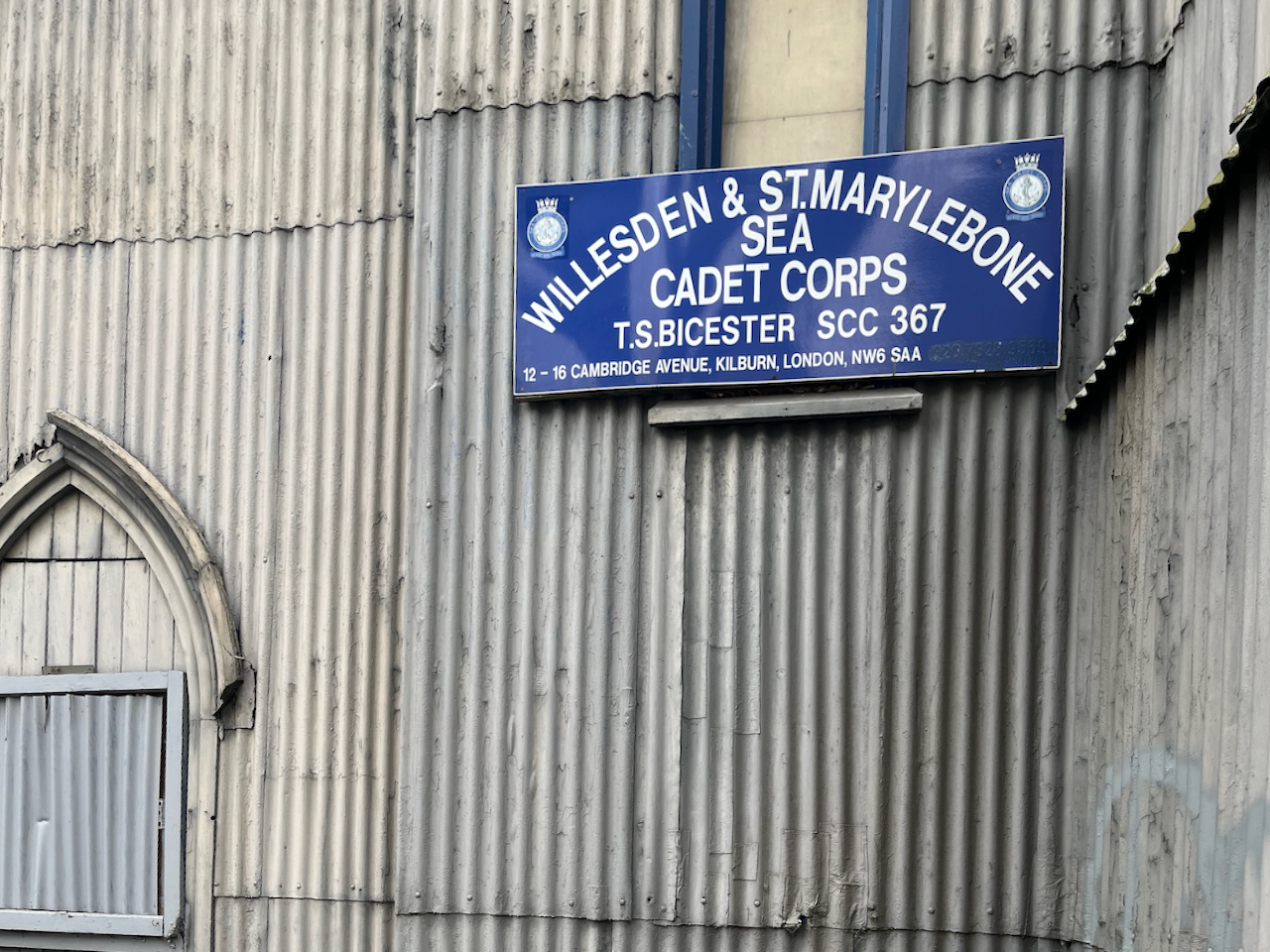
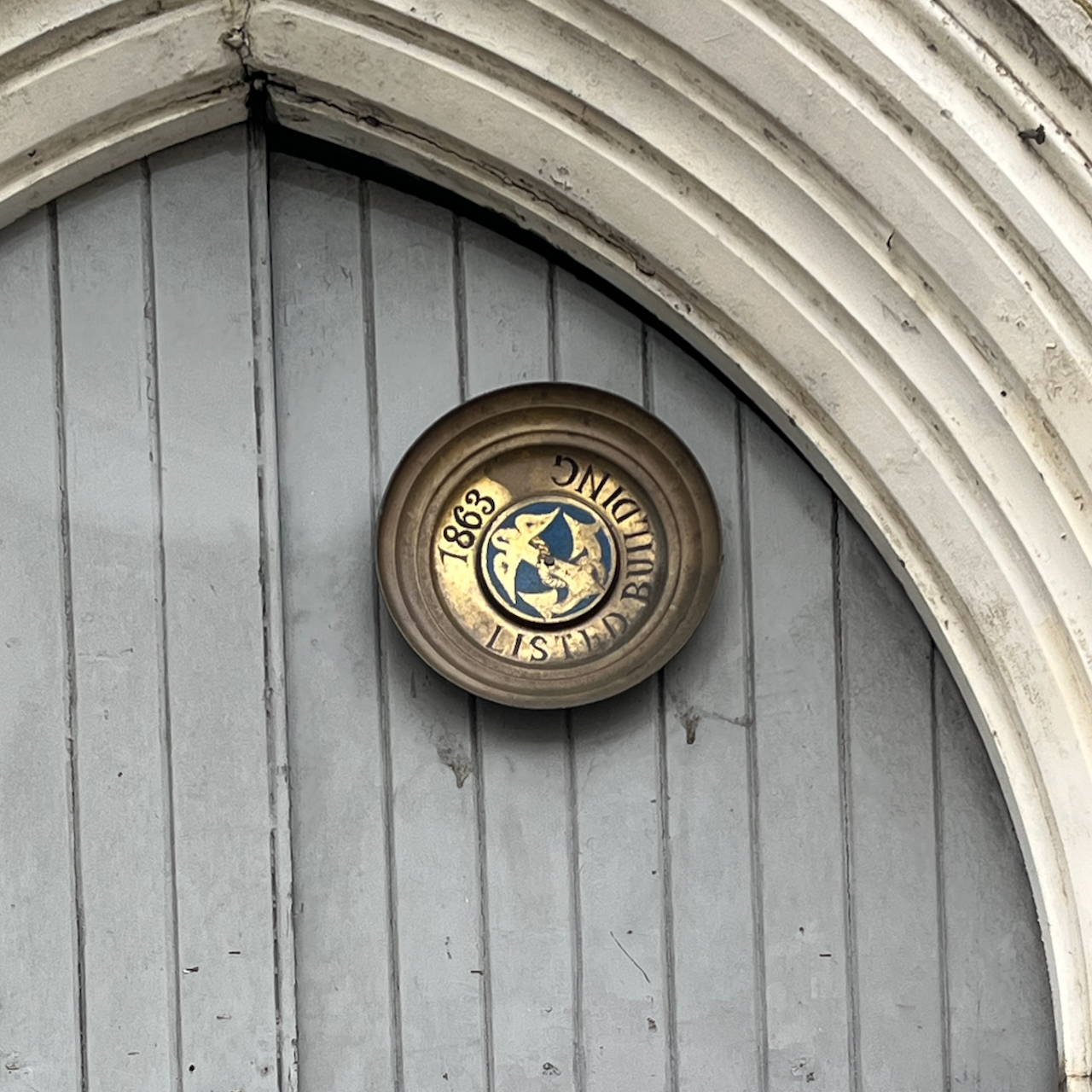
I was reading about “tin tabernacles” having sketched the “Tin Tabernacle” in Esher. I discovered, via a Historic England blog article, that there is a Tin Tabernacle in Kilburn in London. So I went to have a look. It is an “iron church” built of galvanised corrugated iron in 1863. It used to have a steeple, but that has disappeared.

Here it is now:

Cambridge Hall, Cambridge Avenue, Kilburn NW6 5BA, sketched 28 February 2024 3pm in sketchbook 14

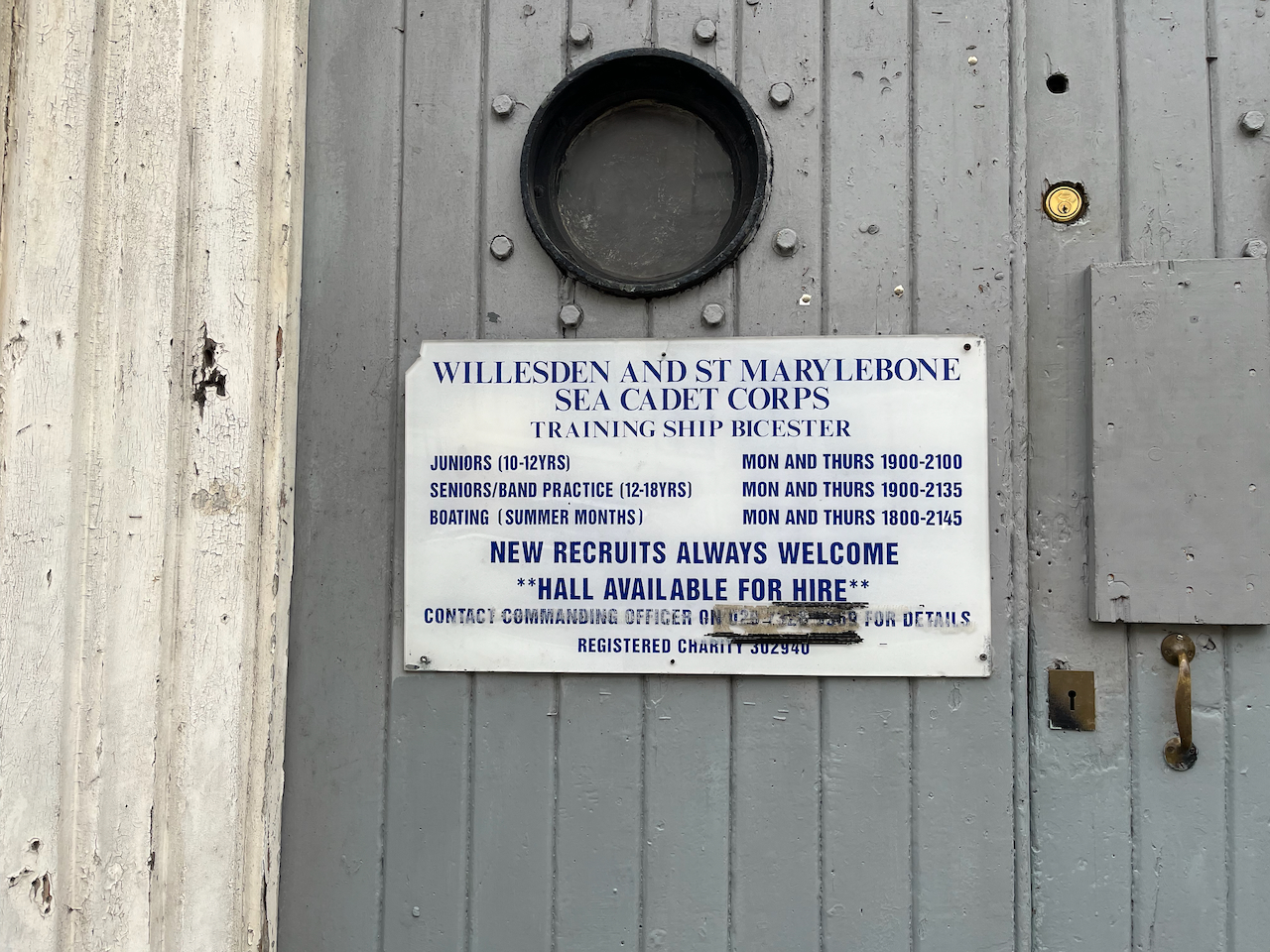
The building was built as a church, and more recently was a centre for Sea Cadets. Its future is under discussion, according to an article on the London Historic Buildings Trust site (LHBT).

The site is owned by Notting Hill Genesis Housing Association (NHG).  LHBT are currently working with NHG and the Sea Cadets, supported by Historic England and the Conservation Officer at Brent Council, to explore how the building can be stabilised and used in the future.

https://londonhistoricbuildings.org.uk/index.php/tin-tabernacle-kilburn/

The latest date mentioned in this article is 2021, so I guess the exploration is still going on. It’s listed as a “current project” on their website. The building was looking a little precarious when I visited this year (February 2024). An alarm was sounding inside.

It is Grade II listed, and on the Heritage at Risk Register. The listing is on this link. It is currently an events venue, the website is:
http://tintabernaclekilburn.org/

Here are some photos of the outside:

The building is about 150m north of Kilburn Park underground station on the Bakerloo Line.

The London Historic Buildings site has a “Virtual Visit” link, so you can see what it looks like inside, and there is a timeline of the building (click below to see it, 2 pages PDF):

It’s a building with a varied history. I wonder what will happen to it?

Sketch and notes in sketchbook 14

UPDATE: 6th March 2026

An article on “Ian Visits” says that the Ministry of Defence is funding the removal of the two training guns inside the church:

Their removal is now expected to make it easier to pursue restoration works and attract the significant external funding needed to repair the building and secure a sustainable future. The London Historic Buildings Trust is leading the restoration work with the aim of opening the Tin Tabernacle as an active community asset for Kilburn.

“Ian Visits” website: https://www.ianvisits.co.uk/articles/the-church-with-anti-aircraft-guns-kilburns-unusual-naval-relics-removed-88029/

St George’s Esher, Old Church, KT10 9PX

After sketching the Tin Tabernacle in Esher West End, I walked into the town centre to sketch another St George’s: St George’s Old Church.

St George’s, Esher, Old Church. Sketched February 2024 in Sketchbook 14

Here is the notice by the door:

ST GEORGE ESHER
This church is cared for by
The Churches
Conservation Trust
.
Although no longer needed for regular worship, it remains a consecrated building, a part of England’s history, maintained for the benefit of this and future generations.

Here is the notice hanging from a post by the gate:

Welcome to ST. GEORGE’S CHURCH

Esher’s oldest public building and one of the earliest Anglican churches.
Most of the structure is 16th Century Tudor Two 18th Century features of te Church are a 3-decker pulpit and the Newcastle chamber pew designed by Sir John Vanburgh for Thomas Pelham., Duke of Newcastle and his brother Henry: both served as Prime Minister.
Princess Charlotte – heir to George IV – and Prince Leopold – who became the first King of the Belgians – worshipped here when they lived at Claremont after their marriage in 1816.
Queen Victoria, Leopold’s niece attended services when visiting her uncle and later came with Prince Albert.
When Christ Church was completed in 1854 St George’s ceased to be the Parish Church.
Restored by the community in 1965 it remains a consecrated building now in the care of the Churches Conservation Trust. Several services are held each year. It is also a venue for music and the arts.

I sketched it from the graveyard, as the sun set. So many angles and views! It has been altered and added to and mended, yet is graceful and somehow perfect.

Behind the church there were crocuses.

A wonderful place! Tranquillity just off the main road.

Here’s a map. I walked here from the St Georges West End, along the route marked with a red line on the map: a half hour’s walk, just over a mile.

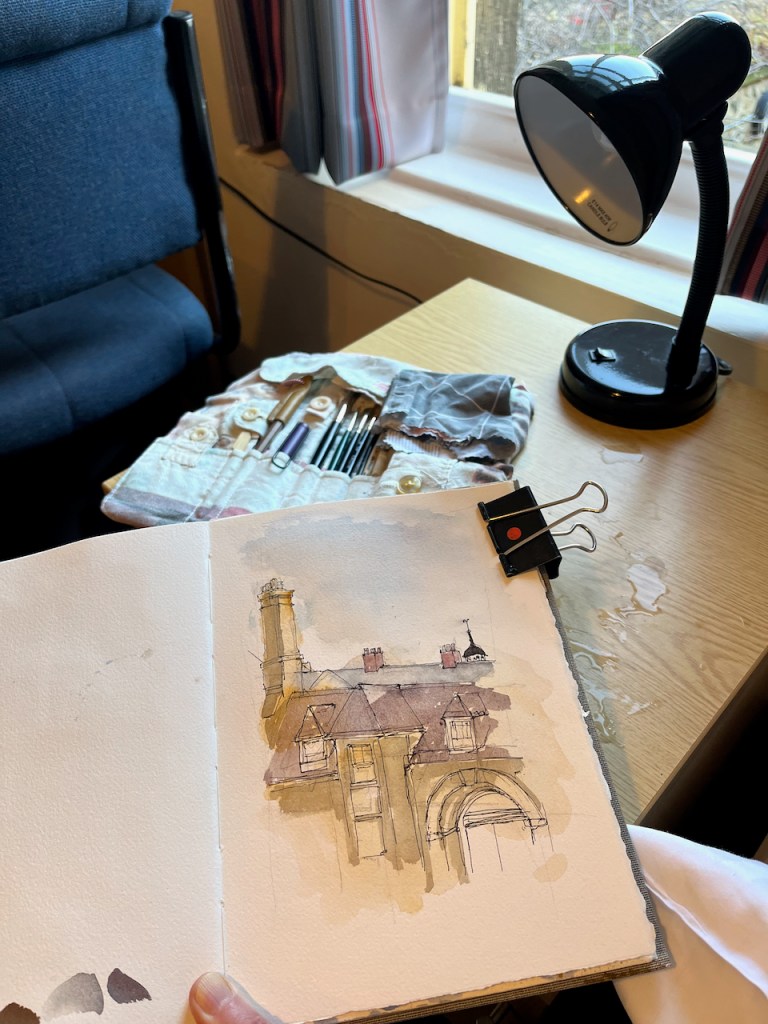
Here is work in progress on the drawing.

Tin Tabernacle, St George’s West End, Esher KT10 8LF

Beside the green on the West side of Esher stands this iron church, St George’s West End.

St George’s West End, Esher. Sketched on location February 2024, in Sketchbook 14

It has a single bell in its small bell tower, and a fence made in a particular way, which I tried hard to show. I wondered if it is intentionally in the shape of a line of crosses, appropriate for a Christian church.

This is one of dozens of “tin tabernacles” or iron churches across the UK. Wikipedia has a whole list. Some of them are strikingly similar to this one.

They were built in the late 19th century, in response to expanding demand, using the new technology of corrugated iron. Many of them, including this one, were pre-fabricated.

According to a 2004 article on this church by Angela Stockbridge the land was donated by Queen Victoria in 1878. “A need was felt to make provision for “the spiritual wants of the “Aged, Poor and Infirm of West End”” and to spare them from the steep and often muddy climb into Esher” she writes. It was intended to be a temporary church. 145 years later, here it is, still standing, and still hosting services.

The church is dedicated to St George. Above the porch is a stained glass window, evidently showing the Knight slaughtering the Dragon. I could just make him out standing on the stirrups of his white horse. The church was closed when I visited, but I hope to go inside on a future occasion. I am told that inside it is cladded with white-painted wood panelling.

I sketched the church from the village green opposite. It was damp and muddy. When I’d had enough, I retreated to the “Prince of Wales” for some lunch. Then I went on to sketch the church in Esher town centre: another St George’s.

Esher is to the West of London, with a main line railway station in to Waterloo.

“They do tend to heat up in summer and stay cold in winter, and the rain makes a noise on their roofs, but they have proved remarkably sturdy. As one commentator writes, “Tin Tabernacles are an important if brief and overlooked episode in the history of church architecture,” and have a claim to “be recognised as listed buildings, particularly as examples of prefabrication” (Dopson 204-05).”
Dopson, Laurence. “Tin Tabernacles.” Words from “The Countryman”. Ed. Valerie Porter. Newton Abbot: David & Charles, 2007. 204-05.

https://victorianweb.org/art/architecture/churches/58.html
In the “Prince of Wales”

St Edmund, Kessingland NR33 7SQ

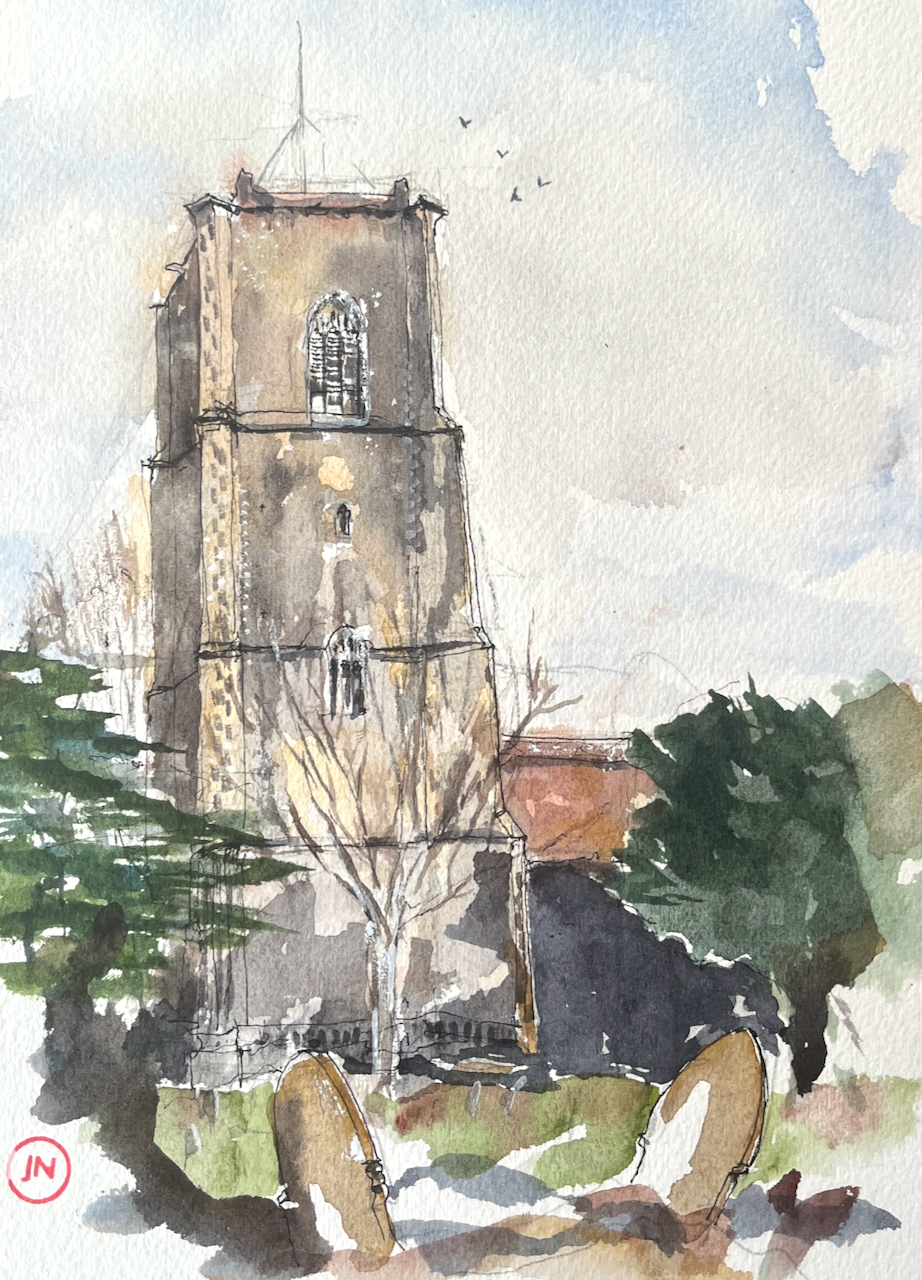
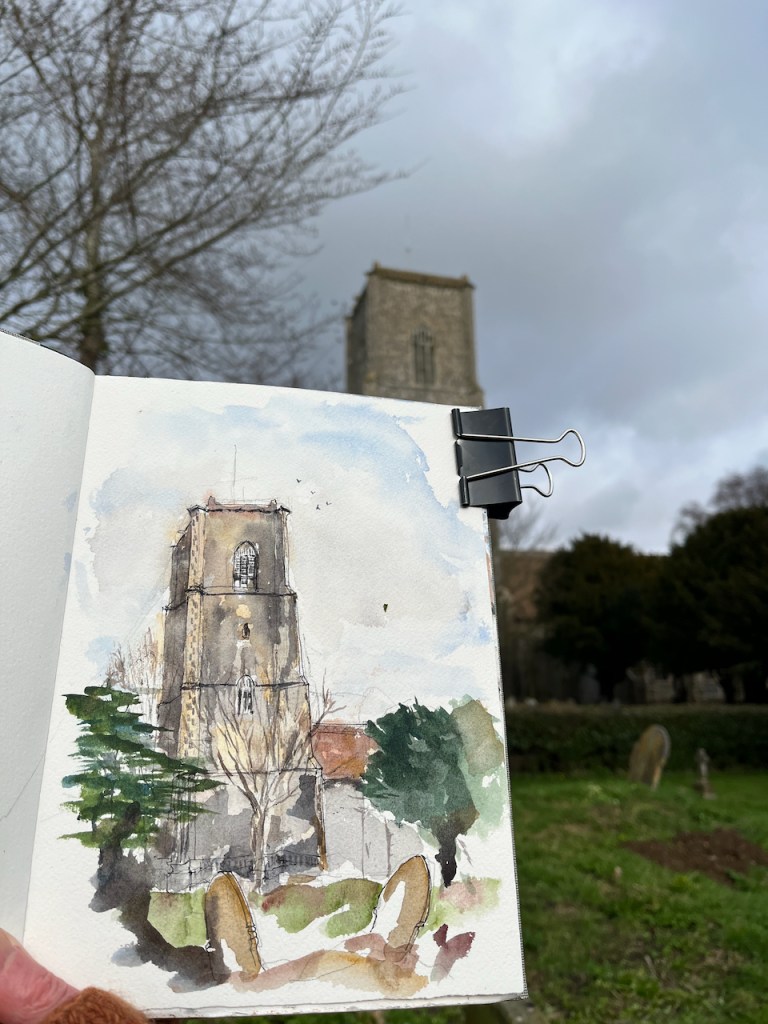
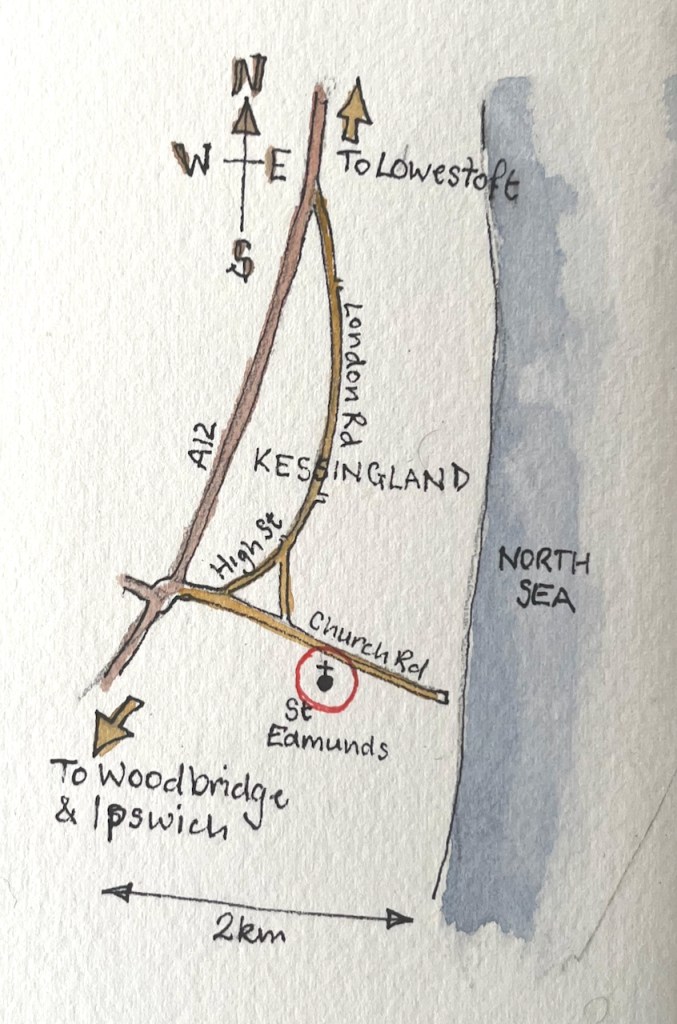
Here is the church of St Edmund, Kessingland, seen from the south.

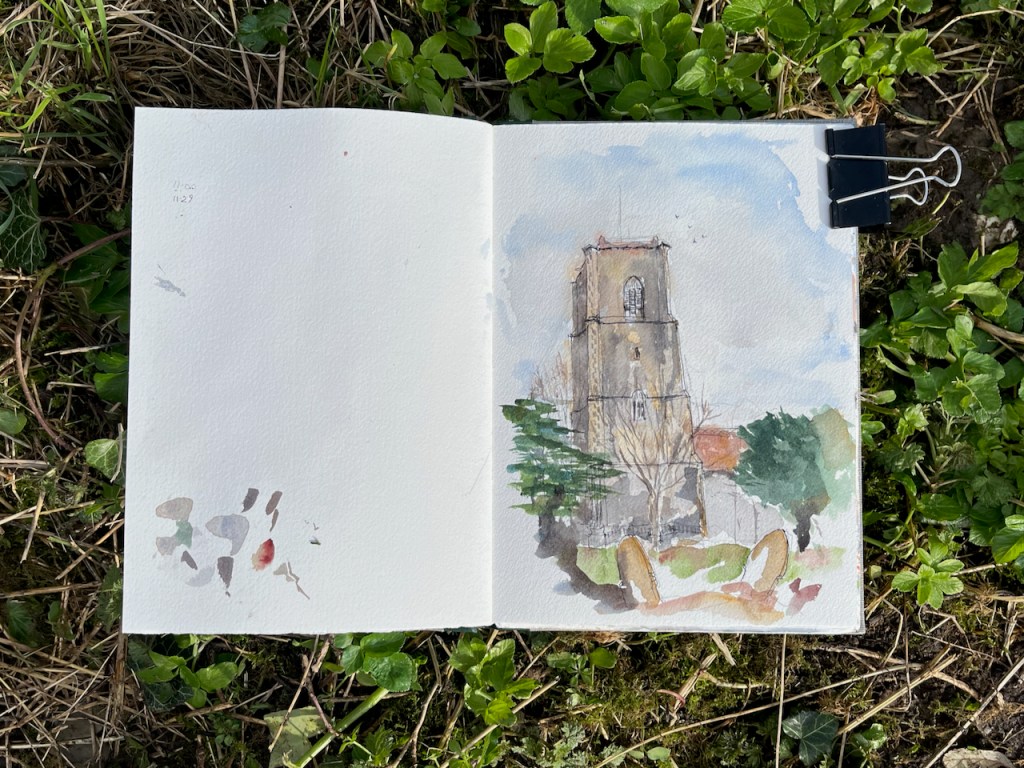
Church of St Edmund, Kessingland. Sketched 11 February 2024, 12:30 in Sketchbook 14

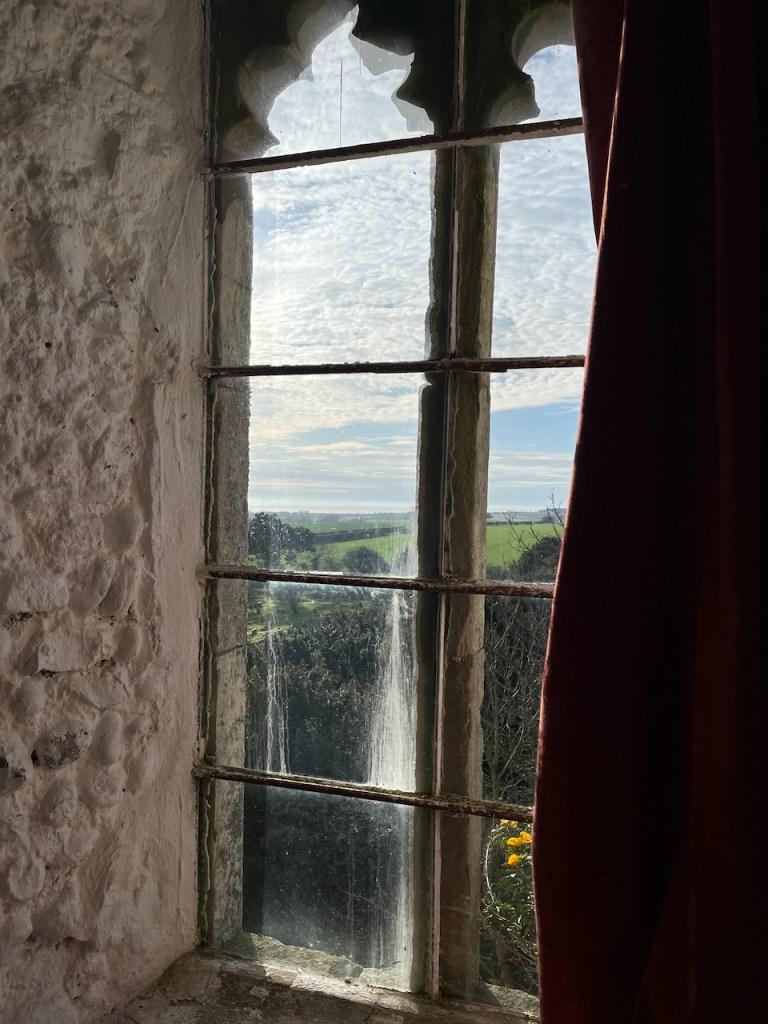
I was a guest of the bell ringers, who kindly invited me to their loft. There are six bells. I witnessed their splendid peals, which made the tower shake slightly under my feet. This was a surprise to me, as the walls of the tower are about three foot thick. But apparently it’s perfectly normal. Then I went outside and sketched the church from the south.

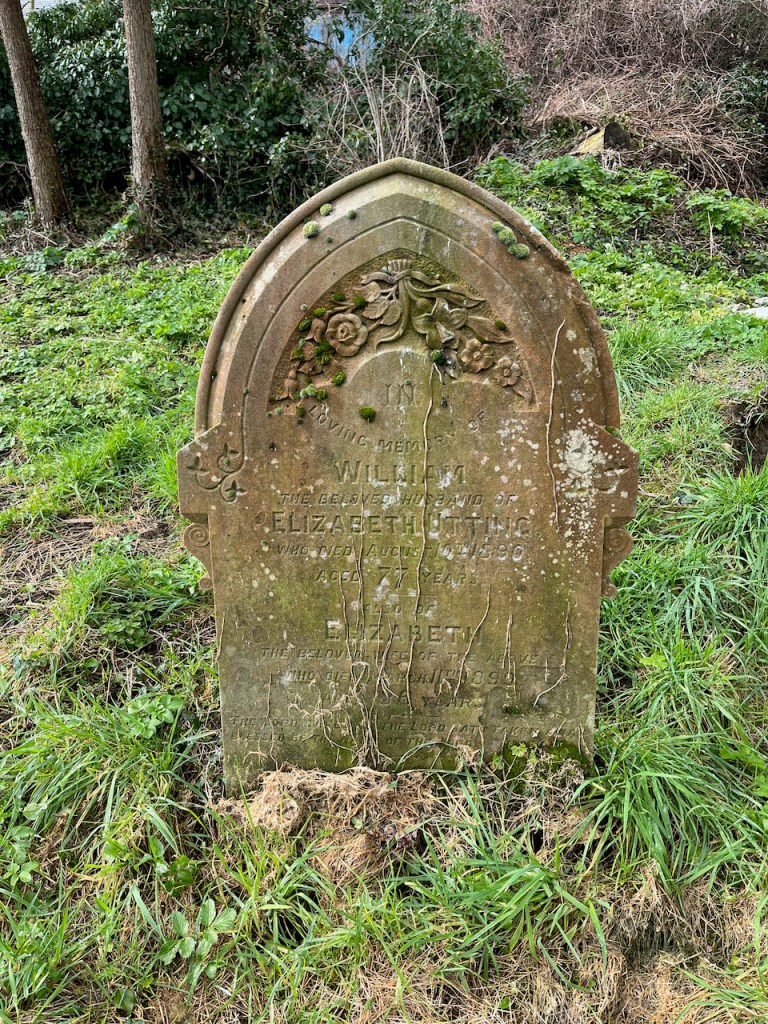
It was a beautiful place to stand and sketch: a peaceful country churchyard. The gravestone in front of me, in the foreground in the picture, carried stone carved flowers, and cushions of moss.

This tower is very old. According to the Historic England listing, the tower is from the 15th century and Grade I listed. There is neat flint work, in a chequerboard pattern higher up and in vertical lines lower down, with a horizontal border at ground level. The nave is thatched! It has recently received new thatch, in a glowing russet colour which you can just see to the right of the tower.

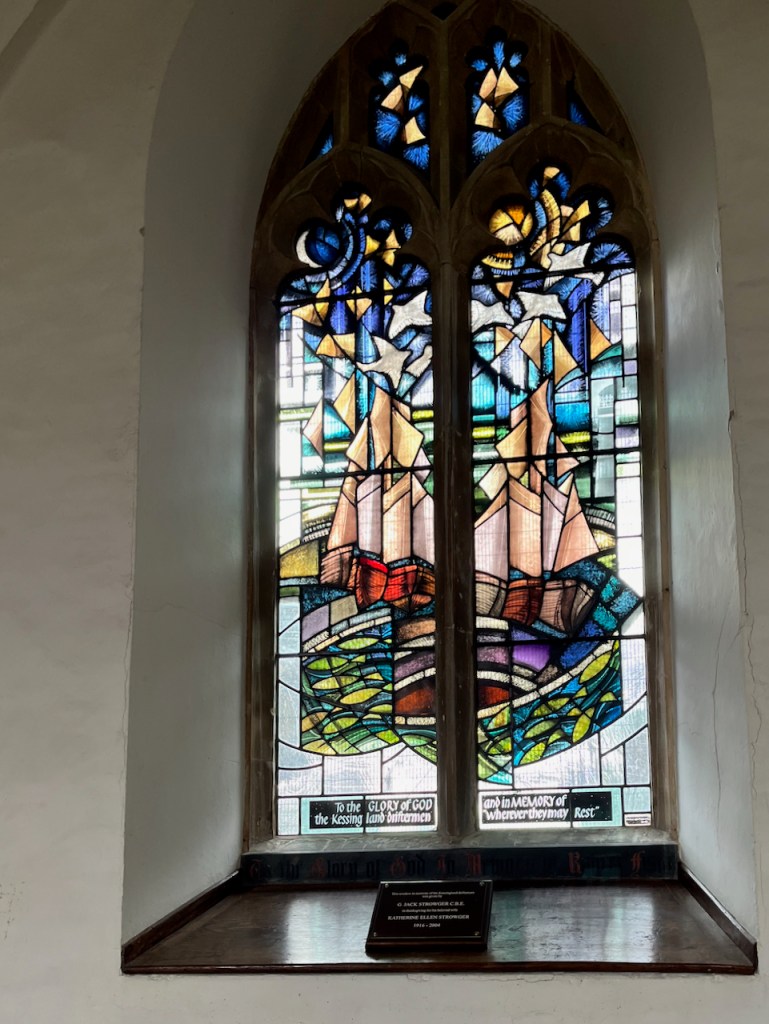
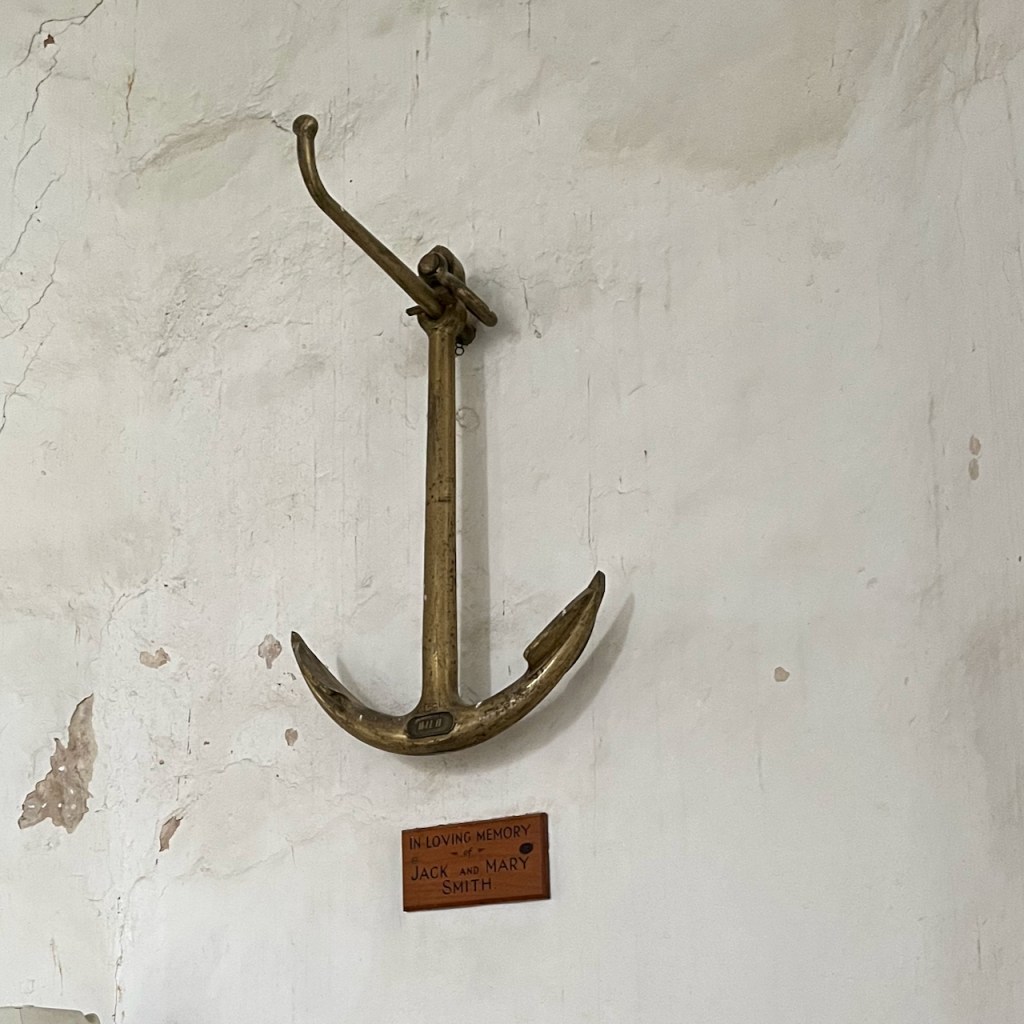
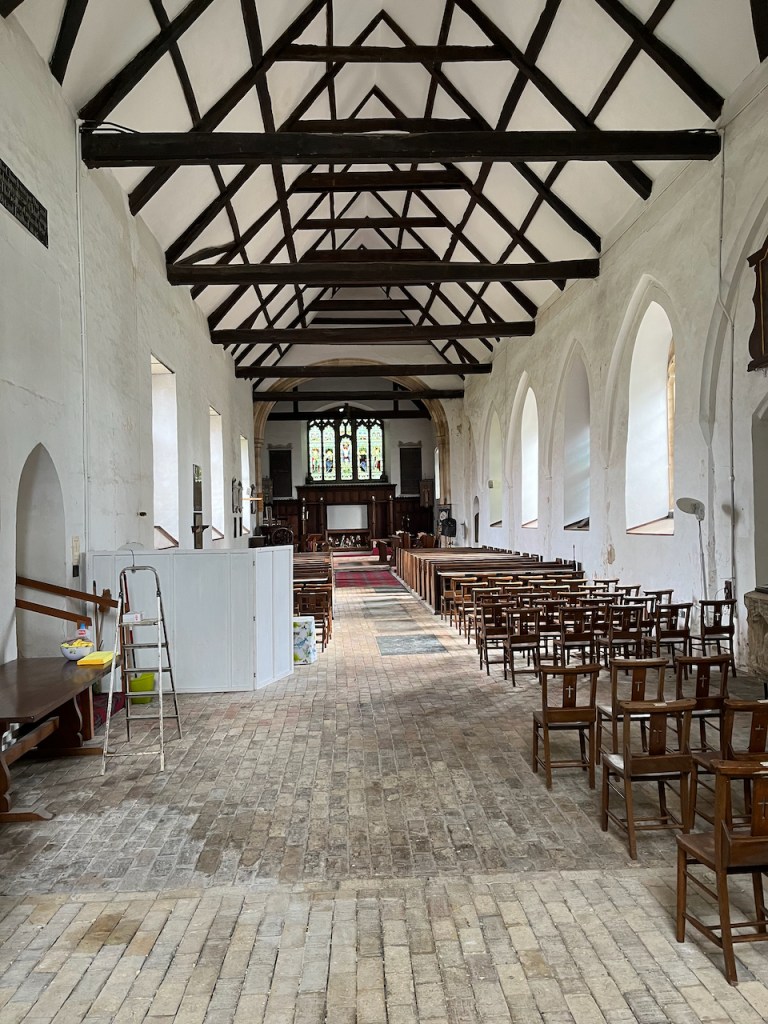
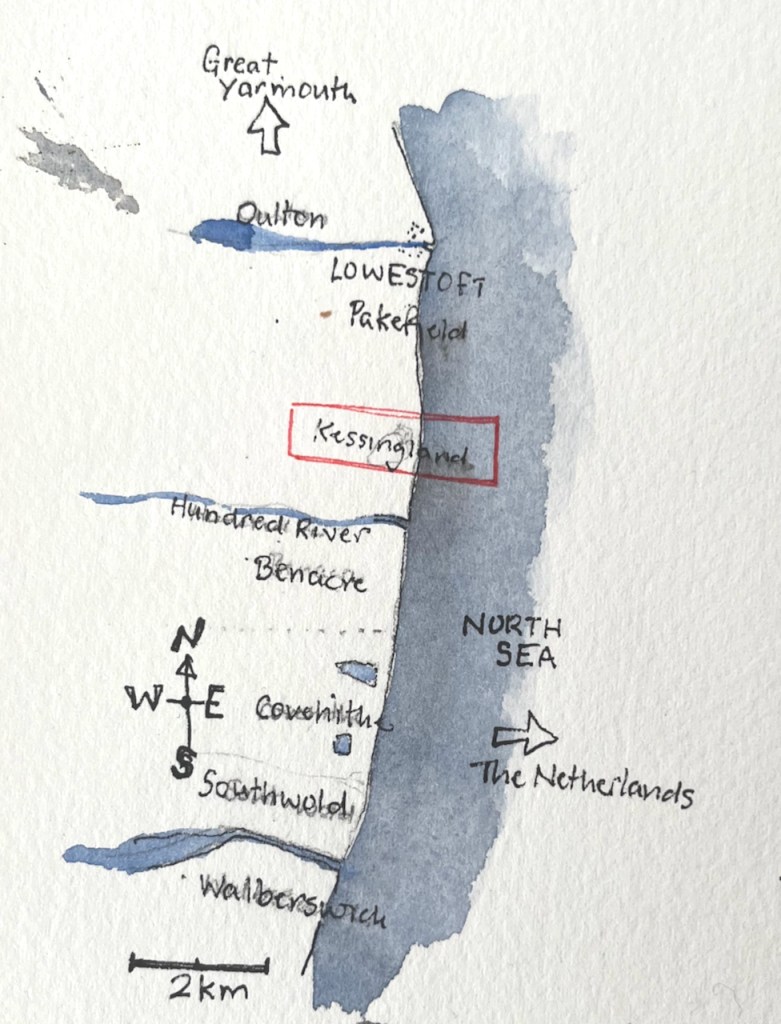
The church is about half a mile from the sea. There is a stained glass window, dated 2007, by Nicola Kantorowicz, dedicated to the “Glory of God and the memory of Kessingland driftermen, ‘where ever they may rest'”. It was given by G. Jack Strowger in memory of his wife Katherine. There is a ship’s wheel on the wall, and another on a low pulpit. An anchor hangs from the wall, “in loving memory of Jack and Mary Smith”.

The nave of the Church of St Edmund, Kessingland, looking east.

It’s well worth a visit if you are in the area.