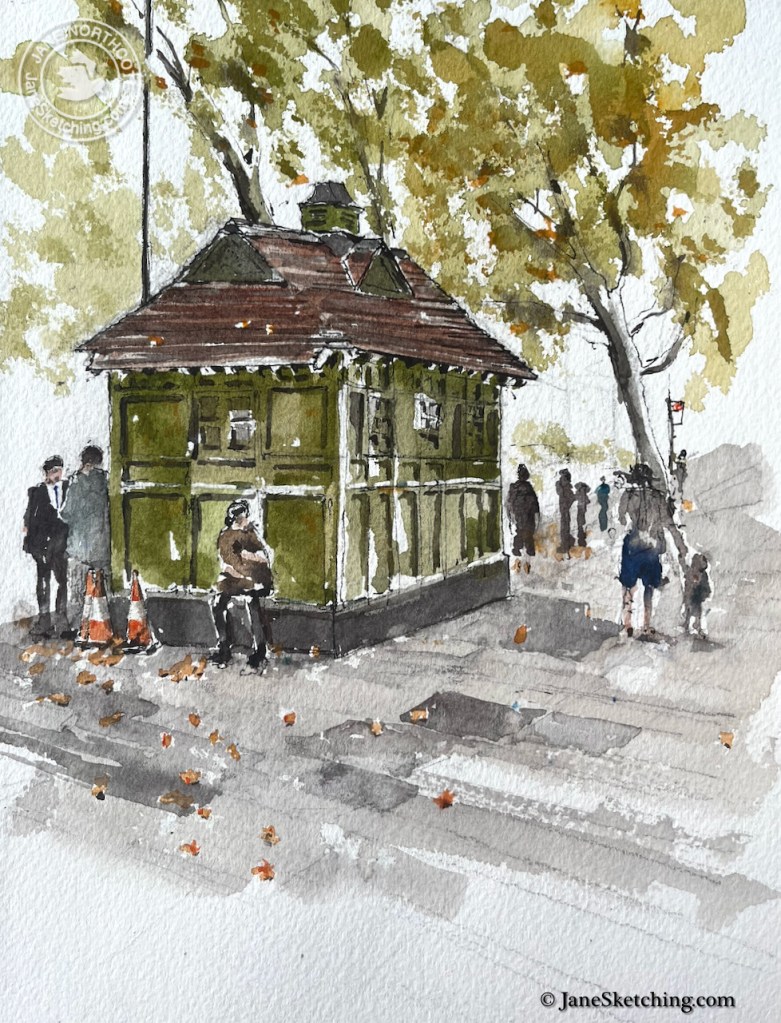
As I was sketching, members of staff emerged from the V&A onto the pavement to chat and to smoke. One of them came to look at the picture and told me “It used to be in the centre of the road you know. We all went over there.”
This shelter has been moved at least twice. It was originally in the middle of the road outside number 2-7.
Undated photo, probably 1920s or 30s, judging from the cars. This is a view looking East along Thurloe Place. The domed structure is on the corner of Thurloe Place and Brompton Road. It is still there. There is a long line of cabs in the road, leading to the shelter in the bottom left (arrowed). Image from Margaret Purnell on Facebook. Google Street view (September 2025), showing approximately the same view. The shelter is now on the pavement, arrowed, partly hidden by a bus stop. The trees have grown!
In the 1970s the shelter was moved southwest to be in the middle of the road outside number 112, the Rembrandt Hotel. A picture in the London Picture archive3 shows that it was still there in the middle of the road in 1977. Then some time later (after 1983 4 ) the shelter was moved to the pavement next to the Victoria and Albert Museum, which is where it is now (see Google Street view above).
This cab drivers’ shelter is closed and no longer serves refreshments. However in a mysterious way it still exerts an attraction. While I sketched, people congregated there on their work breaks. Even though closed it offers some spirit of “shelter” it would seem.
A sheltering place – detail from the sketchPage spread sketchbook 17
Evidence that the shelter was moved southwest in the 1970s: Here’s an extract from footnote n15 in British History Online. This article was written in 1983 when the shelter was still in the middle of the road, opposite number 11.: “Opposite the Rembrandt Hotel, in the centre of the roadway of Thurloe Place, is a cabmen’s shelter (fig. 22) which was originally erected a little further to the east in 1897 and moved here in the 1970’s. Paid for by the Vicar of St. Jude’s Church, Courtfield Gardens, and the residents of Earl’s Court, it was evidently a replacement for an earlier shelter. The purpose of these shelters, for which a fund had been established in 1875 under the president of Lord Shaftesbury, was to supply cabmen ‘when on the rants, with a place of Shelter where they can obtain good and wholesome refreshments at very moderate prices ’. The shelters took various forms, but the best-known type, of which that in Thurloe Place is a good example, was designed by Maximilian Clarke, who was appointed joint honorary architect to the Cabmen’s Shelter Fund in I884.” This article in British History Online was edited in 1983. (Citation: ‘The Alexander Estate’, in Survey of London: Volume 41, Brompton, ed. F H W Sheppard (London, 1983), British History Online https://www.british-history.ac.uk/survey-london/vol41/pp58-86 [accessed 8 September 2026].) ↩︎
An article on the Historic England site says “The shelter once sat in the middle of the road on Thurloe Place but was moved to the side of the road due to local road widening for a nearby hotel”. But it doesn’t say when this happened. Historic England history of Cab drivers’ shelters: https://heritagecalling.com/2024/04/09/a-brief-introduction-to-cabmens-shelters/↩︎
Click a button below to share this post online, email it, or print it:
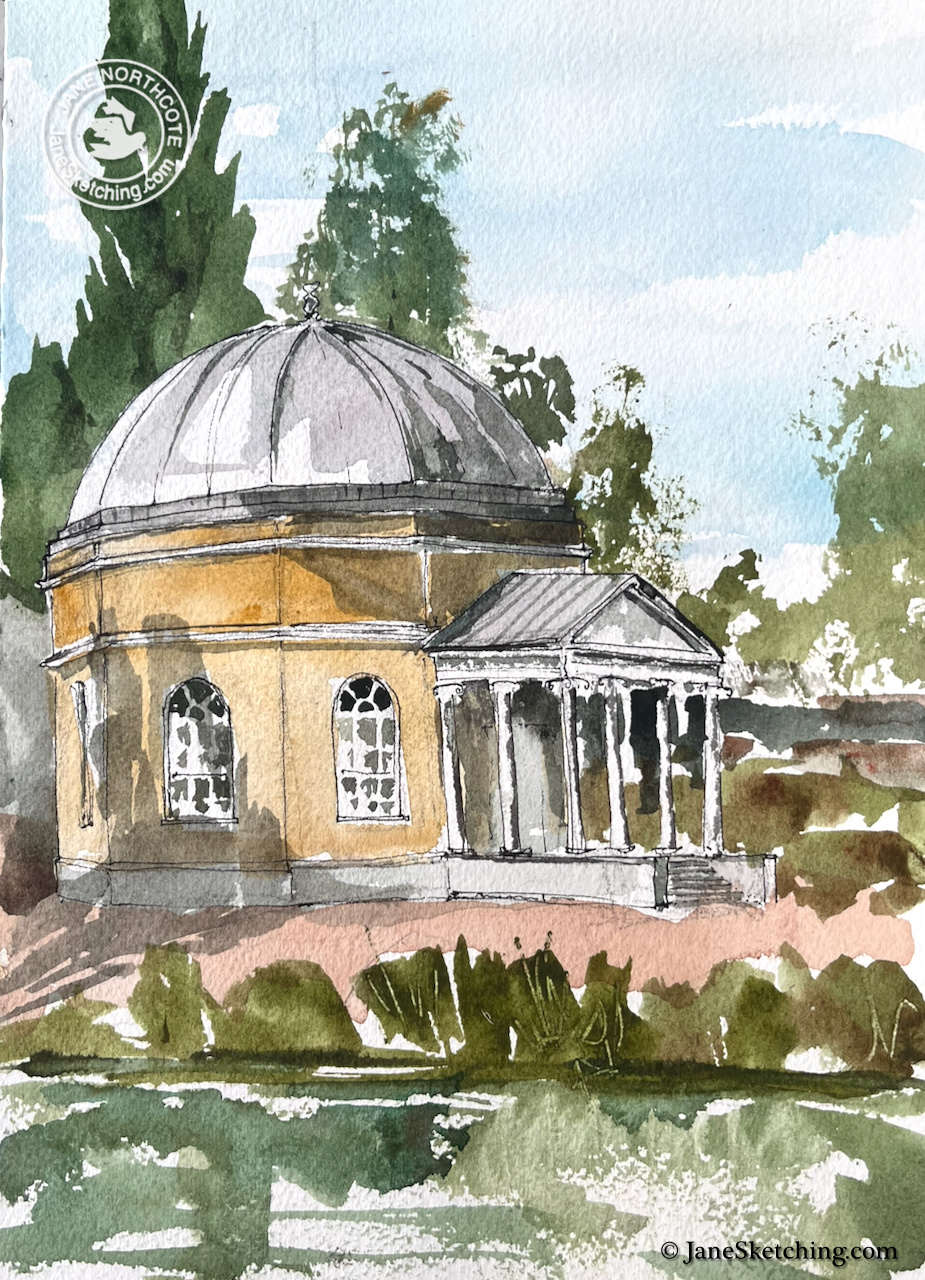
Strolling along the river bank I saw this quirky little temple on the other side of the river. It was afternoon, in the midst of a hot spell. A group of young girls were playing on paddle boards, standing up and jumping in the water, shrieking. A small motor boat came from the island “Garrick’s…
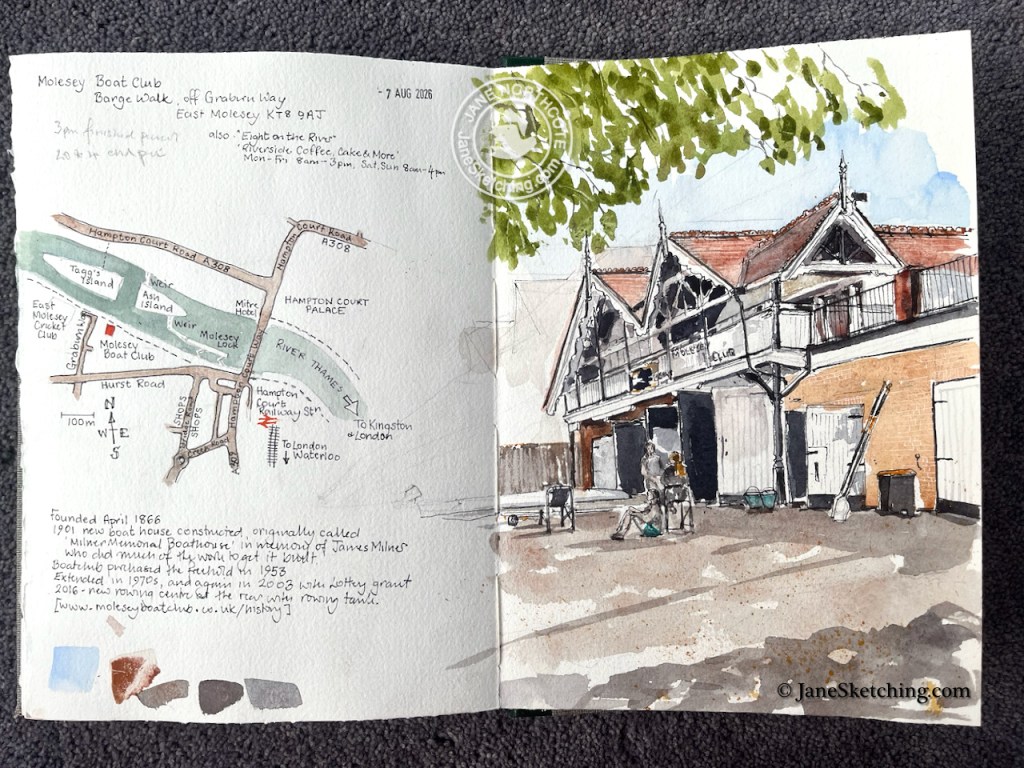
A short walk from Hampton Court Bridge is Molesey Boat Club. This is a lively place. I watched a group of school-age boys and girls competently lift a boat out of the water, and place it carefully on its stand. They then washed it with sponges. Boats were coming and going all the time, fours,…
Click a button below to share this post online, email it, or print it:
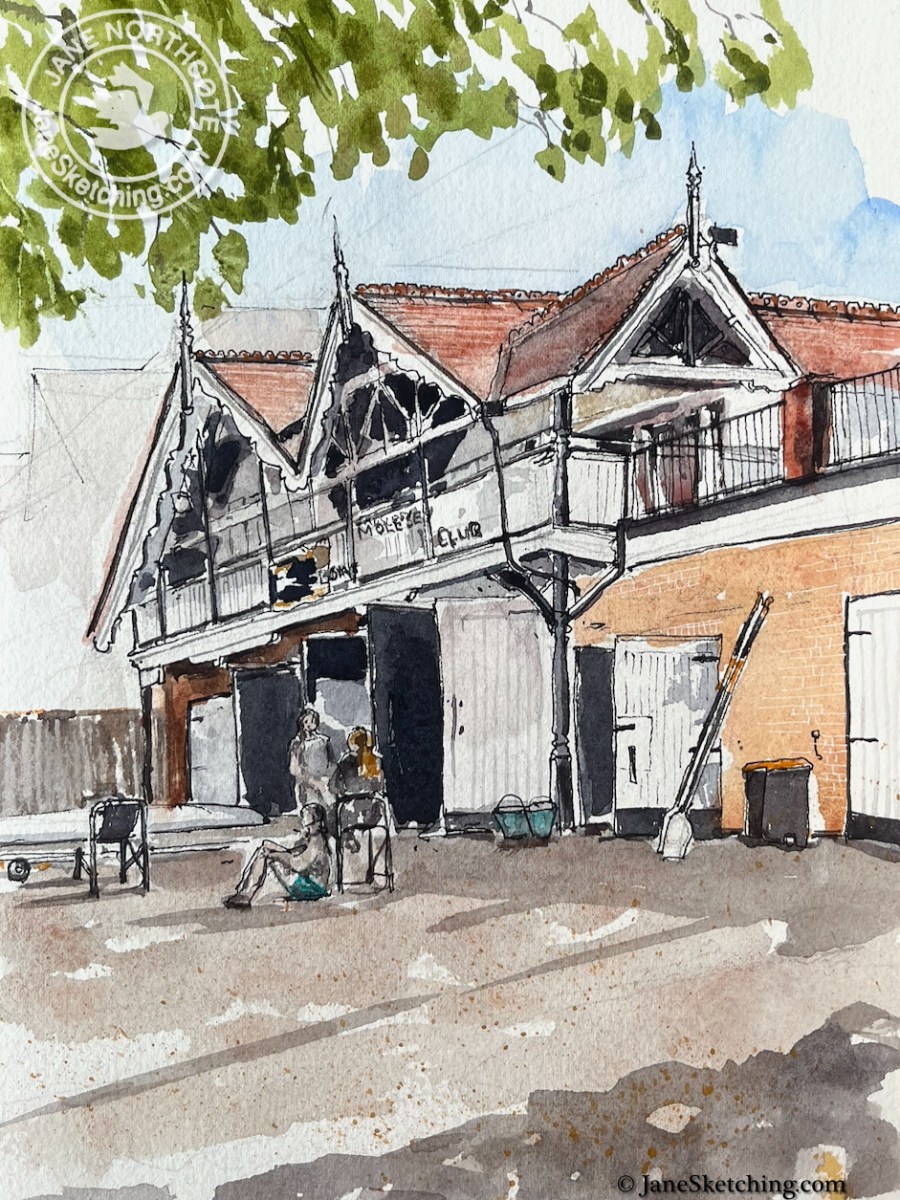
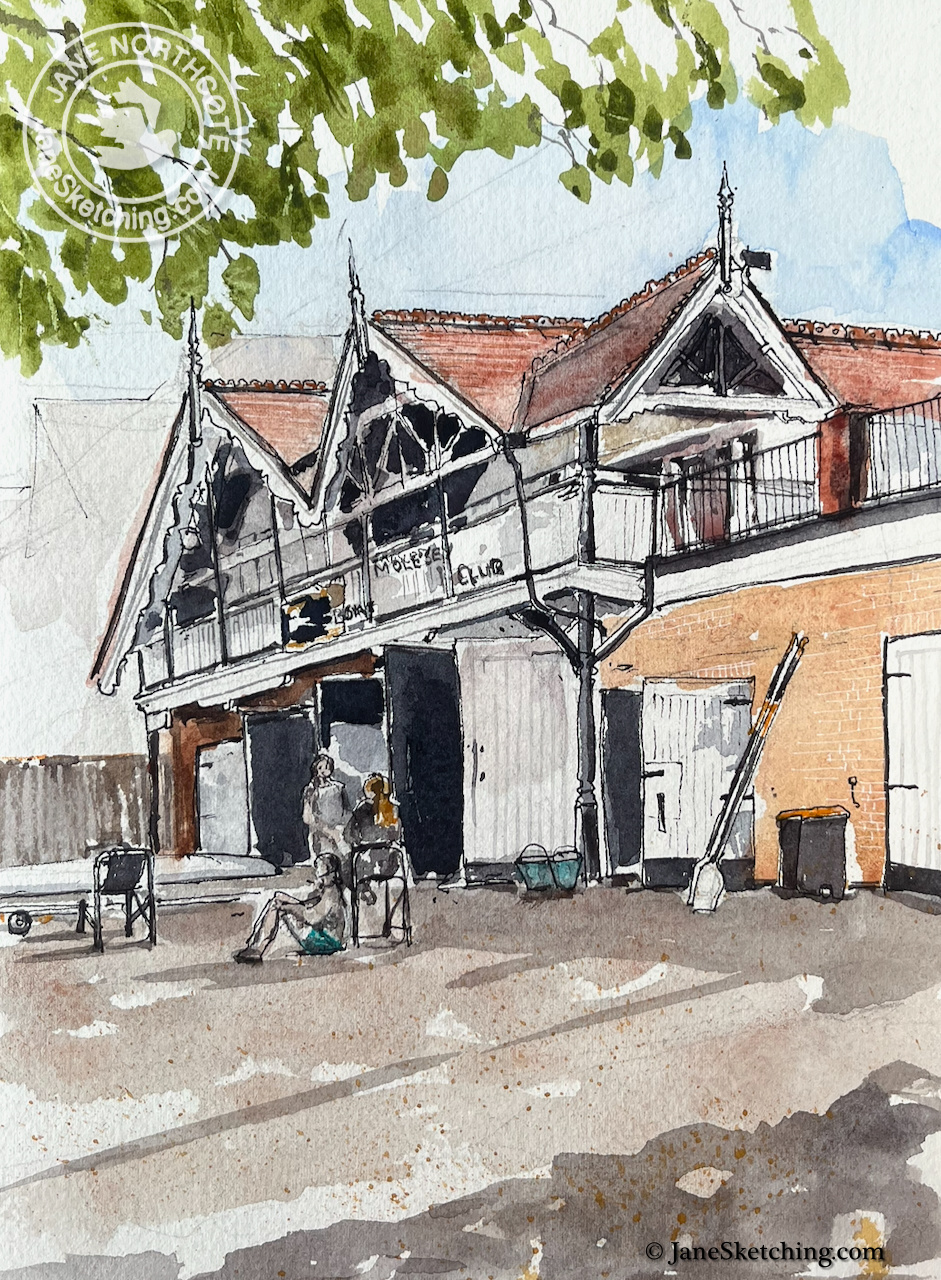
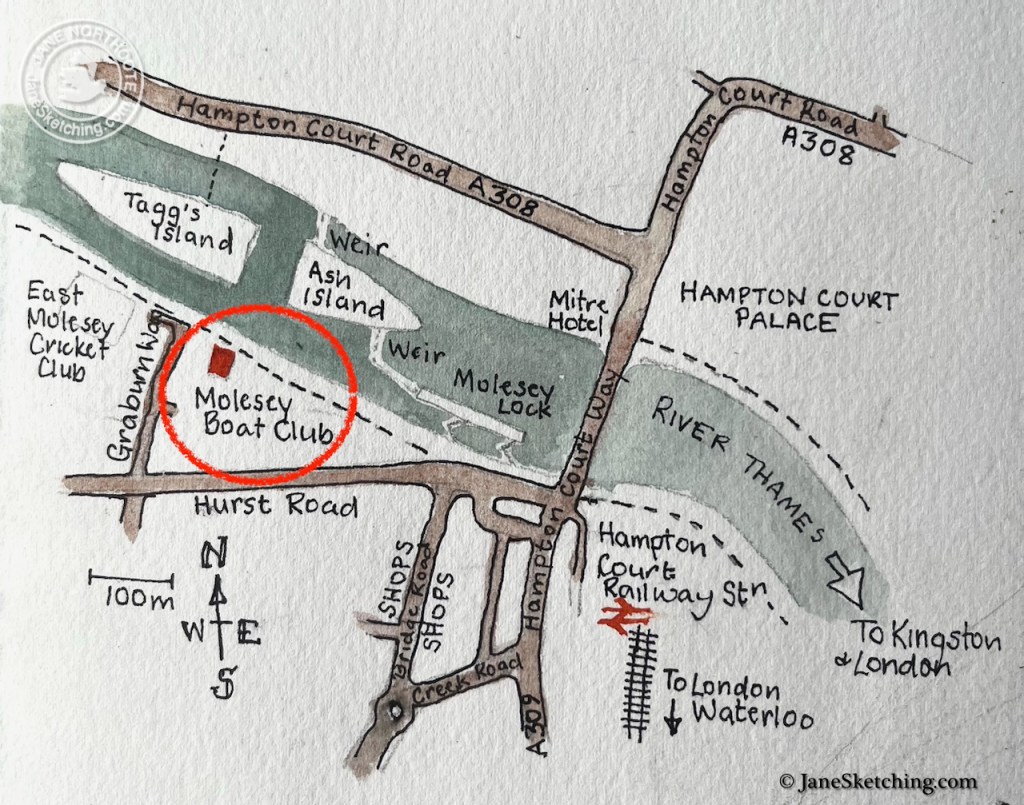
Molesey Boat Club, Barge Walk, East Molesey KT8 9AJ, sketched 7th August 2026 in Sketchbook 16Sketch map showing the location of Molesey Boat Club, a few minutes walk from Hampton Court Bridge and railway station.
This is a lively place. I watched a group of school-age boys and girls competently lift a boat out of the water, and place it carefully on its stand. They then washed it with sponges. Boats were coming and going all the time, fours, twos and single skulls, people of all ages. It all looked fun and made me want to have a go. A group of fit-looking young people set off, their instructor following in a motor boat. In a few moments they were rowing back the other way. Then they turned the boat and went back up the river at fantastic speed. Within half an hour then were back at the boat house, clambering out of the boat, and handing over to another group.
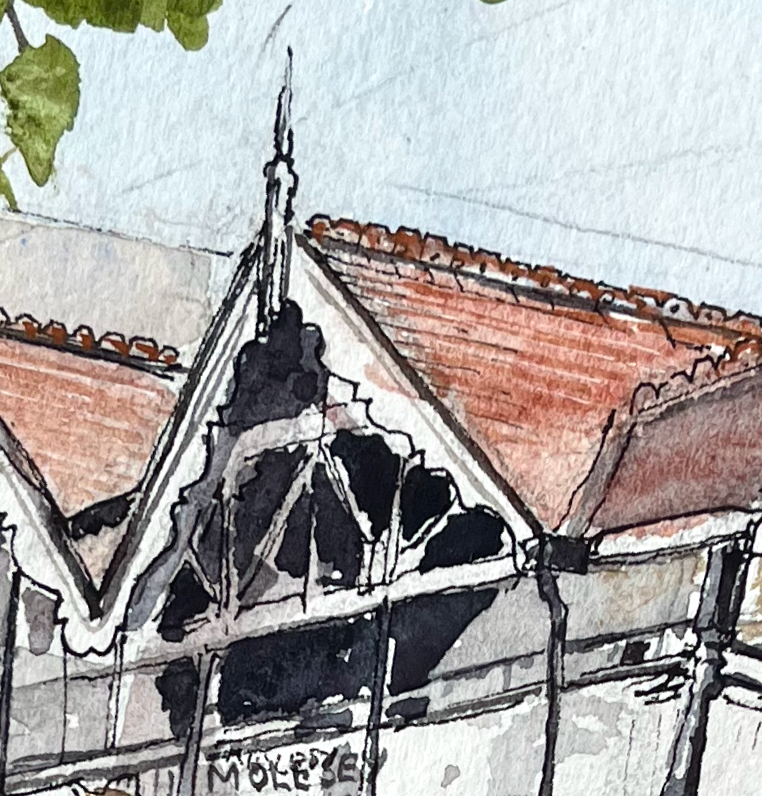
I did not follow the activities of the boat crews in great detail, however, as I was concentrating on those very complicated eaves and the carved woodwork of the boathouse.
Molesey Boat Club, detail.
The club was founded in 1866. This boathouse dates from 1901. It has been renovated and extended since, most recently in 2016, when a new rowing centre with a rowing tank was added.1
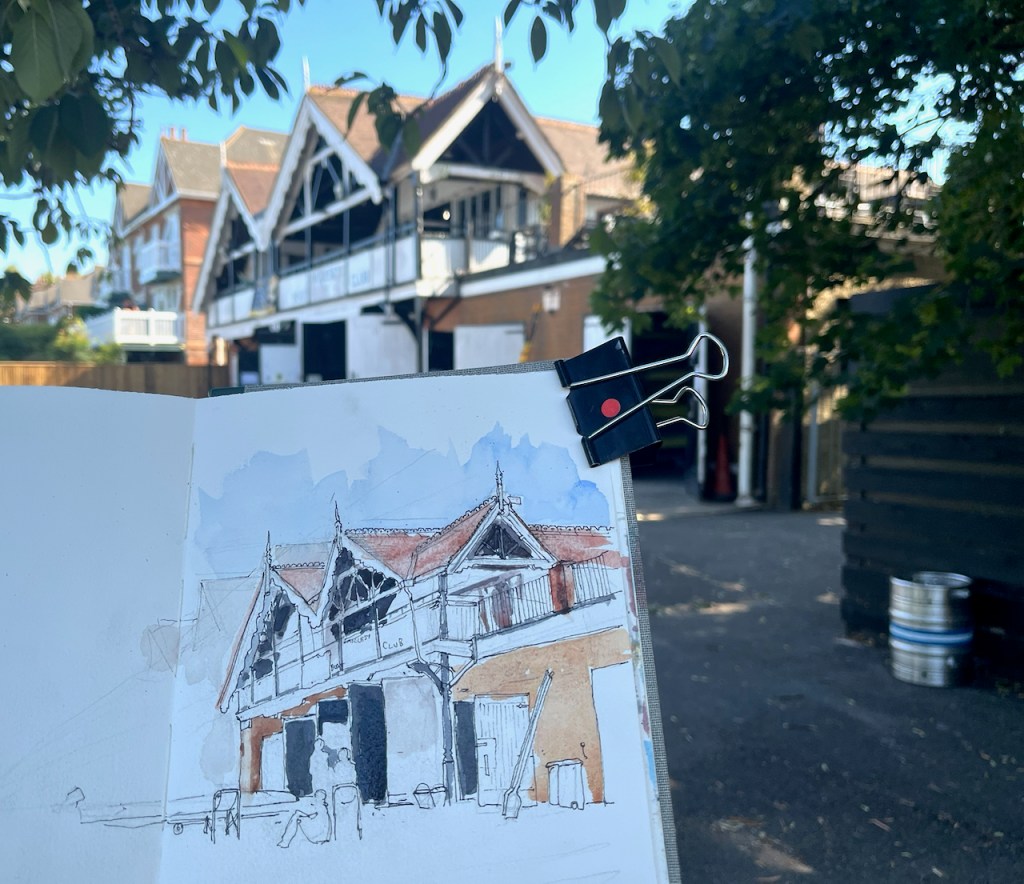
work in progress on the sketch
There is a café on the first floor, overlooking the river. It is called “Eight on the River“. The thing to watch is that it closes at 3pm on weekdays, so don’t hang around perfecting your drawing, but get up there.
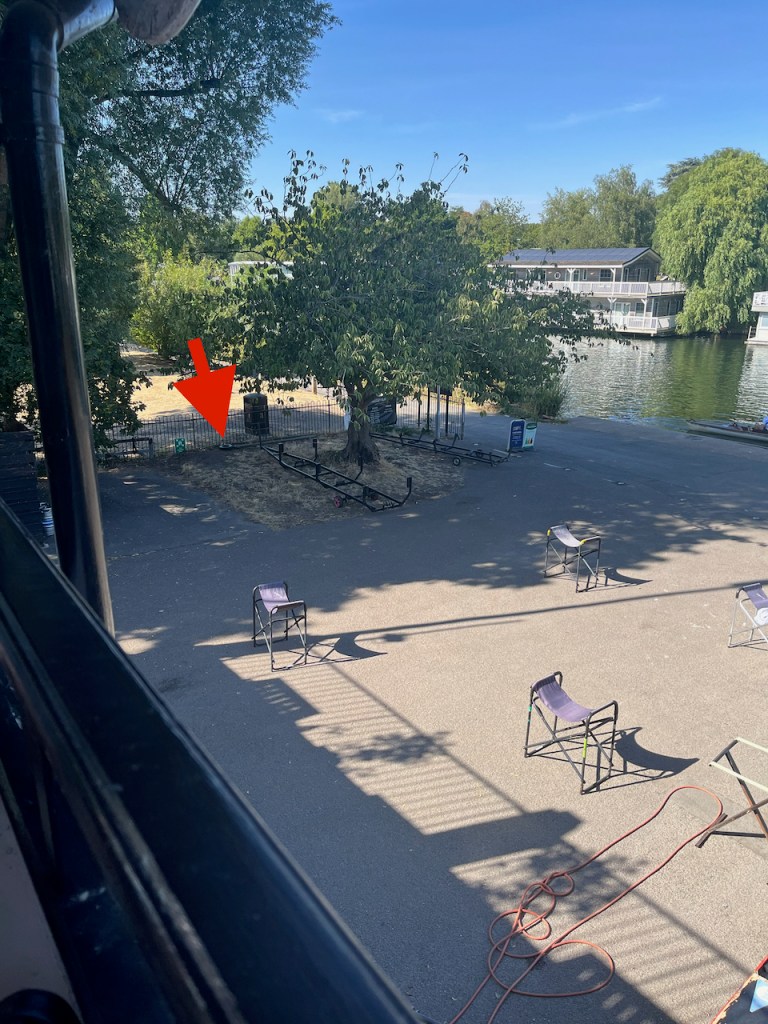
Here is my shady sketching location seen from the balcony of the café. In the foreground are the seat-like stands where the crews place their boats after use.
My sketching location (arrowed) seen from “Eight on the River”
It’s a lovely place to sketch, and to watch the river.
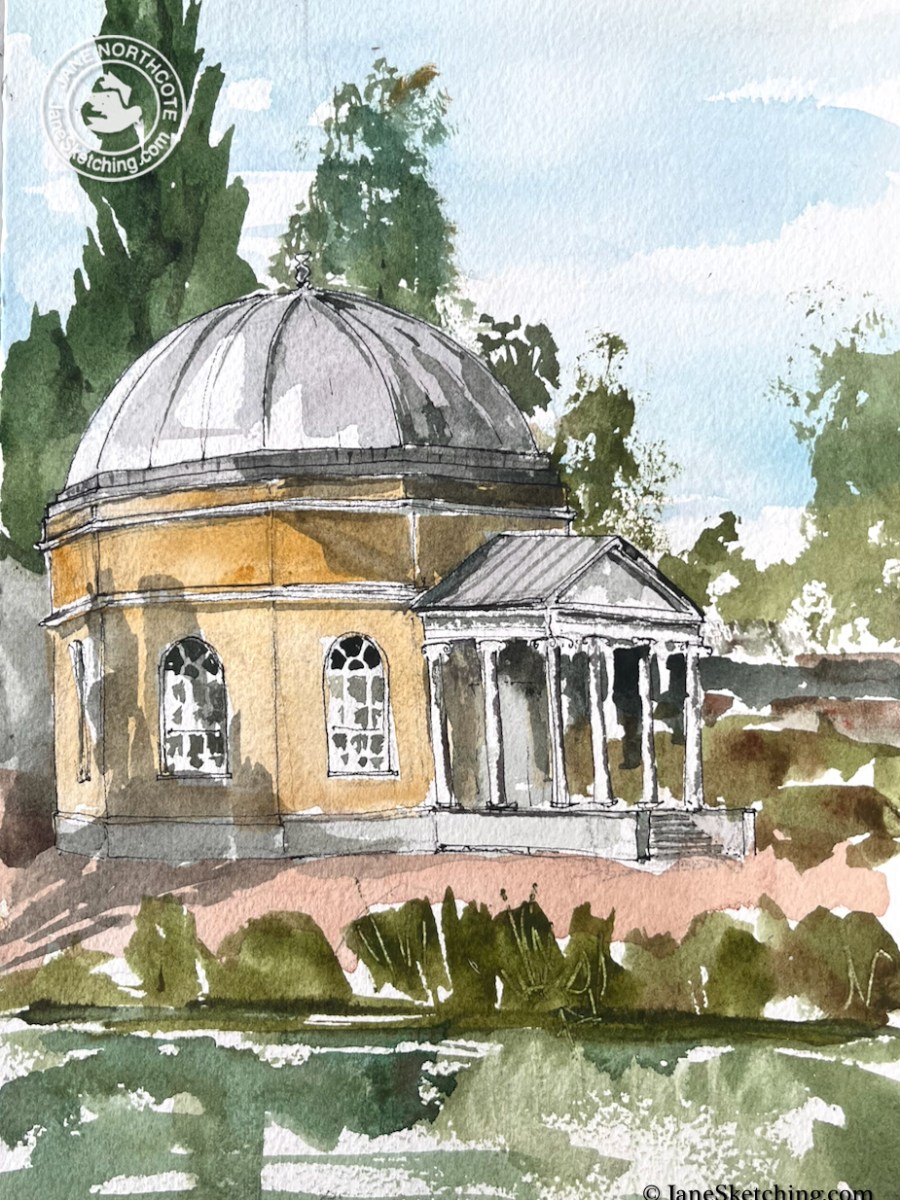
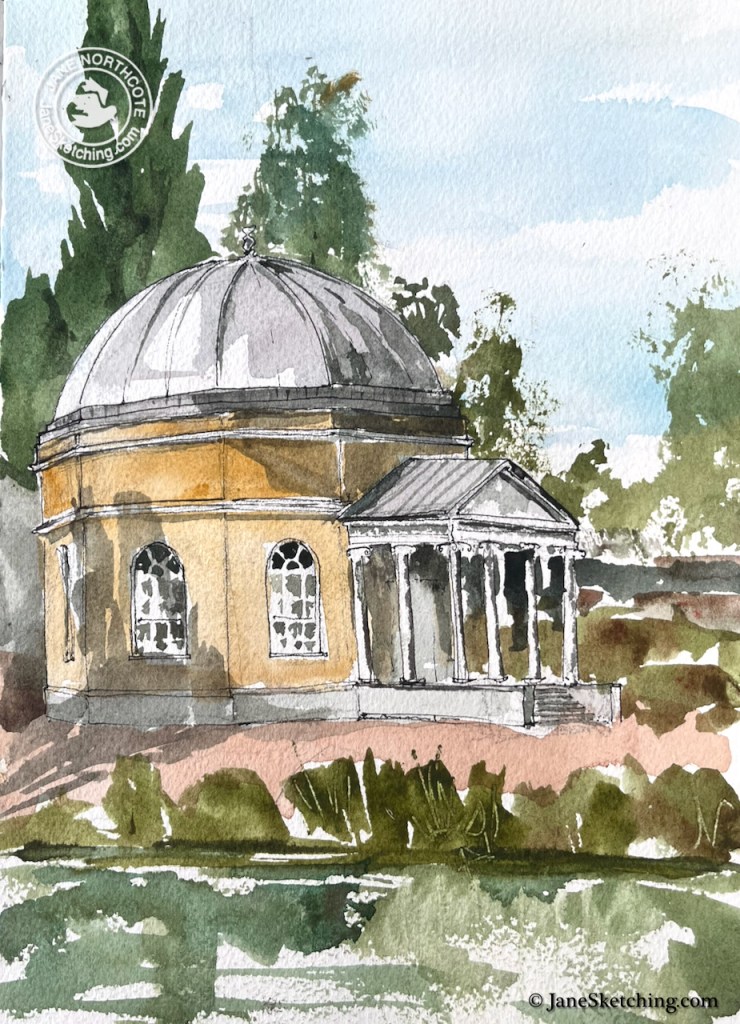
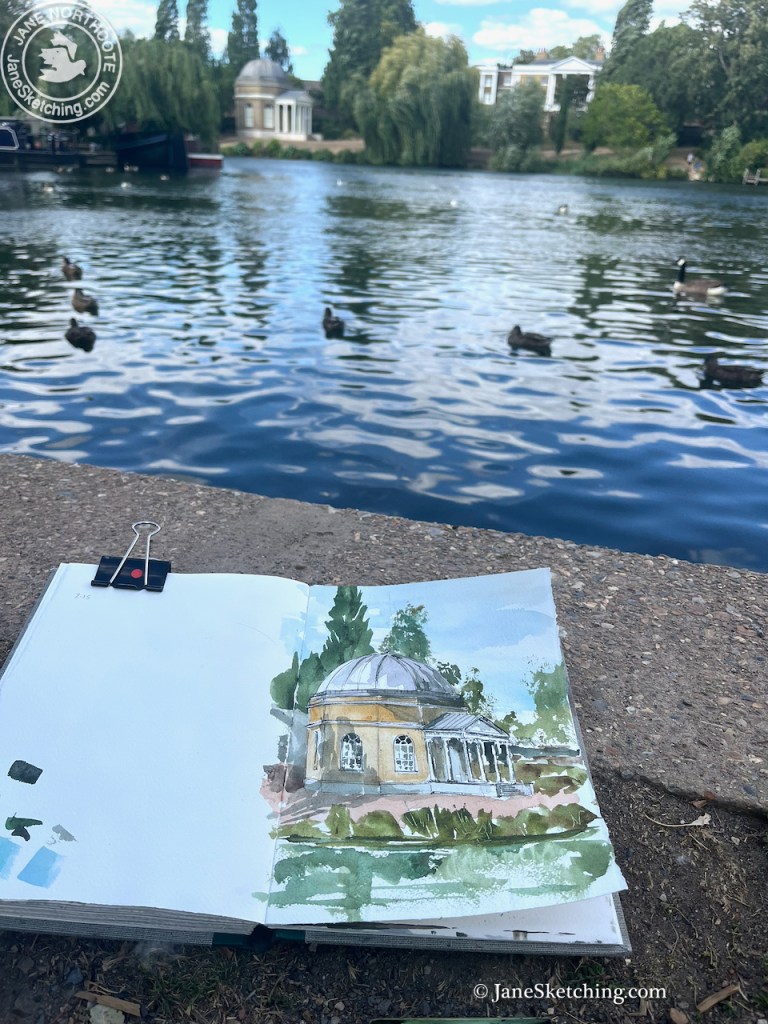
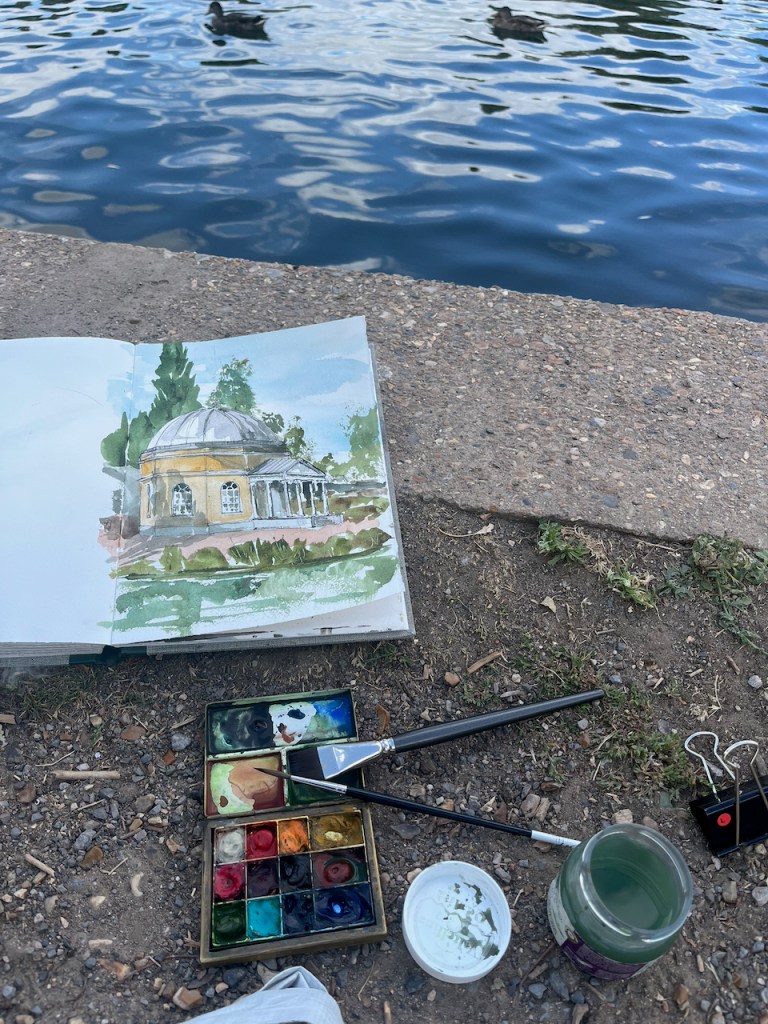
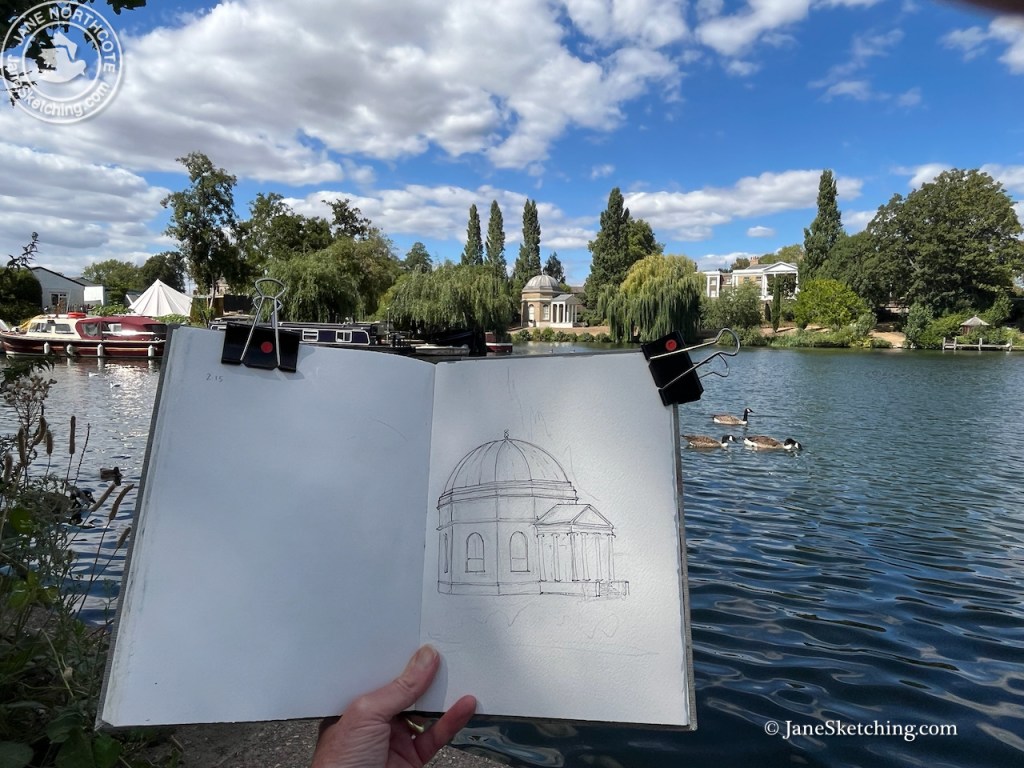
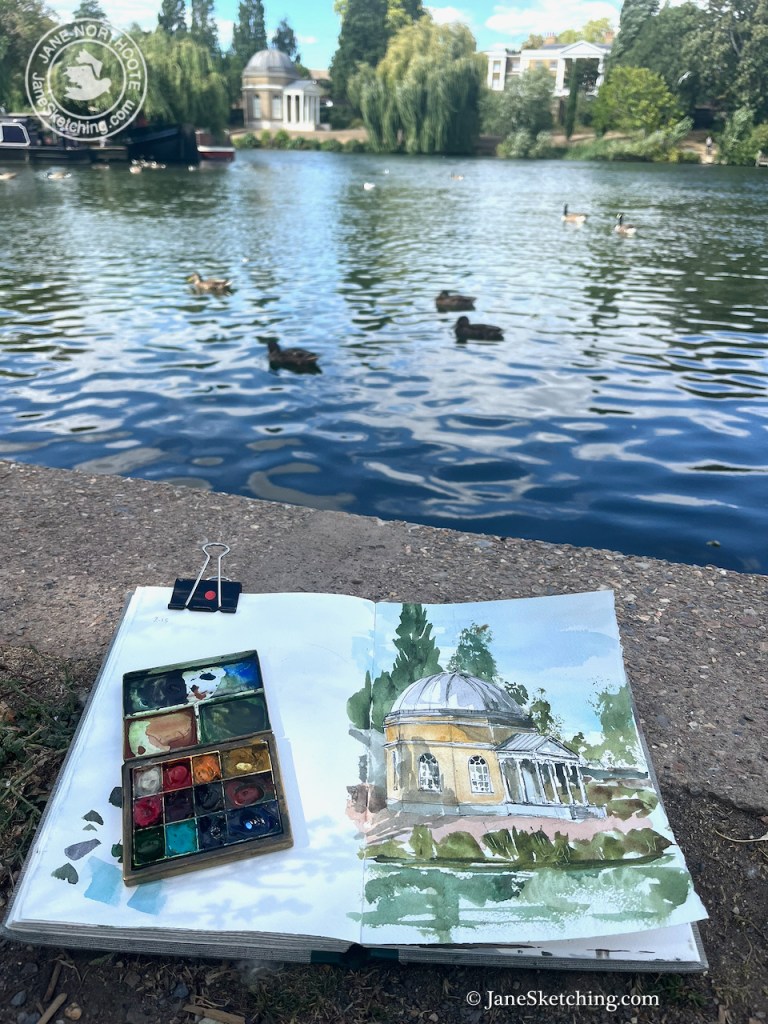
Strolling along the river bank I saw this quirky little temple on the other side of the river.
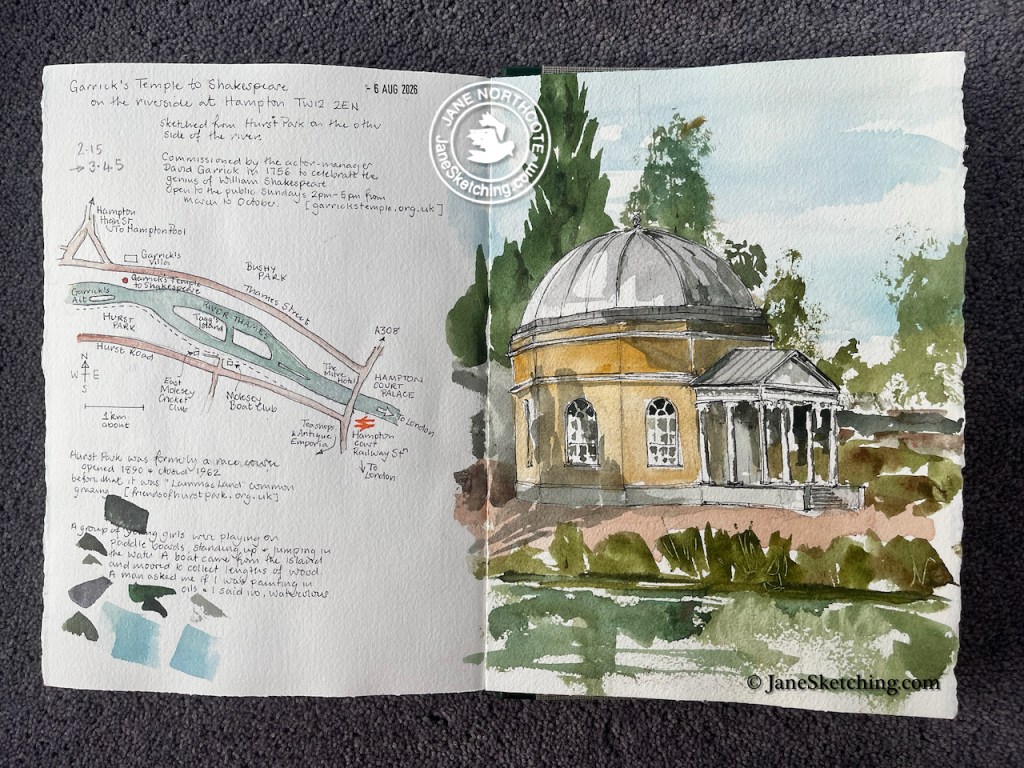
Garrick’s Temple to Shakespeare TW12 2EN, sketched from Hurst Park on 6th August 2026 in Sketchbook 16
It was afternoon, in the midst of a hot spell.
A group of young girls were playing on paddle boards, standing up and jumping in the water, shrieking. A small motor boat came from the island “Garrick’s Ait” and moored to the bank nearby to where I was sketching. They loaded the boat with lengths of wood, and went off again. I had offered to move, but they said no, they could manage. They were polite, I was polite, and we all wished each other a pleasant afternoon.
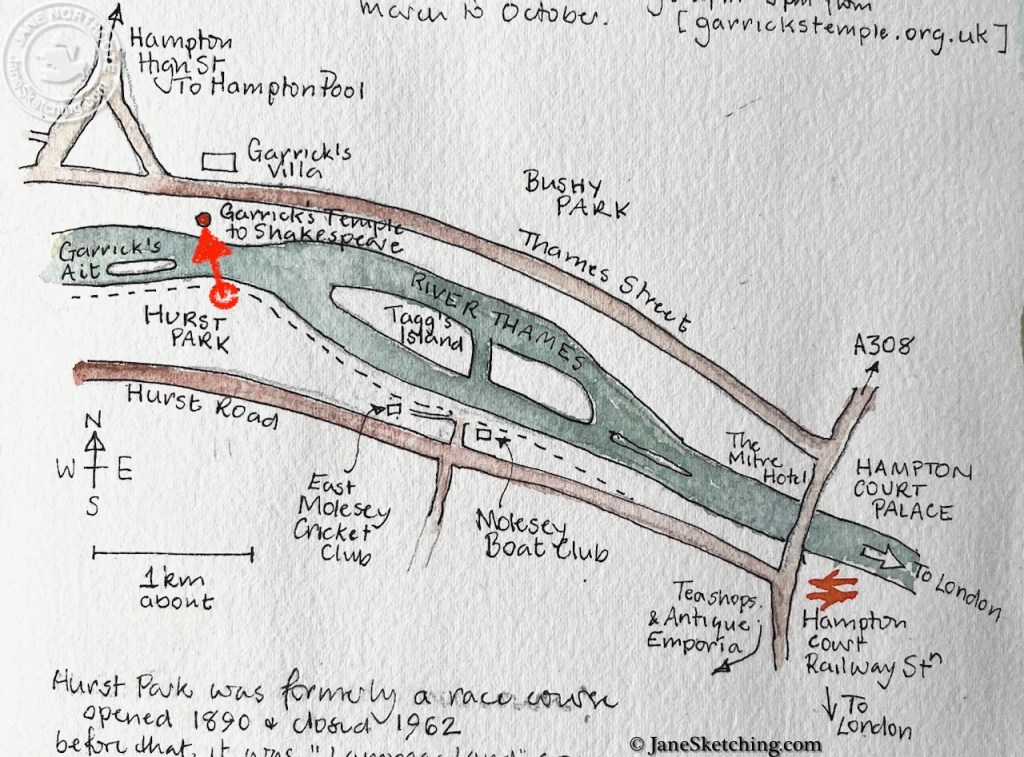
Map showing the location of the Temple.
Later, my friend D kindly drove me over Hampton Court Bridge and dropped me off near the Temple so I could have a closer look.
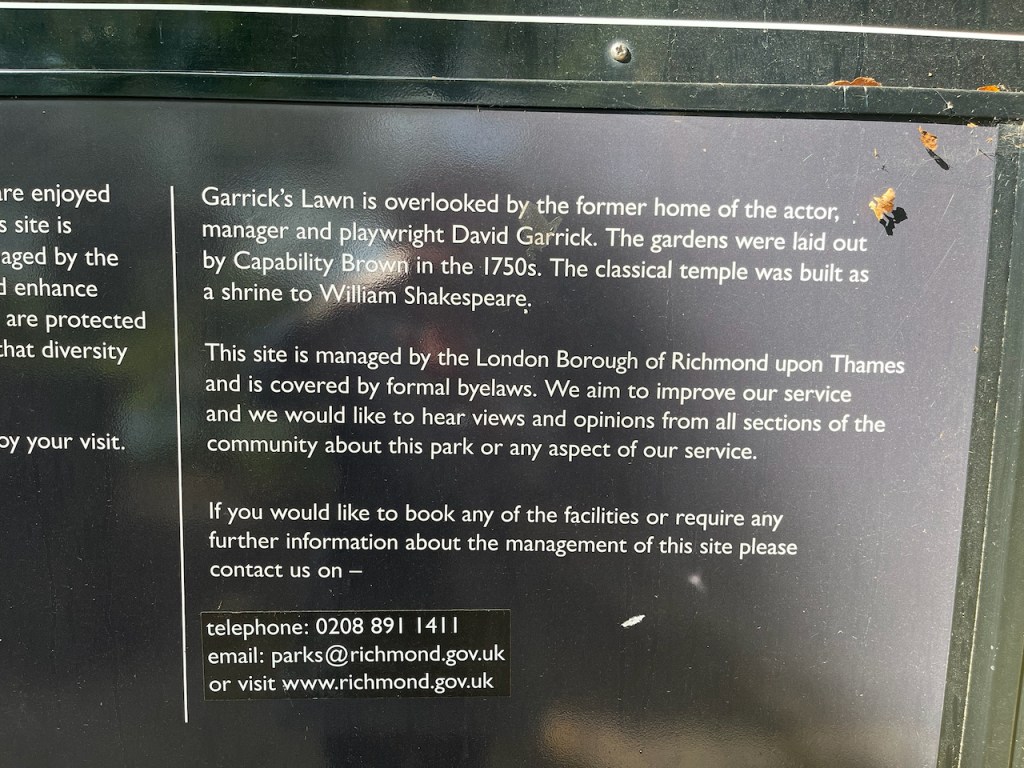
There’s a lawn sloping to the river, and an information placard.
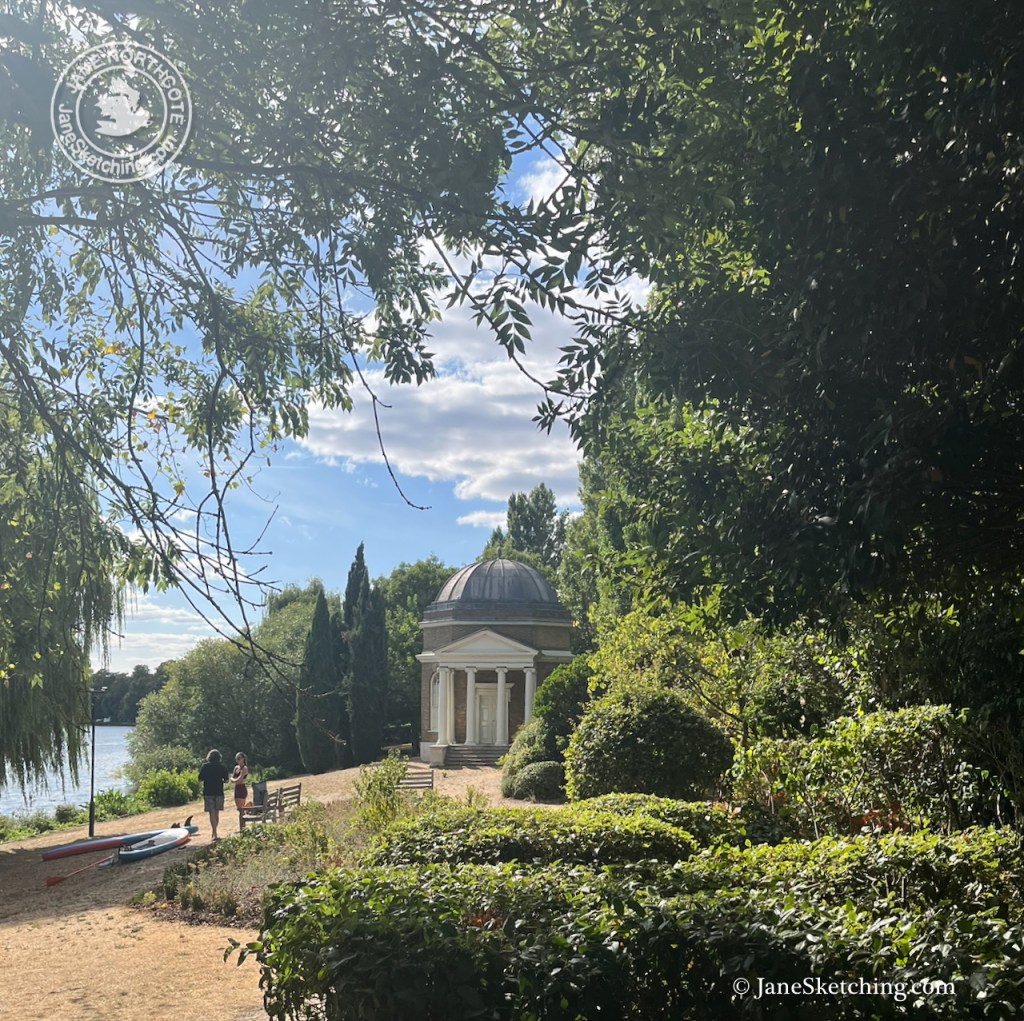
Garrick’s Temple, photographed August 2026 from the Hampton side of the river.
“Garrick’s Lawn is overlooked by the former home of the actor, manager and playwright David Garrick. The gardens were laid out by Capability Brown in the 1750s. The classical temple was built as a shrine to William Shakespeare. This site is managed by the London Borough of Richmond upon Thames and is covered by formal byelaws….”
According to the website of Garrick’s Temple (garrickstemple.org.uk) the building was commissioned by David Garrick in 1756 “to celebrate the genius of William Shakespeare”.
David Garrick (1716-1779) was an actor and theatre manager. The Garrick Theatre in London’s West End was named after David Garrick1. It opened in 1859, 80 years after Garrick’s death, and was financed by playwright W. S. Gilbert, of Gilbert and Sullivan operettas.
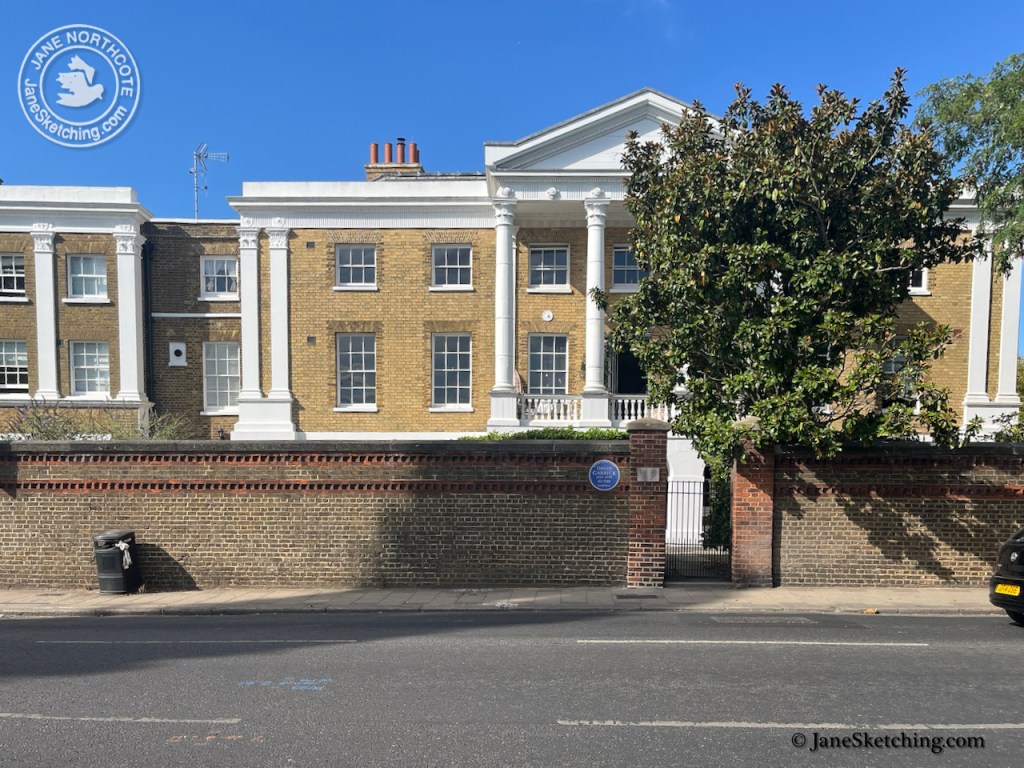
Garrick was a much acclaimed and successful actor, and owned a share of the Theatre Royal Drury Lane. He became wealthy, and had a villa constructed at Hampton. This is what it looks like now:
Garrick’s Villa, just above the Temple, photographed 2026
He built the “shrine to Shakespeare” nearer the river, and used it as a study, as a place to entertain friends and as a place to exhibit his collection of Shakespeare memorabilia.2
Now it is open to the public on Sundays from March to October, 2pm-5pm and houses an exhibition about Garrick. It is also used for arts and cultural events3
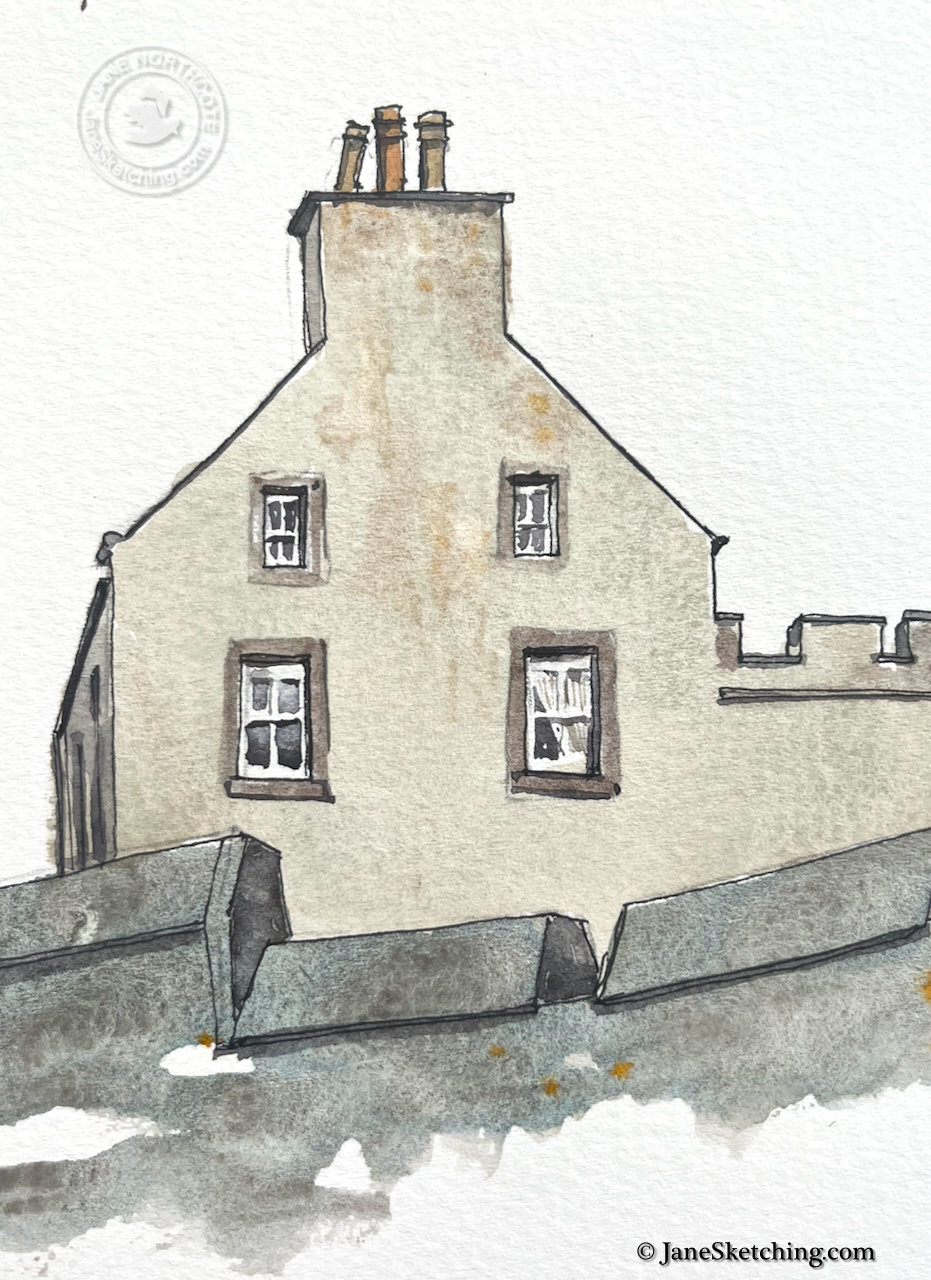
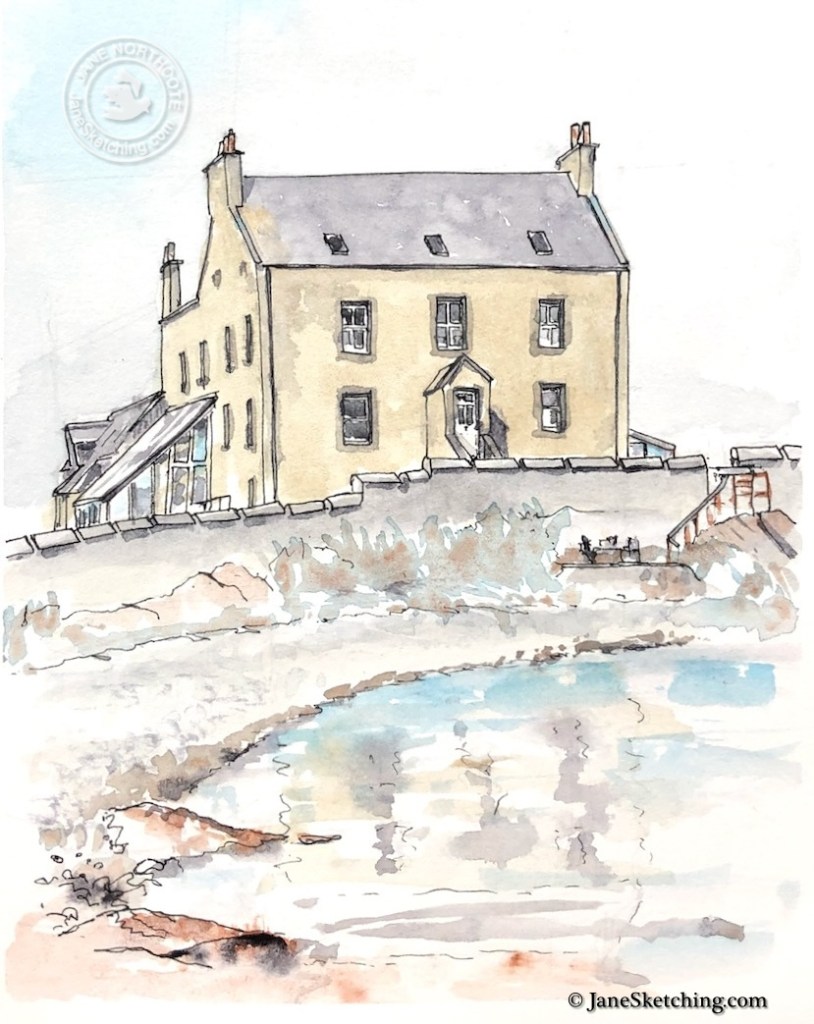
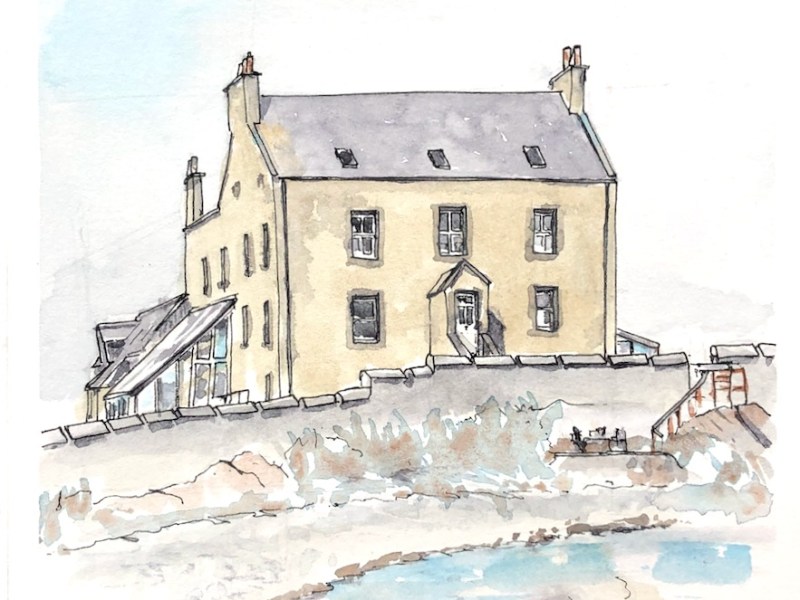
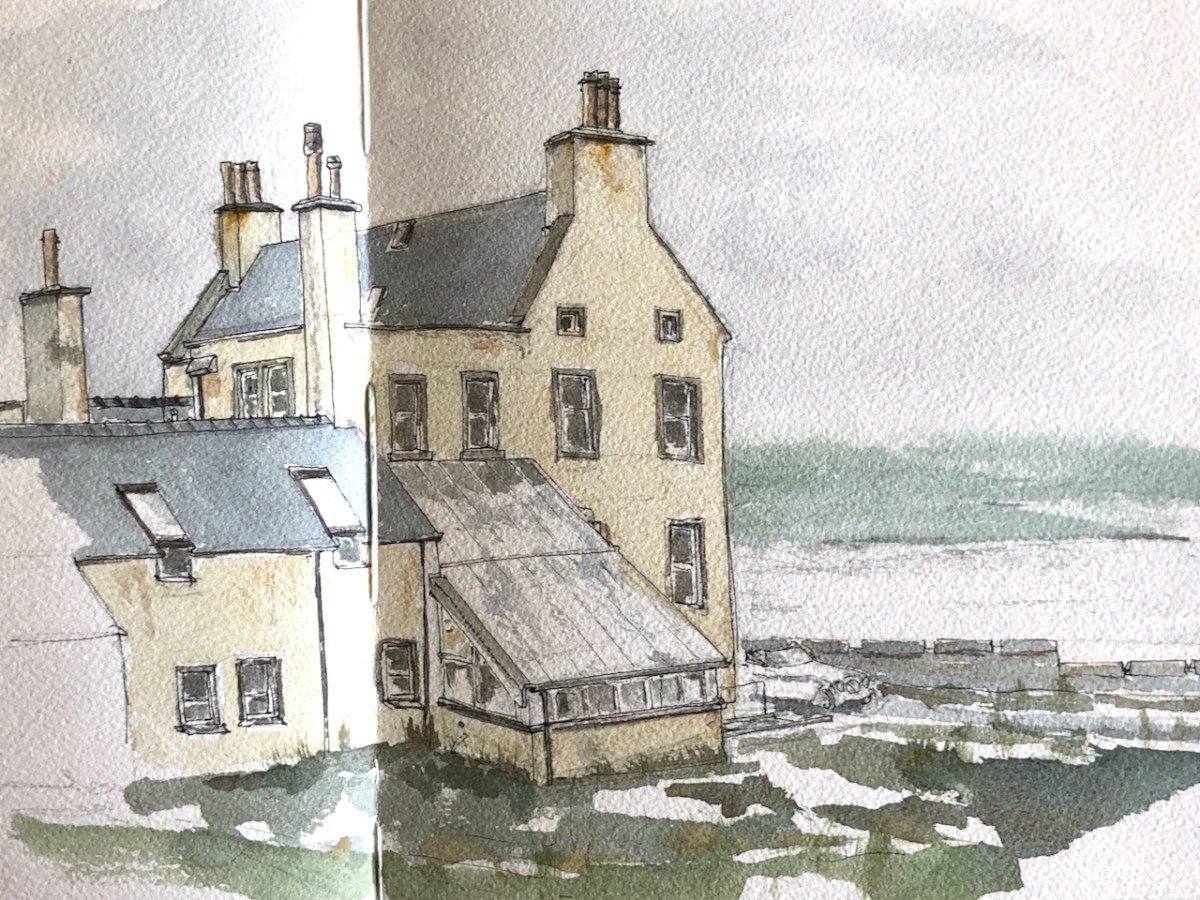
Here are some drawings at Burrastow House, near Walls, on the West side of Shetland. In previous years I have sketched the front of the house from across the bay:
Burrastow House sketched 2020
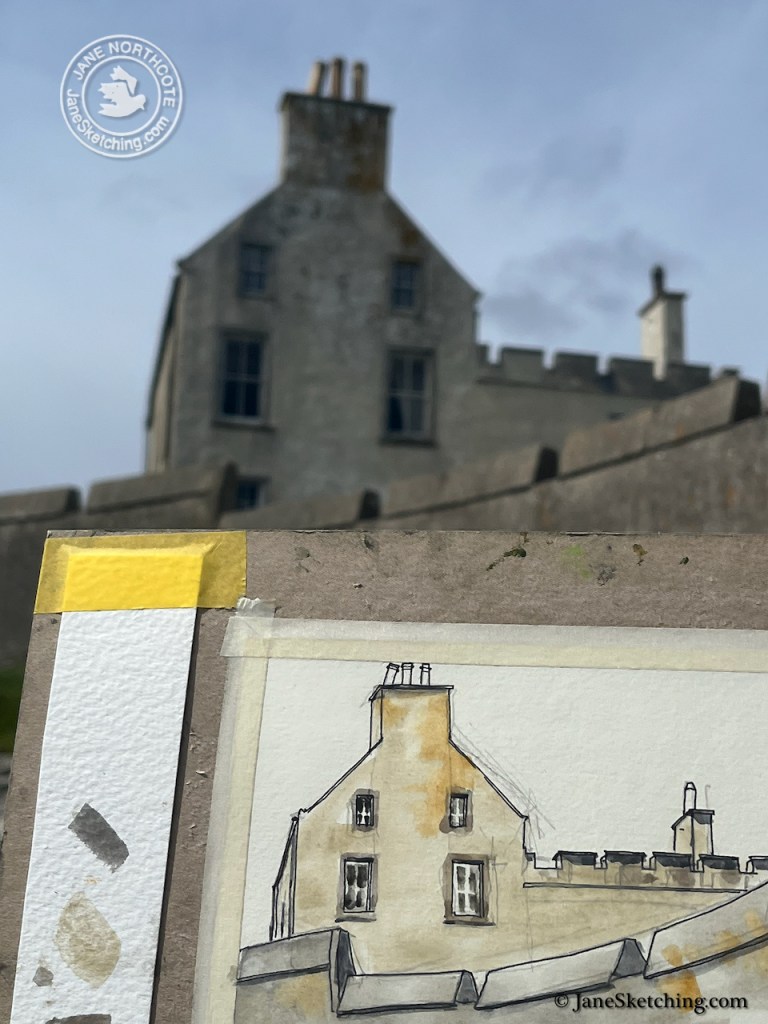
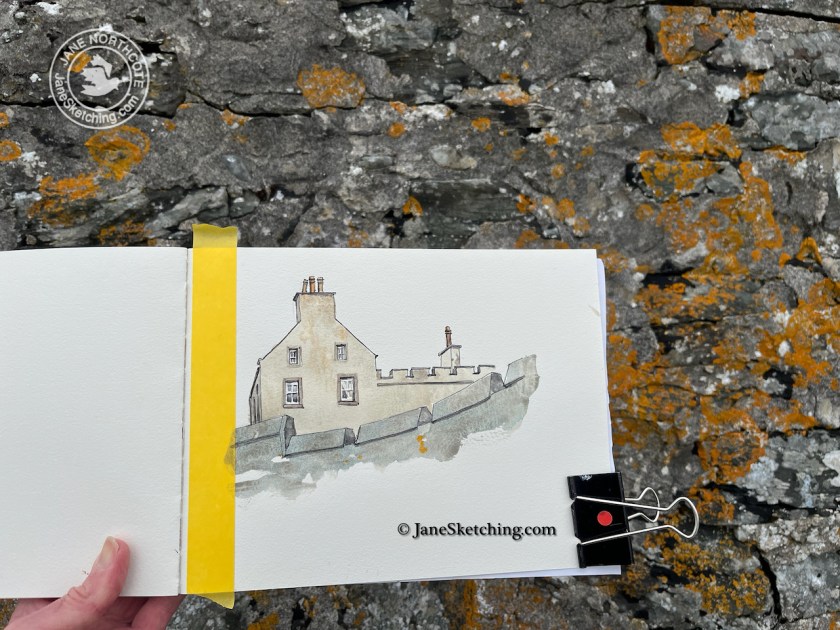
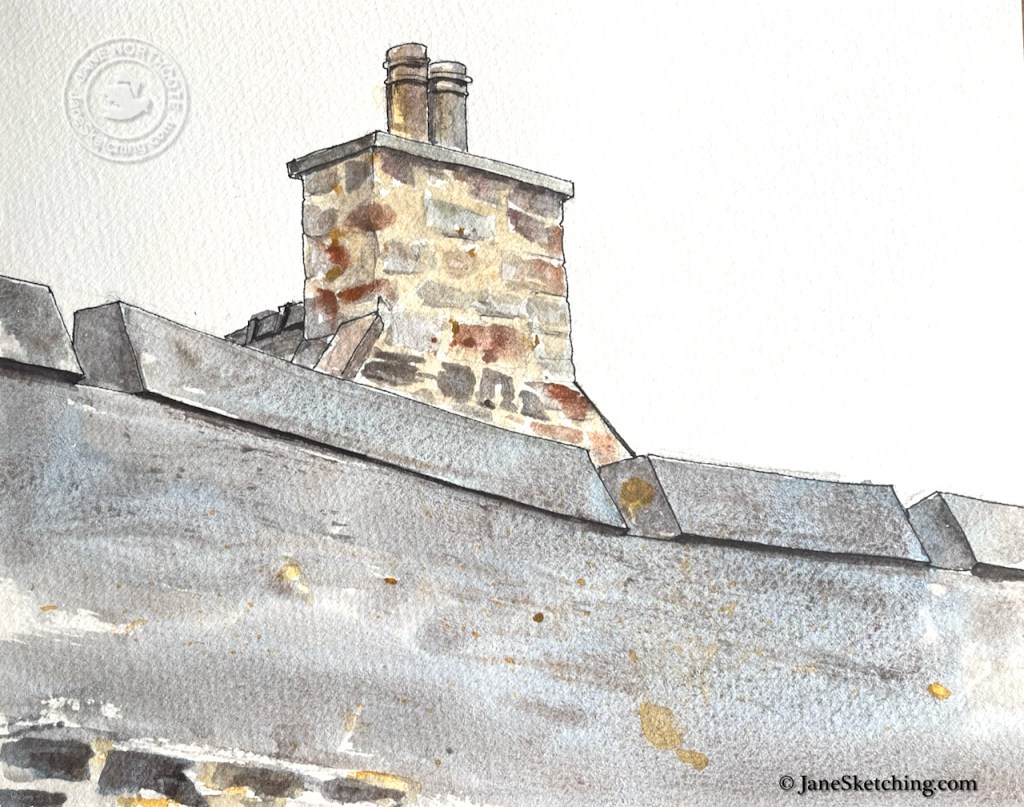
To the right of this drawing is a beach. You can look up at the house from the beach:
The wall has lichen.
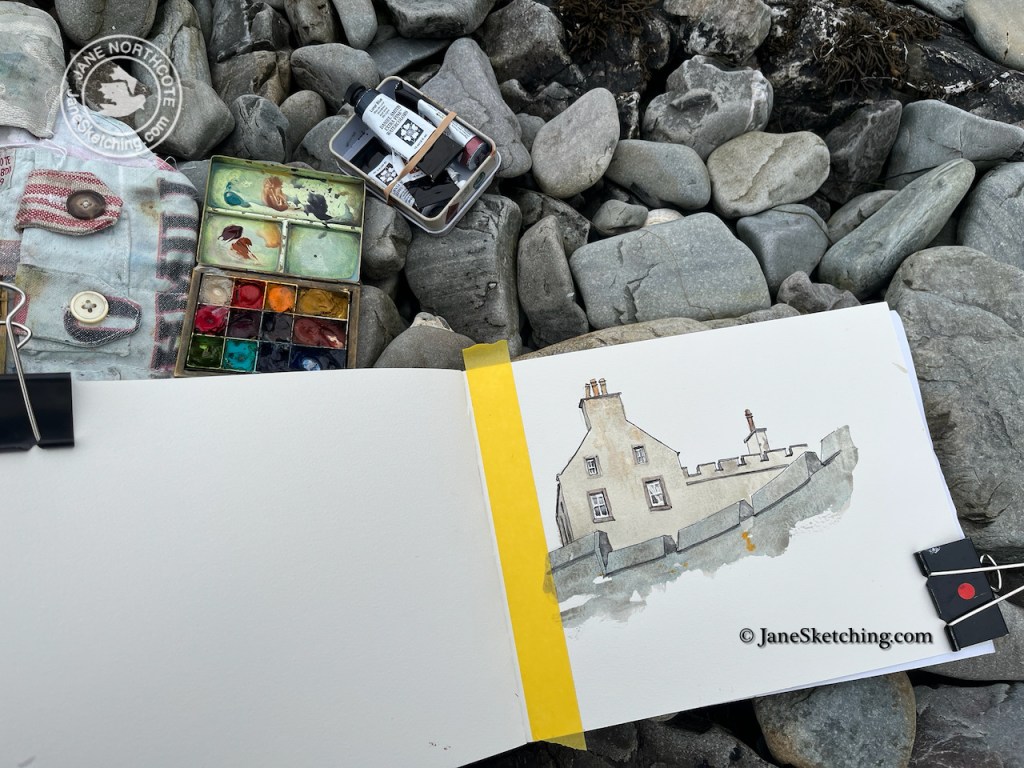
The yellow stripe down the sketchbook edge is masking tape. I remove it when the drawing is done so that there is a clean edge.
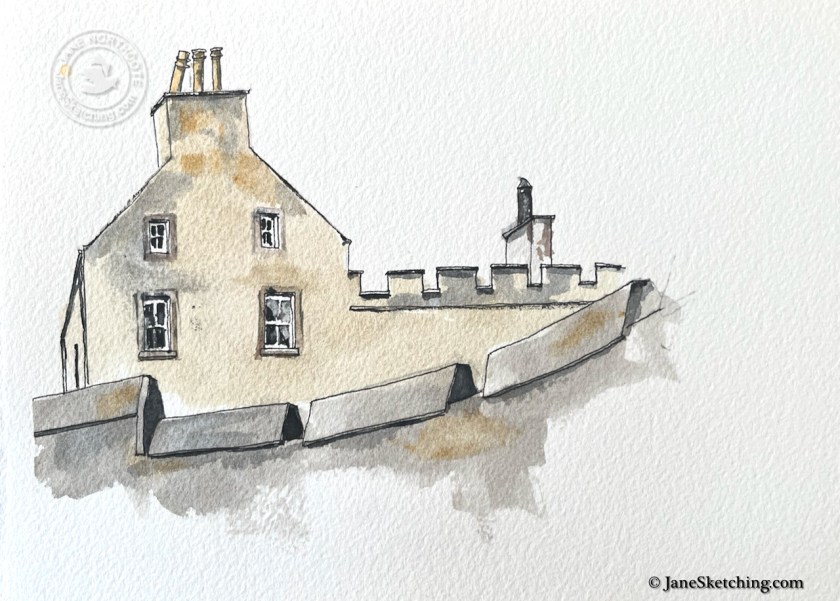
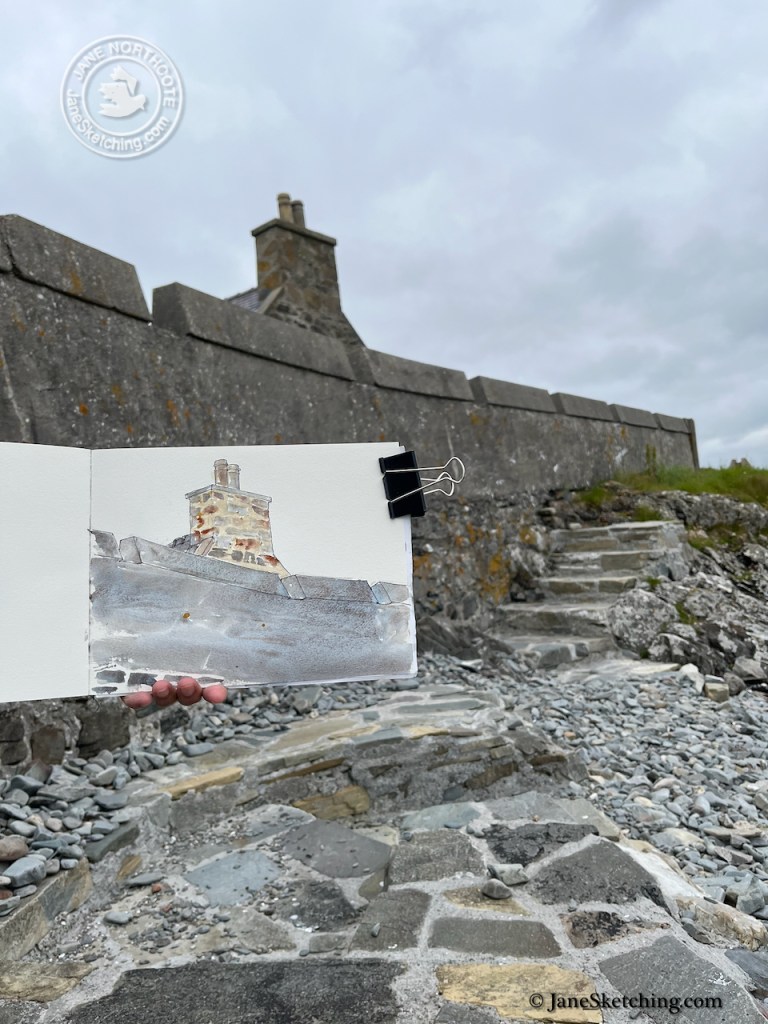
Looking the other way you see the edge of Burrastow Cottage.
While I was drawing on the beach, a man arrived, walking on the seaward side of the wall. After a brief chat, he continued on up those steps shown in the photo. He was walking the entire coast of Shetland. So he went along the shore and around the promontory. He was very thorough, and very determined.
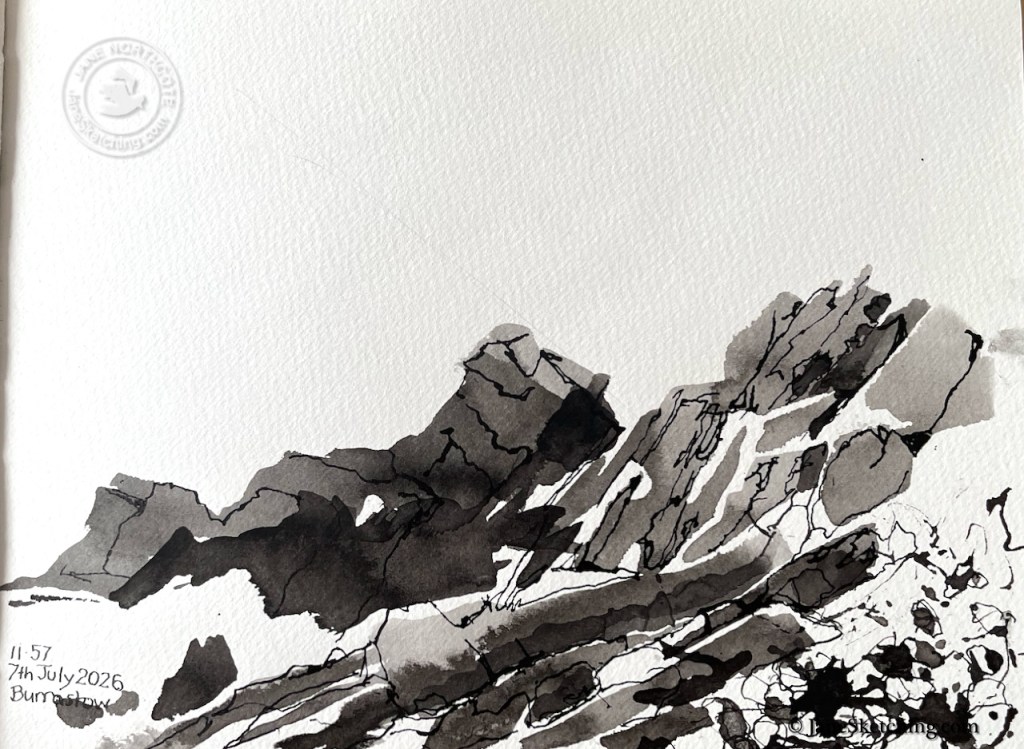
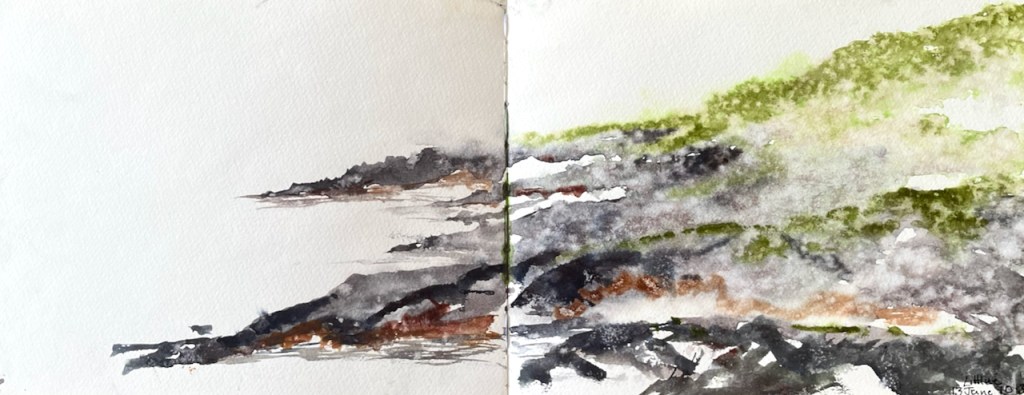
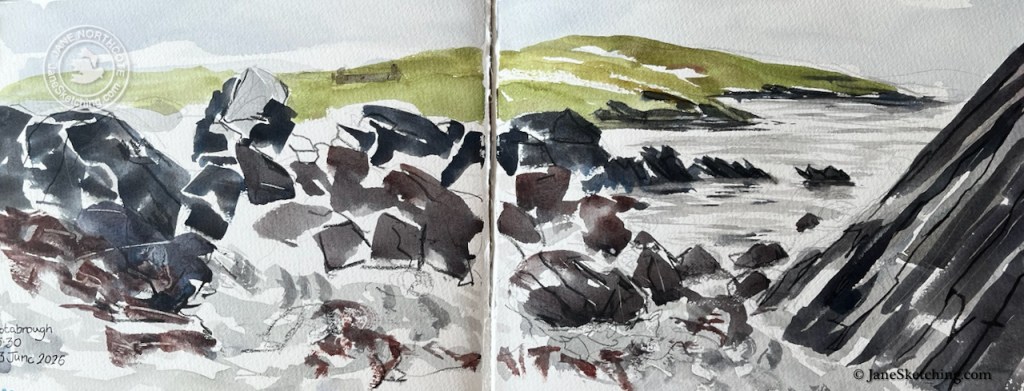
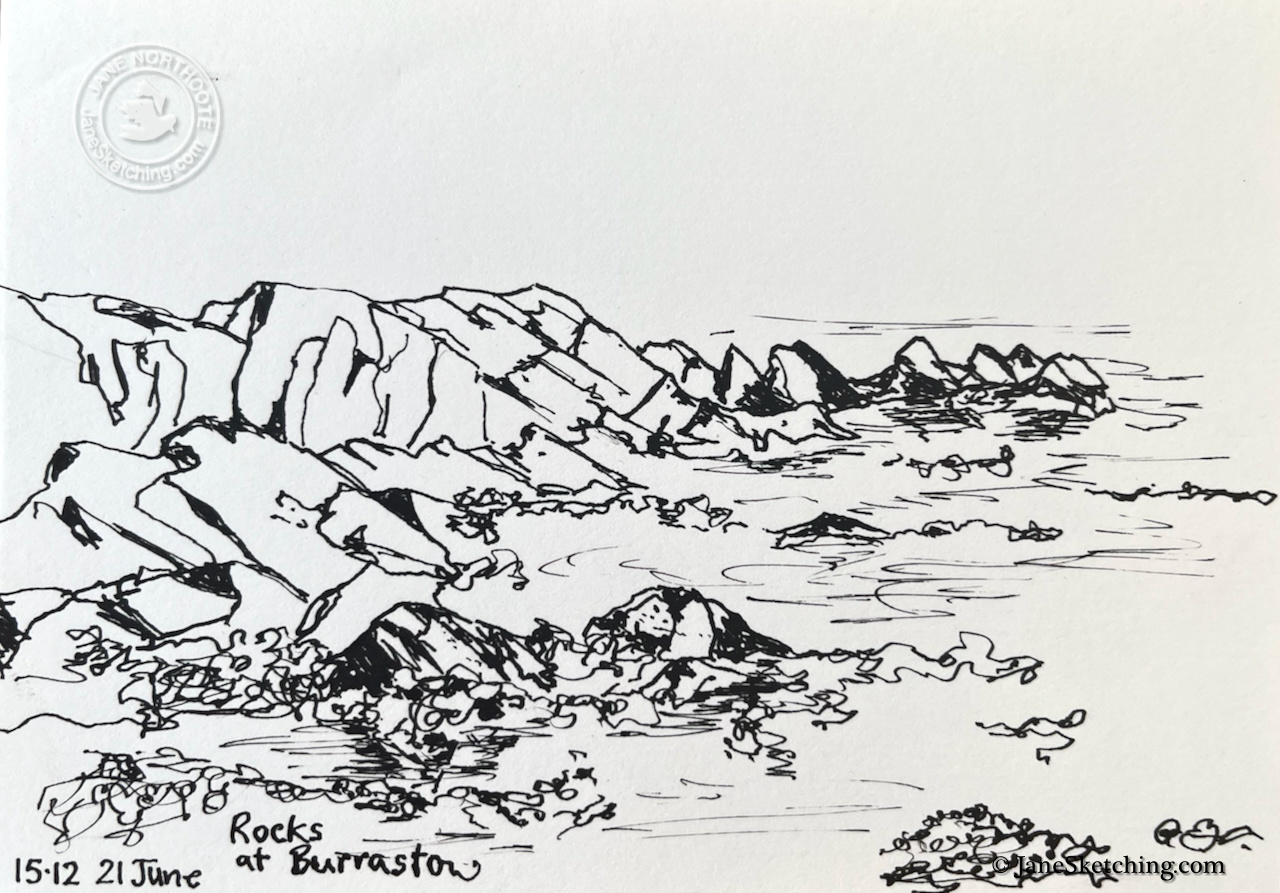
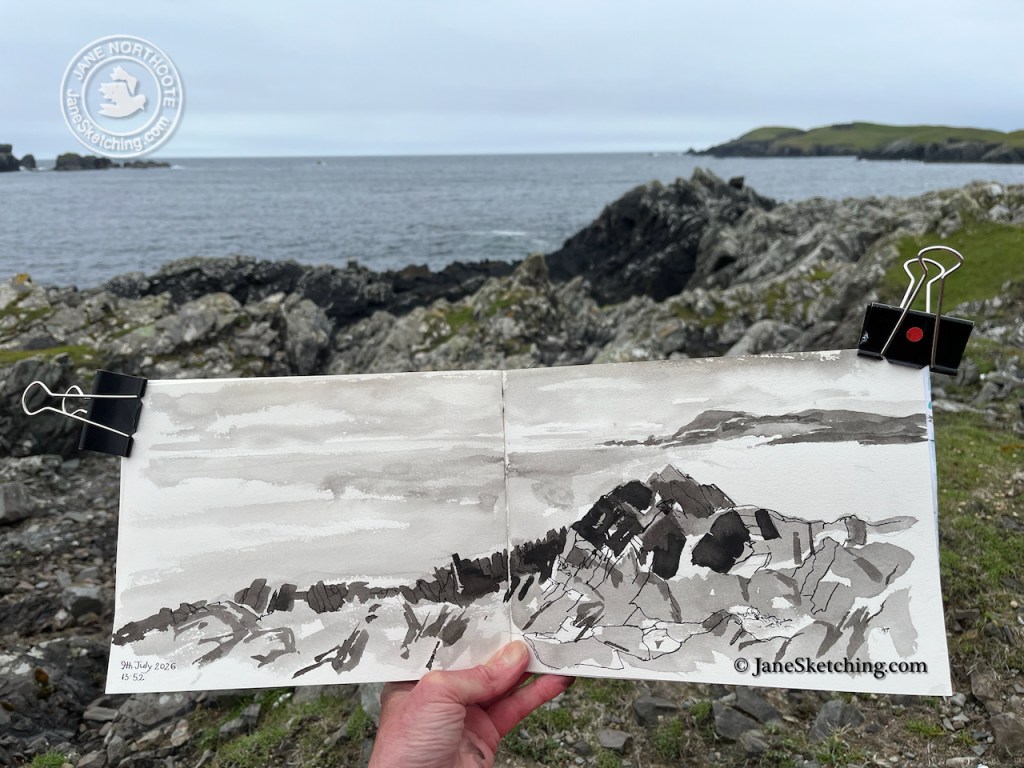
Here are rocks, looking to sea from the same point on Burrastow beach. The man walking the coast of Shetland had been scrambling over such rocks.
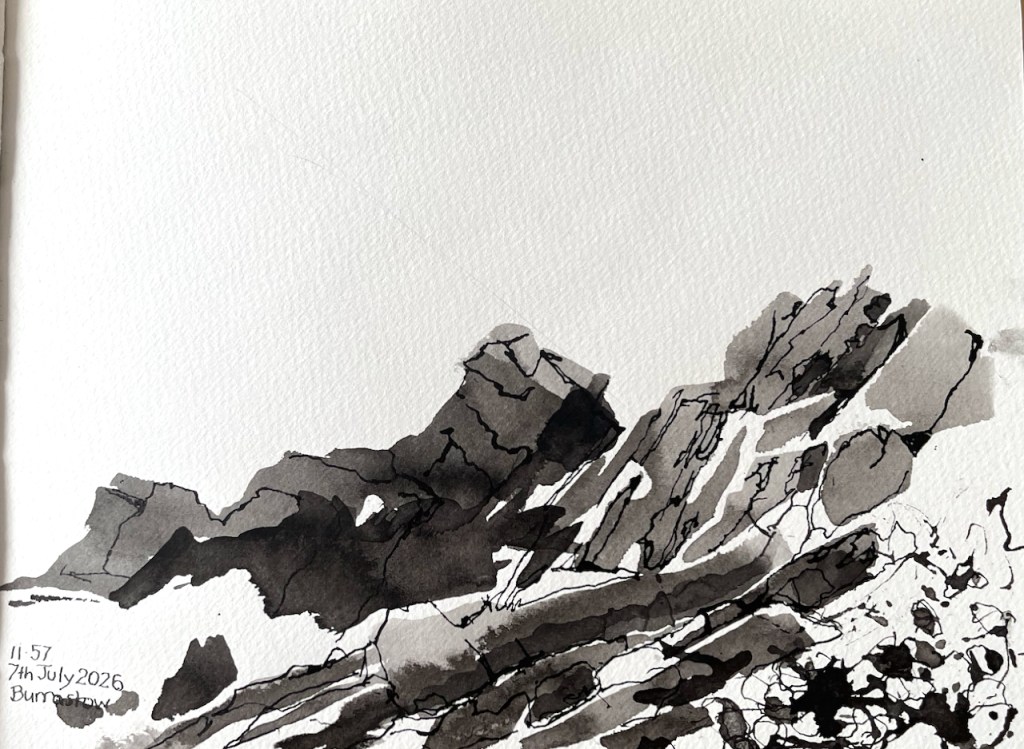
Rocks at Burrastow – pen and ink
It’s a lovely spot. I have sketched at Burrastow before:
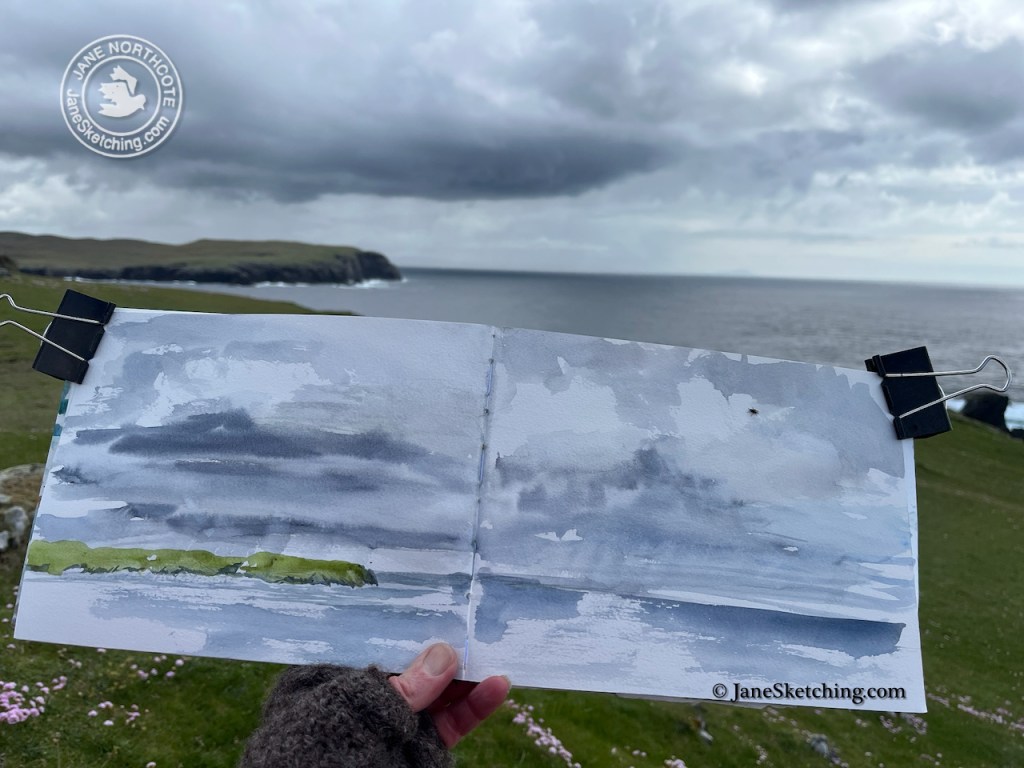
Oh how wonderful to be on the clifftop sketching the changing sky!
13th June 2026, Littlure
That sky contained rain. It came down and made a contribution to my picture.
13th June 2026, Littlure, rain on the page.
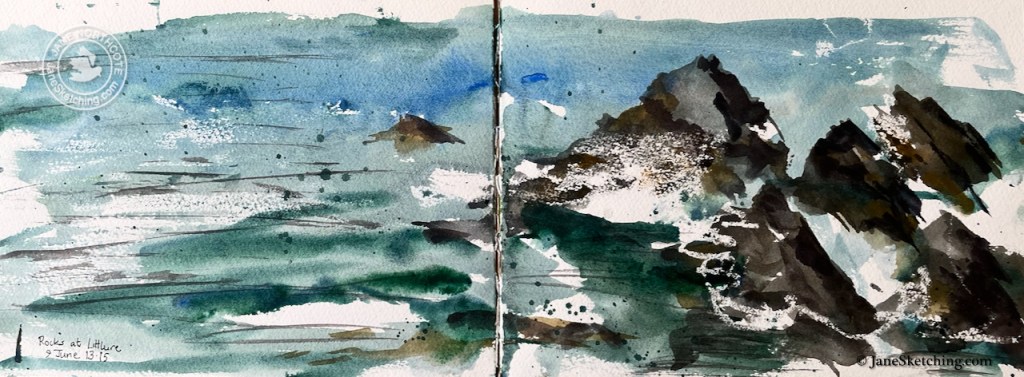
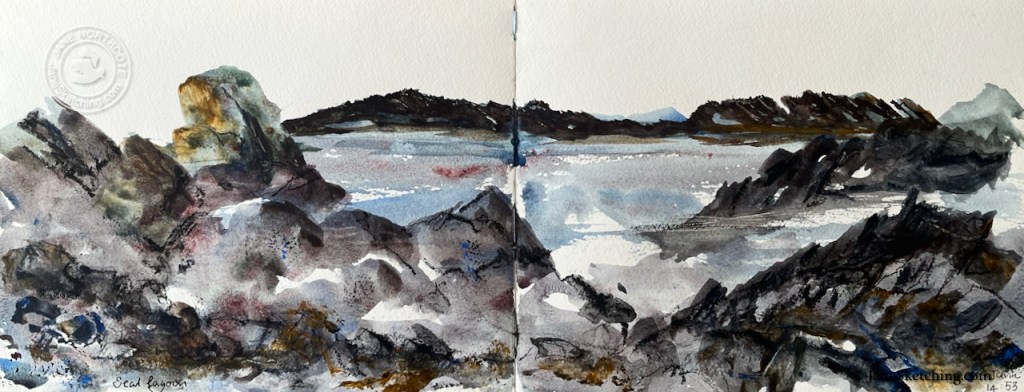
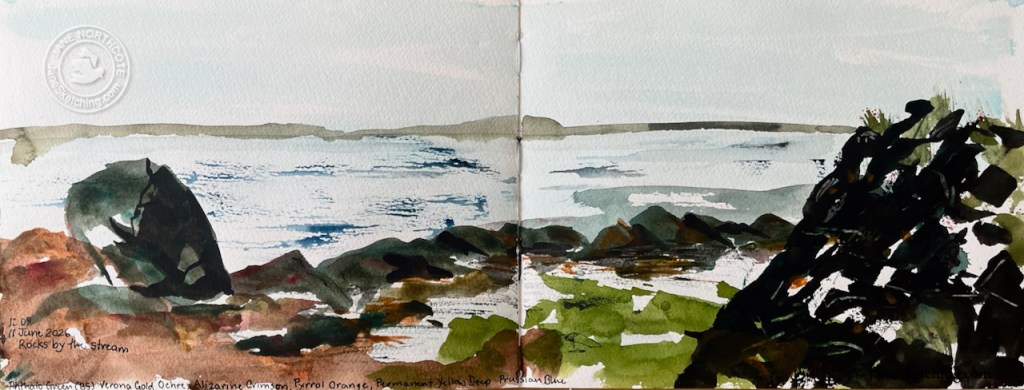
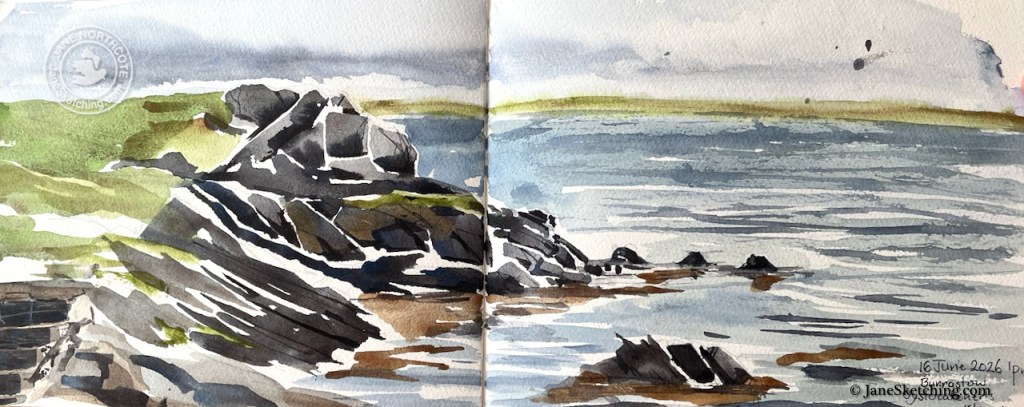
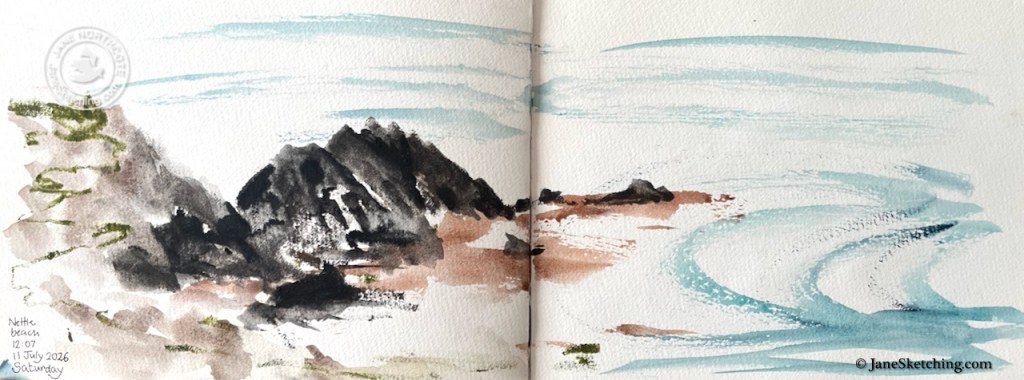
I made a lot of sketches of rocks. Here are eight sketchbook pages in a slideshow. (It might not play on a mobile device.)
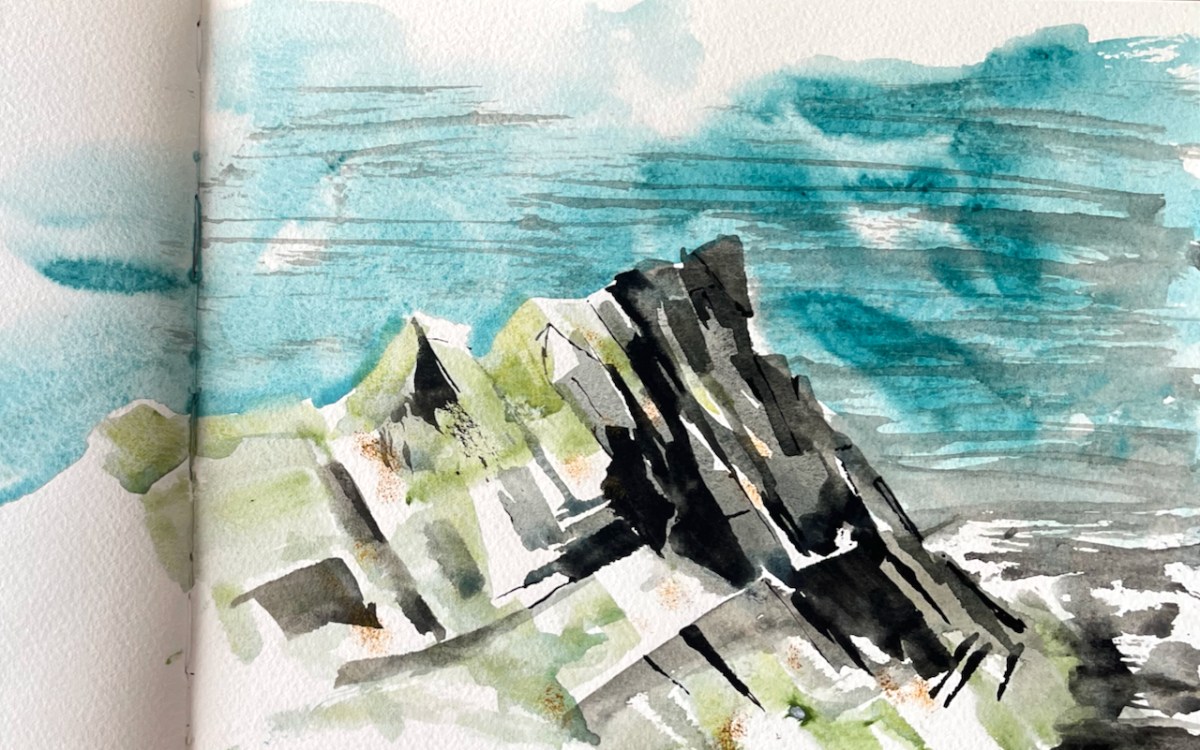
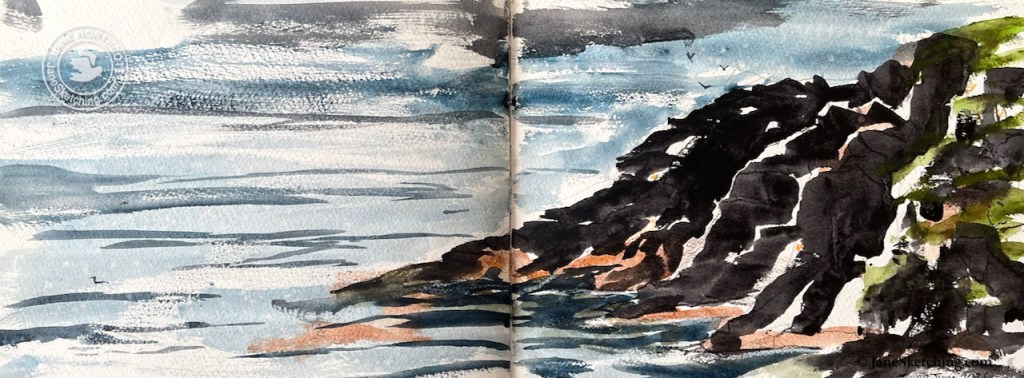
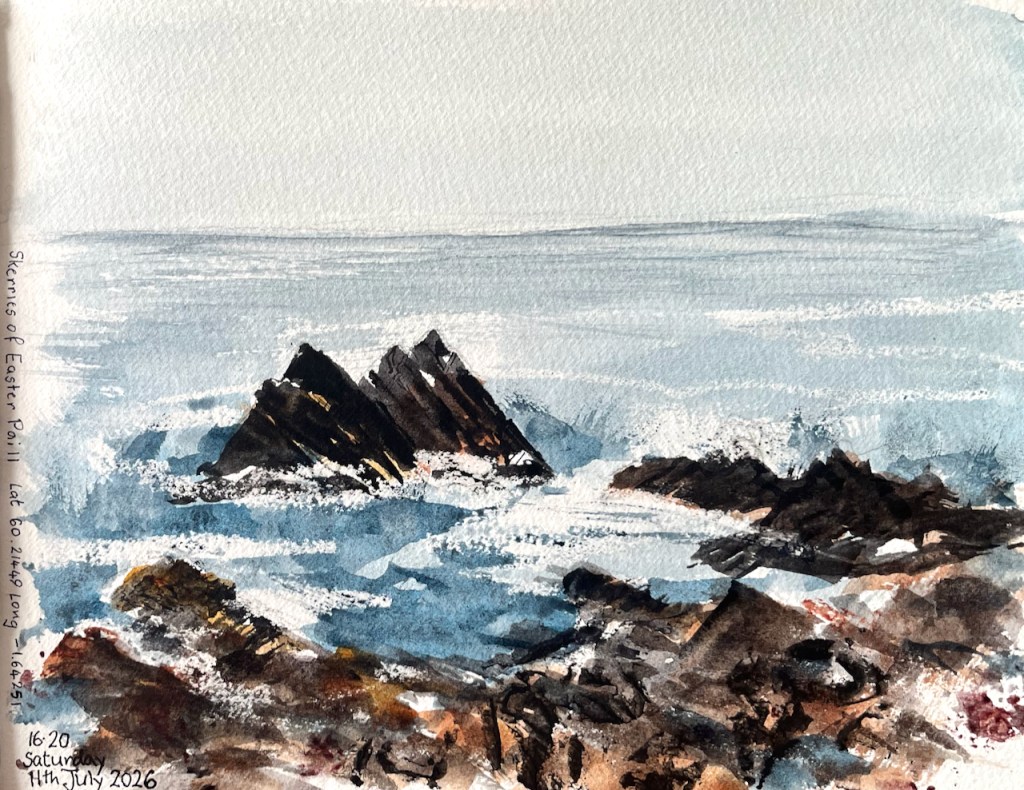
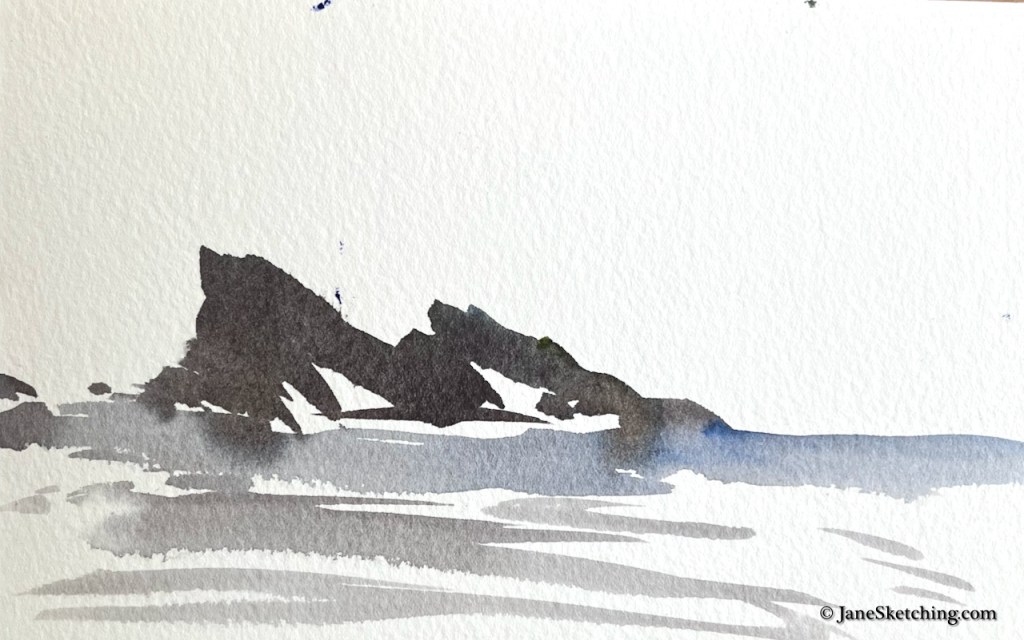
The rocks on the West side of Shetland have angles and points. I particularly like the purity of shape of these rocks: the Skerries of Easter Pail. They are almost exact equilateral triangles.
Skerries of Easter Paill: Latitude 60.21449 Longitude 1.64251 OS reference HU 19912 47846
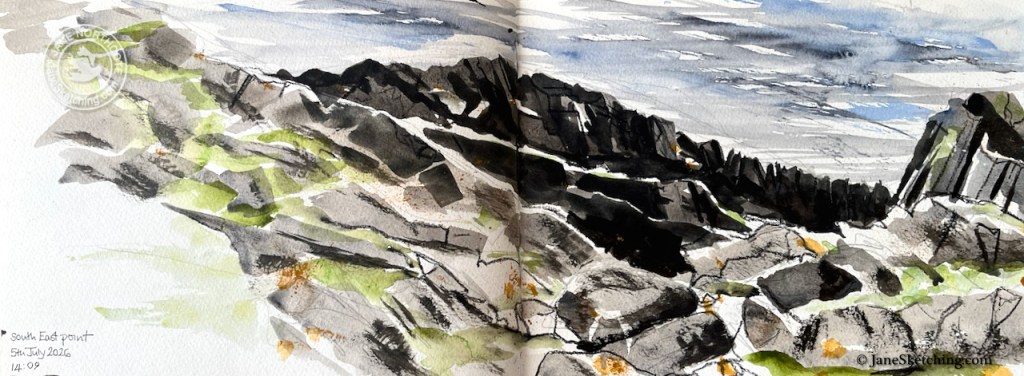
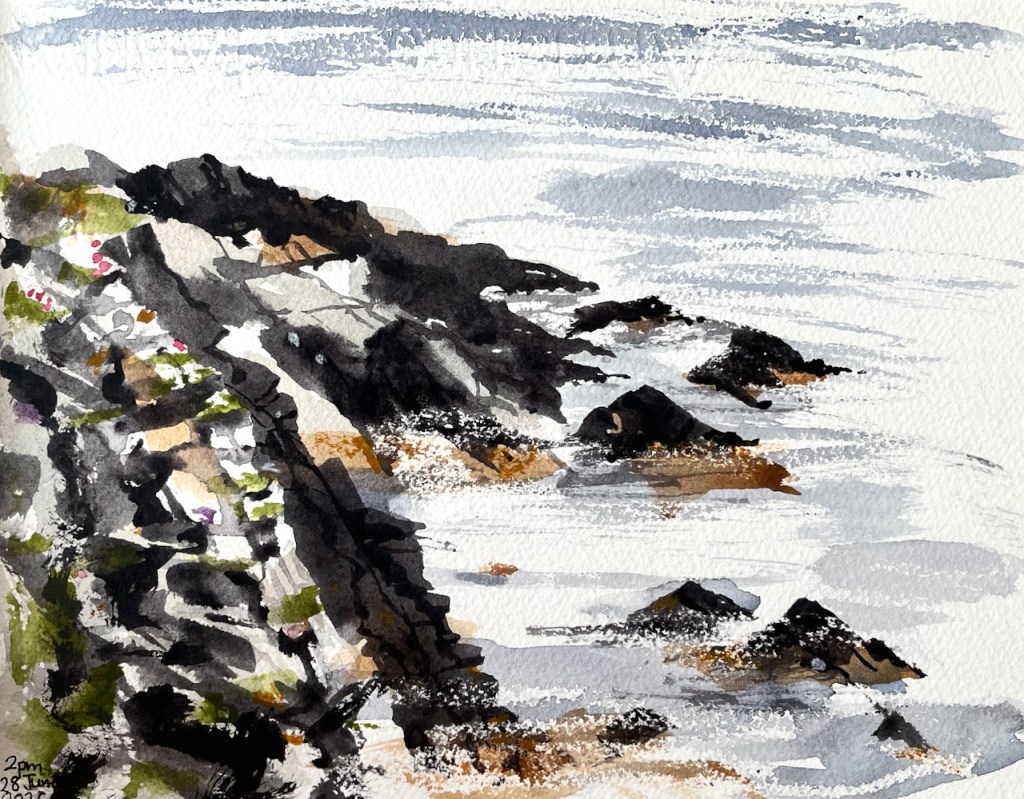
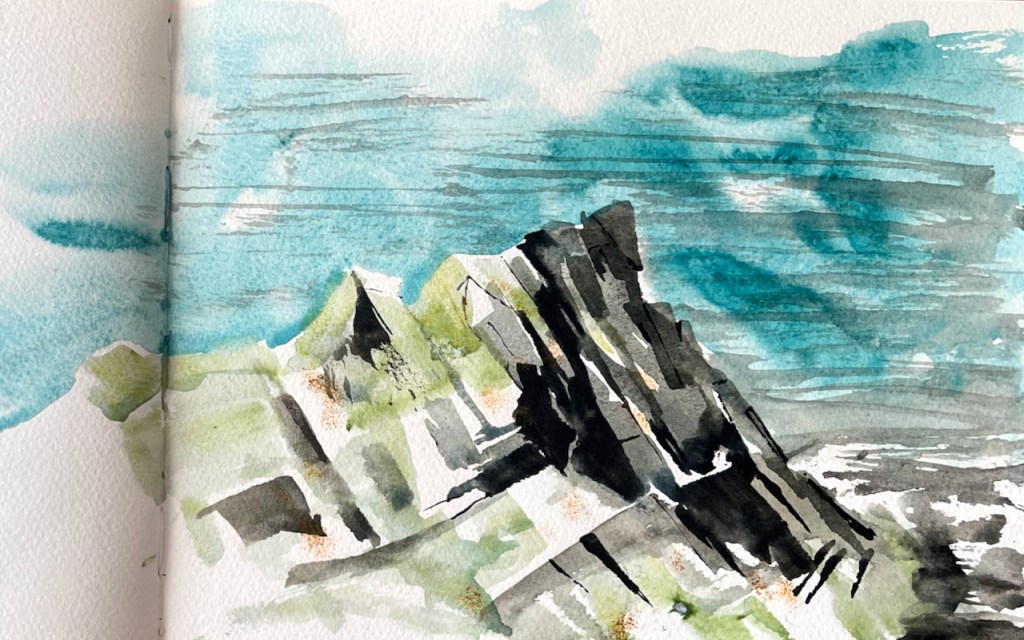
Here are more rocks, all showing the distinctive angle, about 60 degrees.
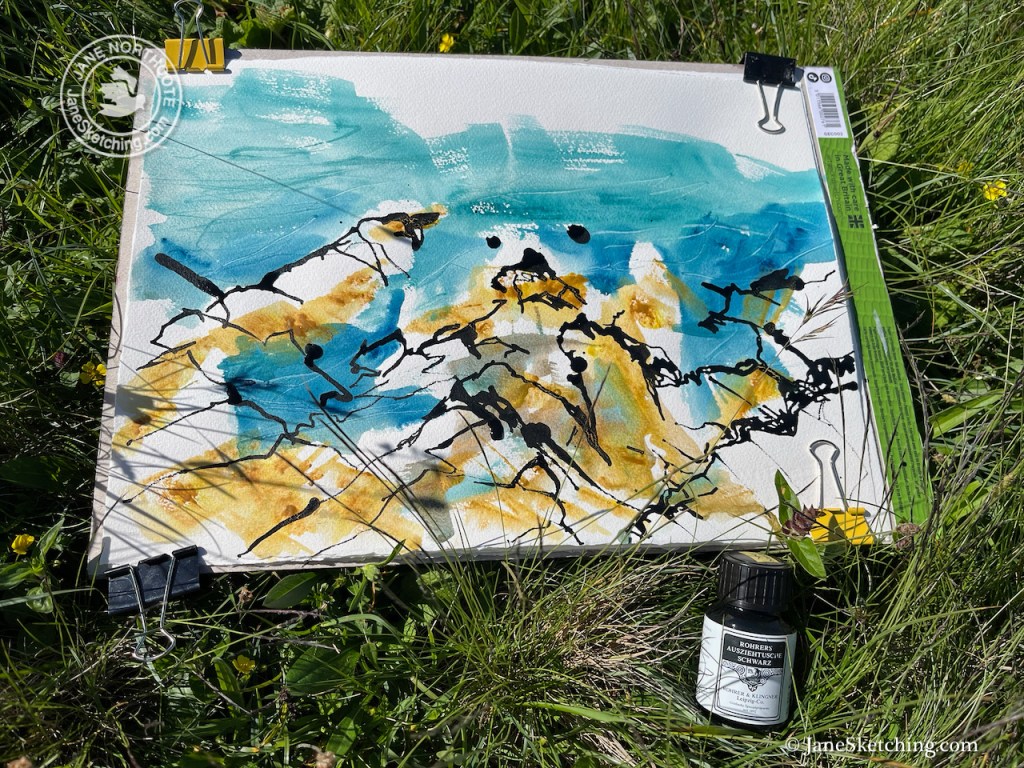
On this visit, I tried a new medium: dip pen and ink.
The ink is Rohrer & Klinger “Auszeihtusche Schwarz”
The ink is Rohrer & Klinger “Auszeihtusche Schwarz” which means (I think) “drawing ink, black”. German speakers out there, please offer a better translation? It is highly pigmented, waterproof, permanent, shellac based, and for dip pens only. In the picture above I used it with an amazing bamboo pen supplied by L Cornelissen & Son. Great fun. The picture above is large by my usual standards. The ink took a surprisingly long time to dry, then rain started and I rushed back, trying to shield the picture under its cardboard drawing board. I had more than one such sheet and they flapped like flags. Needless to say the highly pigmented ink got everywhere: on my raincoat, on my hat (how???).
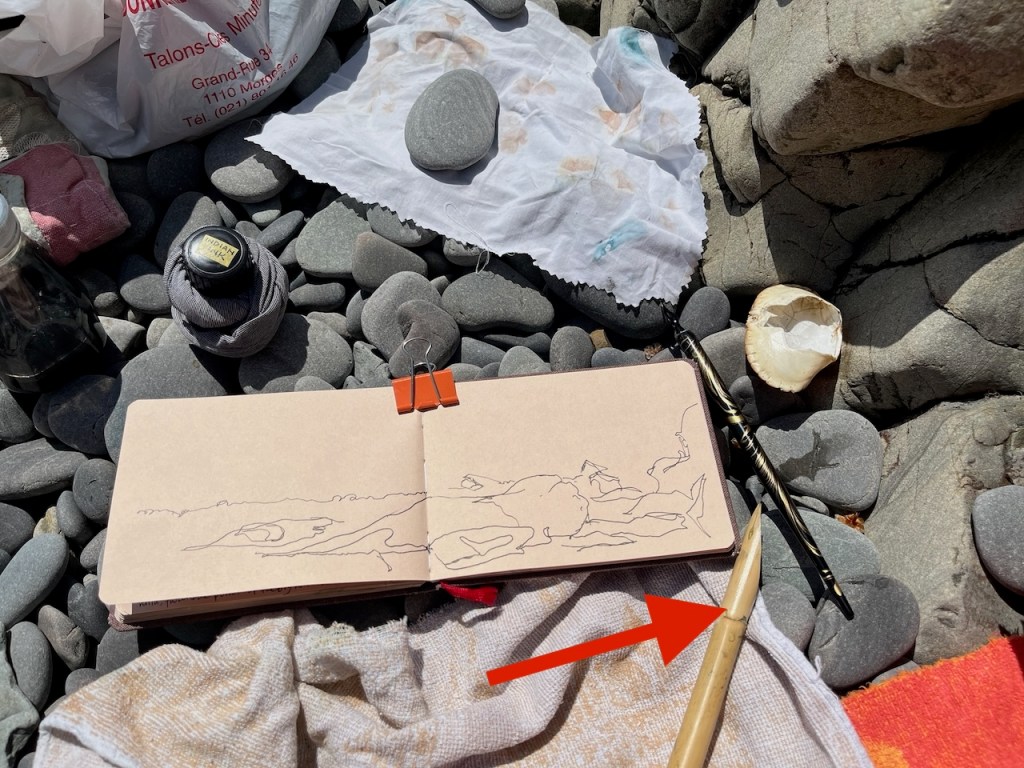
Here’s the bamboo pen under calmer conditions. As you see I have now learned to wrap the bottle in a cloth to catch drips, and to label it clearly, so it doesn’t get confused with fountain pen ink which is in a similar bottle.
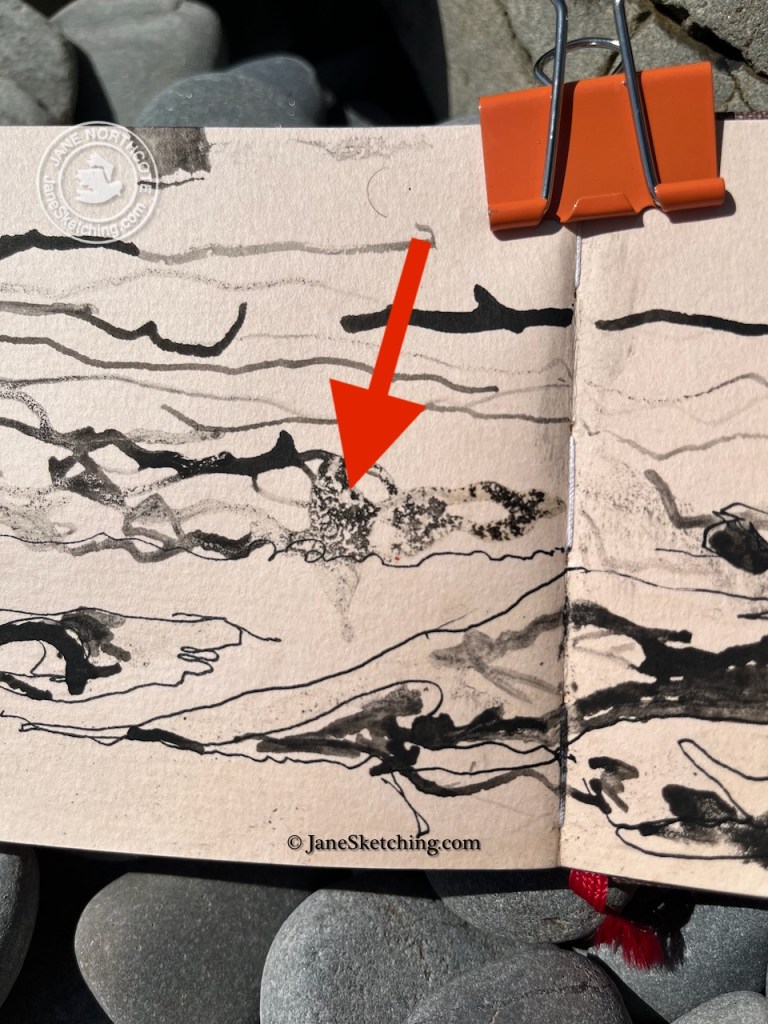
This was a warm day after a refreshing dip in the sea. I drew some pictures of the rocks. I used sea water to dilute the ink. This produced some interesting effects.
You see how the shellac-based ink interacted with the sea water to make little dots and swirls, a pleasing effect.
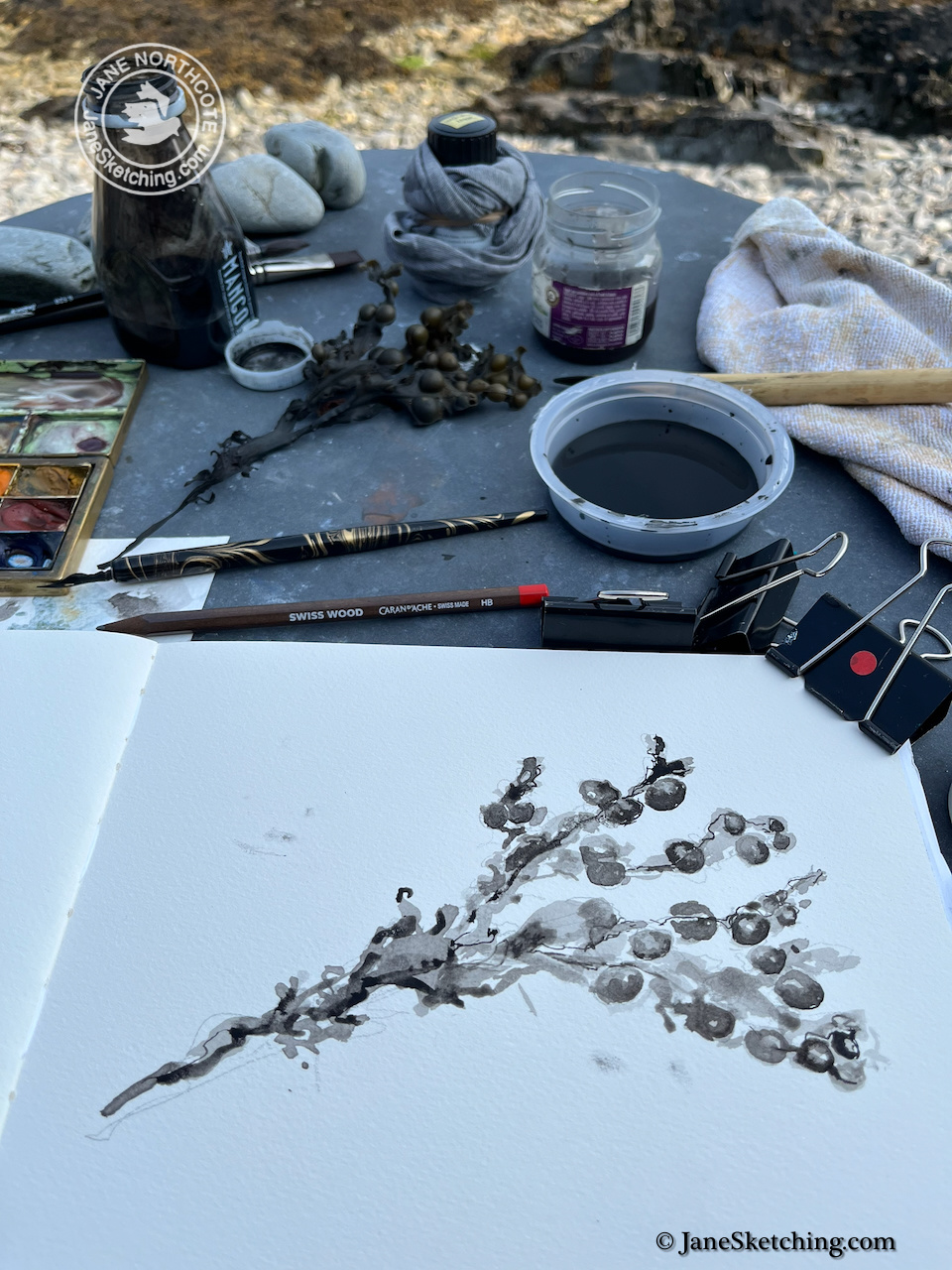
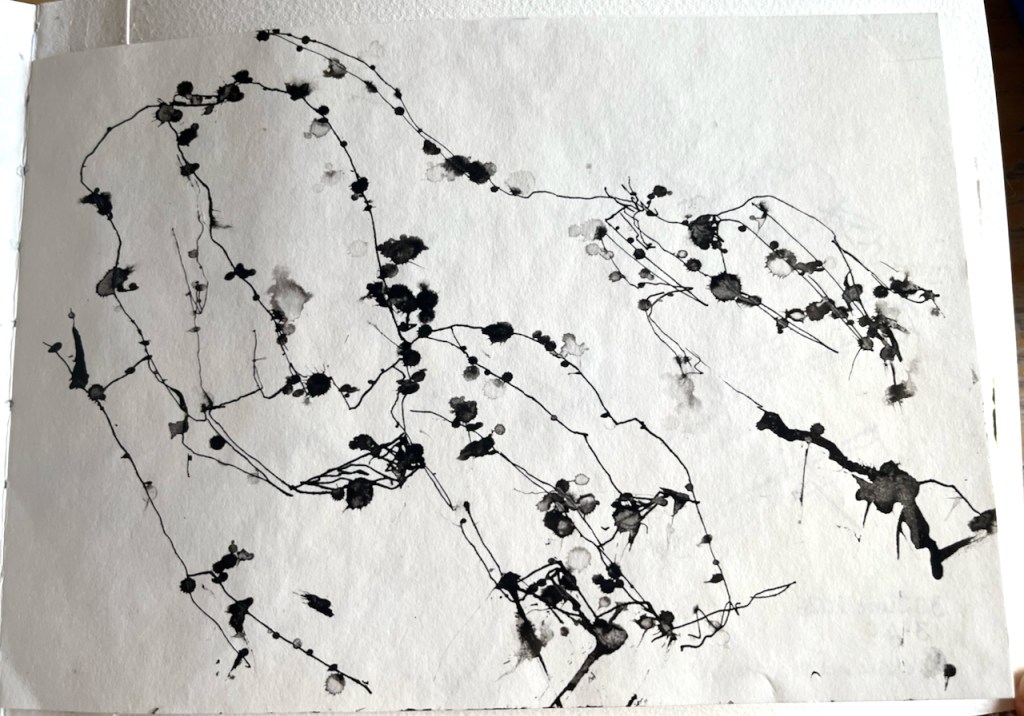
Here are some more pictures done in this ink, undiluted, and diluted with fresh water.
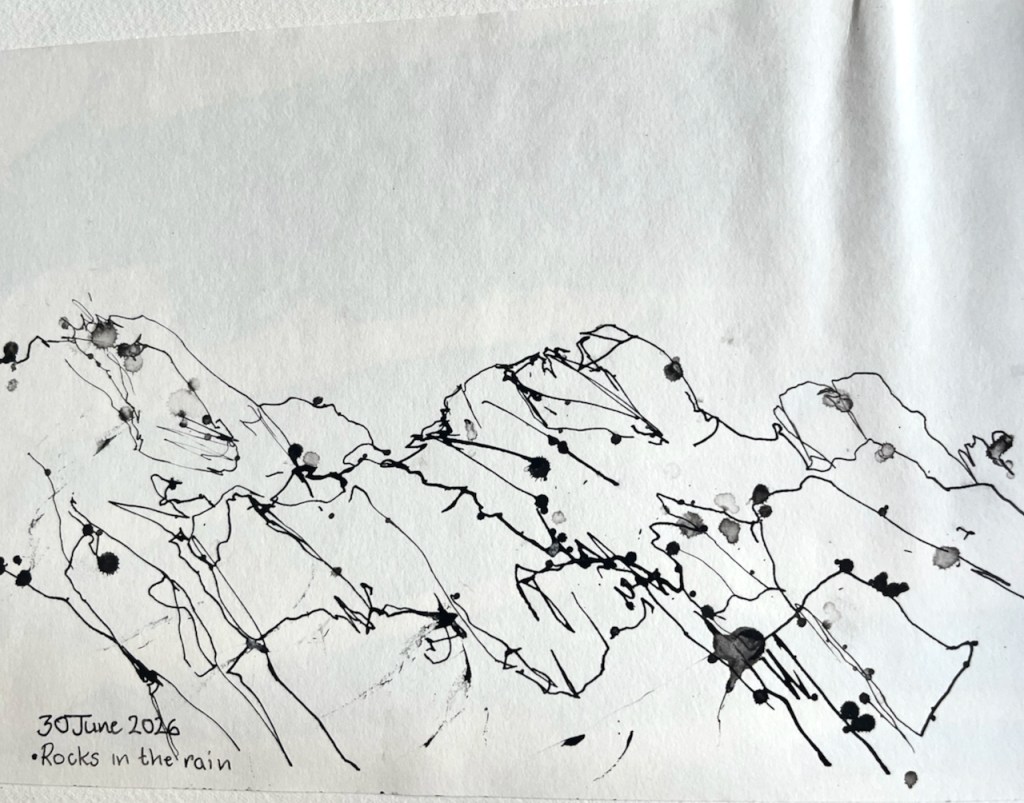
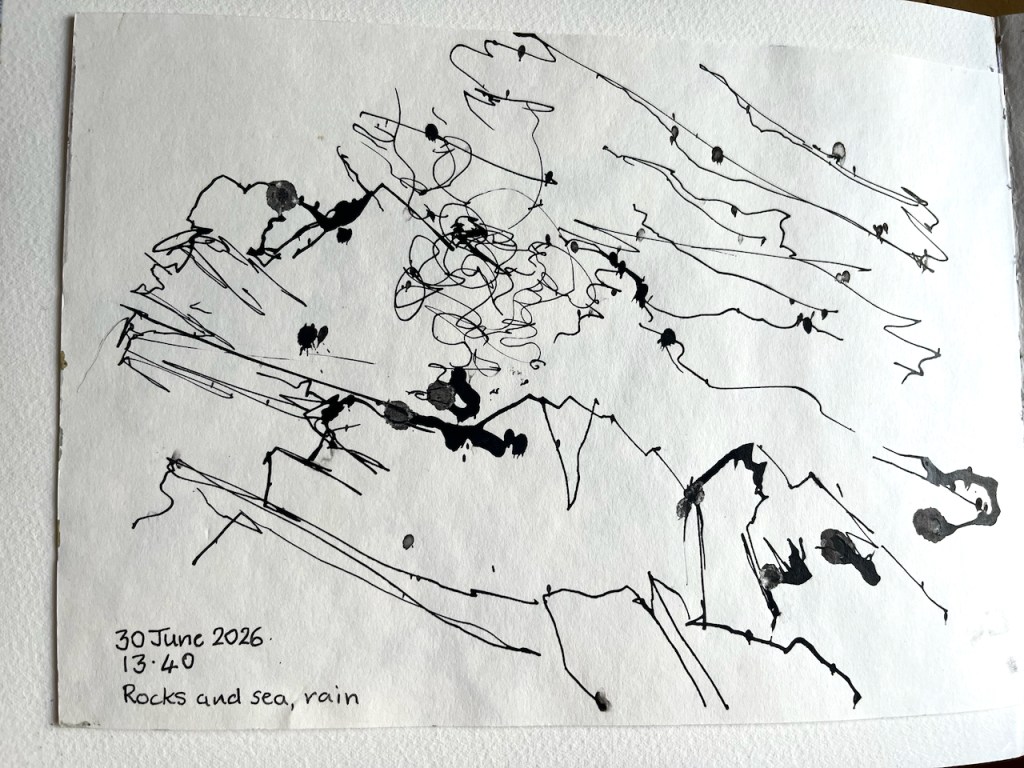
This ink is waterproof, but only *after* it has dried. This is sometimes a challenge in the Shetland climate. Here are some rock studies, with contributions from the rain falling on wet ink.
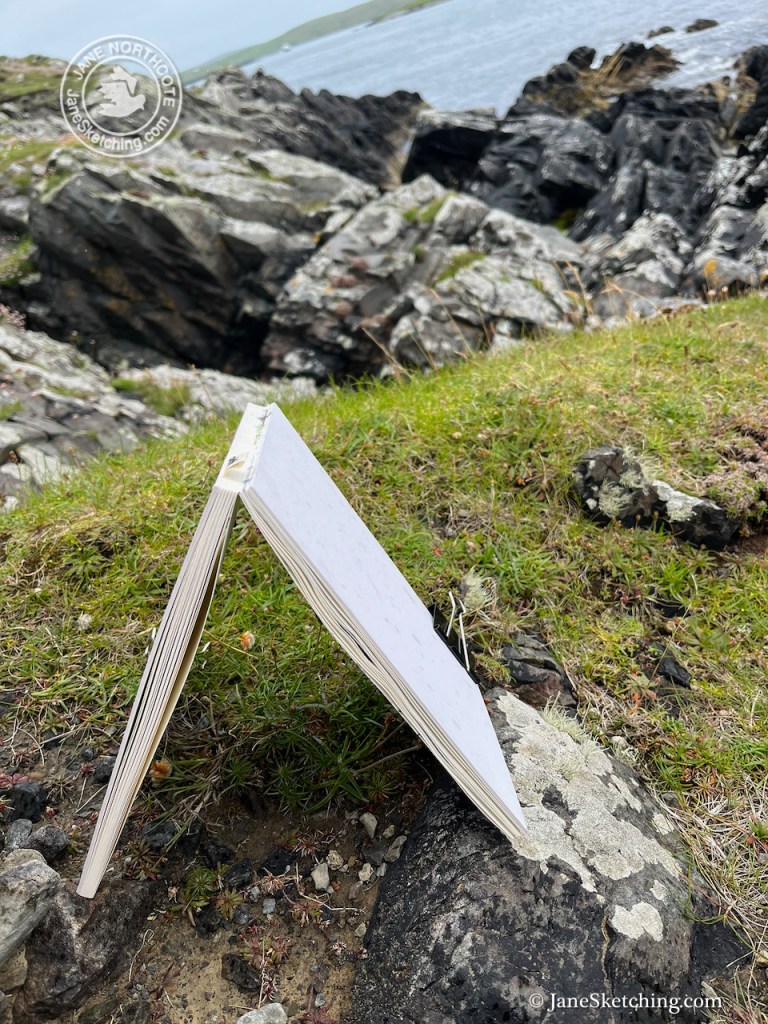
I tried to protect the drawings by turning the sketchbook into a sort of tent.
I enjoyed this new medium and the high-contrast effects I could obtain.
Rocks, diluted and undiluted drawing ink.
In the next post, I will show sketches of Burrastow House, on the West side, near Walls.
Click a button below to share this post online, email it, or print it:
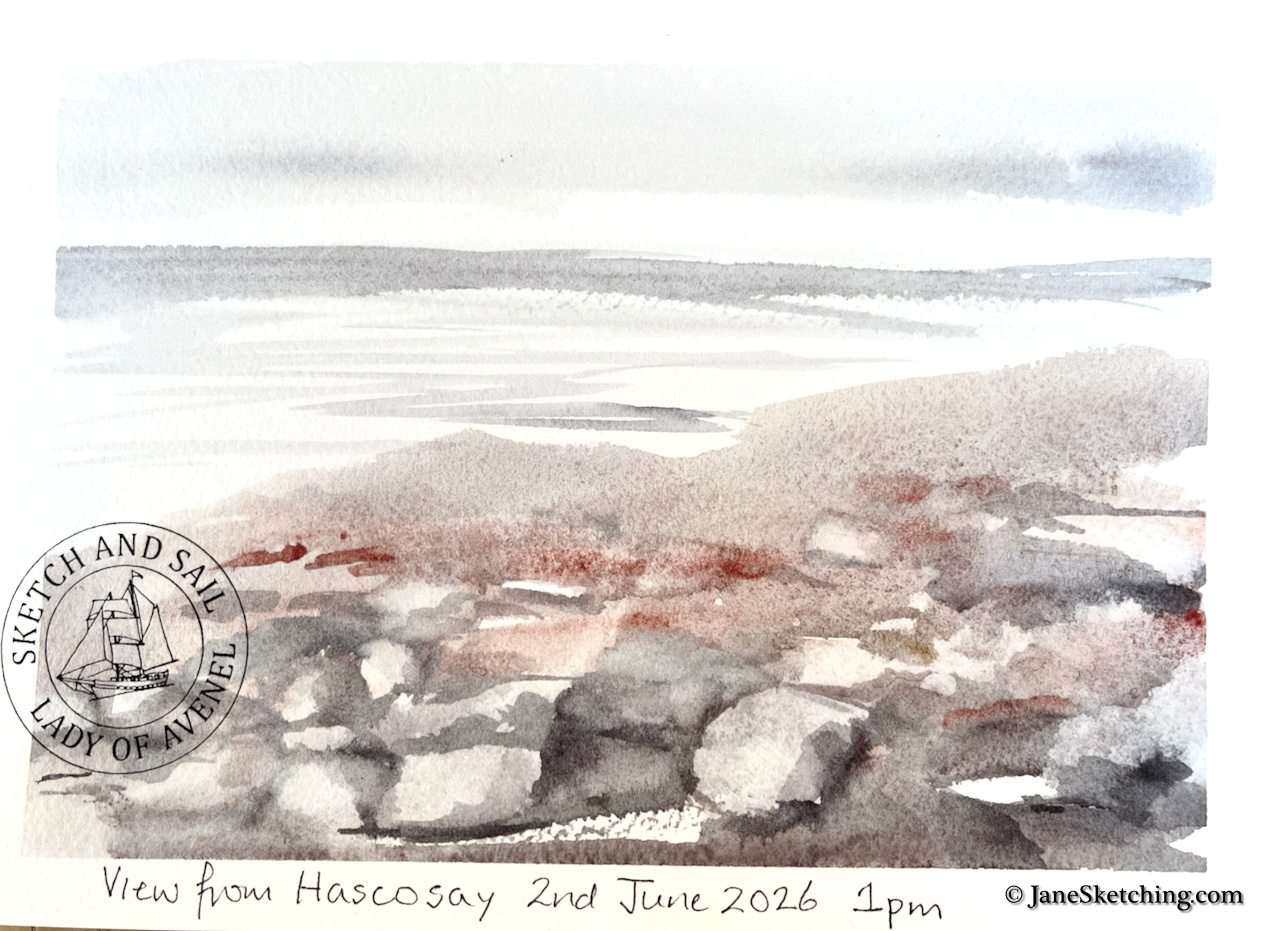
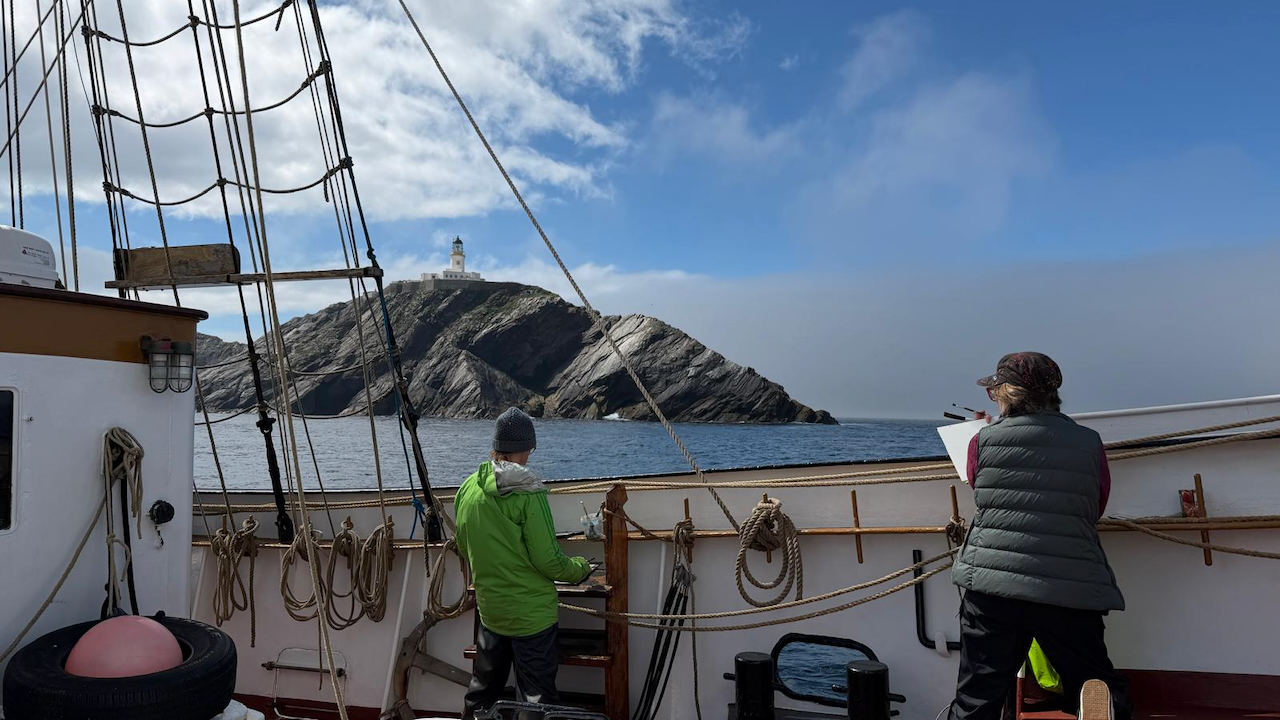
I love boats, and the sea, and I draw pictures. So I found myself in the company of an enthusiastic group of artist-sailors, on board the Lady of Avenel, in Lerwick in Shetland, about to set off for a week’s sketching and sailing.
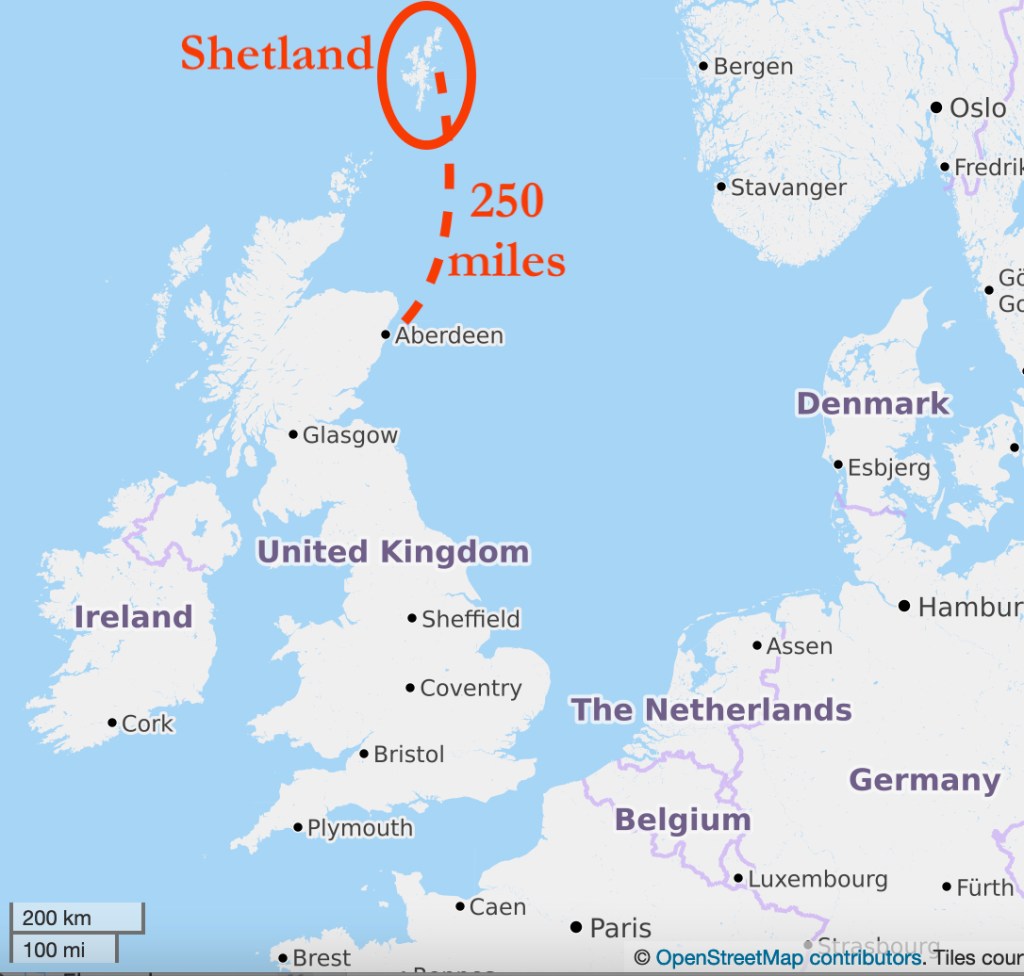
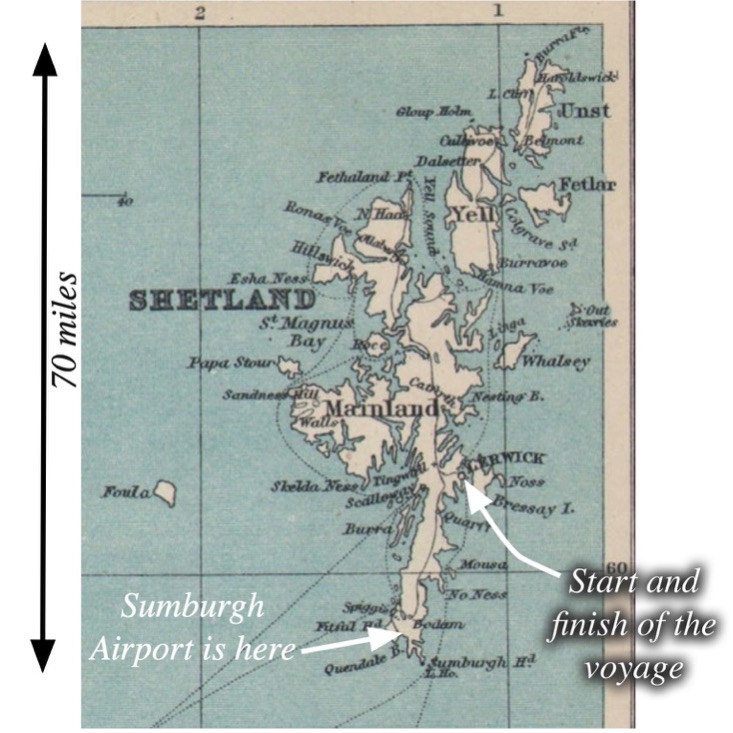
Shetland, for those who are a bit hazy about it, is a group of islands 100 miles or so off the North coast of Scotland. It is part of the UK. Our voyage took us to the most Northerly part of the UK, and I swam at the most northerly beach. But that was later. We set off from Lerwick, which is about half way up the biggest island of the Shetland group.
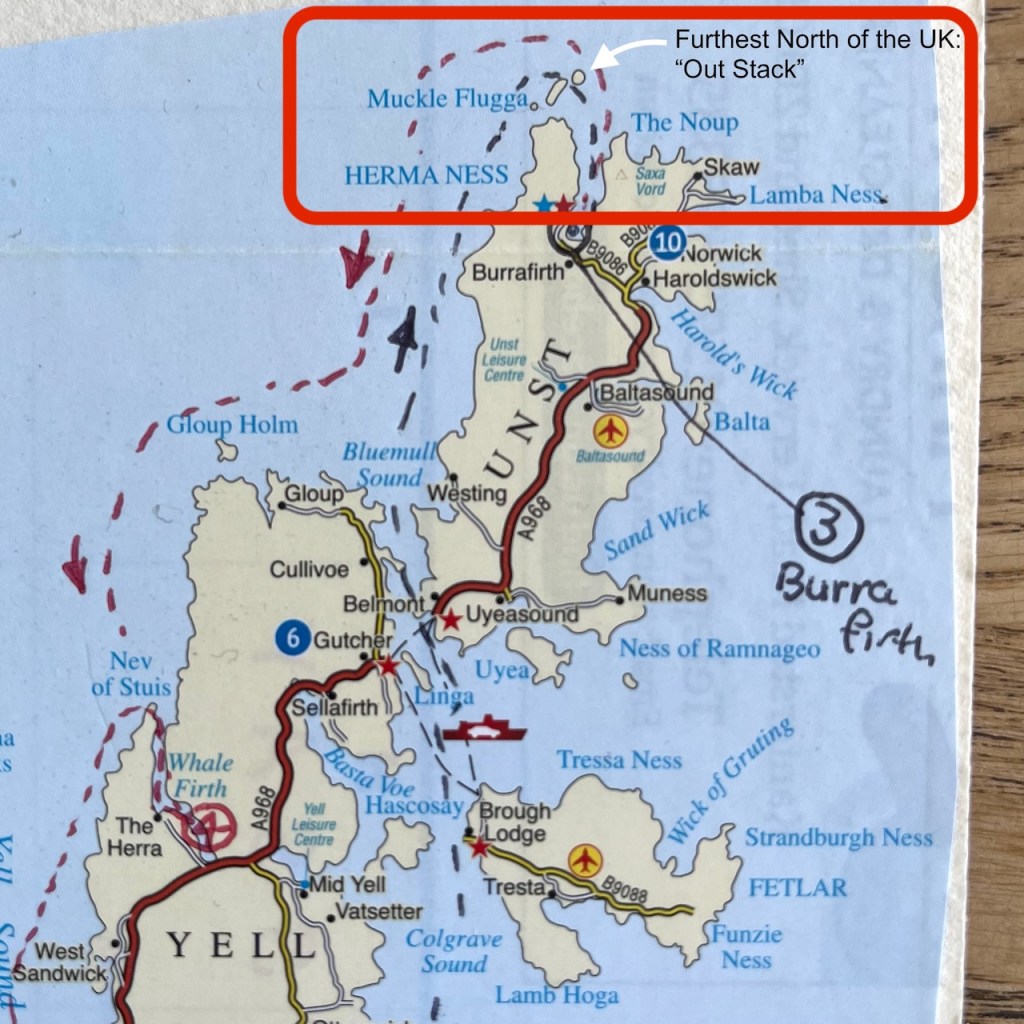
Our voyage took us up the east side of the islands, between the islands of Whalsay, Yell and Unst, and up to the most Northerly lighthouse, Muckle Flugga.
We had a full professional crew: Charles the skipper, Nessie the mate, Tom the cook, and Lyn the second mate.
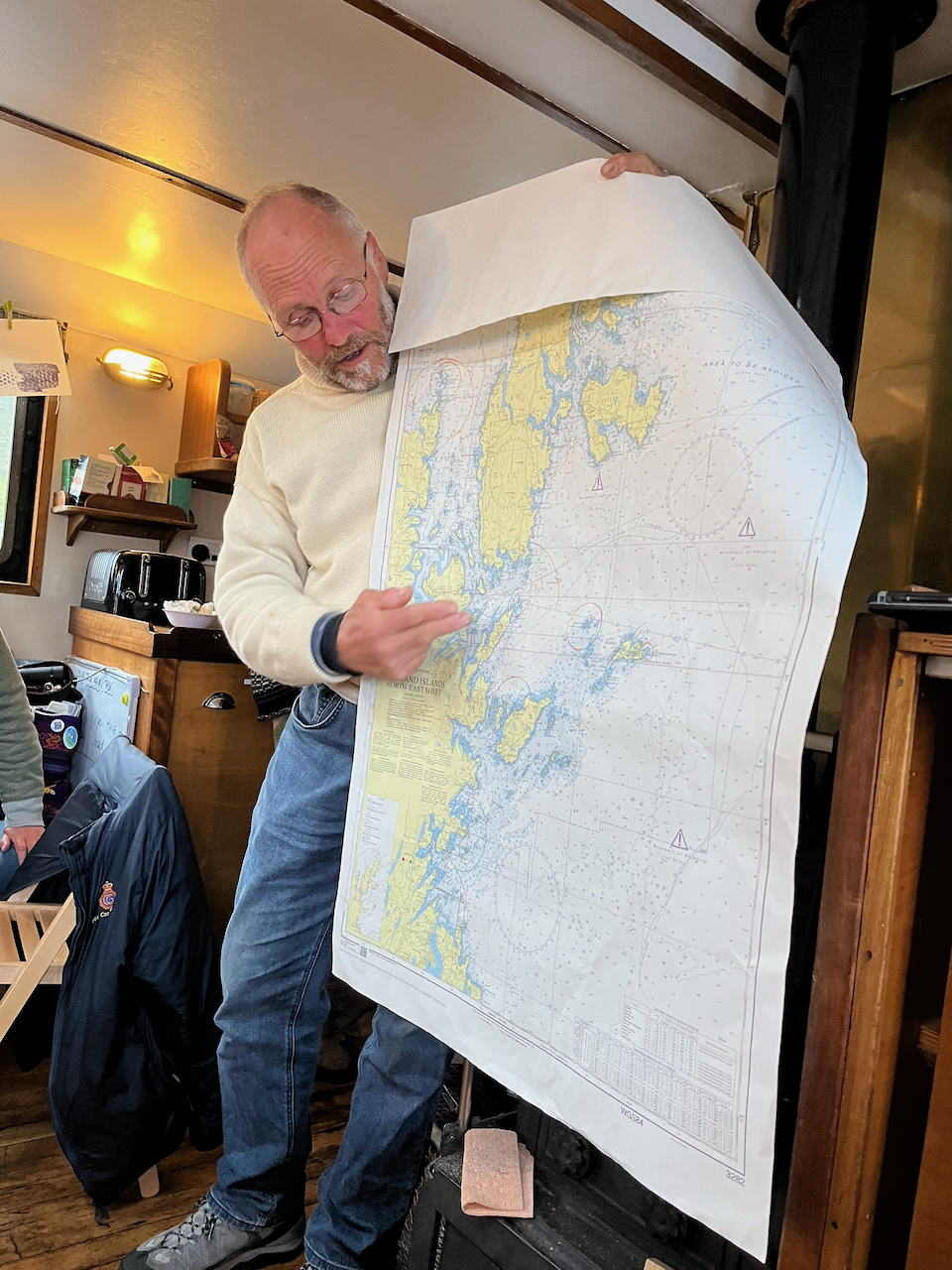
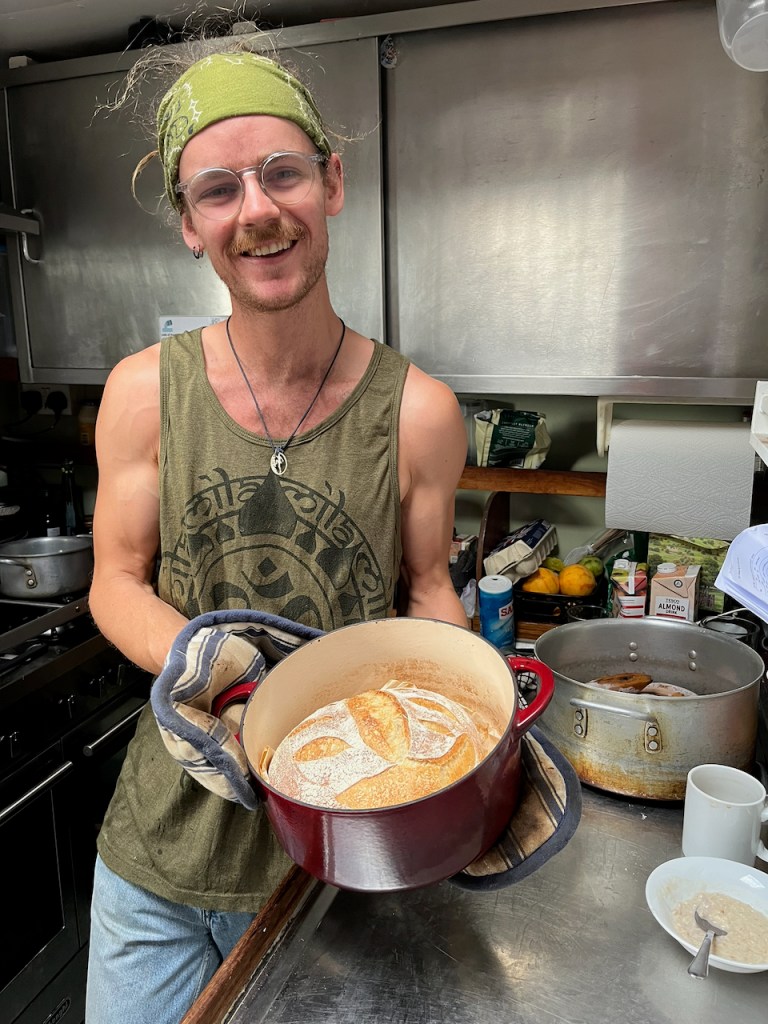
Here is Charles, the captain, describing the next day’s route.Here is Tom, the ship’s cook, who baked fresh sourdough bread every day
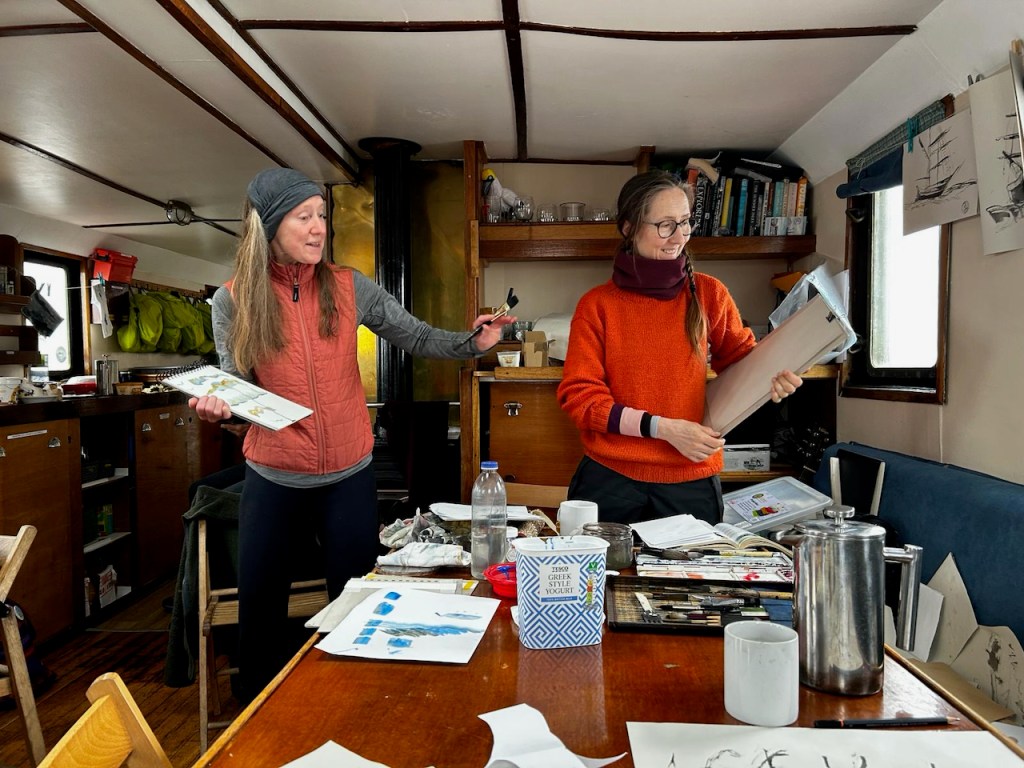
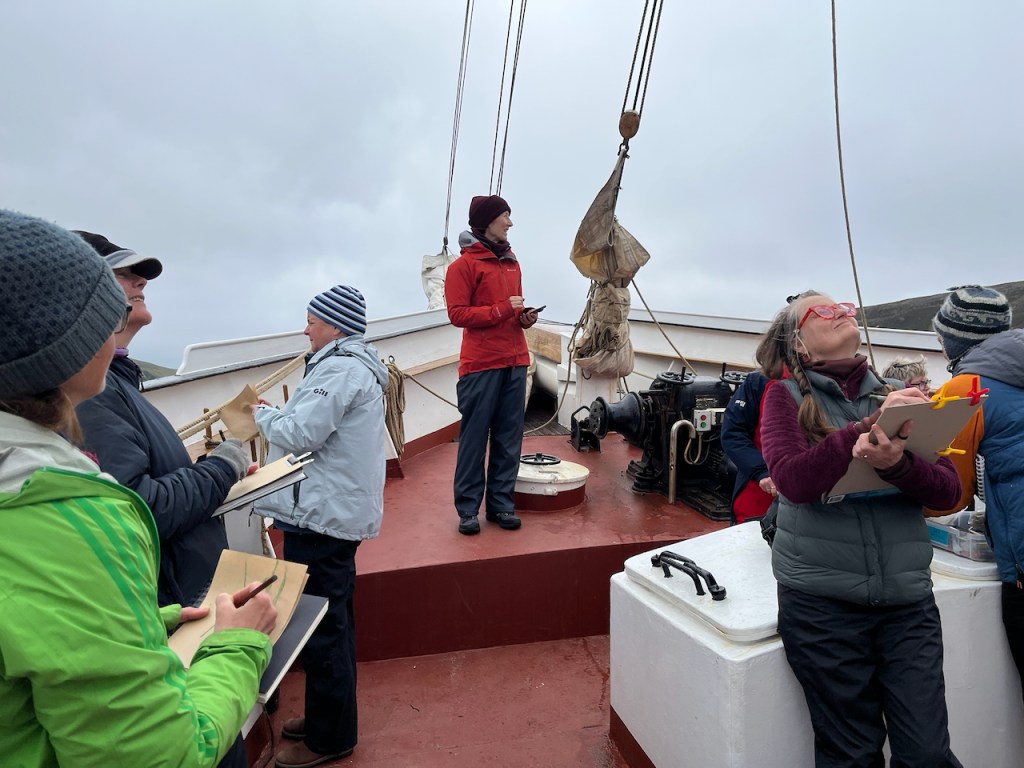
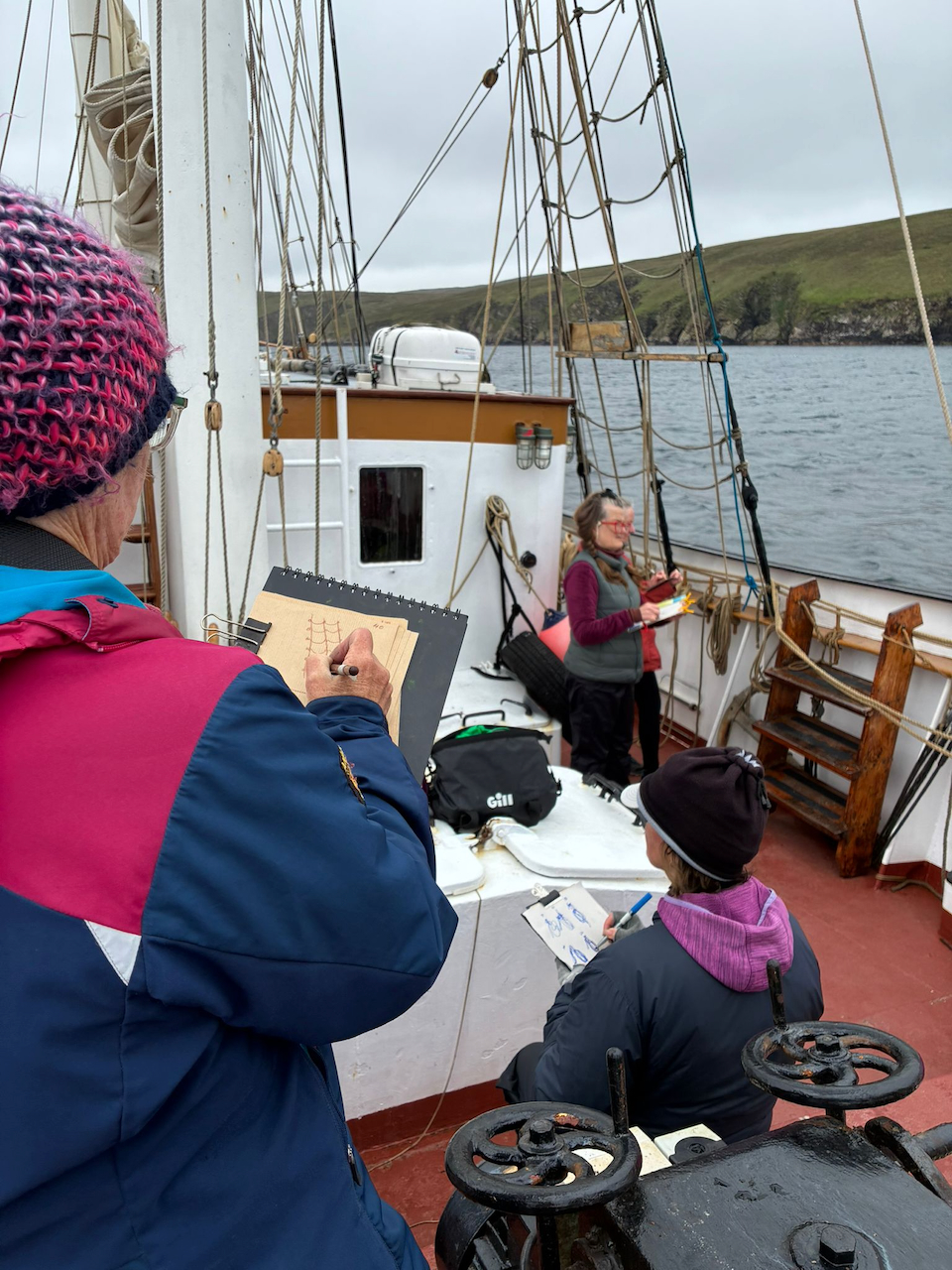
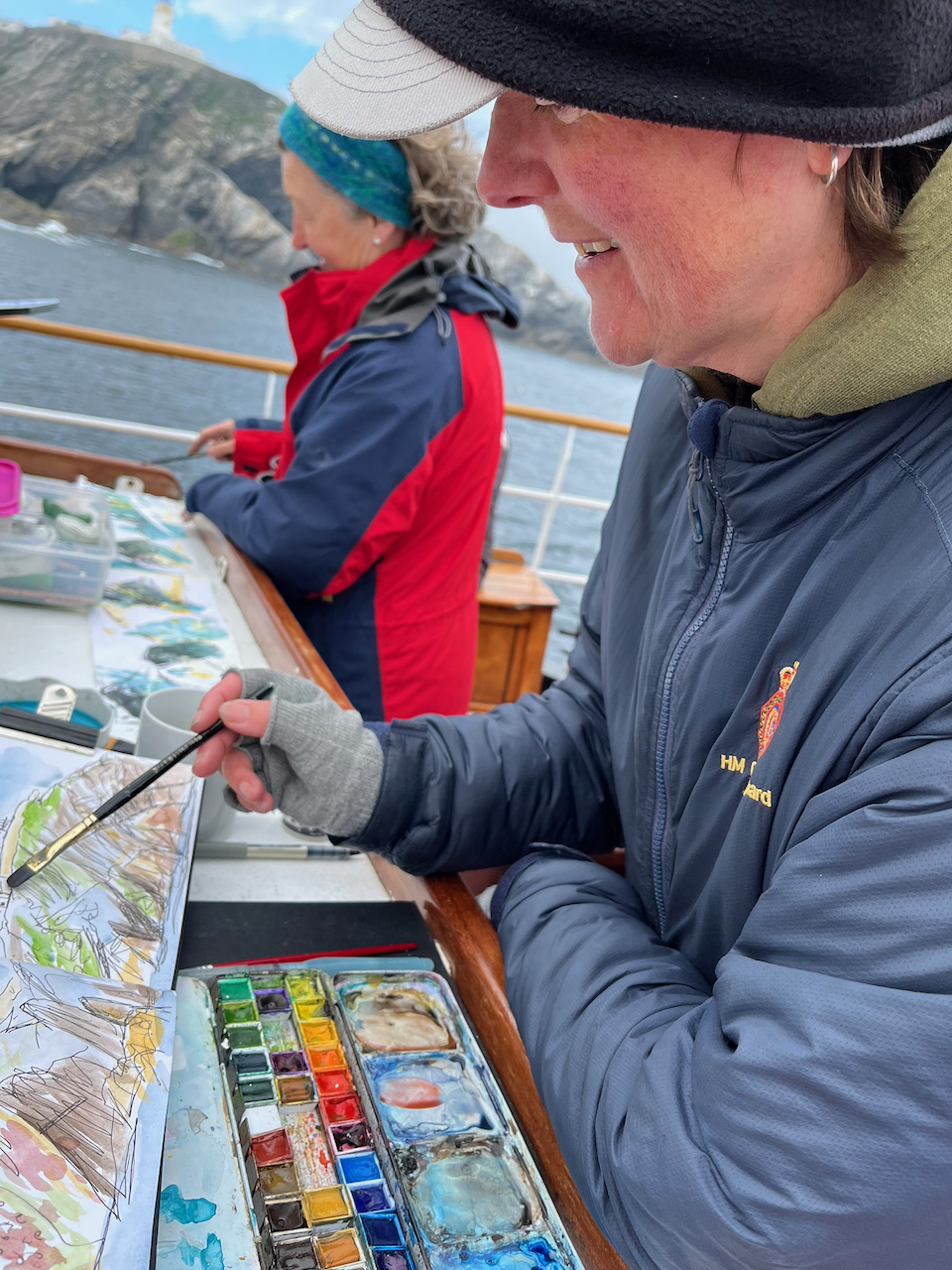
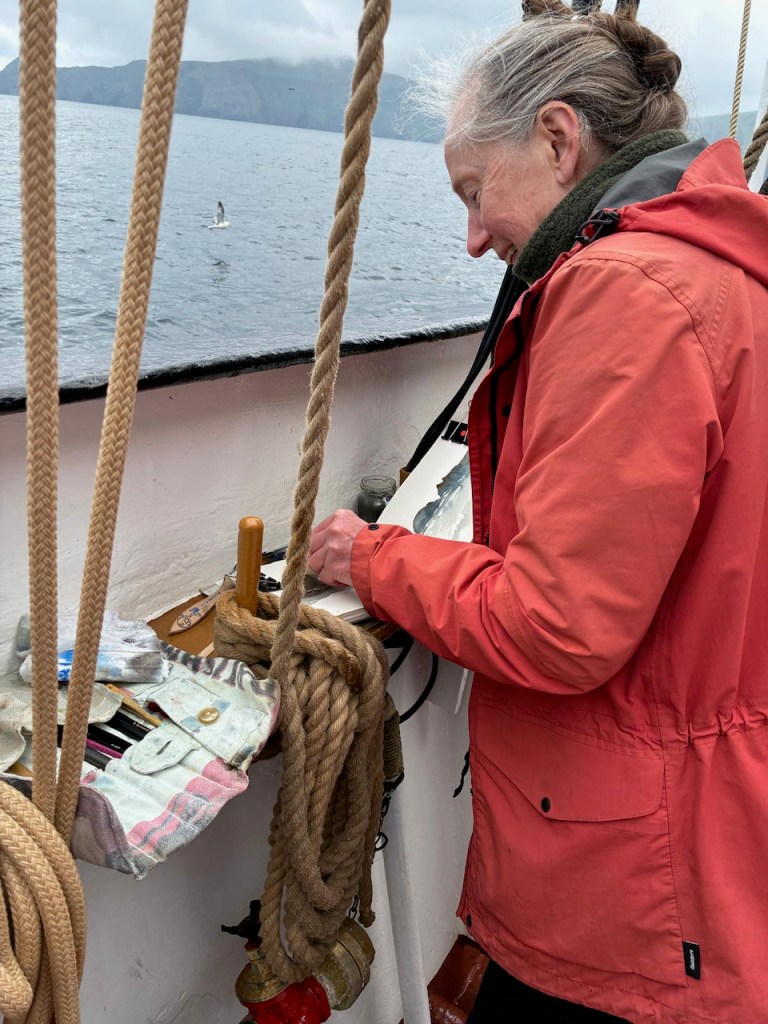
Alice and I were leading the art workshops. We did colour mixing, painting sea and sky, brushmarks, colour layering, distance, and all sorts of exercises and experiments with techniques appropriate for the landscape.
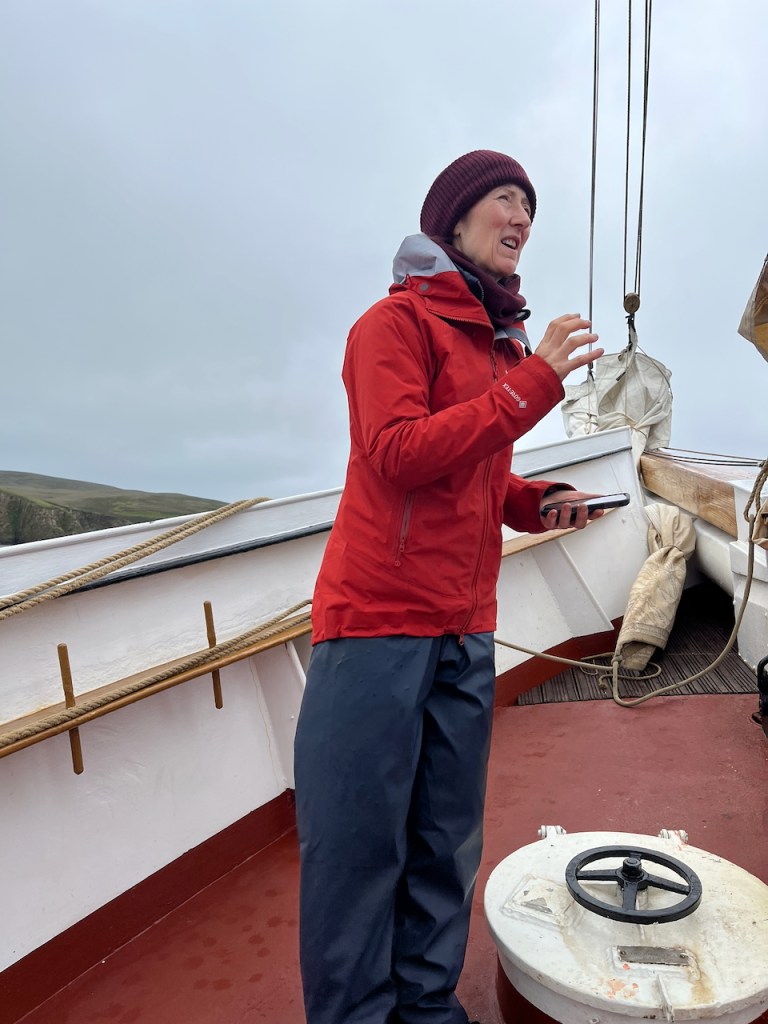
Here are Alice (right) and me (left) on the boat, demonstrating brushstrokesAlice explaining “outline drawing”Alice on the foredeck, during a workshop
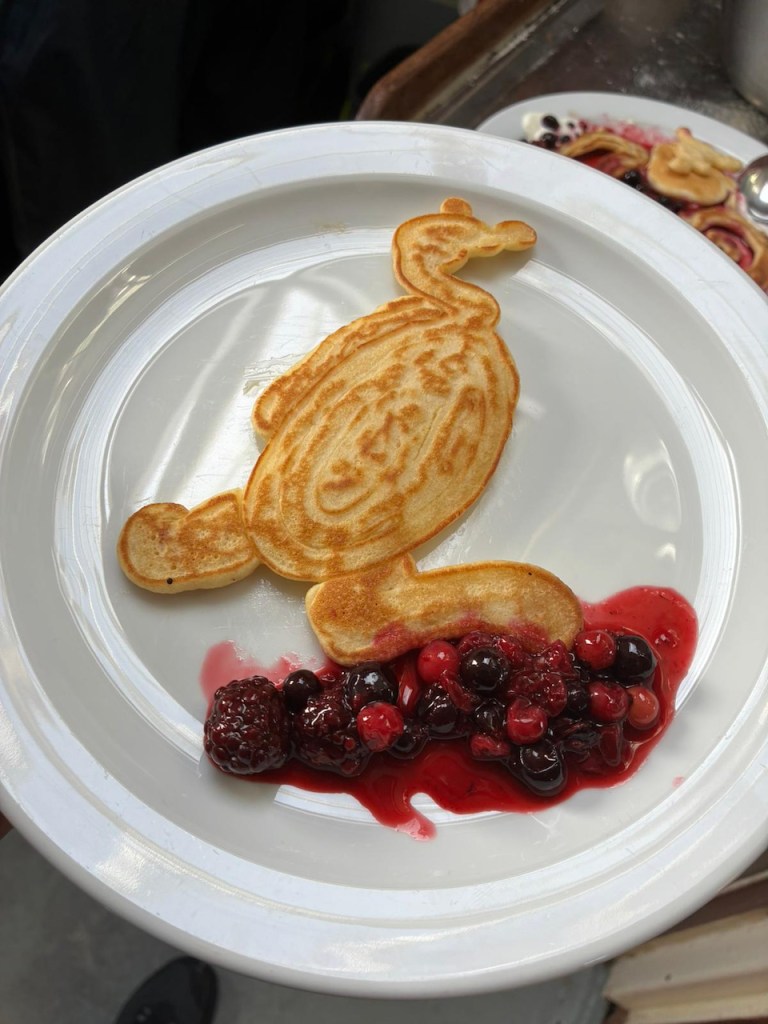
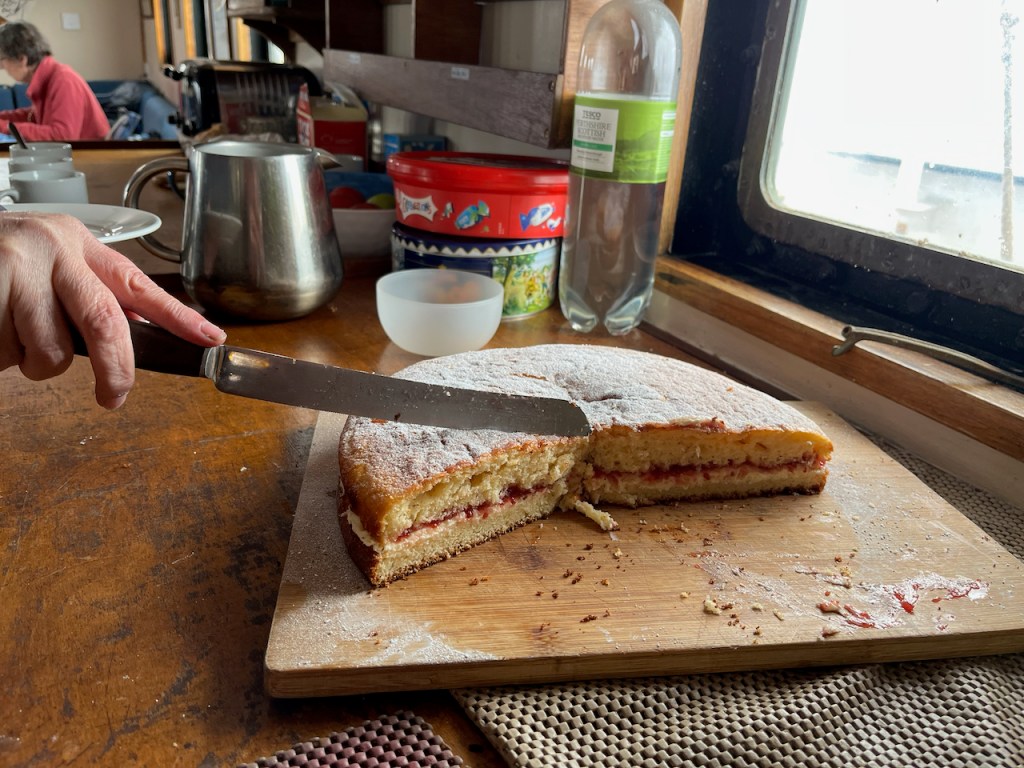
It was a lot of fun, and everyone was very productive. The cook Tom was inspired to produce art too in his special medium. He produced amazing “pancake art” in addition to all the other meals and cakes. His cooking was an outstanding creative production.
Pancake art
If you also are inspired (by the sketching, the sailing …or the cake…) and would like to join such a voyage, have a look at the “Lady of Avenel” site: https://www.ladyofavenel.com/sketchandsail
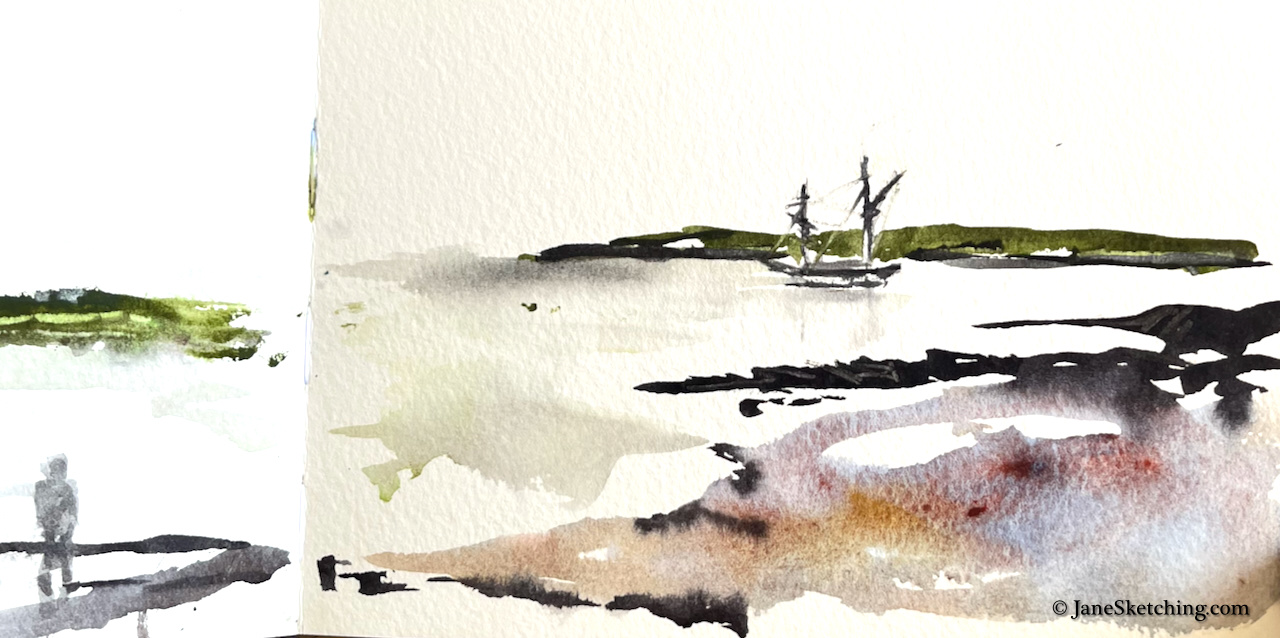
I filled a sketchbook with drawings. Here’s a quick video:
Sketchbook flick-through (36 seconds – no audio) (video may not play on mobile version)
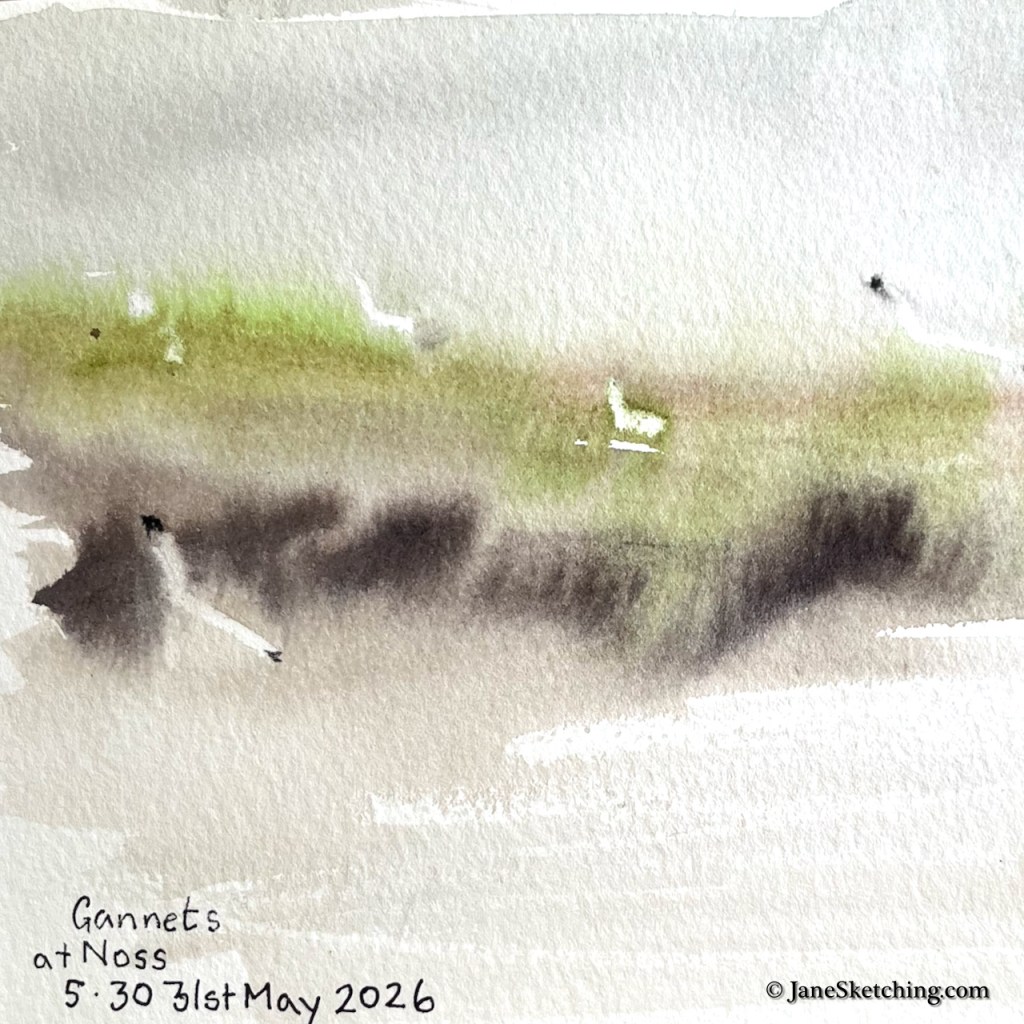
On the very first day, our skipper steered us up to the cliffs of the island of Noss, so we could have a go at sketching the seabirds.
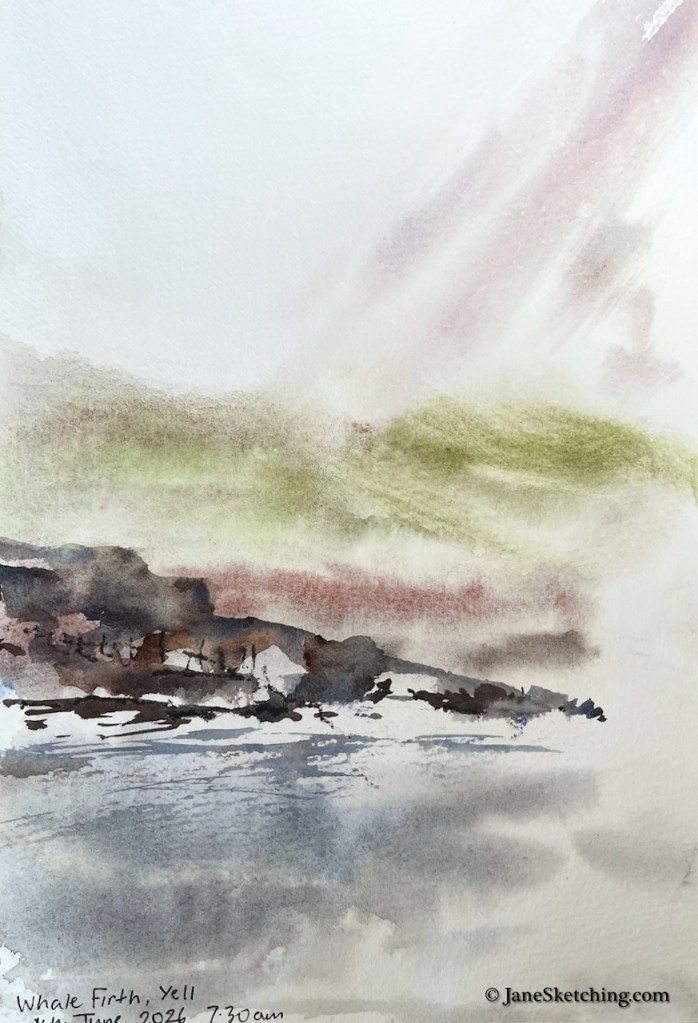
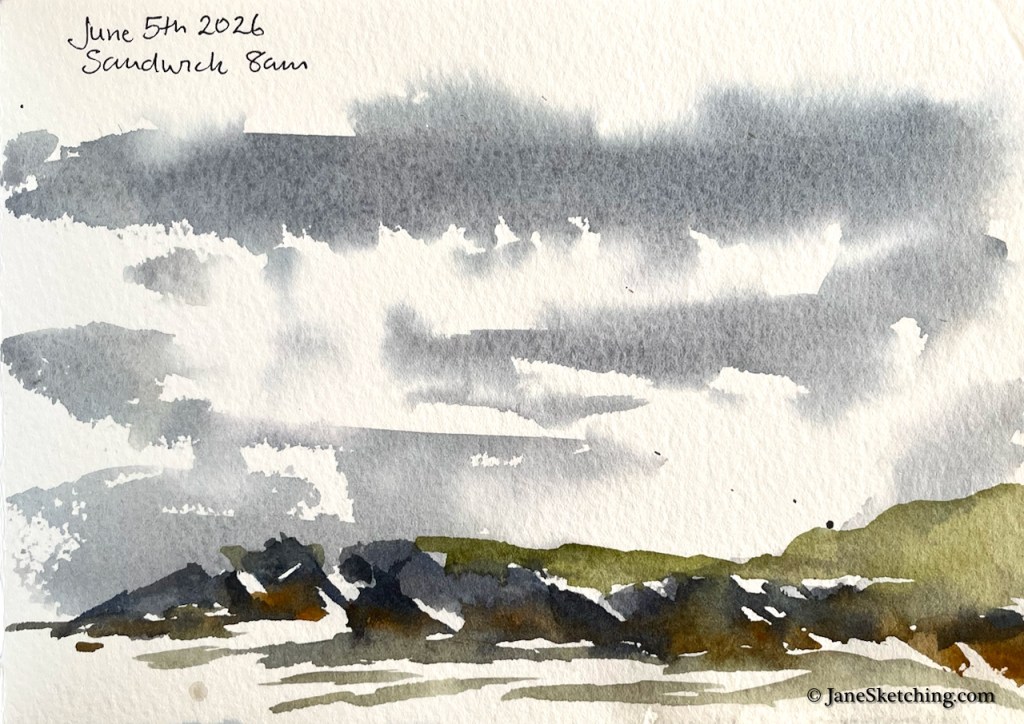
On some days there was fog. It’s possible to paint in the fog. It produces amazing atmospheric effects.
This is a particular Shetland phenomenon: when you look horizontally you see fog, but the light from above is still bright, and seems to make the fog glow. Here’s another fog painting.
The wind soon blew the fog away. Shetland is famous for its wind, and we were on a sailing boat.
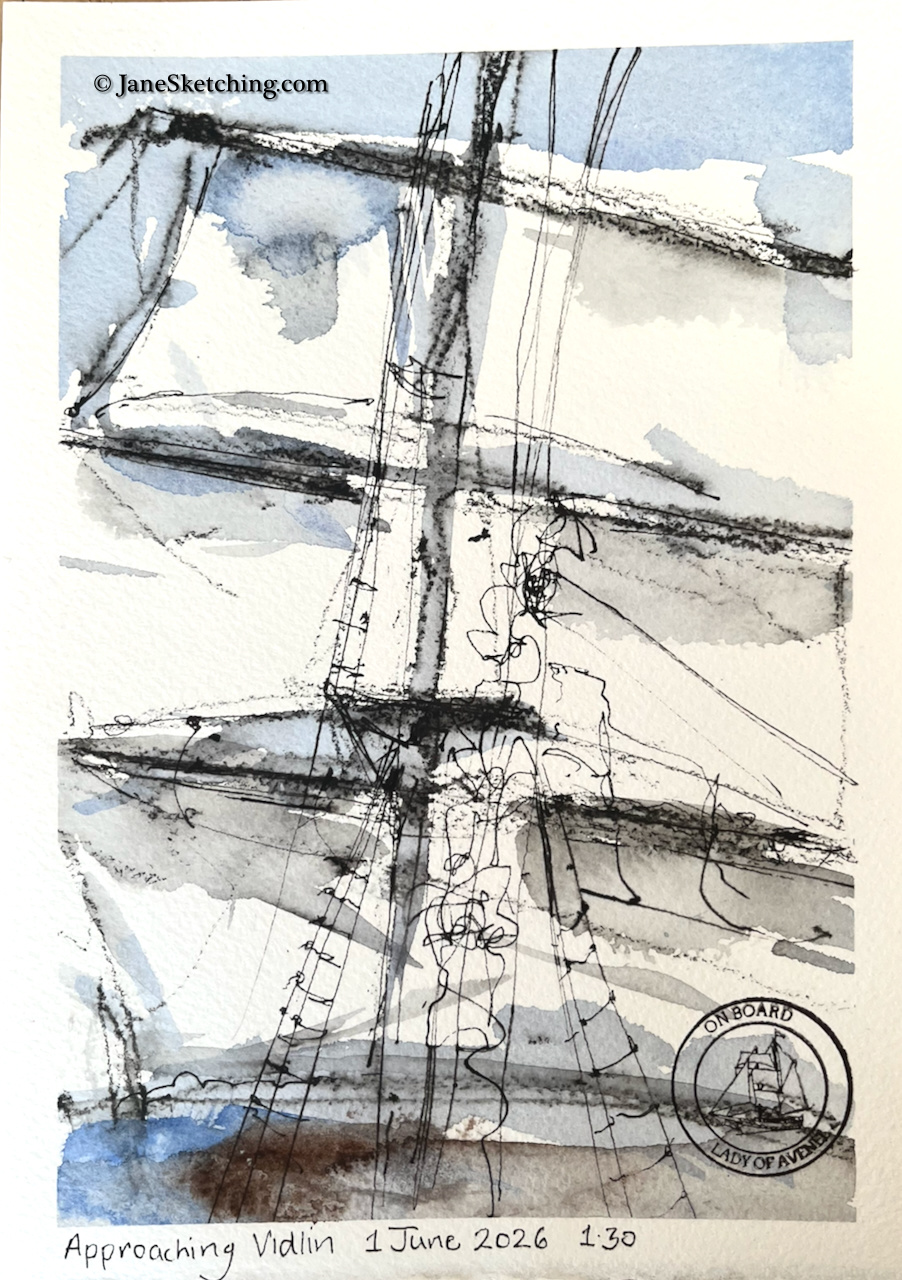
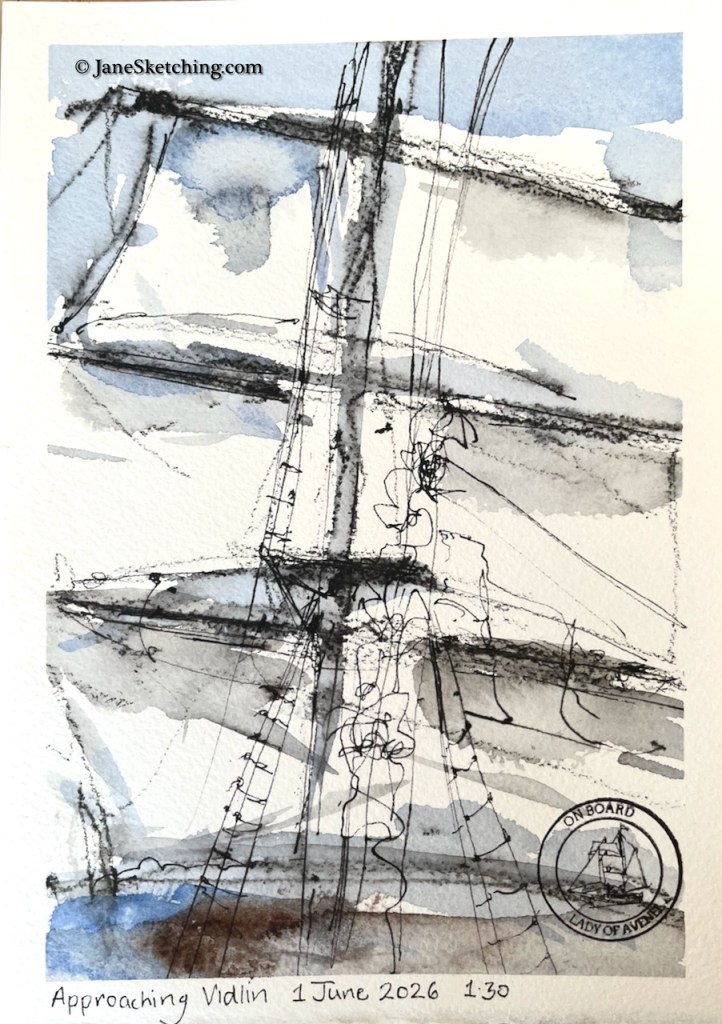
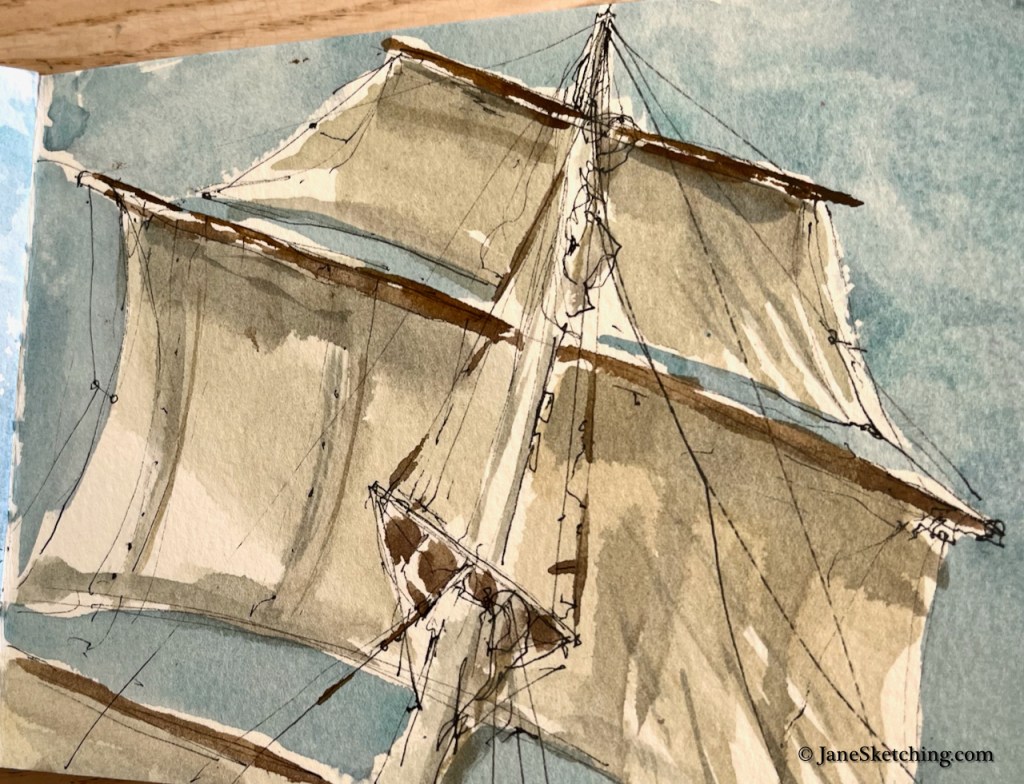
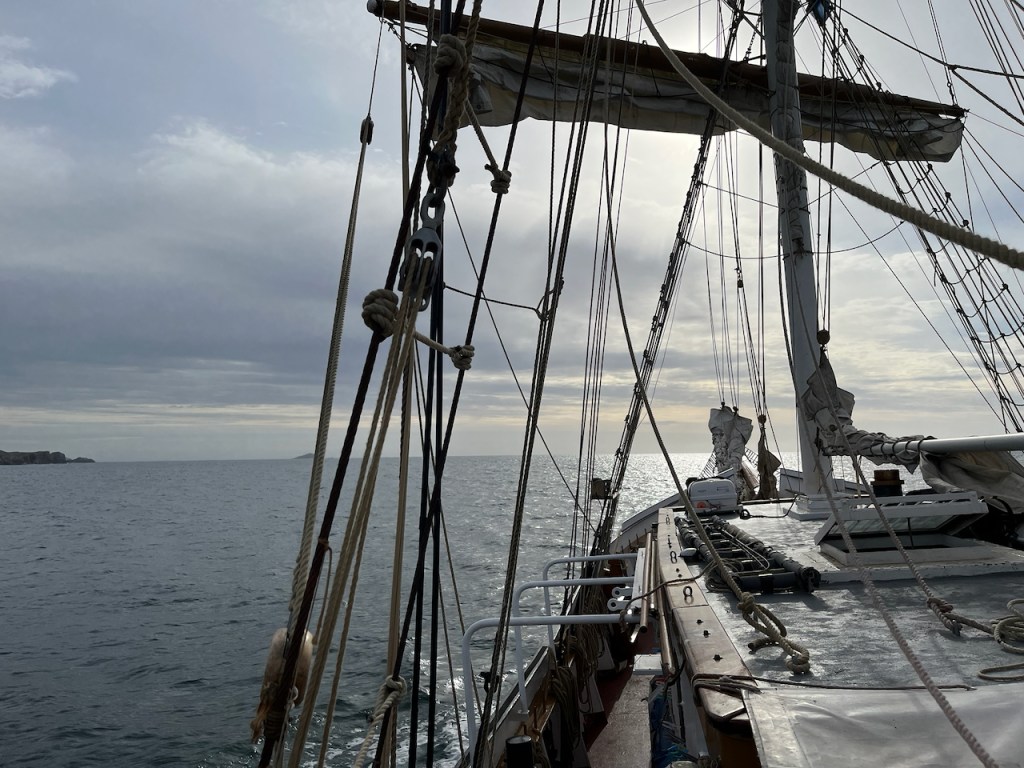
There are a lot of ropes to control those sails. I couldn’t get them all in. It’s a challenge to do these sketches on a moving boat – and of course the crew are trimming those sails all the time and shifting them about, and liable to take one of them down altogether, or put another one up. So you have to be quick. Perhaps a little accuracy is lost.
Alice ran a great workshop on speed sketching, which was just as well.
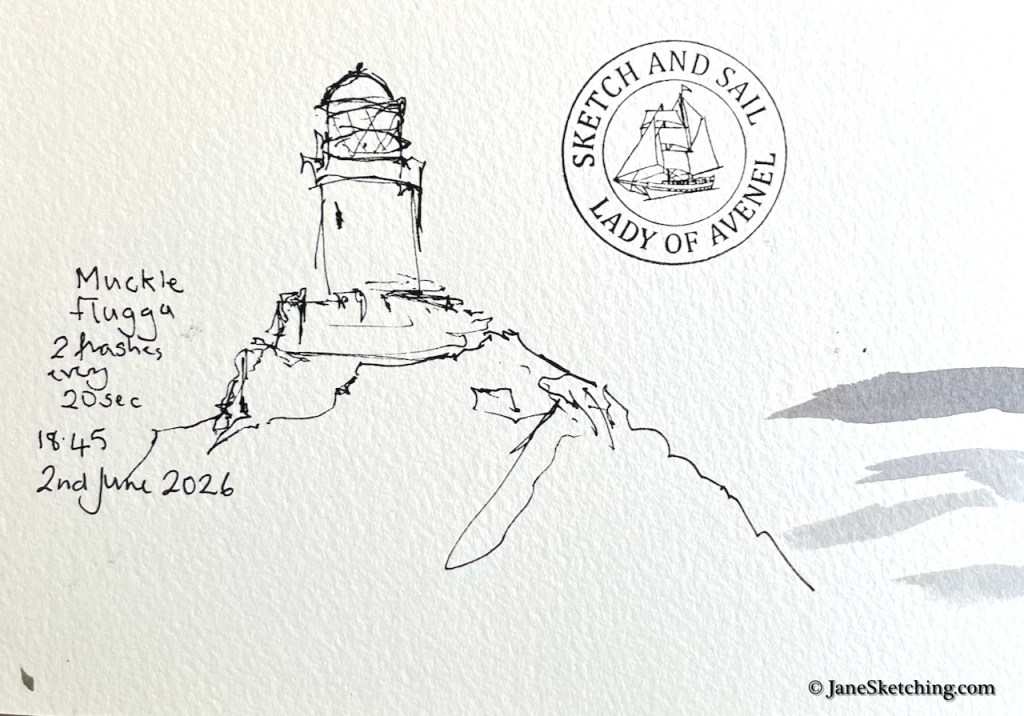
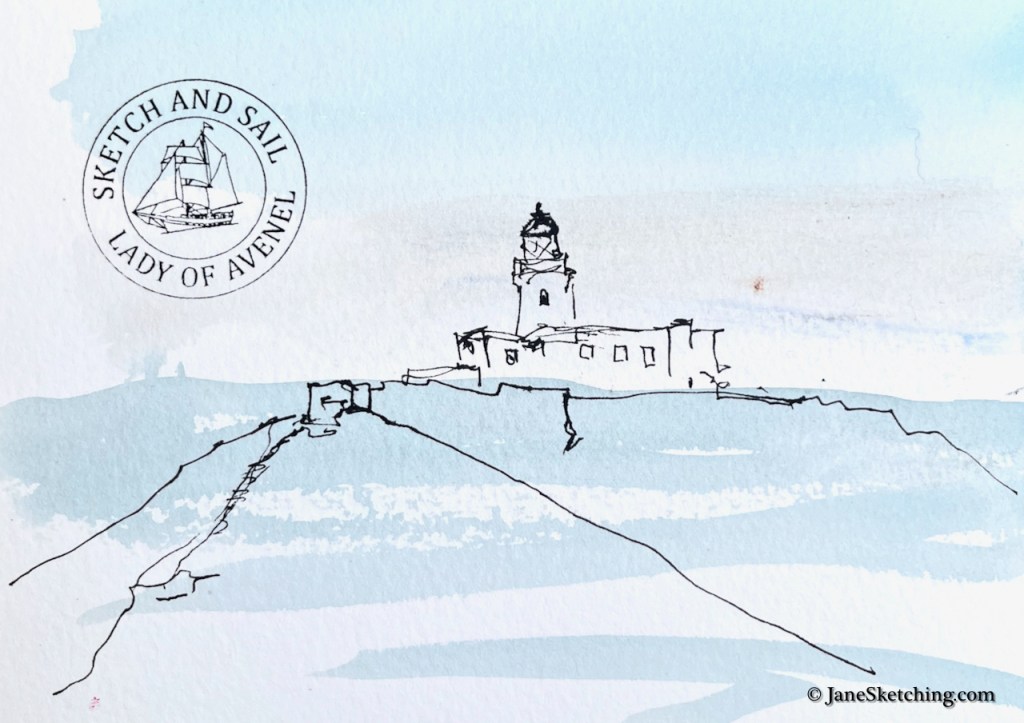
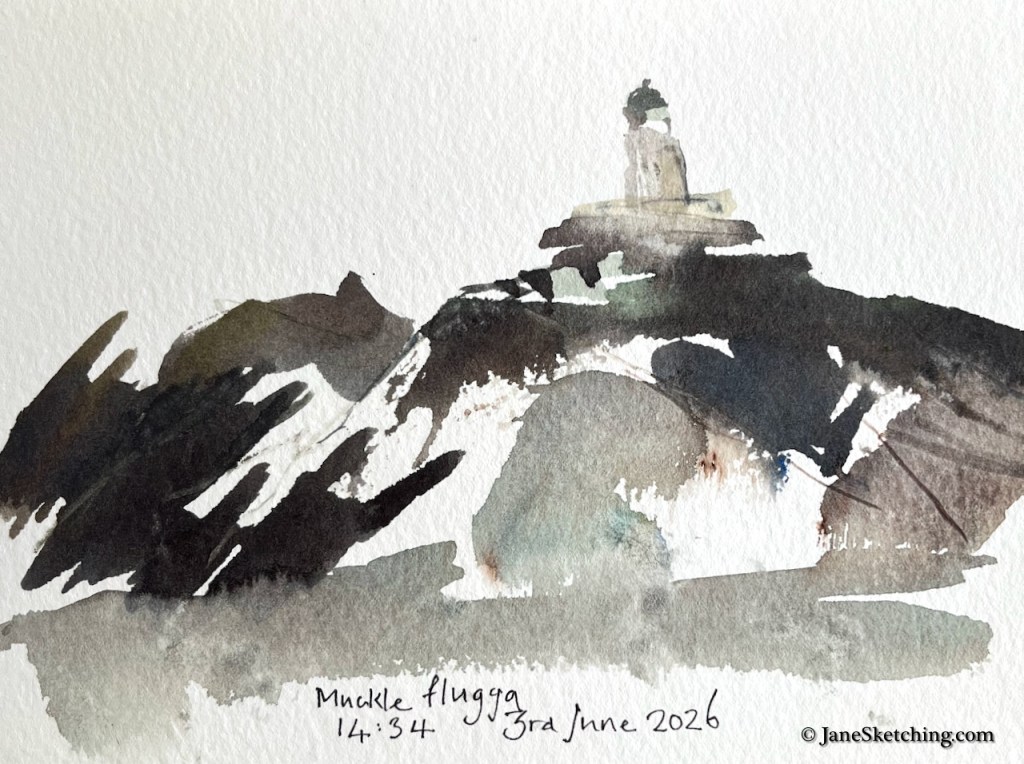
At the northern point of our voyage is the lighthouse at Muckle Flugga. Charles the skipper accepted our request to sail round in small circles so that we could have a good chance to sketch it.
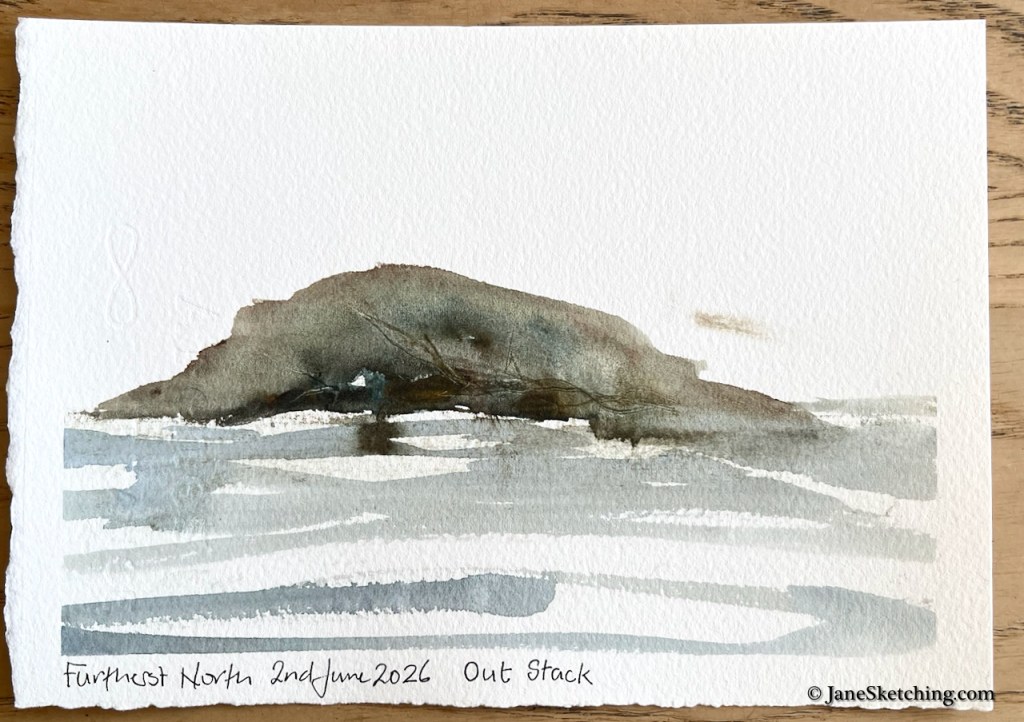
Even further north than Muckle Flugga is a little island: Out Stack.
Here is what that furthest north point of the UK looks like:
Out Stack 60.8603°N 0.8741°W
We landed at some magical remote beaches.
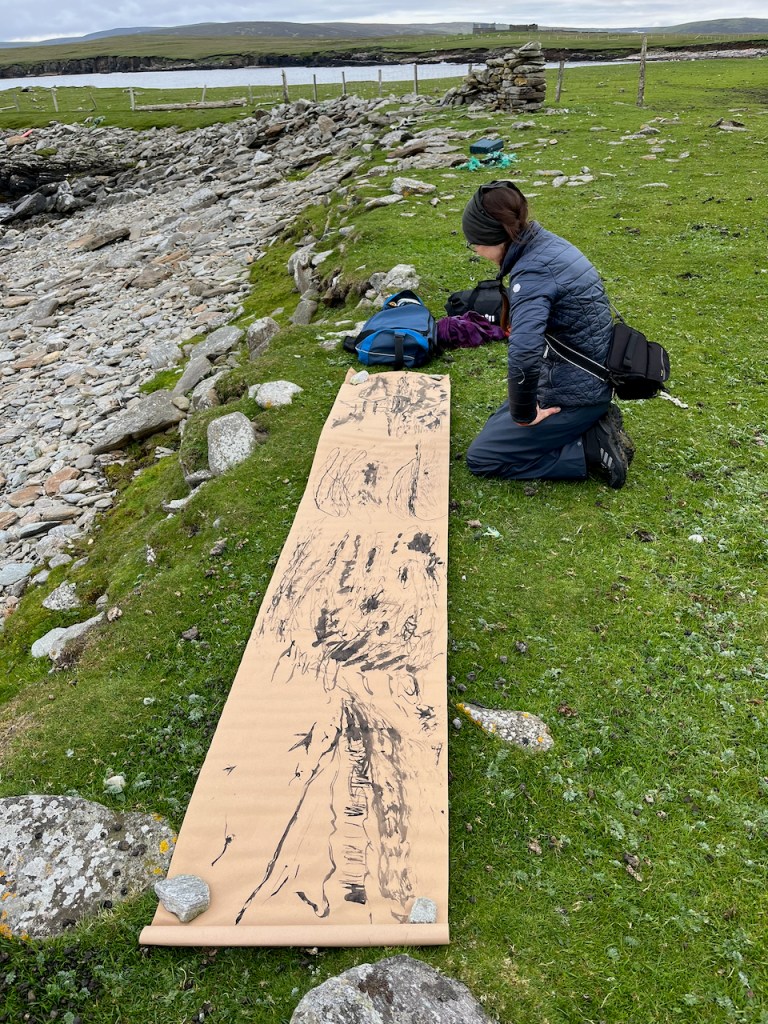
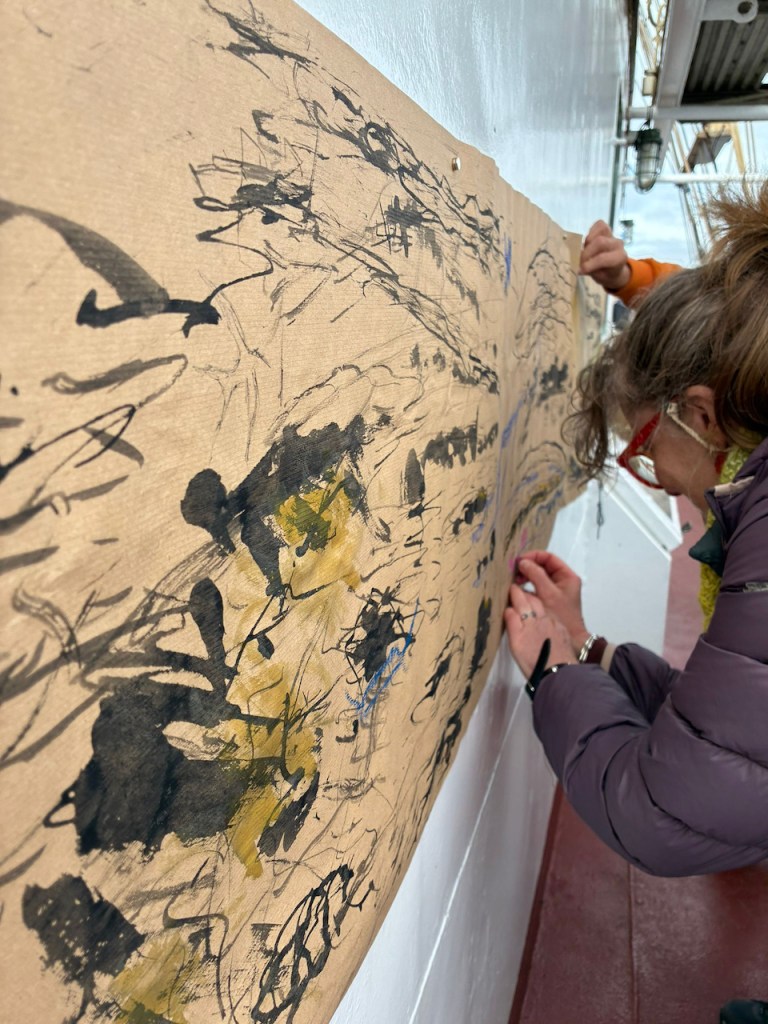
We made big pictures as well as sketches in sketchbooks.
On one beach, Alice organised a huge picture made by many people. ….….who then added to it on board. We found we could fasten the picture to the cabin of the boat with magnets.
…and all the participants in the 2026 Shetland Sketch and Sail. Thank you for your enthusiasm, your inventiveness, and your companionship on the journey.
Click a button below to share this post online, email it, or print it:
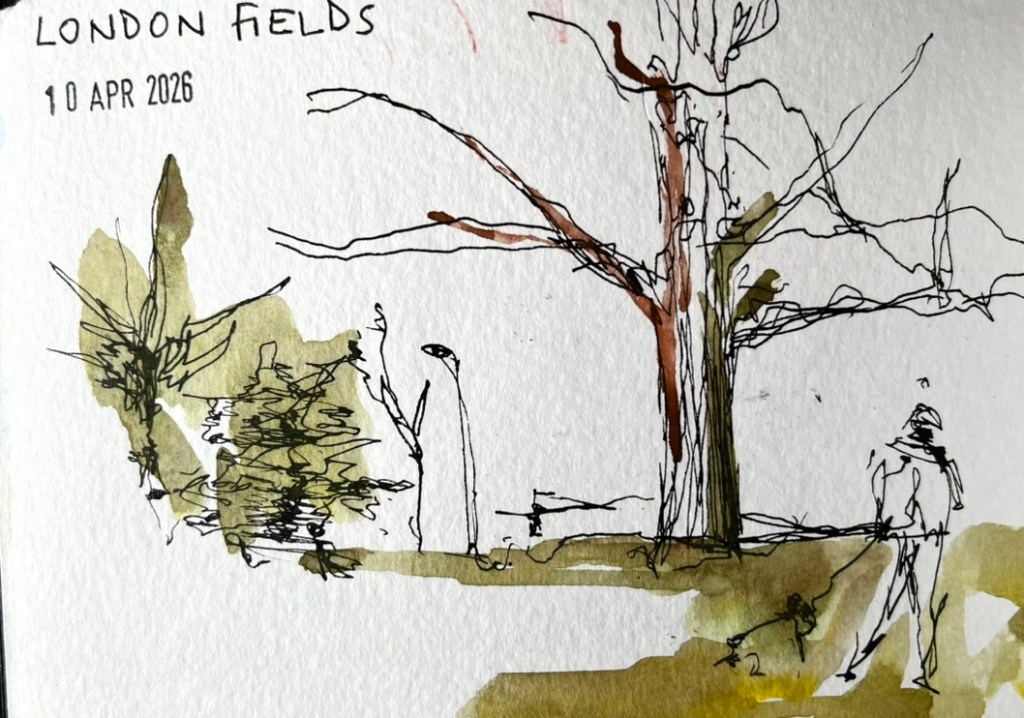
On a sunny day in April, I walked across London Fields. I had a paper bag in my hand containing a cheesy snack from E5 bakery.
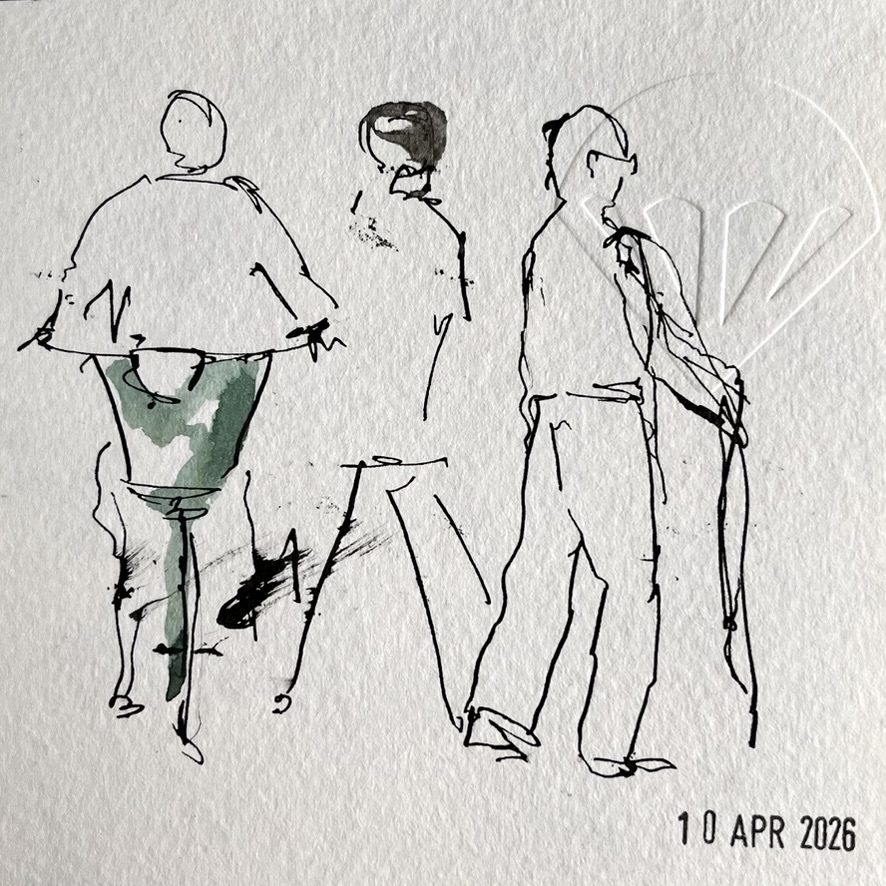
I ate my snack on a bench, watching the people walk past on their way to Borough Market.
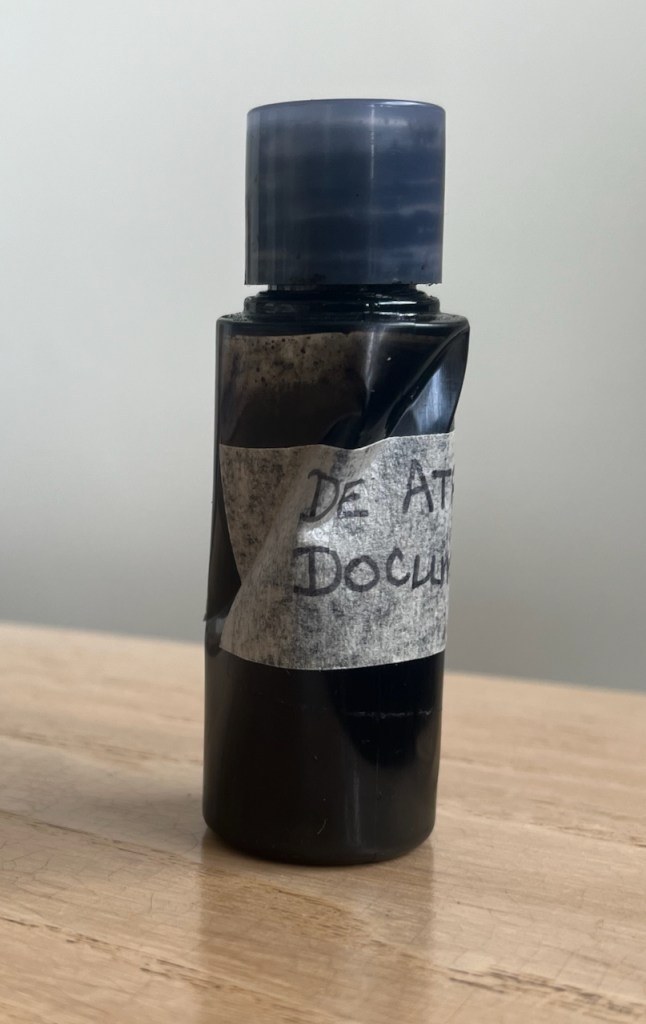
Then I thought I would draw some of the trees, and the people. Already translating the scene in front of me into ink sketches in my mind, I extracted from my bag the bottle of ink I had brought for this purpose. This ink bottle is a repurposed plastic shampoo bottle, small size, from a hotel.
I could not get the top off the ink bottle. The ink had dried. The top was stuck. My hands were not strong enough.
Help was needed. Fortunately, help was going to be readily available in the stream of passers-by. I waited. I discounted the slim woman in the smart white skirt. She would not want to engage with ink. Several older people, though probably interested and willing, would likely have the same issue I had. Then a young man came by. He had the physique of Jack Reacher: a blond man in a tight T-shirt, walking easily and with purpose. I smiled and I said, “You look like a strong guy. Can you get the top off my ink bottle?” I held out the small bottle. He stopped, and assessed the situation. He had not only the physique of Reacher, but also his attitude: never walk past a damsel in distress. Although I am hardly a damsel. “ I am a strong guy,” he told me with a smile. “You got the right man here!” In his muscular hand, the bottle looked tiny. “It’s ink,” I reminded him, “keep it the right way up.” “Got it”, he said, and applied himself to the problem.
The top did not move. “Hmmph” he said, and put down his carrier bag. Now he applied his muscular arms and his huge torso into the twisting movement. I had visions of the bottle bursting, ink going everywhere, including into his carrier bag. De Atramentis Document ink is notable for its intense blackness, and archival quality. That means you can’t wash it out. But within seconds he was handing me back the bottle and picking up his undamaged carrier bag. I thanked him and he went on his way, the action a small blip in his smooth stride across the park.
He had released the top. I undid it cautiously and all was well. No leakage. But this incredibly strong individual had contorted the ink bottle. It now took on the irregular shape of a crumpled can: an art object, perhaps. It sits on my desk, testament to the extraordinary strength of this kind stranger in the park.
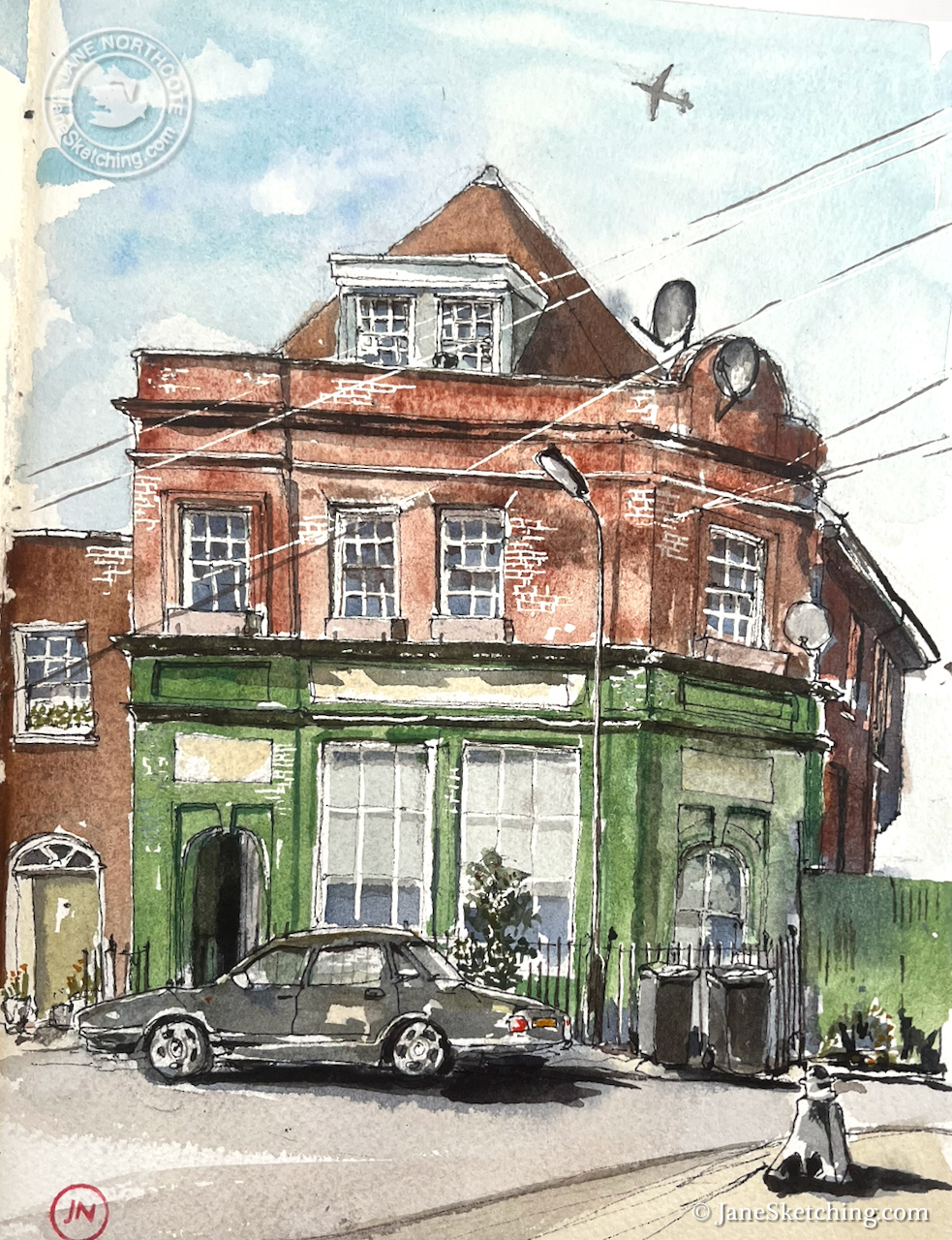
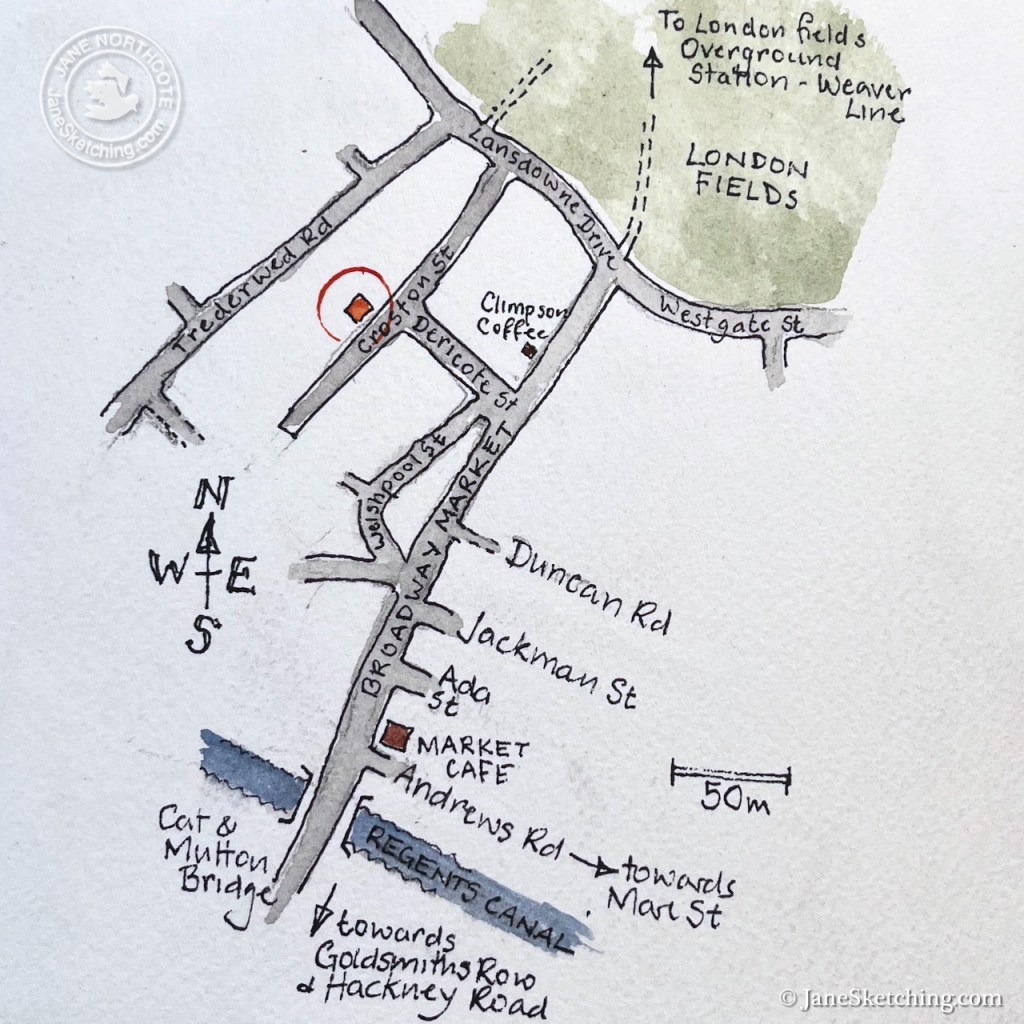
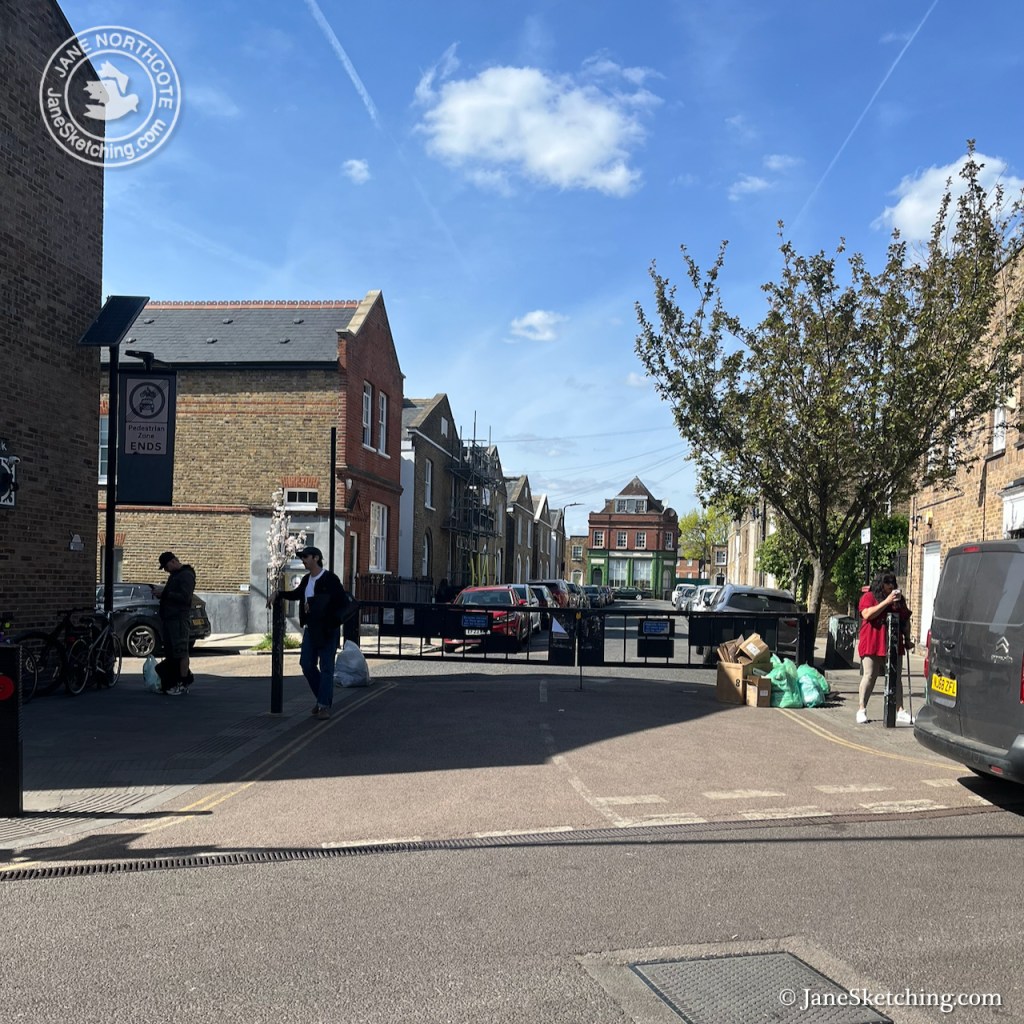
Later, I followed the stream of people towards Broadway Market. I procured coffee from Climpson Coffee and looked for a quiet place to drink it. Round a corner, down a side street, was the perfect place: a silent street, a stone step in the sun, and an interesting house to draw.
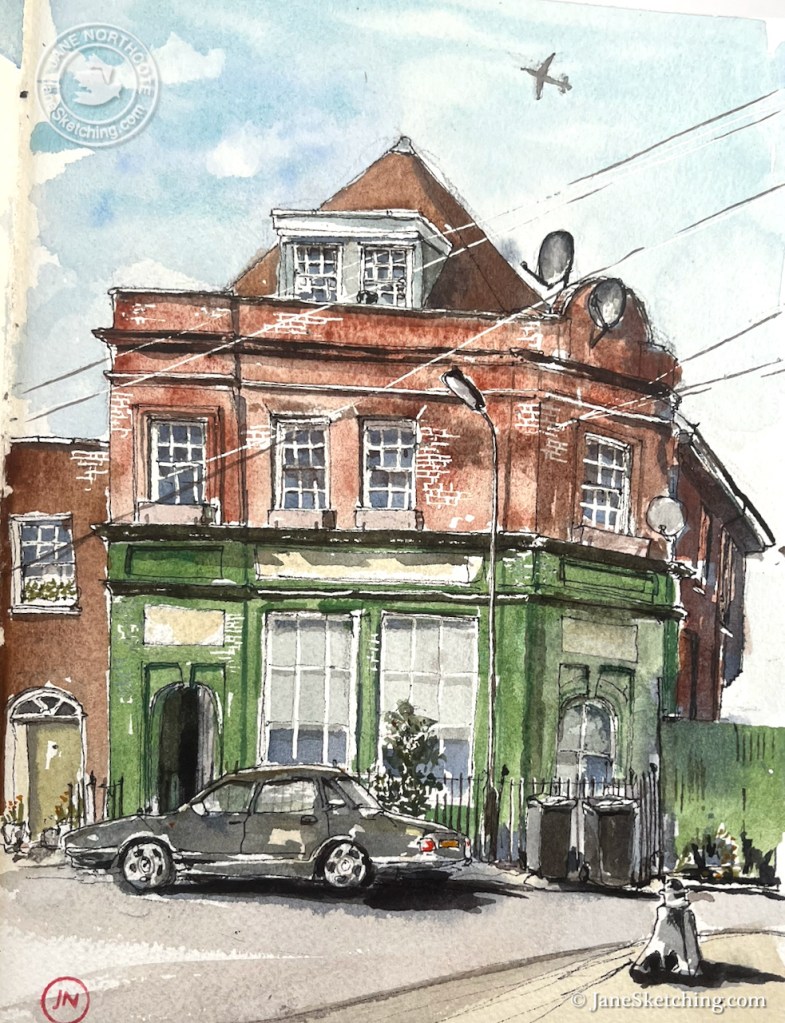
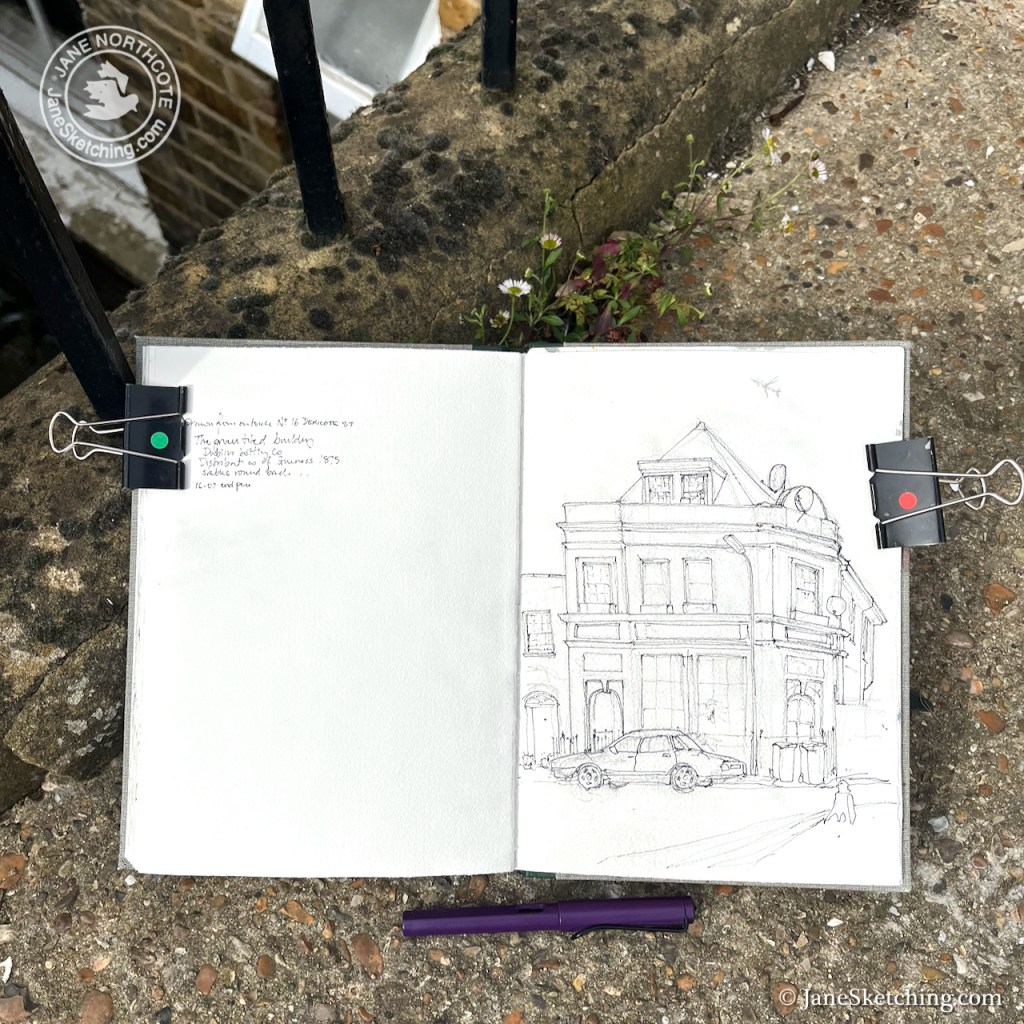
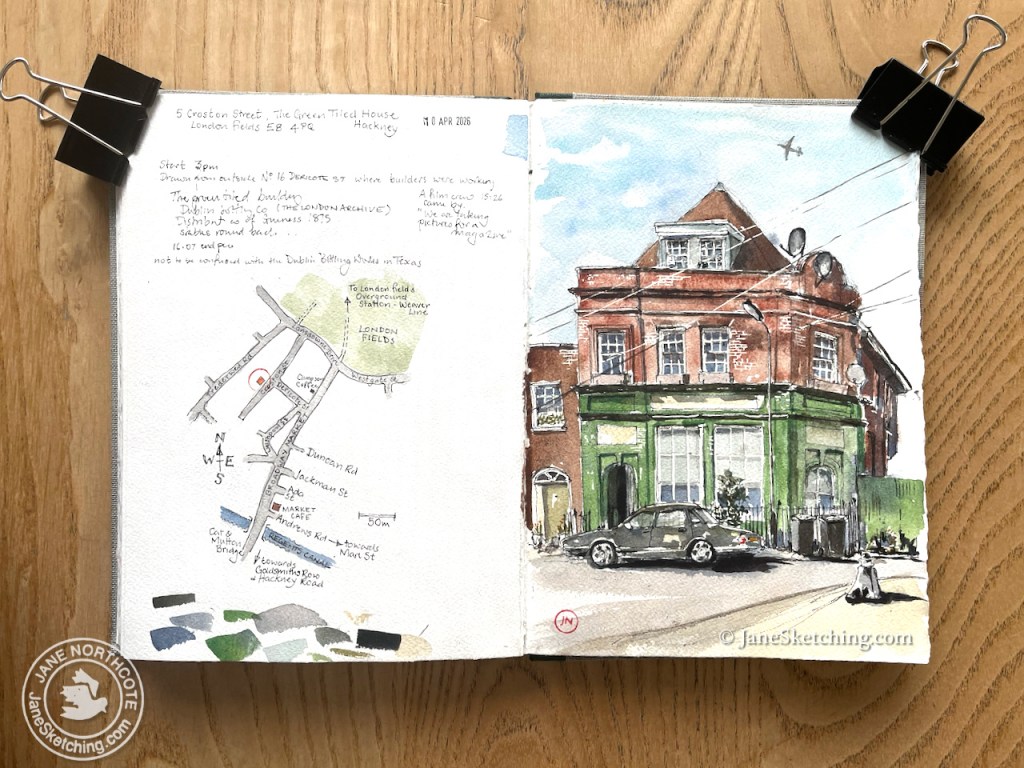
The Green Tiled House, 5 Croston Street, London Fields, E8 4PQ. Sketched 10 April 2026 in Sketchbook 16.
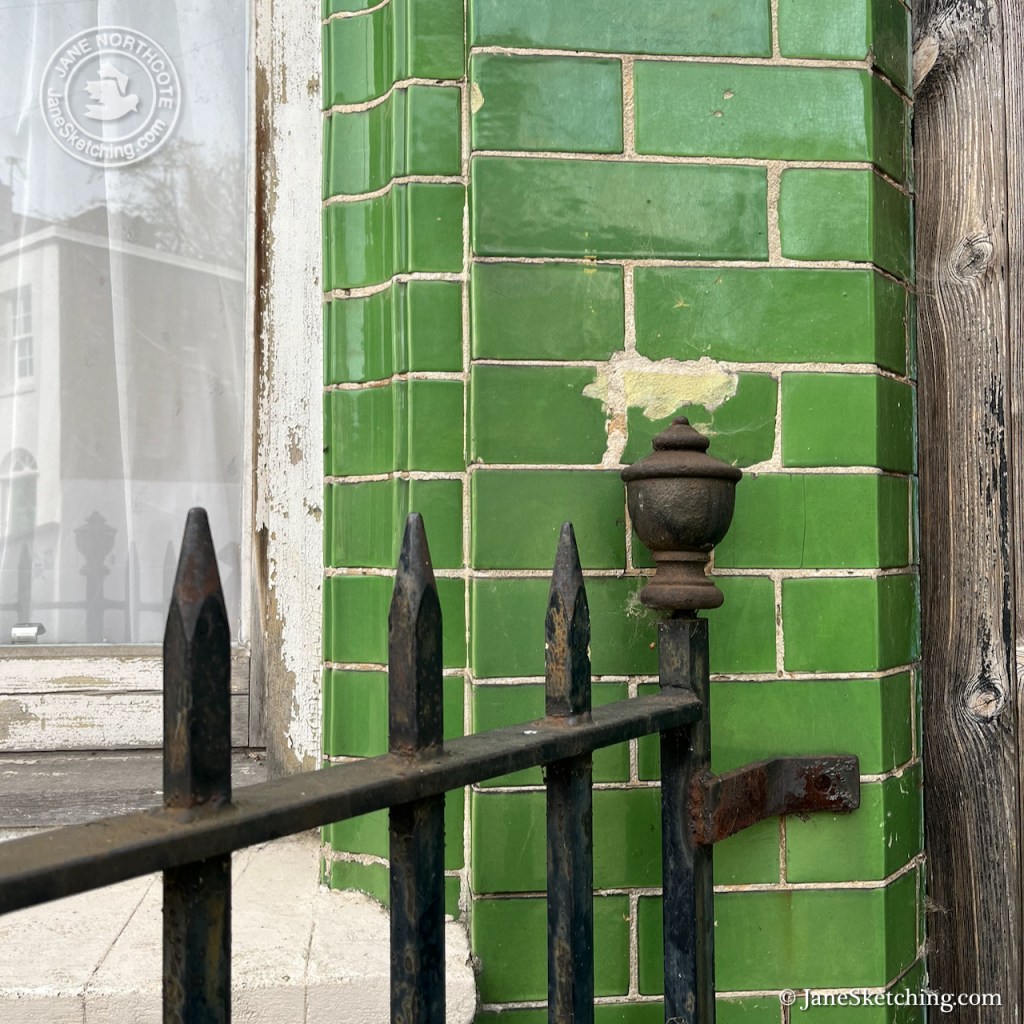
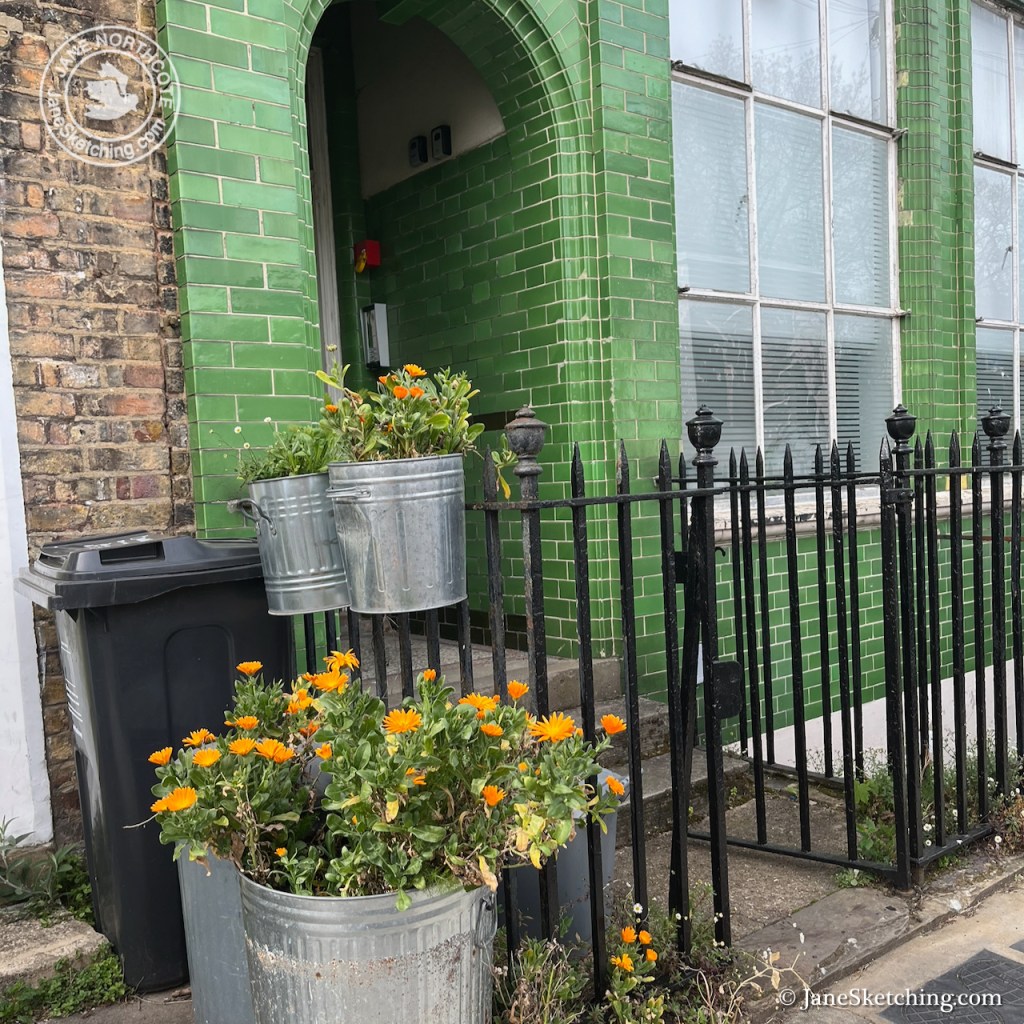
This building had clearly been something. Not a pub: the windows were too low. Pubs of that vintage were built with high windows and stained glass, so children (and others?) could not see the goings-on within1. Also, if it had been a pub, the door would have been on the corner. But the glazed green tiles spoke of a pub. It is apparently residential now. I saw three bell-pushes by the front door and there are three satellite dishes. The bars of the windows were dried up and flaking. That car outside was dented. A mystery.
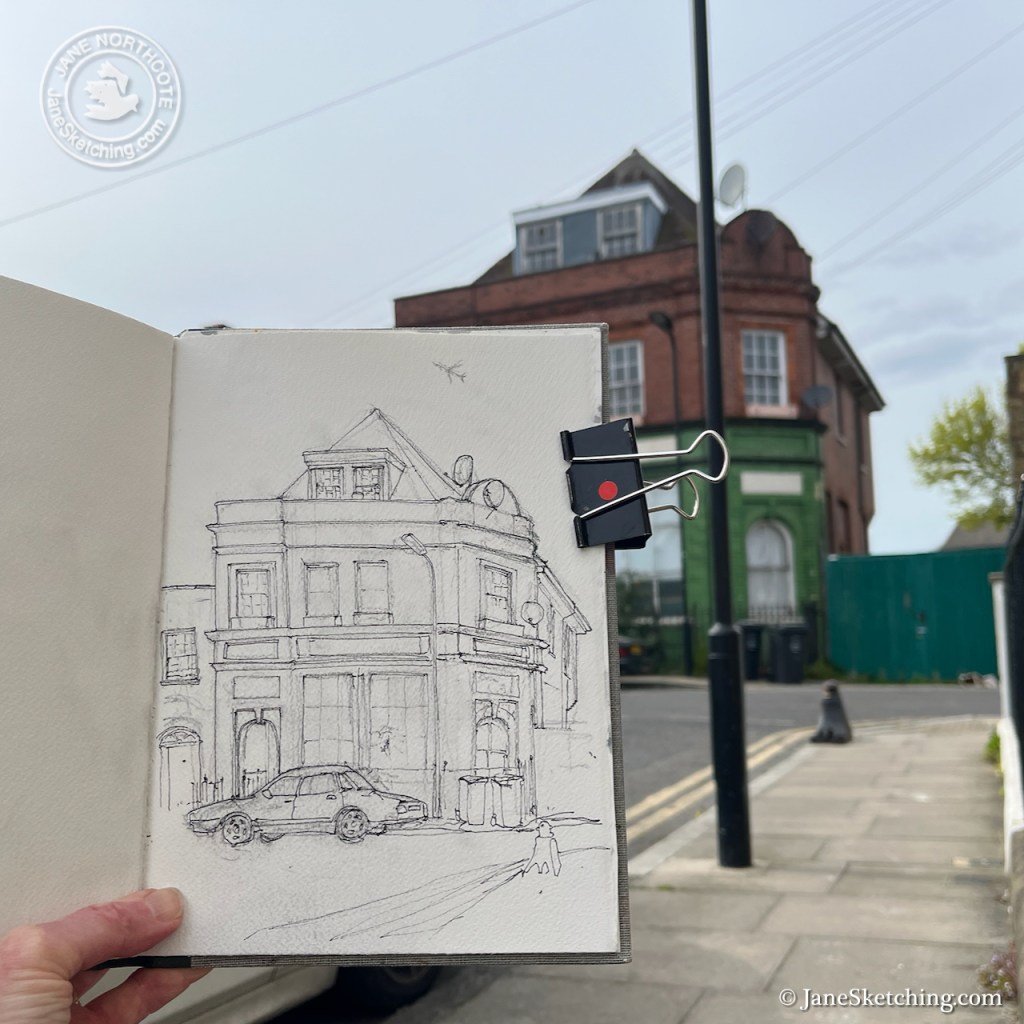
I was sketching from a doorstep on Dericote Street. It was not so quiet as I had thought. Groups of people walked past. I received many encouraging comments on the picture, including from children. One passer-by asked me if I knew what the building was. I said I didn’t and asked if he knew. He didn’t know either.
Then the house behind me, which I had thought was boarded up and empty, turned out to contain building workers, who emerged from the front door into the sunlight and all around me. I apologised for sitting on their doorstep and made to leave, but they waved away my apologies, and examined my picture with interest. They spoke a language I did not recognise. I could not decipher exactly what they were saying, but they seemed to be comparing my work with another artist they knew. A fellow building worker drove up in his van, totally blocking my view. As politely as I could, I asked him if he would please consider parking elsewhere. This suggestion was reviewed in rapid conversation with his colleagues from indoors. He leapt back into the van, put it in gear, and moved up the street.
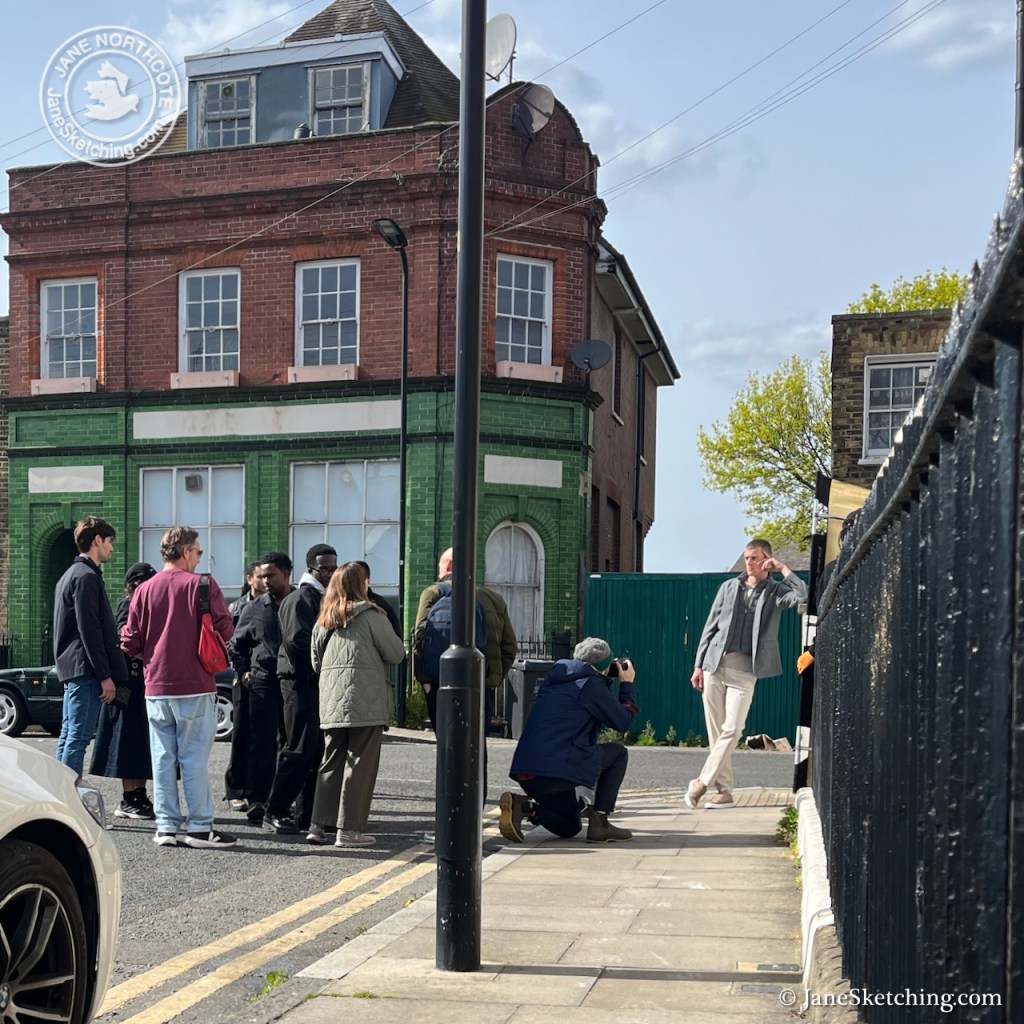
Then the photo shoot arrived. At first I saw a man standing in the middle of the road, shifting sideways, oddly. He was staring, not at me, but round about, in a peculiarly intense manner. He went away, and I thought no more about him. London is full of people moving oddly, myself included. Five minutes later, a whole group arrived, equipped with heavy cameras and silver umbrellas. They were all young and all beautiful. The man who had been moving oddly was amongst them. They took up a position exactly in my field of view. One of the beautiful people noticed me immediately and came across to assure me that “we will only be five minutes”. I said it was a great location, which it was. He agreed, and told me they were making pictures for a magazine.
I watched while one of the beautiful men leaned meaningfully on the railing and everyone else watched and commented.
Then, after five minutes as promised, they moved off around the corner and out of sight.
I finished the pen drawing. It was getting cold.
As I was packing up, the man who had approached me earlier, asking about the building, came back, walking briskly. He was flourishing his mobile phone. “It’s called ‘The Green Tiled Building’“, he told me triumphantly. Reading from his phone he continued “It was ‘The Dublin Bottling Company’, distributors of Guinness, 1875. There were stables round the back.” I wrote it all down. Having dispensed this information, he rushed off again before I could thank him. I looked around to say goodbye to the construction workers but they had gone, and the house behind me was silent.
Back at home, I finished the picture, and researched the Dublin Bottling Company2.
A building is shown at this position in the OS Map of 1891-5, with the same layout and plan as later maps of 5 Croston Street. At that time, Croston Street was called “Hamburg Street” and Dericote Street was “Breman Street”. A building whose roof is remarkably similar to the existing one is shown on the “RAF Aerial Map of London 1945-48”.
My researches took me to the London Archive, where I was able to trace some of the story of this building, via Planning Applications. In the marvellous “Archive Study Room” I spread out plans and saw architects’ drawings showing younger versions of the building I had sketched.3
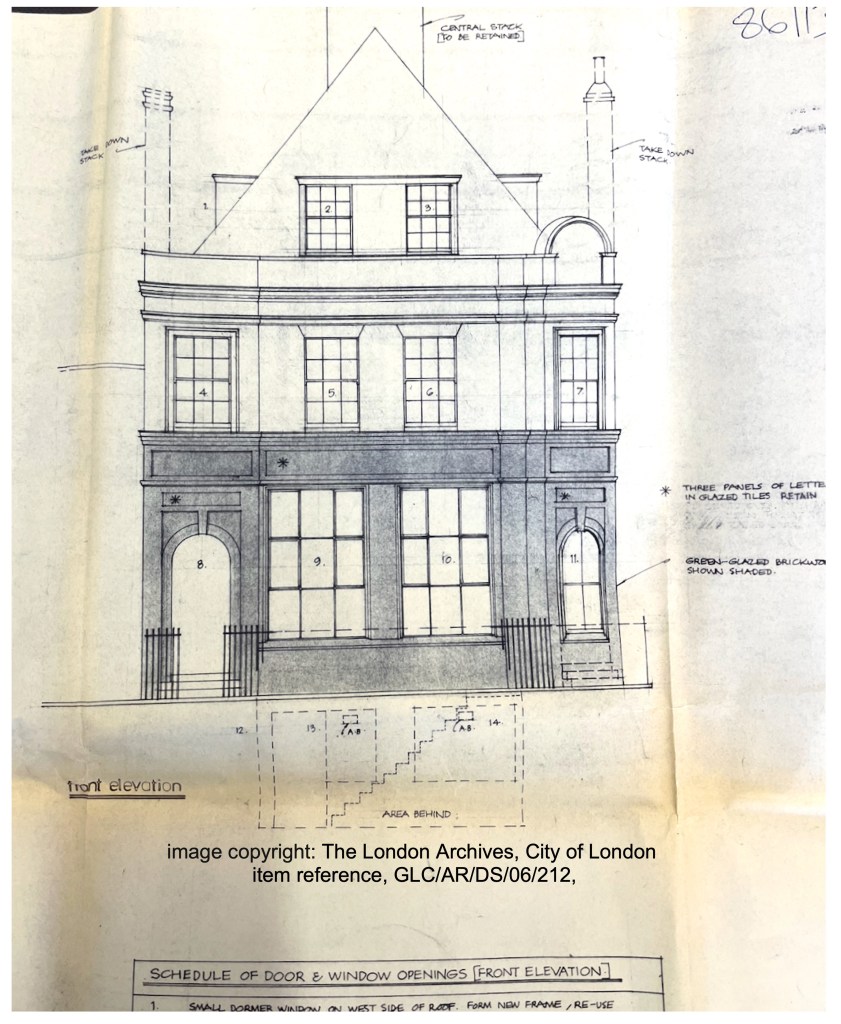
1977 architects’ drawing for the GLC, Department of Architecture and City Design, Sir Roger Walters, KBE, FRIBA . Note the chimney stacks. None of the chimney stacks are there now in 2026. Image copyright: The London Archives, City of London, Reference: GLC/AR/DS/06/212. Reproduced under licence.
The “Dublin Bottling Company” owned the site by 1951. I know this because there was a building application dated 1951, for the proposed installation of a cold water tank, with the owner cited as the Dublin Bottling Company Ltd. By this time the address was 5 Croston Street. A plan of this date shows storage areas for Guinness, cider and “Bass” inside the building, and a big yard with sheds, accessed by a side road to the right of the building.
The Dublin Bottling Company continued to enhance its facilities. In October 1960 they paid a T Whyman and Sons £75 to “form a door through the existing brick wall from open yard store space to storage department and supply and fix rolling shutter.” Mr Wyman must have done a good job because in February the next year, for a fee of £375, he is erecting glazed partitions in the office and removing a “wrot iron gate” to fix another roller shutter.
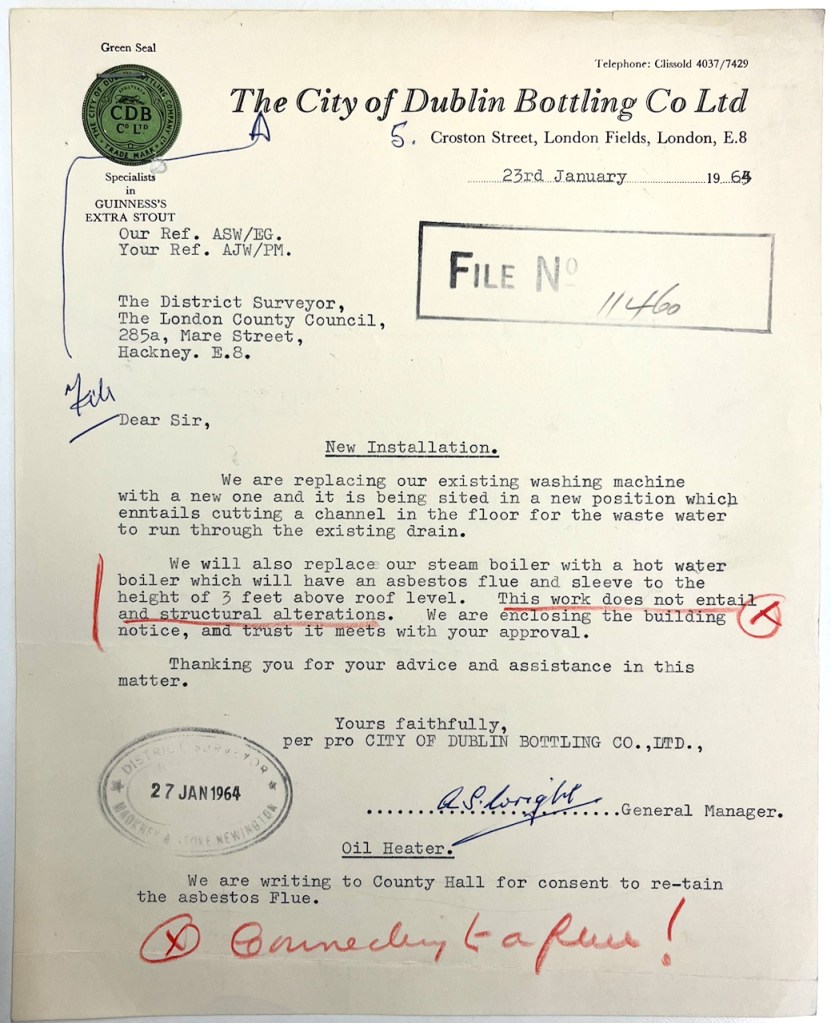
However in 1964 they started to encounter problems. They applied to install a new steam boiler.
Letter from Mr Wright General Manager of the The City of Dublin Bottling Company Ltd to the London County Council District Surveyor in Hackney. This letter is in the London Archive ref GLC/AR/DS/06/212, and is reproduced here by kind permission of the Guinness Archive. The letter tells the Surveyor that they want to make some modifications to install a washing machine, and to install a hot water boiler. They claim there will be no structural modifications. But the annotations in red show that someone has a concern about the flue to the steam boiler. Image copyright: Guinness Archive
The proposed flue for this boiler was “asbestos cement”. The Superintending Architect at the London County Council did his homework. He told them: “It has been ascertained from the makers of the boiler (Berings, Ltd.) that the flue throat temperature is 550°-7000 F. which is 200°F. above the permitted maximum for asbestos cement.” 4
He demanded a cast iron flue. “Please re-submit your application”. I could find no such resubmitted application in the parcel of documents at the London Archive.
By 1975 they found themselves struggling to continue, as the area had been zoned for residential use, and they were not residential. They applied for:
“continued use as a depot for storage purposes and the retention of a storage shed”
However the council was reluctant.
“the building hereby permitted shall be removed at the expiration of the period ending 31st December 1976”
There were to be no vehicle repairs. They had to maintain an 8 foot fence all around the perimeter of this industrial activity.
“The proposal does not accord with the Initial Development Plan for Greater London in which the area is zoned for residential use”
commented the planning officer.
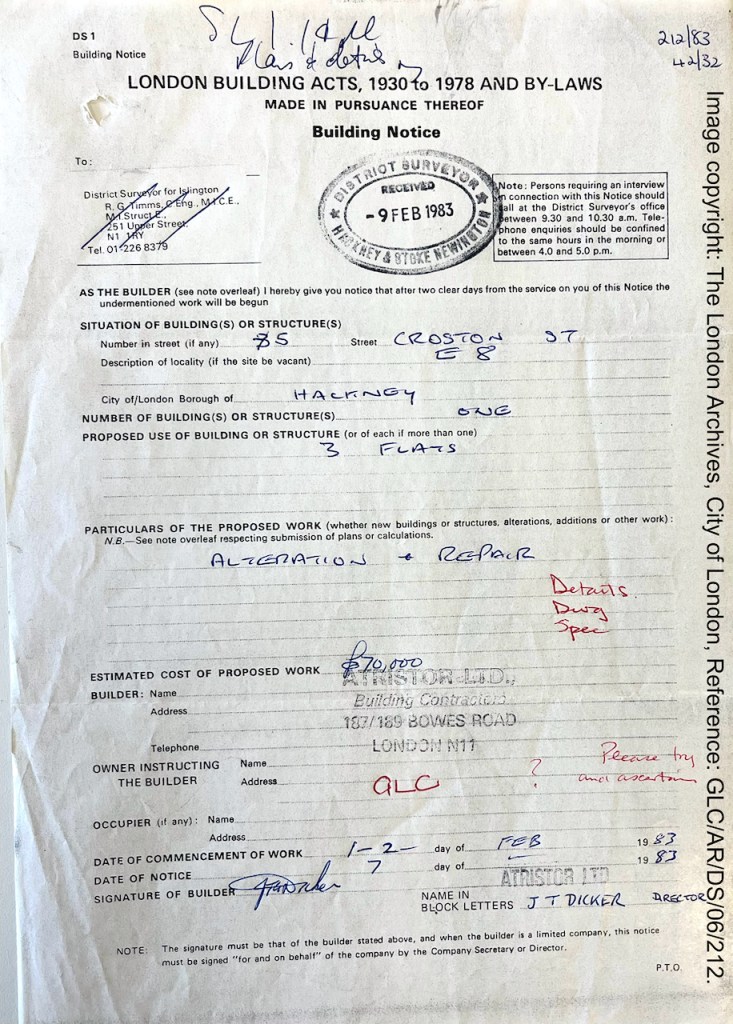
So then some change of ownership must have occurred, because in April 1978 someone, probably the Greater London Council (GLC), was submitting plans to redevelop the property into three residential flats. See the architects drawing above. This was approved on 3rd August 19785. But no redevelopment happened. There was a further application in 1983, now with a builder involved, Atristor Ltd. The planning officer at the time, like me today, wanted to find out who owned the site. In the “owner” field they wrote in red “GLC?” with a note “please try and ascertain”.
7 February 1983: part of the planning application correspondence between the builder, “Atristor Ltd” on behalf of (we assume) the GLC, and the district surveyor, regarding the conversion of the building into three flats. See the red annotations, where someone is querying the ownership. Image copyright: The London Archives, City of London, Reference: GLC/AR/DS/06/212. Reproduced under licence.
It seems that the owner was indeed the GLC, however, because in another bundle there were beautiful architectural drawings for the three flats, marked “GLC ILEA, DEPARTMENT OF ARCHITECTURE AND CIVIC DESIGN, County Hall SE1 7PB, Architect Sir Roger Walters KBE FRIBA FIStructE”.
Do we still have a “Department of Architecture and Civic Design”?
On 9th February 1983 Atristor Ltd notified the District Surveyor they were going to start work in two days. However something went wrong, because on 15th September 1983 the GLC was again submitting plans, this time for replacement of a “fire damaged roof”. They proposed to use steel beams to hold up the tiled roof. This time the work was to be done by the GLC Department of Architecture and design, Engineering Division.
At this point, the archive record stops.
I can only assume that the work to replace the fire-damaged roof went ahead, and that the conversion into flats was completed. Because here is the building, with a roof, and with three flats inside.
Page spread, Sketchbook 16
It’s a wonderful location, and an intriguing building. I’d love to hear from anyone who knows more about it.
Victorian pubs have high windows and stained glass to obscure the inside from the view of children and passers-by: I can’t find a reference for this. I have always assumed it is so. If anyone can confirm – please let me know. ↩︎
This is not the “Dublin Bottling Company” of Texas which makes drinks including “Dr. Pepper” ↩︎
All the quotations, documents and plans I have reproduced come from London Archive document packs with this reference: GLC/AR/DS/06/212, see this link – https://search.lma.gov.uk/scripts/mwimain.dll/144/LMA_OPAC/web_detail?SESSIONSEARCH&exp=refd%20GLC/AR/DS/06/212 The documents are not online, but are available for perusal at the London Archive Study Room. The London Archive kindly gave me permission to photograph the documents and publish them here. The letter from the Dublin Bottling Company appears by kind permission of the Guinness Archive (email from Sarah Mai Kavanagh, 20 My 2026) ↩︎
Letter in the London Archive pack GLC/AR/DS/06/212, dated 20 April 1964 from Hubert Bennet, Superintending Architect London County Council, to the Dublin Bottling Company, copied to the Hackney District Surveyor. Mr Hubert writes, “I would confirm my assistant’s telephone conversation with Mr. Wright on 19 March 1964, when the above matter was discussed and the installation of a cast iron flue pipe complying with By-law 10.05 agreed.I would be pleased to receive a reply confirming the installation of the cast iron flue pipe and the cancelling of the application at your earliest opportunity.” ↩︎
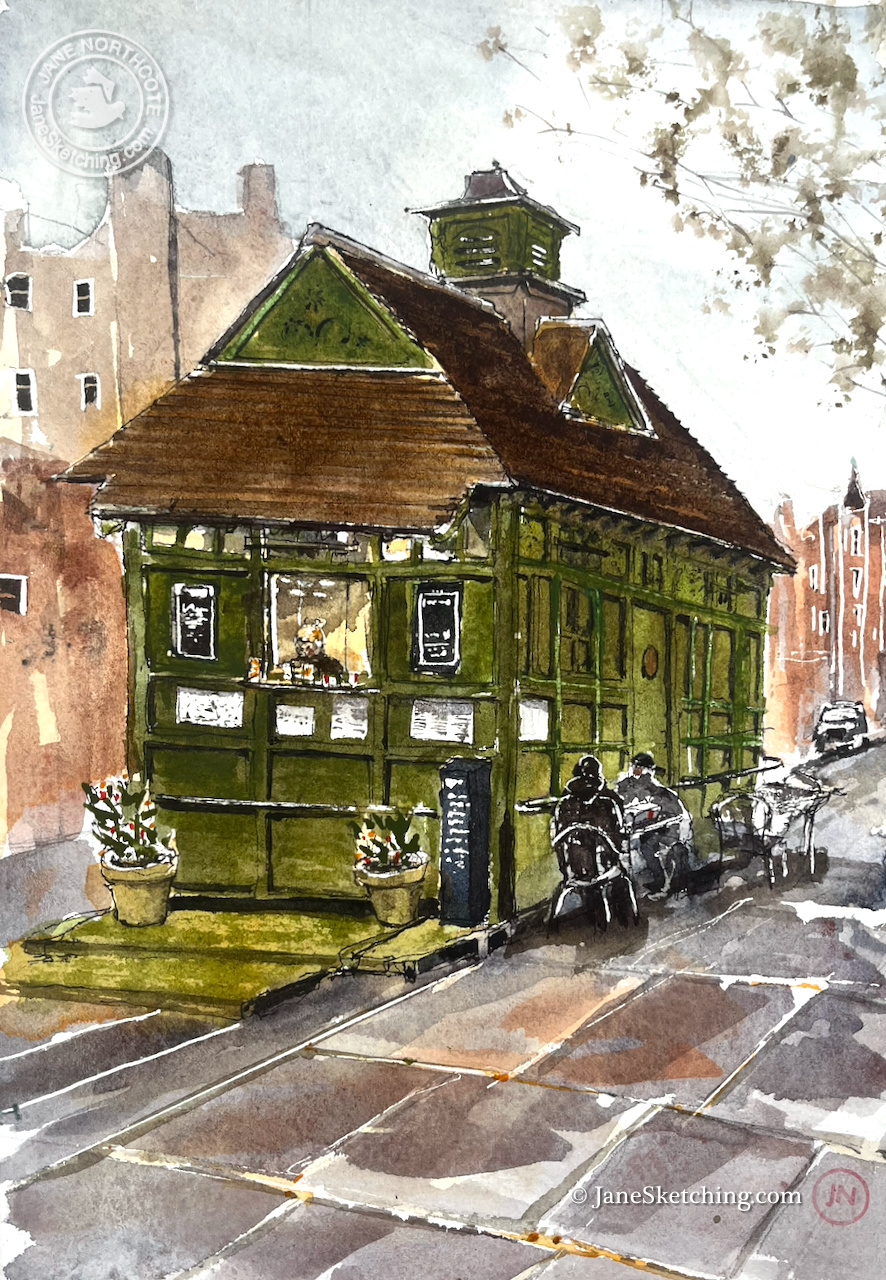
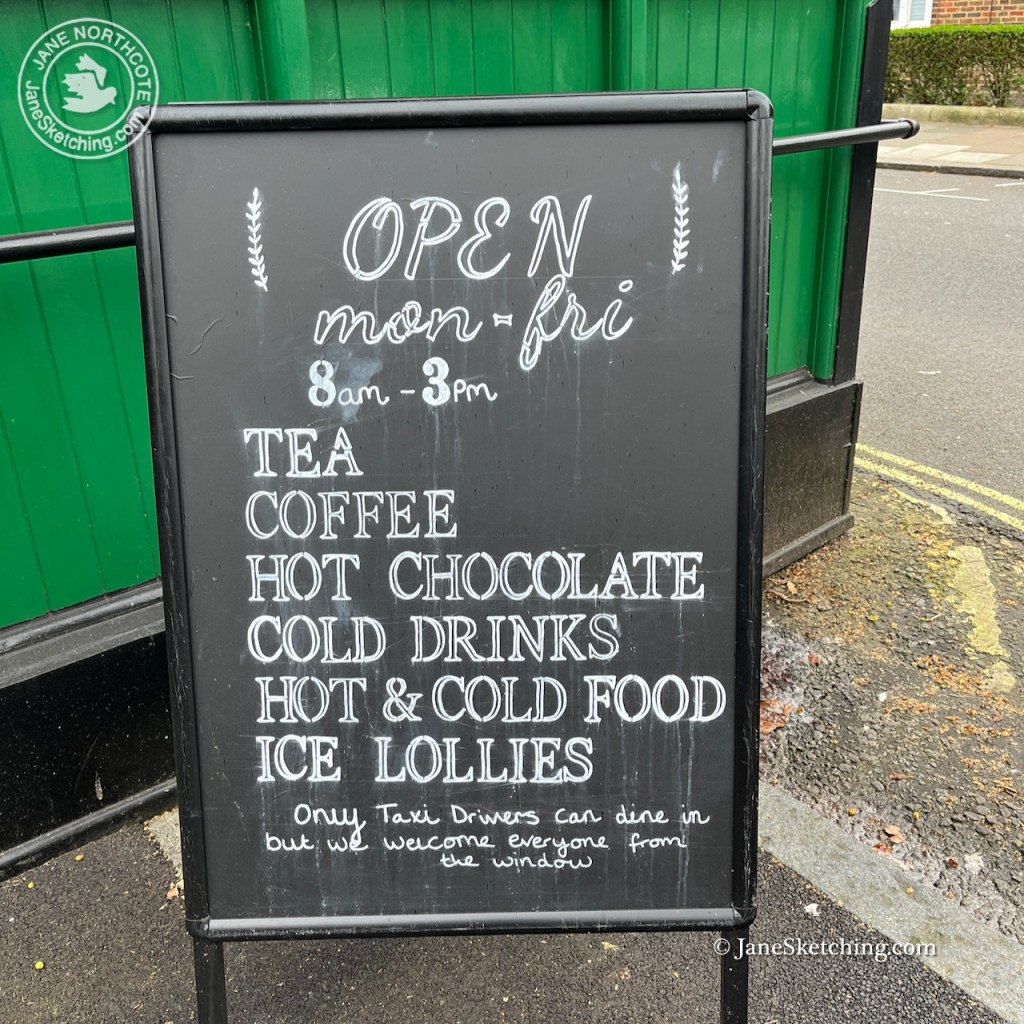
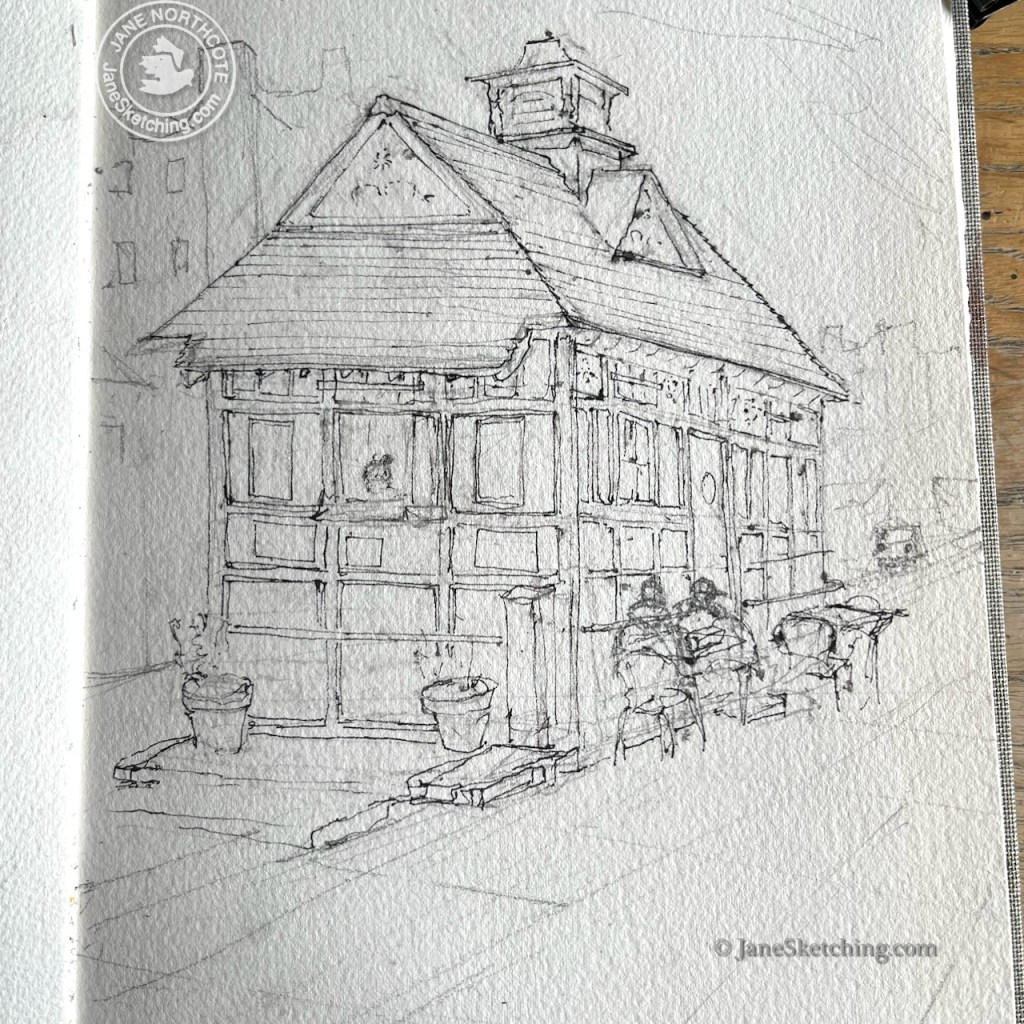
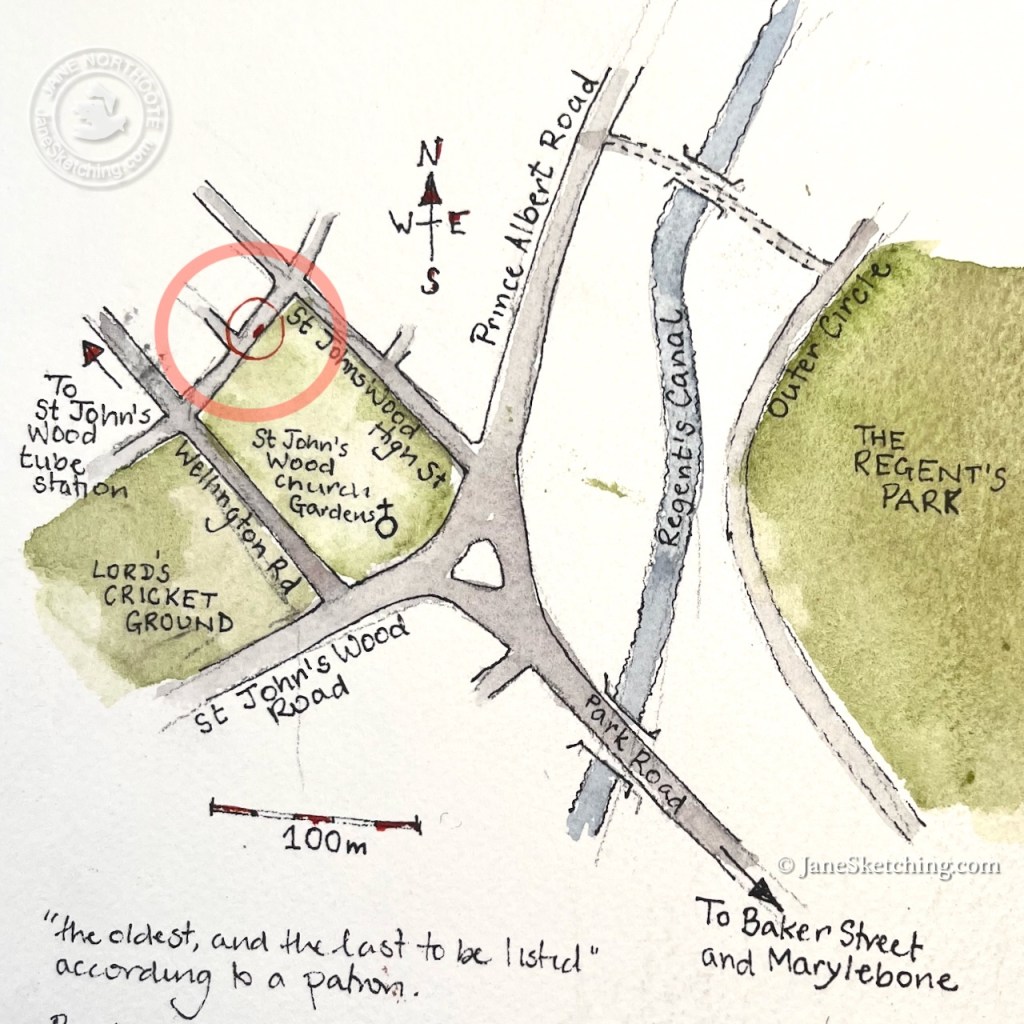
According to the cab driver sitting at one of the tables, this is “the oldest, and the last to be listed”. It was built in 1875, and listed in 2024 (listing ref 1488223).
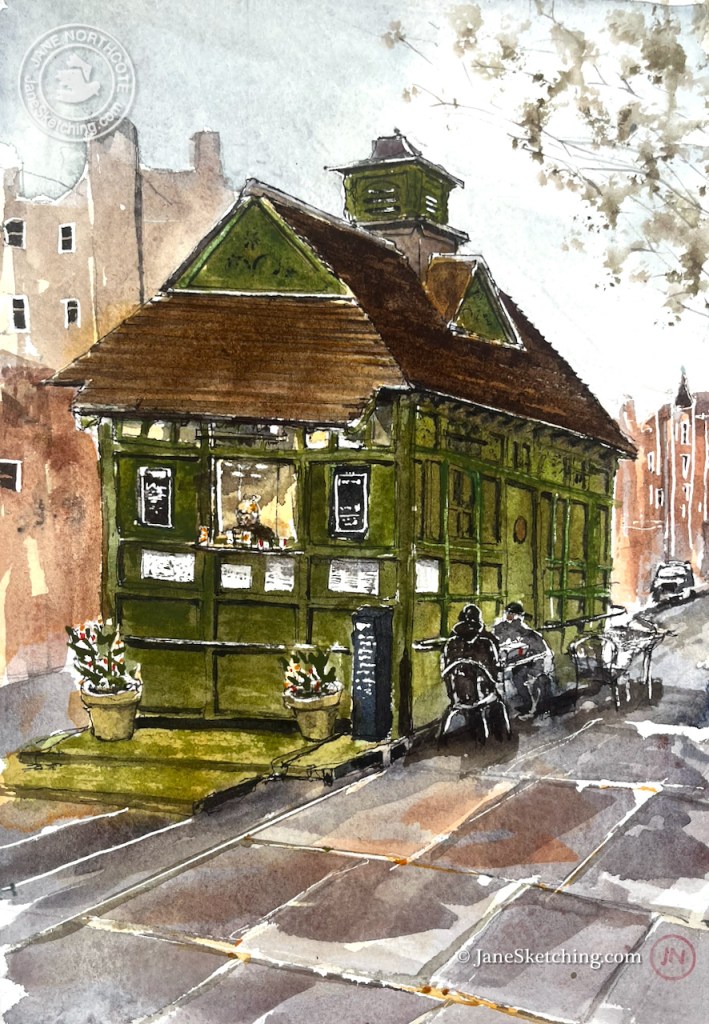
“The Chapel” Cab Drivers’ shelter, Wellington Place, St John’s Wood, NW8 7PE Sketched 27 March 2026, in Sketchbook 16
As I was sketching, the manager of the shelter came out and kindly brought me a cup of tea. She was very welcoming, and interested in the drawing. She told me that the rail running round the shelter, shown in my drawing, was for drivers to tether their horses.
Cup of tea courtesy of the manager of the shelter.
A former cab driver came by in his mobility scooter. He evidently still had dining rights, as he was seated at the tables by the hut. Only cab drivers can sit there, I understood. Cab drivers also went inside the shelter, through the door which you see on the right of the hut, with a circular plate on it. The ex-Cab Driver told me he was a photographer now. “Street Photography”, he said. But he told me he was going to take up birdwatching. This was something it was convenient to do from a mobility scooter. He had no teeth, and it was hard to understand what he said. But nonetheless we enjoyed an extended conversation and listened to the birds we could hear in the park. He went off, waving from his vehicle, steering a confident route along the uneven pavement.
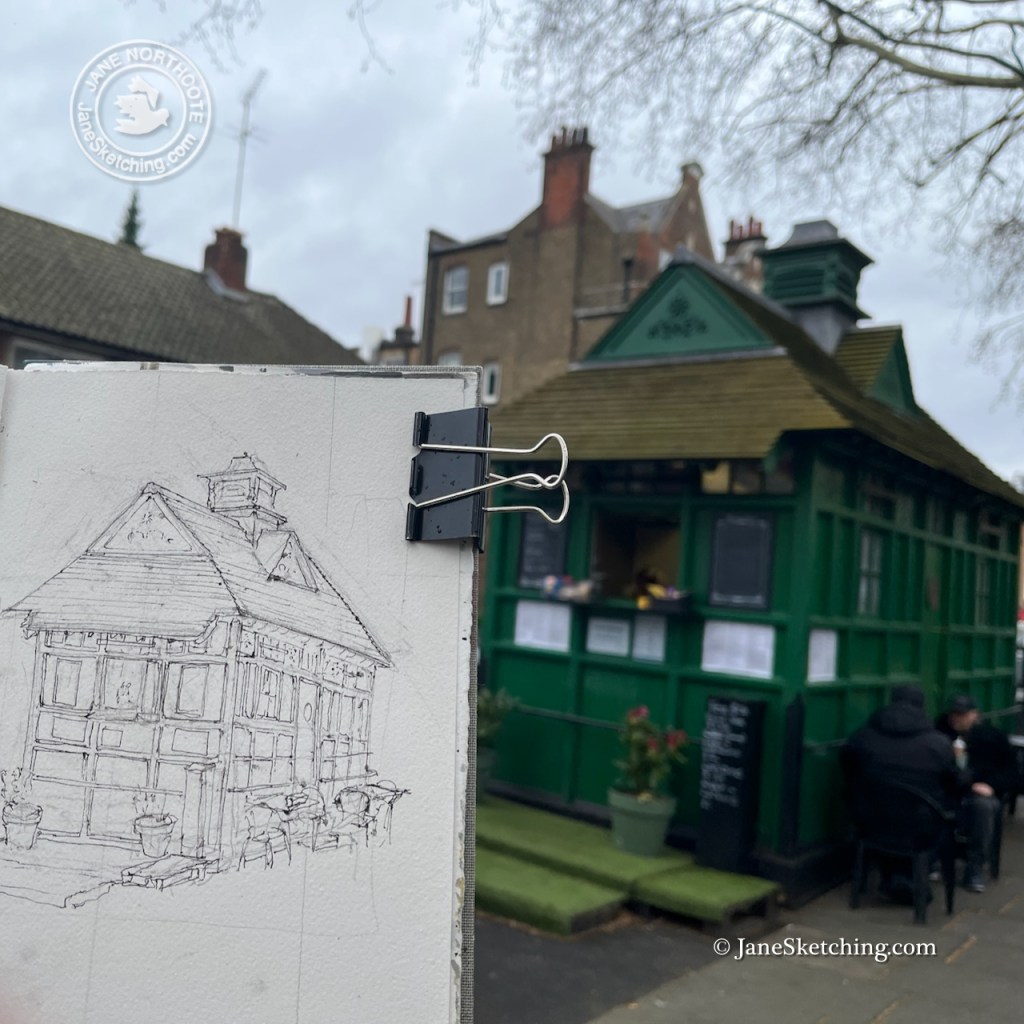
This shelter is called “the Chapel” because it is right next to St John’s Wood Chapel Gardens.
The St John’s Wood Cab Driver’s shelter is next to the Church
It started to rain and I stopped sketching. I bought a bacon sandwich from the woman in the shelter and went to eat it in the garden.
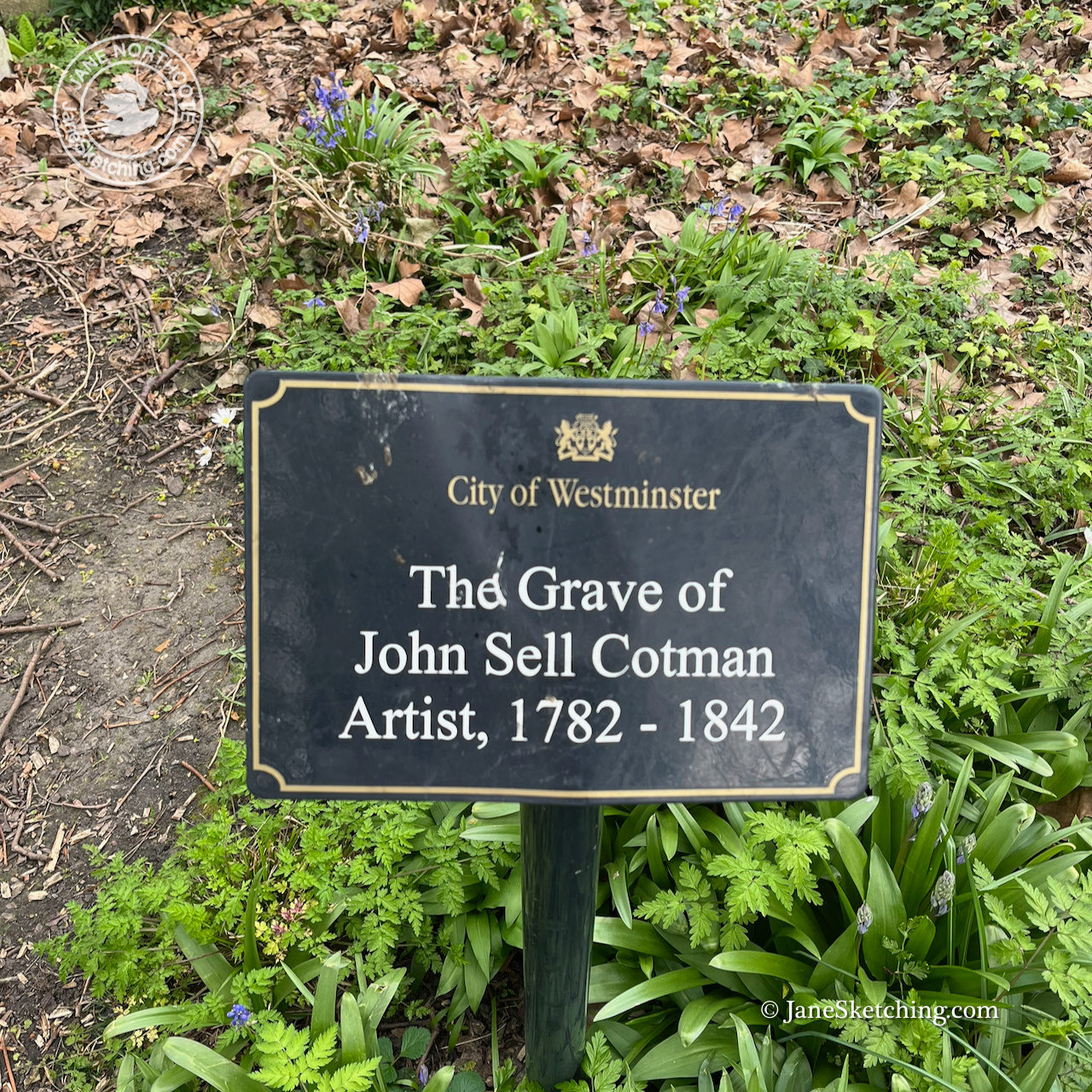
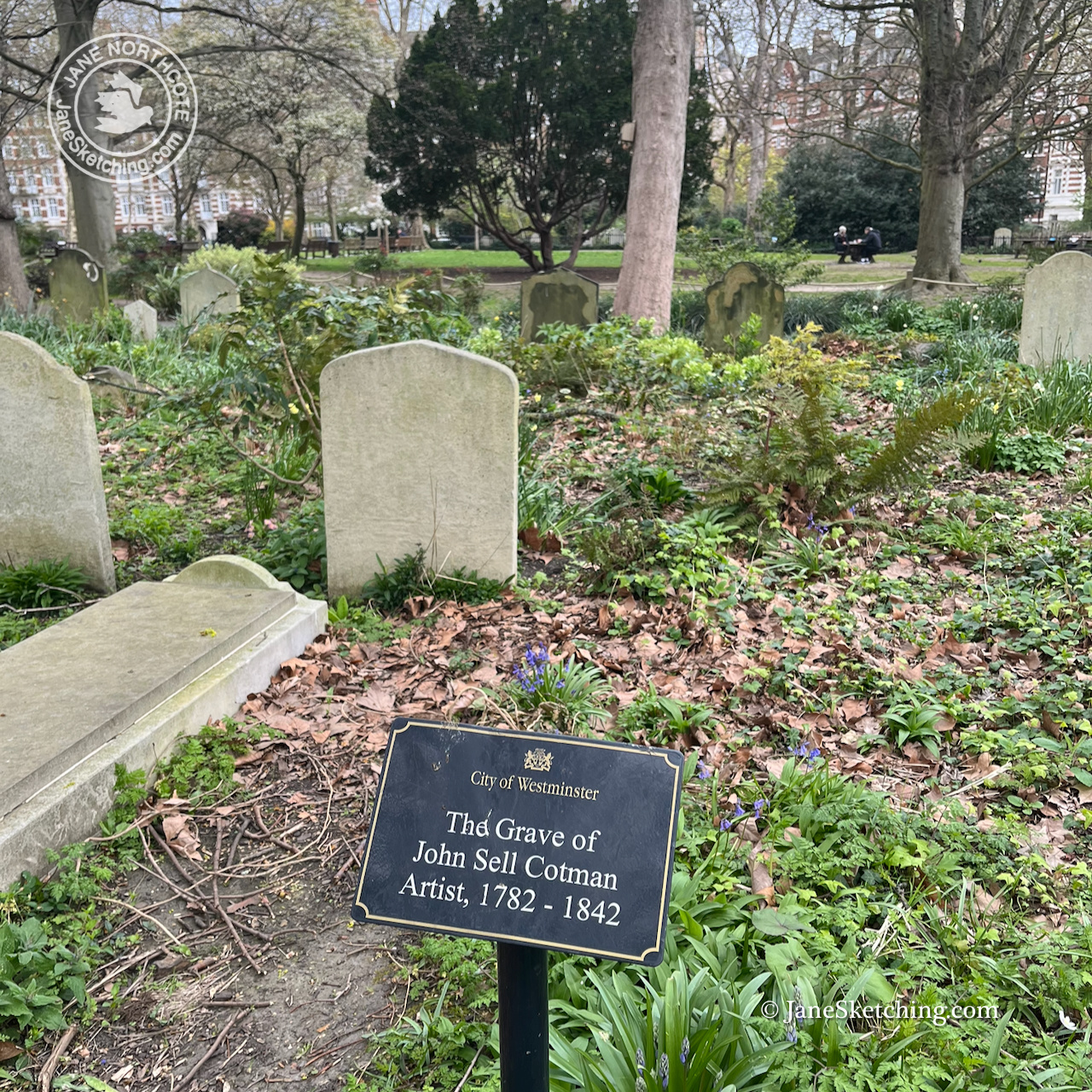
The gardens are the Chapel graveyard. The watercolour artist John Sell Cotman is buried there. I have seen a large exhibition of his work at the British Museum.
Back at my desk, trying to channel my inner John Sell Cotman, I struggled to match the green colour of the shelter. It is called “Dulux Buckingham Paradise Green I”. 1 It exists in the Dulux Trade Paint range2, but not as a watercolour.
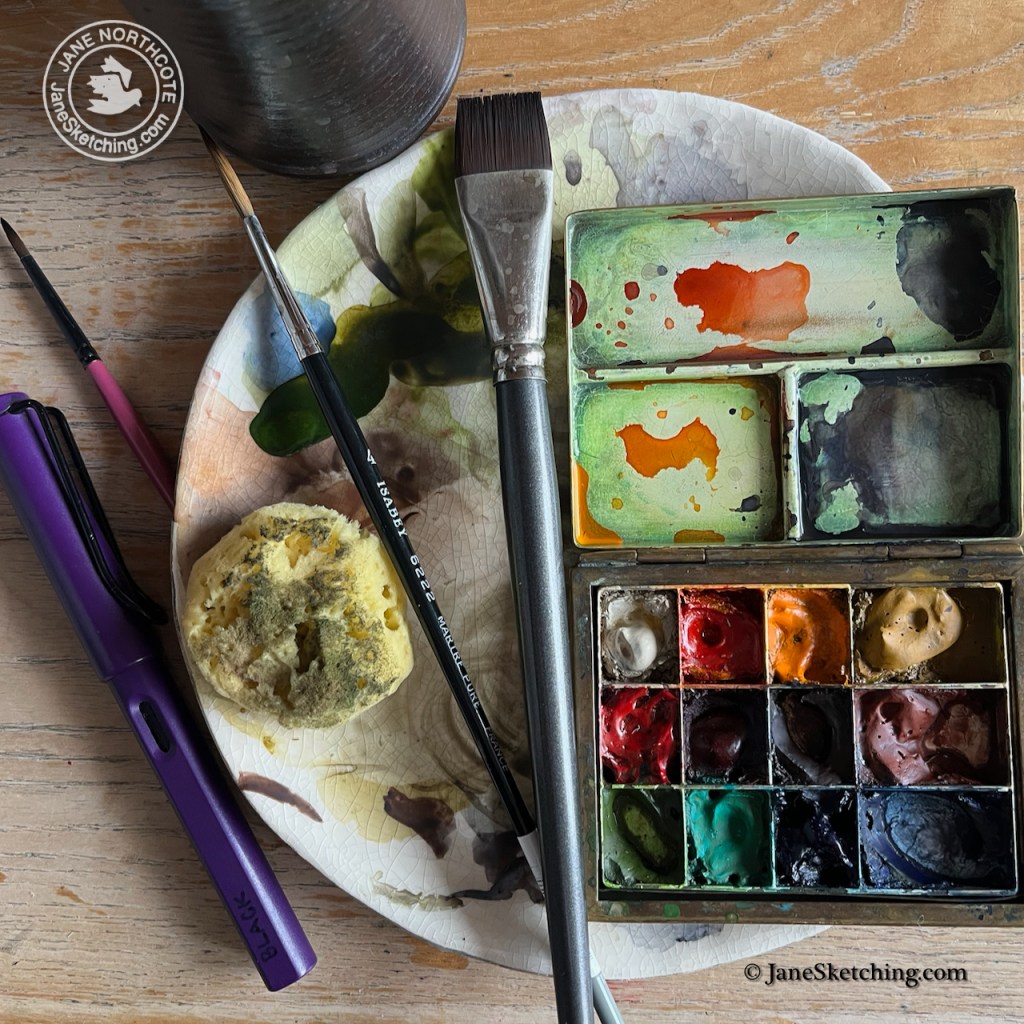
I tried to mix it myself, with partial success. Any colour varies depending on the light conditions, and the surroundings, so I forgive myself for not making an exact technical match. My green is made from Serpentine Genuine (Daniel Smith watercolour ) with touches of Mars Yellow and Ultramarine Blue.
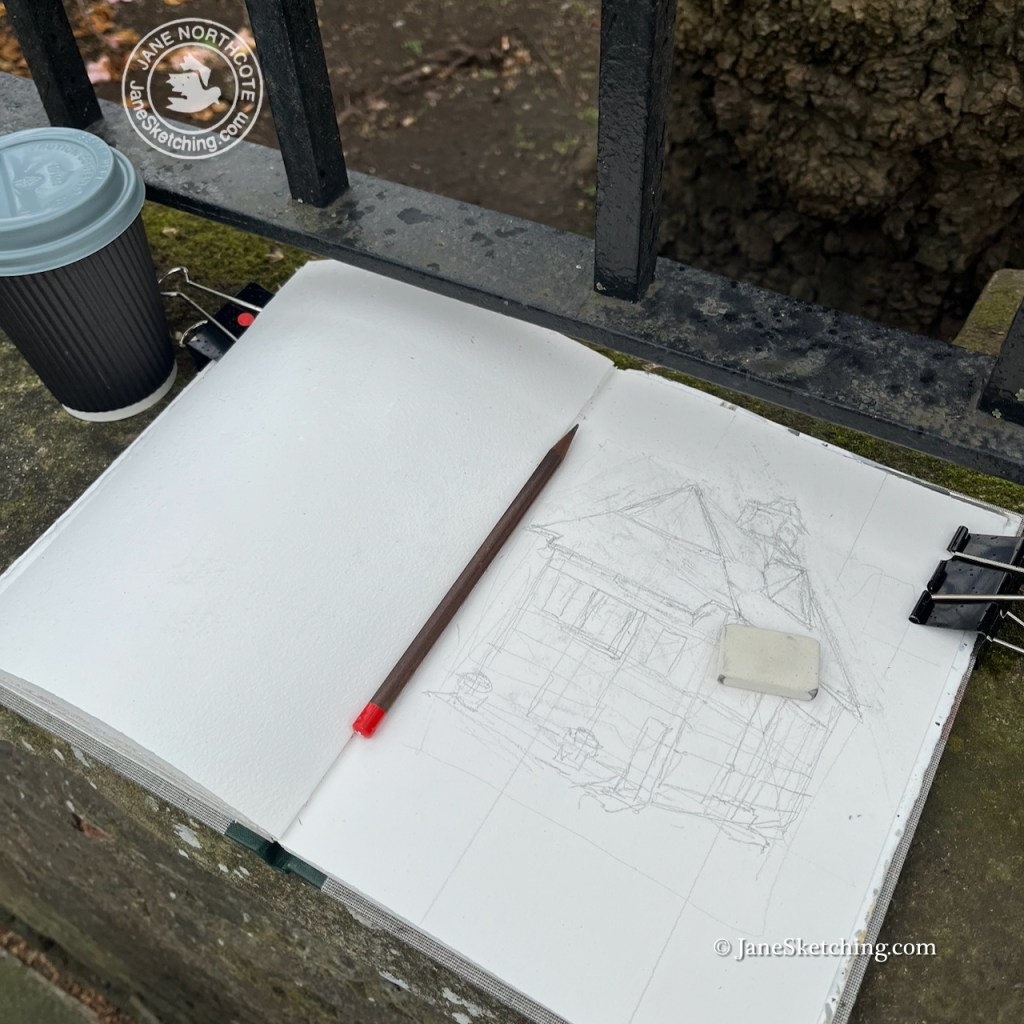
Equipment for this picture. The sponge is for making the tree. Serpentine Genuine is the colour in the palette at the bottom left. It looks quite similar to Dulux Paradise Green I.
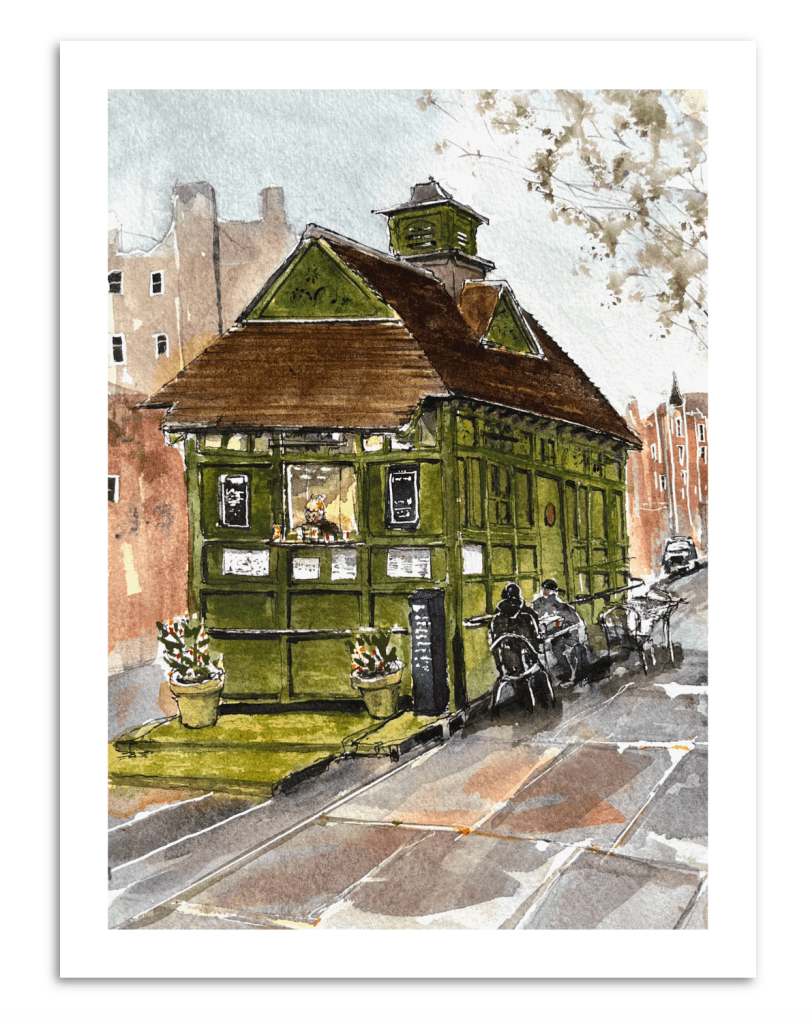
When the picture was finished I ordered a digital print of it, and returned to the shelter to gift the print to the manager who had been so kind and welcoming. It will hang inside her shelter.
The St Johns Wood Cab Drivers’ Shelter, digital print (c) JaneSketching









 Jane Sketching