Shetland Sketchbook

Here I am on the banks of the River Dee, looking across to Aberdeen.

IMG_0891

I had just left the overnight sleeper train from London, and was in Aberdeen waiting for the overnight ferry to take me to Shetland. In the River Dee, I saw dolphins. I walked to the Torry Battery, built 1858-1860. In the picture on the right is the “Aberdeen Harbour Operations Centre”.

The ferry docked in Lerwick, Shetland mainland. It was raining.
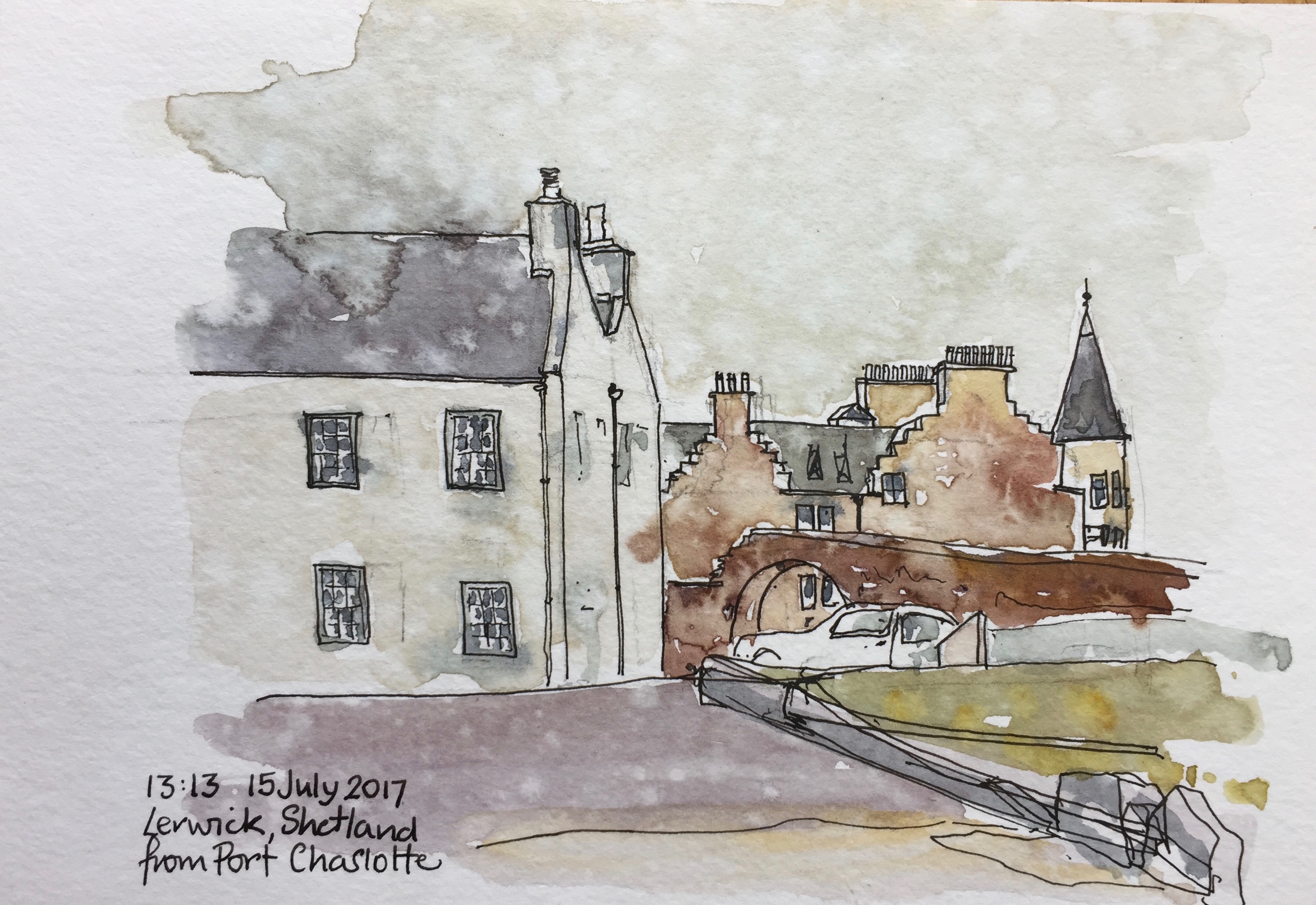
IMG_0892

I drew this picture in Fort Charlotte, sheltering from the rain under the thick walls of a gate. The shelter was not perfect, as you see from the water splattering the picture.

Bus number 9 from the Viking Bus Station took me to the West Mainland, where I was staying in Burrastow Cottage. Here is a drawing of Burrastow House. The cottage is the small building, in the background on the left.

IMG_0890

I did a lot of walking.

In Lerwick I bought a landscape sketchbook. So I experimented with using both pages. There’s a lot of landscape in Shetland.

IMG_0909

Above, I tried to show the bright yellow flowers, very vivid, in the low light.

IMG_0899

The picture above shows the bay and the village of Walls.
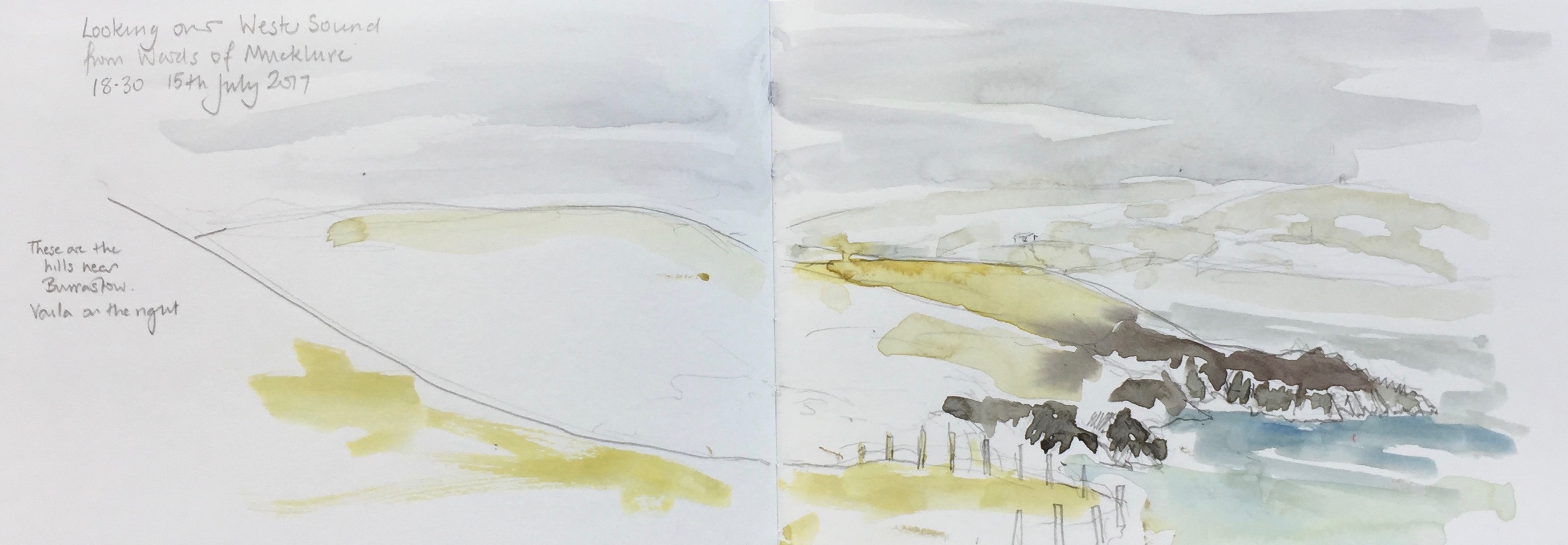
IMG_0894

Above is an attempt to draw the huge cliffs near Burrastow. The peninsula is the delightfully named “Wards of Mucklure”.

IMG_0906

I drew the sea. Above is the view from the door of the cottage. Out there, one day, I saw an otter.
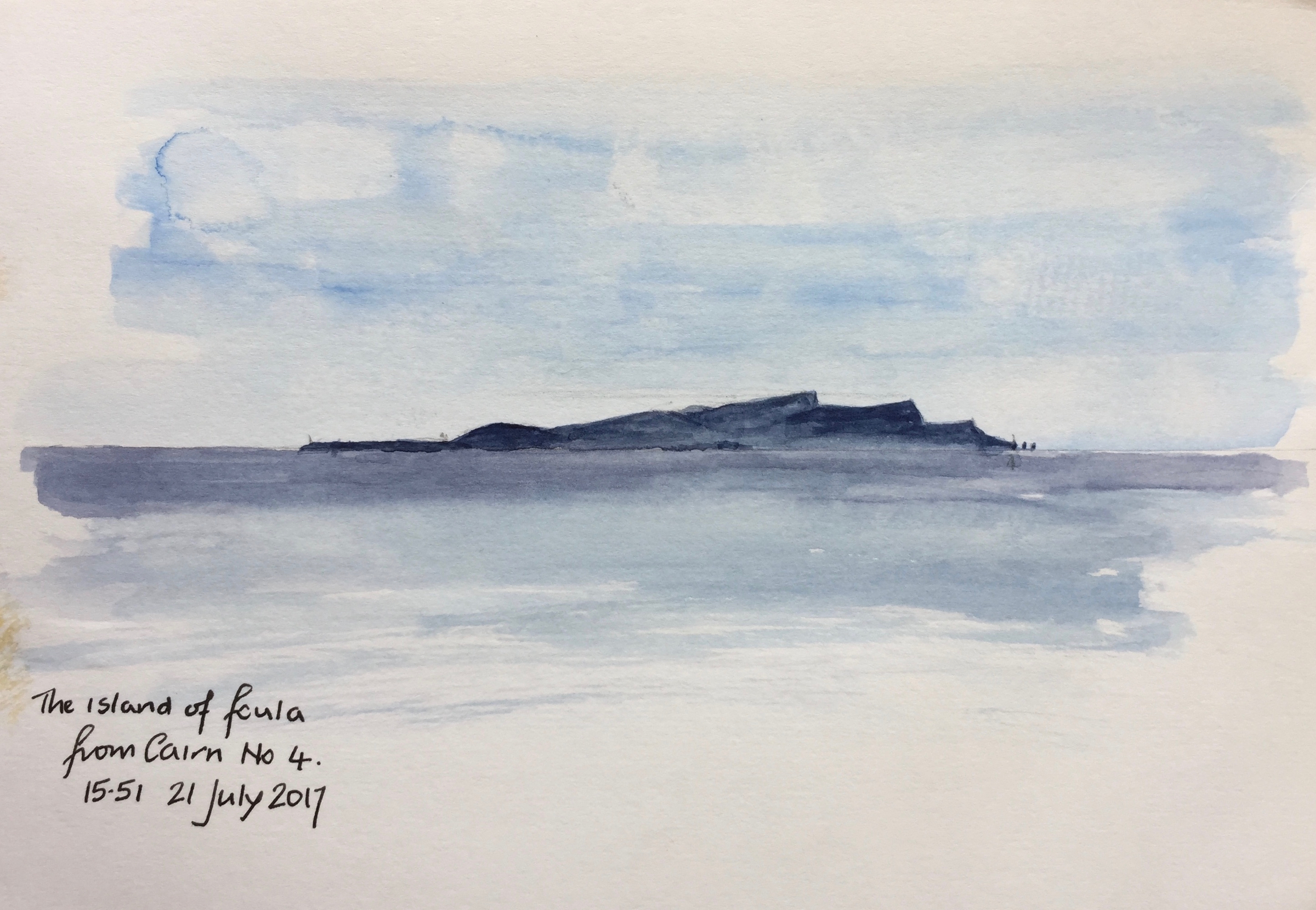
IMG_0887

Above is what the island of Foula looks like, viewed from Cairn 4. I numbered the Cairns.

Here is my numbering scheme:IMG_0933

I also drew the plants.

That picture of the drain hole shows iris plants above dark water. The picture on the right shows flowering sorrel, and iris leaves.
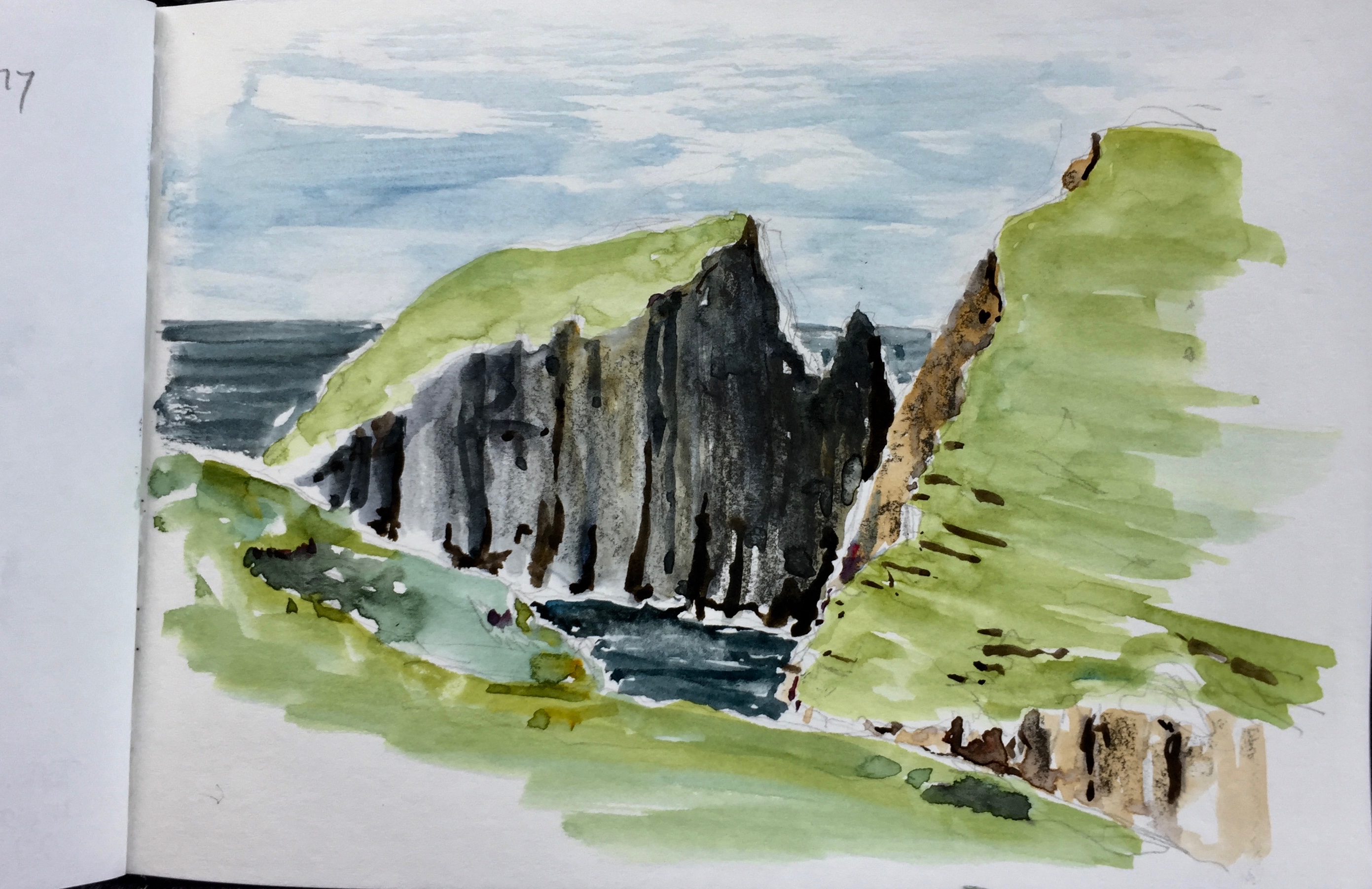
IMG_0914

This is a picture of “The Ned” near Westerwick. It was much more dramatic than the picture. More dark and more light. Maybe the pencil sketch catches it better:

IMG_0915

Here is another sketch of the sea. I tried drawing quickly. Sometimes it seems to work better that way.

IMG_0888

And here is a sketch on the way back to London.

IMG_0916


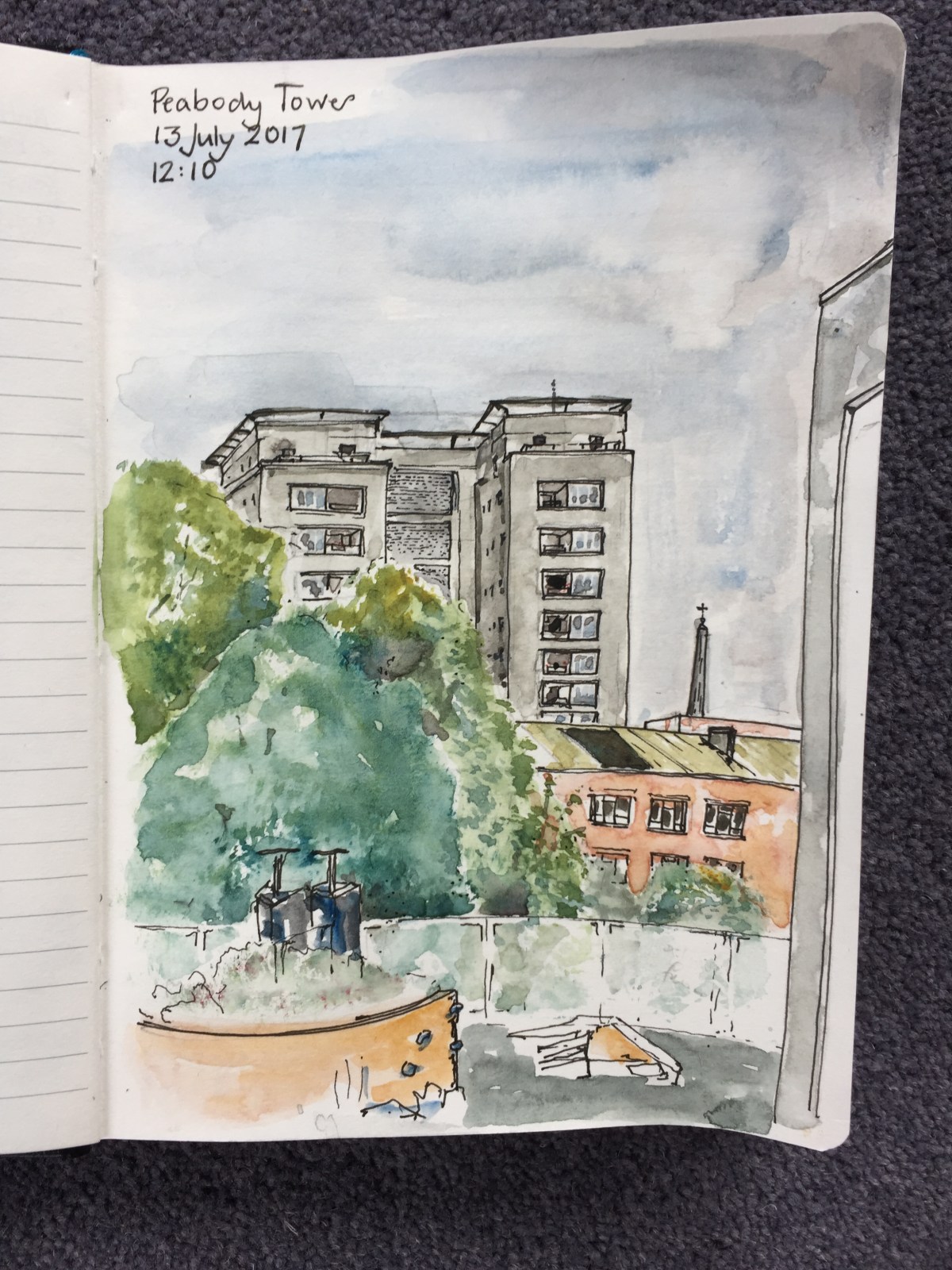
Peabody Tower from the podium

Peabody Tower, 13 floors, 52 flats, is part of the “Roscoe Street Estate”. It was completed in 1959. The architects were John Grey and Partners.

A very interesting history of the Estate was done in 2010 by Publica. Their report is here:

20120821FLP38WhitecrossStreetPublicareport2011

In the foreground is the first-floor playground of the Prior Western Primary School. The building in red brick is Fortune House, built at the same time as Peabody Tower, although it looks very different.

IMG_0426

This drawing took 1hr45min. Done from the podium next to Breton House.

“Anthology” and Bridport Place N1

From our flat we can see this core against the skyline.

It is Phase 3 of Hackney Council’s redevelopment of the Colville Estate. Two towers, called “Anthology” 16 and 20 floors “solely for private sale, to help cross subsidise the construction cost of the remaining social rent buildings”.

I drew this from Shoreditch Park. It rained. I walked around a bit. The sun came out. I started again. It rained again. I got back on my bike and went home and finished the colouring on my desk at home.
12:10, 1 hour intermittent on location and half an hour at home. I’m quite pleased with the tree.

View from Chequer Street EC1

Braithwaite House, on the left, is having its cladding removed. Here’s the quote from Islington Council website (viewed today, 2 July 2017):

Cllr Diarmaid Ward, Islington Council’s executive member for housing and development, said:  “As a landlord, safety is our number one priority and we will do whatever it takes to ensure people are safe in our estates.
“Last night (Thurs June 22) we received results of tests on cladding on the side of Braithwaite House, and they have confirmed the presence of Aluminium Composite Material (ACM).
“We’re arranging to have the cladding, which is only on the sides of the building, removed as soon as we possibly can by a specialist contractor.
“We’re also stepping up safety measures in the block immediately, with fire safety patrols taking place day and night from today until the panels are removed.
“Our housing staff were at Braithwaite House last night to carry out fire checks and clear any obstructions in communal areas.  We’re also taking advice from London Fire Brigade and will follow all their recommendations.

fullsizeoutput_17ba

In the background, the other side of Bunhill Row is “The Featherstone”. The notice says:

“Hill are working with Southern Housing to create 65 new homes for affordable rent, shared ownership and private sale on the former Moorfields School Site.”

In the distance, the building with round windows is “White Collar Factory” on the Old Street Roundabout. No notice on the outside and a bit dark on the inside and it was unclear if you can just walk in. It was a Sunday and I didn’t feel like being challenged, so I didn’t walk in. Their website is hard to decipher. What are they exactly? The bit I understood says:

When it opens at the end of 2016, White Collar Factory will house one of London’s most exciting and diverse working communities.

So they are a shared occupancy building. It looked to me like there might be a café in there too.

Drawn and coloured on location, in the shade until the sun came around. 1hr 30min roughly. Kids playing in the paygound, trying to get a ball somewhere, perhaps in a net. They called “concrete”, or “stone” which was perhaps the intended destination of the ball. One kid called out “Hey, you hurt my eye”. The other kid said “No!”. Then he remembered himself and said, in a clear and respectful tone, “Did I? I’m sorry. Are you OK?”

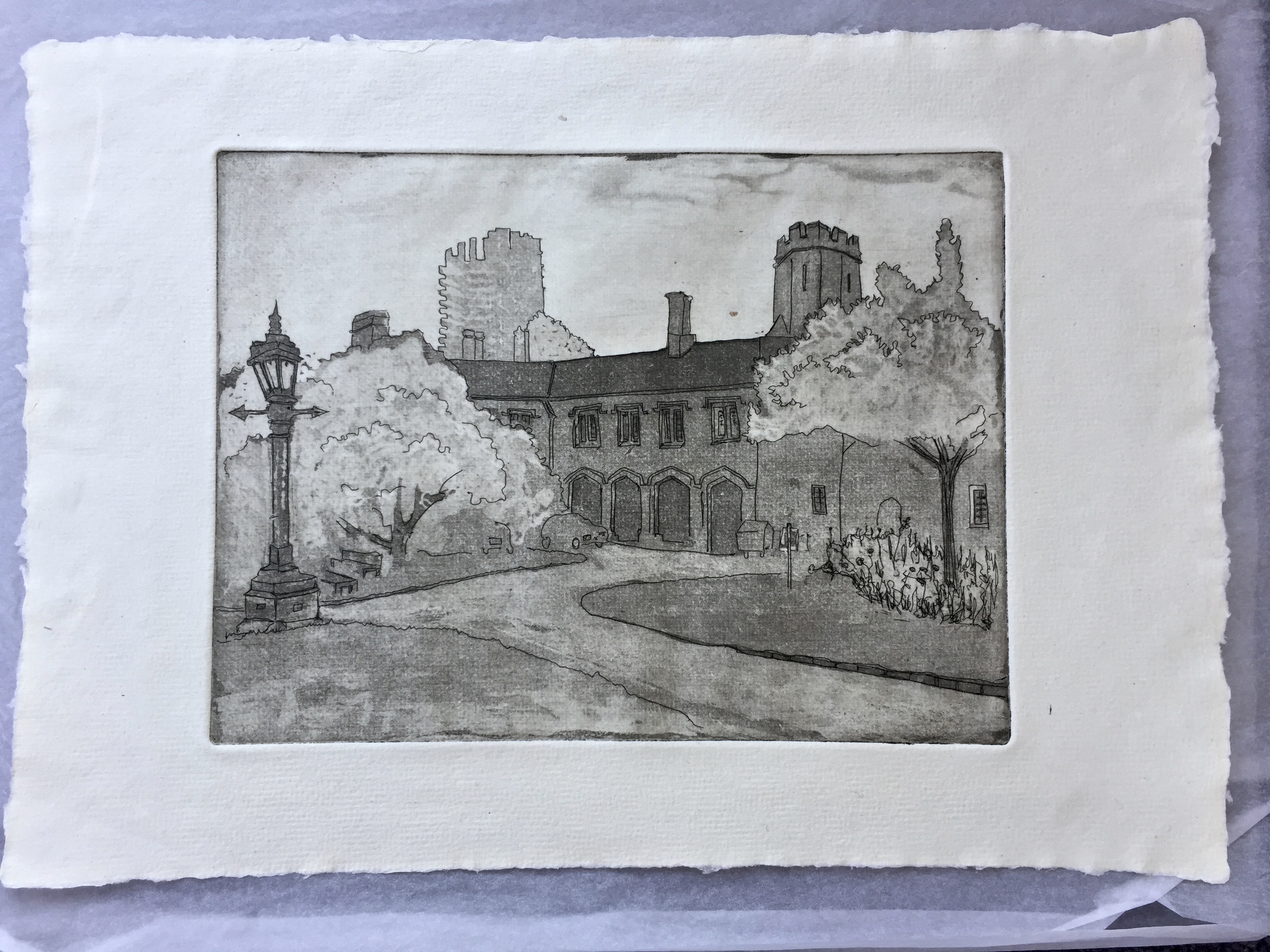
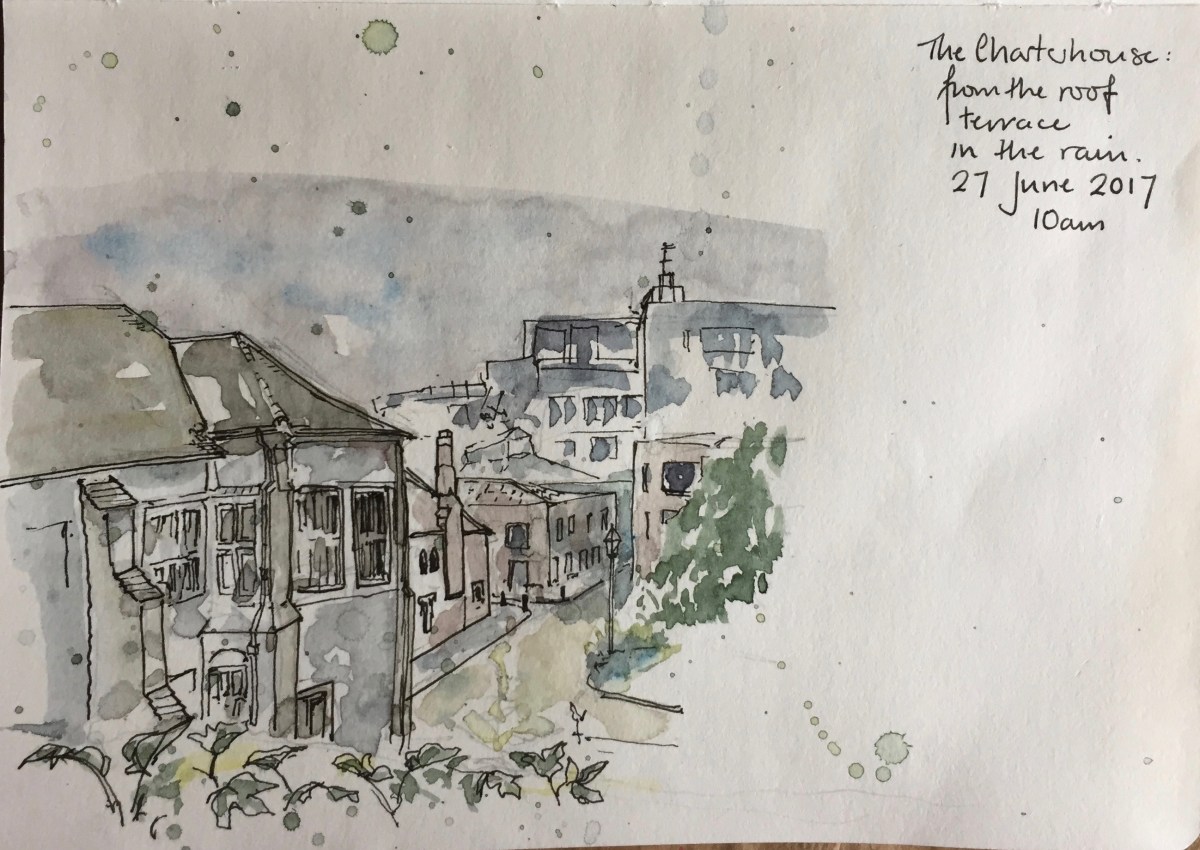
The Charterhouse in aquatint

Here is an aquatint on copper plate, based on a drawing.
I made it at ELP Studio in Stepney. It took all day! I made 5 prints. This is one on Khadi paper which has a very strong texture.

From Holborn Circus

This sketch shows the new “Fleet Building” under construction on the Farringdon Road, towering over the quaint Vicarage and Court House of St Andrews Holborn.

fullsizeoutput_17b4The Vicarage and Court House are Victorian, designed by Samuel Teulon as part of the remodelling of St Andrews to accommodate the Holborn Viaduct, 1860s and 70s. Notices on the gate announce the St Andrews Church Foundation and Associated Charities. The Court House is the building with the turret, No 7 St Andrews Street. It just has a large “7” on the door.

The pinkish coloured building on the right is currently the offices of “Rosenblatt” and “Convex Capital.”

The Fleet Building is designed by Kohn Pedersen Fox Associates. It is Goldman Sachs’ “840 000 sq ft London campus”. To build it they demolished the old Telephone exchange. The murals by Dorothy Annan that were on the Telephone Exchange are now in the Barbican.

An article in a property magazine “CoStar” dated 4 Jan 2013 reads:

Goldman’s plans previously suffered a setback when the government gave Grade II listed status to 1960s murals on the front of Fleet Building, which used to be London’s largest telephone exchange.
The Department for Culture, Media and Sport followed advice from English Heritage that the nine ceramic tile murals by Dorothy Annan, which depict pylons, cables, telegraph poles and generators, were of “historic interest” to the telecoms industry and had “relative rarity as surviving works of 1960s mural art”.
Goldman had opposed the listing of the murals and relocating them could be costly and time-consuming. However, as part of the conditions of the planning consent, Goldman must meet all “reasonable costs” incurred with their removal.

 About 1 hour. Drawn and coloured on location. Very hot sun. Atmosphere of vanilla scented Vape Cloud. Fire alarm on Lloyds Bank ticking intermittantly.

House by the water: experimental aquatints

Yesterday I experimented with aquatint at East London Printmakers.

These are three very small plates, about 3 inches by 2 inches. Click to enlarge the picture.

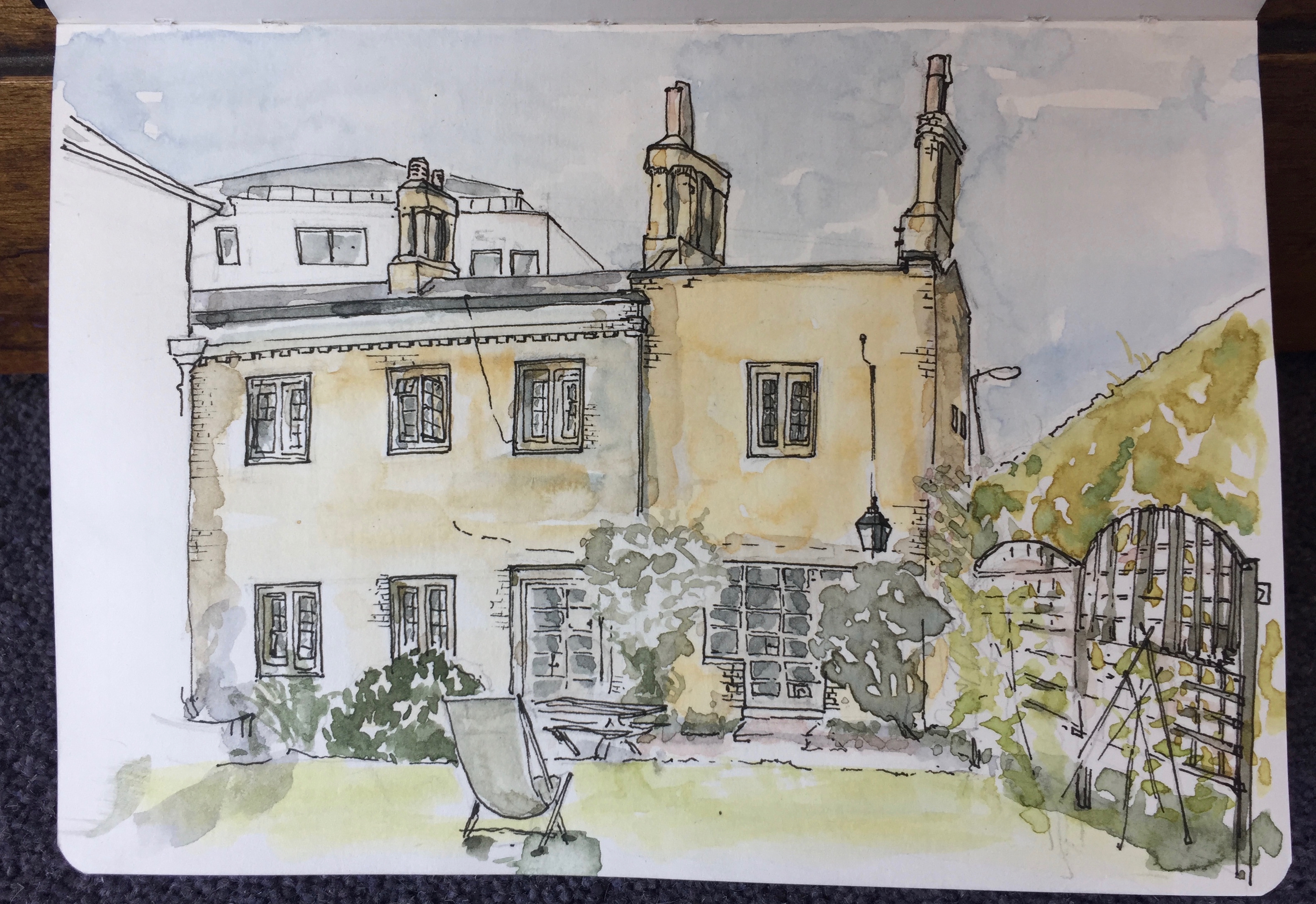
Master’s Garden, The Charterhouse

20 June 2017 (colour)

This shows the Preacher’s House. The wall on the right is next to the Clerkenwell Road. Behind the fence on the right there were bee-hives with very active bees.

About 3 hours. Drawn and coloured on location.

Here’s what it looked like before the colour went on:

20 June 2017 (pen only)