Newcastle Central Station

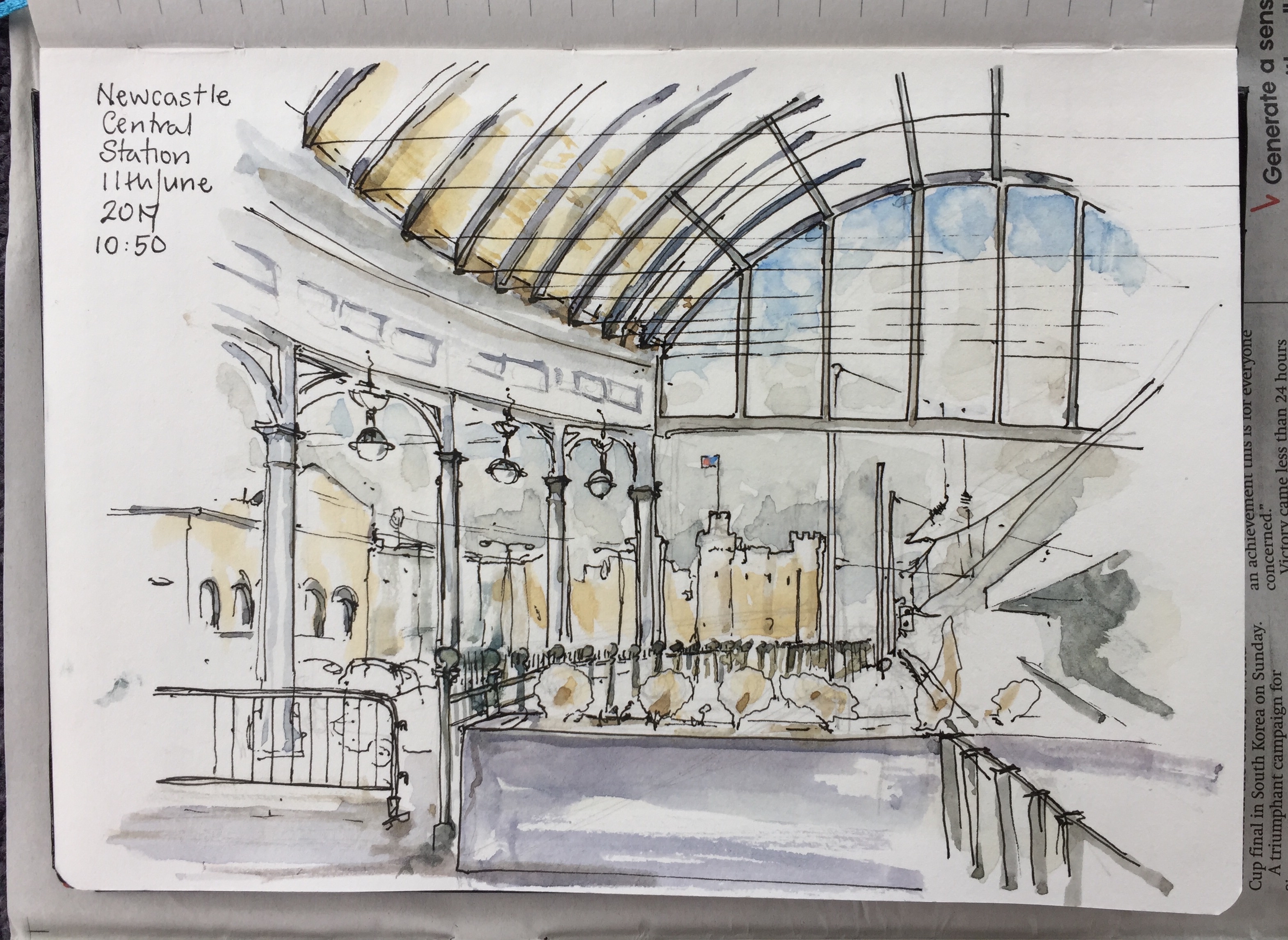
This is a drawing from the Costa Coffee at Newcastle railway station, waiting for the train to London Kings Cross, 268 miles away.


IMG_0280

Newcastle Central Station was opened in 1850.

Architect: John Dobson
Engineers: TE Harrison and Robert Stephenson
Contractor: Mackay and Woodstock

The structure in the distance with the flag is the 13th century Newcastle Castle Keep, restored 2011 to 2015 using Heritage Lottery Funds.

This drawing took about an hour, drawn and coloured on location. Some colour and shadows added at home.

Here is work in progress:

IMG_0279

Charterhouse, Pensioners’ Court

This is from a doorway on Pensioners’ Court, which is the court beyond Preacher’s Court. The Building with the four archways is part of the Brothers’ realm: the infirmary above and the coffee room below. I don’t know what the turret is, very intriguing.
The gardens were magnificent. In front of me was that huge magnolia tree. It moved in the wind and contained darkness much darker than I have drawn it.

I enjoyed the two towers: Barbican and Charterhouse, and the way the view was bracketed by the tree on the right and the lamp-post on the left.

One hour 45 minutes, drawn and coloured on location. The day was overcast and threatened rain. Round me, a gardener was watering the borders.
It should be “Pensioners’” court (plural).

Great Hall, The Charterhouse

Those chimneys are hard to draw. They are not simple rectangles, but a complicated geometric shape, a square put at an angle to another square, difficult to see in the light and shadow.

The crest of the roof is not straight. It goes downwards at quite an alarming angle, as drawn. The windows are not in a straight line with each other, which makes me wonder exactly where the floor is, inside.

I drew this from under the shade of the new building, the “Admiral Ashmore Building”. While I was drawing, the gardeners were making the window boxes, and crushed the geranium leaves. The place smelt of geranium, and earth and water.

IMG_0129

I like it that you can see the Barbican towers beyond. I made this observation to a Brother who paused to chat. He told me that these brutalist towers are not popular with certain of the Brothers. They have identified a place in the garden where you can sit, so that the towers are obscured by a tree.

About 2 hours (those chimneys!!), drawn and coloured on location.

Here is what it looked like before the colour went on:IMG_0105

Willen House EC1

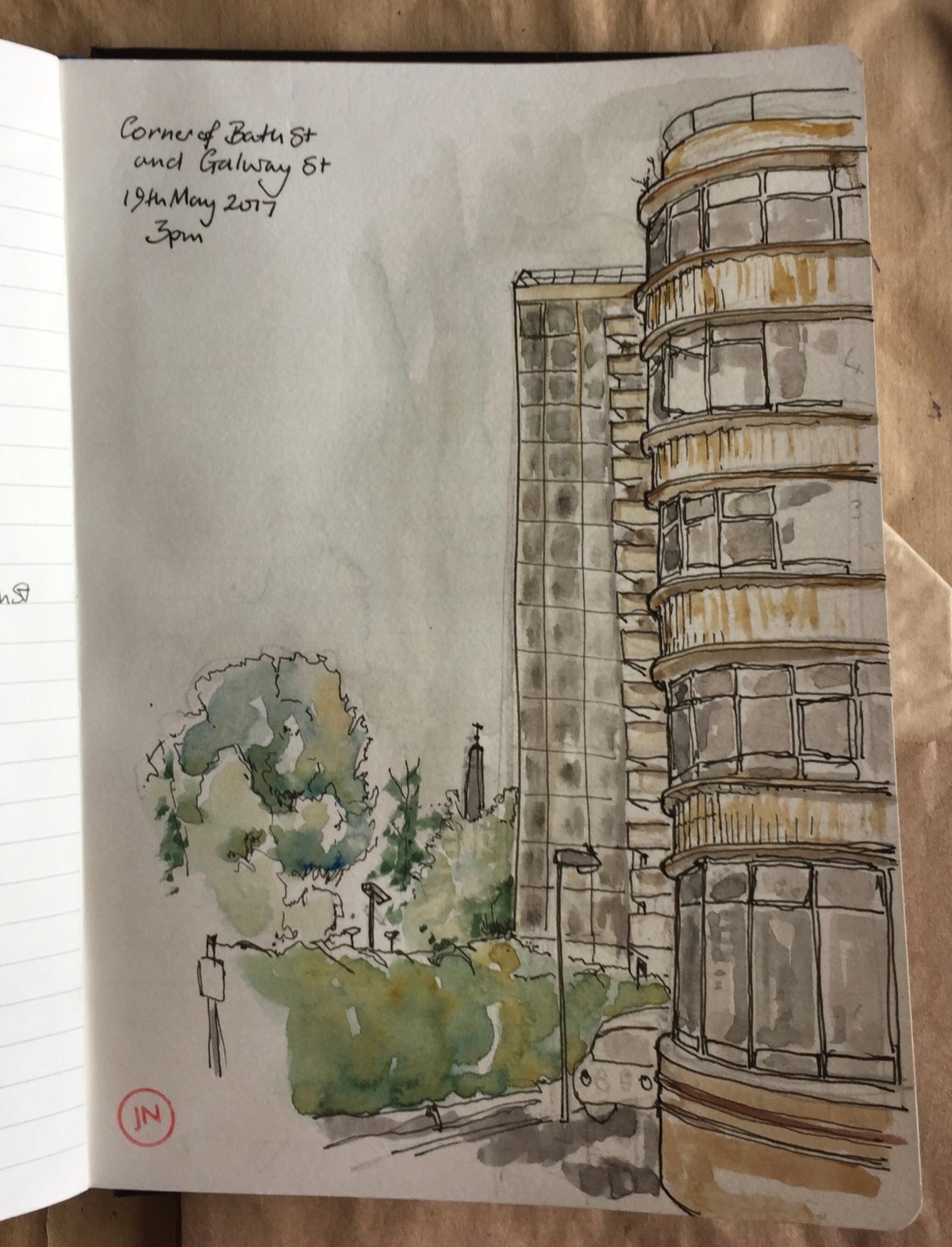
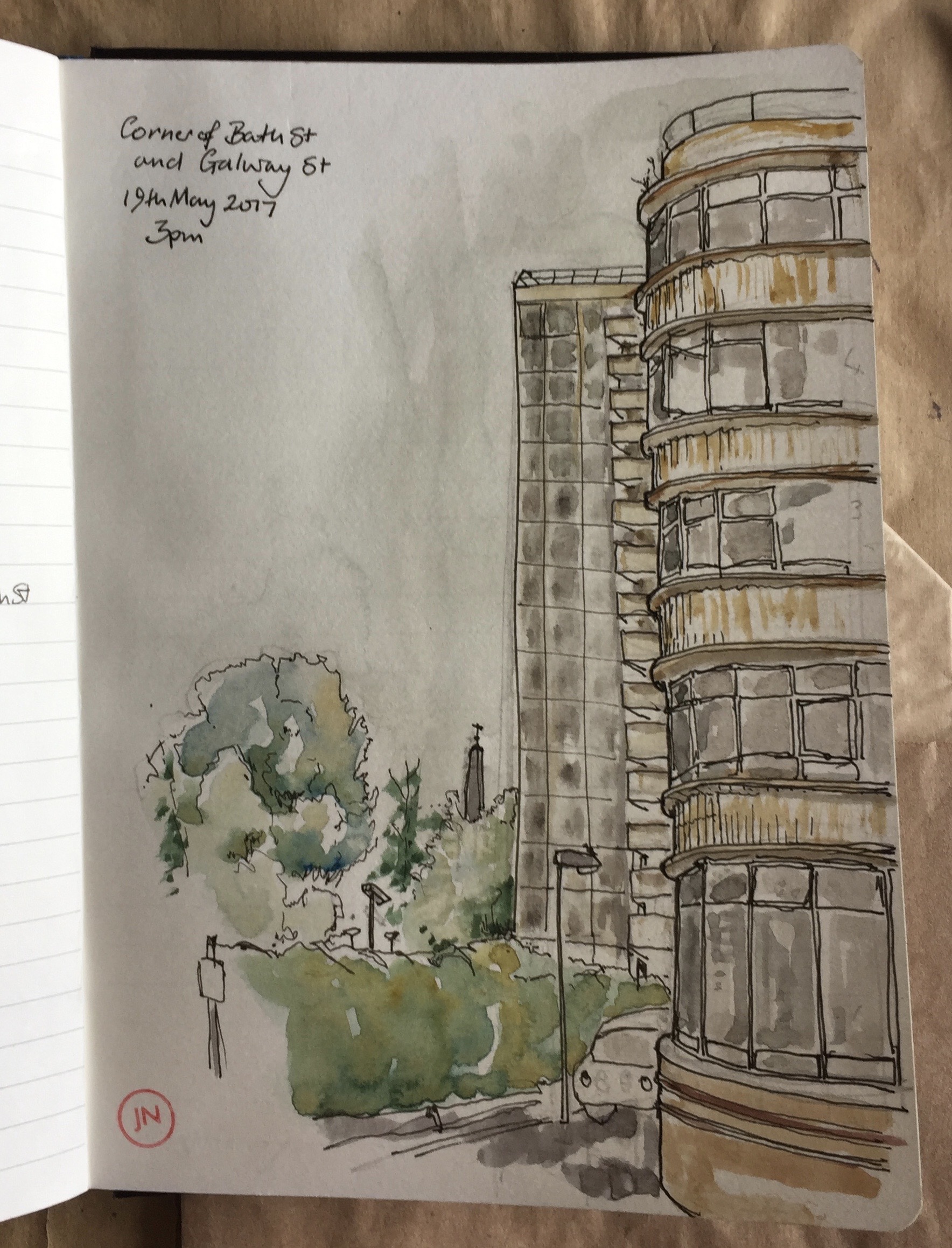
Corner of Galway St and Bath Street, EC1. Willen House is on the right, then in the background is Galway House in the Pleydell Estate. The LSO St Luke’s monument is just visible.

An old man said, “Ah. You are drawing. All little houses, there used to be. I’ve lived here all my life. You know what that [Willen House] used to be? The Income Tax. That primary school? Used to be a pub. Round the corner here, we got bombed out during the war. I’m giving away my age now! And that place – down there – Argos? – you look across the road and what do you see? A bus stop. And that building behind it? Used to be a school. I went there. The man there, conducted during the Cup Final. “Abide With Me”. All dressed in white he was.”

Mostly I did this drawing standing up, leaning on the wall of the “Institute of Ophthalmology, 11-43 Bath Street”. While I was doing the colouring I had to sit down. Two women approached. “You’re drawing,” she told me. Then, “I’m a Community Police Officer”. One of them showed me her badge, in a little case: a metal low-relief sculpture on a blue cloth background. They both admired my drawing, and looked at the view. I said “It’s OK to sit here?” She said, “Oh yes. It’s just, you’ve got your things all round you. Want to be careful you don’t get them swiped. You aren’t in a position to run after them.”. Which was a good point. I moved my bag until I was leaning on it, squeezing it onto the wall behind me.

Willen House is now Student residence, and also home of NTS Fashion Ltd, on the ground floor. I could see their racks of clothes through the window.

About an hour, drawn and coloured on location. The car moved.

The Post Office Tower from Lloyd Street WC1

img 9950

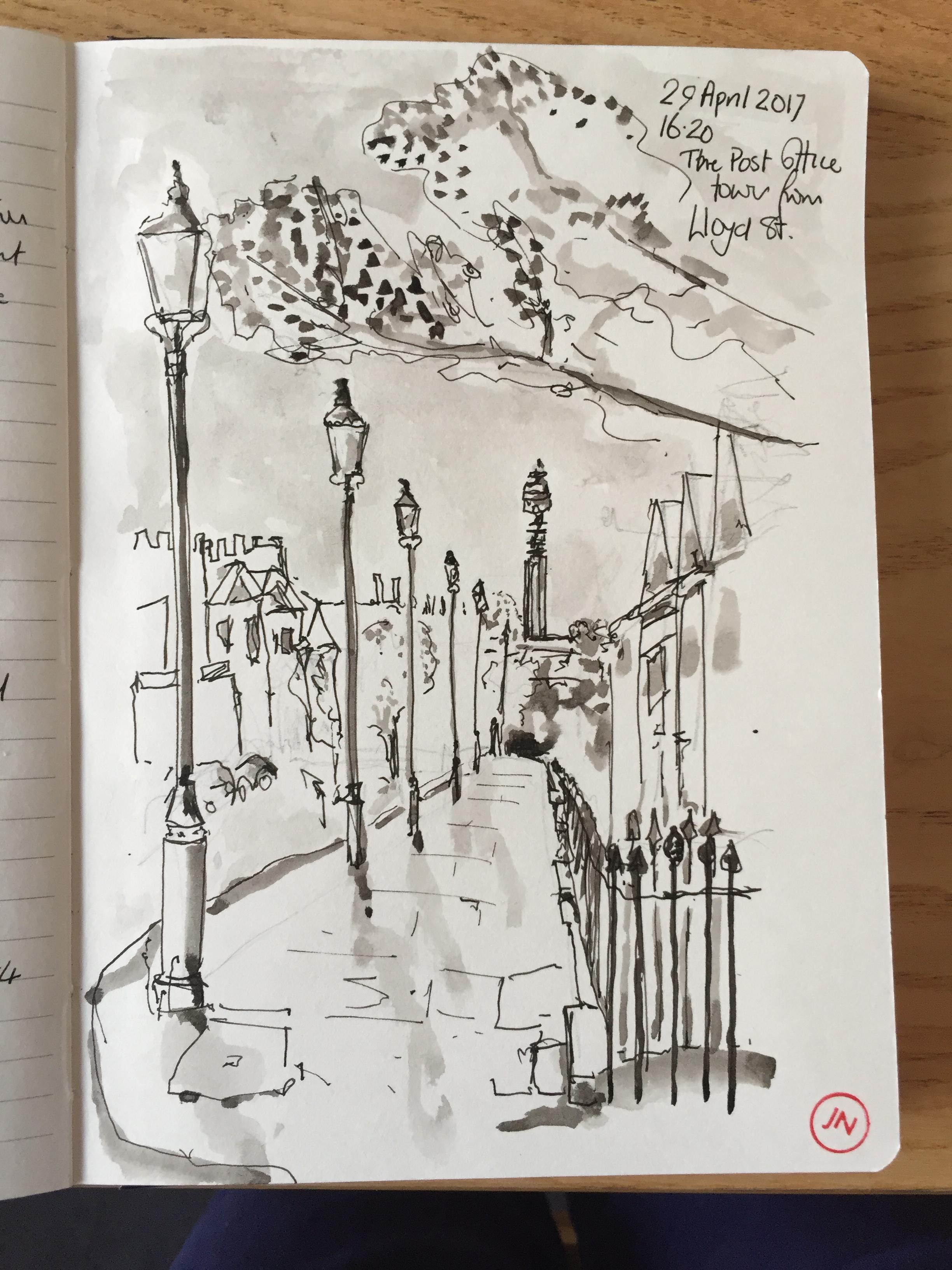
A quick sketch on location, wash done at home later.

I stood in front of Bethany House, built 1882-4 for the Sisters of Bethany, and now a hostel for homeless women.

Lloyd Street constructed 1830s. Post Office Tower (now the BT Tower) completed 1964.

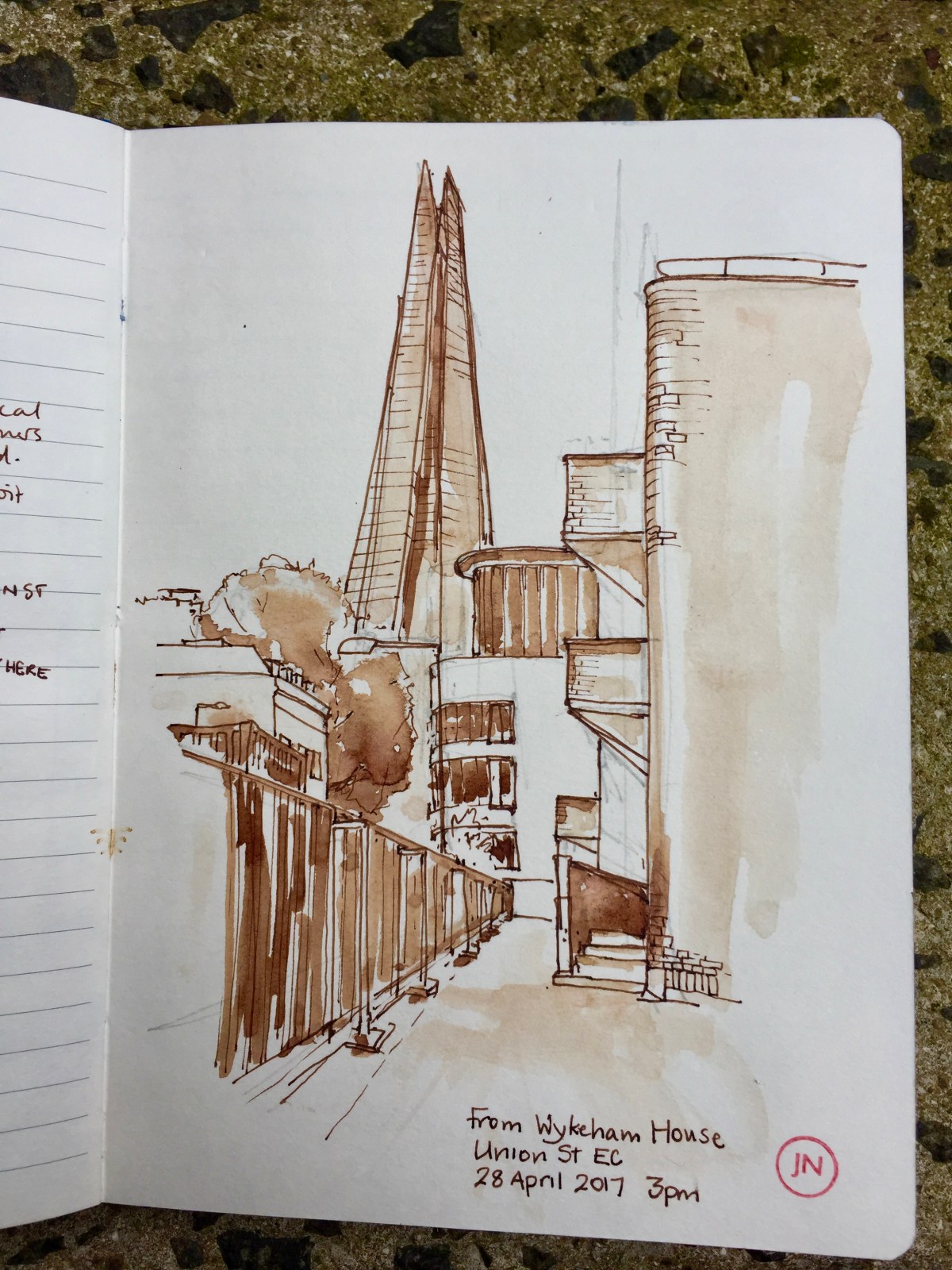
The Shard from Wykeham House, Union Street, SE1

fullsizeoutput_170c

A bit of Wykeham House is on the right. It’s a brick built, Art Deco type building. I was sitting on the steps of the flats, behind the iron railing. Twice during my drawing, residents edged past me, very politely, trying not to disturb me.

On an adjacent building, Waynfleet House,  I saw a notice:

“This tablet commemorates the official opening of these buildings by
THE RT REV RICHAD GODFREY PARSONS the Lord Bishop of Southwark
on Saturday 14th May 1938.”

The badge was that of the “Ecclesiastical Commissioners for England”.

In the Southwark Council publication “South of Union Street and North of Borough Road Character Area Appraisal 2007” I read that:

“There are a number of sites which contribute poorly to the character and appearance of the area and the historic environment. As such it is recommended that they be nominated for re-development”.

Wykeham House and its neighbours is so listed. The group is also excluded from the “Union Street Conservation Area” currently on the Southwark Council Website.

This is a pity, in my view. They have these lovely curved bricks which I have tried to draw, and represent this period of architecture well.

From Oxo Tower Wharf, SE1

img 9929

On the right, Bargehouse Oxo, with all those colours in the brickwork of the wall.
Ahead, “Sea Containers House” 22 Upper Ground SE1.
This is now a luxury hotel “Mondrian” and office space.

Rising above them, the tower block is One Blackfriars, under construction.

Drawn from outdoors balcony on the first floor of the Oxo Tower, about one and a half hours, drawn and coloured on location.

When I was selling software services to Central Government, in the 1980s, I visited Sea Containers House. It was then the headquarters of Her Majesty’s Customs and Excise. The story was that they had accepted this rather swanky hotel in lieu of VAT payment. At that time, the smart offices seemed to have landed from another planet into dilapidated former docks. I picked my way on wooden boards over mud, taking care of my smart shoes. On the door was an officer in a starched shirt, and gold epaulettes.

screen shot 2017 04 30 at 12 36 45
Sea Containers House, about 2010

In 2011 Sea Containers House was renovated, and has only recently been completed. The Golden Balls on the river side were removed, and sold.

IMG_9954
Sea Containers House 2017 – minus the decorative golden globes


screen shot 2017 04 30 at 13 01 32
Golden balls from Sea Containers House, on sale now for £3950
Screen Shot 2017-04-30 at 13.49.42
The smaller globes have already been sold.


Postscript:

Walking along a dock in Aberdeen I saw this notice:

Customs, Sea Containers
14 July 2017, Pocra quay, Aberdeen

The notice is dated “March 1995”. The address, “New King’s Beam House” is Sea Containers.

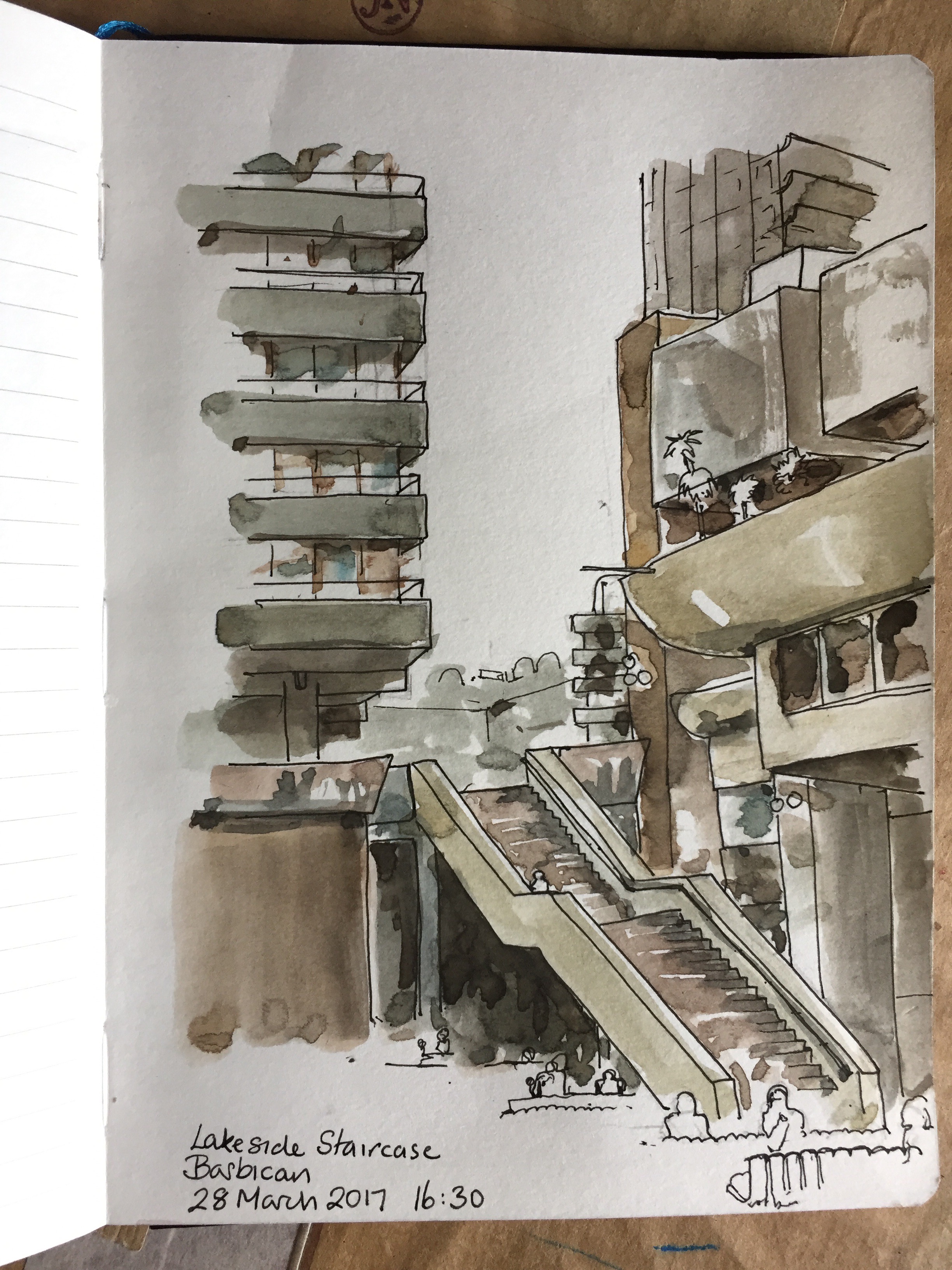
Barbican Staircase 

This is the staircase from Podium Level down to the Lakeside. It’s a magnificent sculptural piece of architecture: it appears free floating, a mass of concrete in the air. 

Drawn in the sun after a lunch in the Barbican Kitchen. The wind kept shifting my art equipment around, and the shadows changed as the clouds came and went. 

About an hour and 15 minutes, drawn and coloured on location. 

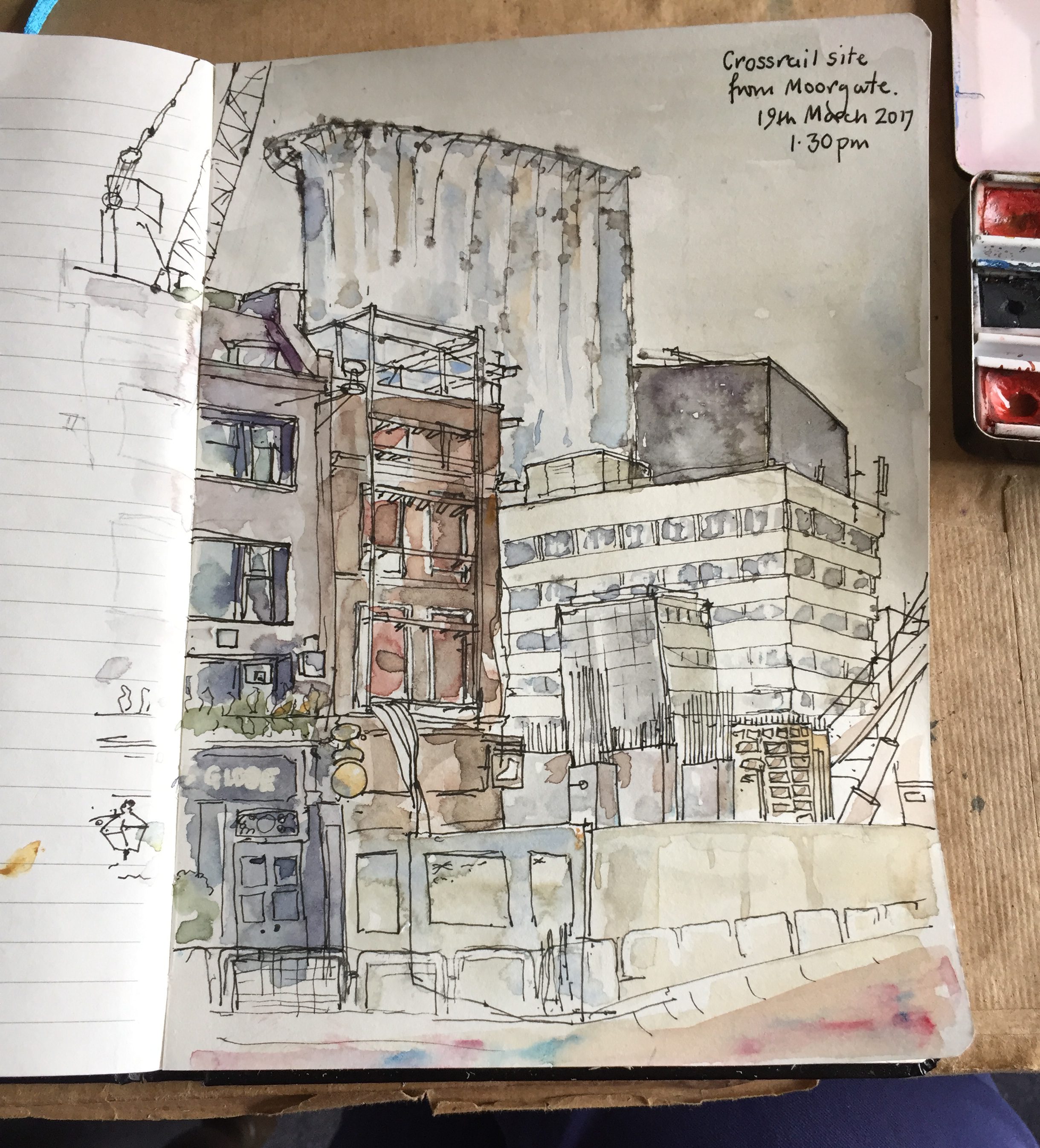
Crossrail site from Moorgate

IMG_9876

I wanted to draw this view before it disappeared. Today, Moorgate was closed completely to motor traffic, so it was calm to draw, though windy and cold. It rained, as you see from the droplets on City Point.

 The Globe Pub, 19th Century, is on the left. The small square notice says:

“In a House on this site
the Swan and Hoop
John Keats
Poet
was born 1795″

The City Point tower is in the background. This was built in 1967, and refurbished in 2000, when the curved projection at the top was added. The designer for the refurbishment was Sheppard Robson. Here’s what the Citypoint website says. 

“The building’s spectacular entrance canopy is approached through the public square, leading to two dramatic twelve storey cathedral-like galleria, offering an inviting and exhilarating experience for both occupiers and visitors alike. The two gallerias allow natural daylight to penetrate into the heart of the development, creating a feeling of scale and corporate arrival.” – http://www.citypoint.org.uk/

The building next to the Globe pub is propped up with steel girders. The “Jones Bootmakers” sign hangs on. Cables pour out of one of the windows.

This took about 1½ hours, pen and ink on location. I coloured it later, at home. On the way back the wind blew. Outside the Barbican Centre, the wind caught the hair of a woman on a mobile phone and blew it straight upright. She had very long blonde hair, so she looked amazing, like someone in a cartoon dropping down a lift shaft.

Here’s the black and white sketch:

fullsizeoutput_16b5

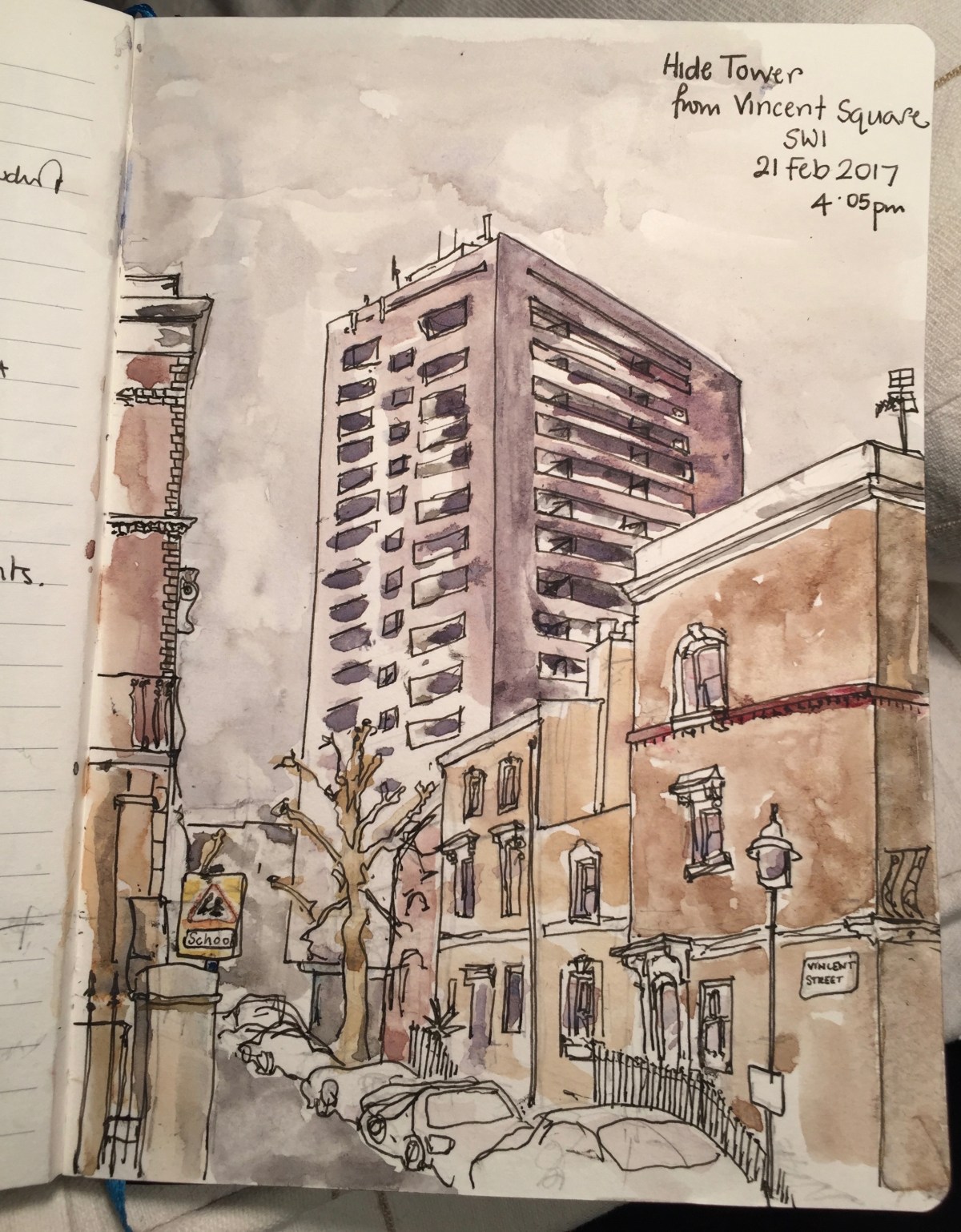
Hide Tower from Vincent Square

img_9674

This 1961 tower block contrasts with the 19th Century buildings of Vincent Square. It is in SW1, Westminster, near Tate Modern.

An “early use” of pre-cast concrete according to Pevsner(1), who also tells me that the architect was Stillman and Eastwick Field for Westminster City Council. I went and looked through the “long bands of fenestration” at the “Brutalist exposed staircase”.

The Hide Tower Resident Management Board is composed of, and run by, residents, according to their website.
They say:

We are responsible for providing the residents of Hide Tower with these services

day-to-day repairs
cleaning
letting flats
mutual exchanges
tenancy checks
management transfers
admitting or denying right to buy applications
parking
emergencies
complaints
general enquiries

CityWest Homes is responsible for

collecting rent from tenants
taking legal action against residents, if necessary

From “A letter from Pimlco”  (sic) website, written by people who live in the tower, I learned that:

Approximately a quarter of the accommodation is privately rented; the other half is rented from Westminster City Council and the remainder is owner occupied.

I thought it was interesting that the residents themselves, via their Board, are responsible for “admitting or denying right-to-buy” applications. I wonder what their criteria are.

While I drew this picture, there was continual drilling coming from the basement of the house to the right of the picture. They were evidently excavating the basement. Piles of rubble were in the front garden. As I walked past, I smelt pine sawdust.

Behind me were cheers and shouts of encouragement to players of a team game on the grass of Vincent Square. Young people in purple and grey uniforms walked past. One young man with a rucksack said to me, “It’s really great, what you are drawing, really great”. That was encouraging.

An older man stopped, and said “You need a stall”. I thought that’s what he said. I wondered if he meant I should set up a stall, selling pictures from the railings of Vincent Square, as they do along the railings of Kensington Gardens. I said nothing, and must have looked baffled. He repeated his assertion, and then I realised he had said “stool”, “you need a stool to sit on”. I have in fact wondered about a stool. And I do have my suitcase, which I can sit on, though it is very low. I pointed out that if I sat down, the parked car would obstruct my view. “Trust a woman’s logic!” pronounced the man. I thought that was anyone’s logic. No-one, man or woman, could see through the very opaque Citroen. But I said nothing.  He waved and took off with a grin, as though he had got the better of me, which perhaps he had. I was puzzling that, for several minutes.

Then I went and had a mug of tea in the Regency Café, 90p.

(1) Nikolaus Pevsner and Simon Bradley, “The Buildings of England: London 6, Westmenster”