From Holborn Circus

This sketch shows the new “Fleet Building” under construction on the Farringdon Road, towering over the quaint Vicarage and Court House of St Andrews Holborn.

fullsizeoutput_17b4The Vicarage and Court House are Victorian, designed by Samuel Teulon as part of the remodelling of St Andrews to accommodate the Holborn Viaduct, 1860s and 70s. Notices on the gate announce the St Andrews Church Foundation and Associated Charities. The Court House is the building with the turret, No 7 St Andrews Street. It just has a large “7” on the door.

The pinkish coloured building on the right is currently the offices of “Rosenblatt” and “Convex Capital.”

The Fleet Building is designed by Kohn Pedersen Fox Associates. It is Goldman Sachs’ “840 000 sq ft London campus”. To build it they demolished the old Telephone exchange. The murals by Dorothy Annan that were on the Telephone Exchange are now in the Barbican.

An article in a property magazine “CoStar” dated 4 Jan 2013 reads:

Goldman’s plans previously suffered a setback when the government gave Grade II listed status to 1960s murals on the front of Fleet Building, which used to be London’s largest telephone exchange.
The Department for Culture, Media and Sport followed advice from English Heritage that the nine ceramic tile murals by Dorothy Annan, which depict pylons, cables, telegraph poles and generators, were of “historic interest” to the telecoms industry and had “relative rarity as surviving works of 1960s mural art”.
Goldman had opposed the listing of the murals and relocating them could be costly and time-consuming. However, as part of the conditions of the planning consent, Goldman must meet all “reasonable costs” incurred with their removal.

 About 1 hour. Drawn and coloured on location. Very hot sun. Atmosphere of vanilla scented Vape Cloud. Fire alarm on Lloyds Bank ticking intermittantly.

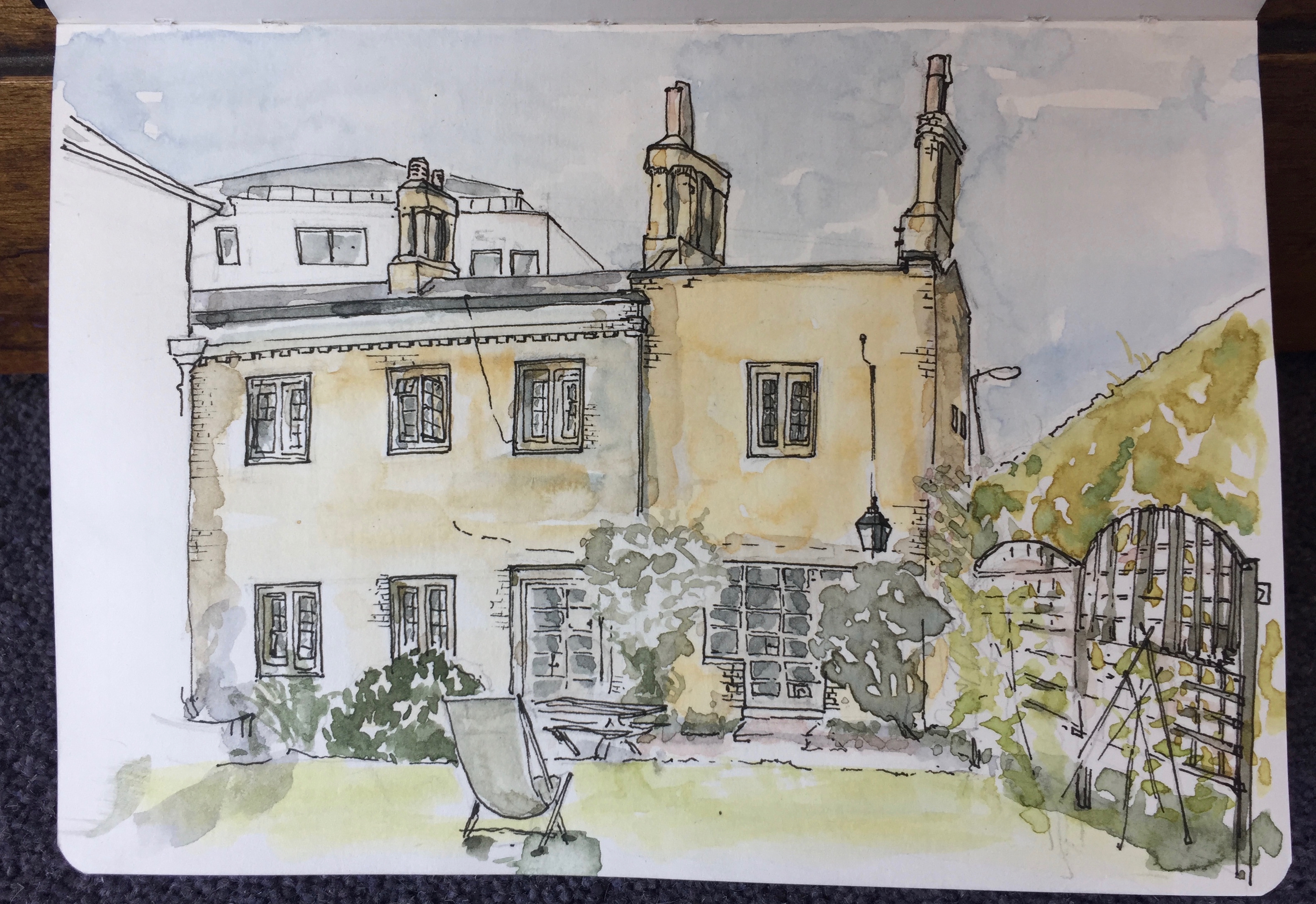
Master’s Garden, The Charterhouse

20 June 2017 (colour)

This shows the Preacher’s House. The wall on the right is next to the Clerkenwell Road. Behind the fence on the right there were bee-hives with very active bees.

About 3 hours. Drawn and coloured on location.

Here’s what it looked like before the colour went on:

20 June 2017 (pen only)


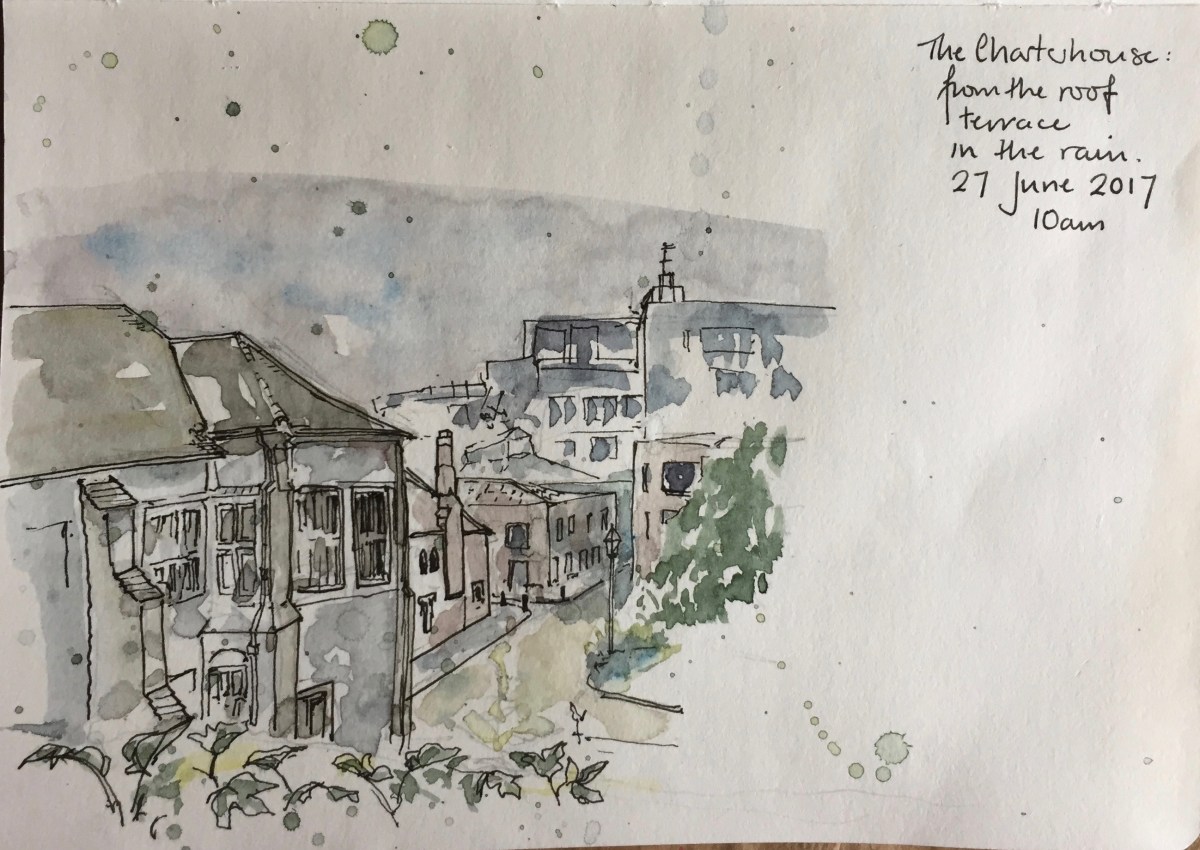
The Charterhouse, Chapel from the Roof Terrace

This is looking South-East from the roof terrace.

13 June 2017

Thank you to the Preacher of Charterhouse, Robin Isherwood, for arranging my access to the roof terrace. This is the view looking across a wide green space in the Queen Mary College campus, towards the Chapel and offices of The Charterhouse.  The building in the foreground is part of Charterhouse, restored in the 1950s. The restoration architects were Seely and Paget, the people behind the restoration of Eltham Palace.

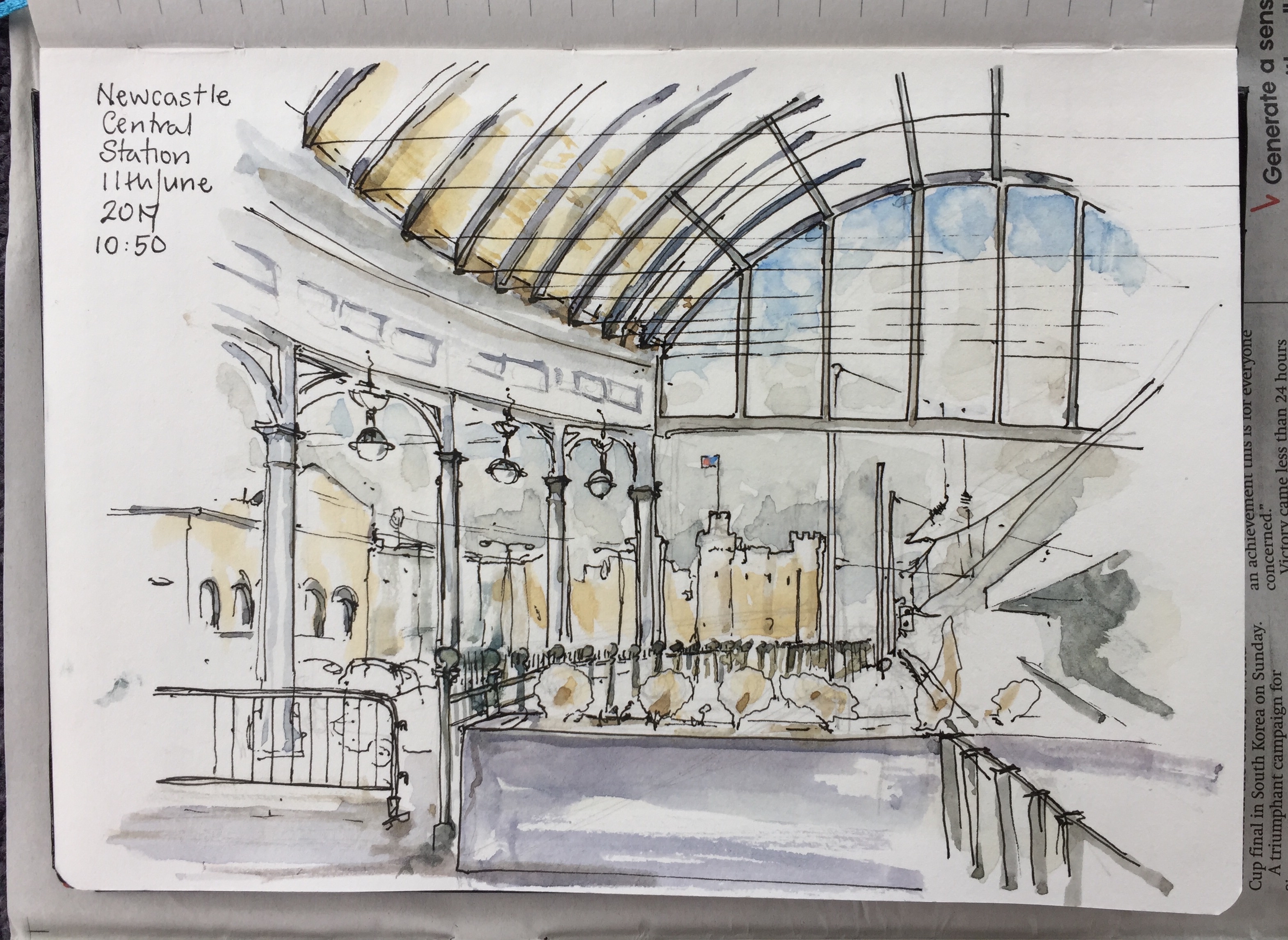
Newcastle Central Station

This is a drawing from the Costa Coffee at Newcastle railway station, waiting for the train to London Kings Cross, 268 miles away.


IMG_0280

Newcastle Central Station was opened in 1850.

Architect: John Dobson
Engineers: TE Harrison and Robert Stephenson
Contractor: Mackay and Woodstock

The structure in the distance with the flag is the 13th century Newcastle Castle Keep, restored 2011 to 2015 using Heritage Lottery Funds.

This drawing took about an hour, drawn and coloured on location. Some colour and shadows added at home.

Here is work in progress:

IMG_0279

Charterhouse, Pensioners’ Court

This is from a doorway on Pensioners’ Court, which is the court beyond Preacher’s Court. The Building with the four archways is part of the Brothers’ realm: the infirmary above and the coffee room below. I don’t know what the turret is, very intriguing.
The gardens were magnificent. In front of me was that huge magnolia tree. It moved in the wind and contained darkness much darker than I have drawn it.

I enjoyed the two towers: Barbican and Charterhouse, and the way the view was bracketed by the tree on the right and the lamp-post on the left.

One hour 45 minutes, drawn and coloured on location. The day was overcast and threatened rain. Round me, a gardener was watering the borders.
It should be “Pensioners’” court (plural).

Great Hall, The Charterhouse

Those chimneys are hard to draw. They are not simple rectangles, but a complicated geometric shape, a square put at an angle to another square, difficult to see in the light and shadow.

The crest of the roof is not straight. It goes downwards at quite an alarming angle, as drawn. The windows are not in a straight line with each other, which makes me wonder exactly where the floor is, inside.

I drew this from under the shade of the new building, the “Admiral Ashmore Building”. While I was drawing, the gardeners were making the window boxes, and crushed the geranium leaves. The place smelt of geranium, and earth and water.

IMG_0129

I like it that you can see the Barbican towers beyond. I made this observation to a Brother who paused to chat. He told me that these brutalist towers are not popular with certain of the Brothers. They have identified a place in the garden where you can sit, so that the towers are obscured by a tree.

About 2 hours (those chimneys!!), drawn and coloured on location.

Here is what it looked like before the colour went on:IMG_0105

Willen House EC1

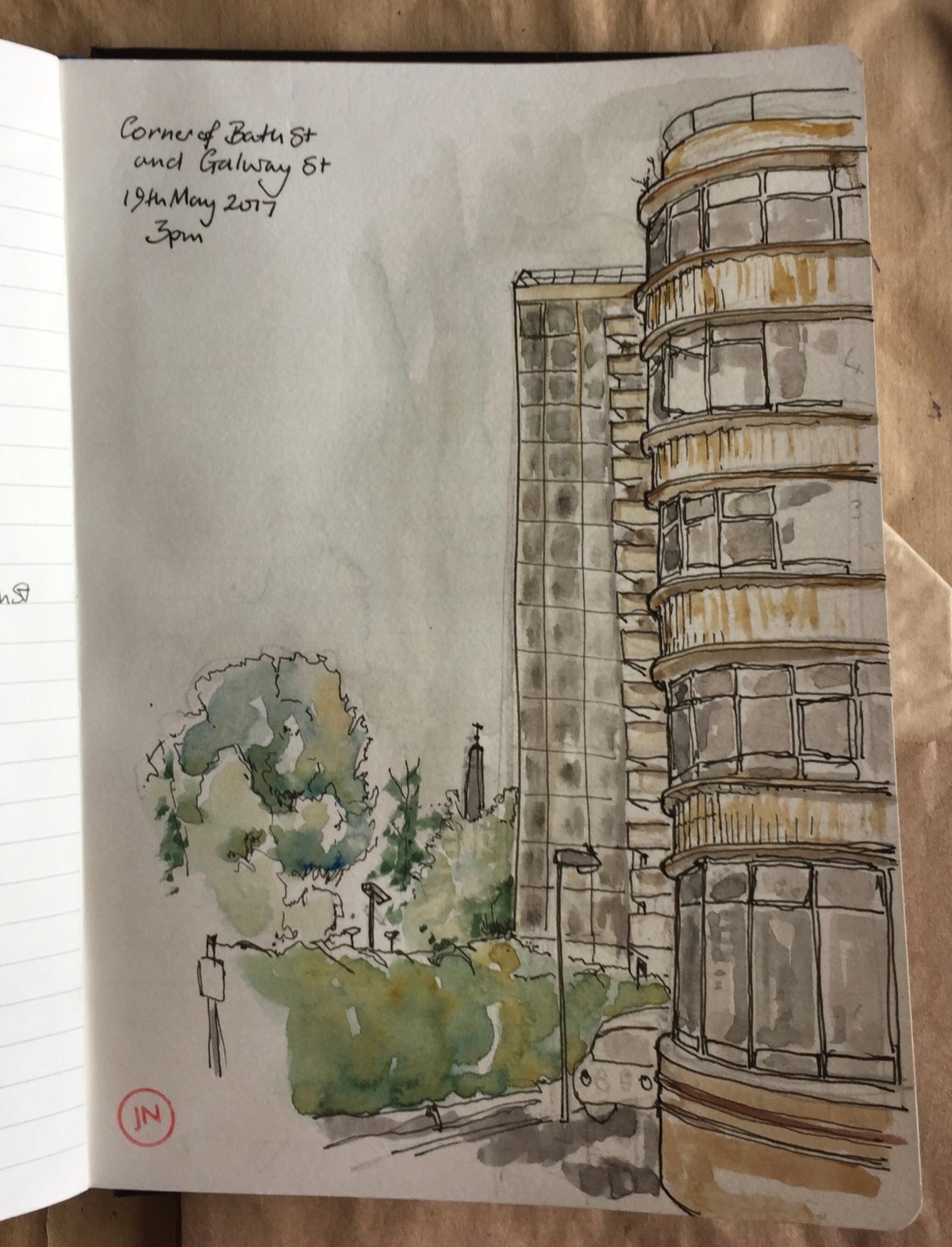
Corner of Galway St and Bath Street, EC1. Willen House is on the right, then in the background is Galway House in the Pleydell Estate. The LSO St Luke’s monument is just visible.

An old man said, “Ah. You are drawing. All little houses, there used to be. I’ve lived here all my life. You know what that [Willen House] used to be? The Income Tax. That primary school? Used to be a pub. Round the corner here, we got bombed out during the war. I’m giving away my age now! And that place – down there – Argos? – you look across the road and what do you see? A bus stop. And that building behind it? Used to be a school. I went there. The man there, conducted during the Cup Final. “Abide With Me”. All dressed in white he was.”

Mostly I did this drawing standing up, leaning on the wall of the “Institute of Ophthalmology, 11-43 Bath Street”. While I was doing the colouring I had to sit down. Two women approached. “You’re drawing,” she told me. Then, “I’m a Community Police Officer”. One of them showed me her badge, in a little case: a metal low-relief sculpture on a blue cloth background. They both admired my drawing, and looked at the view. I said “It’s OK to sit here?” She said, “Oh yes. It’s just, you’ve got your things all round you. Want to be careful you don’t get them swiped. You aren’t in a position to run after them.”. Which was a good point. I moved my bag until I was leaning on it, squeezing it onto the wall behind me.

Willen House is now Student residence, and also home of NTS Fashion Ltd, on the ground floor. I could see their racks of clothes through the window.

About an hour, drawn and coloured on location. The car moved.

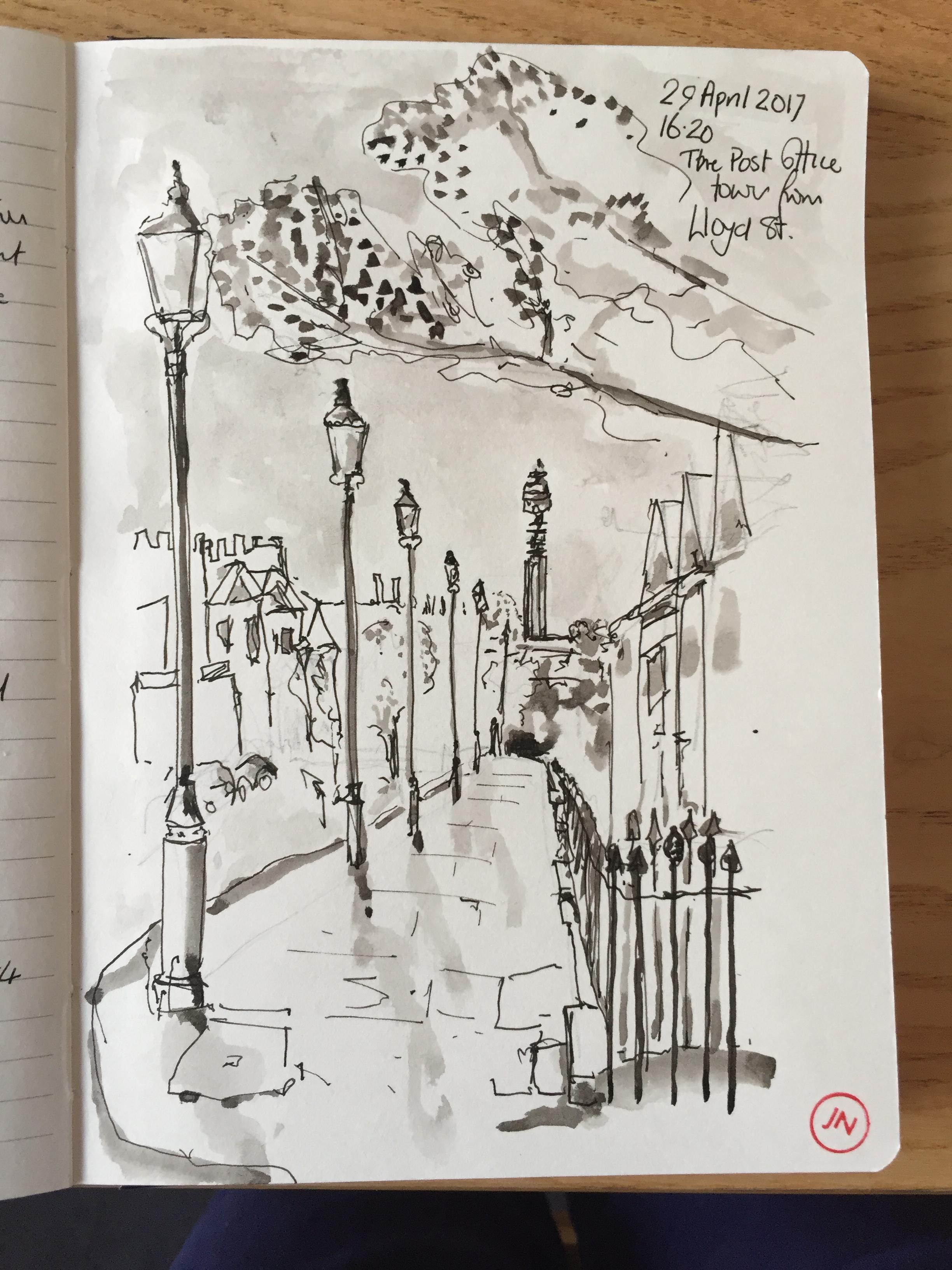
The Post Office Tower from Lloyd Street WC1

img 9950

A quick sketch on location, wash done at home later.

I stood in front of Bethany House, built 1882-4 for the Sisters of Bethany, and now a hostel for homeless women.

Lloyd Street constructed 1830s. Post Office Tower (now the BT Tower) completed 1964.

The Shard from Wykeham House, Union Street, SE1

fullsizeoutput_170c

A bit of Wykeham House is on the right. It’s a brick built, Art Deco type building. I was sitting on the steps of the flats, behind the iron railing. Twice during my drawing, residents edged past me, very politely, trying not to disturb me.

On an adjacent building, Waynfleet House,  I saw a notice:

“This tablet commemorates the official opening of these buildings by
THE RT REV RICHAD GODFREY PARSONS the Lord Bishop of Southwark
on Saturday 14th May 1938.”

The badge was that of the “Ecclesiastical Commissioners for England”.

In the Southwark Council publication “South of Union Street and North of Borough Road Character Area Appraisal 2007” I read that:

“There are a number of sites which contribute poorly to the character and appearance of the area and the historic environment. As such it is recommended that they be nominated for re-development”.

Wykeham House and its neighbours is so listed. The group is also excluded from the “Union Street Conservation Area” currently on the Southwark Council Website.

This is a pity, in my view. They have these lovely curved bricks which I have tried to draw, and represent this period of architecture well.

From Oxo Tower Wharf, SE1

img 9929

On the right, Bargehouse Oxo, with all those colours in the brickwork of the wall.
Ahead, “Sea Containers House” 22 Upper Ground SE1.
This is now a luxury hotel “Mondrian” and office space.

Rising above them, the tower block is One Blackfriars, under construction.

Drawn from outdoors balcony on the first floor of the Oxo Tower, about one and a half hours, drawn and coloured on location.

When I was selling software services to Central Government, in the 1980s, I visited Sea Containers House. It was then the headquarters of Her Majesty’s Customs and Excise. The story was that they had accepted this rather swanky hotel in lieu of VAT payment. At that time, the smart offices seemed to have landed from another planet into dilapidated former docks. I picked my way on wooden boards over mud, taking care of my smart shoes. On the door was an officer in a starched shirt, and gold epaulettes.

screen shot 2017 04 30 at 12 36 45
Sea Containers House, about 2010

In 2011 Sea Containers House was renovated, and has only recently been completed. The Golden Balls on the river side were removed, and sold.

IMG_9954
Sea Containers House 2017 – minus the decorative golden globes


screen shot 2017 04 30 at 13 01 32
Golden balls from Sea Containers House, on sale now for £3950
Screen Shot 2017-04-30 at 13.49.42
The smaller globes have already been sold.


Postscript:

Walking along a dock in Aberdeen I saw this notice:

Customs, Sea Containers
14 July 2017, Pocra quay, Aberdeen

The notice is dated “March 1995”. The address, “New King’s Beam House” is Sea Containers.