Switzerland Sketches (Oct 2025)

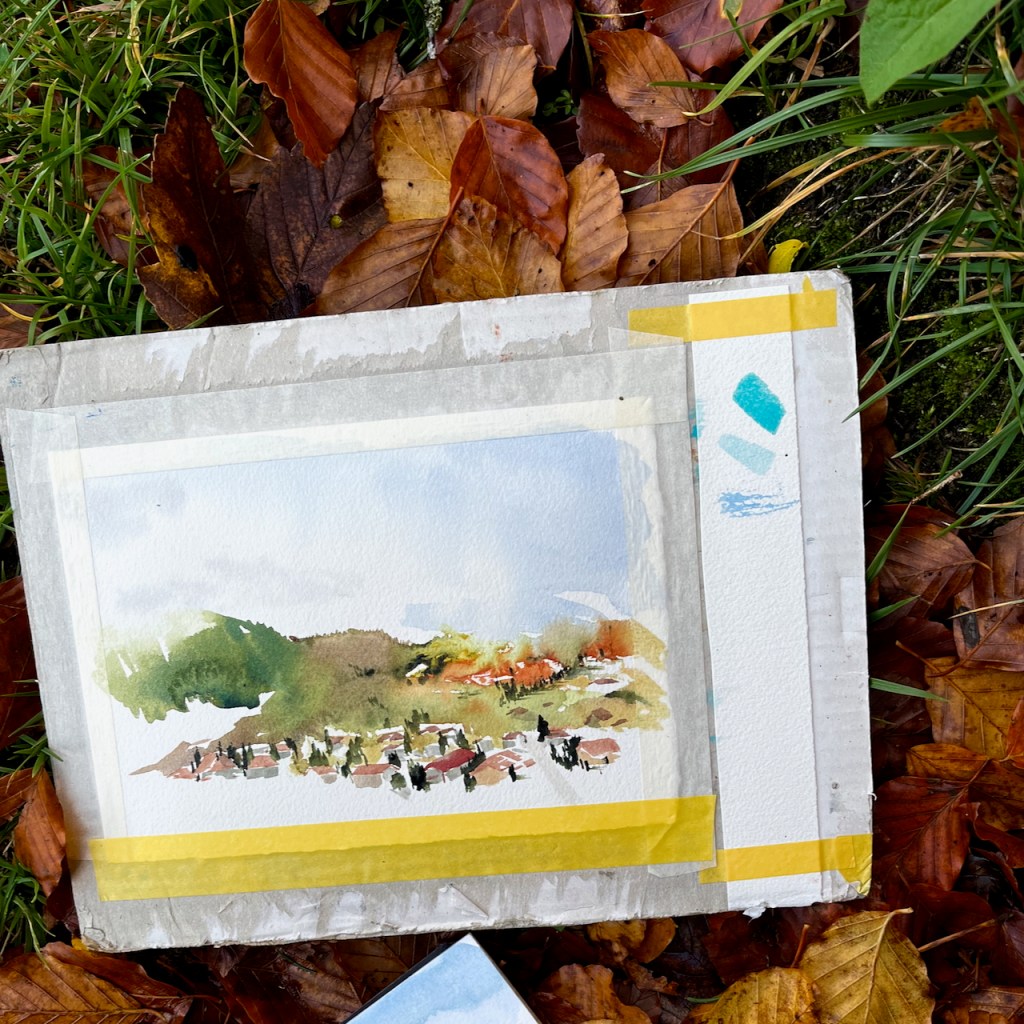
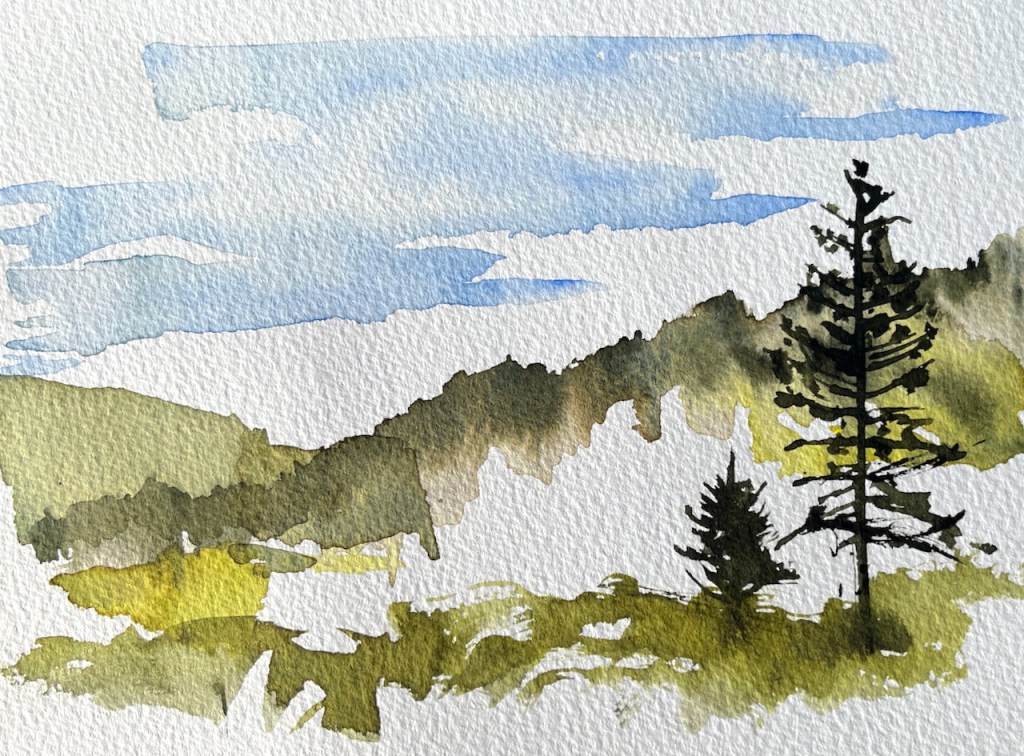
Here is a autumn scene in Sainte-Croix in the canton of Vaud, Switzerland.
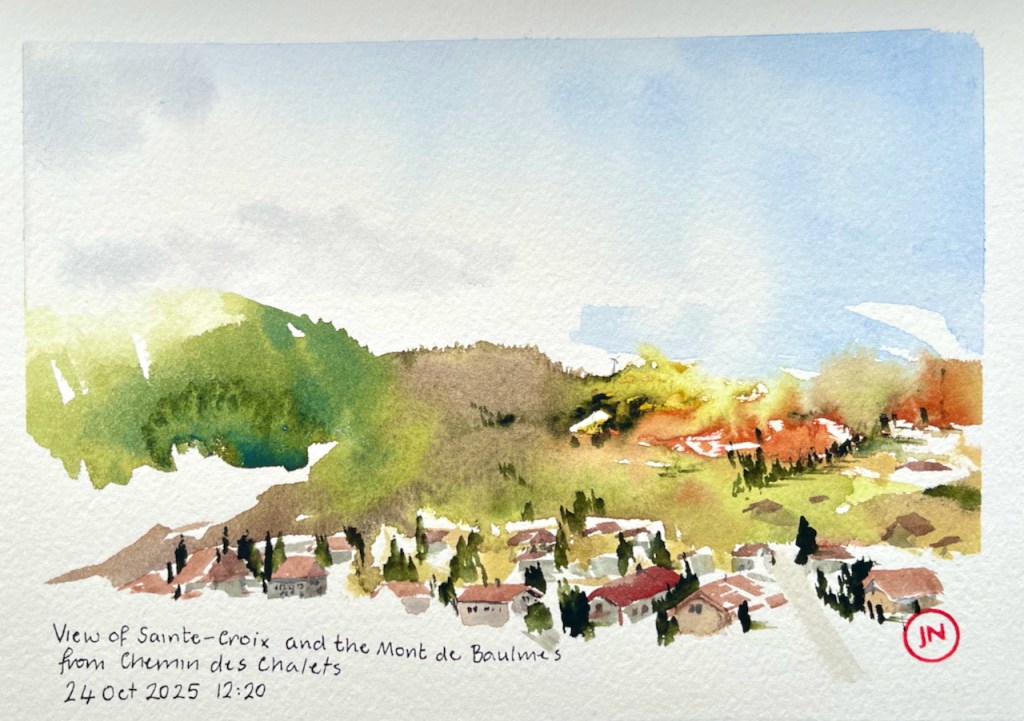
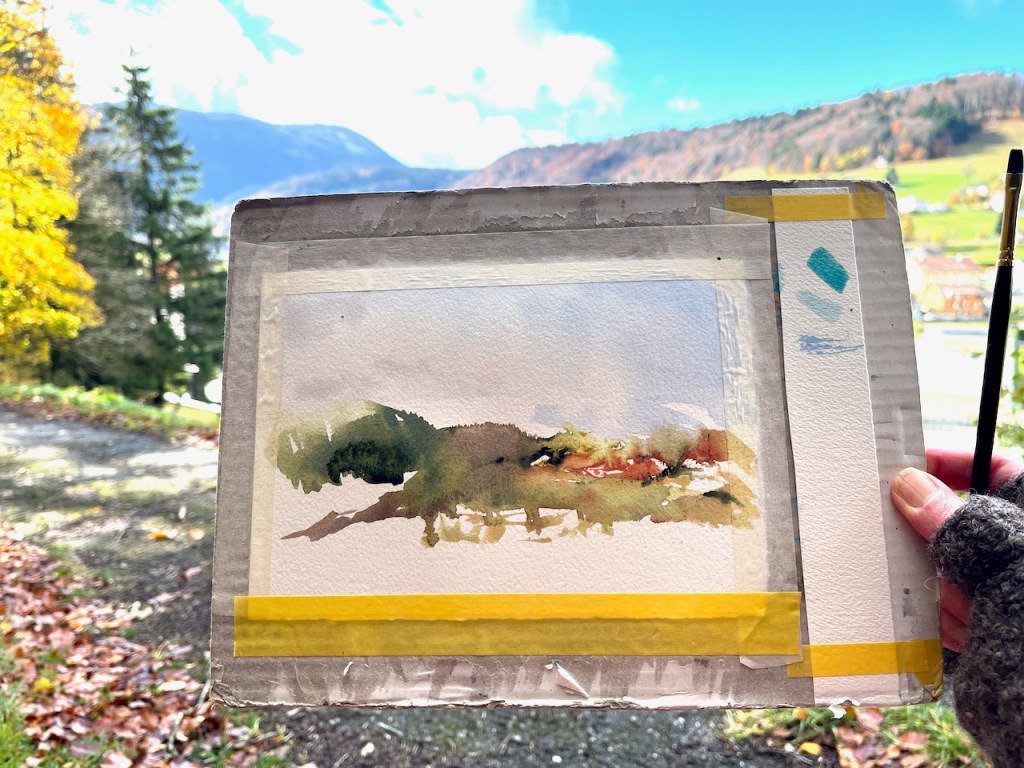
View over Sainte-Croix and the Mont de Baulmes, from Chemin des Chalets

I sketched also in the village.

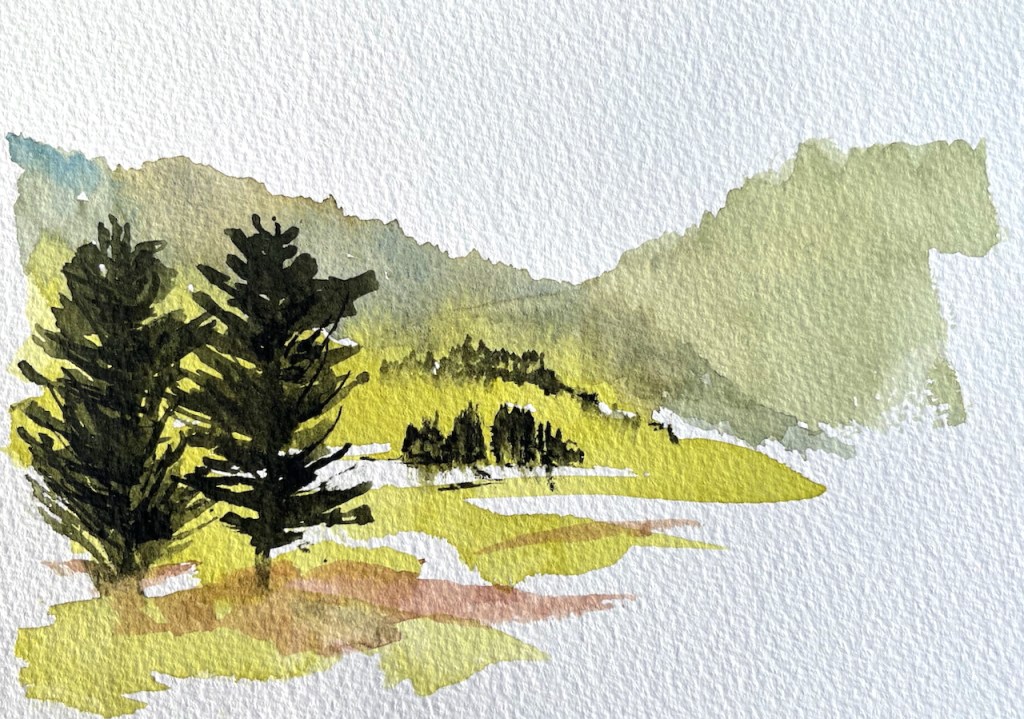
It is a season of clouds.
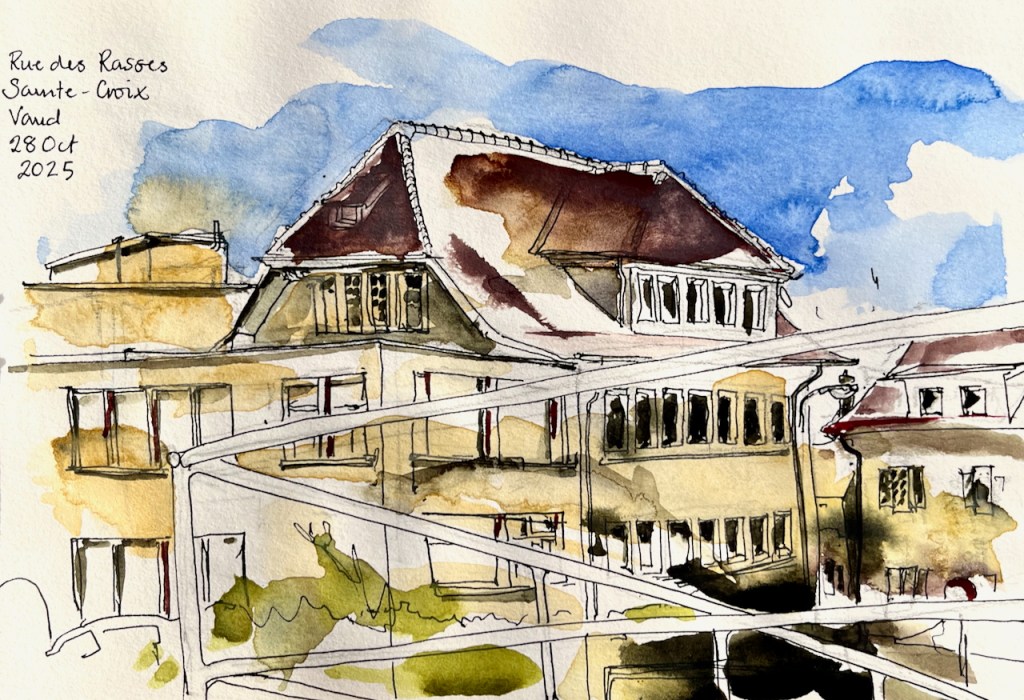
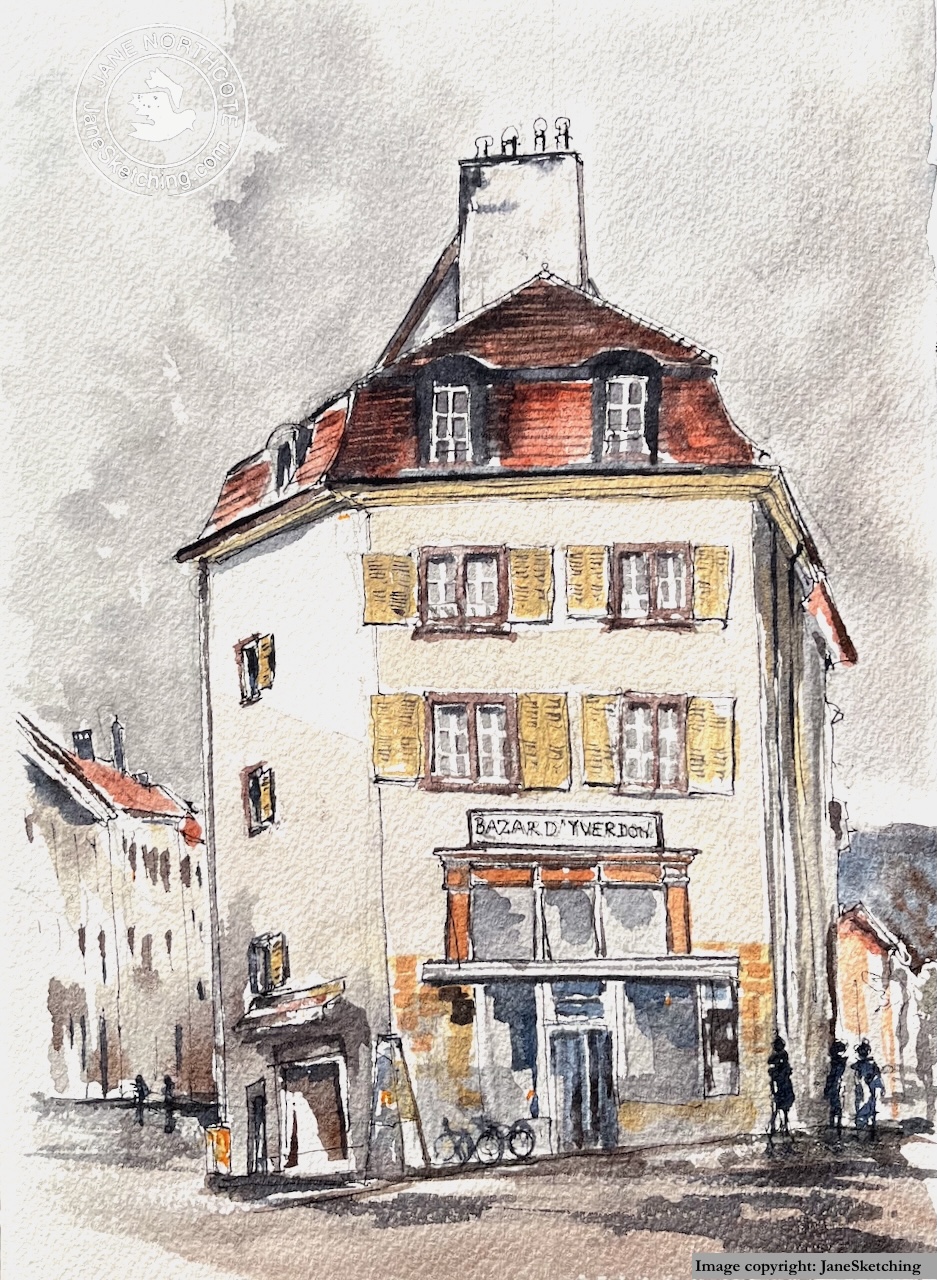
On an expedition to Yverdon-les-Bains I sketched in the Place Pestalozzi.
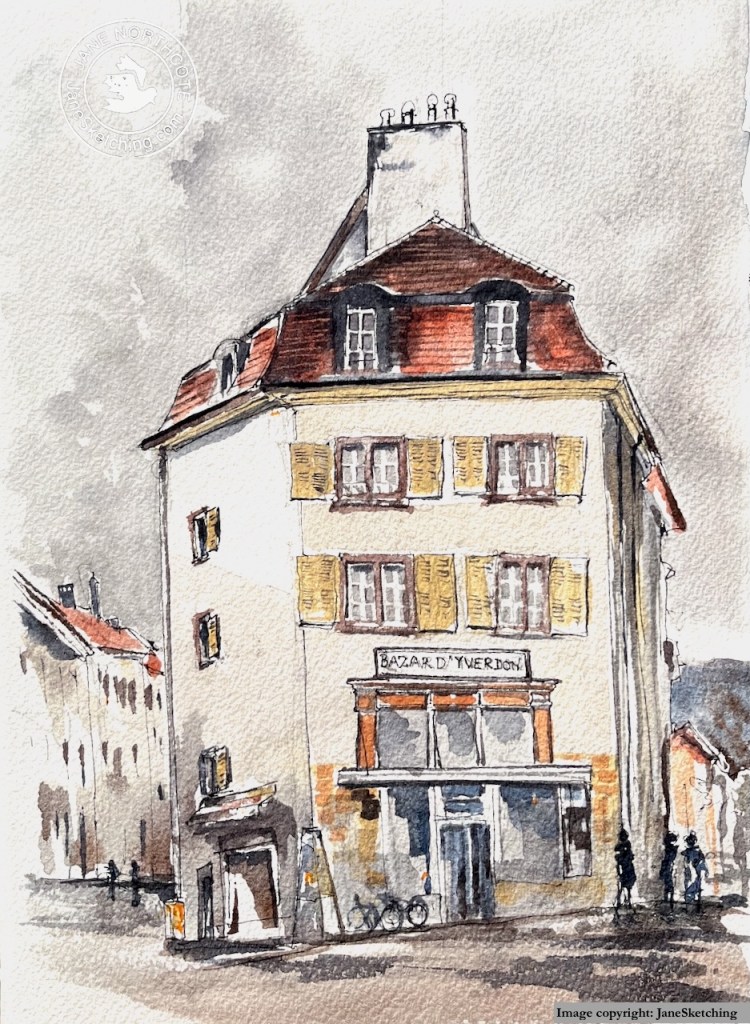
Bazar D’Yverdon, now L’Epicerie Vrac, Place Pestalozzi 3
1400 Yverdon-les-Bains

It was very cold. I just managed to complete the pen and ink sitting in the square. Then I finished the colour in my hotel room.
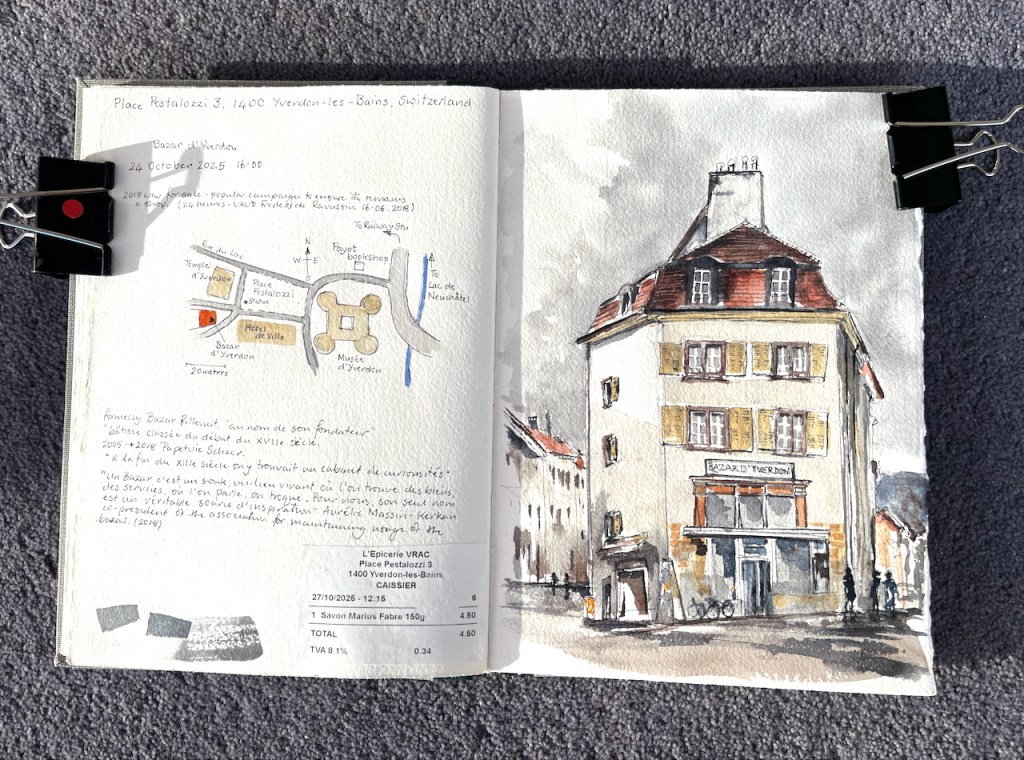
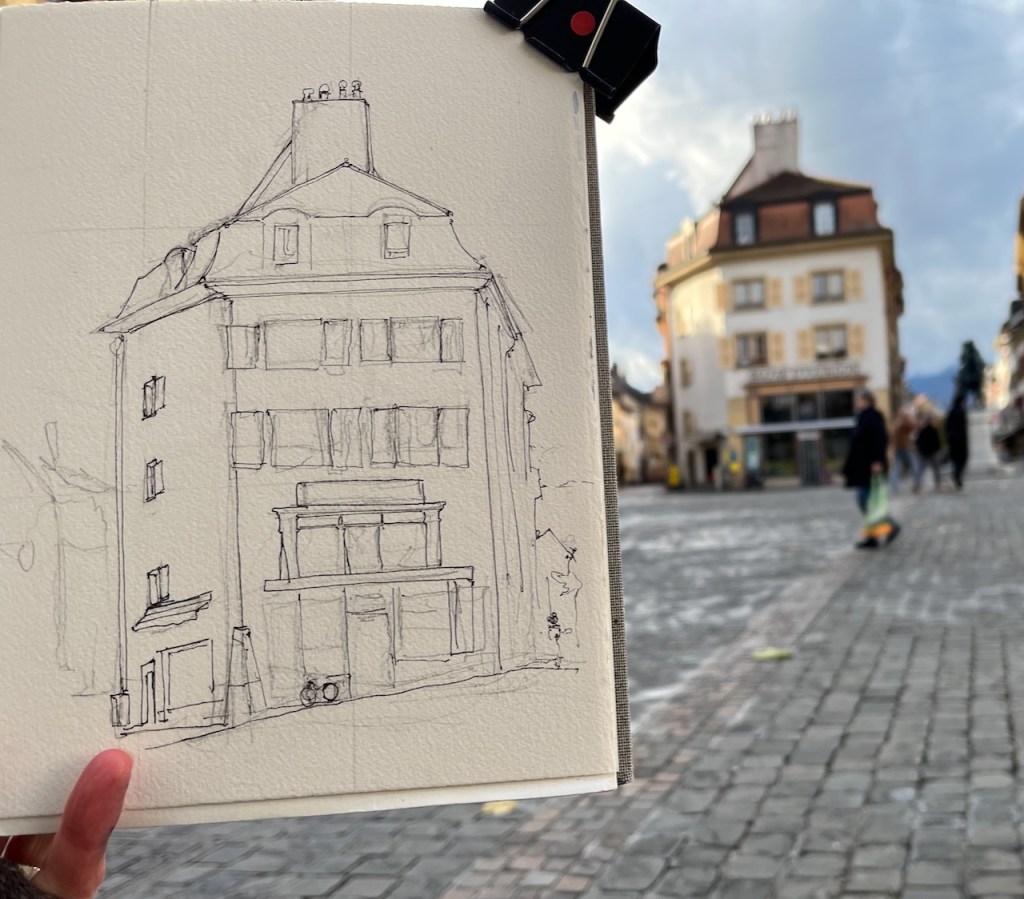
This building, Bazar D’Yverdon, dates from the beginning of the 17th century. There is an article in the local paper of 2018 (note 1), with some history of the building, and news of a campaign to prevent its being sold and transformed from a retail space into offices. At the time is was a stationary shop, Papeterie Schaer.

A bazaar is a souk, a living place where there are goods and services, where you gossip, trade. For us, the very name “Bazar” is a real source of inspiration.”

Aurélie Massin-Kerkan, co-president of the association for maintaining usage of the Bazar (note 1 – my translation)

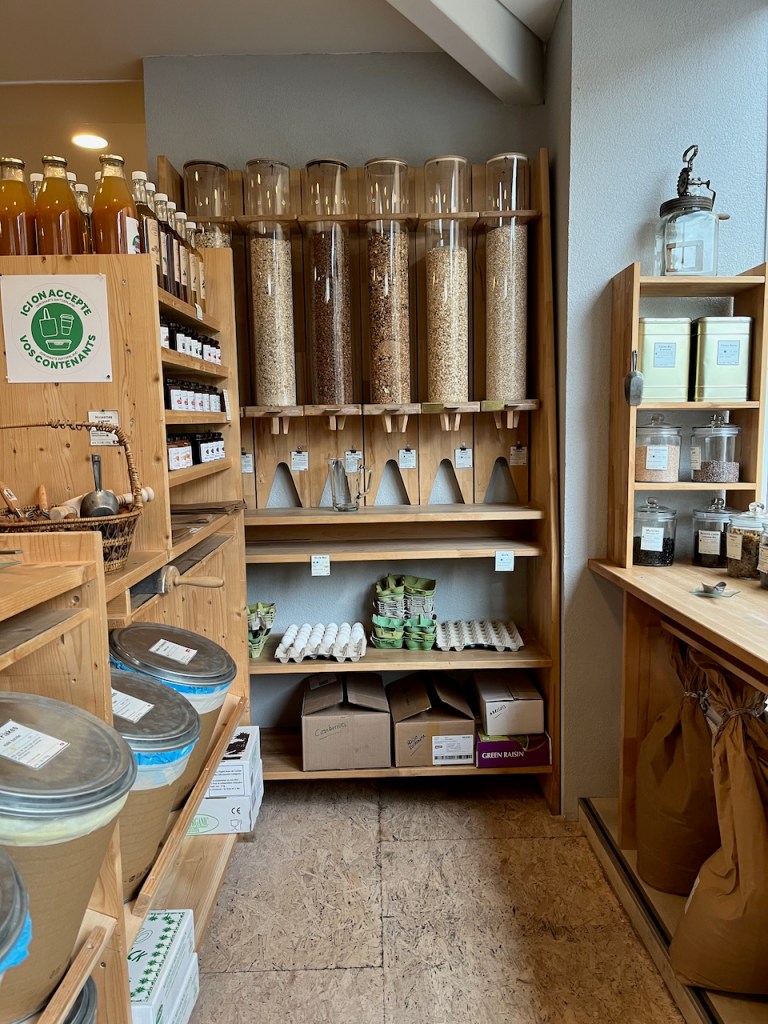
Evidently the campaign was successful. The shop on the ground floor is now a grocer “L’Épicerie VRAC”. I went in to have a look. It sells bulk household goods such as shampoo and muesli, as well as a huge collection of traditional items such as egg timers and kitchen knives and tea towels. The bulk items are displayed in dispensers, so you can fill your own container.
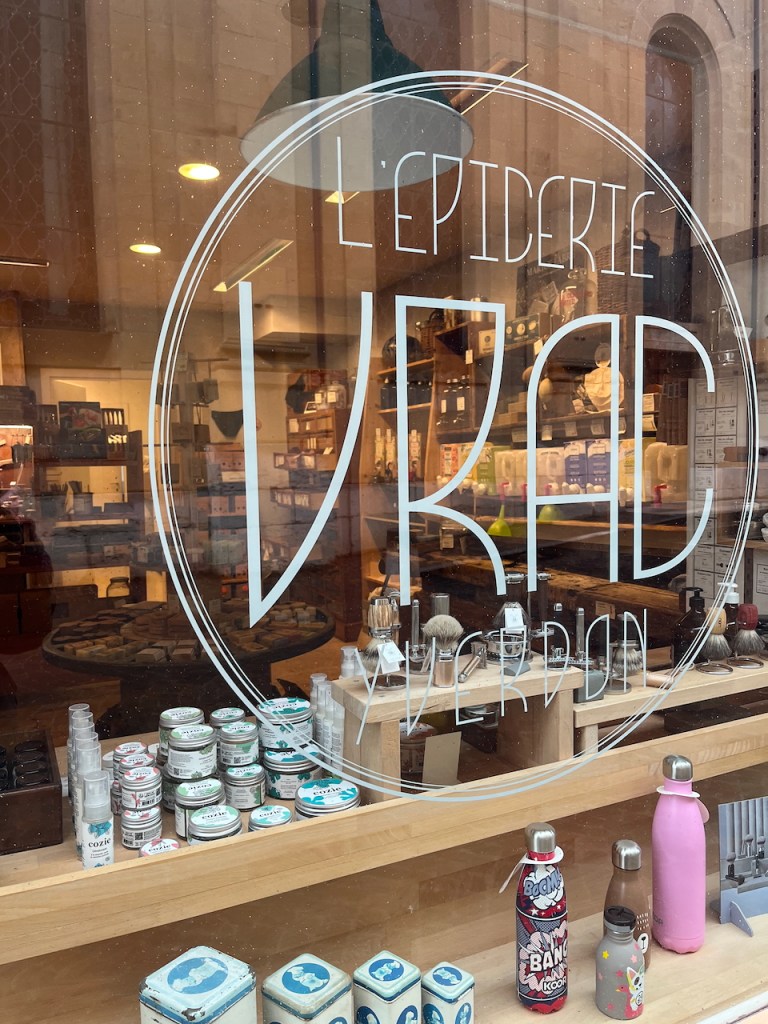
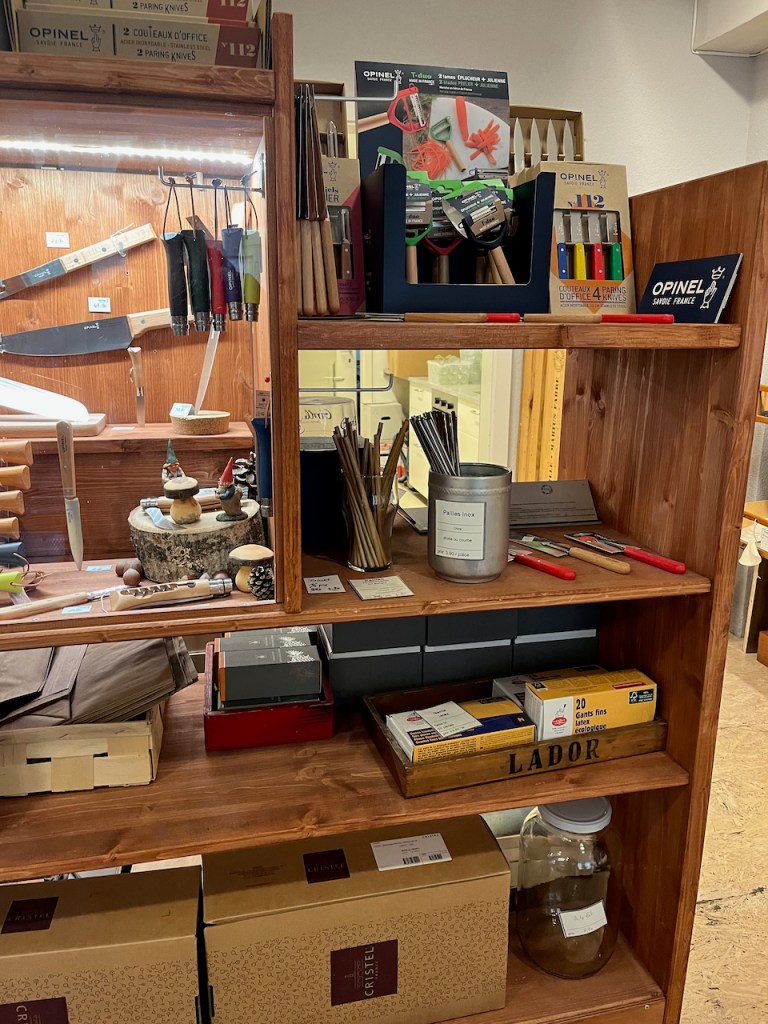
I’ve sketched in Yverdon before. Here is the Temple of Yverdon which is just to the right of the Bazar.
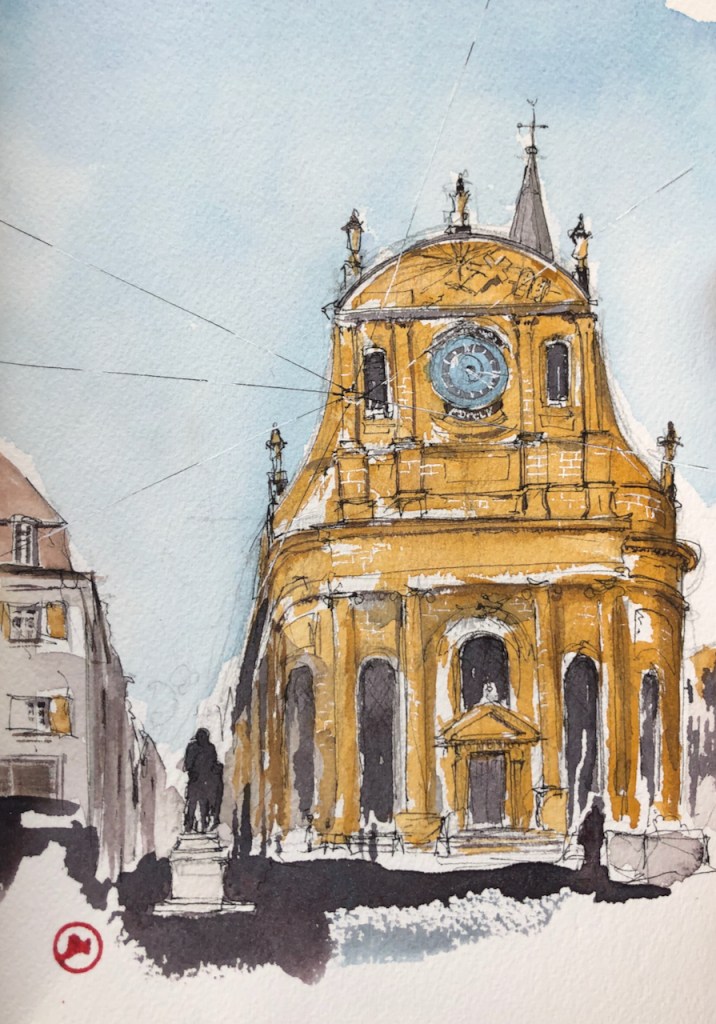
Temple d’Yverdon. The Bazar is the building on the left of this sketch. Click to go to my article about the Temple.

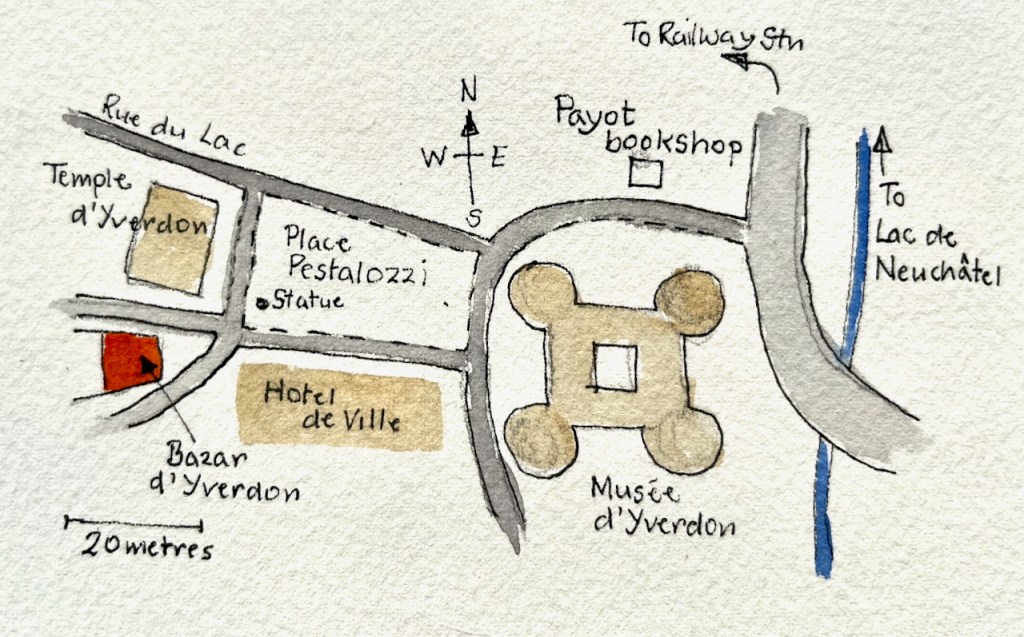
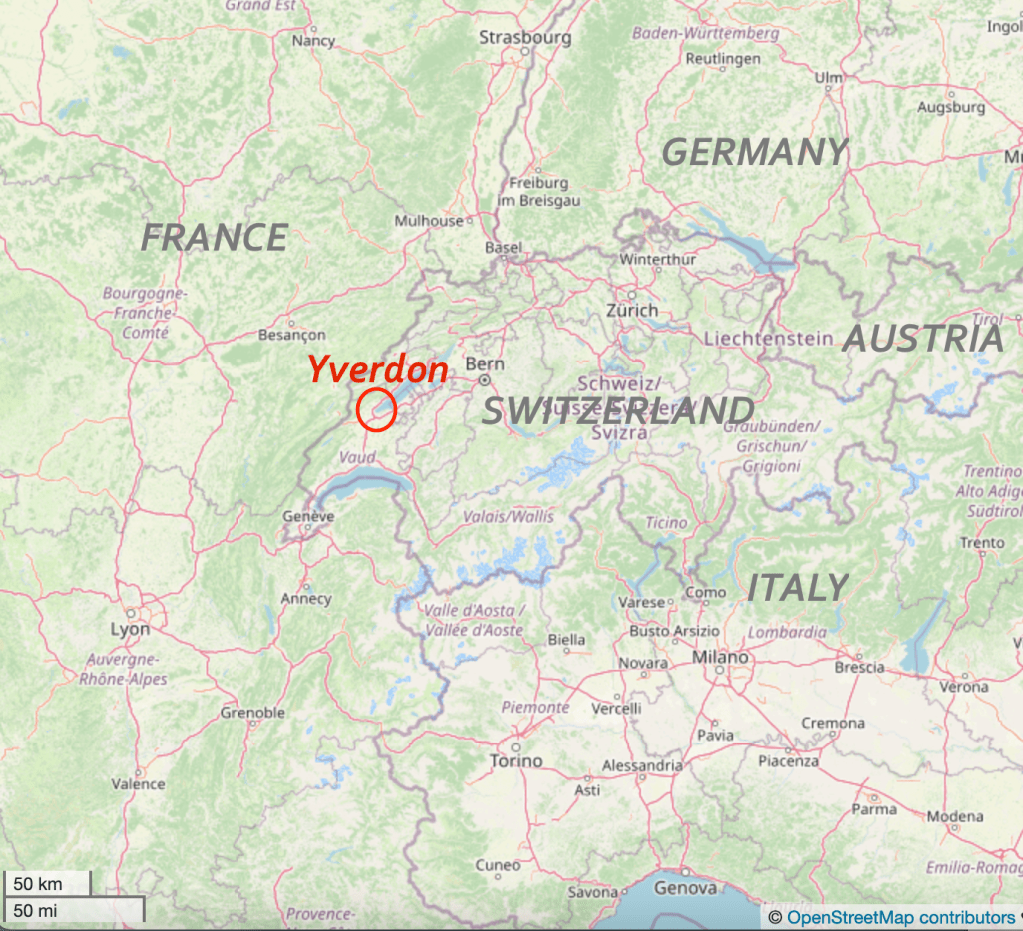
The maps below show the location of Yverdon, in the canton of Vaud.

On the Place Pestalozzi

Note 1: The local paper article about the Bazar is in the archives of “24 heures – VAUD”. It is by Frederick Ravissin, 16 June 2018. Read a pdf of the article here (in French) – link below:
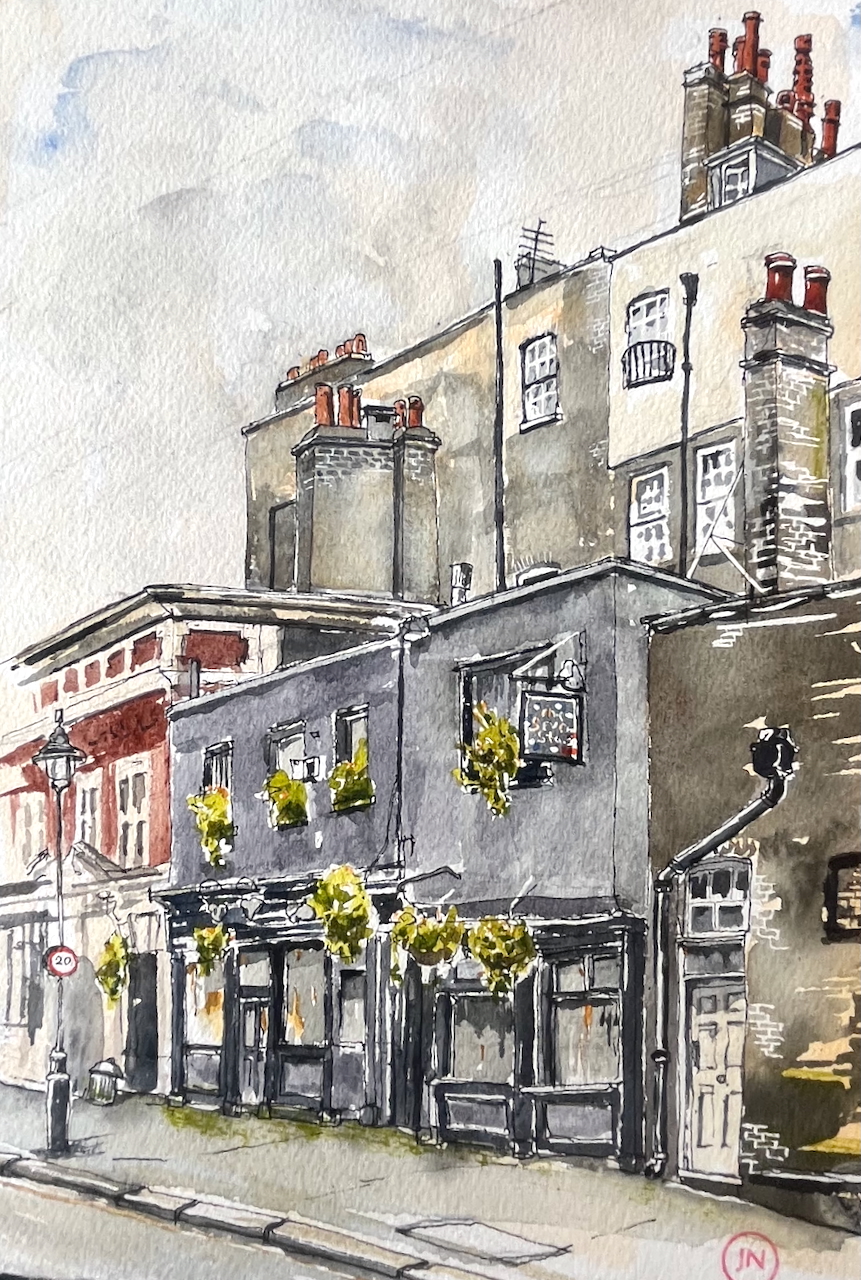
The Seven Stars, Carey Street, WC2

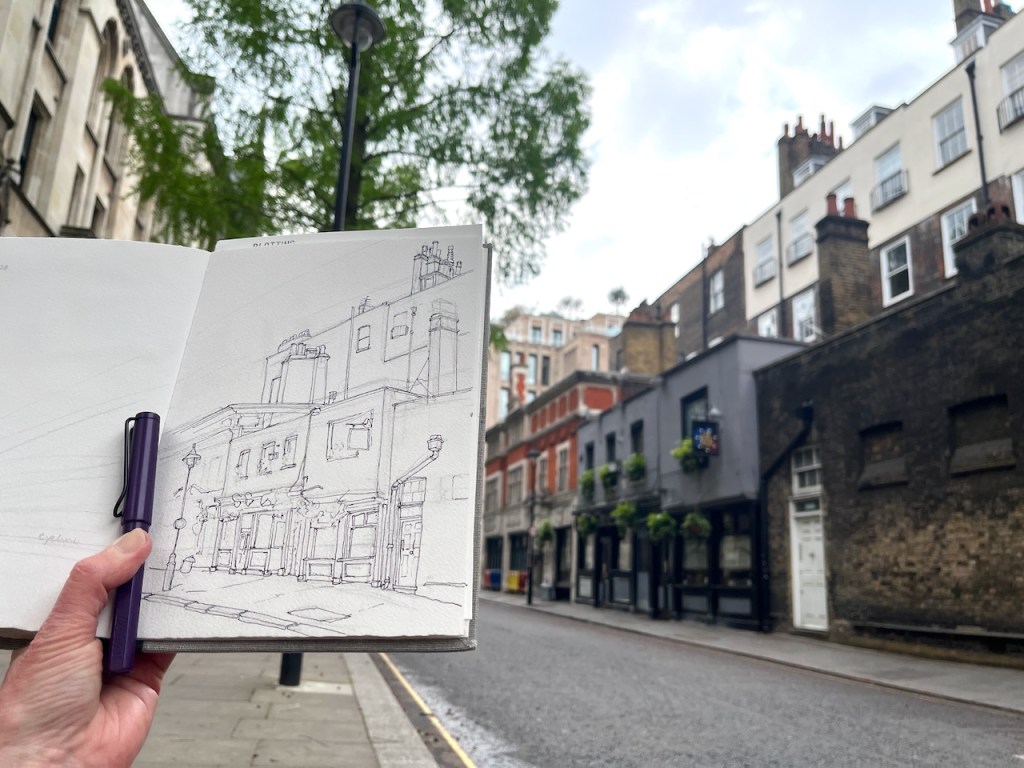
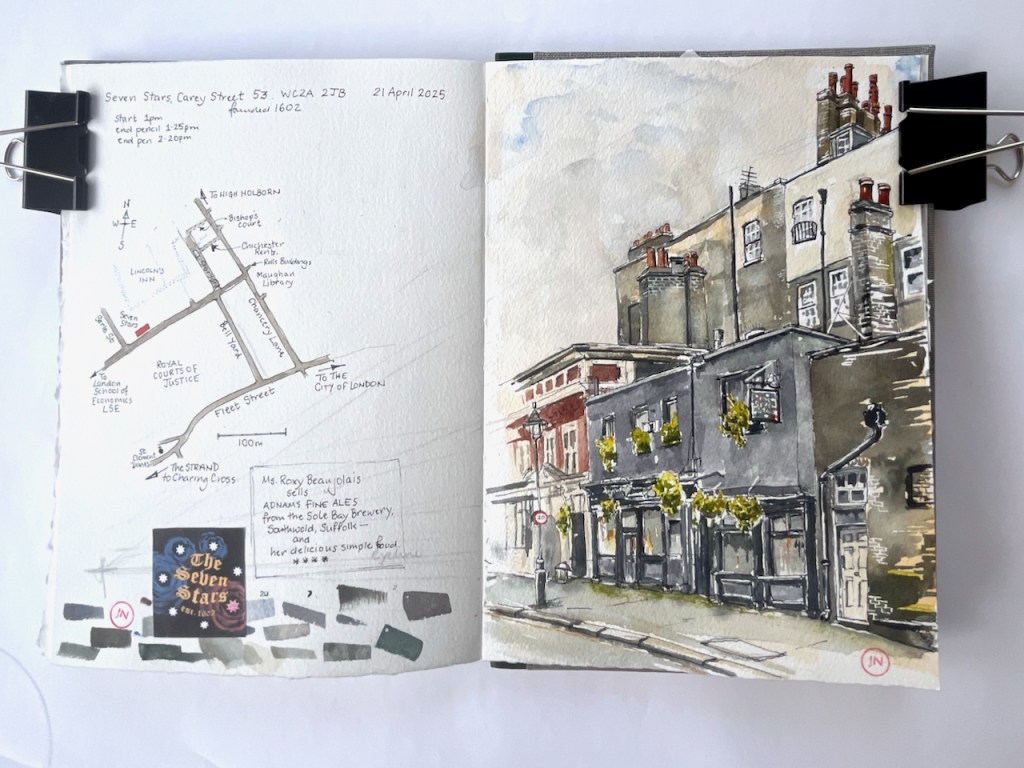
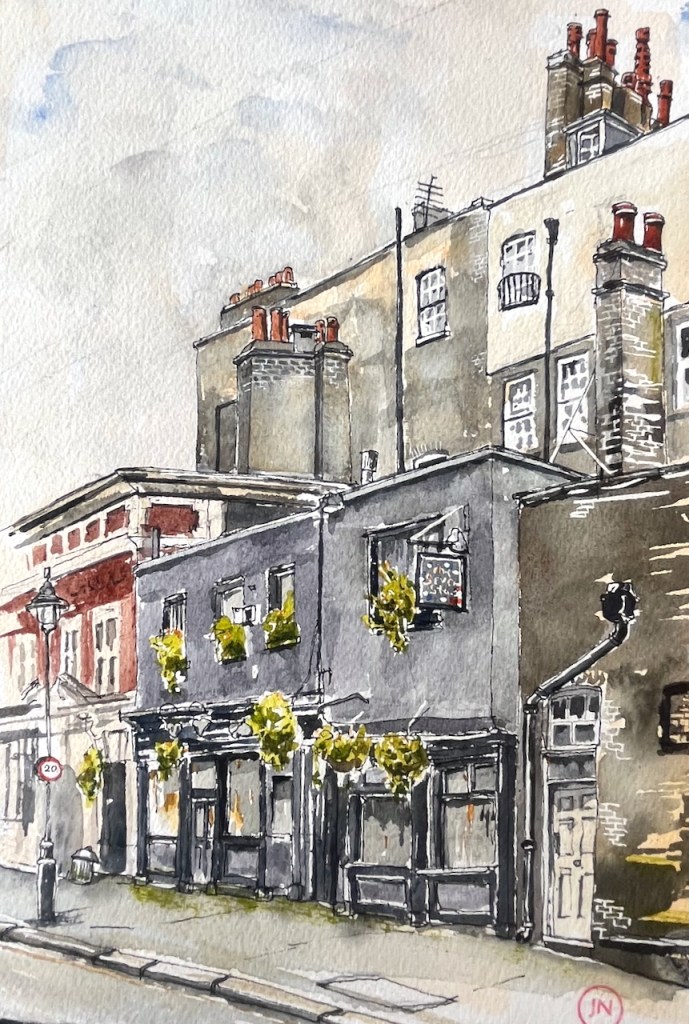
Here is the famous “Seven Stars” on Carey Street, just to the North of the Royal Courts of Justice in London.

The Seven Stars, Carey Street WC2A 2JB, sketched 21 April 2025, in Sketchbook 15

The pub website is a great read. Here’s a sample:

“This tranquil little pub now faces the back of the Royal Courts of Justice, the esteemed Gothic Revival building opened by Queen Victoria in 1882. Within The Seven Stars’ ancient charm of three narrow rooms that make up its public area, drinking in Queer Street (as Carey Street has often been called because of the bankruptcy courts) is contrarily pleasant. One can linger over gastronomic pub food and real ales behind Irish linen lace curtains that are being twitched by litigants, barristers, reporters, LSE students, church musicians, and West End show brass sections. Then, one might navigate to the lavatories up the comically narrow Elizabethan stairs. There are antique Cabinets of Curiosity in the pub’s front windows, and alongside Spy prints of former judges, there are posters of “Brothers in Law,” “A Pair of Briefs,” and other bygone British legal films.”

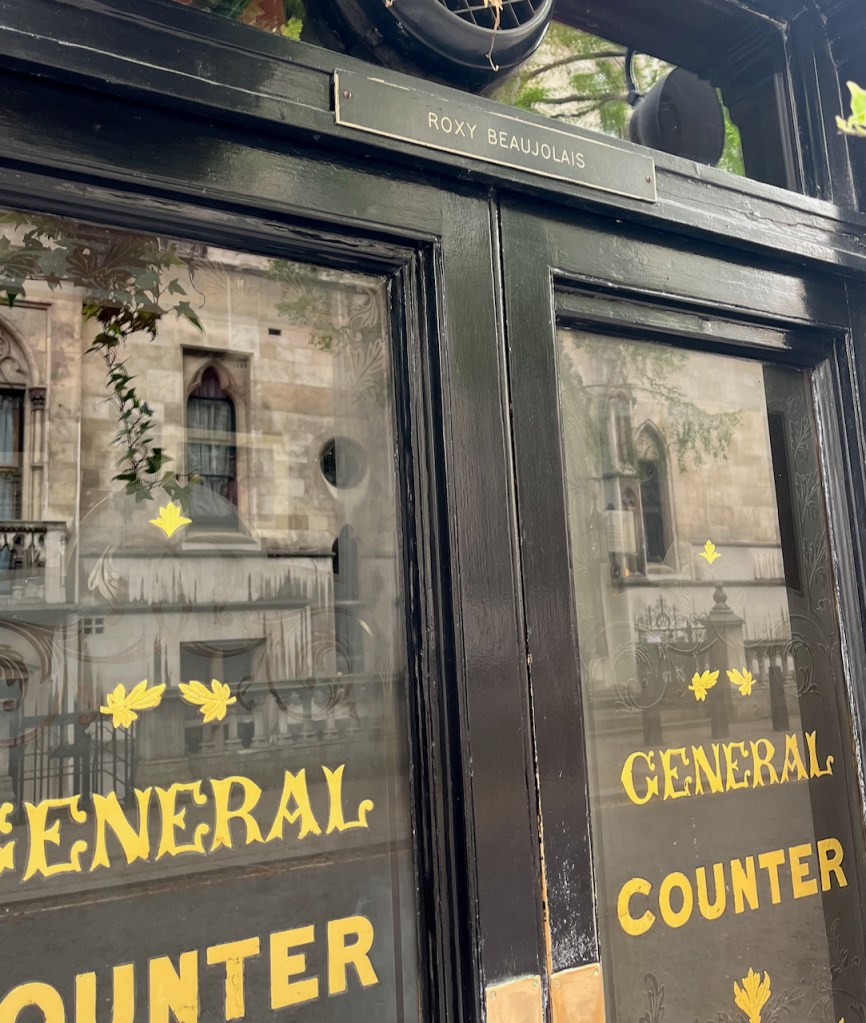
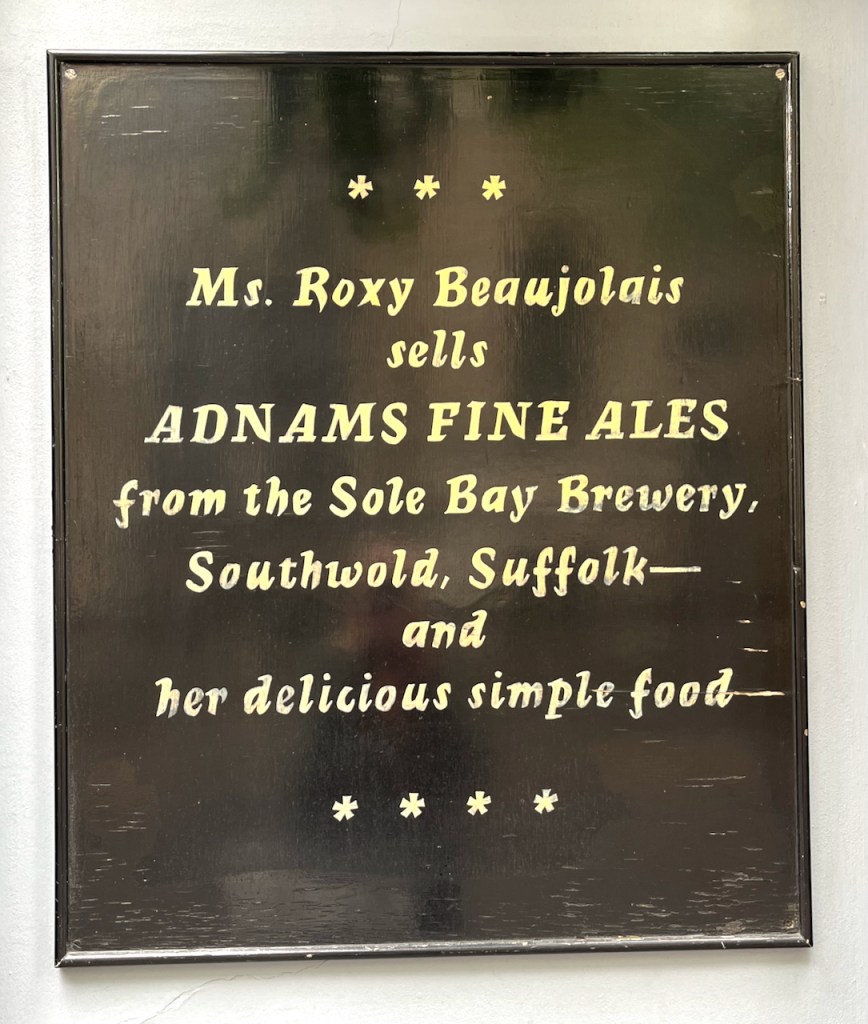
The licensee is the marvellously named Roxy Beaujolais.

Again quoting from the pub website:

In February 2006, FancyAPint listed The Seven Stars as one of “London’s Top Ten Pubs.” A 2006 review in On Trade, a pub industry organ, told it like this:

“We are here to be adored, not ignored,” says Roxy imperiously. “We sell fabulous beer with proper, homecooked food; and I expect my customers to appreciate both of those things.” In the current climate of customer satisfaction at all costs, her words may sound nigh on heretical. But this is a woman utterly qualified to call her own shots, and anyway – her combination of buxom presence, top class conversation, beautifully cared for ale, and sumptuous food is such a winning one that few would feel inclined to argue.

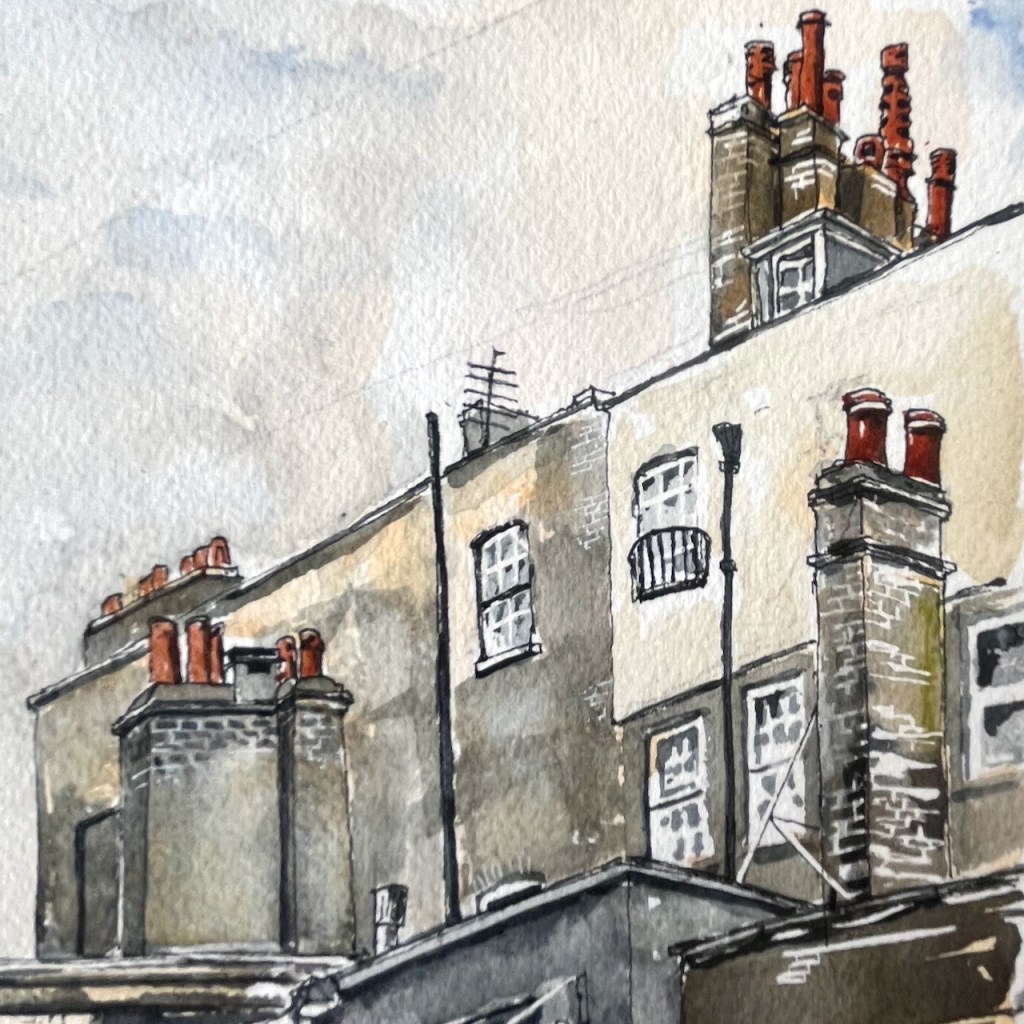
Sketching the pub, I enjoyed the landscape of chimneys. The art of the chimney-maker is not enough noticed. They are unsung sculptors. All those legal offices and chambers behind the Seven Stars must have plenty of fireplaces. Hence the chimneys, here present in great numbers and in extraordinary variety.

Chimneys seen from Carey Street.

This sketch took about an hour and a half on location, and I finished the colour at my desk.

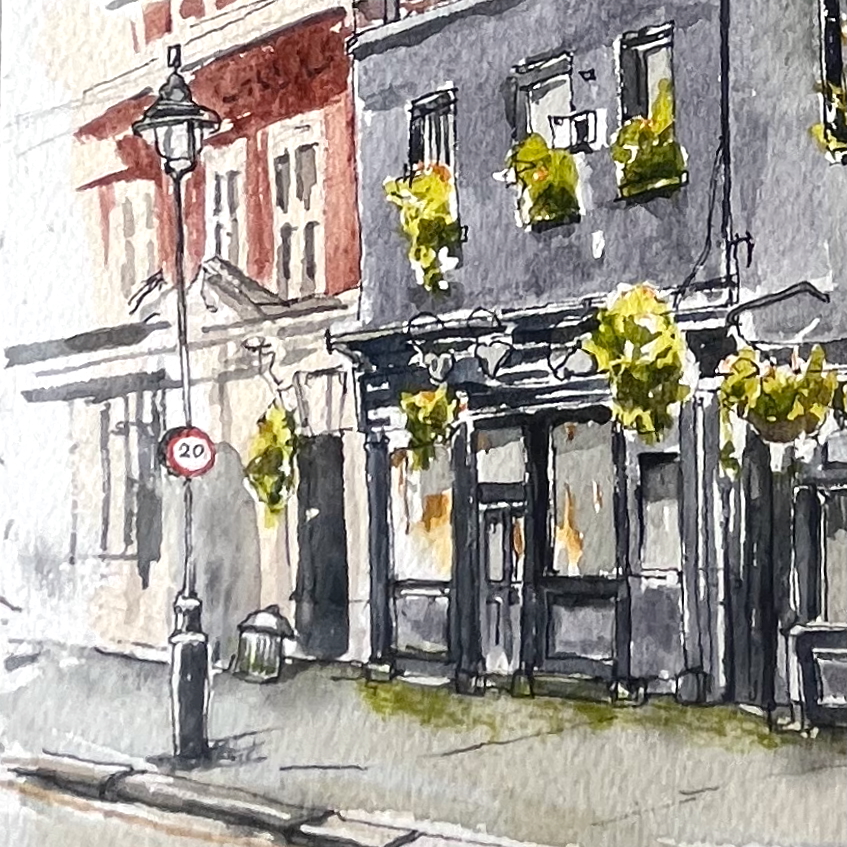
Sketch of the The Seven Stars – detail

See this post and this post for sketches of the Royal Courts of Justice.

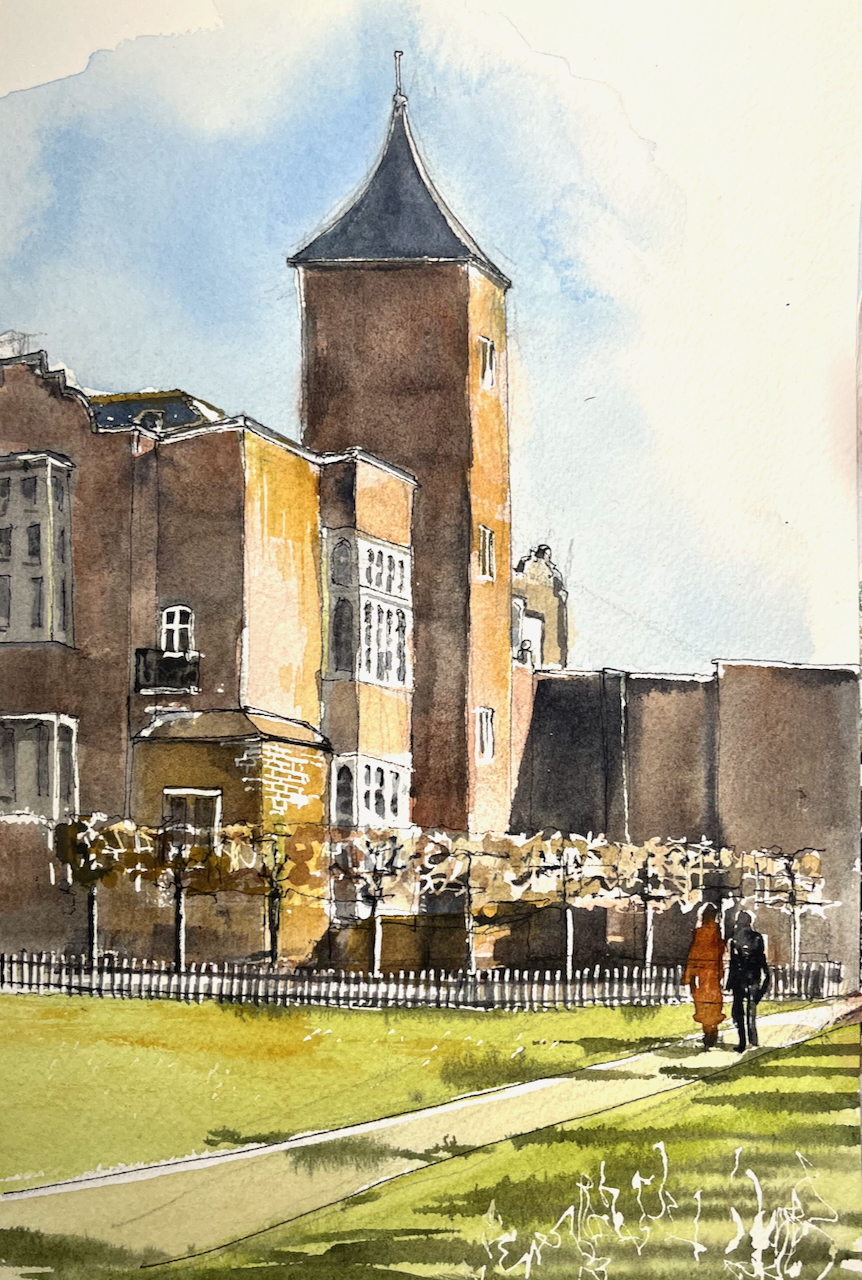
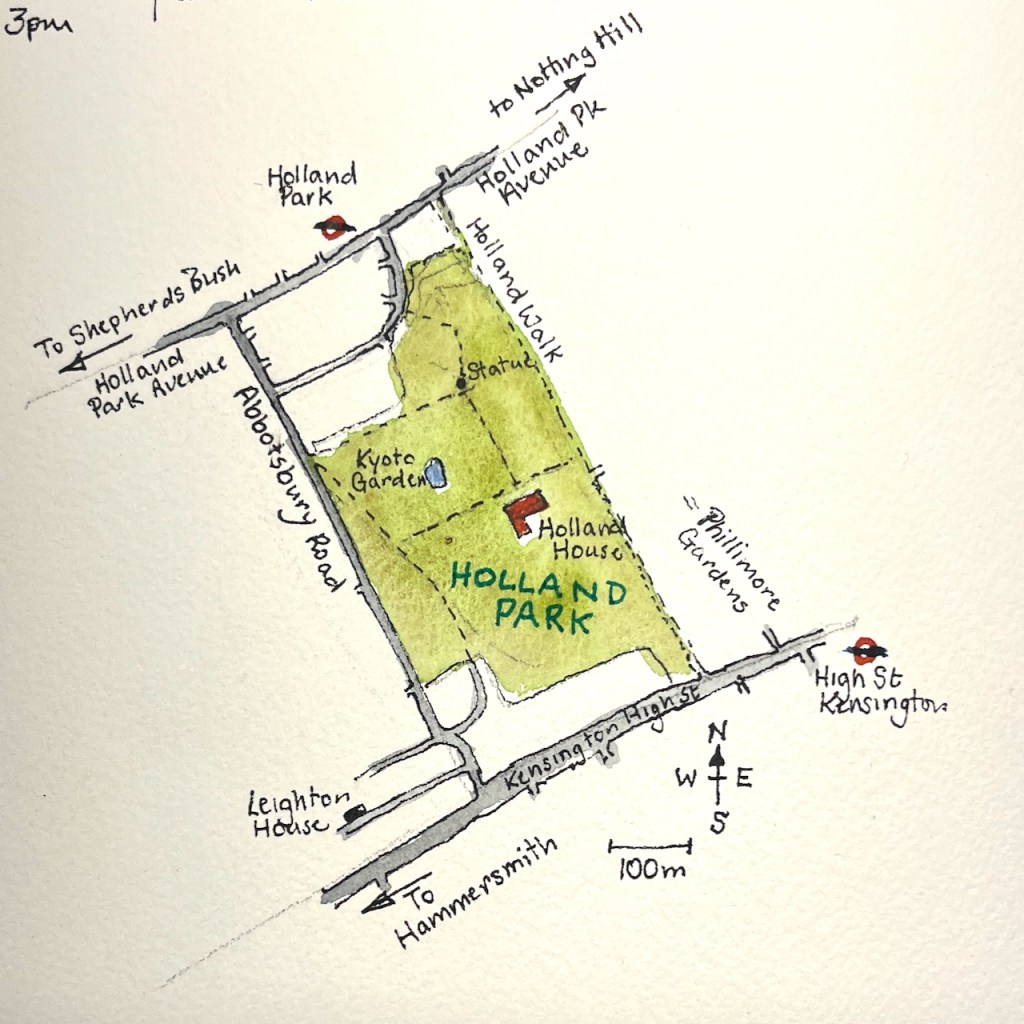
Holland House, Kensington, London W11

On a freezing day in March, I sketched Holland House.

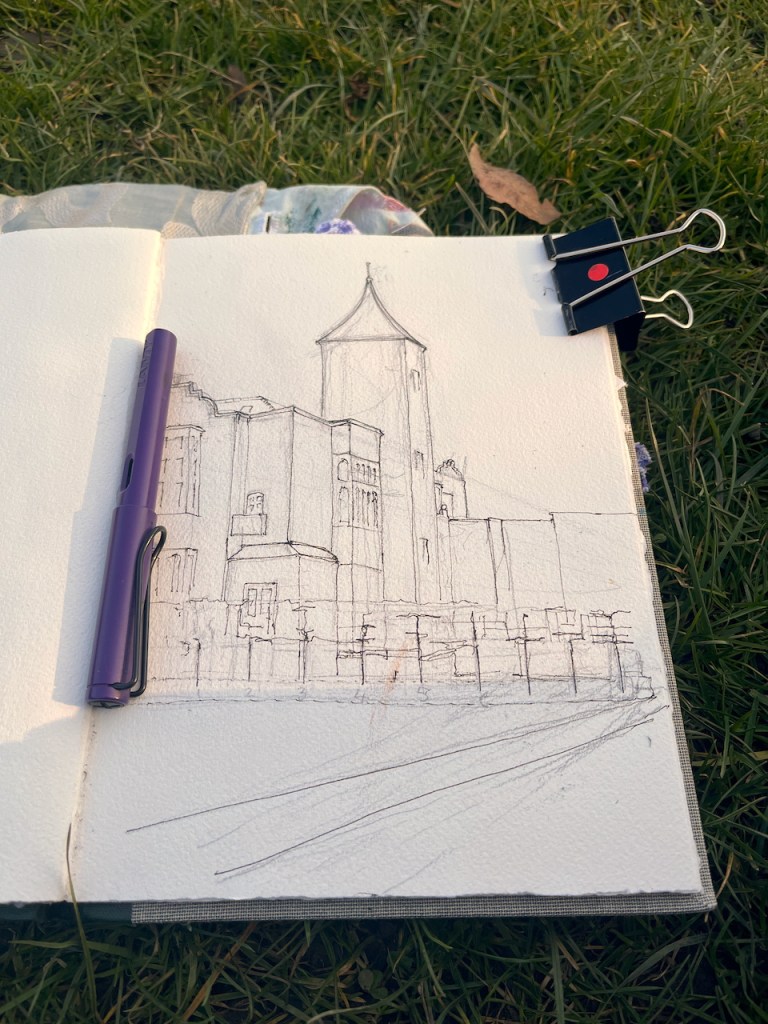
The view from the bench wasn’t quite right, so I moved to the grass. The shadows crept after me across the lawn.

The house was built in 1605-7. It originally had two turrets and was much larger than it is now.

It was damaged by aerial bombardment in 194o.

During the night of 27 September, Holland House was hit by twenty-two incendiary bombs during a ten-hour raid. The house was largely destroyed, with only the east wing, and, miraculously, almost all of the library remaining undamaged.

Historic England archive (<- click this link to see a photo)

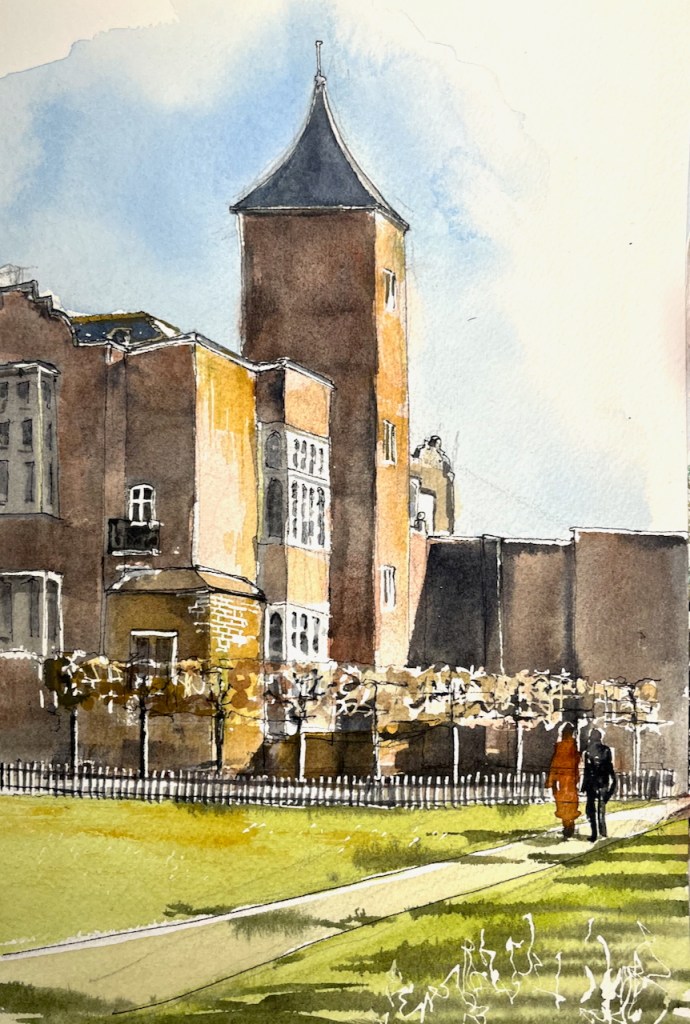
My sketch shows the surviving East wing with its turret. In the 1950s the damaged part was demolished, and the remainder converted to a youth hostel and open-air theatre.

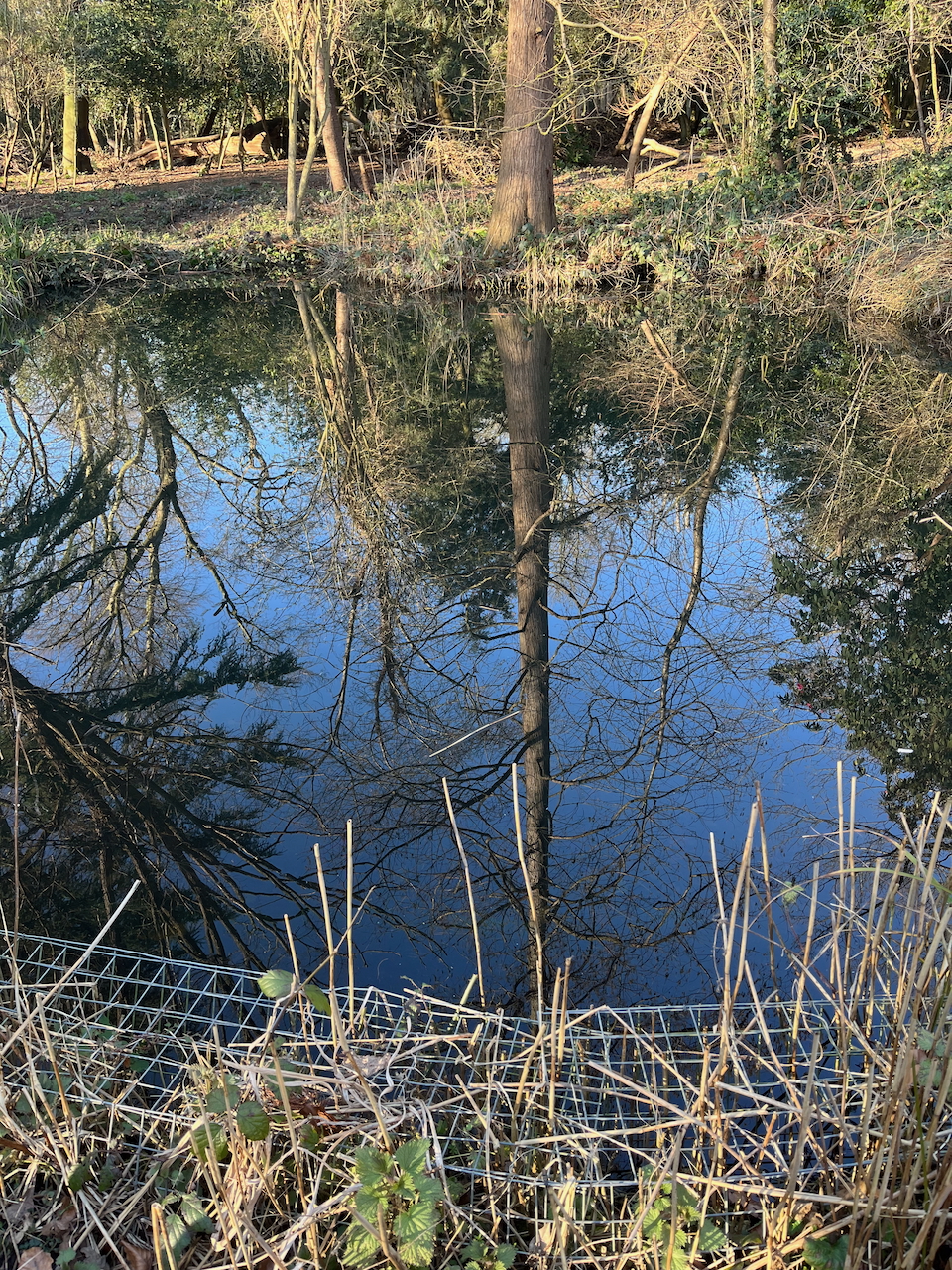
On the way back to the tube station I paused at a still pond.

Hoxton Trust Community Garden – Clock Tower, London N1

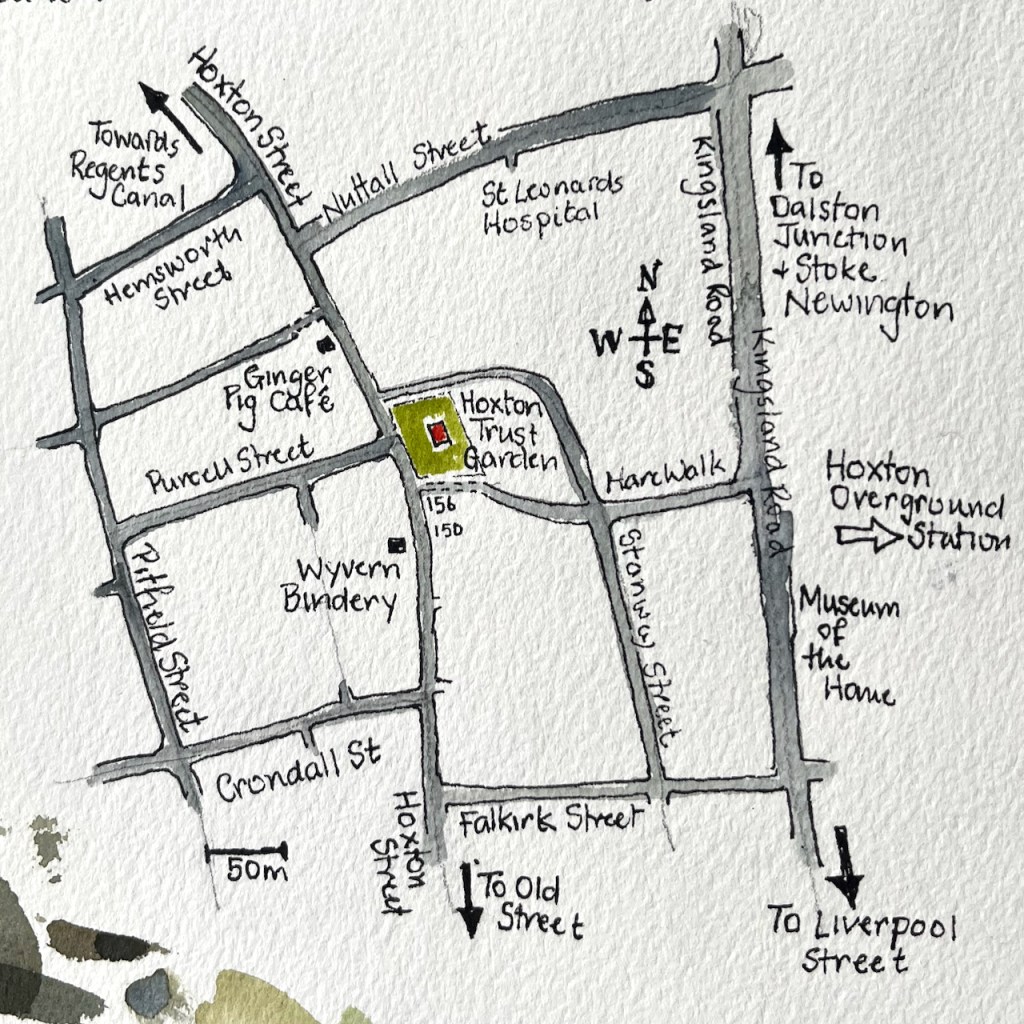
Hoxton Street is busy with market stalls, shops, cafés. People walk to and fro. If you walk North, there’s a small garden on the right, behind a fence. Above the trees there’s this odd white tower. What is it? The gate is open and you can go in.

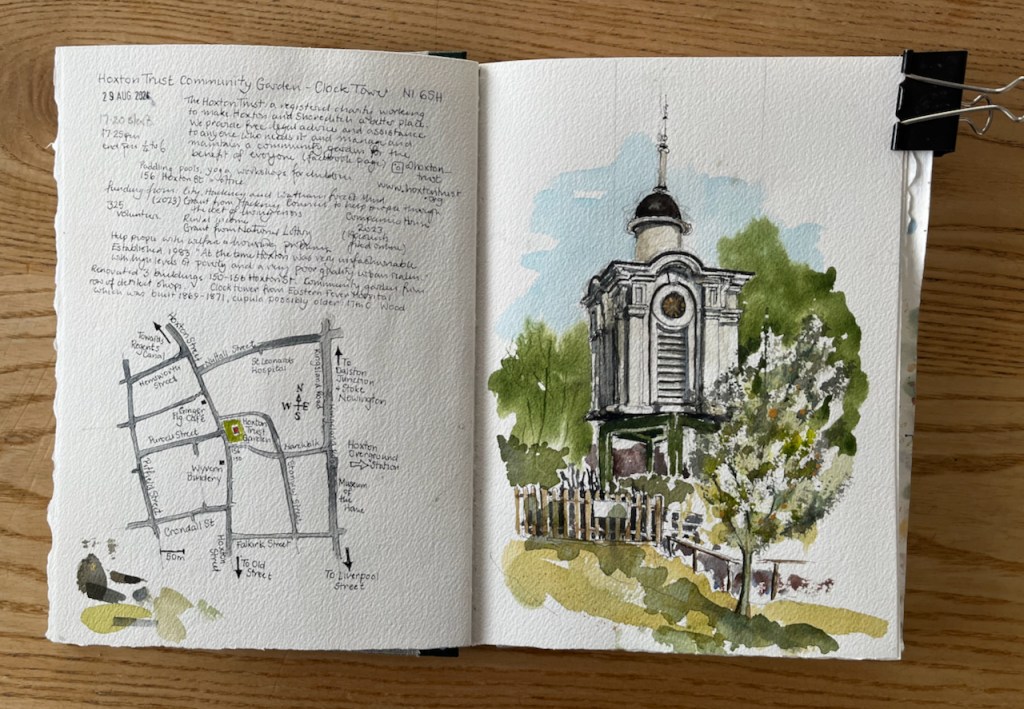
Hoxton Trust Community Garden N1- Clock Tower, sketched 29 August 2024 in Sketchbook 15

This is the Hoxton Trust Community Garden. Their website tells me that the Clock Tower was rescued from the Eastern Fever Hospital which was built 1869-1871. It is made of wood, and is possibly older than the hospital.

The clock tower sits on a framework made of steel girders. On the day I was there, the clock had stopped at half-past six. So in a timeless interlude, I sketched from a wooden bench amongst the trees.

Near the bench is a small monument to the “Hoxton Five”. Who were they?

“One was stabbed, and his four friends were killed in a car crash returning from the funeral.”

The Hoxton Community Trust is a registered charity “working to make Hoxton and Shoreditch a better place”. According to their website, they provide free legal advice and assistance to people who need it. They maintain this community garden for the benefit of everyone. The charity was established in 1983: “At the time, Hoxton was very unfashionable, with high levels of poverty and a very poor quality urban realm”, their website says. They bought and renovated three buildings, 150-156 Hoxton Street, adjacent to the garden. These buildings are now let out. Rents from these buildings supplement the income of the Hoxton Trust, which is also funded by grants from the National Lottery, Hackney Council, and other sources (2023). The work of the Trust is also supported by volunteers, some of whom work in the garden.

The garden is lovely. There are fruit trees and a herb garden, and plenty of seats. A sanctuary.

Sketching in the Hoxton Community Trust Garden.
Sketchbook 15

“The Roundhouse”, Pocra Quay, Aberdeen

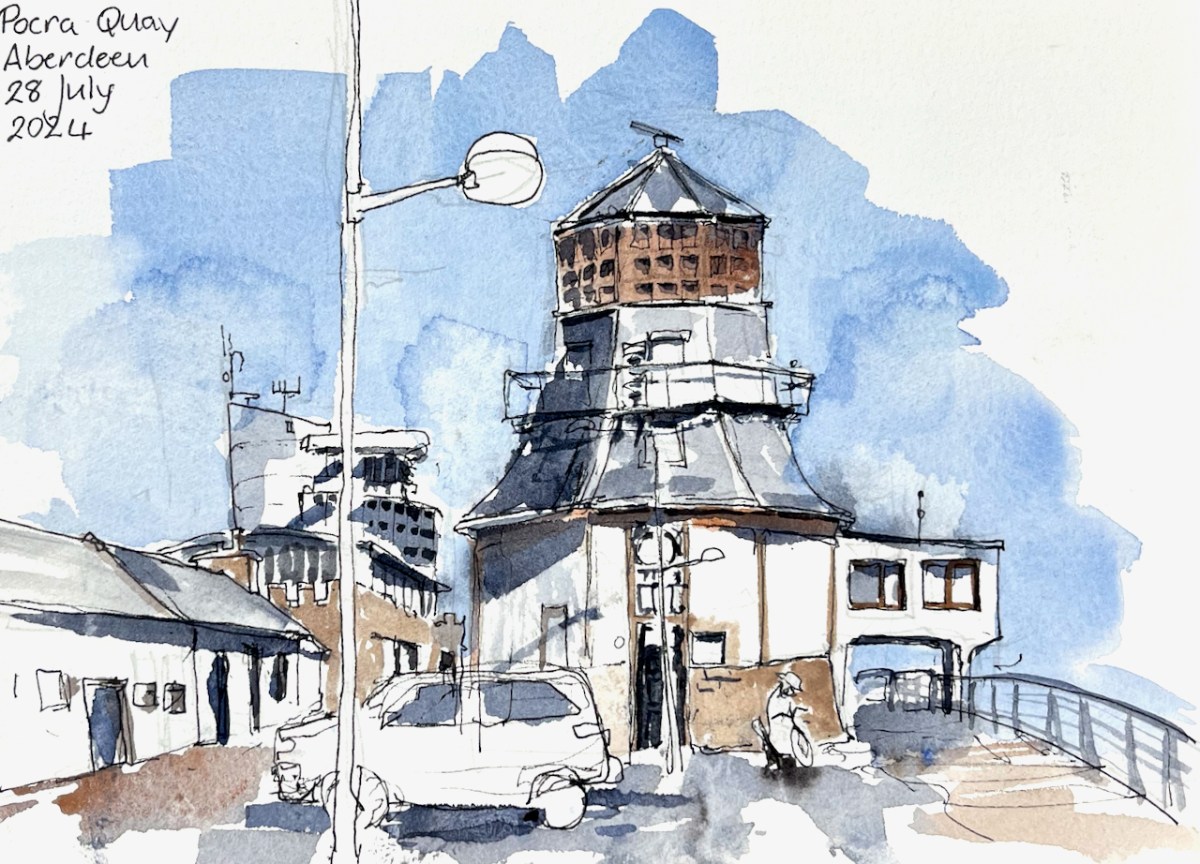
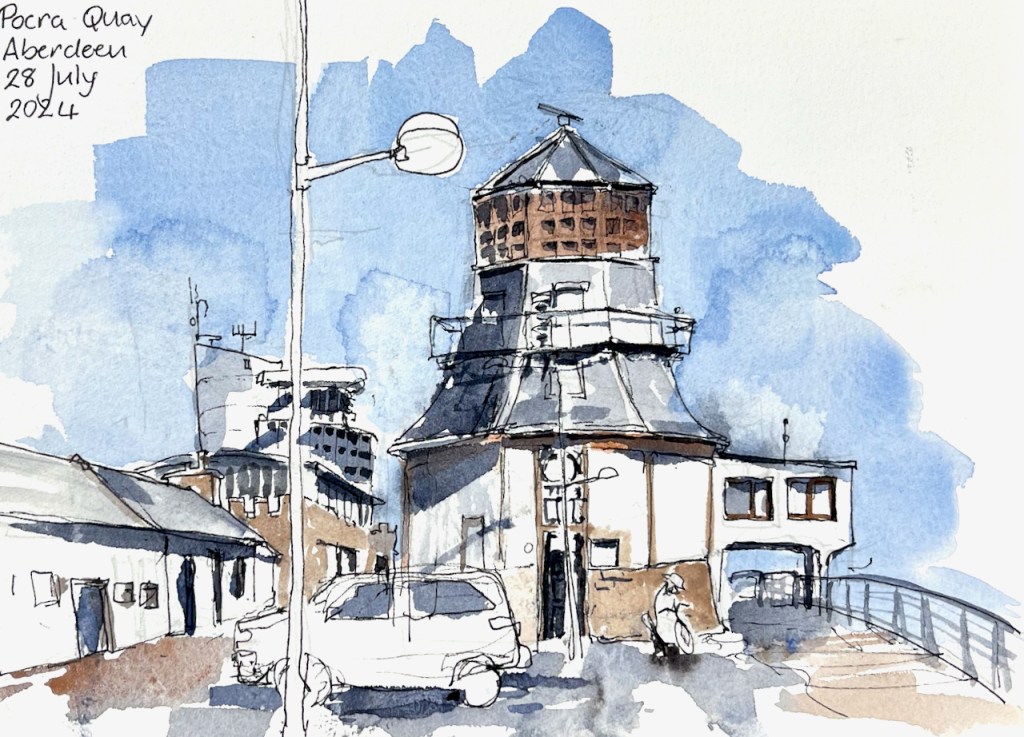
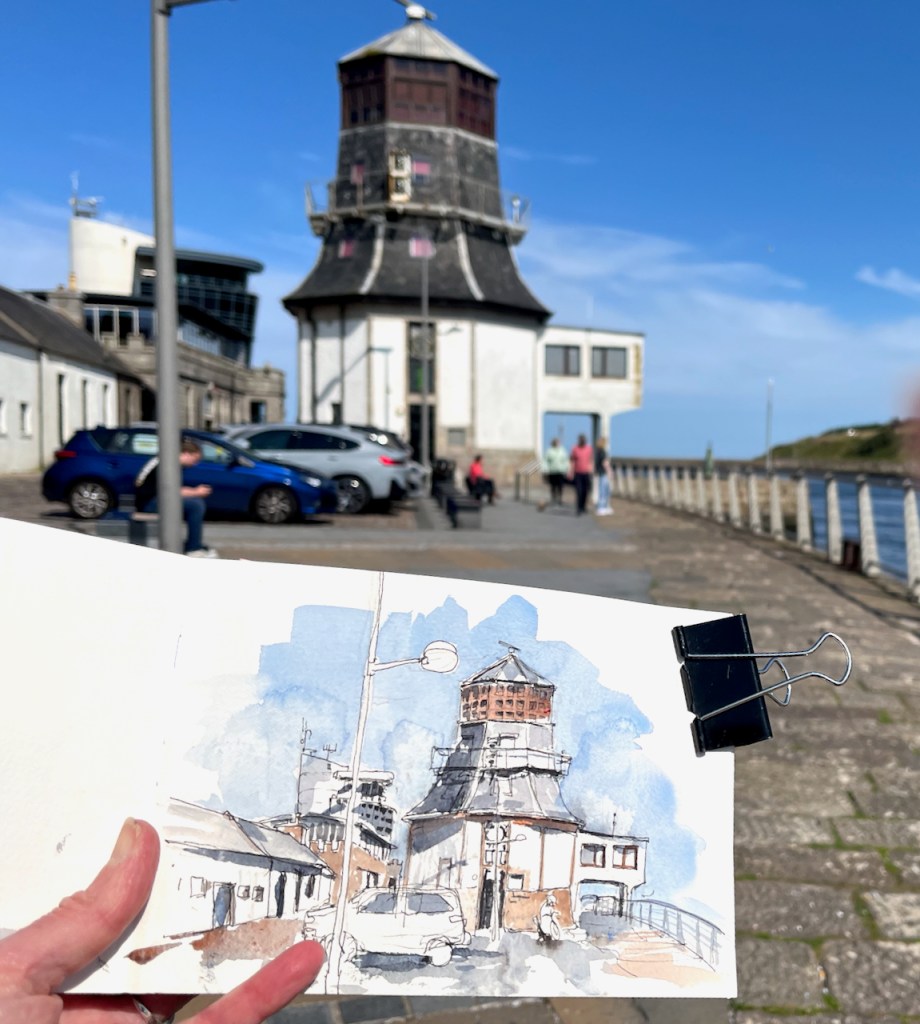
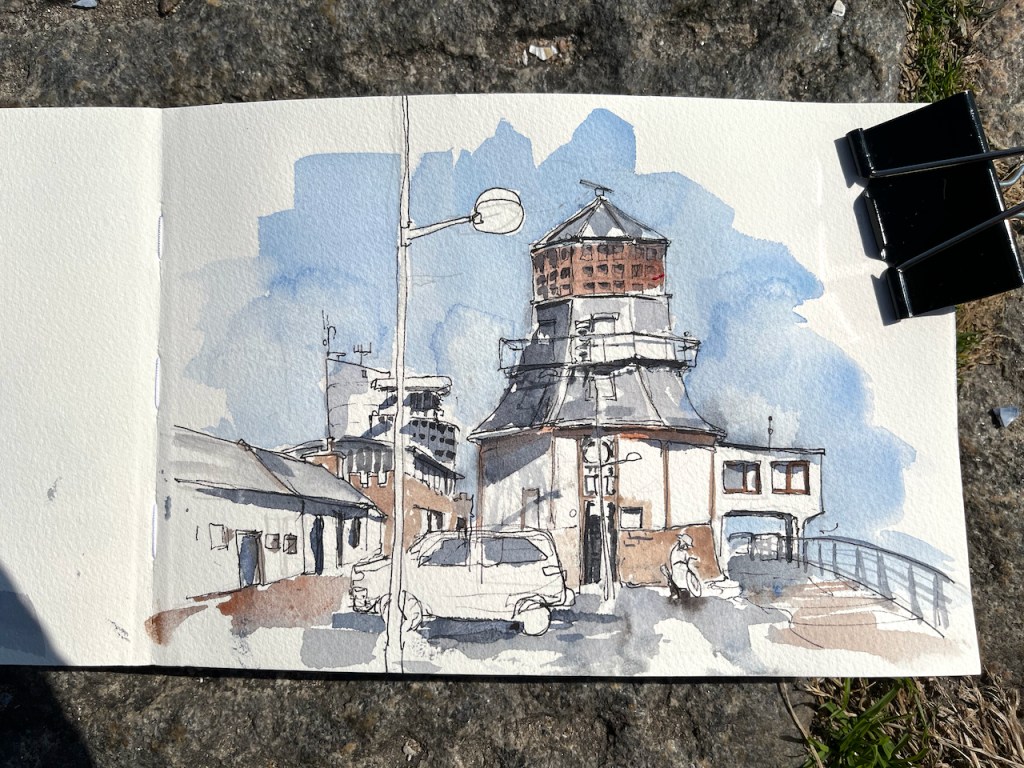
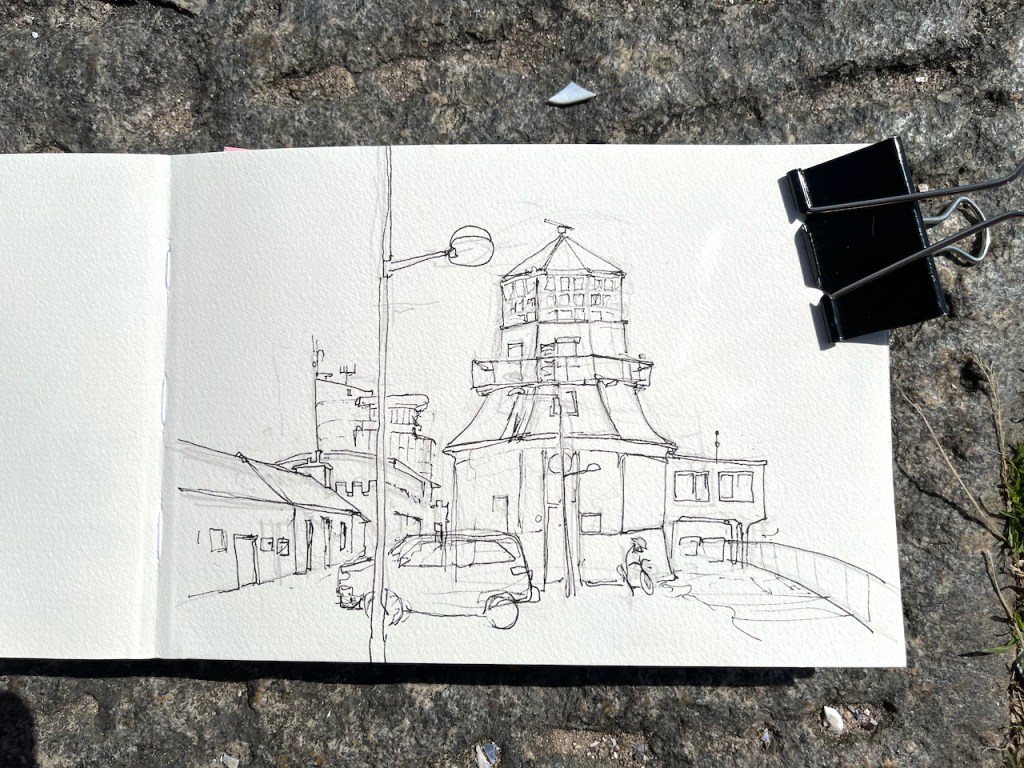
This is the watchtower near the entrance to the harbour of Aberdeen, known as “the Roundhouse”.

The Roundhouse, Pocra Quay, 28 July 2024, A5 in JP Purcell Sketchbook

It is octagonal. According to the listing on the Historic Environment Scotland site it was:

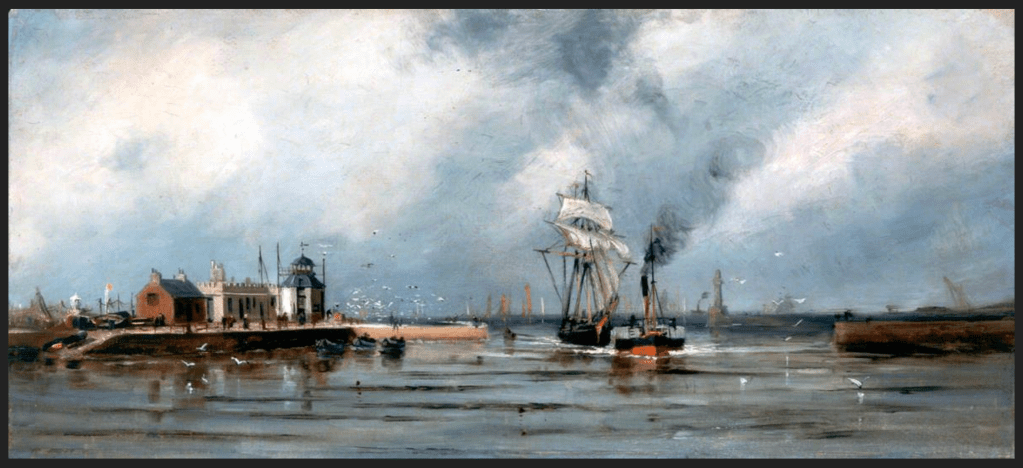
“[built] to guide vessels to port, this was originally carried out by the harbour pilots via loudhailer from a platform built into the roof of the original 2-storey structure, or by a system of wicker balls suspended from a pole rising from the platform.” [1]

“Entrance to Aberdeen Harbour” by James Cassie (1819–1879)
image copyright: Aberdeen Maritime Museum


“The control tower was added in 1966 and a radar system was introduced in 1974. The structure was further updated in 1986 at which time the Queen unveiled a plaque, situated to the right of the main entrance to the tower, commemorating ‘850 years of Harbour History’.” [1]

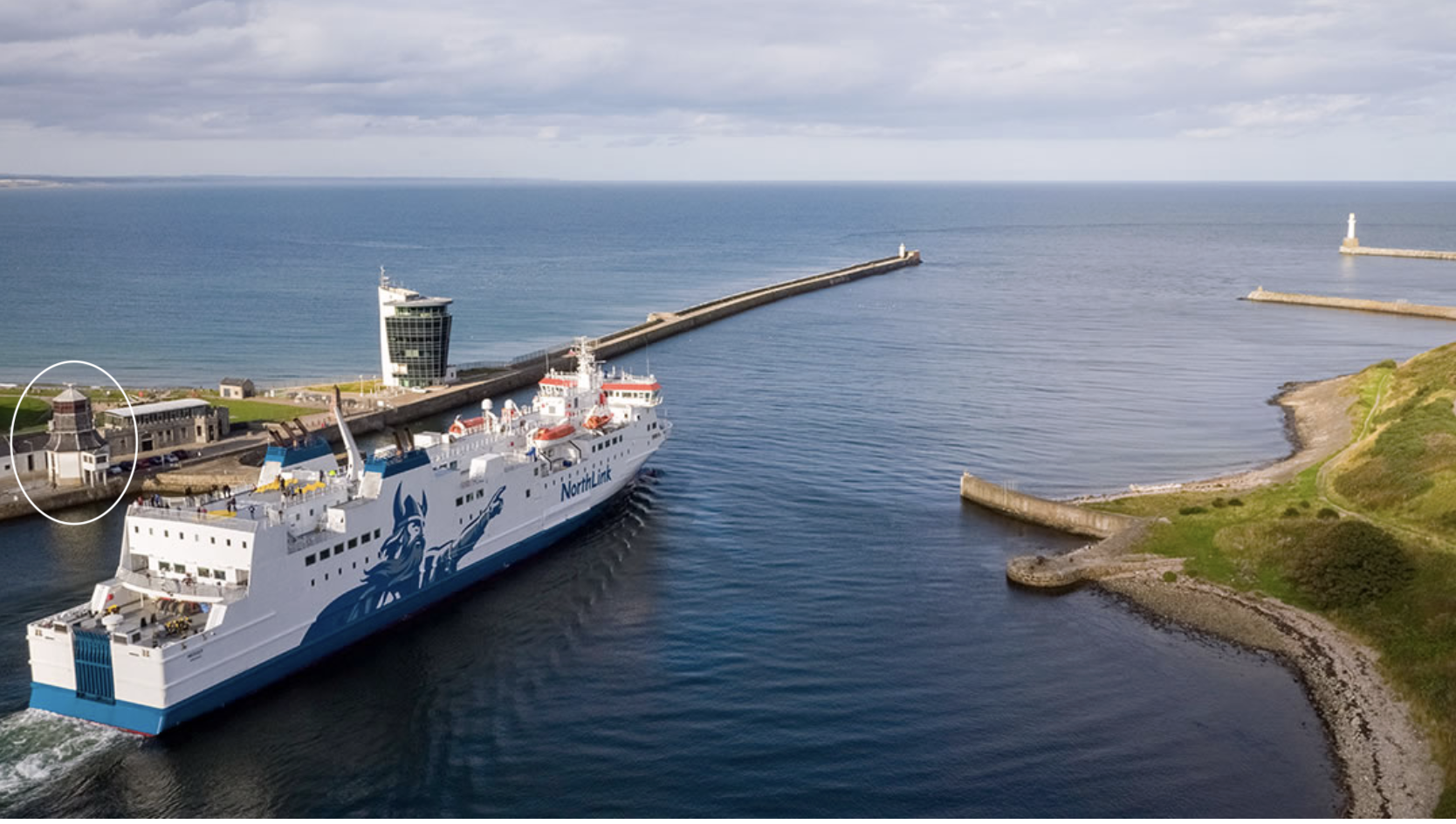
It was in use until the Marine Operations Centre opened in 2006 [4]. This is nearer the sea, just visible behind the lamp-post in my drawing. It handles about 25000 boat movements a year, which averages at 60 a day [2]. For comparison, Heathrow air traffic control centre handles abut 200000 aircraft movements a year or 500 a day [3]. The area managed by the Marine Control Centre extends 2.3 nautical miles around the headland to the South of the harbour [5]. So the Operations Centre handles not just boats going in and out, but boats moving around inside and outside the harbour as well.

MV Hrossey leaving the port of Aberdeen, photo copyright southspear media, used with permission [6]
The Roundhouse, circled, is on the left, and the Marine Operations Centre is above the centre of the ship. This is the Northlink ferry, sailing to the Northern Isles.

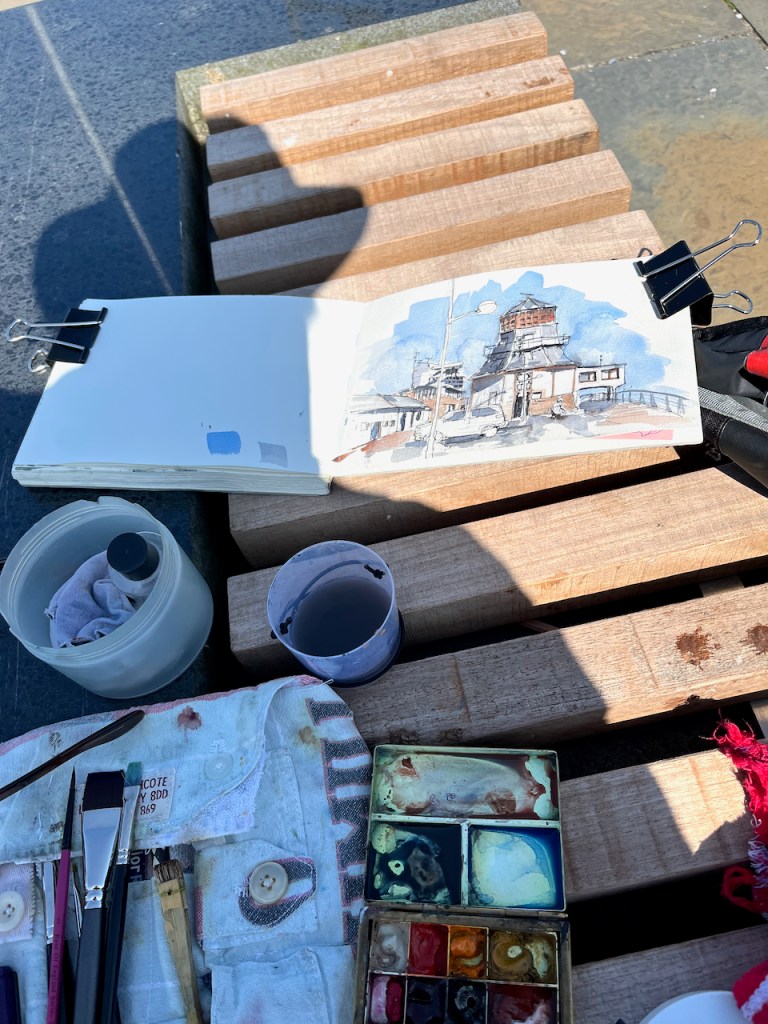
I sketched this on a stunning hot day, sitting on a bench by the quay.

The Roundhouse. The modern Marine Operations Centre is the tall white building behind and to the left. In front of it, and lower down behind the cars, is the restaurant “The Silver Darling”.

Three years ago, on a very different day, I made a much quicker sketch:

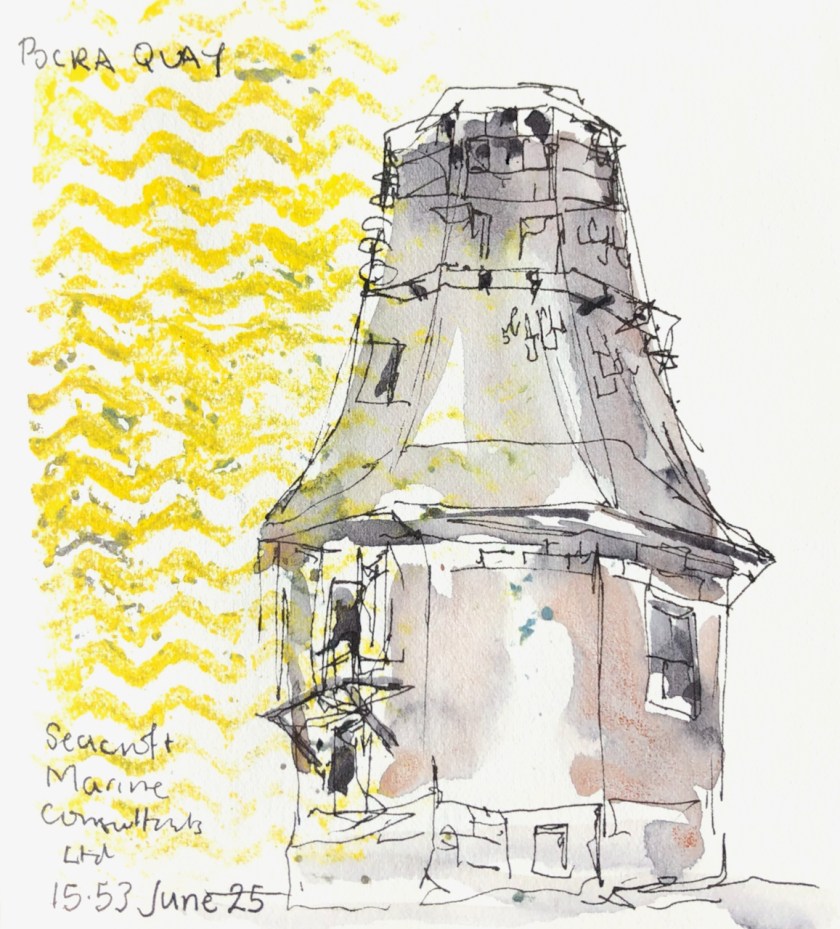
A quick sketch on a stormy rainy day, sketching from the shelter of a doorway. June 25th 2021.

References:

(1) Historic Environment Scotland listing: http://portal.historicenvironment.scot/designation/LB50941 FOOTDEE, POCRA QUAY, NAVIGATION CONTROL CENTRE (FORMER PILOT HOUSE)LB50941 downloaded 30 August 2024

(2) Aberdeen Maritime Trail leaflet, Aberdeen City Council – 100023401 – 2019: https://www.aberdeencity.gov.uk/sites/default/files/2020-09/Maritime%20Heritage%20Trail.pdf

[3] Heathrow Aircraft movement 2021 numbers from Heathrow facts and figures: https://www.heathrow.com/company/about-heathrow/facts-and-figures

[4] Gazetteer of Scotland https://www.scottish-places.info/features/featurefirst19543.html

[5] Port of Aberdeen Vessel Traffic Services extent: “All shipping movements within the Aberdeen VTS area (within 2.3nm from Girdleness) are controlled by Aberdeen VTS. Participation with VTS is mandatory, for further details please see ALRS Vol.6.” https://www.portofaberdeen.co.uk/port-information/marine

[6] Thank you to Nick McCaffrey of Southspear media for permission to use his amazing photograph of MV Hrossey leaving the port of Aberdeen.