Shoreditch Church: St Leonard E1

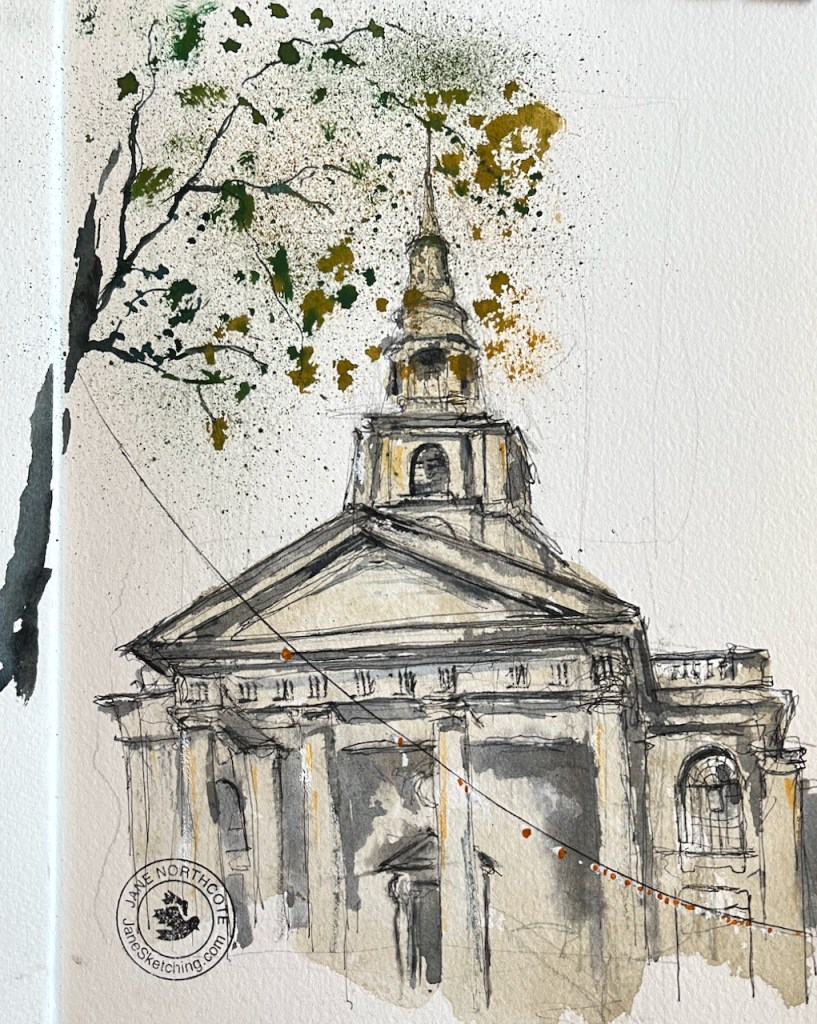
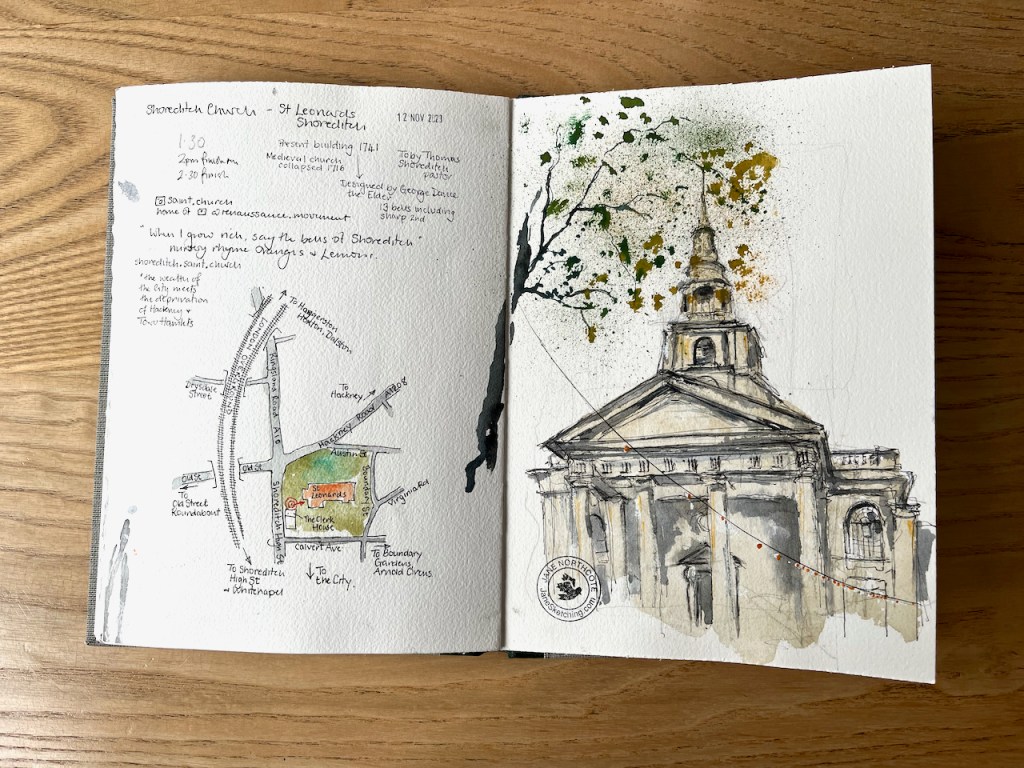
Here is St Leonard Shoreditch, which stands at the intersection of Shoreditch High St and the Hackney Road, postcode E1 6JN.
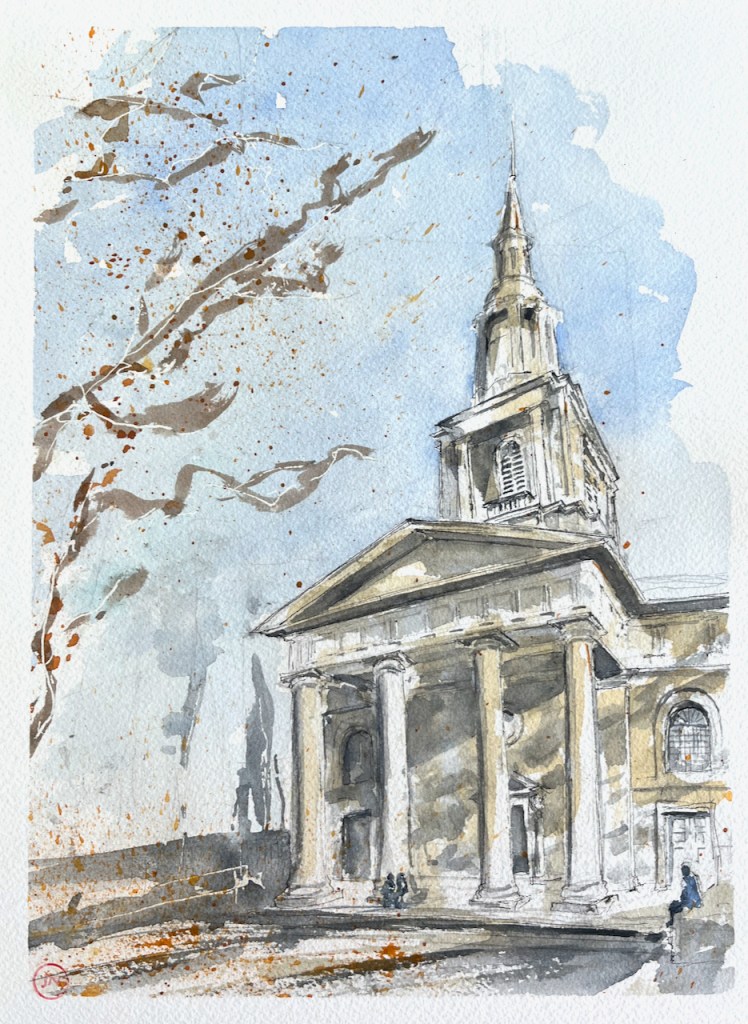
St Leonard’s, Shoreditch Church sketched 23 November 2023, 12″ x 9″ [sold]

There has been a Christian church here since medieval times. The present building dates from 1741 and was designed by George Dance the Elder (1695-1768). George Dance the Elder was the City of London surveyor at the time, and designed, amongst other buildings, Mansion House at Bank Junction.

The current church is active in the community. On the day I was sketching, a Thursday, they were offering meals to local people. This is the Lighthouse Project, “providing practical help, food parcels and hot meals to local people in need” according to their website. You can see several guests in the picture.

Placard offering "Free Community meal for the people of East London"

When the church was recently rebuilt at the turn of the millenium, a large amount of money was spent on its community needs and no funds were left to buy paint. Hence it still looks a bit bohemian. We think it’s quite endearing and shows people where our priorities are – with the community rather than how we look.

The current community is highly diverse. The wealth of the City meets the deprivation of Hackney and Tower Hamlets. Our neighbours in Arnold Circus and St Hilda’s Community Centre are highly galvanised community groups acting for societal change.

Shoreditch Church website (https://shoreditch.saint.church/new-page-50)

This church houses the “bells of Shoreditch” from the children’s song “Oranges and Lemons”. If you go inside the church you can see a bell, which is resting on a wooden pallet on the right hand side of the nave.

when I grow rich, say the bells of Shoreditch.

The Society of Cumbernauld Youths in 1784 rang a complete peal of 12000 changes of Treble Bob Royal, taking nine hours and and five minutes.

Oranges and lemons,
Say the bells of St. Clement’s. (St Clement Danes)
You owe me five farthings,
Say the bells of St. Martin’s. (St Martin in the Fields)
When will you pay me?
Say the bells at Old Bailey. (St Sepulchre-without-Newgate)
When I grow rich,
Say the bells at Shoreditch. (St Leonard Shoreditch)
When will that be?
Say the bells of Stepney.(St Dunstan’s Stepney)
I do not know,
Says the great bell at Bow. (St Mary Le Bow)
Here comes a candle to light you to bed,
And here comes a chopper to chop off your head!

The Society of Cumbernauld Youths in 1784 rang a complete peal of 12000 changes of Treble Bob Royal, taking nine hours and and five minutes, according to a placard in the church porch.

The bells are still rung.

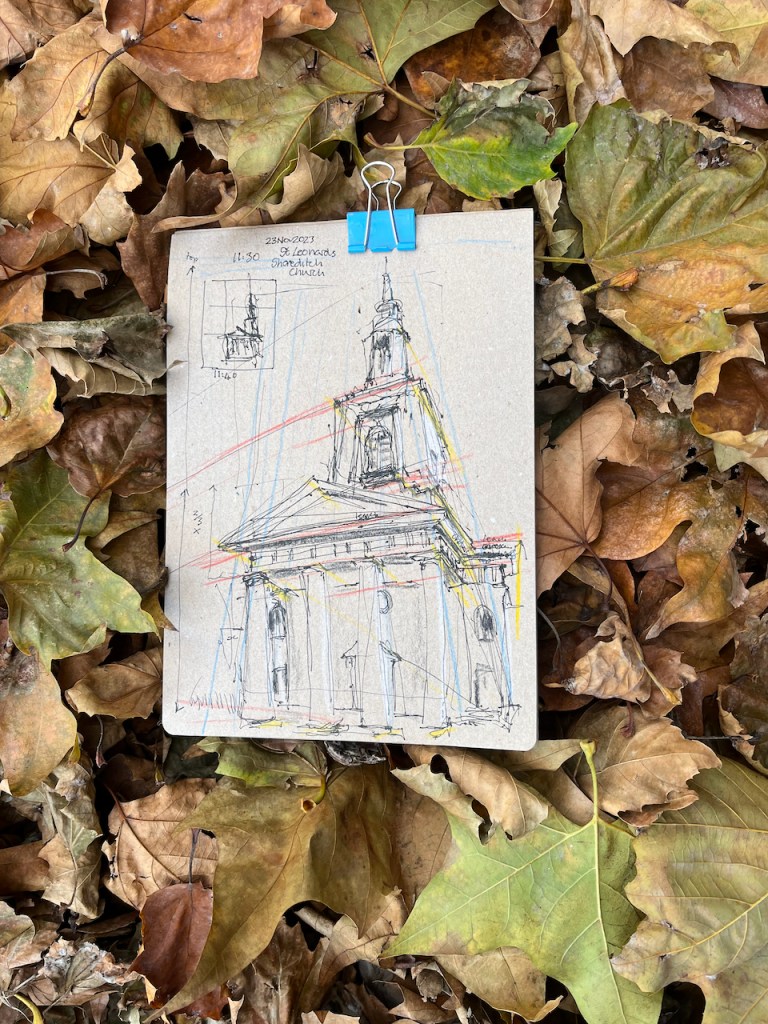
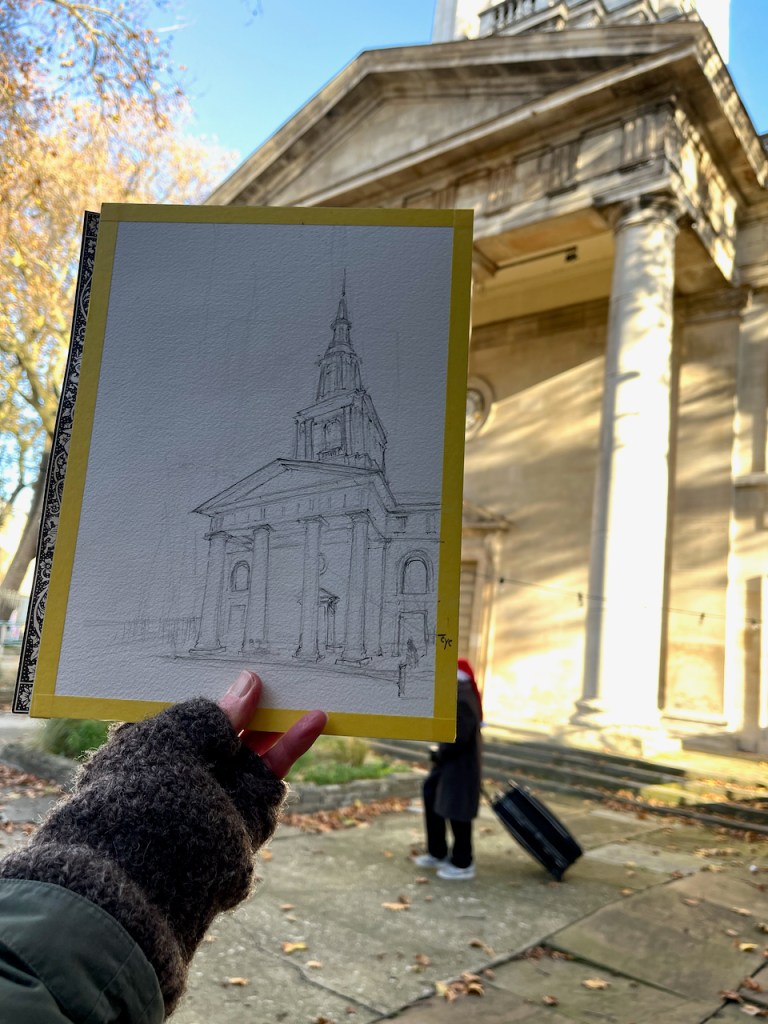
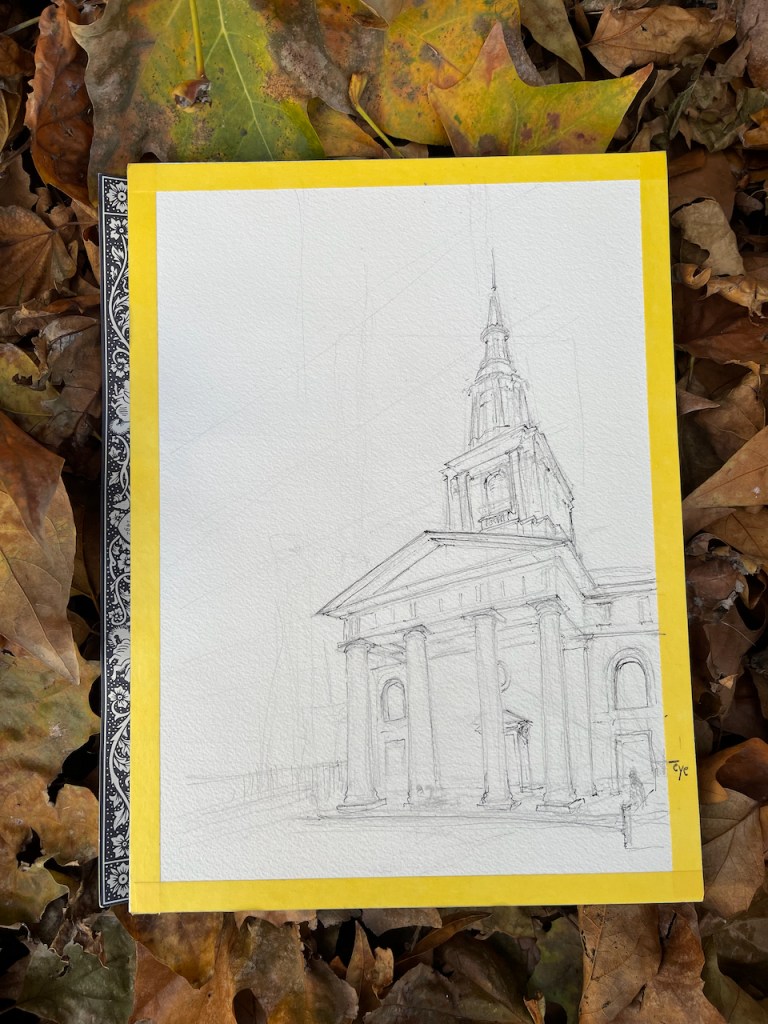
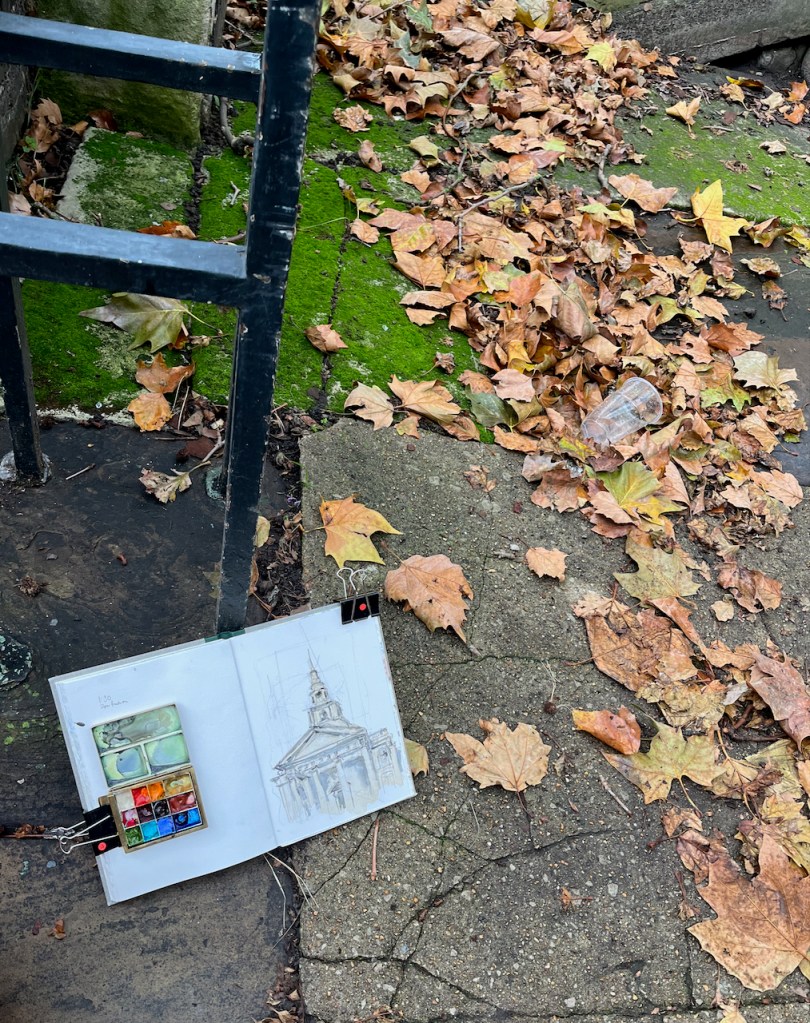
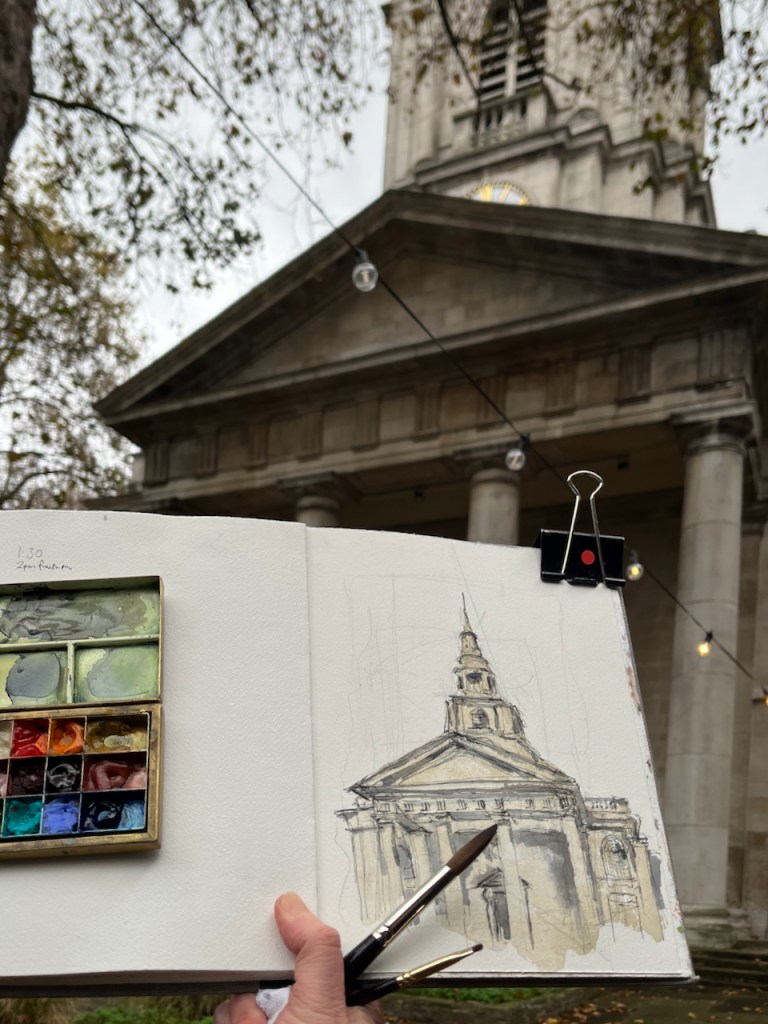
This picture was a commission. My client was keen to have this upward view showing the front of the church. I did some practice sketches to understand the tricky upward perspective.

Thank you to my client for suggesting I draw this inspiring church, and for their permission to publish the photos of the drawing online.
Here is a map showing the location:

There is a current exhibition in the Guildhall London:

“Treasures of Gold and Silver Wire”
curated by Dr. Karen Watts, Emeritus at the Royal Armouries. It celebrates the 400 anniversary of the Worshipful Company of Gold and Silver Wyre Drawers.

In that exhibition there is a cope, a cape for the Bishop of London, showing 73 London Churches. To my delight, St Leonard Shoreditch features, on the right shoulder. It was designed by British embroiderer Beryl Dean and made by needlework students of the Stanhope Institute. (https://trc-leiden.nl/trc-needles/individual-textiles-and-textile-types/commemorative-and-commissioned-textiles/silver-jubilee-cope-and-mitre)
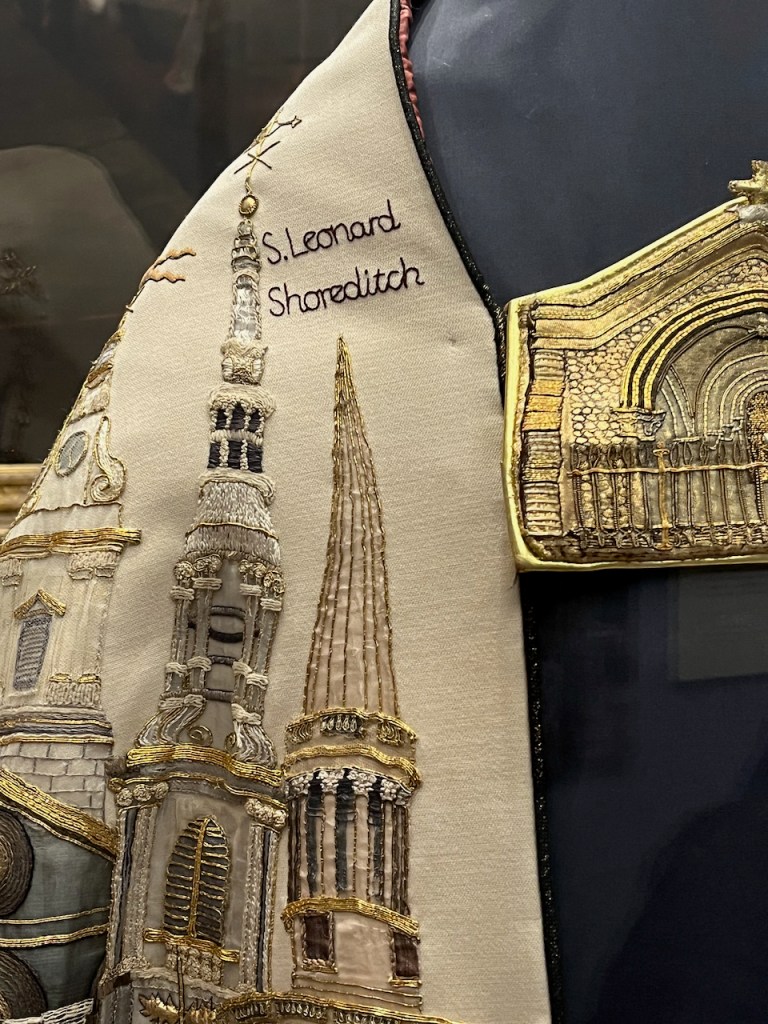
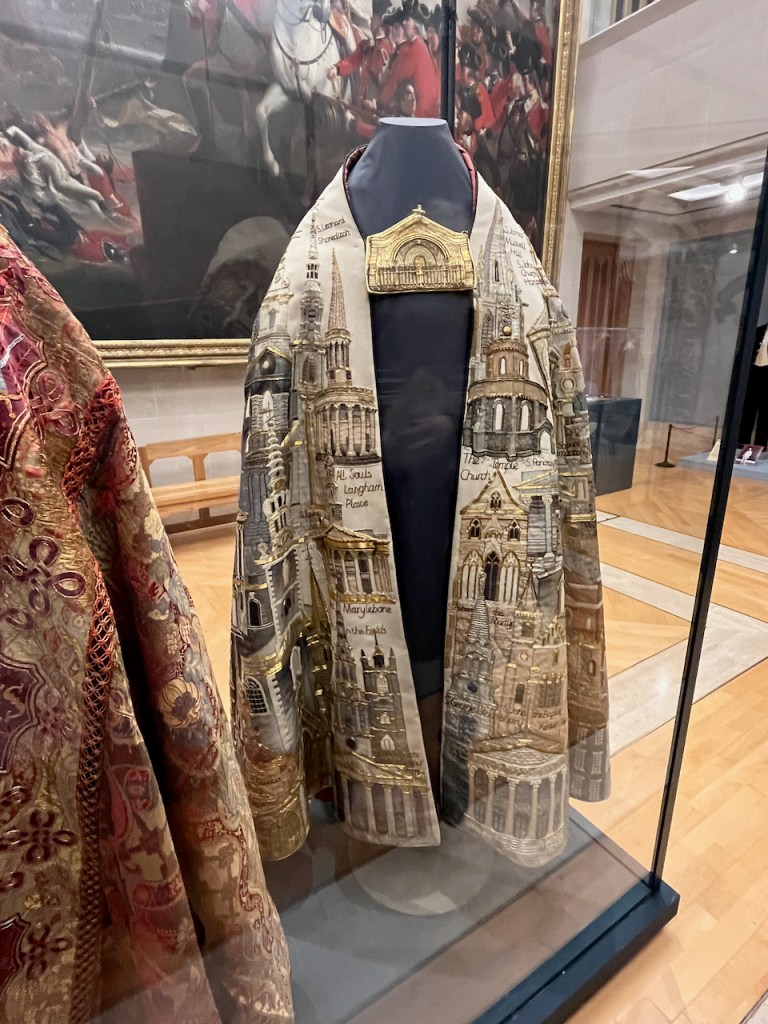
Having myself had a go at depicting those arches and columns on the spire, I am full of admiration for the embroiderers who managed to create an accurate image in wire thread. Hugely accomplished! The exhibition is on until 31st December 2023- well worth seeing.
St Botolph-without-Bishopsgate, EC2

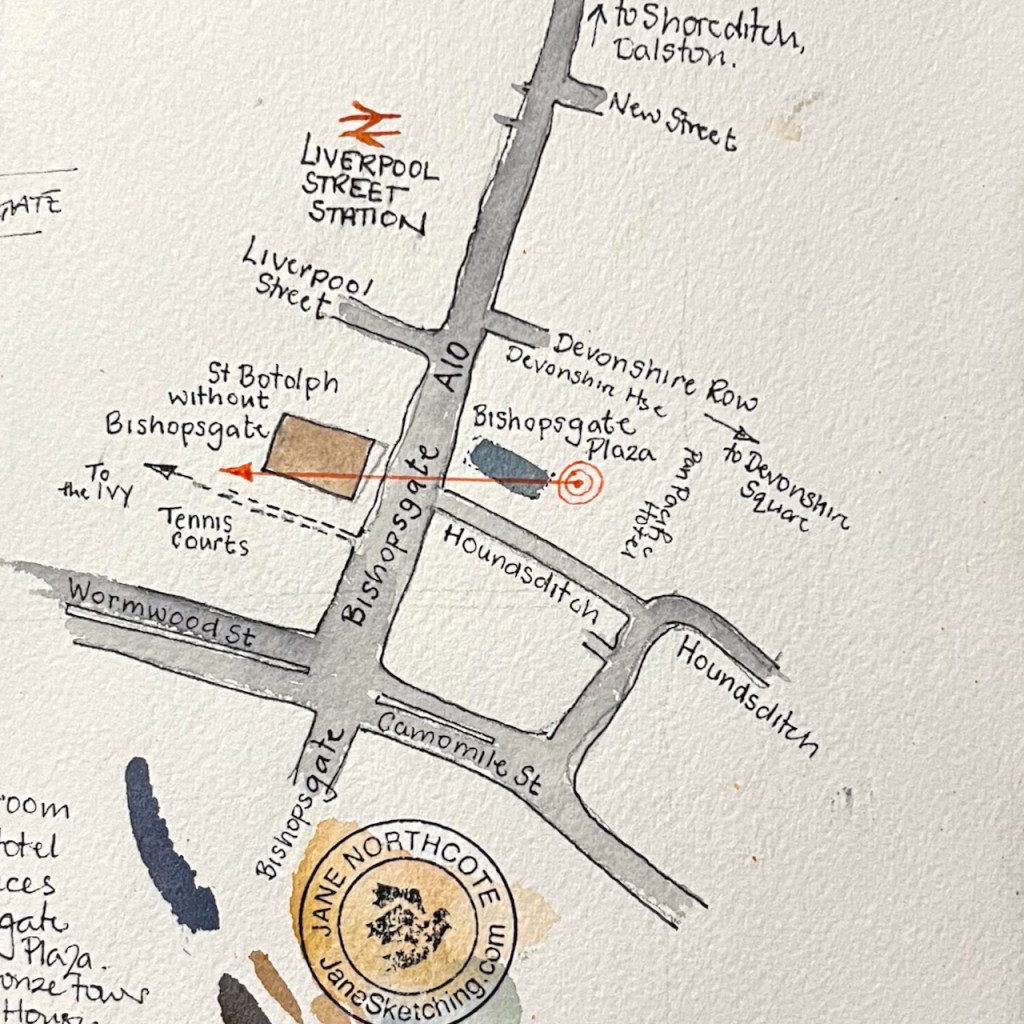
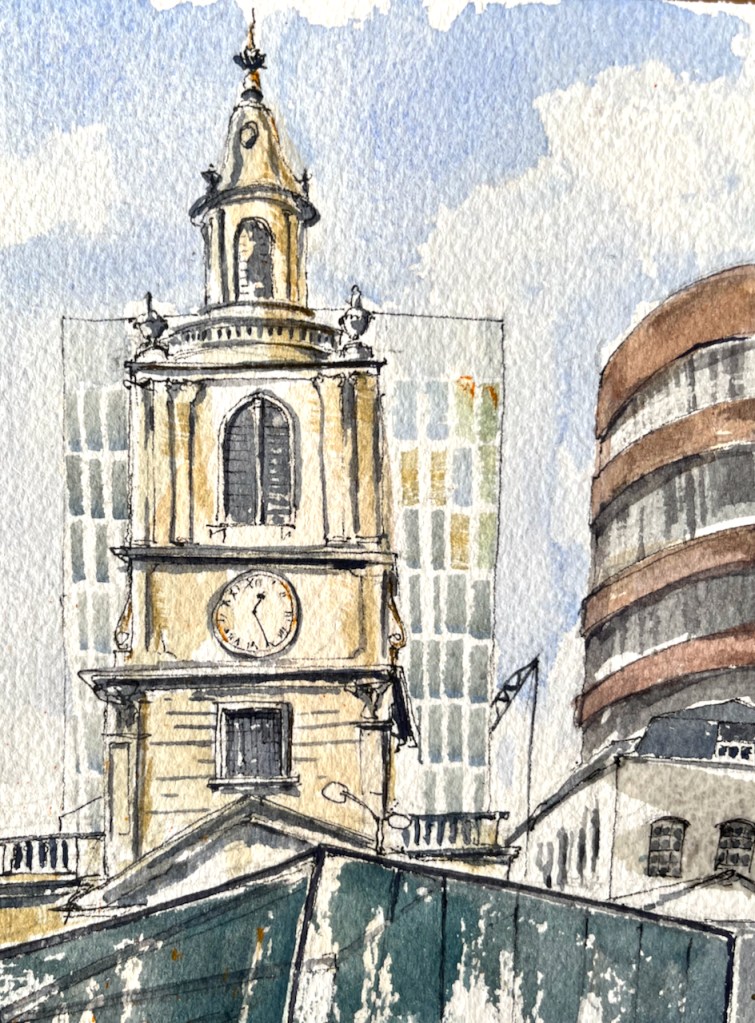
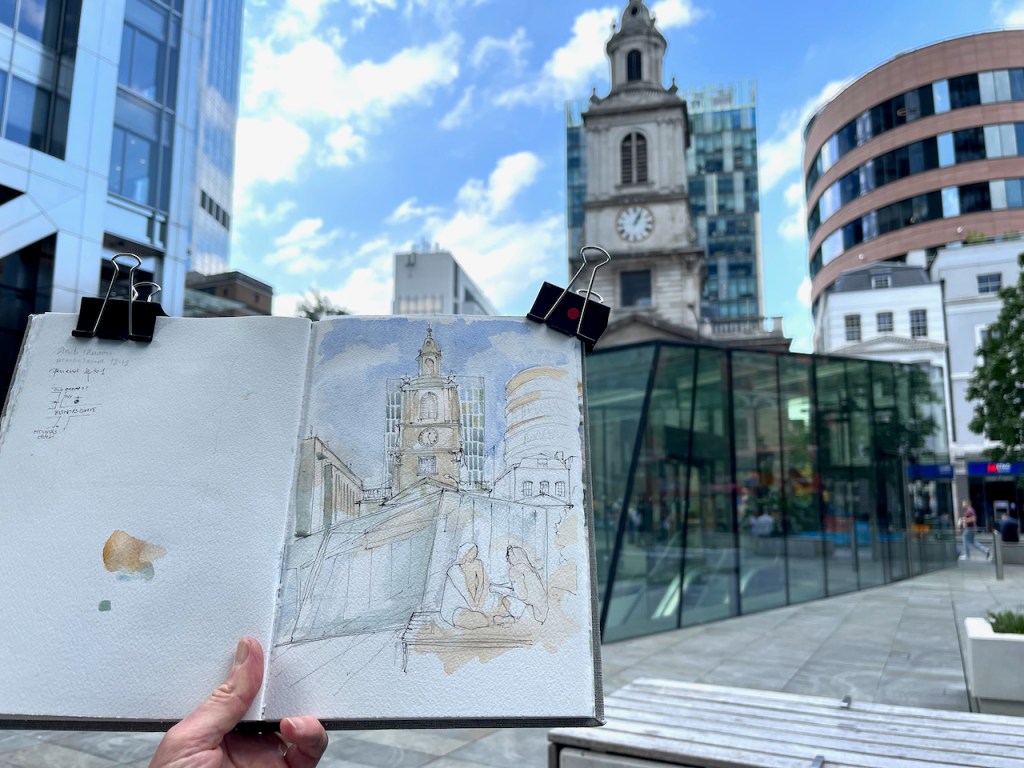
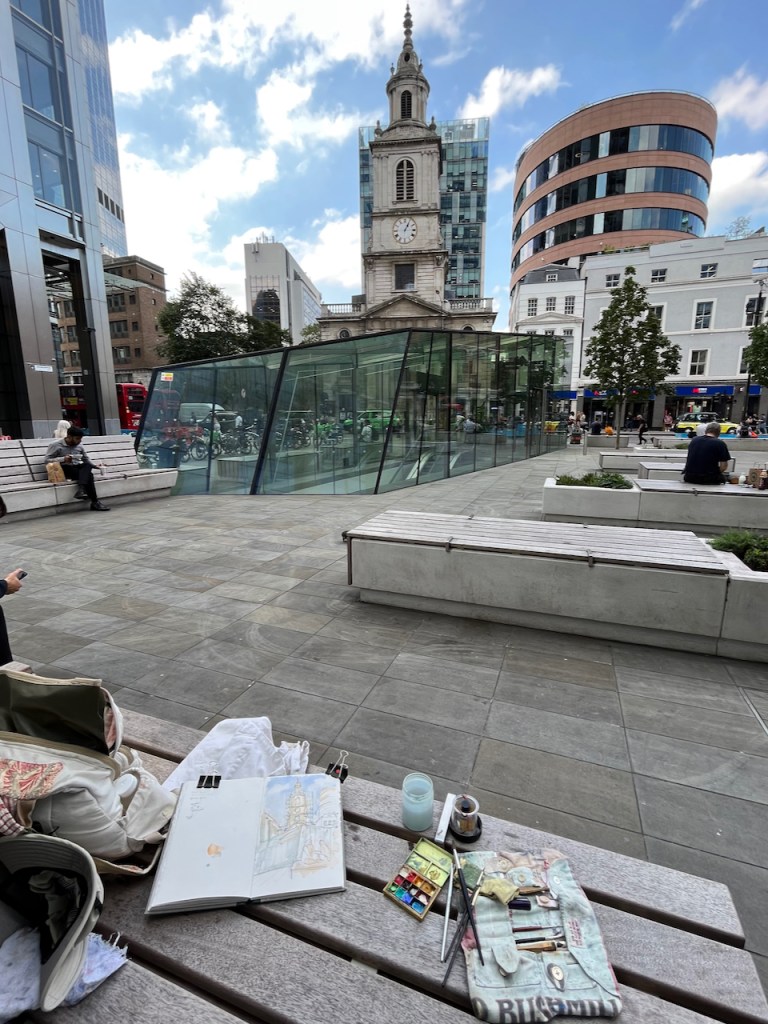
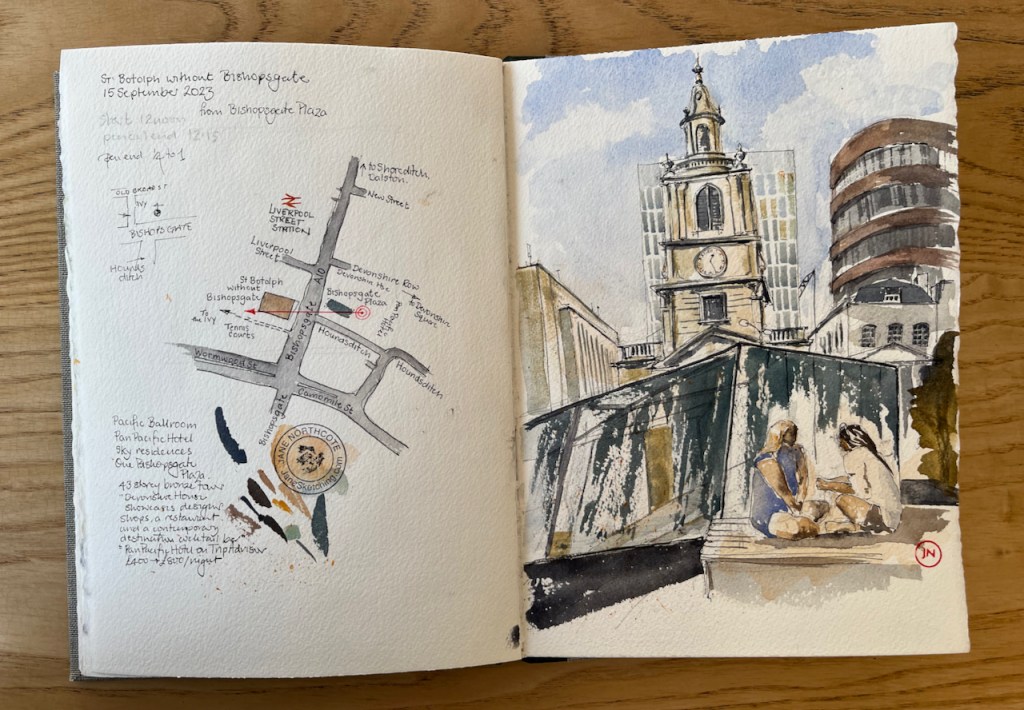
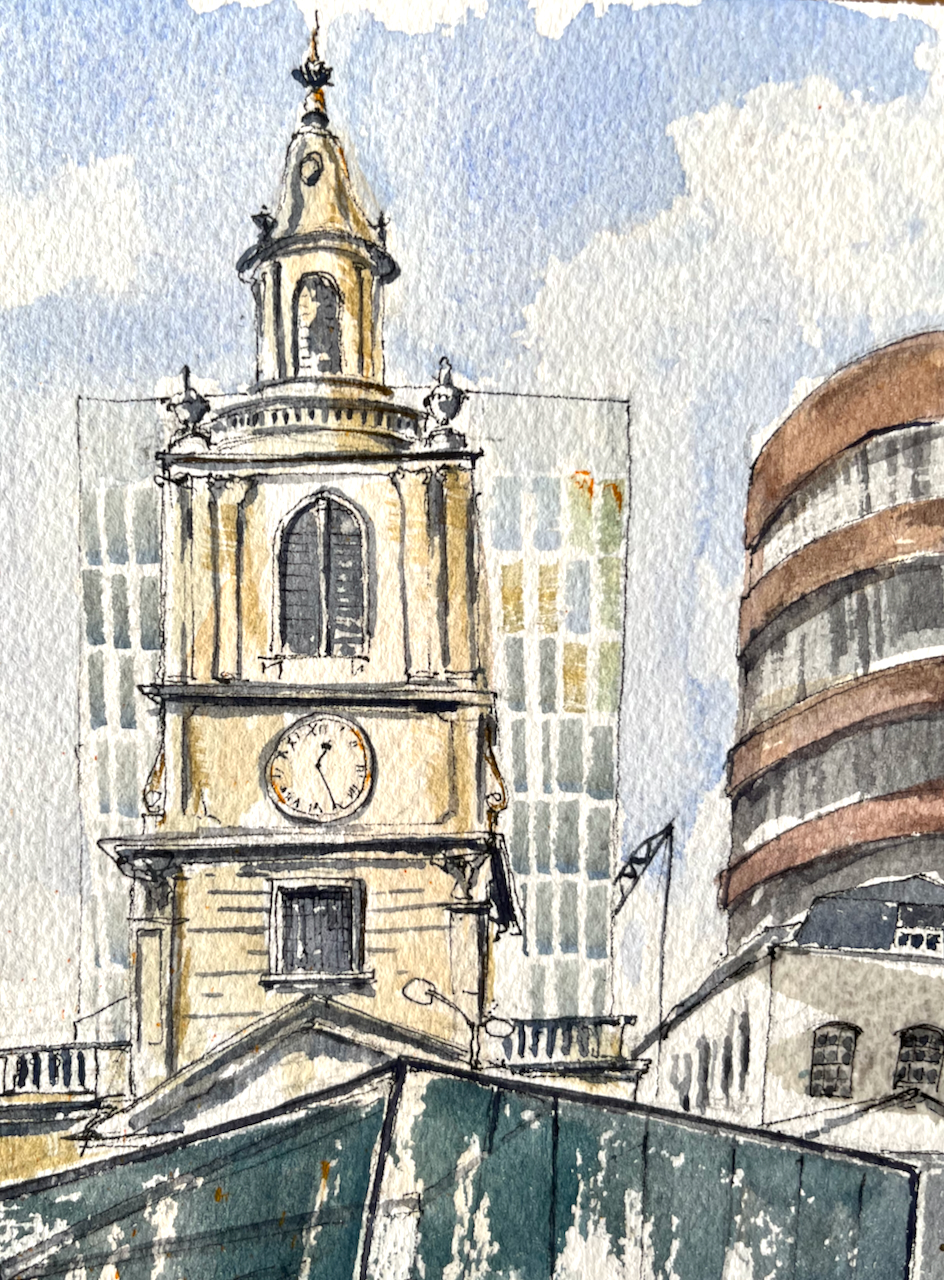
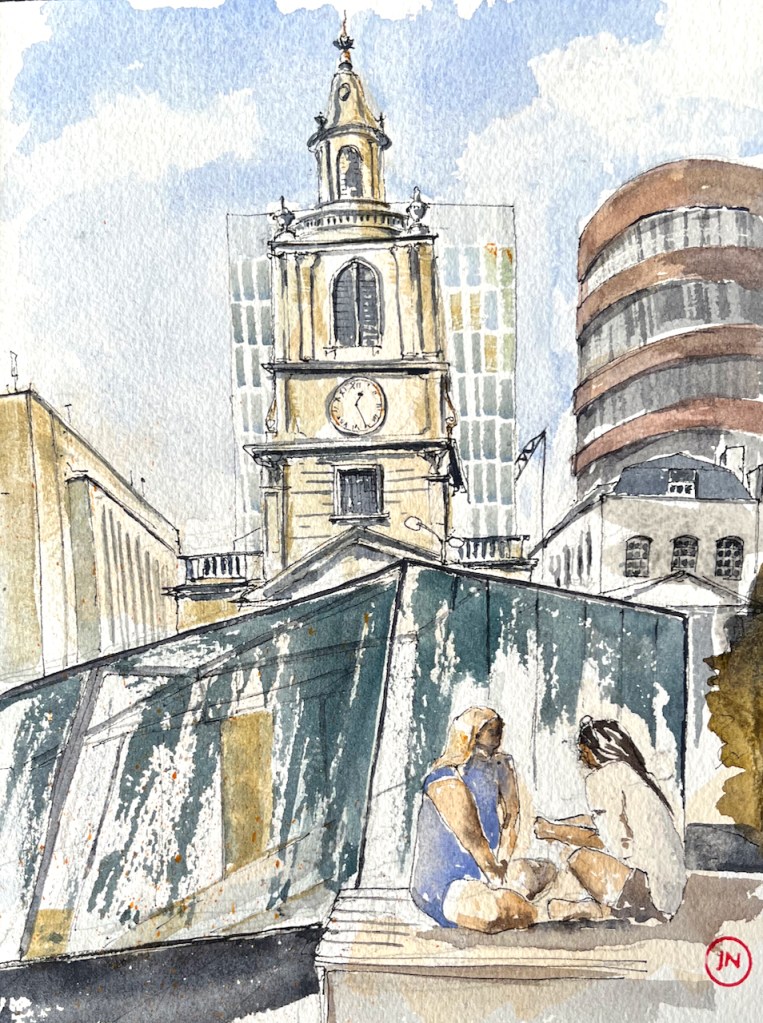
Bishopsgate Plaza is on the East side of Bishopsgate, near Liverpool Street. From the seats there, here is the view of St Botolph-without-Bishopsgate. I sketched amongst the many people enjoying the sun at lunchtime.

St Botolph-without-Bishopsgate, EC2. 15th September 2023, 1pm. 10″x 7″ in sketchbook 13

The current church was constructed in 1729, to the designs of James Gould. There has been a place of Christian worship on this site since Roman times. The parish registers are complete from 1558 according to the church’s website.

Viewed from Bishopsgate Plaza, the church is all but submerged in the surrounding buildings. The large glass structure is the entrance to the “Pacific Ballroom”. This is part of the Pan Pacific Hotel, which was behind me as I sketched.

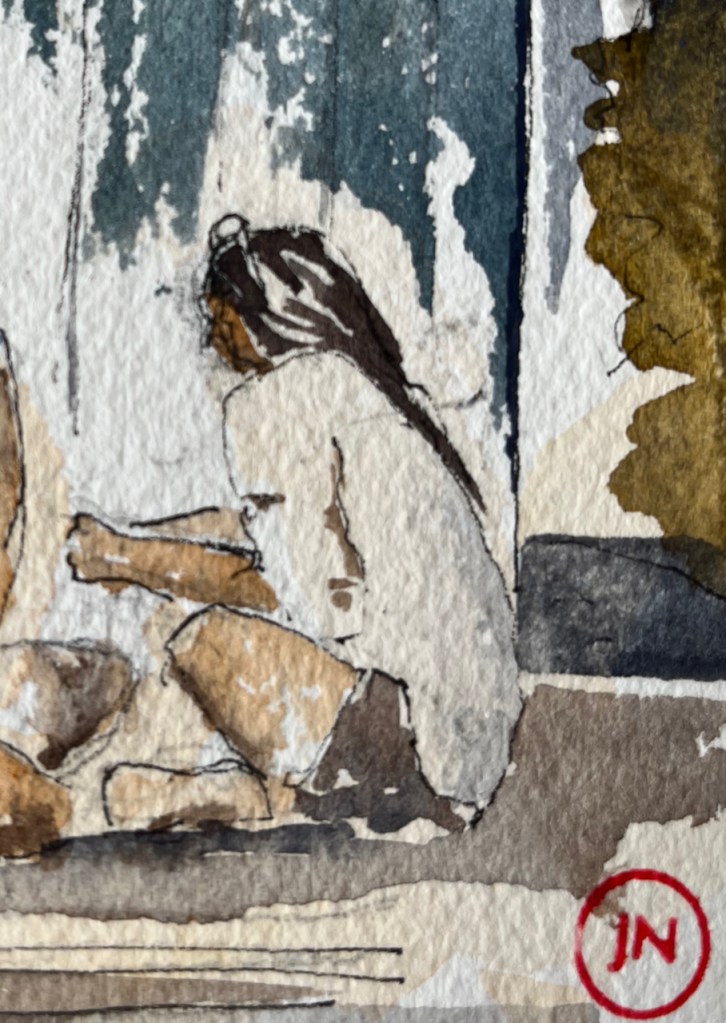
I find it quite hard to draw people, but I wanted to include the discussion between the two women. Their lively conversation contrasted with the stillness of the church, and the enormity of the buildings all around. They created a little private world between themselves.

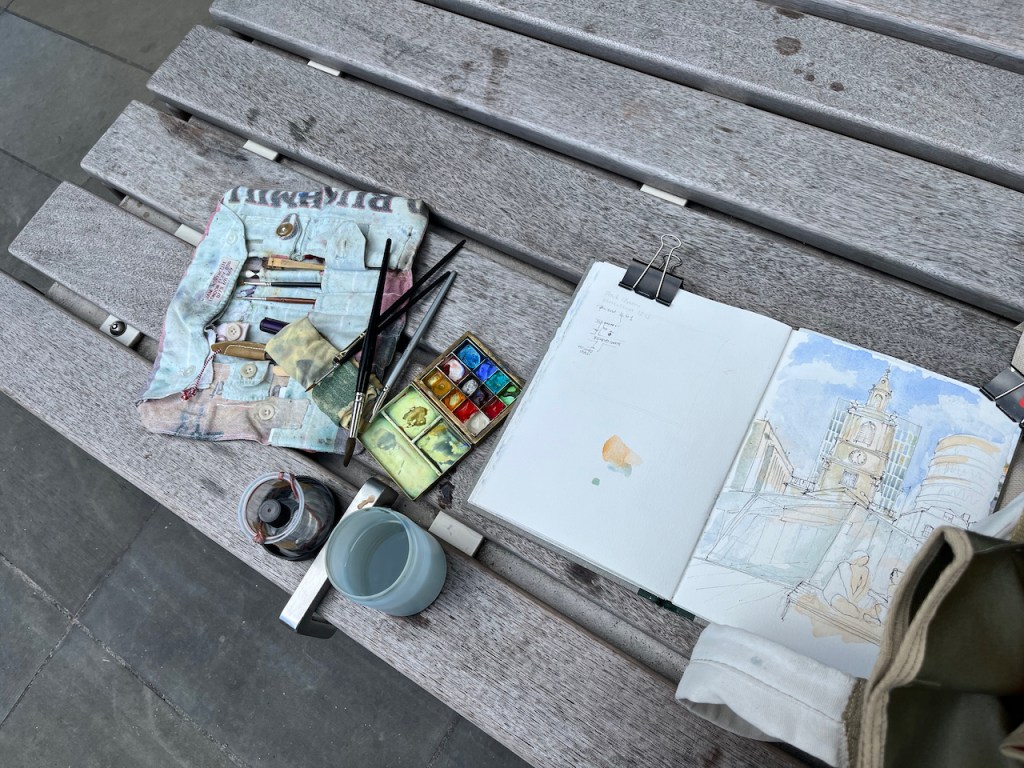
Here is work in progress on the sketch:

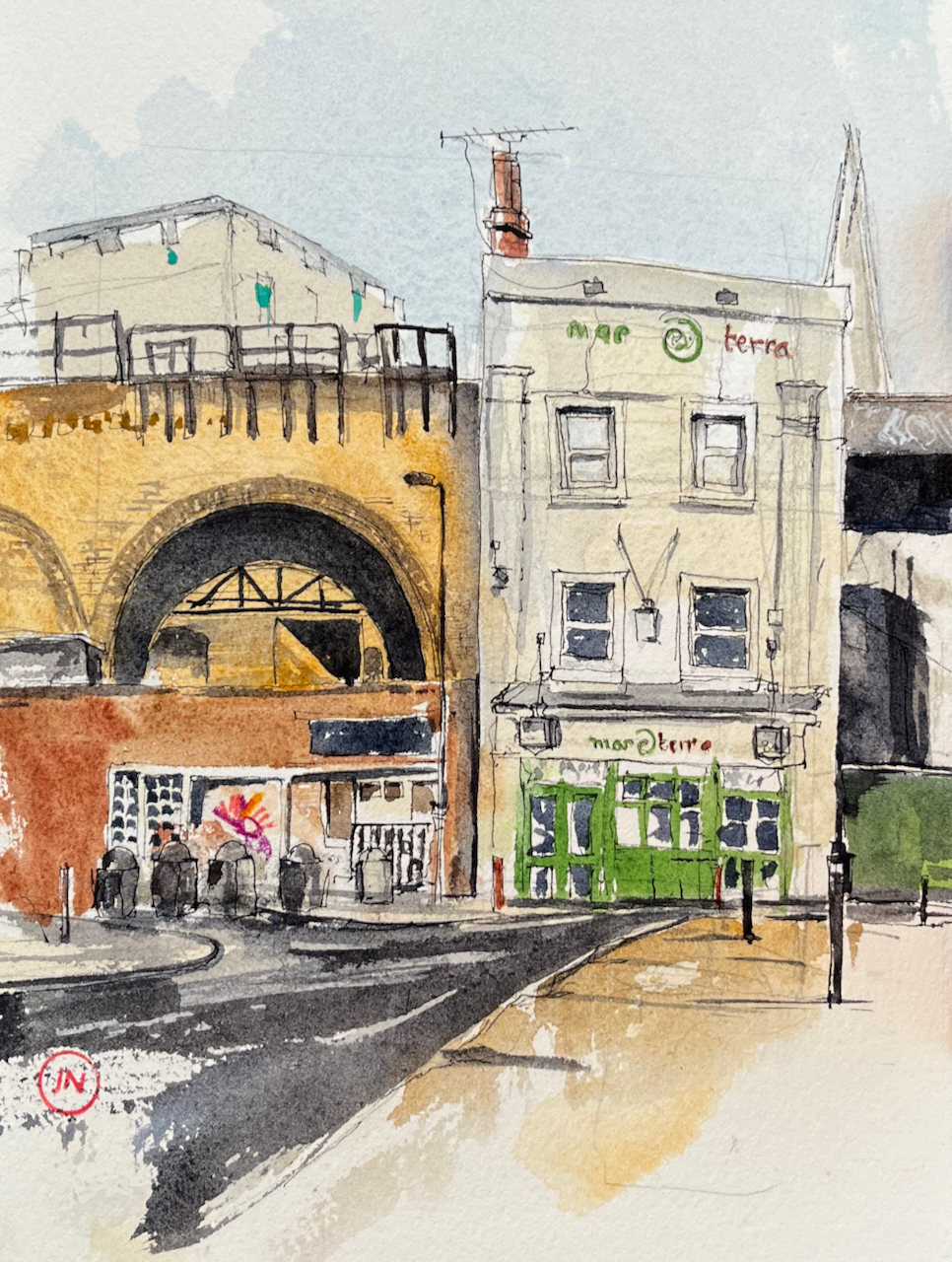
Mar i Terra, Gambia Street, SE1

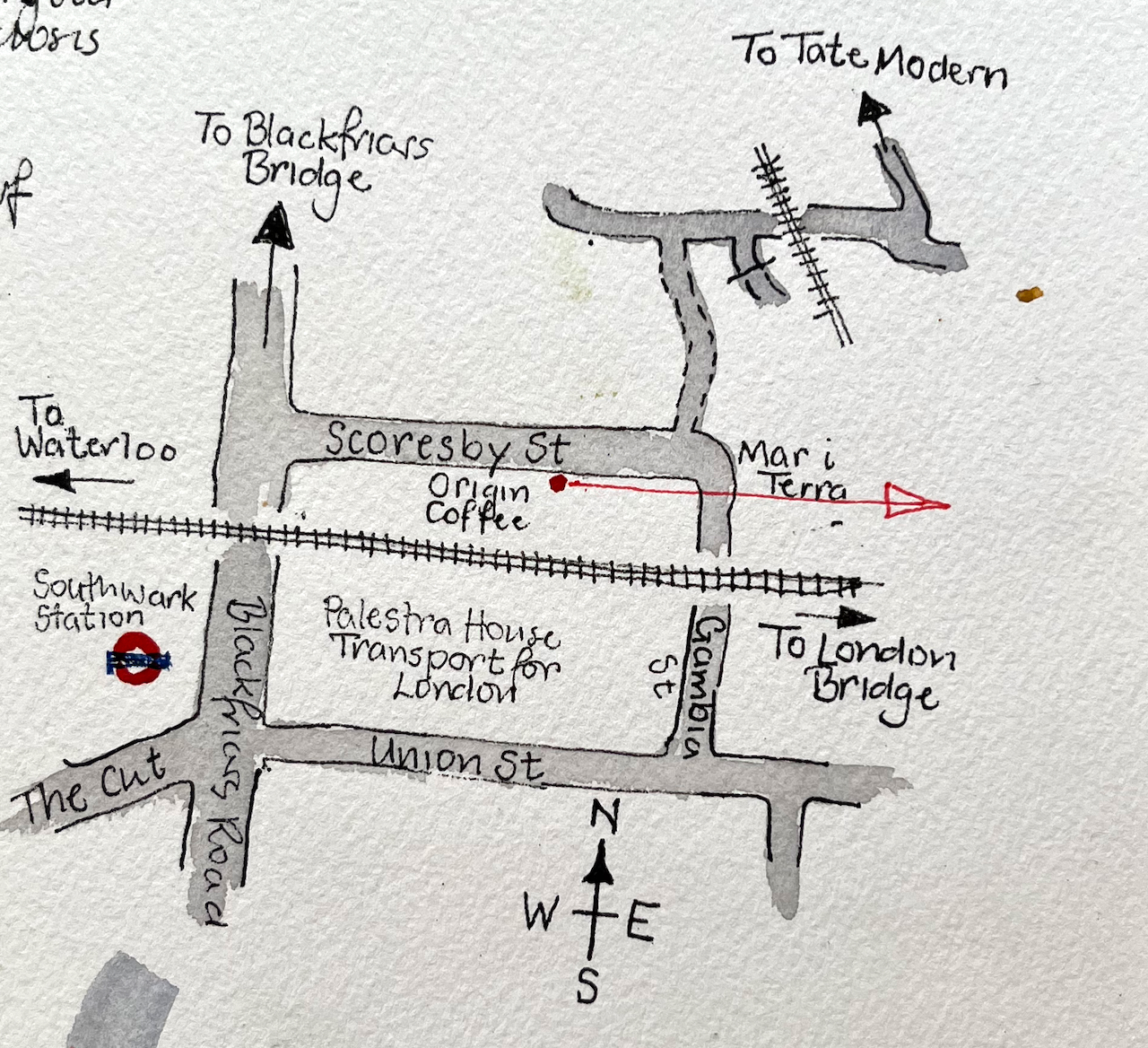
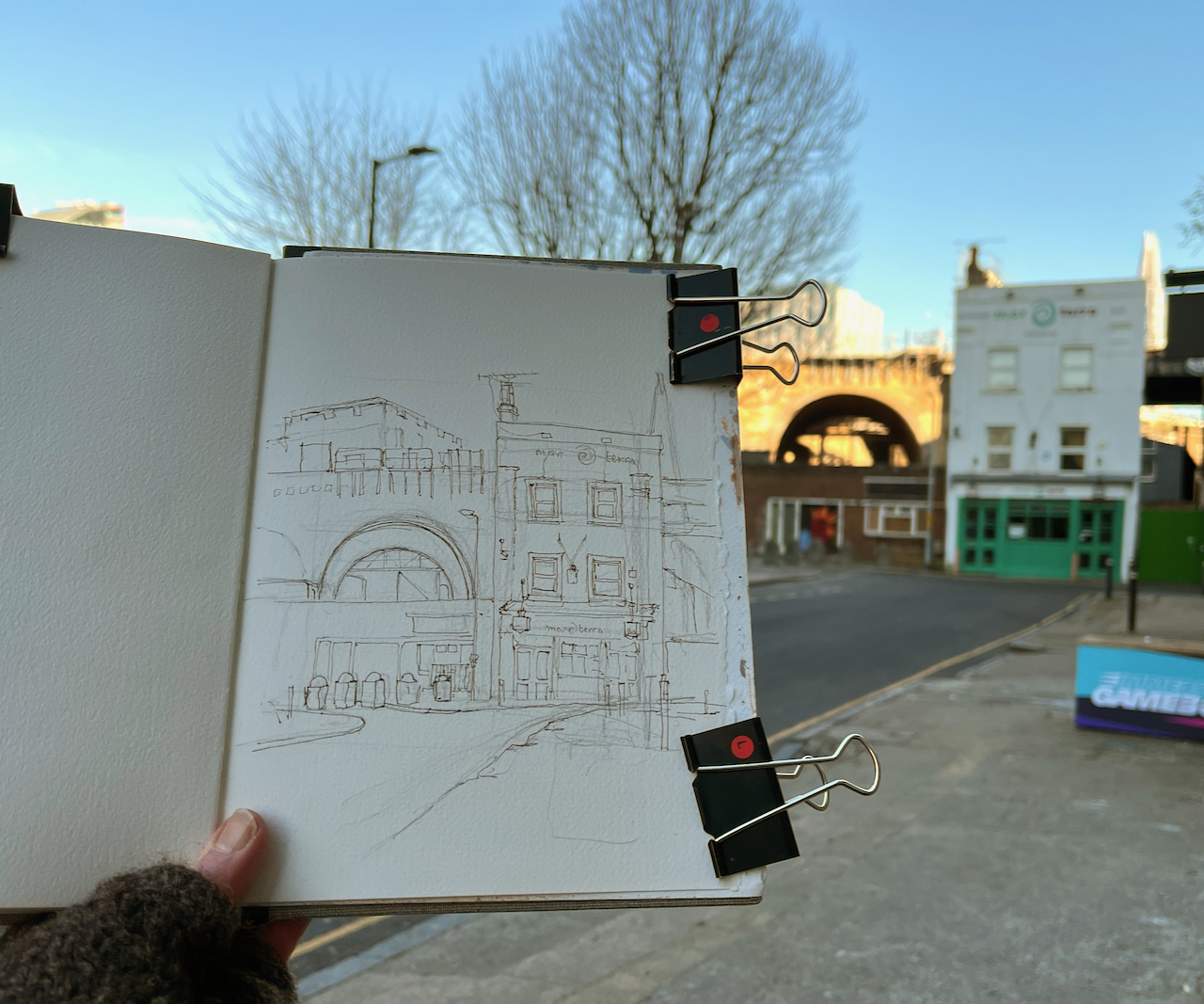
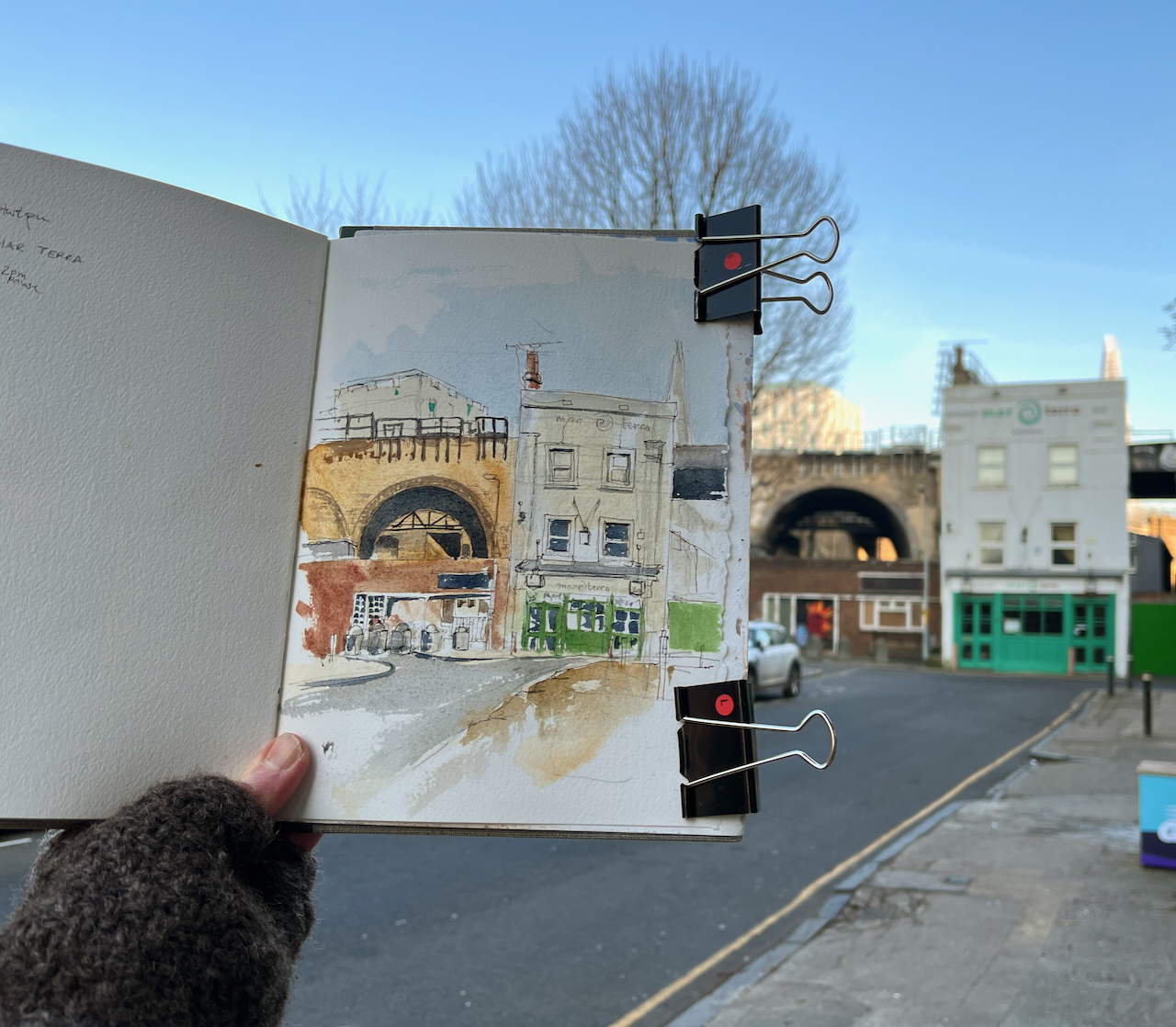
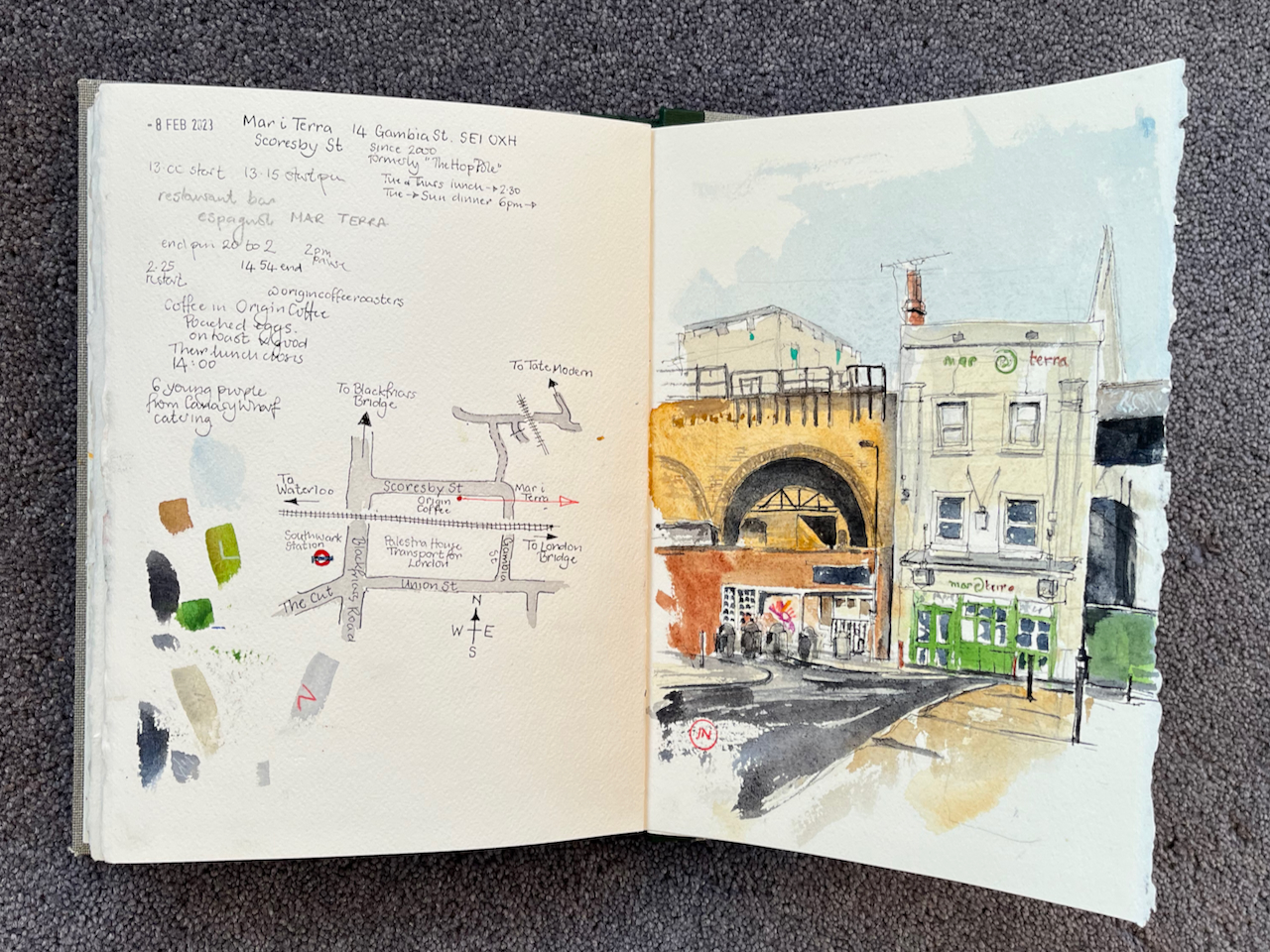
Here is the bar and tapas restaurant “Mar i Terra”, cosily tucked away in a back street near Southwark Station.

“Mar i Terra” Gambia Street SE1, sketched from Scoresby Street. 7″ x 9″ in Sketchbook 12.

There are magnificent Victorian railway arches looping all around, and 21st century buildings in the background, but this building stands defiantly, self-contained and functional.

The restaurant is open Tuesday to Sunday for dinner. It also serves lunch on Tuesdays and Thursdays. I was sketching it on a Wednesday so I sought lunch elsewhere, and discovered the wonderful “Origin Coffee” in Scoresby Street.

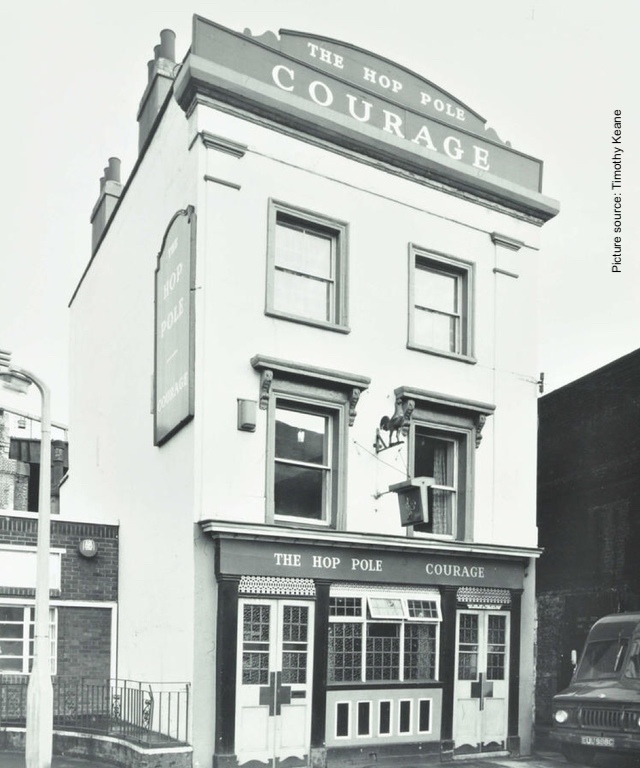
According to their website “Mar i Terra” has been serving the people of the neighbourhood since the year 2000. Up until 1999 this building was “The Hop Pole” pub.

The Hop Pole in about 1972. Image from “https://www.closedpubs.co.uk/london/se1_southwark_hoppole.html”

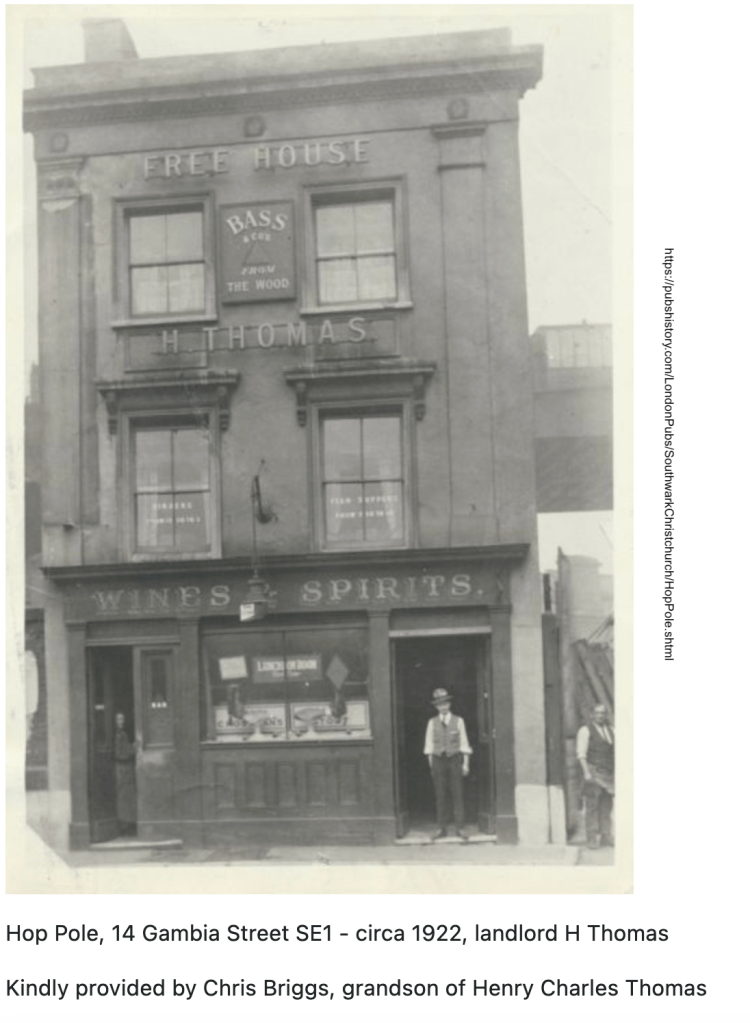
According to the “Pub History” site, victuallers were recorded at this site in 1791. So it was a pub for nearly 200 years.

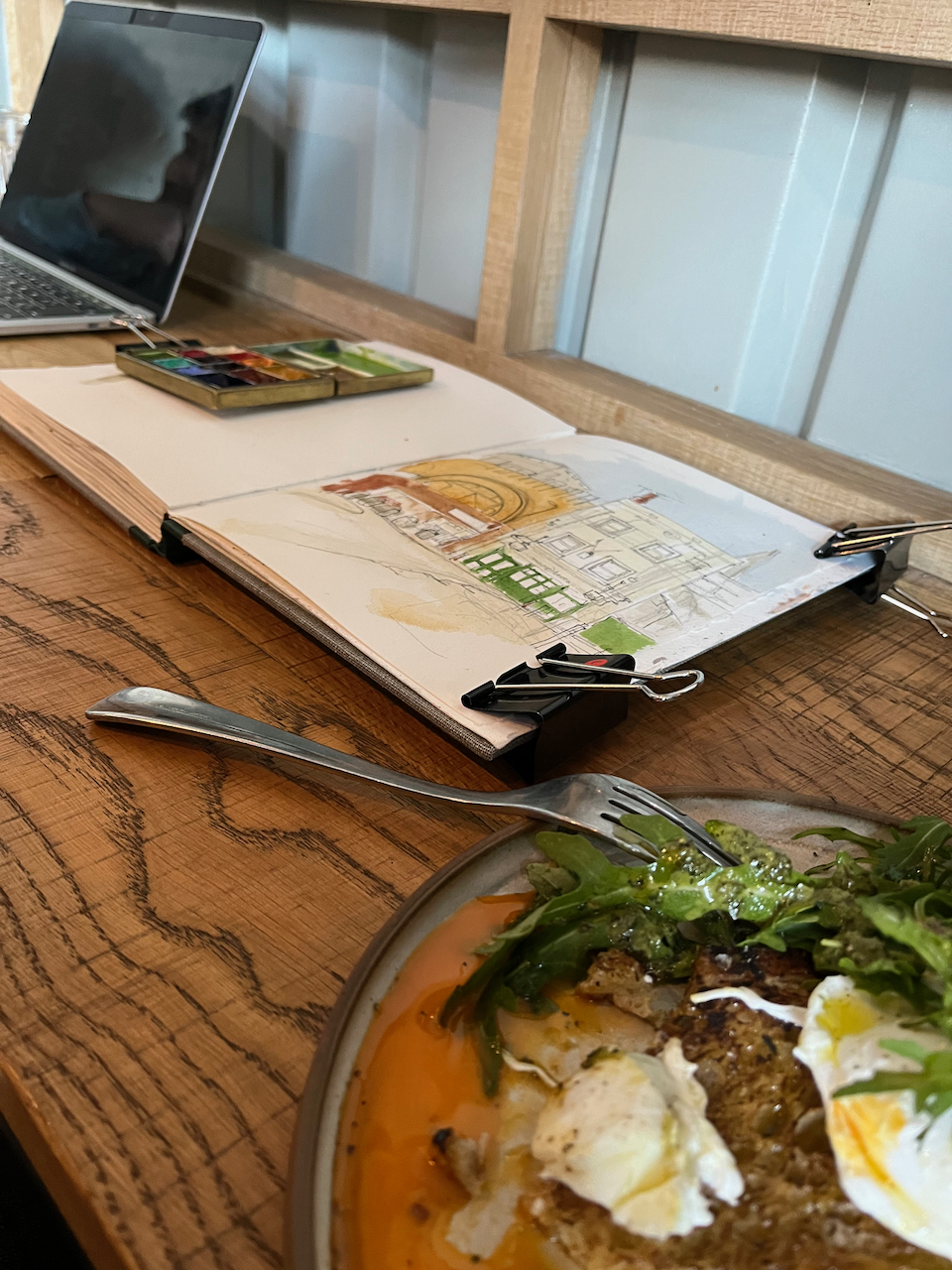
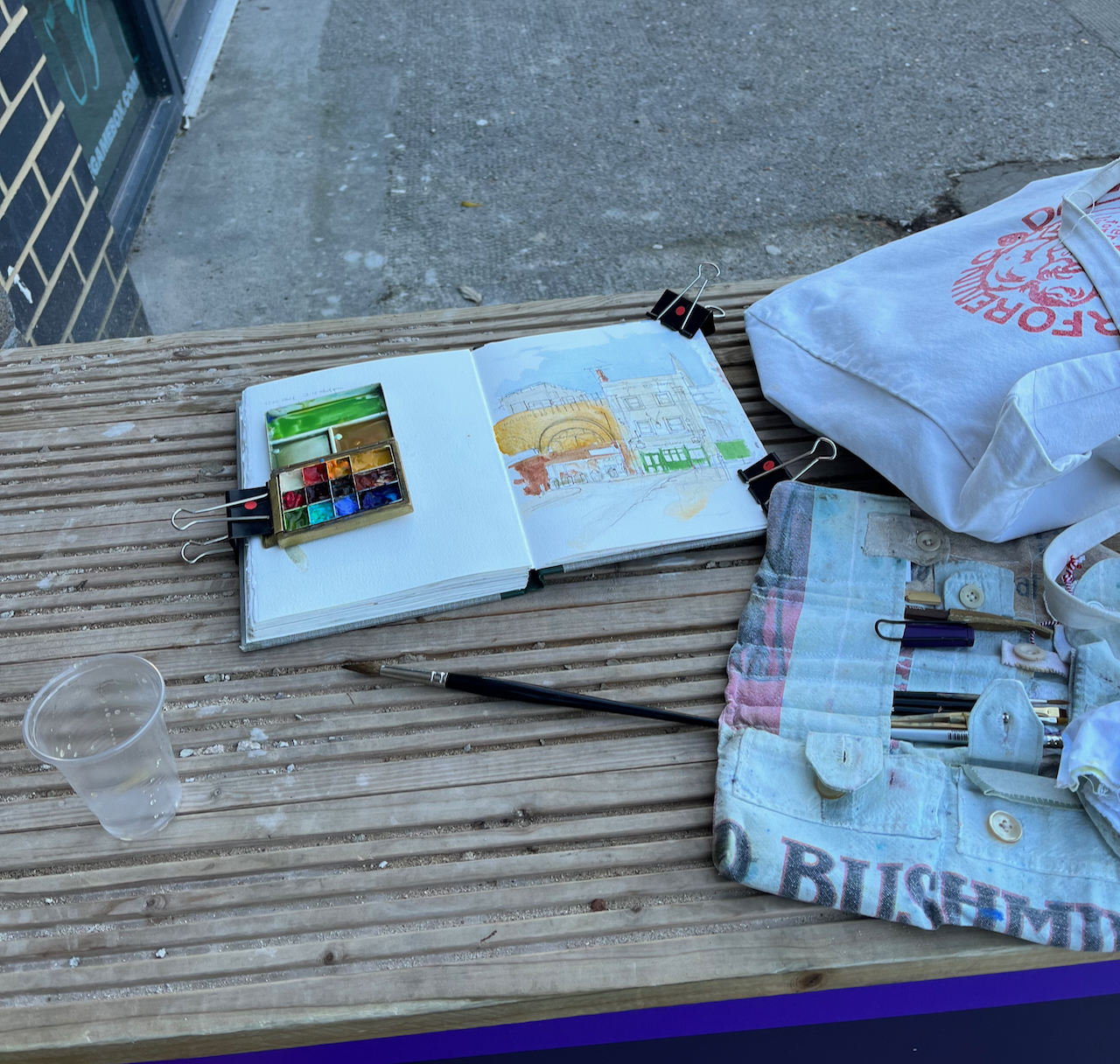
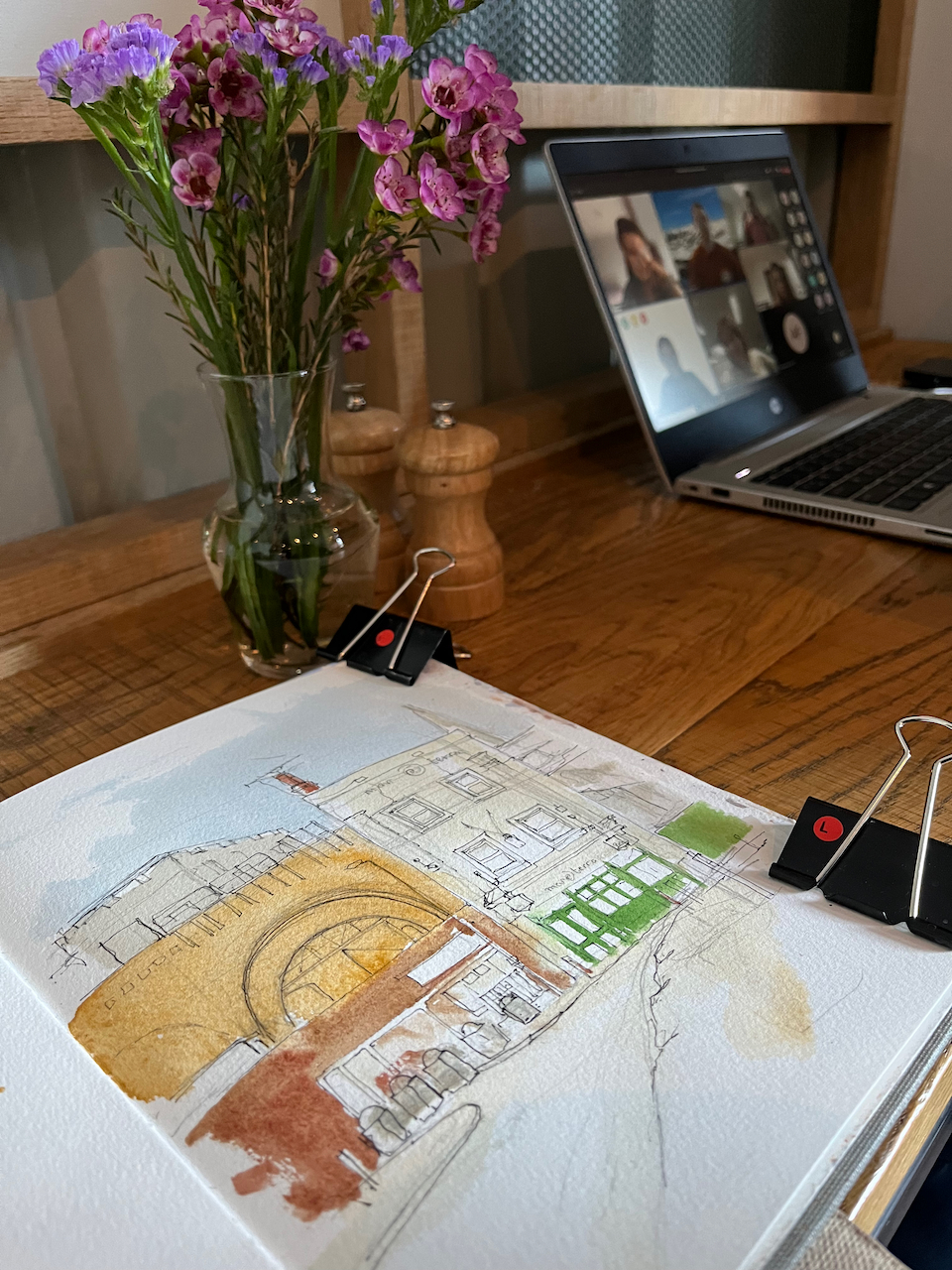
Here is work on progress on the drawing.

Colours:

  • Sky: Ultramarine Blue and Cobalt teal blue
  • Brickwork: Mars Yellow with some Fired Gold Ochre
  • Greys and blacks: Ultramarine Blue and Burnt Umber
  • Green paintwork: Serpentine Genuine moderated with Cobalt Teal Blue
  • Graffiti added with a red crayon

Here’s an image from the Pub History website. I can just read that the notice on the big window says “Luncheon Room”. So the Mar i Terra continues the tradition, on Tuesdays and Thursdays. The railway bridge behind, on the right of the photo, is still there, too, as well as many of the features of the front of the pub. Amazingly, the door layout seems to have endured. Is that Mrs H Thomas standing behind the door on the left?

St Martin-in-the-Fields, WC2

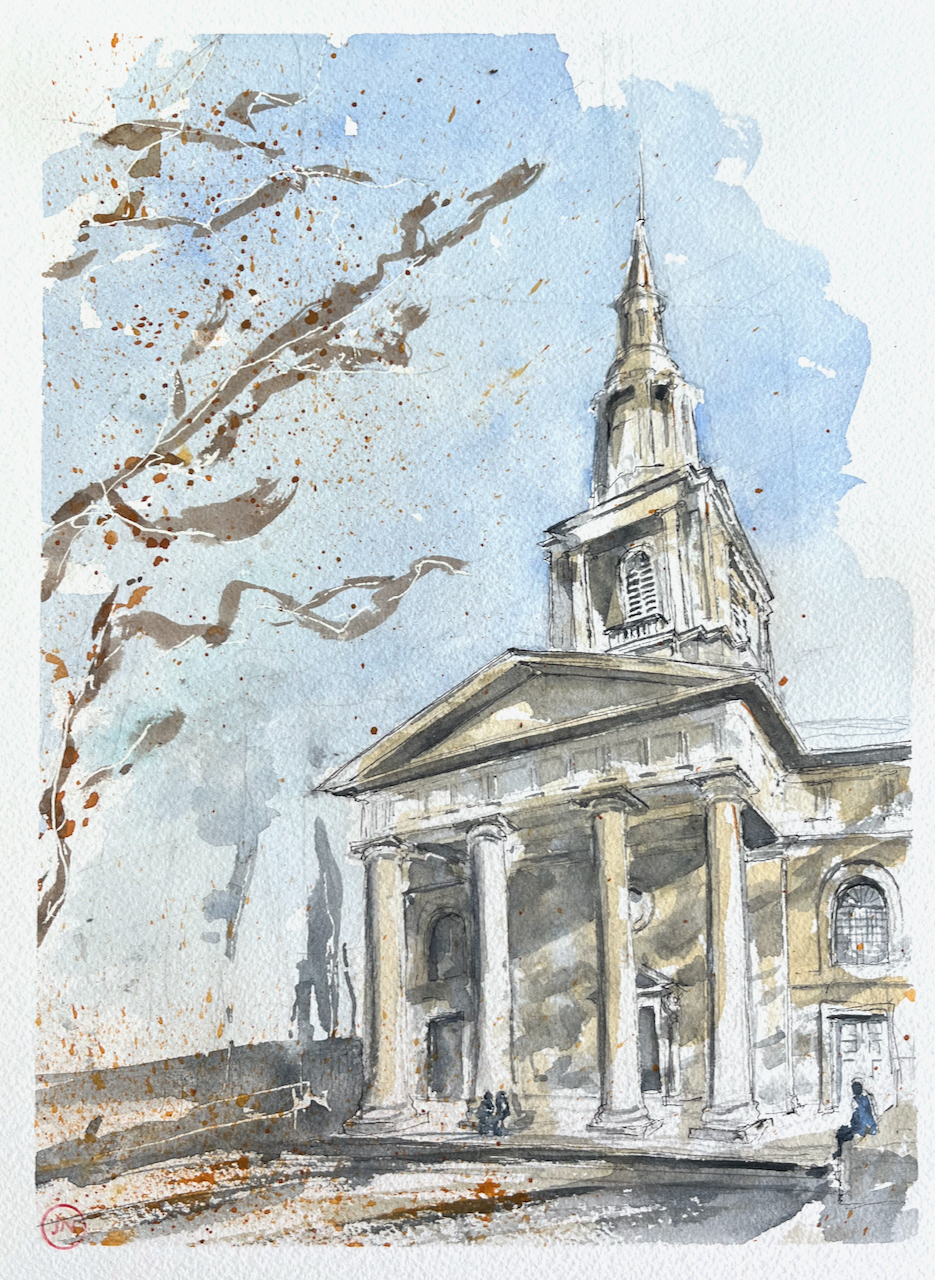
On the way back from a visit to the West End, I passed St-Martin-in-the-Fields, standing out against the cold sky.

St Martin-in-the-Fields, Trafalgar Square. Sketched 2nd Dec 2022, in sketchbook 12

The statue in the foreground, left, is the Edith Cavell Memorial, seen from the back. Edith Cavell (1865-1915) was a British nurse. In German-occupied Belgium, guided by her principles of humanity and her Christian faith, she provided medical care to soldiers irrespective of which side they were on. She was executed by a German firing squad 1915, because she had helped Belgian, British and French soldiers to escape the German occupation and reach Britain. Her grave is in Norwich Cathedral.

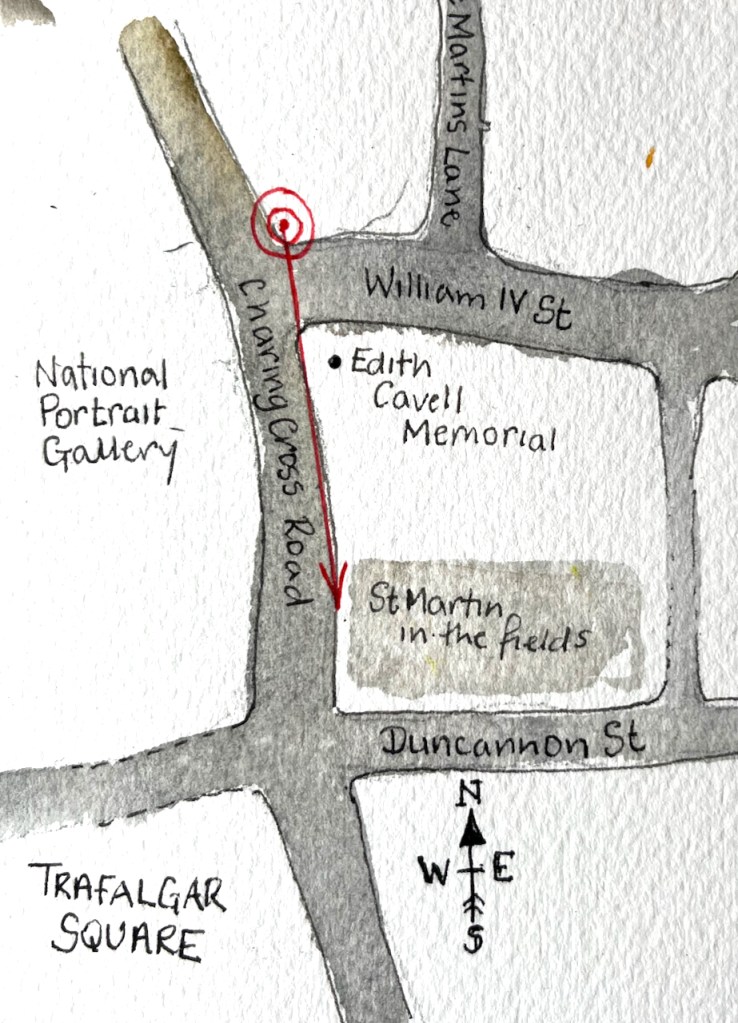
I sketched standing on a corner of the Charing Cross road, see map above. This turned out to be a very noisy location. The National Portrait Gallery is being refurbished and there was continuous drilling and banging. Buses and cars ground their gears, and thundered past, rushing through the traffic lights to shriek to a halt at the next junction.

But St-Martin-in-the-Fields rose above it all. The inscriptions which faced me on the Edith Cavell Memorial were: “Determination”, “Fortitude”.