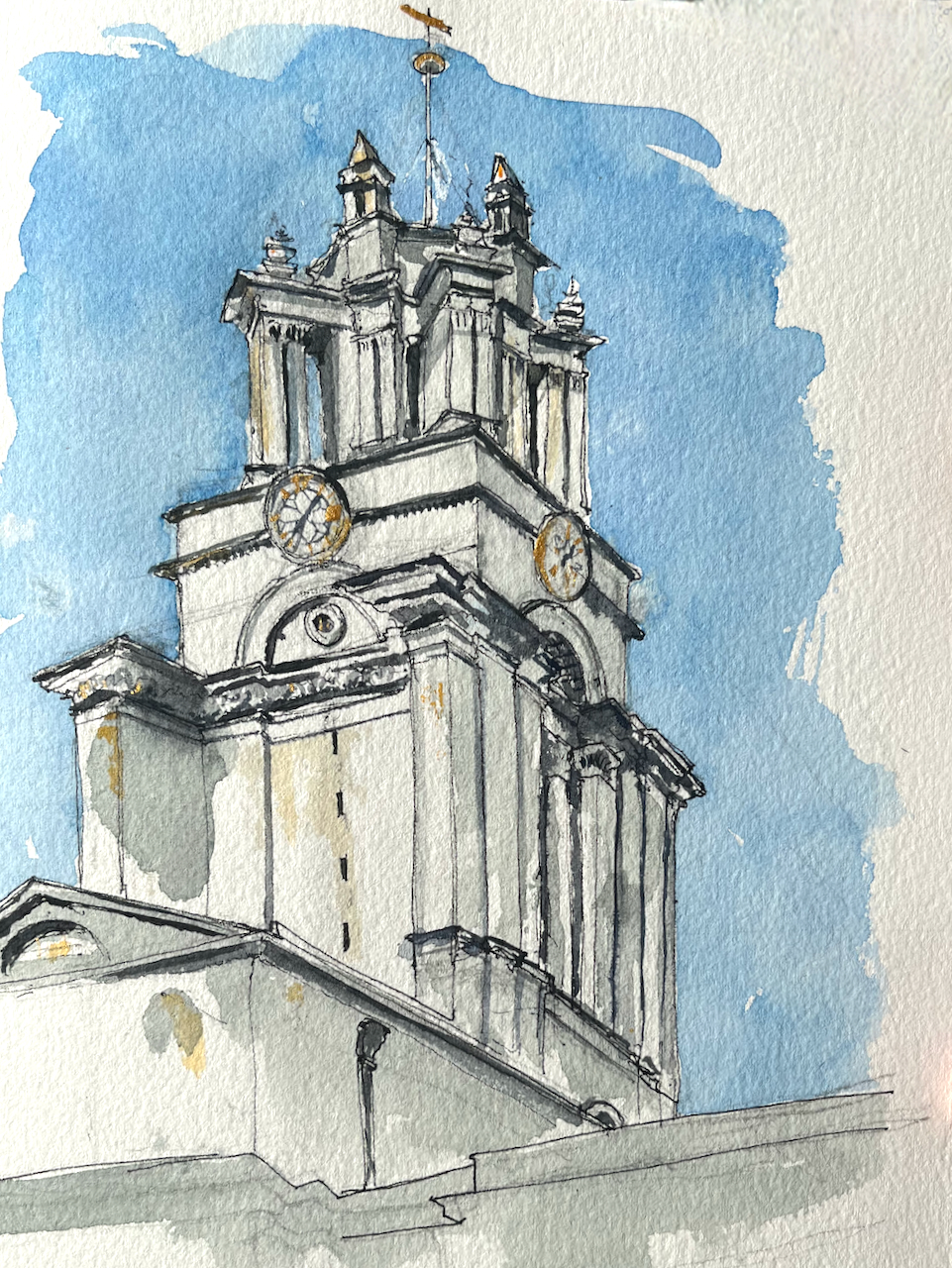
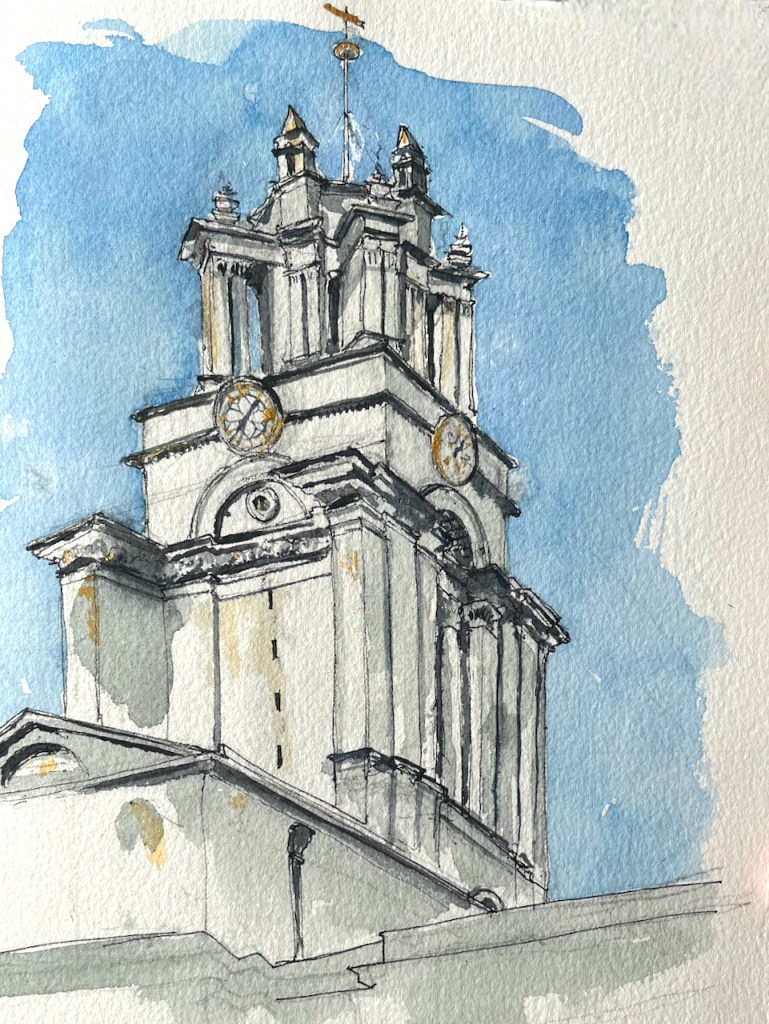
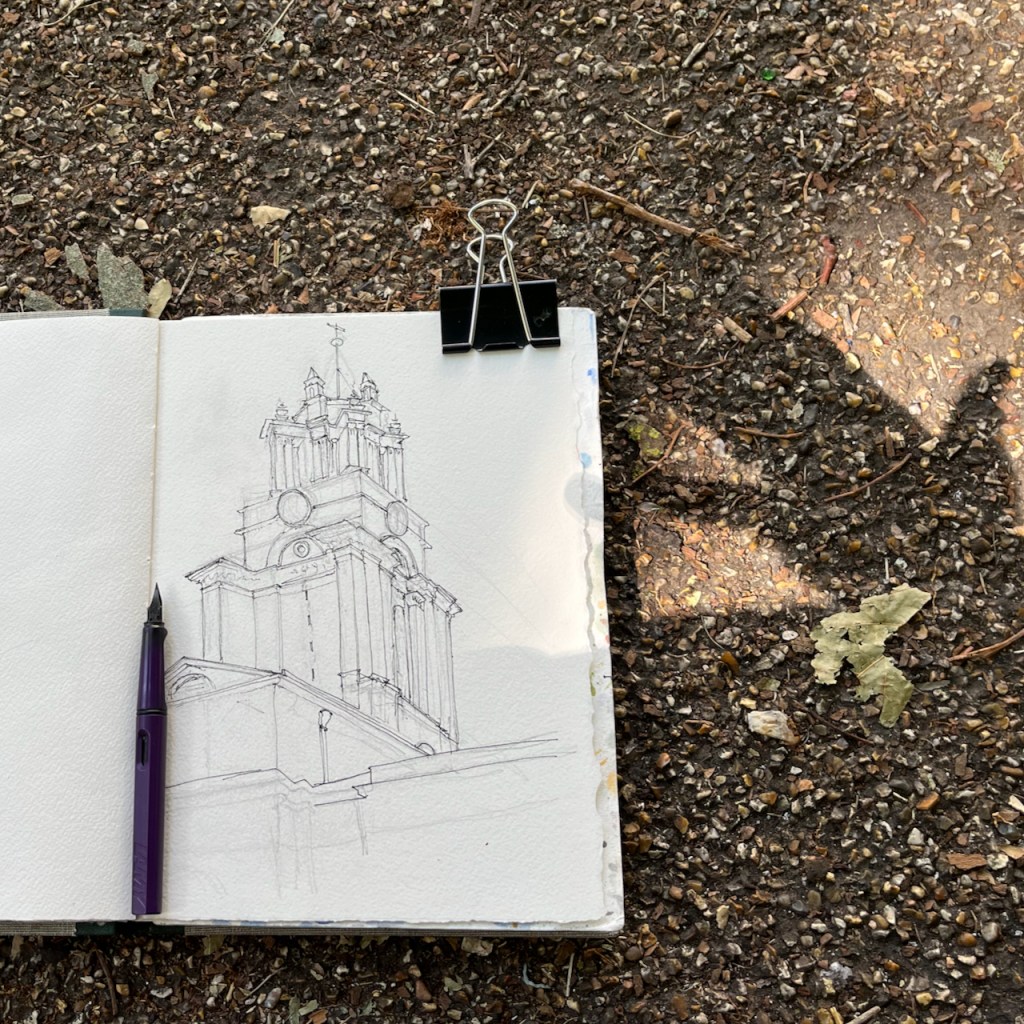
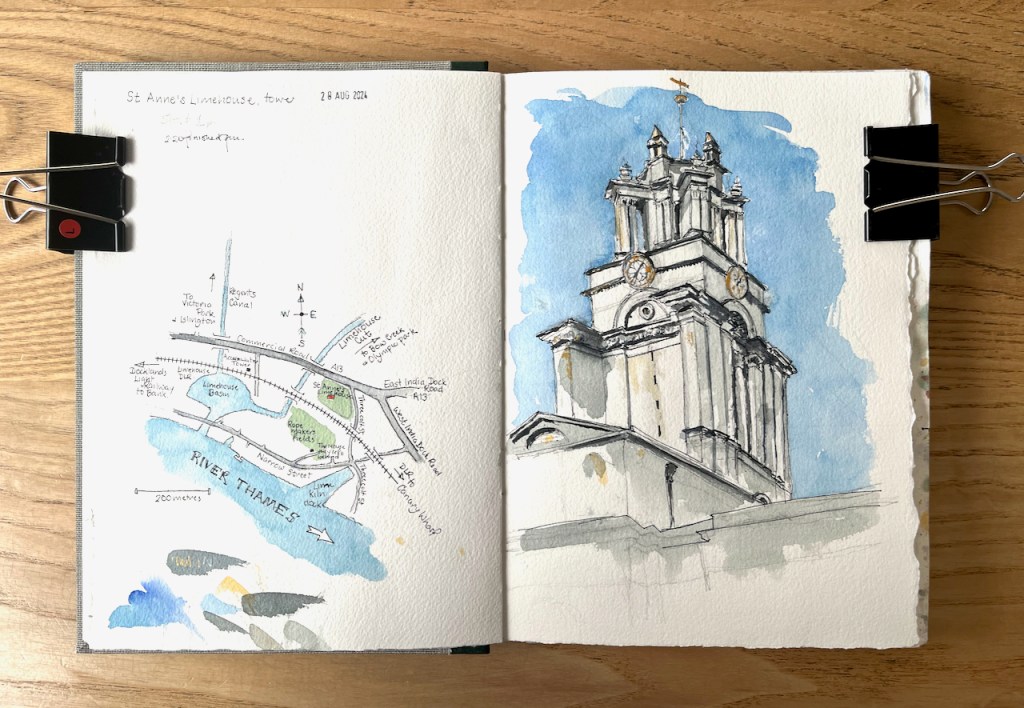
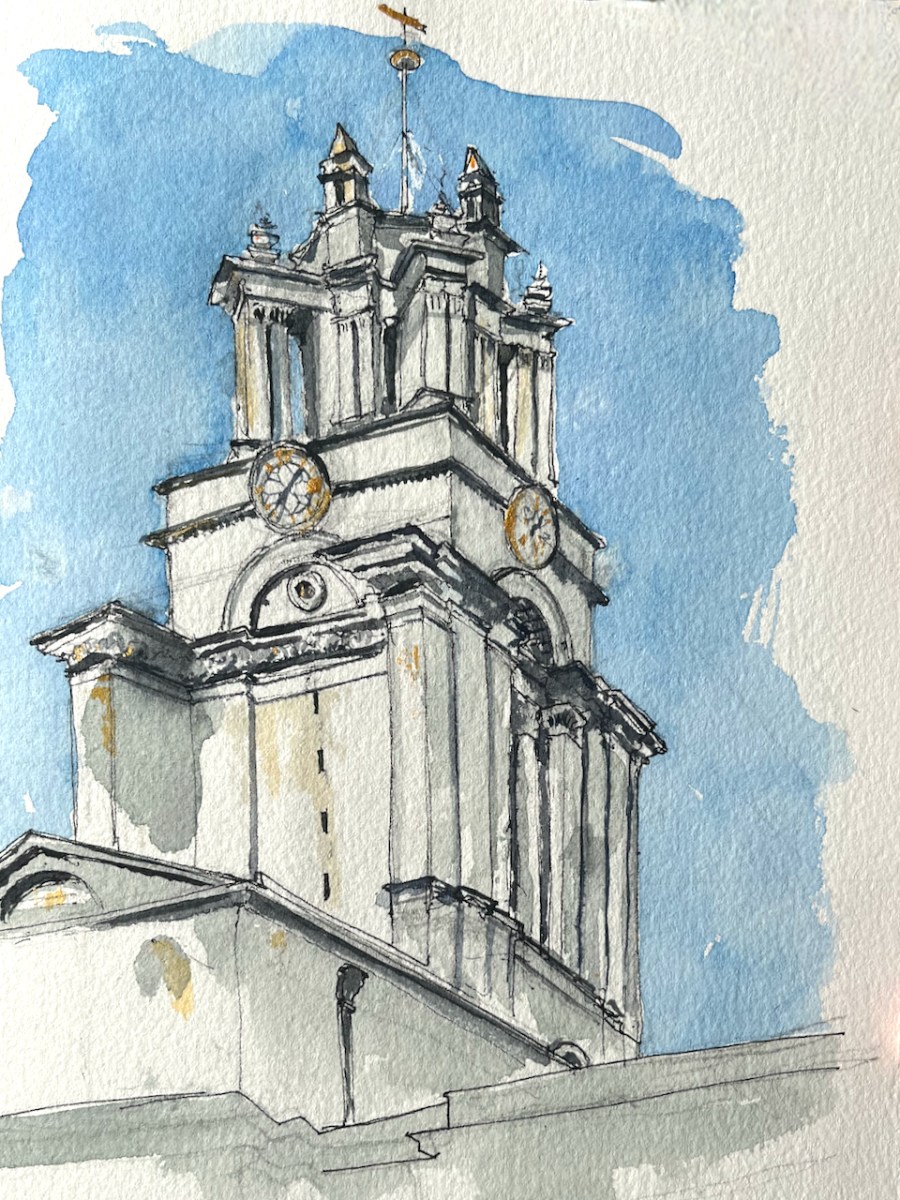
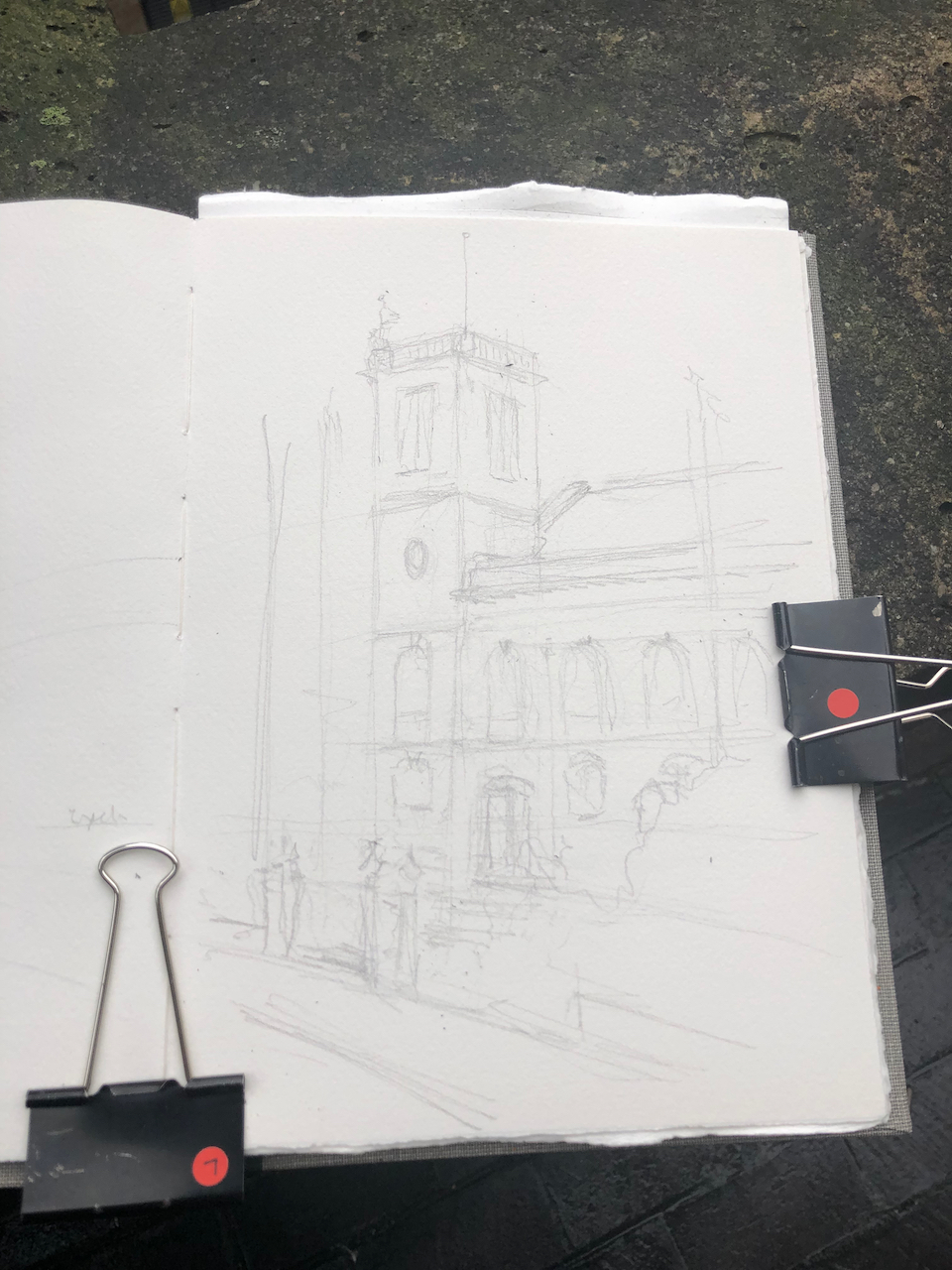
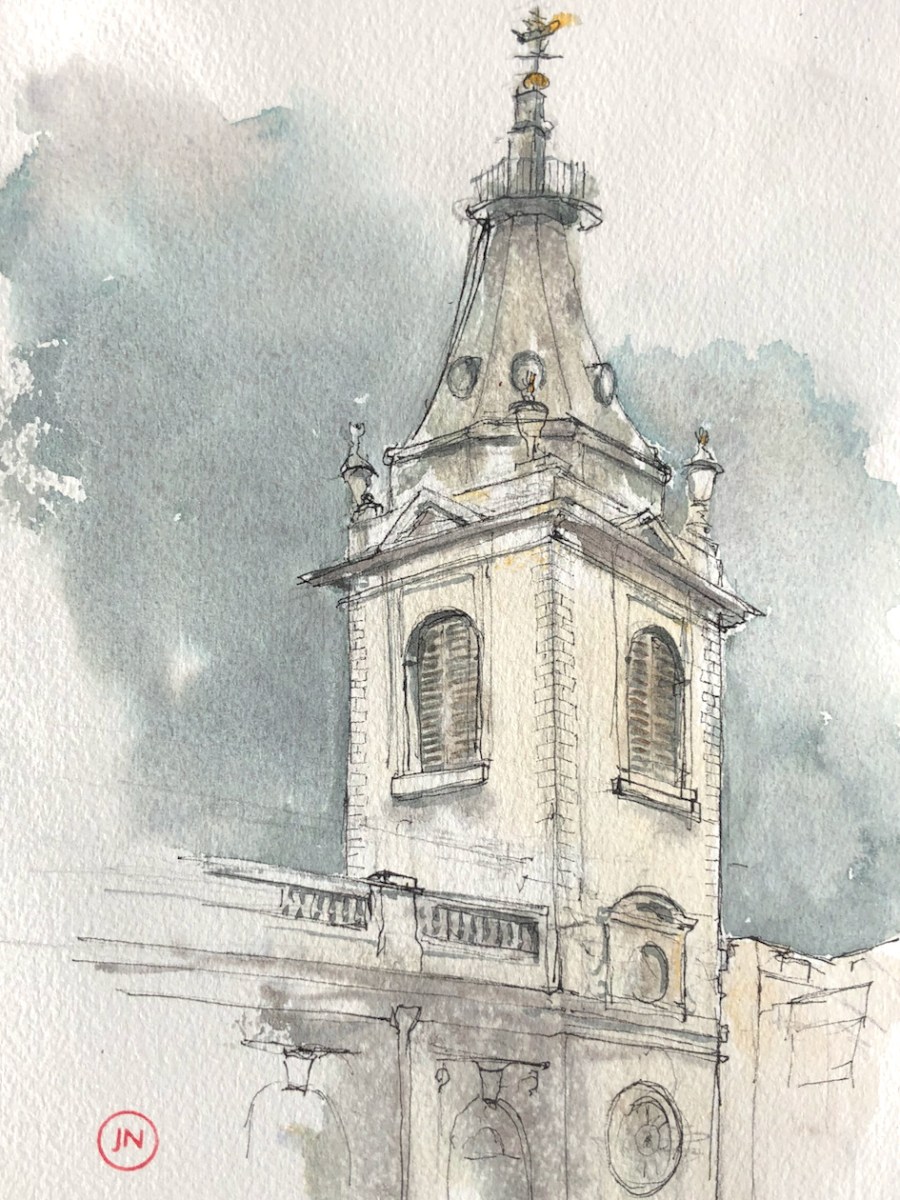
This is the tower of St Anne’s Church Limehouse, seen from the south. St Anne’s is a church designed by Nicholas Hawksmoor, consecrated in 1730.
St Anne’s Church Limehouse tower, sketched 28 August 2024 in sketchbook 15
This tower shows the marine connections of this church:
The prominent tower with its golden ball on the flagpole became a Trinity House “sea mark” on navigational charts and the Queens Regulations still permit St Anne’s Limehouse to display the White Ensign”.
Wikipedia (1 October 2024)
White ensign
The White Ensign is definitely flying. In my drawing the flag is blowing away from me, so you can’t see it well. It is the flag flown by British Navy ships and certain navy-related buildings on land, of which St Anne’s in one.
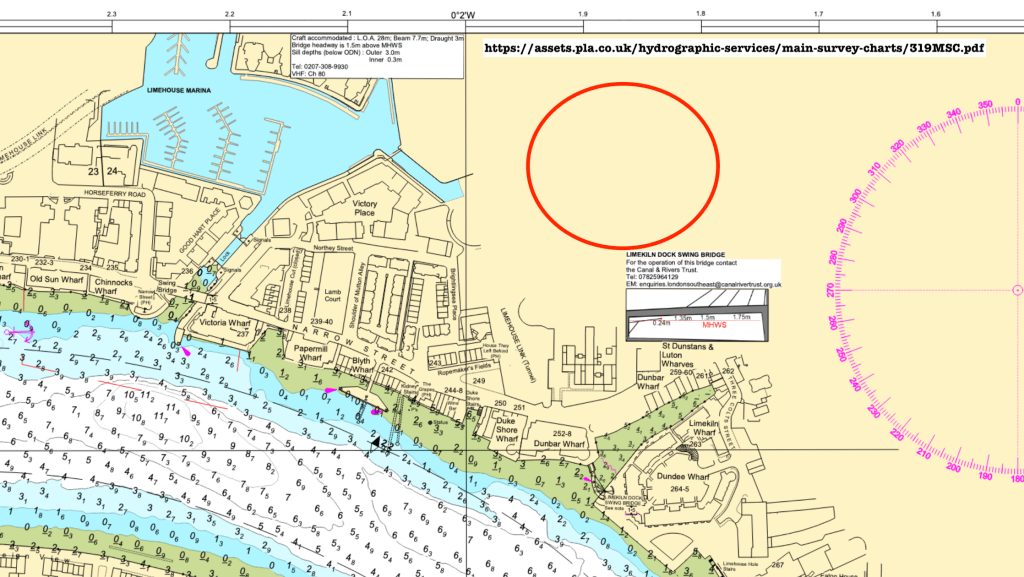
The golden ball is clearly visible on the flagpole, the “sea mark” mentioned in articles about the church. I had a look to see if I could find St Anne’s on a navigational chart. The Port of London Authority offers navigational maps of the Thames – but sadly St Anne’s is not shown as a “sea mark” on any of them.
Detail from Chart 319 from the Port of London Authority. The red circle where St Anne’s is, but it’s not shown as a “sea mark”.
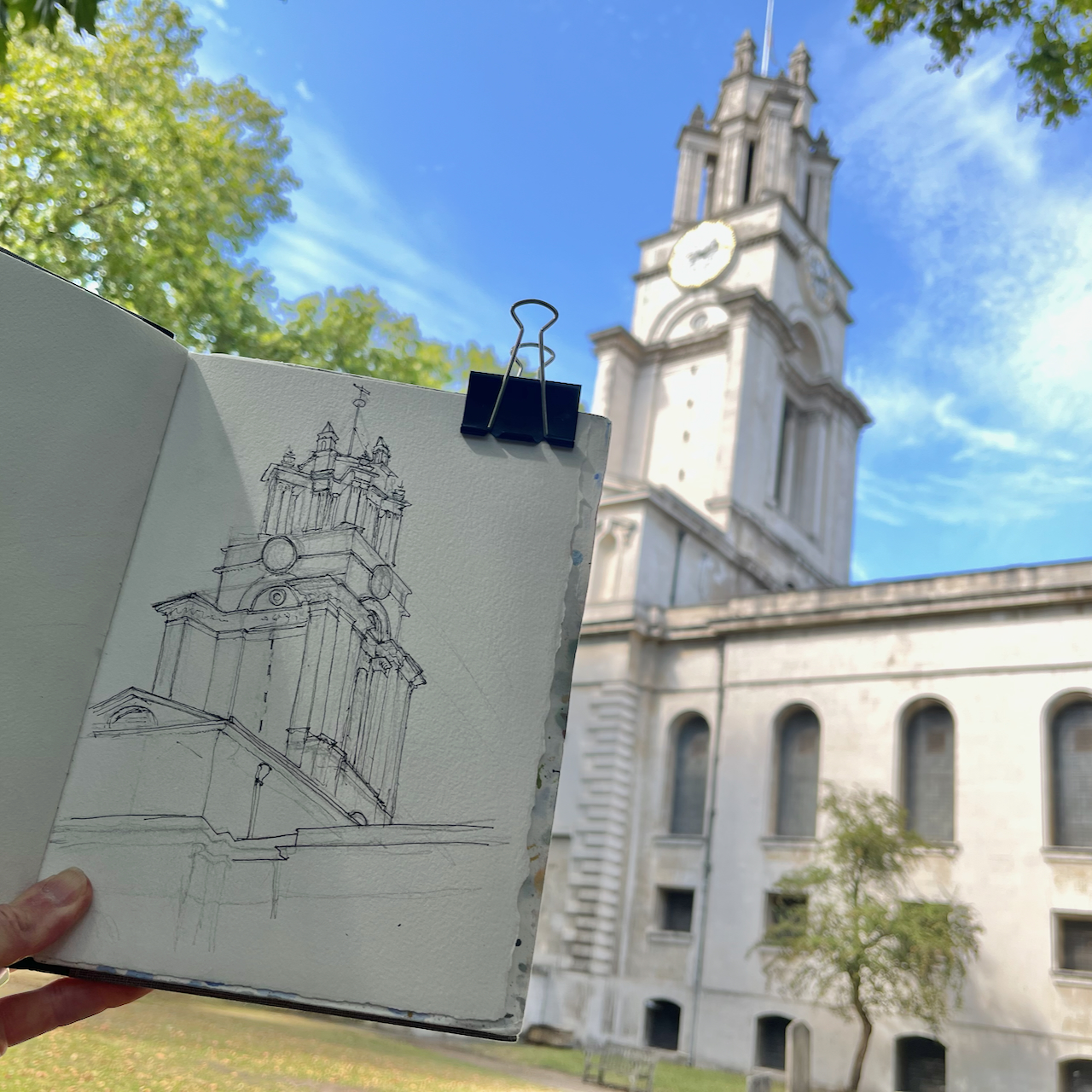
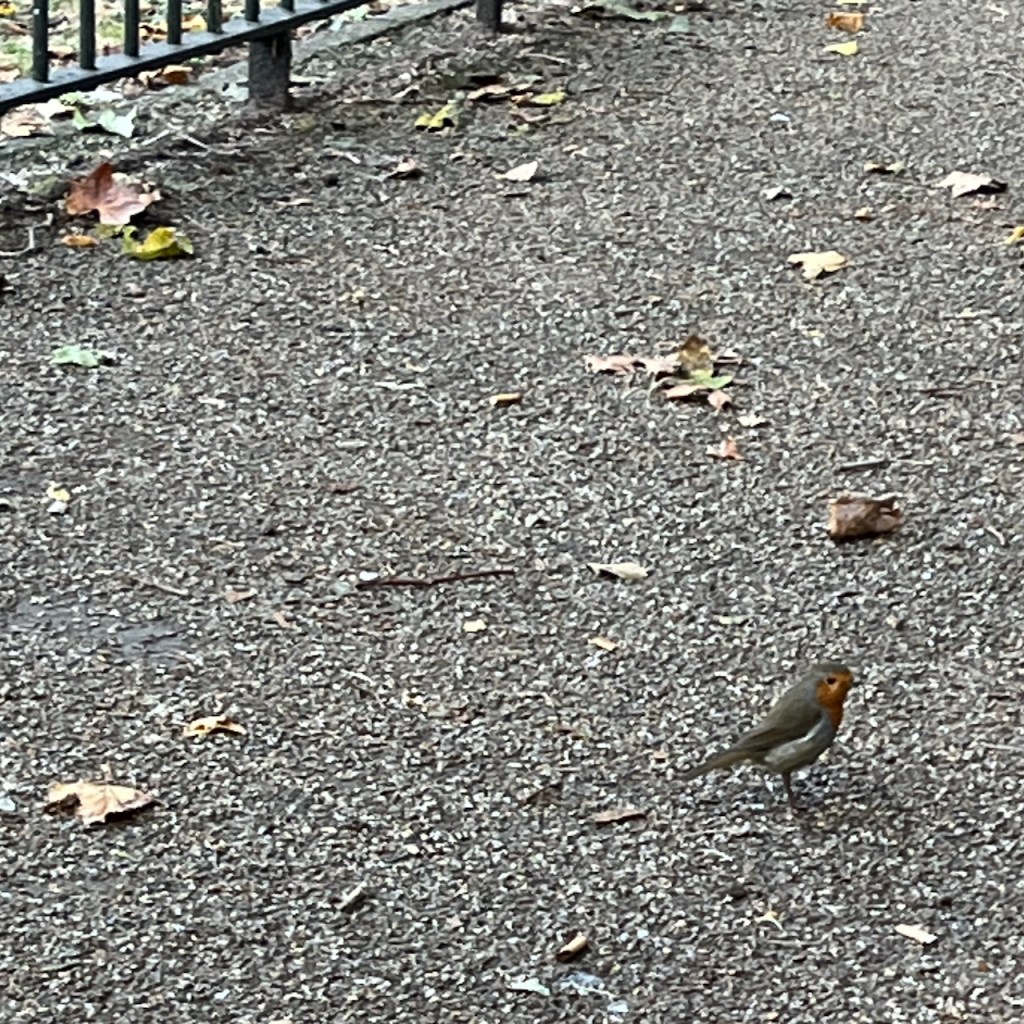
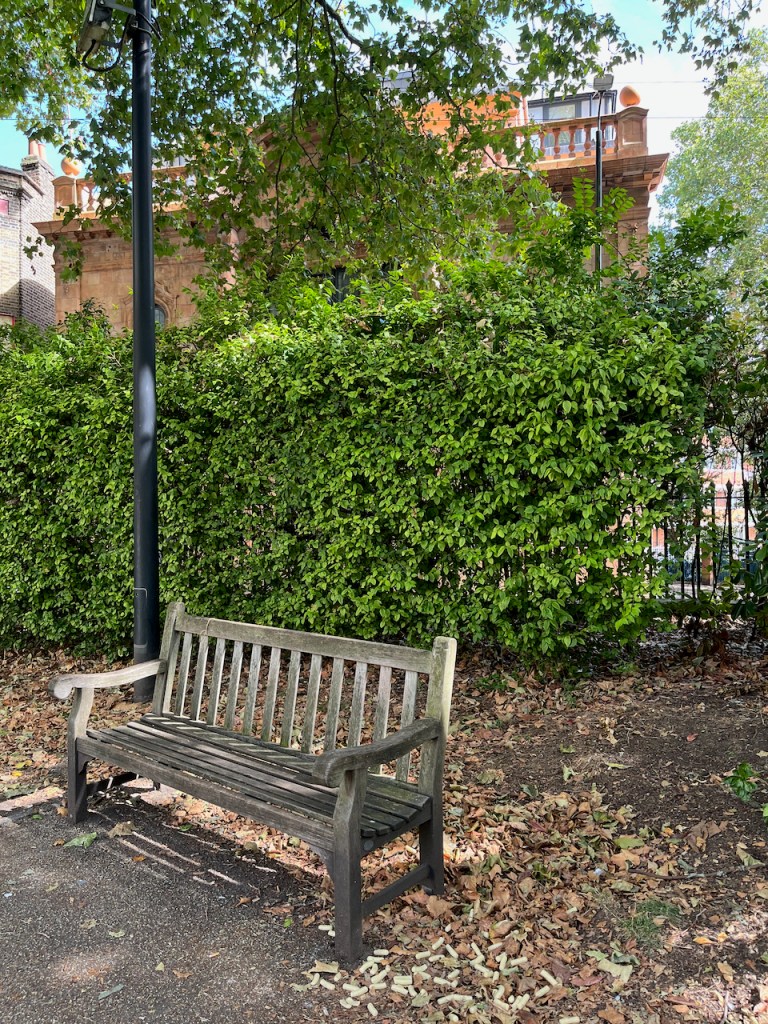
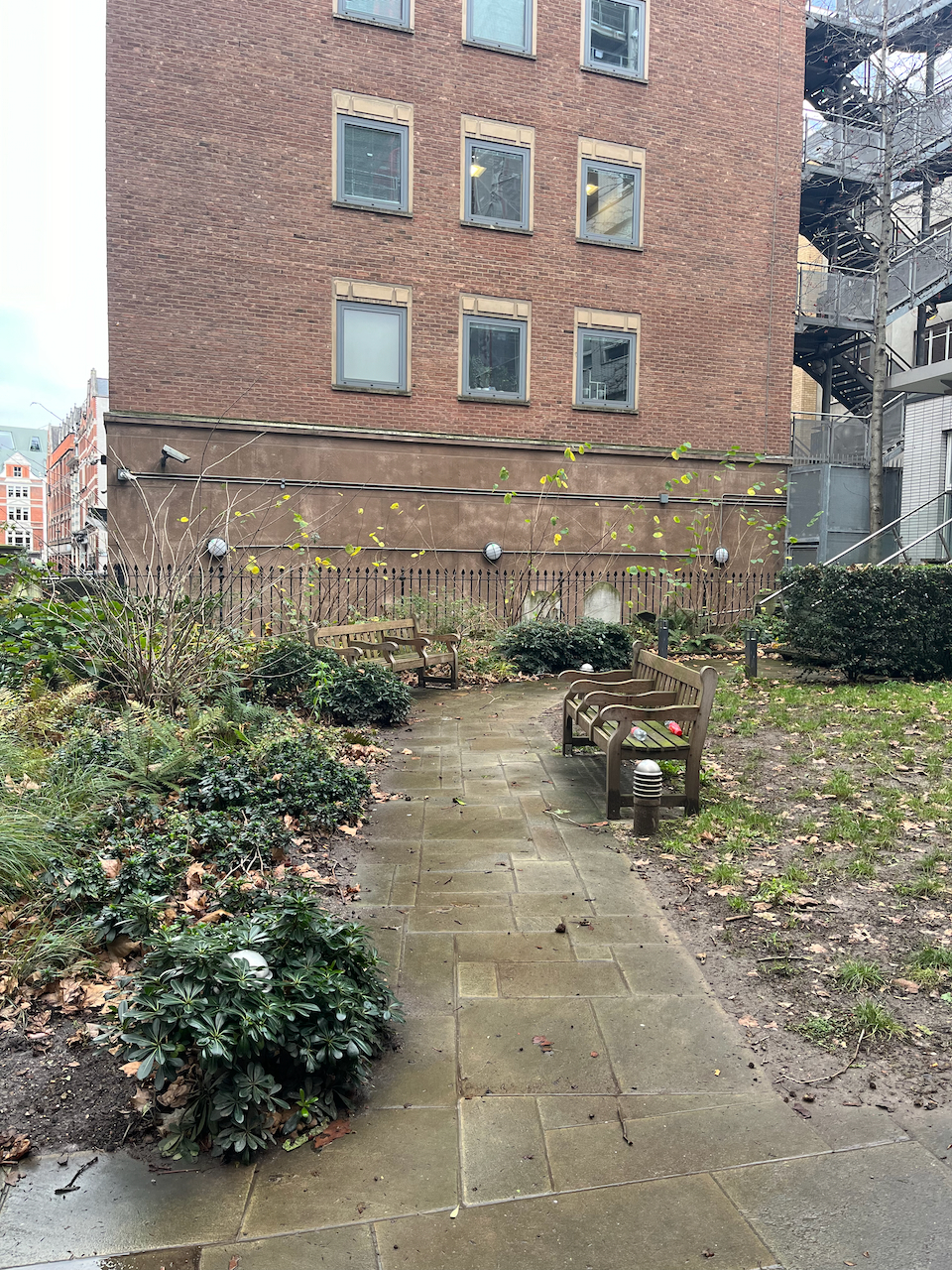
The church has a lovely quiet garden. I sketched from the wooden seat, watched by a robin.
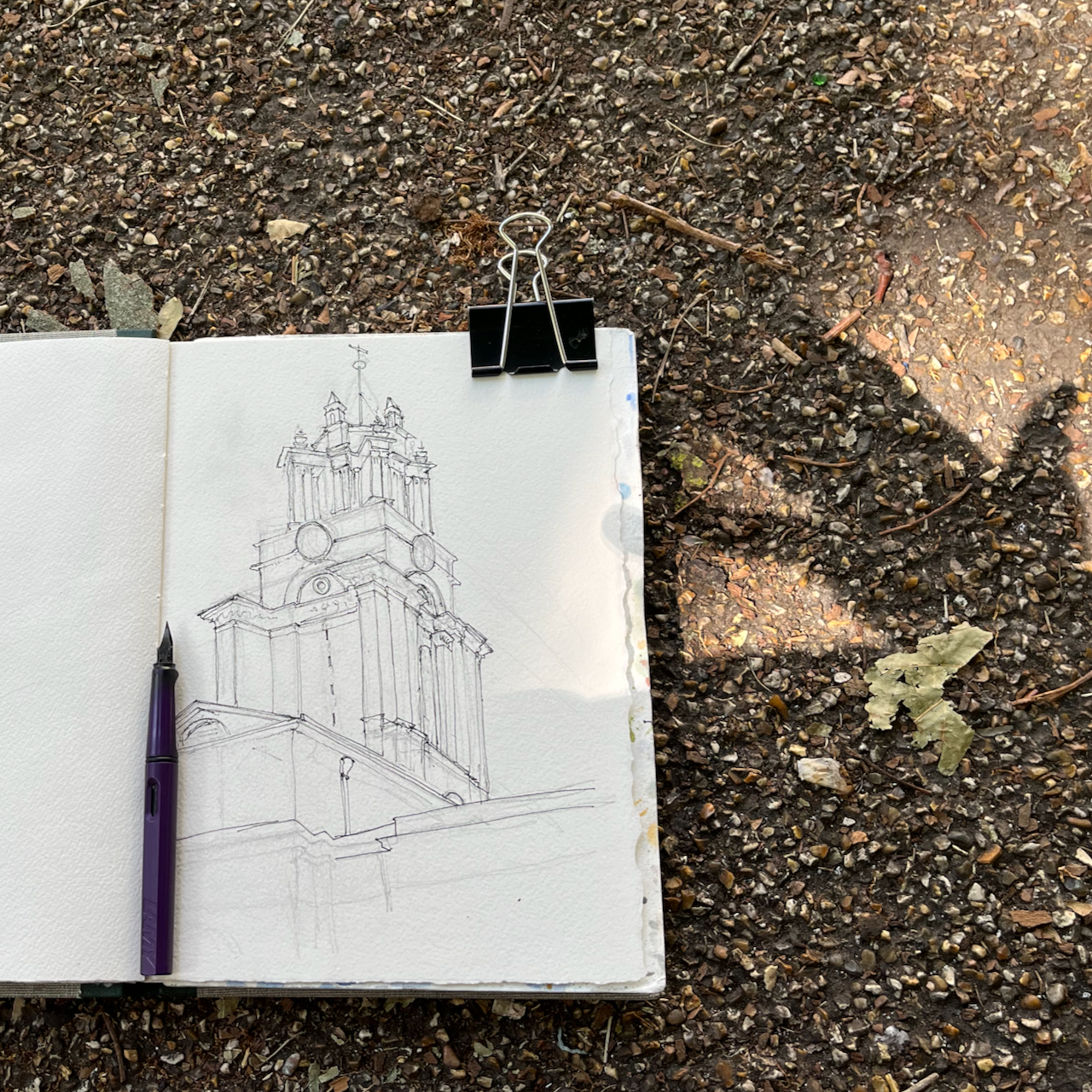
Sketchbook 15
Here are other sketches I’ve done around Limehouse and Wapping, near here:
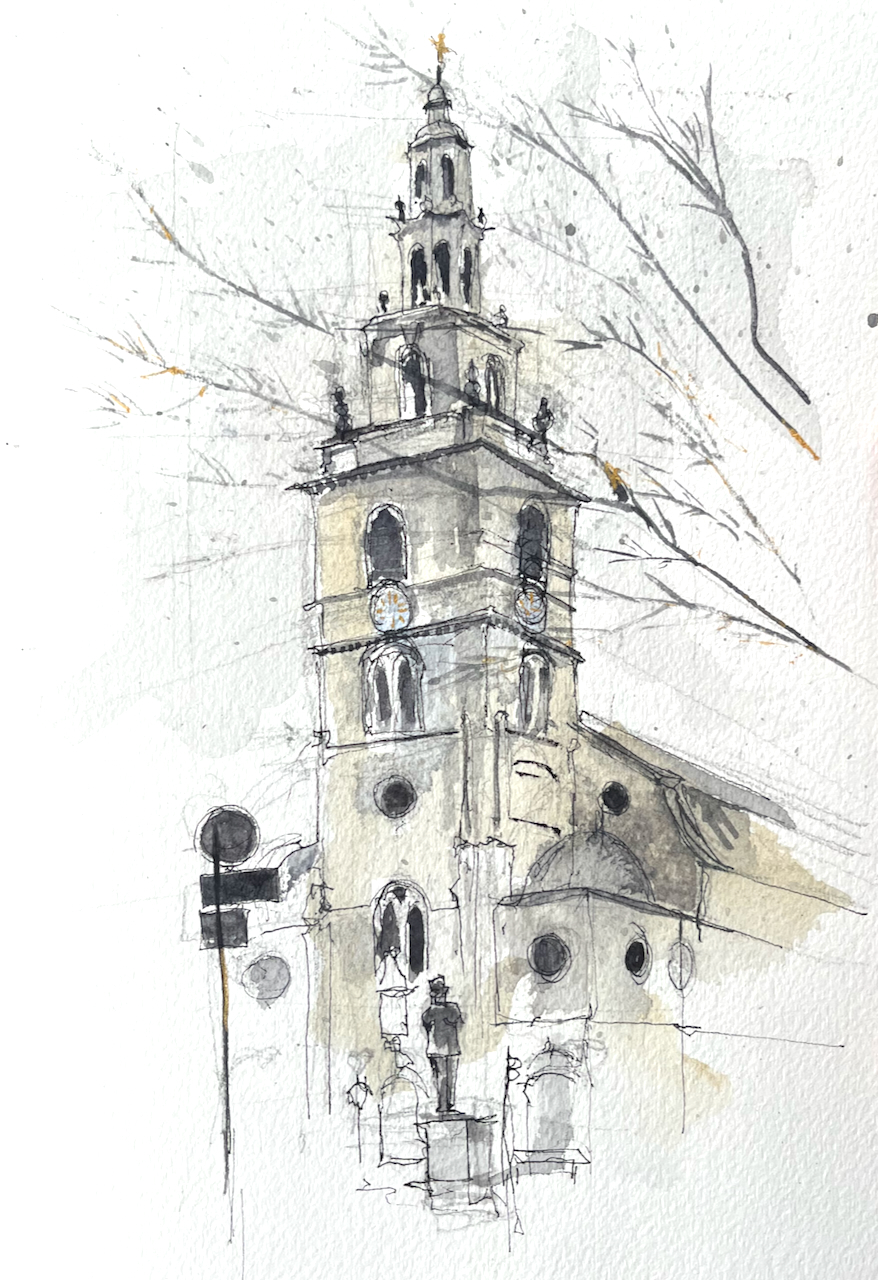
St Clement Danes stands on a traffic island in the Strand.
St Clement Danes, Strand, WC2R 1DH, sketched 7 February 2024 13:30 in sketchbook 14
I sketched this church over a lunchtime. At 1pm its bells played its tune, “Oranges and Lemons“, a little haphazardly, but quite distinct.
Why St Clement Danes? What’s Danish about it? According to the church leaflet, in the 9th century, “Danish settlers who had married English wives were allowed to settle in the area taking over a small church dedicated to St Clement. The Church came to be known as ‘St-Clement-of-the-Danes'”. A rather more brutal story is told by the Viking Ship museum of Roskilde in Denmark:
“By the 9th century London was yet again a powerful and wealthy town attracting the attention of the Danish Vikings. They attacked London in AD 842, and again in AD 851, and The Great Army spent the winter in the town in AD 871-72.” “Cnut became King of England and in AD 1018 he was able to send his army back to Denmark. He burdened the English population with the tax thingild to pay for the maintenance of a small army. He also placed his Danish garrisons around London, including by the church St. Clemens Danes. Generally, Cnut was a popular king, and during his reign peace prevailed in England. Cnut died in AD 1035 and one of his sons, Harold Harefoot, took over the English throne. On his death Harefoot he was buried in Westminster Church, but his brother Harthacnut ordered the body to be dug up and thrown into the Thames. Perhaps Harold Harefoot was re-buried in St. Clemens Danes outside the town wall. The peace in England was over.”
The “Science Nordic” site offers lively descriptions of the Danish people that arrived in England in the 9th and 10th centuries. Today we might describe them as “economic migrants”
“In eastern England the Vikings discovered a milder climate and a rich agricultural landscape, similar to the one they knew back home. Faced with a lack of good farming land in Denmark, many families decided to try their luck on the other side of the North Sea.” – Dr Jane Kershaw, Archaeologist and Viking researcher
St Clements no longer has any particular Danish connection. It is linked to the Royal Air Force. The statue outside, in the bottom centre of my sketch, is
“Air Chief Marshall Lord Downing, Baron of Bentley Priory, Fighter Command 1936-40”
according to the inscription on his plinth. The Danish church in London is St Katherines, to the East of Regents Park.
Here is the song the bells played, with links to my drawings of the churches:
Oranges and lemons,
Say the bells of St. Clement’s. (St Clement Danes)
You owe me five farthings,
Say the bells of St. Martin’s. (St Martin in the Fields)
When will you pay me?
Say the bells at Old Bailey. (St Sepulchre-without-Newgate)
When I grow rich,
Say the bells at Shoreditch. (St Leonard Shoreditch)
When will that be?
Say the bells of Stepney.(St Dunstan’s Stepney)
I do not know,
Says the great bell at Bow. (St Mary Le Bow)
Here comes a candle to light you to bed,
And here comes a chopper to chop off your head!
Click a button below to share this post online, email it, or print it:
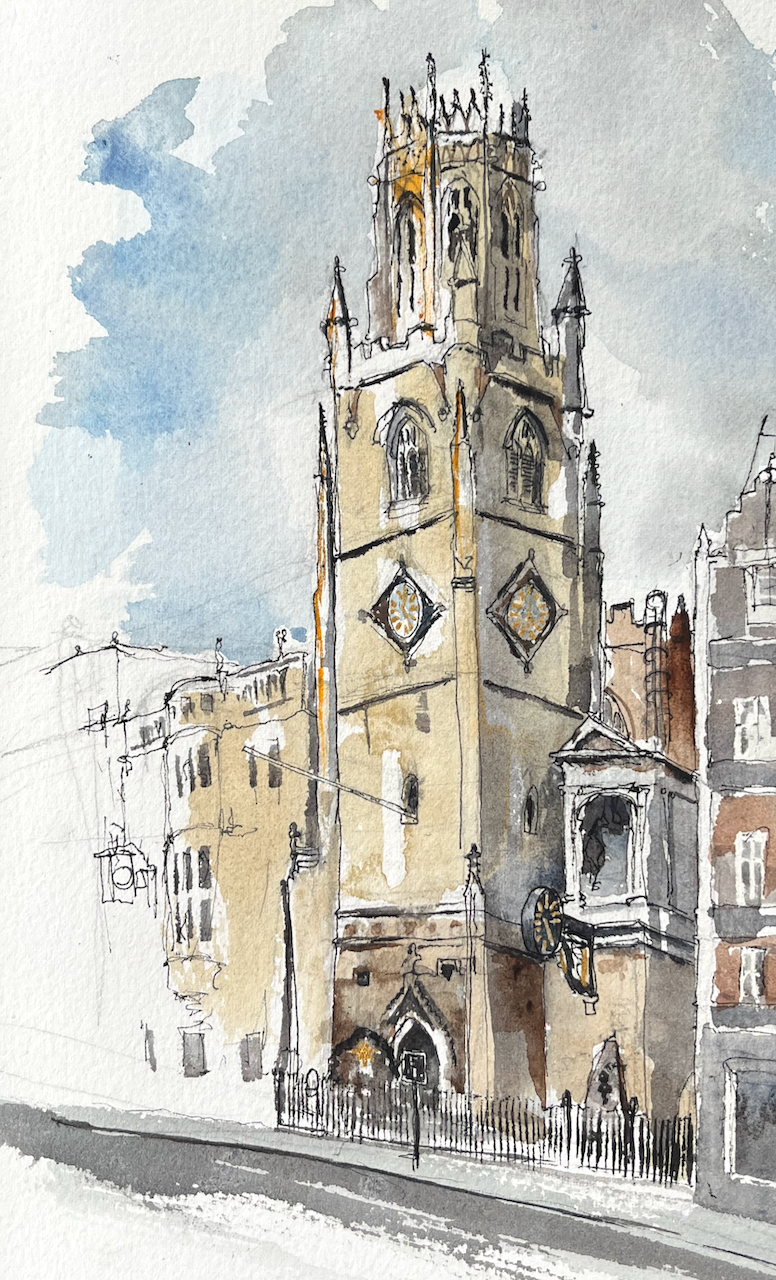
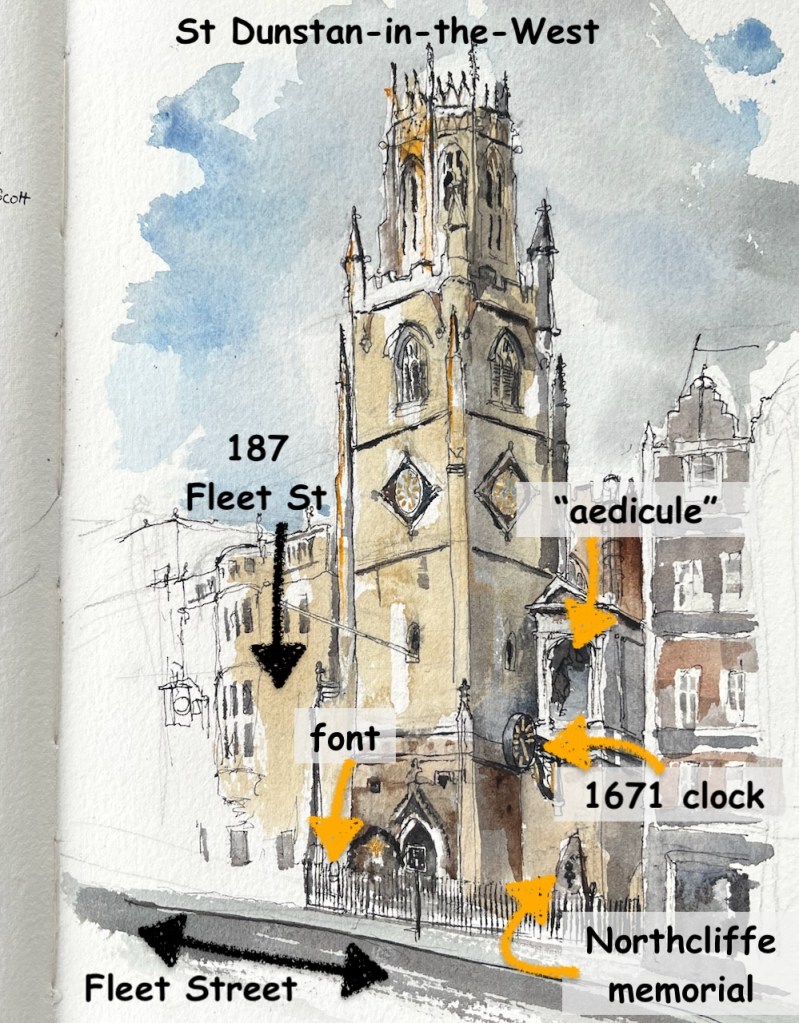
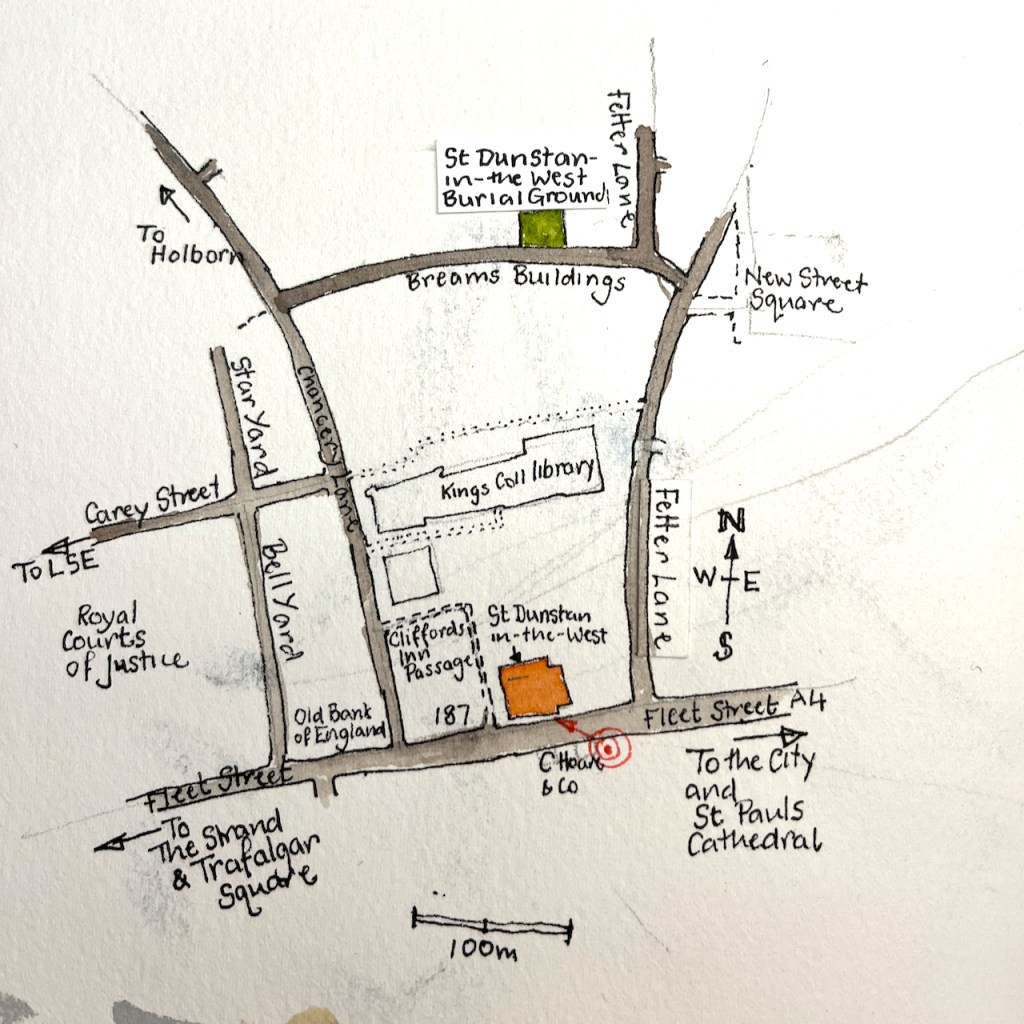
This church stands on Fleet Street, near the Royal Courts of Justice. It is set a little back from the road, so I had not really noticed it. But it is remarkable in many ways.
St Dunstan-in-the-West, 186a Fleet Street, sketched 31 Dec 2023, in Sketchbook 14
For one thing, the architect has used every possible ornate contrivance. It was impossible for this urban sketcher to do justice to the extraordinary details. The crocheted spires! The castellations! The geometry! The lacy top! The stonework above the door!
The geometry is interesting because the tower starts as a squarish-type shape at ground level, and then higher up there is an arrangement of planes which slice off the corners, turning it into an octagon at the top. At the higher part of the tower, the stonework is open so the sky is visible between the fine arches and spires.
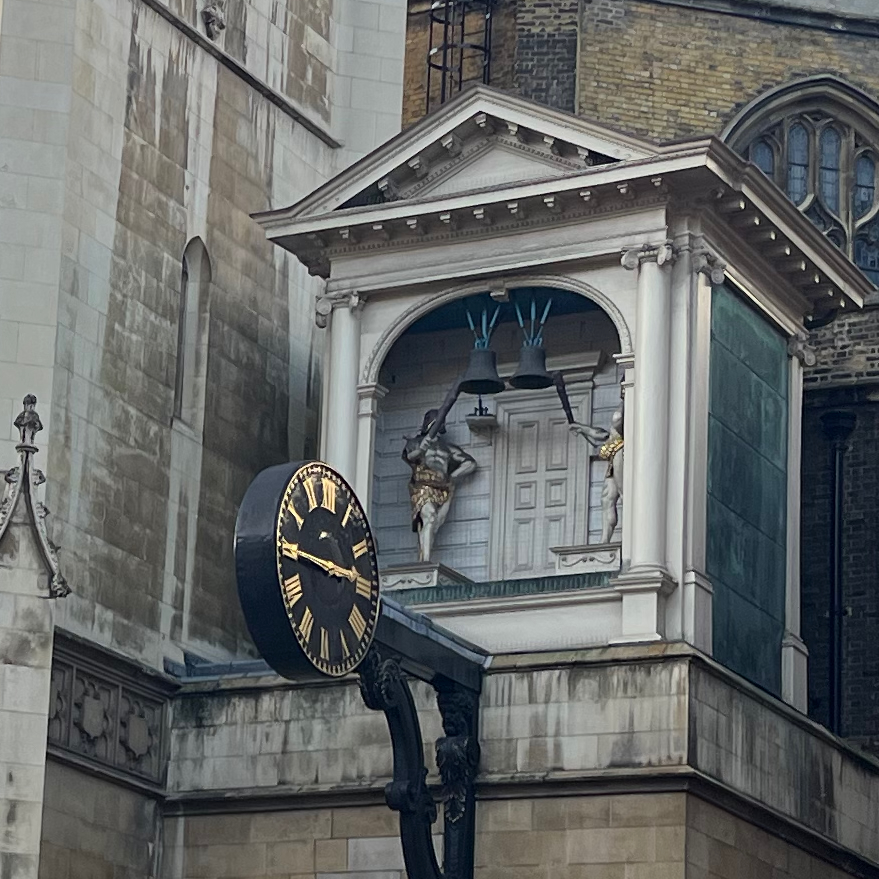
Then there are the clocks. There are two clocks on the tower, both showing the correct time. And there is another clock, also showing the correct time, suspended on a substantial wooden bracket below a little covered stage. Inside the stage are two muscular wooden figures, and two bells. The figures strike the bells every quarter hour. The little stage is described as an “aedicule” in Pevsner, who tells me that the clock was made in 1671.
The clock and the small covered stage (aedicule”), with wooded figures.
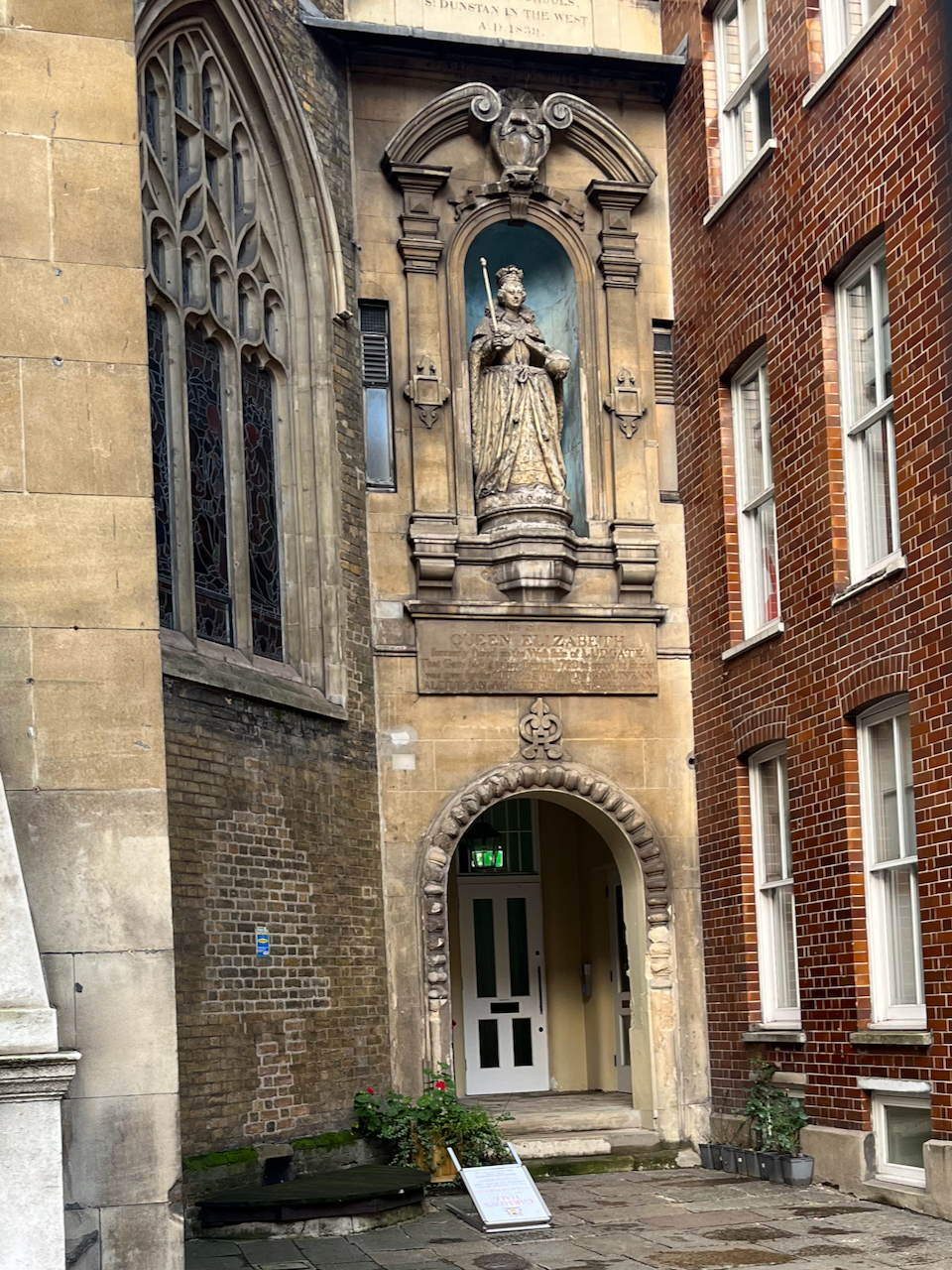
At ground level there is a rather austere monument: the bust of a man, on a plain triangular plinth, labelled simply “Northcliffe MDCCCLXV MCMXXII”. And behind that, above a door, a dusty statue, evidently very old, of Queen Elizabeth the First.
Northcliffe memorial. (Lord Northcliffe 1865-1922)Elizabeth statue (Queen Elizabeth I 1533-1603)
To the left of the church door there is a font set in to the fence. Round the edge, barely legible, it says “The gift of Sir James Duke Bart MP Ald of this ward”.
Next to the church, on its left, is a beautiful building, which is mysteriously empty and boarded up. This is 187 Fleet Street. It also has a clock, but this one did not show the correct time.
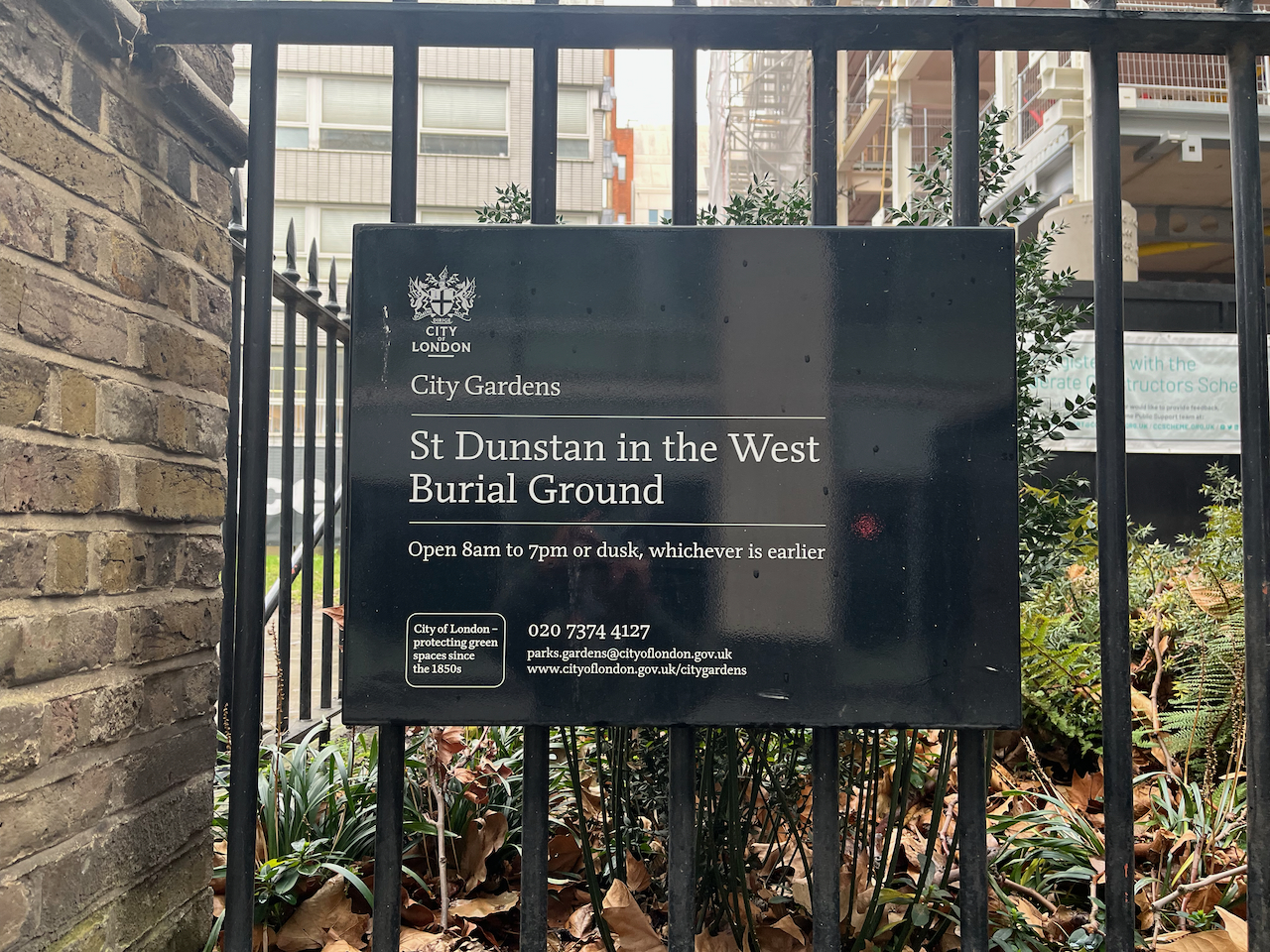
Another mystery: St Dunstan-in-the-West burial ground is some distance away to the north, on Breams Buildings, see map above.
St Dunstan-in-the-West Burial Ground, entrance on Breams BuildingsSt Dunstan-in-the-West Burial Ground
“IanVisits” has an article on the Burial Ground published in 2020. When he visited it was clearly in a better condition than it is now. On my visit, December 2023, the burial ground was litter-strewn and neglected, overshadowed by a building site to the East, and defiled by plastic advertising hoardings flapping on its north fence.
The current St Dunstan-in-the-West church was constructed in 1830-1832 to the designs of John Shaw senior, and completed by his son, also John Shaw. This building replaced a much older one. The church website says:
“It is not known exactly when the original church was built, but it was between 988 and 1070 AD. It is not impossible that St Dunstan himself, or priests who knew him well, decreed that a church was needed here.”
It is an active Anglican church, open during the week, with services on Sundays, according to the notice on the door. The building also hosts the Romanian Orthodox Church.
Northcliffe, it turns out, was quite a character. He was a press baron, founder of the Daily Mail, and promoter of popular journalism. He launched the Daily Mail in 1876. At a time when newspapers were mostly intended to be serious reading, Northcliffe realised the potential of offering “entertainment” and “diversion”:
Hamilton Fyfe, a trusted contributor [to the Daily Mail], recalled that ‘the Chief’ wanted the Daily Mail to ‘touch life at every point … He saw that very few people wanted politics, while a very large number wanted to be entertained, diverted, relieved a little while from the pressure or tedium of their everyday affairs.’
Northcliffe gradually built up his empire, acquiring the The Times and other newspapers. By 1914 he controlled 40% of the morning newspaper circulation, 45% of the evening and 15% of the Sunday circulation in Britain (Wikipedia). A fascinating article by Jessica Kelly of Cardiff University says that, due to Northcliffe’s influence, “politicians of the age sought his approval and support during this most uncertain and unpredictable of times”. Northcliffe publications advocated war against Germany. Once war was declared, they were a “solidifier of British public opinion behind a total war”. The author of this article makes a striking comparison between Rupert Murdoch today, and Northcliffe in the Edwardian era.
Lutyens designed the obelisk for the Northcliffe Memorial in St Dunstan-in-the-West, and the bust is by Kathleen Scott. (Pevsner)
I sketched the church standing on the other side of Fleet Street, near the office of C Hoare and Co, bankers. The church was closed when I visited, but I shall certainly go back and have a look inside during its opening hours.
References
“The Buildings of England, London 1: The City of London, by Simon Bradley and Nikolaus Pevsner (1999 edition)” page 214
Here is St Leonard Shoreditch, which stands at the intersection of Shoreditch High St and the Hackney Road, postcode E1 6JN.
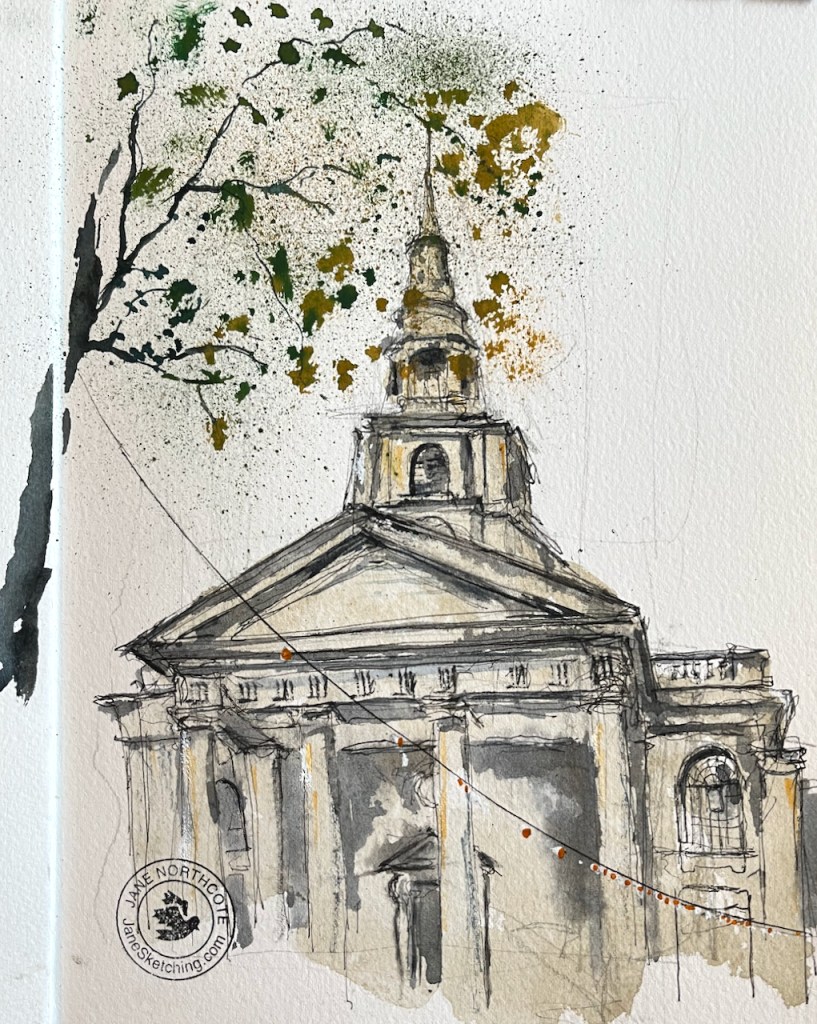
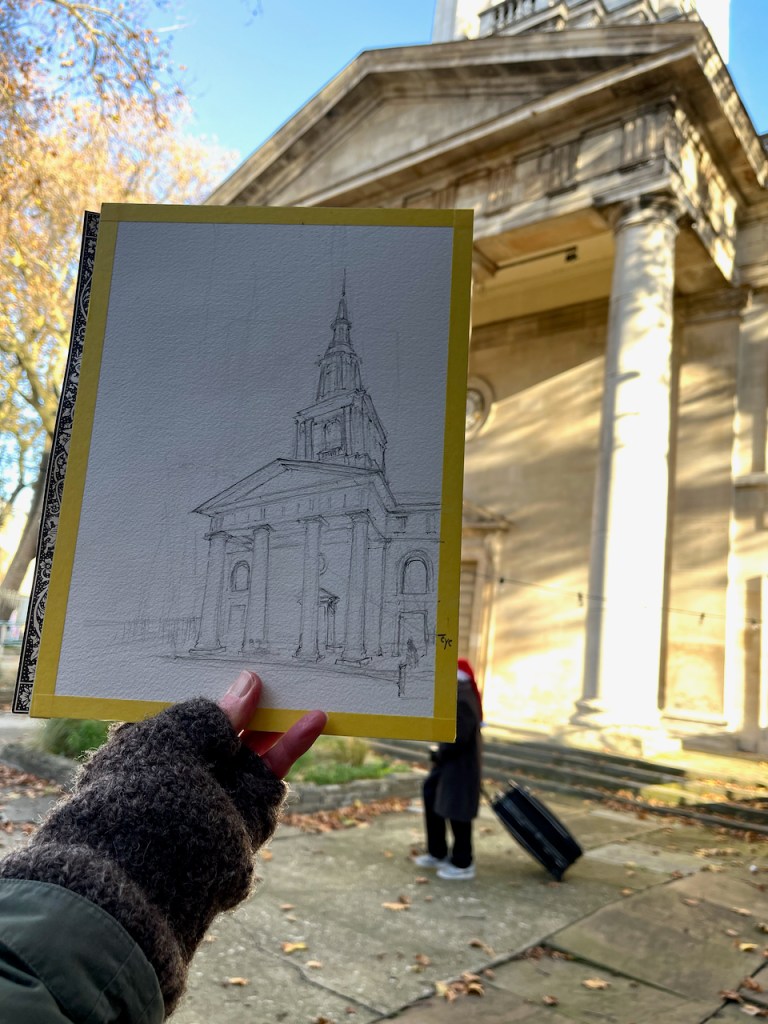
St Leonard’s, Shoreditch Church sketched 23 November 2023, 12″ x 9″ [sold]
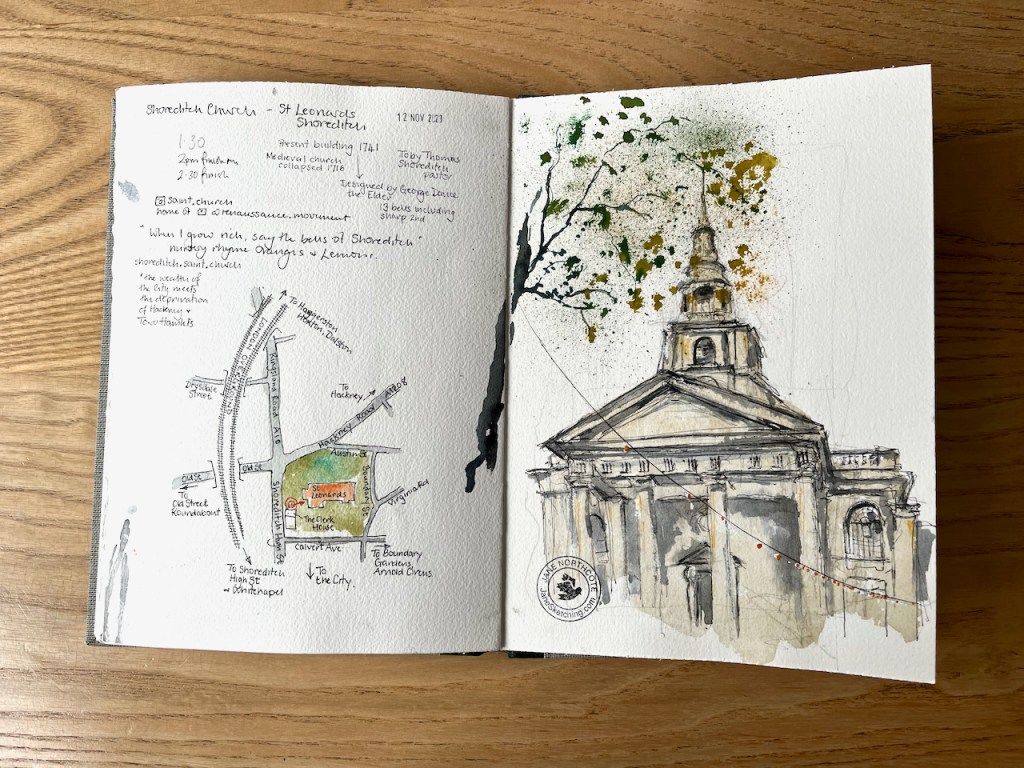
There has been a Christian church here since medieval times. The present building dates from 1741 and was designed by George Dance the Elder (1695-1768). George Dance the Elder was the City of London surveyor at the time, and designed, amongst other buildings, Mansion House at Bank Junction.
The current church is active in the community. On the day I was sketching, a Thursday, they were offering meals to local people. This is the Lighthouse Project, “providing practical help, food parcels and hot meals to local people in need” according to their website. You can see several guests in the picture.
When the church was recently rebuilt at the turn of the millenium, a large amount of money was spent on its community needs and no funds were left to buy paint. Hence it still looks a bit bohemian. We think it’s quite endearing and shows people where our priorities are – with the community rather than how we look.
The current community is highly diverse. The wealth of the City meets the deprivation of Hackney and Tower Hamlets. Our neighbours in Arnold Circus and St Hilda’s Community Centre are highly galvanised community groups acting for societal change.
This church houses the “bells of Shoreditch” from the children’s song “Oranges and Lemons”. If you go inside the church you can see a bell, which is resting on a wooden pallet on the right hand side of the nave.
when I grow rich, say the bells of Shoreditch.
Oranges and lemons, Say the bells of St. Clement’s. (St Clement Danes) You owe me five farthings, Say the bells of St. Martin’s. (St Martin in the Fields) When will you pay me? Say the bells at Old Bailey. (St Sepulchre-without-Newgate) When I grow rich, Say the bells at Shoreditch. (St Leonard Shoreditch) When will that be? Say the bells of Stepney.(St Dunstan’s Stepney) I do not know, Says the great bell at Bow. (St Mary Le Bow) Here comes a candle to light you to bed, And here comes a chopper to chop off your head!
The Society of Cumbernauld Youths in 1784 rang a complete peal of 12000 changes of Treble Bob Royal, taking nine hours and and five minutes, according to a placard in the church porch.
The bells are still rung.
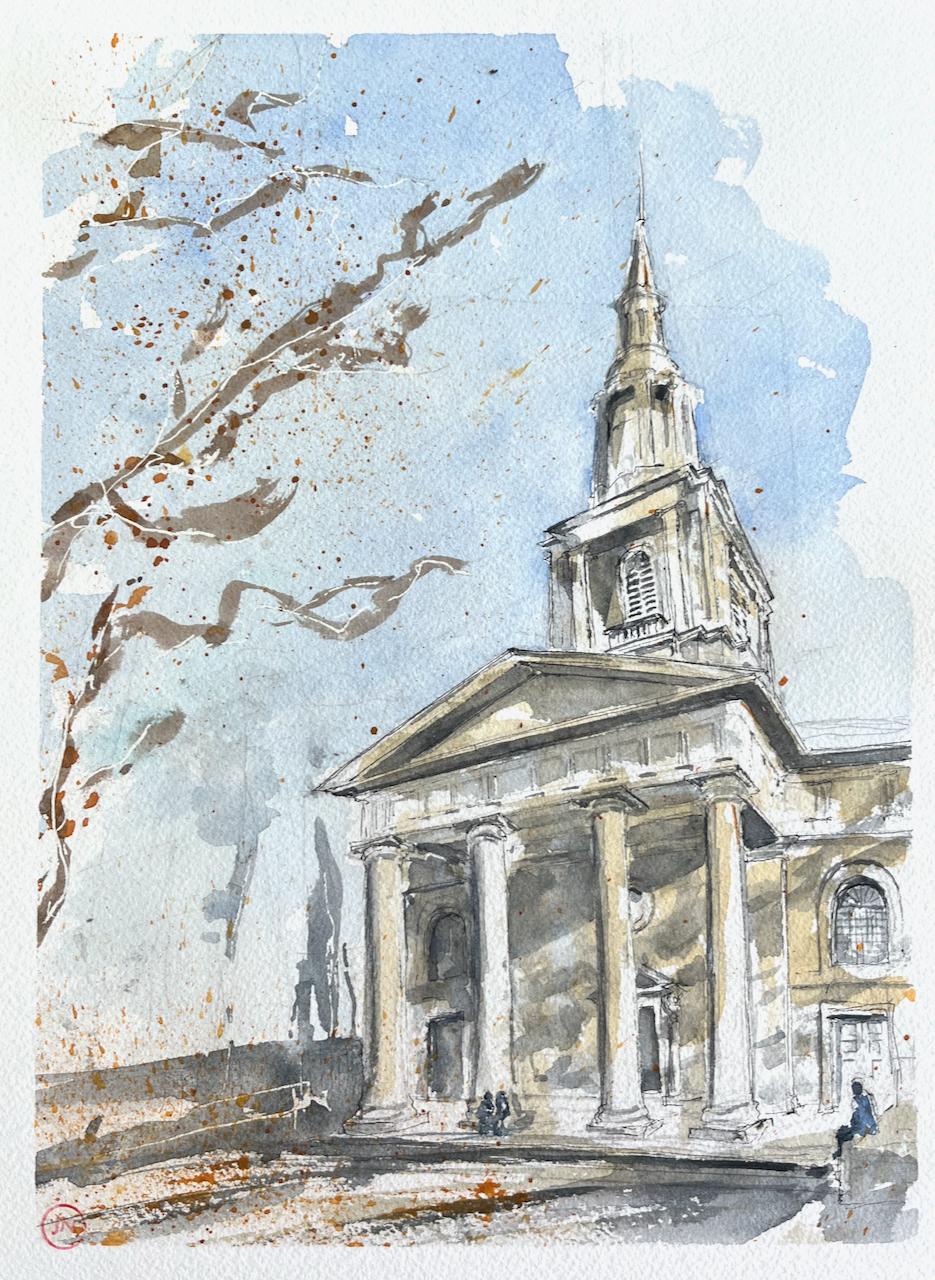
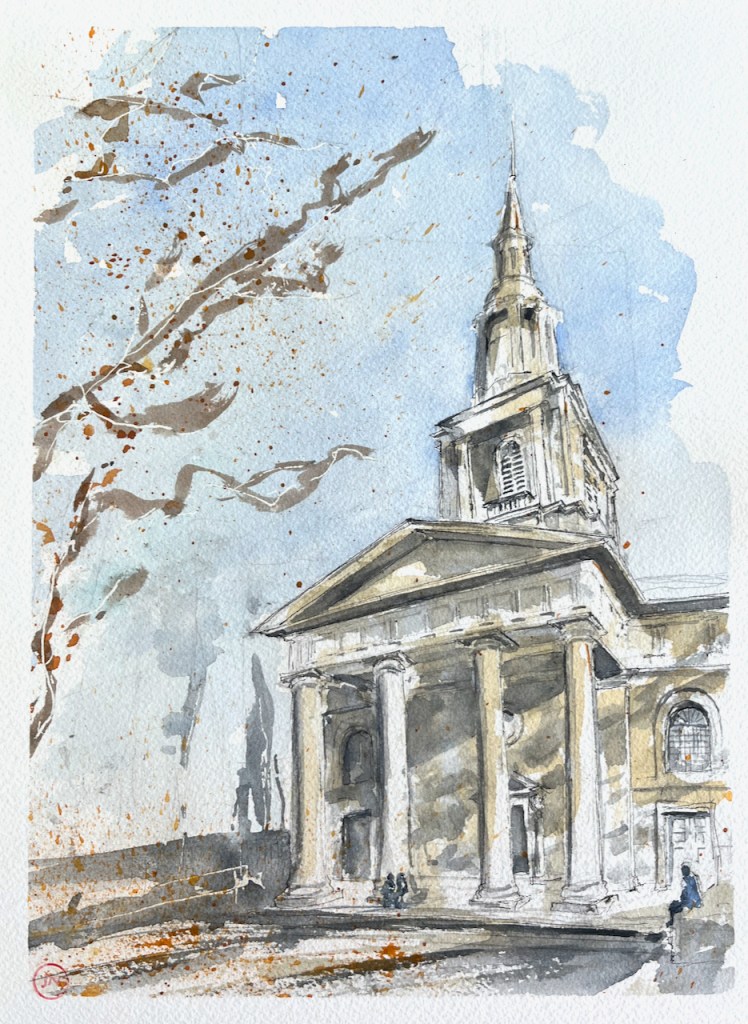
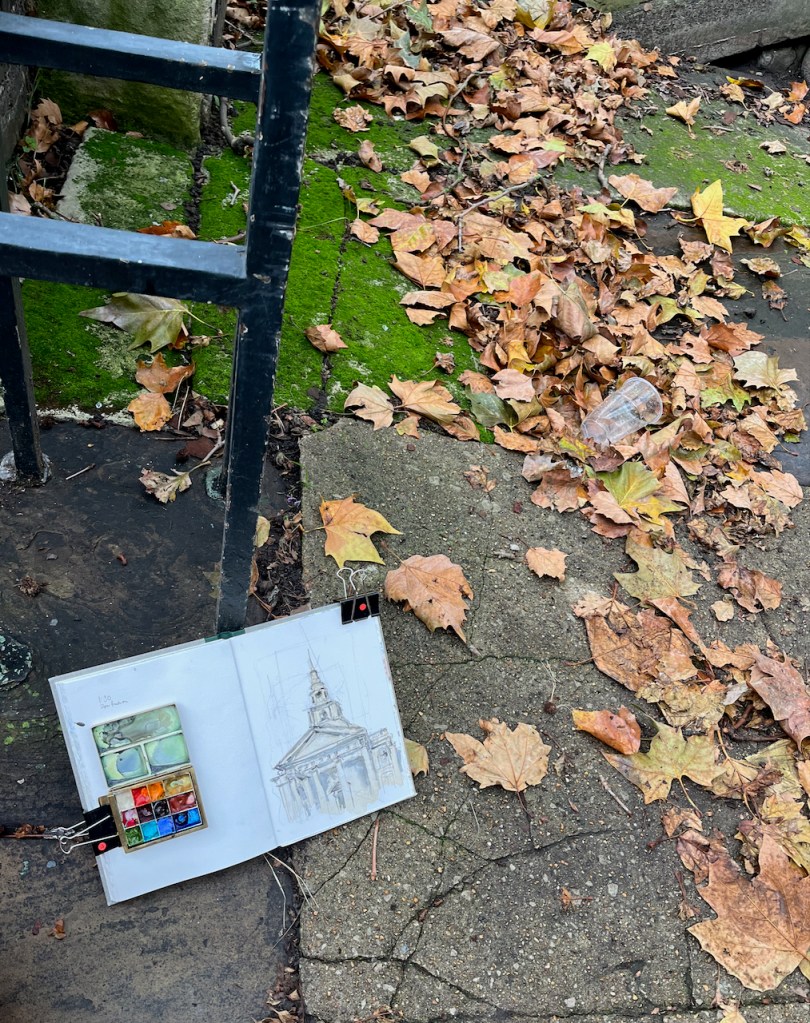
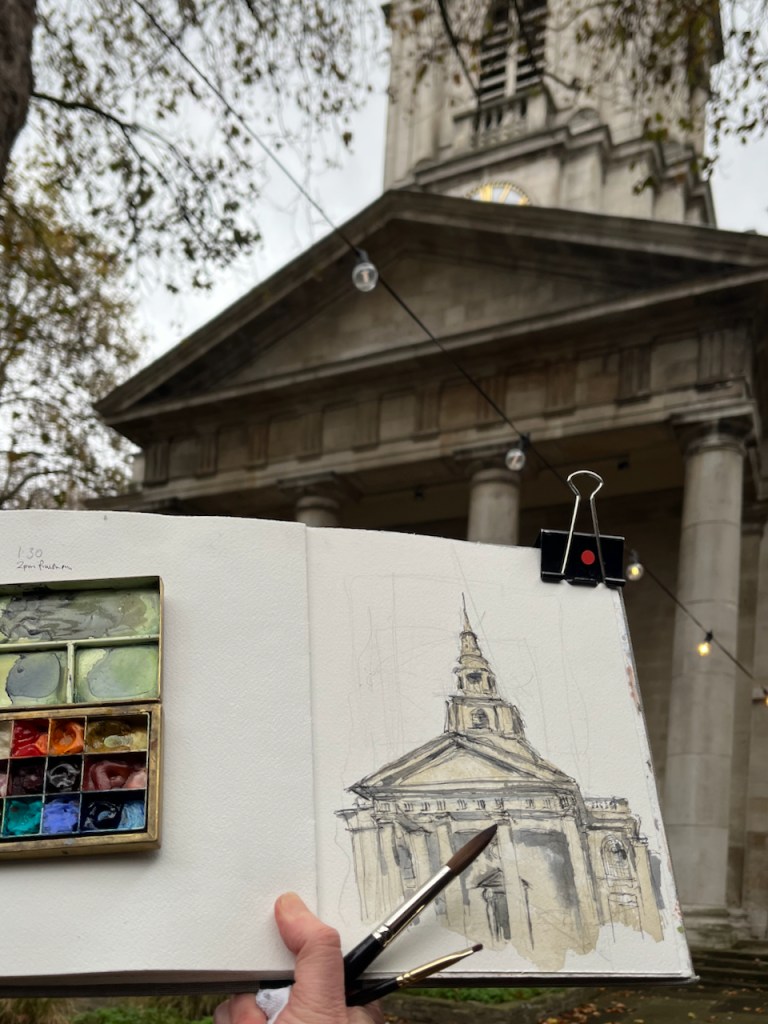
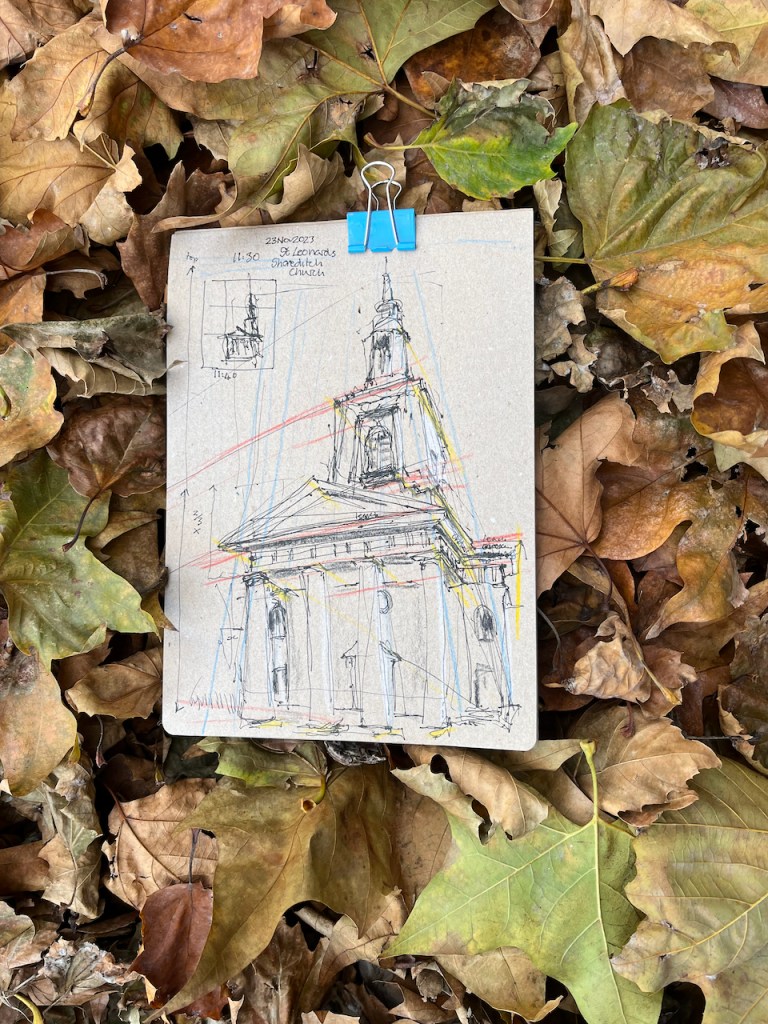
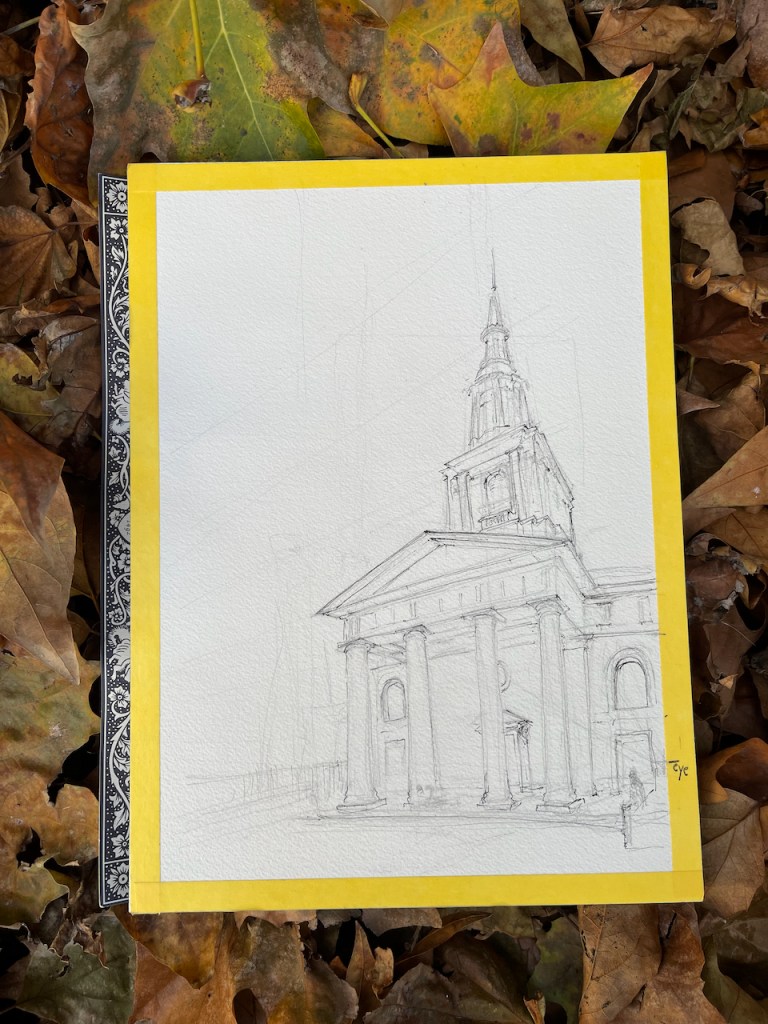
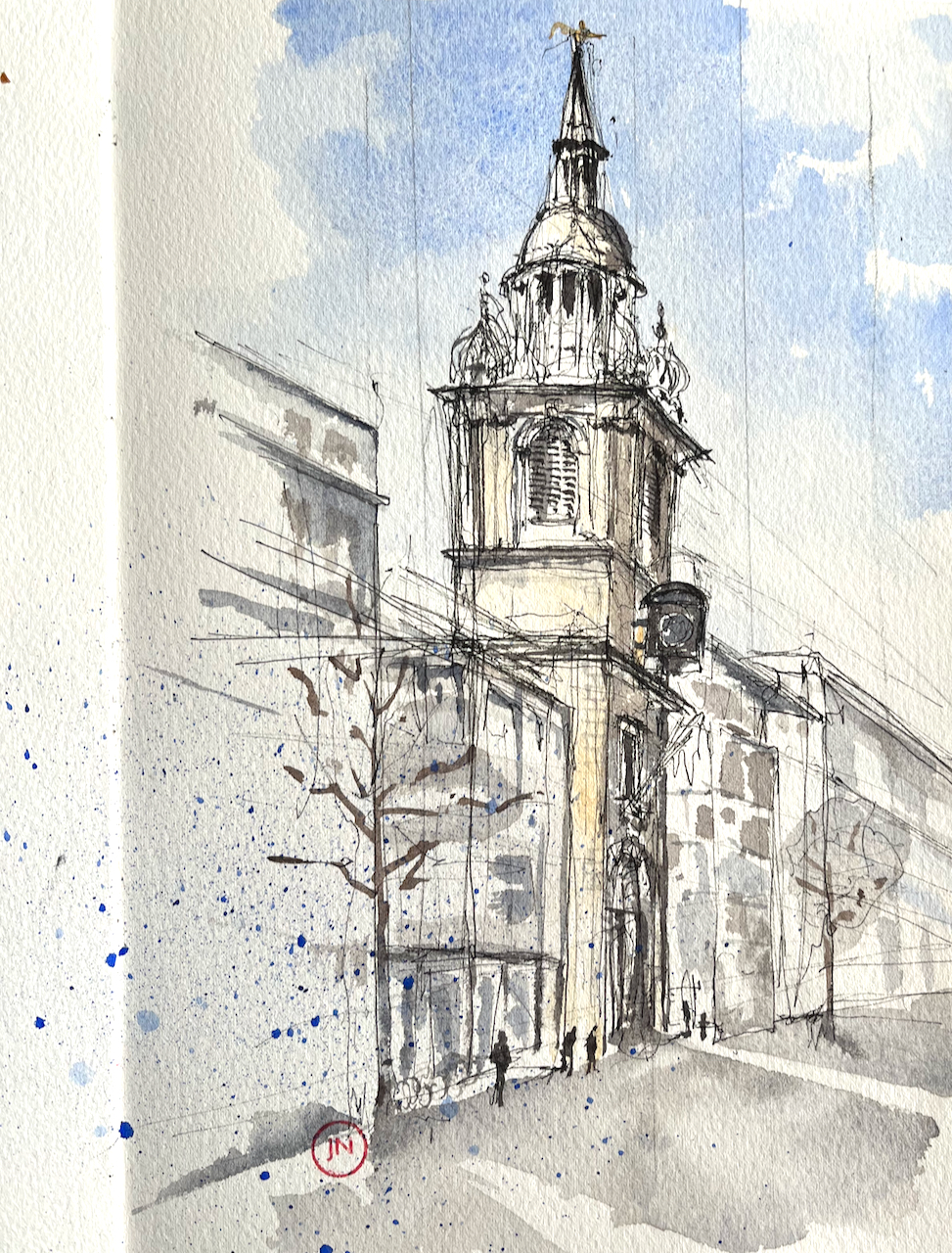
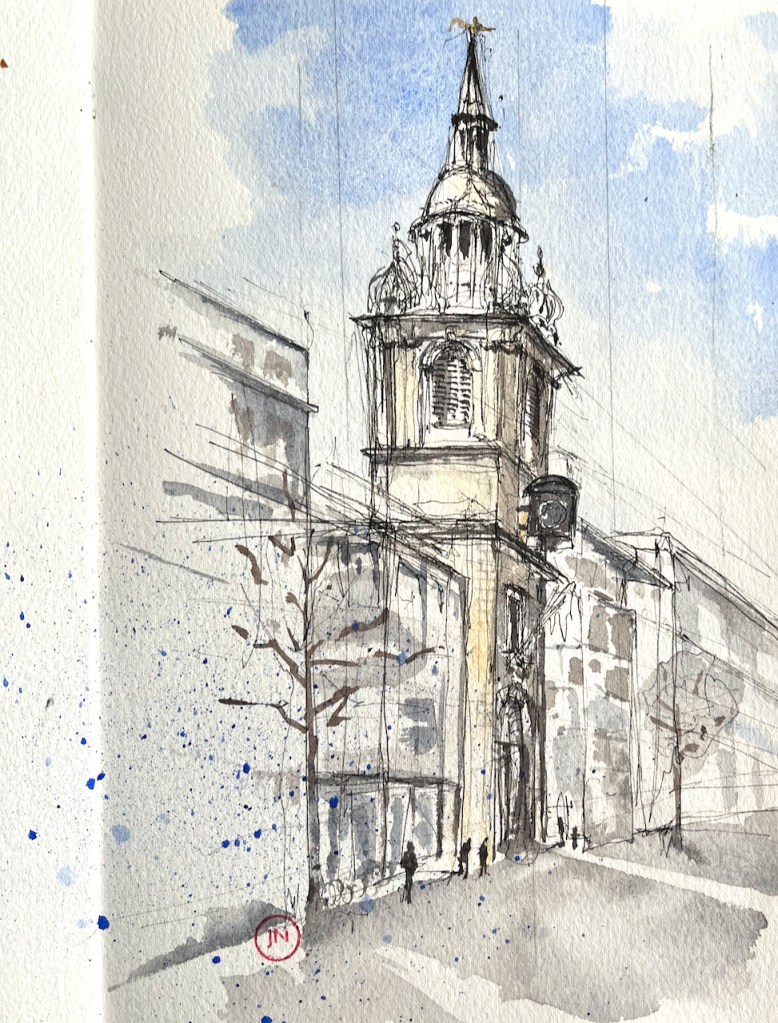
This picture was a commission. My client was keen to have this upward view showing the front of the church. I did some practice sketches to understand the tricky upward perspective.
Thank you to my client for suggesting I draw this inspiring church, and for their permission to publish the photos of the drawing online.
Practise drawing in sketchbookpencil sketchExploring the perspectivenearly finishedPractise drawing in sketchbook 13
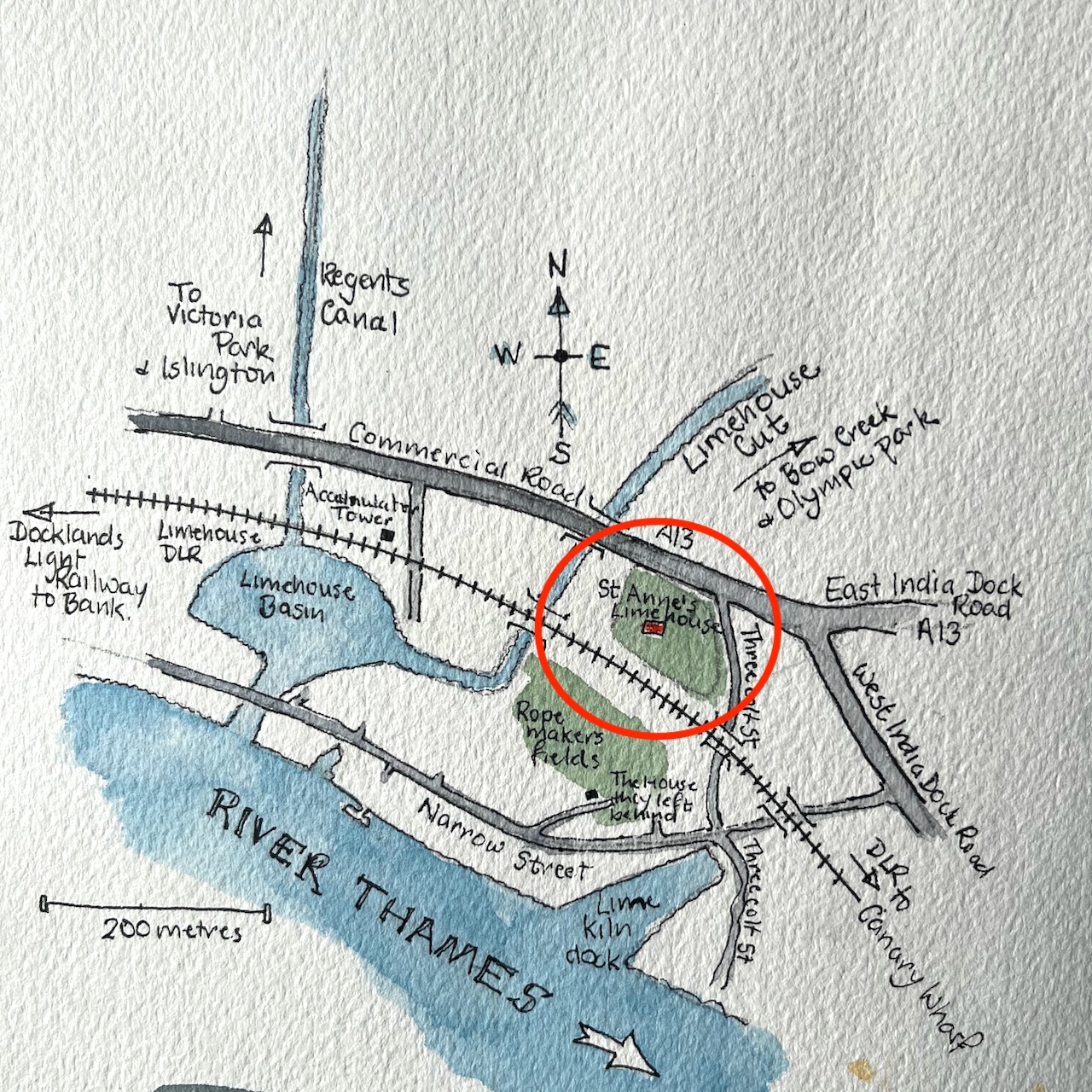
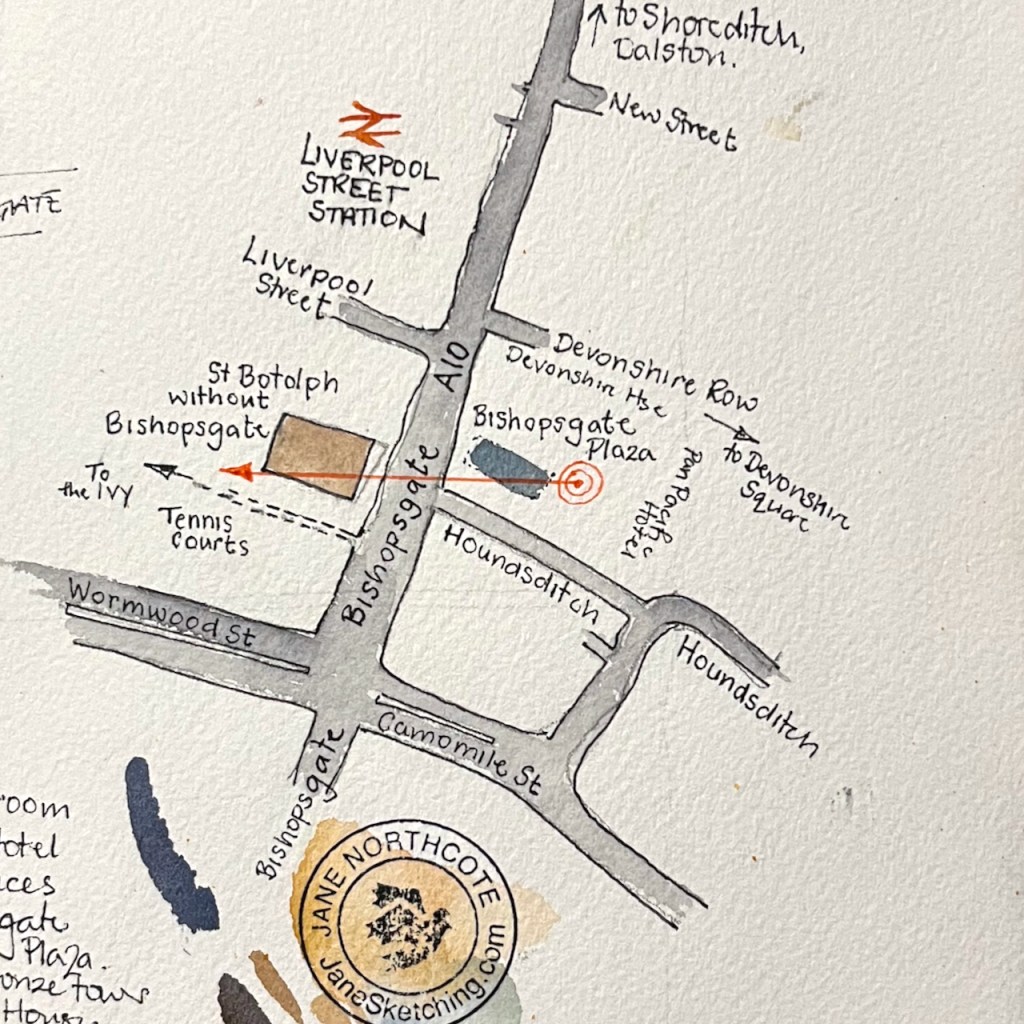
Here is a map showing the location:
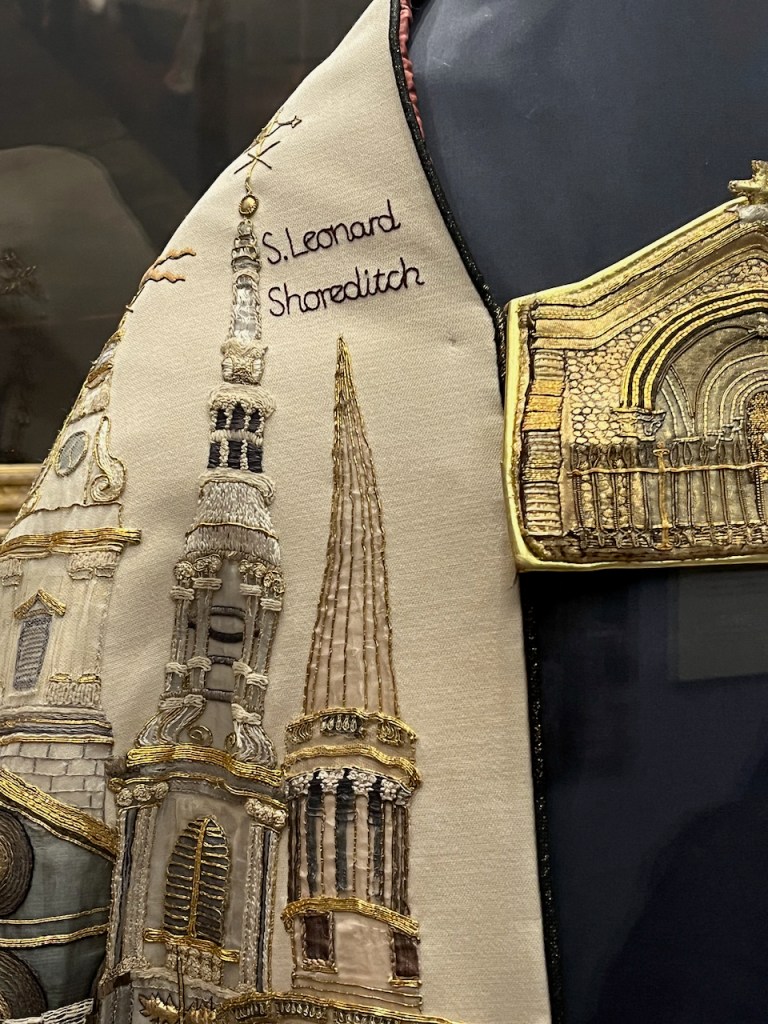
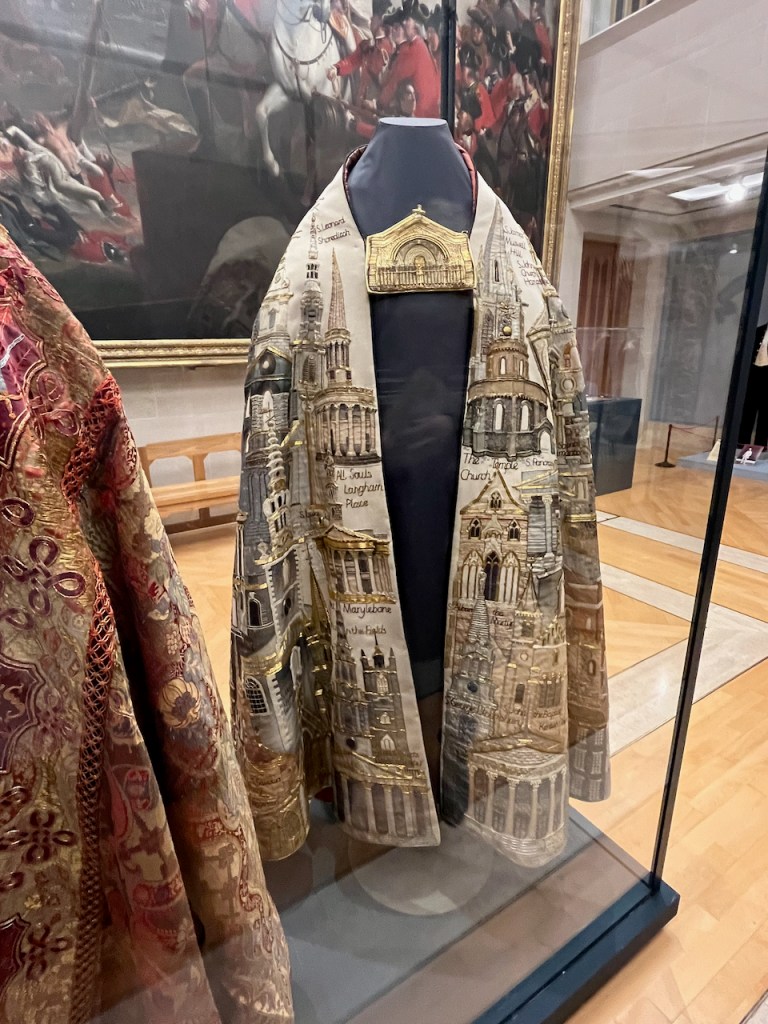
There is a current exhibition in the Guildhall London:
“Treasures of Gold and Silver Wire” curated by Dr. Karen Watts, Emeritus at the Royal Armouries. It celebrates the 400 anniversary of the Worshipful Company of Gold and Silver Wyre Drawers.
St Leonard Shoreditch is the spire to the left of the wordsThe Silver Jubilee Cope on display in the Guildhall 16th December 2023
Having myself had a go at depicting those arches and columns on the spire, I am full of admiration for the embroiderers who managed to create an accurate image in wire thread. Hugely accomplished! The exhibition is on until 31st December 2023- well worth seeing.
Click a button below to share this post online, email it, or print it:
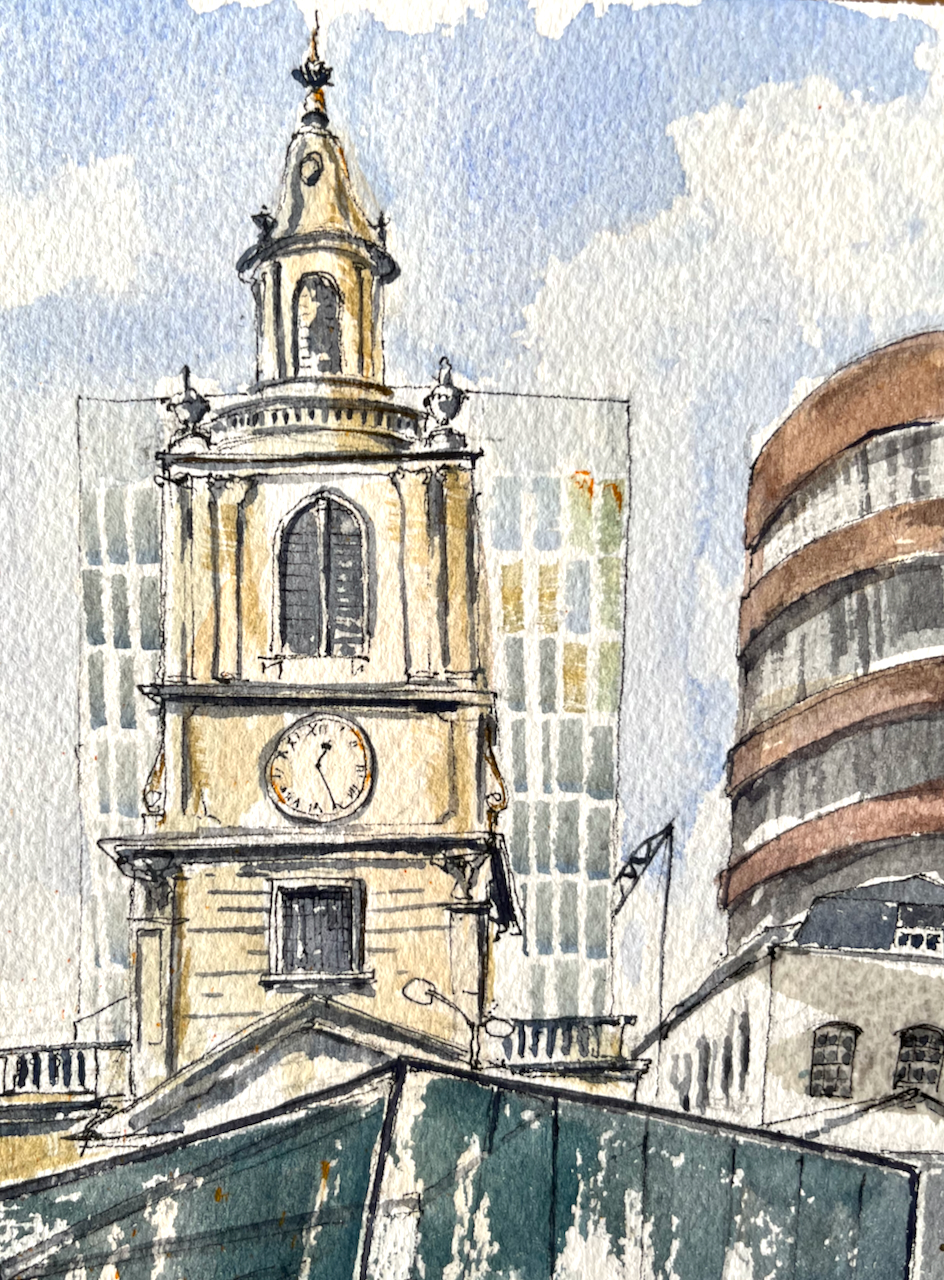
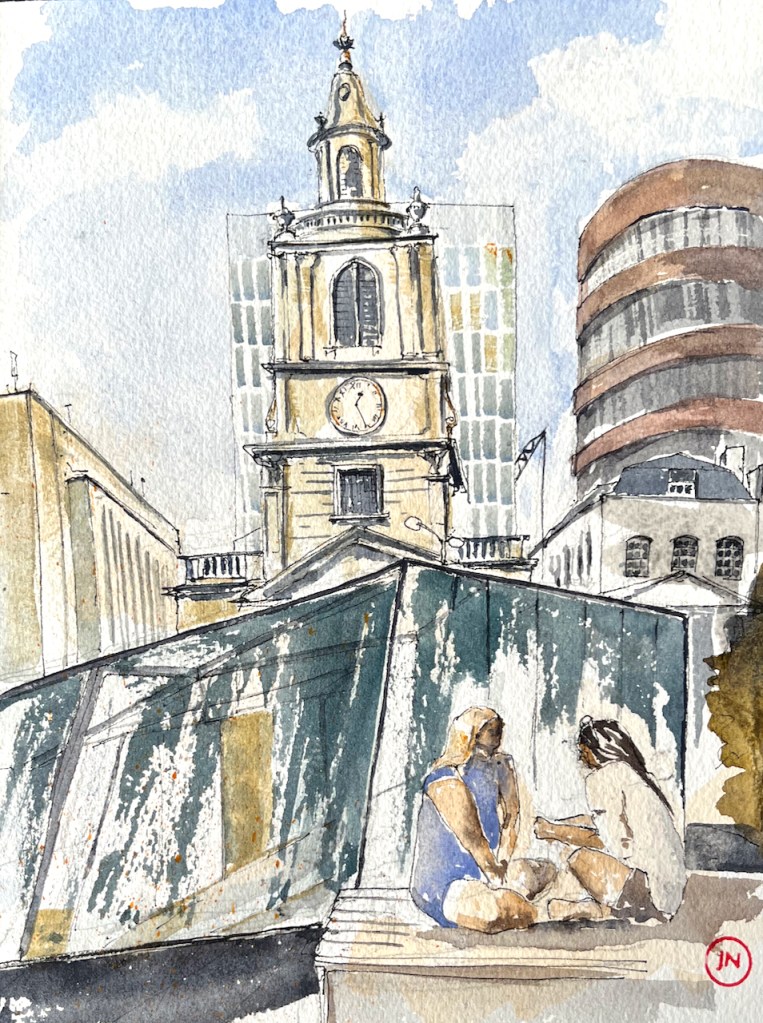
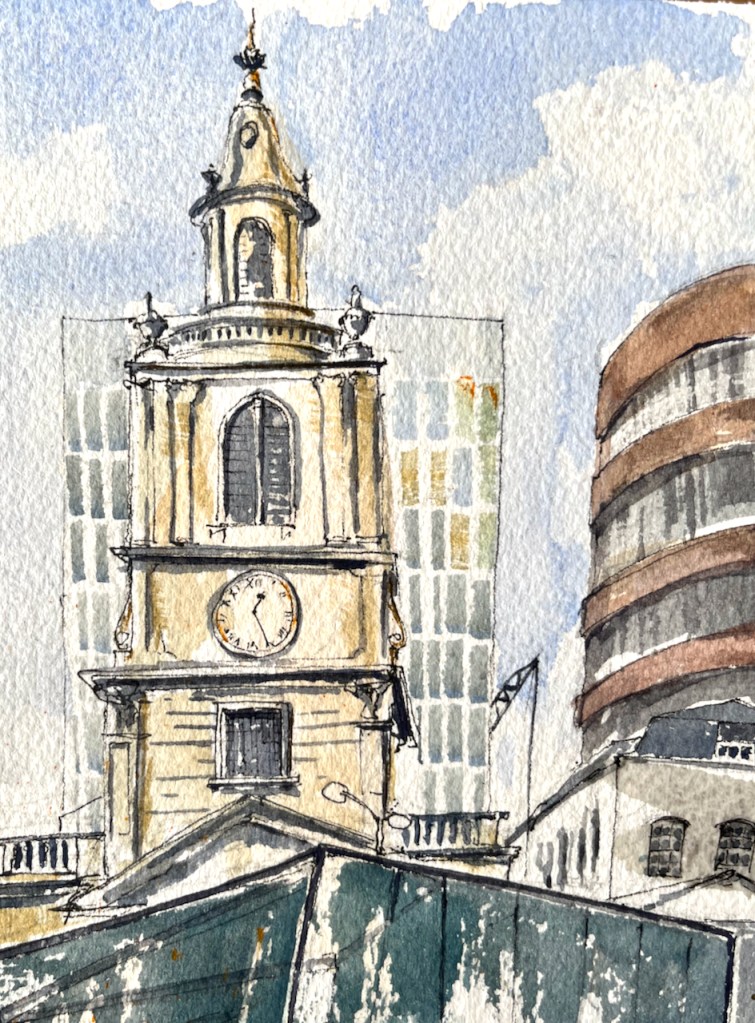
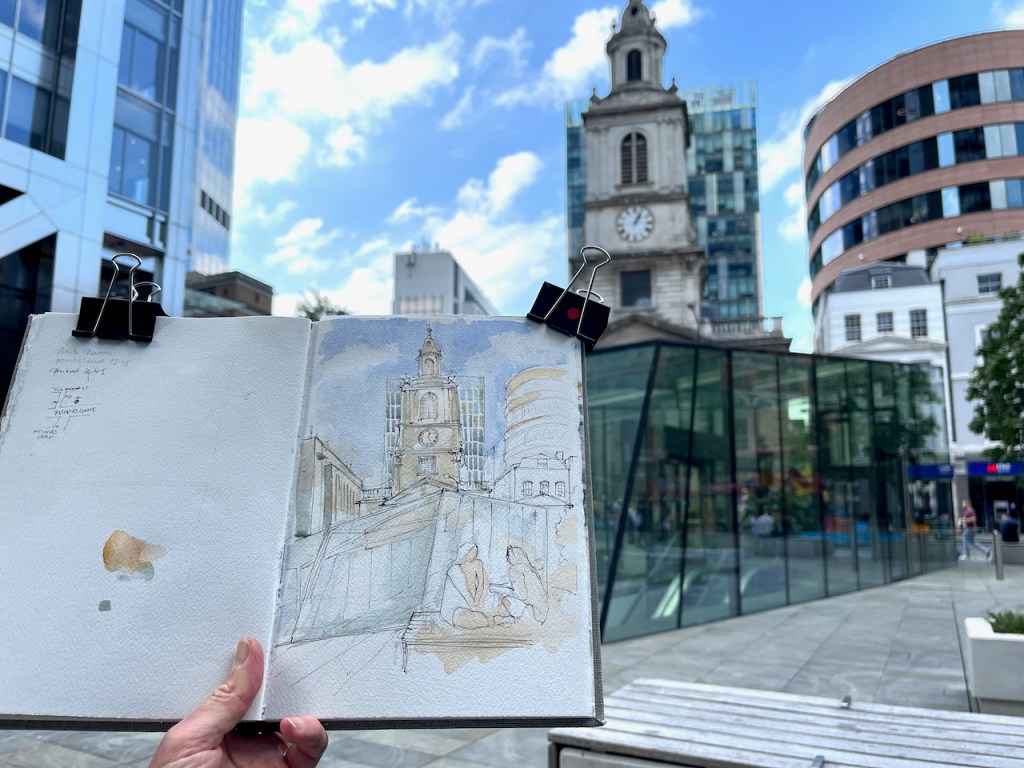
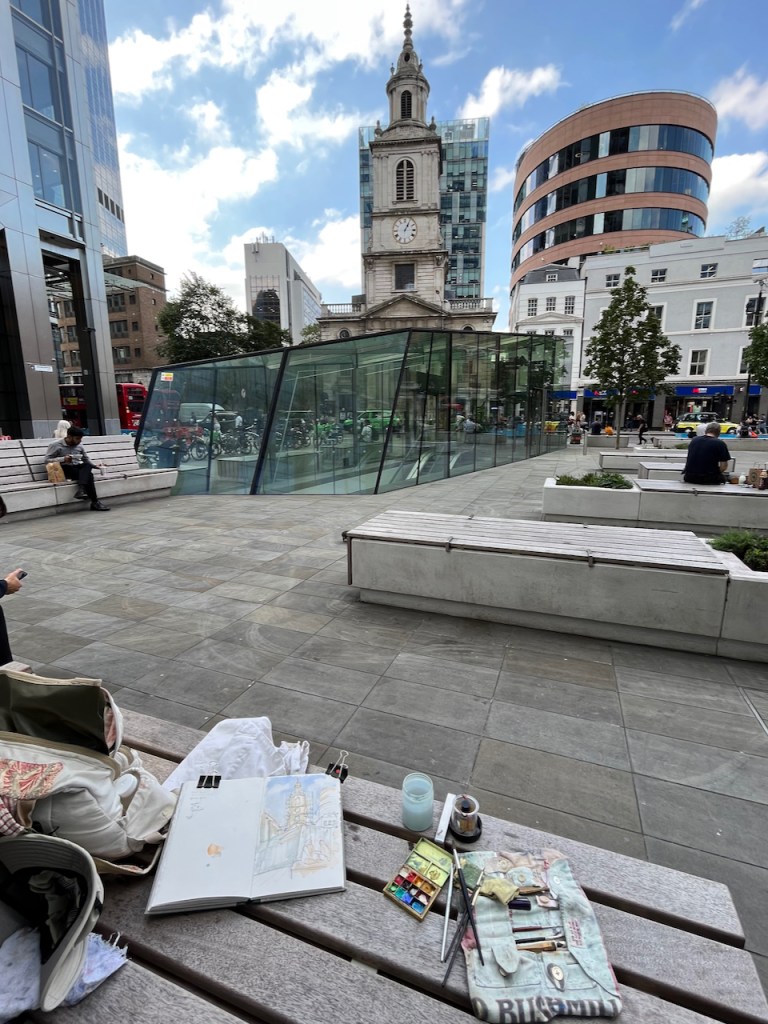
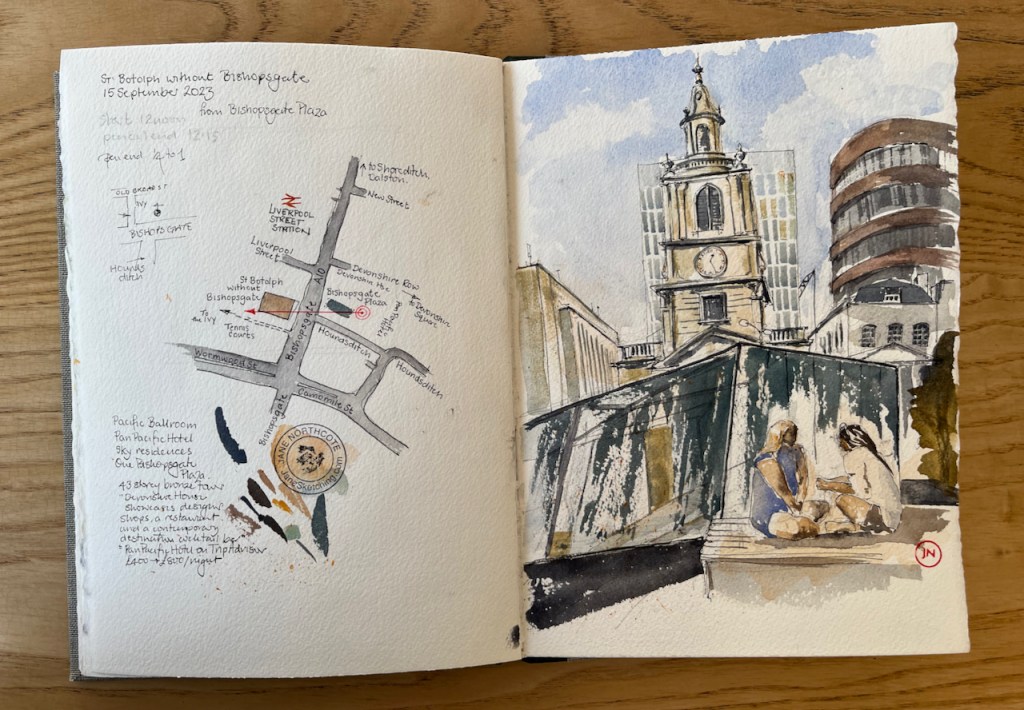
Bishopsgate Plaza is on the East side of Bishopsgate, near Liverpool Street. From the seats there, here is the view of St Botolph-without-Bishopsgate. I sketched amongst the many people enjoying the sun at lunchtime.
St Botolph-without-Bishopsgate, EC2. 15th September 2023, 1pm. 10″x 7″ in sketchbook 13
The current church was constructed in 1729, to the designs of James Gould. There has been a place of Christian worship on this site since Roman times. The parish registers are complete from 1558 according to the church’s website.
Viewed from Bishopsgate Plaza, the church is all but submerged in the surrounding buildings. The large glass structure is the entrance to the “Pacific Ballroom”. This is part of the Pan Pacific Hotel, which was behind me as I sketched.
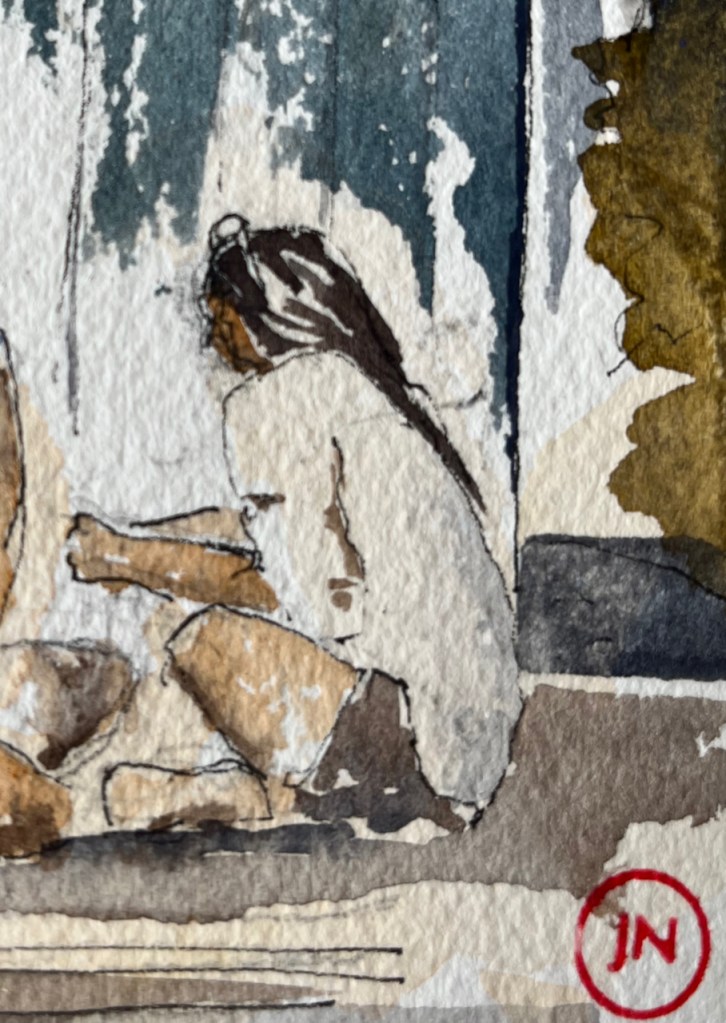
I find it quite hard to draw people, but I wanted to include the discussion between the two women. Their lively conversation contrasted with the stillness of the church, and the enormity of the buildings all around. They created a little private world between themselves.
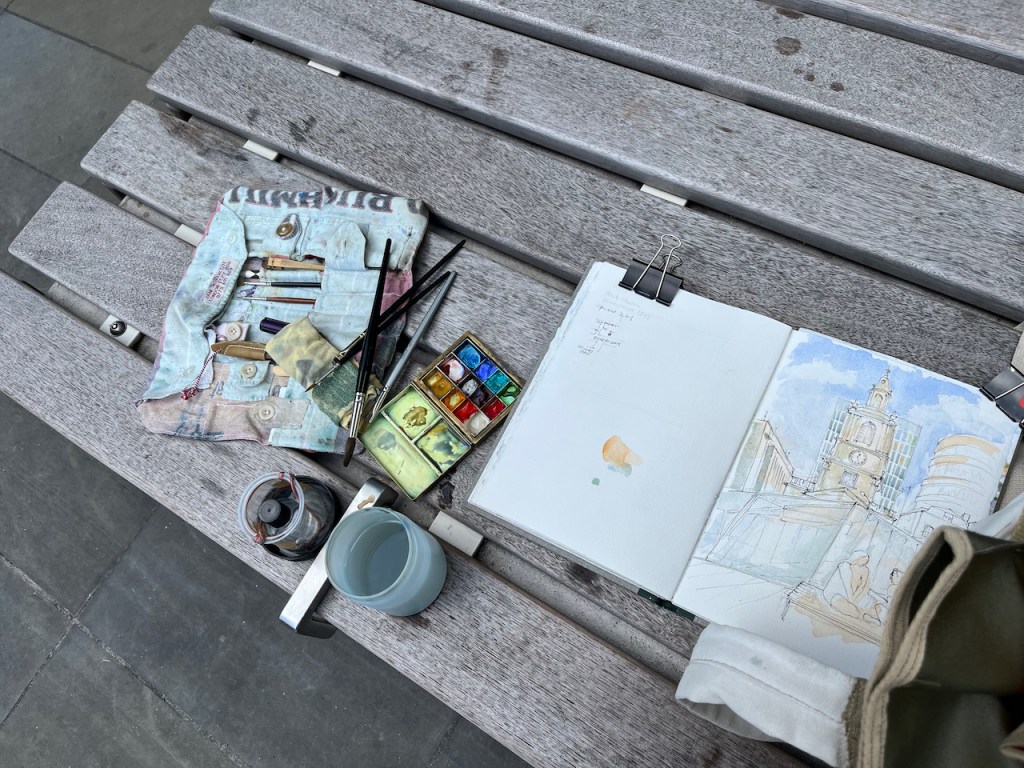
Here is work in progress on the sketch:
Sketchbook 13
Click a button below to share this post online, email it, or print it:
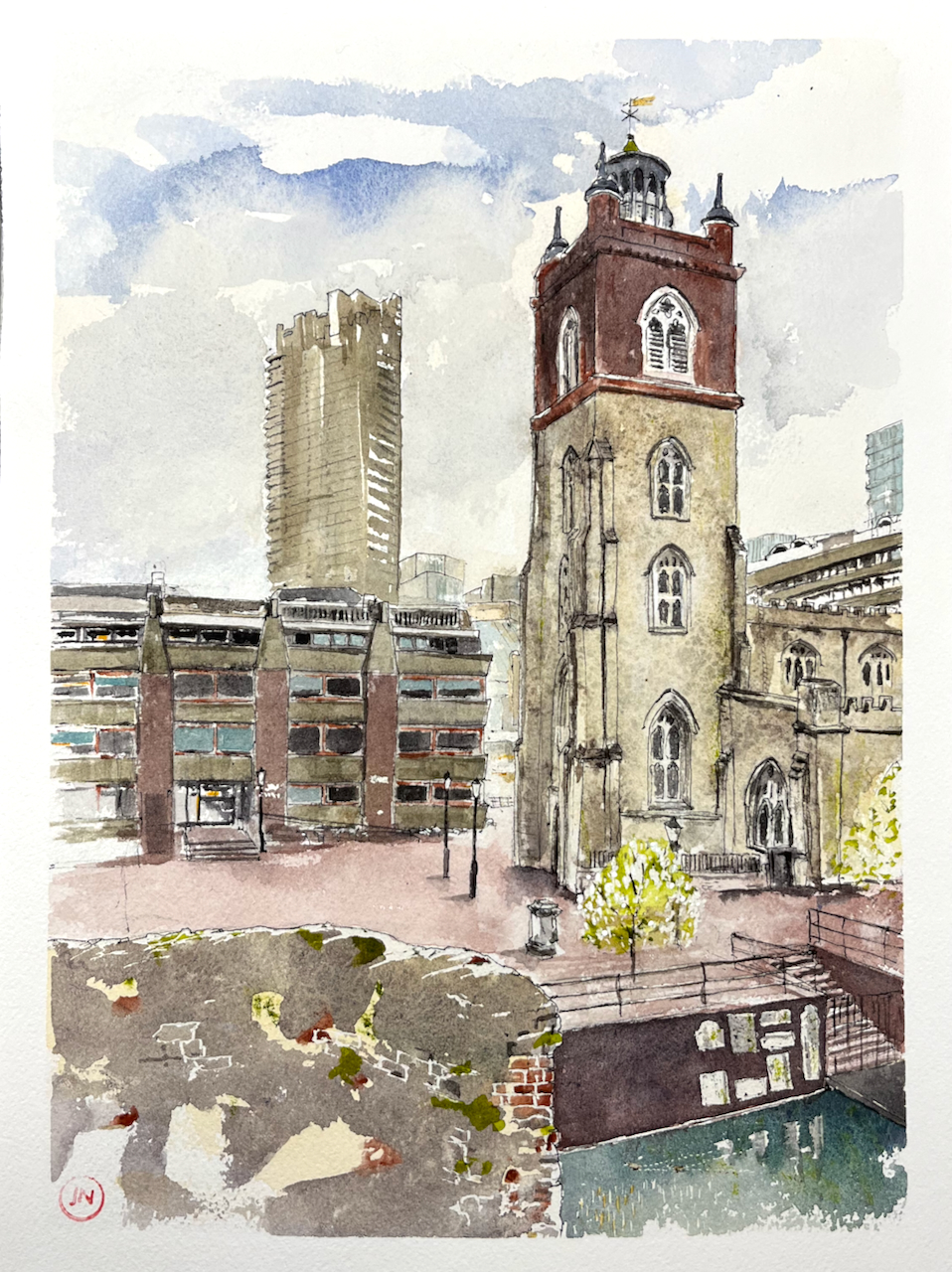
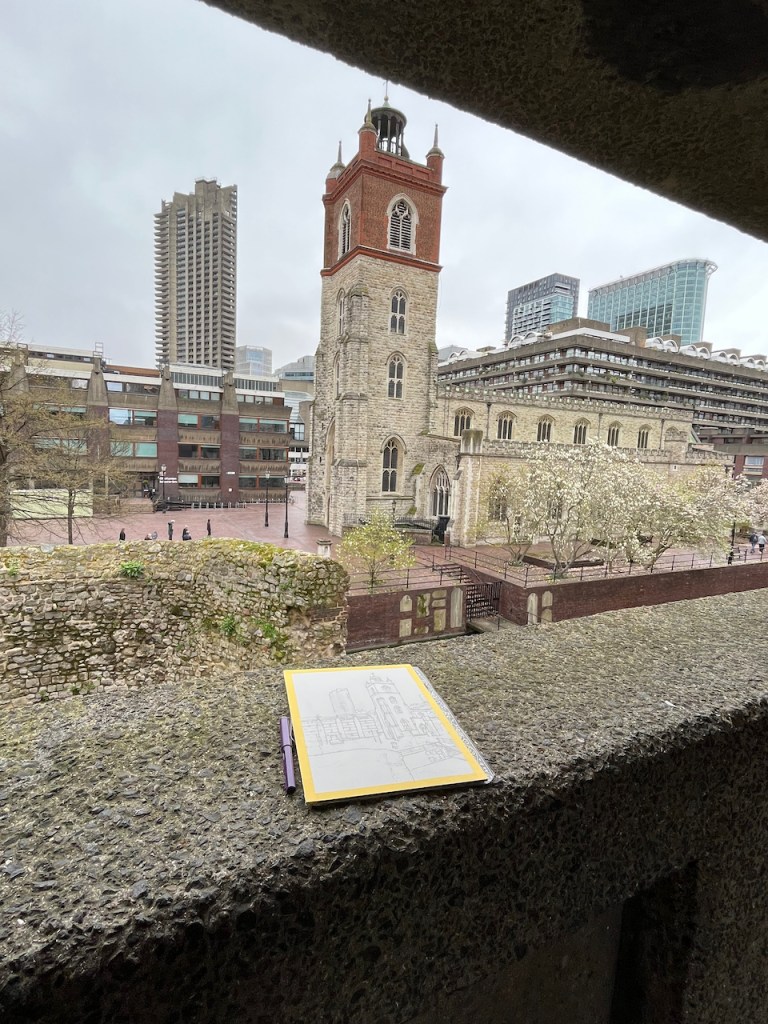
Here is St Giles’ Church, Cripplegate, seen from the public walkway at Wallside. The church is surrounded by the Barbican Estate. Cromwell Tower is in the background. The City of London School for Girls is the lower building, centre and left. Through the gap between the church and the school, you can just glimpse the Barbican Centre.
The magnolia was in bloom!
St Giles from Wallside, Barbican, 1 April 2023 12″ x 9″ [Commission]
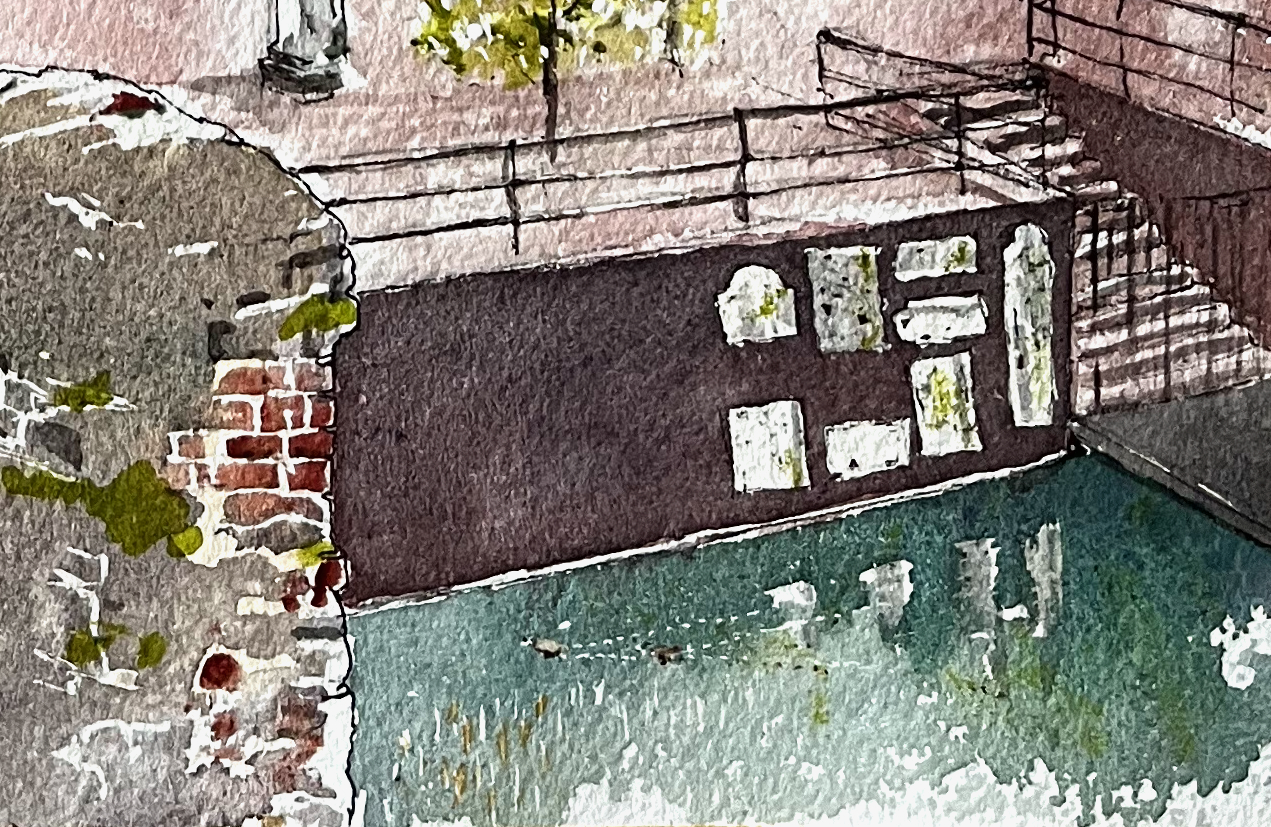
I painted this as a commission, for some clients who wanted this particular view. A special request for this commission was that I showed two ducks. These are small, but they are there!
Ducks on the lake.
The white shapes on the lakeside wall are gravestones.
Old London Wall is on the left: part stone, part brick. This is the old Roman wall round the City of London.
Thank you to my clients for this commission and for their permission to post the picture here online. It was a real pleasure to do.
The colours I used are:
For the sky: a pale yellow wash of permanent yellow deep, followed by a grey made from ultramarine blue and burnt umber, with some ultramarine blue for the blue bits.
For the church: the stone is a pale yellow wash of permanent yellow deep, then a dilute buff titanium wash. I put salt on it to get some texture. Then the dark areas are a grey made from ultramarine blue and burnt umber.
The top part of the church, St Giles Terrace and all the reddish/purple brickwork is a combination of perylene maroon, burnt umber, fired gold ochre, and a bit of ultramarine blue for the dark areas.
The lake, which really is that green colour, is ultramarine blue, plus some serpentine genuine which makes it granulate.
All concrete is the same mix of burnt umber and ultramarine blue with some mars yellow.
Old London wall is the pale yellow wash of permanent yellow deep, with a second wash of lunar blue with burnt umber. Lunar blue is highly granulating, which gives a wonderful stone effect. The bricks are fired gold ochre.
All green plants are green gold, and there’s also some green gold on the stonework of the church, to show the lichen.
The weathervane is Liquitex gold ink, applied with a fine brush.
The line drawing is done with a Lamy Safari fountain pen, using De Atramentis Black ink, which is waterproof.
The white parts of the picture, for example the lines between the bricks on Old London Wall, (and the ducks) are done using a resist. This is a rubbery substance, applied before putting on any paint. The resist I use is called Pebeo Drawing Gum. I put it on using a dip pen to get the fine lines. After the paint is dry, I rub it off, and the parts where it was show up white. There are also a few tiny dots of white gouache paint on the magnolia tree.
The paper is Arches Aquarelle 300gsm 12″ x 9″ in a block.
Work in progress. Arches Aquarelle block, Lamy Safari pen. The yellow is masking tape, which I put round to make the picture easier to handle and to give a crisp edge to the work. The people on St Giles Terrace were practising Tai Chi. It was very relaxing to watch them. See the green lichen on the concrete. And the magnolia.
Click a button below to share this post online, email it, or print it:
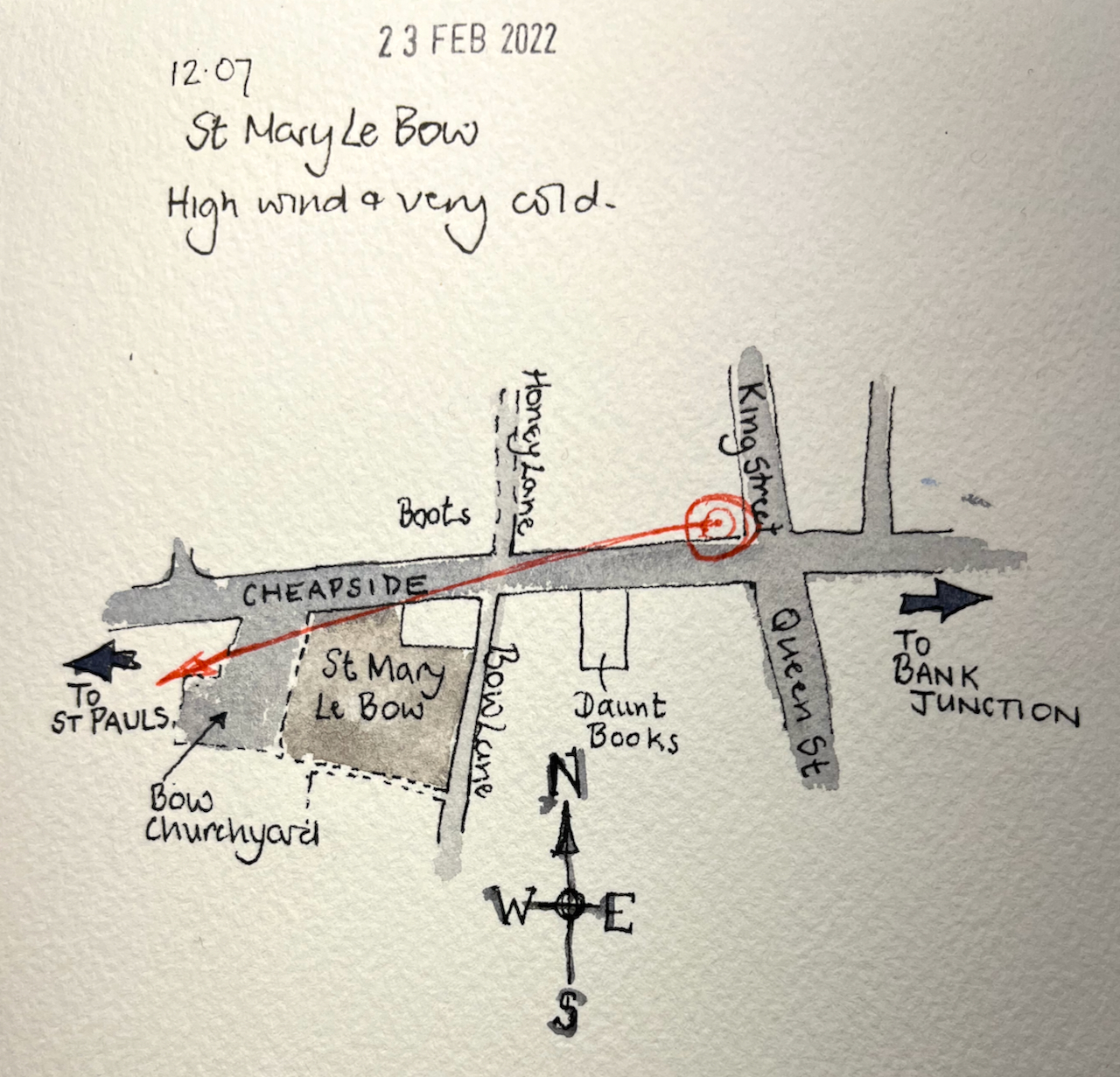
A quick sketch of St Mary Le Bow on Cheapside, London EC2
St Mary Le Bow, from Cheapside 23 Feb 2022 10″ x 7″ in Sketchbook 11
I drew this from the corner of Cheapside and King Street. This seemed like a really good place to stand, since there was a tall junction box next to me, and I could fit myself into a corner of a window. It rapidly became apparent that I chosen the windiest corner in London. My eyes streamed. Everyone coming round the corner took a short cut my side of the junction box, and funnelled past me, their heads down, phones in hand. I felt in the way.
But I persisted. I finished the pen. I did not put the colour on using the convenient top of the junction box, as I had planned, since no paper was going to stay still for a moment in that wind. I retreated, and coloured it at my desk.
Click a button below to share this post online, email it, or print it:
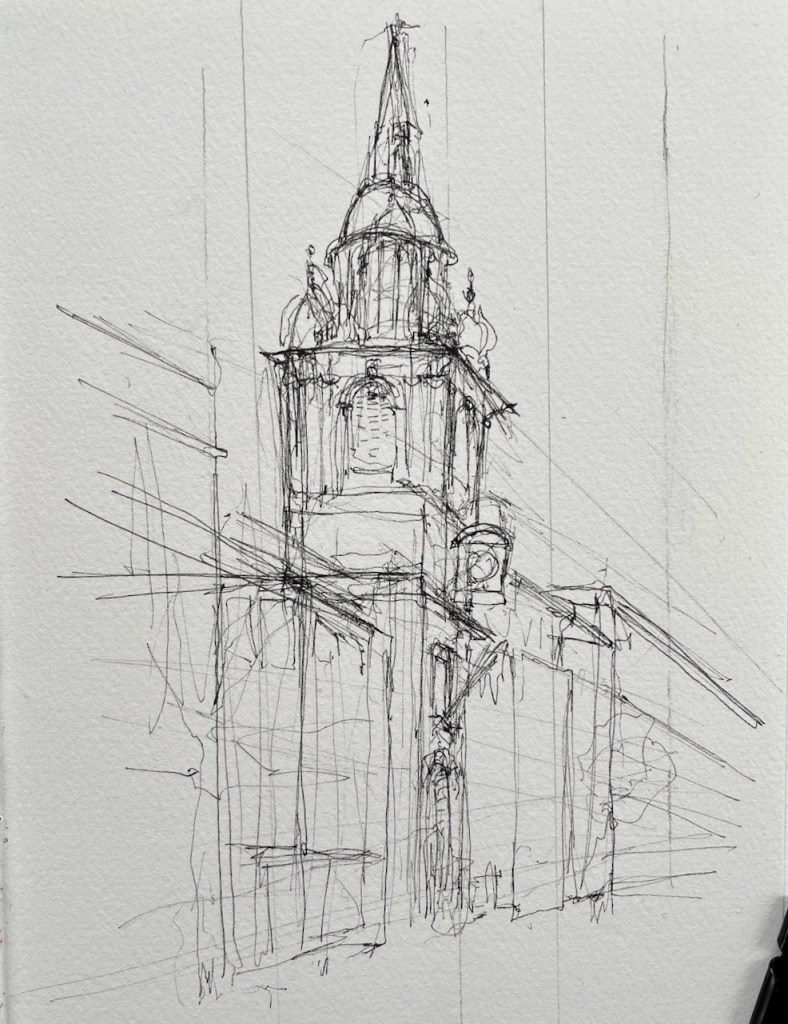
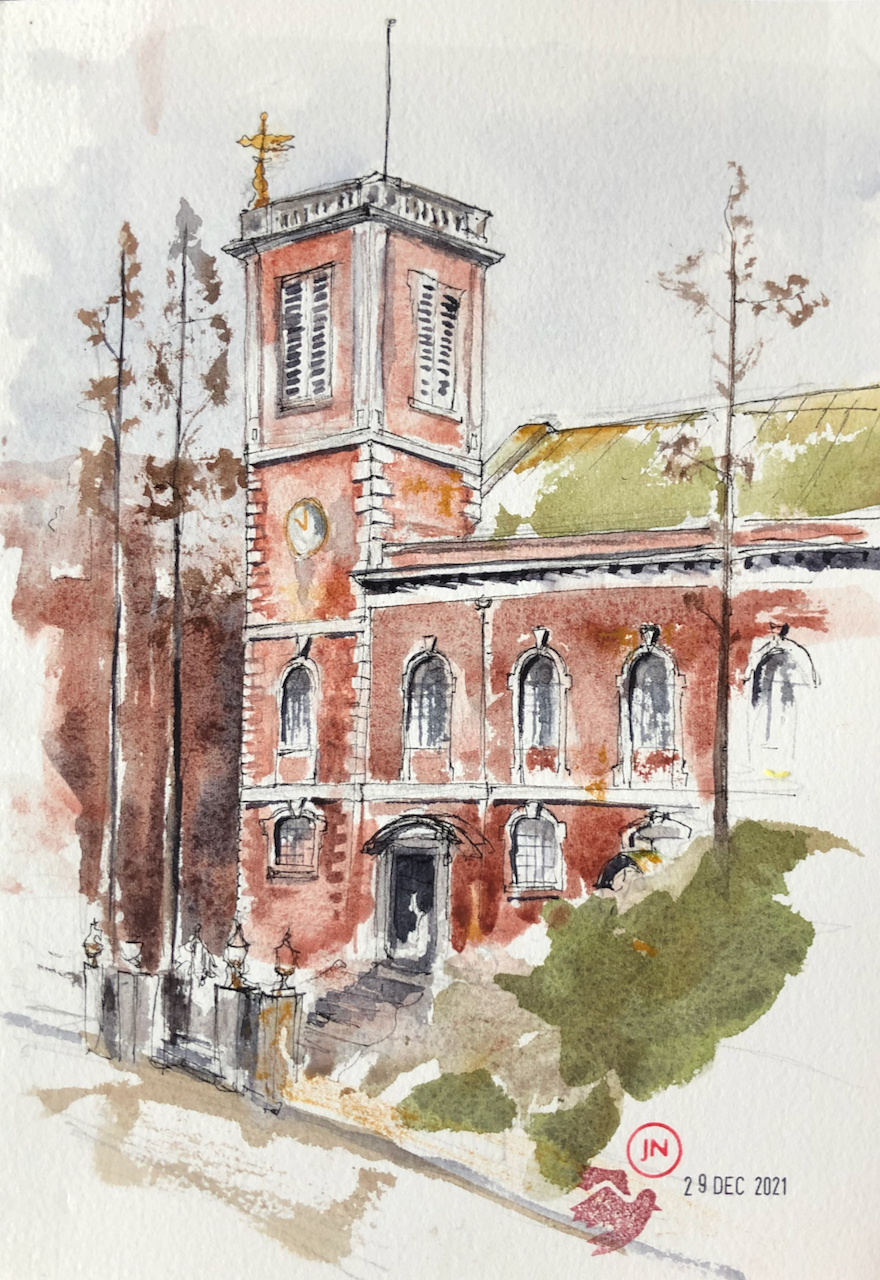
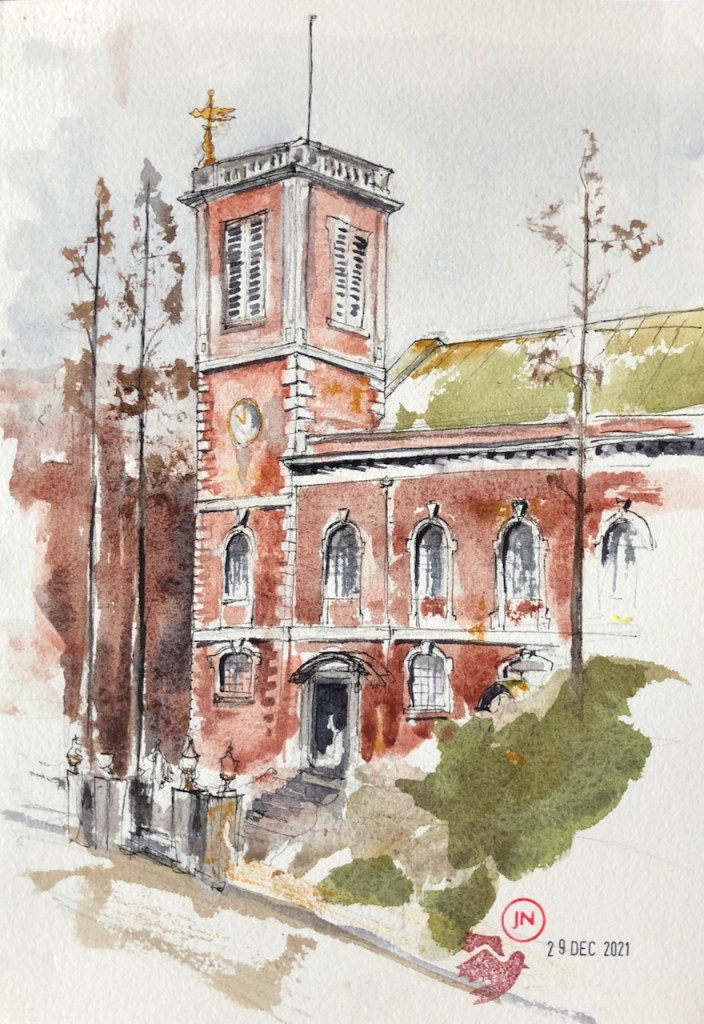
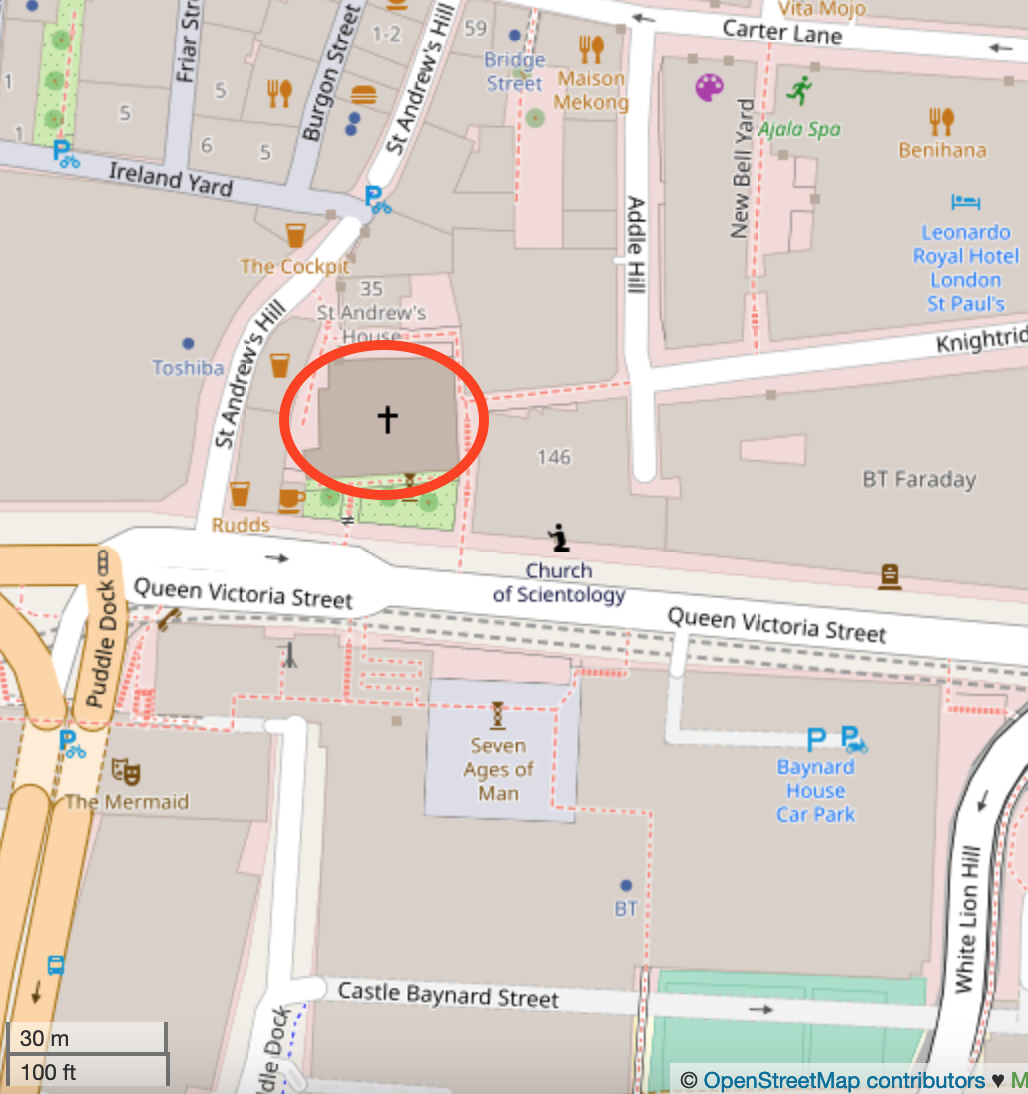
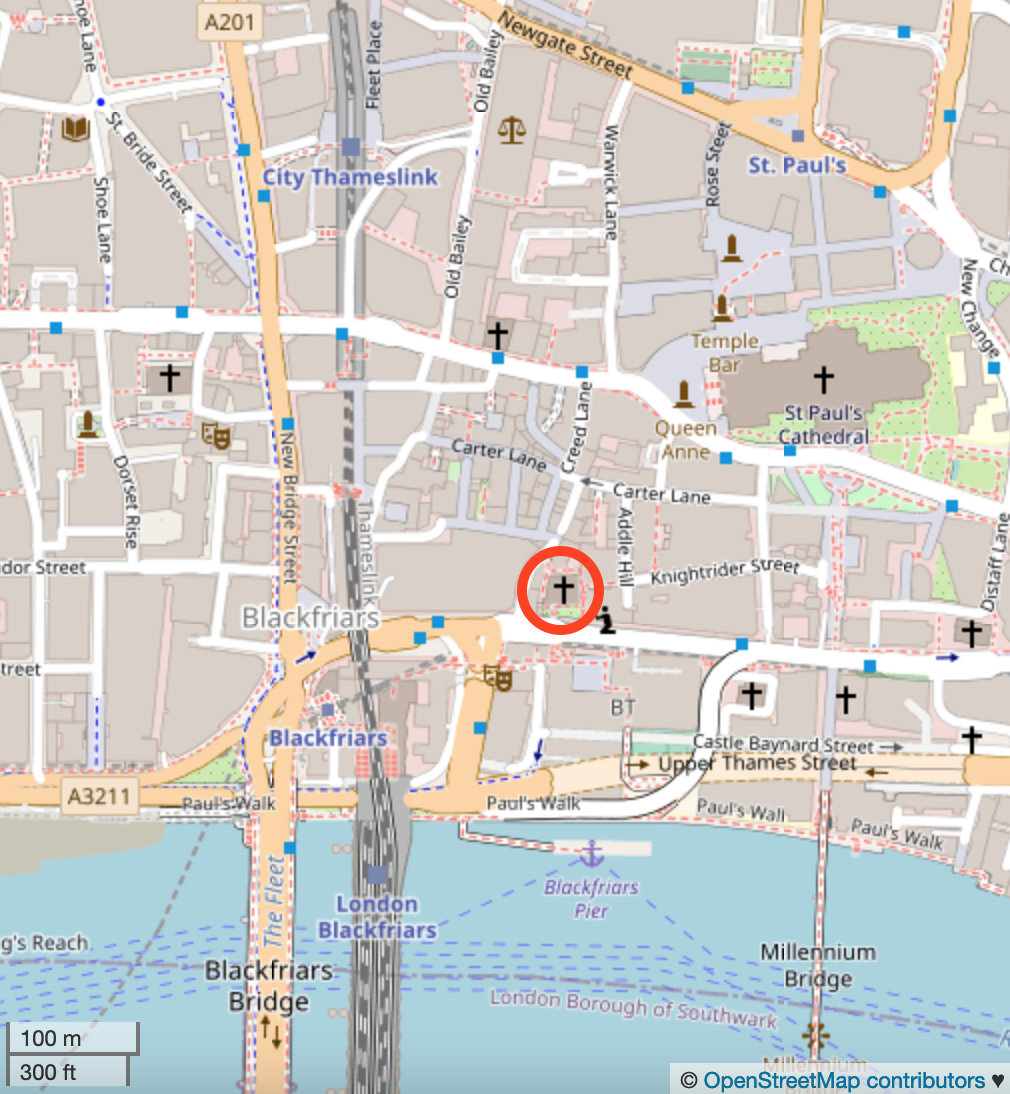
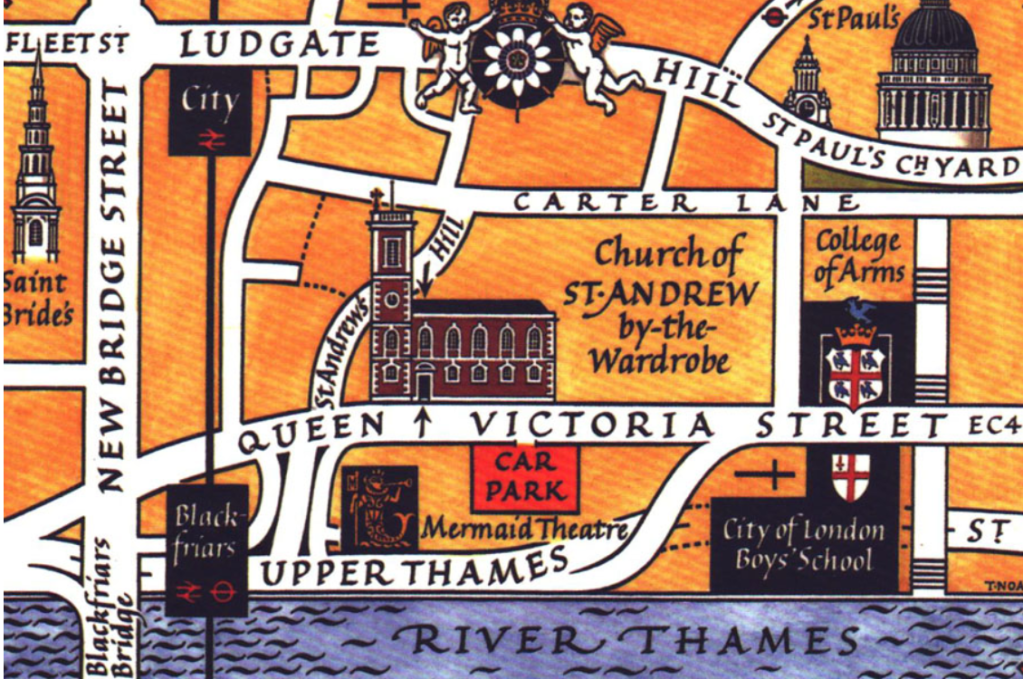
This lovely church is on Queen Victoria Street, a busy thoroughfare in the City of London.
St Andrew by the Wardrobe EC4, 29th December 2021 2pm. 10″ x 7″ in Sketchbook 11
This church was first recorded in 1244, destroyed in the fire of London 1666, rebuilt by Christopher Wren in 1685-93, then destroyed again in the 1939-45 conflict, rebuilt again, and re-hallowed in 1961. It is now closed for refurbishment, and due to reopen in May 2022. When it re-opens it will become the London Headquarters of the Egyptian Coptic Orthodox Church, this use being shared with the Anglican parish activities. I read this news on the church website.
Note the magnificent trees! These trees should feature on any London Tree Tour. I think they are larches but I am not an expert.
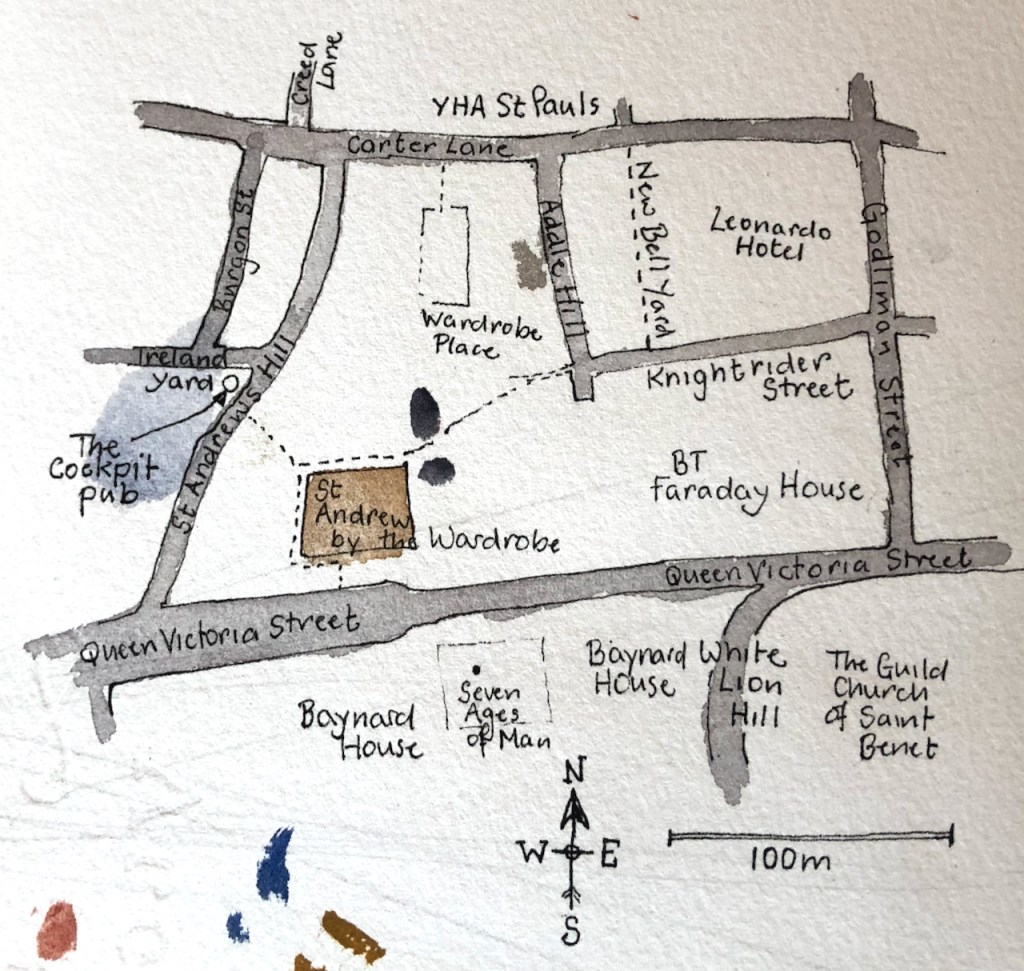
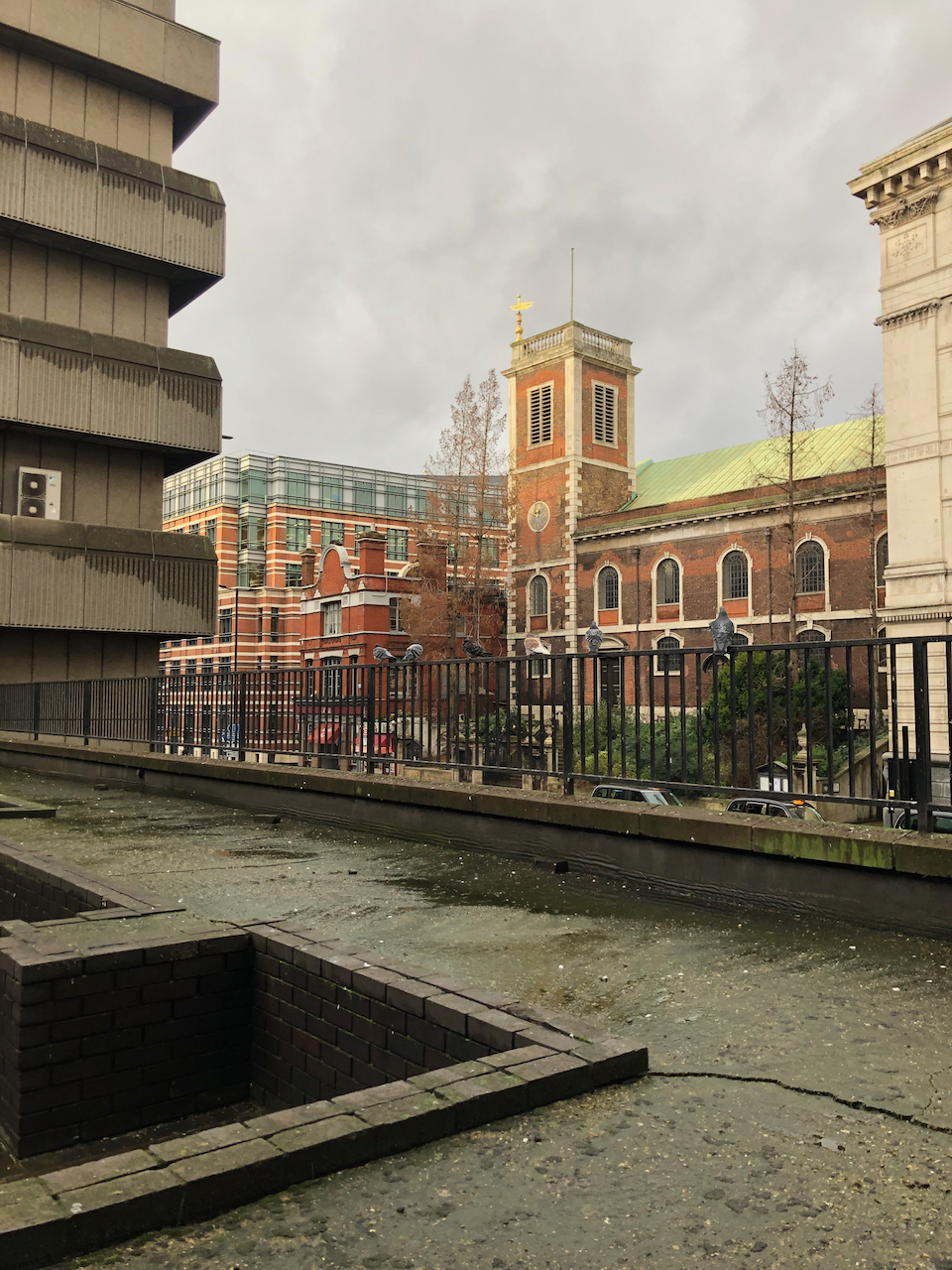
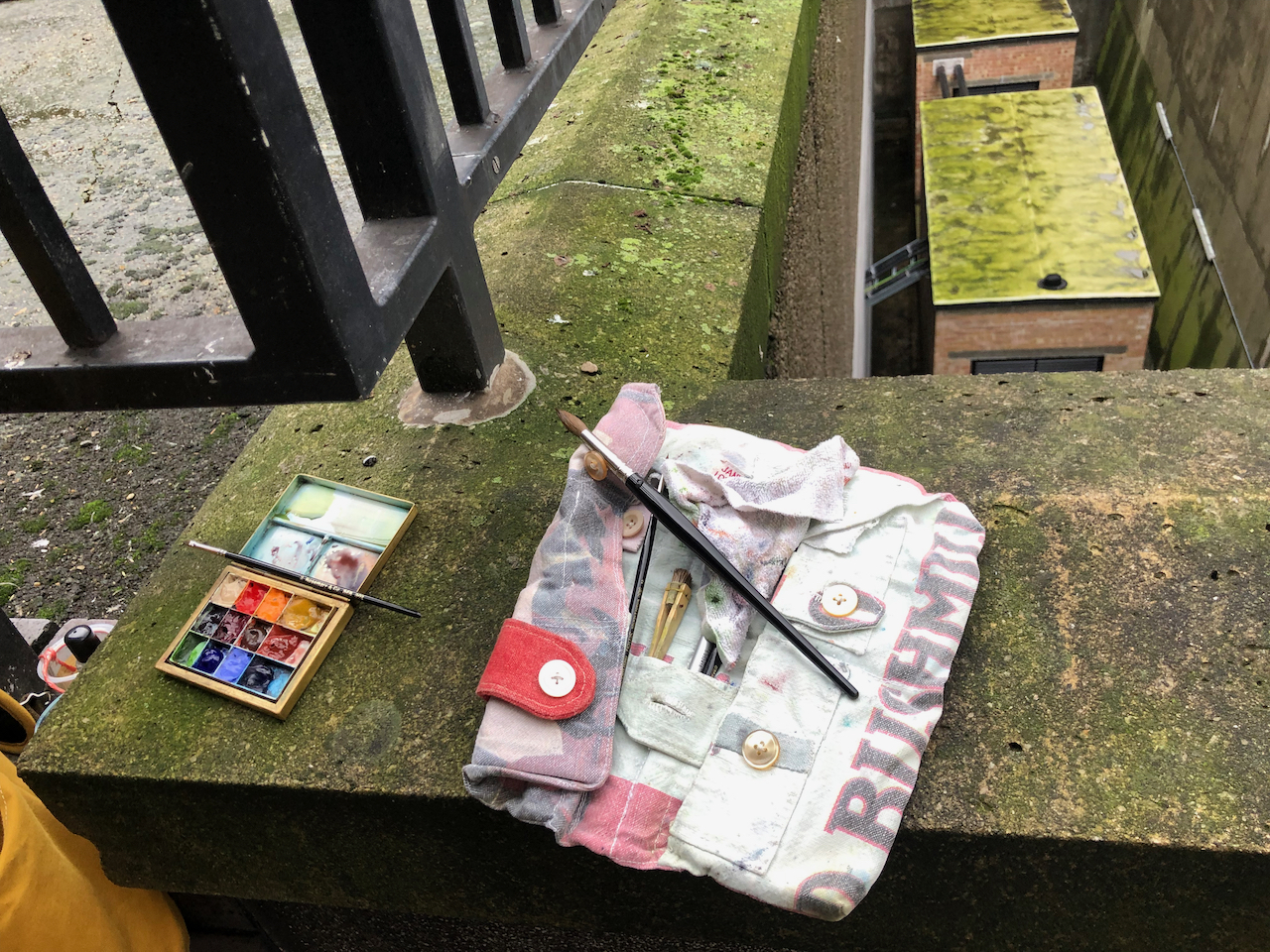
Yesterday, London was quiet. I sketched the church from podium level on Baynard House on the other side of the road. Baynard House is a 1970s office block currently occupied by BT (British Telecommunications, as was). Next to St Andrews on the East is the Church of Scientology. On the West side of St Andrews is a cocktail bar, Rudds.
map from the website of Slovenia in London
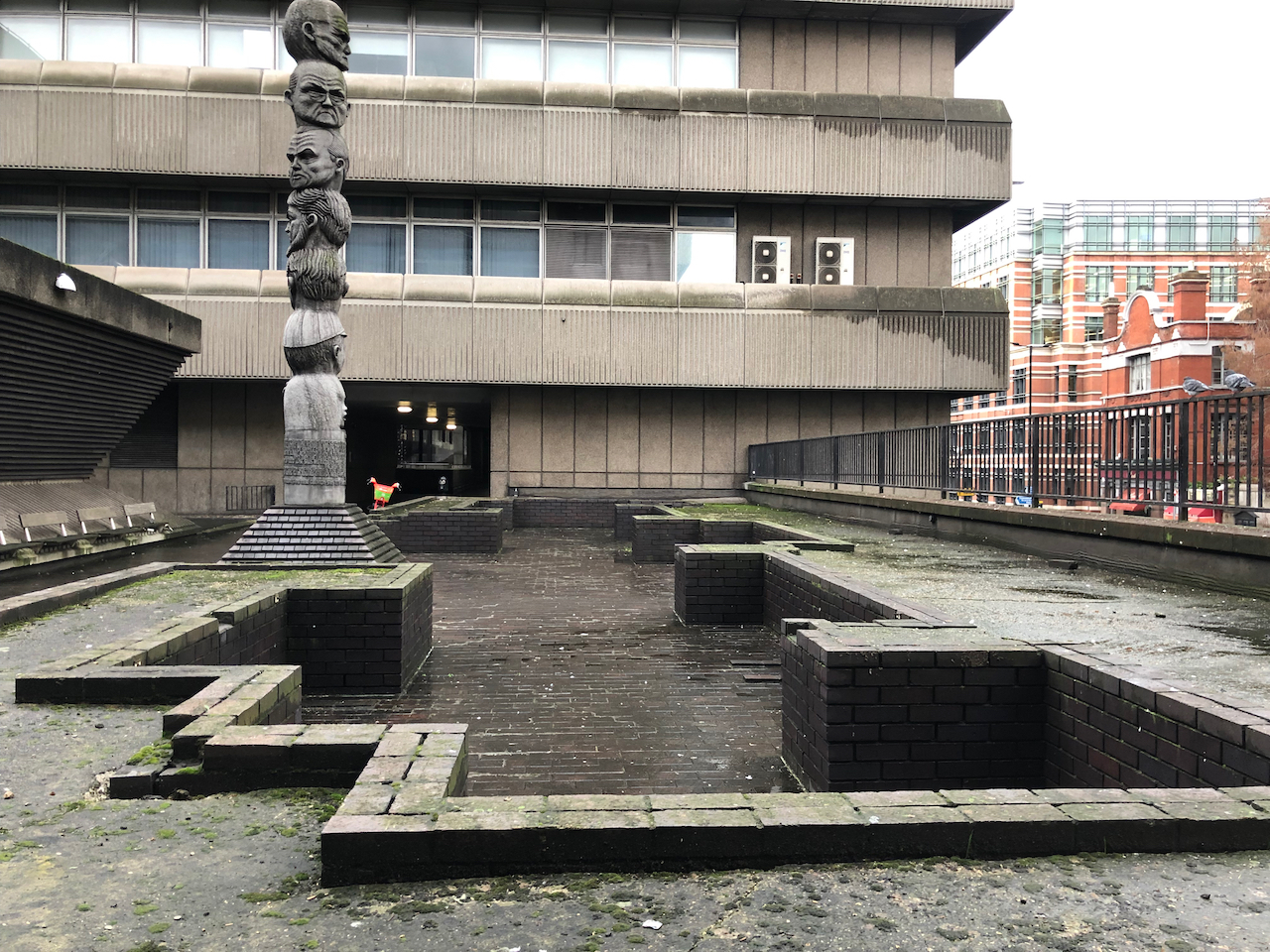
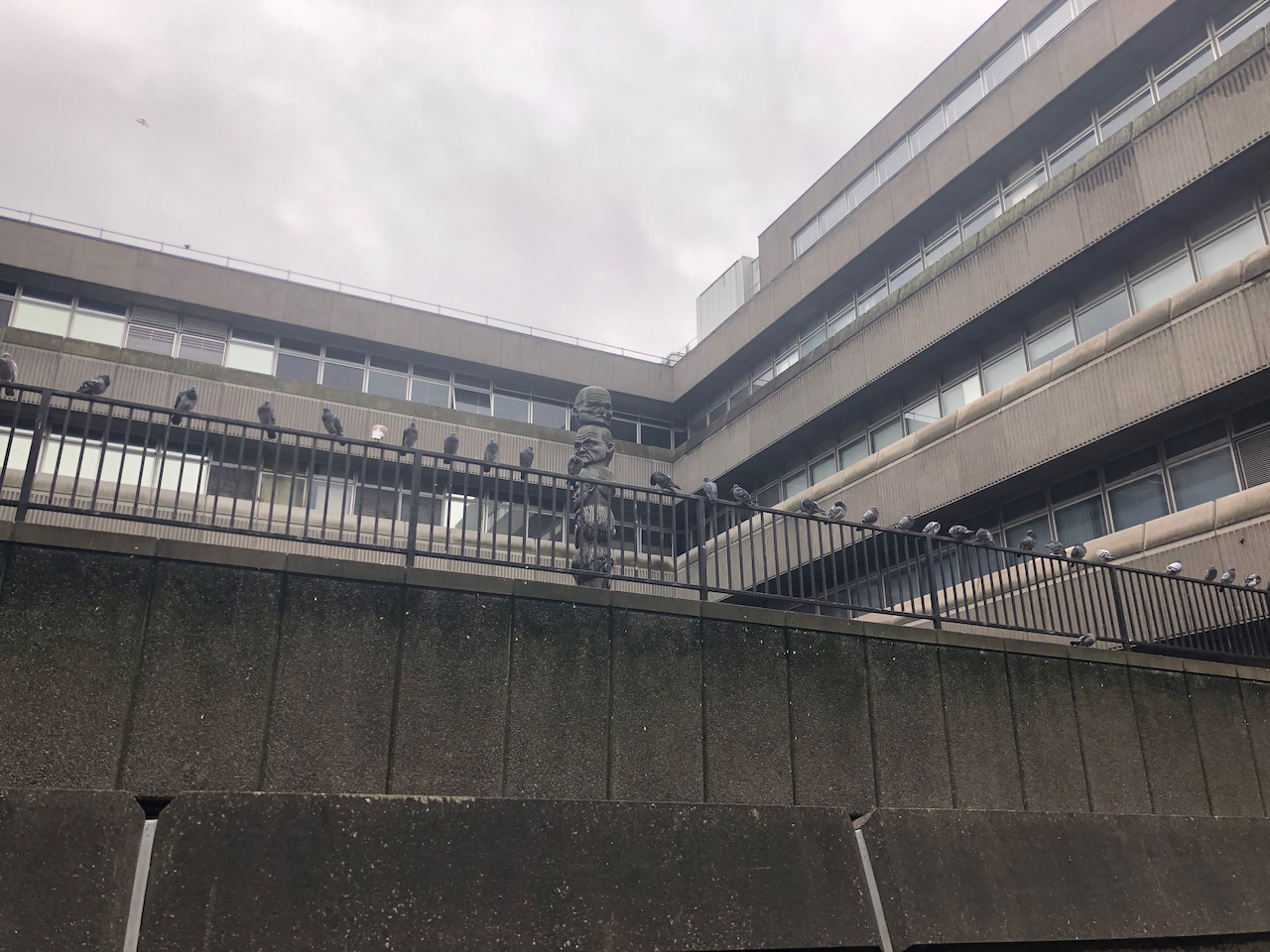
Baynard House, where I was sketching, is a strange and mysterious place. There is a podium-level walkway through the block. There are odd structures, like remnants of a lost civilisation.
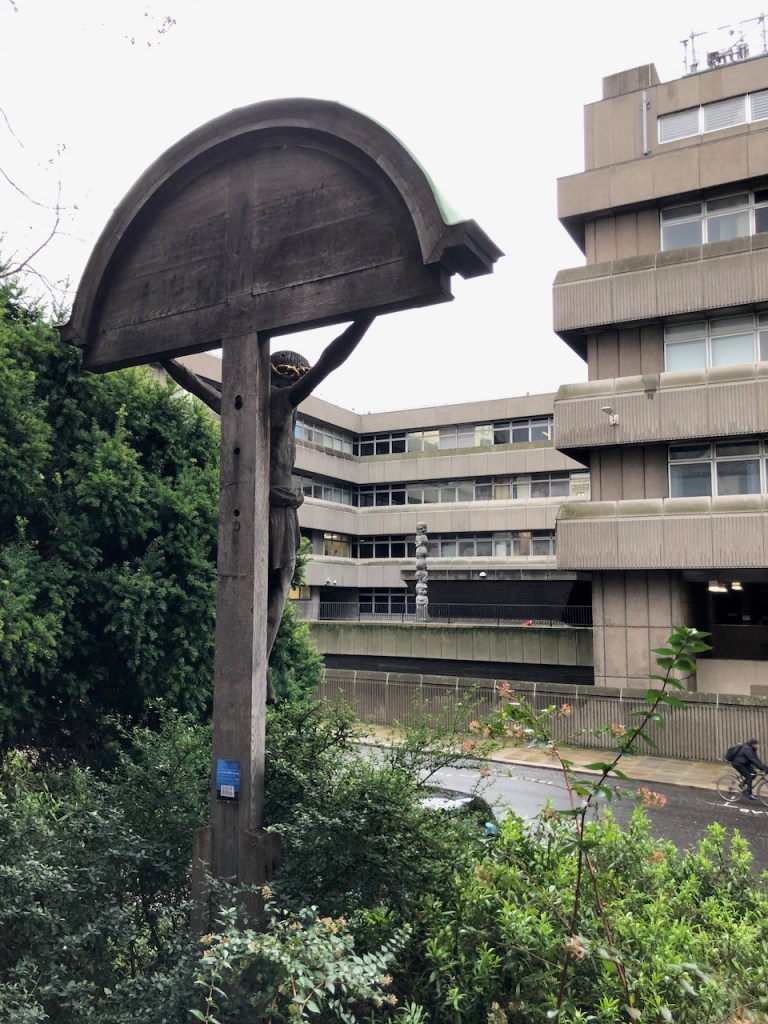
The church has a steeply sloping garden, with a wooden crucifix, just visible in the drawing. This looks across to the “seven ages of man” sculpture on Baynard House.
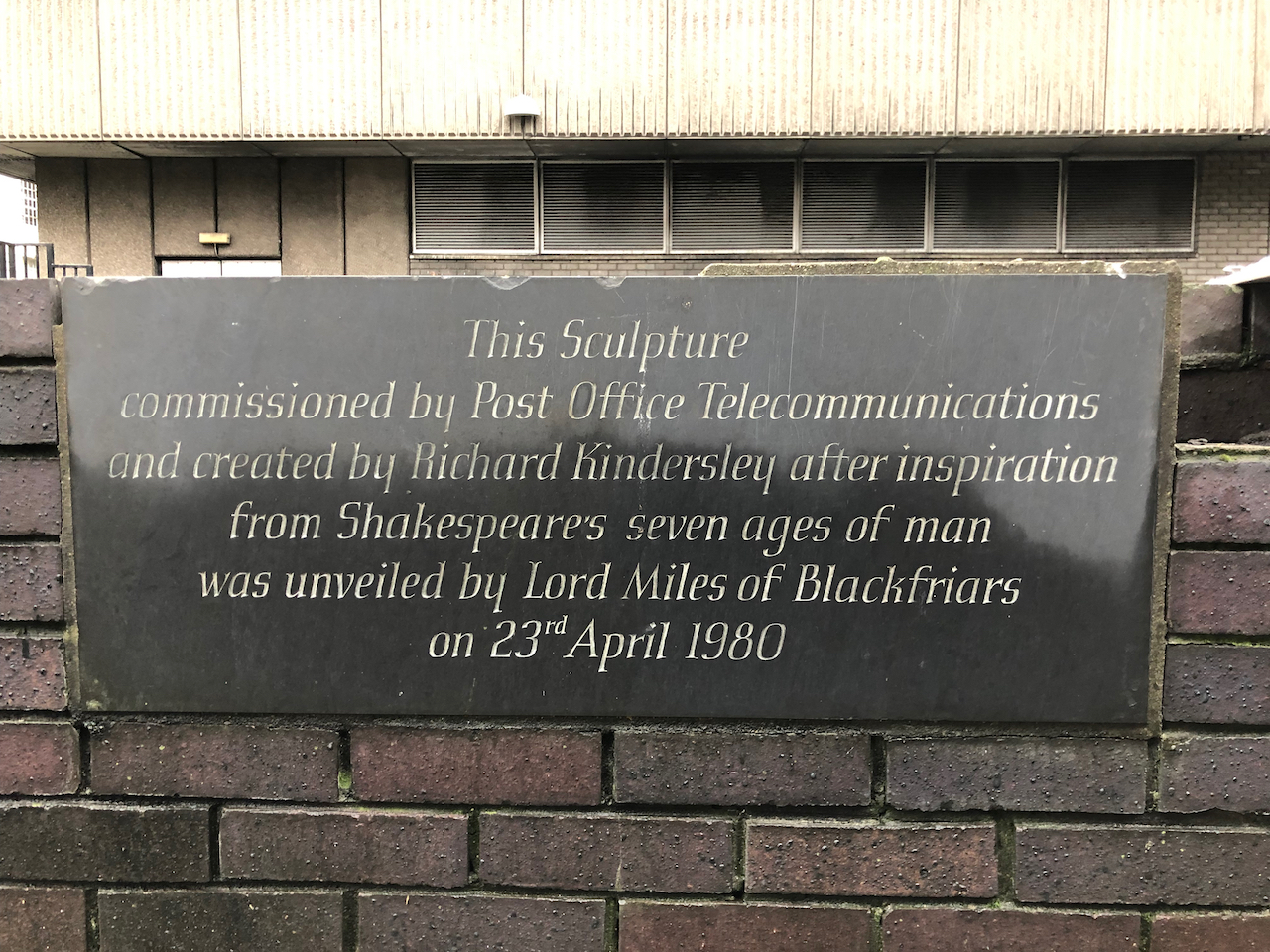
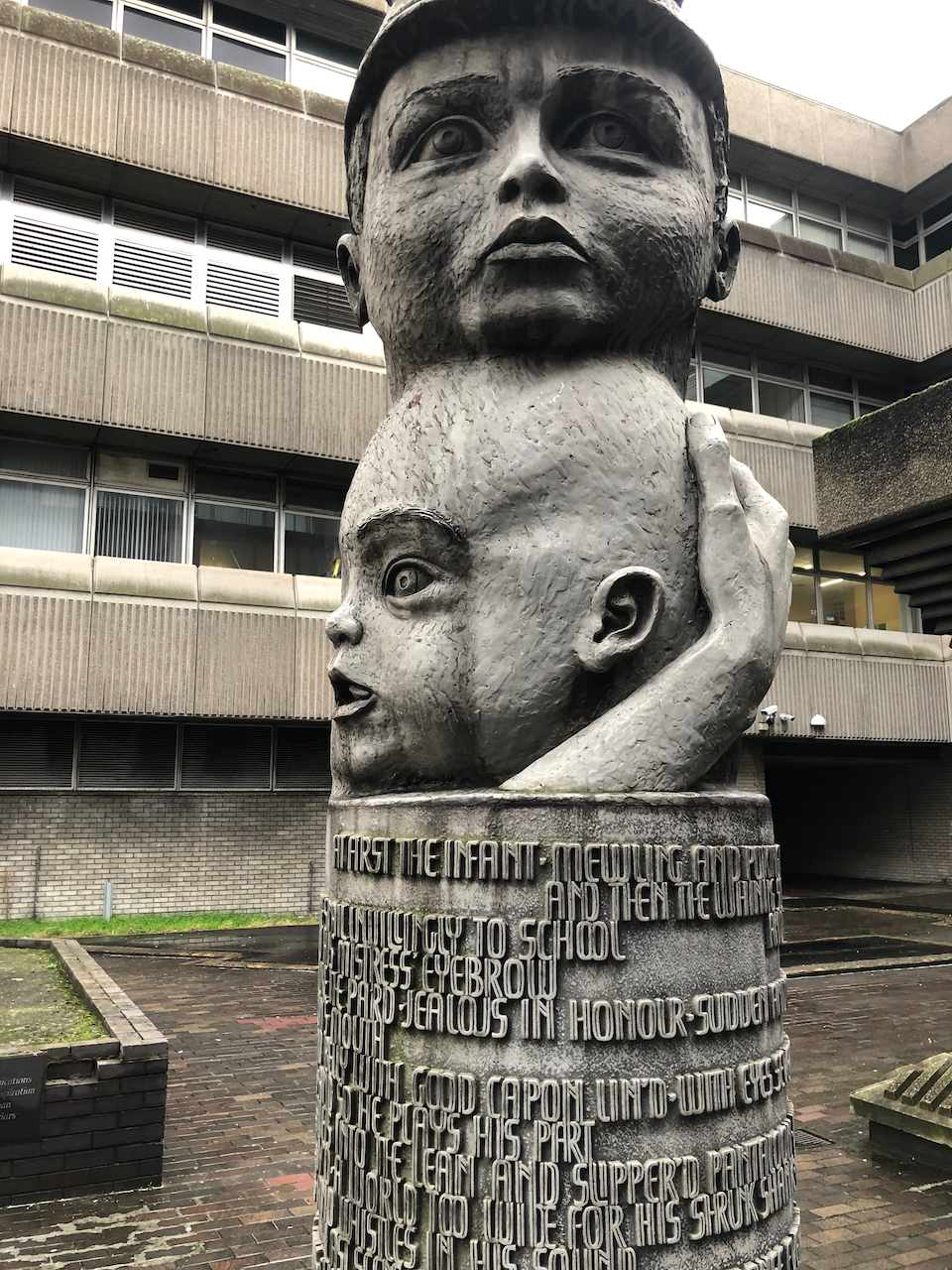
Looking South from St Andrews towards Baynard House, “Seven Ages of Man” sculpture by David Kindersley is visible in the centre of the picture.
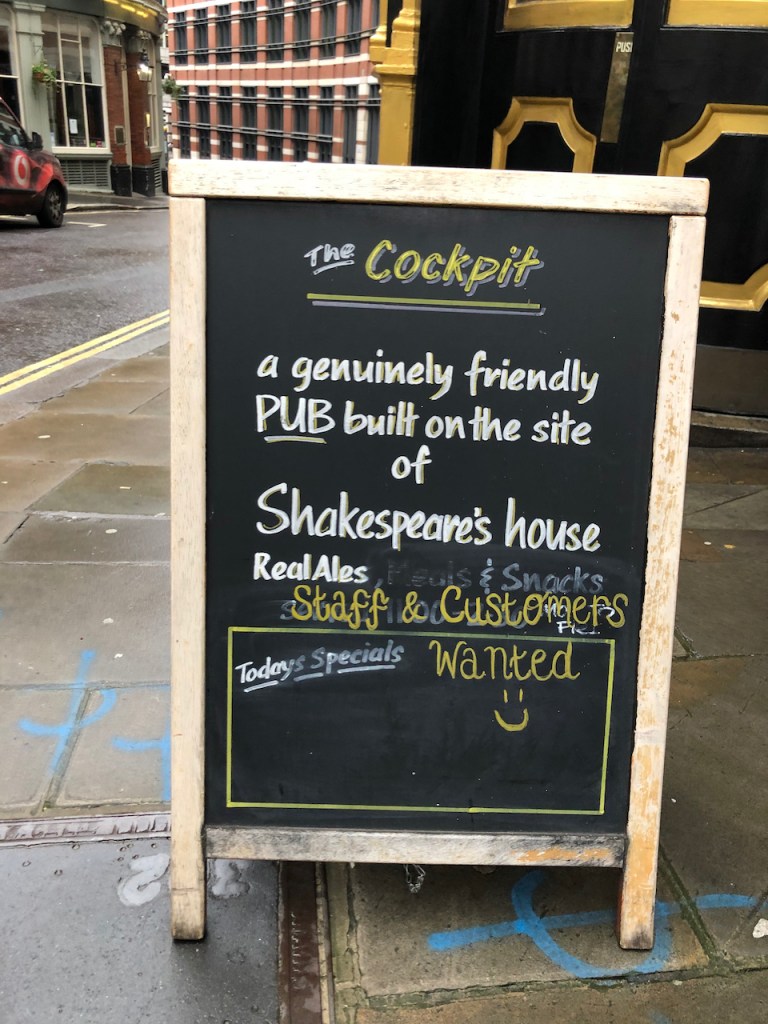
Walking up St Andrew’s Hill, I passed the “Cockpit” pub, on the site of Shakespeare’s house. It had a notice outside: “Staff and CustomersWanted“.
Click a button below to share this post online, email it, or print it:
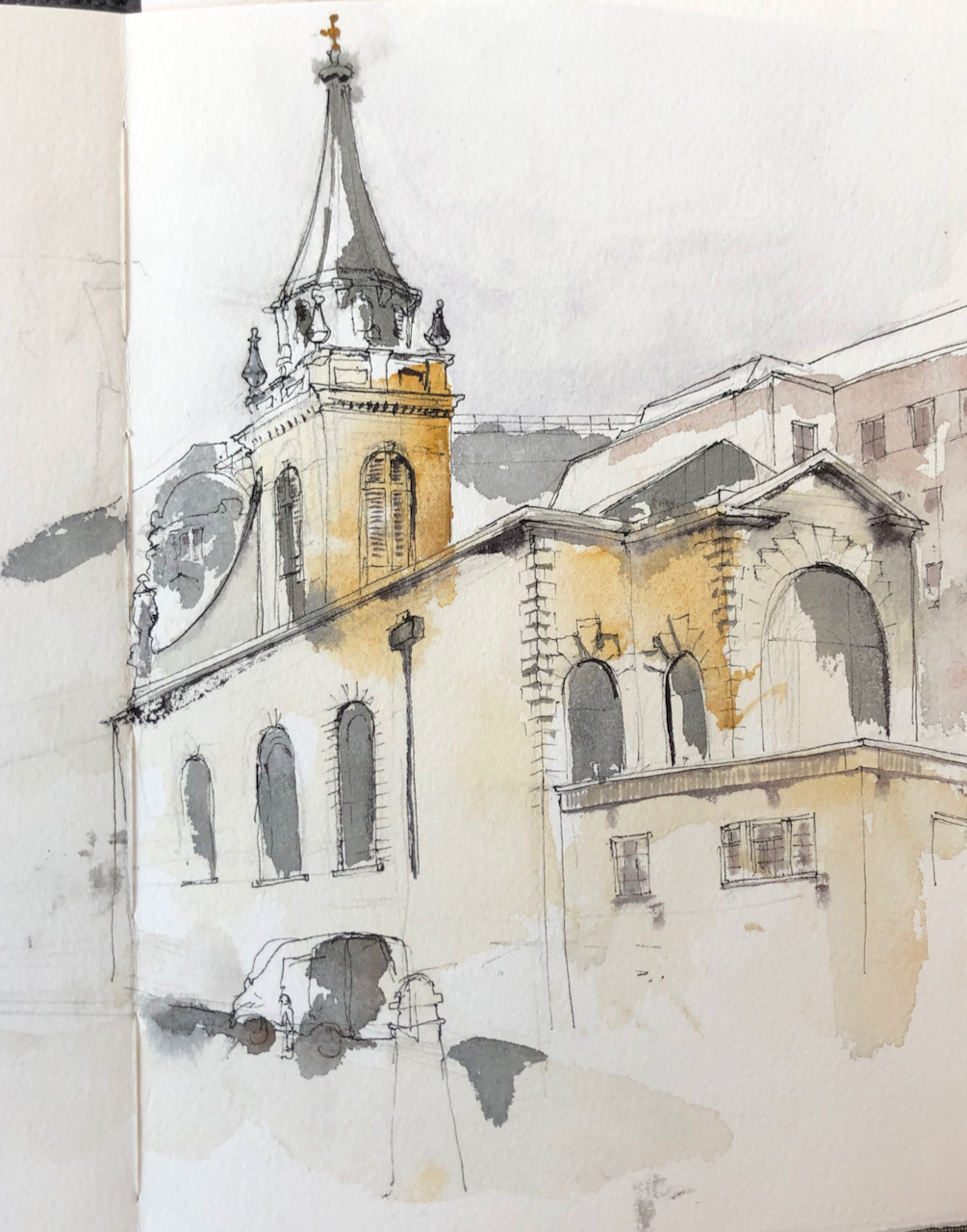
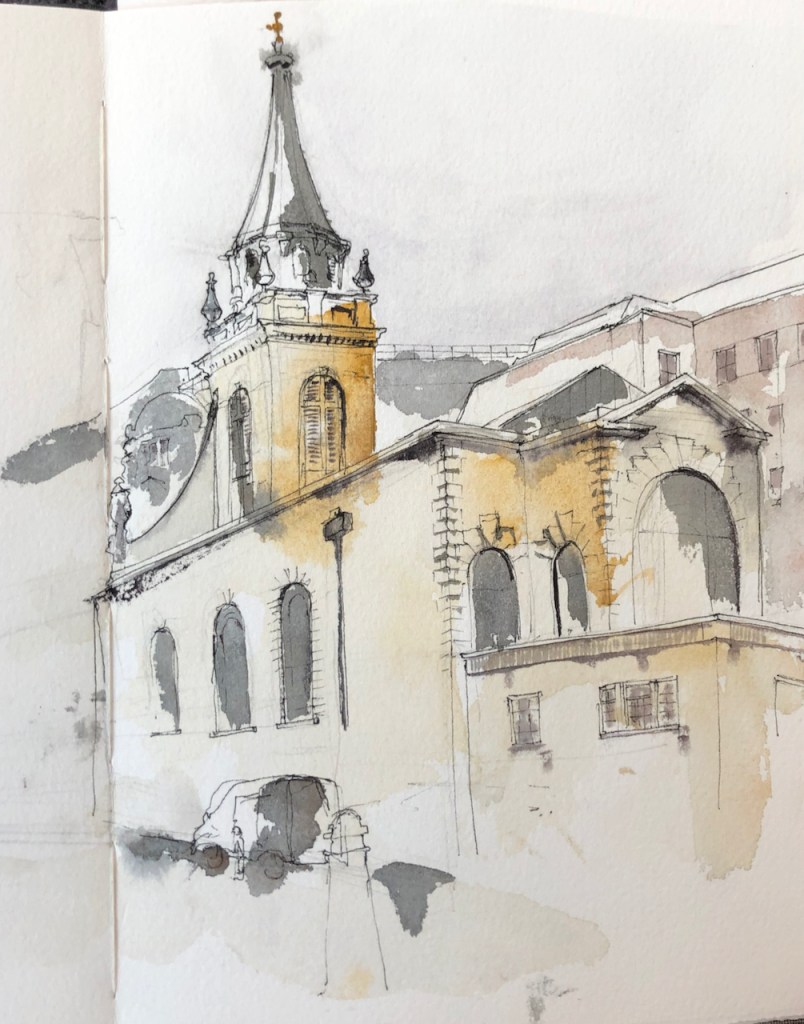
Here is a sketch of the church of “St Edmund King and Martyr” which is on Lombard St, City of London.
St Edmund King and Martyr, Lombard Street, from George Yard, EC3. 7″ x 10″ in Sketchbook 10
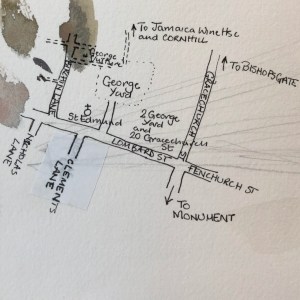
George Yard is at the intersection of a number of city lanes, one of which leads West to “The George and Vulture”, and another leads North to the Jamaica Wine House.
Also in George Yard is a marvellous leafy garden. In the garden, shaded by vegetation, is the tombstone of “Sir Henry Tulse”. Below the tombstone is the inscription telling you about its incumbent:
"Sir Henry Tulse was a benefactor of the Church of St Dionis Backchurch (formerly adjoining)
He was also grocer, Alderman, and Lord Mayor of this City.
In his memory, this tombstone was restored November 1937 by
"The Ancient Society of College Youths" during the 100th year of the society's foundation.
He was also Master of the Society during his Mayoralty in 1684"
St Edmund King and Martyr is an active church. The Church is, according to the notice on Lombard Street, “The Gregory Centre for Church Multiplication”. Church Multiplication has a clear mission statement on their website: “We equip and resource the Church to reach new people, in new places, in new ways with the good news of Jesus Christ.”
The Vestry Hall is the cubical building on the right of my drawing.
Just off the drawing to the left is 2 George Yard and 20 Gracechurch Street, a modern building, where a long list of companies are registered with financial sounding names: “The Close Investment 1988 Fund “A” “, “The Greater Mekong Capital Fund”. This is the City of London, with all its contrasts and juxtapositions.
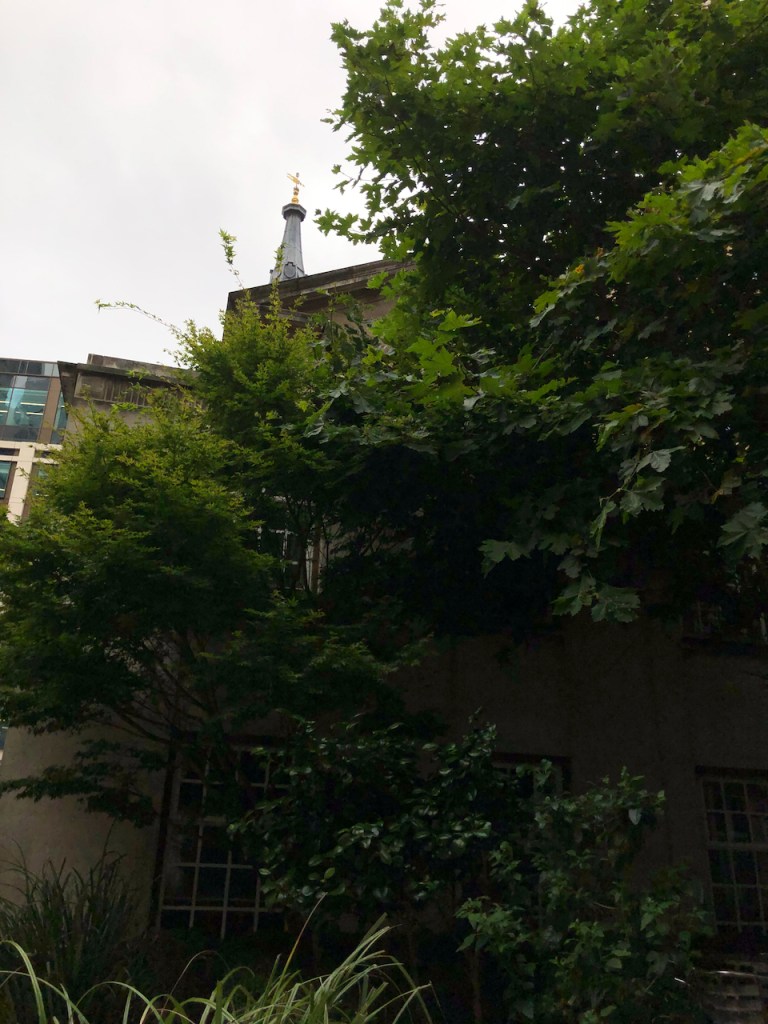
Here is work in progress on the drawing, and a view of the Church from the leafy garden.
This drawing took about 1 hour and 20 mins. The colours are Mars Yellow, Perylene Maroon, and Phthalo Blue Turquoise.
Click a button below to share this post online, email it, or print it:
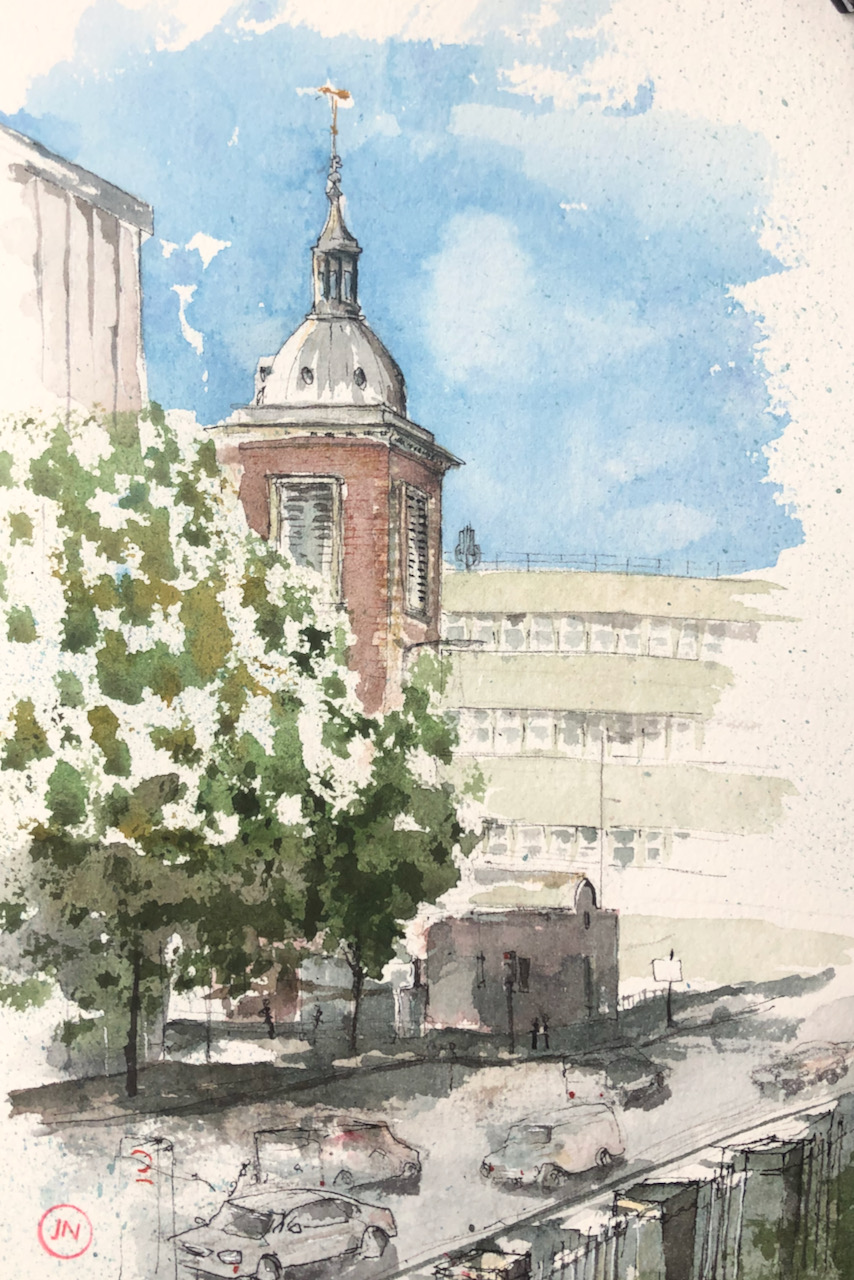
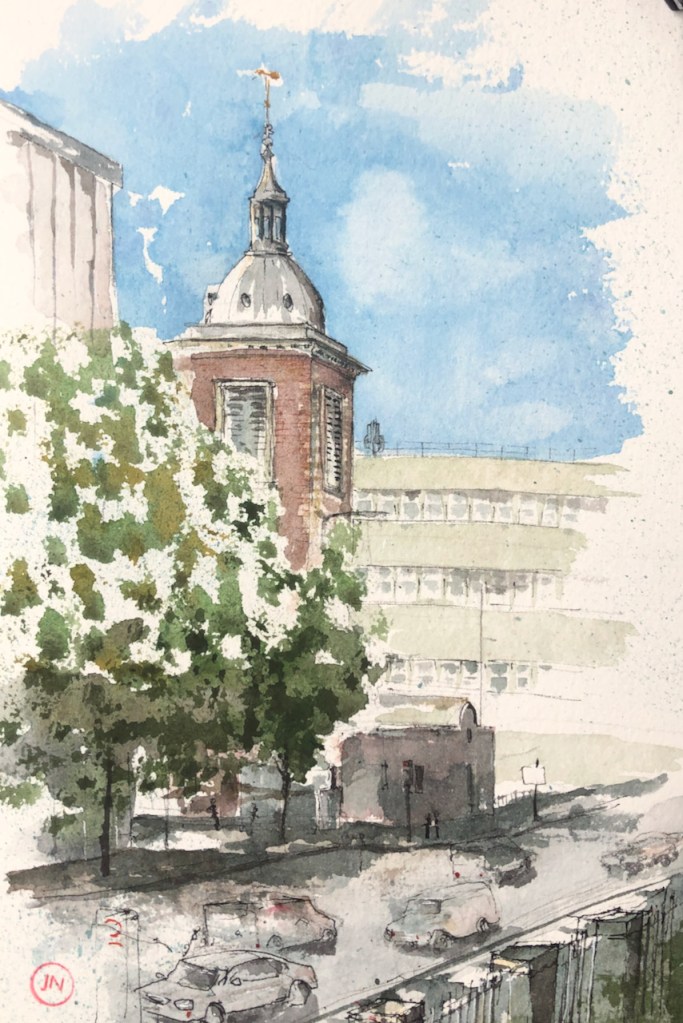
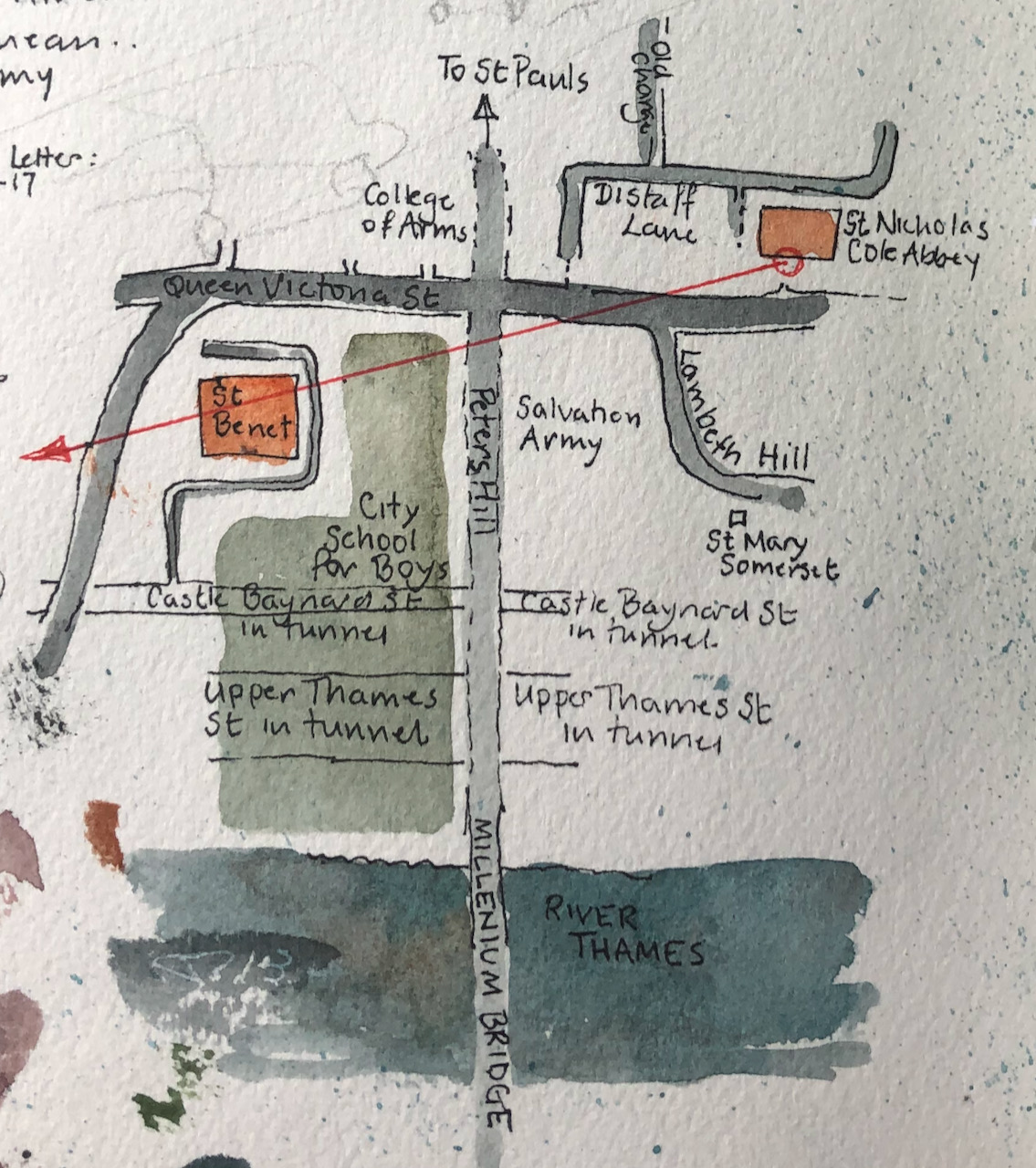
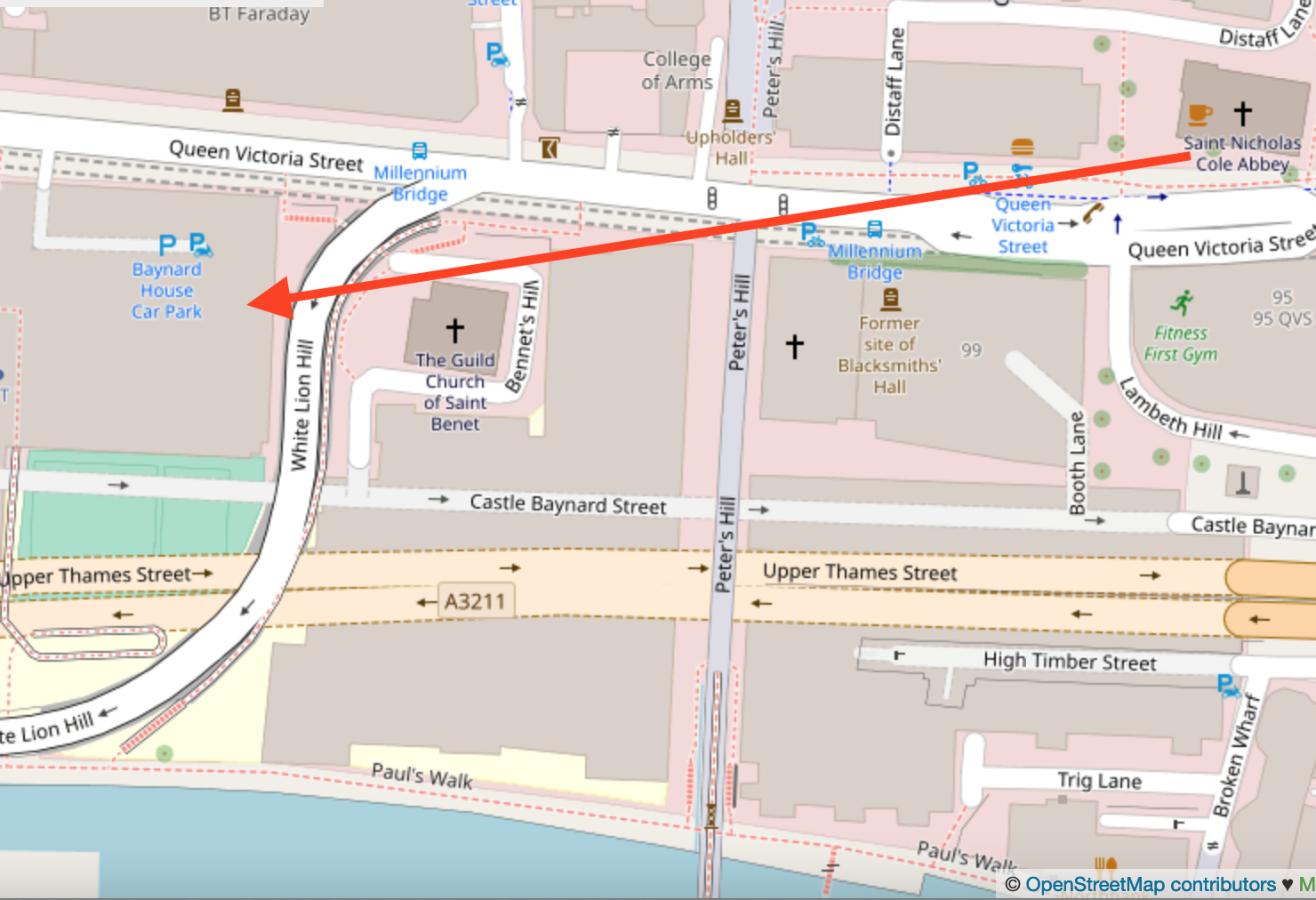
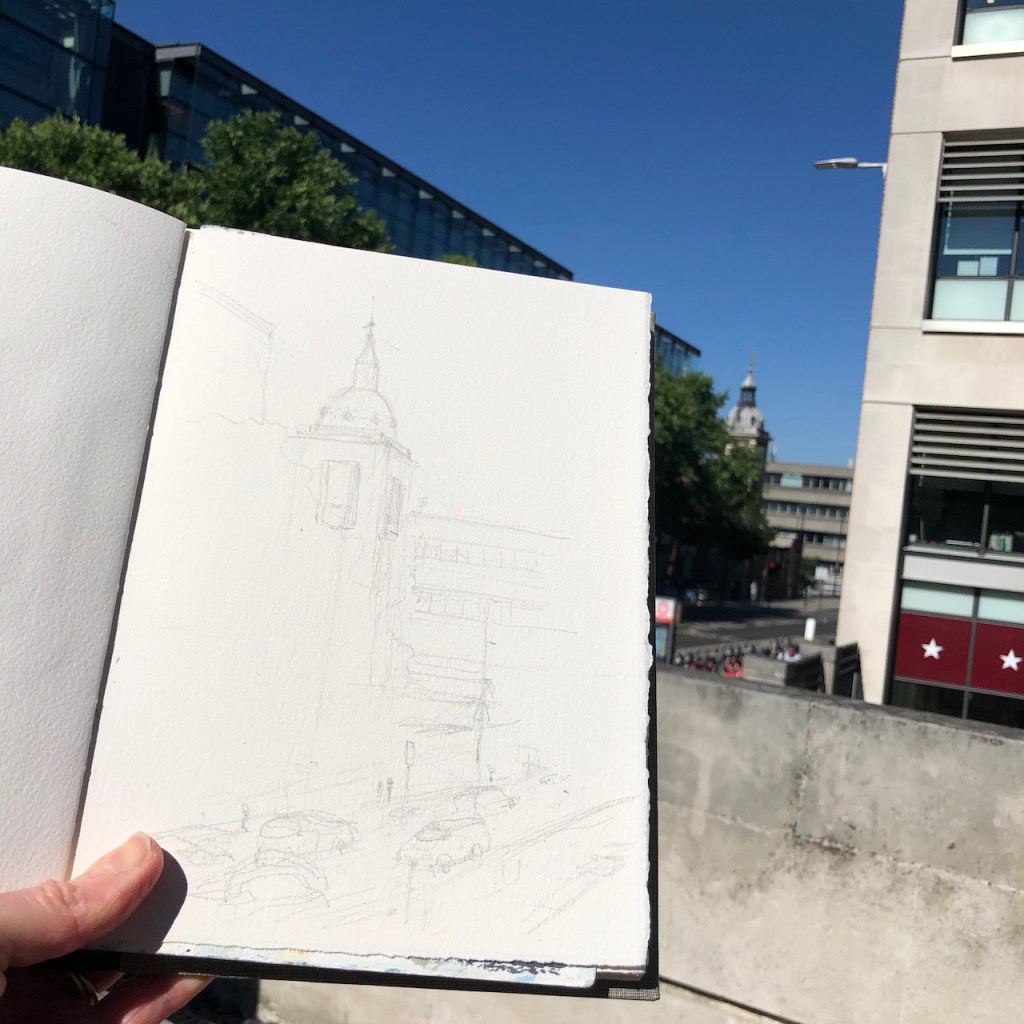
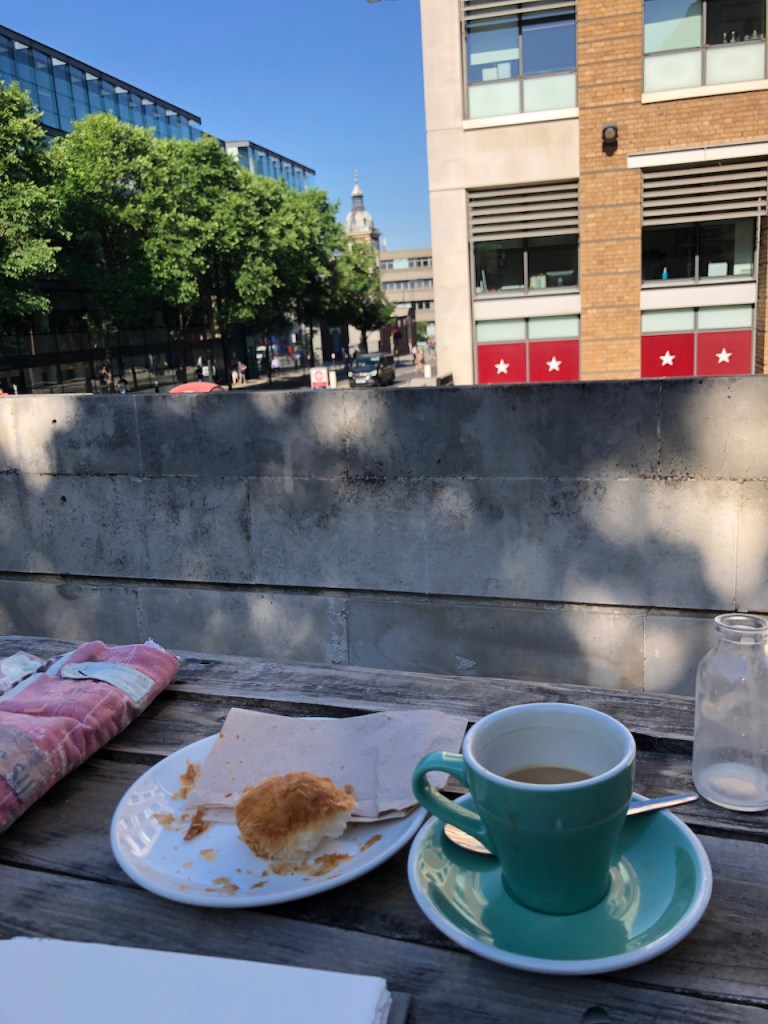
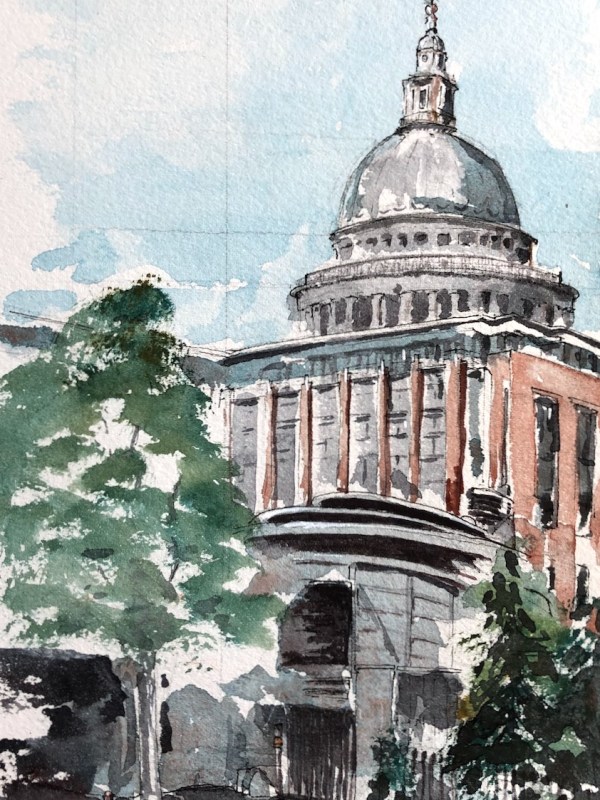
On a lovely sunny morning I walked to the Wren café for breakfast. The Wren is in Saint Nicholas Cole Abbey church on Queen Victoria Street. There is a terrace high above Queen Victoria Street. It commands an excellent view of St Paul’s Cathedral, but I chose to look along the busy road and sketch the Guild Church of St Benets.
Guild Church of Saint Benets, from St Nicholas Cole Abbey, Queen Victoria Street EC4. 16th June 2021, 08:30 – 10:45am, 10″ x 7″ in sketchbook 10.
The building in the background is Baynards House, a BT building. In front of the church is the City of London School for Boys. Here are maps:
The Guild Church of St Benets is an active church with services in Welsh. It is a Wren Church, listed Grade I. The listing on the Historic England site says that this is “one of the least altered of Wren’s churches”, since it was not damaged in the 1939-45 war.
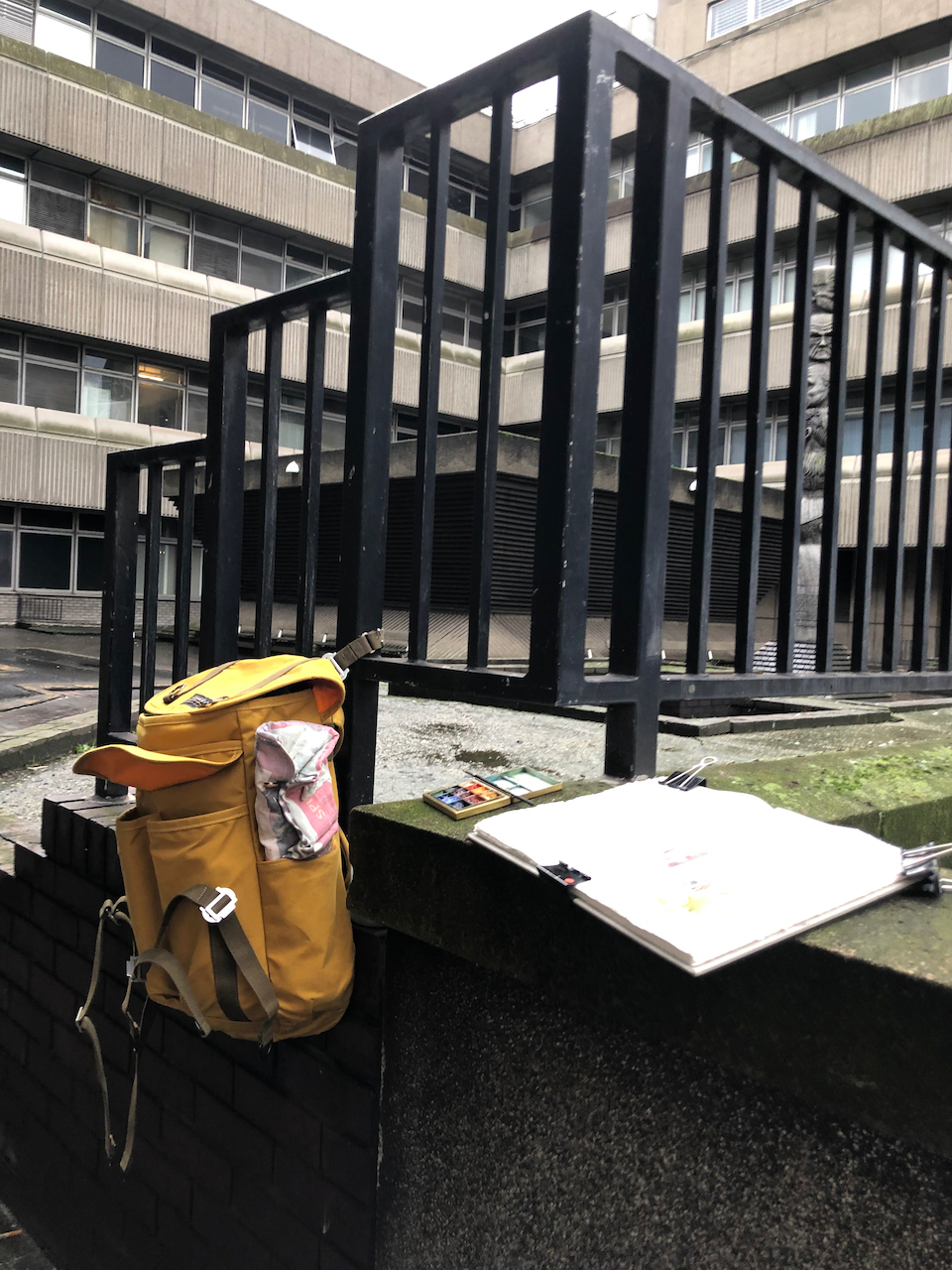
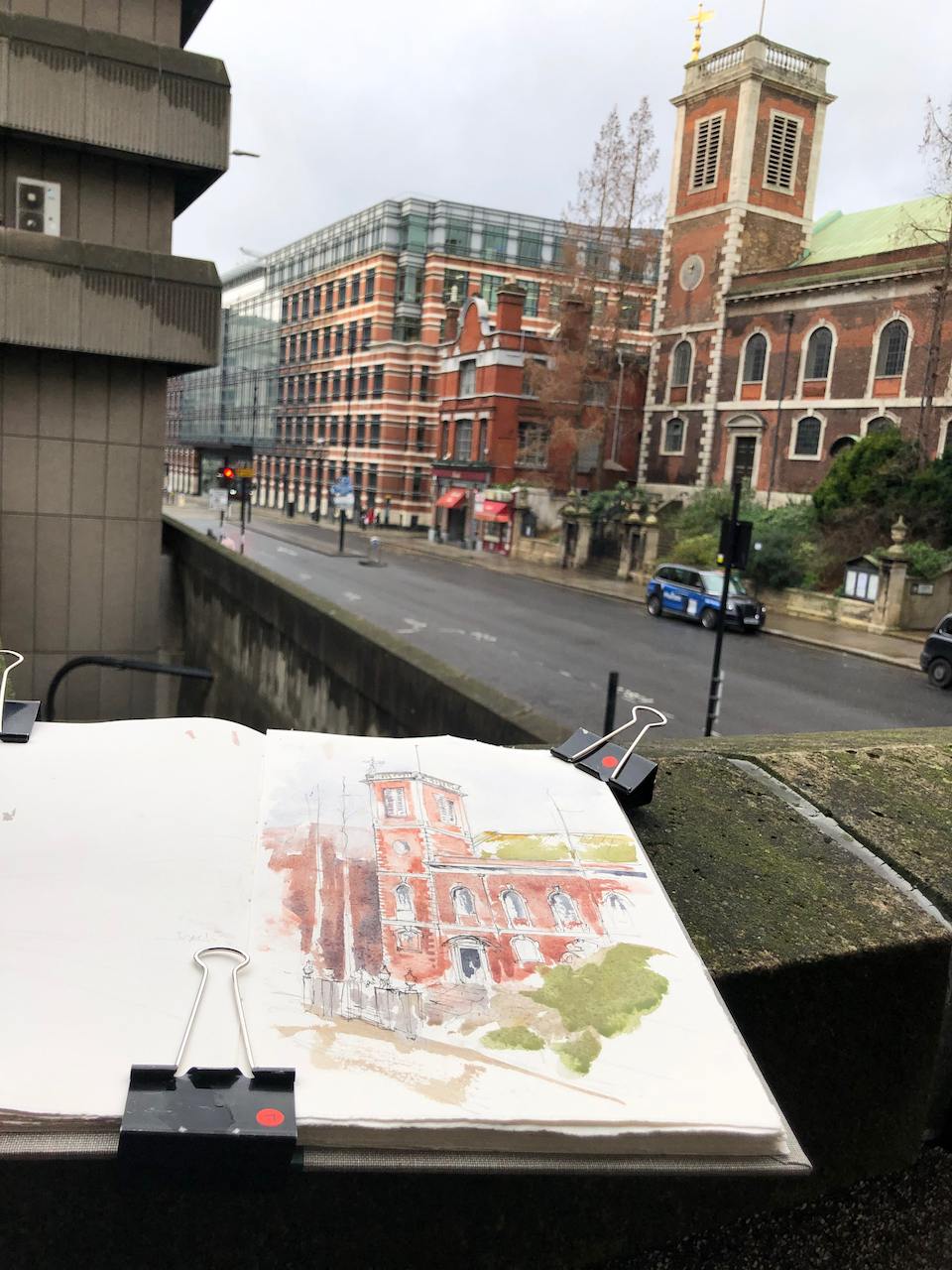
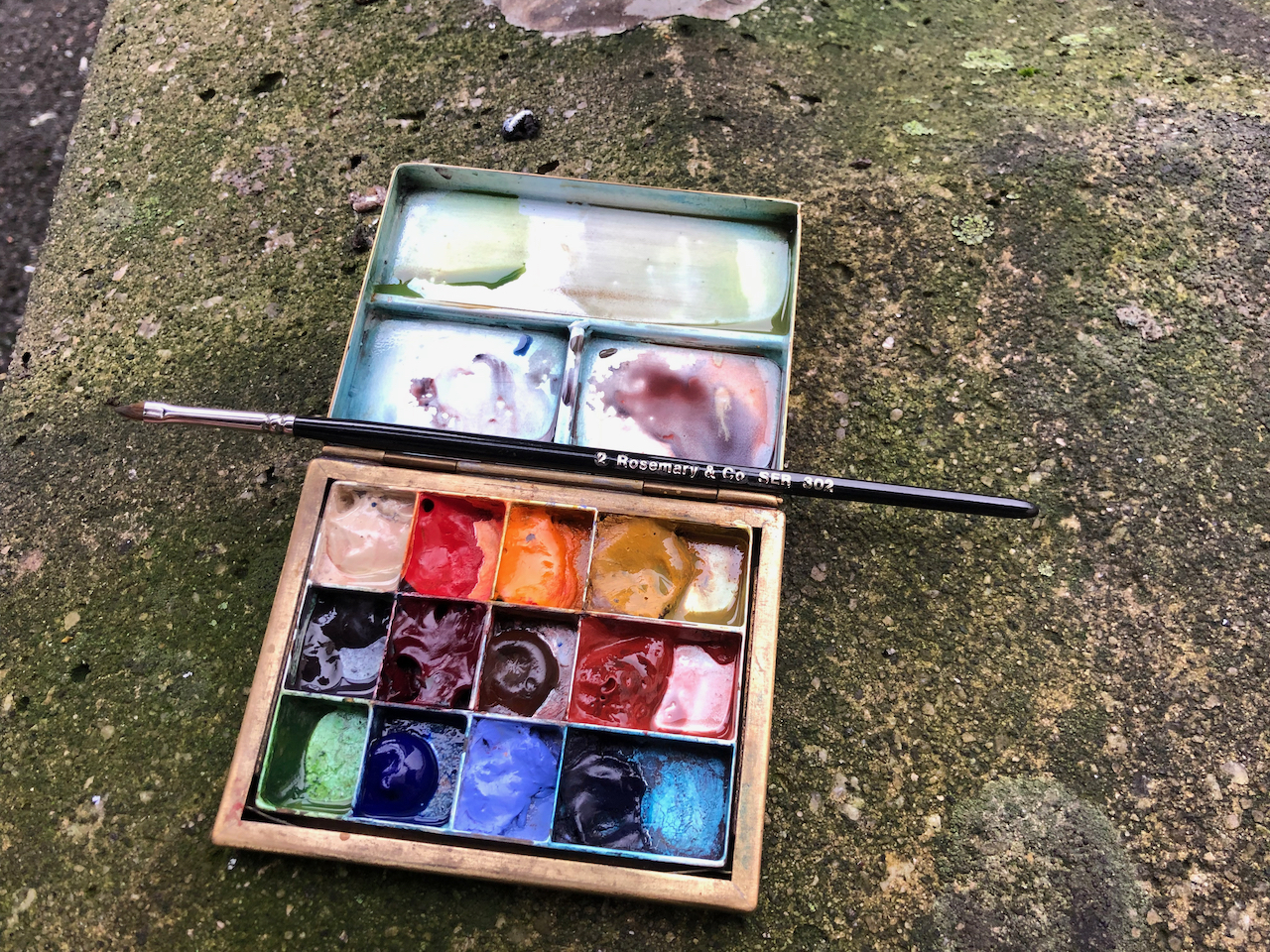
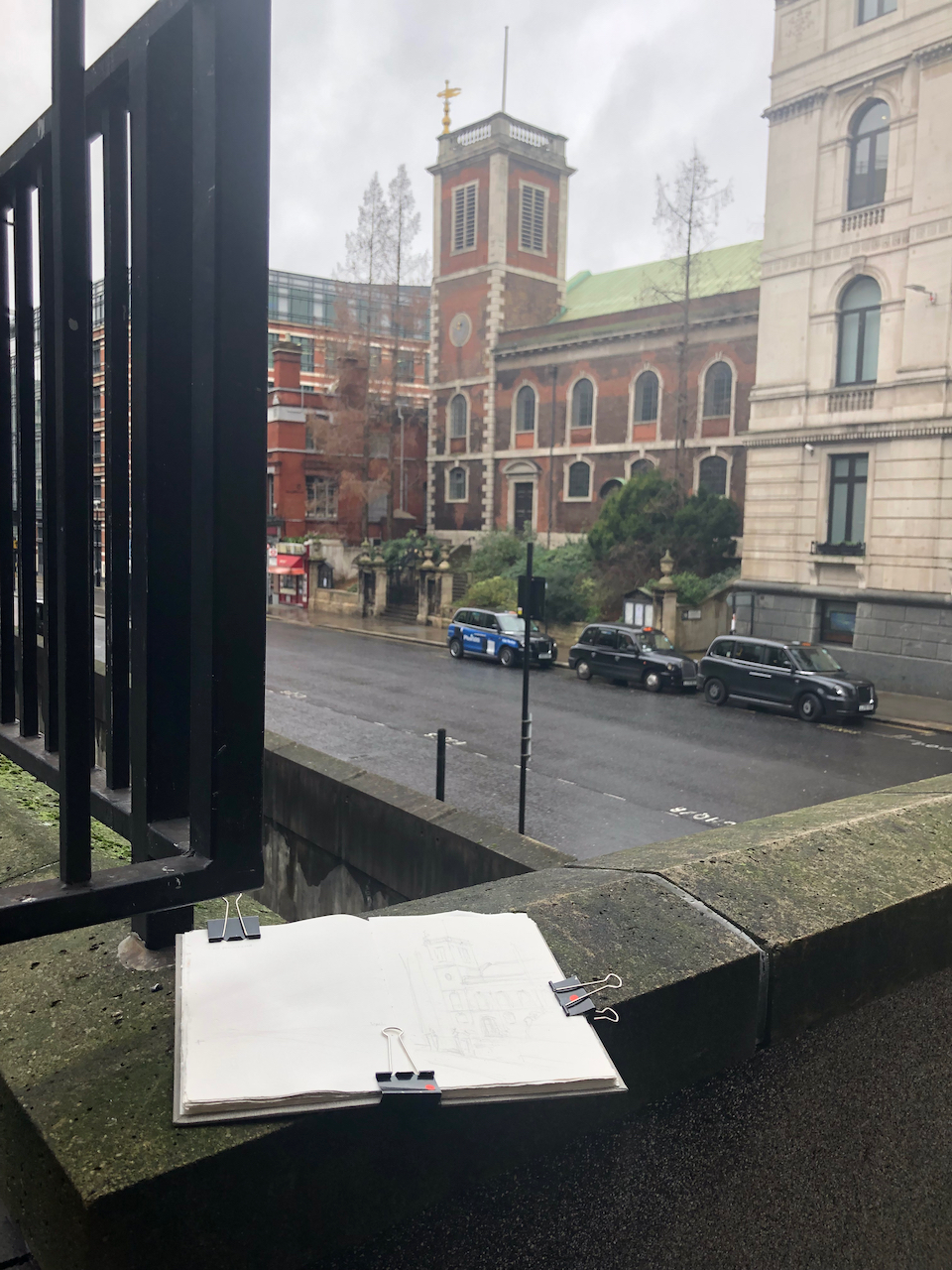
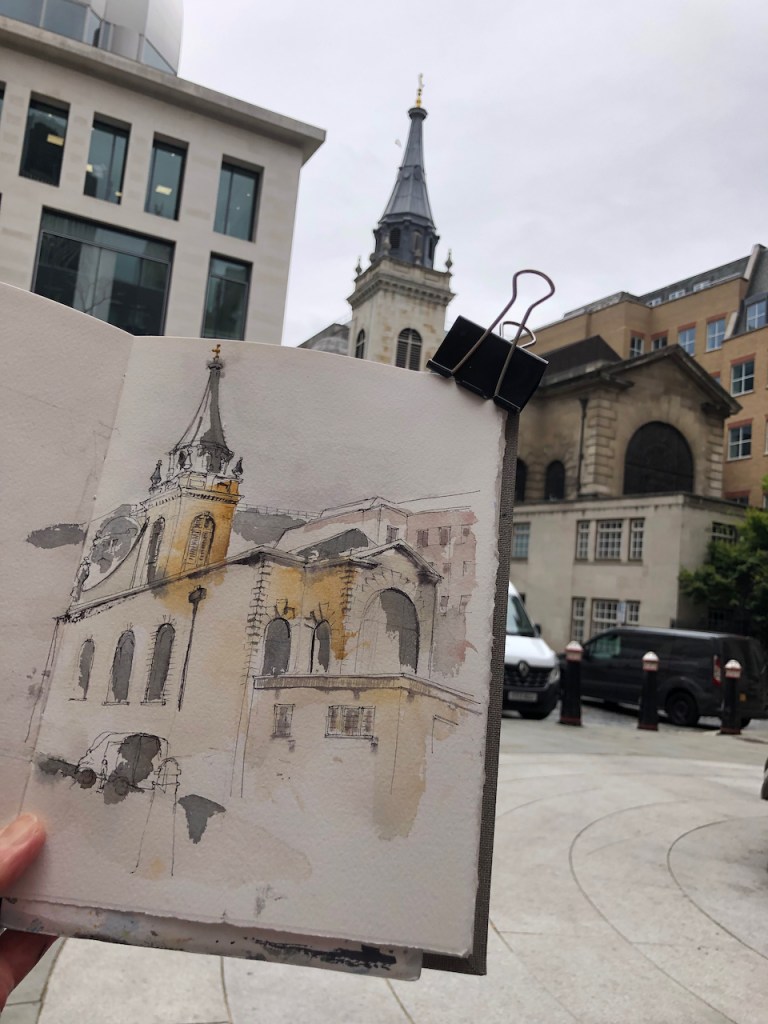
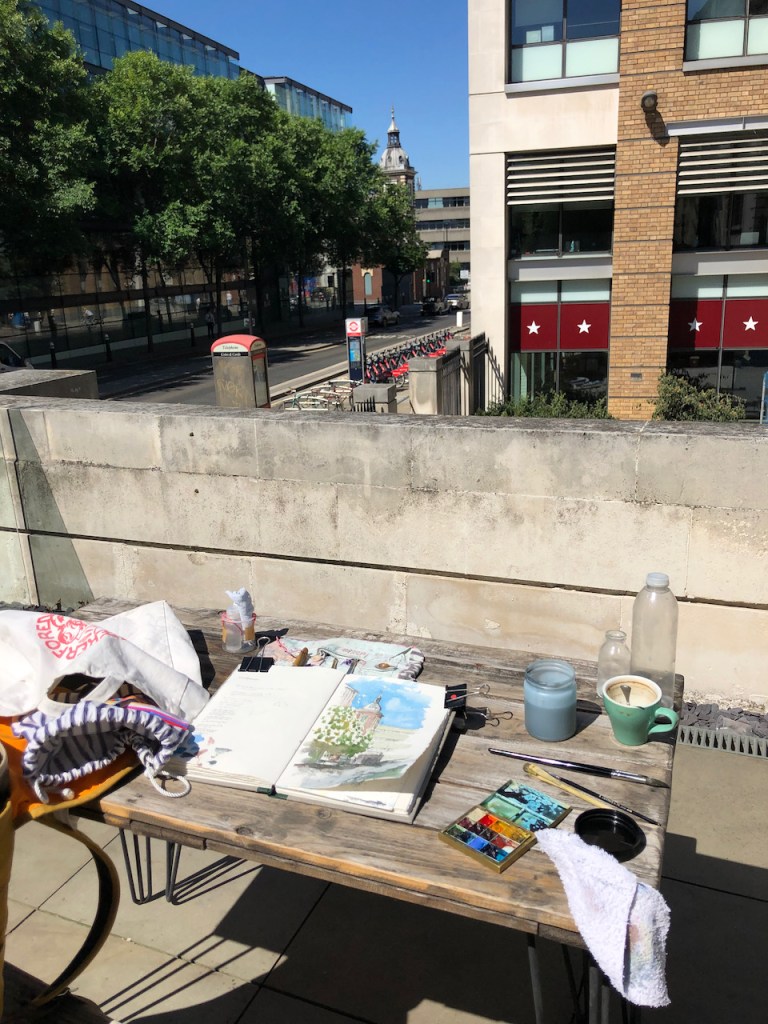
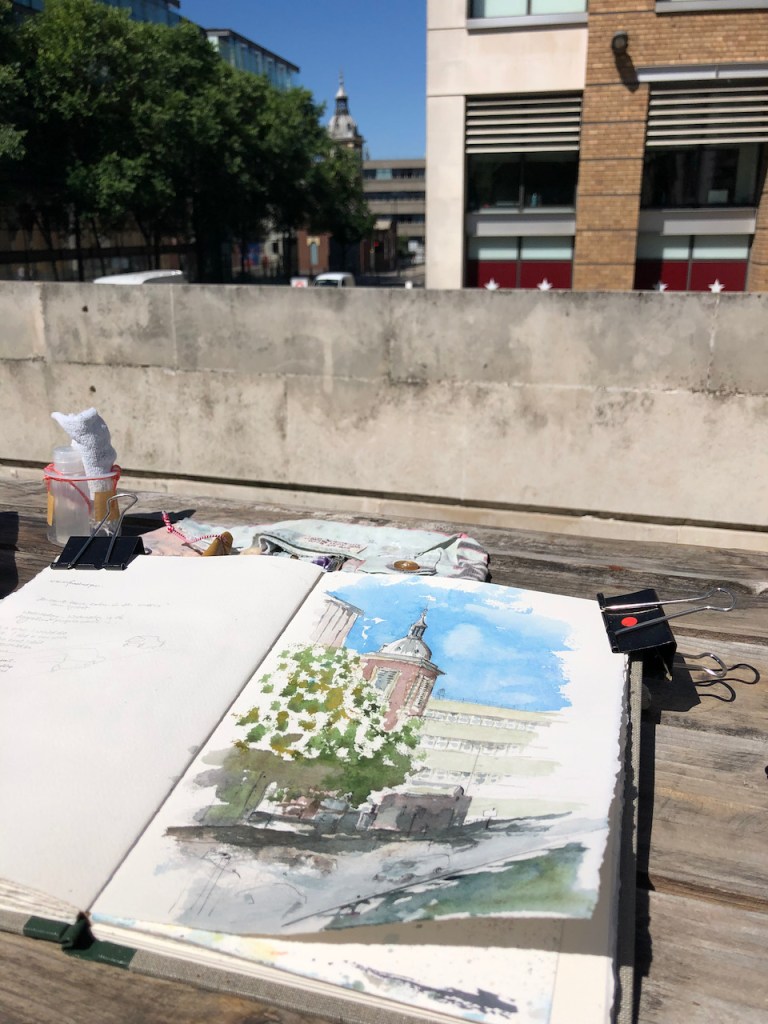
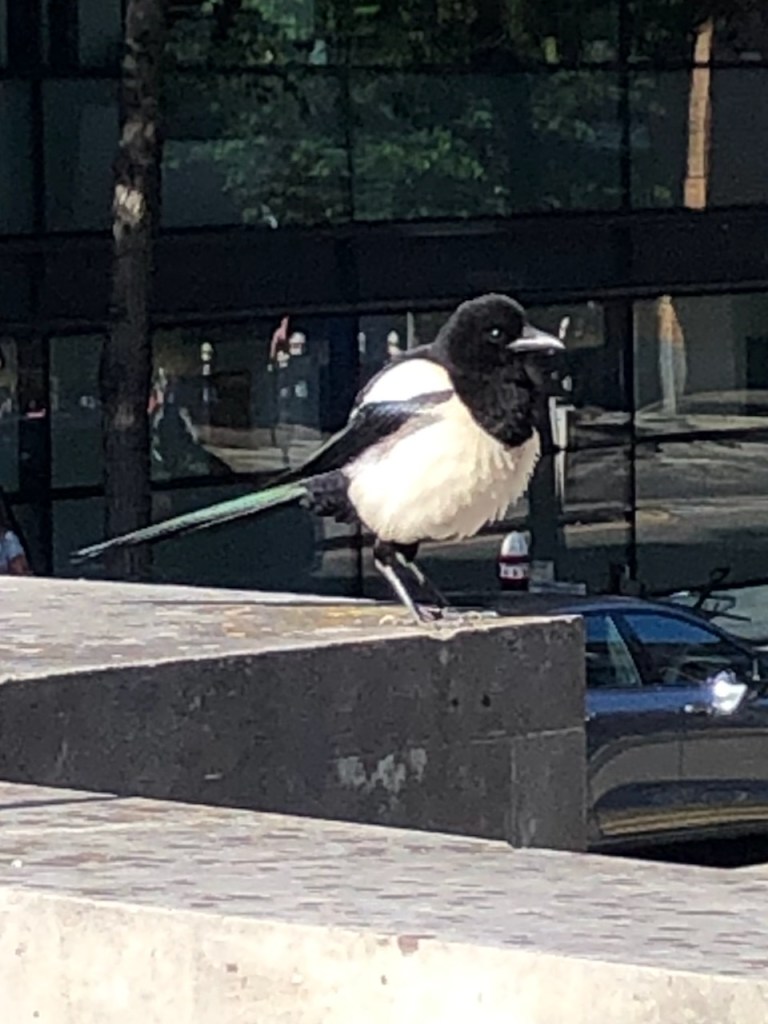
Here are a few photos of work in progress on the drawing, and a portrait of a magpie who came to look at my croissant:
I’ve sketched the view of St Paul’s from the same location:
















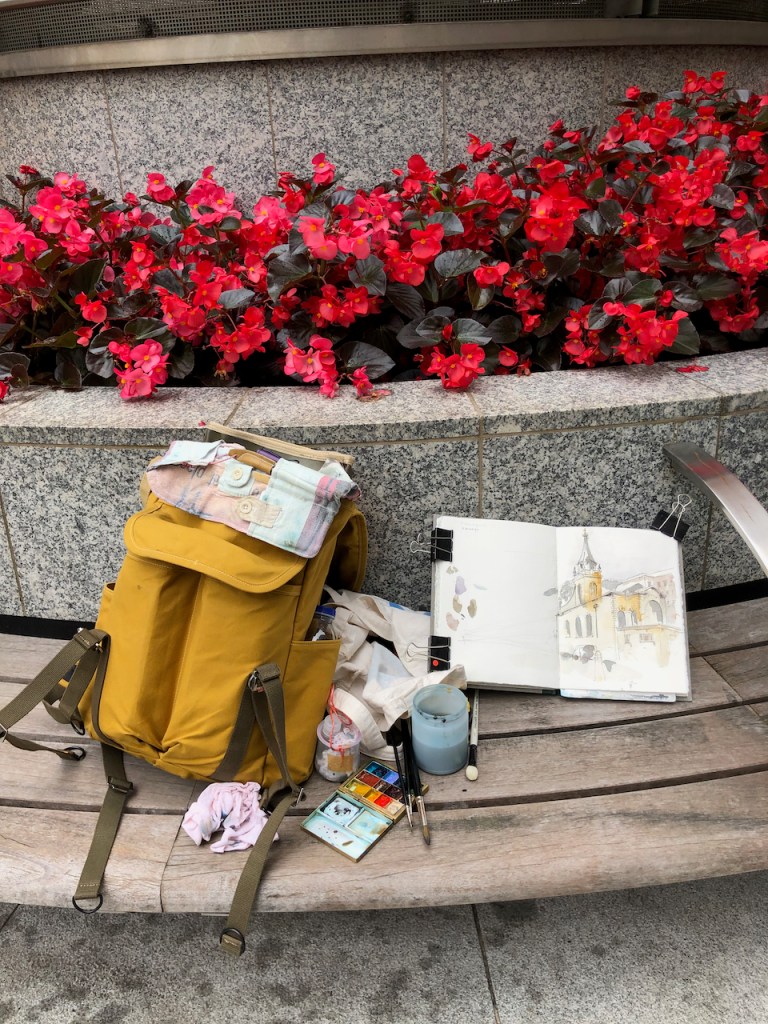
 Jane Sketching