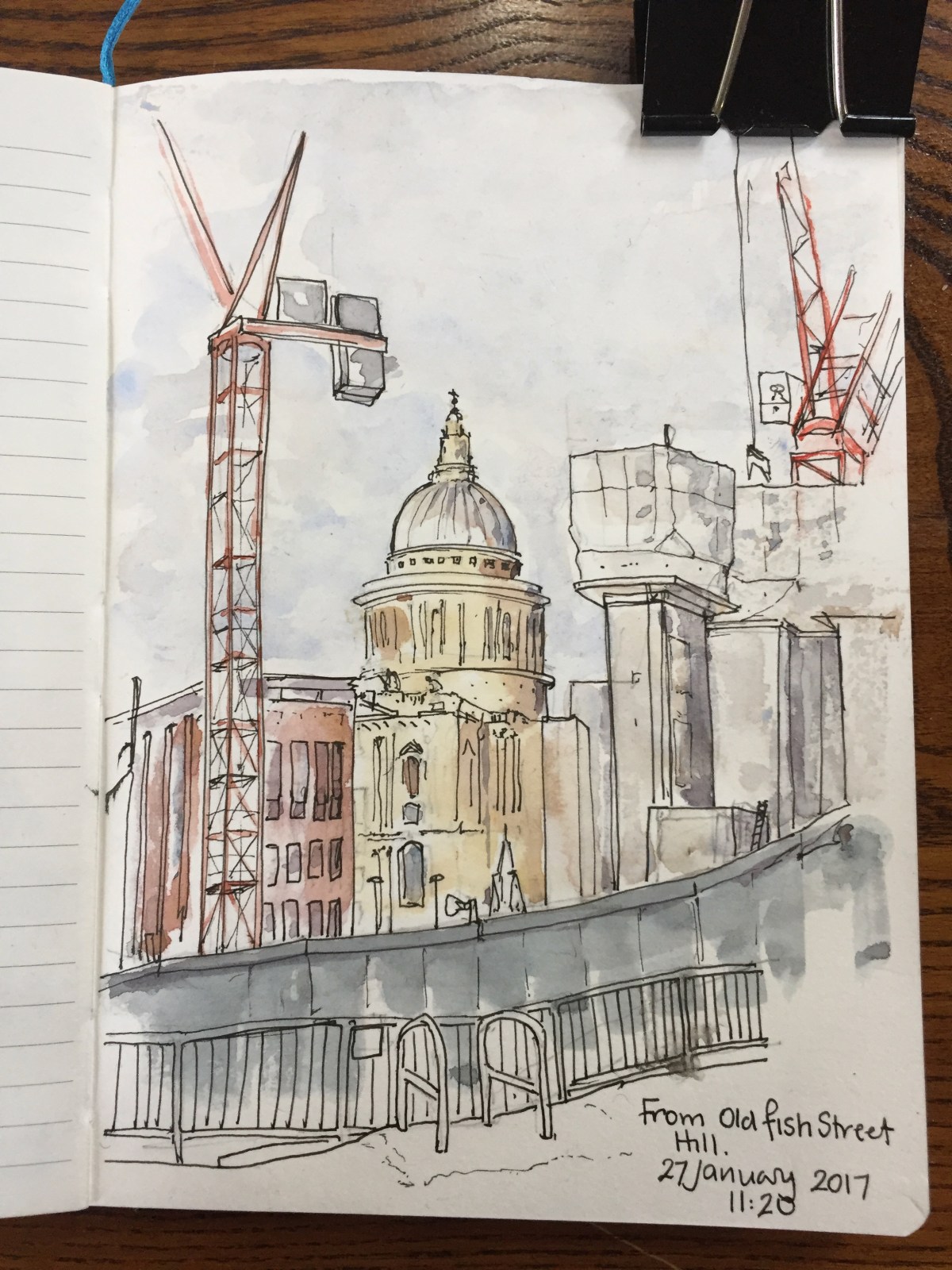
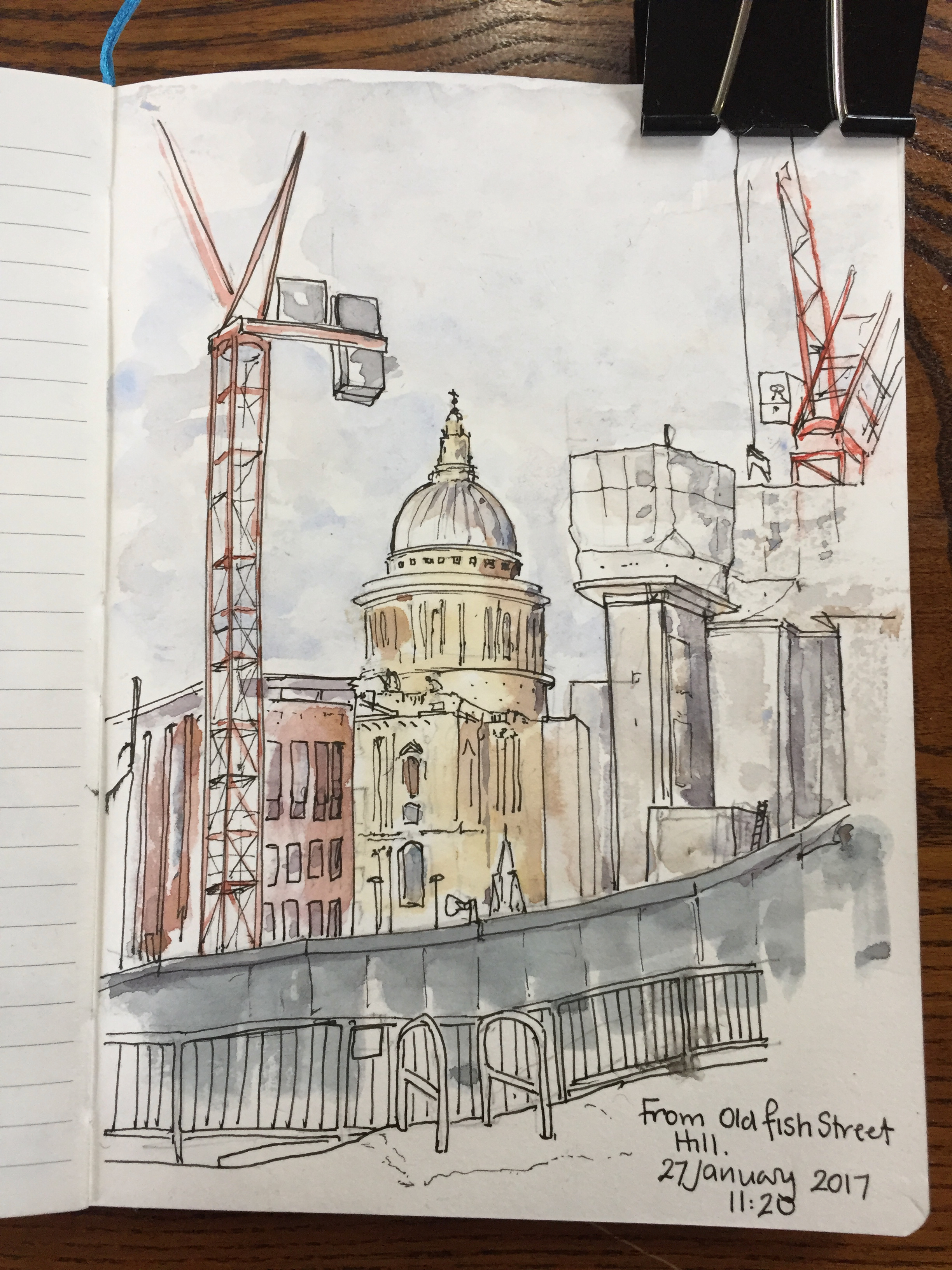
I was keen to draw this view of St Paul’s before it vanished behind the new building on 2-4 Cannon Street.
“PLP’s scheme, for global property firm Pembroke Real Estate, will replace a 1959 modernist office building by Theo Birks called Scandinavian House. The north facade, facing the cathedral, is the most orthogonally formal, with red sandstone cladding and a 3m window grid with anodised aluminium frames.
The south-western elevation tapers to create a public garden which will provide a new home for Michael Ayrton’s sculpture of Icarus.”
From Building Design Online 22 September 2014 | By Elizabeth Hopkirk
While I was drawing this, the traffic marshall of the building site came by, looked up at St Paul’s, and remarked that it was a “fine building”.
 It was extremely cold, about 2degreesC, and I was wrapped up in my Loden coat and furry boots. You’ll notice I invented a new watercolour technique. It’s called “greasy fingers marbling effect”. See the extreme right of the picture. Before I went out, I put a LOT of hand cream on my hands, because this cold weather makes my skin crack. But then after I had been gripping the sketchbook, I found the paint didn’t stick. But it’s quite a good effect, I think.
I managed to complete the pen and ink drawing, and do most of the watercolour before the cold got to me. Then I retreated to the warmth of the Wren café in St Nicholas Cole Abbey Church.
There I met Amy Marsh @harshmissmarsh who posted my work-in-progress on her Instagram. In the café I painted the red cranes.
Coffee and a small and delicious Marmalade Cake, £6. They were just bringing out some delicious-looking lunchtime food. But I had places to go and work to do, so I exerted willpower and moved on.