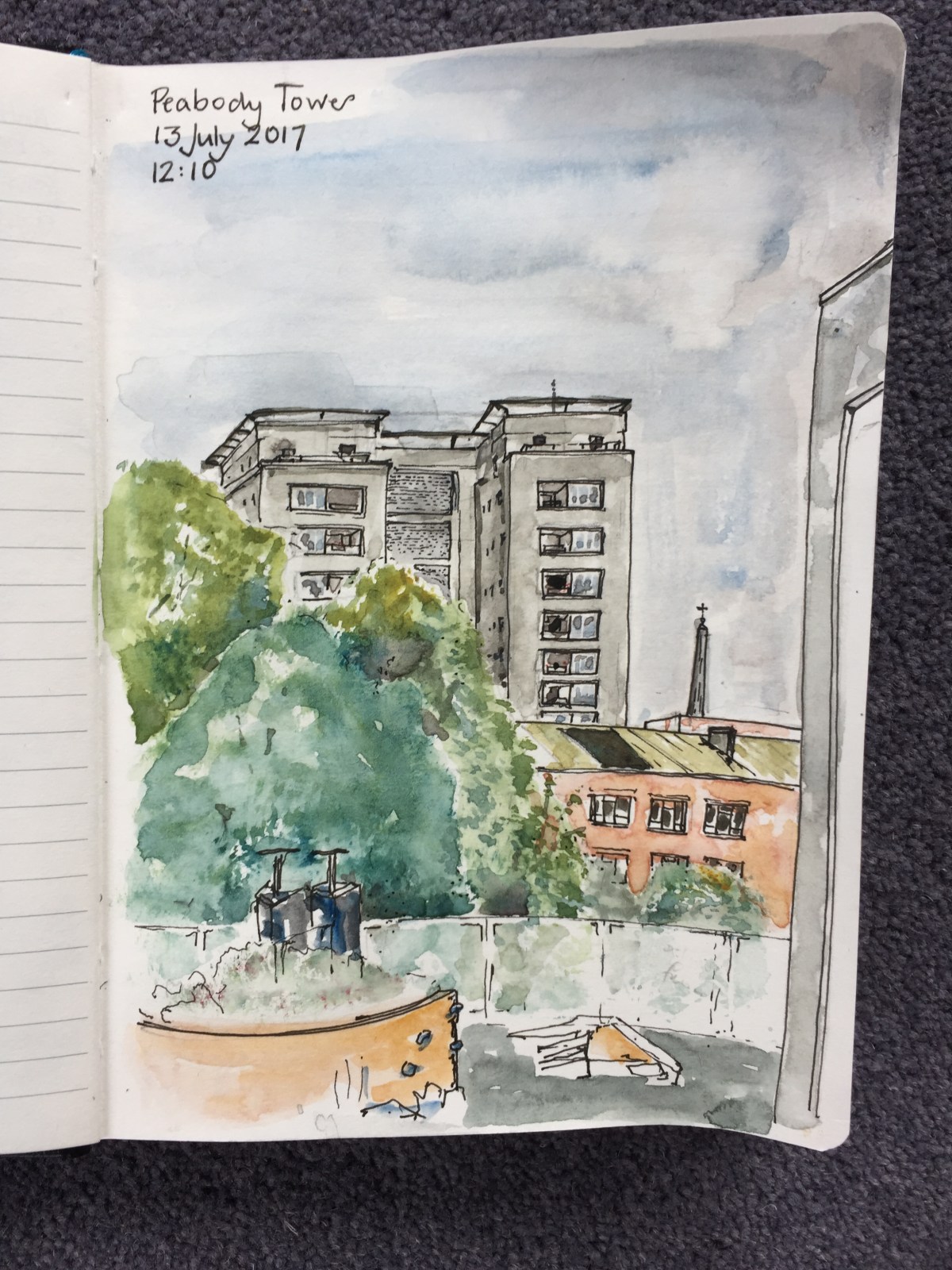
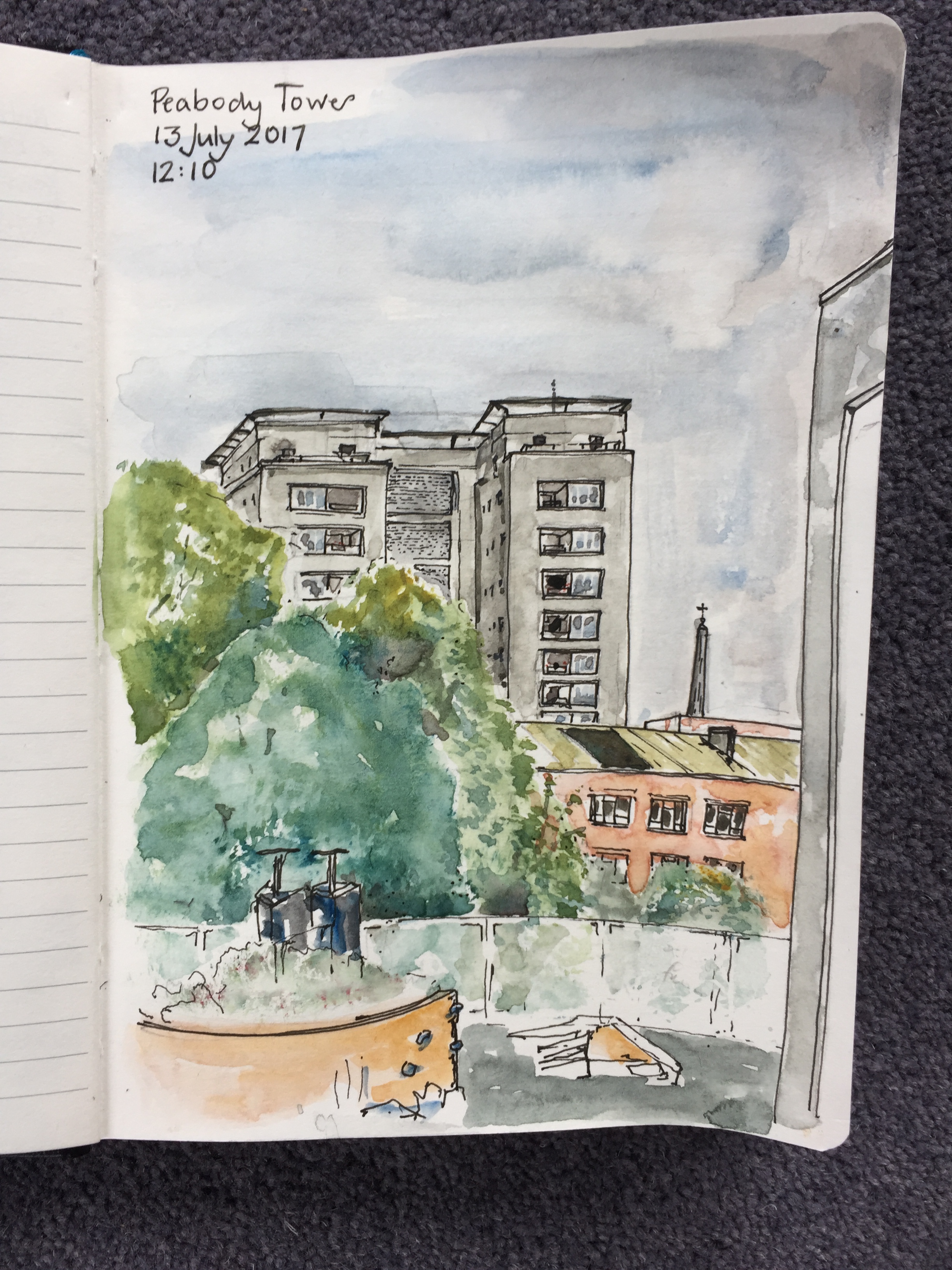
In the foreground is the first-floor playground of the Prior Western Primary School. The building in red brick is Fortune House, built at the same time as Peabody Tower, although it looks very different.
This drawing took 1hr45min. Done from the podium next to Breton House.
Click a button below to share this post online, email it, or print it:
This sketch shows the new “Fleet Building” under construction on the Farringdon Road, towering over the quaint Vicarage and Court House of St Andrews Holborn.
The Vicarage and Court House are Victorian, designed by Samuel Teulon as part of the remodelling of St Andrews to accommodate the Holborn Viaduct, 1860s and 70s. Notices on the gate announce the St Andrews Church Foundation and Associated Charities. The Court House is the building with the turret, No 7 St Andrews Street. It just has a large “7” on the door.
The pinkish coloured building on the right is currently the offices of “Rosenblatt” and “Convex Capital.”
The Fleet Building is designed by Kohn Pedersen Fox Associates. It is Goldman Sachs’ “840 000 sq ft London campus”. To build it they demolished the old Telephone exchange. The murals by Dorothy Annan that were on the Telephone Exchange are now in the Barbican.
Goldman’s plans previously suffered a setback when the government gave Grade II listed status to 1960s murals on the front of Fleet Building, which used to be London’s largest telephone exchange.
The Department for Culture, Media and Sport followed advice from English Heritage that the nine ceramic tile murals by Dorothy Annan, which depict pylons, cables, telegraph poles and generators, were of “historic interest” to the telecoms industry and had “relative rarity as surviving works of 1960s mural art”.
Goldman had opposed the listing of the murals and relocating them could be costly and time-consuming. However, as part of the conditions of the planning consent, Goldman must meet all “reasonable costs” incurred with their removal.
About 1 hour. Drawn and coloured on location. Very hot sun. Atmosphere of vanilla scented Vape Cloud. Fire alarm on Lloyds Bank ticking intermittantly.
Click a button below to share this post online, email it, or print it:
This is from a doorway on Pensioners’ Court, which is the court beyond Preacher’s Court. The Building with the four archways is part of the Brothers’ realm: the infirmary above and the coffee room below. I don’t know what the turret is, very intriguing.
The gardens were magnificent. In front of me was that huge magnolia tree. It moved in the wind and contained darkness much darker than I have drawn it.
I enjoyed the two towers: Barbican and Charterhouse, and the way the view was bracketed by the tree on the right and the lamp-post on the left.
One hour 45 minutes, drawn and coloured on location. The day was overcast and threatened rain. Round me, a gardener was watering the borders.
It should be “Pensioners’” court (plural).
Click a button below to share this post online, email it, or print it:
Those chimneys are hard to draw. They are not simple rectangles, but a complicated geometric shape, a square put at an angle to another square, difficult to see in the light and shadow.
The crest of the roof is not straight. It goes downwards at quite an alarming angle, as drawn. The windows are not in a straight line with each other, which makes me wonder exactly where the floor is, inside.
I drew this from under the shade of the new building, the “Admiral Ashmore Building”. While I was drawing, the gardeners were making the window boxes, and crushed the geranium leaves. The place smelt of geranium, and earth and water.
I like it that you can see the Barbican towers beyond. I made this observation to a Brother who paused to chat. He told me that these brutalist towers are not popular with certain of the Brothers. They have identified a place in the garden where you can sit, so that the towers are obscured by a tree.
About 2 hours (those chimneys!!), drawn and coloured on location.
Here is what it looked like before the colour went on:
Click a button below to share this post online, email it, or print it:
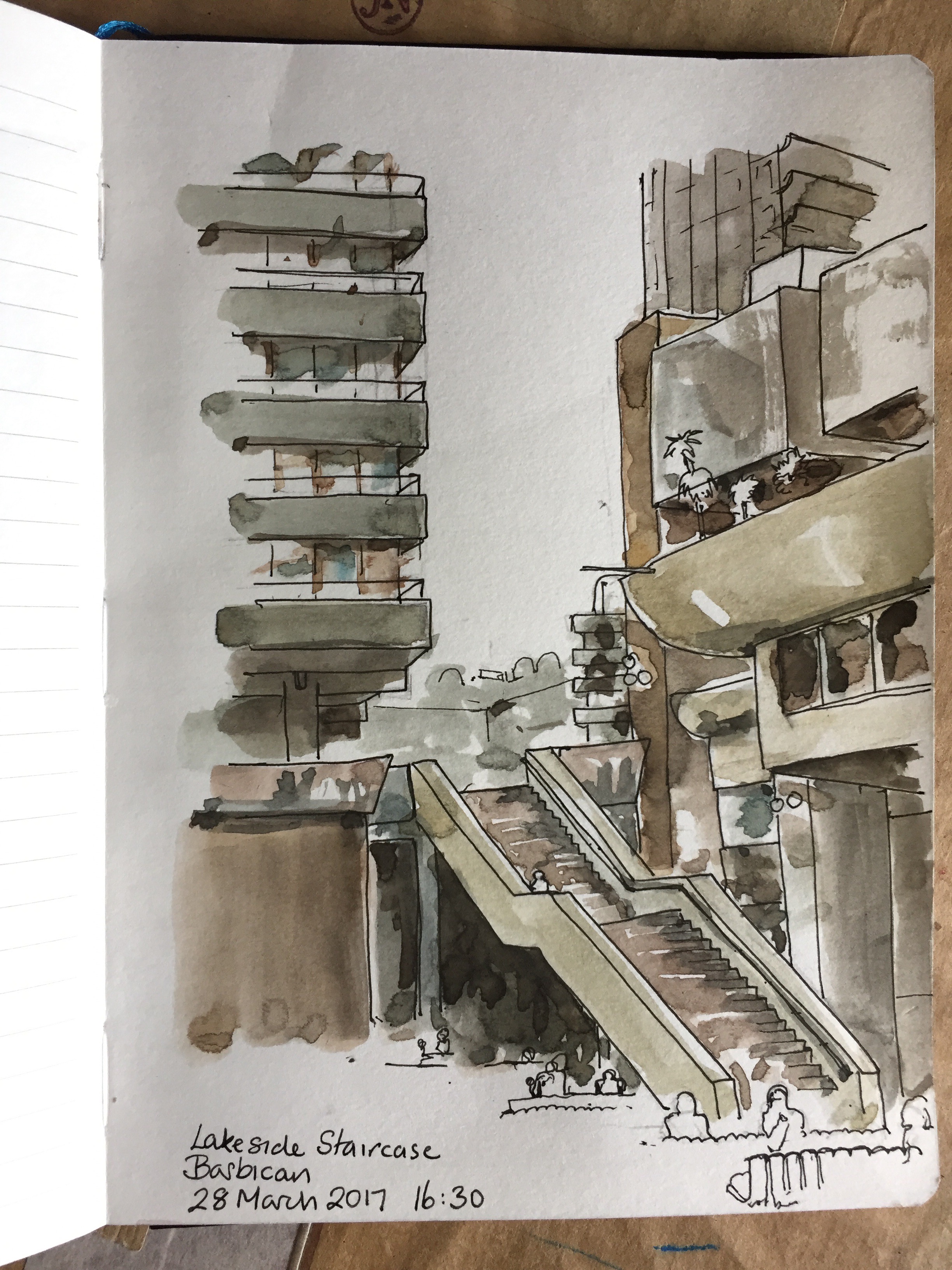
This is the staircase from Podium Level down to the Lakeside. It’s a magnificent sculptural piece of architecture: it appears free floating, a mass of concrete in the air.
Drawn in the sun after a lunch in the Barbican Kitchen. The wind kept shifting my art equipment around, and the shadows changed as the clouds came and went.
About an hour and 15 minutes, drawn and coloured on location.
Click a button below to share this post online, email it, or print it:
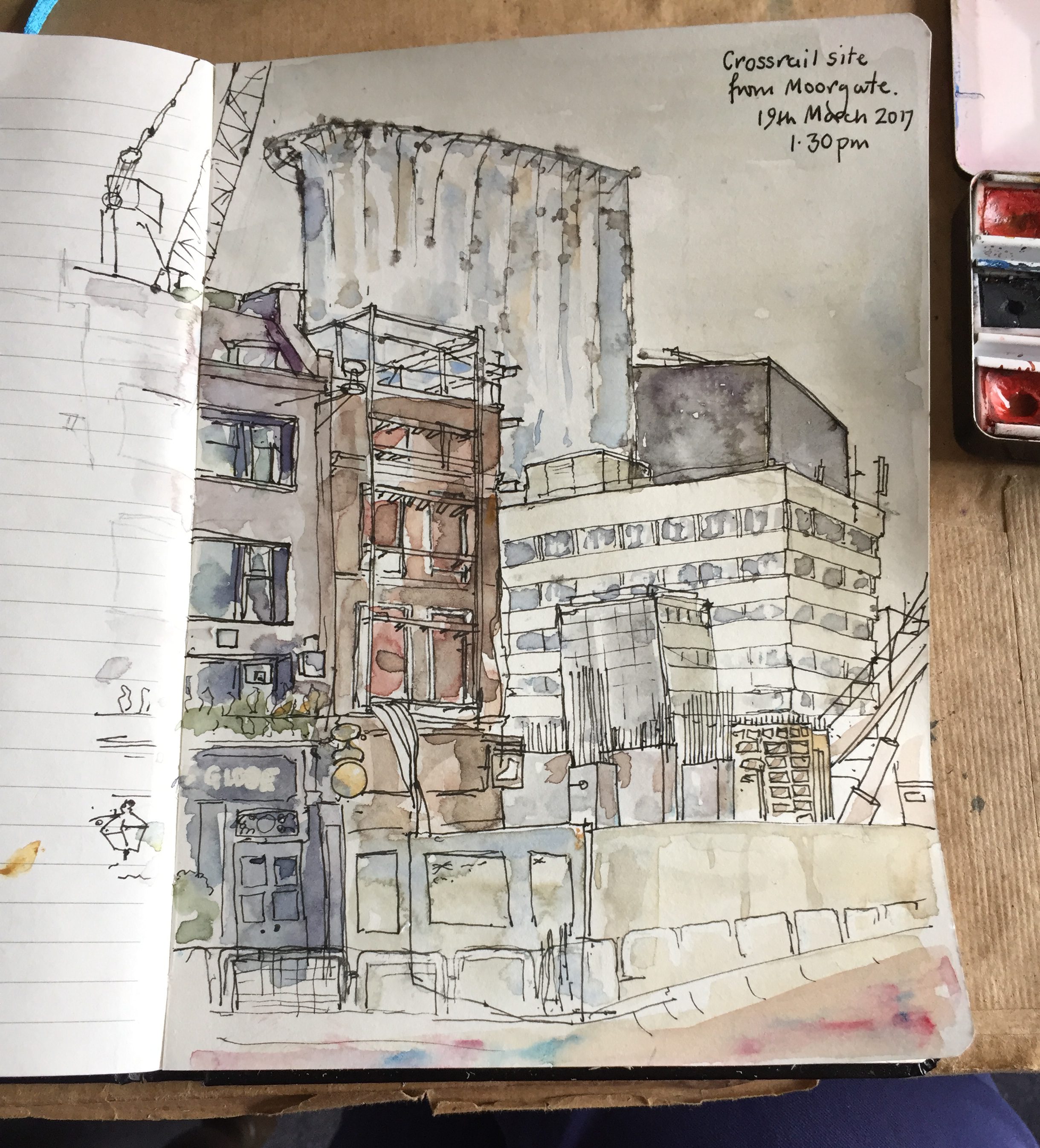
I wanted to draw this view before it disappeared. Today, Moorgate was closed completely to motor traffic, so it was calm to draw, though windy and cold. It rained, as you see from the droplets on City Point.
The Globe Pub, 19th Century, is on the left. The small square notice says:
“In a House on this site
the Swan and Hoop
John Keats
Poet
was born 1795″
The City Point tower is in the background. This was built in 1967, and refurbished in 2000, when the curved projection at the top was added. The designer for the refurbishment was Sheppard Robson. Here’s what the Citypoint website says.
“The building’s spectacular entrance canopy is approached through the public square, leading to two dramatic twelve storey cathedral-like galleria, offering an inviting and exhilarating experience for both occupiers and visitors alike. The two gallerias allow natural daylight to penetrate into the heart of the development, creating a feeling of scale and corporate arrival.” – http://www.citypoint.org.uk/
The building next to the Globe pub is propped up with steel girders. The “Jones Bootmakers” sign hangs on. Cables pour out of one of the windows.
This took about 1½ hours, pen and ink on location. I coloured it later, at home. On the way back the wind blew. Outside the Barbican Centre, the wind caught the hair of a woman on a mobile phone and blew it straight upright. She had very long blonde hair, so she looked amazing, like someone in a cartoon dropping down a lift shaft.
Here’s the black and white sketch:
Click a button below to share this post online, email it, or print it:
The London Wall Place newsletter of 5th January 2017 said:
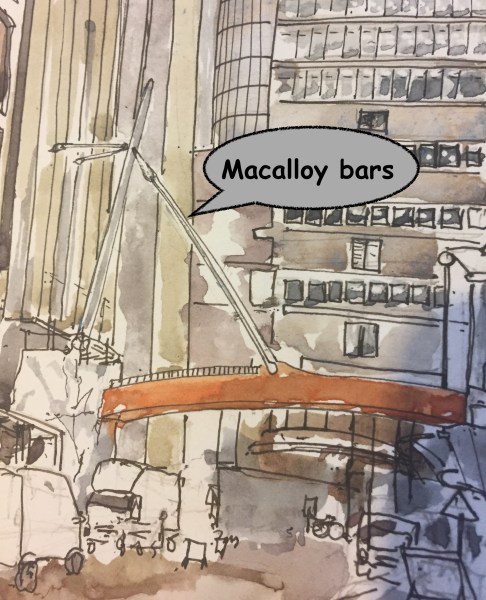
“We wish to advise that the operation to install the new footbridge across Wood Street was aborted on Wednesday 21st December due to technical issues with the alignment of the Macalloy suspension bars that connect the bridge deck structure to the pylon.
We are in the process of rectifying these issues and have agreed a new road closure with the City of London for the bridge installation, week commencing 6th February with a back up closure the following week.
The install of the stainless steel pylon on the 19th December was a success and this is ready to receive the bridge.”
“Macalloy” is the name of the manufacturer of the steel bars. They are based in Sheffield.
Macalloy 460 Tension bar – image from Macalloy.com
The bridge was successfully installed on the 6th February.
I drew the picture sitting on my suitcase near the vehicle entrance to the St Giles area. A man came to open the nearby garage, which was crammed with builder’s equipment and paint pots. Later, a succession of well dressed middle-aged people came by, as though leaving a large event. They were all of a type, and spoke distantly with each other.
Afterwards, I walked underneath the bridge and looked at the junction between the bridge and the sloping walkway, on the right of the picture. This joint is interesting because the walkway slopes down, so, to join it perfectly, the bridge cannot be horizontal at this point. It looks as though the bridge twists slightly to accommodate this geometry, but it’s difficult to see at the moment. I have drawn the bridge as slightly rainbow-shaped, as that’s what it looked like, but the architect’s pictures in the newsletters show it as flat:
Click a button below to share this post online, email it, or print it:
Drawn from outside the Pret on Queen St, about 1hr 30.
The building in the centre is “Albert Buildings”, a thin triangular building on the corner of Cannon St and Queen Victoria St. It is incredibly complicated, with many pillars and arches and different window shapes.
Now it is inhabited by a number of small businesses. I saw a dental surgeon, Shoe Care, and “Traditional Pure” lebanese food. It is now managed by “First Base” as “Cannon St Serviced Office and Business Centre” who describe it as a “listed turn of the century building with quirky Victorian features”. They don’t specify which turn of which century, but evidently it’s not the most recent one.
Pevsner says:
“Albert Buildings, the grandest surviving 1870s block, built 1871. By F.J. Ward, whose office was here. Arcaded Gothic, mixed English and Early French, with a remarkable assortment of window heads” The Buildings of England, London 1 by Simon Bradley and Nicholas Pevsner
St Mary Aldermary is one of my favourite London churches. Inside is the friendly Host Café, and welcoming tables and chairs, and a stunning fan-vaulted ceiling. The church is on Bow Lane, near Watling Street, and the current building was built after the fire, in 1666.
Click a button below to share this post online, email it, or print it:
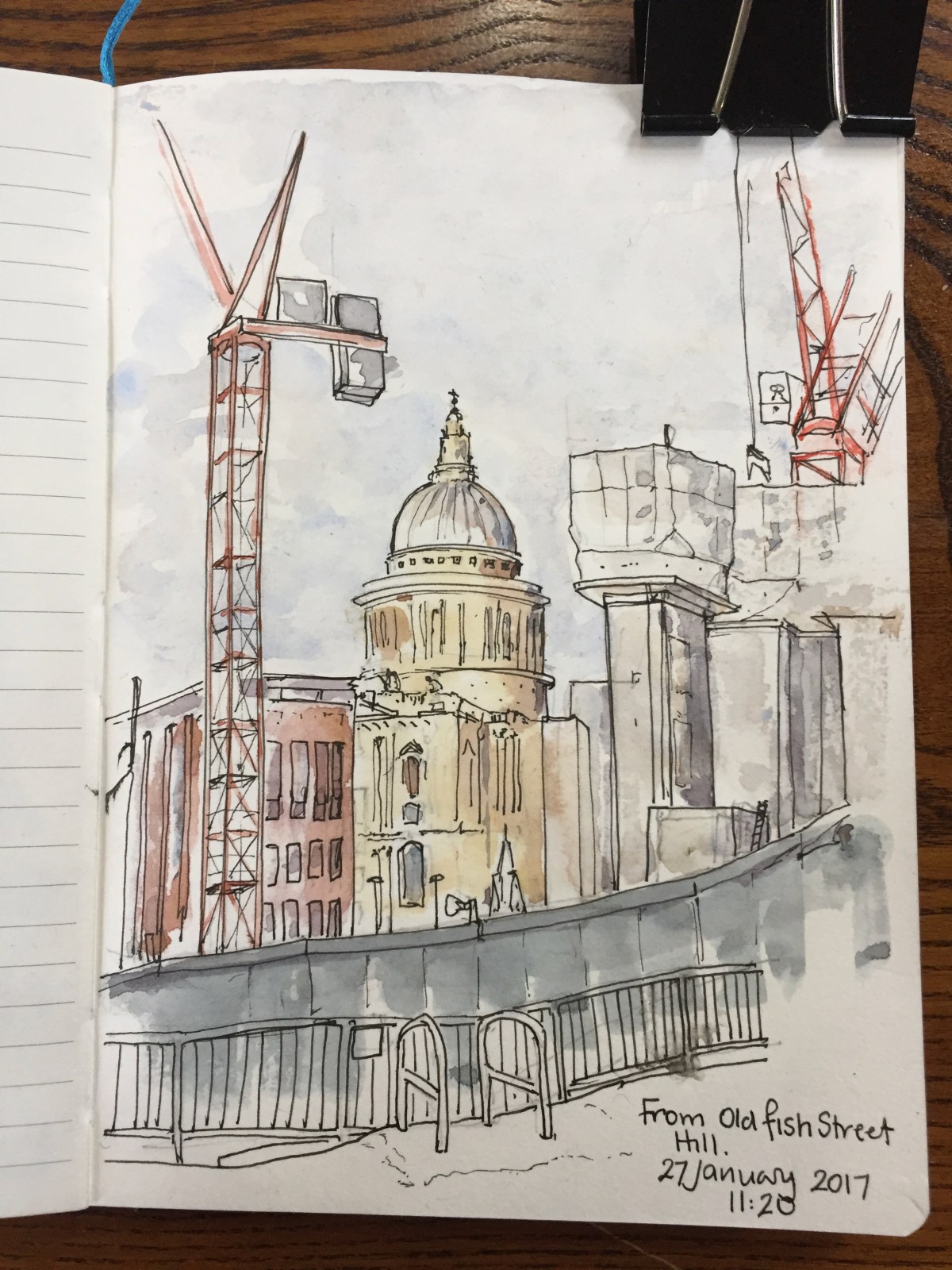
I was keen to draw this view of St Paul’s before it vanished behind the new building on 2-4 Cannon Street.
“PLP’s scheme, for global property firm Pembroke Real Estate, will replace a 1959 modernist office building by Theo Birks called Scandinavian House. The north facade, facing the cathedral, is the most orthogonally formal, with red sandstone cladding and a 3m window grid with anodised aluminium frames.
The south-western elevation tapers to create a public garden which will provide a new home for Michael Ayrton’s sculpture of Icarus.” From Building Design Online 22 September 2014 | By Elizabeth Hopkirk
While I was drawing this, the traffic marshall of the building site came by, looked up at St Paul’s, and remarked that it was a “fine building”.
It was extremely cold, about 2degreesC, and I was wrapped up in my Loden coat and furry boots. You’ll notice I invented a new watercolour technique. It’s called “greasy fingers marbling effect”. See the extreme right of the picture. Before I went out, I put a LOT of hand cream on my hands, because this cold weather makes my skin crack. But then after I had been gripping the sketchbook, I found the paint didn’t stick. But it’s quite a good effect, I think.
I managed to complete the pen and ink drawing, and do most of the watercolour before the cold got to me. Then I retreated to the warmth of the Wren café in St Nicholas Cole Abbey Church.
There I met Amy Marsh @harshmissmarsh who posted my work-in-progress on her Instagram. In the café I painted the red cranes.
Coffee and a small and delicious Marmalade Cake, £6. They were just bringing out some delicious-looking lunchtime food. But I had places to go and work to do, so I exerted willpower and moved on.
Click a button below to share this post online, email it, or print it:








 “We wish to advise that the operation to install the new footbridge across Wood Street was aborted on Wednesday 21st December due to technical issues with the alignment of the Macalloy suspension bars that connect the bridge deck structure to the pylon.



 Jane Sketching