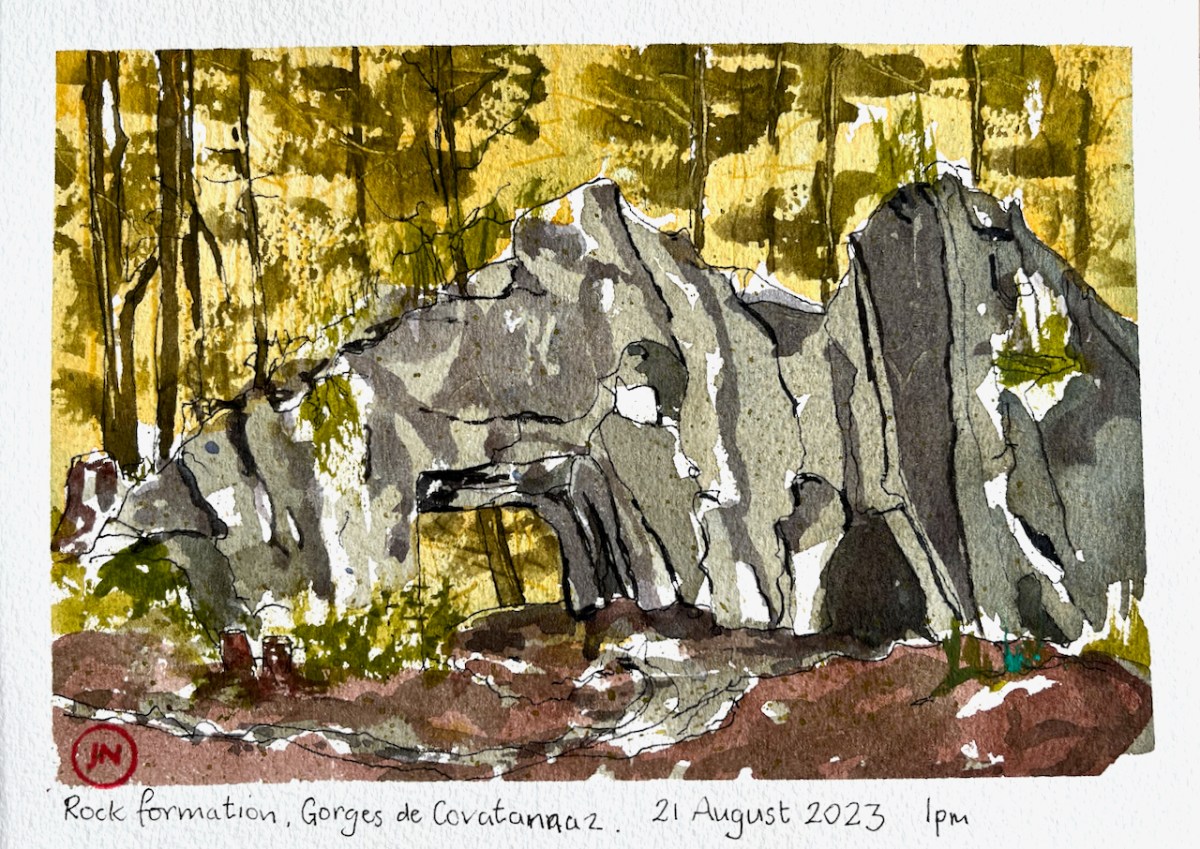
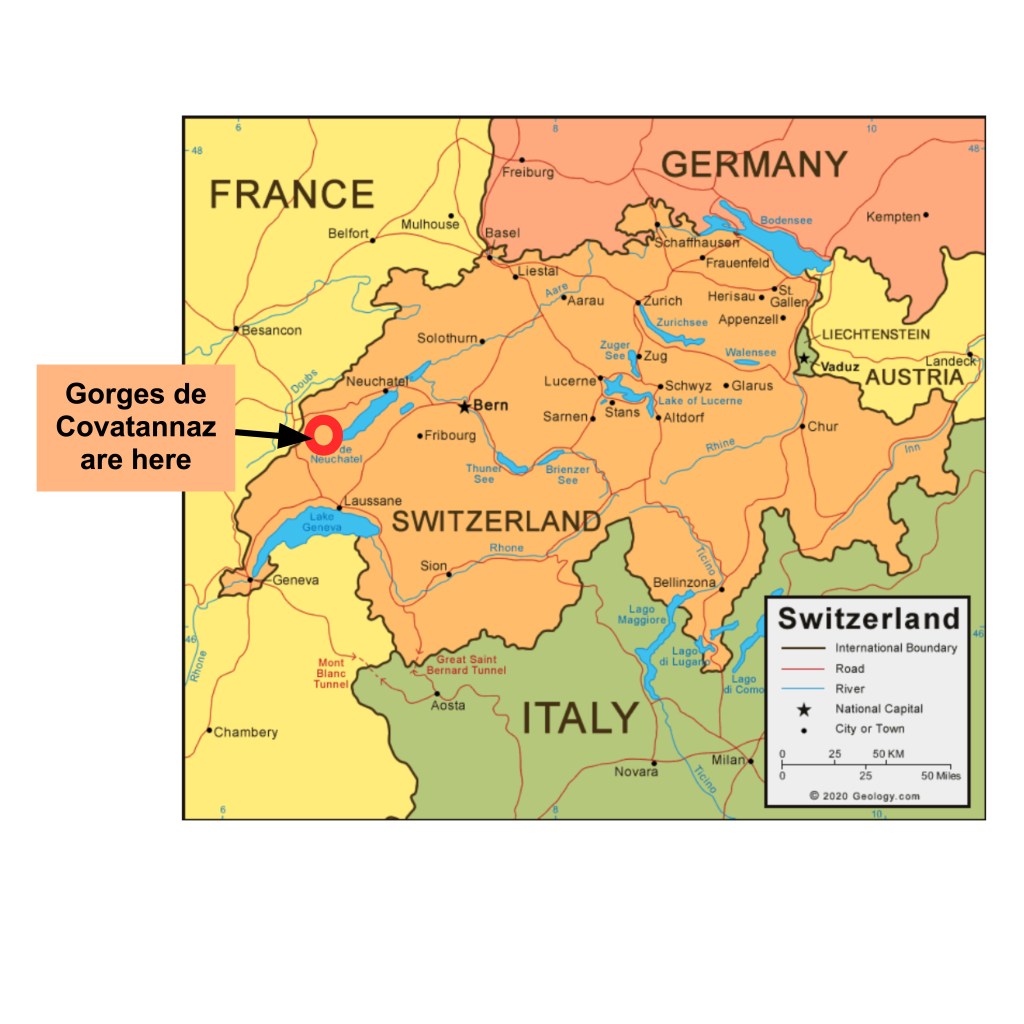
Gorge de Covatannaz, Vaud, Switzerland

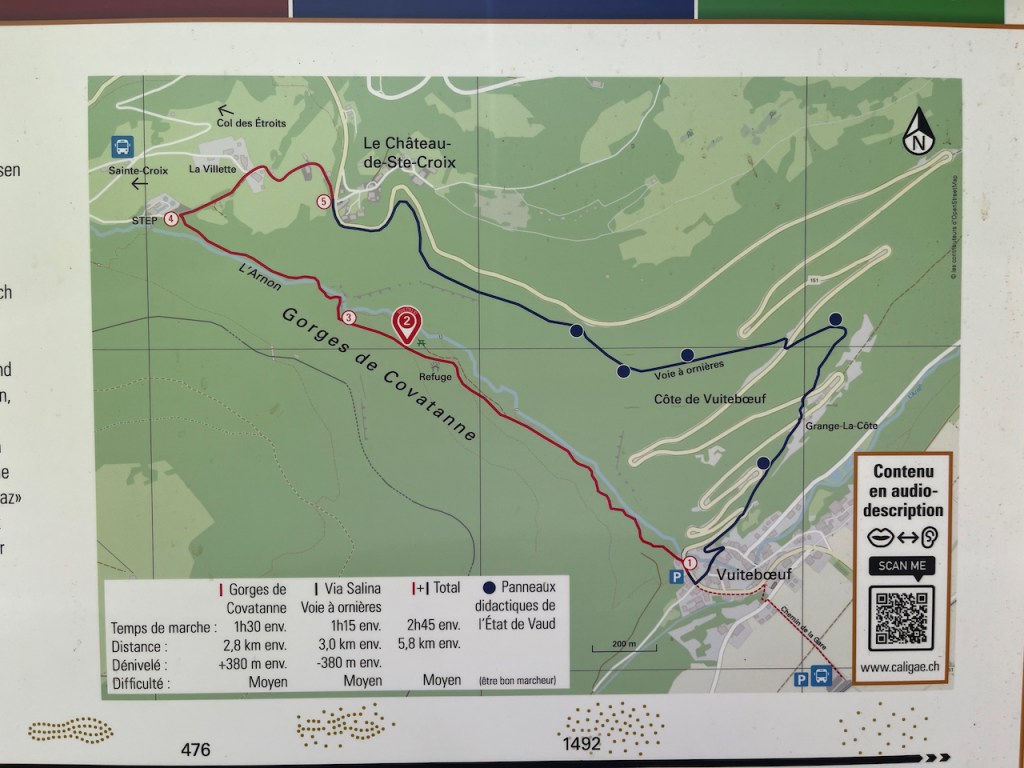
I walked up the gorge from Vuiteboeuf to Sante-Croix. Half-way up I paused to sketch this amazing rock formation.
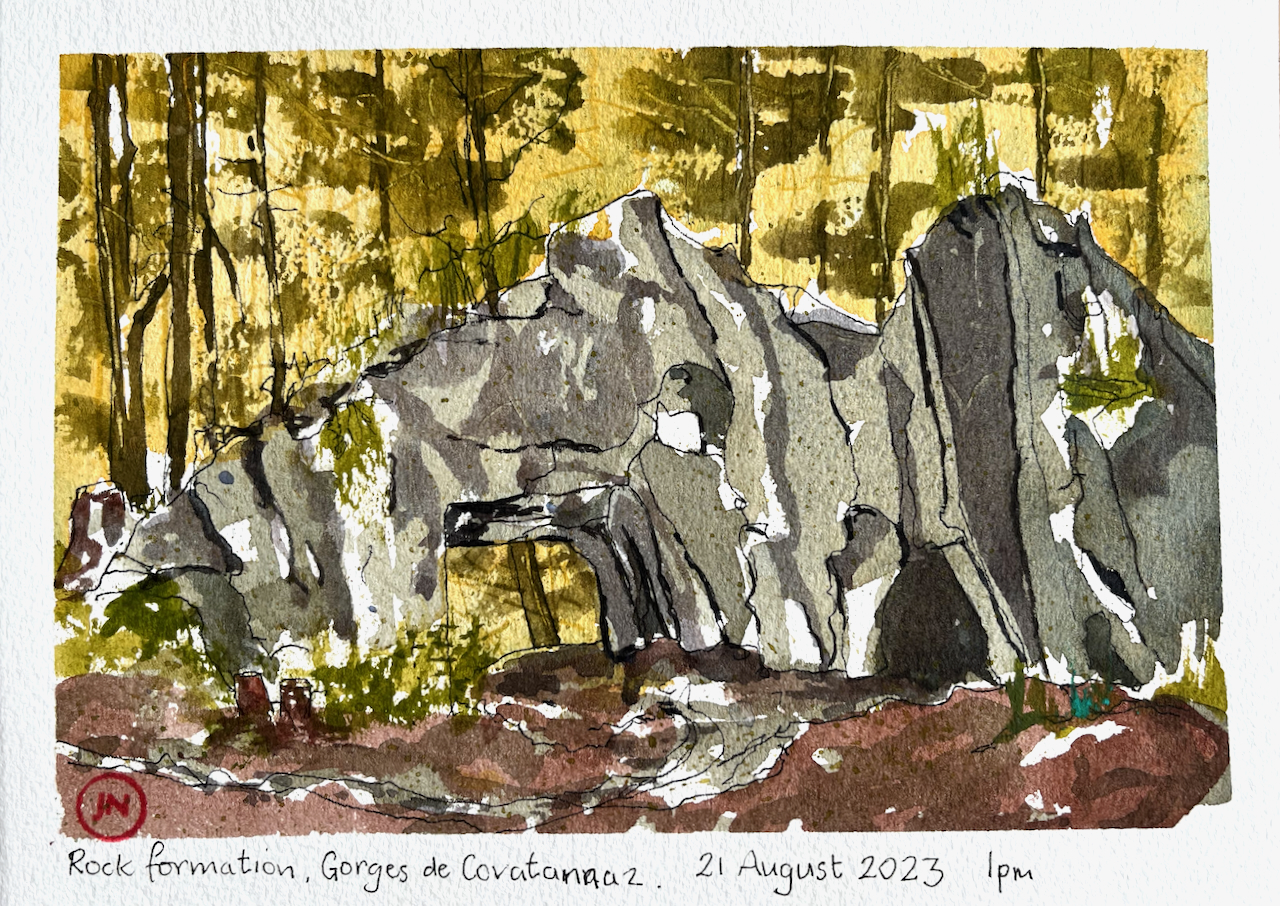
It was an ideal place to sketch, under the trees.

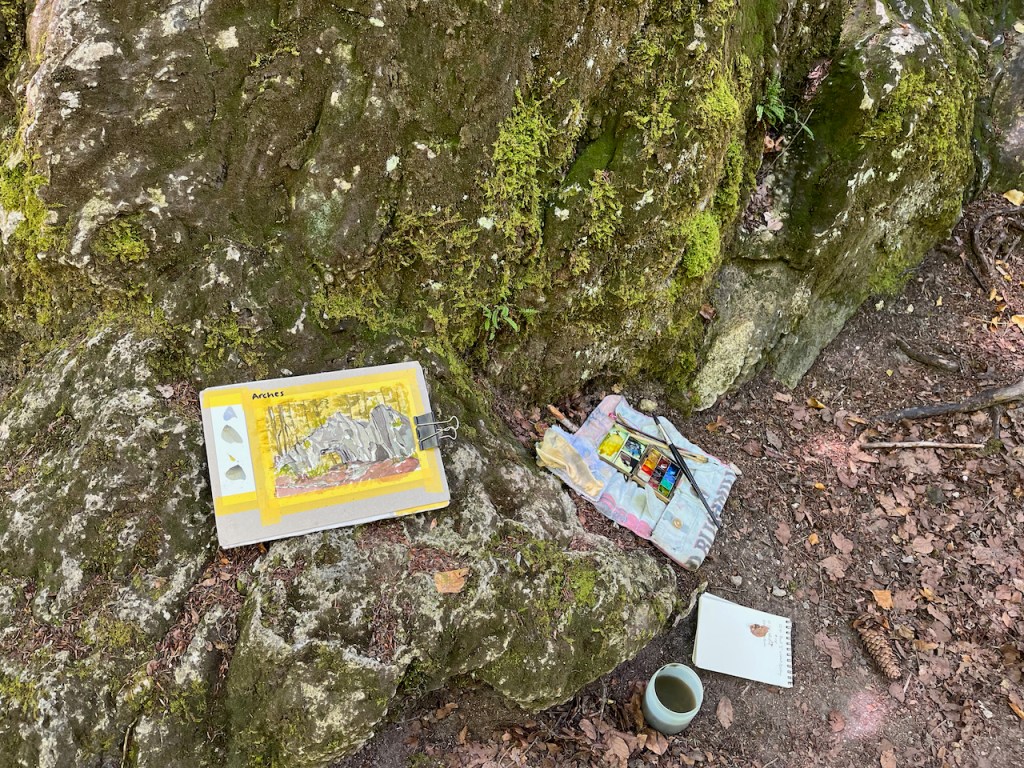
As I sketched, the silence was broken by thumps and scrapes behind me. A bear? A tree fall? A rock avalanche? No. A mountain bike rider descending the path at speed. These riders are skilful – they jump and bounce, and turn in the air like dancers.

I saw one in the distance as I navigated a narrow part of the path. Since there was a steep drop on the right hand side, I flattened myself against the rock to give them room. But there was no need. The rider brought their bike to a graceful halt, slipping sideways like an ice skater. They grinned as I greeted them. “Il faut du muscle” they said in response to my comment on the steepness of the path. Yes, you have to be strong. And have a sense of balance, good eyesight and rapid reaction times. And courage. After I passed, they backed up their bike and jumped on, to hurtle off down the slope.

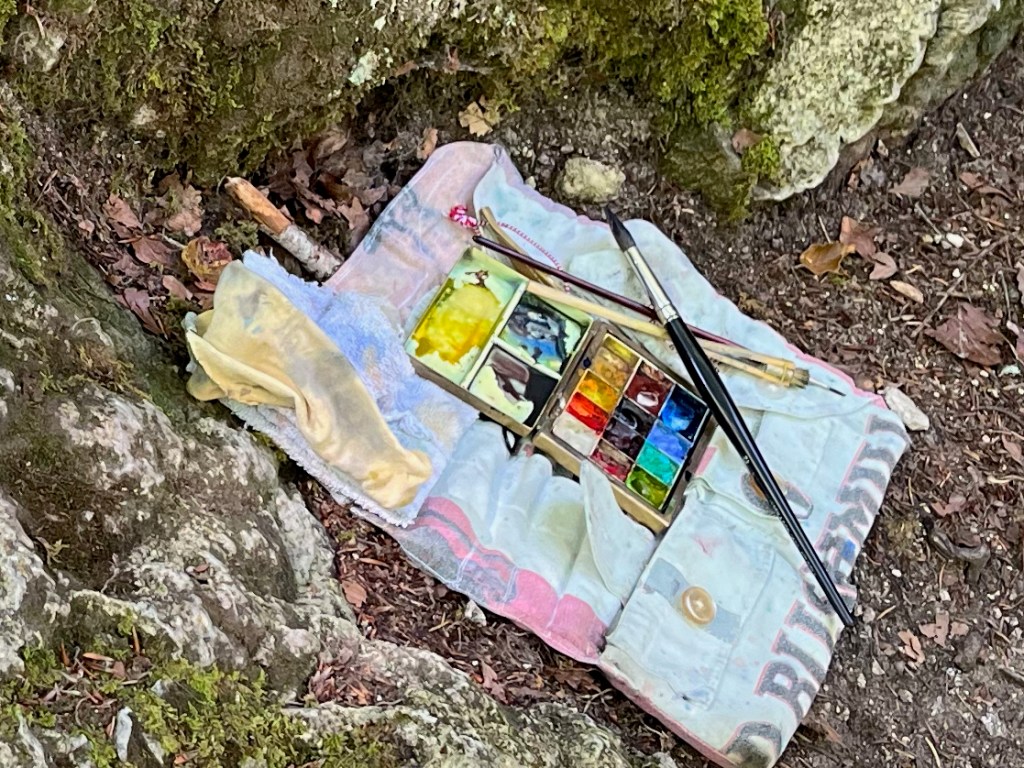
My sketch took an hour. It’s on Arches 300gsm paper, with Daniel Smith watercolours. The colours I used were:

  • Permanent yellow deep
  • Serpentine genuine
  • Cobalt teal blue
  • Burnt Umber
  • Buff titanium
  • Perylene maroon

The pen drawing is with a fountain pen, Lamy Safari, with De Atramentis Document Black waterproof ink.
Temple d’Yverdon-les-Bains

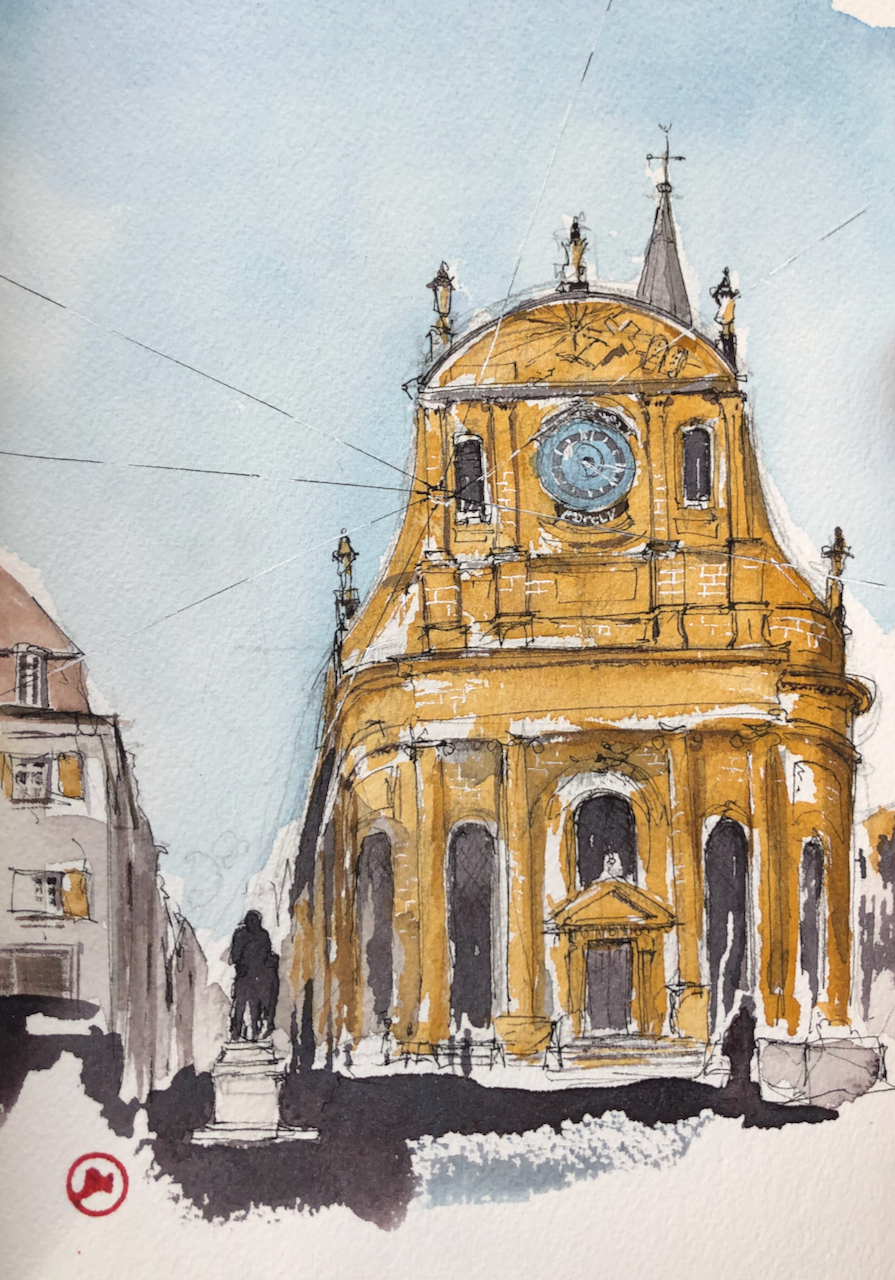
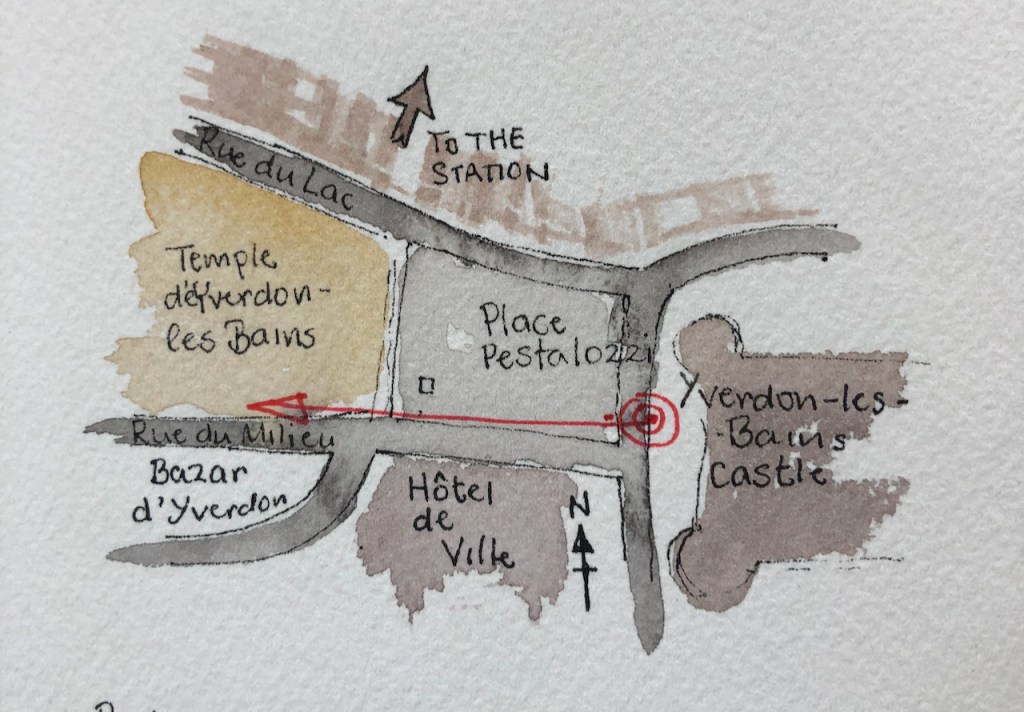
Here is a view from a bench in the main square in Yverdon-les-Bains, Vaud, Switzerland.

Temple d’Yverdon-les-Bains, 27 October 2021, 3.30pm, 10″ x7″ in Sketchbook 11

This is a protestant church, built in 1757. The wonderful yellow stone is from Hauterive in the canton of Neuchâtel.

On the left you see the statue of Johann Heinrich Pestalozzi, for whom this central square in named. He lived 1746-1827. He was an educator, and established the idea that the process of teaching needs to be thought about. He was an early practitioner of the study of teaching: pedagogy. This is why on his statue there are also children.

Pestalozzi’s idea was “Learning by head, hand and heart”. He thought that education was a good idea, in general, for everybody, including the poor. It was good for people as individuals, and good for society in general. Education meant people contributed more, were healthier and happier, and generally better citizens. [My paraphrase of what I’ve read on the website of the JH Pestalozzi Society and elsewhere]. This all sounds very modern. The current ideas of “child-centred learning” for example, can be traced back to Pestalozzi, I read, as well as the concept of state education.

He initiated the Pestalozzi Children’s villages in Switzerland and elsewhere, specifically to help the poor and displaced. This work is still continuing as Pestalozzi World.

So Pestalozzi was a very influential person.

The lines in my drawing are wires suspended across the square for hanging banners and decorations. I like to think they also symbolise the rays of hope that education brings.

Later note:

Above the clock is the Latin inscription: SUPERNA QUAERITE

This roughly translates as “Seek higher things” or “Enquire upon matters of a higher order”.

It occurs in the Letters of Paul to the Colossians, Chapter 3 verse 2, which is rendered in my St James’ Bible as:

If then ye were raised together with Christ, seek the things that are above, where Christ is, seated on the right hand of God. Set your mind on the things that are above, not on the things that are on the earth.

Or if you prefer the Latin, from “Novum Testamentum Domini Nostri Jesu Christi”(“The New Testament. A Latin version prepared by Theodore Beza”[2010], via GoogleBooks):

Itaque si resurrexistis cum Christo superna quaerite ubi Christus est ad dextrum Dei sedens. Superna satagite non terrestria.

Below the clock are the Roman numerals: MDCCLV

1000+500+100+100+50+5 = 1755