
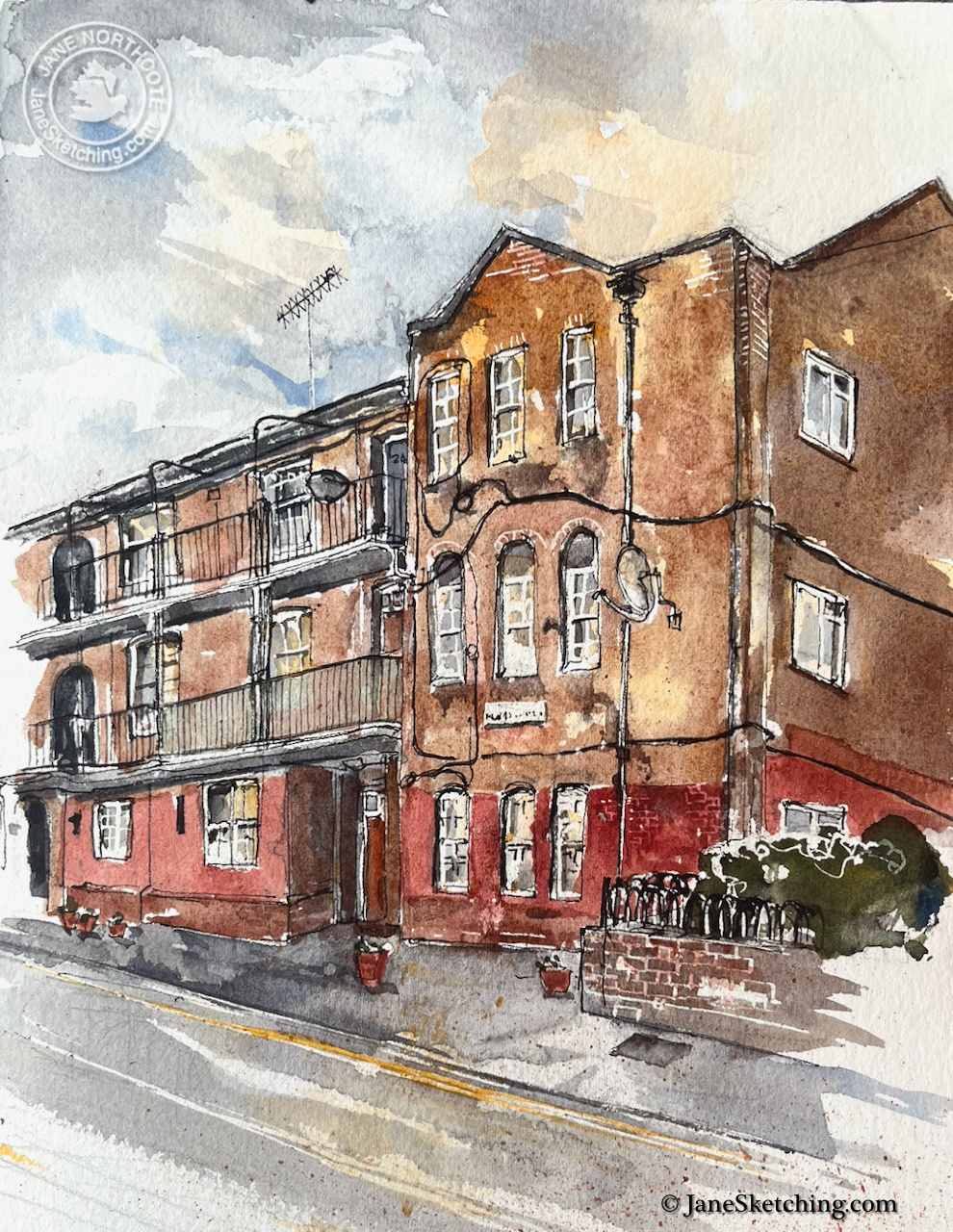
I sketched this block of flats in Southwark, towards the end of an afternoon.
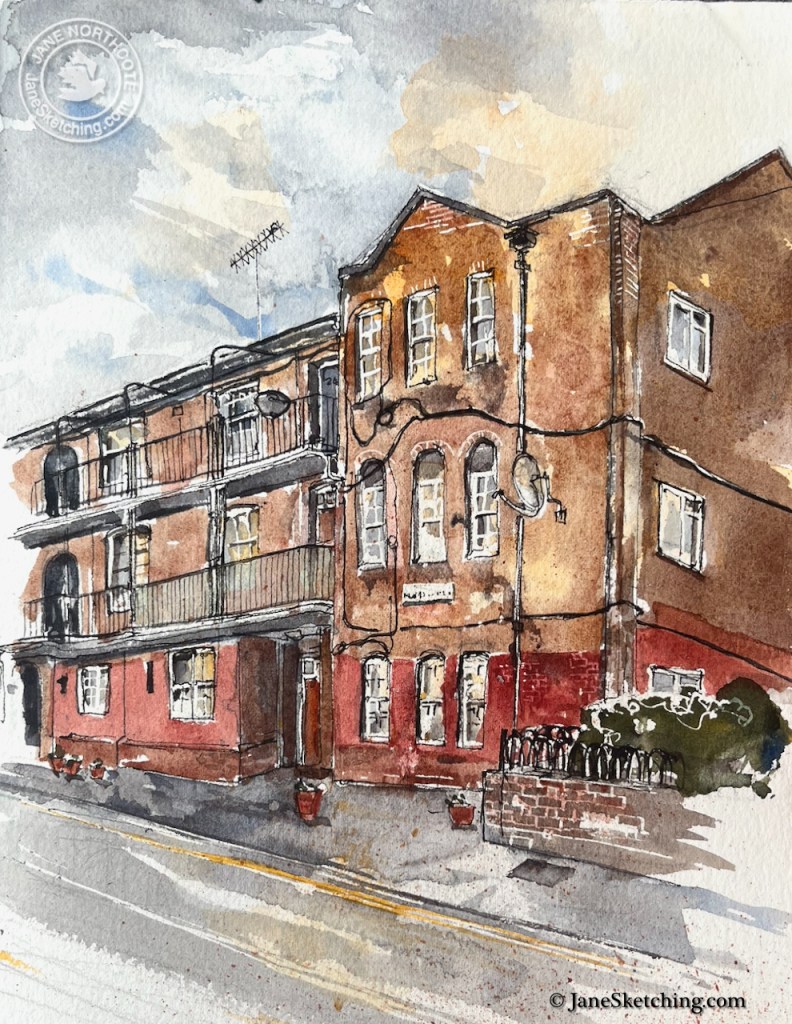
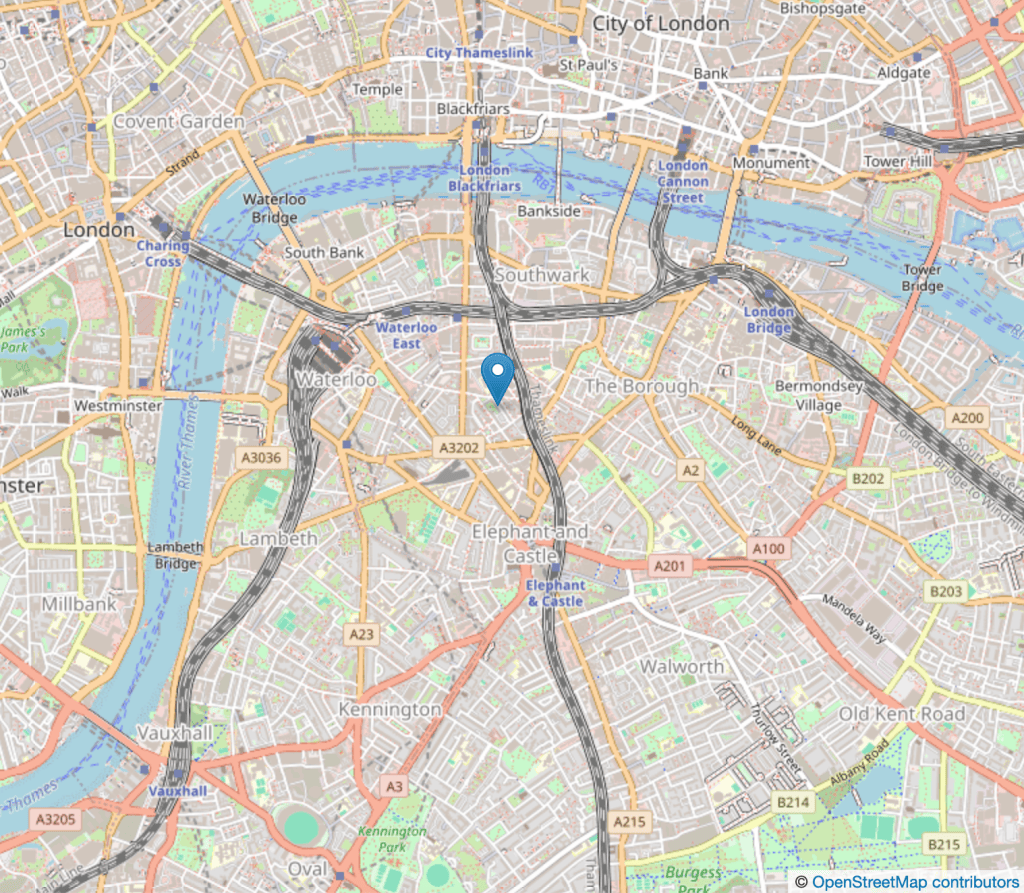
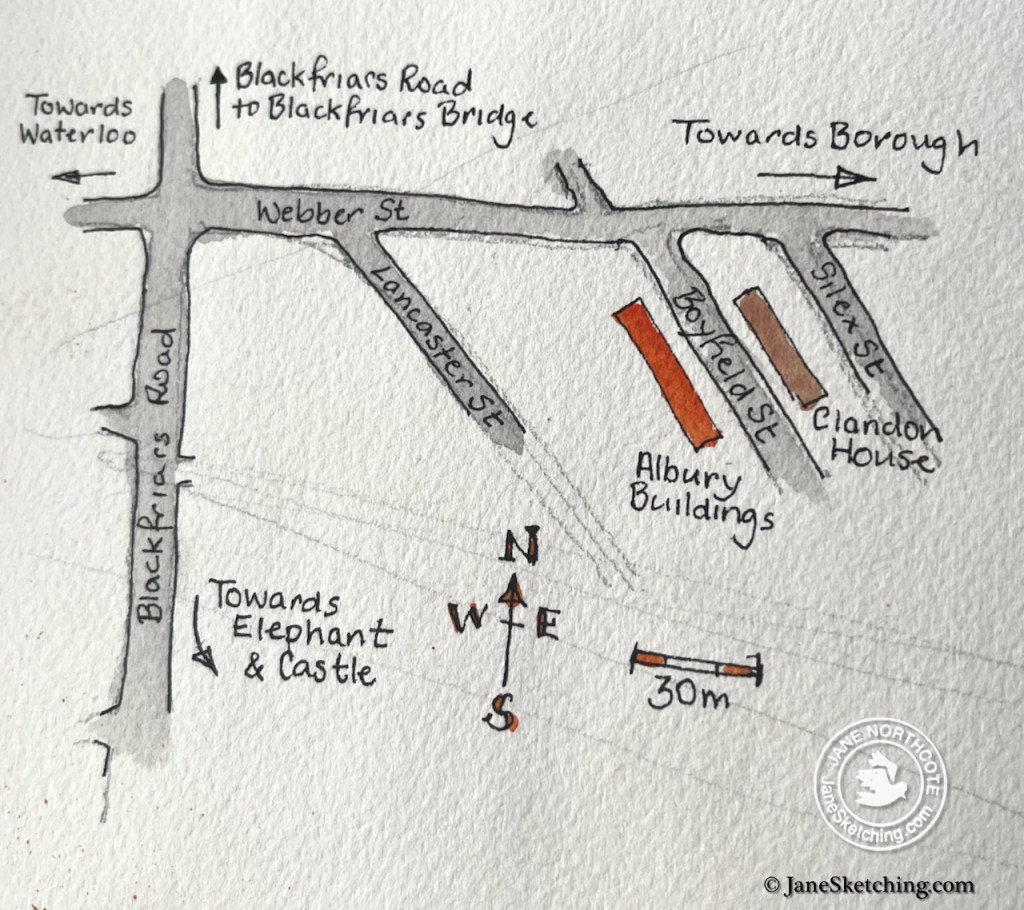
This block, and the block opposite, Clandon House, were completed in 1897.
Pevsner2describes these buildings as “noteworthy early L.C.C. [London County Council] housing of 1896-7” with “quirky Arts and Crafts details”. These, and nearby blocks between Rushworth Street and King’s Bench Street, were designed by R.M. Taylor for the L.C.C.’s housing branch. They are listed Grade II, listing entry 13783763.
I found the building dignified and beautiful, with its arches, railings, and plant pots. The buildings are interesting because they represent the beginnings of the state taking some responsibility for people’s housing4.
During the 19th century, the industrial revolution drew many workers to London. By the middle of the century many of these workers were living in appalling conditions. The government of the day did not see housing as any part of its role. Social reformers such as Octavia Hill made valiant attempts to provide better housing, by raising money from investors. The Peabody Trust, funded from the fortune of a London-based American banker George Peabody, was also building what we would now call social housing. But the rents were too high for the poorest Londoners, who continued to live in unsanitary and crowded conditions. Members of the clergy, reformers and politicians wrote articles drawing attention to this misery.5
By 1890 the government was starting to take positive action. A “Housing of the Working Classes Act” (1890) gave London County Council the power and the duty to replace at least half of the housing that was demolished in improvement schemes for roads and railways. Only half of the housing is to be replaced by the council, note. In his book “Metropolitan Dreams” John Boughton notes that this Act “provided the basis of the relative surge in council house building that followed.” Council house building was controversial. Conservative politicians in power at the time “saw it [the Act], at most, as a small shift towards increased state responsibility but retained their basic belief in the efficacy of the free market and fear (to use a later idiom) of a ‘dependency culture’ fostered by state provision.”6
The London County Council was formed by the Local Government Act of 1888, and the first elections in 1889, just 7 years before Albury Buildings were completed. A subset of the LCC was the “Housing of the Working Classes” branch. This group was influenced by socialist thinkers including William Morris, who is now remembered for his textile designs but who, in his time, was a campaigner for the dignity of working people. So the Arts and Crafts movement, through William Morris and others, was influential at the time of the construction of Albury Buildings. Hence the ornamental railings, the arches, and the balconies.
The arches are open: I could have walked in and along the balconies.
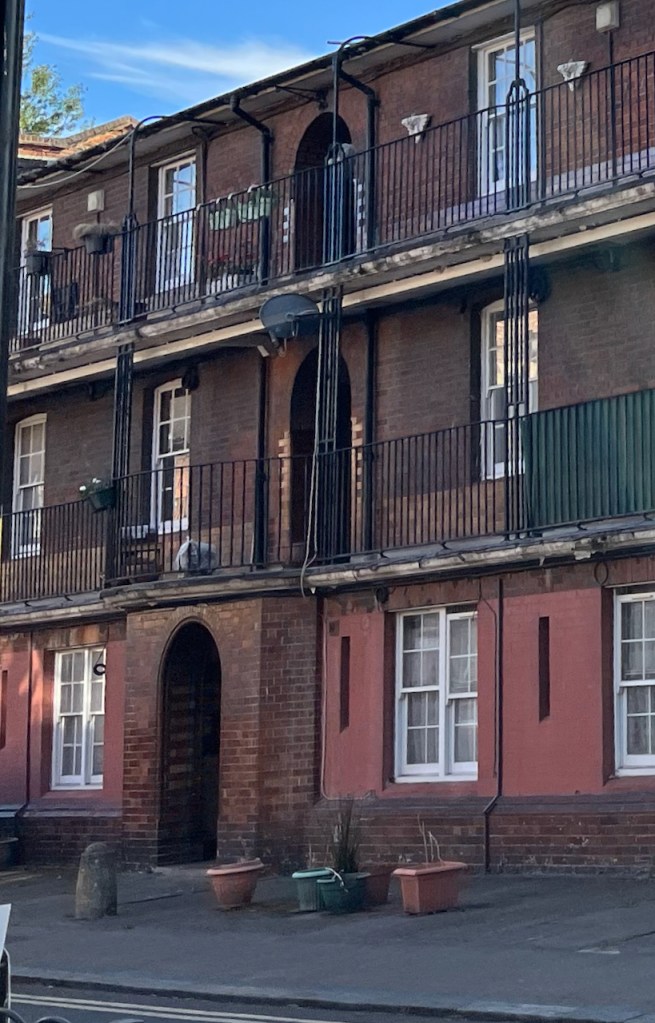
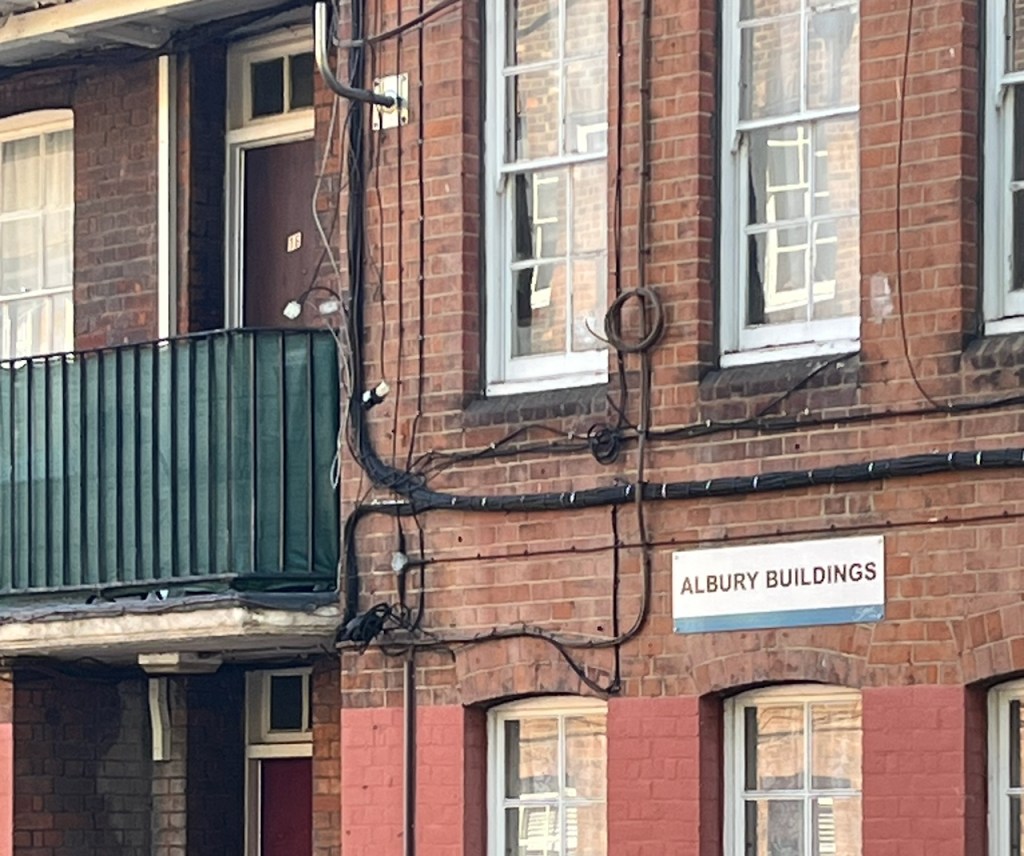
Albury Buildings is now part of the Boyfield Street Estate managed by Southwark Borough Council, who own the freehold. Some are social rent dwellings7, and others are privately owned leaseholds, selling on platforms such as “Rightmove”.
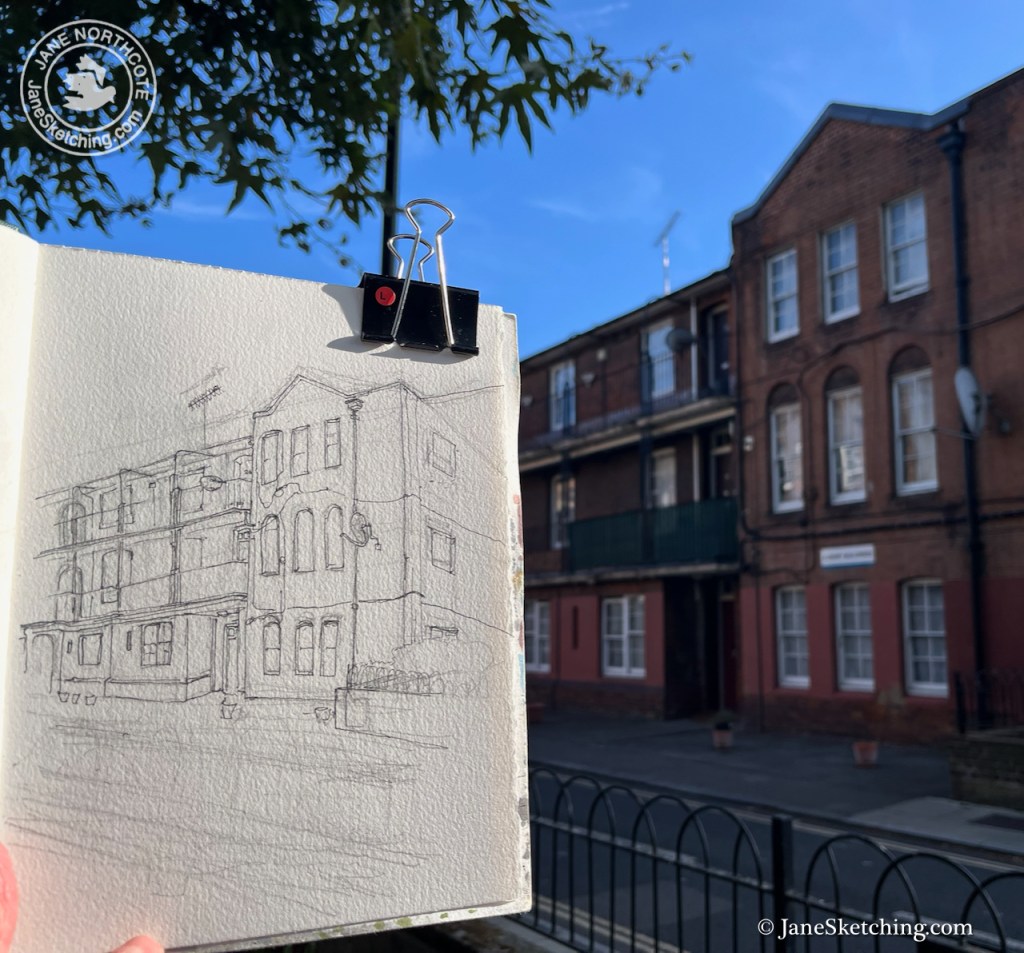
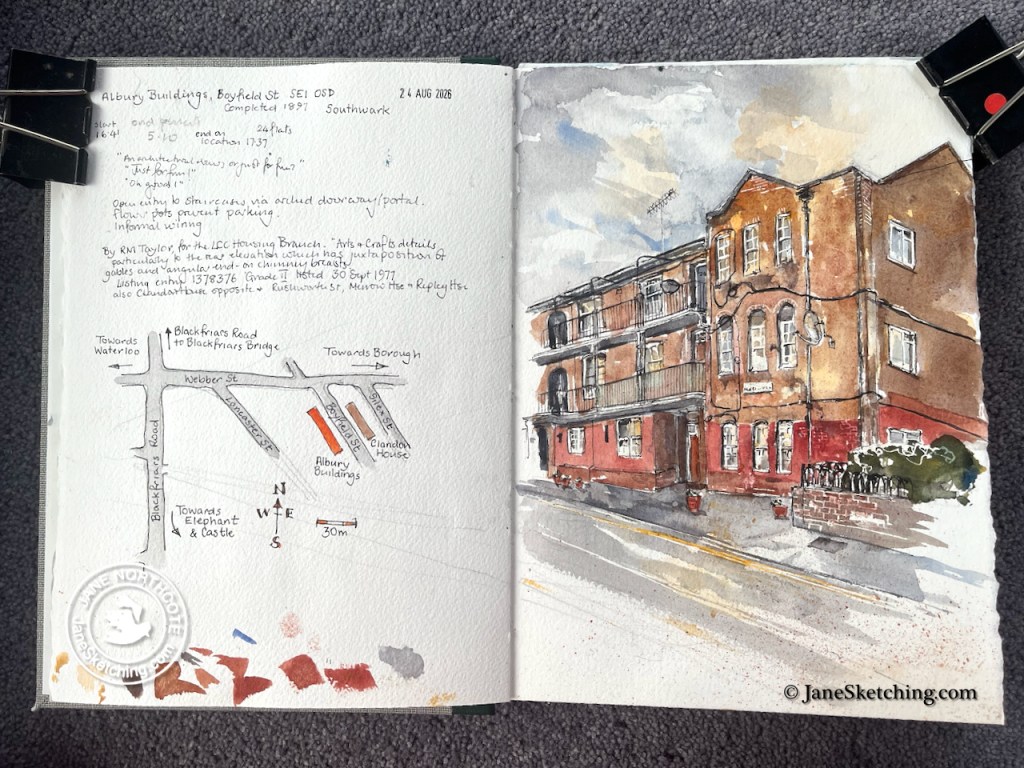
As I sketched people were walking home from work. A passing man asked me, “Is it an architectural drawing, or just for fun?”
“Just for fun”, I replied.
“Good!” he declared, and walked on.
- “Albury Buildings” is the name written on the building. In some references it is called “Albury House”. ↩︎
- LONDON 2: SOUTH by Nikolaus Pevsner and Bridget Cherry ISBN 0 14 0710.47 7 2001 reprint, page 591 ↩︎
- Listing entry by Historic England https://historicengland.org.uk/listing/the-list/list-entry/1378376 ↩︎
- Another early example of social housing is the Boundary Estate, Arnold Circus which I have sketched previously . ↩︎
- For example,”The Bitter Cry of Outcast London” by Rev. ANDREW MEARNS, London Congregational Union, Memorial Hall, Farringdon Street, E.C., and William C. Preston (1883) https://www.gutenberg.org/cache/epub/55316/pg55316-images.html
This pamphlet describes the appalling conditions in graphic detail, and also gives a sense of the moral panic that was felt by this clergyman and others. In the crowded conditions, incest was all but inevitable, and people could not go to church. Here’s an extract [all quotes are from the pamphlet reproduced online by Project Gutenberg]:
“Whilst we have been building our churches and solacing ourselves with our religion and dreaming that the millennium was coming, the poor have been growing poorer, the wretched more miserable, and the immoral more corrupt; the gulf has been daily widening which separates the lowest classes of the community from our churches and chapels, and from all decency and civilization….“
The authors go on to describe the conditions. Here is one description [page 9]:
“Every room in these rotten and reeking tenements houses a family, often two. In one cellar a sanitary inspector reports finding a father, mother, three children and four pigs! In another room a missionary found a man ill with small pox, his wife just recovering from her eighth confinement, and the children running about half naked and covered with dirt. Here are seven people living in one underground kitchen, and a little dead child lying in the same room. Elsewhere is a poor widow, her three children, and a child who had been dead thirteen days.”
The authors propose state intervention [page 24]:
“Large spaces have been cleared of fever-breeding rookeries, to make way for the building of decent habitations, but the rents of these are far beyond the means of the abject poor. They are driven to crowd more closely together in the few stifling places still left to them; and so Dives makes a richer harvest out of their misery, buying up property condemned as unfit for habitation, and turning it into a gold-mine because the poor must have shelter somewhere, even though it be the shelter of a living tomb.
The State must make short work of this iniquitous traffic, and secure for the poorest the rights of citizenship; the right to live in something better than fever dens; the right to live as something better than the uncleanest of brute beasts.”
↩︎ - The history of social housing is from John Bougham’s book “Metropolitan Dreams” ISBN978-1-78478-739-4. The parts I’ve quoted here are from Chapter 1: “How to provide Housing for the People”. ↩︎
- Social rent houses in “Albury Buildings” are listed on “https://uksocialhousing.com” under postcode SE1 0SD as council rents. ↩︎

 Jane Sketching