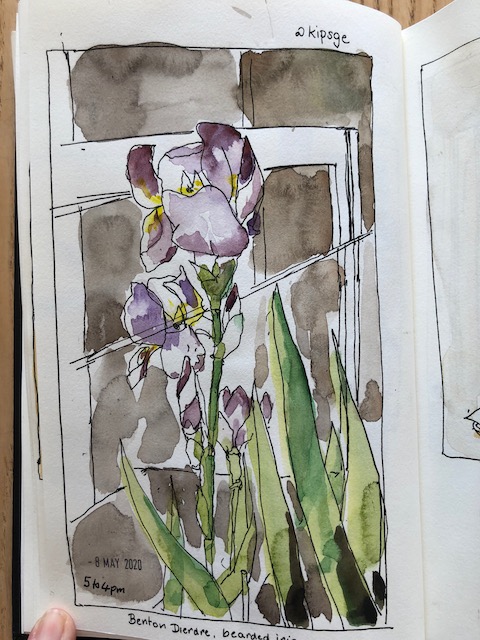
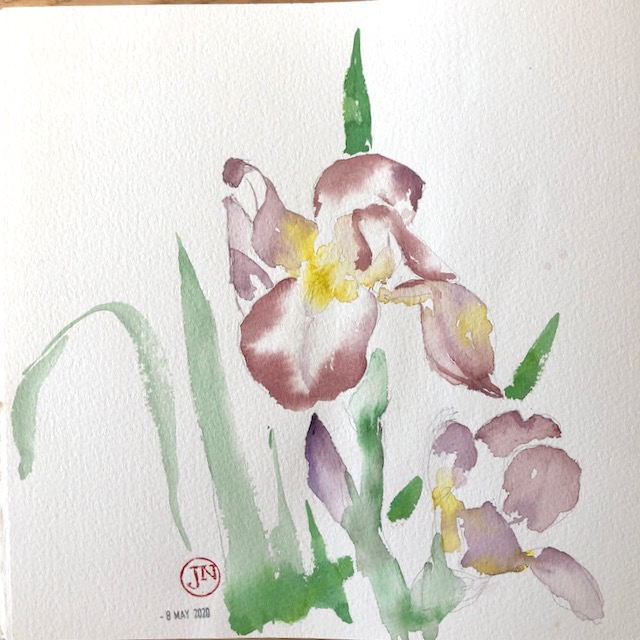
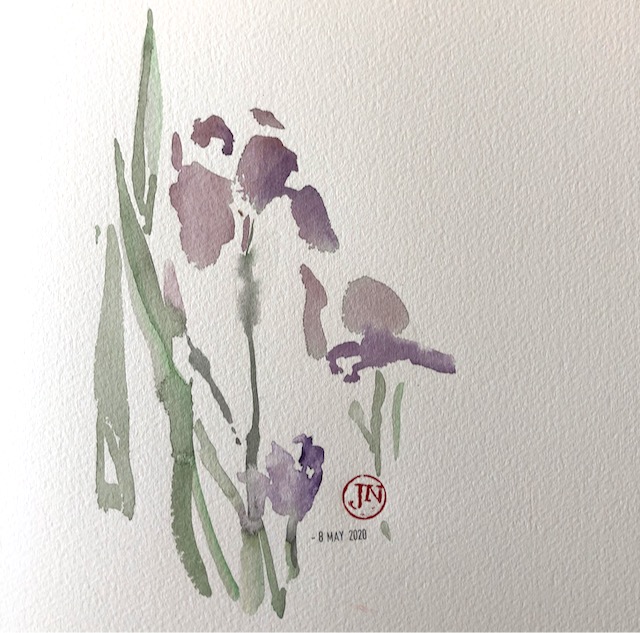
Here are more pictures of the Benton Dierdre iris. These are watercolours, done wet-in-wet, a technique I understand is called “tarashi-komi” in Japan.
Cedric Morris iris, watercolours.
Click a button below to share this post online, email it, or print it:
Since I live in a flat, “stay at home” means “stay indoors”.
I started drawing the scenes around the flat.
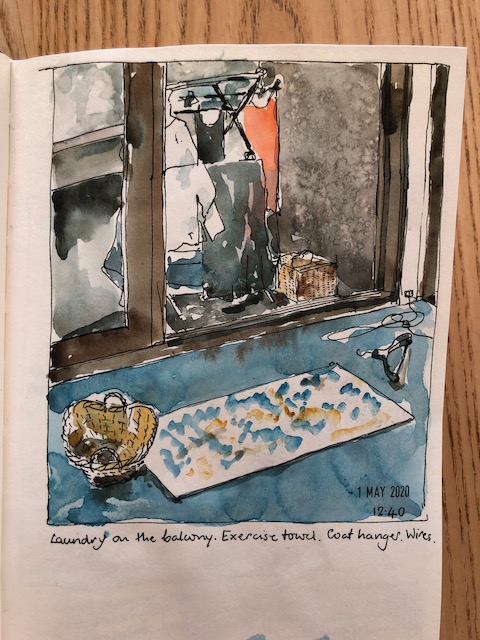
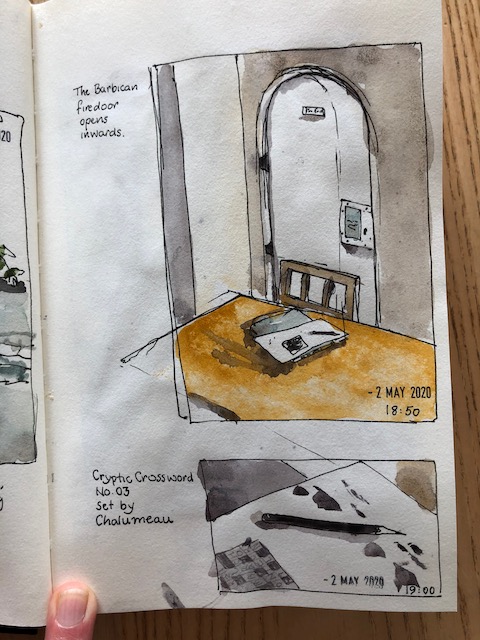
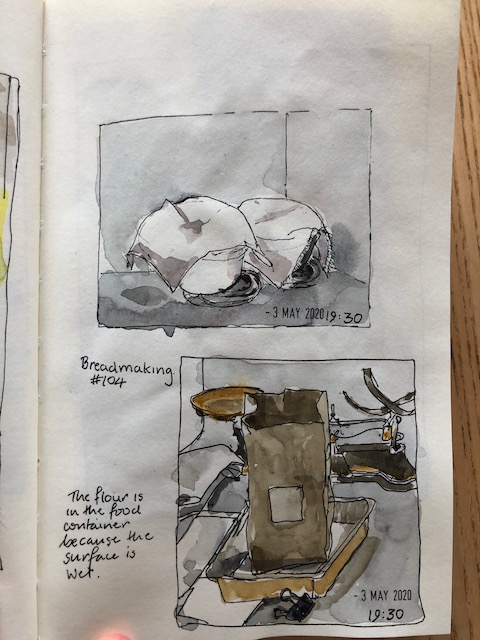
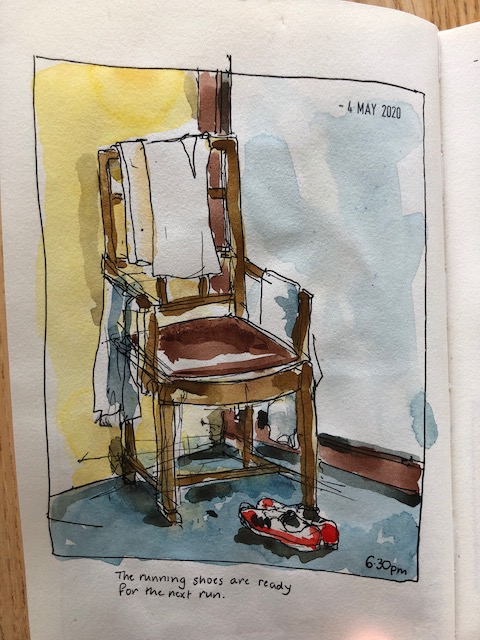
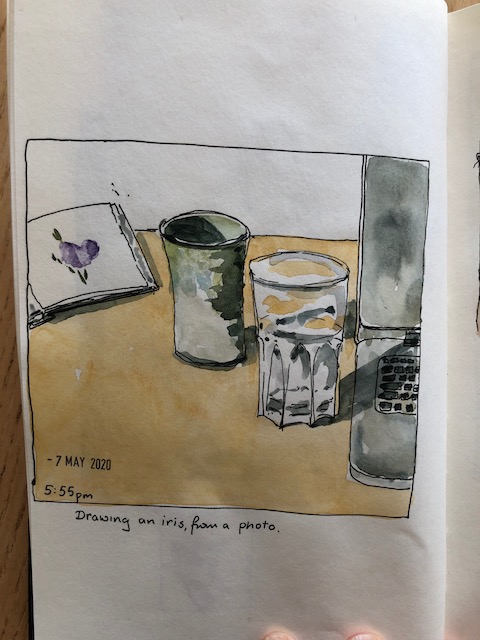
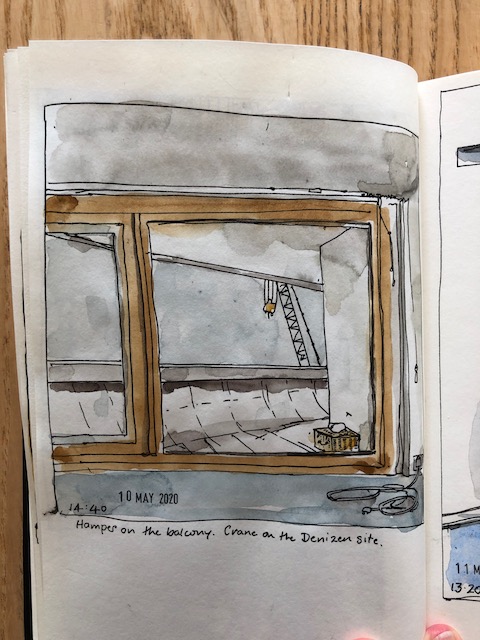
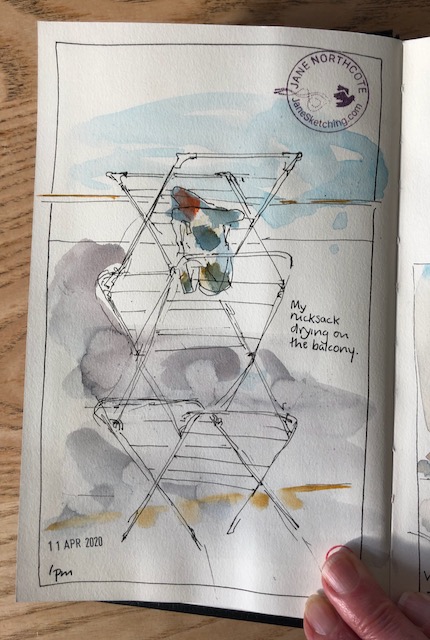
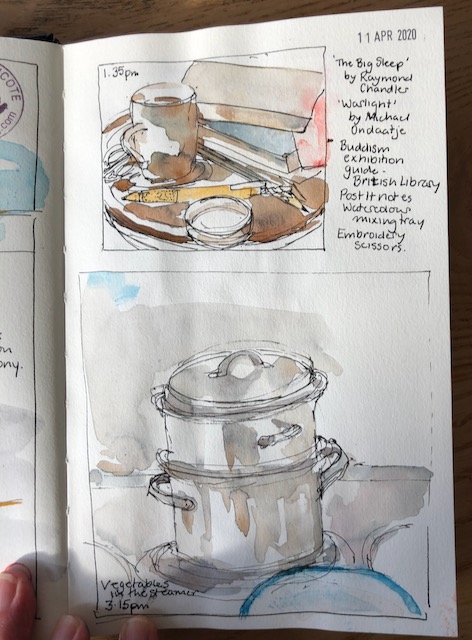
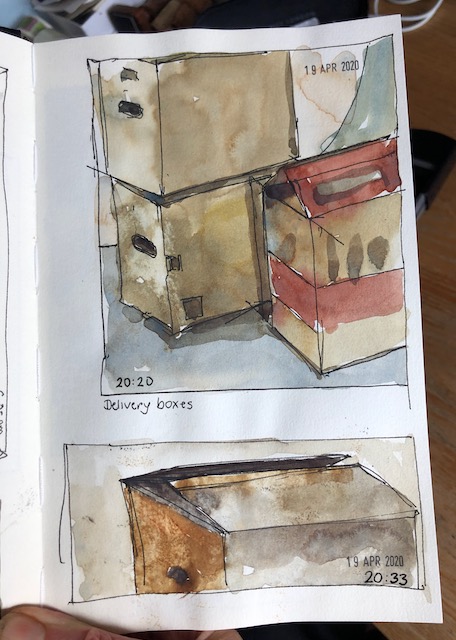
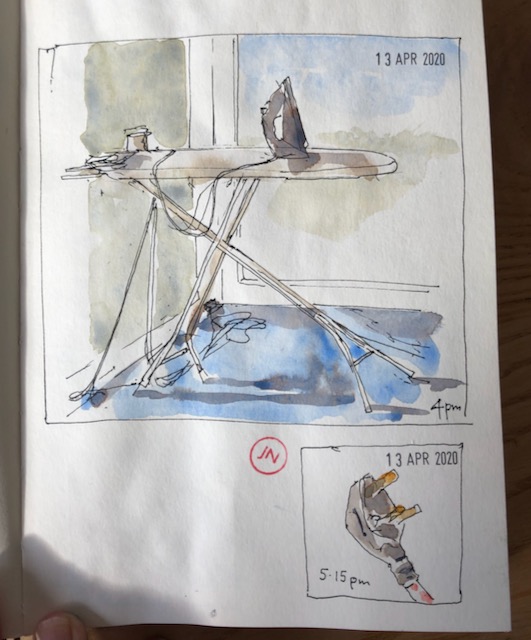
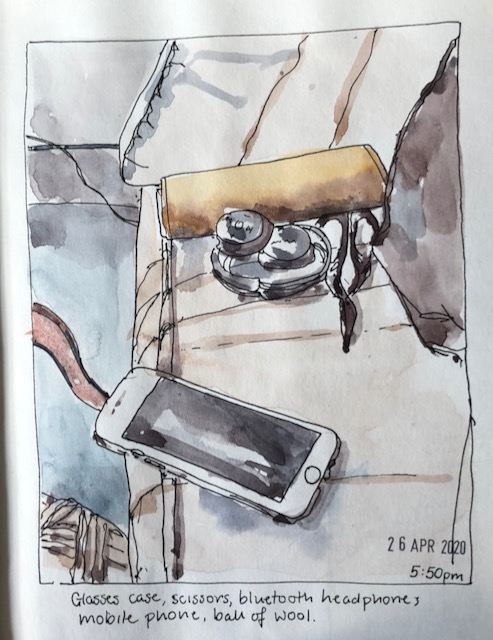
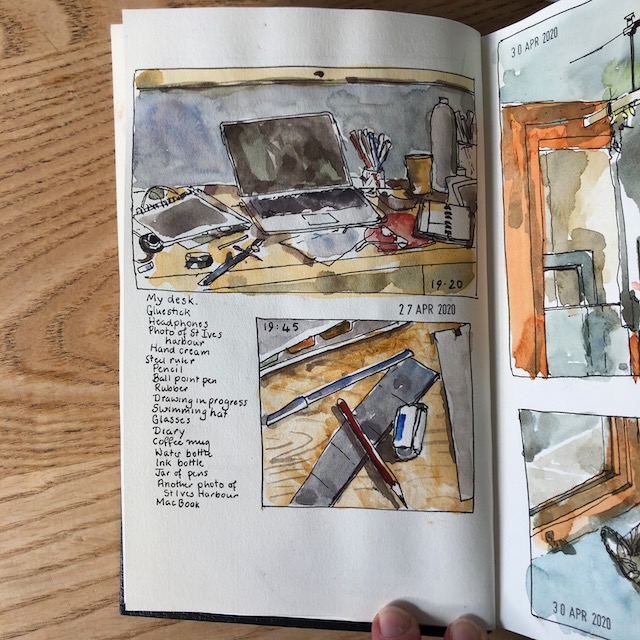
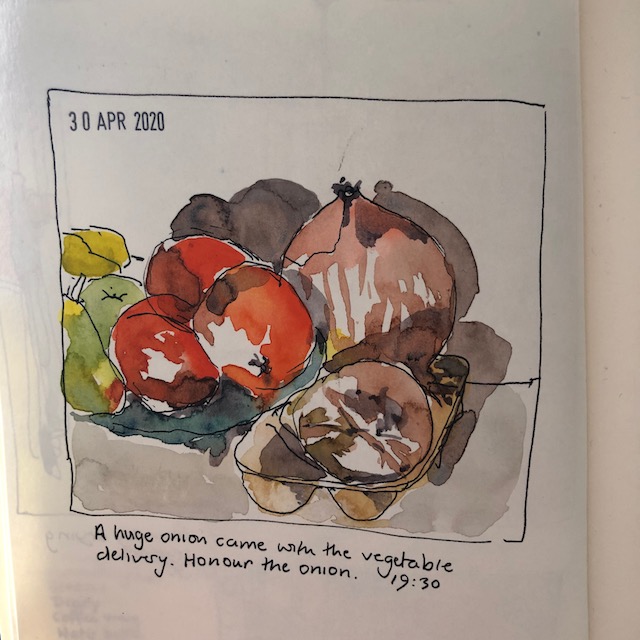
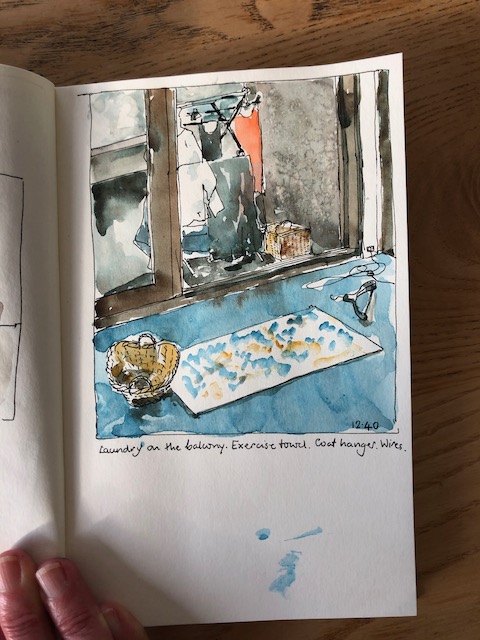
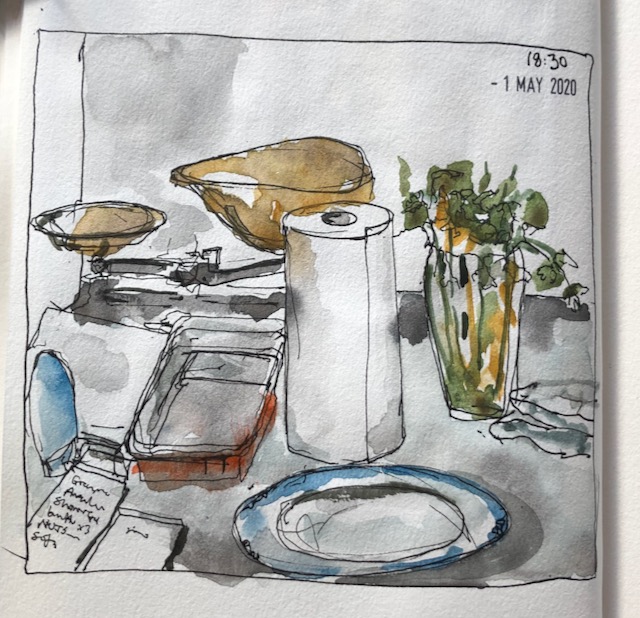
I can look outdoors. We have a balcony which is just big enough for the drying rack. I have mended my rucksack. Then I washed it. After all, I won’t be needing a rucksack for a while.My principle is to draw things as I find them. I don’t move or adjust them. These are vernacular still lives: the way things are.In a corner the delivery boxes accumulate. There are a lot of delivery boxes.Here is the ironing board.Here are the things which accumulate at the end of the sofa.A scene by the kitchen sink.An apple from the vegetable delivery.Evening scenesThe important HDMI connector. I learned to make the TV work from my laptop. This was for the online life-drawing sessions.Miscellaneous objects get thrown together. Here, some knitting items meet the mobile phone technology.My desk. How can I work in such chaos? I am making a design for a swimming hat. A sample swimming hat is the red thing on the right.The huge onion.Laundry on the balcony, exercise towel, coat hanger. Before I finishd this picture, the rain came down, and I had to go out and get the washing in.Items form social groups: the weighing machine, the kitchen roll, a food container, the enamel plate, two shopping lists, the hand cream, a beer glass with the parsely in.
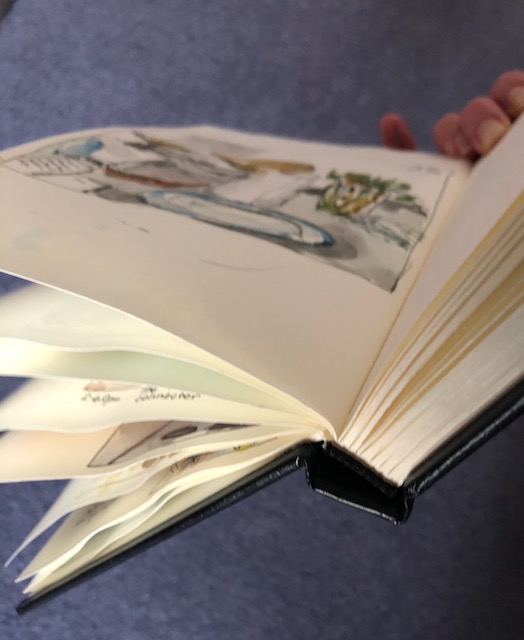
These are the drawings up to today, 1st May.
Stillman+Bern, Gamma series sketchbook. Still a lot of pages left to fill.
Click a button below to share this post online, email it, or print it:
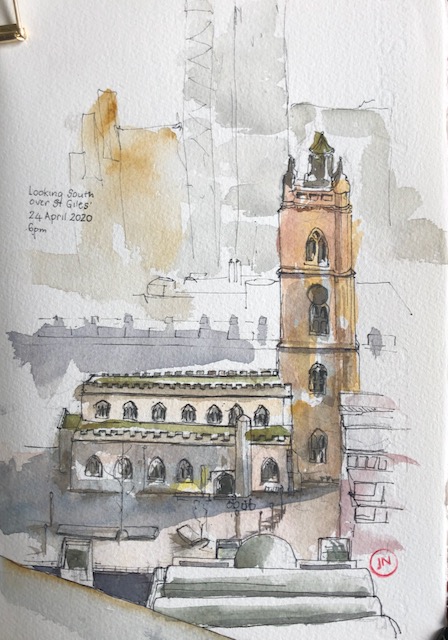
I drew St Giles’ Cripplegate, as seen from the window of the flat.
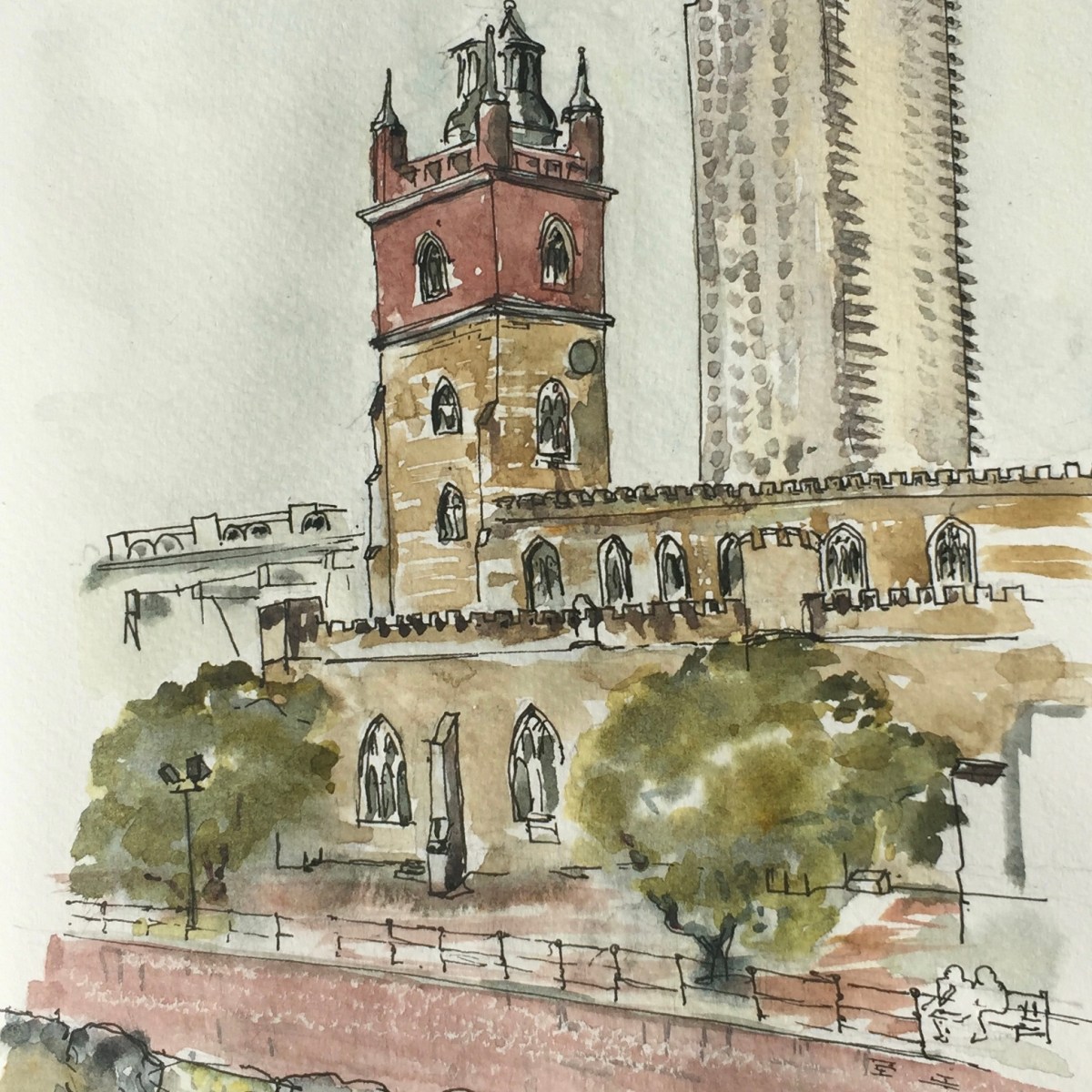
St Giles Cripplegate, from the North
The church is surrounded by the buildings of the Barbican estate. To the right of the church is the City of London School for Girls. Behind it in the picture you see a representation of the Barbican block called “Wallside”, and then behind that, are the office blocks of the City. In the foreground is Frobisher Crescent.
St Giles’ was damaged by enemy action in the 1939-45 conflict. Artists showed the damage. I was particularly struck by the work of Sam Carter, and William Coldstream, shown by the East London Group in their excellent and informative Twitter stream (@EastLondonGroup) – their tweets are embedded below, if you scroll down. Here’s the picture by William Coldstream, 1946:
St Giles Cripplegate (1946) by William Coldstream, in the Arts Council Collection. Thanks to @EastLondonGroup twitter stream for showing this work.
As you see in the picture above by William Coldstream, in 1946 the church itself was damaged, and it was surrounded by rubble. This picture must have been painted from the current location of the Museum of London. The damage was done in a bombing raid in about 1940. The plants have had 6 years to grow.
The Barbican was built on the area destroyed by bombing. St Giles was rebuilt.
Here is St Giles Church from the Lakeside Terrace of the Barbican. While I drew this, three men were shovelling mud from the bottom of the lake. The mud is black and viscous and the men were remarkably cheerful in their task. They would have made good subjects for a drawing too. But for now,…
Today Urban Sketchers London held a “sketch crawl” in the Barbican. So I joined them. An astonishing number and diversity of people assembled inside the entrance of the Barbican Centre at the appointed time of 11am. I counted about 35 and then another dozen or so joined. All shapes and sizes of people, tall, short,…
Here is today’s sketch showing: London Wall – 2nd century AD Barber-Surgeons Hall – current building 1969, first hall, on this site 1441 St Giles Church – current building 1966, first church on this site by 1090 Barbican, Cromwell Tower, Wallside and Arts Centre – 1965-82 Braithwaite House – completed around 1963 White Collar Factory…
Here is a sketch from a staircase from the Barbican Podium, just outside the Dentists but just inside the old London Wall. Parts of the Roman London Wall are in the foreground, 2nd century AD. St Giles’ has Roman foundations and is much rebuilt. The church we see now is the 1966 restoration following designs…
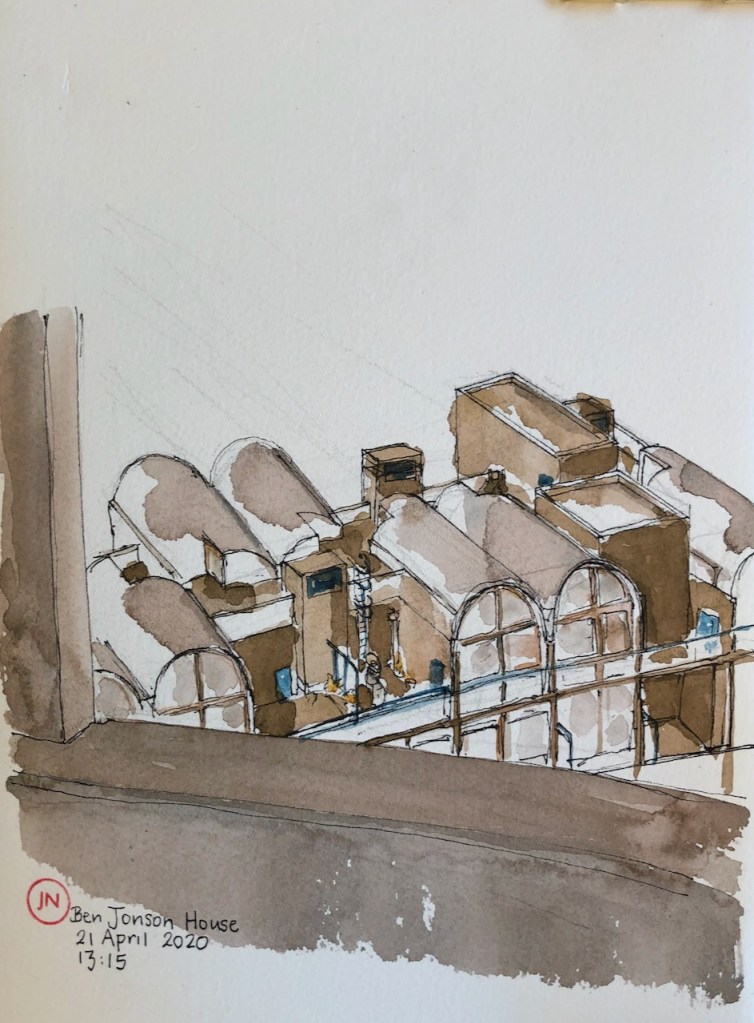
Sketching from the window, here is Ben Jonson, part of the Barbican estate.
The people who live on the top floor of Ben Jonson have sunlit roof gardens. You can see one person enjoying his garden. He sits just at the bottom of the blue fire escape ladder.
There is also an interesting void space shown in the lower right of the picture. It was empty when I was drawing, but sometimes someone’s legs are visible, using the space for sunbathing. Sometimes they set up a table and chairs there.
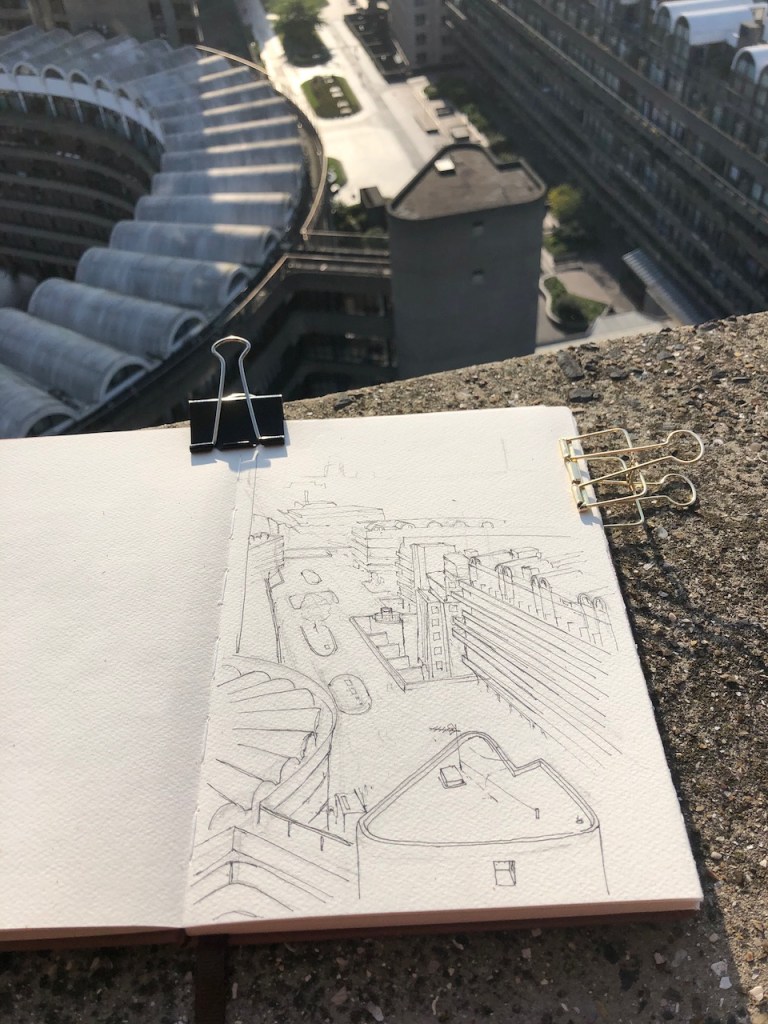
Here is work in progress. I used colours: Mars Yellow, Burnt Umber, Prussian Blue and a bit of Perinine Orange.
Click a button below to share this post online, email it, or print it:
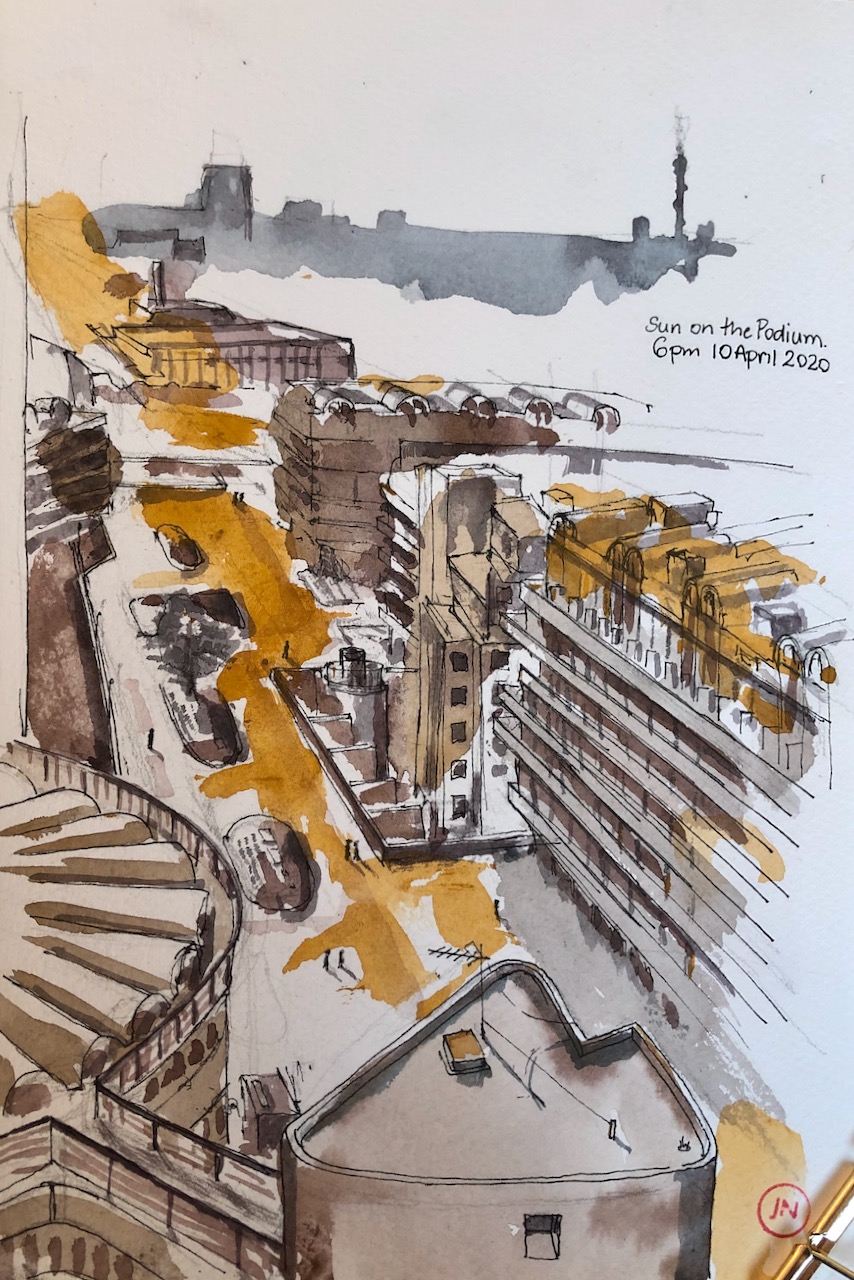
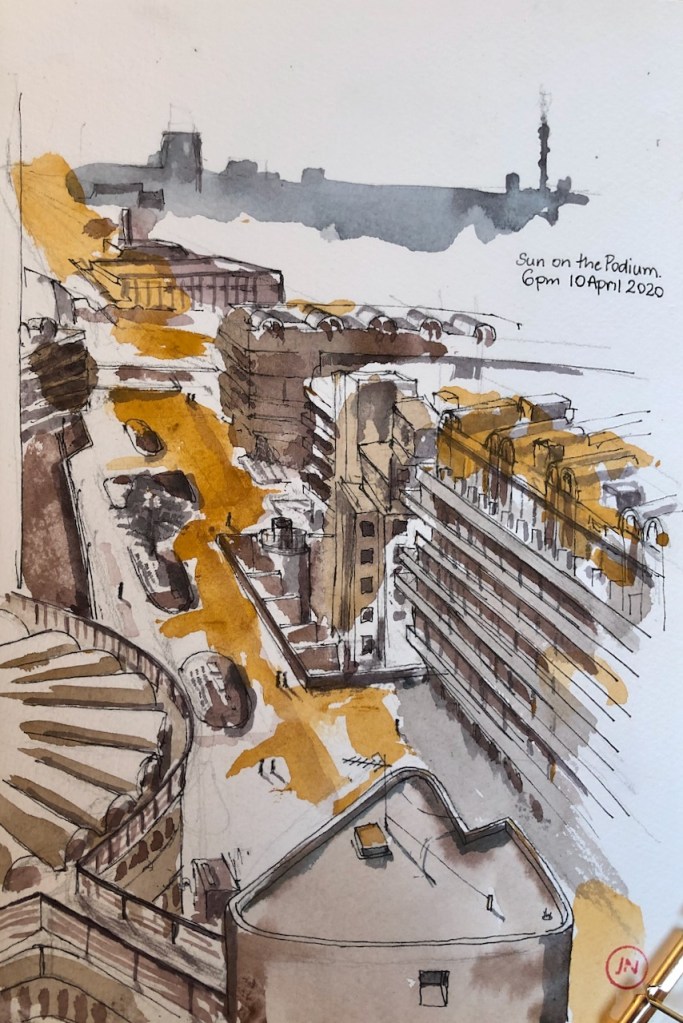
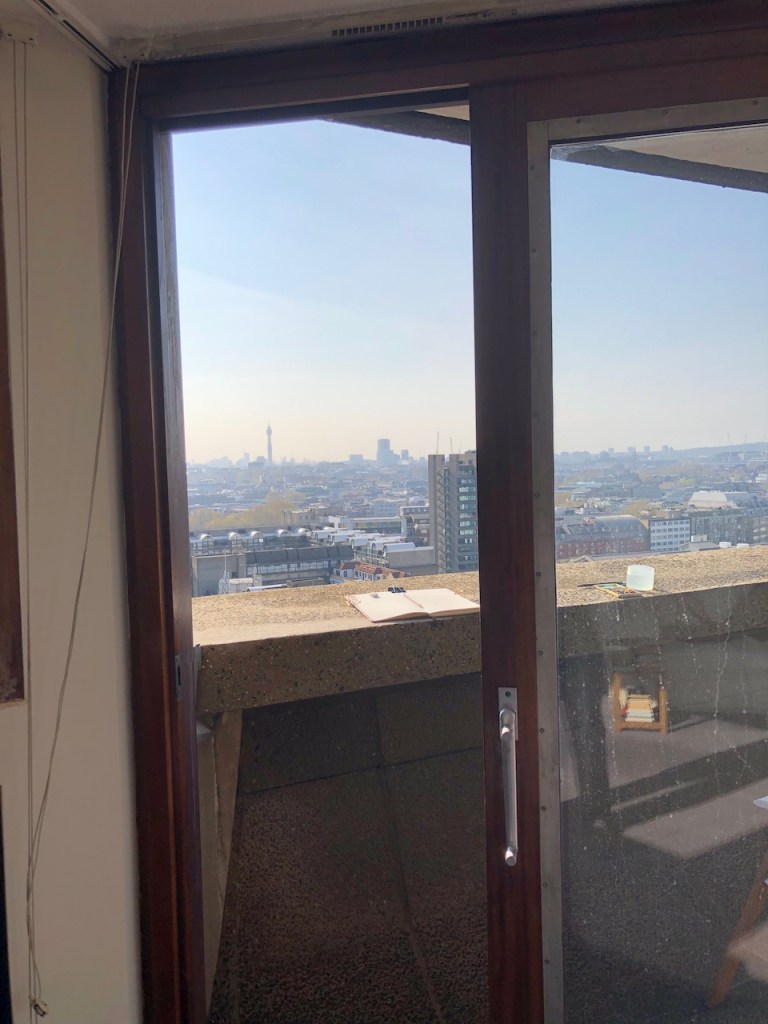
The tower in the foreground is part of Frobisher Crescent. Frobisher Crescent itself is on the left. Ben Jonson House is on the right. On the horizon you can see Centrepoint, and the Post Office Tower.
This took 2 hours. The sun moved, of course.
Colours: Mars Yellow, Perylene Maroon, Prussian Blue, all Daniel Smith watercolours.
Click a button below to share this post online, email it, or print it:
On the left is the fire door, and on the right you see the carpet sweep up in a glorious curve to the underside of the window. This is a Barbican Feature, which is a challenge to carpet fitters.
At the bottom of the far wall, to the right, is the important box fastened into a power socket. This is the power line device which extends the WiFi internet through the re-inforced concrete walls of the brutalist building.
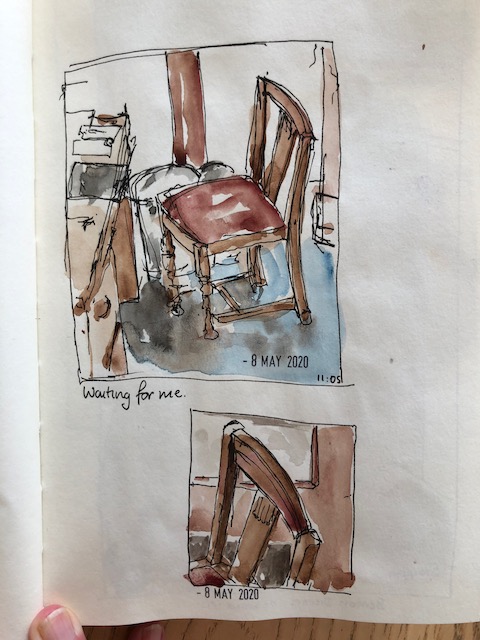
The chairs are “utility furniture” made in the 1940s and 50s, to standard designs making the most of scarce timber. New furniture was rationed at that time. I bought them in about 1998 from a shop in Brighton, and they’ve travelled with me.
Here is another view from the sofa, looking the other way.
Here you see my knitting, together with associated paraphernalia: instruction books, a bag, scissors and bits on the table.
That little table came from my parents’ house. The knitting wool came from Shetland.
The sofa came from the shop on the Tottenham Court Road that used to be called Habitat, and perhaps still is. It is long enough to lie on, full length. That was my criterion.
Click a button below to share this post online, email it, or print it:
Just before Christmas 2018, our neighbour arrived at our door with an orchid. He was going away, and didn’t want to discard the plant. He told us he didn’t need to have it back, and we shouldn’t worry if it died. It came from M&S. We took it in.
We are not great gardeners. We just left it and it grew. Our neighbour returned from his holiday and said no, he did not want it back. And it kept on growing. Now it is a flourishing plant with several stems and multiple leaves. It lives in a tiny flower pot, with hardly any soil.
It threw out various extra stems and strange root-like protuberances, which seemed to be seeking new lands. I’ve been meaning to see if it would propagate. So last week I carefully embedded these extra stems in soil, as you see.
Rooting one of the stems
Rooting one of the root-like protuberances.
Indoor orchid propagation attempts.
When I say “embedded in soil”, I am not strictly accurate. We live in a flat in a tower block, and there is no soil up here. So the orchid is rooted in coffee grounds.
If anyone knows anything about orchids, and can provide advice, I would be glad to hear it. This seems to be a particularly robust specimen, and produces flowers all the time. It is a delight.
Here is work in progress on the drawing.
Sketching the orchid.
I’m drawing in a large Saunders Waterford sketchbook. I originally bought it for urban sketching, but it was too heavy to carry about. I also found the huge pages, 11″ by 10″, meant I did huge pictures, which took a long time, standing outdoors in the cold. The paper is also more absorbent than I am used to, which means that my washes don’t go very far and I have to keep refilling the brush. So now, being at home, I am using it to make sketches in the flat, where I can sit down and be warm.
This sketch took about 2 hours, including hanging up the laundry while paint dried (another advantage of working indoors).
Colours: Prussian Blue (DS), Perylene Maroon (DS), Mars Yellow (DS), Burnt Umber (Jacksons).
Click a button below to share this post online, email it, or print it:
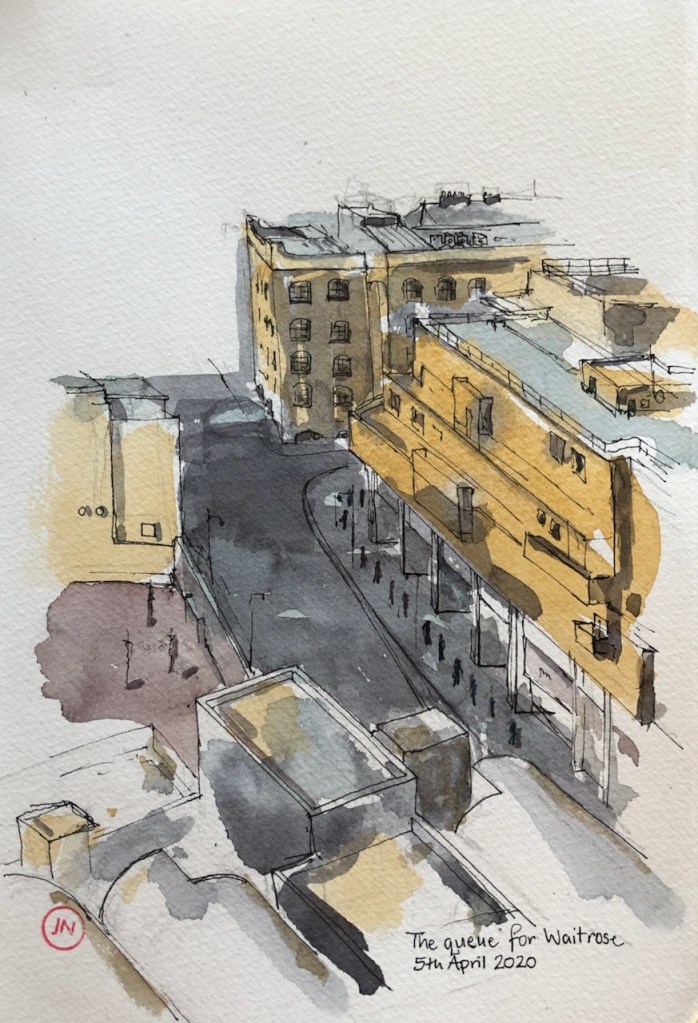
This is Whitecross Street. The people are in the well-managed queue for the Waitrose supermarket, which is underneath the building to the right.
In the foreground: Ben Jonson House, Barbican. On the left, behind Ben Jonson, in pink, is a children’s playground at first floor level, part of Prior Weston School.
Drawn looking out of the window, about an hour and a half including a phone call from a friend.
The friend called to tell me the answer to a crossword clue which had defeated me.
Colours: Mars Yellow (DS), Perylene Maroon (DS), Phthalo Turquoise (W&N)
Click a button below to share this post online, email it, or print it:


















 Jane Sketching