
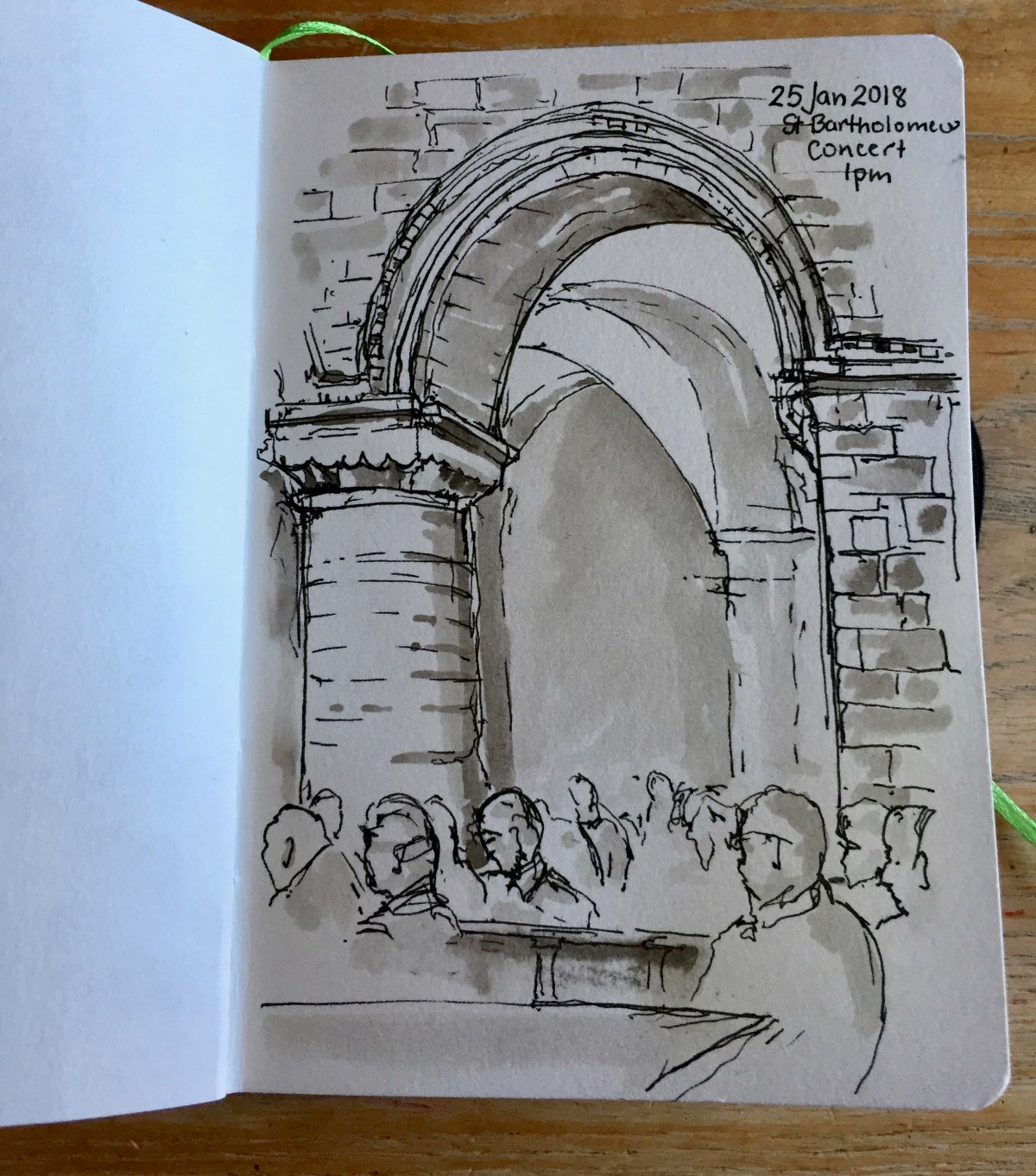
Here is a post-card sized sketch of people listening to the concert. It felt as though the stones were listening too.

Pen and ink in small Seawhite journal, about 20 mins.
watercolour, pen and wash
Here is a post-card sized sketch of people listening to the concert. It felt as though the stones were listening too.
Pen and ink in small Seawhite journal, about 20 mins.
I have previously drawn the Cheesegrater from Threadneedle Street. Today I went to find a good view from the East. I was keen to include the ancient church of St Katharine Cree.
Here is the Cheesegrater from Leadenhall, just east of Creechurch Lane.

The current building of St Katharine Cree is 1633. The tower that I’ve drawn is from 1504. Parts of the church date back to the Mediaeval Priory 1108. This place is a survivor. It survived
The Cheesegrater, aka The Leadenhall Building, 122 Leadenhall St, was finished in July 2014. The architects were Rogers Stirk Harbour + Partners.
Behind, you can just see the cranes for 22 Bishopsgate under construction.
Drawn standing in the street, 1 hour, drawn and coloured on location.
As the daylight faded, I made this sketch from outside 37 St Giles, Estagun House.
St Giles is the name of the road going North out of Oxford, and also of the Church, which where the road starts. There has been a “St Giles” church near Oxford from at least 1120.
“St Giles is supposed to have protected a wounded deer from hunters, and images of him usually show him accompanied by a deer pierced by an arrow. Many churches dedicated to St Giles are situated just outside city limits, where they could minister particularly to those who resembled the wounded deer – the weak and defenceless, such as lepers and beggars, who might not be welcomed into the city. Today, the St Giles congregation continues this tradition by working with the homeless.” [St Giles Church website]
The building is from 1200, the lower part of the tower in the drawing is 13th century. The top was altered in the 15th century.
Behind the tower, you see a crane, which is building part of Somerville College.

I was staying in St Benets Hall, 38 St Giles. Here is the view from the window.
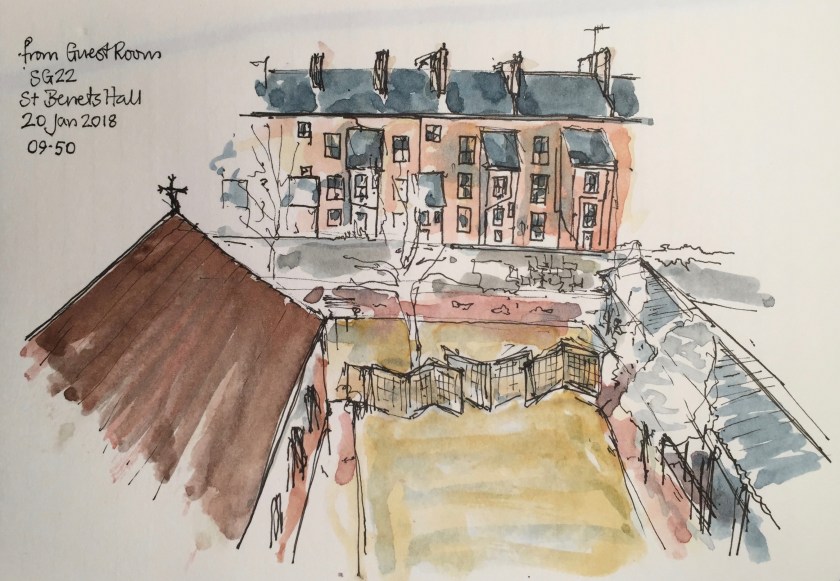

A very cold and blustery day.
Drawn from Ironmonger Passage, beside St Luke’s Gardens. My watercolour bag blew onto the ground, and the street sweeper, speaking Polish into his mobile phone, swept it up amongst the leaves. I raced after him to retrieve it, and he was very polite and apologetic.
“Gambier House was constructed in 1968 and is a 20 storey tower block, comprising 115 flats. The block is located on a triangular site between Mora Street and Lever Street. A small park is immediately adjacent to the south whilst surrounding properties, of between two and seven storeys, are in both commercial and residential uses. “
Gambier House was subject of a Planning Application in 2014, to install cladding. The above is an extract from this Planning Application. Here is a link to the document:
On the way back from the dentist, I looked up and saw The Cheesegrater, above Victorian buildings on Threadneedle Street. I sheltered from the rain under a Classical pediment, and made this sketch.

The Cheesegrater is also known as “The Leadenhall Building”, which is descriptive of its location, but not its shape.

The building to its left, under construction, is “22 Bishopsgate”. According to the informative panel from its builders, Multiplex, this will be 278m tall, with 3 basement layers, and 62 upper storeys, providing 1.4M sq feet of “net useable space” which accommodates 11000 people. That’s 1273 sq ft of useable space per person, or 141 sq yards: a space about 12×12 yards, which is about the size of our living room, including the kitchen.
I did the picture outside a building whose architects had had their names inscribed in serif capitals, low down: Mewes and Davis. This is number 53 Threadneedle Street, and now houses Montanero Asset Management Limited, and the Burger and Lobster Bar. A blue plaque of the City of London declares that this was the “site of the 13th Century Hospital of St Anthony, and of the French Protestant Church demolished 1840”.
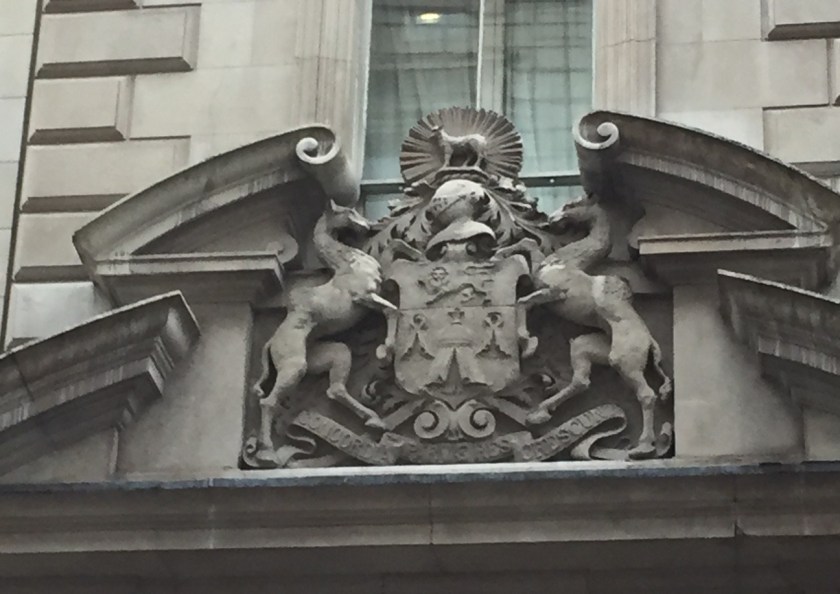
Opposite, above a grand entrance door to number 30, is the motto “Concordia parvae res crescent” and the crest of the Worshipful Company of Merchant Taylors. This is the Merchant Taylors Hall, the yellowish building on the front right of the drawing.
Multiplex also have “2 other projects on Bishopsgate”, said their notice, “number 15 and number 100”. I don’t know about making small things flourish, but big things are certainly flourishing.
About 45 minutes, pen and wash on location, drawn standing up.
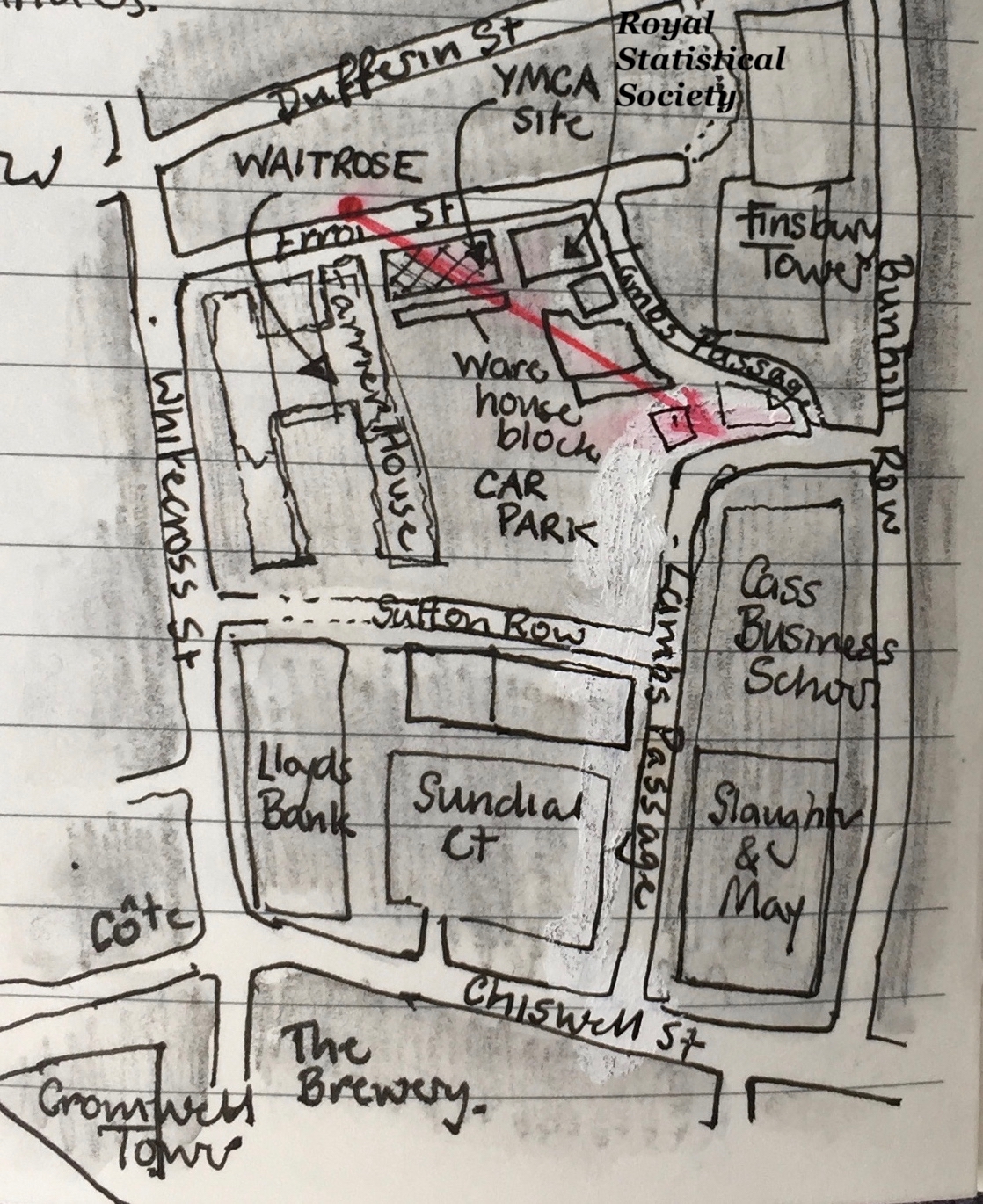
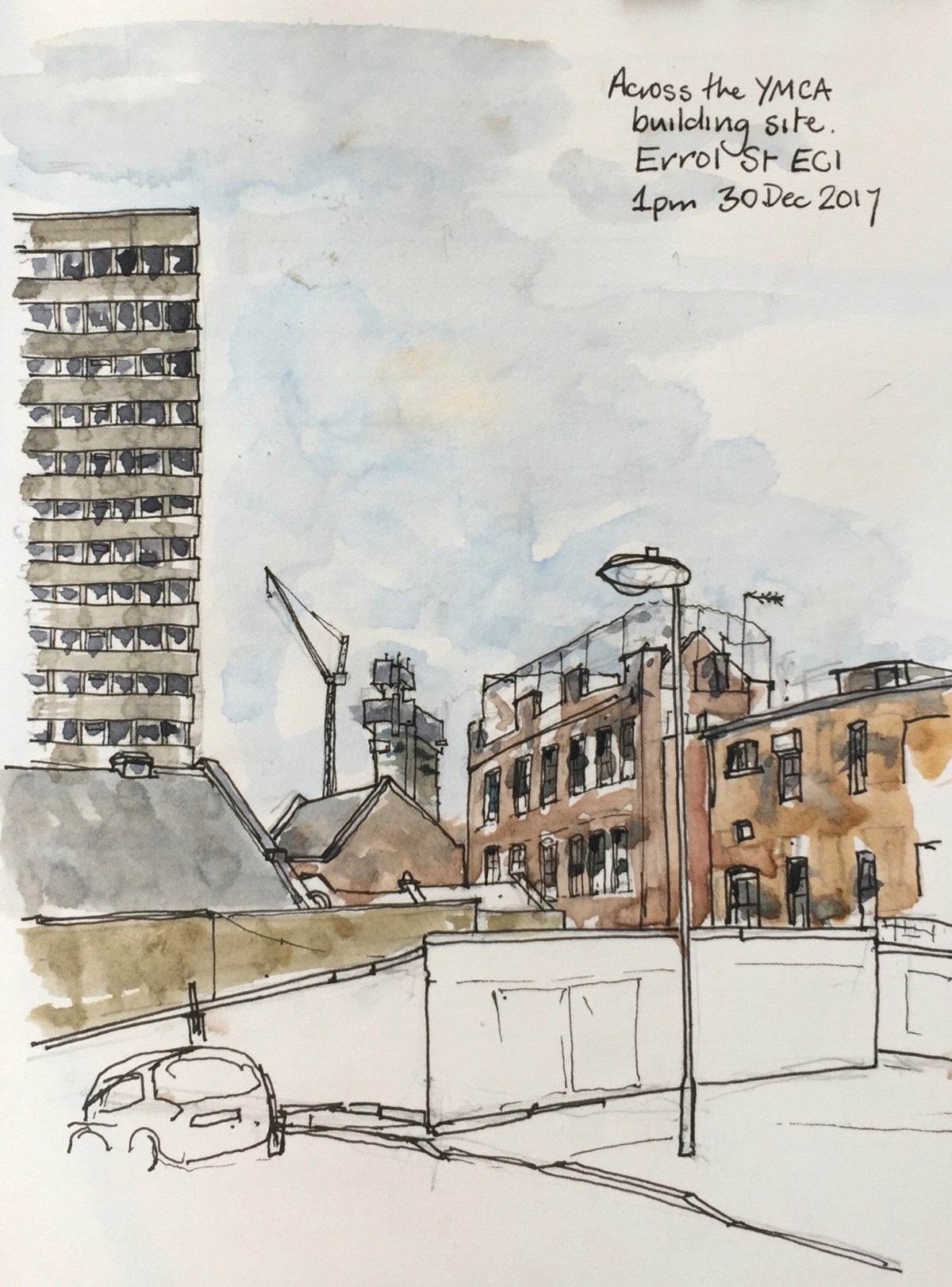
This site is a few minutes walk from where I live. There will be a “new home for young homeless Londoners”. “146 beds, 10 000 lives, 60 years”, says the text on the hoarding.
There will be 146 en-suite rooms, an “affordable gym for the whole community” and a “social enterprise unit”. You can see none of this in the picture. It is a building site. The old YMCA building has come down, revealing a temporary skyline. I hastened out to draw this skyline before it is obscured by the new building.
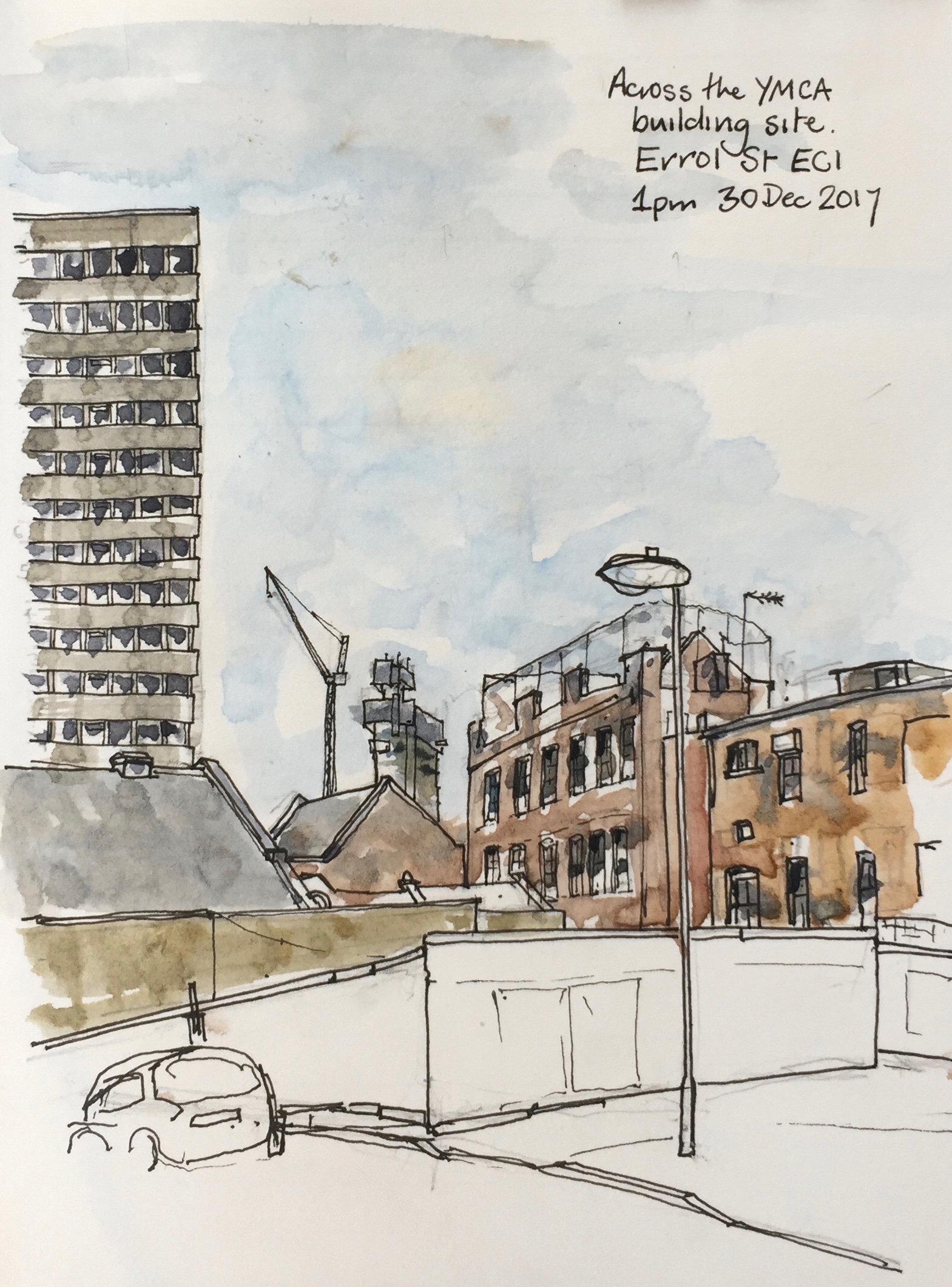
In this view the huge diversity of London life is visible. On the left, Finsbury Tower houses the Cass Business School. The grey sloping roof below it is the Royal Statistical Society, whose main entrance is on Errol Street. This is an old Victorian building, clearly previously ecclesiastical. 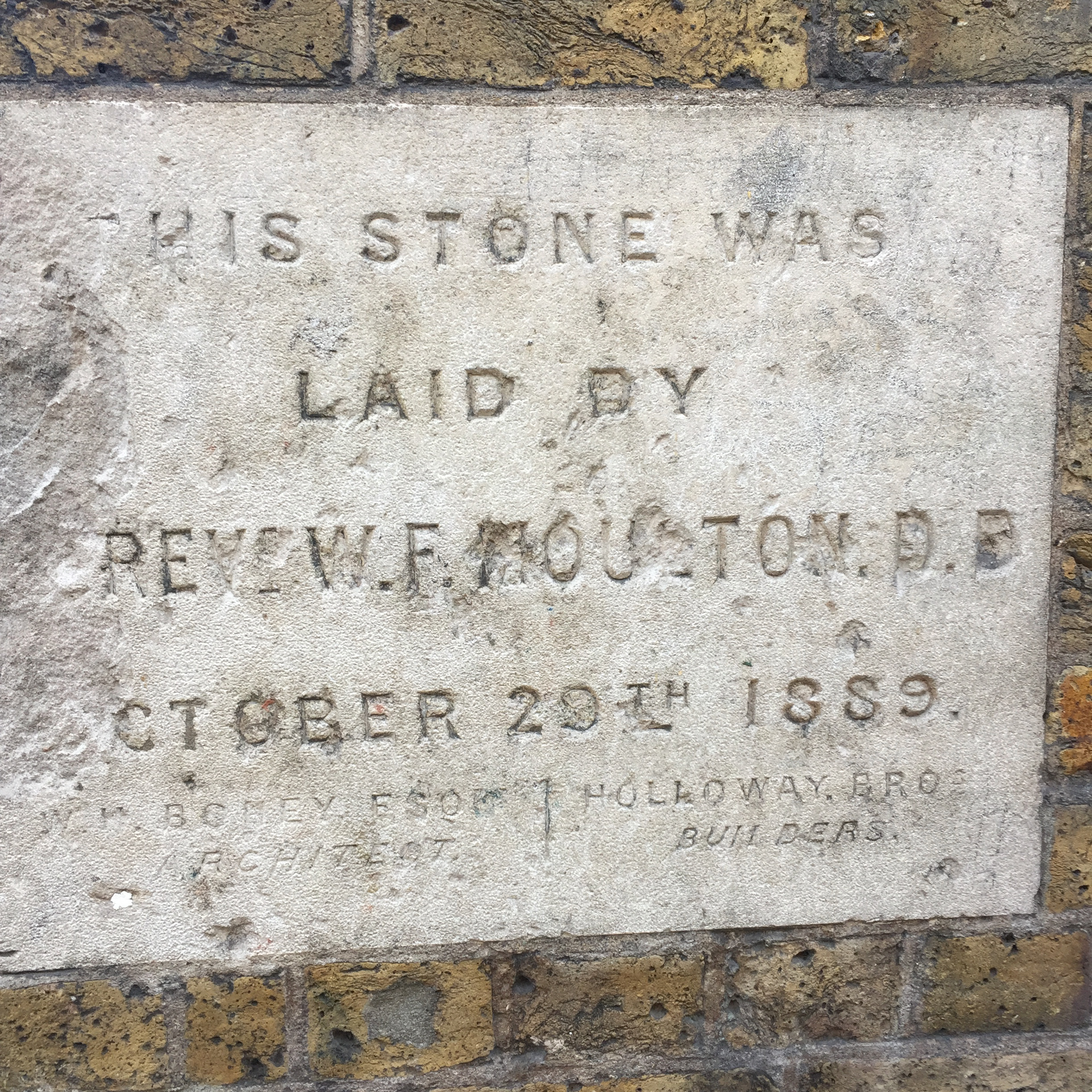 The three foundation stones are all dated 29th October 1889. They were laid, from left to right by Rev WF Moulton, Mrs ES Whelpton, and Mrs EA Holman. The names of the architects and builders are written on the left hand stone: WH Boney Esq, Architect, and Holloway Bros, Builders.
The building with the pitched roof, in the centre, is part of St Joseph’s Catholic Church. The Church itself is mostly underground. Right now they have a crib which you can visit.
On the right, the tall building with the wire netting on top, looks like an old school. It is in poor repair: the paint on the window frames is flaking, and the rooms look dark. But it is occupied. There was a light on in one of the windows, and Christmas decorations visible in the gloom behind the dusty window panes. Part of the building is “St Josephs Parish Hall”, accessible from the other side, with a modern lift. A notice by the door said “National Association for People Abused in Childhood”, but the notice looked very old, and I can’t find any reference to it on the web.
At the base of this building is a lovely garden, open during certain hours in the summer. It is in memory of Basil Hume “Monk and Shepherd”.
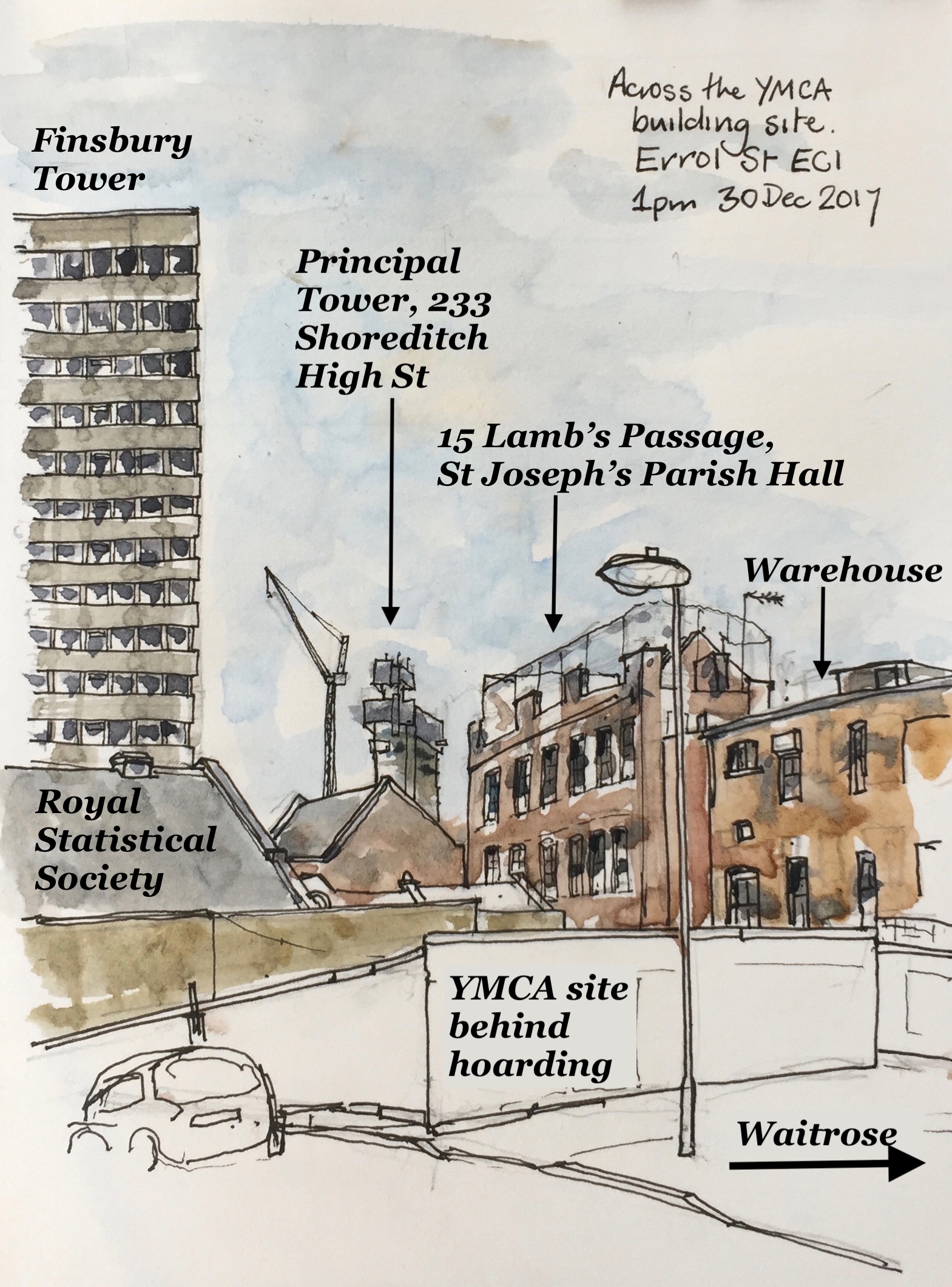
In the centre background is the huge residential tower that is being built in Shoreditch: the “Principal Tower” 50 stories.
This picture took an hour and a half, drawn and coloured on location.
Here is a view of the lighthouse at Southwold. While I was drawing it, standing on the path by the sea, a woman came up and told me I was very gifted. I said thank you. Her husband said he’d told her to say that, because she’d seen me on the way down, and not said anything. He said she should express her feelings.
He had a pit bull dog. Because his mother was pure Romany. I was not sure of the connection. He said this was Kensington-and-Chelsea-on-Sea. He said that people here told him “you don’t have a London accent”. That’s because he’s not from Kensington and Chelsea, but from a different part of London.
This is the picture:

Here’s a drawing from Southwold pier:

This is a sketch from a bird hide in Minsmere. The two ducks on the right are Shovellers.

This is the sunset at Walberswick:

It was misty. I drew the Church, St Andrews. There is a ruined part, from 1493, on the right. And a more modern 18th Century part on the left.

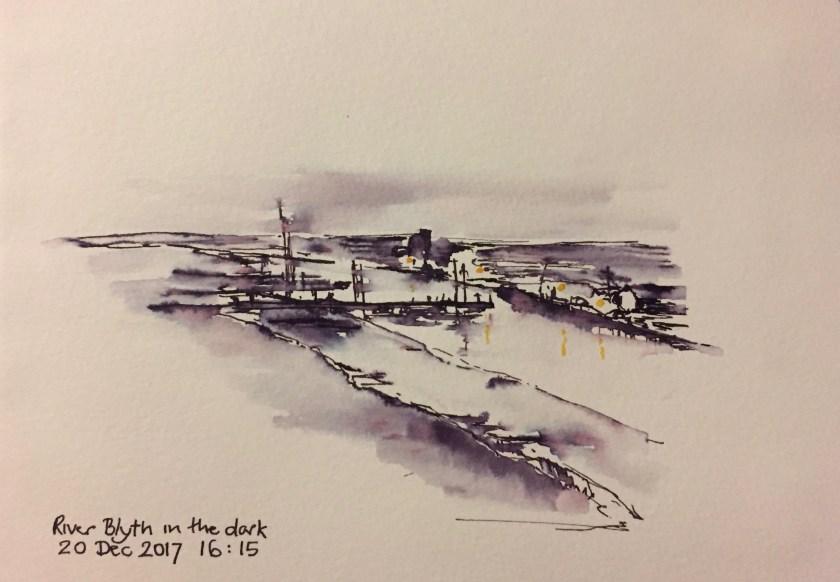
I drew the view up the river. Here it is in the mist.

Here it is in the dark.
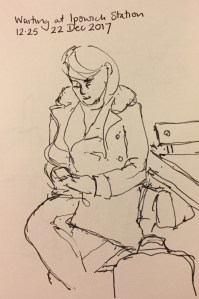
We went home by train. I sketched the people waiting.
In the bright sun, fourteen chimneys stand in a line at the corner of Garrett Street and Whitecross Street.
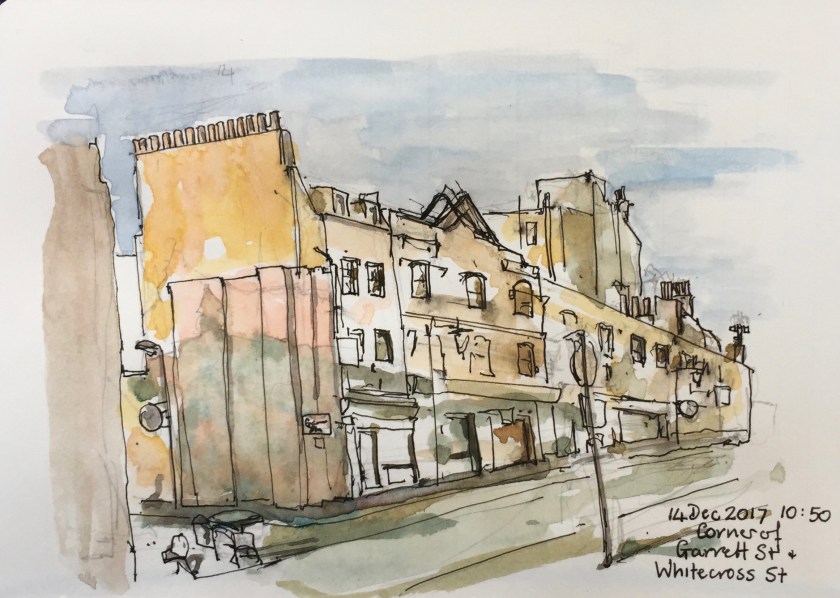
I drew them, standing up in the cold. I could hear a blackbird, from the garden outside St Luke’s.
40 minutes, drawn and coloured on location.
It was a very cold day. The sun threw sharp shadows of the tree on the wall. Then the sun went in and the shadows disappeared.
A Brother was smoking in the cloister, under cover. Gardeners came by.
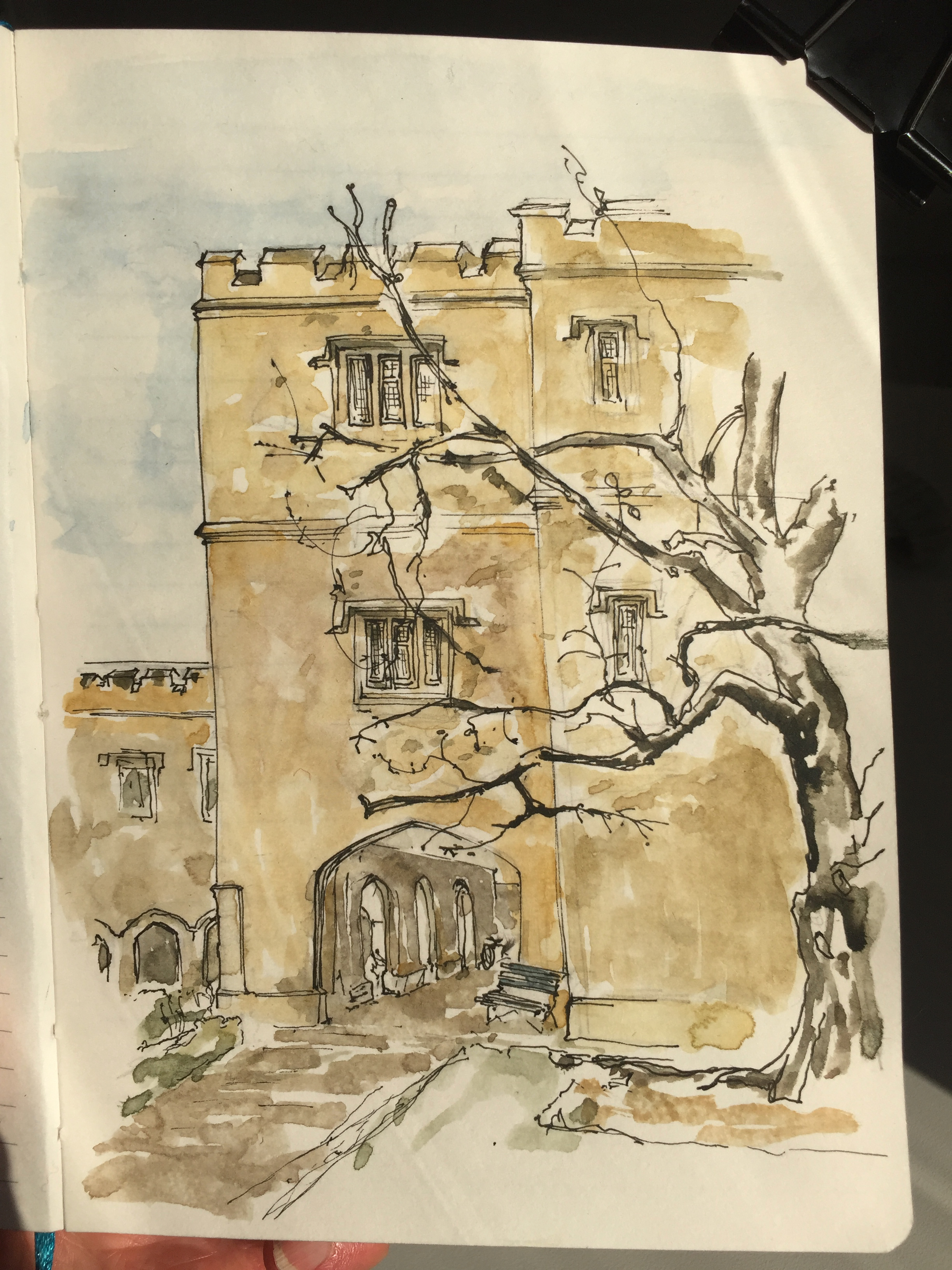
Here is the sketch before the colour went on:
Here are three sketches done inside the Chapel at the Charterhouse.


There is a quiet recording of religious songs in there. The sound makes the place calm. People speak softly.




 Jane Sketching