

View across the Blackmoor Vale from Stoke Trister, 16th June 2017

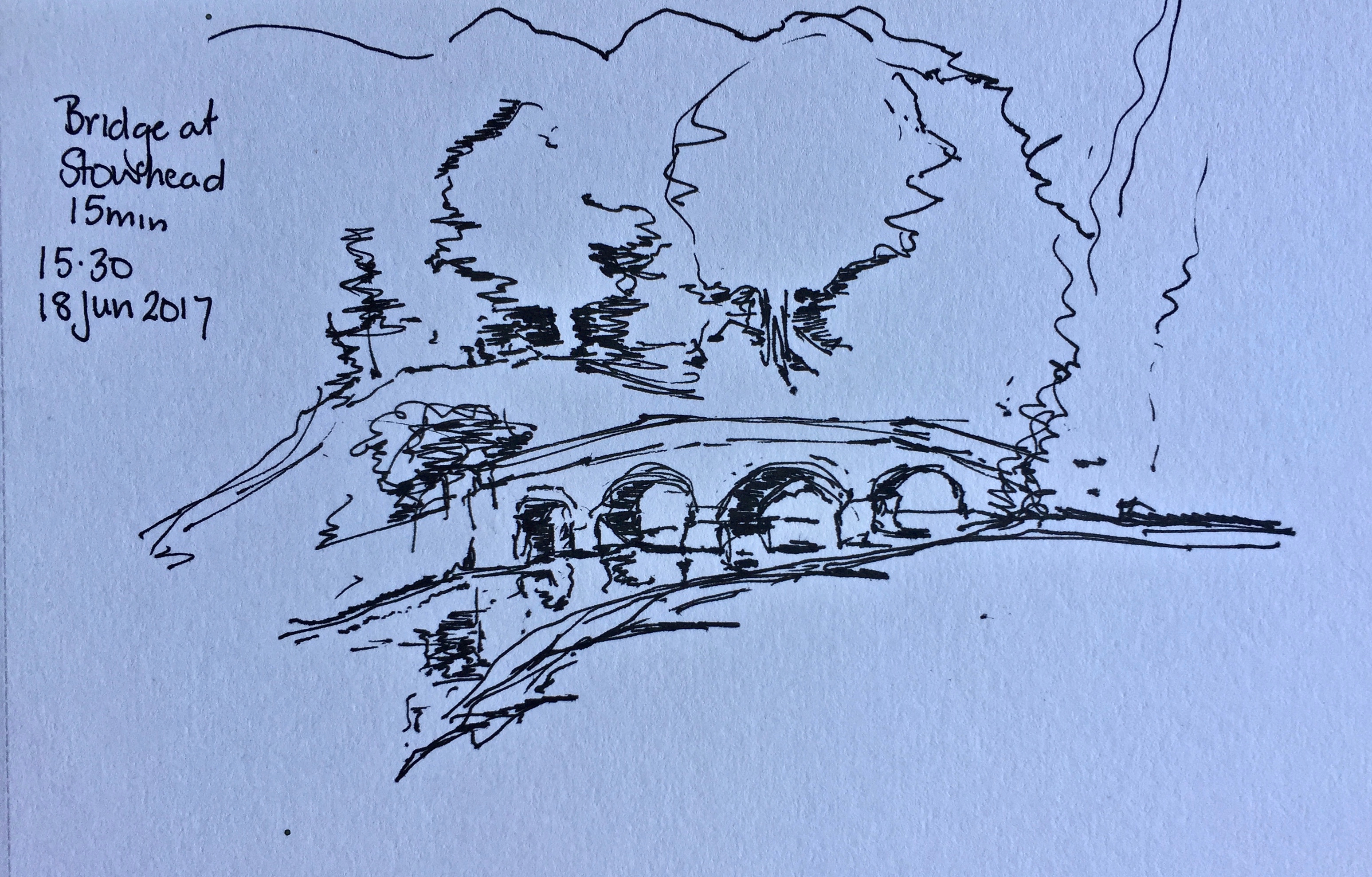
The Bridge at Stourhead, 18 June 2017
watercolour, pen and wash
View across the Blackmoor Vale from Stoke Trister, 16th June 2017
The Bridge at Stourhead, 18 June 2017
This is looking South-East from the roof terrace.

Thank you to the Preacher of Charterhouse, Robin Isherwood, for arranging my access to the roof terrace. This is the view looking across a wide green space in the Queen Mary College campus, towards the Chapel and offices of The Charterhouse. The building in the foreground is part of Charterhouse, restored in the 1950s. The restoration architects were Seely and Paget, the people behind the restoration of Eltham Palace.
This is a drawing from the Costa Coffee at Newcastle railway station, waiting for the train to London Kings Cross, 268 miles away.
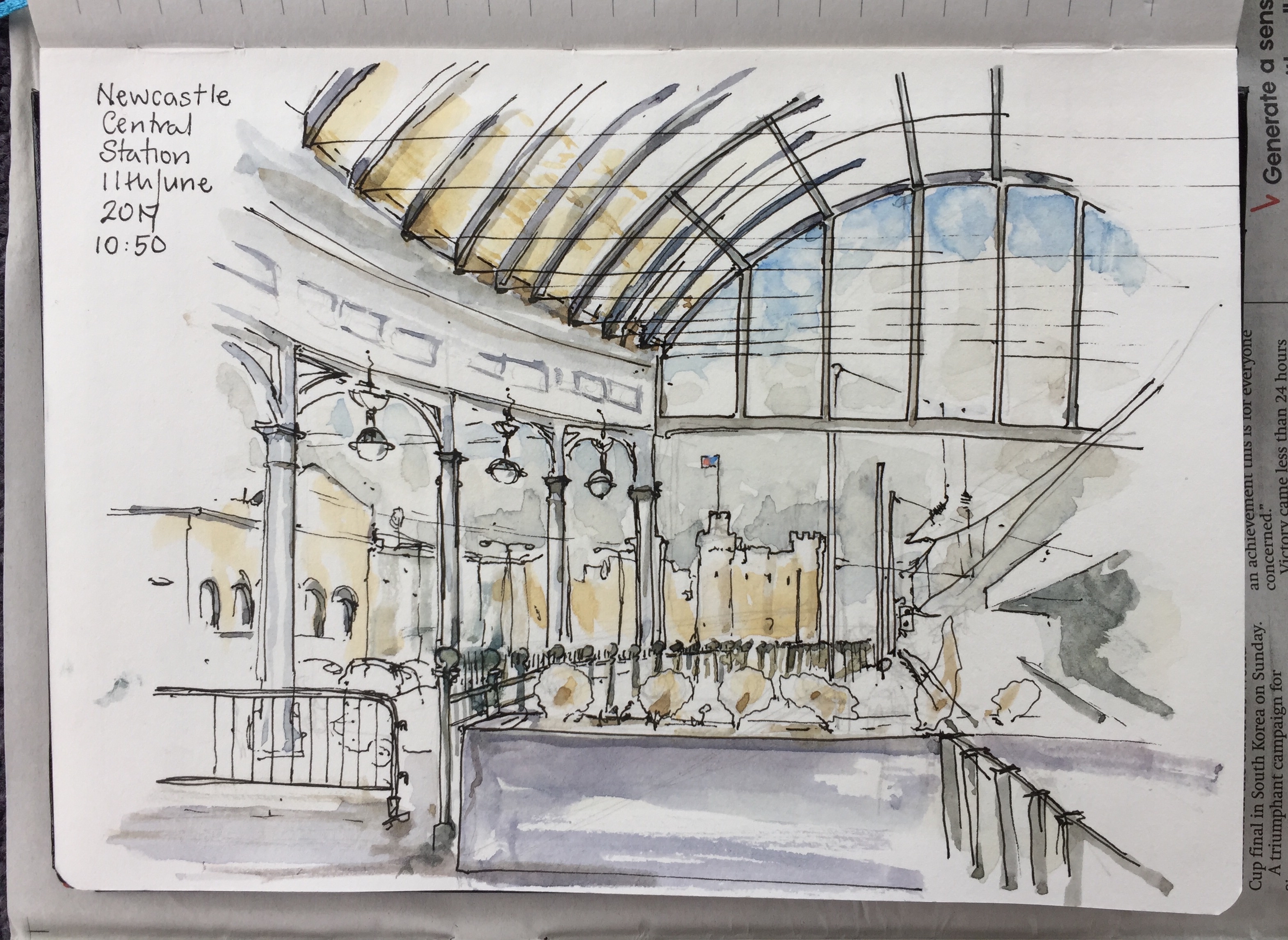
Newcastle Central Station was opened in 1850.
Architect: John Dobson
Engineers: TE Harrison and Robert Stephenson
Contractor: Mackay and Woodstock
The structure in the distance with the flag is the 13th century Newcastle Castle Keep, restored 2011 to 2015 using Heritage Lottery Funds.
This drawing took about an hour, drawn and coloured on location. Some colour and shadows added at home.
Here is work in progress:

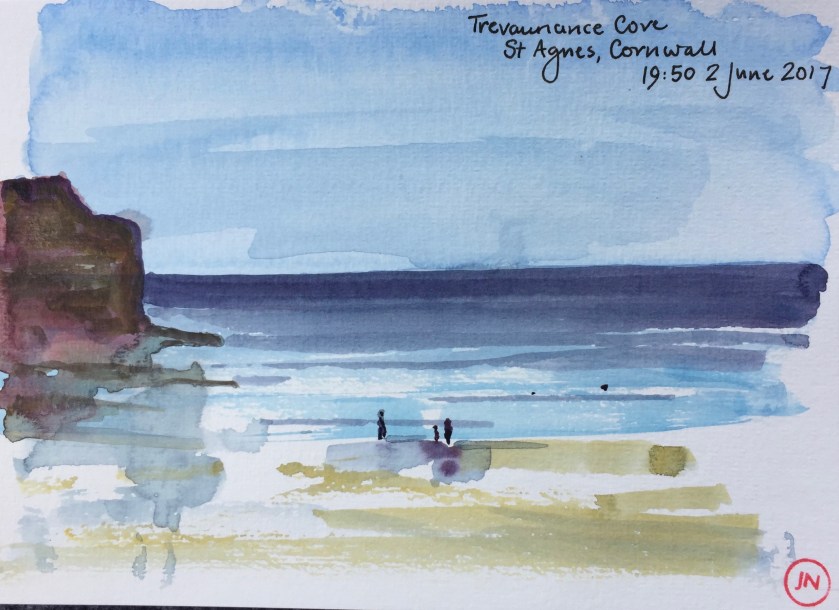
I just came back from 4 days in Cornwall, swimming with “Sea Swim Cornwall”.
I also did some sketches.


This is from a doorway on Pensioners’ Court, which is the court beyond Preacher’s Court. The Building with the four archways is part of the Brothers’ realm: the infirmary above and the coffee room below. I don’t know what the turret is, very intriguing.
The gardens were magnificent. In front of me was that huge magnolia tree. It moved in the wind and contained darkness much darker than I have drawn it.
I enjoyed the two towers: Barbican and Charterhouse, and the way the view was bracketed by the tree on the right and the lamp-post on the left.

One hour 45 minutes, drawn and coloured on location. The day was overcast and threatened rain. Round me, a gardener was watering the borders.
It should be “Pensioners’” court (plural).
Those chimneys are hard to draw. They are not simple rectangles, but a complicated geometric shape, a square put at an angle to another square, difficult to see in the light and shadow.
The crest of the roof is not straight. It goes downwards at quite an alarming angle, as drawn. The windows are not in a straight line with each other, which makes me wonder exactly where the floor is, inside.
I drew this from under the shade of the new building, the “Admiral Ashmore Building”. While I was drawing, the gardeners were making the window boxes, and crushed the geranium leaves. The place smelt of geranium, and earth and water.

I like it that you can see the Barbican towers beyond. I made this observation to a Brother who paused to chat. He told me that these brutalist towers are not popular with certain of the Brothers. They have identified a place in the garden where you can sit, so that the towers are obscured by a tree.
About 2 hours (those chimneys!!), drawn and coloured on location.
Here is what it looked like before the colour went on:
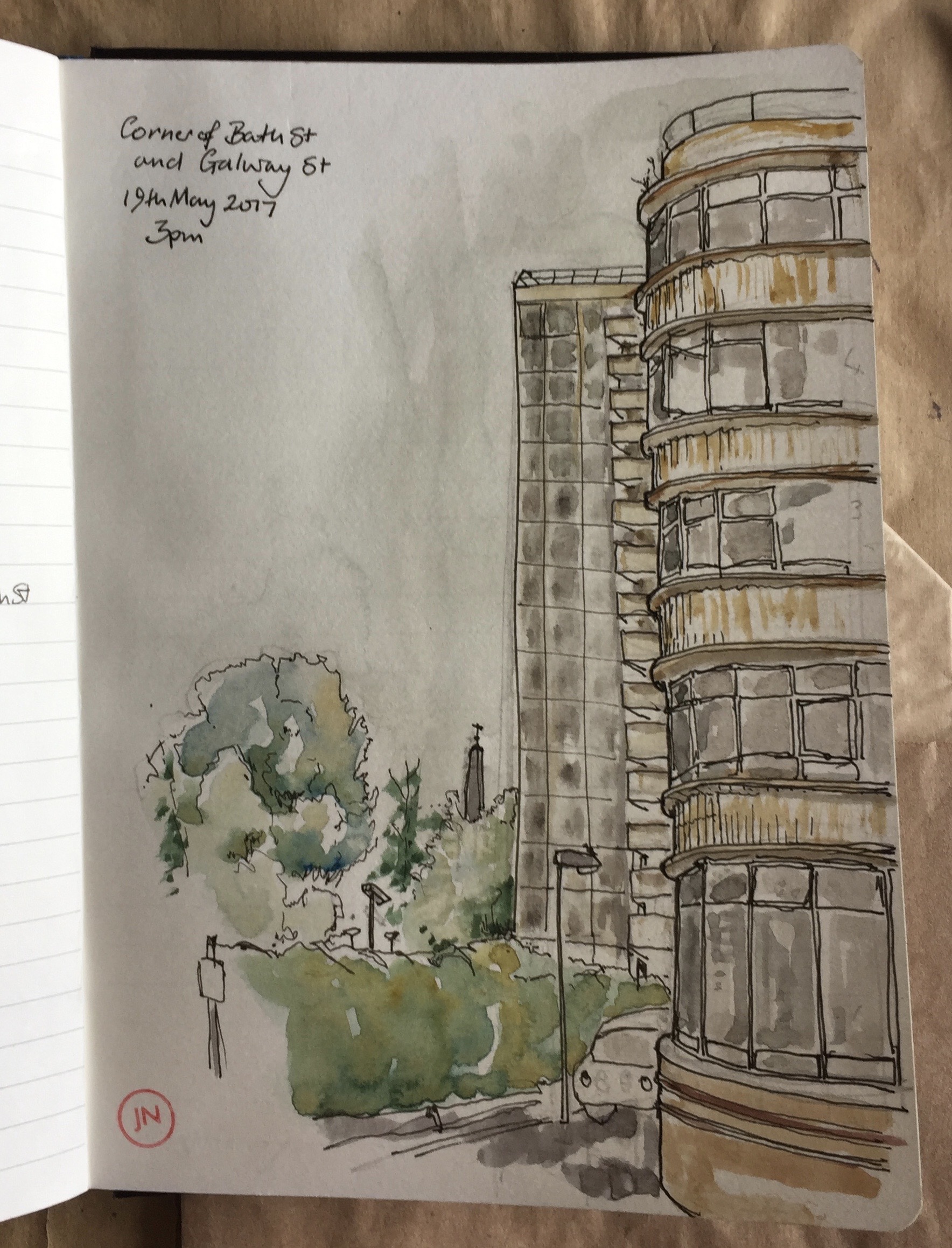
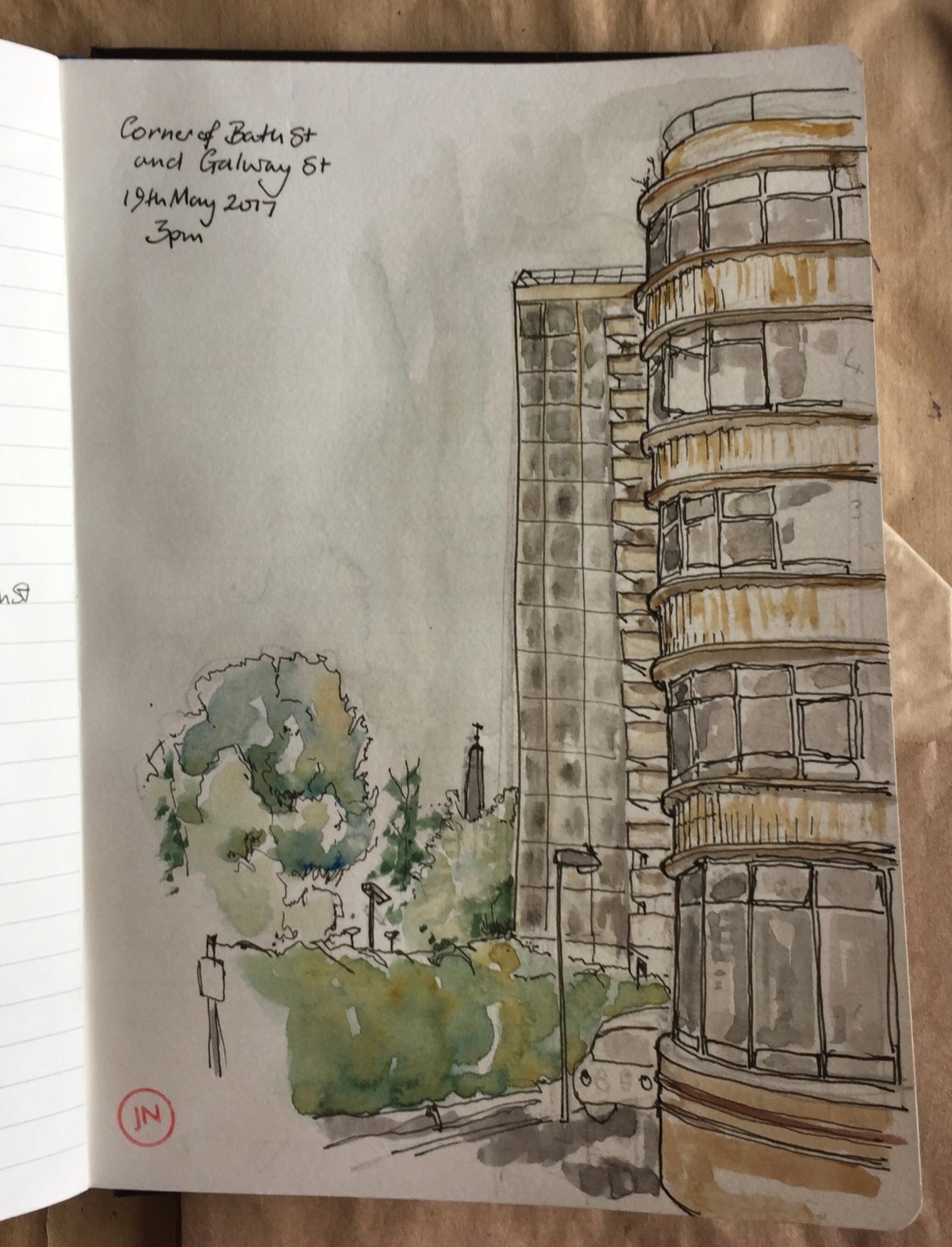
Corner of Galway St and Bath Street, EC1. Willen House is on the right, then in the background is Galway House in the Pleydell Estate. The LSO St Luke’s monument is just visible.
An old man said, “Ah. You are drawing. All little houses, there used to be. I’ve lived here all my life. You know what that [Willen House] used to be? The Income Tax. That primary school? Used to be a pub. Round the corner here, we got bombed out during the war. I’m giving away my age now! And that place – down there – Argos? – you look across the road and what do you see? A bus stop. And that building behind it? Used to be a school. I went there. The man there, conducted during the Cup Final. “Abide With Me”. All dressed in white he was.”
Mostly I did this drawing standing up, leaning on the wall of the “Institute of Ophthalmology, 11-43 Bath Street”. While I was doing the colouring I had to sit down. Two women approached. “You’re drawing,” she told me. Then, “I’m a Community Police Officer”. One of them showed me her badge, in a little case: a metal low-relief sculpture on a blue cloth background. They both admired my drawing, and looked at the view. I said “It’s OK to sit here?” She said, “Oh yes. It’s just, you’ve got your things all round you. Want to be careful you don’t get them swiped. You aren’t in a position to run after them.”. Which was a good point. I moved my bag until I was leaning on it, squeezing it onto the wall behind me.
Willen House is now Student residence, and also home of NTS Fashion Ltd, on the ground floor. I could see their racks of clothes through the window.
About an hour, drawn and coloured on location. The car moved.
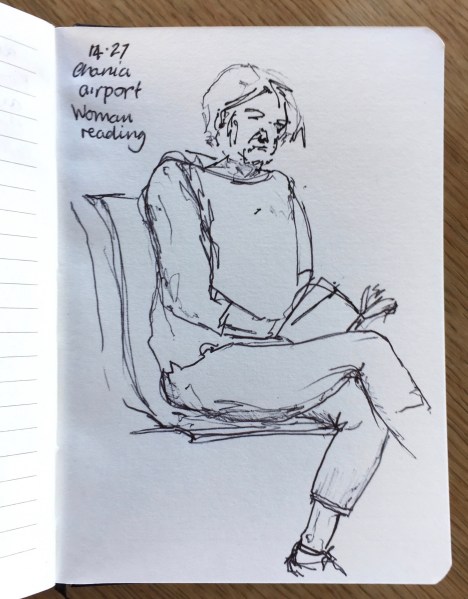
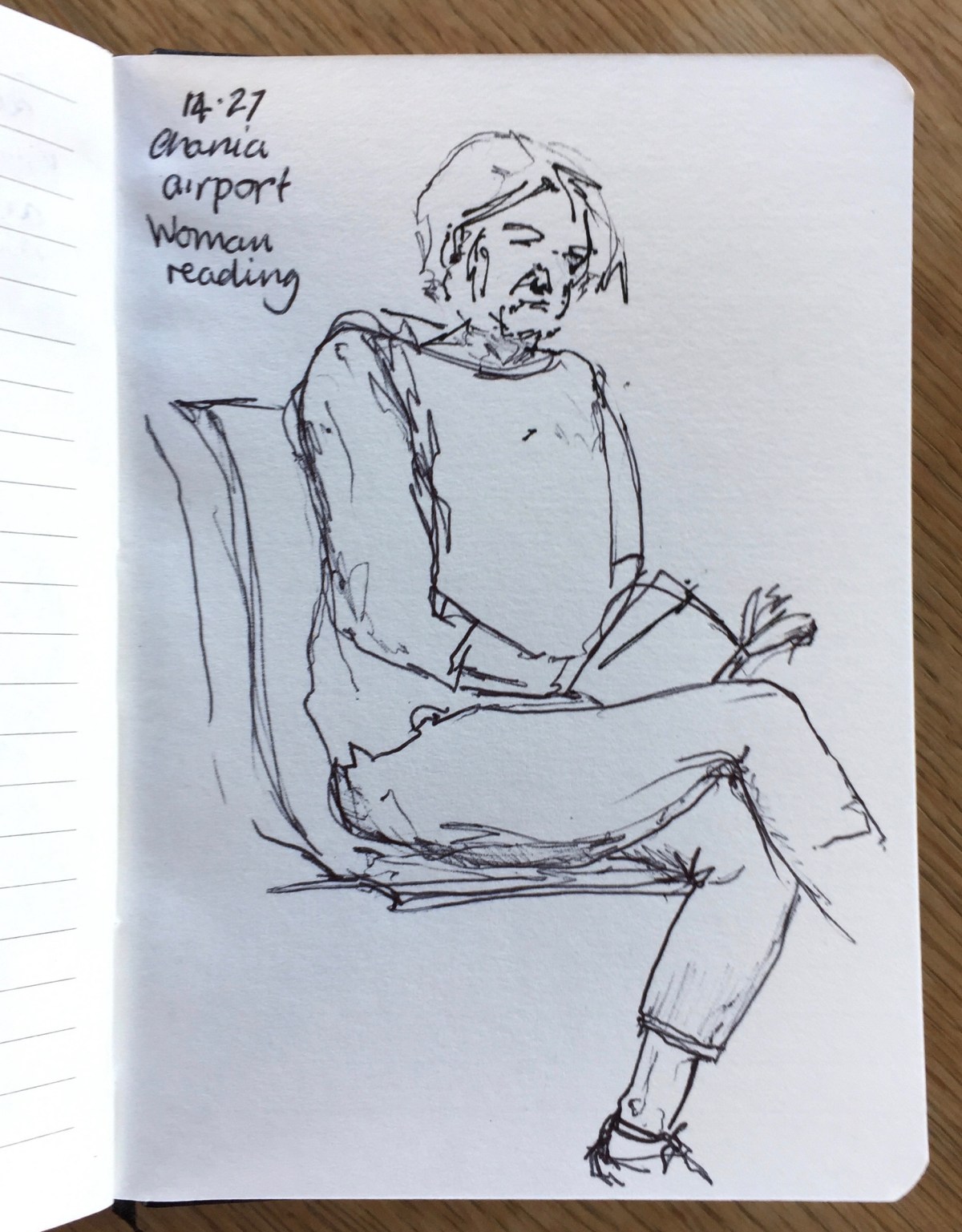
At the gate at Chania airport, we eat cheese pies, and I do sketches of the other people.
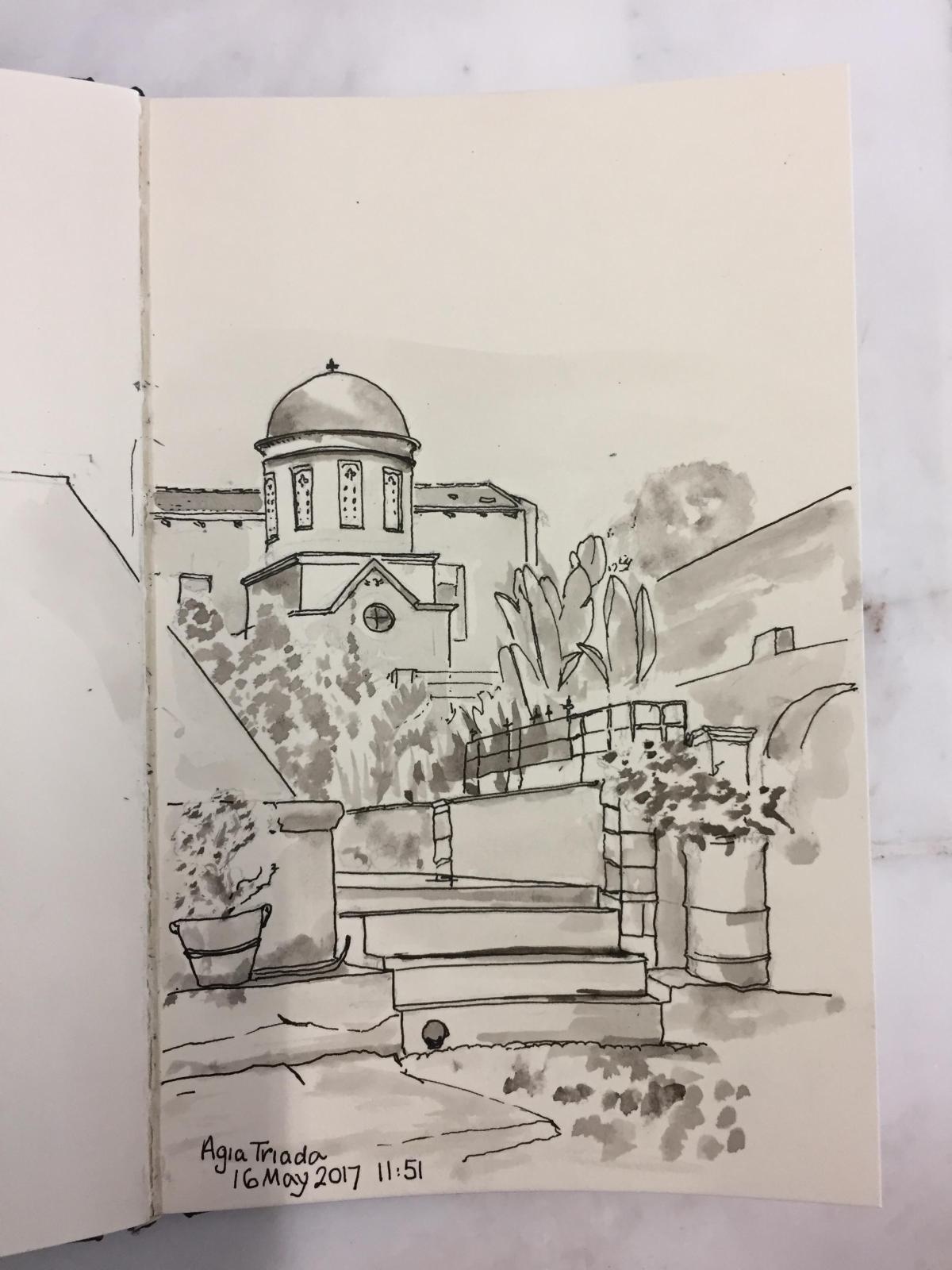
We visited the monastery again, before going to the airport. Two large coaches were in the car park.
As I drew the chapel, fragments of dialogue in French and German floated by. A French-speaker was relieved at last to have a call from Yves. He described in detail where the car was, naming the Greek village. He must insist it be ready by Thursday.
A woman with a German American accent told me my drawing was beautiful. I told her I was glad she liked it.
By and large people were respectful and did not stand in front of me while I sketched. But, according to John, a guy with a big heavy camera photographed the drawing, over my shoulder, without my knowing.
After an hour and a half John came to alert me that we should leave in 5 minutes.
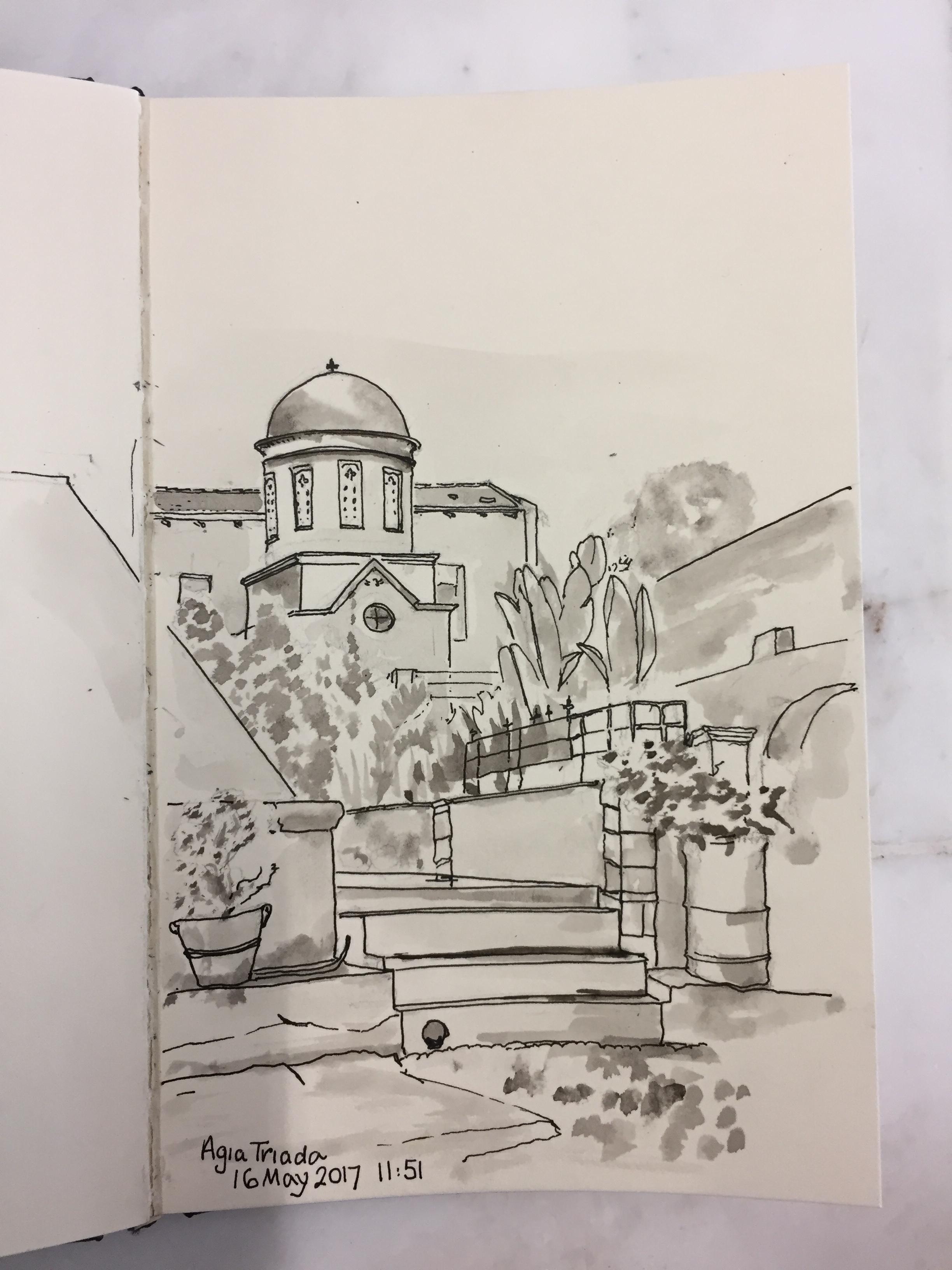
Pen and ink. 1 hour 40.
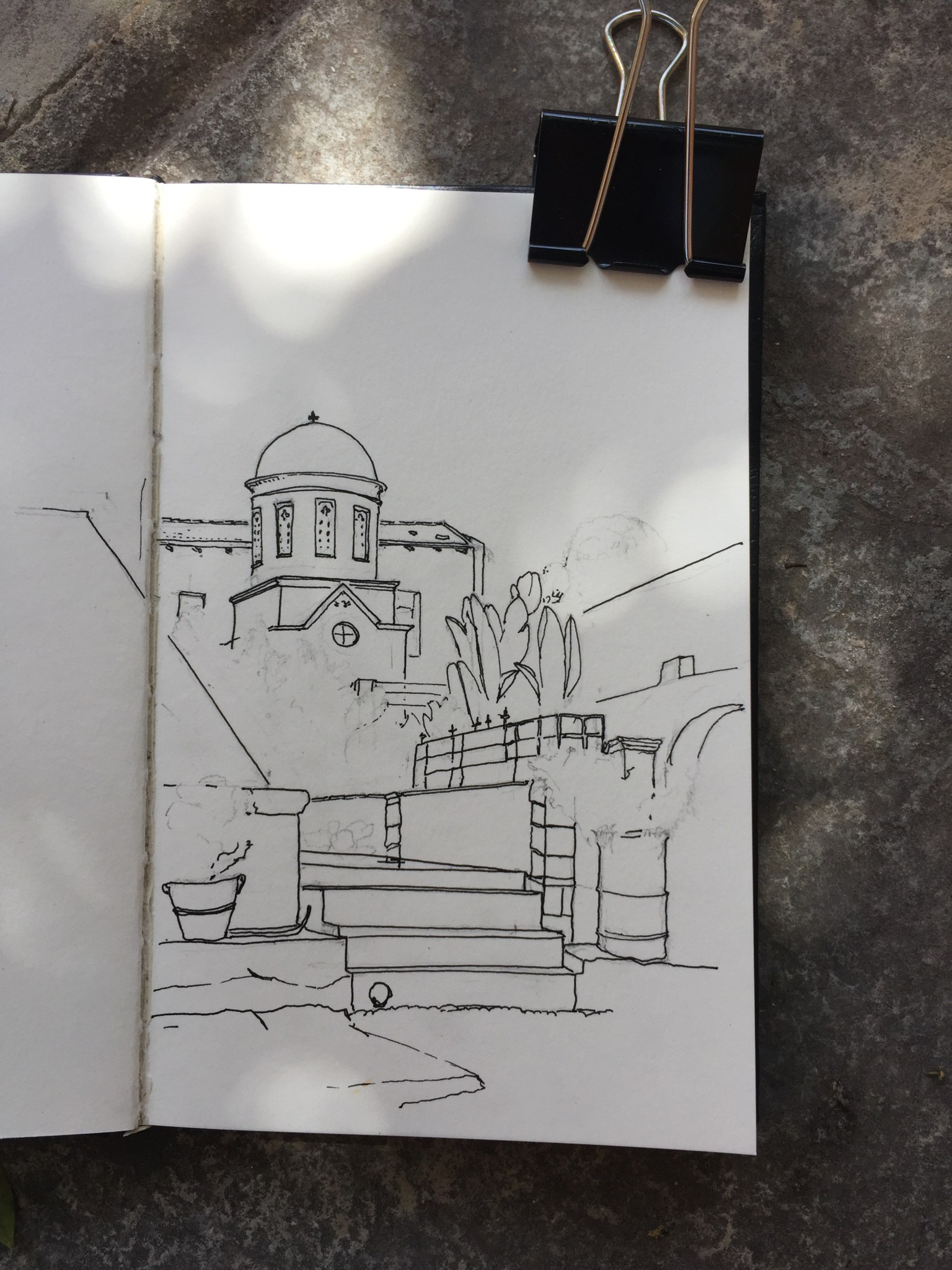
Here’s what it looked like before adding the tones:
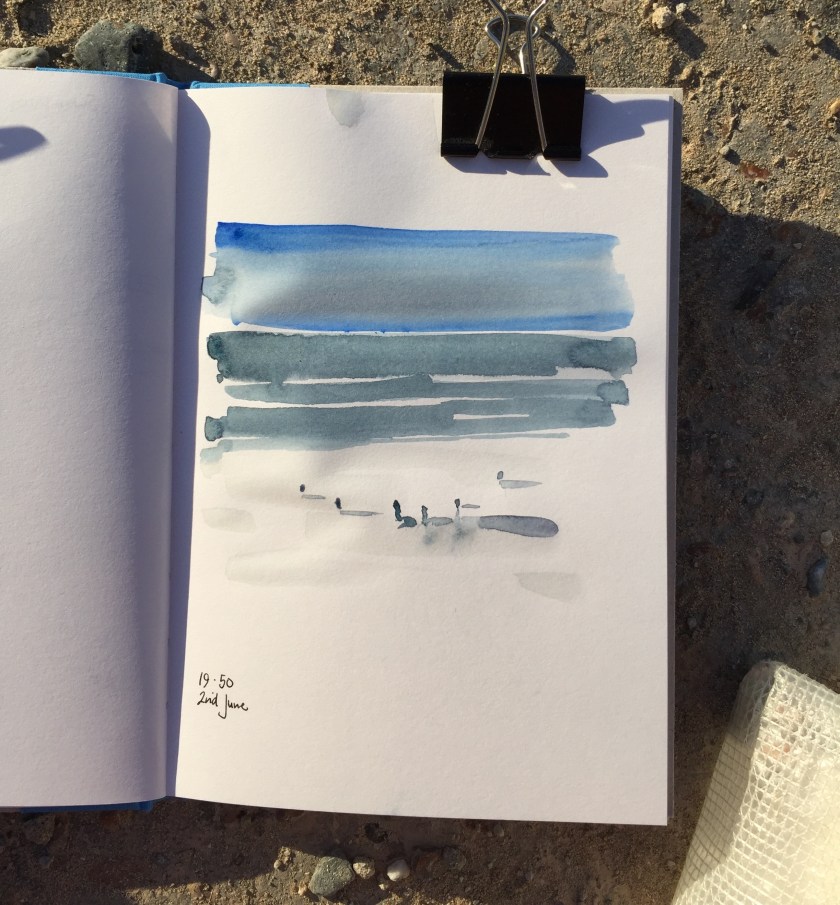
A warm evening, an experiment in watercolour-only – no pen and ink!
Eventually the night came, and the light faded.
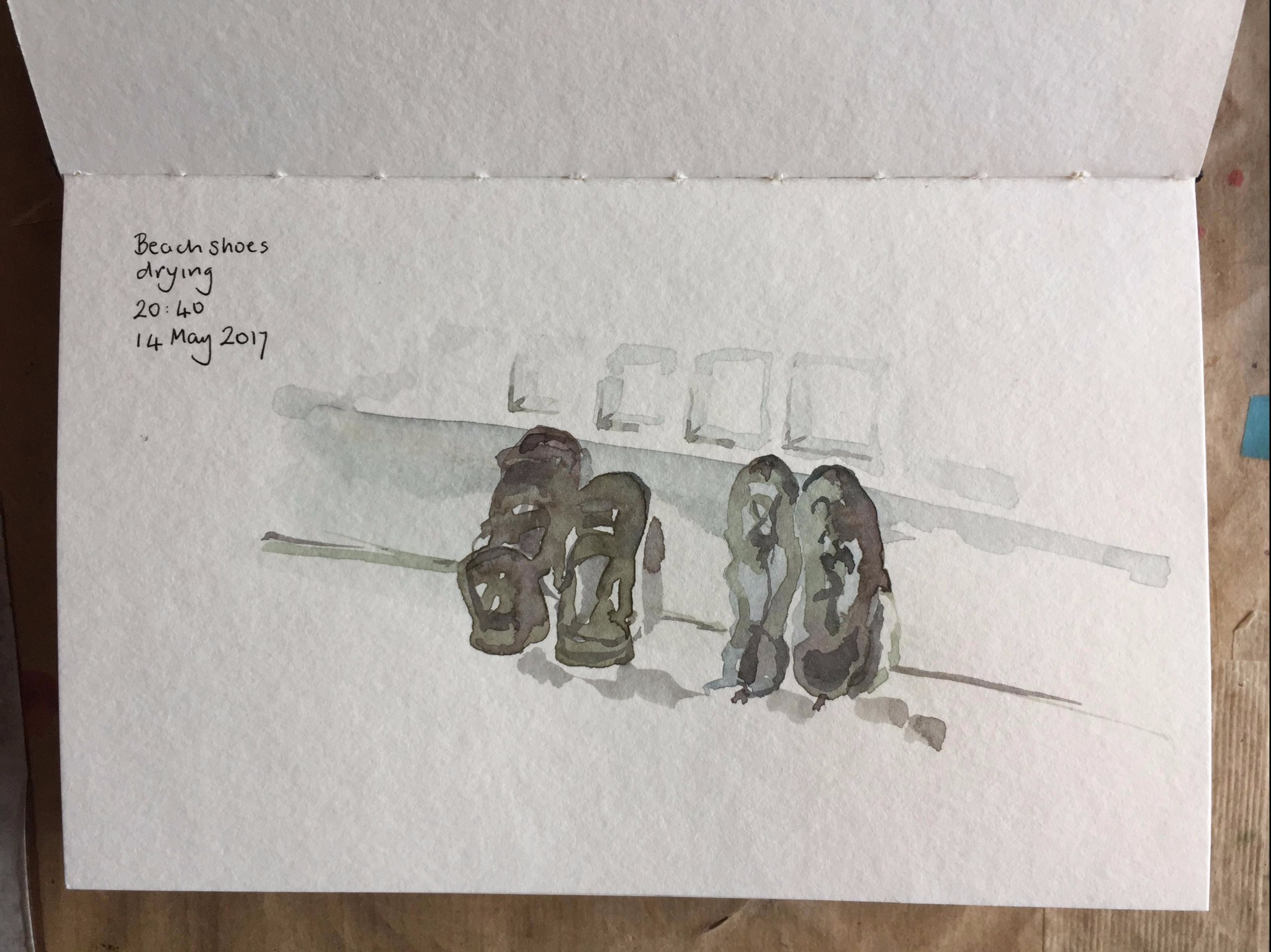
About 30 mins, watercolour only.


 Jane Sketching