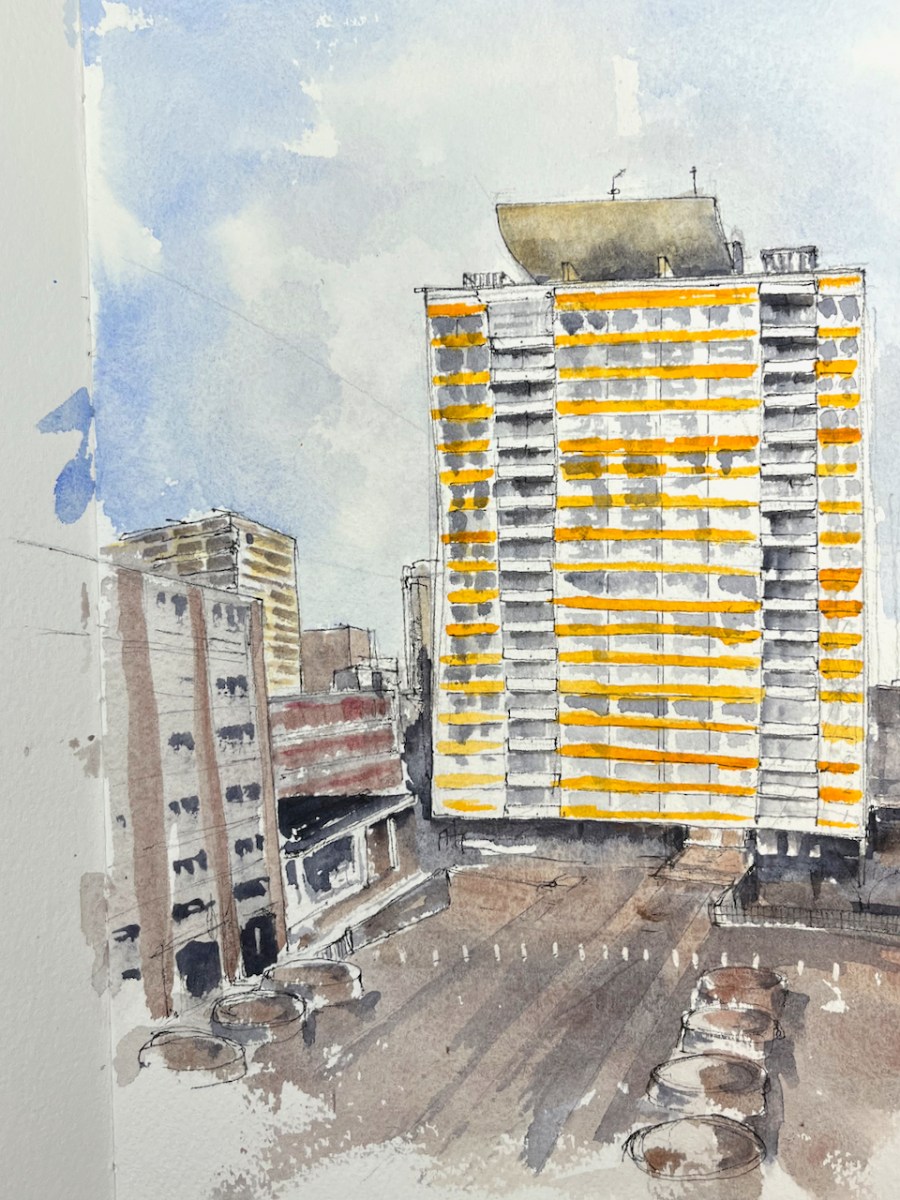
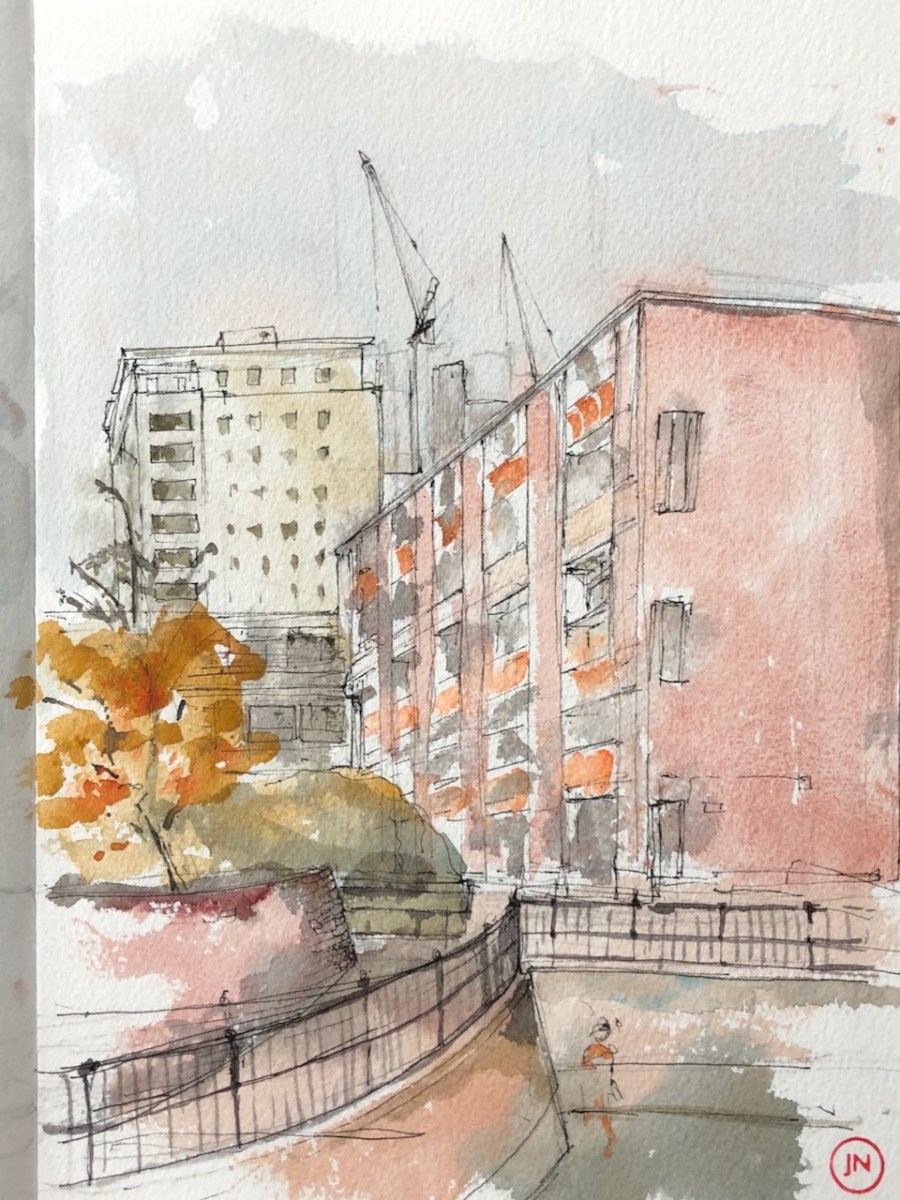
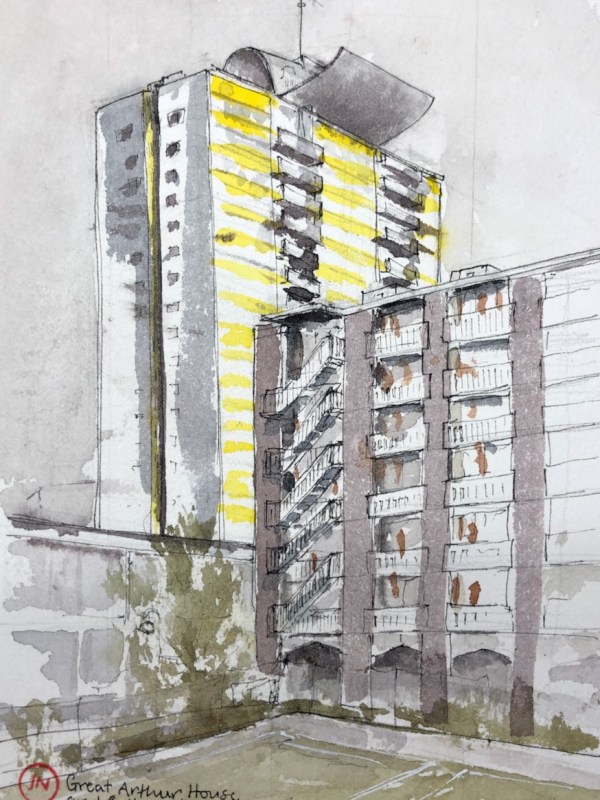
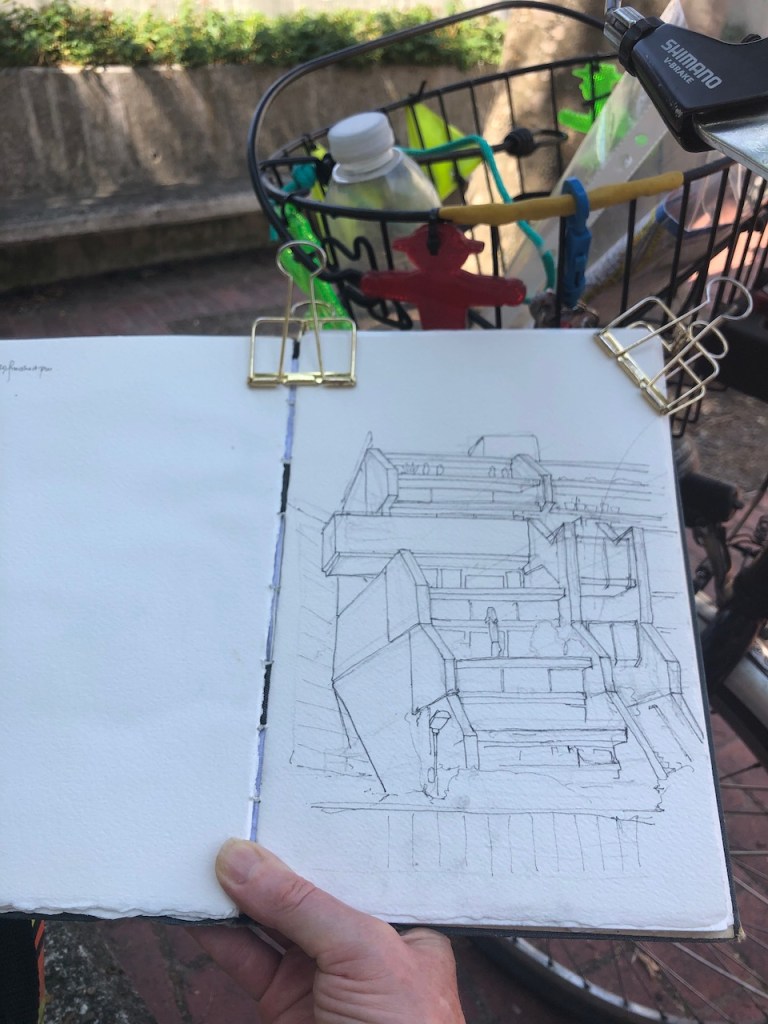
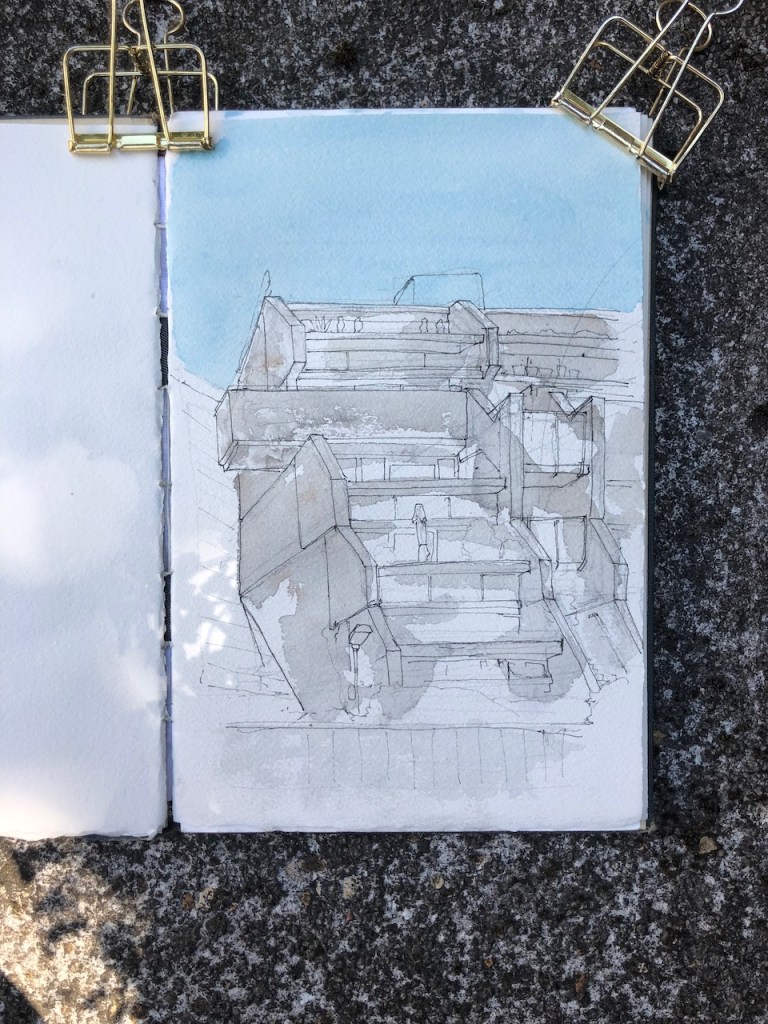
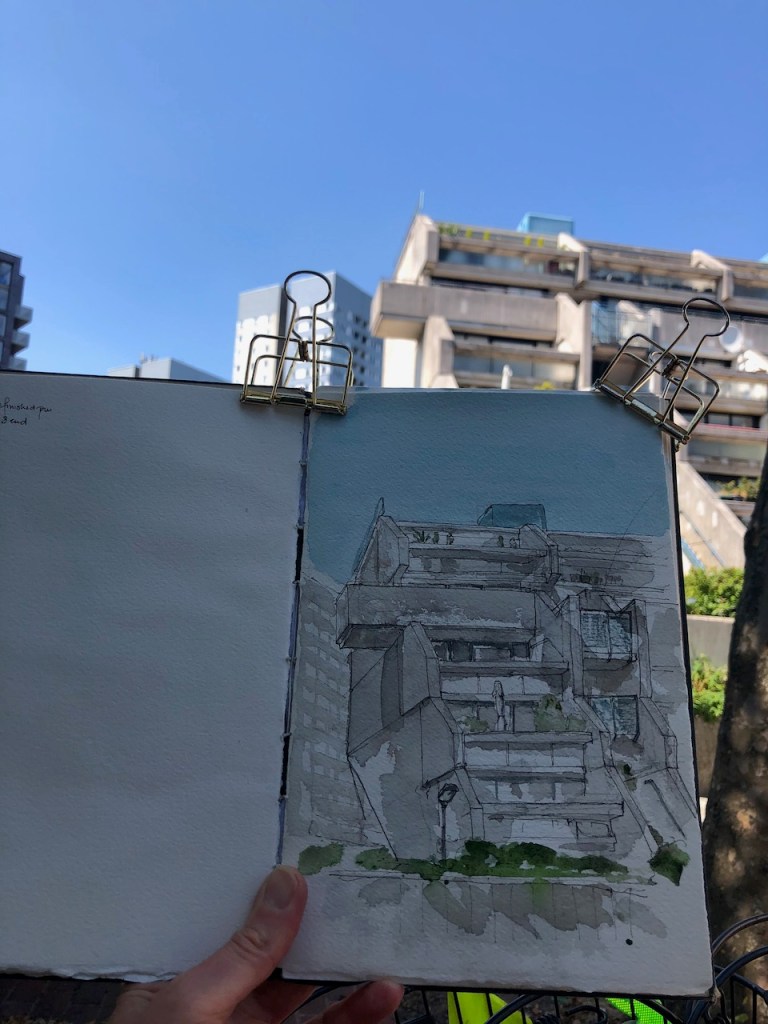
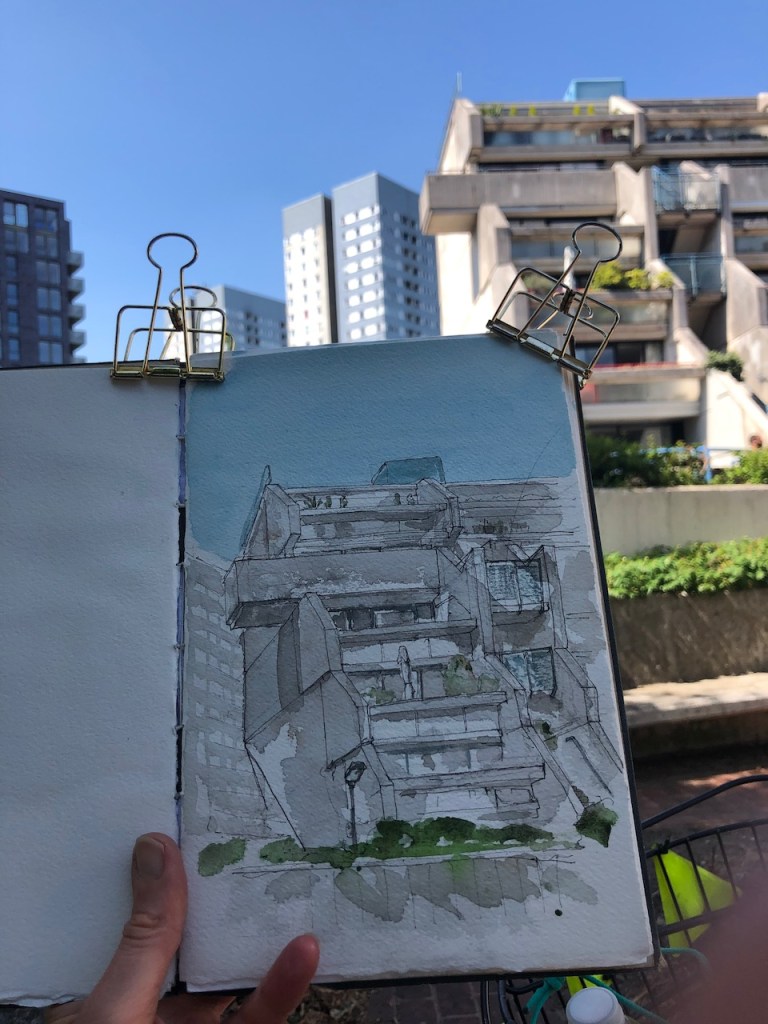
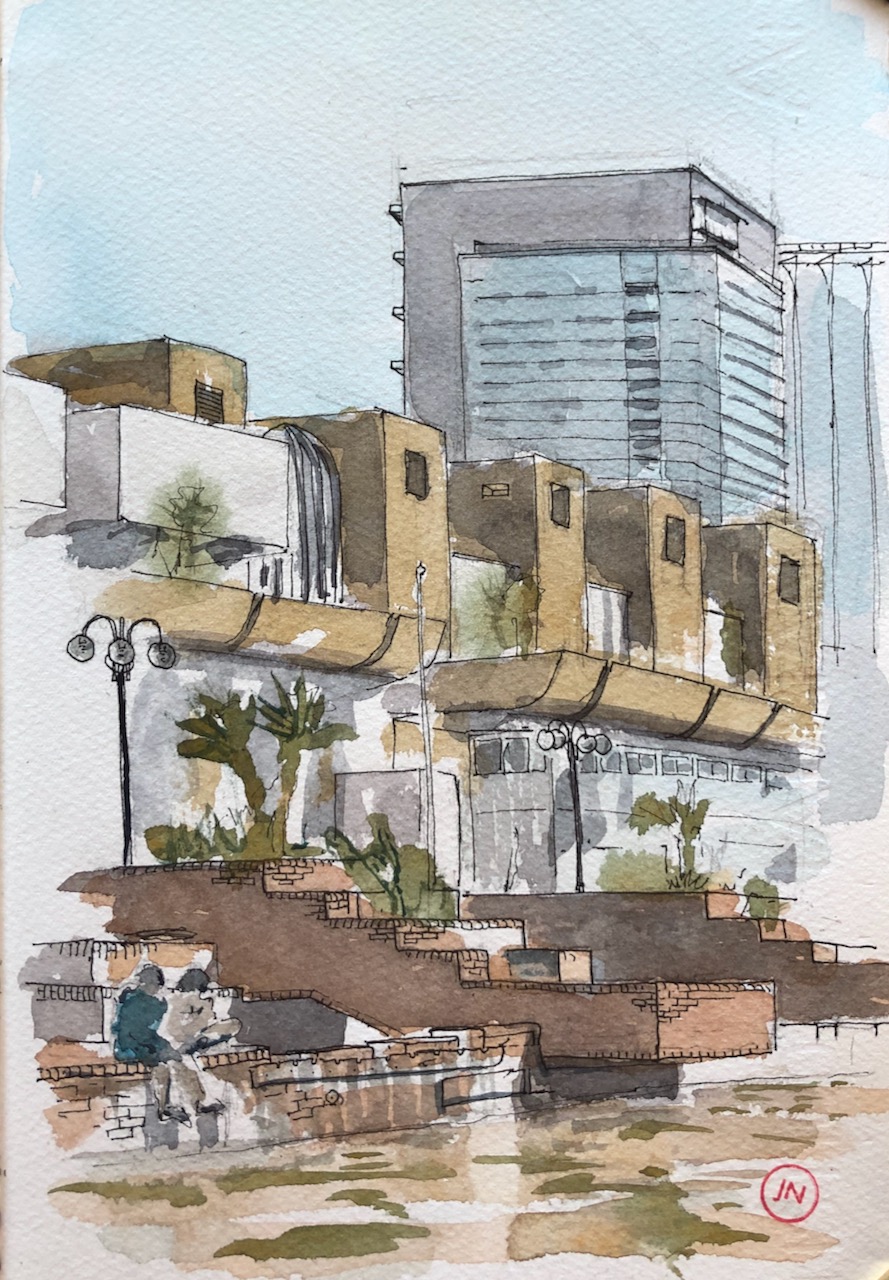
Yesterday I drew Basterfield House, sitting on some steps in the shadow of Great Arthur House.
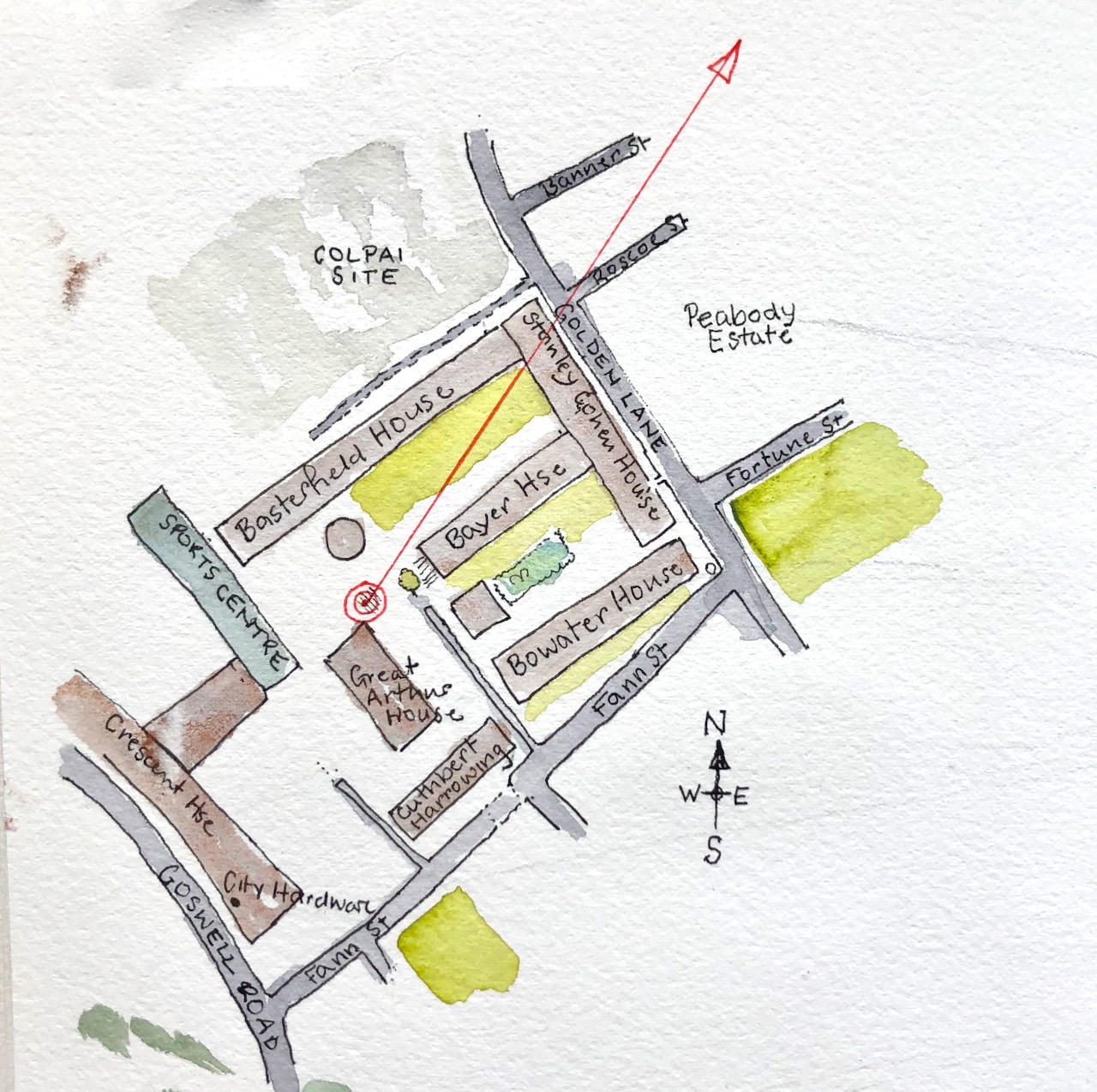
Basterfield House is at the North of the Golden Lane Estate. Here is a map. Great Arthur House was over my right shoulder, and cast its huge shadow in the afternoon sun.
Sketch map showing the view shown in the drawing.
Behind the tree, the low-rise block is Stanley Cohen House. In the background of the drawing is the Atlas Building, just to the left of the tree. On the right of the tree is the architect’s practice at 88 Golden Lane.
On the right is Godfrey House, Bath Street, Islington, part of the St Luke’s Estate managed by the London Borough of Islington. It’s former “council housing” built in 1965. Today many of the flats are privately owned, as is evident from the number listed for sale. On the left is the Atlas Building, on City…
Today was a glorious sunny day. I walked out into the sun and everywhere was worthy of a sketch. Here is 88 Golden Lane, a strange thin building. It is an architects’ practice: Blair Architecture. I sketched this standing on the side of the road in the sun, then retreated to sit on my case…
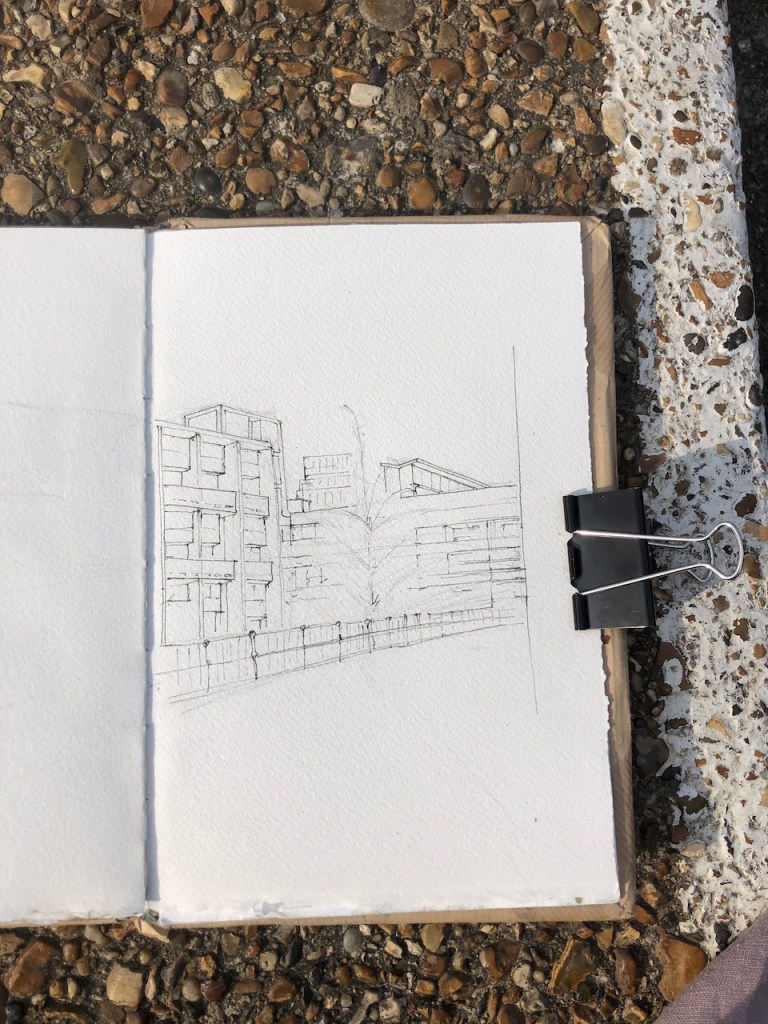
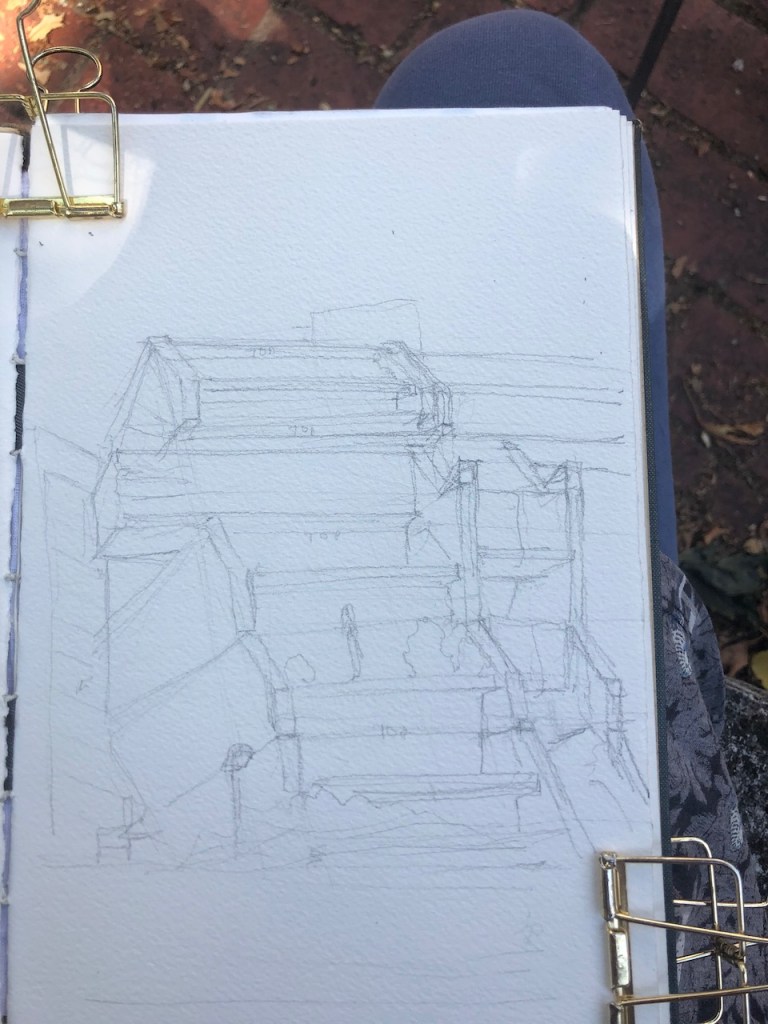
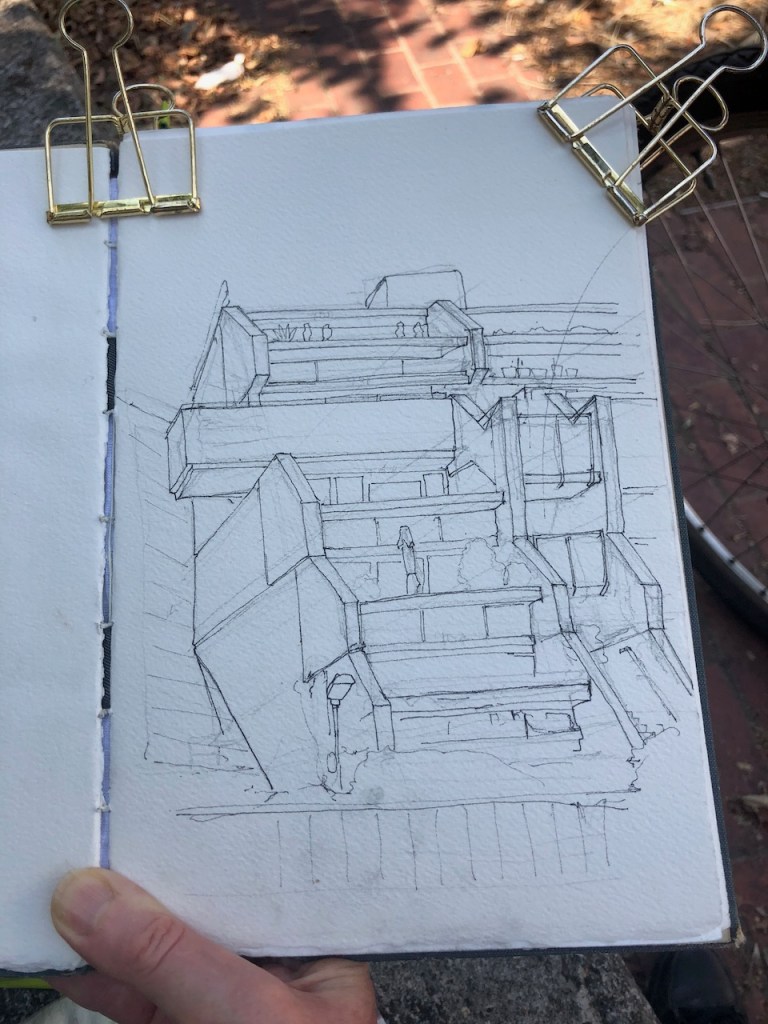
This drawing is 25cm by 16cm, 10 inches by 6½ inches on Arches 300gsm watercolour paper. It took 1½ hours. I did a preliminary sketch first, shown in the work-in-progress photos below. The colours are Fired Gold Ochre, Phthalo Turquoise, Transparent Pyrrol Orange, and Mars Yellow, watercolours over De Atramentis document black ink.
Preliminary Sketch with Winsor and Newton watercolour sticks.
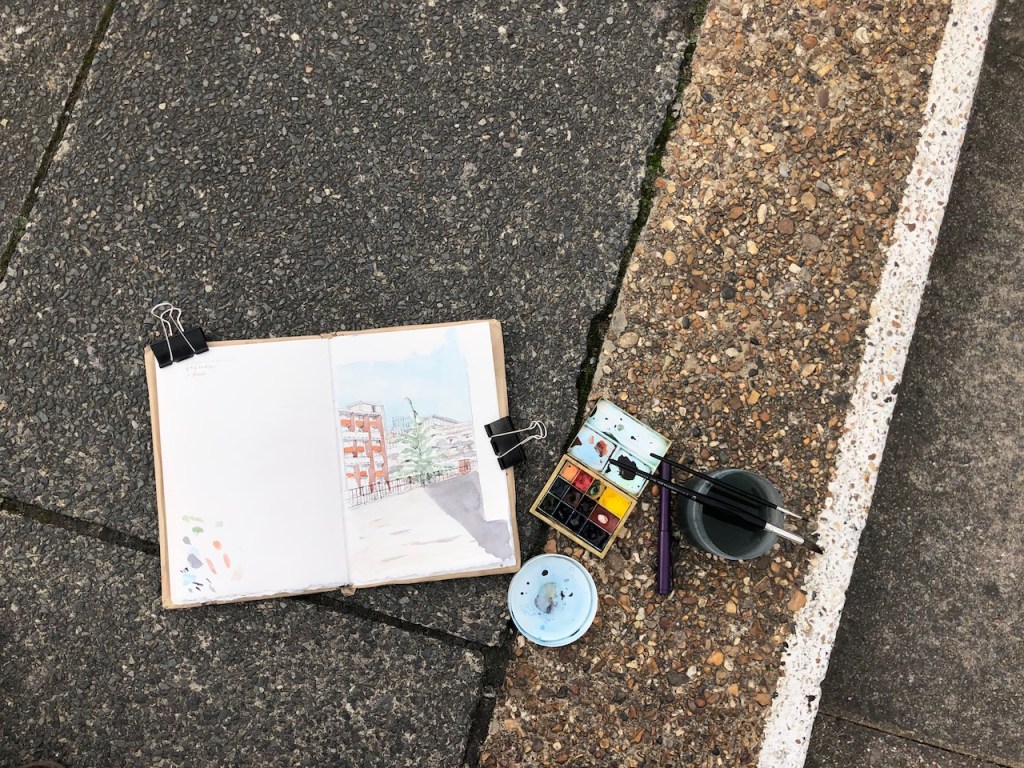
Preliminary sketch, and work in Progress.
I have drawn the Golden Lane Estate before. Here is a selection of drawings in this area:
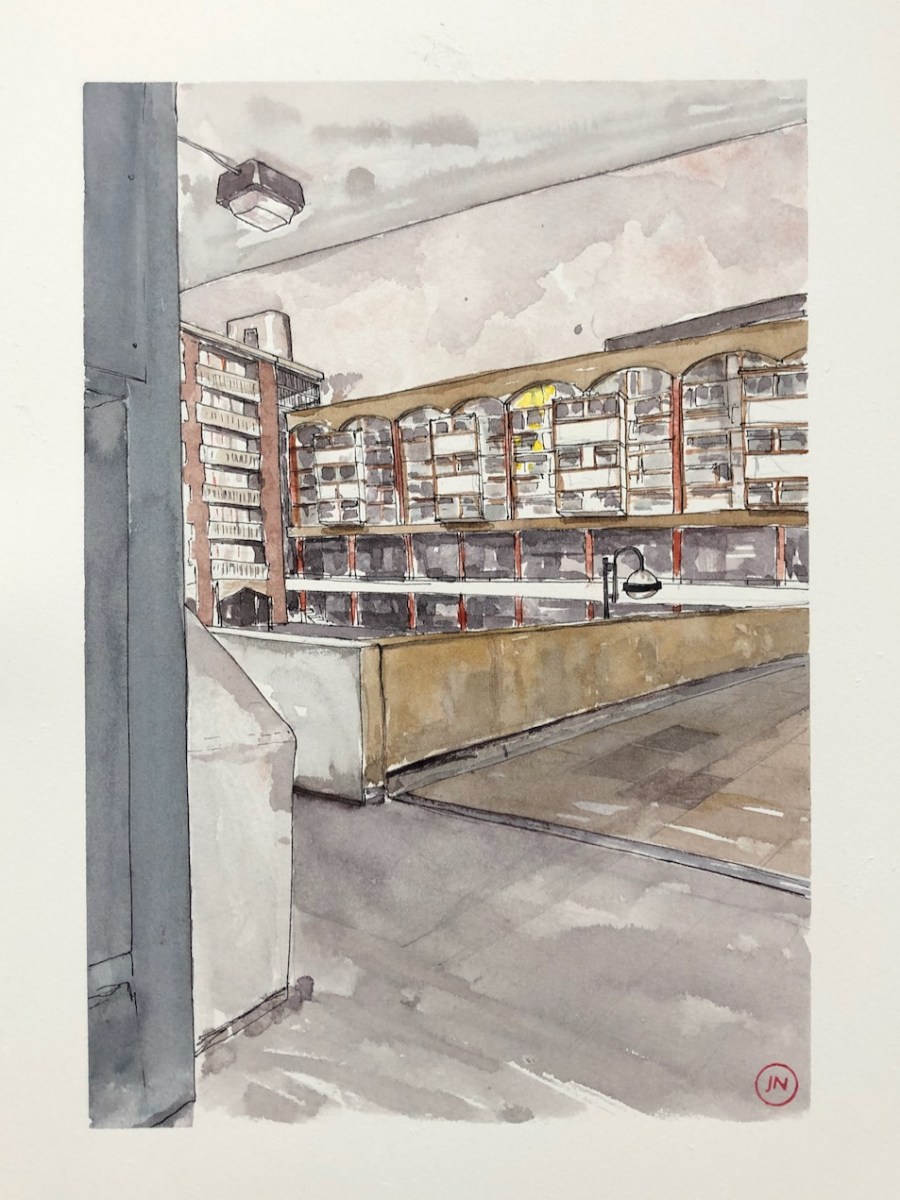
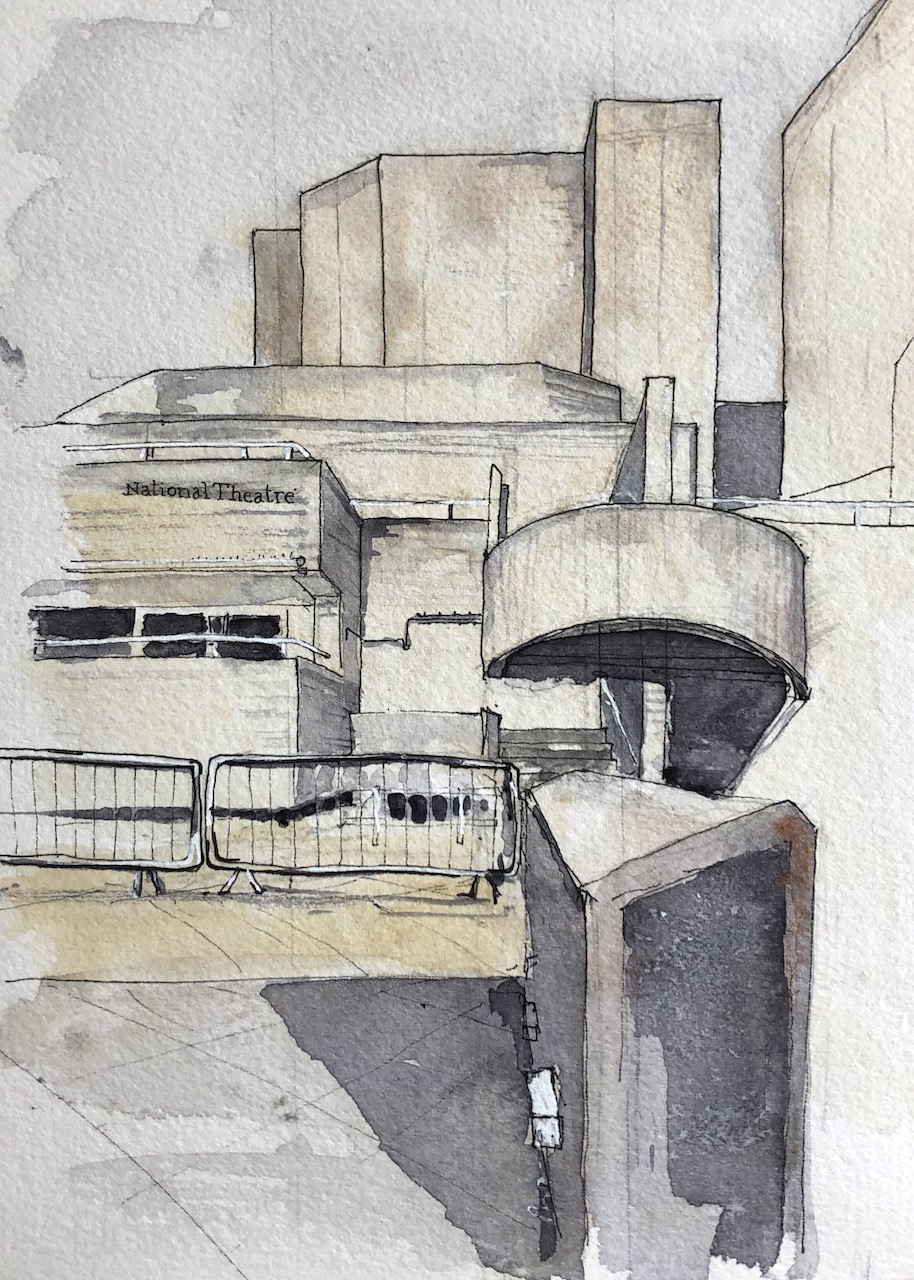
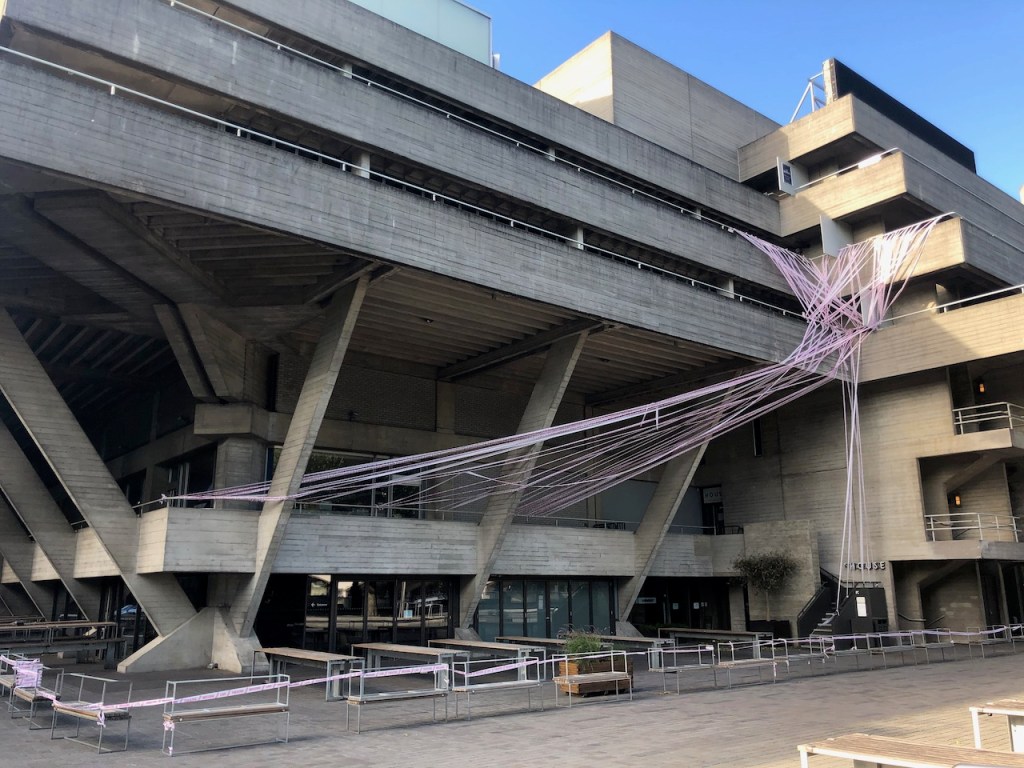
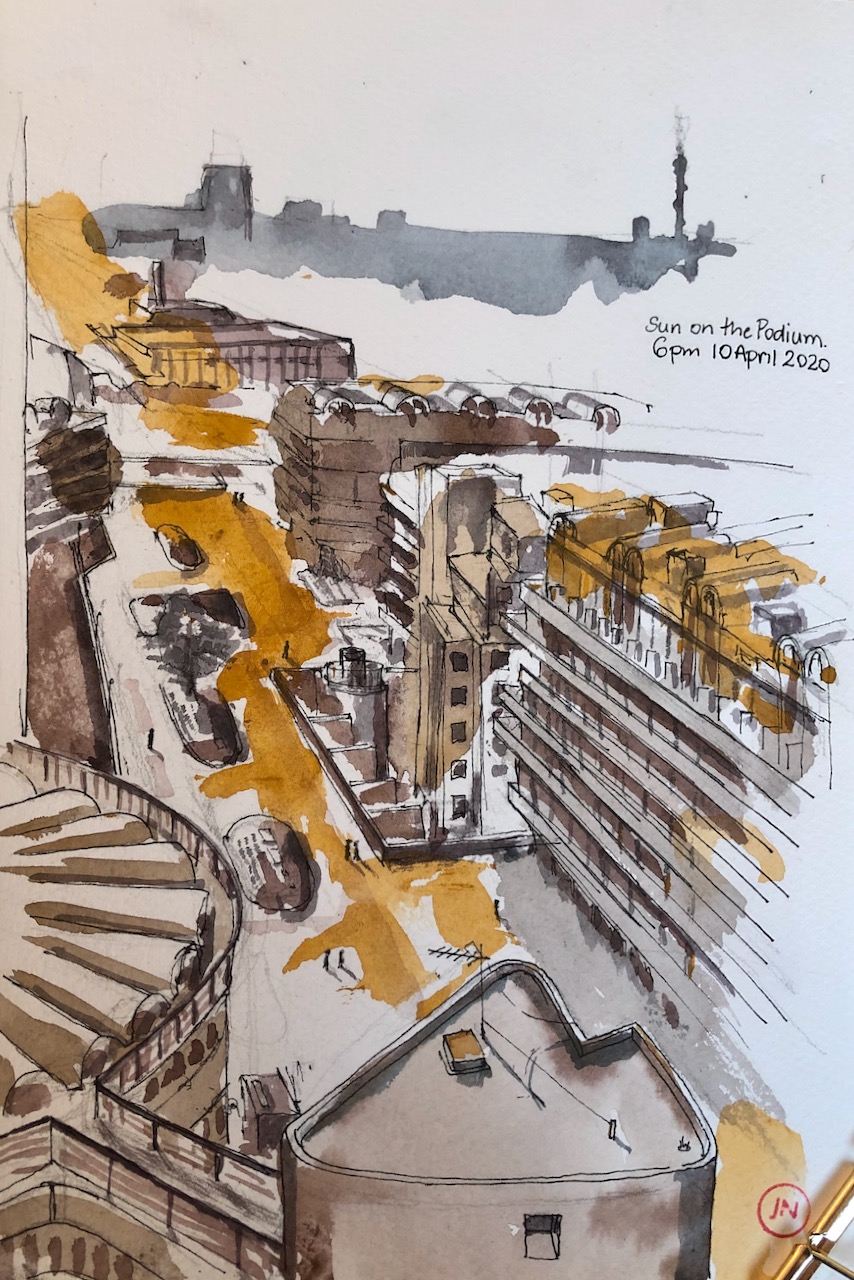
The National Theatre is on the South Bank of the Thames. Here is a view, looking East from Waterloo Bridge.
National Theatre, 9th September 2020, 3:20pm
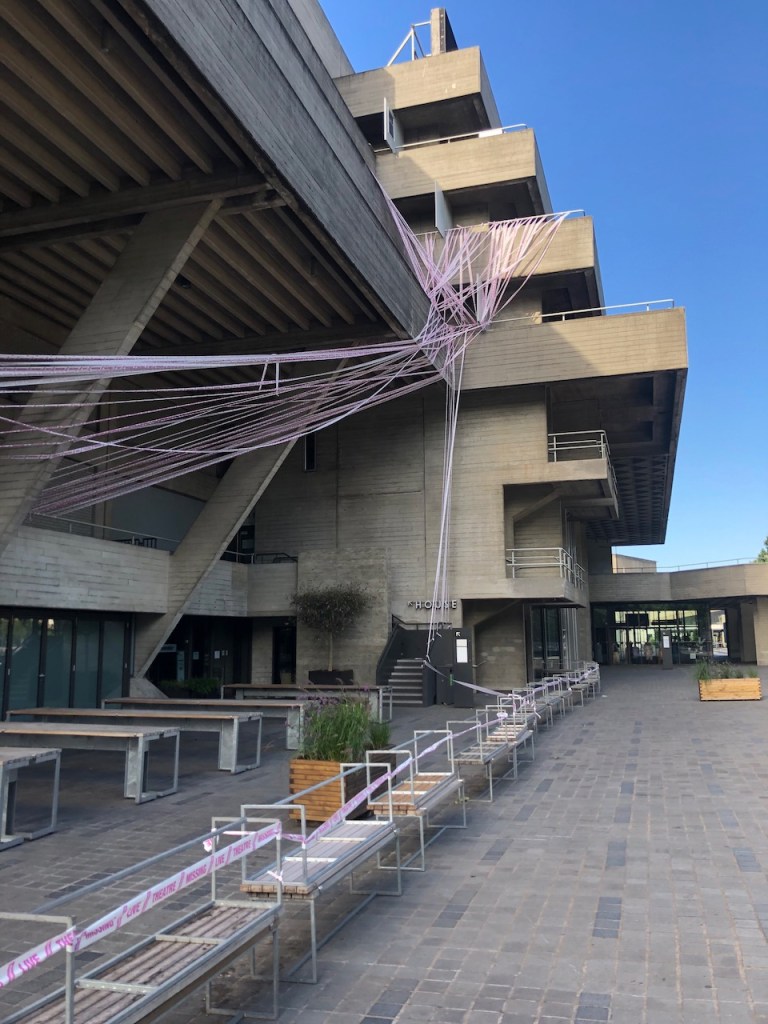
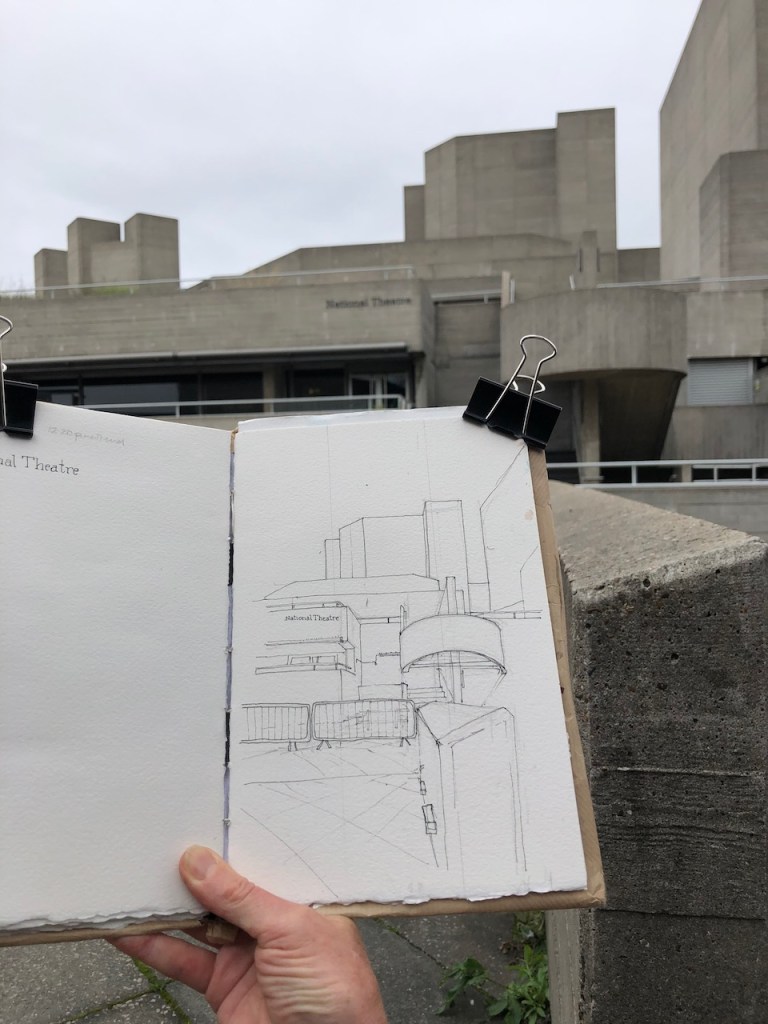
As you see, there are gates across the walkway. The Theatre is closed, and the walkways are closed.
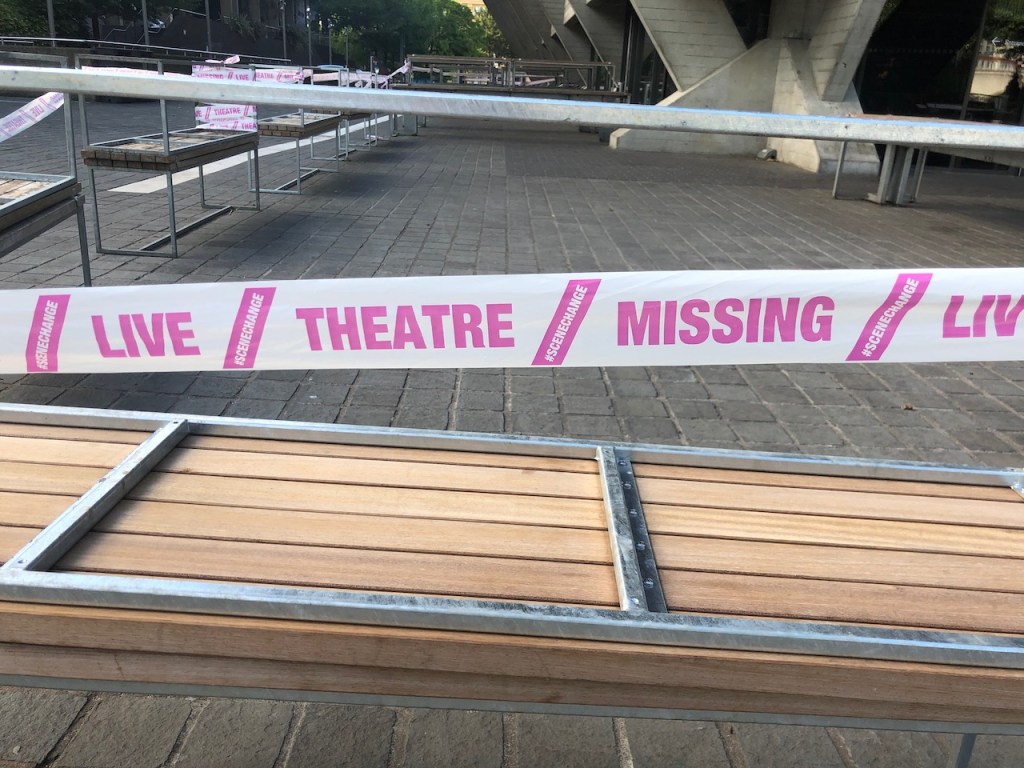
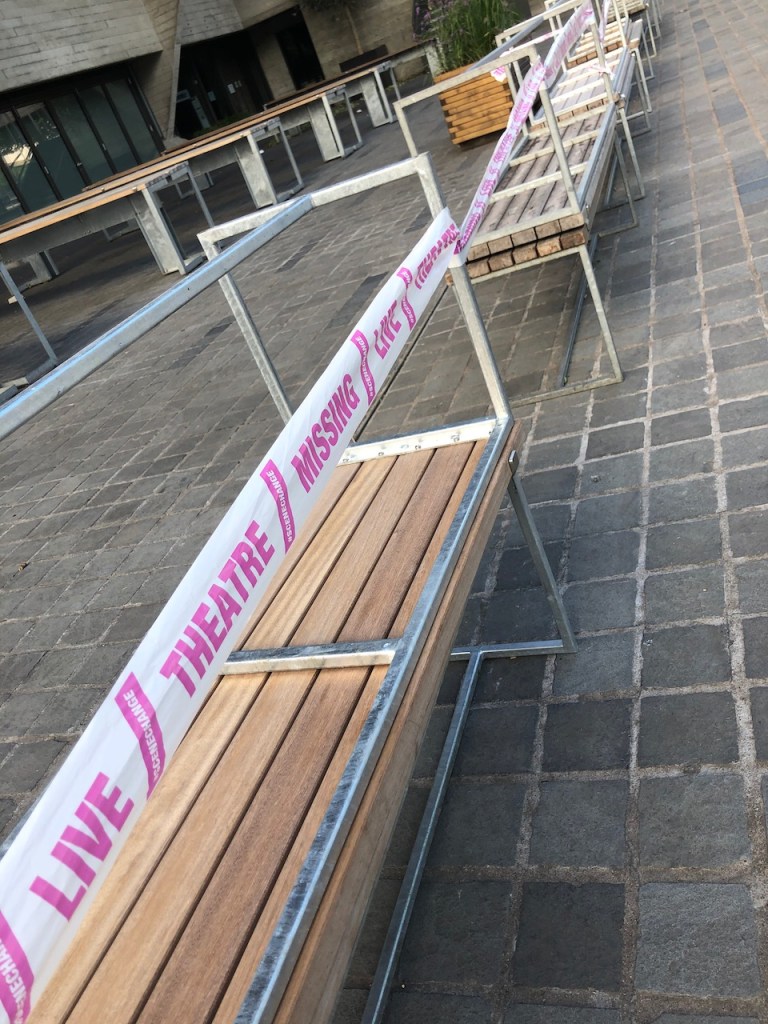
“Missing Live Theatre” – tape across the National Theatre 7th July 2020. This tape appeared across other theatres in London too. It was a protest that live theatre venues were not receiving government support to cope with their shut down in the COVID pandemic.
My drawing shows the empty theatre, and the empty walkways. The theatre restaurant, which is on the left of the drawing, is also closed and empty.
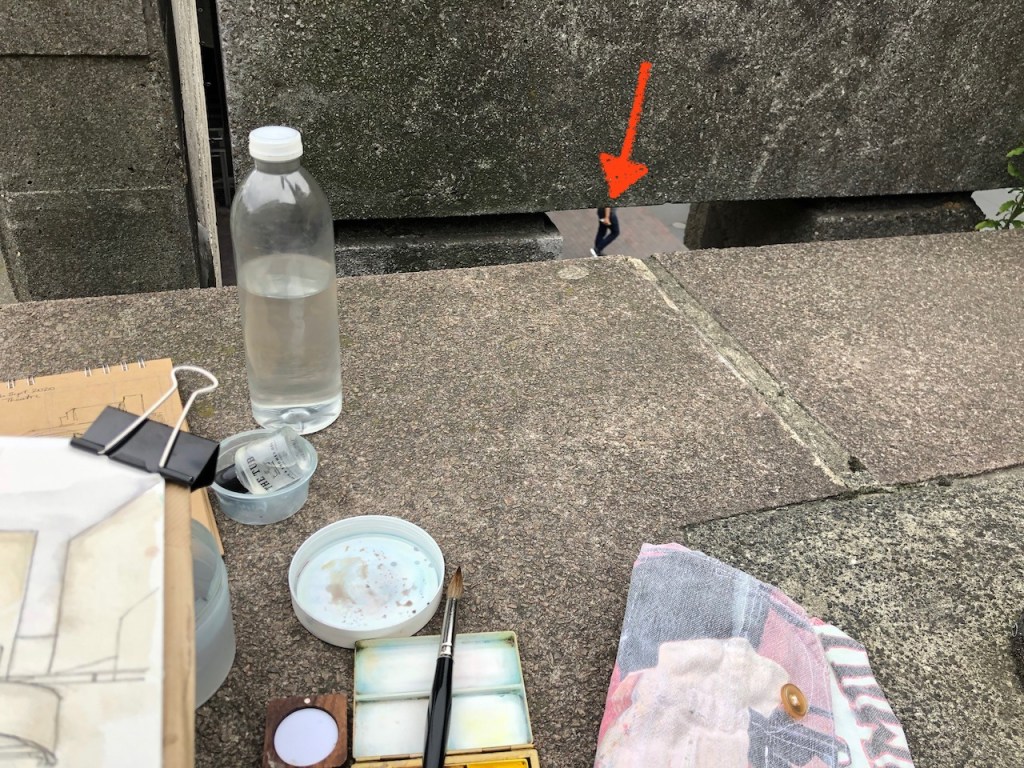
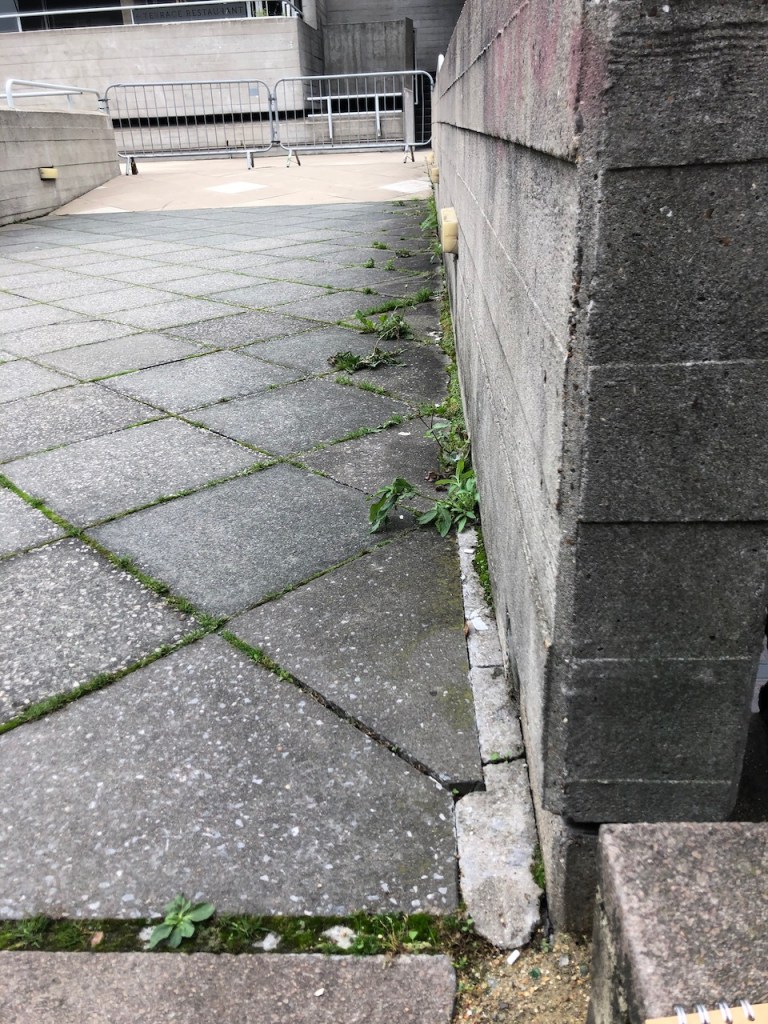
The walkways, in true 1960s style, are at “podium” level, above the traffic. Below me as a drew, people walked and cycled, and traffic passed on the nearby road, Upper Ground. Grass and buddleia grow in the cracks. Life continues, but at a different level.
Life in the cracks.
This drawing is 25cm by 16cm, 10 inches by 6½ inches on Arches 300gsm watercolour paper. It took 1½ hours. I did a preliminary sketch first, shown in the work-in-progress photos below. The colours are Buff Titanium, Neutral Tint, and Lunar Earth, all Daniel Smith watercolours, over De Atramentis document black ink.
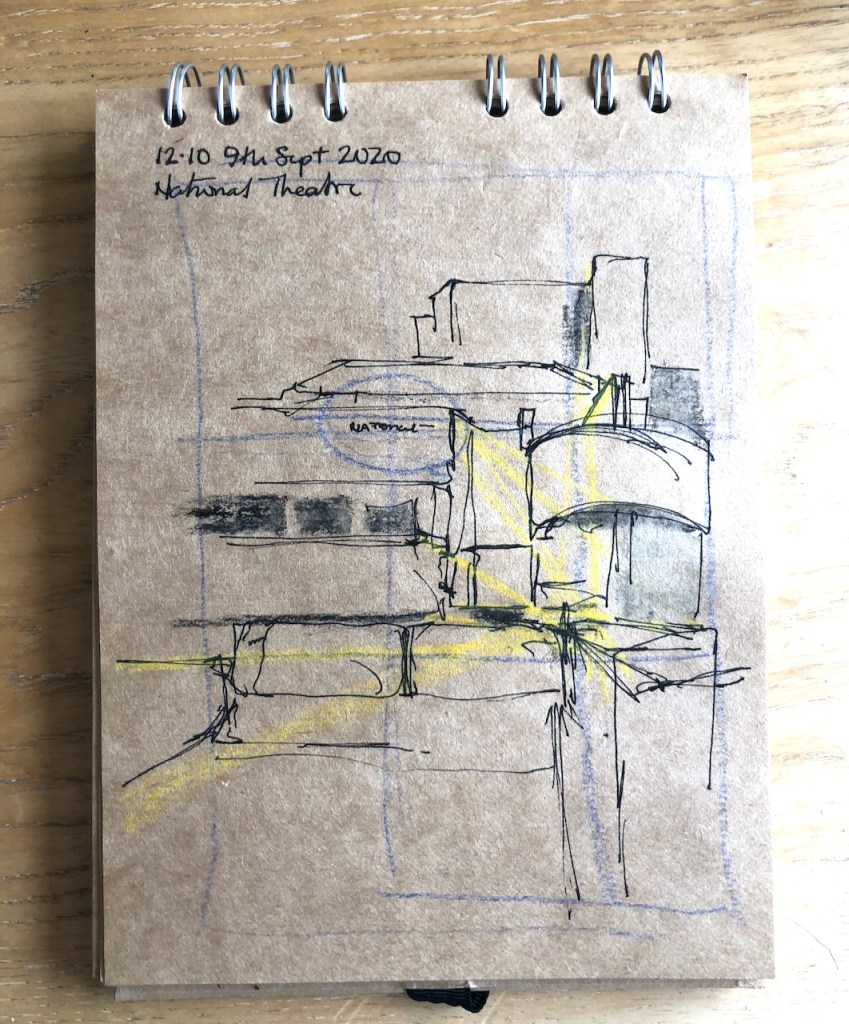
Preliminary sketch. Yellow lines show the perspective lines.
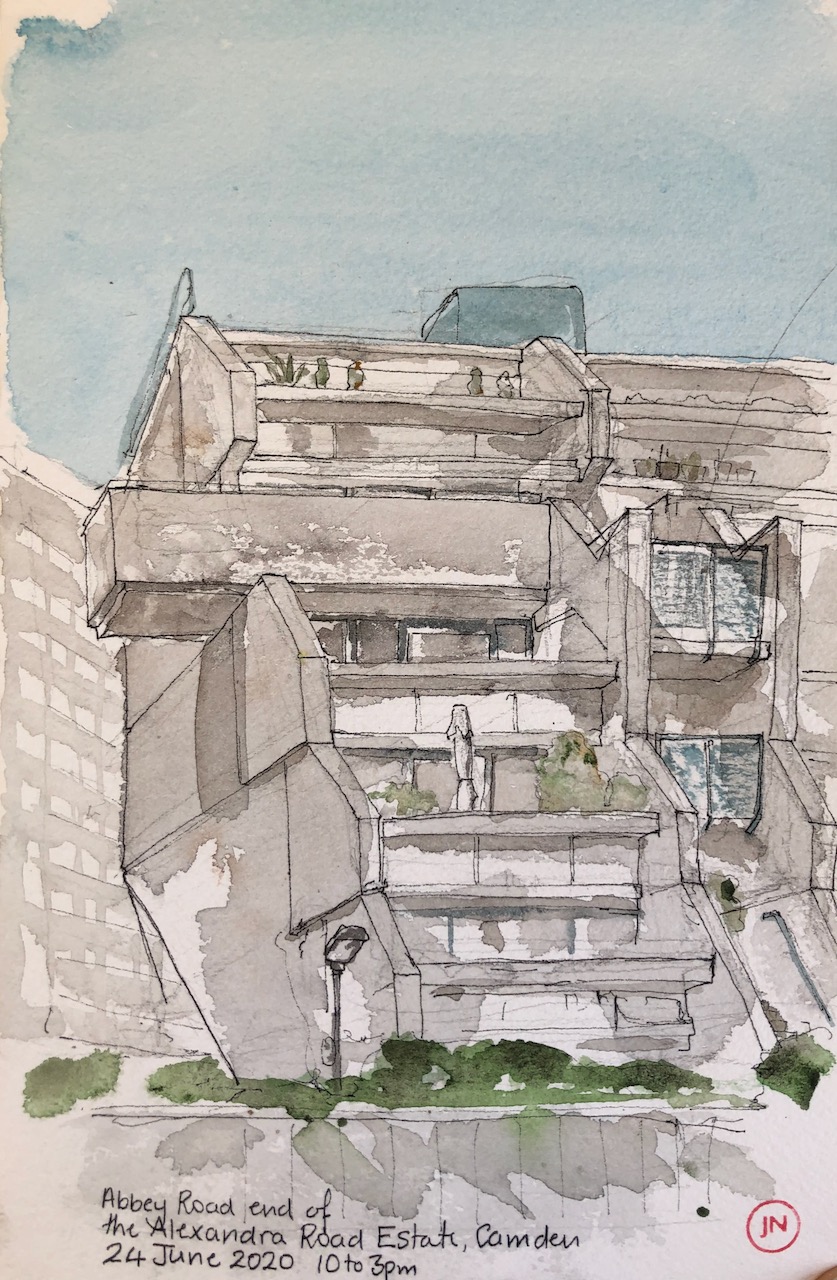
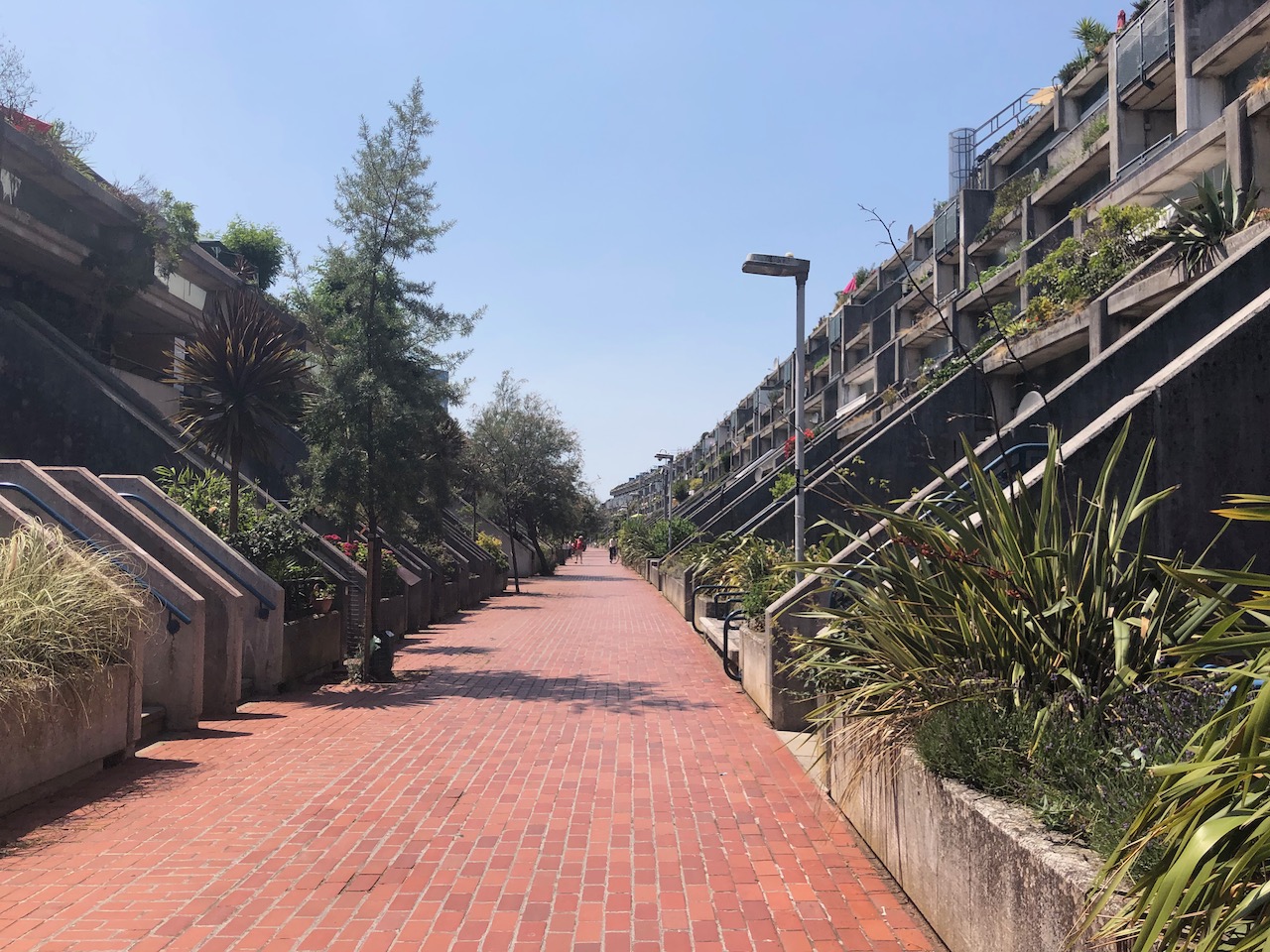
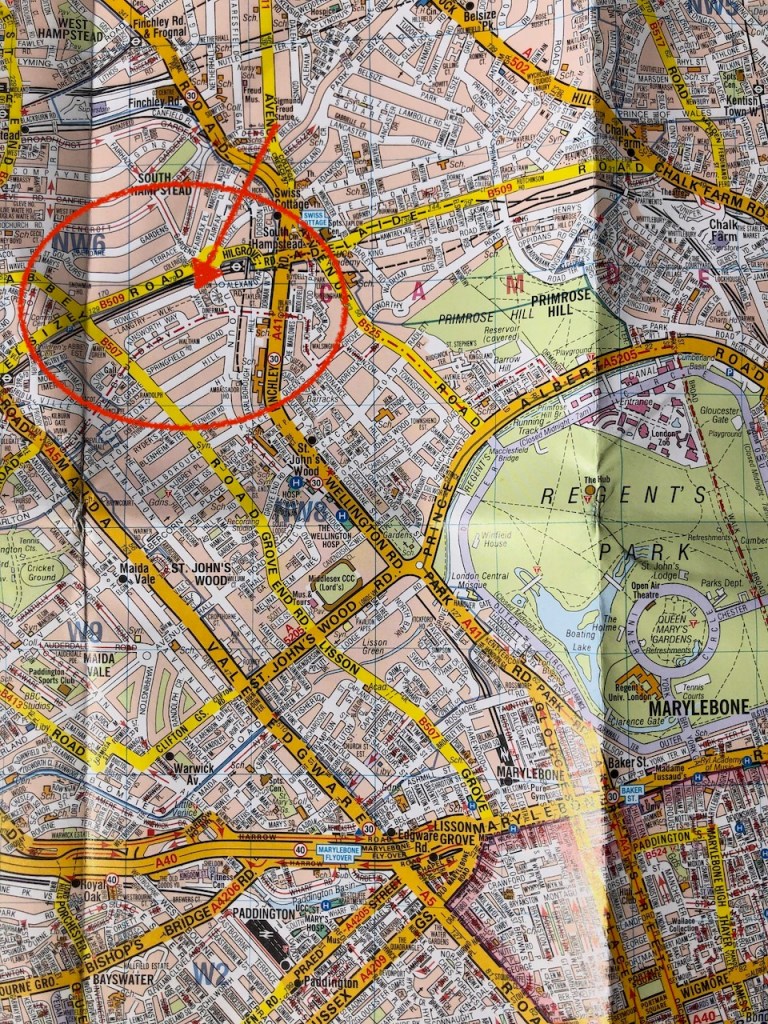
I cycled to the North West of Regent’s Park, in search of the Alexandra Road Estate. This estate is a truly astonishing work, testament to the vision and social ideals of the Camden councillors and architects who made it happen.
I cycled past the large and stately houses of Queens Grove, Marlborough Road, Loudoun Road, going north, uphill. I went left on Boundary Road, which is the north edge of Westminster and the south Edge of Camden. There on the right I glimpsed brutalist concrete. This is it. But the side road I followed, Rowley Way, led downwards into a disappointing loading bay, with barriers, delivery drivers and much disorganised parking. It was hot, and I’d cycled what felt like a long way. Then I remembered that this was a 1960s development. There must be a podium level, above the cars. There was. I looked for, and found, the slope upwards.
Rowley Way, Alexandra Road Estate
At the top of the slope was another world. A long village street led into the distance, with tranquillity, with greenery, and with concrete benches. People walked about immersed in conversation, leading children. Two lads sat on a bench, chatting and looking at their feet. Everywhere, there were trees, bushes and flowers. The street was tiled with red terracotta tiles. Each side the flats sloped up, looking irregular, like houses I have seen built into the hill in Crete.
I walked all along the tiled street, pushing my bike. There were concrete benches, but from those the view would give directly onto someone’s home, so I didn’t feel that would be good manners to sit down and draw there. Many features I recognised as typically 1960s: wood-marked concrete, thick iron railings, slabs of exposed concrete, round stairwells. The flats were all interlocked, so it was not clear where one flat started and the next stopped. It was most intriguing architecture. There were ledges, and low doors, gardens on ledges, and stairways climbing high up right to the roof.
At the end of the street, there was a small tiled public area, with a tree, and a viewpoint, and more concrete benches. Here I had a view of the end of the terrace of flats.
“..monoliths of tower blocks..” behind the Alexandra Road Estate.
I particularly enjoyed the way that the architect had made that walkway protrude at the end of the block, to provide a viewpoint, a special place. I didn’t go up there. To the north, there were the tall monoliths of tower blocks. Trains rumbled. The railway line is immediately behind the terrace I was drawing.
The architect of the Alexandra Road Estate was Neave Brown, of the Camden Architecture Department. It was designed in 1968 and built 1972-78. The construction was controversial. Inflation was 20% at times in the seventies, and so costs went up. Neave Brown fought hard to complete the scheme, and he prevailed.
There is a wonderful description of the estate and its history on the Municipal Dreams website on this link:
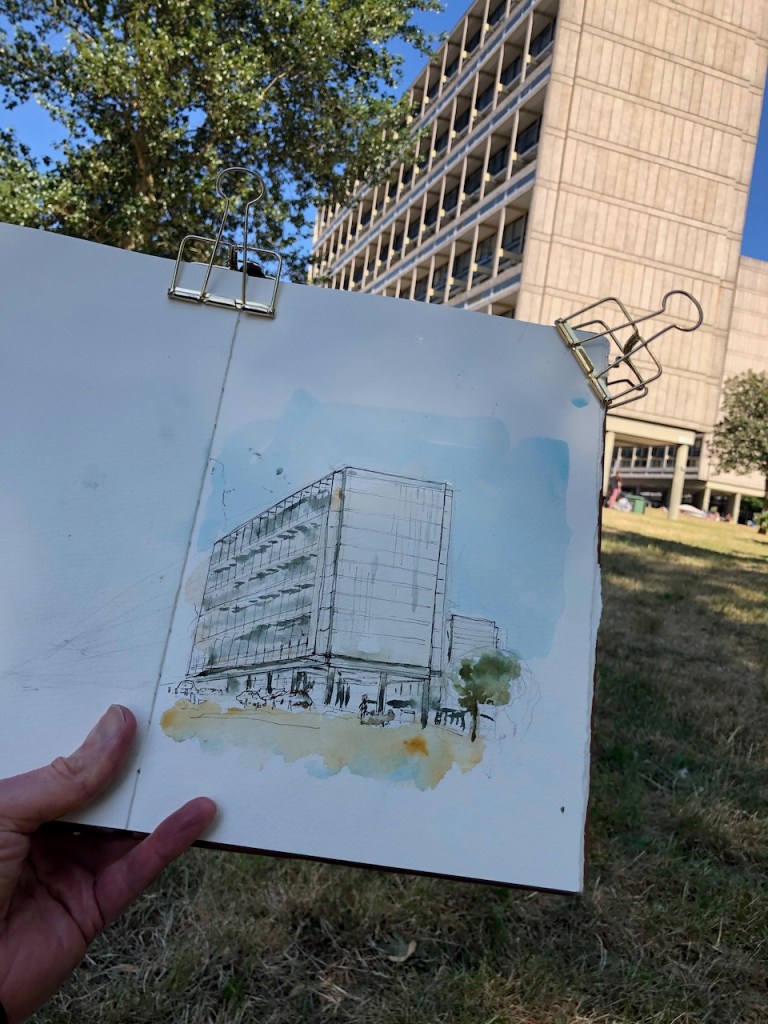
Here is a sketch of Charcot House, one of the five tower blocks in the Alton West Estate, Roehampton, SW15.
The Alton West estate was completed in 1958, as social housing. It was designed by a London County Council team led by Rosemary Stjernstedt (1912-1998).
The five tower blocks stand in a huge green space, on a hill, with many trees. When I visited, people were picnicking on the dry grass. You can see some of them in the centre of the picture.
I went there by bike, it took about two hours, partly because I also went to look at the Dover House Estate, nearby, which was built in 1918. Also it took me a while to find the Alton West estate. There are a number of hills in the area.
Here is a map:
The arrow shows the sightline of the drawing.
Local map
Work in progress
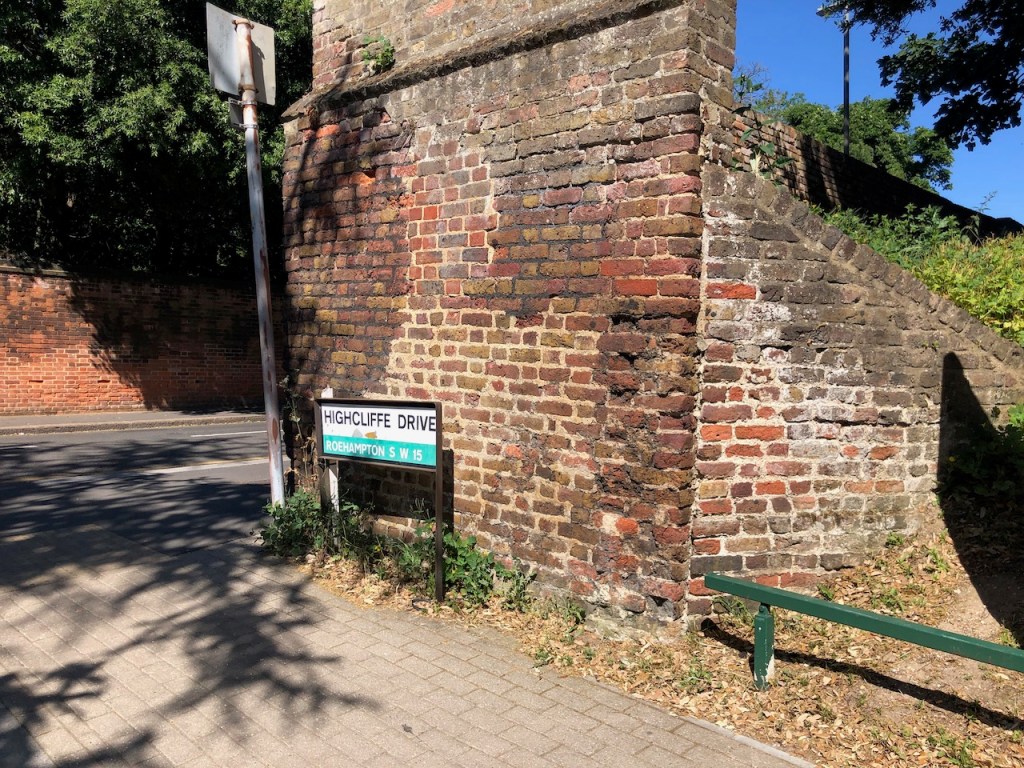
This lovely old wall pre-dates the estate, I imagine.
The flats are maisonettes.
Local photos. Click to expand.
Drawing time: 45 min. Colours: Mars Yellow (DS), Phthalo Turquoise (W&N), Burnt Umber (Jacksons).
Click a button below to share this post online, email it, or print it:
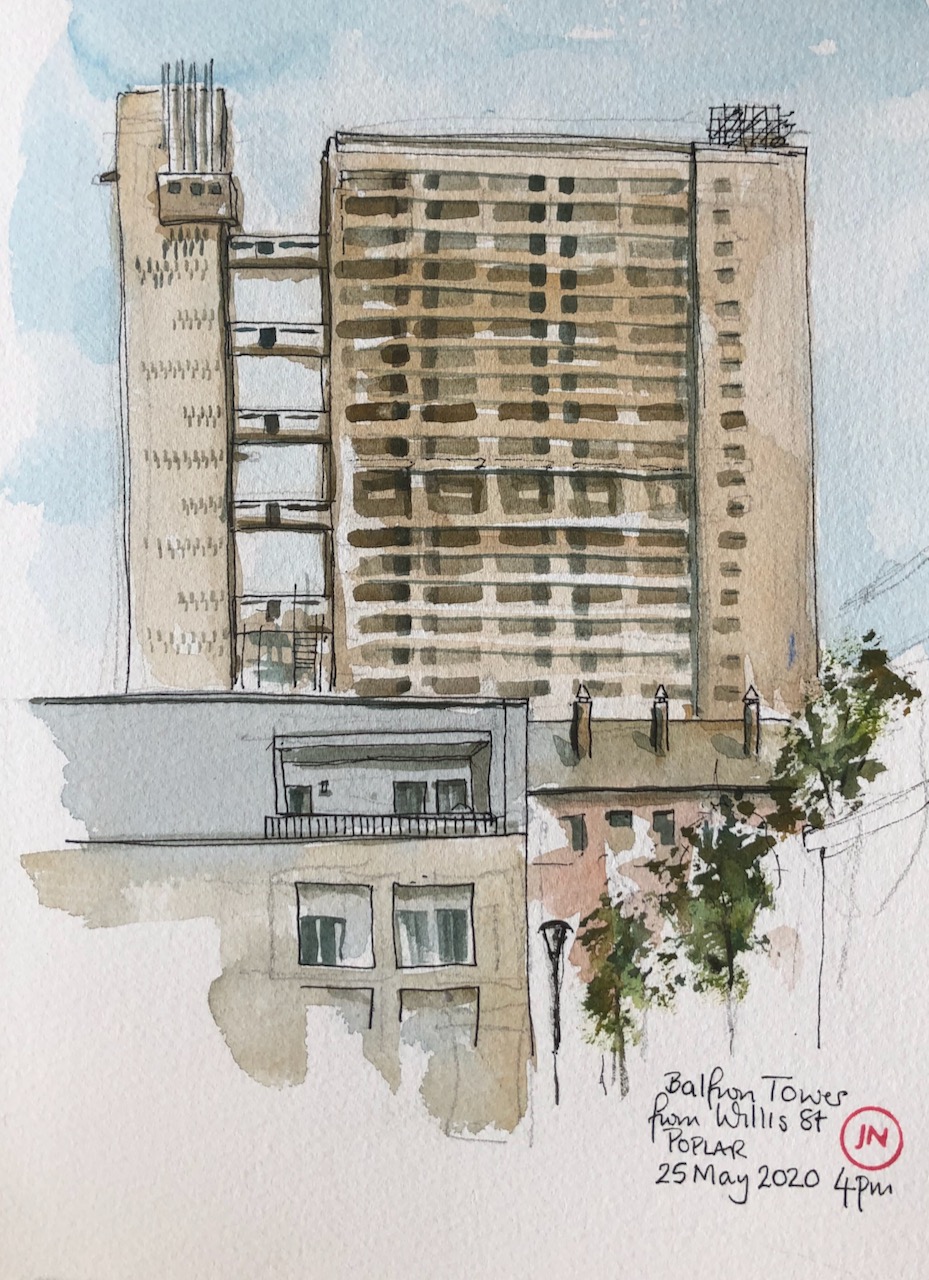
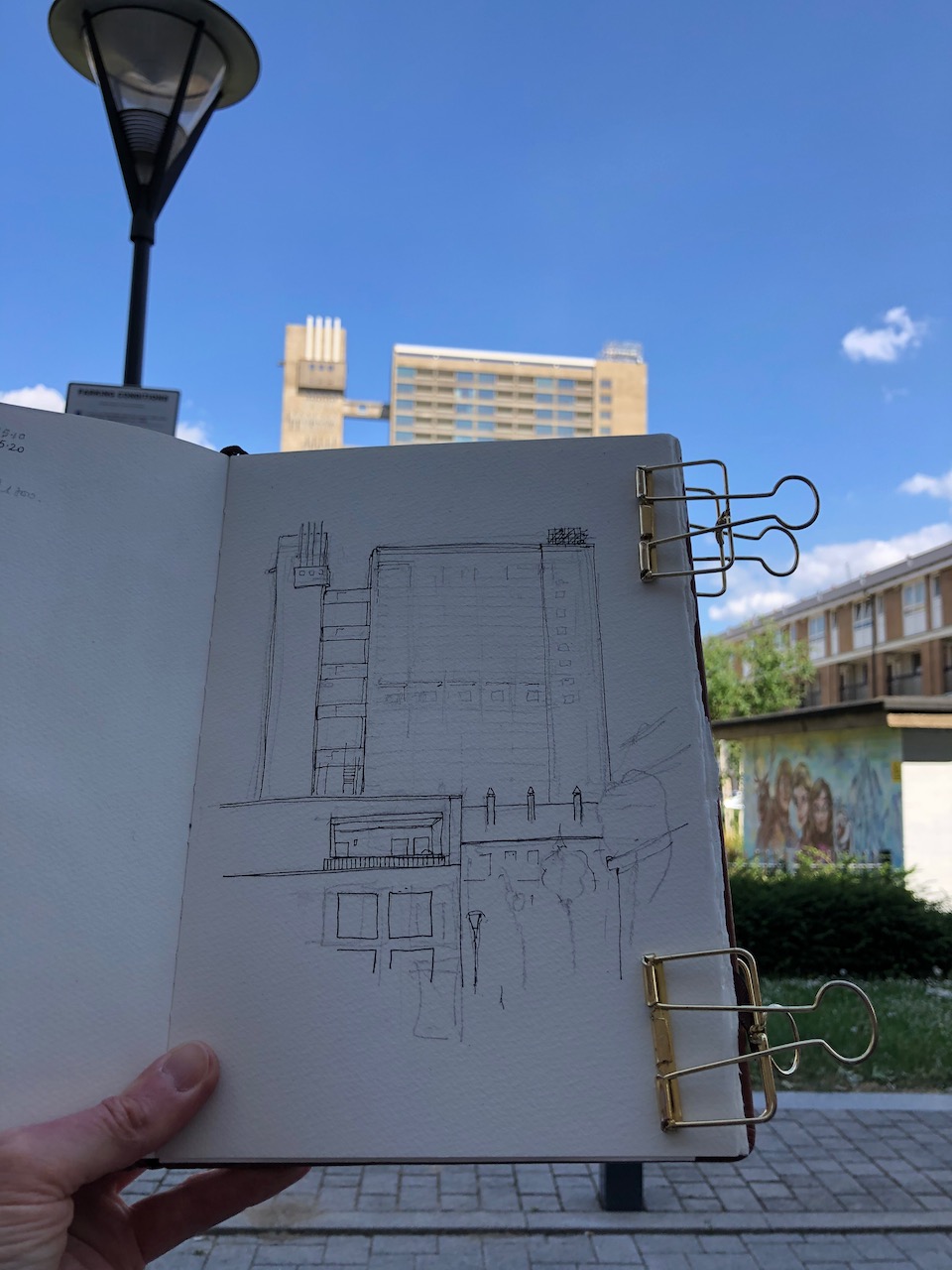
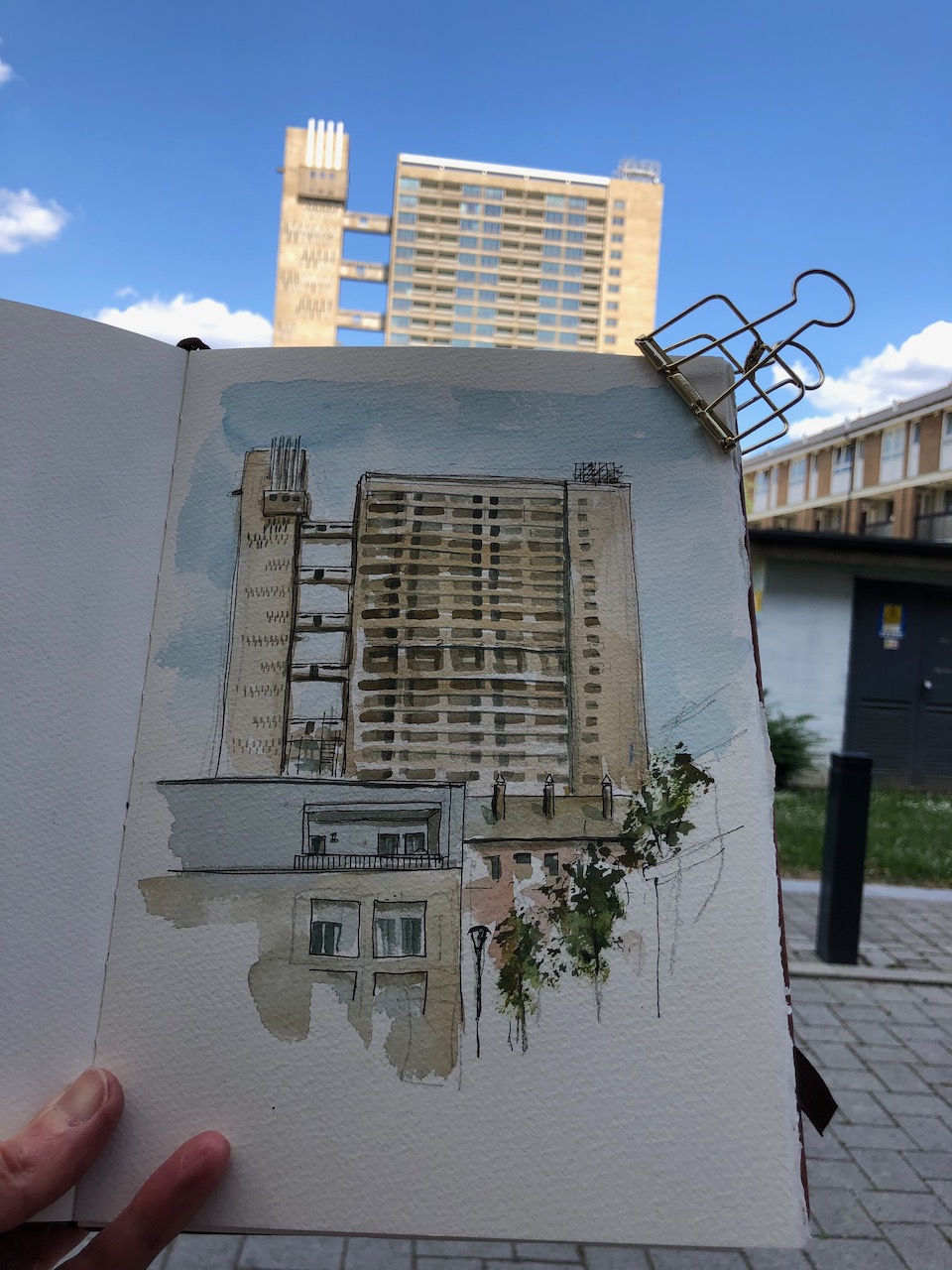
I went on a marvellous cycle ride in East London. The air was clear, the roads were wide and empty. As I came back I spotted this view of the Balfron Tower. I sat on a low wall in a housing estate off Willis Street, and sketched it.
Balfron Tower, Poplar, east London.
This tower is designed by the architect Ernő Goldfinger, and resembles his other famous tower, Trellick Tower, which is in North West London. Balfron Tower was built in 1967 as council housing.
It has recently been sold by Tower Hamlets Council, and redeveloped by the developer LondonNewcastle as luxury flats. You can see some of the scaffolding in the drawing.
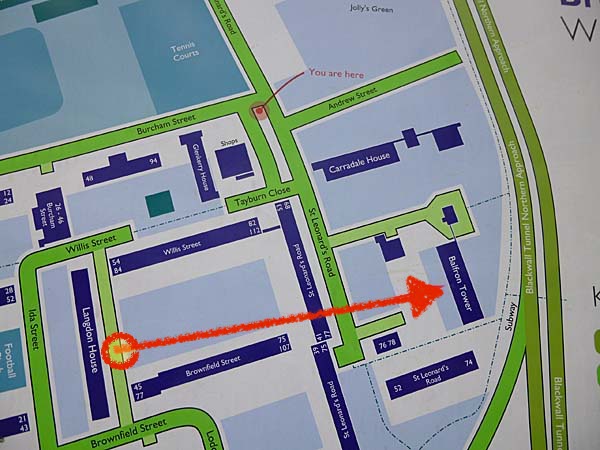
Here is where it is.
The arrow is my sightline for the drawing.
Here is work in progress. Also a glimpse of my bicycle.
As I sat sketching, a pale young man approached. “It’s beautiful,” he said as he strode past. He was referring to the Balfron Tower, not to my drawing.
“Yes, ” I agreed, “I think so”. I looked down to my drawing again. But the young man had something else to say.
“You should see Jesus,” he told me, “He’s beautiful too.” Taking my baffled silence as amazement, he continued, “I’ve seen Him, believe it or not”. He left this statement hanging in the air and walked on around the corner, without breaking step.
Click a button below to share this post online, email it, or print it:
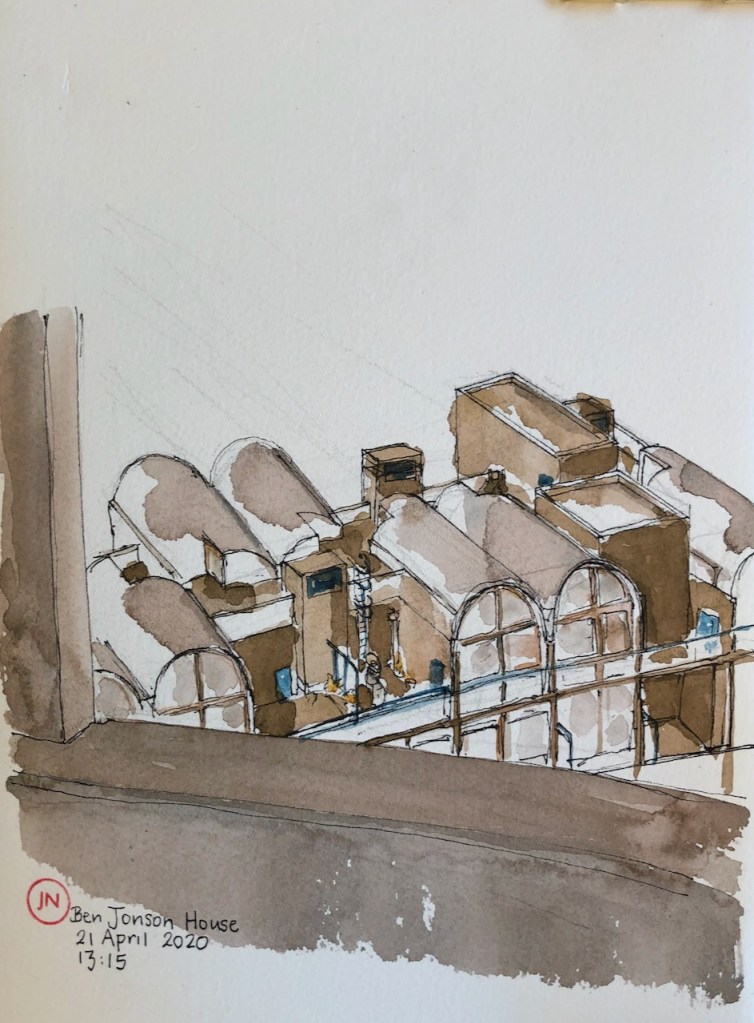
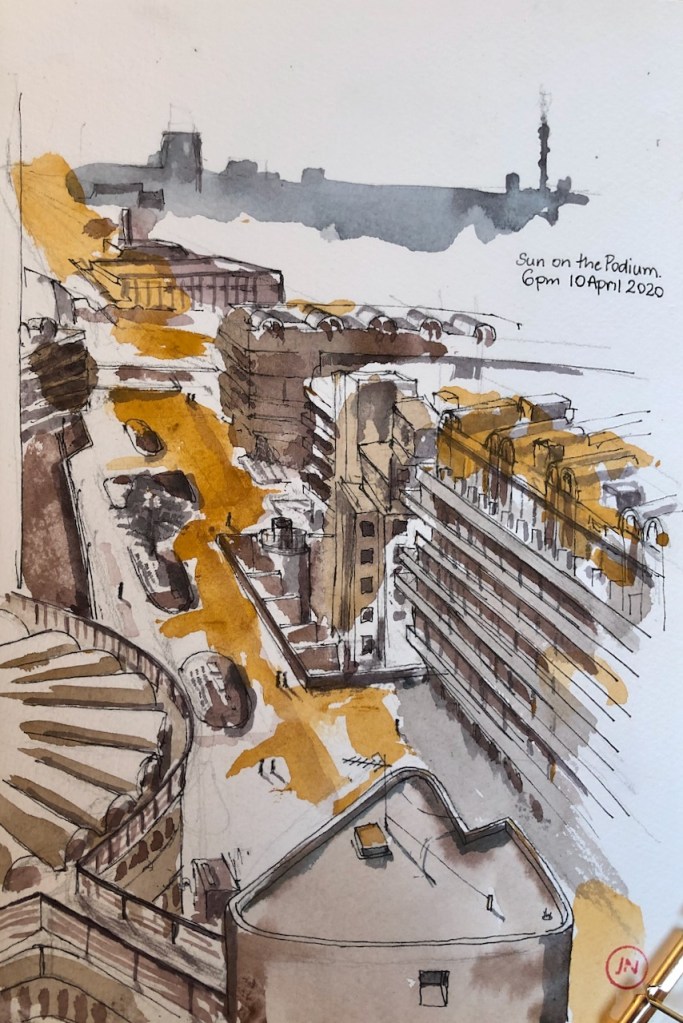
Sketching from the window, here is Ben Jonson, part of the Barbican estate.
The people who live on the top floor of Ben Jonson have sunlit roof gardens. You can see one person enjoying his garden. He sits just at the bottom of the blue fire escape ladder.
There is also an interesting void space shown in the lower right of the picture. It was empty when I was drawing, but sometimes someone’s legs are visible, using the space for sunbathing. Sometimes they set up a table and chairs there.
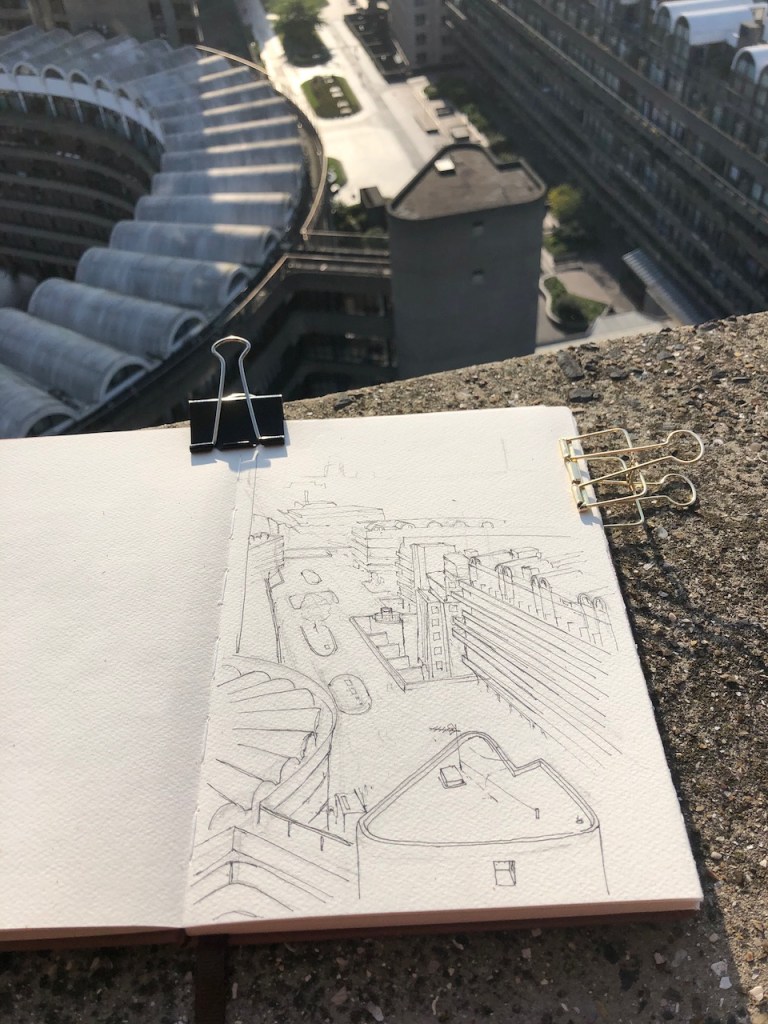
Here is work in progress. I used colours: Mars Yellow, Burnt Umber, Prussian Blue and a bit of Perinine Orange.
Click a button below to share this post online, email it, or print it:
The tower in the foreground is part of Frobisher Crescent. Frobisher Crescent itself is on the left. Ben Jonson House is on the right. On the horizon you can see Centrepoint, and the Post Office Tower.
This took 2 hours. The sun moved, of course.
Colours: Mars Yellow, Perylene Maroon, Prussian Blue, all Daniel Smith watercolours.
Click a button below to share this post online, email it, or print it:
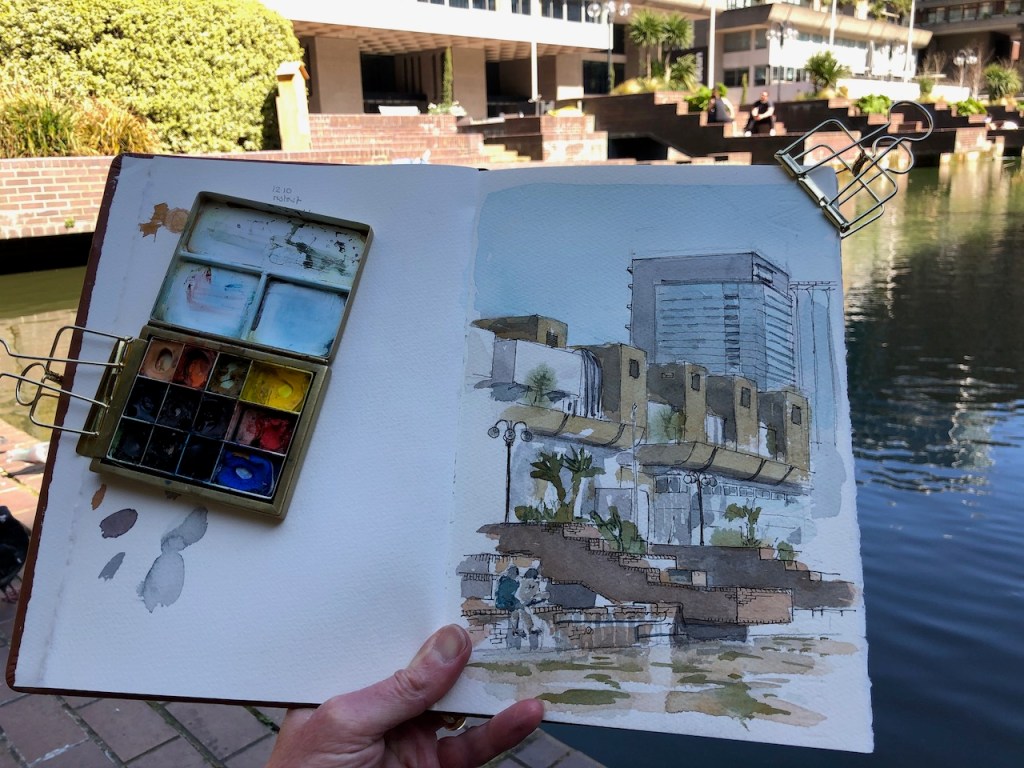
The building in the background is the Heron Building, luxury flats above the Milton Court Concert Hall, Guildhall School of Music and Dance. This building opened in September 2013. It replaced a public building, which was in the brutalist design of the Barbican and designed by Chamberlain Powell and Bon, It housed a fire station, Coroner’s Court, mortuary, office of weights and measures and a civil defence school, and was connected to the Barbican by a bridge at Podium level. This building was demolished in 2008, in the face of opposition from the Twentieth Century Society amongst others, and was replaced by the steel and glass tower. This new building has no bridge to the Barbican, which is a pity, in my view.
At the extreme right is City Point.
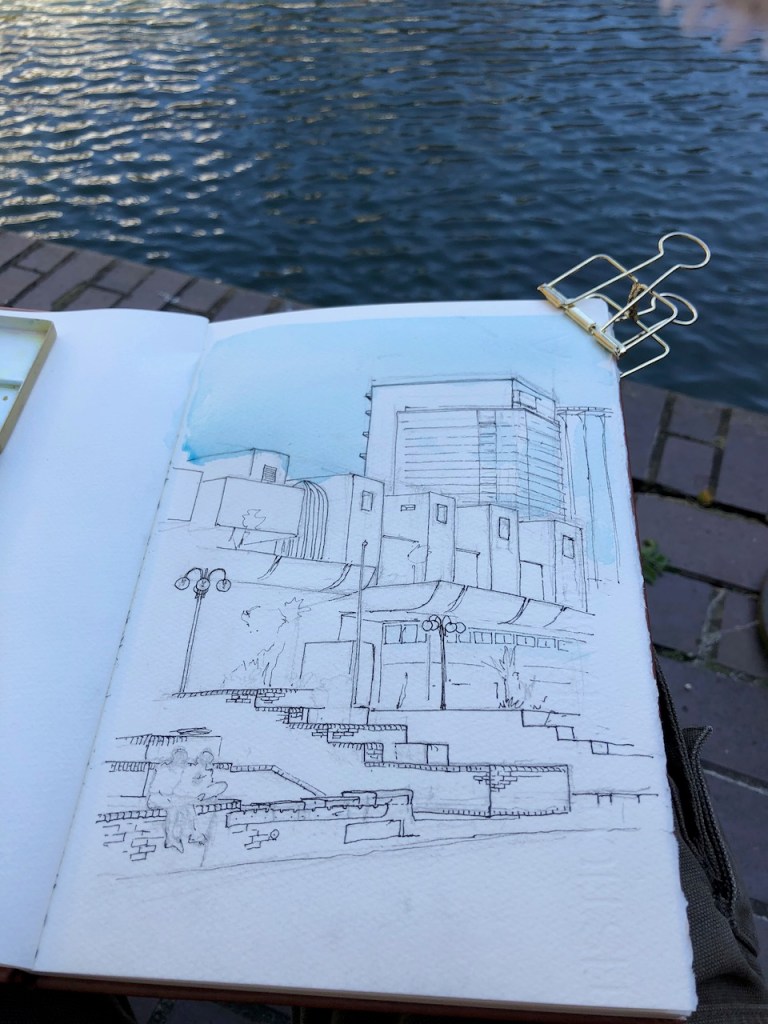
Here is work in progress:
This drawing took ages. I couldn’t get the steps right. After 30 minutes of drawing and rubbing out I restarted at 12:10 and finished 1hour30mins later.
Click a button below to share this post online, email it, or print it:
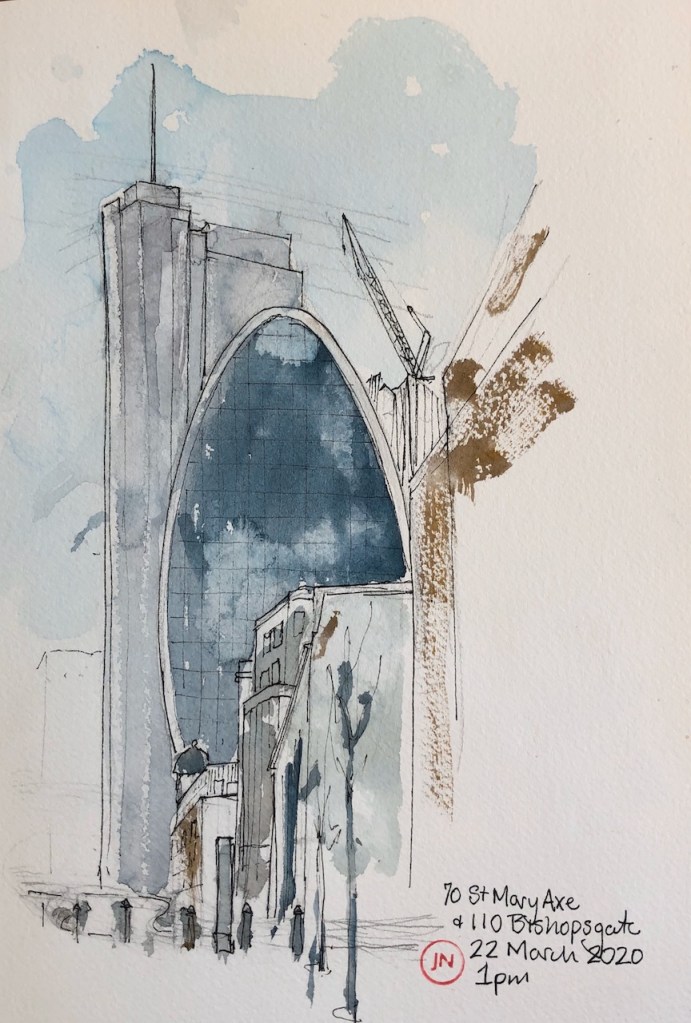
I have wanted to draw this building for a long time. It has the most wonderful shape.
70 St Mary Axe, from the park by St Botolphs, 110 Bishopsgate is the tall building in the background.
It seemed like today was a good day: empty streets and sun. I found a view, and stood sketching with the sun on my back.
Work in progress
Location where I was drawing
Sightline of the drawing
Three things happened.
A group of skateboarders chose the particular wide pavement on which I was standing to practise their sport.
People started to accumulate in the park nearby, with beer cans and music.
The sun moved, and I was in shade.
The skateboarders were skilful, and avoided me, but were a worry and distraction. The groups of people were definitely contravening current regulations on social distancing and made me uneasy. And then I was getting cold.
So I packed up my sketch, and moved on. The result is a rather dashed sketch, but somehow captures the mood, and is not unpleasing. What do you think?
There are more curves in this view than I normally encounter in an urban sketch. As well as the marvellous building, you can see the wiggle of the road called Bevis Marks, at the bottom of the sketch. That sinuous line is usually totally lost in the buses and parked cars. But it was visible today.
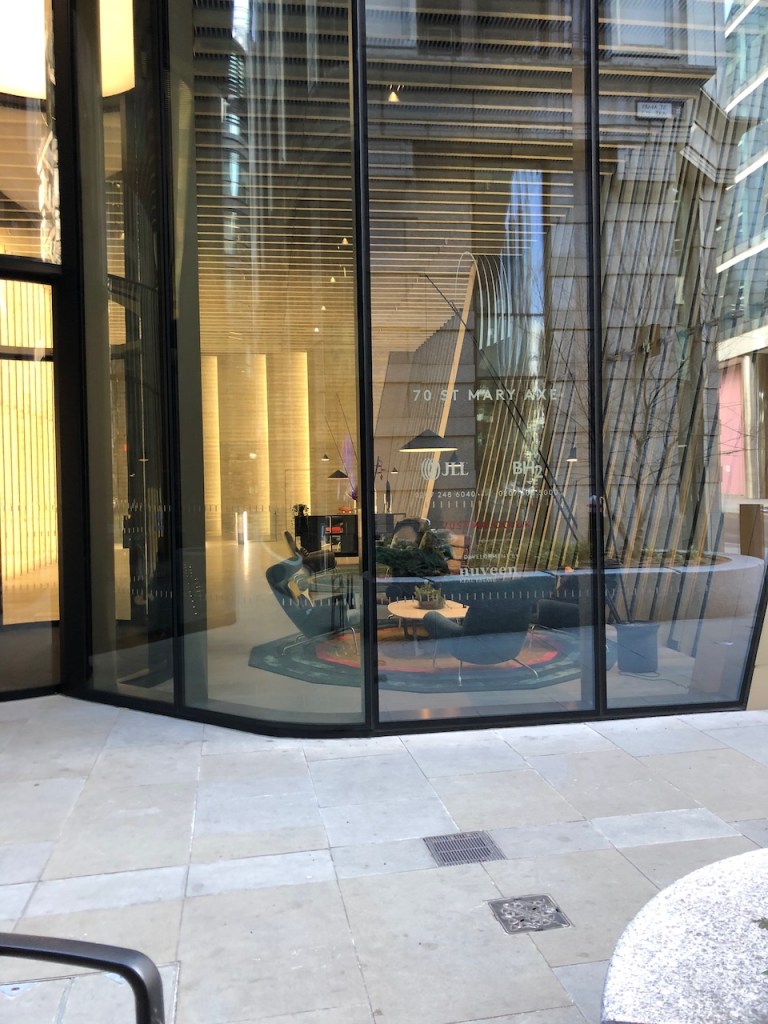
70 St Marys Axe is by Foggo Architects. It was finished last year. The interior design is also a sight to behold. I peered in through the glass.
A glimpse into the interior of 70 St Mary Axe
70 St Mary Axe south west edge.
I walked back through the deserted city and came to Finsbury Circus. Here was the most wonderful tranquil air and a feeling of light. I realised this was because a huge and tall Crossrail construction, which has been at the centre of Finsbury Circus for months, has now gone. The sky has reappeared. I could look back and see the buildings of the city though a fine mesh of branches and spring leaves. It was beautiful. I sat on the steps of 1 Finsbury Circus and drew it.
Phthalo turquoise (W&N), Burnt Umber (DS) and Perylene Maroon (DS), with some Mars Yellow (DS)
Click a button below to share this post online, email it, or print it:
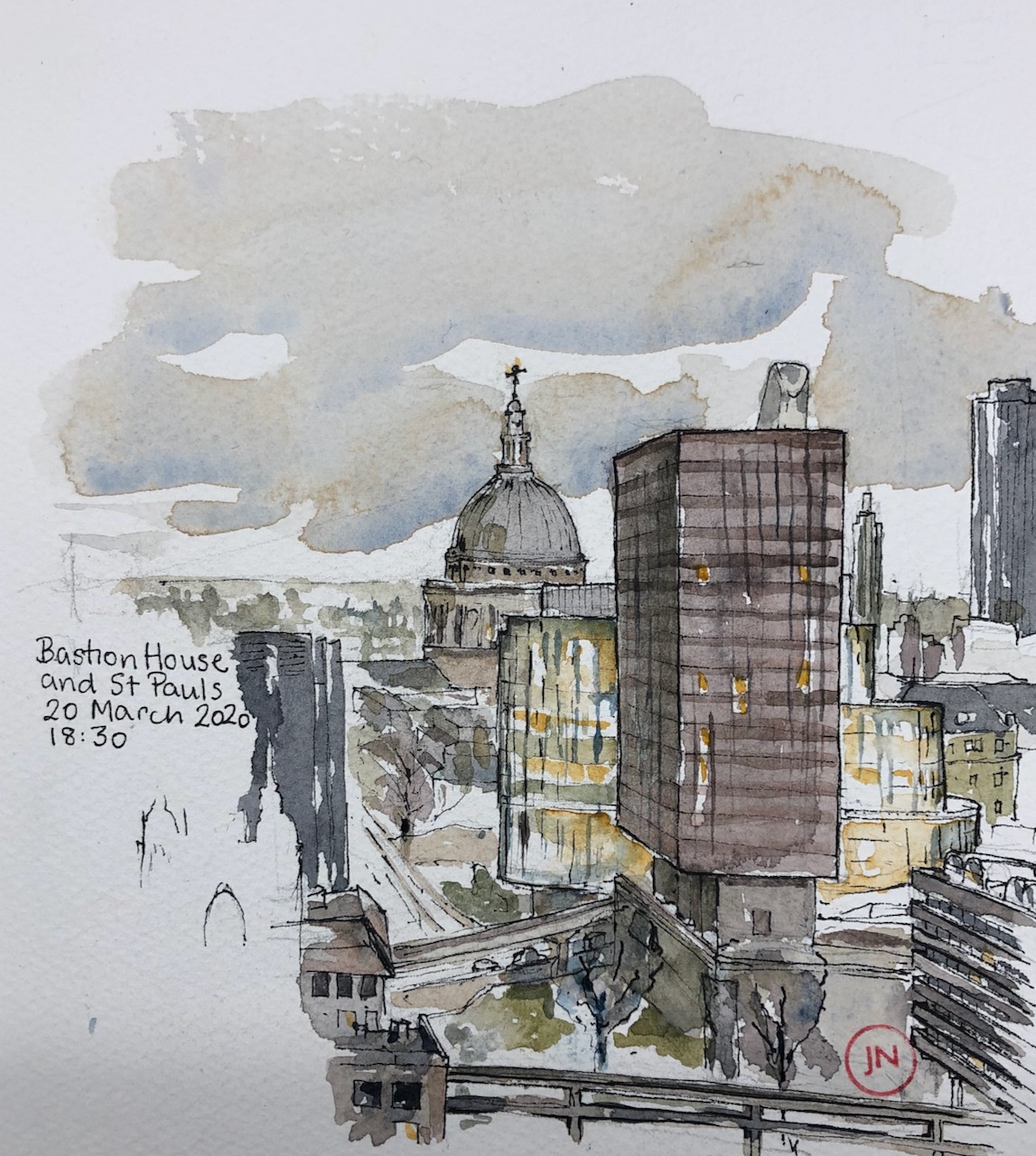
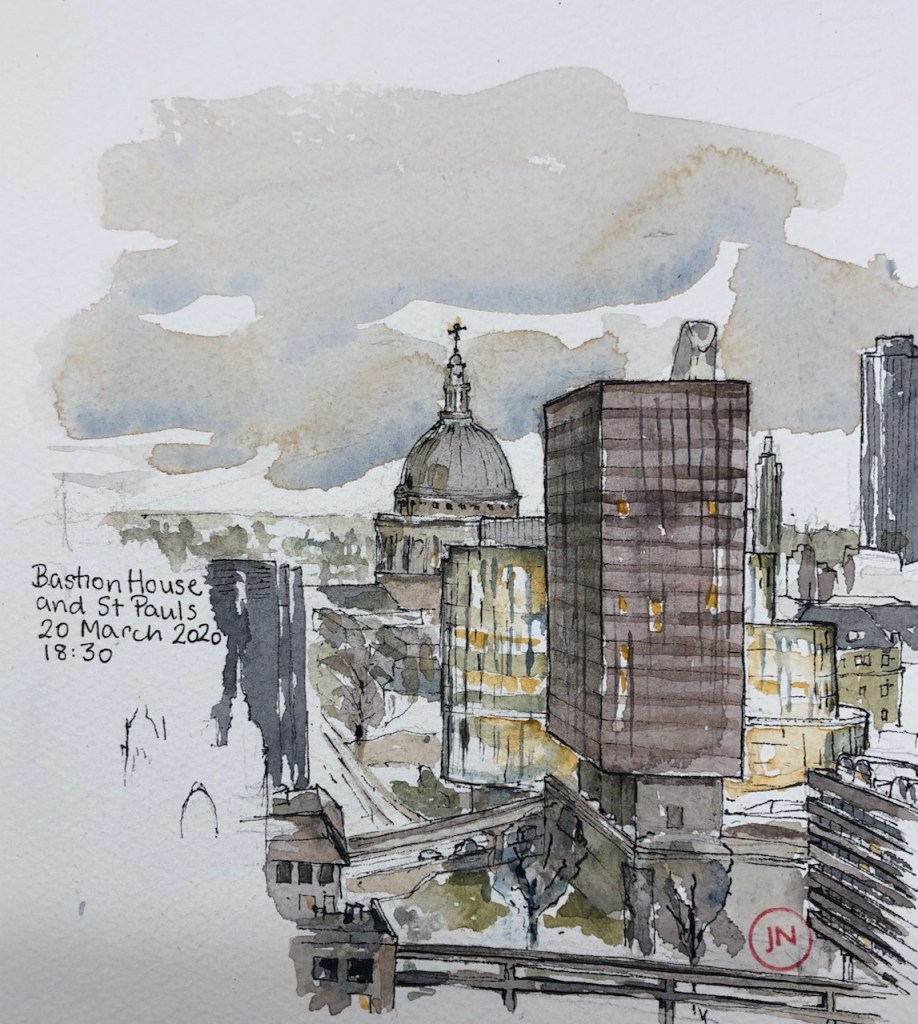
Left to right: St Pauls, an office block on London Wall, Bastion House, tower in Vauxhall, South Bank Tower.
Just visible over the top of Bastion House is the top of “OneBlackfriars”. In the foreground: Mountjoy House, Barbican, on the right. Along the bottom is the Barbican Highwalk which joins Mountjoy House and Wallside.
I hastened to draw the magnificent Bastion House, on London Wall. It is due for demolition. In the foreground you see the balcony and privacy screen of the flat in Andrewes, whose leaseholder had kindly hosted me. The line of red brick, and what looks like chimneys, in the foreground are the rooftops of a…
Bastion House aka 140 London Wall is a huge modernist monolith, reminiscent of the monolith in “2001 – A Space Odyssey”. I couldn’t find a site to draw the monolith part today, so here is a view at Podium Level, looking West towards the Museum of London. You see the dark undercroft, walkways and a…
Today Urban Sketchers London held a “sketch crawl” in the Barbican. So I joined them. An astonishing number and diversity of people assembled inside the entrance of the Barbican Centre at the appointed time of 11am. I counted about 35 and then another dozen or so joined. All shapes and sizes of people, tall, short,…
This drawing took rather a long time as I stopped a couple of times. As a result, by the time I finished, the lights were coming on in the office buildings, and the sky was dark.



































 Jane Sketching