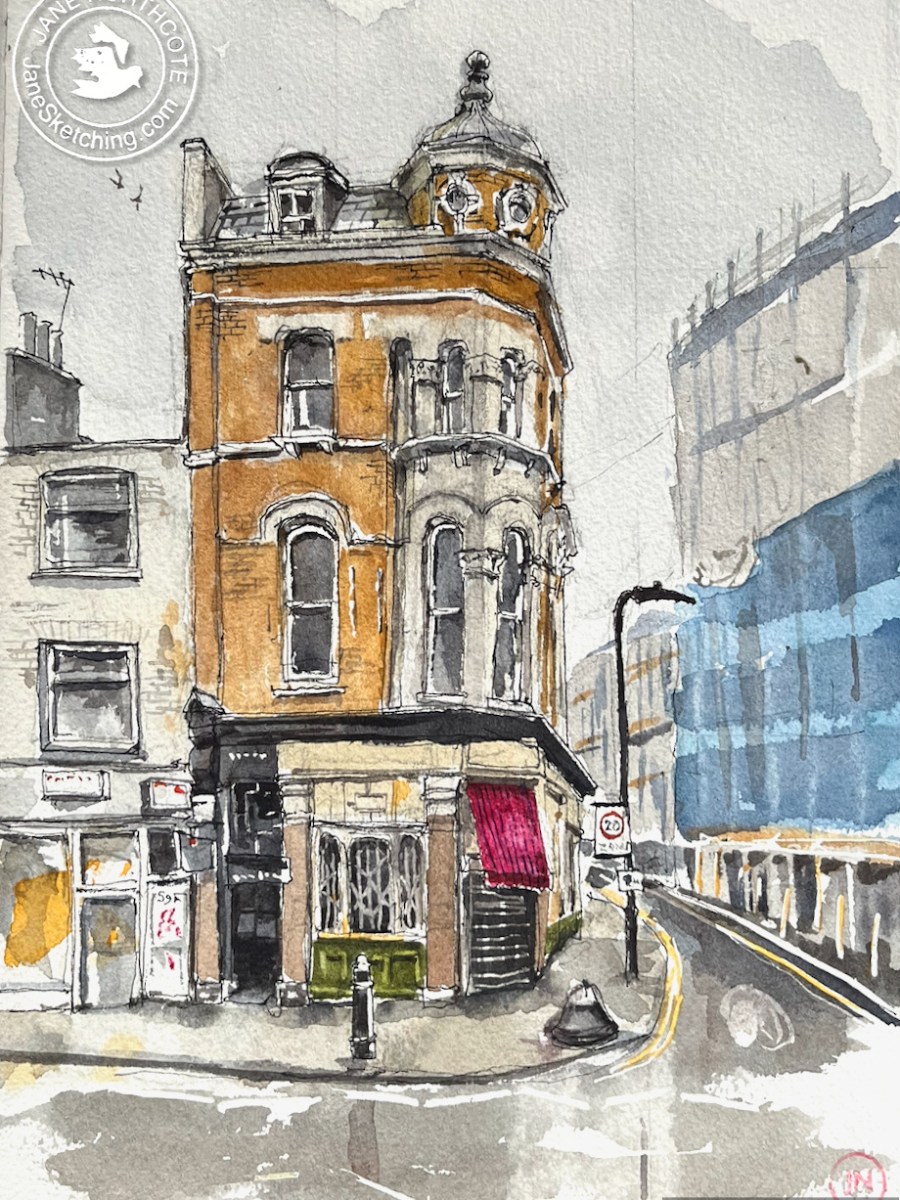
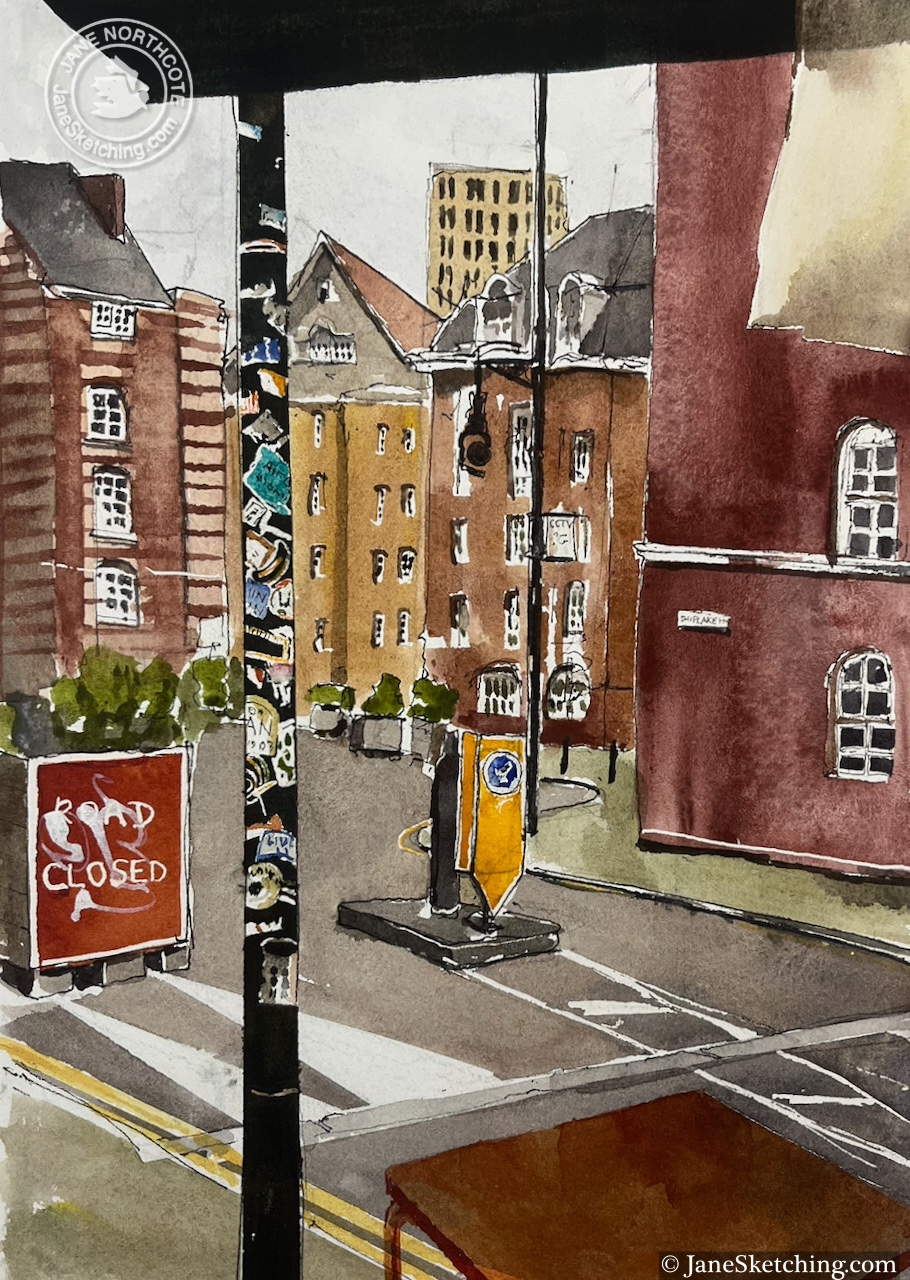
North side of Broadgate Circle, EC2M

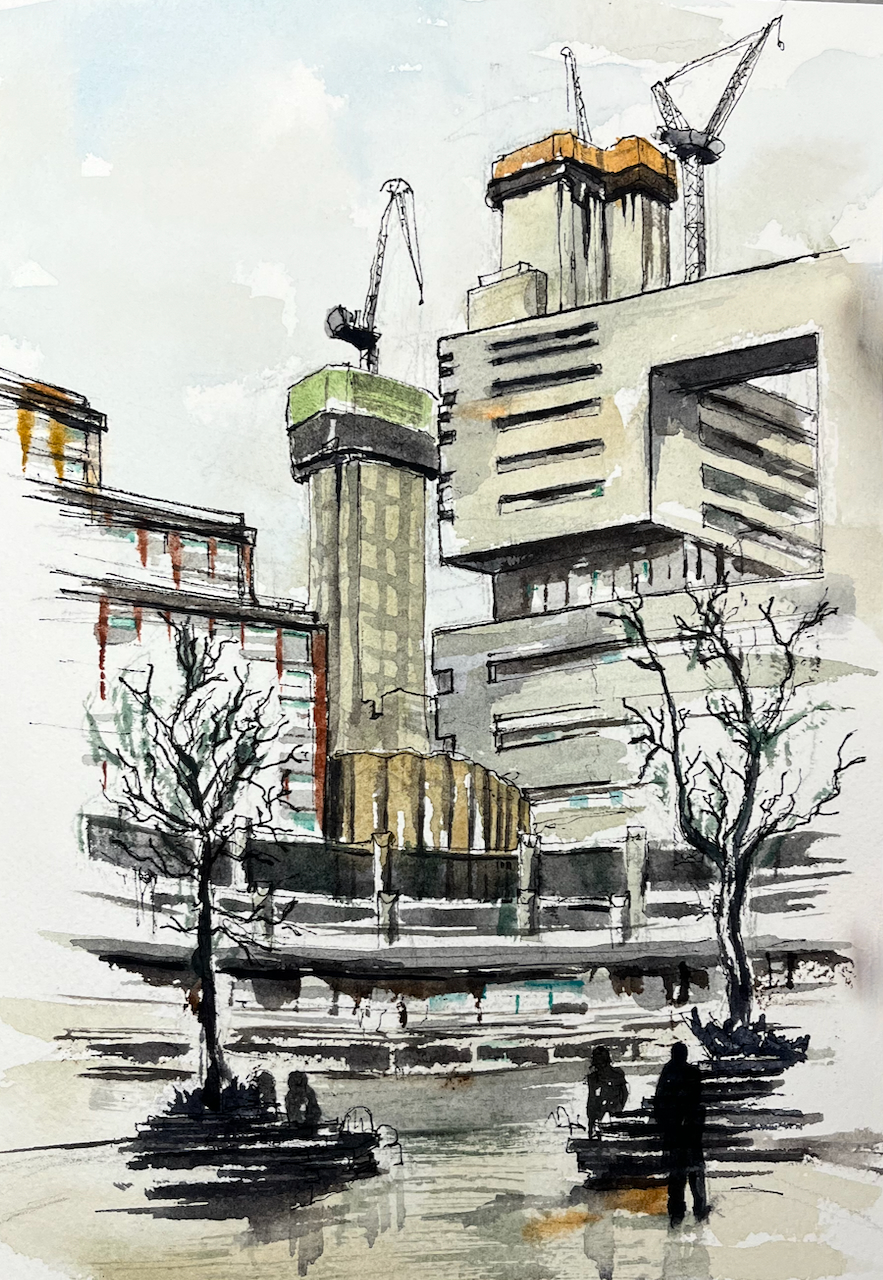
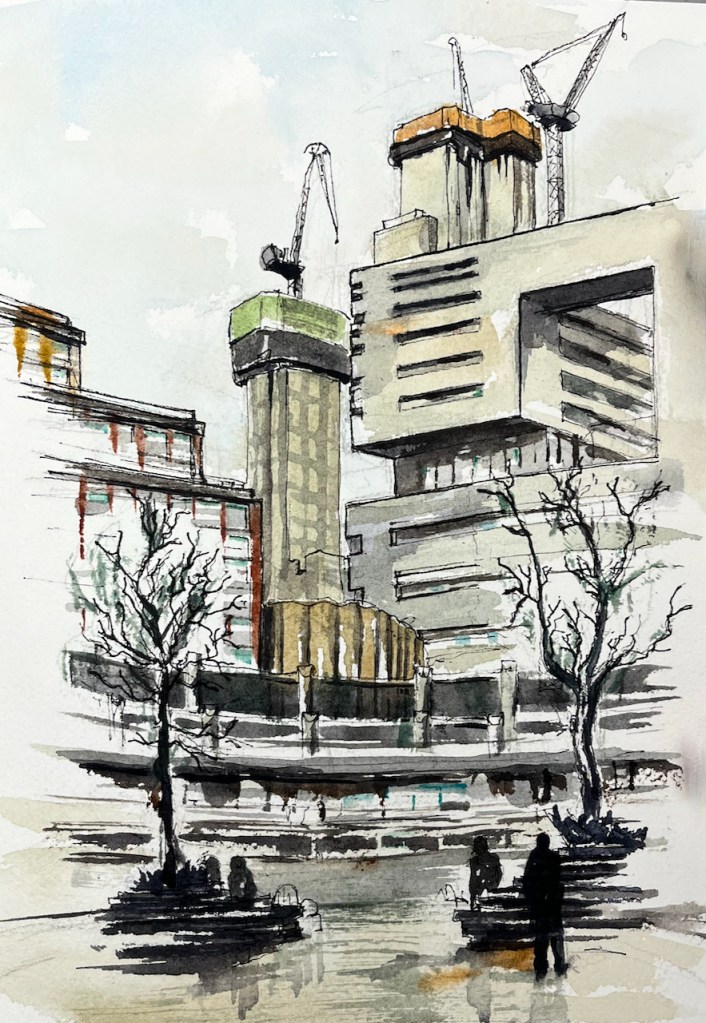
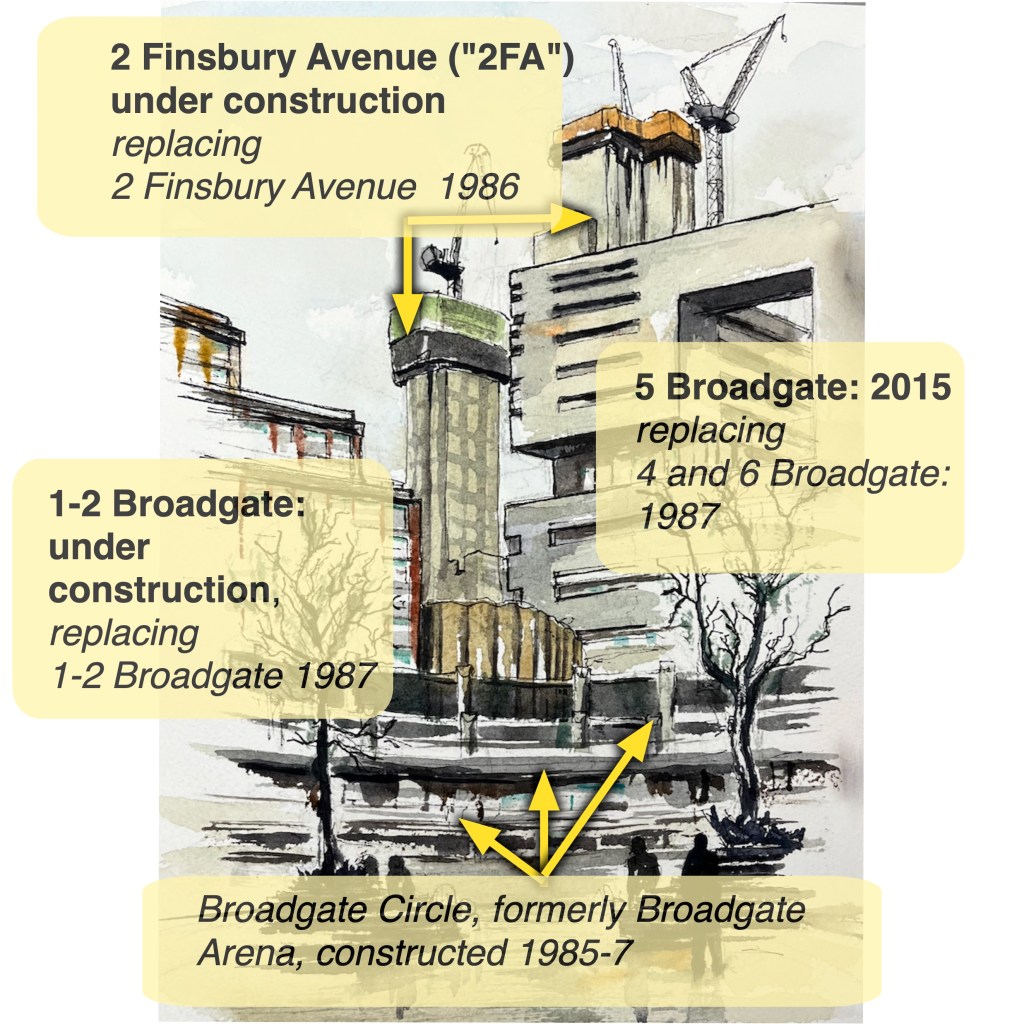
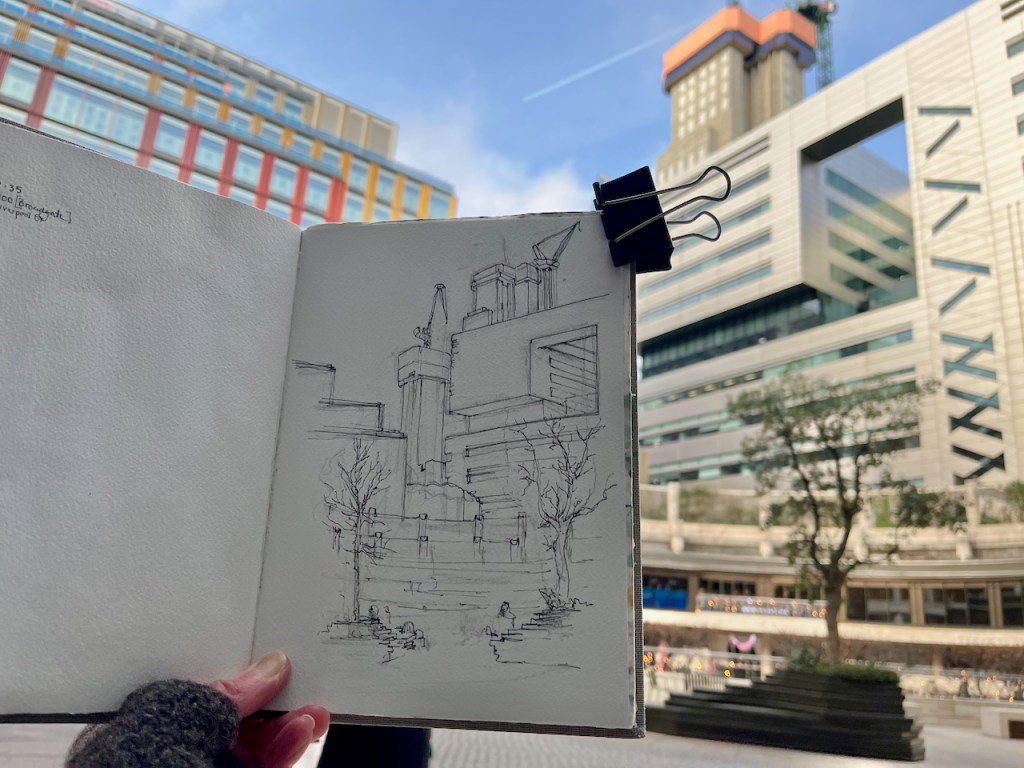
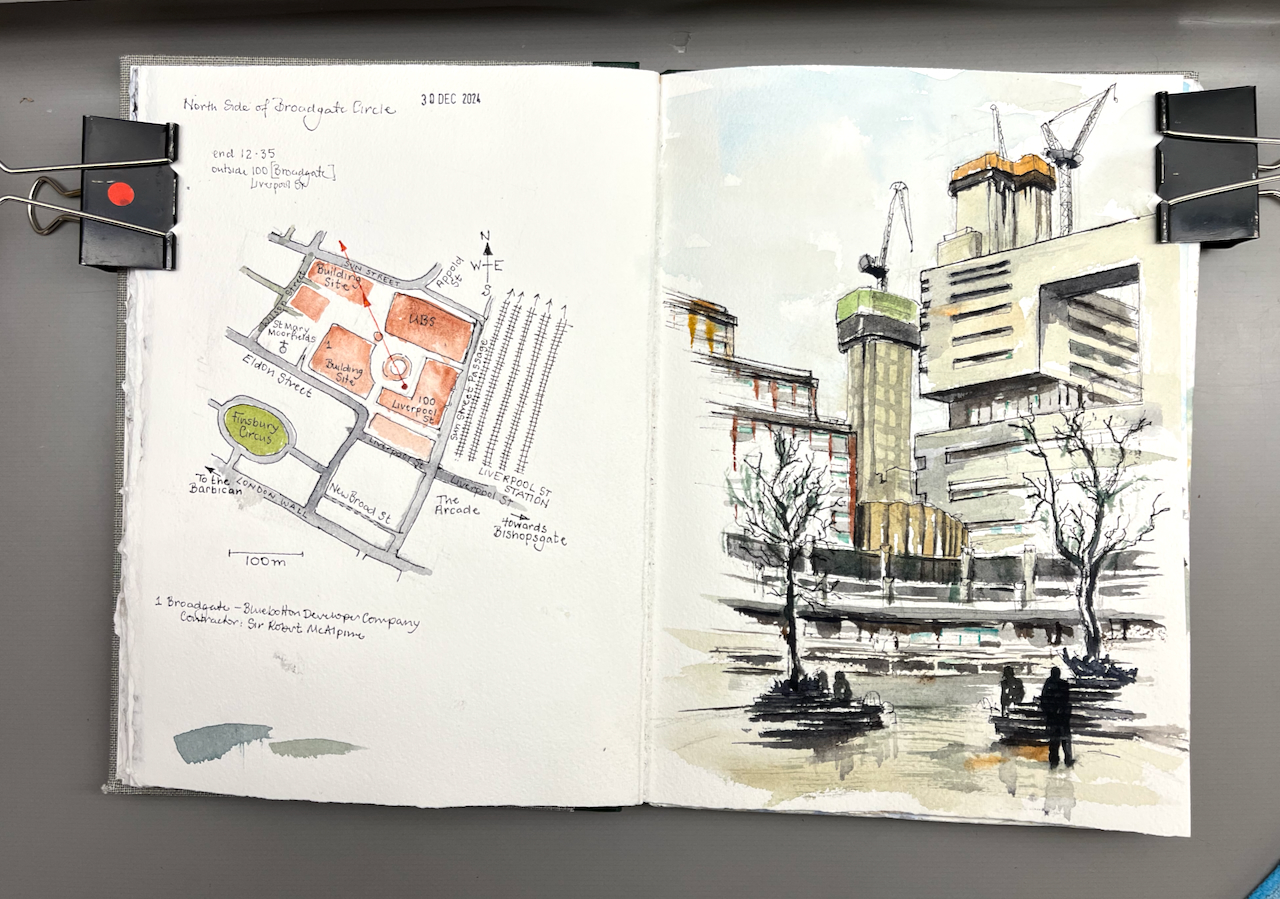
Broadgate Circle is undergoing massive redevelopment. Here is the view looking North.

View of the North side of Broadgate Circus, 2 Finsbury Avenue under construction.
Sketched, 30 December 2024 in sketchbook 15.

The concrete cores in the background are 2 Finsbury Avenue under construction. The previous building was demolished. On the left is 1-2 Broadgate, replacing previous buildings. The steel-clad building on the right is 5 Broadgate which replaced 4 and 6 Broadgate and sealed up the access road that led between them.

Building replacement: after 40 years, all change.

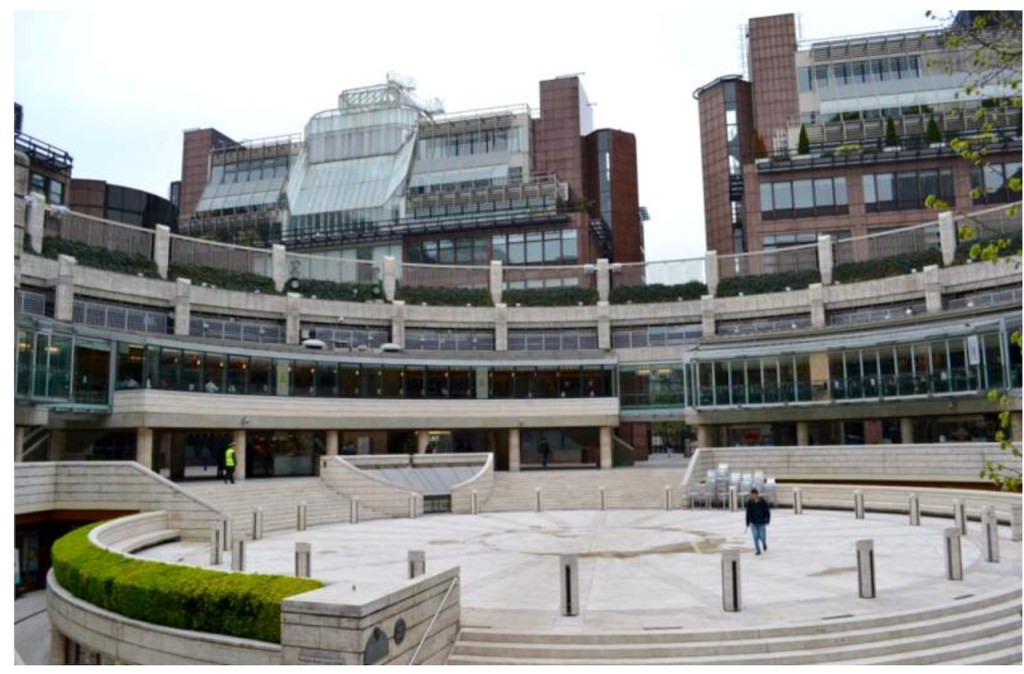
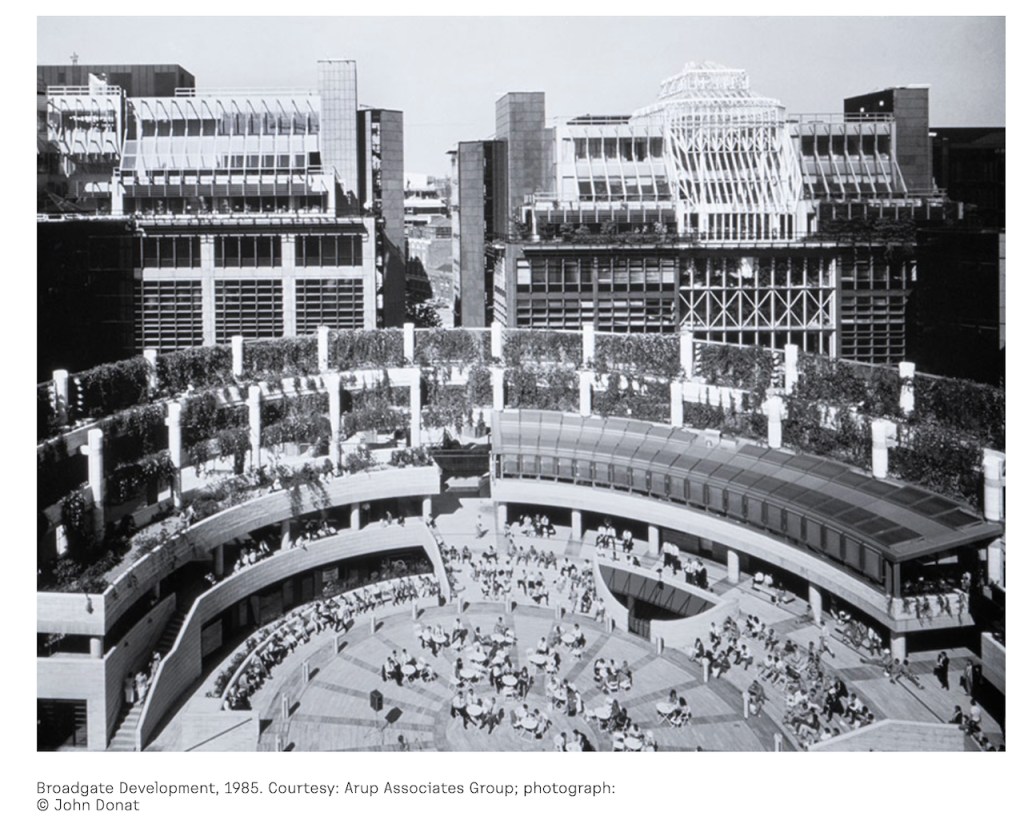
Broadgate Circle was constructed in 1985-7 on the site of the former Broad Street station. Here is what the 1980s buildings looked like:

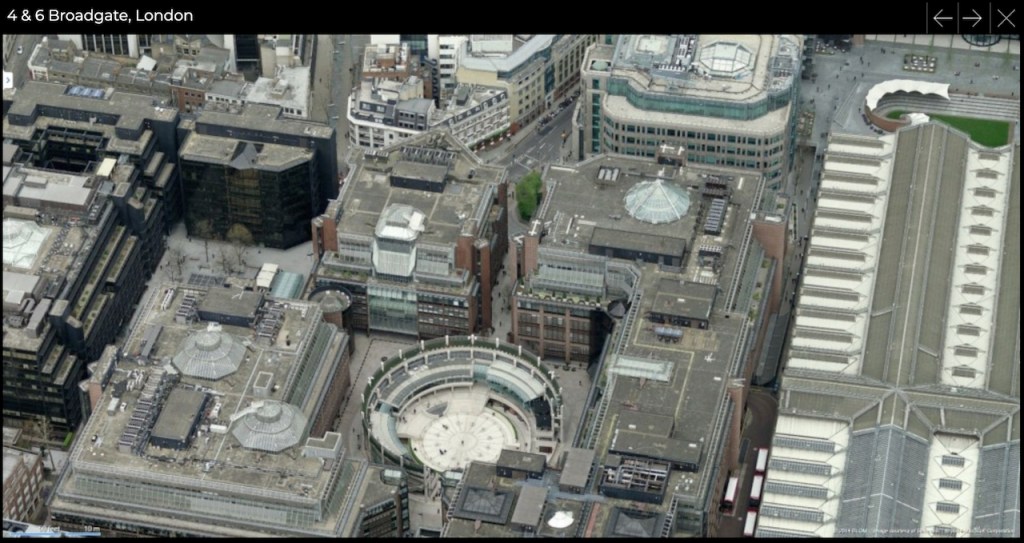
4 and 6 Broadgate, on the North side of Broadgate Circle, before 2012.
From: https://knowyourlondon.wordpress.com/2015/09/14/broadgate-circle/

5 Broadgate, on the right of my sketch, replaced the two buildings in the photo above. It is occupied by the bank UBS. The building has its own Wikipedia page:

The two lowest storeys contain a 200-seat auditorium, restaurants, a gym, and a dry cleaner. Above those are four trading floors which can fit 3,000 people each, as well as seven storeys of offices above. The superstructure is divided into a grid of 13.5-by-12-metre (44 by 39 ft) sections, arranged around the trading floors. Three of the building’s four utility cores are placed along the site perimeter to increase the amount of space on each trading floor.

Wikipedia – https://en.wikipedia.org/wiki/5_Broadgate

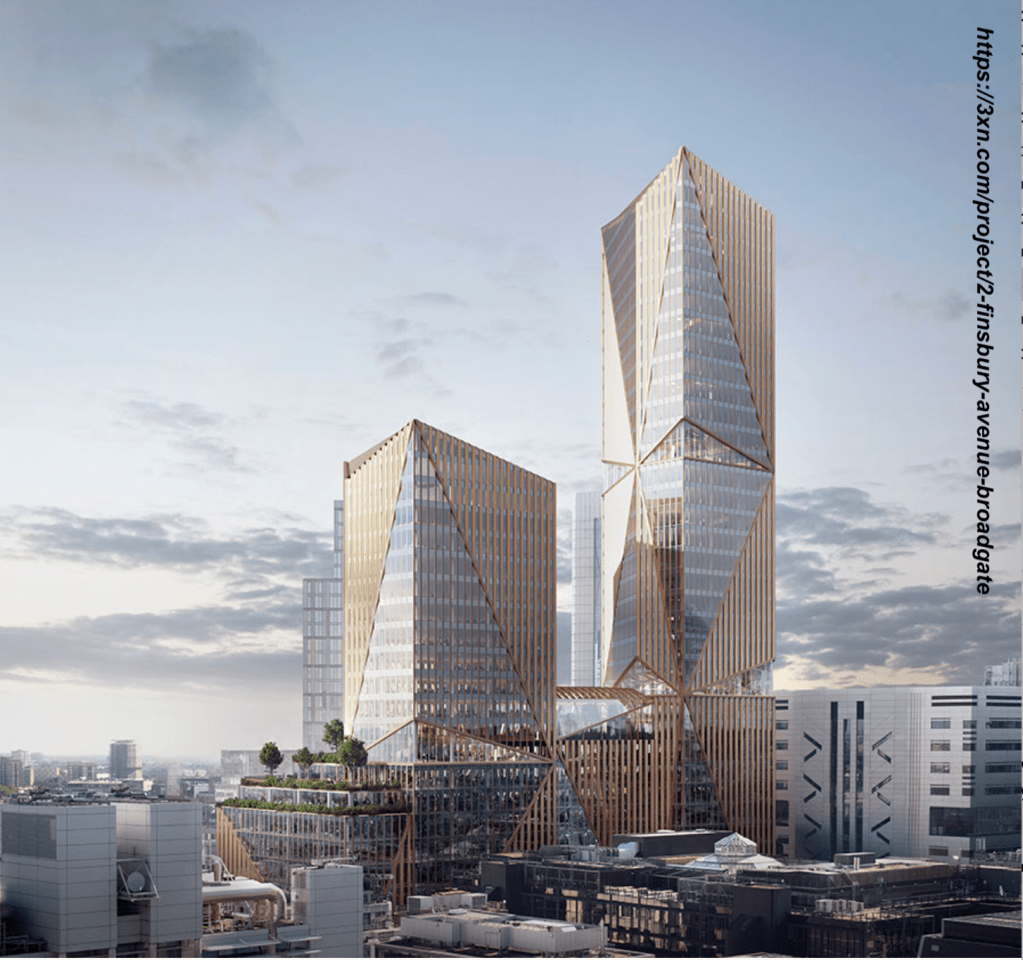
The new 2 Finsbury Avenue “consists of a 12-storey podium with a 21-storey West Tower and 36-storey East Tower.”1 It is due to be completed in 20272 and will look like this:

The new 2 Finsbury Avenue, from the website of the architects 3XN.
For scale: 5 Broadgate Circle is on the right of this picture, with the >< signs on the side.

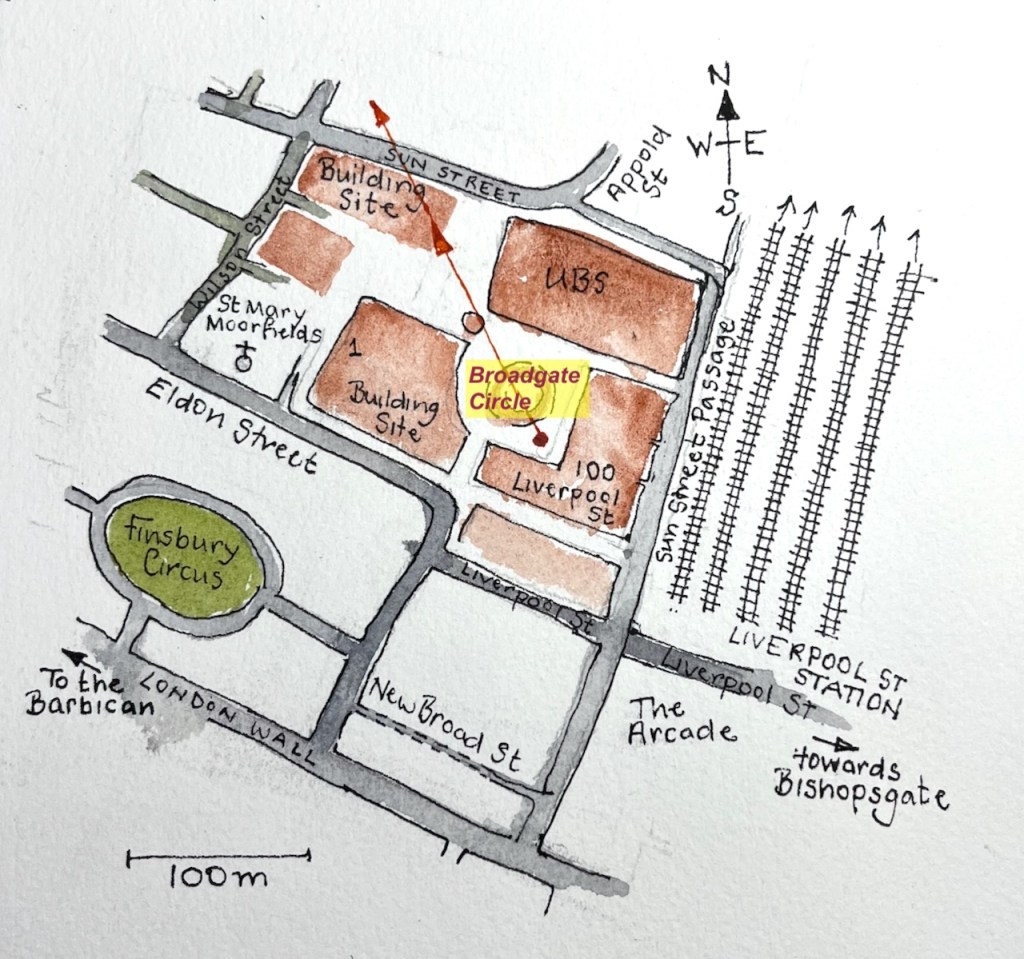
Broadgate Circle is owned as a joint venture between British Land and GIC3. It is adjacent to Liverpool Street Station on the East side of the City of London.

Sketch map showing the location of Broadgate Circle, and my viewing line for the sketch

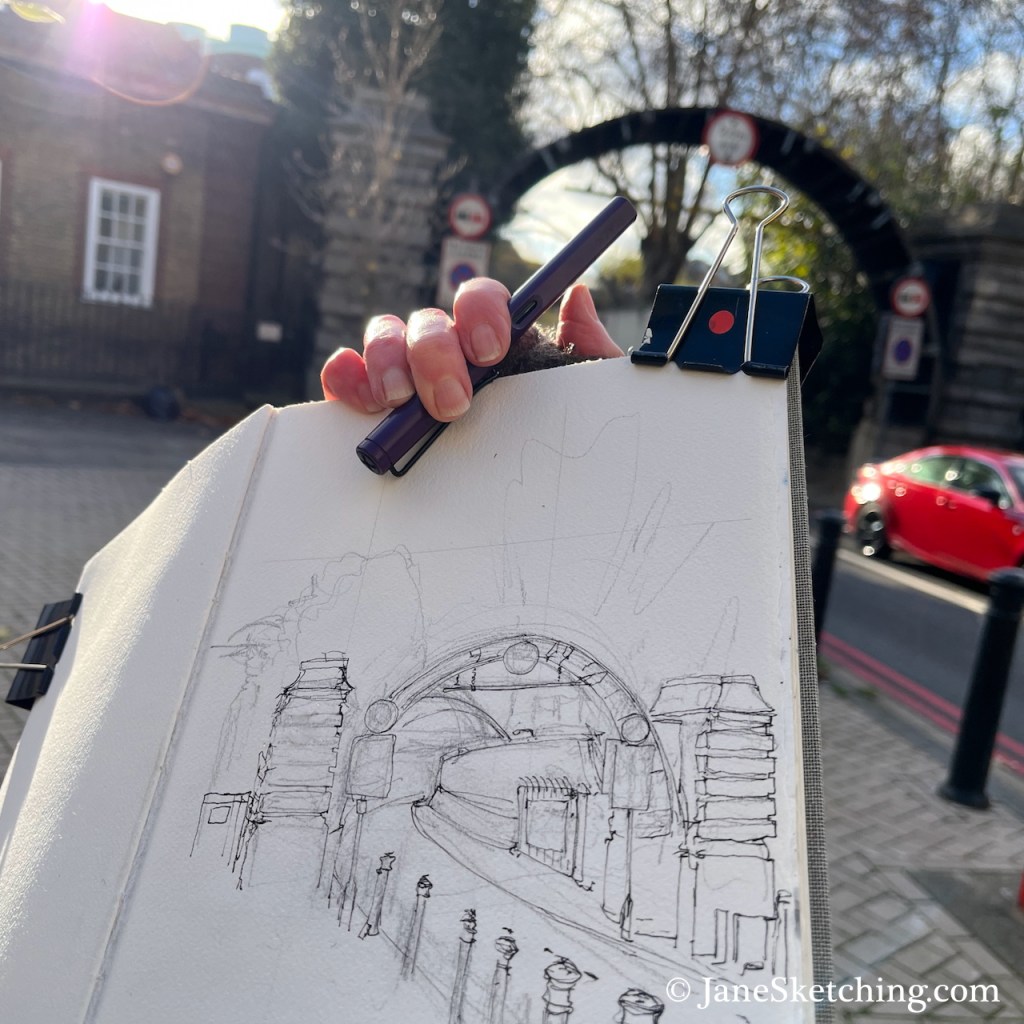
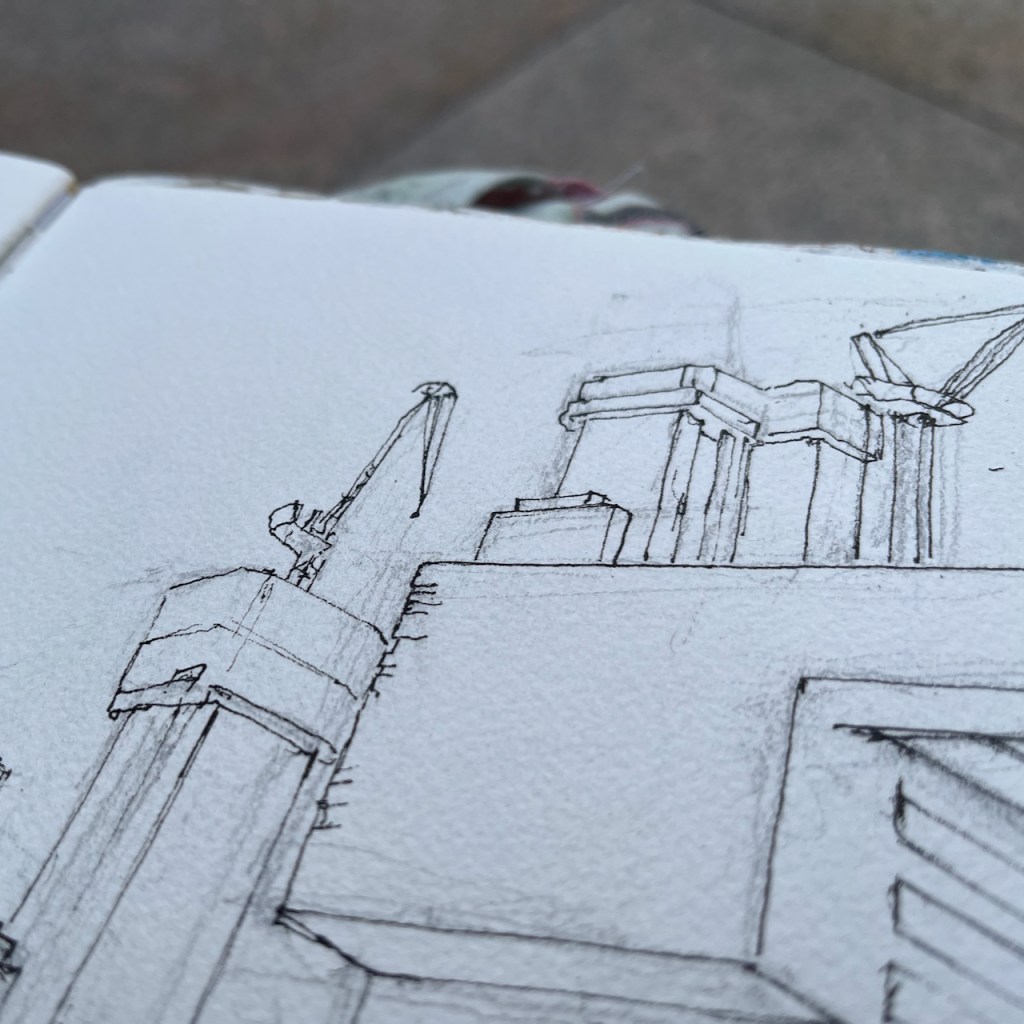
Here are photos while I was sketching:

Here are links to more views of the 1980s buildings:

Sketchbook 15
  1. Pictures and descriptions of the new 2 Finsbury Avenue are from the architects’ website: https://3xn.com/project/2-finsbury-avenue-broadgate ↩︎
  2. 18 April 2024 Press release from British Land and GIC. See the press release on this link, file attached below in case the link has expired. https://www.britishland.com/news/broadgate-secures-landmark-pre-let-at-2-finsbury-avenue/ ↩︎
  3. British Land is a UK property developer and GIC is “a leading global investment firm established in 1981 to secure Singapore’s financial future”. GIC is “the manager of Singapore’s foreign reserves” Quotes are from press release below. ↩︎
Nyon, view from the castle

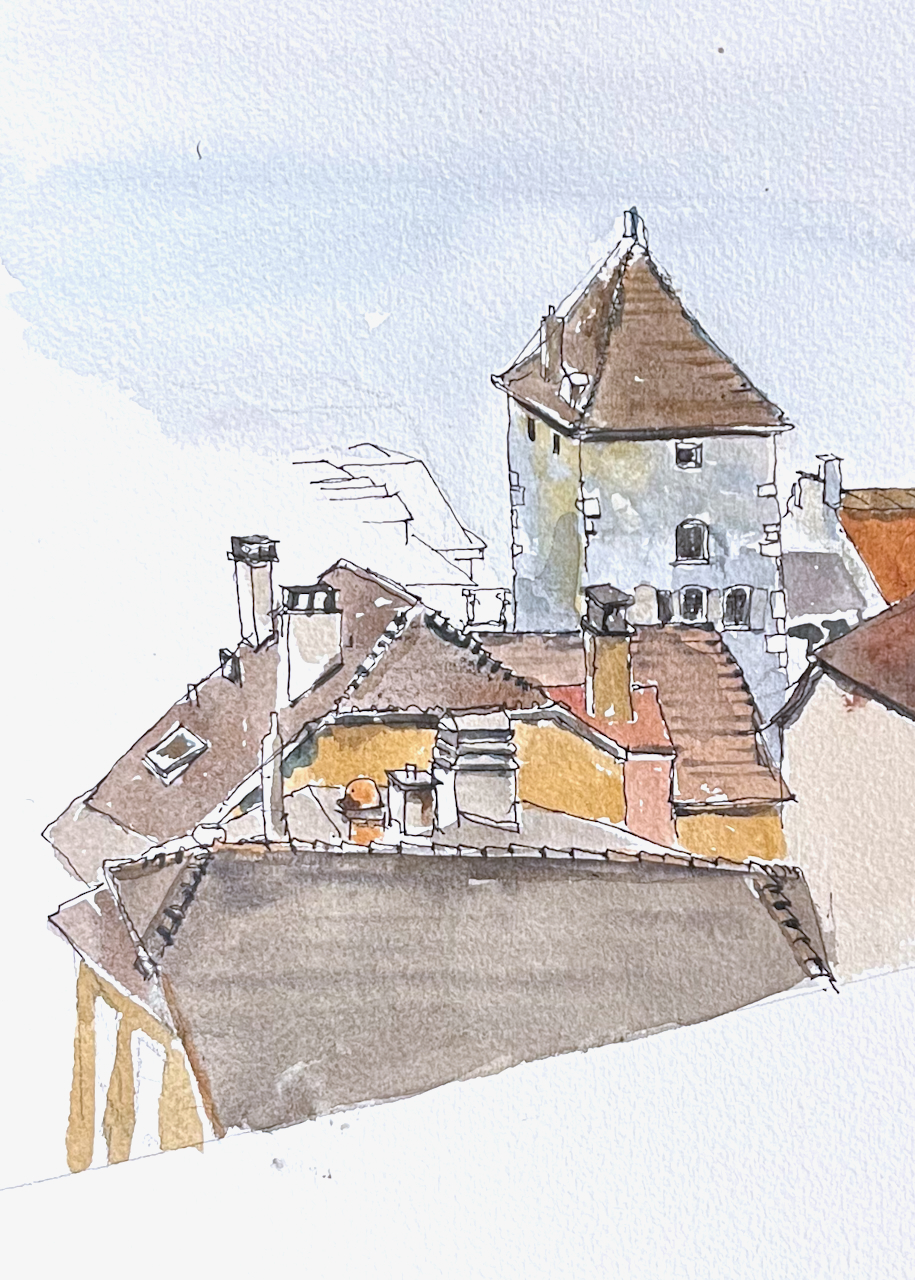
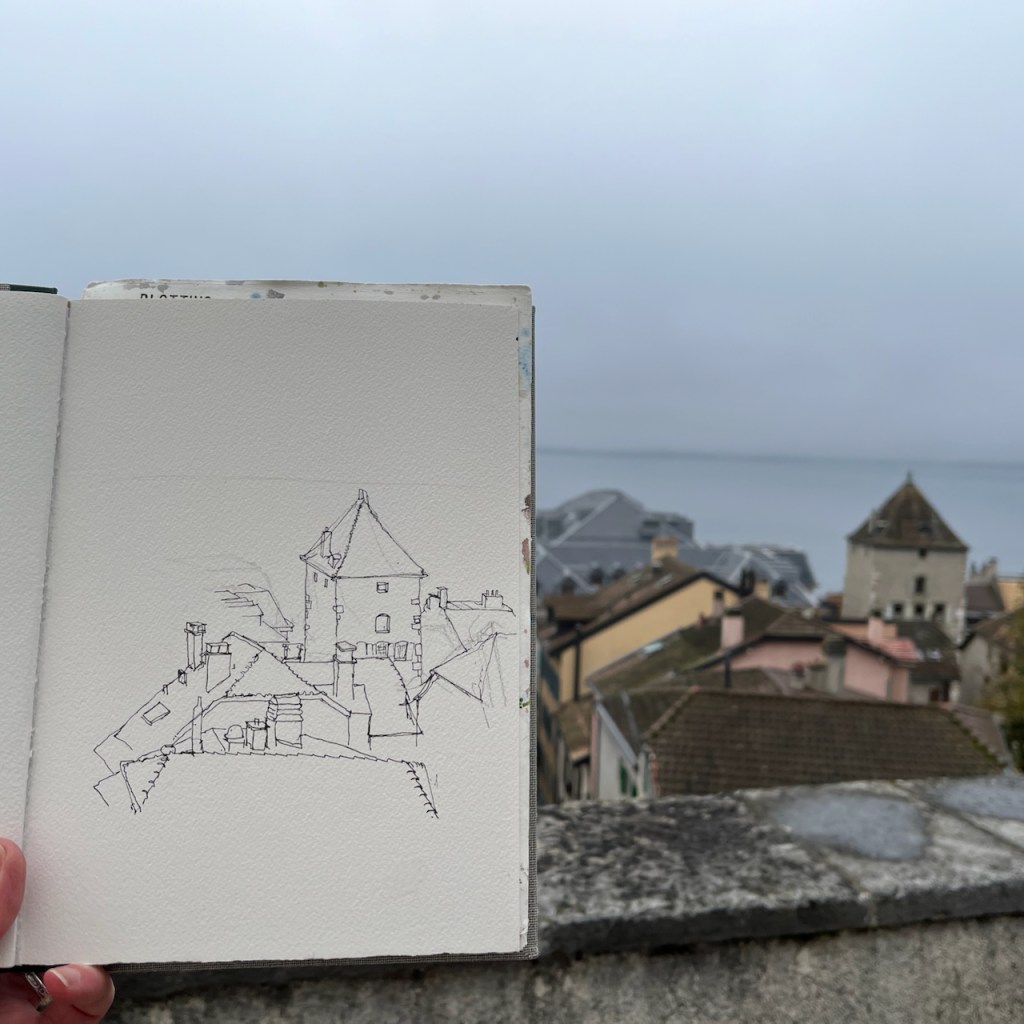
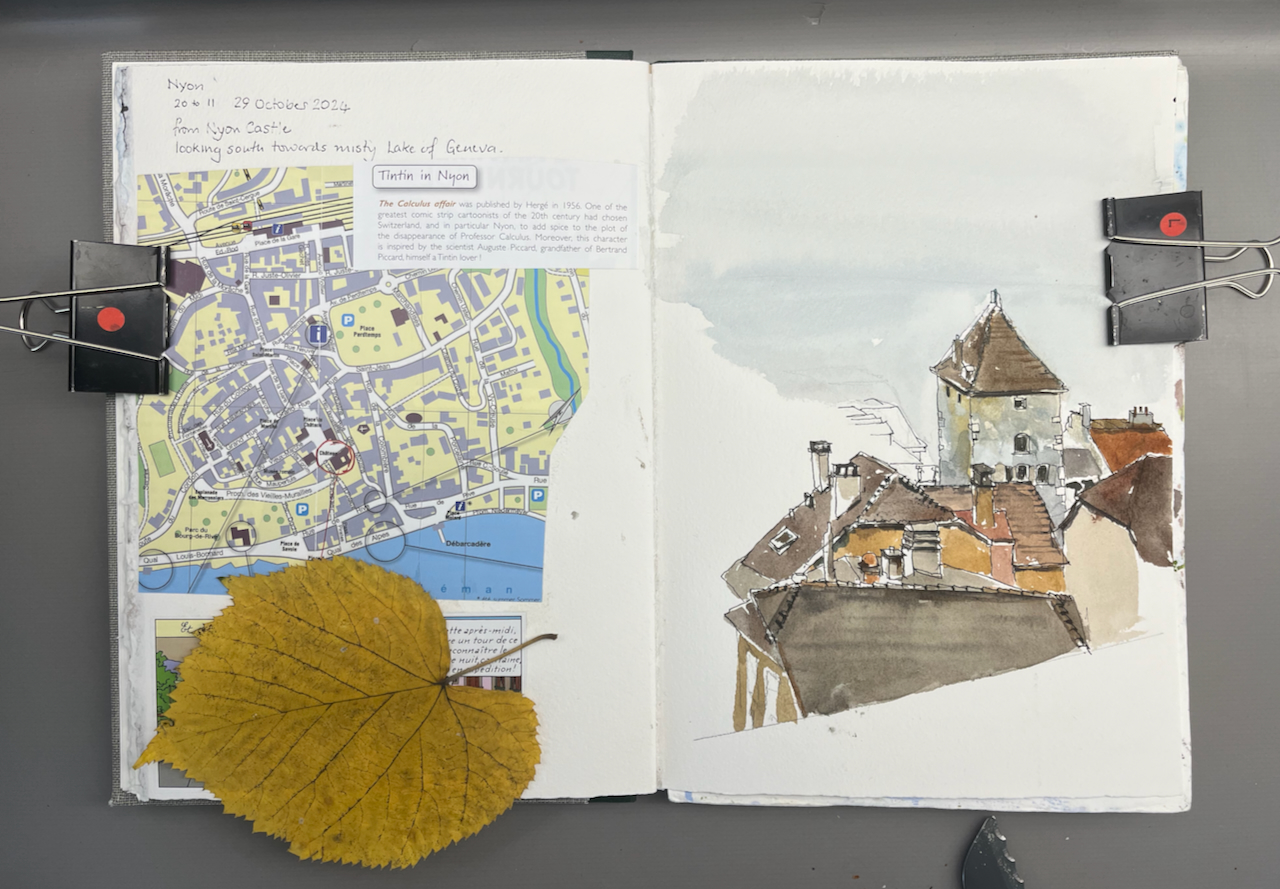
Standing on the ramparts of the castle at Nyon, I look towards Lake Geneva.

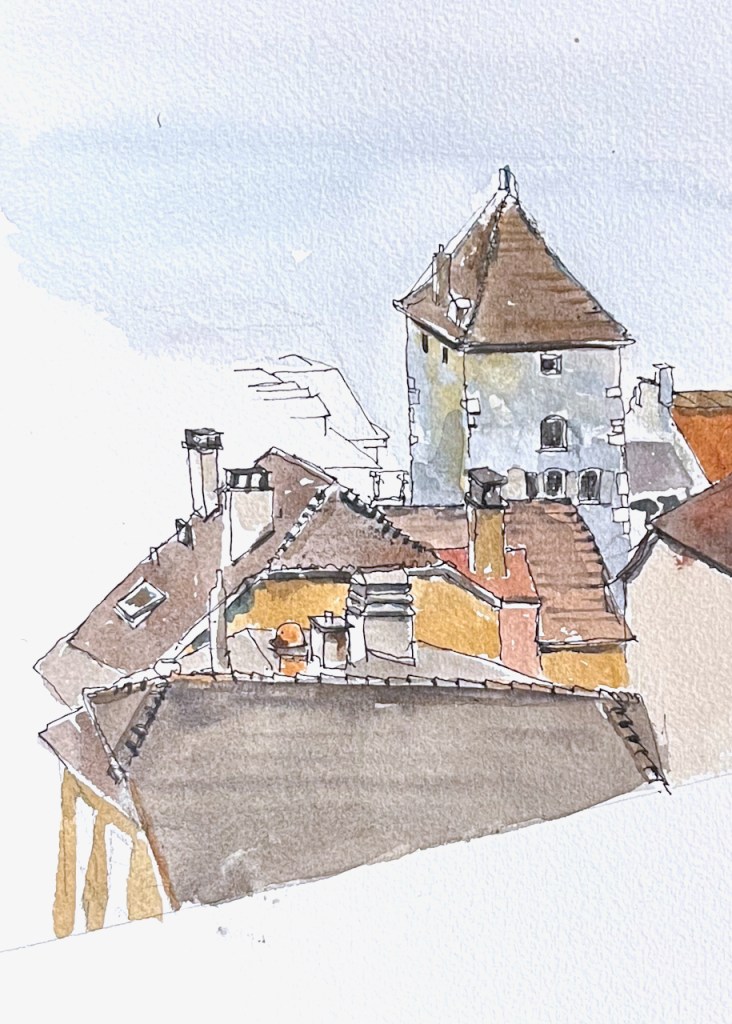
Rooftops from Nyon Castle, 29 October 2024 in Sketchbook 15

The tower in the picture is at the junction of Rue de Rive and Passage des Pirates, Place Abraham HERMANJAT 1862-1932. I can find its position on a map, but it is unremarked and seems not to have a name. If there is any citizen of Nyon out there who can identify it, I’d be very grateful.

Lake Geneva is in mist, in the background of the picture. The mist came and went as I was sketching. It was extremely cold.

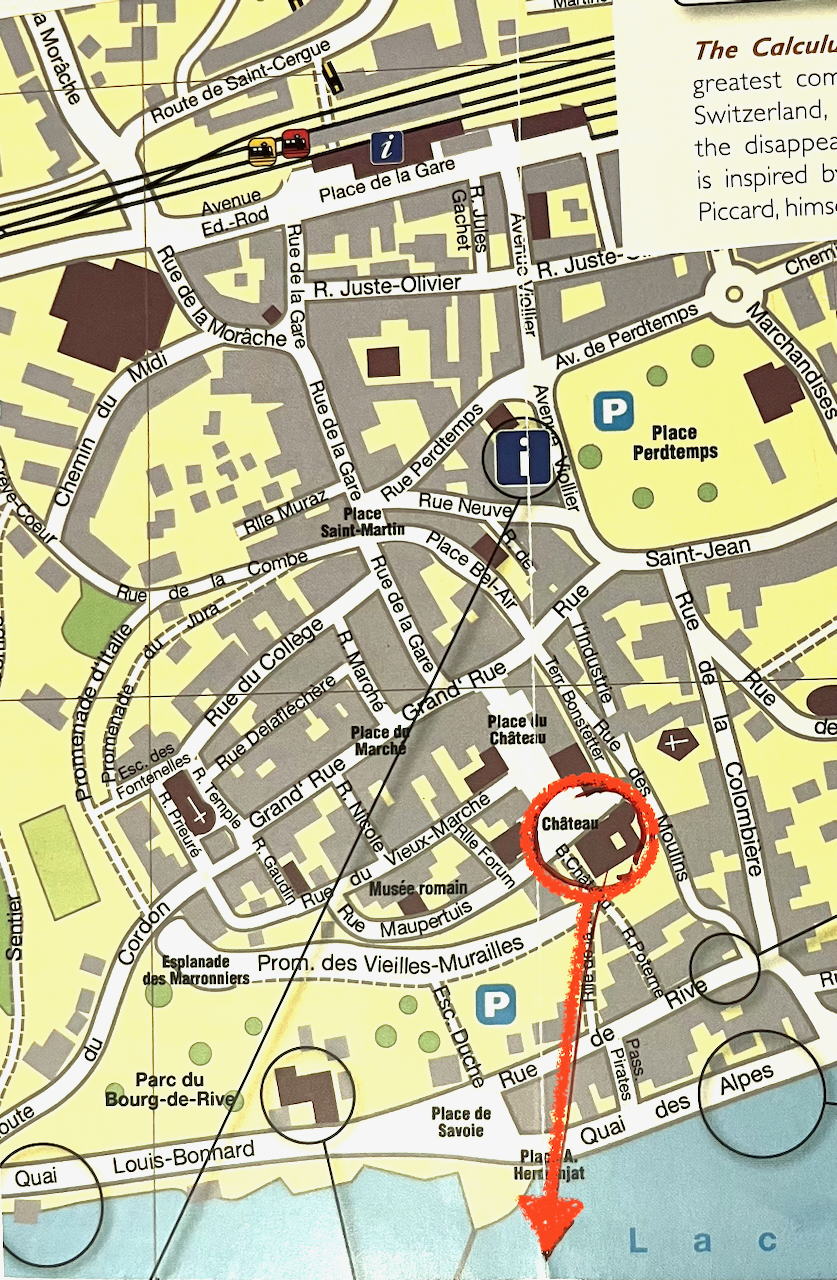
Map from Nyon tourist office, showing the sightline of the drawing.
Nyon is easy to navigate because it is on a slope, from the train station at the top of the map down to Lake Geneva at the bottom of the map.

The map above came from the Nyon Tourist Office who also offered a leaflet reminding me that part of the action in the Tintin book “L’Affaire Tournesol” took place in Nyon. This book is called “The Calculus Affair” in English. On page 21, you can see the the white car which takes Tintin and Haddock along the lake. It has Vaud number plates (“VD”).1 The fire engine which rescues them from the ruins of the house on page 27 is, according to the tourist office, carefully preserved in a local museum.
I read the Tintin books assiduously as a child, and again, in French, years later. I think the pictures influenced my drawing style, and may be why I like to draw in pen and wash today. So as well as being a record of a moment spent on the freezing battlements of Nyon Castle, the drawing above is my small homage to the great Hergé.

Sketchbook 15, with items from the leaflet “Tintin in Nyon”, and a leaf.
  1. The images from the Tintin books are protected by copyright, so I am not including them here. But do have a look if you have a copy of the book at home. ↩︎

E5 Bakehouse, London E8

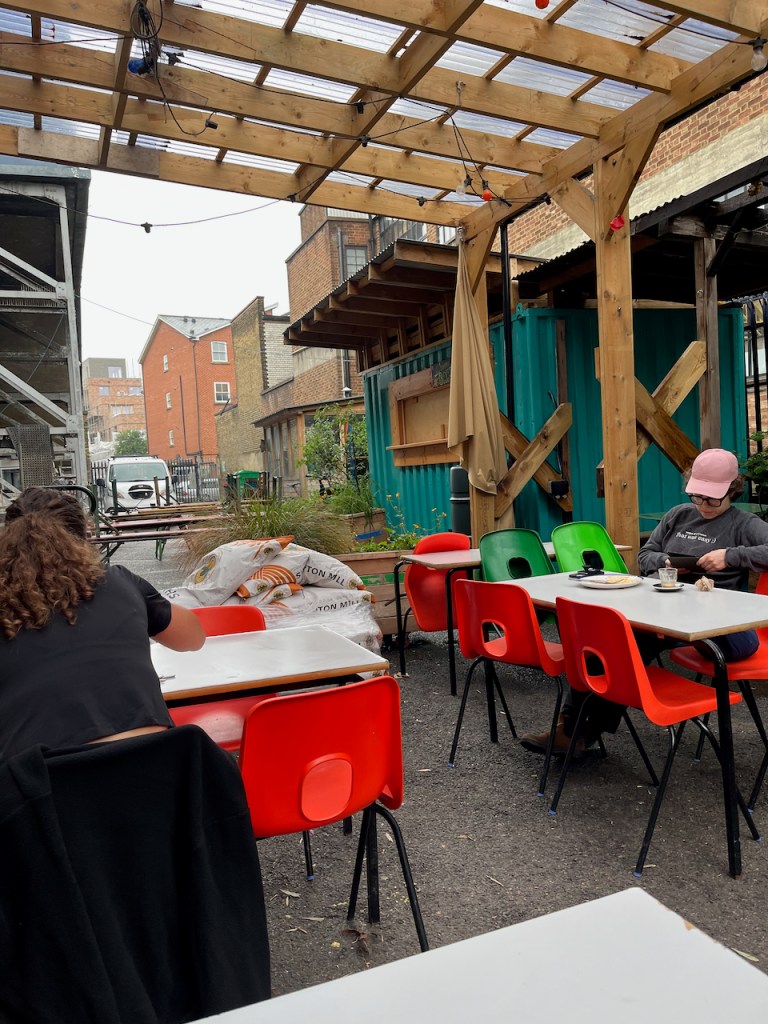
Sometimes I go out and find a view for my sketch. Sometimes the view is determined simply by where I find myself. Here is one of those occasions.

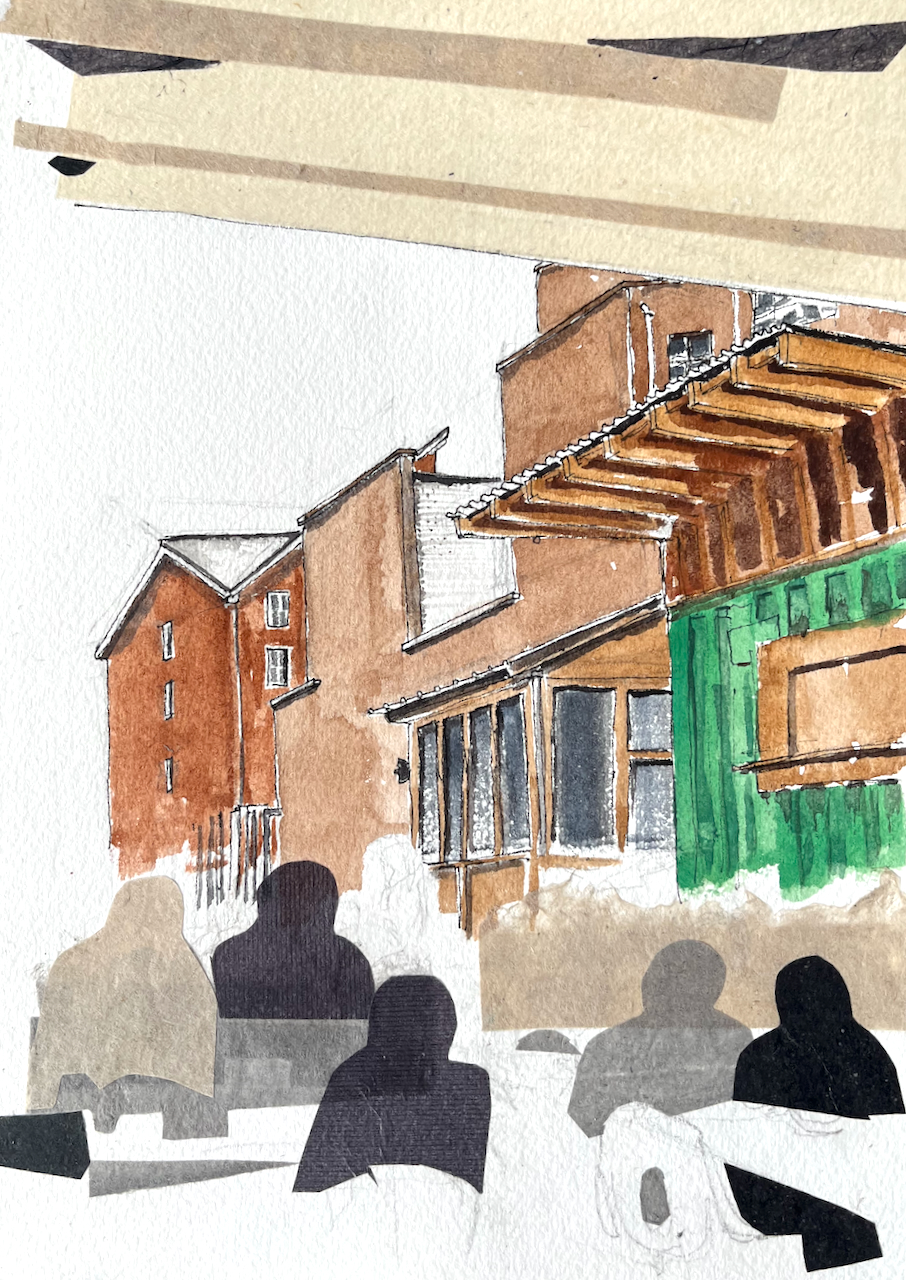
I had breakfast in the seating area at the back of E5 Bakehouse. At 09:15 I was the only person out there. I looked at the view. The various roofs made interesting angles. The cyclist who delivers their bread arrived and loaded up his formidable cargo bike. Customers arrived, and came outdoors. The tables filled up, each new arrival nodding a greeting to those of us already there. People made room for each other. It was quiet, no background music, perfect. I went back to the counter and bought another Gilchester bun. Time to do a sketch.

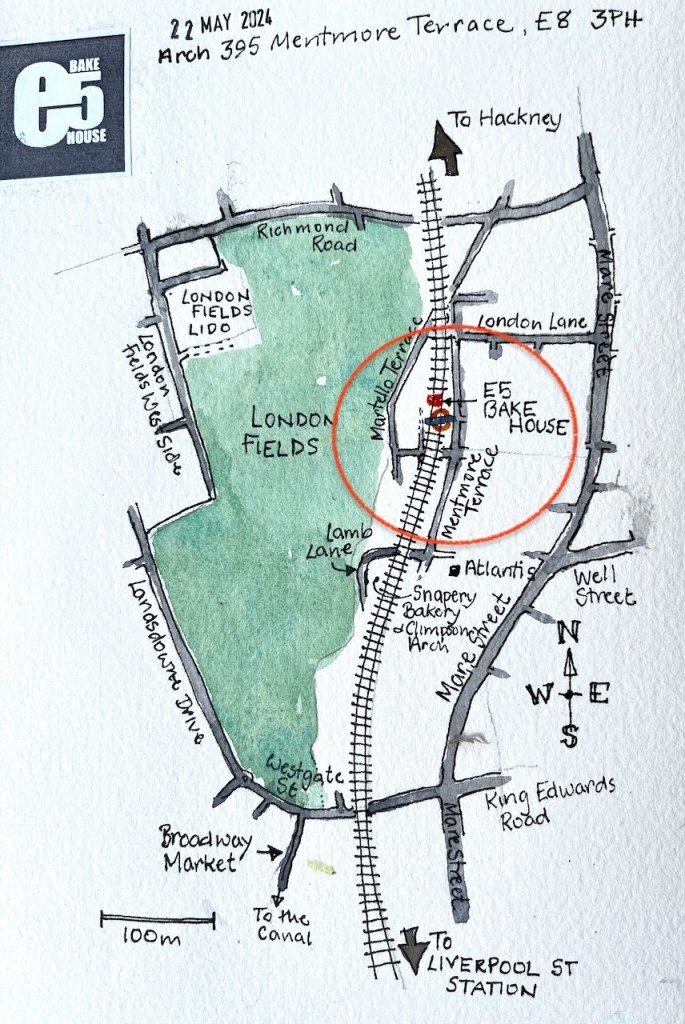
E5 Bakehouse is not in E5 but in E8, right next to London Fields Overground Station, on the line out of Liverpool Street. Their website says

“The name E5 is a nod to our former local postcode and our intention to remain rooted in our community.”

They produce wonderful bread and pastries. My fellow customers were enjoying substantial breakfasts of eggs and all sorts of greens, or a kind of piled up yogurt and fruit dish. My favourite is the Gilchester bun: the archetypal currant bun – “Made using Gilchester’s organic flour , these are so simple and so tasty you can eat them on their own, or toasted even just with butter is all you need!”

A colleague of mine once told me that the way he judged a hotel was to ask for a glass of orange juice. The orange juice told him all he needed to know, he asserted. Was it fresh pressed, or out of a bottle? Was it served in a glass or a paper cup? Did they provide a spoon to stir up the bits?

For me, a currant bun is the test of a bakery. Those at E5 set the standard for currant buns the world over. The currants are numerous, the bread is soft and all the sweetness is from the currants. They are just superb. So that’s why I needed another one.

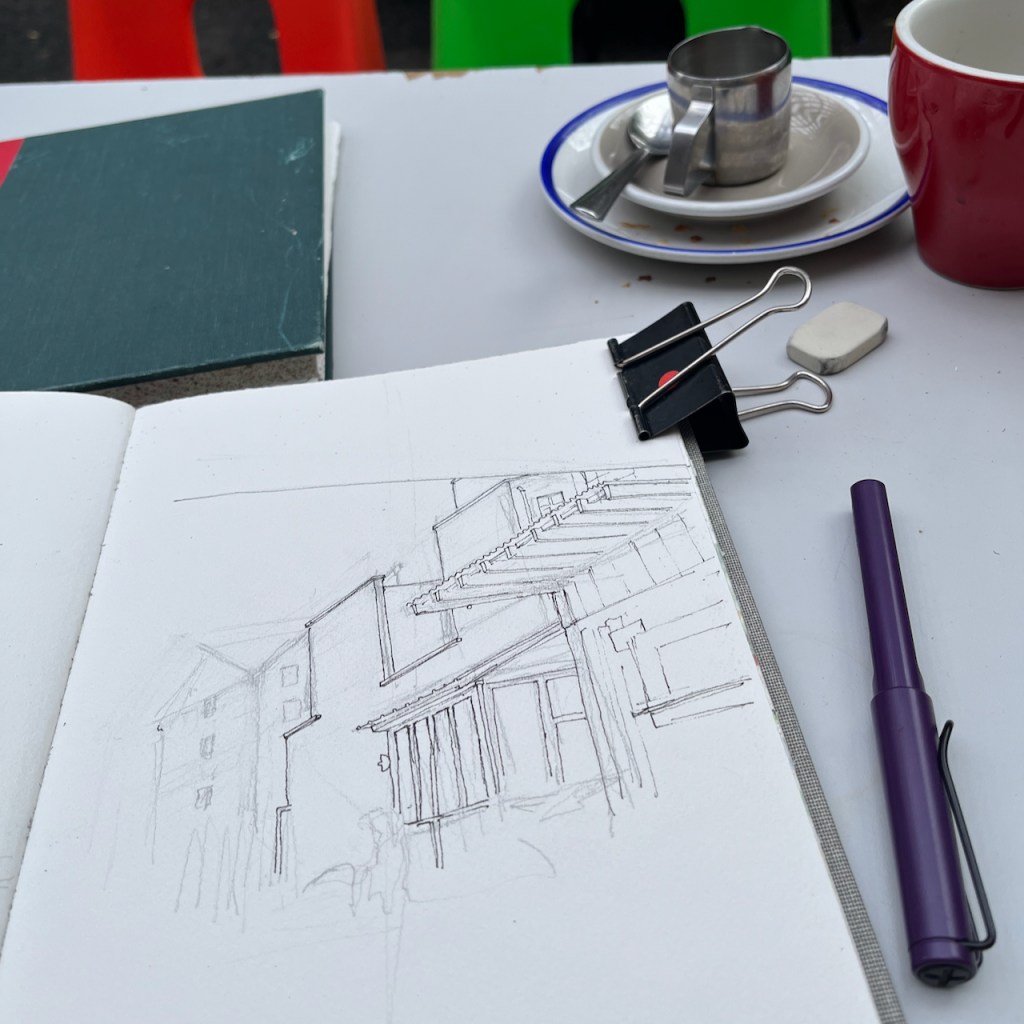
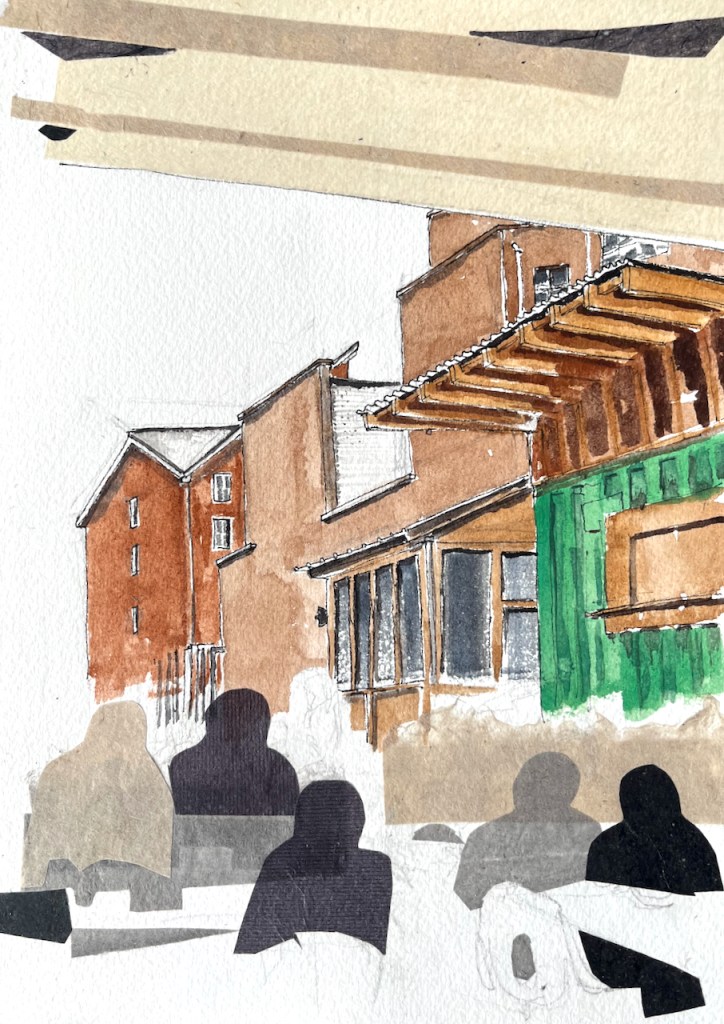
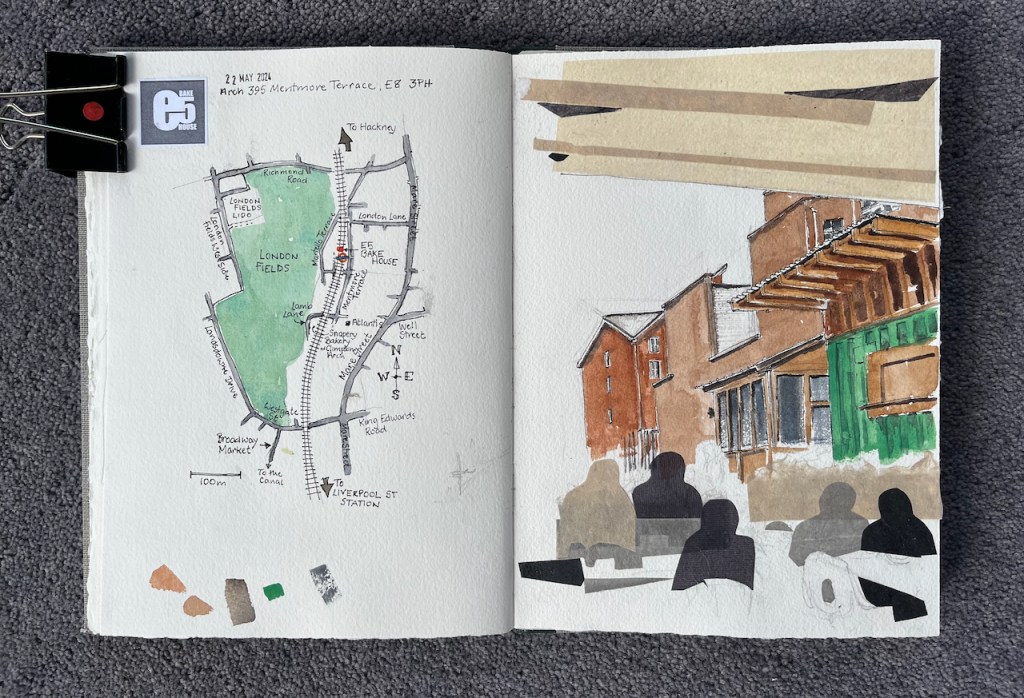
Here’s the finished picture. I added the collage at my desk at home.

Breakfast at E5 Bakehouse, watercolour and collage, 10″ x 7″ in sketchbook 14.
Page spread: sketchbook 14

City Road 400kV Substation EC1

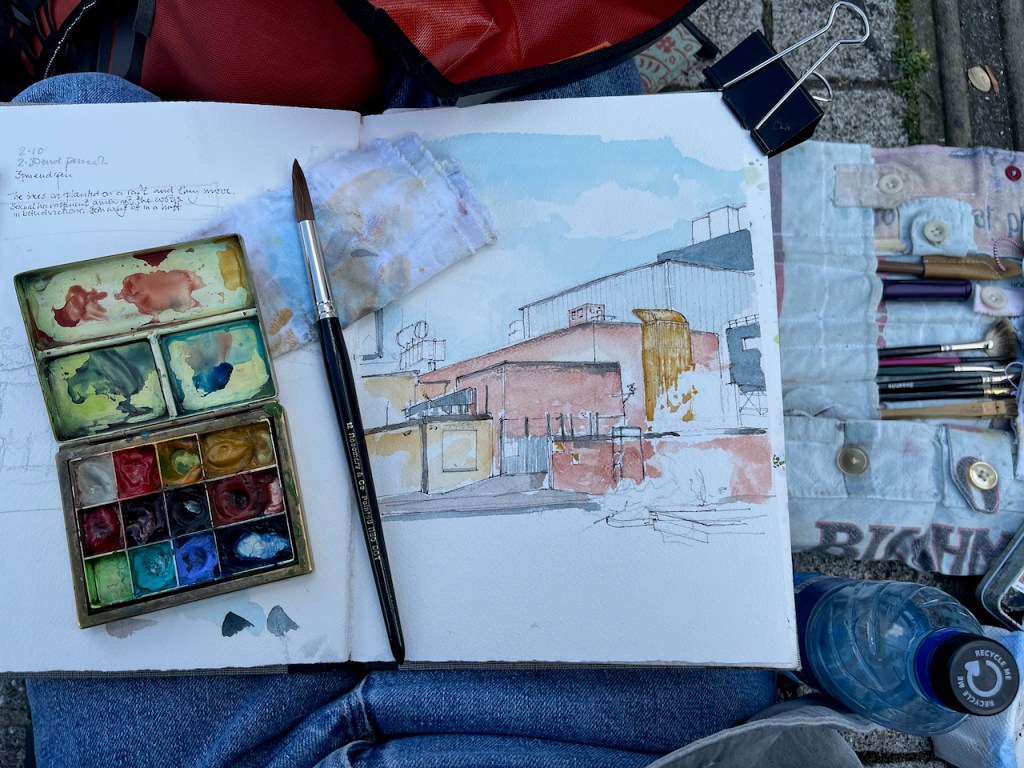
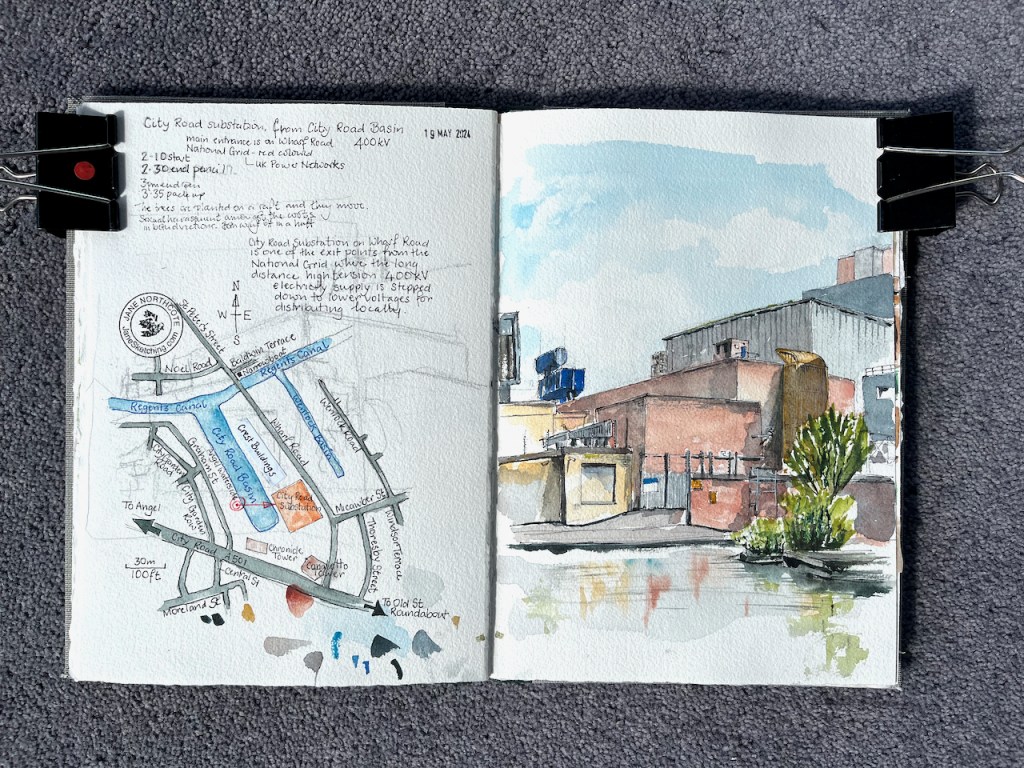
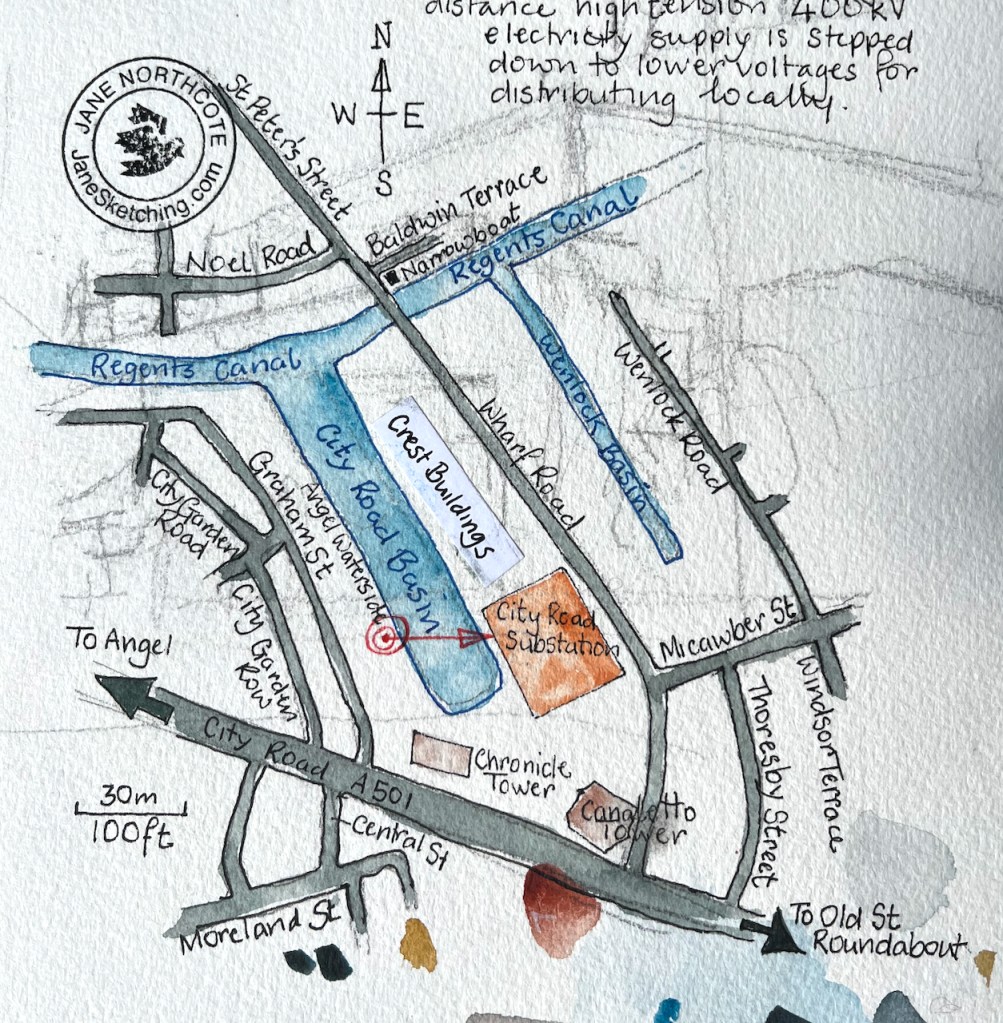
Here is a view of the City Road 400kV Substation, sketched from the other side of City Basin.

City Road 400kV Substation from “Angel Waterside” City Basin, 19th May 2024 in sketchbook 14

This is a monumentally large building, a last remaining representative of heavy industry, in an area now mainly residential. All around are the new tower blocks containing luxury apartments, made of shapes and designs aiming for visual appeal. Chronicle Tower and Canaletto Tower are just off the picture to the right. The sub-station is robustly functional. I enjoyed its forthright no-nonsense appearance.

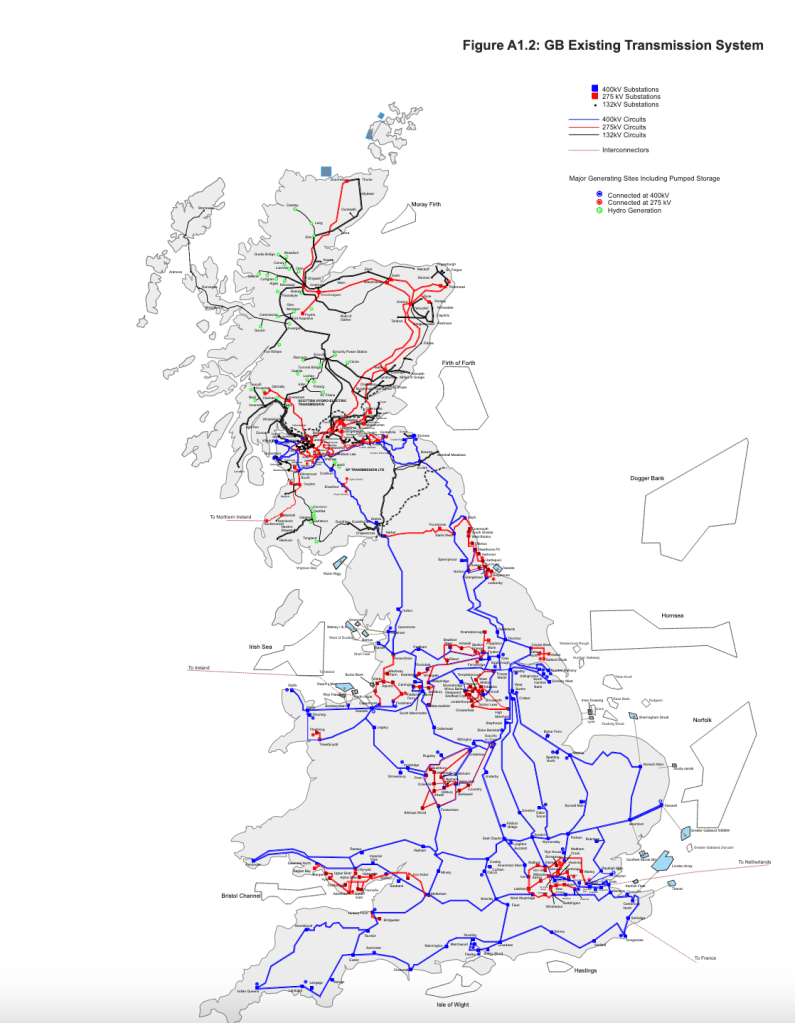
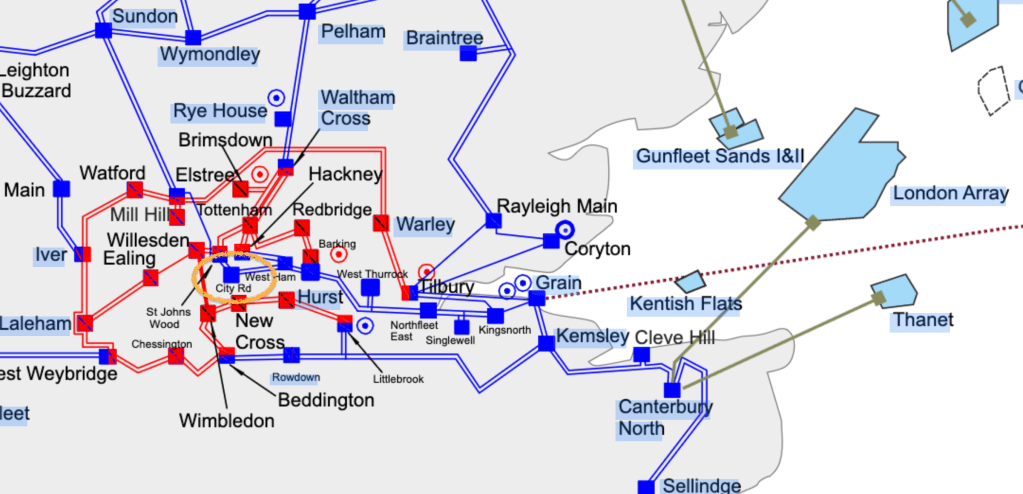
It’s built like a fortress, as well it should be. It is part of the UK power distribution system, connecting us in London to, amongst other power sources, the off-shore windfarms in the North Sea, an interconnector off across to Europe, and power stations on the Isle of Grain.

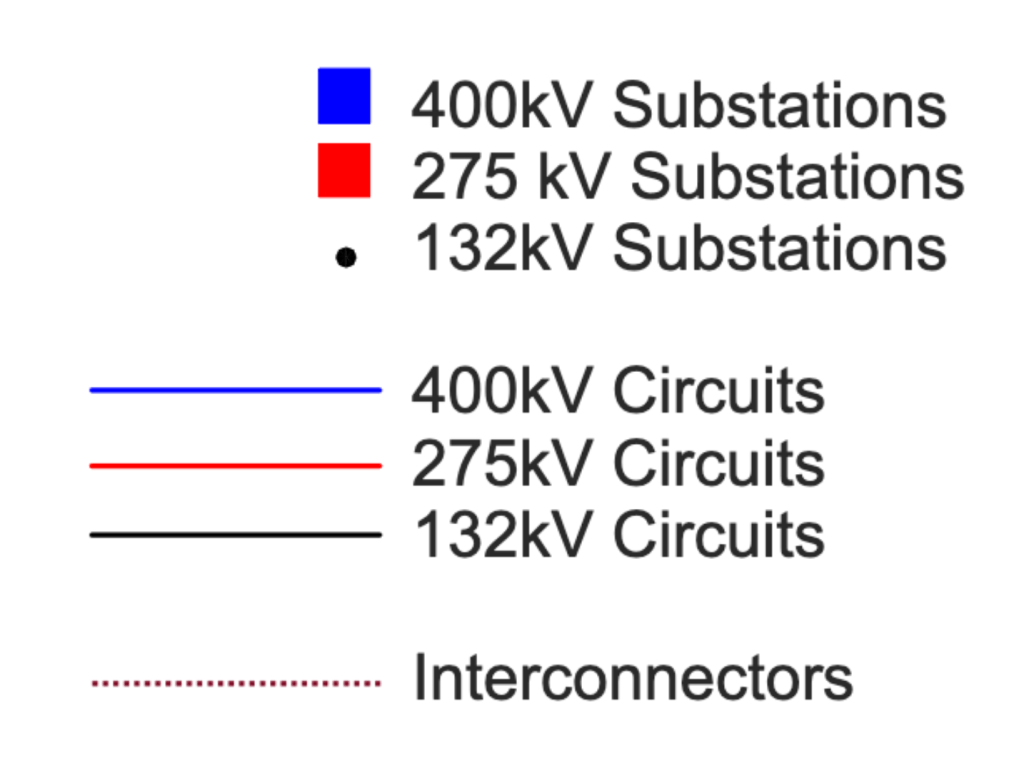
These diagrams come from a National Grid document on this link. The document is “Electricity Ten Year Statement 2012, Appendix A1”. It’s over 12 years old so there may be different connections now.

Despite the uncompromising appearance of the substation, the edge of its higher roof was softened with a subtle fringe of grass. I don’t know if this was a deliberate attempt at a “green roof” or if the grass planted itself there of its own volition.

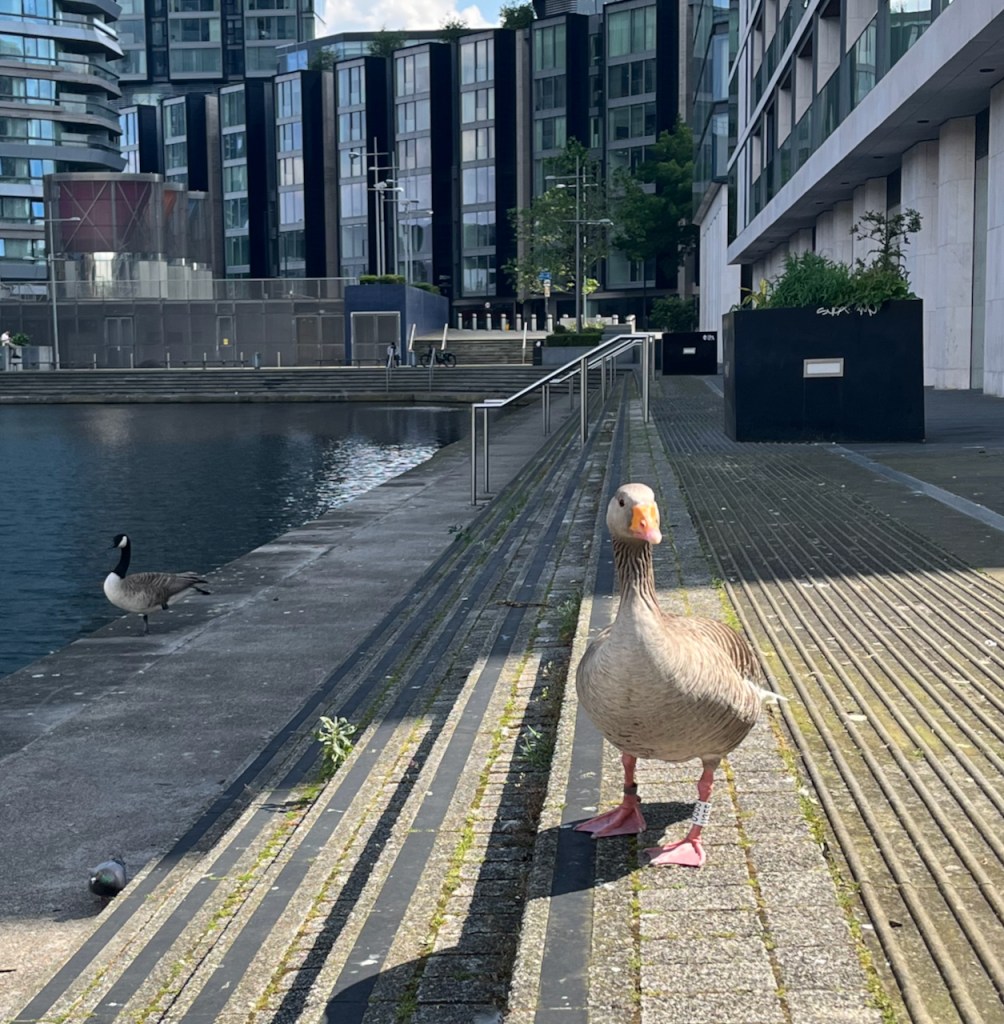
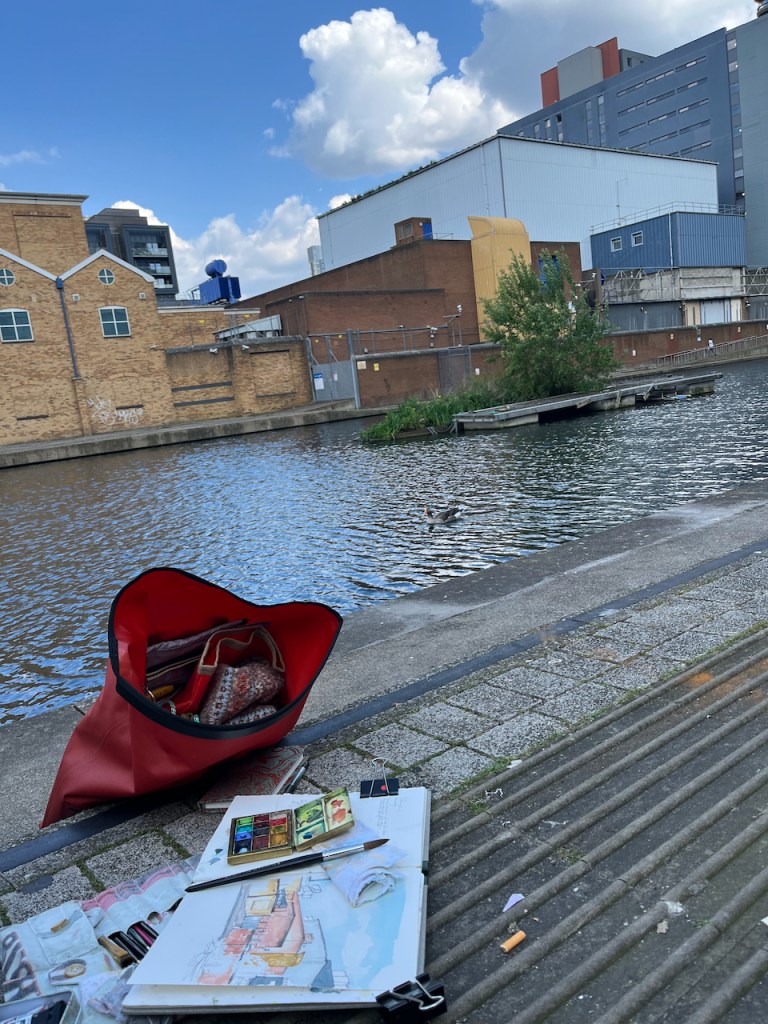
I made this sketch sitting by the water observed by geese. It took me a little while to establish that the tree in the picture was on a raft, and therefore it moved. One does not expect trees to shift around from place to place. I would put it in the sketch, and look up again, and find I had mysteriously got it wrong, again. The geese, obviously, always knew it was a raft, and cackled.

The colours here are:

  • Phthalo Turquoise Blue for the sky (with some Ultramarine Blue)
  • Fired Gold Ochre for the bricks
  • Mars Yellow, with Fired Gold Ochre, for the paler brickwork
  • Ultramarine Blue for the cylindrical construction on the roof (middle left)
  • Serpentine Genuine for the tree
  • All greys and blacks are combinations of the above, plus Burnt Umber.

Colours are all Daniel Smith. The paper is Arches Aquarelle 300gsm in a sketchbook by Wyvern Bindery.

Handyside Gardens, Kings Cross, N1

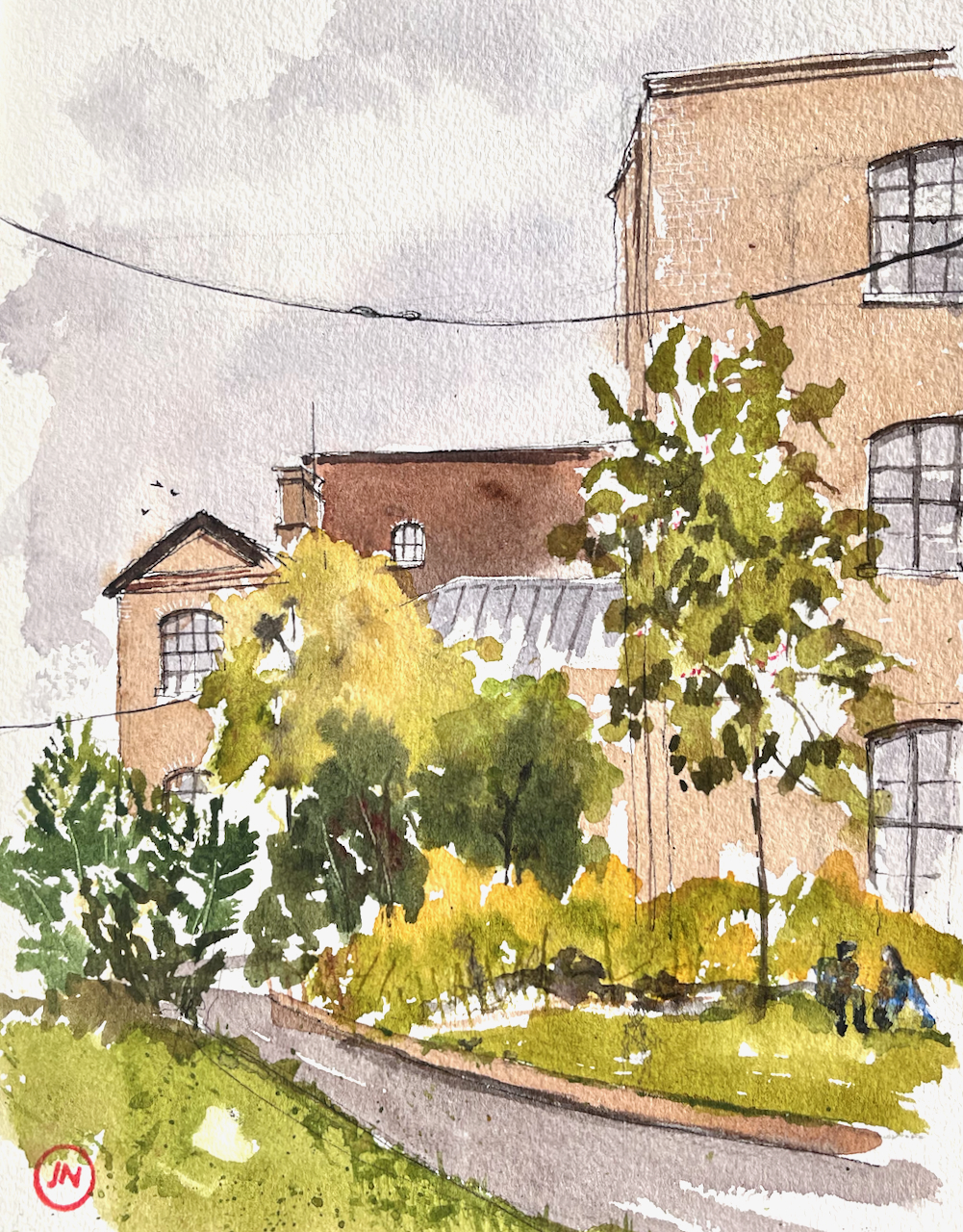
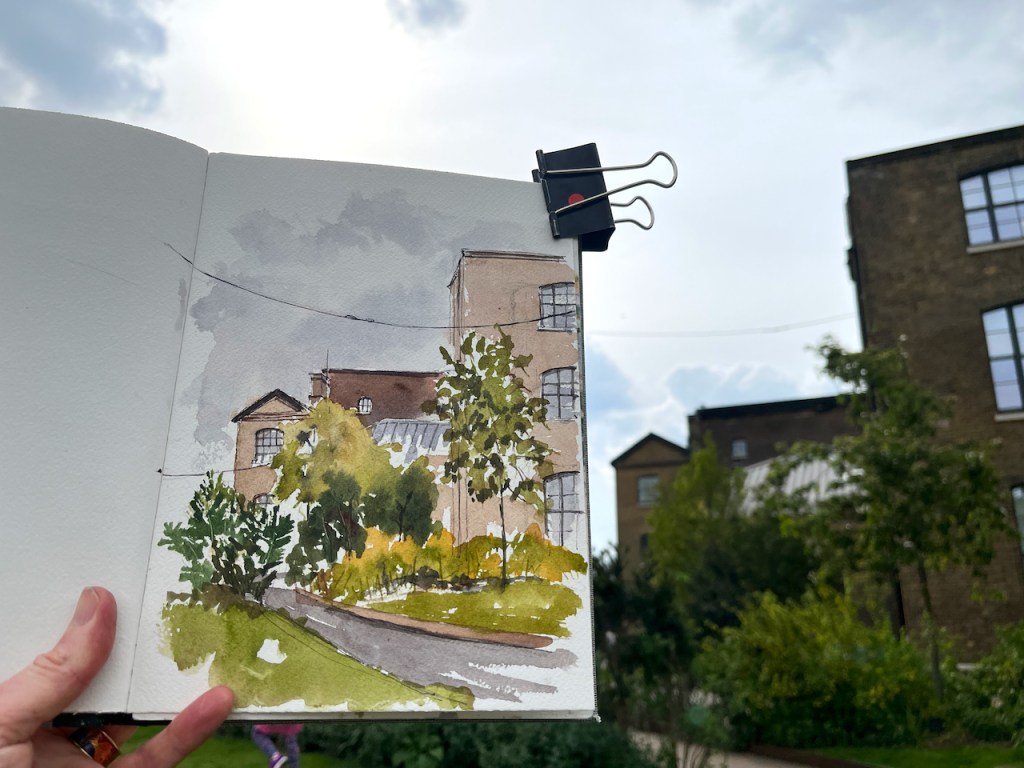
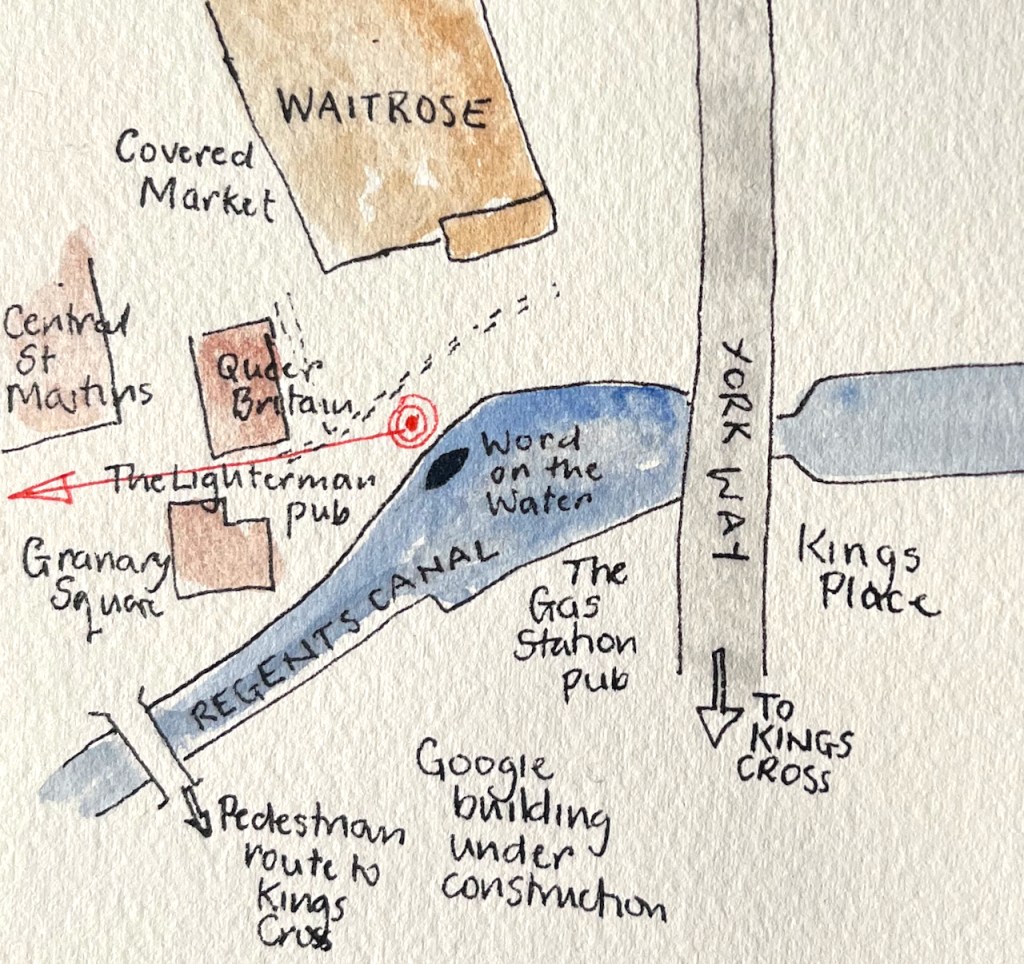
Here’s the view from Handyside Garden, which is just north of the canal, part of the new Kings Cross development, Coal Drops Yard.

From Handyside Gardens, 30th April 2023, in Sketchbook 13, 10″ x 7″

People rested on the grass eating takeaway food from containers. Children toddled under supervision. I painted.

On the roof of the barge “Word on the Water”, Hidè Takemoto played detailed guitar tunes. I recognised “Recuerdos de la Alhambra” by Tarrega, which I hadn’t heard for years. Each thread of the tune was insistent: the low climbing bass, the vibrating tremolo and the soaring high points, speaking clearly. It was perfect on that warm evening. He went on to play tunes I did not recognise: navigating his way through rhythms and moods. He gave us controlled and technical melodies and then, suddenly, wild abstract rock. A really talented musician.

St Martin-in-the-Fields, WC2

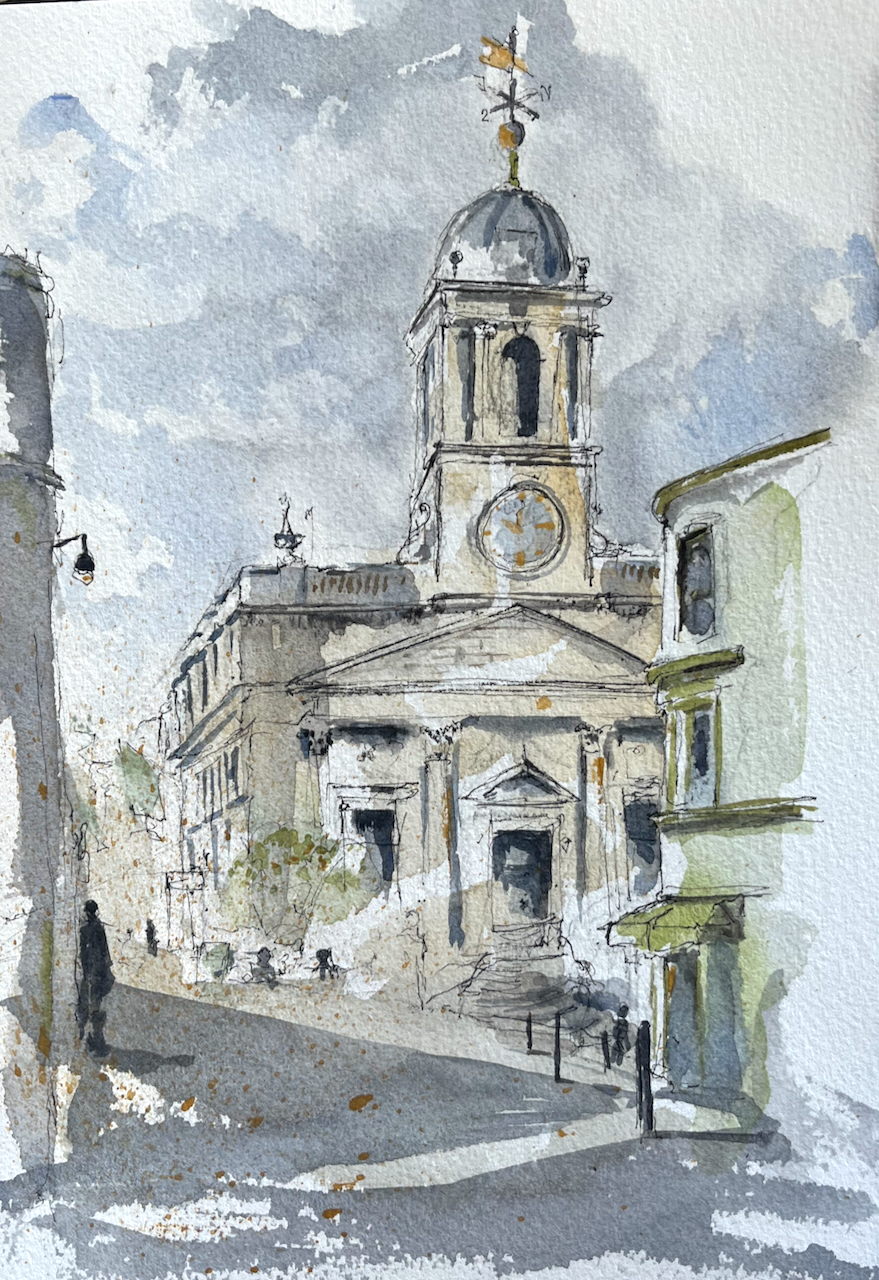
On the way back from a visit to the West End, I passed St-Martin-in-the-Fields, standing out against the cold sky.

St Martin-in-the-Fields, Trafalgar Square. Sketched 2nd Dec 2022, in sketchbook 12

The statue in the foreground, left, is the Edith Cavell Memorial, seen from the back. Edith Cavell (1865-1915) was a British nurse. In German-occupied Belgium, guided by her principles of humanity and her Christian faith, she provided medical care to soldiers irrespective of which side they were on. She was executed by a German firing squad 1915, because she had helped Belgian, British and French soldiers to escape the German occupation and reach Britain. Her grave is in Norwich Cathedral.

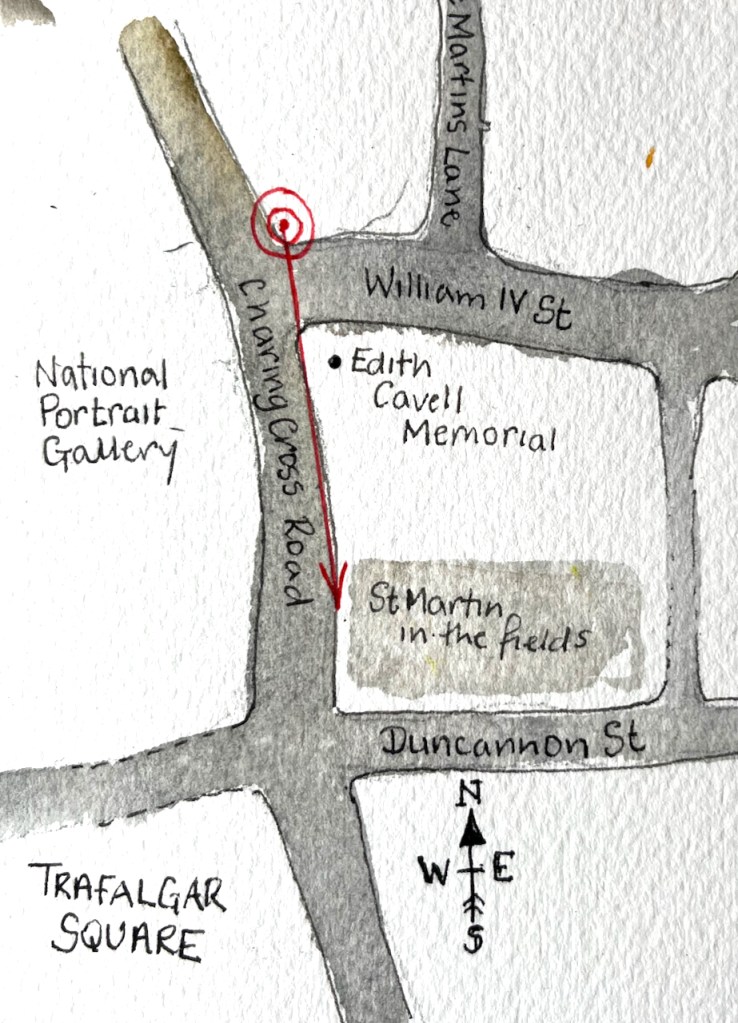
I sketched standing on a corner of the Charing Cross road, see map above. This turned out to be a very noisy location. The National Portrait Gallery is being refurbished and there was continuous drilling and banging. Buses and cars ground their gears, and thundered past, rushing through the traffic lights to shriek to a halt at the next junction.

But St-Martin-in-the-Fields rose above it all. The inscriptions which faced me on the Edith Cavell Memorial were: “Determination”, “Fortitude”.

Great Suffolk Street, Railway arch

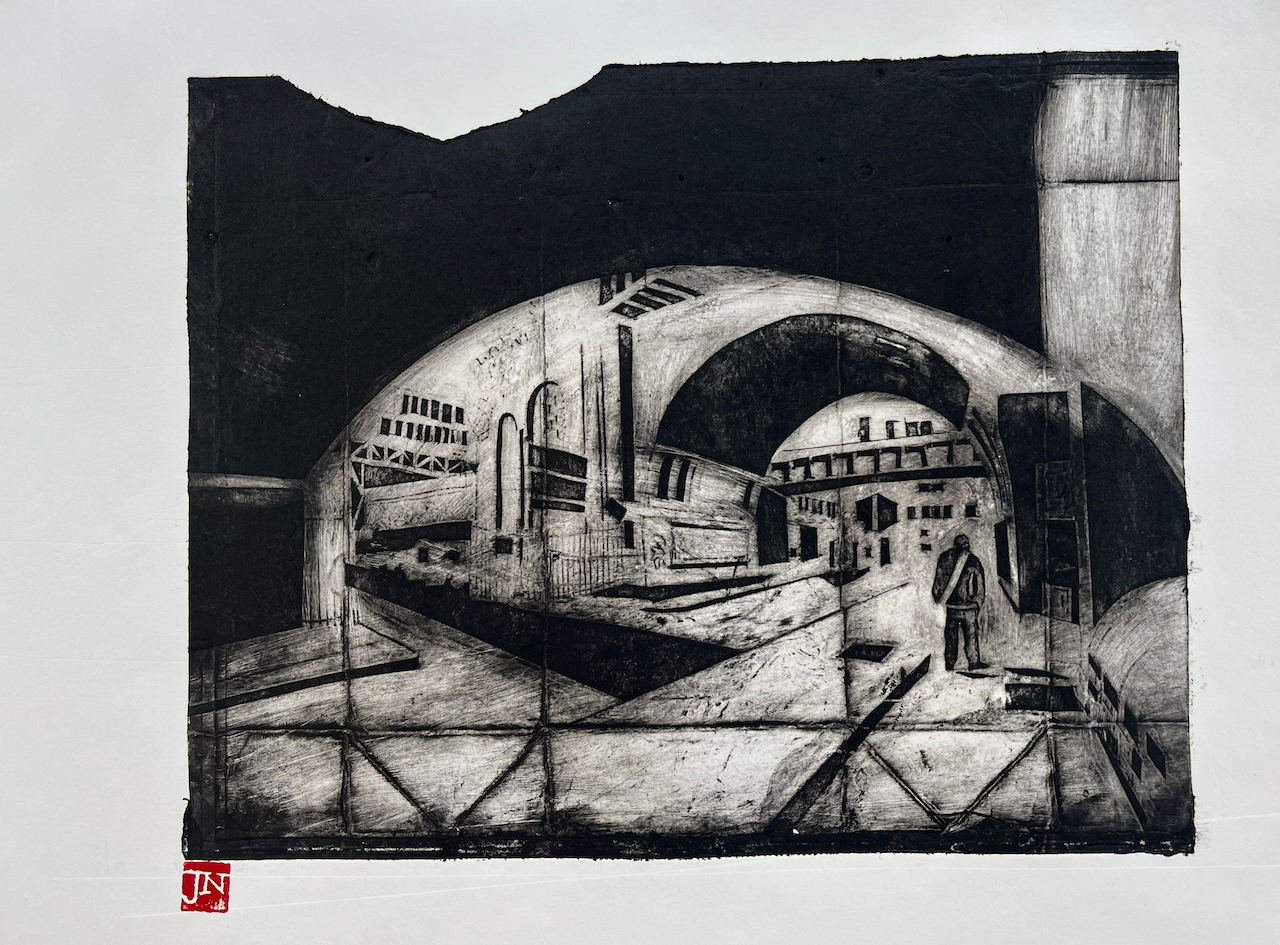
Huge brick arches carry the railway lines into Waterloo Station. Here is a view looking North up Great Suffolk Street.

Great Suffolk Street railway arch, monoprint #3 of 6. Printed image size 12″ x 9″. On Fabriano Unica paper, 20″ x14″

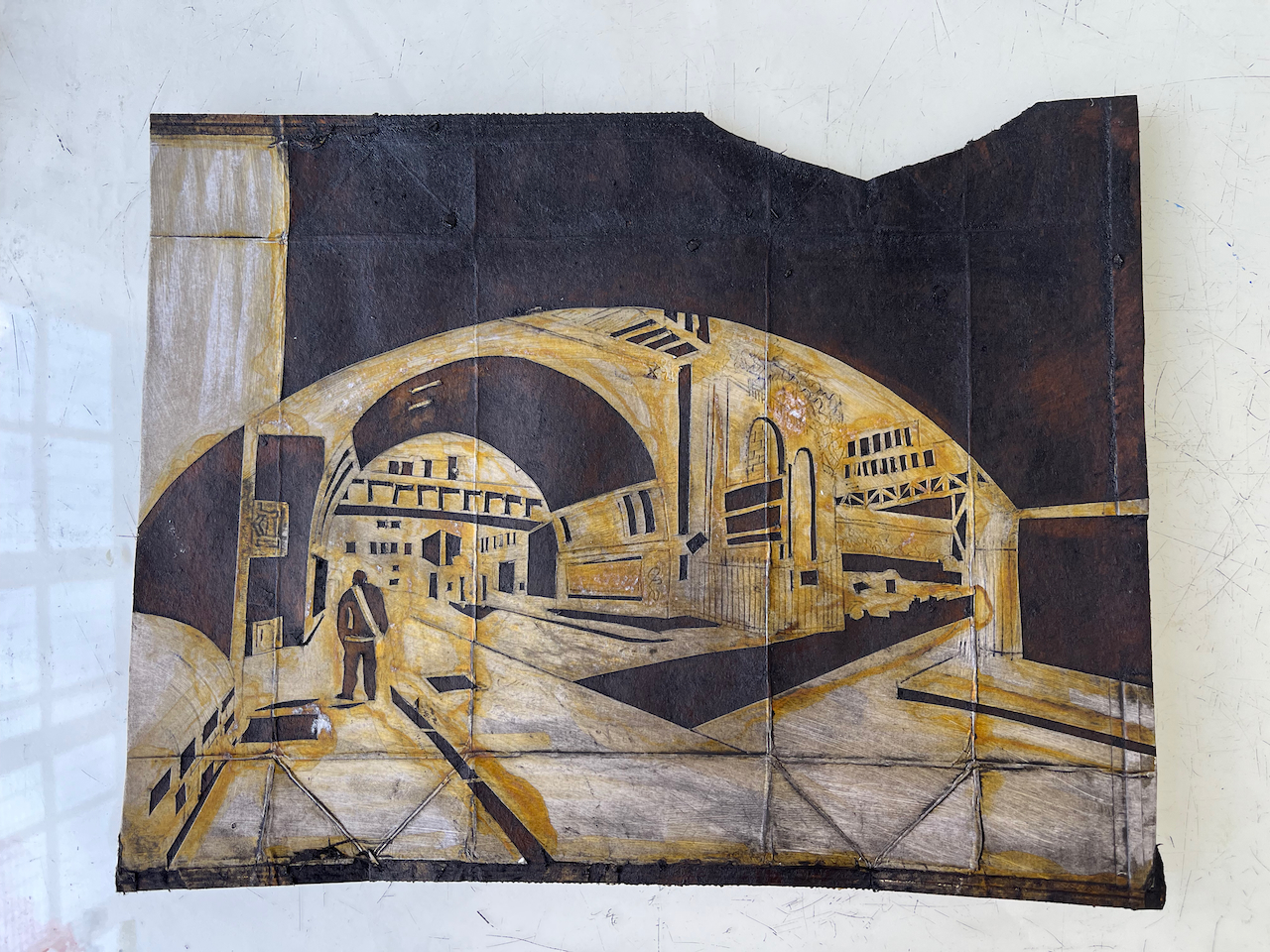
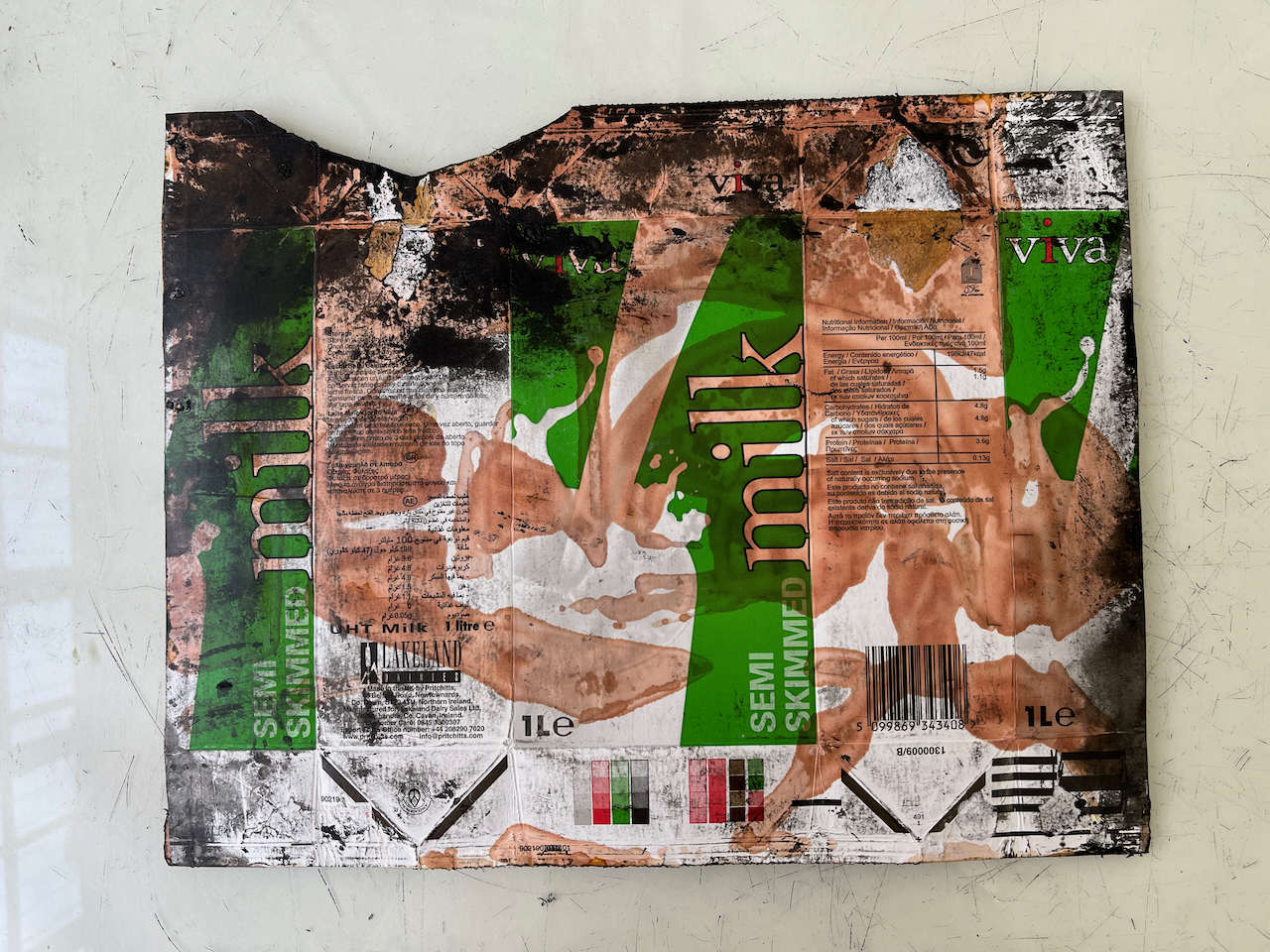
This is a packaging monoprint. It is an intaglio print from a “plate” made from a milk carton. Here is the plate:

I’ve described the process in this blog post: Print plates made of packaging. The basic method is to use the shiny metallic surface inside the carton. I cut out the shapes I want and peel back the shiny surface to reveal a rougher surface which takes the ink. The yellow colour you see on the plate is shellac, a varnish that I paint on to make the plate last a little longer.

The plates are quite fragile, and can only make a limited number of prints. Here is number 6:

Great Suffolk Street railway arch, monoprint #6 of 6. Printed image size 12″ x 9″. On Agawami Washi Kitakata Japanese paper, 20″ x1 4″

I made all the prints on the Henderson press at East London Printmakers, Stepney. I used Chabonnel F66 traditional oil-based etching ink.

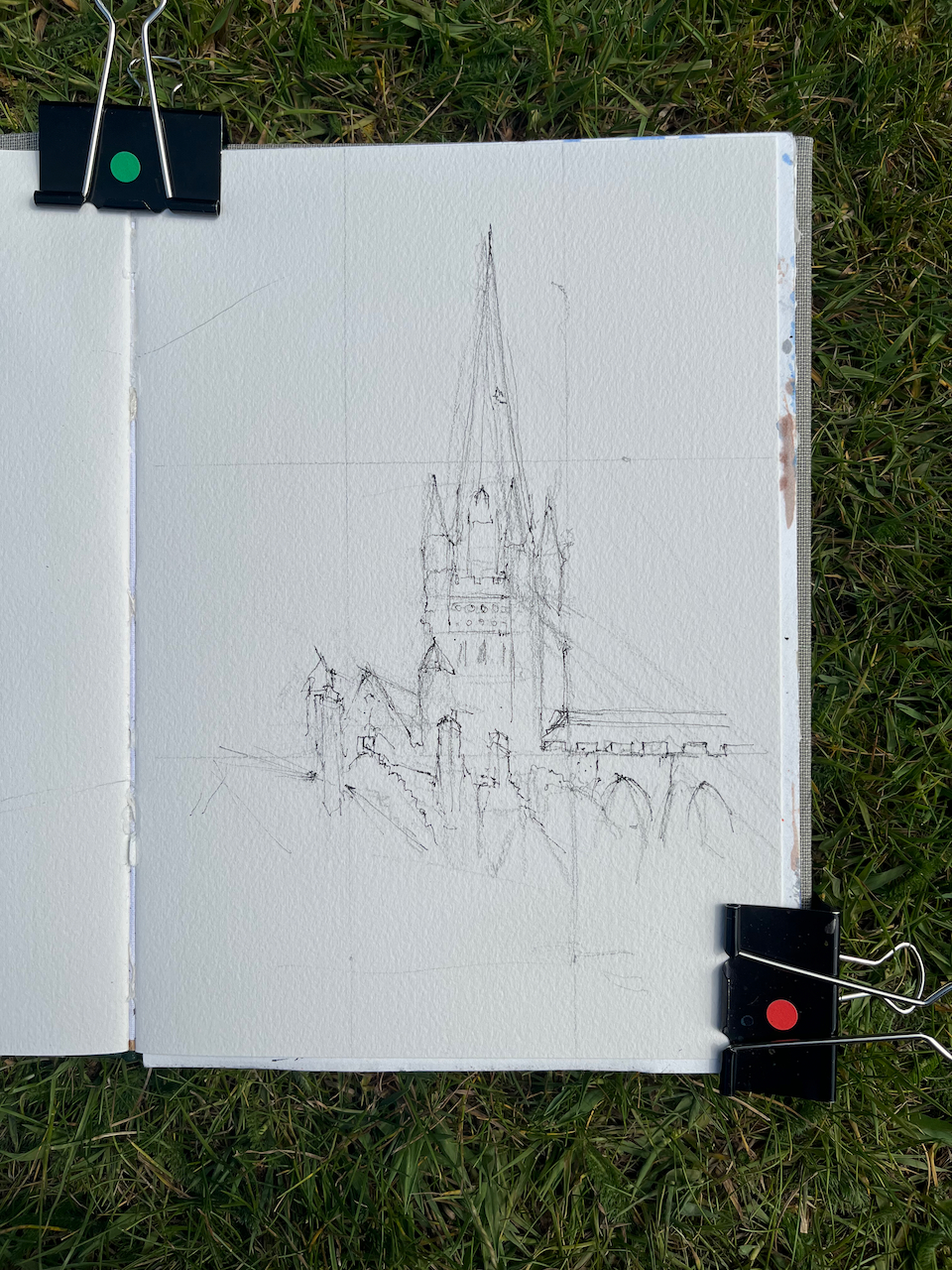
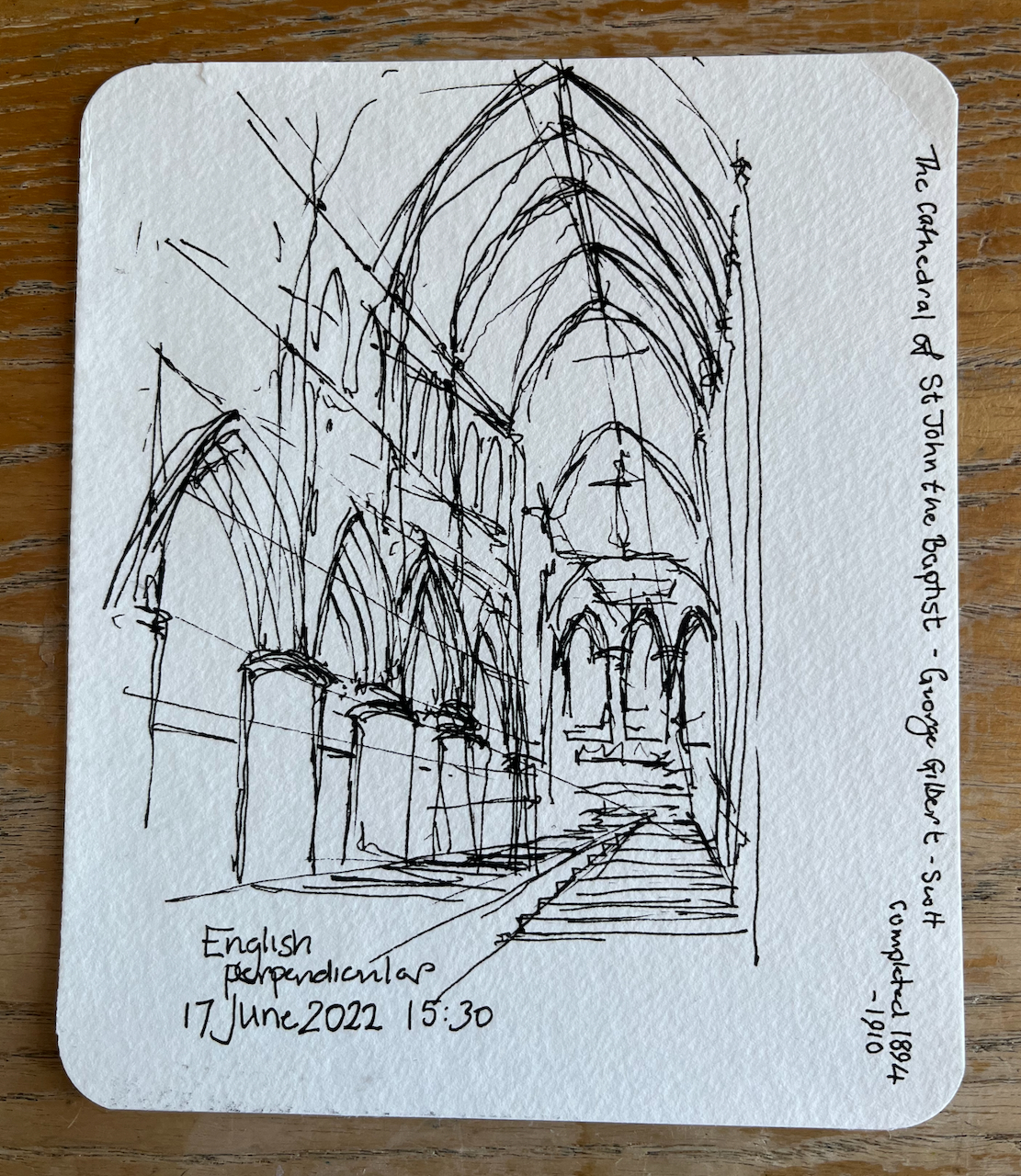
Sketching in Norwich

Norwich describes itself as “A Fine City”. Indeed it is. The city centre streets are clean, car-free, and lined with a huge variety of shops, restaurants, and service providers such as key-cutters and barbers. All very interesting. And there’s a lovely river too.

The City of Norwich website tells me: “On 17 July 1967, London Street became the first shopping street in the UK to be pedestrianised. It started a revolution that saw people given priority over traffic in city centres.”

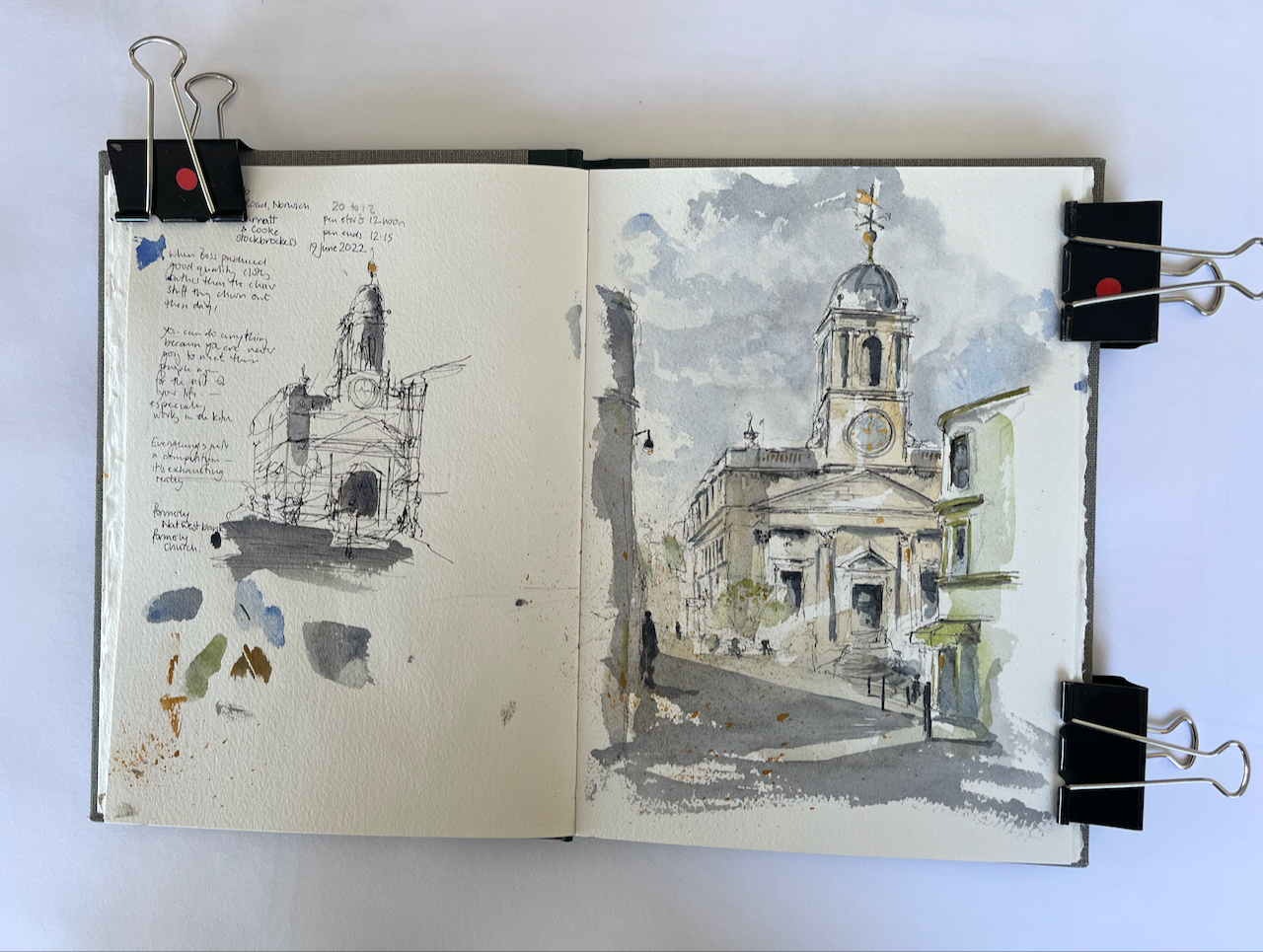
This building stands in London Street, at the junction with St Andrews Hill. It was designed by FCR Palmer for the National Provincial Bank, and was completed in 1925 [1]. The National Provincial became NatWest after a series of mergers and takeovers. NatWest moved out in 2017.

“Cosy Club” 45-51 London St, Norwich NR2 1AG, 19th June 2022 12:15, in Sketchbook 12

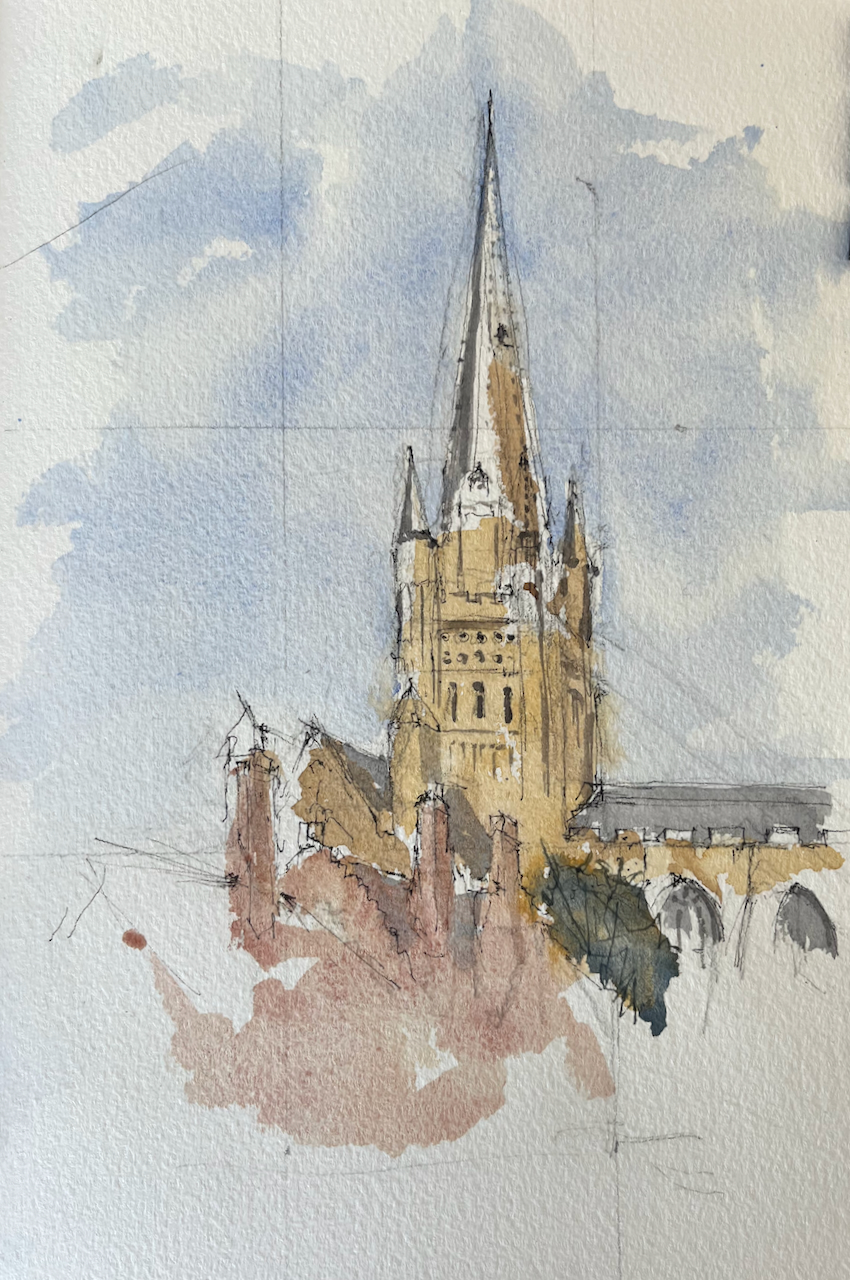
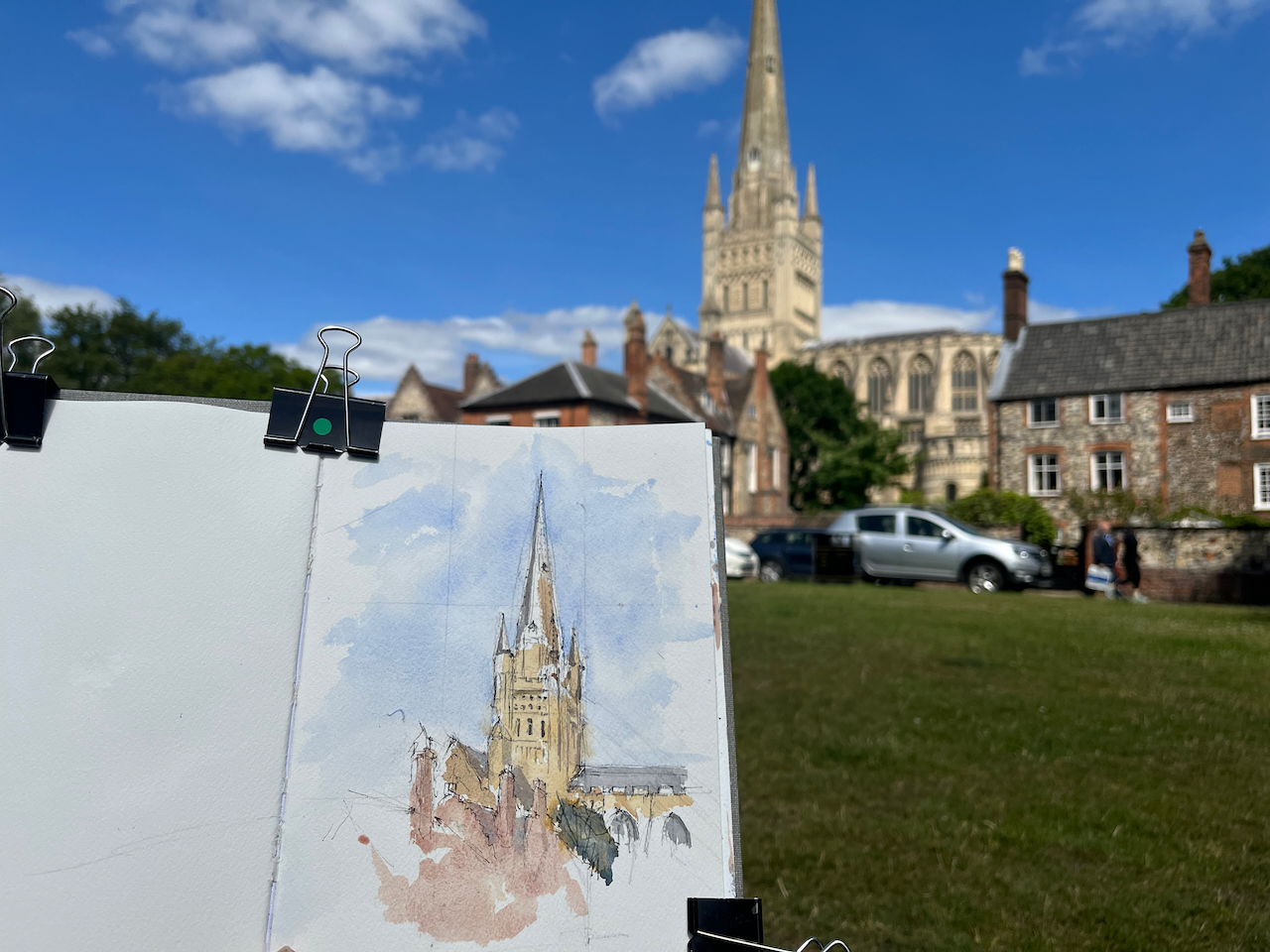
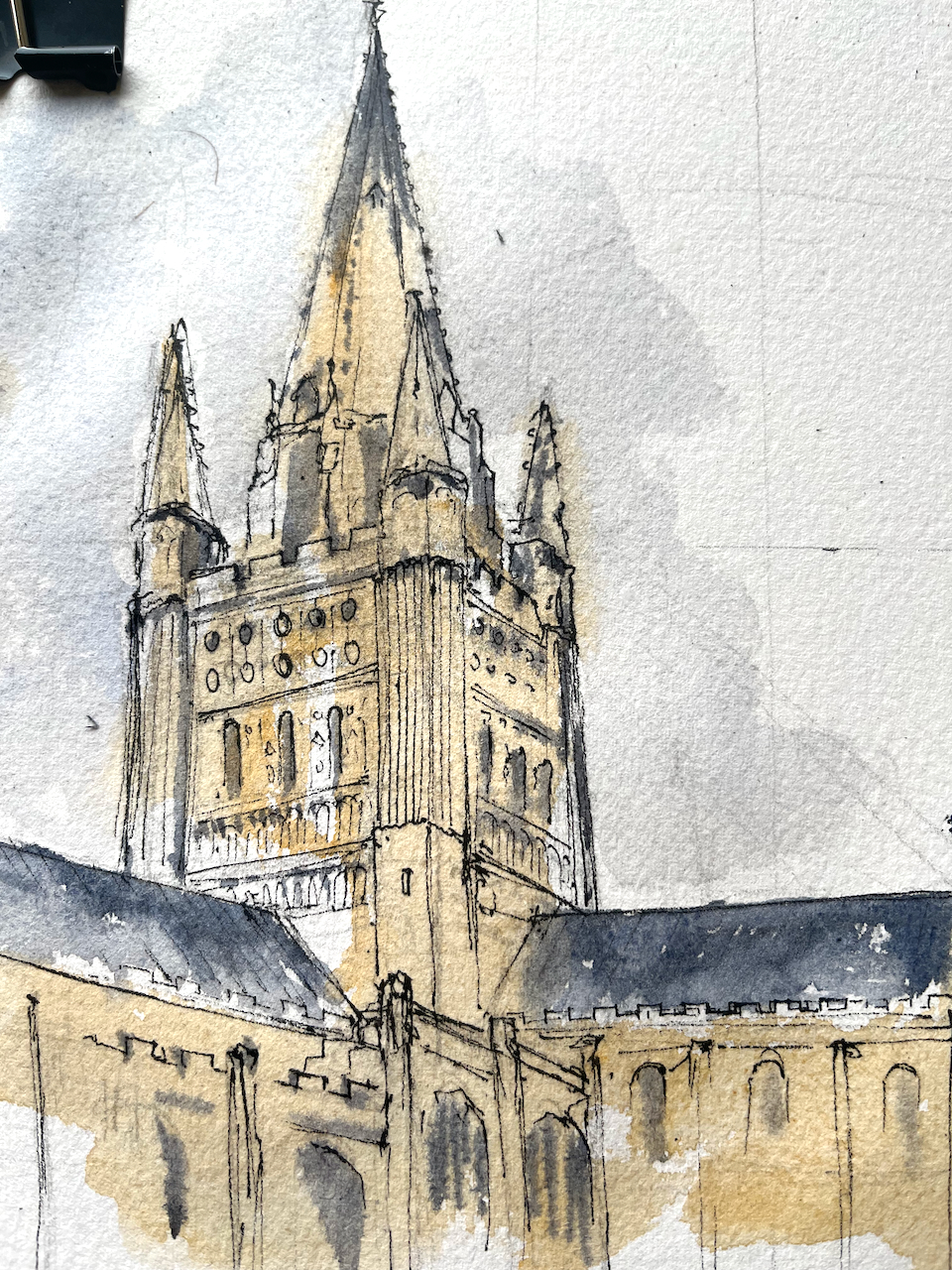
I also sketched Norwich Cathedral, from the Cathedral Close.

Certainly a fine city, and one to which I hope to return.

Note 1: History of the London Street bank building from the Norwich Society website: https://www.thenorwichsociety.org.uk/explore-norwich/natwest-building-on-london-street

Spitalfields E1 from ChristChurch

I joined a sketching friend for a stroll around Spitalfields. We had coffee at the Cafe in the Crypt of Christchurch Spitalfields, and then sat at the tables outside and sketched the view.

Here is my sketch:

Spitalfields Market E1 from ChristChurch, 7″ square in Sketchbook 12. 1st June 2022

Behind the red-bricked buildings of the Market, you can see the office and residential tower blocks along Bishopsgate. “Principal Tower” in the one to the right.

Here are some on-location photos and a picture of the sketchbook.

Thankyou to the talented artist LA for your company and inspiration on this expedition. It’s fun to sketch together!

Urban watercolour studies

Usually, I use the “pen-and-wash” technique. I draw an urban scene in waterproof pen and then add the wash. This method is fast, and useful for outdoor work on location. Most of my urban sketching work uses this technique. Here’s are example:

I wanted to try a “straight-to-watercolour” method. This involves looking at the scene differently. To go straight to watercolour I need to learn to see “shapes” rather than “lines”. I practised this with these three watercolours:

I worked learning from demonstrations by Matthew White . I hope to incorporate elements of this practice into my own work.