Sketching in Aberdeen

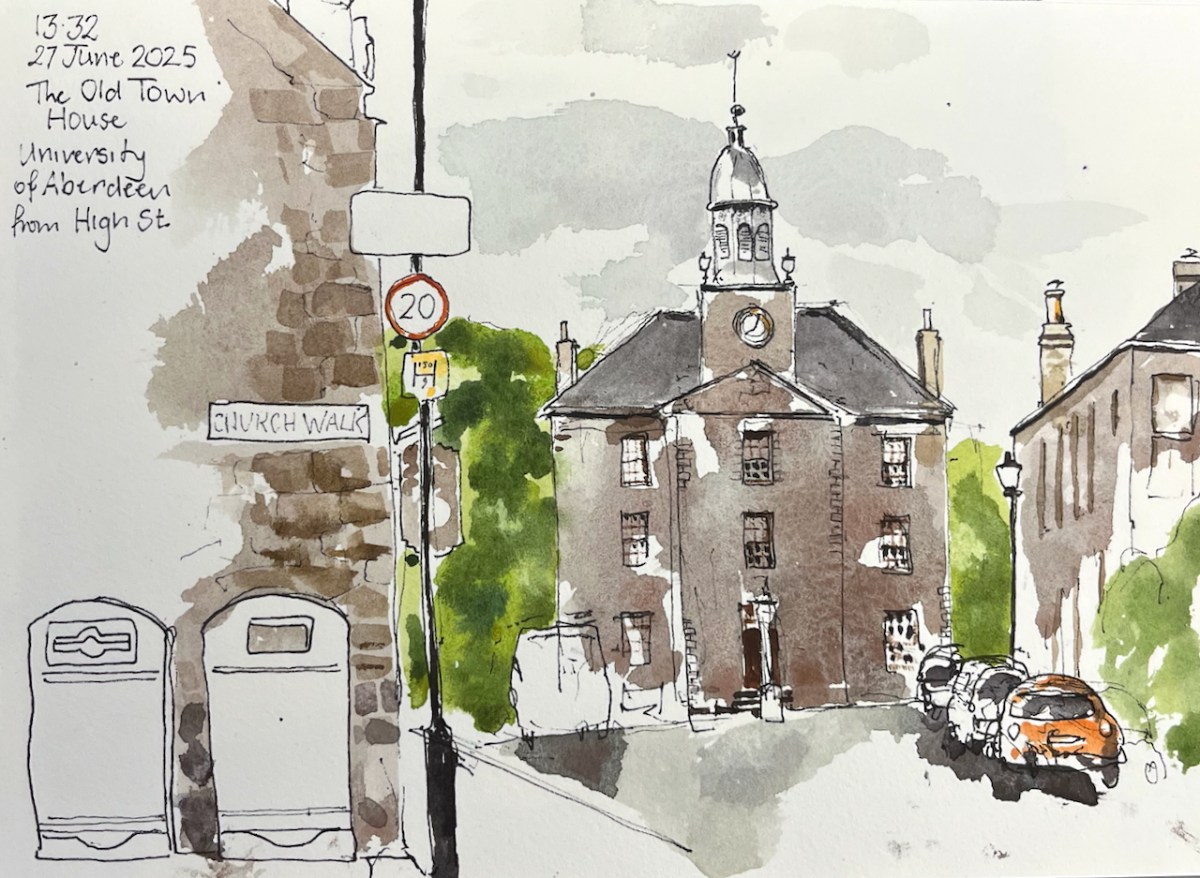
I had been travelling a long time. Reaching Old Aberdeen I sat on a granite kerbstone and sketched The Old Town House. Behind me was a friendly bookshop, where I had bought a map.
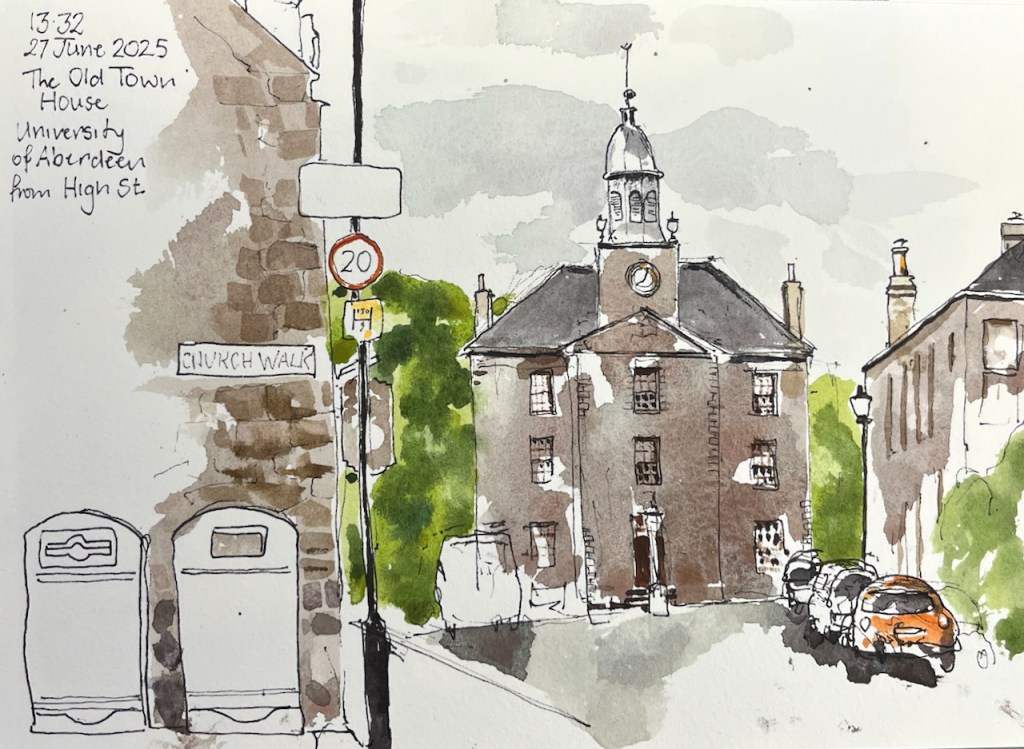
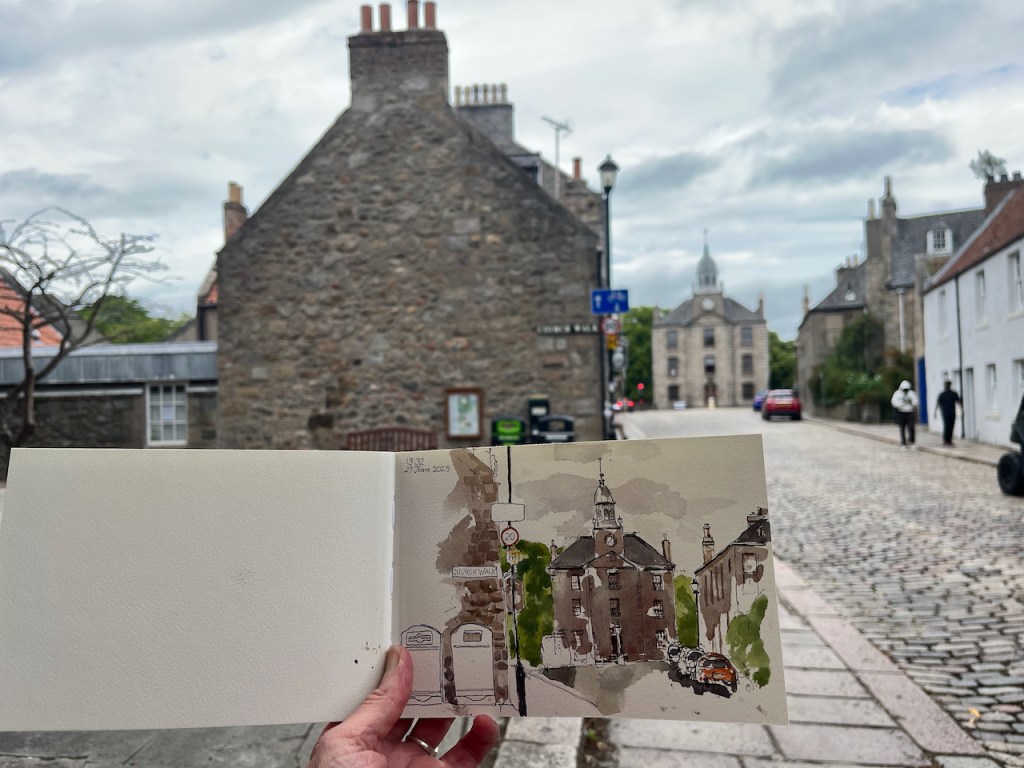
The Old Town House, University of Aberdeen, in Shetland 2025 sketchbook, size A5.

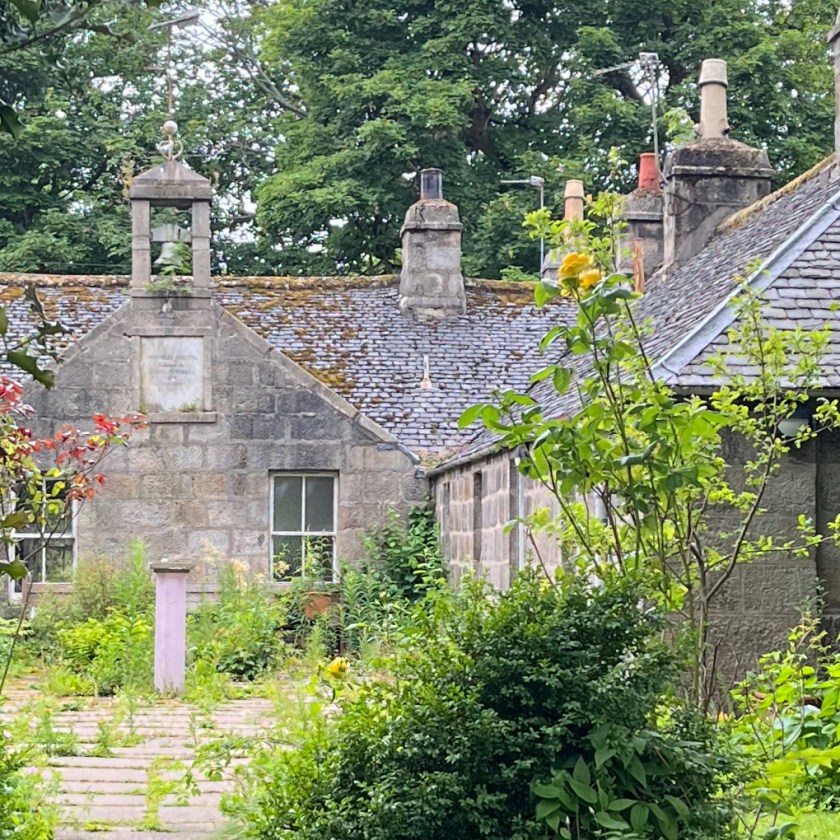
Having sketched, I walked into the picture I had drawn, and towards the trees on the left of the Town House. There I discovered a building being taken over by plants.
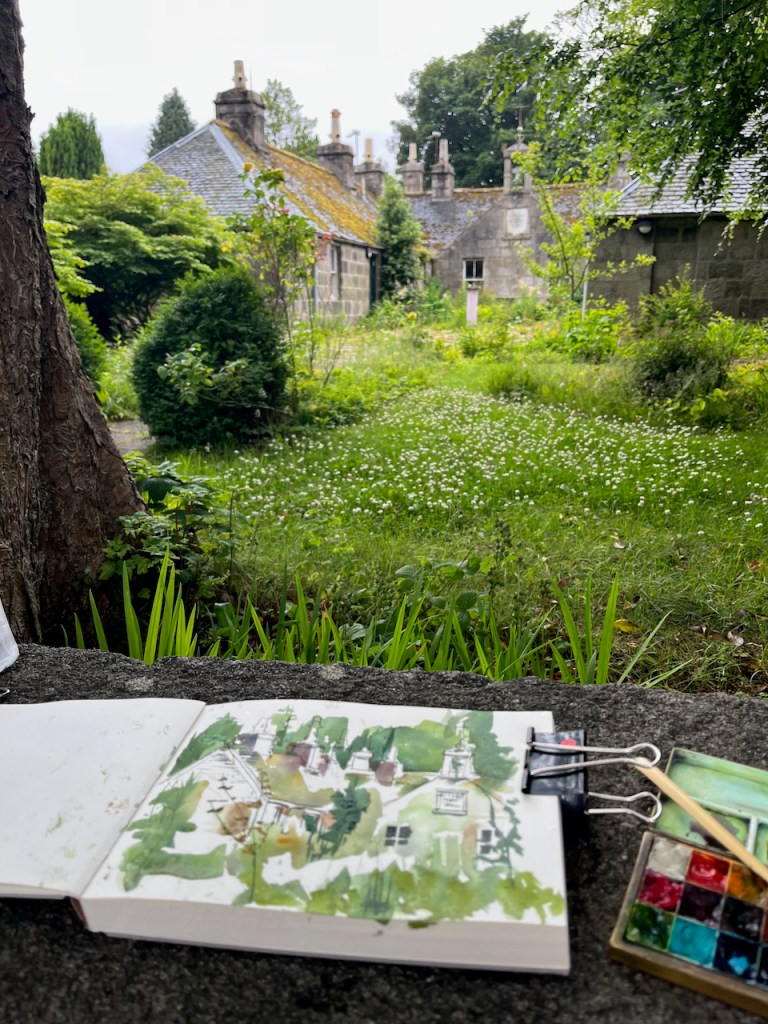
There was a plaque on the building, with writing on. You can see it in the background of the photo above. I couldn’t read the plaque at this distance, and neither could my phone.

Some tourists came by, laden with backpacks and cameras. They paused, curious to see what I was drawing. Since their eyes were younger than mine, I asked if they could read the plaque. They couldn’t, and neither could their phones. My next idea was that they could try using the telephoto lens on one of those formidable-looking cameras. With good grace they shrugged off a hefty block of technology, and removed its canvas housing. It had a fine lens.
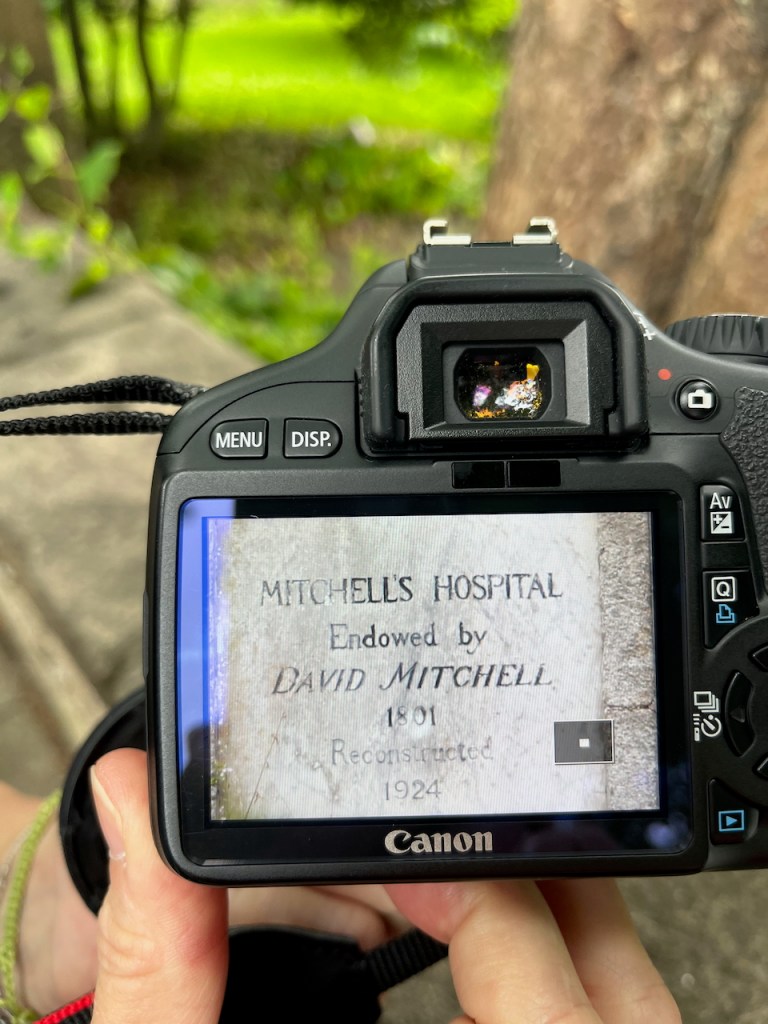
“Mitchell’s Hospital, endowed by David Mitchell 1801. Reconstructed 1924.”

So now we know.
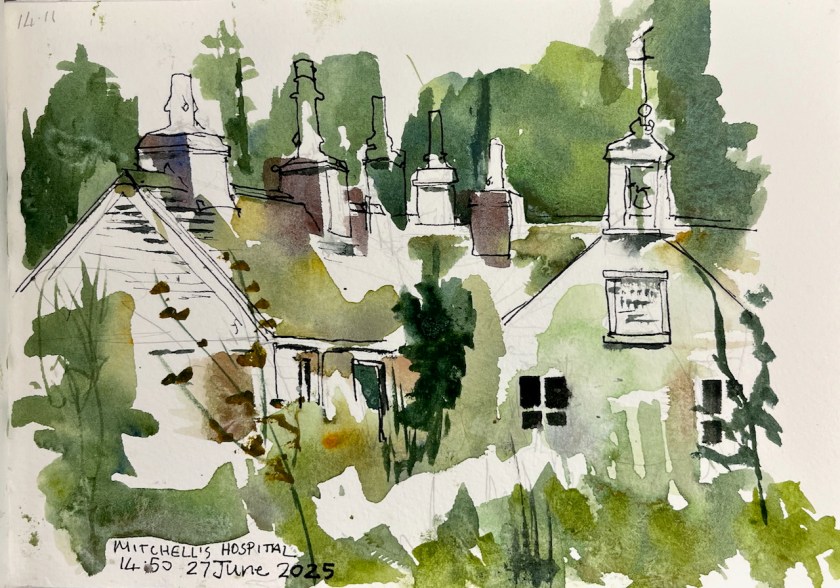
Mitchell’s Hospital, The Chanonry, Old Aberdeen. Sketch in “Shetland 2025” sketchbook, A5

David Mitchell founded the hospital as an almshouse “from a regard for the inhabitants of the city of Old Aberdeen and its ancient college and a desire in these severe times to provide lodging, maintenance and clothing for a few aged relicks and maiden daughters of decayed gentlemen merchants or trade burgesses of the said city..” [Wikipedia entry quoting the deed of mortification of the Hospital]. It was used as such, housing elderly ladies, up to to around 2016 when the final elderly resident, Iona Mathieson-Ross, had to move out.

In April 2024, there was notice of a sale in the local paper:
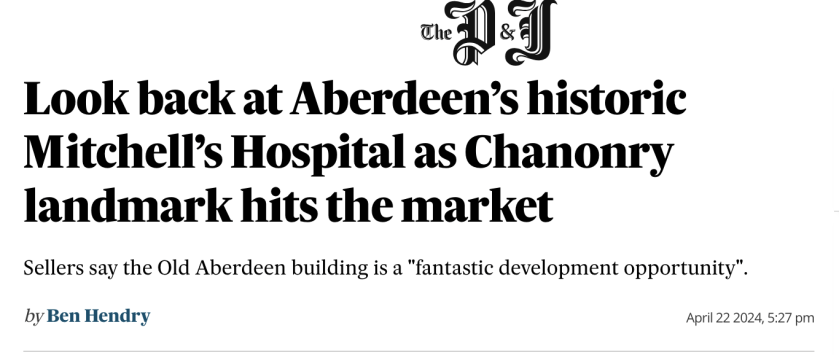
A later article says it has been sold, and that the new owners are refurbishing the building as small residential units to be let, possibly as short-term holiday lets. The planning application on Aberdeen Council’s website shows a building looking identical to the existing one, cleaned up and repaired.
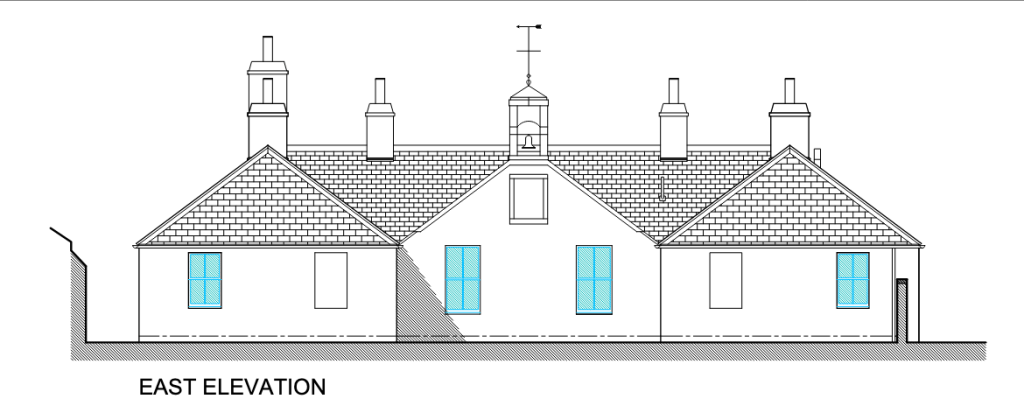
From the planning application 241449/LBC Proposed elevations, North and East

It sounds like a dream come true for this neglected building:

“PROPOSED WORKS
Roof:
Allow for removal of all moss and vegetation
Allow for replacement of missing slates in size, thickness and colour to match existing.
Check ridge tiling and re-bed any loose tiles.
Chimney stacks pointing to be checked and where missing to be repointed…

…Chimney cans to be reset…

Granite Masonry:
Pointing to be checked and where missing to be repointed…

Windows:
Existing sash & case windows to be checked & where wet rot is evident timber sections to be replaced with same profile in Redwood.
Windows to be refurbished to ensure they are fully operational and fitted with draught stripping internally….

External Doors:
Existing external doors to be replaced with external quality Redwood 4 panel doors with double glazed obscure glass in upper 2 panels fully weather stripped primed and painted…

planning application: https://publicaccess.aberdeencity.gov.uk/online-applications/files/D0CA009C52149577D726371114B13754/pdf/241449_LBC-Proposed_Elevations__North__East___Sectional_A-A-2405900.pdf

The planning application was approved on the 3rd July 2025, a few days after I was standing there doing my sketch. Perhaps when I next visit Aberdeen the improvement work will be in progress. Maybe, if it becomes holiday lets, I can even stay there.

I’m glad it’s being refurbished, but I shall treasure the view of this graceful building gradually being assimilated into the plant world.
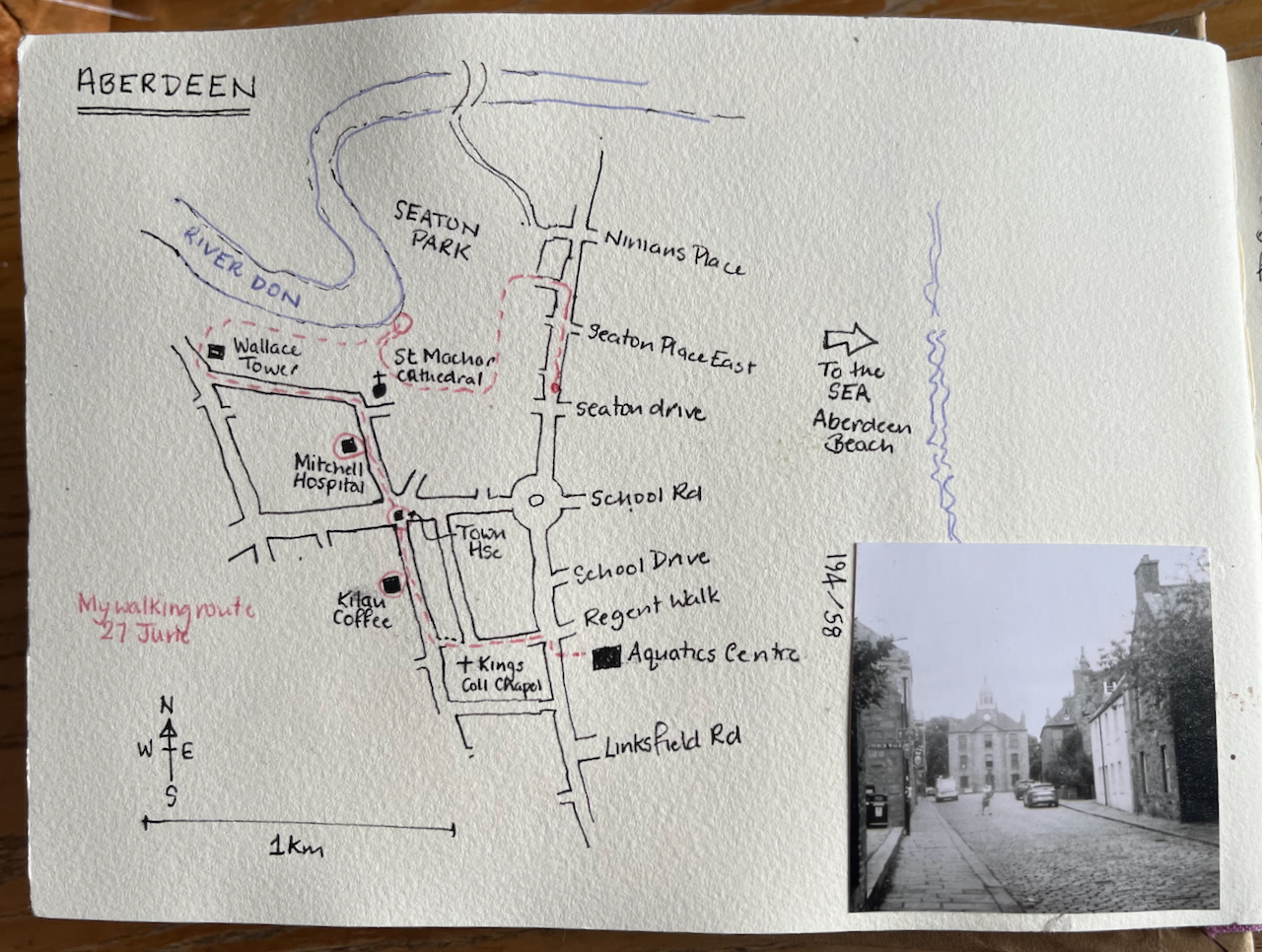
Here is a map showing my walk and Mitchell’s Hospital.
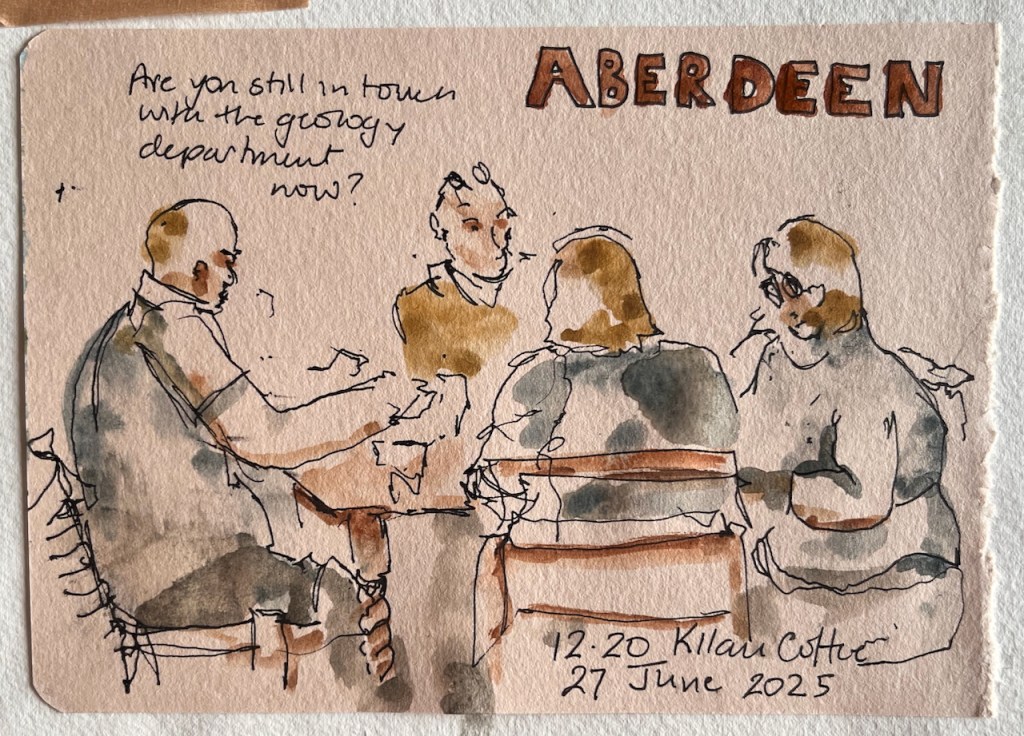
I had coffee in Kilau Coffee – recommended!
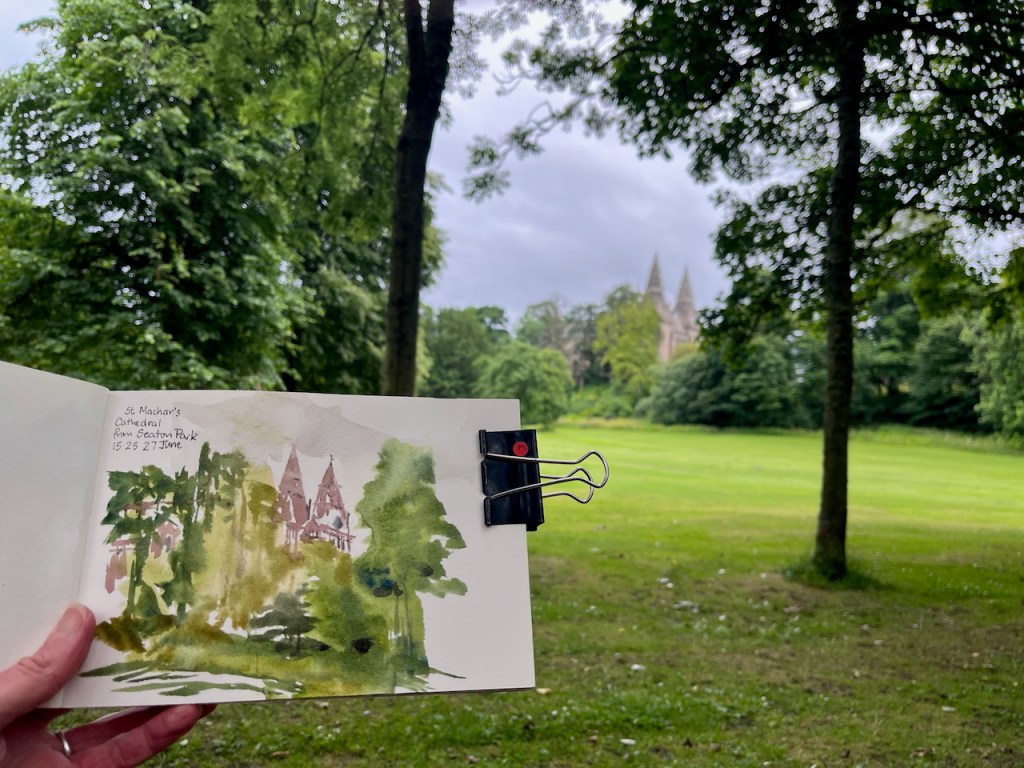
Sketching in Seaton Park, before the rain. St Machar’s Cathedral.
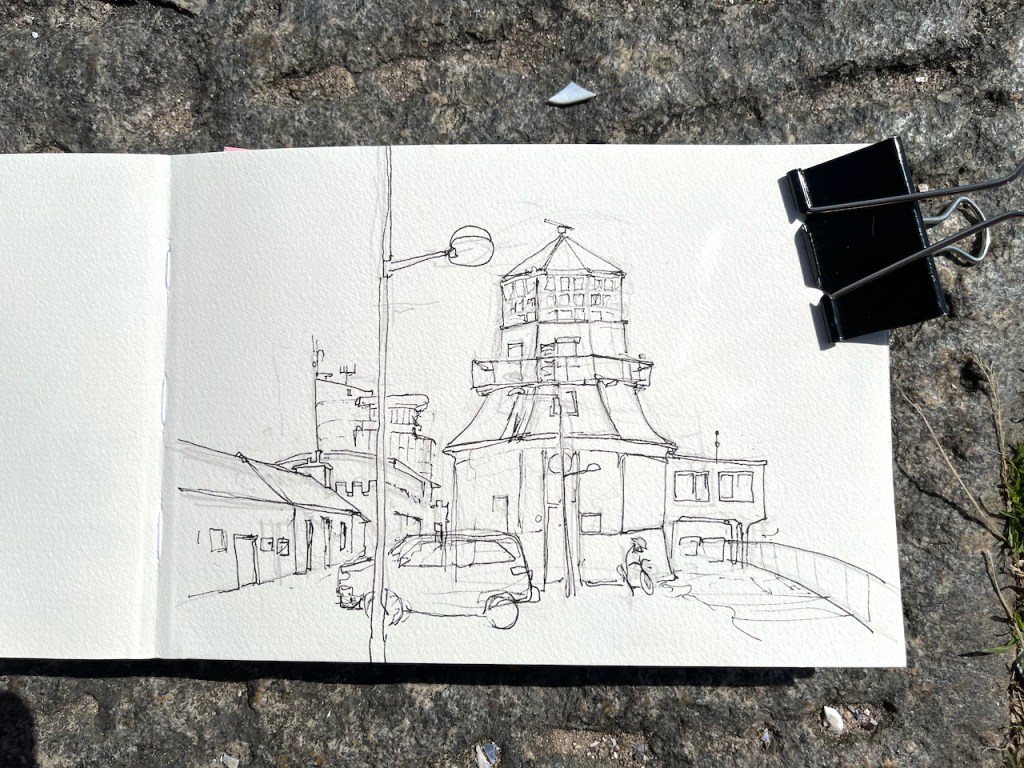
“The Roundhouse”, Pocra Quay, Aberdeen

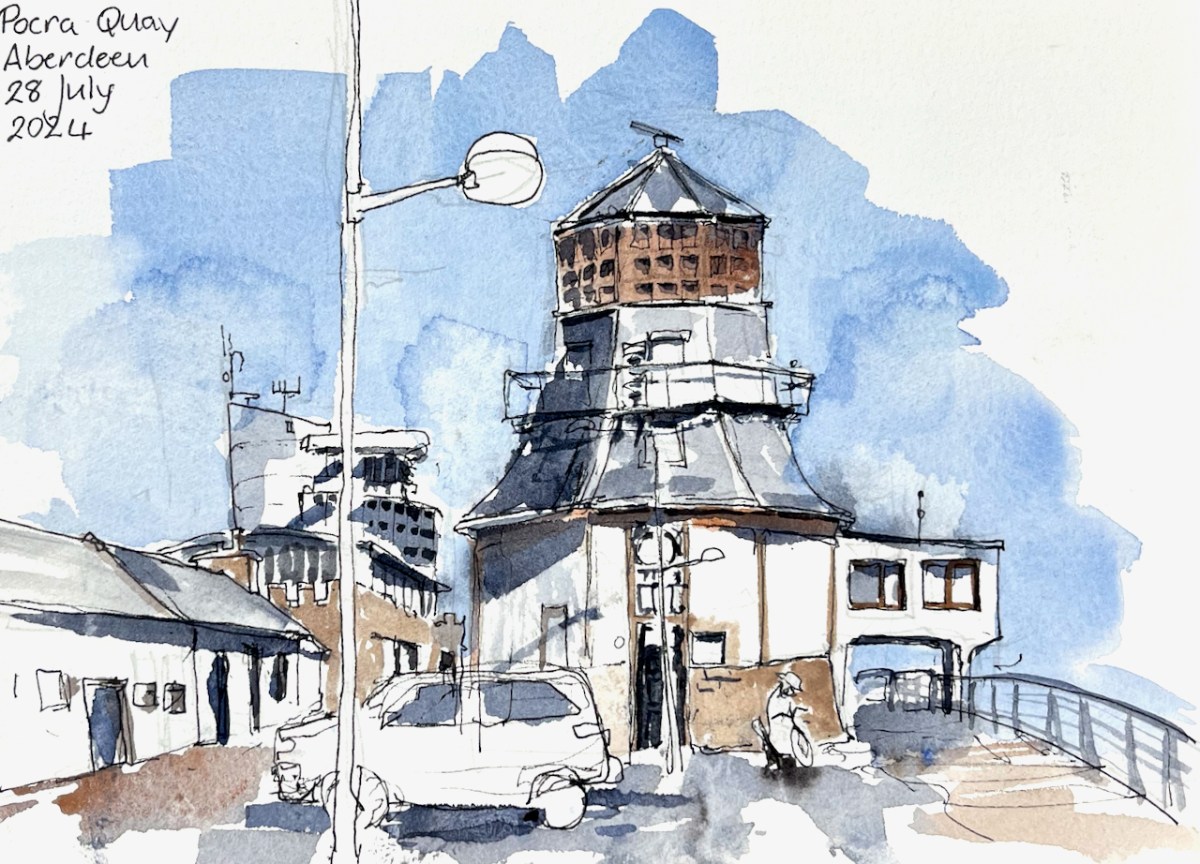
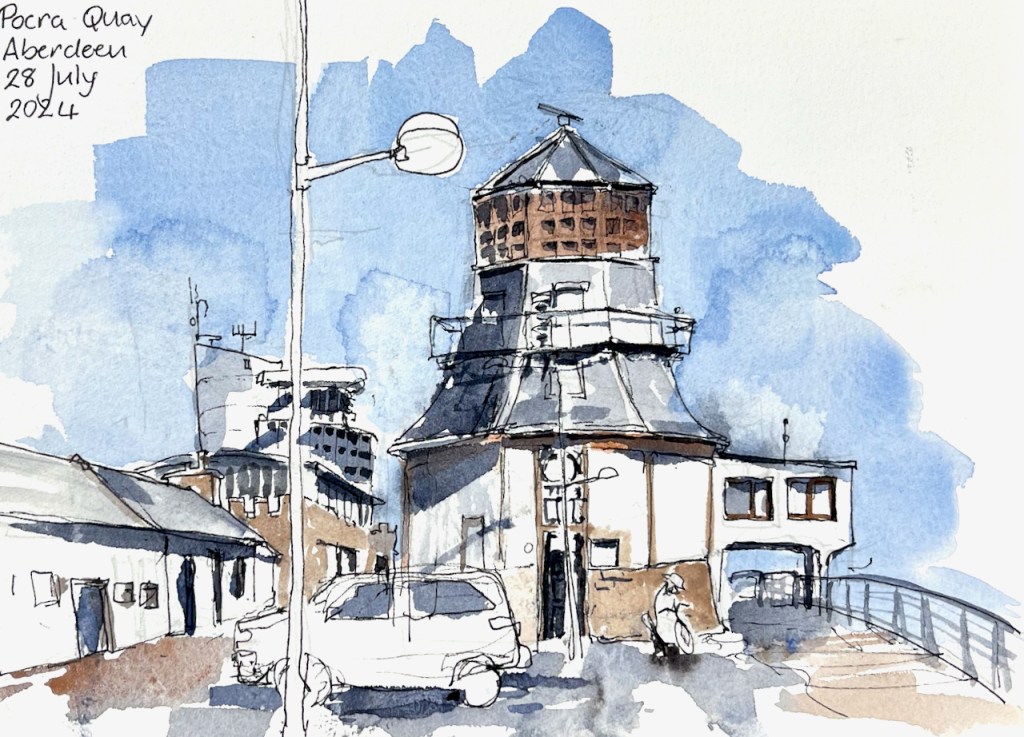
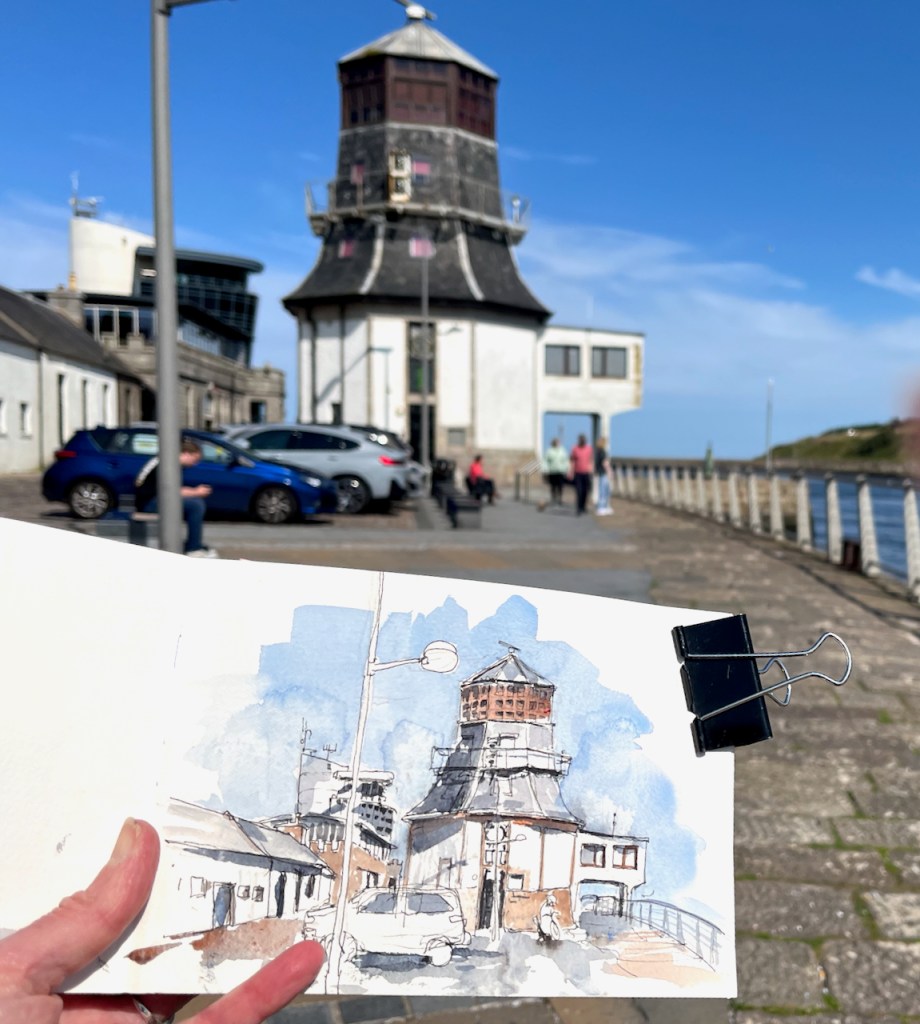
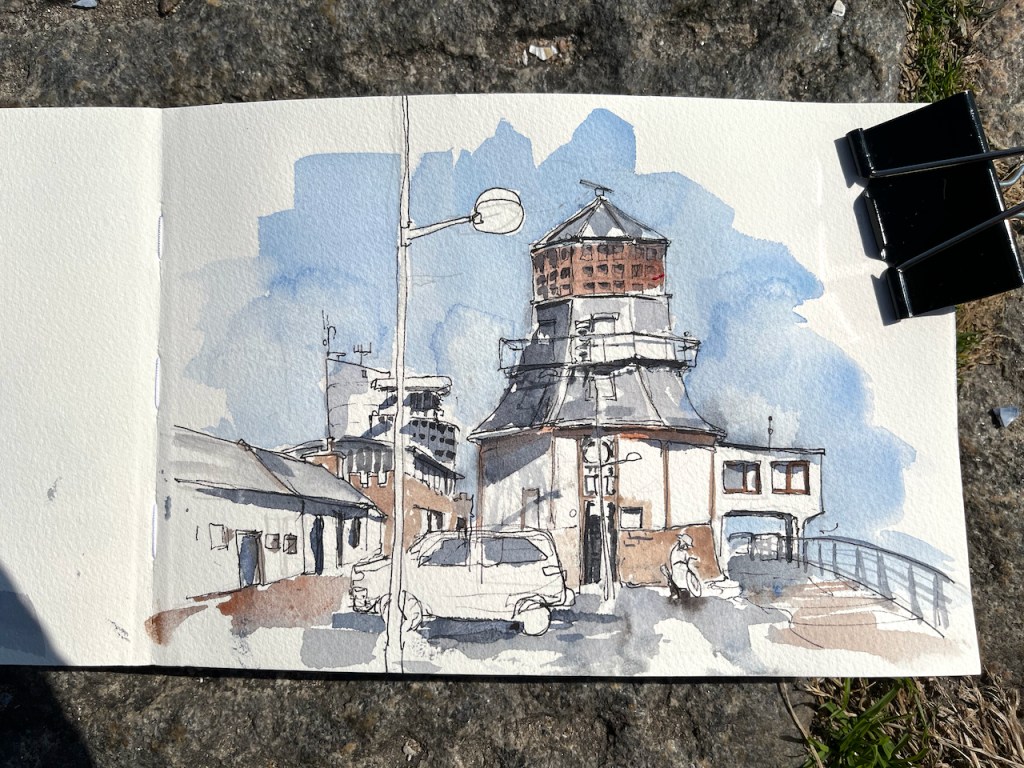
This is the watchtower near the entrance to the harbour of Aberdeen, known as “the Roundhouse”.

The Roundhouse, Pocra Quay, 28 July 2024, A5 in JP Purcell Sketchbook

It is octagonal. According to the listing on the Historic Environment Scotland site it was:
“[built] to guide vessels to port, this was originally carried out by the harbour pilots via loudhailer from a platform built into the roof of the original 2-storey structure, or by a system of wicker balls suspended from a pole rising from the platform.” [1]

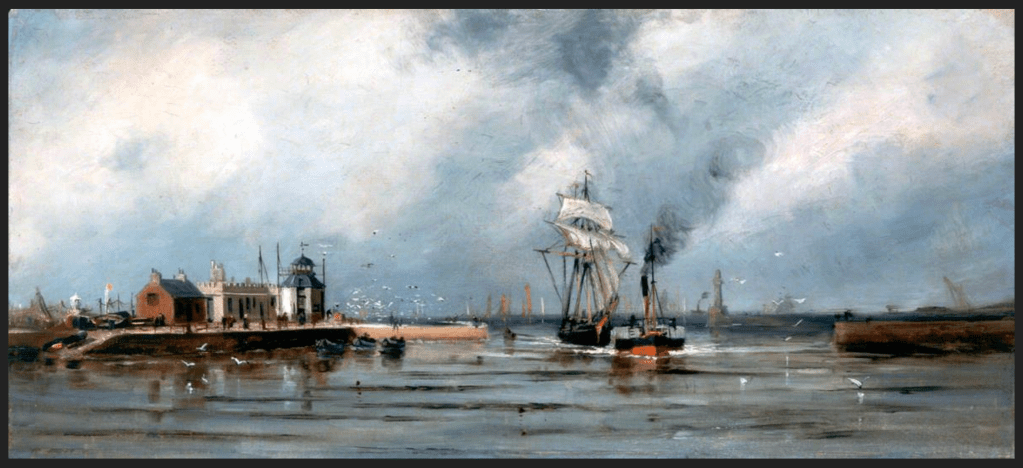
“Entrance to Aberdeen Harbour” by James Cassie (1819–1879)
image copyright: Aberdeen Maritime Museum


“The control tower was added in 1966 and a radar system was introduced in 1974. The structure was further updated in 1986 at which time the Queen unveiled a plaque, situated to the right of the main entrance to the tower, commemorating ‘850 years of Harbour History’.” [1]
It was in use until the Marine Operations Centre opened in 2006 [4]. This is nearer the sea, just visible behind the lamp-post in my drawing. It handles about 25000 boat movements a year, which averages at 60 a day [2]. For comparison, Heathrow air traffic control centre handles abut 200000 aircraft movements a year or 500 a day [3]. The area managed by the Marine Control Centre extends 2.3 nautical miles around the headland to the South of the harbour [5]. So the Operations Centre handles not just boats going in and out, but boats moving around inside and outside the harbour as well.

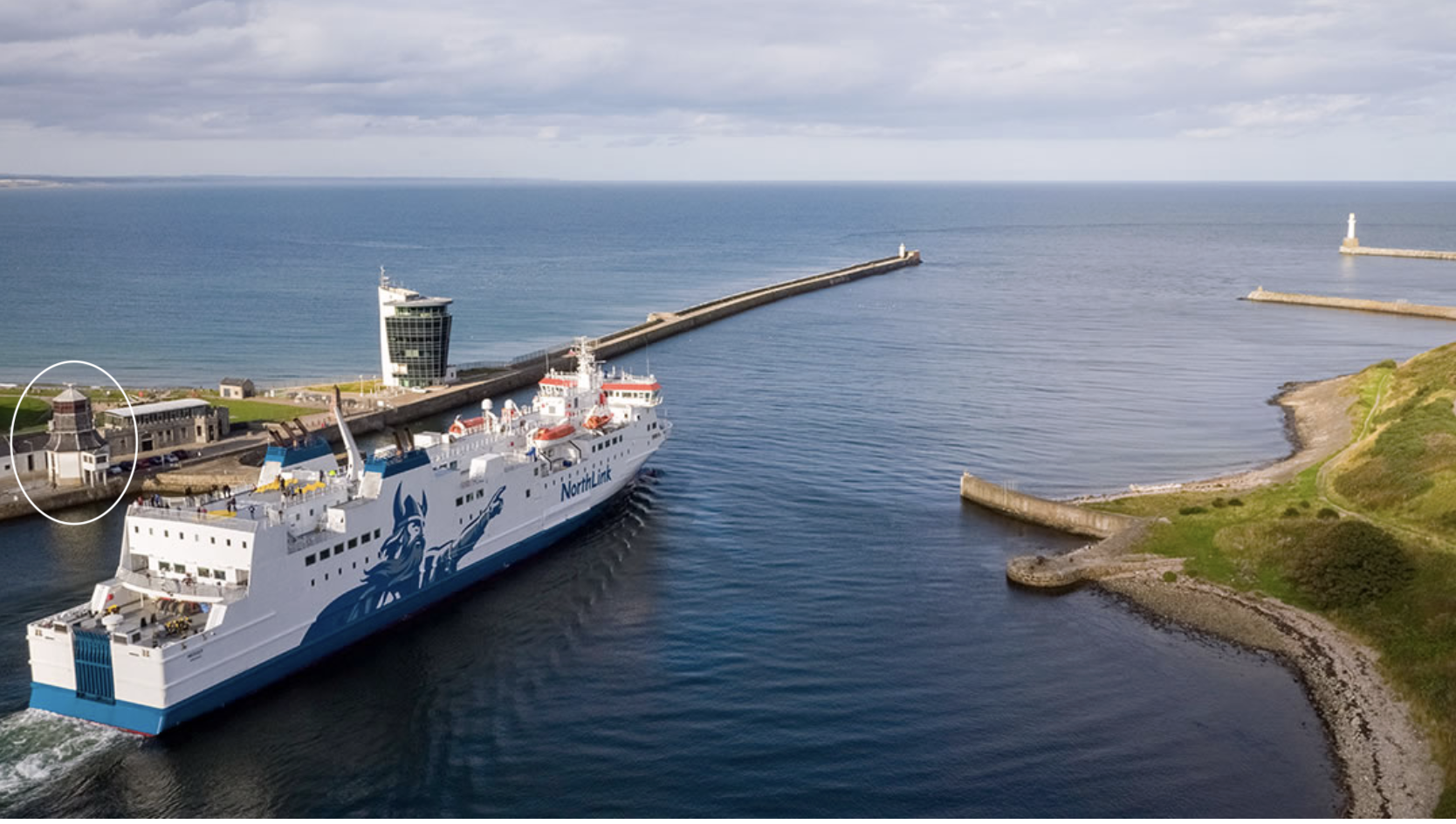
MV Hrossey leaving the port of Aberdeen, photo copyright southspear media, used with permission [6]
The Roundhouse, circled, is on the left, and the Marine Operations Centre is above the centre of the ship. This is the Northlink ferry, sailing to the Northern Isles.

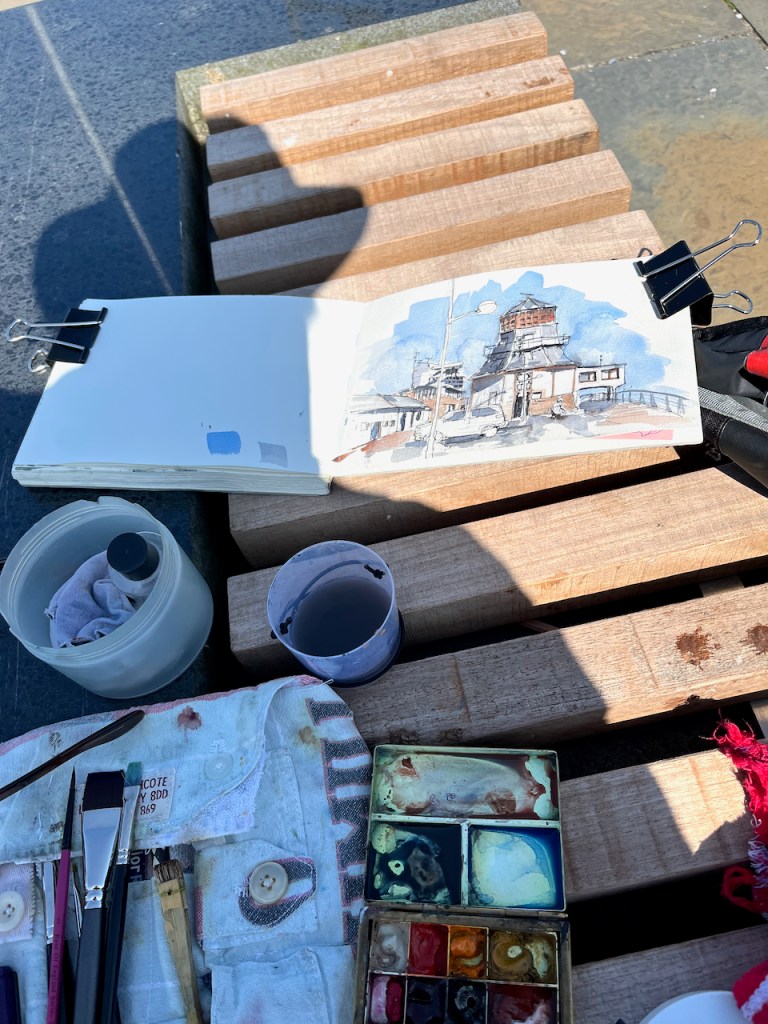
I sketched this on a stunning hot day, sitting on a bench by the quay.

The Roundhouse. The modern Marine Operations Centre is the tall white building behind and to the left. In front of it, and lower down behind the cars, is the restaurant “The Silver Darling”.

Three years ago, on a very different day, I made a much quicker sketch:

A quick sketch on a stormy rainy day, sketching from the shelter of a doorway. June 25th 2021.

References:

(1) Historic Environment Scotland listing: http://portal.historicenvironment.scot/designation/LB50941 FOOTDEE, POCRA QUAY, NAVIGATION CONTROL CENTRE (FORMER PILOT HOUSE)LB50941 downloaded 30 August 2024

(2) Aberdeen Maritime Trail leaflet, Aberdeen City Council – 100023401 – 2019: https://www.aberdeencity.gov.uk/sites/default/files/2020-09/Maritime%20Heritage%20Trail.pdf

[3] Heathrow Aircraft movement 2021 numbers from Heathrow facts and figures: https://www.heathrow.com/company/about-heathrow/facts-and-figures

[4] Gazetteer of Scotland https://www.scottish-places.info/features/featurefirst19543.html

[5] Port of Aberdeen Vessel Traffic Services extent: “All shipping movements within the Aberdeen VTS area (within 2.3nm from Girdleness) are controlled by Aberdeen VTS. Participation with VTS is mandatory, for further details please see ALRS Vol.6.” https://www.portofaberdeen.co.uk/port-information/marine

[6] Thank you to Nick McCaffrey of Southspear media for permission to use his amazing photograph of MV Hrossey leaving the port of Aberdeen.

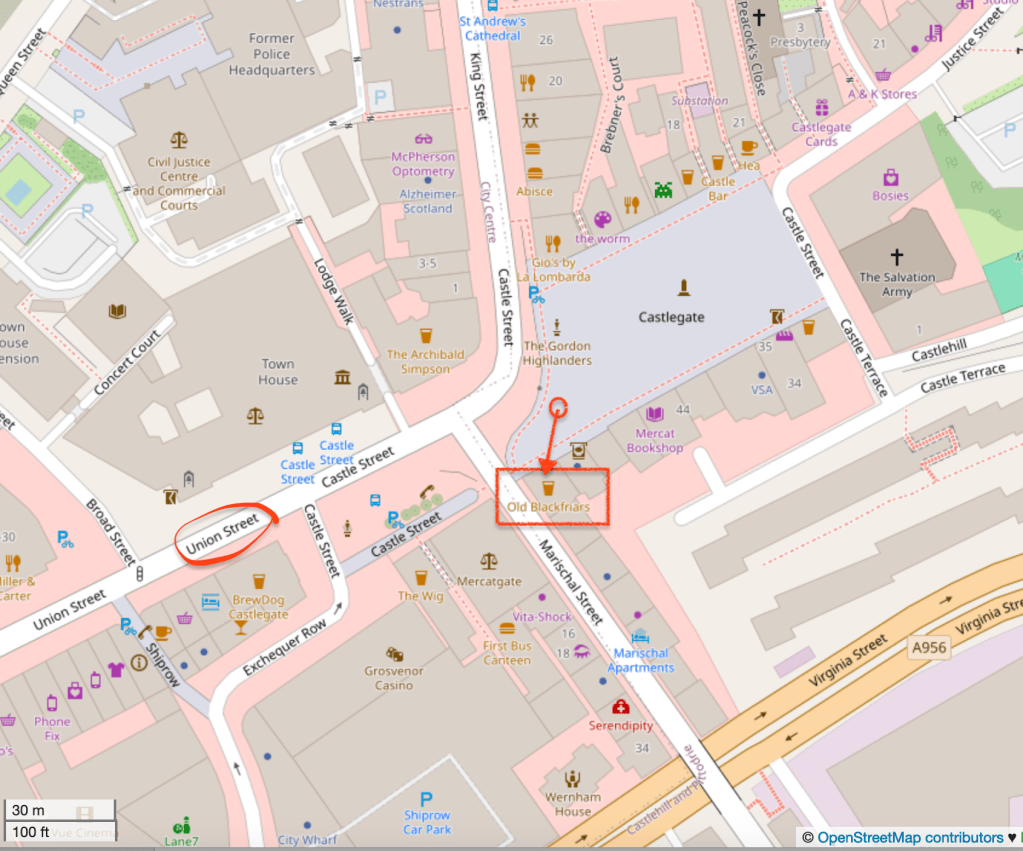
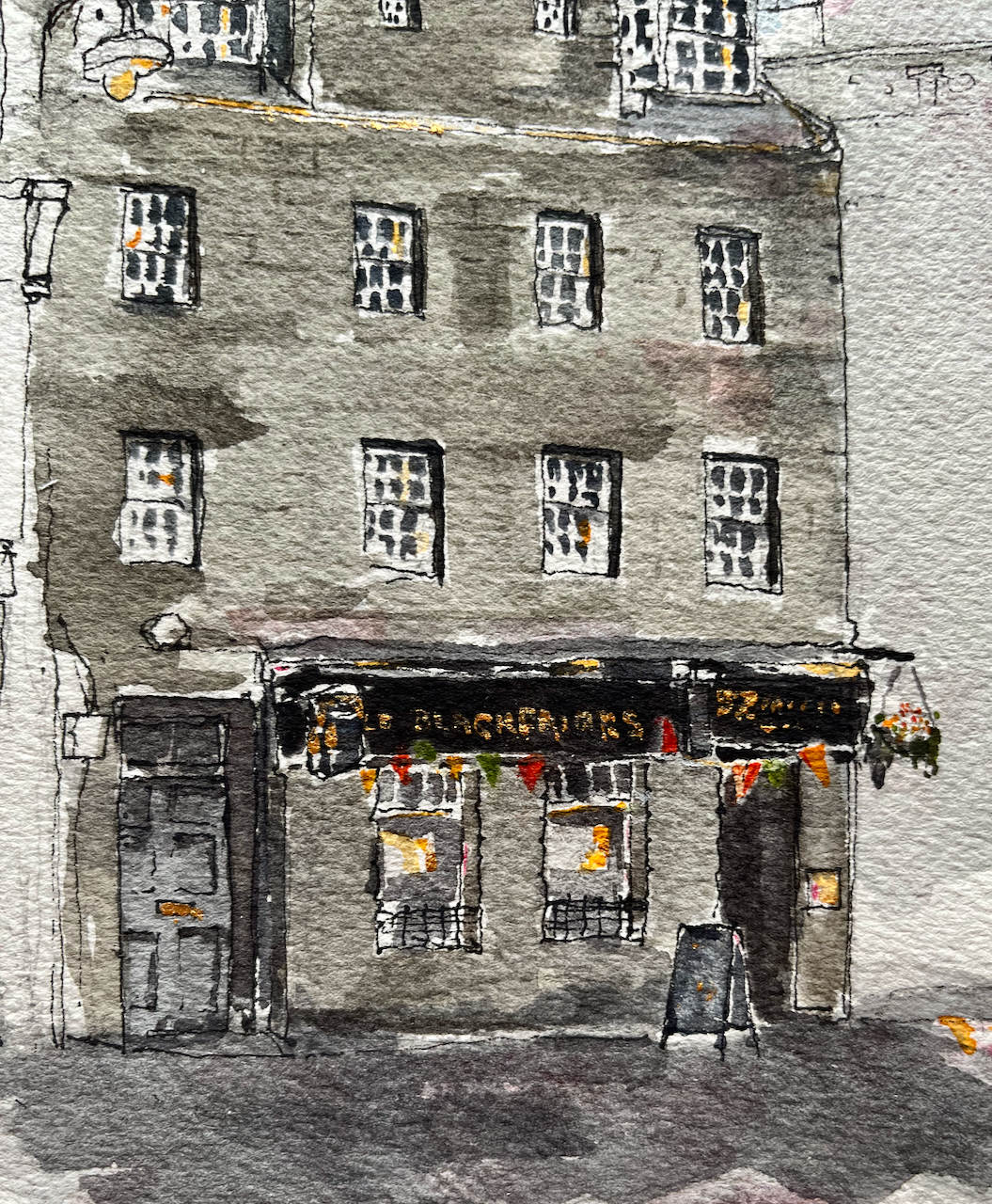
The Old Blackfriars, Aberdeen

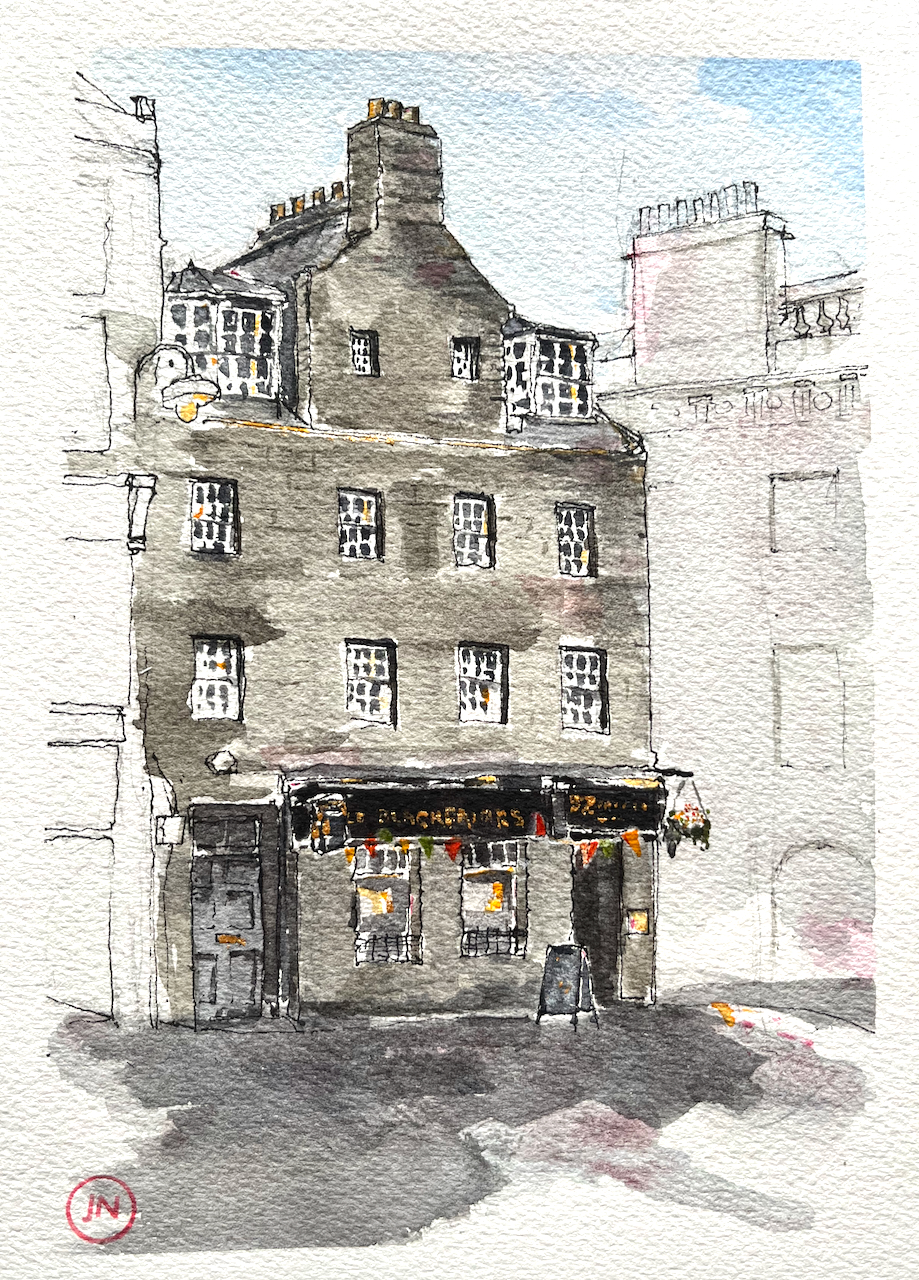
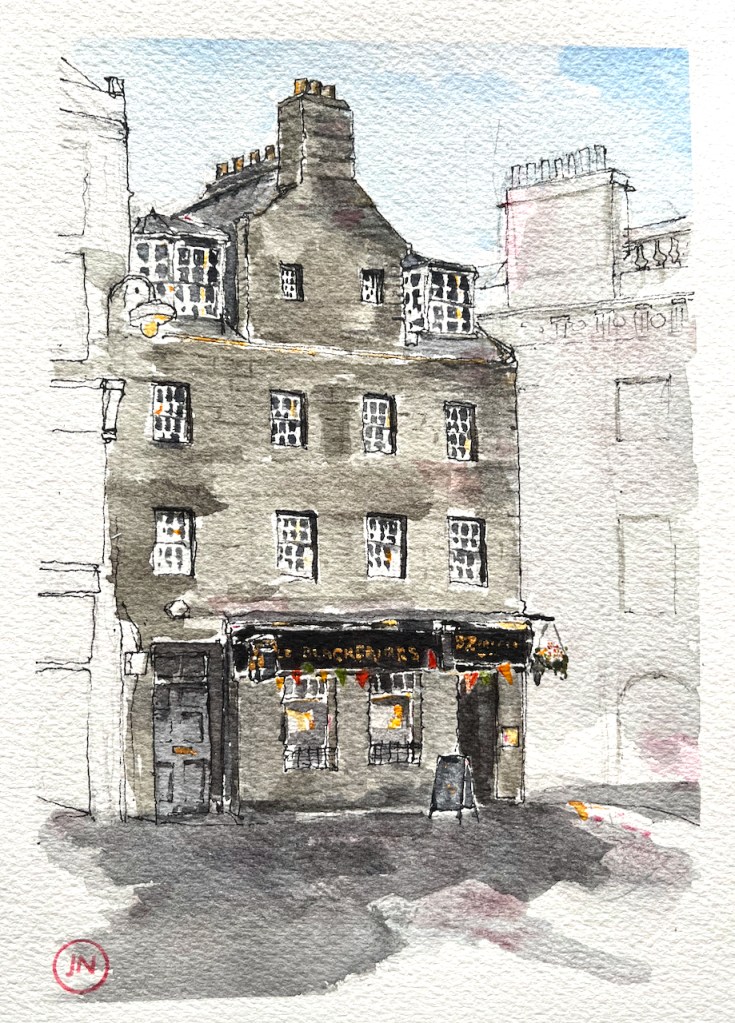
This is the Old Blackfriars, 52 Castle St, Aberdeen.

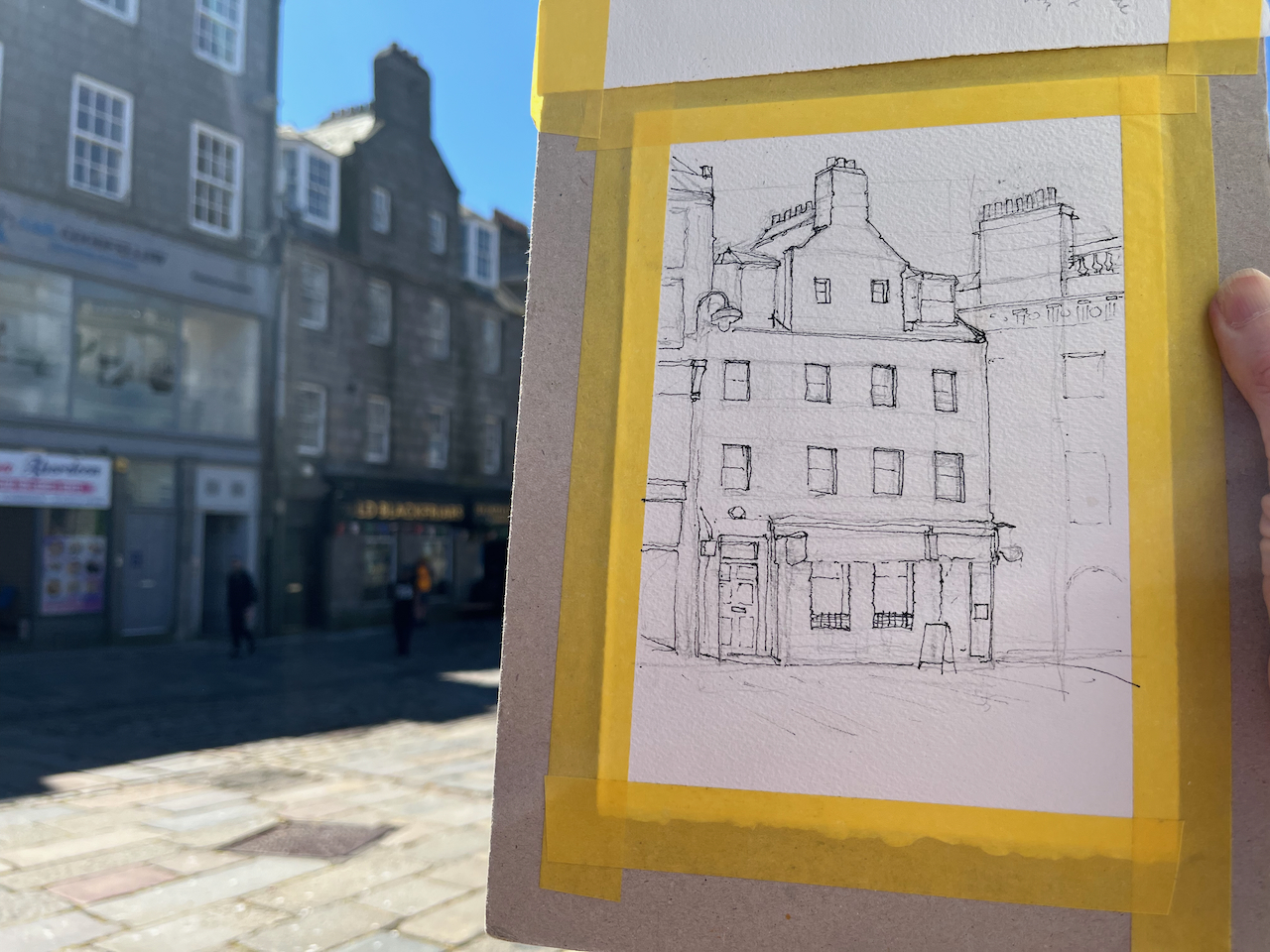
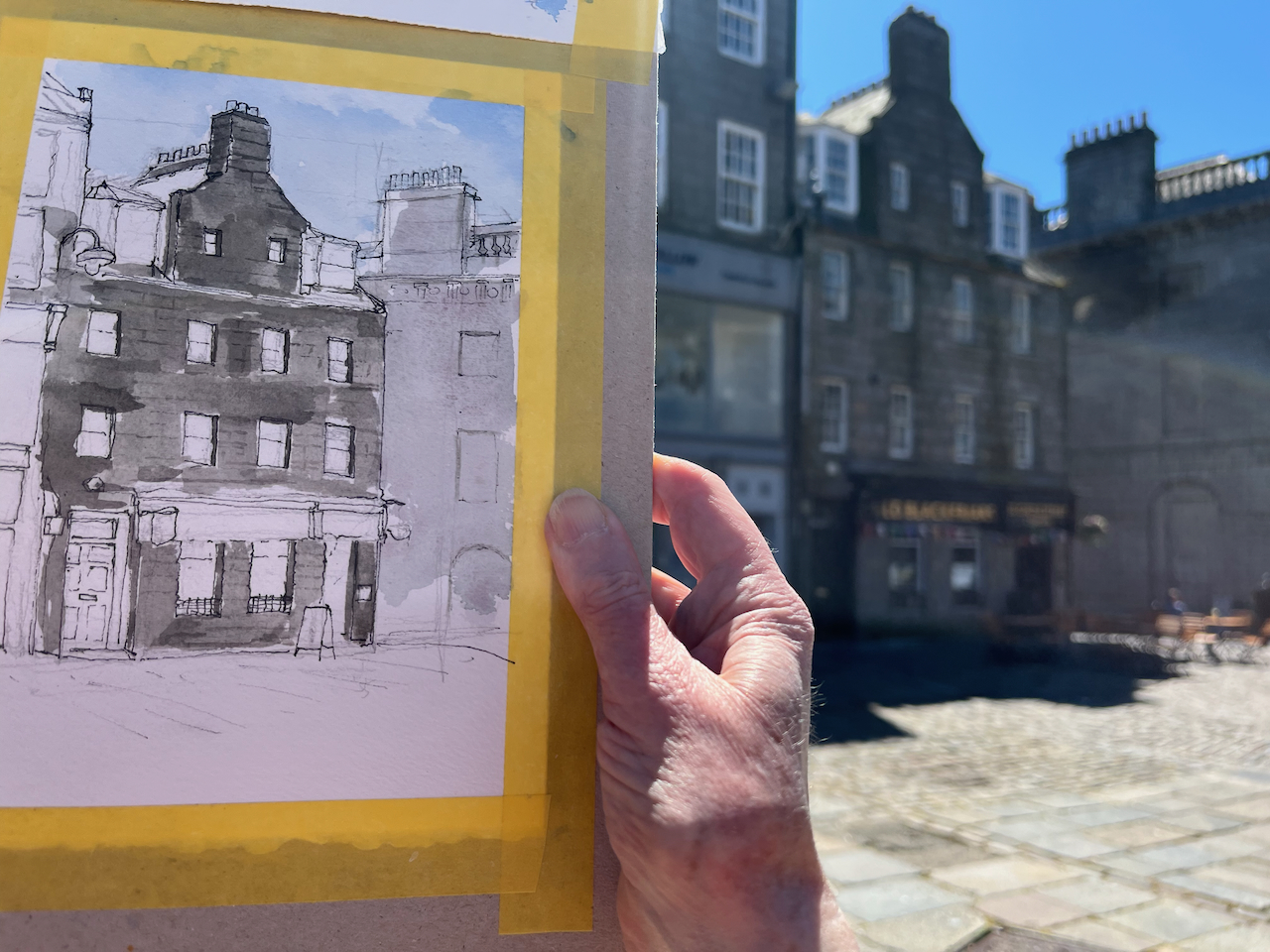
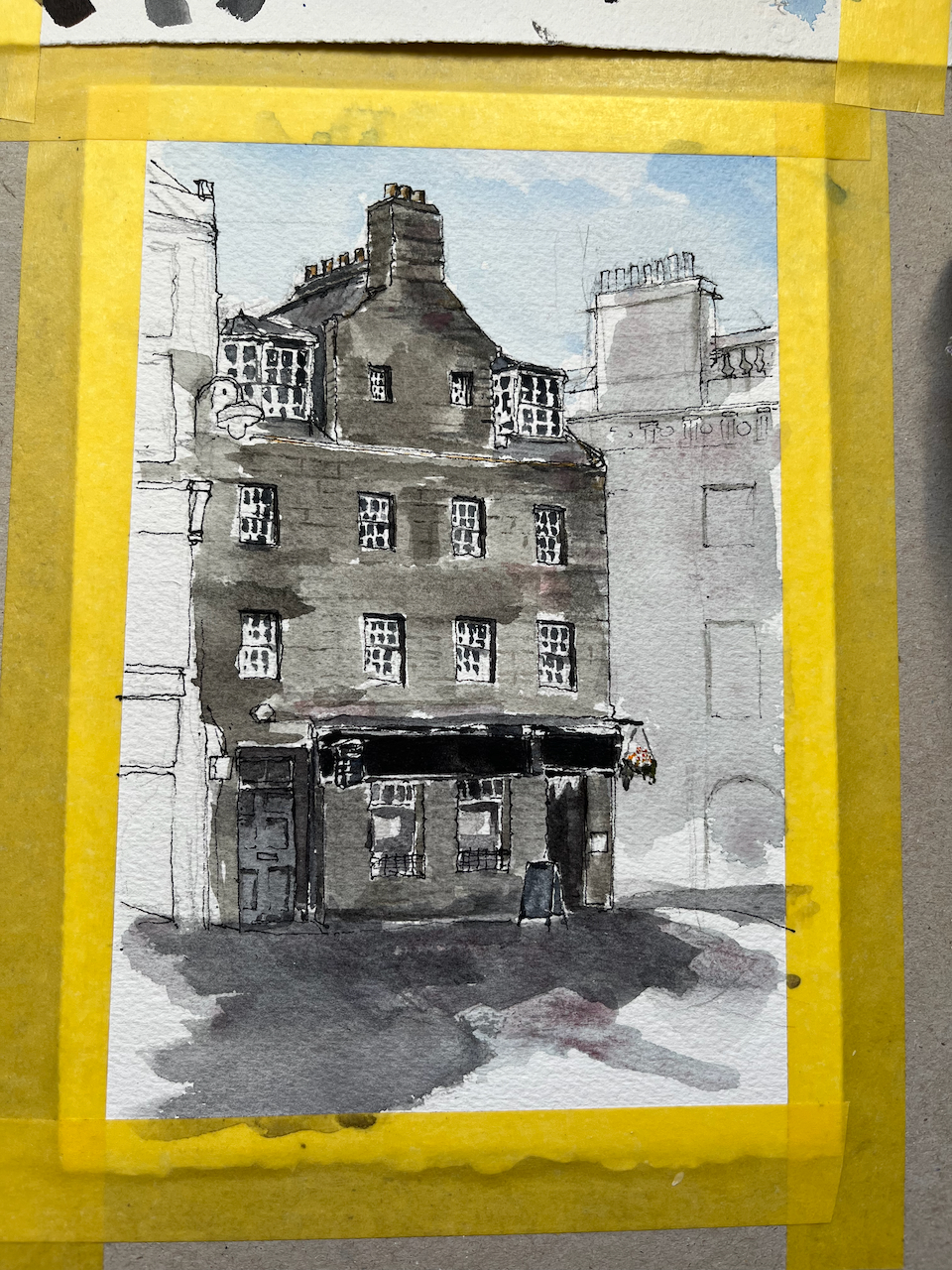
The Old Blackfriars, Aberdeen AB11 5BB, sketched 24 June 2024, 20cmx14cm (A5), [commission]

I worked on this drawing standing in the large cobbled square called Castlegate. A passer-by walked up to where I was standing, and took an interest in the picture. I’ll call him Campbell. He had much to tell me, a visitor, about the city of his birth. He had been brought up in what he described as the “tenements” on the dock. “Six of us to a room,” he said. He’d trained as a coppersmith, and found work in the engine rooms of ships and submarines, making “boilers, pipes and flanges”.

I was sketching this pub at the request of a client who had happy memories of their time there. Campbell also had happy memories of his lively times at the pub, although his experiences pre-dated those of my client by some decades. It was a pub for folk working the docks Campbell told me, and “they had a hard life”.

Uncharacteristically for British people, we talked politics. The general election was coming up. My new friend had little time for politicians of any stripe. They don’t know what they are doing, he asserted. “It’s like watching a drunk man trying to walk down Union Street”. He indicated the wide straight street across the cobbles, and with an articulate hand gesture demonstrated the erratic movements of the inebriated.


I enjoyed his entertaining stories as I sketched. He went on his way when I was at the pen-and-ink stage. I hope that some of his stories made it into the finished drawing.


The main colours are: (DS=Daniel Smith watercolour)
– ultramarine blue finest (Schmincke)
– burnt umber (DS)
– haze pink (Schminke) – in the stones
– rose madder permanent (DS) – in the stones
For the details:
– permanent yellow deep
– pyrrole red
– mars yellow
– acrylic gold paint

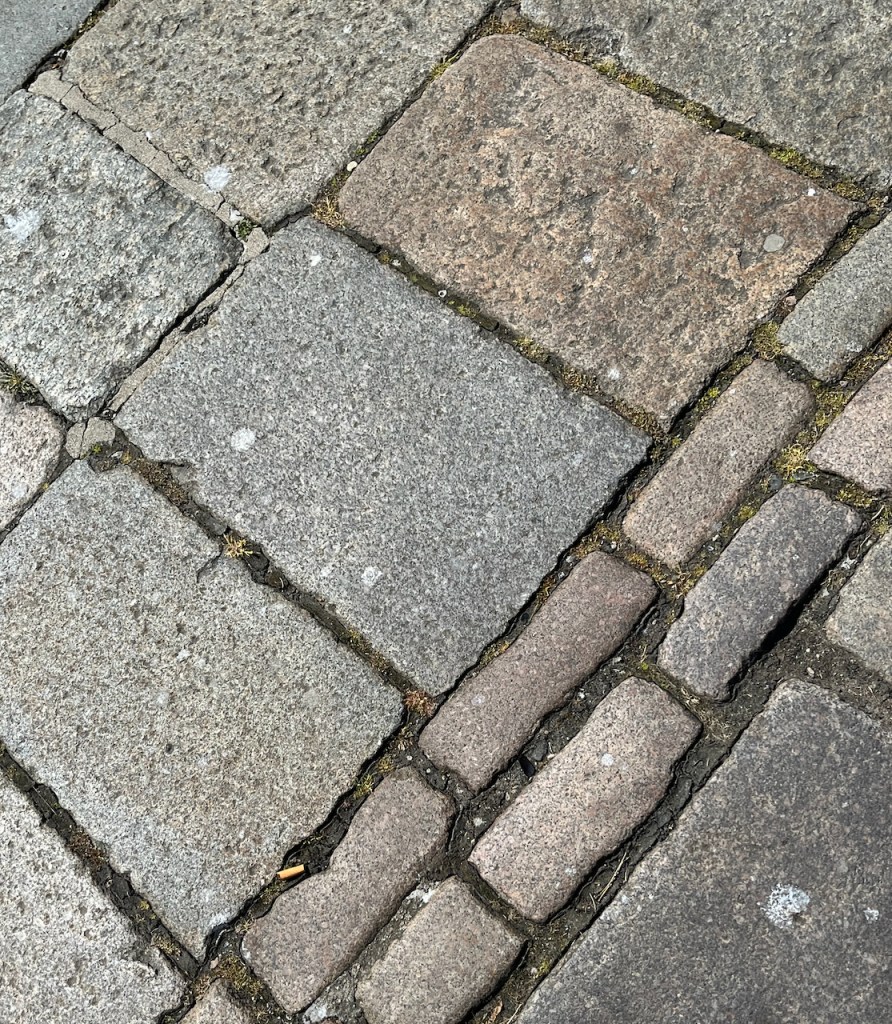
Aberdeen is “The Grey City” for some. But for anyone who doubts that there really is pink in the stone, I include a photo of the cobbles.

Cobbles at my feet


This was a commission. Thank you to my client for inspiring me to draw this historic pub, and for their permission to post the pictures here. They kindly sent me a photo of the picture in its frame:

photo credit: my client G.

Urban sketching, Shetland and the journey south 2023

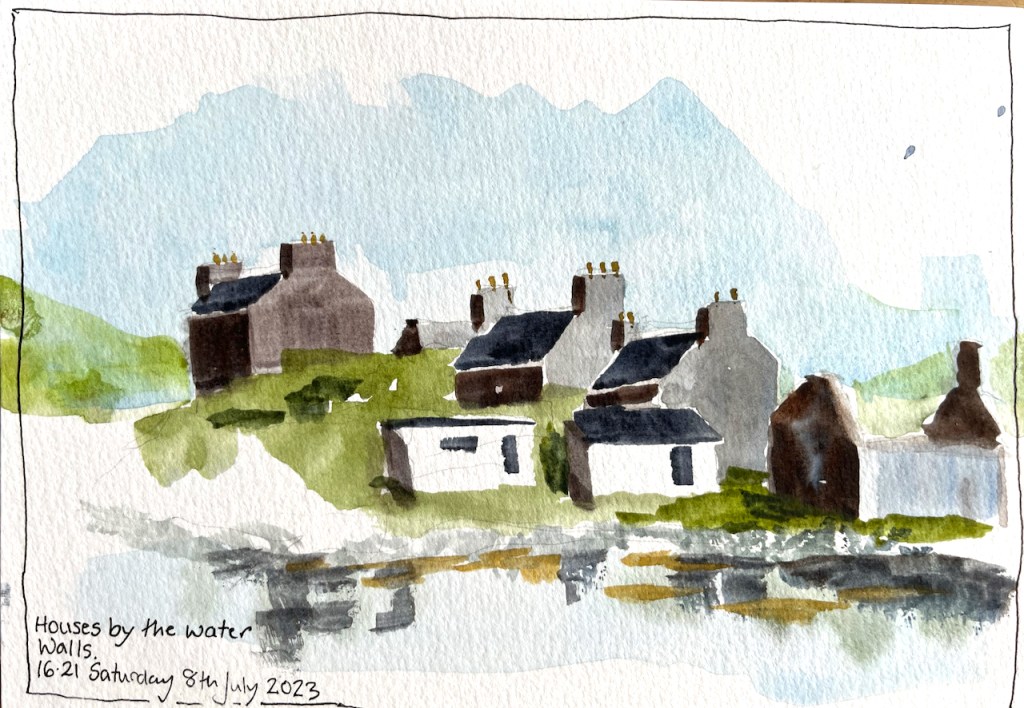
Here is a postcard which I made at the end of a long hot walk. It shows the houses in Walls, on Shetland West Side.

Houses by the water, Walls, Shetland. Postcard sketch A5, 8th July 2023

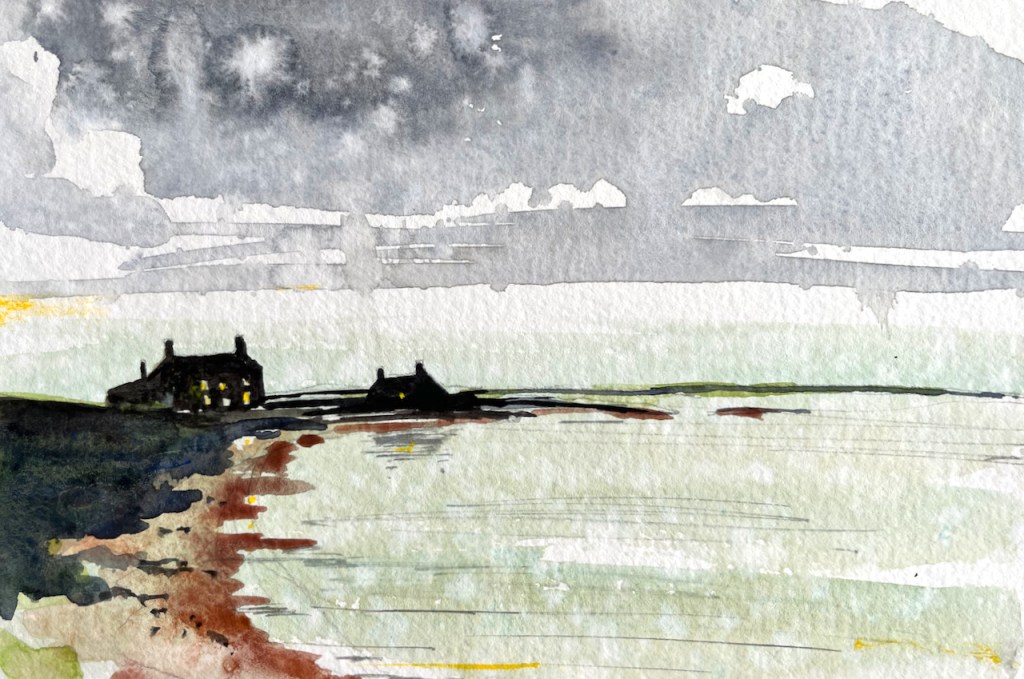
Here is Burrastow House and Burrastow Cottage, an evening view. I sketched this on top of a sky view I’d sketched earlier, but which had been spotted by rain, as you see.

Burrastow House and cottage, evening view. A5 postcard.

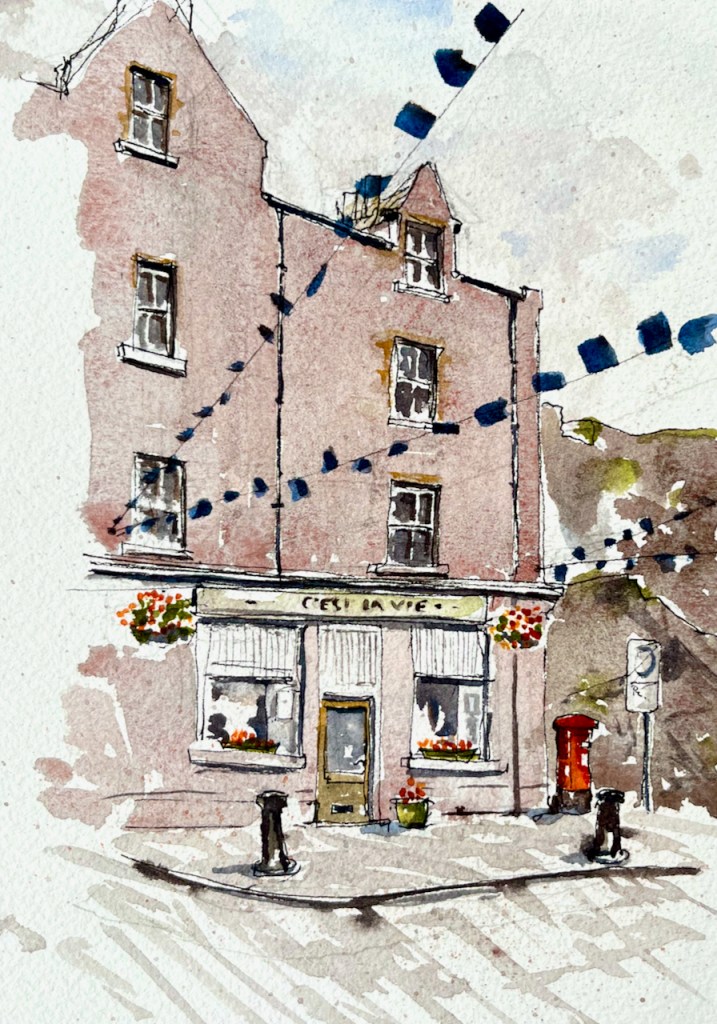
This is a restaurant in Lerwick: “C’est la vie”.

“C’est la vie” French restaurant, Lerwick, postcard sketch A5, August 3rd 2023

The flags are to welcome the “Tall Ships” which came to Lerwick earlier in the week. The restaurant was closed, I was waiting to see if it opened. Then the rain started. Then the restaurant opened and I finished the sketch inside. Then I walked to the Ferry Terminal.

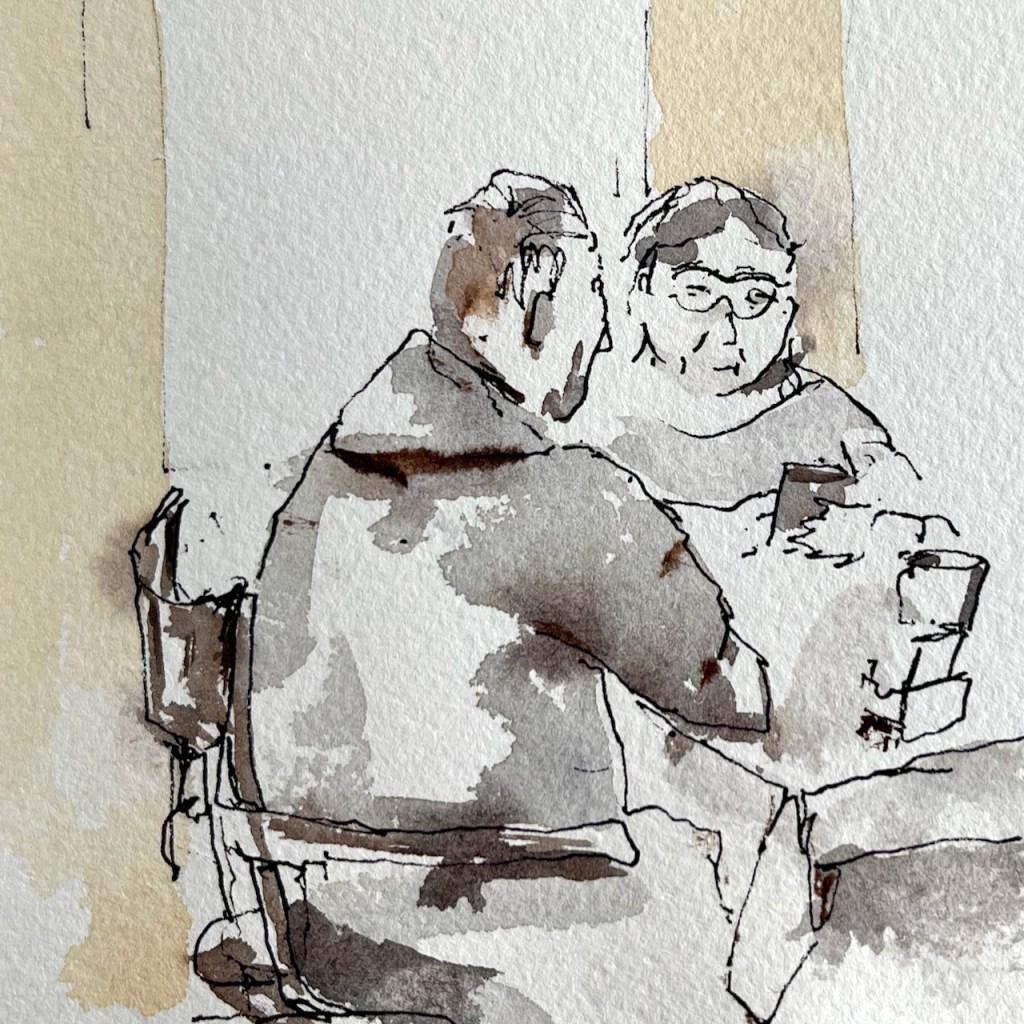
On the ferry, I made quick sketch of people at breakfast.

On board MV Hrossey, approaching Aberdeen. Breakfasters in the lounge. August 4th 2023. Vintage paper company sketchbook, A5

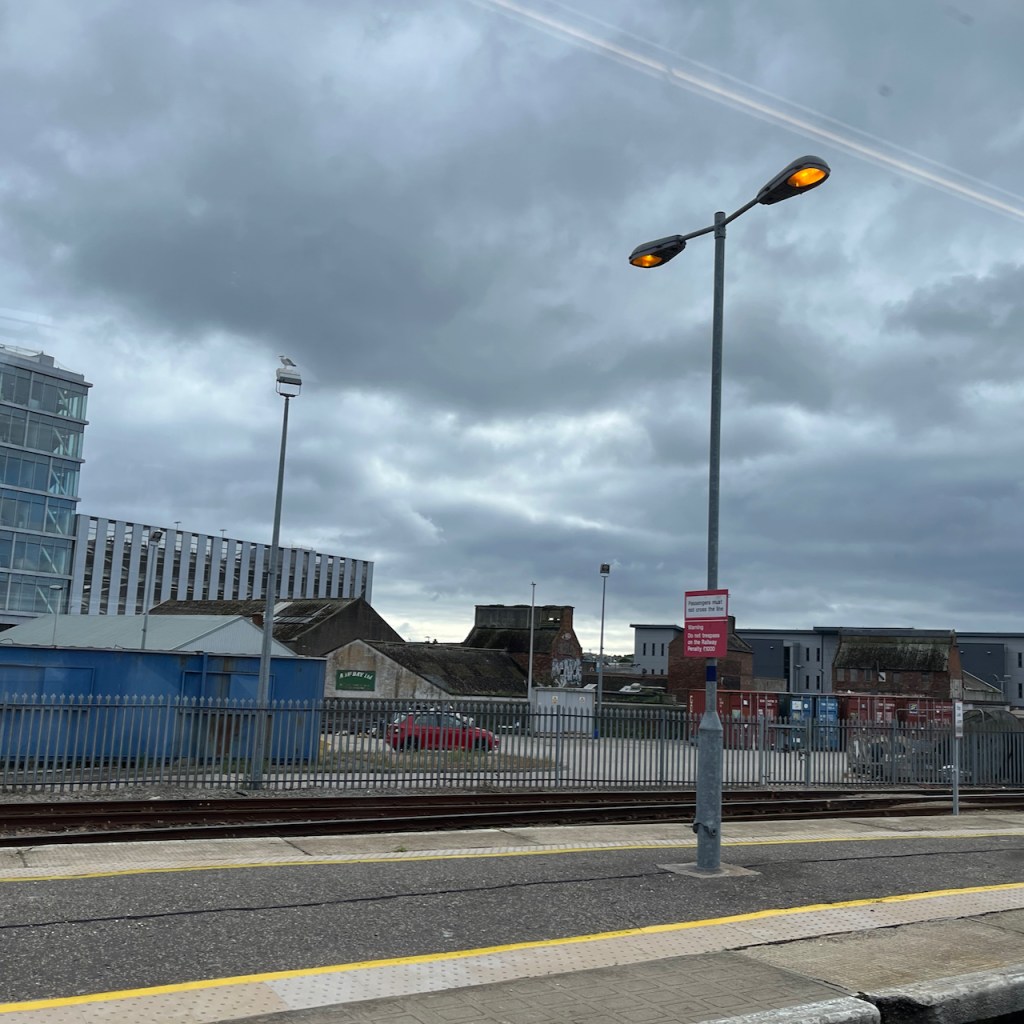
Here is my final sketch of the expedition. On the train at Aberdeen, I looked out of the window.


I have a sketchbook full of images. Here’s a quick flip through showing random glimpses of the visit: (19 second silent video)

Sketching in Aberdeen, summer 2022

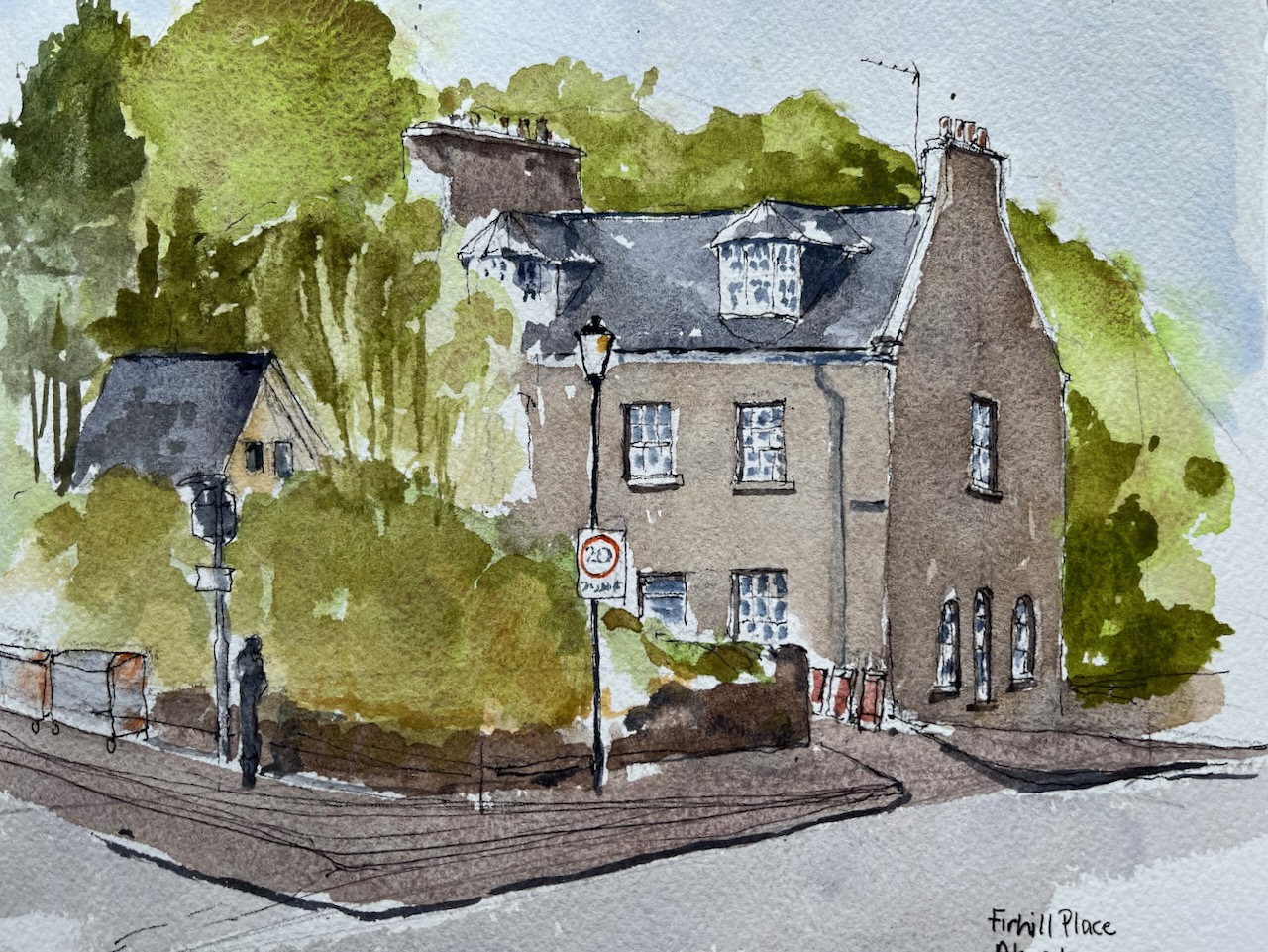
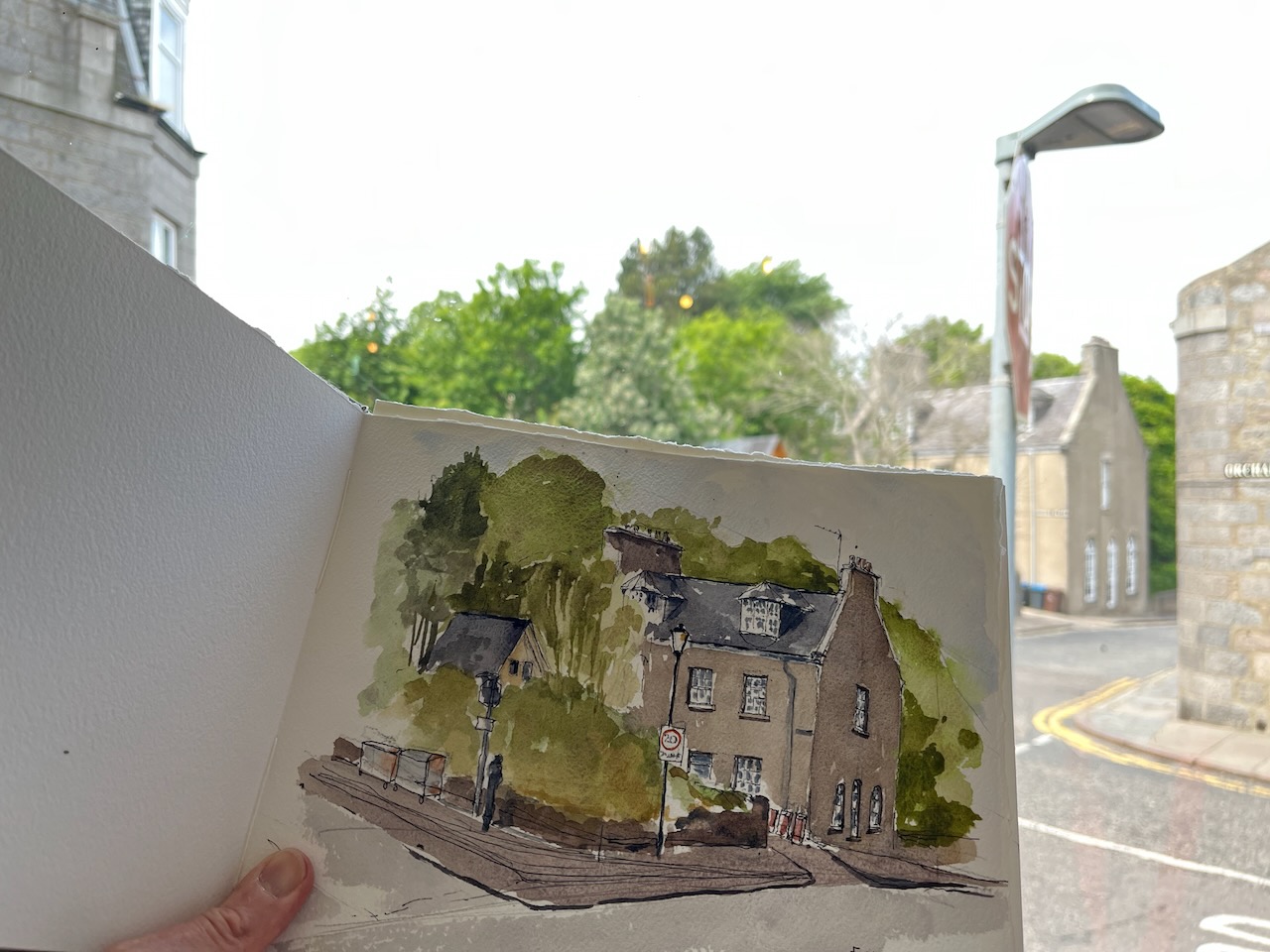
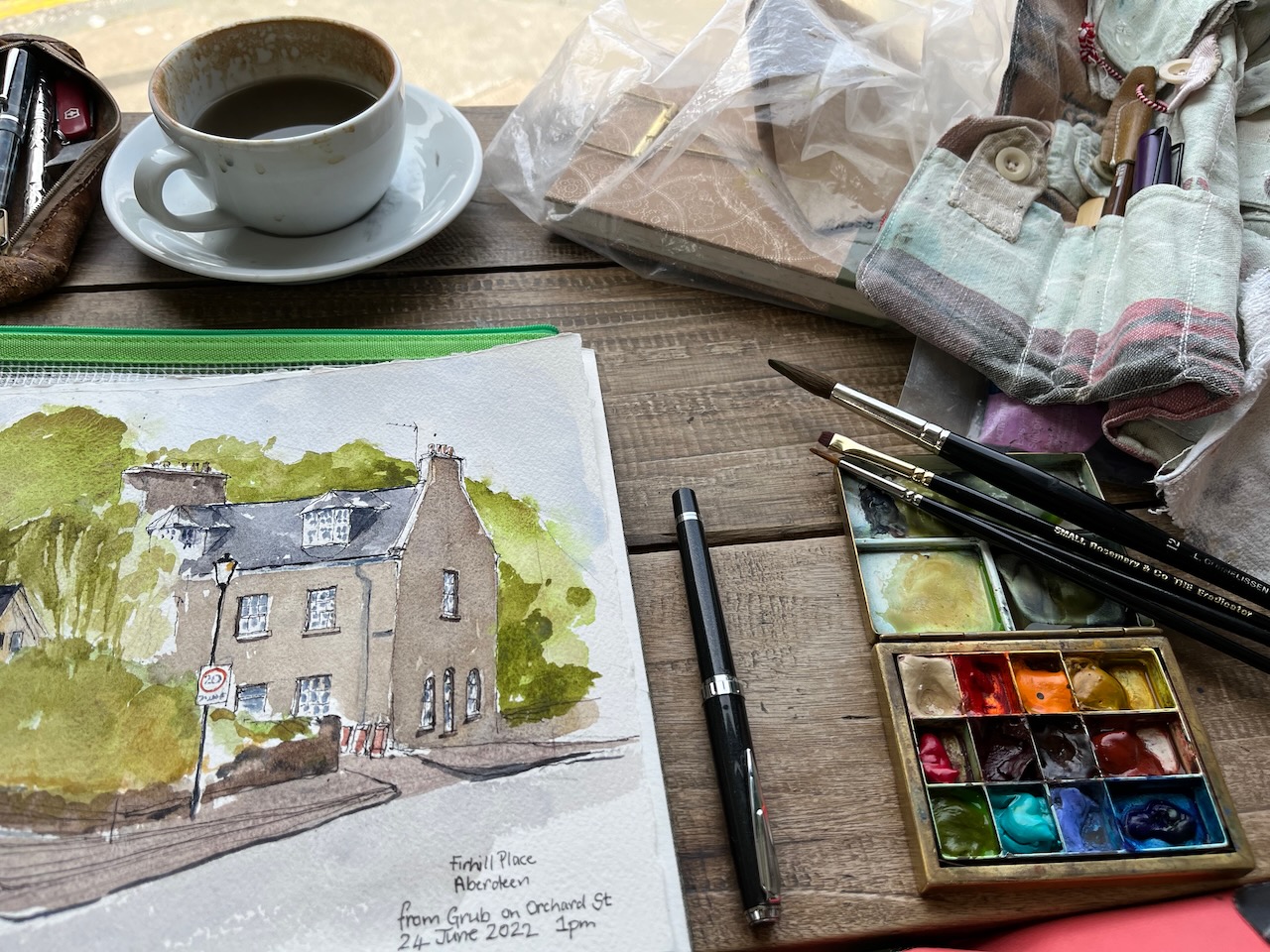
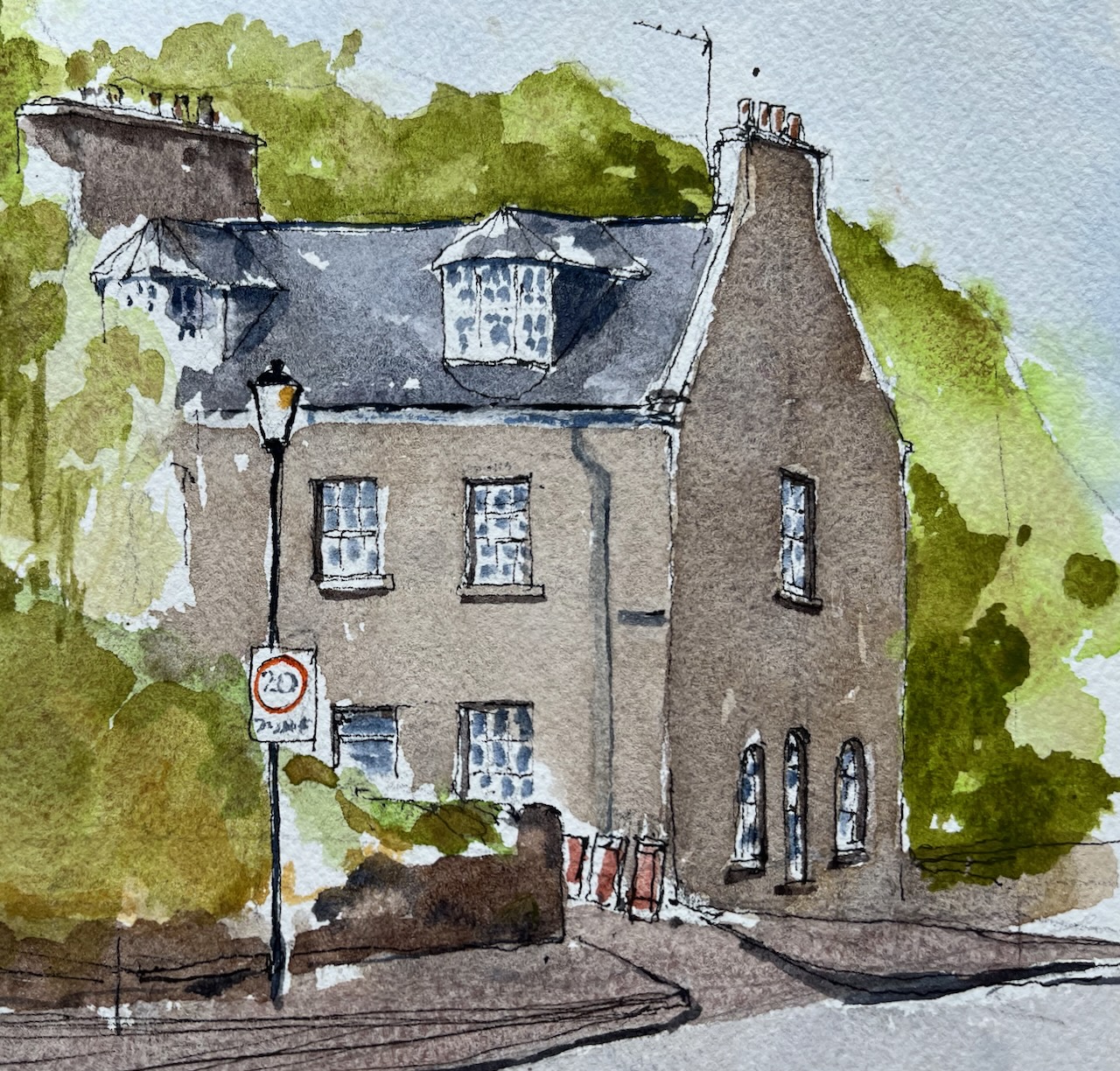
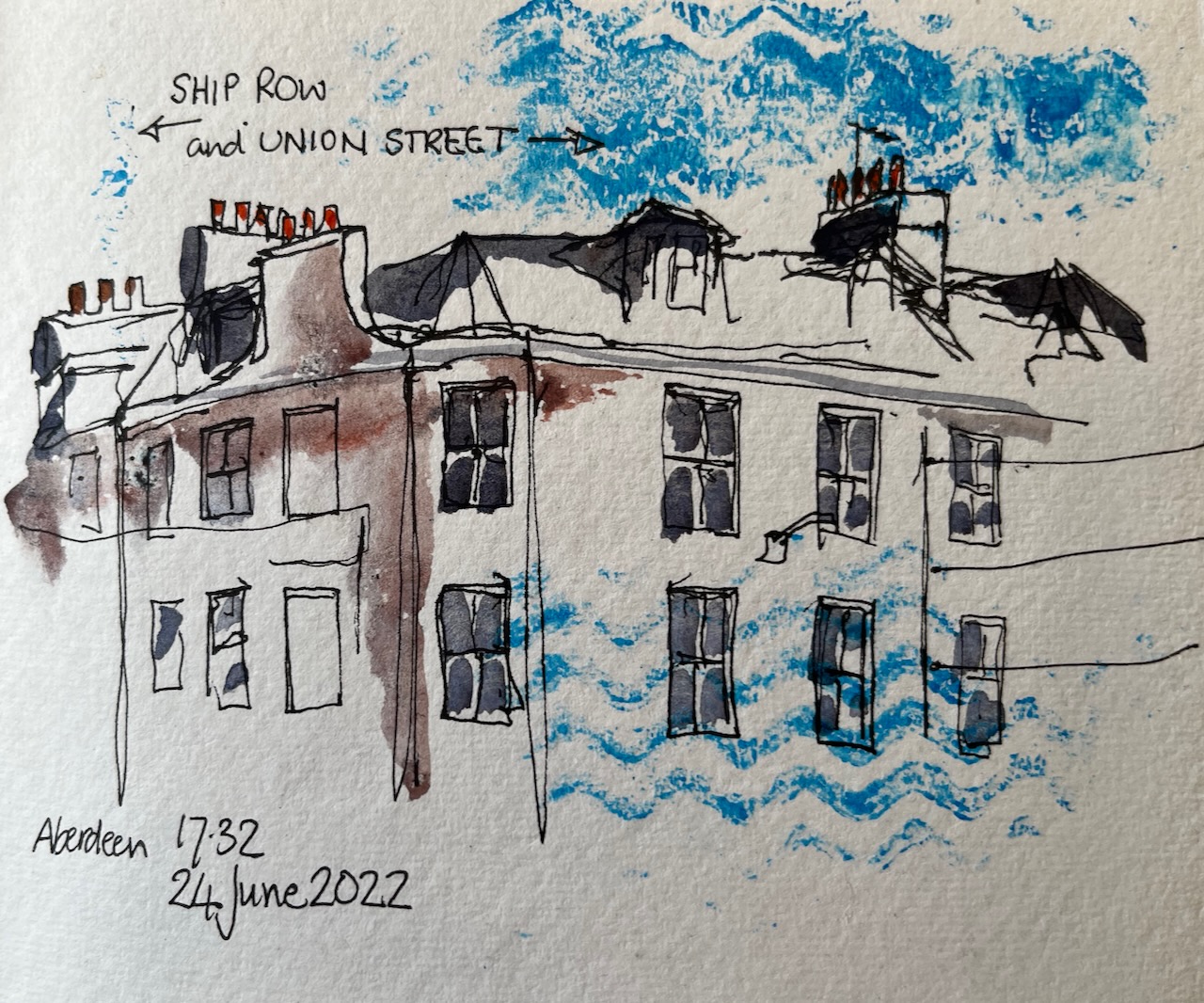
Here is a house in Firhill Place, Aberdeen, near the University.

House in Firhill Place, Aberdeen, 24 June 2022

I sketched it from a coffee shop called “Grub”, on Orchard Street.

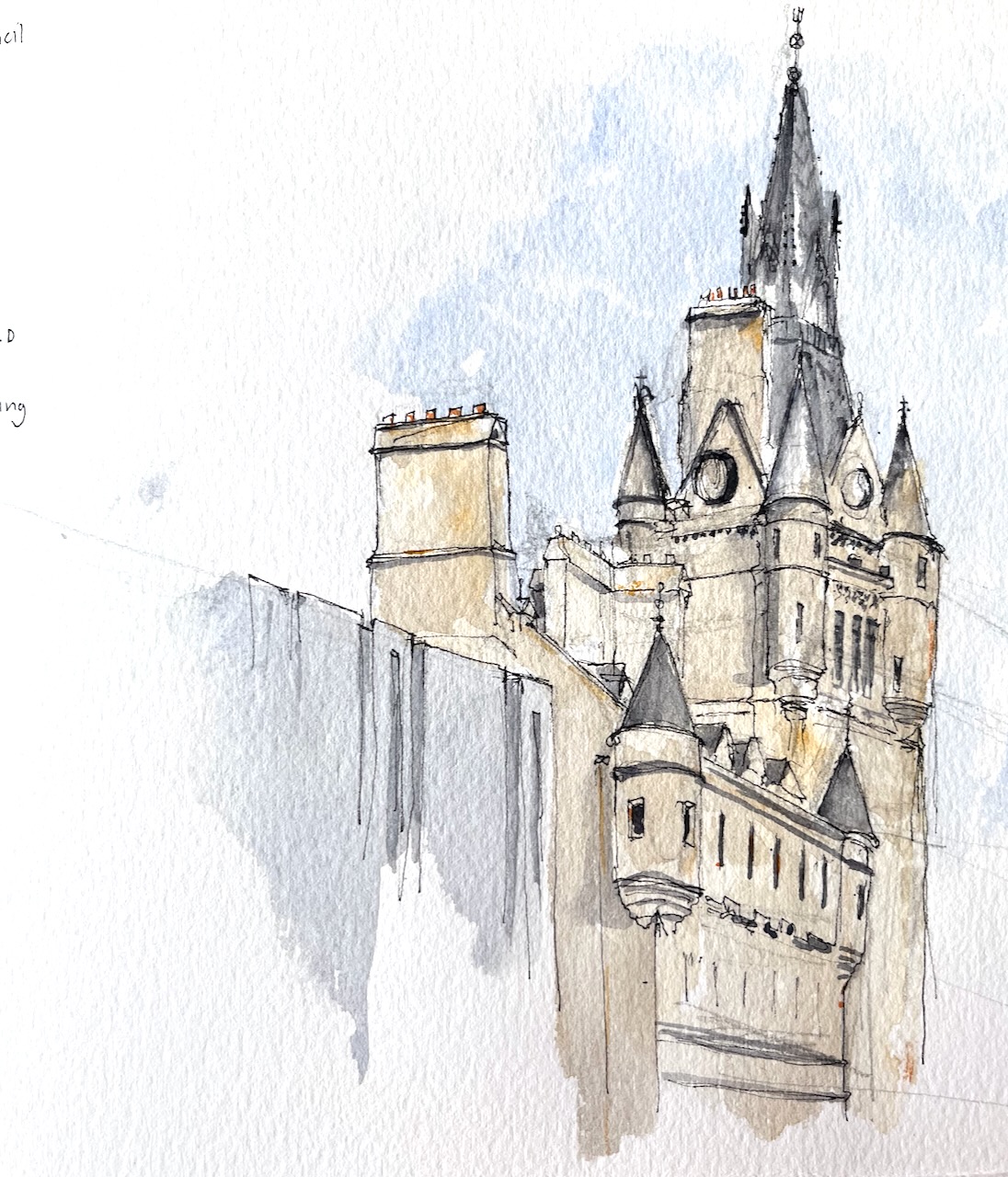
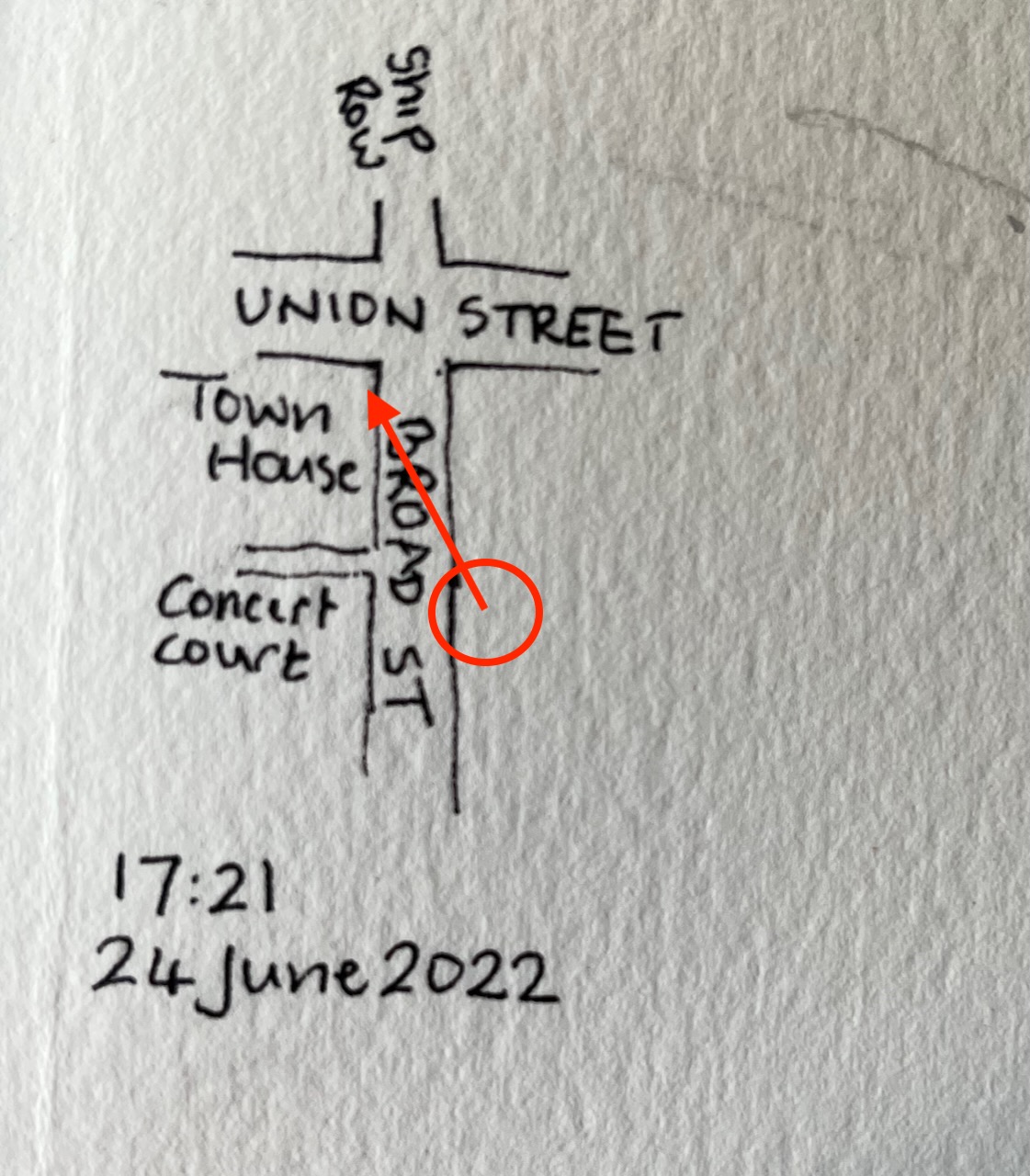
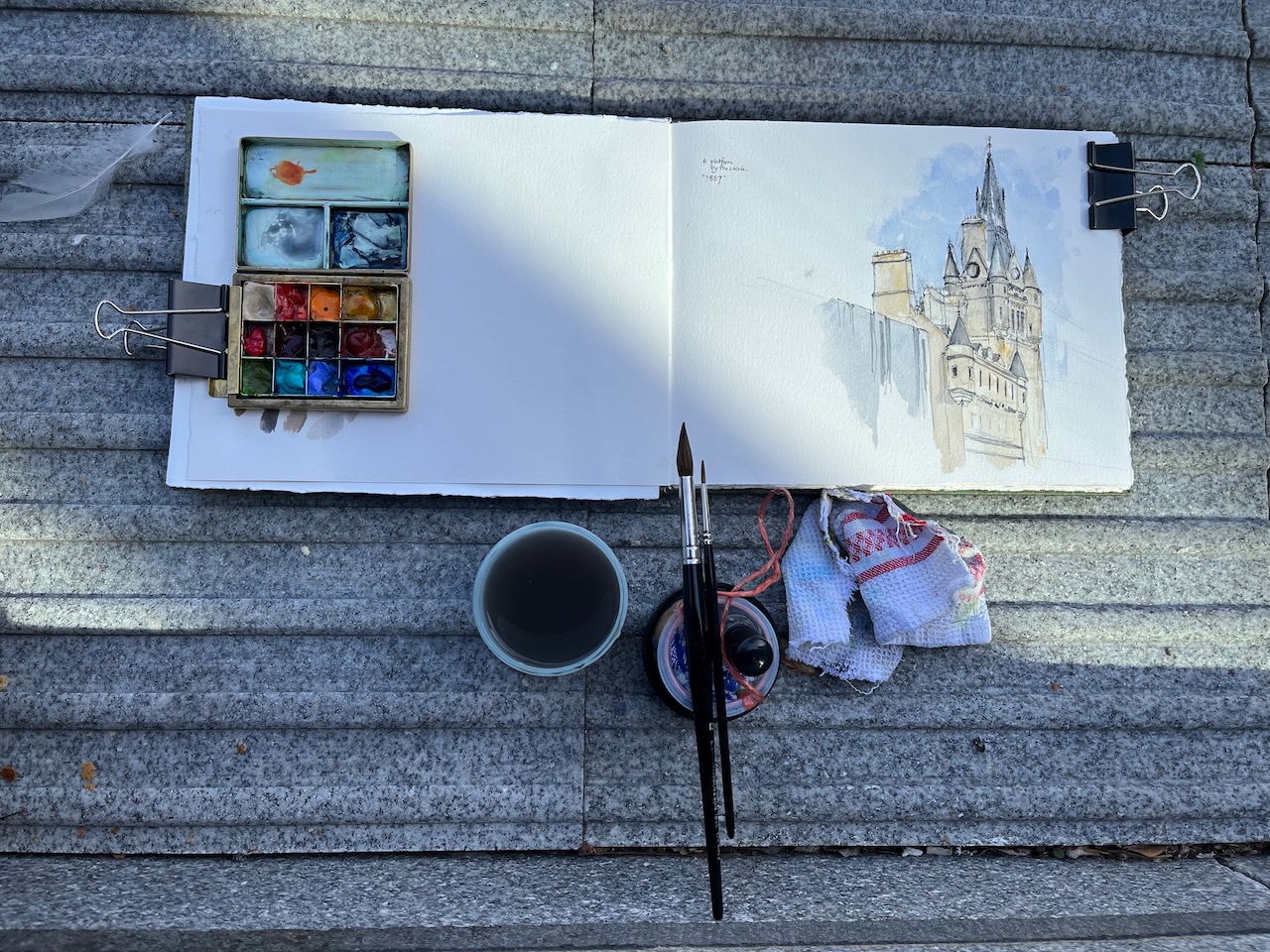
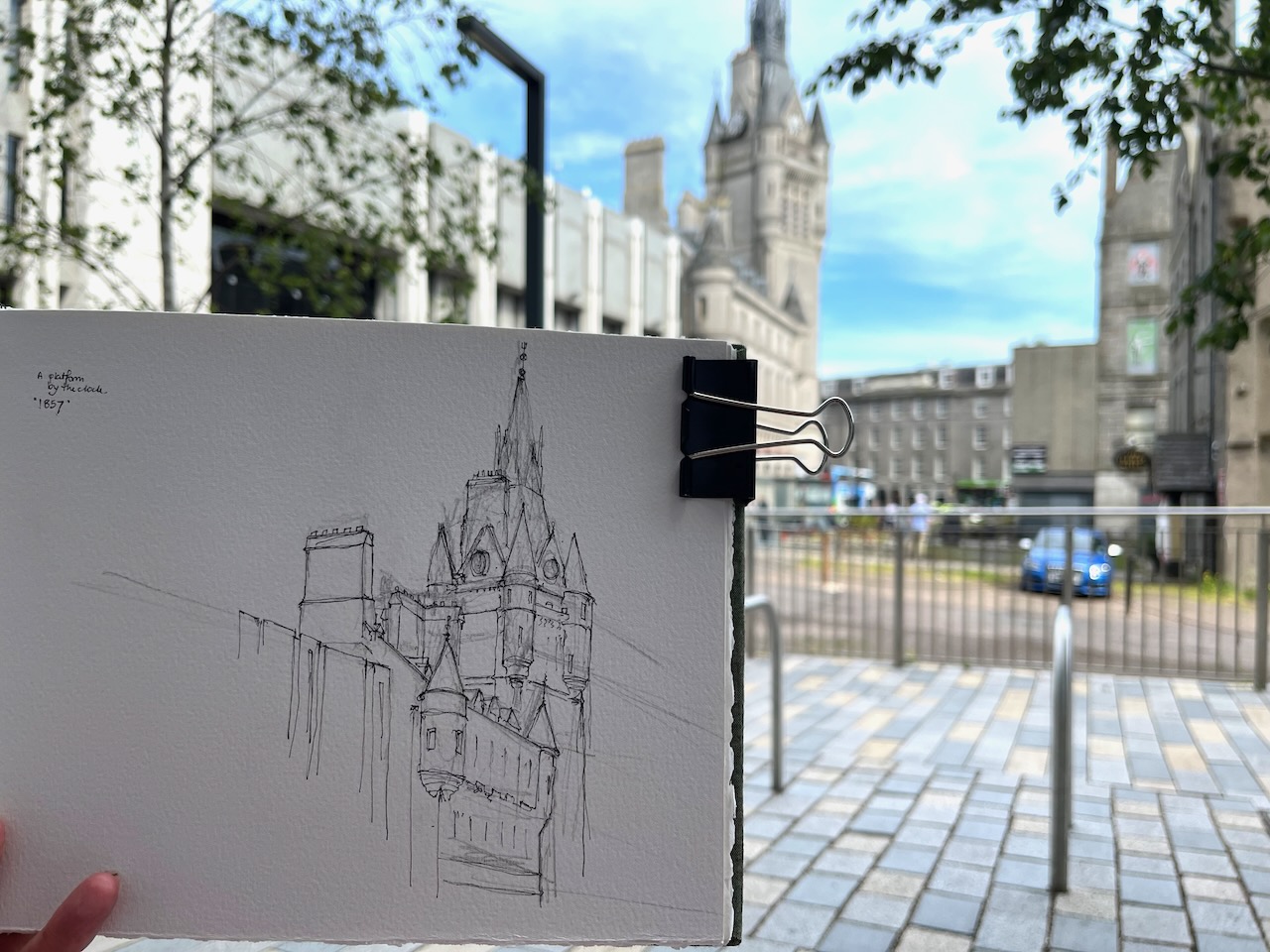
Here’s Aberdeen Town House, with its marvellous turrets.

Aberdeen City Council Town House from Broad Street. 24th June 2022

Aberdeen Town House was built in 1868-74 by John Dick Peddie and Charles George Hood Kinnear. It incorporates the remaining part of the Tolbooth of 1615-29 by Thomas Watson of Old Rayne at the east, and includes the City Chambers to Broad Street, added in 1975 by the Aberdeen City Architect’s Department, with Ian Ferguson and Tom Campbell Watson as its chief architects.

https://britishlistedbuildings.co.uk/200406609-aberdeen-town-house-castle-street-aberdeen-aberdeen

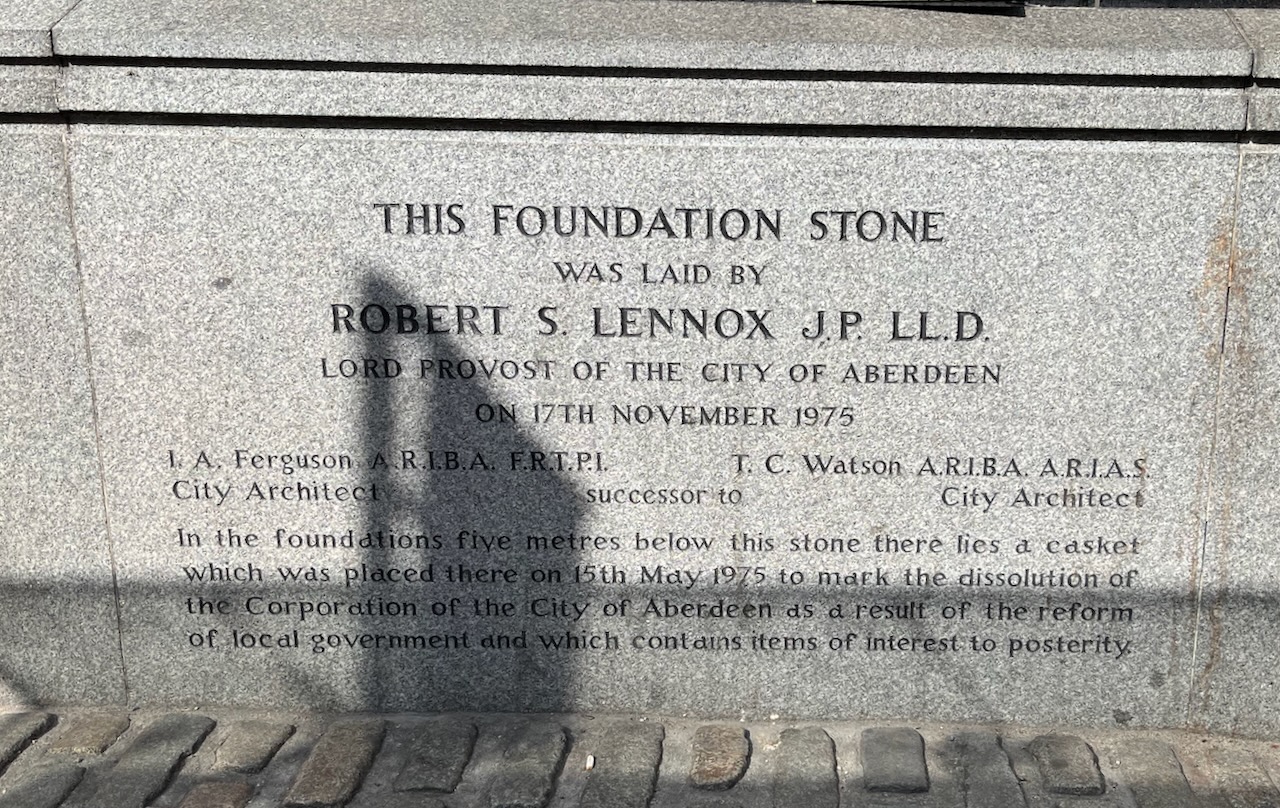
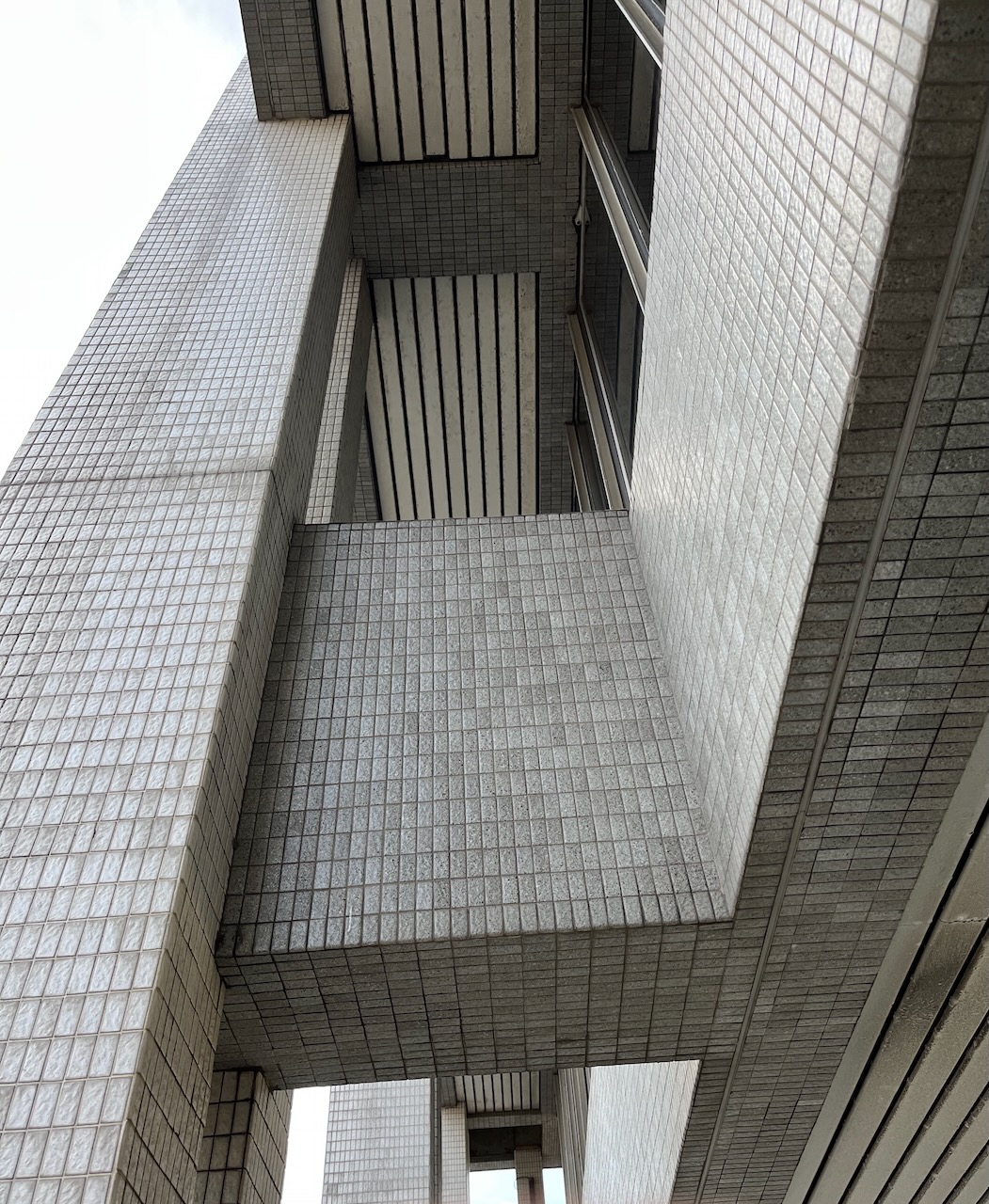
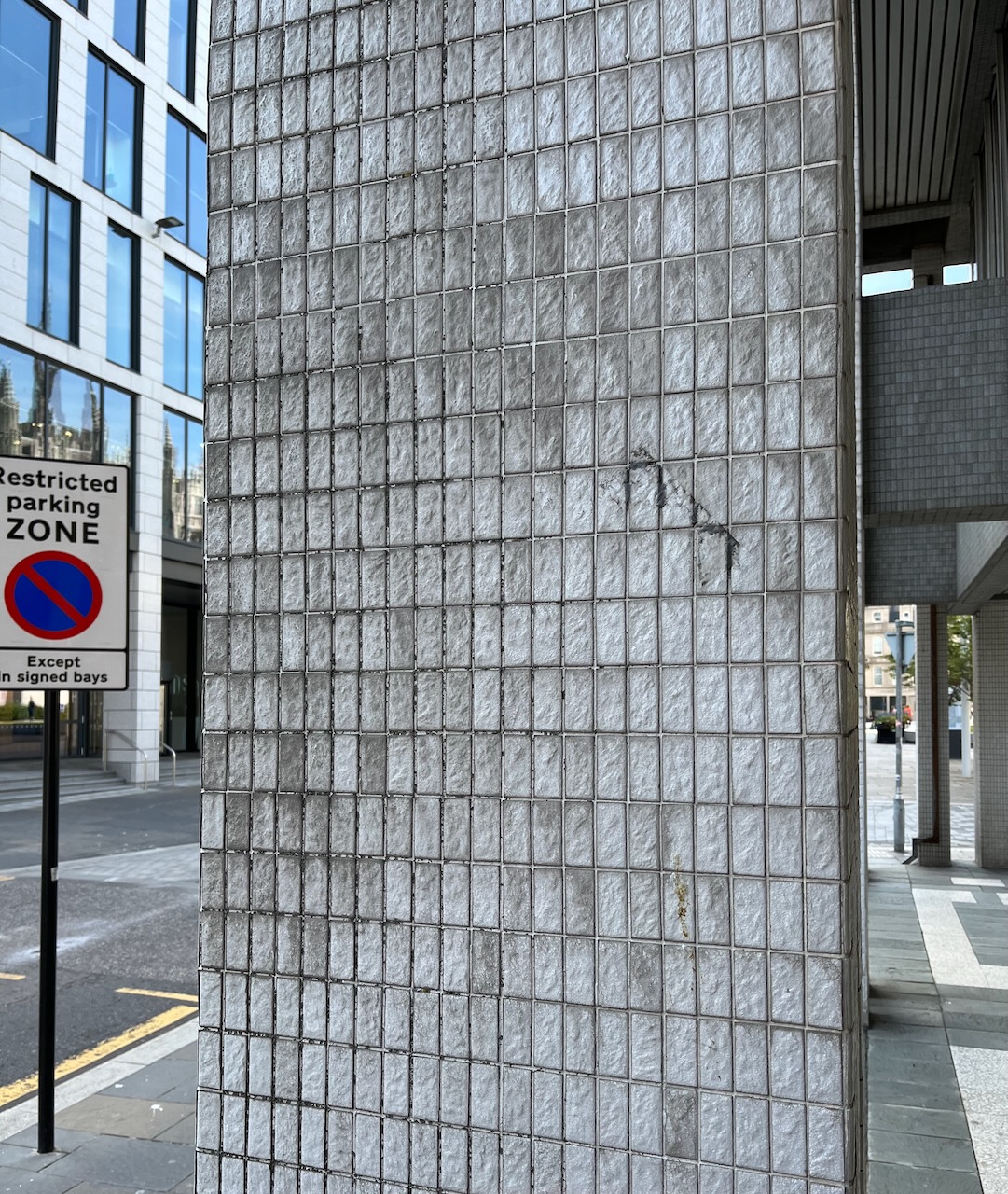
The building on the left of my sketch is the brutalist structure “City Chambers” covered in a tessellation of rectangles of grey marble. Its foundation stone was laid on 17th November 1975, according to the inscription on the foundation stone.

I was on my way to the ferry terminal.

Next stop, Shetland.

Sketching on the journey to Orkney

We travelled to Orkney by train via Edinburgh and Aberdeen.

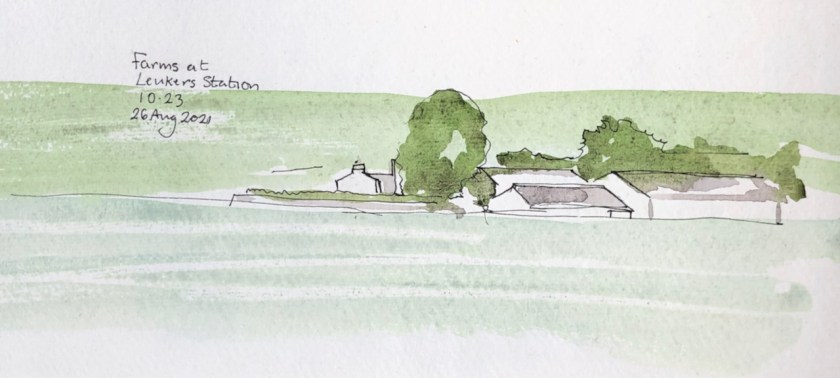
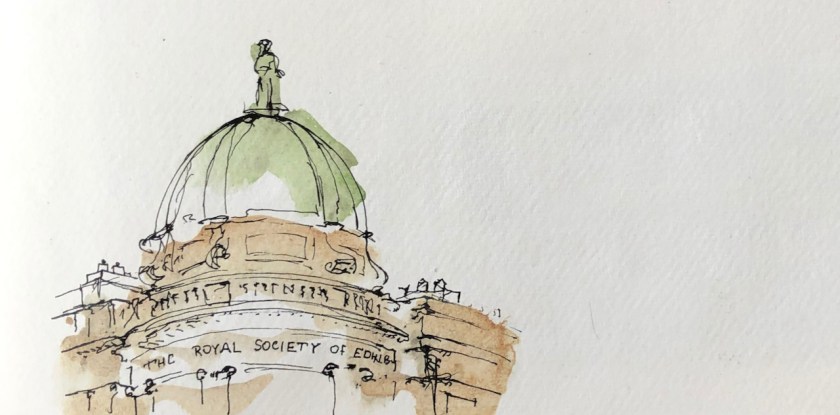
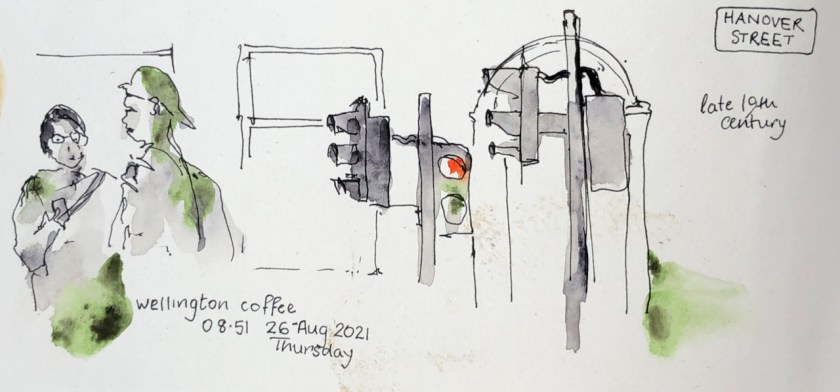
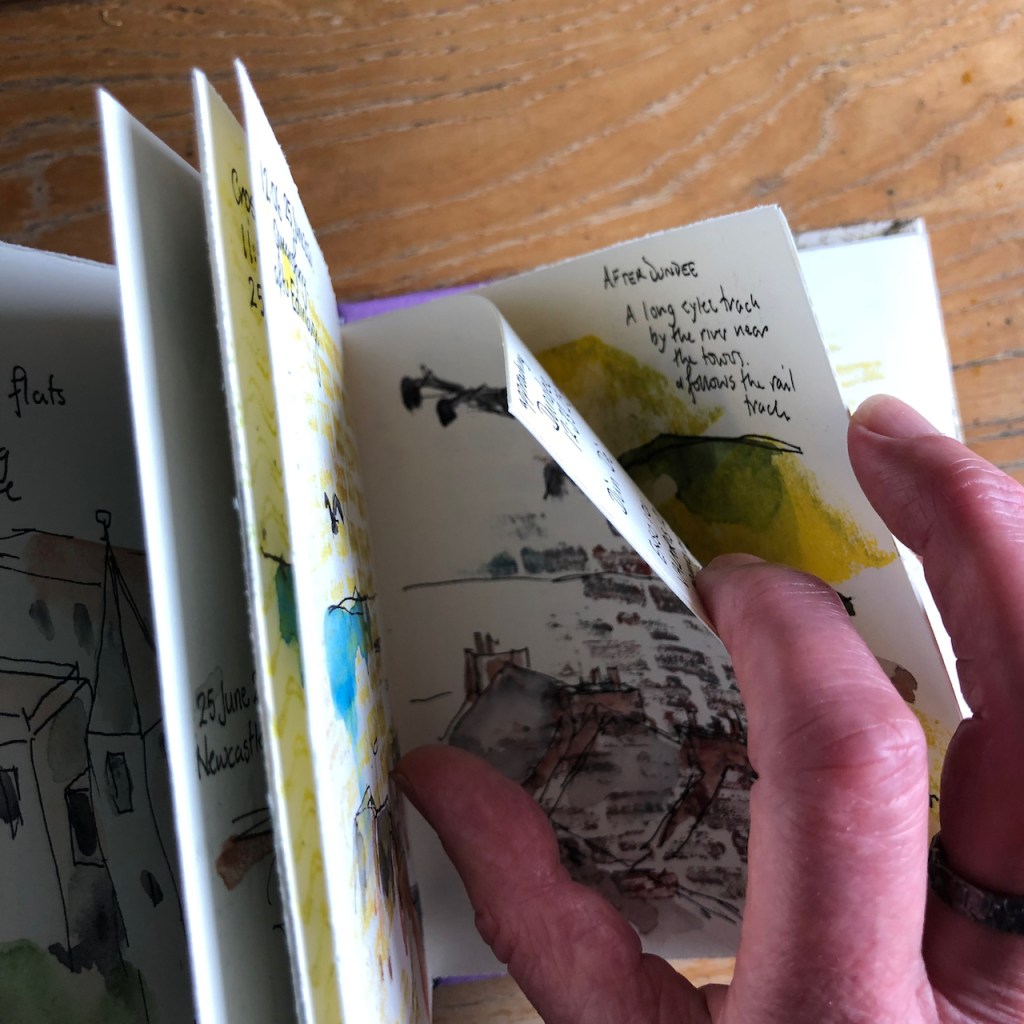
I carried a long thin sketchbook and made drawings along the way.

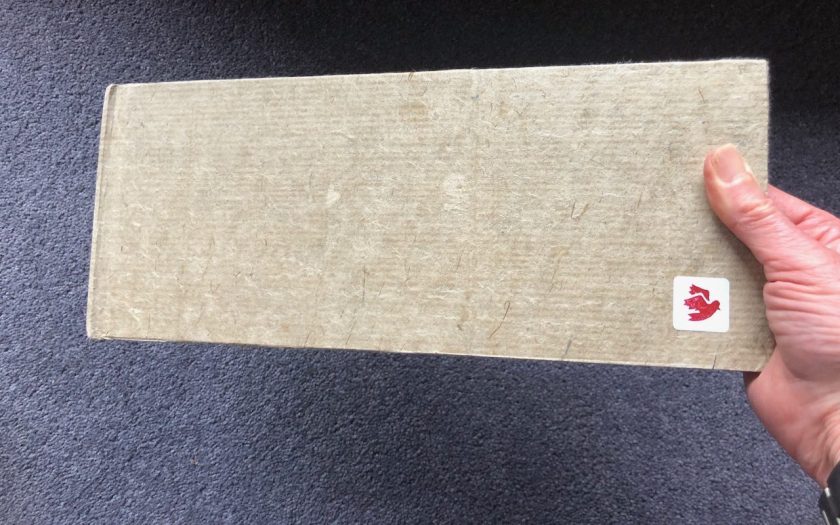
Here is my very long sketchbook, 12″ x 5″ made by Khadi Paper, and bought at Atlantis in Hackney, London.

Experiments on a journey

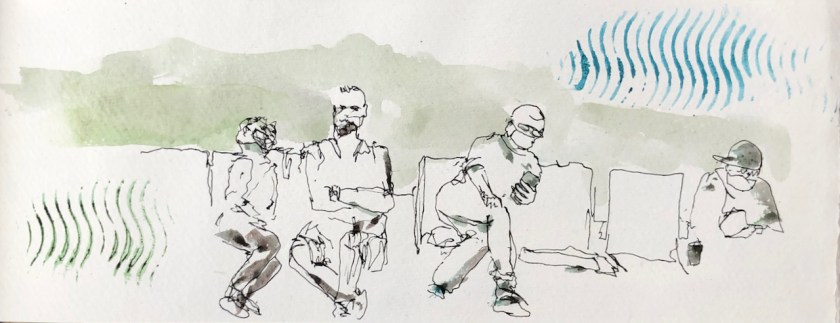
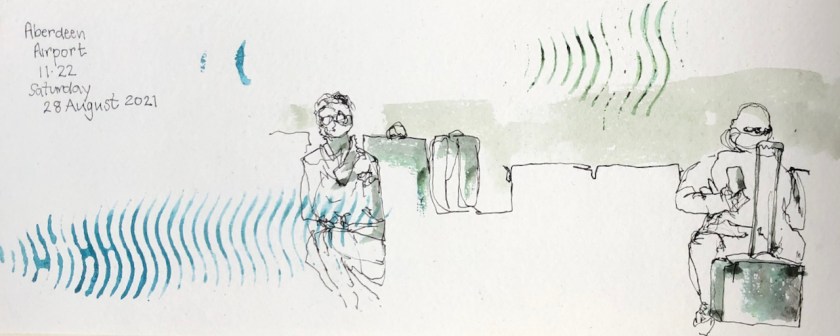
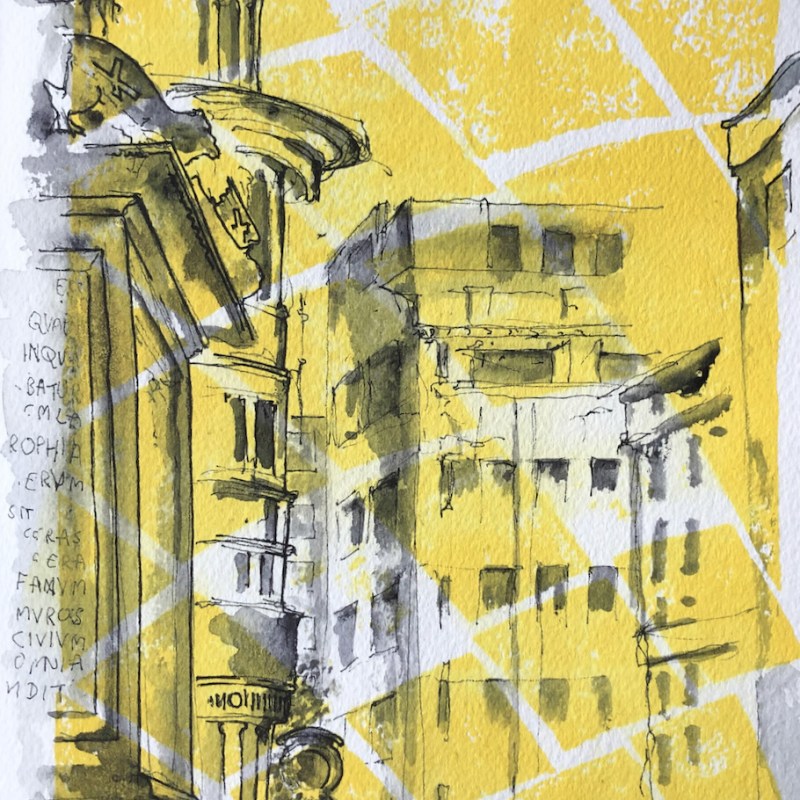
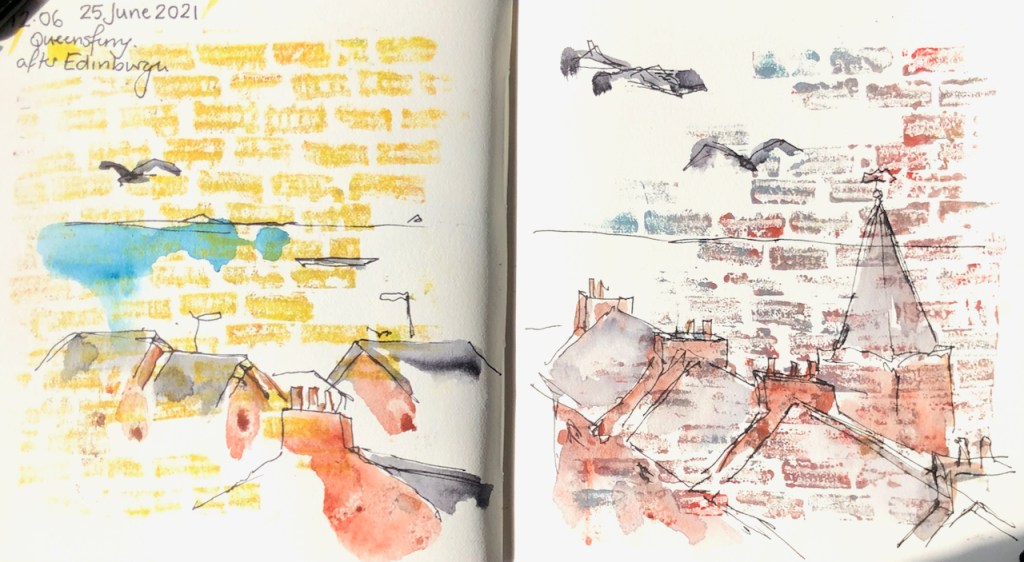
Here is another experiment with printed backgrounds. My first experiment was this drawing at Monument.

I thought the background was a bit bright, so I chose more muted colours for the next attempt.

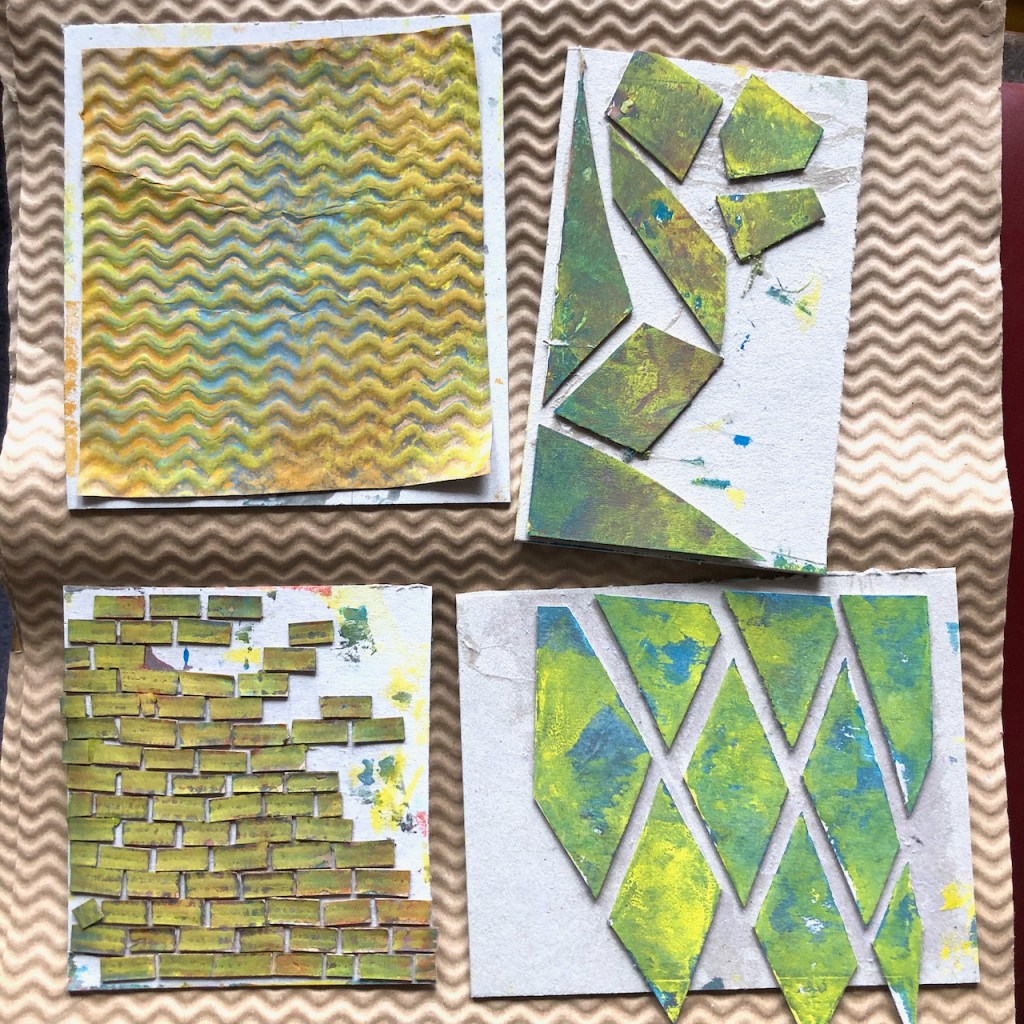
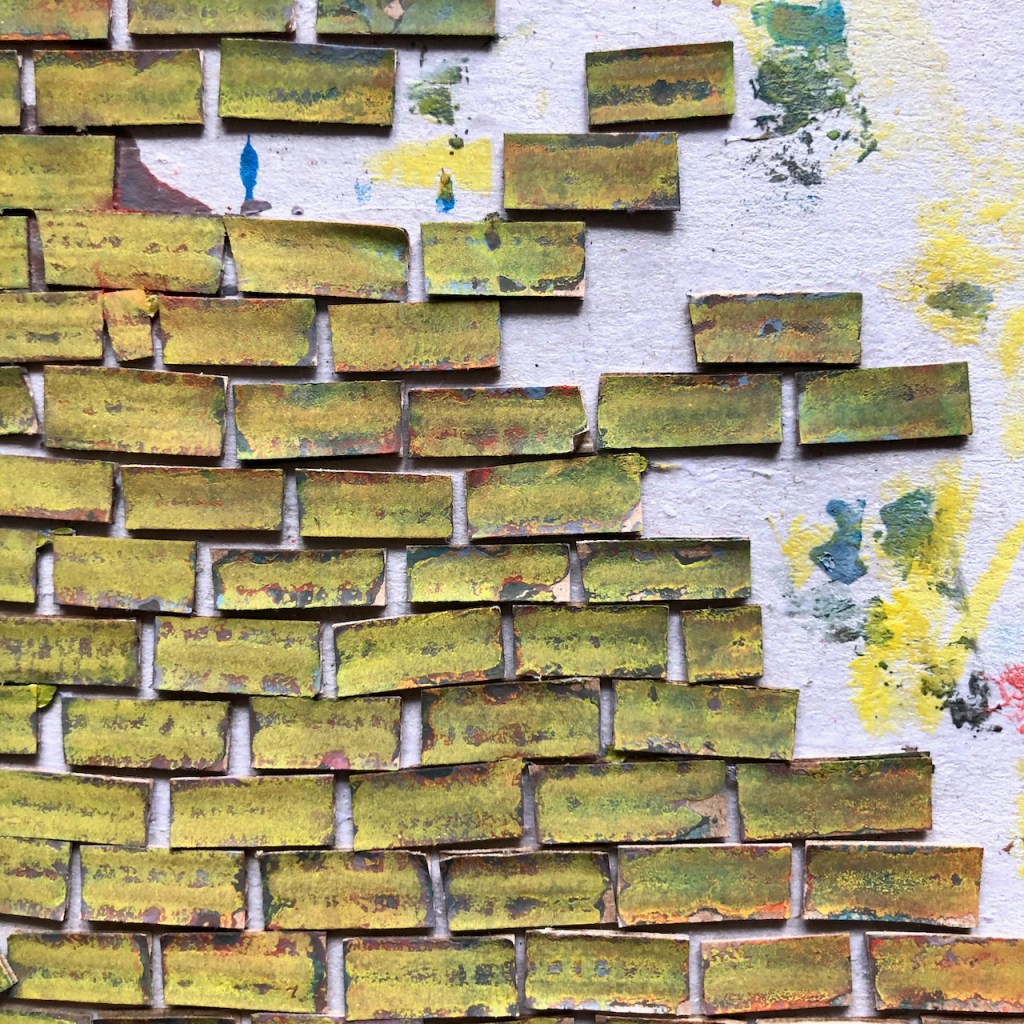
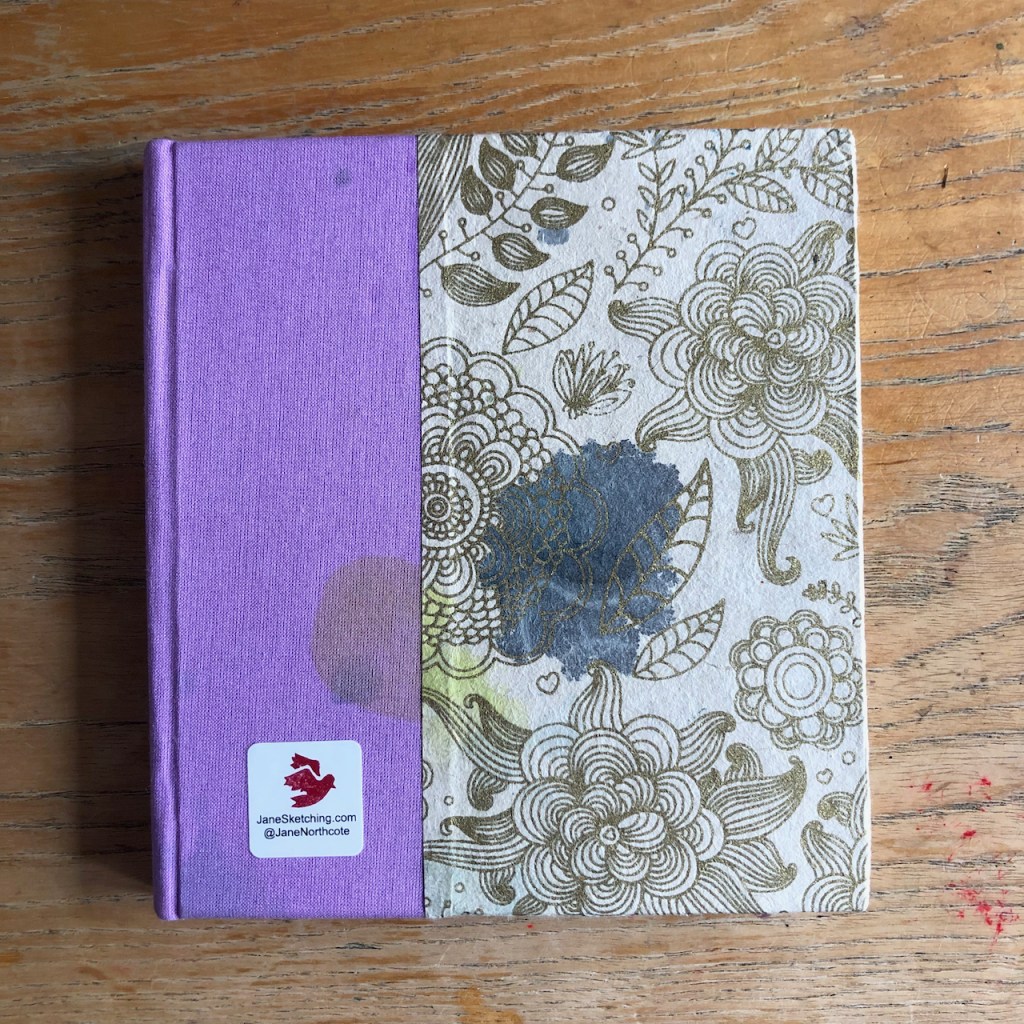
Here are the cardboard cutouts I used for making the relief prints. I used a small square sketchbook made by “PrintUrchin” and pre-printed the pages using relief printing ink, diluted with extender and water so it wasn’t too bright (learning from last time). It still came out quite bright. Those printing inks are heavily pigmented.

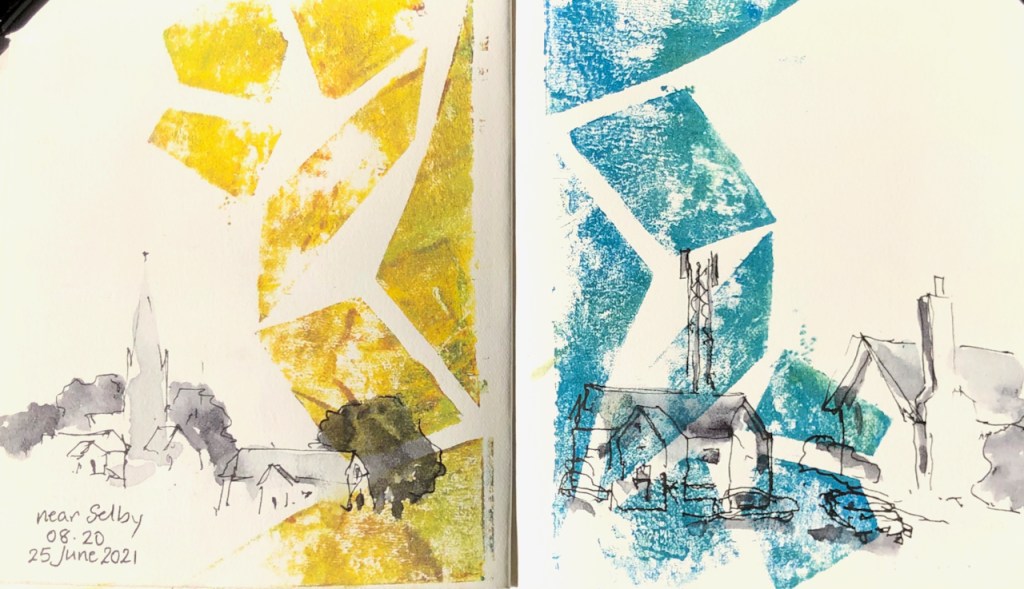
I printed the pages first, then took the sketchbook with me on my journey, and made sketches on top of the prints.

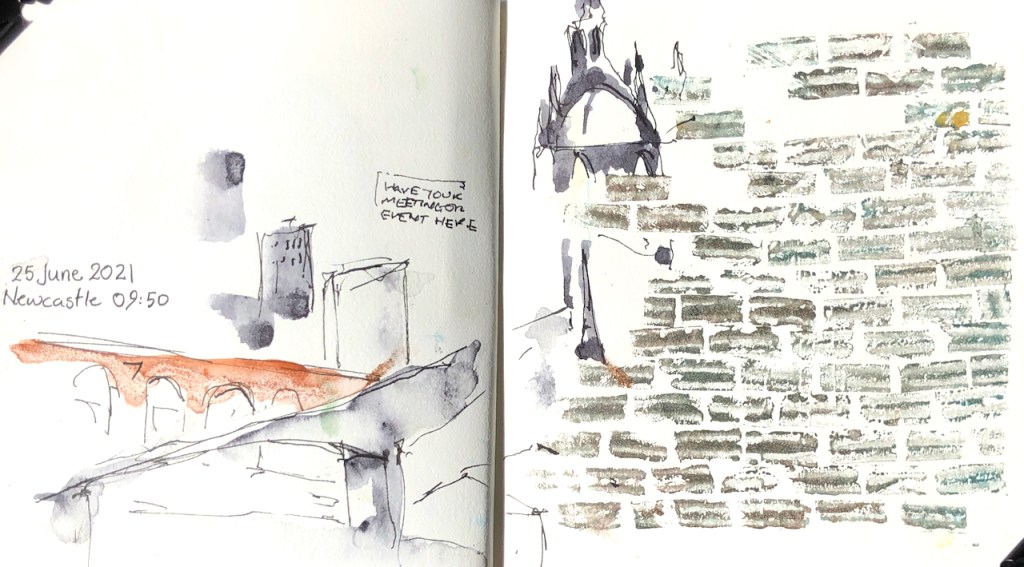
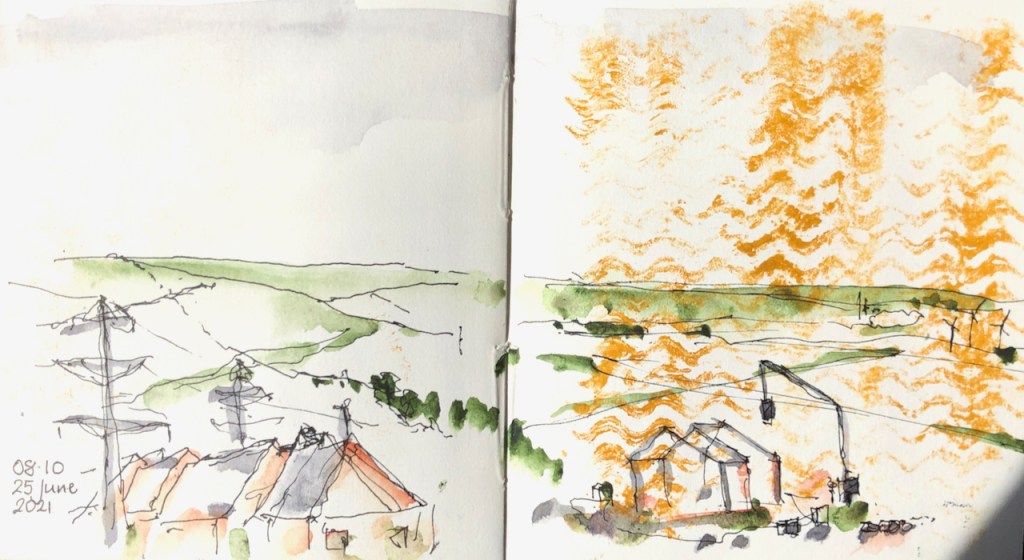
Here are some of the sketches. They are done on the train, hence the rather shaky lines. It’s amazing how the printing, done in advance, seems to fit the subject.

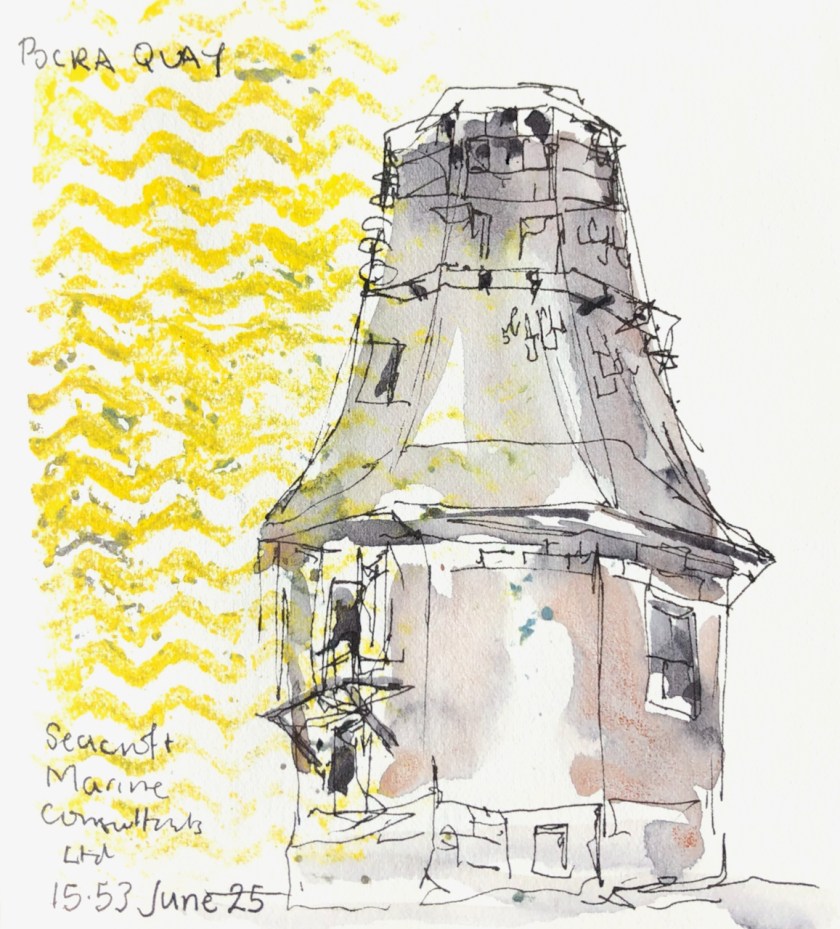
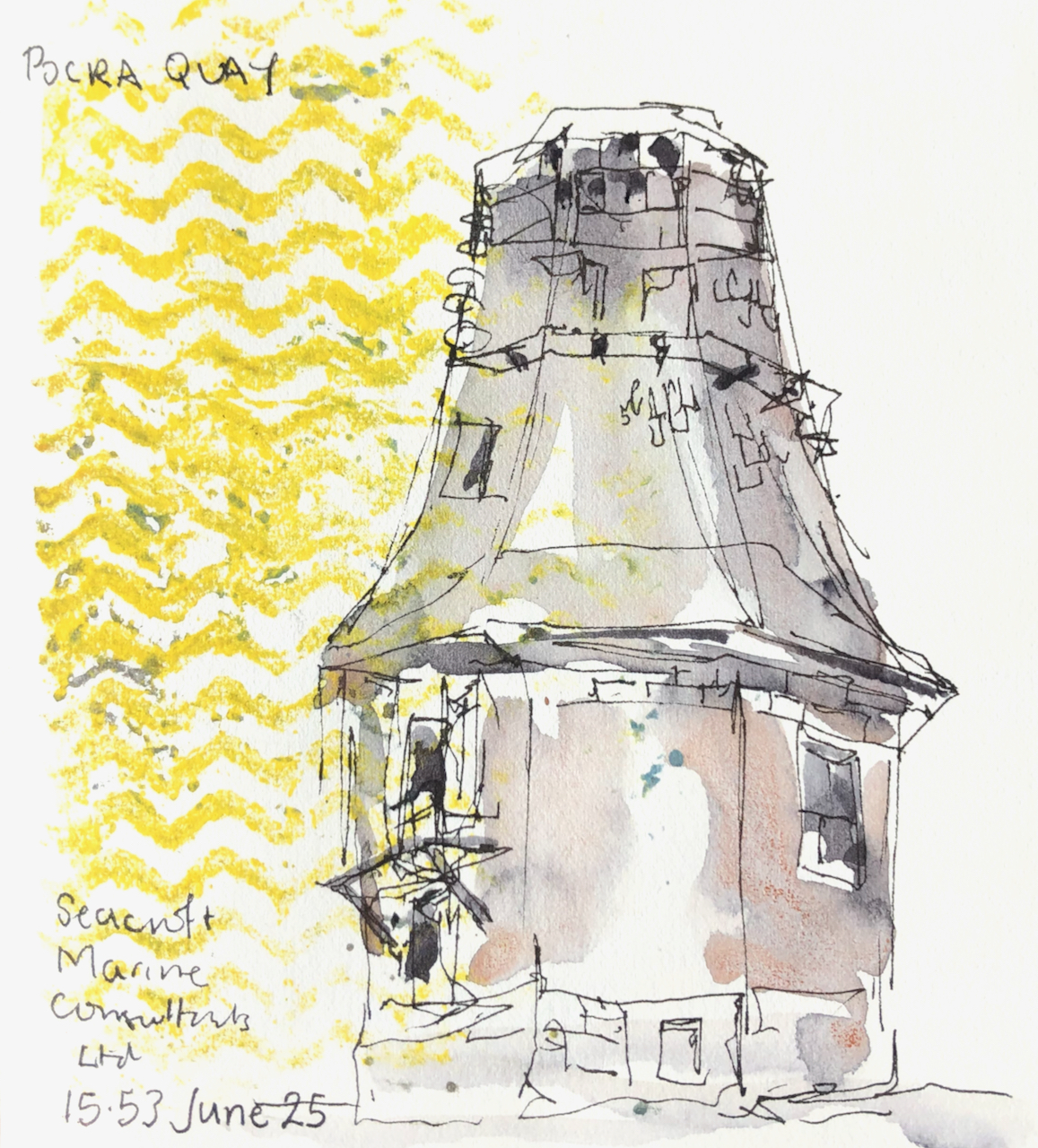
Here is the octagonal building at Pocra Quay, drawn while on a walk round Aberdeen waiting for the ferry.

Octagonal building at Pocra Quay, Aberdeen, 25th June 2021, printed background, 20th June 2021.

This octagonal building was a Navigation Control Centre, operating up until 1966. It was built in around 1797-8, according to the leaflet from the Aberdeen Heritage trail. I sketched it from the shelter of the doorway to the “Silver Herring” restaurant, on a cold, windy and rainy day.

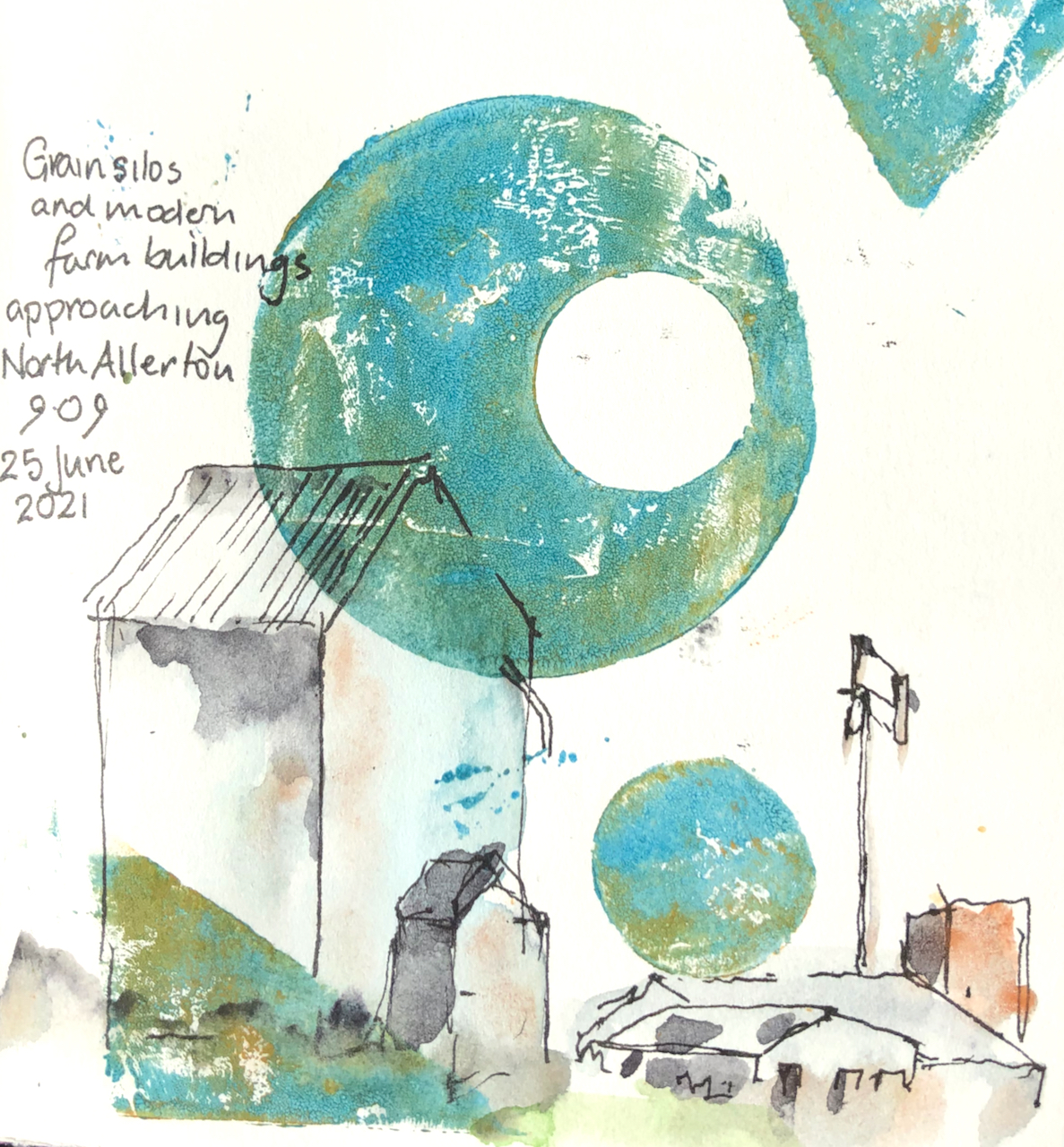
Grain silos at North Allerton, 25th June 2021

This is a really fun technique. I shall use it again.

Sketching on the journey South

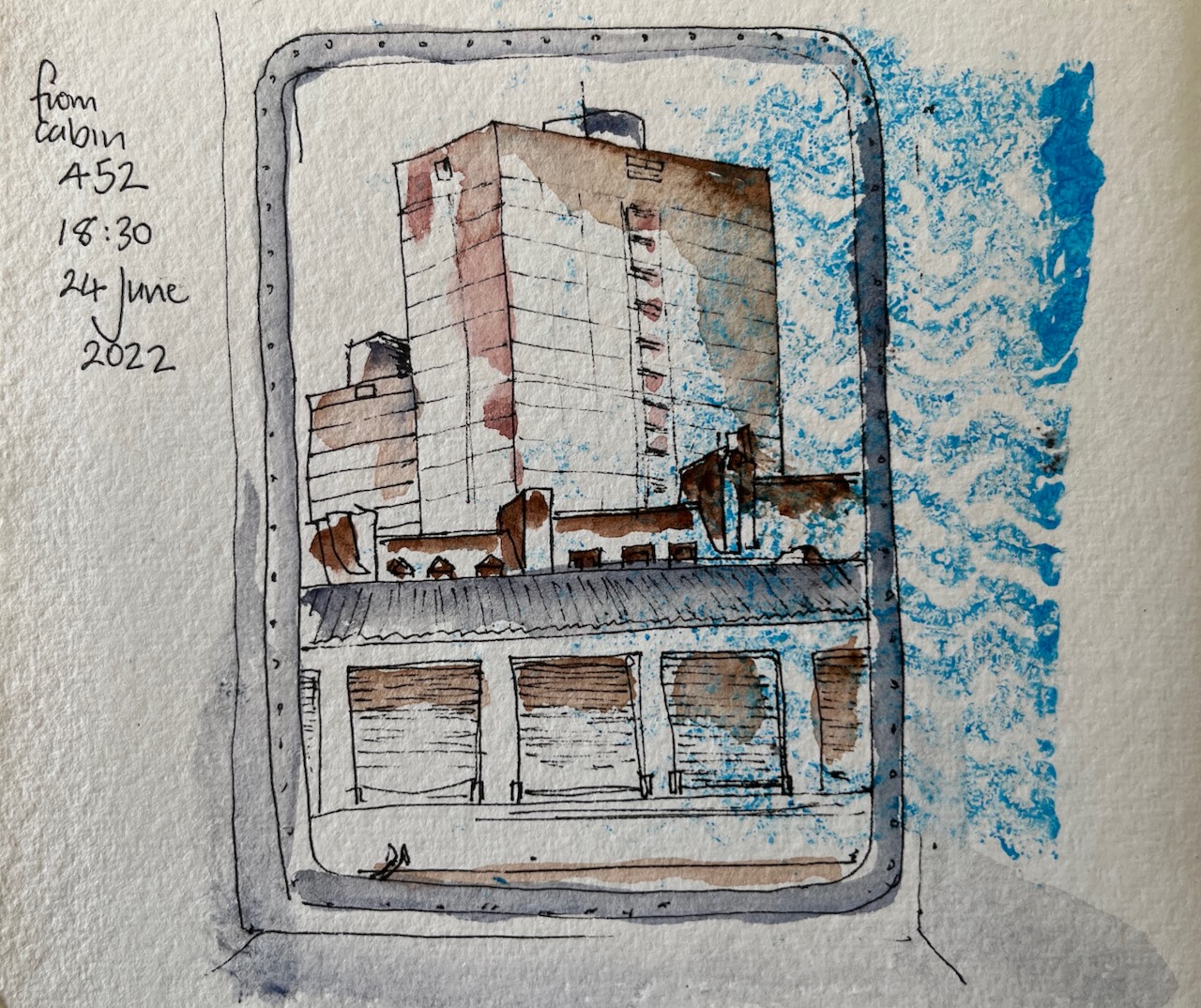
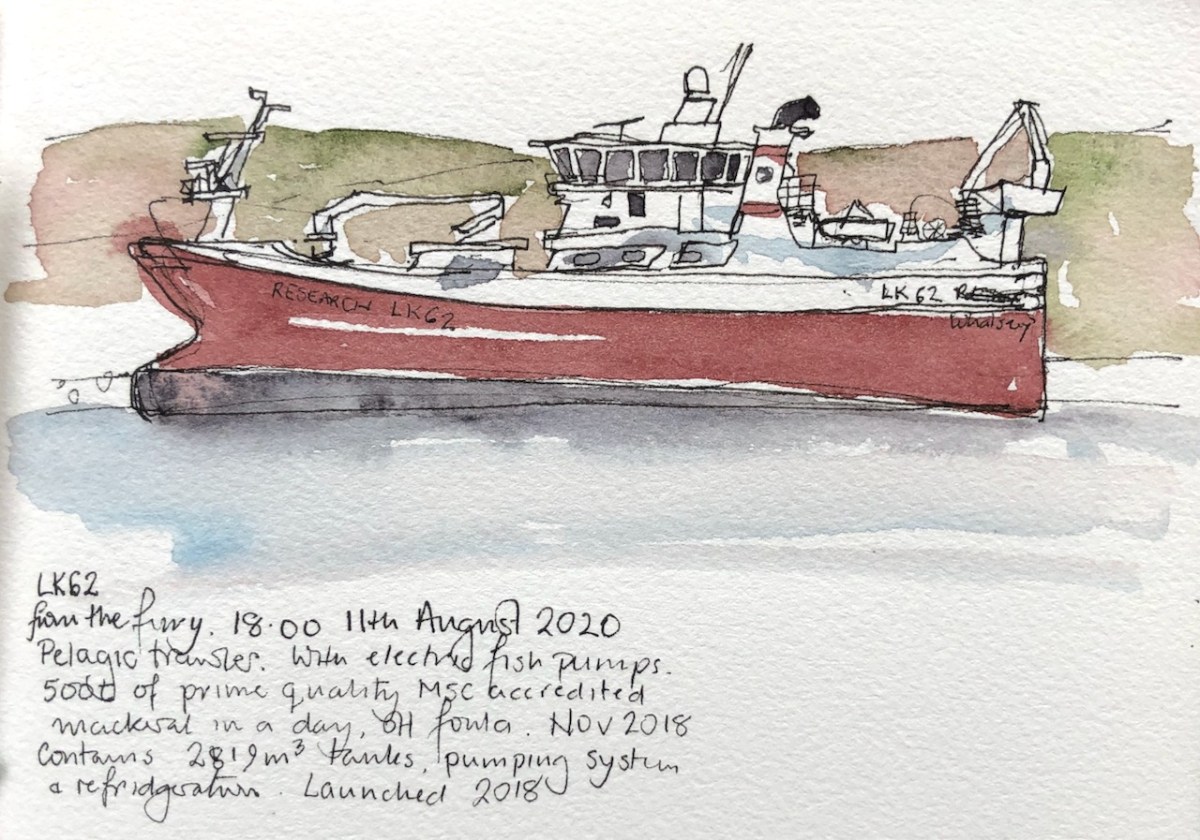
On the ferry from Lerwick to Aberdeen I had an “outside” cabin with a window. From there, I had a view of LK62, named “Research”.

Despite the name, this is not a research vessel, but a trawler. It was launched in November 2018, according to a very informative article in Fishing News.

Aboard a quite different vessel, the Northlink Ferry, I arrived in Aberdeen the next morning. Aberdeen was in lockdown, and I planned to spend as little time there as possible, just two hours, before my train left for the South. My idea was to sit in the sun outside the ferry terminal, eating my packed breakfast, before a gentle stroll to the railway station. Ha! I arrived in Aberdeen in the middle of a rainstorm. Roads had become rivers. On the periphery of my vision, a drain cover had lifted, and the water rose from it in a translucent pillar. I struggled towards the station through floods and wind.

…the floor was covered in a thin layer of water….

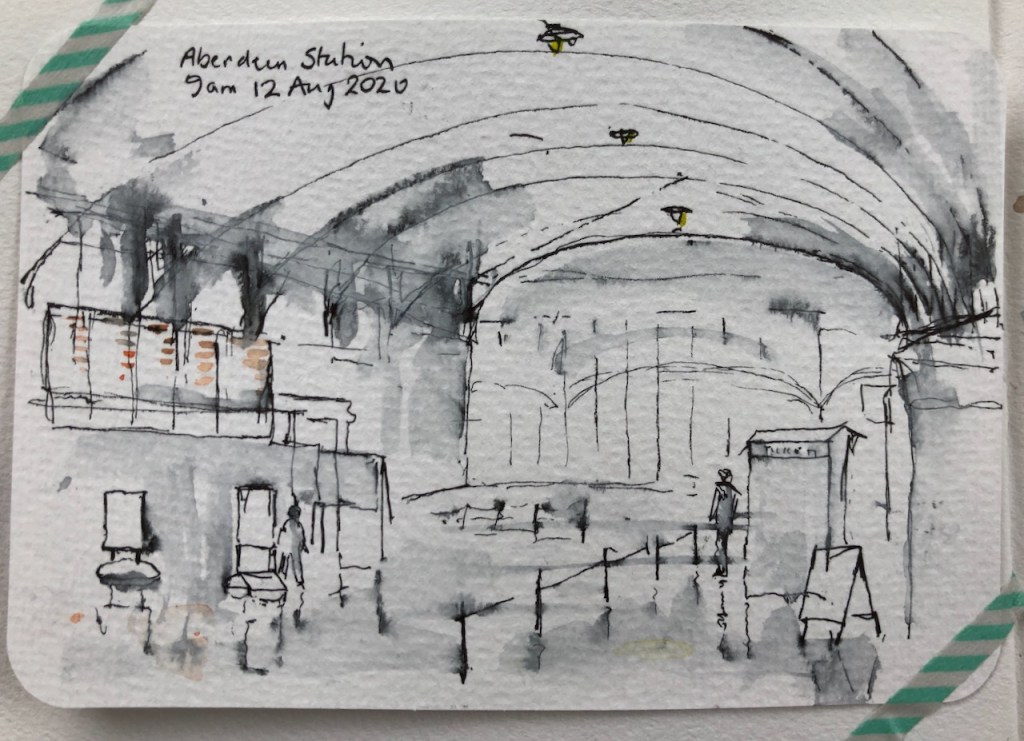
Aberdeen station was a huge glass tent, with the rain battering, and lightning visible, dimly, through the roof covering. It also resembled all the tents I have ever known in that the floor was covered in a thin layer of water. I sat down damply on a damp metal bench. All the trains were cancelled. Fortunately, I had some banana cake. I drew a picture. Then I found a helpful official and a bus.

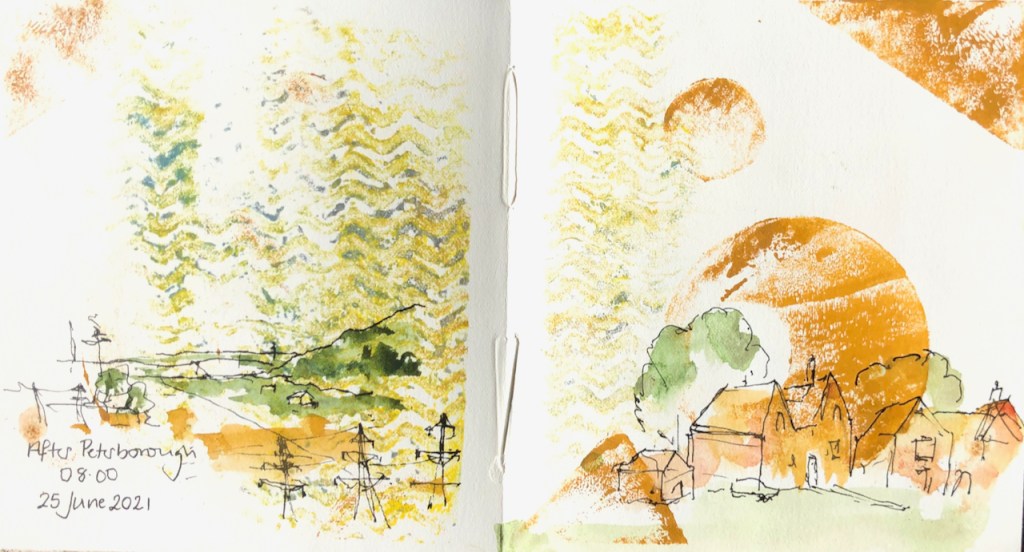
The bus was going to Edinburgh. I drew a picture on the bus. After having been in Shetland for three weeks, I noticed that there were huge trees, everywhere. The sun came out.

On the bus: wind turbines, fields, barns, and TREES.

Travelling to Shetland

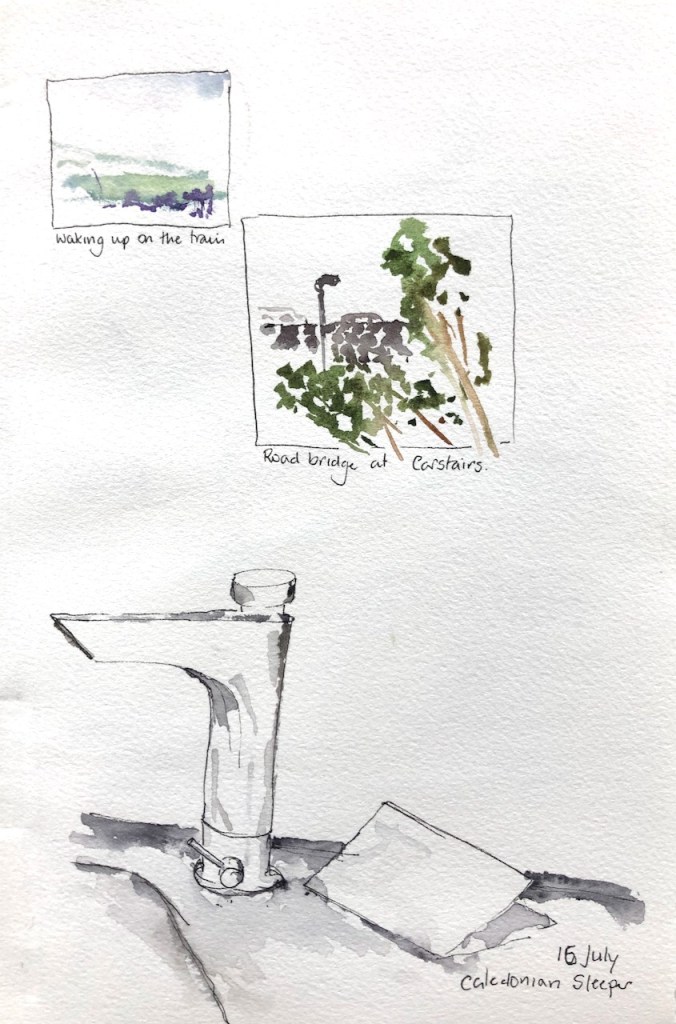
The Caledonian Sleeper took me North. It’s the most marvellous way to travel – and fulfils the requirement to be socially isolated. I had one of the new cabins, or “rooms” as they call them. It even had a built-in toilet and shower. So I woke up refreshed, approaching Edinburgh.

The modern tap on the sink in my travelling room on the Caledonian Sleeper.

Because of COVID-related timetable alterations, the train didn’t go all the way to Aberdeen, as it normally should. I changed at Edinburgh onto a normal train.

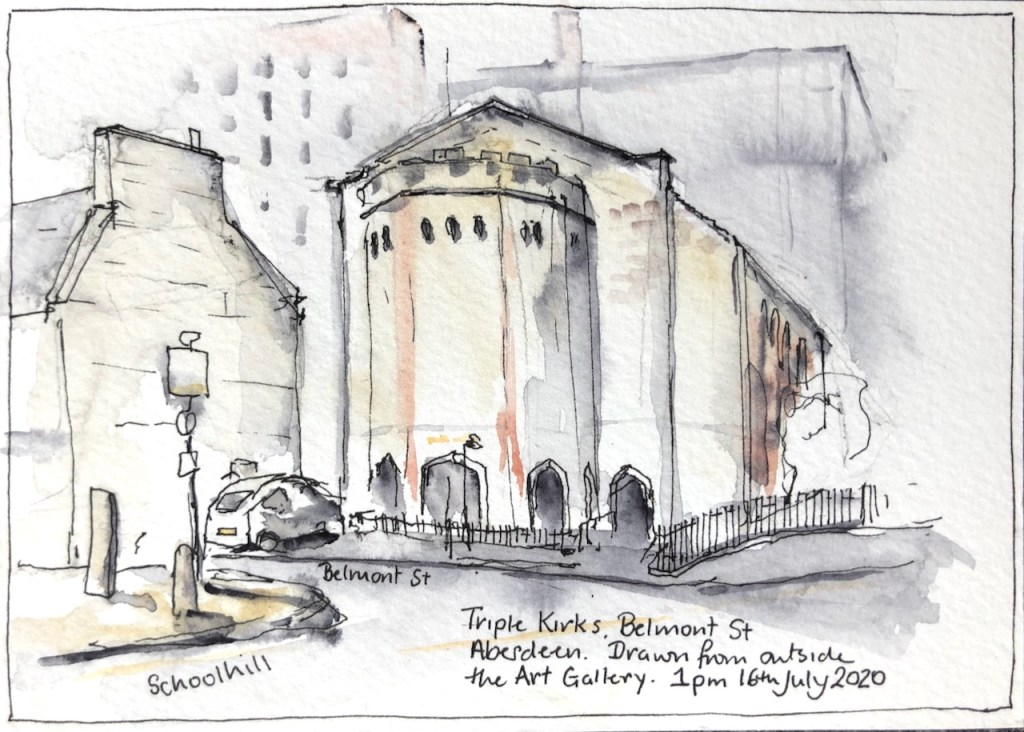
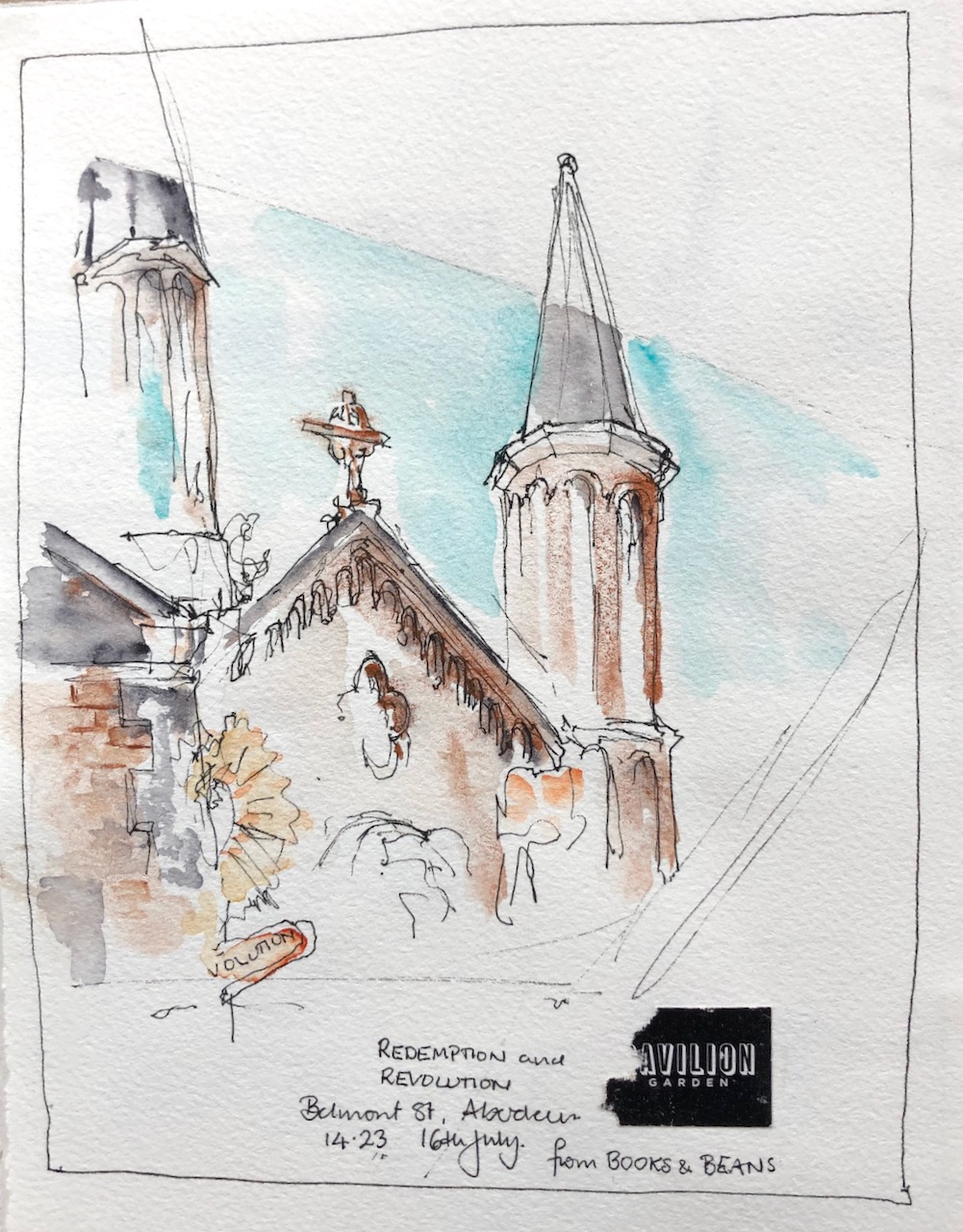
Aberdeen was eerily empty. I drew a picture near the Art Gallery.

This church had been converted into a restaurant.

Then eventually I found somewhere open in Belmont St. I sat outside. The waitress cleaned every table and every chair after customers left. She even sprayed the laminated menu with disinfectant before replacing it on the pile. On a paper form at counter I filled in my contact information for contact tracing. Next to the form was the biro to use. I used it without thinking. I guess everyone had used it. I did remember to wash my hands afterwards though.

While waiting for my food I drew the establishments on the other side of the street, visible through the awning.

Belmont St, Aberdeen.

Both were bars. One was a converted church and was called “Redemption”. The other was a house, called “Revolution”.

The restaurant I was in was called “Books and Beans”. I could see no books, and beans didn’t seem to feature on the menu. I had an excellent huge sandwich.

Maybe we need a campaign for meaningful restaurant names.

Passing through Aberdeen

I went through Aberdeen on the way out to Shetland, and on the way back.

On the way out I drew St Machar’s Cathedral then proceeded south to find the excellent coffee shop Kilau Coffee recommended by the church guardian, who knew her coffee shops. By then I was in the University. It was still raining. So I sketched Kings College Chapel, from a convenient cloister.

IMG_3458
Kings College Chapel, Aberdeen, from the cloister. 9th August 2019 15:21

Then I walked back to the ferry terminal, still in the rain. Here’s a sketch of a building on the main square.

IMG_3493
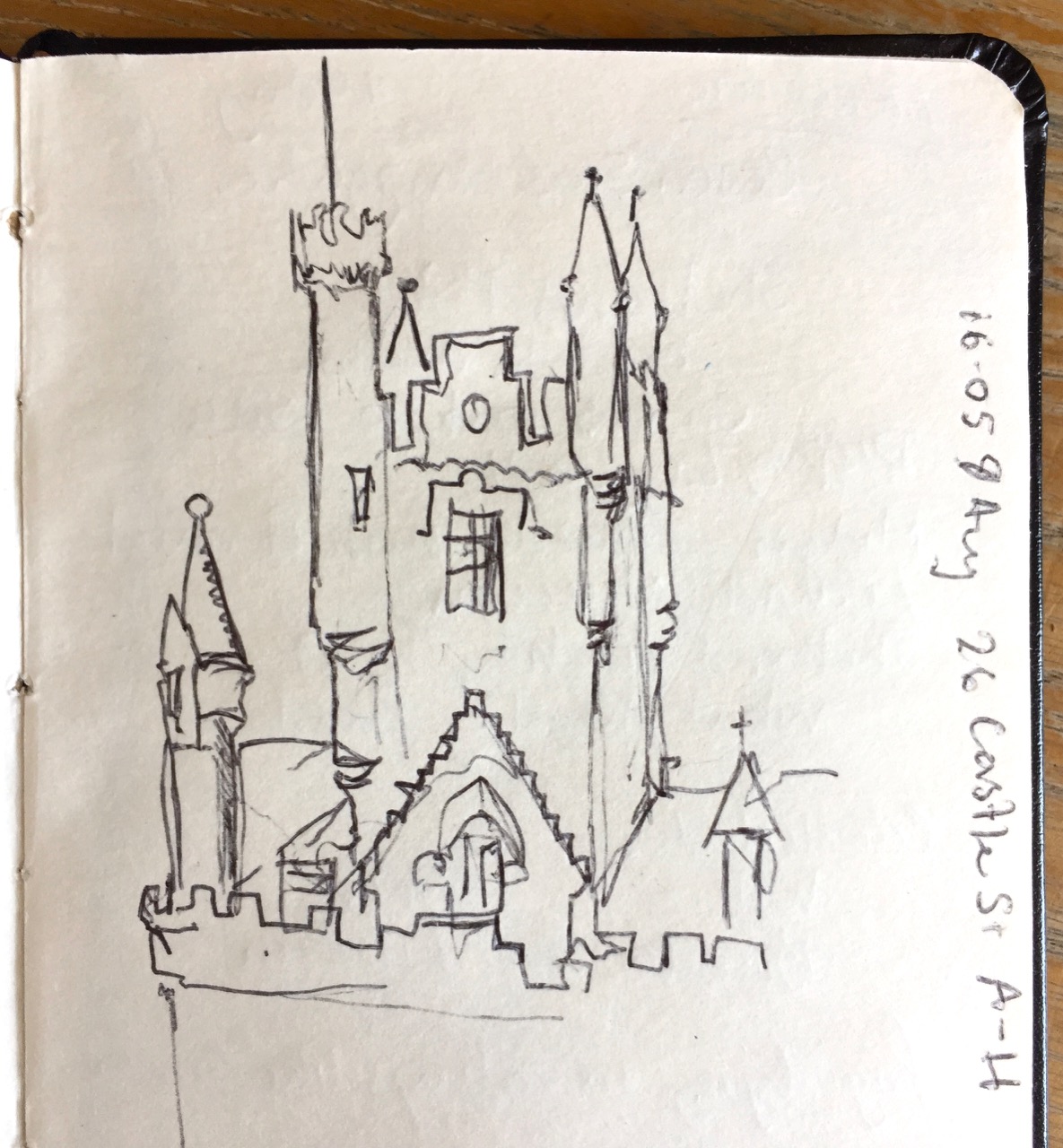
Aberdeen Market Square, 26 Castle St, 9th August 2019

I was taken by the multiple levels of bartizan, which are the towers fastened to the side of the building. These are also called courbelled tourelles. I was sketching from the doorway of a charity shop, in biro, which was the only medium that worked in the sluicing dampness. I tried to find out what this magnificent building was. It seemed only to have a number: “26 Castle Street A-H”, so I guess it is residential.

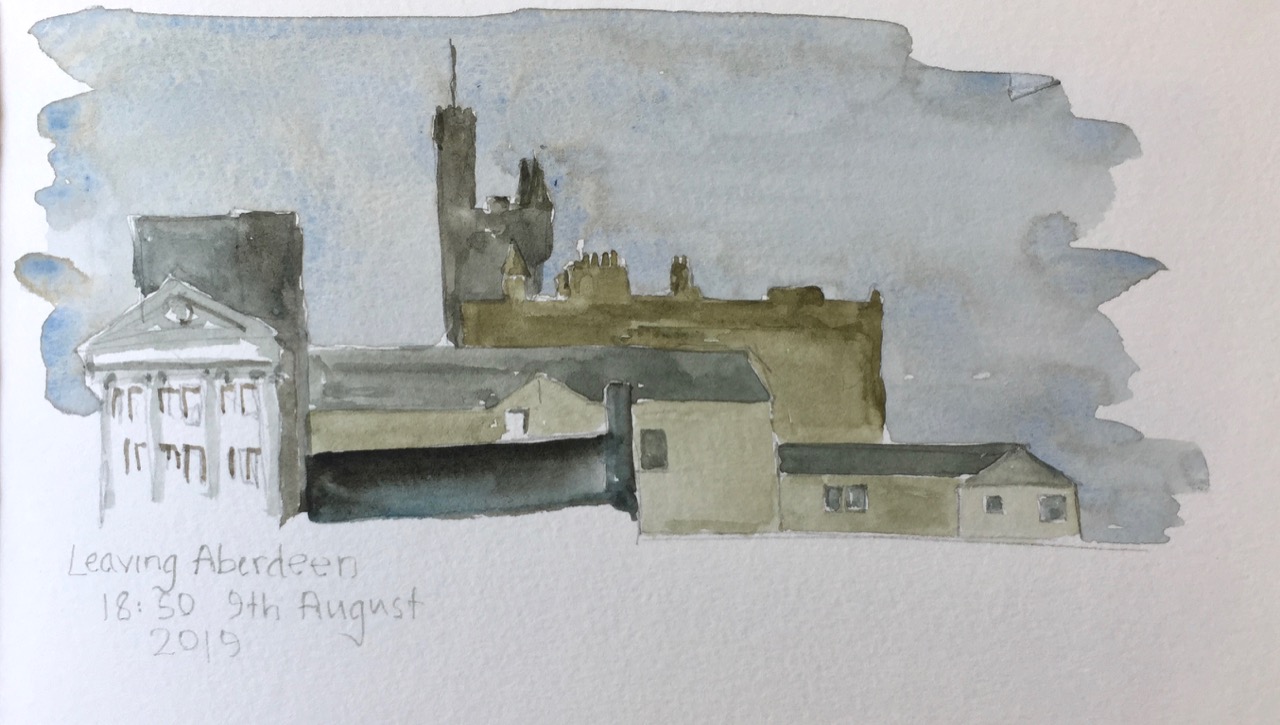
From the window of my cabin on the ferry I saw the same building from a distance.

IMG_3459

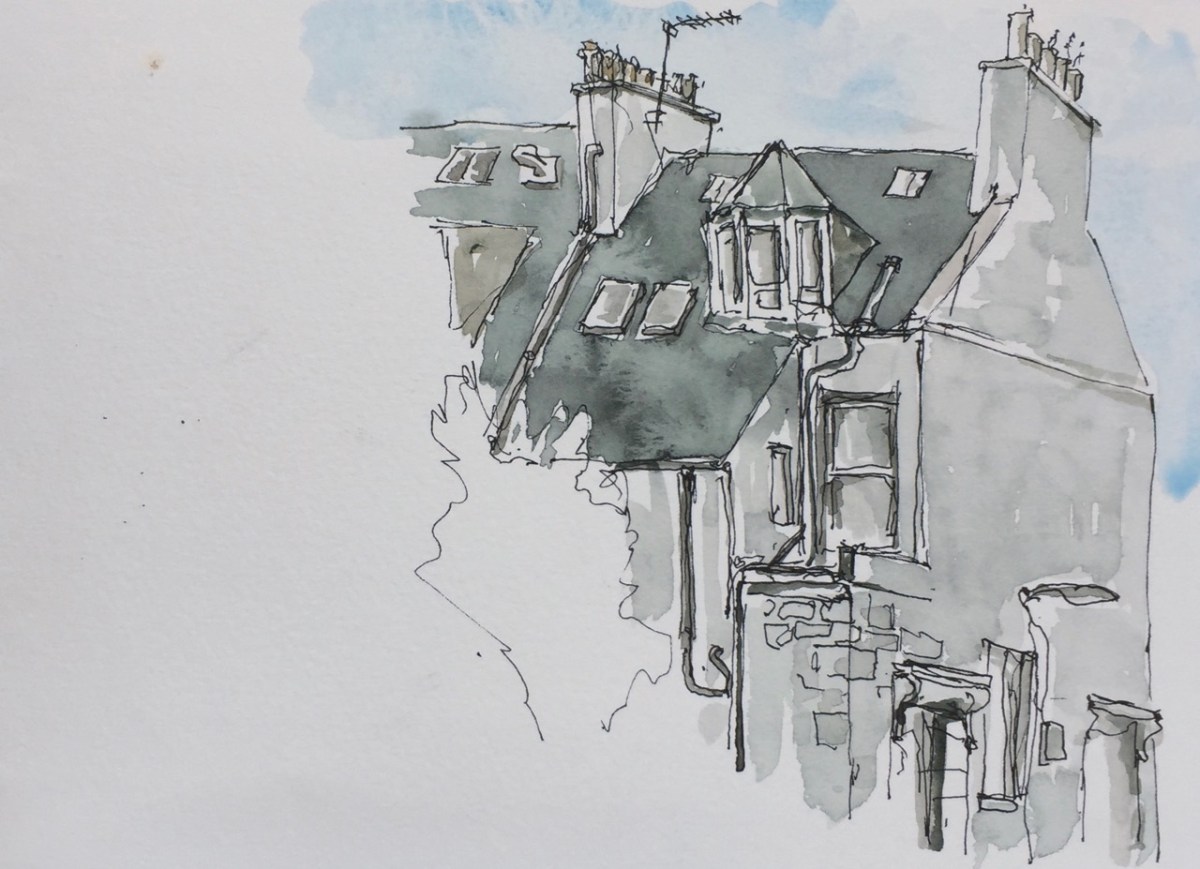
On the way back, two weeks later, I took a walk round what I termed the “Starbucks side of town”. This is the part south of the railway station. There is indeed a Starbucks, on Union Street. The houses are grand here, and in orderly terraces. Here’s a glimpse of an end house, a quick sketch as I was on my way to the bus station.

More posts about these visits to Aberdeen:

St Machar’s Cathedral, Aberdeen

Station Hotel, Aberdeen