St Magnus the Martyr

img_9468

The Parish and Pilgrimage Church of Saint Magnus the Martyr in the City of London, drawn from a bench on the Riverside walk.

Saint Magnus was Earl of Orkney, died 1118 and canonised in 1135. This is a Wren church, re-built 1668-1676, after the Fire of London. There has been a church hereabouts from at least 1128.

This church has a marvellous porch and clock, in the shadow in the drawing, but accessible from Lower Thames St. A notice in the porch says “This Churchyard formed part of the roadway approach to the old London Bridge, 1176-1831”.

Also in the drawing is the Monument to the Fire of London, another Wren construction, built 1671-77.

Also in the drawing are a number of 20th Century office blocks.

About an hour to draw, by which time it was dark.
Under the bridge

img 9312

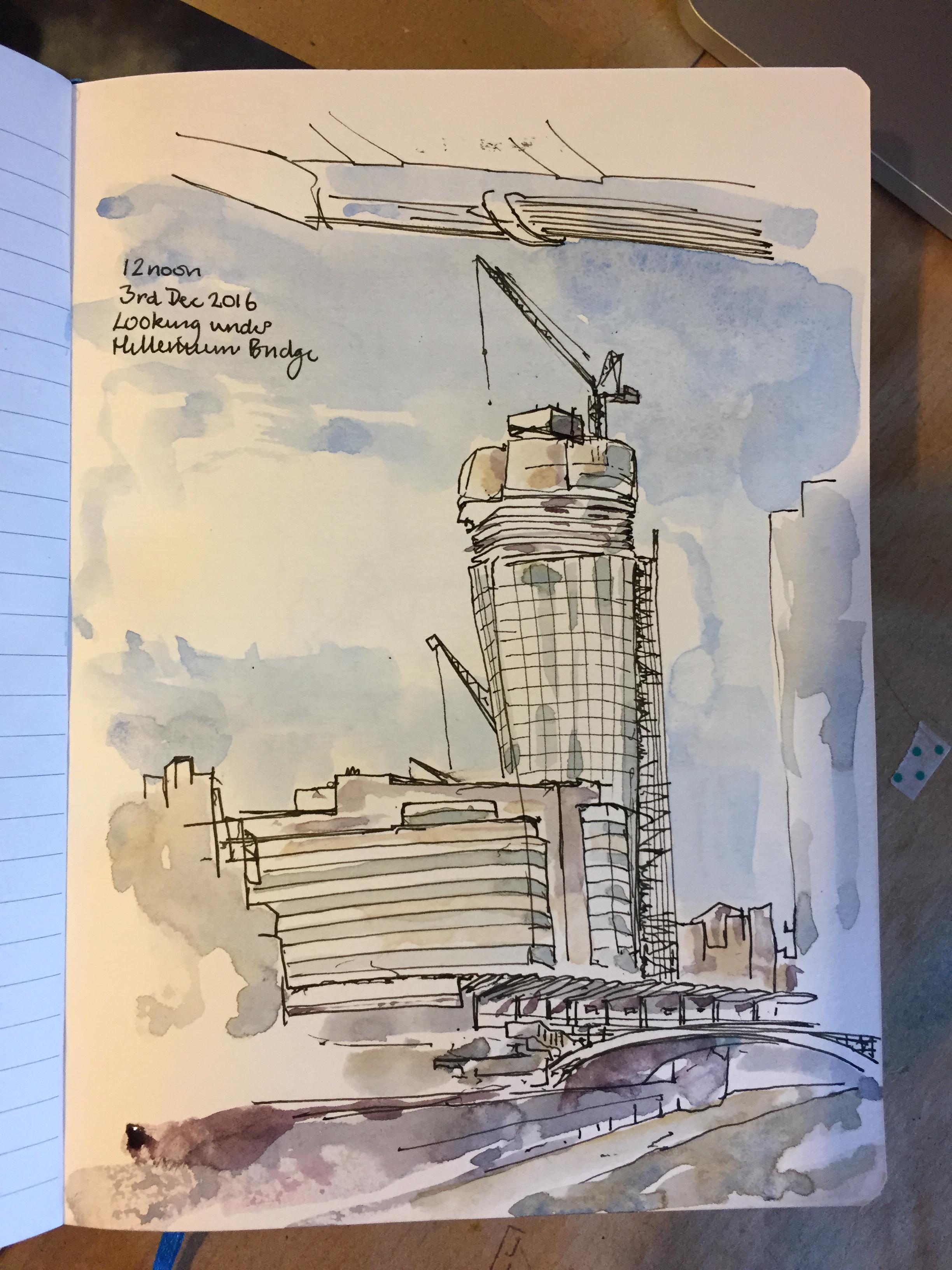
The view looking West through the Millennium Bridge. Drawn from the Thames foreshore. About 45 minutes + coloured later.
The tall tower is 1 Blackfriars. It still has a way to go up.

Two City Sketches

The view from an office window, Tower 42 on the left. This was sketched from indoors, nice and warm. The challenge was to avoid getting watercolour spots on their pristine office furniture.

The view “above Great St Helen’s”, shows what you see if you look up towards the North from the Aviva building in Undershaft, near the Gherkin. The cupola is above St Helen’s Place, 62-69 Bishopsgate. This sketch done standing up, in the cold. Coloured later.

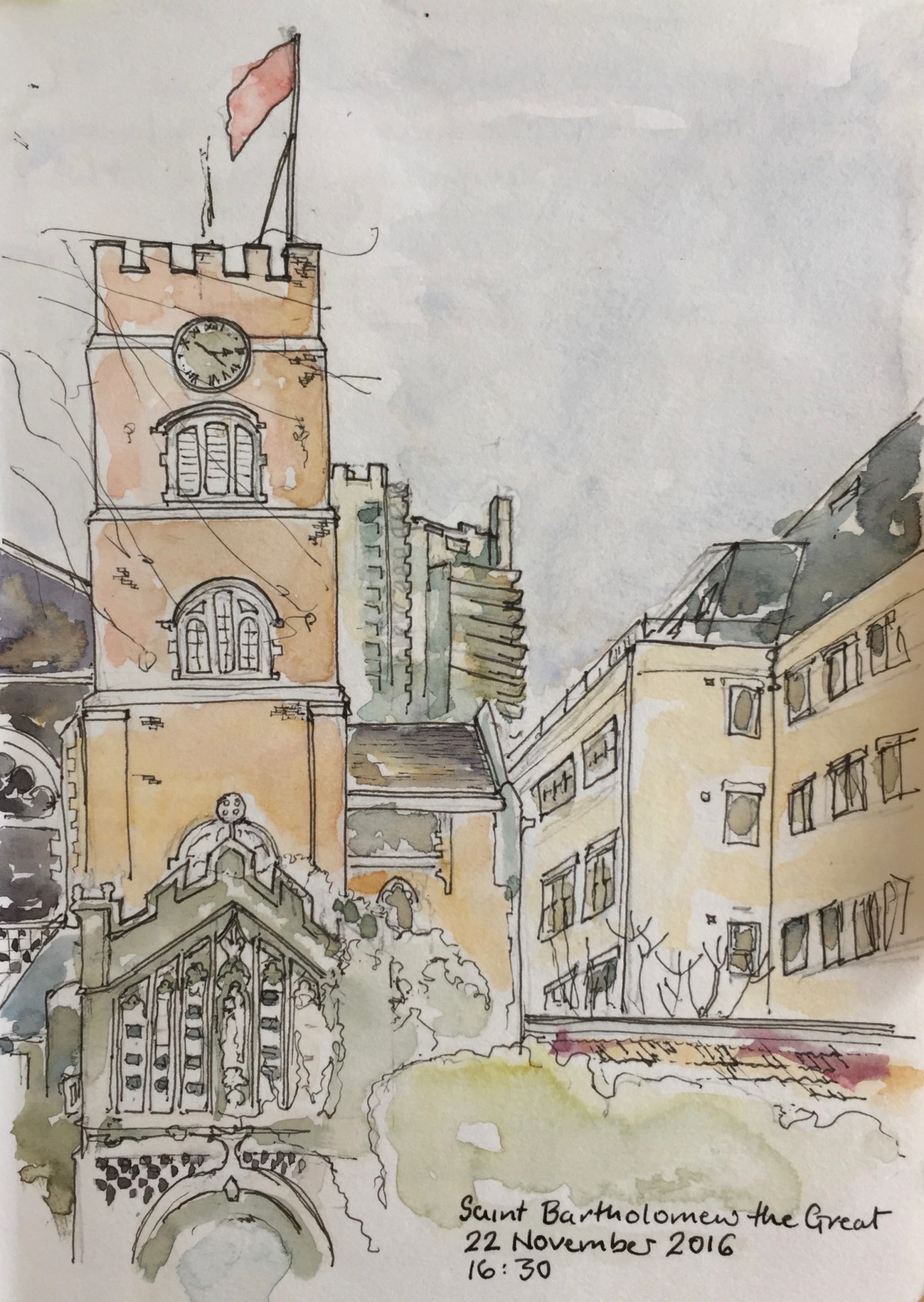
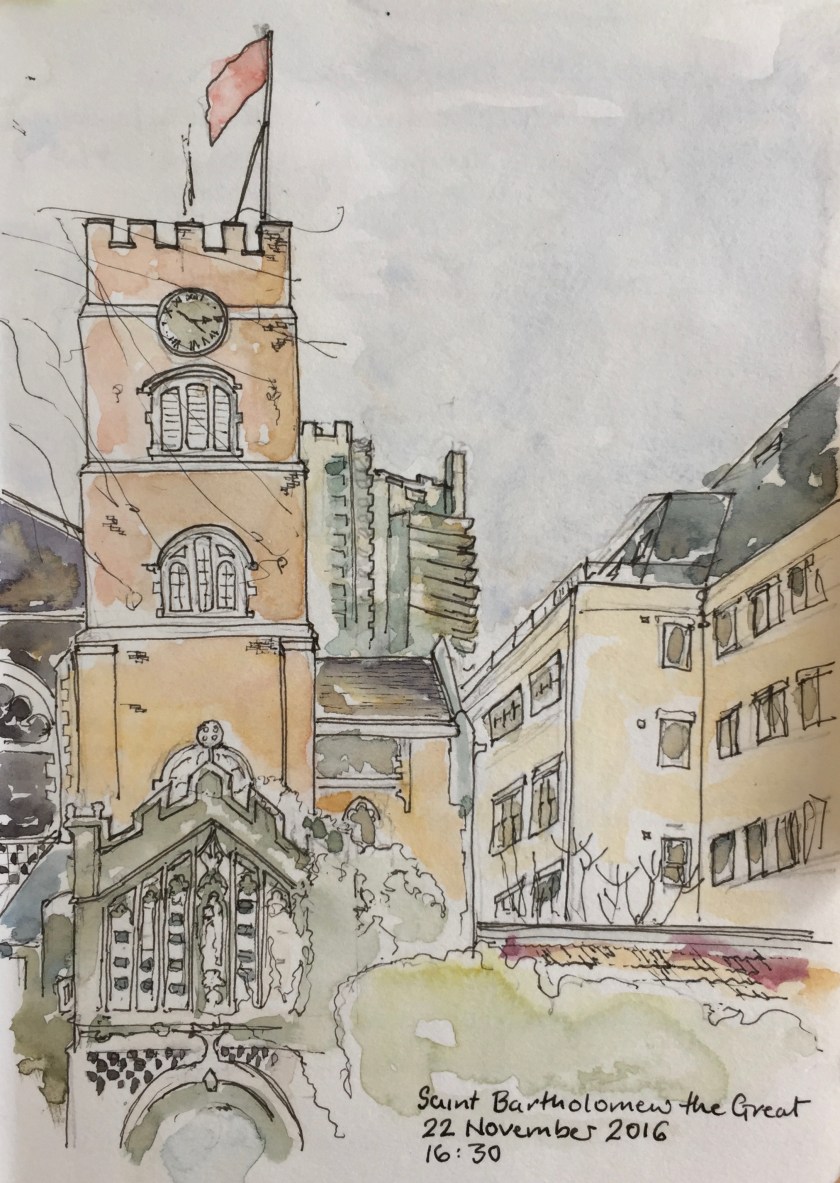
Saint Bartholomew the Great

fullsizeoutput_3102

From the main gate of St Bartholomew the Great, off West Smithfield.


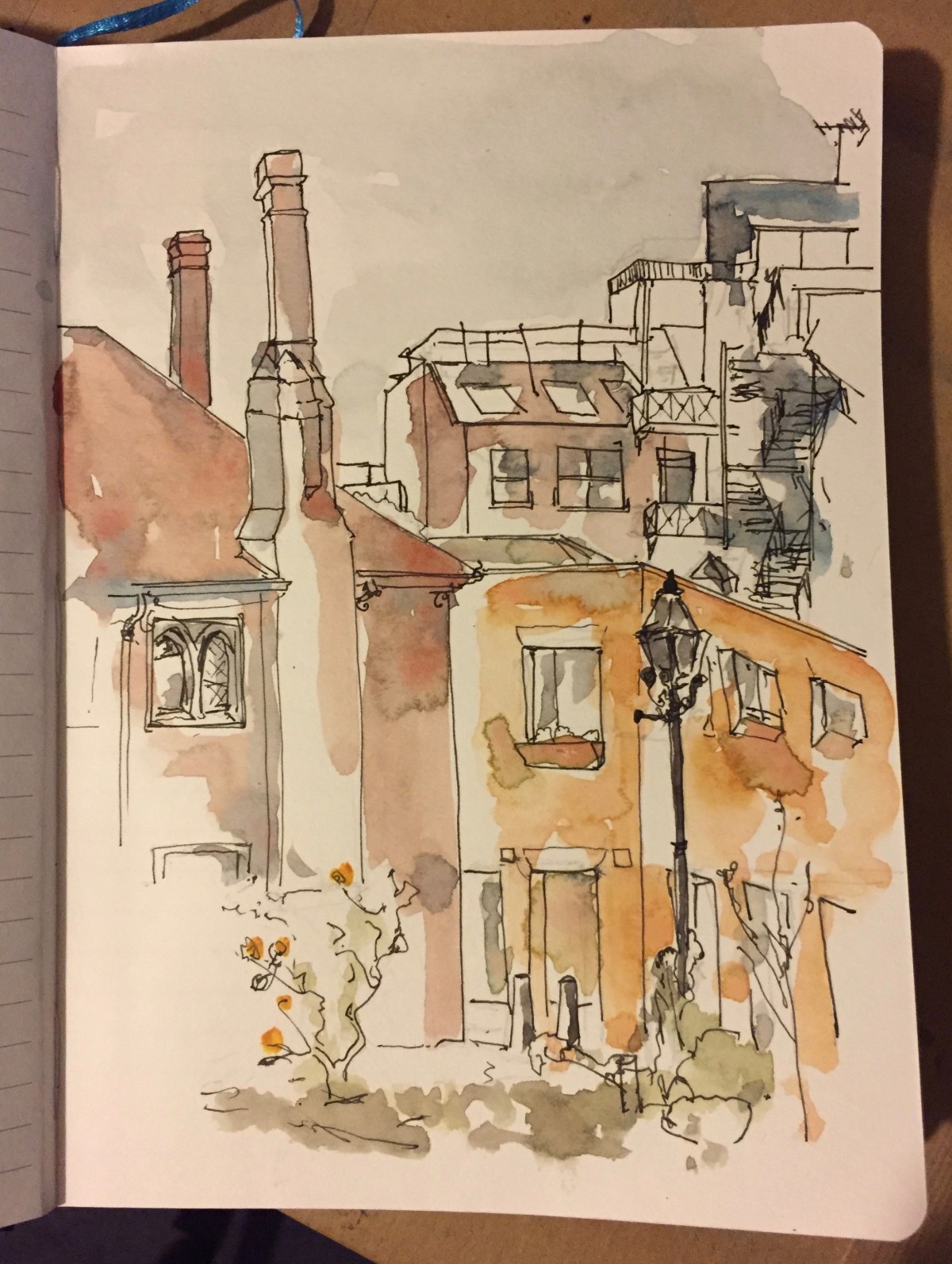
The Admiral Ashmore building

Here is a sketch from Preacher’s Court, Charterhouse.

I did it just after “The Well House” sketch.

3 Nov 2016 (2)

I liked the three ages of buildings: the 16th and 17th Century Hall on the left, the Admiral Ashmore Building (2000) and the 1970s office blocks and flats behind, with scrappy enhancements, probably 21st Century.

I got very cold.

A brother came by and told me he was the oldest, at 88. He was going to lead Grace at lunch. Everyone would have to stand up. It was like being at school. “I have the mind of a 15-year-old boy,” he informed me, “You had better watch out!”

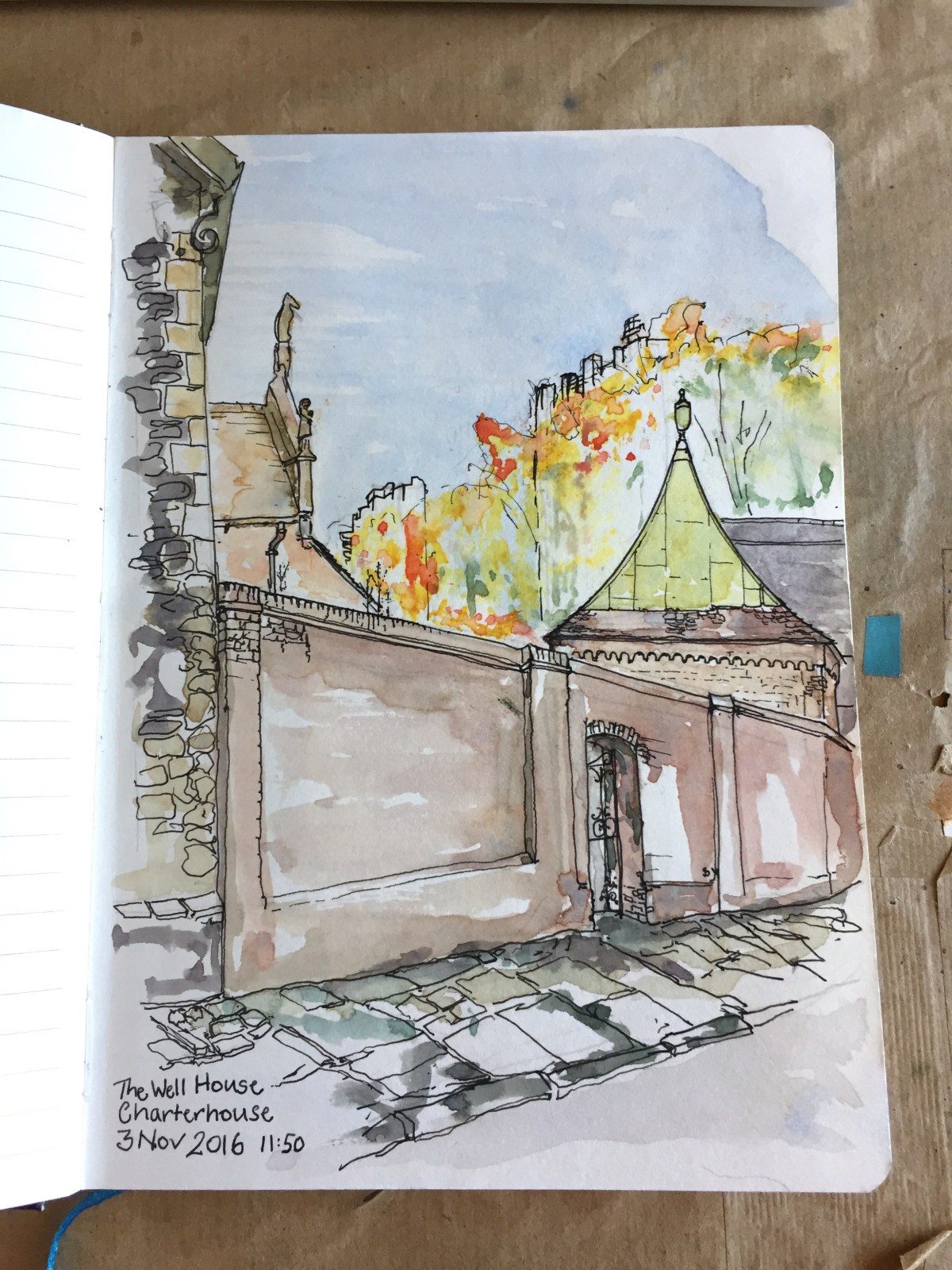
The Well House,  Charterhouse 

Here is one of my favourite views in The Charterhouse. That curling support for the guttering (top left) is characteristic: details that delight the eye.

I drew this standing in the roadway. The suppliers and drivers coming and going were very gracious.

Barbican towers are just visible over the autumn trees.

Here’s what it looked like before the colour:

3 Nov 2016 (1 - outline only)

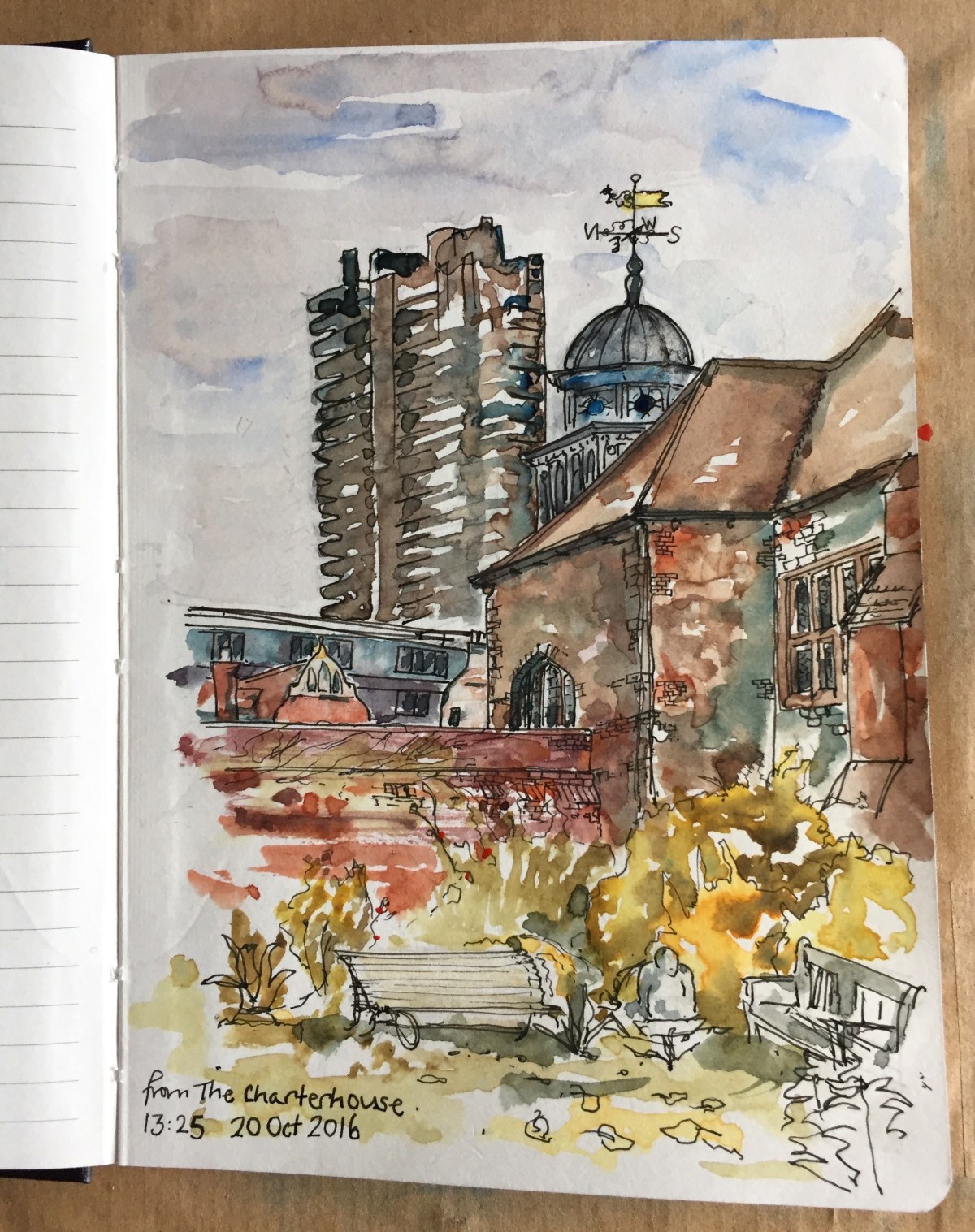
The Charterhouse, Chapel roof

This is my first sketch at The Charterhouse, as a guest of the Preacher, Reverend Robin Isherwood.

The building on the right is the Great Hall, Tudor, around 1600. Beyond it is a Barbican tower, 1970s.
The small dome is the roof of the Chapel of The Charterhouse, 17th Century, by Francis Carter. According to Pevsner*, Francis Carter had “previously worked at Trinity College Cambridge, and from 1614 was chief clerk of the King’s Works under Inigo Jones.”

*The Buildings of England, LONDON 4: NORTH, Bridget Cherry and Nicolas Pevsner, page 619