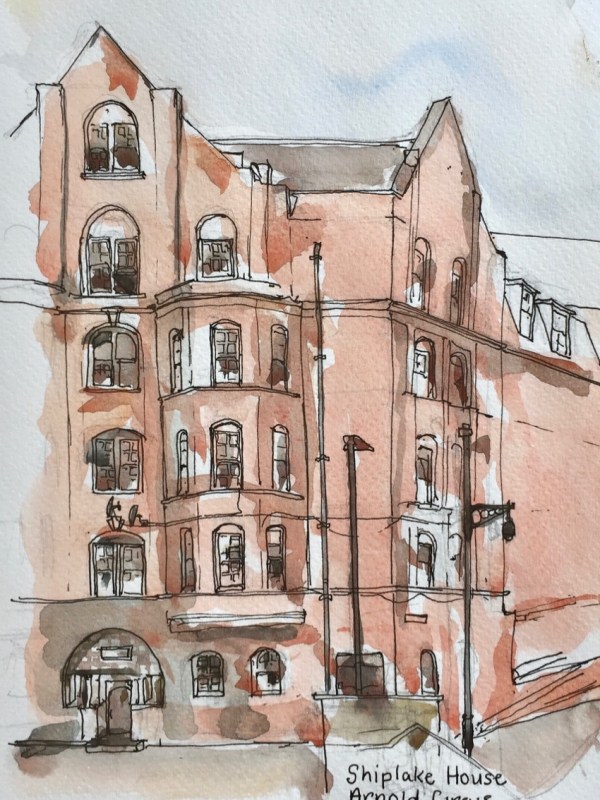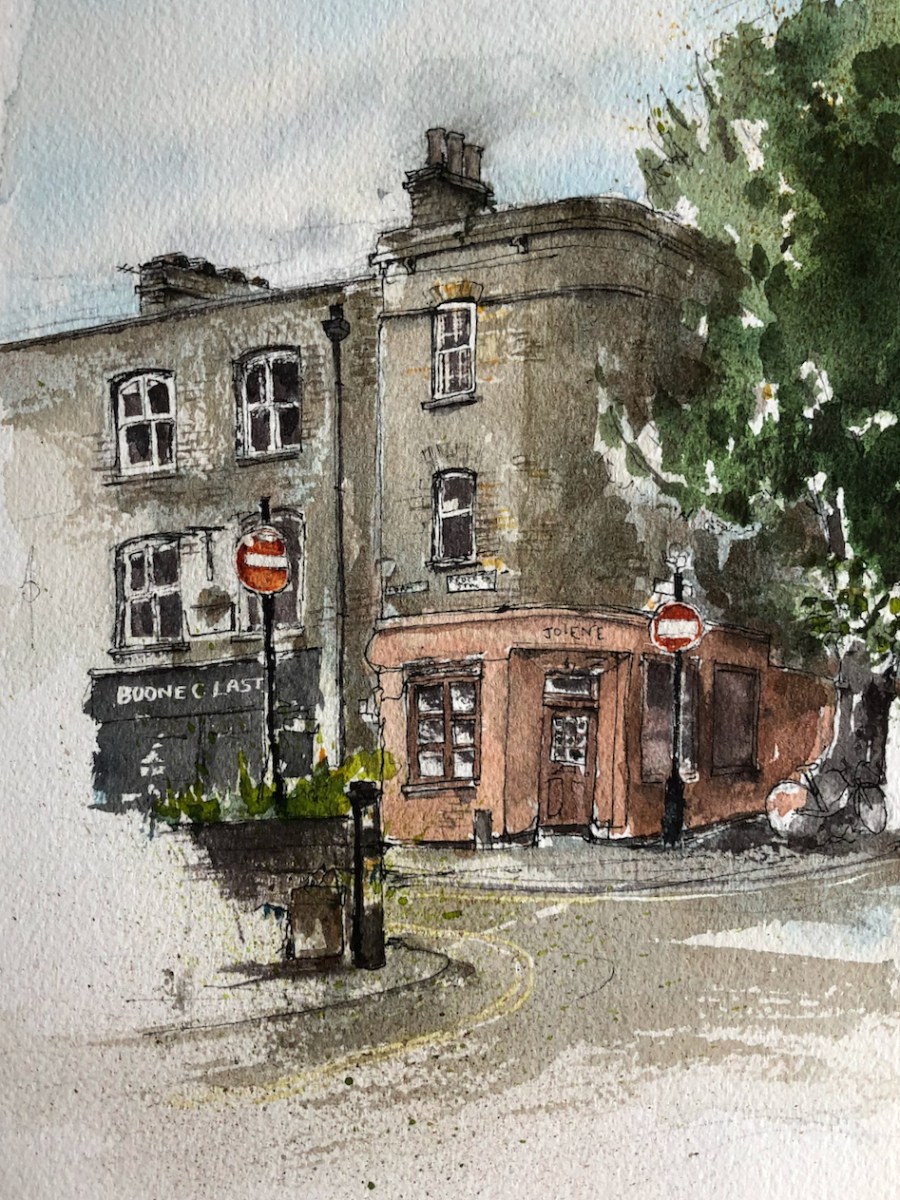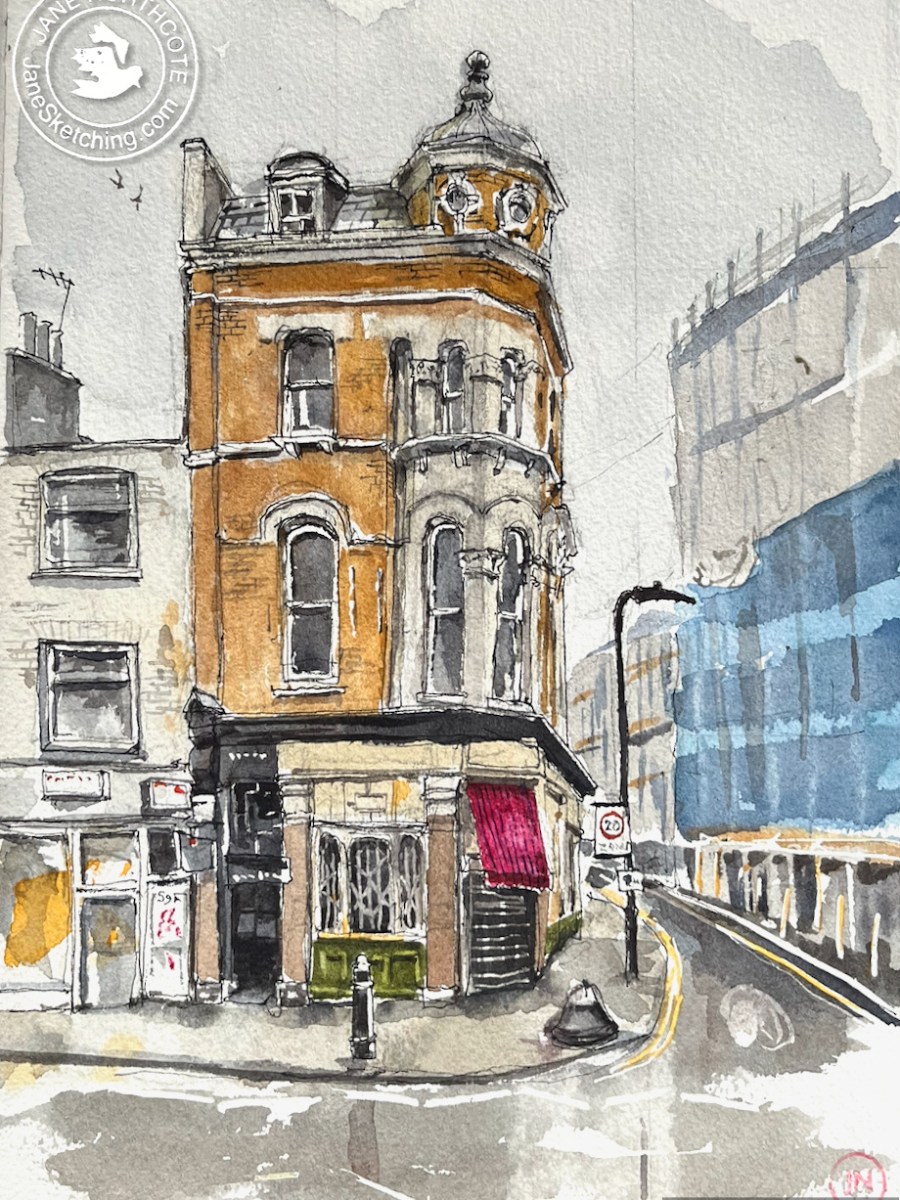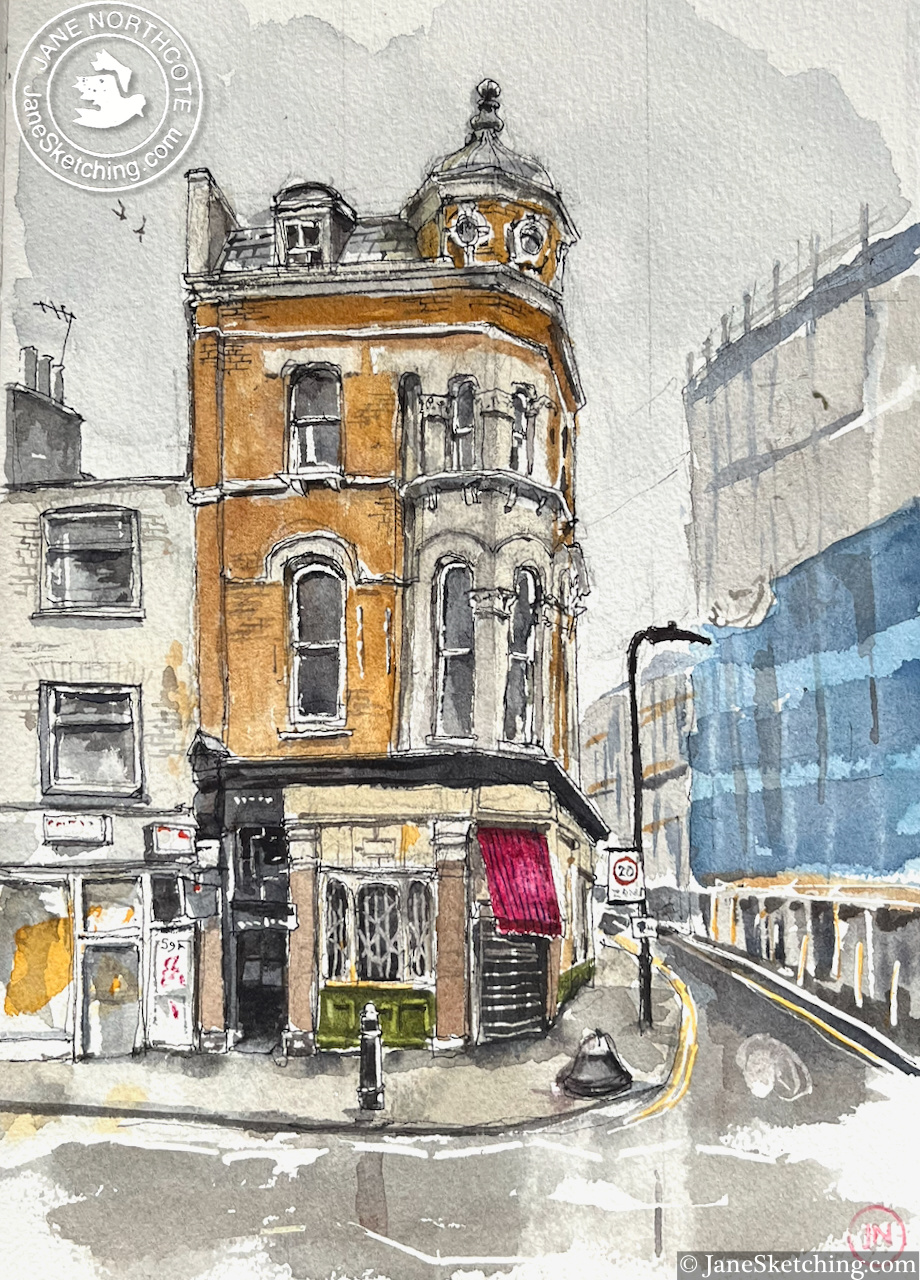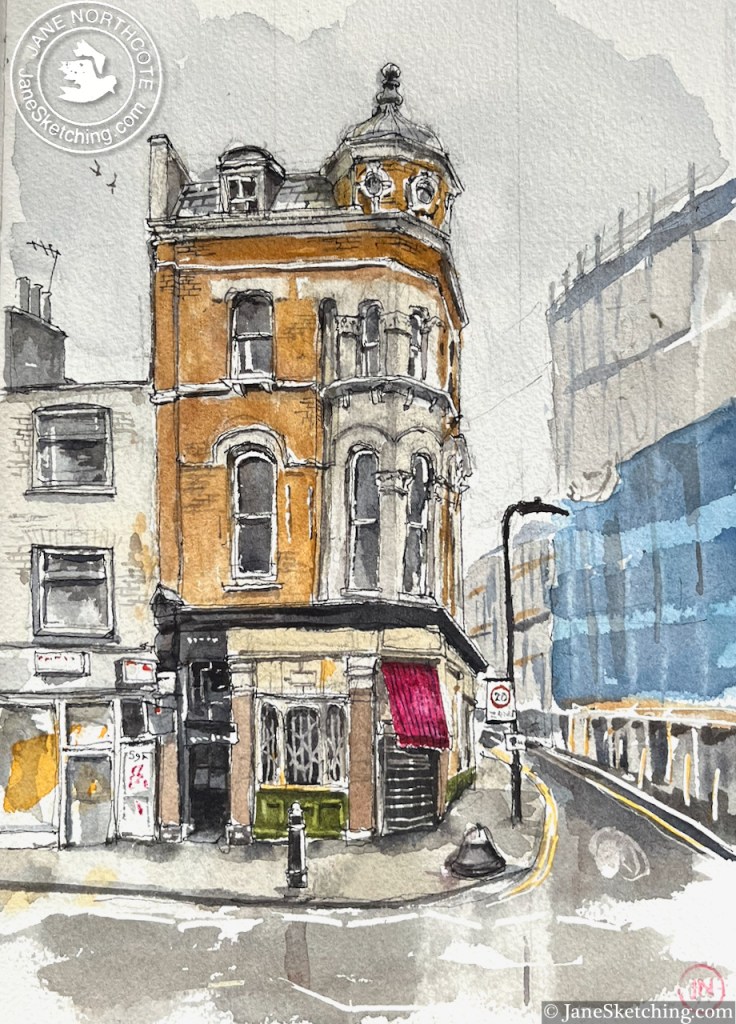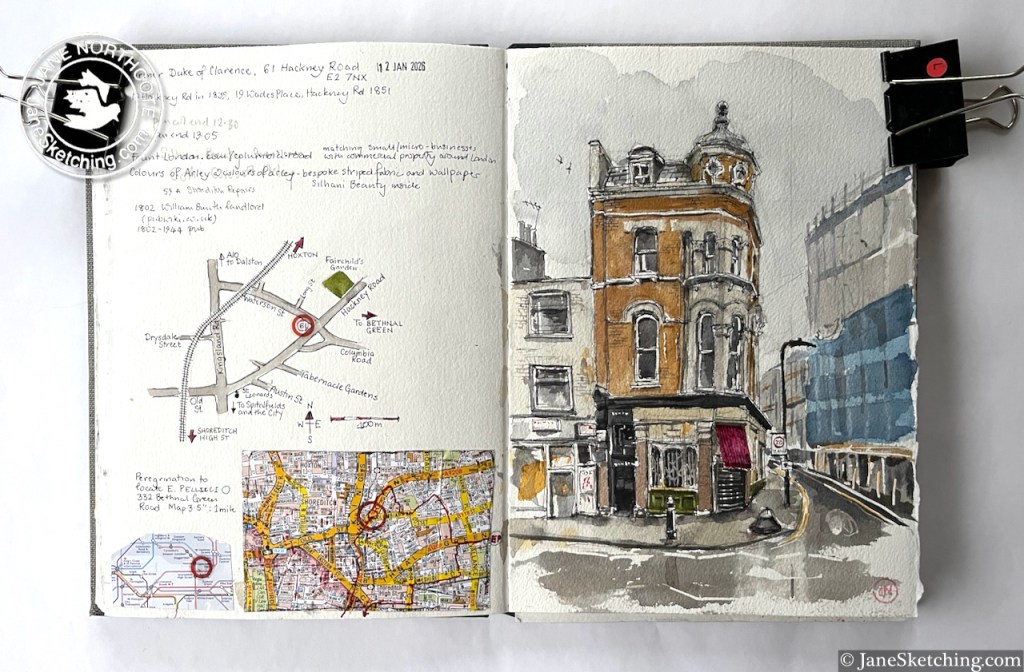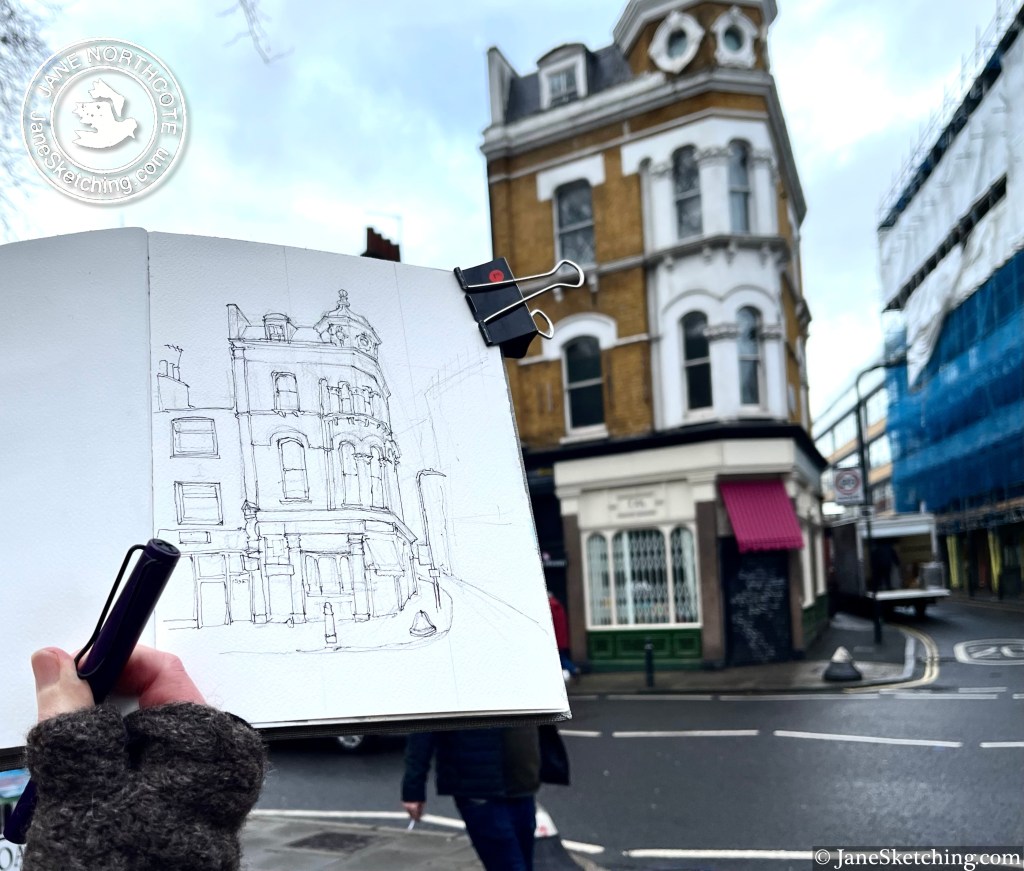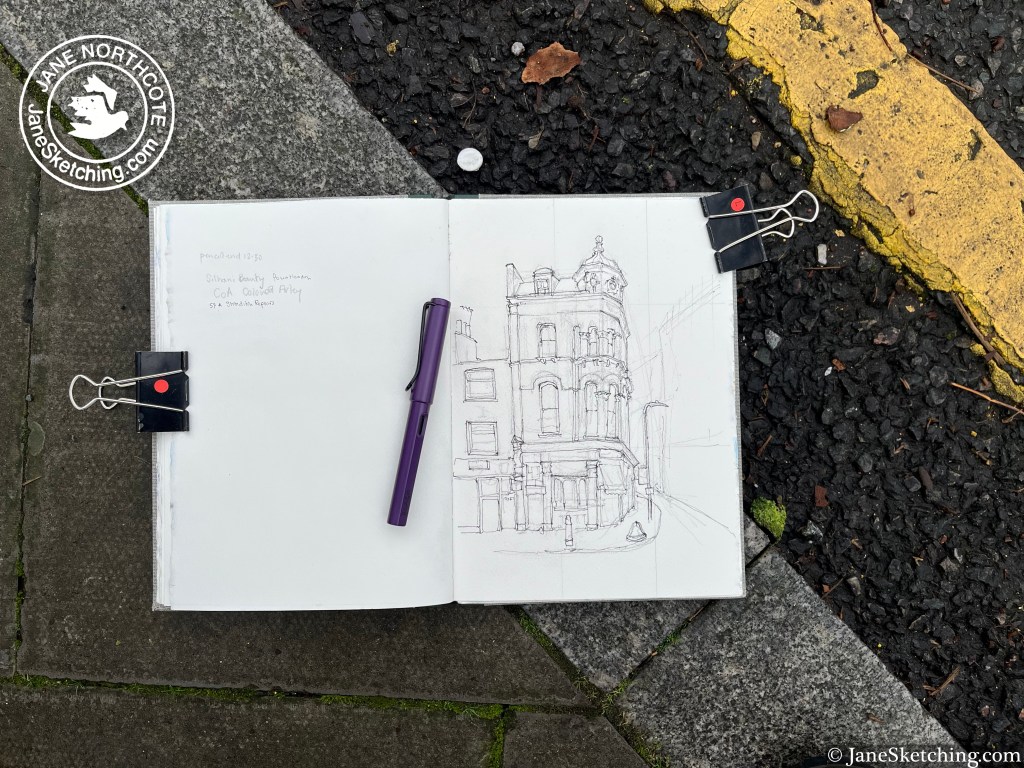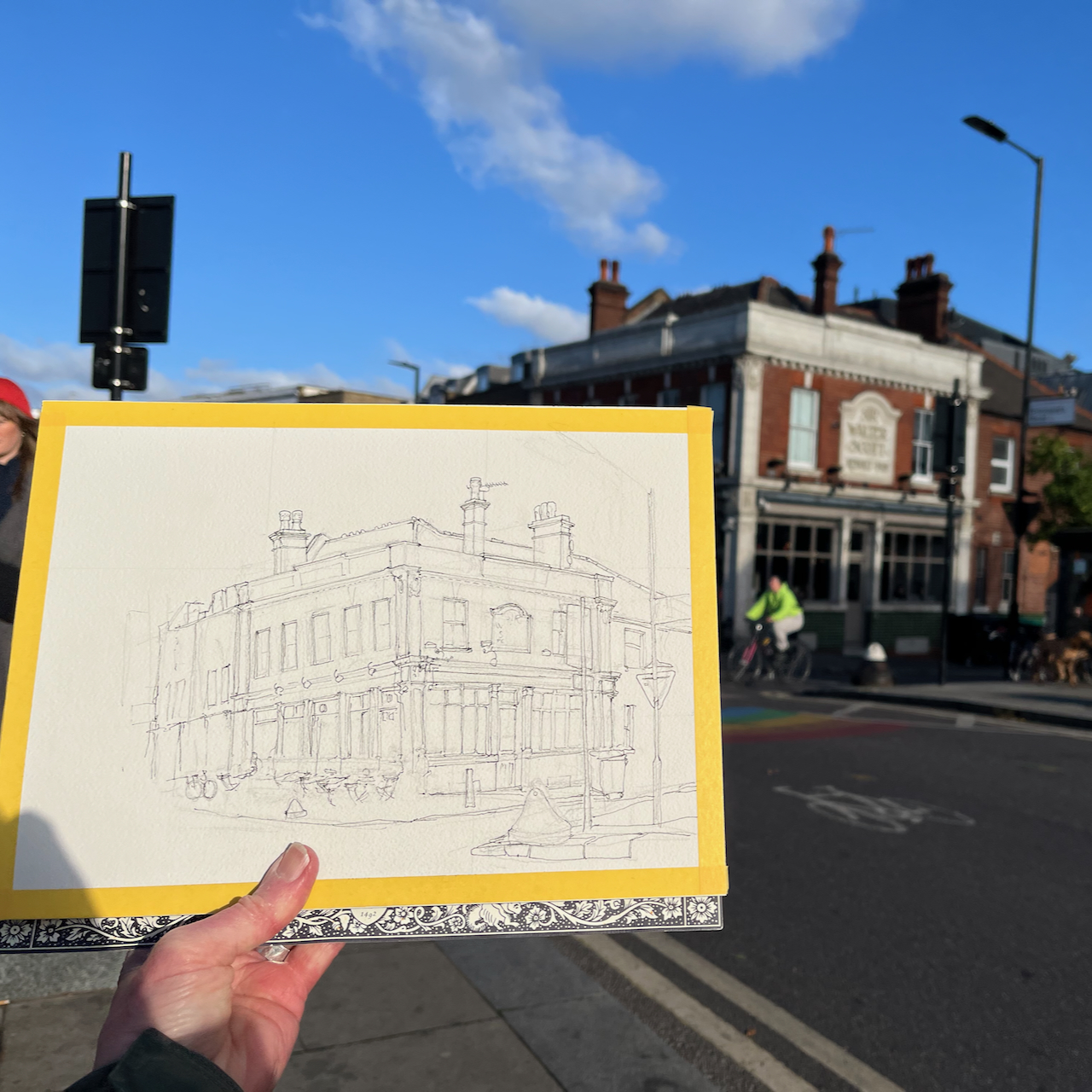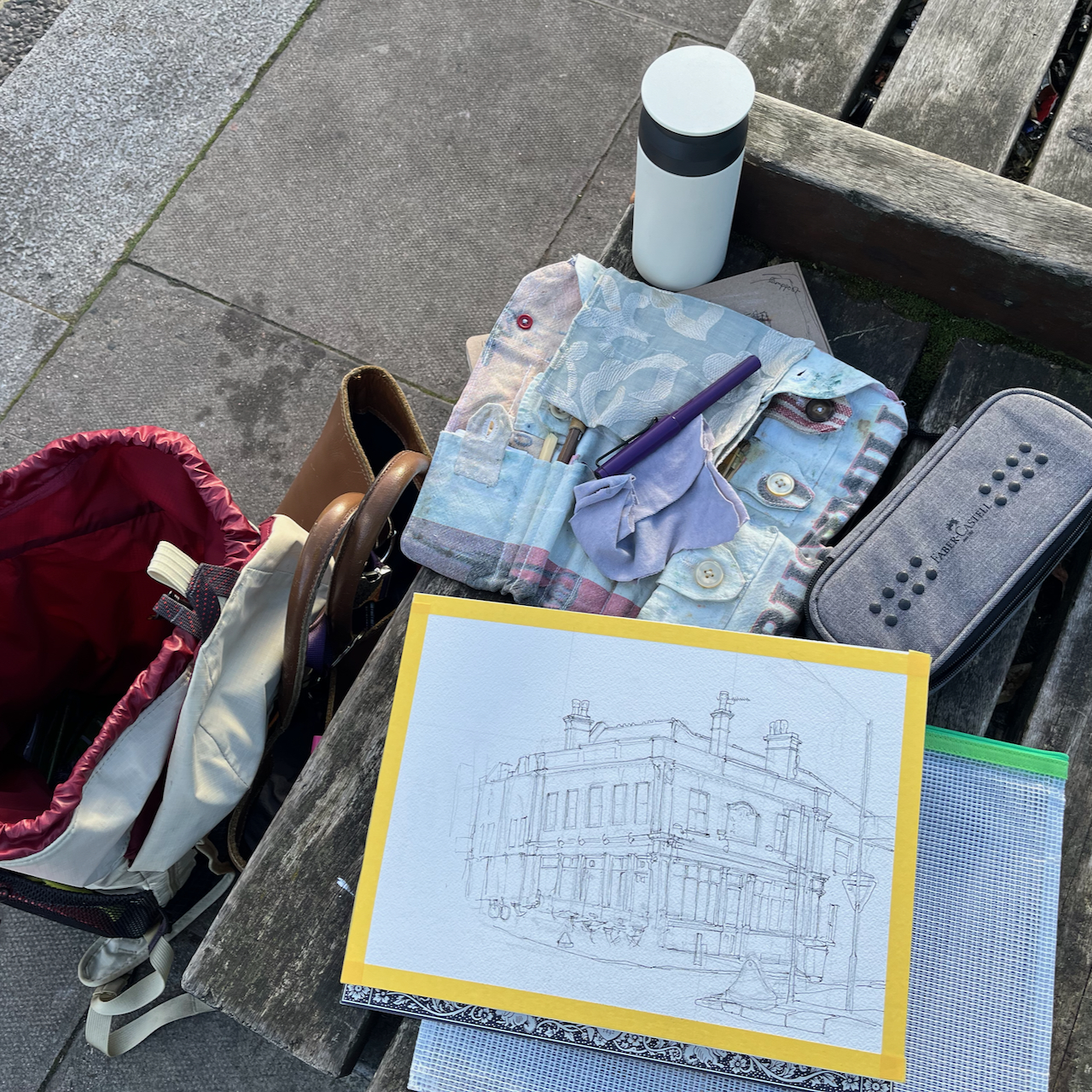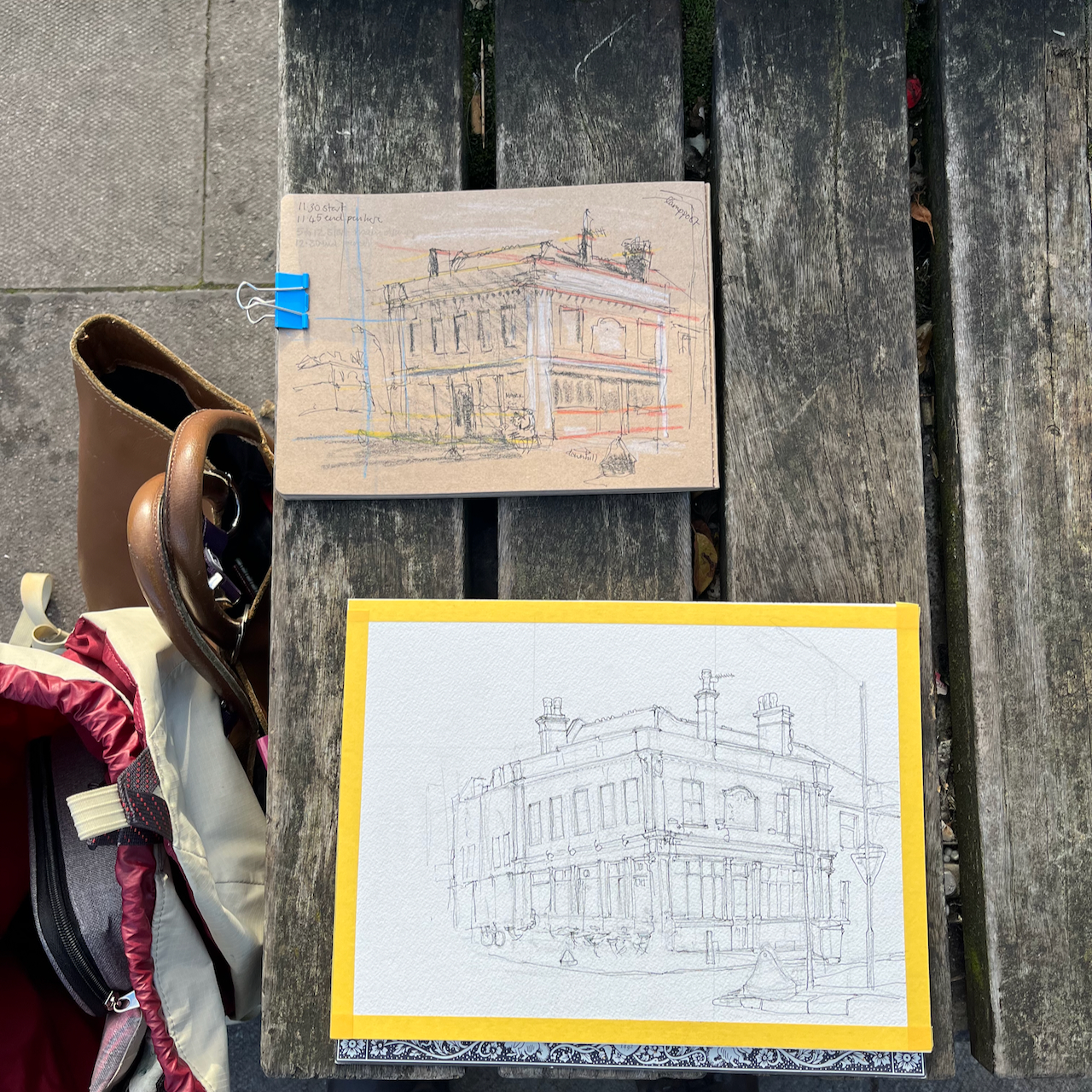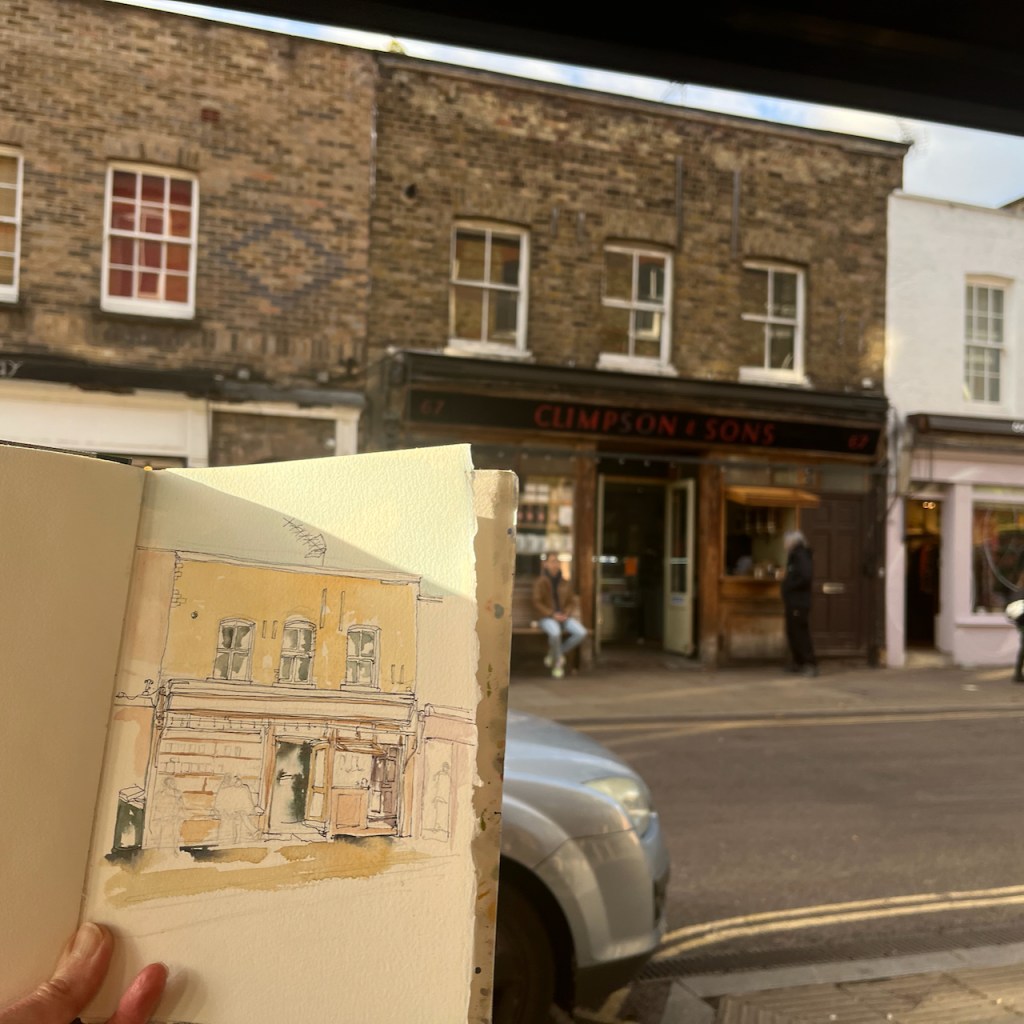
Along the Hackney Road stands this building with a turret:
61 Hackney Road, E2 7NX, sketched 12 January 2026 in sketchbook 16
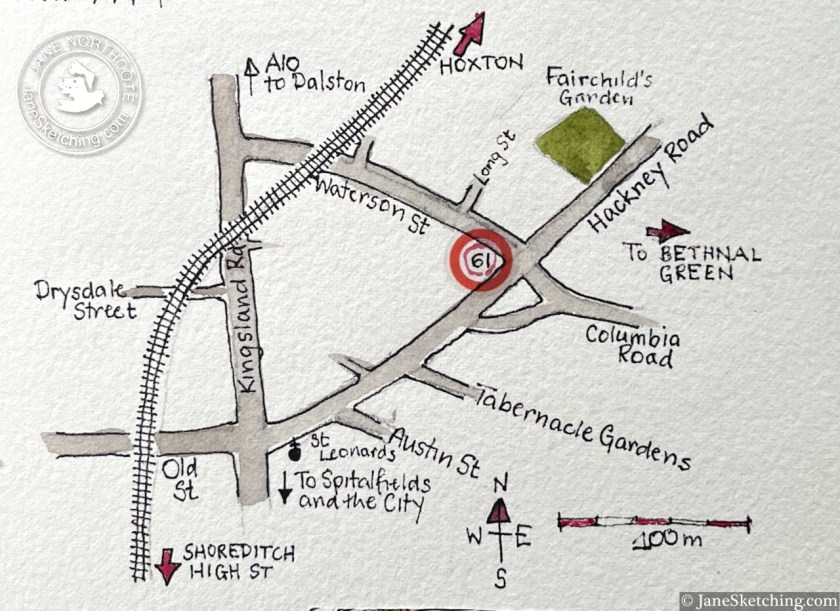
This on the corner of Waterson Street and Hackney Road, at the western end of Columbia Road.
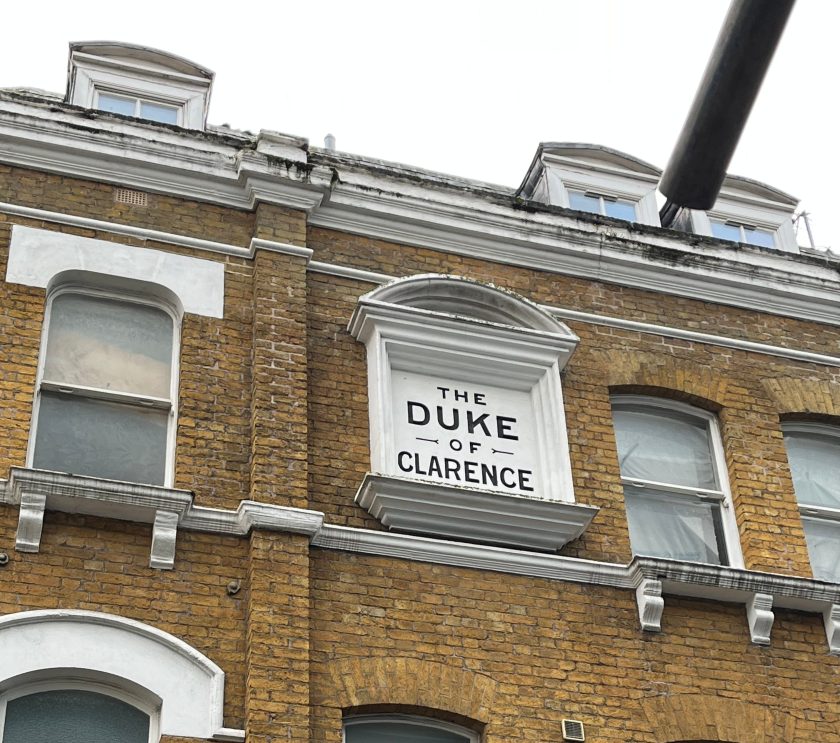
After I’d sketched it, I walked into the picture, and had a look at the building from the Waterson Street side. It was a pub called the Duke of Clarence.
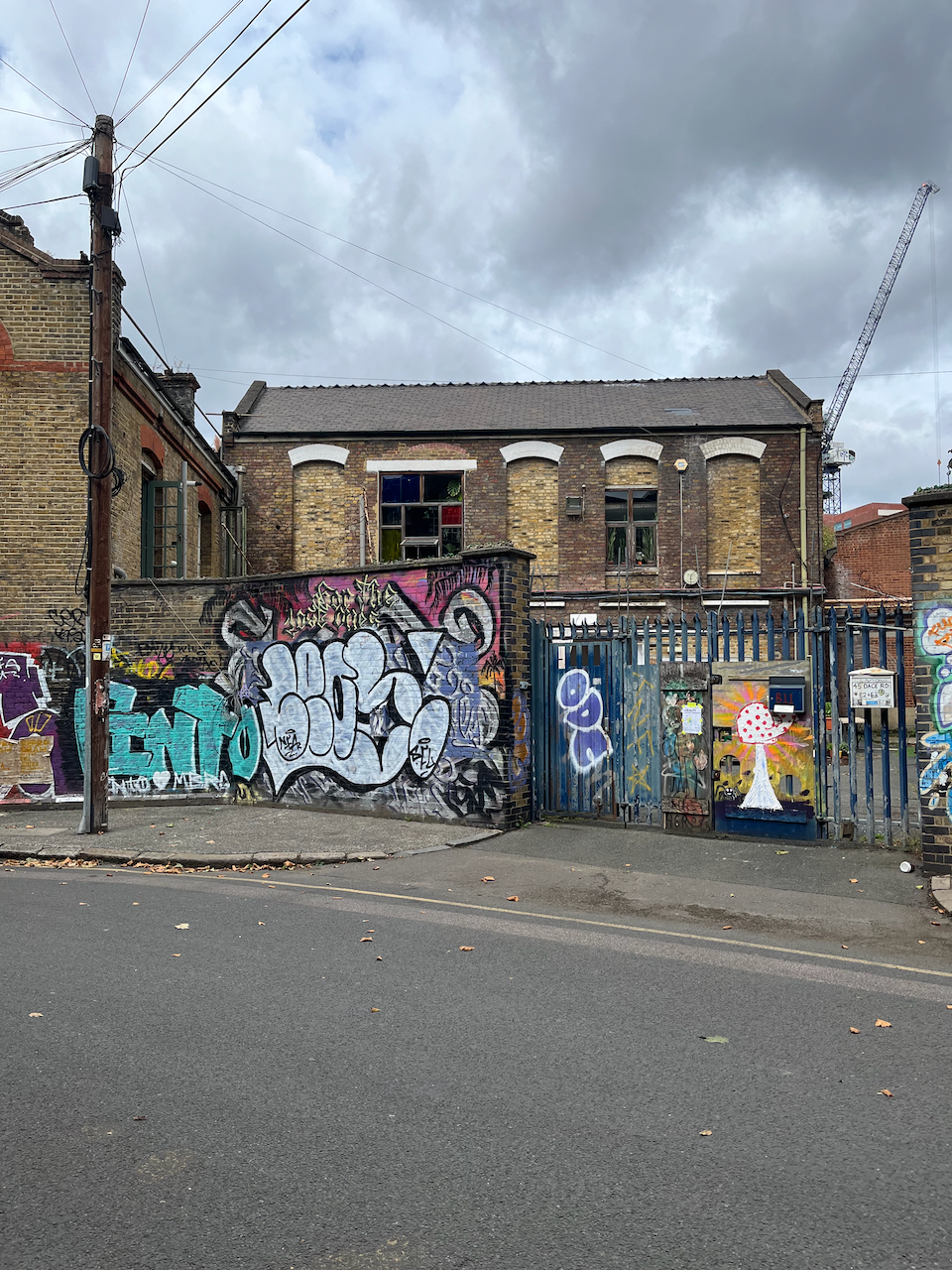
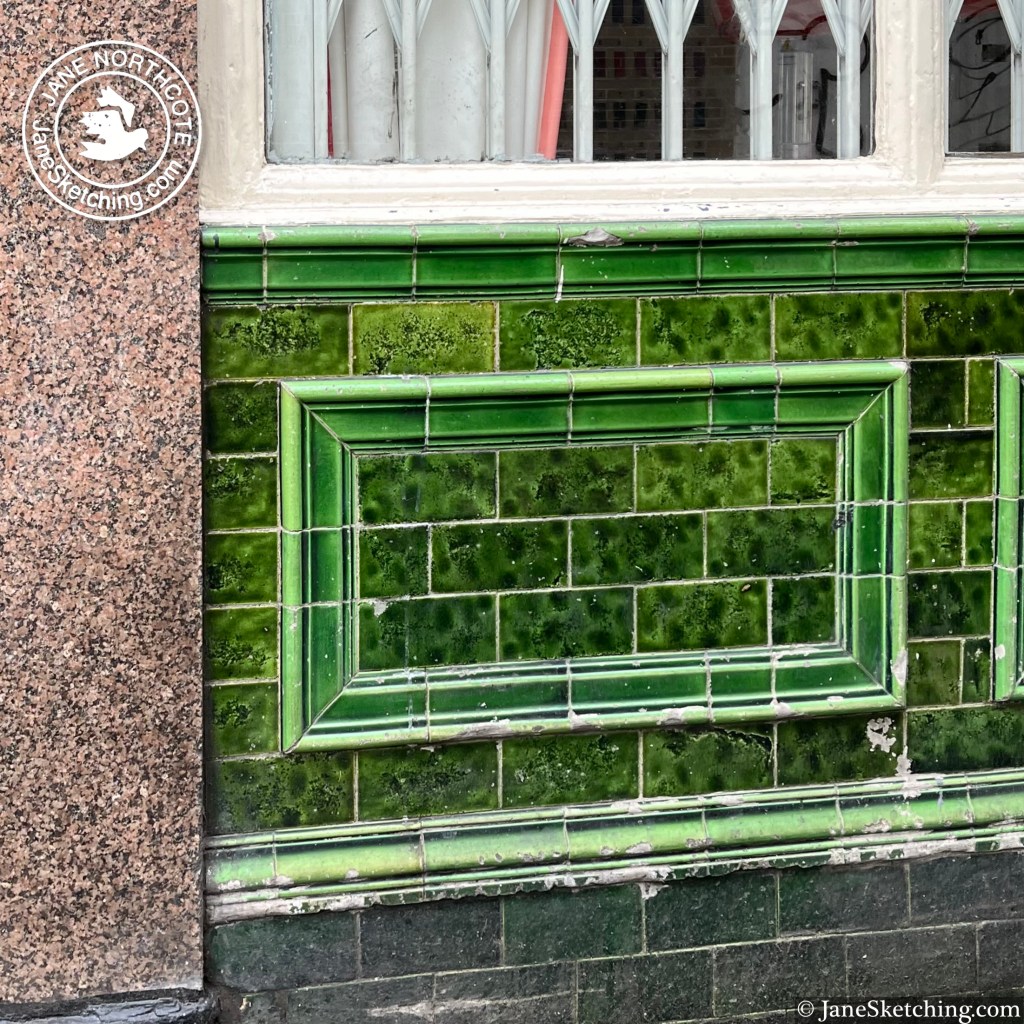
There is deep green tiling, characteristic of 19th century London pubs.
Now it is home to “Colours of Arley” on the ground floor, which offers “bespoke striped fabric and wallpaper”. Other floors are occupied by tenants of “Fount London”, which provides small office spaces in quirky buildings.
It’s still standing on its corner, still noble, still useful, while the businesses and the district change around it.
Click a button below to share this post online, email it, or print it:
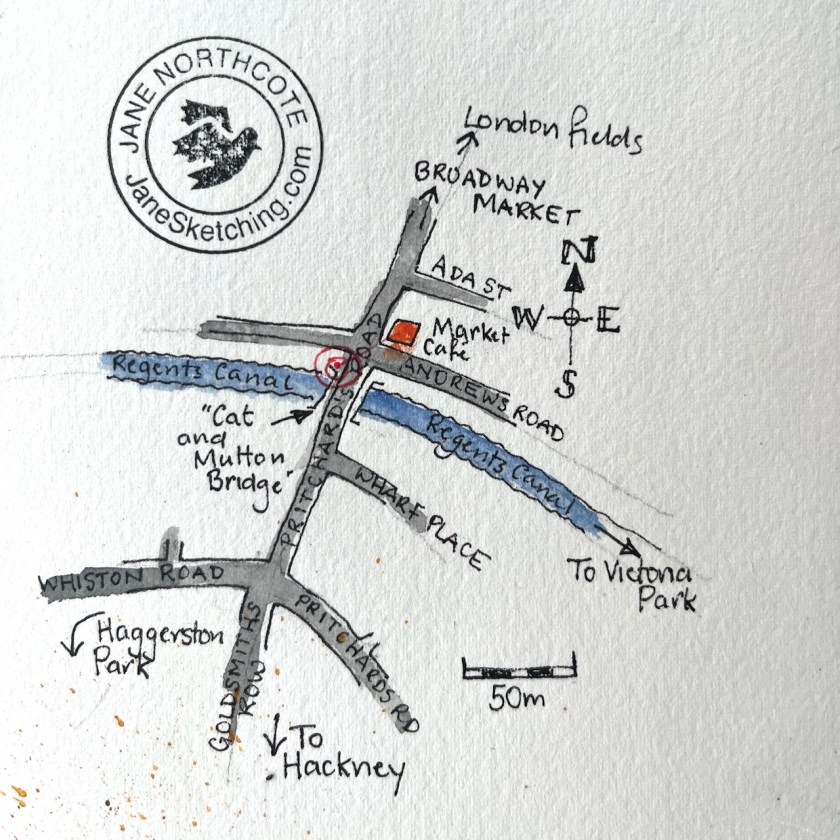
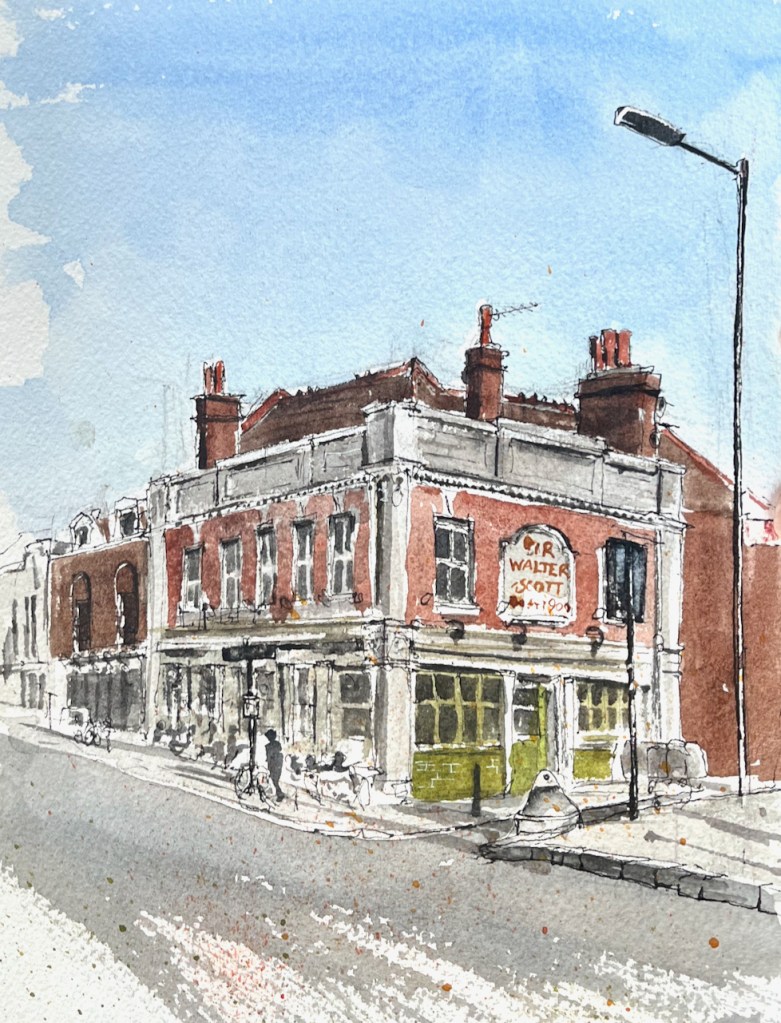
Here is the Market Café, which is at the South end of Broadway Market, near the canal.
Market Café, Broadway Market, Hackney E8, sketched 12 November 2024, 12″ x 9″ [sold]
I’ve sketched the Market Café before, and written about it on this post. This latest sketch was a commission to celebrate a happy event which took place there.
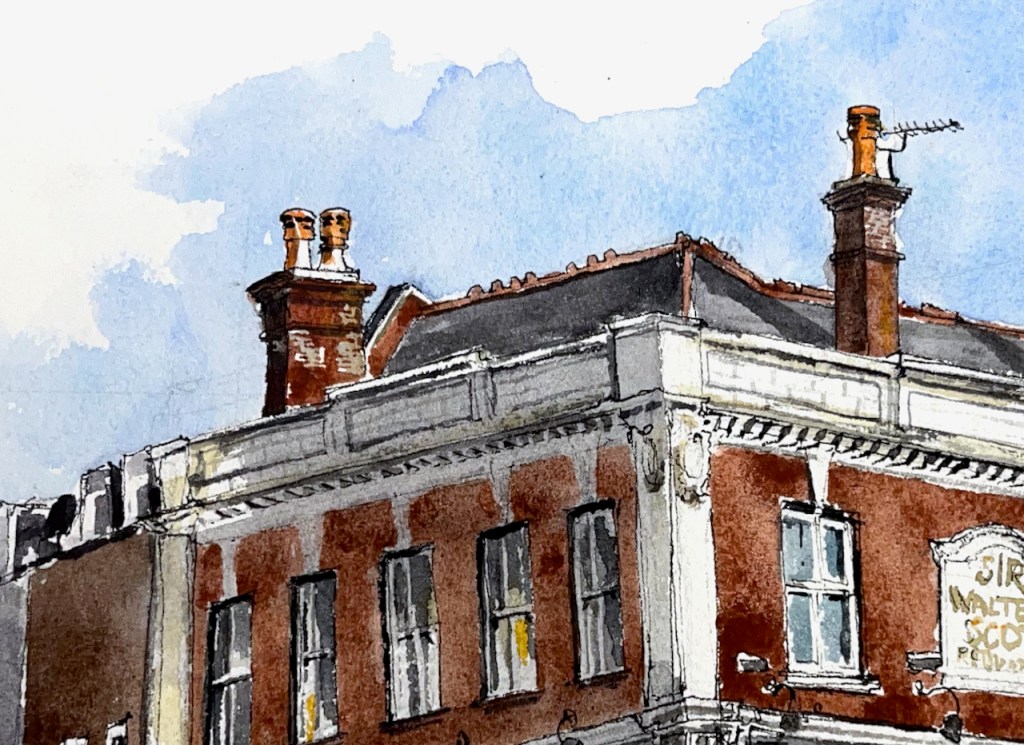
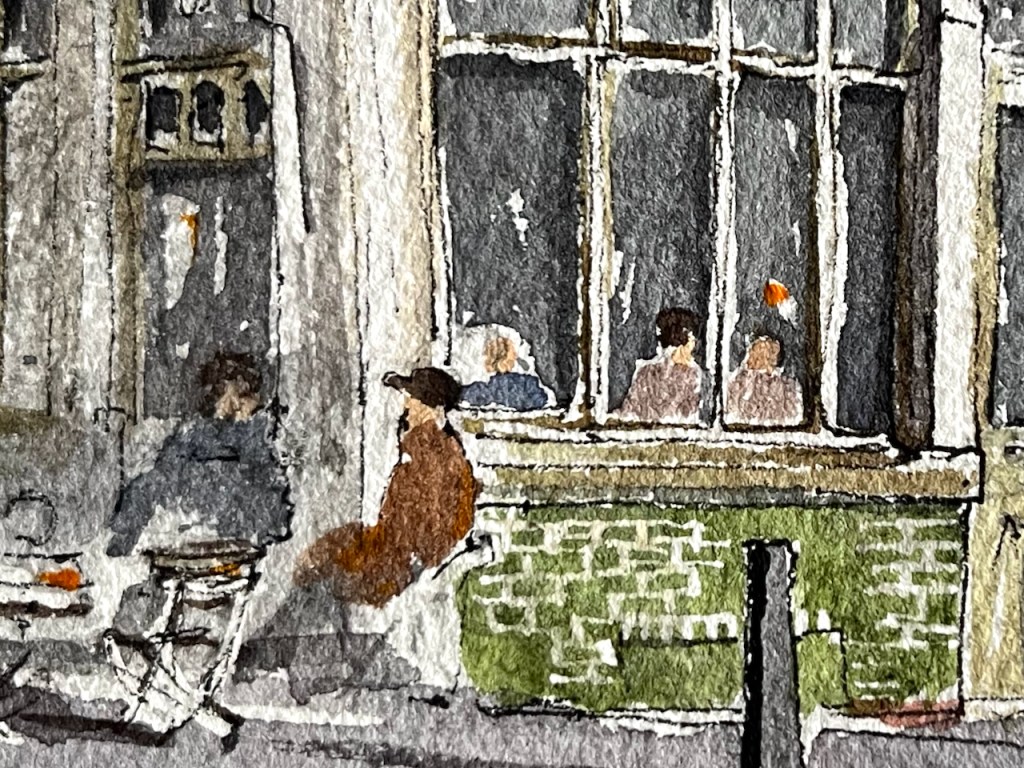
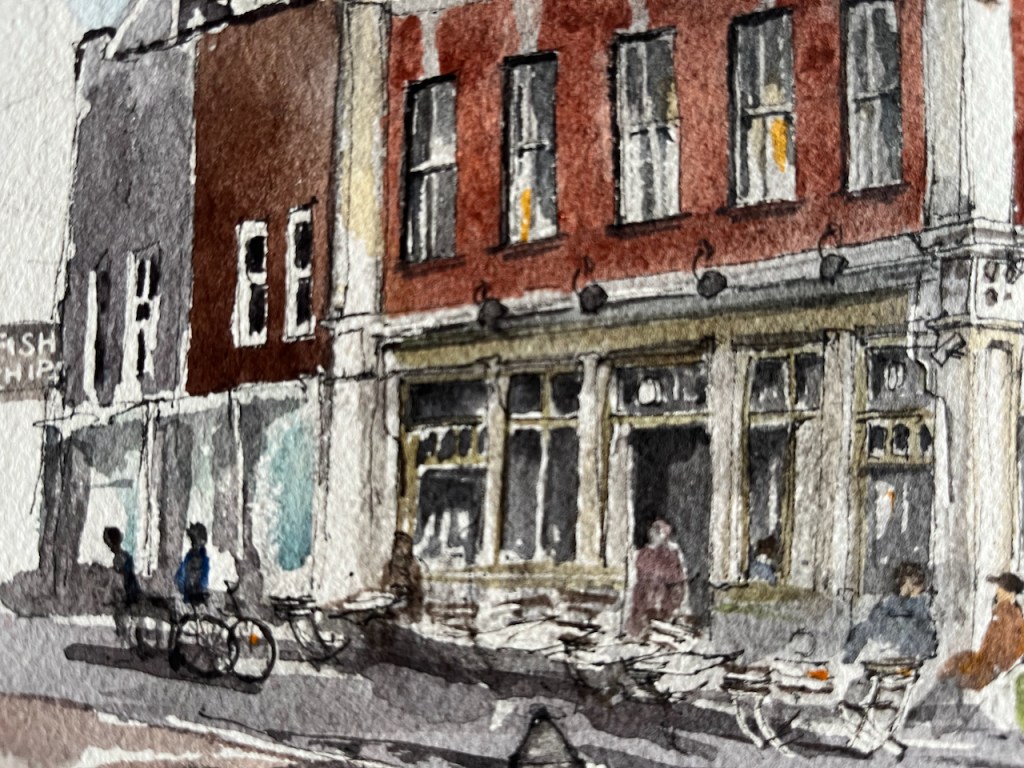
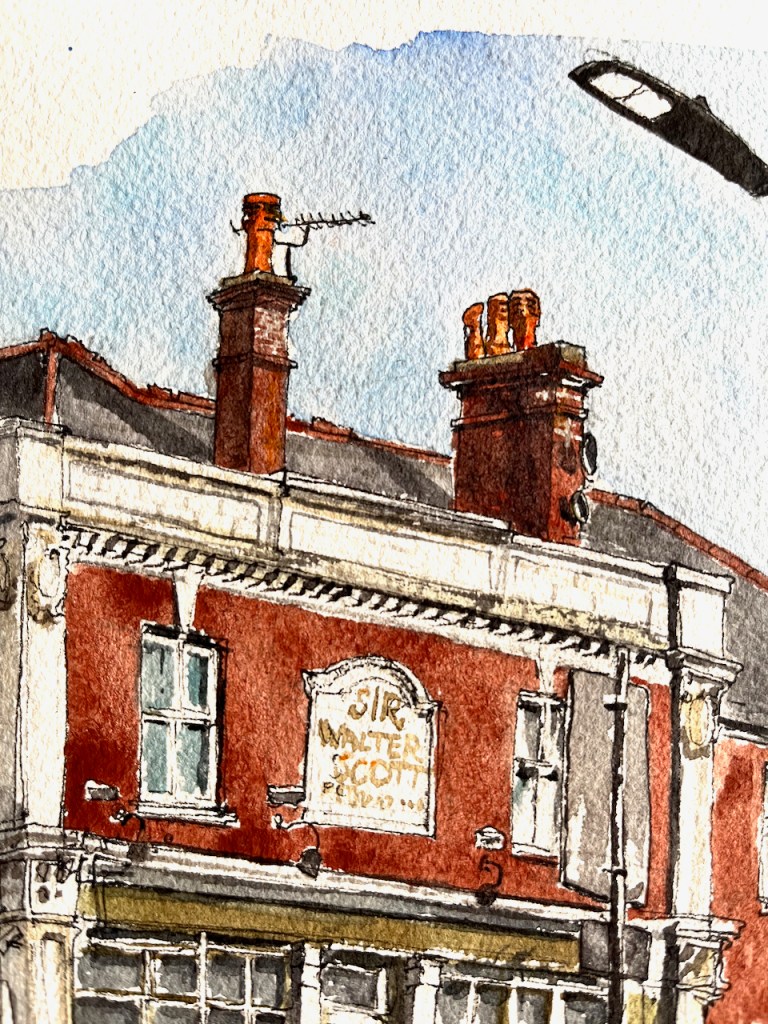
Here are some details from the sketch:
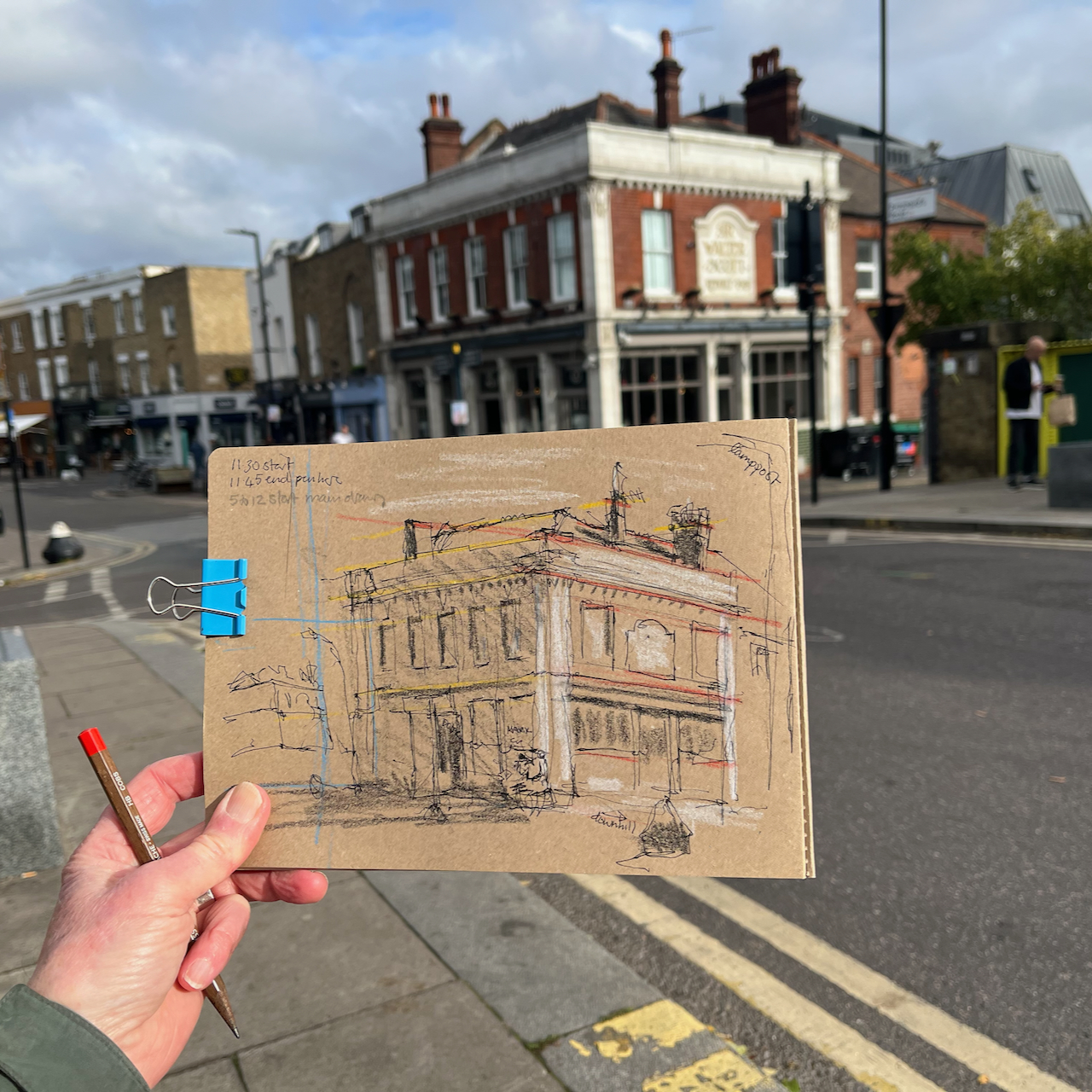
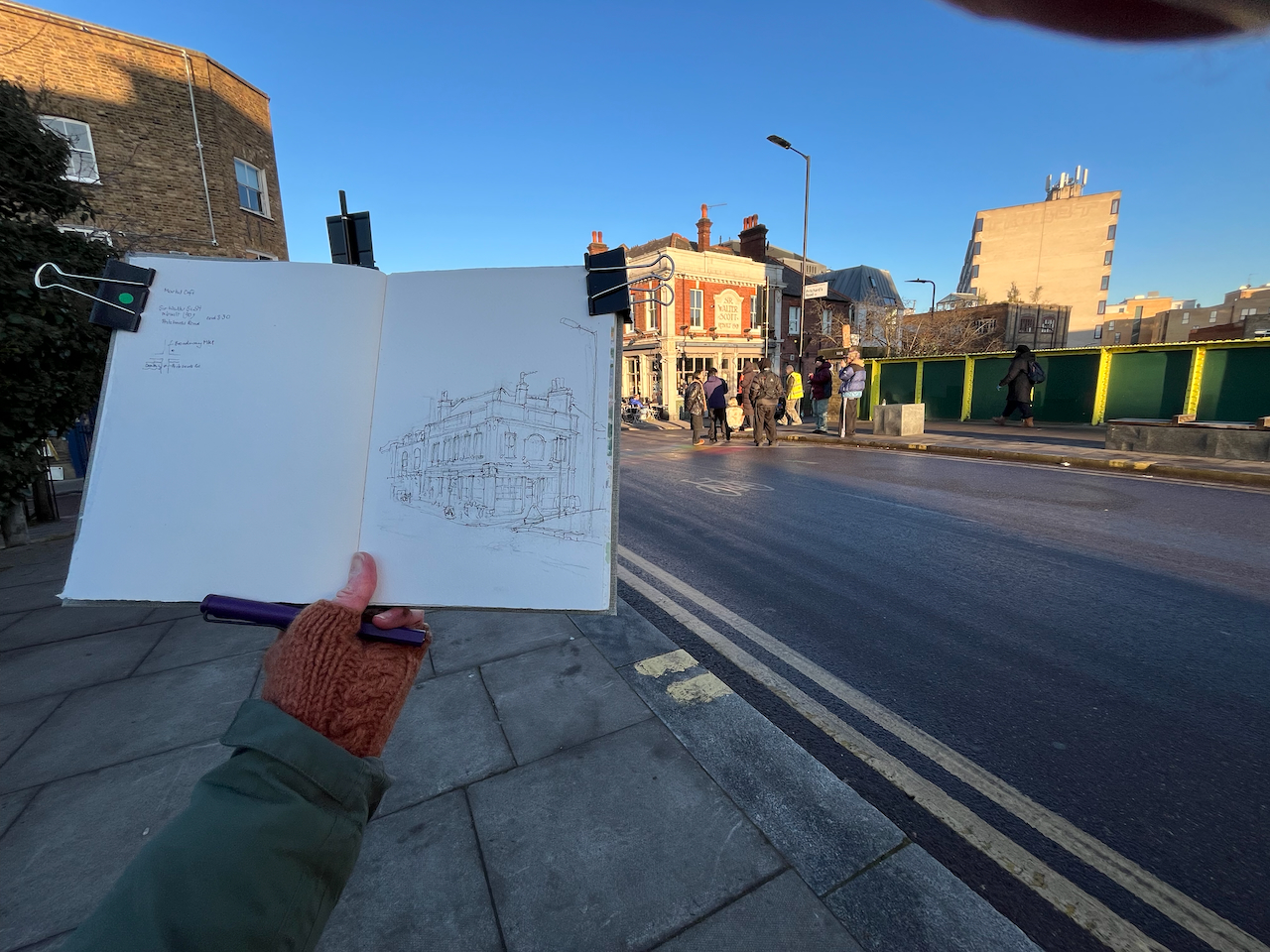
It was a bright and cold day. I did the pen and ink on location.
preliminary sketchPacking up.Working on location
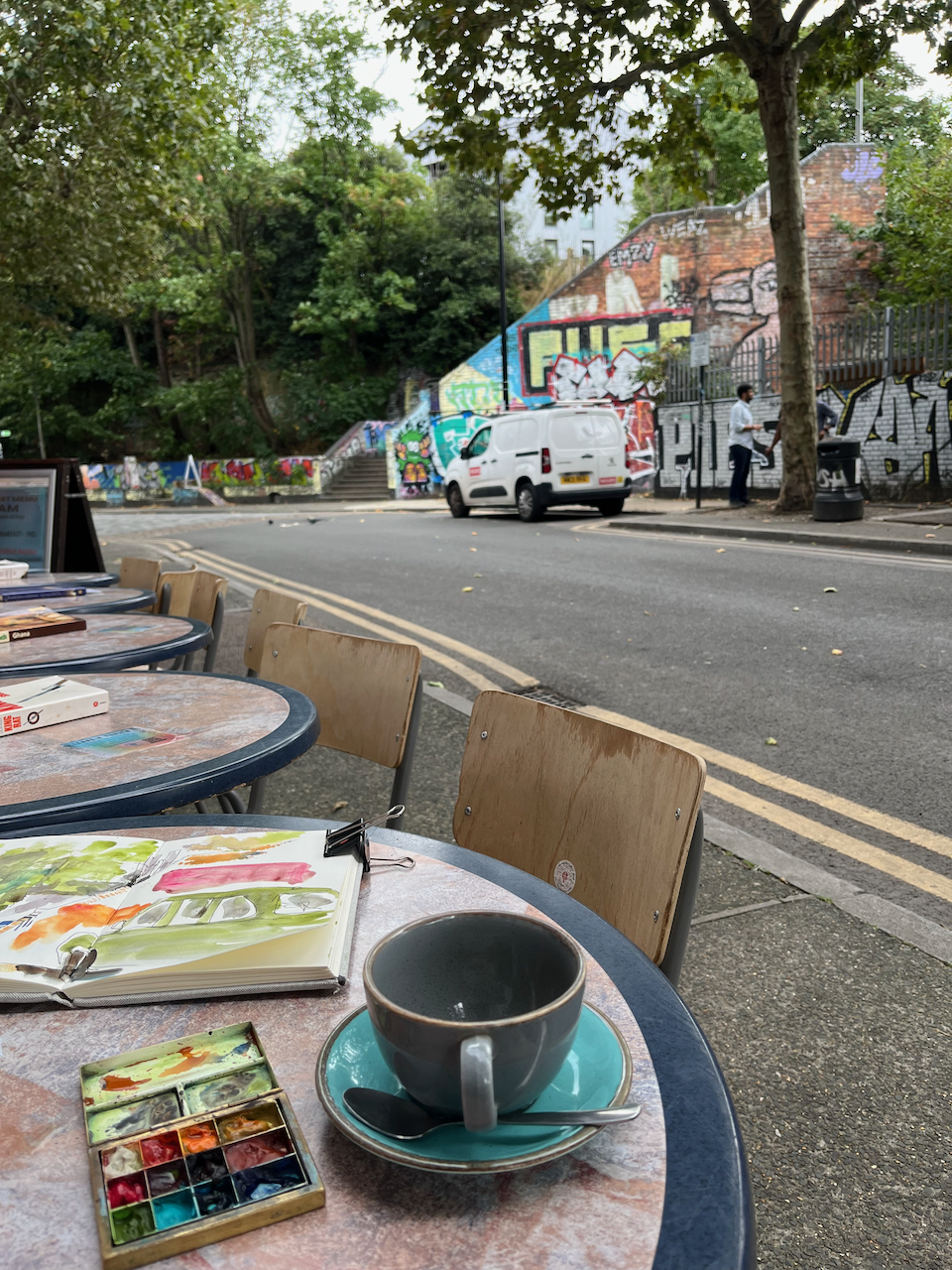
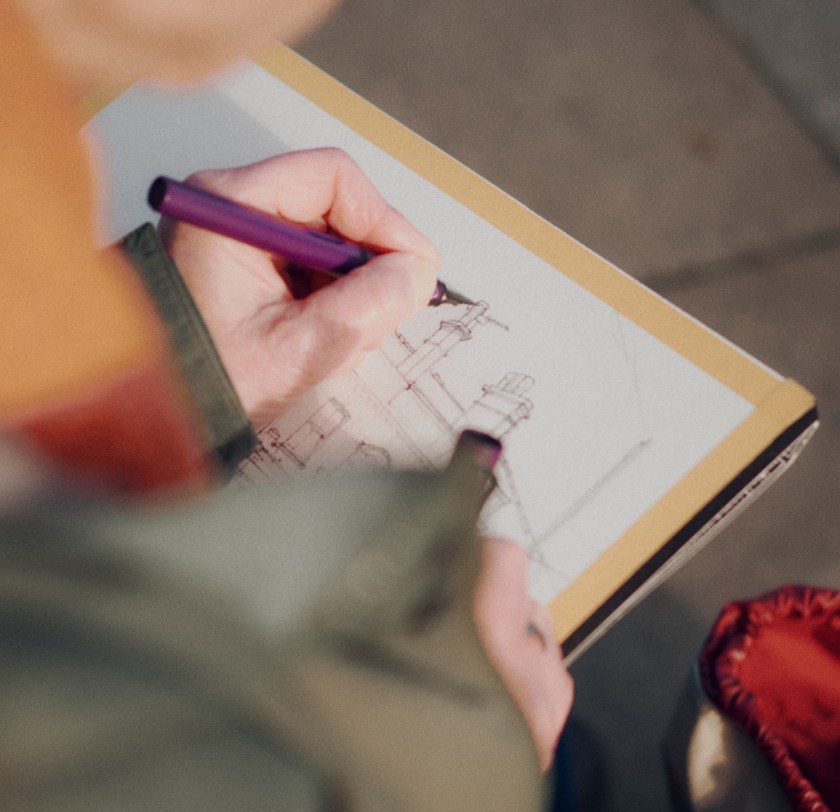
The photographer Nick Hillier came by and took some photographs of me working, which he kindly sent me later.
Sketching on location, image credit: Nick Hillier. Pen is a Lamy Safari.
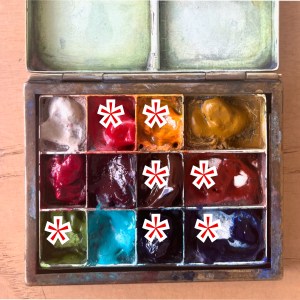
I added the colours at my desk. The colours are:
for the brickwork: Fired Gold Ochre
all the greys and blacks are: Ultramarine Blue plus Burnt Umber
the sky is Phthalo Blue Turquoise
the green tiles are Serpentine Genuine
there’s a bit of Permanent Yellow Deep on some of the highlights and some dots of Transparent Pyrrol Orange
the fine white lines are made by using a rubber resist gum. I use Pebeo drawing gum.
For my current palette see this link. I have 12 colours in my palette. For most pictures I fewer colours. This picture used about 7 colours.
Thank you to my client H for the commission and for allowing me to post this image here.
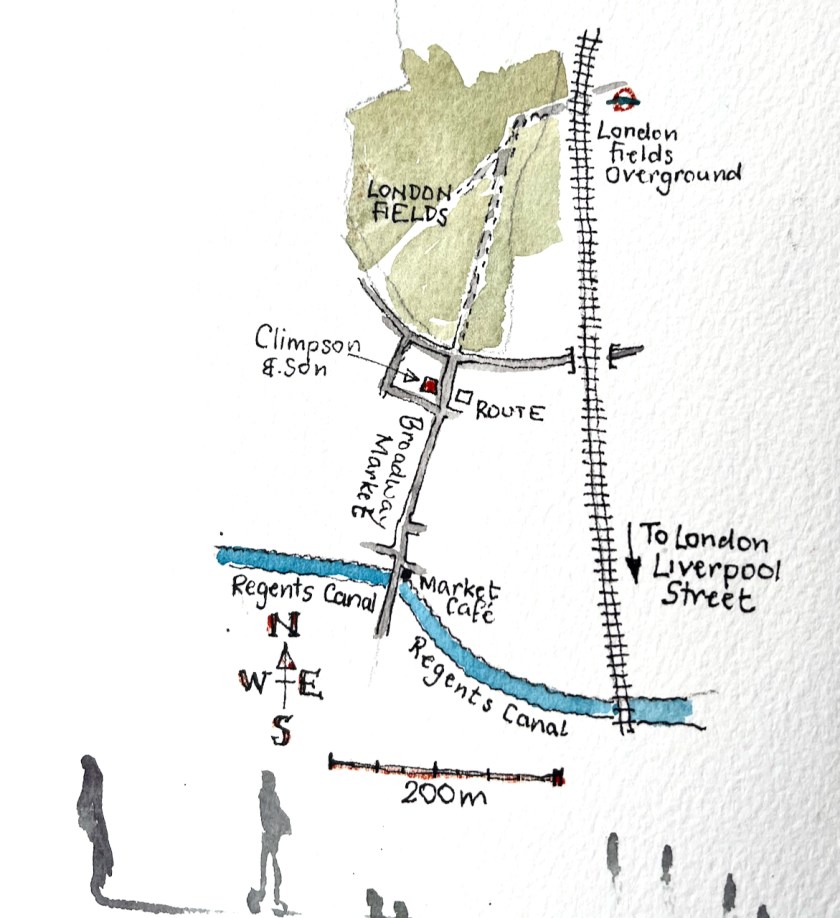
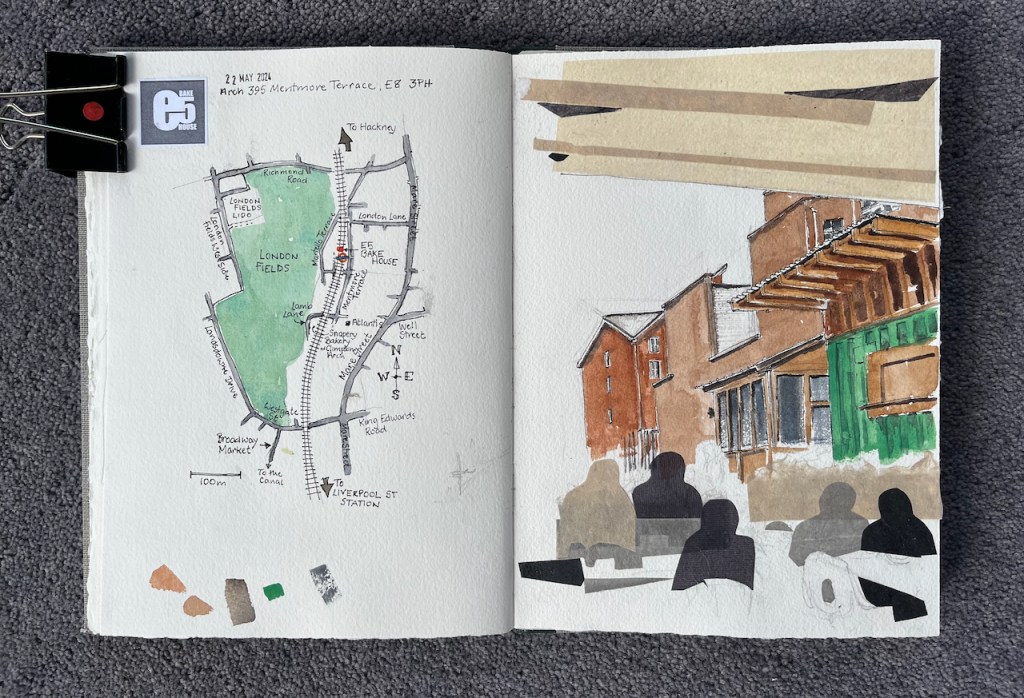
I’ve sketched around the Broadway Market area before. See this link for a sketch of Climpson Coffee, and here is a sketch done at E5 bakery on the other side of London Fields.
Sketch location
Click a button below to share this post online, email it, or print it:
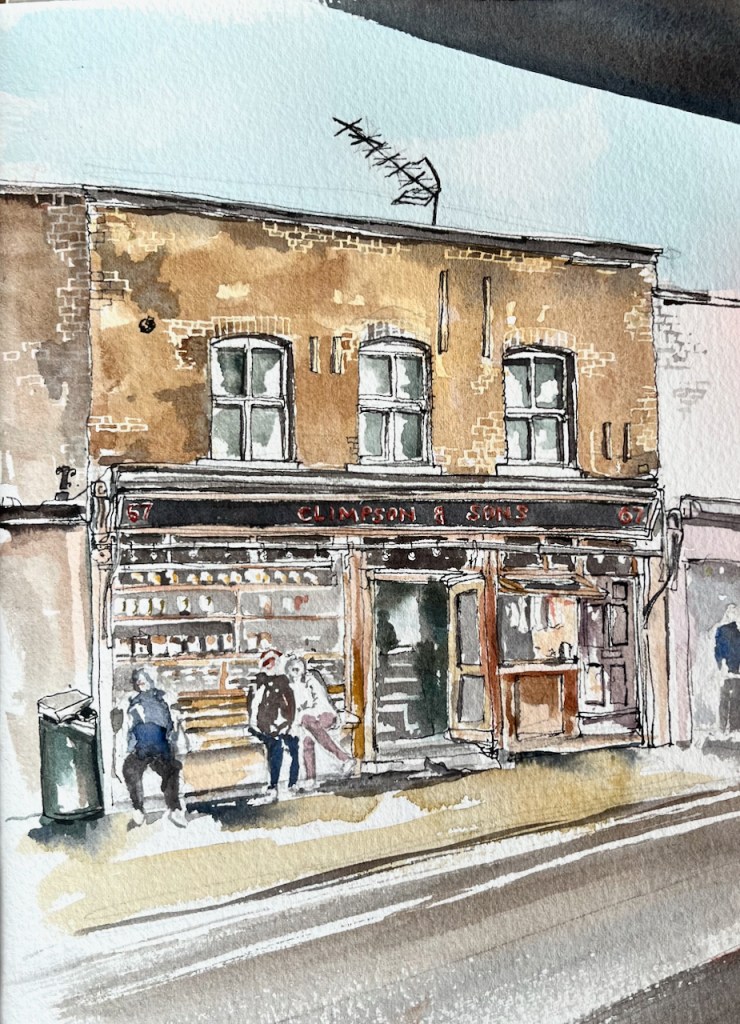
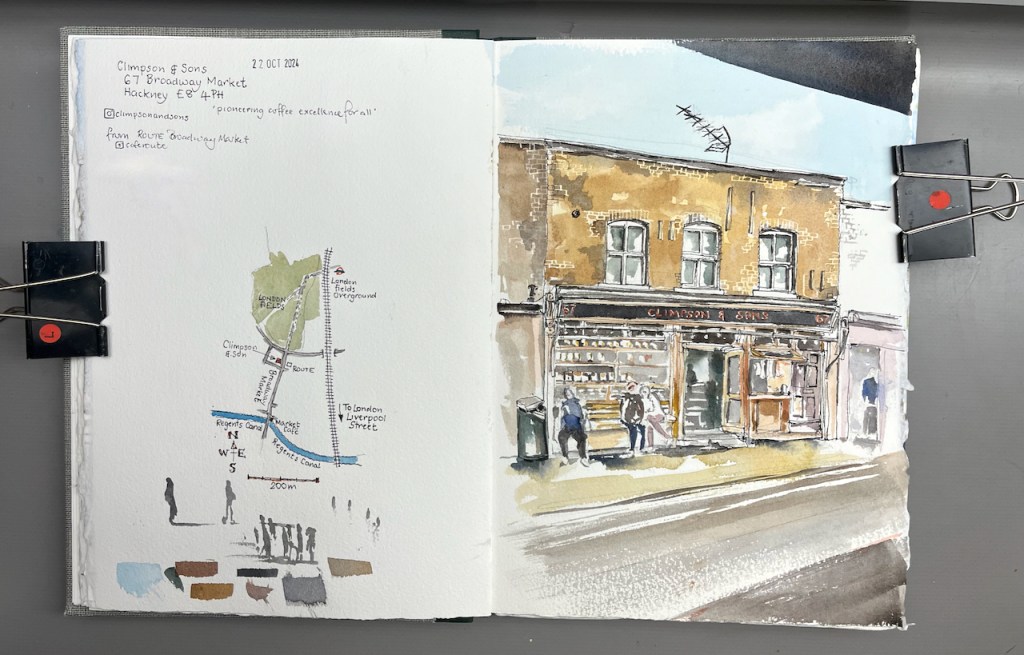
Here is a sketch of the coffee merchant Climpson & Sons, on Broadway Market in Hackney.
Climpson & Sons, 67 Broadway Market, London E8, sketched 22 October 2024 in Sketchbook 15
I was sitting at a table in the café opposite, which is called “Route”.
Climpsons are a coffee merchant and roastery based in East London. They roast their coffee in Walthamstow, and their HQ is just the other side of London Fields from Broadway Market.
They were doing a brisk trade as I sketched, and people drank their coffees on the benches outside.
I did most of the sketch on location and finished it at my desk.
Sketchbook 15
Click a button below to share this post online, email it, or print it:
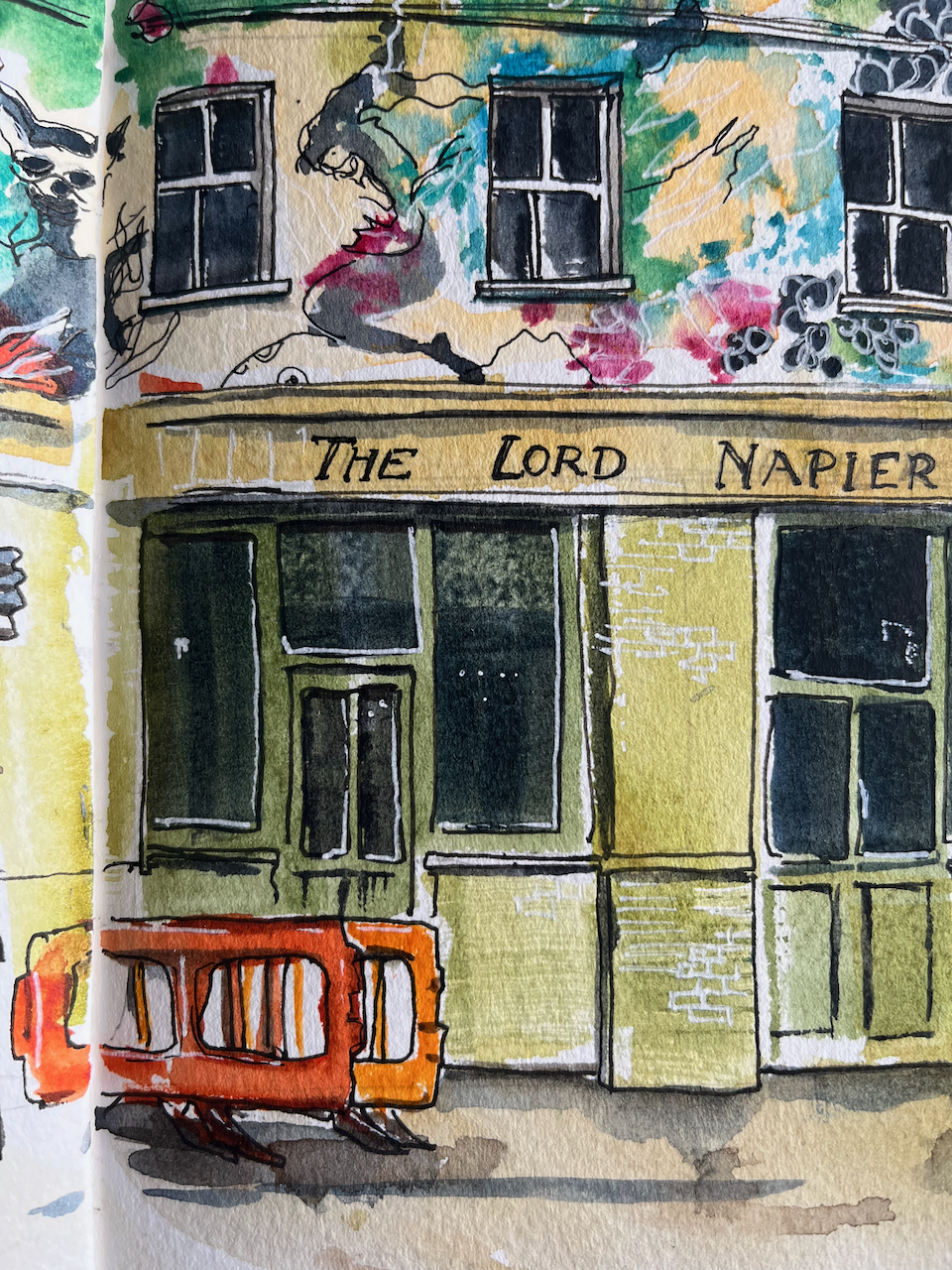
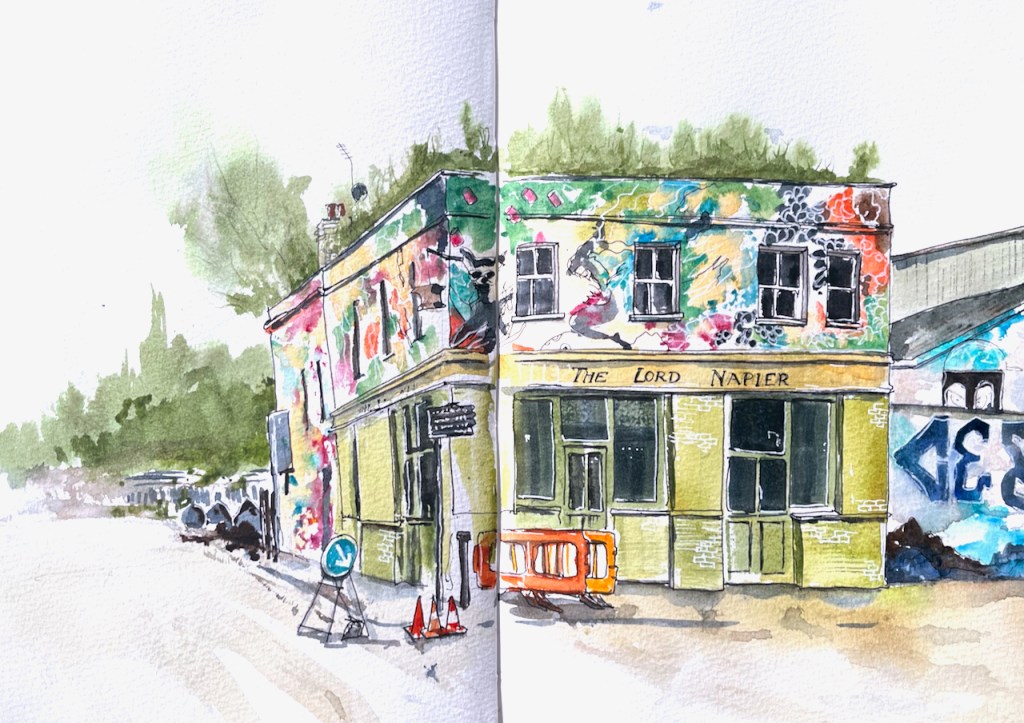
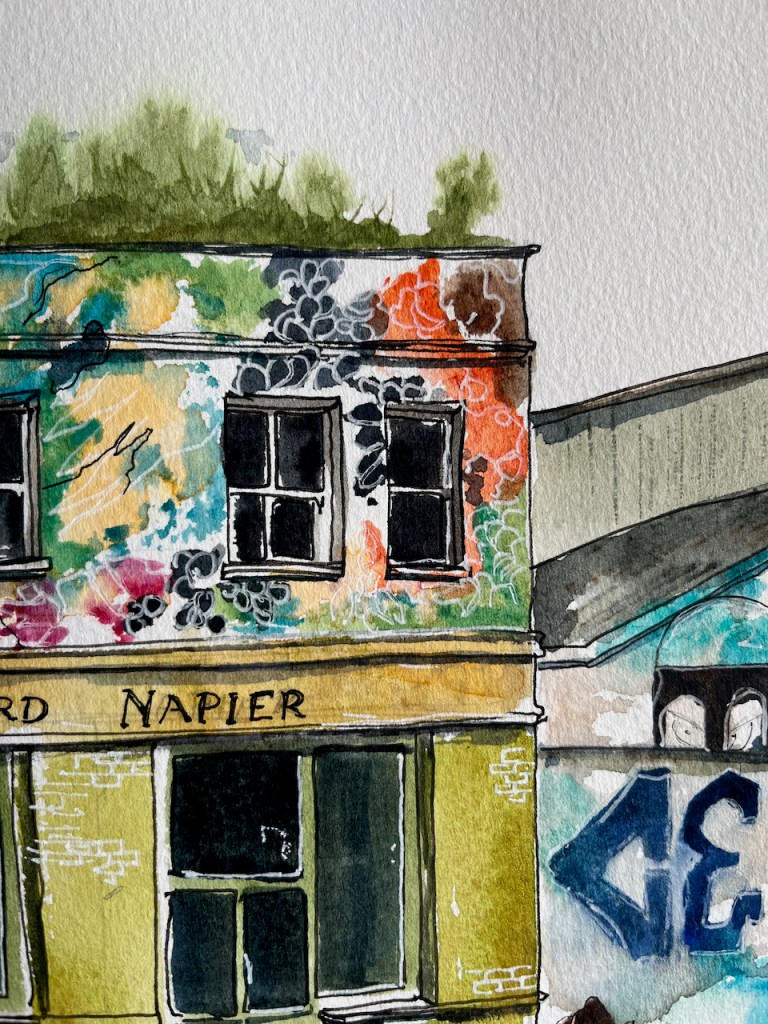
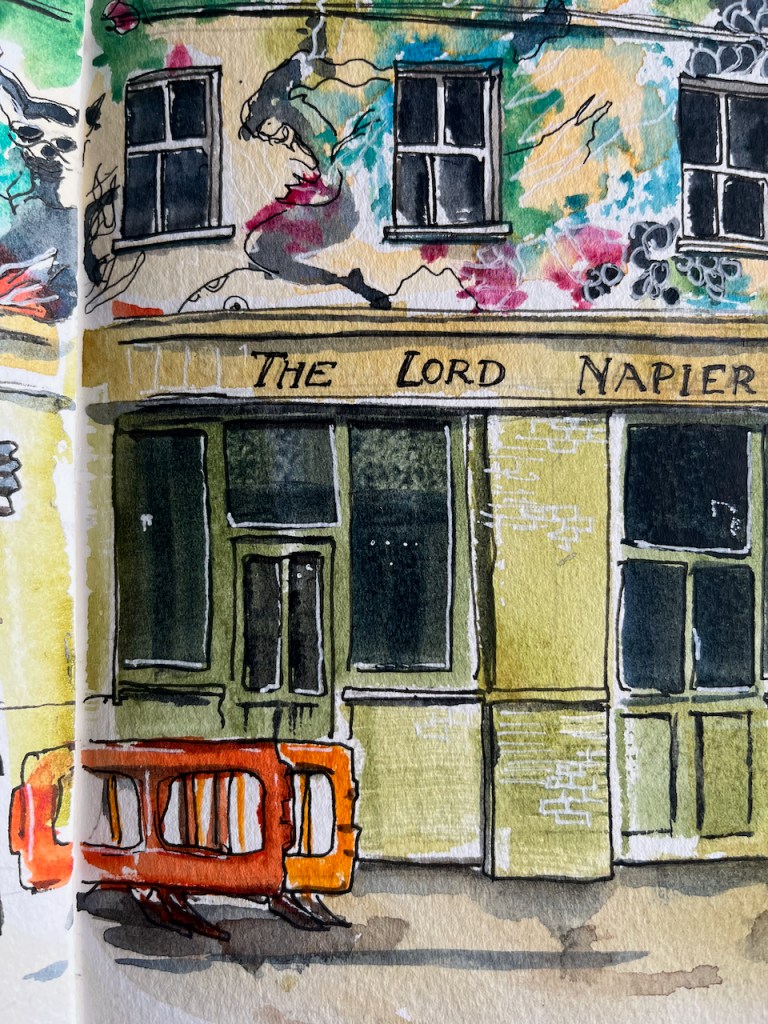
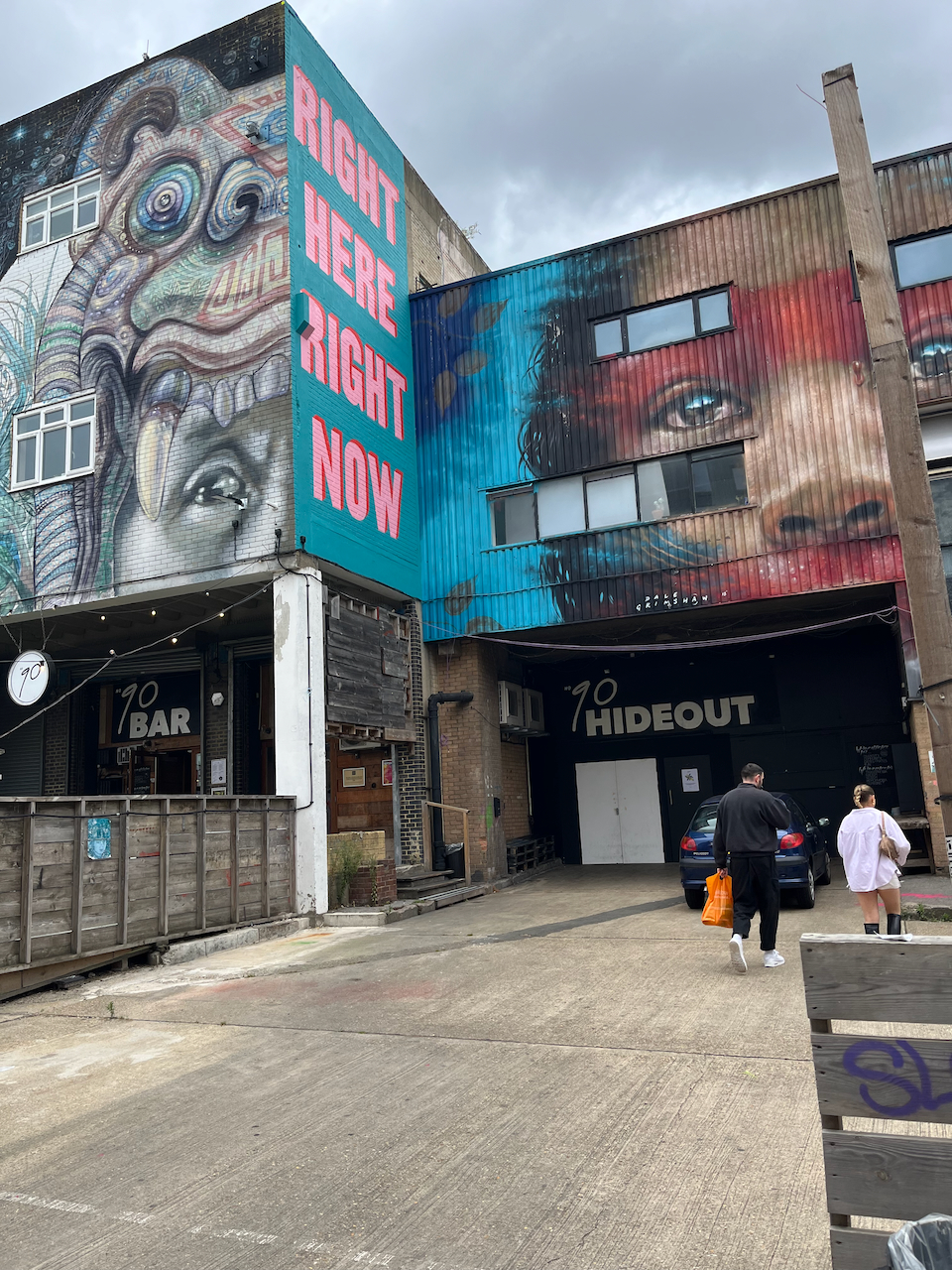
Here is a sketch of the remarkable pub, The Lord Napier, now the Lord Napier Star.
As you see, the top of the pub is covered in street art. I had fun trying to copy it. The original art is done at large scale with a spray can. My drawing is at small scale with watercolour and gel pens.
The pub has history. It has been a working pub, derelict, a rave venue, a squat. Now it is back to being a pub again.
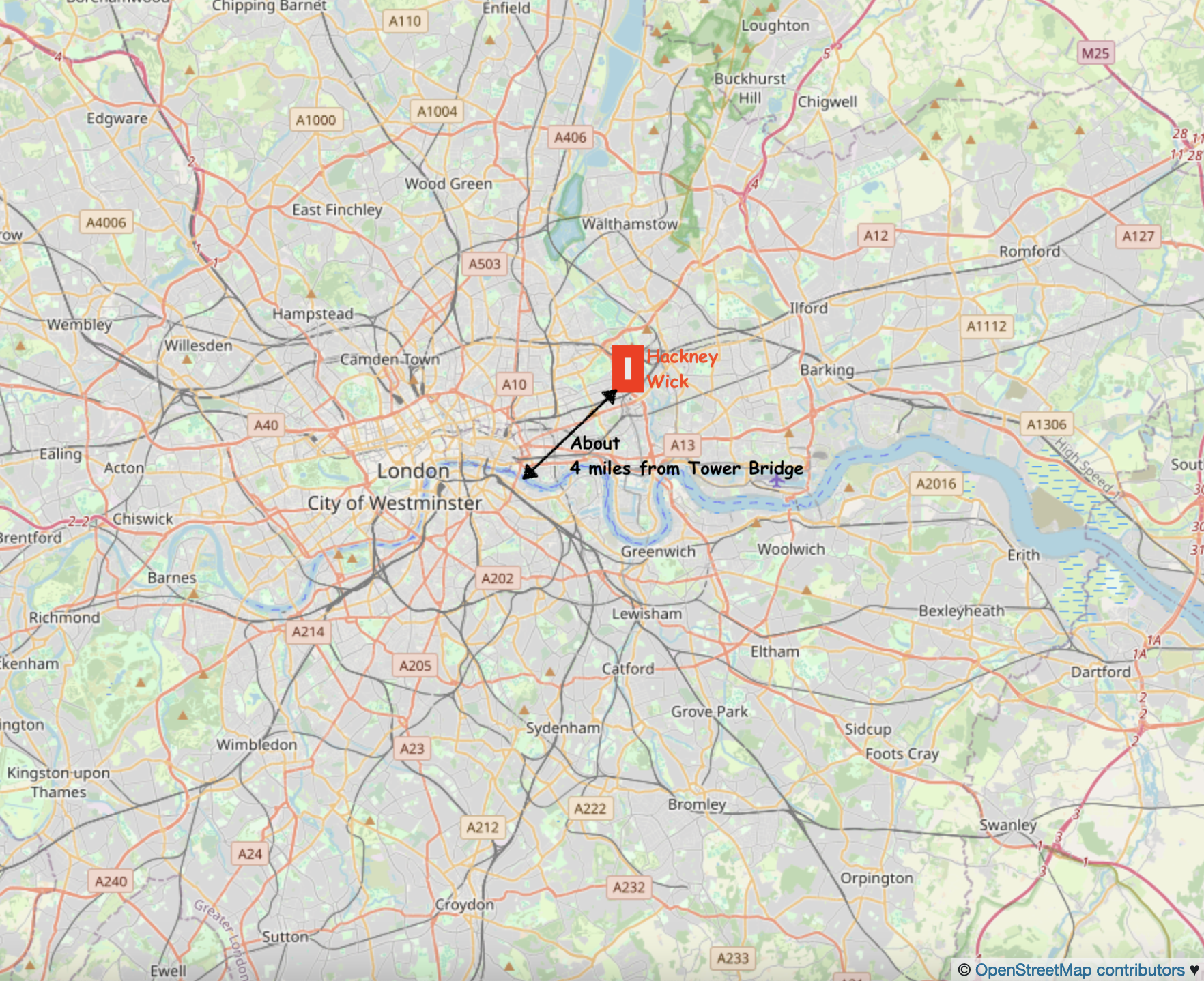
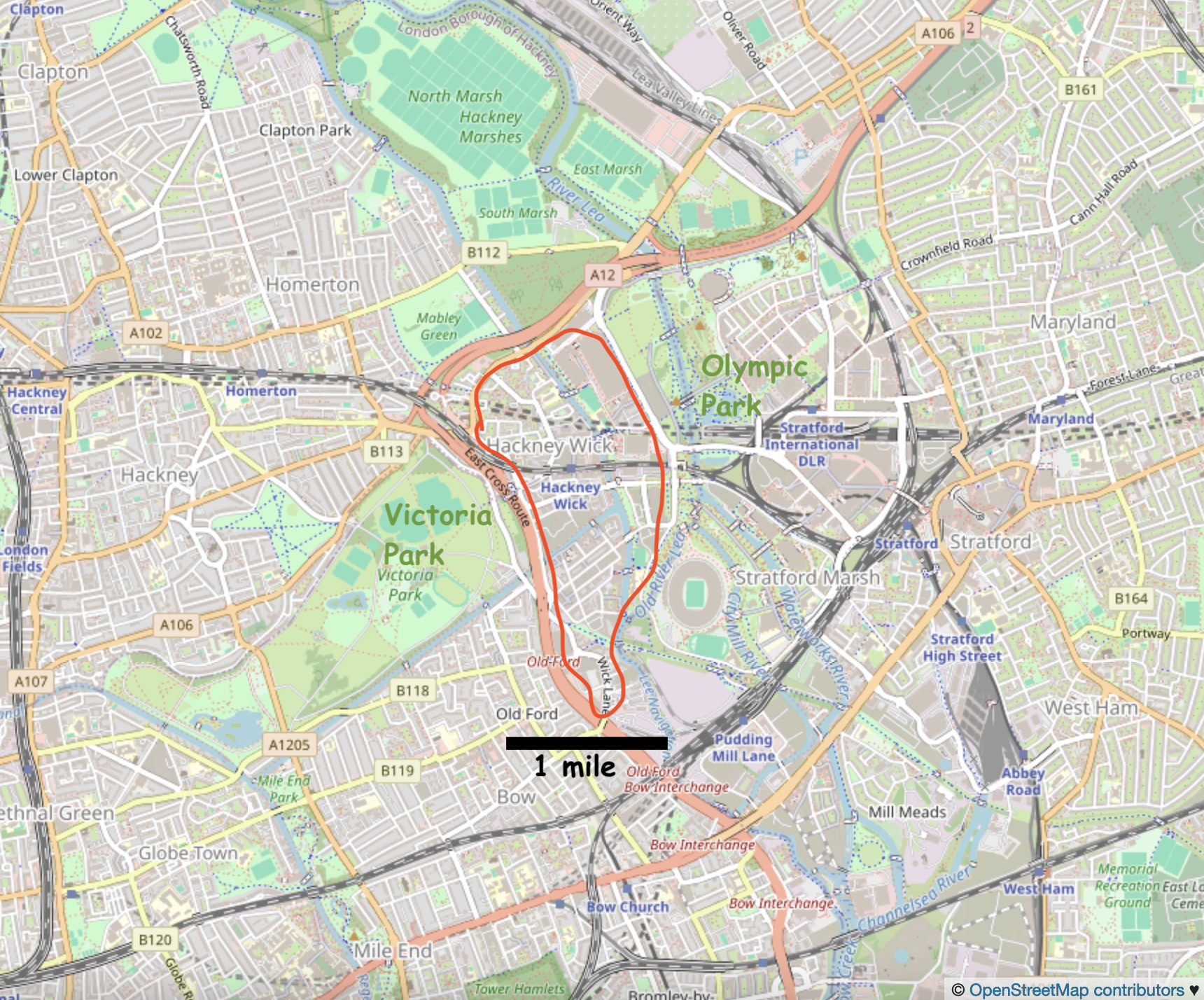
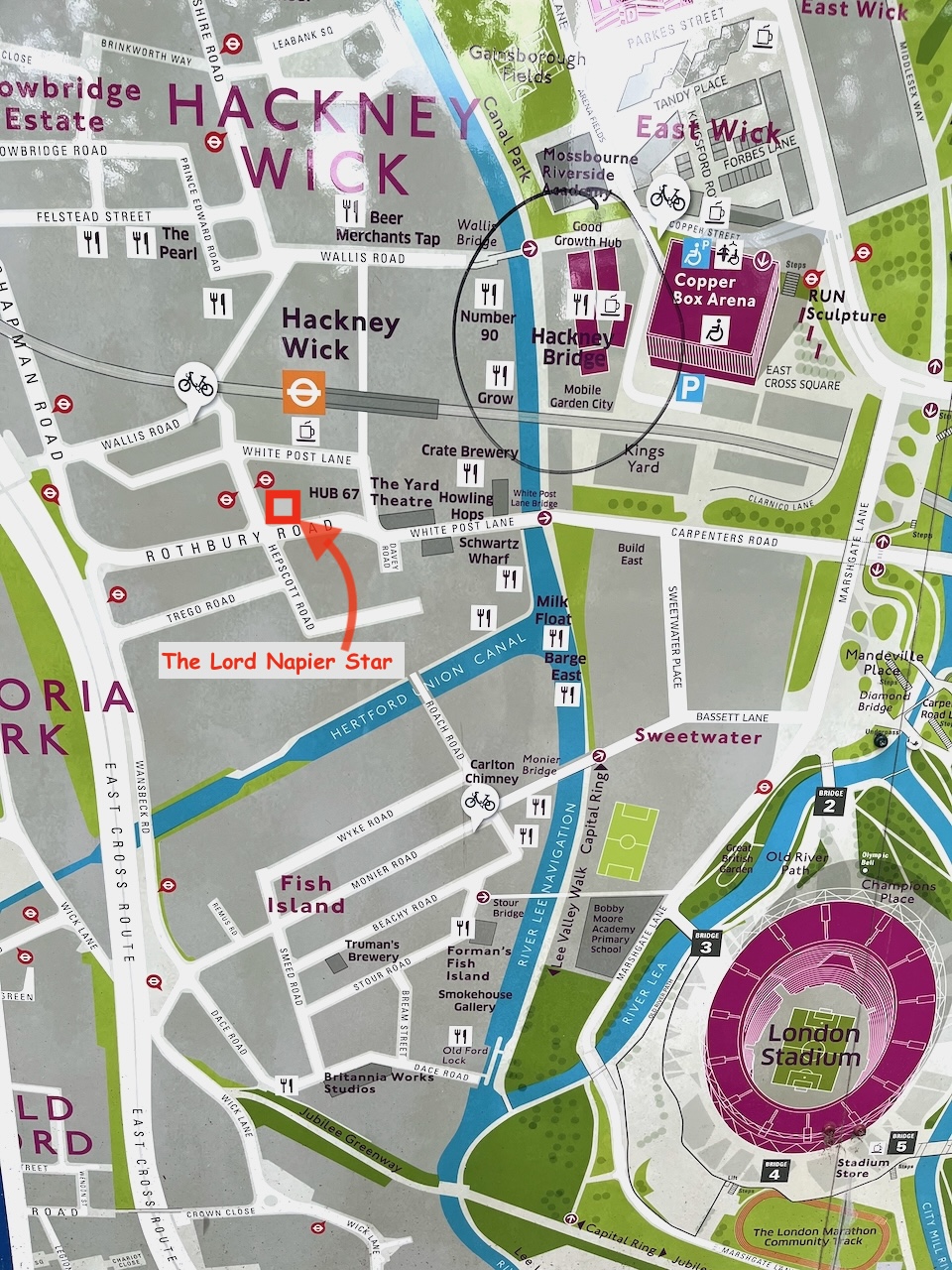
Hackney Wick is in East London between Victoria Park and the Olympic Park.
Hackney Wick is on the East side of London, 20 min walk from the Stratford railway station, and on the Hackney Wick overground.Hackney Wick is between the Olympic Park and Victoria Park.
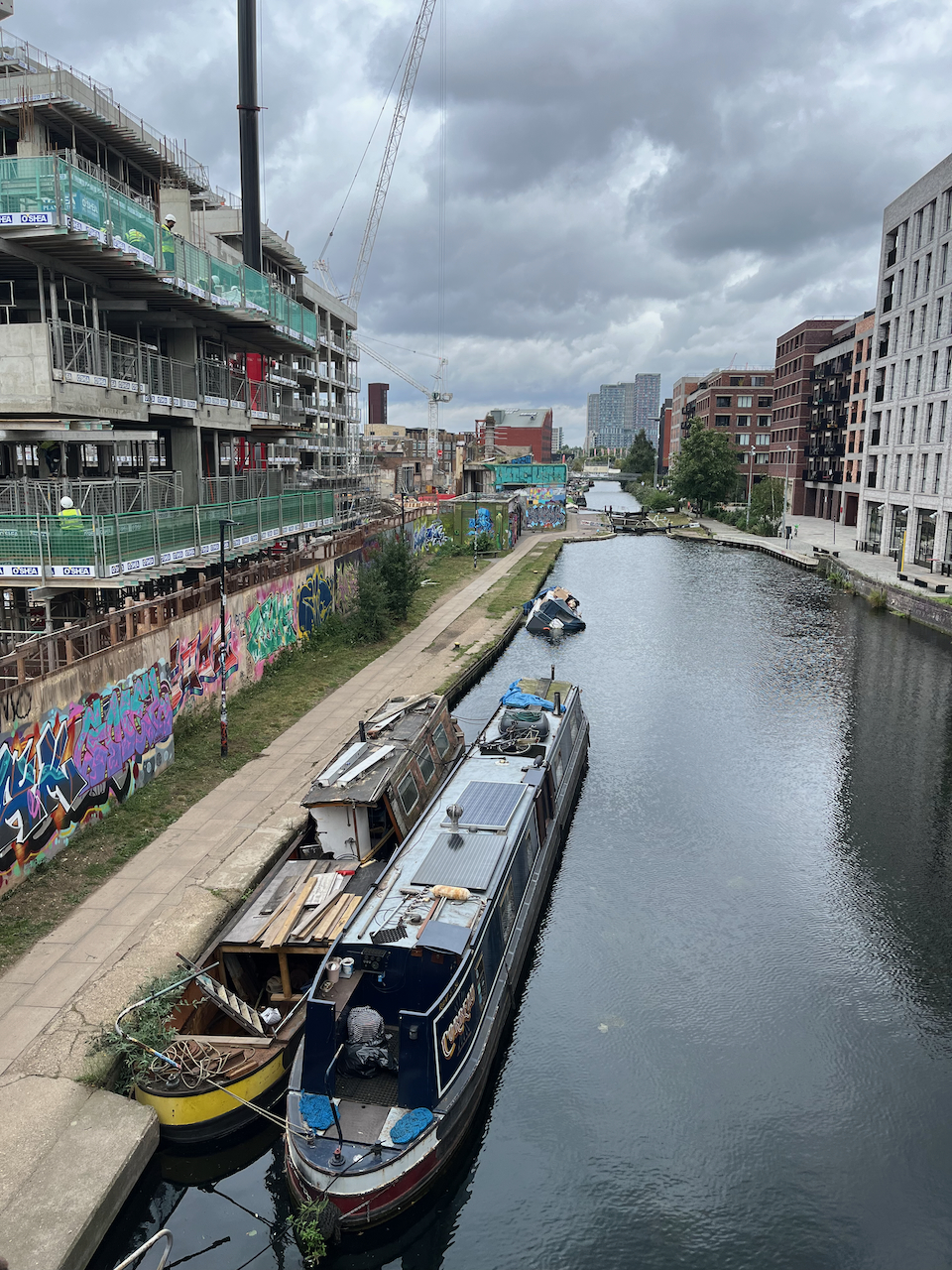
I have walked and run through there at intervals over the last twenty years. It has changed remarkably. The company I use for printing my artwork moved over there about 5 years ago, from a location in central London. I thought “what!” and “why?”. Now I realise that they were at the start of a trend. They were wise. The area is on the up. It used to be somewhat derelict and somewhat dodgy. Now the old buildings are taken over by new businesses, and there are cranes everywhere, constructing buildings where there were coal depots, docks, builders yards, heavy industry.
Map at the bridge to the Olympic Park.
There are new residential buildings, at human scale of 3 to 5 stories, with footpaths and green spaces in between, and commerce at ground level. The commerce is, yes, coffee shops, but also gyms, shared office spaces, businesses to do with the film industry, music and film studios, a bakery, and what looked like scenery painting studios. It felt as though real things happened there, new businesses moving in, people living near where they worked, businesses springing up to serve the people who live there.
New businesses adapting the spacesNew housing, built and under constructionNew businesses in old buildingsDwellings in old buildingsNew businesses in old buildingsA peaceful cafe “The Ethical Bean” Dace RoadA walk around Hackney Wick
I found it cheering and energising. And I recommend the café I found: “The Ethical Bean” on Dace Road.
Click a button below to share this post online, email it, or print it:
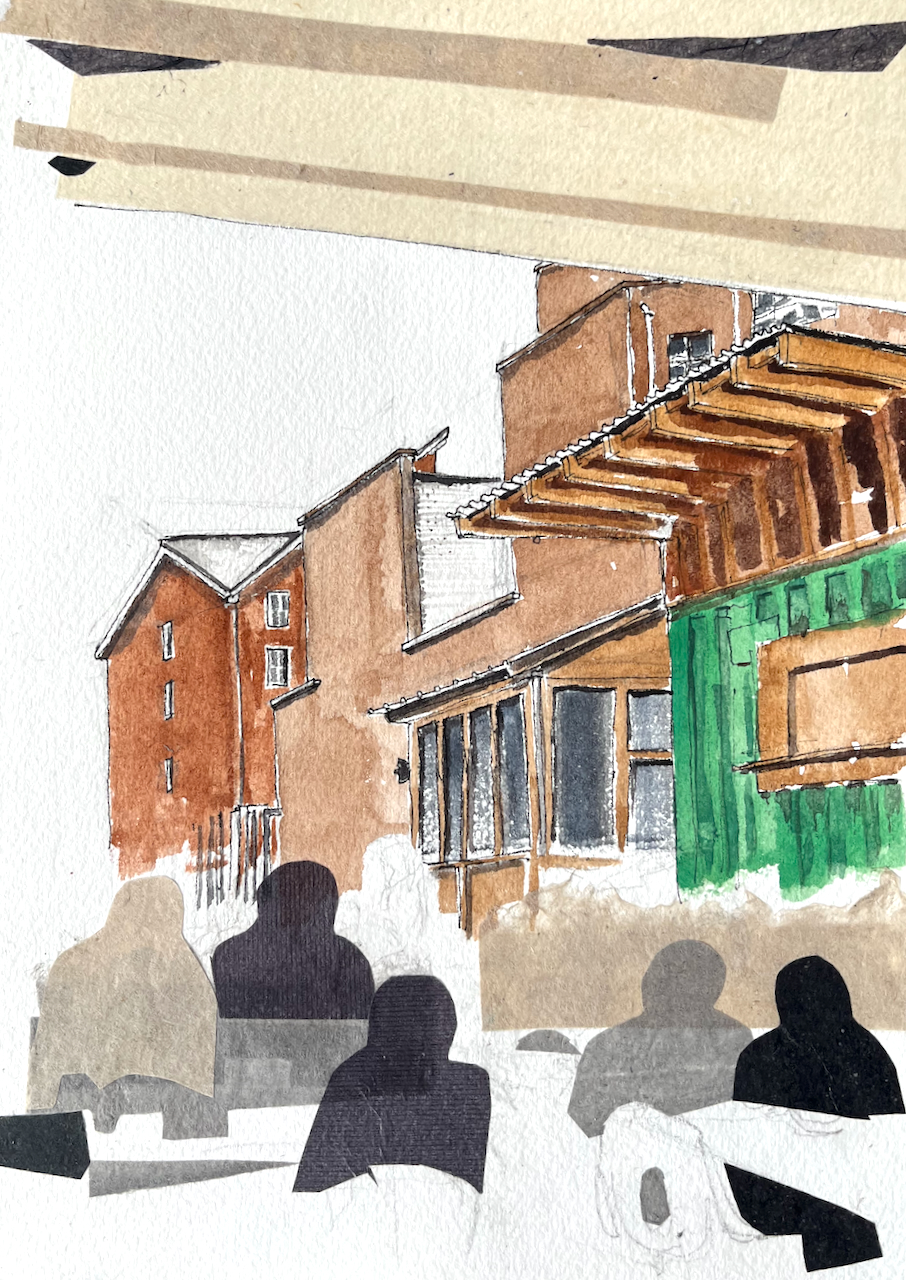
Sometimes I go out and find a view for my sketch. Sometimes the view is determined simply by where I find myself. Here is one of those occasions.
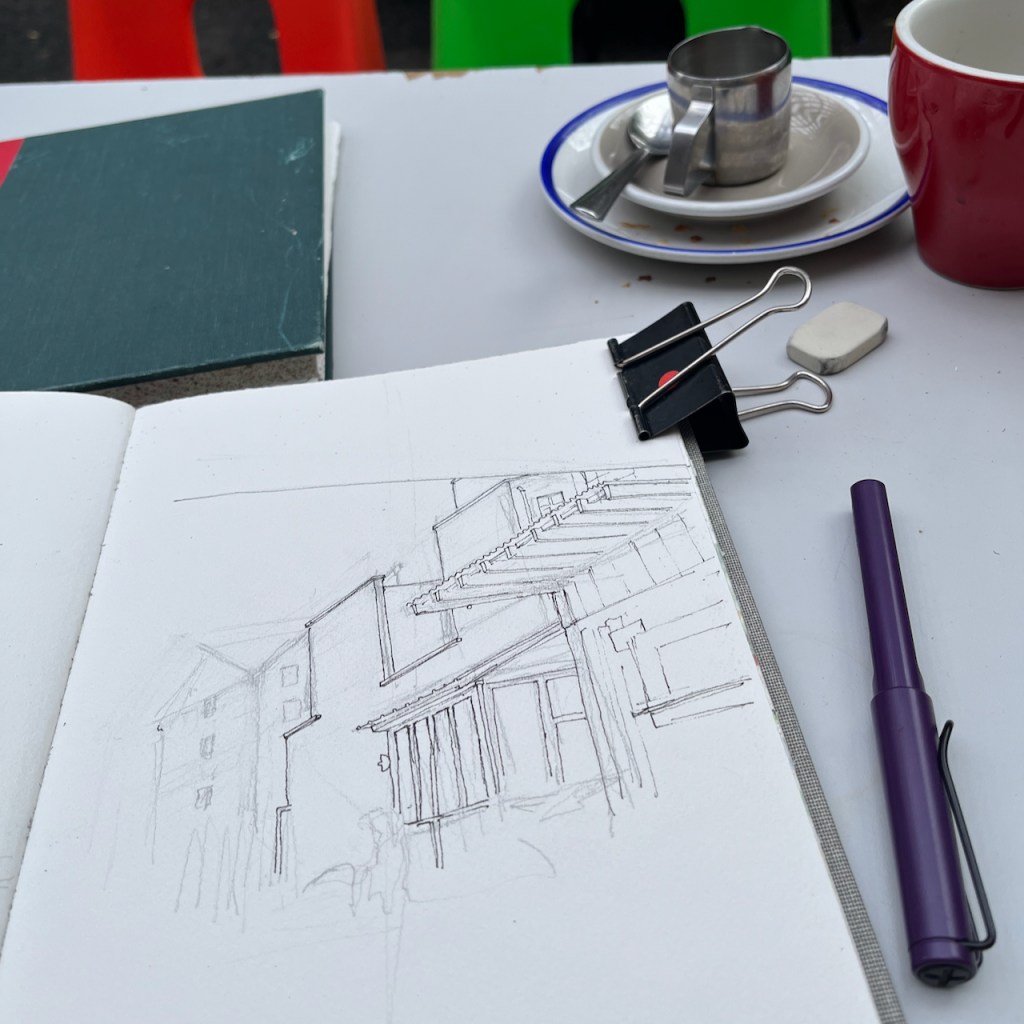
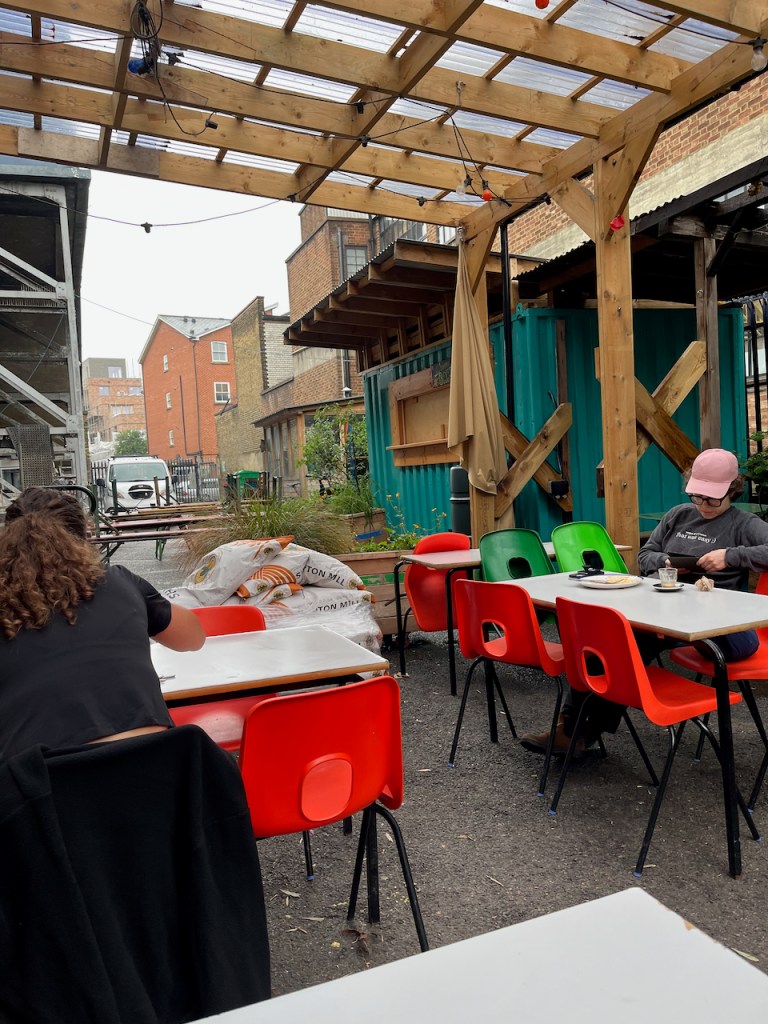
I had breakfast in the seating area at the back of E5 Bakehouse. At 09:15 I was the only person out there. I looked at the view. The various roofs made interesting angles. The cyclist who delivers their bread arrived and loaded up his formidable cargo bike. Customers arrived, and came outdoors. The tables filled up, each new arrival nodding a greeting to those of us already there. People made room for each other. It was quiet, no background music, perfect. I went back to the counter and bought another Gilchester bun. Time to do a sketch.
Sketching at E5 BakehouseThe view from my table
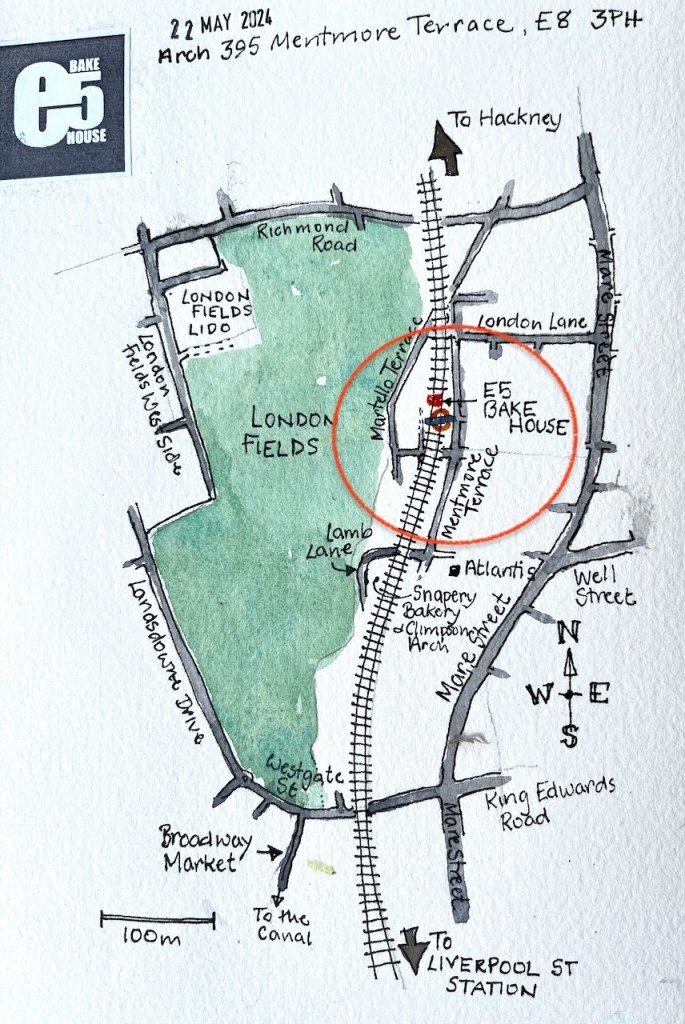
E5 Bakehouse is not in E5 but in E8, right next to London Fields Overground Station, on the line out of Liverpool Street. Their website says
“The name E5 is a nod to our former local postcode and our intention to remain rooted in our community.”
They produce wonderful bread and pastries. My fellow customers were enjoying substantial breakfasts of eggs and all sorts of greens, or a kind of piled up yogurt and fruit dish. My favourite is the Gilchester bun: the archetypal currant bun – “Made using Gilchester’s organic flour , these are so simple and so tasty you can eat them on their own, or toasted even just with butter is all you need!”
A colleague of mine once told me that the way he judged a hotel was to ask for a glass of orange juice. The orange juice told him all he needed to know, he asserted. Was it fresh pressed, or out of a bottle? Was it served in a glass or a paper cup? Did they provide a spoon to stir up the bits?
For me, a currant bun is the test of a bakery. Those at E5 set the standard for currant buns the world over. The currants are numerous, the bread is soft and all the sweetness is from the currants. They are just superb. So that’s why I needed another one.
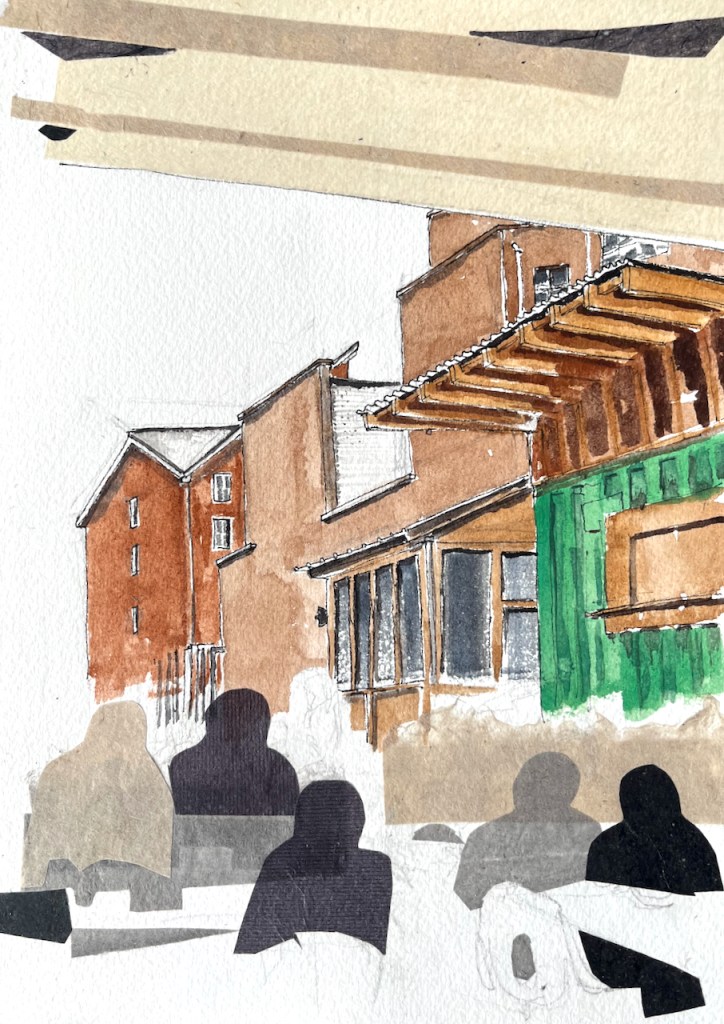
Here’s the finished picture. I added the collage at my desk at home.
Breakfast at E5 Bakehouse, watercolour and collage, 10″ x 7″ in sketchbook 14.Page spread: sketchbook 14
Click a button below to share this post online, email it, or print it:
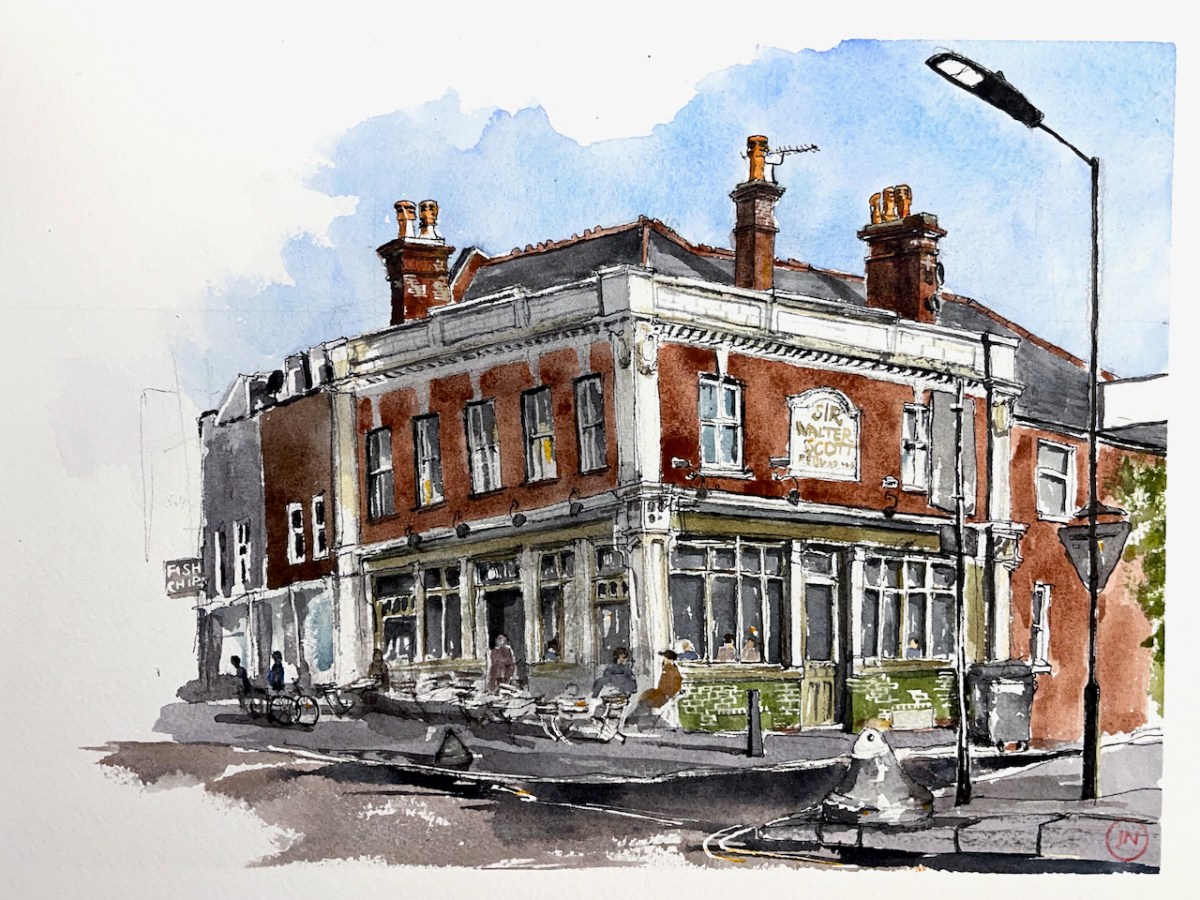
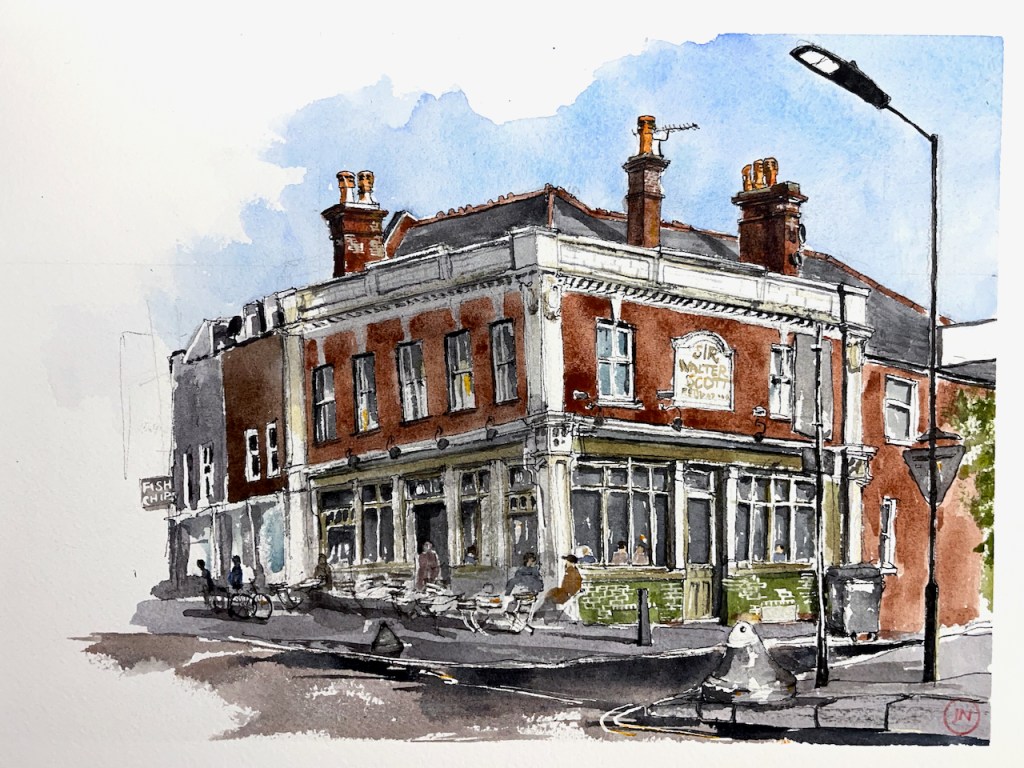
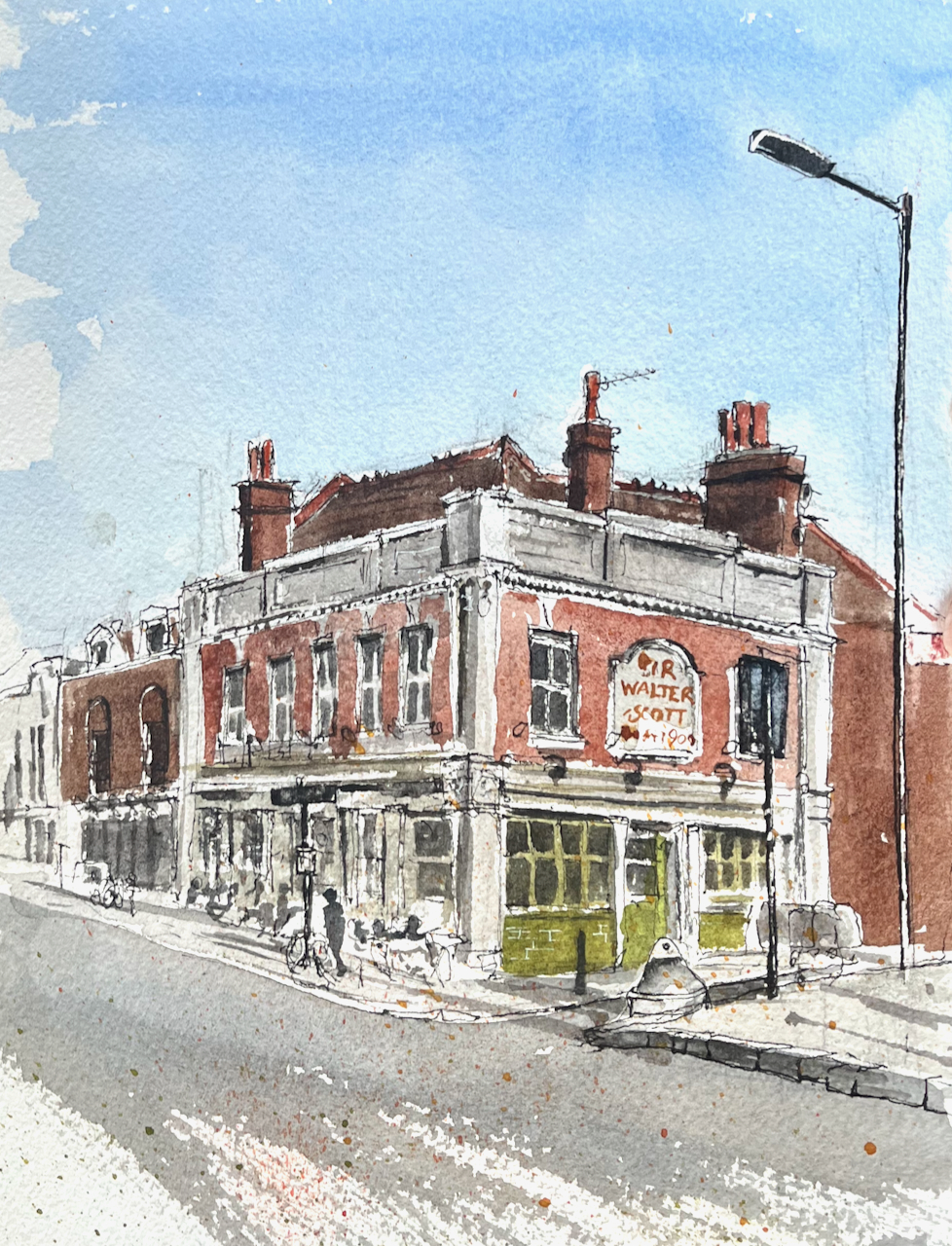
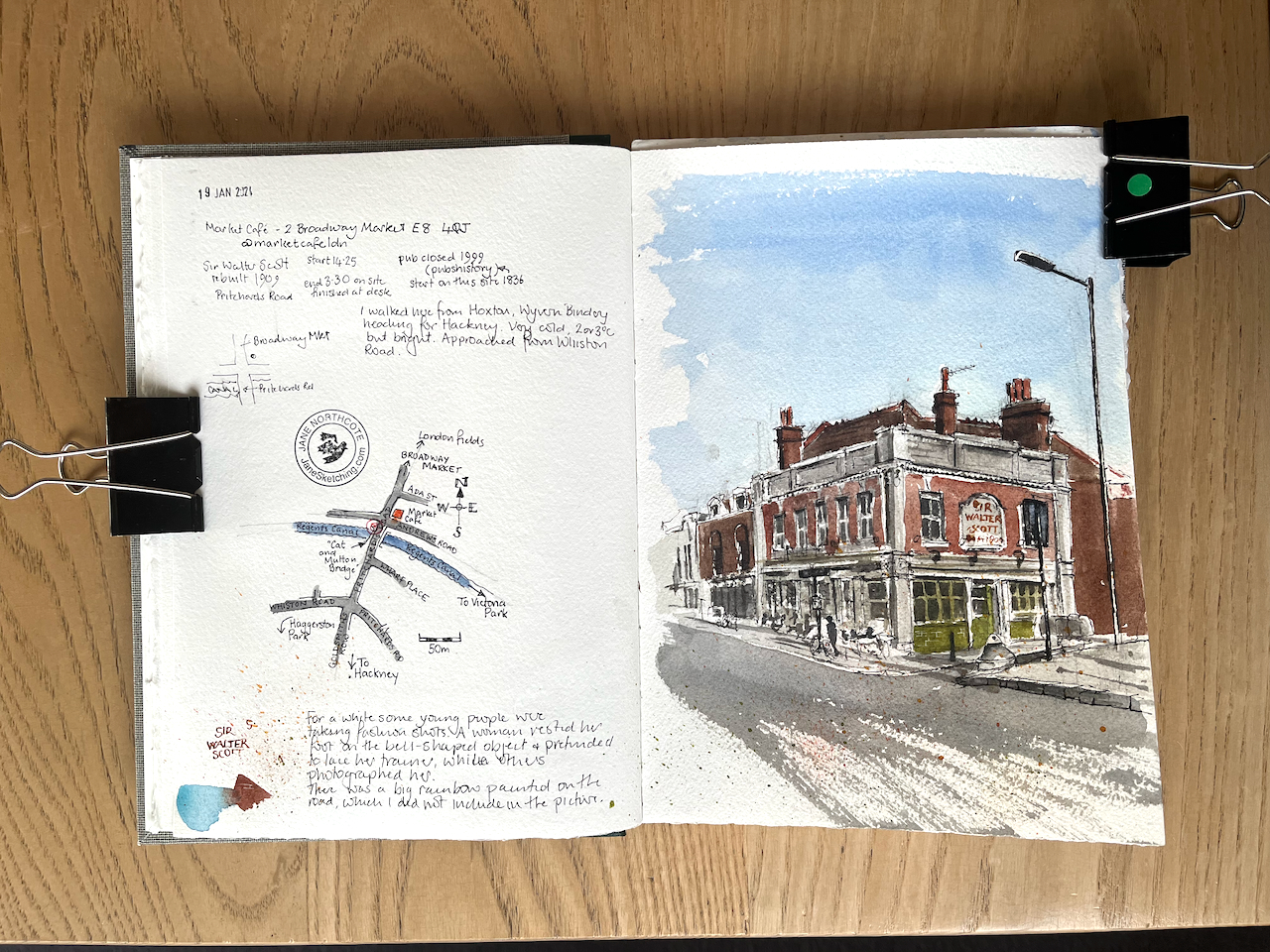
Here is the Market Café, sketched from the “Cat and Mutton Bridge” on 19th January 2024.
Market Café, 2 Broadway Market, London E8. Sketched 19th January 2024, 15:30, in Sketchbook 14.
As you see, this building is the former pub, the “Sir Walter Scott”. A pub was on this site in 1836. The wording on the building says “rebuilt 1909”. It closed as a pub in 1999 according to “pubhistory.com”. The Market Café now operates from the ground floor.
The website of Broadway Market gives a history of this area. In the early 19th century, the canal was the major means of freight transport, until the coming of the railways in the 1840s.
In 1812 “The Regent Canal Act” was passed and the Regent’s Canal constructed. This final link was direct into the River Thames at Limehouse, completing the passageway of heavy freight to Birmingham Manchester and the entire industrial North. (It should be noted that this was at the time of horse-drawn stage coaches and ox-laden wagons).
The new Regents Canal became a central pivot for industry and supplies. Timber warehouses grew, Gas light and Coke companies were established and this once rural backwater had become a major hub of enterprise.
This “once rural backwater” evidently needed a pub. Sir Walter Scott was a Scottish historian, novelist, poet, and playwright. He died in 1832, which must have been around the time this pub was named and the area was growing in population and importance.
The National Library of Scotland provides a wonderful side-by-side map, so you can see how the area looked previously, alongside a modern map. Click the image below to go to their marvellous site. You can shift the images around and expand them: both maps change at once. It’s fascinating.
I had a look at an 1870 OS map. The Public House “P.H.” existed here in 1870. The road currently called Broadway Market was called “Pritchards Road” then. You can see the rows of terraced houses along the canal, gone now, and the “Coal Wharf” and “Wood Wharf” which used to be on the south side of the canal.
Broadway Market is now a street of modern coffee shops and small enterprises, with a street market of stalls down the middle. The jeweller William Cheshire has a workshop at the south end of the street. Climpson Coffee are further up. There are bakers, grocers, greengrocers and an opticians. At the North end, Broadway Market gives onto London Fields, a lovely park, with a lido.
It’s a great area to explore.
Click a button below to share this post online, email it, or print it:
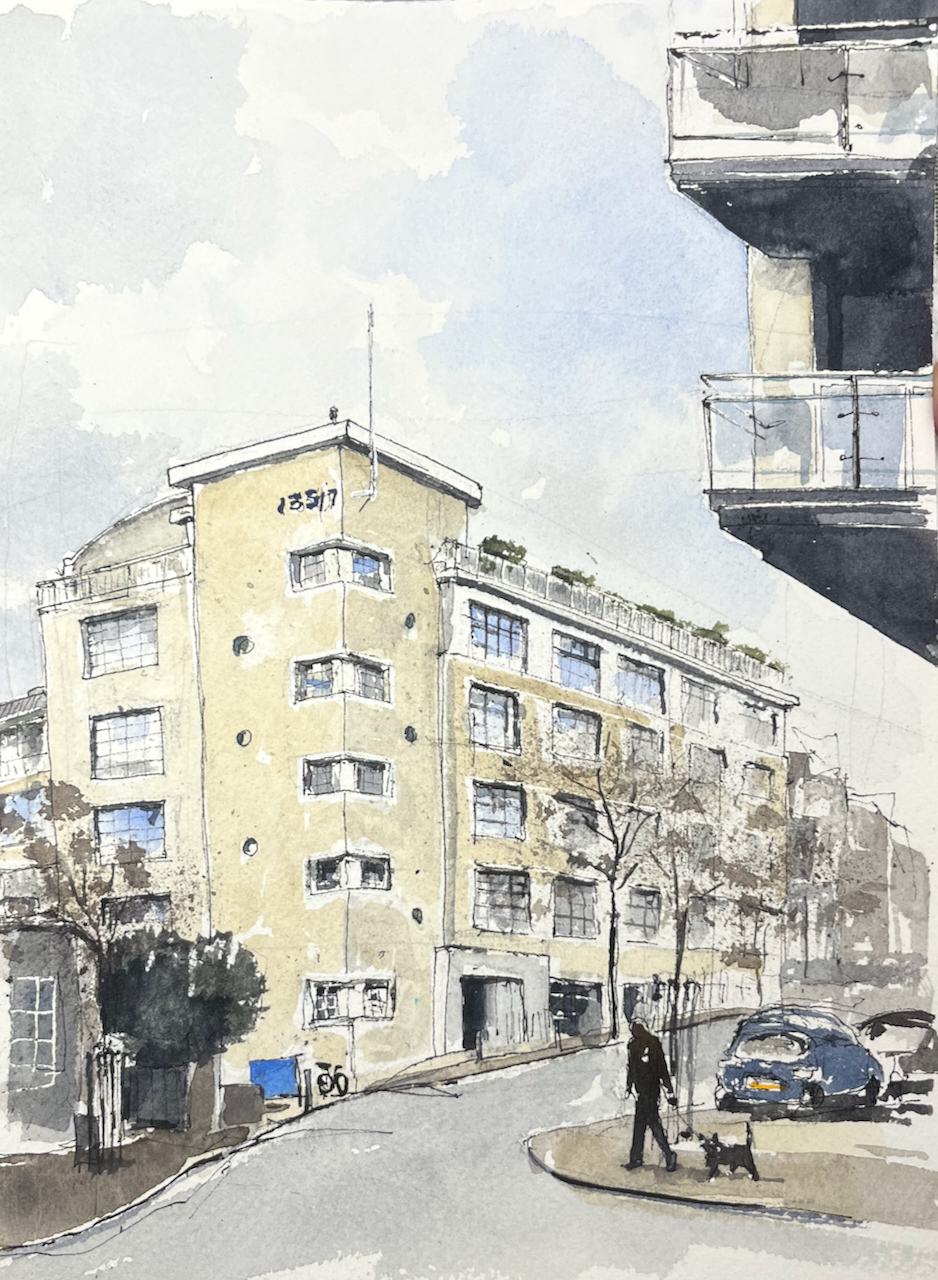
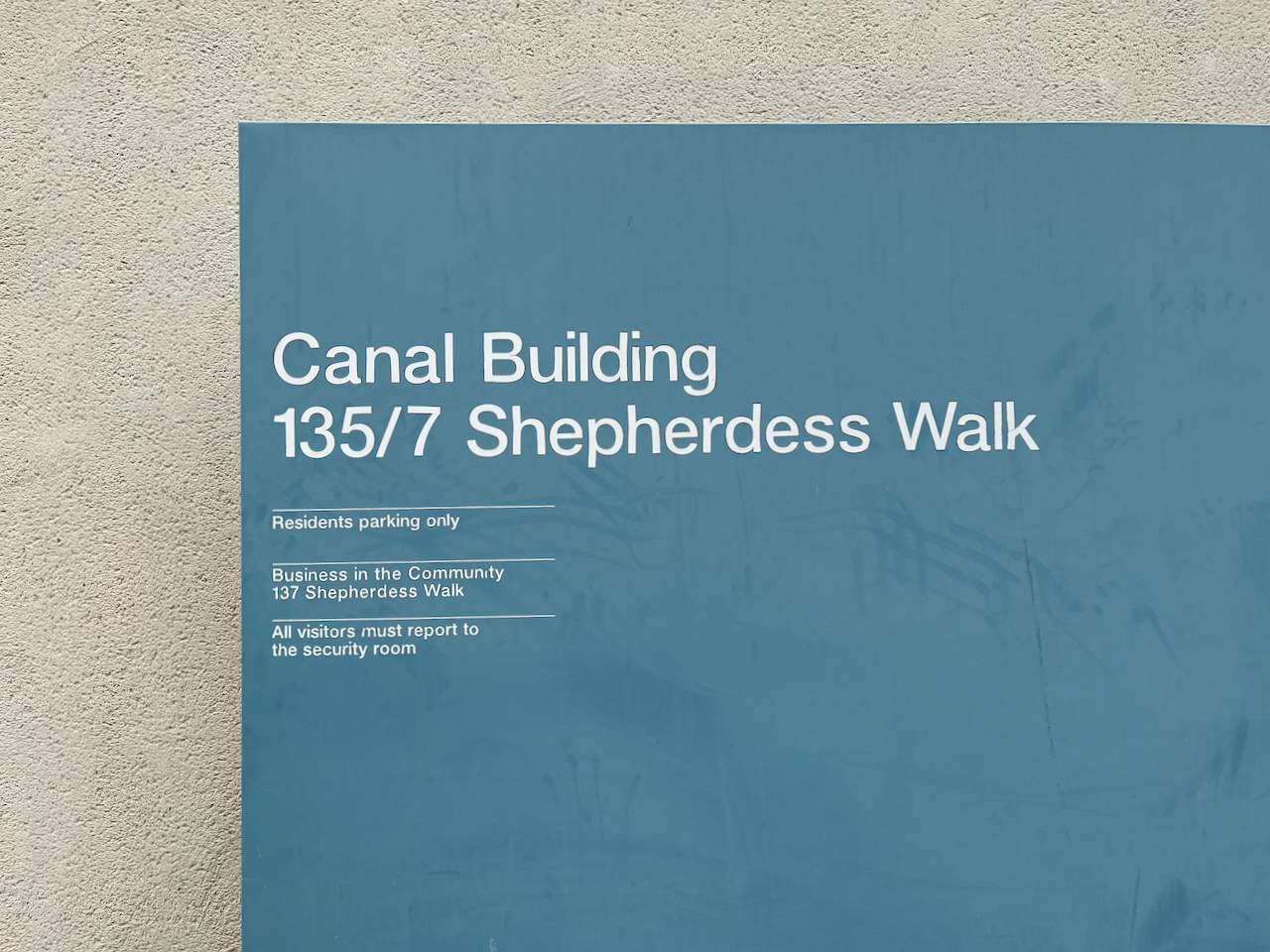
Here is The Canal Building, at the north end of Shepherdess Walk, sketched yesterday from the junction with Eagle Wharf Road.
Canal Building, Shepherdess Walk, London N1, sketched 29 December 2023 in Sketchbook 14
The building overhanging, in the top right of the drawing is part of Angel Wharf, 164 Shepherdess Walk. Shepherdess Walk leads over the Regents Canal, the bridge is just behind the cars in the picture. The buildings you see above the cars are on the other sidee of the canal. On the left is the “Wenlock Brewery”.
There is a tiny object on the roof of the Canal Building, next to the flagpole. It was hard to see what it was, but it looked like a wooden owl.
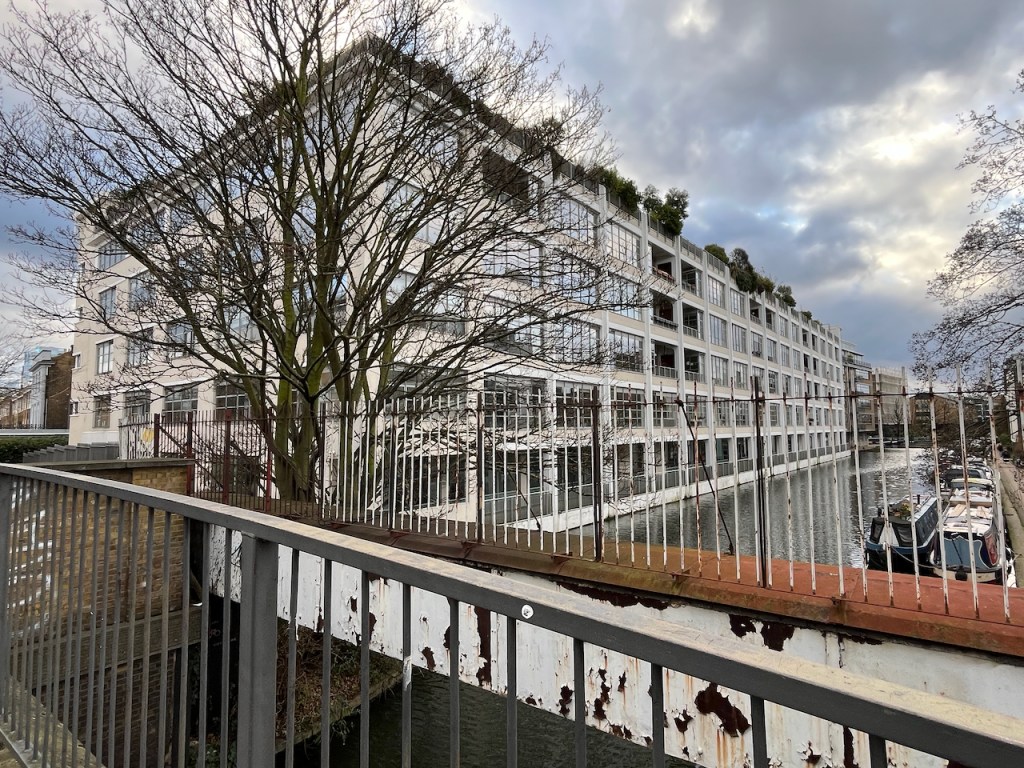
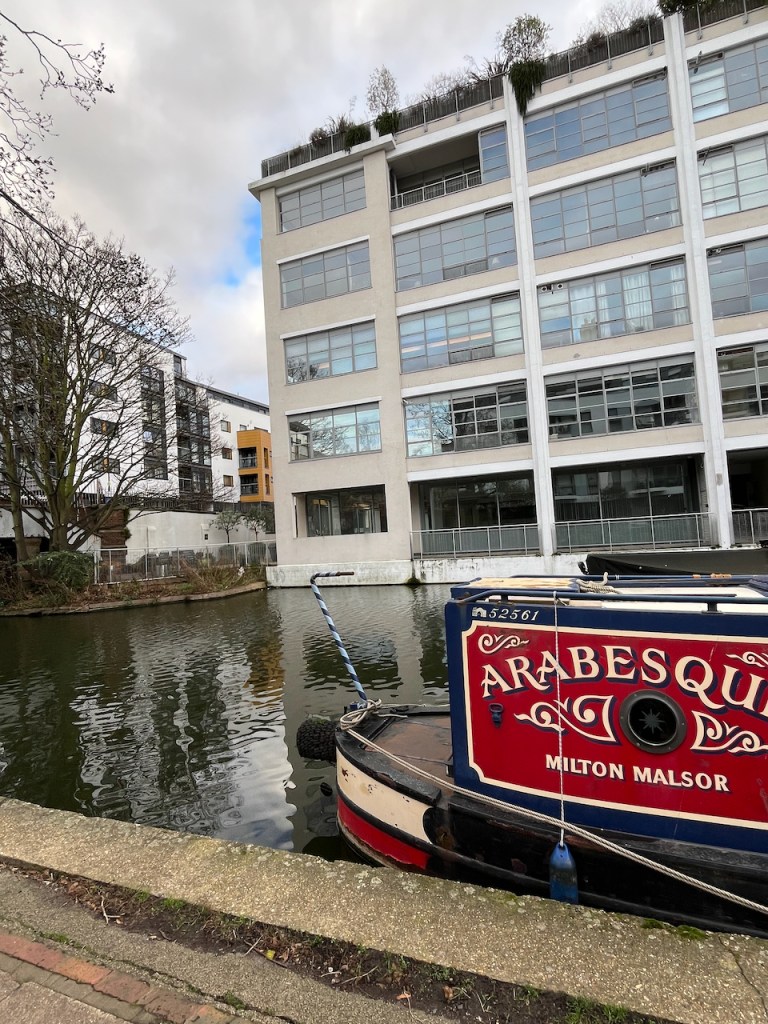
The Canal Building is a former 1930s Art Deco warehouse. In 2000, it was converted into apartments and commercial space to the design of the architects Child Graddon Lewis. This building gained the architects a place amongst the finalists for the 2023 Architecture Today Awards, in the category “Mixed Use and Retail”. There are 35 new apartments, 45 live/work units and 1100 sq metres of commercial space. Here are photos of the building from the canal side.
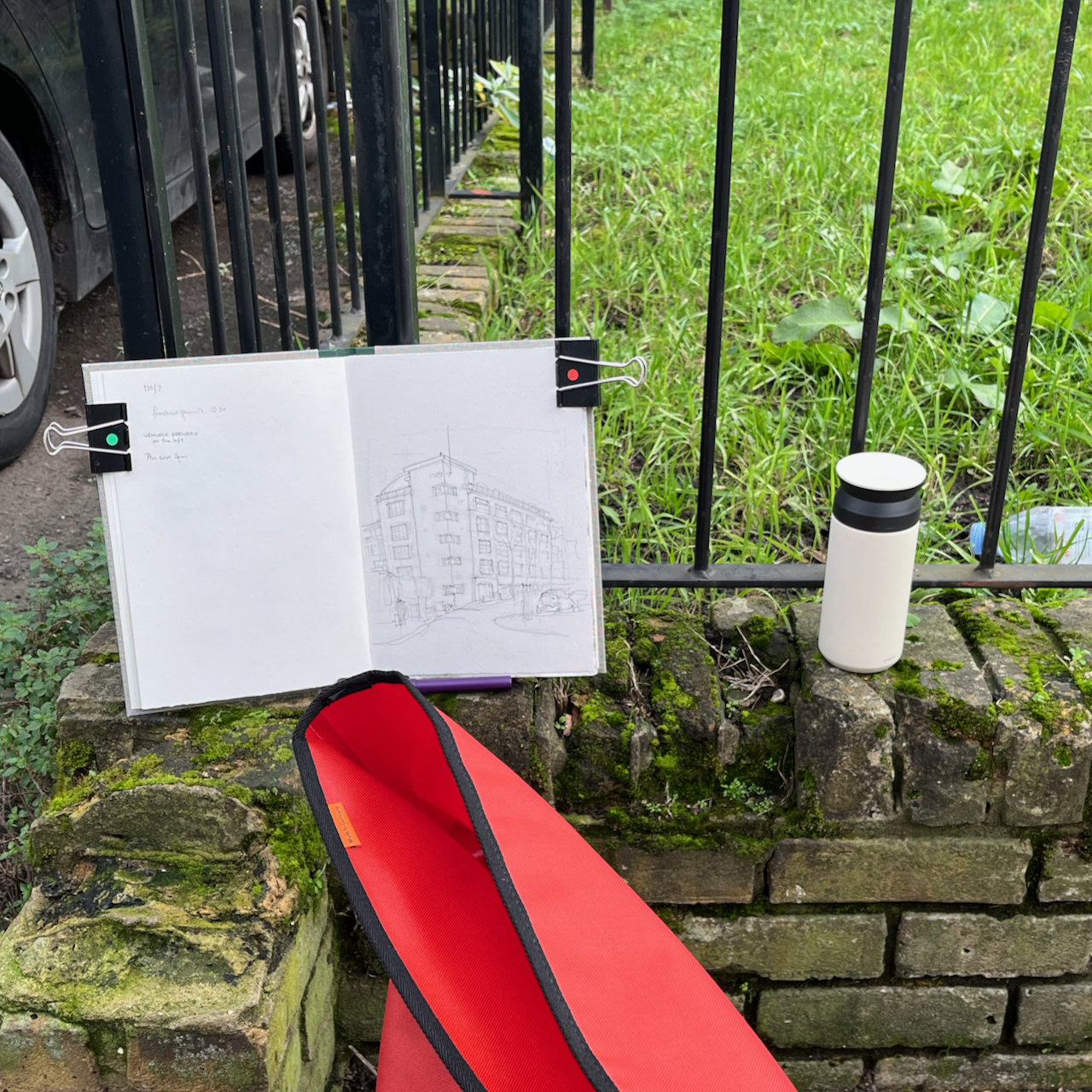
I did the pen on location and added the colour at my desk later. It was cold outside and I was sitting on a damp stone wall. Many people were out and about in the area, and two of them stopped to say hello and look at the drawing.
Pen doneDamp mossy wall…my sketchbook…coffee
There are just three main colours in the sketch: Buff Titanium, Burnt Umber and Ultramarine Blue.
Buff Titanium for the Canal Building
All greys and blacks are Ultramarine Blue plus Burnt Umber
Ultramarine Blue for the blue car, the blue notice, and in the sky
The trees are Burnt Umber
And that’s it! There is a bit of Mars Yellow for the car number plate.
All colours are Daniel Smith except the blue, which is Schminke Horadam.
This is my first sketch in a new sketchbook!
Sketchbook 14
Here are some other sketches I’ve done in Shepherdess Walk:
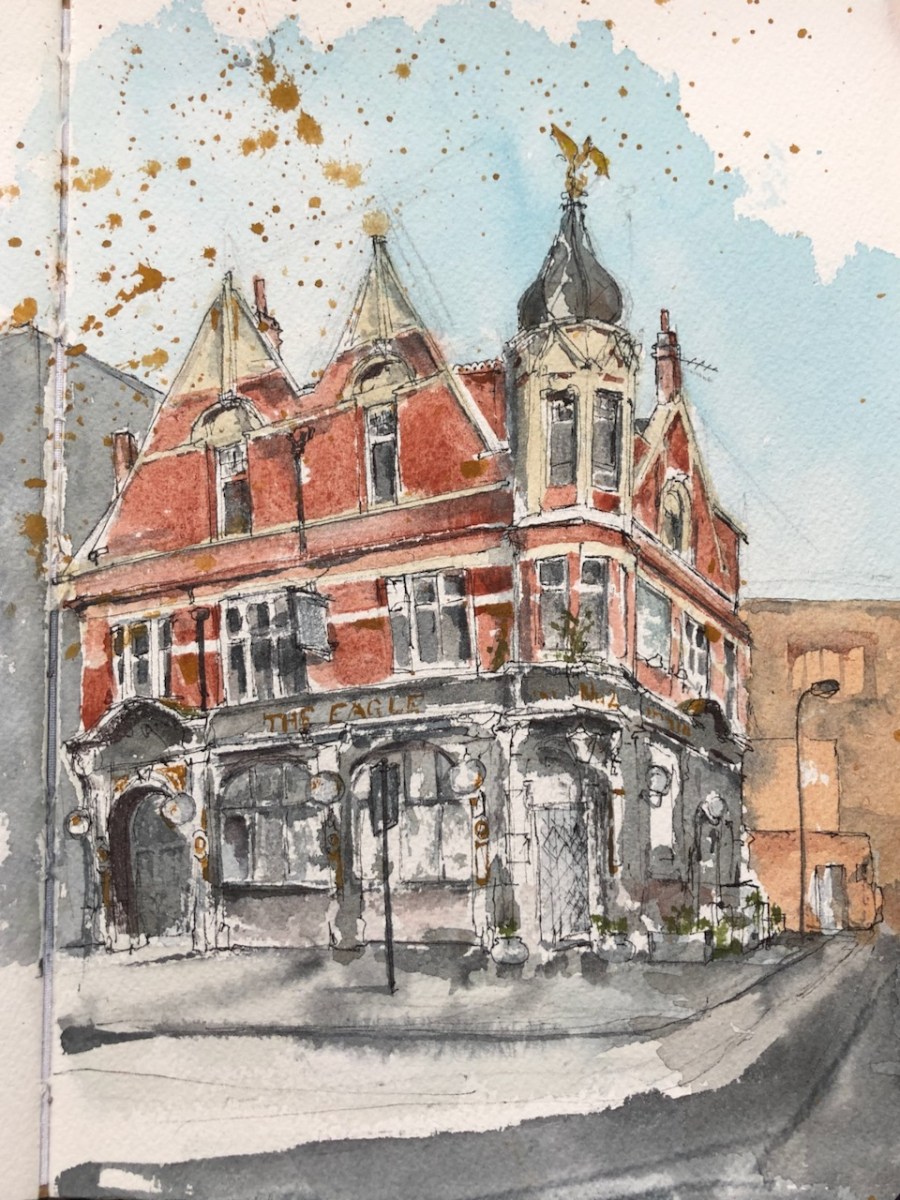
Here is The Eagle. This is a very old pub, located at a significant junction on City Road. In the picture above, the alley on the right of the pub is called “Shepherdess Place”. It leads to a police car park, and several…
Here is Plumage House, 106 Shepherdess Walk, London N1. This was a feather factory. According to Spitalfields Life this operated until 1994. The building is now rather shabby, though in a dignified way. I wonder what will happen to it? In the drawing,…
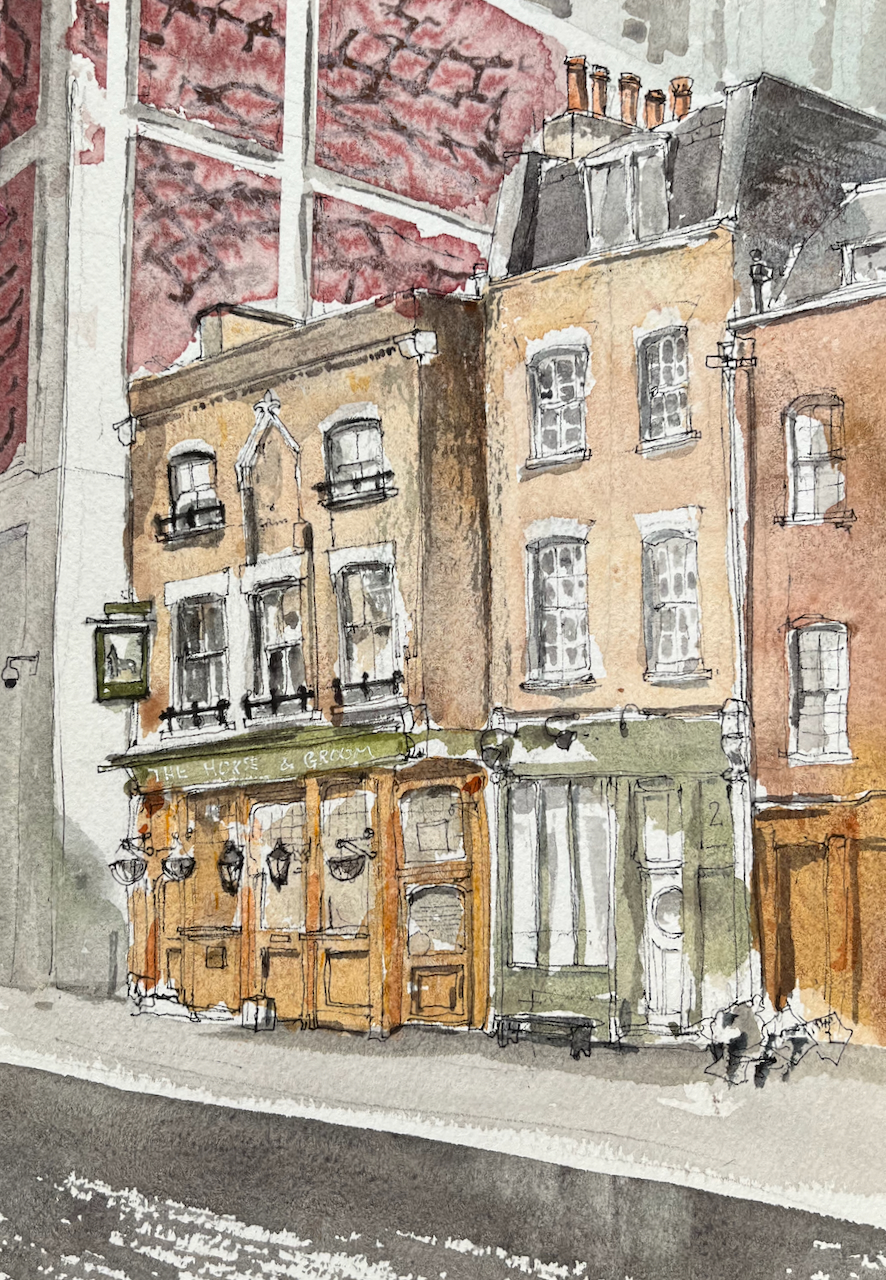
The Horse & Groom pub is on Curtain Road in Shoreditch.
The Horse & Groom, EC2. 10″ x 7″ in Sketchbook 12. Friday 10 June 2022 12:05
The Horse and Groom describes itself on its website :
Since opening our doors in 2007 the Horse and Groom has grown to be one of East London’s best loved pubs. Recognised as the original entrance for Shakespeare’s Curtain Theatre, in 2012 we were protected as a venue and we look to keep Shoreditch drinking and dancing for a long time yet
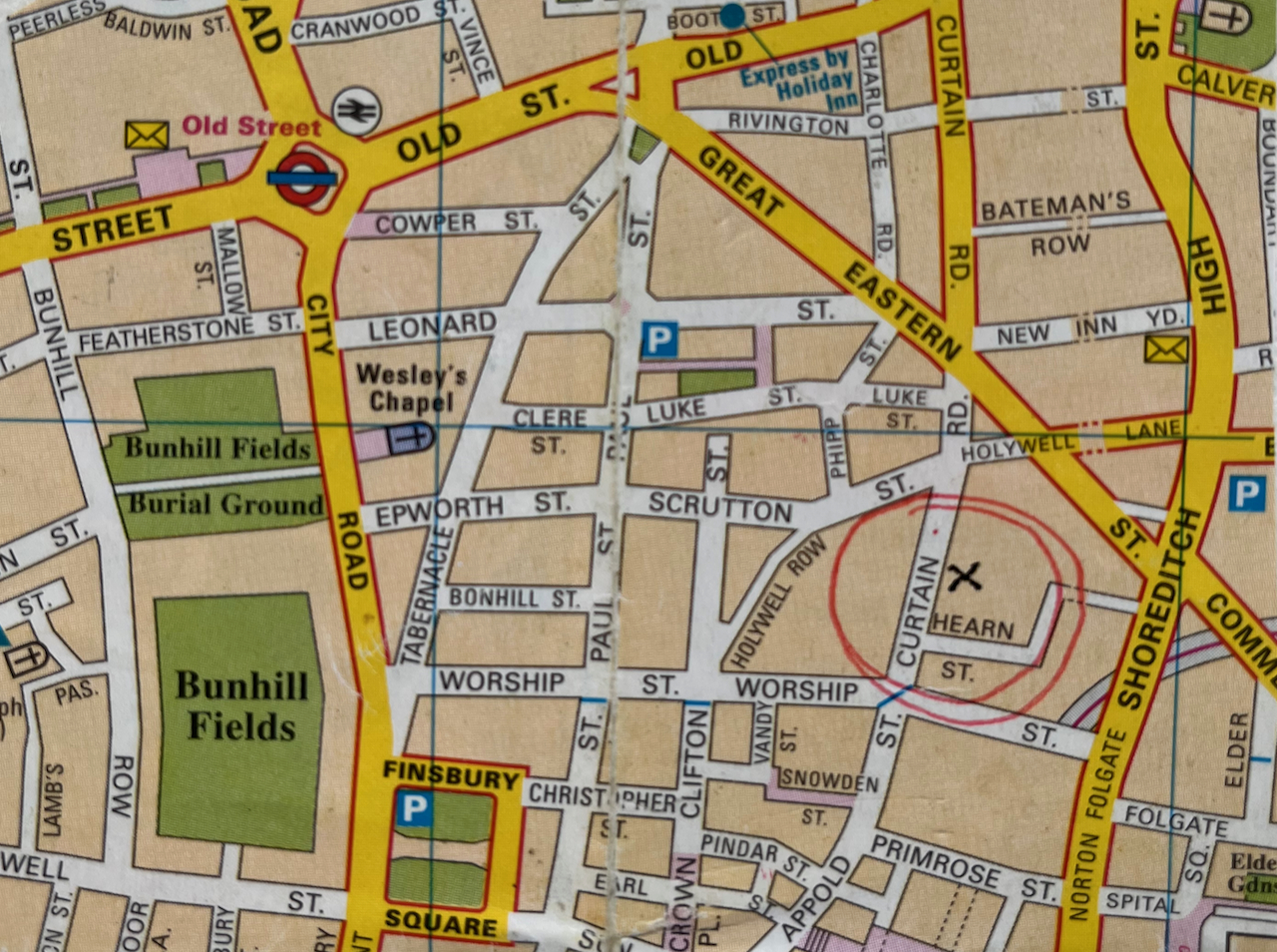
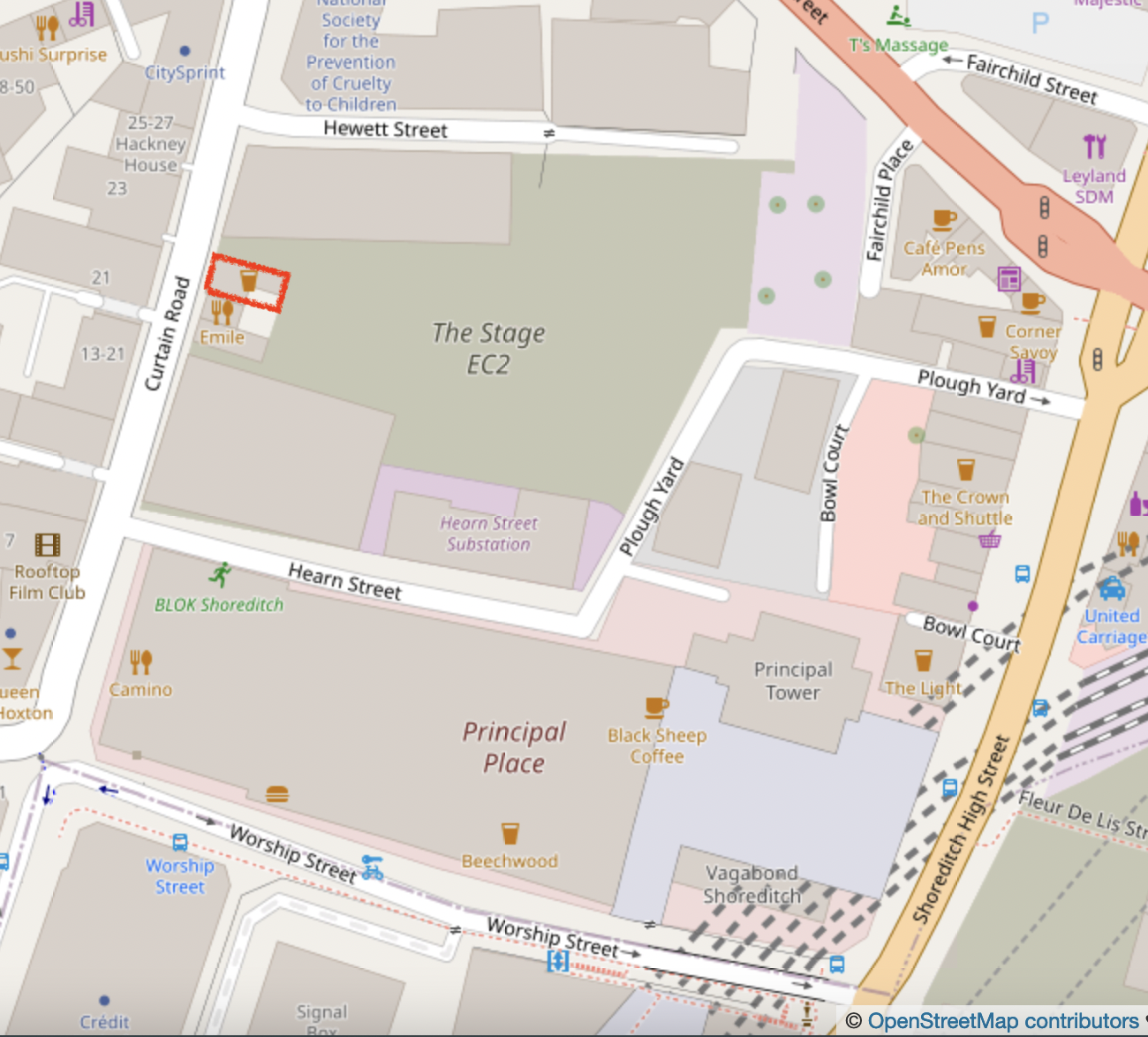
The reason why the pub’s future might need to be mentioned is clear from the modern map. As you see from the 2022 street map, the pub and its neighbours are surrounded on three sides by a huge office and residential development “The Stage”.
Paper street map (Collins) around 1999(c) Open Street Map Contributors map 2022The Horse & Groom (left) and its neighbours are surrounded by new build.
The pub not only survives, it thrives. Squaremeal.co.uk, a review site, says “The rickety Georgian boozer’s twin dance floors get hectic and steamy at weekends, when house, funk, and rare garage rule….”
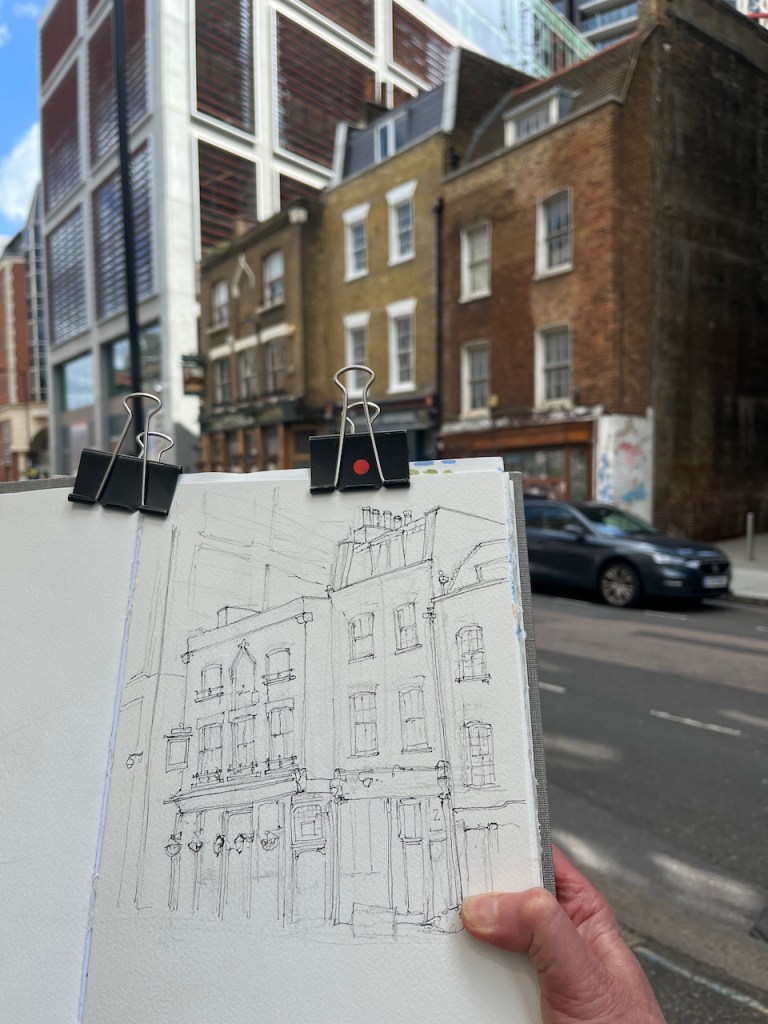
Sketching in Curtain Road
I sketched The Horse & Groom standing in Curtain Road. At first I had a clear view, but cars gradually arrived, and vans, and delivery vehicles. I finished the drawing at my desk.
The pub is number 28. The building next door, number 26, is, or was, “Cincinnati Chilibomb”. One of the vans that arrived discharged a consignment of building materials. Construction workers started shifting tools and materials into number 26. So maybe there will be a change of use.
The building next to that, on the right of my drawing, must be number 24. Numbers 24 and 26 are listed, Grade II, Listing NGR: TQ3326982177. I cannot find any listing for the pub.
No 24: early C18, 3 storeys and attic, 2 windows. Rounded gambrel roof, tiled, with dormer. Painted brick with parapet front. Gauged segmental arches to later sash windows. Early-mid C18 shop front, with slightly altered glazing, on ground floor. No 26: house of early C19 appearance, possibly with older core, 3 storeys and attic, 2 windows. Stock brick with parapet, slated mansard with dormer, Gauged near-flat brick arches to modern plate glass windows. Ground floor mid-late C19 shop front.
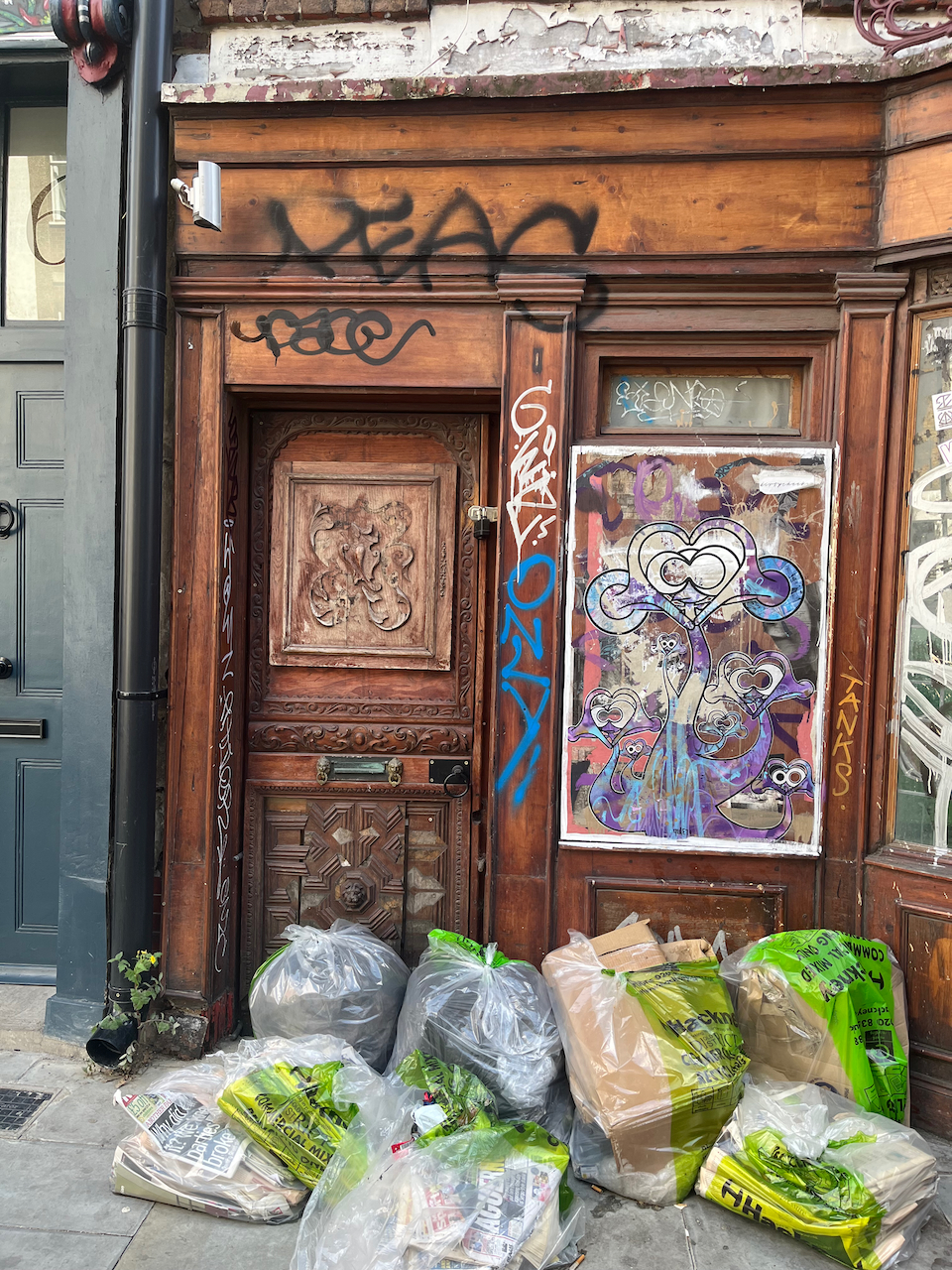
Number 24 is a fascinating building. What will happen to it? Currently it is gradually falling derelict:
Click and enlarge the pictures to appreciate the amazing carved woodwork on the door.
The huge buildings behind are described on the website for “The Stage”. The development has “over an acre of public space and landscape gardens surrounded by luxury apartments, cutting edge office space and prime retail…”
London is certainly a city of contrasts.
Here you can see the pen-and-ink drawing and the colour side-by-side:
pages in Sketchbook 12
Click a button below to share this post online, email it, or print it:
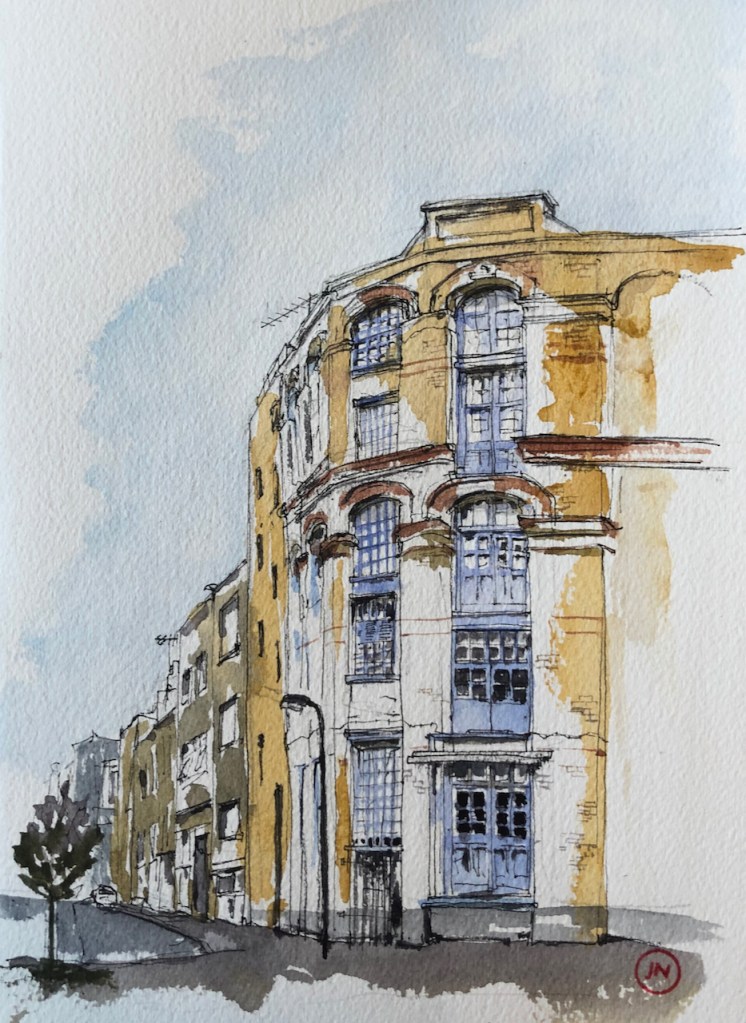
This is the building on the corner of Worship Street and Clifton Street, on the northern edge of the City of London.
Clifton House, 75-77 Worship Street, EC2, 13 September 2021, 7″ x 10″ in Sketchbook 10
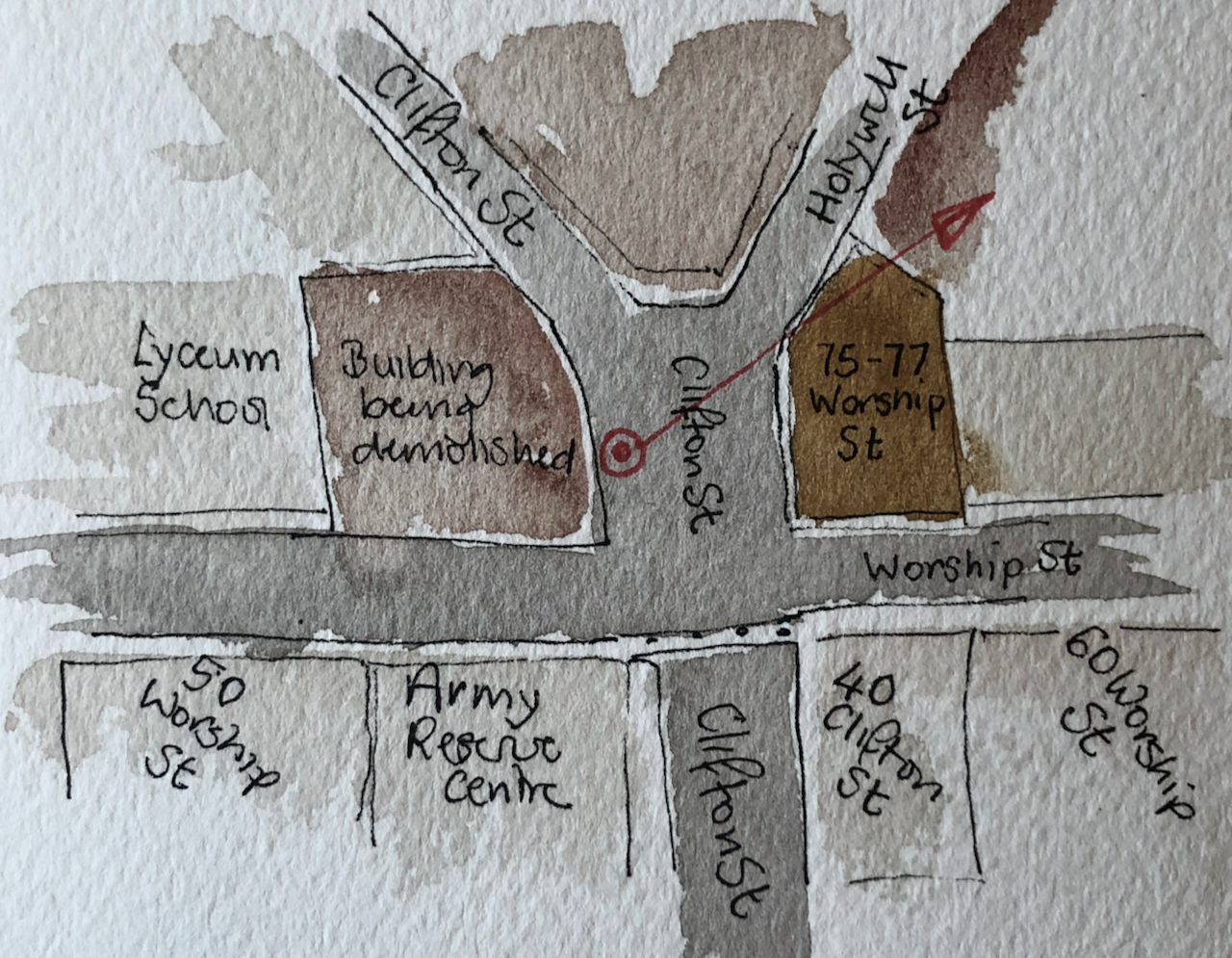
Location of the drawing
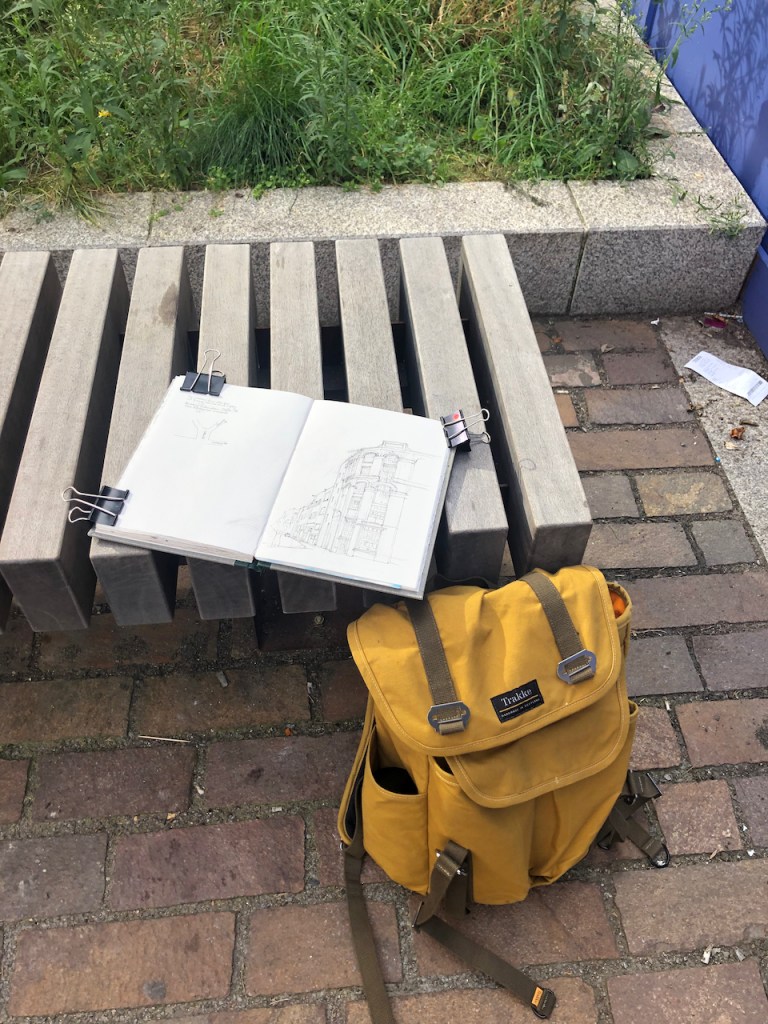
Holywell Street is to the left of the drawing. I sketched this from a bench in the little pedestrian square that now exists where Clifton Street meets Worship Street.
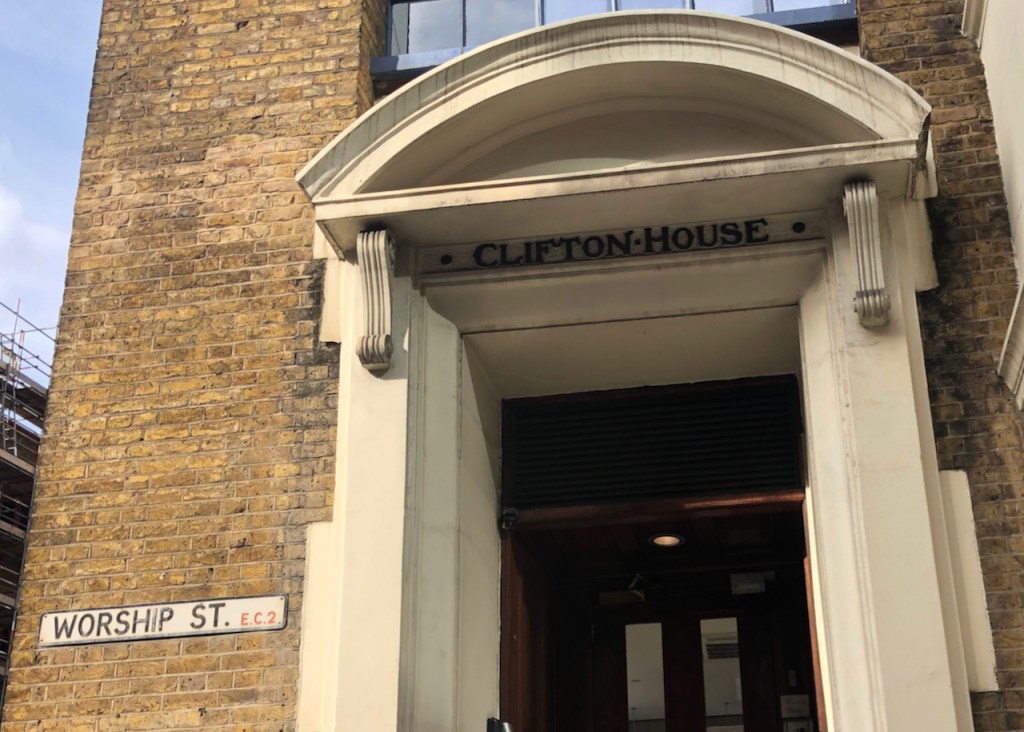
What is this building? Well, now it is inhabited by an organisation called “NEL NHS” according to the notice on the door. From what I can discover online, NEL stands for “North East London” and the organisation is an in-house consulting organisation for the NHS (the UK National Health Service). They are a “Commissioning Support Unit (CSU)” which means they supply services to, for example, GP practices, and area administrators of parts of the NHS. Computing projects and change programmes amongst the service offerings listed on their website. NEL is quite a big organisation. LinkedIn records it as having 967 employees of whom 457 work in London.
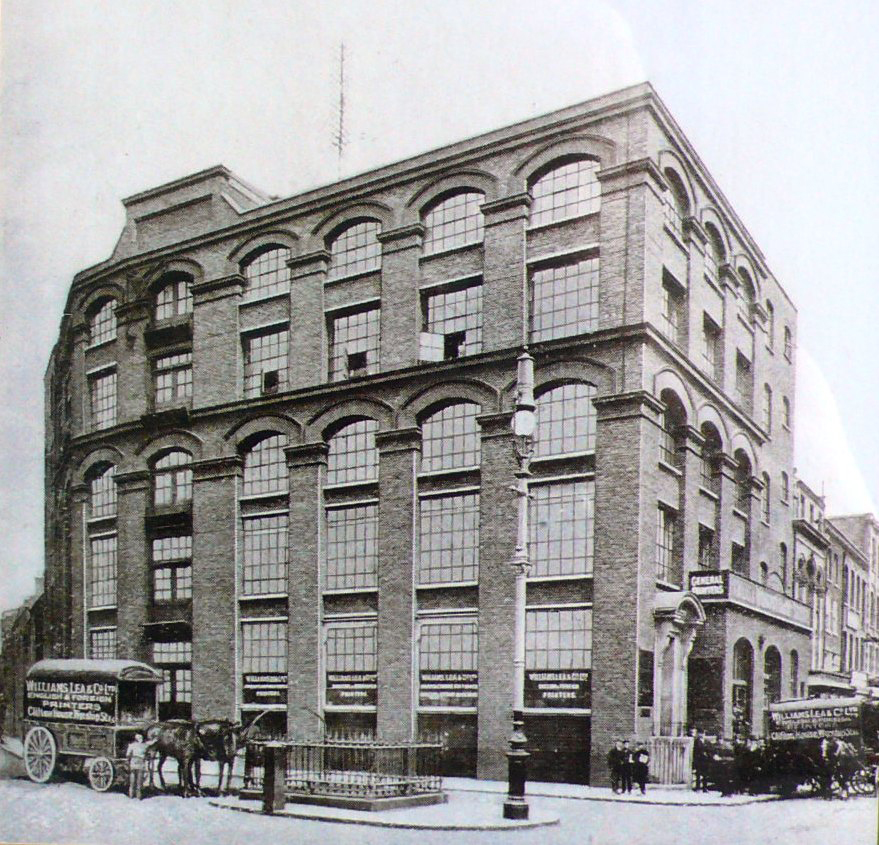
That’s who’s there now. But the building has a history. It was built in 1900, for the printers Williams Lea. Williams Lea printed stamps, newspapers, and foreign language material. In the 1939-45 conflict, they printed UK government propaganda in German, which was dropped into Germany. They also printed the first copy of the Radio Times, in 1923, probably in this very building. Williams Lea has itself undergone various transformations, and is now called Perivan. The Perivan website has a history section which helpfully provided me with this information. (Note 1)
In 1978 Tony Williams took over the family business of Williams Lea. Under his leadership the business flourished. He took the decision
“to establish Williams Lea as a Financial Printer serving the City community with its specialist printing needs. This move coincided with the privatisations of many state-owned industries and utilities and in 1990 Williams Lea was awarded the printing for the privatisation of the electricity industry, one of the largest and most complex jobs of its type.” [https://www.tandswilliams.org/]
It did well. He sold the business in 2006, and with the money established a charitable foundation which exists today.
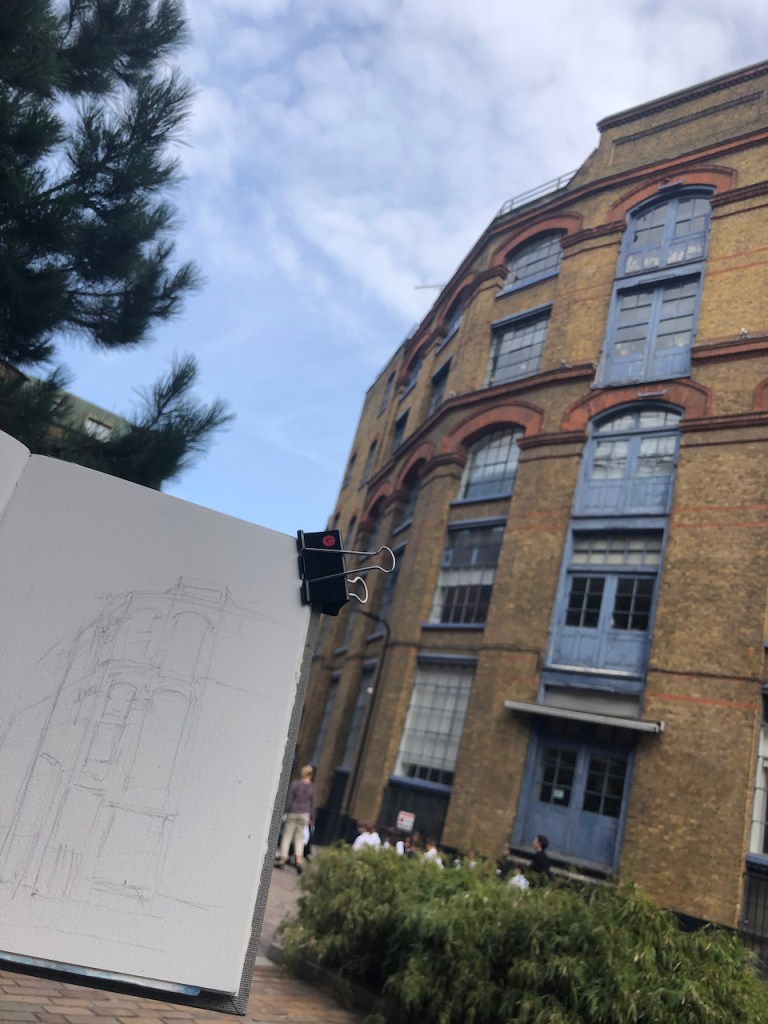
My drawing took 90 mins on location, with colour added later at my desk.
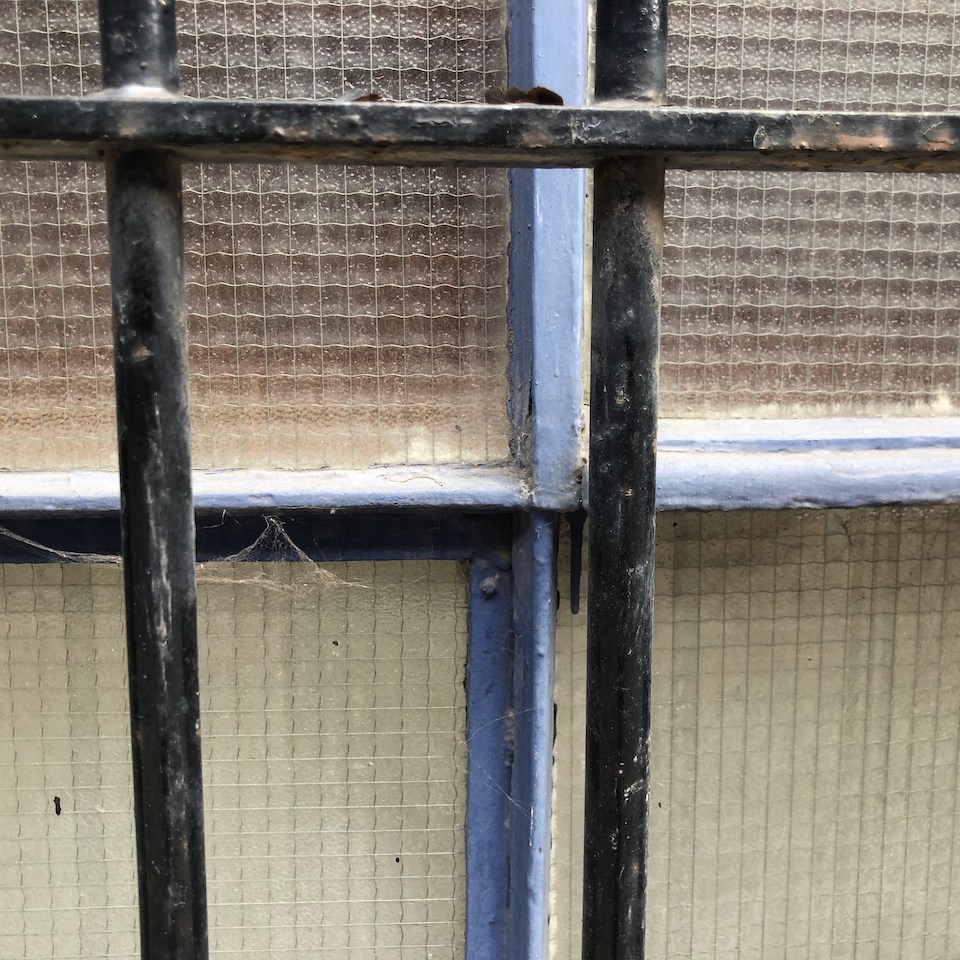
I spent a long time looking at this building. There are the large windows, which are also doors, so that large items can be lifted out from the different floors. Some of the windows have louvres for extraction fans.
There are many textures in the brickwork. Some cobwebs have been there a while.
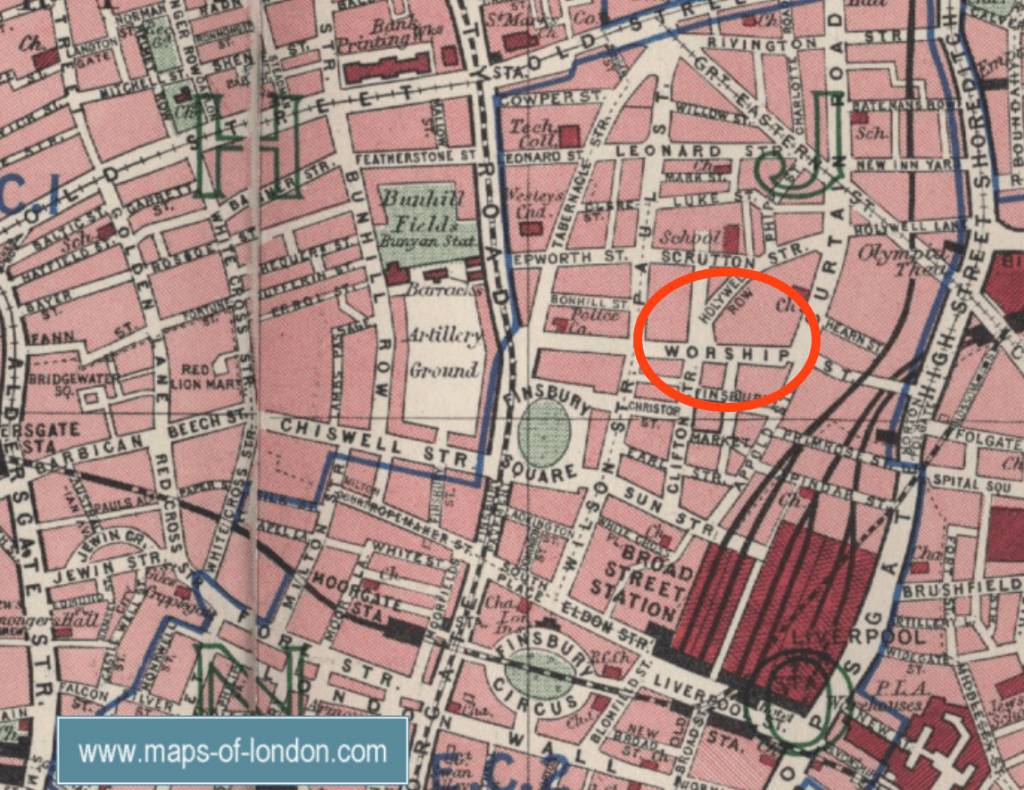
Here is a 1945 map showing the location:
Map from “www.maps-of-london.com”
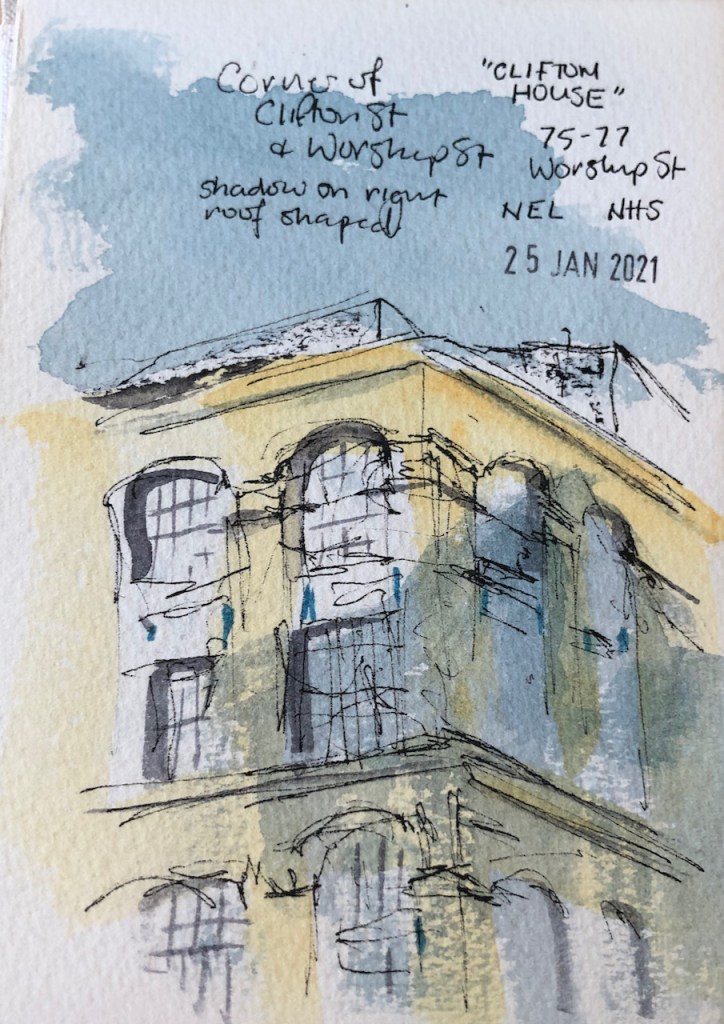
I sketched this location as a “microsketch” earlier this year:
Note 1: History of the building: references.
Pevsner LONDON 4: NORTH, page 525 refers to “Clifton House, at the corner of Clifton Street and Worship Street, another printers, (WIlliams Lea & Co) built 1900, five storeys, with handsome red brick arched windows.”
“A Mr J E Lea became a partner of the business in 1864, and it was promptly renamed to Wertheimer Lea & Co. When John Wertheimer passed away in 1883, Mr J H Williams purchased his share (great grandfather of Philip Williams, who works within Perivan today). Over the years, J H Williams acquired the rest of the company and in 1899, Wertheimer Lea built a new factory in Worship Street, London, to consolidate 5 production sites. Now central London, at the time the new factory was built, it was possible to see fields from the top floor. The biggest USP was that all the machines were powered by electricity. The business was renamed in 1914 to Williams Lea to reflect the existing founders. A fun fact – Williams Lea printed the first edition of the Radio Times in 1923!……Throughout the wartime years, Williams Lea survived the blitz where many other printers did not. With its specialism in foreign language printing, this was understandably in very high demand at this point in history, and Williams Lea was heavily involved in the printing of propaganda materials in German which bombers distributed by throwing them out of aeroplanes over Germany – containing messages encouraging the enemy to give up. Williams Lee also printed newspapers for governments in exile in London, including Poland and Norway, and stamps for the Post Office.”
“Williams Lea & Co Contractor to De La Rue after their premises were bombed on 29th December 1940. William Lea & Co printed the Bermuda high value stamps during 1941.“
Here is Plumage House, 106 Shepherdess Walk, London N1.
Plumage House, 7″ x 10″
This was a feather factory. According to Spitalfields Life this operated until 1994. The building is now rather shabby, though in a dignified way.
I wonder what will happen to it?
In the drawing, the main colours are Fired Gold Ochre, Buff Titanium, Phthalo Turquoise, and Perylene Maroon, with Mars Yellow and Green Apatite Genuine for the green.
Shepherdess Walk (the main street North-South) and the location of Plumage House.
Click a button below to share this post online, email it, or print it: