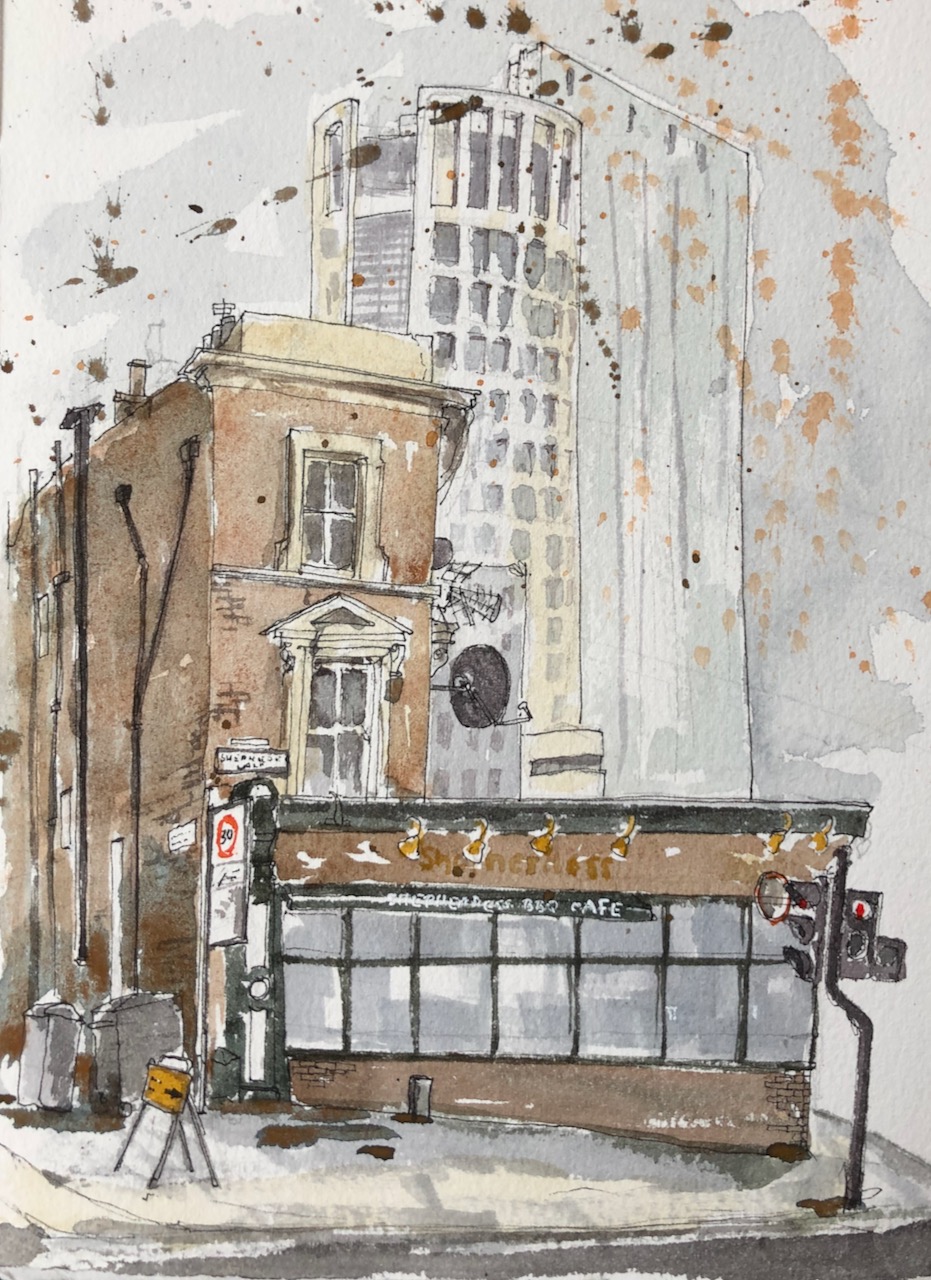
Shepherdess Walk at City Road

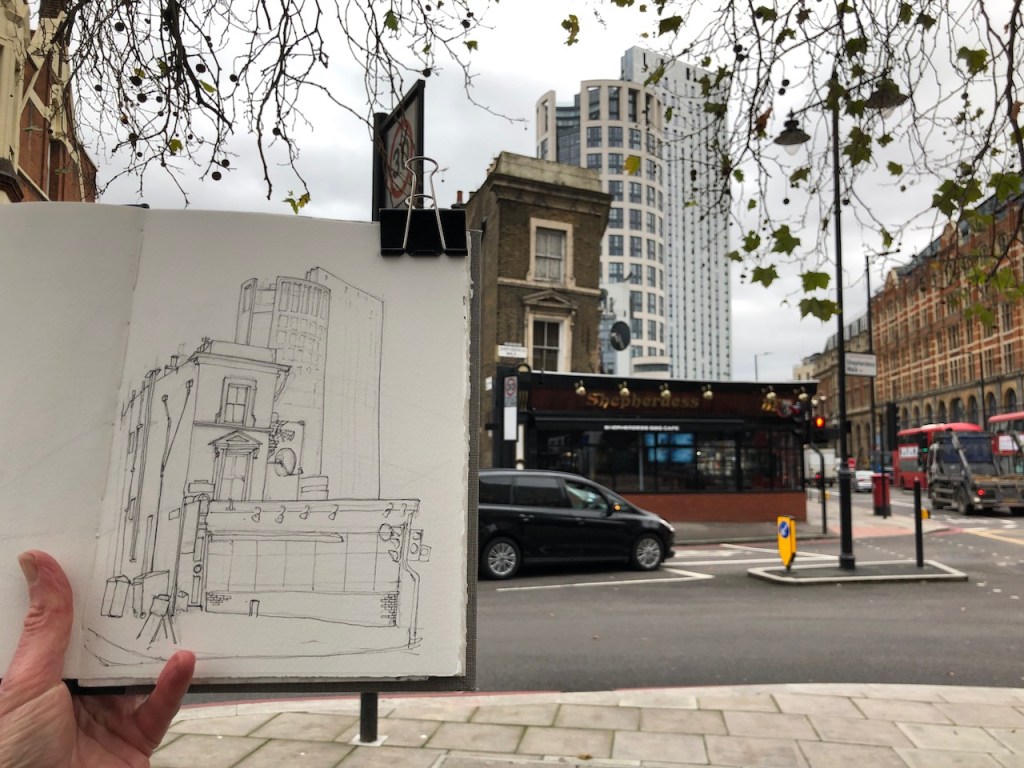
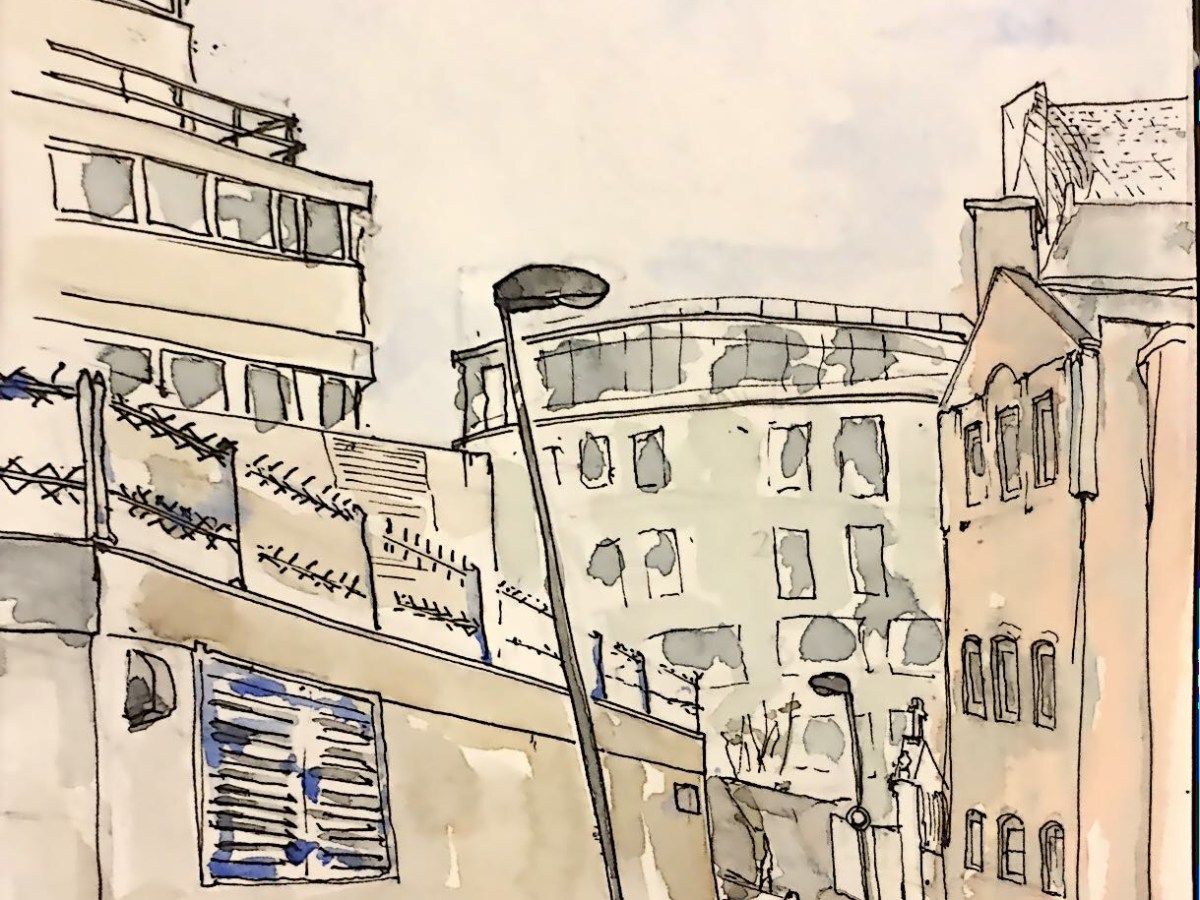
This is at the junction of Shepherdess Walk and the City Road.
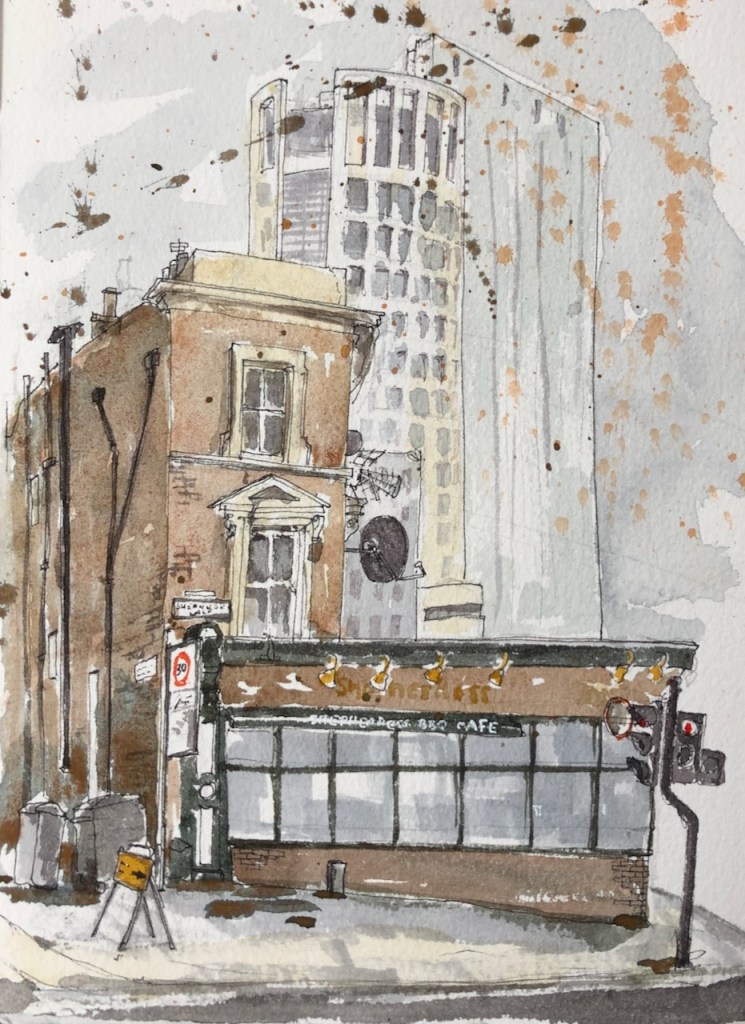
Shepherdess Café, with Eagle Point and The Atlas Building in the background.

Just off the picture to the left is the Eagle pub. Both the Eagle pub and the narrow building I’ve drawn are remarkably dilapidated, given their location in a trendy part of town, right near Old Street Roundabout. I feel their existences are somewhat precarious. See the huge shiny towers, only a few hundred metres away.

But that building above the café has its dignity, for all that it is cracked, and its walls are leaning several degrees off the vertical. Its windows are surrounded by scrollwork and stucco. It is much used, and much modified. There is a spectacular network of pipes and conduits at the back of the building, and an impressive array of TV aerials and satellite dishes on the front.

The alley on the left of my drawing is Shepherdess Place.
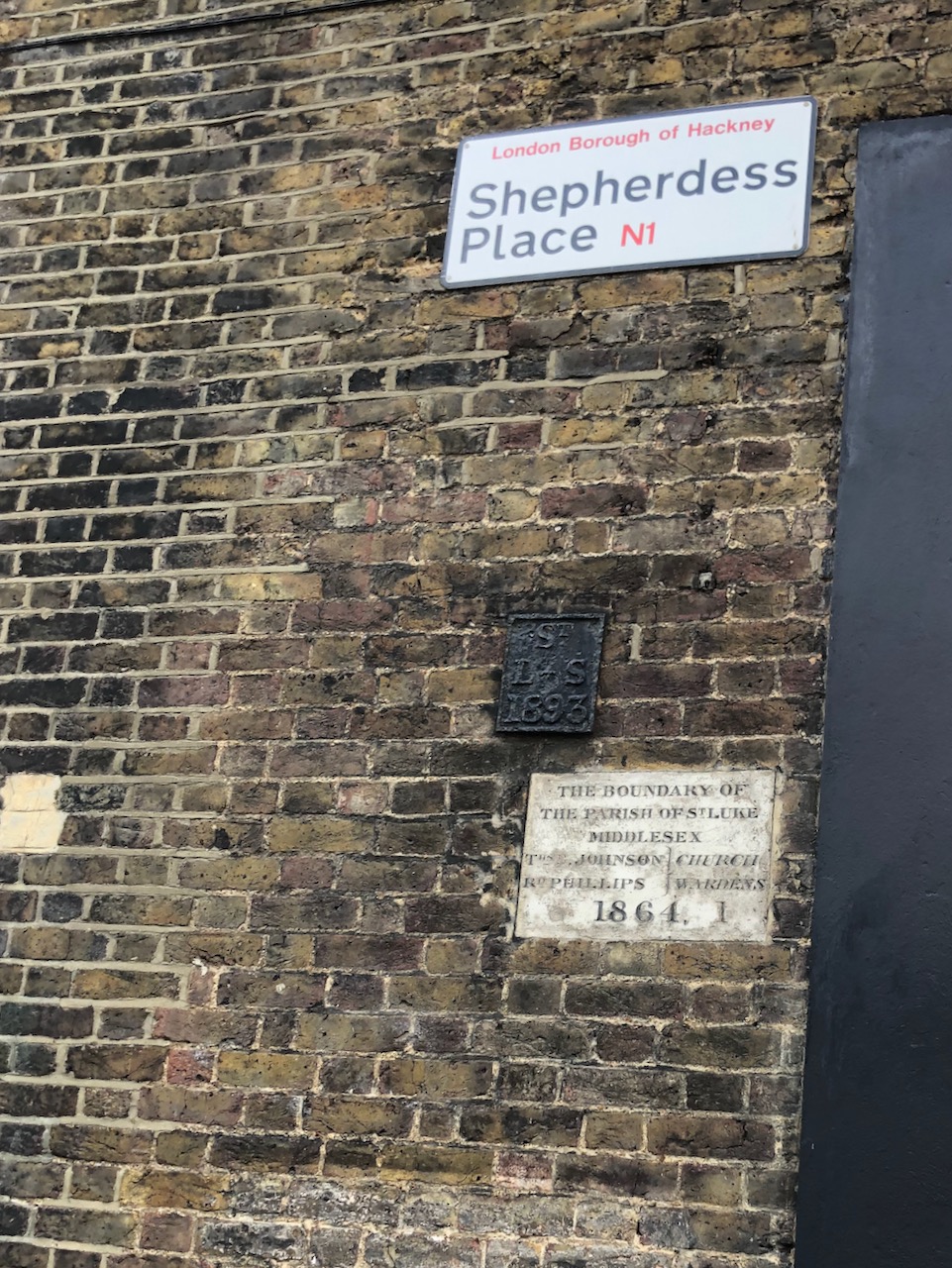
Notices on Shepherdess Place.

The white stone in the brickwork tells us that this small street marks a parish boundary. It says “The Boundary of the Parish of St Luke Middlesex, Ths B Johnson, Rd Phillips, Church Wardens, 1864“, with an additional figure “1” whose meaning is obscure to me. Can we assume “Ths” is “Thomas” and “Rd” is Rudyard? The black notice confirms this boundary “St L-S 1893“, 29 years later.

See how lovely the brickwork is! All those pinks and browns!

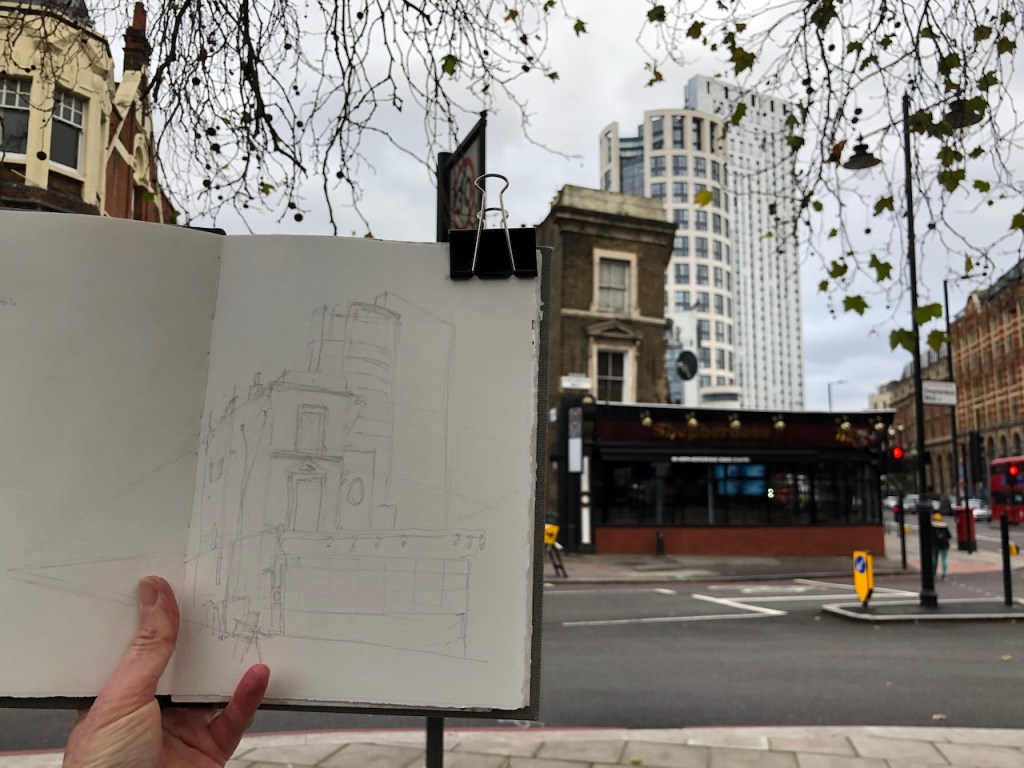
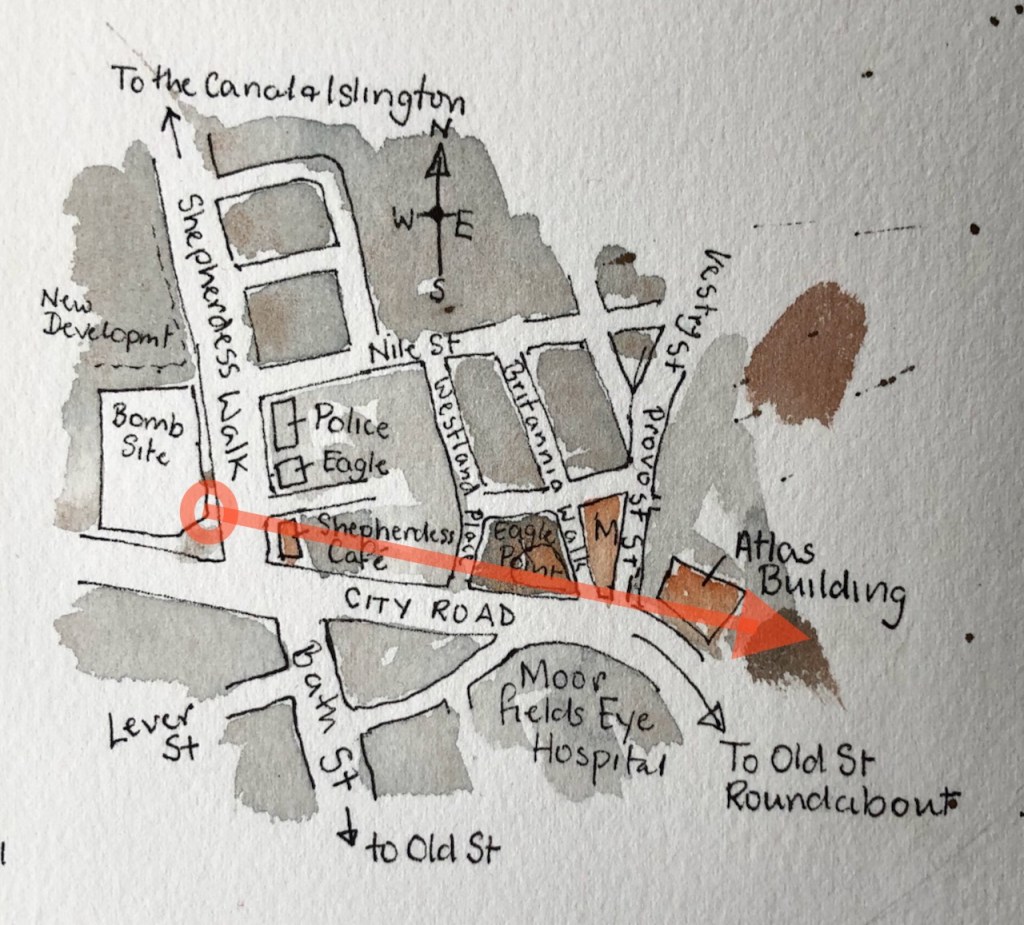
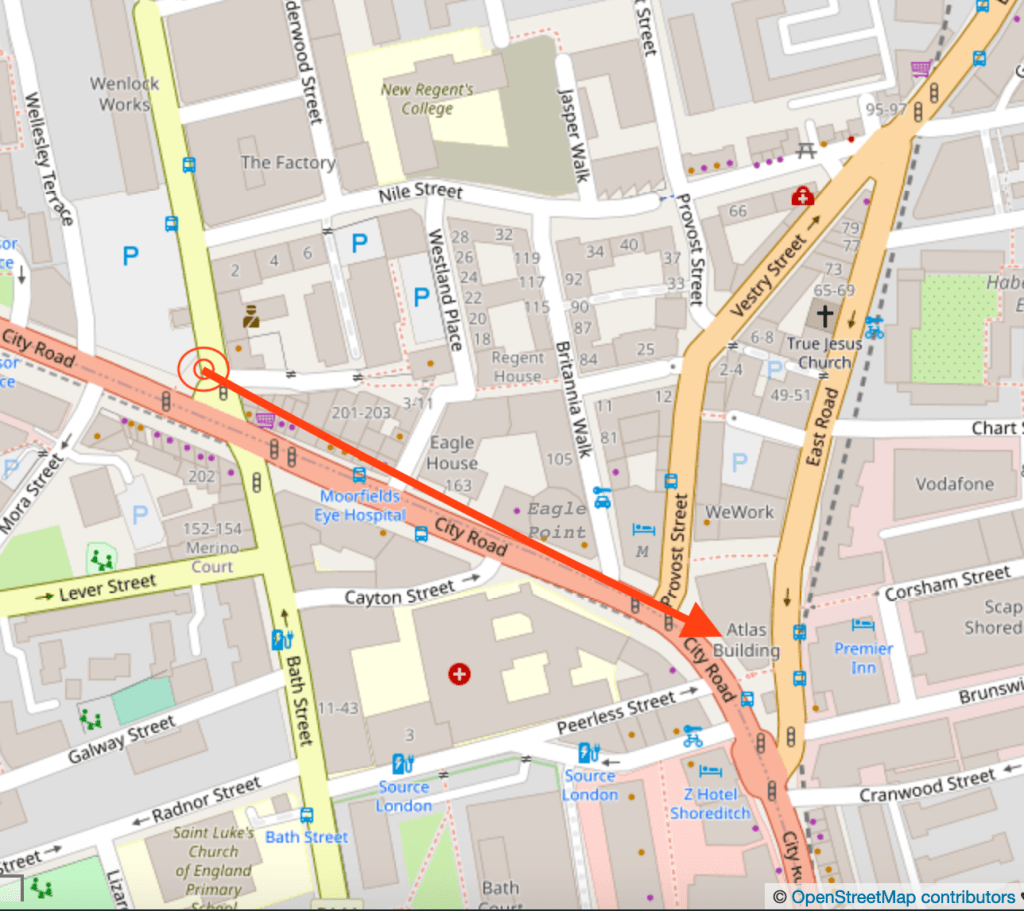
Here is work in progress on the drawing and some maps.
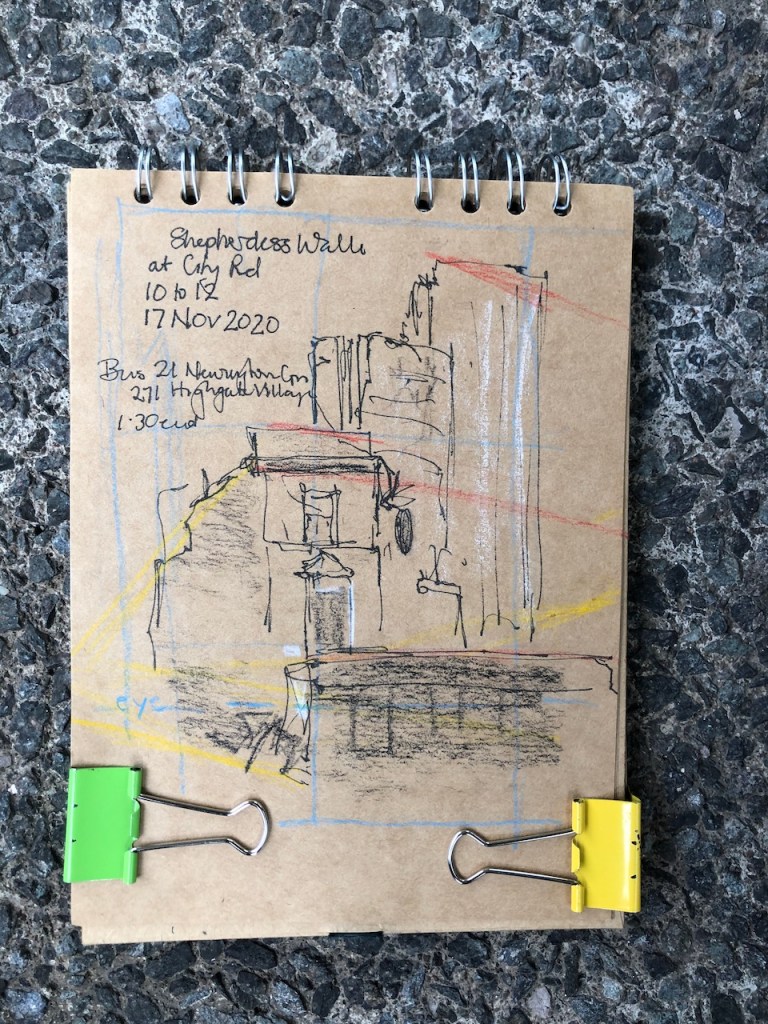
Five different buses pass the spot where I was drawing. They all head North up Shepherdess Walk:

  • 21 to Newington Green
  • 271 to Highgate Village
  • 394 to Homerton Hospital
  • 141 to Palmers Green
  • 76 to Tottenham Hale

There is a police station next to the Eagle pub, offices and housing all around. Moorfields Eye Hospital is just across the City Road. It’s a busy corner. The Shepherdess Café was closed because of lockdown.

There are many colours in this picture, all Daniel Smith colours: Lunar Earth, Buff Titanium, Burnt Umber and Prussian Blue for the brickwork, Perylene Maroon is in there too, for the grey and black, and Mars Yellow and Transparent Pyrrol Orange for the street signs. This is in Sketchbook 9 on Arches Aquarelle 300g NOT paper. The picture is 10″ x 7″ and took 1hr30min approx.

Jerusalem Tavern, Britton St

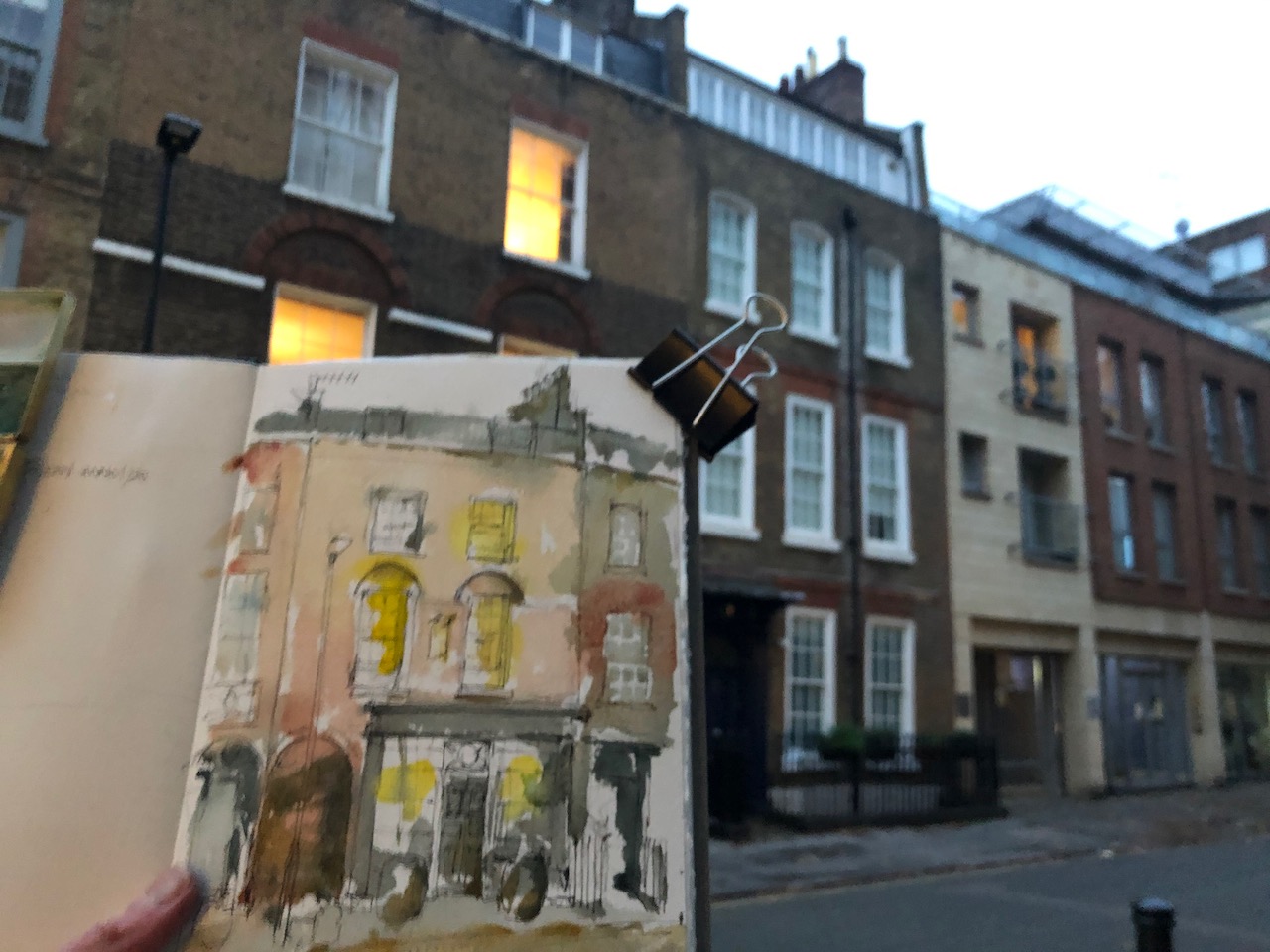
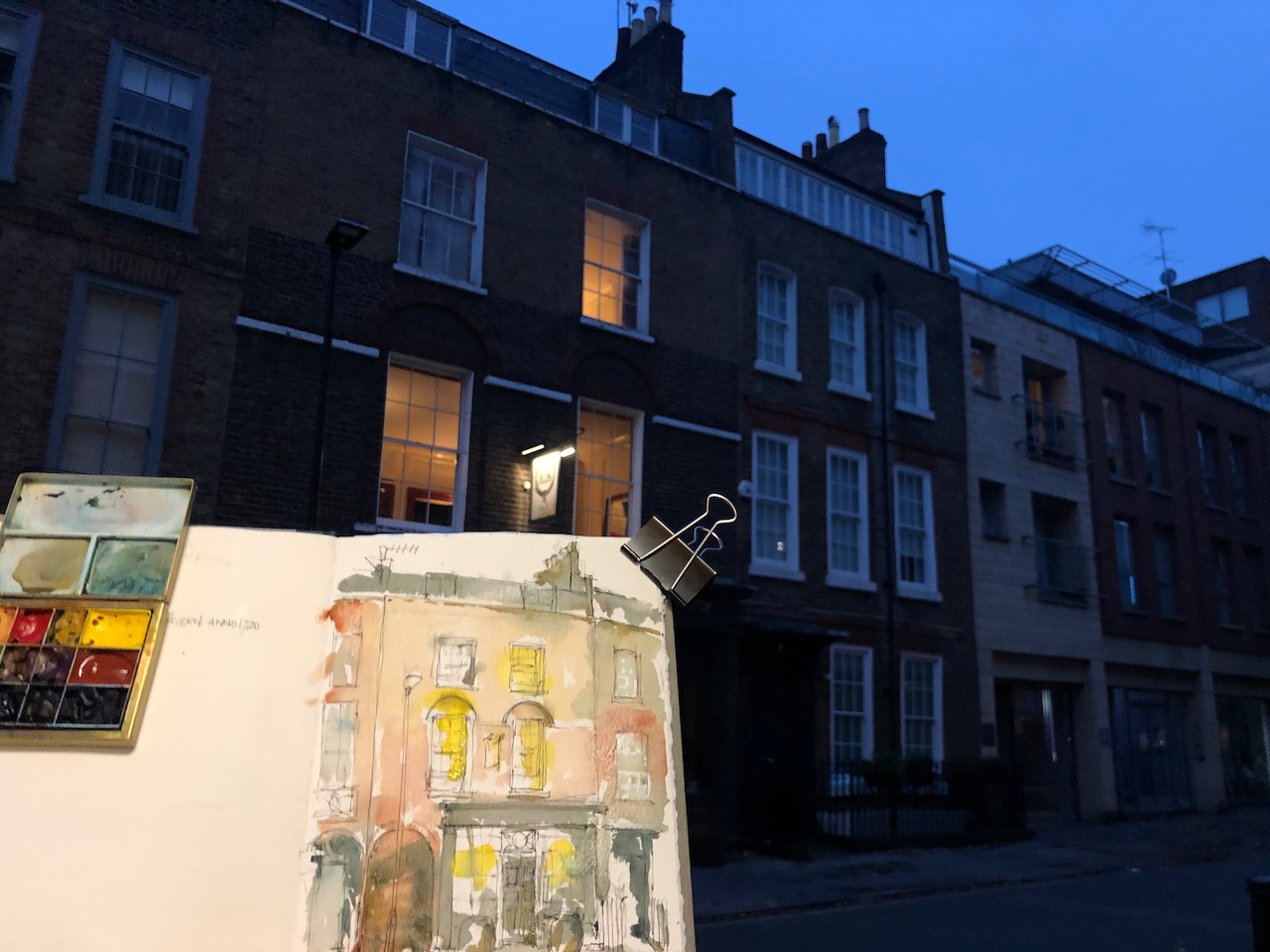
Here is a sketch of The Jerusalem Tavern, Britton St, Clerkenwell, made as the light faded.

Jerusalem Tavern, 55 Britton St, 16 Nov 2020

I find this a particularly lovely building. The curves over the windows are semicircles and there is a pleasing symmetry to the upper floors. The semicircle over St John’s Passage exactly matches the door to its left, on another lovely house which has amazing tall windows on the first floor.

Britton Street was surprisingly lively on that Monday afternoon. There are offices along the street and people rushed in and out of doors, or came and stood on the pavement smoking. Delivery drivers were the main traffic, both vans and bicycles. They all seemed to know each other. A package was delivered to the office next to me. A woman came out to receive it. It was evidently expected. The driver returned to his van, and sorted more packages inside.

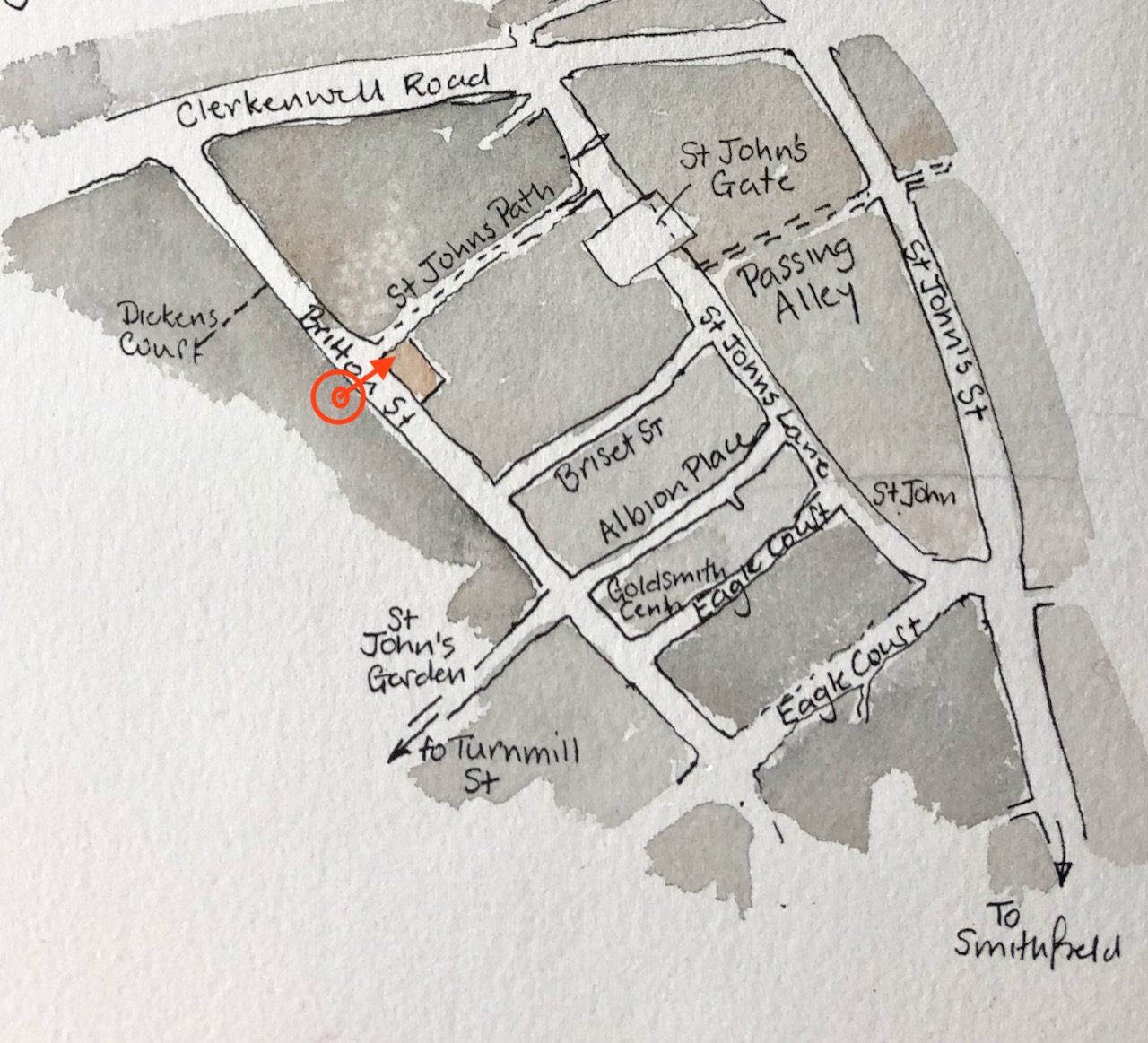
Here are some work in progress pictures and a map. I have just finished reading “Troubled Blood” by Robert Galbraith. If you’ve read the book you’ll know that much of the action takes place in these streets in Clerkenwell. As far as I can work out, all the streets mentioned in the book exist, and the routes described are realistic.

This drawing took about an hour. The colours are: for the walls – Fired Gold Ochre (DS), Mars Yellow (DS) and Phthalo Turquoise (W&N) , for the light in the windows Hansa Yellow Mid (DS). The drawing is 7″ x 10″, done in a sketchbook on 300gsm Arches Aquarelle Paper.

While I was drawing, I detected a movement in my peripheral vision. A spider of alarming size was climbing the wall against which I was leaning. It was making little spurts across each brick, then secreting itself into the mortar, trying to become invisible, before making its next jump. As I watched, it turned around meaningfully, and started heading down towards my rucksack, which was upright on the pavement, open, leaning against the brickwork like a spider-catching bucket. I moved the rucksack, and closed its flap. I was more-than-usually disconcerted, because we had been watching “Dr No” the previous night. I could recall rather too vividly that scene of the poisonous spider which crawls on James Bond while he is sleeping. I stood away from the wall, and monitored the spider’s progress. I did not have long to wait. It reached pavement level, no doubt disappointed that the bright yellow rucksack had somehow disappeared. Then it went into a pavement-level crack to decide what to do next. I decided to stop worrying about it.

To see the spider, scroll down – if you dare. Trigger warning: SPIDER.

Spider. It is about half the height of a house brick. Those are bricks on the wall, against which I was leaning.

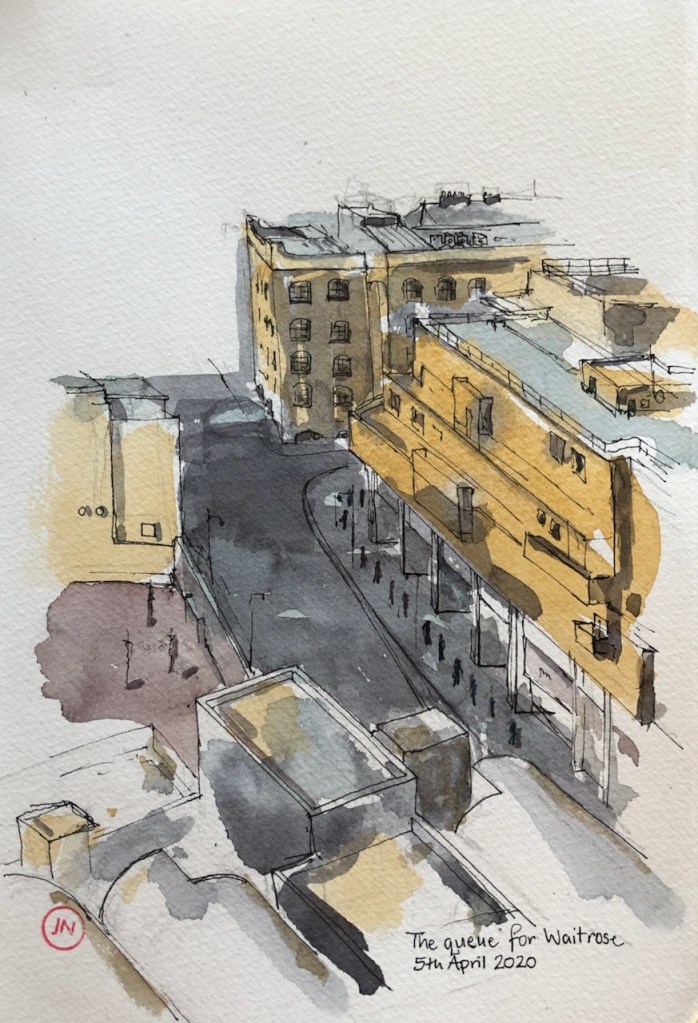
The queue for Waitrose

This is Whitecross Street. The people are in the well-managed queue for the Waitrose supermarket, which is underneath the building to the right.

In the foreground: Ben Jonson House, Barbican. On the left, behind Ben Jonson, in pink, is a children’s playground at first floor level, part of Prior Weston School.

Drawn looking out of the window, about an hour and a half including a phone call from a friend.

The friend called to tell me the answer to a crossword clue which had defeated me.

Colours: Mars Yellow (DS), Perylene Maroon (DS), Phthalo Turquoise (W&N)

Buildings on Errol St

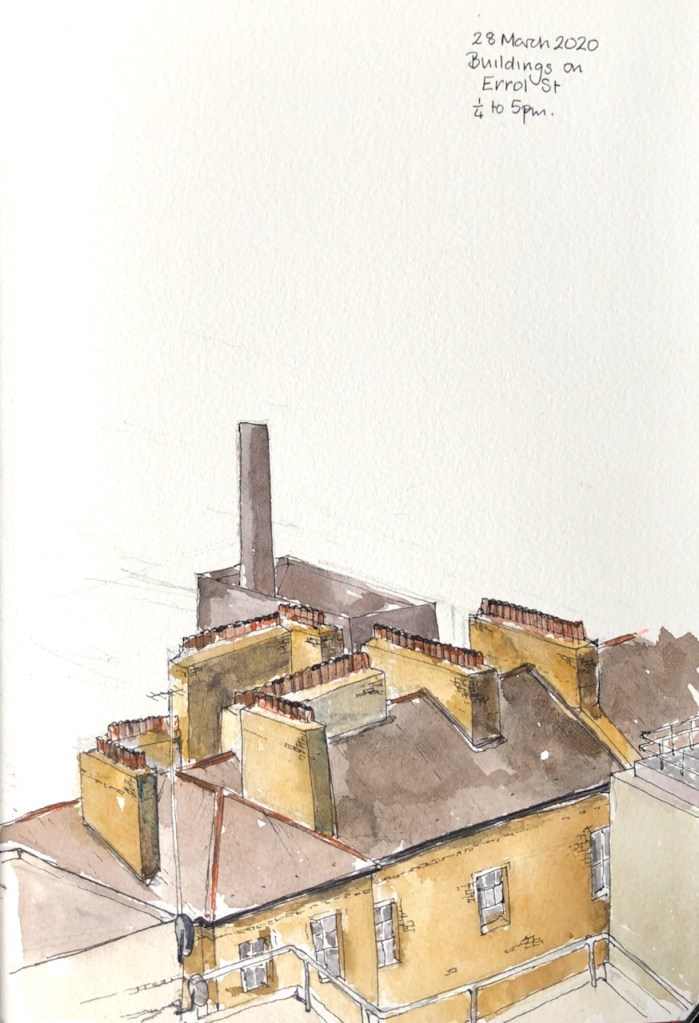
Sketching from home: here is a view of the chimney pots on the Peabody buildings of Errol St:

These chimney pots are interesting because they are all single rows. Also the chimney stacks are arranged in several different ways: along the ridge of the roof, across the ridge of the roof, up from the side of the roof, and along the structural wall between blocks. There must be a lot of fireplaces in these buildings.

Map showing the sightline of the drawing.

These blocks are part of the “Roscoe St Estate”, still managed by Peabody. I think this is blocks E and D, but I’m ready to be corrected. I don’t know what the tall industrial chimney is. If you know, please tell me.

This perspective was a challenge. Also the blocks are quite a distance away, and so it was hard work to pick out which set of chimney pots was which. After a while my concentration lapsed, and it all went into a blur. So this picture took about 3 hours elapsed time, including breaks for lunch, exercises, phone calls, and strolling about the flat.

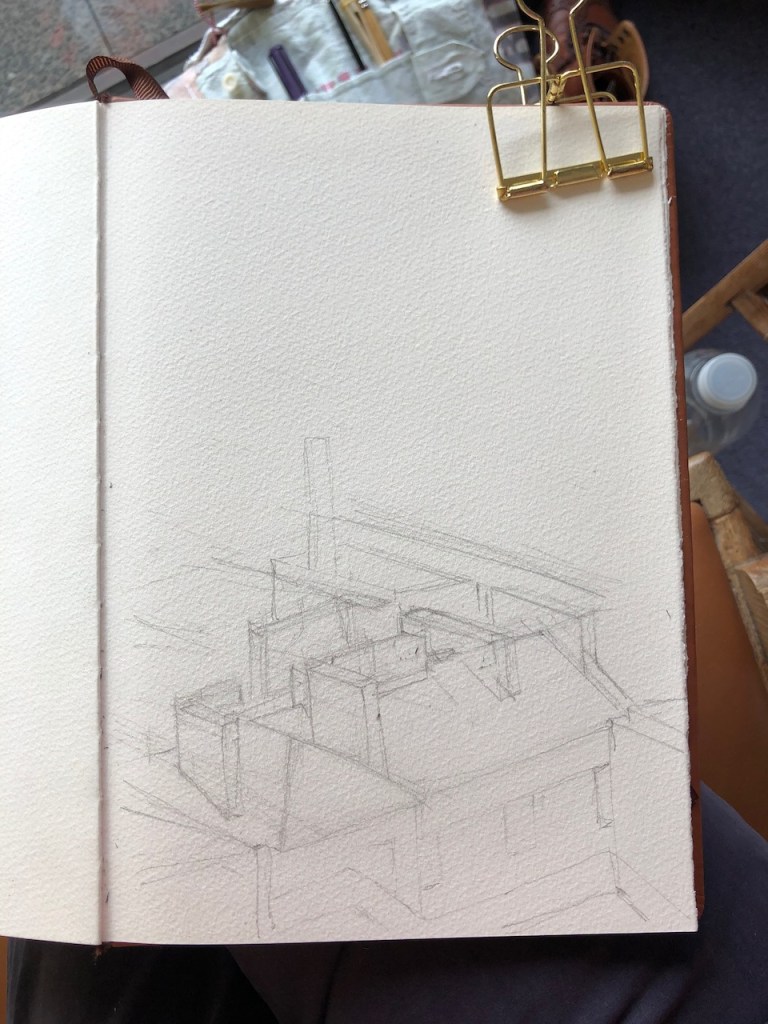
Here are some photos of work in progress.

Colours used: Prussian Blue, Mars Yellow, Burnt Umber, Perinone Orange. I made the black for the guttering from Prussian Blue and Perylene Maroon.

Horizon panorama

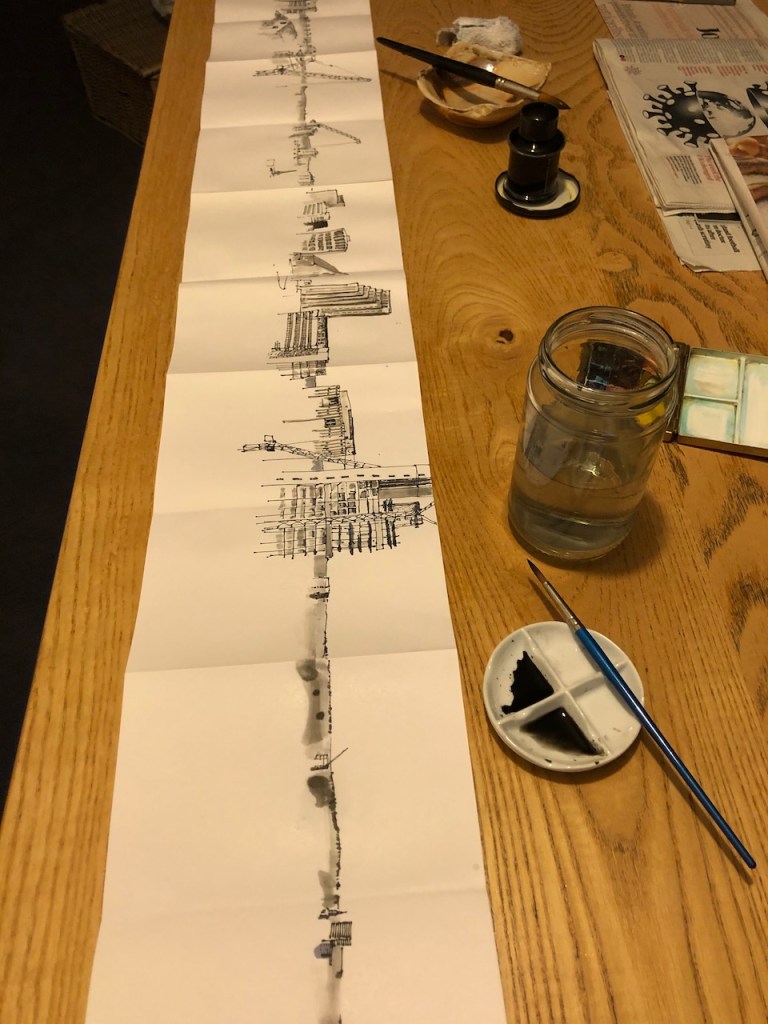
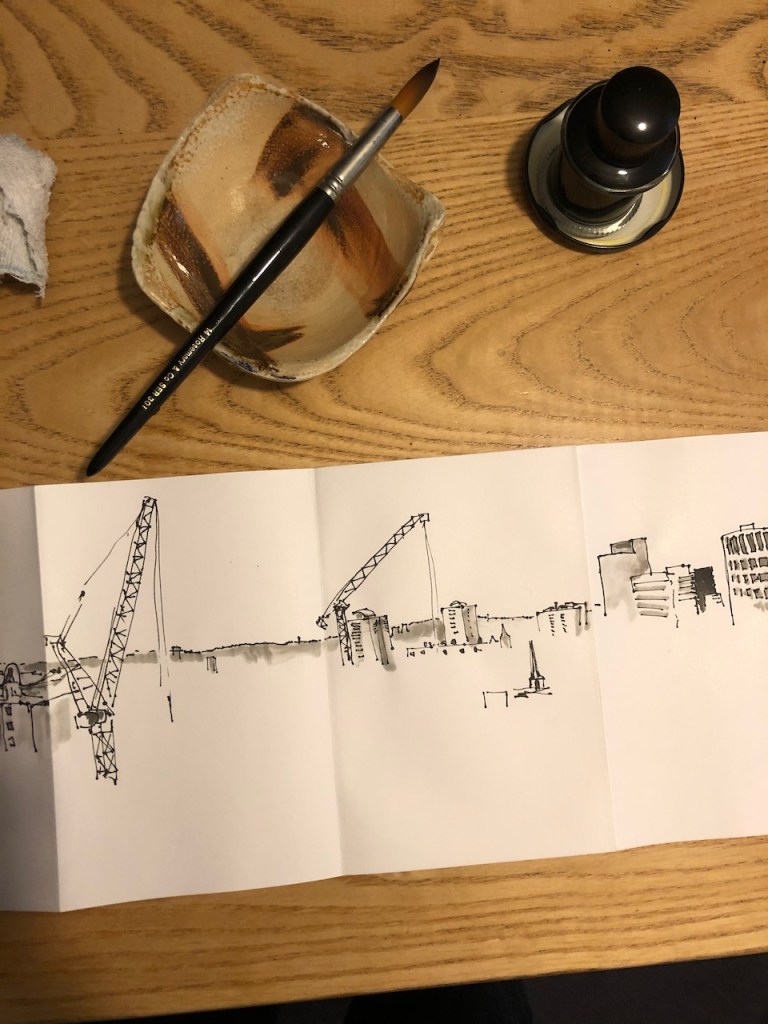
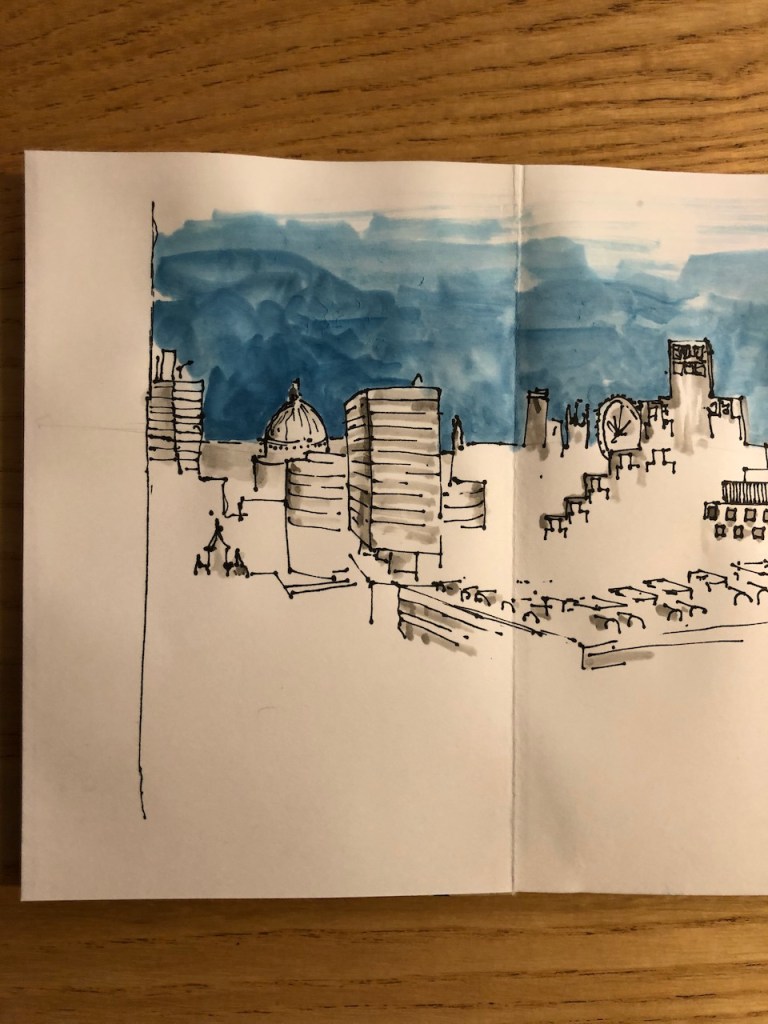
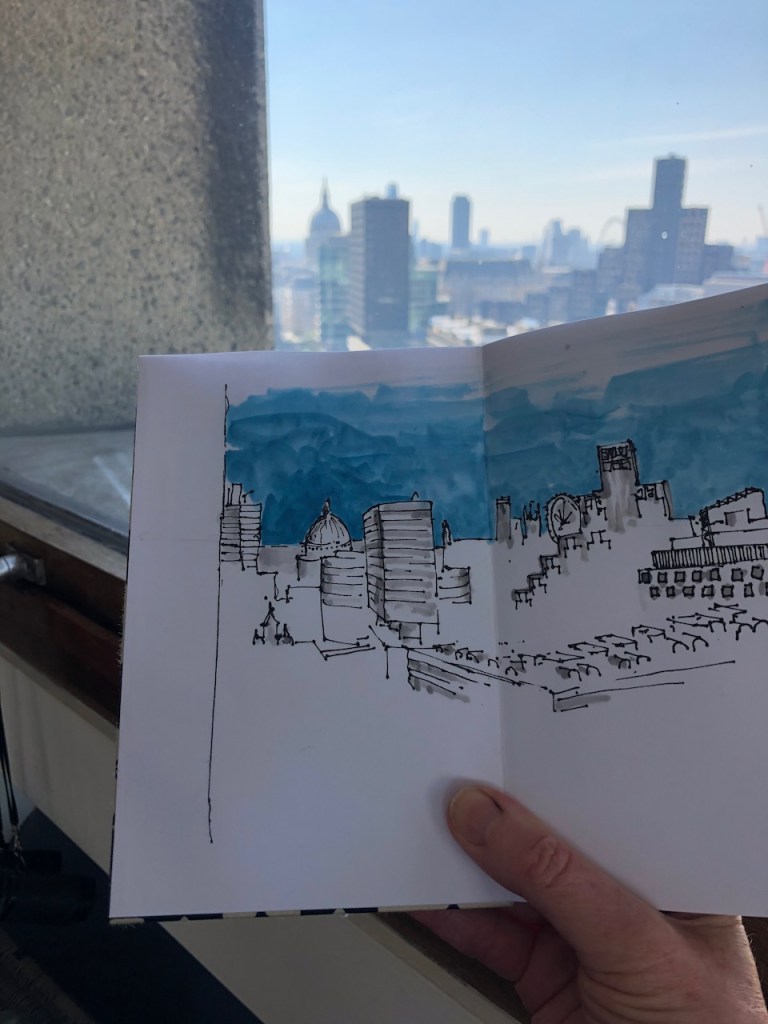
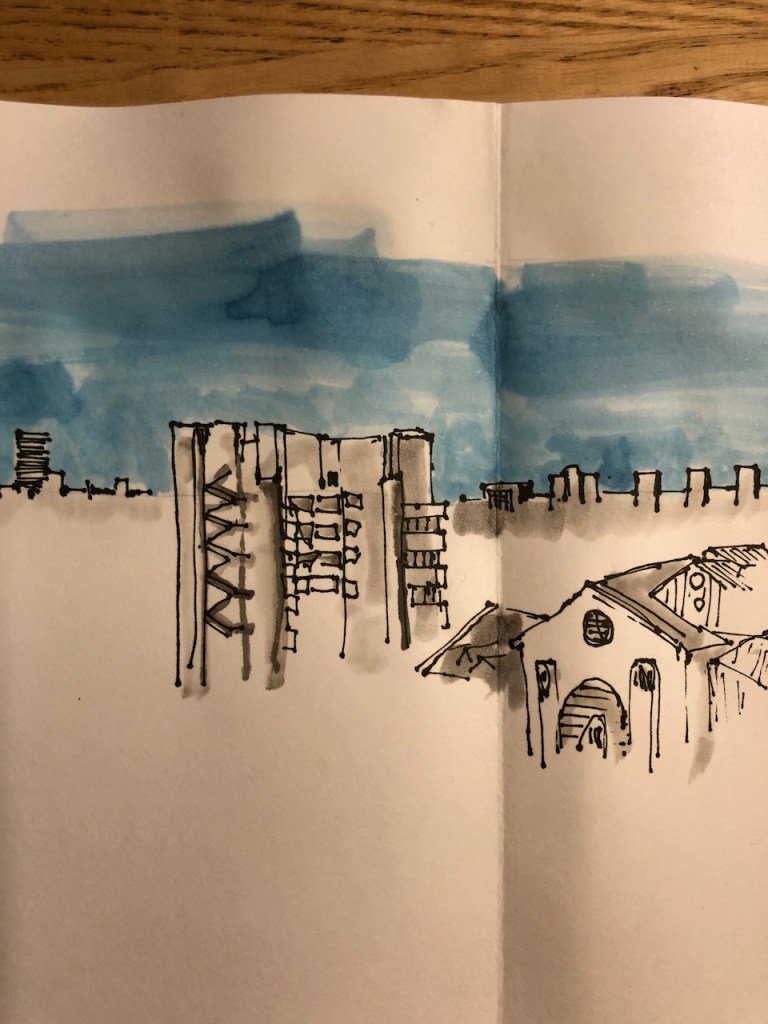
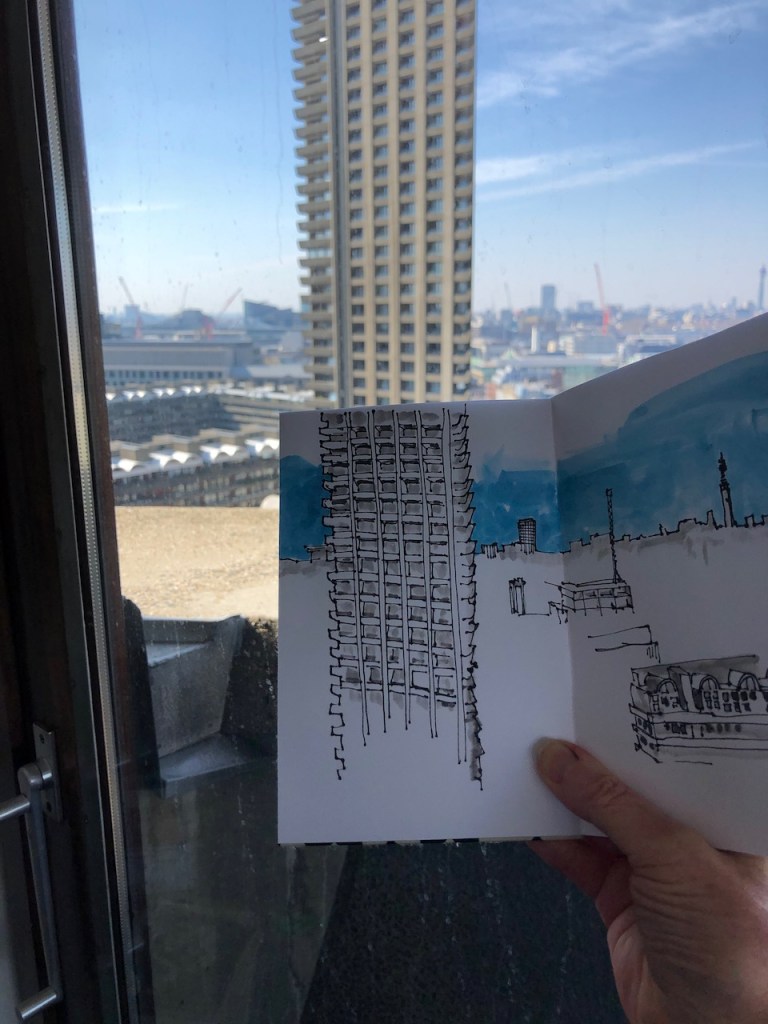
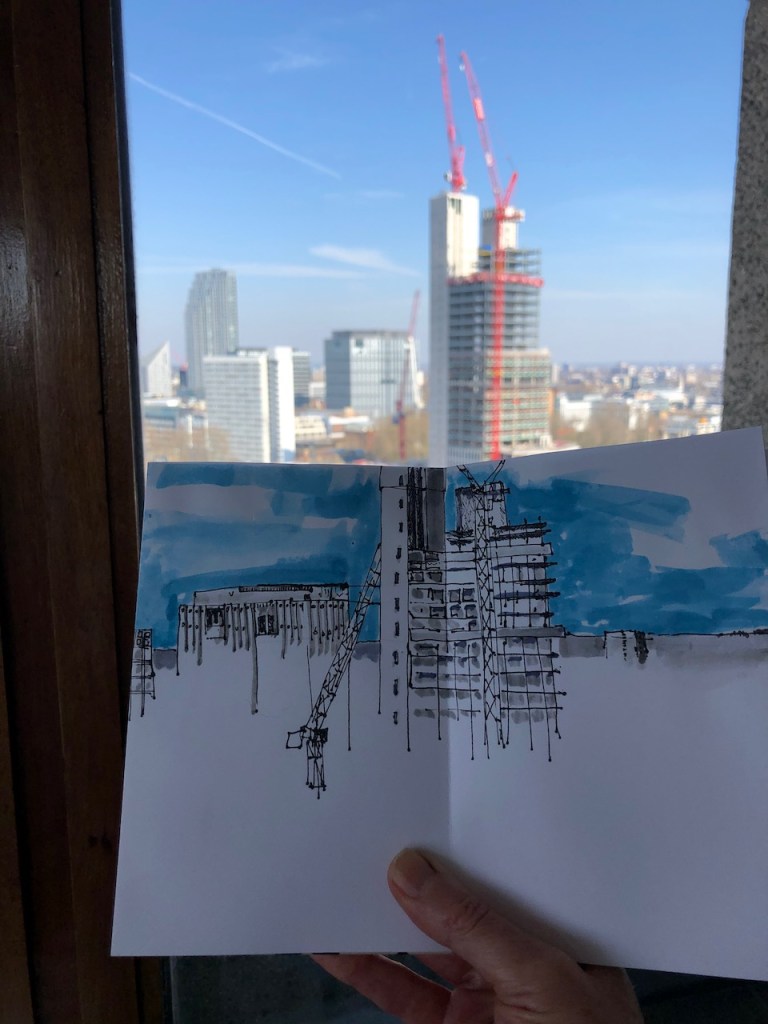
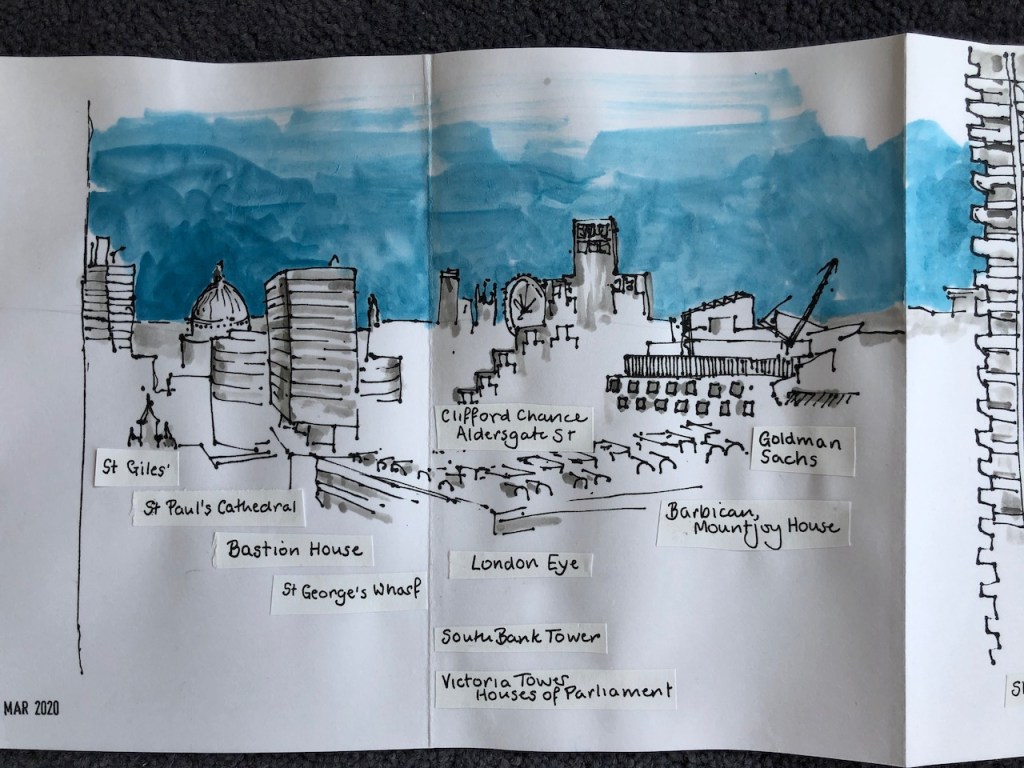
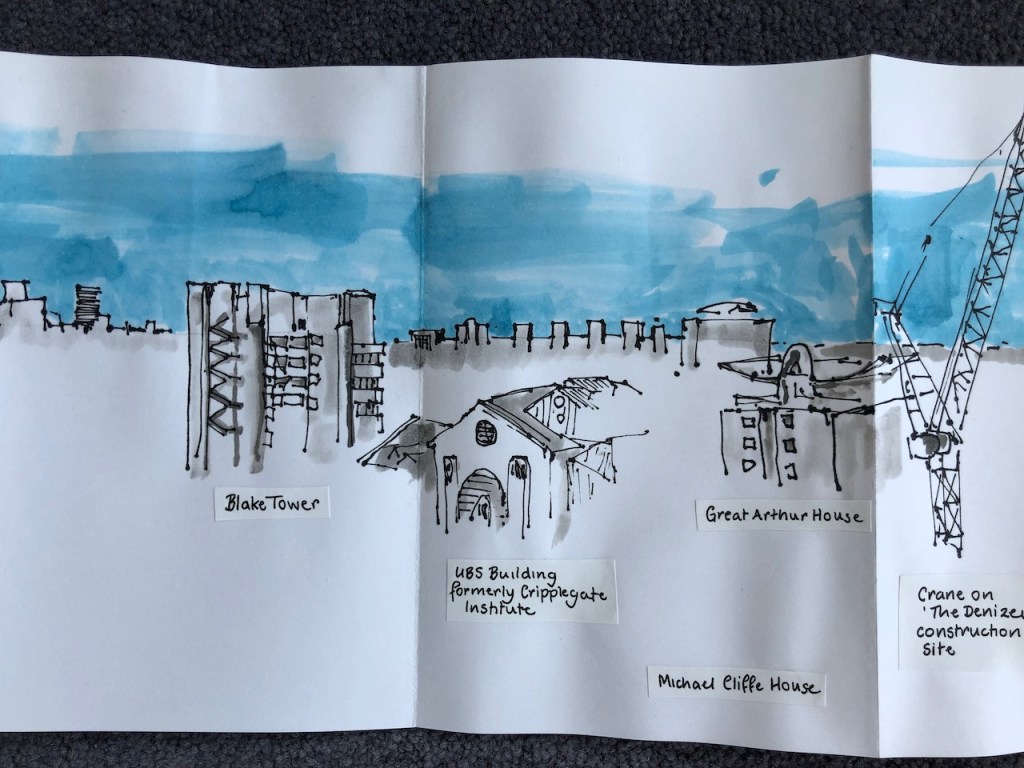
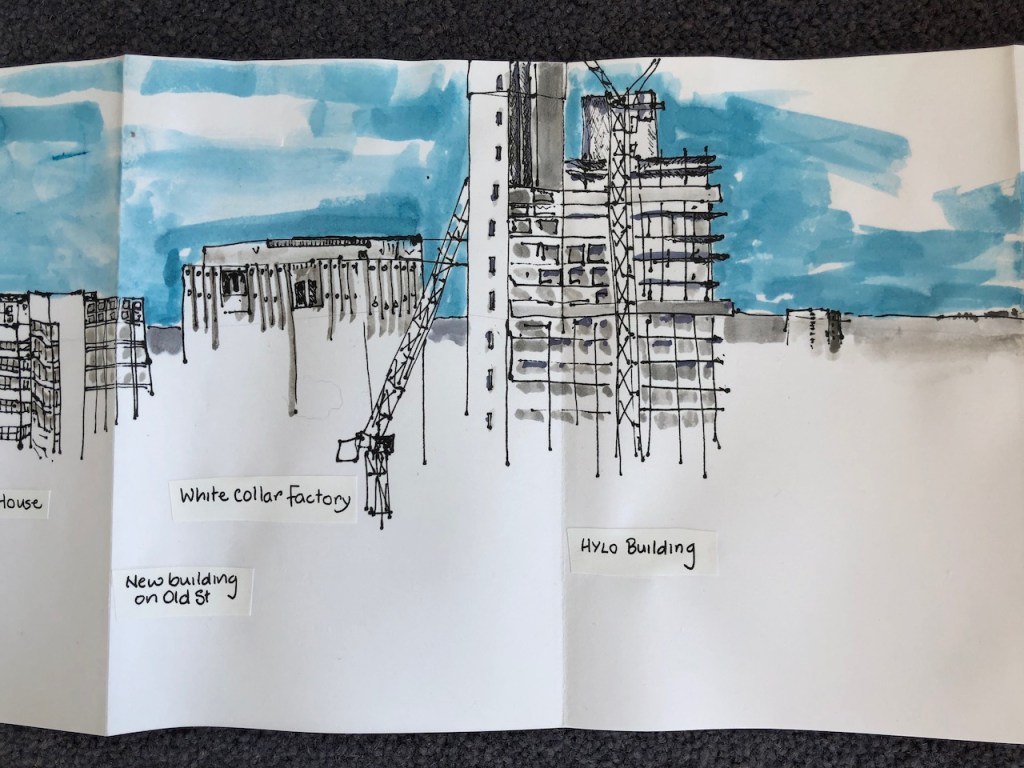
Some time ago, I was given a Japanese sketchbook, which was in the form of a concertina of doubled paper. In the last few days I drew the world outside, as seen from the windows of this flat. It’s about a 270 degree view, mostly over West and North London.

During these days of indoor confinement, the weather outside has been beautiful. Stunning blue skies. So I put that in using Phthalocyanine Turquoise watercolour.

Then I made a videos. The first one, with the pointer, has an audio commentary. It’s quite quiet, you may need to turn the sound up. The second one is silent. This is the first time I’ve put videos on this site. Let me know if it works.

I added written captions also, as you see in the second video.

Here are still pictures from the panorama with captions.

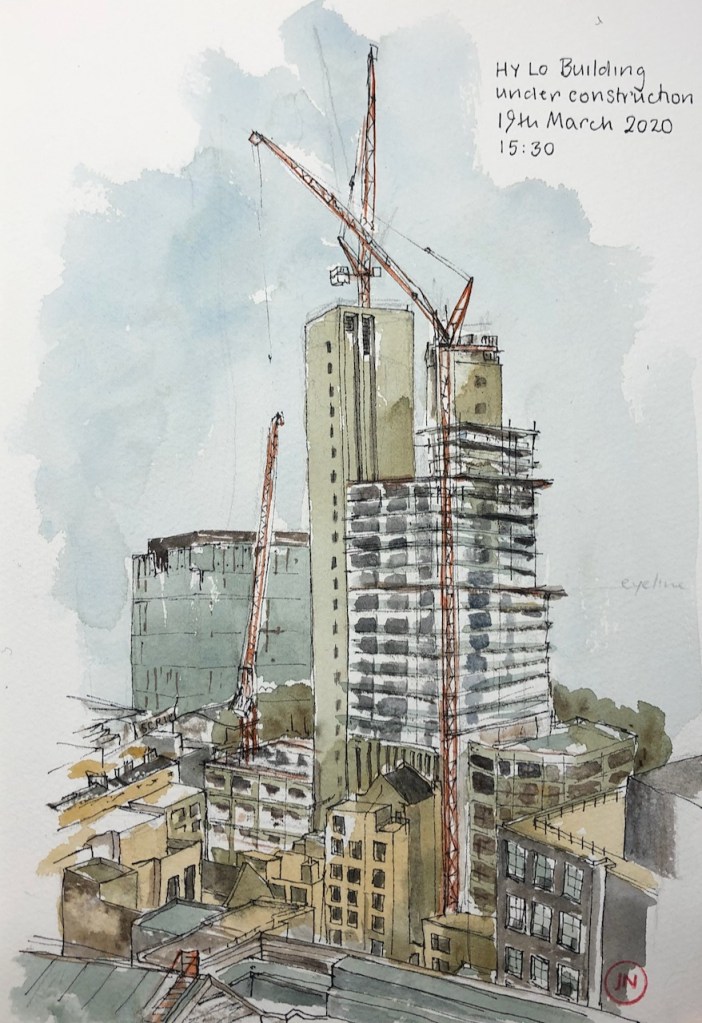
HYLO Building under construction

Here is the “HYLO” Building on Bunhill Row.

HYLO, on the site of the Finsbury Tower.

It will be “premium office and retail space over 29 floors”. The developer is “CIT”:

Steve Riddell, Managing Director Developments, CIT, says [on the CIT website]: “As the line between corporate and creative becomes more integrated, our aim is to provide a workplace solution that offers flexible spaces that embrace collaboration and connectivity at the same time. We are excited for HYLO to become the defining destination in the Old Street district.”

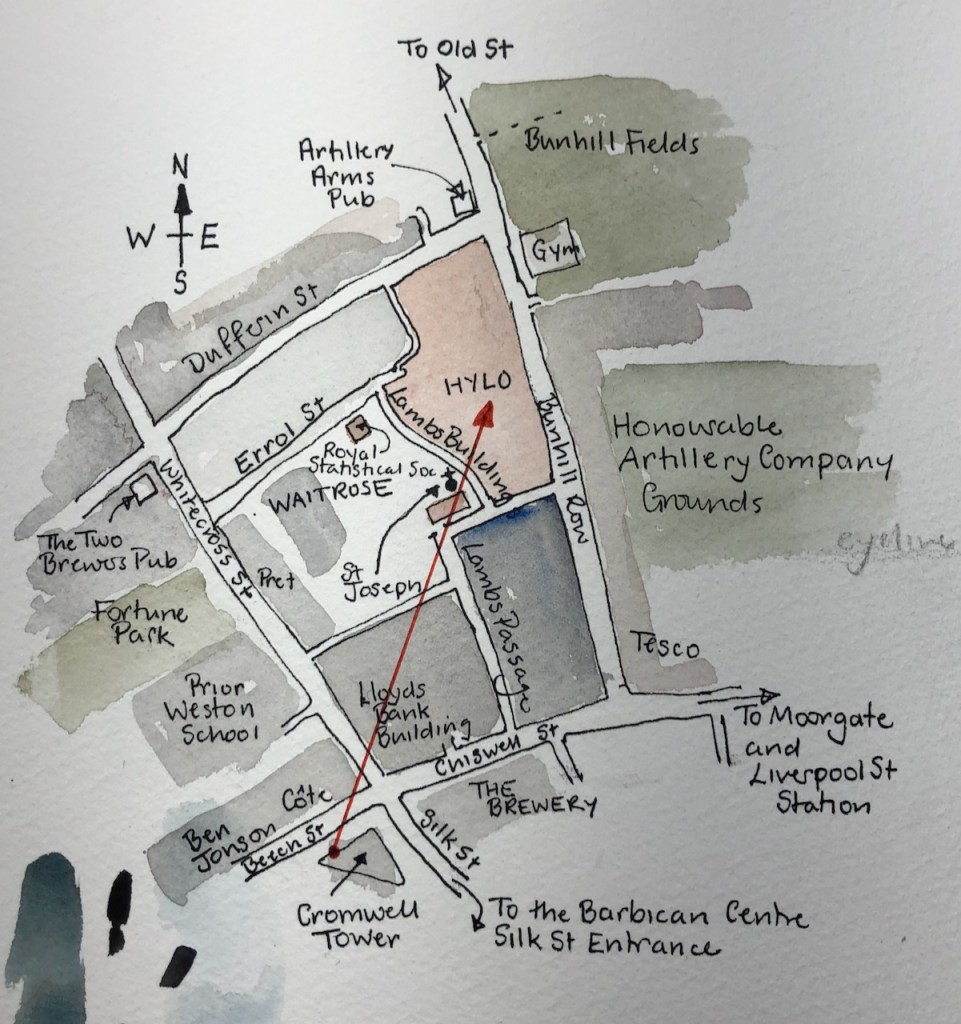
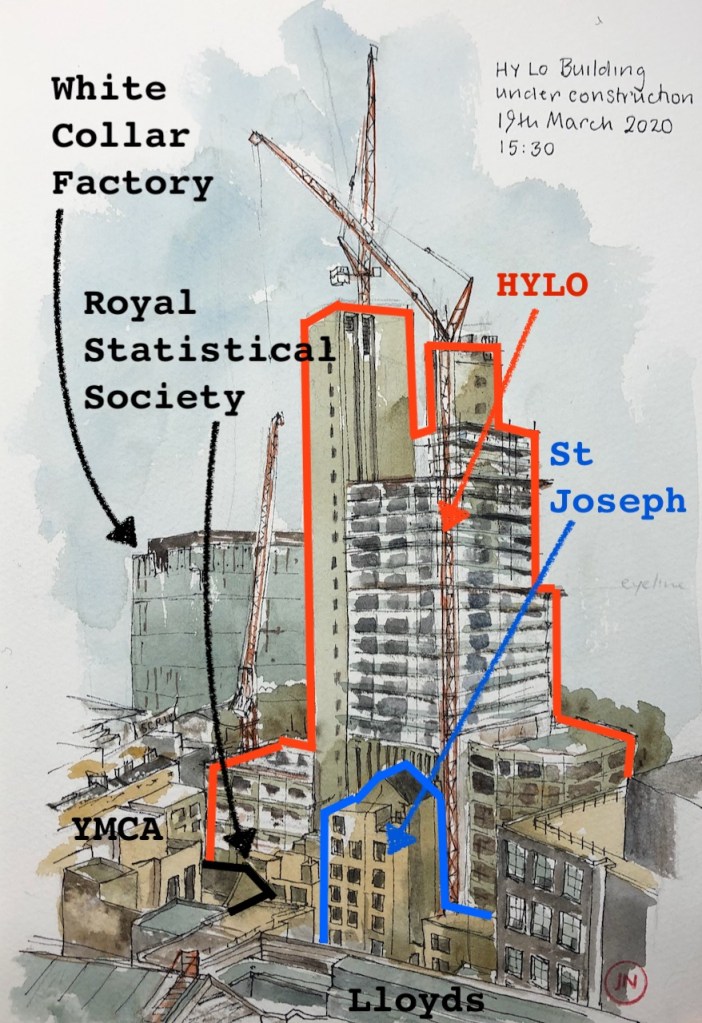
The drawing also shows buildings associated with St Joseph’s Catholic Church, these are in front of HYLO, and dwarfed by it. The cube behind HYLO on the left is “White Collar Factory” and mixed-use office space on Old Street Roundabout. Offices on Lambs Passage are on the right. In the front, at the bottom of the drawing, are the extensive air conditioning ducts and roof apparatus on a building of Lloyds Bank. On the lower left is a YMCA, being rebuilt as accommodation for young homeless people. Here’s a map and an annotated drawing.

HYLO is on the site of the former Finsbury Tower. Here is what it looked like before:

Finsbury Tower 3rd August 2016
Finsbury Tower on Bunhill Row above Peabody Estate buildings. Finsbury Tower was a 1960s office building now undergoing extensive renovation. According to the planning application, the renovation will add 12 storeys to the existing 16, doubling the building’s height. 

Here are some other drawings in this area:

Lamb’s Buildings EC1

St Joseph’s Bunhill Row on right. From the church notice board: “A small chapel in the basement of a former school 1901”. Contains windows from St Mary Moorfields 1820. Remodelled 1993 by Anthony Delarue “in a vaguely Florentine Renaissance manner”. The crib is there until Feb 2nd, and the church is open Fridays 12noon to…

YMCA site, Errol St EC1

This site is a few minutes walk from where I live. There will be a “new home for young homeless Londoners”. “146 beds, 10 000 lives, 60 years”, says the text on the hoarding. There will be 146 en-suite rooms, an “affordable gym for the whole community” and a “social enterprise unit”. You can see…

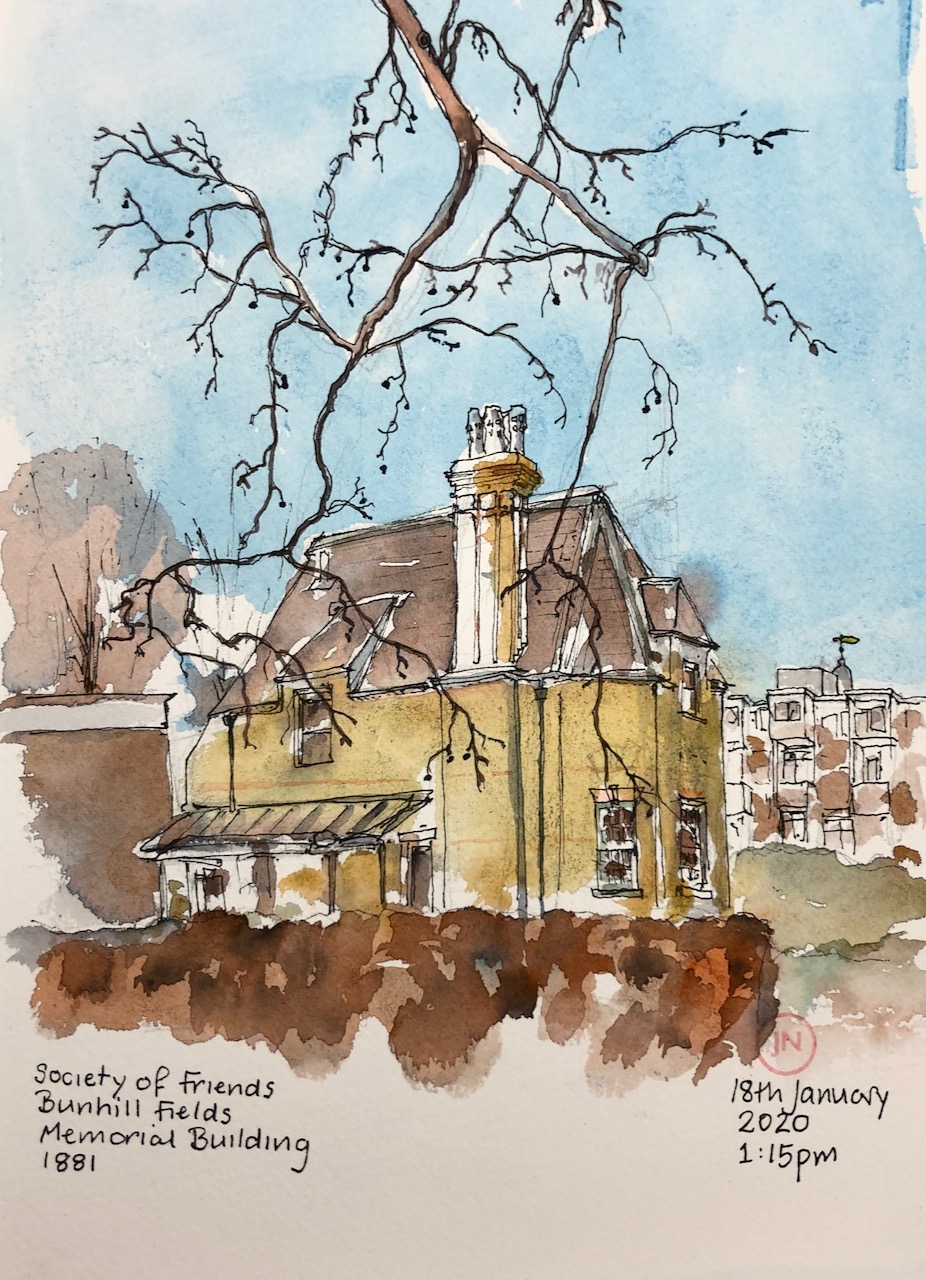
Bunhill Fields Memorial Buildings

This small building stands peacefully in a garden, surrounded by later developments. It is the local Quaker Meeting House.

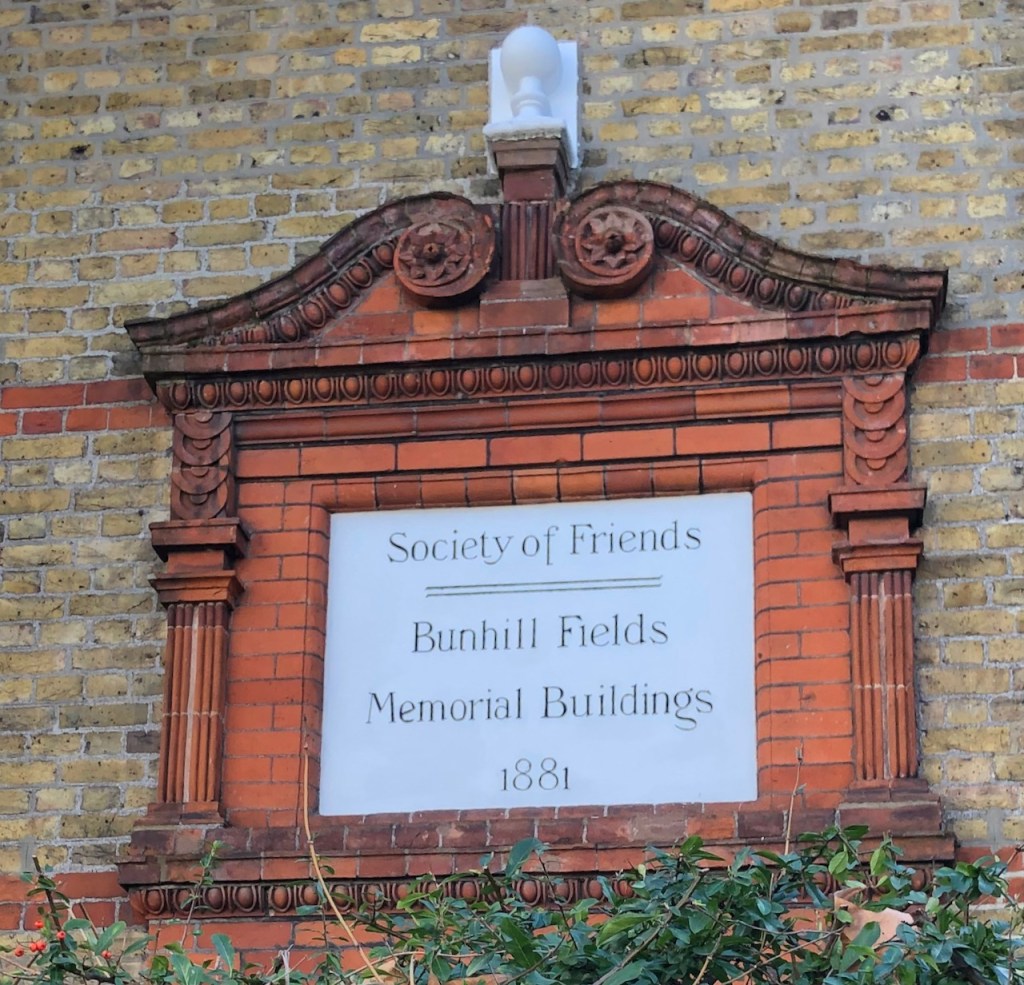
According to the very interesting leaflet produced by the Bunhill Quakers, the current building is the sole remnant of a once large establishment, the Memorial Buildings, completed 1881. These Memorial Buildings housed “a coffee Tavern, mission rooms for the adult schools and breakfast meetings, Sunday schools, a medical mission, and a large meeting house”. The construction was funded by money obtained when the Metropolitan Board of Works wanted to widen Roscoe Street, and purchased land owned by the Quakers to do so. Roscoe Street was then called Coleman Street. “The success of the Adult School brought in funds for the erection of an Extension building in 1888”, they write. 300-400 people attended the meeting in those days.

Bombing raids in 1940, ’41, and ’44 destroyed “all but the caretakers’ house”, and the council “re-zoned” the area to “allow only residential building”. Friends Meetings continued, however, and still continue, in the former Caretakers’ House, which is the building I have drawn. As well as the Quaker Meetings, it is the centre for a travelling library. A small notice by the door says that this is the drop-in centre for an organisation called “At Ease” which provides a “Free, independent and confidential advisory service for people in the Armed Forces.”

The leaflet from the Bunhill Quakers is on their website and also here:

I made the drawing from the Quaker Garden on the site of the Bunhill Fields Burial Ground.

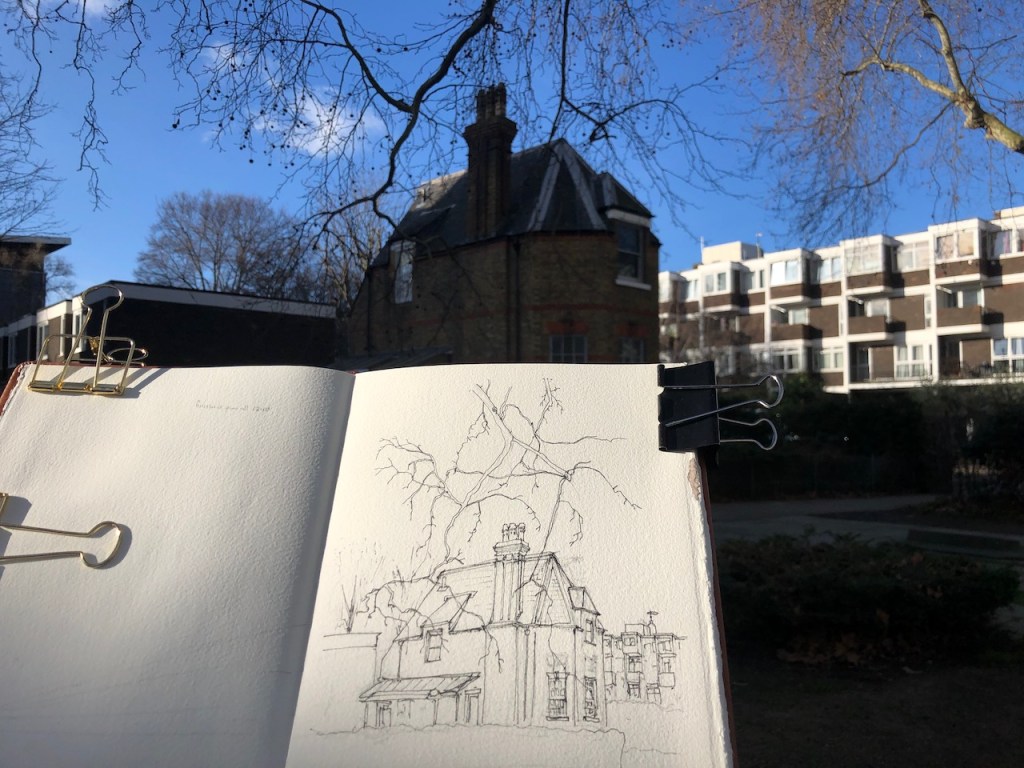
The drawing took about 1 hour 30mins. The sky is a new colour: Phthalocyanine Turquoise, a Winsor and Newton colour, pigment PB16. Other colours are Perinone Orange, and Mars Yellow, both Daniel Smith Watercolours. Here is work in progress:

The air temperature was 5 degrees C. That blue sky was not a “warm blue” whatever the photos seem to say.

Islington Square

On a shopping expedition in Islington, I made a diversion through the new development: “Islington Square”, opposite St Mary’s Church. It’s not a square, more of a passage, a covered road, very high. Lots of huge empty windows wait like empty stages for the retail theatre to begin. At the end is an open-air space, also not a square, more of a rectangle. Here is a grand kitchen equipment shop, where you can buy a saucepan in copper, or other high-grade metal such as stainless steel. Then looking back towards the passage, I made a sketch:IMG_0493

This was a very quick sketch, about 20 minutes (that’s quick, for me). Drawn and coloured sitting on one of the benches near the kitchen shop.

As I was finishing a man emerged from the passage and announced “We have our first artist!”. He meant me. Other men followed. I asked him if he lived here, as I was interested in the flats I had been drawing. He said no, he was the Manager of the Development. I said I appreciated the fine wooden bench, which was placed in a good position for drawing. He looked at my drawing and said I should come back in different seasons – and put on a show! Good idea.

He was a busy person and walked off. One of the other men came up and very kindly offered to fetch me a cup of tea or coffee. I was just packing up though, and so declined. It was nice of him.

“Islington Square, just an eight-minute walk to Angel Underground Station, offers 263 new homes and 108 serviced apartments at a maximum height of just eight floors, fusing Edwardian grandeur and contemporary style. The build will be complemented by 170,000 square feet of retail, dining and leisure amenities including a luxury Odeon cinema and a premium Third Space gym.” (Olivier Heath, writing in “House Beautiful” April 11th 2019)

The new development is around and about the former postal sorting office, which has been empty for some time. The dates I could see in the brickwork said “1905”. The new buildings are curved, as you see in my sketch, and one group is covered in purple tiles. I thought it looked good. At least they haven’t just imitated the Victorian architecture, but courageously added something decidedly 21st Century.


Coal Drops Yard N1C from the Skip Garden

Here is the view from high up in the marvellous Skip Garden at Kings Cross. Coal Drops Yard roofs are in the background, behind the crane.

IMG_2061

I did this picture with just three colours: cobalt blue, yellow ochre, and alizarin crimson. The yellow ochre and cobalt blue refused to make green. They made grey.

Here is the picture under construction.

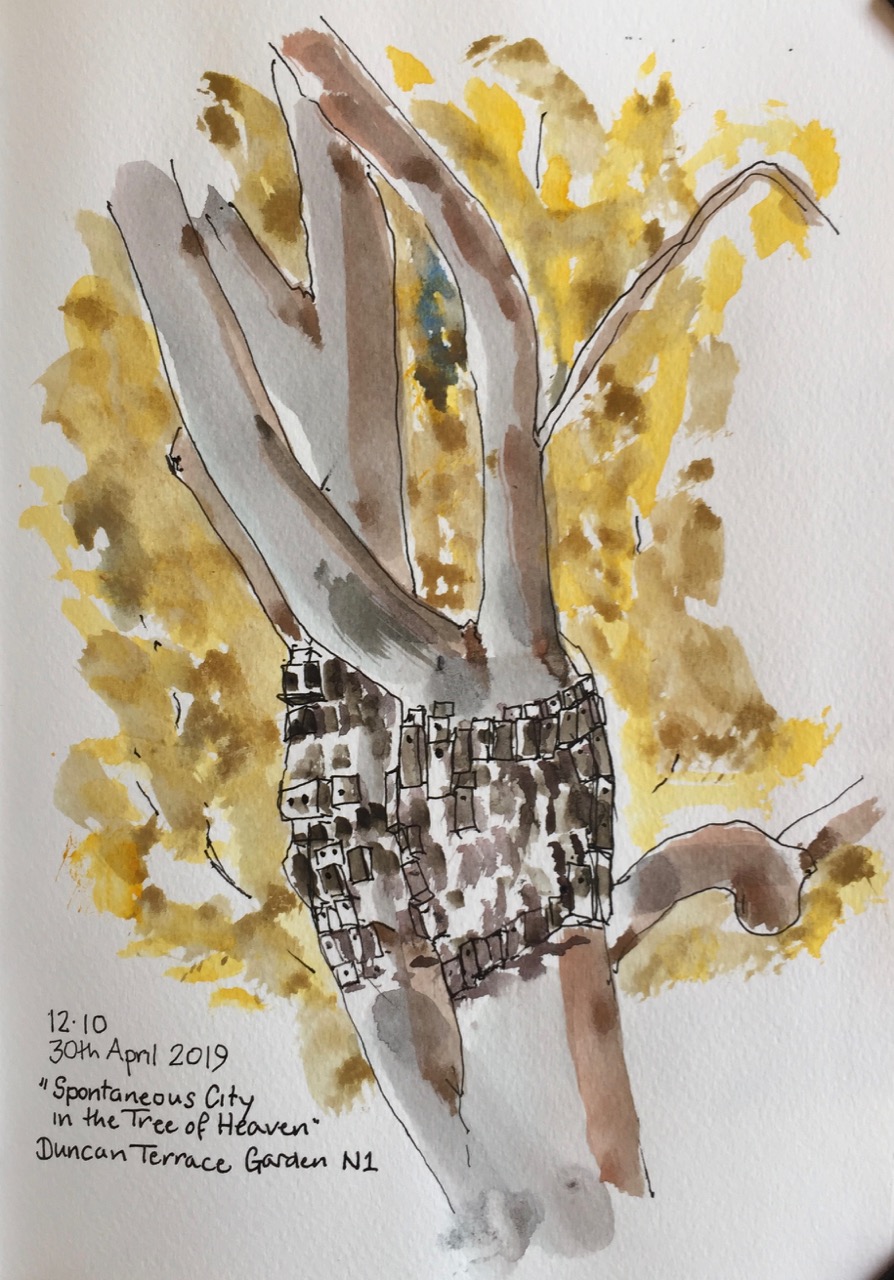
IMG_2060On the way to Kings Cross I passed through Duncan Terrace Gardens, in Islington, where there is an extraordinary “bird hotel” in one of the gigantic trees. It was made by “London Field Works” and consists of 300 specially made bird boxes, all different sizes, fitted round the tree.

A nearby notice assured me: “The method of installation has been designed in close consultation with the Forestry Commission and the borough’s ecology dept to enable the tree to continue to grow and expand.”

Old Street Roundabout: Adeyfield House

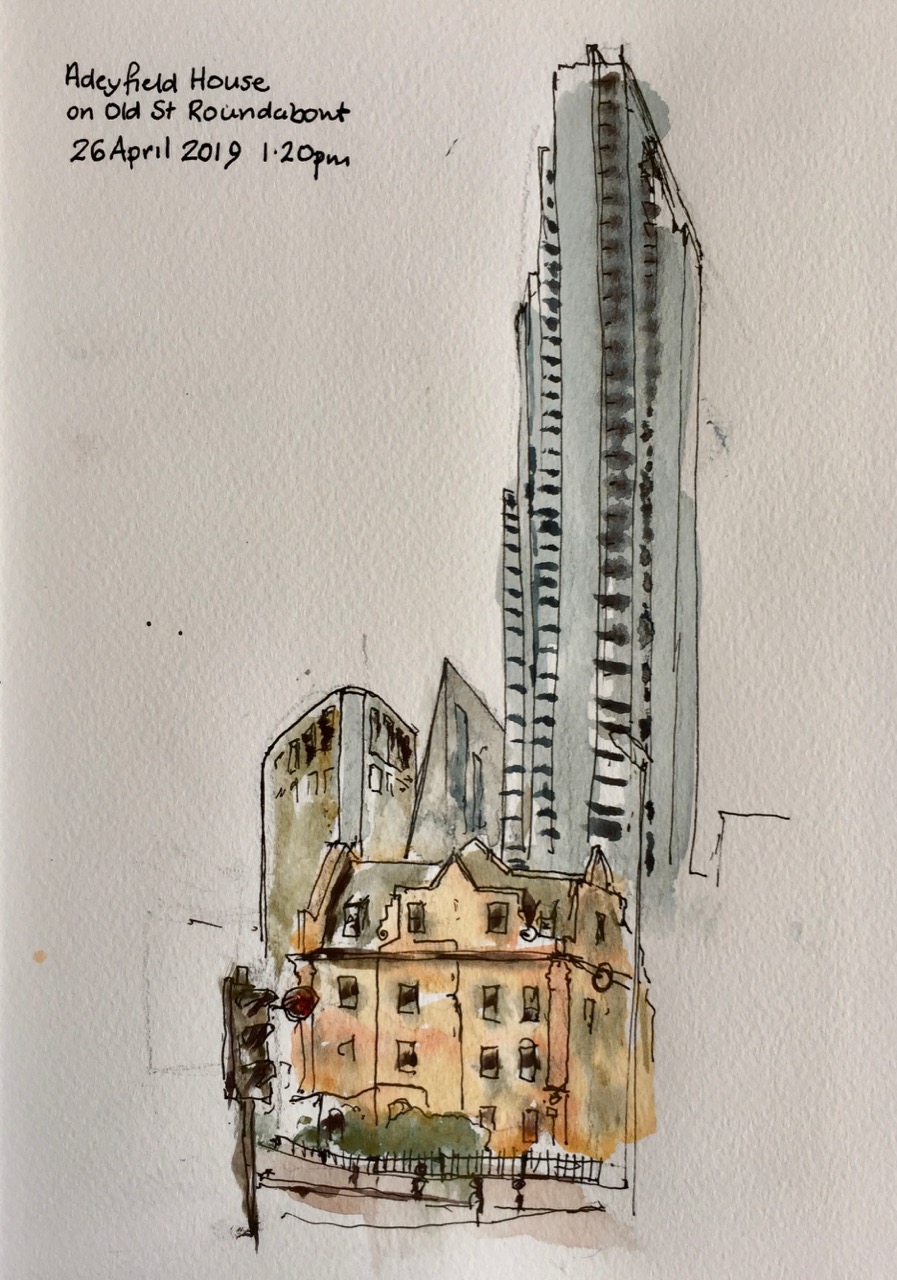
I saw this redbrick building on the Old Street Roundabout.

Above it are the huge developments on City Road. From left to right they are Eagle Point, M by Montcalm, and the Atlas Building.

Adeyfield House is residential, part of the Sutton Estate, managed by Islington Council.

IMG_2009

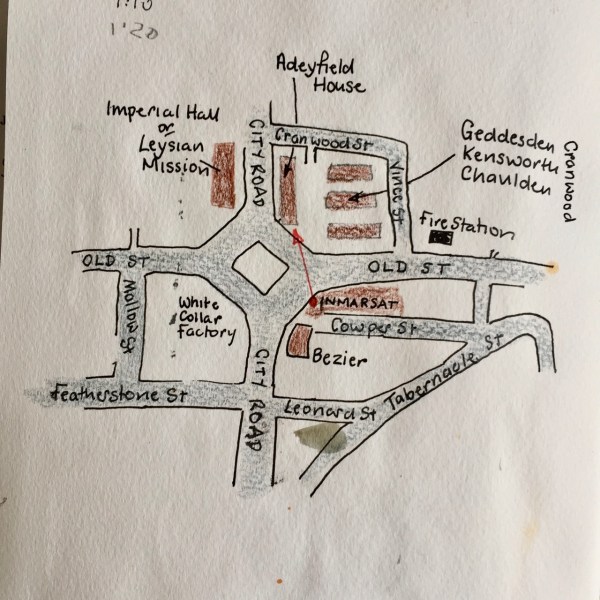
The Old Street roundabout was sometimes called “silicon roundabout” because of the high-tech start-ups in the surrounding area. I haven’t heard that term used for a while though. There are certainly many incubator-type office blocks. One is called “White Collar Factory” and was near to where I was standing outside Inmarsat. Inmarsat is a satellite data company.

IMG_2010

Old Street roundabout is about to be re-configured to make it more agreeable for pedestrians and cyclists. At the moment it is noisy, polluted, dangerous to cyclists and difficult to navigate on foot.

Huge numbers of pedestrians passed by me on the pavement, talking of investments, employment opportunities, stock options, and where to go for lunch.