Sutton Arms, Great Sutton St, EC1

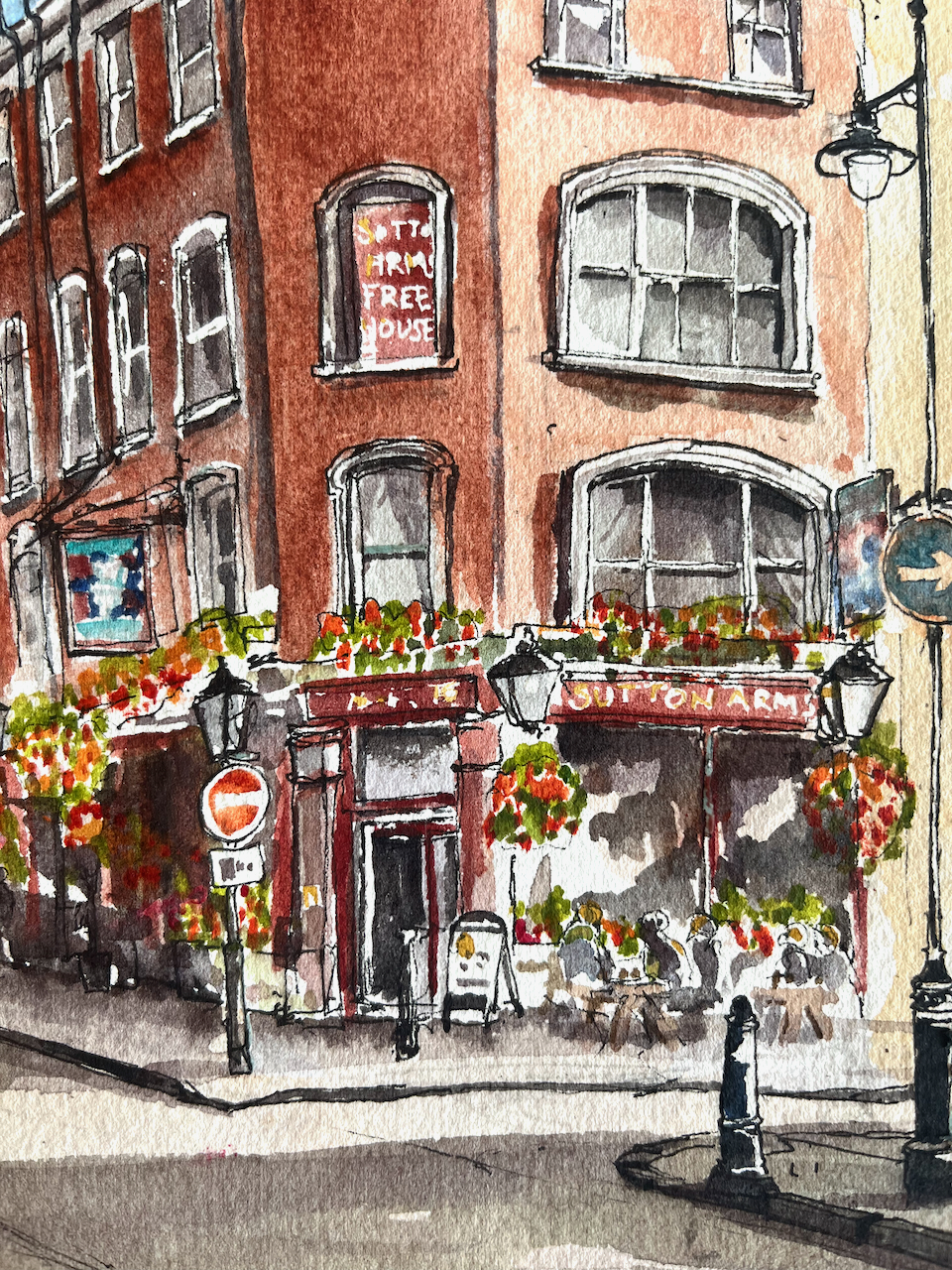
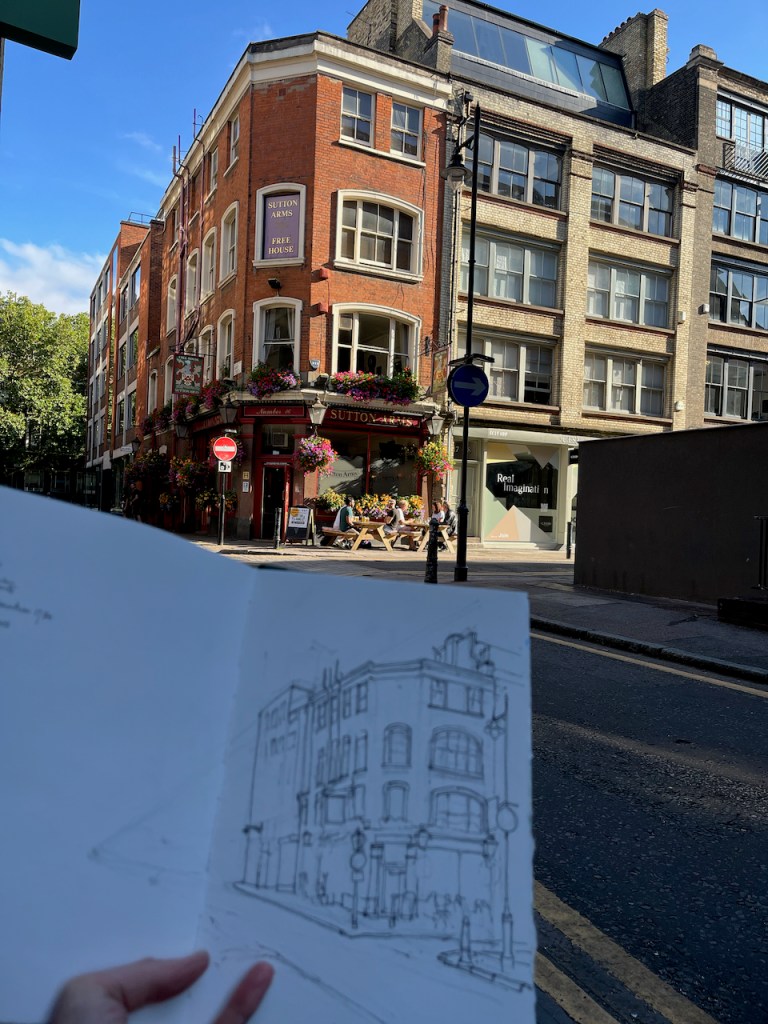
This is the Sutton Arms in Clerkenwell, 16 Great Sutton Street, EC1.

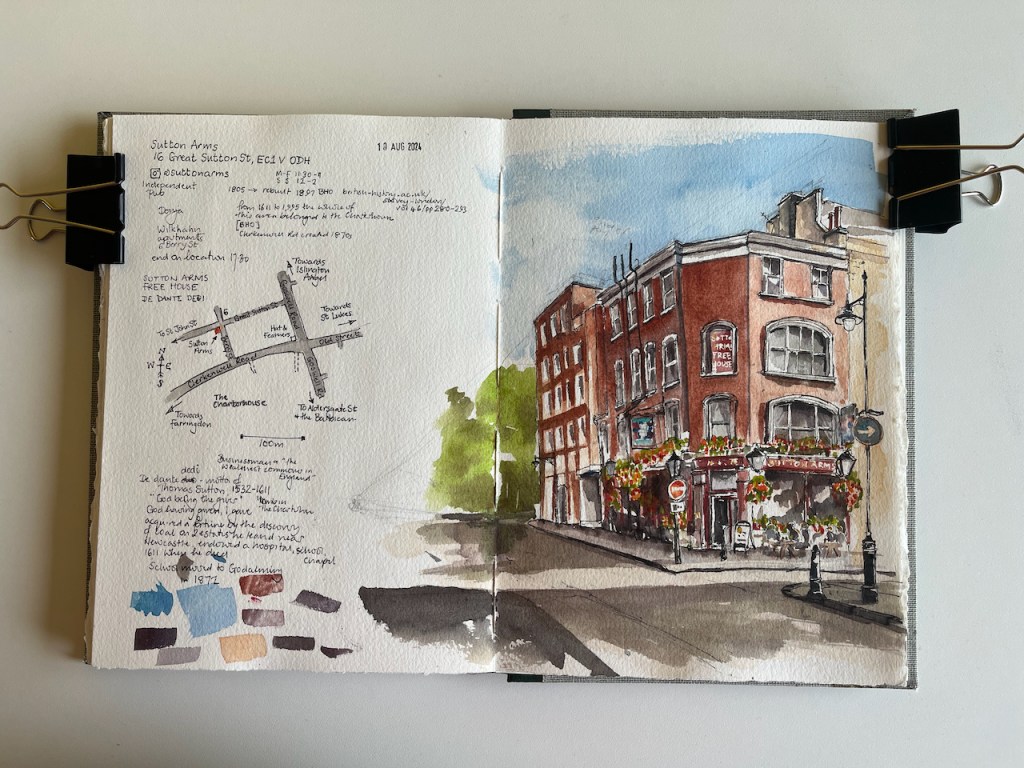
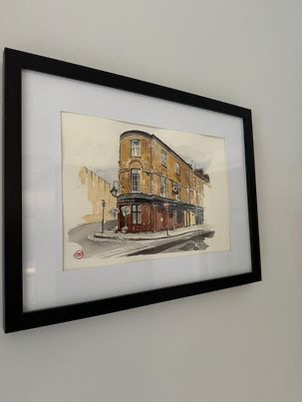
Sutton Arms, 16 Great Sutton Street, EC1V 0DH, sketched 10 August 2024 in Sketchbook 14

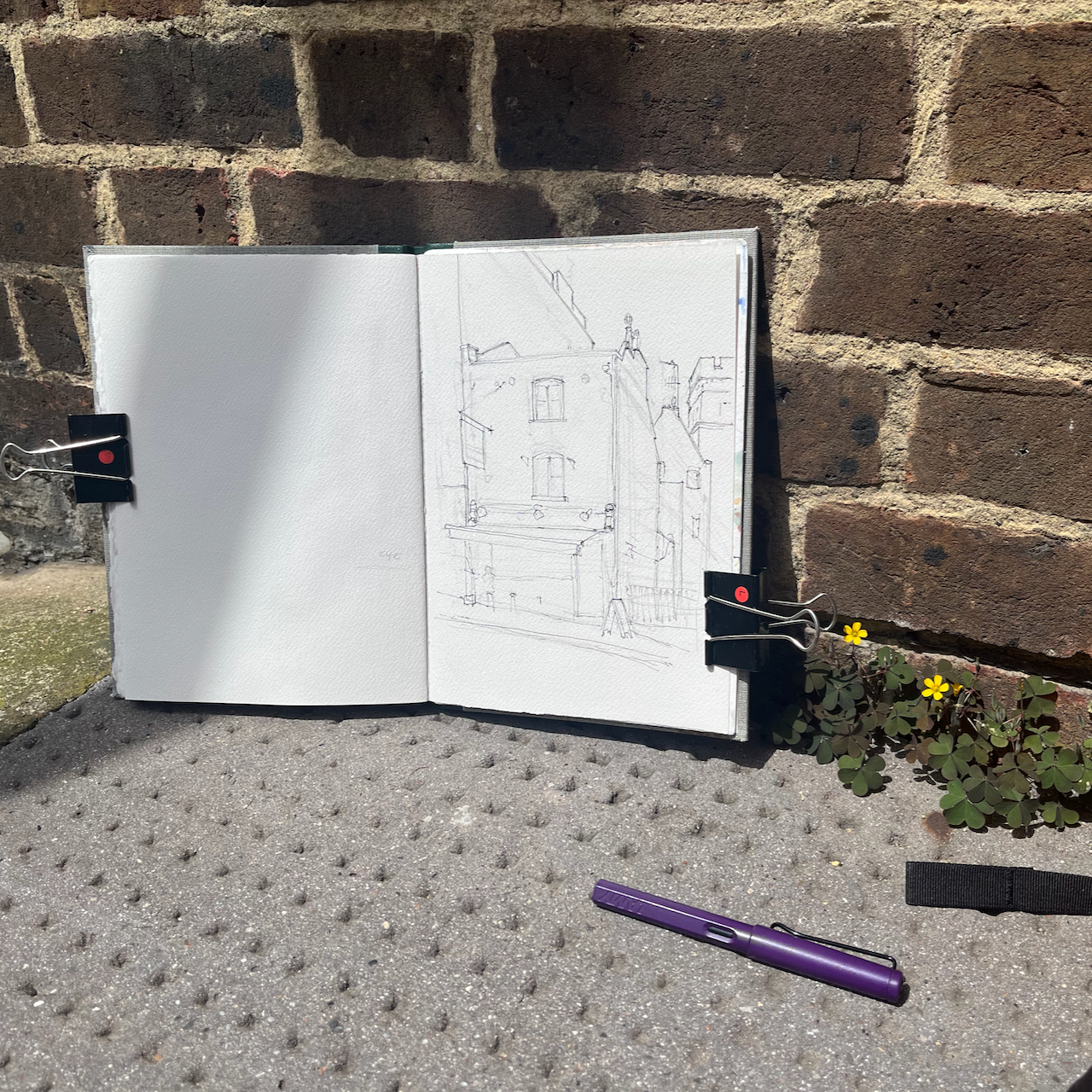
I sketched it towards the end of a sunny afternoon in August, sitting on steps outside number 6 Berry Street. As you see, the sun streamed in from the west. The trees in the distance, on the left of the drawing, are on Clerkenwell Road. Behind them is The Charterhouse, fulfilling its ancient tradition as an arms house and sanctuary for the elderly and frail.
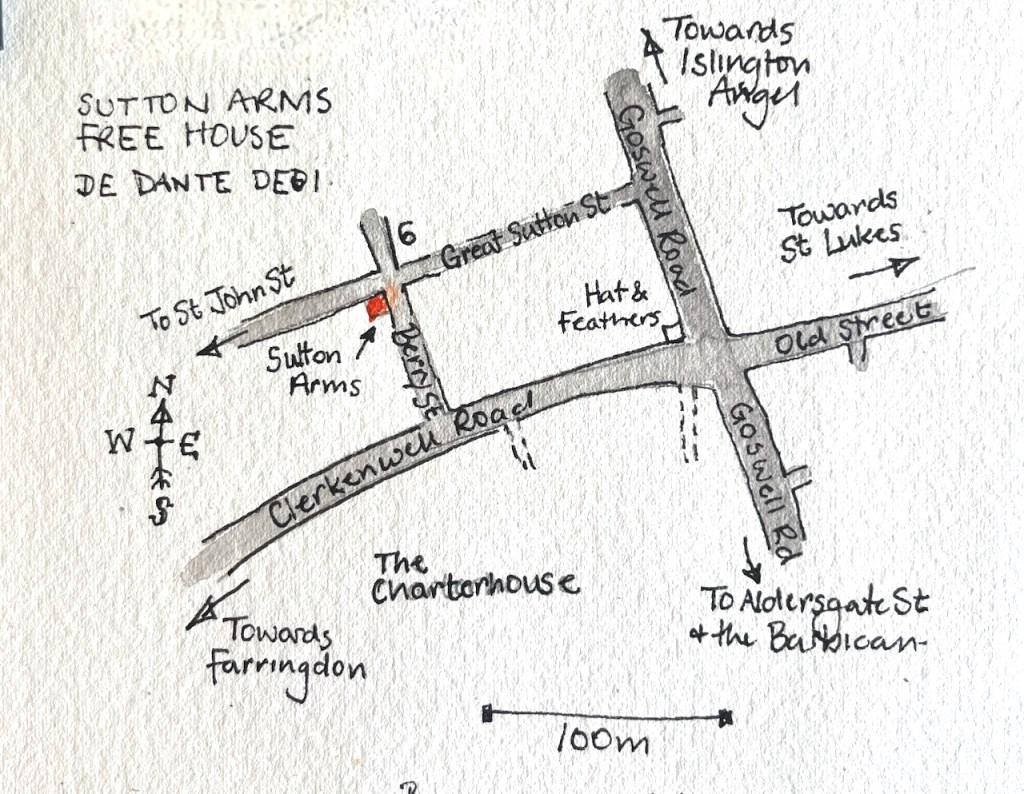
From 1611 to 1995, The Charterhouse owned the whole of this area.
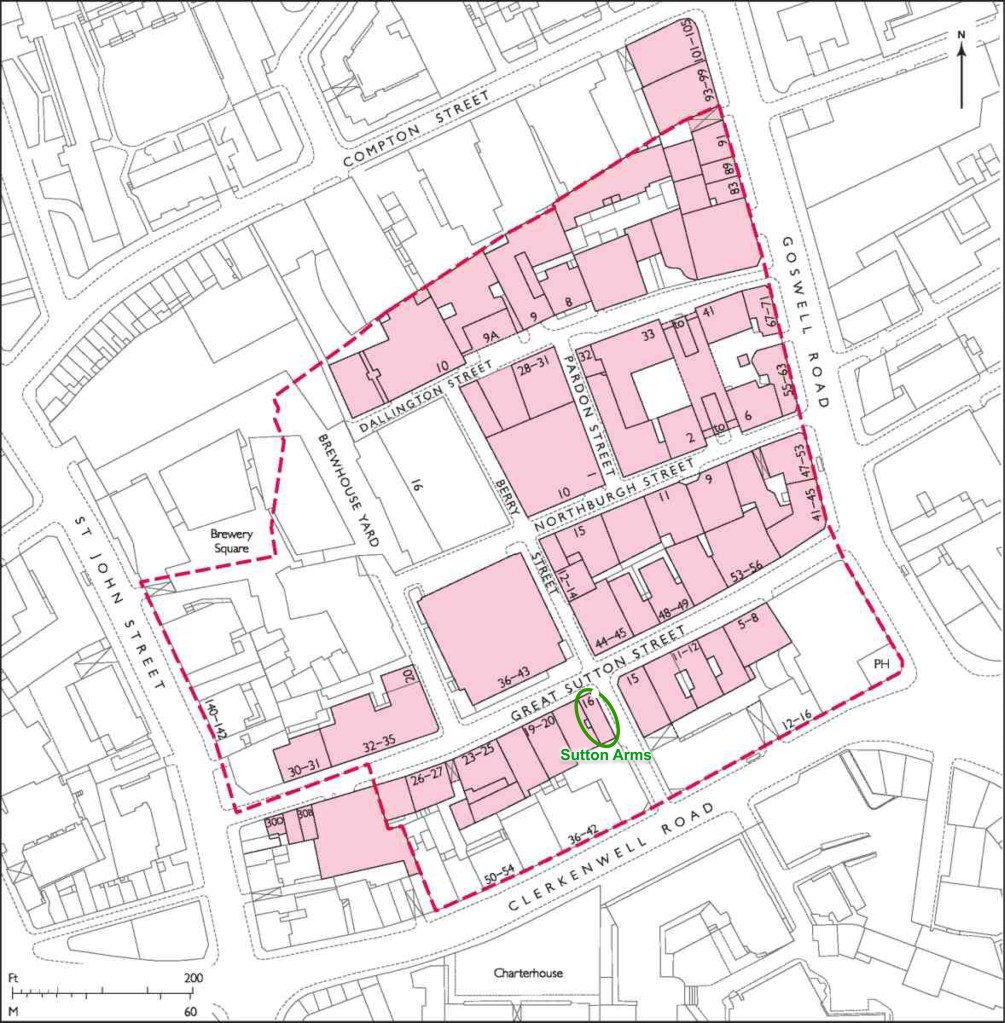
Great Sutton Street area. The broken red line indicates the extent of the former Charterhouse estate. Image from British History Online [reference 2] annotated.

The Charterhouse sold this land in 1995. A developer bought up the land and built factories and warehouses. In the 21st century a new wave of developers transformed former warehouse blocks into apartments and offices. I sketched sitting outside one such: 6 Berry Street is residential apartments. This is now an area for architects and interior designers.
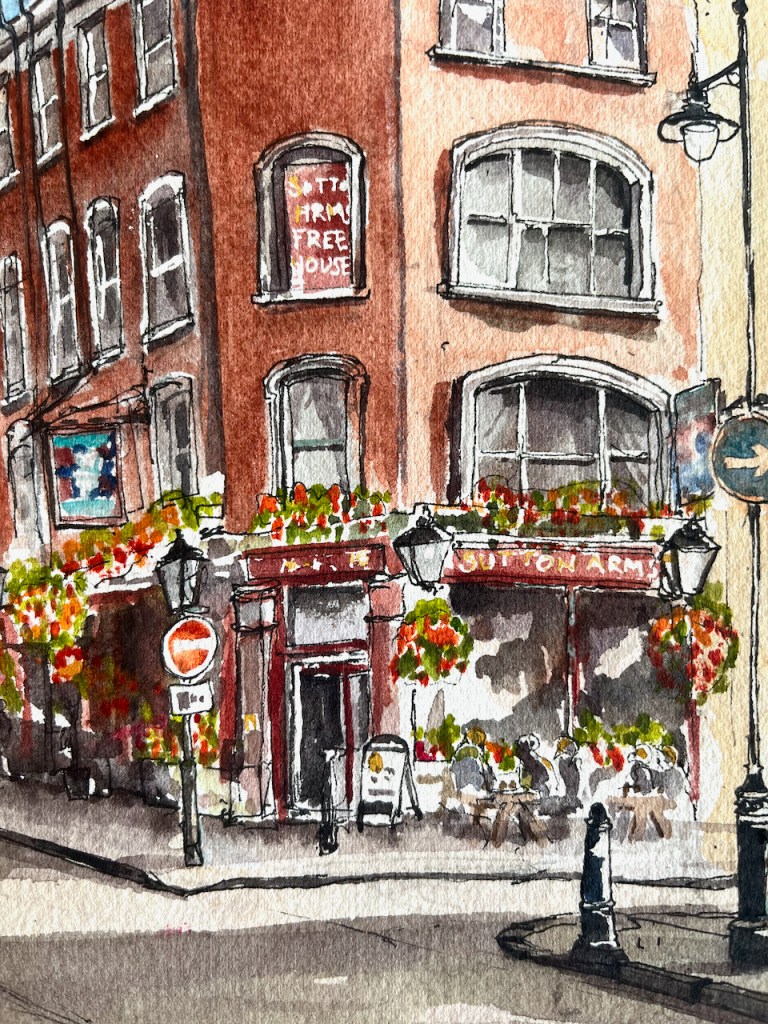
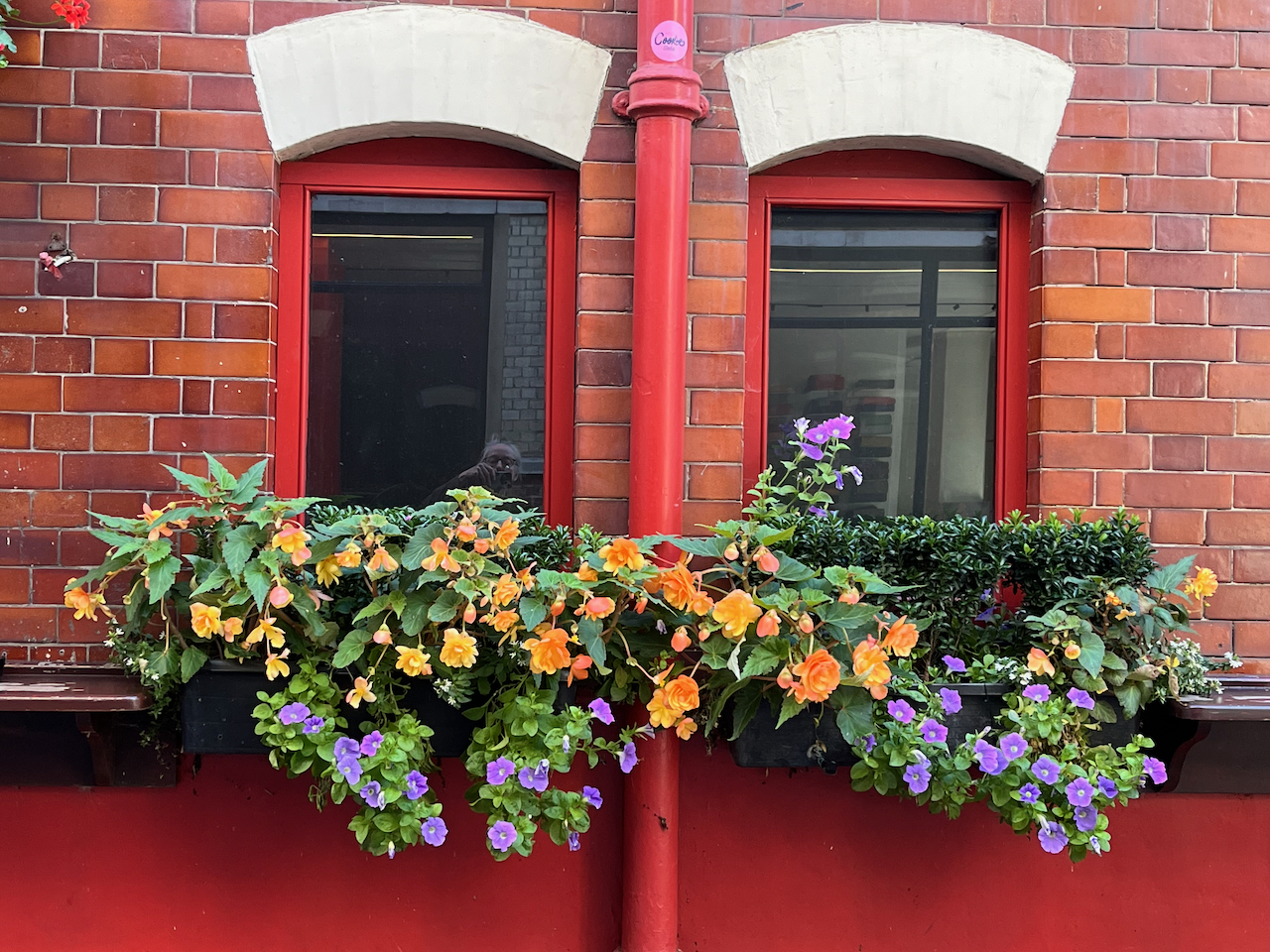
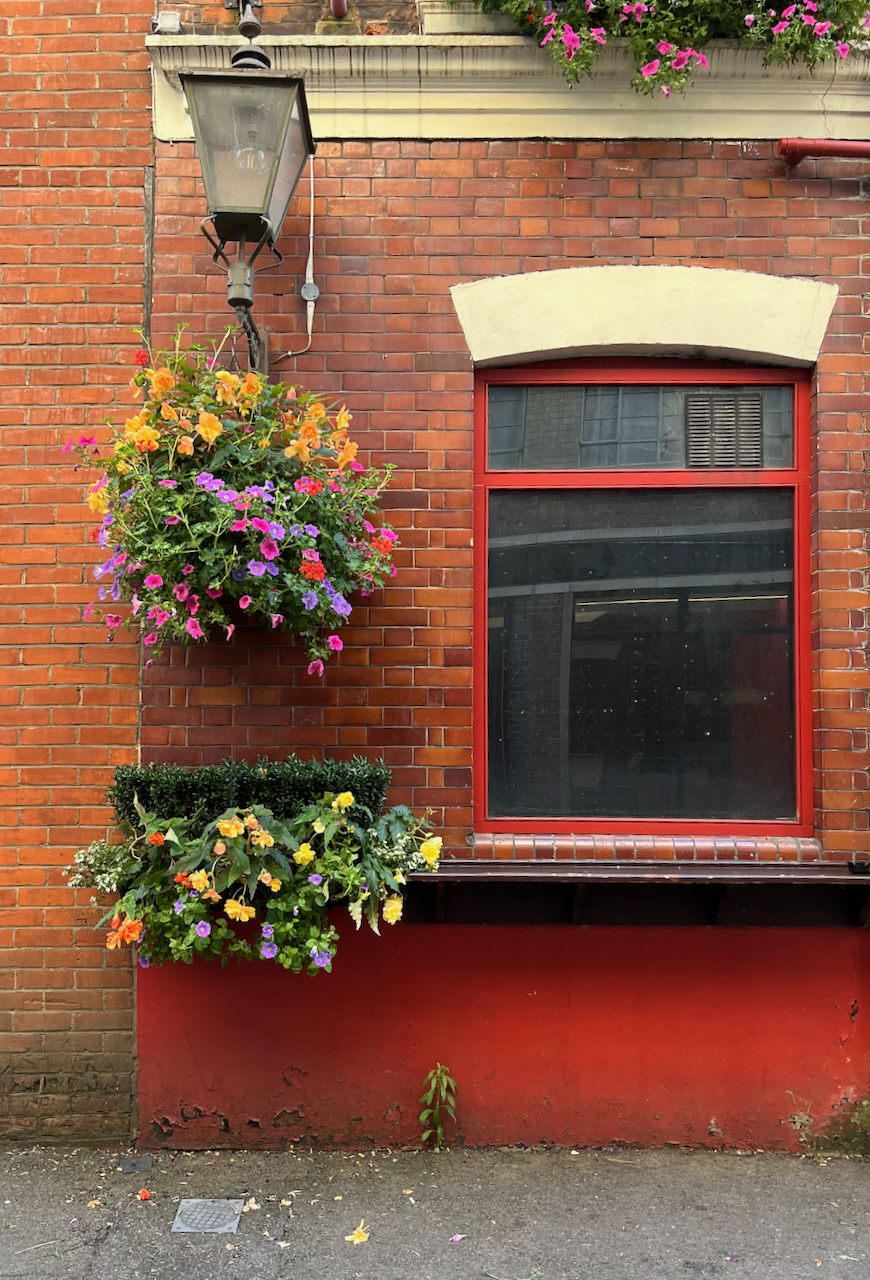
There was a pub here by 1825 [1]. It was rebuilt in 1897 [2]. It’s now a Free House. It’s clearly well looked after and well patronised. Definitely to be visited! The flowers are spectacular.
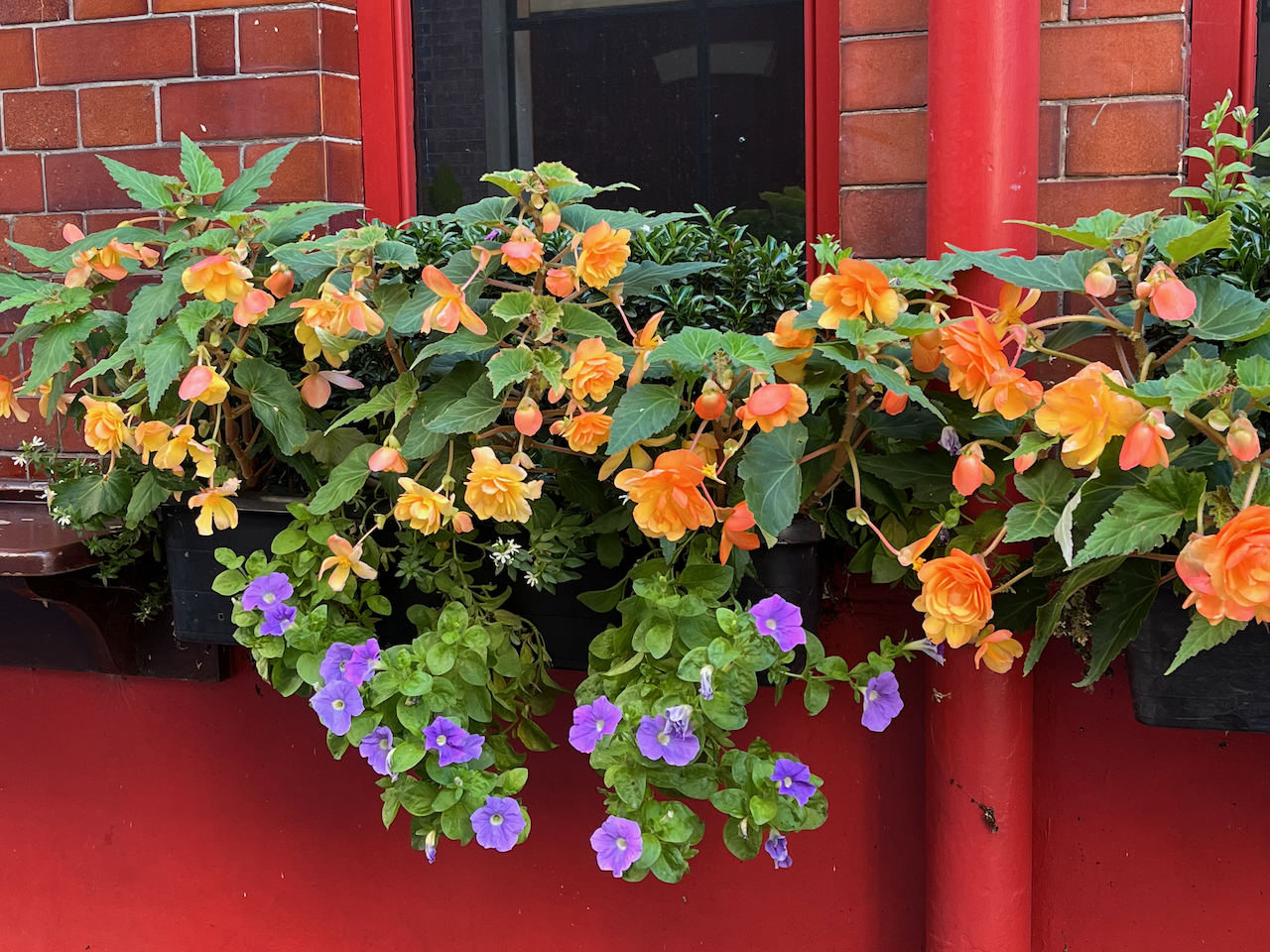
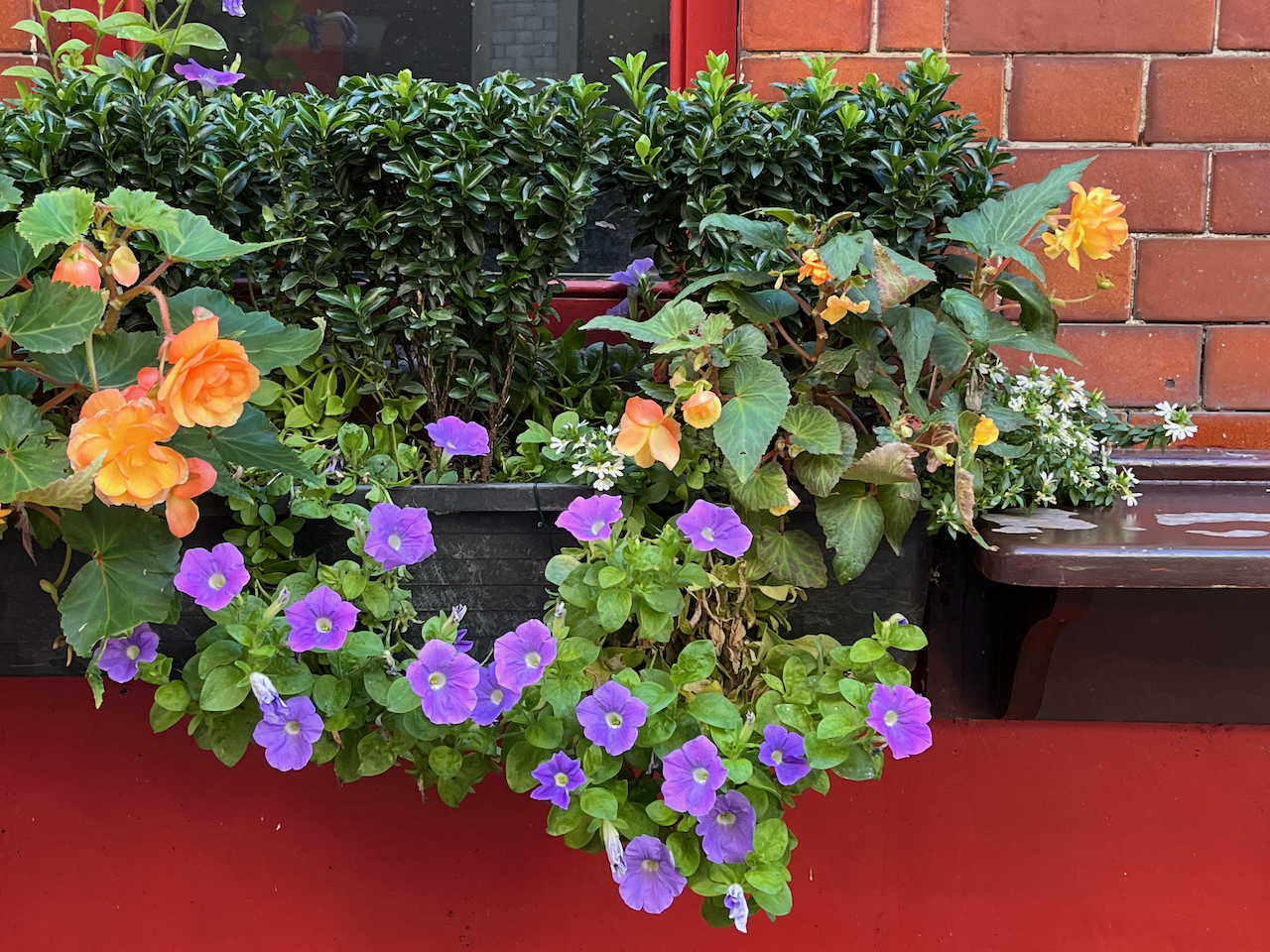
Thomas Sutton (1532-1611) was the founder of the Charterhouse, hence the name of the road and the name of the pub. This is the Sutton Arms in Clerkenwell, north of The Charterhouse. There is also a Sutton Arms south of The Charterhouse, in Carthusian Street, near Barbican tube.

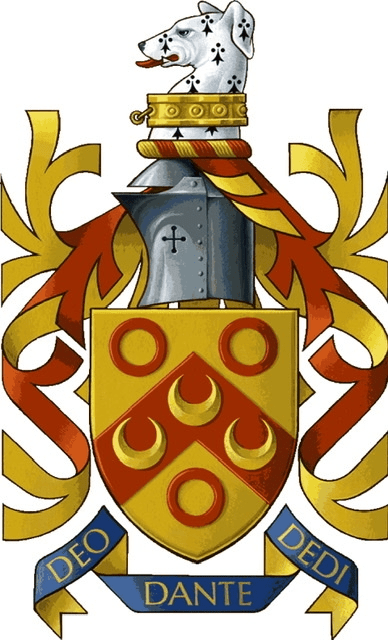
The pub sign is Sutton’s coat of arms. His motto is:

DEO DANTE DEDI

The translation is “God having given, I give”, or
“As God has given to me, so I give in my turn”,
a good motto for the benefactor that he was. The pub sign misses off the “O” in DEO and the “I” in DEDI.
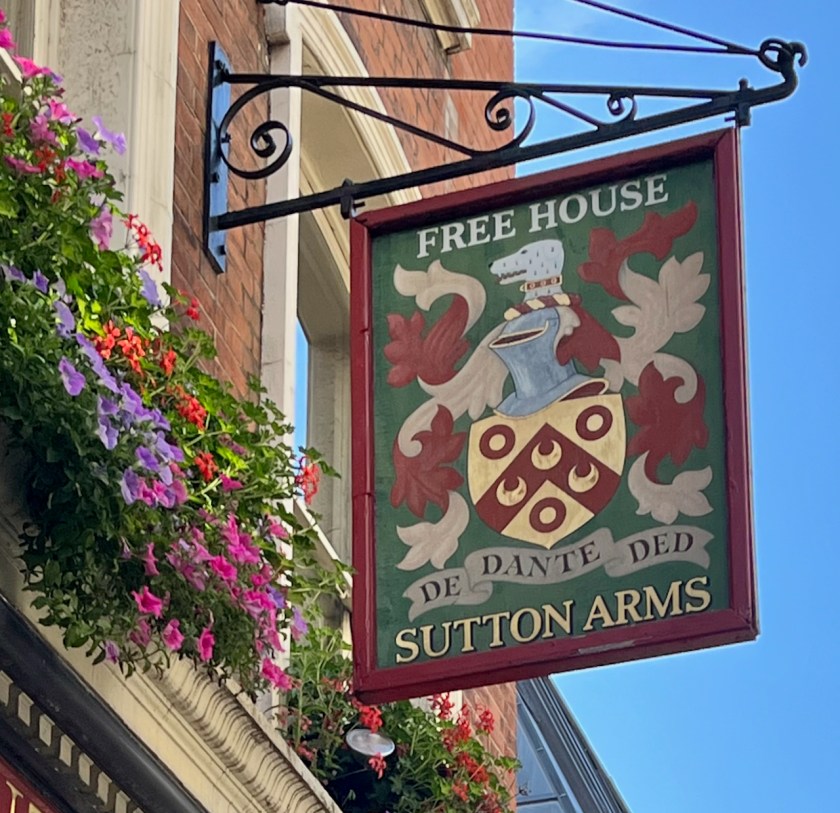
Sutton Arms pub sign: “DE[o] DANTE DED[i]”
Thomas Sutton’s Coat of Arms. See the greyhound. Source: Charterhouse School on Wikipedia

The “Survey of London ” [2] gives a detailed history of this area, which has alternately flourished and decayed over the centuries. It is currently flourishing.

I completed the ink on location and finished the colour at my desk. The colours are:

  • Fired Gold Ochre (bricks)
  • Ultramarine Blue and Phthalo Blu (Green shade) (sky)
  • Serpentine Genuine (trees)
  • Mars Yellow (road and bricks)
  • Ultramarine Blue plus Burnt Umber (blacks and greys)
  • Transparent Pyrrole Orange (flowers, street signs)
The changing fortunes of the Great Sutton Street area.


In the 14th century this area was fields, owned by a Carthusian Priory. There was a mortuary chapel, called “Pardon Chapel” for saying the last rites for criminals and suicides.
Henry VIII eradicated the Carthusian Priory in 1538 (“Dissolution of the Monasteries”) and it passed into private hands, along with the land. It became known at “The Charterhouse”.
Thomas Sutton, a wealthy businessman, bought the Charterhouse in 1611. He died that year. His will provided for the hospital and almshouse that are still there. The Charterhouse leased the land outside its walls to developers, who built houses.
“By 1687, when the Charterhouse estate was thoroughly mapped by William Mar, almost the whole had been laid out in streets of small terrace houses—242 houses in all, with yards, gardens and sheds.” [2] These terraces set the street pattern for the small streets that are there today. The lattice continued to the walls of The Charterhouse. Clerkenwell Road was cut through much later, in the 1870s.
Then commerce moved in and a hundred years passed. By the 1700s, the area was a mix of residences and industries: “In 1731 Philip Humphreys, the Charterhouse gardener [..]complained of the adverse effect on his crops of smoke ‘from so many neighbouring Brewhouses, Distillers and Pipe-makers lately set up’ in the vicinity.” Thus we see that NIMBYism is not a new phenomenon.
A new developer (Pullin) came in and rebuilt, and more and larger factories were built. Again, the neighbours complained: “Already by the 1820s some houses were giving way to further industrial developments, including slaughterhouses, a dye-house, breweries, and vinegar, vitriol and gas works. Complaints were made to the Charterhouse in 1832 about the nuisance of these works and their steam engines, and to the Vestry in the 1850s about the ‘boiling of putrid meat and other offal’ and blood running into the drains.”
Building continued.
Eventually government intervened: “Extensive redevelopment of the Charterhouse estate followed remarks in 1884–5 by the Royal Commission on the Housing of the Working Classes as to the badness of the houses there. […] Charterhouse was criticized for allowing [..]the incidence of house-farmers, severe overcrowding and badly constructed, poorly ventilated housing to continue on its property. One house in Allen Street was found to be occupied by thirty-eight people, eleven of them in one small room; similar conditions were found in the cottages of Slade’s Place. Many of these properties were occupied by costermongers with ‘very precarious’ earnings (whom the Commission felt would do better ‘if they kept from drink’).[2]”
The Charterhouse governors eventually took action. The small houses were demolished, and replaced by factories and warehouses. This time the trades were less polluting: “Among early occupants were clothing manufacturers: milliners, mantle-makers and collar-makers, leather manufacturers, glove-makers and furriers. The printing trade was also well represented, along with book-binding, engraving and stationery manufacture. Continuing a long-standing tradition were several butchers and tripedressers.” By now we are in the early 1900s.
About a dozen buildings were destroyed by bombing in the 1939-45 conflict, and replaced in the 1950 and 1960s by factories and warehouses.
The Survey of London [2] reports that the area was “considerably run down” in 1995 when the Charterhouse sold it to developers. The developers started a programme of warehouse conversions, to apartments and offices, which transformed the area, and moved it back upmarket. And that’s where we are today.
(The above is my summary of the more detailed description in reference [2])
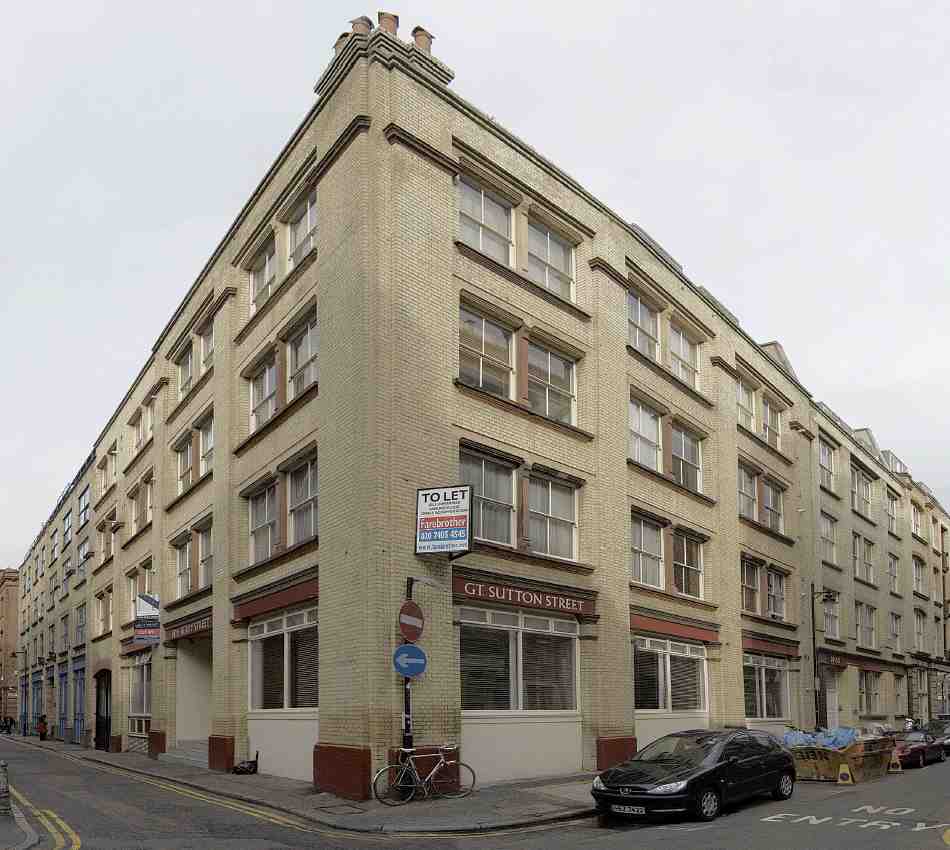
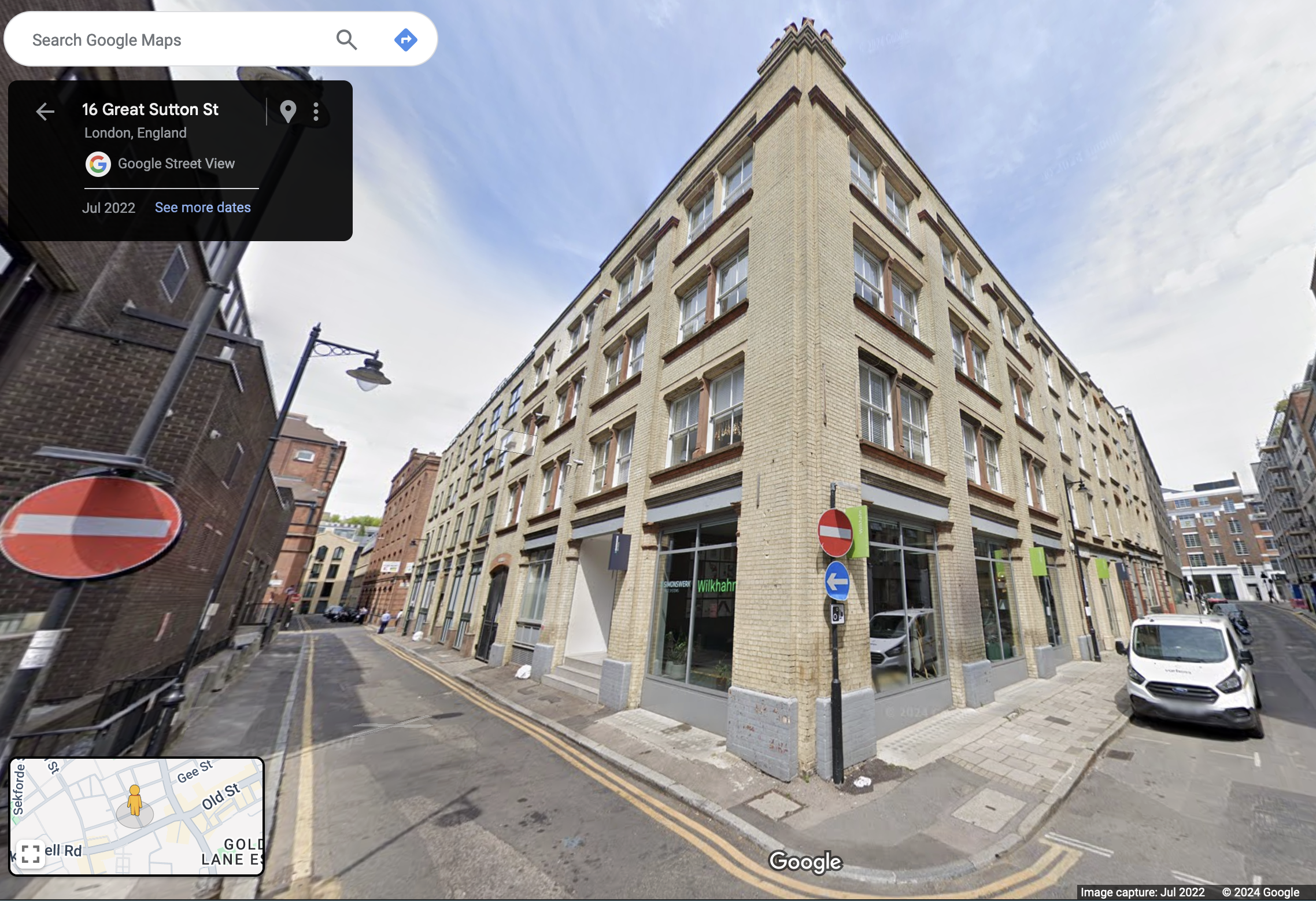
[1] List of licensees in
https://londonwiki.co.uk/LondonPubs/Aldersgate/SuttonArms.shtml
First licensee recorded in their list is 1825.

[2] British History Online: ‘Great Sutton Street area’, in Survey of London: Volume 46, South and East Clerkenwell, ed. Philip Temple( London, 2008), British History Online https://www.british-history.ac.uk/survey-london/vol46/pp280-293 [accessed 2 September 2024].

[3] History of The Charterhouse https://thecharterhouse.org/explore-the-charterhouse/history/
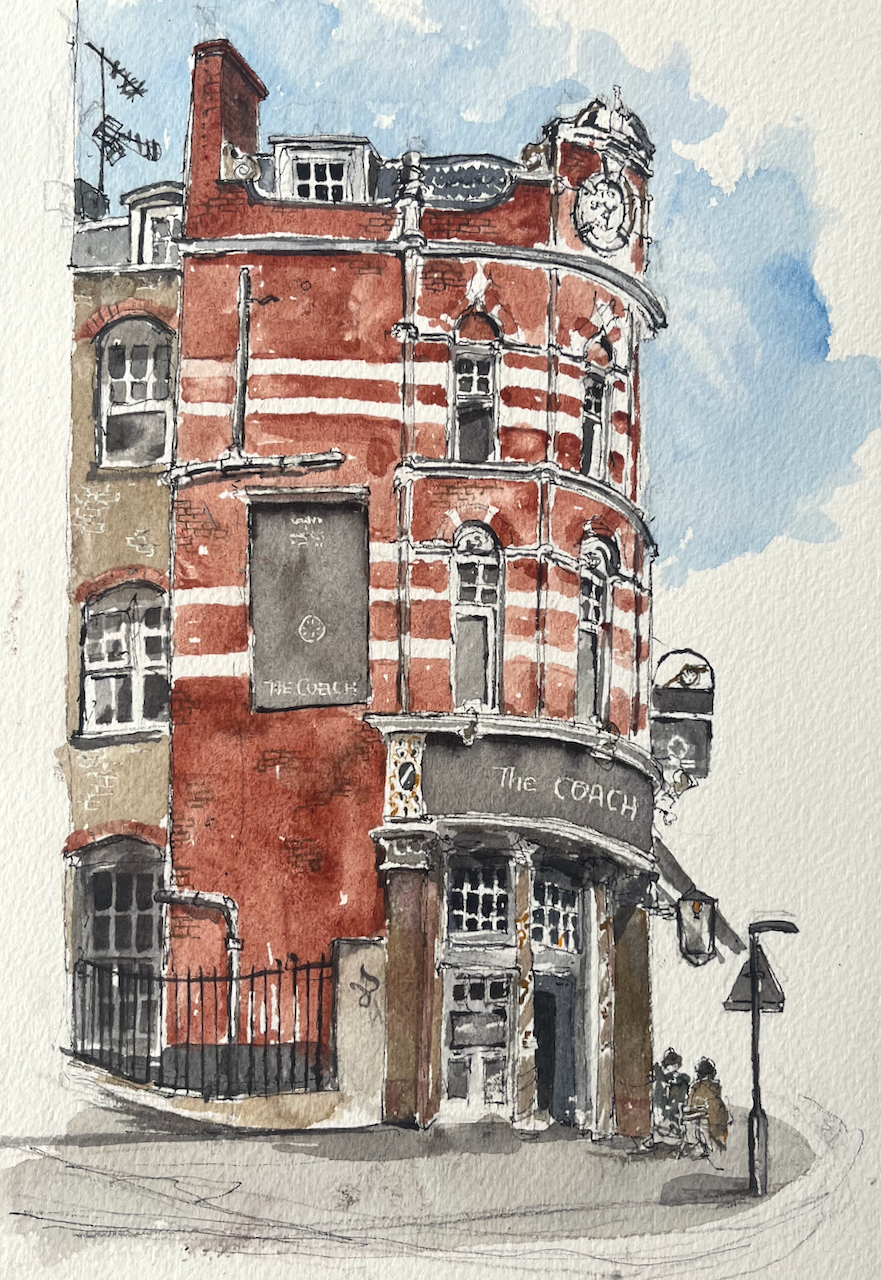
The Coach, Clerkenwell, EC1

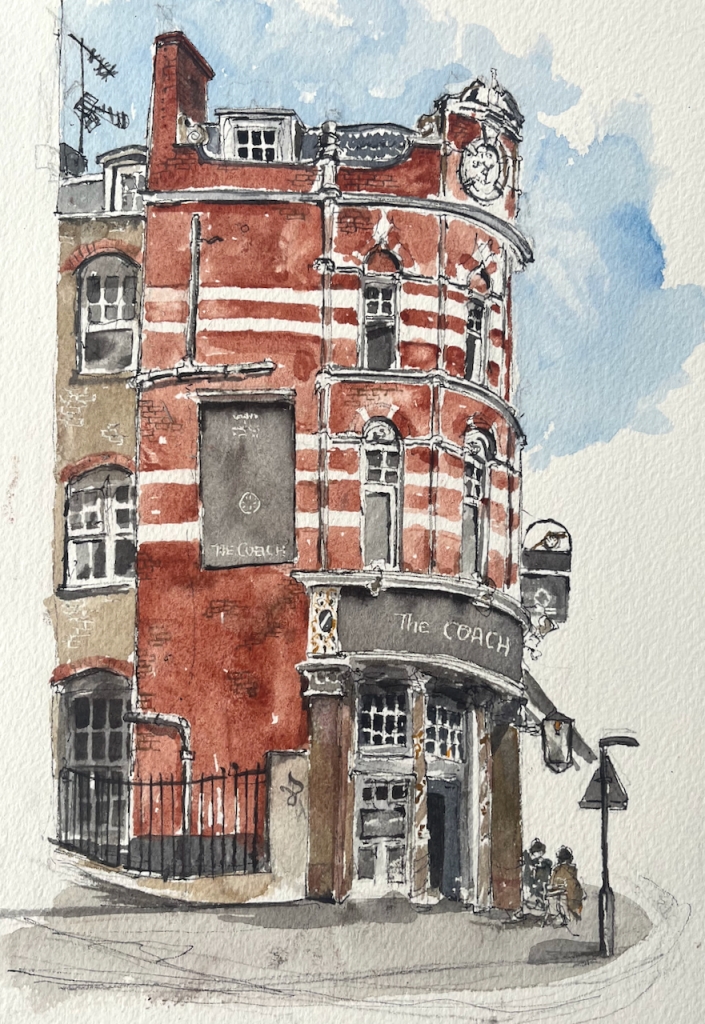
Here is “The Coach” on Ray Street in Clerkenwell.

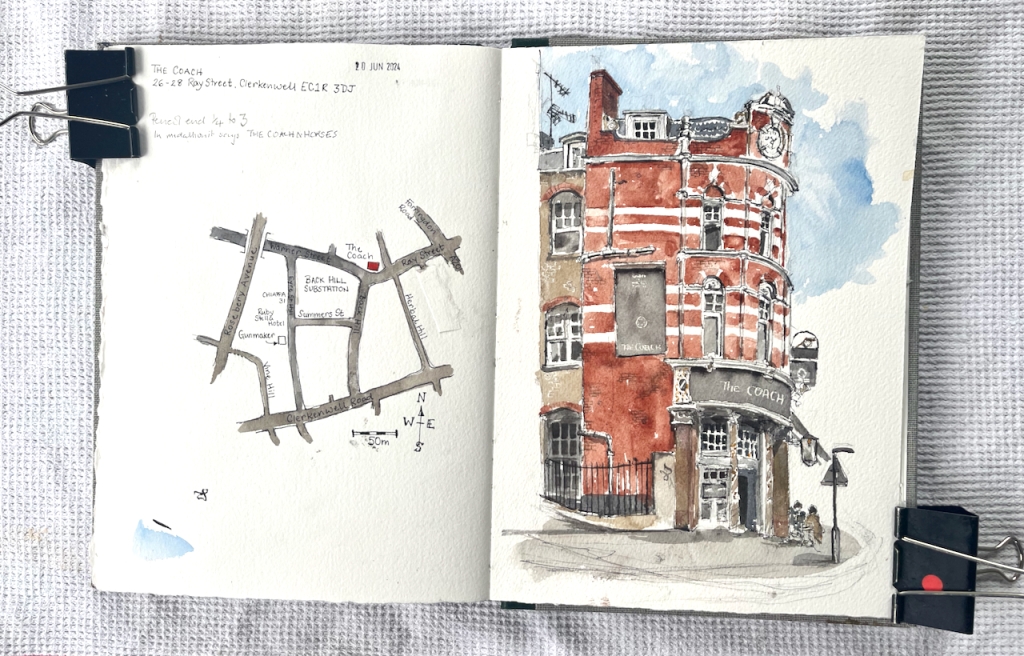
“The Coach” Clerkenwell, Sketched 20th June 2024 in Sketchbook 14

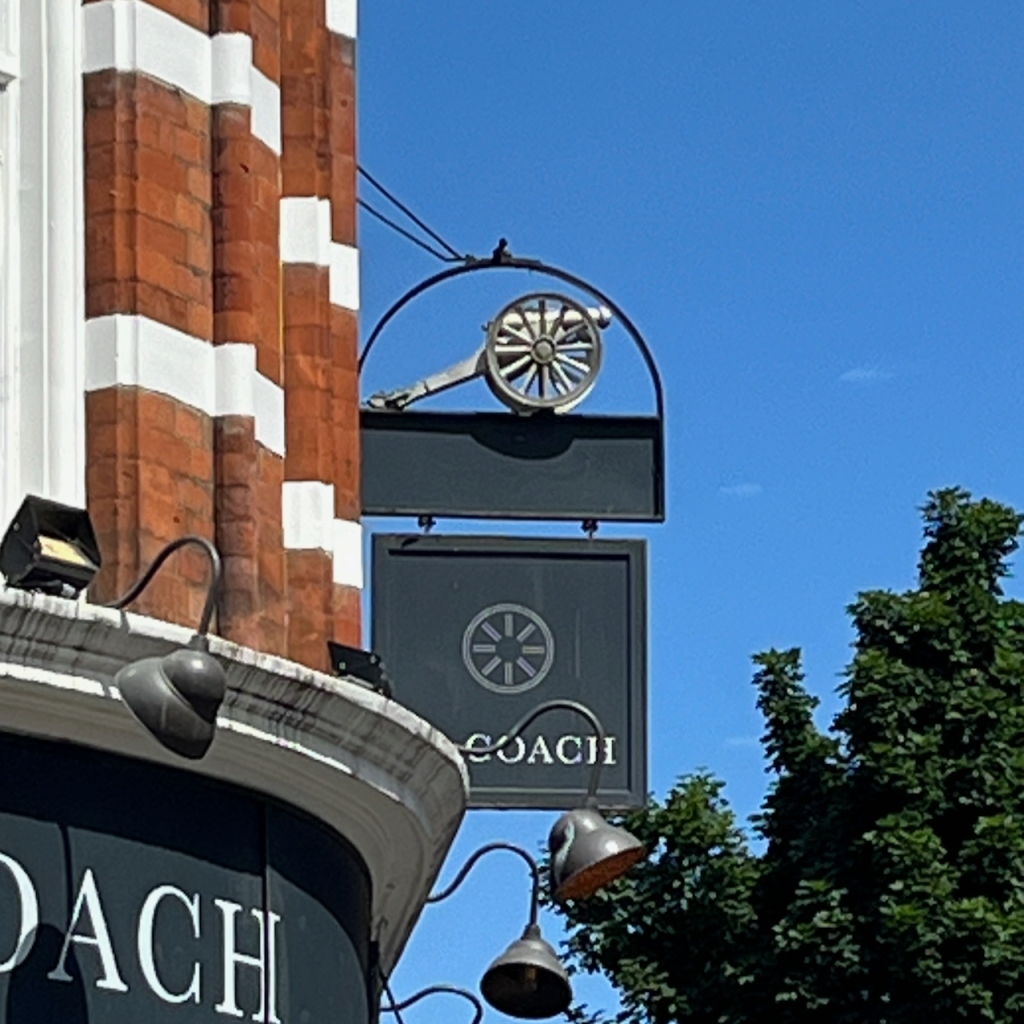
I sketched this after I had sketched “Gunmakers” in nearby Eyre Street Hill. Above the pub sign is a model, just visible on the right of my drawing.

The Coach pub sign: a gun carriage?

The model is a gun carriage. I wondered what the connection was to The Coach, and if there was any connection to Gunmakers on Eyre Street Hill. But no, it is the symbol of The Cannon Brewery. This brewery was founded 1720, in nearby St John Street. It was acquired by Taylor Walker in 1930. I have this information from http://breweryhistory.com. So that explains the cannon.

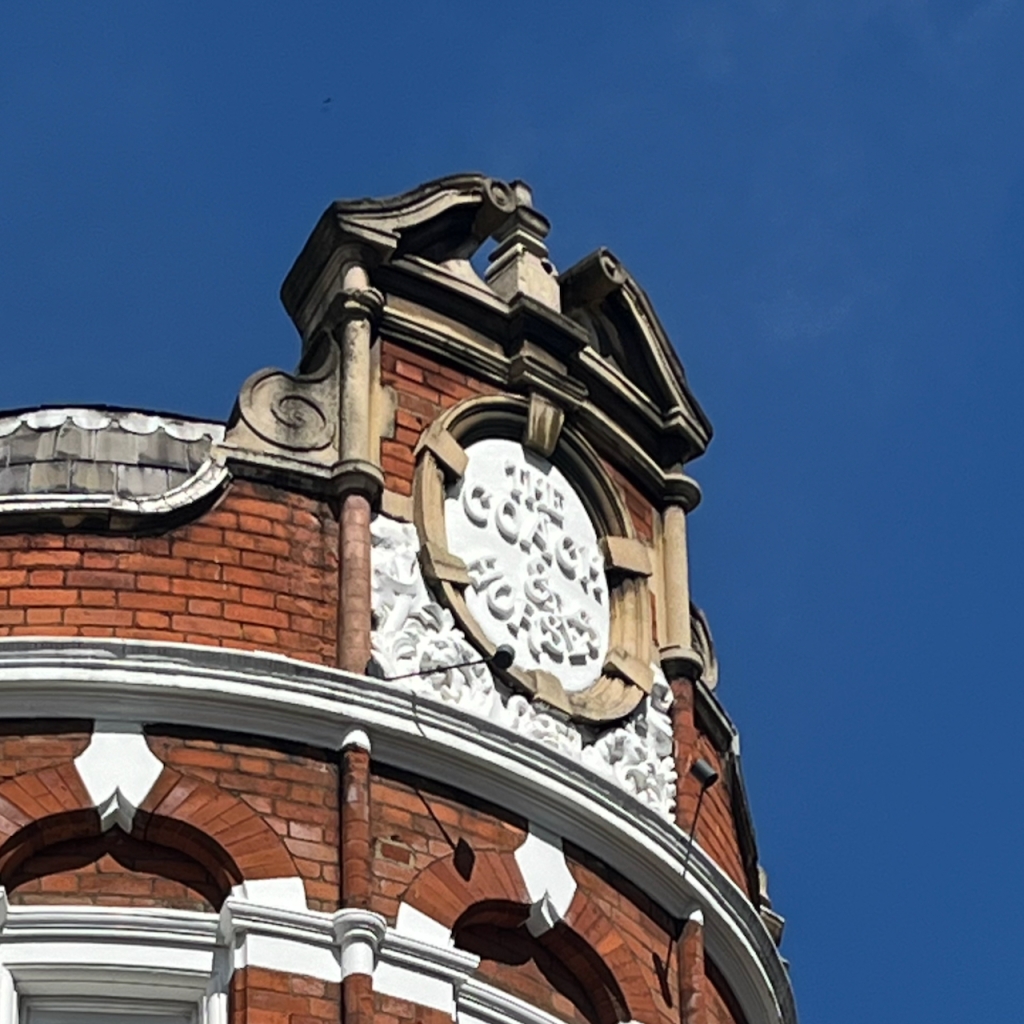
At the top of the pub, the medallion names the pub as “The Coach and Horses” in white relief work.

The pub website says: “The Coach was established in 1790, and has been at the heart of the lively Clerkenwell community for generations.”

British History Online describes a pub called The Cock Inn, which was part of a sale in 1695:

At the time of the sale [1695], the land was mostly taken up by two fields of pasture: Gardiner’s Field to the north and the larger Sir John Oldcastle’s Field to the south. There was a cluster of buildings and a large rubbish dump or laystall in the south-eastern corner, in the area of Hockley-in-the-Hole. Chief of these buildings was the Cock inn, the forerunner of the present-day Coach and Horses in Ray Street.

https://www.british-history.ac.uk/survey-london/vol47/pp22-51

The current building dates from 1897 according to this source:

All the eighteenth-century public houses in the area have been rebuilt or have disappeared entirely. The Apple Tree in Mount Pleasant was rebuilt in the 1870s, and the Coach and Horses in Ray Street in 1897

https://www.british-history.ac.uk/survey-london/vol47/pp22-51

So it looks as though the pub was there already in 1695 as the Cock Inn, was established as The Coach and Horses in 1790 (according to the pub website) and rebuilt in 1897. It was renamed The Coach in 2018.

Having closed on 31st July 2015, this pub reopened on 16th January 2018 as the Coach with its Taylor Walker/Cannon Brewery sign frame retained.

https://londonwiki.co.uk/LondonPubs/Clerkenwell/CoachHorses.shtml

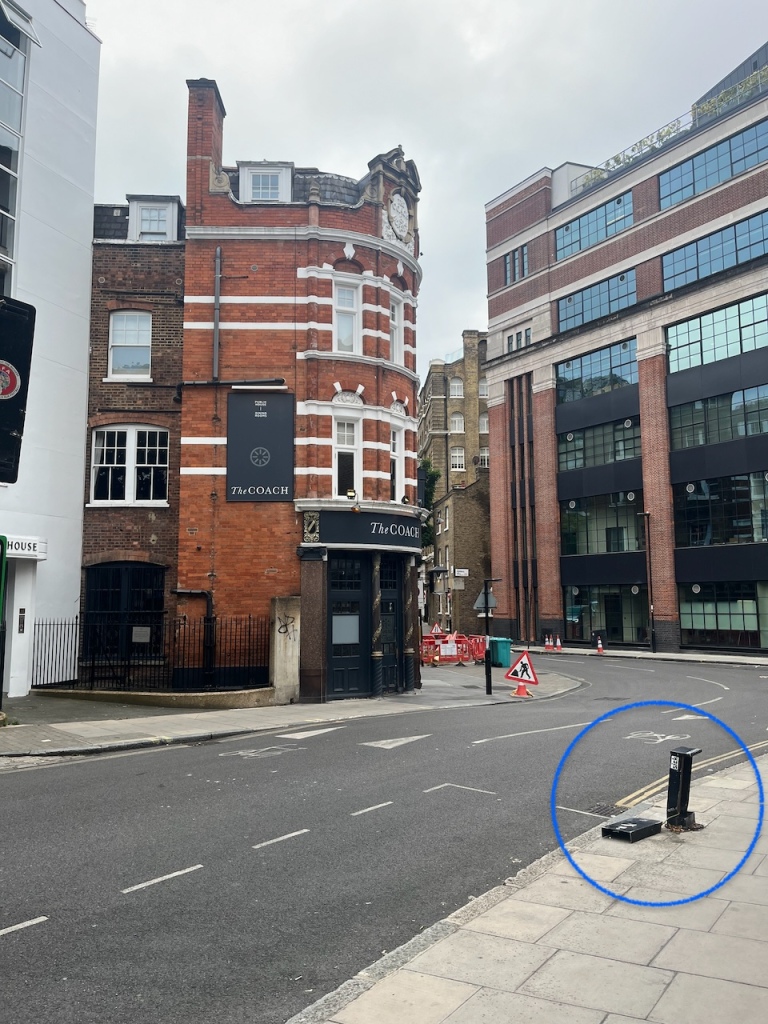
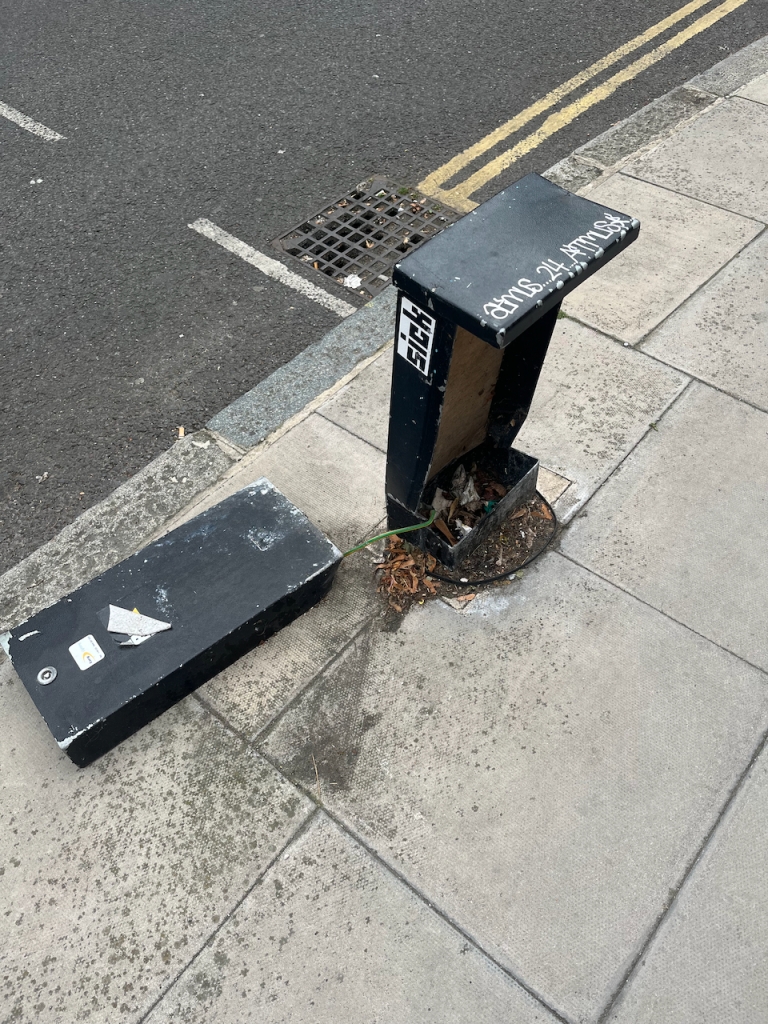
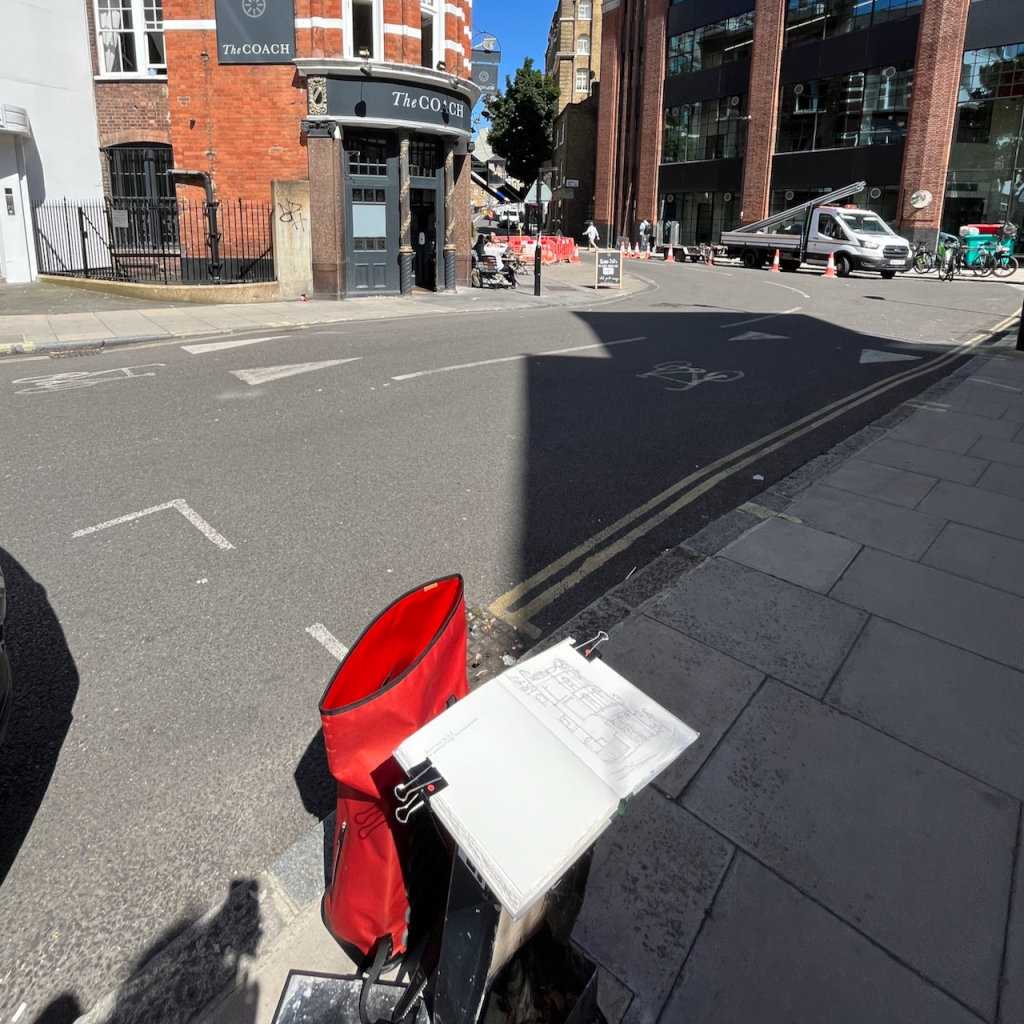
People sometimes ask me how I determine the viewpoint in my sketches. Often, as here, it is determined by practical rather than artistic considerations. I need somewhere to sketch, out of the way, not in the road, and with a clear view. I don’t carry a seat, though sometimes I wish that I did. But here, like a miracle, a seat presented itself.

This perhaps had been a phone junction box, but no more. Now it was a seat. I commandeered it.

I did the pen-and-ink on location and then added the colour back at my desk.

The colours here are:

  • Fired Gold Ochre for the bricks
  • Ultramarine Blue plus Phthalo Blue Turquoise for the sky
  • All greys and blacks are Burnt Umber with the blues
  • There’s a bit of Mars Yellow in some of the brickwork and the pillars.

All watercolours from Daniel Smith.

Sketchbook spread

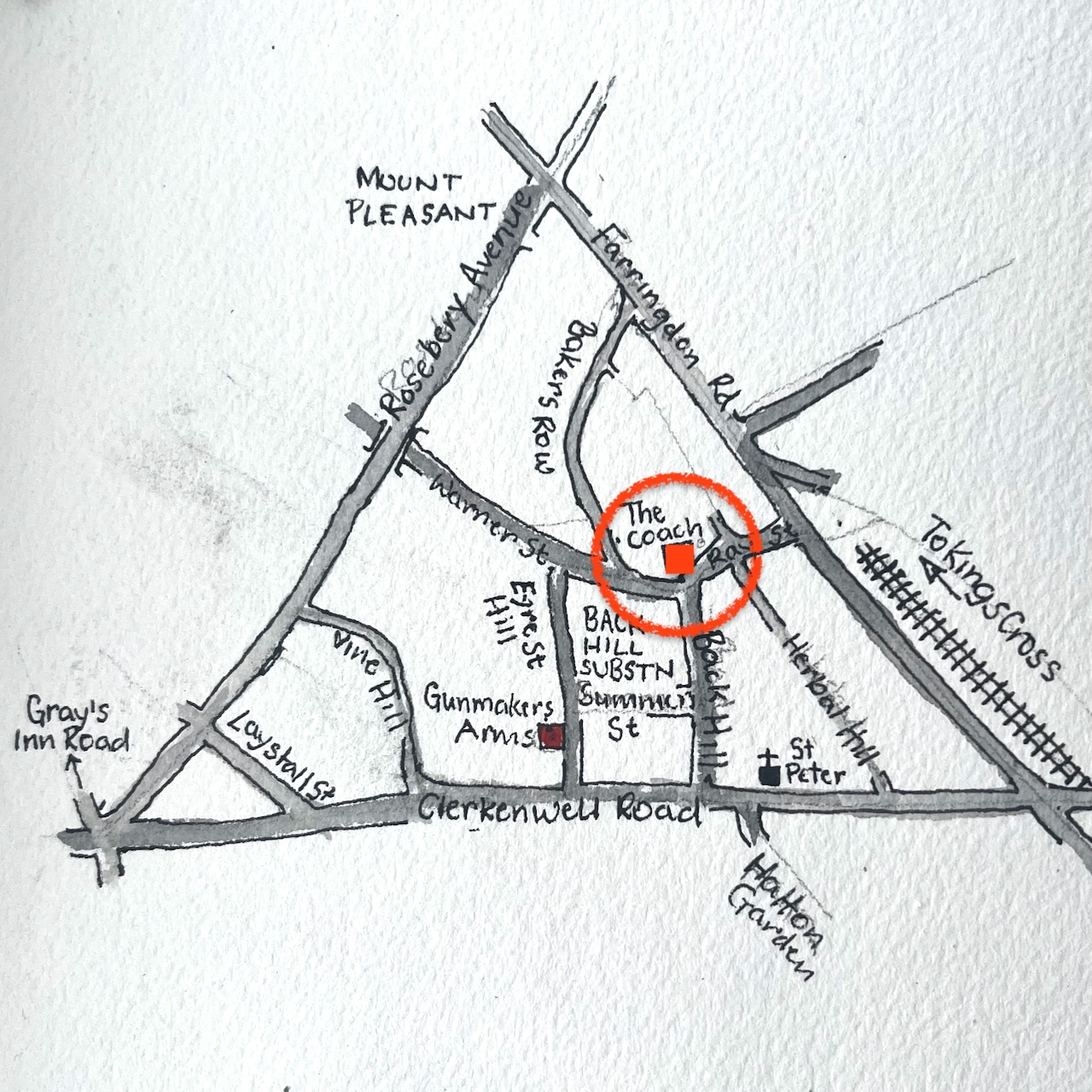
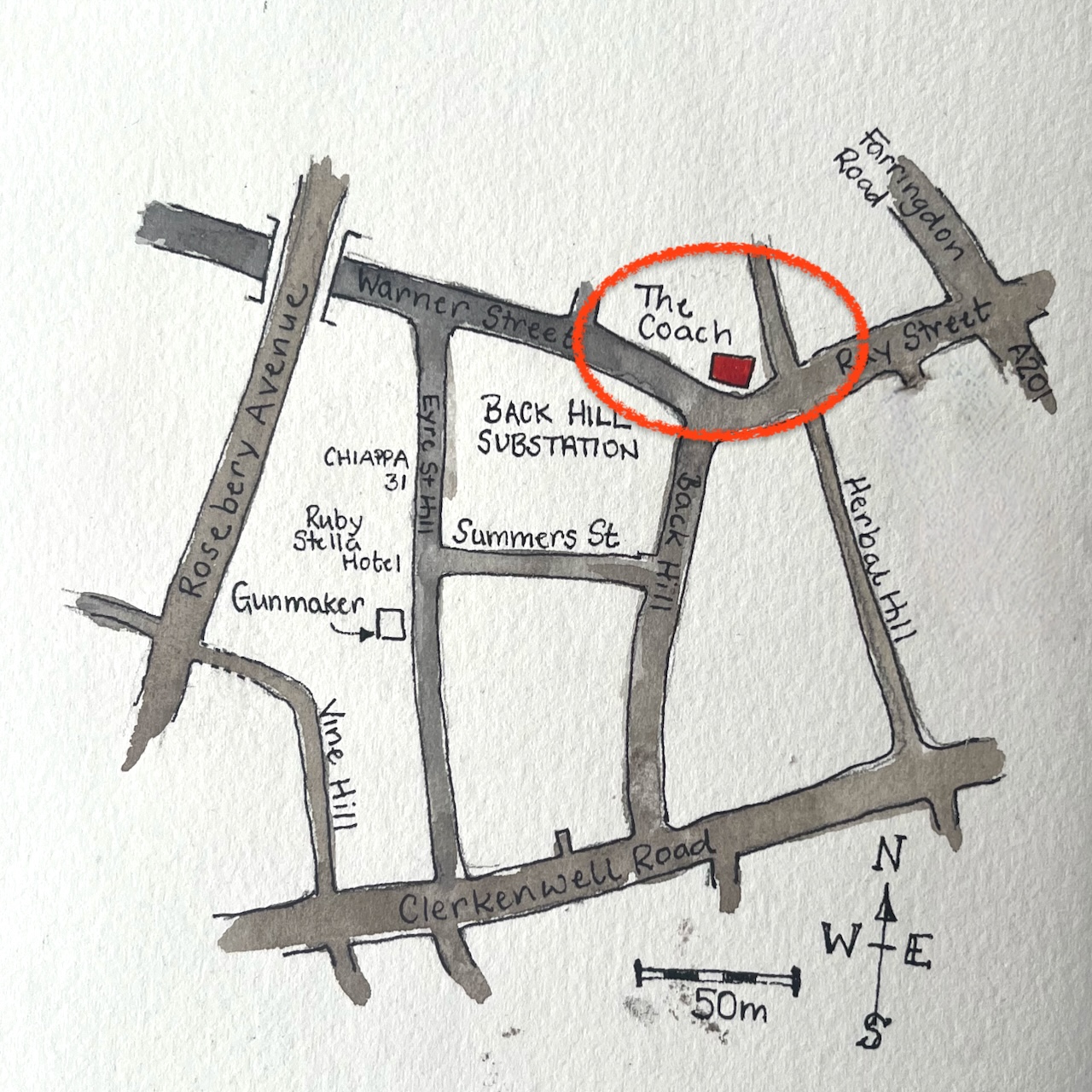
Here are maps to show where it is. It looks like a great pub, with a serious gastronomy menu. https://thecoachclerkenwell.co.uk/

Click here to see more pubs that I’ve drawn.

Gunmakers, Eyre Street Hill EC1R

Here is the pub “Gunmakers” in Eyre Street Hill, Farringdon.

“Gunmakers” in Eyre Street Hill EC1R, sketched 20th June 2024 in sketchbook 14

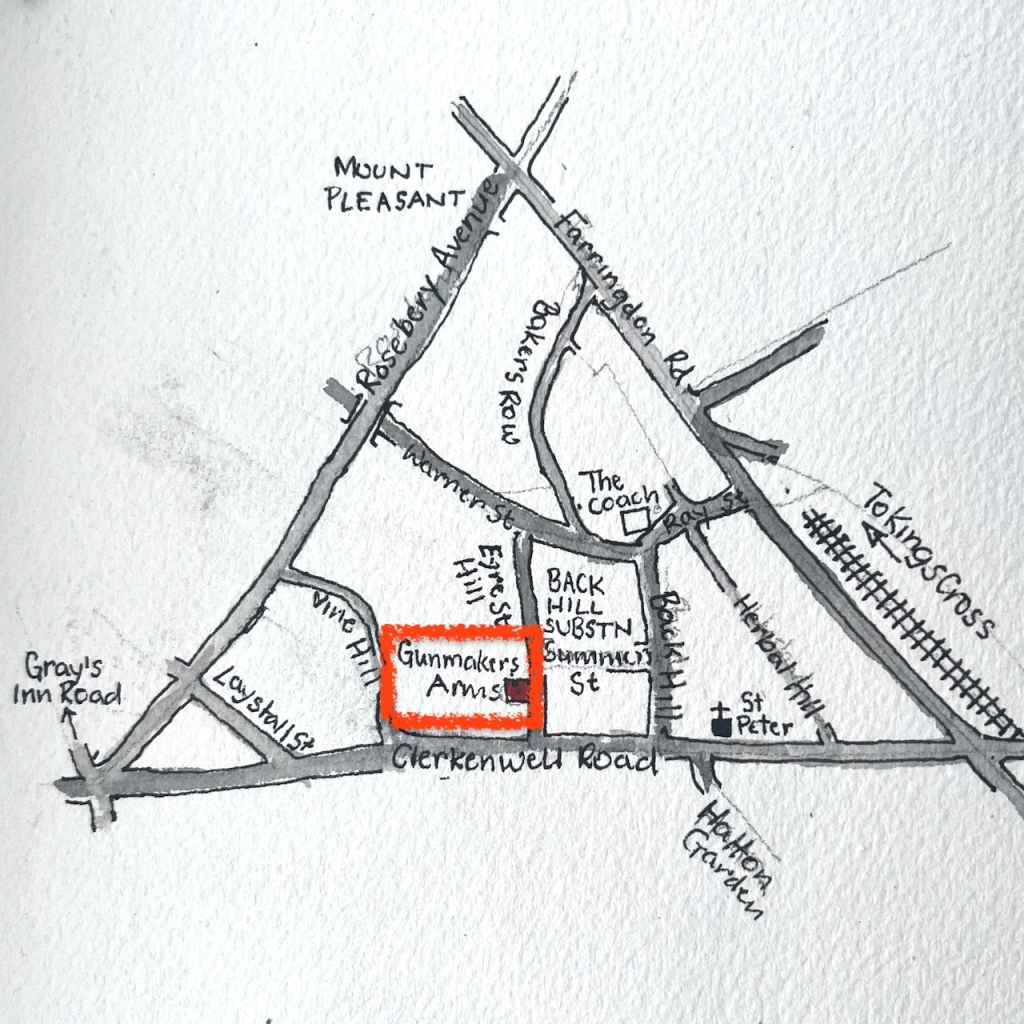
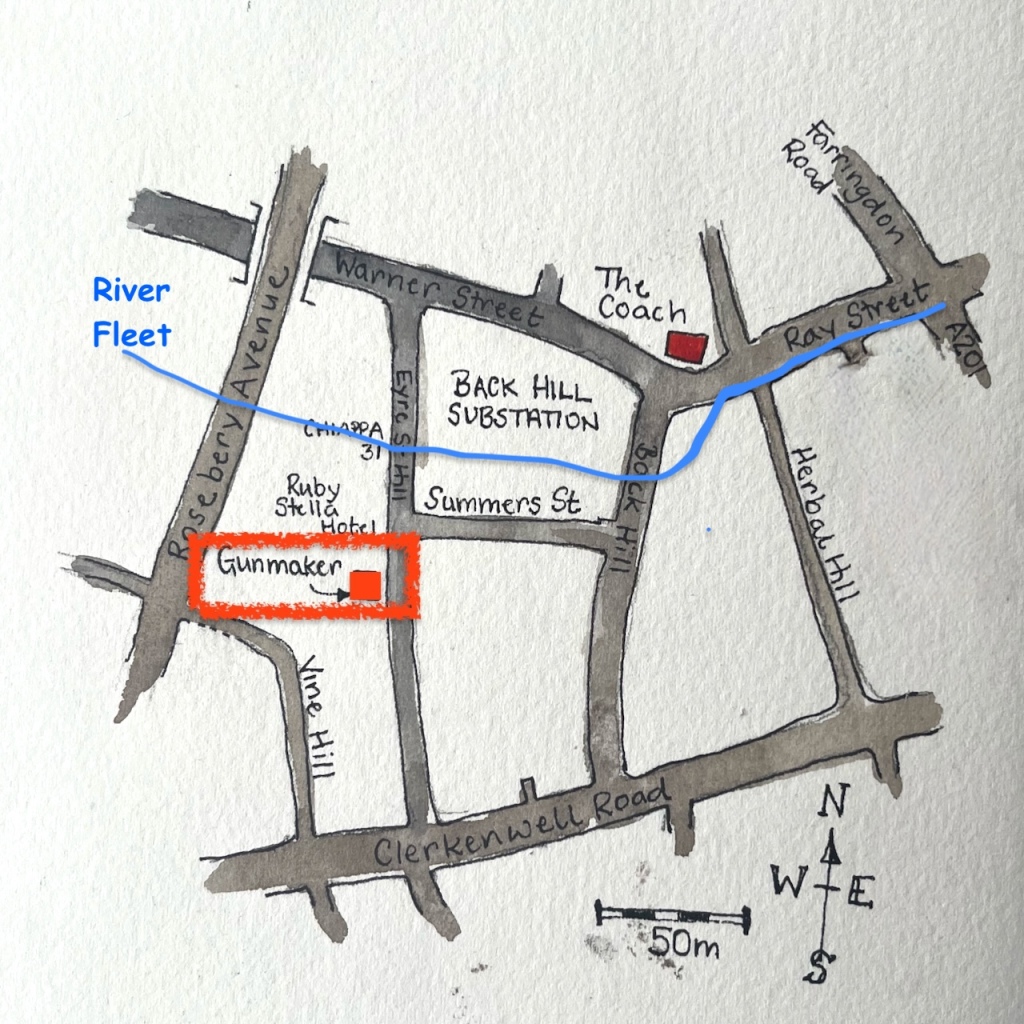
Eyre Street Hill is a small sloping street in Farringdon, within the triangle made by Rosebery Avenue, Clerkenwell Road, and the Farringdon Road.

It slopes down to the River Fleet which is now below ground. I marked the approximate route of the Fleet on the map below:

It is a very old street, laid out in the 1720s as “Little Bath Street”. “British History Online” contains a detailed history of the area. This tells me that here and to the north was called “Coldbath Fields” in around 1719. The small houses in Eyre St were beside the Cold Bath, “a privately run hydropathic establishment opened in the late 1690”. This was on the edge of town. But then the came a distillery, a smallpox hospital and a workhouse.

“On the north-western ground, now largely occupied by Mount Pleasant Sorting Office, a distillery was built in the 1730s, and a smallpox hospital in the 1750s. These were joined towards the end of the eighteenth century by the prison, the Middlesex House of Correction, which became notorious for the brutality of its regime. South of the Cold Bath, near the old and insalubrious quarter called Hockley-in-the-Hole, the parish workhouse, built in the 1720s, was greatly enlarged in 1790.”

British History Online (see reference below)

Then Rosebery Avenue and Farringdon Road were built, with much demolition and reconstruction. By the beginning of the twentieth century, this area became part of “Little Italy”, a centre of the Italian Community. St Peter’s Church, on Clerkenwell Road, is still “the Italian Church”.

I can find no reference to this pub, or to gunmaking in the area. The building looks like one of the ones built in 1812:

The sun catches the castellated building.

“Today the oldest structures are the small, single-bay houses with shopfronts at Nos 33–37, dating from the early nineteenth century and fairly typical of the rebuilding that took place in the area at that time. Nos 33 and 35 were erected as a pair around 1812 by Thomas Abbott, builder, of Leather Lane.”

British History Online (see reference below)

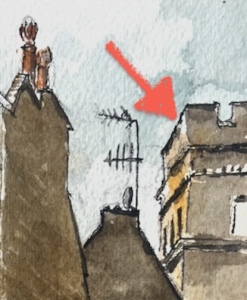
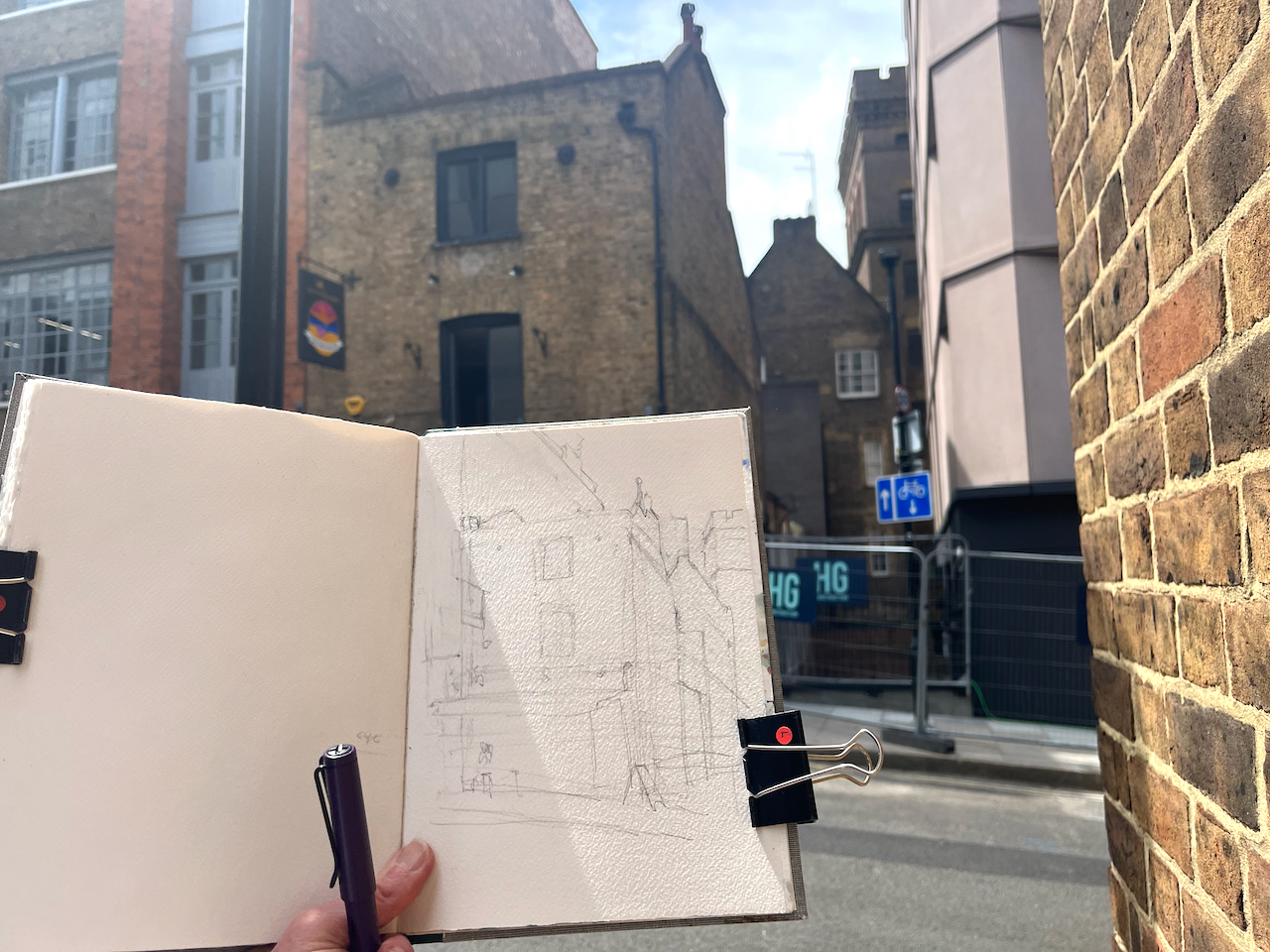
In the right background of my drawing is a magnificent castellated building, now obscured by the newly-built “Ruby Stella Hotel” .

I was sketching, appropriately enough, in “Summers Street”. It was 20 June and the first sun of summer arrived. The pub was doing a brisk trade.

After about an hour of drawing on location, I added the colour at my desk later.

Sketchbook 14

All quotes are from British History Online Volume 47, pages 22-51 with this reference:

‘West of Farringdon Road’, Survey of London: Volume 47, Northern Clerkenwell and Pentonville, (London, 2008), pp. 22-51. British History Online https://www.british-history.ac.uk/survey-london/vol47/pp22-51 [accessed 22 June 2024].

Christ Church, Esher, KT10

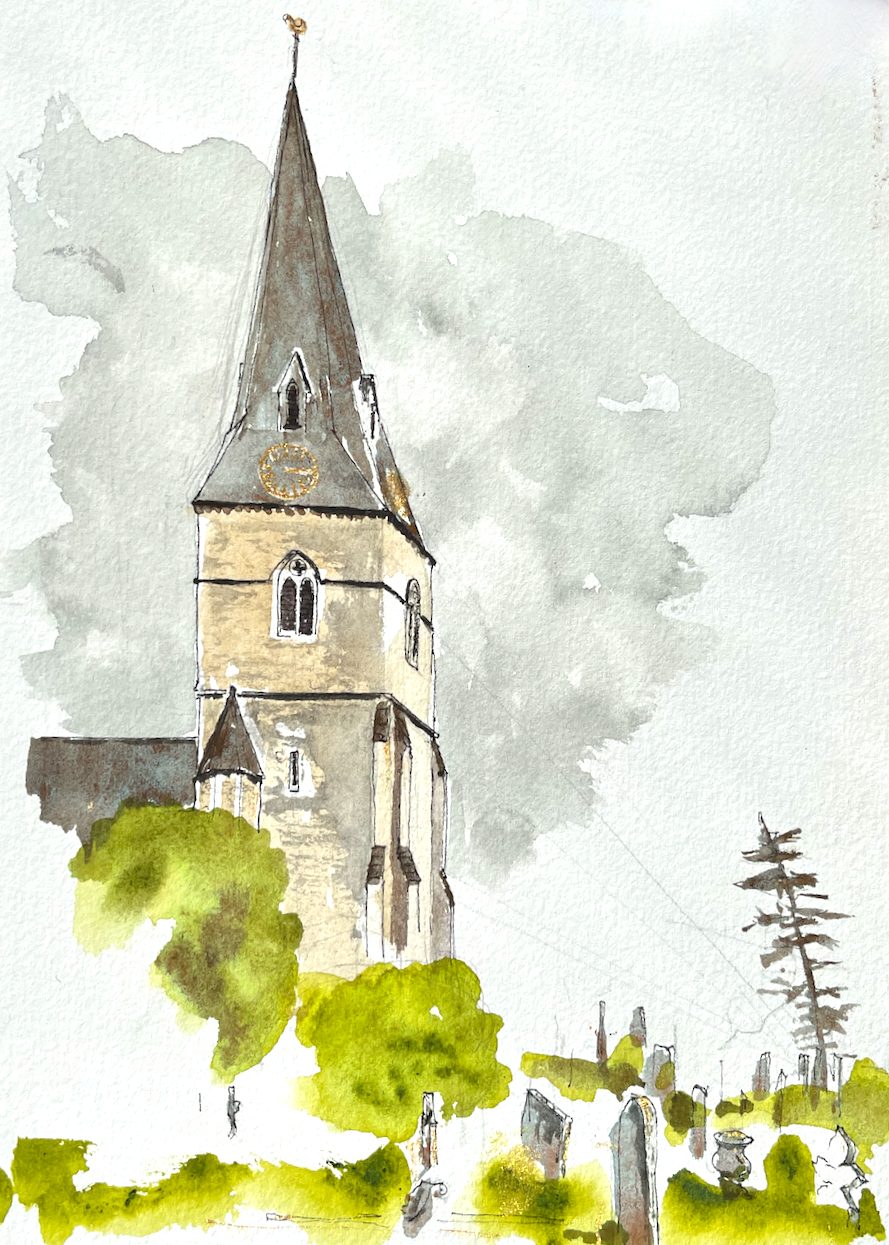
Christ Church Esher stands on the top of a hill, near the intersection of roads that marks Esher town centre.

Christ Church, Church Street, Esher, Surrey, KT10 8 QS. Sketched 28 May 2024, in Sketchbook 14

The church has a “splayed foot” spire.

SPLAYED-FOOT: variation of the broach form, found in England principally in the south-east, in which the four cardinal faces are splayed out near their bases, to cover the corners, while oblique (or intermediate) faces taper away to a point.

BROACH: starting from a square base, then carried into an octagonal section by means of triangular faces.

– Pevsner’s Architectural Glossary, page 116, under “SPIRE”

This simple and elegant geometry turned out to be rather tricky to draw. I worked hard to get the shape of the spire correct.

Sketching the spire of Christ Church

The church was built in 1853-1854 to the design of Benjamin Ferrey (1810-1880) according to its Historic England listing entry. Ferrey studied under A.W.N. Pugin1, and like Pugin, designed in the style known as “Gothic Revival”. Christ Church was built because the growing congregation could no longer be housed in the smaller St George’s, a little way down the hill.

I sketched the church on location and added the colour later. The colours are:

  • Mars Yellow
  • Green Gold
  • Phthalo Blue Turquoise

I used just three colours, all Daniel Smith. I used gold paint for the clock. The clock is on the roof of the spire, which is remarkable. Usually the clock is on the tower, below the spire. So I wanted to put it in and show its unusual location.

Here is a sketch map of the area.

See this post for my sketch of St George’s, this post for the Tin Tabernacle in West End Esher, and this post for sketches of the council housing in Lower Green.


References

Historic England Listing Entry: https://historicengland.org.uk/listing/the-list/list-entry/1188268?section=comments-and-photos downloaded 7th June 2024, contains also many photos of the interior of Christ Church.

Ferrey’s biography is on Wikipedia, and also on “The Victorian Web” at this link: https://victorianweb.org/art/architecture/ferrey/

1A.W.N. Pugin designed, amongst other things, the inside of the Houses of Parliament: https://heritagecollections.parliament.uk/stories/the-architects-barry-pugin-and-scott/. The Houses of Parliament are a classic example of Gothic Revival Style. The Houses of Parliament were designed by a team consisting of Charles Barry, A.W.N. Pugin and later Giles Gilbert Scott.

Council housing, Lower Green, Esher KT10

Esher is an area of Greater London, half an hour’s train ride from Waterloo. It is a place of diverse architecture: magnificent Arts-and-Crafts villas, modernist mansions, and a row of “stockbroker Tudor” houses.

Stockbroker Tudor houses, Esher.

On the other side of the railway tracks, in the low ground near the industrial estate and the waterworks, there is a council estate. This is “Lower Green”. It was built towards the end of the 1940s. This was an era of visionary town planning and utopian ideals, eloquently described in the book “Municipal Dreams” by John Boughton, Chapter 3. On page 66 Boughton quotes the town planner Patrick Abercrombie who sought a plan for Plymouth

“which allows for a higher standard of living well within our grasp, with its call for space and beauty rather than for mere economy”

J. Paton Watson and P. Abercrombie “A Plan for Plymouth” 1943.

The new towns were built around this time, including Stevenage, Crawley, Hemel Hempstead, Harlow, Welwyn Garden City, and Hatfield. Lower Green has many characteristics of those new towns: two storey “cottage style” houses with a front garden and a back garden, arranged behind wide verges, with trees and plenty of green space. The houses were designed by the architect George Blair Imrie (1885–1952), for Esher Urban District Council.

Round symbol on the houses: E for Esher, “UDC” = Urban District Council. Esher is now under “Elmbridge Borough Council”. See the interesting texture of the bricks.

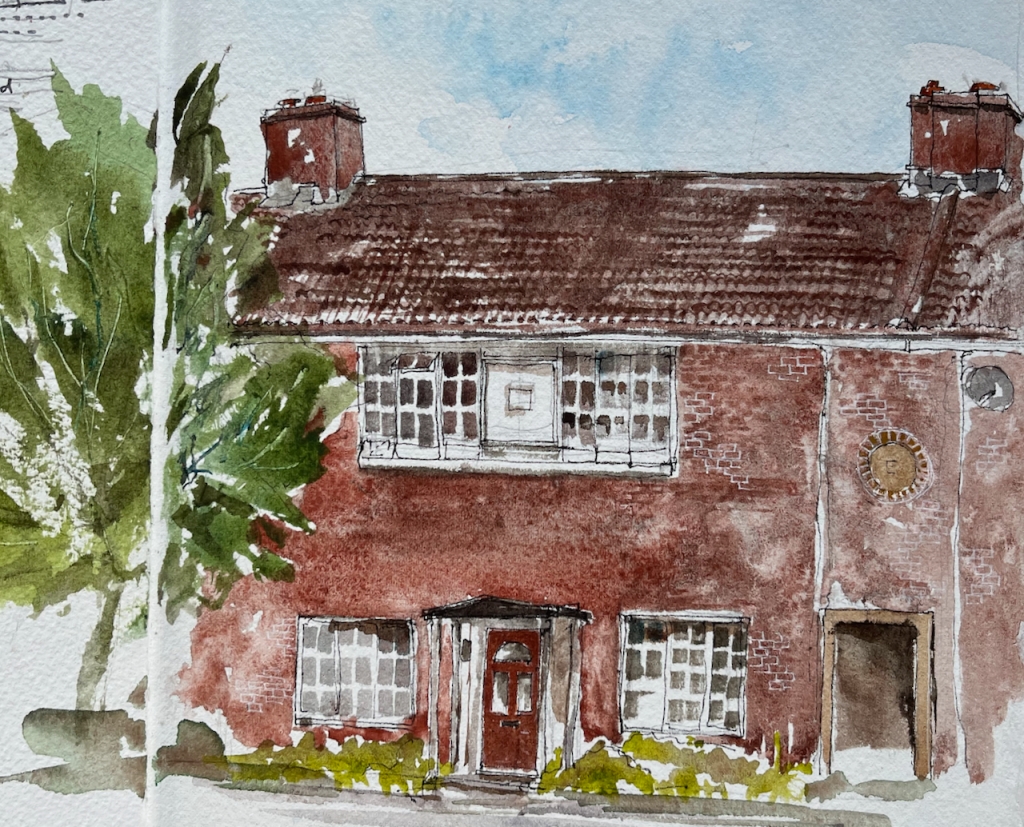
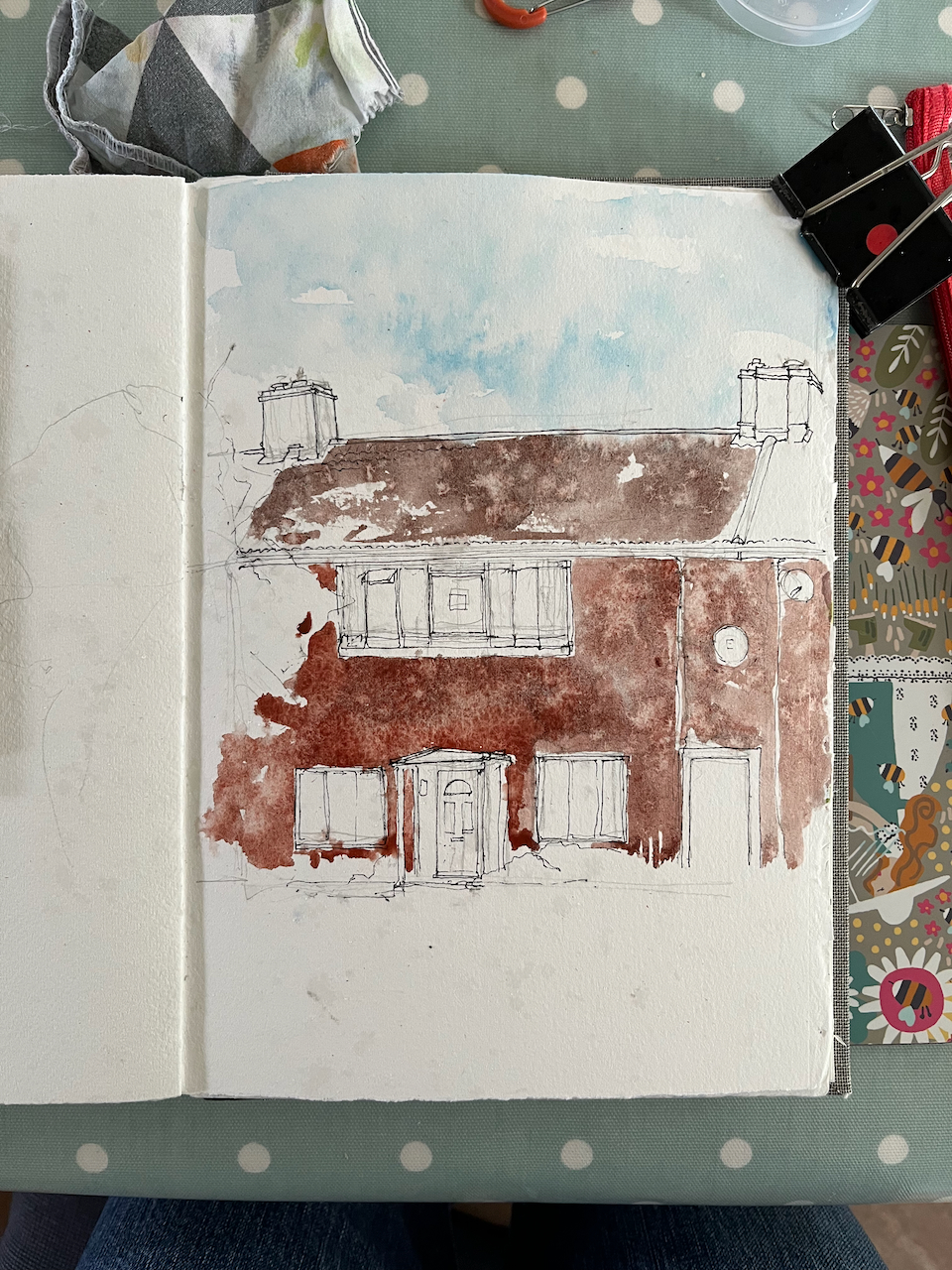
My watercolours show houses on Douglas Road, Lower Green. Here, the land was acquired by the council in 1949. It was a compulsory purchase under the 1936 Housing Act. The vendor was the farmer, Sydney Edward Parkes. I have this detailed information thanks to an owner and resident of one of the houses, who kindly showed me their title deeds.

Here is the basic design of the houses.

A house in Douglas Road, Lower Green, Esher, KT10. Watercolour and ink, Sketchbook 14

The geometry is perfect: the side edges of the upper windows are aligned with the centres of the lower windows. The upper edges of the lower windows, the door lintel and the passage are all in a neat line.

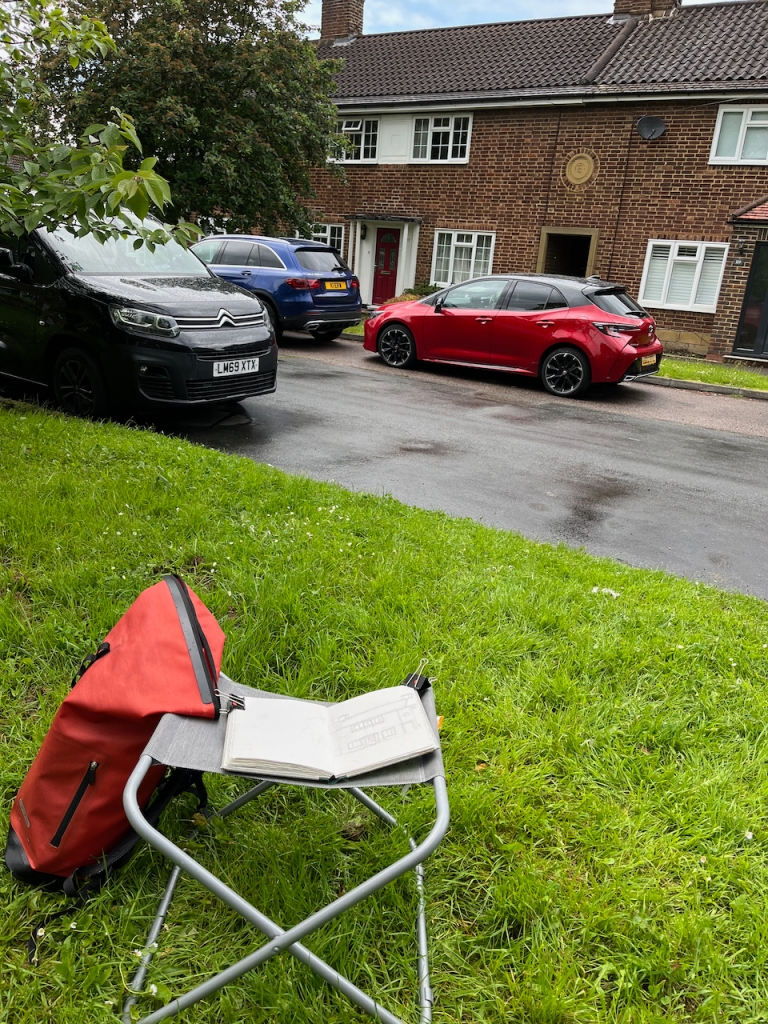
What you can’t see in my painting is that this house stands behind a wide verge and trees, which separate it from the road.

Painting location for the picture above.

There is a passage through the terrace of houses, on the right in my picture. This passage takes you through to “the back” where you can store your bicycle, and your dustbins.

Another feature of the estate is the arrangement of houses round a square.

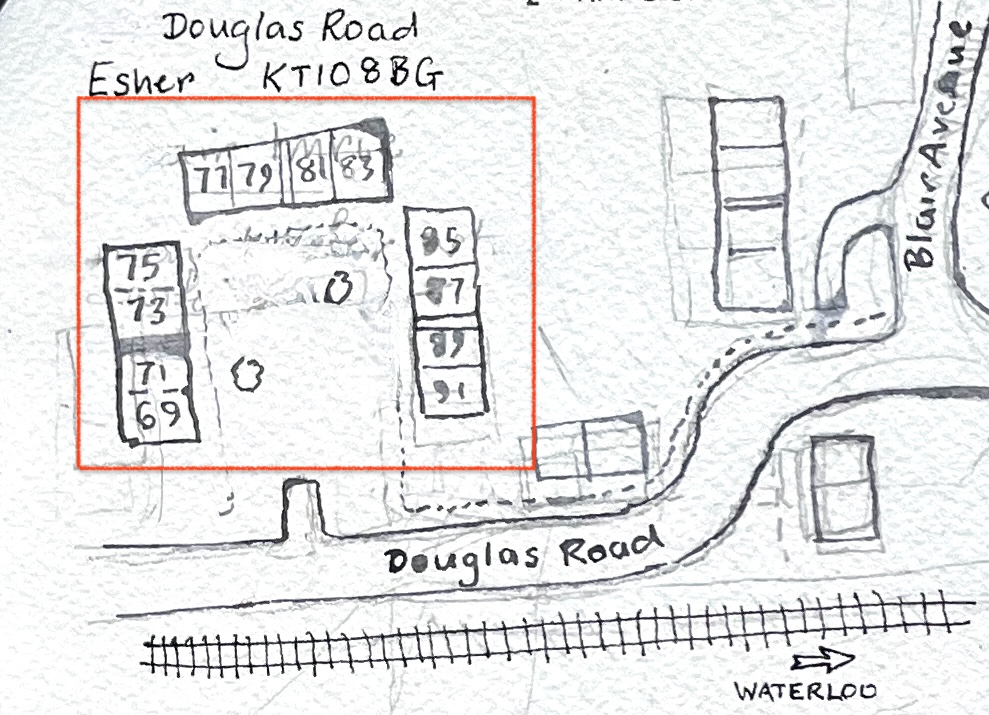
Here is a painting of some of the houses round the corner of a square: numbers 69 to 77 (odd numbers) Douglas Road:

69-77 (odd numbers) Douglas Road, Esher. Watercolour and ink, in Sketchbook 14

Painting of odd numbers 69-77 Douglas Road Esher, seen across the huge green public space.

There are three such squares, all large green spaces. It’s one of the “patterns” in this estate, to use the concept described by Christopher Alexander, in the 1977 book “A Pattern Language”.

“A Pattern Language” by Christopher Alexander and others (1977), page 304, Pattern number 60 “Accessible Green”

I didn’t see anyone using the green space. But this was a Tuesday afternoon, in term time, and it was raining. Perhaps they were enjoying looking out across it from their windows. If they were, they were probably wondering what the strange woman was doing, sitting there on a metal camping stool under the tree, staring at their house.

This estate was originally intended as rental accommodation. It was owned by Esher Urban District Council and residents paid rent to the council. Nowadays, some of these former council houses are in private freehold ownership, having been sold under the “right to buy” scheme. There are also a lot more cars. The estate was built at a time when most people did not not own cars. The houses do not have garages.

The architect, George Blair Imrie, designed many houses in the area. His wikipedia page lists the large houses he designed for the wealthy. His work on the council housing estate of Lower Green is also remarkable, and not mentioned. So I am glad of the opportunity to draw attention to it here.

I drew these pictures between rainstorms, finally completing them under a borrowed umbrella.


Blair Imrie’s work, including his work on Lower Green, is mentioned the 100th newsletter of the The Esher Residents Association, January 2020. See pages 4 and 5:

E5 Bakehouse, London E8

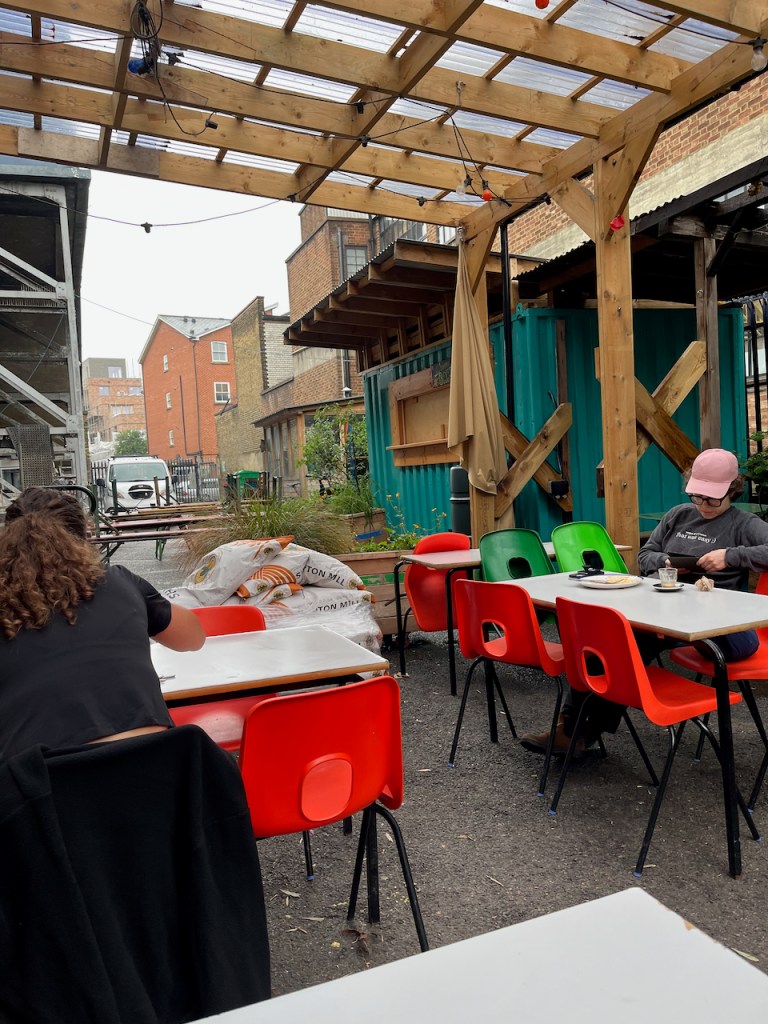
Sometimes I go out and find a view for my sketch. Sometimes the view is determined simply by where I find myself. Here is one of those occasions.

I had breakfast in the seating area at the back of E5 Bakehouse. At 09:15 I was the only person out there. I looked at the view. The various roofs made interesting angles. The cyclist who delivers their bread arrived and loaded up his formidable cargo bike. Customers arrived, and came outdoors. The tables filled up, each new arrival nodding a greeting to those of us already there. People made room for each other. It was quiet, no background music, perfect. I went back to the counter and bought another Gilchester bun. Time to do a sketch.

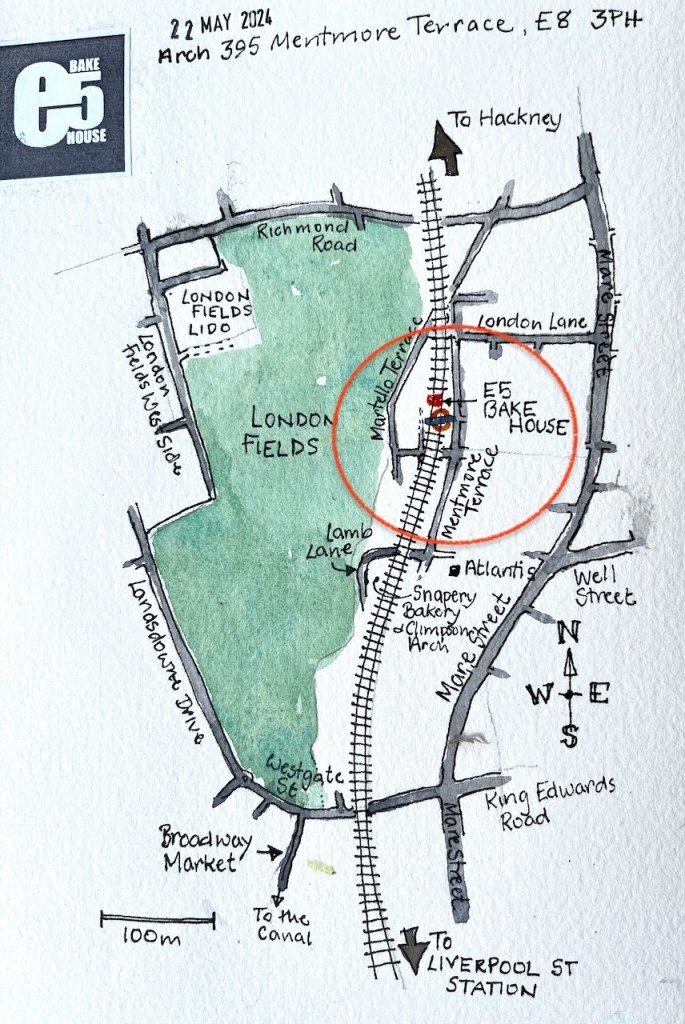
E5 Bakehouse is not in E5 but in E8, right next to London Fields Overground Station, on the line out of Liverpool Street. Their website says

“The name E5 is a nod to our former local postcode and our intention to remain rooted in our community.”

They produce wonderful bread and pastries. My fellow customers were enjoying substantial breakfasts of eggs and all sorts of greens, or a kind of piled up yogurt and fruit dish. My favourite is the Gilchester bun: the archetypal currant bun – “Made using Gilchester’s organic flour , these are so simple and so tasty you can eat them on their own, or toasted even just with butter is all you need!”

A colleague of mine once told me that the way he judged a hotel was to ask for a glass of orange juice. The orange juice told him all he needed to know, he asserted. Was it fresh pressed, or out of a bottle? Was it served in a glass or a paper cup? Did they provide a spoon to stir up the bits?

For me, a currant bun is the test of a bakery. Those at E5 set the standard for currant buns the world over. The currants are numerous, the bread is soft and all the sweetness is from the currants. They are just superb. So that’s why I needed another one.

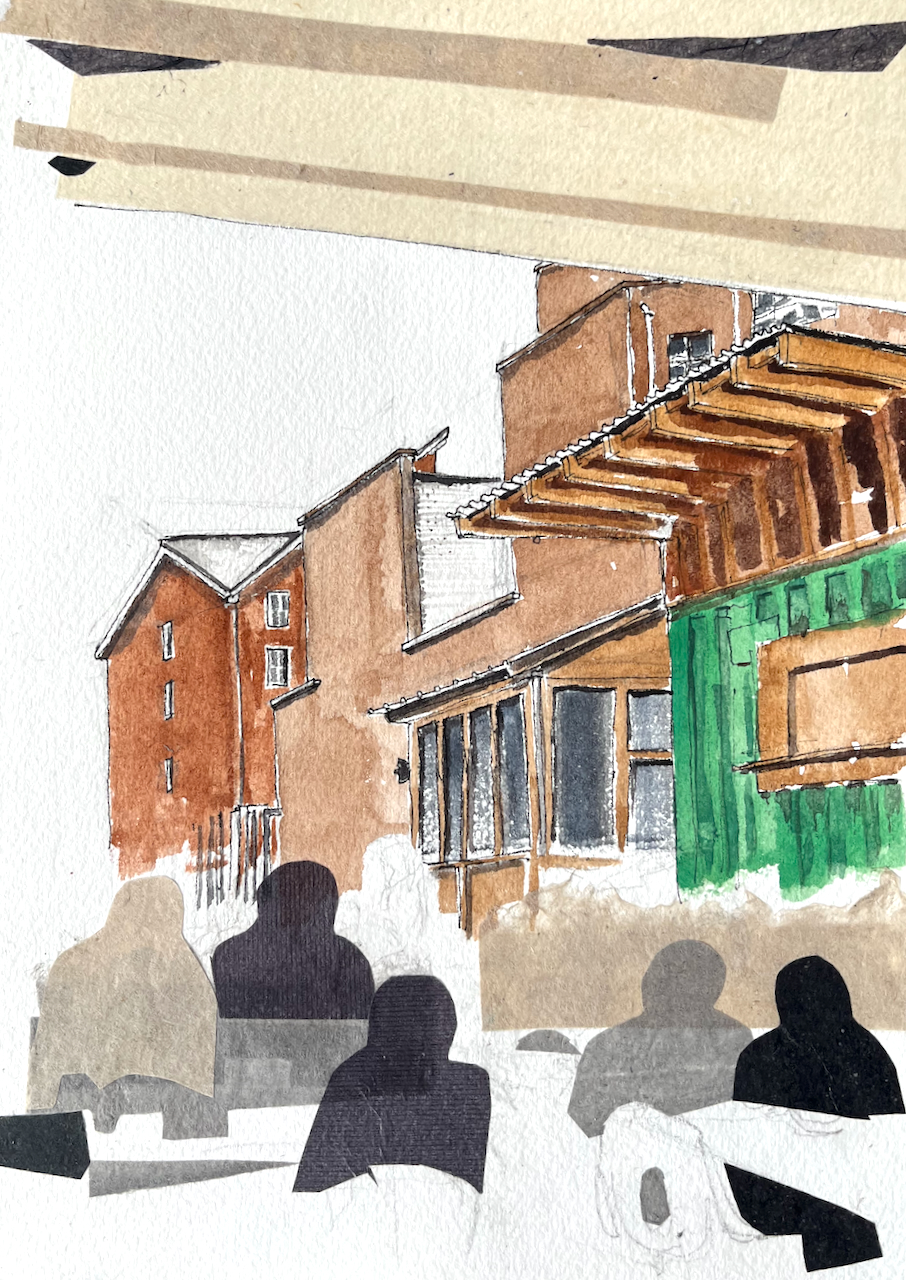
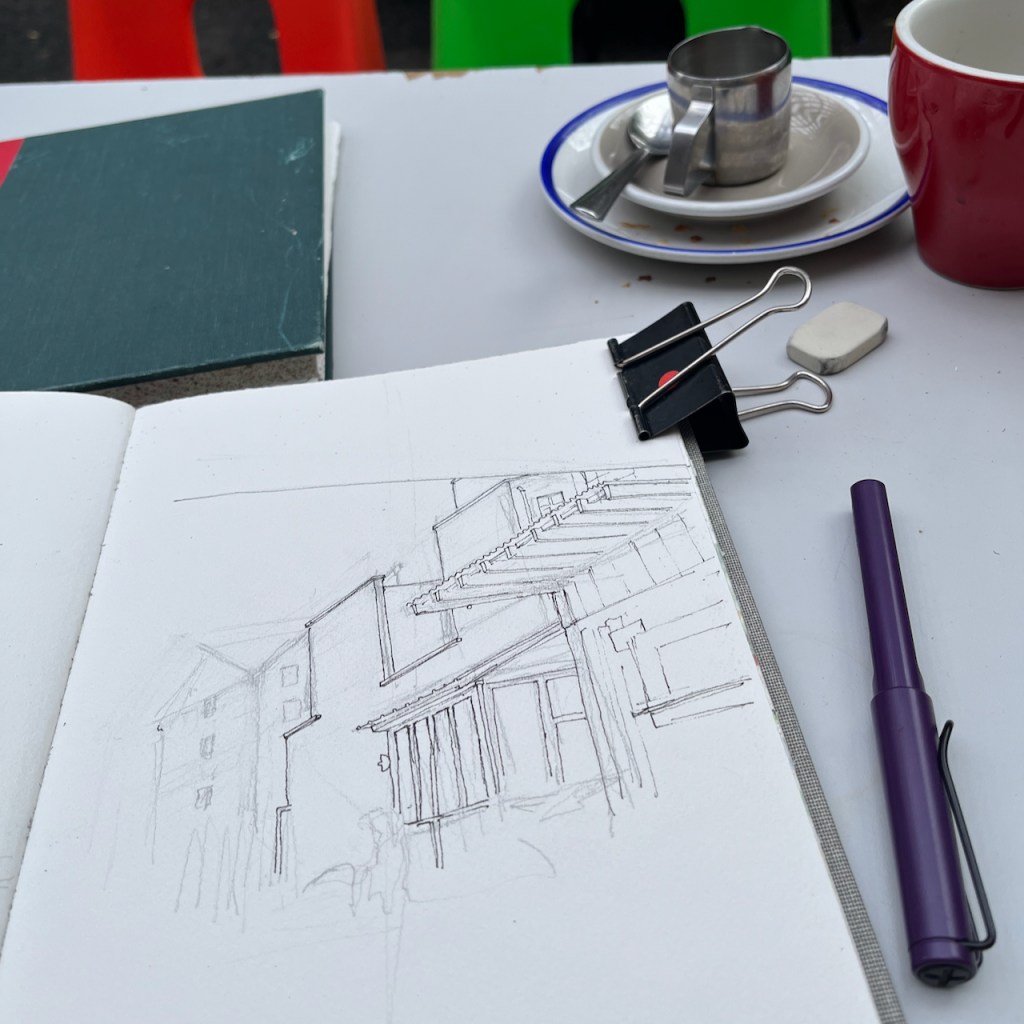
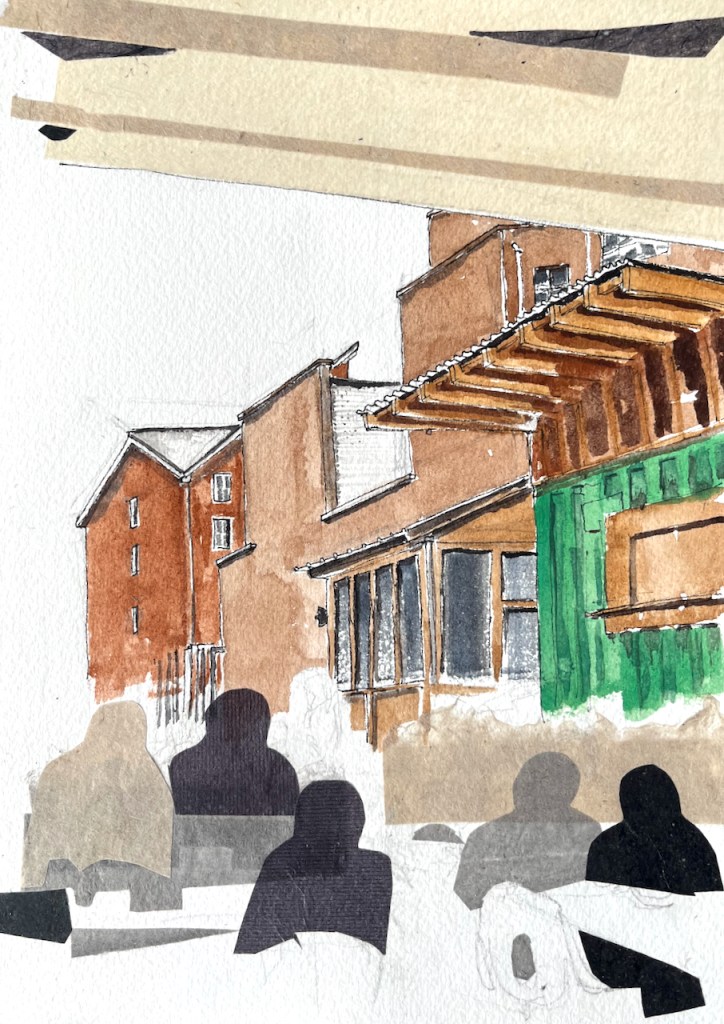
Here’s the finished picture. I added the collage at my desk at home.

Breakfast at E5 Bakehouse, watercolour and collage, 10″ x 7″ in sketchbook 14.
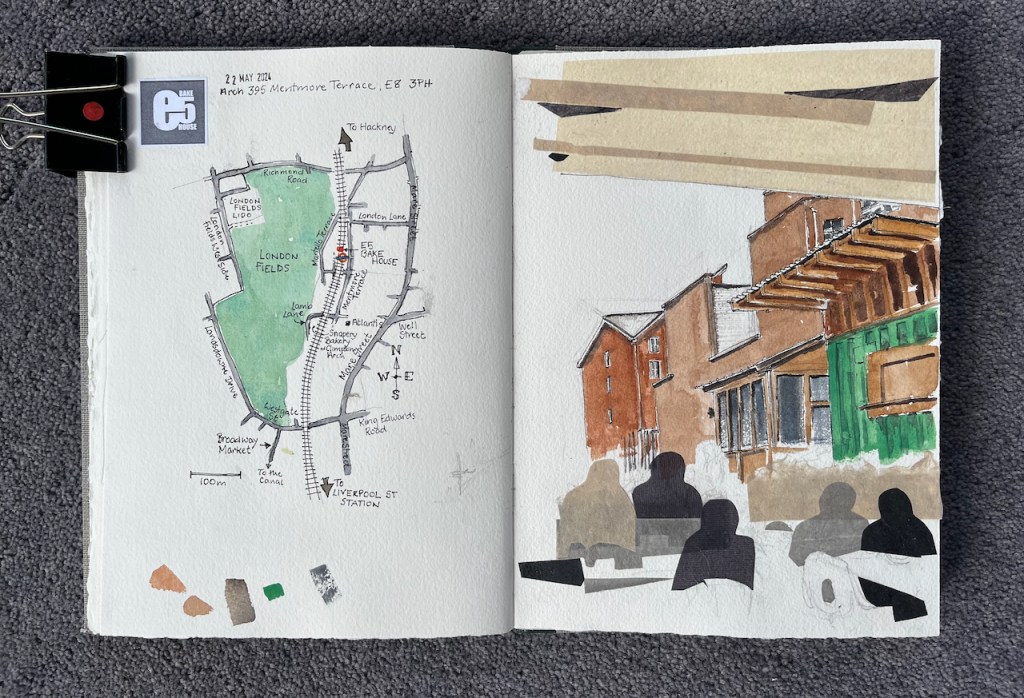
Page spread: sketchbook 14

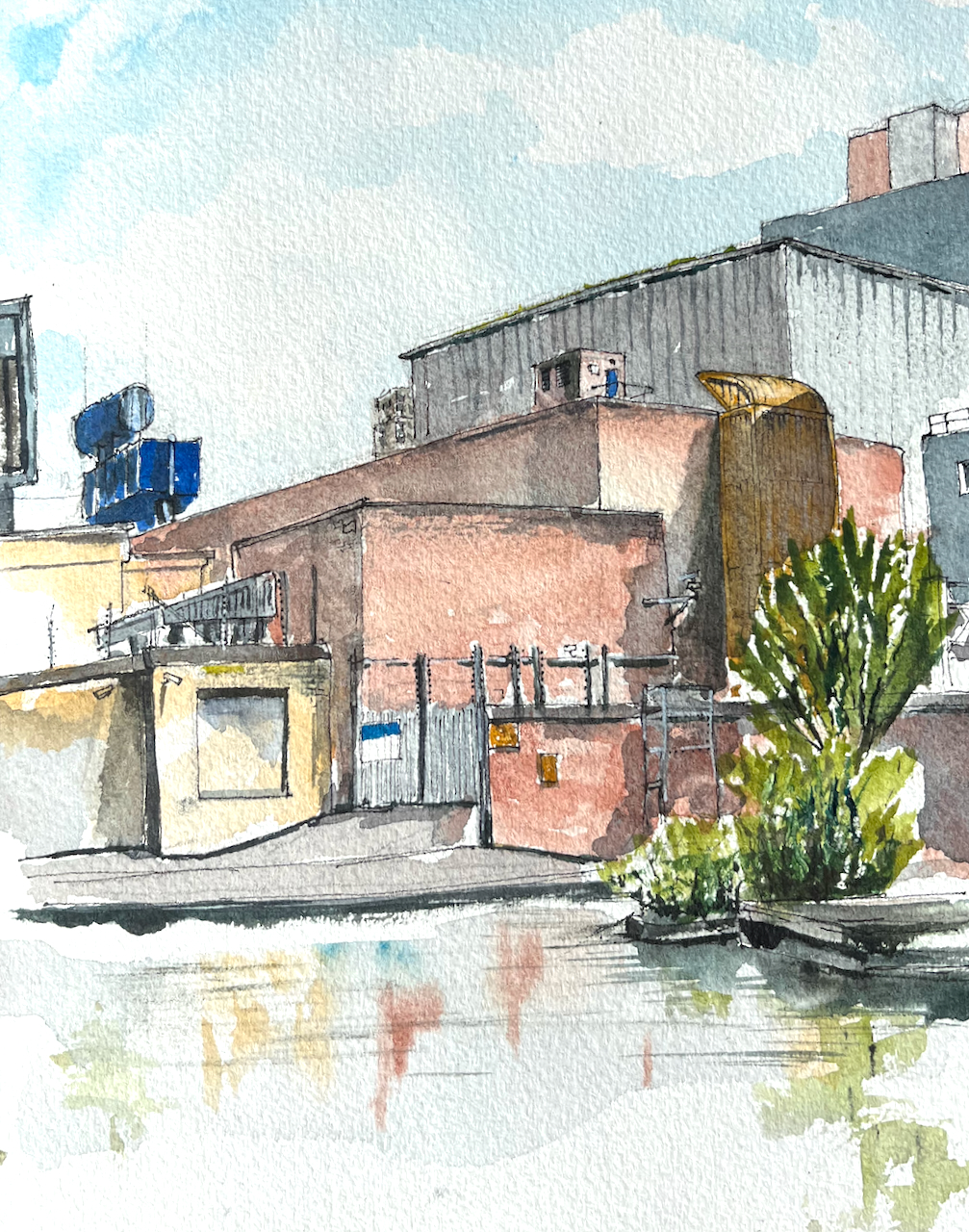
City Road 400kV Substation EC1

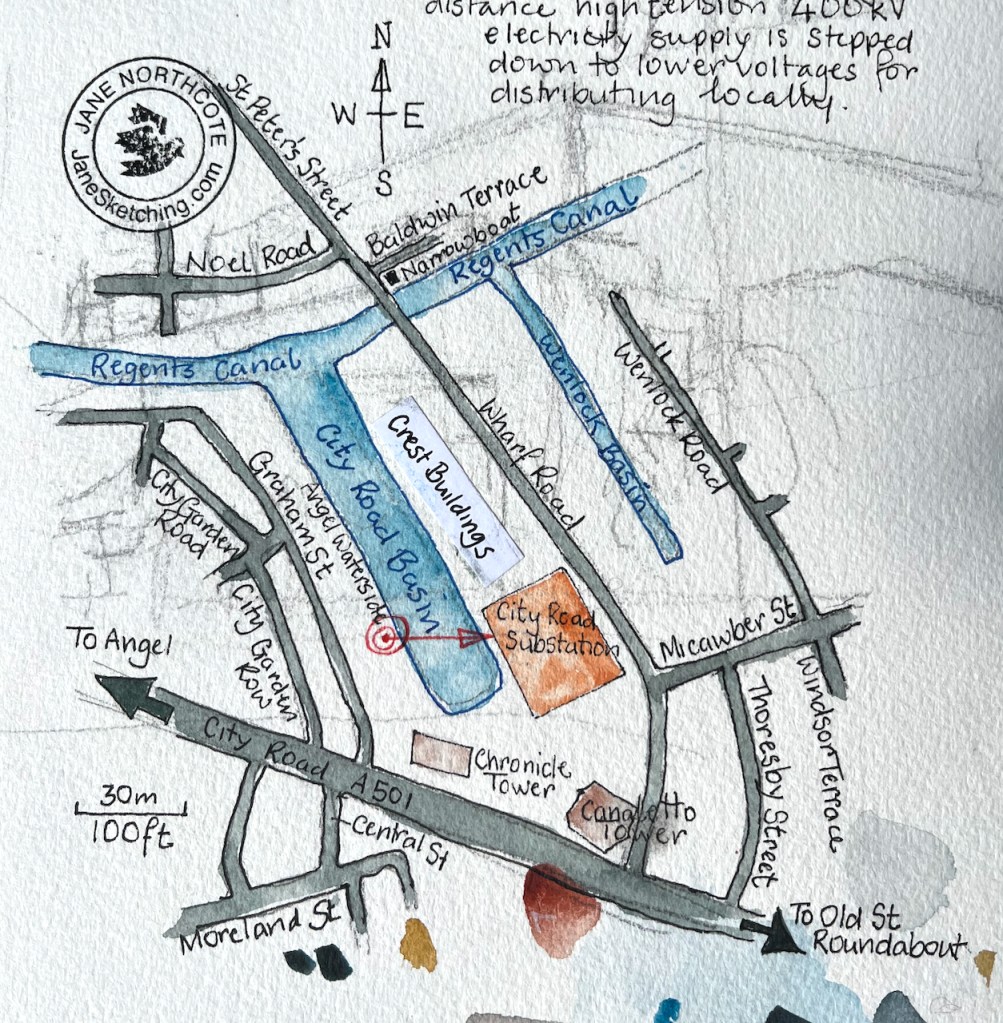
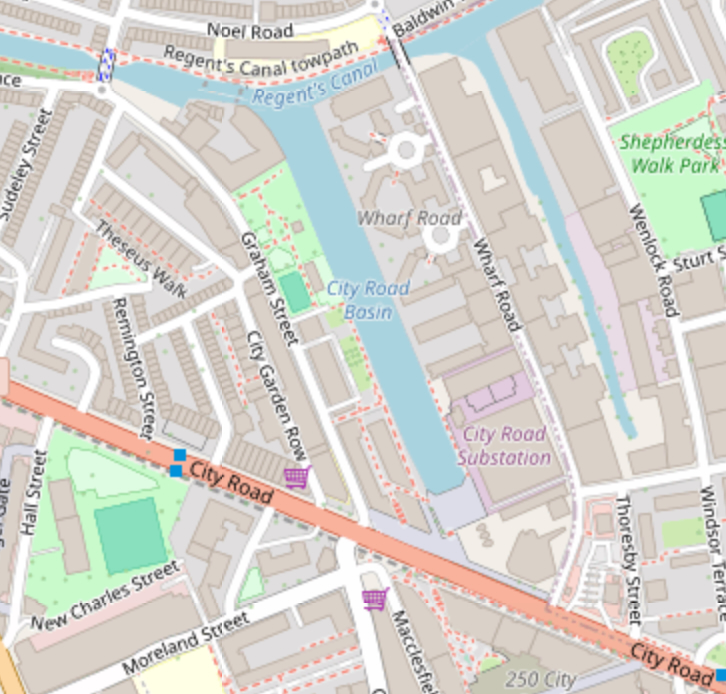
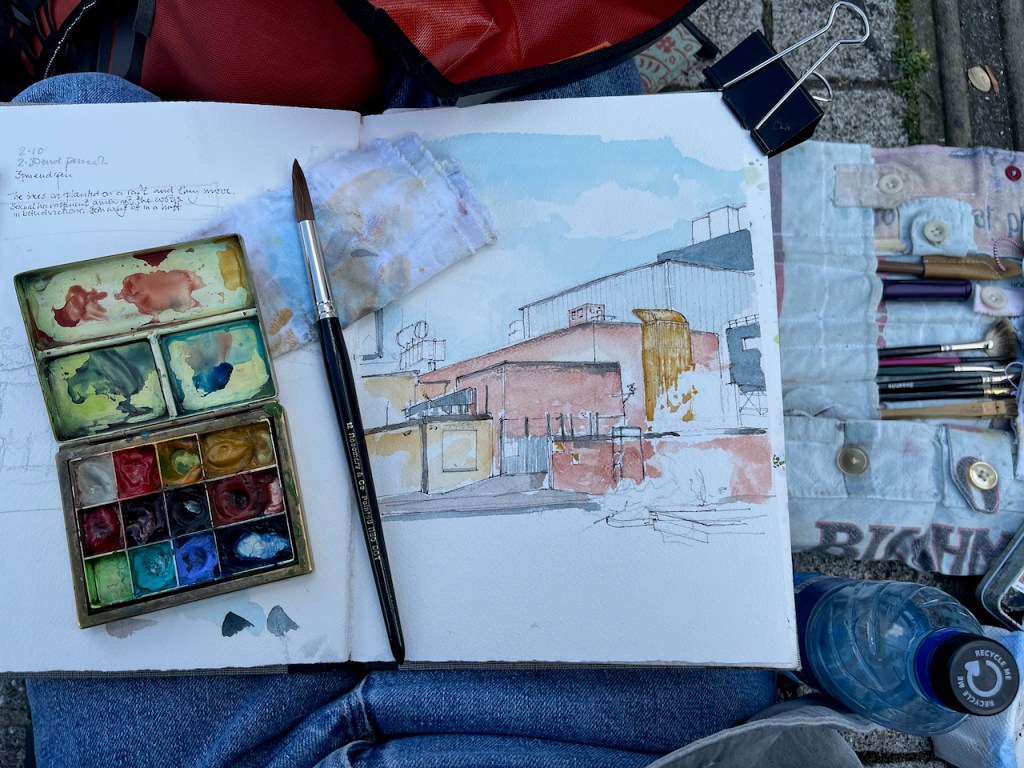
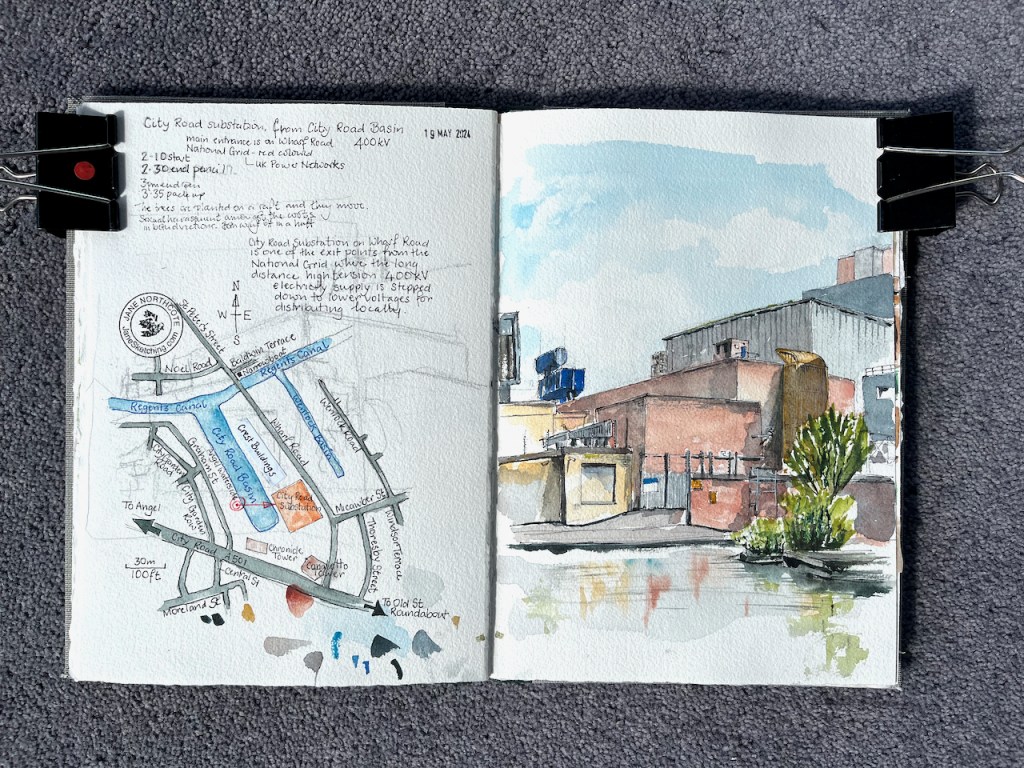
Here is a view of the City Road 400kV Substation, sketched from the other side of City Basin.

City Road 400kV Substation from “Angel Waterside” City Basin, 19th May 2024 in sketchbook 14

This is a monumentally large building, a last remaining representative of heavy industry, in an area now mainly residential. All around are the new tower blocks containing luxury apartments, made of shapes and designs aiming for visual appeal. Chronicle Tower and Canaletto Tower are just off the picture to the right. The sub-station is robustly functional. I enjoyed its forthright no-nonsense appearance.

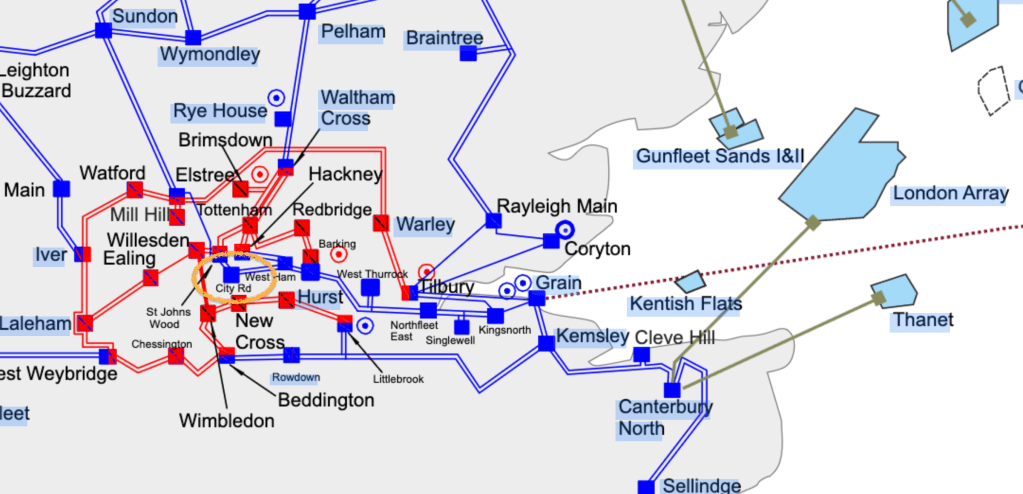
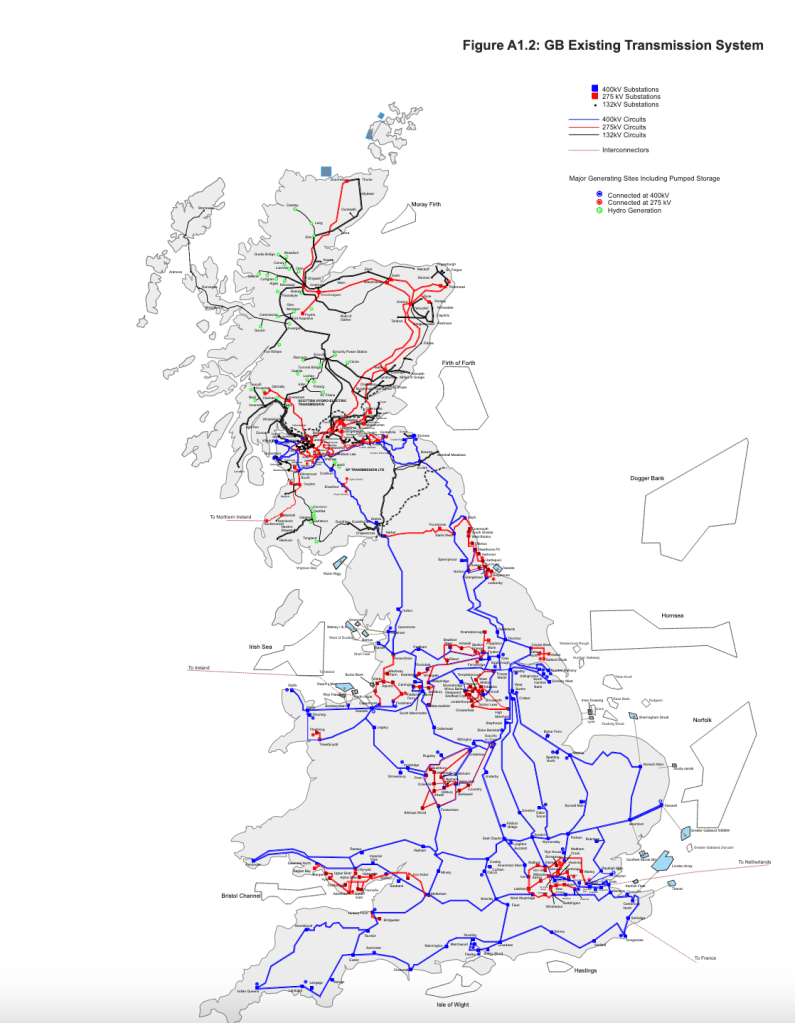
It’s built like a fortress, as well it should be. It is part of the UK power distribution system, connecting us in London to, amongst other power sources, the off-shore windfarms in the North Sea, an interconnector off across to Europe, and power stations on the Isle of Grain.

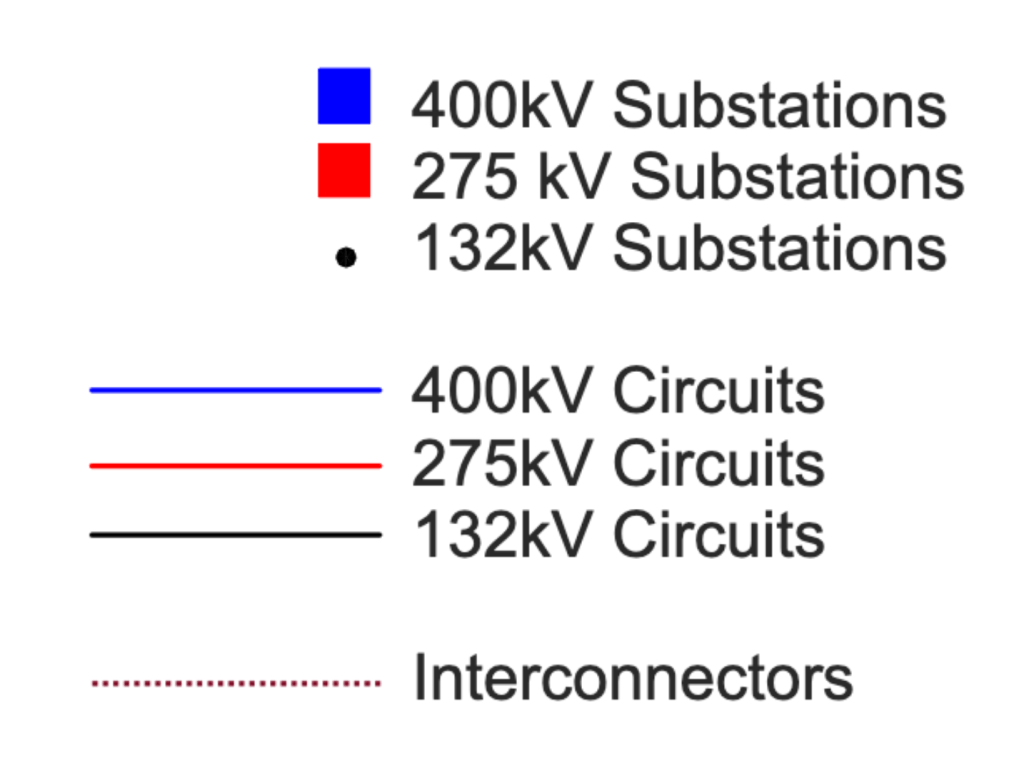
These diagrams come from a National Grid document on this link. The document is “Electricity Ten Year Statement 2012, Appendix A1”. It’s over 12 years old so there may be different connections now.

Despite the uncompromising appearance of the substation, the edge of its higher roof was softened with a subtle fringe of grass. I don’t know if this was a deliberate attempt at a “green roof” or if the grass planted itself there of its own volition.

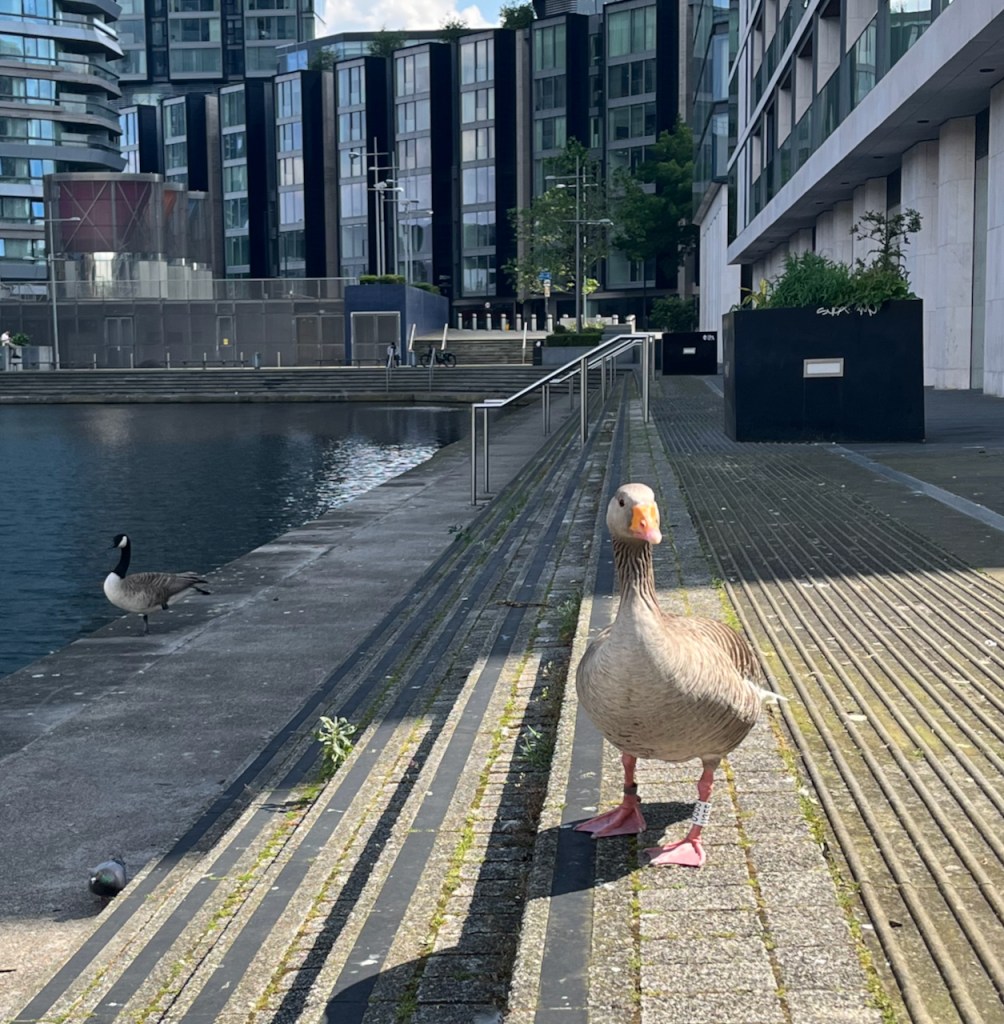
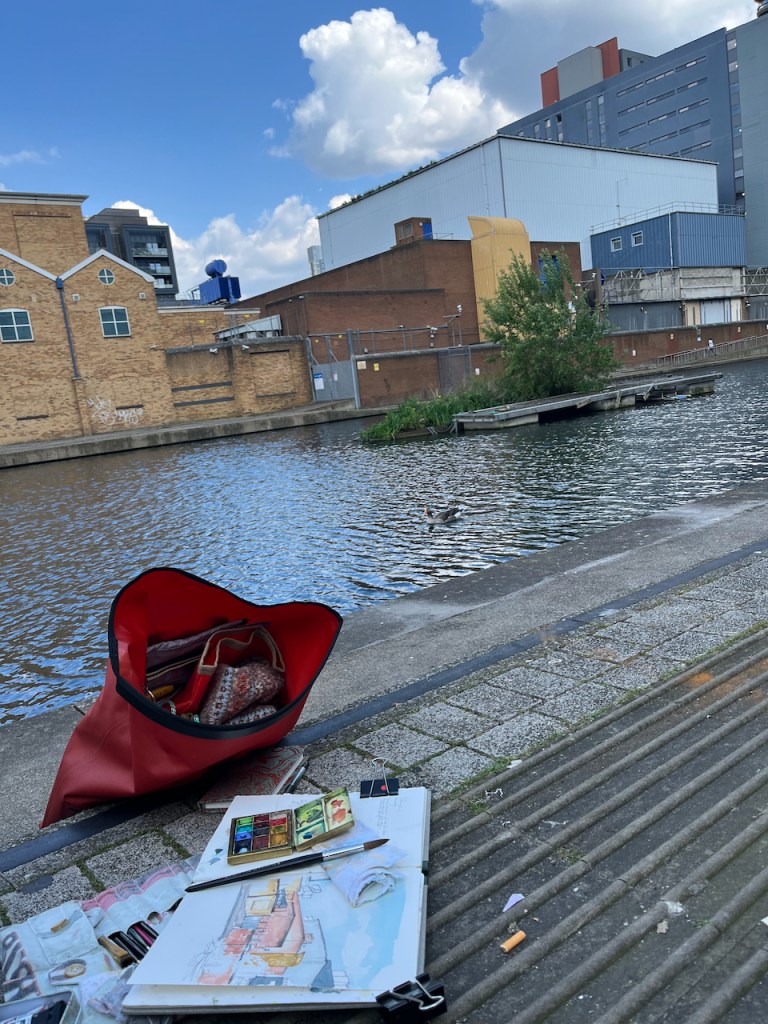
I made this sketch sitting by the water observed by geese. It took me a little while to establish that the tree in the picture was on a raft, and therefore it moved. One does not expect trees to shift around from place to place. I would put it in the sketch, and look up again, and find I had mysteriously got it wrong, again. The geese, obviously, always knew it was a raft, and cackled.

The colours here are:

  • Phthalo Turquoise Blue for the sky (with some Ultramarine Blue)
  • Fired Gold Ochre for the bricks
  • Mars Yellow, with Fired Gold Ochre, for the paler brickwork
  • Ultramarine Blue for the cylindrical construction on the roof (middle left)
  • Serpentine Genuine for the tree
  • All greys and blacks are combinations of the above, plus Burnt Umber.

Colours are all Daniel Smith. The paper is Arches Aquarelle 300gsm in a sketchbook by Wyvern Bindery.

The Sekforde – a commission

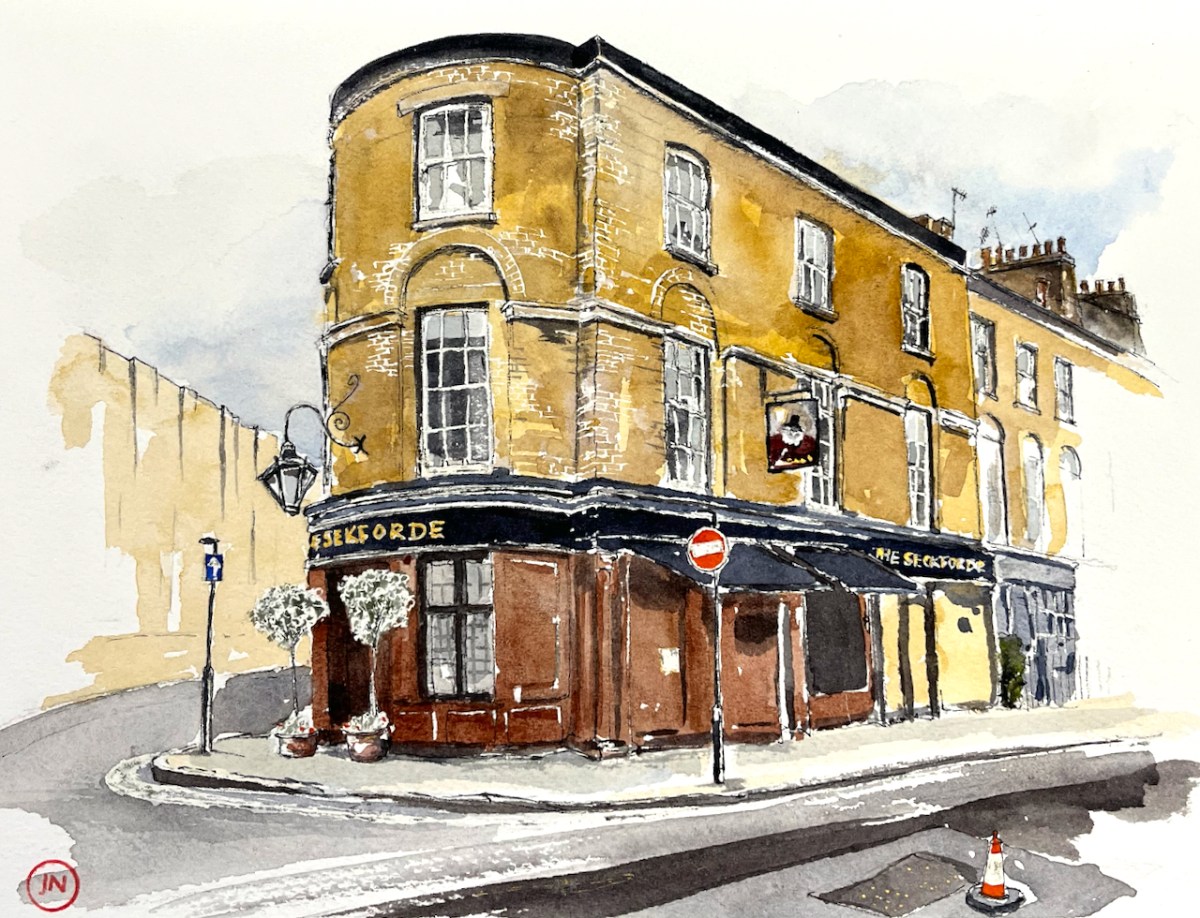
The Sekforde EC1R 0HA, Clerkenwell, sketched March 2024 12″ x 9″ [commission]

This watercolour was specially commissioned to celebrate a happy event.

The colours are:

  • Mars Yellow
  • Fired Gold Ochre
  • Ultramarine Blue
  • Burnt Umber
  • plus some Horadam Random Grey, some Daniel Smith Green Serpentine Genuine, and Pyrrol Red for the street sign and road marker.
  • Gold paint for the lettering.

Admire the bricks! I am very pleased with this effect. It was done by applying a rubber resist, “pebeo drawing gum” to the paper before I did any painting. The paint does not adhere to the rubber resist. When I had done all the colour, I rubbed off the rubber resist and hey presto! bricks.

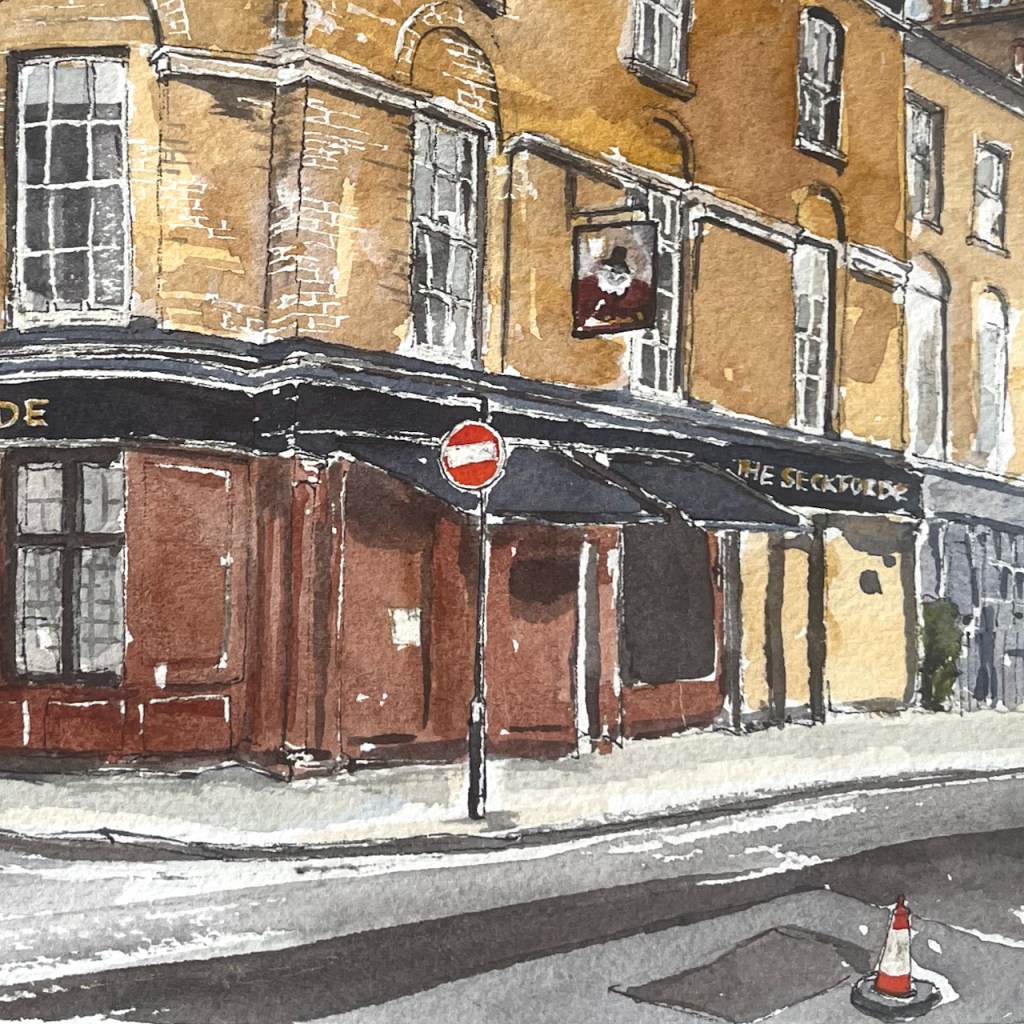
Thank you to my client for their encouraging words and for inspiring me to make this picture of The Sekforde. Here are some details of the drawing.

I have sketched The Sekforde previously, see this link: The Sekforde, Clerkenwell

UPDATE:

My client kindly sent me photos of the framed picture!

Vauxhall Tea House Theatre SE11

Here is a civilised place in London. It’s the Vauxhall Tea House Theatre.

This is a picture I sketched there last week:

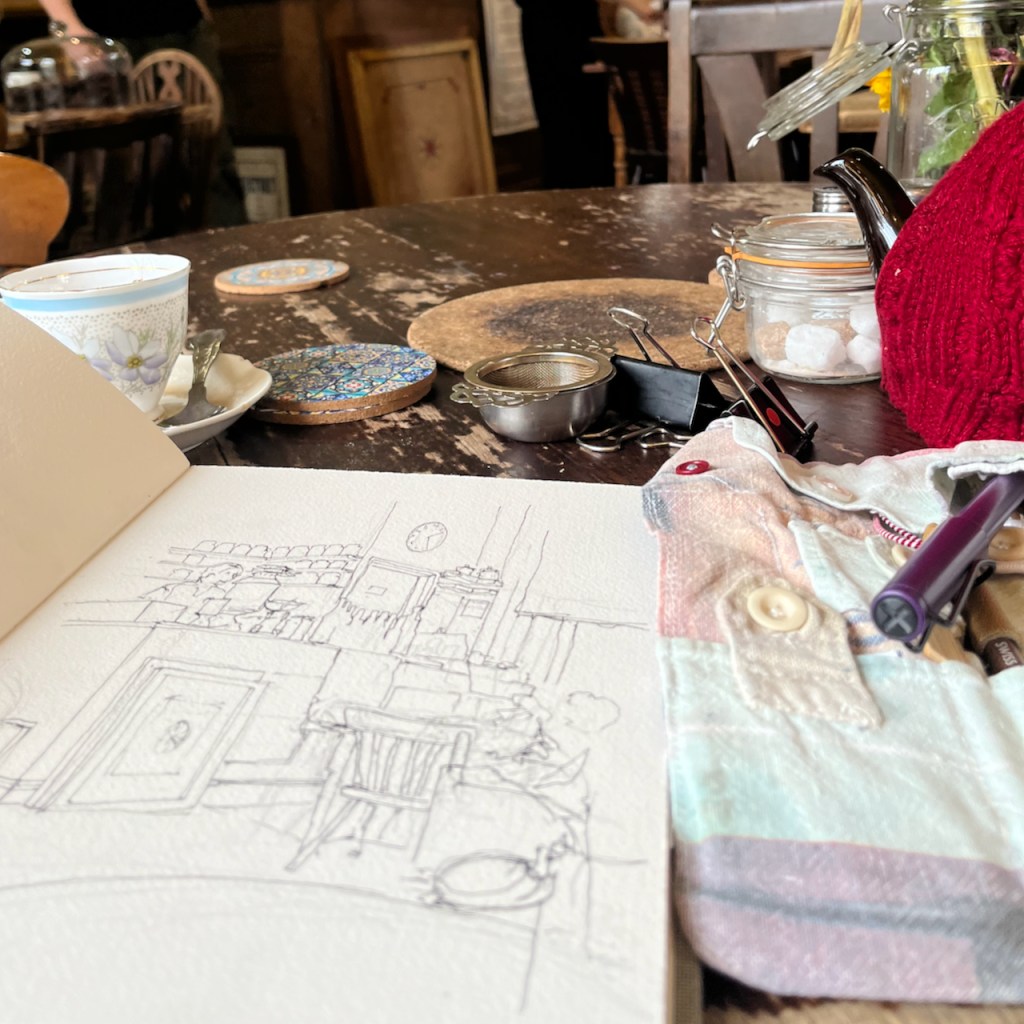
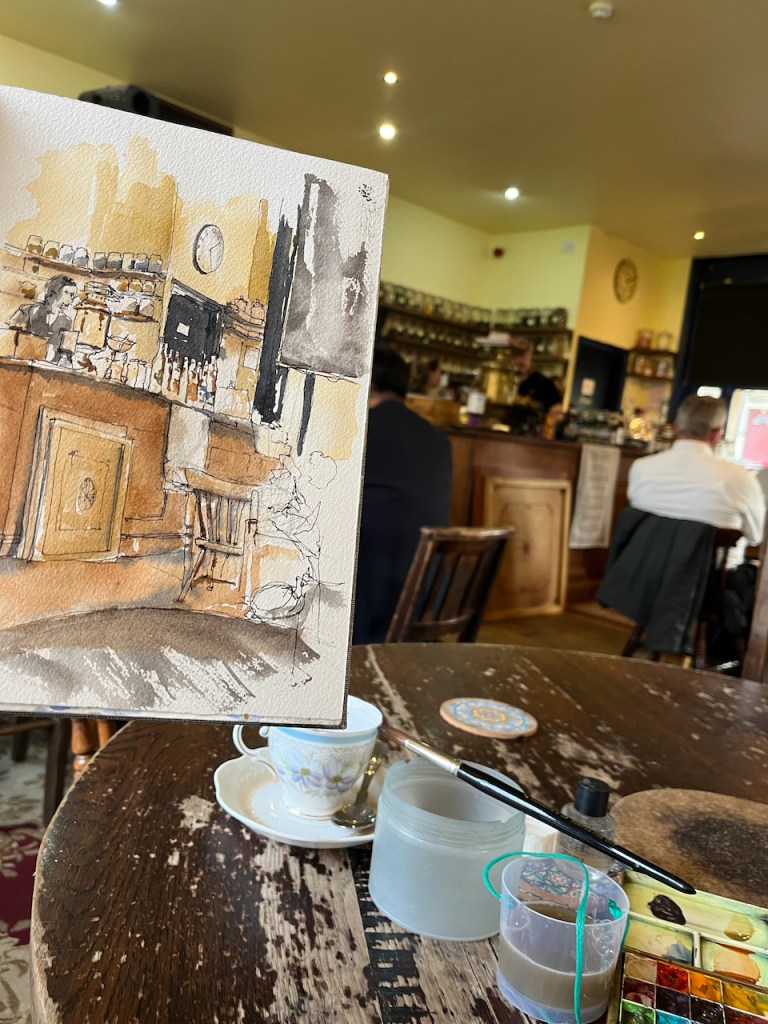
Vauxhall Tea House – 2:30pm 7 March 2024, in sketchbook 14

The tea I drank was their “Russian Smoky Tea”.

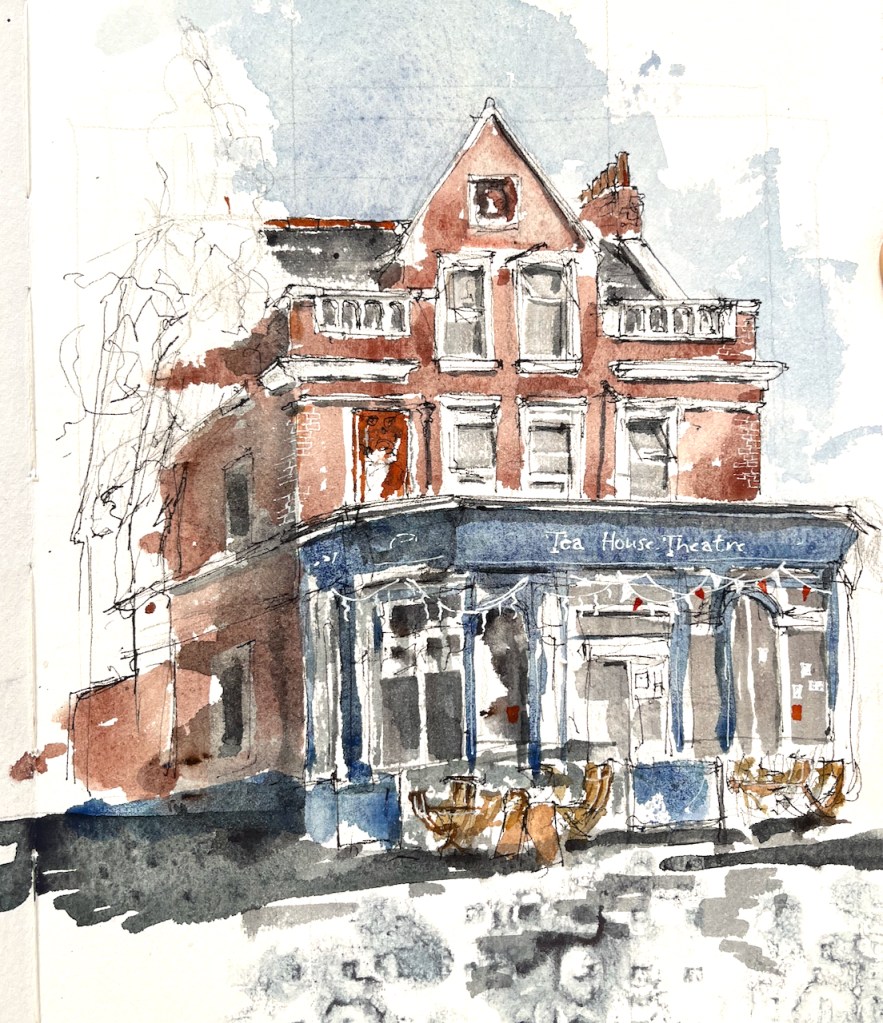
I’ve visited the Tea House many times. Here is an outside view from June 2022

Tea House Theatre, external view, June 2022 in Sketchbook 12

They have all sorts of theatrical events on their tiny stage. I enjoy “Don’t Go Into The Dungeon” where talented actor Jonathan Goodwin plays all of the characters to amazing effect. He specialises in Victorian mysteries. The next one is “The Hound of the Baskervilles”. Dinner is served before the performance. With scones for dessert.

Here’s where it is, just a 5 minute walk from Vauxhall Station.

And in more detail:

Here’s my sketchbook page:

Sketchbook 14

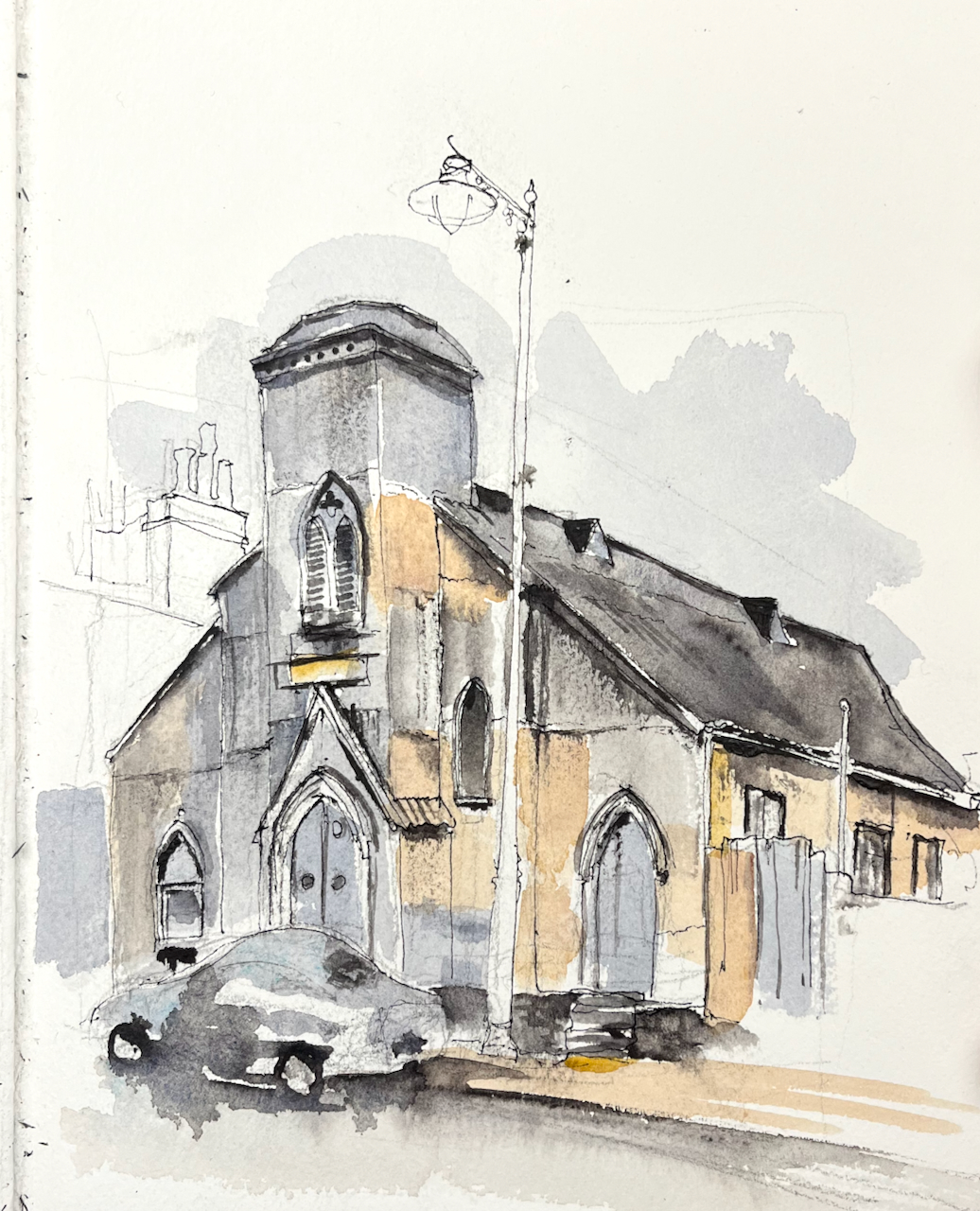
Cambridge Hall, Tin Tabernacle, Kilburn NW6 5BA

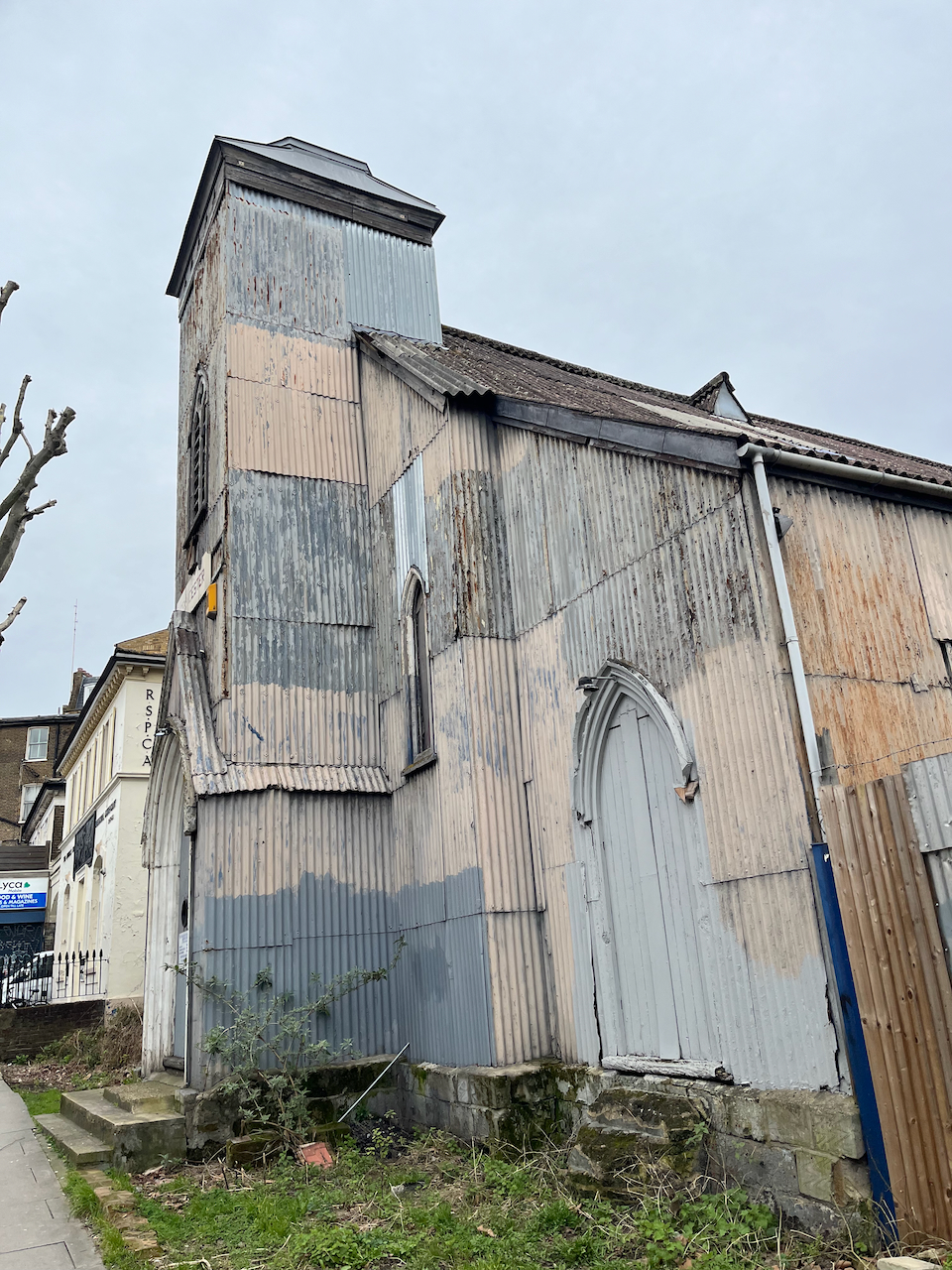
I was reading about “tin tabernacles” having sketched the “Tin Tabernacle” in Esher. I discovered, via a Historic England blog article, that there is a Tin Tabernacle in Kilburn in London. So I went to have a look. It is an “iron church” built of galvanised corrugated iron in 1863. It used to have a steeple, but that has disappeared.

Here it is now:

Cambridge Hall, Cambridge Avenue, Kilburn NW6 5BA, sketched 28 February 2024 3pm in sketchbook 14

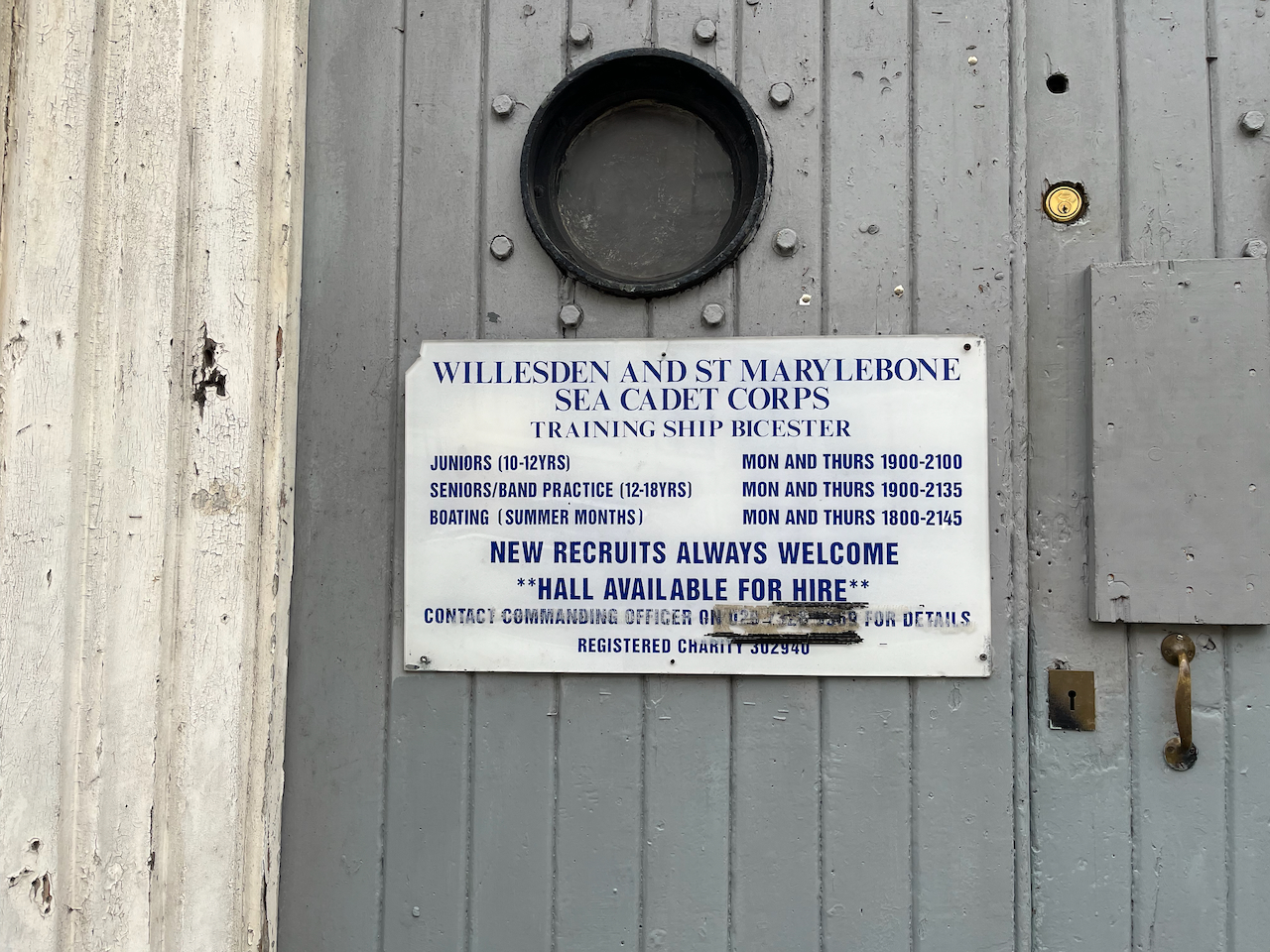
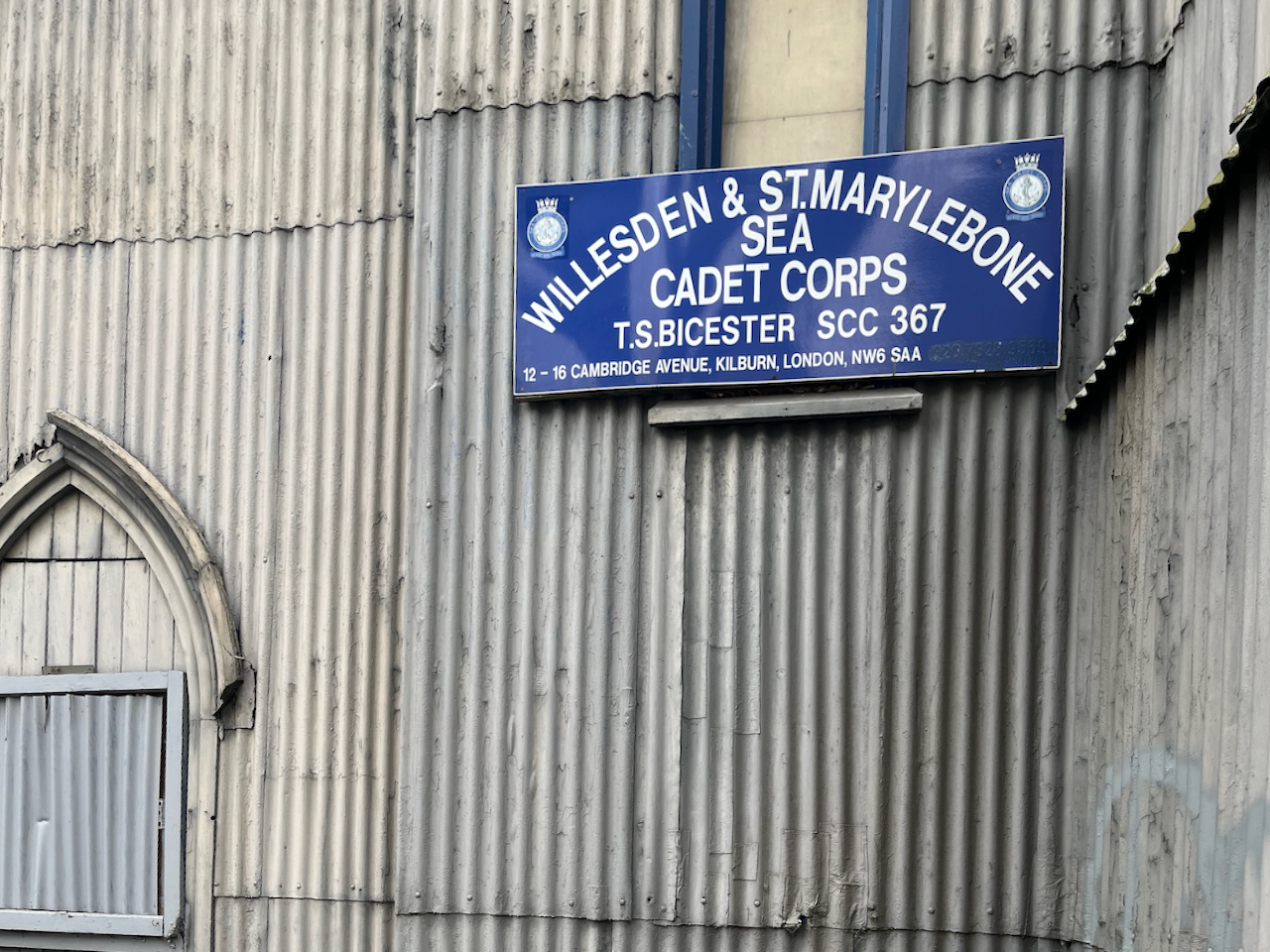
The building was built as a church, and more recently was a centre for Sea Cadets. Its future is under discussion, according to an article on the London Historic Buildings Trust site (LHBT).

The site is owned by Notting Hill Genesis Housing Association (NHG).  LHBT are currently working with NHG and the Sea Cadets, supported by Historic England and the Conservation Officer at Brent Council, to explore how the building can be stabilised and used in the future.

https://londonhistoricbuildings.org.uk/index.php/tin-tabernacle-kilburn/

The latest date mentioned in this article is 2021, so I guess the exploration is still going on. It’s listed as a “current project” on their website. The building was looking a little precarious when I visited this year (February 2024). An alarm was sounding inside.

It is Grade II listed, and on the Heritage at Risk Register. The listing is on this link. It is currently an events venue, the website is:
http://tintabernaclekilburn.org/

Here are some photos of the outside:

The building is about 150m north of Kilburn Park underground station on the Bakerloo Line.

The London Historic Buildings site has a “Virtual Visit” link, so you can see what it looks like inside, and there is a timeline of the building (click below to see it, 2 pages PDF):

It’s a building with a varied history. I wonder what will happen to it?

Sketch and notes in sketchbook 14

UPDATE: 6th March 2026

An article on “Ian Visits” says that the Ministry of Defence is funding the removal of the two training guns inside the church:

Their removal is now expected to make it easier to pursue restoration works and attract the significant external funding needed to repair the building and secure a sustainable future. The London Historic Buildings Trust is leading the restoration work with the aim of opening the Tin Tabernacle as an active community asset for Kilburn.

“Ian Visits” website: https://www.ianvisits.co.uk/articles/the-church-with-anti-aircraft-guns-kilburns-unusual-naval-relics-removed-88029/