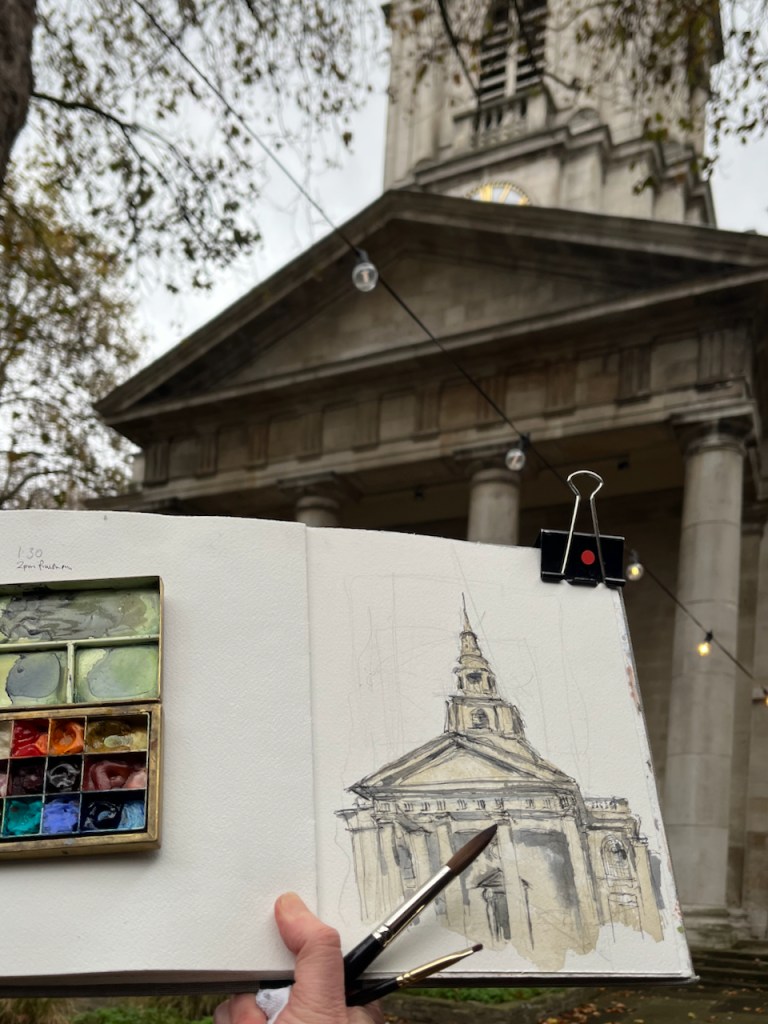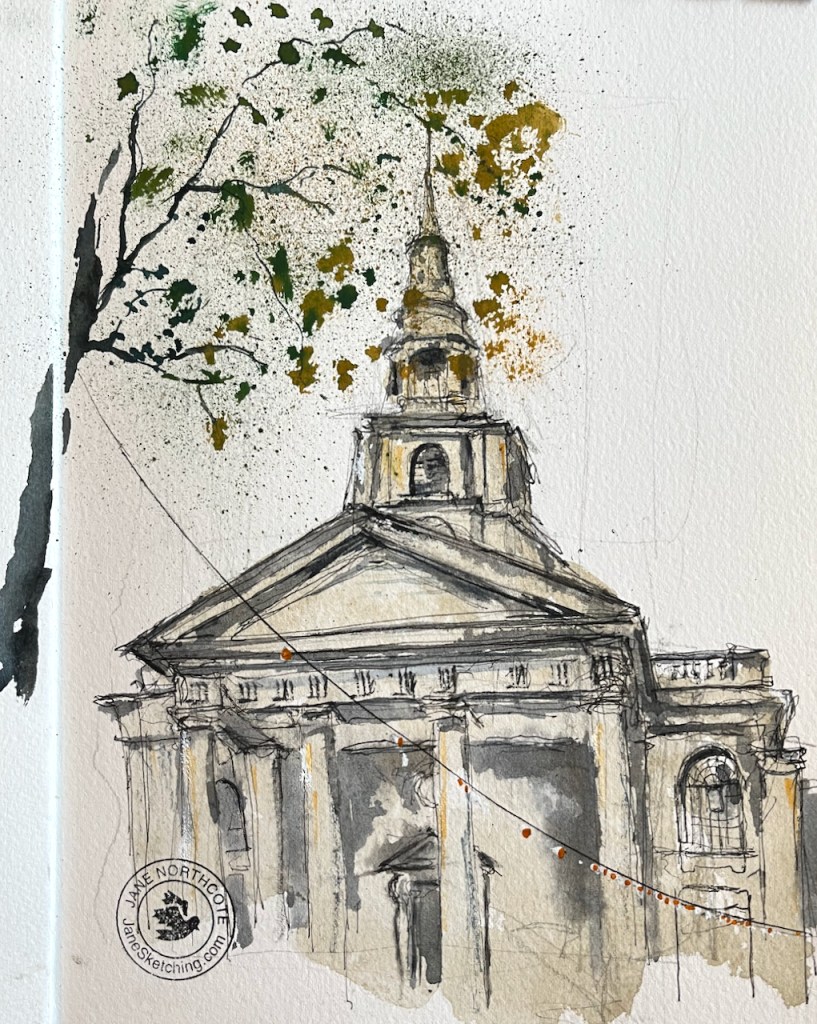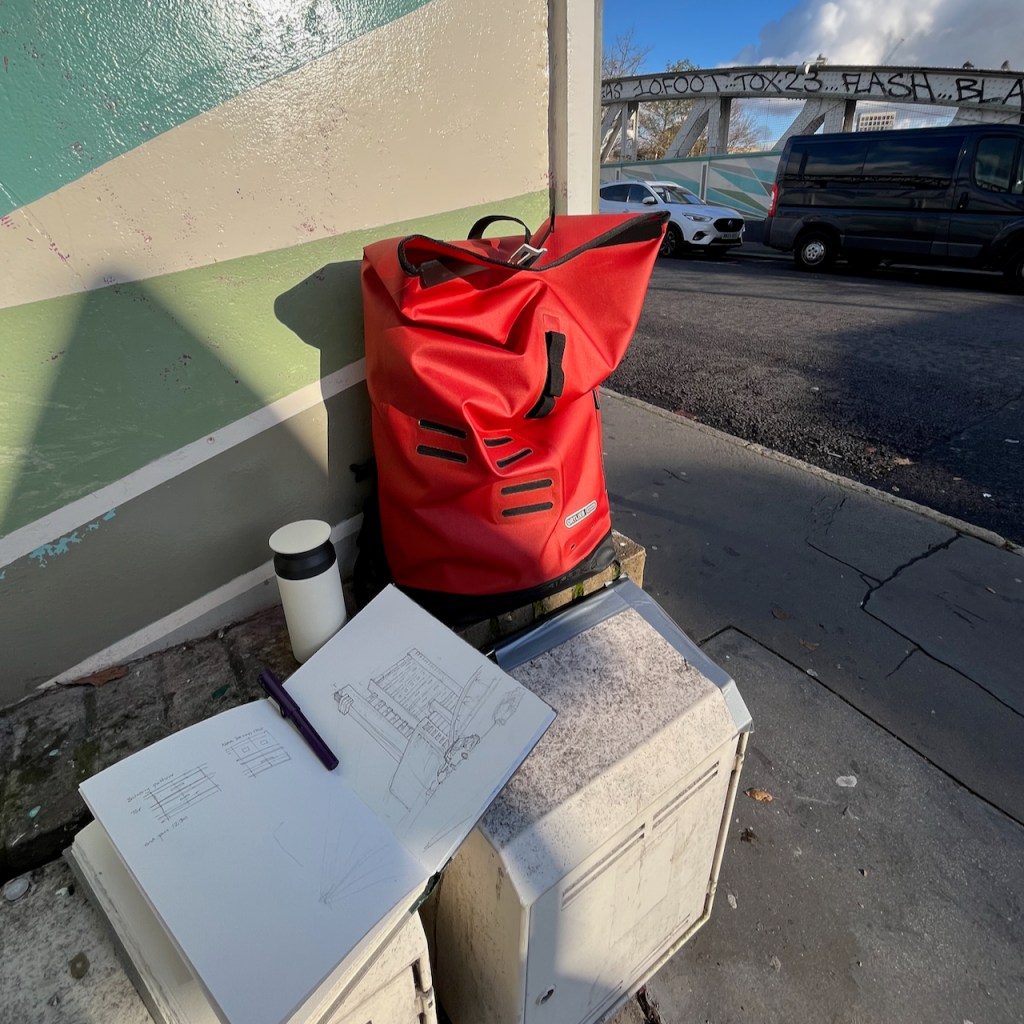
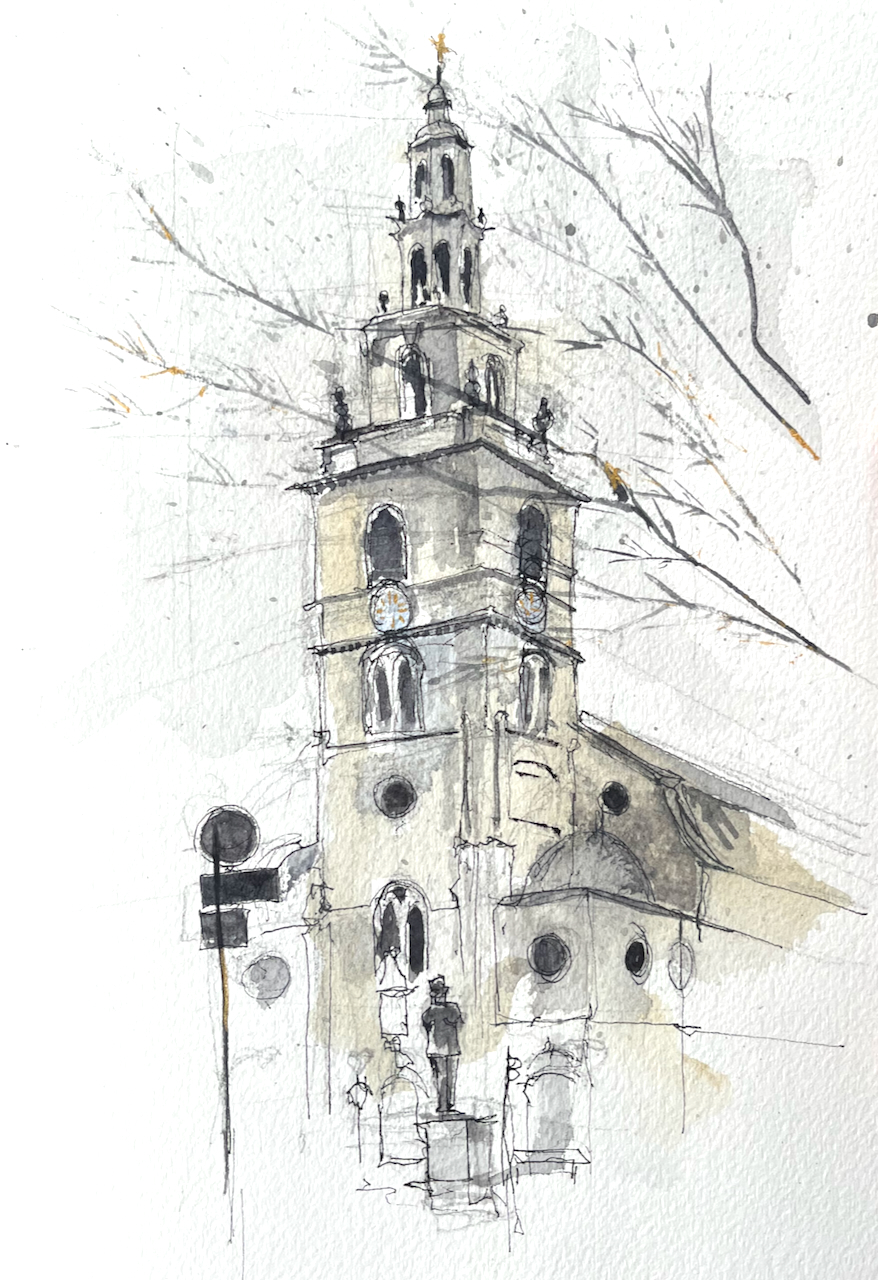
St Clement Danes, Strand, WC2

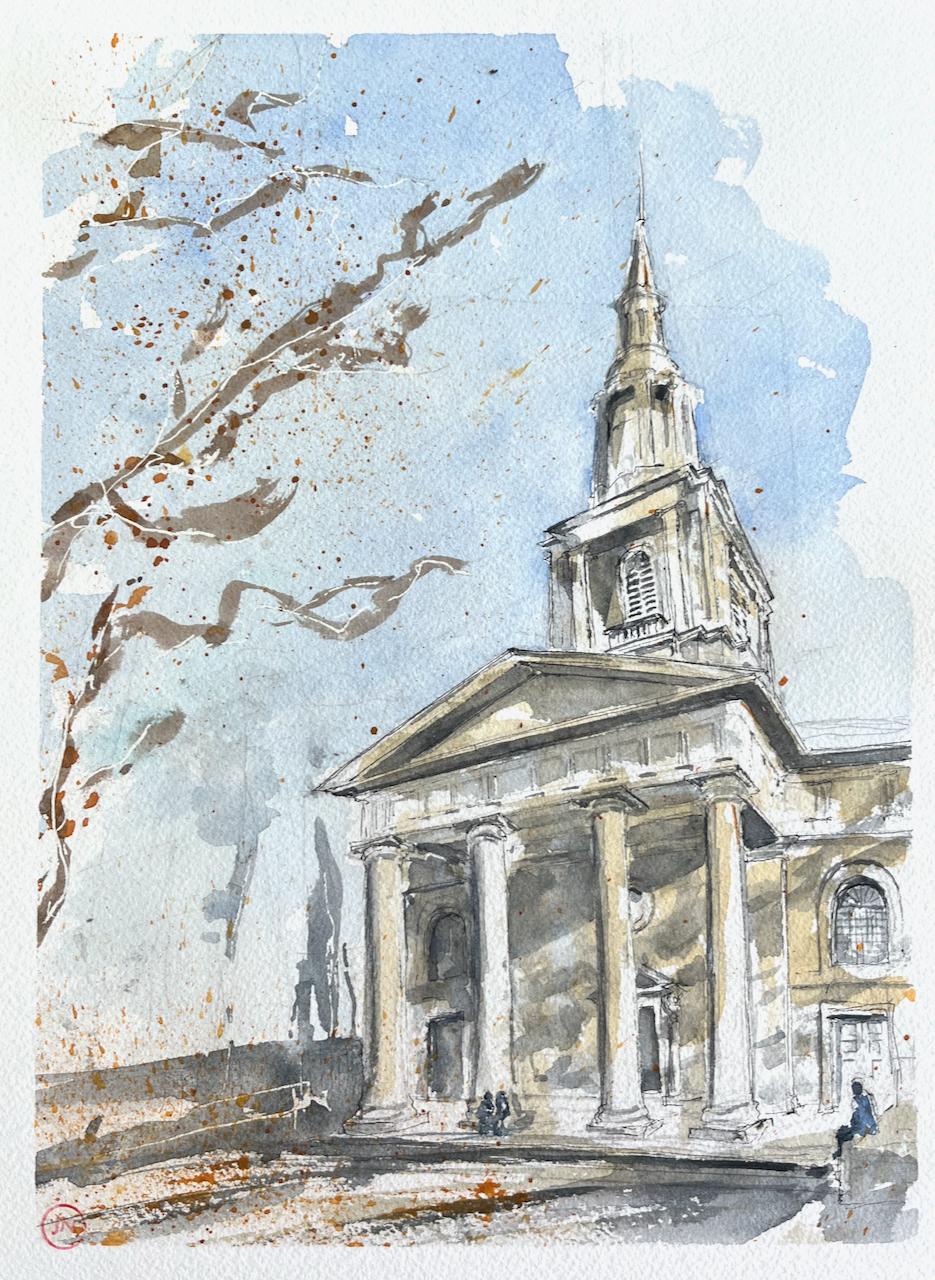
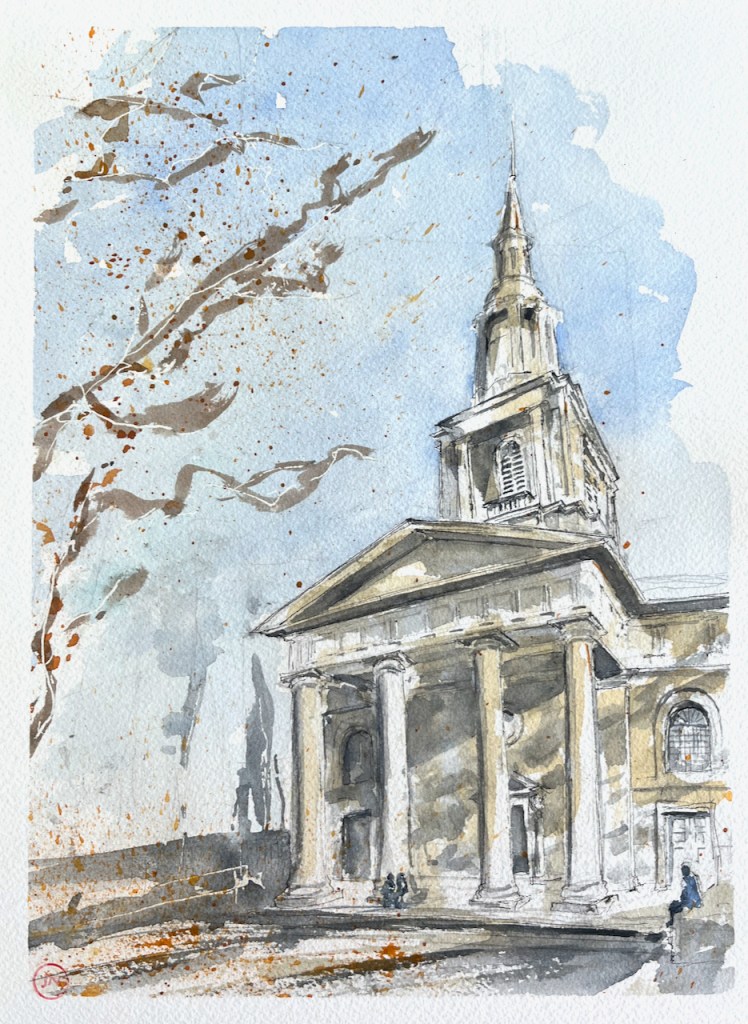
St Clement Danes stands on a traffic island in the Strand.

St Clement Danes, Strand, WC2R 1DH, sketched 7 February 2024 13:30 in sketchbook 14

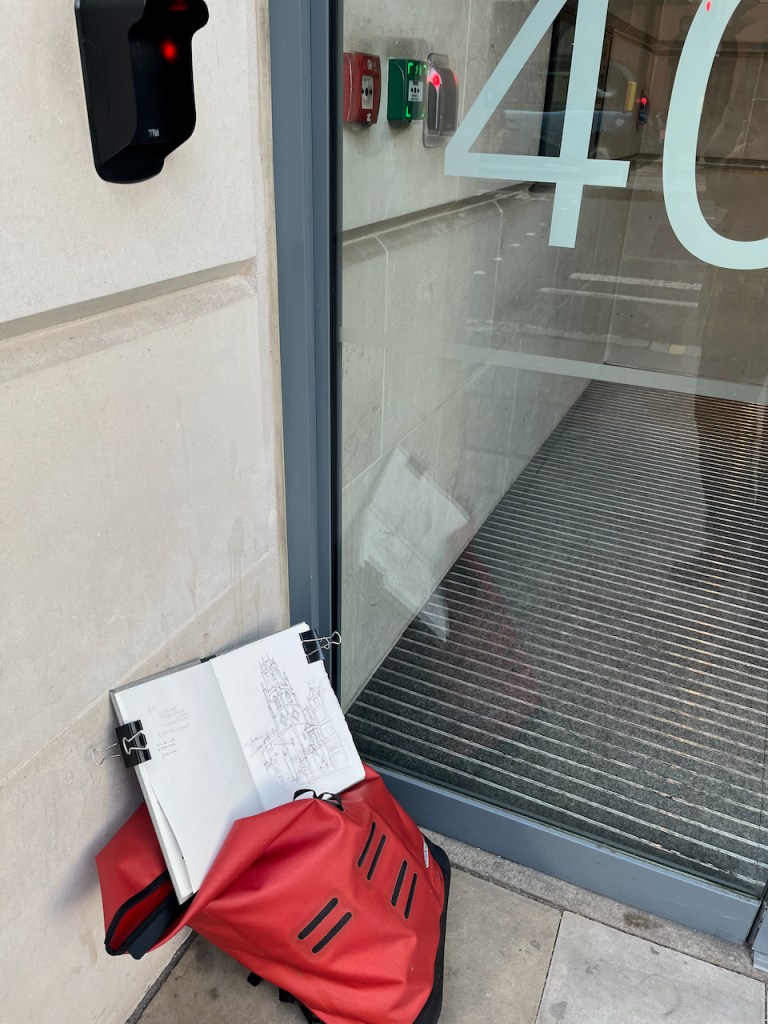
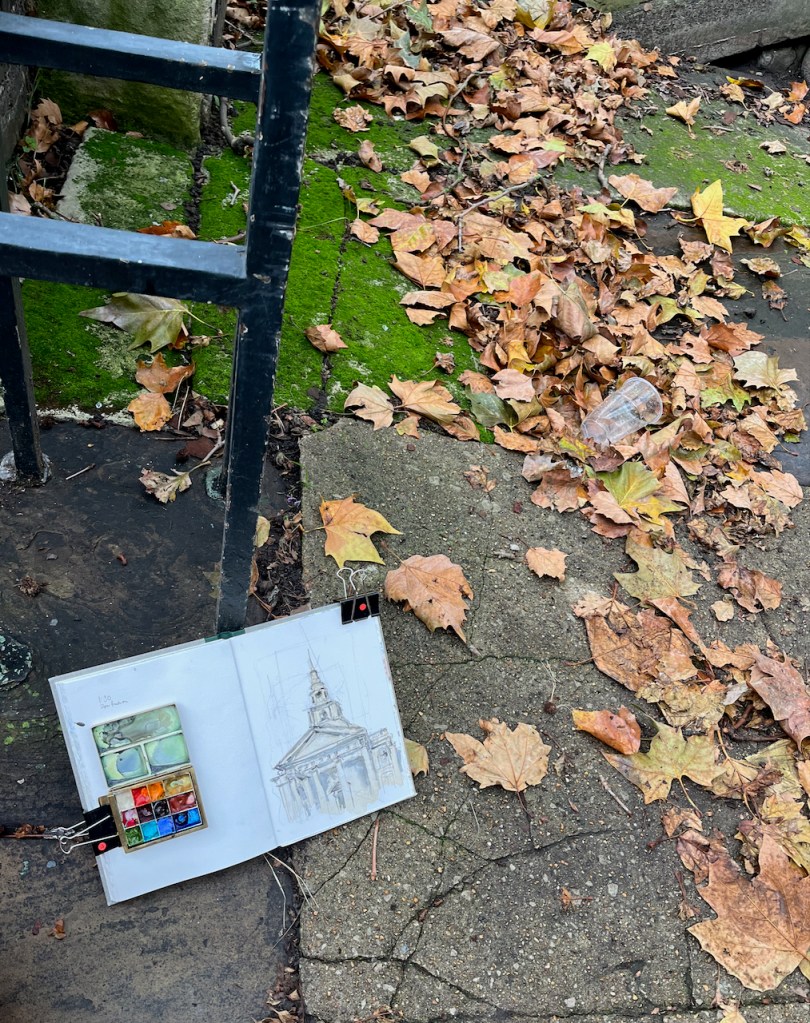
I sketched this church over a lunchtime. At 1pm its bells played its tune, “Oranges and Lemons“, a little haphazardly, but quite distinct.

Why St Clement Danes? What’s Danish about it? According to the church leaflet, in the 9th century, “Danish settlers who had married English wives were allowed to settle in the area taking over a small church dedicated to St Clement. The Church came to be known as ‘St-Clement-of-the-Danes'”.
A rather more brutal story is told by the Viking Ship museum of Roskilde in Denmark:

“By the 9th century London was yet again a powerful and wealthy town attracting the attention of the Danish Vikings. They attacked London in AD 842, and again in AD 851, and The Great Army spent the winter in the town in AD 871-72.”
“Cnut became King of England and in AD 1018 he was able to send his army back to Denmark. He burdened the English population with the tax thingild to pay for the maintenance of a small army. He also placed his Danish garrisons around London, including by the church St. Clemens Danes. Generally, Cnut was a popular king, and during his reign peace prevailed in England. Cnut died in AD 1035 and one of his sons, Harold Harefoot, took over the English throne.
On his death Harefoot he was buried in Westminster Church, but his brother Harthacnut ordered the body to be dug up and thrown into the Thames. Perhaps Harold Harefoot was re-buried in St. Clemens Danes outside the town wall. The peace in England was over.”

The “Science Nordic” site offers lively descriptions of the Danish people that arrived in England in the 9th and 10th centuries. Today we might describe them as “economic migrants”

“In eastern England the Vikings discovered a milder climate and a rich agricultural landscape, similar to the one they knew back home. Faced with a lack of good farming land in Denmark, many families decided to try their luck on the other side of the North Sea.”
Dr Jane Kershaw, Archaeologist and Viking researcher

St Clements no longer has any particular Danish connection. It is linked to the Royal Air Force. The statue outside, in the bottom centre of my sketch, is

“Air Chief Marshall Lord Downing, Baron of Bentley Priory, Fighter Command 1936-40”

according to the inscription on his plinth. The Danish church in London is St Katherines, to the East of Regents Park.

Here is the song the bells played, with links to my drawings of the churches:

Oranges and lemons,
Say the bells of St. Clement’s. (St Clement Danes)
You owe me five farthings,
Say the bells of St. Martin’s. (St Martin in the Fields)
When will you pay me?
Say the bells at Old Bailey. (St Sepulchre-without-Newgate)
When I grow rich,
Say the bells at Shoreditch. (St Leonard Shoreditch)
When will that be?
Say the bells of Stepney.(St Dunstan’s Stepney)
I do not know,
Says the great bell at Bow. (St Mary Le Bow)
Here comes a candle to light you to bed,
And here comes a chopper to chop off your head!
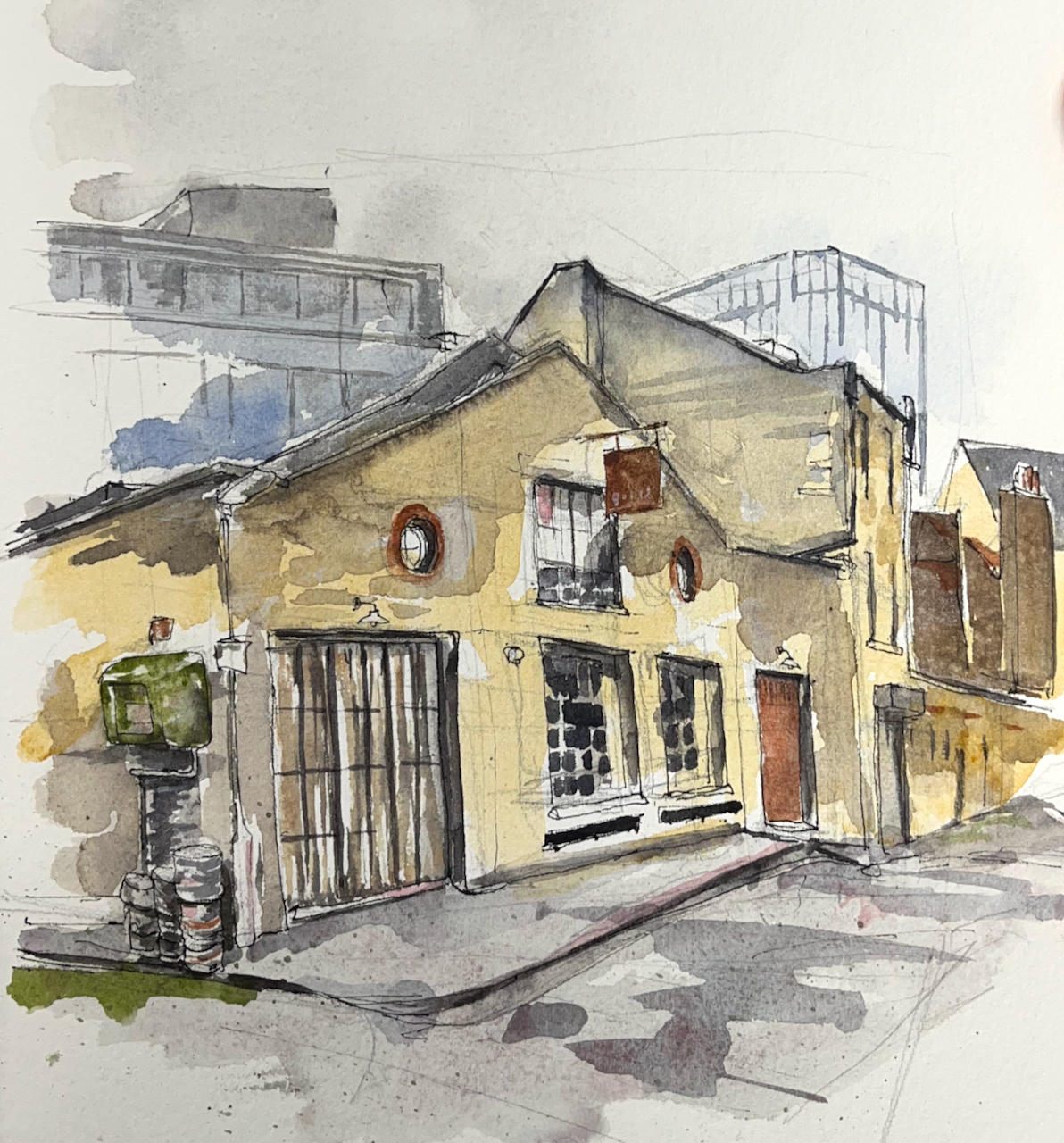
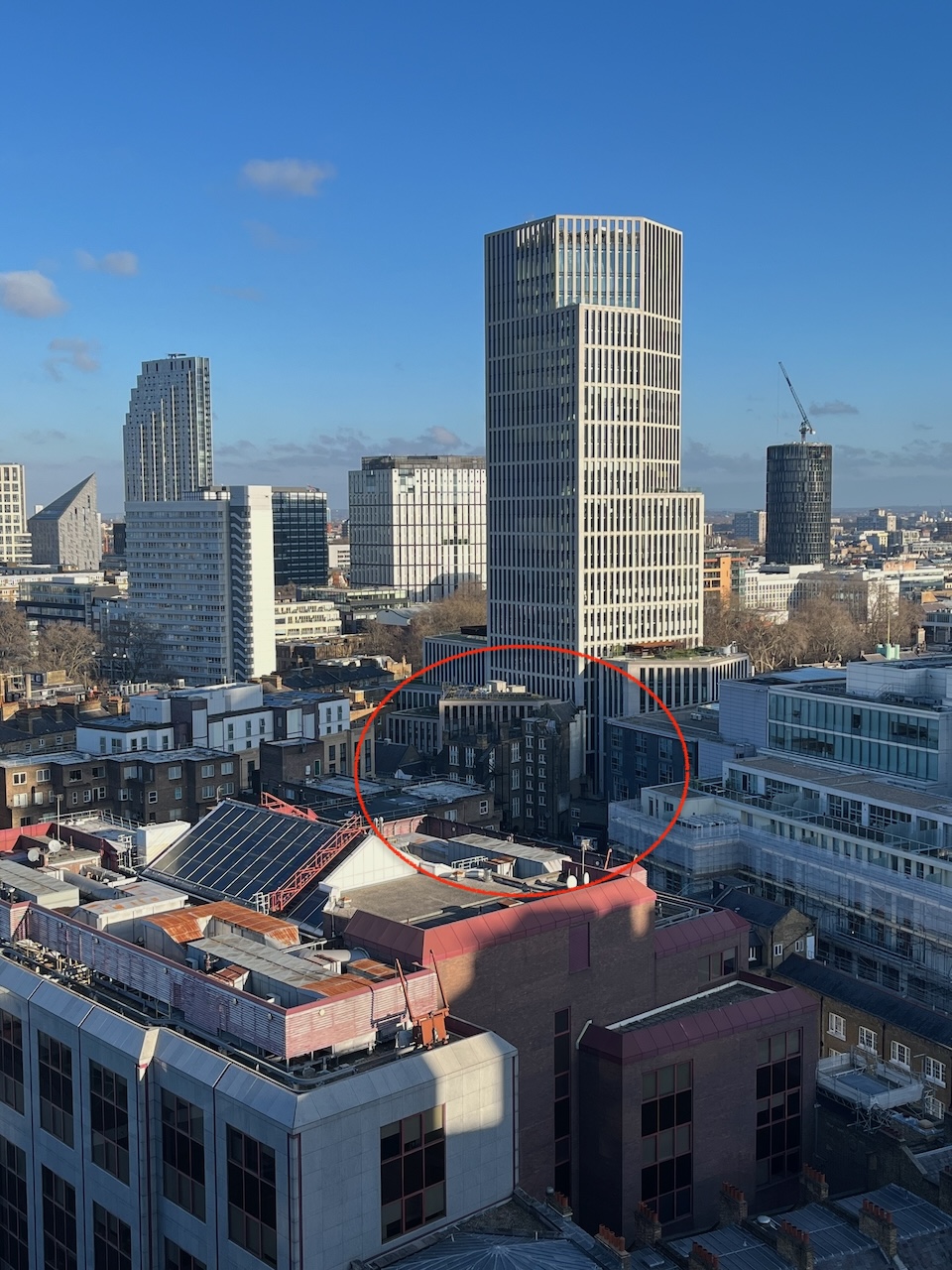
6 St Chad’s Place – Jamboree WC1X

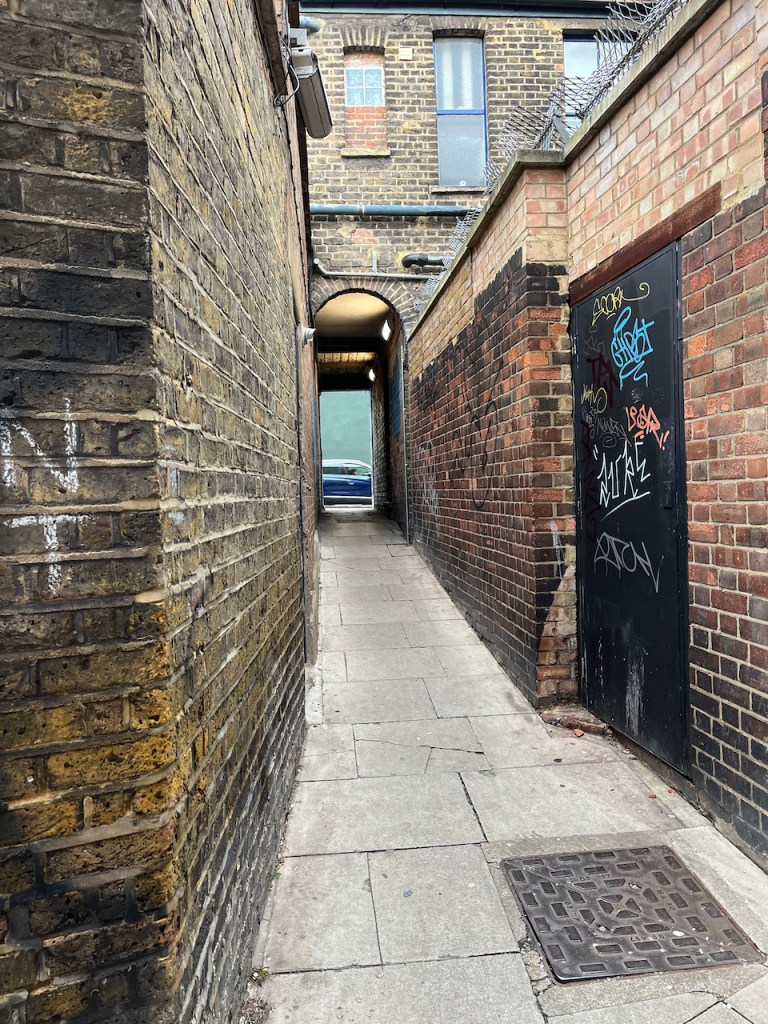
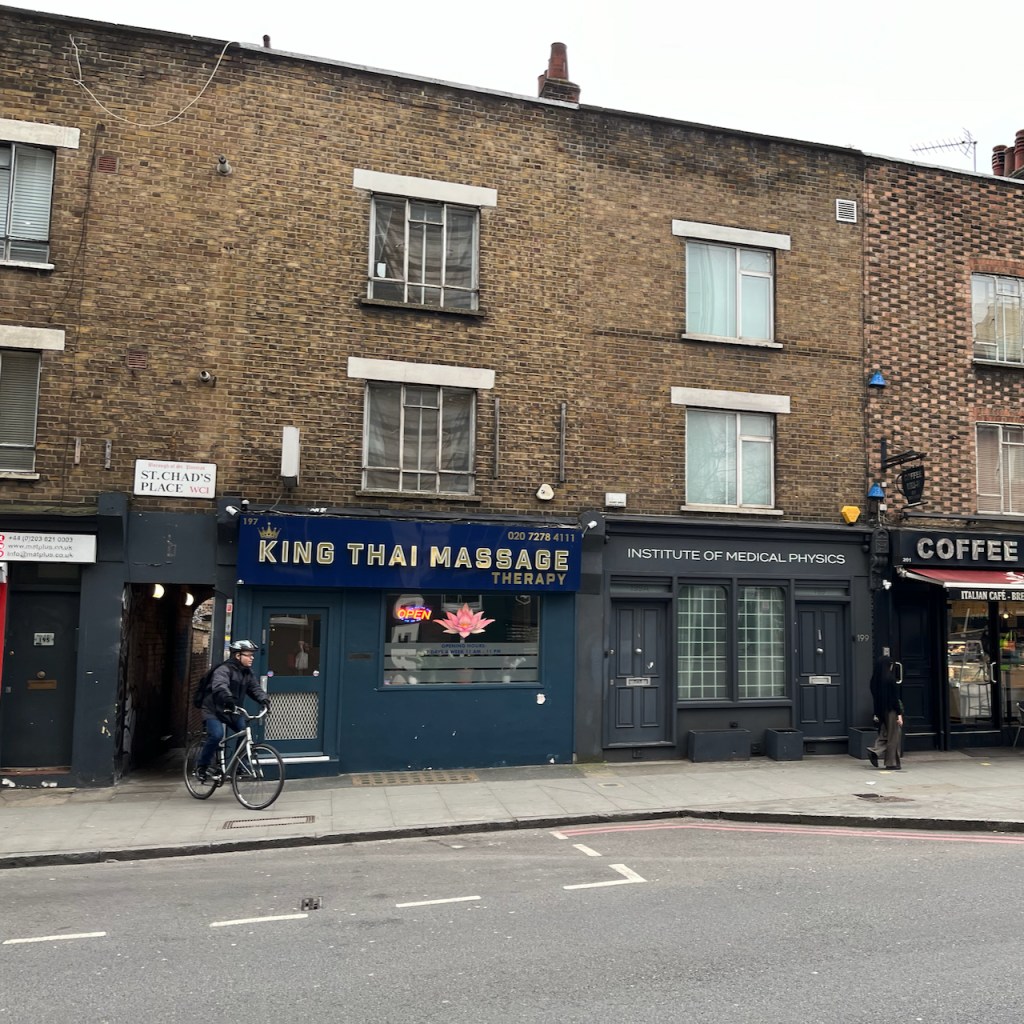
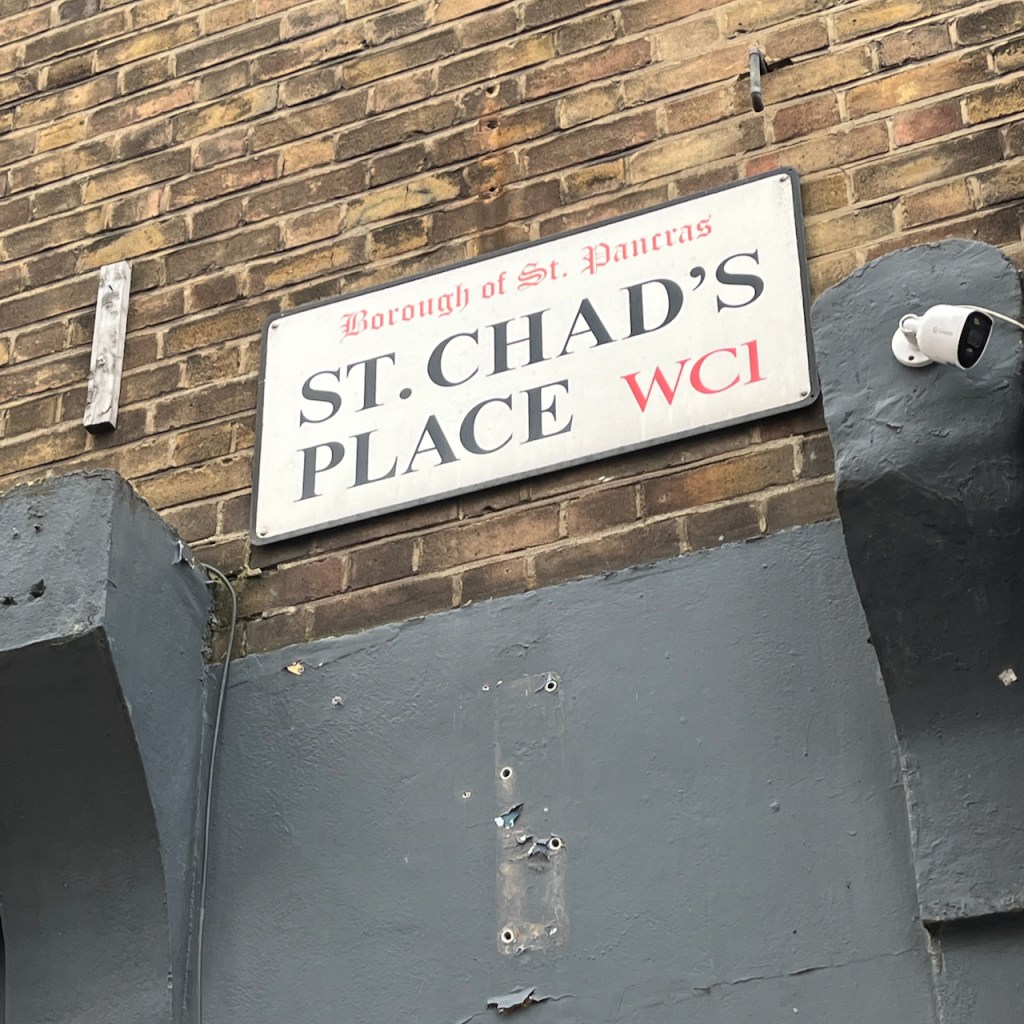
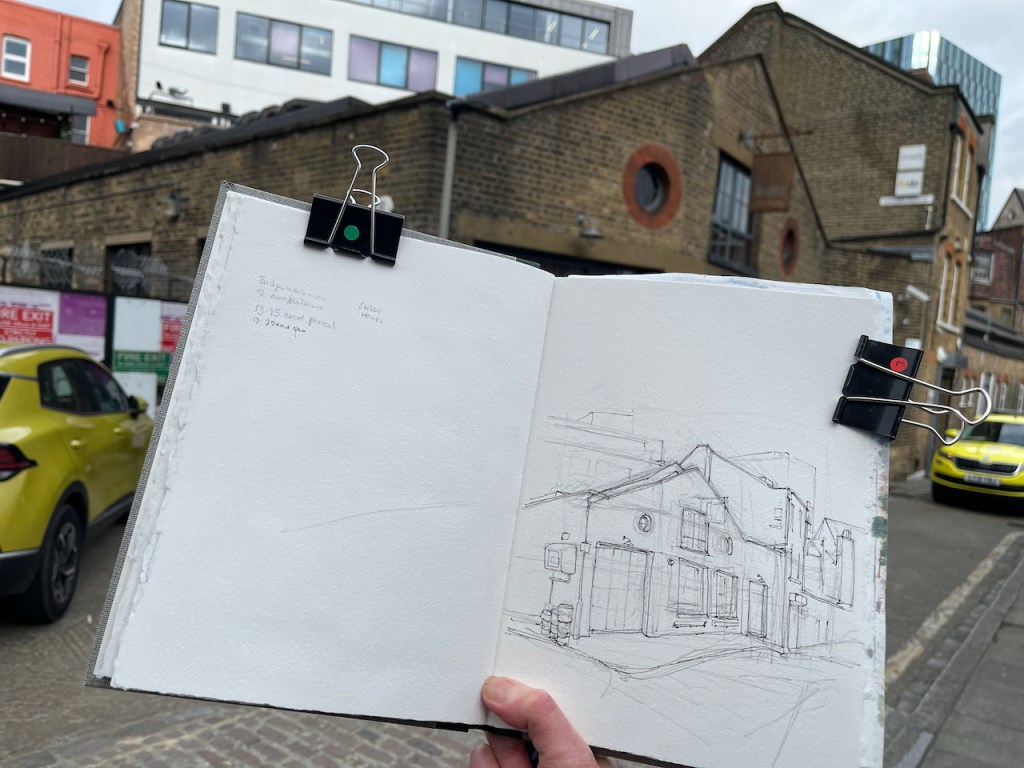
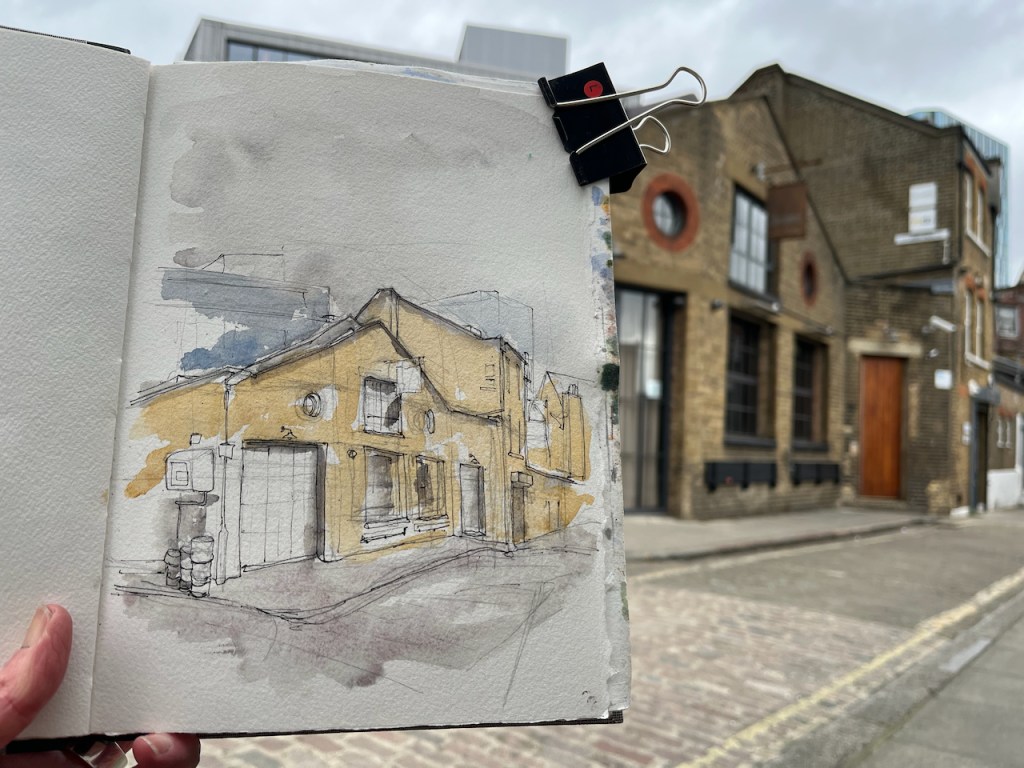
I went to sketch this place in a back alley near Kings Cross because I enjoyed the geometry of the roof, spotted on a morning run some time ago.

6 St Chad’s Place, Jamboree, London WC1X 9HH – sketched 6 February 2024 2pm in Sketchbook 14

This is “Jamboree” where there is live music, dancing and events: It is open Tuesday evening to Sunday.

“music forms from around the world, cabaret, European folk, dances.”

(https://www.jamboreevenue.co.uk/)

I was expecting the hidden alleyway to be deserted on a Tuesday lunchtime, and so it was for the first hour. But then it became suddenly busy. A small ambulance backed carefully down the alleyway in front of me and parked. Its doors opened and two paramedics went round to the back of the car. They lifted out their equipment and walked calmly off down the alley. After that excitement, a certain calm returned to the alley, insofar as calm is possible a few hundred metres from Kings Cross.

I carried on sketching, now working on the beer barrels to the left of the picture. But the calm did not last long. Two cars arrived and people dressed in orange hi-vis vests scrambled out. They unlocked a gate off the picture to the left, and went in, leaving their car on the pavement. Then a van arrived, it parked directly in front of me, and a further person in a hi-vis outfit got out. He looked across the bonnet of his van and saw me sketching. “Oh, sorry,” he said, “Am I in your way?” I said that yes, he kind of was. I stood ready, however, to concede the space to him, as he looked important and determined in his bright orange overalls and hard hat. But to my surprise he grinned at me, “Ten minutes! I’ll be just ten minutes!”. He rushed off through the gate where the other people had gone. I abandoned the beer barrels and worked on the roofs.

The roofs were quite a challenge, and they productively occupied the 8 minutes until the driver came rushing back out, looking triumphant, accompanied by a selection of the people who’d arrived earlier. “I told this woman I’d be ten minutes,” he explained to his entourage. He raised a hand to me in greeting, got into his car and rumbled off, leaving the other people standing on the cobbles. I asked them what they were working on. “The bridge,” they said. Oh yes, I was standing on a bridge. The train lines were below.

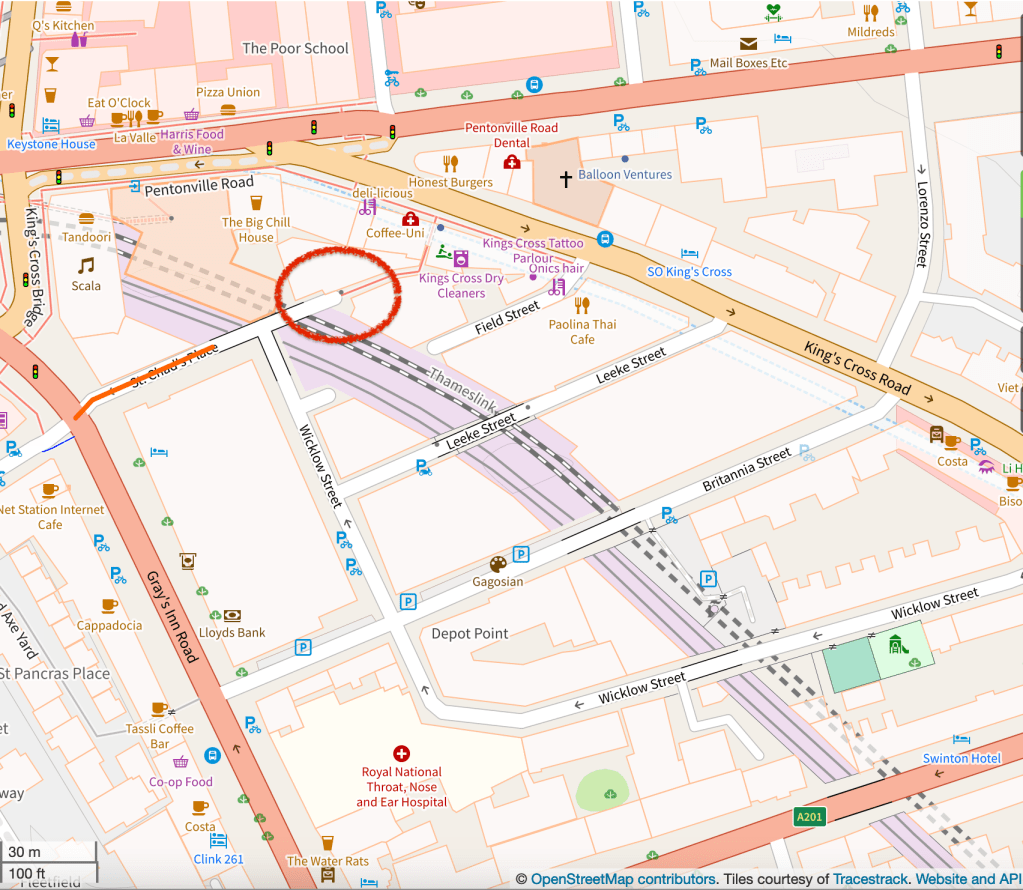
Annotated Google map of the location.

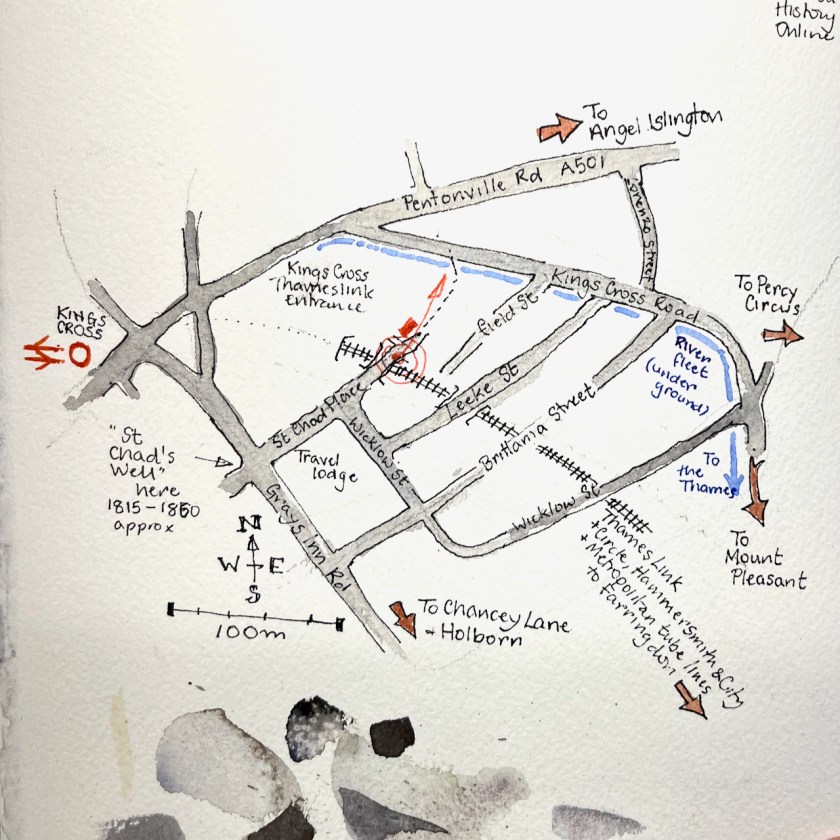
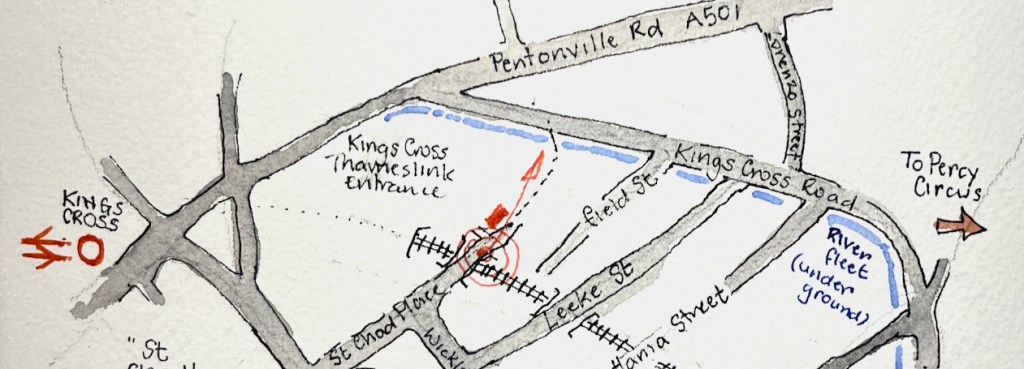
It’s in a labyrinth of roads and railway lines just to the east of Kings Cross mainline station.Here are some maps to show the location. Walk east from Kings Cross, about 10 minutes.

On the maps, the blue line represents the River Fleet, which is alongside the Kings Cross Road, underground. It flows from left to right across the map (West to East) and then heads South down to join the Thames beneath Blackfriars Bridge.

The river Fleet, before it became an underground sewer in 1825, flowed along the western side of Pancras Road and then eastward along the south side of the common, crossing the old highway (now Gray’s Inn Road) north of St. Chad’s Place.

‘Battle Bridge Estate’, in Survey of London: Volume 24, the Parish of St Pancras Part 4: King’s Cross Neighbourhood, ed. Walter H Godfrey and W McB. Marcham (London, 1952), pp. 102-113. British History Online http://www.british-history.ac.uk/survey-london/vol24/pt4/pp102-113 [accessed 7 February 2024].

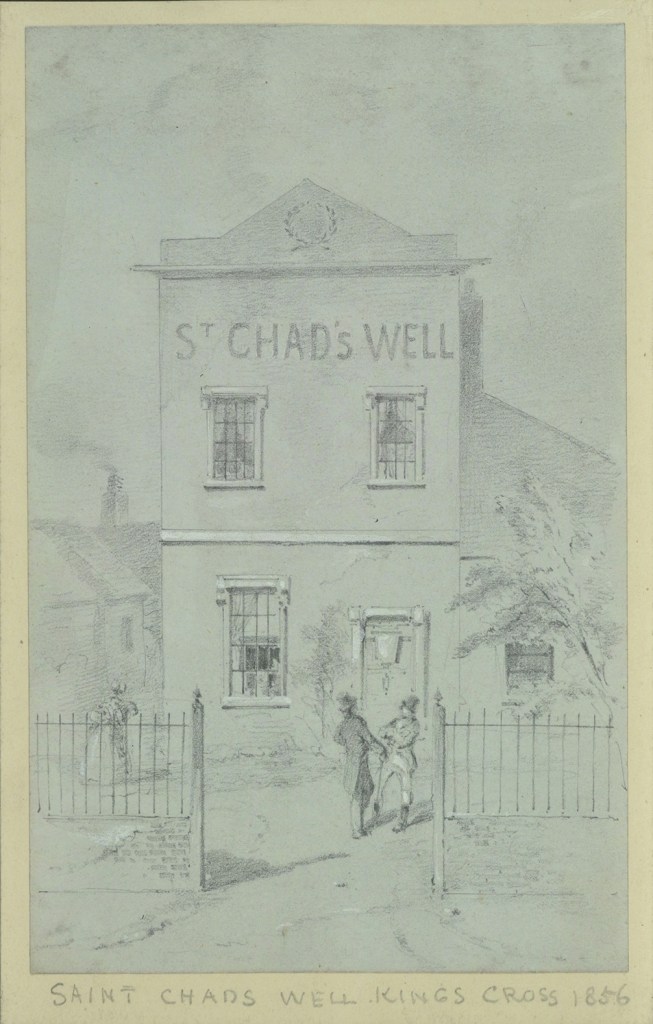
St Chad’s Place slopes down towards the River Fleet. This area was once the location of St Chad’s Well, a spring said to have health-giving properties. It operated from about 1815 to 1860. I found a picture in the London Picture Archives, reproduced below with their permission.

Image © London Metropolitan Archives, City of London Metropolitan Prints Collection LPA 006123 St Chads Well Catalogue No: SC_PZ_SP_01_556 Accession No: Saint Pancras P 01688 Date of execution: 1856
Record No: 305367 used with permission under licence dated 08/02/2024

The website “A London Inheritance” has an informative article about St Chad’s Place and the Well: https://alondoninheritance.com/london-streets/st-chads-place-and-a-lost-well/, which is well worth a read.

A river, a bridge, a well, a passage and a music venue. It’s amazing what you find.

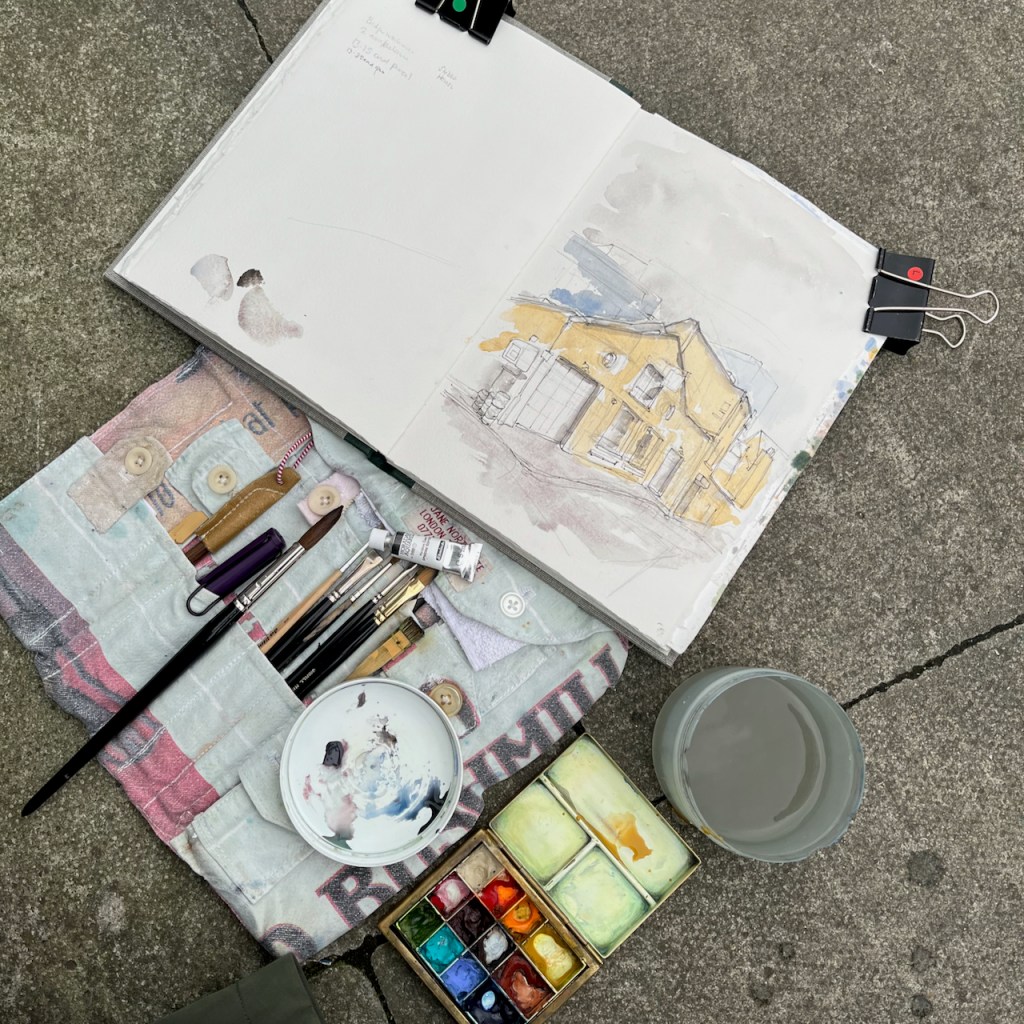
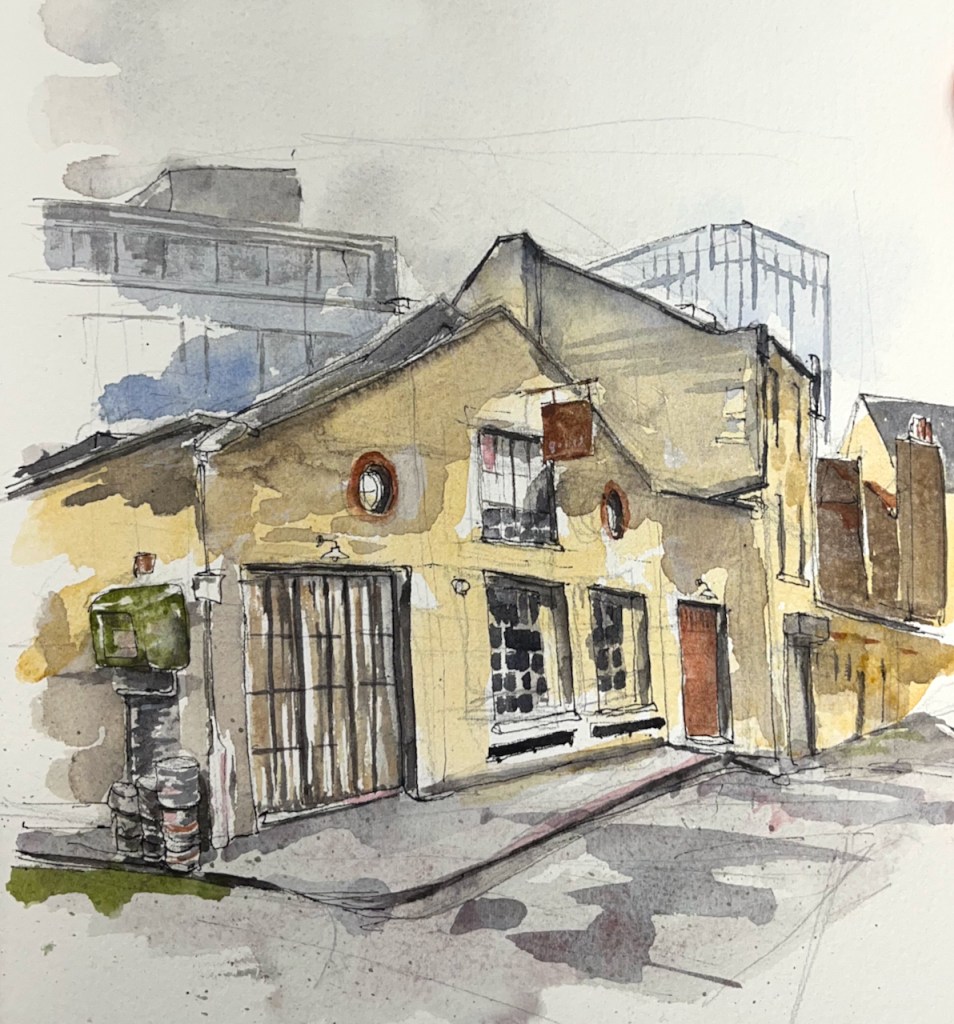
Here is work in progress on the sketch:

The colours are:

  • For the sky and pavement – a special new colour, Schminke Horadam “Random grey” – “formulated each year from surplus pigments”. This is the 2022 edition.
  • Rose madder permanent – also on the pavement
  • Mars Yellow
  • Ultramarine Blue
  • Green Serpentine Genuine
  • Buff Titanium
  • Fired Gold Ochre in the brickwork
  • Burnt Umber
Arches Aquarelle paper in a sketchbook made by Wyvern Bindery (Sketchbook 14).

“The House they Left Behind” London E14

I read an article in “A London Inheritance” about this house, and went off on an expedition to find it.

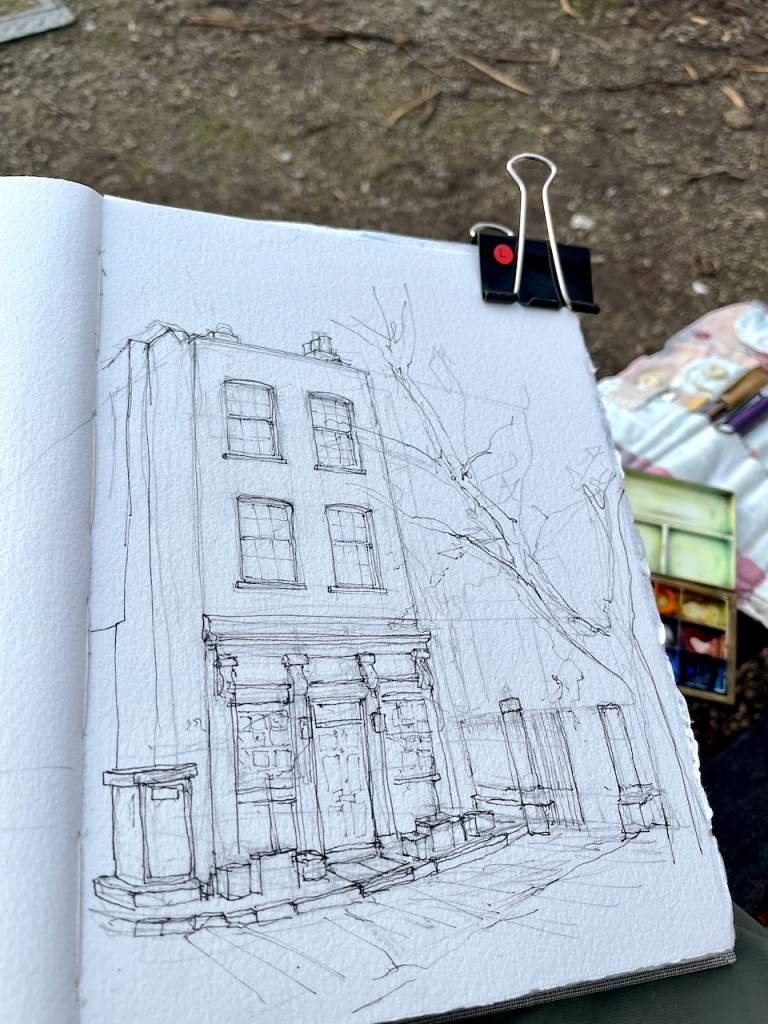
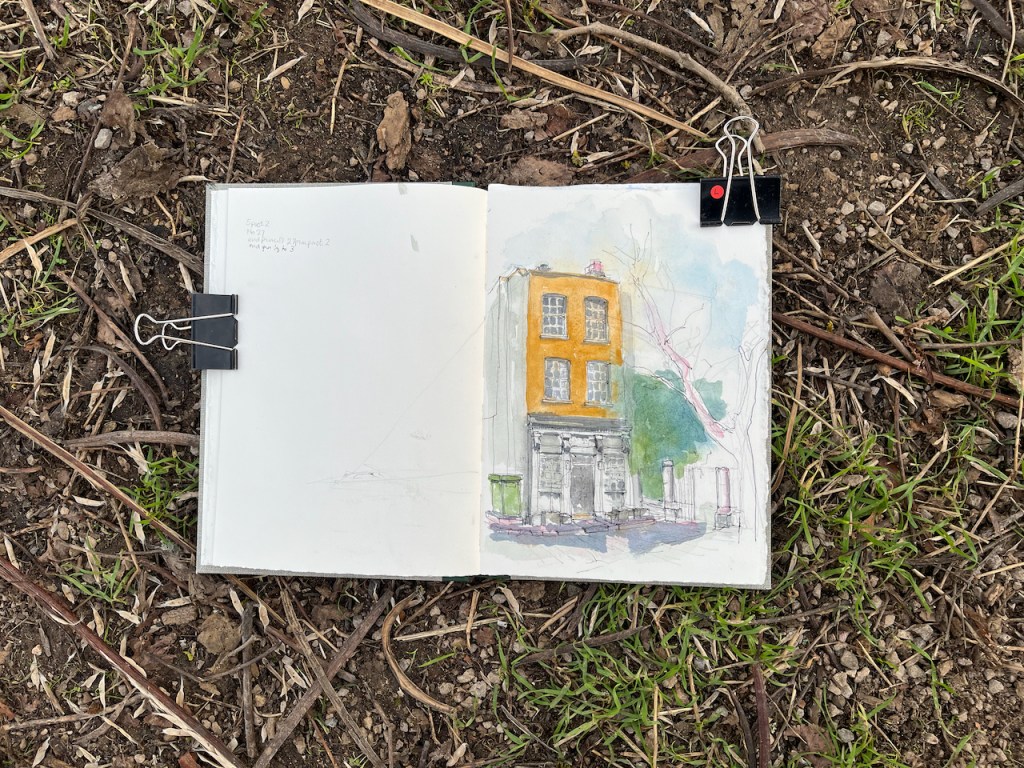
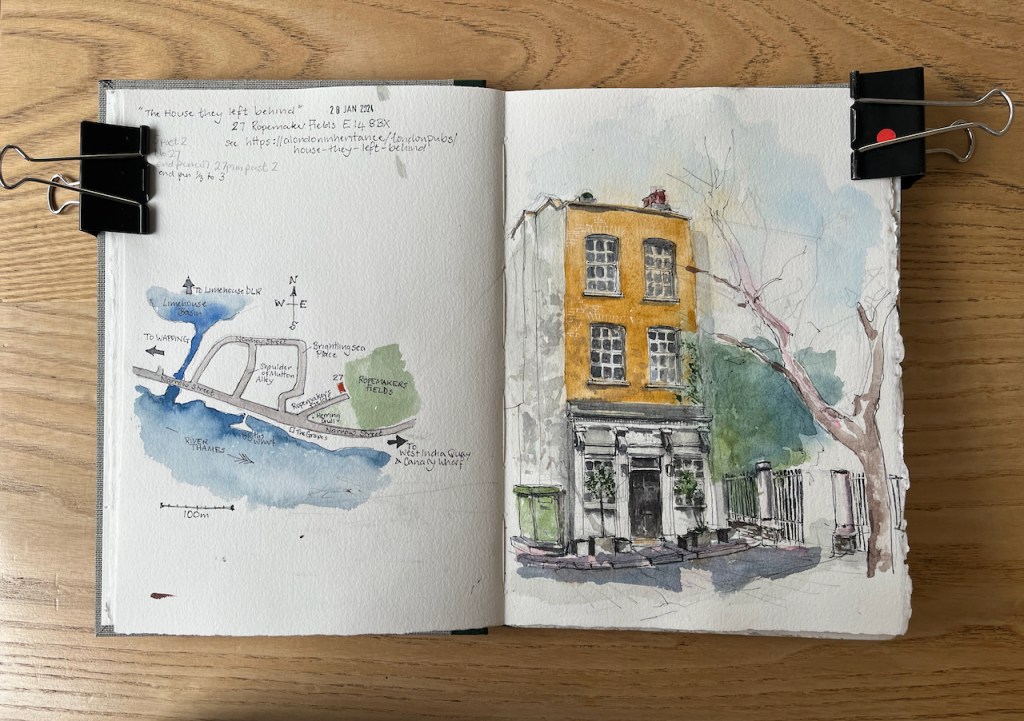
“The House they left Behind”, 27 Ropemakers Fields, London E14 8BX, sketched in Sketchbook 14 28th Jan 2024 at 2pm (Image copyright JaneSketching.com)

The London Inheritance article shows a 1986 photo taken by the author’s father. Painted on the side of the building was the sign:

THE HOUSE THEY LEFT BEHIND
BUILT 1857
RESTORED 1985

The sign has now been painted over. The wall, which is on the left of my drawing, is now completely white. But the name lives on and appears on current maps. Here is a map showing where the house is.

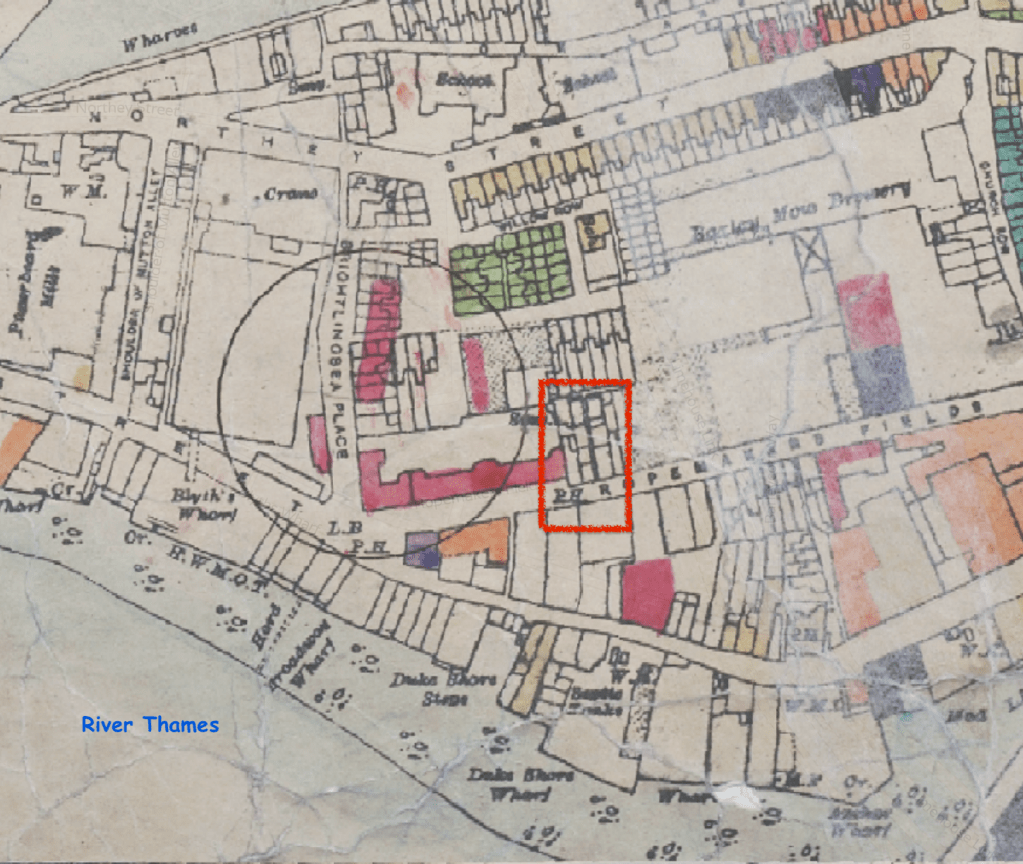
The building is now residential, but was previously a pub. It was “left behind” by the bombs dropped on London by the Luftwaffe in the 1939-45 conflict. The website “Layers of London” provides maps of bomb damage in London. Here is the area.

Map showing bomb damage. Classified from Total Destruction (Black), through Seriously Damaged (Dark Red) to Clearance Areas (Green).
credit:
https://www.layersoflondon.org/map/overlays/bomb-damage-1945
Map provided by London Metropolitan Archives. Geo-referenced with the support of the National Library of Scotland 

The map is based on 1:2500 Ordnance Survey sheets originally published in 1916. The bomb damage was recorded on these maps by hand soon after it happened. The circle represents where a V2 rocket landed. The red area shows buildings that were classified as “seriously damaged – doubtful if repairable”. As you see, the pub, labelled “P.H.”and outlined in red, is shown as undamaged.

I found more information on Bomb Damage Maps from a National Geographic article on a book about the maps. This article also provides a detailed key to the colours on the map. The book is “The London County Council Bomb Damage Maps” by Laurence Ward.

“A diary entry included in the book, from architect Andrew Butler on April 20, 1941, gives an idea of what the work was like:

For the block I have started on—eight floors high with two flats on each floor—has had its whole face ripped off … I found it possible to stand on part of the roof. So, clutching a broken chimney, I surveyed the damage there. My notebook became very messy. What with the dust and soot, wet filth and the perspiration of fluster on my hands, it was difficult to read what I wrote. The notes served their purpose however when, after drying the book, I had to transcribe them into a report.”

https://www.nationalgeographic.com/science/article/bomb-damage-maps-reveal-londons-world-war-ii-devastation

The original maps are in the London Metropolitan Archives.

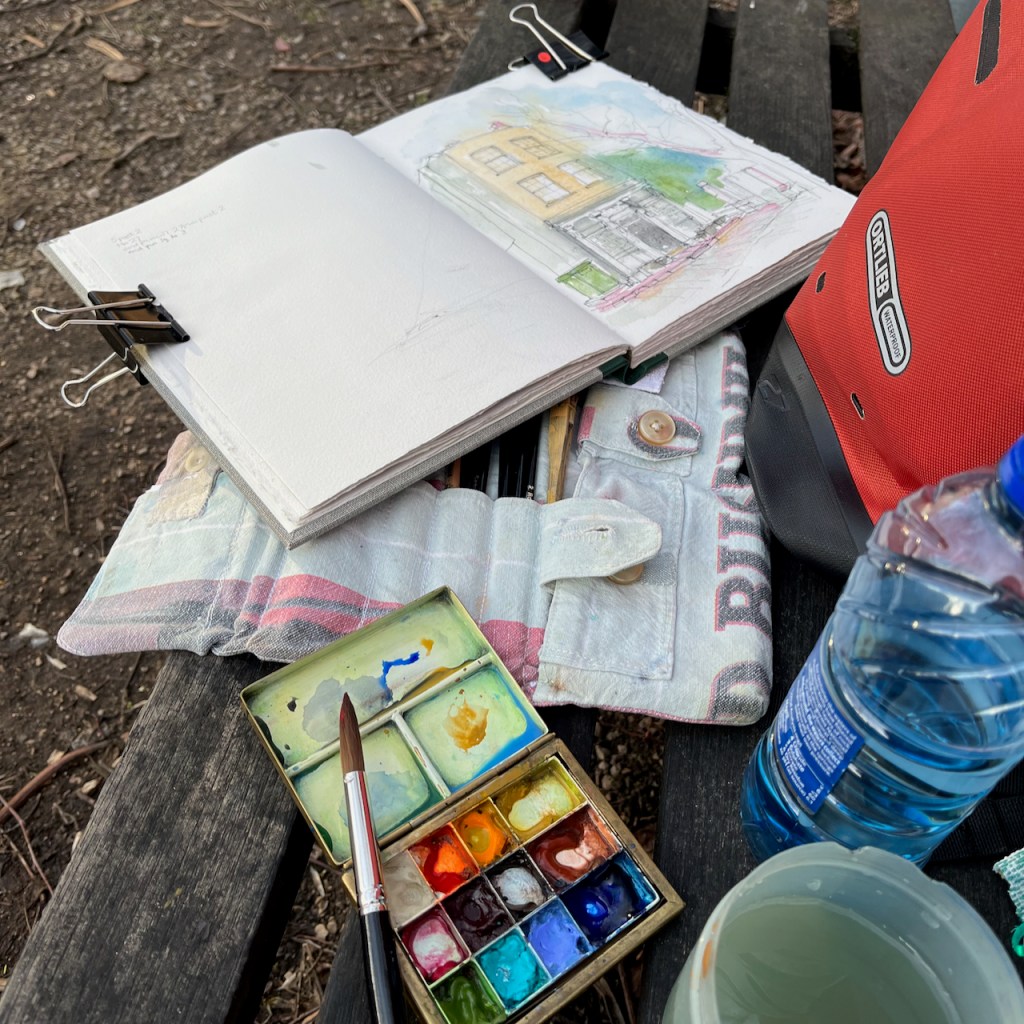
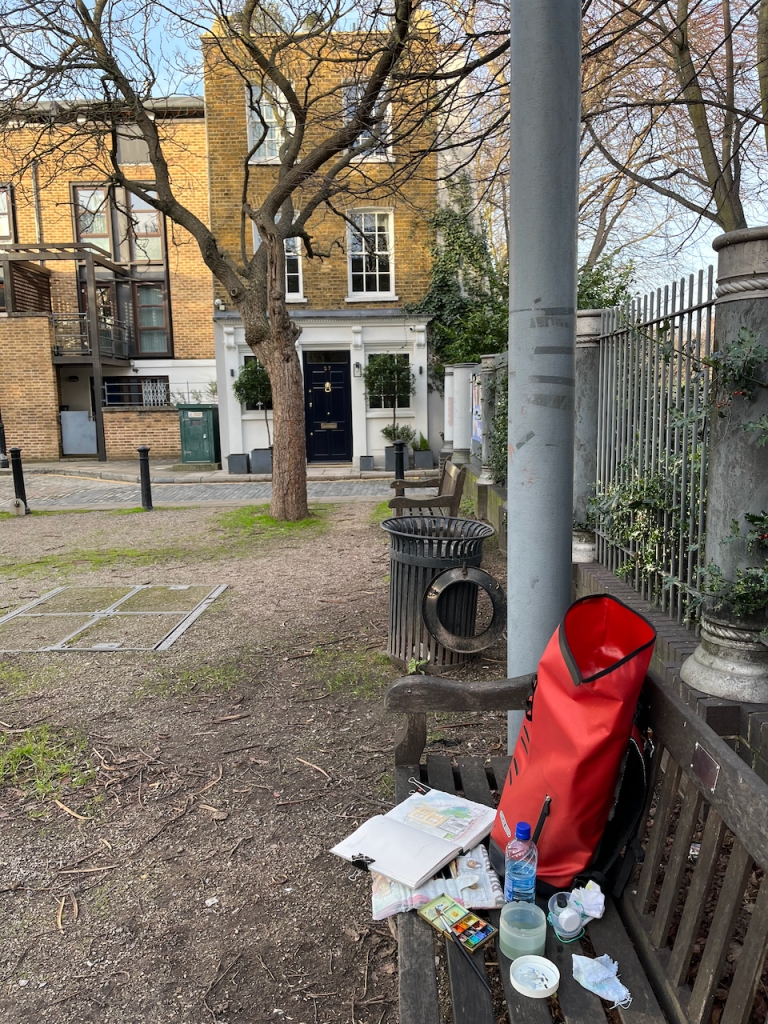
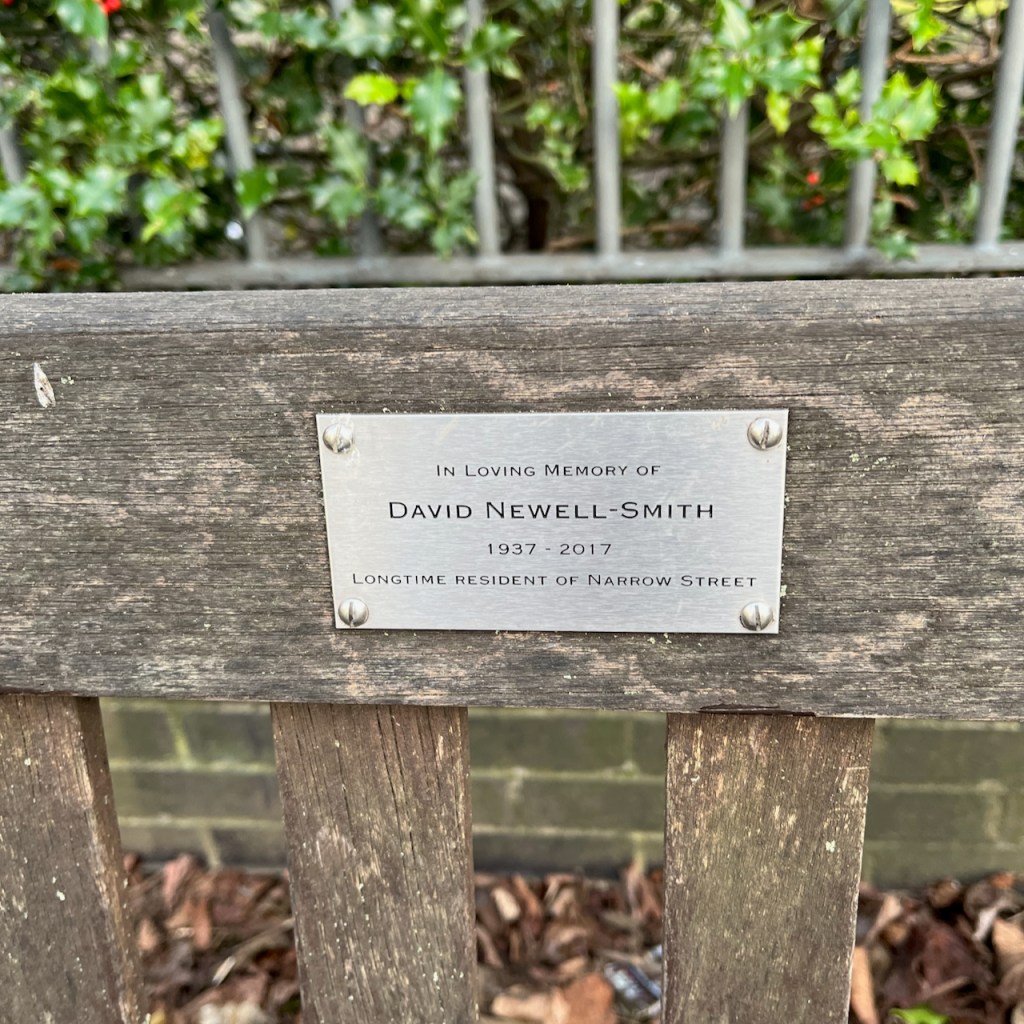
Here is my work in progress on the sketch. Thank you to the author of “A London Inheritance” for providing the stimulus for this expedition. Thank you also to the friends and family of local resident David Newell-Smith, on whose memorial bench I completed the sketch. His dates are given as 1937-2017. He would have been a boy when the bombs were falling.

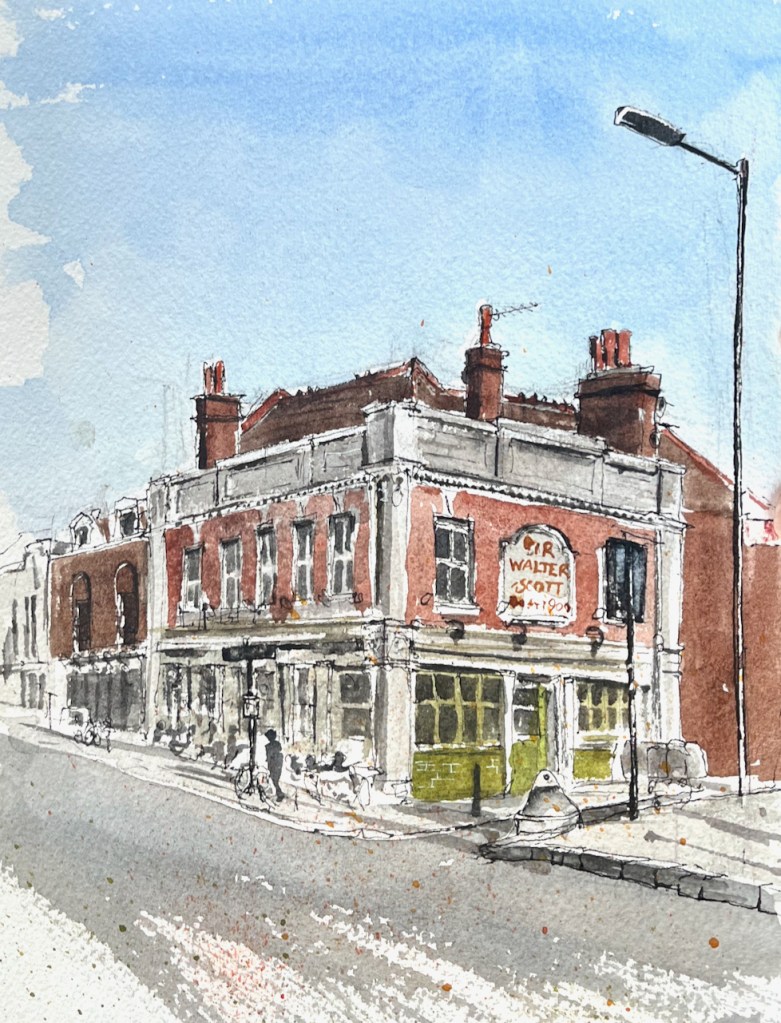
Market Café, 2 Broadway Market, E8

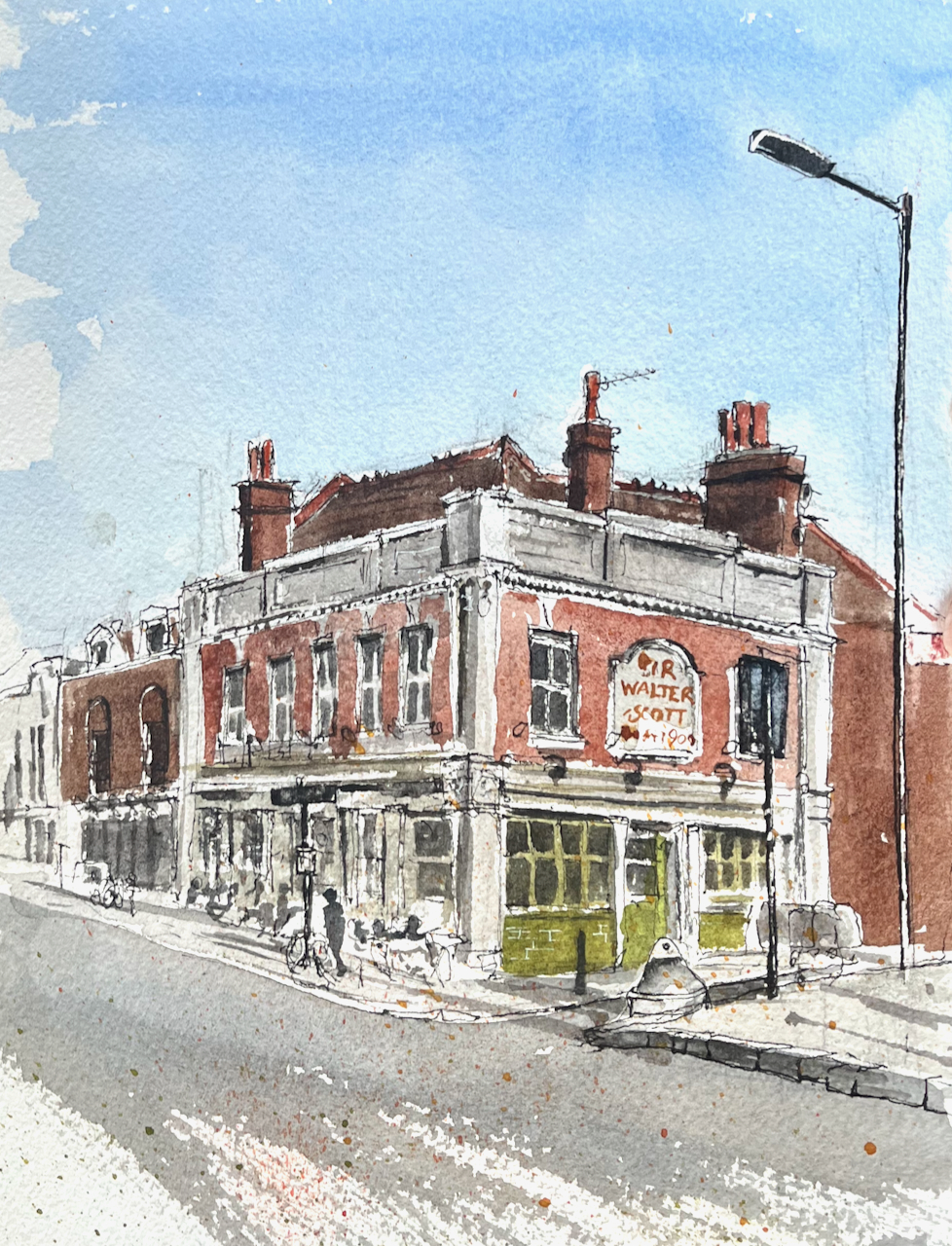
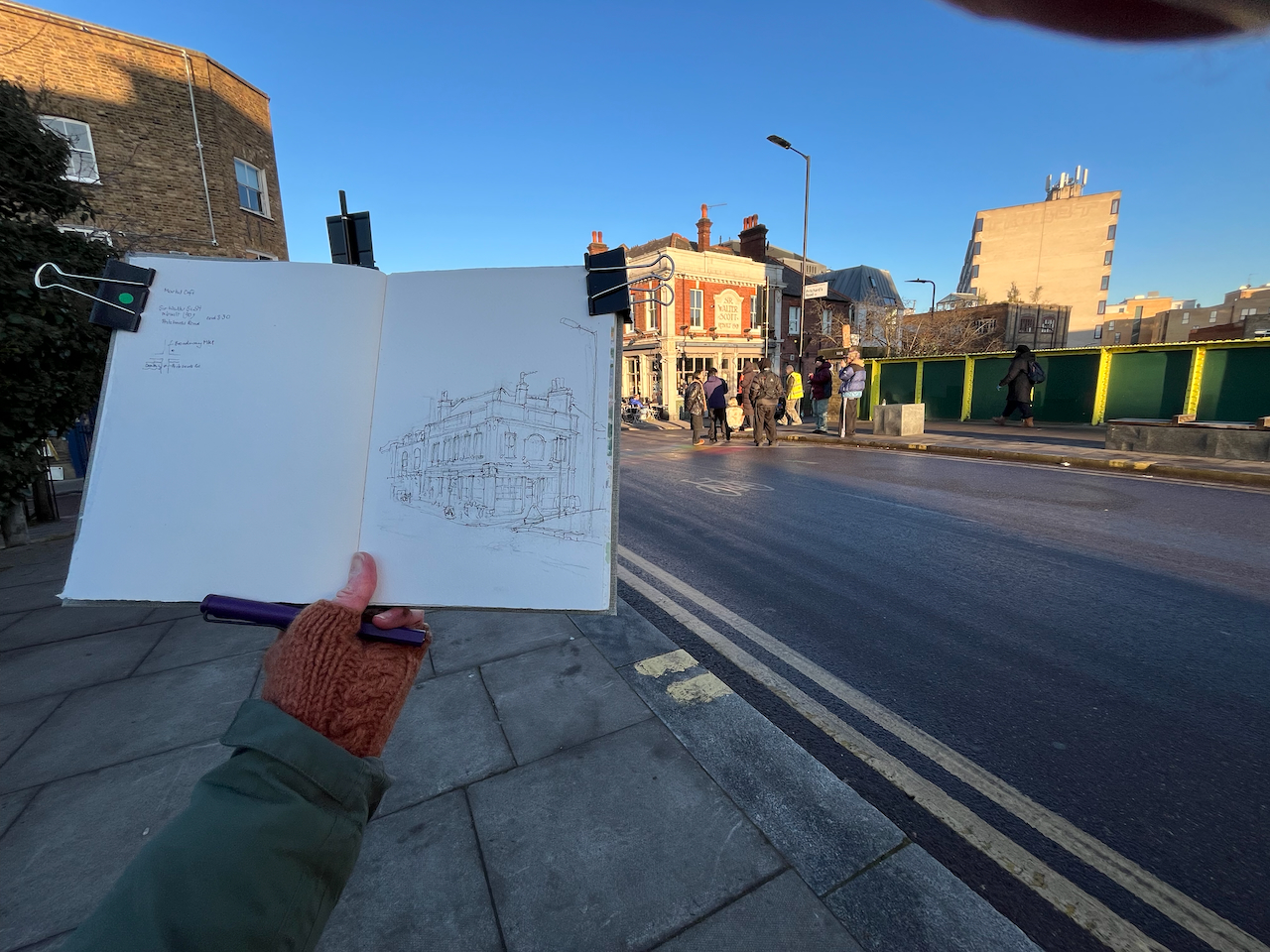
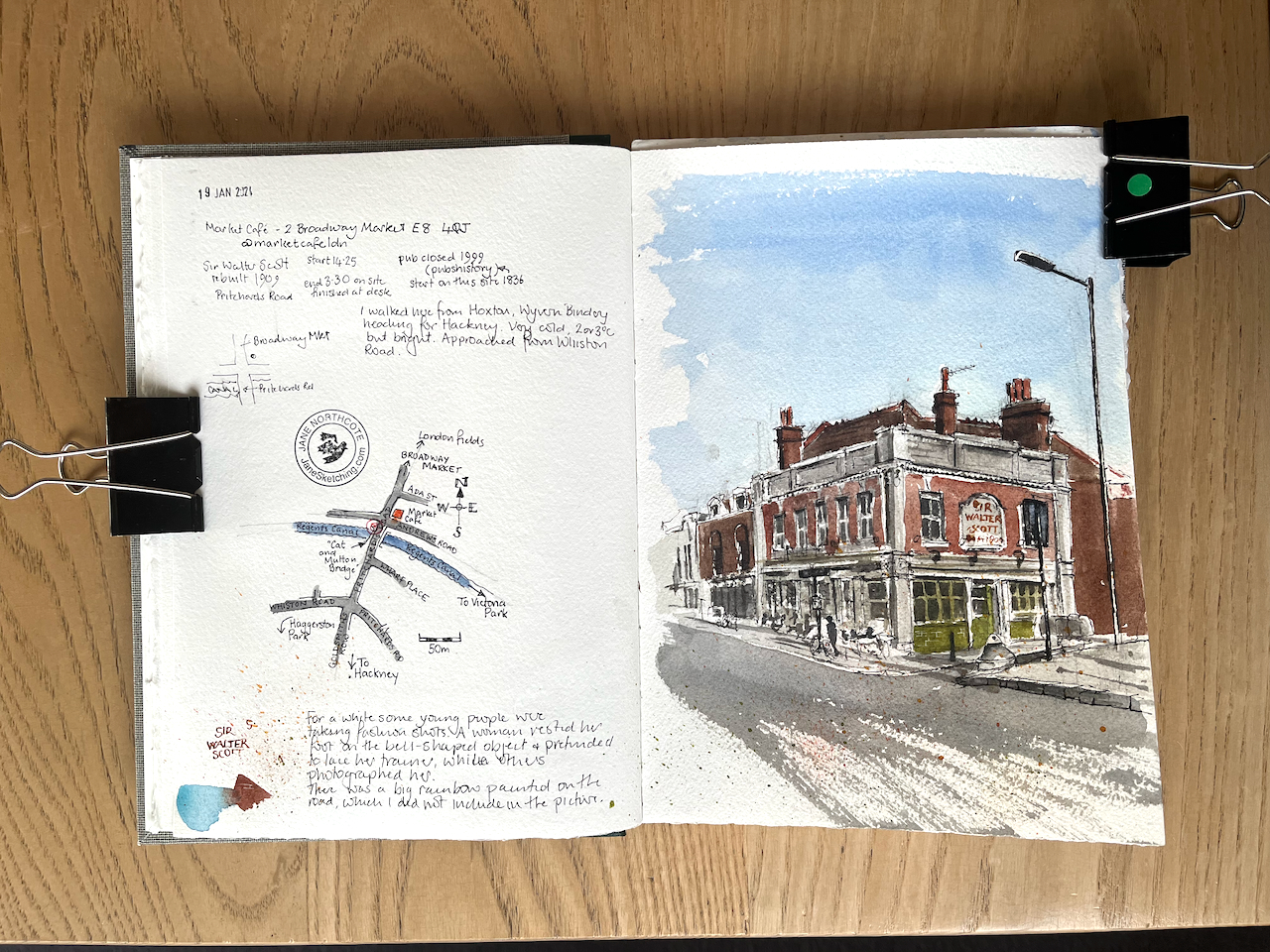
Here is the Market Café, sketched from the “Cat and Mutton Bridge” on 19th January 2024.

Market Café, 2 Broadway Market, London E8. Sketched 19th January 2024, 15:30, in Sketchbook 14.

As you see, this building is the former pub, the “Sir Walter Scott”. A pub was on this site in 1836. The wording on the building says “rebuilt 1909”. It closed as a pub in 1999 according to “pubhistory.com”. The Market Café now operates from the ground floor.

The website of Broadway Market gives a history of this area. In the early 19th century, the canal was the major means of freight transport, until the coming of the railways in the 1840s.

In 1812 “The Regent Canal Act” was passed and the Regent’s Canal constructed. This final link was direct into the River Thames at Limehouse, completing the passageway of heavy freight to Birmingham Manchester and the entire industrial North. (It should be noted that this was at the time of horse-drawn stage coaches and ox-laden wagons).

The new Regents Canal became a central pivot for industry and supplies. Timber warehouses grew, Gas light and Coke companies were established and this once rural backwater had become a major hub of enterprise.

https://broadwaymarket.co.uk/history-part-1/

This “once rural backwater” evidently needed a pub. Sir Walter Scott was a Scottish historian, novelist, poet, and playwright. He died in 1832, which must have been around the time this pub was named and the area was growing in population and importance.

The National Library of Scotland provides a wonderful side-by-side map, so you can see how the area looked previously, alongside a modern map. Click the image below to go to their marvellous site. You can shift the images around and expand them: both maps change at once. It’s fascinating.

https://maps.nls.uk/geo/explore/side-by-side/#zoom=17.6&lat=51.53590&lon=-0.06196&layers=117746212&right=osm

I had a look at an 1870 OS map. The Public House “P.H.” existed here in 1870. The road currently called Broadway Market was called “Pritchards Road” then. You can see the rows of terraced houses along the canal, gone now, and the “Coal Wharf” and “Wood Wharf” which used to be on the south side of the canal.

Broadway Market is now a street of modern coffee shops and small enterprises, with a street market of stalls down the middle. The jeweller William Cheshire has a workshop at the south end of the street. Climpson Coffee are further up. There are bakers, grocers, greengrocers and an opticians. At the North end, Broadway Market gives onto London Fields, a lovely park, with a lido.

It’s a great area to explore.

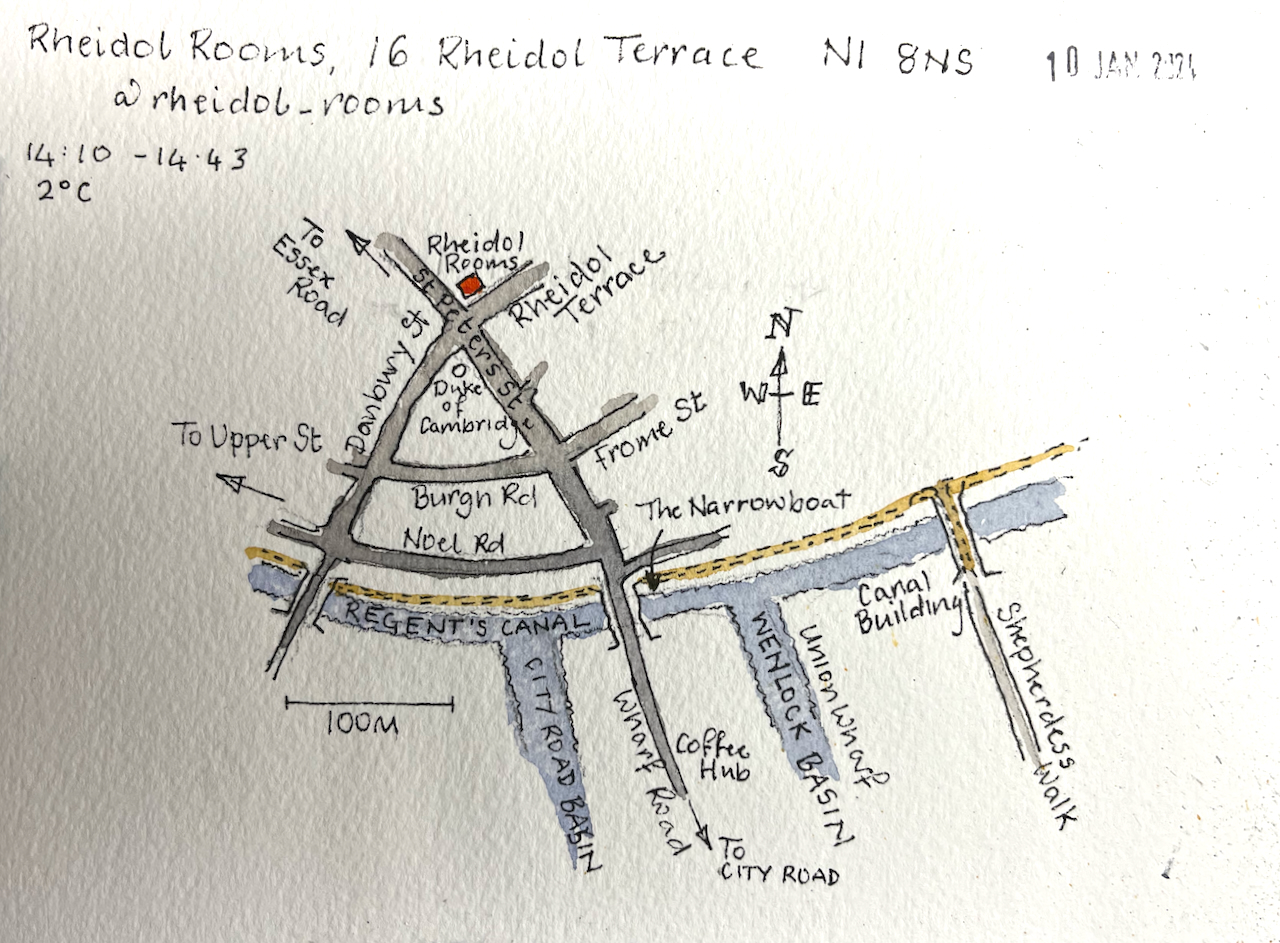
Rheidol Rooms, London N1

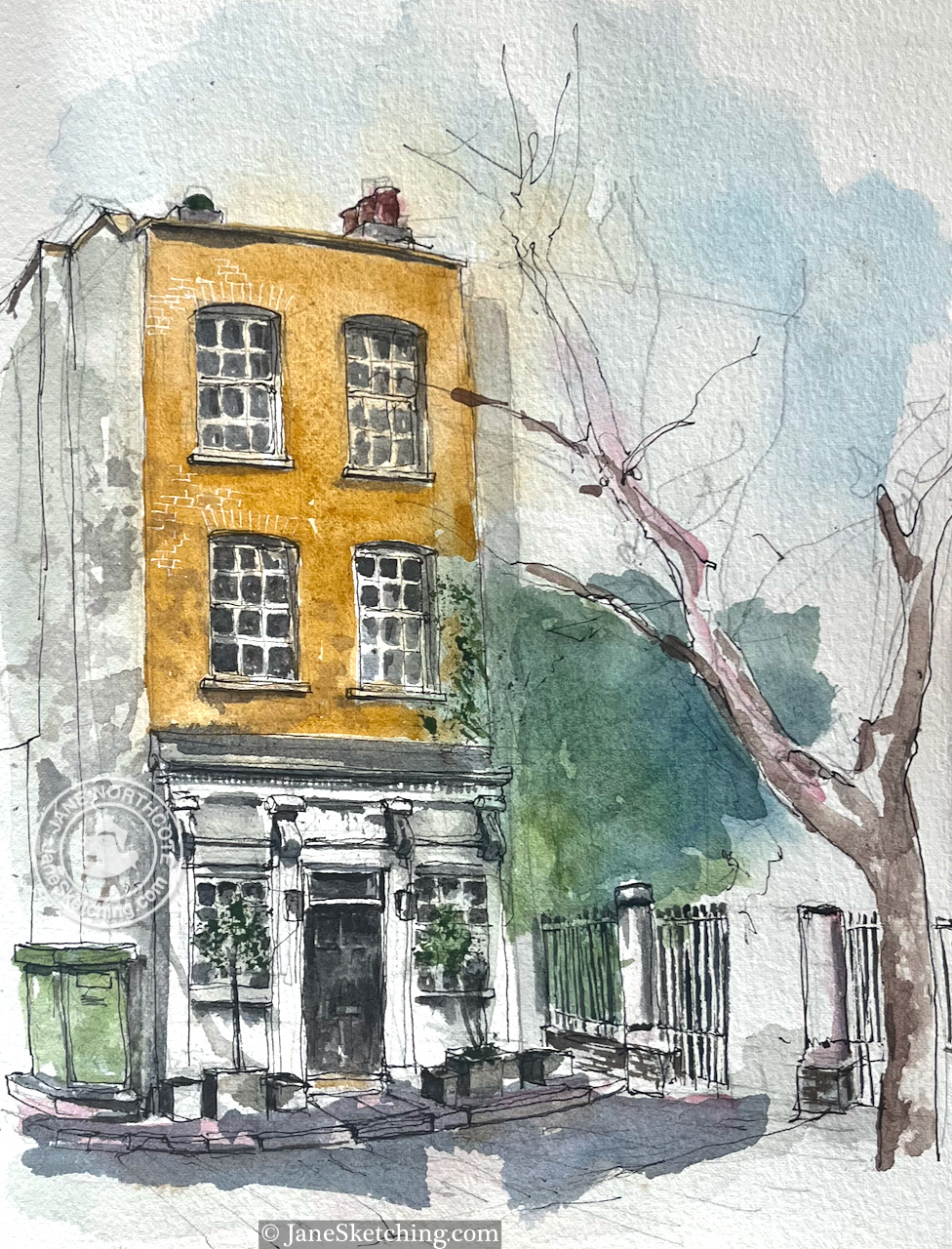
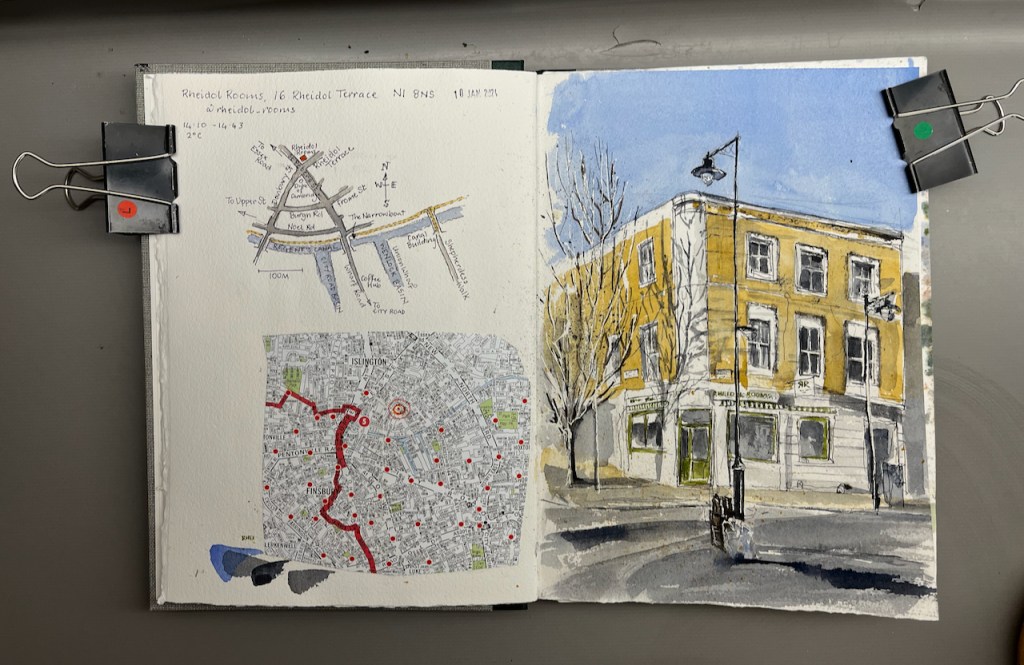
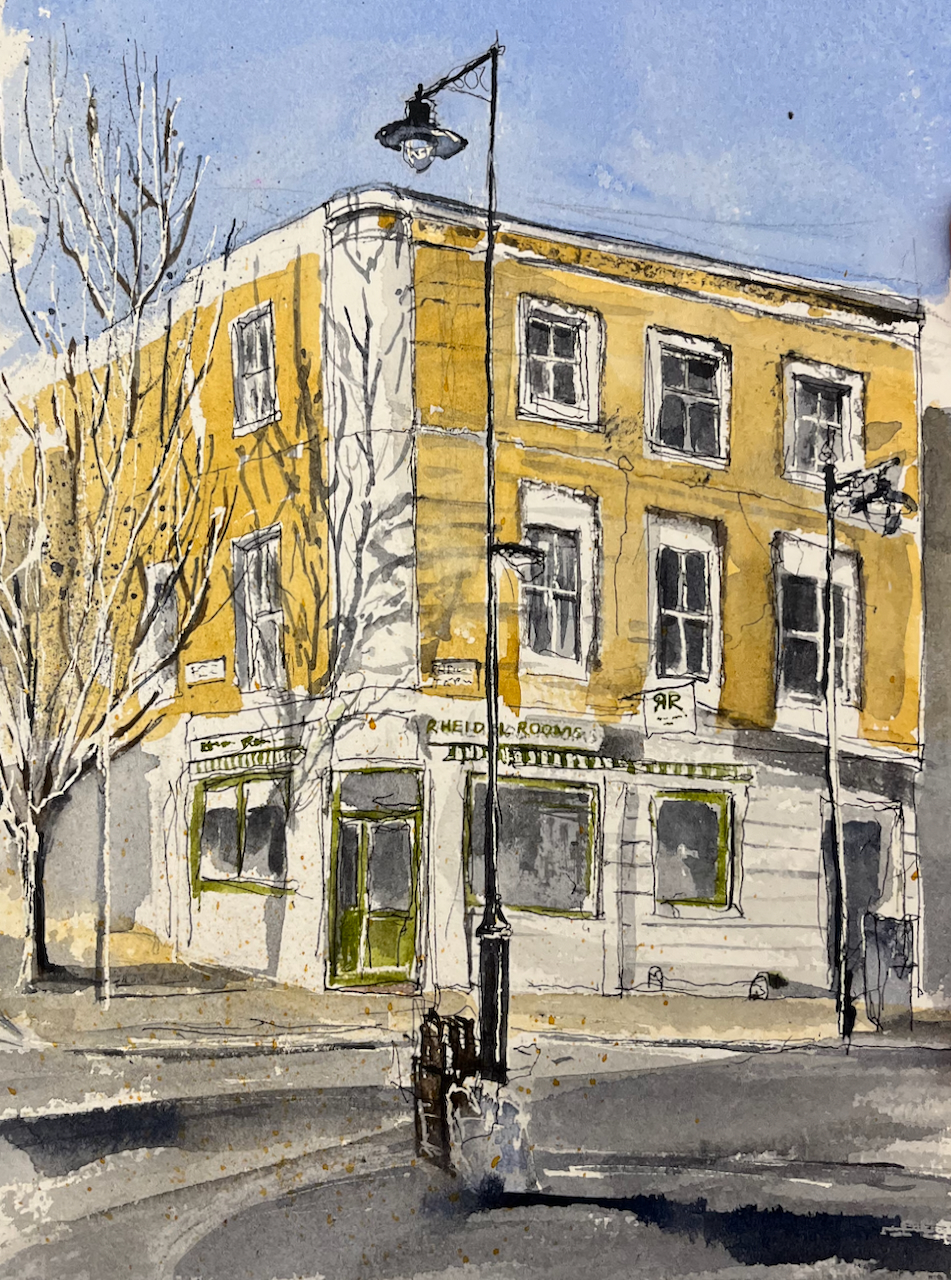
Rheidol Rooms is a café in Islington, just North of the Regent’s Canal. I sketched it on a bright cold day.

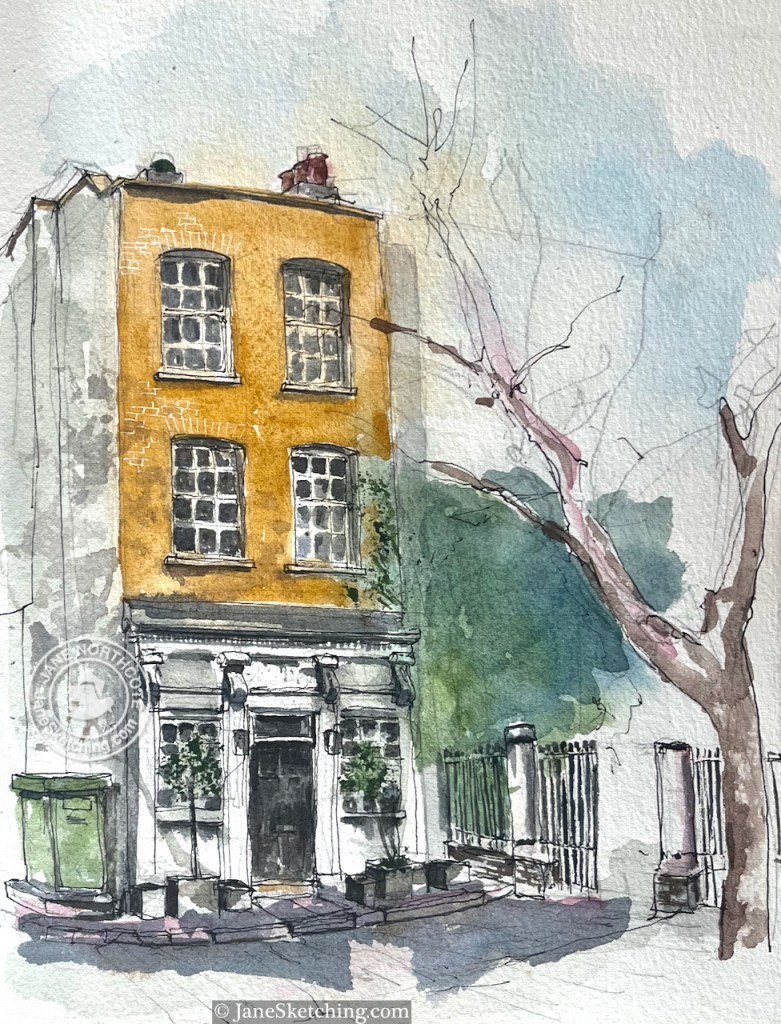
Rheidol Rooms, 16 Rheidol Terrace, London N1 sketched 3pm 10 January 2024 in Sketchbook 14

The tree cast its image onto the café. The twigs is the shadow were so sharply defined that it was hard to distinguish the shadow from the tree.

Despite that bright blue sky, the temperature was 2 degrees C and there was a wind. I froze, and walked across to the café. Sadly, it was closed, but it looked like a really good café and I will go back. I finished the drawing at my desk.

The colours in the picture are:

  • Mars Yellow
  • Ultramarine Blue
  • Burnt Umber
  • Serpentine Genuine (green, for the window frames)
  • The grey and black is made from a mix of Ultramarine Blue and Burnt Umber

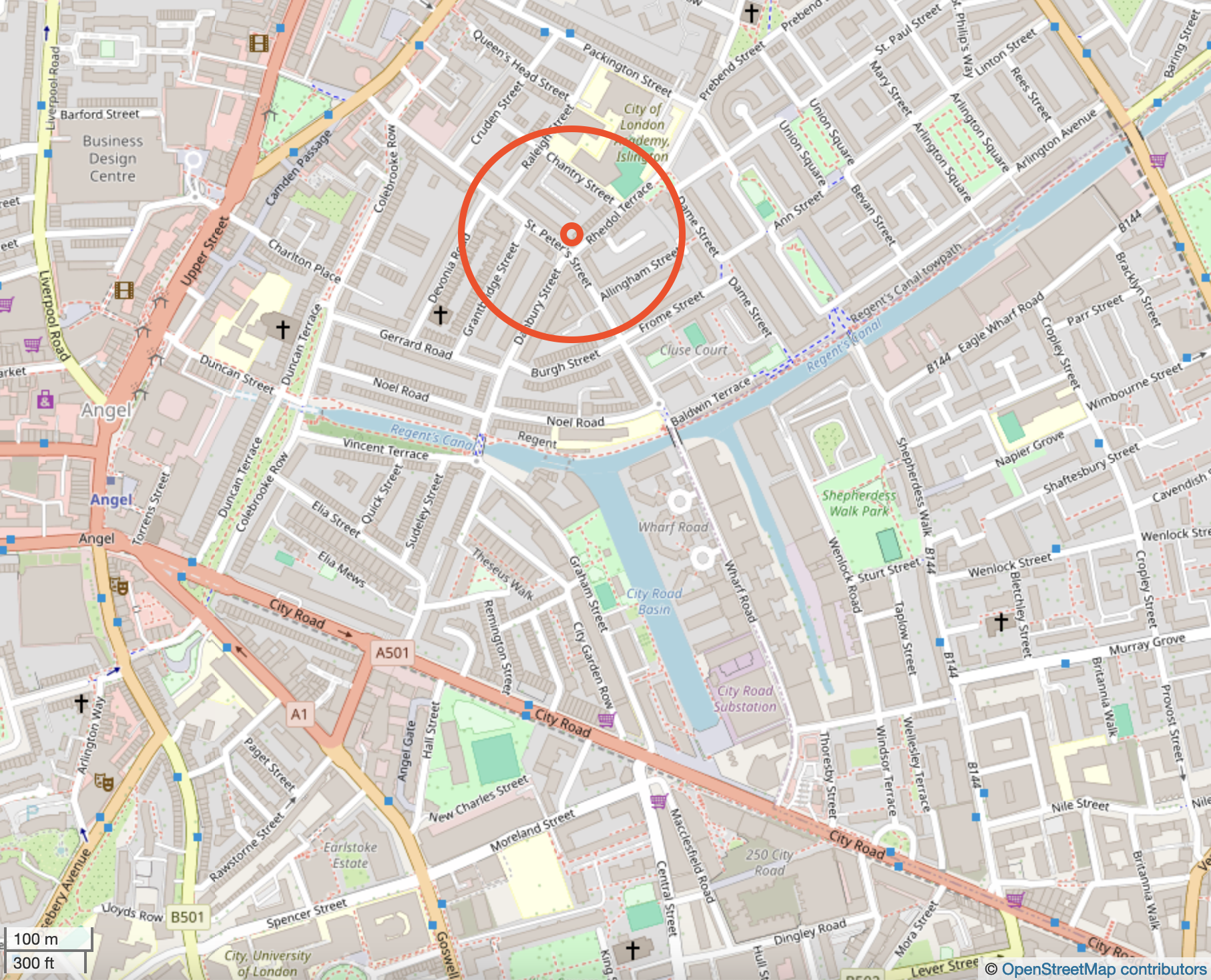
The café is at the junction of St Peter’s Street and Rheidol Terrace. It is in a 19th century row of terraced houses. “British History Online” indicates that this terrace was constructed in 1848-52.

Reference: British History Online: the history of this area is here: A P Baggs, Diane K Bolton and Patricia E C Croot, ‘Islington: Growth, South-east Islington’, in A History of the County of Middlesex: Volume 8, Islington and Stoke Newington Parishes, ed. T F T Baker and C R Elrington (London, 1985), pp. 20-24. British History Online http://www.british-history.ac.uk/vch/middx/vol8/pp20-24 [accessed 11 January 2024].

….the block bounded by St. Peter’s Street, Rheidol Terrace, and Cruden Street as far as the backs of houses in Queen’s Head Lane, with provision for 14 semi-detached and 74 terraced houses, was taken by James and Thomas Ward and built up by James Ward and sublessees. Leases for nos. 7-21 St. Peter’s Street, pairs of stuccoed villas originally called Angell Terrace after the Clothworkers’ surveyor, Samuel Angell, who probably laid out the estate, were granted in 1848 and for the rest of the block from 1848 to 1852.”

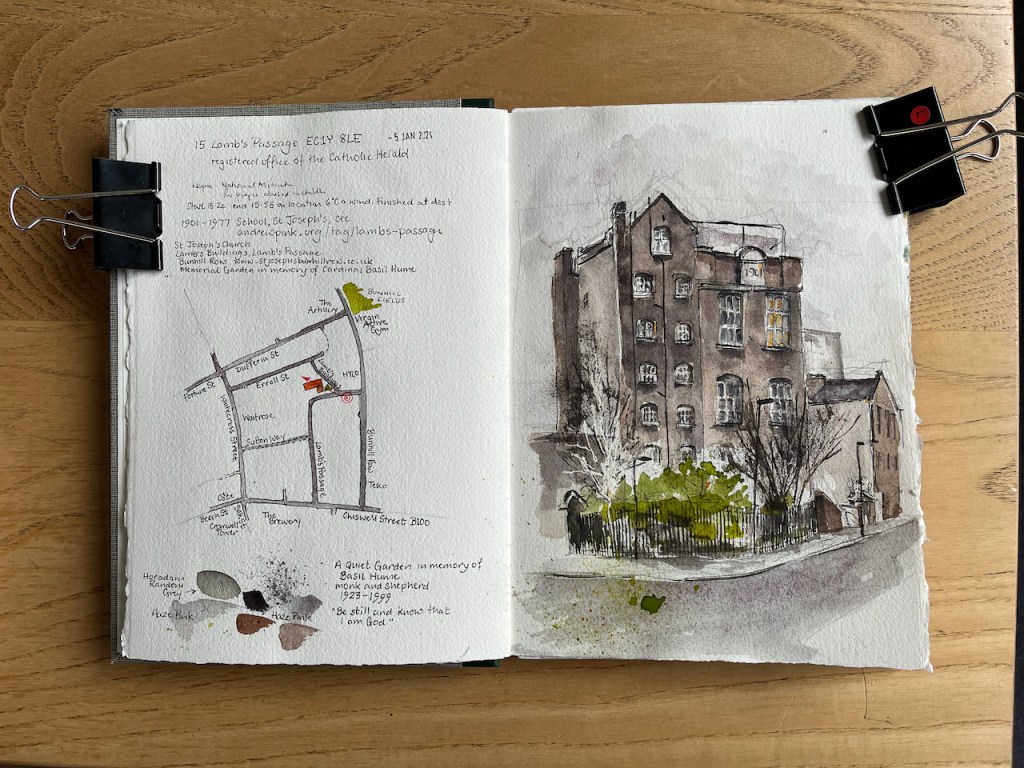
15 Lamb’s Passage EC1

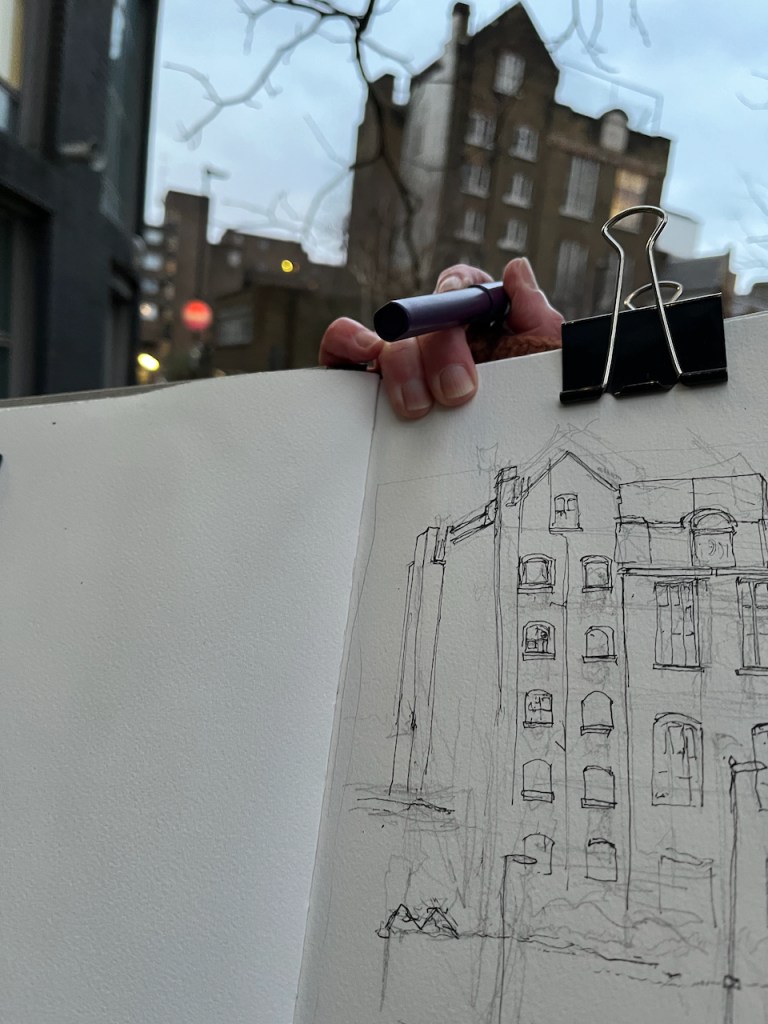
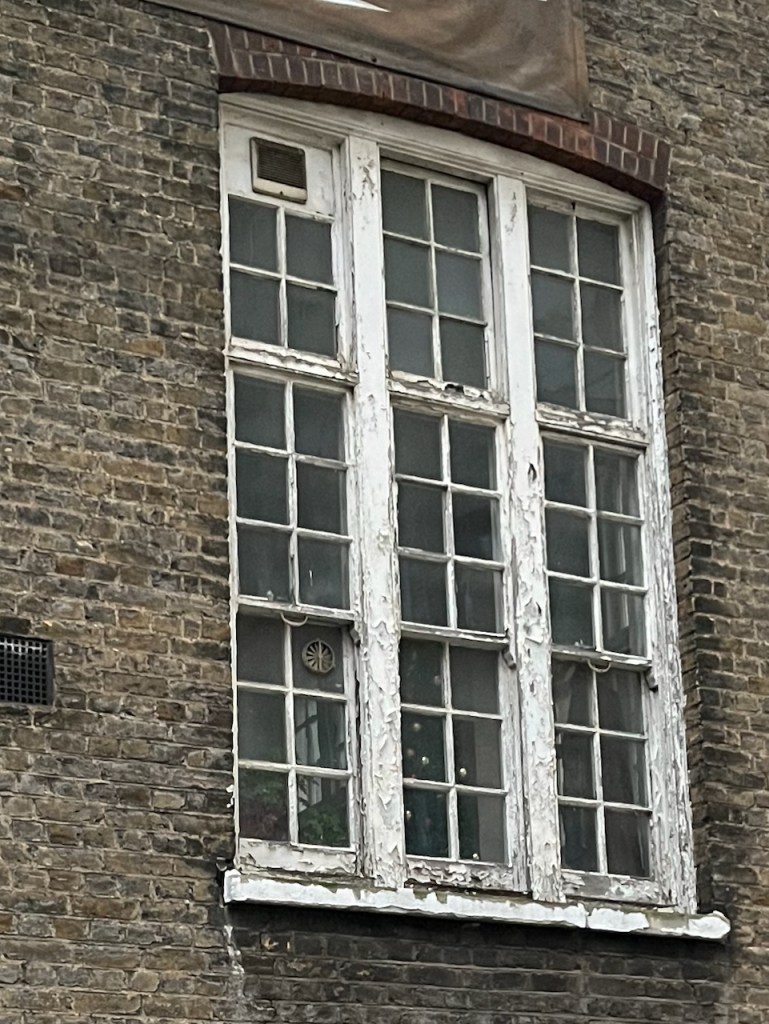
An old brick building stands amongst the new-build. The paint on its window frames is flaking, and its brickwork is dark from the smoke of a previous age, yet it retains its dignity: a grandmother of a building.

15 Lamb’s Passage, London EC1, sketched 5th January 2024 in Sketchbook 14, 4pm, 6 degrees C

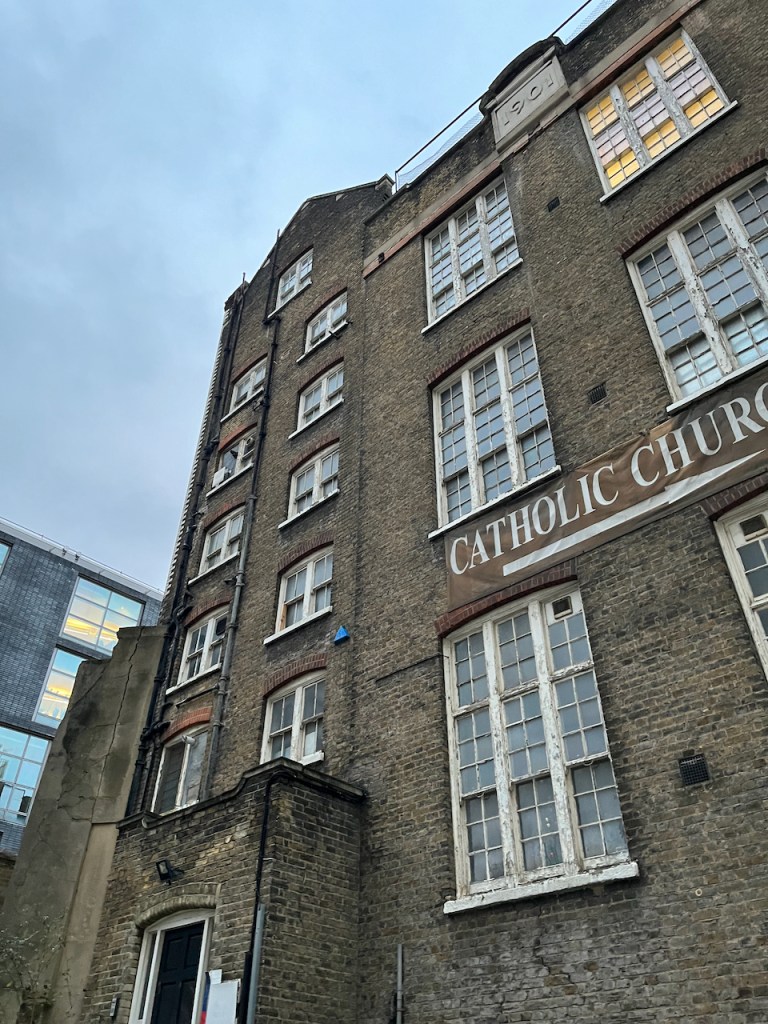
This is the former St Joseph’s School, built in 1901, which ceased operation as a school in 1977. On its roof you can see the wire netting which once must have surrounded a playground or netball court.

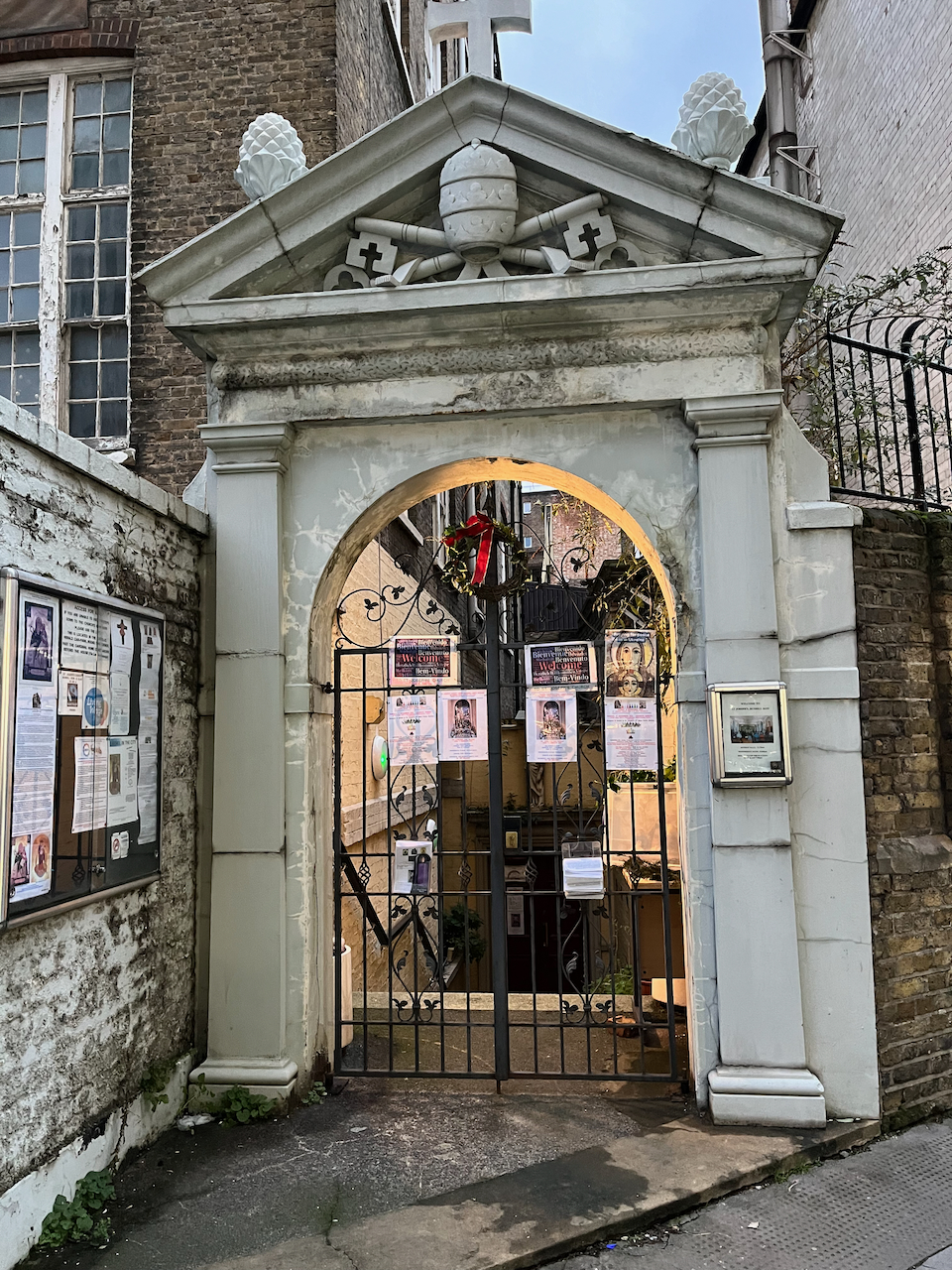
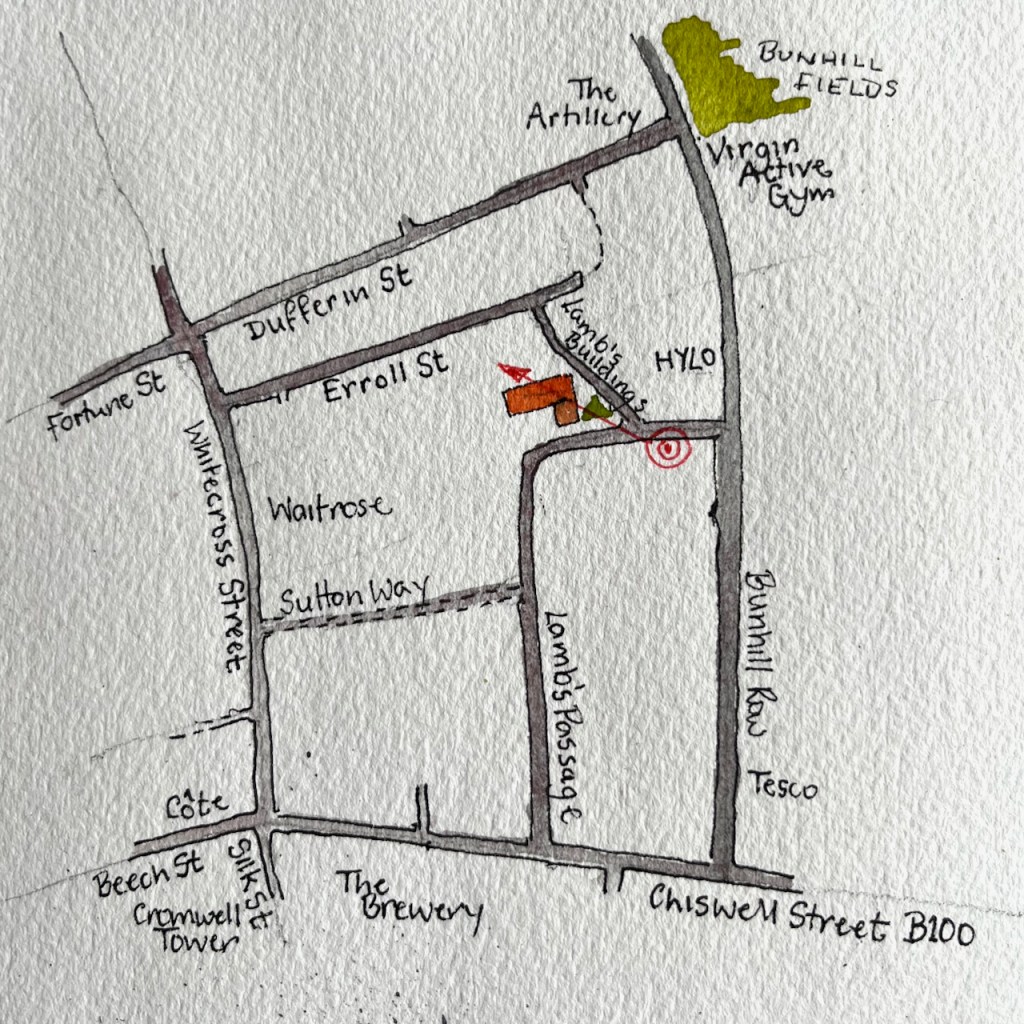
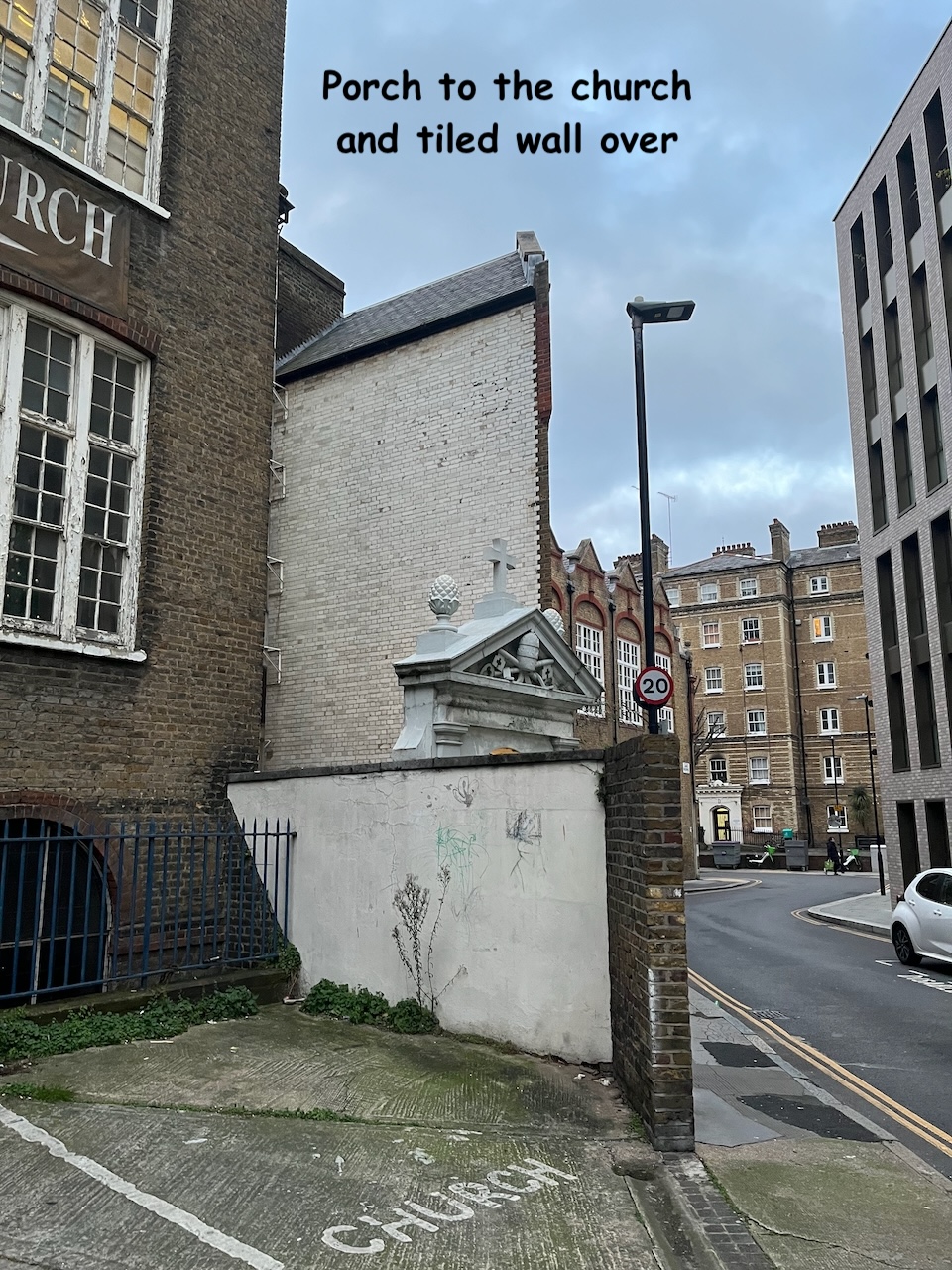
St Joseph’s Church is in the basement, accessed by the porch you can just see to the right of my drawing behind the furthest lamppost.

Entrance to St Joseph’s Catholic Church, Lamb’s Buildings: porch built 1993 to the design of Anthony Delarue (from https://parish.rcdow.org.uk/bunhillrow/about-the-parish/)

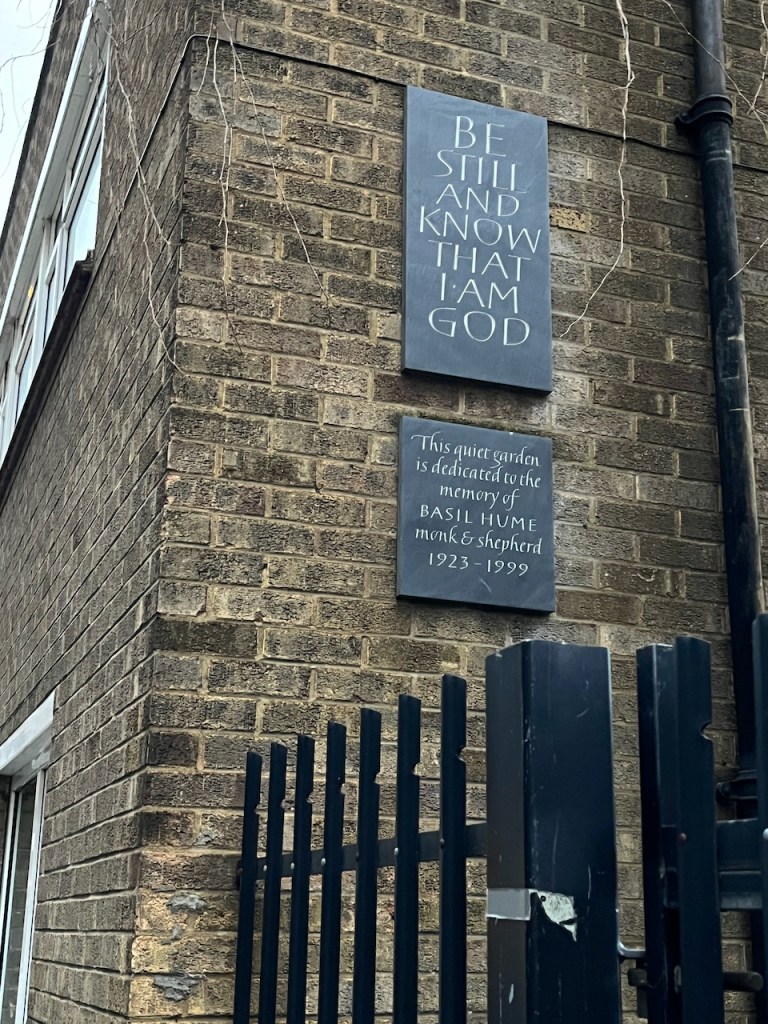
The area in front of the building is a quiet garden, in memory of Basil Hume, an English Catholic bishop. Sometimes the gate is open and you can go in. It has been arranged so that, even in this tiny space, it is possible to walk some kind of small pilgrimage, along a path, across a ditch, past a tree, and so round a corner to rest in the shaded hut. On the way you encounter a splendid birch tree with white bark, which I have seen grow from a sapling.

BE 
STILL
AND
KNOW
THAT
I AM
GOD
This quiet garden 
is dedicated to the
memory of BASIL HUME
monk and shepherd
1923-1999

Number 15 Lamb’s Buildings hosts several organisations now. The City Photographic Society uses the Church Hall in this building. It is also the registered office of the Catholic Herald. I have often heard music as I pass by, so it might also be used as a rehearsal space. There is ballroom dancing on Mondays. The smaller building to the south, on the left of my drawing, hosts a pregnancy advice centre. So this is a set of buildings is in use, actively serving the community despite the flaking paint.

I made this drawing quickly as the light faded on a cold and windy evening. After the pen, I retreated back to my desk to apply the colour.

The musician Andrew Pink has written in detail about this building, including a description of the organ in the basement church. His piece is here: https://andrewpink.org/lambs-buildings/. The church website is here: https://parish.rcdow.org.uk/bunhillrow/about-the-parish

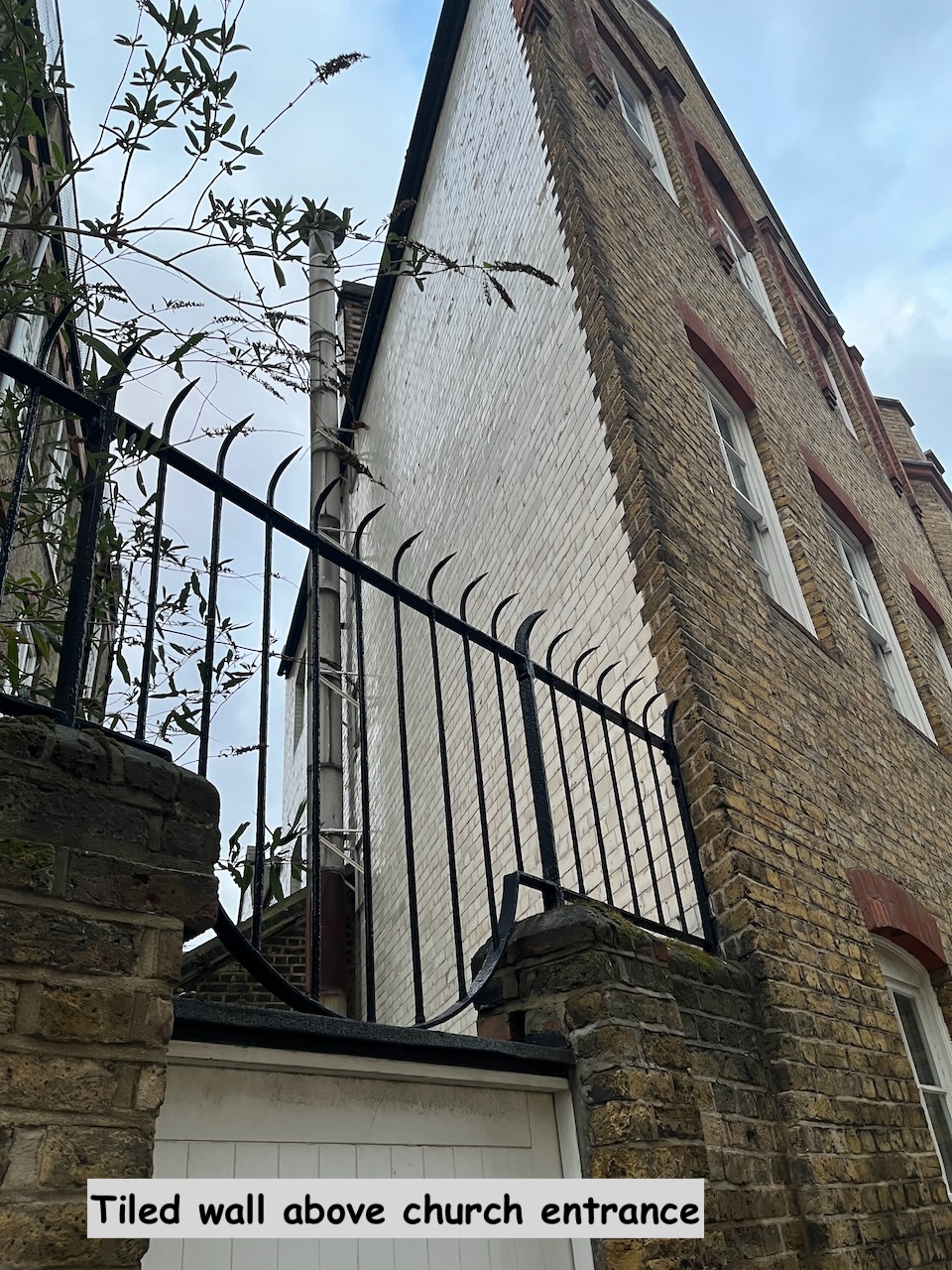
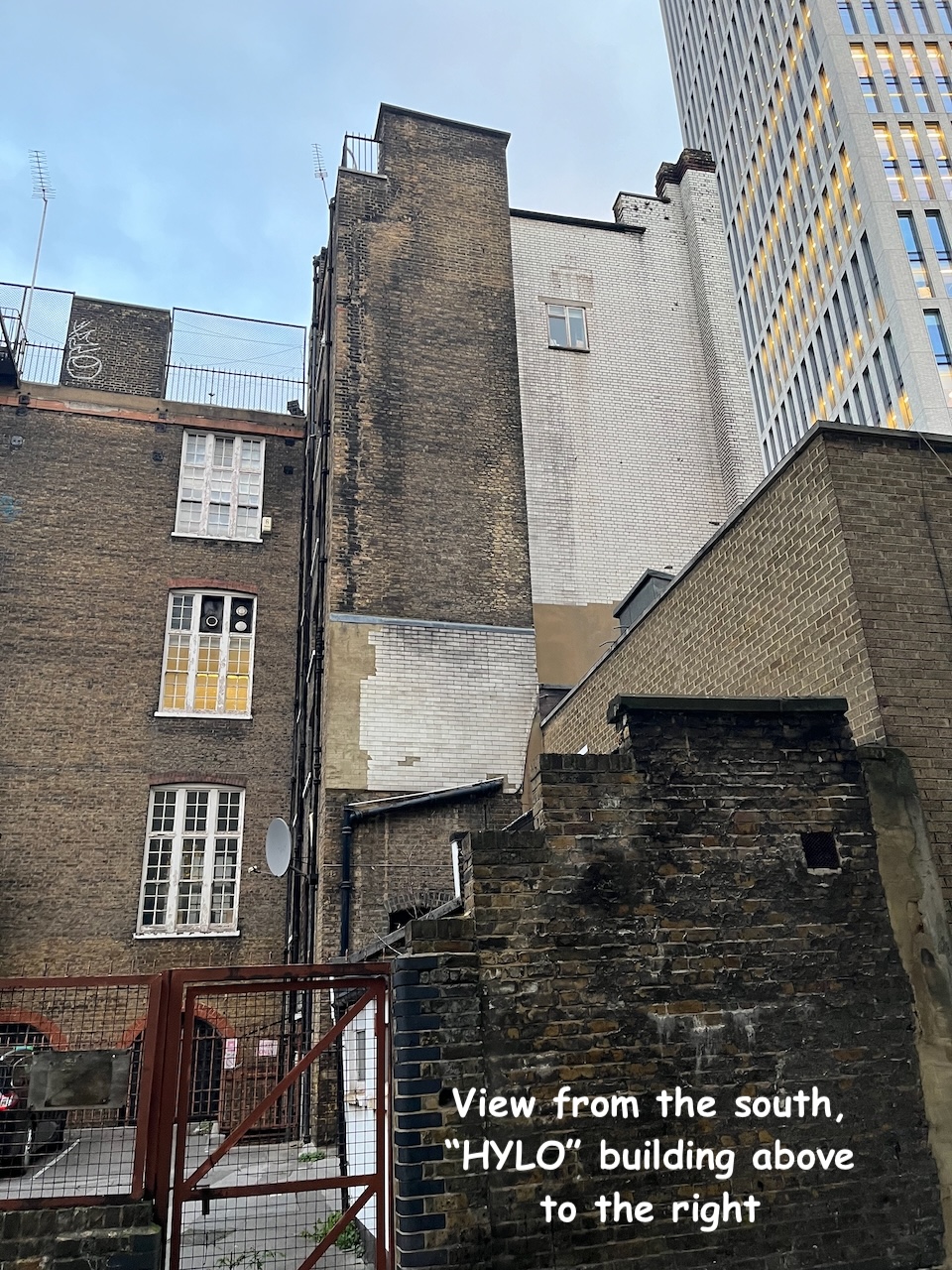
Here are some more photos of the building:

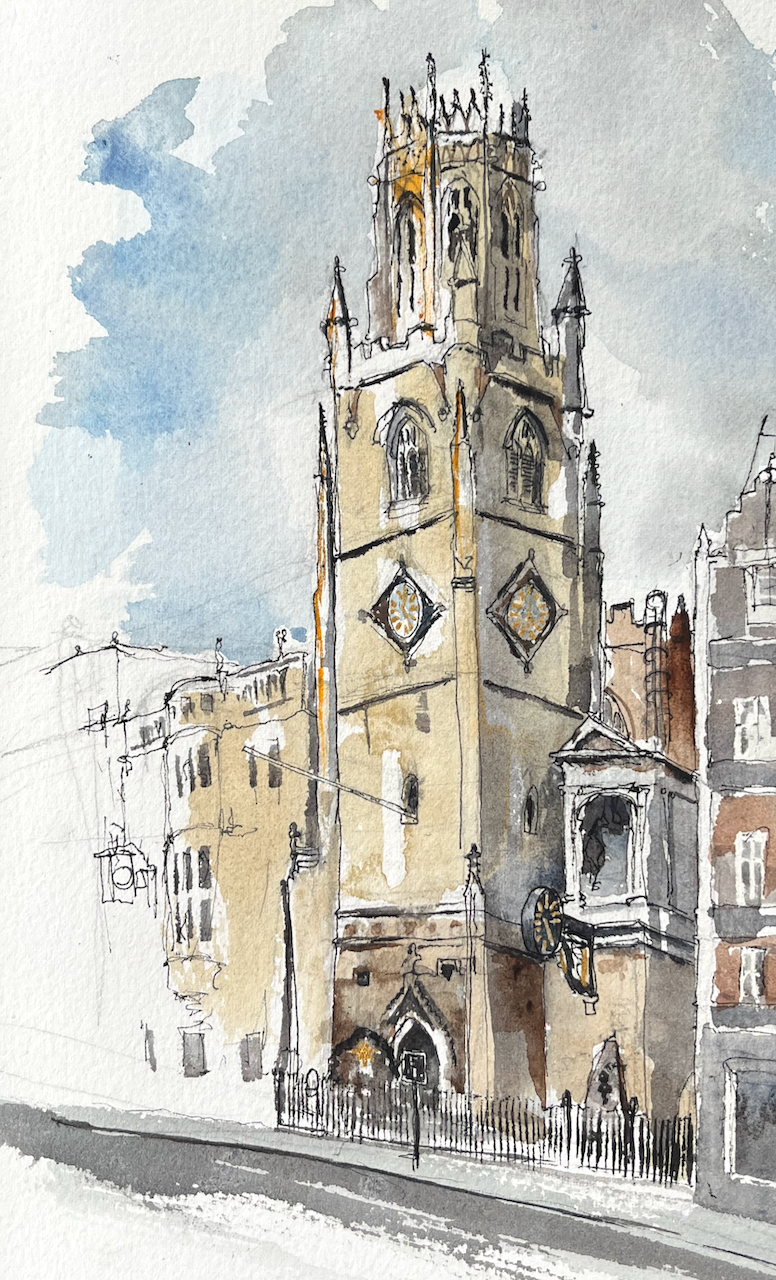
St Dunstan-in-the-West, Fleet Street, EC4

This church stands on Fleet Street, near the Royal Courts of Justice. It is set a little back from the road, so I had not really noticed it. But it is remarkable in many ways.

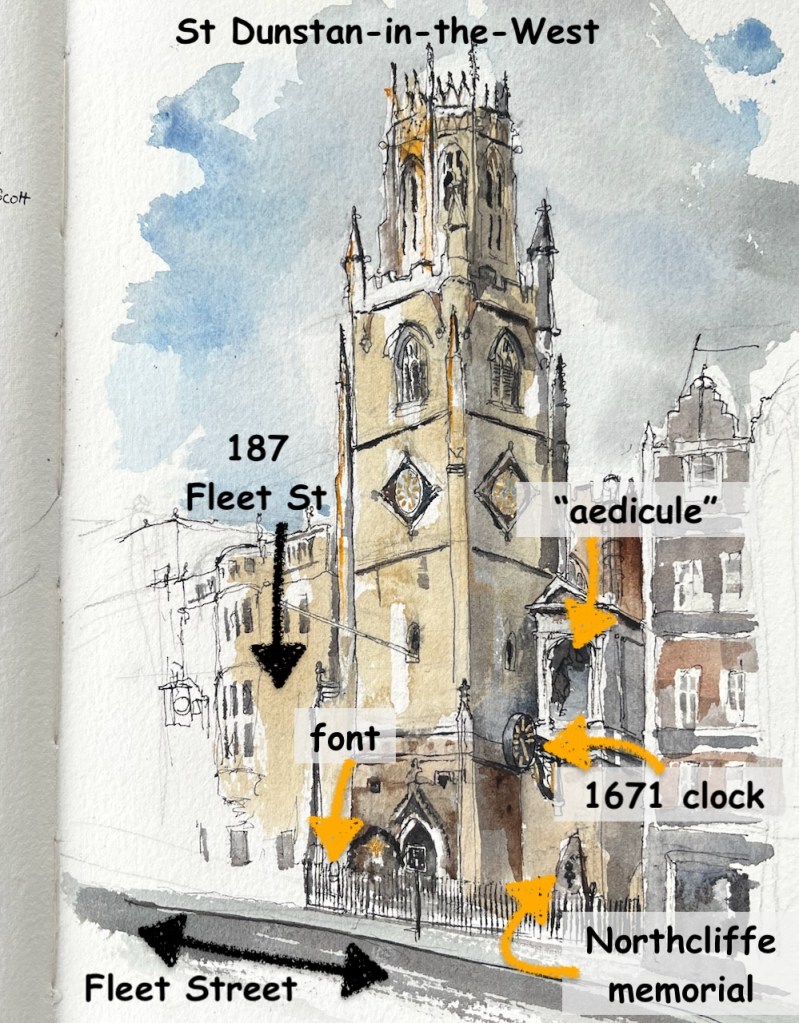
St Dunstan-in-the-West, 186a Fleet Street, sketched 31 Dec 2023, in Sketchbook 14

For one thing, the architect has used every possible ornate contrivance. It was impossible for this urban sketcher to do justice to the extraordinary details. The crocheted spires! The castellations! The geometry! The lacy top! The stonework above the door!

The geometry is interesting because the tower starts as a squarish-type shape at ground level, and then higher up there is an arrangement of planes which slice off the corners, turning it into an octagon at the top. At the higher part of the tower, the stonework is open so the sky is visible between the fine arches and spires.

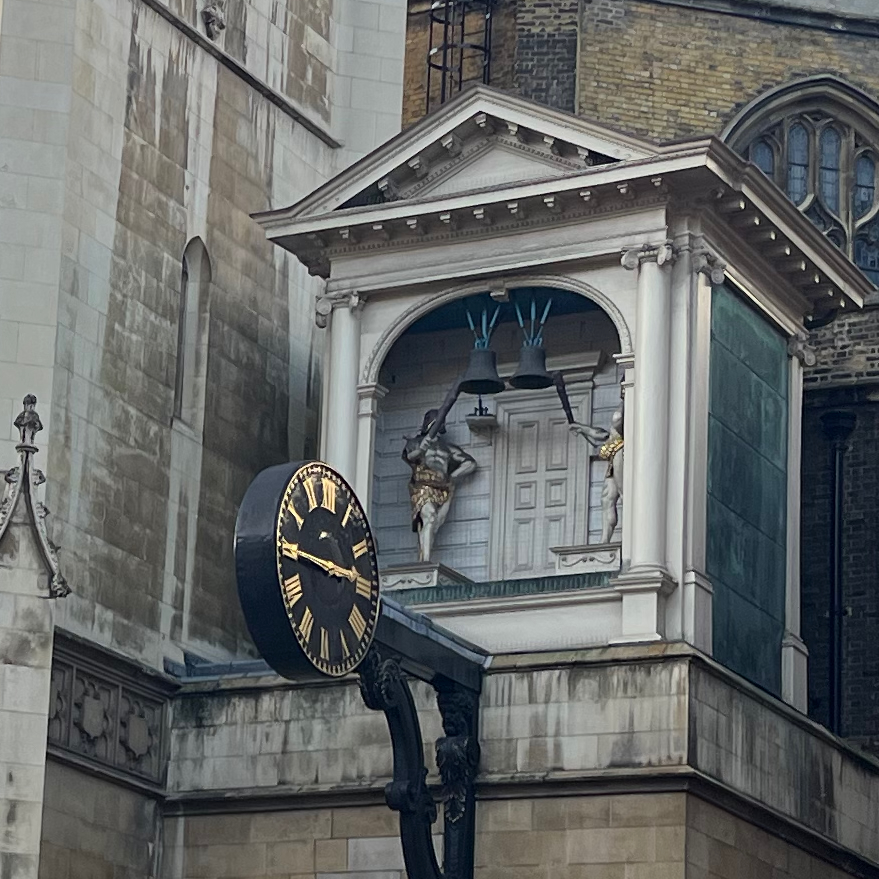
Then there are the clocks. There are two clocks on the tower, both showing the correct time. And there is another clock, also showing the correct time, suspended on a substantial wooden bracket below a little covered stage. Inside the stage are two muscular wooden figures, and two bells. The figures strike the bells every quarter hour. The little stage is described as an “aedicule” in Pevsner, who tells me that the clock was made in 1671.

The clock and the small covered stage (aedicule”), with wooded figures.

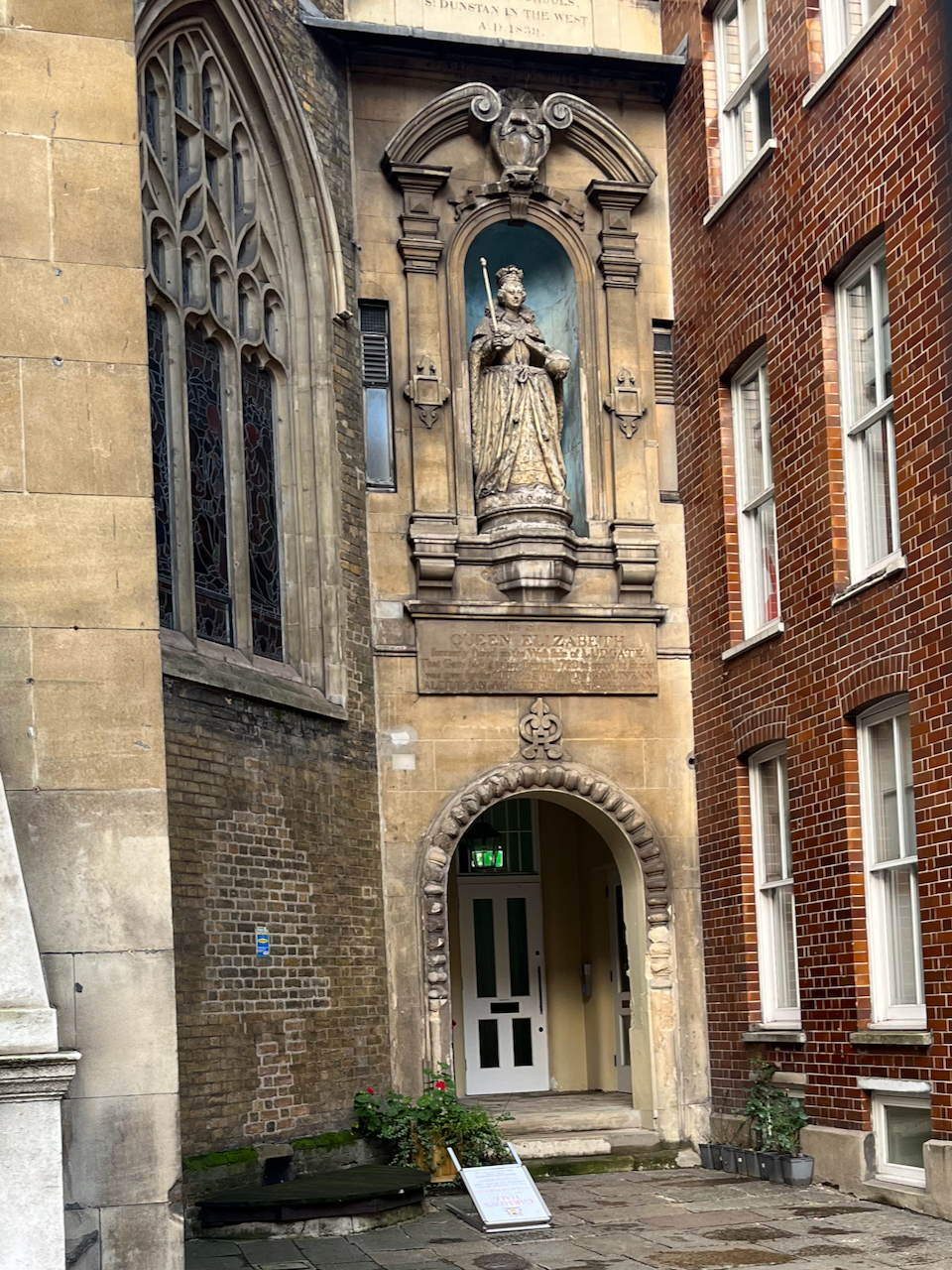
At ground level there is a rather austere monument: the bust of a man, on a plain triangular plinth, labelled simply “Northcliffe MDCCCLXV MCMXXII”. And behind that, above a door, a dusty statue, evidently very old, of Queen Elizabeth the First.

To the left of the church door there is a font set in to the fence. Round the edge, barely legible, it says “The gift of Sir James Duke Bart MP Ald of this ward”.

Next to the church, on its left, is a beautiful building, which is mysteriously empty and boarded up. This is 187 Fleet Street. It also has a clock, but this one did not show the correct time.

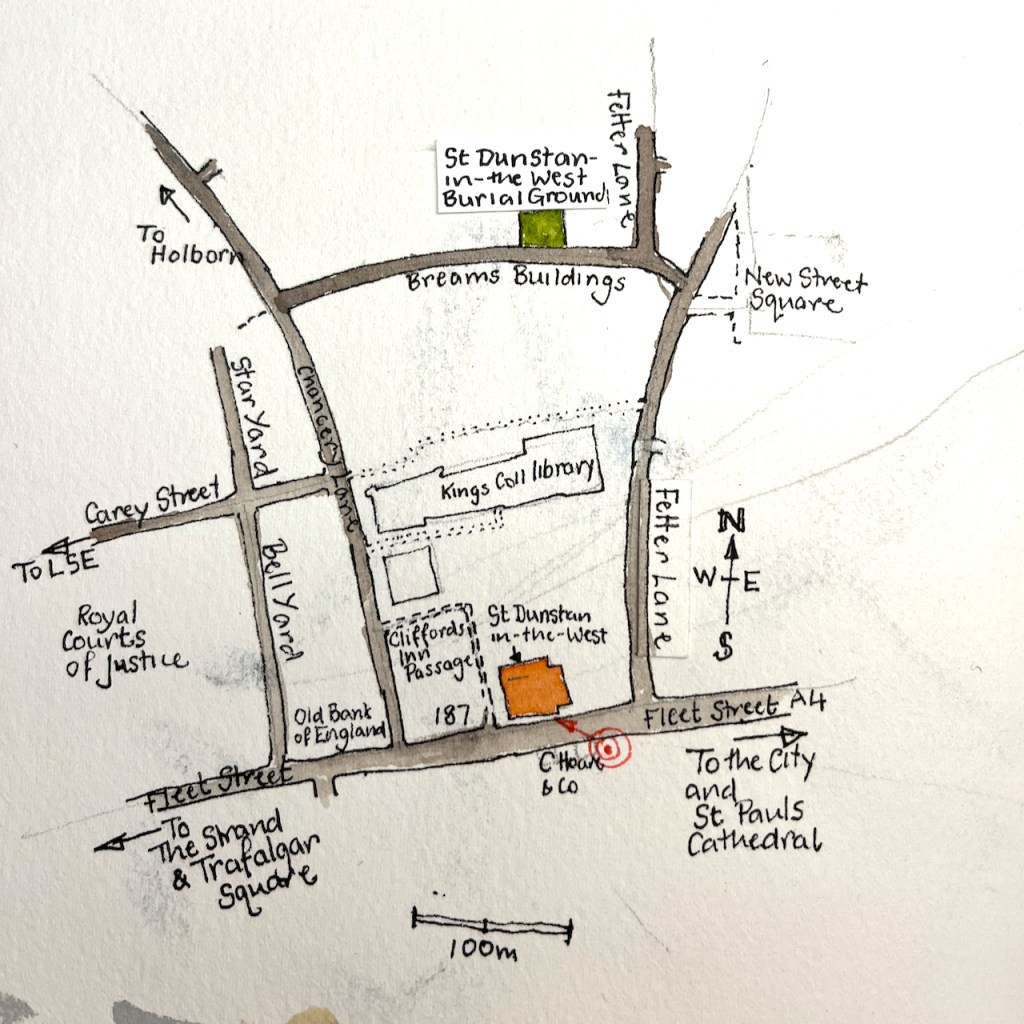
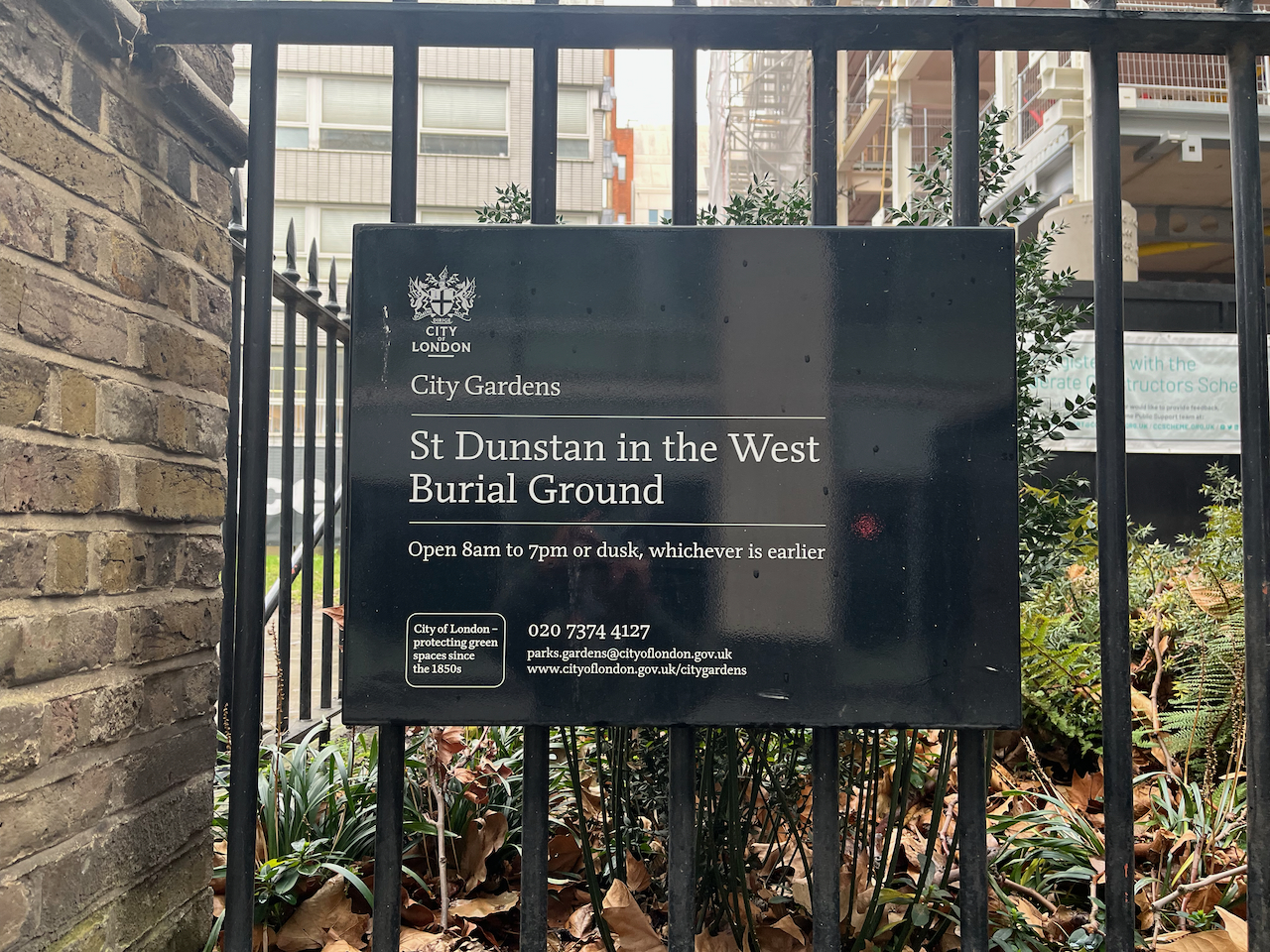
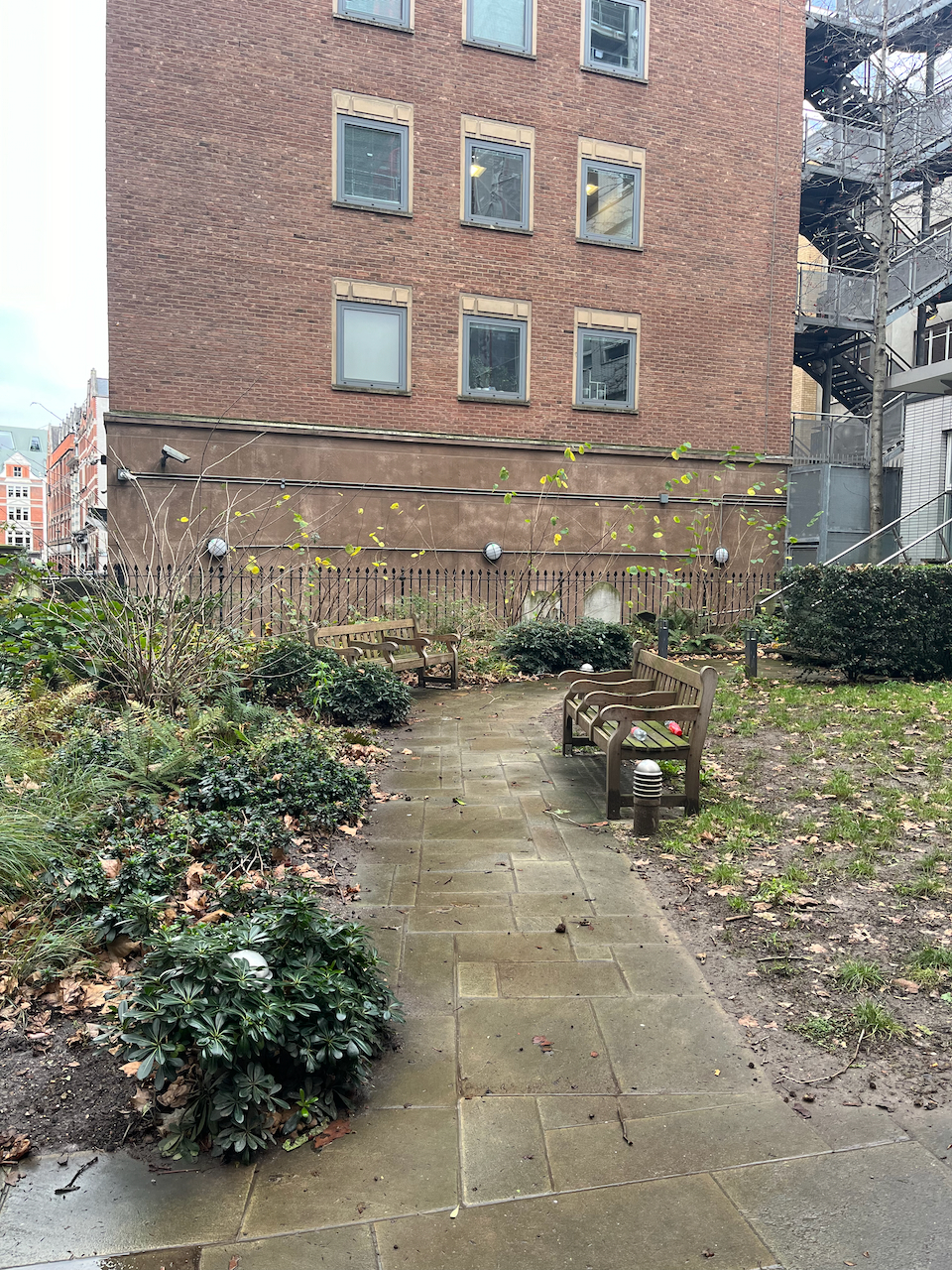
Another mystery: St Dunstan-in-the-West burial ground is some distance away to the north, on Breams Buildings, see map above.

“IanVisits” has an article on the Burial Ground published in 2020. When he visited it was clearly in a better condition than it is now. On my visit, December 2023, the burial ground was litter-strewn and neglected, overshadowed by a building site to the East, and defiled by plastic advertising hoardings flapping on its north fence.

The current St Dunstan-in-the-West church was constructed in 1830-1832 to the designs of John Shaw senior, and completed by his son, also John Shaw. This building replaced a much older one. The church website says:

“It is not known exactly when the original church was built, but it was between 988 and 1070 AD. It is not impossible that St Dunstan himself, or priests who knew him well, decreed that a church was needed here.”

It is an active Anglican church, open during the week, with services on Sundays, according to the notice on the door. The building also hosts the Romanian Orthodox Church.

Northcliffe, it turns out, was quite a character. He was a press baron, founder of the Daily Mail, and promoter of popular journalism. He launched the Daily Mail in 1876. At a time when newspapers were mostly intended to be serious reading, Northcliffe realised the potential of offering “entertainment” and “diversion”:

Hamilton Fyfe, a trusted contributor [to the Daily Mail], recalled that ‘the Chief’ wanted the Daily Mail to ‘touch life at every point … He saw that very few people wanted politics, while a very large number wanted to be entertained, diverted, relieved a little while from the pressure or tedium of their everyday affairs.’

Bingham, Adrian: “‘The Original Press Baron: The Role and Legacy of Lord Northcliffe.” Daily Mail Historical Archive 1896-2004. Cengage Learning, 2013

Northcliffe gradually built up his empire, acquiring the The Times and other newspapers. By 1914 he controlled 40% of the morning newspaper circulation, 45% of the evening and 15% of the Sunday circulation in Britain (Wikipedia). A fascinating article by Jessica Kelly of Cardiff University says that, due to Northcliffe’s influence, “politicians of the age sought his approval and support during this most uncertain and unpredictable of times”. Northcliffe publications advocated war against Germany. Once war was declared, they were a “solidifier of British public opinion behind a total war”. The author of this article makes a striking comparison between Rupert Murdoch today, and Northcliffe in the Edwardian era.

Lutyens designed the obelisk for the Northcliffe Memorial in St Dunstan-in-the-West, and the bust is by Kathleen Scott. (Pevsner)

I sketched the church standing on the other side of Fleet Street, near the office of C Hoare and Co, bankers. The church was closed when I visited, but I shall certainly go back and have a look inside during its opening hours.

References

“The Buildings of England, London 1: The City of London, by Simon Bradley and Nikolaus Pevsner (1999 edition)” page 214

“Lord Northcliffe – The Press baron at the heart of World War One”, 8 June 2016 by Jessica Kelly. https://blogs.cardiff.ac.uk/musicresearch/lord-northcliffe-the-press-baron-at-the-heart-of-world-war-one/

Bingham, Adrian: “‘The Original Press Baron: The Role and Legacy of Lord Northcliffe.” Daily Mail Historical Archive 1896-2004. Cengage Learning, 2013 https://www.gale.com/intl/essays/adrian-bingham-original-press-baron-role-legacy-lord-northcliffe

Shoreditch Church: St Leonard E1

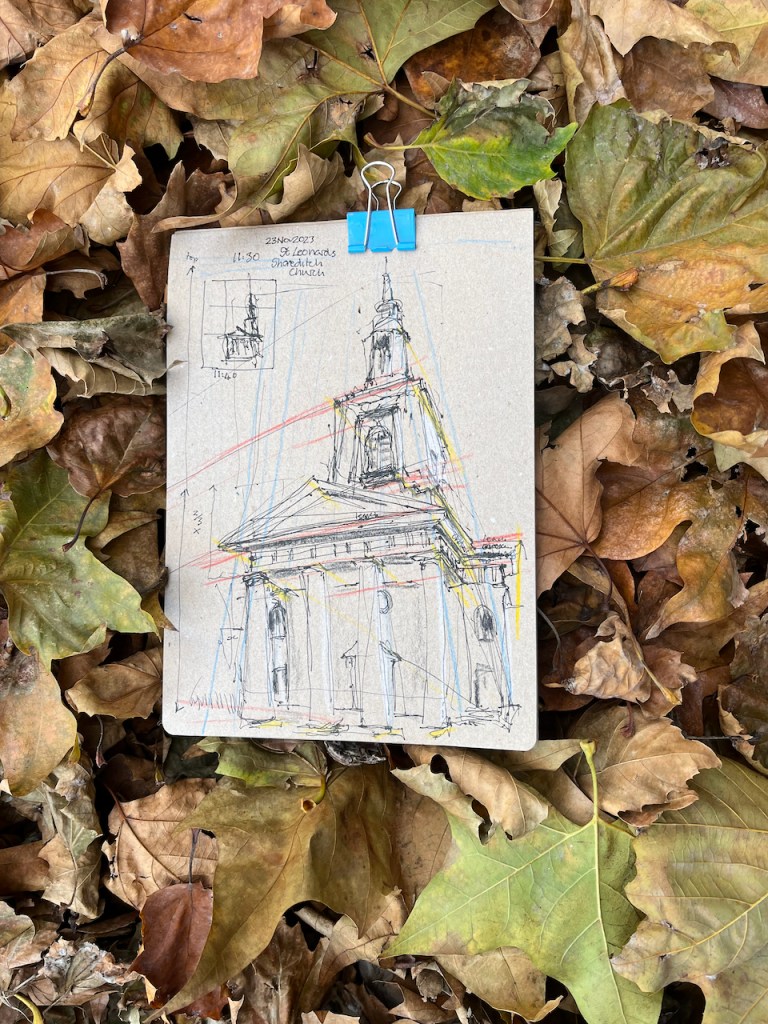
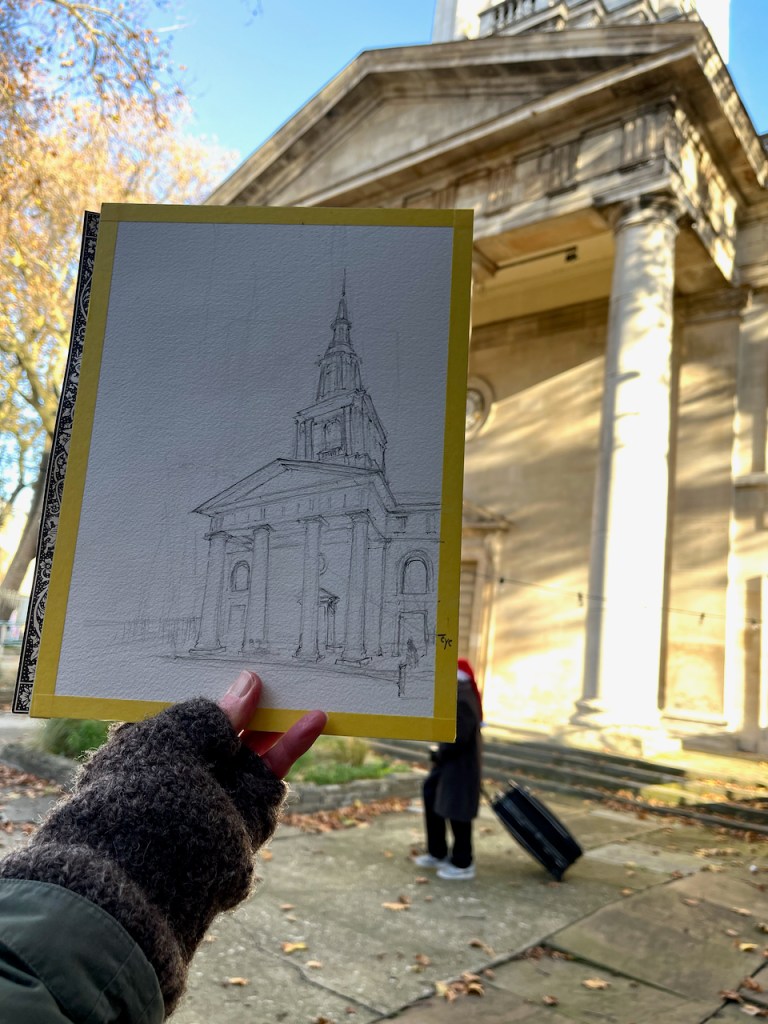
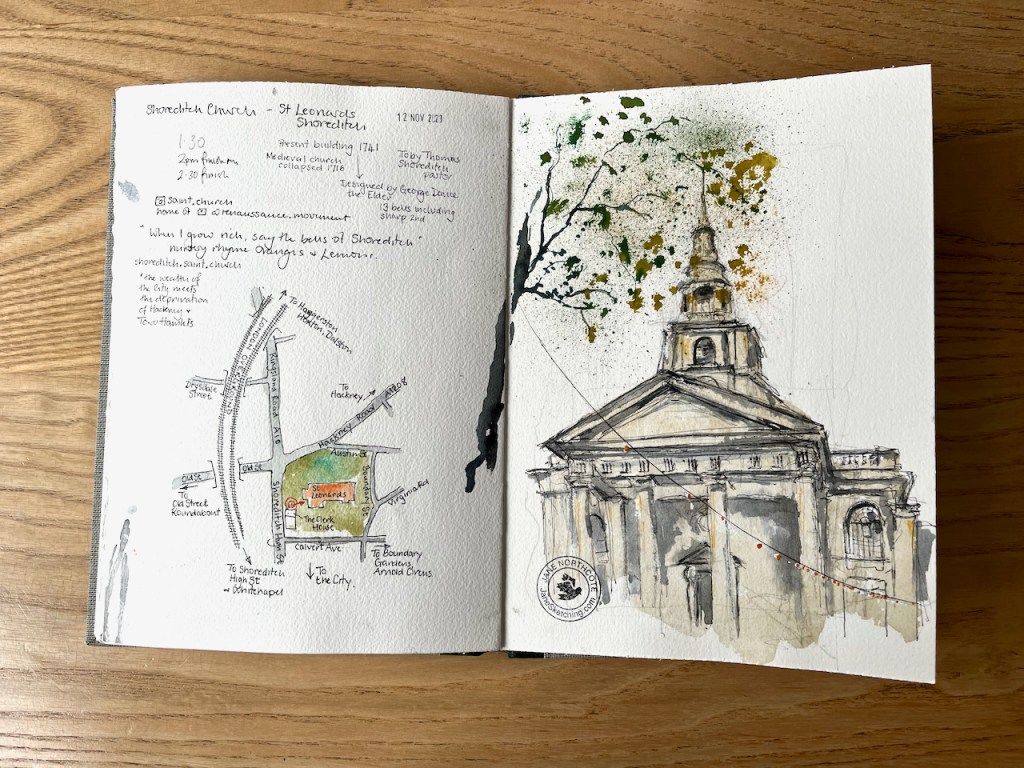
Here is St Leonard Shoreditch, which stands at the intersection of Shoreditch High St and the Hackney Road, postcode E1 6JN.

St Leonard’s, Shoreditch Church sketched 23 November 2023, 12″ x 9″ [sold]

There has been a Christian church here since medieval times. The present building dates from 1741 and was designed by George Dance the Elder (1695-1768). George Dance the Elder was the City of London surveyor at the time, and designed, amongst other buildings, Mansion House at Bank Junction.

The current church is active in the community. On the day I was sketching, a Thursday, they were offering meals to local people. This is the Lighthouse Project, “providing practical help, food parcels and hot meals to local people in need” according to their website. You can see several guests in the picture.

Placard offering "Free Community meal for the people of East London"

When the church was recently rebuilt at the turn of the millenium, a large amount of money was spent on its community needs and no funds were left to buy paint. Hence it still looks a bit bohemian. We think it’s quite endearing and shows people where our priorities are – with the community rather than how we look.

The current community is highly diverse. The wealth of the City meets the deprivation of Hackney and Tower Hamlets. Our neighbours in Arnold Circus and St Hilda’s Community Centre are highly galvanised community groups acting for societal change.

Shoreditch Church website (https://shoreditch.saint.church/new-page-50)

This church houses the “bells of Shoreditch” from the children’s song “Oranges and Lemons”. If you go inside the church you can see a bell, which is resting on a wooden pallet on the right hand side of the nave.

when I grow rich, say the bells of Shoreditch.

The Society of Cumbernauld Youths in 1784 rang a complete peal of 12000 changes of Treble Bob Royal, taking nine hours and and five minutes.

Oranges and lemons,
Say the bells of St. Clement’s. (St Clement Danes)
You owe me five farthings,
Say the bells of St. Martin’s. (St Martin in the Fields)
When will you pay me?
Say the bells at Old Bailey. (St Sepulchre-without-Newgate)
When I grow rich,
Say the bells at Shoreditch. (St Leonard Shoreditch)
When will that be?
Say the bells of Stepney.(St Dunstan’s Stepney)
I do not know,
Says the great bell at Bow. (St Mary Le Bow)
Here comes a candle to light you to bed,
And here comes a chopper to chop off your head!

The Society of Cumbernauld Youths in 1784 rang a complete peal of 12000 changes of Treble Bob Royal, taking nine hours and and five minutes, according to a placard in the church porch.

The bells are still rung.

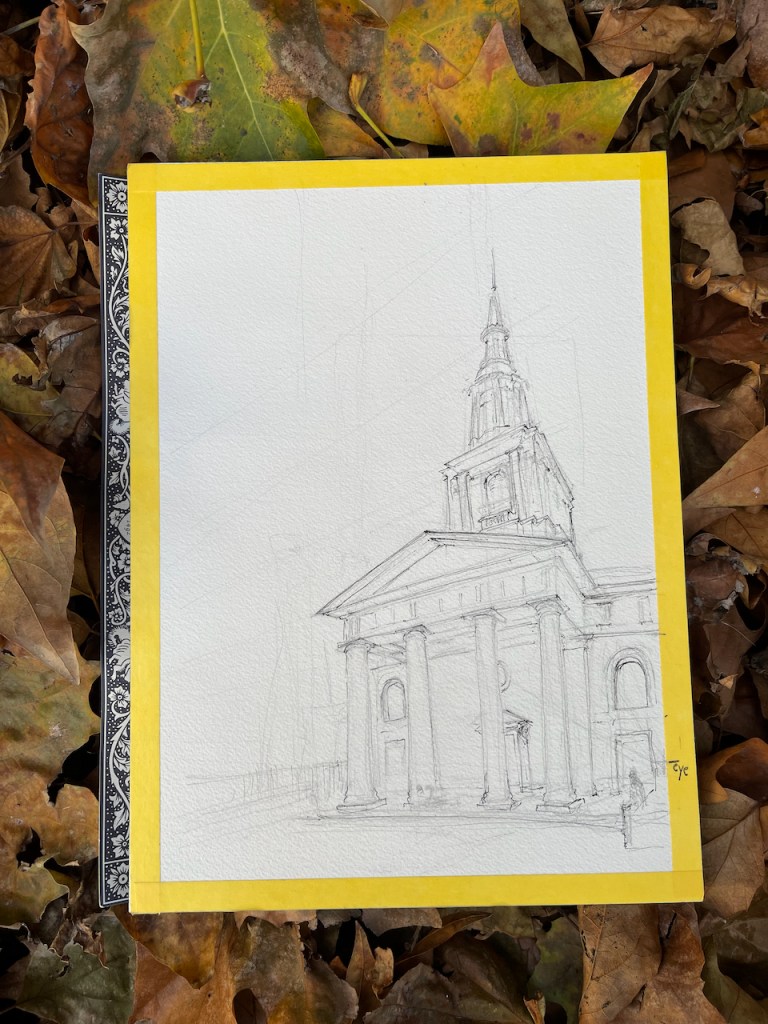
This picture was a commission. My client was keen to have this upward view showing the front of the church. I did some practice sketches to understand the tricky upward perspective.

Thank you to my client for suggesting I draw this inspiring church, and for their permission to publish the photos of the drawing online.

Here is a map showing the location:

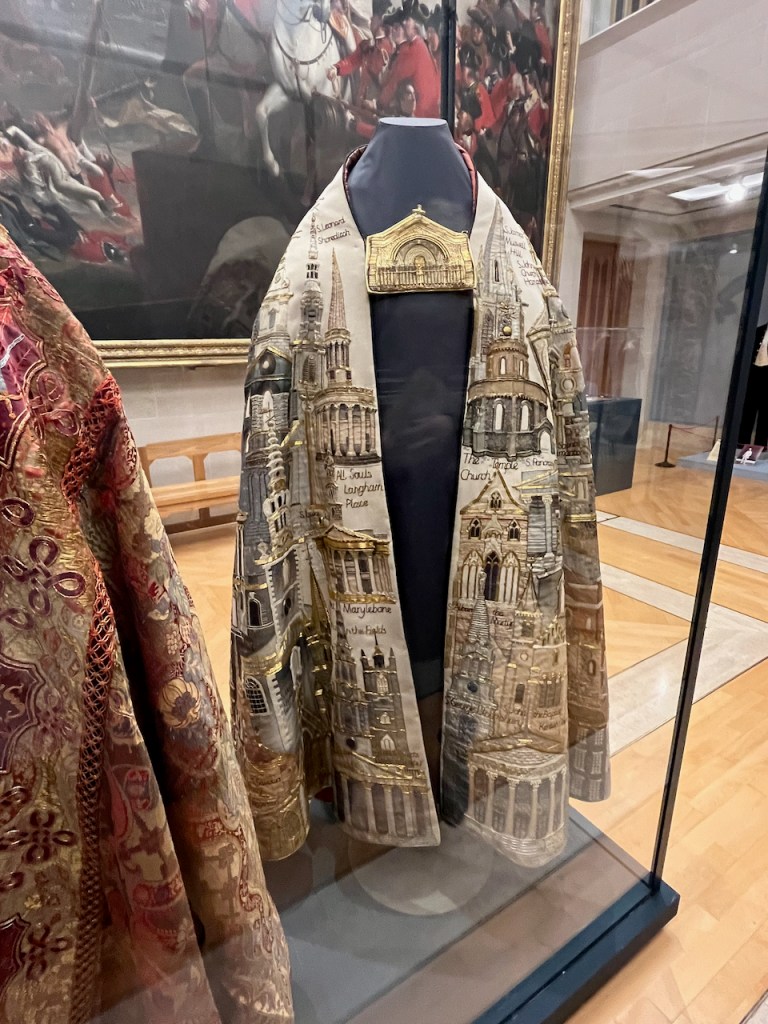
There is a current exhibition in the Guildhall London:

“Treasures of Gold and Silver Wire”
curated by Dr. Karen Watts, Emeritus at the Royal Armouries. It celebrates the 400 anniversary of the Worshipful Company of Gold and Silver Wyre Drawers.

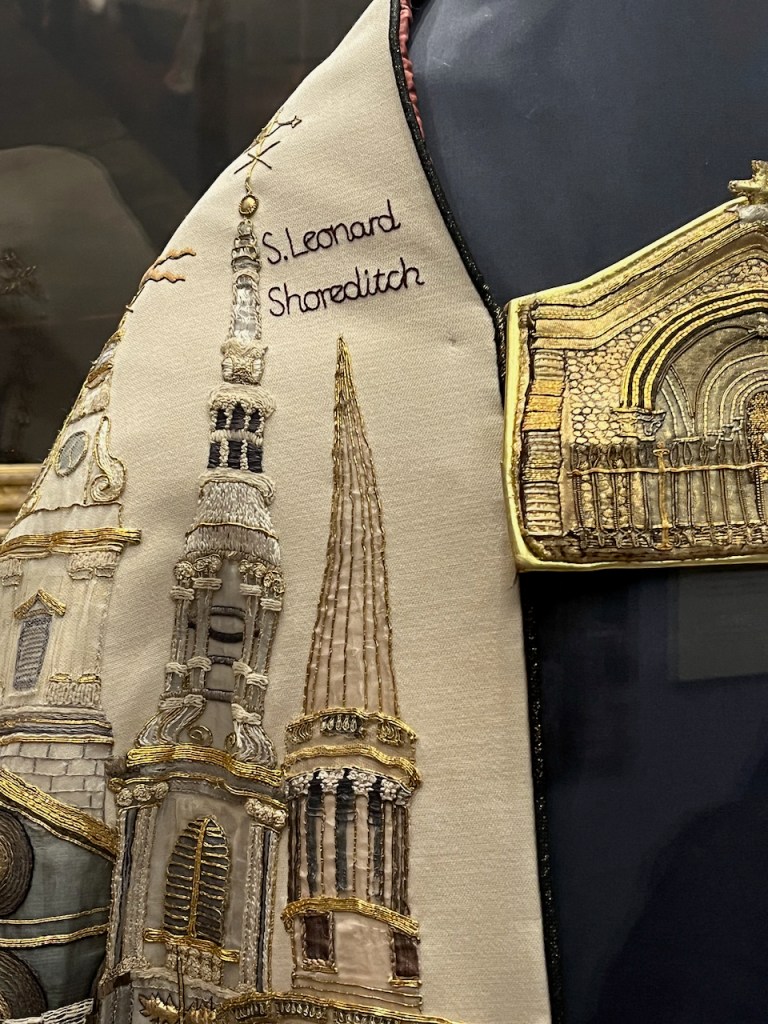
In that exhibition there is a cope, a cape for the Bishop of London, showing 73 London Churches. To my delight, St Leonard Shoreditch features, on the right shoulder. It was designed by British embroiderer Beryl Dean and made by needlework students of the Stanhope Institute. (https://trc-leiden.nl/trc-needles/individual-textiles-and-textile-types/commemorative-and-commissioned-textiles/silver-jubilee-cope-and-mitre)

Having myself had a go at depicting those arches and columns on the spire, I am full of admiration for the embroiderers who managed to create an accurate image in wire thread. Hugely accomplished! The exhibition is on until 31st December 2023- well worth seeing.
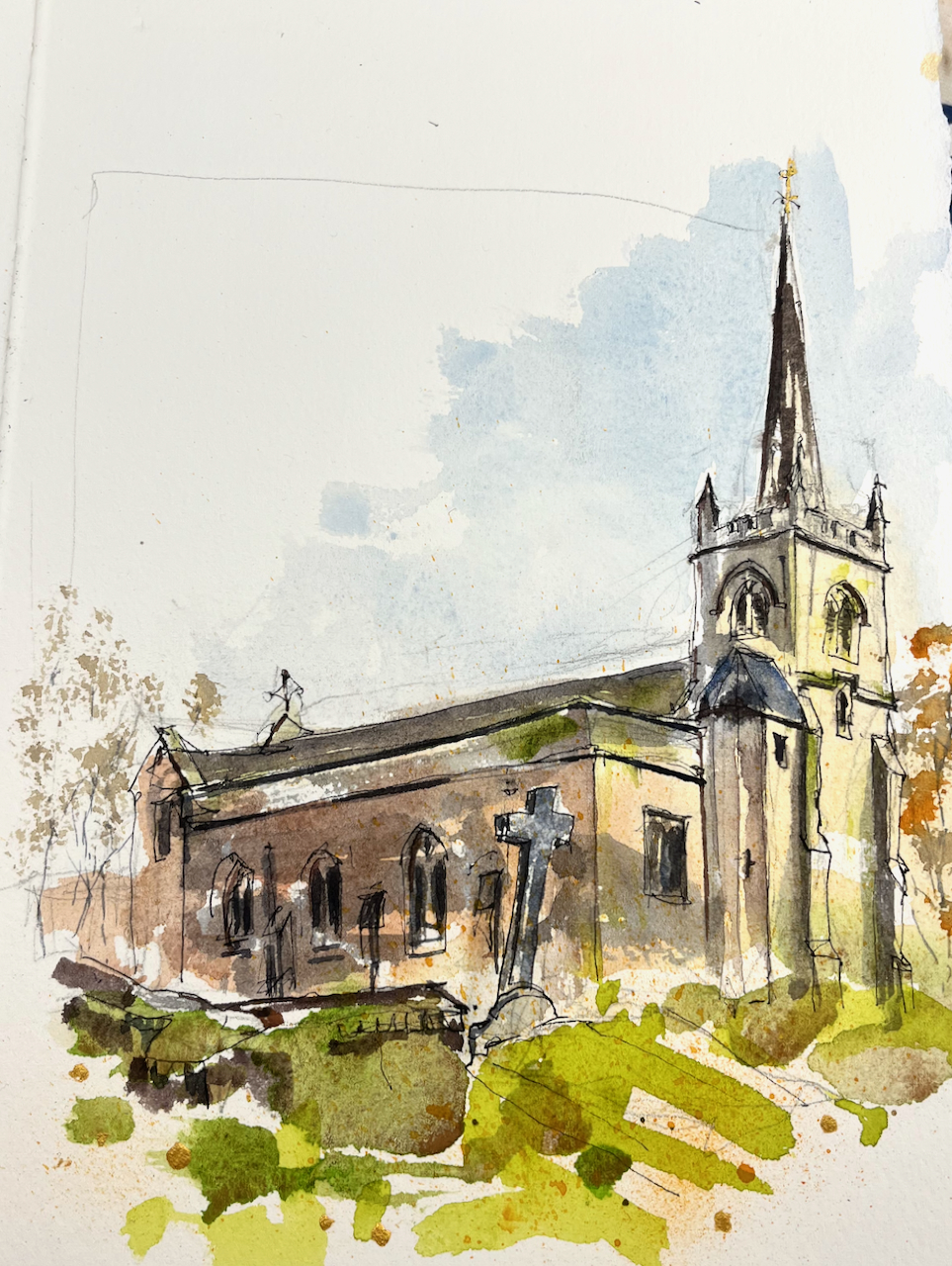
Old Church of St Mary, Stoke Newington, London N16

Having sketched the Stoke Newington New Church, I was keen also to sketch the Old Church, which is just the other side of the road. This church is Elizabethan, constructed in 1562, on a very ancient site. It is in active use, and shares a vicar with the New Church across the way.

Old Church of St Mary, Stoke Newington, London N10 sketched 1 December 2023 in Sketchbook 13

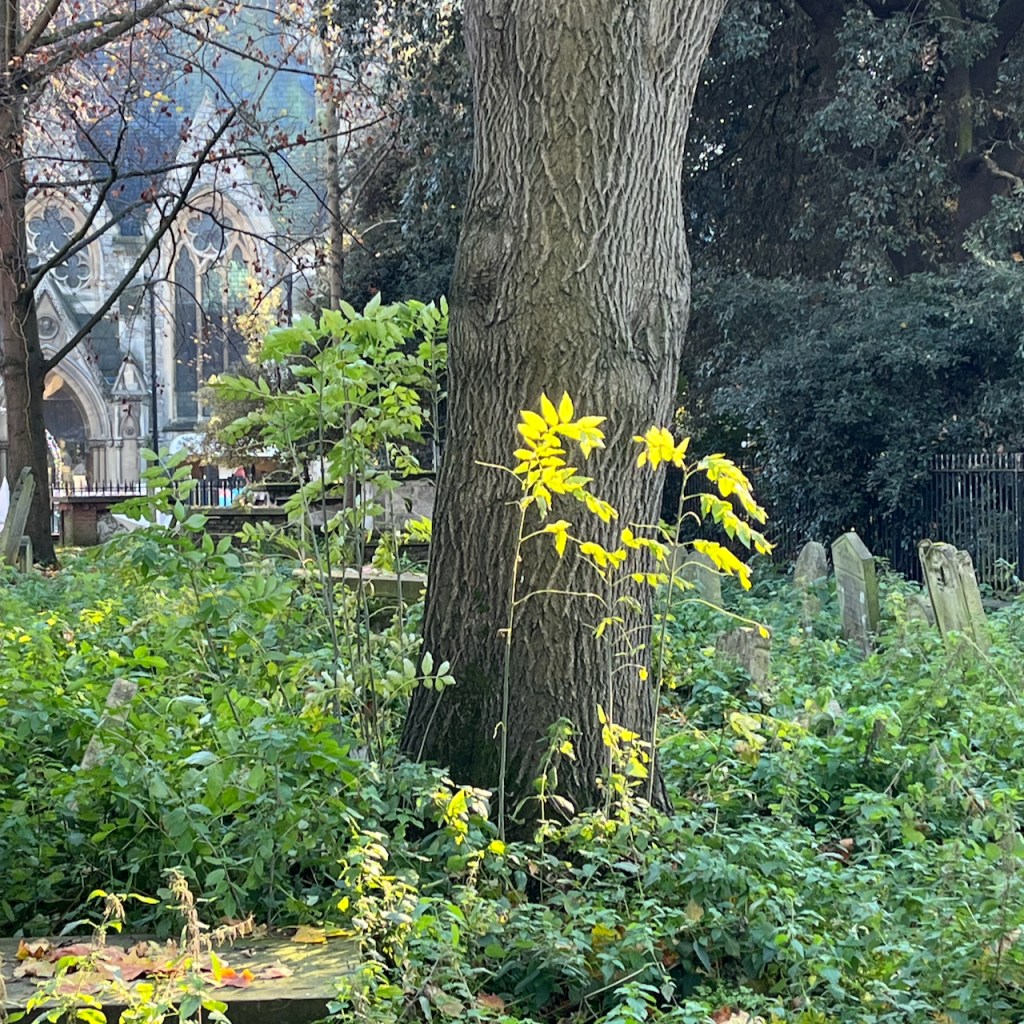
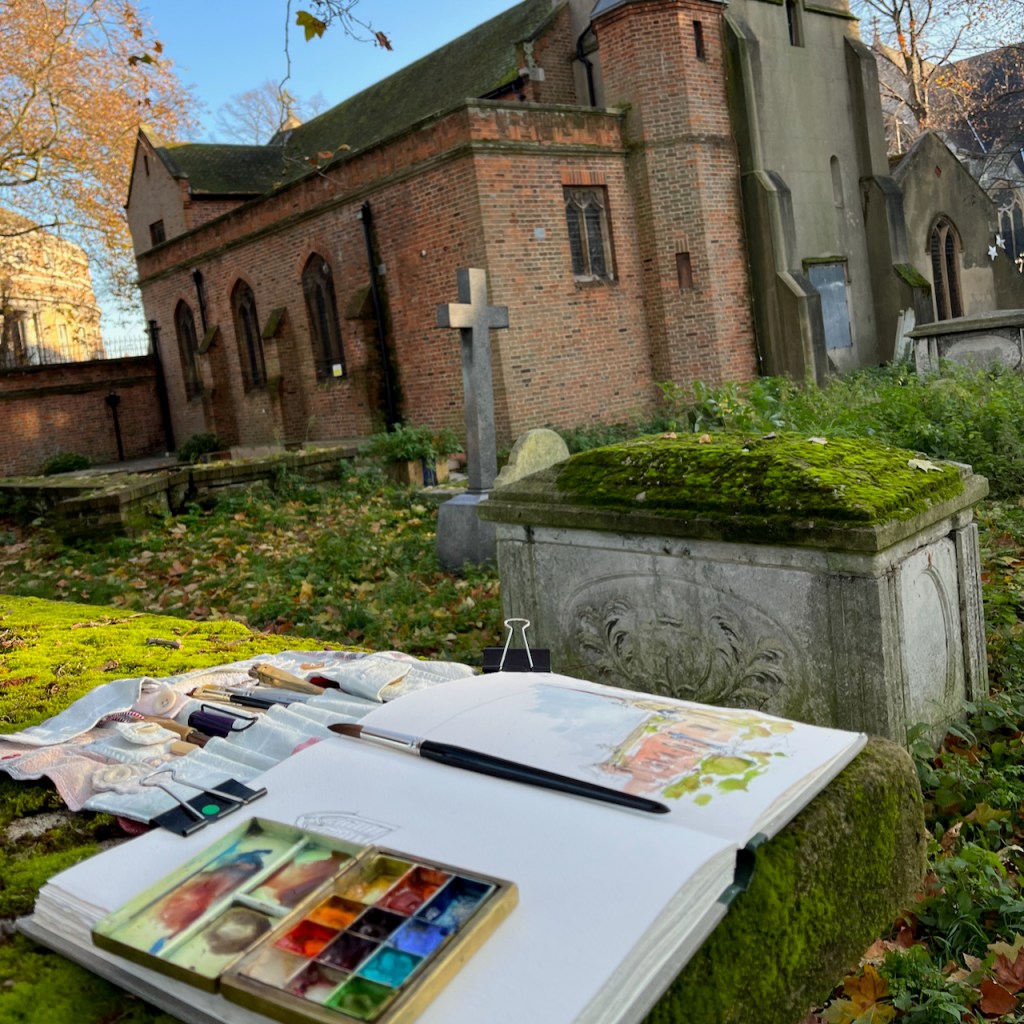
The churchyard is overgrown and atmospheric, it was wonderful to stand there on this cold clear day.


The building is Grade II* listed. The listing is here and the At Risk listing is here. It is listed because of much of the building from 1563 has survived, and because very few churches were built in this period. Also, the listing comments on its “group value”, because it stands next to the New Church. “The two make a memorable contrast and are a striking visual representation of the demographic changes from the C16 to the C19 in this area.” says the listing. The Old Church is small and domestic in scale, the New Church is magnificently huge.

Some history is given on the placard by the entrance.

ST. MARY’S OLD CHURCH, STOKE NEWINGTON
The Manor of Stoke Newington is recorded in the Domesday Book (1086) to be the property of the Canons of St.Pauls Cathedral in whose possession it still remains. It is reputed to have been the Gift of King Athelstan about the year 940. It is probable therefore that a Church has occupied this site since Anglo-Saxon times. The South Aisle was built in 1563 by William Patten Lord of the Manor In.1829 Sir Charles Barry enlarged the Church. Severe bomb damage was sustained in 1940 and the Church was restored to its present state in 1953.

The future? This building is on the Historic England Heritage at Risk register, at risk level A, the highest, because there is “immediate risk of further rapid deterioration or loss of fabric; no solution agreed”

I sketched the church quickly as it was 2 degrees C outdoors. Then I caught the number 73 bus back down the hill to central London. Here is work in progress on the sketch.

Trellick Tower, London W10

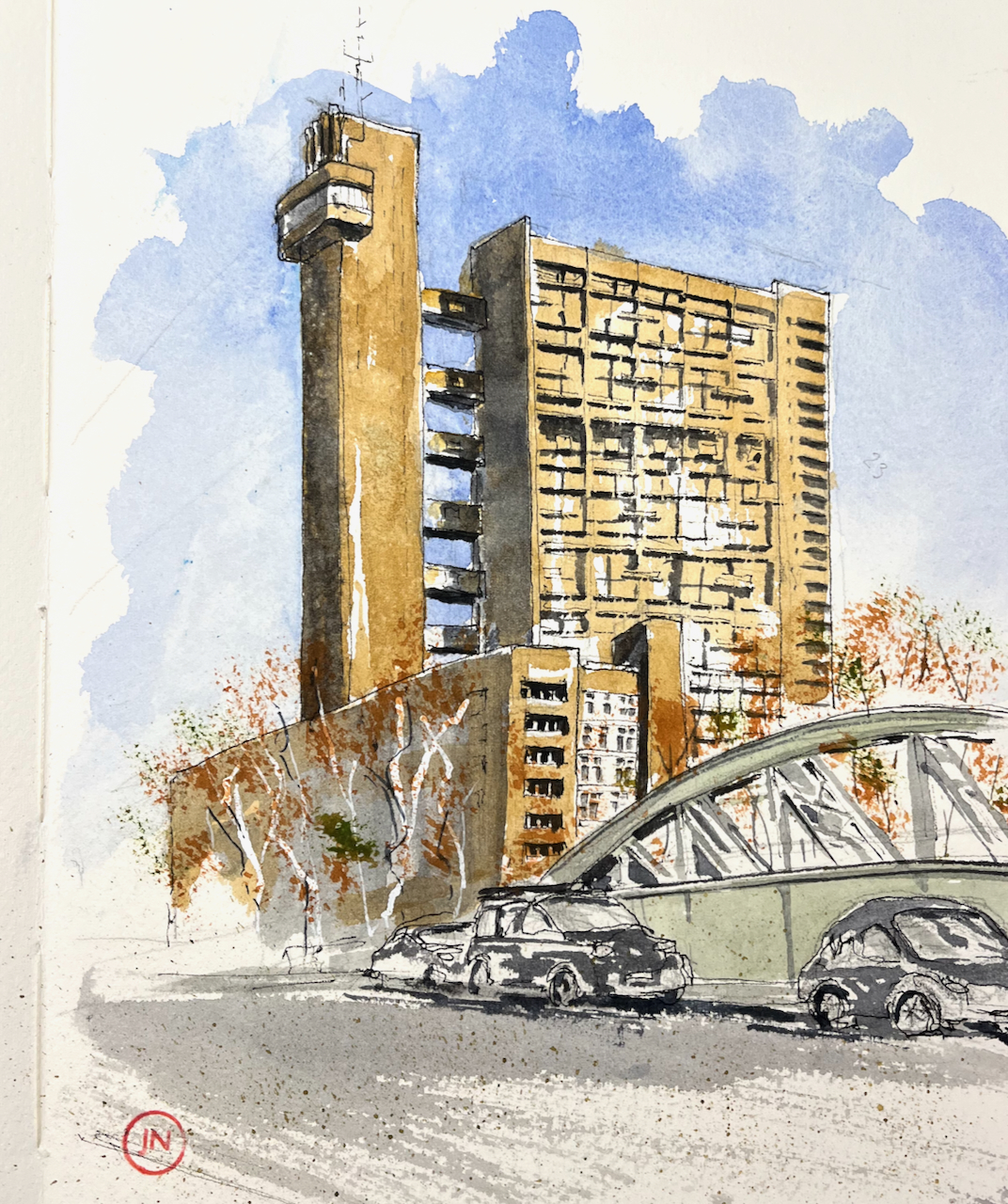
Here is the magnificent Trellick Tower in West London.

Trellick Tower from the Golbourne Road, London W10. Sketched 28 November 2023 in Sketchbook 13

This tower is 271 flats, 31 stories, completed in 1972 to the design of Ernő Goldfinger (note 1). It is in the Royal Borough of Kensington and Chelsea, near the Grand Union Canal and the A40 trunk road out of London. It is Grade II* listed (note 2)

After sketching, I was really cold. I found warmth and excellent food in the Sicilian Café “Panella” shown on the map above, recommended!
Panella – Golborne Road

Sketchbook spread: Trellick Tower

I have previously sketched the Balfron Tower in East London, also designed by Ernő Goldfinger.

Note 1: Information on the Balfron Tower and Trellick Tower is from the RIBA website: https://www.architecture.com/explore-architecture/inside-the-riba-collections/trellick-tower-turns-50

Note 2: Grade II* listing: https://historicengland.org.uk/listing/the-list/list-entry/1246688?section=official-list-entry

The RIBA site gives the number of flats as 271, the Historic England Site as 217.