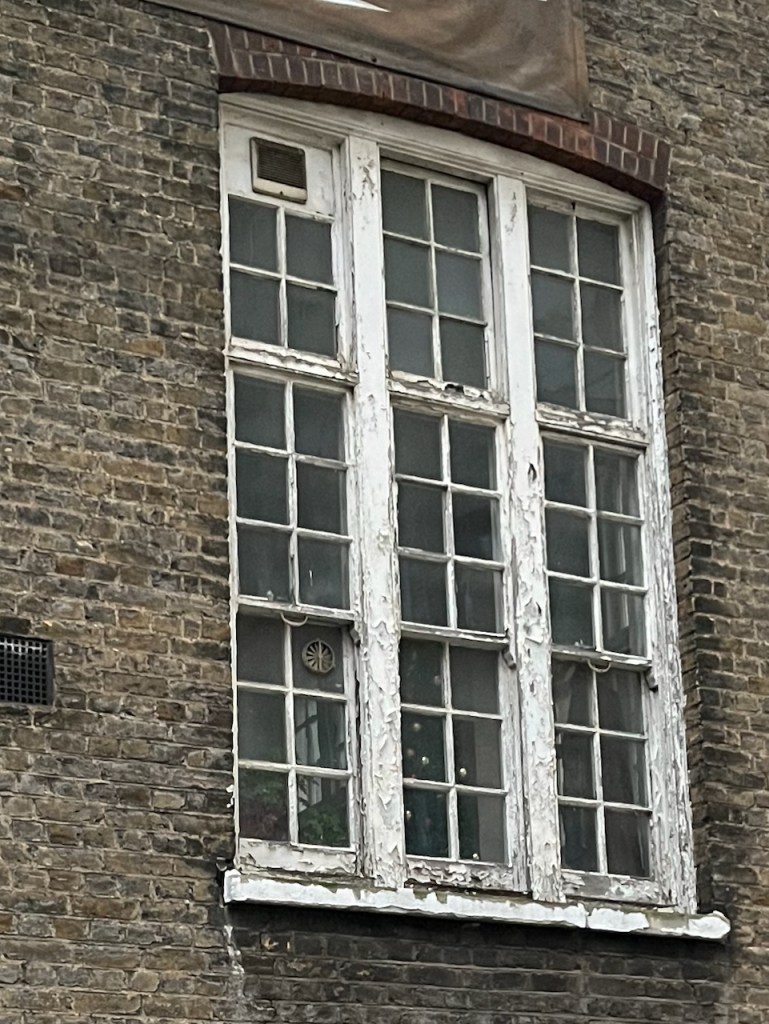
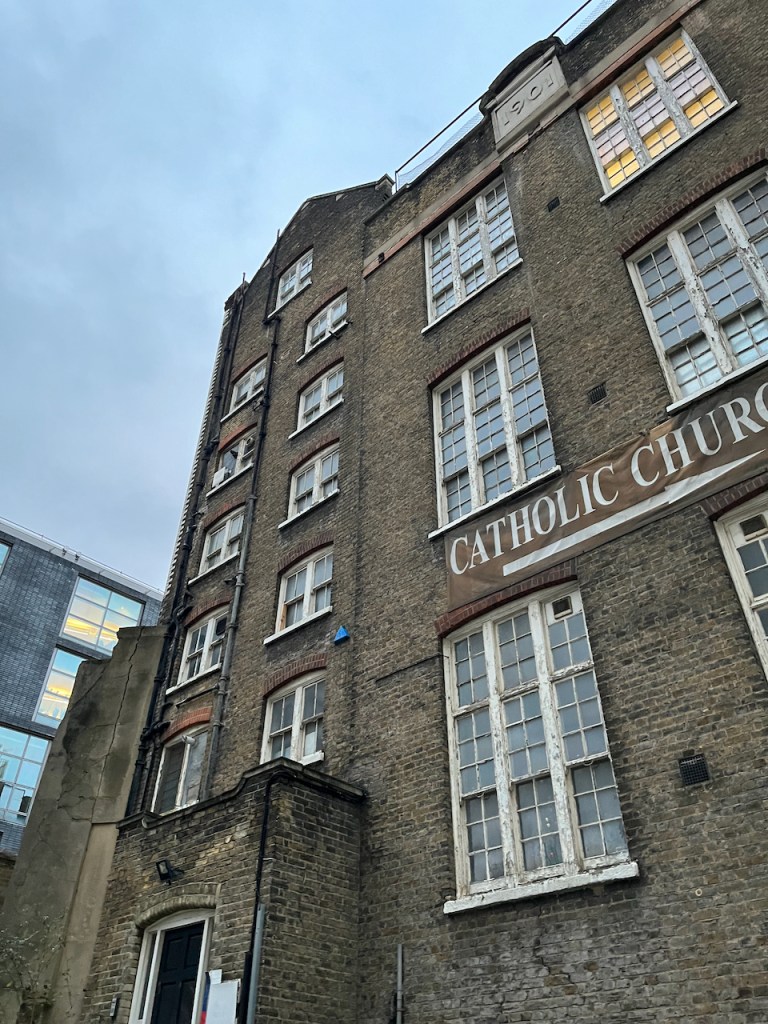
An old brick building stands amongst the new-build. The paint on its window frames is flaking, and its brickwork is dark from the smoke of a previous age, yet it retains its dignity: a grandmother of a building.
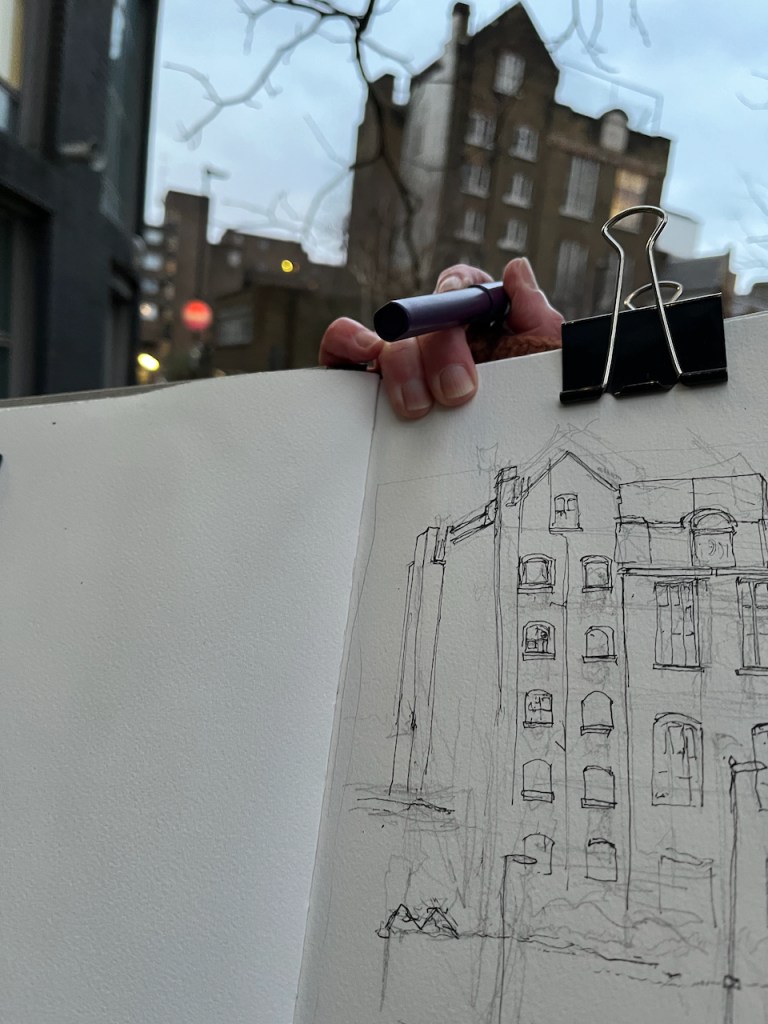
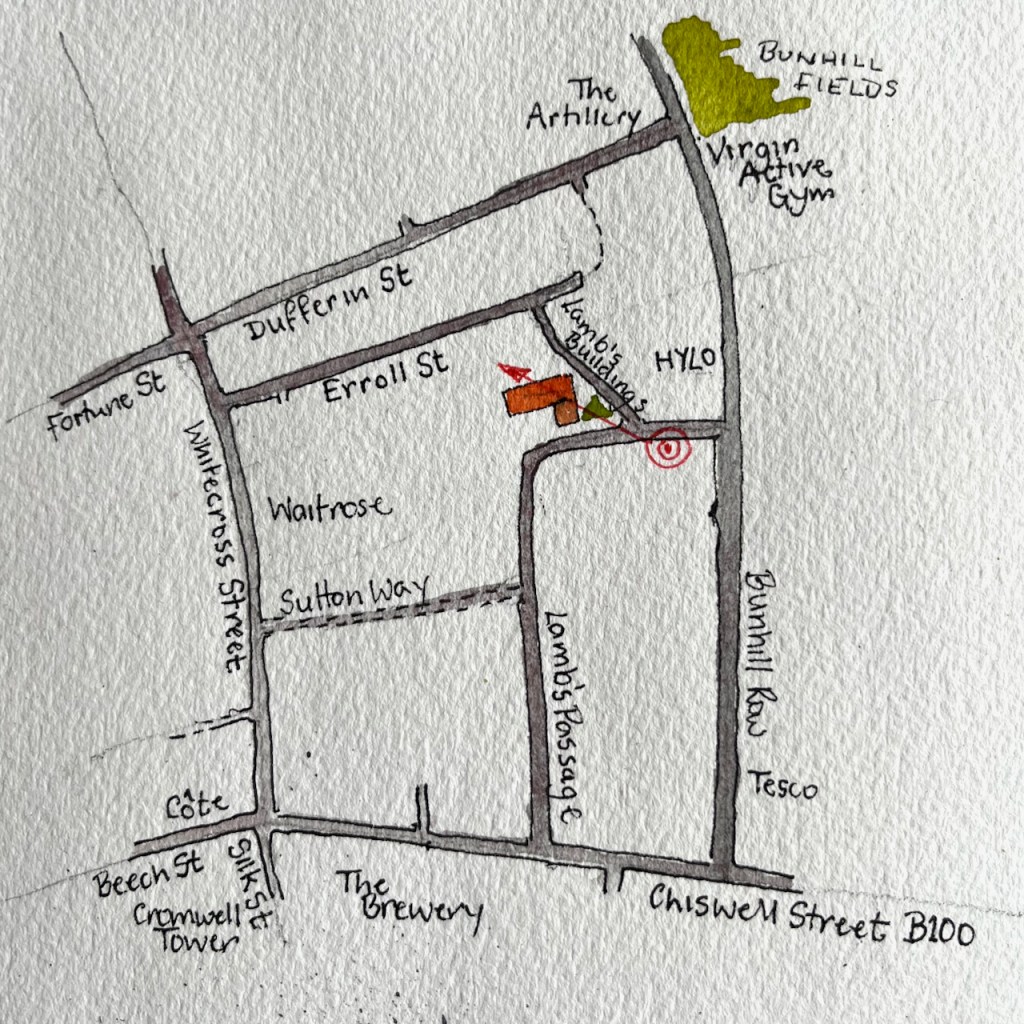
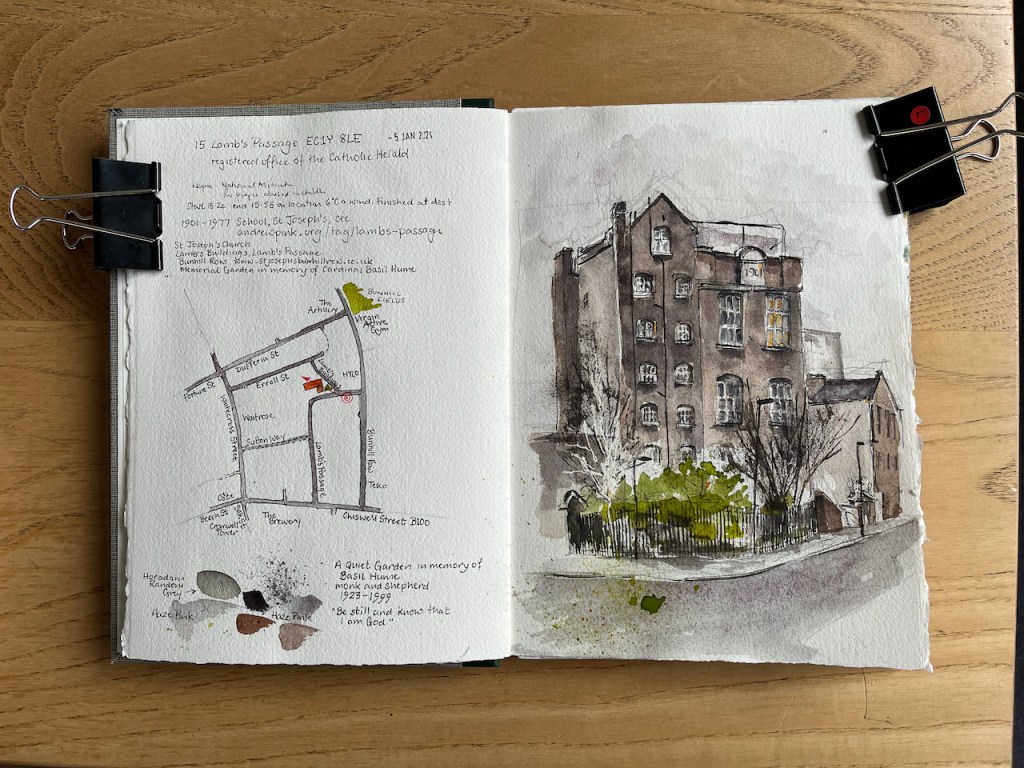
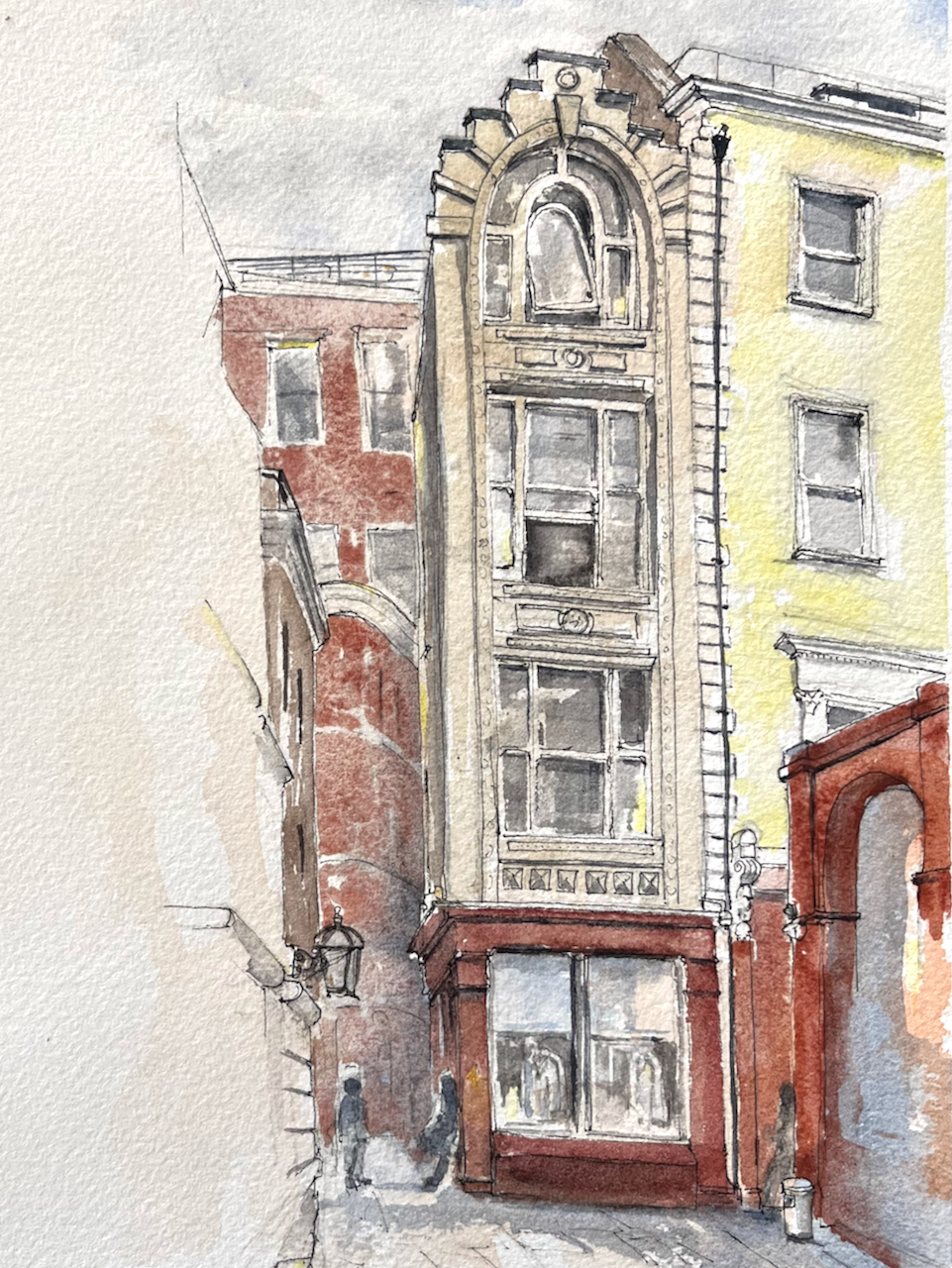
15 Lamb’s Passage, London EC1, sketched 5th January 2024 in Sketchbook 14, 4pm, 6 degrees C
This is the former St Joseph’s School, built in 1901, which ceased operation as a school in 1977. On its roof you can see the wire netting which once must have surrounded a playground or netball court.
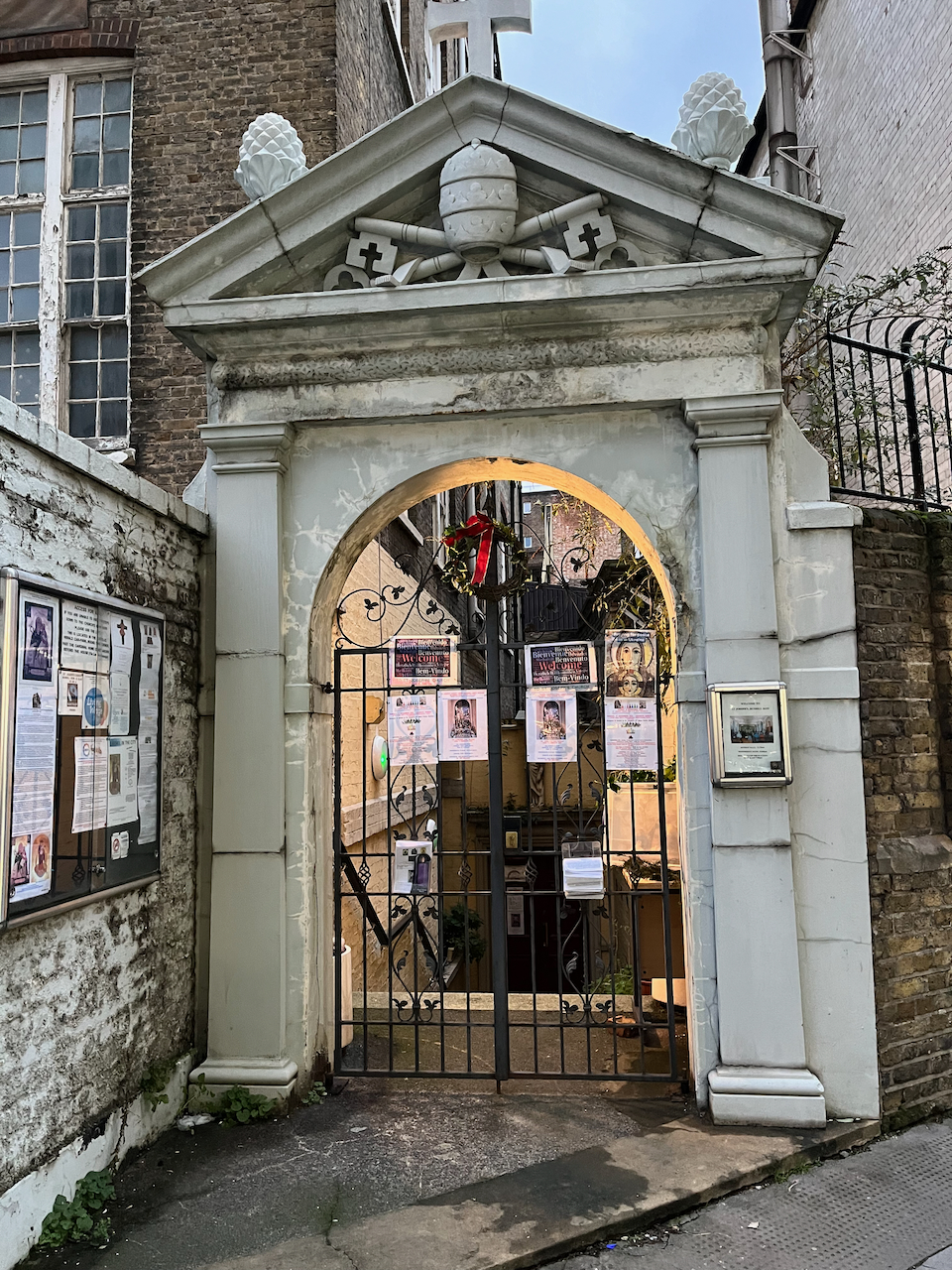
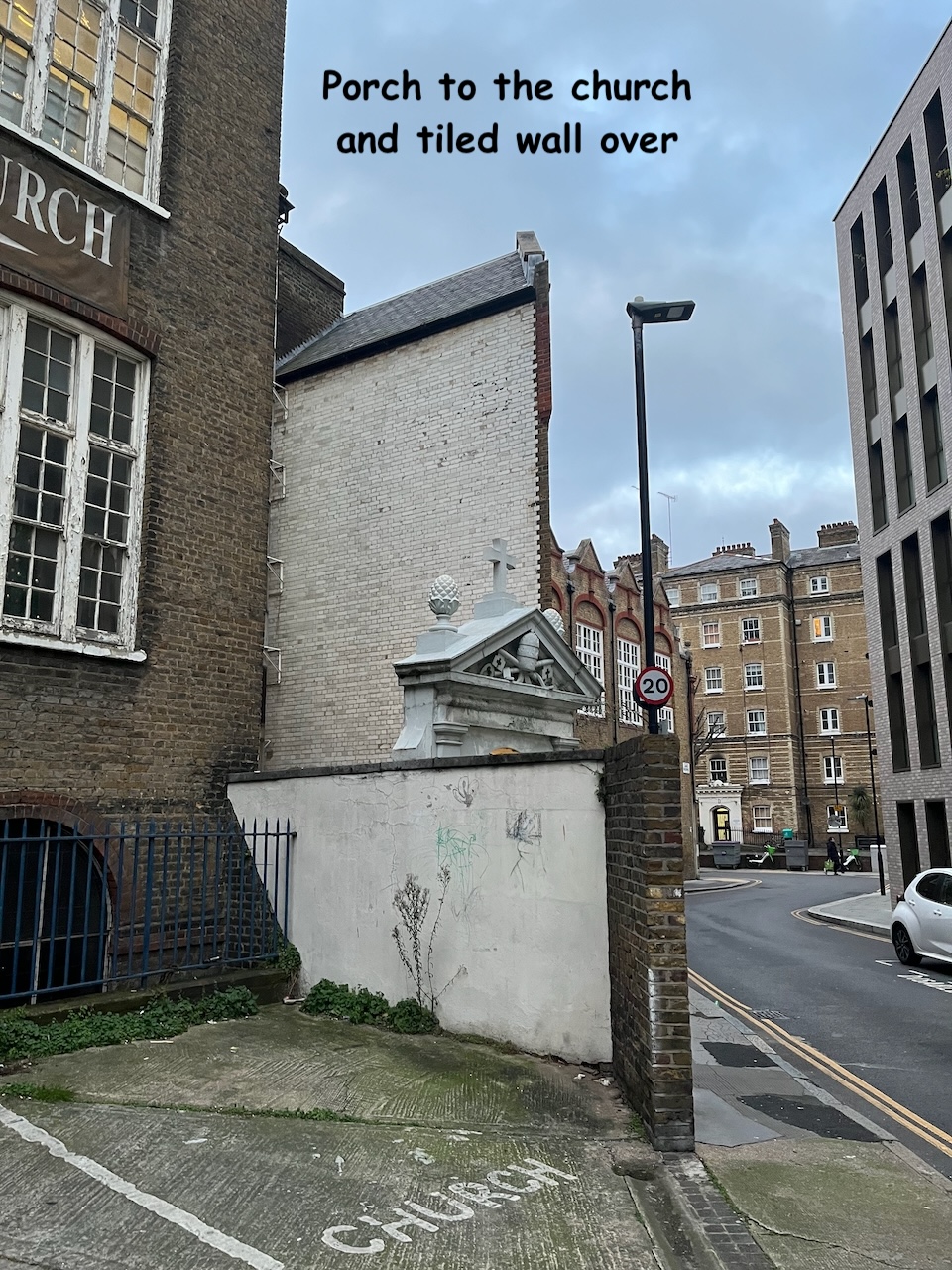
St Joseph’s Church is in the basement, accessed by the porch you can just see to the right of my drawing behind the furthest lamppost.
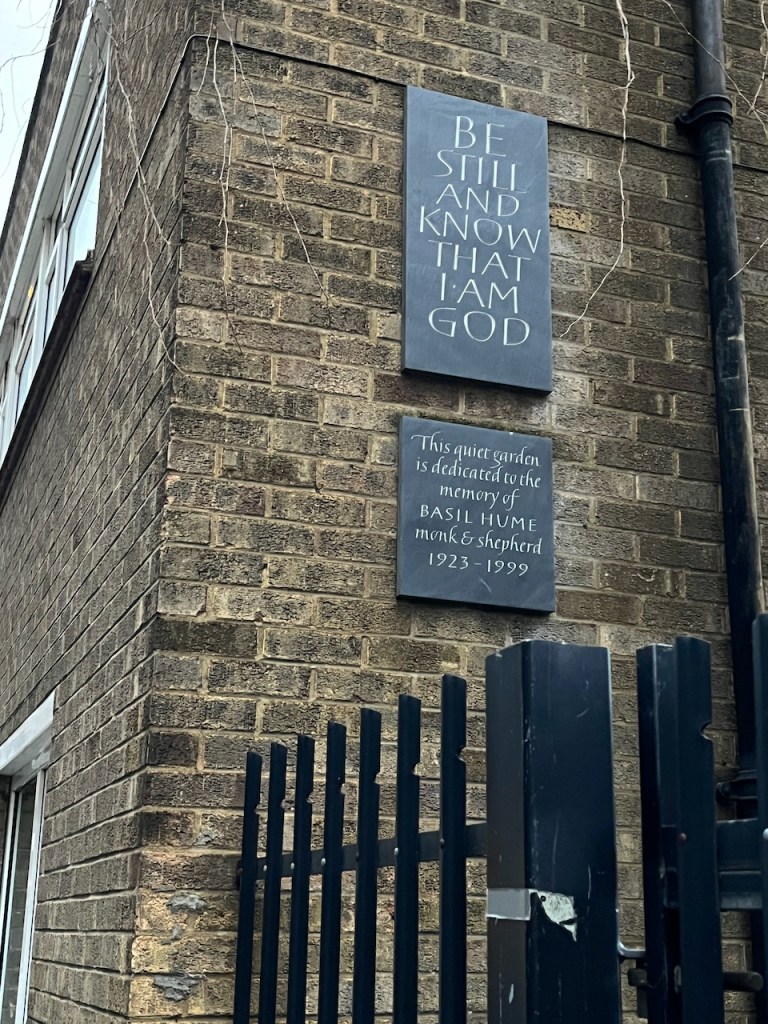
The area in front of the building is a quiet garden, in memory of Basil Hume, an English Catholic bishop. Sometimes the gate is open and you can go in. It has been arranged so that, even in this tiny space, it is possible to walk some kind of small pilgrimage, along a path, across a ditch, past a tree, and so round a corner to rest in the shaded hut. On the way you encounter a splendid birch tree with white bark, which I have seen grow from a sapling.
BE
STILL
AND
KNOW
THAT
I AM
GOD
This quiet garden
is dedicated to the
memory of BASIL HUME
monk and shepherd
1923-1999
Number 15 Lamb’s Buildings hosts several organisations now. The City Photographic Society uses the Church Hall in this building. It is also the registered office of the Catholic Herald. I have often heard music as I pass by, so it might also be used as a rehearsal space. There is ballroom dancing on Mondays. The smaller building to the south, on the left of my drawing, hosts a pregnancy advice centre. So this is a set of buildings is in use, actively serving the community despite the flaking paint.
I made this drawing quickly as the light faded on a cold and windy evening. After the pen, I retreated back to my desk to apply the colour.
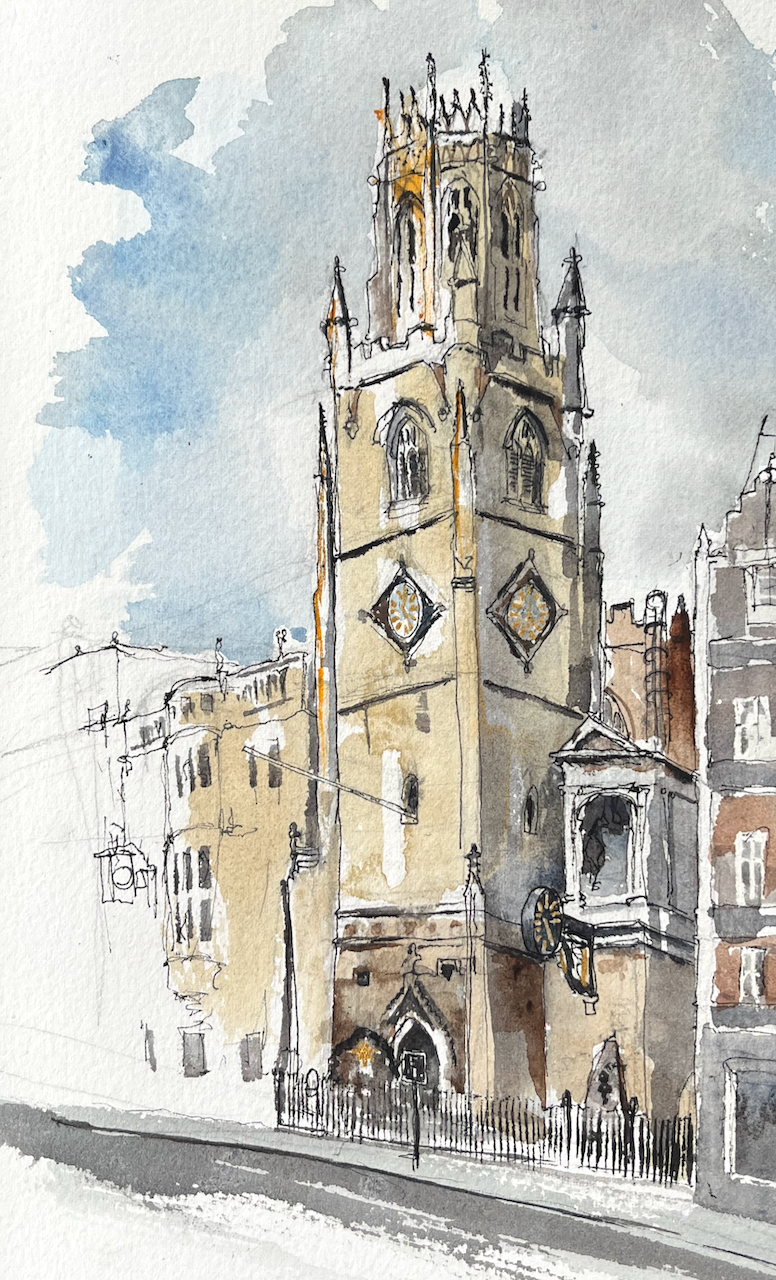
This church stands on Fleet Street, near the Royal Courts of Justice. It is set a little back from the road, so I had not really noticed it. But it is remarkable in many ways.
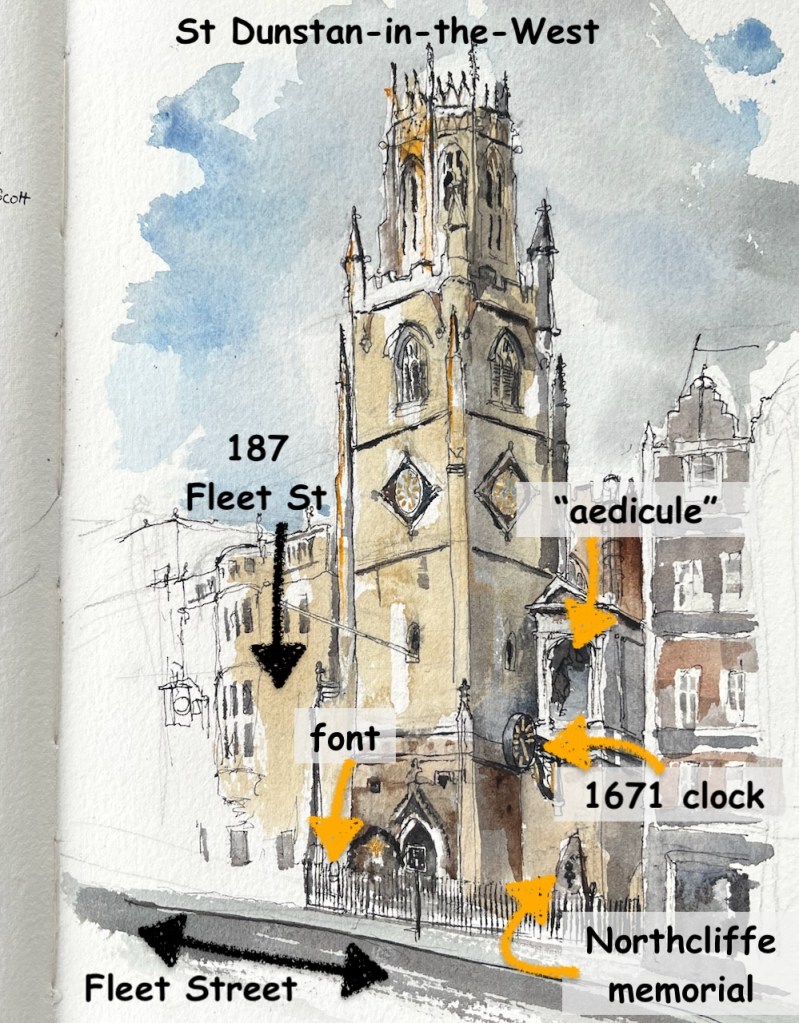
St Dunstan-in-the-West, 186a Fleet Street, sketched 31 Dec 2023, in Sketchbook 14
For one thing, the architect has used every possible ornate contrivance. It was impossible for this urban sketcher to do justice to the extraordinary details. The crocheted spires! The castellations! The geometry! The lacy top! The stonework above the door!
The geometry is interesting because the tower starts as a squarish-type shape at ground level, and then higher up there is an arrangement of planes which slice off the corners, turning it into an octagon at the top. At the higher part of the tower, the stonework is open so the sky is visible between the fine arches and spires.
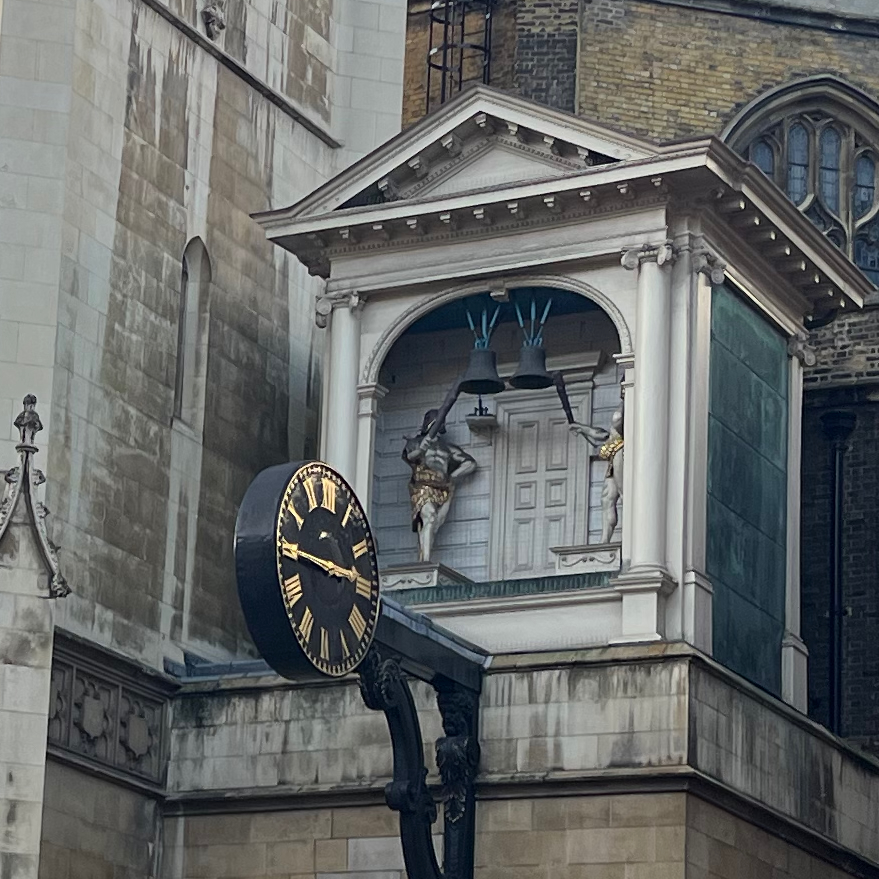
Then there are the clocks. There are two clocks on the tower, both showing the correct time. And there is another clock, also showing the correct time, suspended on a substantial wooden bracket below a little covered stage. Inside the stage are two muscular wooden figures, and two bells. The figures strike the bells every quarter hour. The little stage is described as an “aedicule” in Pevsner, who tells me that the clock was made in 1671.
The clock and the small covered stage (aedicule”), with wooded figures.
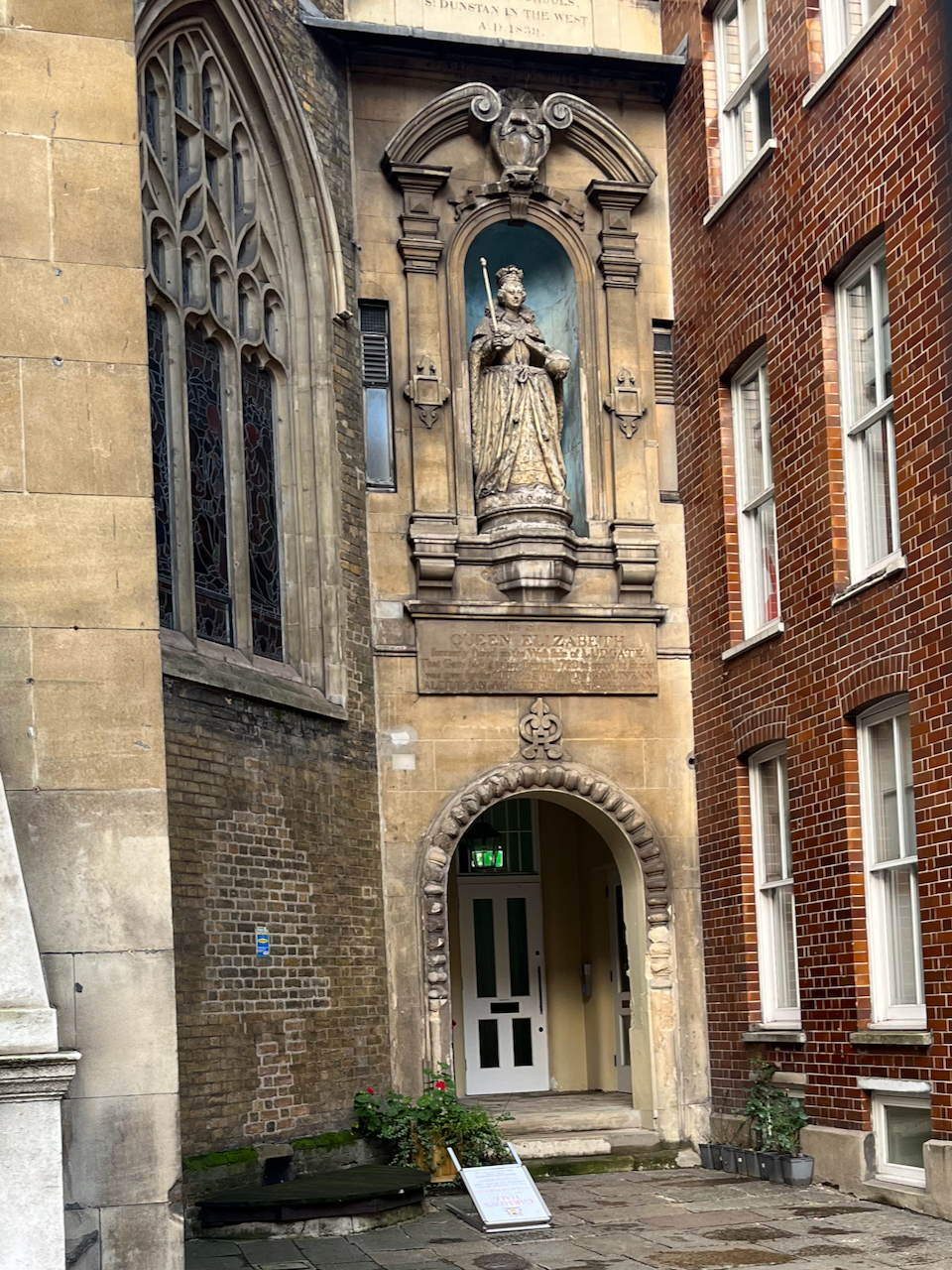
At ground level there is a rather austere monument: the bust of a man, on a plain triangular plinth, labelled simply “Northcliffe MDCCCLXV MCMXXII”. And behind that, above a door, a dusty statue, evidently very old, of Queen Elizabeth the First.
Northcliffe memorial. (Lord Northcliffe 1865-1922)Elizabeth statue (Queen Elizabeth I 1533-1603)
To the left of the church door there is a font set in to the fence. Round the edge, barely legible, it says “The gift of Sir James Duke Bart MP Ald of this ward”.
Next to the church, on its left, is a beautiful building, which is mysteriously empty and boarded up. This is 187 Fleet Street. It also has a clock, but this one did not show the correct time.
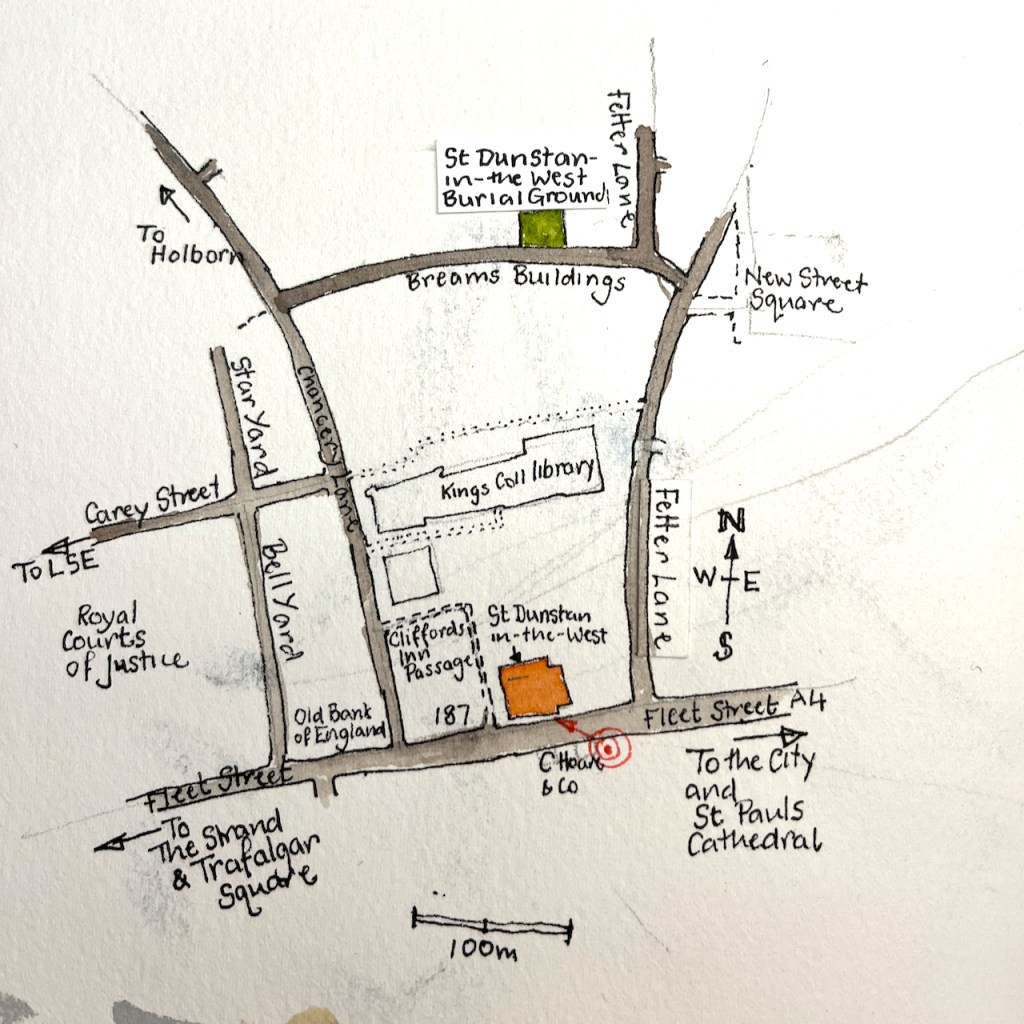
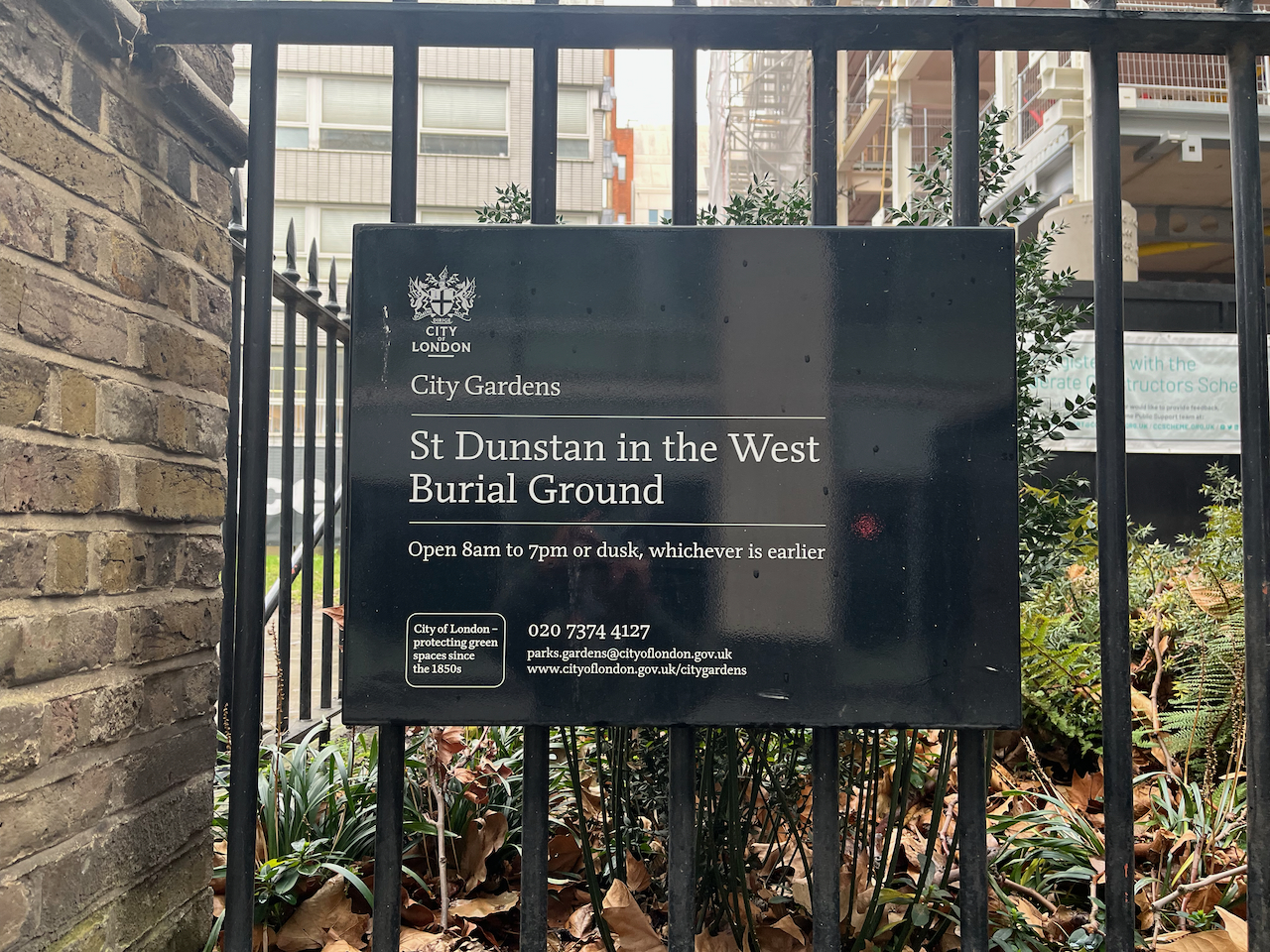
Another mystery: St Dunstan-in-the-West burial ground is some distance away to the north, on Breams Buildings, see map above.
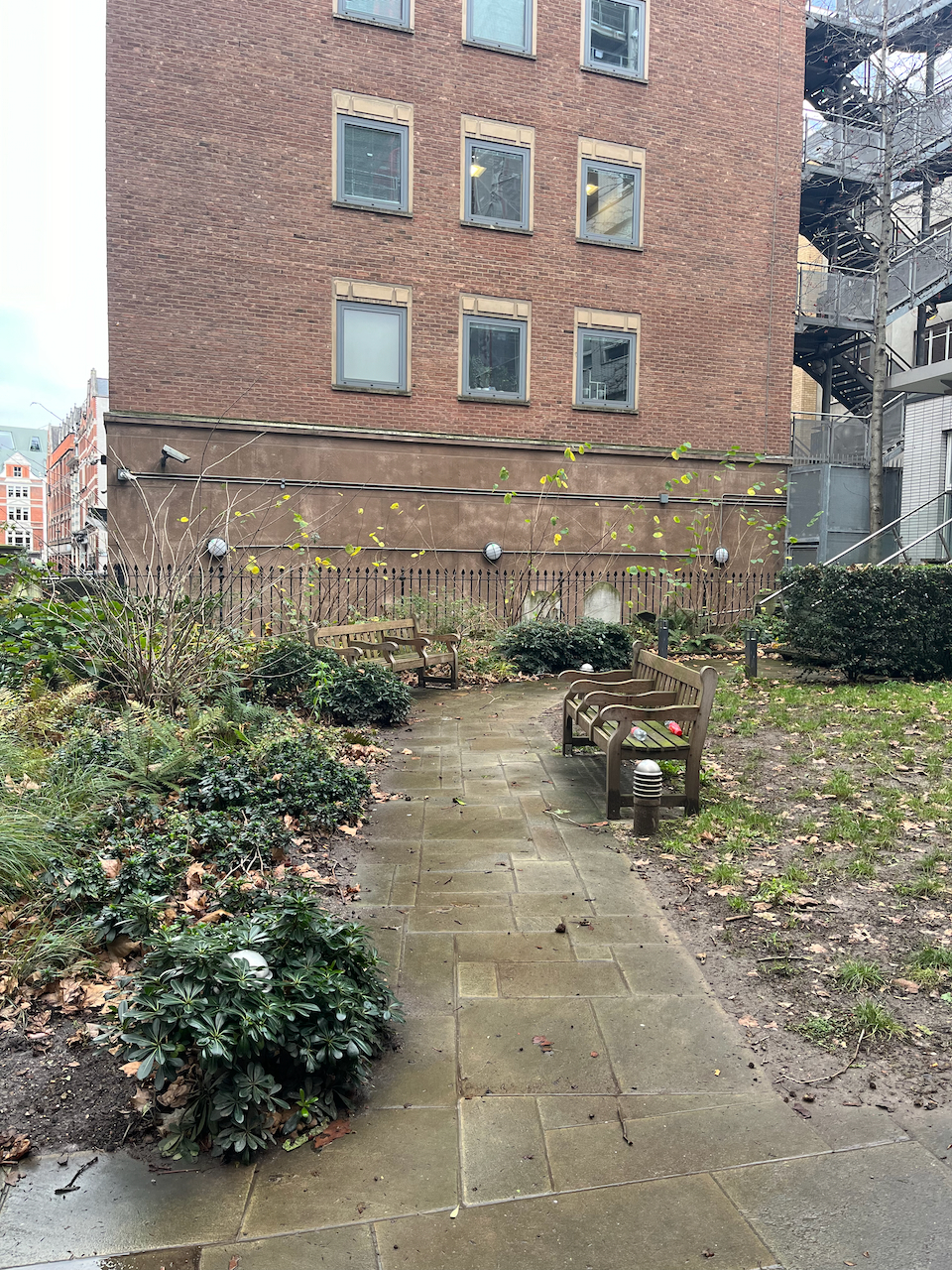
St Dunstan-in-the-West Burial Ground, entrance on Breams BuildingsSt Dunstan-in-the-West Burial Ground
“IanVisits” has an article on the Burial Ground published in 2020. When he visited it was clearly in a better condition than it is now. On my visit, December 2023, the burial ground was litter-strewn and neglected, overshadowed by a building site to the East, and defiled by plastic advertising hoardings flapping on its north fence.
The current St Dunstan-in-the-West church was constructed in 1830-1832 to the designs of John Shaw senior, and completed by his son, also John Shaw. This building replaced a much older one. The church website says:
“It is not known exactly when the original church was built, but it was between 988 and 1070 AD. It is not impossible that St Dunstan himself, or priests who knew him well, decreed that a church was needed here.”
It is an active Anglican church, open during the week, with services on Sundays, according to the notice on the door. The building also hosts the Romanian Orthodox Church.
Northcliffe, it turns out, was quite a character. He was a press baron, founder of the Daily Mail, and promoter of popular journalism. He launched the Daily Mail in 1876. At a time when newspapers were mostly intended to be serious reading, Northcliffe realised the potential of offering “entertainment” and “diversion”:
Hamilton Fyfe, a trusted contributor [to the Daily Mail], recalled that ‘the Chief’ wanted the Daily Mail to ‘touch life at every point … He saw that very few people wanted politics, while a very large number wanted to be entertained, diverted, relieved a little while from the pressure or tedium of their everyday affairs.’
Northcliffe gradually built up his empire, acquiring the The Times and other newspapers. By 1914 he controlled 40% of the morning newspaper circulation, 45% of the evening and 15% of the Sunday circulation in Britain (Wikipedia). A fascinating article by Jessica Kelly of Cardiff University says that, due to Northcliffe’s influence, “politicians of the age sought his approval and support during this most uncertain and unpredictable of times”. Northcliffe publications advocated war against Germany. Once war was declared, they were a “solidifier of British public opinion behind a total war”. The author of this article makes a striking comparison between Rupert Murdoch today, and Northcliffe in the Edwardian era.
Lutyens designed the obelisk for the Northcliffe Memorial in St Dunstan-in-the-West, and the bust is by Kathleen Scott. (Pevsner)
I sketched the church standing on the other side of Fleet Street, near the office of C Hoare and Co, bankers. The church was closed when I visited, but I shall certainly go back and have a look inside during its opening hours.
References
“The Buildings of England, London 1: The City of London, by Simon Bradley and Nikolaus Pevsner (1999 edition)” page 214
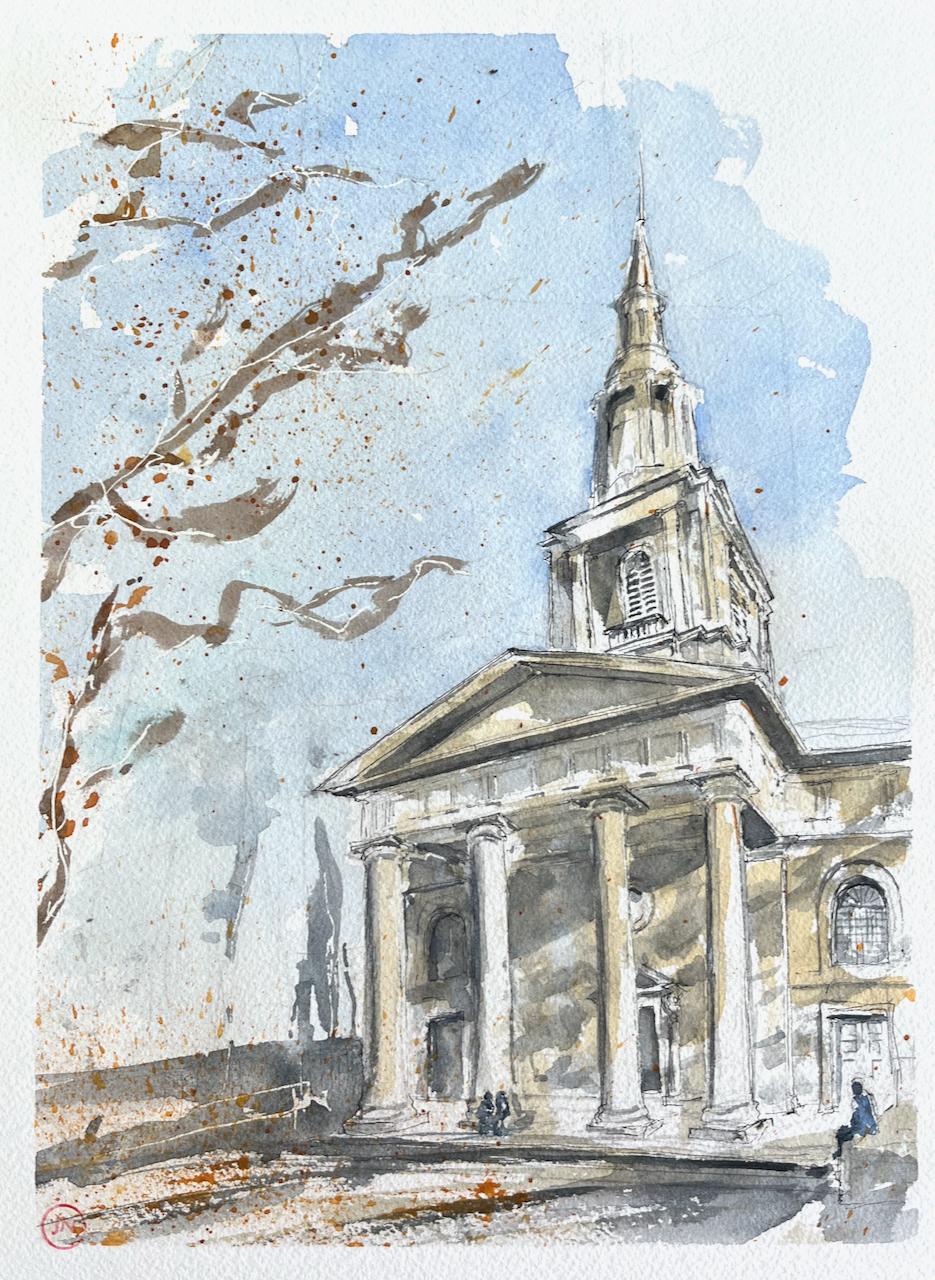
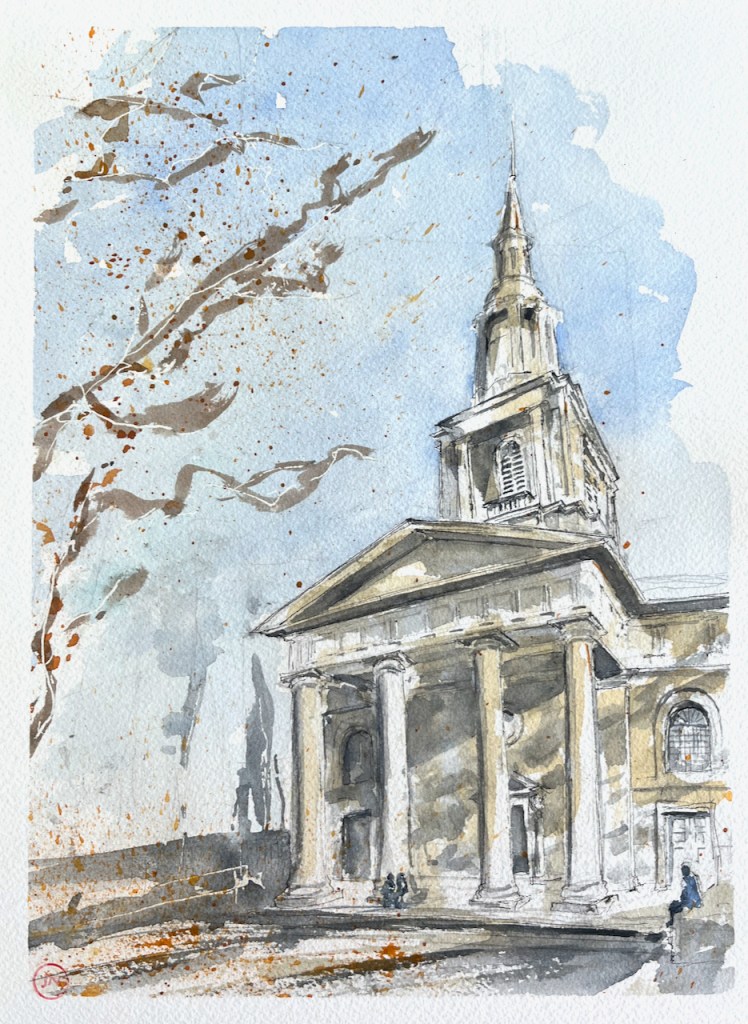
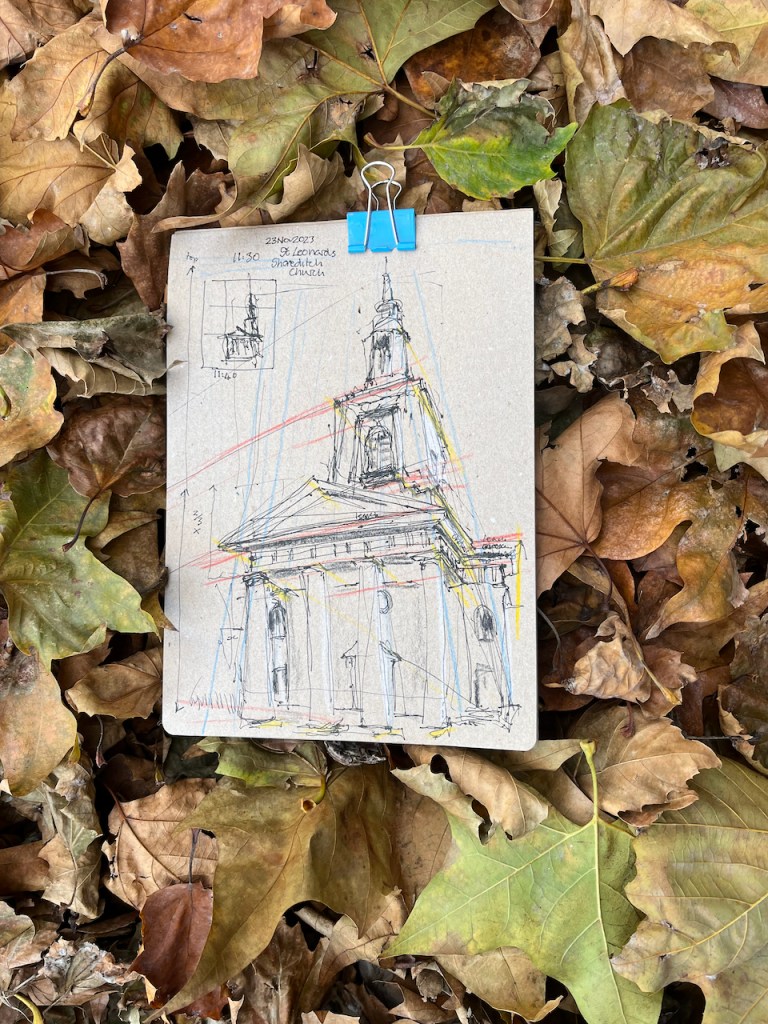
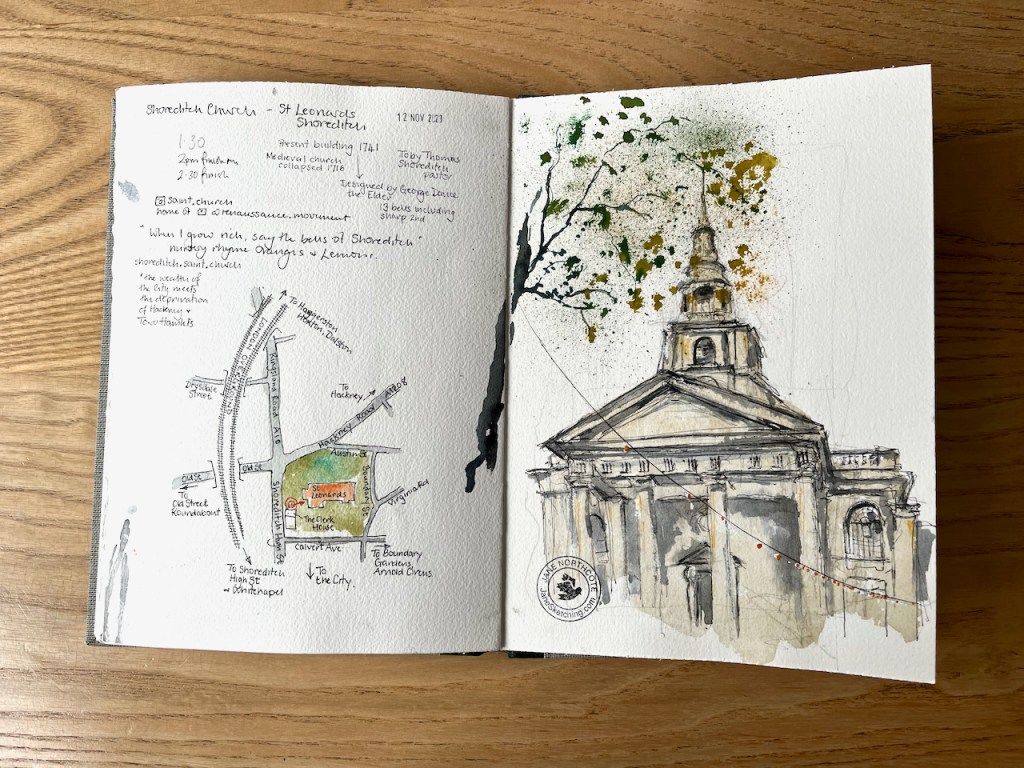
Here is St Leonard Shoreditch, which stands at the intersection of Shoreditch High St and the Hackney Road, postcode E1 6JN.
St Leonard’s, Shoreditch Church sketched 23 November 2023, 12″ x 9″ [sold]
There has been a Christian church here since medieval times. The present building dates from 1741 and was designed by George Dance the Elder (1695-1768). George Dance the Elder was the City of London surveyor at the time, and designed, amongst other buildings, Mansion House at Bank Junction.
The current church is active in the community. On the day I was sketching, a Thursday, they were offering meals to local people. This is the Lighthouse Project, “providing practical help, food parcels and hot meals to local people in need” according to their website. You can see several guests in the picture.
When the church was recently rebuilt at the turn of the millenium, a large amount of money was spent on its community needs and no funds were left to buy paint. Hence it still looks a bit bohemian. We think it’s quite endearing and shows people where our priorities are – with the community rather than how we look.
The current community is highly diverse. The wealth of the City meets the deprivation of Hackney and Tower Hamlets. Our neighbours in Arnold Circus and St Hilda’s Community Centre are highly galvanised community groups acting for societal change.
This church houses the “bells of Shoreditch” from the children’s song “Oranges and Lemons”. If you go inside the church you can see a bell, which is resting on a wooden pallet on the right hand side of the nave.
when I grow rich, say the bells of Shoreditch.
Oranges and lemons, Say the bells of St. Clement’s. (St Clement Danes) You owe me five farthings, Say the bells of St. Martin’s. (St Martin in the Fields) When will you pay me? Say the bells at Old Bailey. (St Sepulchre-without-Newgate) When I grow rich, Say the bells at Shoreditch. (St Leonard Shoreditch) When will that be? Say the bells of Stepney.(St Dunstan’s Stepney) I do not know, Says the great bell at Bow. (St Mary Le Bow) Here comes a candle to light you to bed, And here comes a chopper to chop off your head!
The Society of Cumbernauld Youths in 1784 rang a complete peal of 12000 changes of Treble Bob Royal, taking nine hours and and five minutes, according to a placard in the church porch.
The bells are still rung.
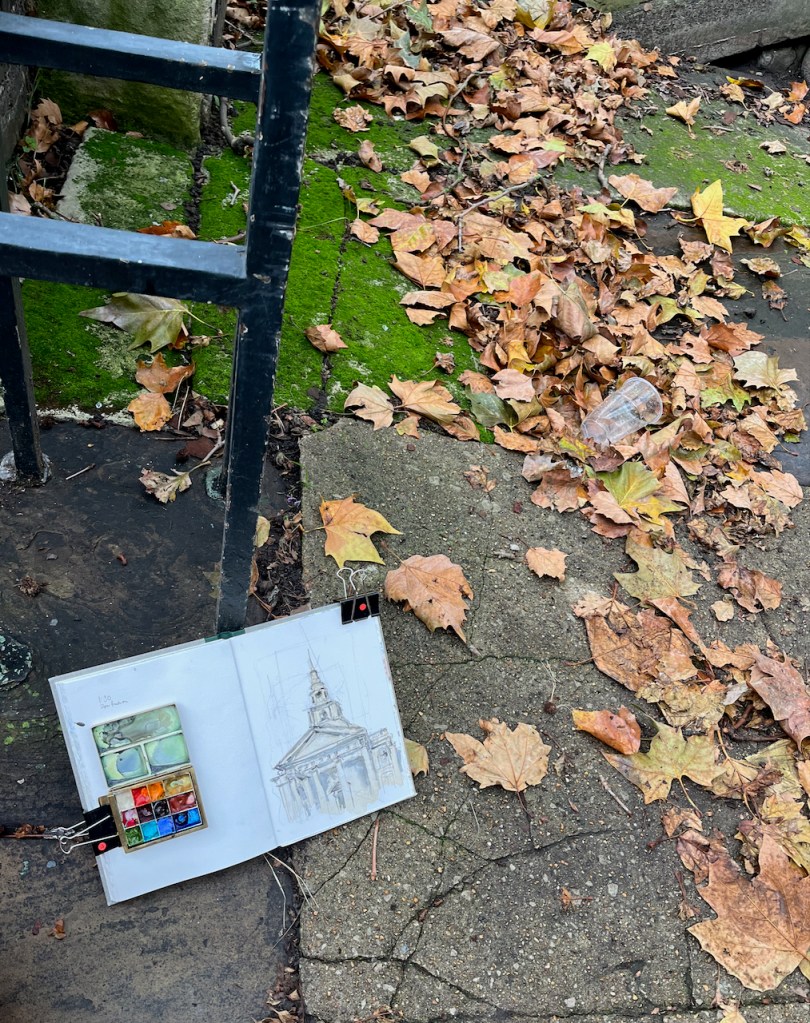
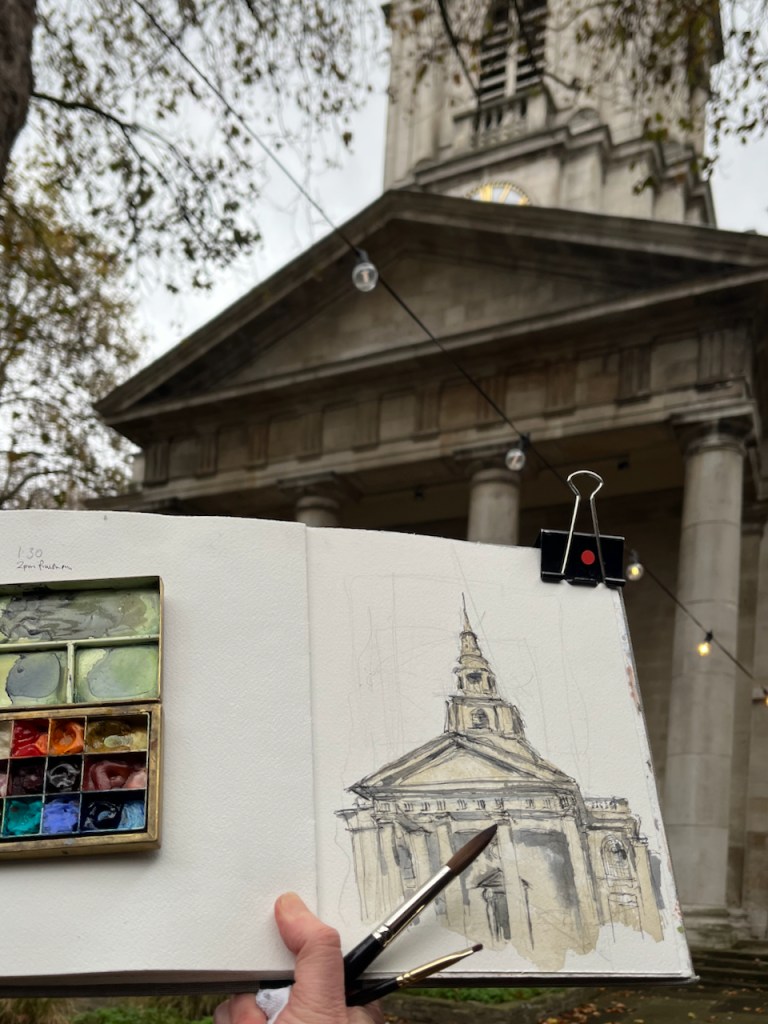
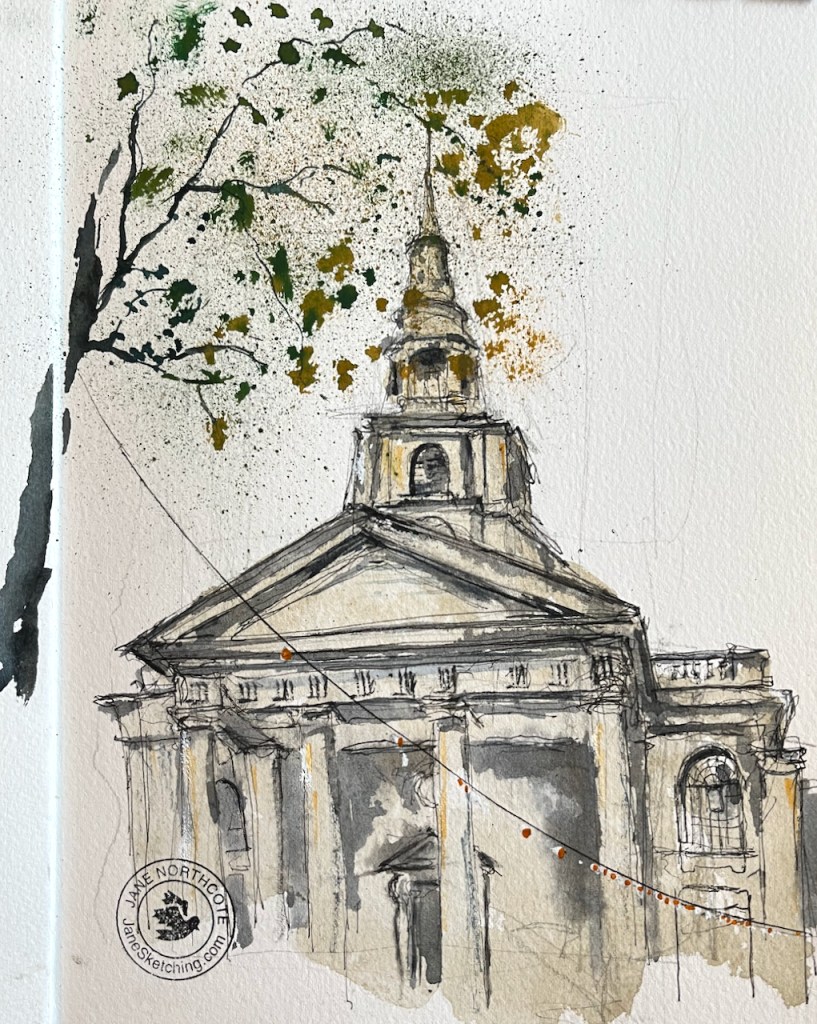
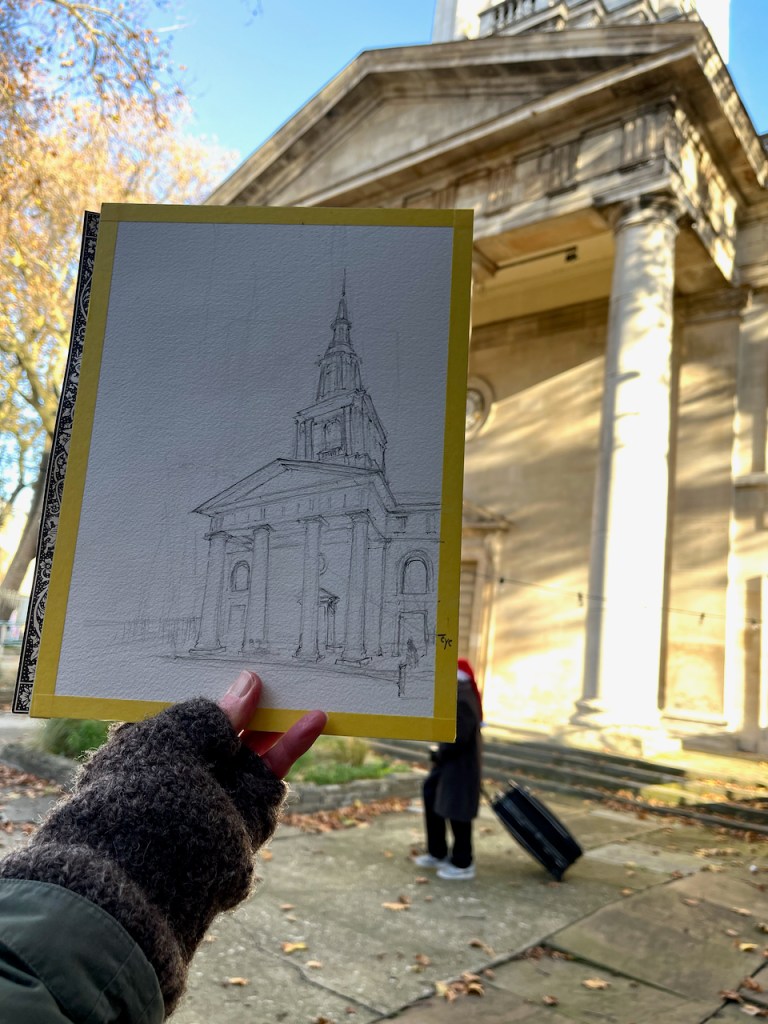
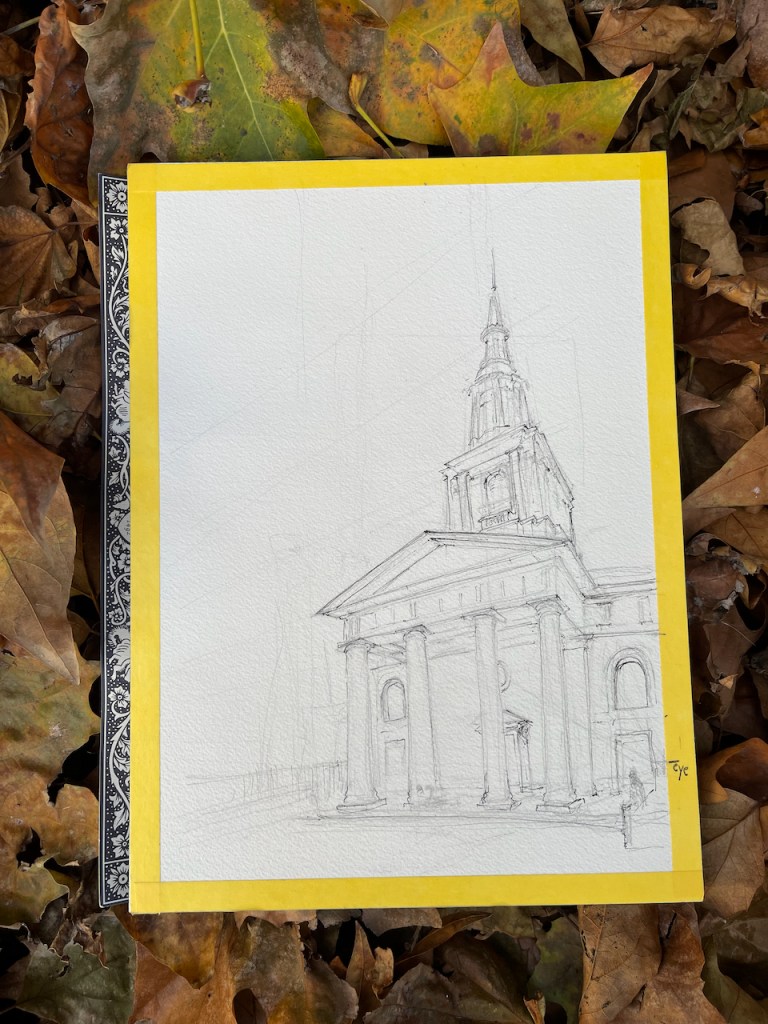
This picture was a commission. My client was keen to have this upward view showing the front of the church. I did some practice sketches to understand the tricky upward perspective.
Thank you to my client for suggesting I draw this inspiring church, and for their permission to publish the photos of the drawing online.
Practise drawing in sketchbookpencil sketchExploring the perspectivenearly finishedPractise drawing in sketchbook 13
Here is a map showing the location:
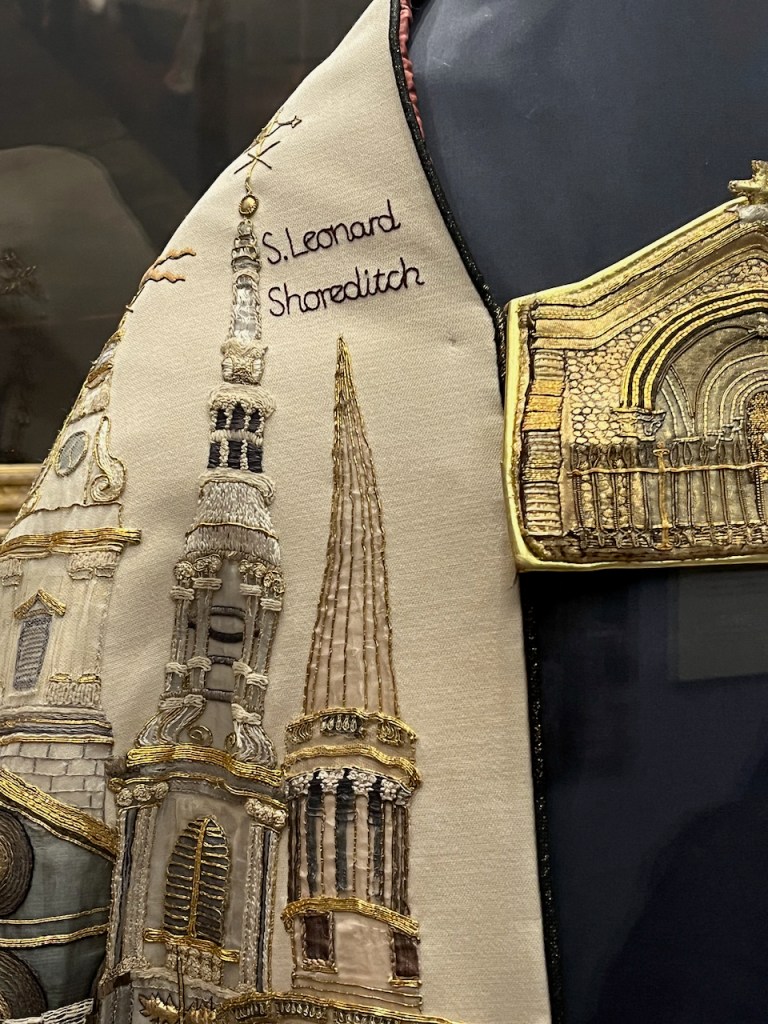
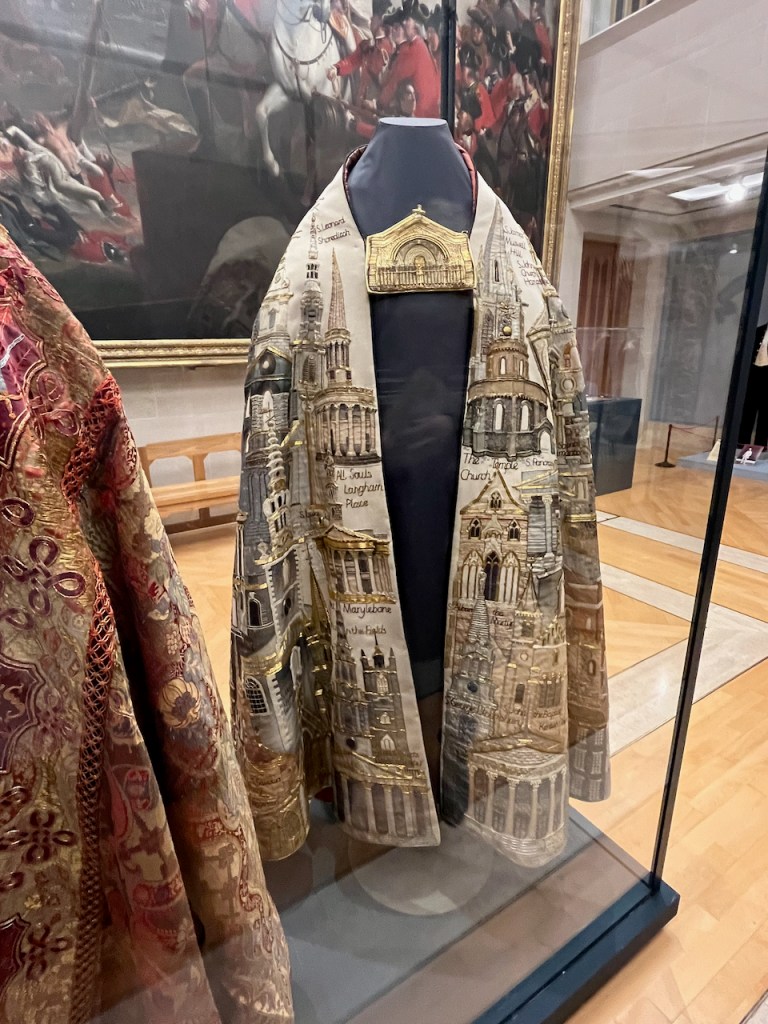
There is a current exhibition in the Guildhall London:
“Treasures of Gold and Silver Wire” curated by Dr. Karen Watts, Emeritus at the Royal Armouries. It celebrates the 400 anniversary of the Worshipful Company of Gold and Silver Wyre Drawers.
St Leonard Shoreditch is the spire to the left of the wordsThe Silver Jubilee Cope on display in the Guildhall 16th December 2023
Having myself had a go at depicting those arches and columns on the spire, I am full of admiration for the embroiderers who managed to create an accurate image in wire thread. Hugely accomplished! The exhibition is on until 31st December 2023- well worth seeing.
Click a button below to share this post online, email it, or print it:
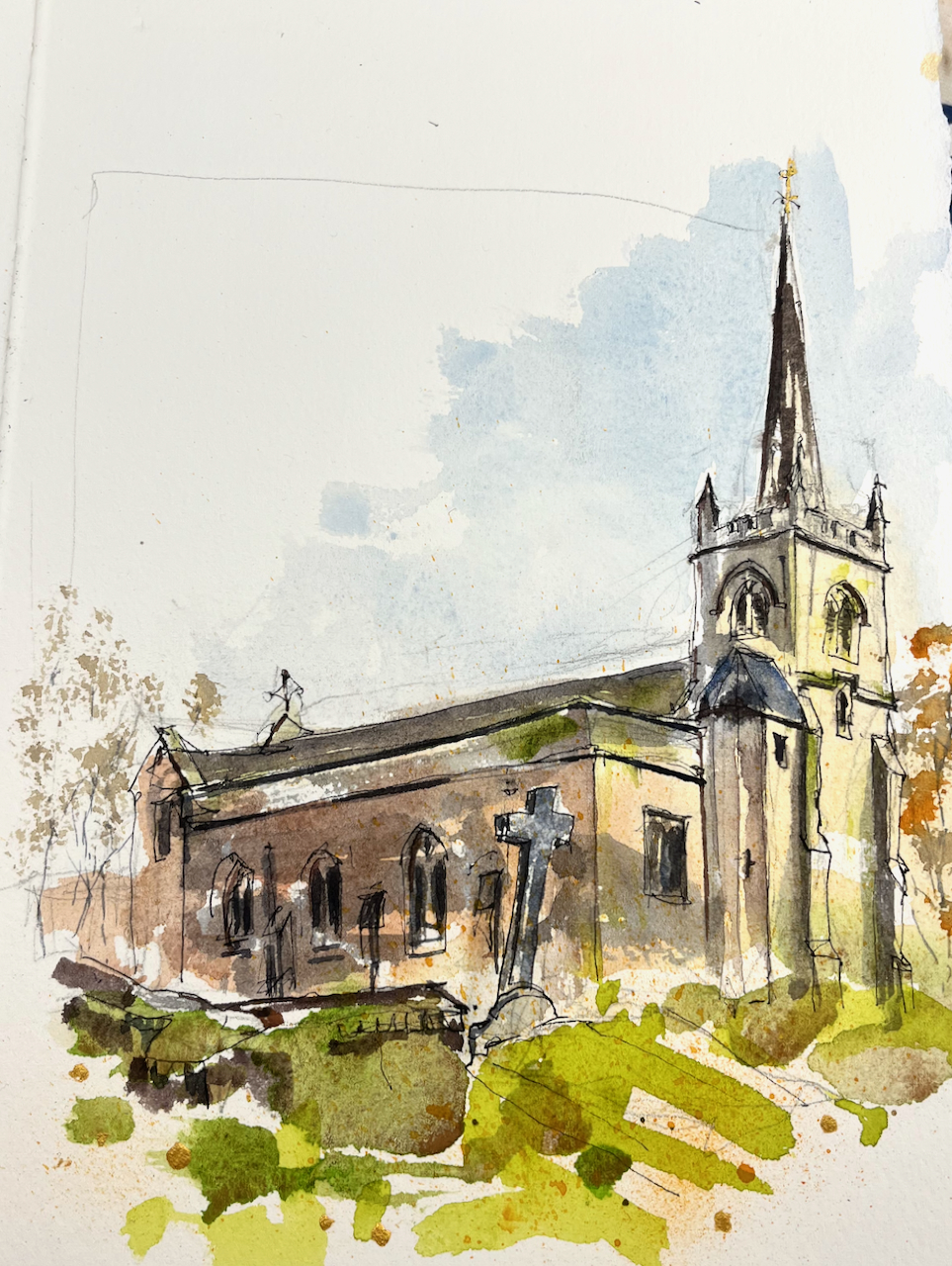
Having sketched the Stoke Newington New Church, I was keen also to sketch the Old Church, which is just the other side of the road. This church is Elizabethan, constructed in 1562, on a very ancient site. It is in active use, and shares a vicar with the New Church across the way.
Old Church of St Mary, Stoke Newington, London N10 sketched 1 December 2023 in Sketchbook 13
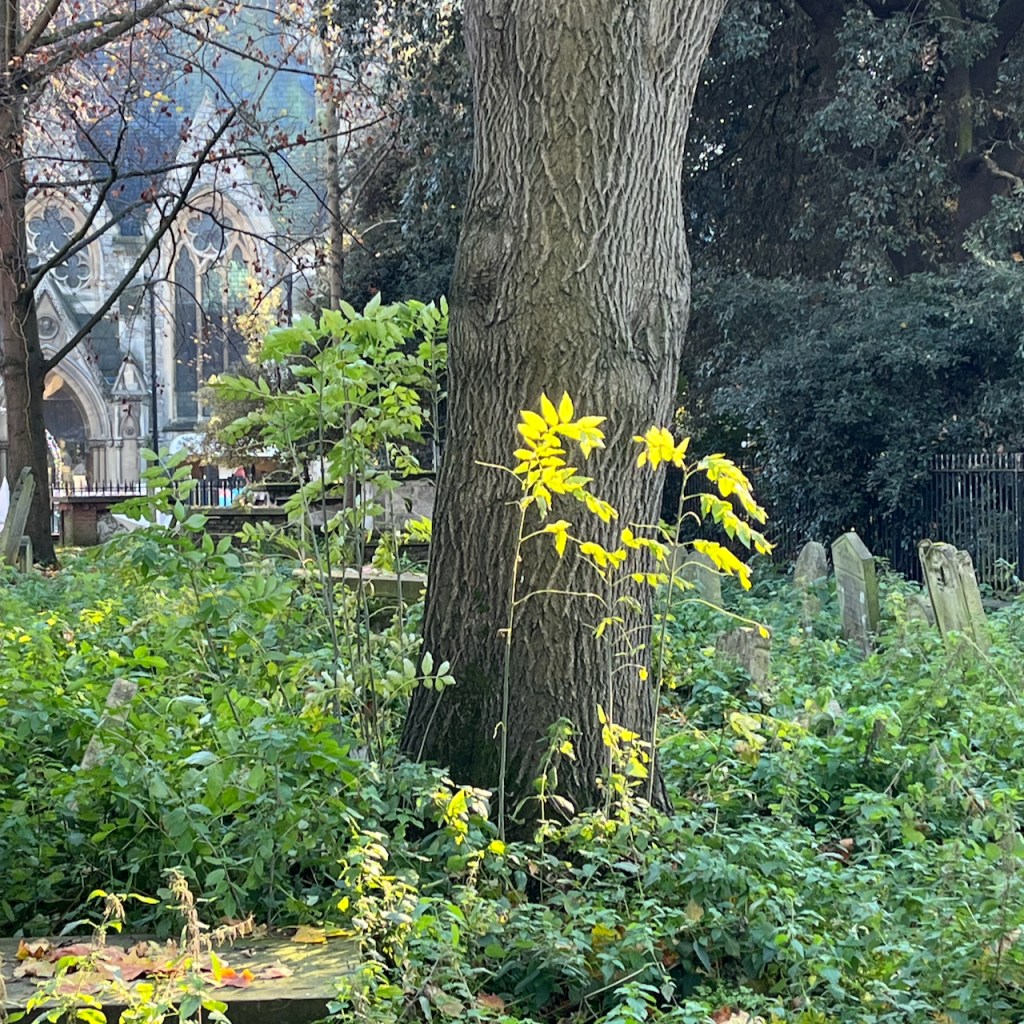
The churchyard is overgrown and atmospheric, it was wonderful to stand there on this cold clear day.
The building is Grade II* listed. The listing is here and the At Risk listing is here. It is listed because of much of the building from 1563 has survived, and because very few churches were built in this period. Also, the listing comments on its “group value”, because it stands next to the New Church. “The two make a memorable contrast and are a striking visual representation of the demographic changes from the C16 to the C19 in this area.” says the listing. The Old Church is small and domestic in scale, the New Church is magnificently huge.
Some history is given on the placard by the entrance.
ST. MARY’S OLD CHURCH, STOKE NEWINGTON The Manor of Stoke Newington is recorded in the Domesday Book (1086) to be the property of the Canons of St.Pauls Cathedral in whose possession it still remains. It is reputed to have been the Gift of King Athelstan about the year 940. It is probable therefore that a Church has occupied this site since Anglo-Saxon times. The South Aisle was built in 1563 by William Patten Lord of the Manor In.1829 Sir Charles Barry enlarged the Church. Severe bomb damage was sustained in 1940 and the Church was restored to its present state in 1953.
The future? This building is on the Historic England Heritage at Risk register, at risk level A, the highest, because there is “immediate risk of further rapid deterioration or loss of fabric; no solution agreed”
I sketched the church quickly as it was 2 degrees C outdoors. Then I caught the number 73 bus back down the hill to central London. Here is work in progress on the sketch.
Click a button below to share this post online, email it, or print it:
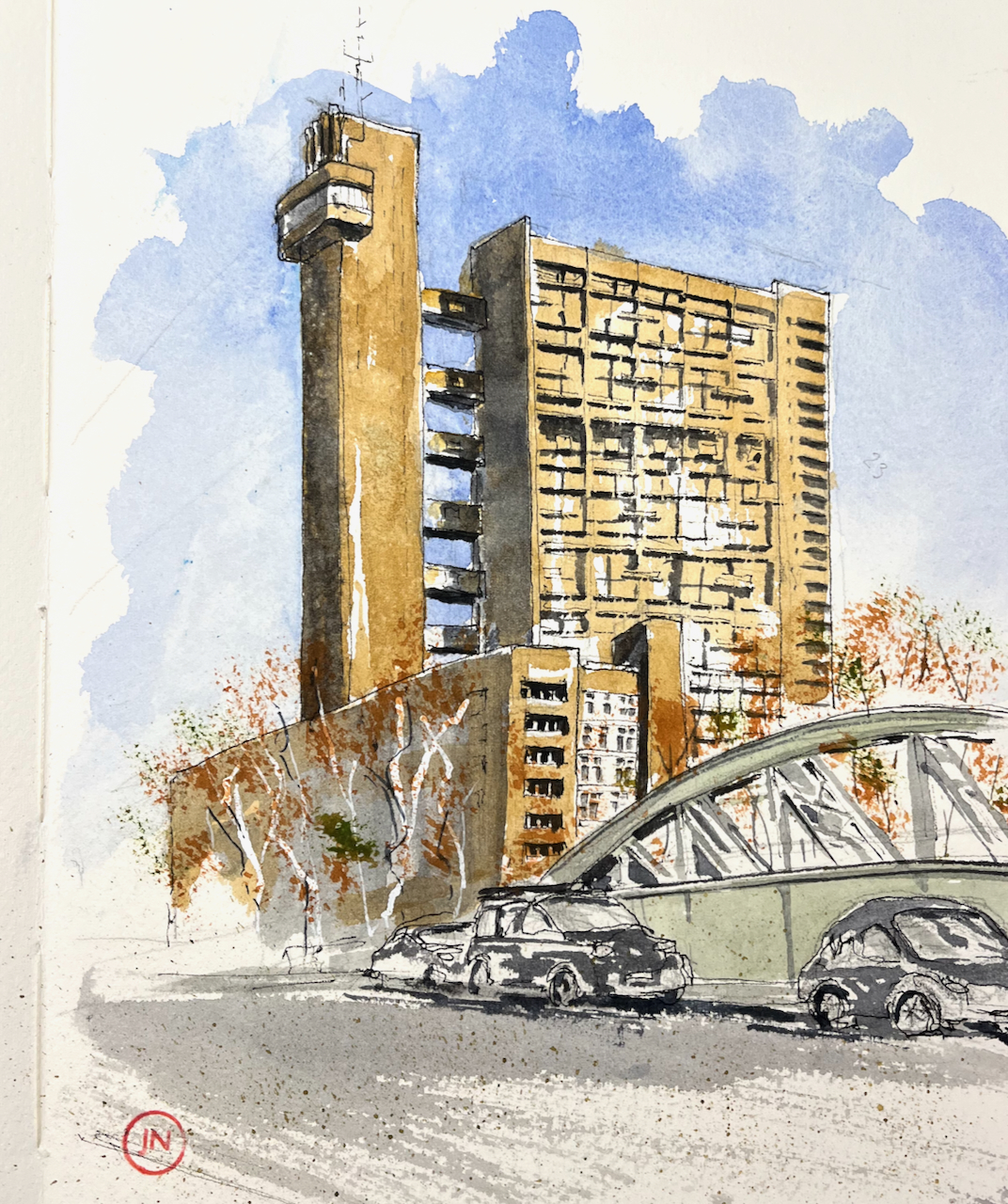
Here is the magnificent Trellick Tower in West London.
Trellick Tower from the Golbourne Road, London W10. Sketched 28 November 2023 in Sketchbook 13
This tower is 271 flats, 31 stories, completed in 1972 to the design of Ernő Goldfinger (note 1). It is in the Royal Borough of Kensington and Chelsea, near the Grand Union Canal and the A40 trunk road out of London. It is Grade II* listed (note 2)
After sketching, I was really cold. I found warmth and excellent food in the Sicilian Café “Panella” shown on the map above, recommended!
Panella – Golborne RoadSketching locationA bright and cold daythe base of the Trellick TowerSketchbook spread: Trellick Tower
I have previously sketched the Balfron Tower in East London, also designed by Ernő Goldfinger.
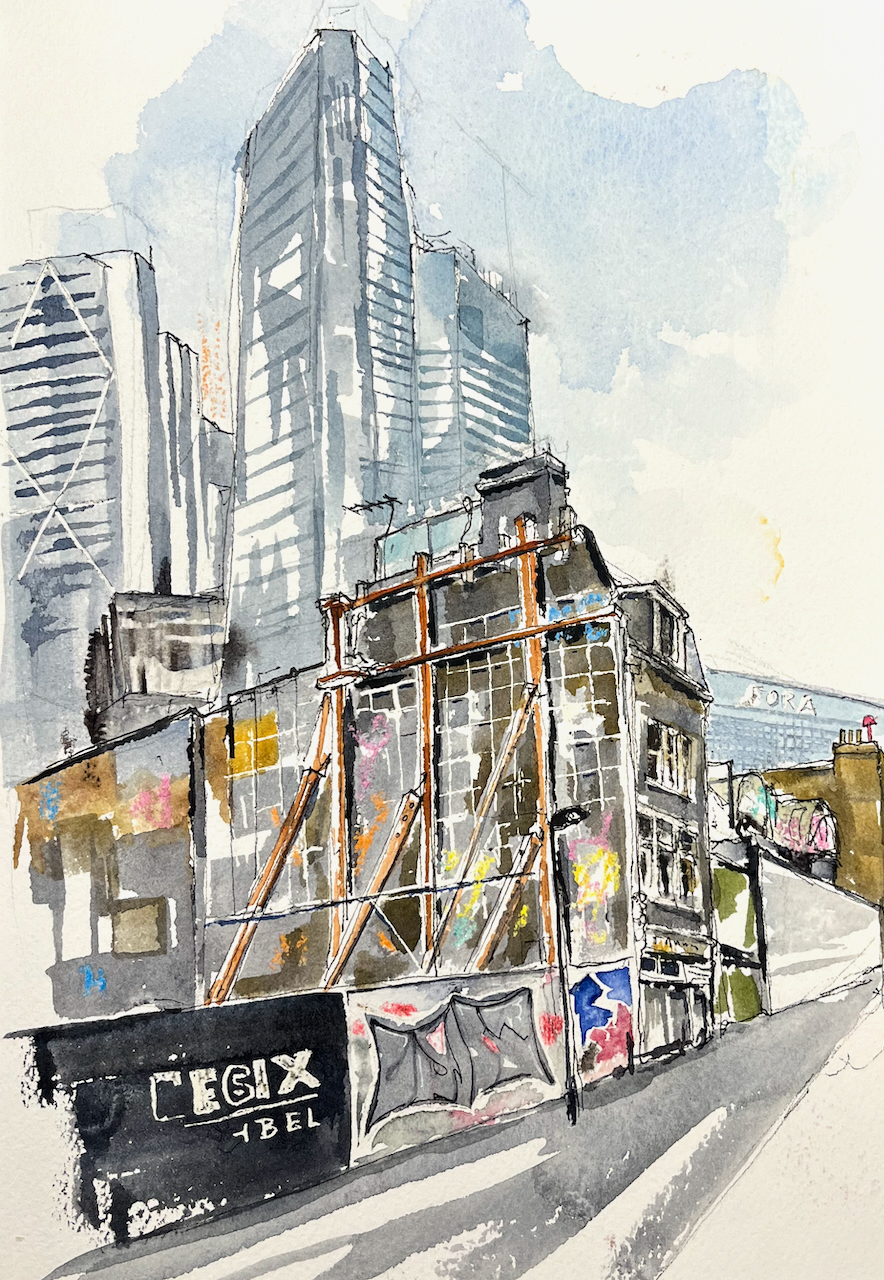
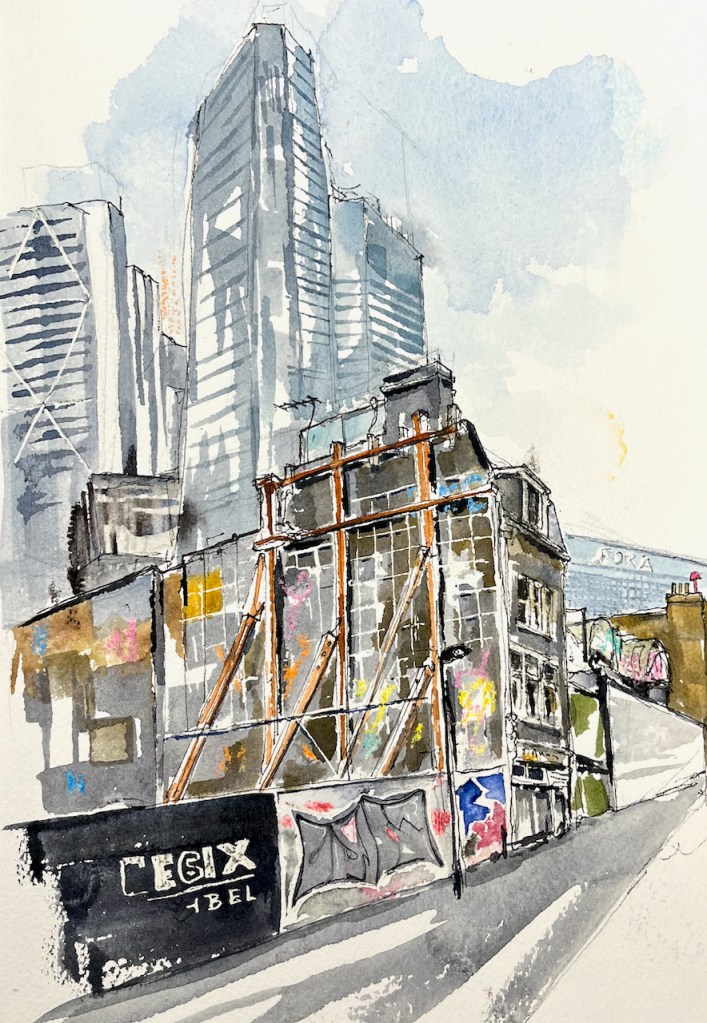
55 Holywell Lane, London EC2A 3PQ, sketched 17 November 2023 in Sketchbook 13
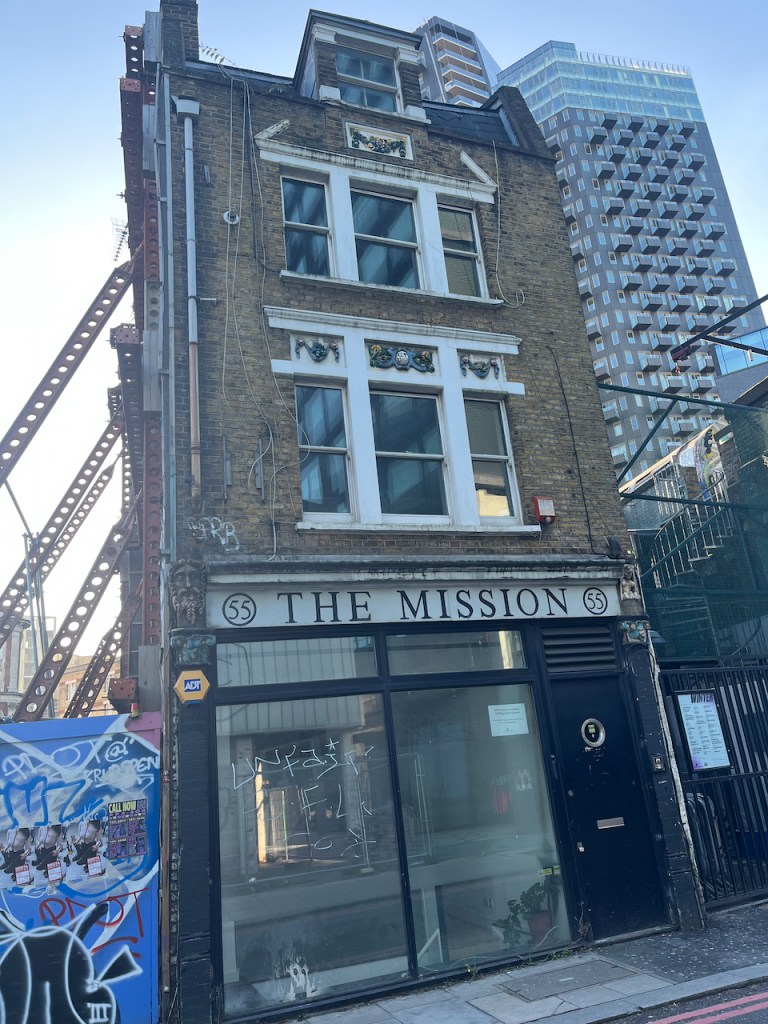
This apparently dilapidated building stands on the edge of a building site in Shoreditch. The flaking shopfront announces “The Mission”. It looks dusty and closed up.
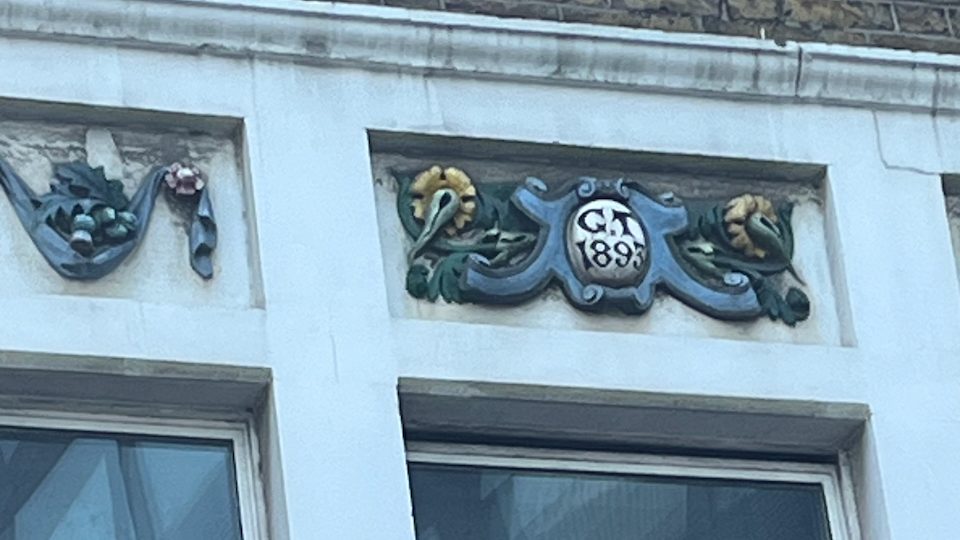
This is 55 Holywell Lane. The Victorian decorations on the front of the building say “G.T. 1893”.
Despite appearances, the building is in active use. It is part of “Village Underground” – “part creative community, part arts venue”. “home to cutting edge culture, clubbing and live music” founded in 2006. In the centre right of the drawing you can see the underground train carriages, hoisted on top of the venue. Their website says
“It’s a strange little haven of calm in the carriages, above the chaos of Shoreditch, enclosed by skyscrapers on each side, where we grow fruit and veg in our little rooftop garden, get excited about new bands and parties, plot and plan how to improve the venue, decide which shows to book, and try to get more people to come to our shows. “
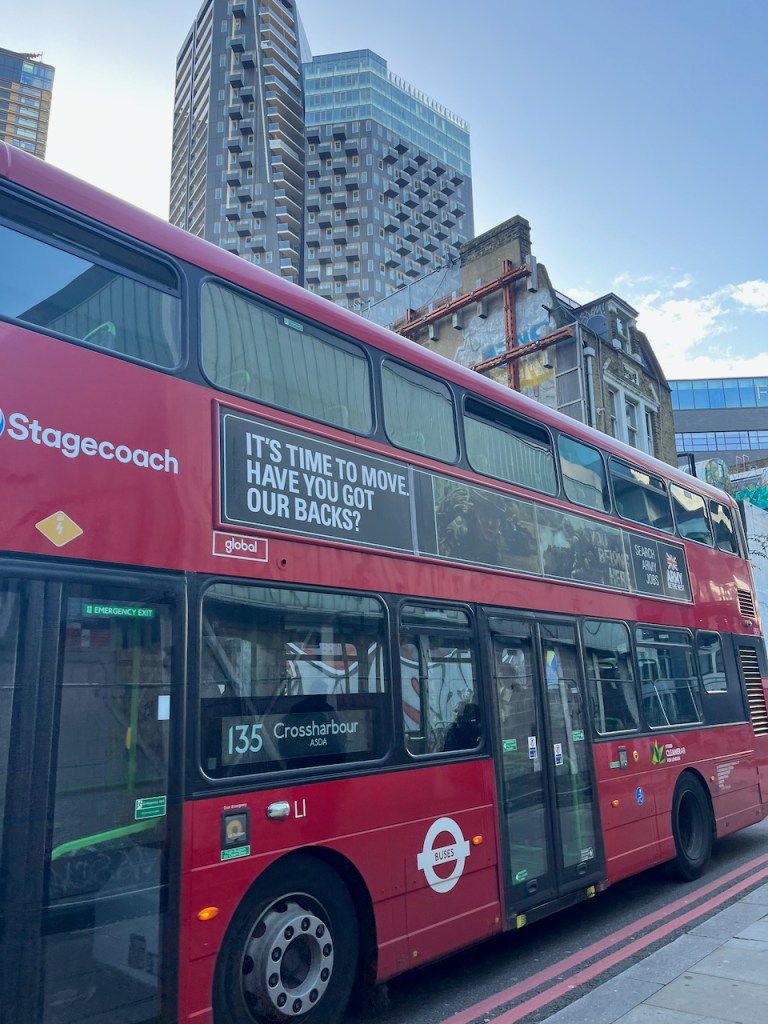
This is an area of London undergoing transition. In the background of my drawing you can see the huge residential and office towers next to Liverpool Street Station: “The Stage” and “Principal Place”. I sketched the picture standing under the elevated overground railway line, next to a building site. On the white wall shown to the right of my drawing, people were making a large mural, an advertisement for a whisky brand. The number 135 double-decker buses came past at what seemed like extraordinary frequency.
Cars and buses queued in this small street waiting to cross Shoreditch High St. It was a narrow pavement, and not a great place to sketch. But two people came and looked at the drawing: it’s a great skyline, they observed, looking at the view. And it is.
Here is the view of the site from Great Eastern Street early in the morning. The underground train carriages are visible top left.
Click a button below to share this post online, email it, or print it:
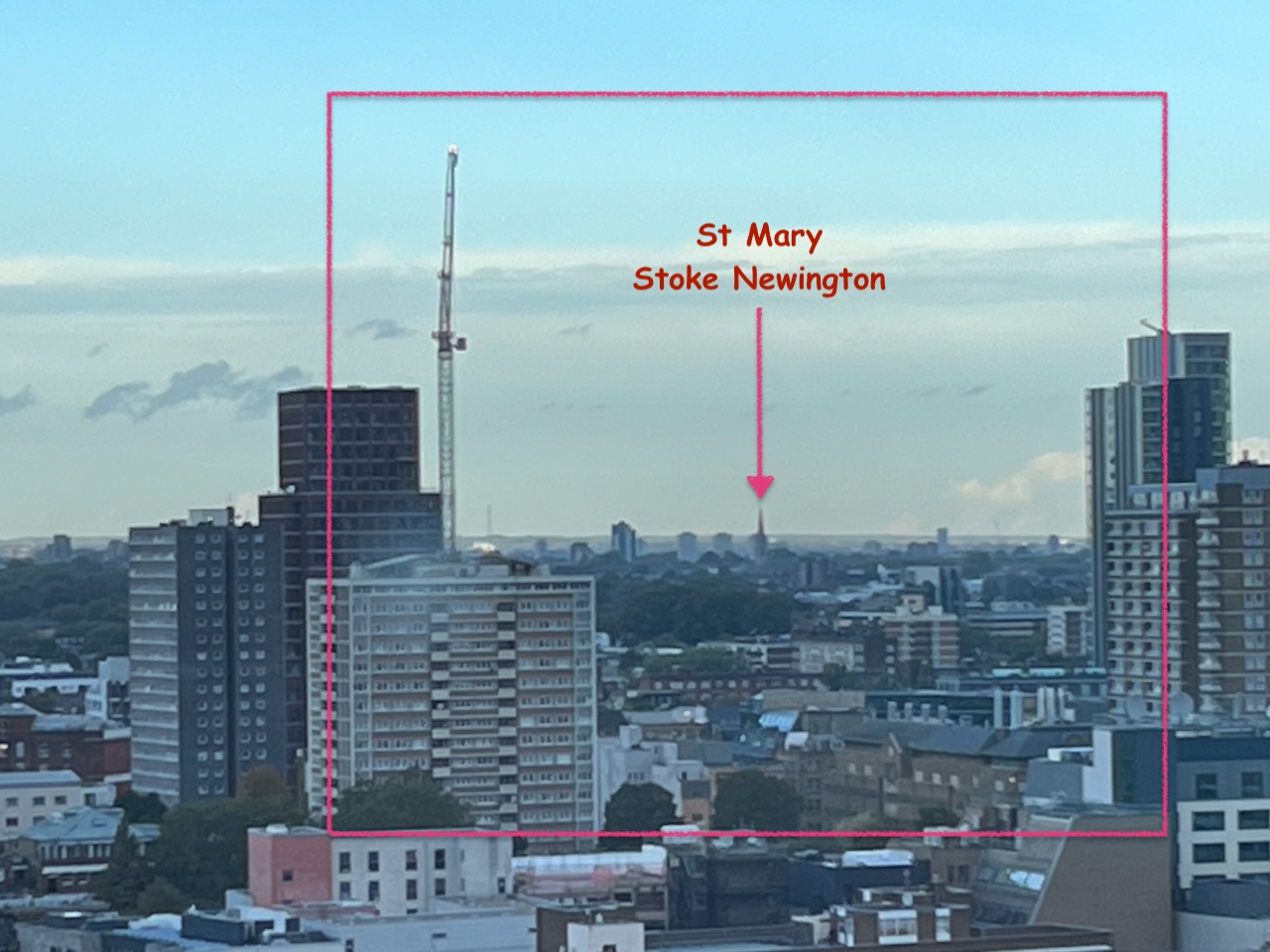
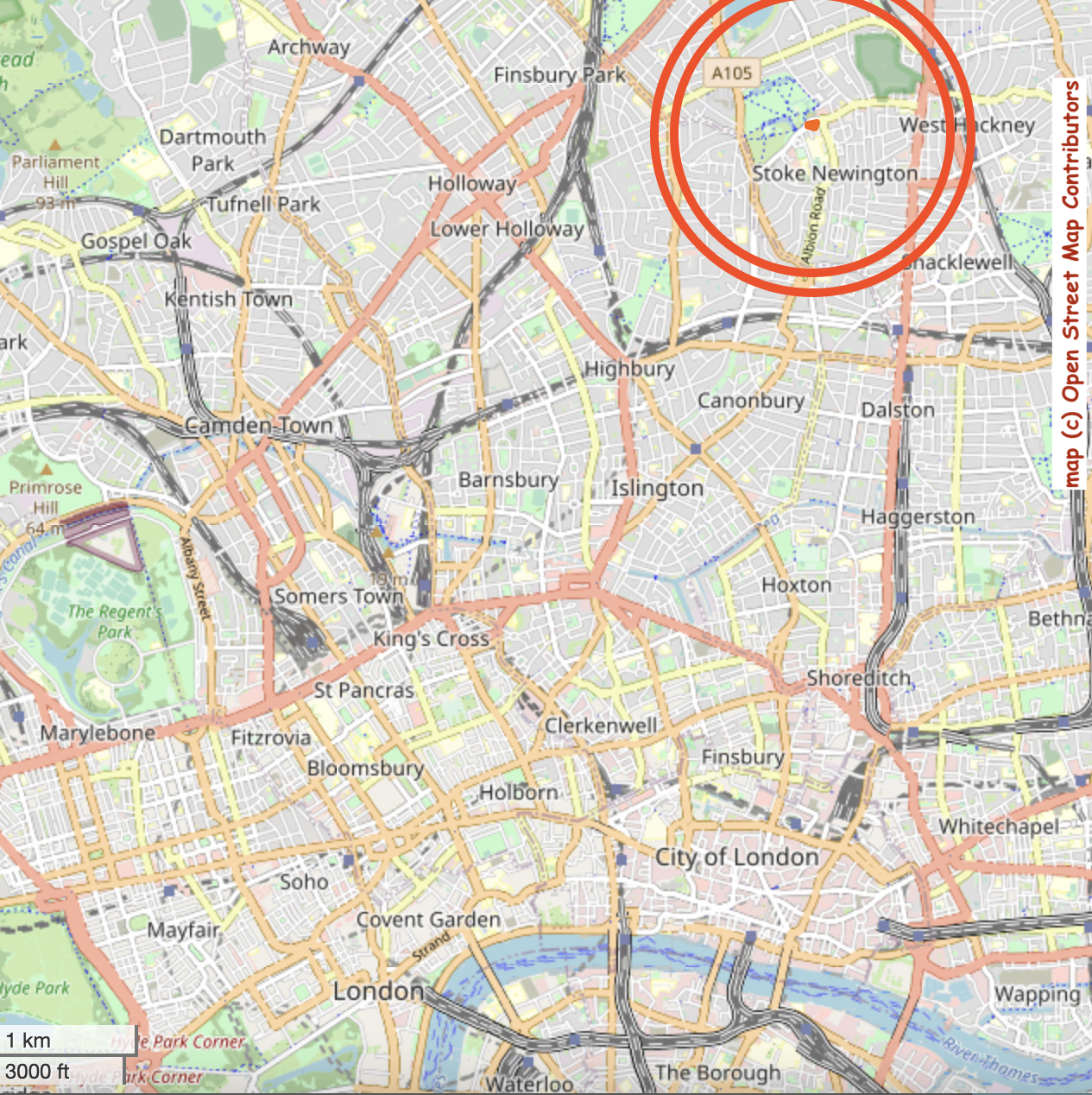
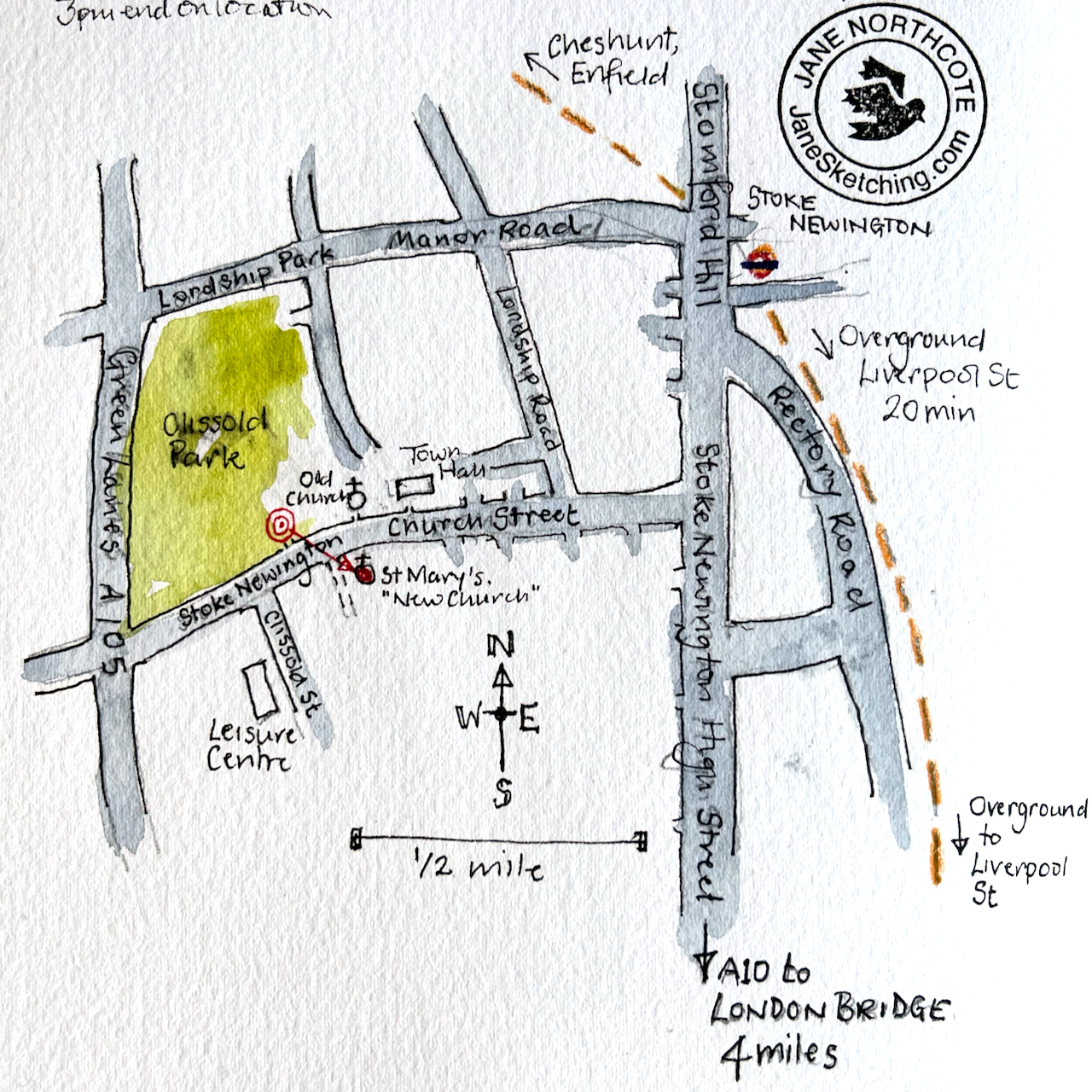
It’s just visible, on the horizon between office blocks. Some work with the binoculars and the map established that it must be St Mary Stoke Newington, some 3 to 4 miles away to the North.
“What is that spire?”
I went up there to make sure, and to have a closer look at this building which was visible at so great a distance.
St Mary Stoke Newington, the “New Church”, London N16. Sketched on October 17th 2023 in sketchbook 13, size: 10″x 8″
I sketched the church from Clissold Park.
Stoke Newington is another world, even though just 4 miles from the City. My sketching location was a few yards from the gate of the park. A succession of people entered the gate and walked along the path: old and young, solitary and in groups, noisy, meditative and with or without dogs. Each person or group carefully opened the gate, then turned round and closed it again behind them. At one point, a very elderly person approached the gate in a wheelchair. Someone who had just passed through noticed them, returned to the gate, and with a respectful flourish, opened both gates wide, to allow the passage of the wheelchair, and then carefully closed the gates again afterwards. It was all very civilised, and restored my faith in the human race.
If you wish to visit this church bear in mind that the overground lines are rather complicated in this area. The one to get is the one which goes north from Liverpool Street. The one from Shoreditch, although going in broadly the same direction, takes another route entirely and you end up in Dalston, which is also an interesting place, but different. I walked from there to Hackney Downs to find the right railway line, and discovered more as-yet-unexplored areas of London.
Overground routes in the Stoke Newington area.
St Mary Stoke Newington New Church was built in 1854-8, to the design of Sir George Gilbert Scott. His other works include the Midland Hotel at St Pancras, the Albert Memorial, Westminster Abbey, the Martyr’s Memorial in Oxford and St John’s College Chapel Cambridge, to name but four. So the people of Stoke Newington got a rock-star architect in 1854. This was because Stoke Newington had a hugely popular preacher, the Reverend Thomas Jackson, with people coming across London to hear him preach. The cost of the new church was raised by voluntary contributions1 from this large congregation.
The spire was added by Sir George’s son John Oldrid Scott, in 1890.
Stoke Newington New Church seen from Stoke Newington Church StreetThe impressive interior of Stoke Newington New Church.
Across the road is the much smaller “old church” which this “new church” replaced. The old church is still there, looking like a country village church.
Stoke Newington Old Church, 17th October 2023
Now I know what that spire is, on the horizon, I think I should make another visit, to sketch the old church.
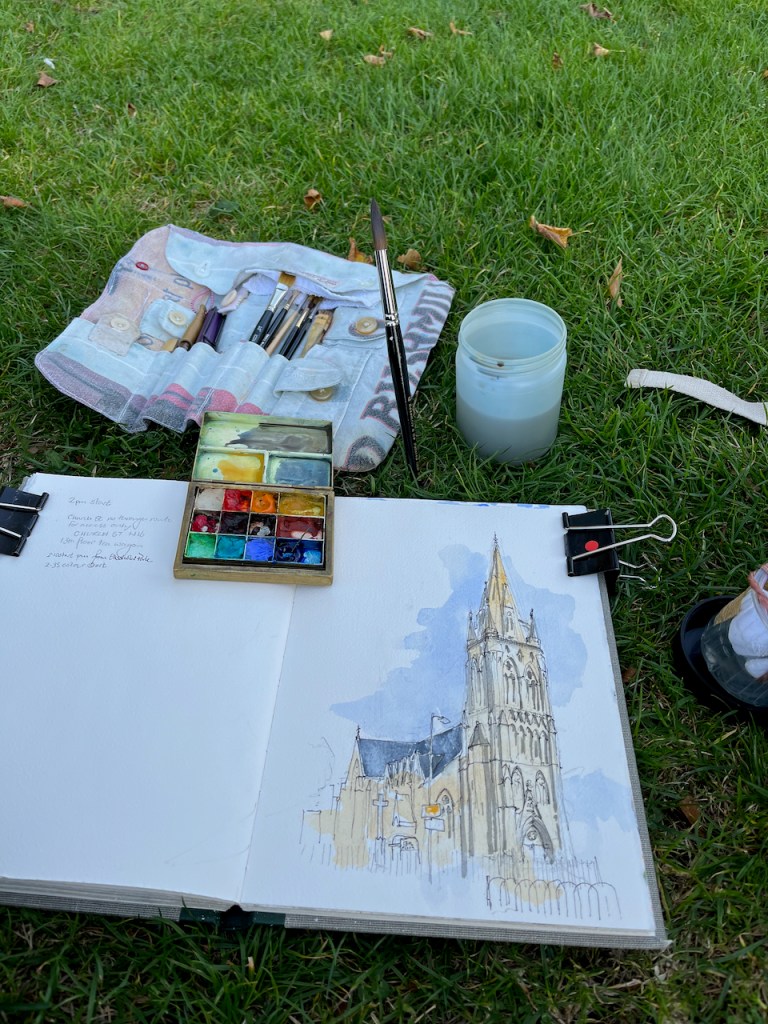
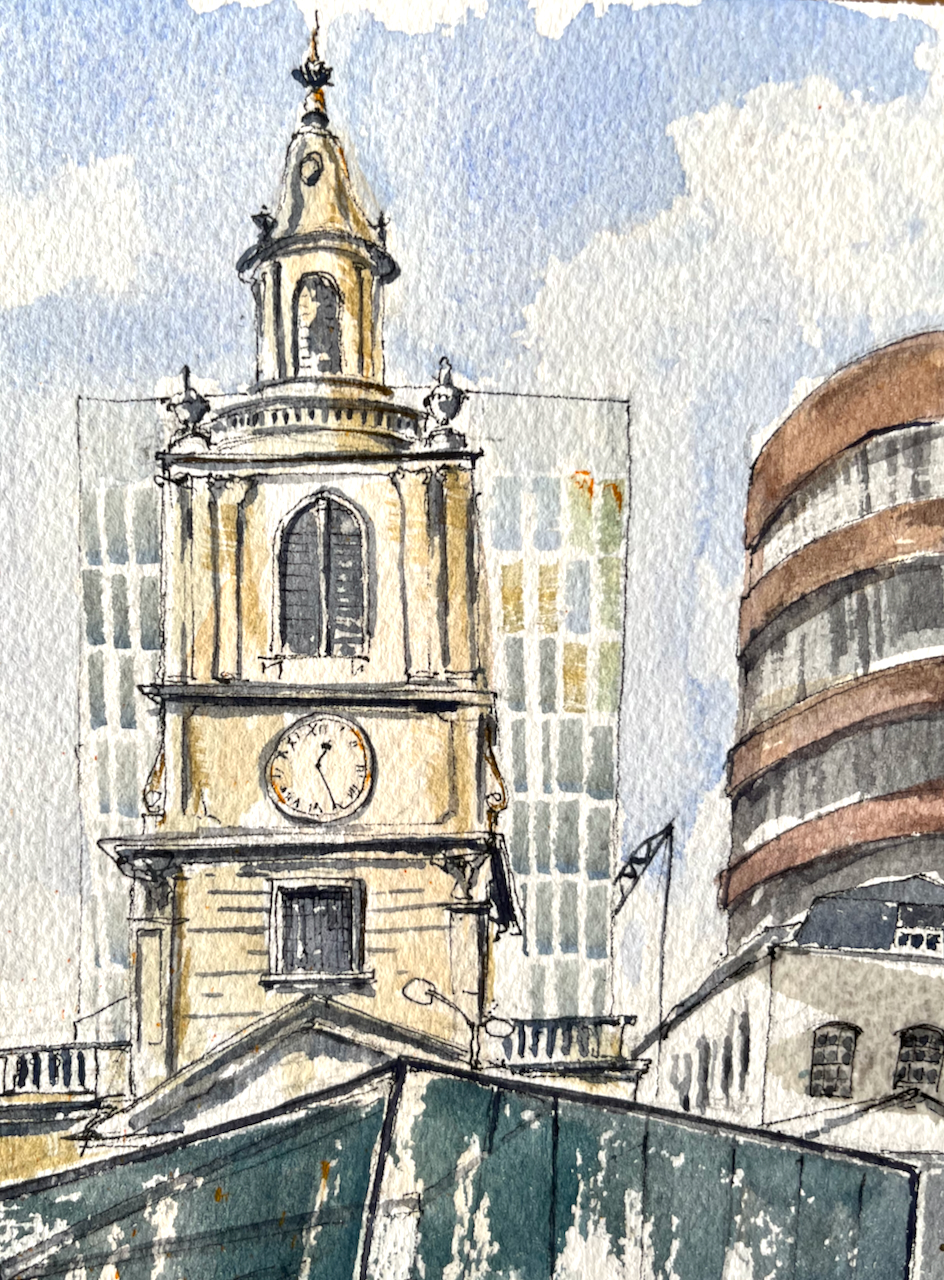
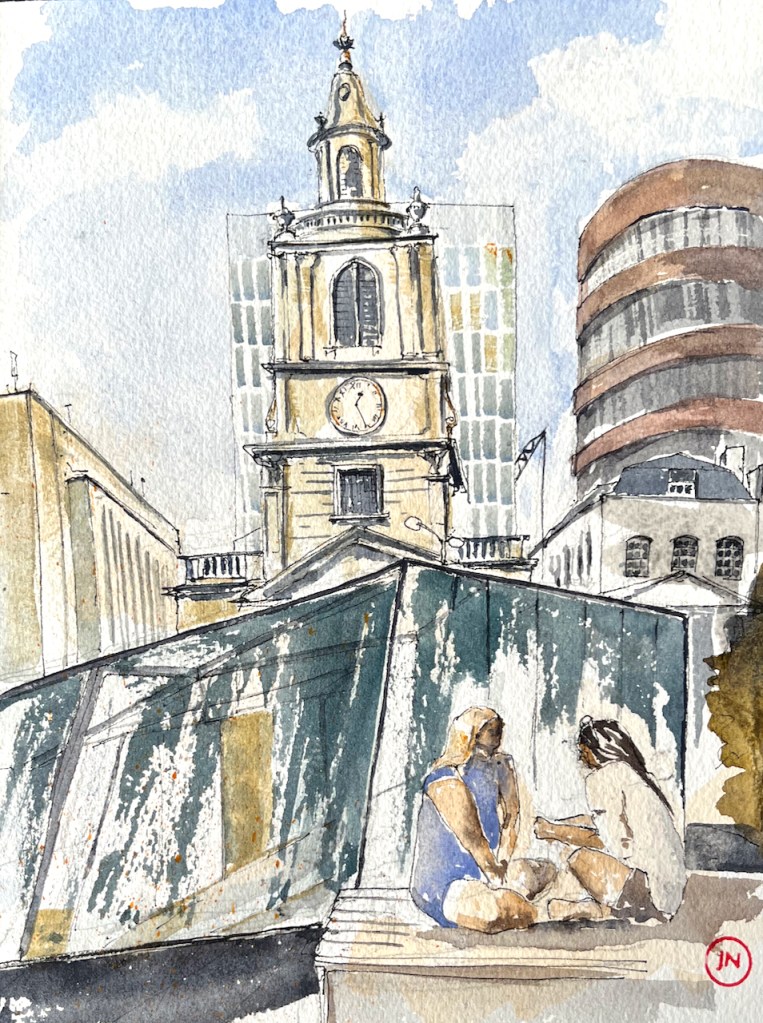
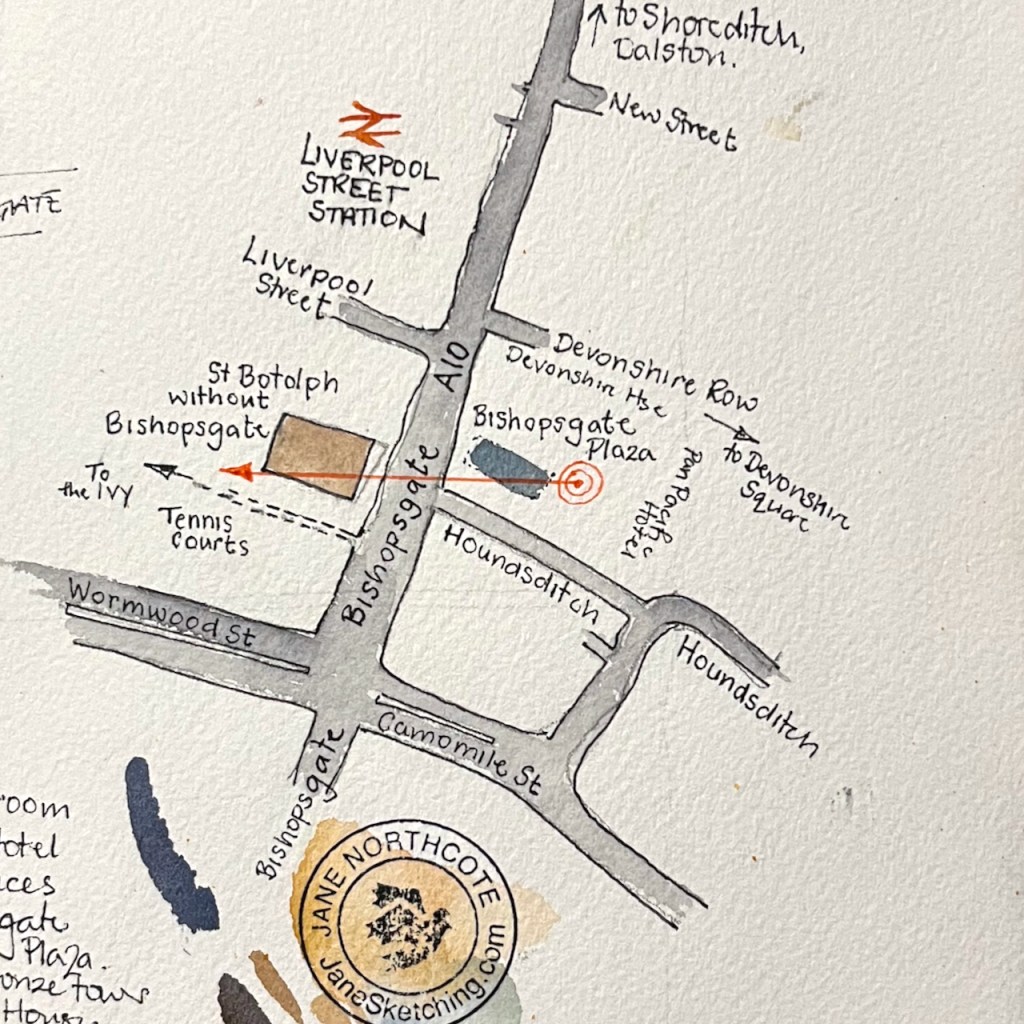
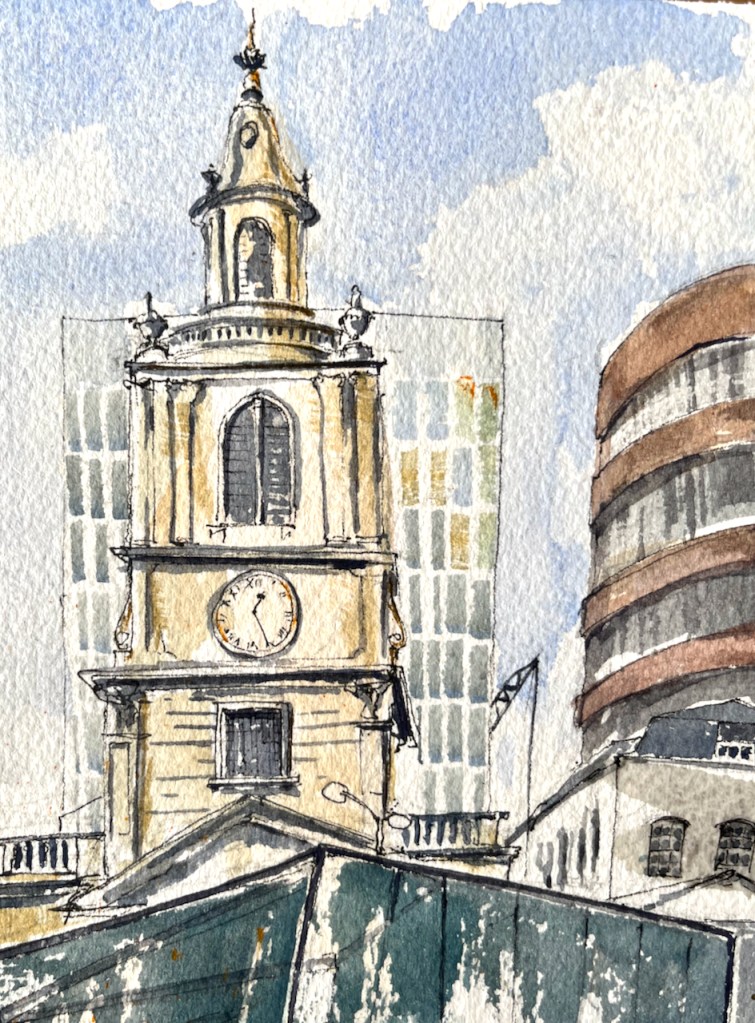
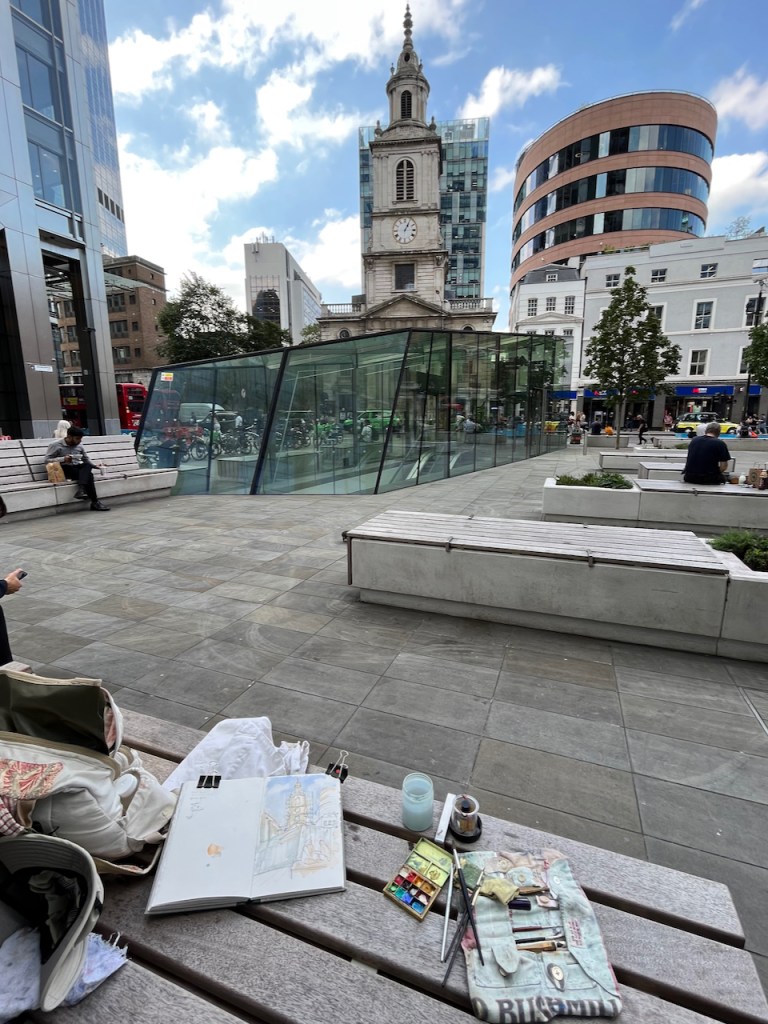
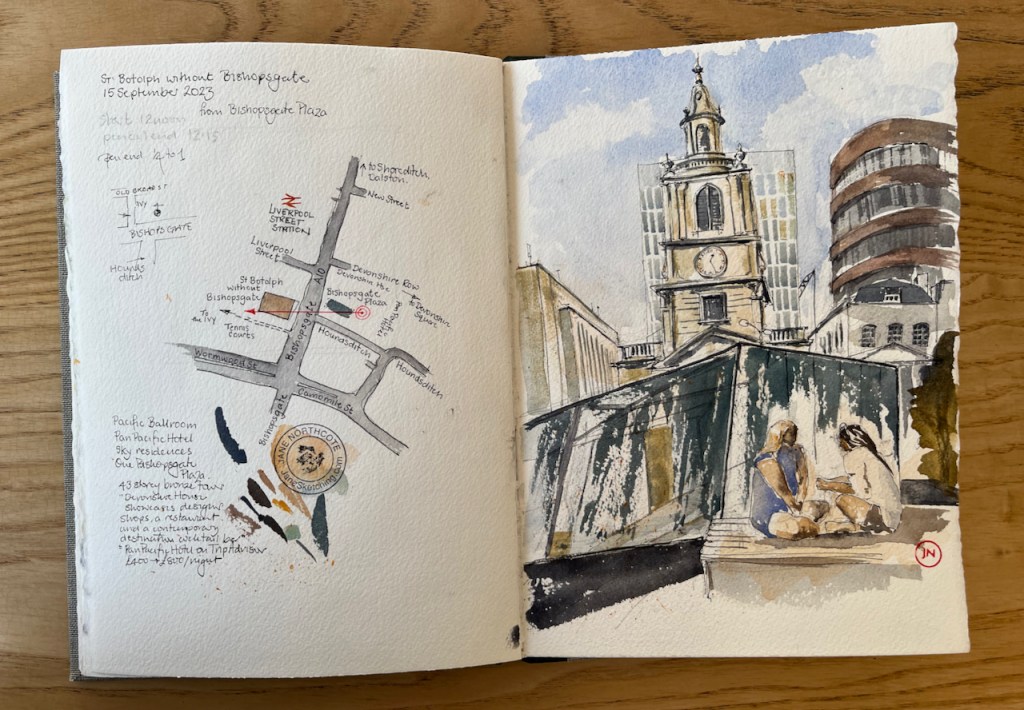
Bishopsgate Plaza is on the East side of Bishopsgate, near Liverpool Street. From the seats there, here is the view of St Botolph-without-Bishopsgate. I sketched amongst the many people enjoying the sun at lunchtime.
St Botolph-without-Bishopsgate, EC2. 15th September 2023, 1pm. 10″x 7″ in sketchbook 13
The current church was constructed in 1729, to the designs of James Gould. There has been a place of Christian worship on this site since Roman times. The parish registers are complete from 1558 according to the church’s website.
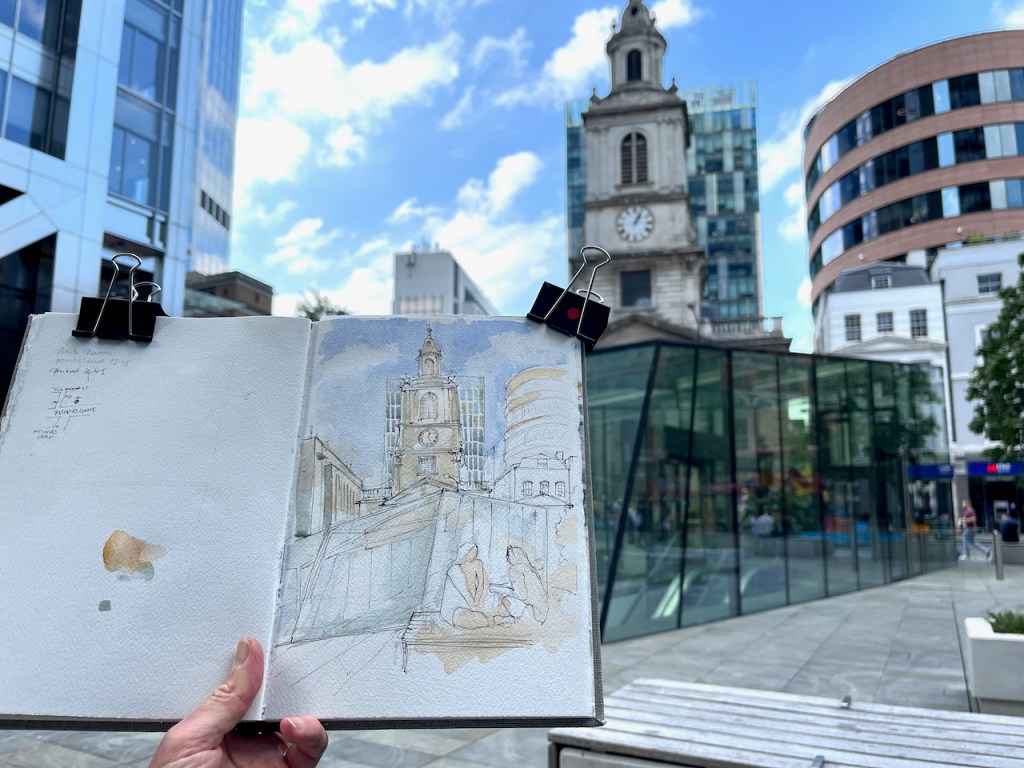
Viewed from Bishopsgate Plaza, the church is all but submerged in the surrounding buildings. The large glass structure is the entrance to the “Pacific Ballroom”. This is part of the Pan Pacific Hotel, which was behind me as I sketched.
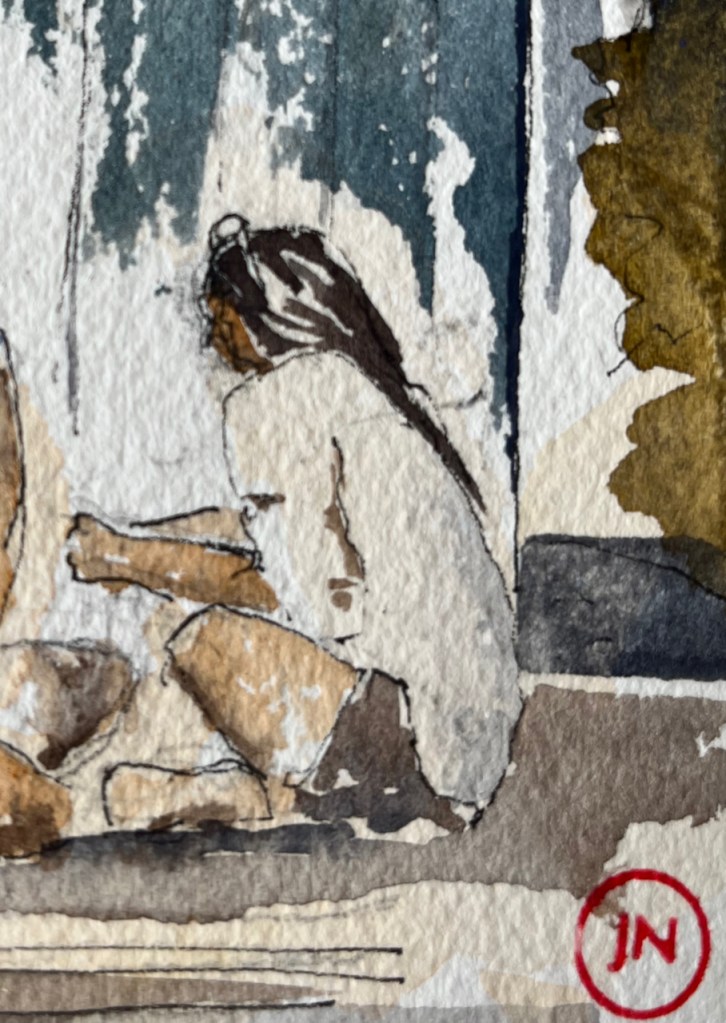
I find it quite hard to draw people, but I wanted to include the discussion between the two women. Their lively conversation contrasted with the stillness of the church, and the enormity of the buildings all around. They created a little private world between themselves.
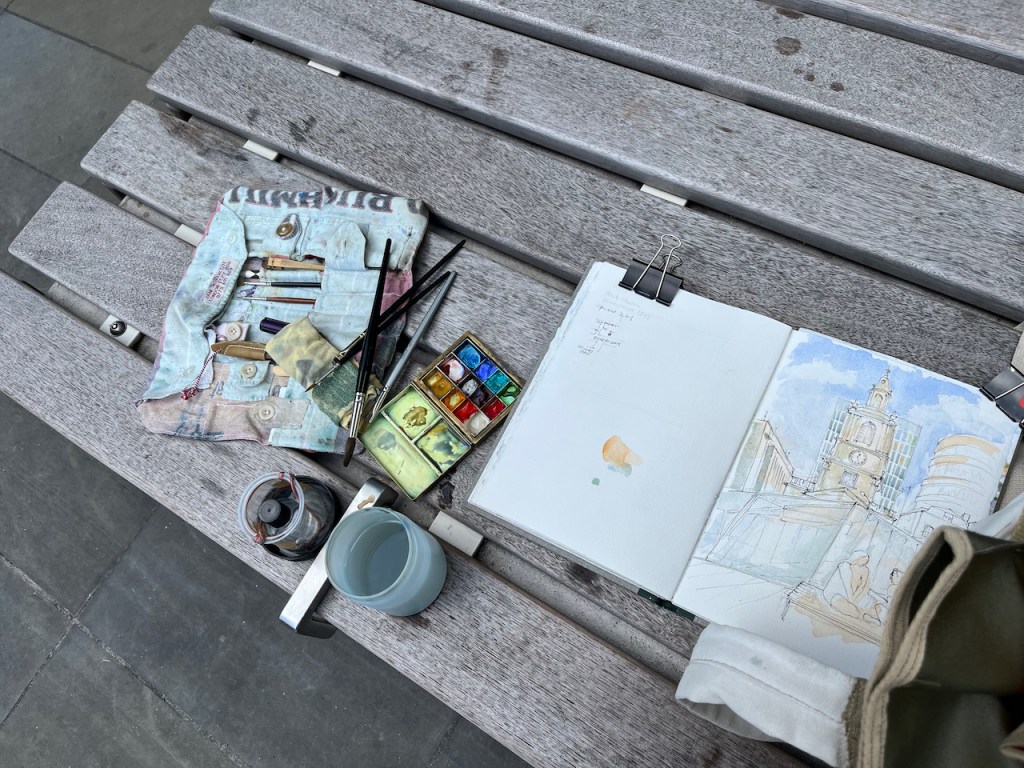
Here is work in progress on the sketch:
Sketchbook 13
Click a button below to share this post online, email it, or print it:
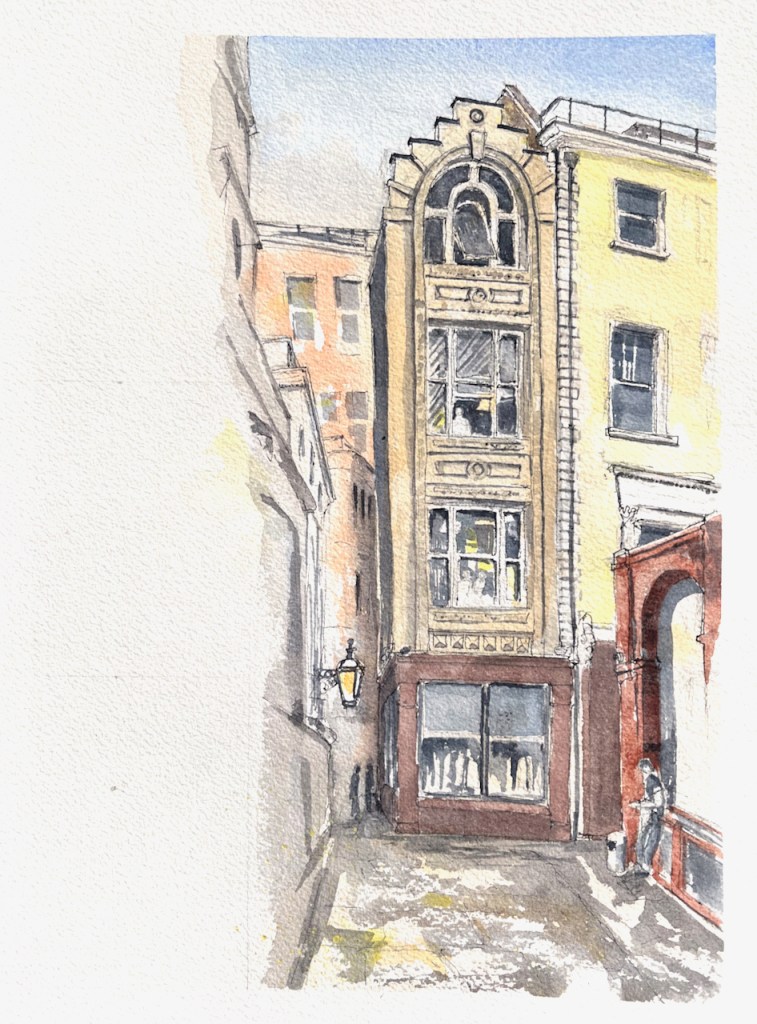
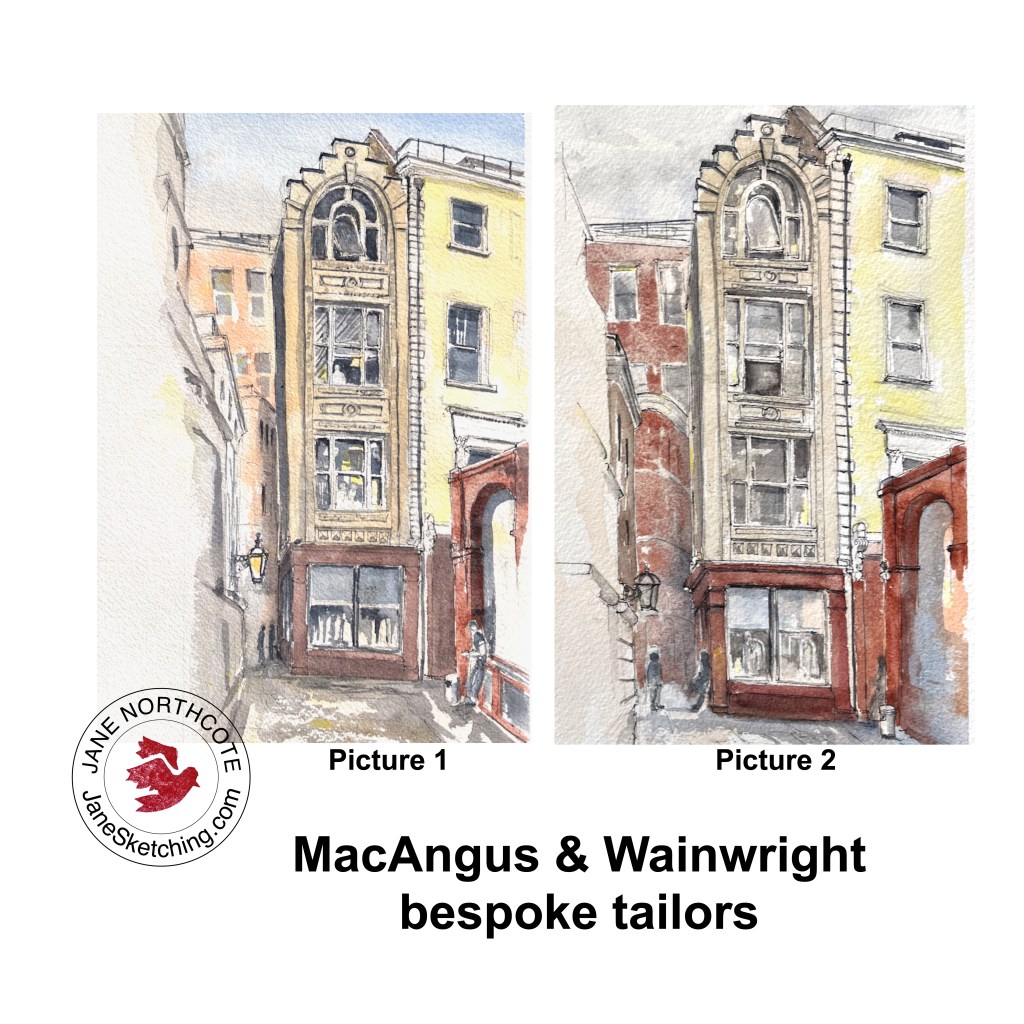
Here is 4 St Michael’s Alley, City of London, EC3, the premises of MacAngus & Wainwright, bespoke tailors. Their business uses all the floors. Above the ground floor showroom are the fitting room, workroom and cutting room.
4 St Michael’s Alley, London EC3, the premises of MacAngus & Wainwright, bespoke tailors.
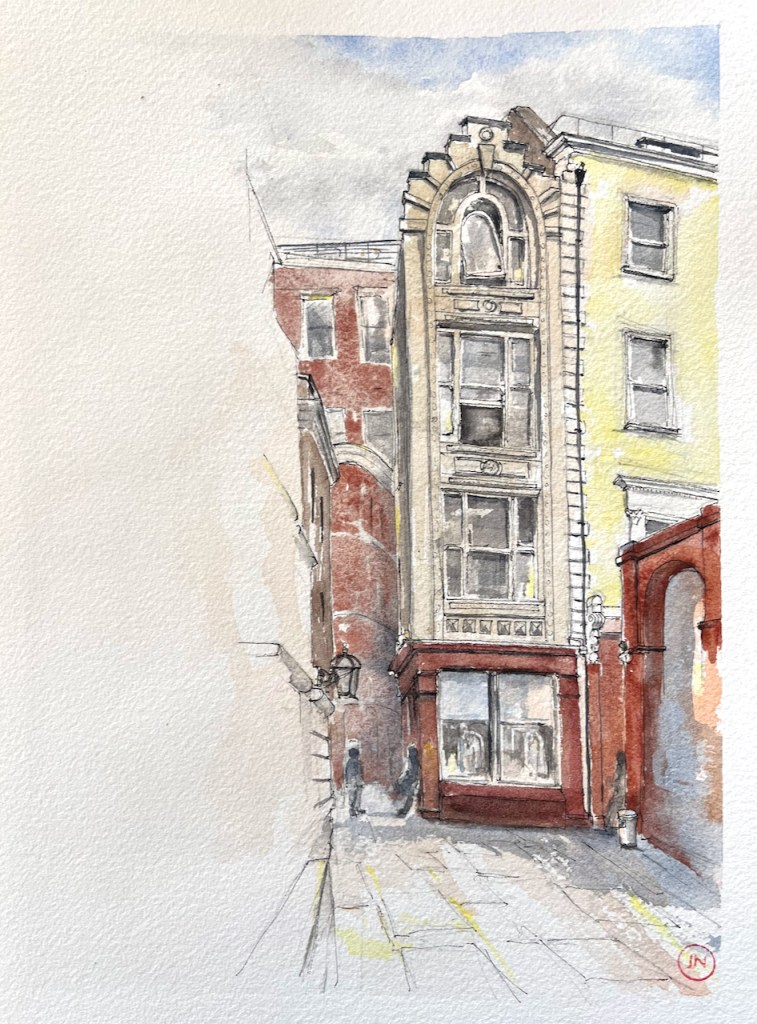
The shop is just off Cornhill, near Bank in the City of London and right next to the Jamaica Wine House which I sketched previously. You can see a bit of the Jamaica Wine House on the right of my sketch. The prominent lamp is outside the “George and Vulture” pub, which is hidden on the left. I made two pictures of this building, on different days and from slightly different angles. Here is the other one:
4 St Michael’s Alley, London EC3, the premises of MacAngus & Wainwright, bespoke tailors.
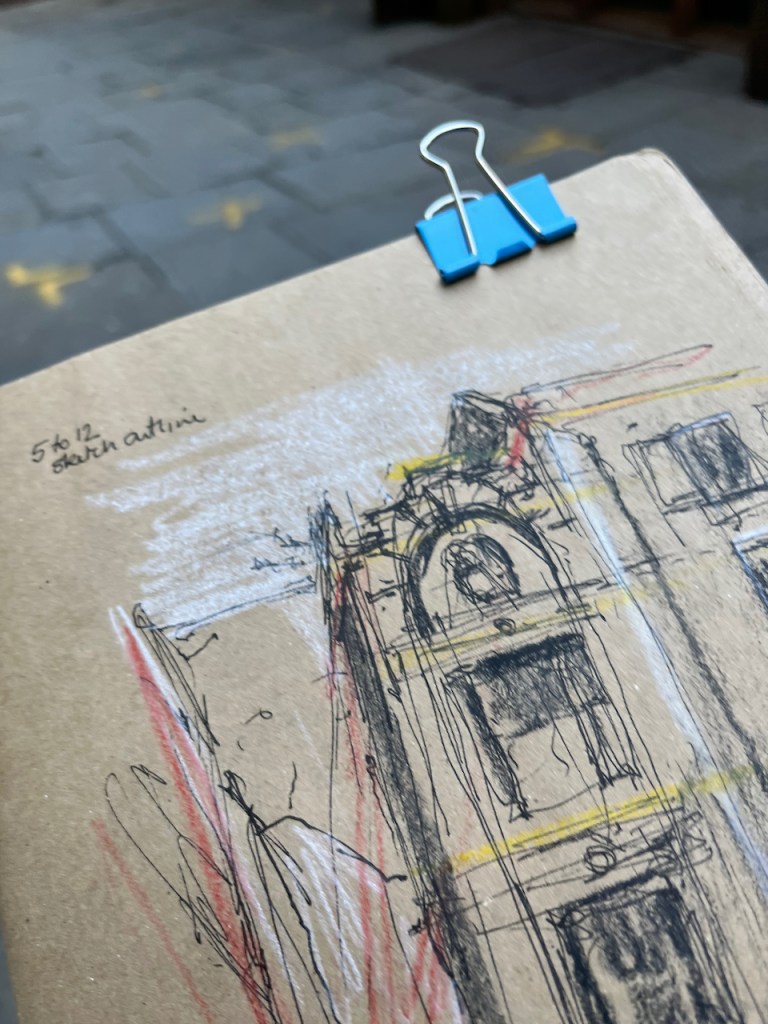
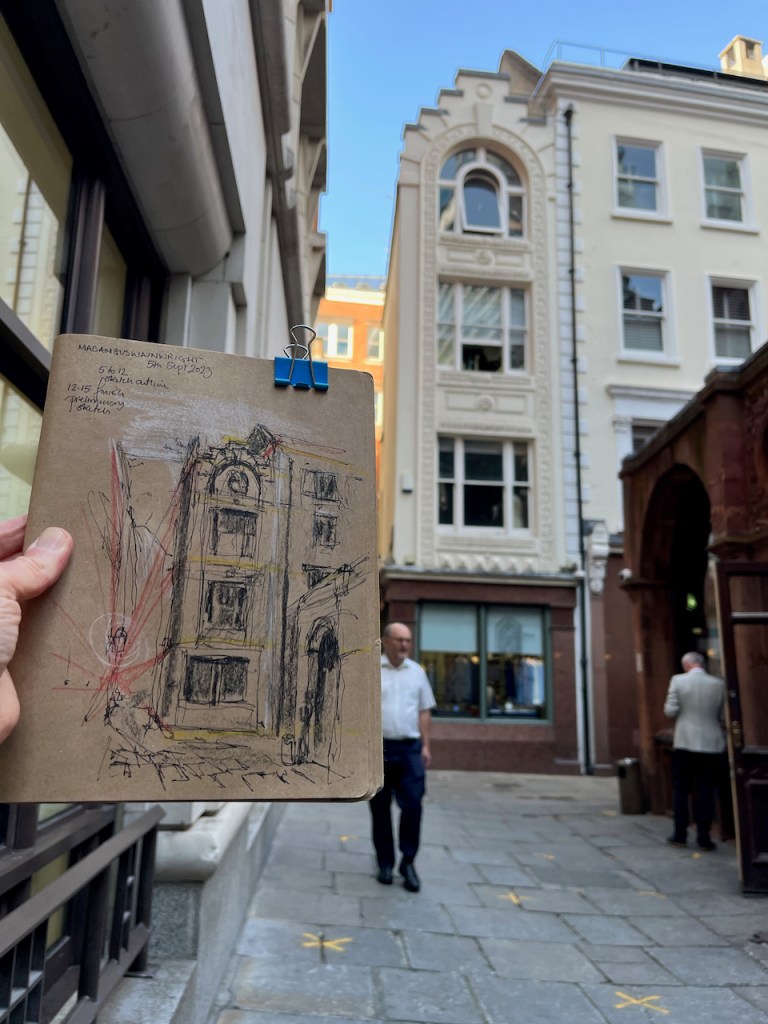
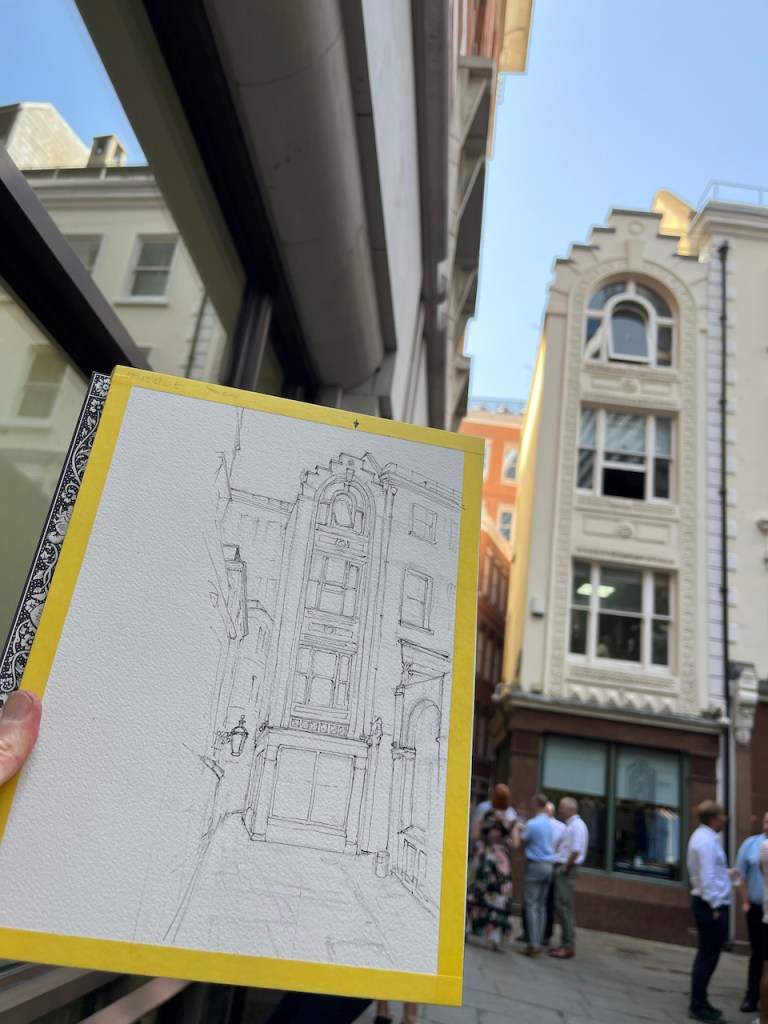
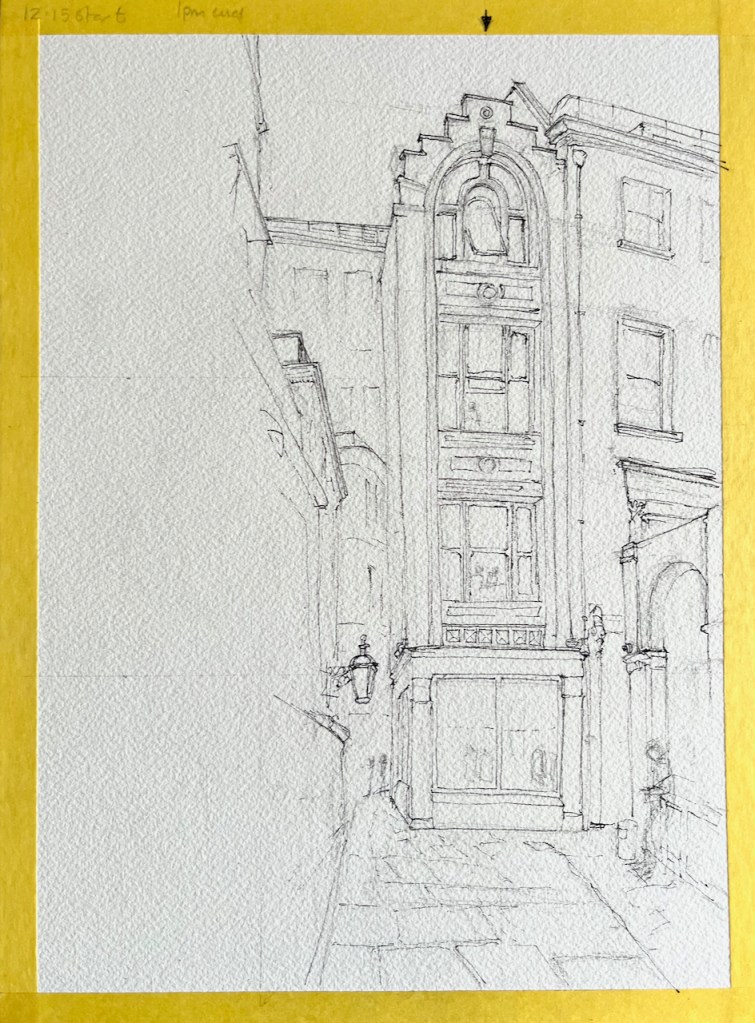
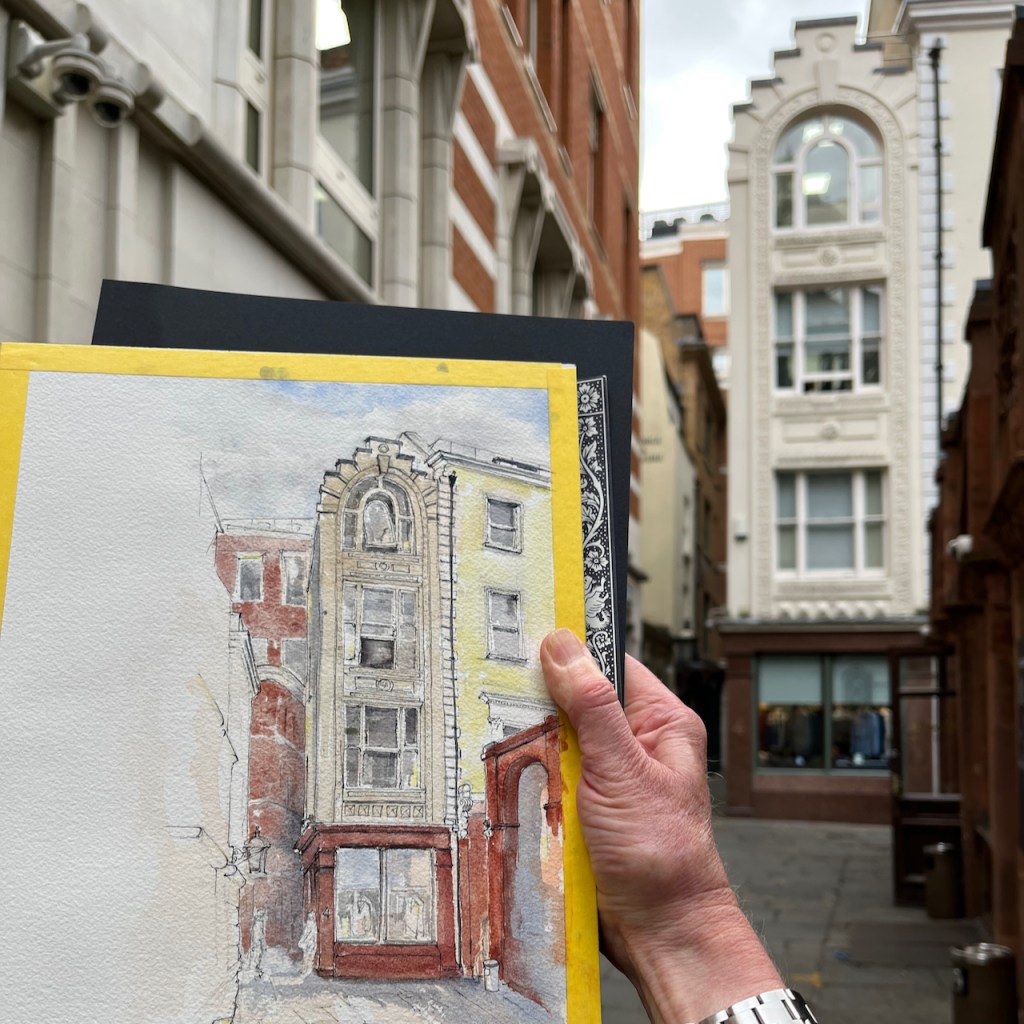
Here is work in progress on the drawings.
preliminary sketchpreliminary sketch
A succession of tour guides took their groups into the alley in the centre of my picture. This is Castle Court. These alleys apparently feature in Charles Dickens stories. Since J.K Rowling was inspired by the novels of Charles Dickens, there’s also a Harry Potter angle. I overheard this in fragments of tour guide talks. I don’t know if it’s true.
I started sketching in the late morning. This was the time for tour guides. Later, starting from about 1pm, the courtyard became populated by drinkers at the Jamaica Wine House. They were polite people, helpfully stepping aside and congregating on the other side of the alley, so they did not block my view.
The drawings are on Arches Aquarelle 12″ x 7″ 300gsm cold-pressed watercolour blocks, using Daniel Smith paints. The colours are:
Blues: Ultramarine Blue, Lavender, Cobalt Teal Blue
Yellows: Mars Yellow. The house on the right at the back is mostly Nickel Titanate Yellow. It was quite a hard colour to match.
Browns: The tailors building is a mix of Buff Titanium with Mars Yellow. The Jamaica Wine House and other buildings are Fired Gold Ochre, with a bit of transparent Pyrrol Orange.
All blacks and greys are a mix of Ultramarine Blue and Burnt Umber.
The pen drawing is De Atramentis Document Black ink in a Lamy Safari Fountain pen, fine nib.
Click a button below to share this post online, email it, or print it:
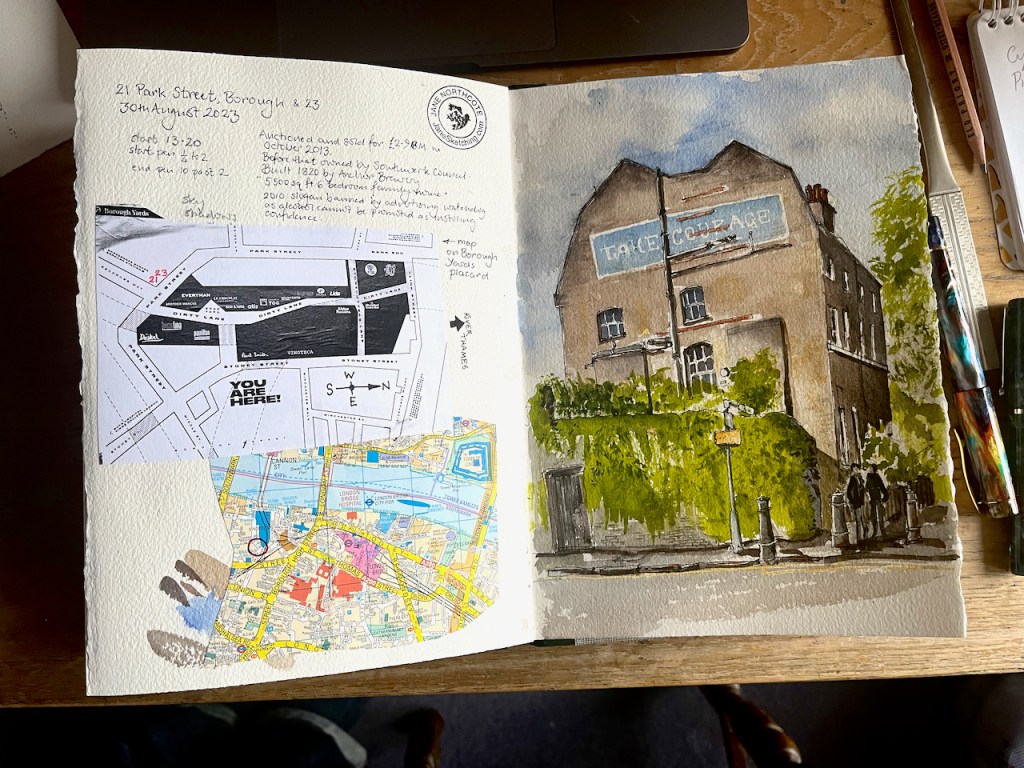
I enjoy the marvellous trigonometry of this roof, and the encouraging slogan on the wall.
21 and 23 Park Street, Borough, Southwark, London SE1. Sketched 30th August 2023, 2pm.
The slogan is for a brewery, Courage. This house was built in 1820 for the managers of the Anchor Brewery, then on this site. The Anchor pub is on the river Thames nearby.
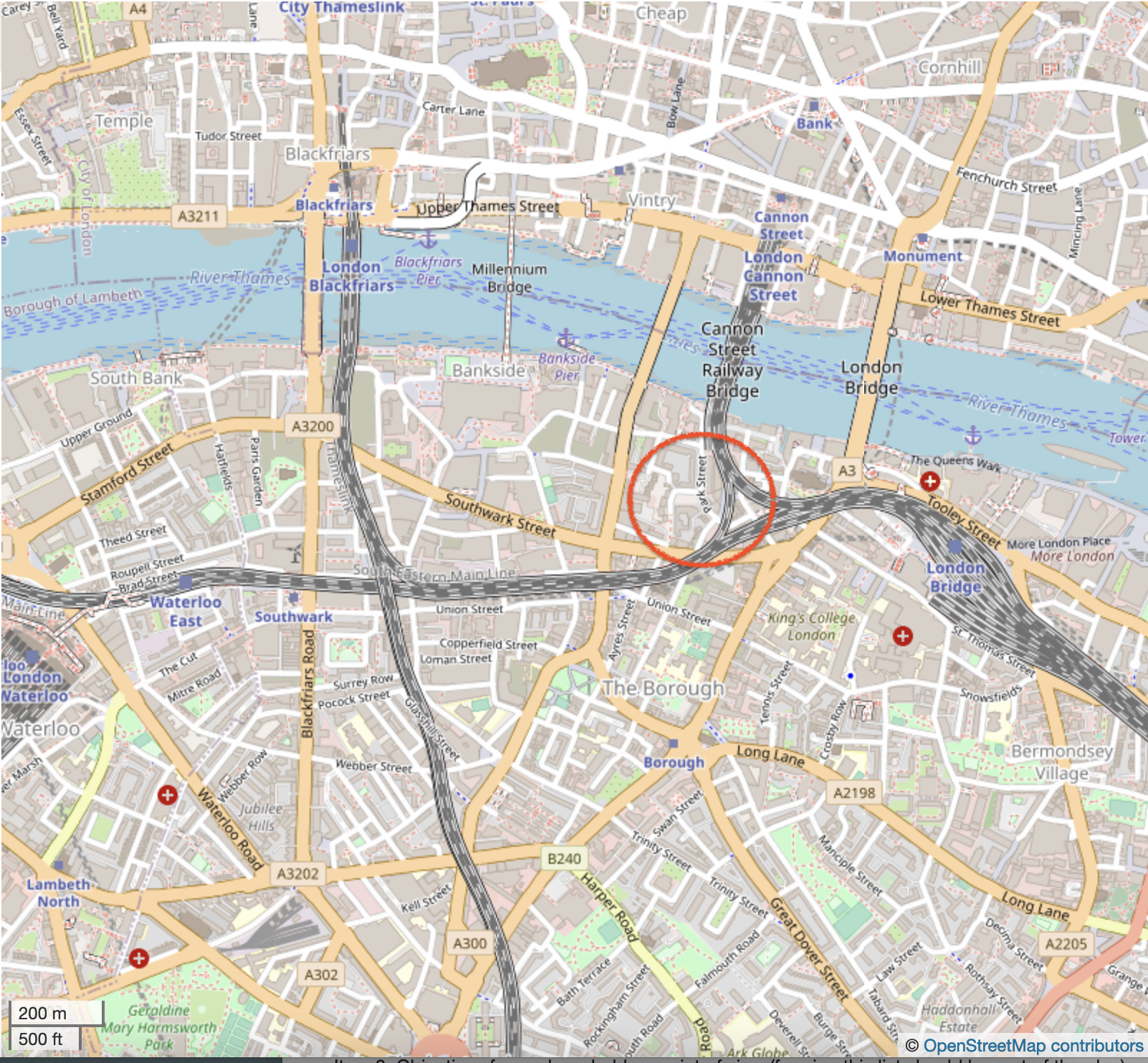
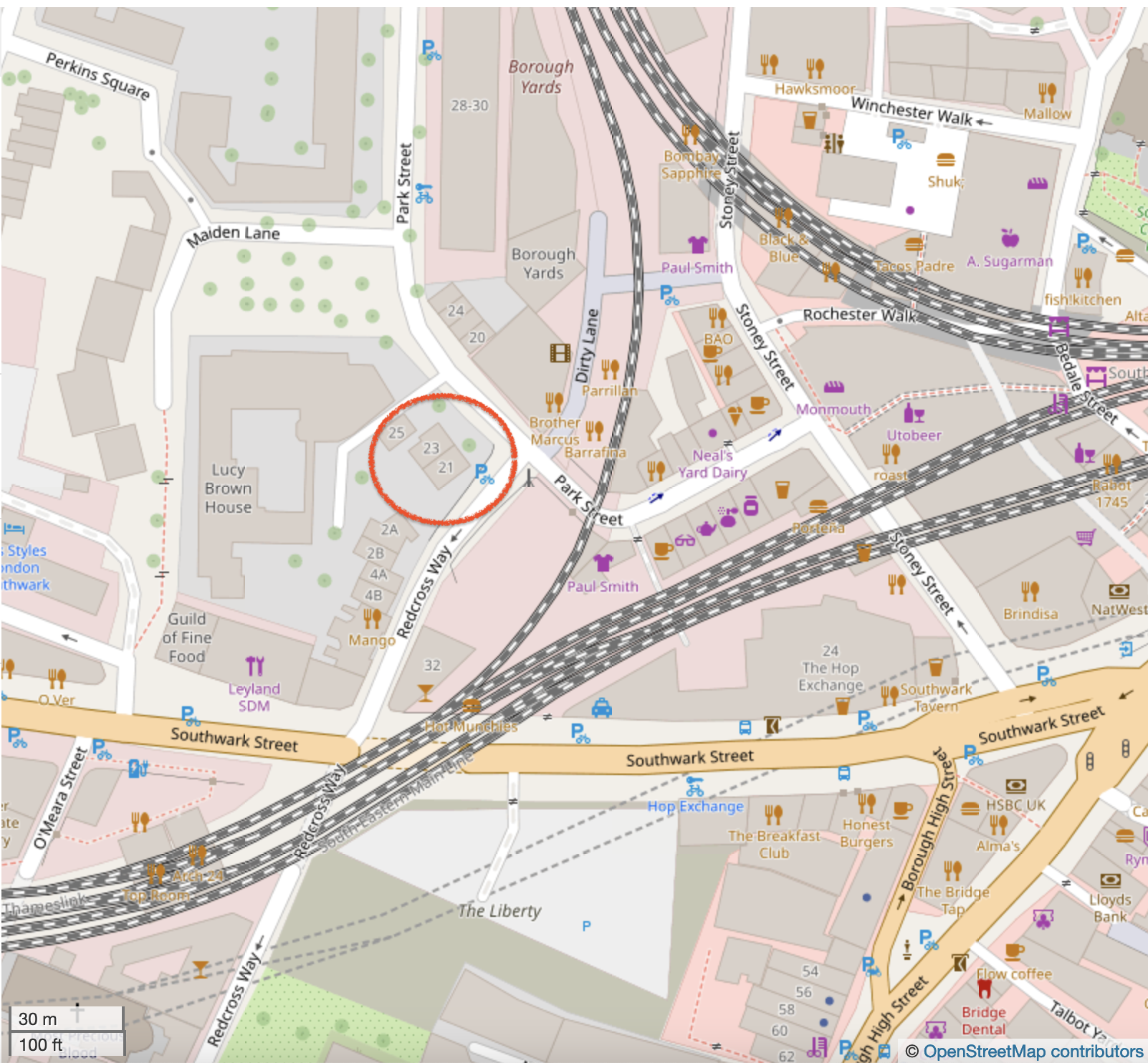
Map from “Borough Yards” poster (rotated to put North at the top)
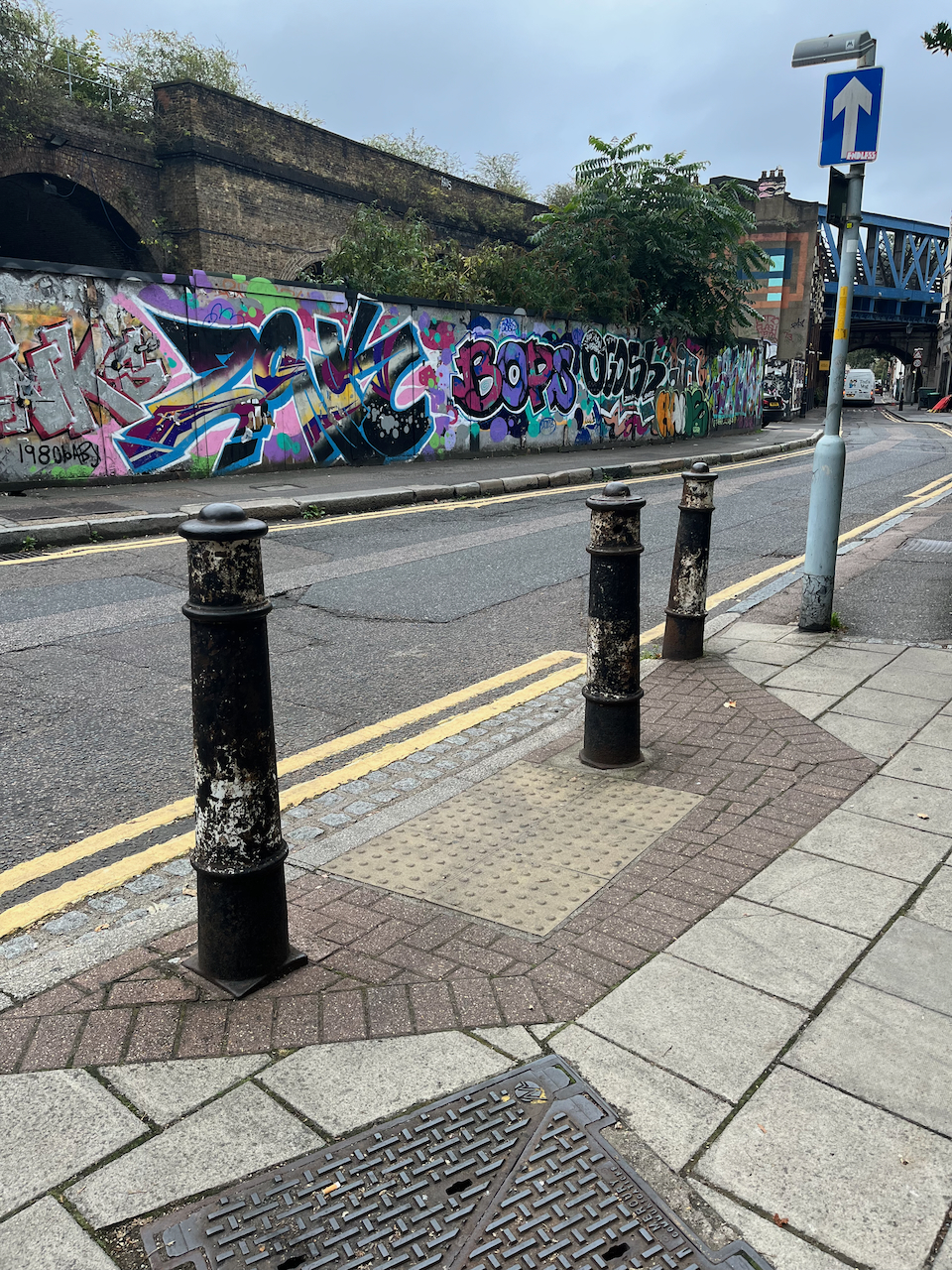
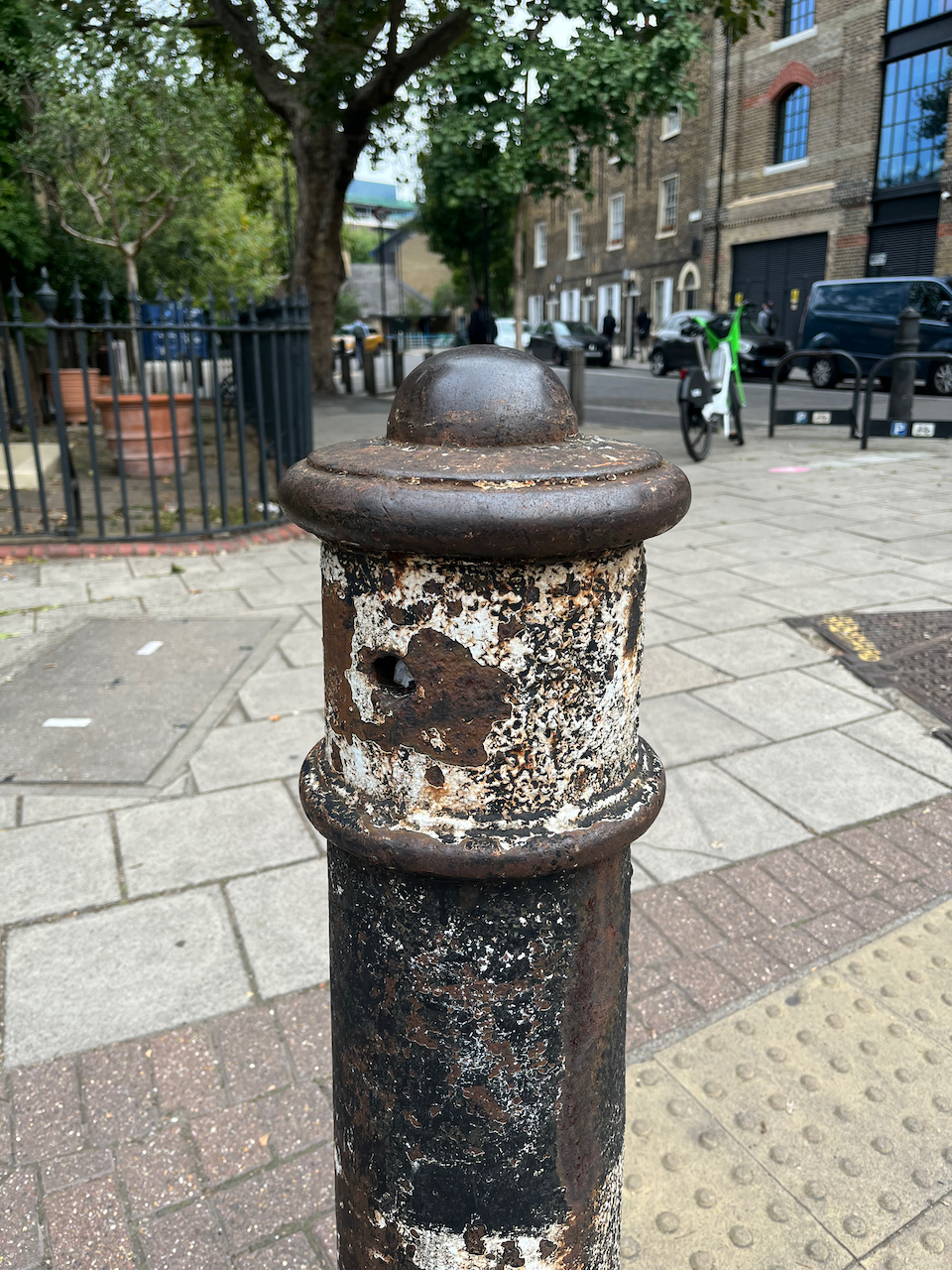
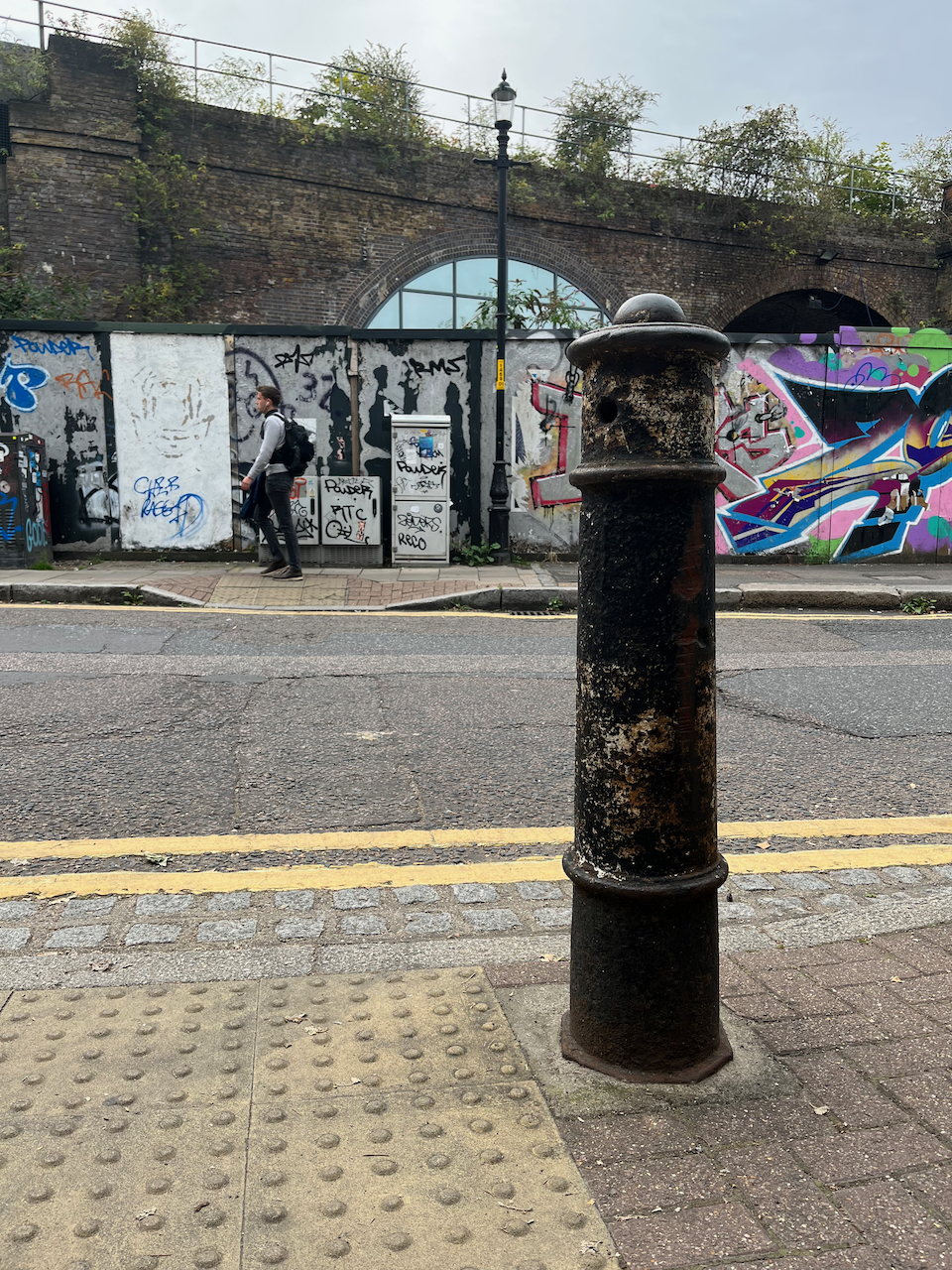
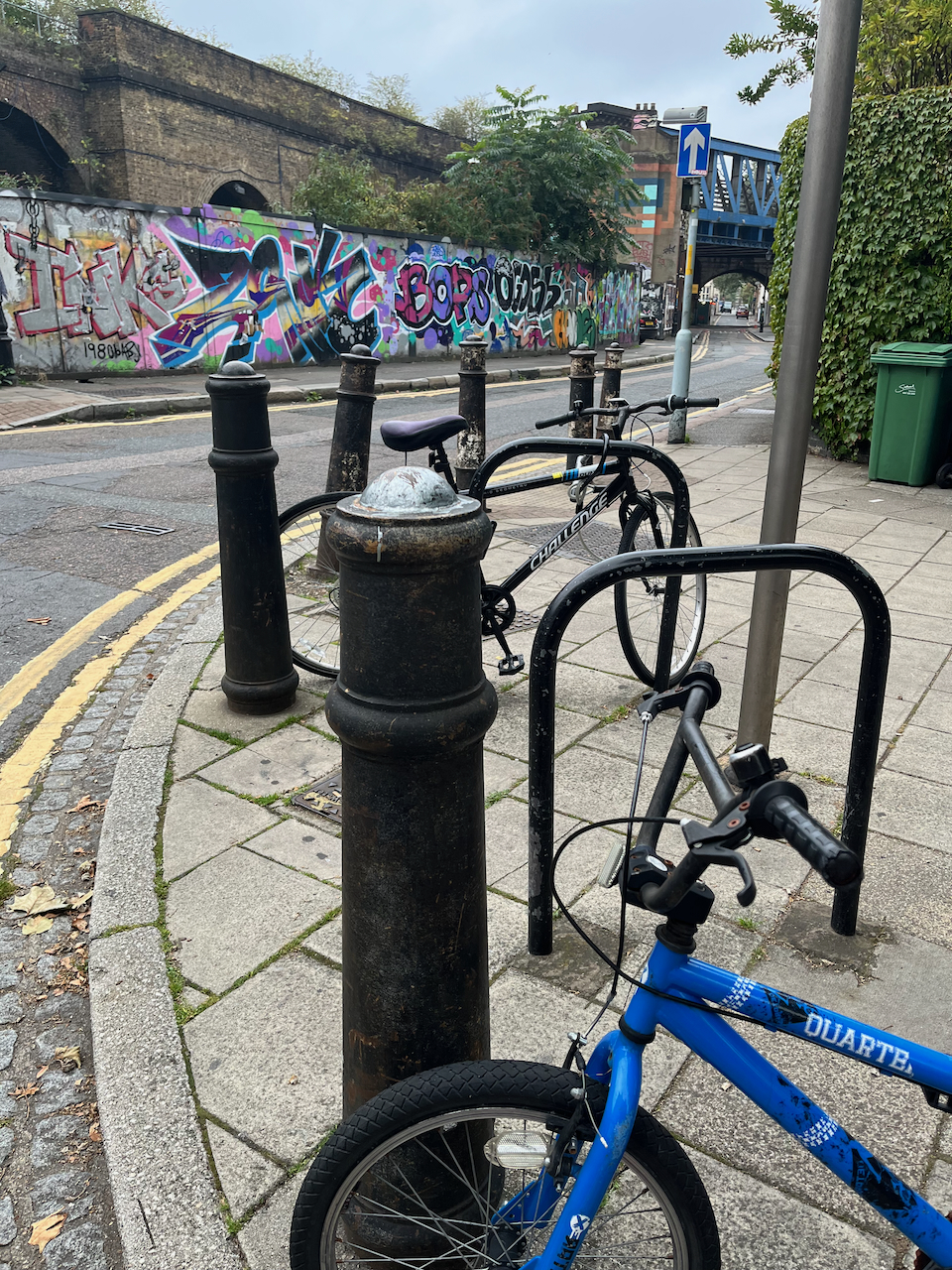
The building, and its cast iron railing, is listed Grade II, number 1385752. When I searched for the list entry in the Historic England register, I found, to my surprise, that the bollards in my picture have their own special listing, number 1385753 “
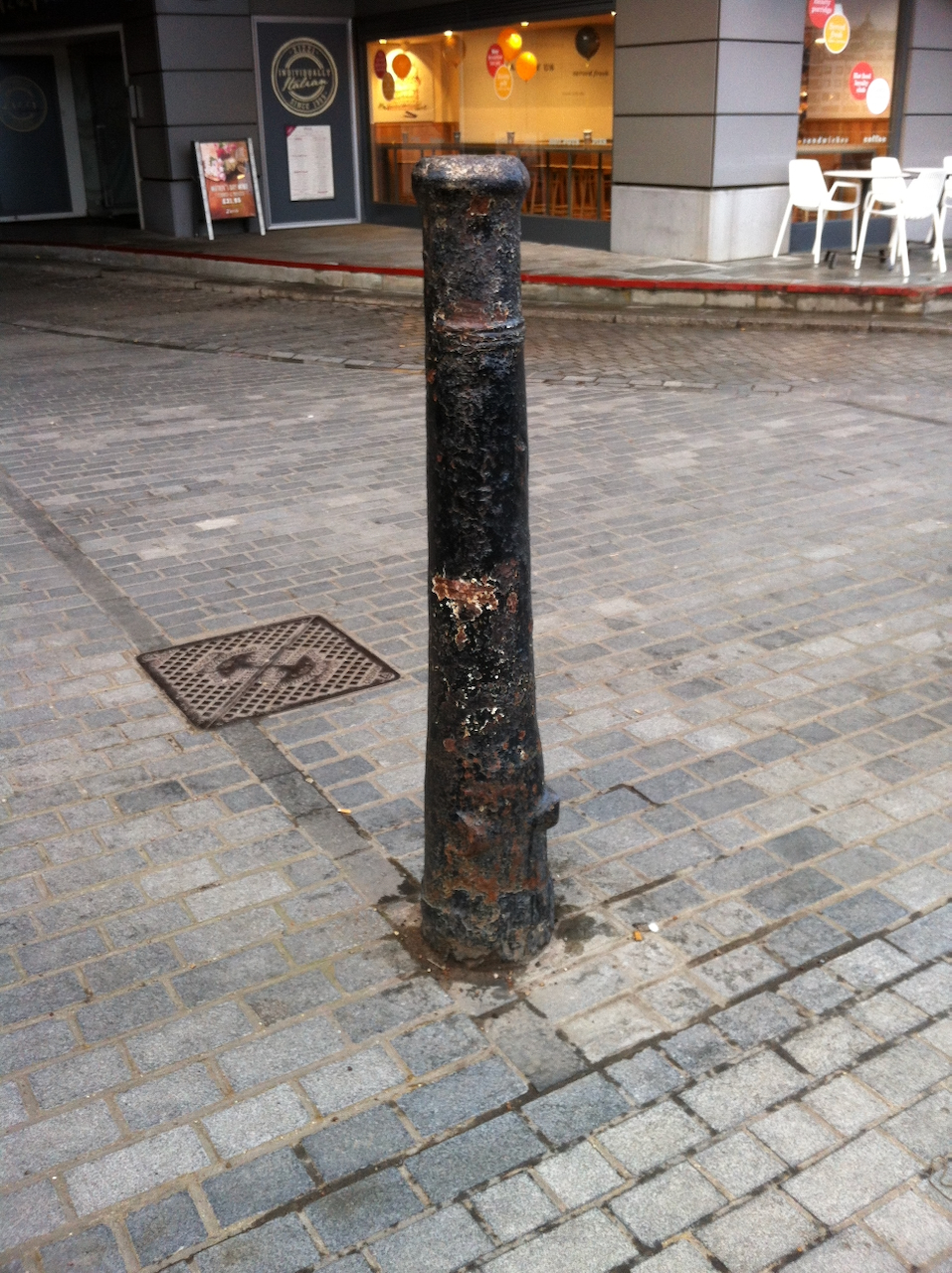
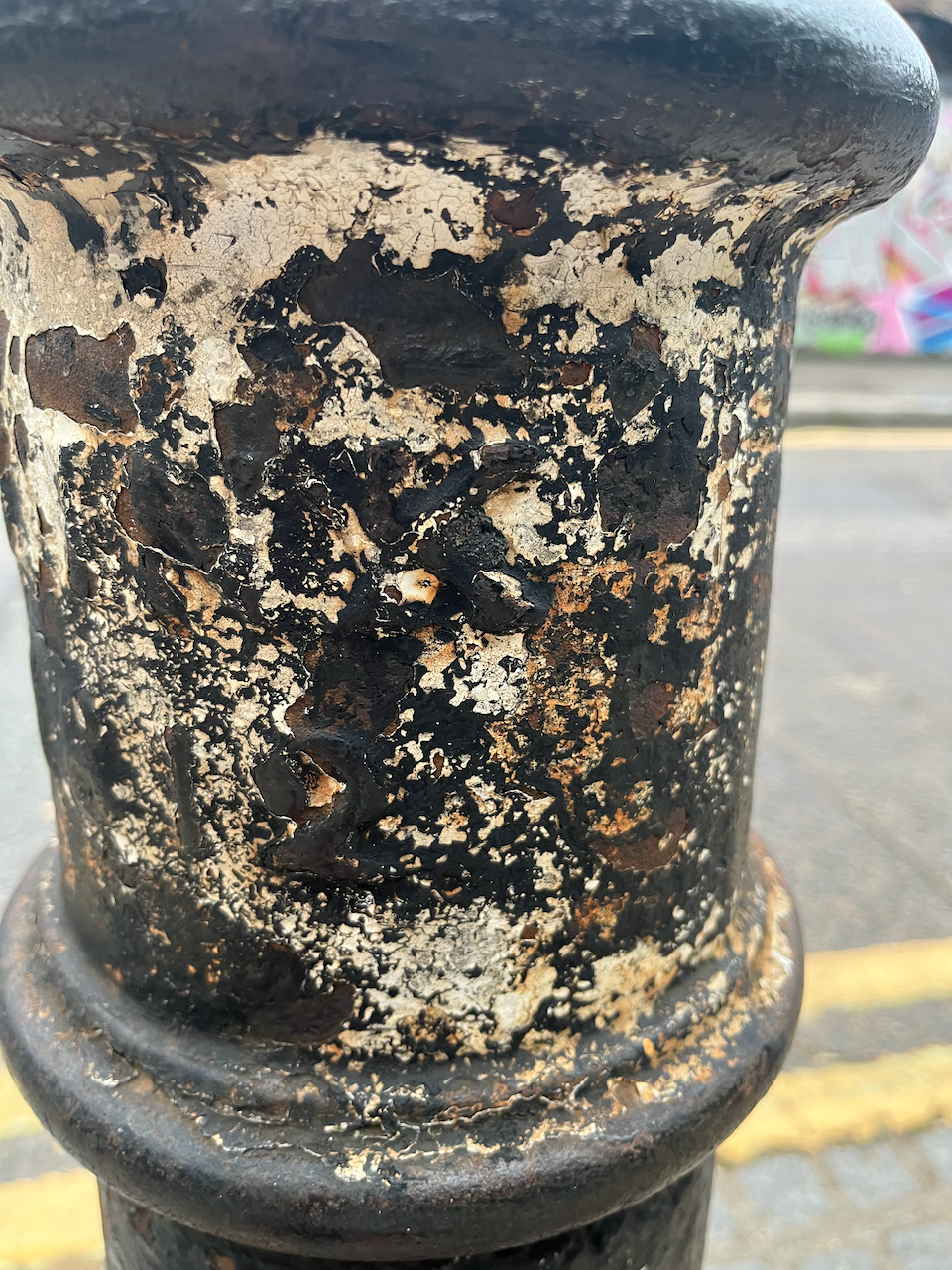
So I had to go back and have a closer look at them. Why were they listed? The list entry does not say. There are some bollards in London which are former cannon. It’s always a delight to discover them. They can be positively identified because you can see the indentation or hole near the base, which is where the gunpowder used to be poured in. Also they sometimes have protrusions about two-thirds down where they used to pivot on their gun-carriage. Sometimes the base is flattened on one side. Here are some examples of cannon (click the image to enlarge and see location):
I was unable to find on these 21 Park Street bollards any characteristic which confirmed they might have been cannon. The listing says they are “canon posts” – “canon” spelt like that – not “cannon”. The words “CLINK 1812” were still just about visible on the bollard which is on the right in my drawing. Here are some photos of the posts outside 21 Park Street. Click to enlarge and see captions. Do you think they might be real cannon, or perhaps the word “canon” simply describes a design of post.
“Clink” was the name of the area, from about 1127. It was called the “Liberty of Clink”. The designation “Liberty” implied that it was a civic area under the jurisdiction of the local manor, rather than the King, or the City of London. Famously, certain activities, including theatres, which were forbidden in the City of London were permitted here. The Liberty of Clink was abolished in 1889 and amalgamated into the Southwark in the County of London.
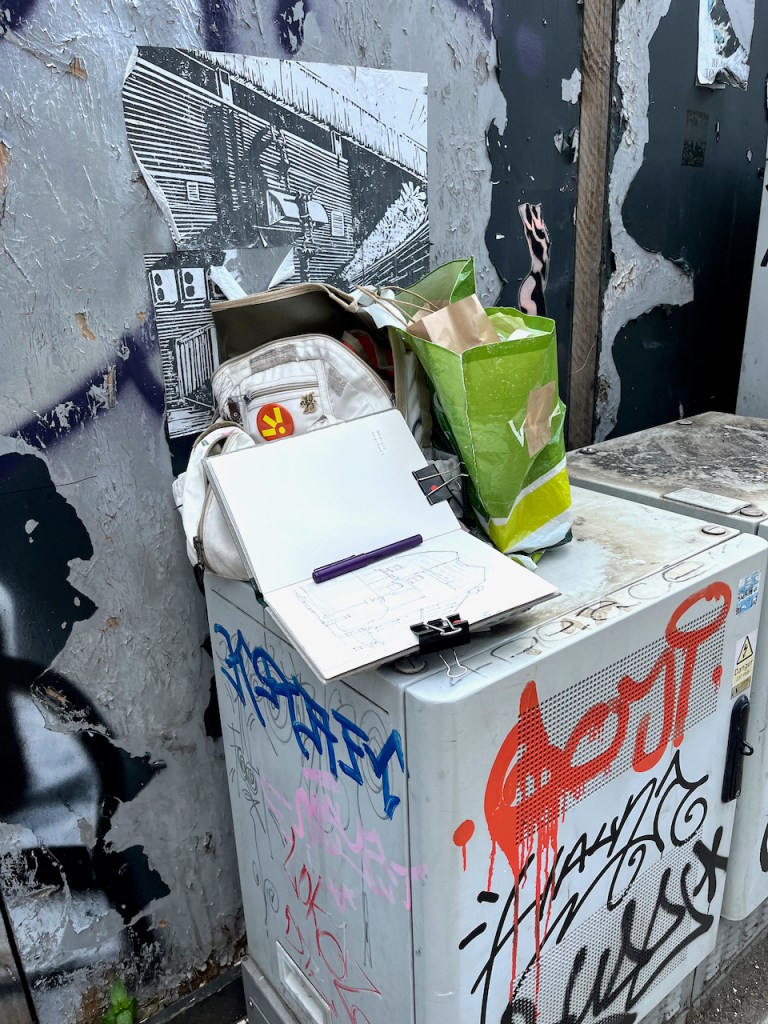
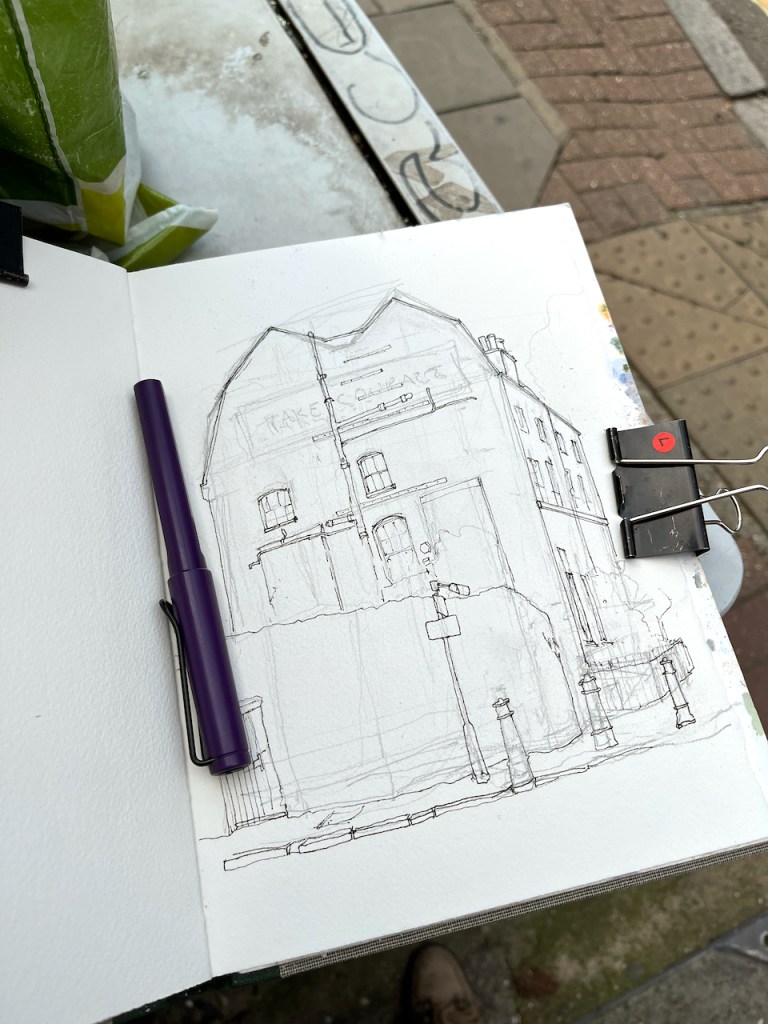
Here are some photos of work in progress on the drawing:
Drawing size 10″ x 8″ on Arches papers 300gsm NOT watercolour paper, in a sketchbook made by Wyvern Bindery.
Watercolours by Daniel Smith:
ultramarine blue
fired gold ochre
green gold
burnt umber
yellow line is naples yellow
All blacks and greys are Ultramarine Blue plus Burnt Umber
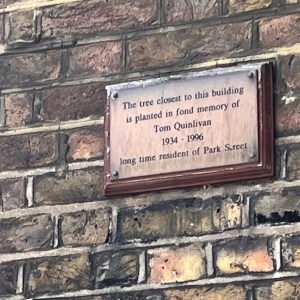
A notice on 21 Park Street reads:
The tree closest to this building
 is planted in fond memory of
Tom Quinlivan 1934-1996
long time resident of Park Street.
Click a button below to share this post online, email it, or print it:









































 Jane Sketching