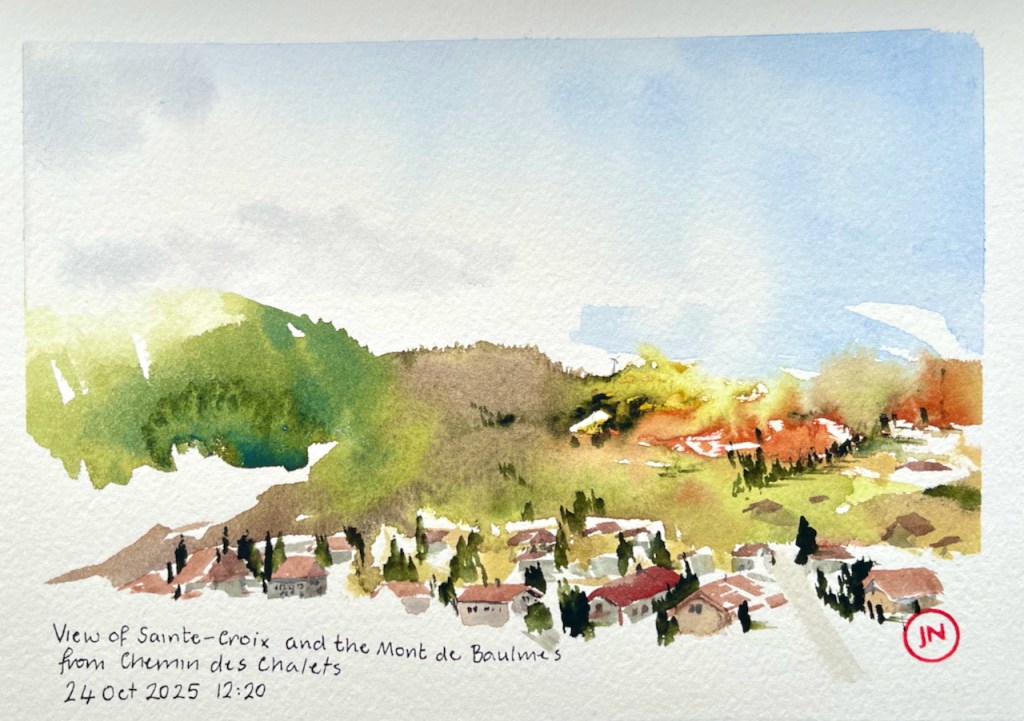
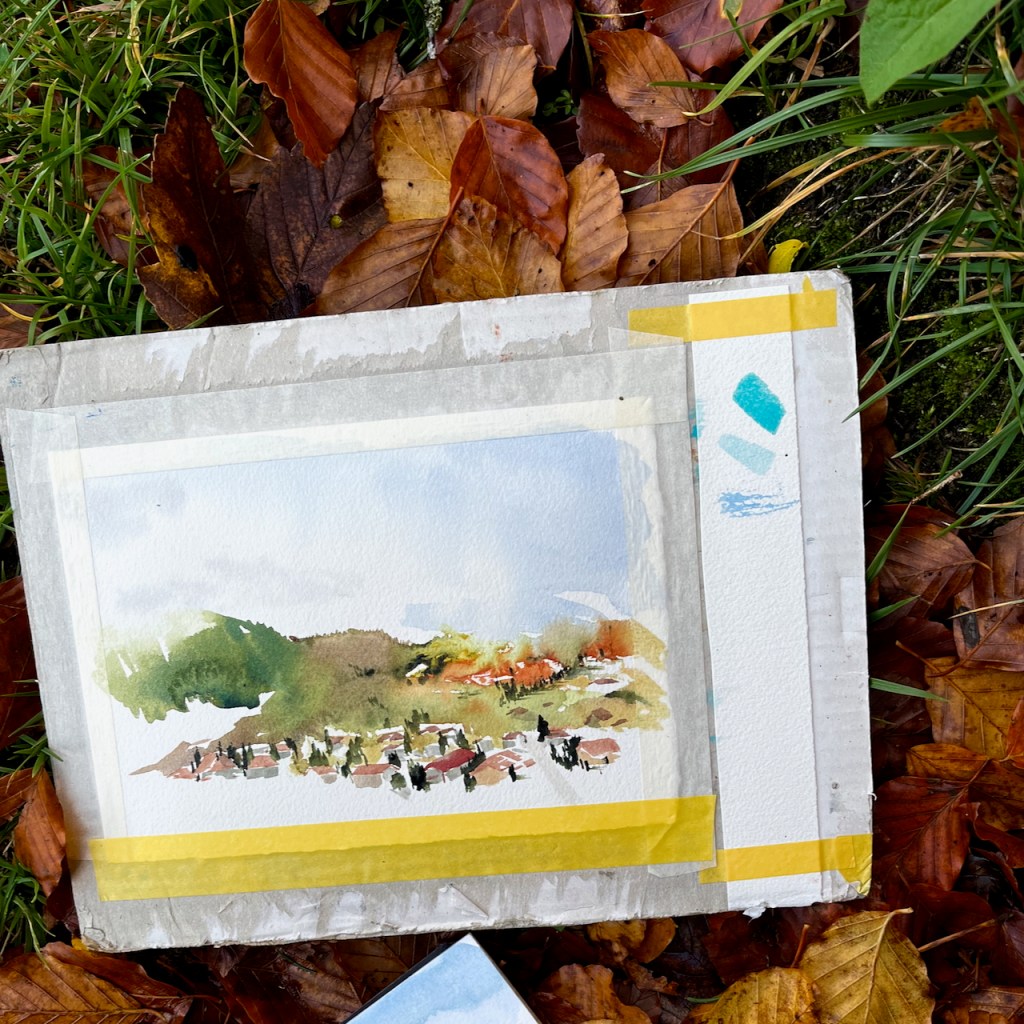
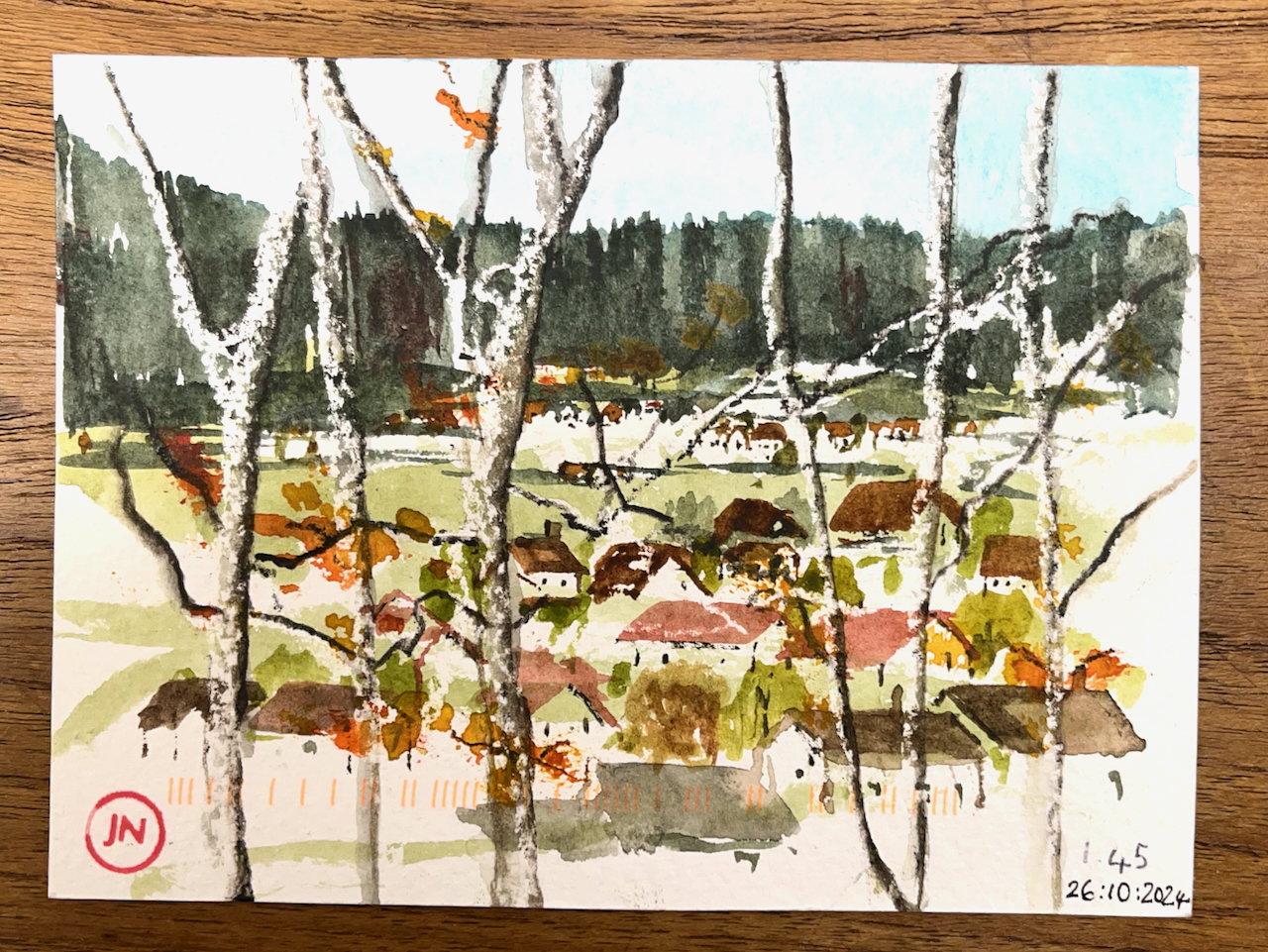
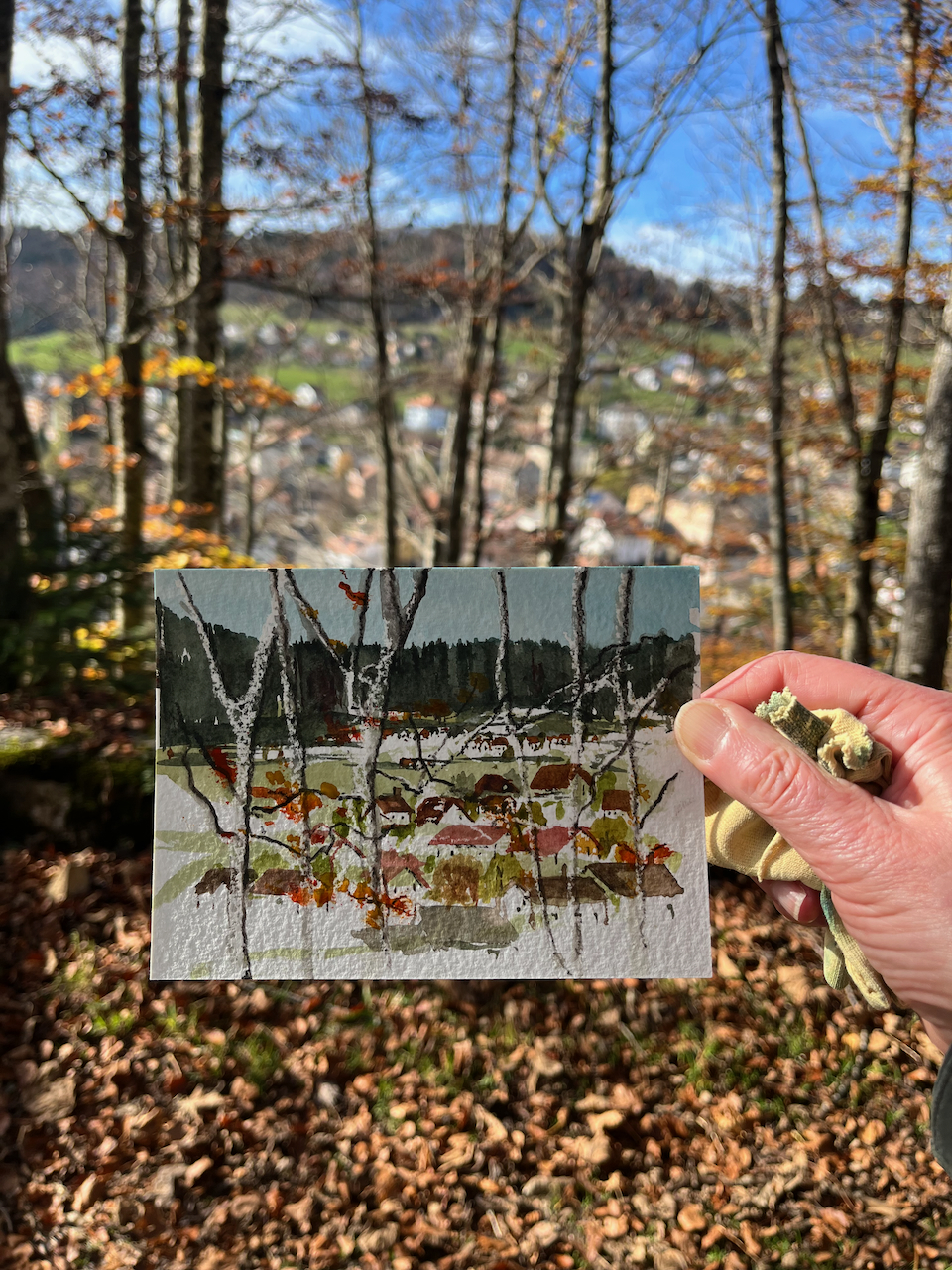
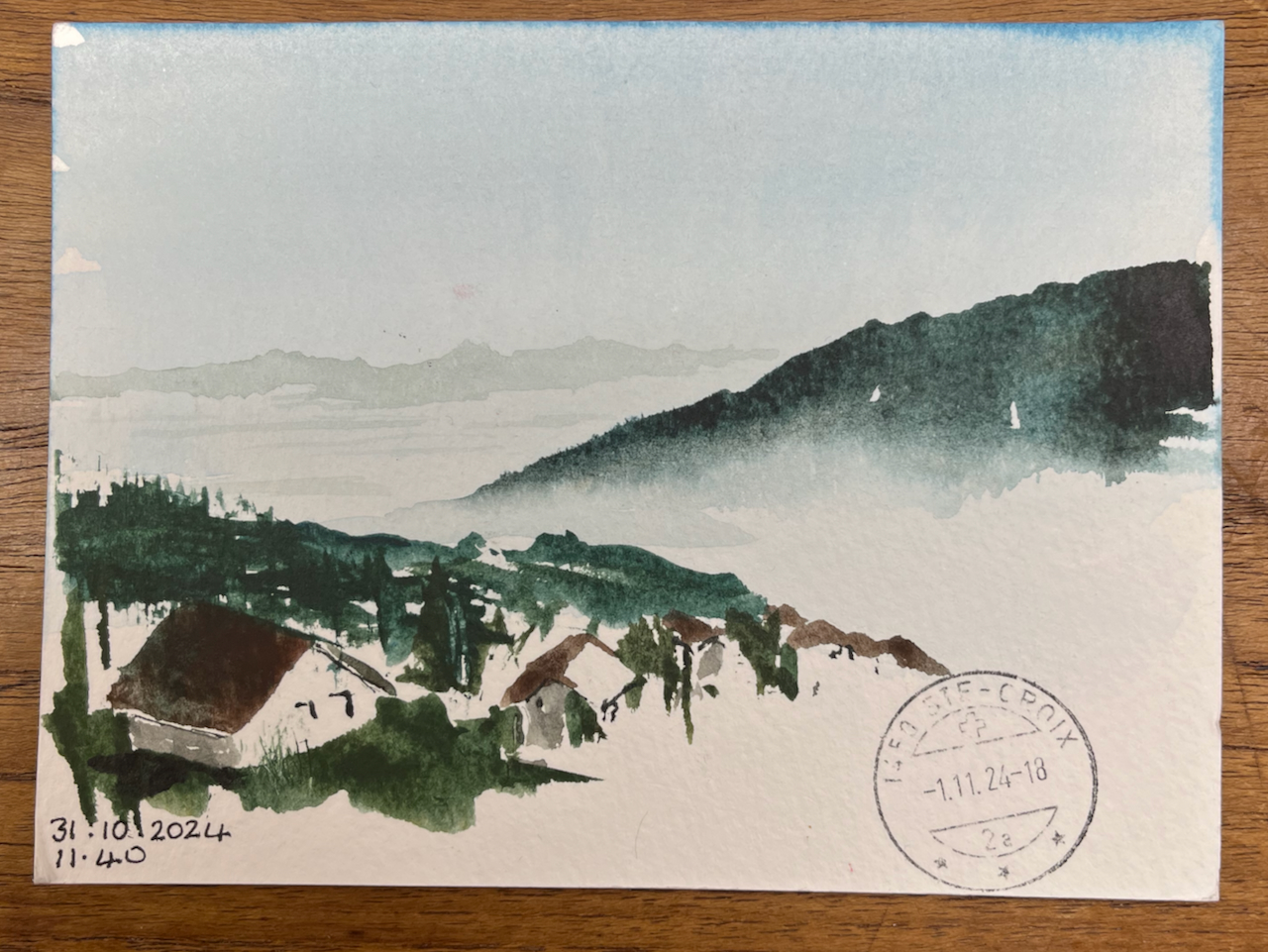
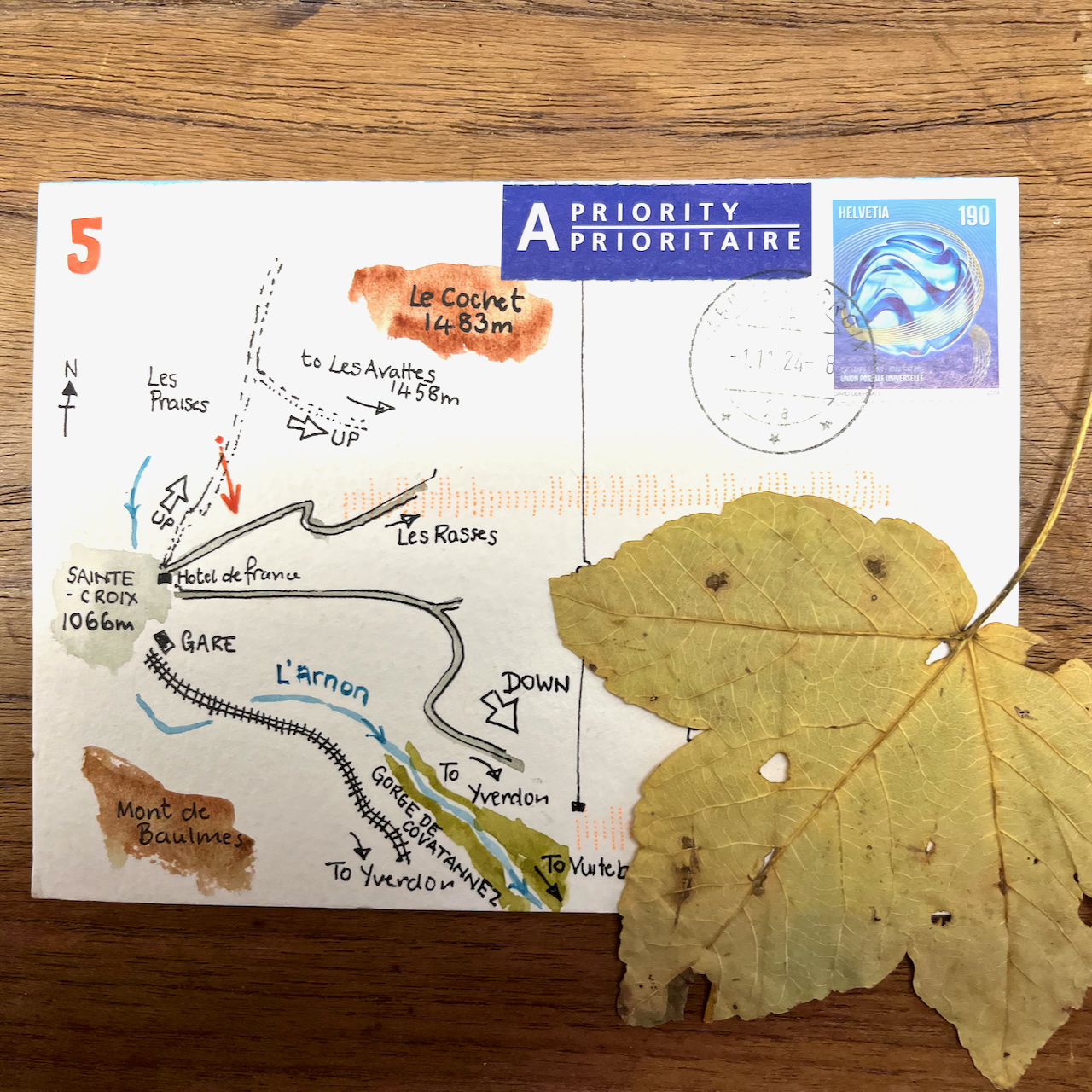
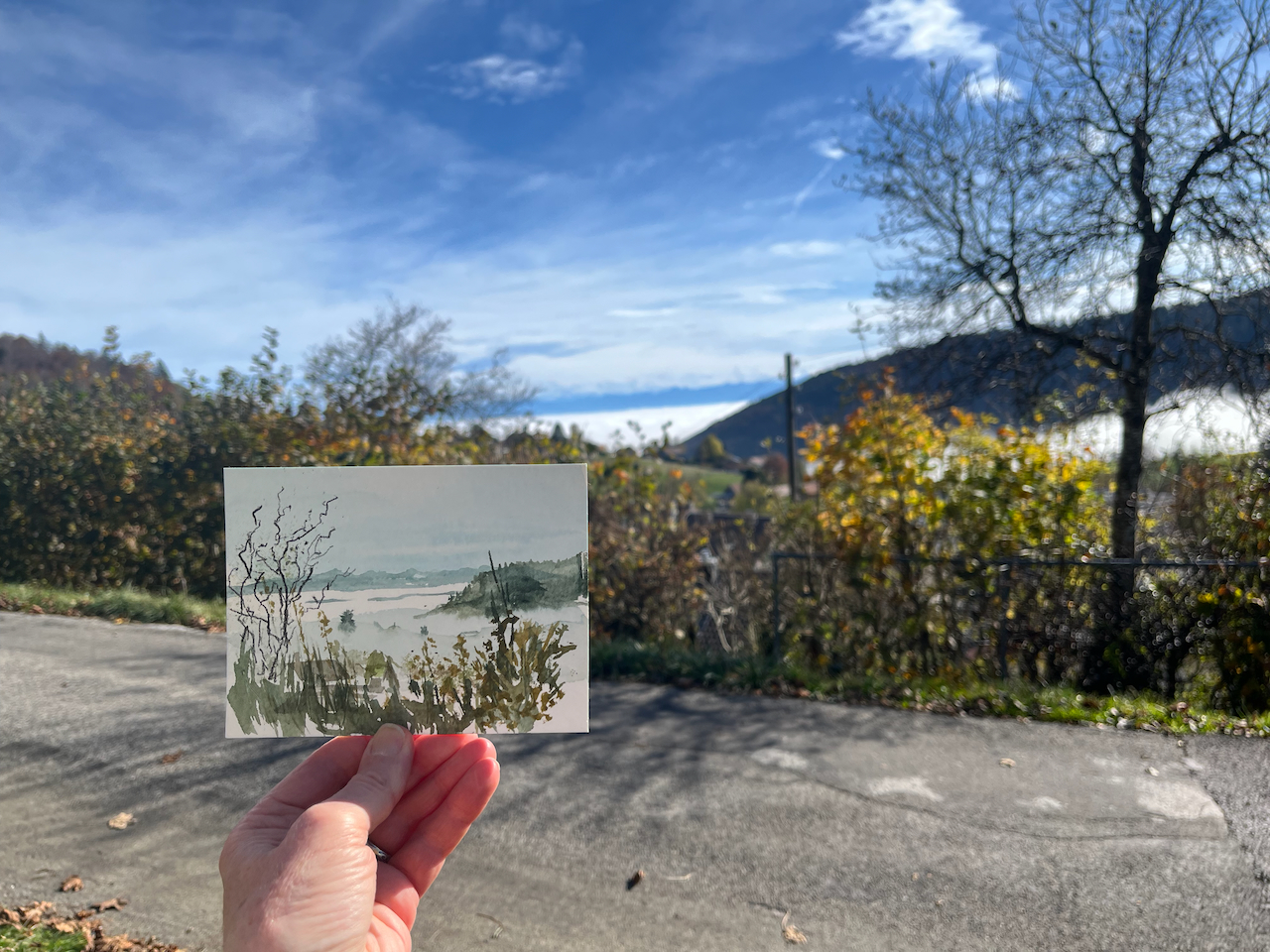
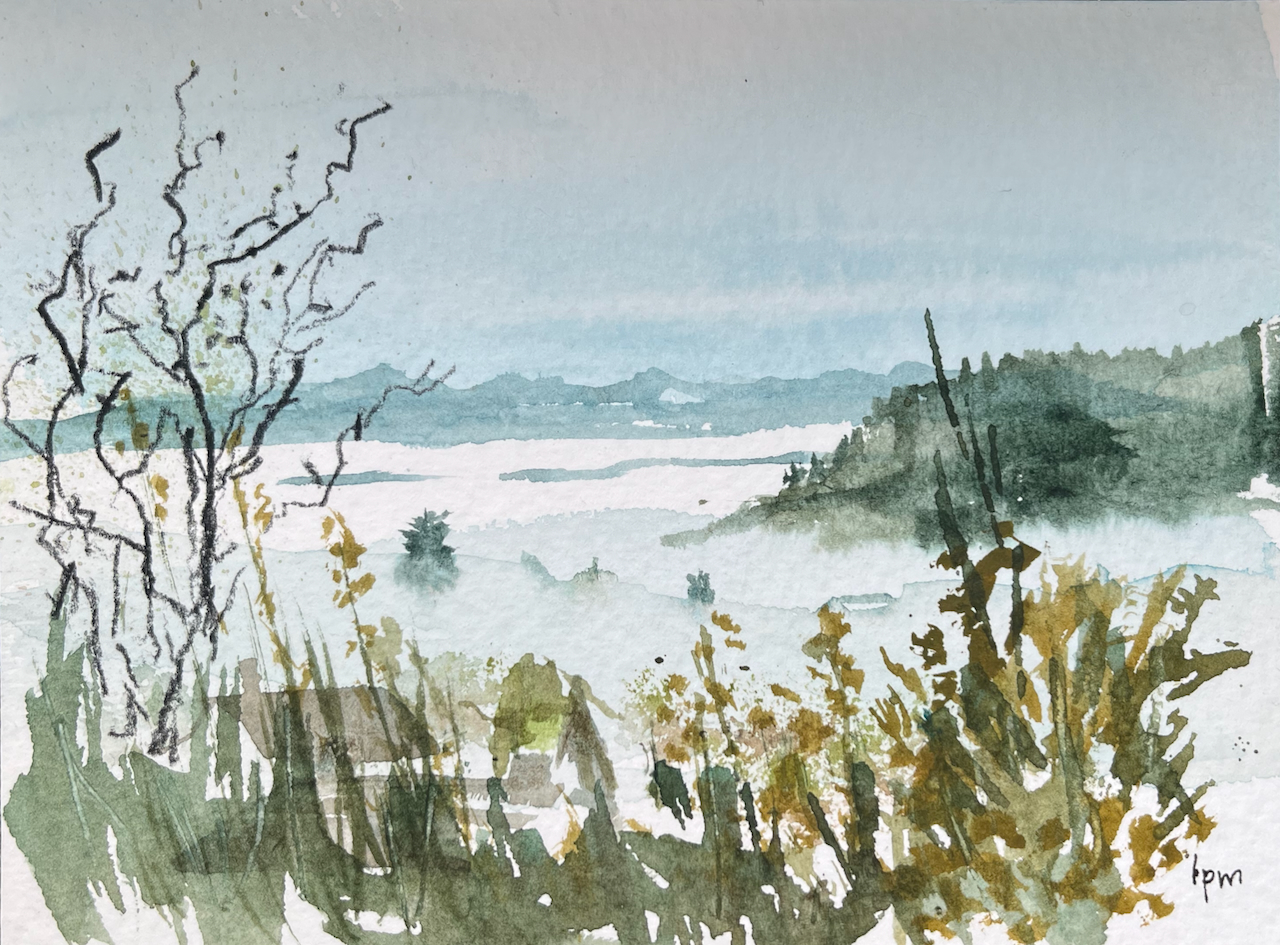
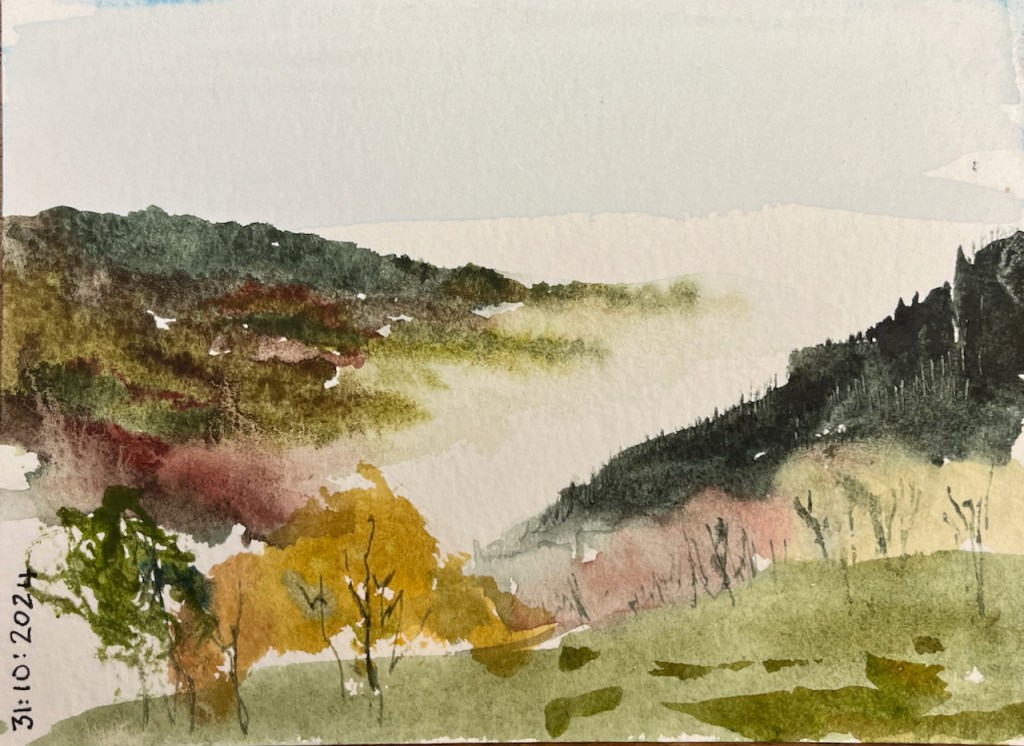
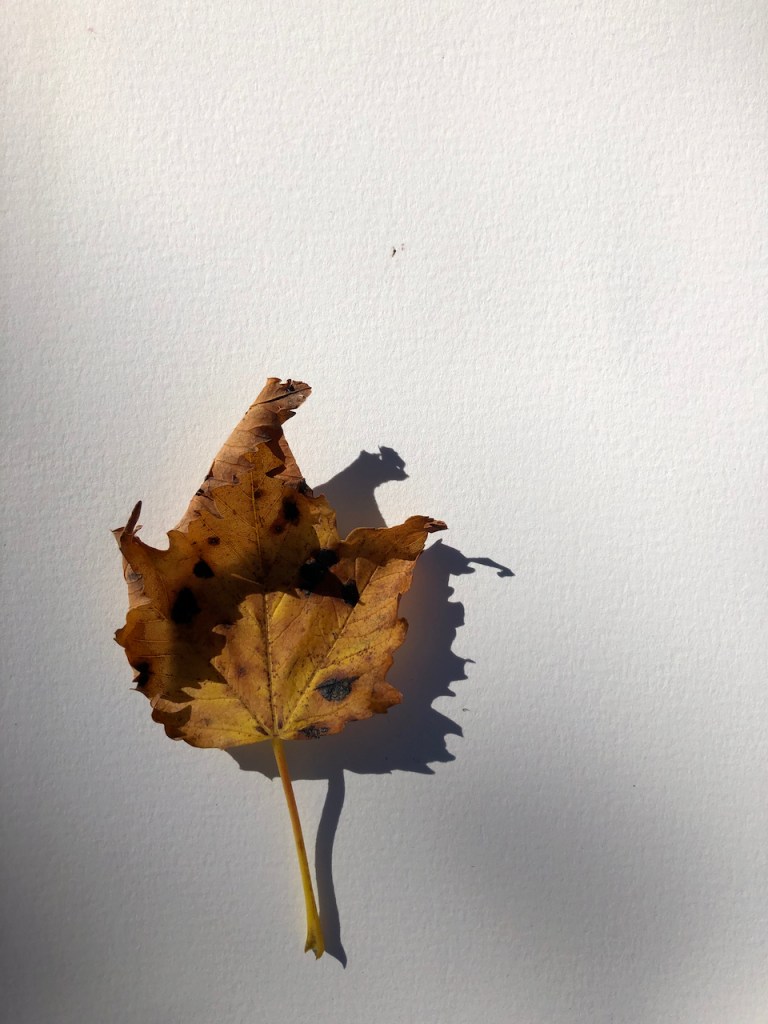
Here is a autumn scene in Sainte-Croix in the canton of Vaud, Switzerland.
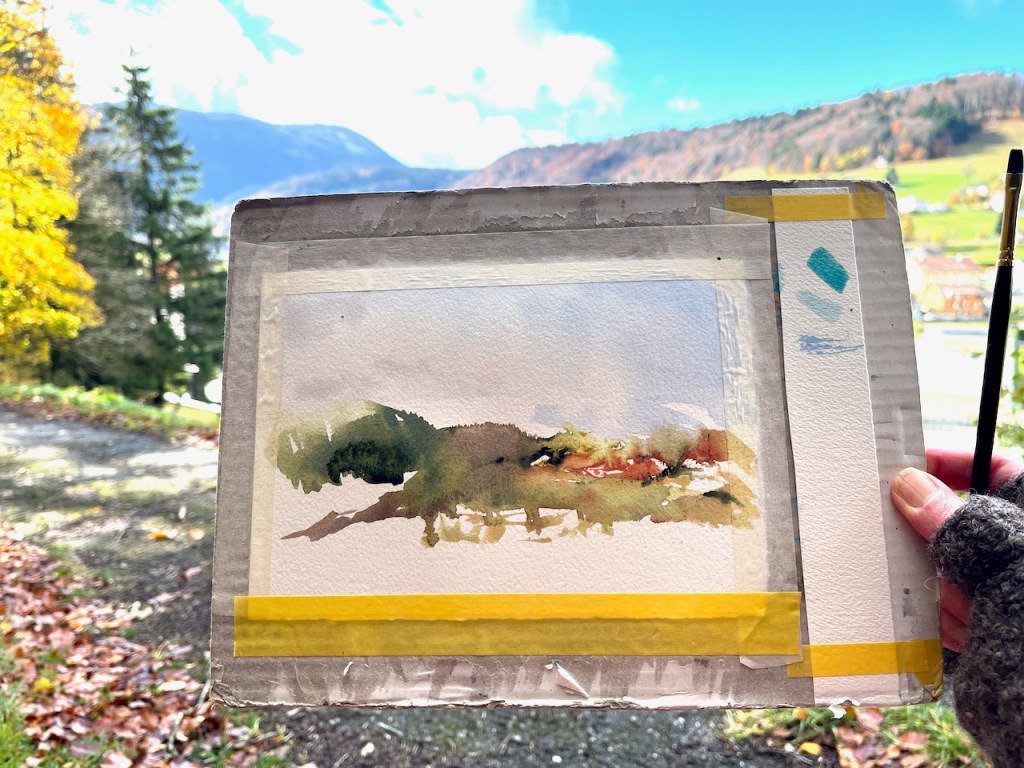
View over Sainte-Croix and the Mont de Baulmes, from Chemin des ChaletsWork in progress on the sketch
I sketched also in the village.
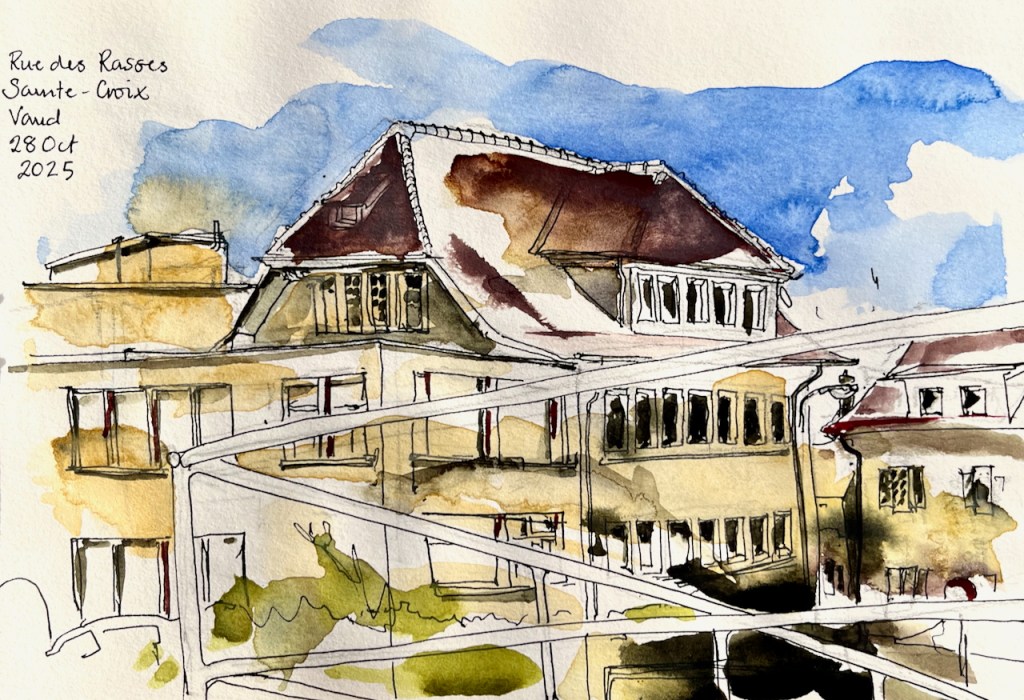
House, Rue des Rasses, Sainte-Croix
It is a season of clouds.
Jura scenes
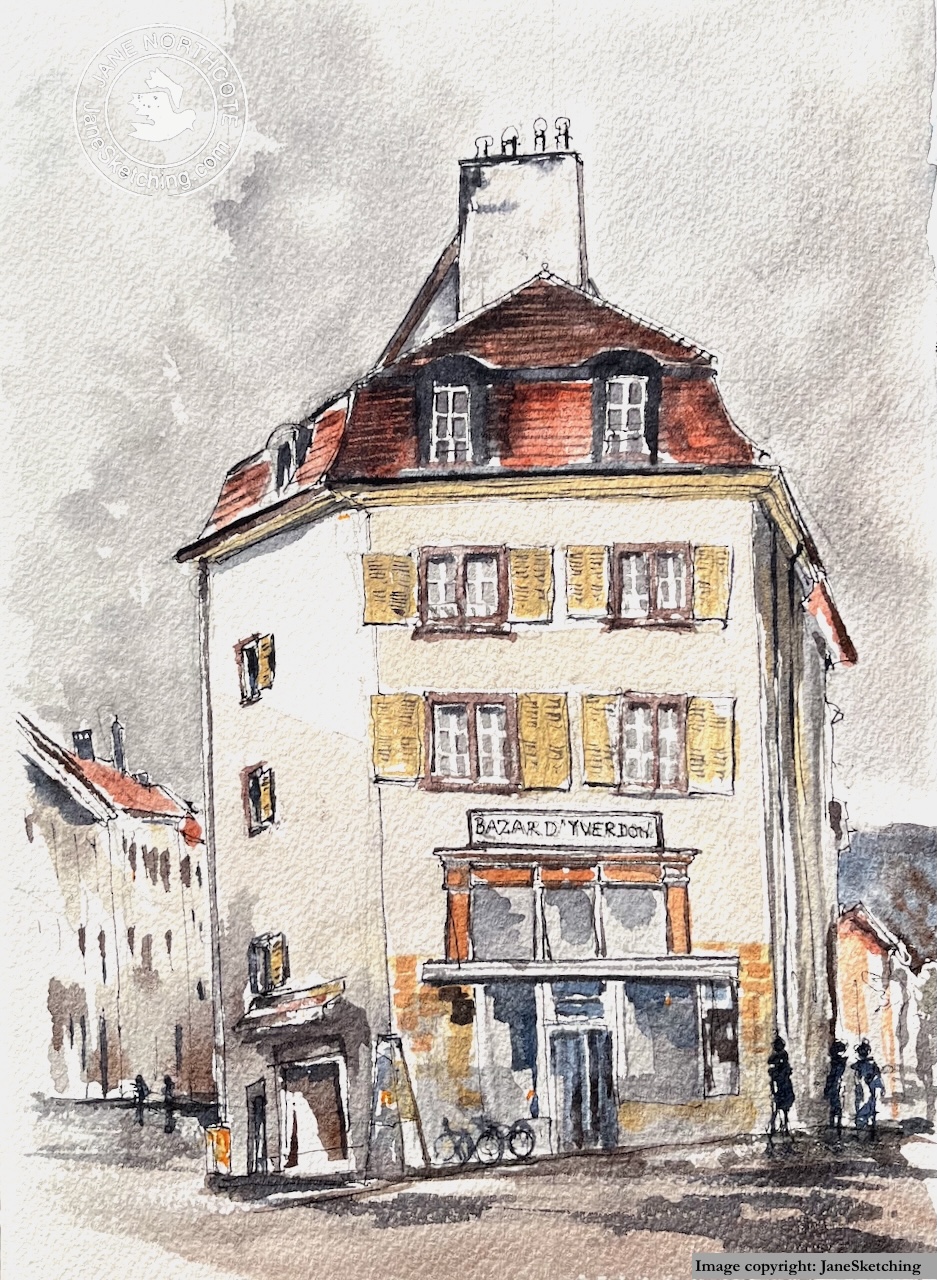
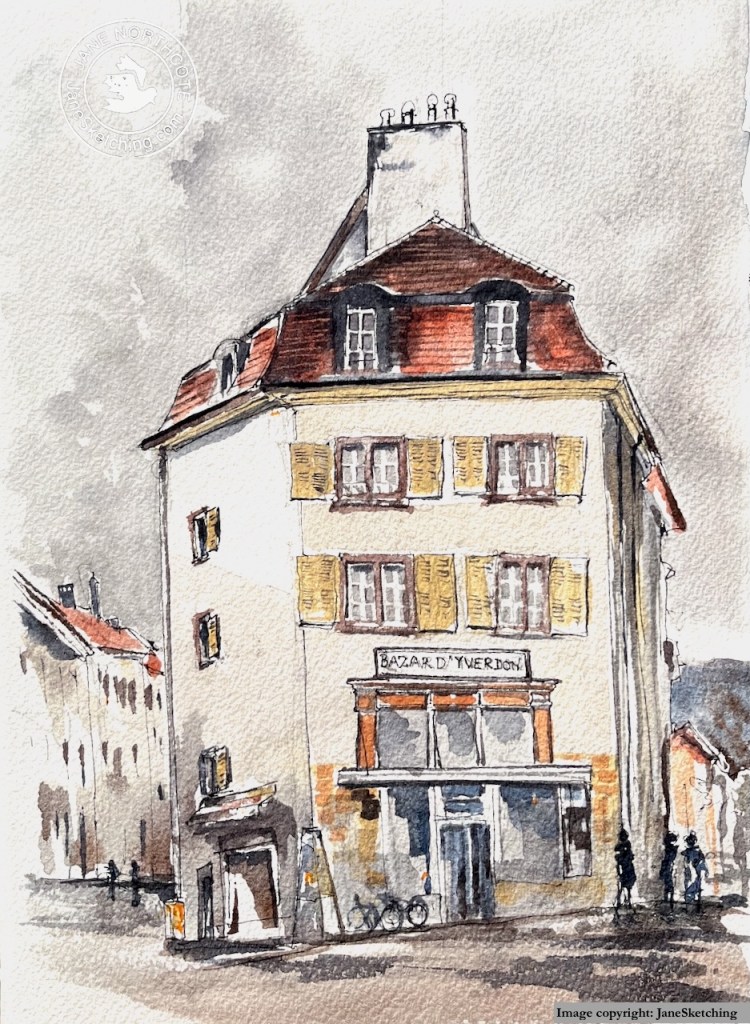
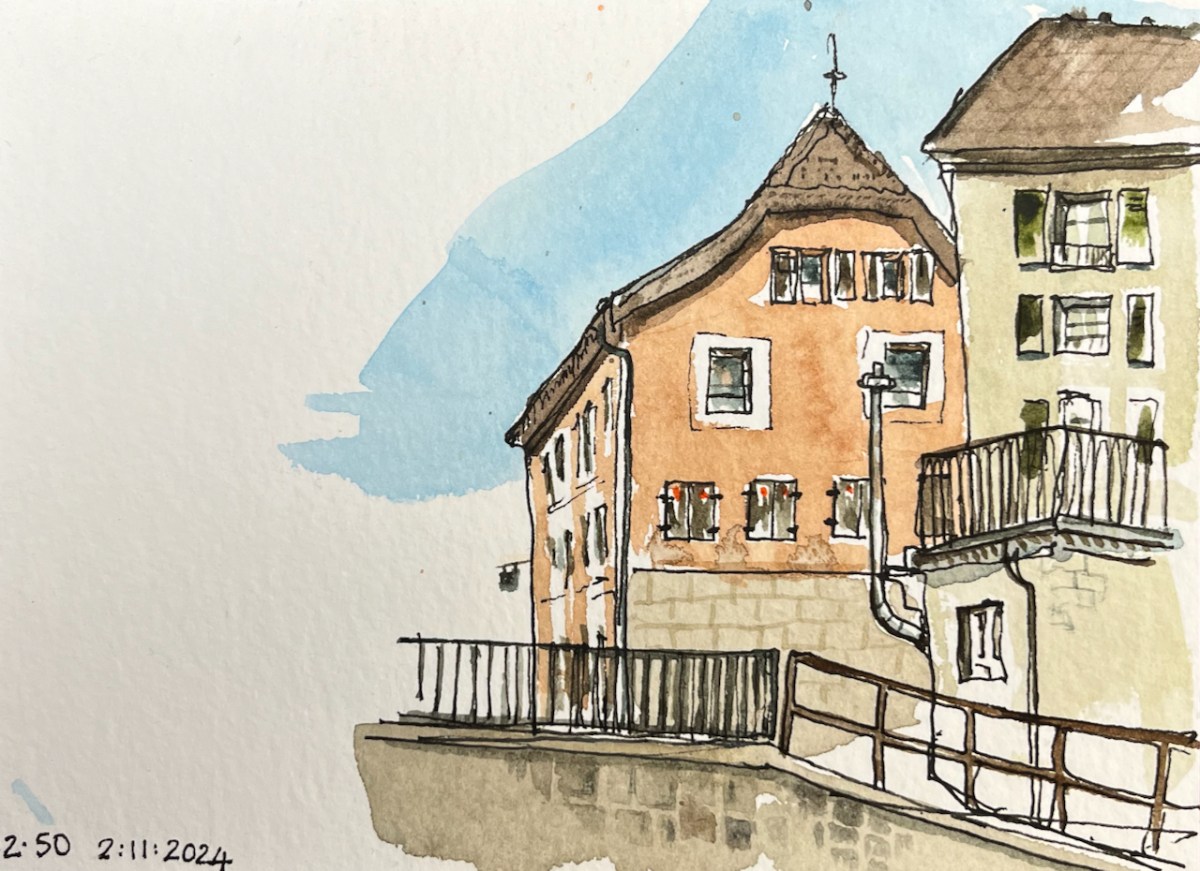
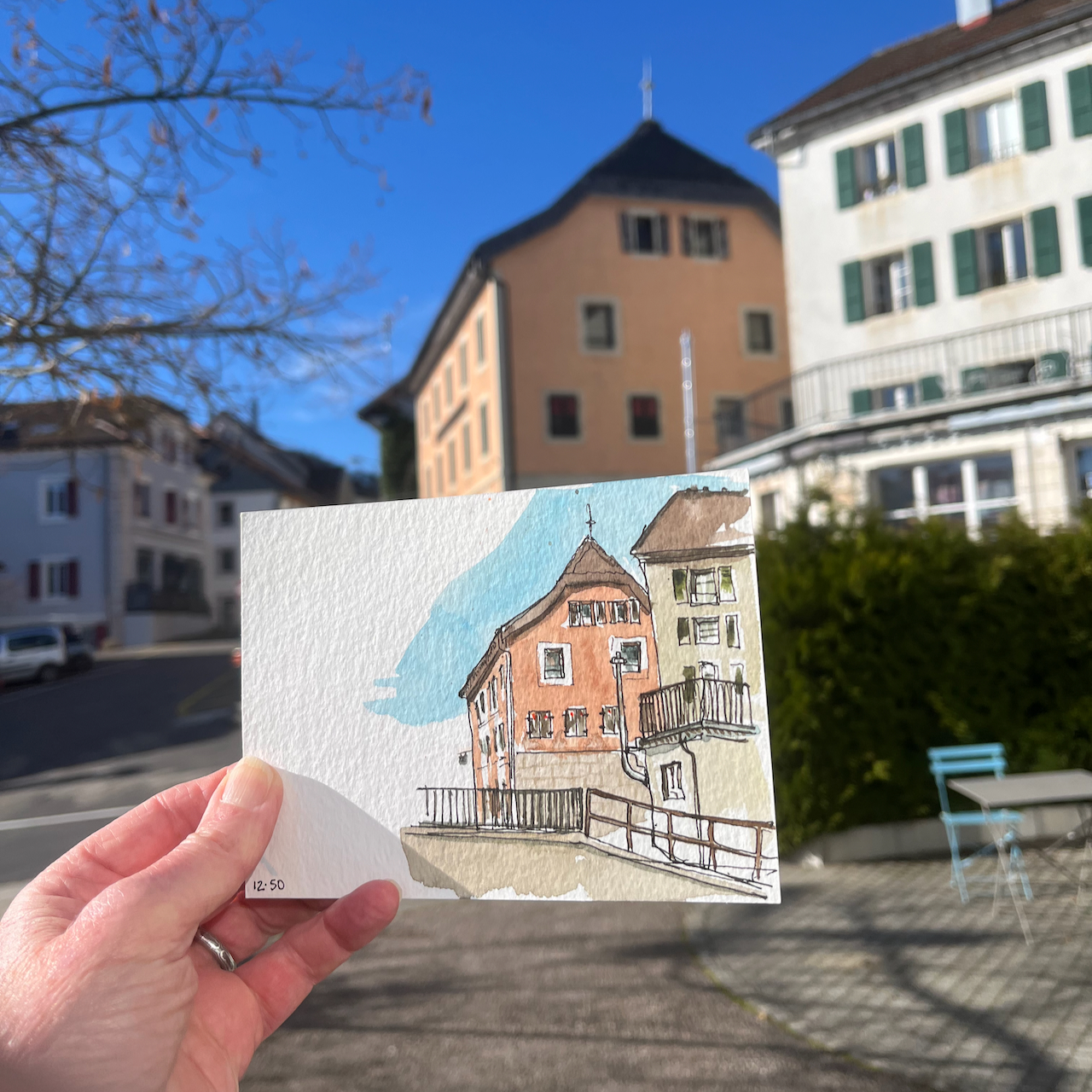
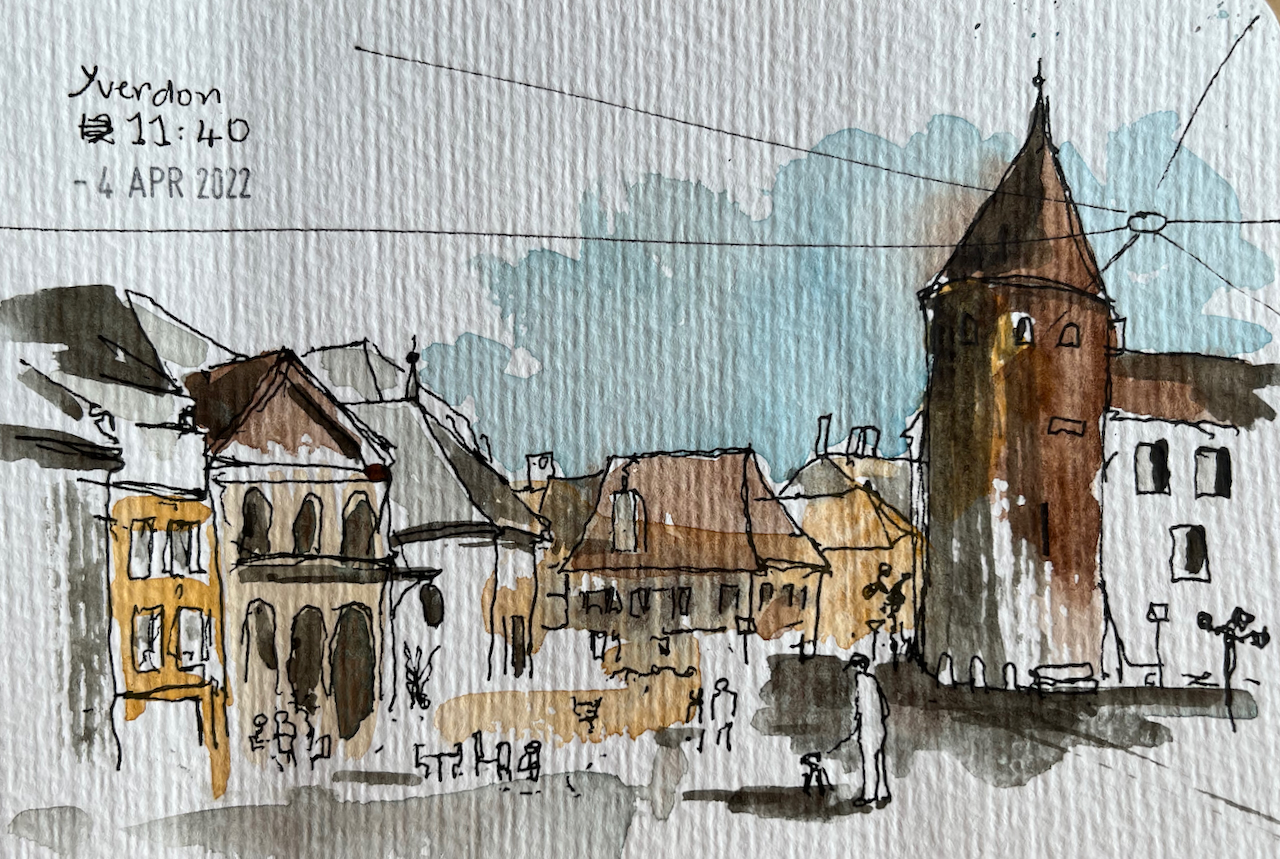
On an expedition to Yverdon-les-Bains I sketched in the Place Pestalozzi.
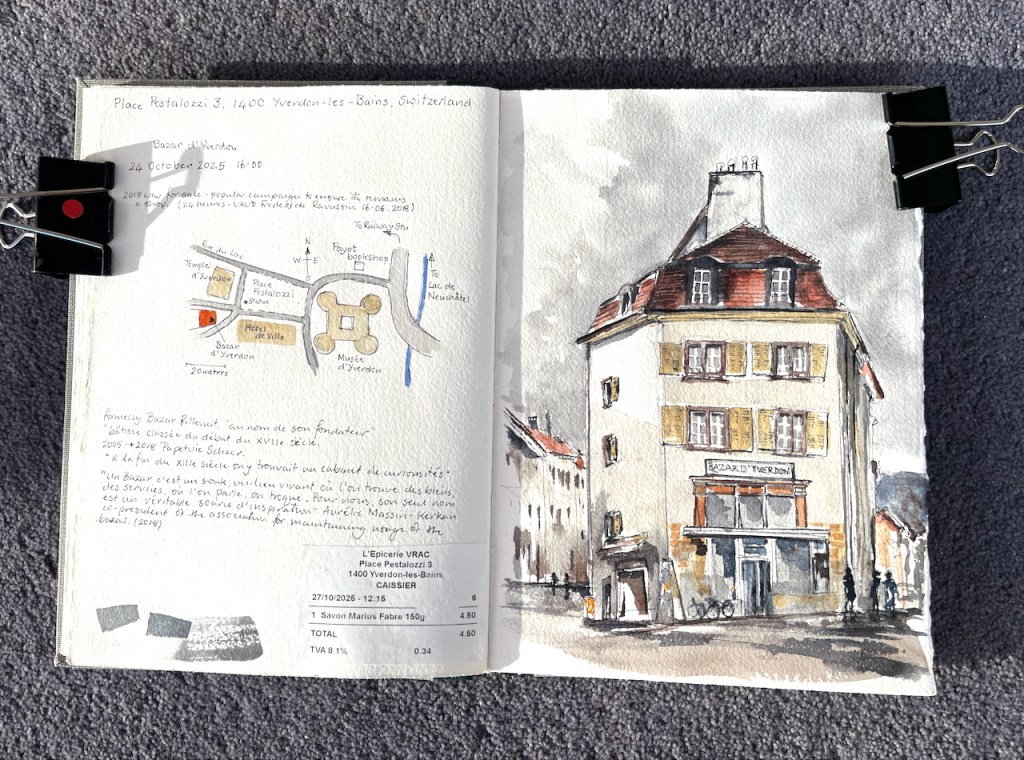
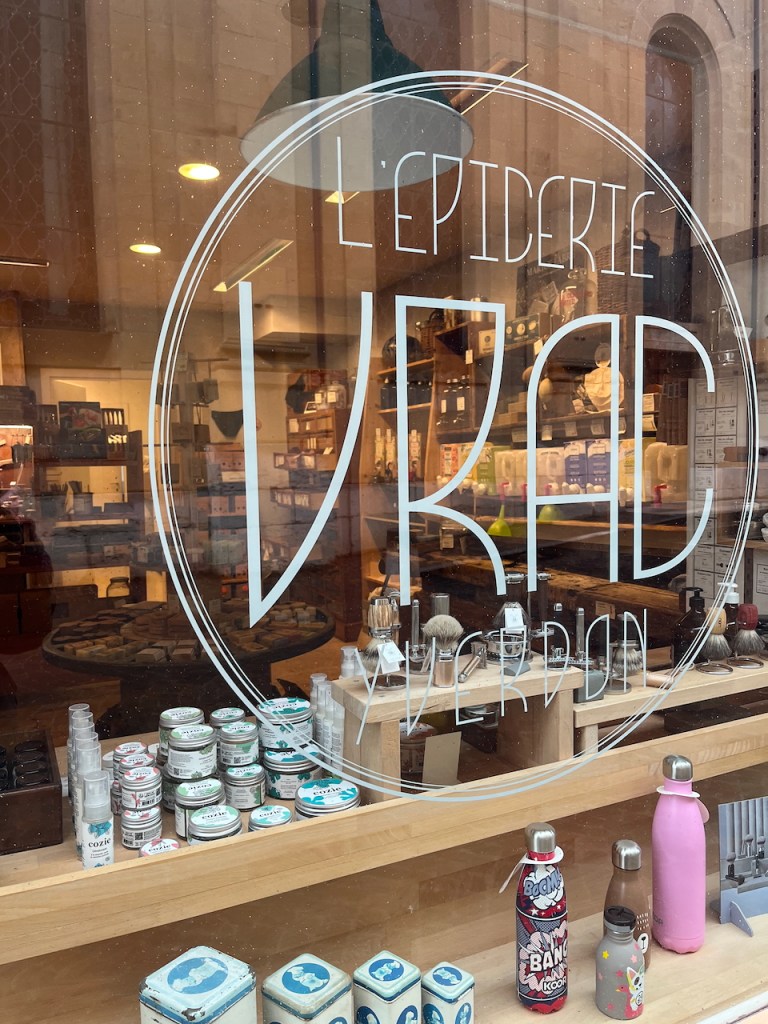
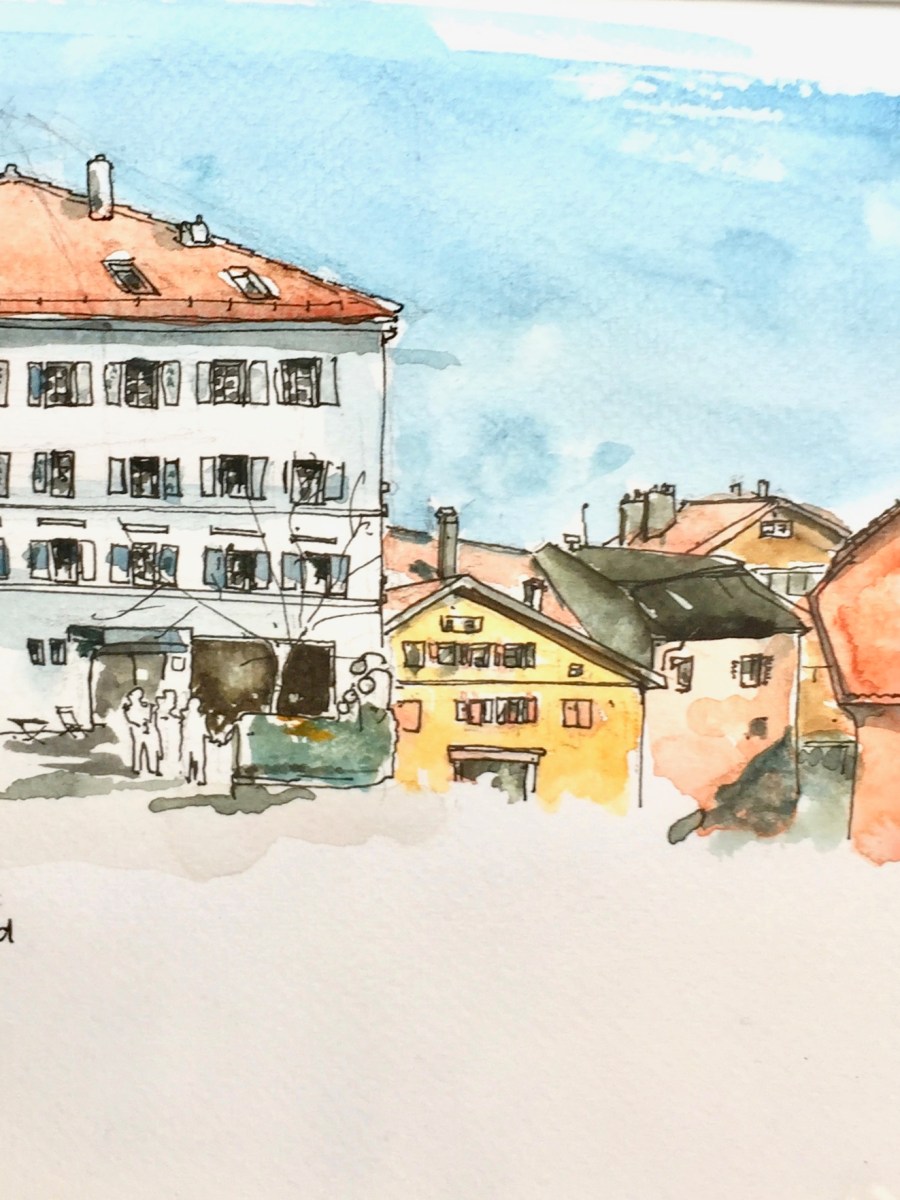
Bazar D’Yverdon, now L’Epicerie Vrac, Place Pestalozzi 3 1400 Yverdon-les-Bains
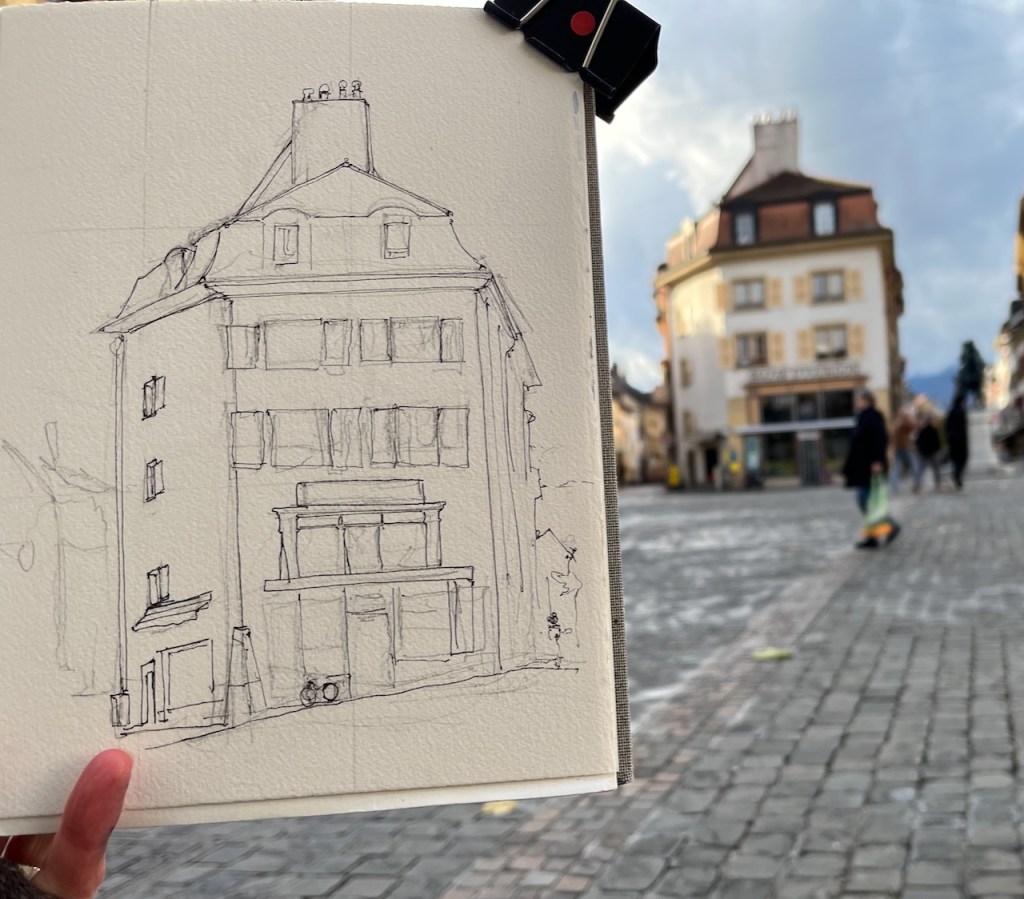
It was very cold. I just managed to complete the pen and ink sitting in the square. Then I finished the colour in my hotel room.
This building, Bazar D’Yverdon, dates from the beginning of the 17th century. There is an article in the local paper of 2018 (note 1), with some history of the building, and news of a campaign to prevent its being sold and transformed from a retail space into offices. At the time is was a stationary shop, Papeterie Schaer.
A bazaar is a souk, a living place where there are goods and services, where you gossip, trade. For us, the very name “Bazar” is a real source of inspiration.”
Aurélie Massin-Kerkan, co-president of the association for maintaining usage of the Bazar (note 1 – my translation)
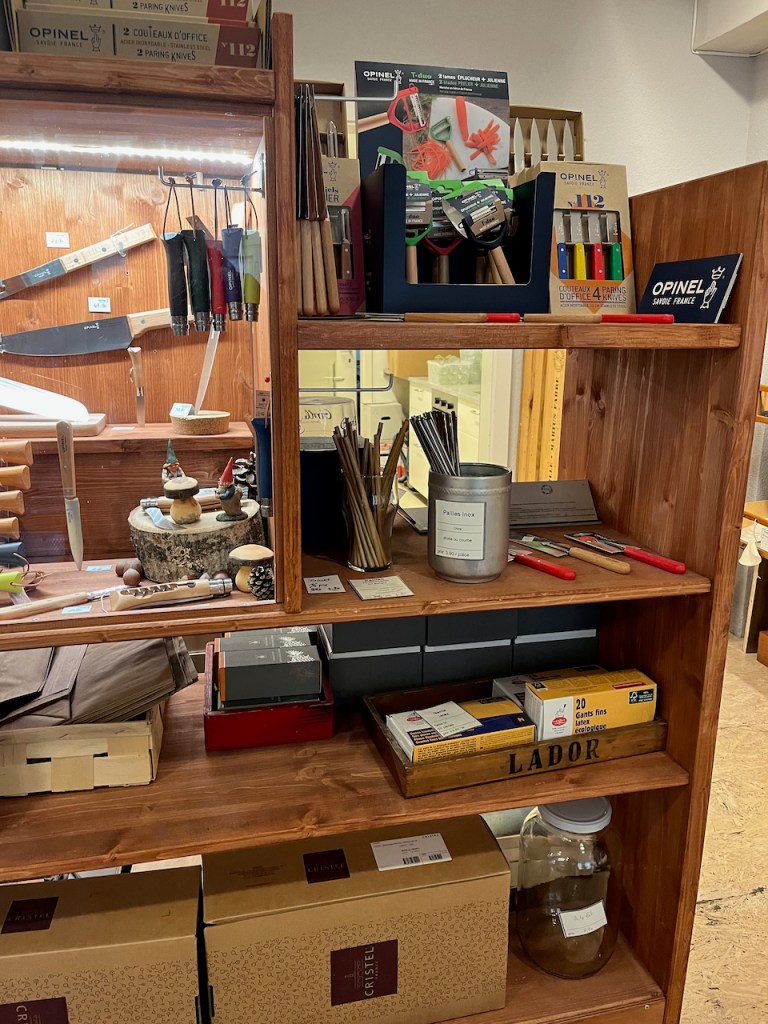
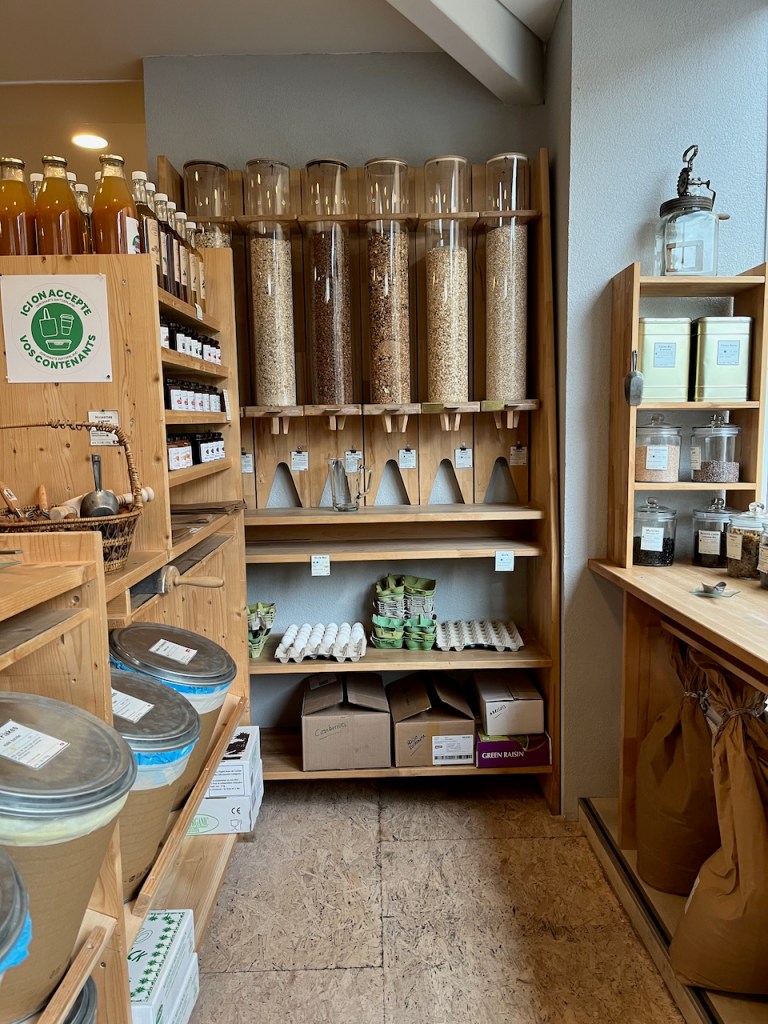
Evidently the campaign was successful. The shop on the ground floor is now a grocer “L’Épicerie VRAC”. I went in to have a look. It sells bulk household goods such as shampoo and muesli, as well as a huge collection of traditional items such as egg timers and kitchen knives and tea towels. The bulk items are displayed in dispensers, so you can fill your own container.
L’Épicerie VRAC
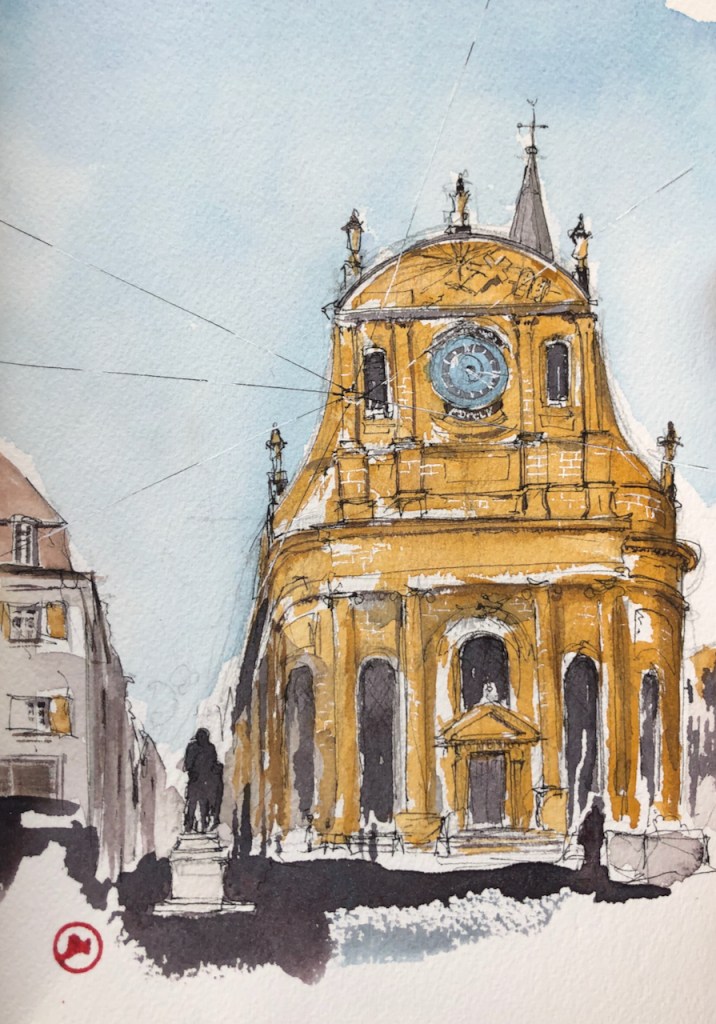
I’ve sketched in Yverdon before. Here is the Temple of Yverdon which is just to the right of the Bazar.
Temple d’Yverdon. The Bazar is the building on the left of this sketch. Click to go to my article about the Temple.
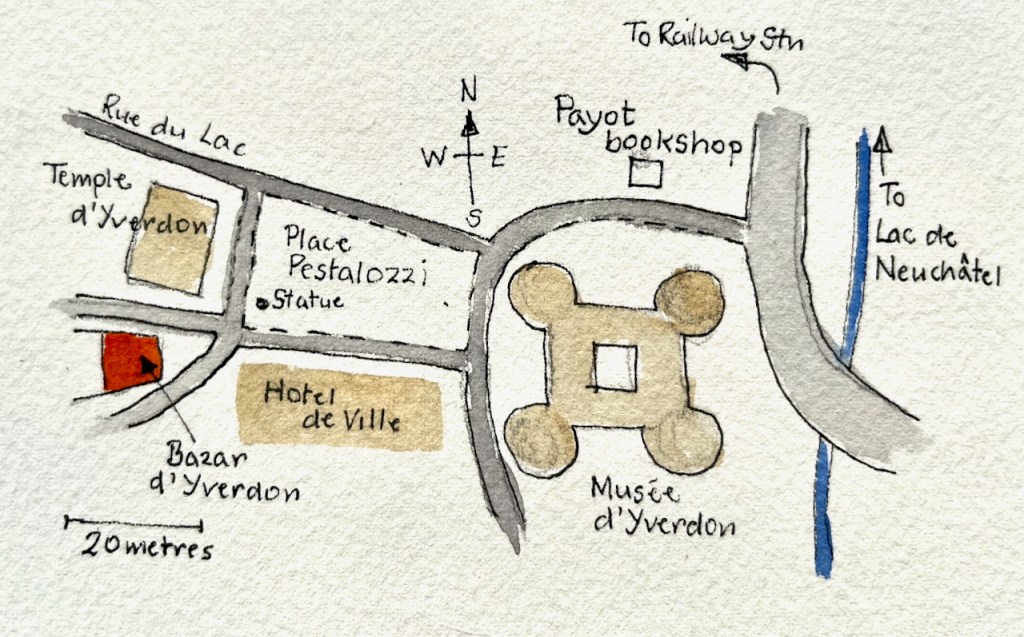
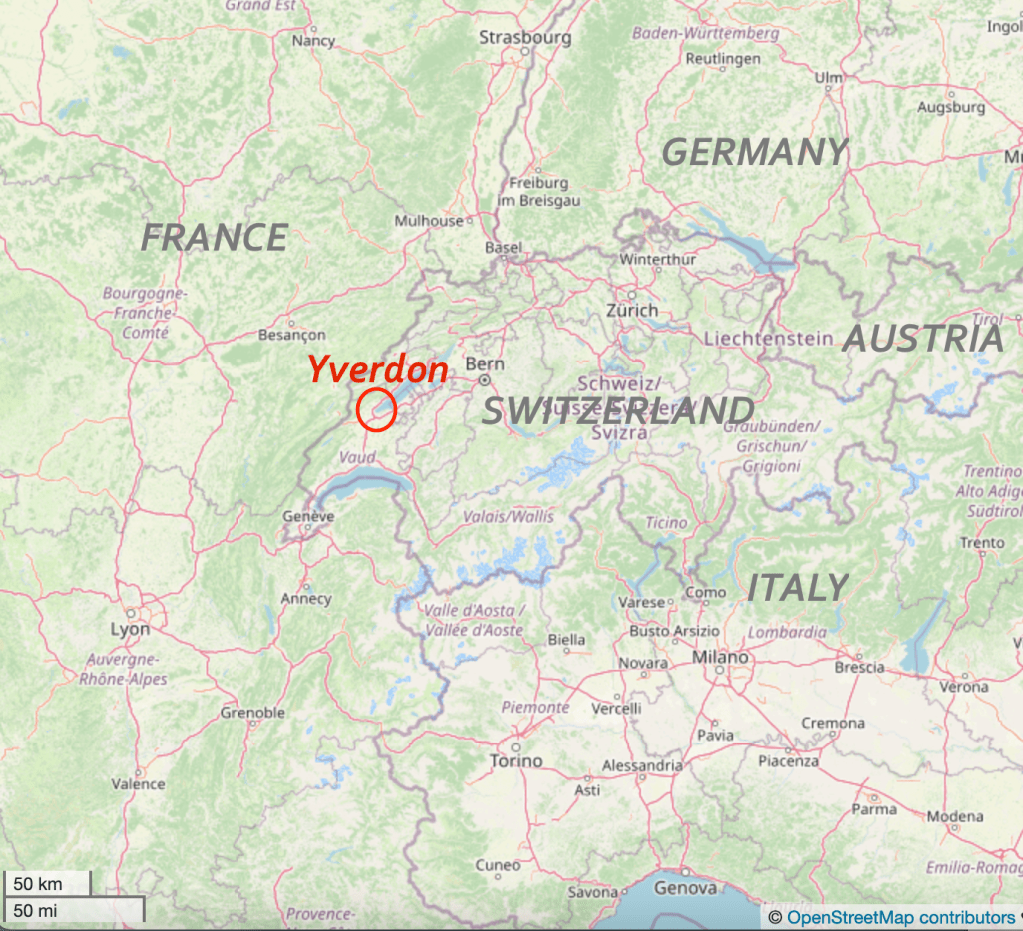
The maps below show the location of Yverdon, in the canton of Vaud.
Canton of Vaud is in the West of SwitzerlandLocation of Yverdon (c) OpenStreetMap contributors
On the Place Pestalozzi
Note 1: The local paper article about the Bazar is in the archives of “24 heures – VAUD”. It is by Frederick Ravissin, 16 June 2018. Read a pdf of the article here (in French) – link below:
Here are postcards from Switzerland, sketched quickly on 4″ x 6″ watercolour postcards.
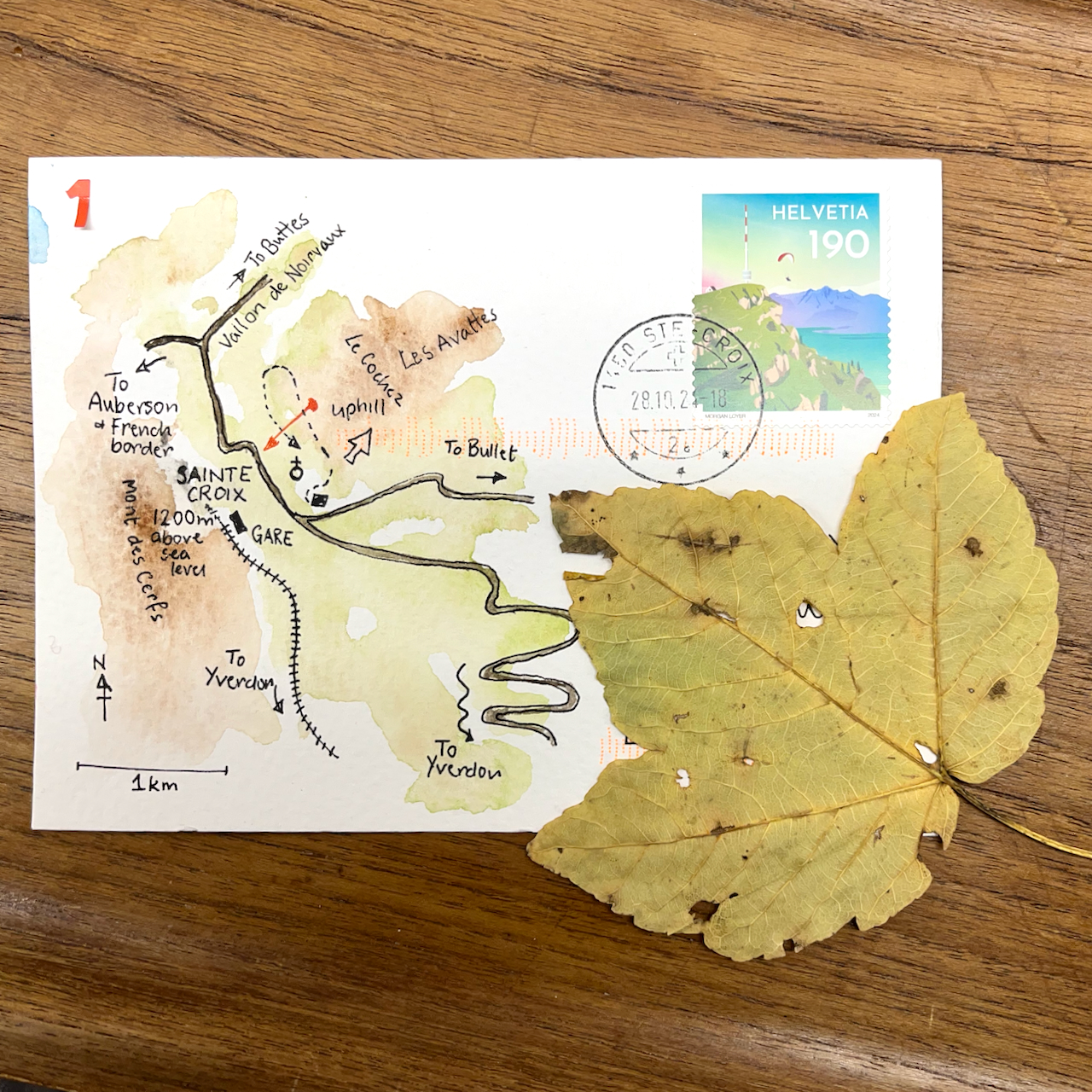
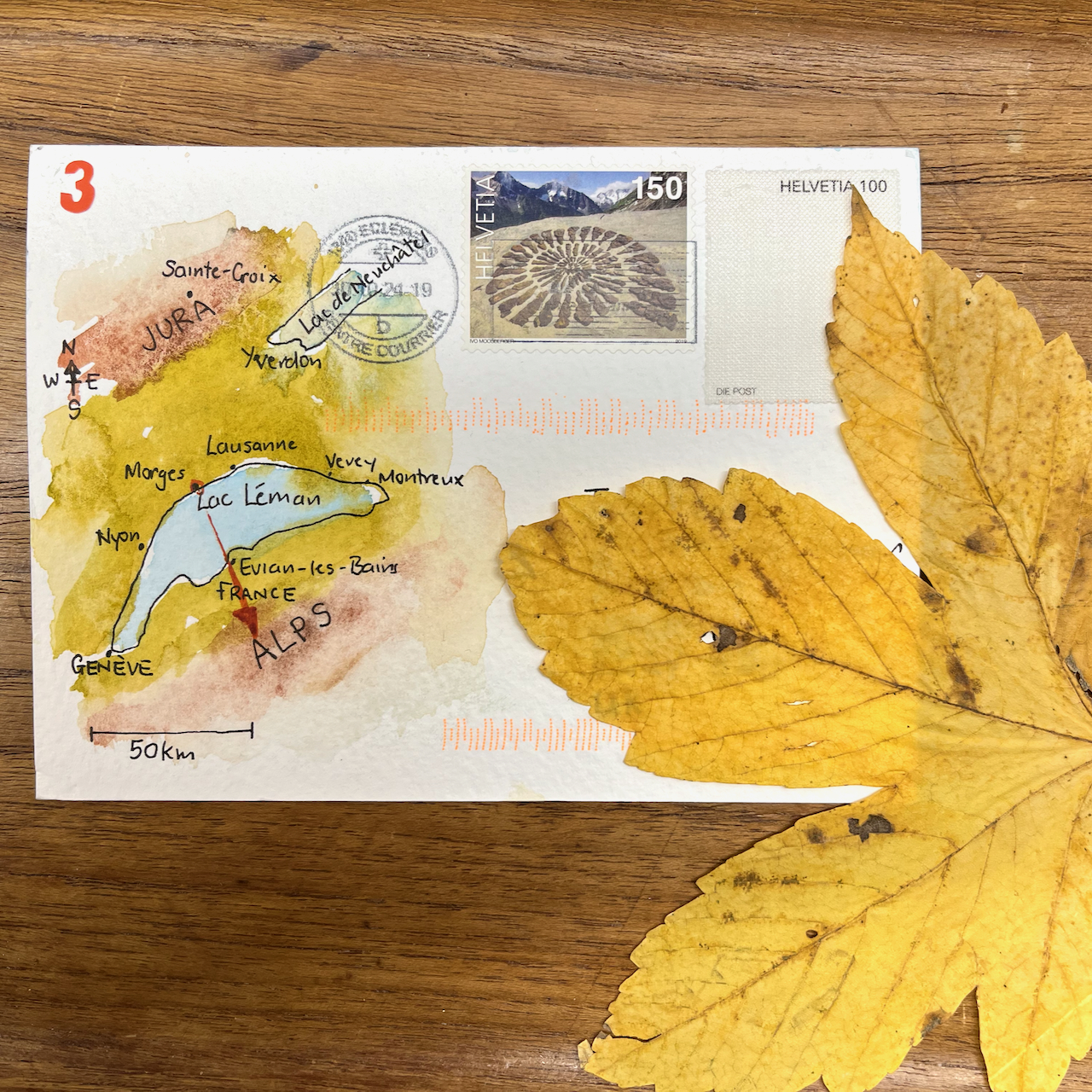
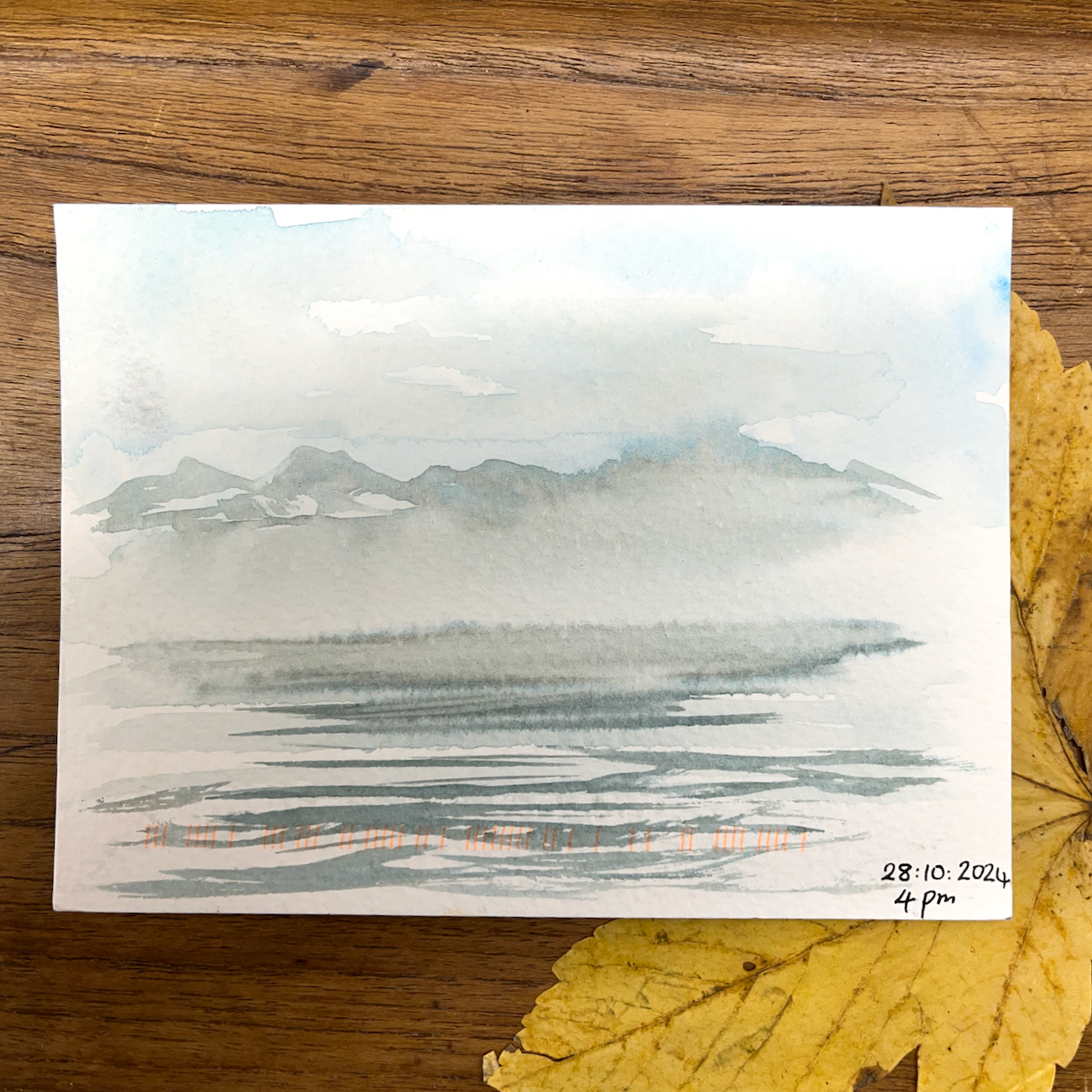
A walk above the villageLooking across Lake Geneva from MorgesFrom Les Praises, looking across to the Alps The Alps above the fogSketching in Sainte-Croix, Vaud (1000m)
It was foggy in the valley, and clear at 1000m.
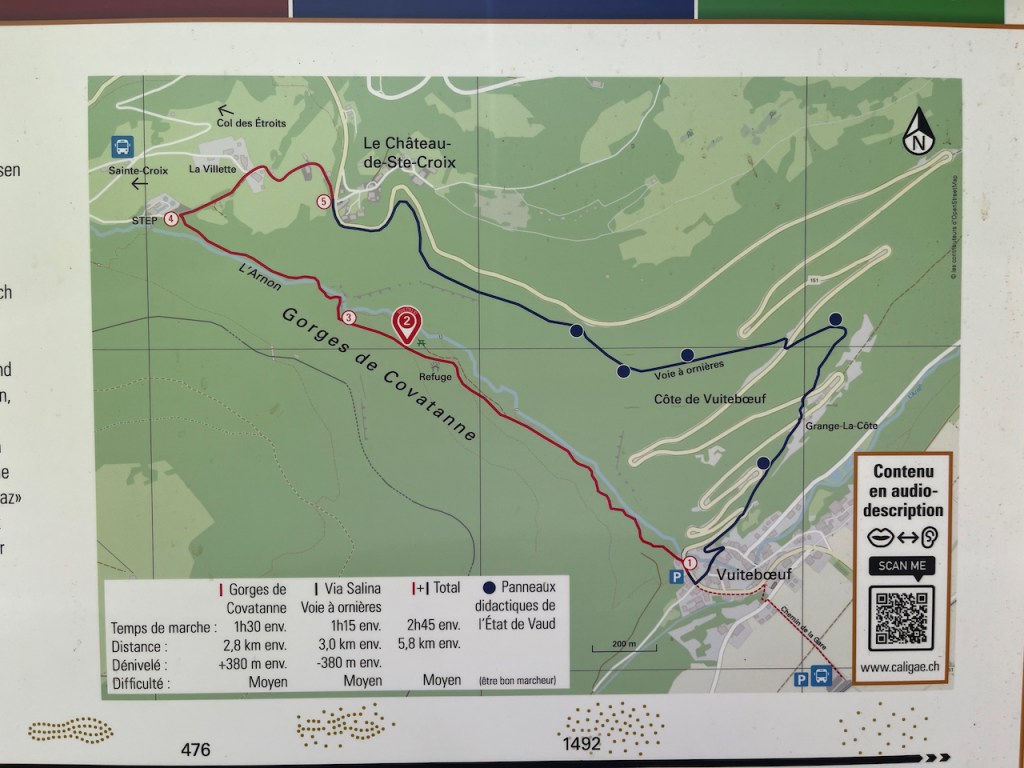
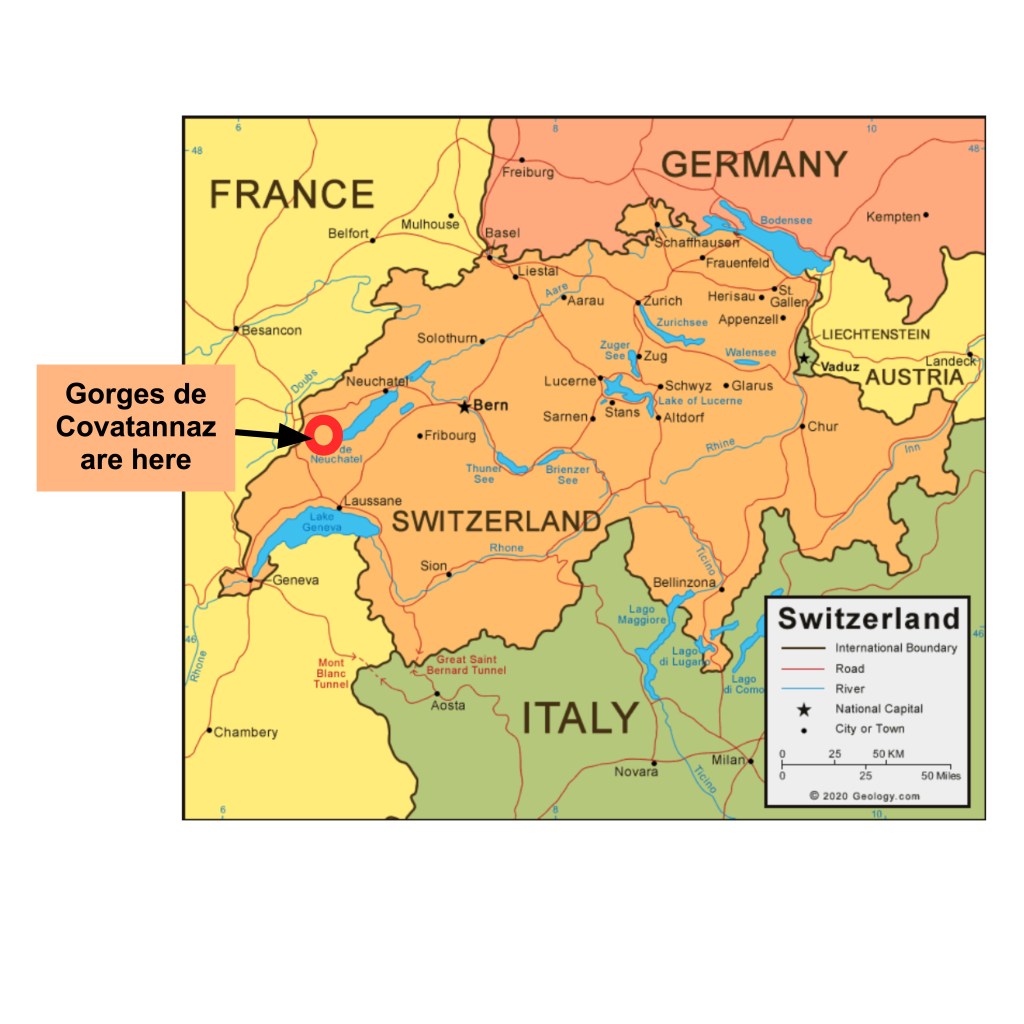
One day, starting early, my hosts dropped me in the village of Vuiteboeuf, which is at the lower end of the Gorges de Covatannaz. I walked up, through the fog. It took about an hour and a half. I’d intended to sketch and I had my watercolours with me. But the fog made it surprisingly cold, and I didn’t want to stop or I would freeze. I was warm so long as I kept walking. So I made very quick sketches using Derwent “inktense” watercolour pencils. Here are my sketches in video format.
Here is the view over the Gorge, from the fields at the top.
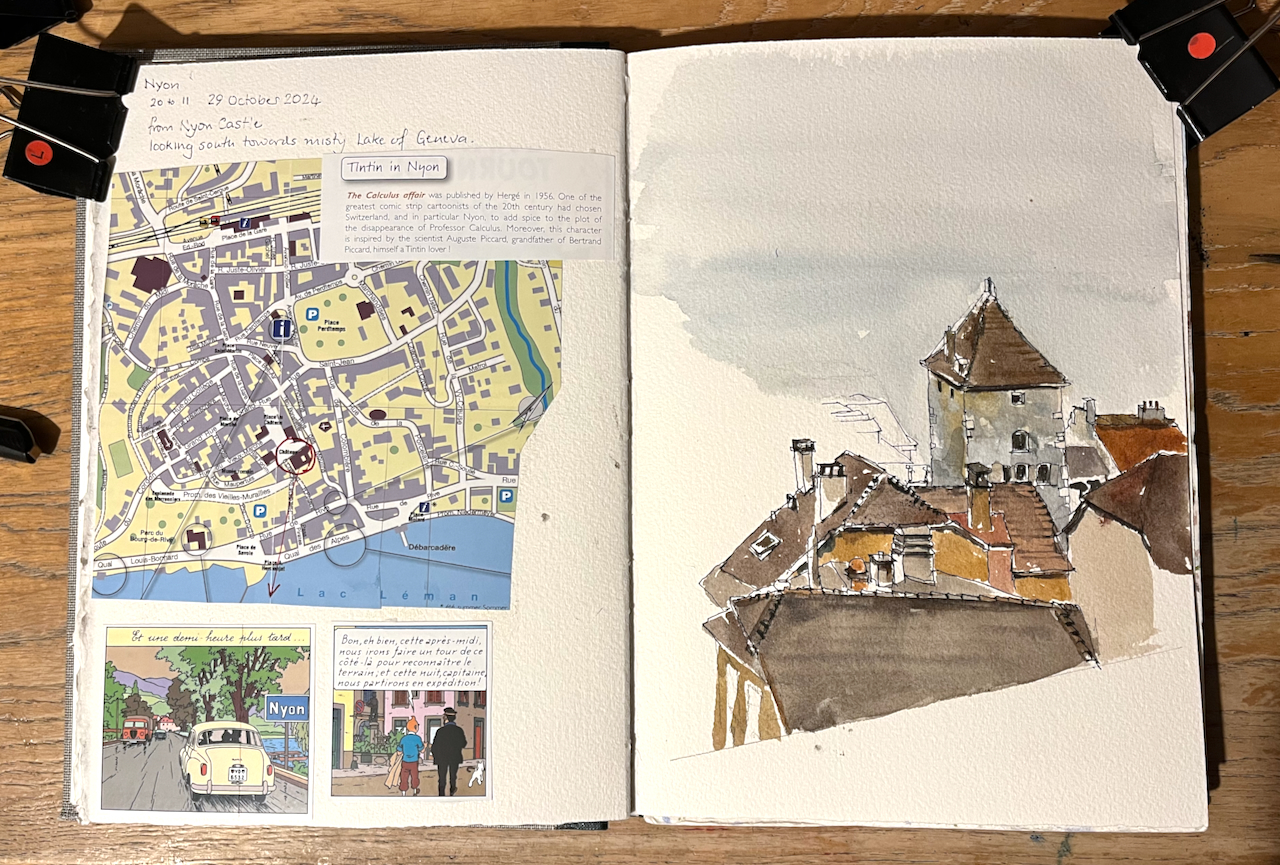
My visit took me to Nyon, on the shores of Lake Geneva. I made a quick sketch from the walls of the castle. Did you know that the Tintin story, “The Calculus Affair” was set in Nyon? The tourist office made much of this connection.
Sketchbook 15, Nyon page spread.
Switzerland is beautiful in the Autumn. Thanks to my hosts at the Hotel de France, Vaud, for their hospitality.
Click a button below to share this post online, email it, or print it:
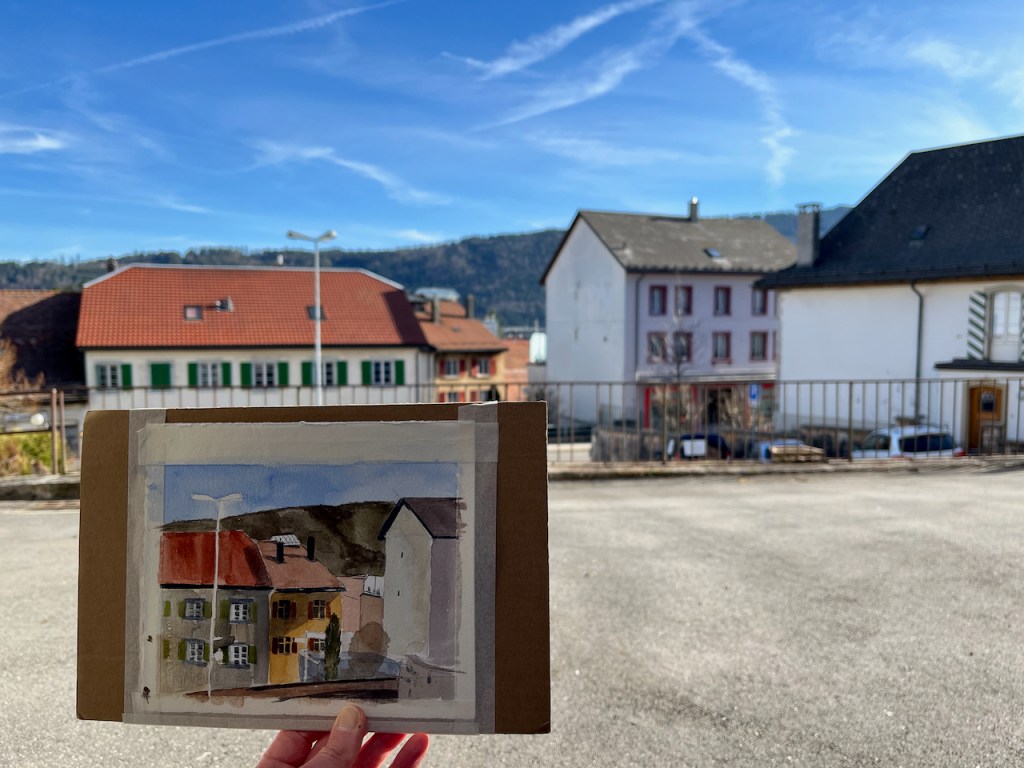
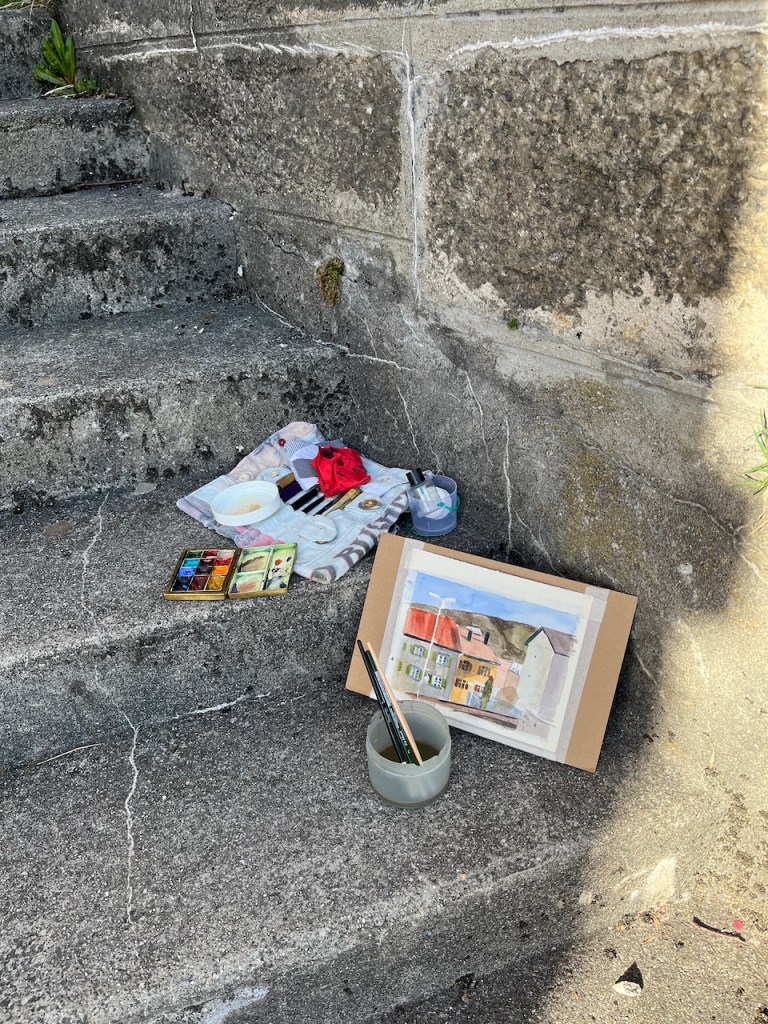
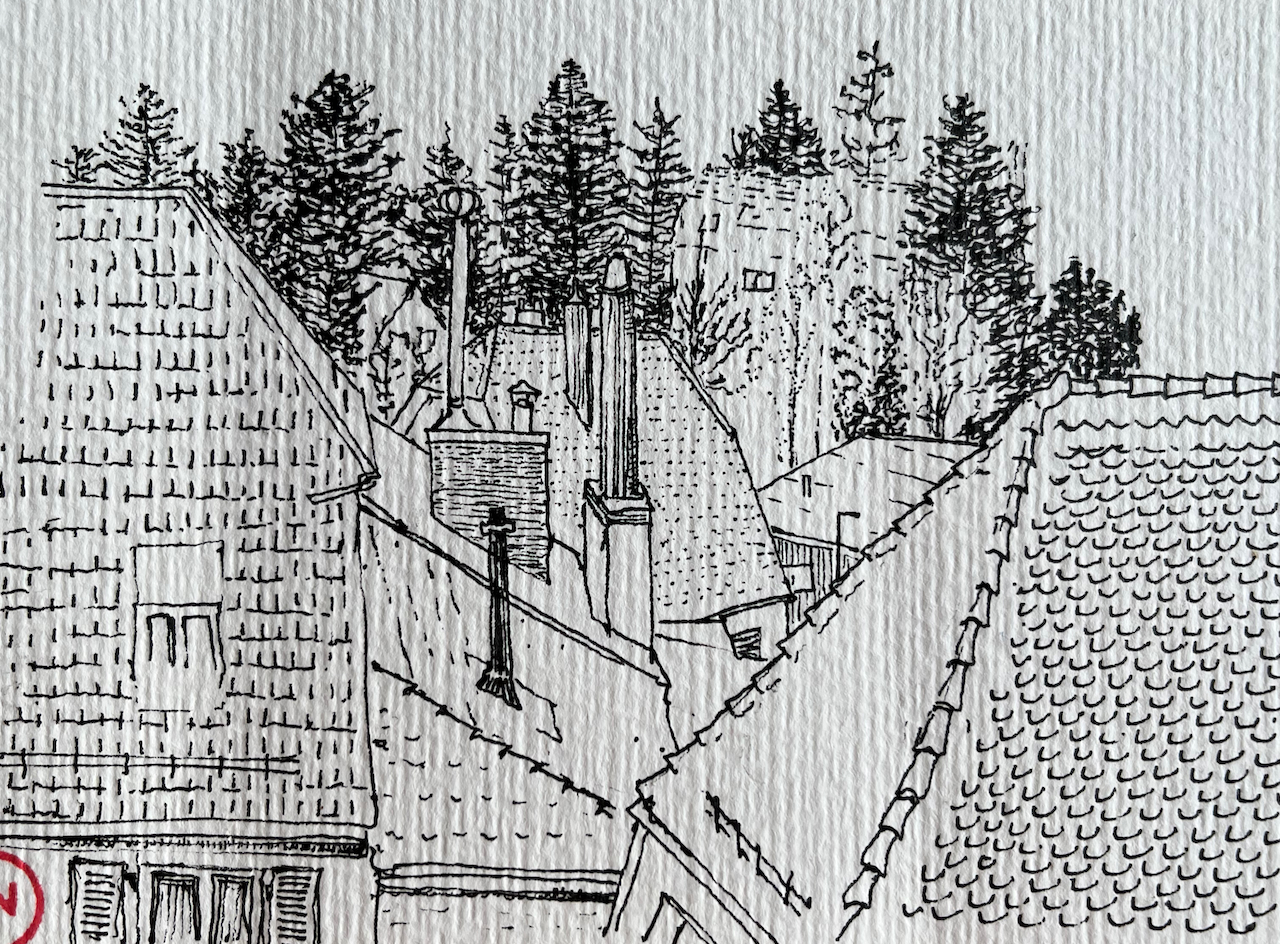
In the afternoon I sat down on the stone steps and sketched the houses that were in front of me.
Sainte-Croix houses, 8″ x 6″ postcard on Arches Aquarelle 300gsm paper. March 2024
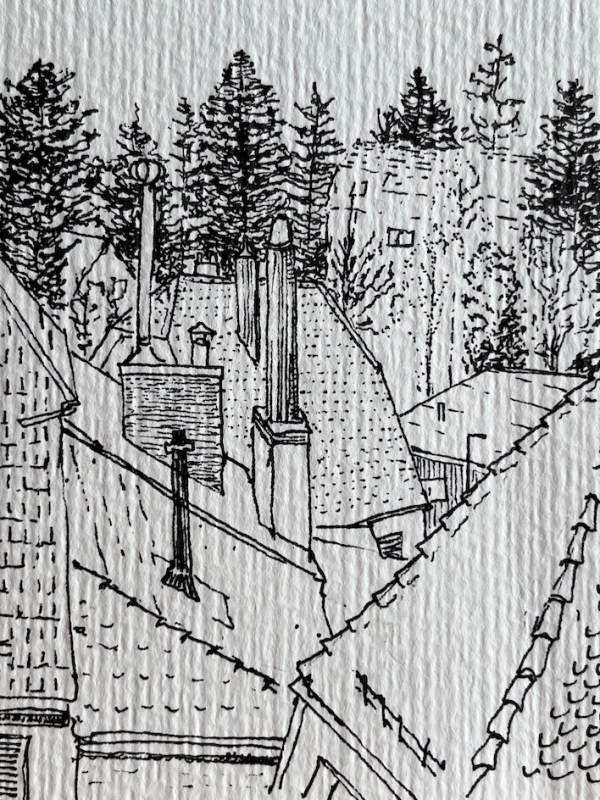
I was struck by how the afternoon sun cast shadows on that glass screen, centre left, and illuminated the little greenhouse-type roof on the house in the centre. These are solid Swiss houses, with heavy tiled roofs and properly operational shutters. Some of the metalwork, such as the guttering and the surroundings of the chimney stacks, is in actual copper. Even the downpipes are copper.
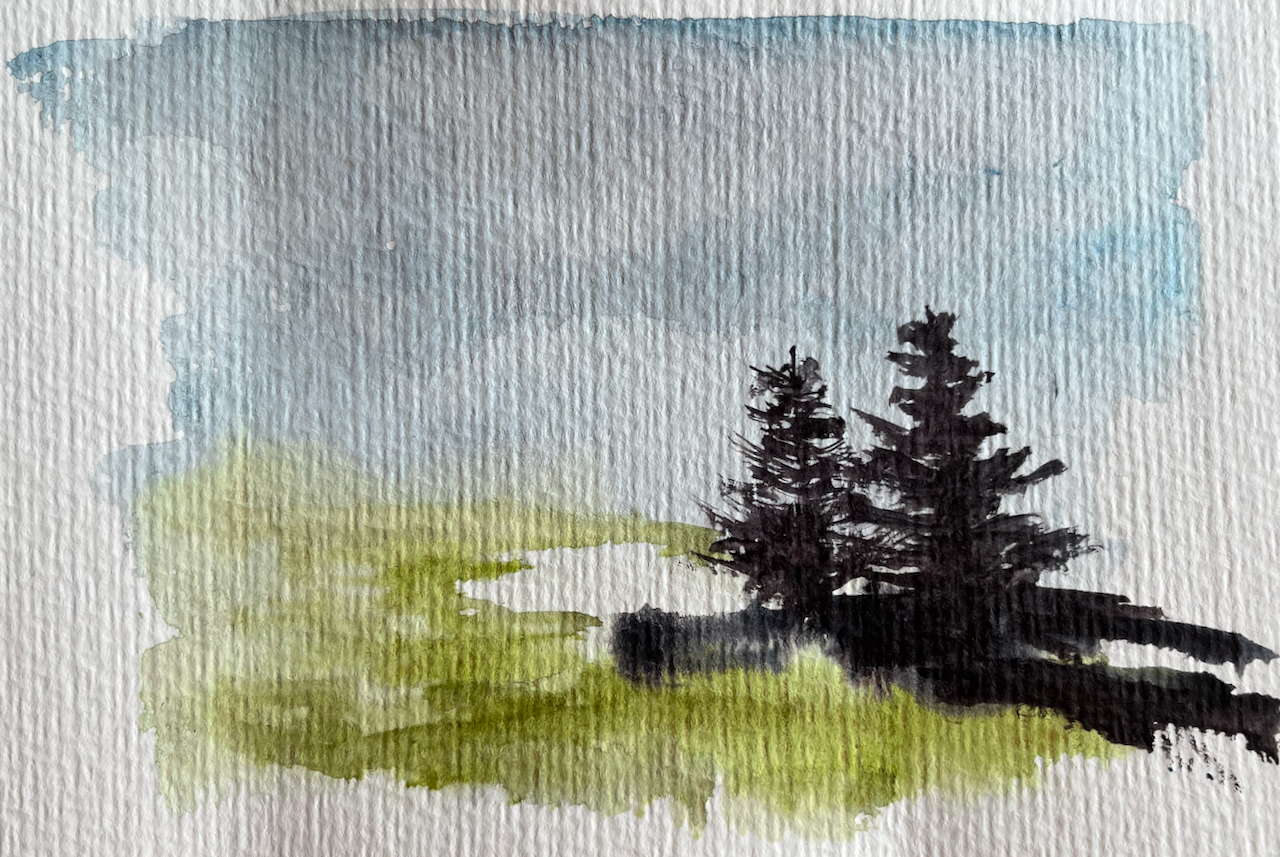
One tree was a fir tree and was opaque. The other tree was twigs, and was transparent.
Although it was spring, this is at 1200m, and it was cold. The deciduous trees are still bare. The hill is the background is Mont-de-Baulmes. Many of the trees up there are deciduous larch.
I painted this picture in watercolour-only. Usually I use pen. Here, I did a quick pencil sketch and then straight on with the colour. It was too cold to try to get any details or do any penmanship. The solid plainness of the houses seemed to demand flat colour washes. I deliberately left lines of white between the slabs of colour – the sun always catches edges.
Work in progress22 March 2024 16:30
Click a button below to share this post online, email it, or print it:
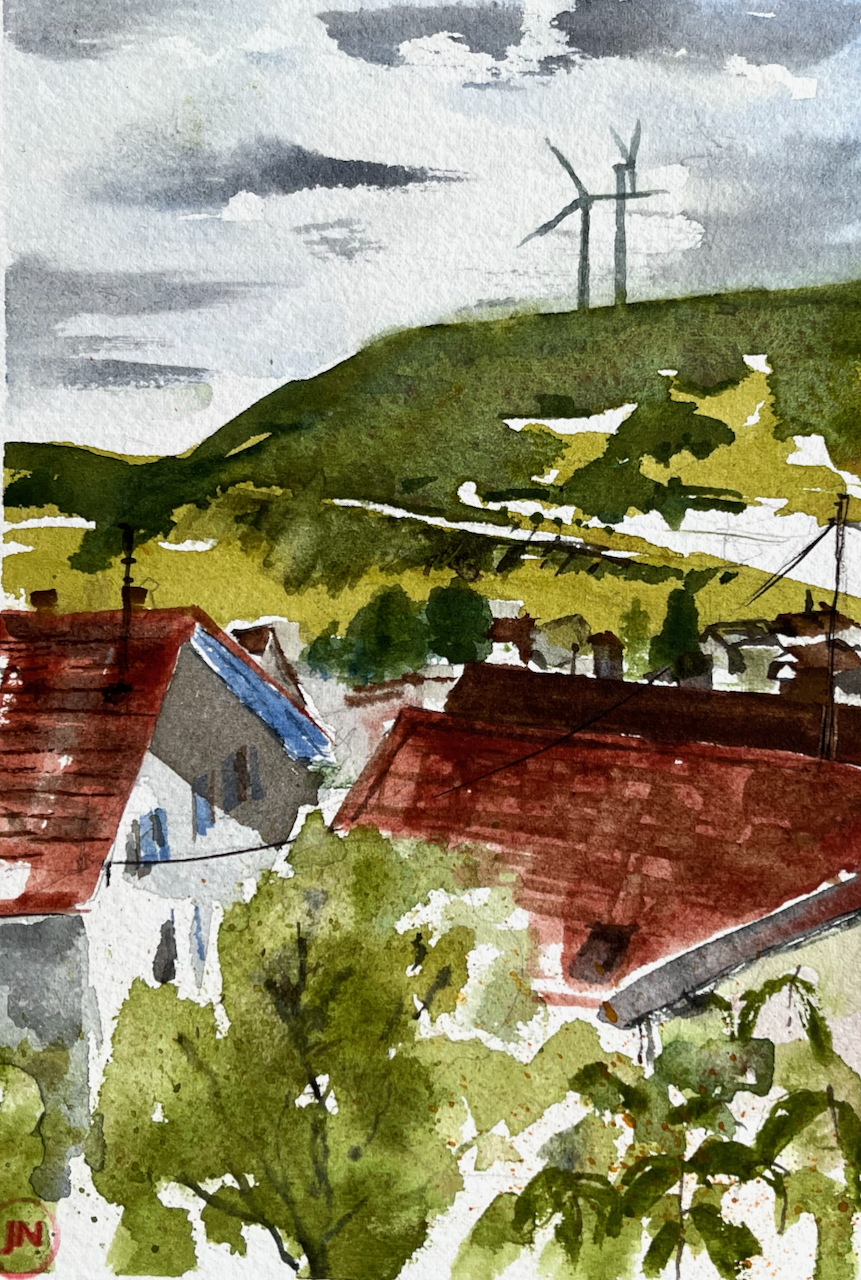
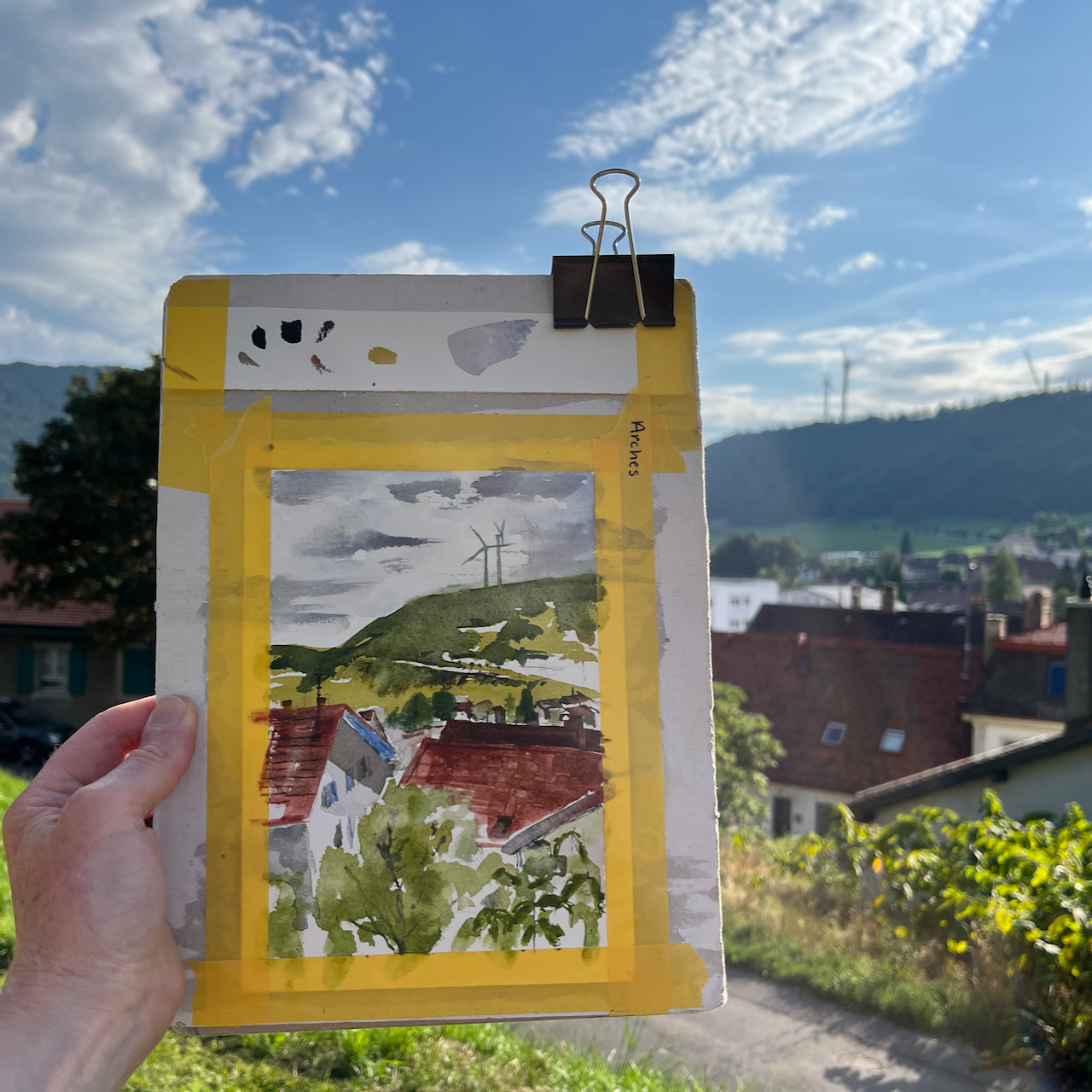
In the Swiss hotel there was much talk about the wind turbines. They are being constructed on a nearby hill. I could see them from a bench by the church.
Wind turbines above Sainte-Croix, Vaud 6:30pm, 16th August 2023. A5 Arches 300gsm NOT
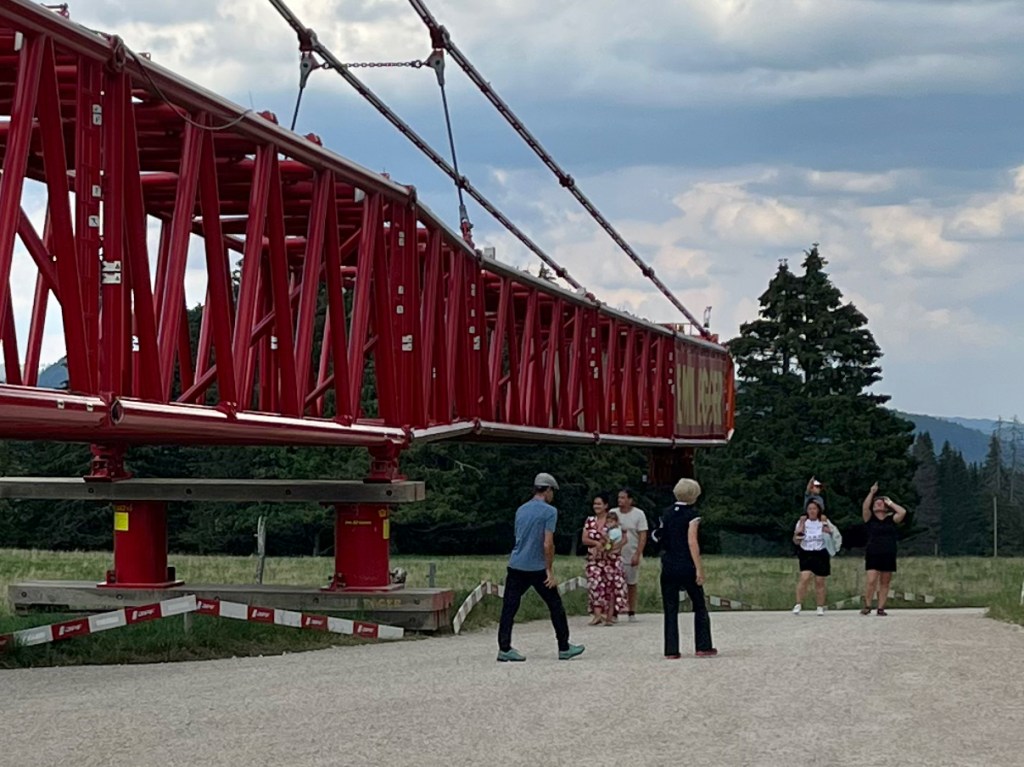
People said, you should go up there and see them, you can get very close. So on Sunday afternoon, we visited the construction site. There are information placards and a visitor car-park. Plenty of local people were up there viewing the machinery. The general atmosphere was one of curiosity and admiration.
It was a Sunday afternoon family outing: Let’s go and see the wind turbine construction site…
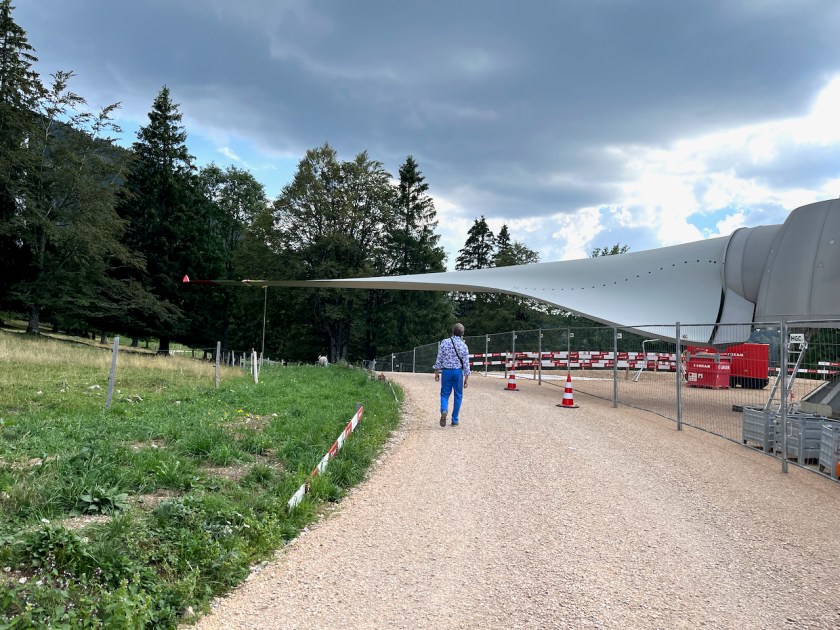
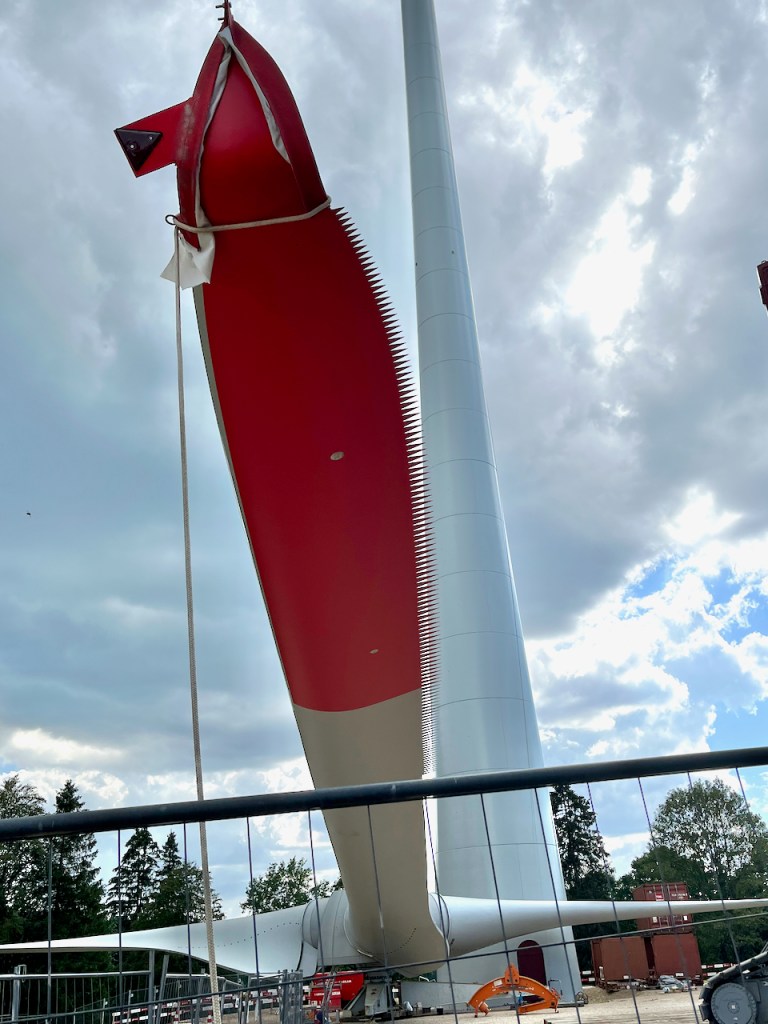
The blades are huge. 43 m.
The enormous blades, ready to raise.The blades have serrated trailing edges
As a British person, I was surprised at the openness. As it was the weekend, the site had no workers. The fascinating machinery was separated from us by some notional fences. It was supervised only by a few CCTV cameras on a stand. Perhaps there were also hidden ones. As you see from the photos, we could get close, and walk freely around the crane. My Swiss companion was surprised at my surprise.
It was also remarkable how positive the feeling was amongst the sightseers. A local person said that in the past they had been opposed to the turbines, but now that construction was started, they could see how clean and organised it was. “It’s better than a nuclear power station!” they observed. There’s no immediate benefit for the local people: they do not get a reduction on their bills. “But it’s better for everyone.” I was told.
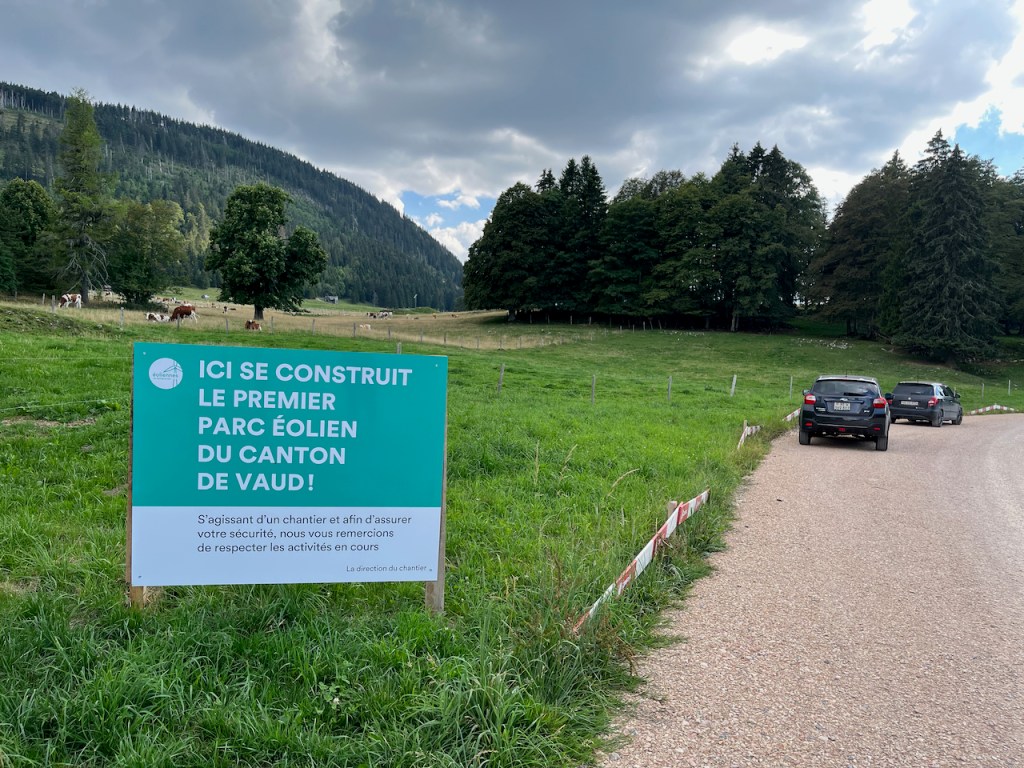
“Here we are building the first Wind Turbine park in the Canton of Vaud”. Note the line of cars to the right: local people have come to visit the construction site.
The next day, Monday, my host came rushing up to me as I returned from a walk. “Quick, look! They are raising…”. We found a vantage point. There, on the distant hill, the blades were being raised up the mast by the crane. They moved very slowly, but definitely, “like the hands of a watch” said my host. For that Swiss person, this engineering feat had become a source of local pride.
Click a button below to share this post online, email it, or print it:
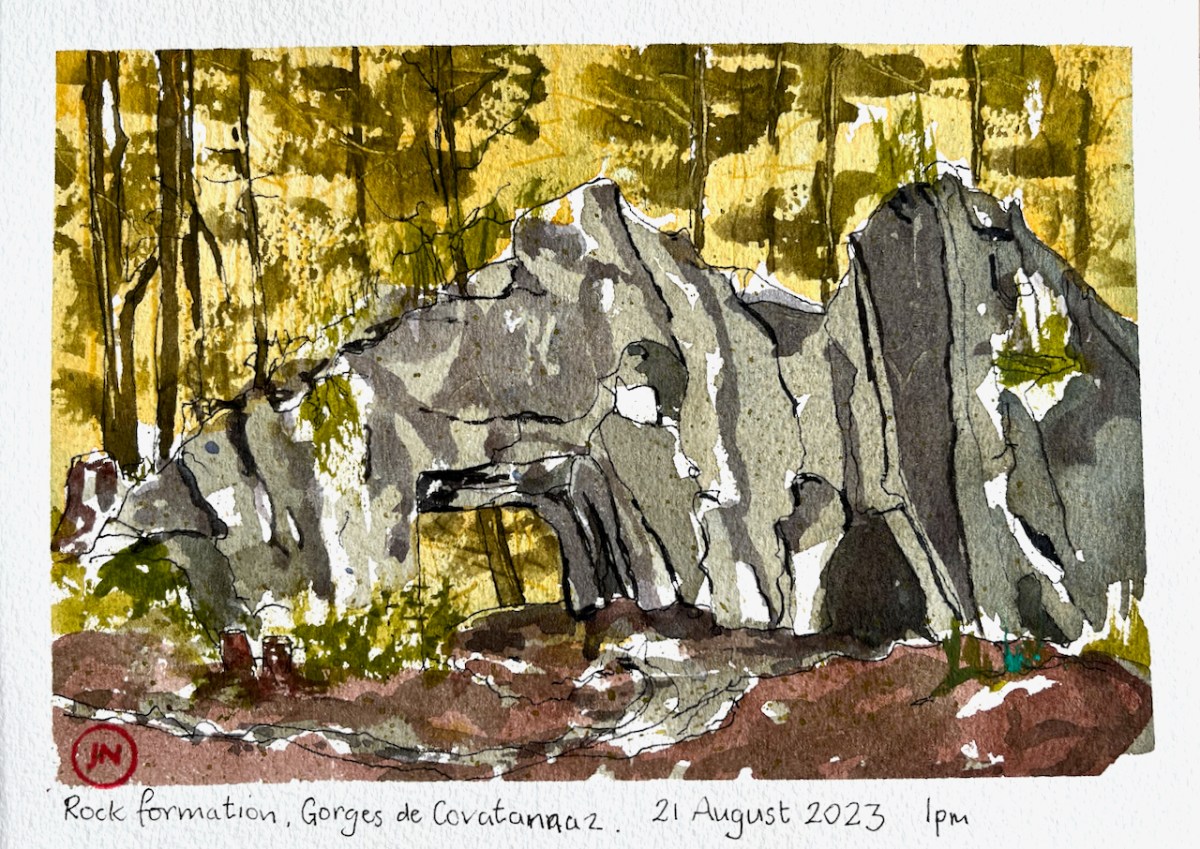
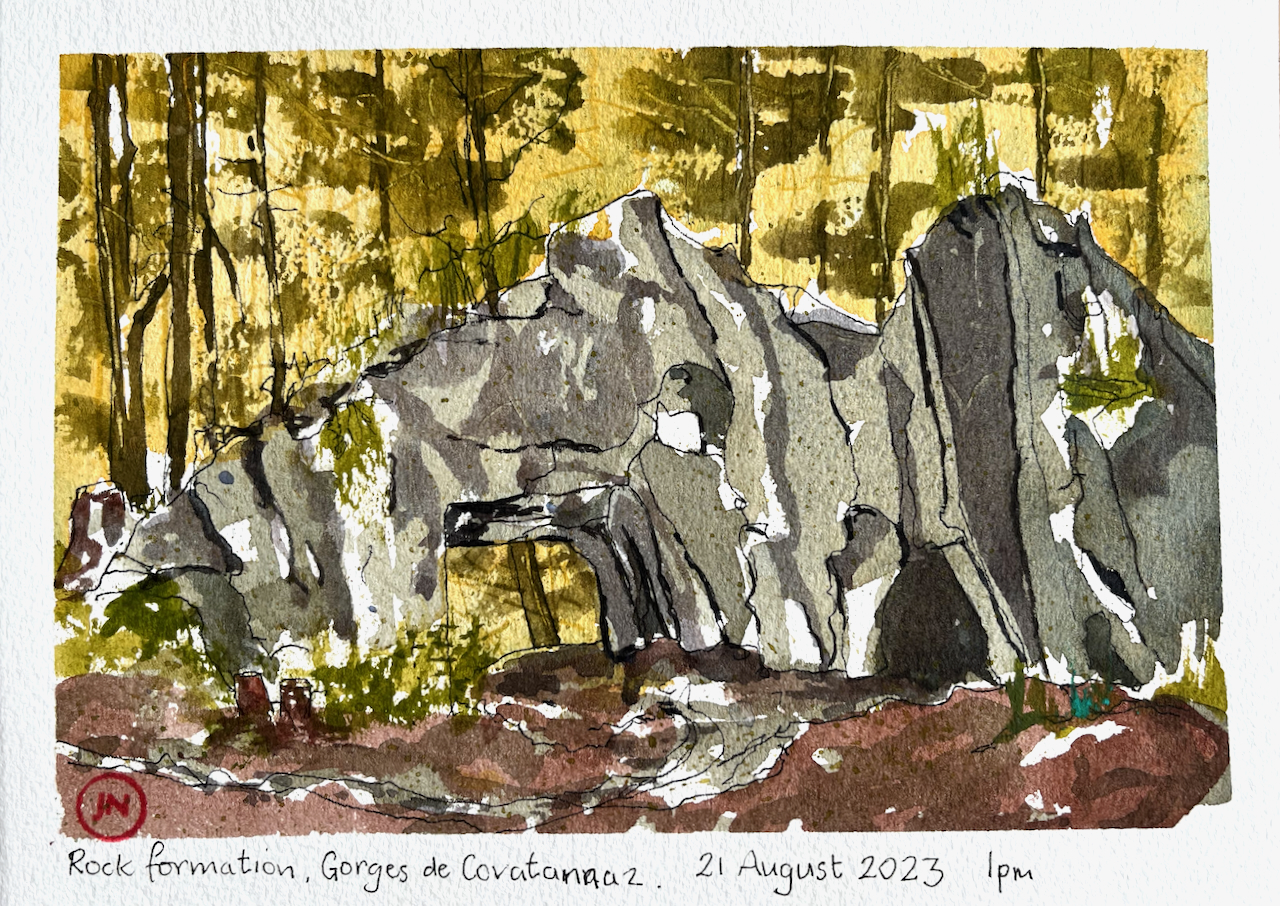
I walked up the gorge from Vuiteboeuf to Sante-Croix. Half-way up I paused to sketch this amazing rock formation.
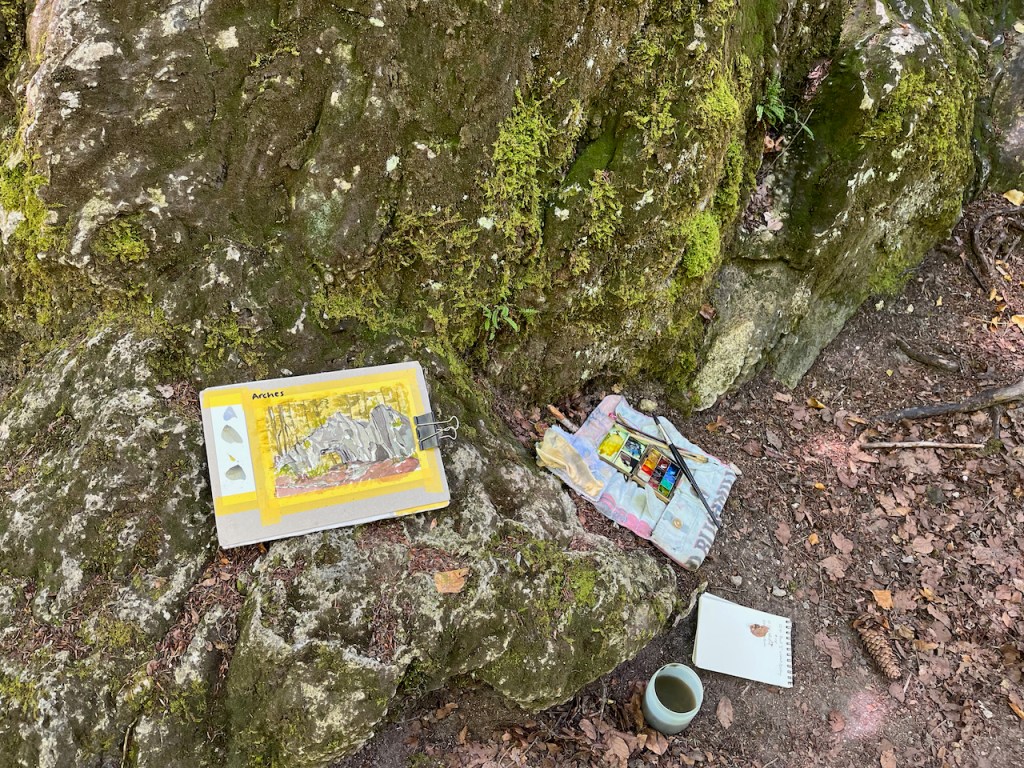
It was an ideal place to sketch, under the trees.
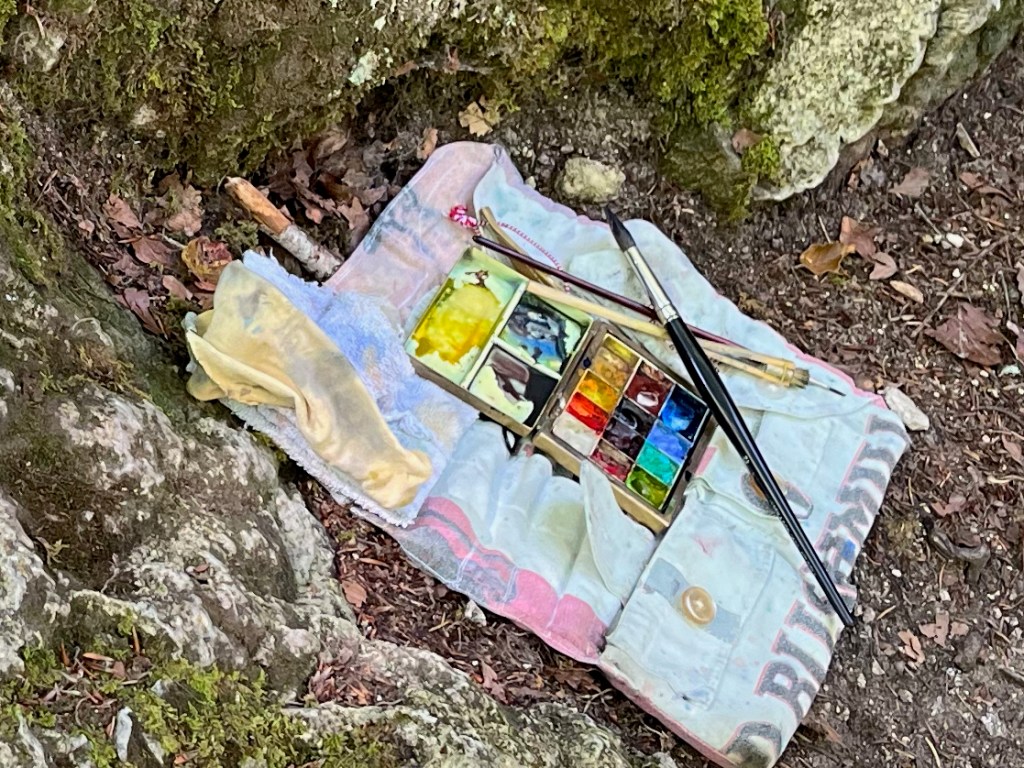
The rock formationSketching location at the foot of mossy rocks and trees.Information board
As I sketched, the silence was broken by thumps and scrapes behind me. A bear? A tree fall? A rock avalanche? No. A mountain bike rider descending the path at speed. These riders are skilful – they jump and bounce, and turn in the air like dancers.
I saw one in the distance as I navigated a narrow part of the path. Since there was a steep drop on the right hand side, I flattened myself against the rock to give them room. But there was no need. The rider brought their bike to a graceful halt, slipping sideways like an ice skater. They grinned as I greeted them. “Il faut du muscle” they said in response to my comment on the steepness of the path. Yes, you have to be strong. And have a sense of balance, good eyesight and rapid reaction times. And courage. After I passed, they backed up their bike and jumped on, to hurtle off down the slope.
My sketch took an hour. It’s on Arches 300gsm paper, with Daniel Smith watercolours. The colours I used were:
Permanent yellow deep
Serpentine genuine
Cobalt teal blue
Burnt Umber
Buff titanium
Perylene maroon
The pen drawing is with a fountain pen, Lamy Safari, with De Atramentis Document Black waterproof ink.
Click a button below to share this post online, email it, or print it:
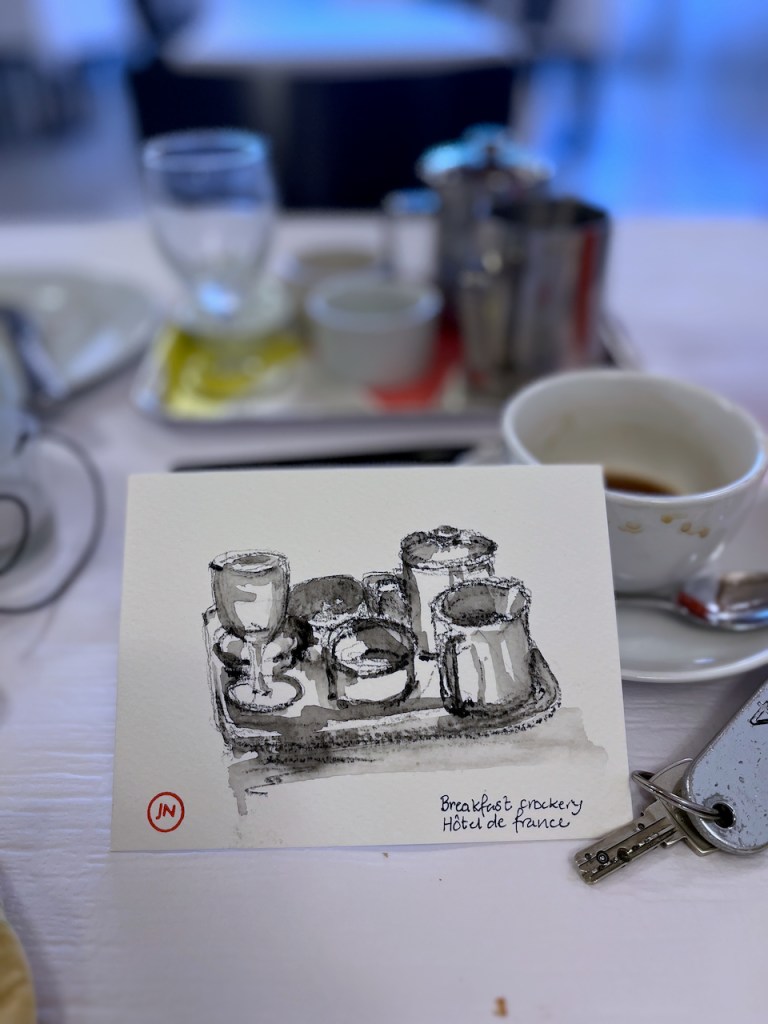
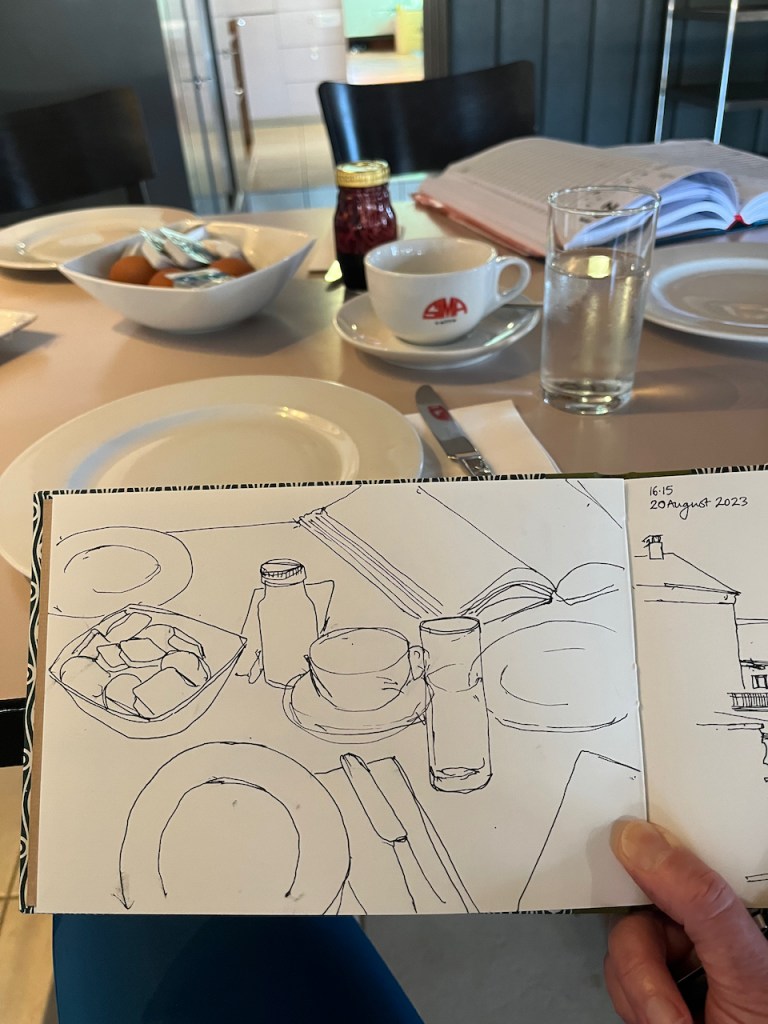
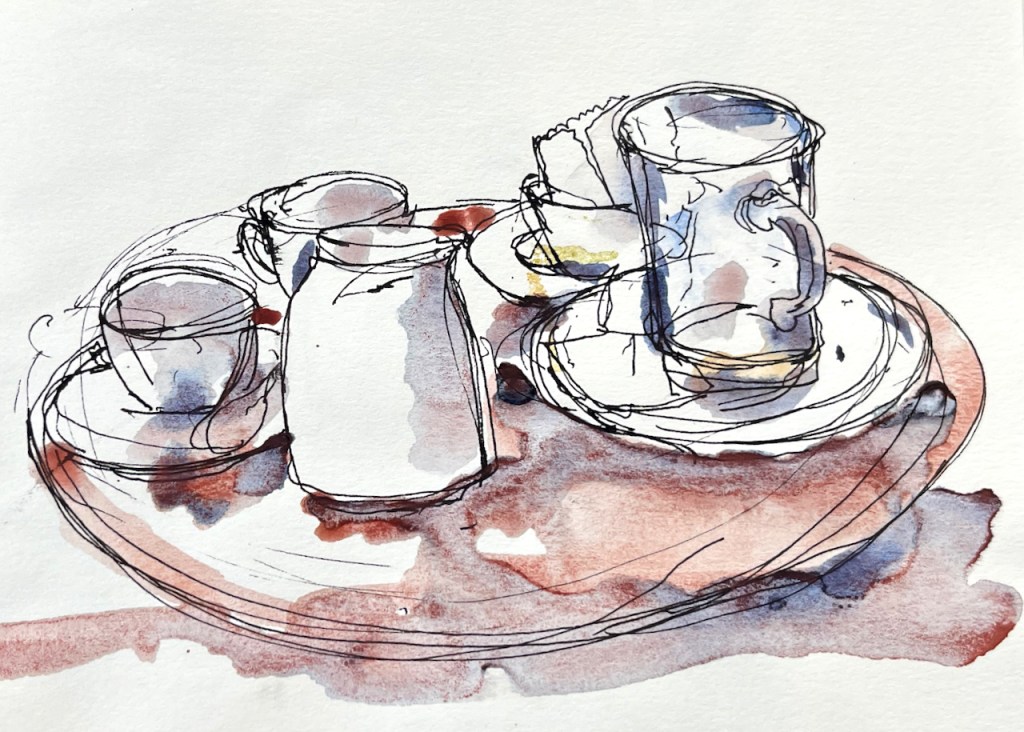
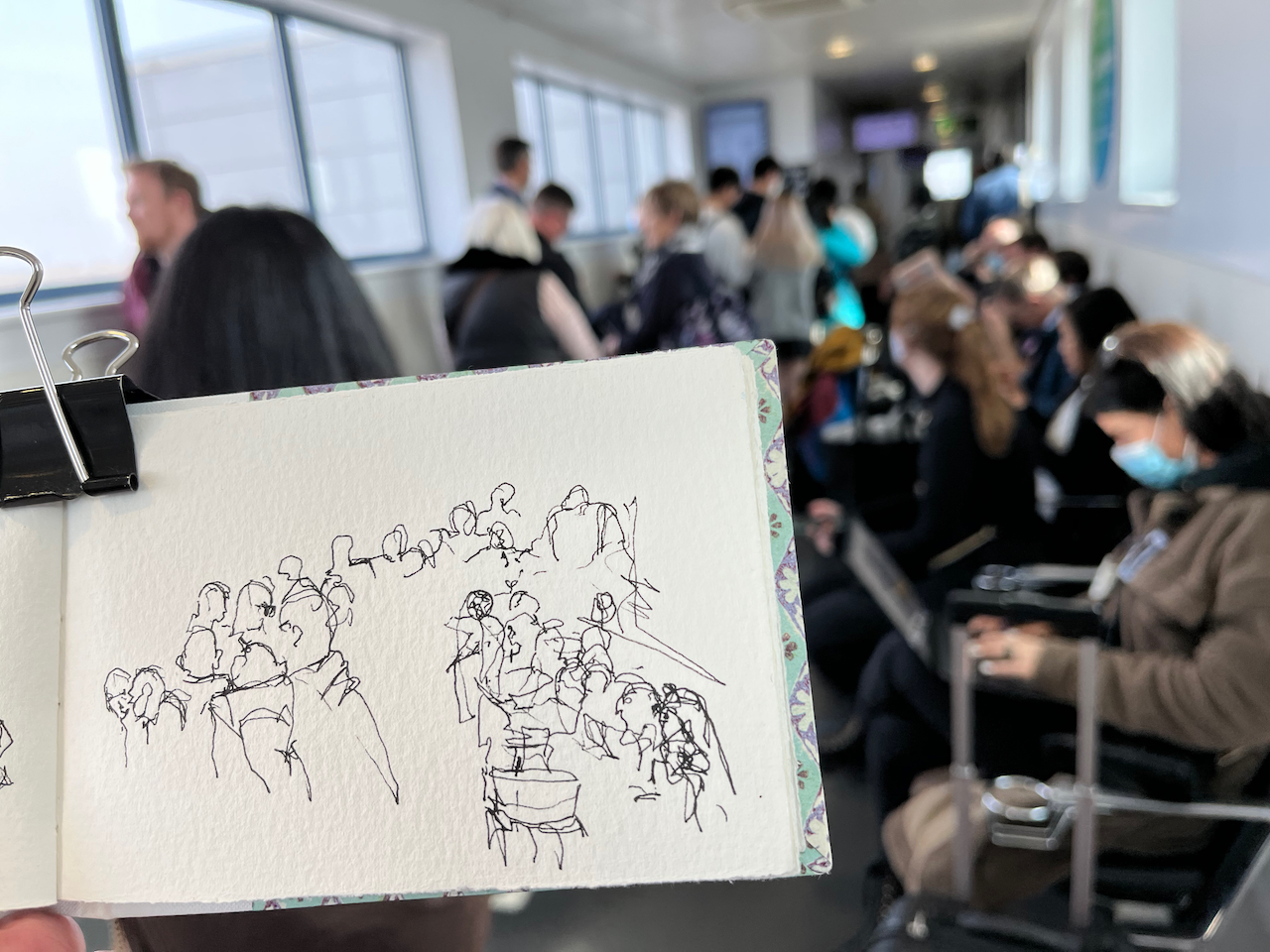
Sketching is a way to fill those “waiting” times with creative activity.
..at the airport…..waiting for lunch…..before dinner…..before the others arrived……waiting for the food….
I had an A5 sketchbook with cartridge paper. This cartridge paper behaved differently from the watercolour paper I am used to. It was more suited to quick sketches.
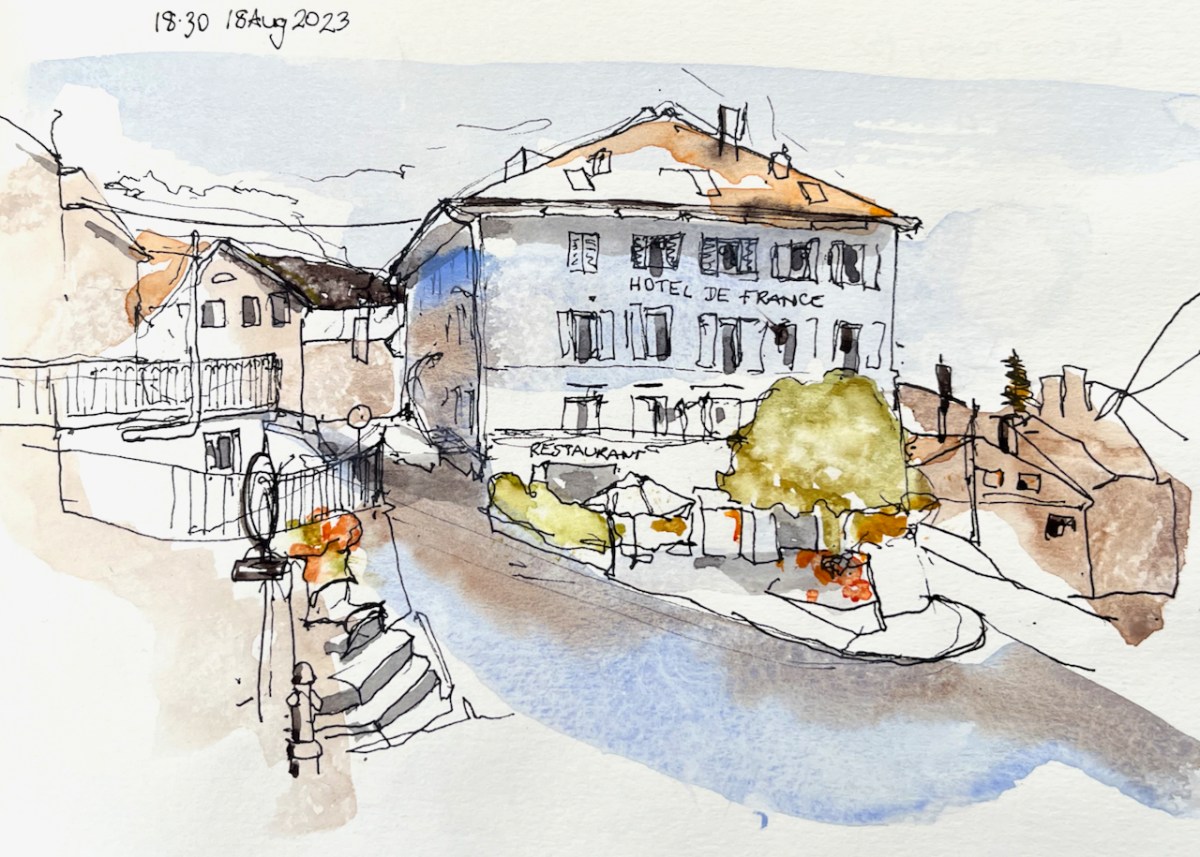
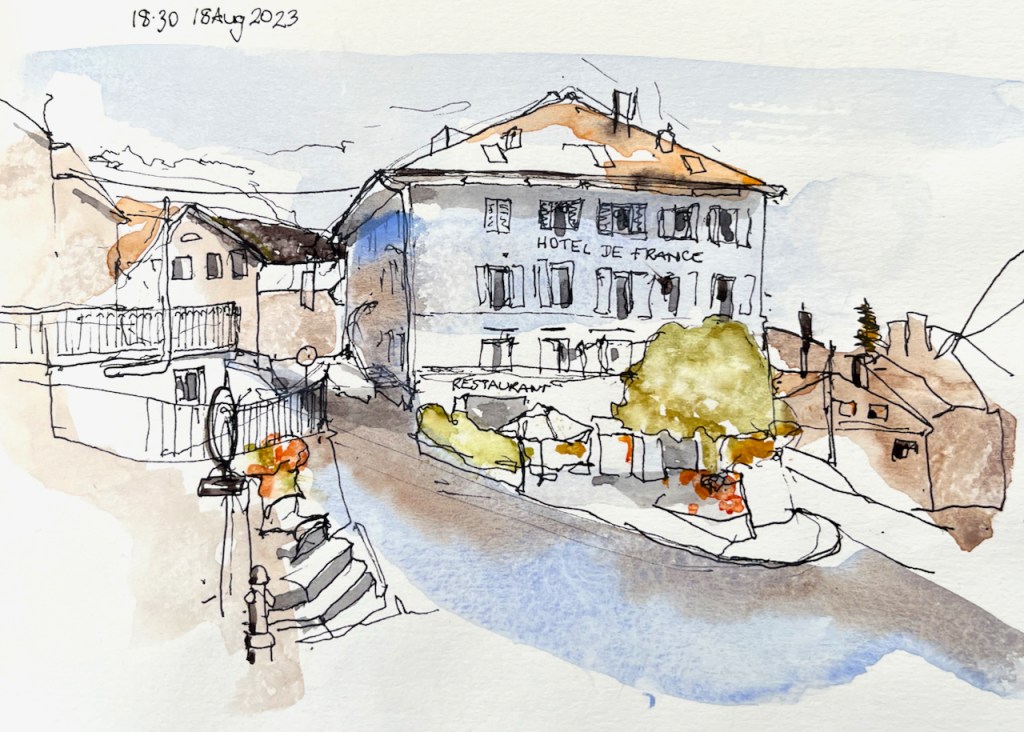
It was hot weather. Outdoors the paint dried quickly. Here’s the hotel from the other side of the road, drawn very quickly, about 20 minutes.
Hôtel de France, Sainte-Croix 18 August 2023
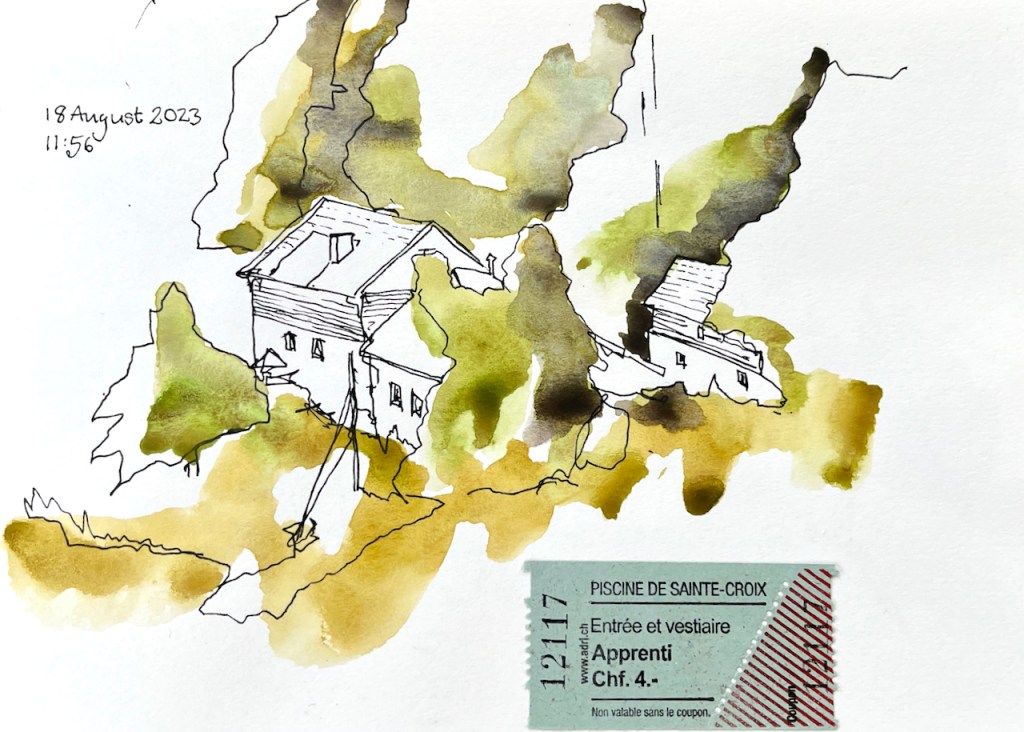
I went to the swimming pool. On the way back I stopped to sketch the sloping hill and a house in the trees.
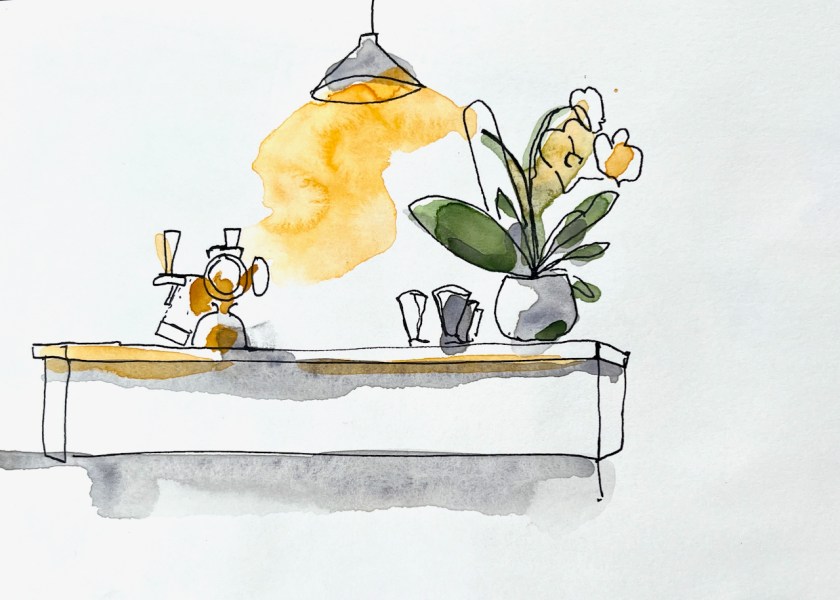
Here’s a view of the bar at the hotel.
Here’s a flip-through of the sketchbook. 20 seconds of silent video. [This video and the gallery beneath may not show on email or phones so if there’s a problem please see the web version of this post]
Sketchbook flip-through. Sketchbook from the Vintage Paper Company.
I’ve sketched in Switzerland before. Here are some other other drawings I’ve done in the same location:
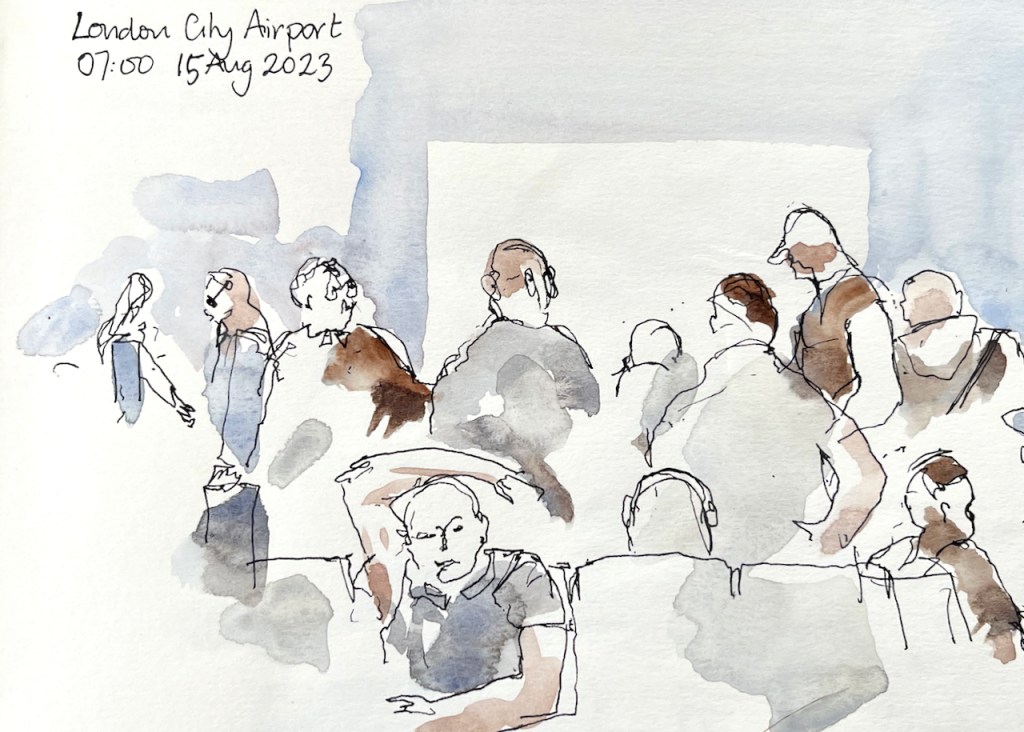
Waiting in London City airport… Breakfast… Looking out of the window… Walking around… A rich cultural spectacle: Photographs absolutely not allowed, but sketching was OK. It was very crowded,…
Here is 23 rue du Petit-Montreux, Sainte-Croix, Vaud. I sketched this house after breakfast. The sun was bright and I rushed out into the crisp morning. It took me…
It was raining in Switzerland. Here is a sketch I did looking out of the window of the Hôtel de France, Sainte-Croix, Vaud. The building with the flags is…
I visited the Hôtel de France, Sainte-Croix in Vaud, Switzerland. Here is the hotel, from the street outside, just after I arrived. I had to wait in Geneva train…
The weather in the Jura mountains is changing. This is climate change, the residents tell me. Once, the snow came reliably every year, bringing skiers. Now, the snow is…
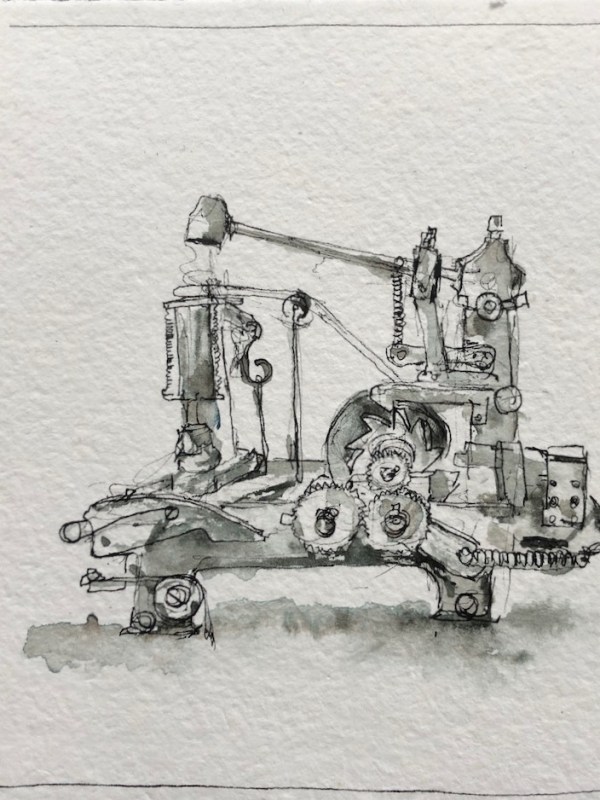
Here is a machine that was used to make music boxes: The machine is about 100 years old. It still works. It sits with its colleagues and companion machines…
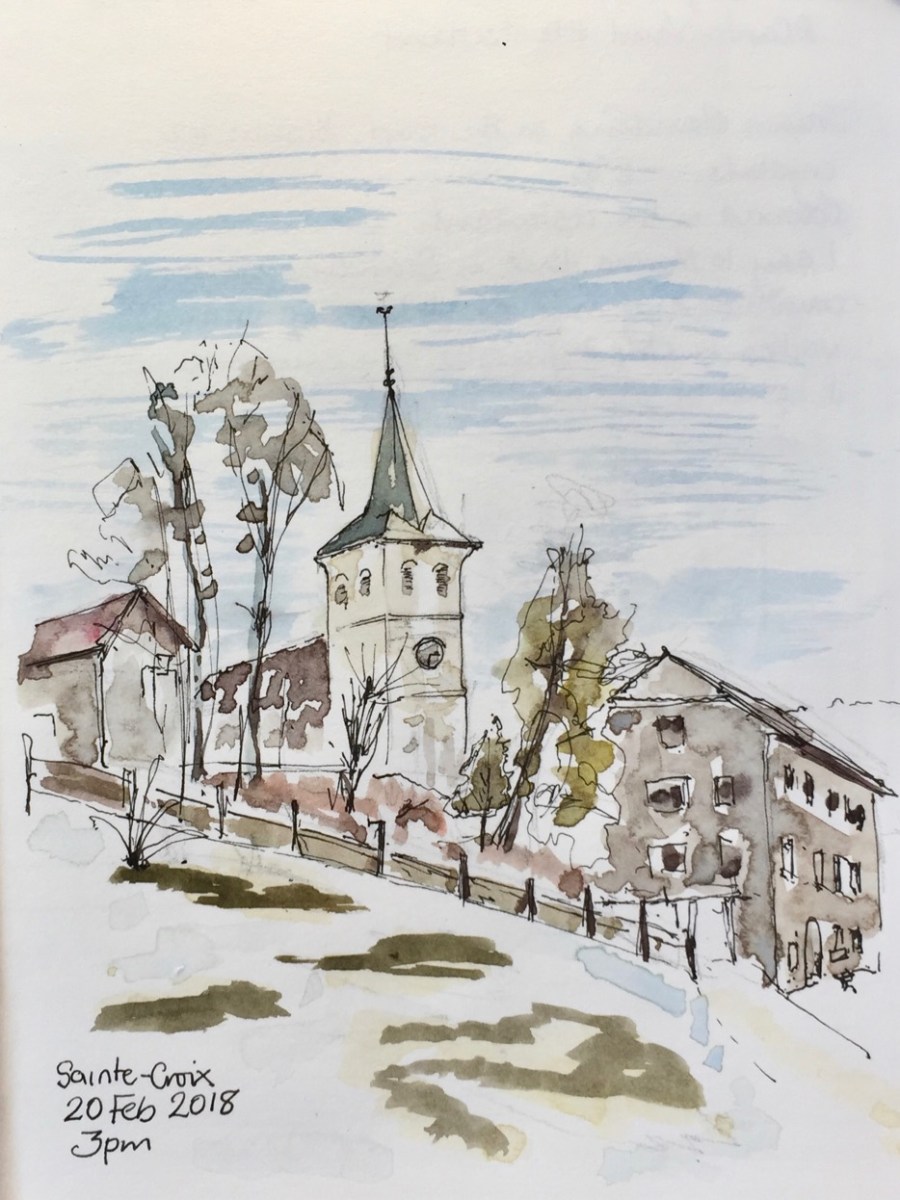
This is the church. Drawn and coloured on location, about 1 degree C. That’s snow in the foreground. Then later, it was colder. Hotel de France, drawn from the…
This building is on the Rue des Rasses, in Sainte-Croix, Vaud, Switzerland. For maps, see end of this article. There is much that is interesting about this building: there…
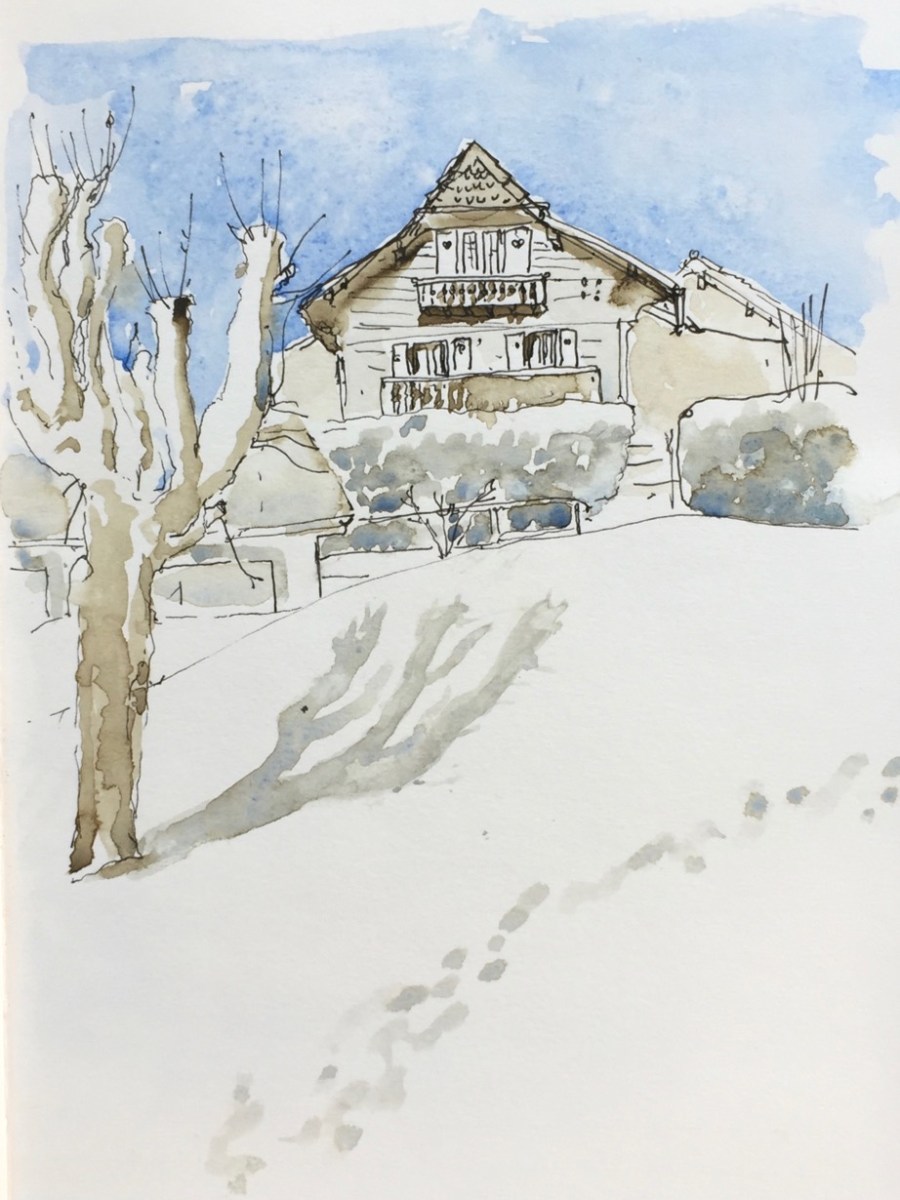
Snowfield behind the church. Painted with melted snow as I forgot to bring water. All done standing up as everything was wet and cold. Snow blew from the roof…
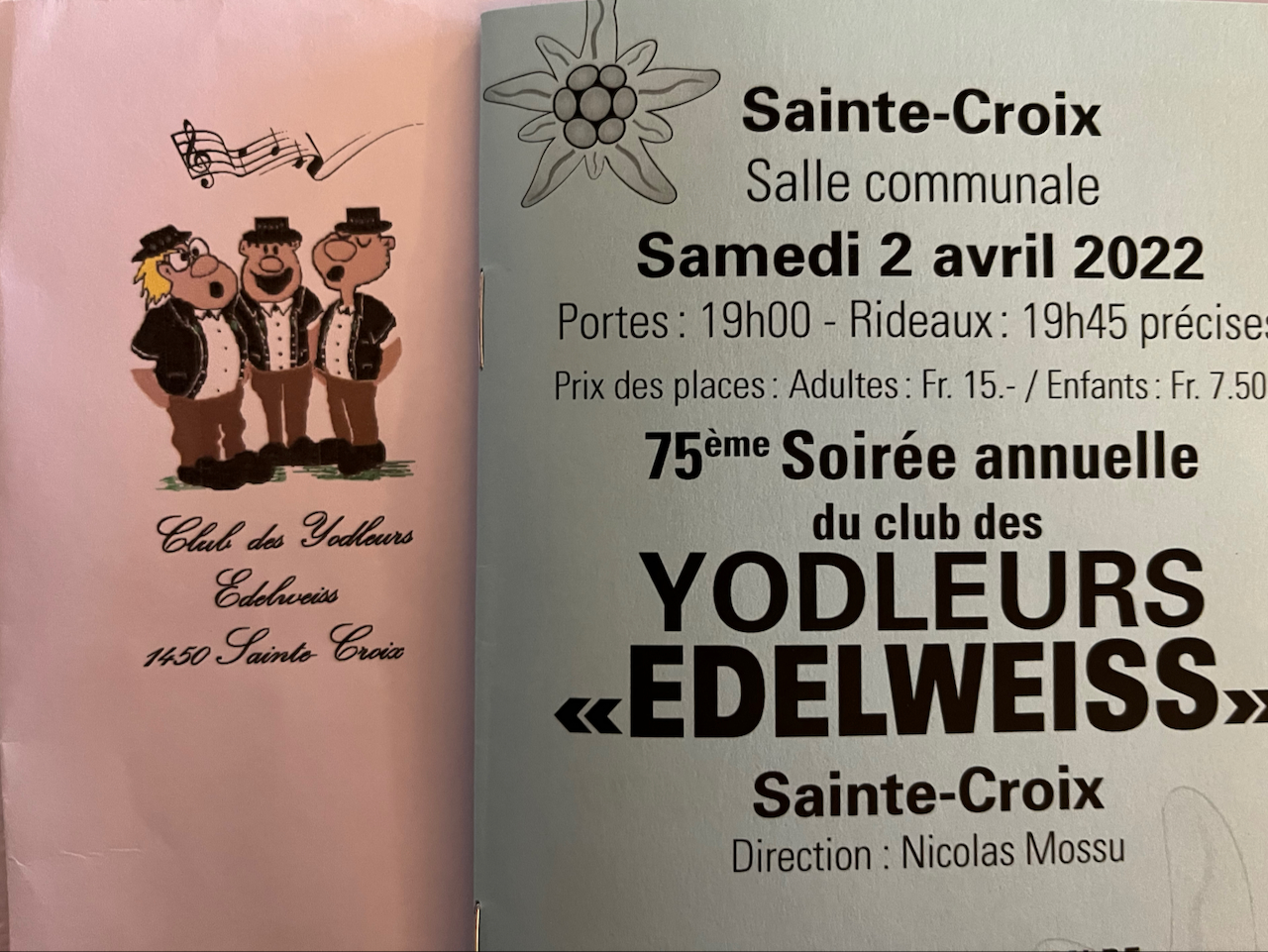
Photographs absolutely not allowed, but sketching was OK. It was very crowded, and great fun to hear the expert yodleurs. They sung in French.
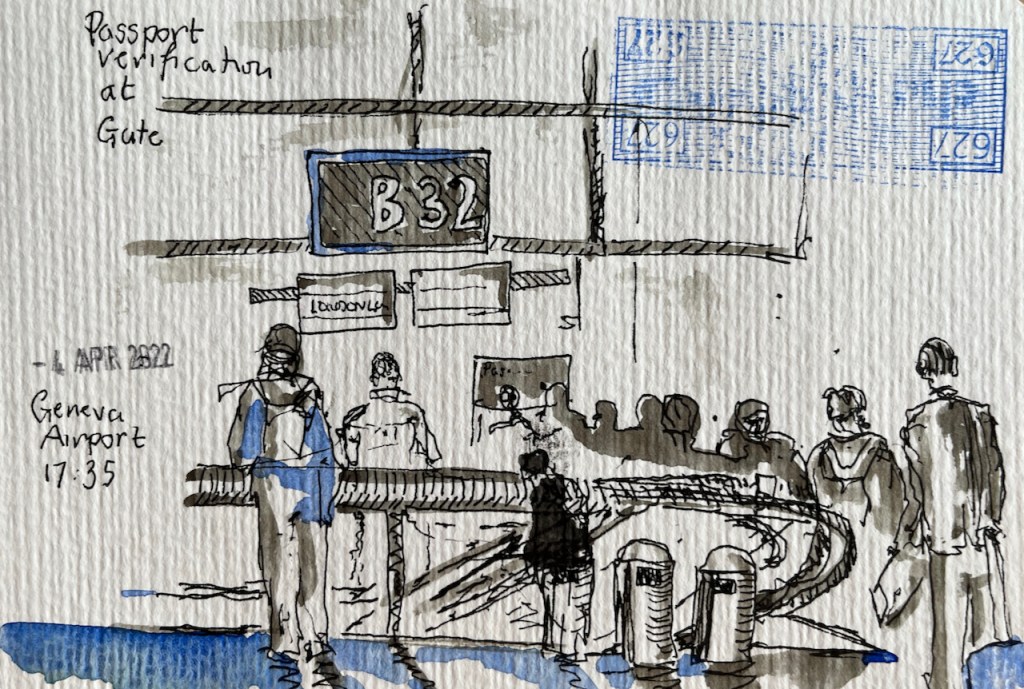
Sketching on the journey back to London. Passports were checked four times: at check-in, at border passport control, and again at the gate in Geneva (shown below), and again on arrival in the UK.
The friendly passport officer at Gate B32 kindly agreed to add his stamp to my picture. You see his blue rectangular contribution in the top right.
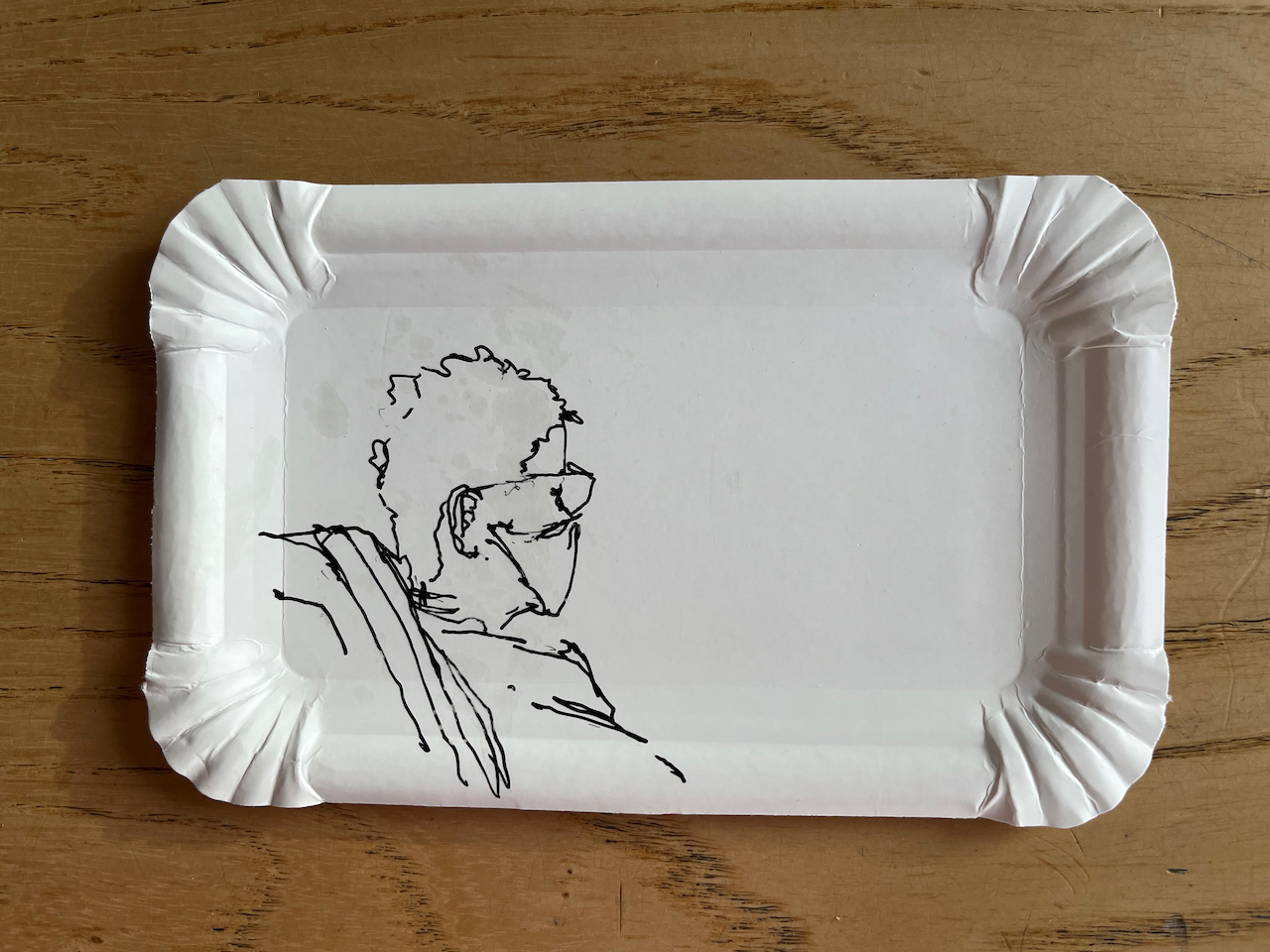
Sketching on the plane:
Sketching on a paper plate.
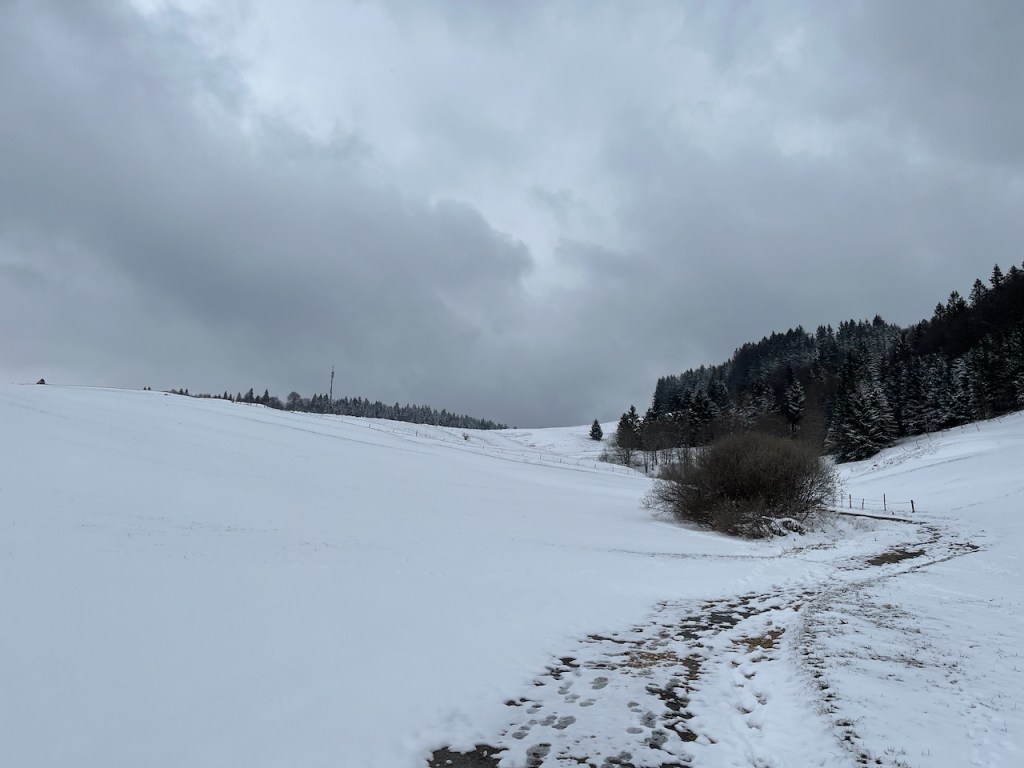
In between all this sketching I did some work…..and went walking in the snow.
Near Sainte-Croix, Vaud.
Click a button below to share this post online, email it, or print it:
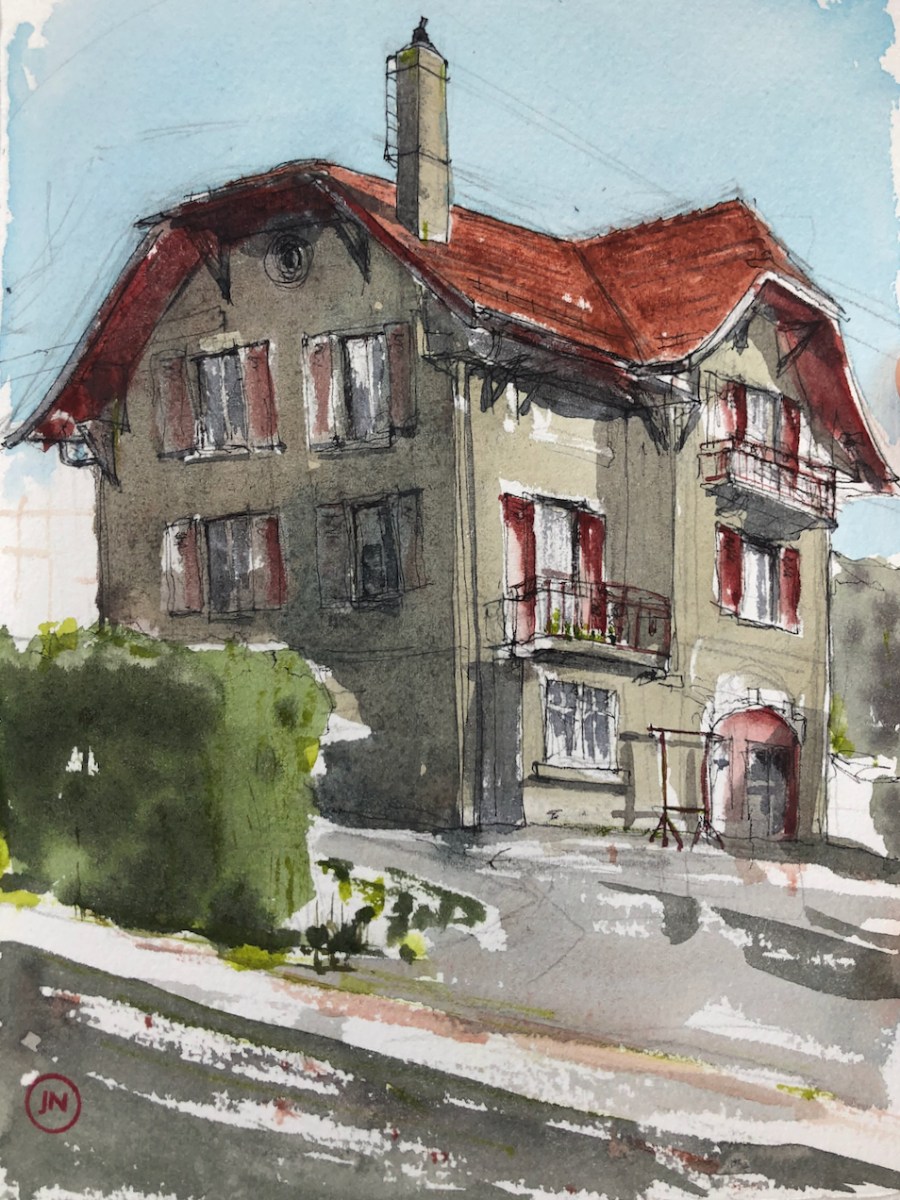
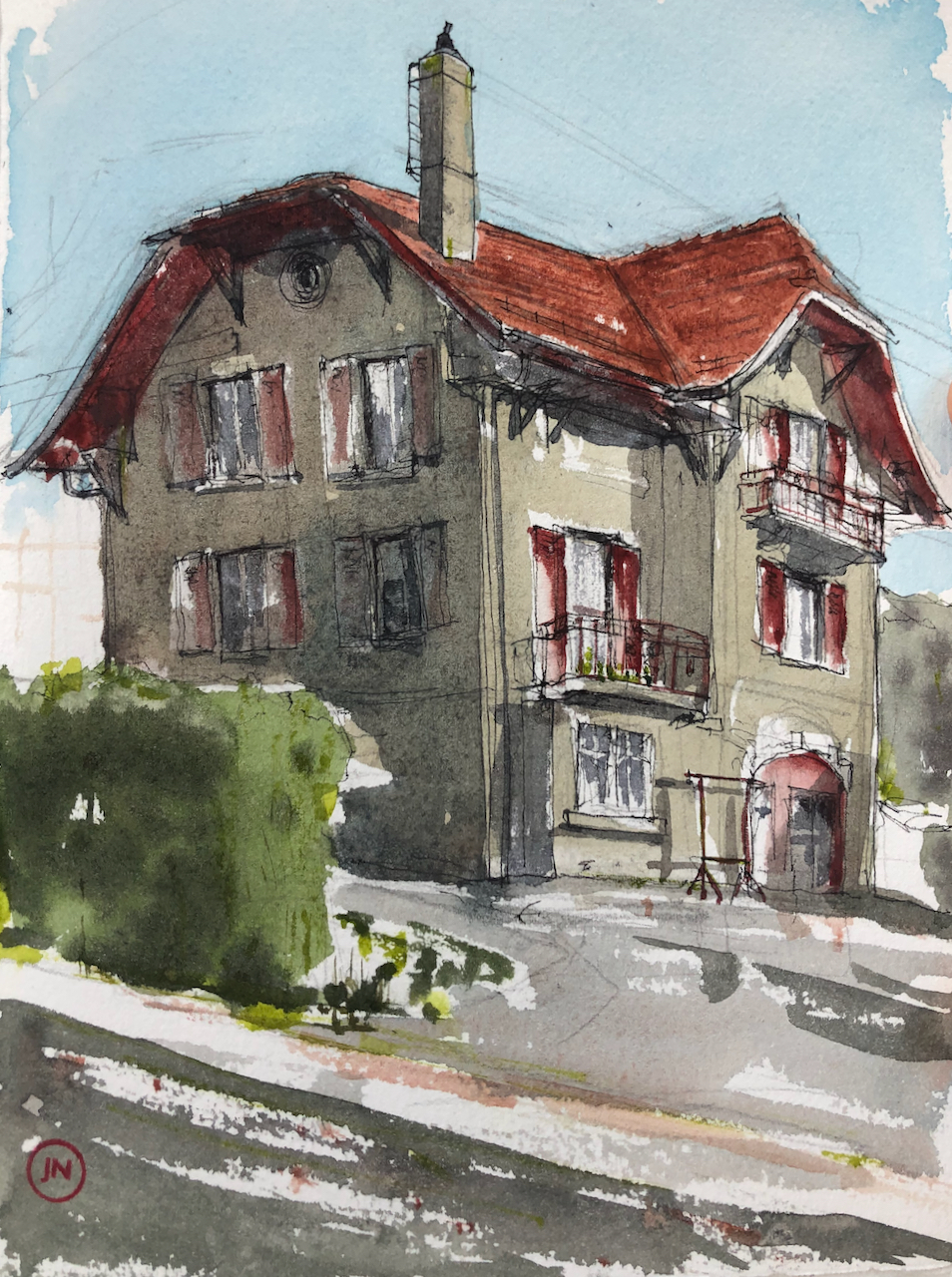
Here is 23 rue du Petit-Montreux, Sainte-Croix, Vaud.
23 rue du Petit-Montreux, Sainte-Croix, Vaud 24 October 2021, 10″ x 7″ in Sketch book 11
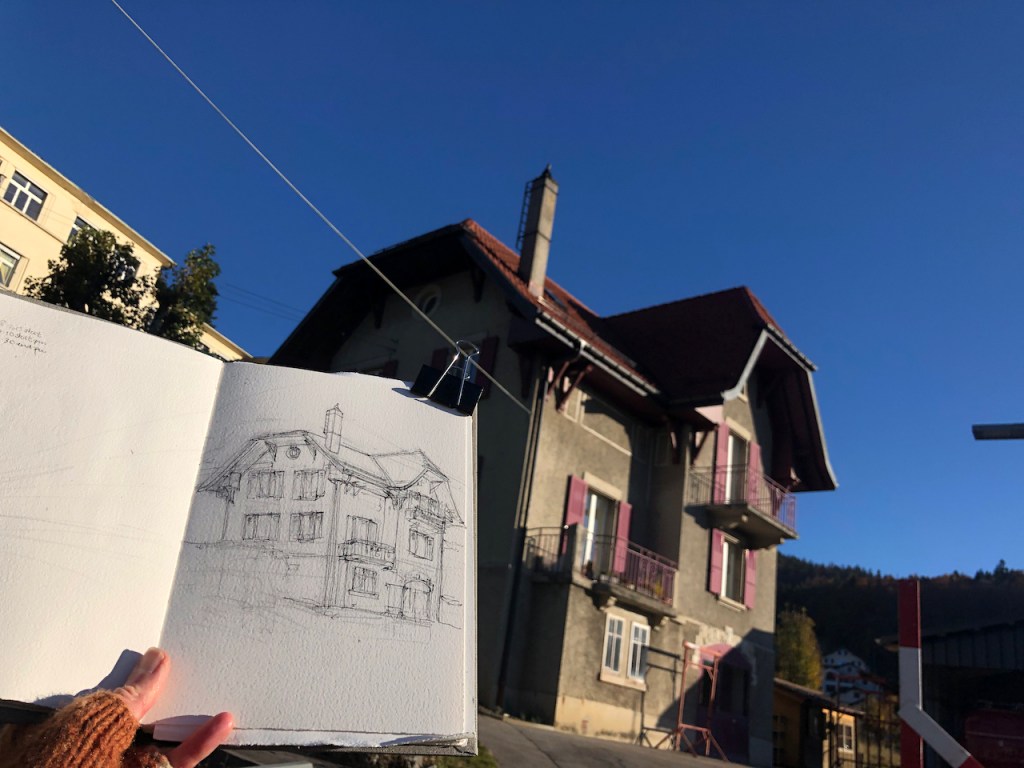
I sketched this house after breakfast. The sun was bright and I rushed out into the crisp morning. It took me about one hour and 15 minutes outdoors, and then I completed it in my hotel room. The outside air temperature was 20 C.
A few pencil lines
Pen and ink
Pen and ink done
Work in progress on the colour
Looking east to the house
Perhaps I should draw the scene looking the other way too?
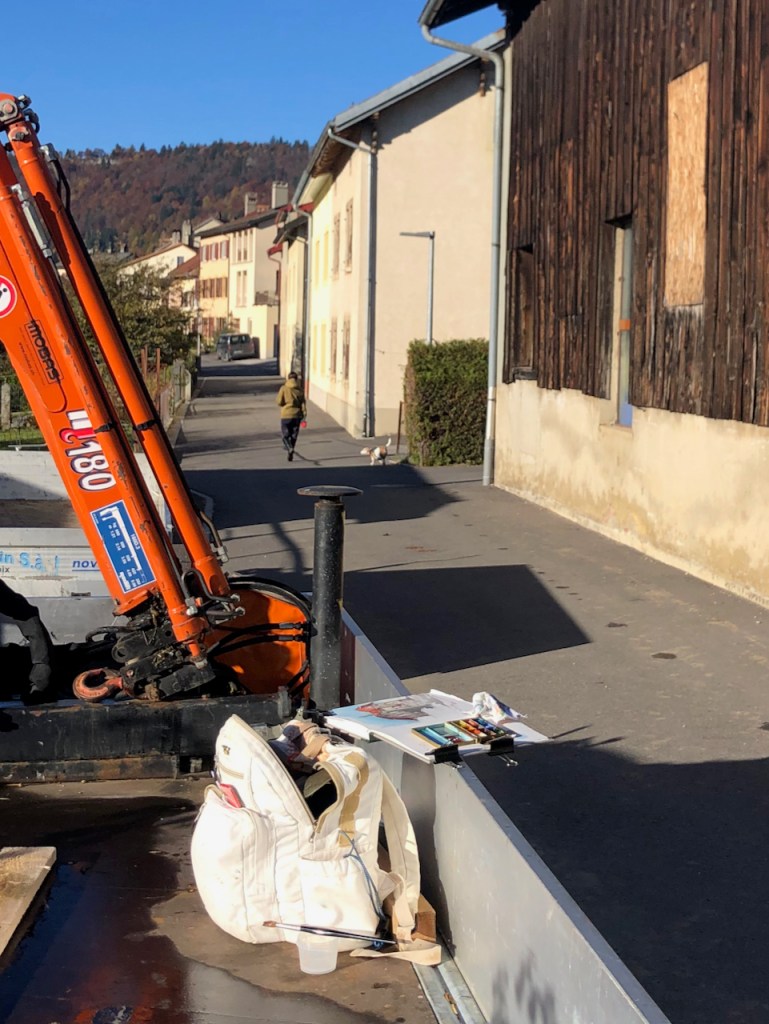
Work in progress in rue du Petit-Montreux
“…the ladder that goes up the chimney…”
I particularly admired the ladder that goes up the chimney. So practical.
The sky is Phthalo Blue Turquoise, with some Lavender. The roof is mostly Fired Gold Ochre. The house walls, and the road, are a mix of Phthalo Blue Turquoise and Perylene Maroon, with a bit of Transparent Brown Oxide and Buff Titanium. The shutters are a mix of Fired Gold Ochre and Perylene Maroon. The hedge is Sap Green with those other colours mixed in to make it darker.
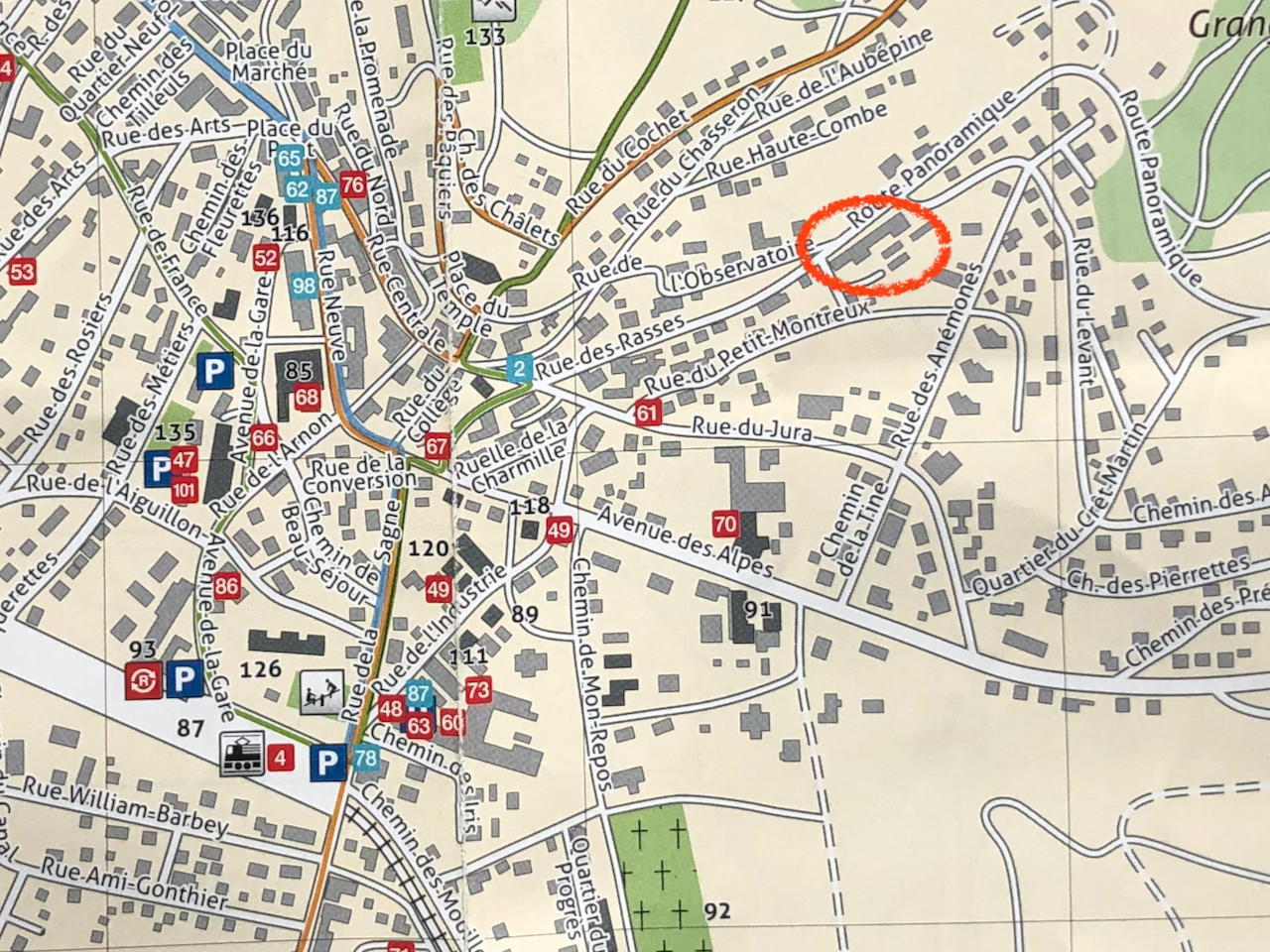
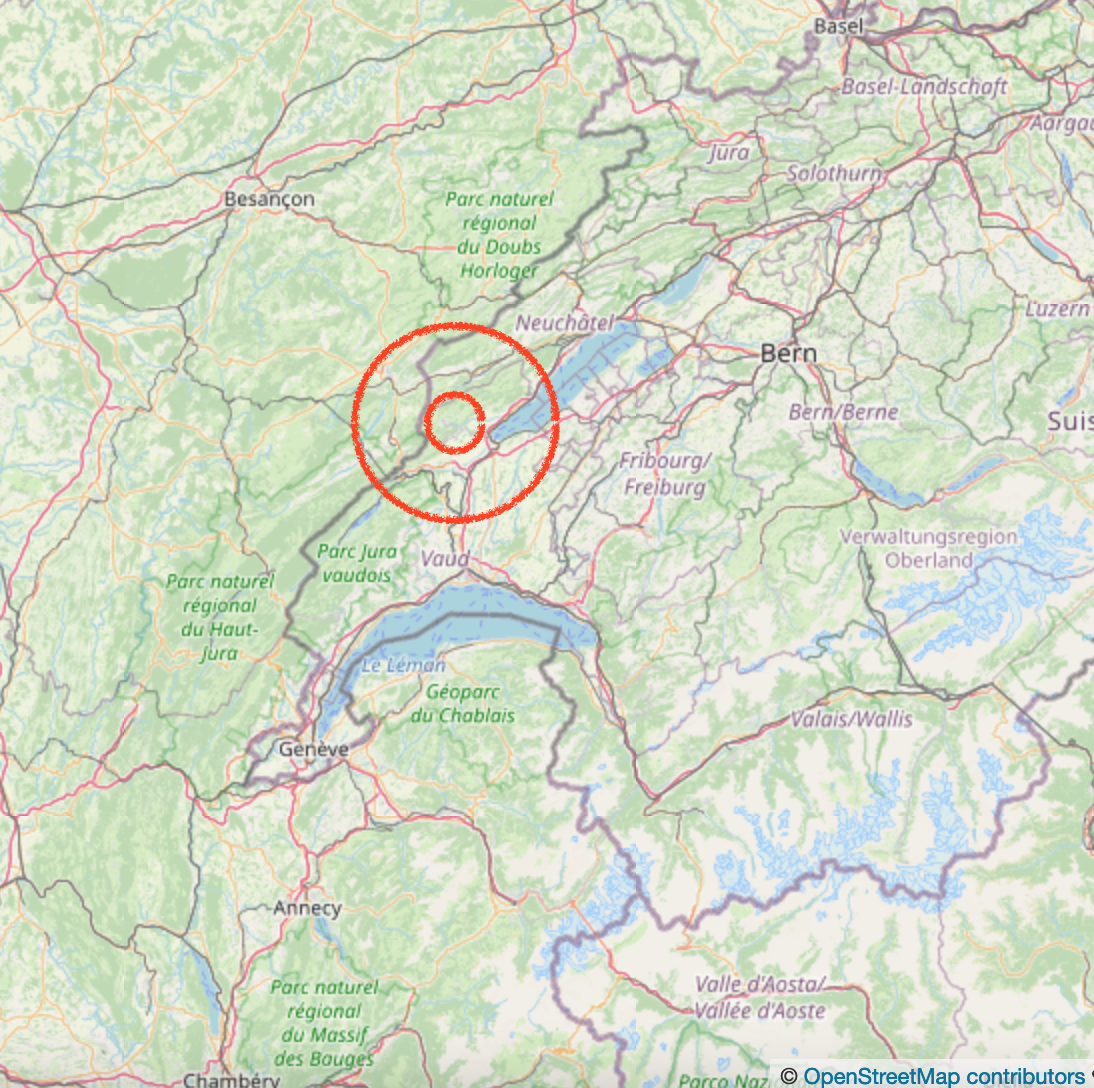
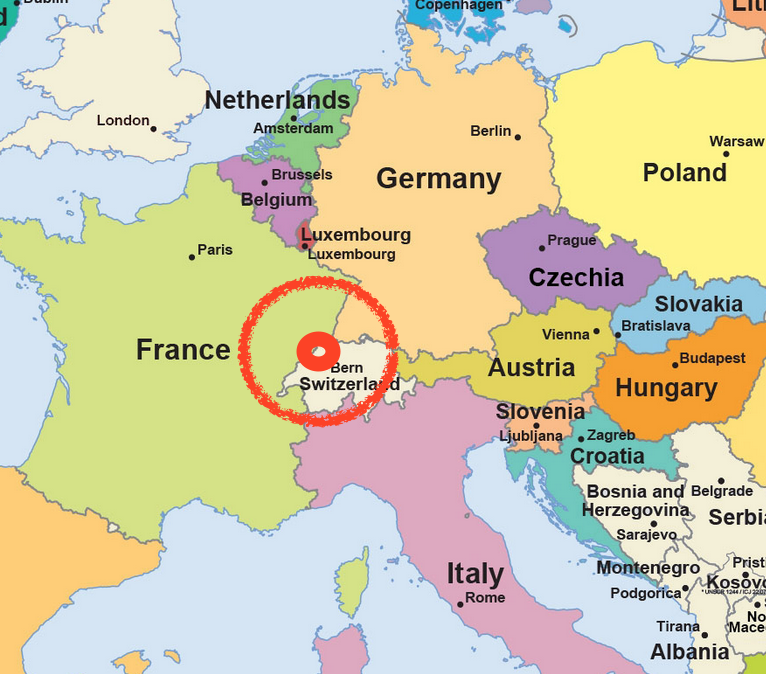
Here are some maps:
Click a button below to share this post online, email it, or print it:
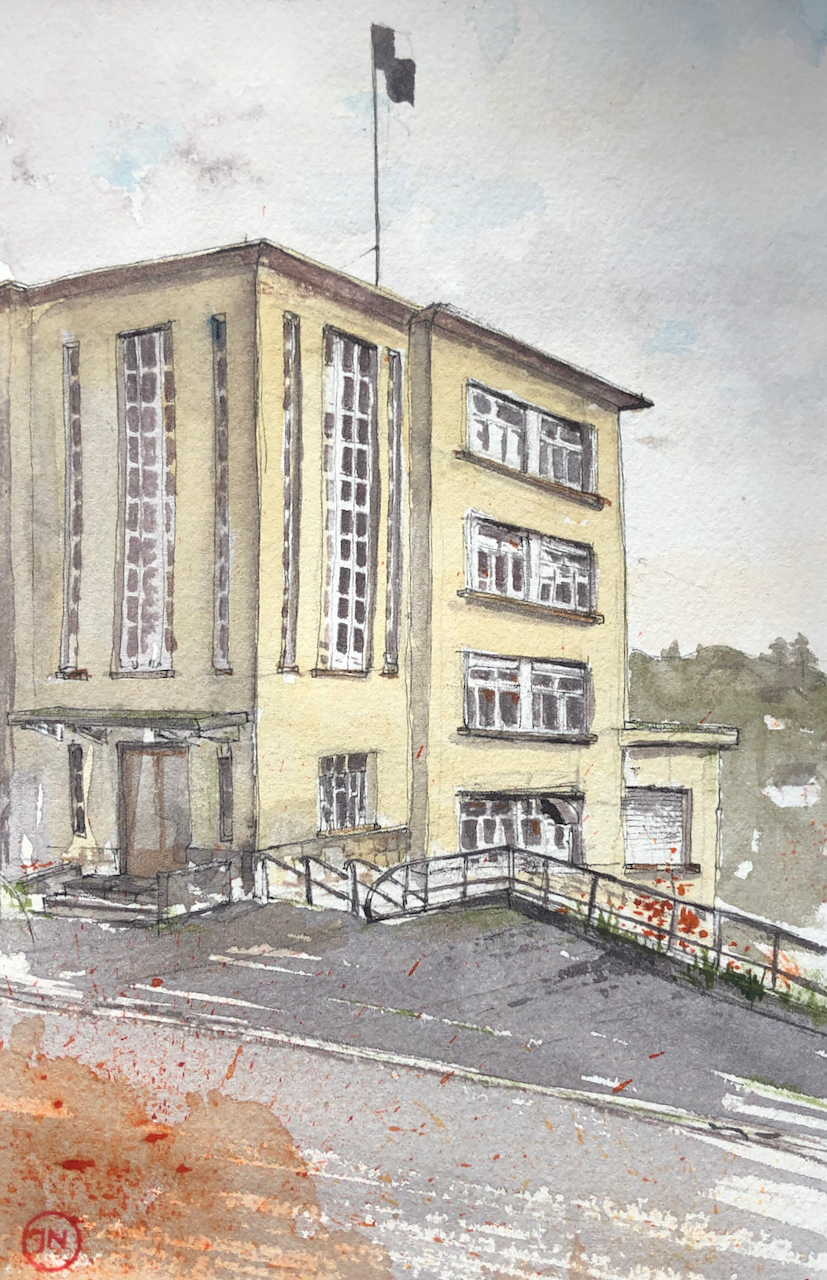
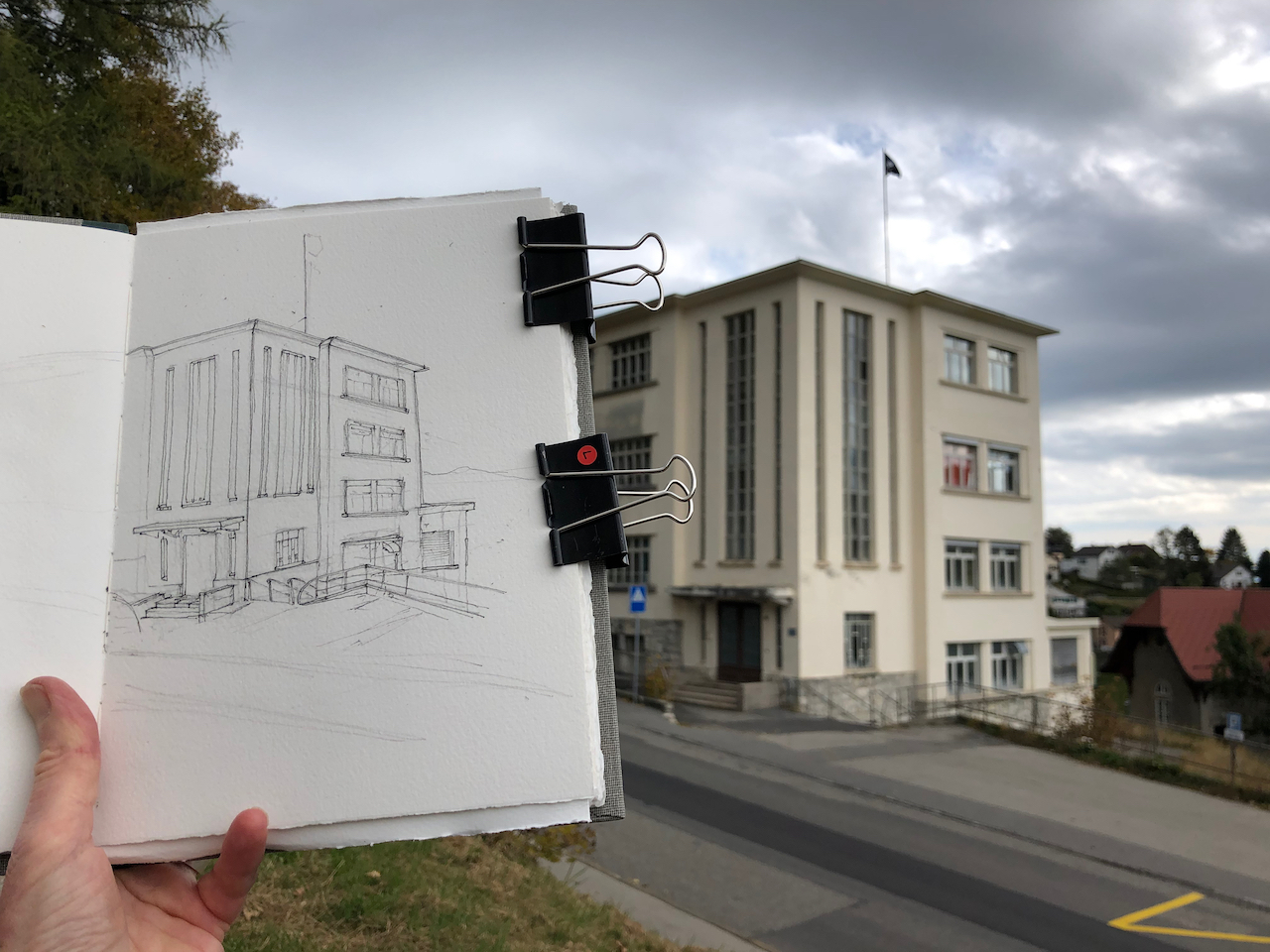
This building is on the Rue des Rasses, in Sainte-Croix, Vaud, Switzerland. For maps, see end of this article.
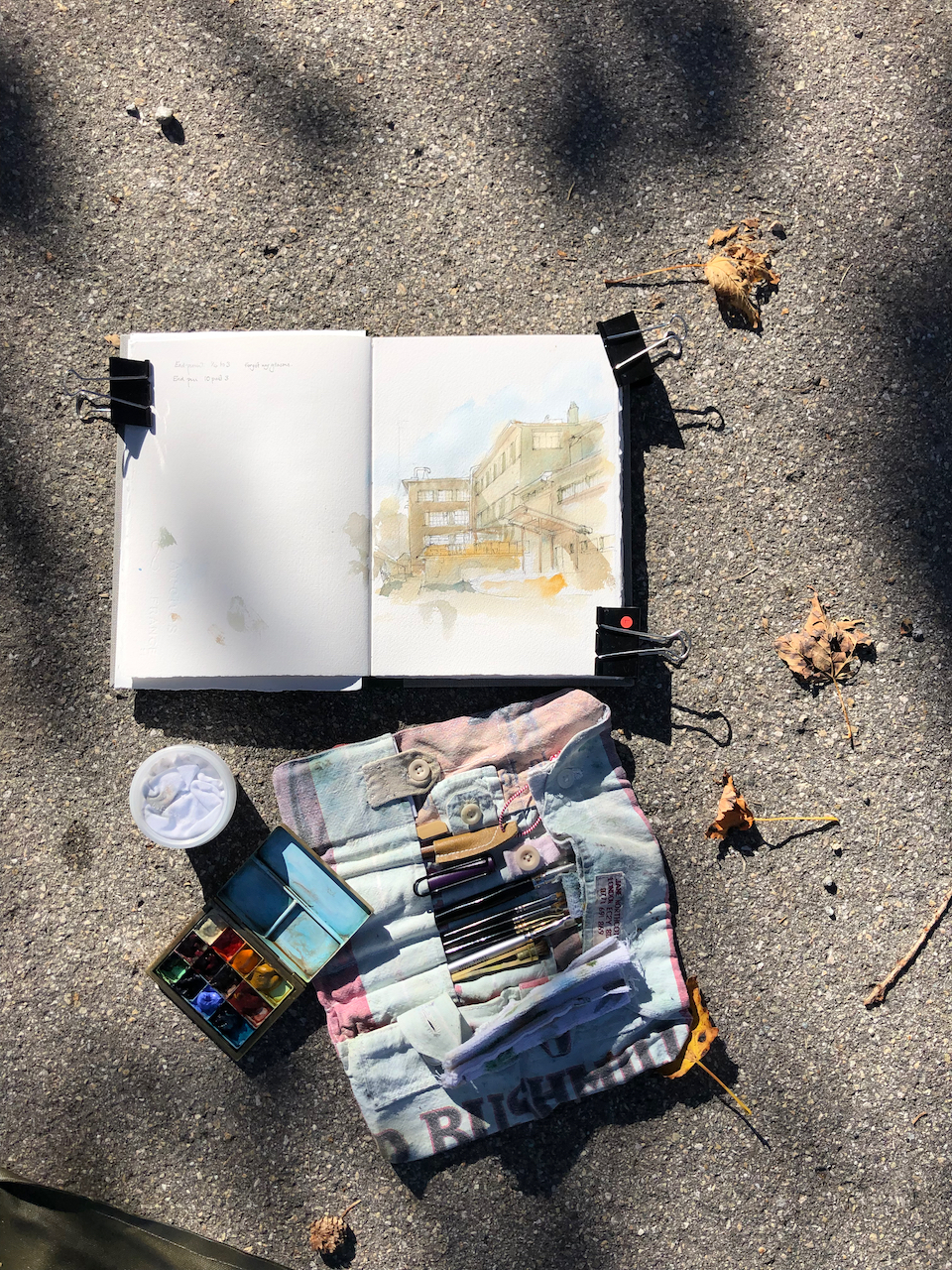
26 rue des Rasses, Sainte Croix, Vaud. Front entrance. 20 October 2021 in Sketchbook 11
There is much that is interesting about this building: there is the building itself, a 1930s marvel, there are the original occupiers, and there are the current occupiers.
The building was constructed in 1929-1930 as a factory for Reuge, the music-box makers. Reuge had already been operating for some 55 years by that time, starting with a pocket-watch shop in 1865. The factory operated for 85 years, until 2015, then they moved production to another site. Here is a picture of the factory fully operational, from a Reuge publication dated 2007 1
In June 2016, Reuge still owned the building, even though they’d moved their production out. They still used the wood-panelled showroom to demonstrate their music boxes. Here are some pictures from when I visited the empty building at that time:
Music box demonstration room
Former Reuge Factory, visit June 2016
Since around November 20193 the building has been occupied by a group called “le Baz”. They are a self-governing collective, who have created a “ZàB” in the former Reuge building. “ZàB”, their website2 explains, stands for “Zone libre à Bâtir”:
C’est une zone autogérée d’expérimentation, d’émancipation, de solidarité et de lutte, et pas un espace de consommation passive. Elle est ouverte à toutes et tous à toute heure décente. Et ce pour souffler, partager, apprendre ou transmettre de manière spontanée. Toute personne présente devrait pouvoir répondre à vos questionnements concernant le fonctionnement. Tout comme vous, elles ne sont ni responsables, ni programmateurices, ni animateurices, mais ni plus ni moins que les acteurices d’une création collective.
It is a self-organised space for experiment, emancipation, solidarity and struggle, and not a place for passive consumption. It is open to everybody, at any reasonable time. It’s where you can breath, share, learn or communicate at will. All the people here should be able to answer your questions about how it works. Just like you, they are not the managers, nor the schedulers, nor the facilitators, but no more and no less than the participants in a collaborative creation.
[My translation]
I took them at their word, and showed up at an “heure décent”, which as it happened was about midday. As I hesitated in front of the door, a young man asked if he could help me. I said yes, would it be possible to go in? He said yes of course, had I not read the notice on the door? I said I had. But he was already about his business, rushing ahead of me, and had left the door open. So I went in.
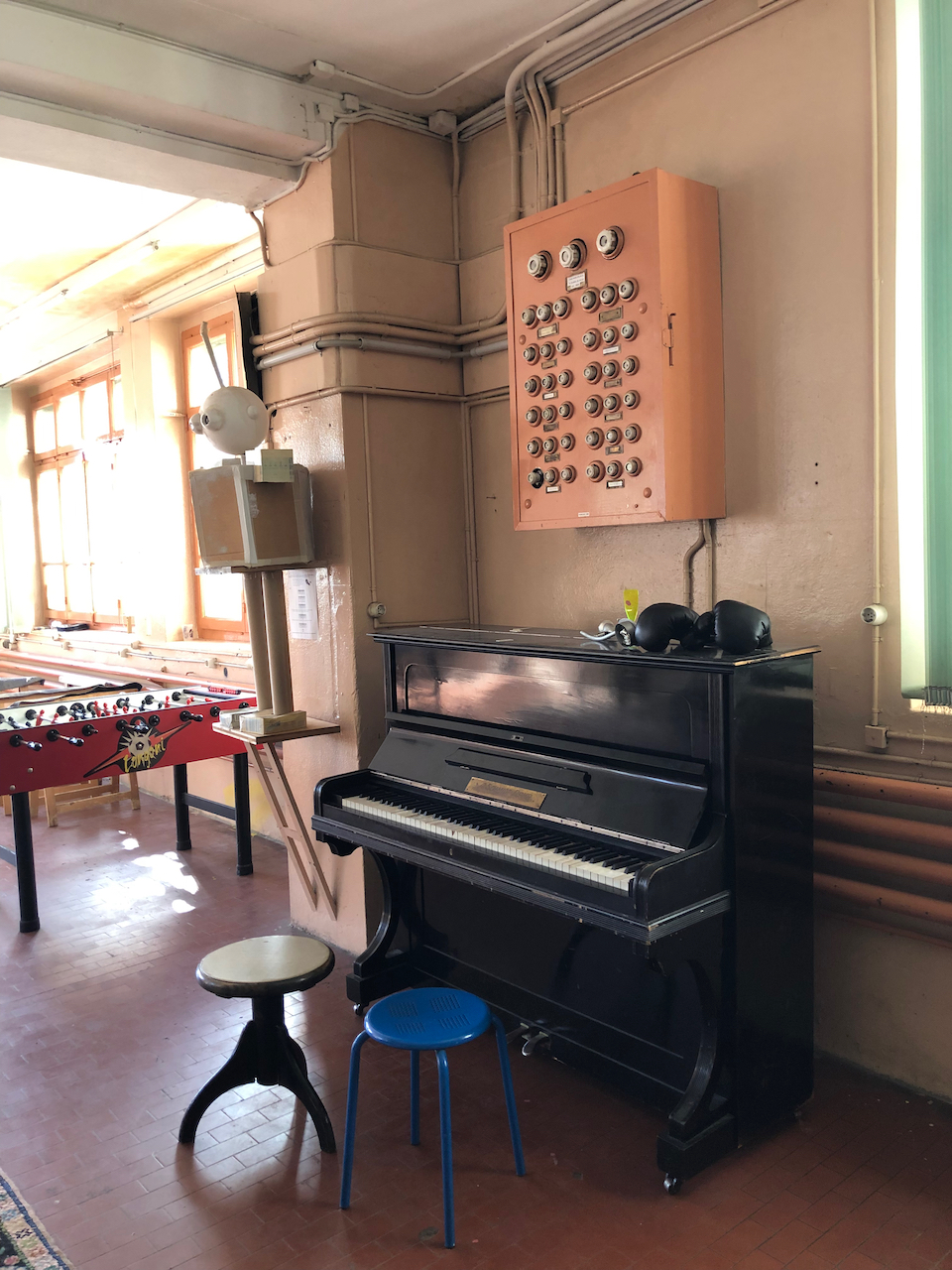
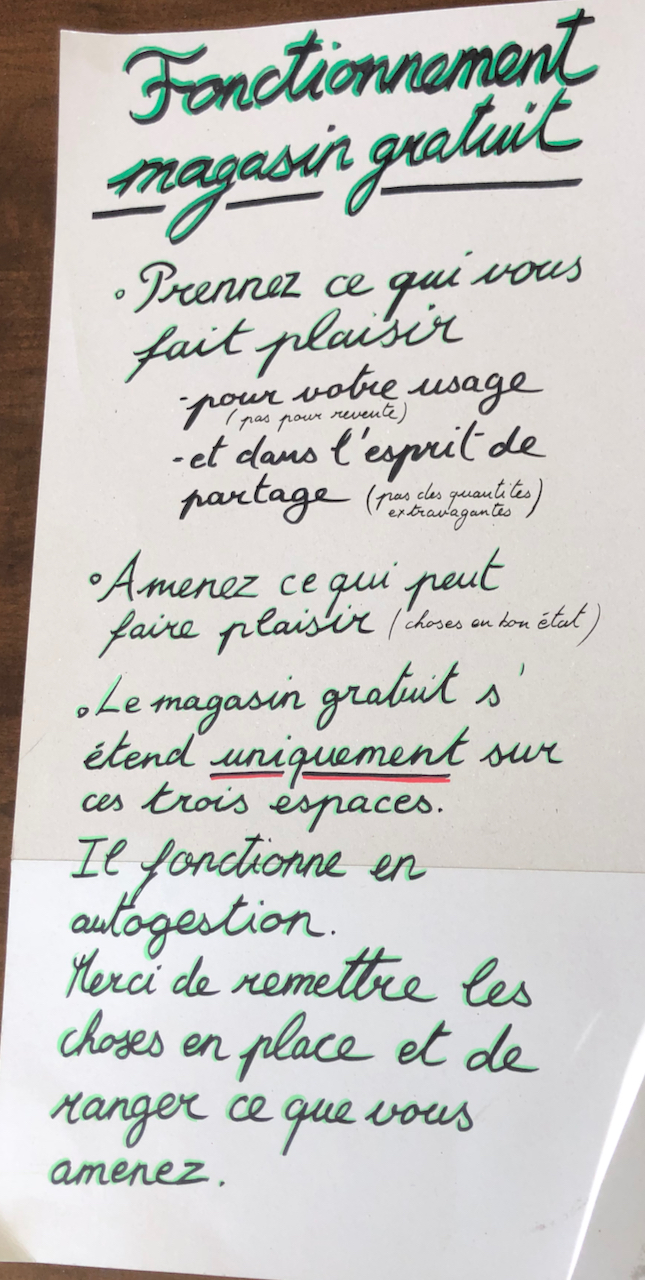
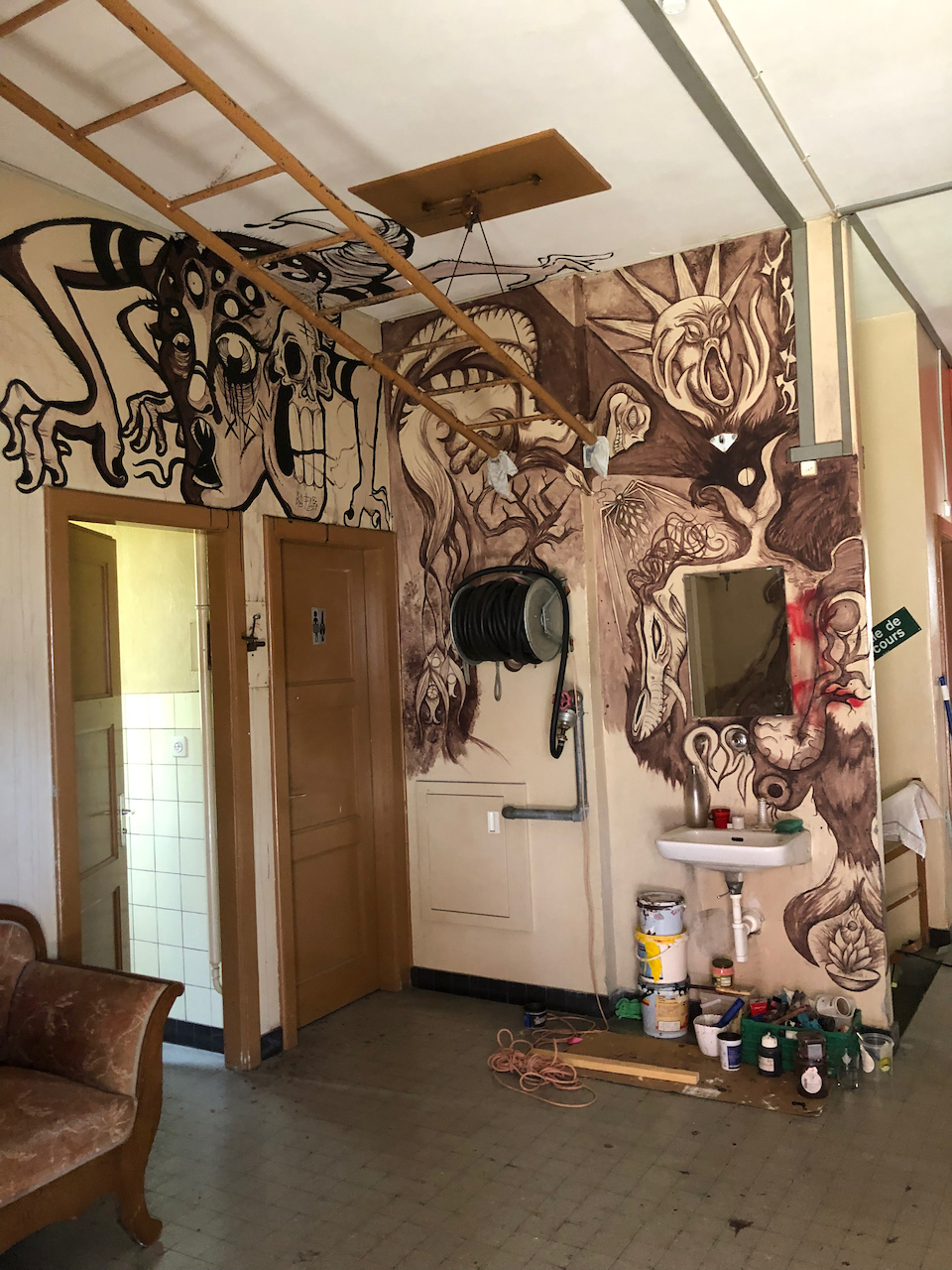
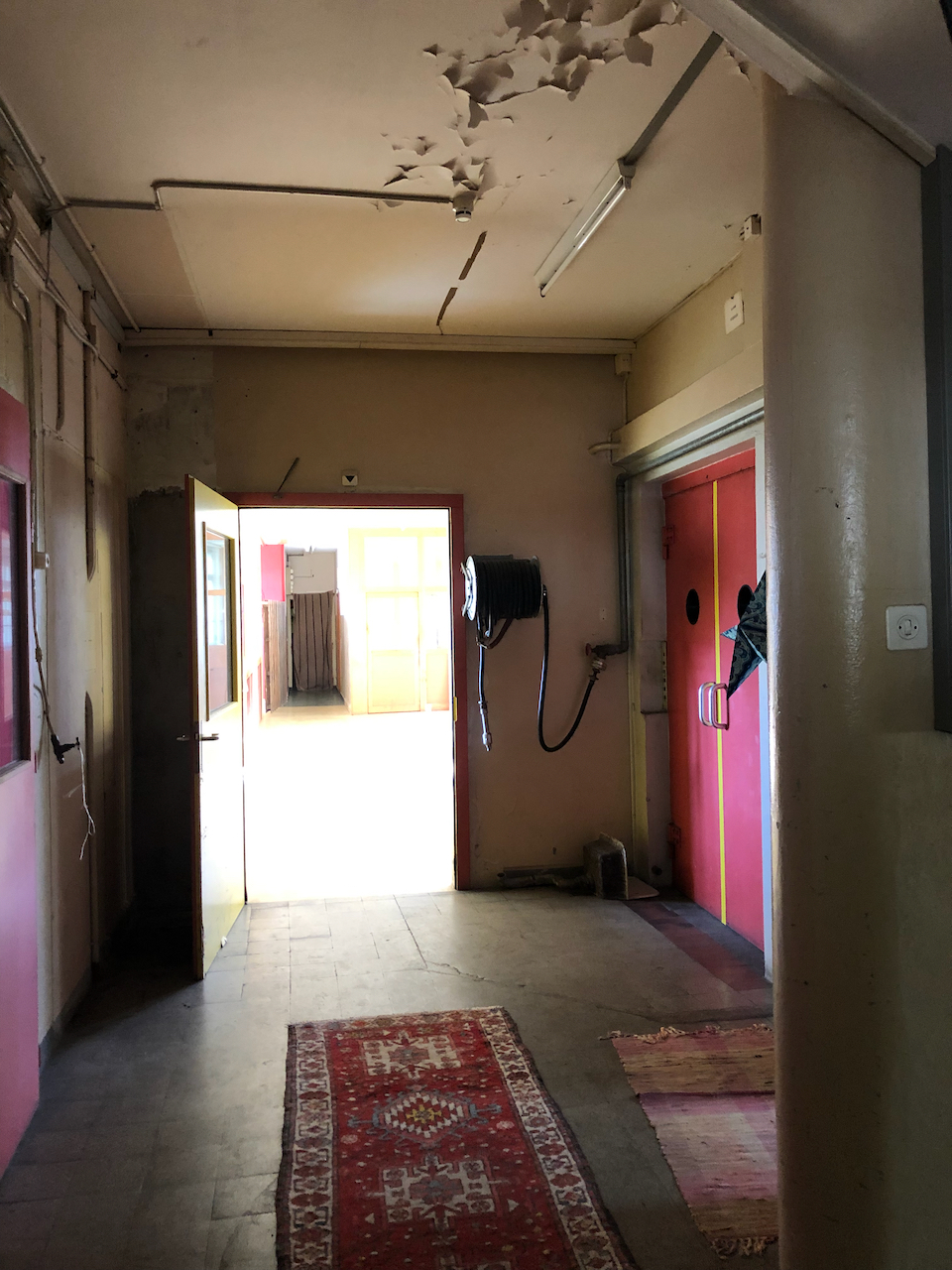
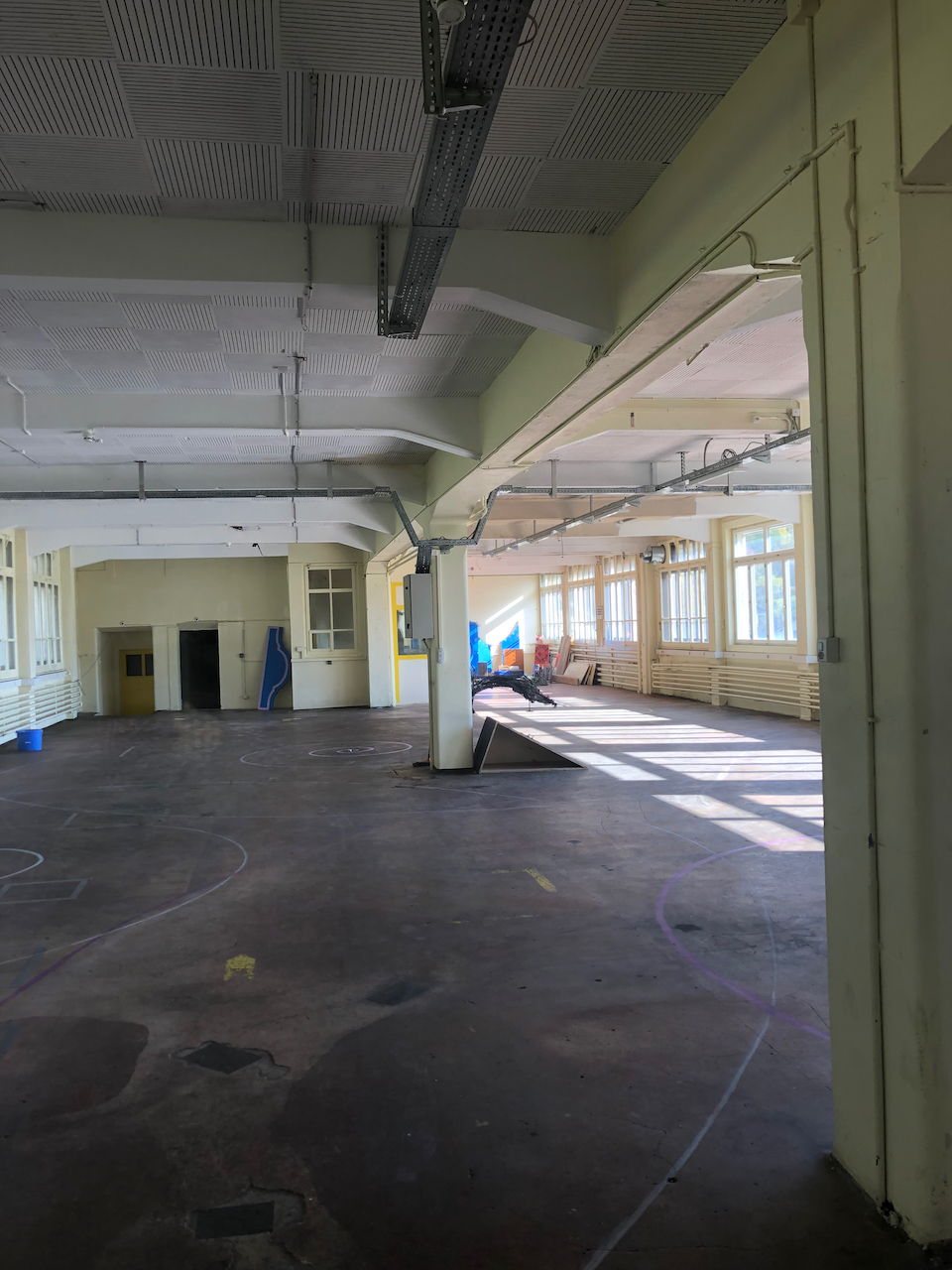
I walked around the empty spaces. It was all clean and organised. Someone had recently been working on the wall murals: there was a smell of paint. There are huge areas of blank wall and vast empty rooms. There is a “magasin gratuit” where you are invited to take what you need or bring goods to donate. A handwritten notice explains how it works.
I didn’t meet anybody.
On the way out, I did meet someone. This was a young woman, who smiled and asked if I was visiting: “Vous faites le tour?” I said yes I was. She recognised me, because she’d seen me drawing, three days previously. We chatted for a bit. She explained some of the history. The town had been opposed to their use of the site. Some people thought we were squatters, she said: “ils pensent qu’on fait le squatte”. But no, she said, we are not squatters. In principle, “no-one sleeps here the night”. And they have the permission of the owner. Well, they had the permission of the owner. But things have changed…. so the situation now is, well, “un peu ambigue”, a bit ambiguous.
She smiled. She liked it there. She said that it was surprising how little one needed, just “les un ou deux trucs” a few things needed for existence.
“And friends,” I suggested.
“Yes,” she agreed, “and friends.” She told me her name and asked me mine. “Come back,” she said, “any time. Boir un café.” And she set off down the slope, towards a young man waiting patiently below, by the collection of wooden outhouses.
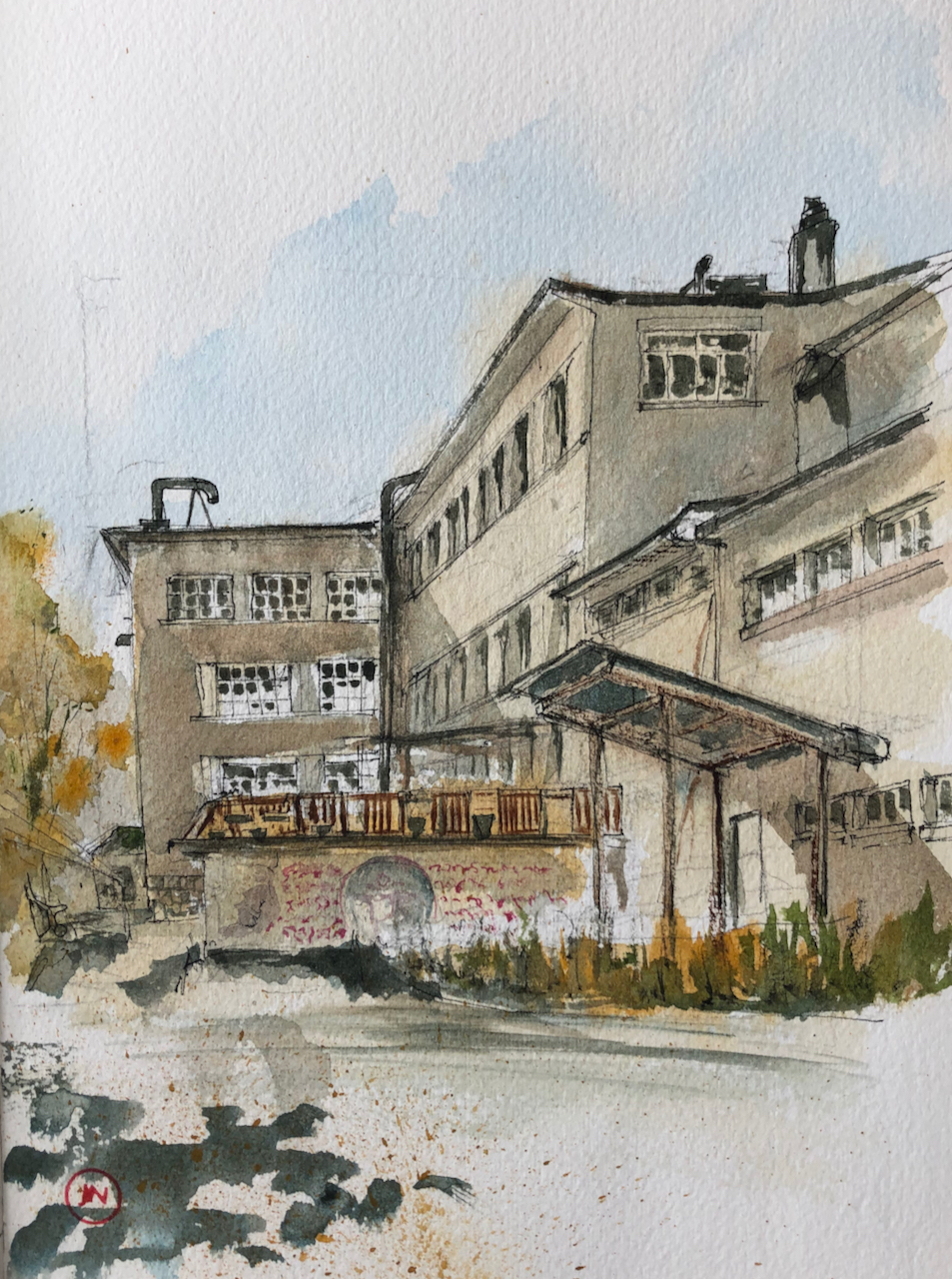
Here is the picture I had been drawing when I first met the woman.
26 rue des Rasses, rear entrance (view from the South). 17th October 2021, 4pm. In Sketchbook 11
In this view you can see evidence of the current occupiers. They have built a fence, made of wooden pallets, on top of a concrete platform which is part of the original building. On the concrete wall are inscriptions in a flowing calligraphic script I did not recognise, and a large symbol in a roundel.
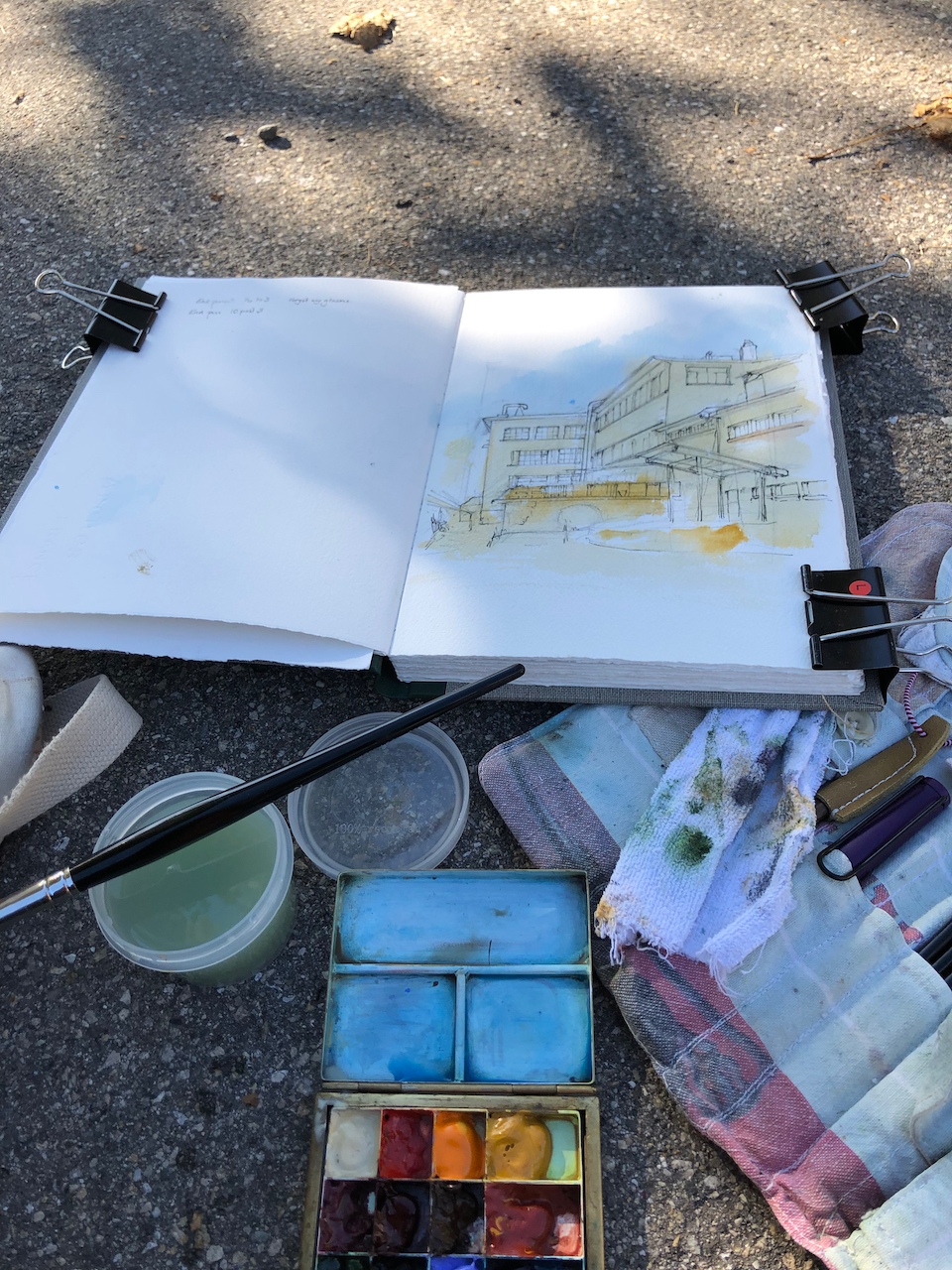
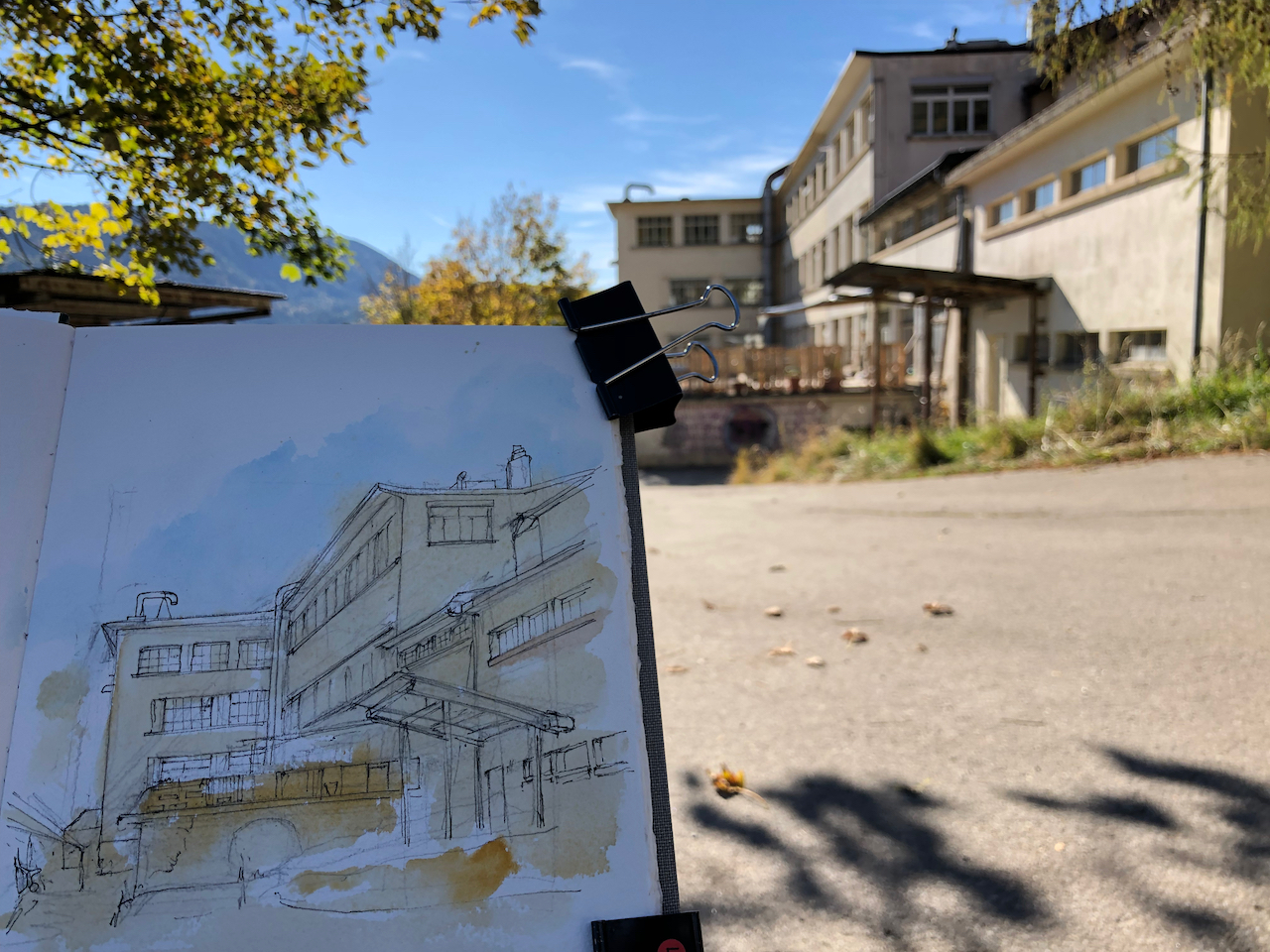
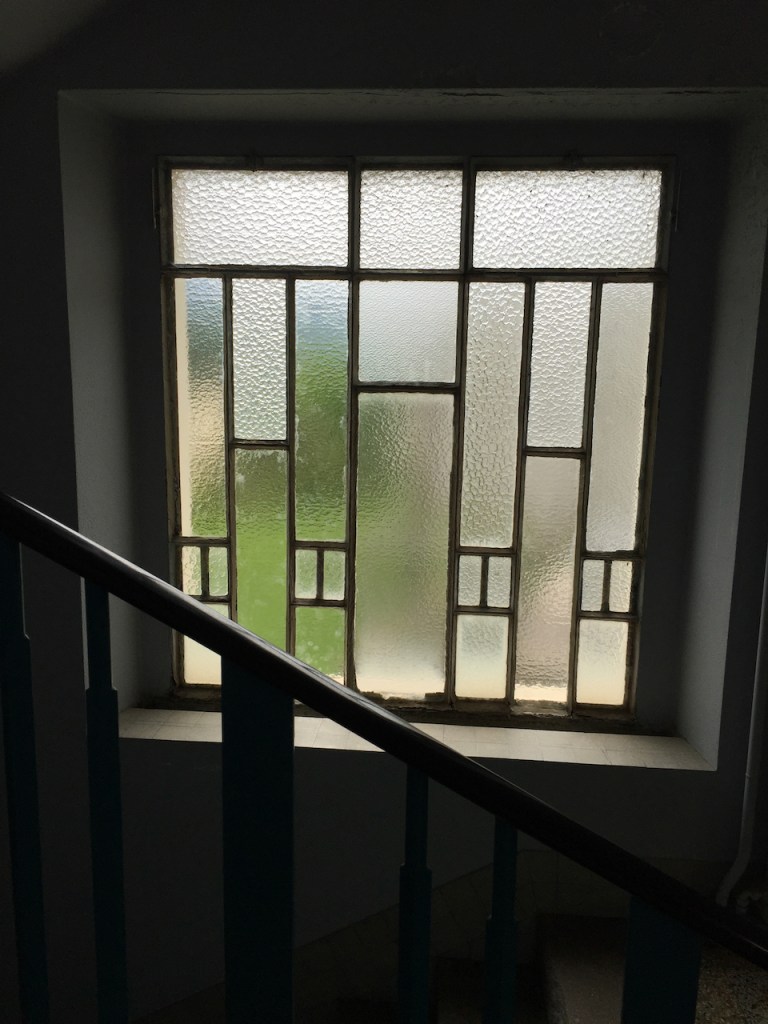
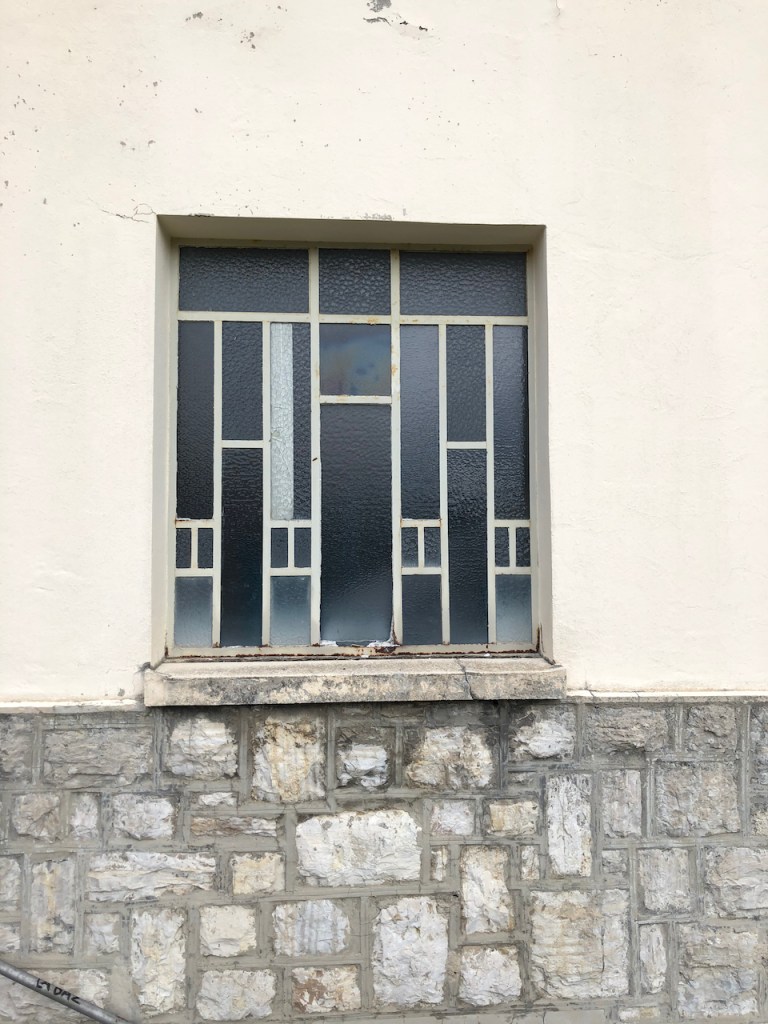
Here are some external views and work in progress on the drawings:
Window from inside, June 2016
Window from outside, October 2021
Building exterior, October 2021
Here are maps:
References:
Reuge, the Art of Mechanical Music, Secrets of the Reuge Manufacture, published by Reuge in 2007. Picture of the factory in the snow is from the frontispiece.
Website describing Le Baz, and the Zone libre à Bâtir: https://pantographe.info/ downloaded 22 Oct 2021
The local newspaper <<24 heures>> carries articles about how the current occupiers took over the buildings and disputes between the current occupiers and local residents. See for example the article by Frédéric Ravussin, 22.11.2019, 06h51. These newspapers are available on the marvellous digital resource: Scriptorium from the University of Lausanne.
Click a button below to share this post online, email it, or print it:
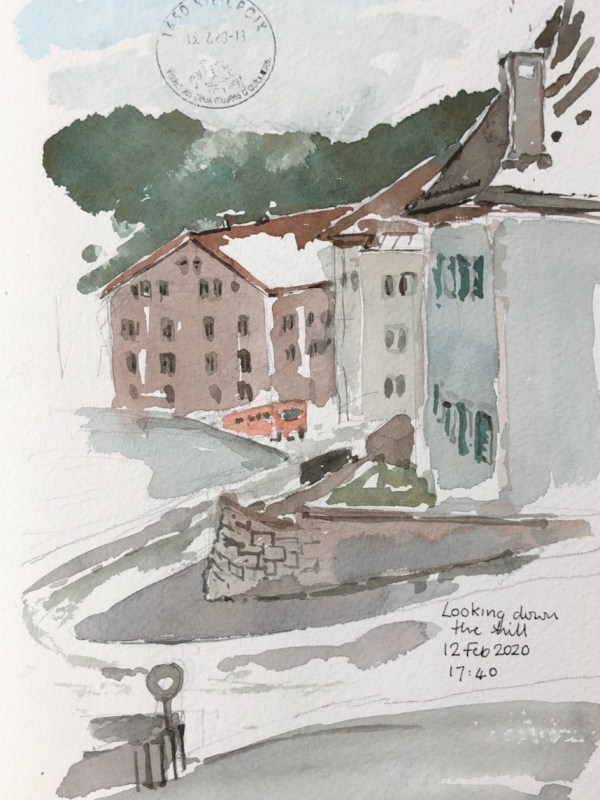
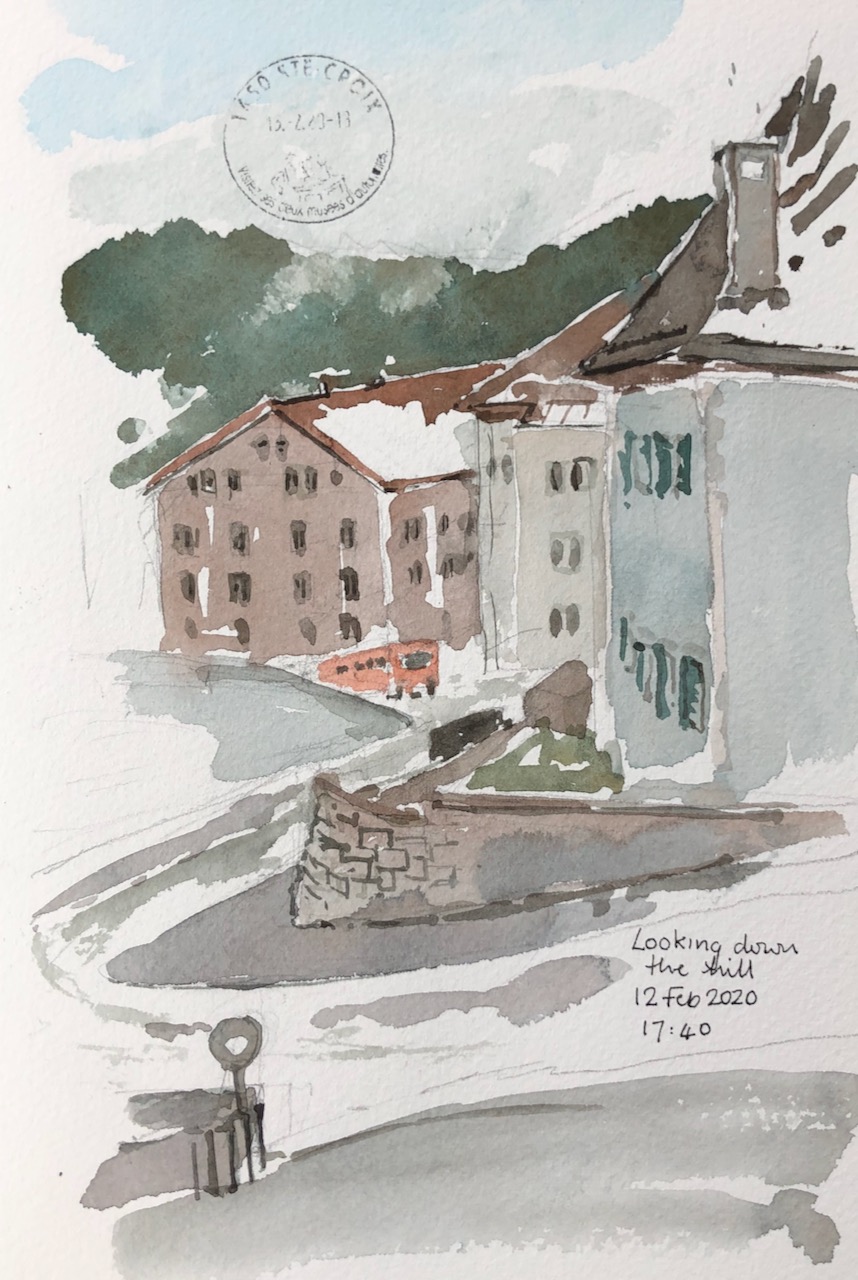
The weather in the Jura mountains is changing. This is climate change, the residents tell me. Once, the snow came reliably every year, bringing skiers. Now, the snow is unreliable. “It shouldn’t be like this,” they said, looking out at the slushy rain. This is February: high skiing season. “It should not be like this,” they say again, sadly.
Here is a sketch made looking out of the window into the rain and melting snow. The lady at the Post Office added the stamp.
Sainte-Croix, February 12th 2020, looking down the hill towards the station.
I made that picture with just watercolour: no pen.
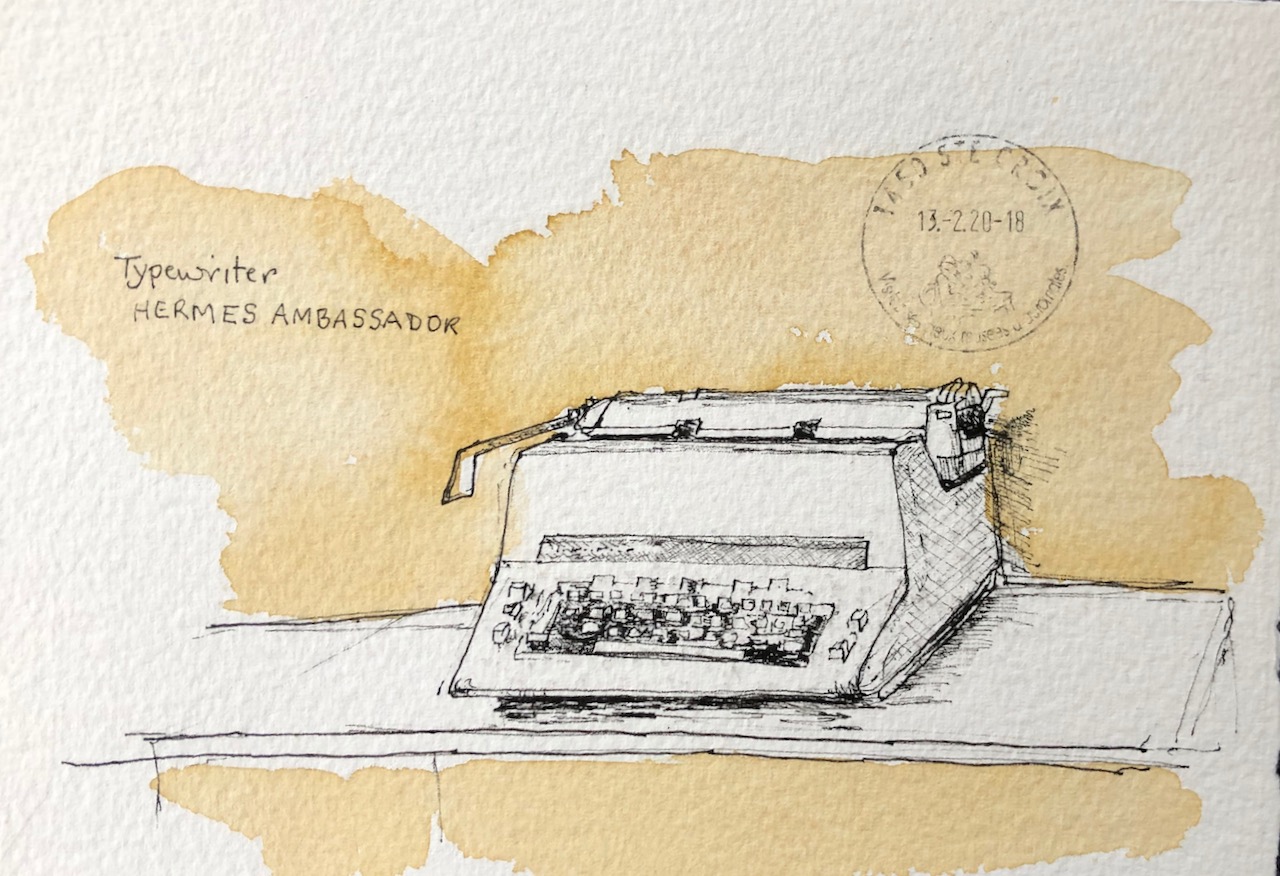
The Hôtel de France celebrates the fine engineering expertise of the area with a collection of typewriters. There were several in the meeting room where we worked. Here is one of them.
Typewriter. The Post Office lady obliged with the stamp.
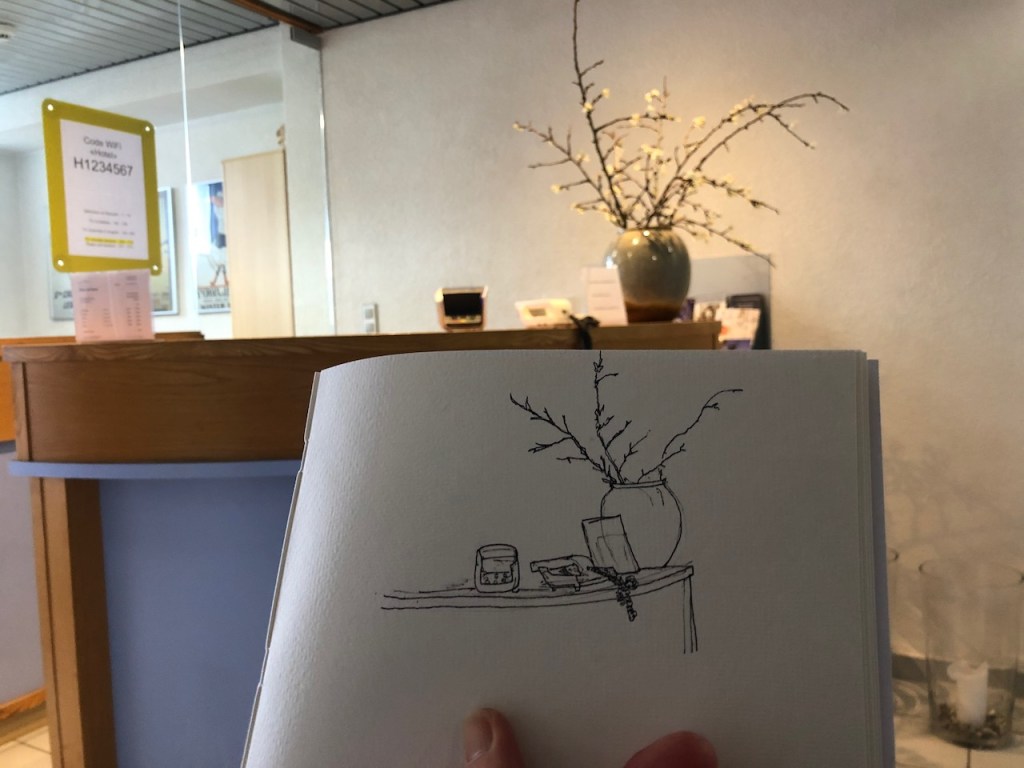
This was a busy visit. My arrival had been delayed by a storm, and so work was compressed into a few hours. My next sketching opportunity was while I waited for a lift to the station.
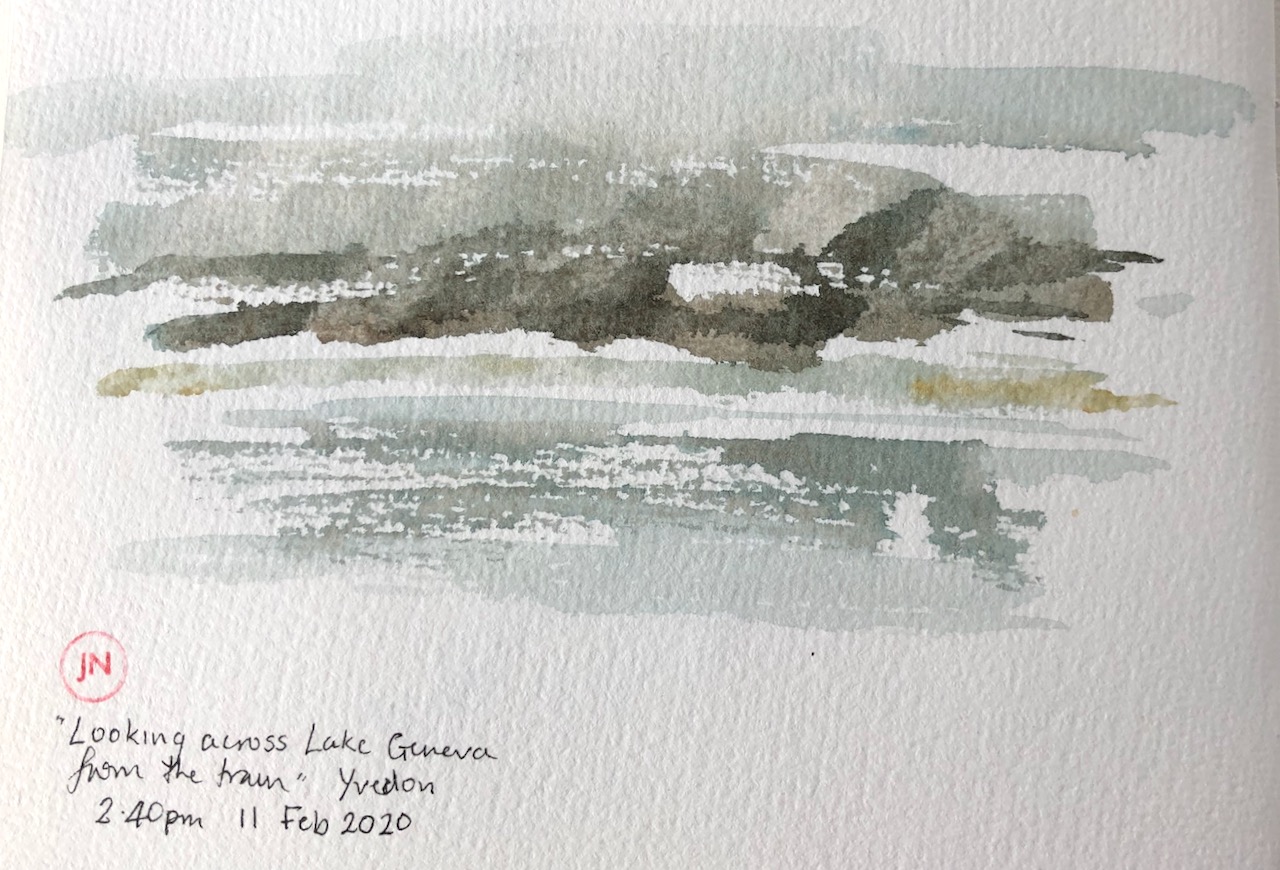
Here’s a view across Lake Geneva in the rain.
Click a button below to share this post online, email it, or print it:






































 Jane Sketching