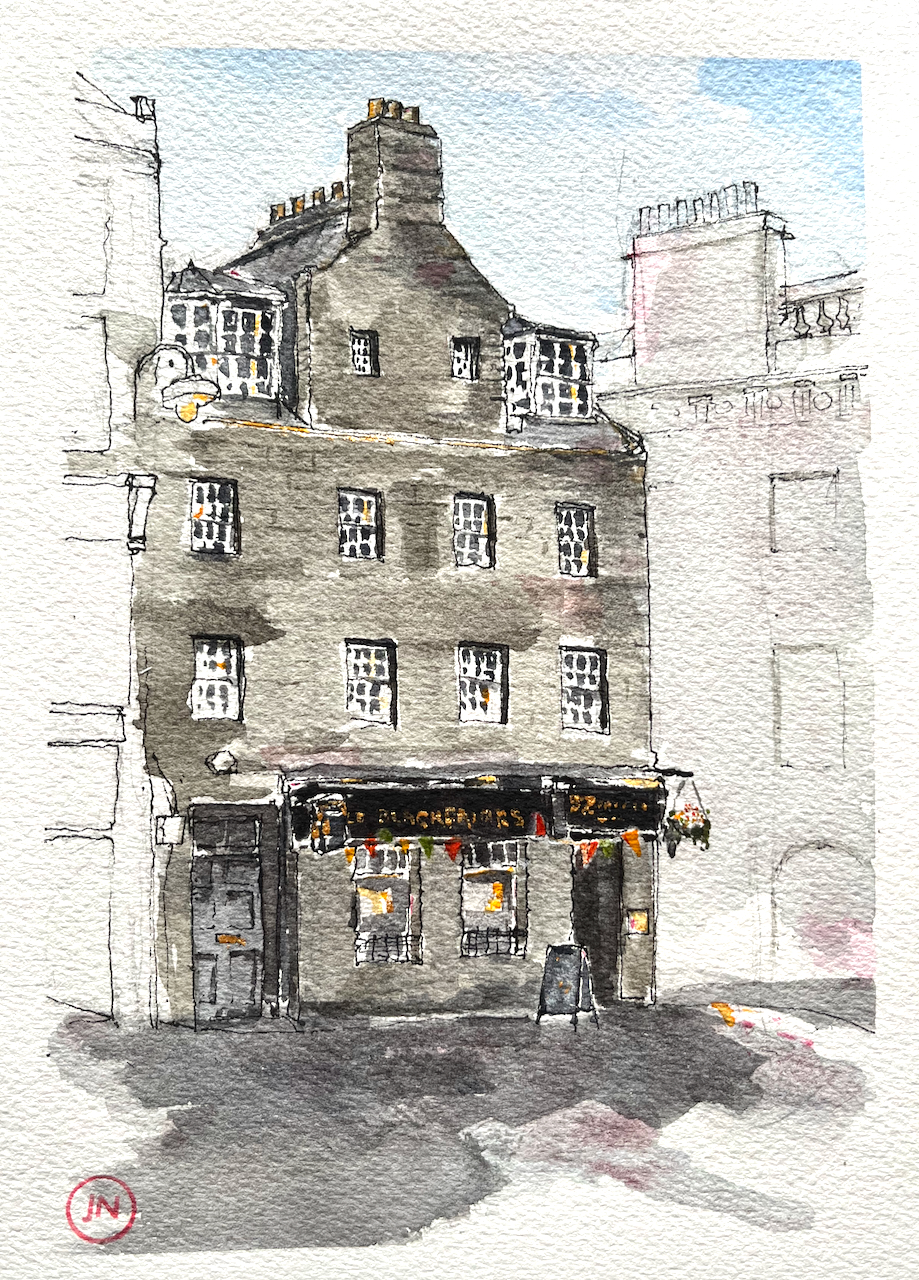
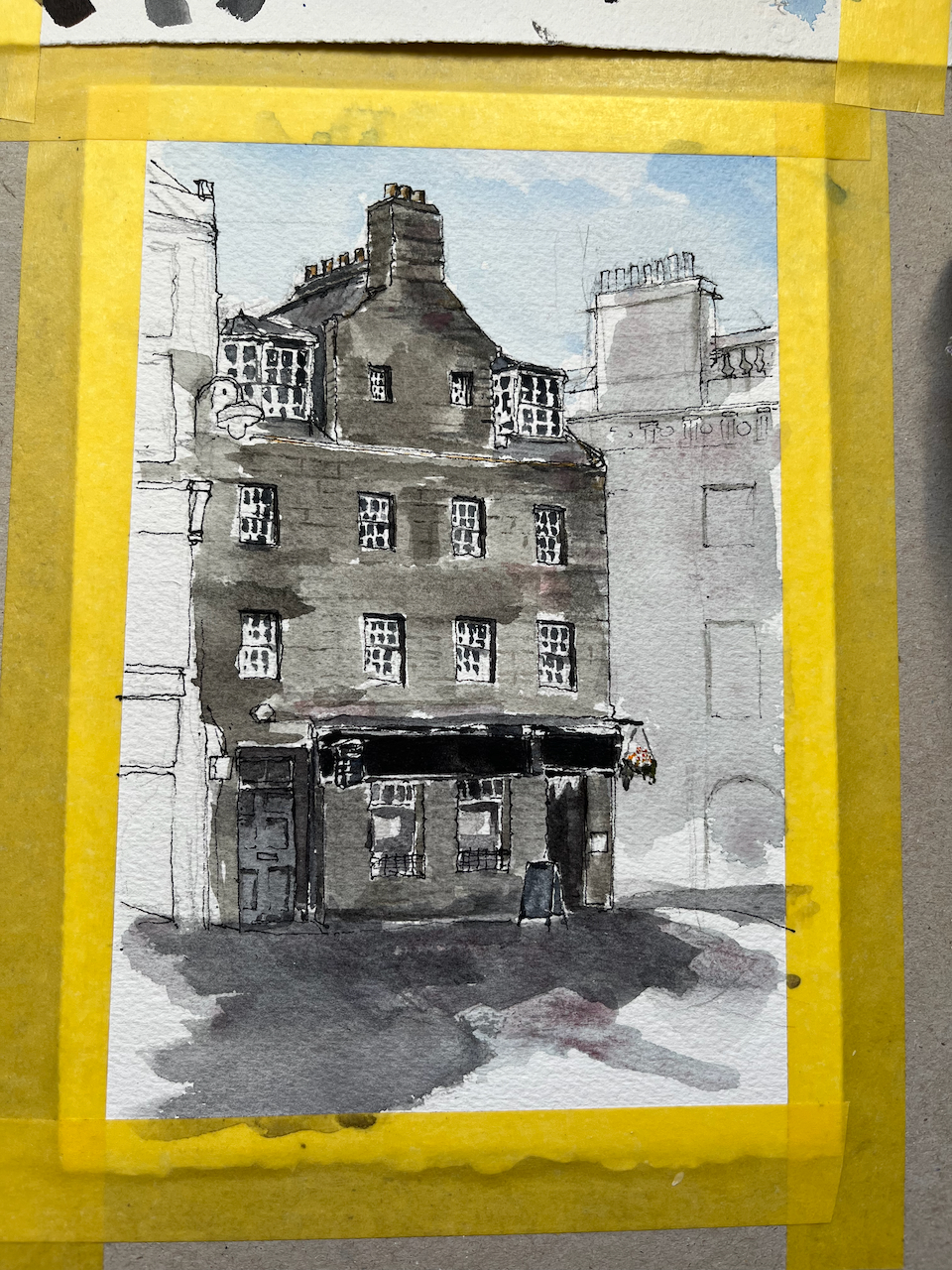
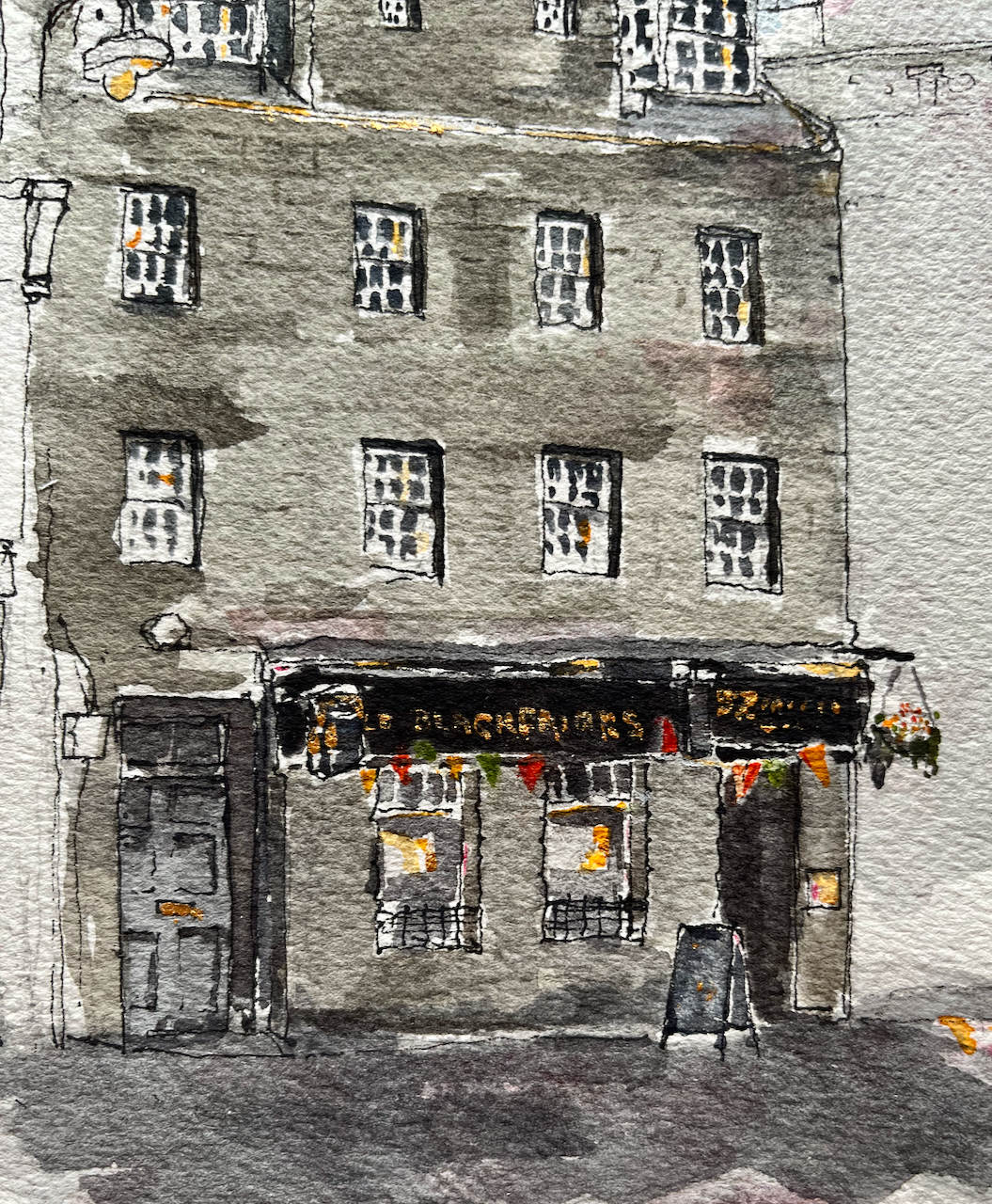
This is the Old Blackfriars, 52 Castle St, Aberdeen.
The Old Blackfriars, Aberdeen AB11 5BB, sketched 24 June 2024, 20cmx14cm (A5), [commission]
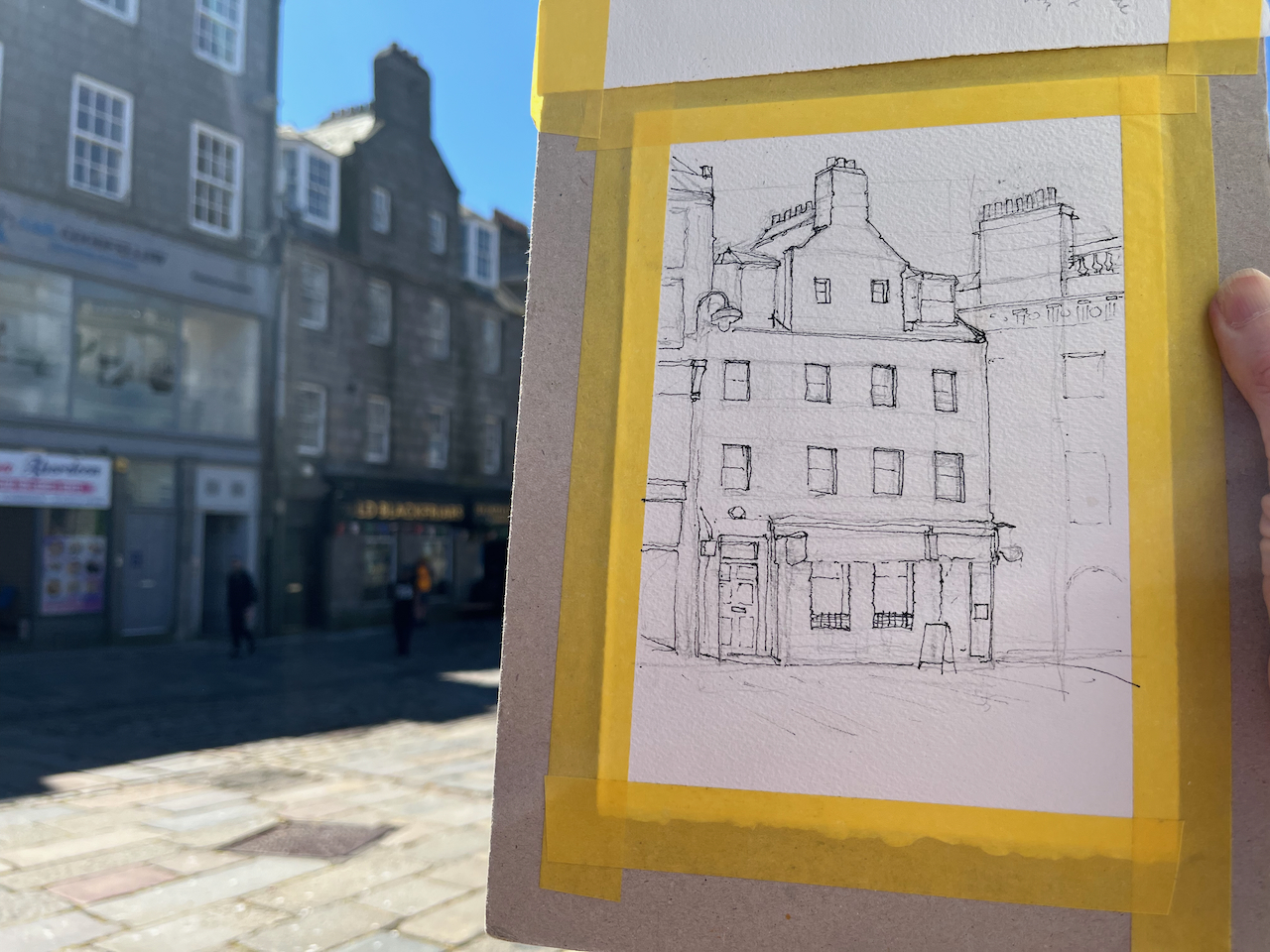
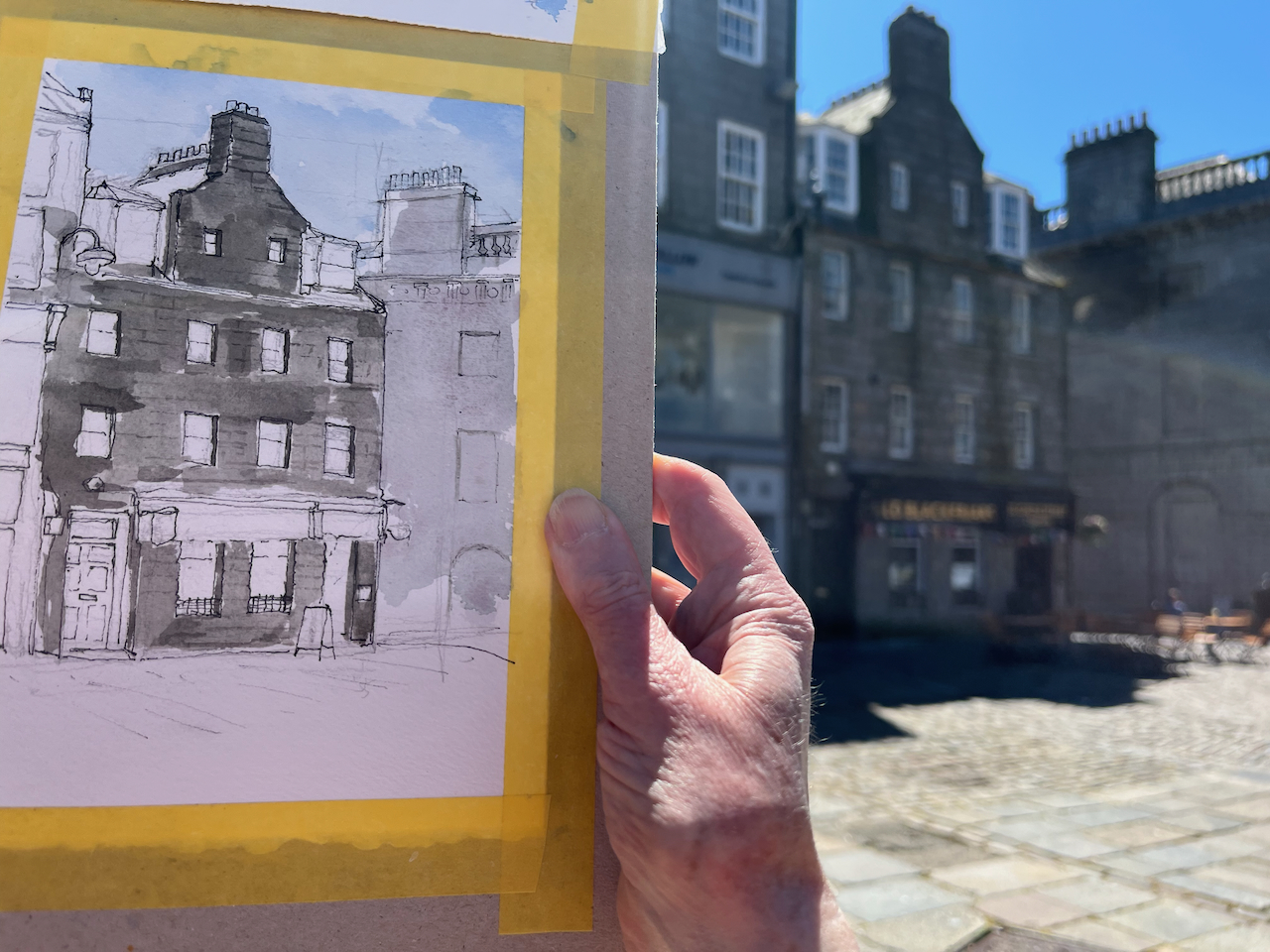
I worked on this drawing standing in the large cobbled square called Castlegate. A passer-by walked up to where I was standing, and took an interest in the picture. I’ll call him Campbell. He had much to tell me, a visitor, about the city of his birth. He had been brought up in what he described as the “tenements” on the dock. “Six of us to a room,” he said. He’d trained as a coppersmith, and found work in the engine rooms of ships and submarines, making “boilers, pipes and flanges”.
I was sketching this pub at the request of a client who had happy memories of their time there. Campbell also had happy memories of his lively times at the pub, although his experiences pre-dated those of my client by some decades. It was a pub for folk working the docks Campbell told me, and “they had a hard life”.
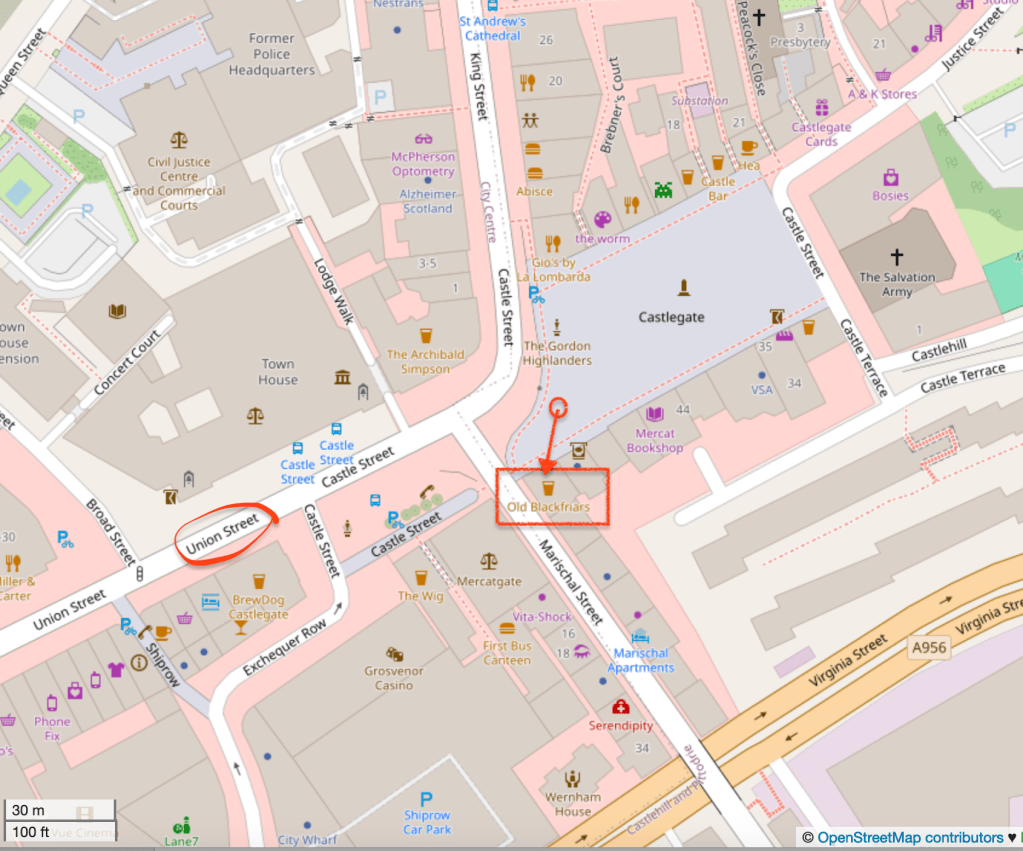
Uncharacteristically for British people, we talked politics. The general election was coming up. My new friend had little time for politicians of any stripe. They don’t know what they are doing, he asserted. “It’s like watching a drunk man trying to walk down Union Street”. He indicated the wide straight street across the cobbles, and with an articulate hand gesture demonstrated the erratic movements of the inebriated.
I enjoyed his entertaining stories as I sketched. He went on his way when I was at the pen-and-ink stage. I hope that some of his stories made it into the finished drawing.
Sketching on location in Castlegate, Aberdeen
The main colours are: (DS=Daniel Smith watercolour) – ultramarine blue finest (Schmincke) – burnt umber (DS) – haze pink (Schminke) – in the stones – rose madder permanent (DS) – in the stones For the details: – permanent yellow deep – pyrrole red – mars yellow – acrylic gold paint
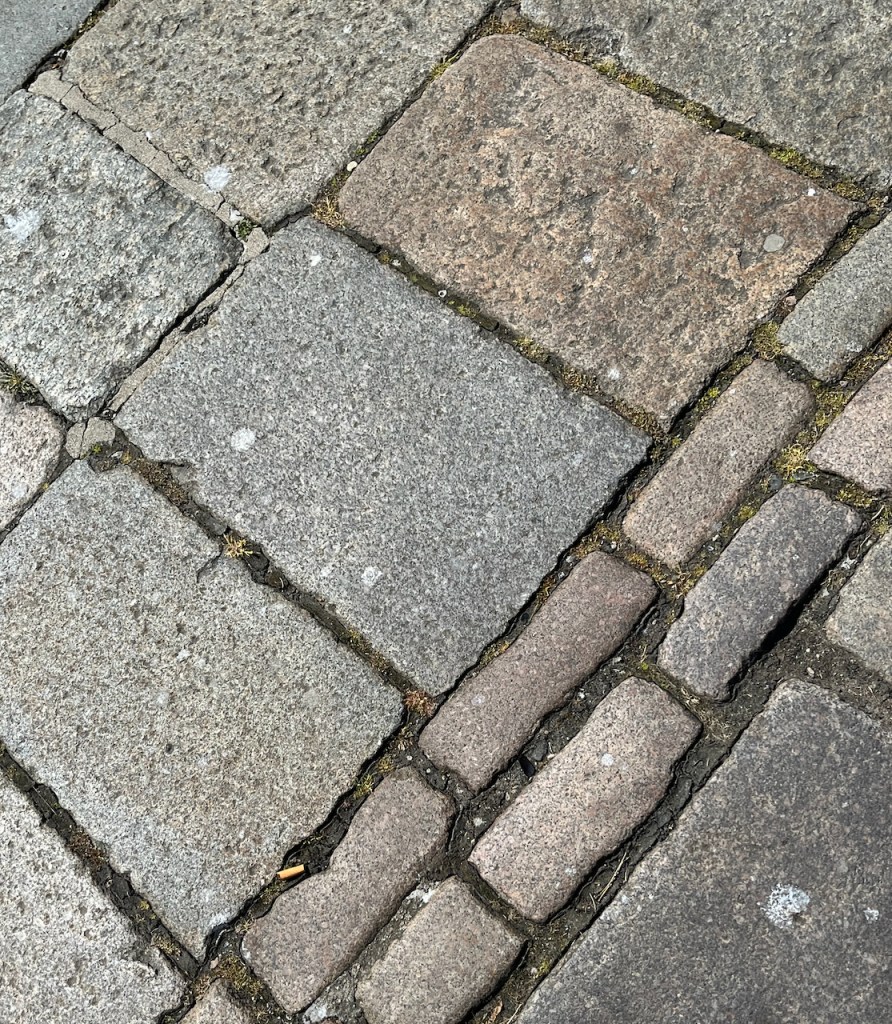
Aberdeen is “The Grey City” for some. But for anyone who doubts that there really is pink in the stone, I include a photo of the cobbles.
Cobbles at my feet
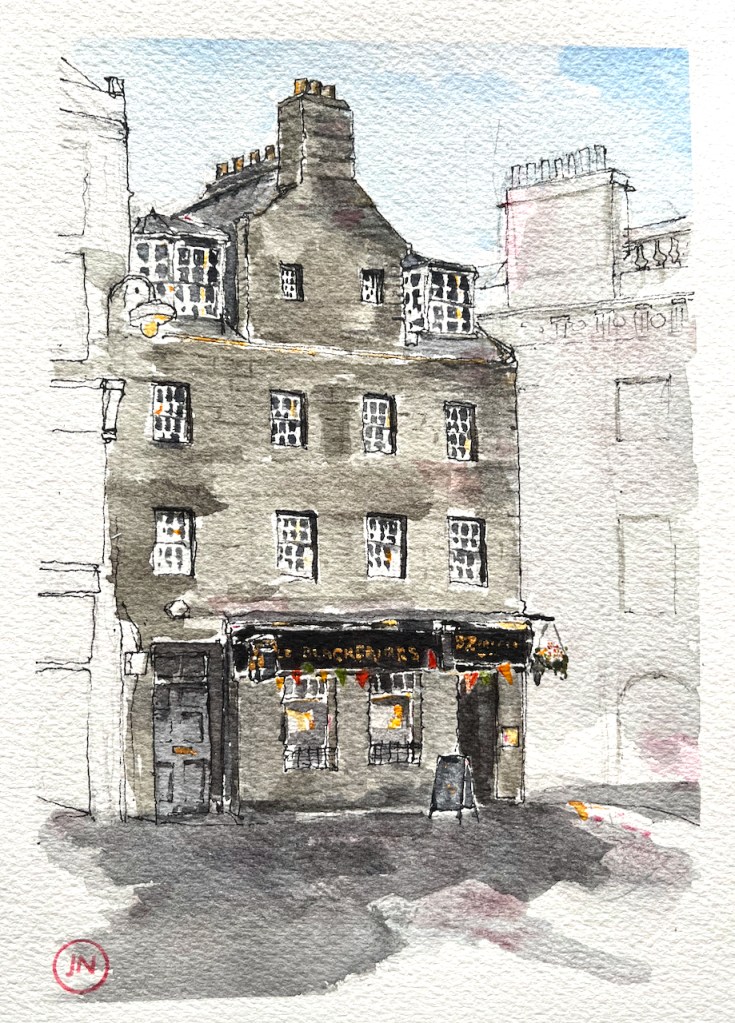
This was a commission. Thank you to my client for inspiring me to draw this historic pub, and for their permission to post the pictures here. They kindly sent me a photo of the picture in its frame:
photo credit: my client G.
Click a button below to share this post online, email it, or print it:
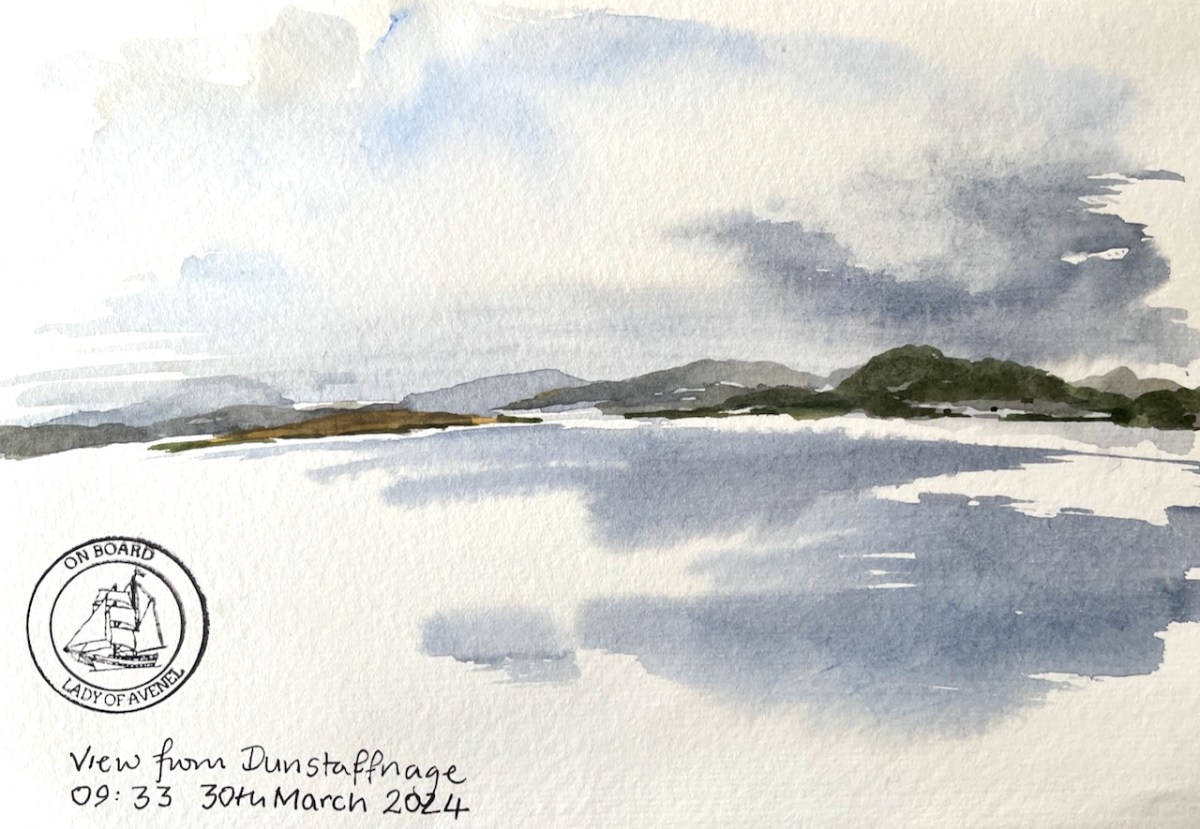
Here’s a view from the ship”Lady of Avenel”. She which was at the Dunstaffnage Marina, Oban, at the time. This is a quick sketch done on thin “Amatruda” watercolour paper, sent as a postcard. It is the view looking north, towards Fort William. See the rain clouds coming!
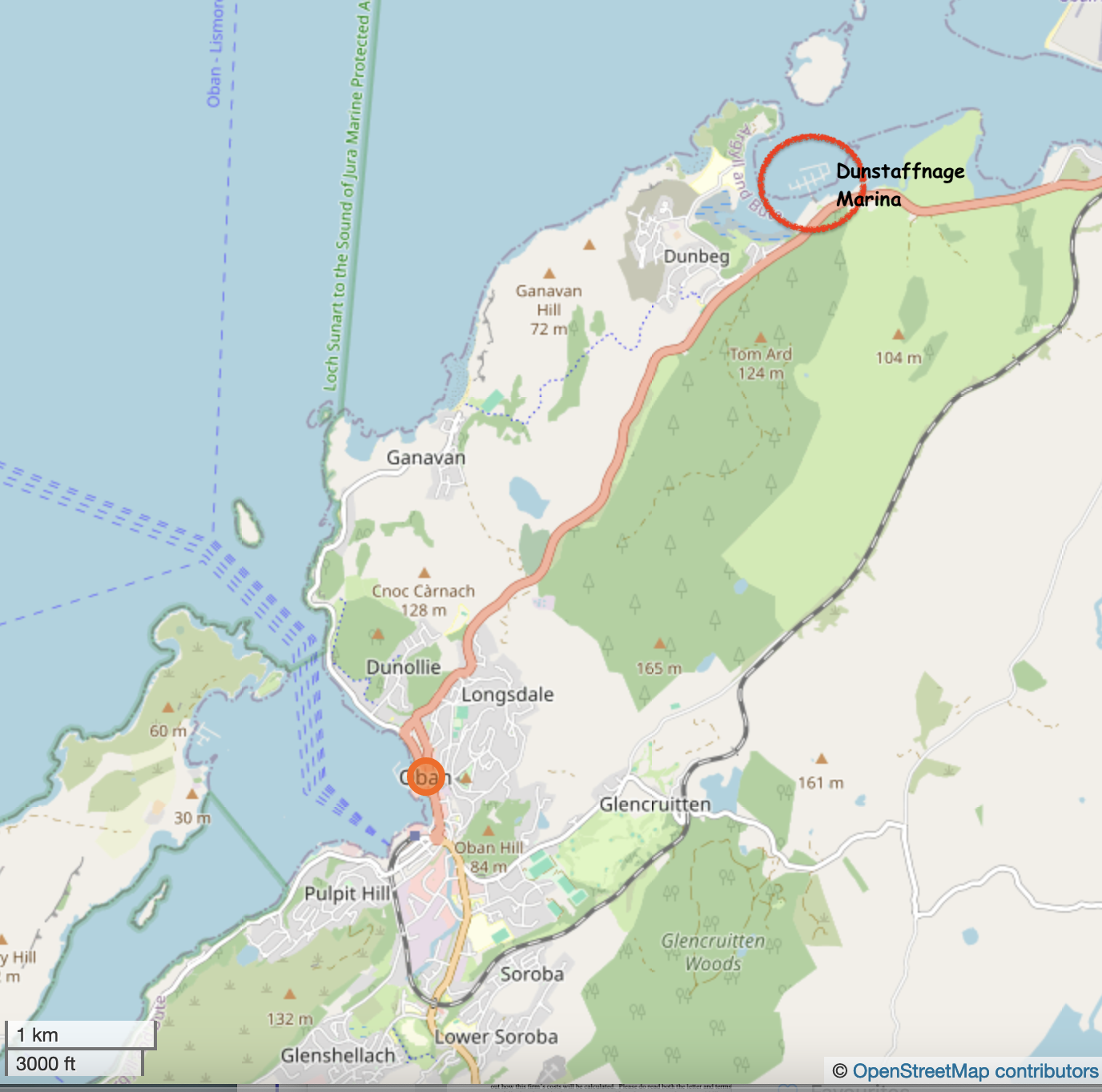
Oban is on the West Coast of ScotlanLady of Avenel was at Dunstaffnage Marina
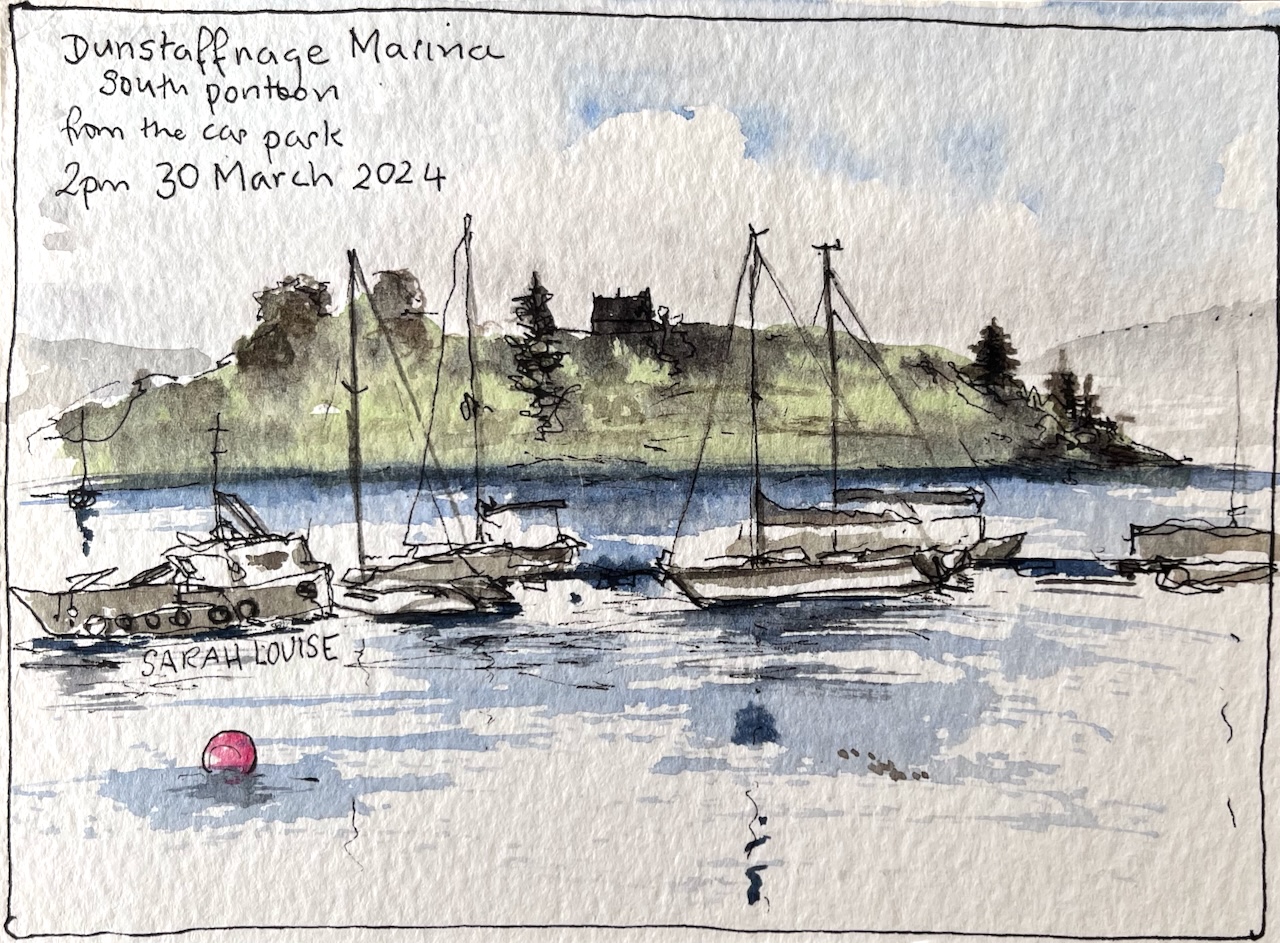
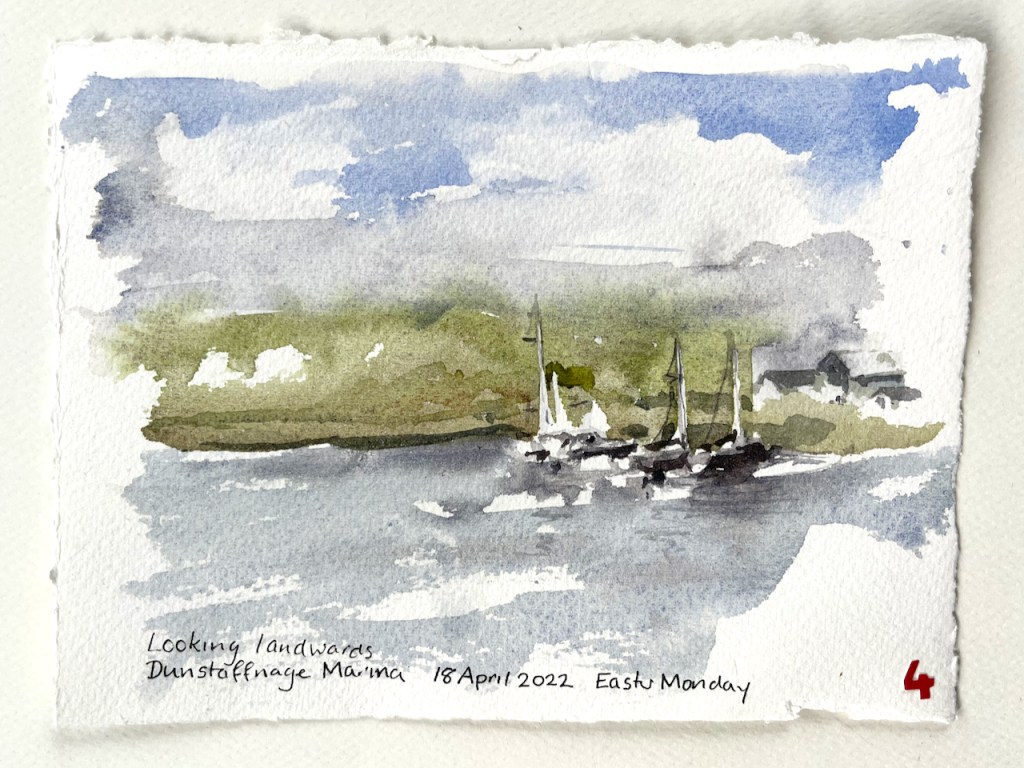
Here’s a quick sketch of the marina.
Quick sketch on a 6″ x 4″ postcard
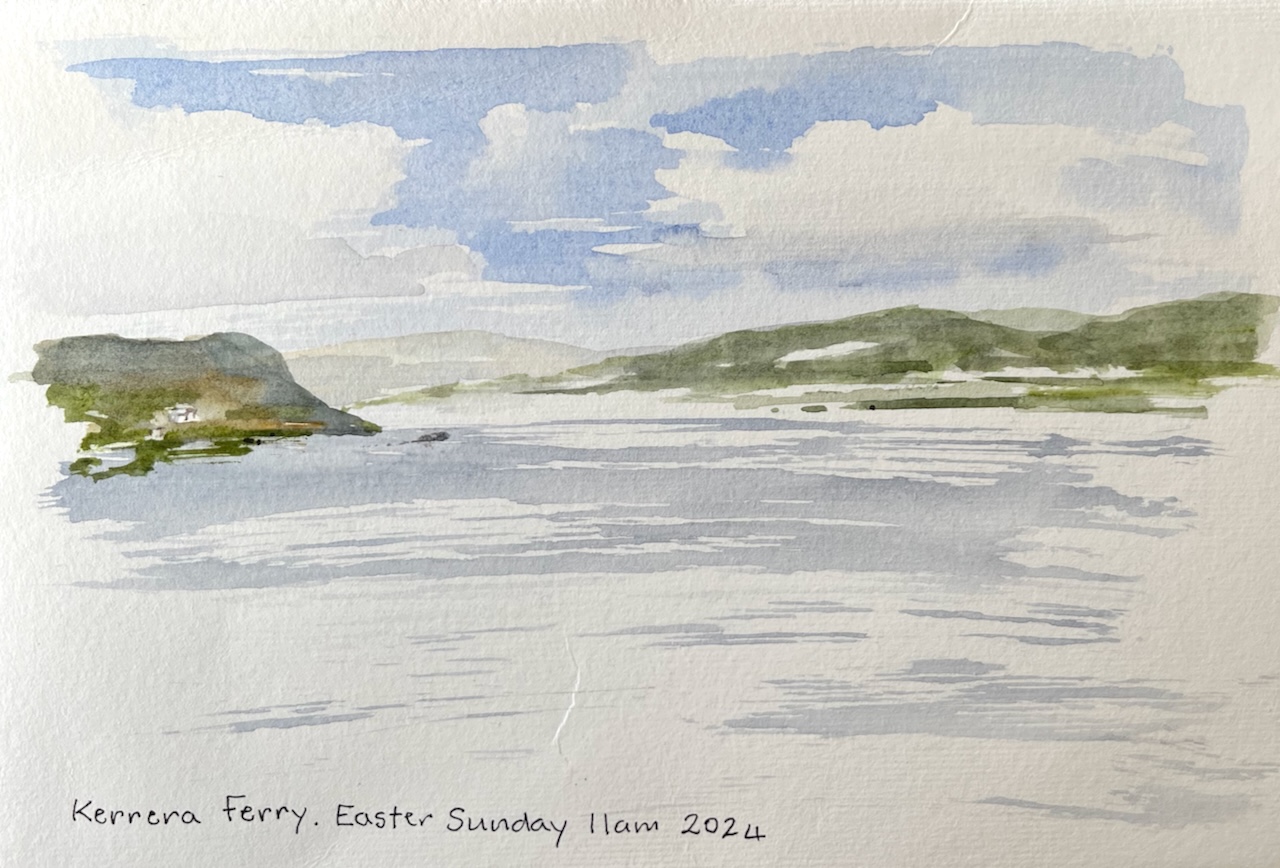
Later I visited the lovely island of Kerrera.
A5 Amatruda watercolour paper.
These landscapes are so inspiring! I’ll be leading a “Sketch and Sail” adventure on the Lady of Avenel in October 2024, together with Alice Angus. We’ll start and finish in Oban. Would you like to join us? Have a look at this page and get in touch!
Click a button below to share this post online, email it, or print it:
On my way up to the West of Scotland I had a day in Glasgow. The overnight train had arrived at 07:30 and the bus to Oban didn’t leave until 18:05. I emerged from Glasgow Central into the mist and fine rain, and walked up the hill to find the “Buchanan Bus Station”. My idea was to stash my bag in the Left Luggage facility and then spend my time exploring Glasgow.
Glasgow at 07:30 on a wet morning in March is not so very enticing. I had the lowest possible expectations as I entered the bus station. Although huge, the bus station had been difficult to find, hidden as it is behind a monumental building called “Buchanan Galleries”. This is neither a “gallery” of the art sort, nor a shopping centre, as far as I could work out. It is a multi-story car-park. Every shop I had passed on the way up had been closed, possibly permanently, or so it seemed to me. There was a wind, I was getting wet, and I was hungry. Despite the confident announcements on its website, I was starting to think that the Left Luggage at Buchanan Bus Station would be closed.
But, contrary to all expectations, the Left Luggage Office was lit up, the door open, and everything looked new and clean inside. Even better, a cheerful man in a beanie hat soon appeared behind the desk, took charge of my pack, and efficiently operated the locker system. I exchanged a £5 note for a receipt with a code, put the receipt deep within my pockets, and set off into the grey morning feeling a lot more cheerful.
This came to typify my experience of Glasgow: a grey and wet city enlivened by cheerful welcoming people.
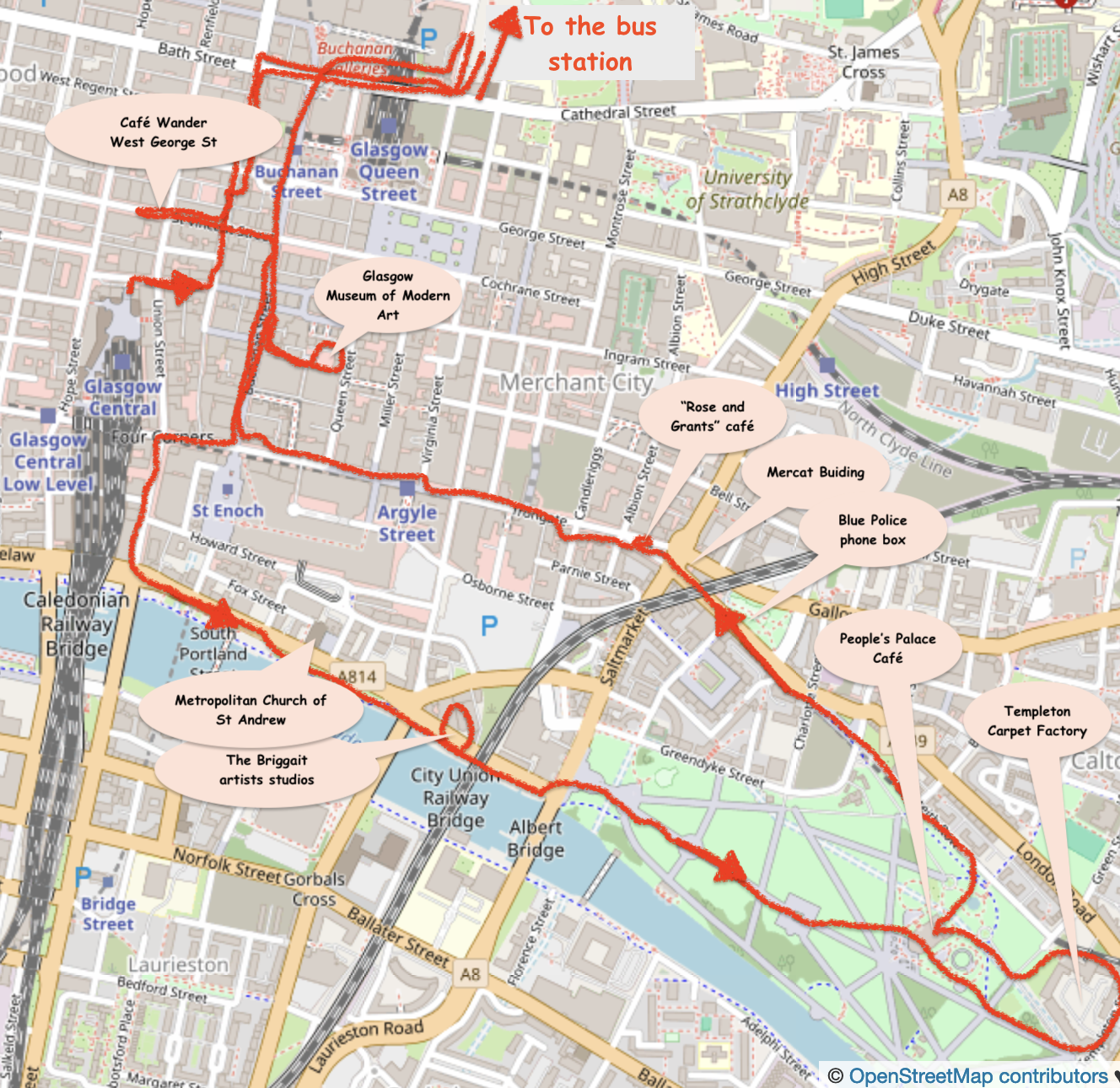
My wanderings around Glasgow. Positions of monuments and cafés are approximate. Map (c) Open Street Map Contributors.
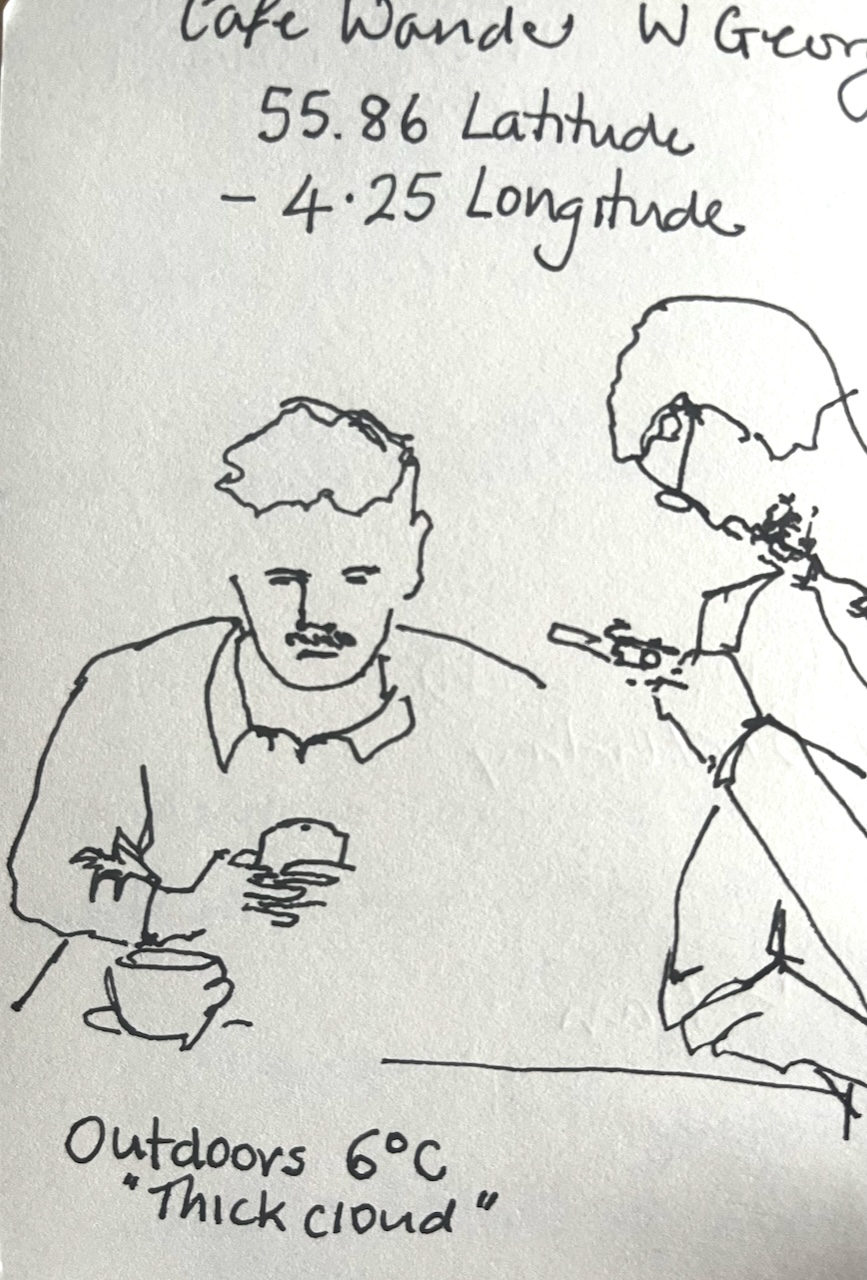
Walking out of the bus station, and wandering at random through the grid of streets, I spotted the “Café Wander” in a basement. This is at 110 West George St and was a great find: welcoming people, a big mug of tea, food, and a charging point for my phone. No rush, I could think and sketch, and feel as though I’d arrived. I decided to head for the river. A river tells you about a city.
The amazing thing about Glasgow is that there are these magnificent buildings, and a lot of them are apparently empty. Or at least they are empty from the 2nd floor up. At street level there is a band of multi-coloured shopfronts, some shuttered. Higher up the Victorian optimism and wealth proclaims itself in ornamented facades, fancy windows, sculptures, and carved names of proud institutions: “St Vincents Chambers”, “Bank of Scotland”. But these higher floors are deserted. The windows are dusty, the facades chipped, the statues dark with dust. But still.
The river told me nothing about Glasgow, except that Glasgow seems to ignore its river. There is a main road, a magnificently restored catholic church, and a succession of buildings which in London would be converted to luxury flats but which in Glasgow remain as buildings awaiting their future. By the time I reached the park, I was really cold. Hacking my way against what was now a biting wind, I encountered a small round woman with a small round dog, coming the other way. She caught my eye and laughed, holding firmly on to the dog’s lead as though it anchored her to the ground. “Bitter!” she announced, still laughing. I agreed that it was.
I wanted to ask her some important questions, such as whether the “People’s Palace” had a café, and what was that brightly coloured building in the misty distance? But conversation was going to be impossible in that wind, so she and I passed each other in amicable silence, allies against the elements.
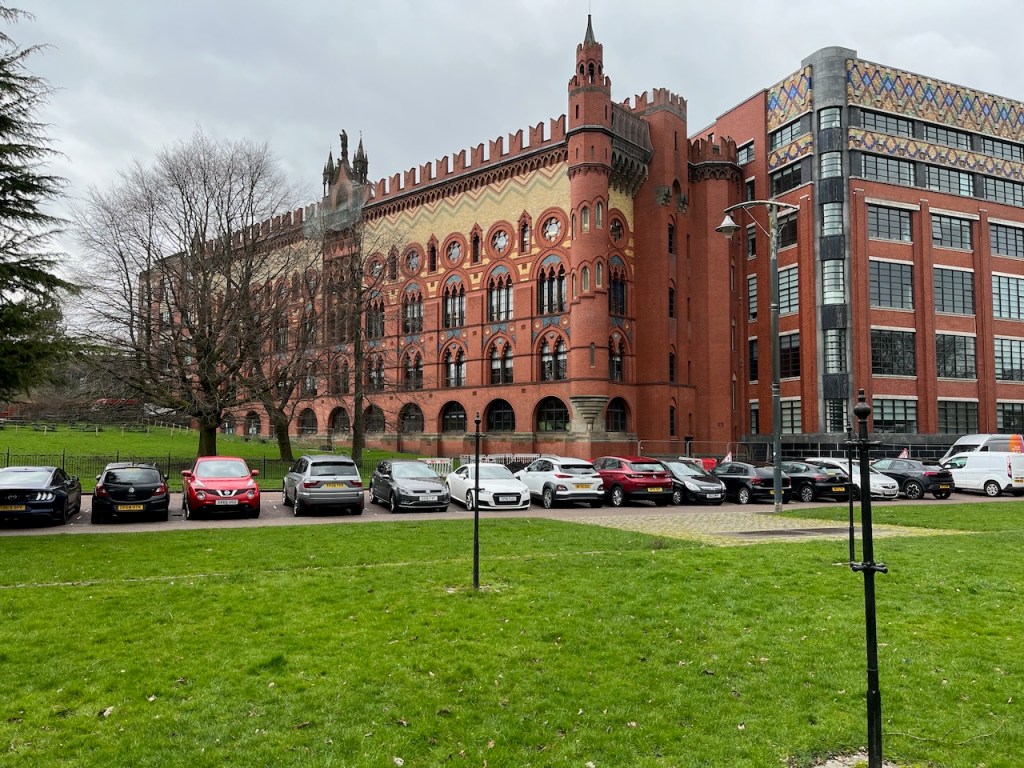
The brightly coloured building was called “Templeton Buildings”. It had no café, and no information. There was a bar, predictably closed. I circumnavigated it, and then set off for the “People’s Palace”. In the distance I’d seen someone come out, but they could have been a builder or a janitor.
It was now raining in earnest. All my papers, tickets and art equipment were in dry-bags inside my backpack, which had been a good precaution. I’ve been in Scotland before. The People’s Palace appeared out of the mist, a huge Victorian edifice, looking formidable and very closed. It was not closed. There was a board outside. A café! I pushed open the door, ready to be rebuffed at any moment, but no, inside was warmth and light, a museum of some sort, public toilets, and a café.
The “People’s Palace” Glasgow Green.
I more or less fell into the café. The friendly person at the counter gave me a guided tour of the home-made cakes, evidently from personal experience. Since he looked like someone who knew his cakes, I accepted his recommendation for the coconut sponge and took a window seat by an old fashioned radiator that was pumping out heat. From there, I watched through the window at coach tours who arrived to look at a fountain in the rain. This is the Doulton Fountain, gifted to Glasgow in 1888 by the Doulton Pottery in Lambeth, London. It would look very nice in the sun: a good sketching subject.
The friendly cake-expert directed me to information panels which told me about Templeton Buildings. This is the former Templeton Carpet Factory, which ceased operation only in 1980.
photo of Templeton Buildings
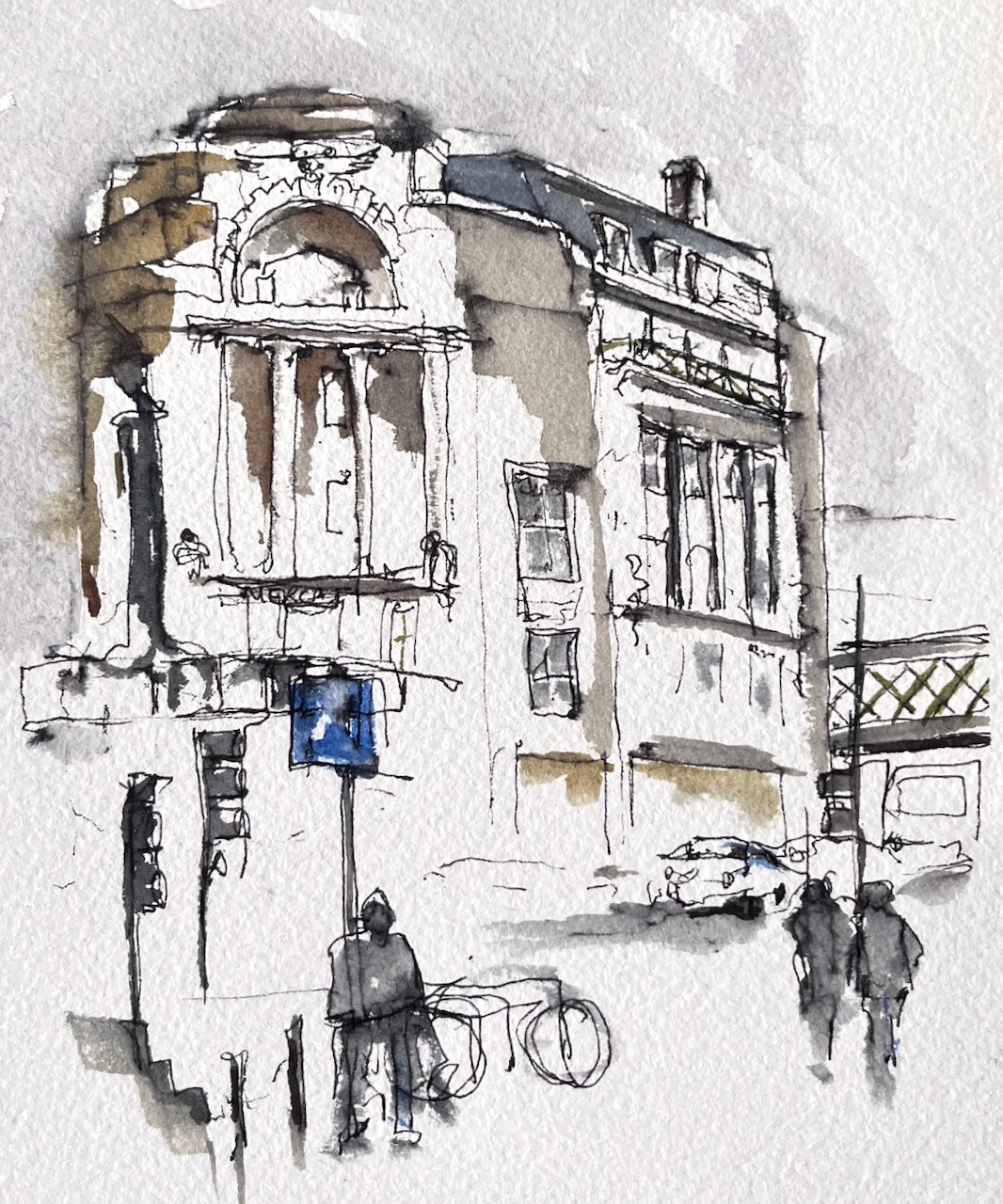
Eventually, fortified by cake, I was off again in the rain which had abated slightly. I was determined to sketch at least one of the Glasgow buildings. I came to the end of a long road, there was the Mercat Building.
Mercat Building, 26-36 Gallowgate, Glasgow, G1 5AB: 1928-31 designed by Andrew Graham Henderson who lived and worked in Glasgow 1882 – 1963
This was a very quick sketch, on an A5 card, done from a doorway as the rain came down. I stopped before all the colours ran together and retreated into “Rose and Grant”, another welcoming café where the people were not atall put out by my washing my brushes in their water glass and spreading out my watercolour equipment on the table, making copious use of the supplied paper napkins for art purposes.
My tour of Glasgow included the Museum of Modern Art, which has a peaceful library in the basement, as well as small galleries where the pictures have commendably large-type curation. Not crowded. Easy to navigate. Friendly.
I ended up back at Buchanan Street Bus Station, successfully retrieved my pack and was early for my bus.
Glasgow is definitely a City to return to.
Click a button below to share this post online, email it, or print it:
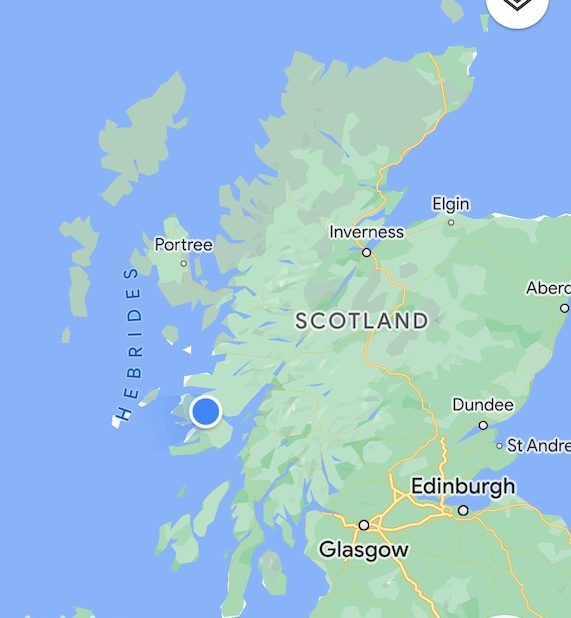
I’m just back from a “Sketch and Sail” adventure on the Lady of Avenel, a square rigged brigantine. I was one of the art tutors, together with Claudia Myatt. We spent a week sailing around the Inner Hebrides with a group of other sketchers: sketching the boat, the sea and the landscapes. The drawings which follow are ones I made. Participants’ drawings, with permission and attribution, will appear on the Lady of Avenel website.
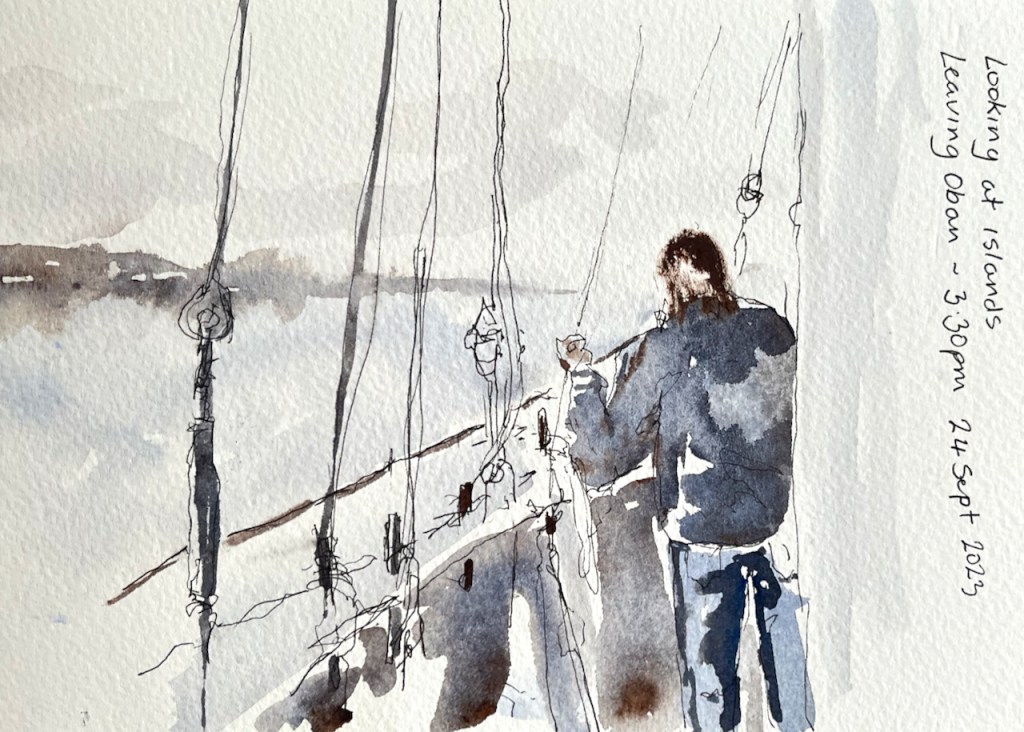
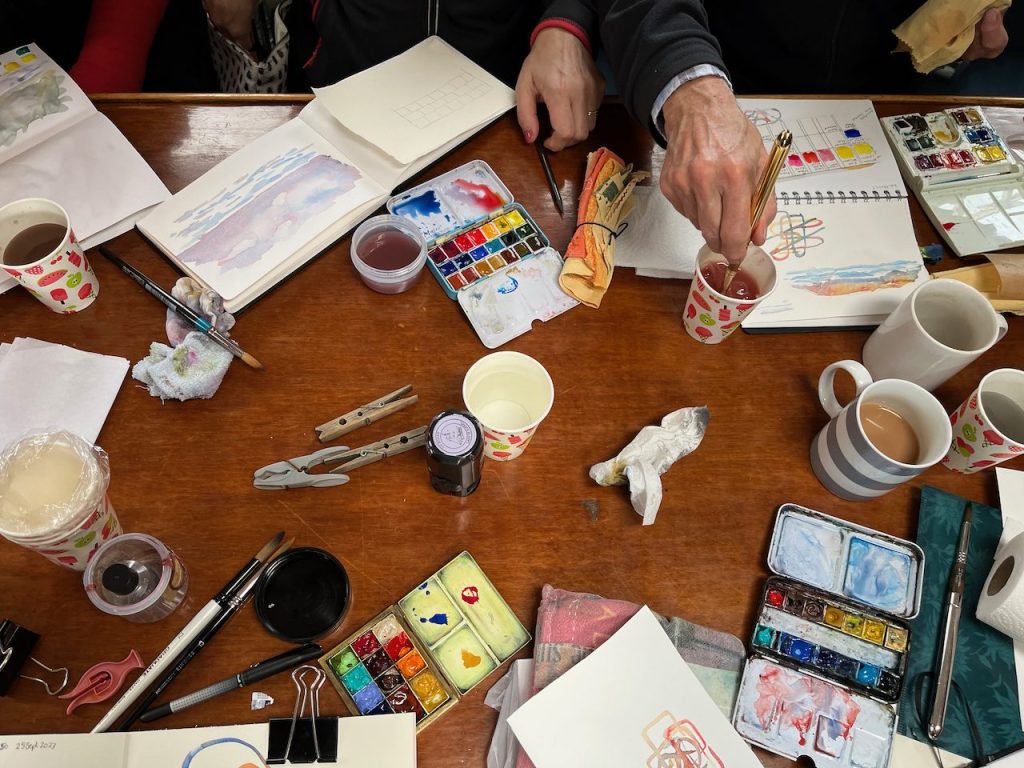
Lady of Avenel Saloon “Welcome to Sketch and Sail”Looking at islandsLandscape on MullA sketch near LismoreWorkshop participants in action on the table inside the Lady of Avenel
This was September in Scotland. There was wind and rain. Two storms passed over: “Nigel” and “Agnes”. But somehow, in between it all, we all did a lot of sketching. Our Skipper, Stefan Fritz, was skilled at finding sheltered anchorages. Claudia and I worked with him to plan the days so there was always something interesting to sketch.
There were days when we went ashore. Here are the boats at Salen on the Isle of Mull. Two hulks of fishing boats are in their final resting place on the beach. They lean on each other. Their grand forms are still majestic, and their paint has now flaked to reveal multi-coloured undercoats and timbers.
Boats at Salen. 25th September 2023, A5 postcard.
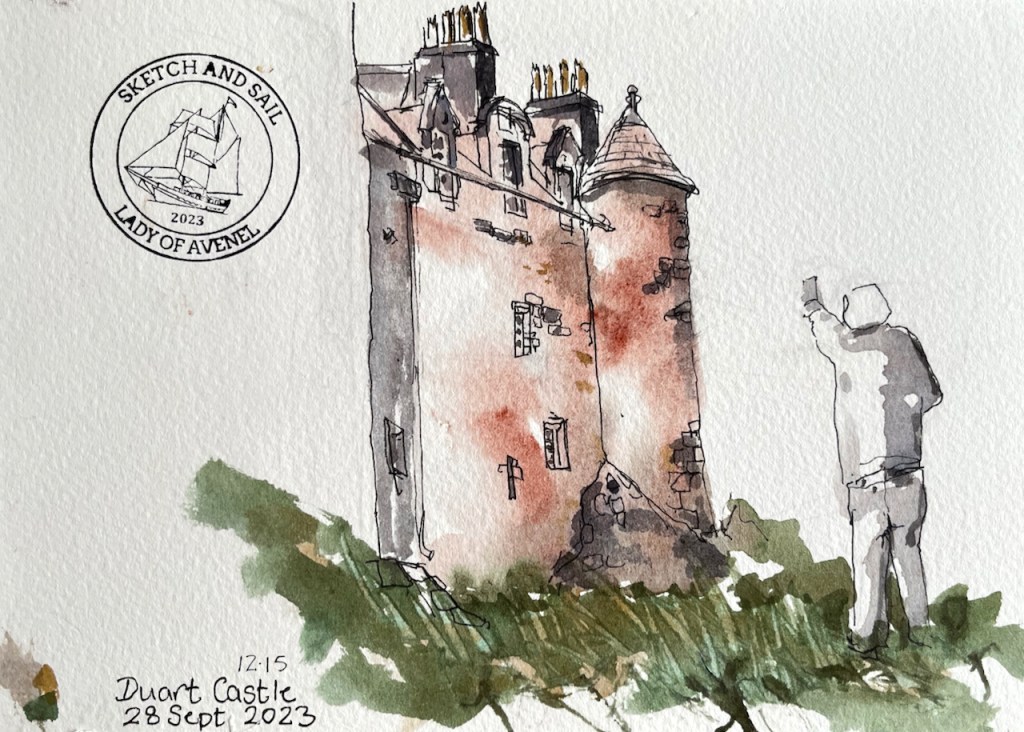
We visited Castle Duart. Some people went inside, others sat outside on the grass and had a go at sketching the castle’s complicated shape.
Castle Duart (and tourist), 28th September 2023
Those chimneys had multiple points, like crowns. One of the participants did a careful study of them. In the grounds of the castle there were porcini mushrooms. These were confidently identified by one of our number, a horticulture expert. We left the mushrooms exactly where they were. We didn’t touch them or eat them. But we did draw them. My drawing does not give the scale: they were about 3 inches across.
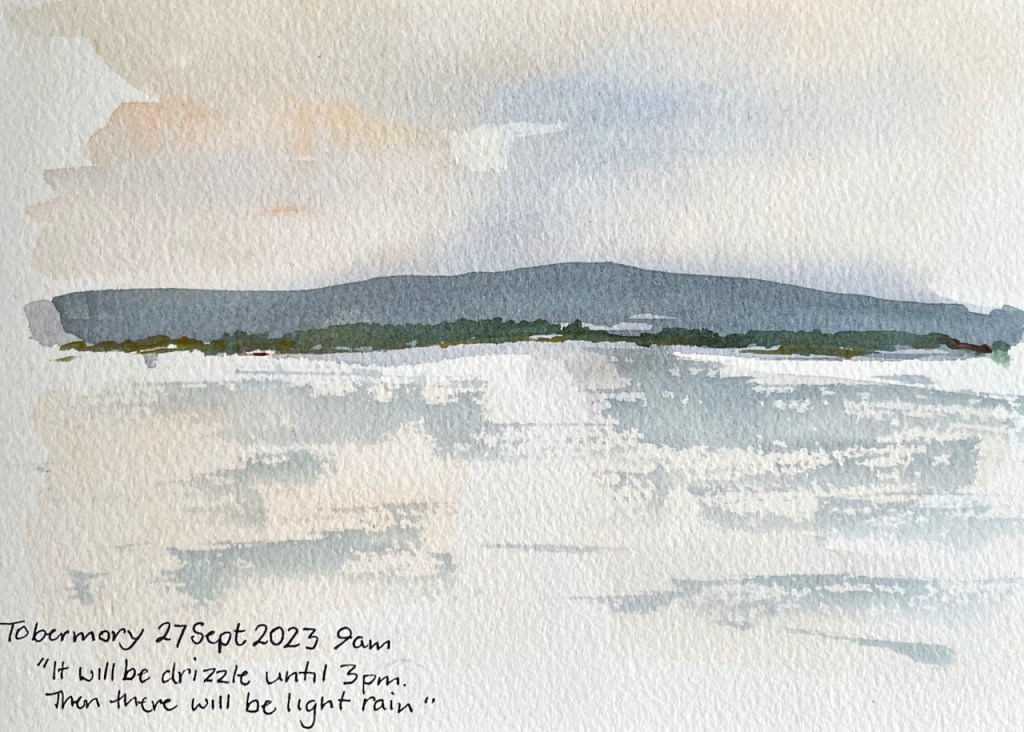
We sketched the land from the sea.
From Fishnish, near isle of MullNear Tobermory, Isle of MullLeaving LismoreIsle of Kerrera, East side
There were inspiring atmospheric effects. Here is a glimpse of the sun near the isle of Lismore.
On the way to Port Ramsay, Isle of Lismore. 28th September 2023
That neat round sun is made using a drop of melted candlewax from a nightlight which a member of the crew, Nessie, found for me. Nessie, a.k.a Carol Anderson, is an astonishing fiddle player. She played tunes for us on some evenings. We were all impressed by her skill. She maintained several melodies at once, all on just one fiddle. Other people played the harp and the recorder, and we sang sea shanties: half-remembered but rendered with gusto, and accompanied by assorted musical instruments and improvised percussion.
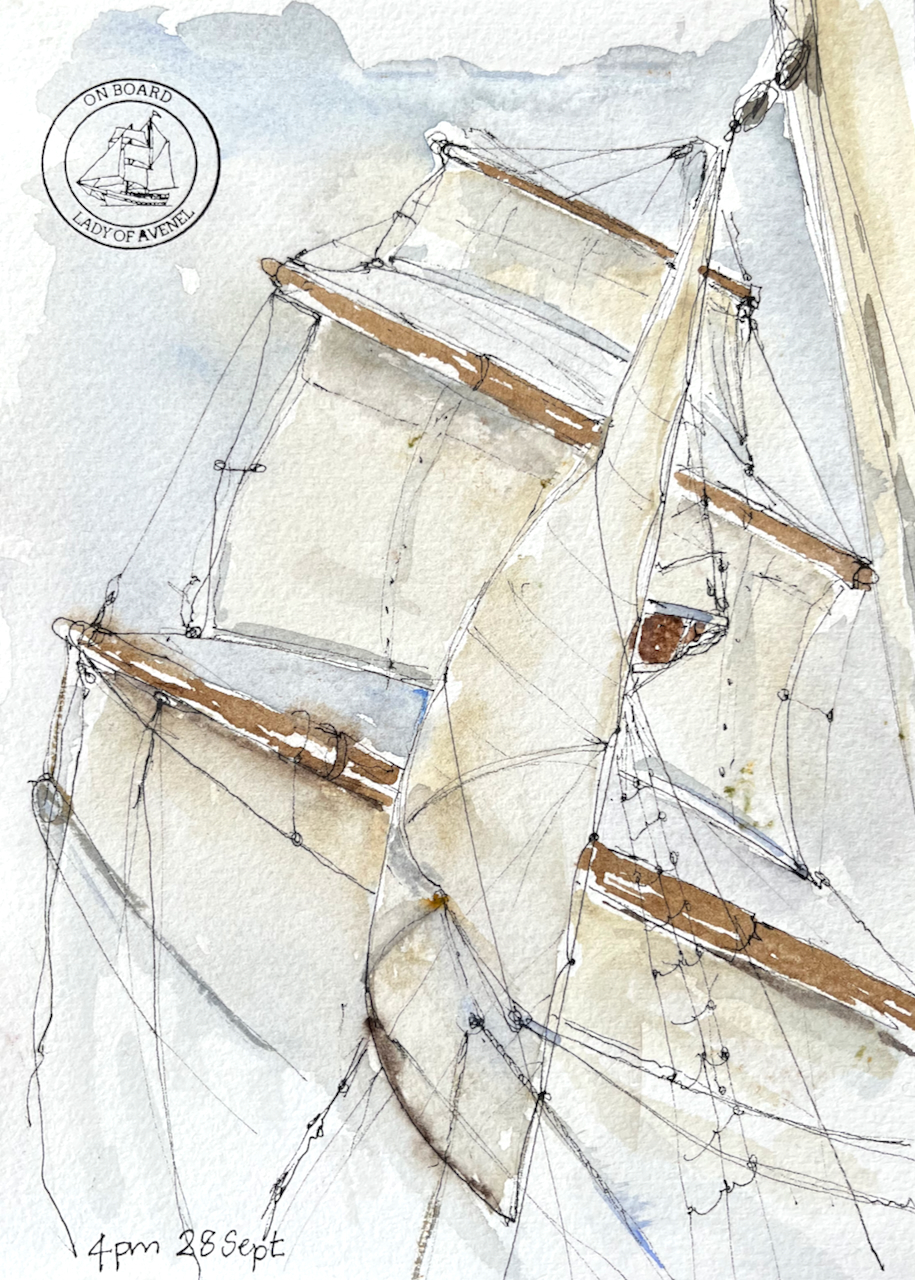
Nessie was our cook for this expedition. We also had a mate, the mate’s mate, and a ship hand, to help the skipper manage the boat. They were out there even in the pouring rain, getting us to the next safe harbour, piloting us past landmarks and between islands, and managing the engine and sails. Thanks to this crew, we had a productive and inspiring voyage: always something to see or do. The sails are beautiful, although quite hard to sketch.
Sketching on the move.
Some people took time off sketching to enjoy working the boat: hauling on ropes or taking the wheel. A brave few elected to climb the rigging. One person even did a sketch from up there.
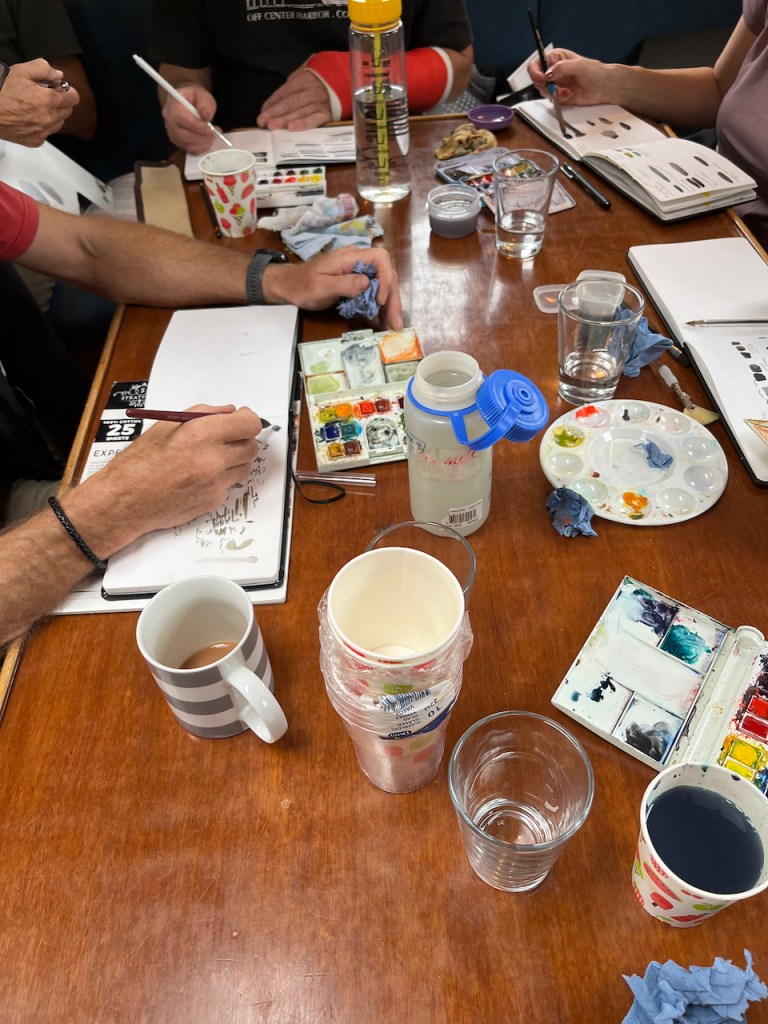
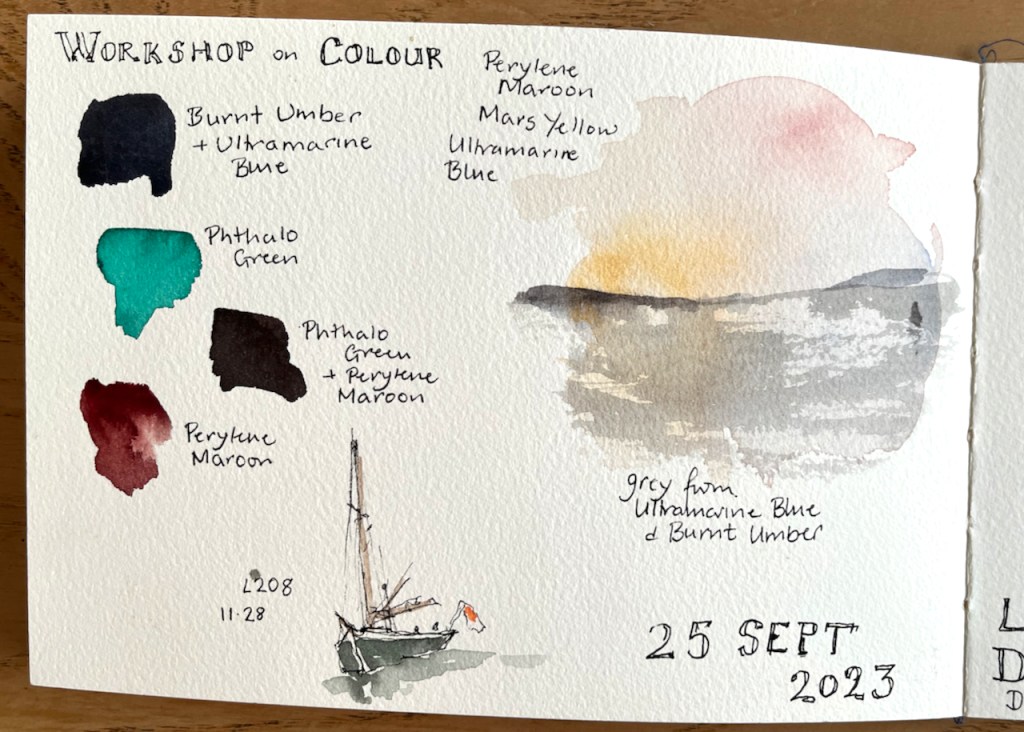
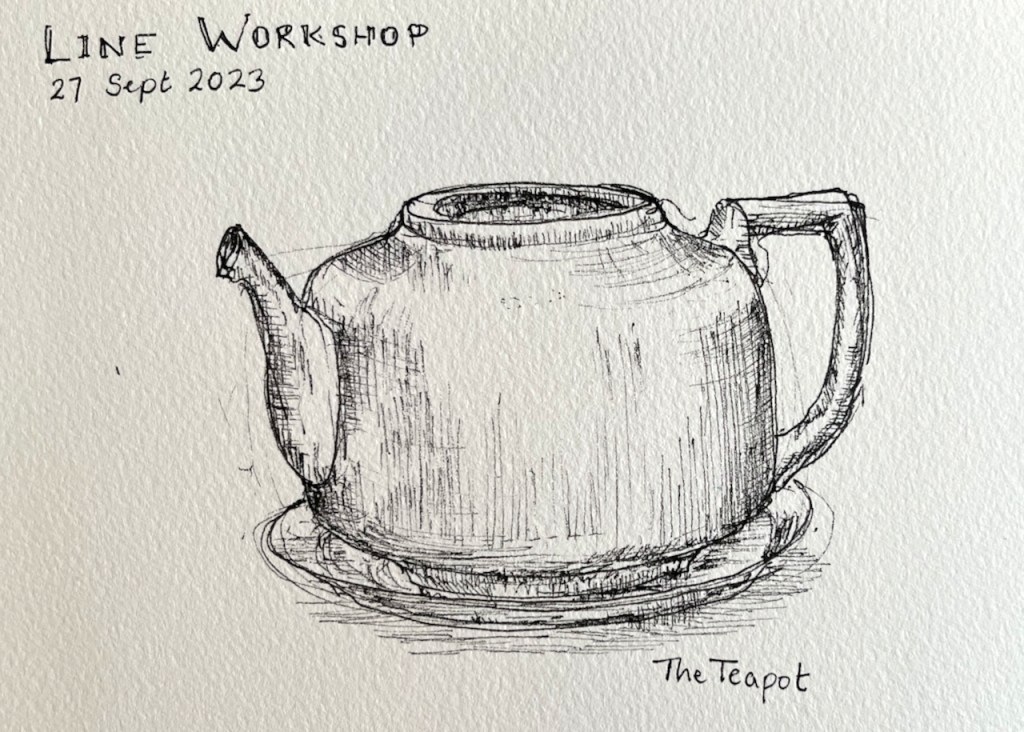
In the intervals between other activities, and when it rained, Claudia and I ran various workshops, so that people could learn new techniques, share skills, or get started: depending on skill level.
Making black and greyLine workshop: the teapotColour mixingColour mixing
The expedition was great fun, and highly productive. Sketchbooks were filled, postcards painted and sent, maps examined and weather apps compared.
We intend to run it again in 2024 and 2025. If you’re tempted to come, you can register your interest now by contacting me, or Claudia Myatt, or the Lady of Avenel direct. You don’t need any experience of sketching or sailing!
Here’s a page-turn of my sketchbook (about a minute, silent video). The sketchbook is from JP Purcell, A5, watercolour paper 300gsm. I use Daniel Smith watercolours: you can see the colour palette at the beginning of the video. (The video plays on tablets and desktops. It does not play on email or on mobile phones. Try looking at this post via the web on this link)
The Lady of Avenel is an 102ft square rigged brigantine. She was on the East coast of Scotland, and needed to be on the West Coast. So a group of us assembled to take her through the Caledonian Canal, from the North Sea to the Atlantic. This whole journey was about 190km or 120miles. I…
I took my sketching things on a swimming expedition to the Outer Hebrides with Swimtrek. We were on the wonderful Lady of Avenel 102ft square rigged brigantine. We started in Oban. It was raining when I drew this picture, as you can see from the way the pen has drifted a bit, round the chimneys.…
The Lady of Avenel is an 102ft square rigged brigantine, currently based near Oban, on the west coast of Scotland. Every year the Lady of Avenel needs a refit to prepare her for her working season. This year I went up there to join the working party for the refit. I travelled by overnight train…
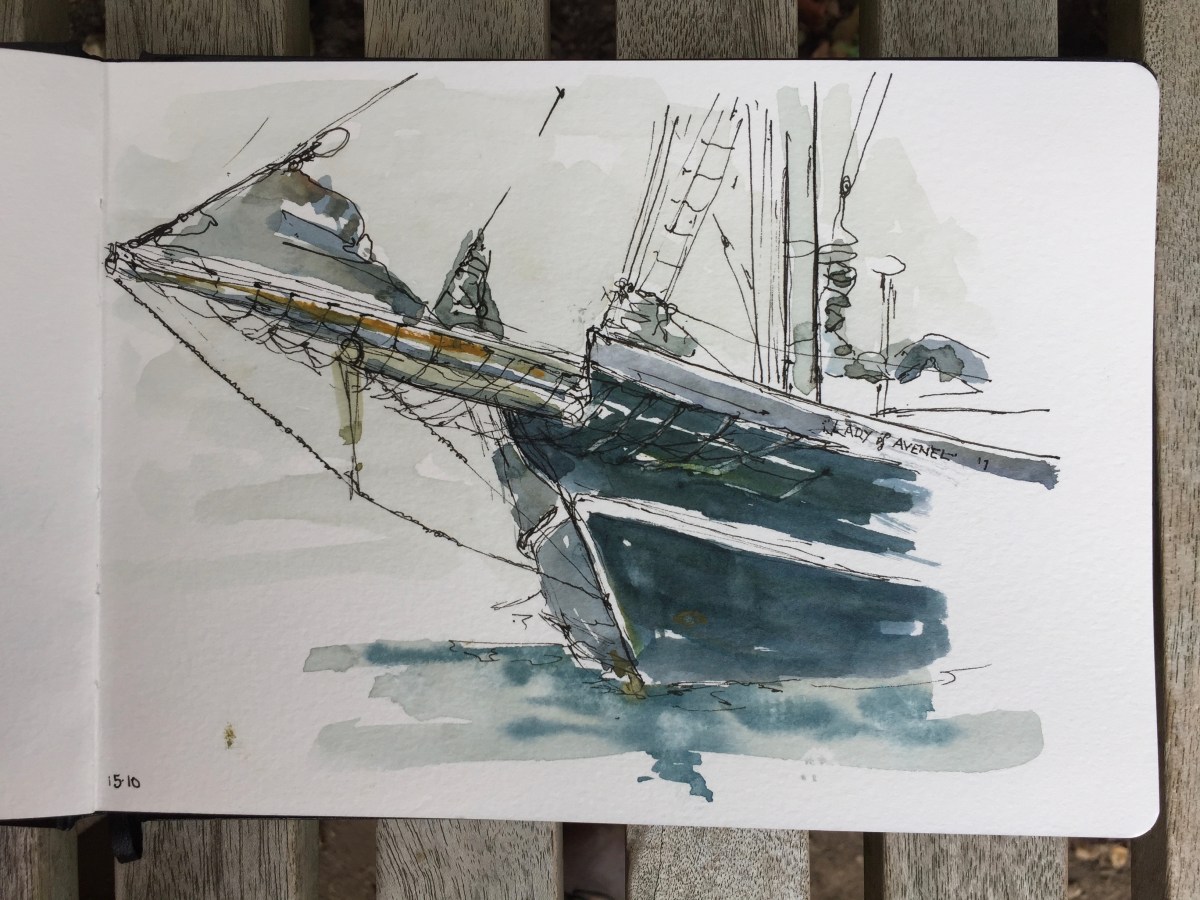
Here is Lady of Avenel, 102ft Brigantine. This was the third of three sketches. Here are the first two. I have drawn Lady of Avenel previously: Outer Hebrides 2017 See also these pages for pictures of and from Lady of Avenel: Outer Hebrides 2017 Outer Hebrides 2016 Sketch notes from maritime Holland
Here is the Lady of Avenel in aquatint. Here is the hard ground, before the aquatint went on: To help with the aquatint, I made a small test plate. It seemed a pity to leave it blank, so I put some sea life: Lady of Avenel is an 102ft brigantine square rigger. I sailed on…
Click a button below to share this post online, email it, or print it:
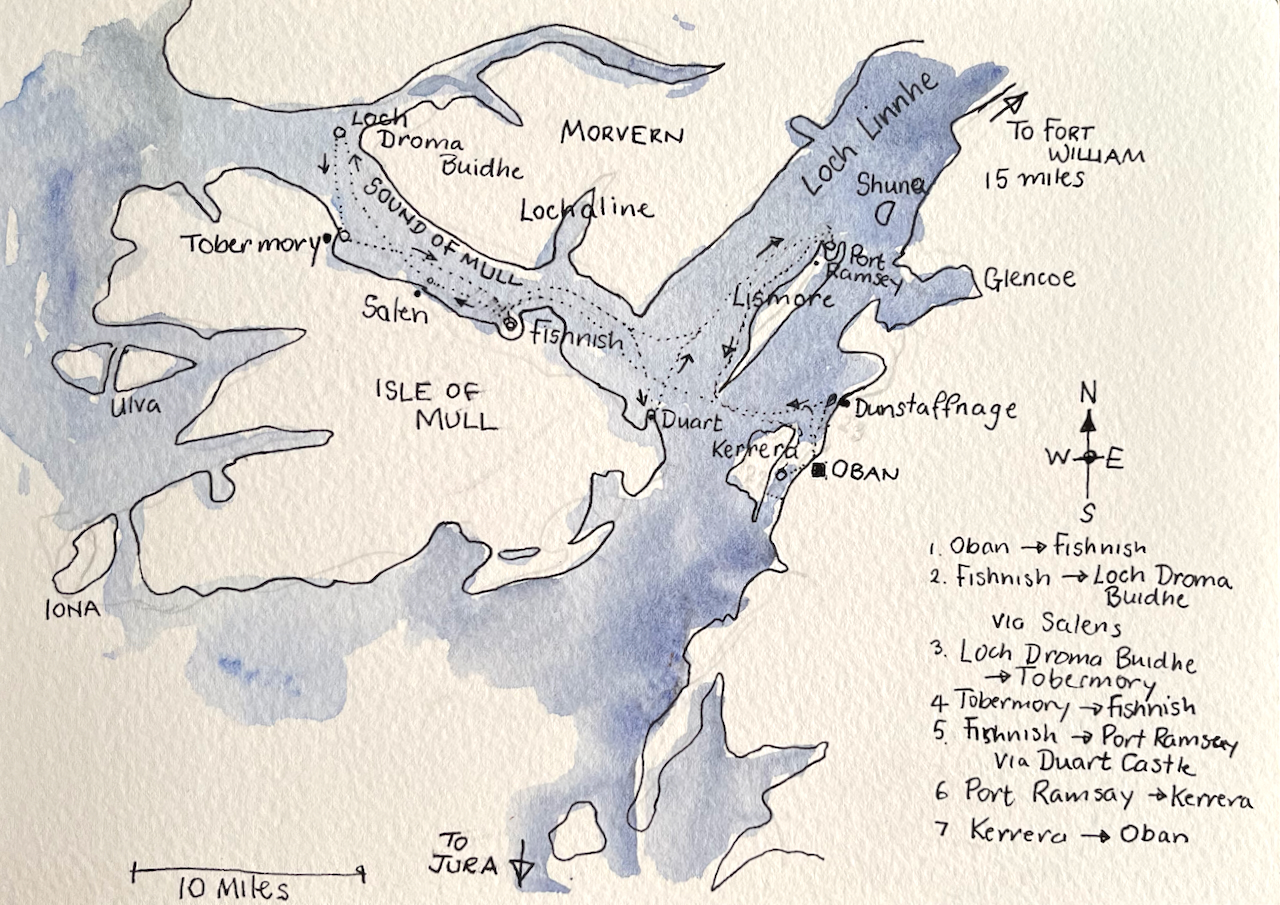
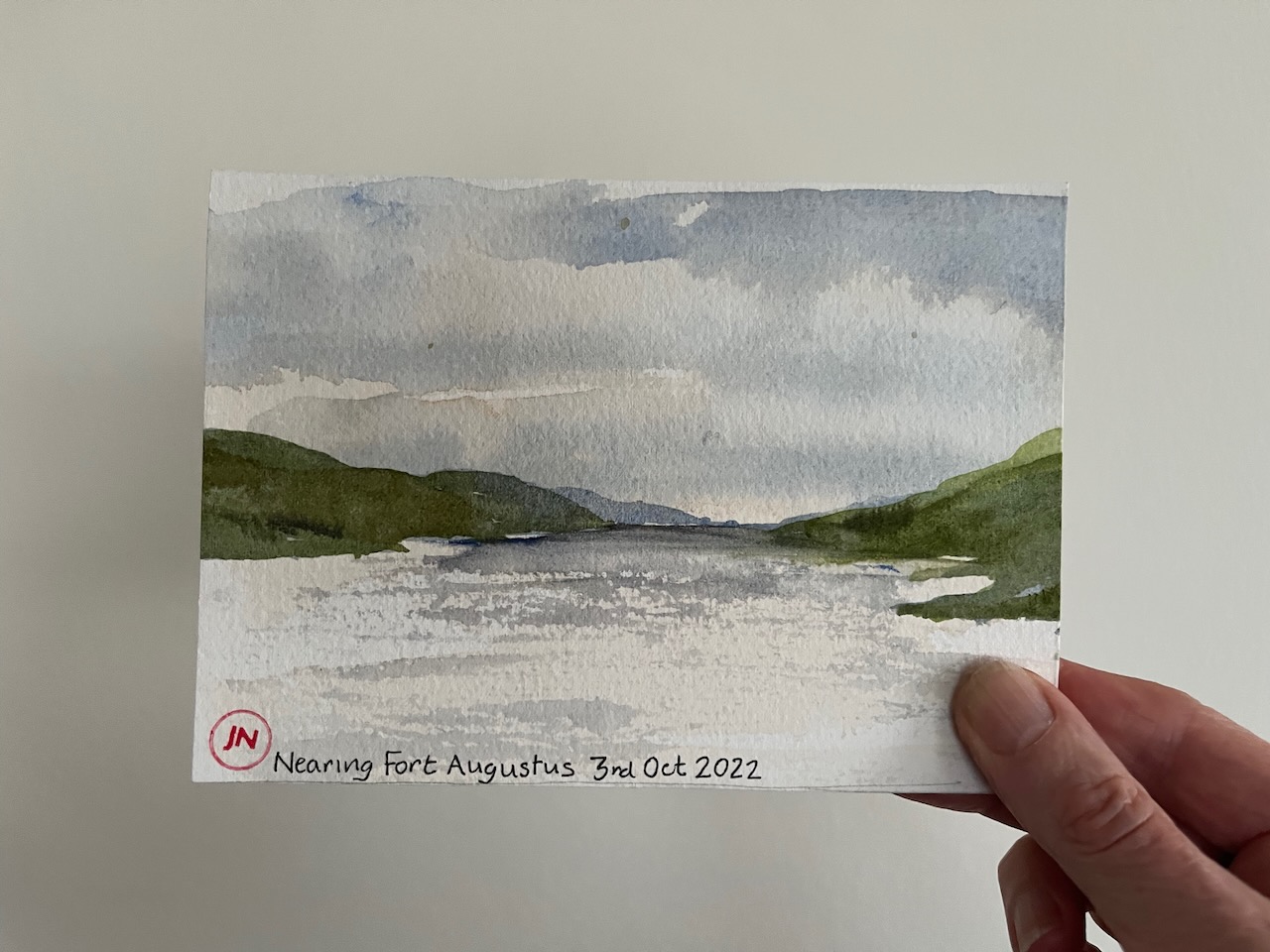
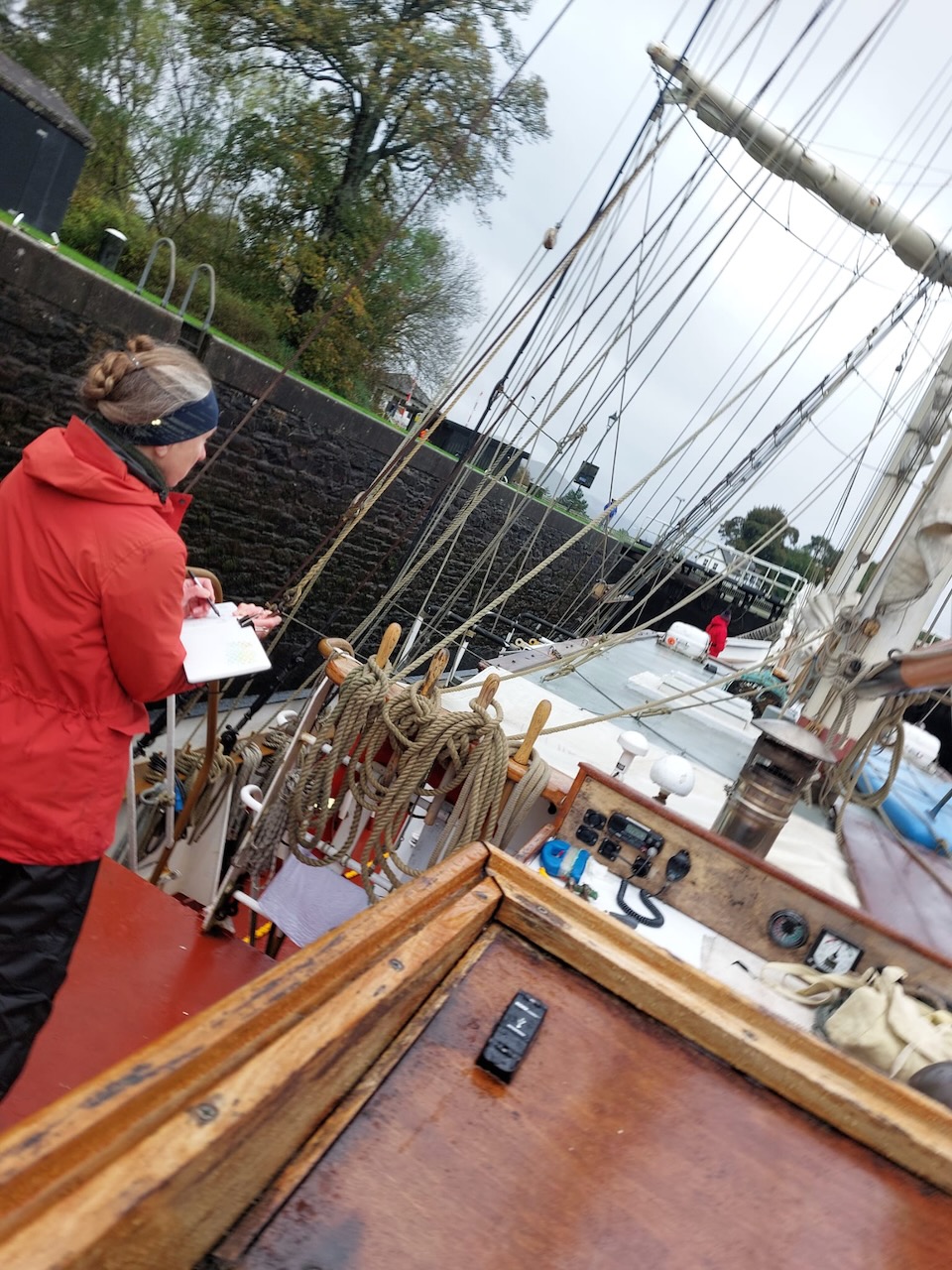
The Lady of Avenel is an 102ft square rigged brigantine. She was on the East coast of Scotland, and needed to be on the West Coast. So a group of us assembled to take her through the Caledonian Canal, from the North Sea to the Atlantic. This whole journey was about 190km or 120miles.
Route of The Lady of Avenel: Inverness to Oban, via Tobermory. 1st Oct to 8th Oct 2022
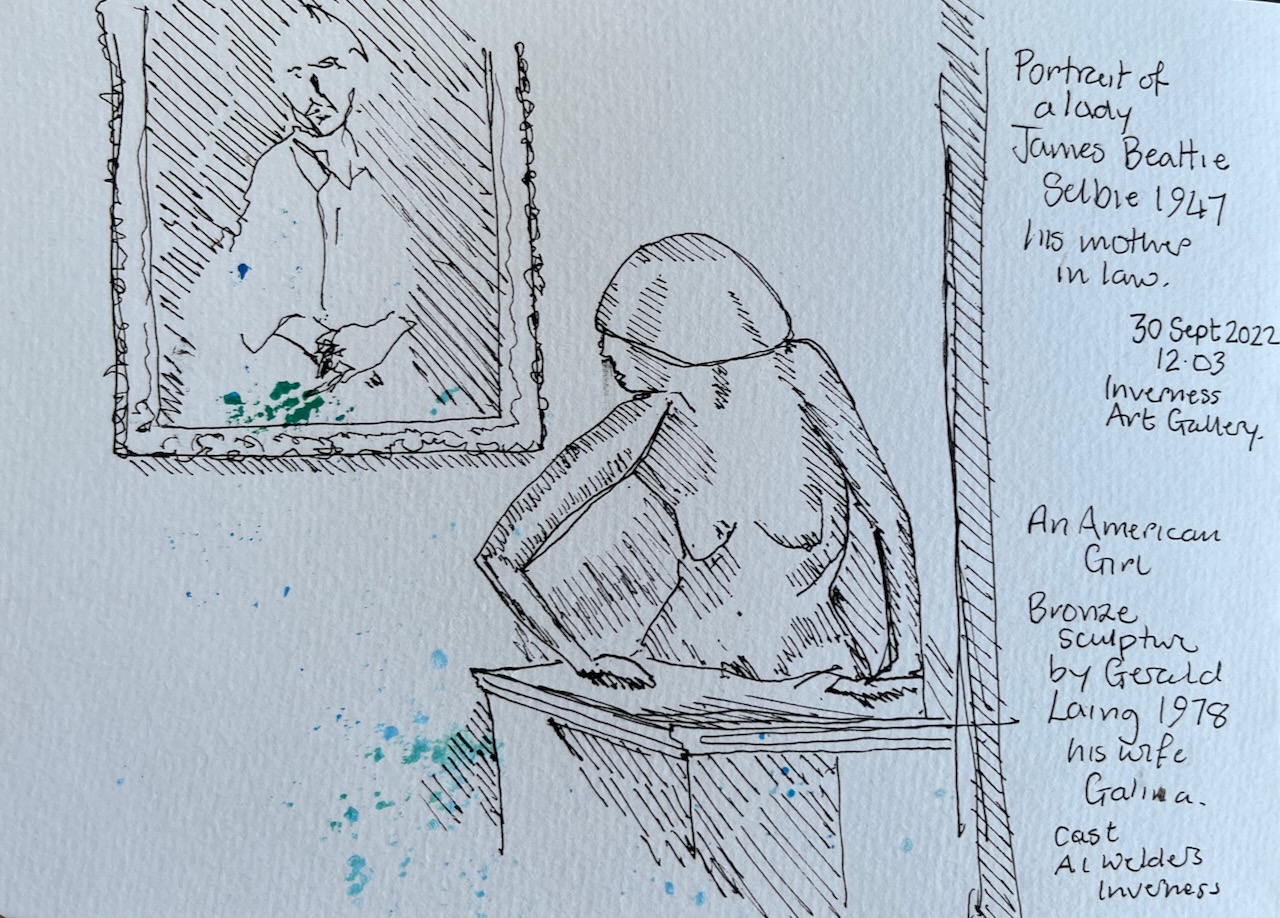
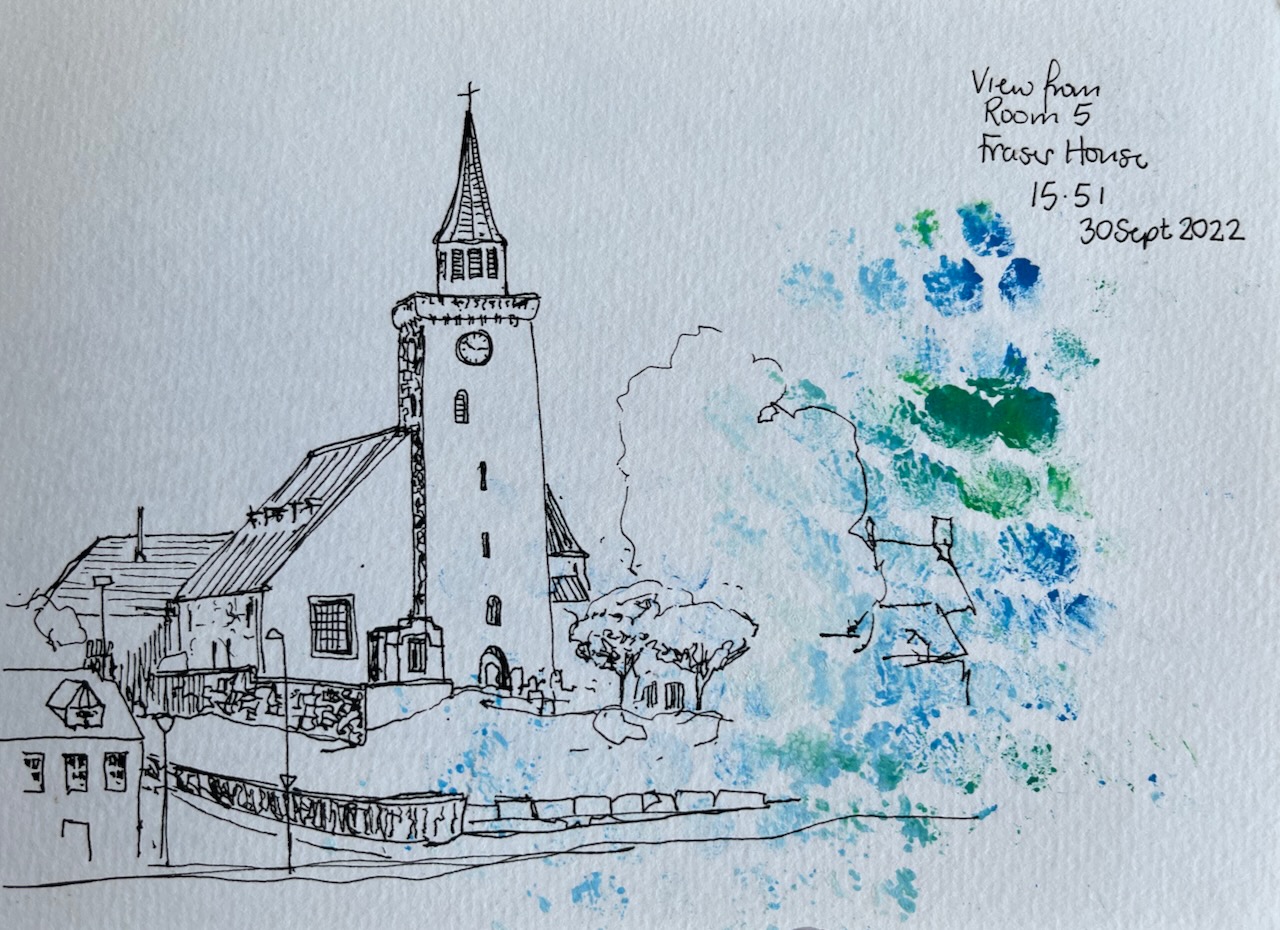
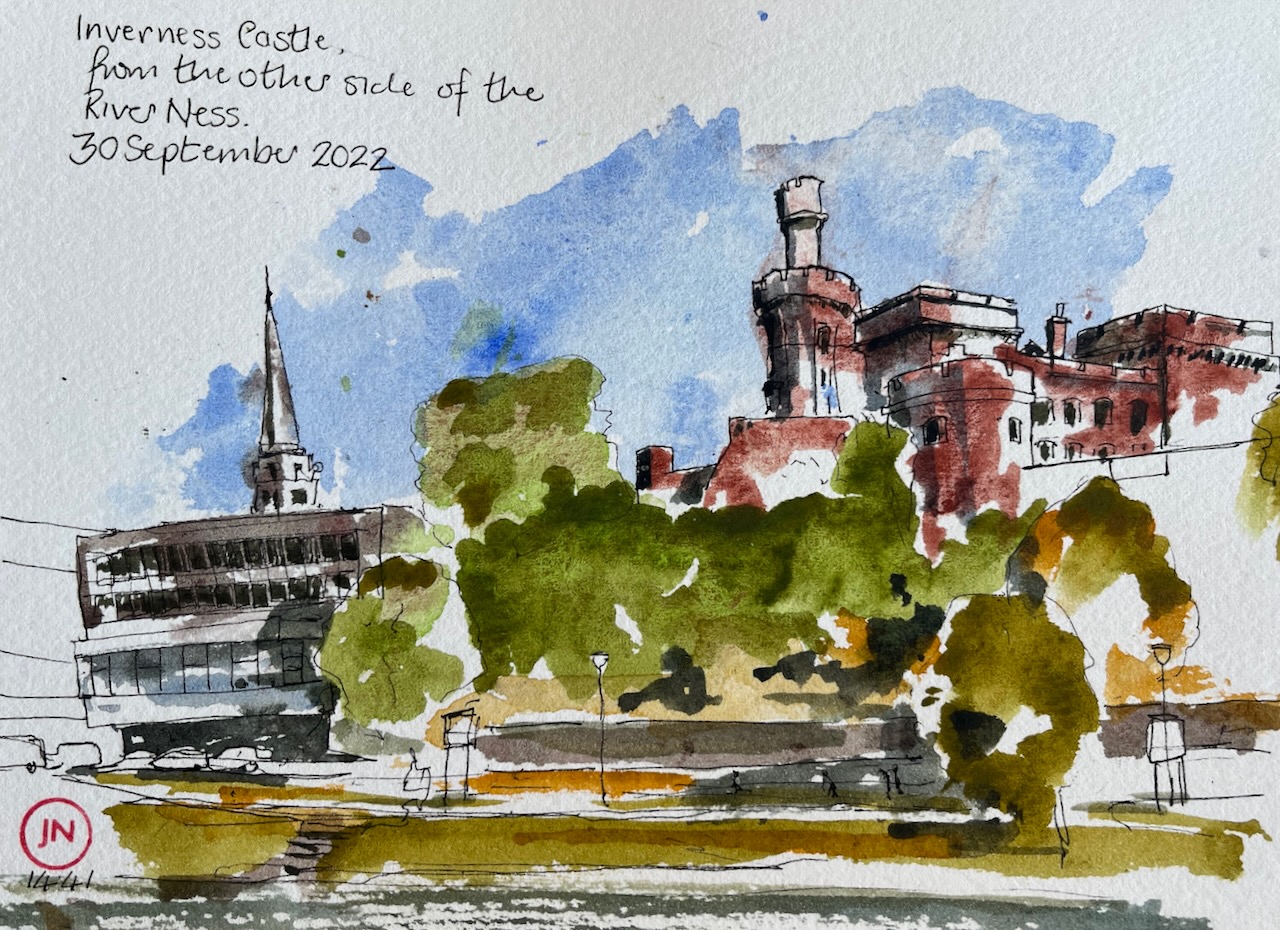
I joined the boat at Inverness. Travel to Scotland was disrupted by rail strikes. To be sure of arriving on time I arrived a day early. This gave me a chance to look around Inverness. There’s a huge river, the River Ness, and a castle and an Art Gallery. I stayed in a lovely hotel, Fraser House, on the river: recommended.
In the Art Gallery, Bronze Sculpture by Gerald Laing 1978 “An American Girl” – his wife Galina.View from my room in Fraser HouseInverness Castle From the other side of the river. Sketching inverness CastleSketching in Inverness
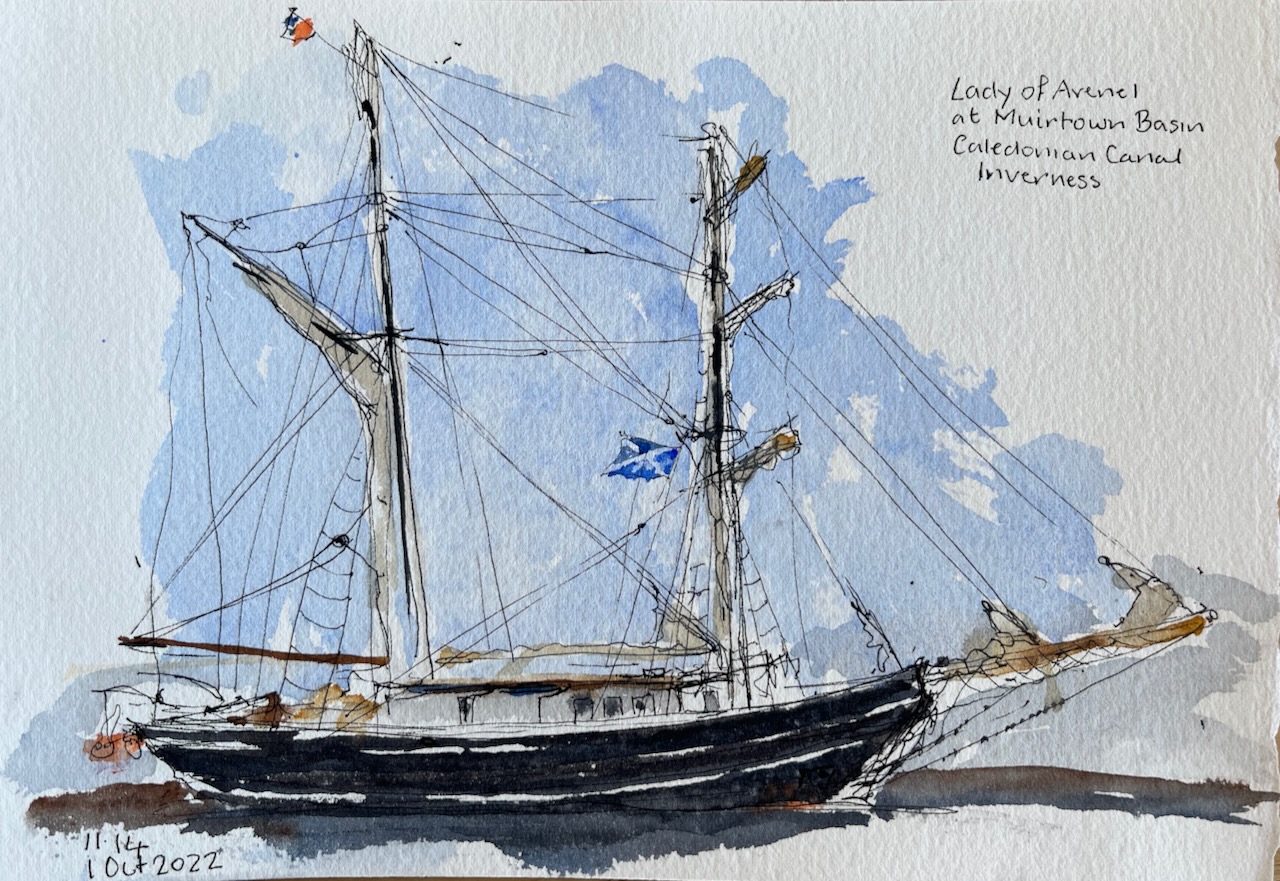
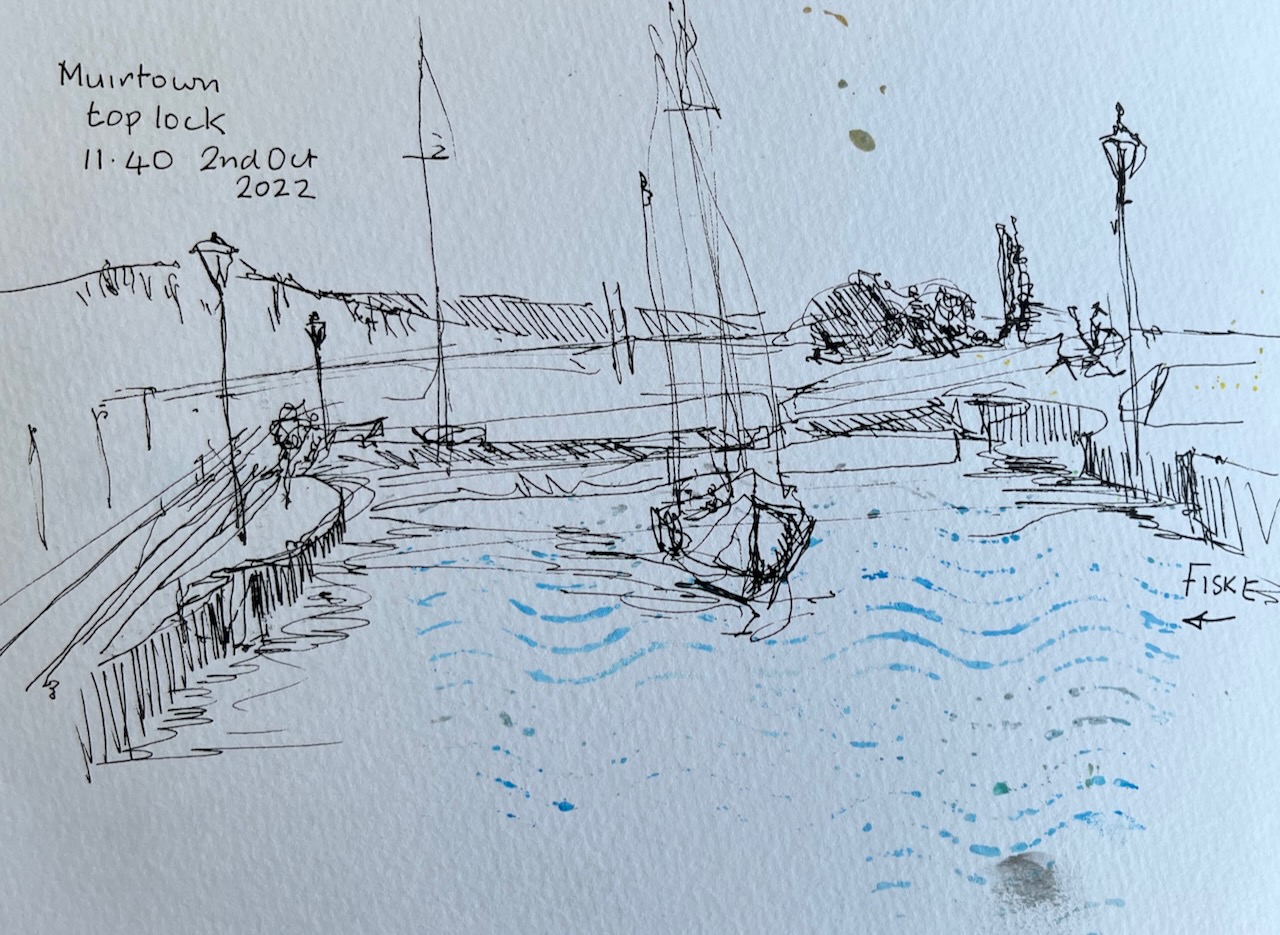
The Lady of Avenel was on the Canal at Seaport. The first Locks were Muirtown Locks, taking us uphill from the North Sea.
Lady of AvenelInside Muirtown LocksSeaport, and Muirtown Locks
Here is the view as we entered Loch Ness:
Entering Loch Ness
I was making these sketches very quickly. The boat kept moving, the light kept changing, and then it rained.
The sketchbook I was using was a Seawhite A5 Travel journal.
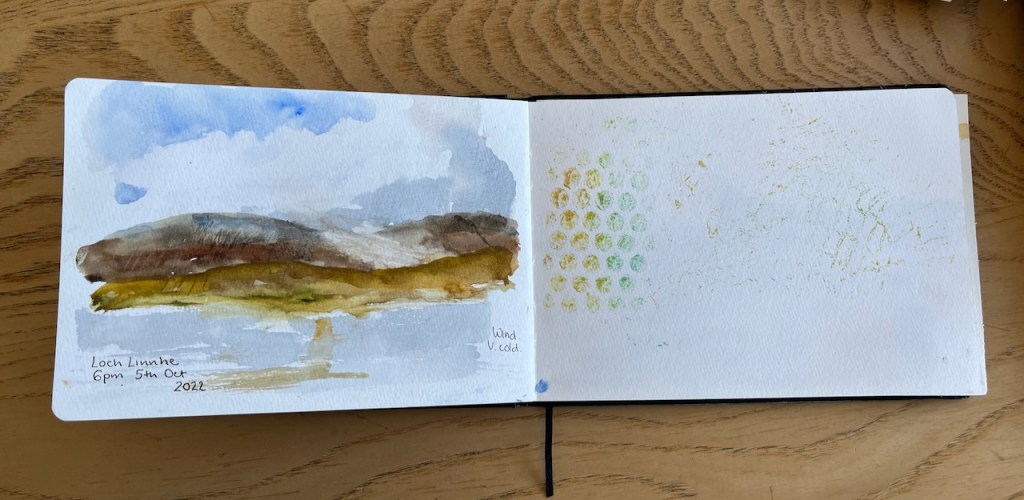
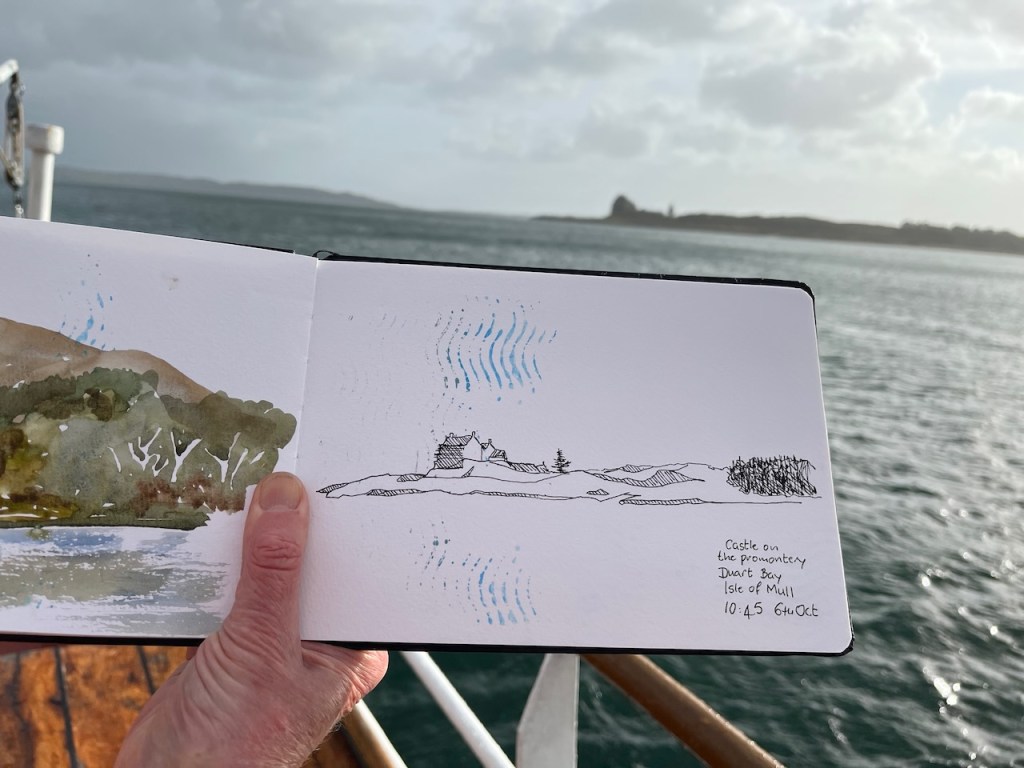
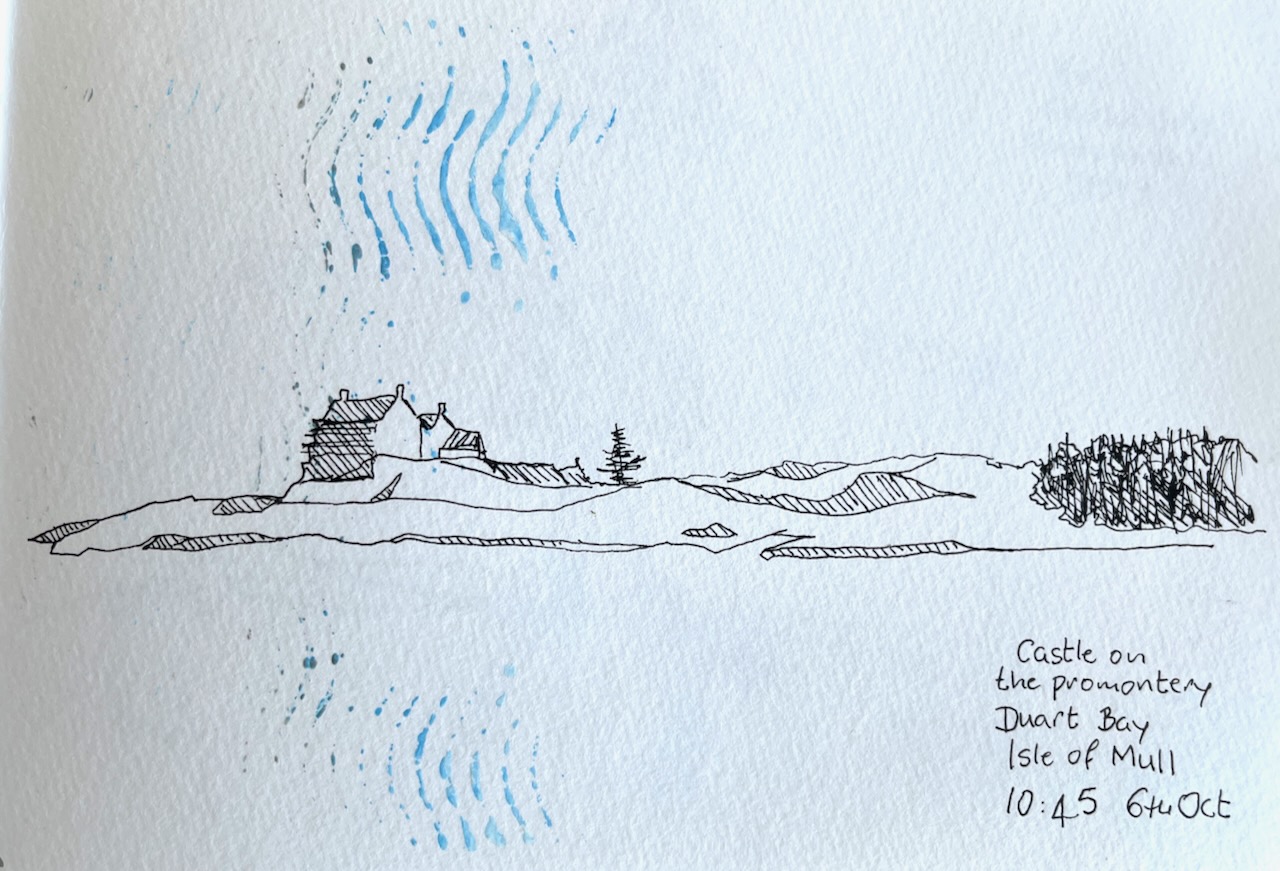
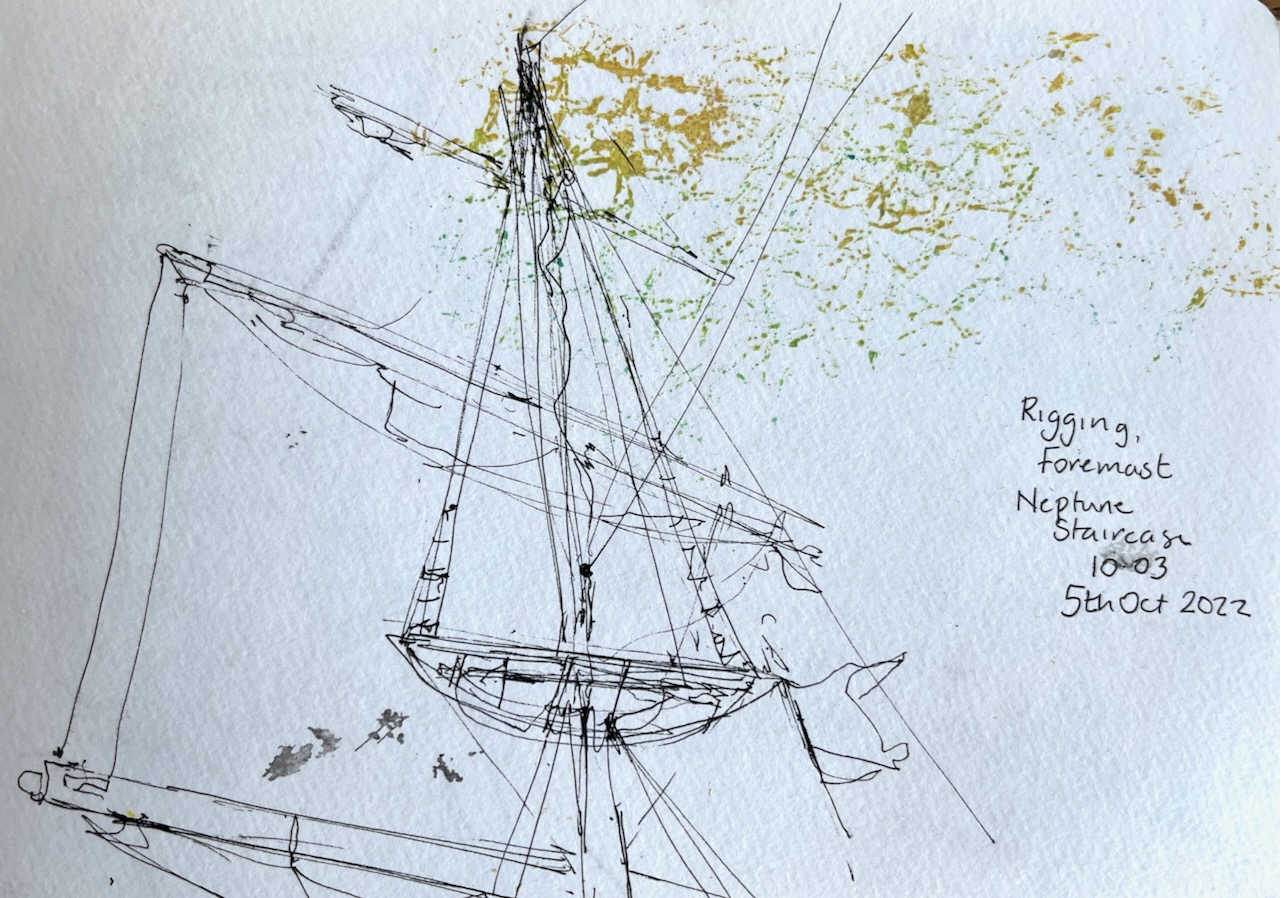
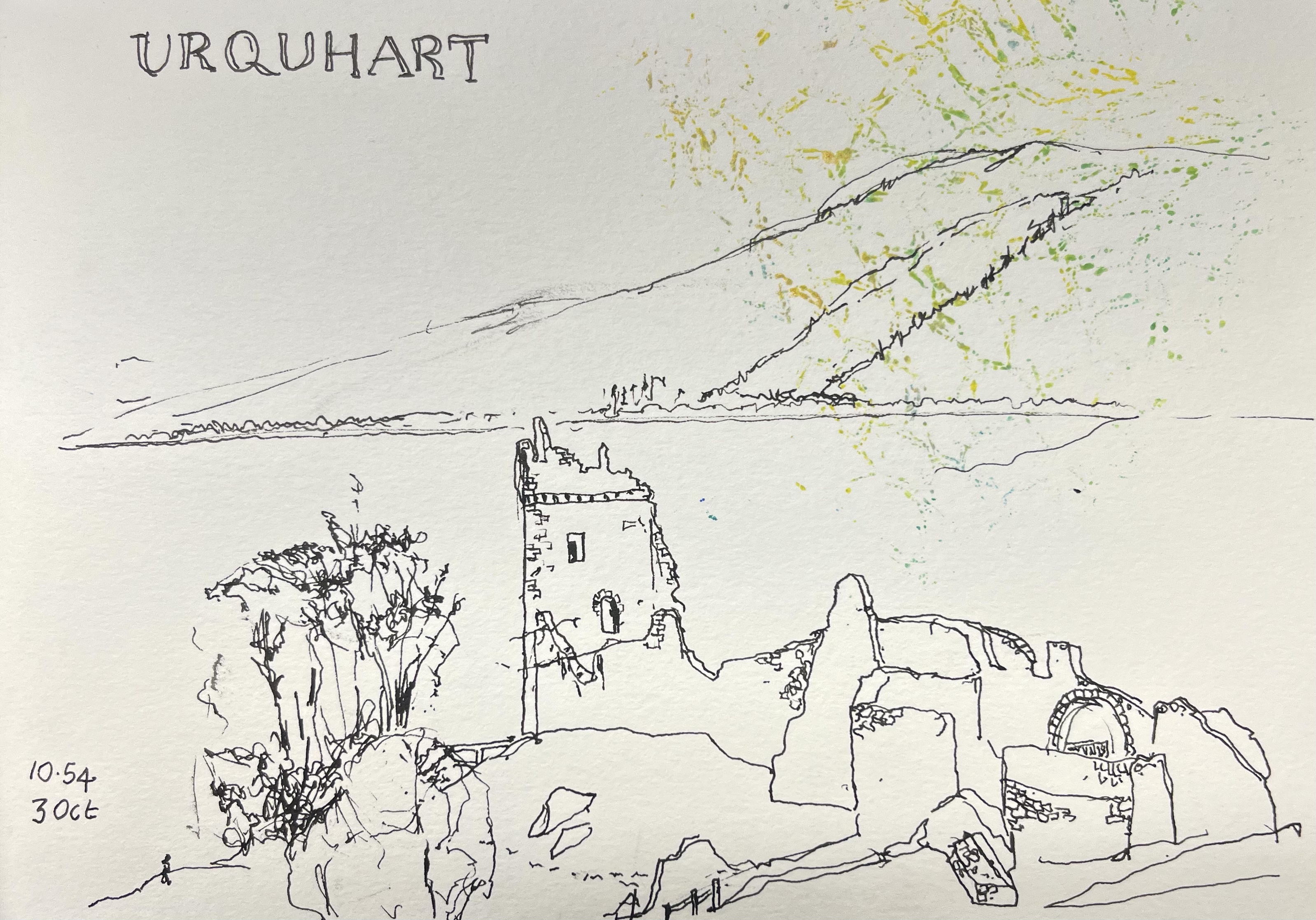
The patterns on some of the drawings were made before the trip. They are relief prints, using the corrugated paper from a coffee cup, corrugated cardboard, bubblewrap, and the net from some oranges. Sometimes these prints really enhanced the drawing, sometimes not. Here’s one where it worked:
Duart castle, printed background from a takeaway coffee cup
I also made sketches on small pieces of watercolour paper, which I sent as postcards.
Sketching Inverness CastlePostcards from the voyage
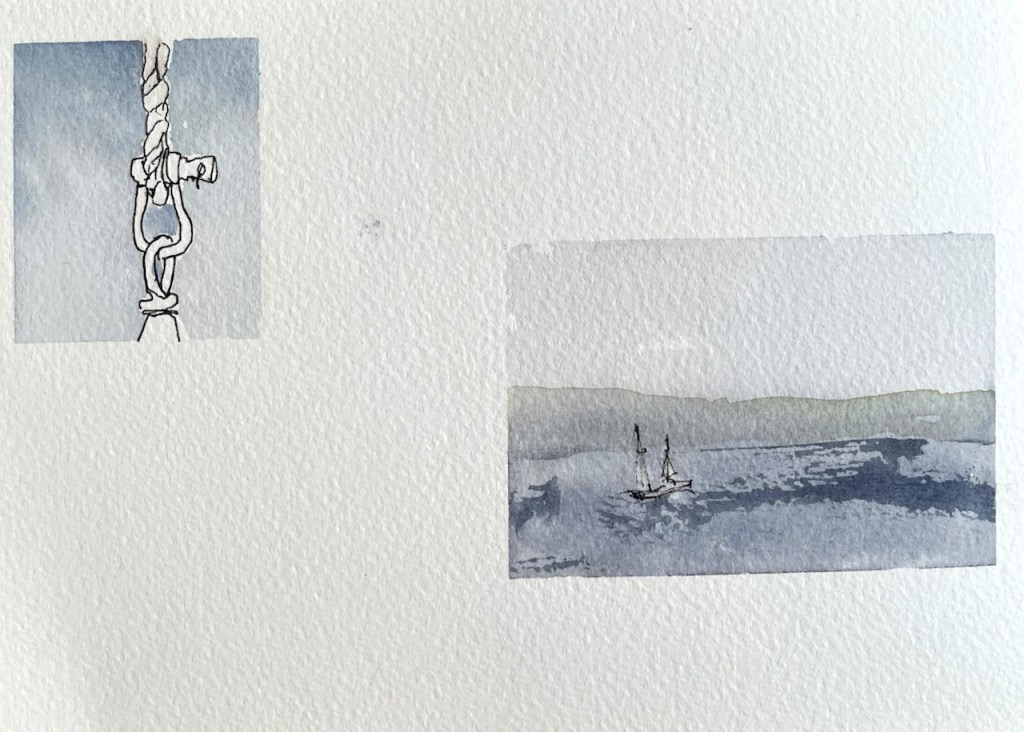
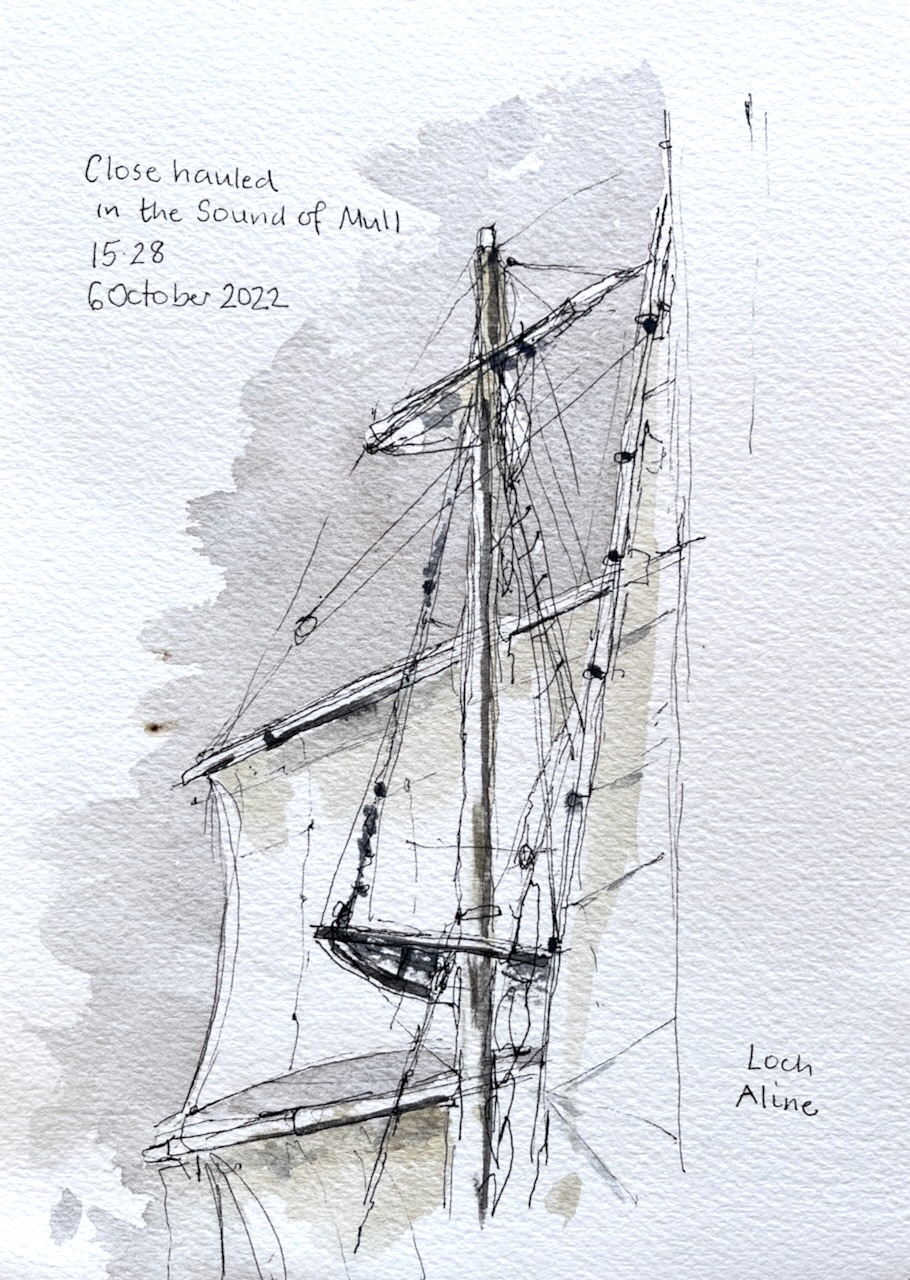
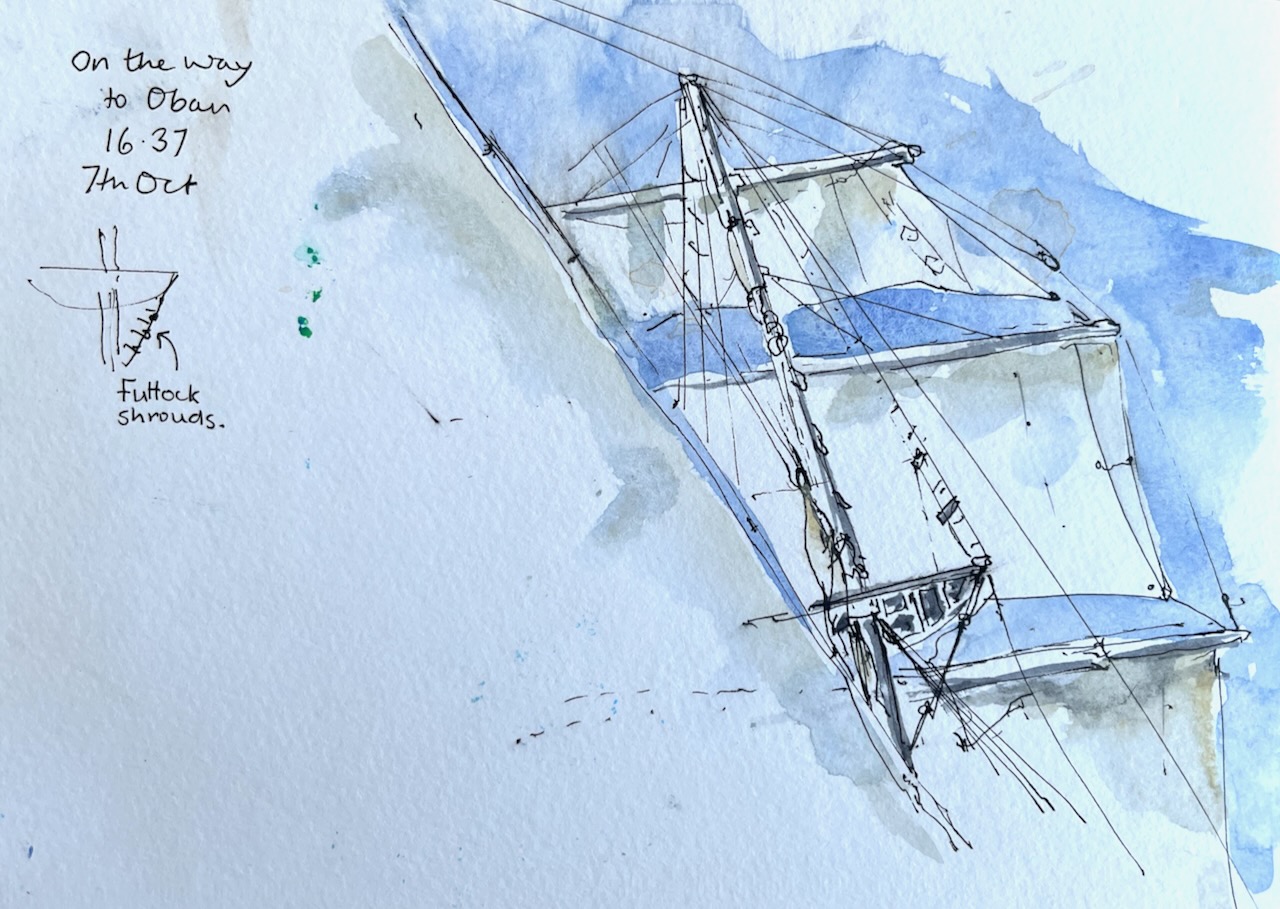
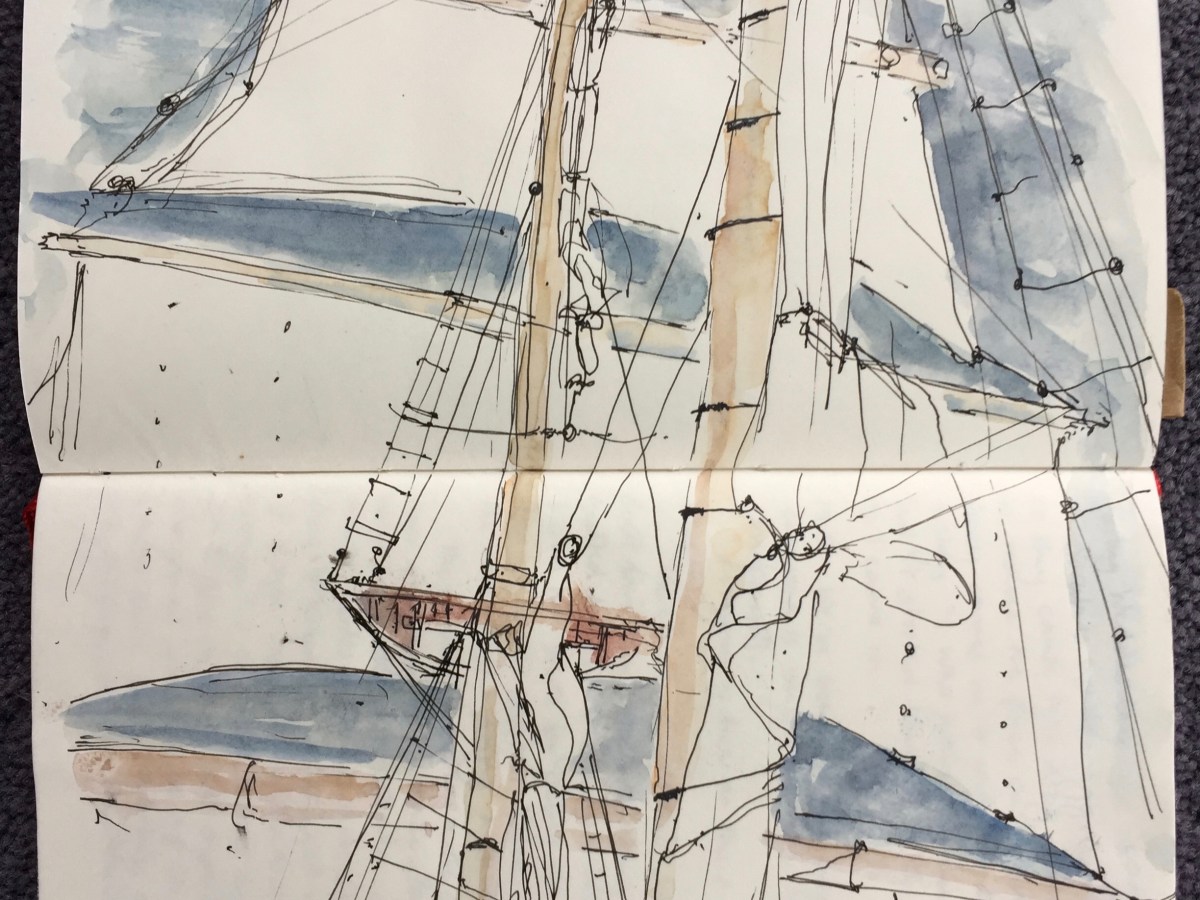
It’s a challenge to draw the rigging.
Rigging sketches
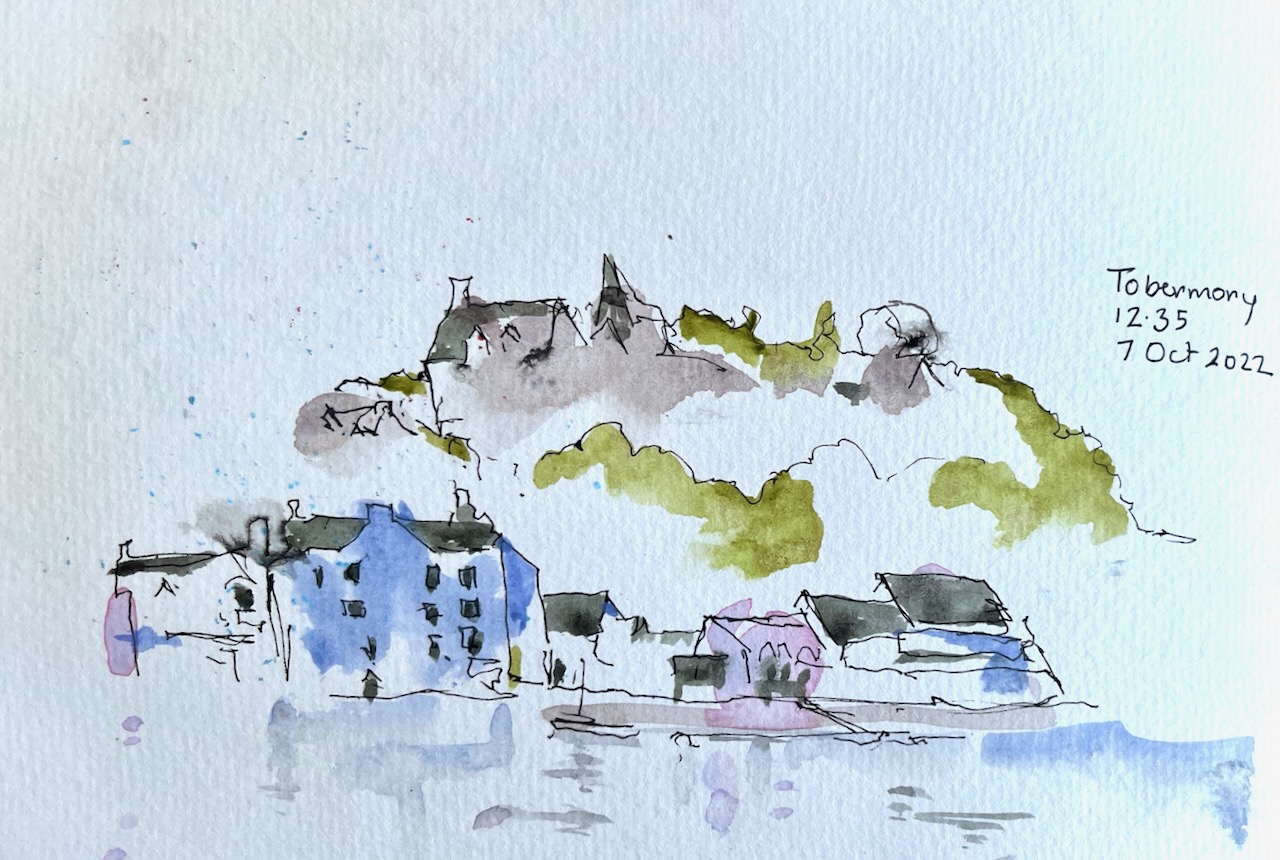
We had some shore leave.
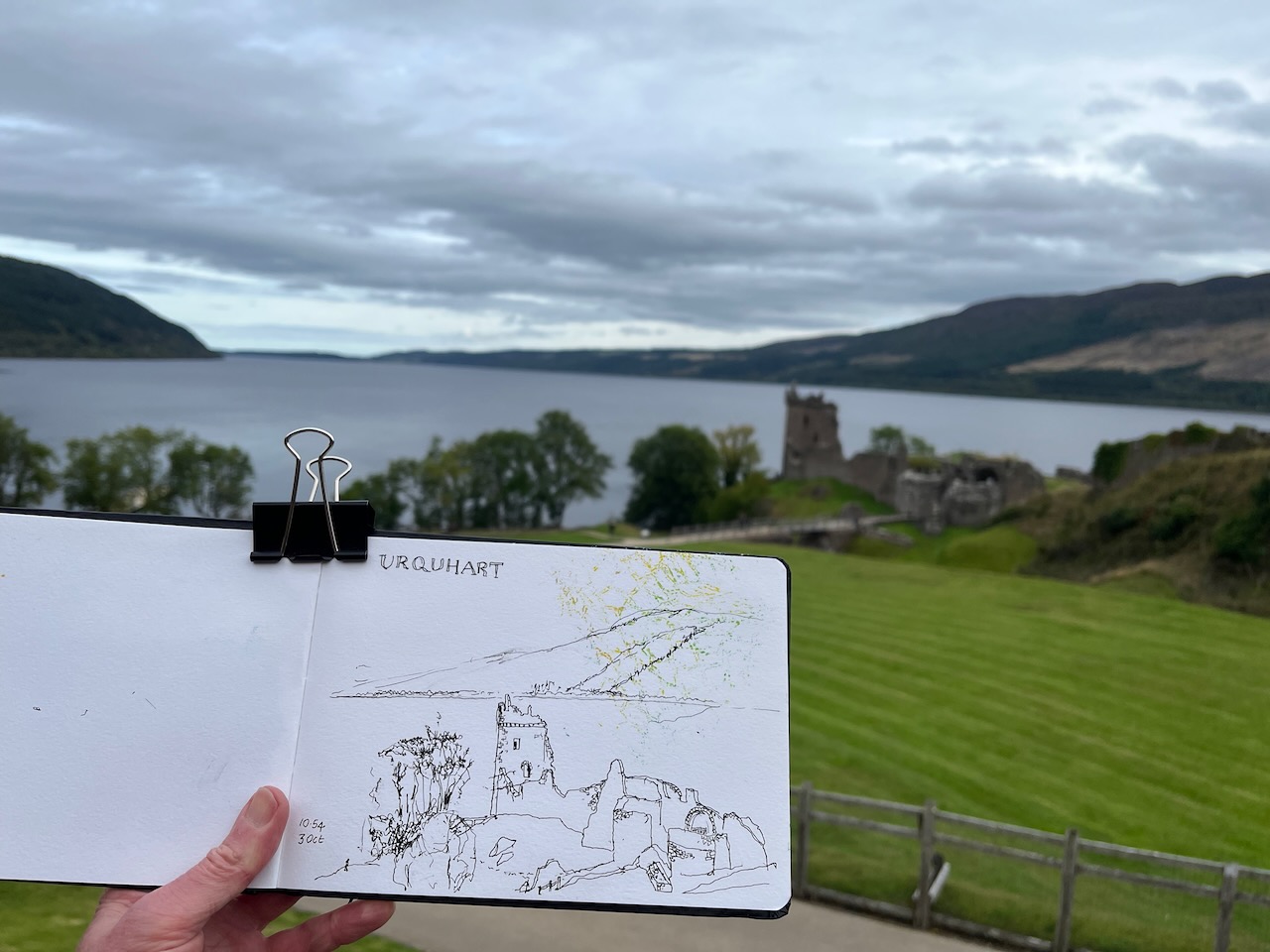
From the Community Arts Centre, An Tobar, in Tobermory Tobermory, from the Lady of AvenelUrquhart CastleSketching at Urquhart CastleSketching on shore leave
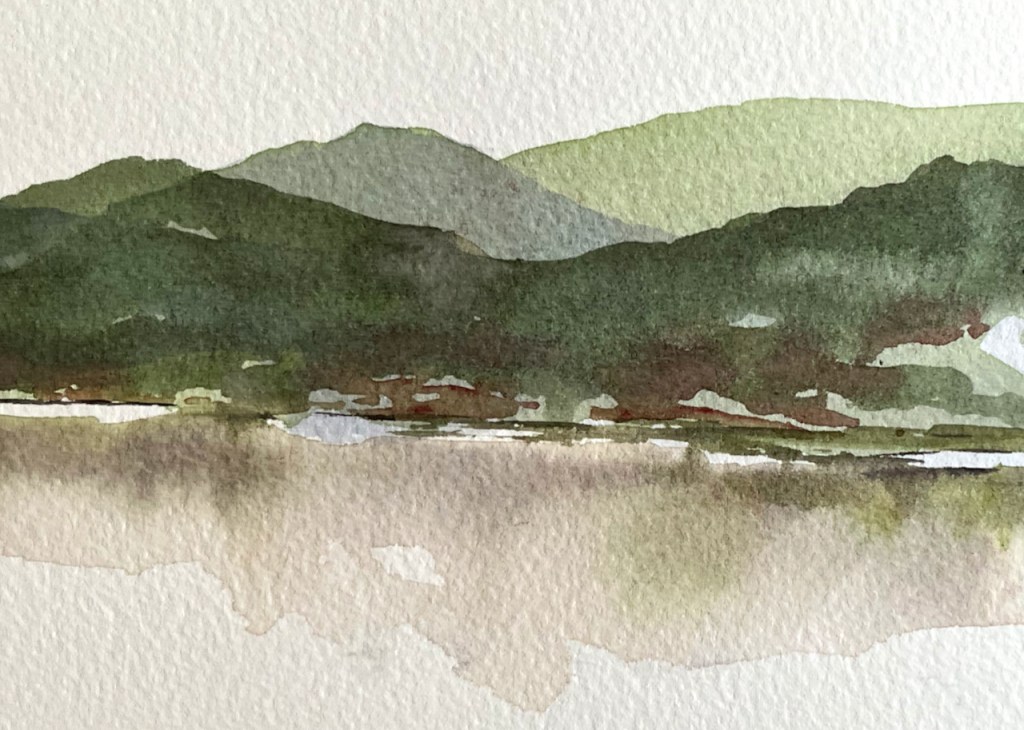
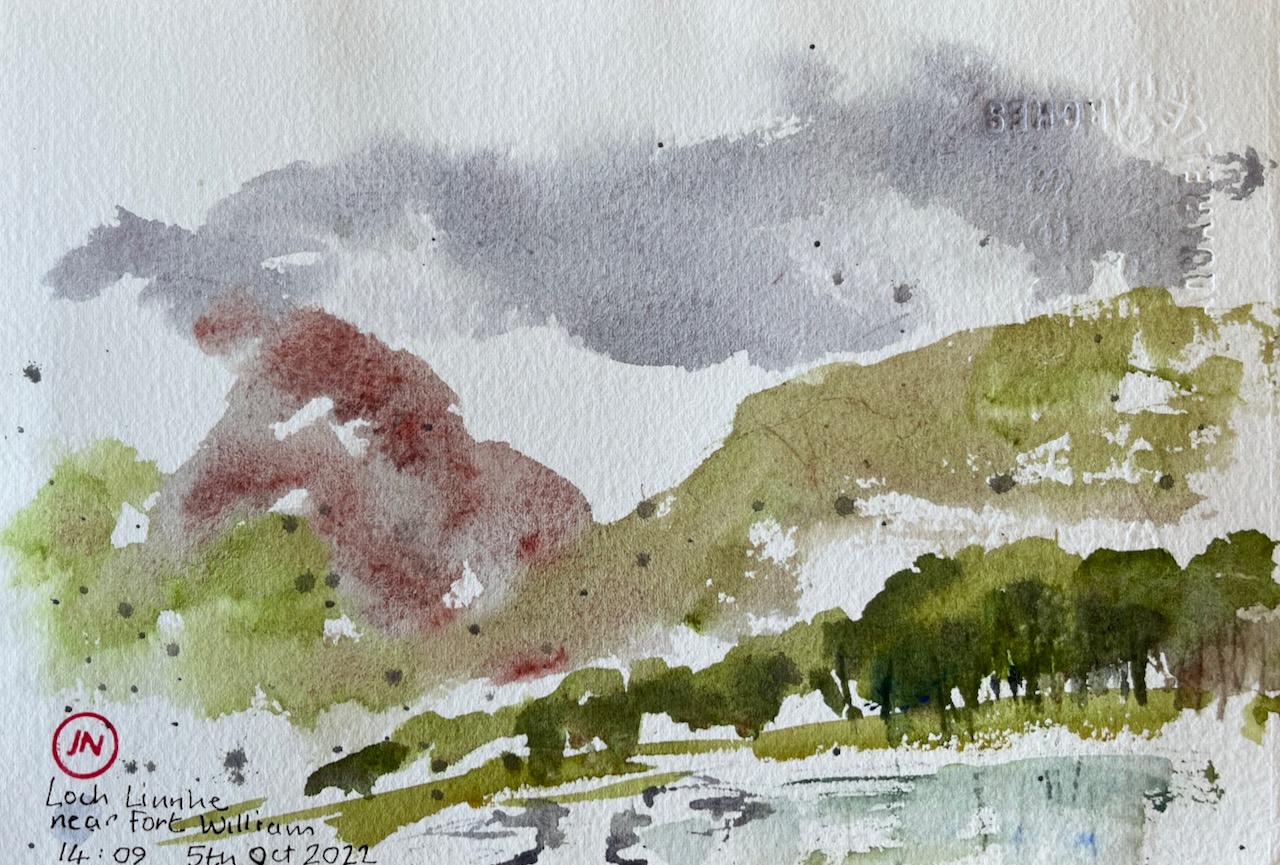
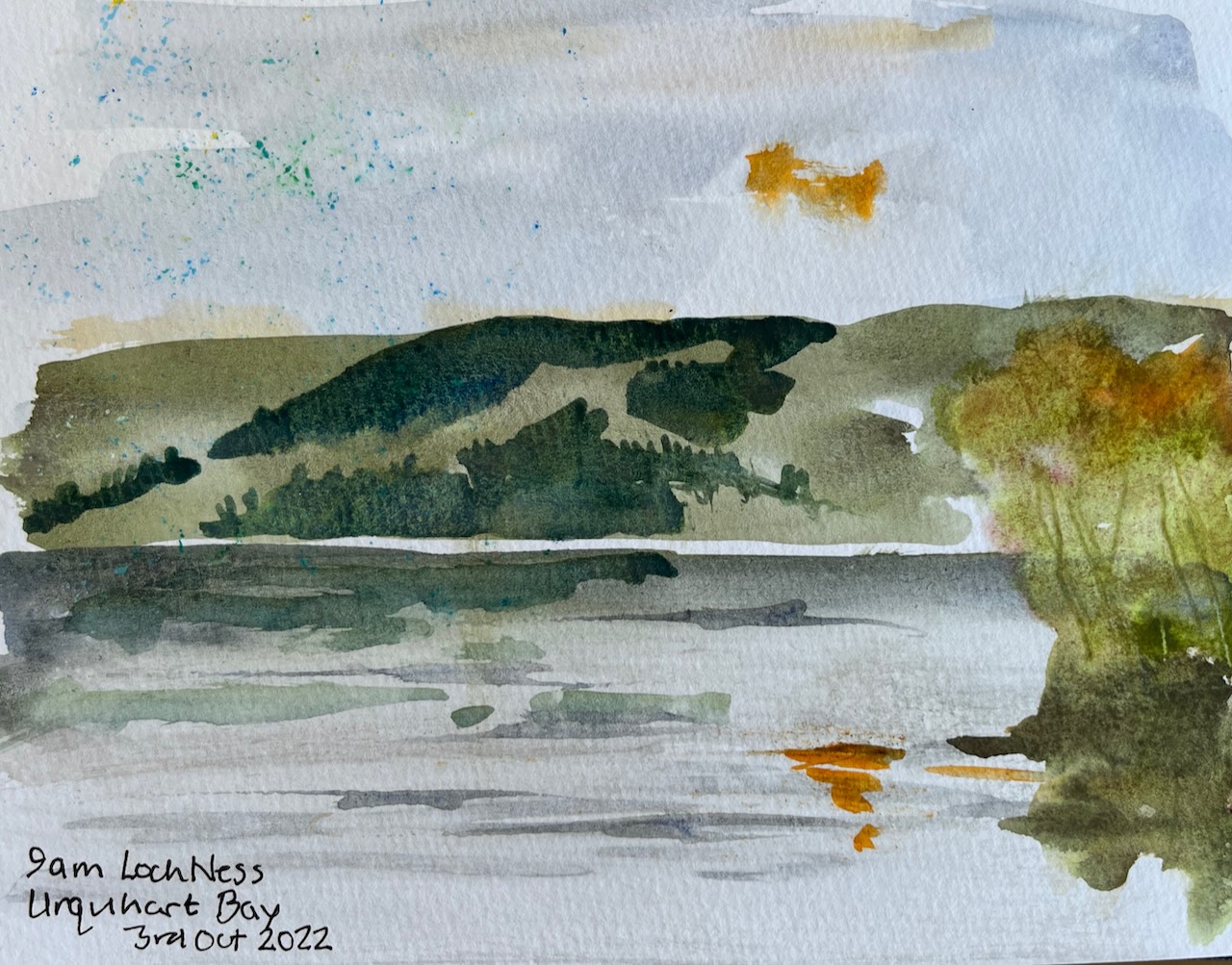
The scenery of the Highlands, seen from the boat, was stunning. I tried to capture the light. All these sketches were made from the boat, which was moving, even when anchored.
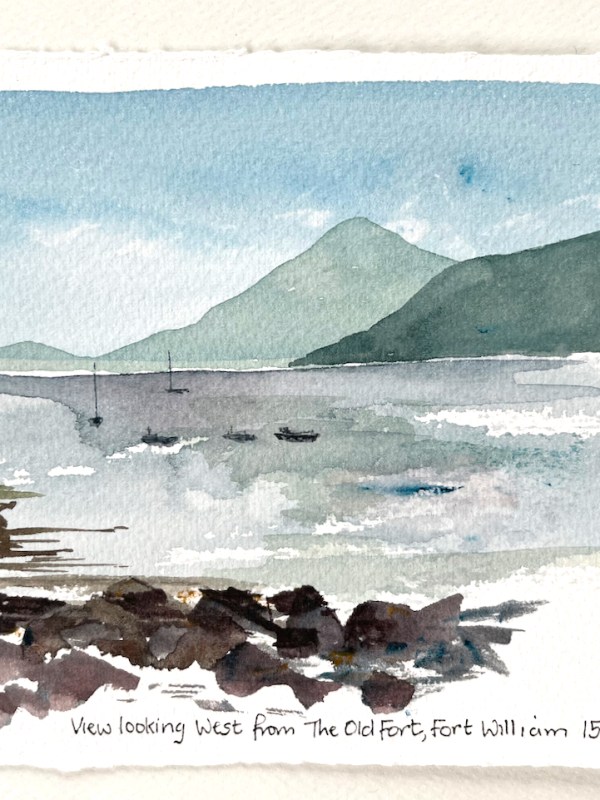
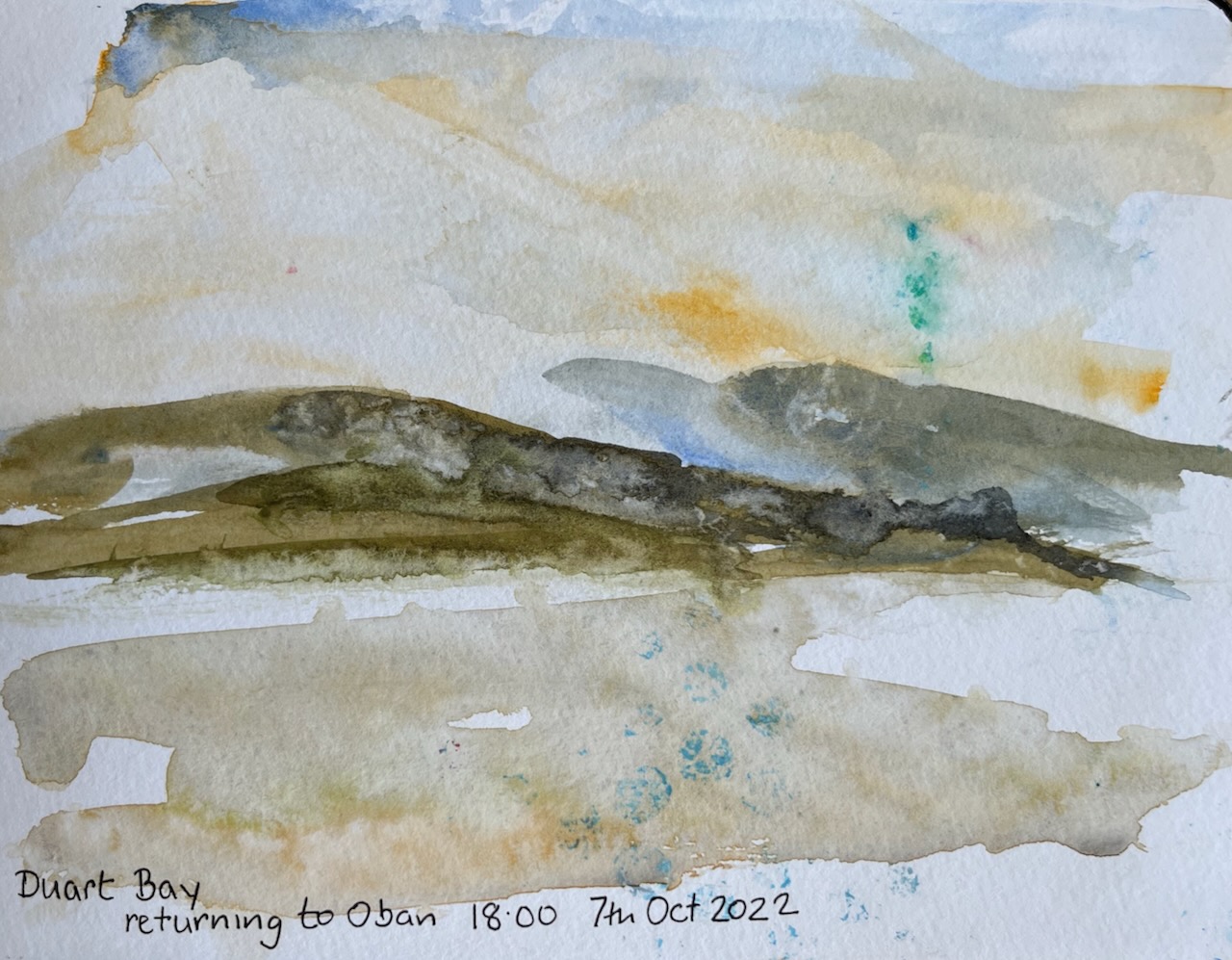
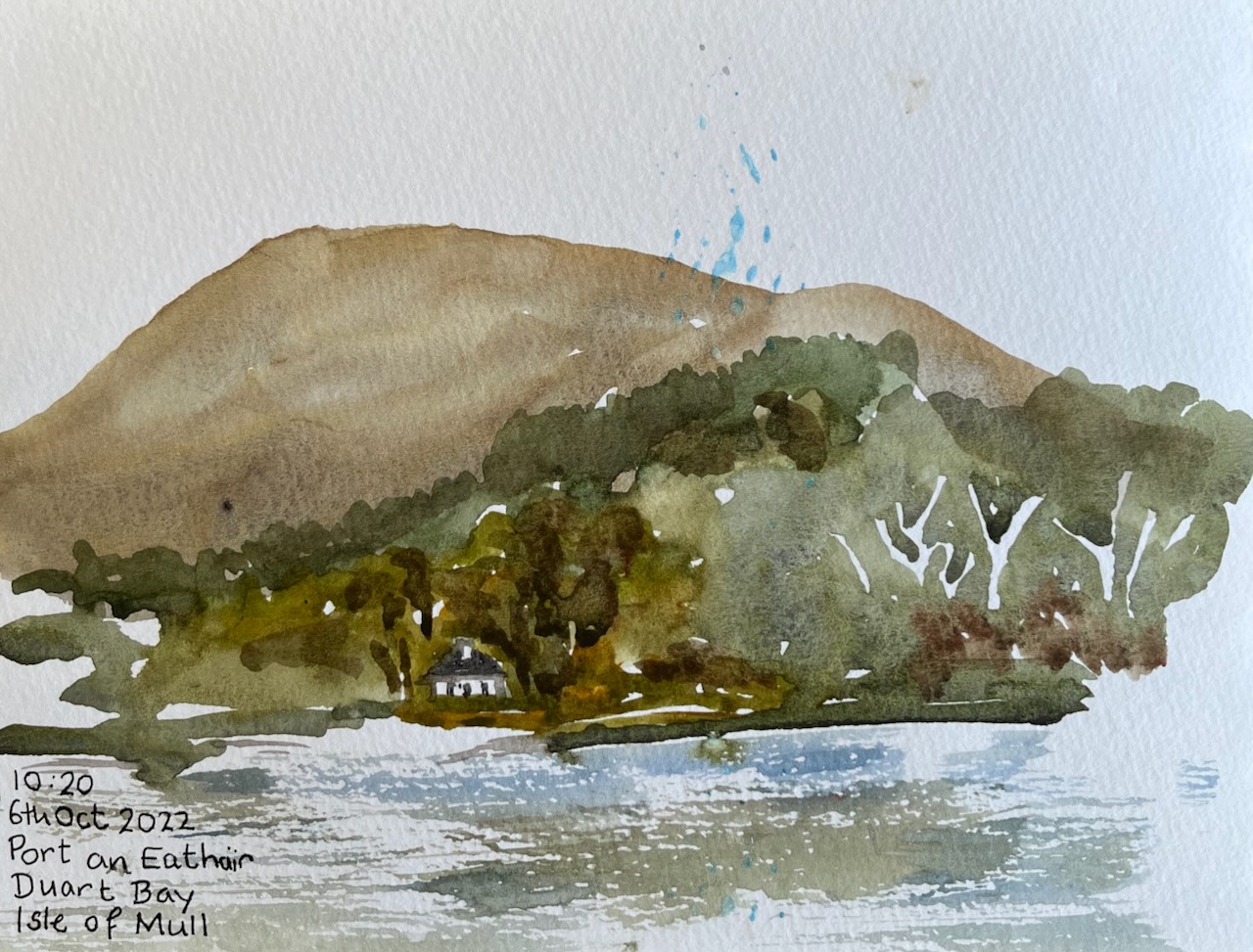
Loch Linnhe, near Fort WIlliam. Ben Nevis in cloud on the left.Urquart Bay, Loch Ness, 9amDuart Bay, returning to ObanPine trees on a promontery, Duart Bay, Isle of MullPort An Eathair, Duart Bay, Isle of MullLoch Linnhe, 6pmViews of the Highlands
It was an adventure.
Me sketching on board. Picture Credit: AndyCustom stamp by “stampit.co.uk”
The Lady of Avenel is an 102ft square rigged brigantine, currently based near Oban, on the west coast of Scotland.
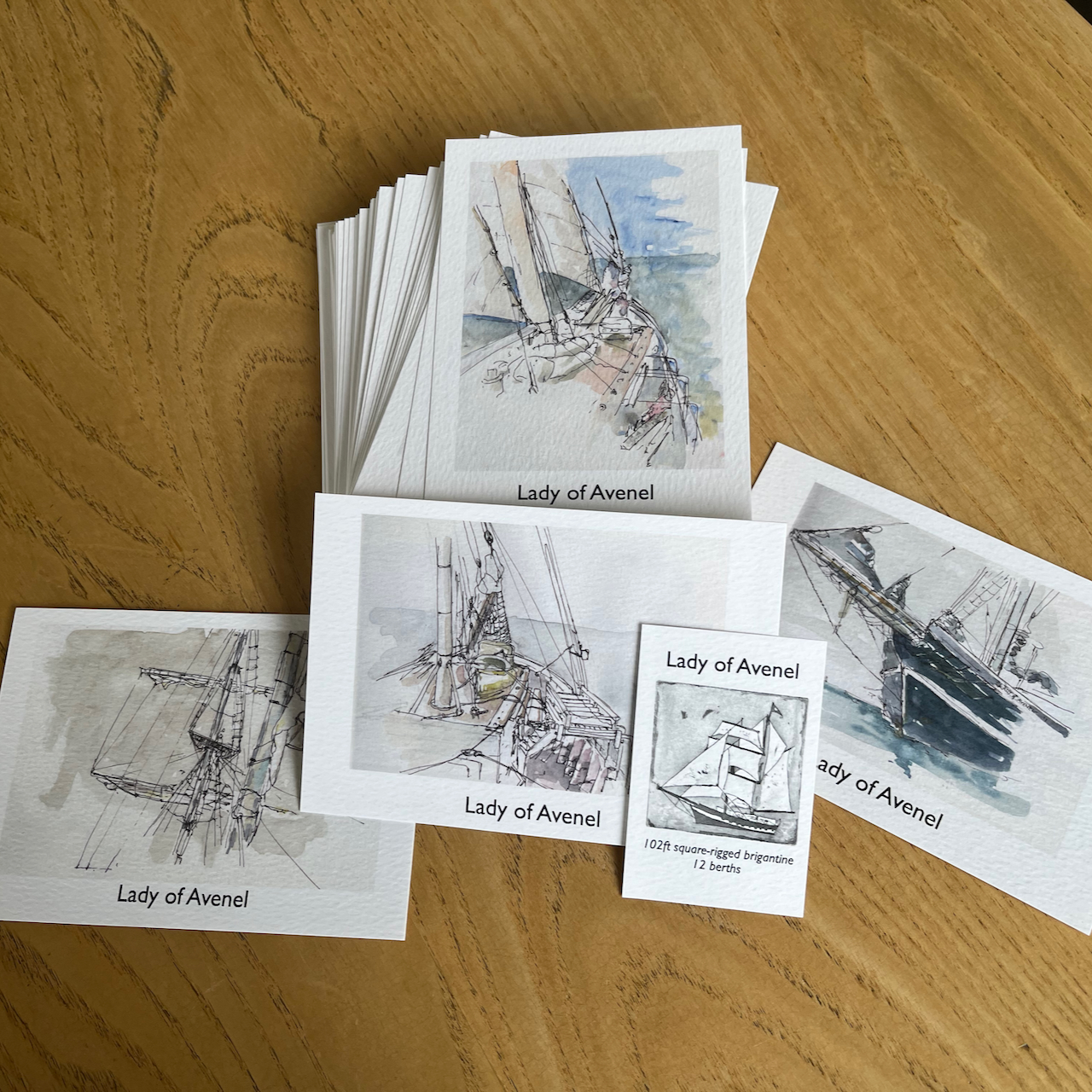
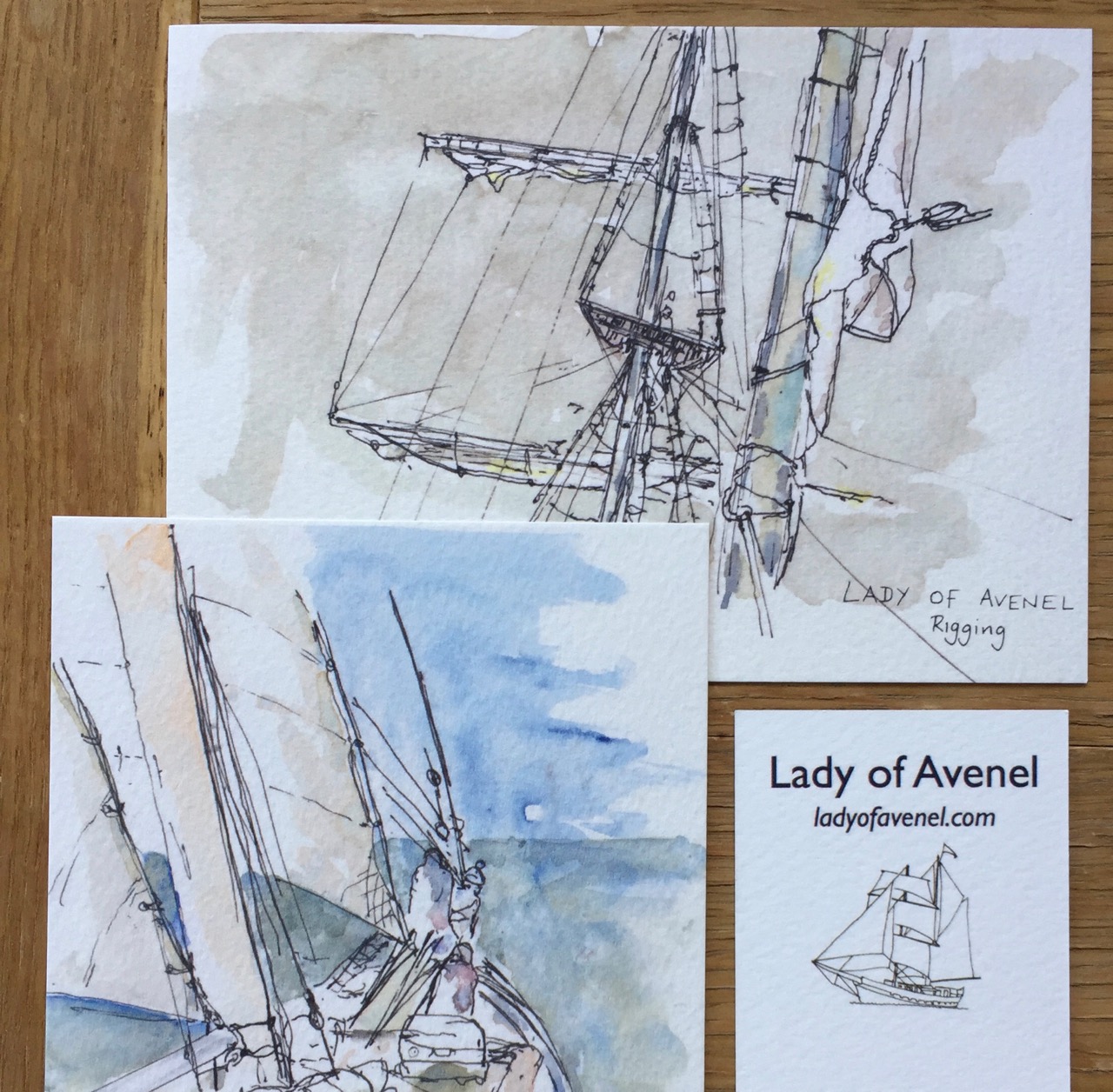
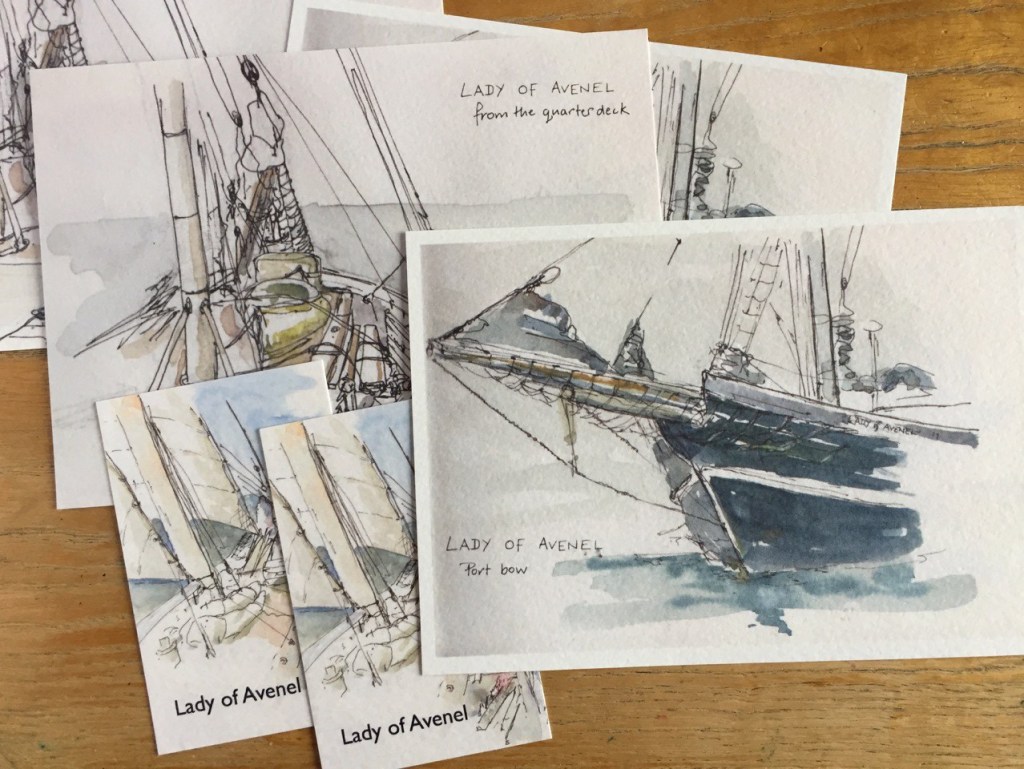
Postcards and Business Card for “Lady of Avenel”Postcards for “Lady of Avenel”Sketches of the “Lady of Avenel” made into postcards and business cards
Every year the Lady of Avenel needs a refit to prepare her for her working season. This year I went up there to join the working party for the refit.
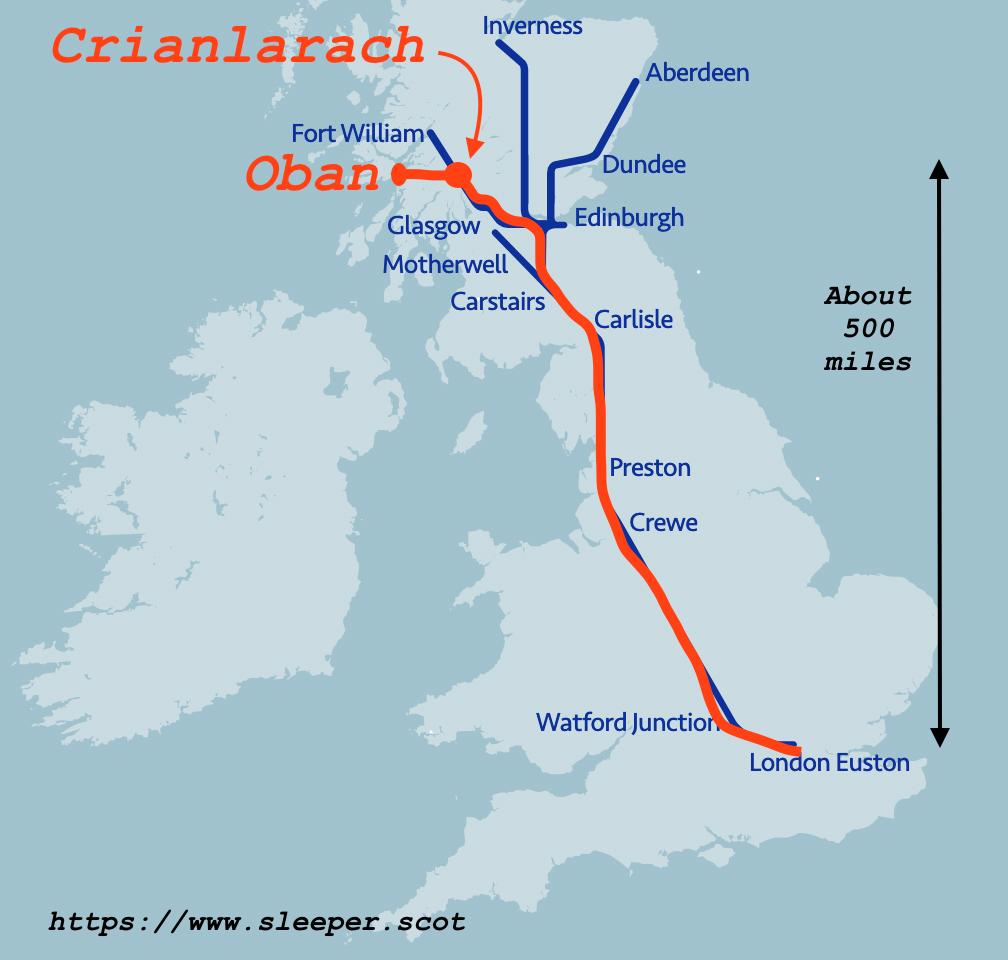
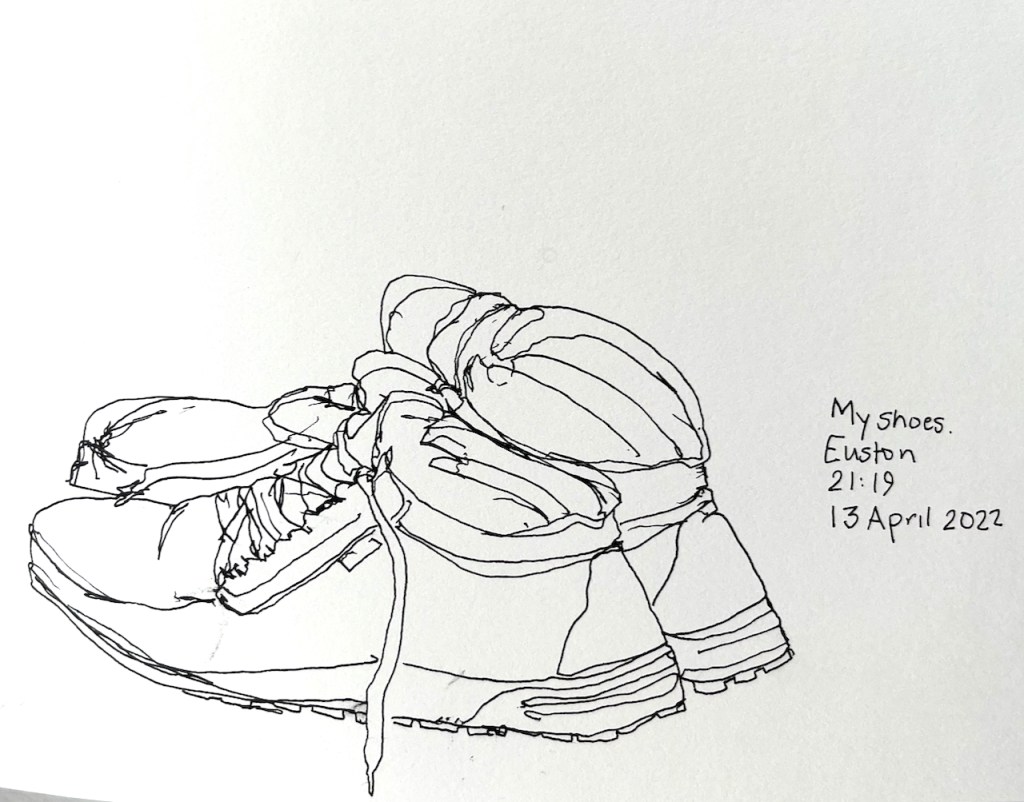
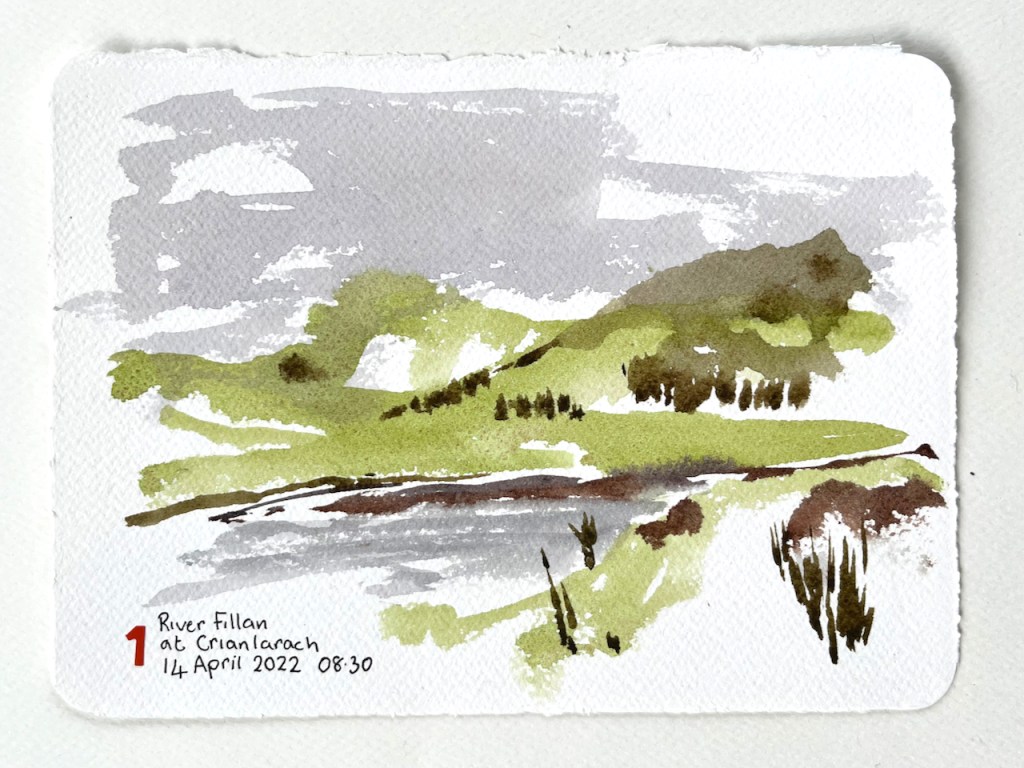
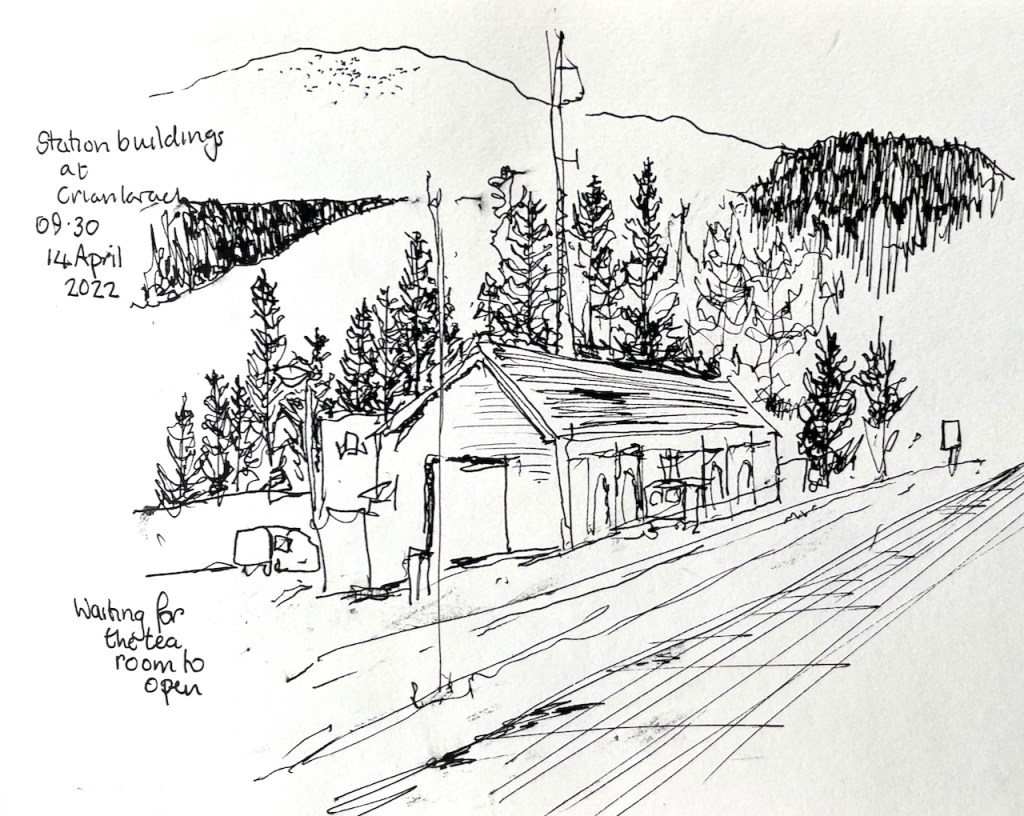
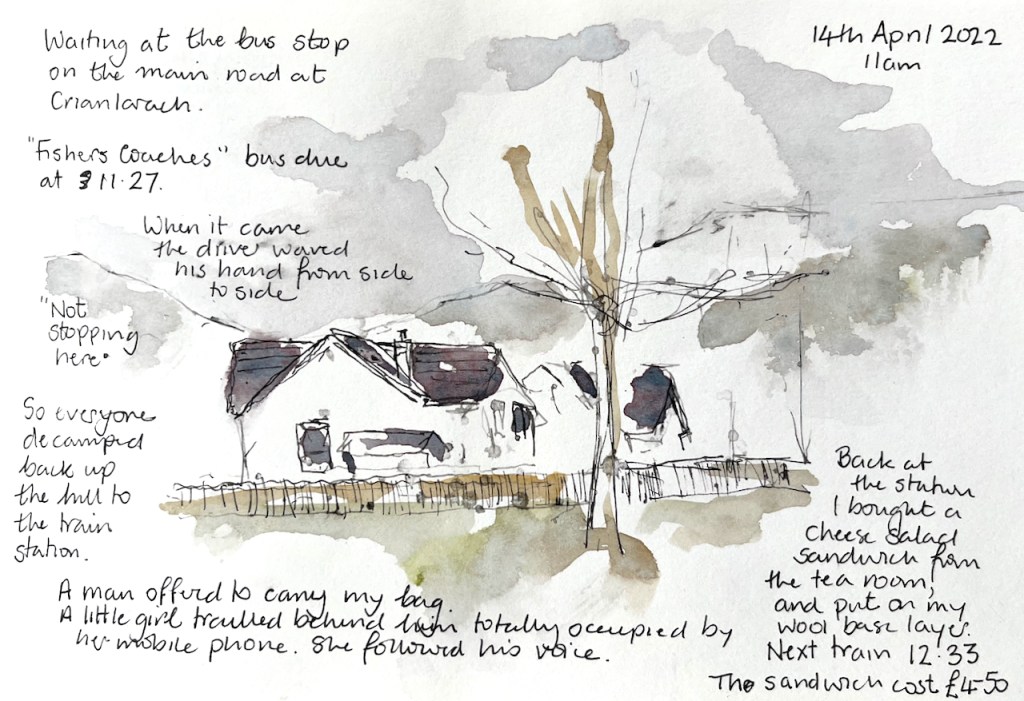
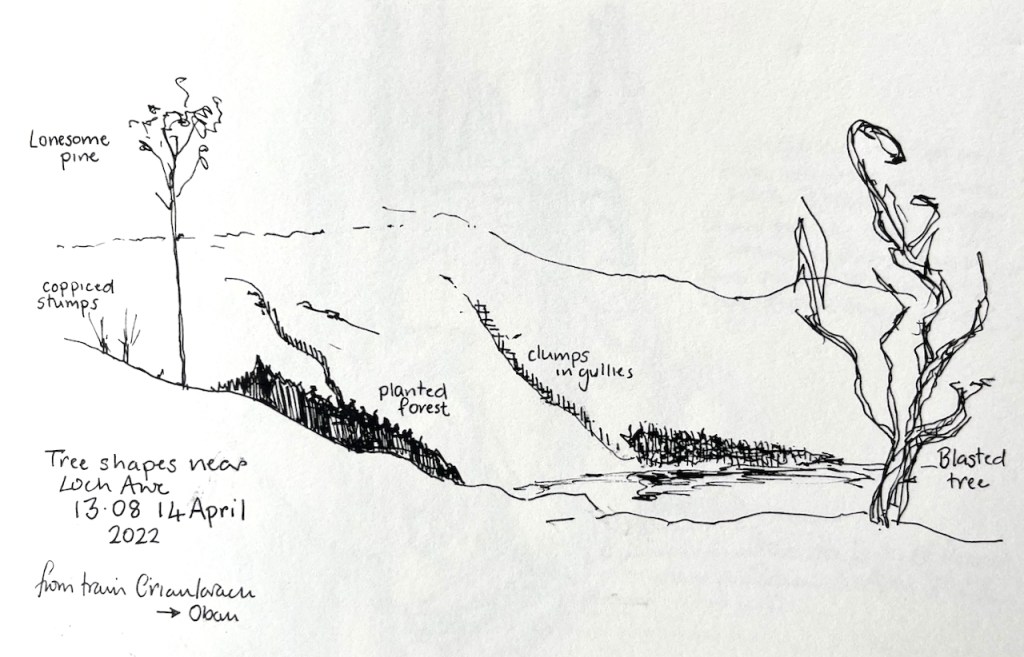
I travelled by overnight train from Euston to Crianlarach.
Journey via the Caledonian Sleeper from London to Oban. Map from the Caledonian Sleeper webpage. The overnight journey takes about 10 hours Euston-Crianlarach. Then I caught a local train Crianlarach to Oban.
I drew some sketches on the journey.
I sketch my shoes before going to sleep on the train.Arrival at Crianlarach: a walk to the nearby River FillanWaiting for the train to ObanThe train is cancelled. Waiting for a bus on the main road. The bus doesn’t stop. Probably it is full. Back at the station, waiting for the later train. On the later train, on the way to Oban.Sketching on the journey north.
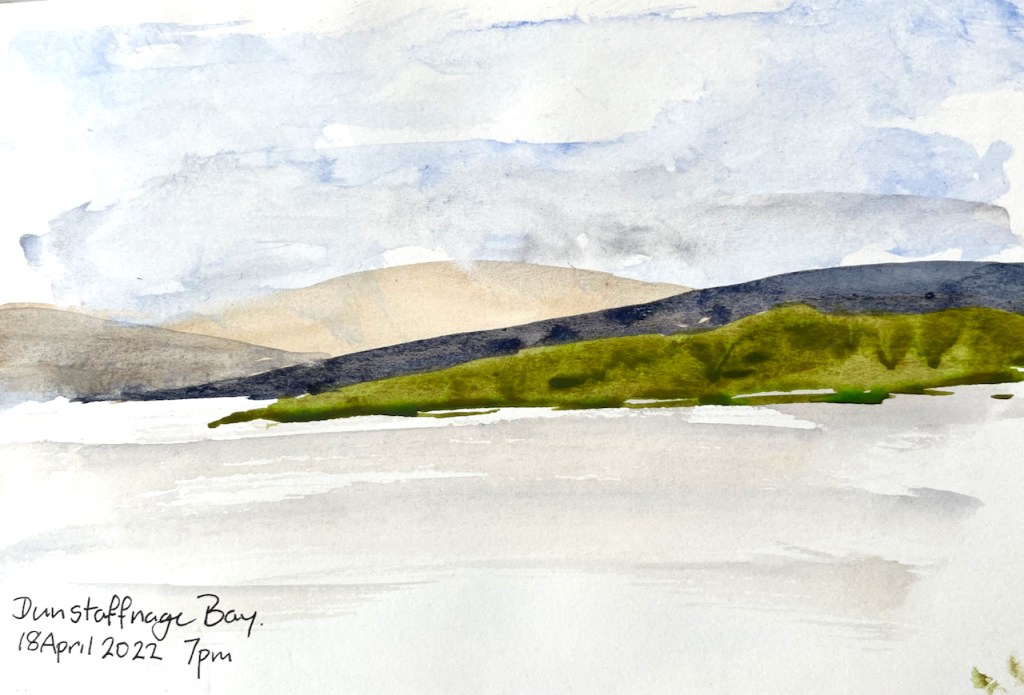
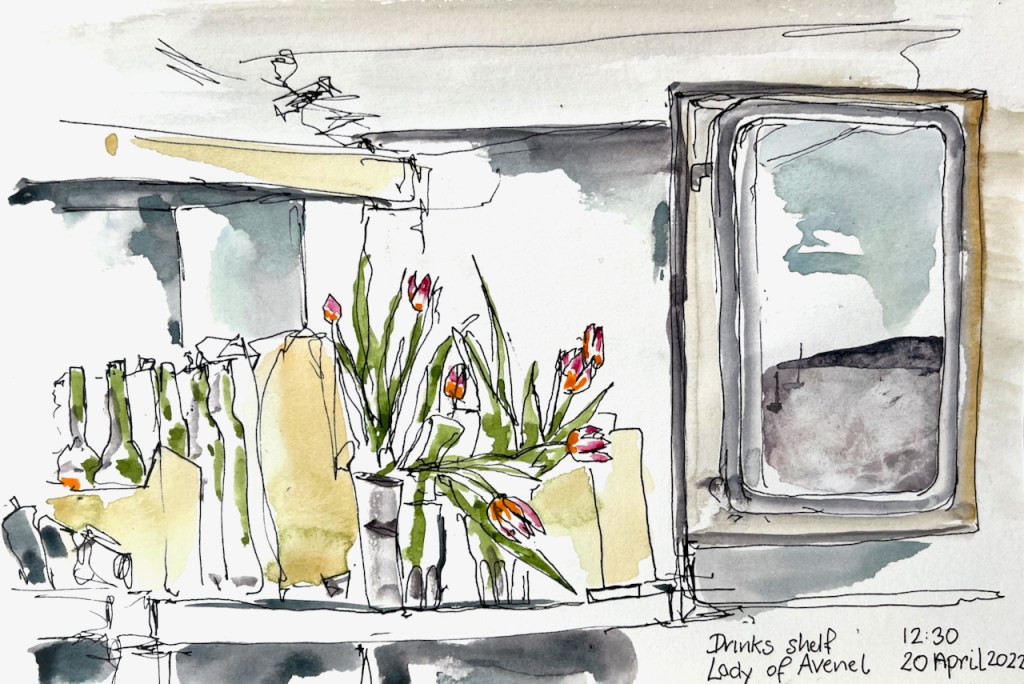
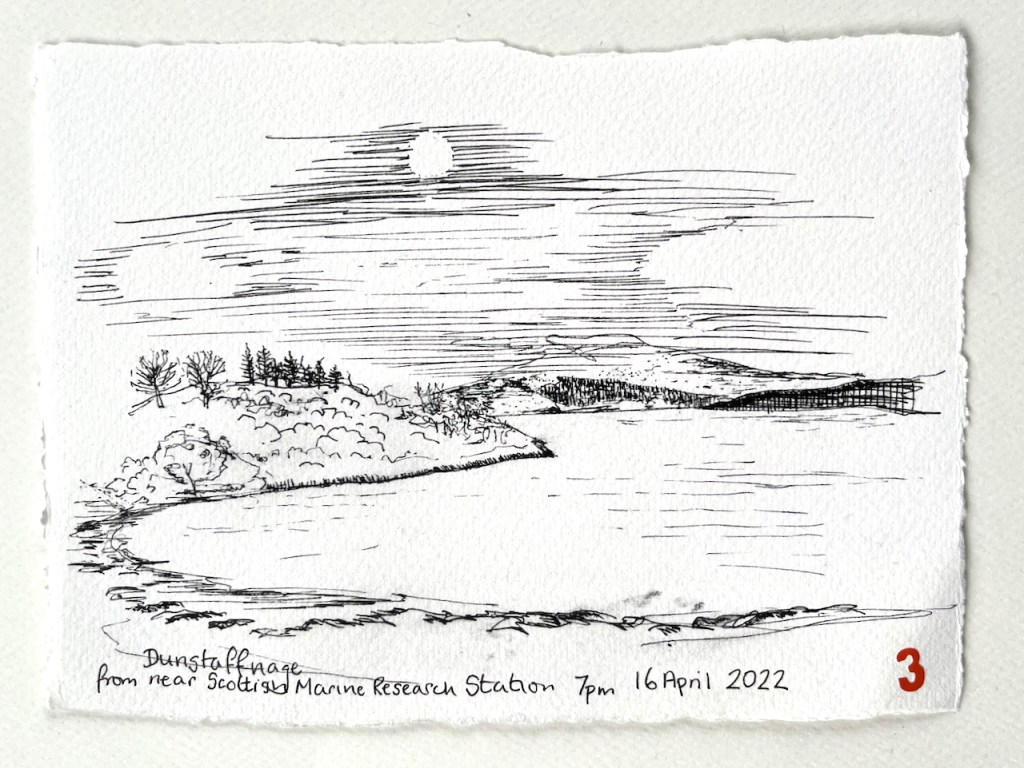
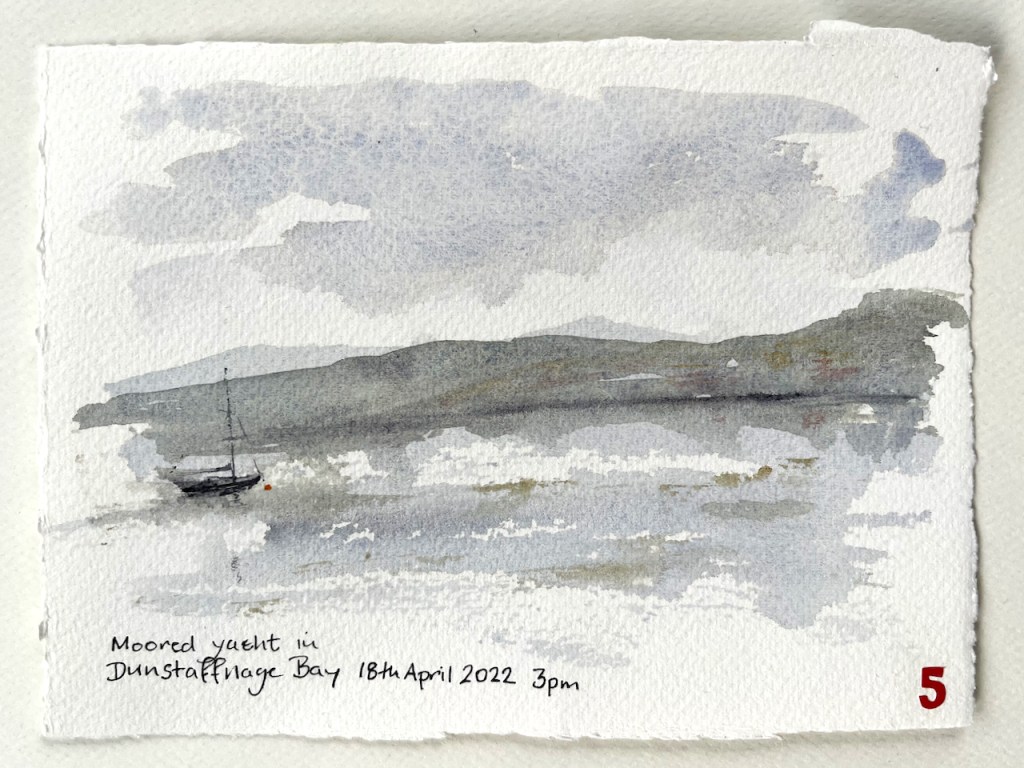
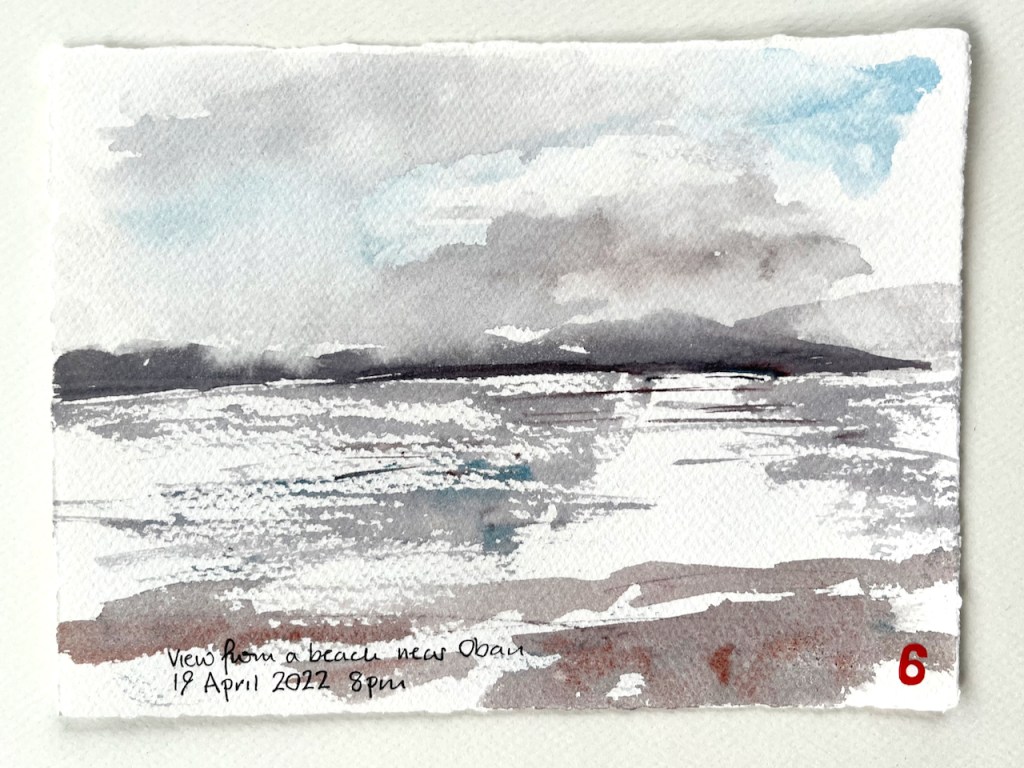
The boat was at Dunstaffnage Marina. In between work sessions I drew some pictures.
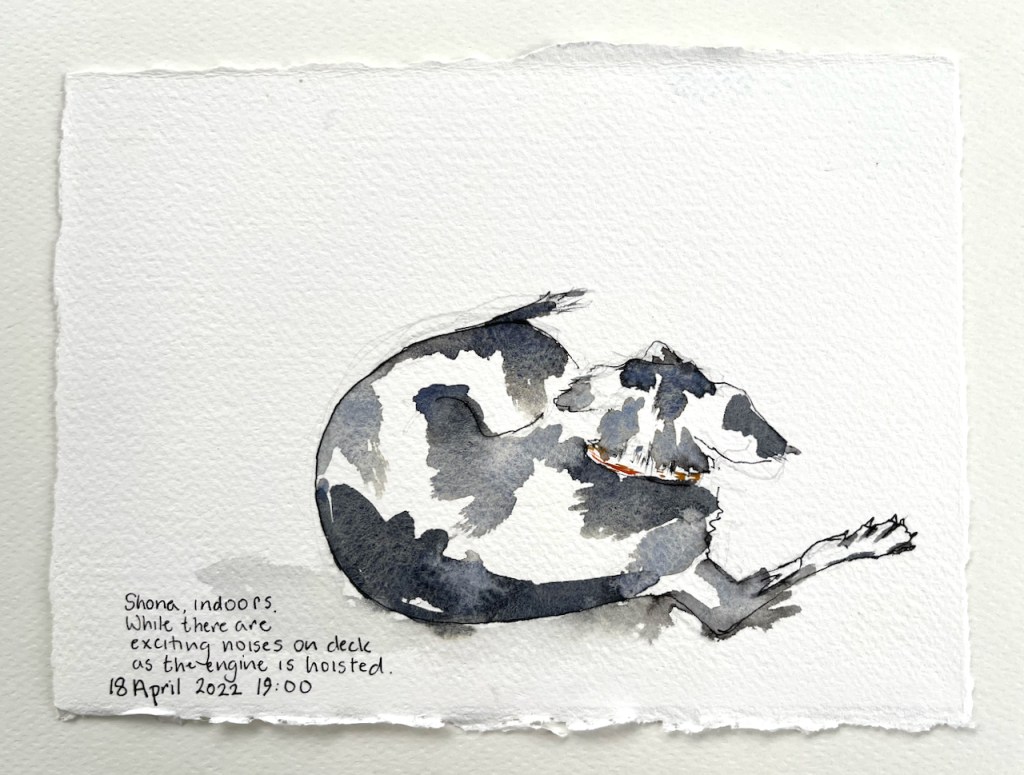
On the boat was a sea dog, Shona. She had to be locked indoors while crew members were hoisting the engine out. I was not part of the engine-hoisting gang. So I kept the dog company and drew her picture.
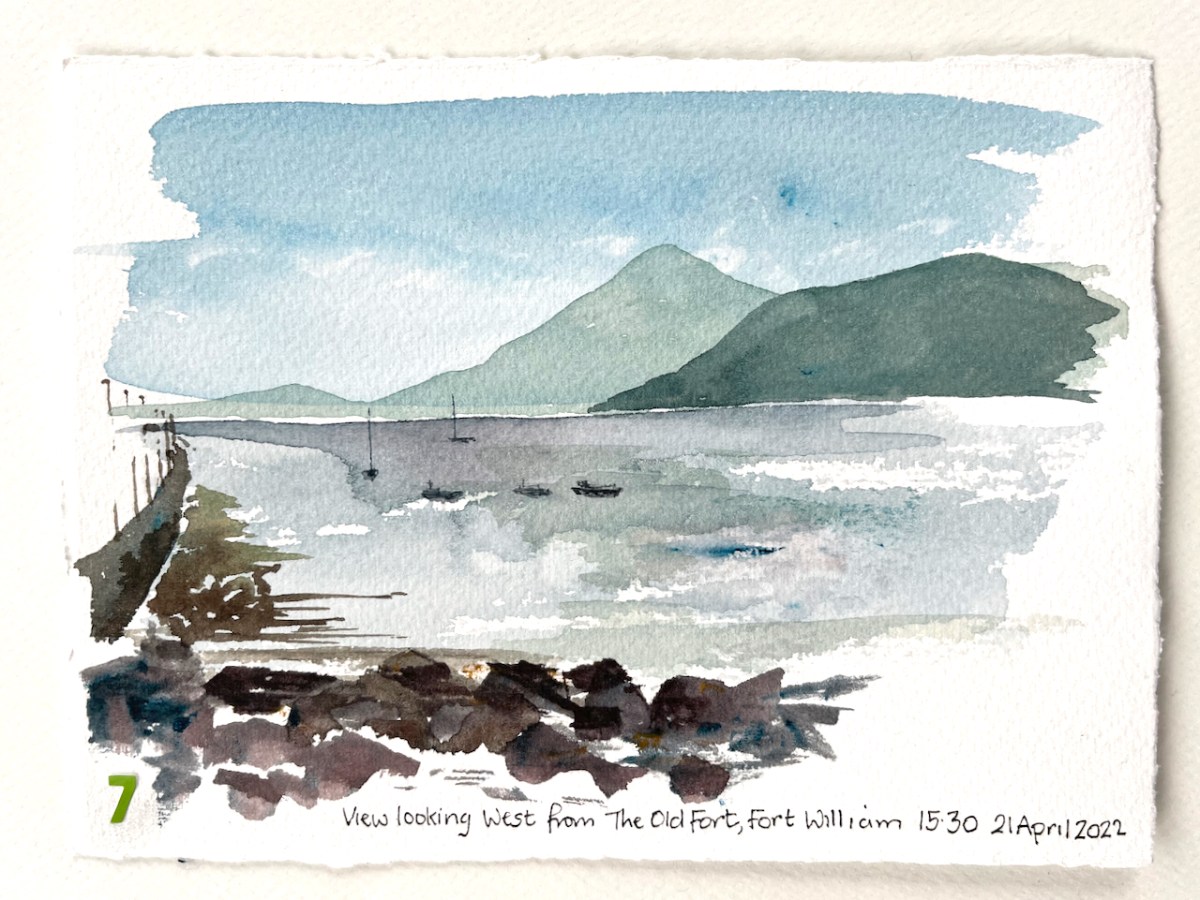
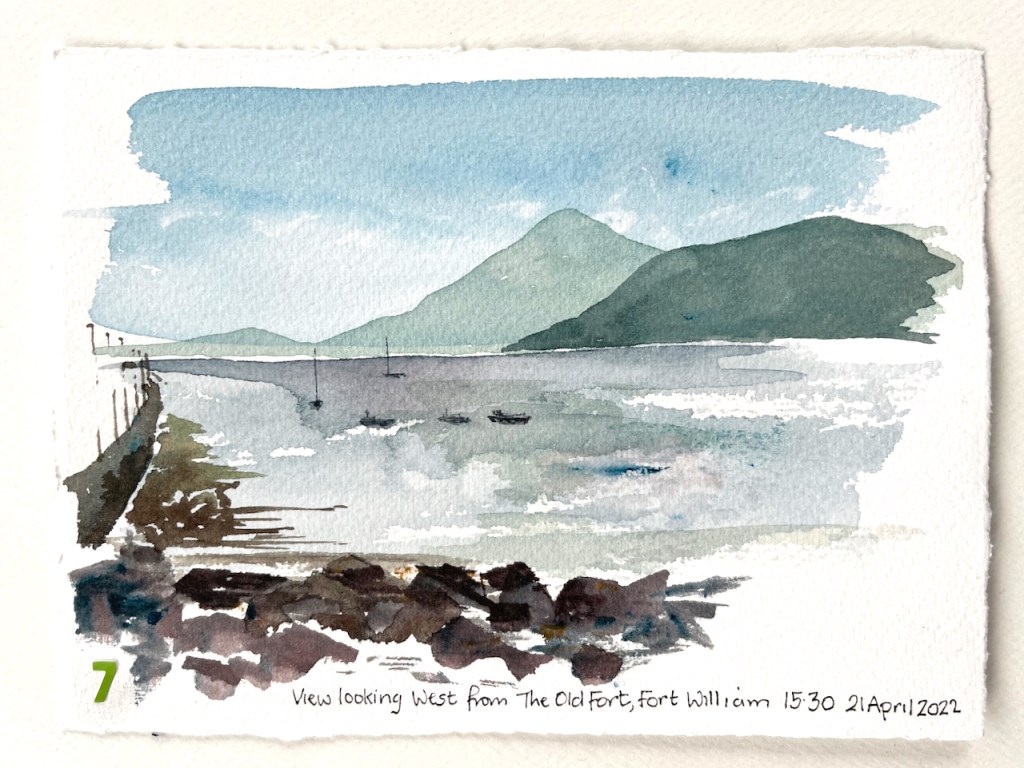
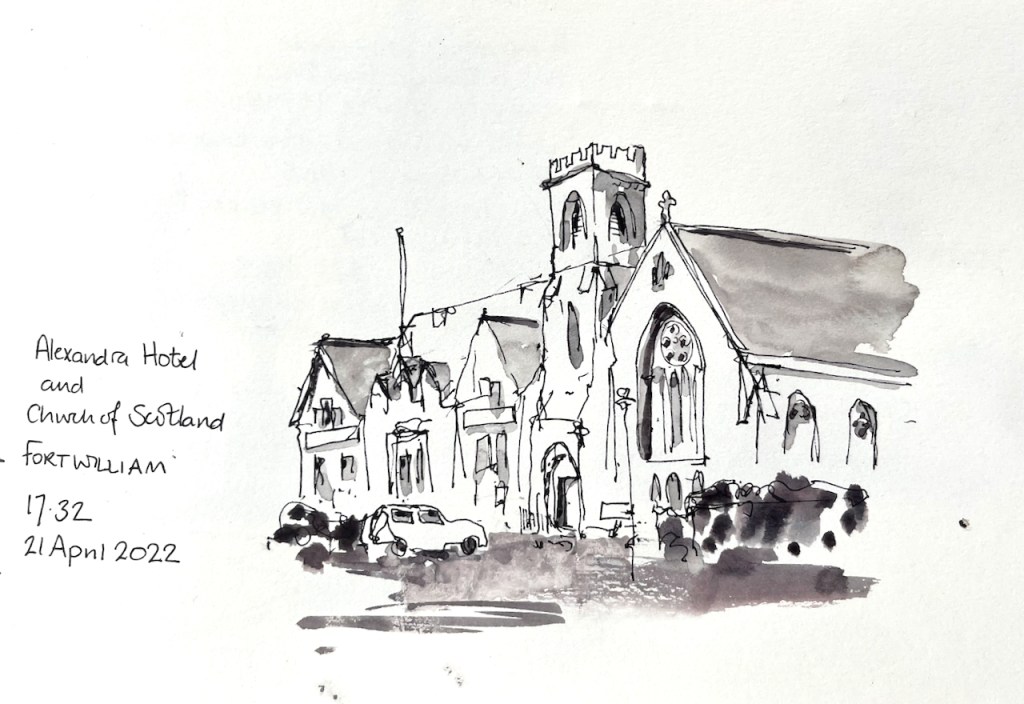
I travelled back via Fort William. The High Street caters for climbers and walkers and has a large number of shops stocking all brands of outdoor gear. I examined some of them, then rested by the Old Fort.
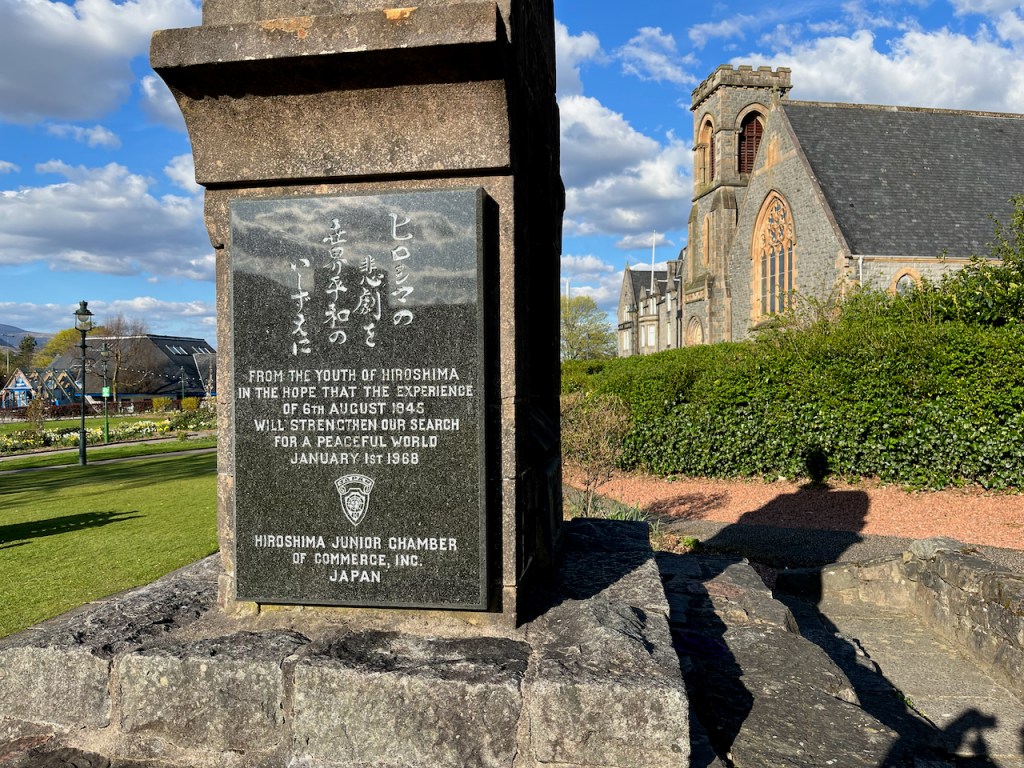
Near the train station there is a park with several war memorials, and a poignant plaque from the young people of Hiroshima:
“From the youth of Hiroshima in the hope that the experience of 6th August 1945 will strengthen our search for a peaceful world. January 1st 1968. Hiroshima Junior Chamber of Commerce.”Parade Gardens, Fort William
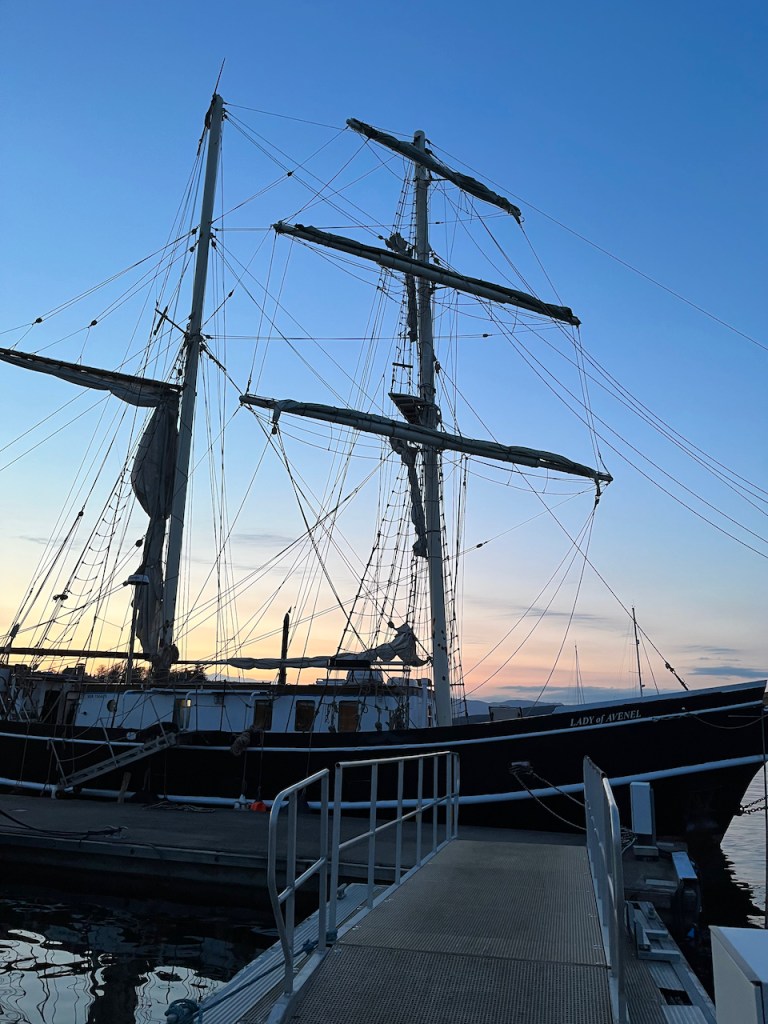
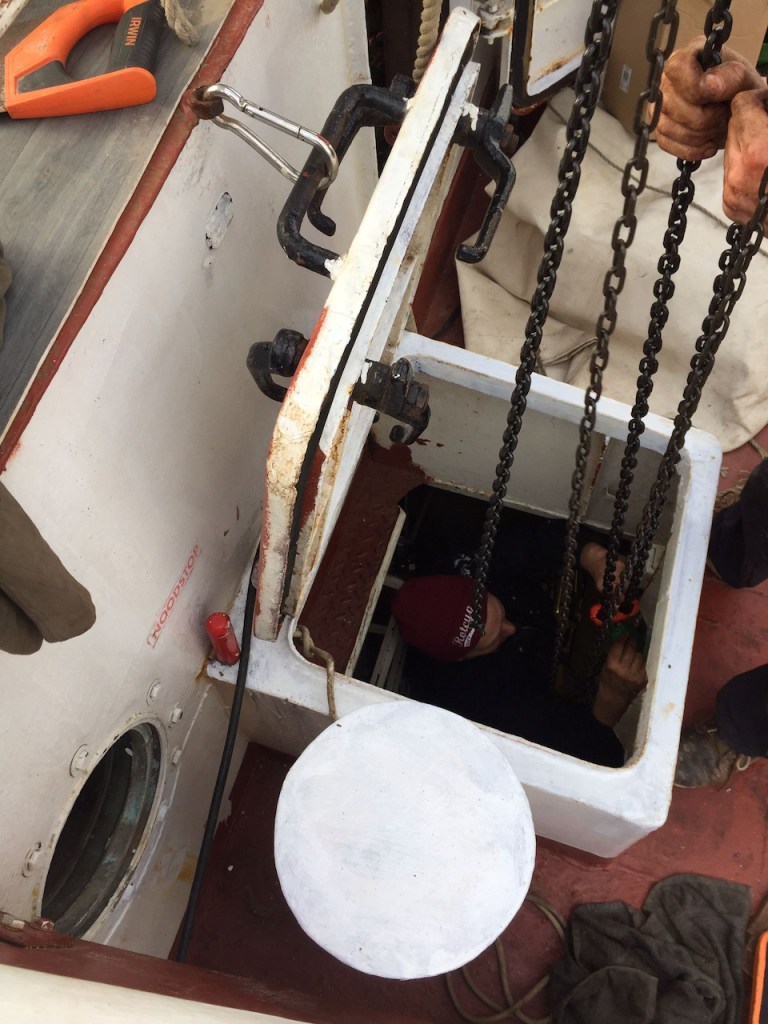
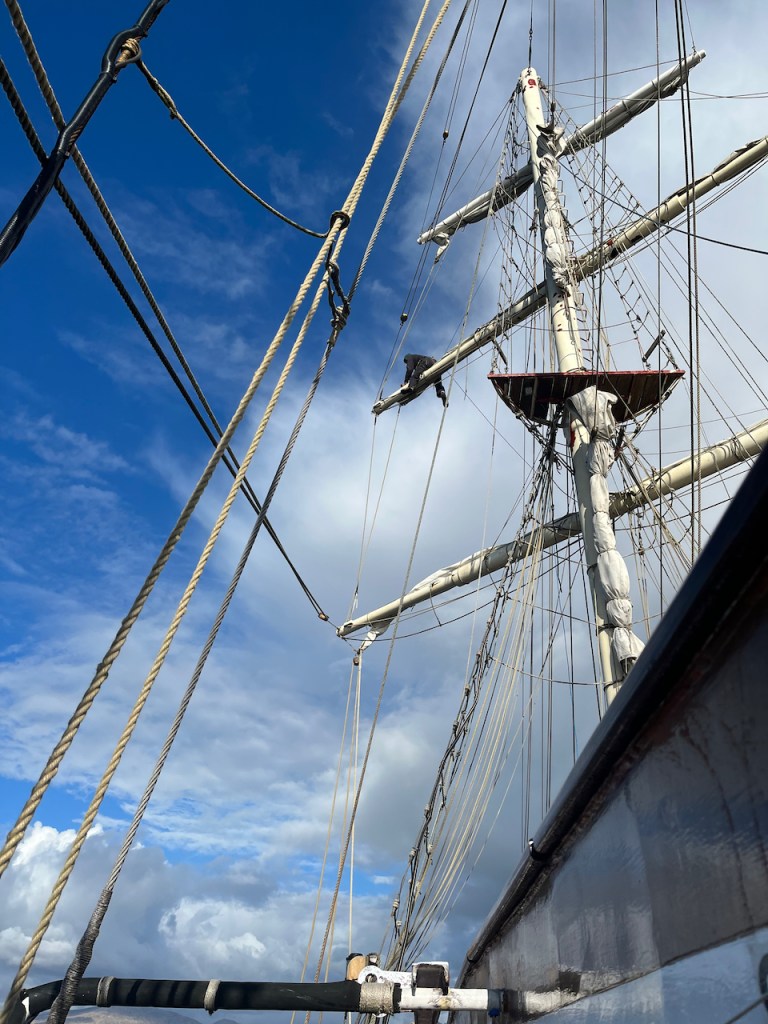
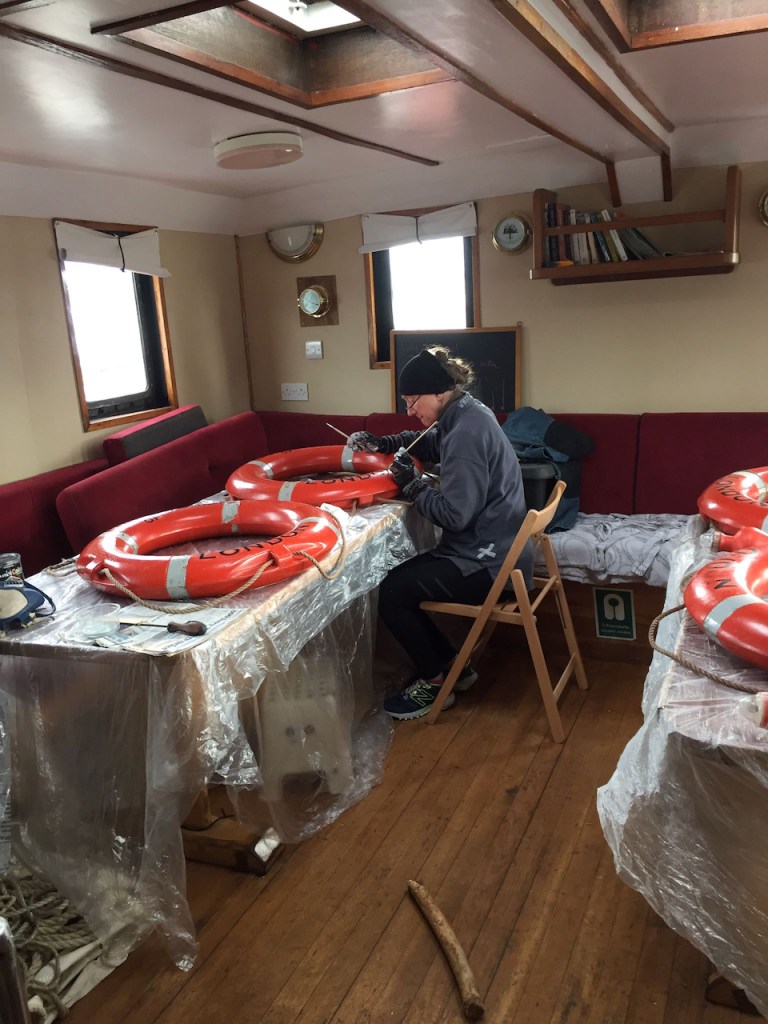
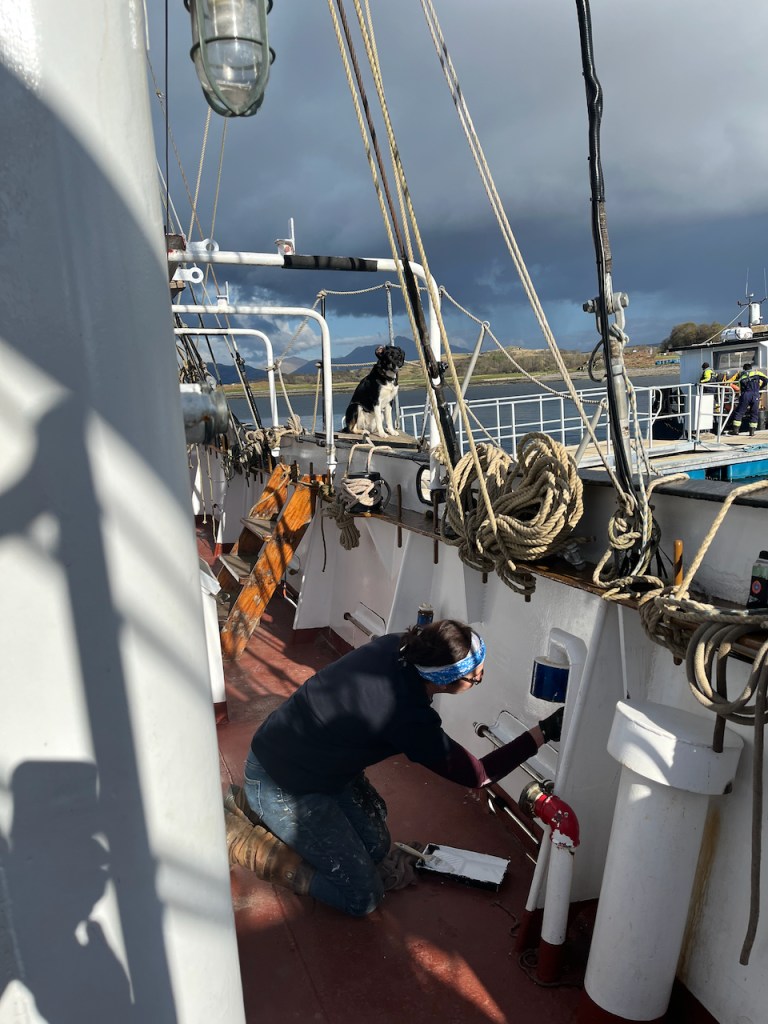
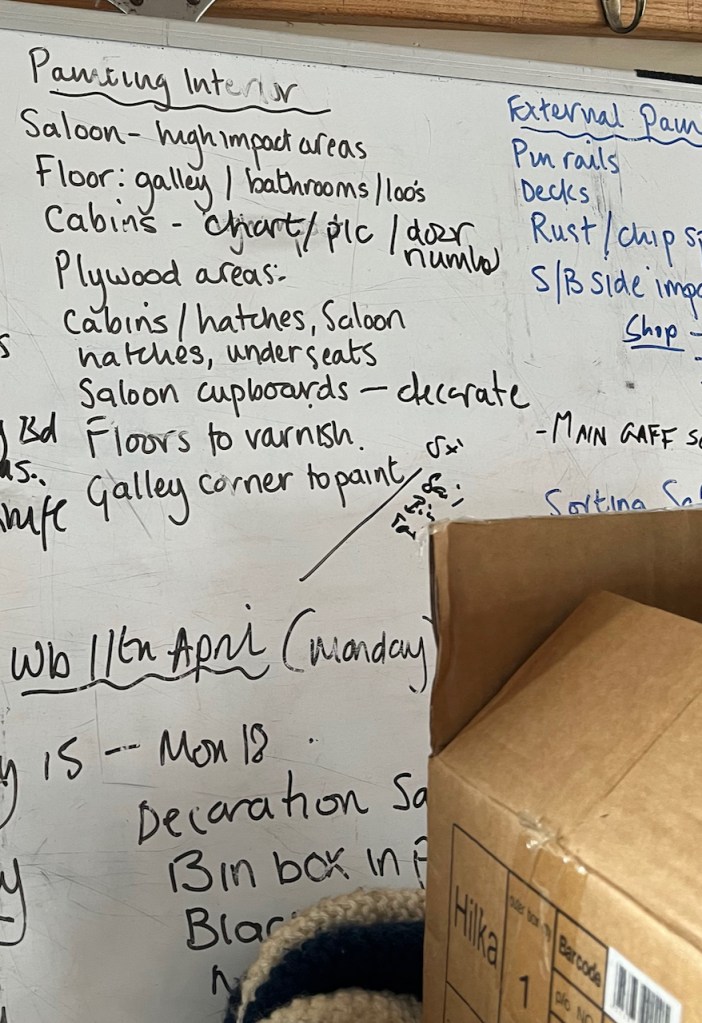
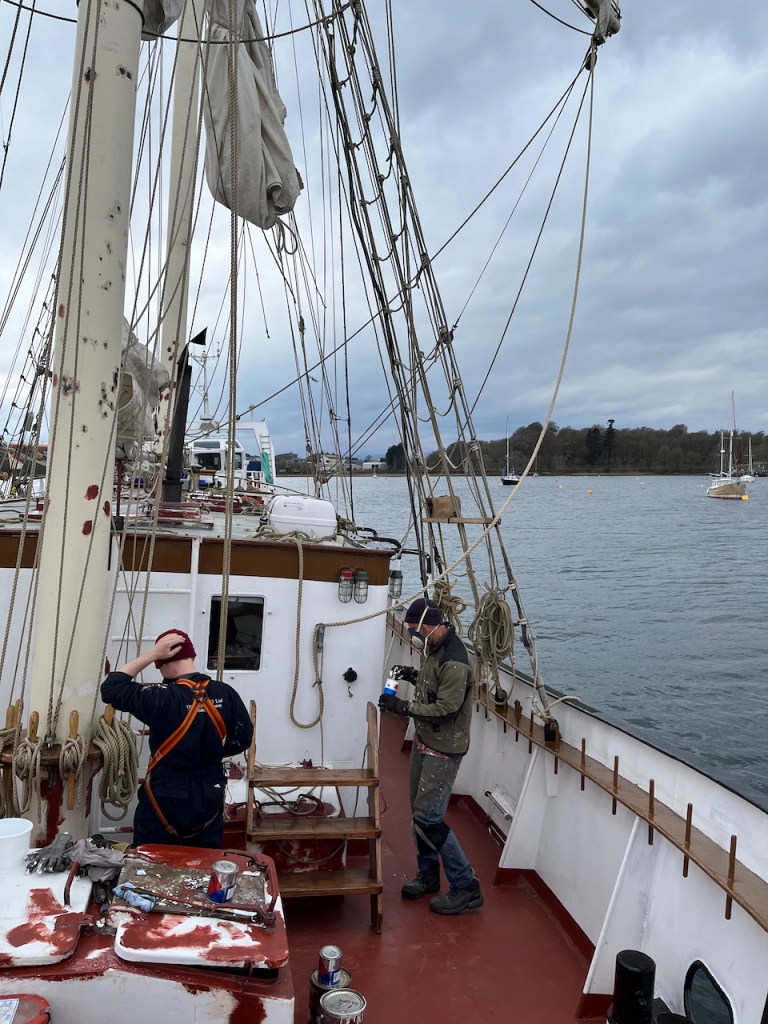
Here are a few photos of the Lady of Avenel during the refit.
The Lady in the marinaShadows in the morningHoisting up the engineWorking in the riggingPainting the name on the lifebuoysWhite paint on the bulwarksThe ListWorking out what’s nextWork in progress on the “Lady of Avenel” refit 2022
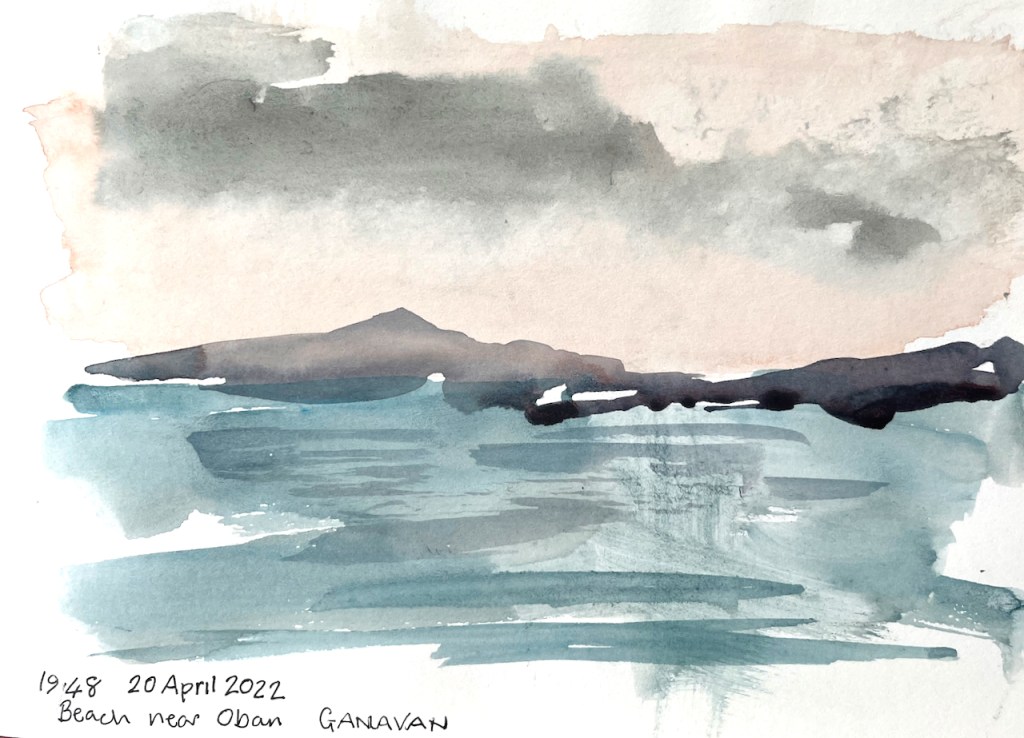
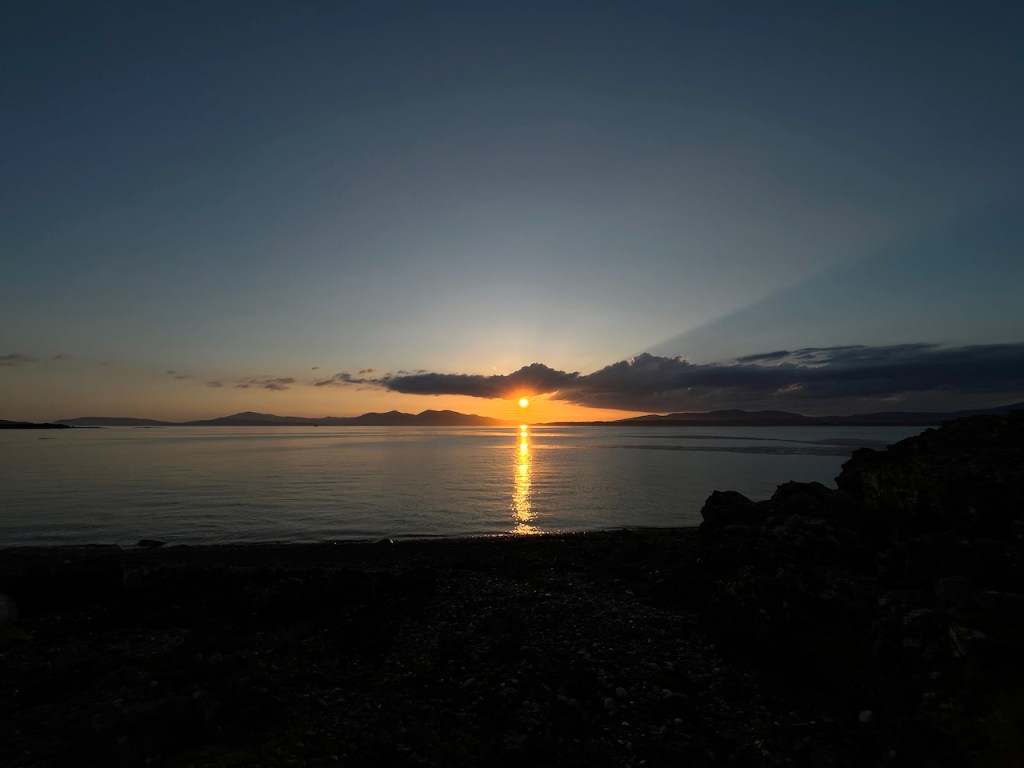
Scotland is beautiful.
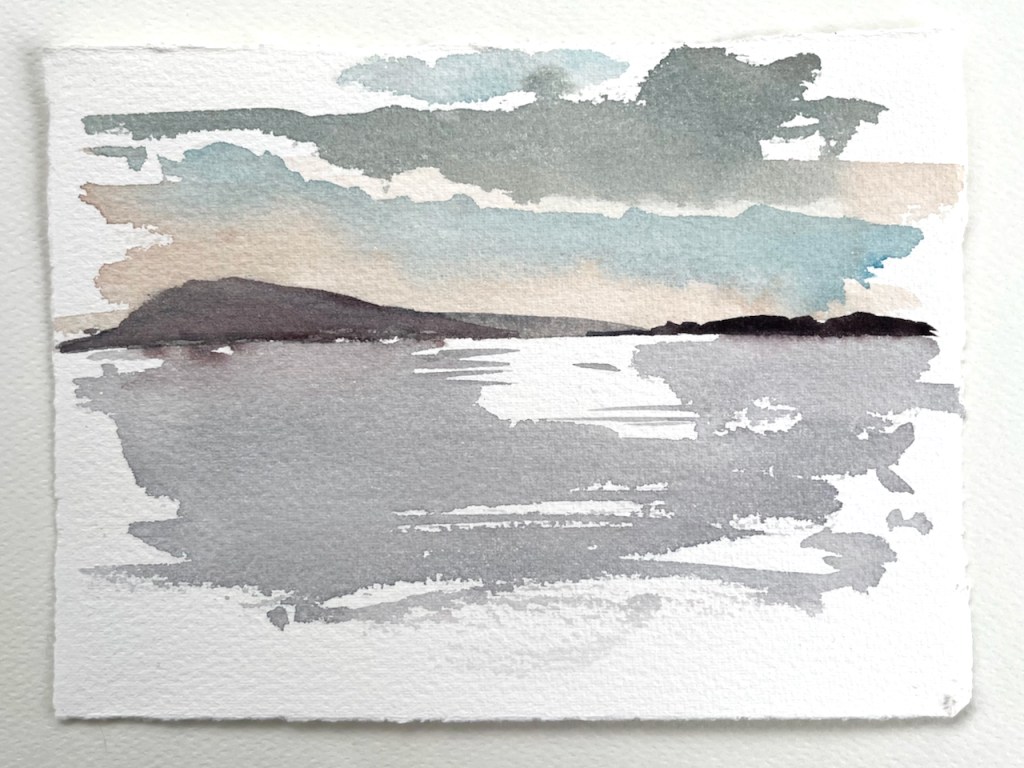
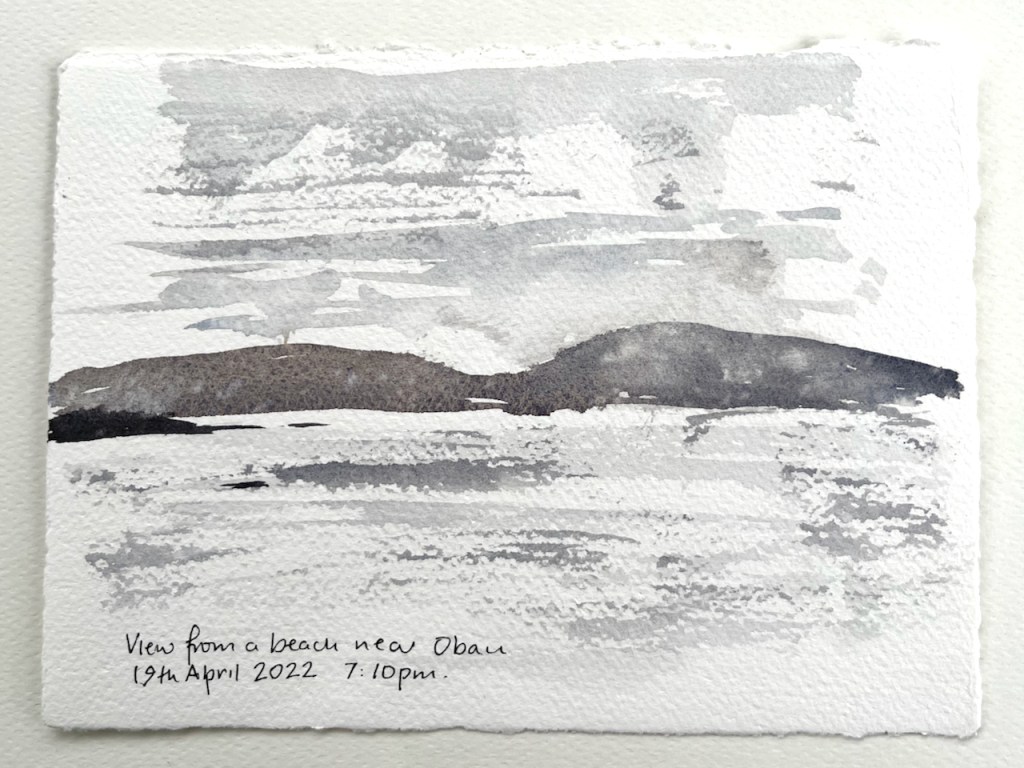
Sunset after a swim. Beach called “Ganavan” near Oban.
I have sailed on the Lady of Avenel in previous years:
I took my sketching things on a swimming expedition to the Outer Hebrides with Swimtrek. We were on the wonderful Lady of Avenel 102ft square rigged brigantine. We started in Oban. It was raining when I…
Here is Lady of Avenel, 102ft Brigantine. This was the third of three sketches. Here are the first two. I have drawn Lady of Avenel previously: Outer Hebrides 2017 See also these pages for pictures of and…
This is Noordermarkt, as seen from Café Hegeraad, in the Jordaan district of Amsterdam. It was a lovely autumn day, warm with a light breeze. I had the apple cake and a coffee. I had arrived from…
I went through Aberdeen on the way out to Shetland, and on the way back.
On the way out I drew St Machar’s Cathedral then proceeded south to find the excellent coffee shop Kilau Coffee recommended by the church guardian, who knew her coffee shops. By then I was in the University. It was still raining. So I sketched Kings College Chapel, from a convenient cloister.
Kings College Chapel, Aberdeen, from the cloister. 9th August 2019 15:21
Then I walked back to the ferry terminal, still in the rain. Here’s a sketch of a building on the main square.
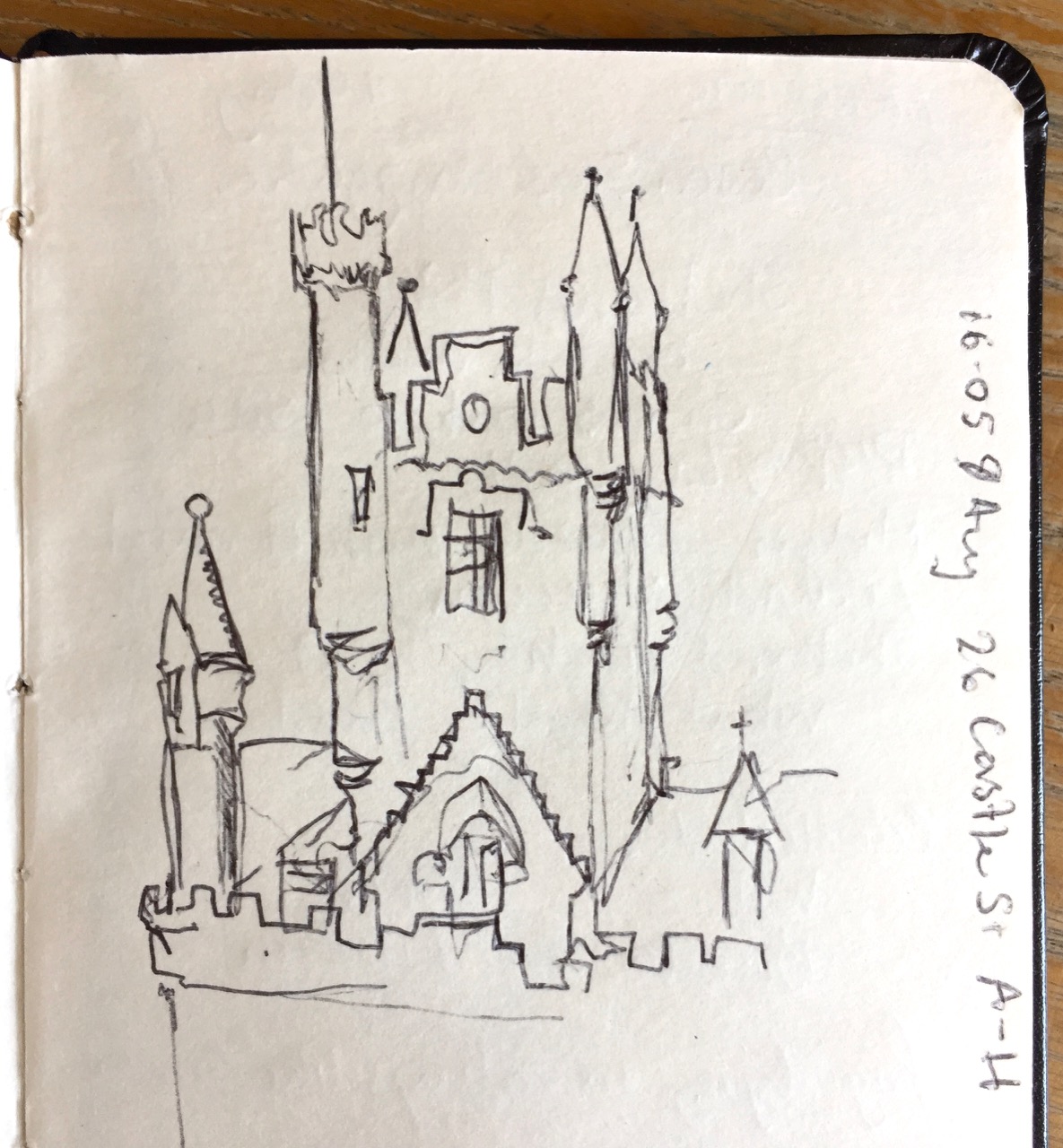
Aberdeen Market Square, 26 Castle St, 9th August 2019
I was taken by the multiple levels of bartizan, which are the towers fastened to the side of the building. These are also called courbelled tourelles. I was sketching from the doorway of a charity shop, in biro, which was the only medium that worked in the sluicing dampness. I tried to find out what this magnificent building was. It seemed only to have a number: “26 Castle Street A-H”, so I guess it is residential.
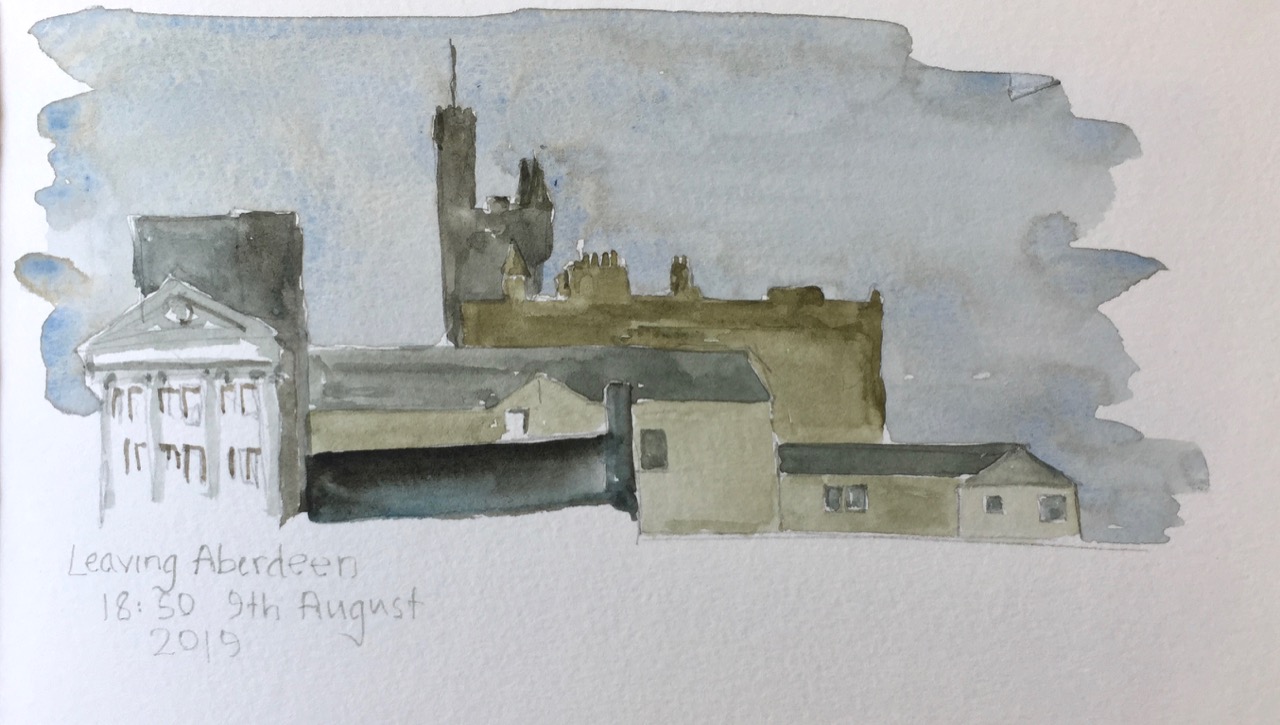
From the window of my cabin on the ferry I saw the same building from a distance.
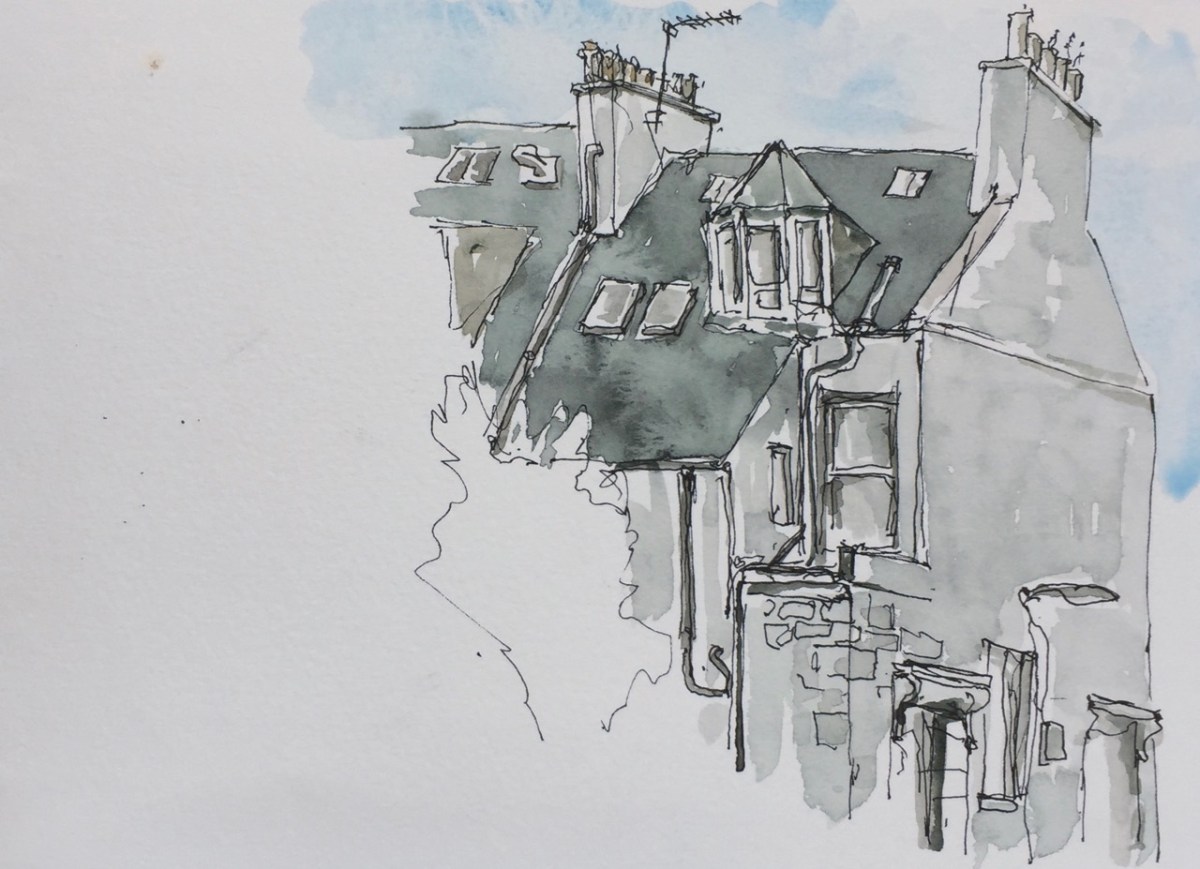
On the way back, two weeks later, I took a walk round what I termed the “Starbucks side of town”. This is the part south of the railway station. There is indeed a Starbucks, on Union Street. The houses are grand here, and in orderly terraces. Here’s a glimpse of an end house, a quick sketch as I was on my way to the bus station.
Aberdeen Houses, Rosebank Terrace numbers 2 and 4, 11am, 25th August 2019
St Machar’s is in Old Aberdeen, North of the University.
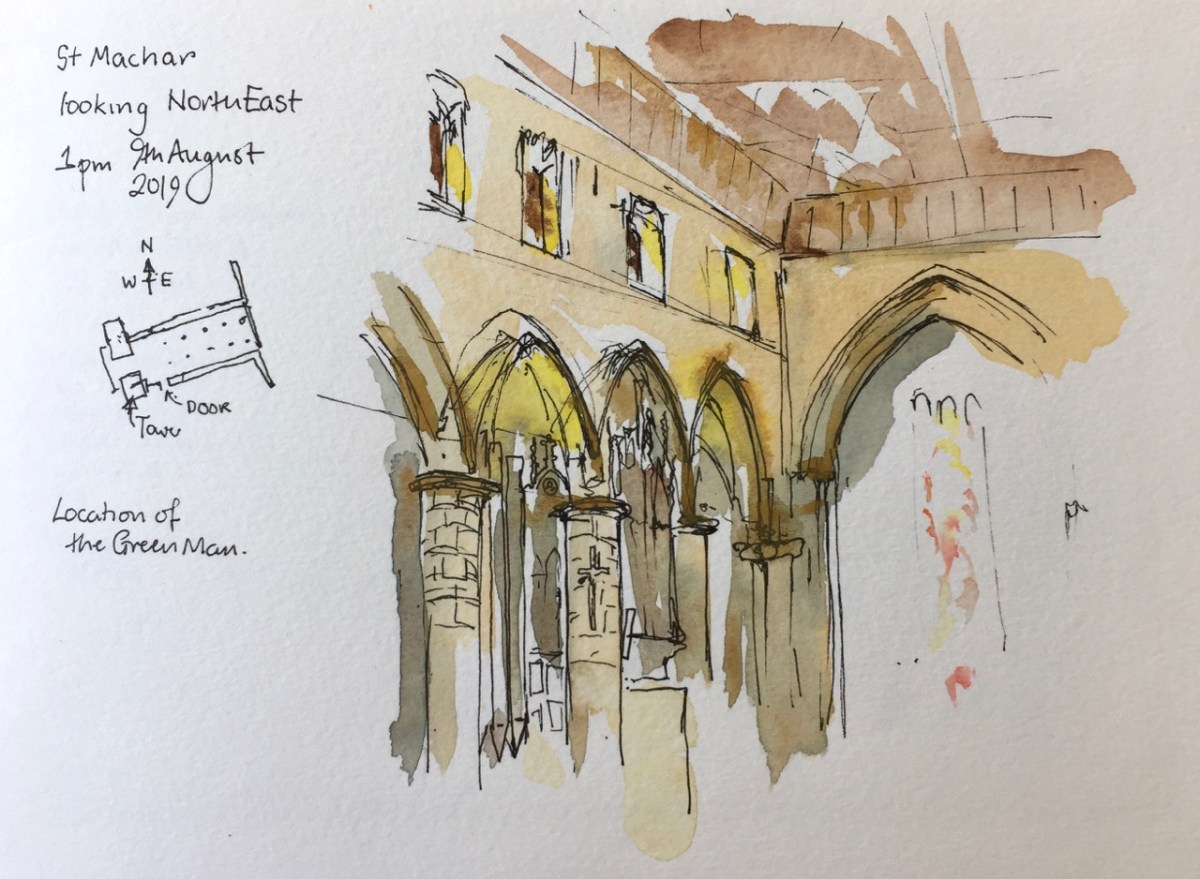
I went to look for a medieval carving, a “Green Man”. According to my instructions it was in the “North East Crossing” on the “west side”. I had a good look around. This is a very plain church, solid granite columns, no carving. I could see no “North East Crossing”. The church is rectangular, not cross-shaped like most churches. The enthusiastic guardians welcomed me, and told me about the church. It is very ancient, and many different peoples have worshipped there, including the Celts, whose 7th century stone cross stands at the west end.
After I had listened and chatted, I showed them my instructions: “North East Crossing, west side”. Ah, they said, but there is no longer any “North East Crossing”, it’s been demolished, for centuries, since the Reformation.
I felt a shiver as though someone was telling me a ghost story. My instructions came from a printed book, much later than the Reformation, clearly. But the guardian was still talking. “You can see the ruins,” she was telling me, “Outside”.
Outside it was raining, a heavy wet Aberdeen rain. I stomped about in wet grass, between gravestones. I was looking up, which made me more wet. And there he was, the Green Man, staring down. I risked taking my iPhone out of my pocket for an instant, to get a photo.
I couldn’t draw outside, so I went back inside. The picture I drew shows the position of the Green Man, but the inside wall. He is on the outside.
9th August 2019, St Machar’s Cathedral, Aberdeen, now Church of Scotland, formerly Celtic, Roman Catholic, Episcopal.
Click a button below to share this post online, email it, or print it:
The ferry from Shetland arrives in to Aberdeen at 7am. The air feels cool and chemical, like water from a cold tap. I carry my luggage on my back, and it’s heavy.
No, they won’t take my bag at the ferry Left Luggage. Only if I’m travelling on the evening ferry will they take in my luggage. I am not travelling on the evening ferry. I have just arrived on the morning ferry. And I am going to the airport. But that is later. For now I have a heavy bag, and the whole of Aberdeen to explore.
Let’s try the train station.
It is Sunday. Aberdeen is closed. The Union Square shopping centre is closed. So the route to the station is three sides of a rectangle, a circumnavigation of the Union Square, Jury’s Hotel and the Bus Station. Outside the Jury’s Hotel, a cluster of men with beer cans part to let me through. My grim determination is reflected in their faces. Or perhaps it’s something else I’m seeing: their effort to stay vertical.
I spot the “Left Luggage” symbol at the Train station. The door has a dim window which frames a seated man. “I see the Left Luggage operative,” says my optimistic brain. The straps of my luggage are now making permanent furrows in the muscles of my shoulders. The door is locked. I rattle it. “It opens at nine,” comes a voice. It’s the seated man, who is behind me, reflected in the dirty glass. He is sitting on the sunlit steps, waiting.
From the table at “Patisserie Valerie” I can see that he is still there. He hasn’t moved at all. Those steps must be cold, granite. He must be fed up. But he didn’t seem fed up when I spoke to him. Perhaps he is sitting there for some other reason. Perhaps he does not require the services of the Aberdeen Station Left Luggage.
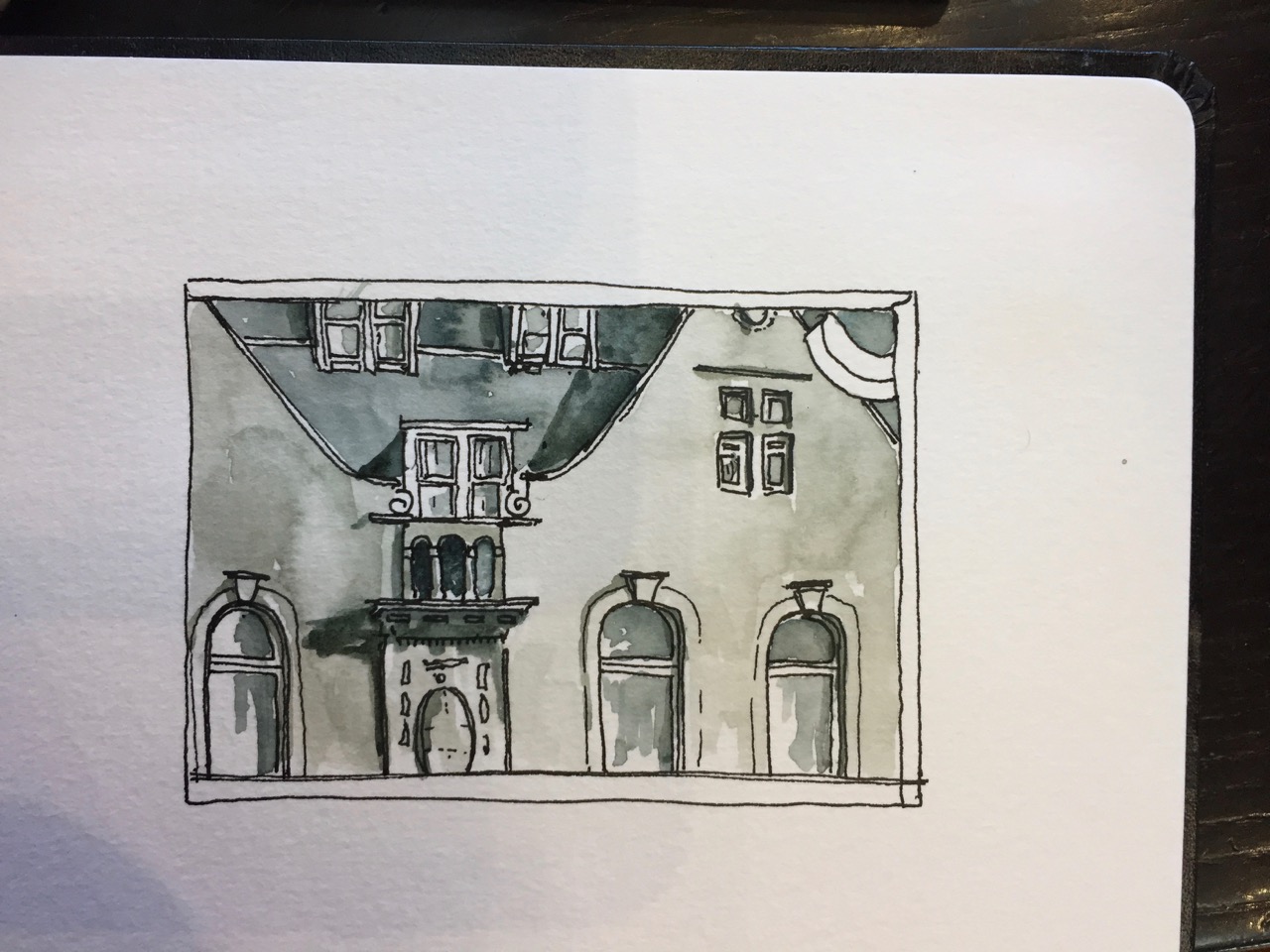
I do, though. I order breakfast at Patisserie Valerie. The glass and steel of the modern shopping centre cuts the view into bits. I can’t draw it all, so I draw a segment.
A bit of the Station Hotel, Aberdeen, from the Union Square Shopping Centre, Patisserie Valerie.
That odd curl in the top right is the “e” of “Union Square” written on the outside in modern 3D lettering.
Here is work in progress.
Line drawing before the tone went on
The view from Patisserie Valerie
Line drawing before the tone went on
The picture and the view
Exactly one hour to draw, including eating breakfast. Patisserie Valerie opens at eight. The Aberdeen Station Left Luggage opened at nine.
When I went there, the seated man had gone.
Click a button below to share this post online, email it, or print it:










































 Jane Sketching