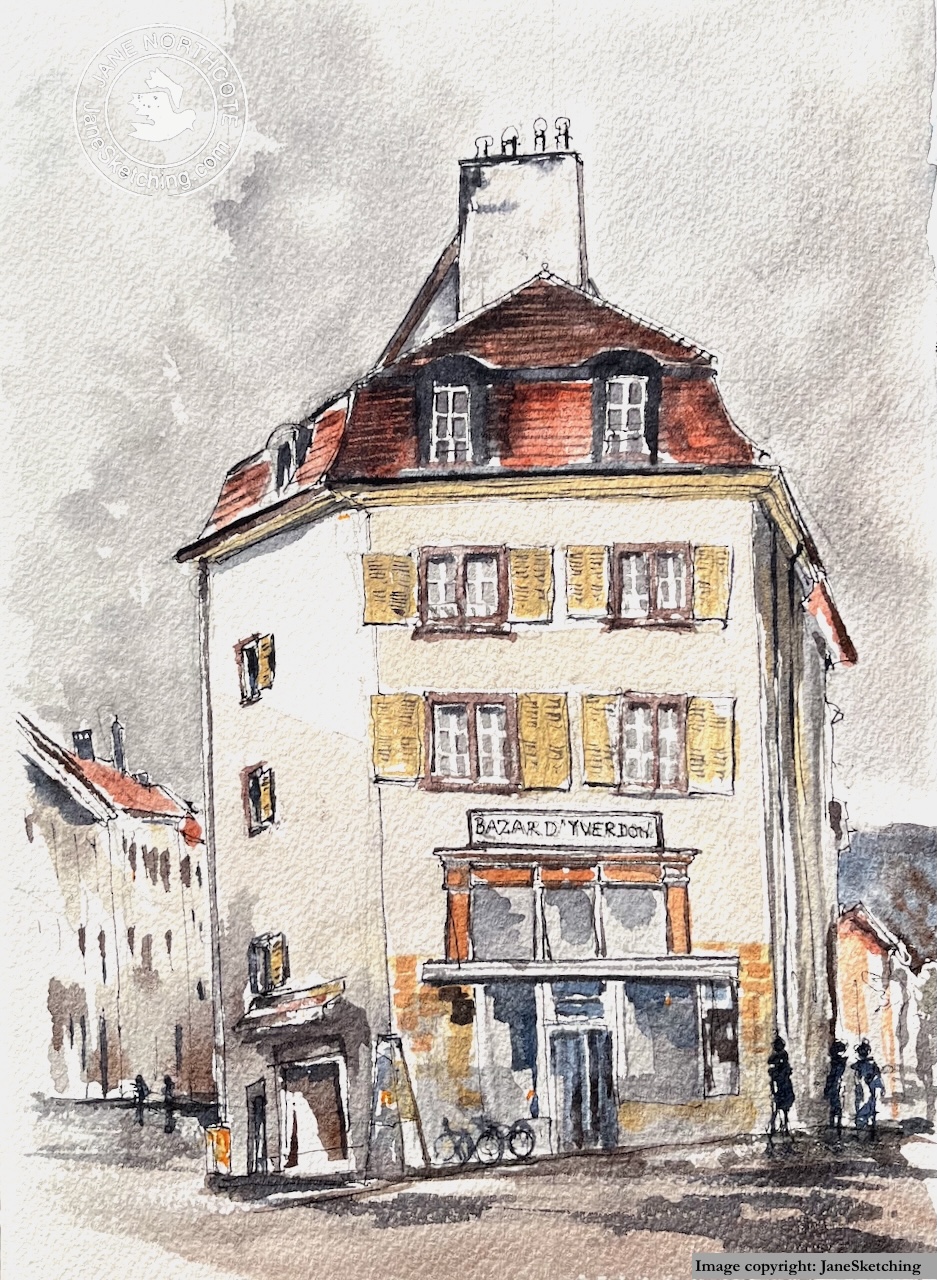
Switzerland Sketches (Oct 2025)

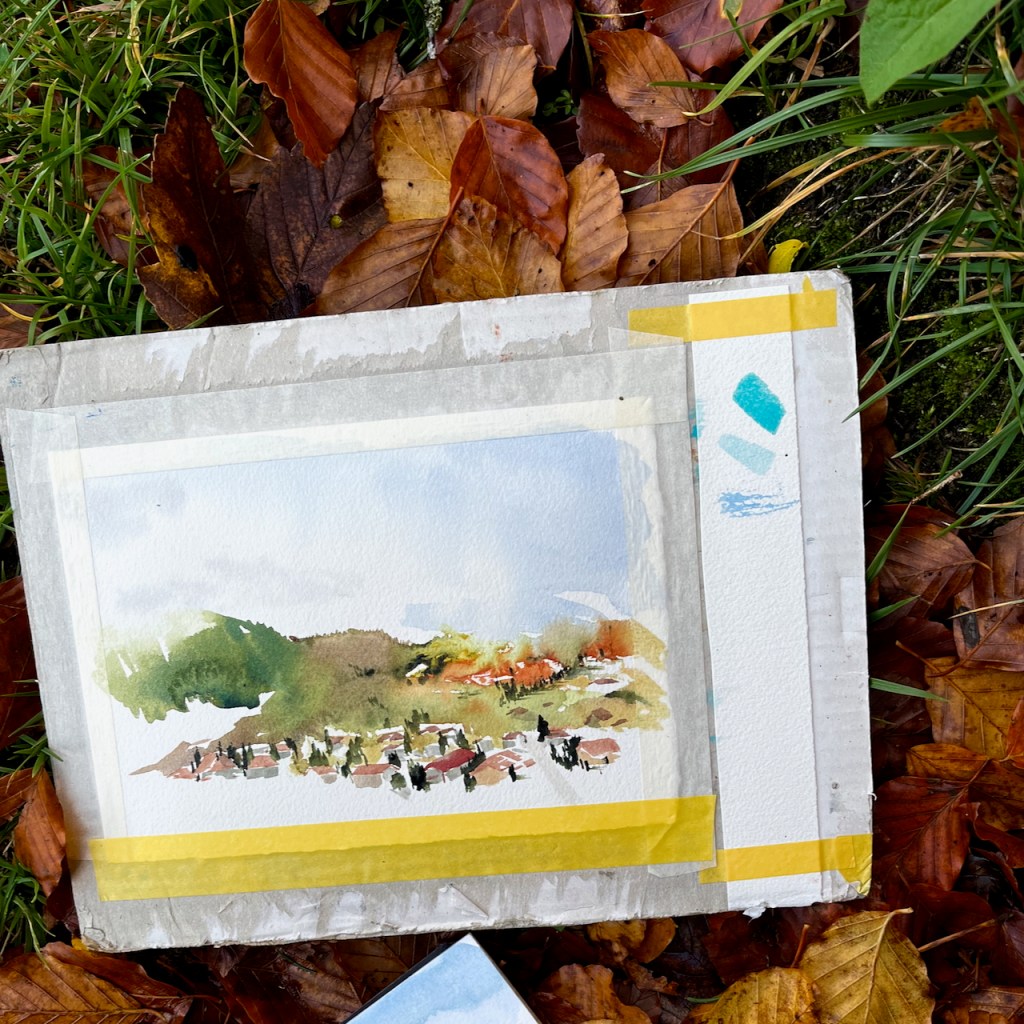
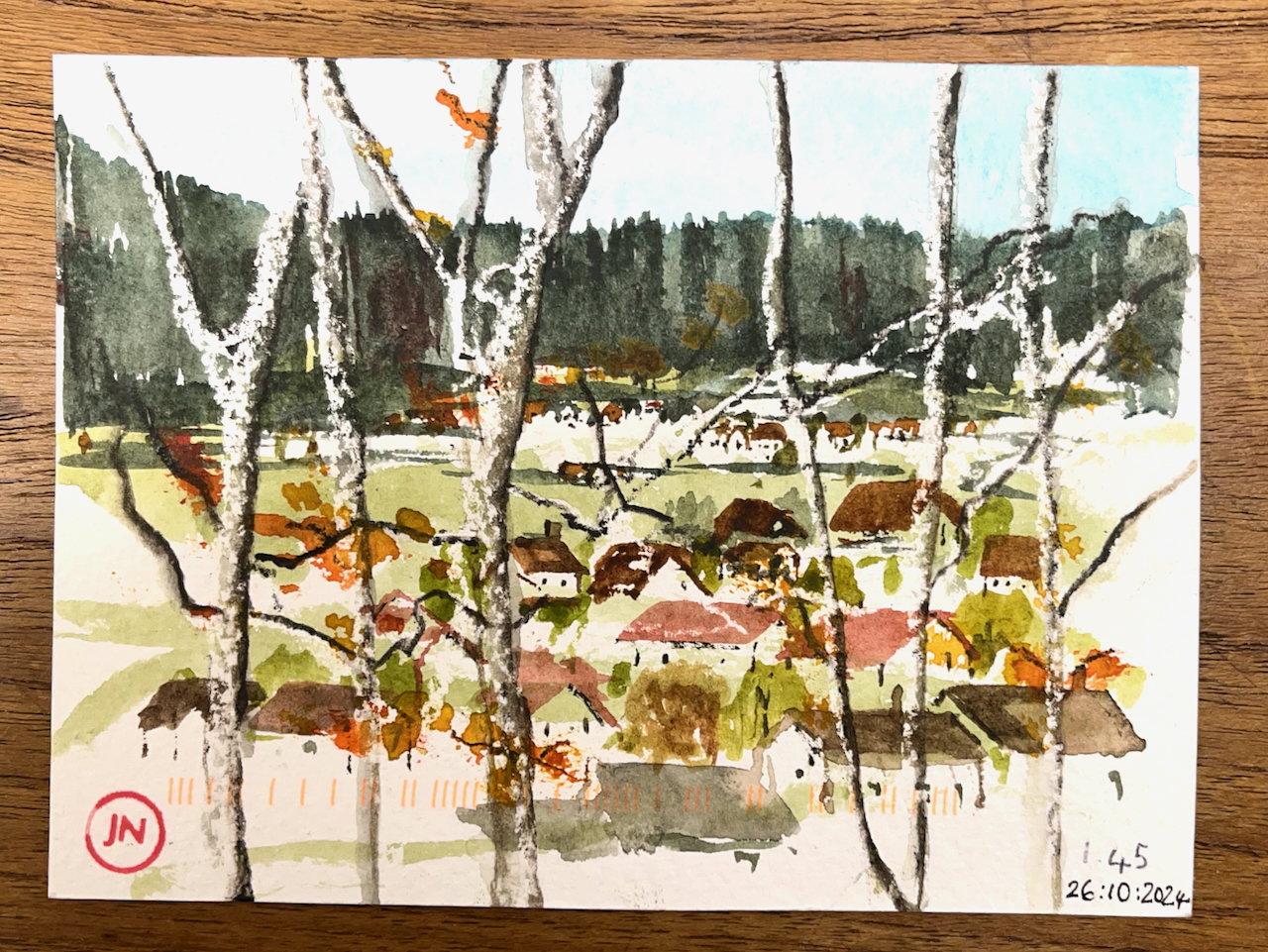
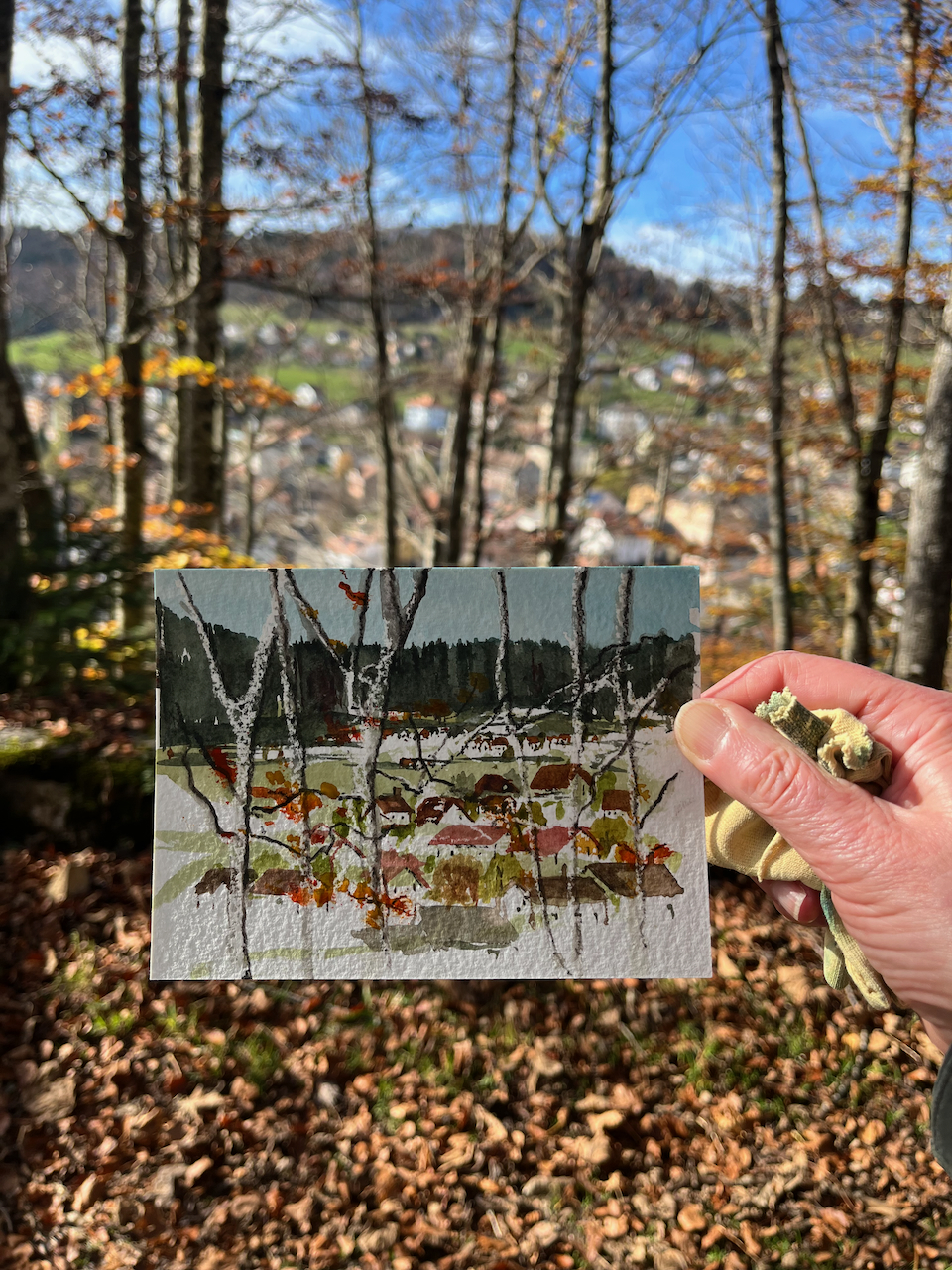
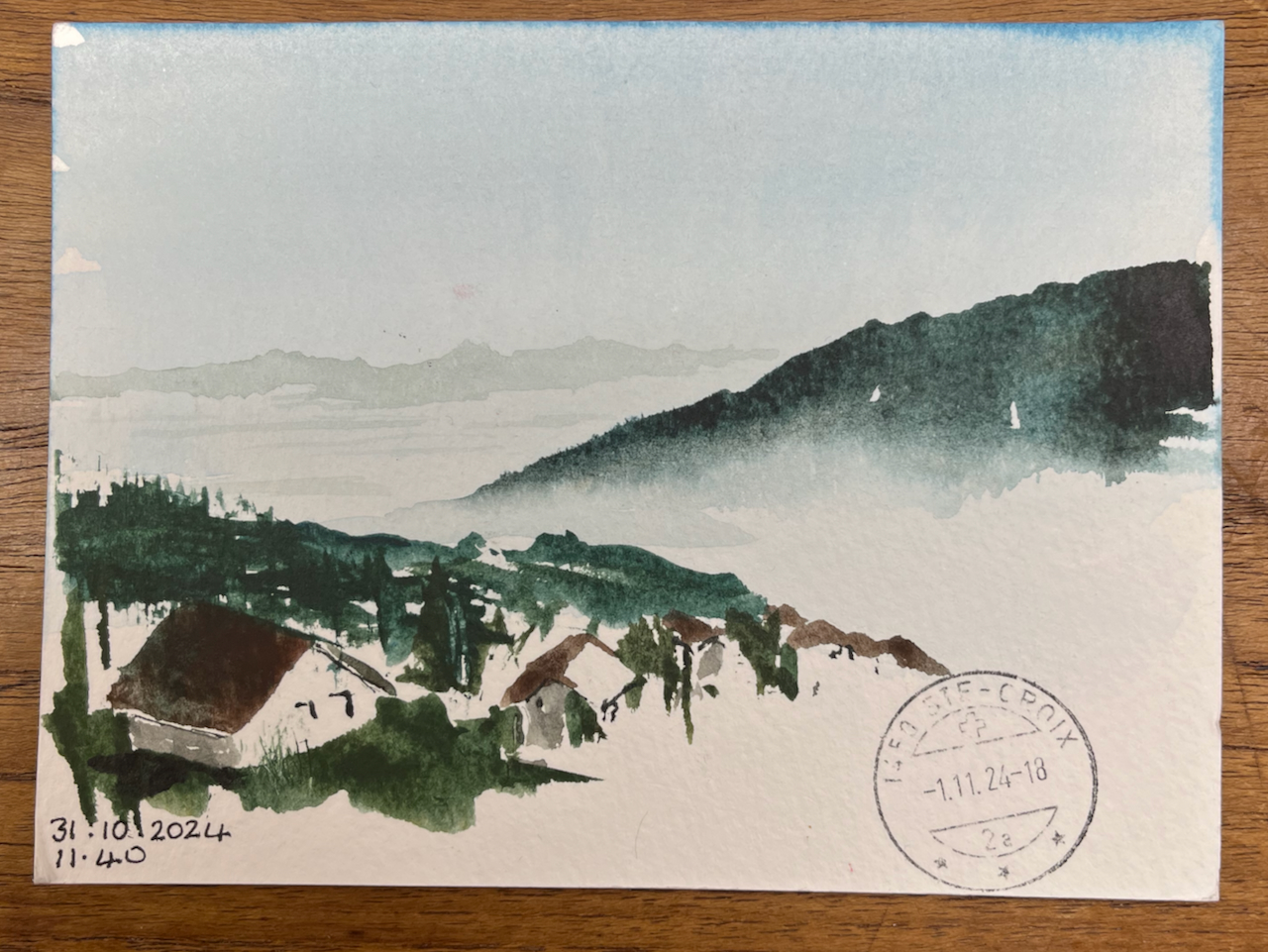
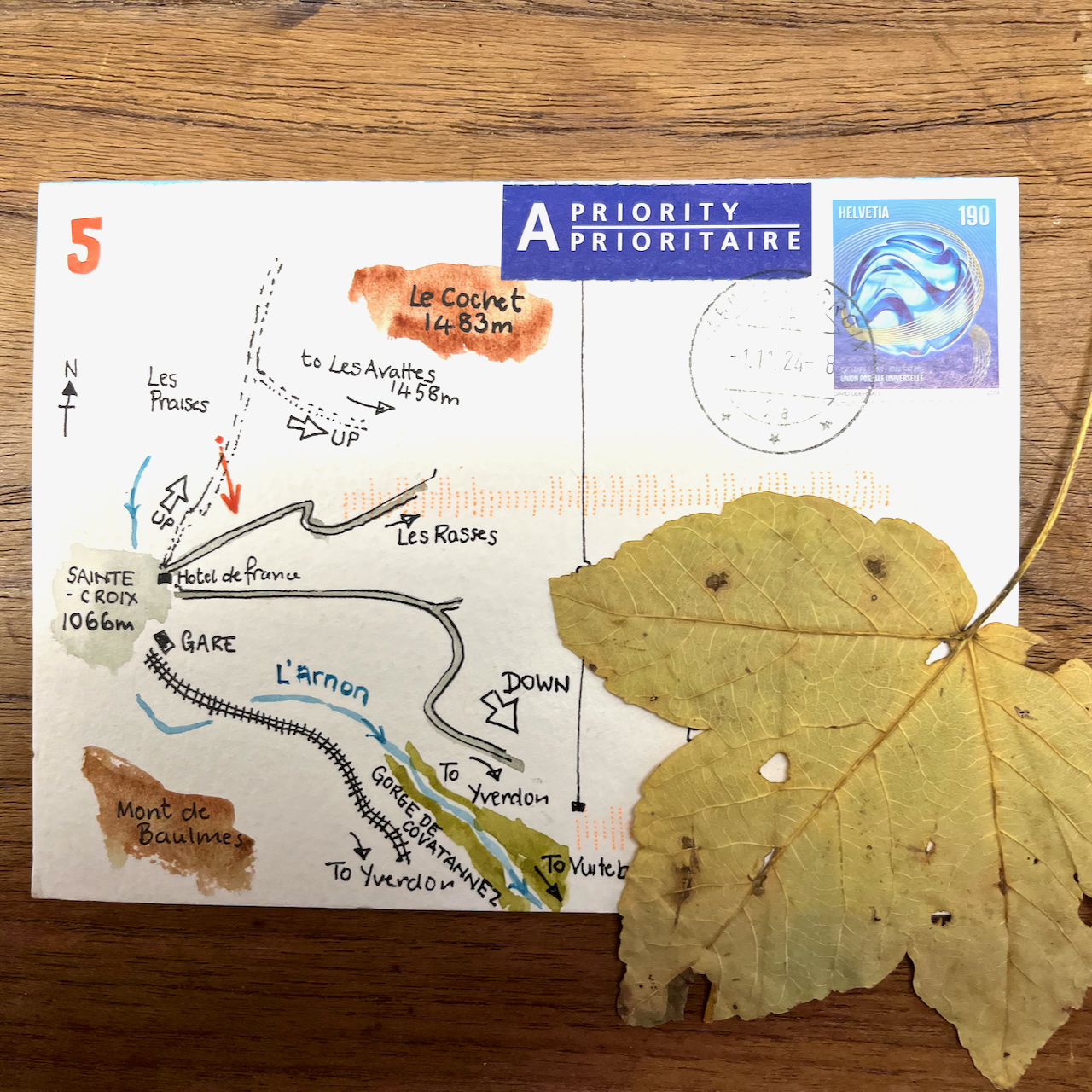
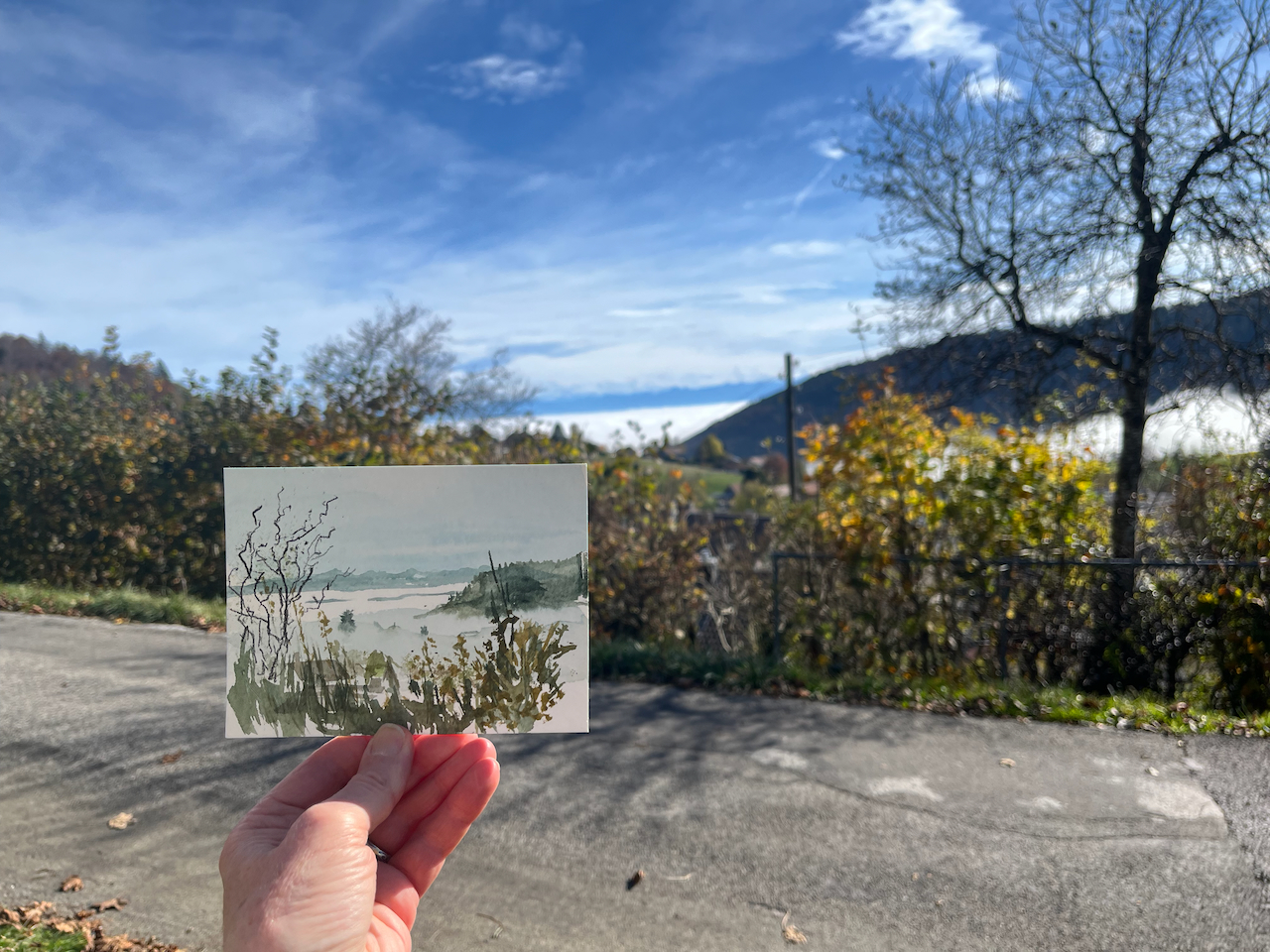
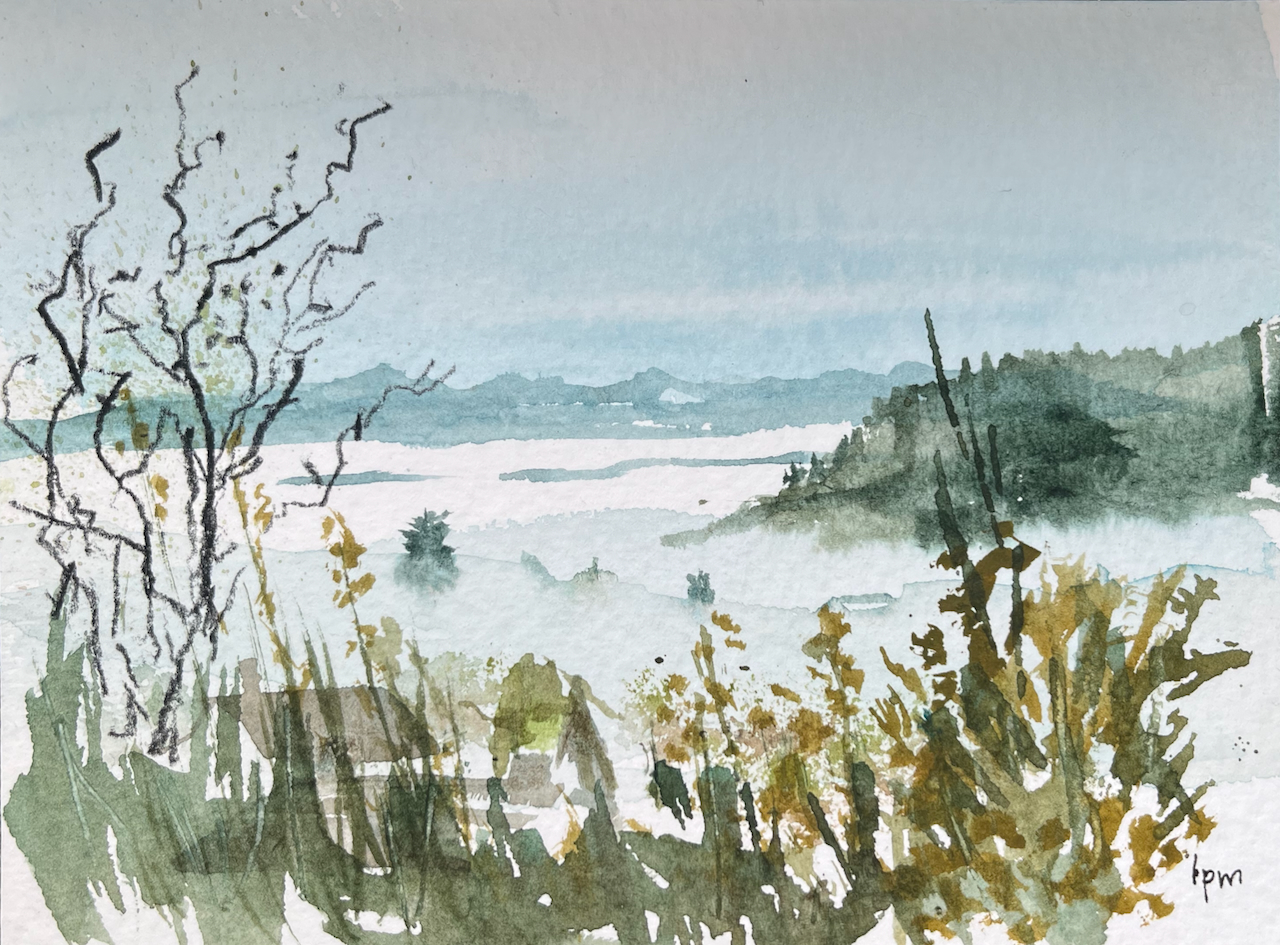
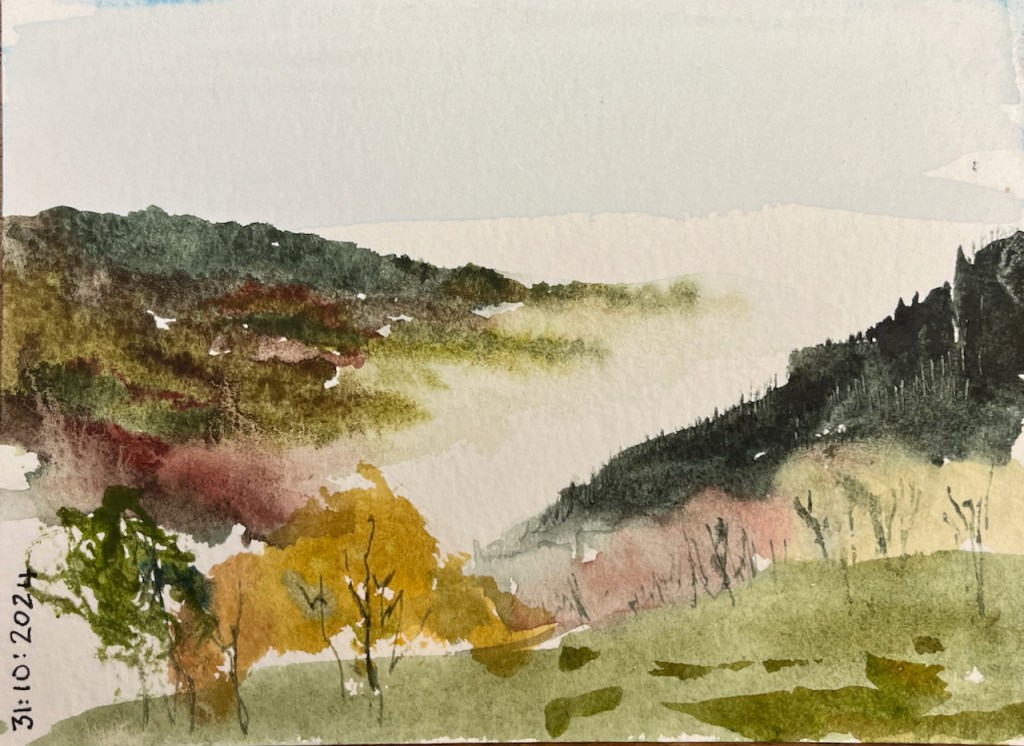
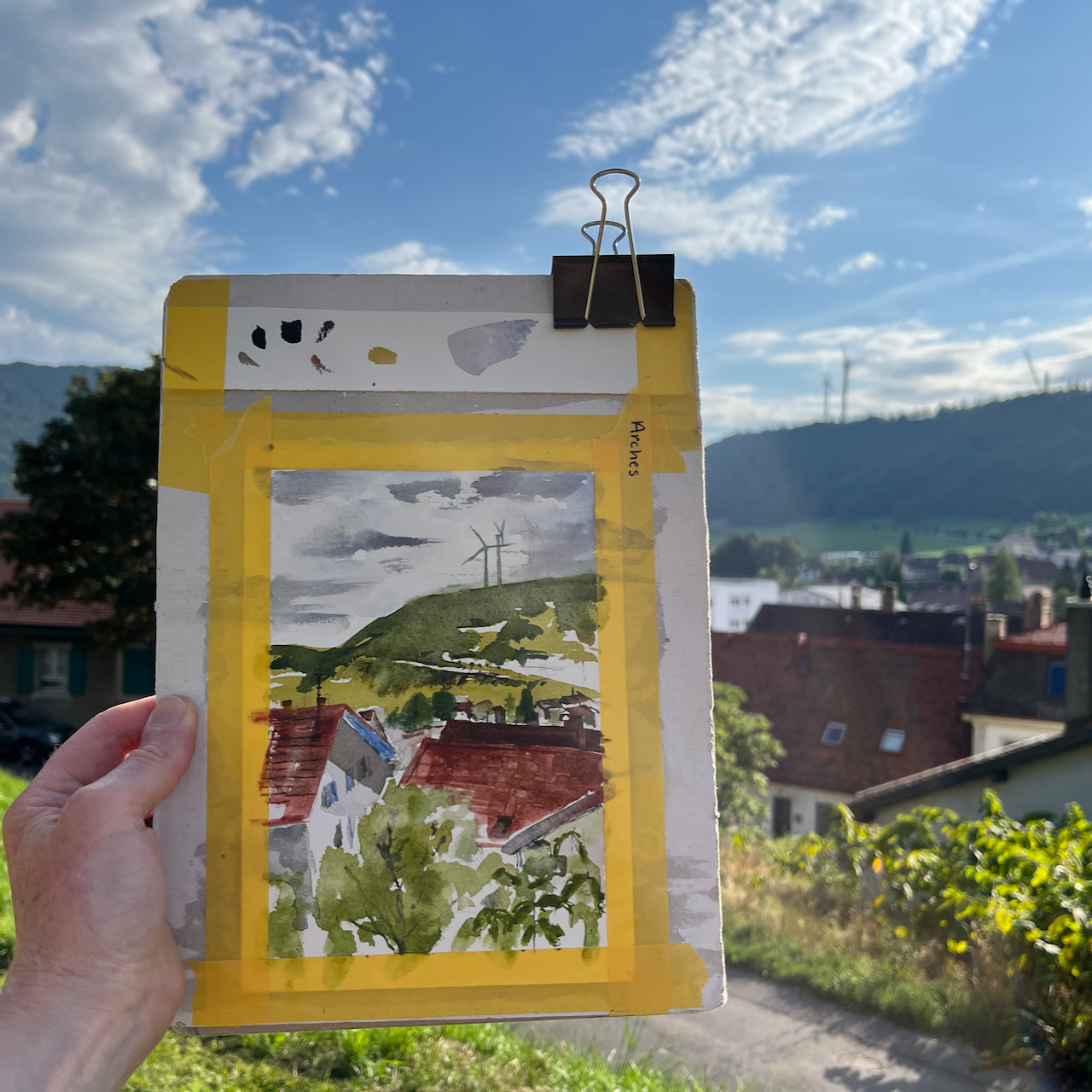
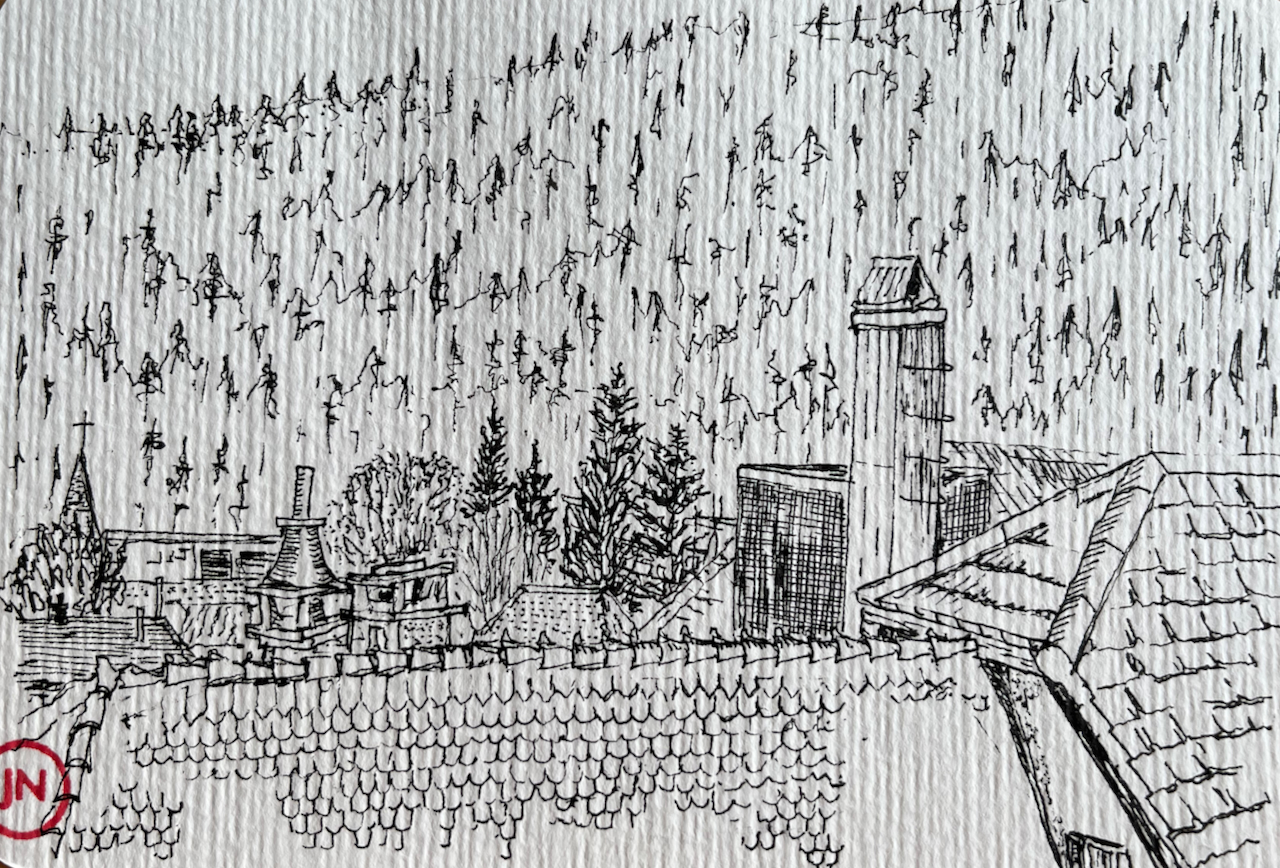
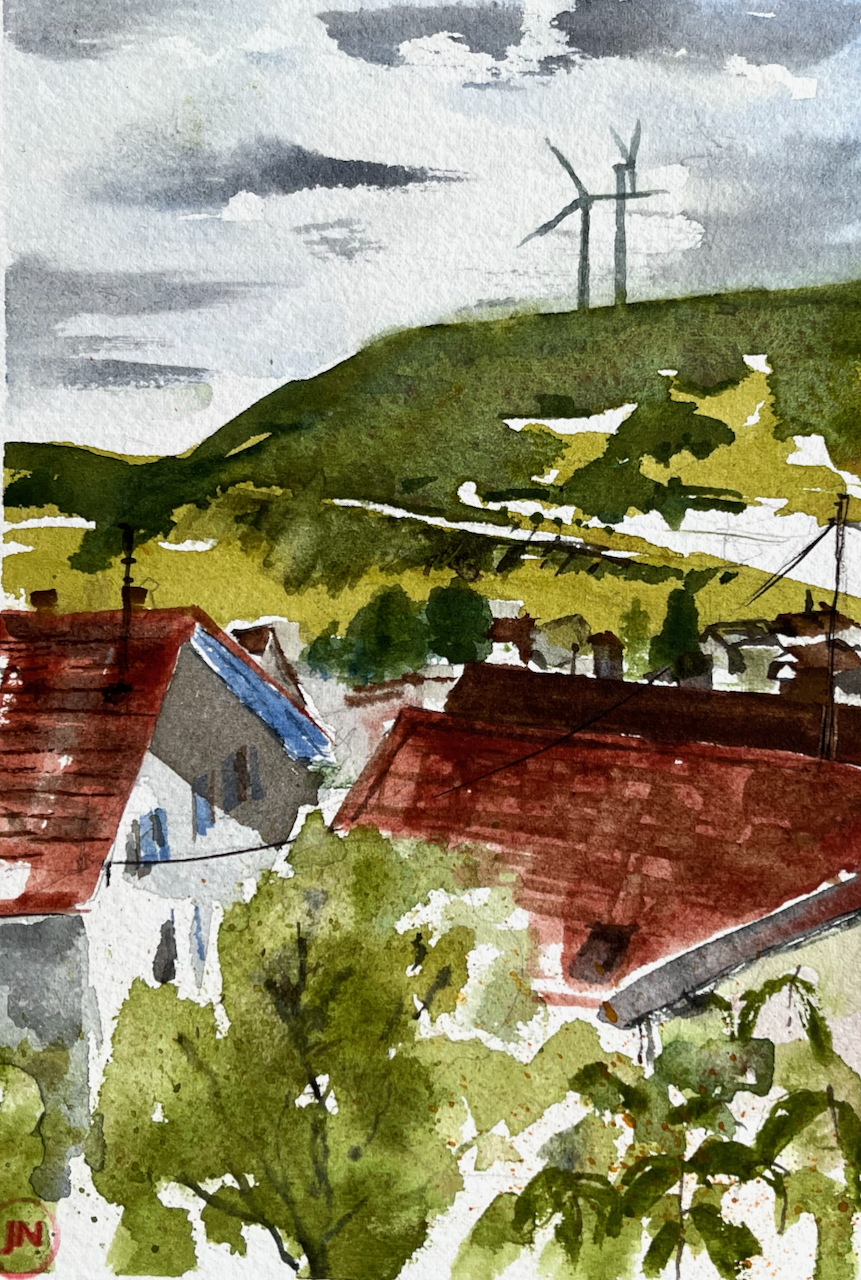
Here is a autumn scene in Sainte-Croix in the canton of Vaud, Switzerland.
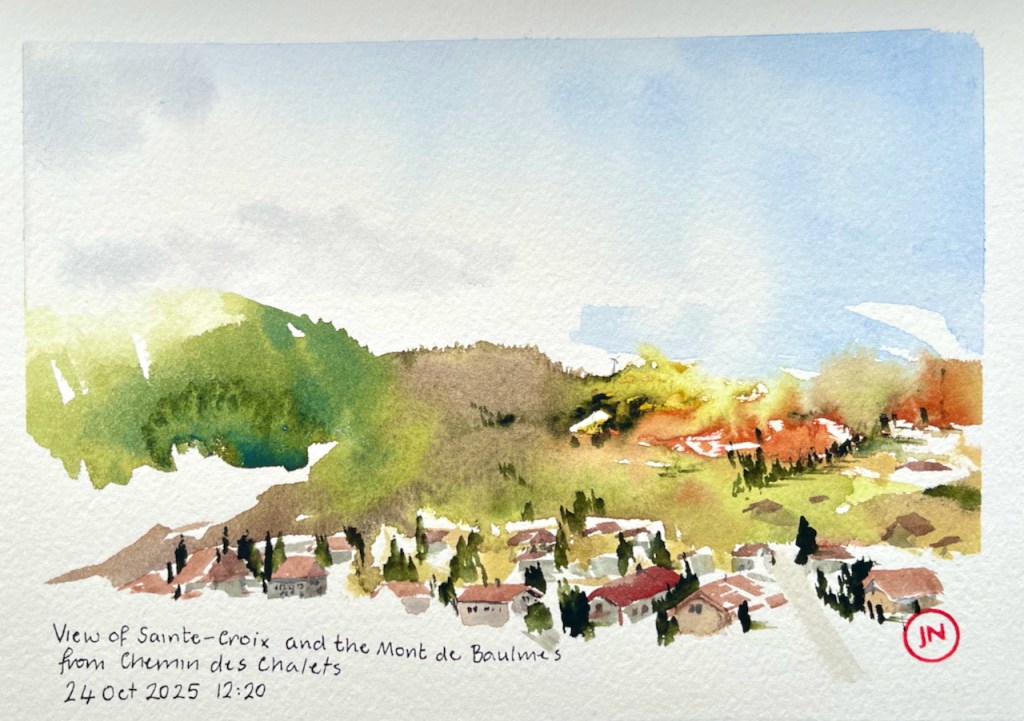
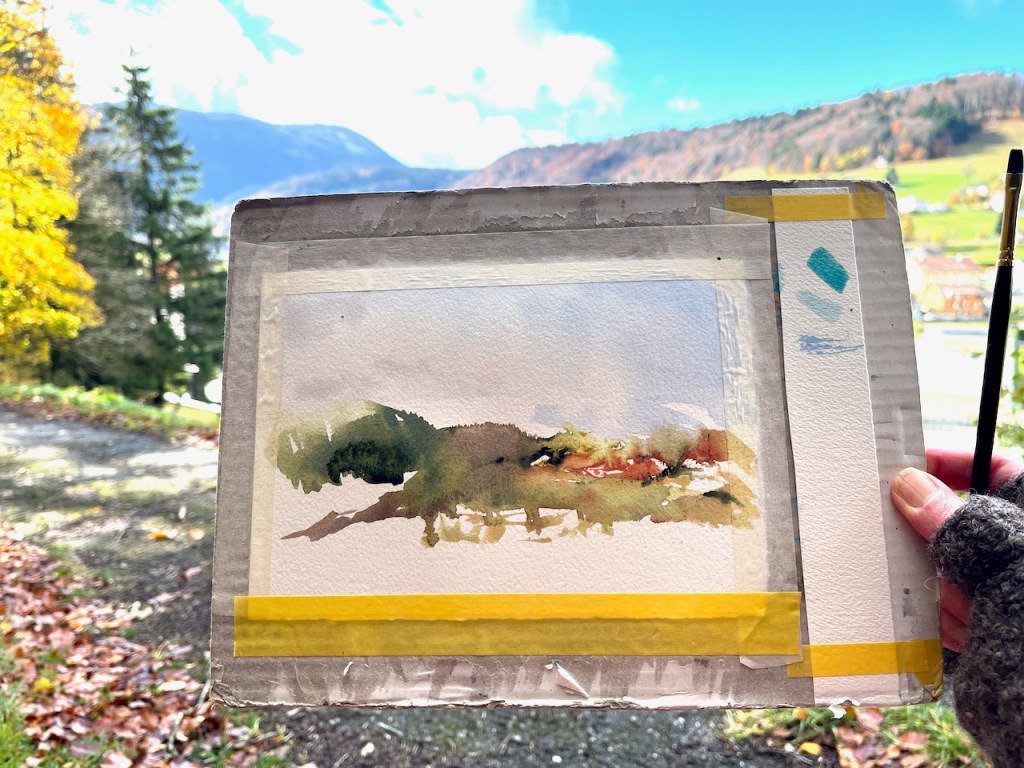
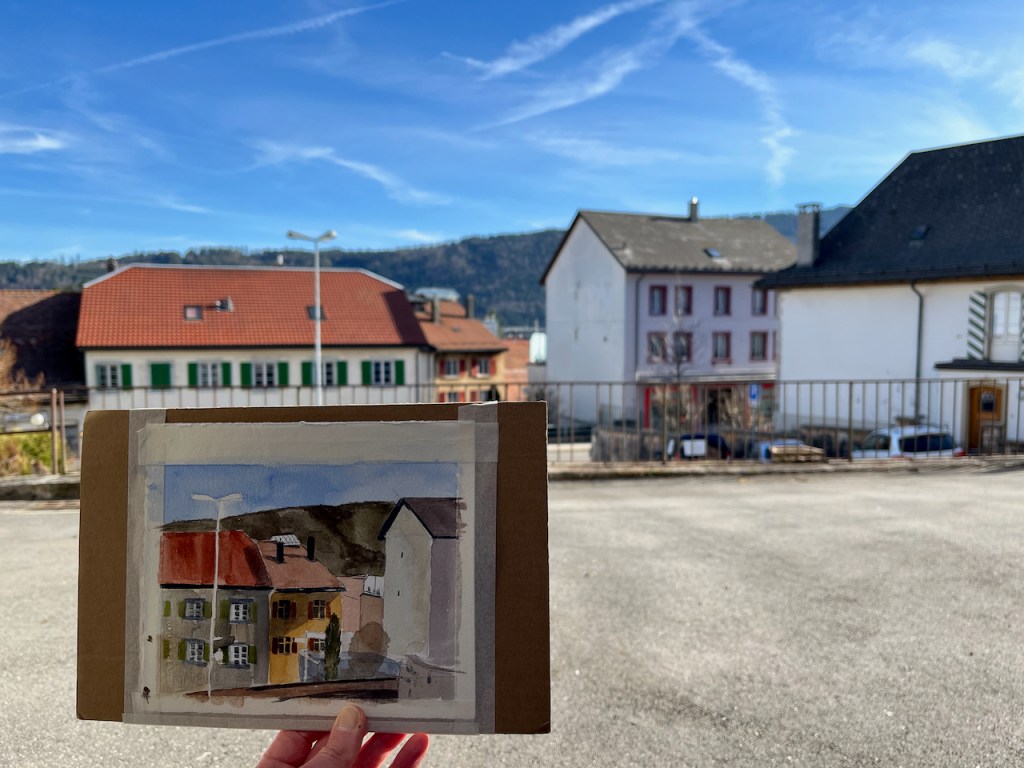
View over Sainte-Croix and the Mont de Baulmes, from Chemin des Chalets

I sketched also in the village.

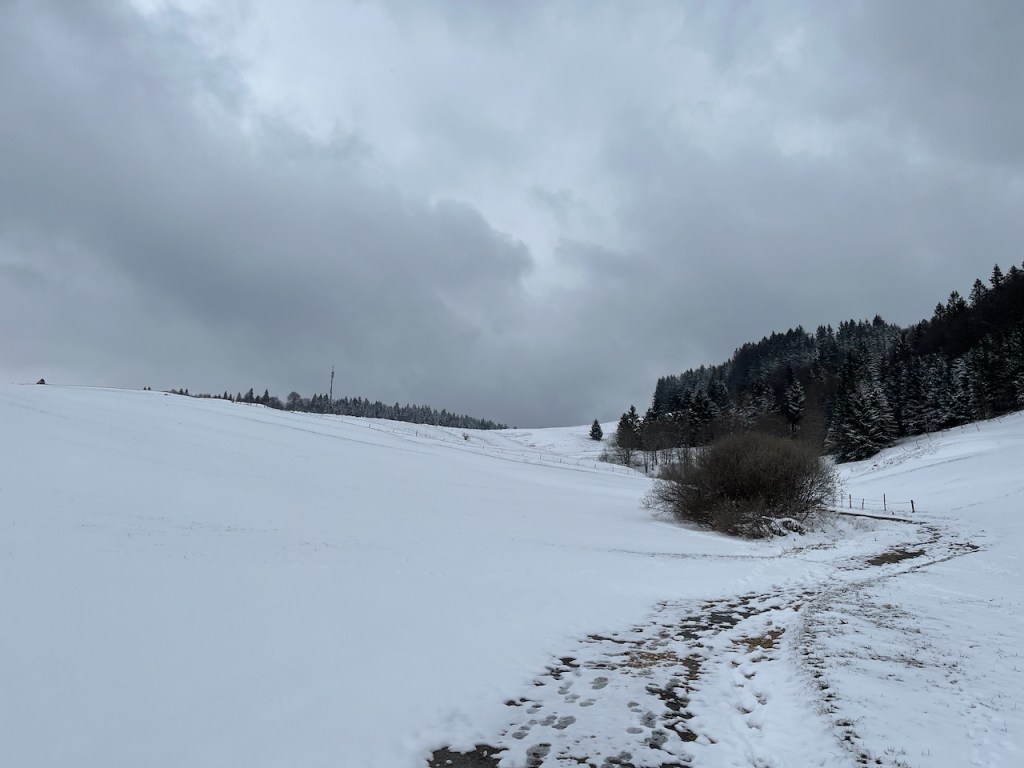
It is a season of clouds.
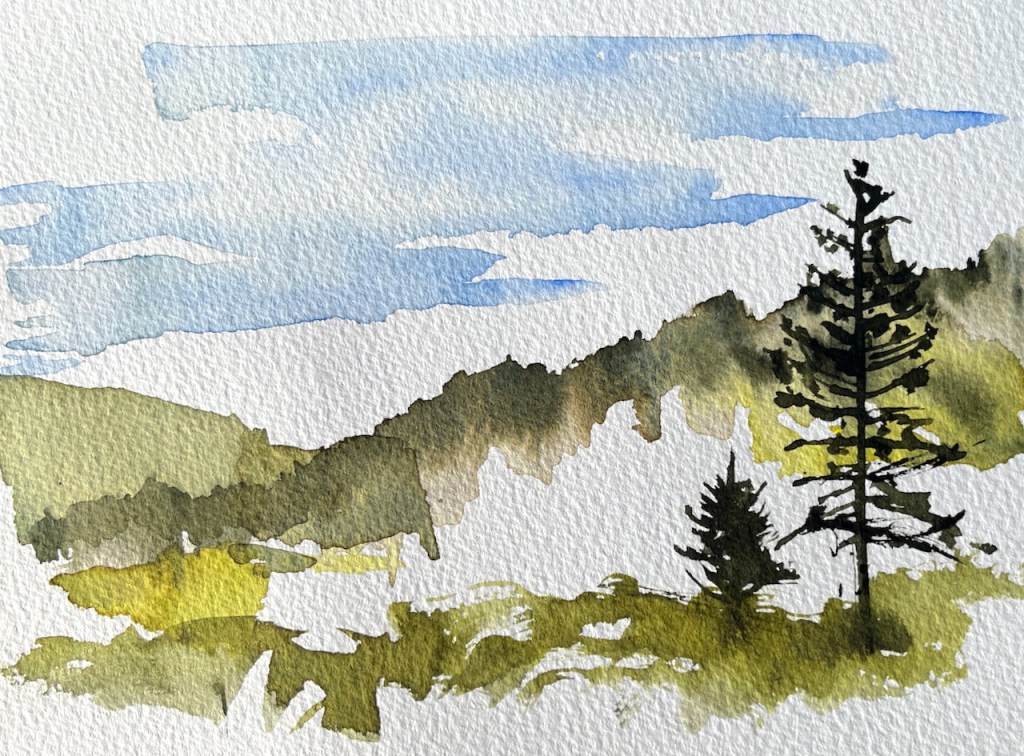
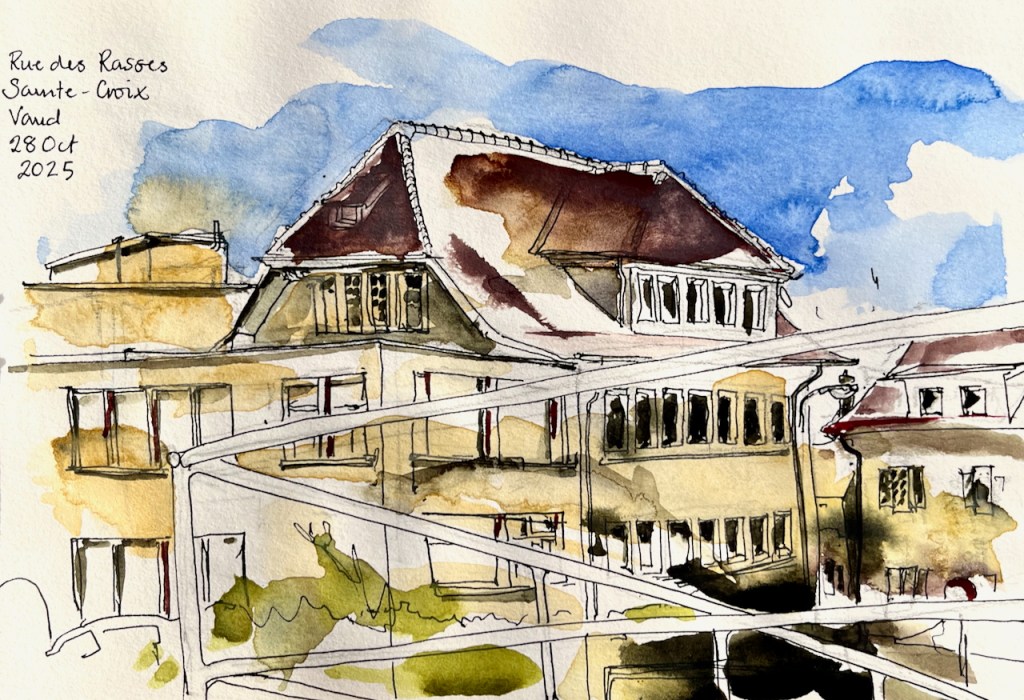
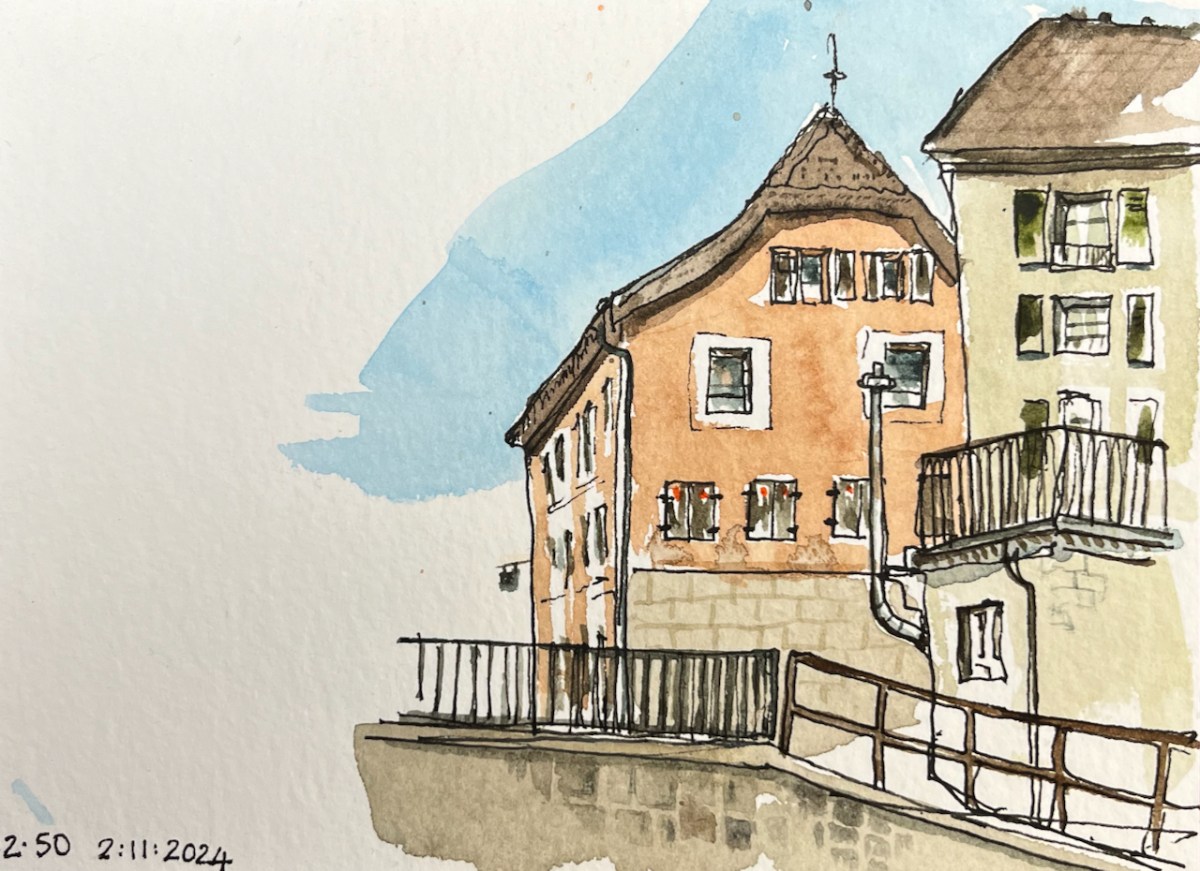
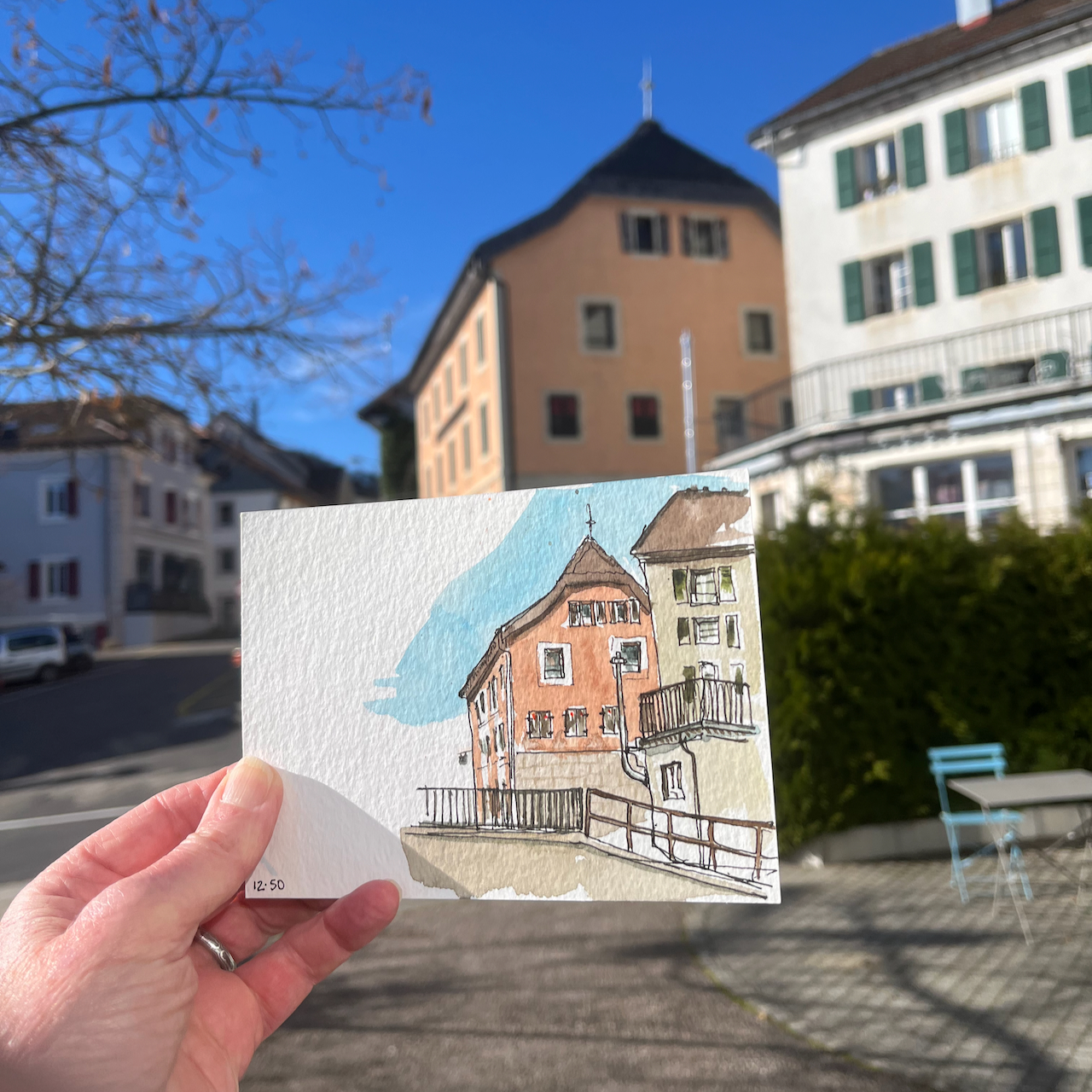
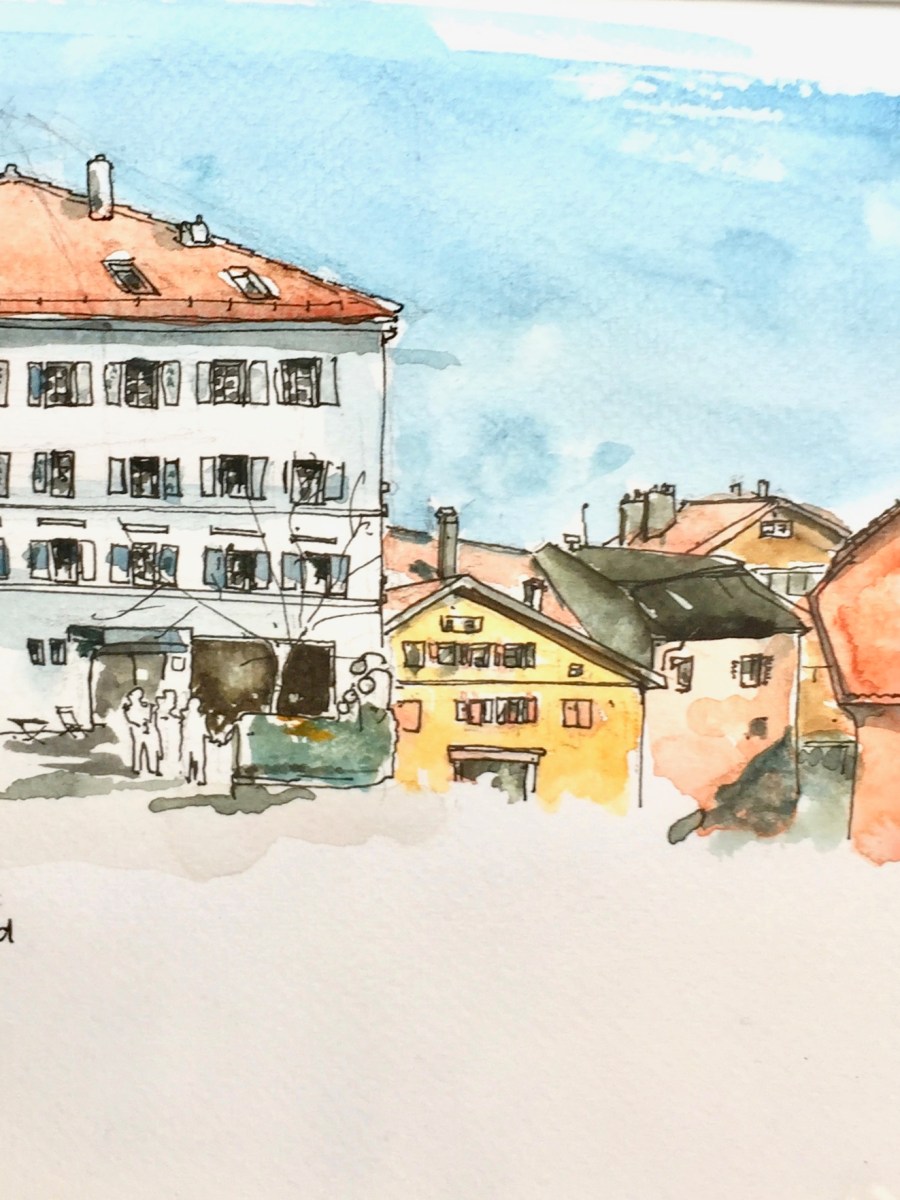
On an expedition to Yverdon-les-Bains I sketched in the Place Pestalozzi.
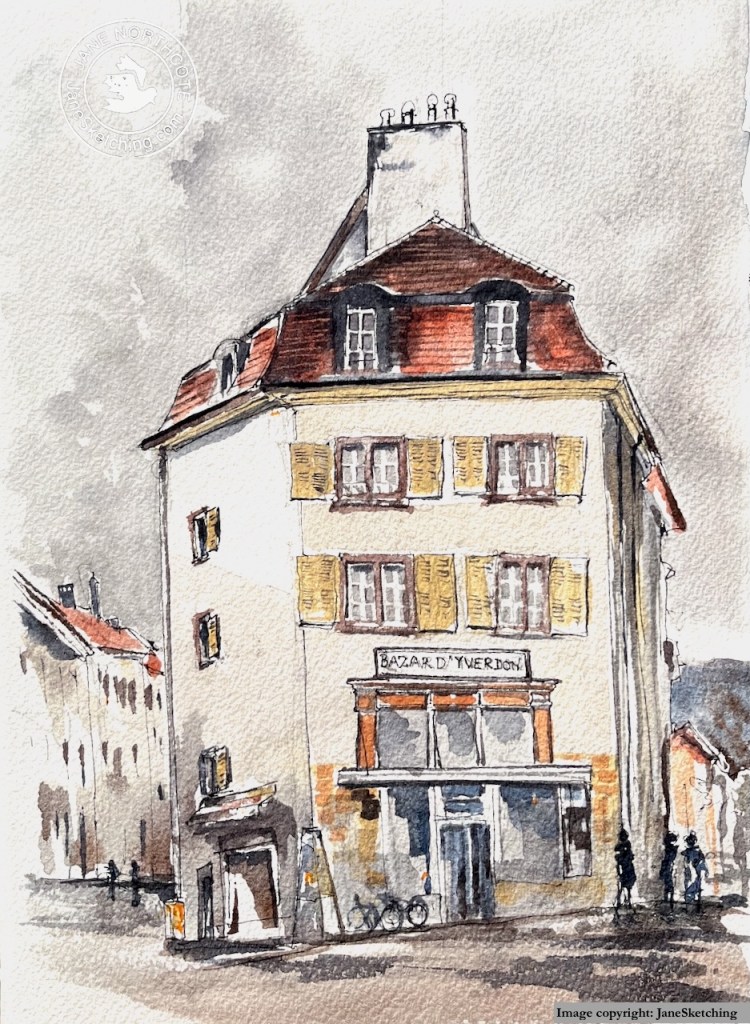
Bazar D’Yverdon, now L’Epicerie Vrac, Place Pestalozzi 3
1400 Yverdon-les-Bains

It was very cold. I just managed to complete the pen and ink sitting in the square. Then I finished the colour in my hotel room.
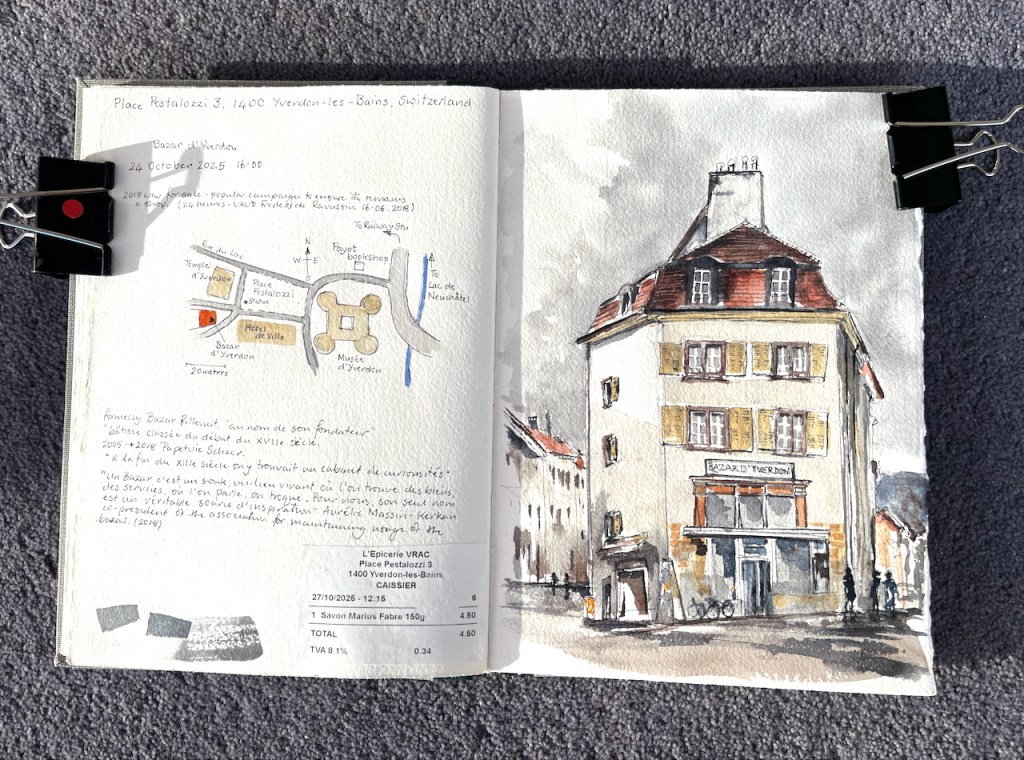
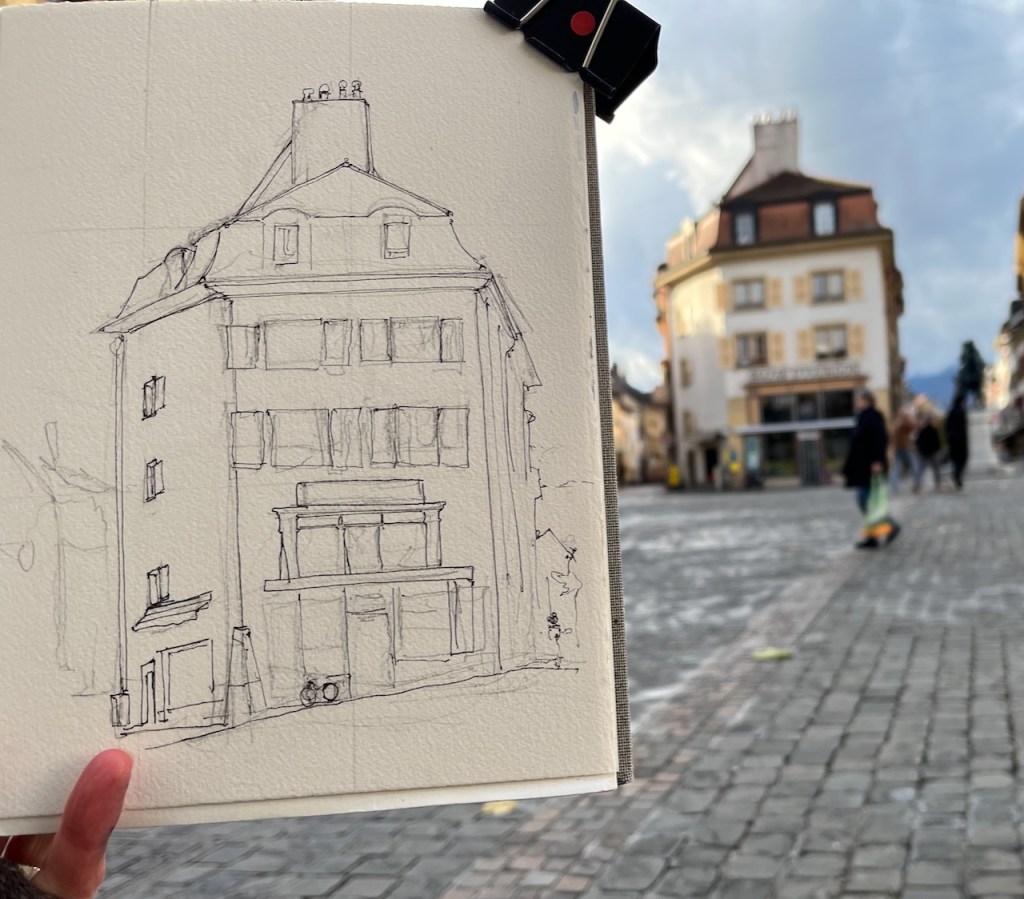
This building, Bazar D’Yverdon, dates from the beginning of the 17th century. There is an article in the local paper of 2018 (note 1), with some history of the building, and news of a campaign to prevent its being sold and transformed from a retail space into offices. At the time is was a stationary shop, Papeterie Schaer.

A bazaar is a souk, a living place where there are goods and services, where you gossip, trade. For us, the very name “Bazar” is a real source of inspiration.”

Aurélie Massin-Kerkan, co-president of the association for maintaining usage of the Bazar (note 1 – my translation)

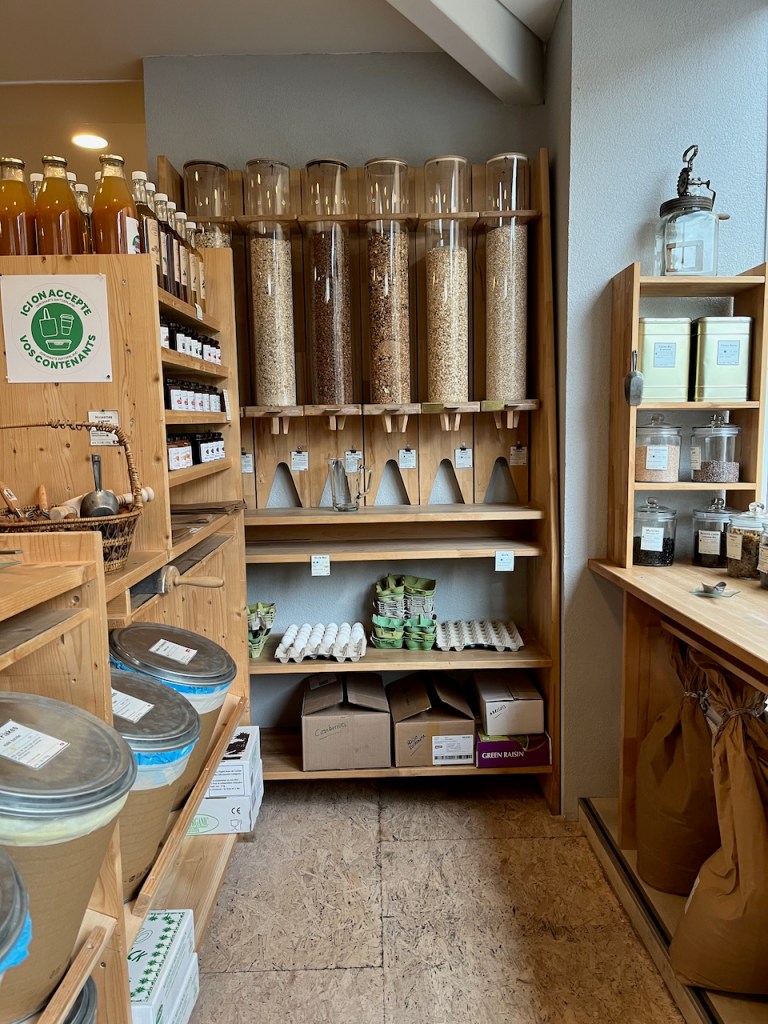
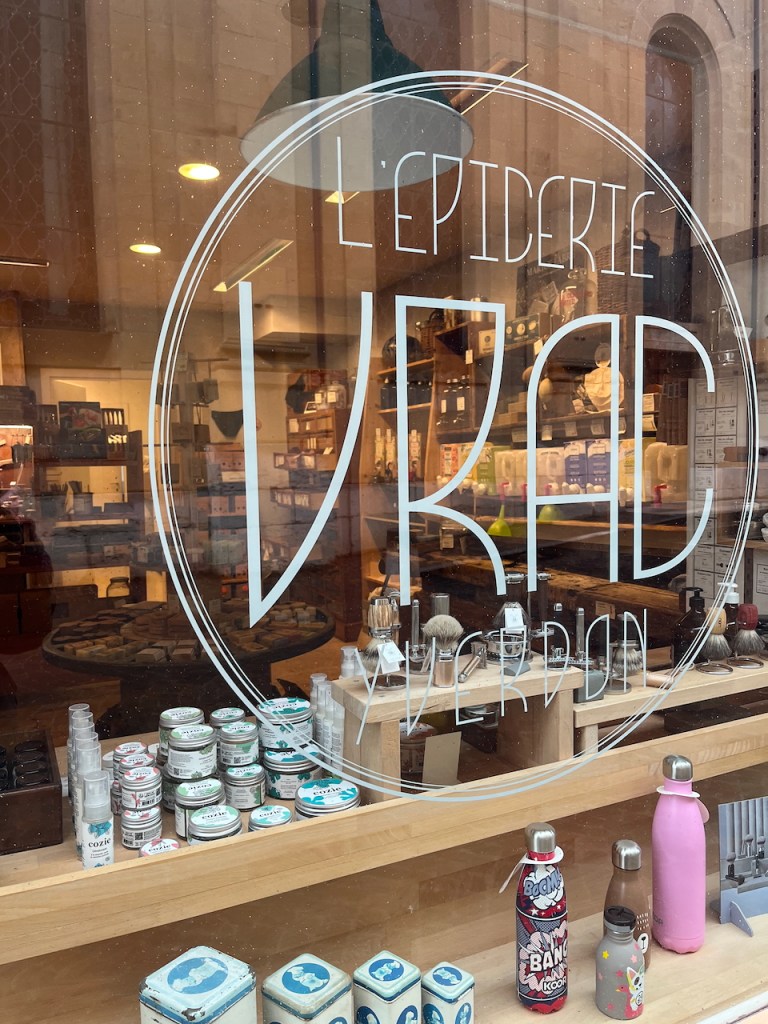
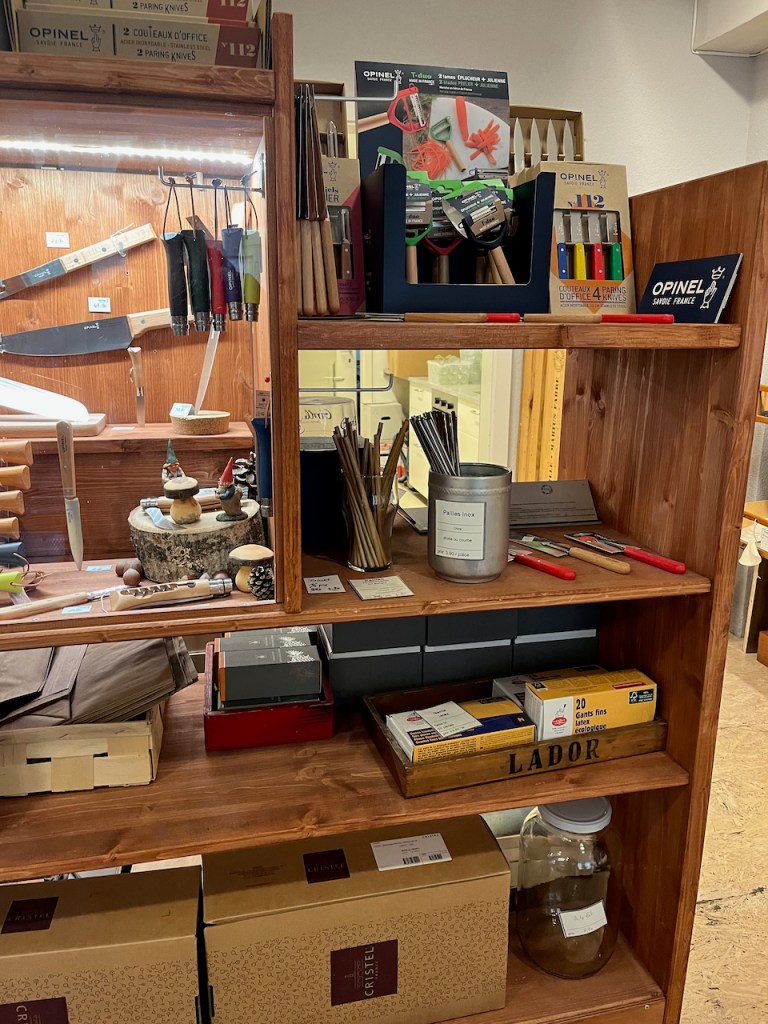
Evidently the campaign was successful. The shop on the ground floor is now a grocer “L’Épicerie VRAC”. I went in to have a look. It sells bulk household goods such as shampoo and muesli, as well as a huge collection of traditional items such as egg timers and kitchen knives and tea towels. The bulk items are displayed in dispensers, so you can fill your own container.
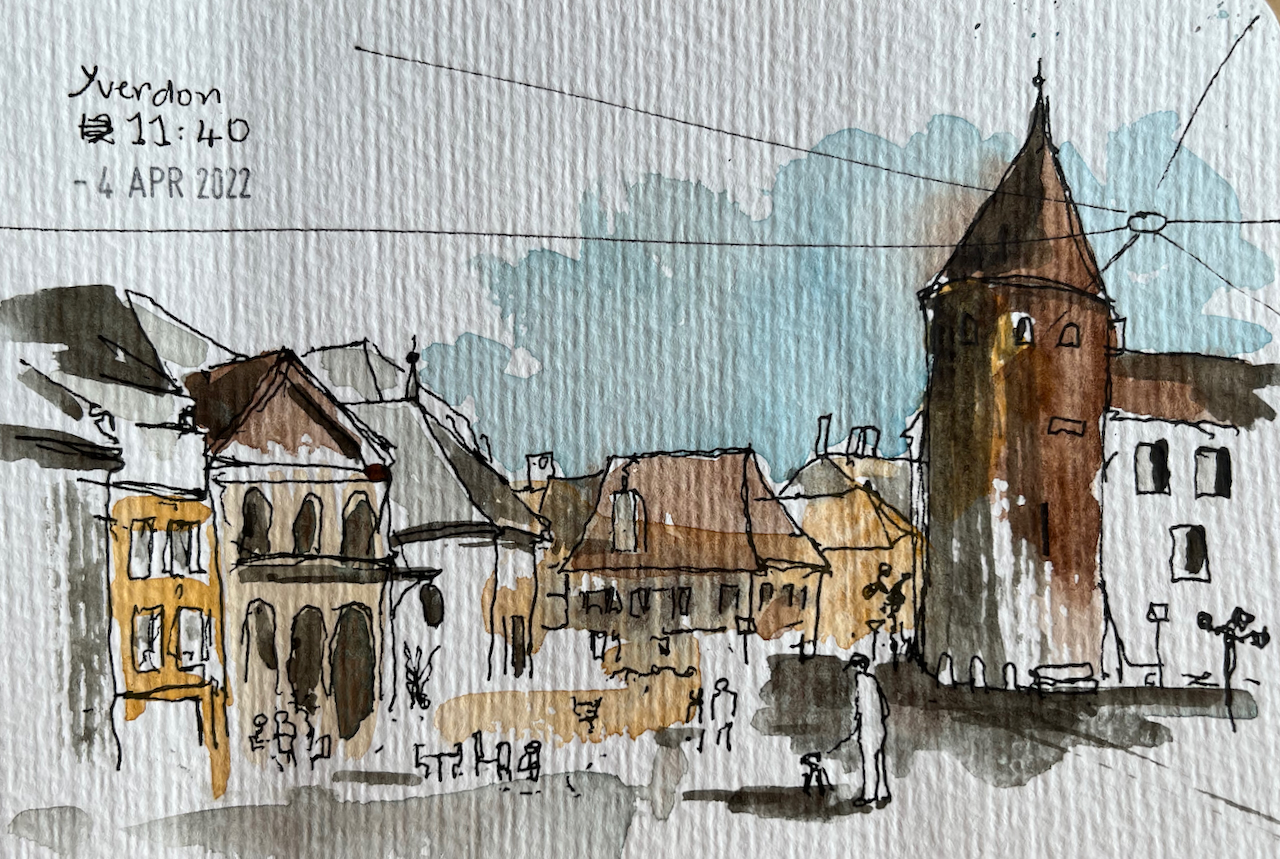
I’ve sketched in Yverdon before. Here is the Temple of Yverdon which is just to the right of the Bazar.
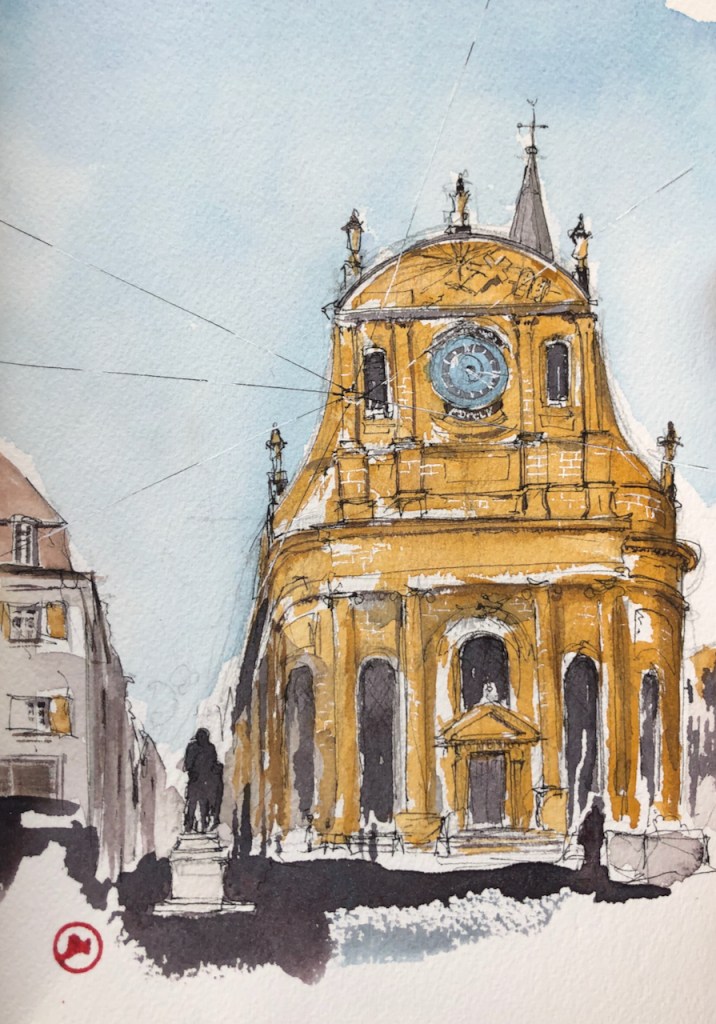
Temple d’Yverdon. The Bazar is the building on the left of this sketch. Click to go to my article about the Temple.

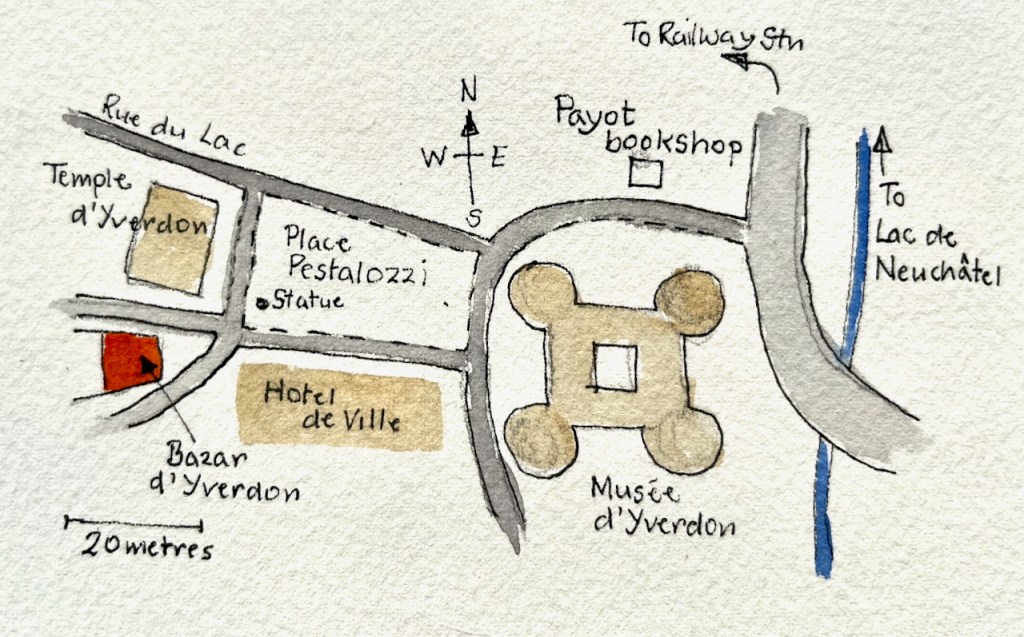
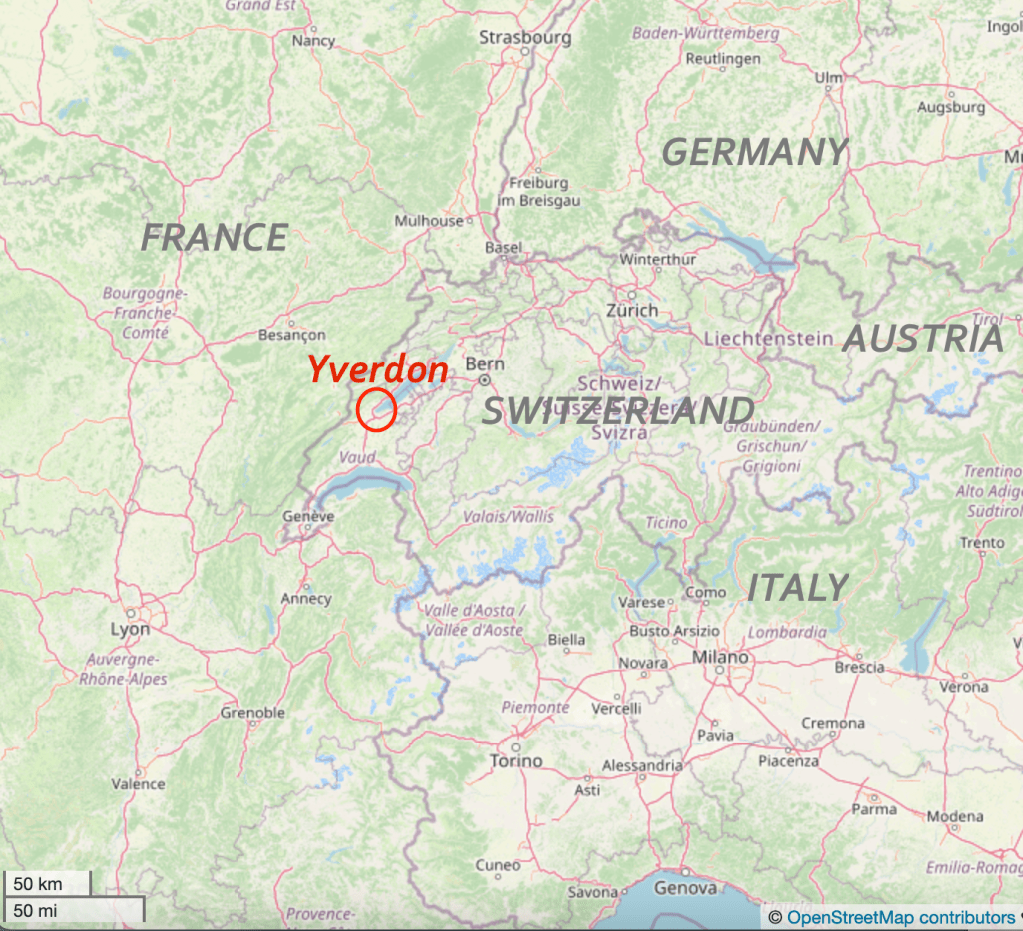
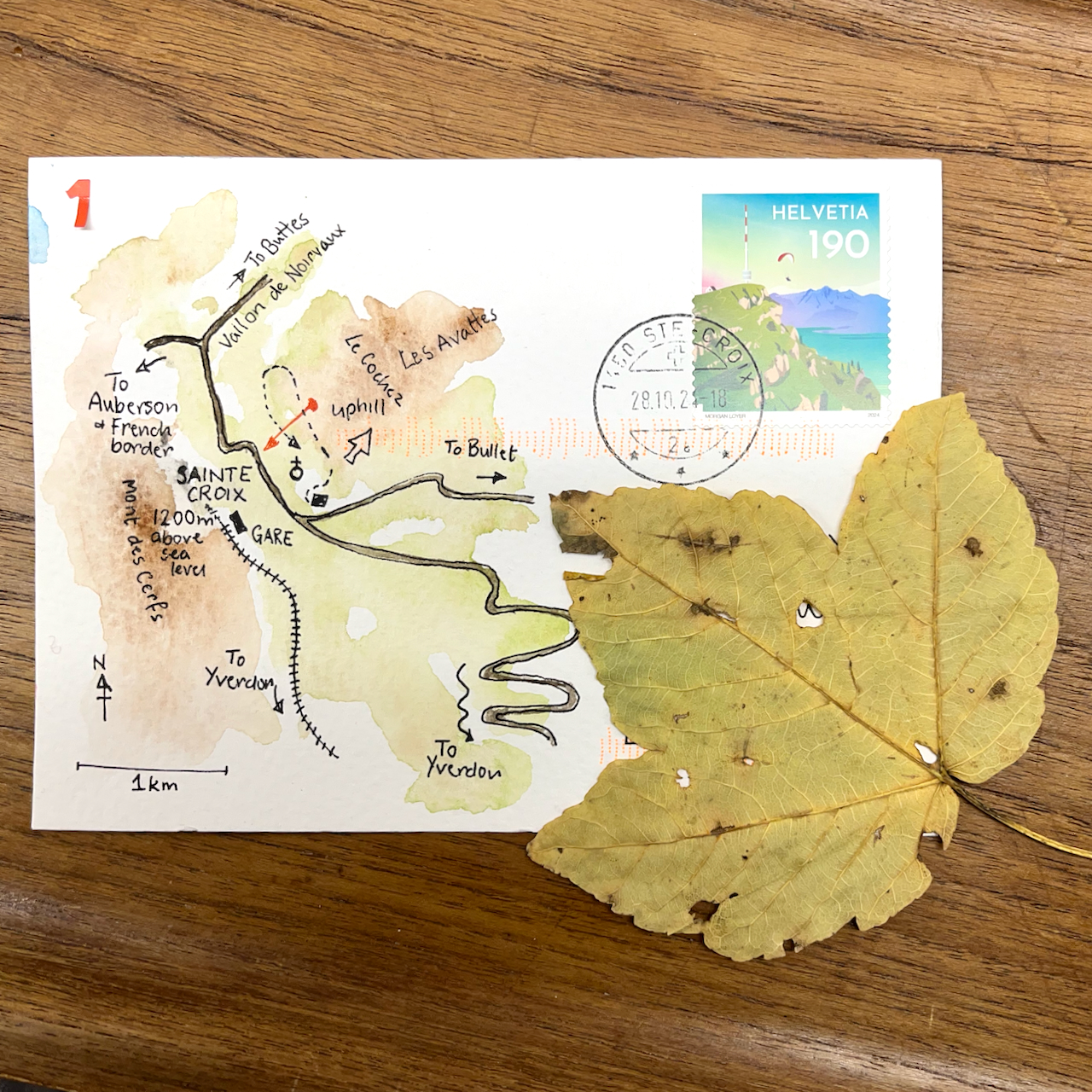
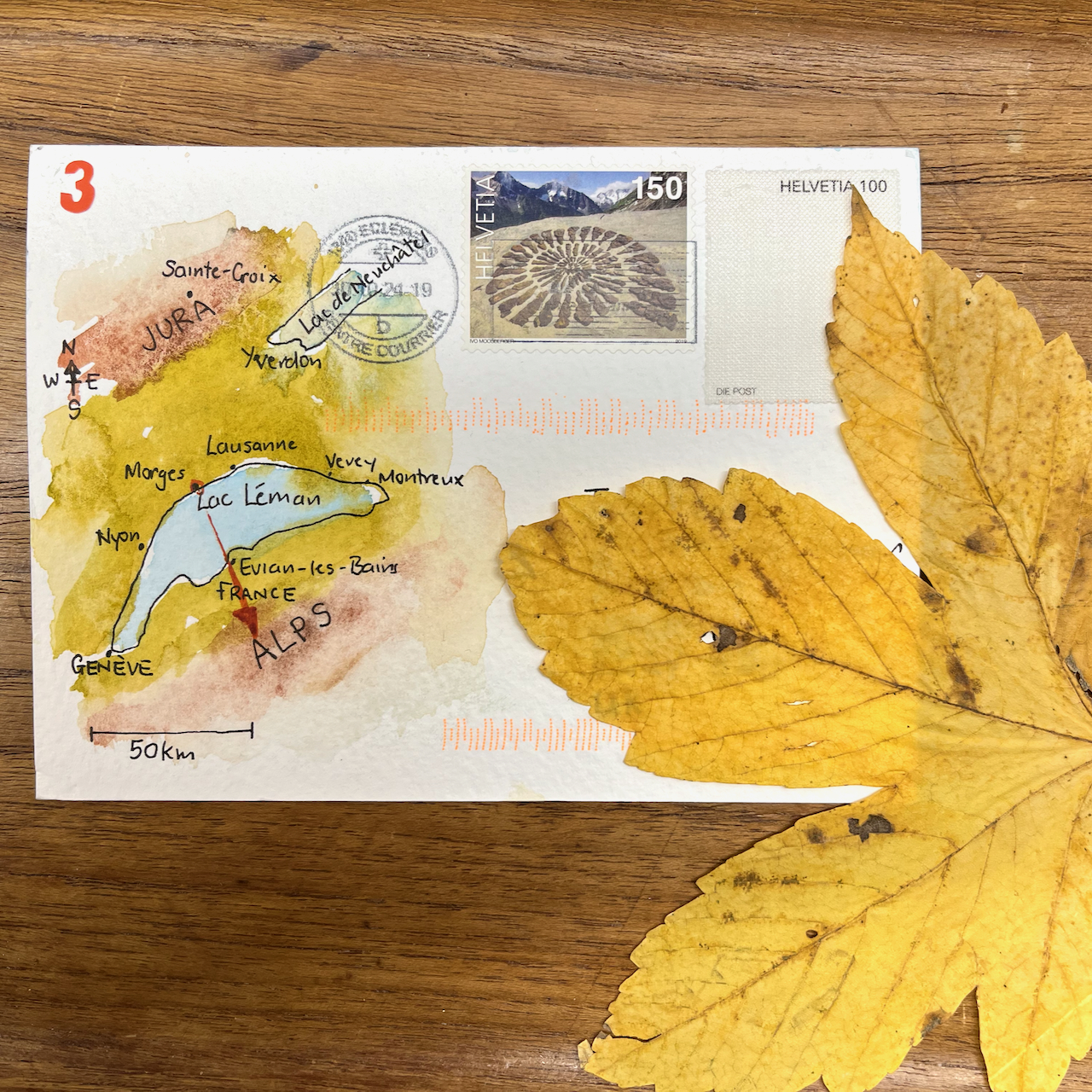
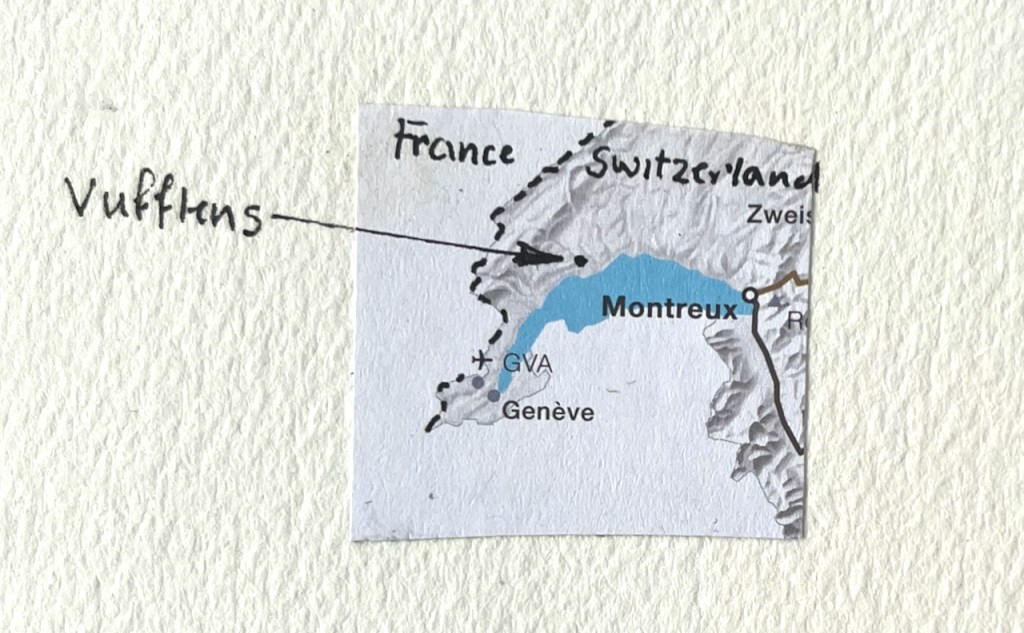
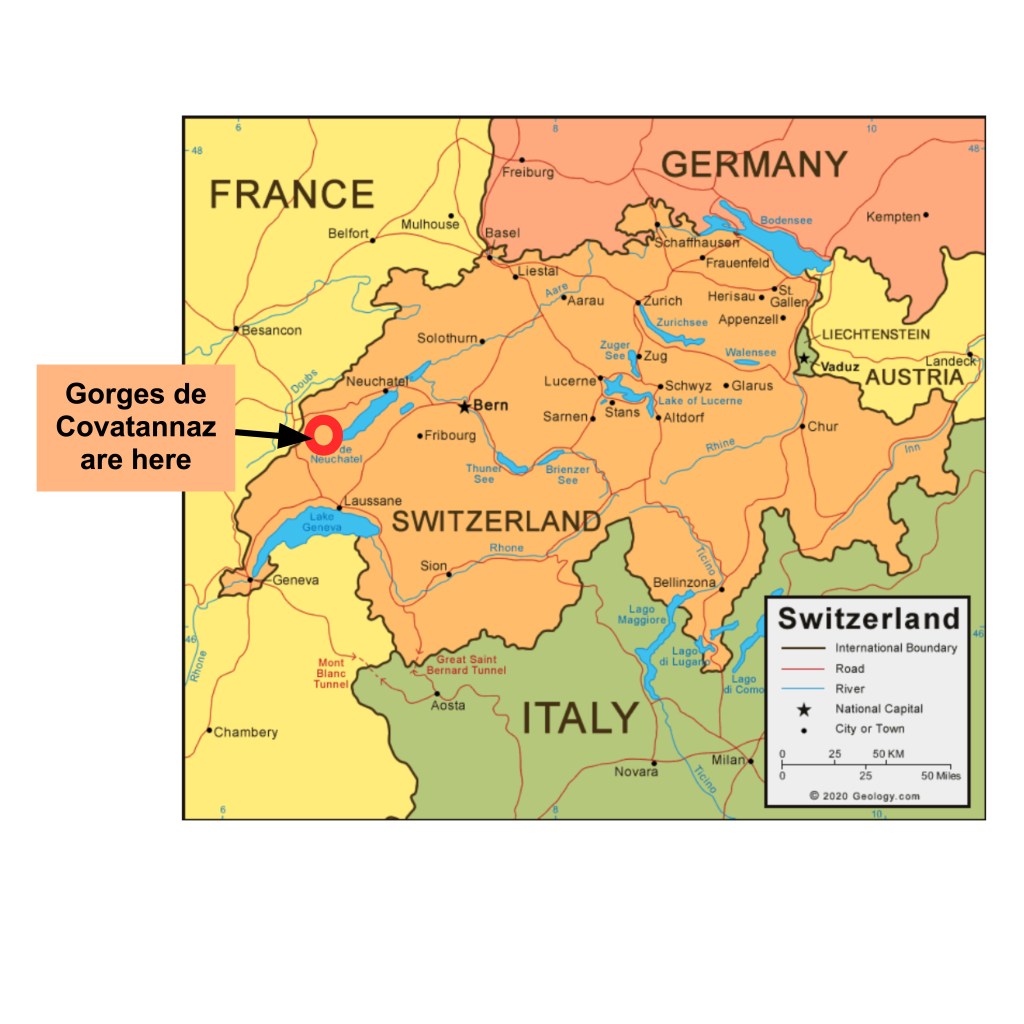
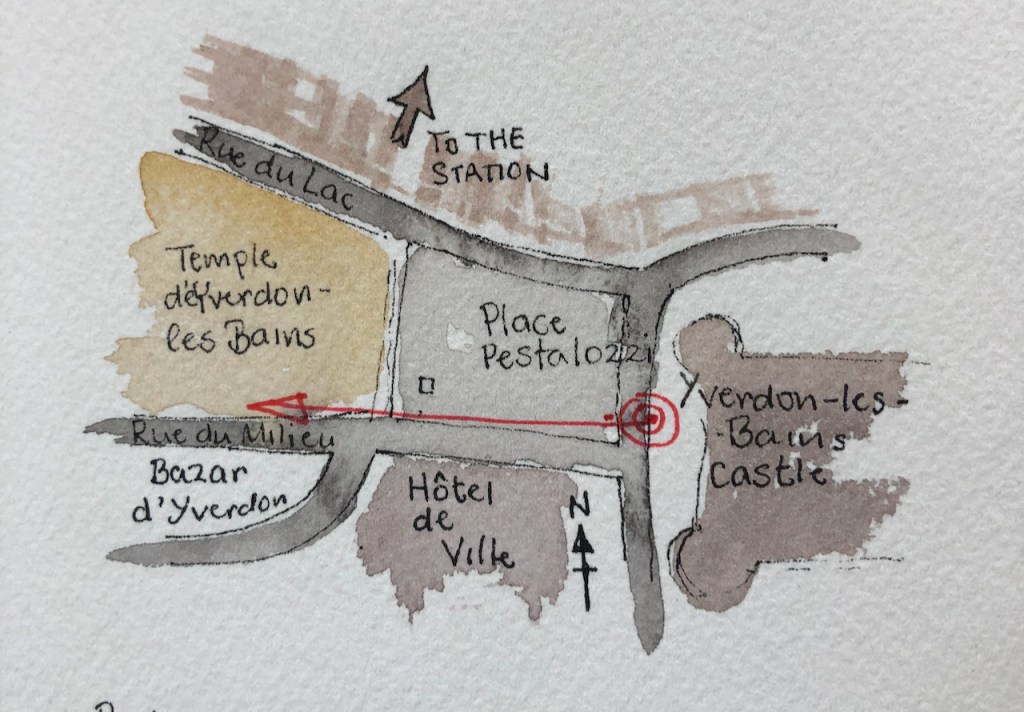
The maps below show the location of Yverdon, in the canton of Vaud.

On the Place Pestalozzi

Note 1: The local paper article about the Bazar is in the archives of “24 heures – VAUD”. It is by Frederick Ravissin, 16 June 2018. Read a pdf of the article here (in French) – link below:
Nyon, view from the castle

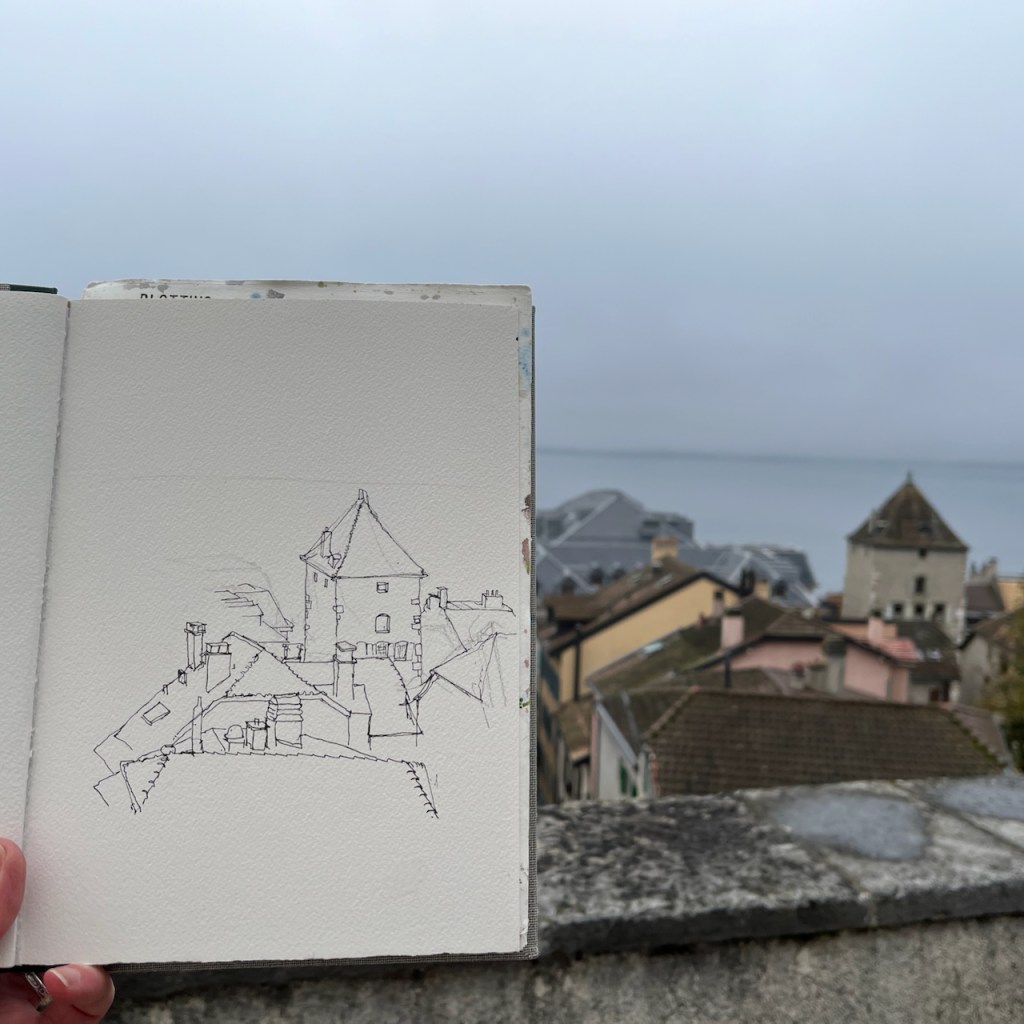
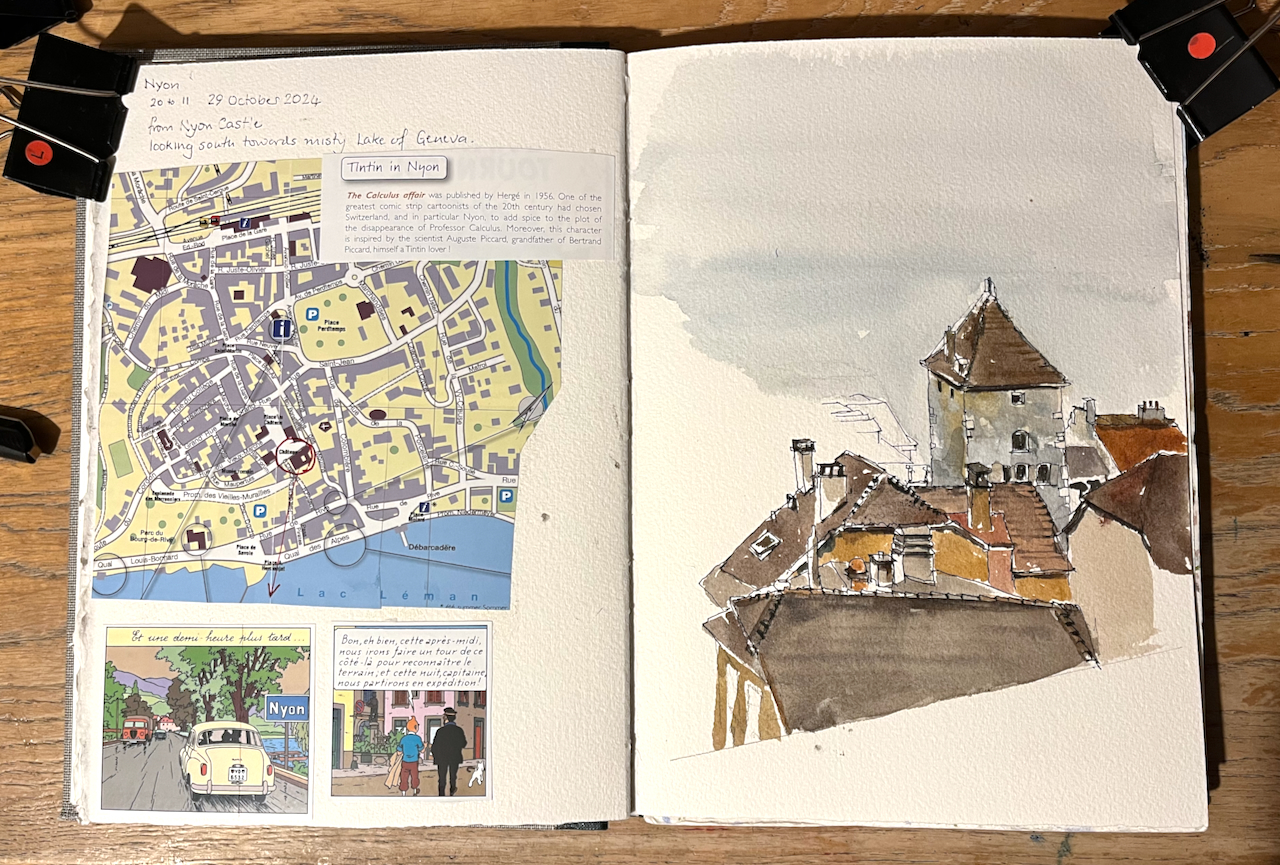
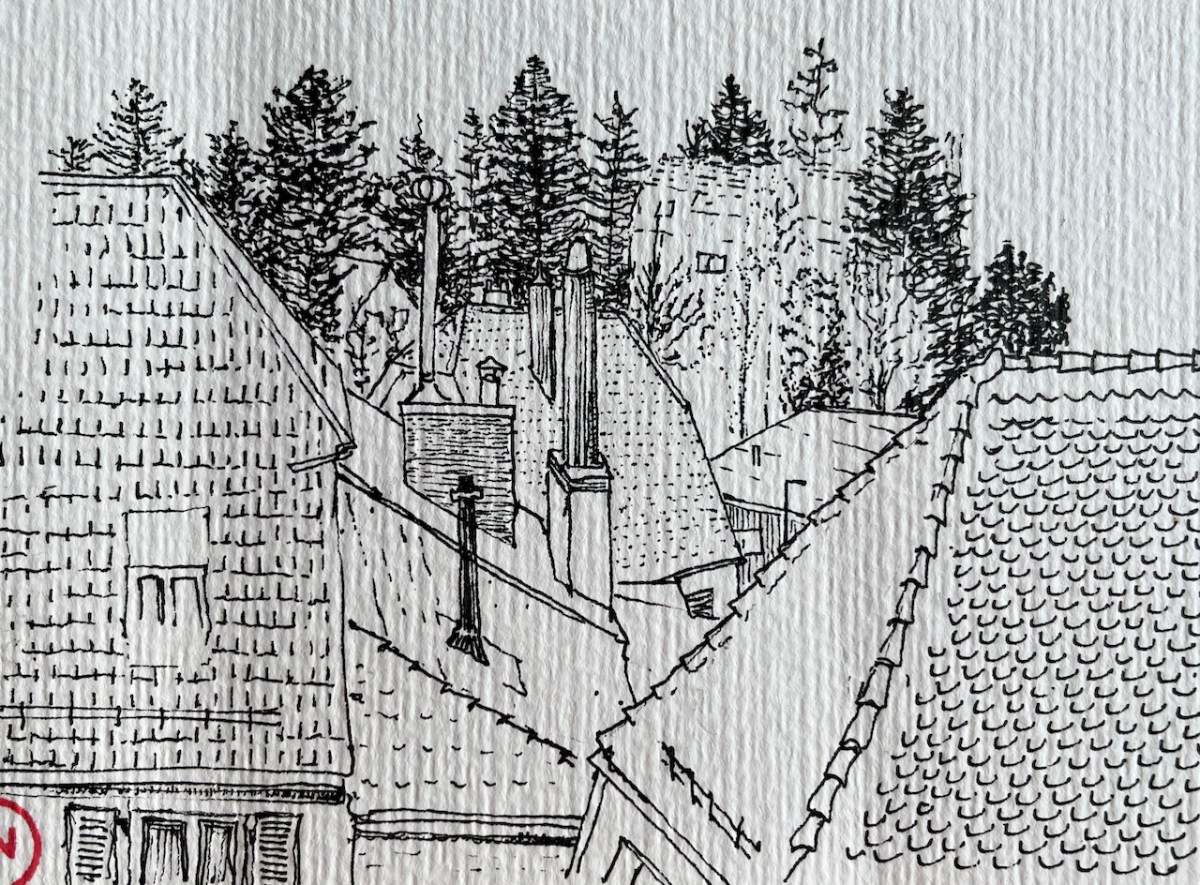
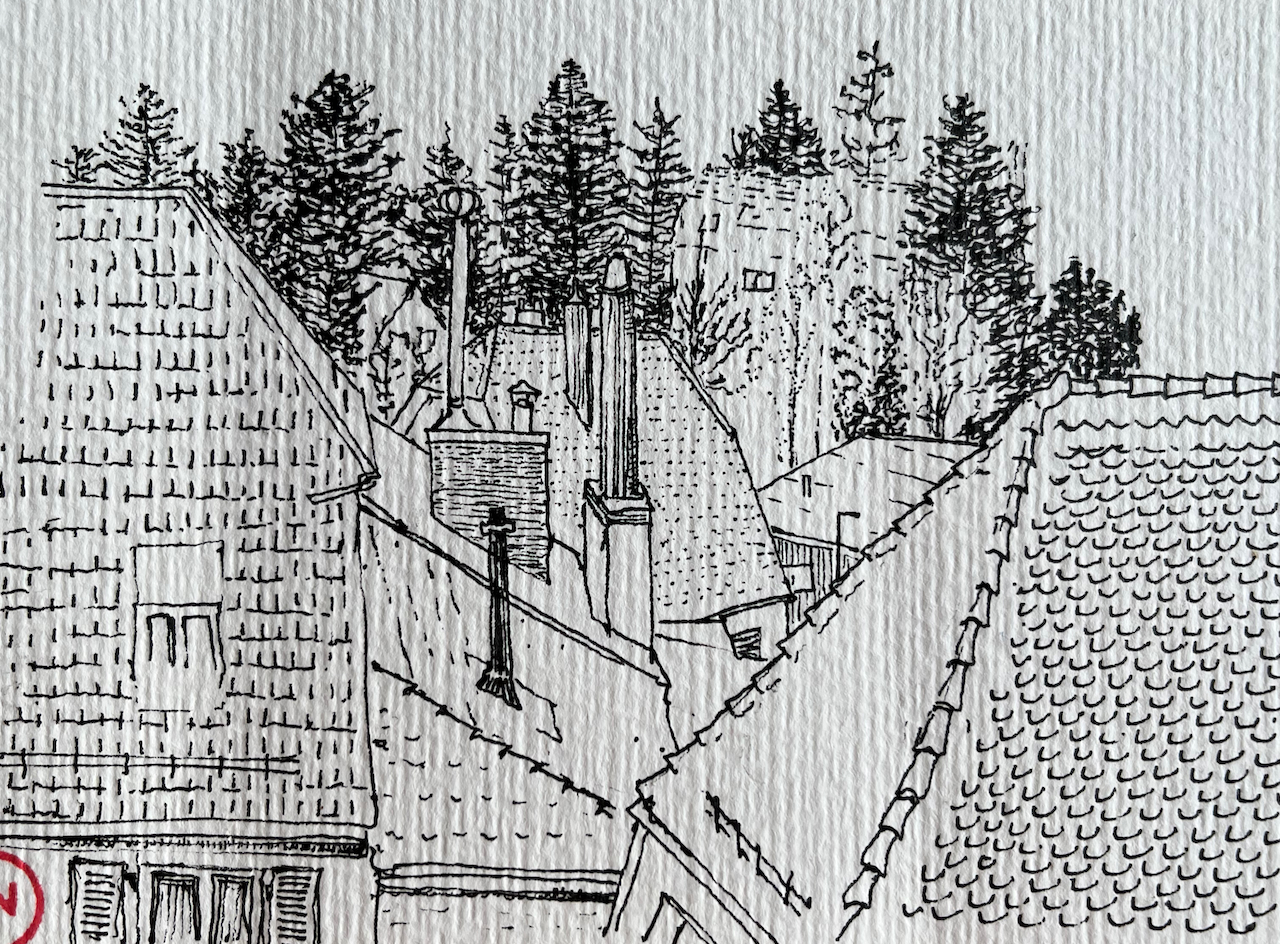
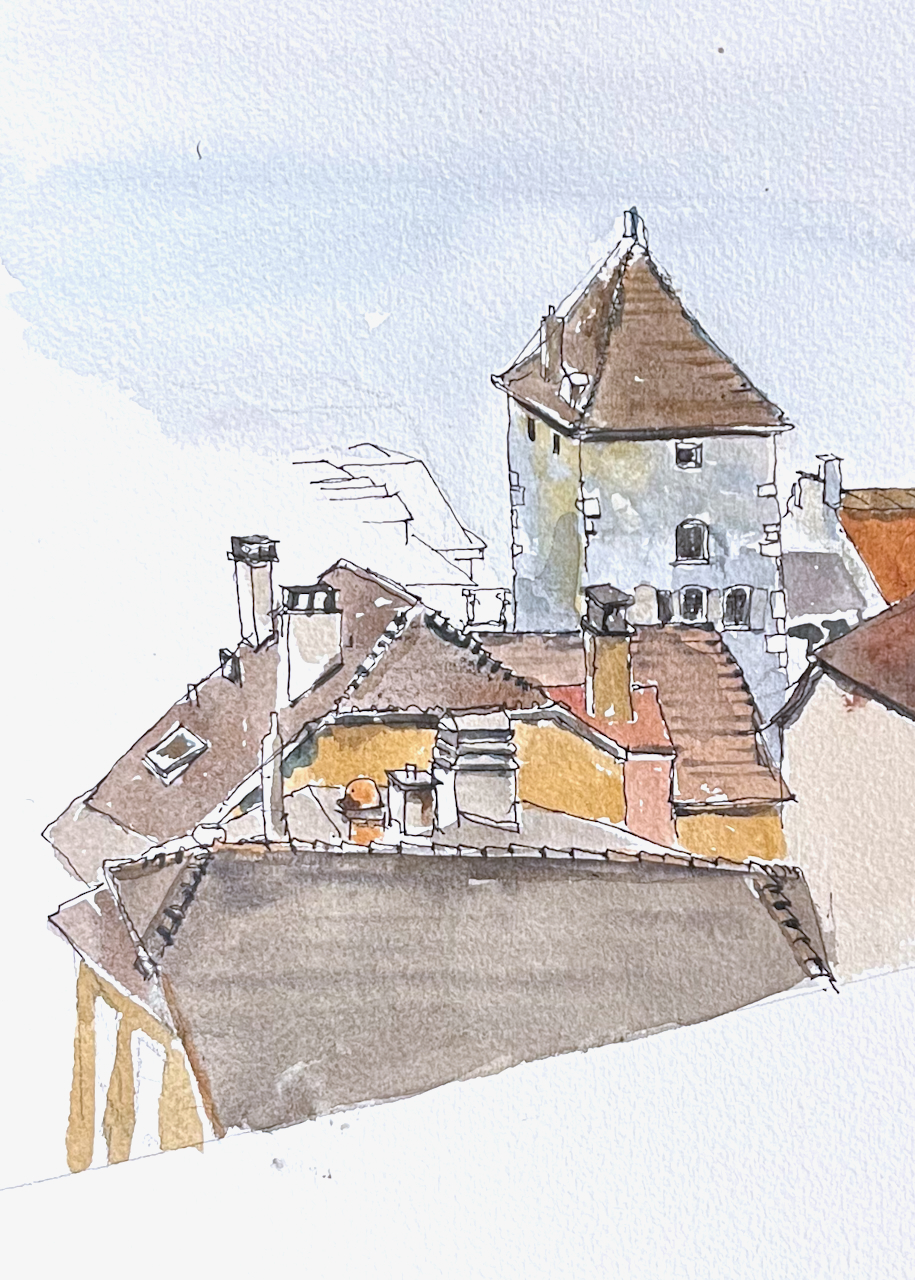
Standing on the ramparts of the castle at Nyon, I look towards Lake Geneva.

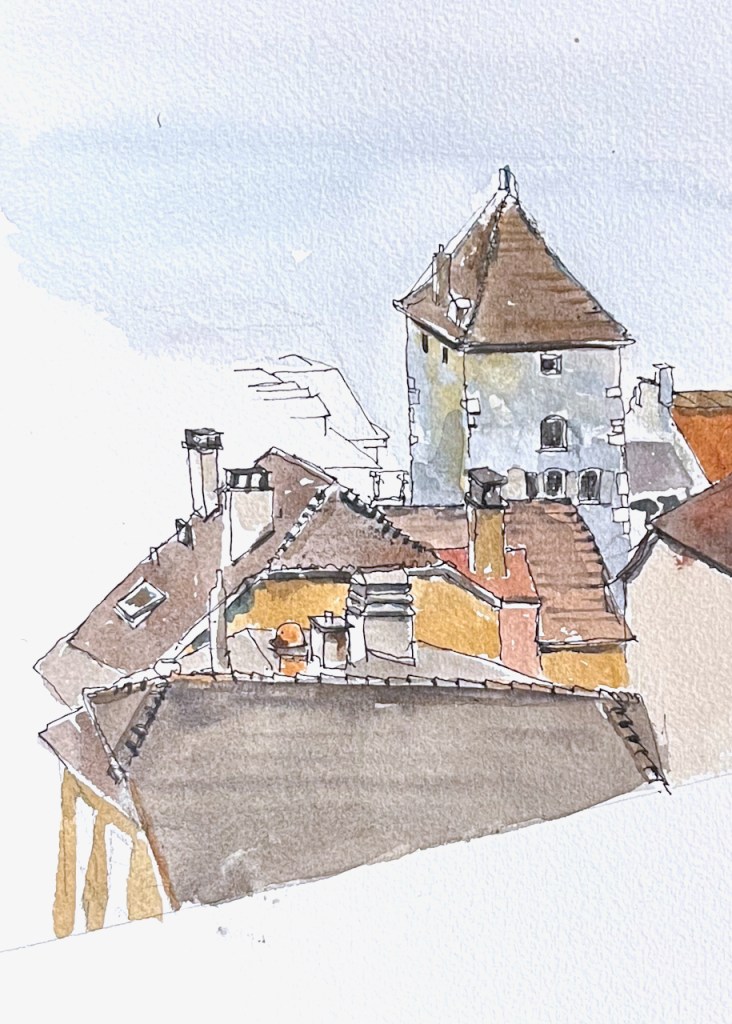
Rooftops from Nyon Castle, 29 October 2024 in Sketchbook 15

The tower in the picture is at the junction of Rue de Rive and Passage des Pirates, Place Abraham HERMANJAT 1862-1932. I can find its position on a map, but it is unremarked and seems not to have a name. If there is any citizen of Nyon out there who can identify it, I’d be very grateful.

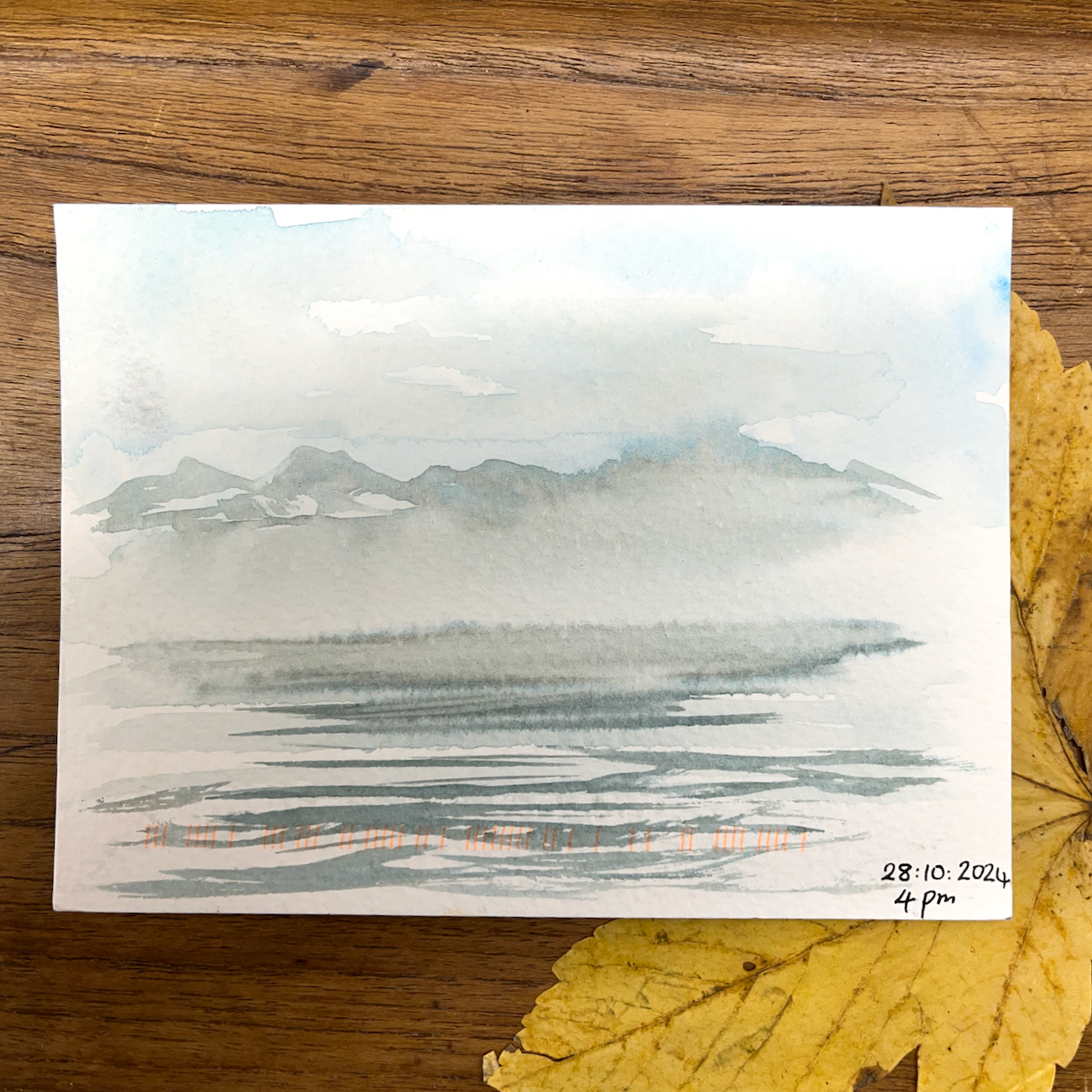
Lake Geneva is in mist, in the background of the picture. The mist came and went as I was sketching. It was extremely cold.

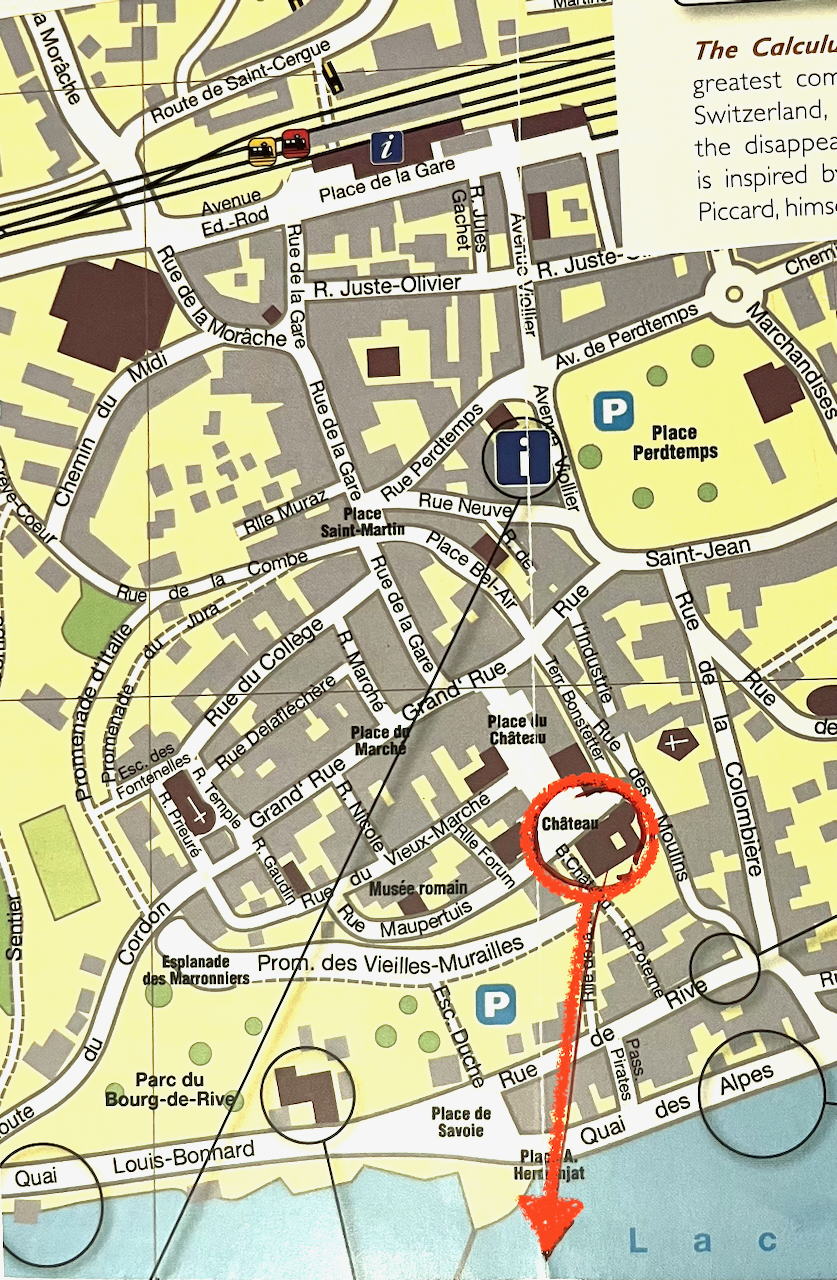
Map from Nyon tourist office, showing the sightline of the drawing.

Nyon is easy to navigate because it is on a slope, from the train station at the top of the map down to Lake Geneva at the bottom of the map.

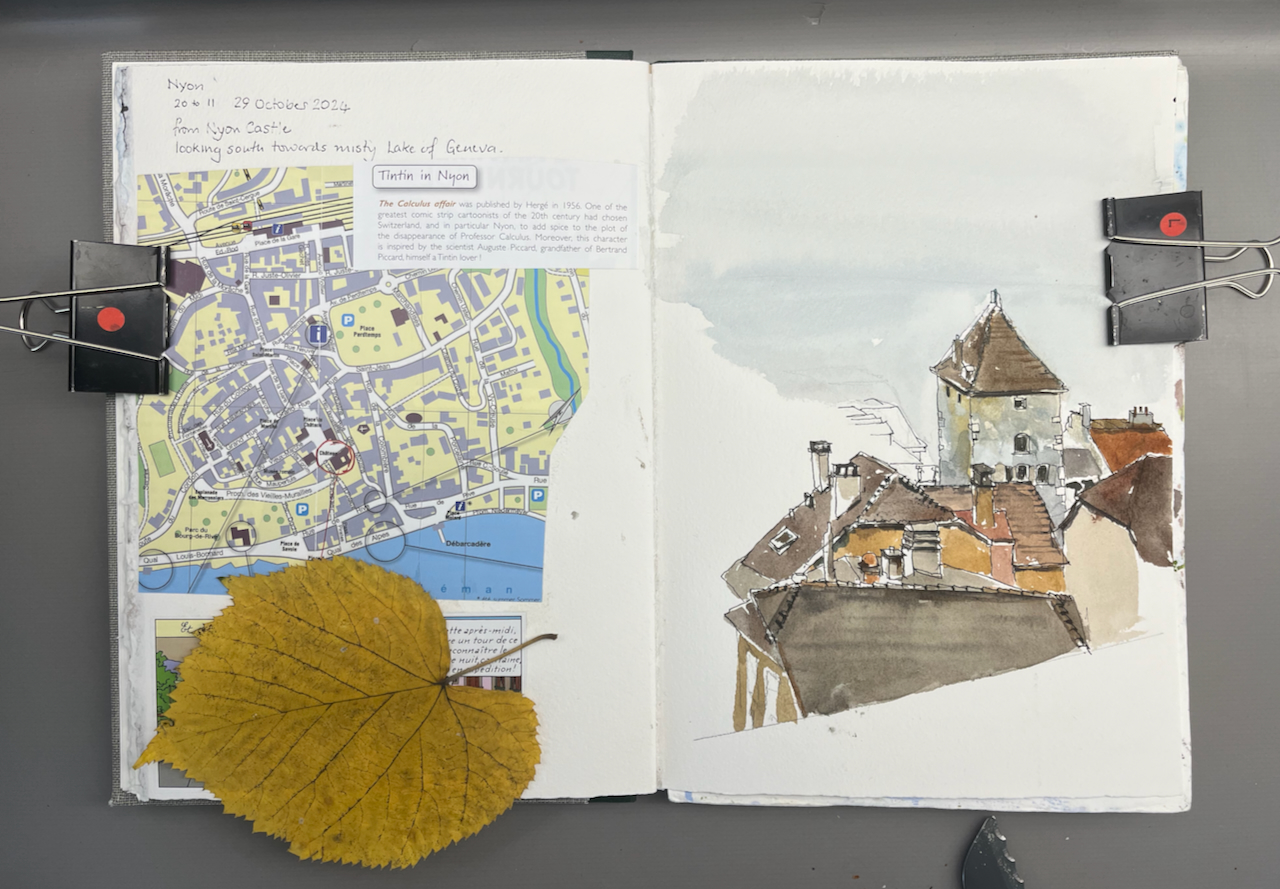
The map above came from the Nyon Tourist Office who also offered a leaflet reminding me that part of the action in the Tintin book “L’Affaire Tournesol” took place in Nyon. This book is called “The Calculus Affair” in English. On page 21, you can see the the white car which takes Tintin and Haddock along the lake. It has Vaud number plates (“VD”).1 The fire engine which rescues them from the ruins of the house on page 27 is, according to the tourist office, carefully preserved in a local museum.

I read the Tintin books assiduously as a child, and again, in French, years later. I think the pictures influenced my drawing style, and may be why I like to draw in pen and wash today. So as well as being a record of a moment spent on the freezing battlements of Nyon Castle, the drawing above is my small homage to the great Hergé.

Sketchbook 15, with items from the leaflet “Tintin in Nyon”, and a leaf.
  1. The images from the Tintin books are protected by copyright, so I am not including them here. But do have a look if you have a copy of the book at home. ↩︎

Sketching in Switzerland November 2024

Here are postcards from Switzerland, sketched quickly on 4″ x 6″ watercolour postcards.

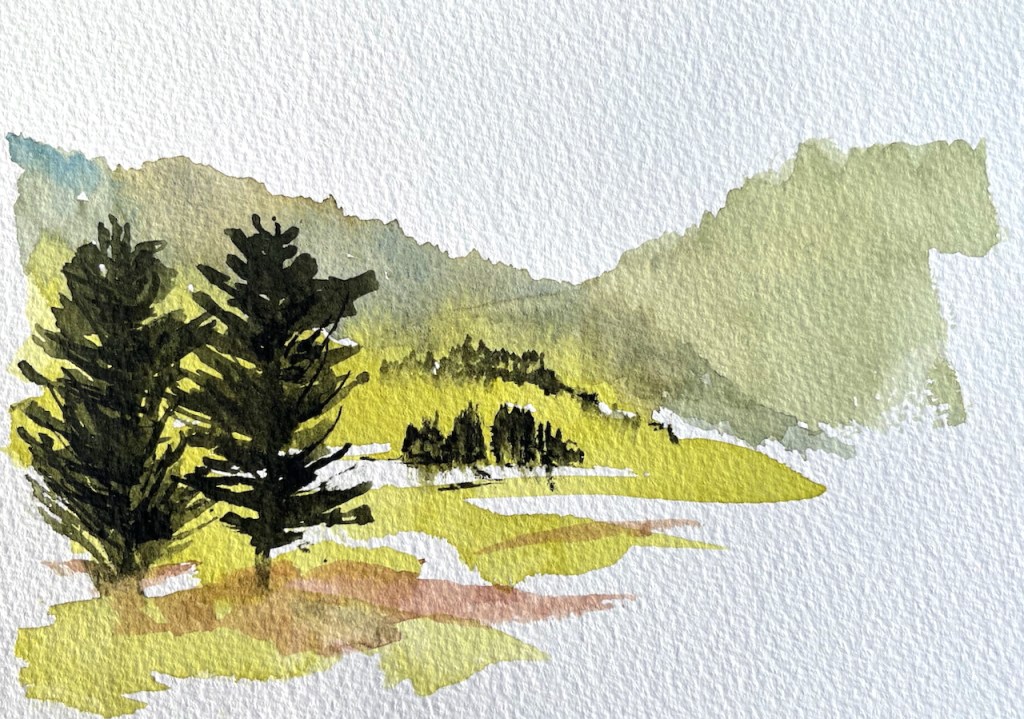
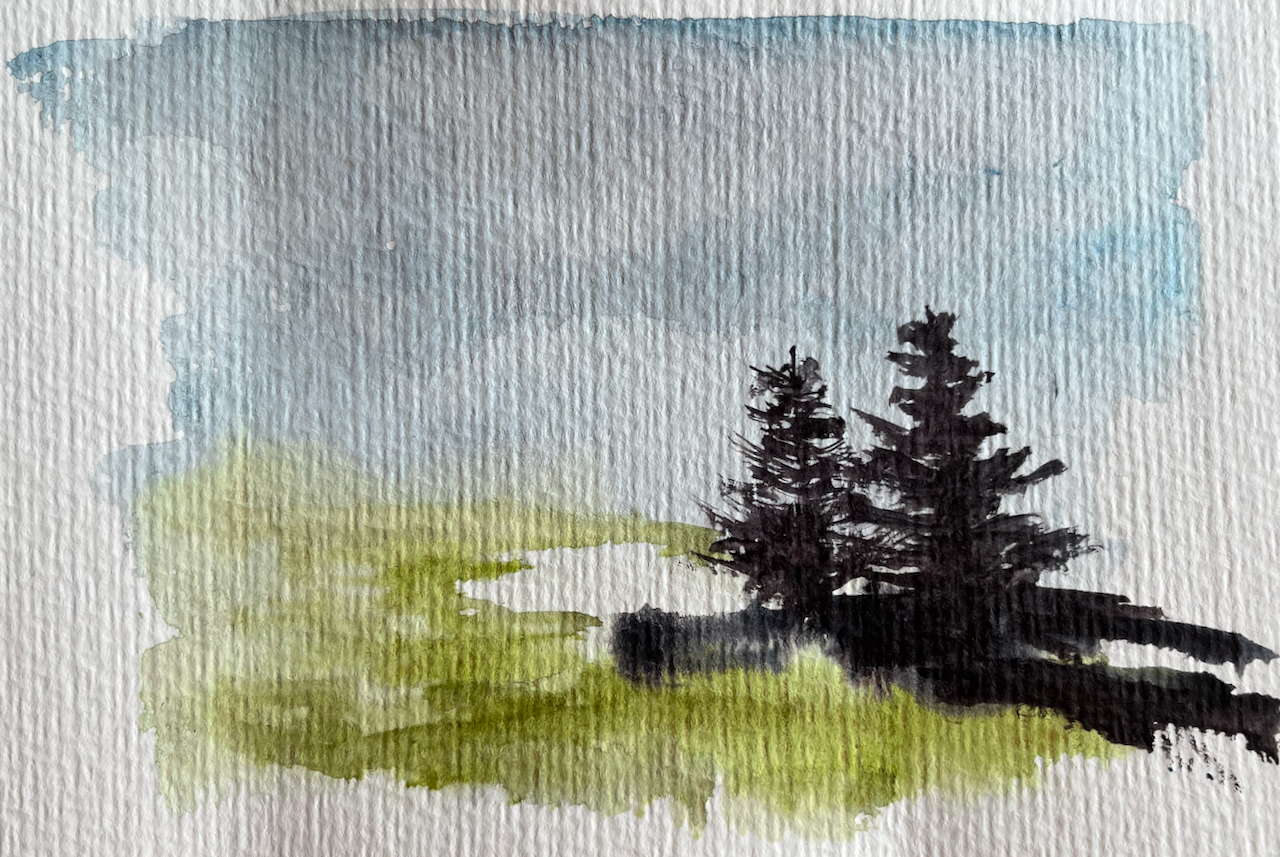
It was foggy in the valley, and clear at 1000m.

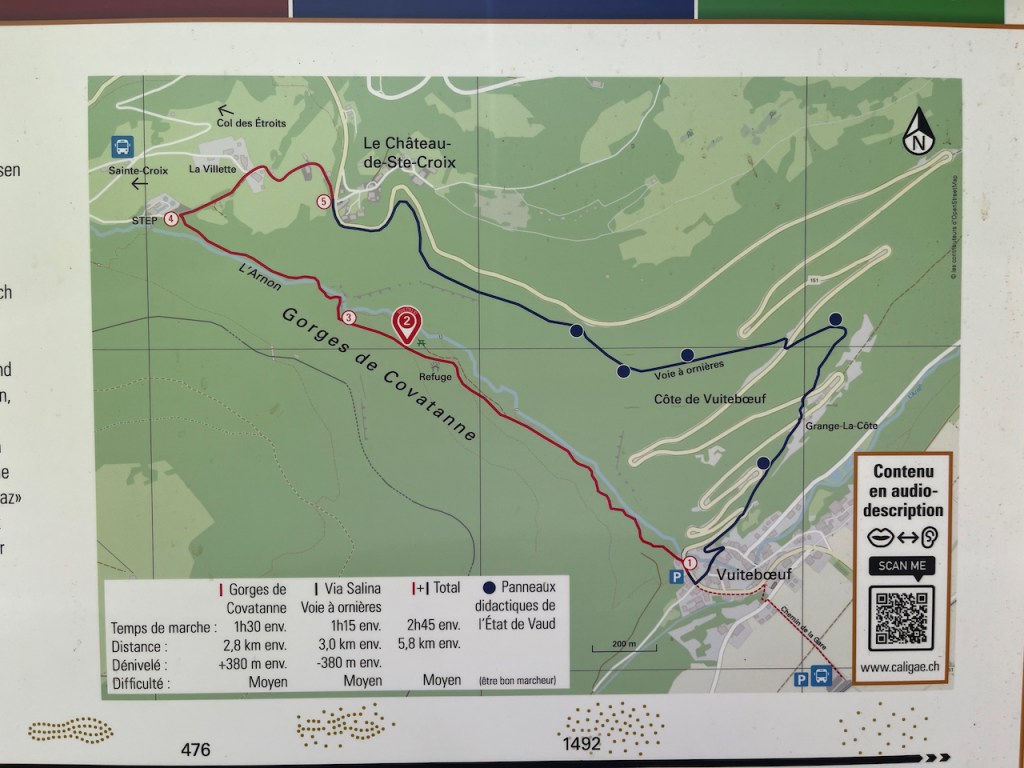
One day, starting early, my hosts dropped me in the village of Vuiteboeuf, which is at the lower end of the Gorges de Covatannaz. I walked up, through the fog. It took about an hour and a half. I’d intended to sketch and I had my watercolours with me. But the fog made it surprisingly cold, and I didn’t want to stop or I would freeze. I was warm so long as I kept walking. So I made very quick sketches using Derwent “inktense” watercolour pencils. Here are my sketches in video format.

Here is the view over the Gorge, from the fields at the top.

My visit took me to Nyon, on the shores of Lake Geneva. I made a quick sketch from the walls of the castle. Did you know that the Tintin story, “The Calculus Affair” was set in Nyon? The tourist office made much of this connection.

Sketchbook 15, Nyon page spread.

Switzerland is beautiful in the Autumn. Thanks to my hosts at the Hotel de France, Vaud, for their hospitality.

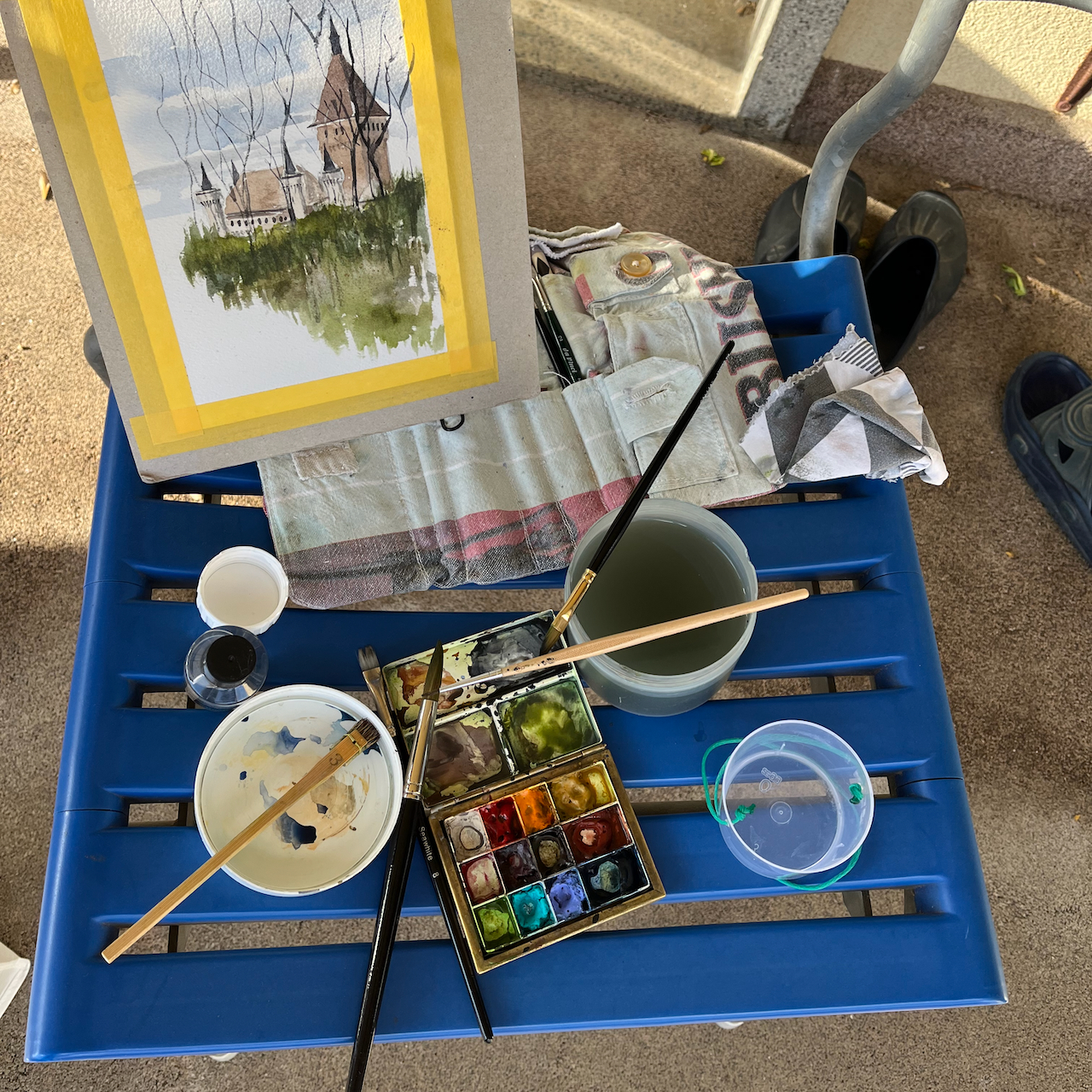
Château de Vufflens, Vaud, Switzerland

Fine rain started as I sketched the Château de Vufflens. At first I thought I could keep sketching. But then rain arrived in large-size drops, some containing ice. I took refuge under an archway. There was a view of the castle from there, but a different view. Also, standing there, I was, very possibly, in someone’s garden. I am not sure about Swiss laws on trespass. All I was sure of was that there would be laws. I assembled suitable French phrases in my head, to be ready to explain and apologise. And I restarted the sketch from this new angle. Then the rain stopped.

I inspected the sky suspiciously. I watched the cloud movements. Clouds just appear here, over the mountains, as from a volcano. They don’t proceed in an orderly succession as they do over the Atlantic. However all seemed more lightweight and friendly than it did earlier. I exited from the archway, and resumed my place on the public roadway. There are probably laws about sketching on the public roadway too.

But no-one even walked past. Not a car. Not a person. Not a dog. So that was alright. I finished the sketch. And then the rain started again.

Château de Vufflens in the morning, 24 March 2024 11:15 in Sketchbook 14

This castle is privately owned. It is on a rock in the valley, surrounded by high walls. Houses cluster at the bases of the walls. if you know the work of Mervyn Peake, think “Gormenghast”.

It was originally constructed in the middle ages, 1420-1430, for Henri de Colombier, an adviser to Duke Amadeus VIII of Savoy, I was told. It looks well maintained, and vast.

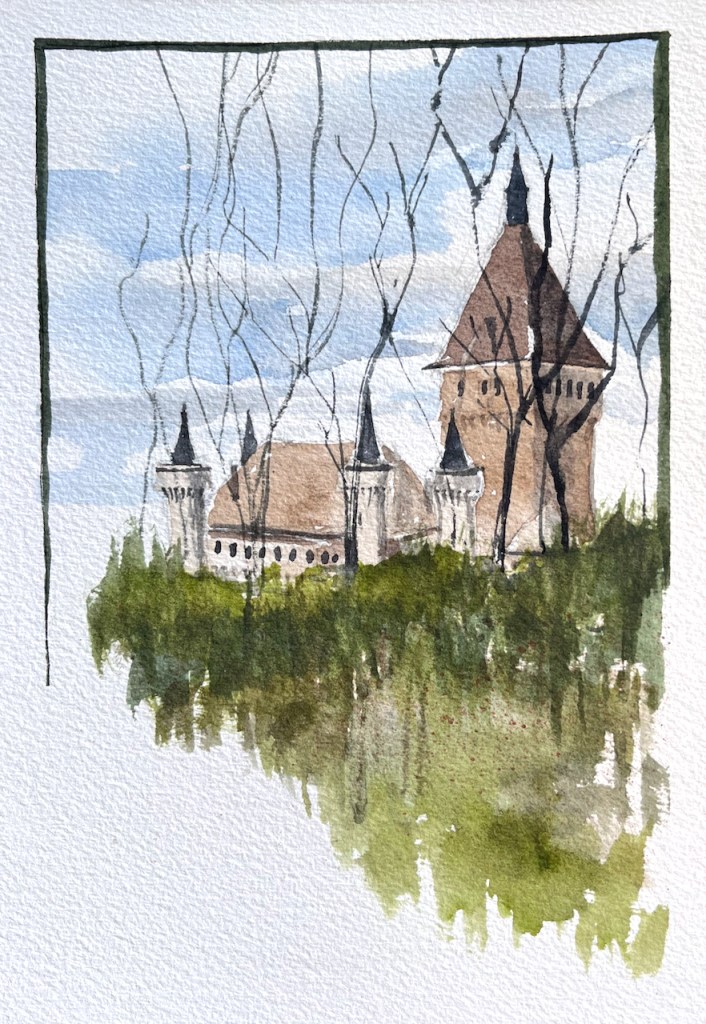
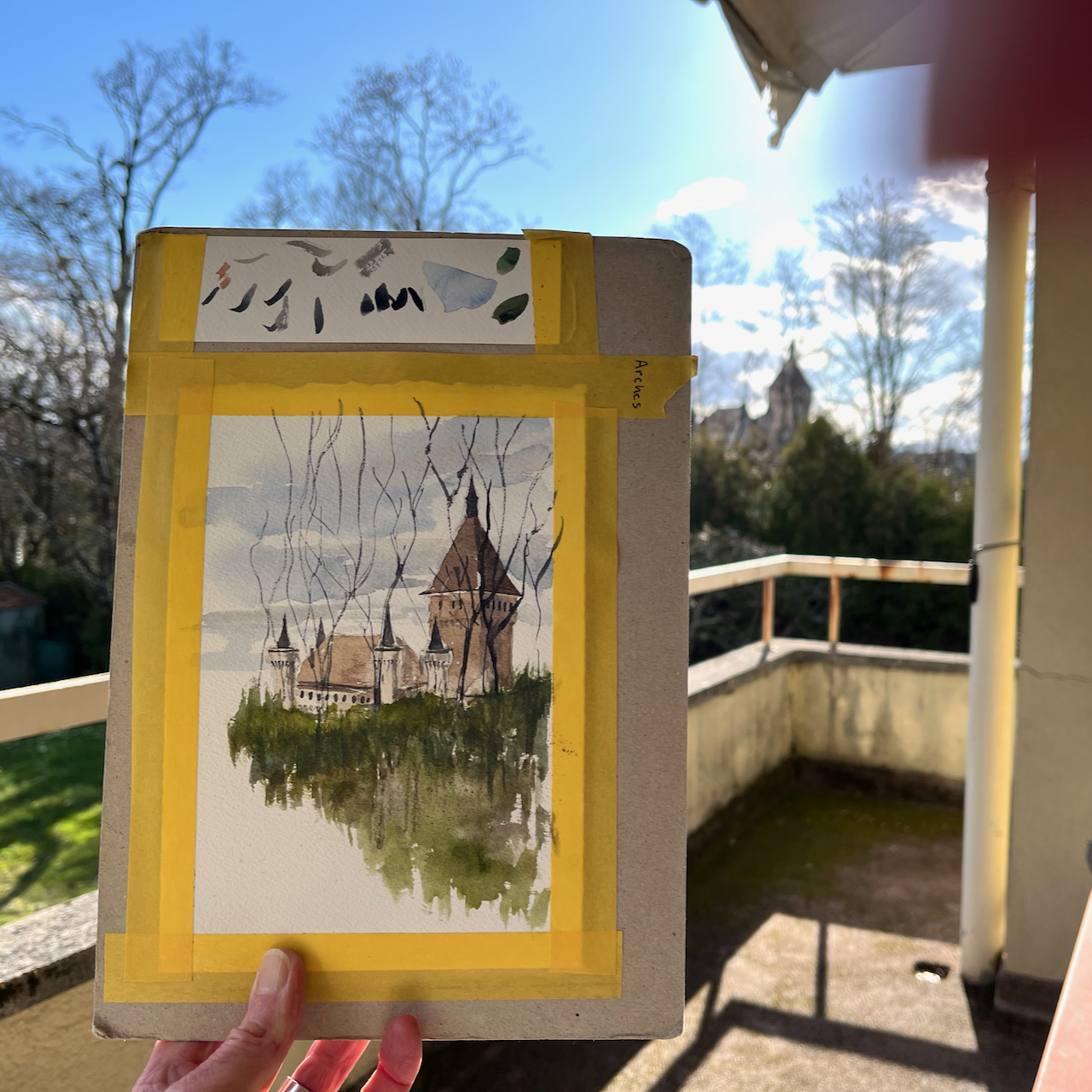
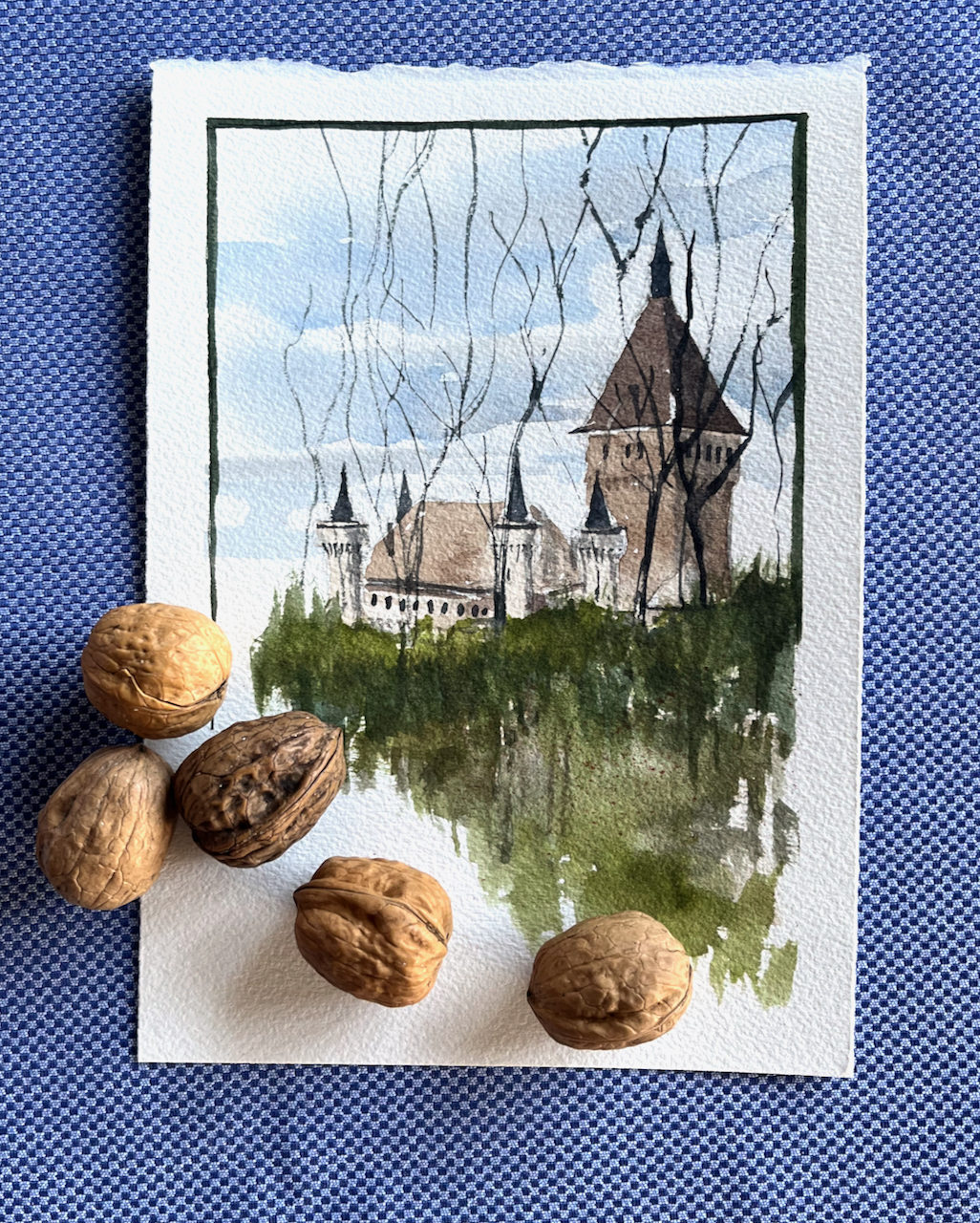
Later that day I made another attempt at drawing the castle, from a different angle. From this new viewpoint I could be under cover, but there were trees. I put the trees in.

Château de Vufflens in the afternoon. 24th March 2024, 4pm. 6″ x 8″ on Arches Aquarelle card

The walnuts came from the trees.

Sainte-Croix houses

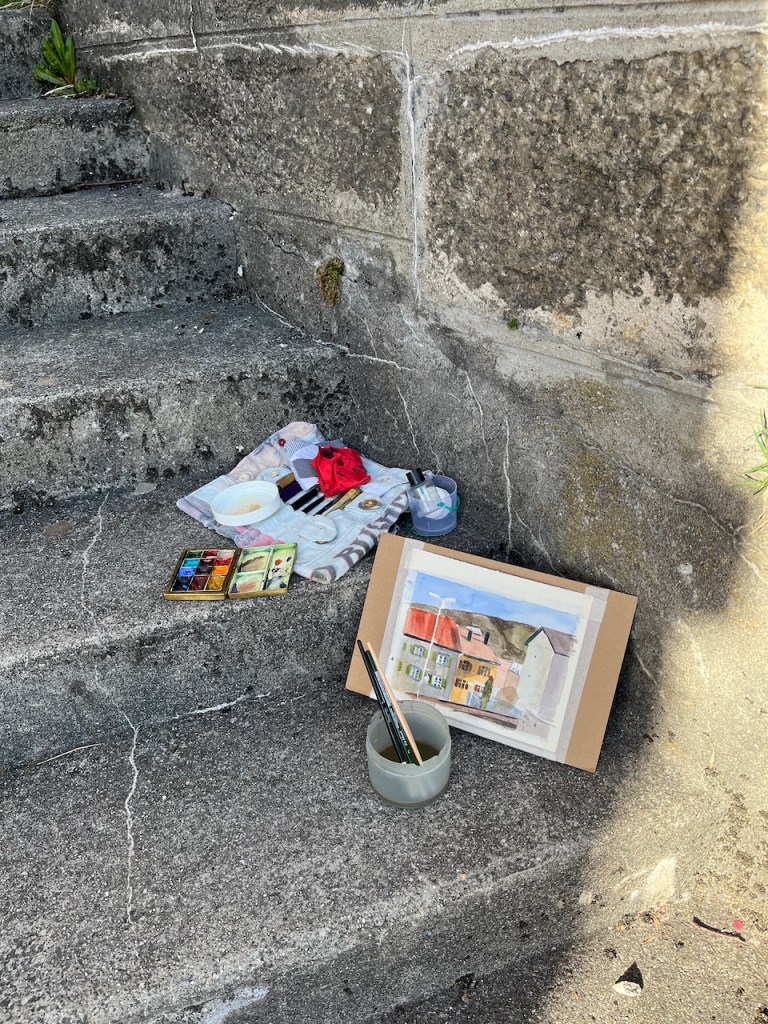
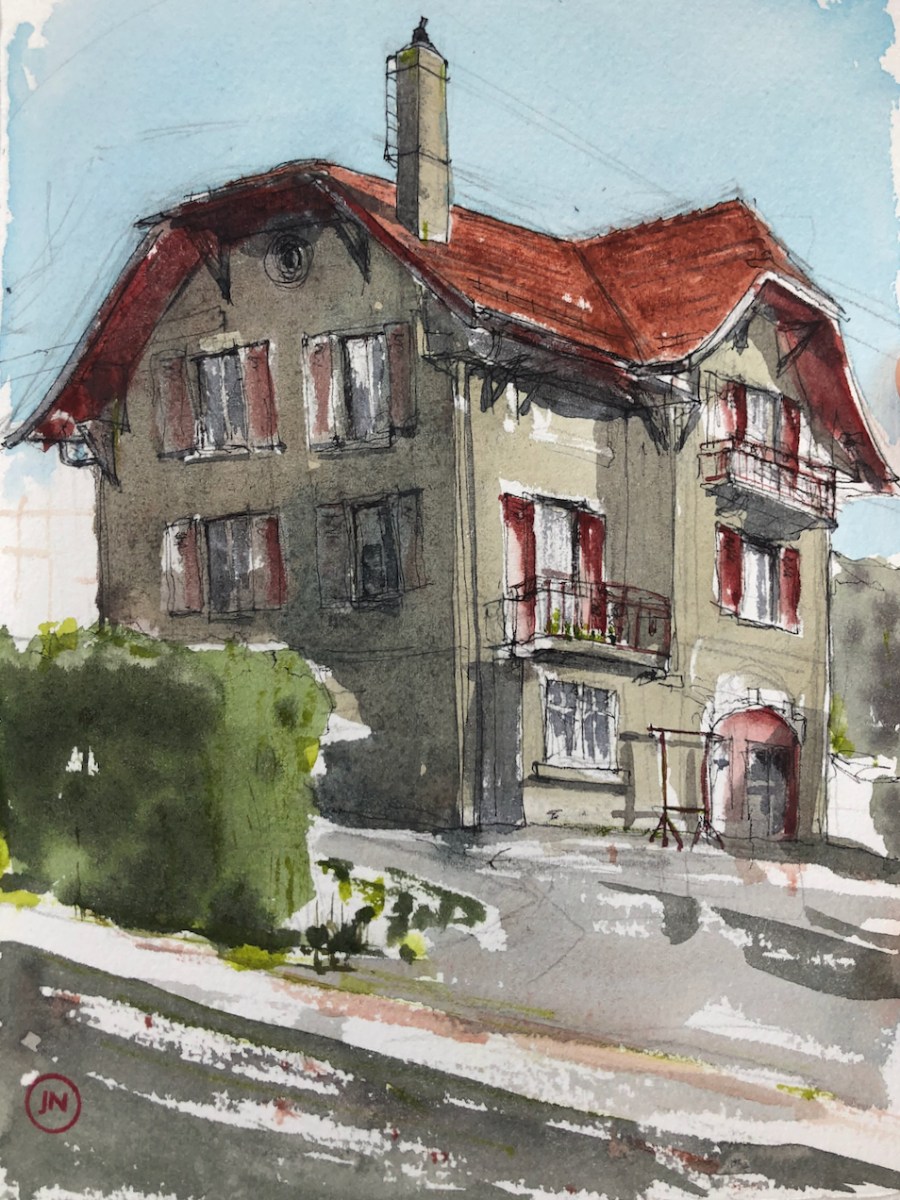
In the afternoon I sat down on the stone steps and sketched the houses that were in front of me.

Sainte-Croix houses, 8″ x 6″ postcard on Arches Aquarelle 300gsm paper. March 2024

I was struck by how the afternoon sun cast shadows on that glass screen, centre left, and illuminated the little greenhouse-type roof on the house in the centre. These are solid Swiss houses, with heavy tiled roofs and properly operational shutters. Some of the metalwork, such as the guttering and the surroundings of the chimney stacks, is in actual copper. Even the downpipes are copper.

One tree was a fir tree and was opaque. The other tree was twigs, and was transparent.

Although it was spring, this is at 1200m, and it was cold. The deciduous trees are still bare. The hill is the background is Mont-de-Baulmes. Many of the trees up there are deciduous larch.

I painted this picture in watercolour-only. Usually I use pen. Here, I did a quick pencil sketch and then straight on with the colour. It was too cold to try to get any details or do any penmanship. The solid plainness of the houses seemed to demand flat colour washes. I deliberately left lines of white between the slabs of colour – the sun always catches edges.

Wind turbine construction in Sainte-Croix, Vaud, Switzerland

In the Swiss hotel there was much talk about the wind turbines. They are being constructed on a nearby hill. I could see them from a bench by the church.

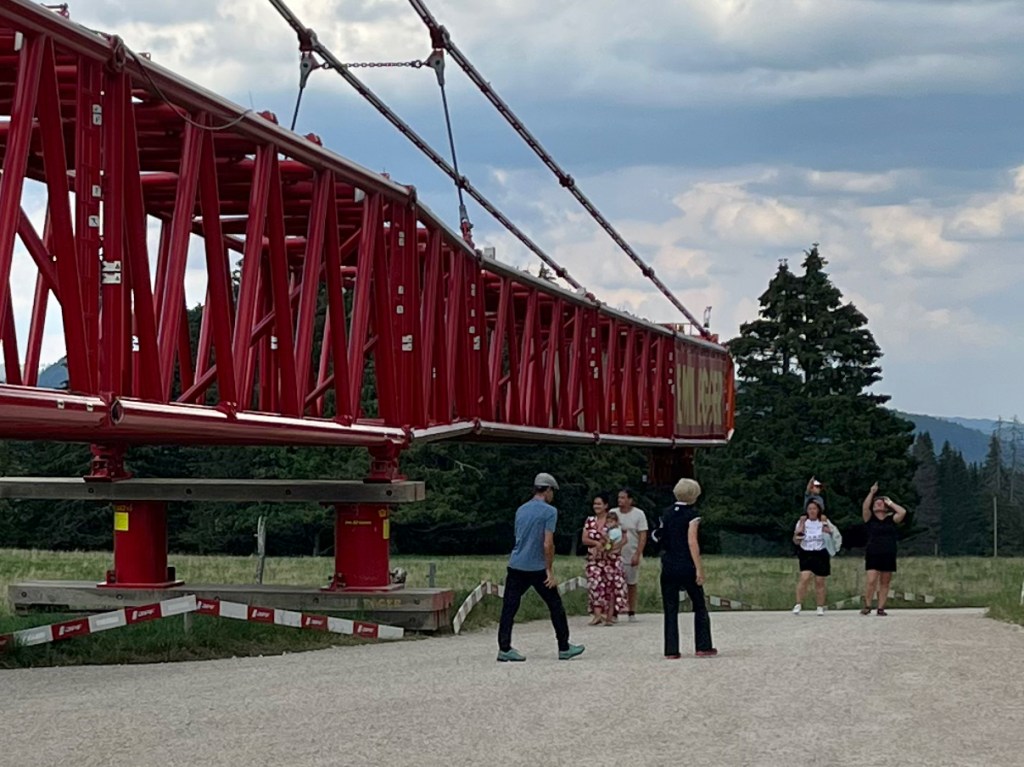
People said, you should go up there and see them, you can get very close. So on Sunday afternoon, we visited the construction site. There are information placards and a visitor car-park. Plenty of local people were up there viewing the machinery. The general atmosphere was one of curiosity and admiration.

It was a Sunday afternoon family outing: Let’s go and see the wind turbine construction site…
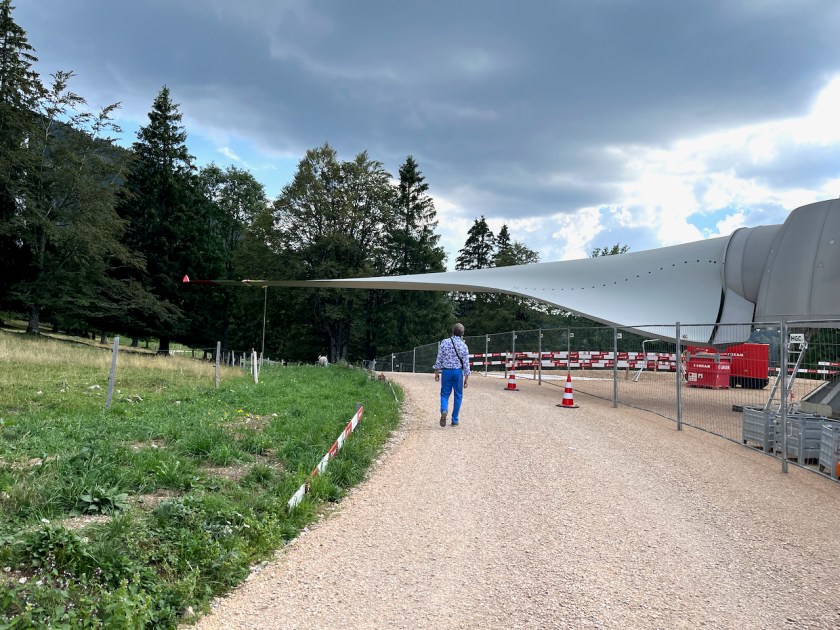
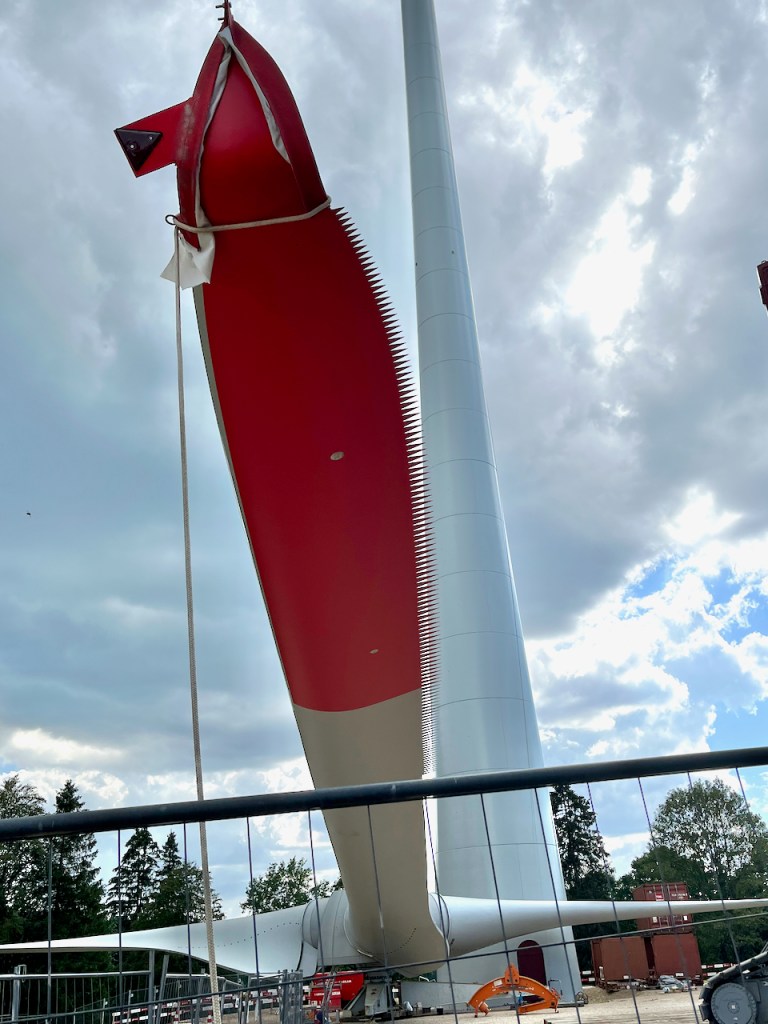
The blades are huge. 43 m.

The enormous blades, ready to raise.

As a British person, I was surprised at the openness. As it was the weekend, the site had no workers. The fascinating machinery was separated from us by some notional fences. It was supervised only by a few CCTV cameras on a stand. Perhaps there were also hidden ones. As you see from the photos, we could get close, and walk freely around the crane. My Swiss companion was surprised at my surprise.

It was also remarkable how positive the feeling was amongst the sightseers. A local person said that in the past they had been opposed to the turbines, but now that construction was started, they could see how clean and organised it was. “It’s better than a nuclear power station!” they observed. There’s no immediate benefit for the local people: they do not get a reduction on their bills. “But it’s better for everyone.” I was told.
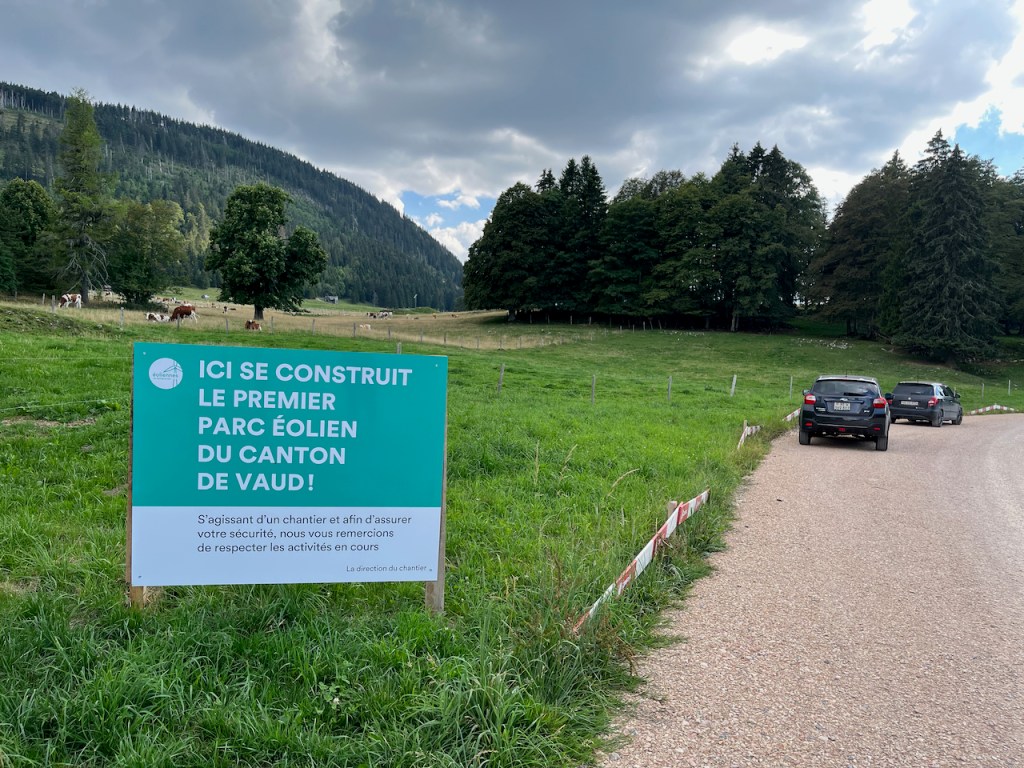
“Here we are building the first Wind Turbine park in the Canton of Vaud”. Note the line of cars to the right: local people have come to visit the construction site.

The next day, Monday, my host came rushing up to me as I returned from a walk. “Quick, look! They are raising…”. We found a vantage point. There, on the distant hill, the blades were being raised up the mast by the crane. They moved very slowly, but definitely, “like the hands of a watch” said my host. For that Swiss person, this engineering feat had become a source of local pride.

Gorge de Covatannaz, Vaud, Switzerland

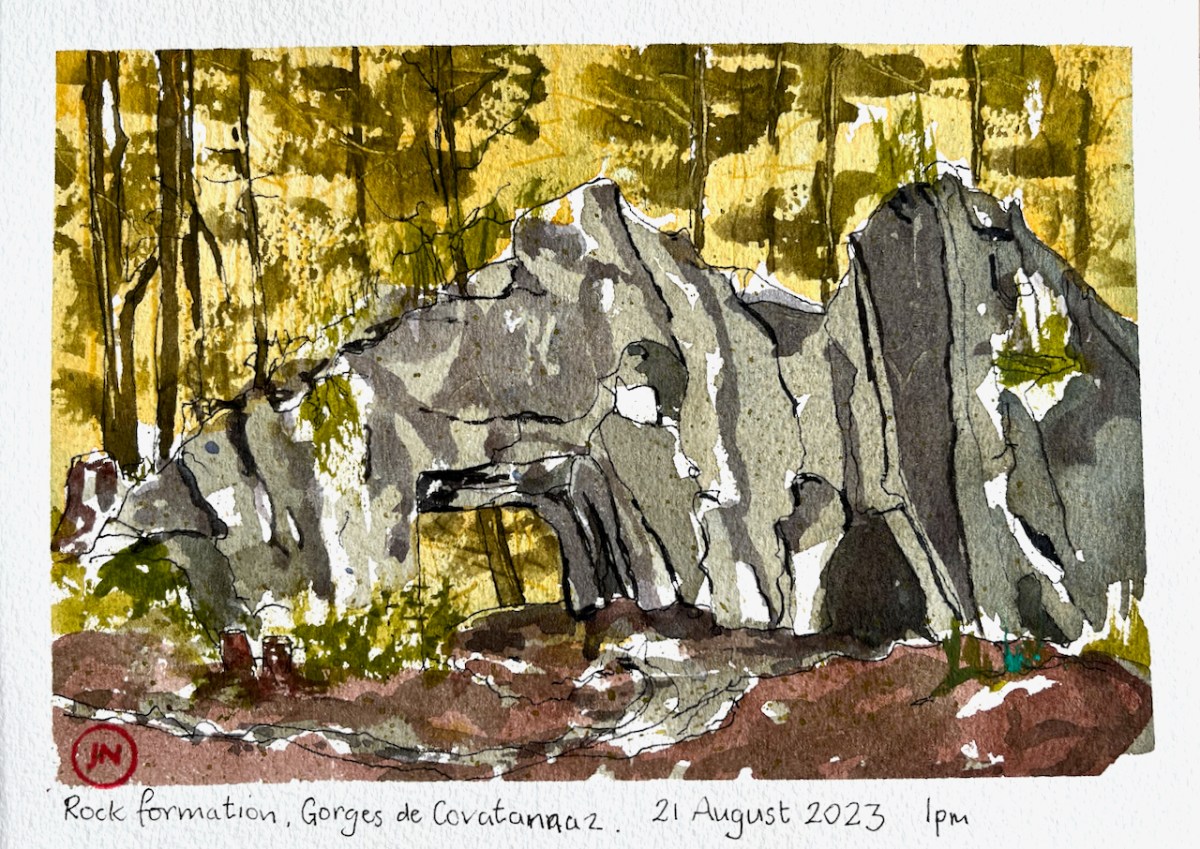
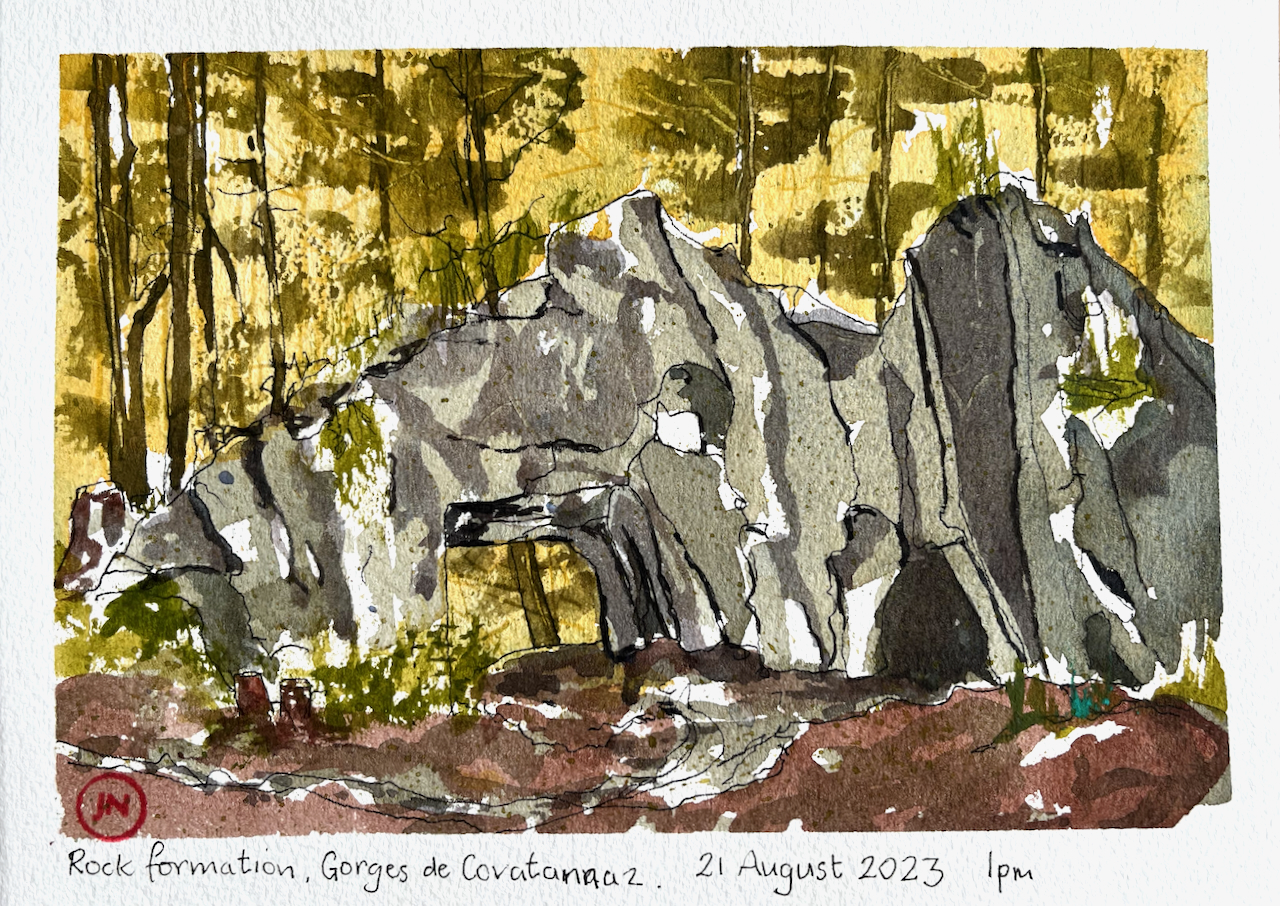
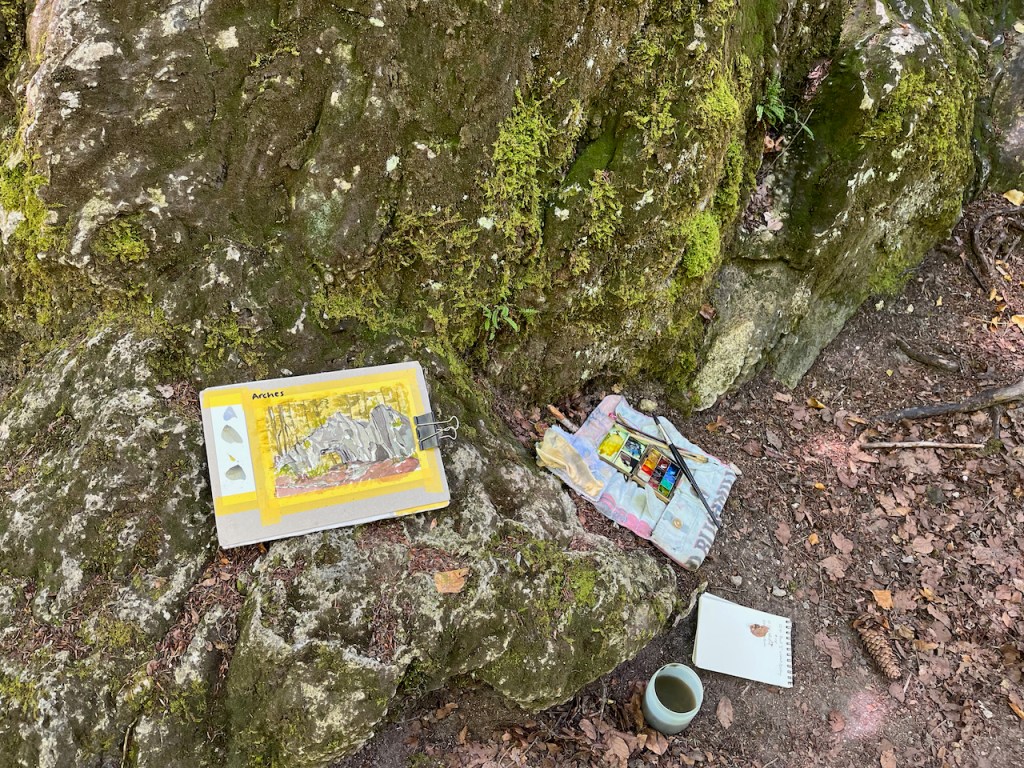
I walked up the gorge from Vuiteboeuf to Sante-Croix. Half-way up I paused to sketch this amazing rock formation.

It was an ideal place to sketch, under the trees.

As I sketched, the silence was broken by thumps and scrapes behind me. A bear? A tree fall? A rock avalanche? No. A mountain bike rider descending the path at speed. These riders are skilful – they jump and bounce, and turn in the air like dancers.

I saw one in the distance as I navigated a narrow part of the path. Since there was a steep drop on the right hand side, I flattened myself against the rock to give them room. But there was no need. The rider brought their bike to a graceful halt, slipping sideways like an ice skater. They grinned as I greeted them. “Il faut du muscle” they said in response to my comment on the steepness of the path. Yes, you have to be strong. And have a sense of balance, good eyesight and rapid reaction times. And courage. After I passed, they backed up their bike and jumped on, to hurtle off down the slope.

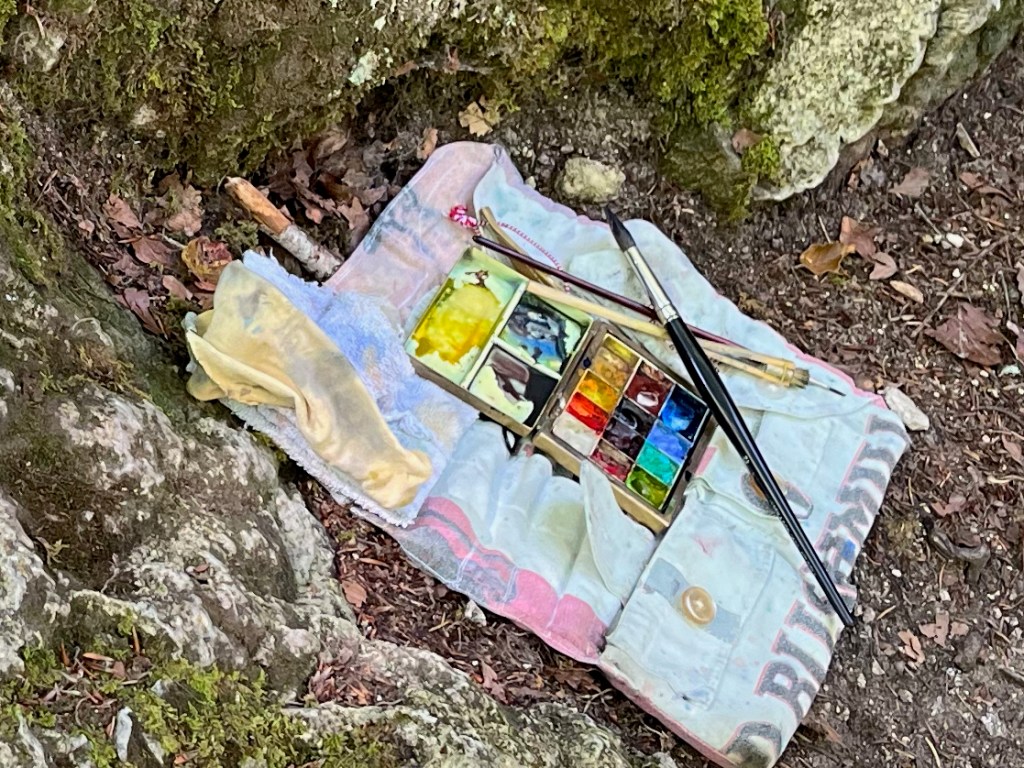
My sketch took an hour. It’s on Arches 300gsm paper, with Daniel Smith watercolours. The colours I used were:

  • Permanent yellow deep
  • Serpentine genuine
  • Cobalt teal blue
  • Burnt Umber
  • Buff titanium
  • Perylene maroon

The pen drawing is with a fountain pen, Lamy Safari, with De Atramentis Document Black waterproof ink.

Scenes from Switzerland – August 2023 sketchbook

Sketching is a way to fill those “waiting” times with creative activity.

I had an A5 sketchbook with cartridge paper. This cartridge paper behaved differently from the watercolour paper I am used to. It was more suited to quick sketches.

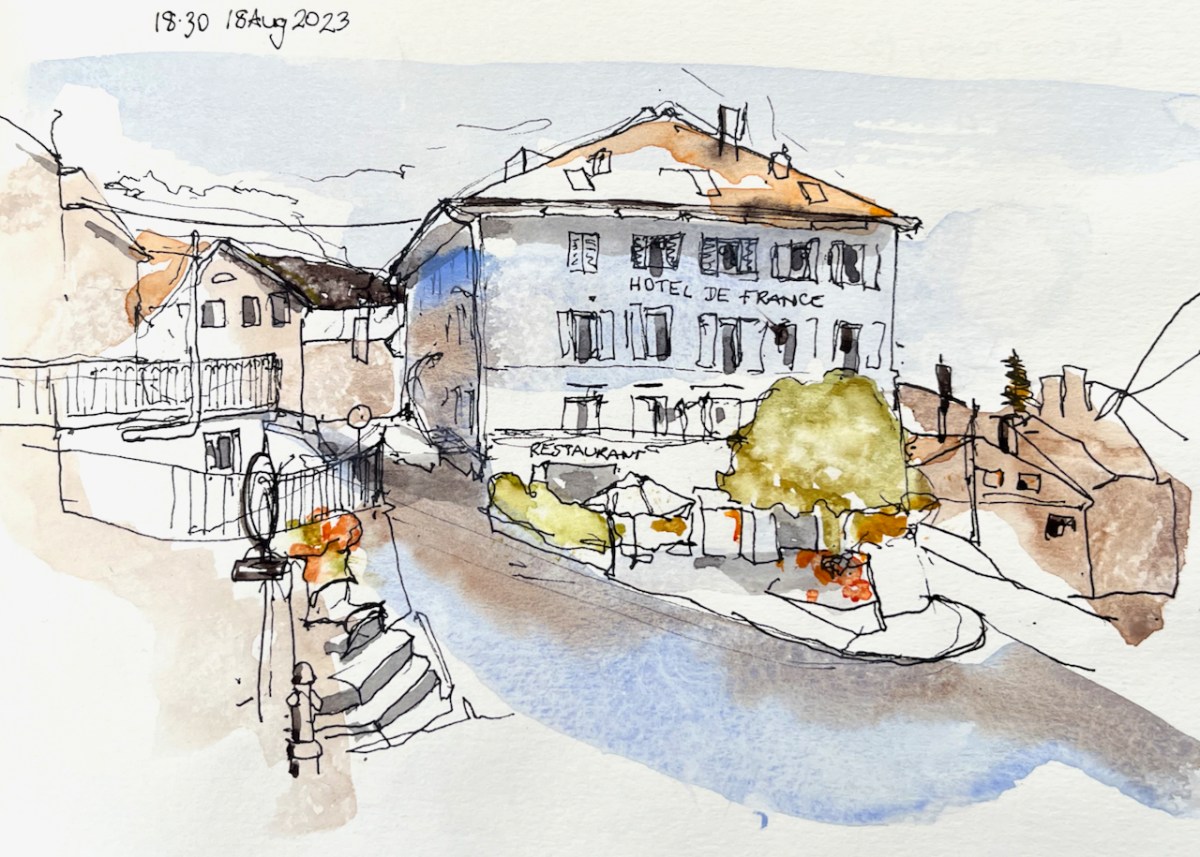
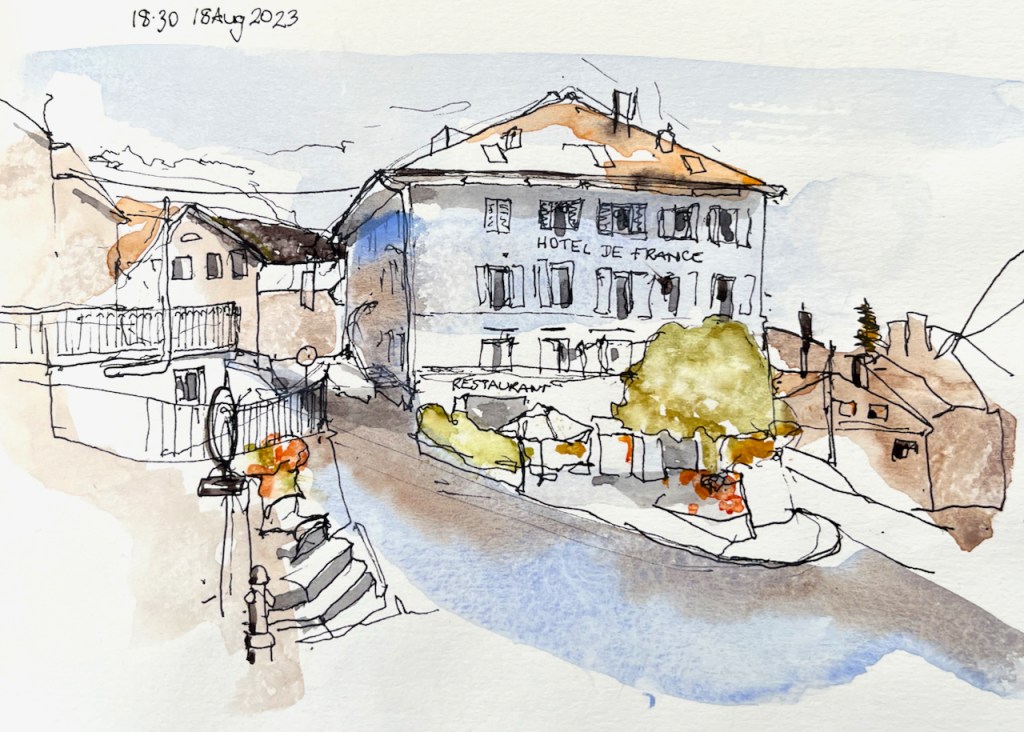
It was hot weather. Outdoors the paint dried quickly. Here’s the hotel from the other side of the road, drawn very quickly, about 20 minutes.

Hôtel de France, Sainte-Croix 18 August 2023

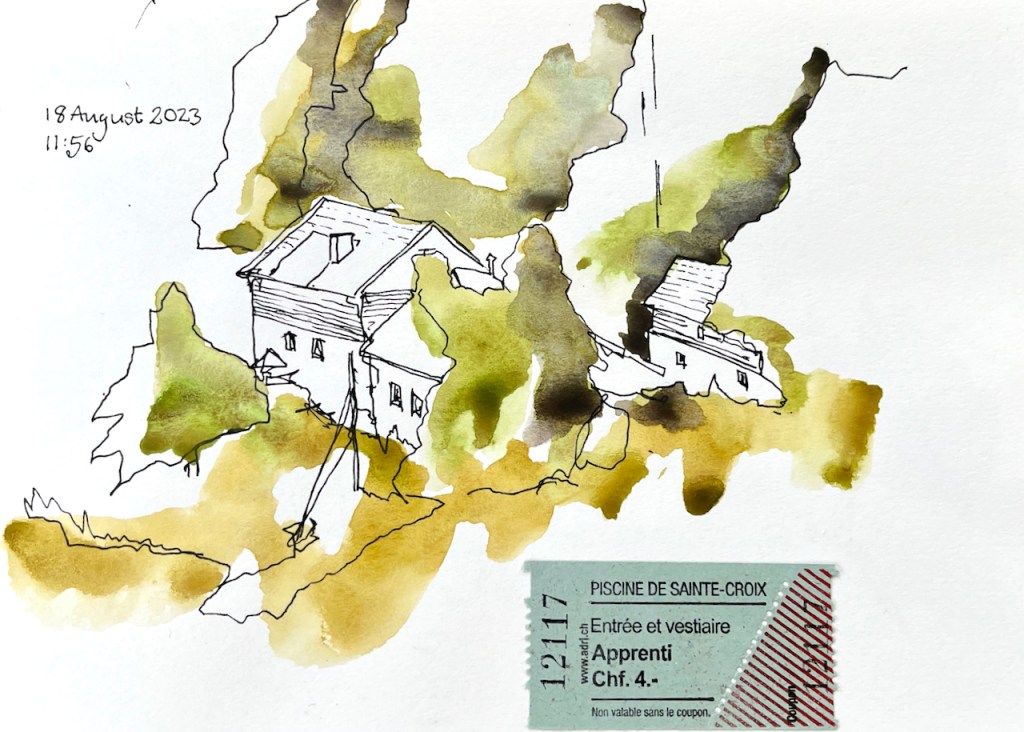
I went to the swimming pool. On the way back I stopped to sketch the sloping hill and a house in the trees.

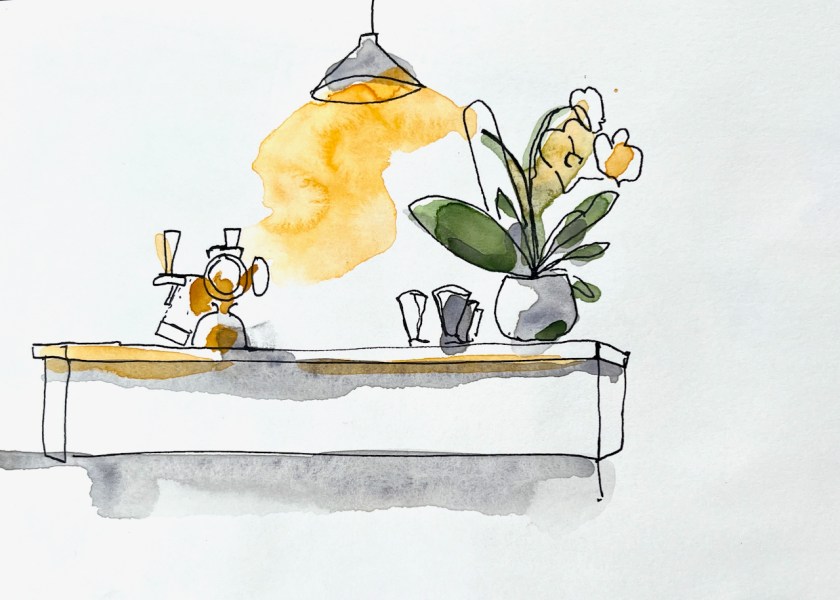
Here’s a view of the bar at the hotel.

Here’s a flip-through of the sketchbook. 20 seconds of silent video. [This video and the gallery beneath may not show on email or phones so if there’s a problem please see the web version of this post]

Sketchbook flip-through. Sketchbook from the Vintage Paper Company.

I’ve sketched in Switzerland before. Here are some other other drawings I’ve done in the same location:

Swiss house on a hill

Here is 23 rue du Petit-Montreux, Sainte-Croix, Vaud. I sketched this house after breakfast. The sun was bright and I rushed out into the crisp morning. It took me…

read this post…

View from a Swiss Hotel

It was raining in Switzerland. Here is a sketch I did looking out of the window of the Hôtel de France, Sainte-Croix, Vaud. The building with the flags is…

read this post…

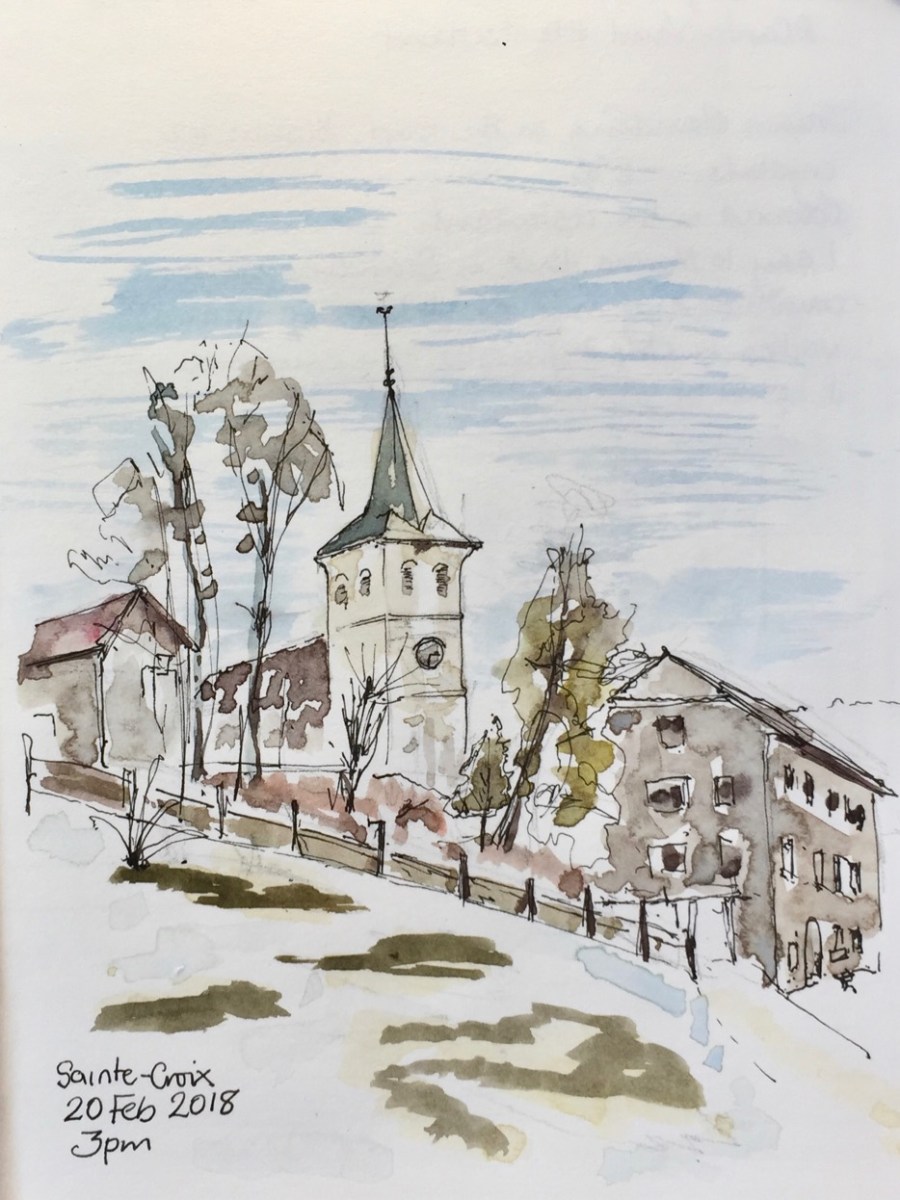
Sainte-Croix, February 2020

The weather in the Jura mountains is changing. This is climate change, the residents tell me. Once, the snow came reliably every year, bringing skiers. Now, the snow is…

read this post…

Sainte-Croix, Vaud

This is the church. Drawn and coloured on location, about 1 degree C. That’s snow in the foreground. Then later, it was colder. Hotel de France, drawn from the…

read this post…

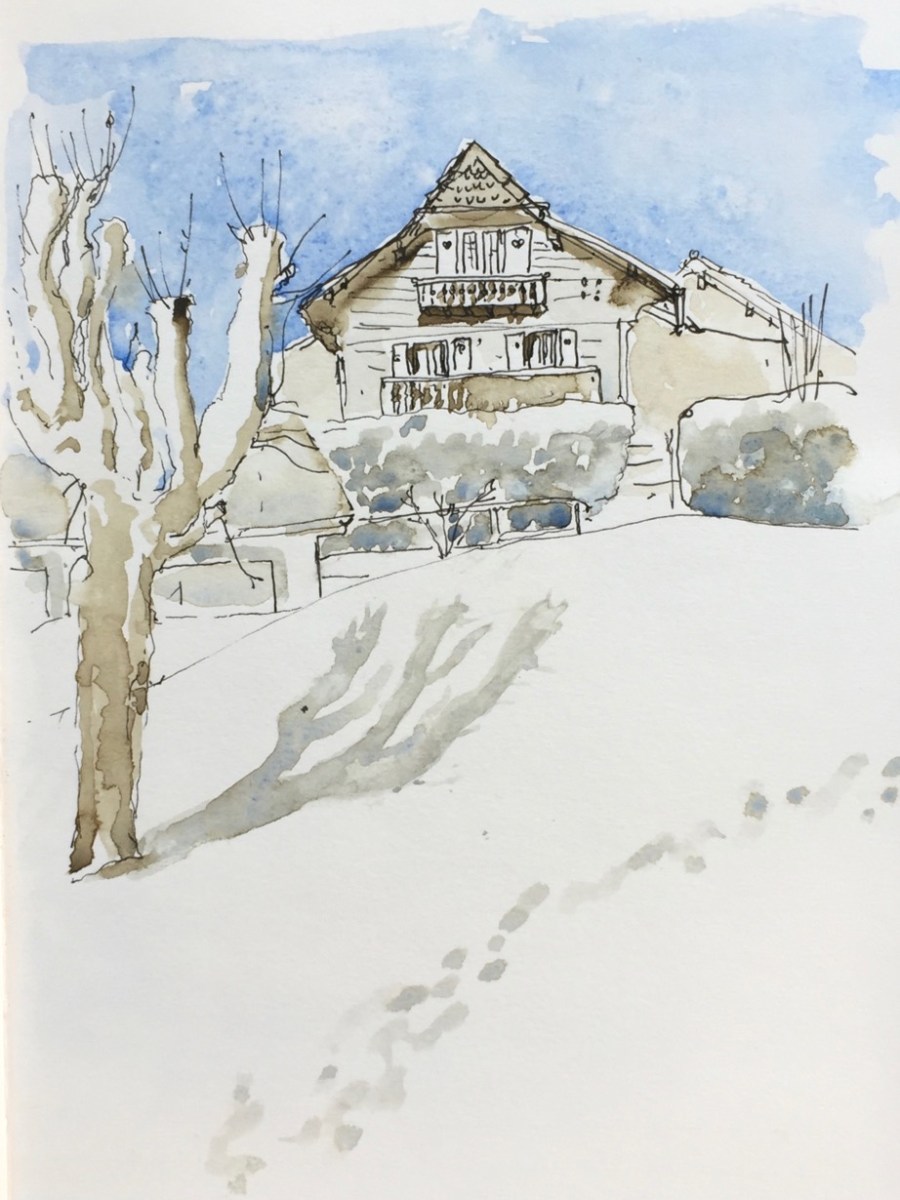
Snow in Sainte-Croix

Snowfield behind the church. Painted with melted snow as I forgot to bring water. All done standing up as everything was wet and cold. Snow blew from the roof…

read this post…

Sketches in Switzerland – Spring 2022

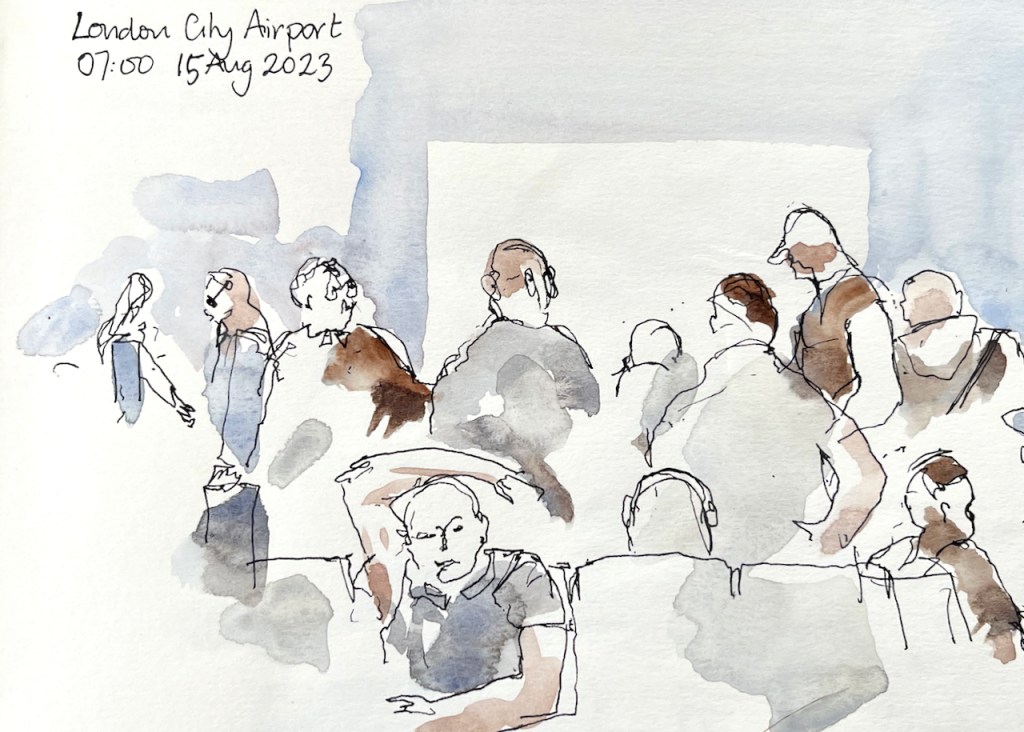
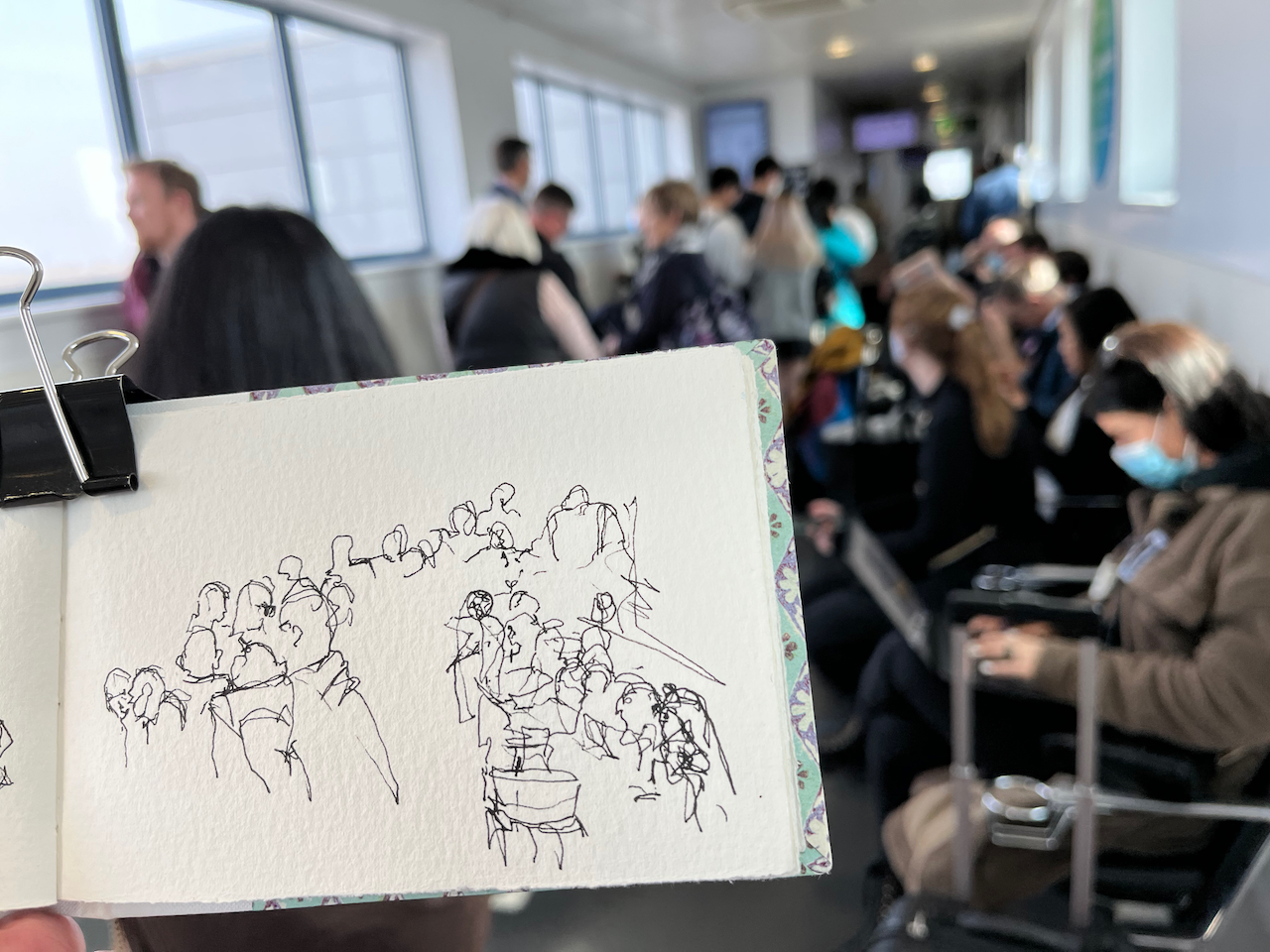
Waiting in London City airport…

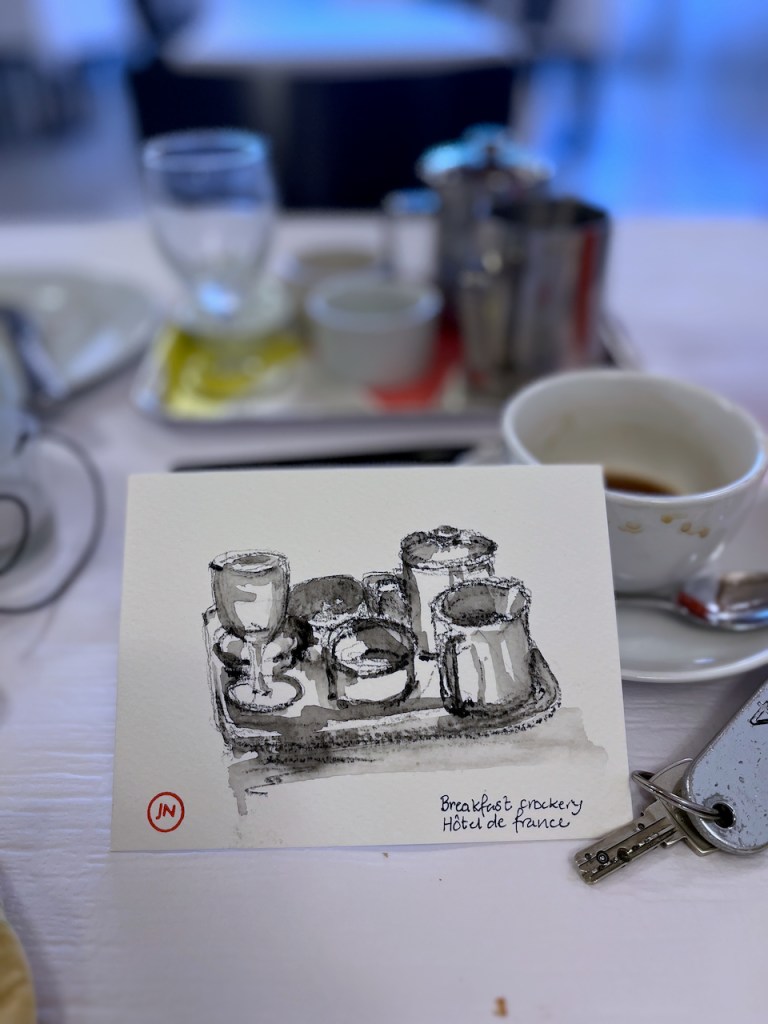
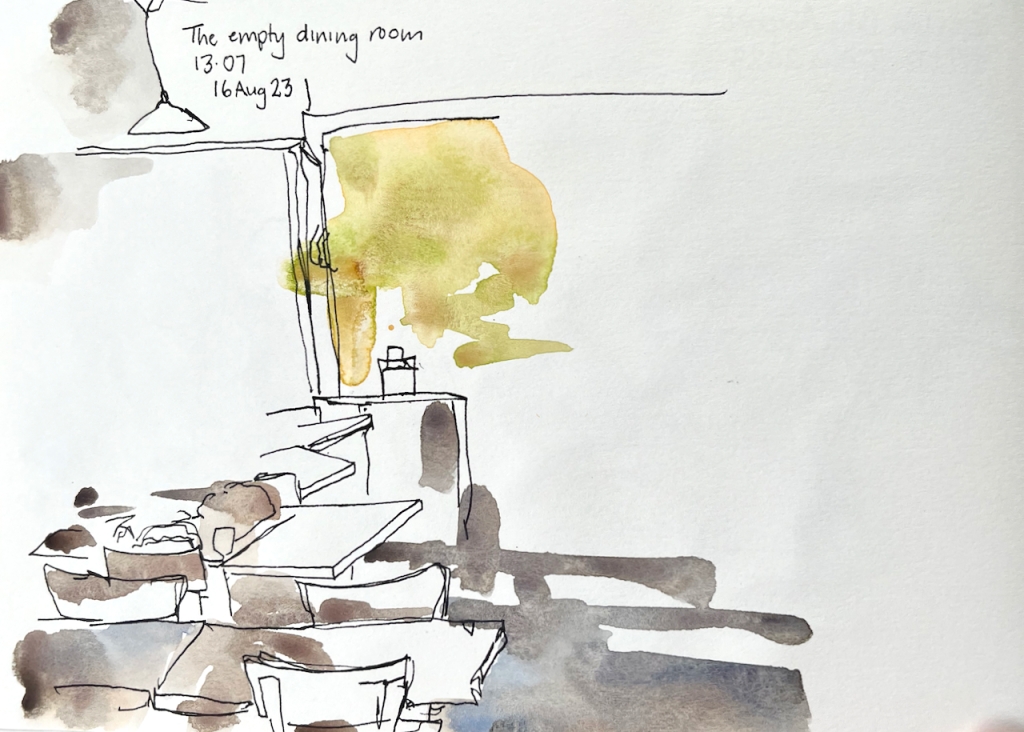
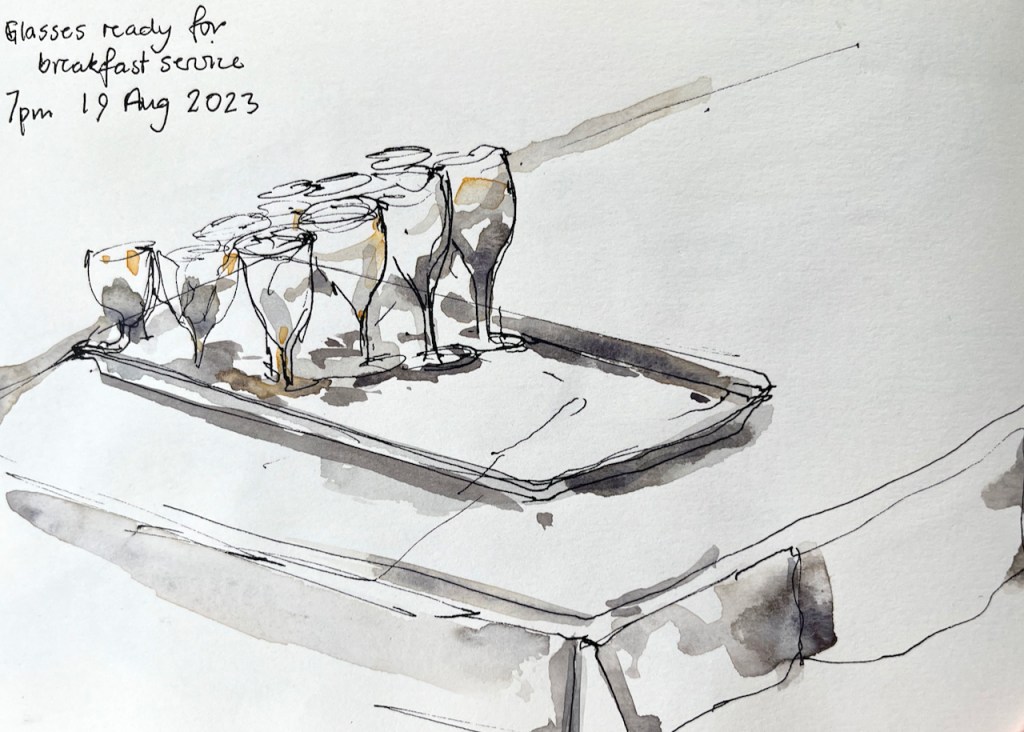
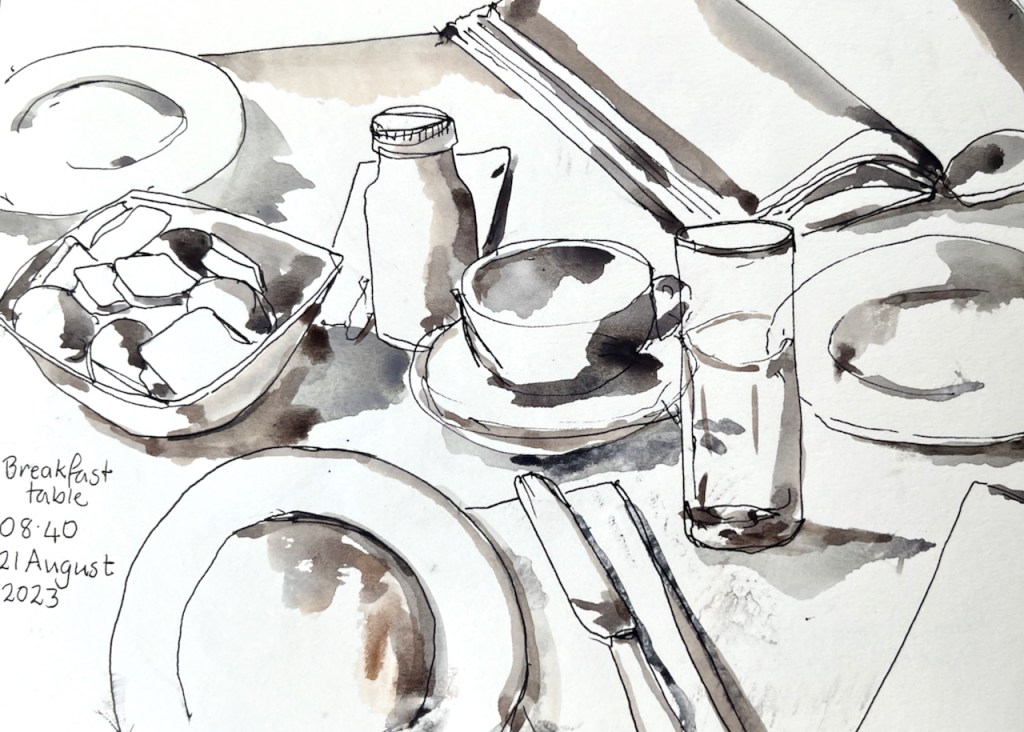
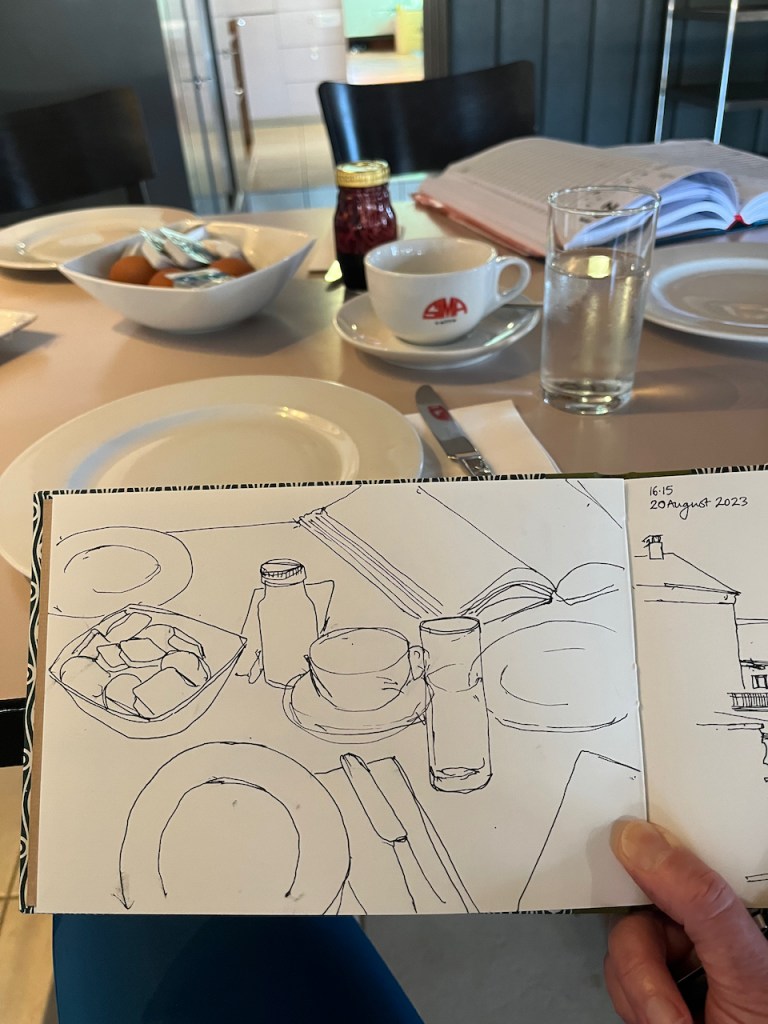
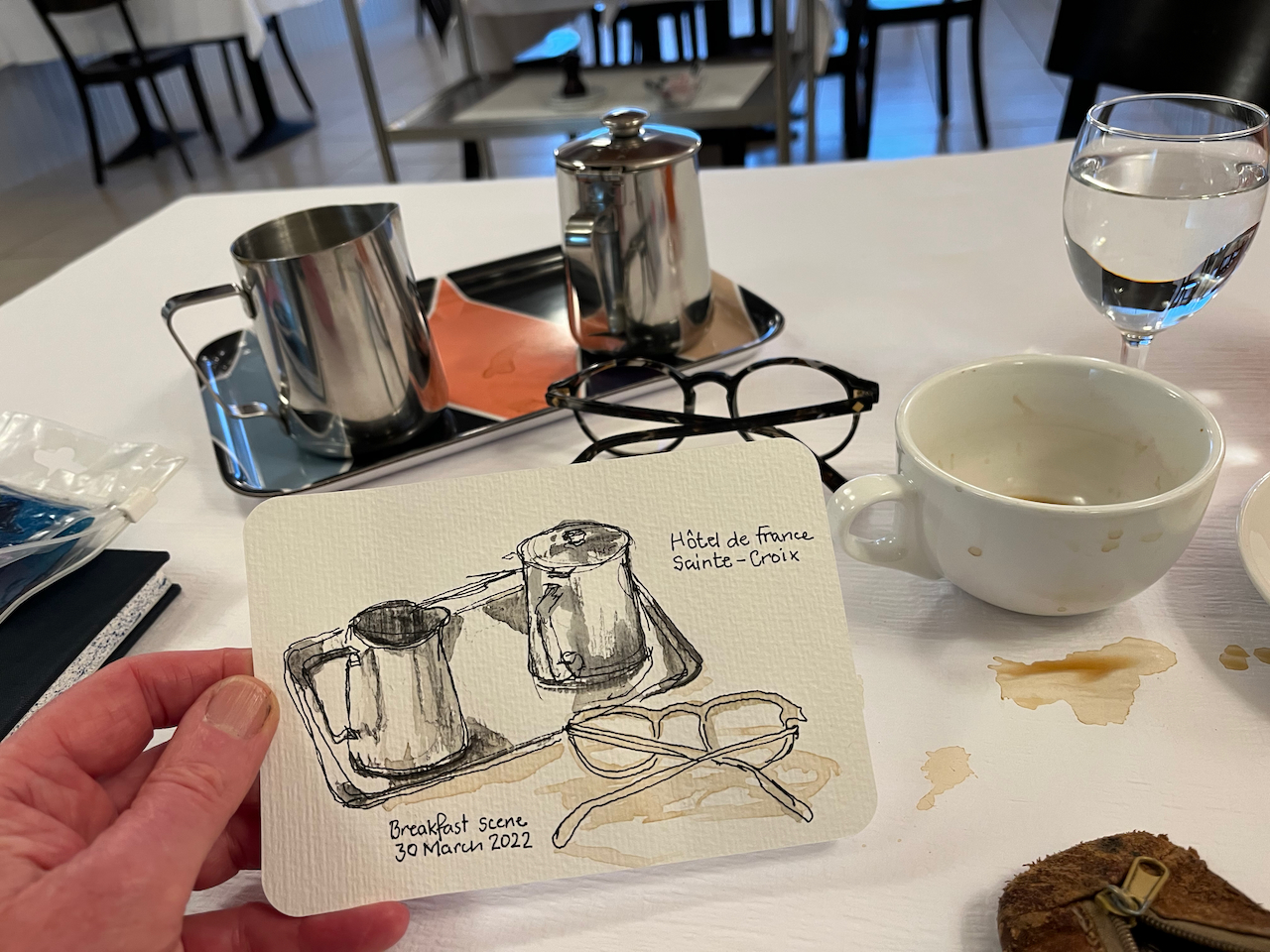
Breakfast…

Looking out of the window…

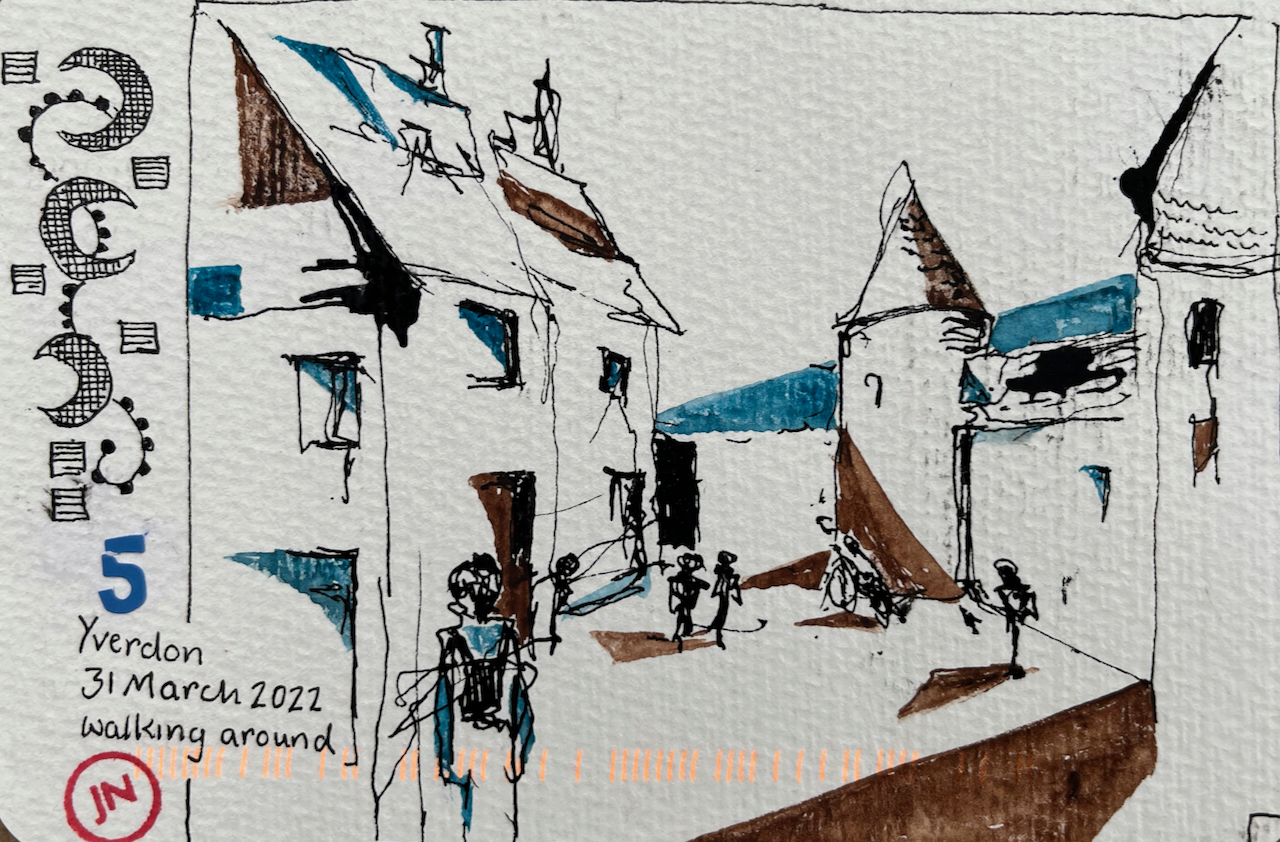
Walking around…

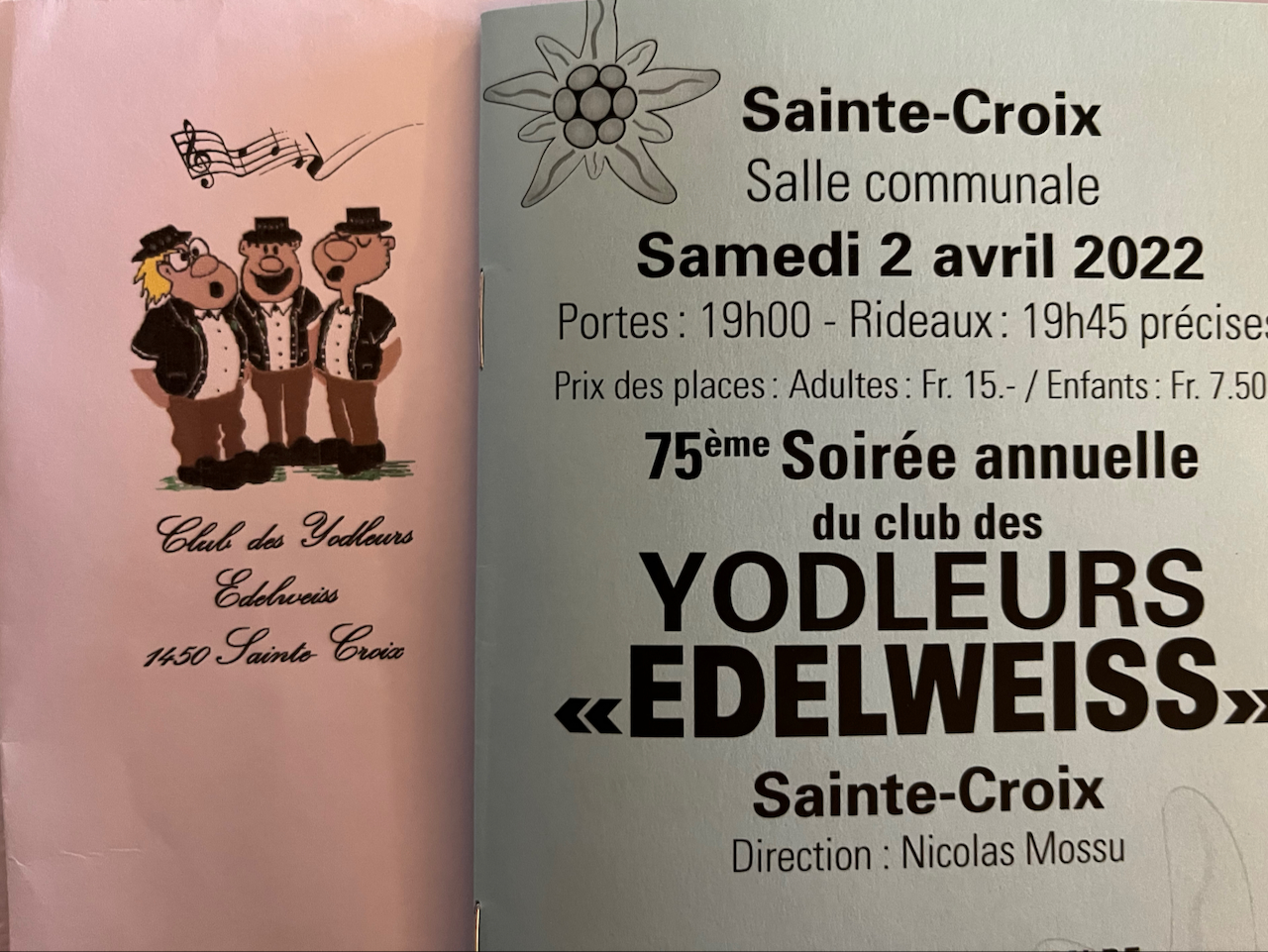
A rich cultural spectacle:

Photographs absolutely not allowed, but sketching was OK. It was very crowded, and great fun to hear the expert yodleurs. They sung in French.

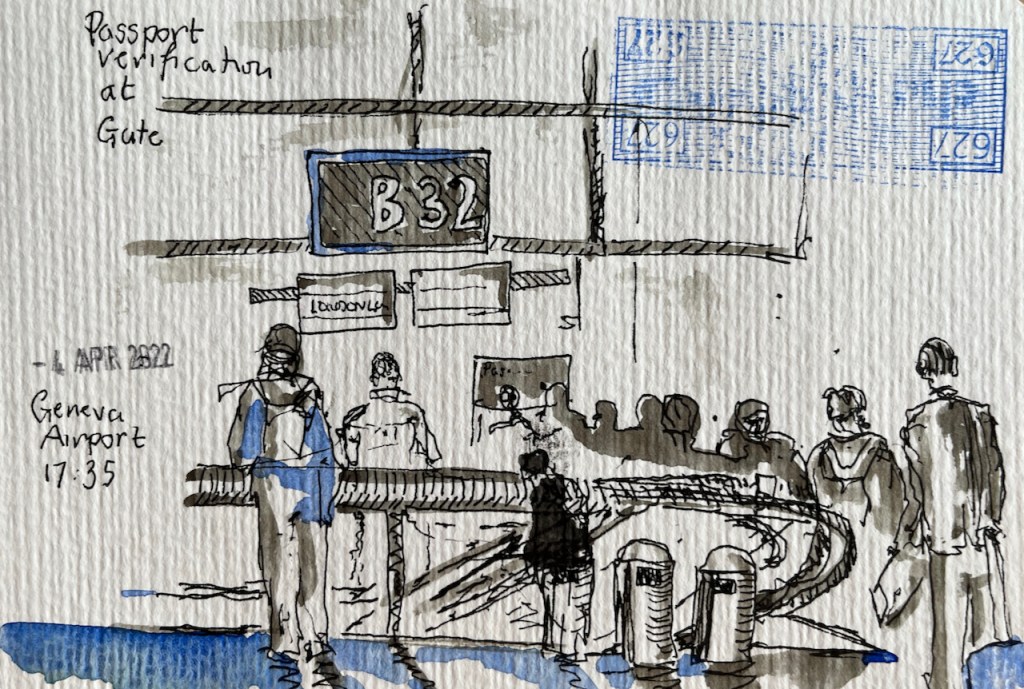
Sketching on the journey back to London. Passports were checked four times: at check-in, at border passport control, and again at the gate in Geneva (shown below), and again on arrival in the UK.

The friendly passport officer at Gate B32 kindly agreed to add his stamp to my picture. You see his blue rectangular contribution in the top right.

Sketching on the plane:

In between all this sketching I did some work…..and went walking in the snow.

Near Sainte-Croix, Vaud.

Temple d’Yverdon-les-Bains

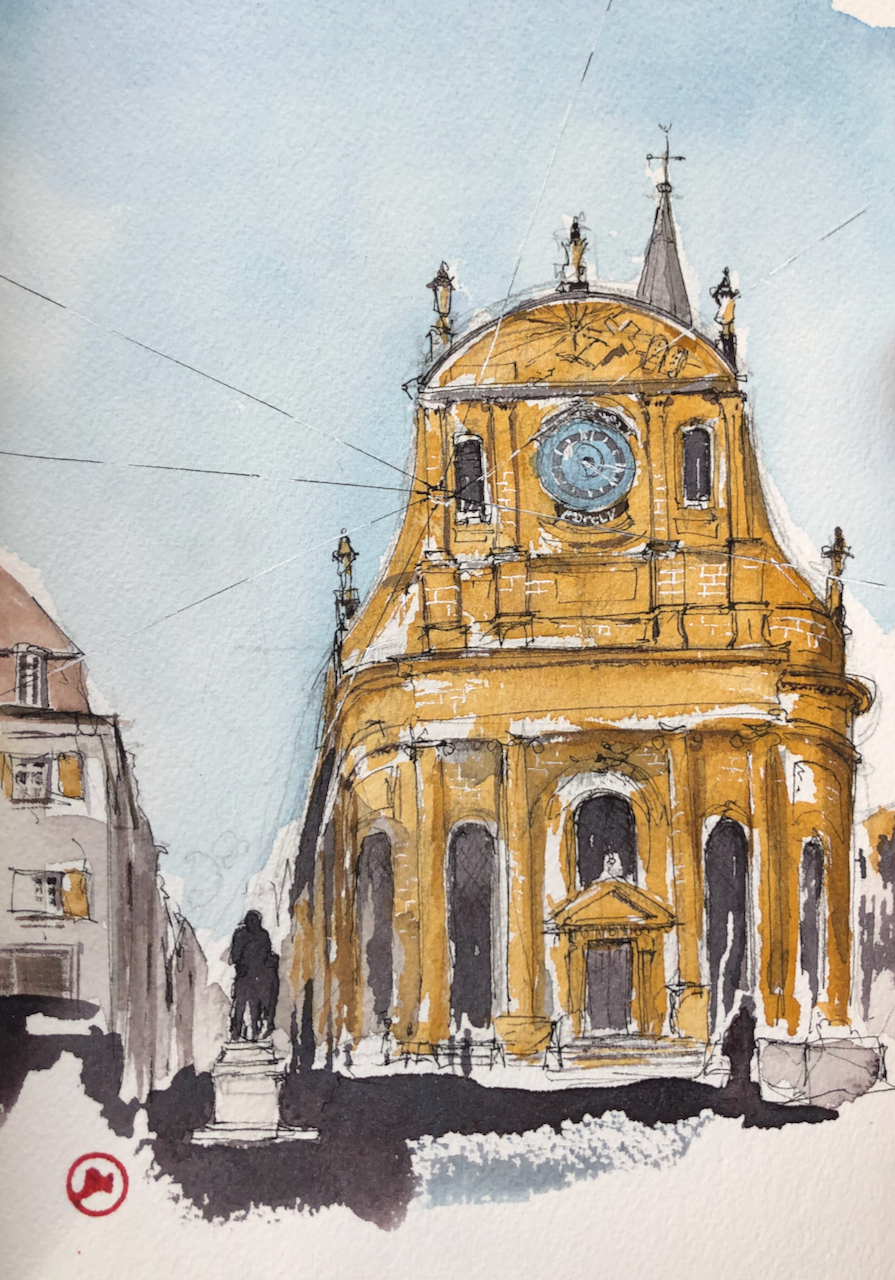
Here is a view from a bench in the main square in Yverdon-les-Bains, Vaud, Switzerland.

Temple d’Yverdon-les-Bains, 27 October 2021, 3.30pm, 10″ x7″ in Sketchbook 11

This is a protestant church, built in 1757. The wonderful yellow stone is from Hauterive in the canton of Neuchâtel.

On the left you see the statue of Johann Heinrich Pestalozzi, for whom this central square in named. He lived 1746-1827. He was an educator, and established the idea that the process of teaching needs to be thought about. He was an early practitioner of the study of teaching: pedagogy. This is why on his statue there are also children.

Pestalozzi’s idea was “Learning by head, hand and heart”. He thought that education was a good idea, in general, for everybody, including the poor. It was good for people as individuals, and good for society in general. Education meant people contributed more, were healthier and happier, and generally better citizens. [My paraphrase of what I’ve read on the website of the JH Pestalozzi Society and elsewhere]. This all sounds very modern. The current ideas of “child-centred learning” for example, can be traced back to Pestalozzi, I read, as well as the concept of state education.

He initiated the Pestalozzi Children’s villages in Switzerland and elsewhere, specifically to help the poor and displaced. This work is still continuing as Pestalozzi World.

So Pestalozzi was a very influential person.

The lines in my drawing are wires suspended across the square for hanging banners and decorations. I like to think they also symbolise the rays of hope that education brings.

Later note:

Above the clock is the Latin inscription: SUPERNA QUAERITE

This roughly translates as “Seek higher things” or “Enquire upon matters of a higher order”.

It occurs in the Letters of Paul to the Colossians, Chapter 3 verse 2, which is rendered in my St James’ Bible as:

If then ye were raised together with Christ, seek the things that are above, where Christ is, seated on the right hand of God. Set your mind on the things that are above, not on the things that are on the earth.

Or if you prefer the Latin, from “Novum Testamentum Domini Nostri Jesu Christi”(“The New Testament. A Latin version prepared by Theodore Beza”[2010], via GoogleBooks):

Itaque si resurrexistis cum Christo superna quaerite ubi Christus est ad dextrum Dei sedens. Superna satagite non terrestria.

Below the clock are the Roman numerals: MDCCLV

1000+500+100+100+50+5 = 1755