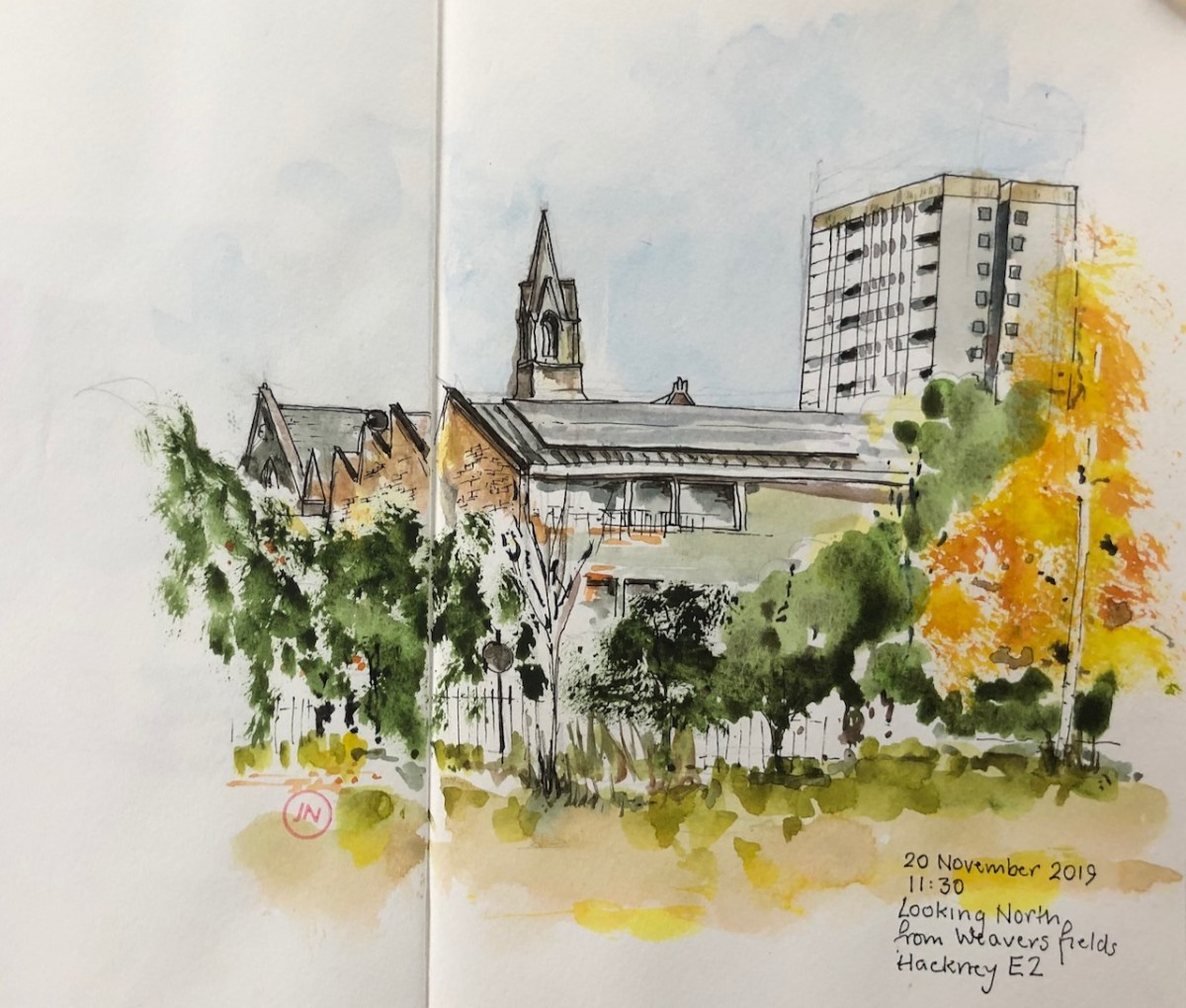
Weavers Fields, and Worship Street

On Wednesday I went for a peregrination around Hackney, north and east of Brick Lane.
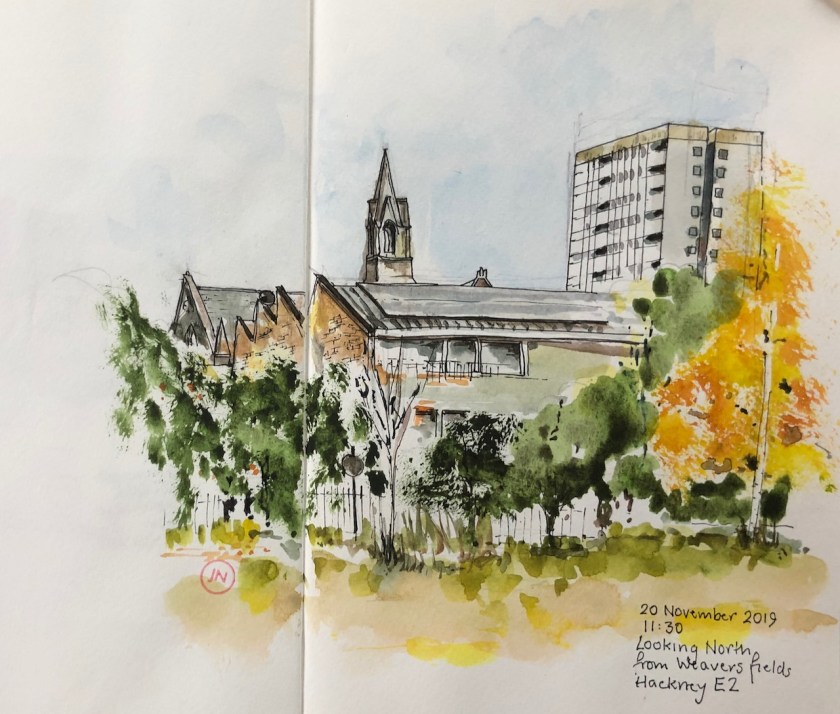
IMG_0343

I drew this sitting on a bench on Weavers’ Fields. The tower block is Charles Dickens House. The church which you can just see is on the junction of Pollard Row and the Bethnal Green Road. It is a deconsecrated church, and looks as though it’s been converted to residential flats. The building with the roof, straight ahead, is on Derbyshire Road E2. It’s clearly been industrial in its time, now it looks vaguely high-tech. Note the long solar panel on the roof.

It was incredibly cold, about 5 degrees C. But very bright sun, so the solar panel must have been working.

I walked on back to the city. In amongst the office blocks it was warmer. I tucked myself into the angle of a building and drew this:

IMG_0344

This is 101 Worship Street, in the beautiful row of workshops designed by Philip Webb. If I were to make the untold millions necessary, I would buy up this row and look after it. I have had my eye on it for a while, ready to campaign if it were threatened. At the far end, sketchily shown behind the cars, is a sort of font or water fountain, with a sharp angled roof. The houses are not in good repair, and evidently listed or they’d have been pulled down by now. They are surrounded by the huge developments of Hoxton and the City of London, as you see behind. This is the “fin tech” area. But these houses survive, against the odds, tribute to the utopian dreams of a previous era.

99 Leman Street E1 – Co-operative Wholesale Society (CWS)

This huge redbrick building in Leman Street stands proudly amongst the 21st century steel and glass. Inscribed round its windows and above its door in letters a foot high are the words “Co-operative Wholesale Society Limited”. The words are spelled out in full, and written in stone. Oh, those confident and visionary Victorians!

The Co-operative Wholesale Society’s  London Branch headquarters were built to designs by J. F. Goodey of 1885. At the formal opening on 2 November 1887, the CWS announced that it should ‘be their aim to make this beautiful building a common home for all the various movements having for their object the interest and advancement of the working people. They had with them their friend, the Rev. S. A. Barnett, and they hoped to work hand in hand with him and the residents of Toynbee Hall, in giving a message of hope to the people of the neighbourhood’

from the “Survey of London” [https://surveyoflondon.org/map/feature/1264/detail/]

IMG_2035

A thin plastic sign by the street door says “Sugar House”. It is now apartments.

This drawing done very quickly, in about 10-15 minutes, as the sun was setting and I was tired and cold. From the junction of Chamber St and Leman St.

A walk to Wapping

Today was a beautiful day. It was a day to go for a walk.

I went to the river. Near Old Billingsgate I looked under London Bridge and saw Tower Bridge and HMS Belfast. This is a 15 minute sketch, watercolour-only, no pen.

IMG_1730

Onwards towards the East, I stood on Sugar Quay, which has only just re-opened after years of being closed while the nearby hotel is built.

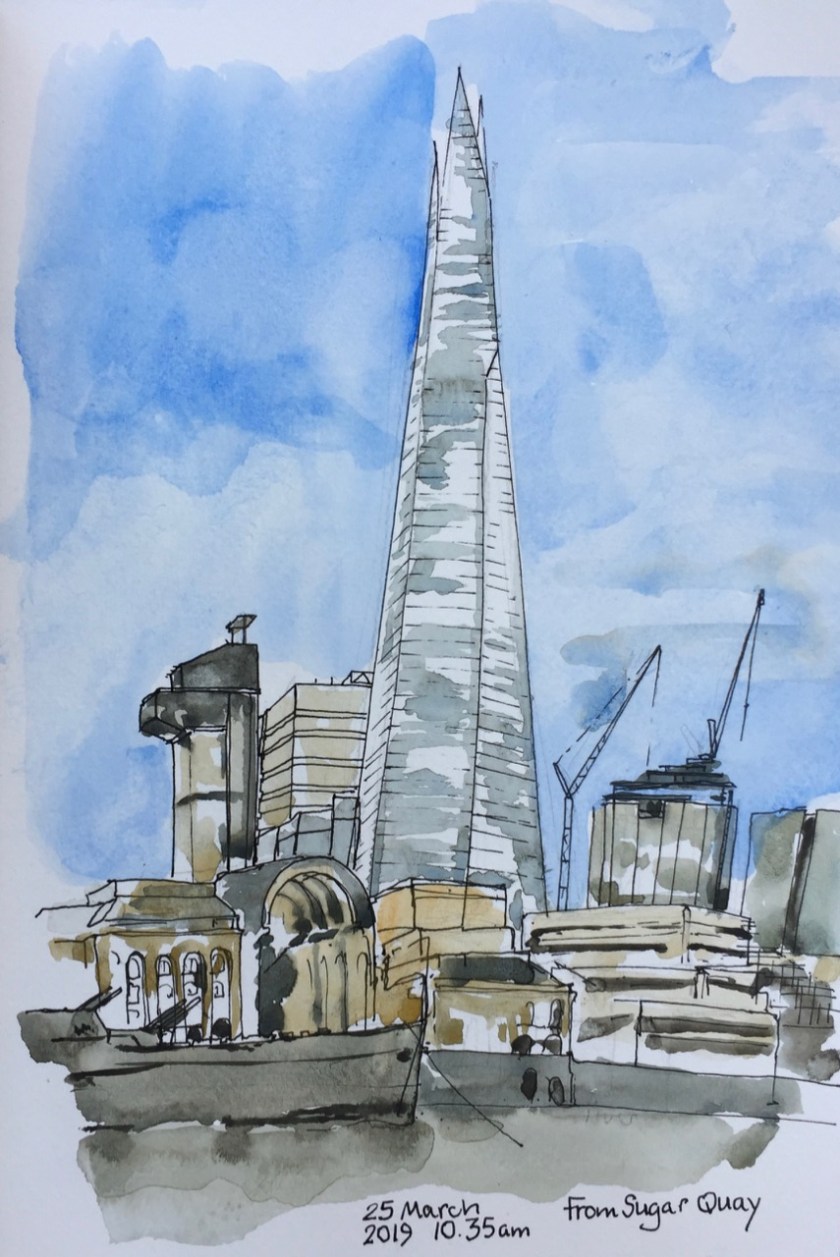
Here is the Shard, in context,  from a wooden bench on Sugar Quay.

IMG_1729

This map shows my walk:

IMG_1731

Tourists congregate around Tower Bridge. East of Tower Bridge, after St Katherines Dock, there are no tourists at all. It was suddenly very quiet. I went down “Alderman Steps”. There was this great view. The wind was fierce, and my eyes were streaming. I had a go anyway. Two mallards bobbed around amongst the floating quays, chatting away, looking around as if searching for something lost.

IMG_1728

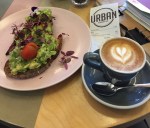
Then I went on East. I had lunch in a hipster café called “Urban Baristas” on Wapping High Street.

IMG_1677
Lunch at the hipster café “Urban Baristas”

A man at the next table discussed flats on his mobile phone. He said Shoreditch was too expensive, so he was looking in Wapping. He’d found a good place, a view of the river, open plan, lots of space. Maybe it was offices he was describing, not flats.

Then I went on East. The river opens out here, it starts to feel more like an estuary. There are 1980s flats, brick-built, but in the river shores are the remains of the old trade: the old chains, the stanchions, huge shafts of timber, rotting piers.

Then the river bends again, and there’s a magnificent view of Canary Wharf.

IMG_1727

I drew this in about an hour, sitting in sunlight spiked with the smell of someone else’s fish and chips.

Here is work in progress:

Here is me drawing:

IMG_1715

Trinity Buoy Wharf

The headlines in the Evening Standard had described the pollution levels in central London at “Red Alert” levels. So I headed East to the clearer air and big skies of the maritime Thames.

Trinity Buoy Wharf is here:

img_9495

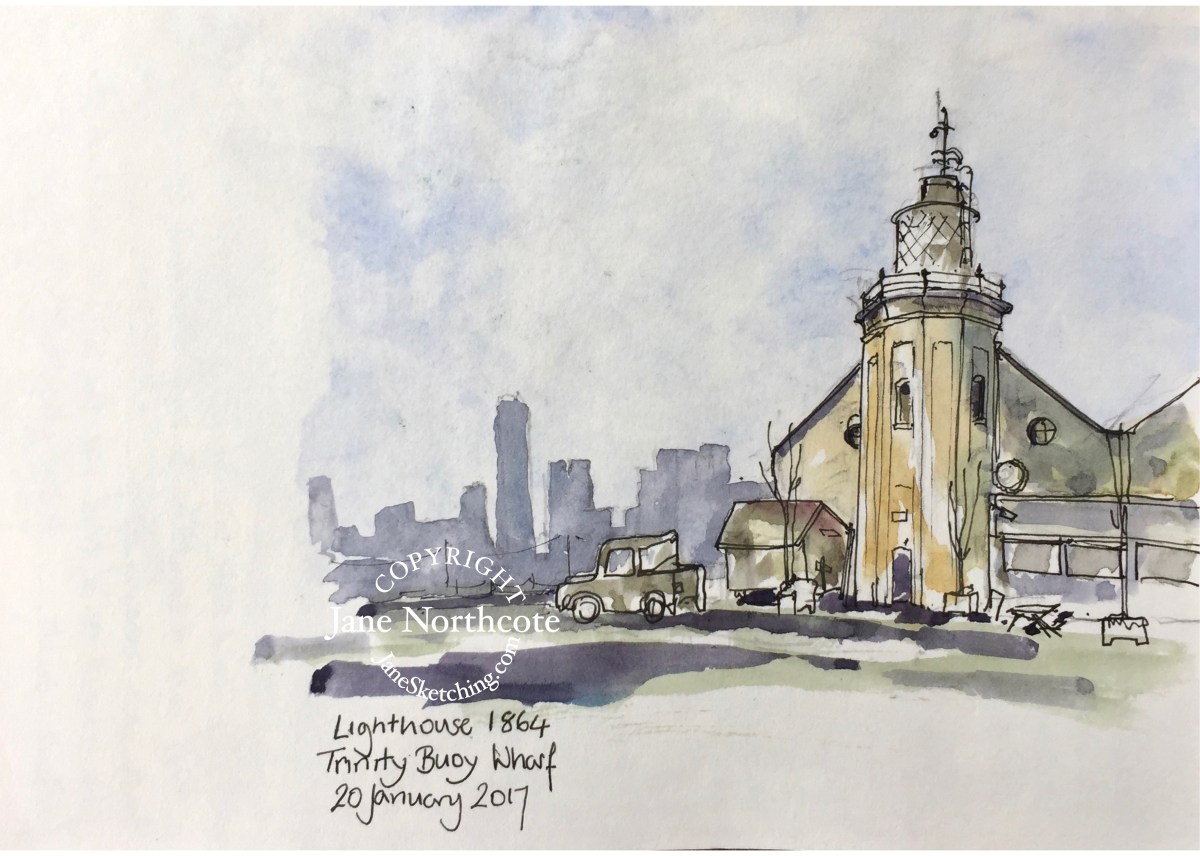
I drew a picture of the lighthouse.

Above me, four stories of shipping containers contain offices. Words floated down.

“That was his first investment. He hasn’t really been improving. … To be fair, he does wear a luminescent hat. If that isn’t a warning sticker I don’t know what is.”

I continued drawing. The shed on the left of the lighthouse contains a small display called “The Faraday Effect”. Inside the shed I learned that

“there used to be two lighthouses here. The original one was built in 1854 and demolished in the late 1920s. This was the building used by Micheal Faraday in his scientific work for Trinity House.  The roof space adjoining the surviving lighthouse, which was built in 1864, housed Faraday’s workshop for examining lenses and other apparatus”

I was glad I’d drawn the roof adjoining the lighthouse. The building below it, on the right of the picture, is “Fat Boys Diner” with a Pepsi sign on top. I’ve not been in there yet.

The Faraday Effect is the phenomenon whereby when polarised light passes through a magnetic field, the polarisation rotates. Faraday also showed that light is affected by magnet force. He discovered electromagnetic induction: that electricity can be made by rotating a coil of wire in a magnetic field. Hence power stations, and much else.

Before I drew the lighthouse, I had a coffee in the marvellous “Bow Creek Café”. From there I drew this picture:

img_9491

There was a lot of light. The things in the foreground were dark, and the boat shone.

The light-bulb shaped object on the left is a construction on top of a number of blue containers labelled “ENO” in the English National Opera logo.

On the left is the lightship, which is red, called “Lightship95 Audio Recording Studio”.