The winter evening settles down With smell of steaks in passageways. Six o’clock. The burnt-out ends of smoky days. And now a gusty shower wraps The grimy scraps Of withered leaves about your feet And newspapers from vacant lots; The showers beat On broken blinds and chimney-pots, And at the corner of the street A lonely cab-horse steams and stamps. And then the lighting of the lamps.
T.S. Eliot – Preludes
There are still quite a few gas lights in London. I aim to draw as many as possible before they are taken out of service. It’s quite remarkable that there are so many in operation. This one is in Guildhall Yard, in the City of London. St Lawrence Jewry is in the background.
Gaslight, and St Lawrence Jewry, from Guildhall Buildings
Here is the gas light close up, drawn from Guildhall Yard, looking south.
Written on the little blue canister are the words:
“…the Solar Dial which automatically adjusted lighting times at dusk and dawn throughout the year. It was the start of nearly eighty years of Horstmann’s manufacturing involvement in the street lighting controls market.”
However before this innovation, the gas might have been lit by a person, because there is the arm for the ladder, as shown in my drawing. Perhaps that arm was always there, though, even after automation, in case someone needed to inspect the light. The North face of the light, the one shown in my picture, includes hinges on the left, and evidently could be opened.
I do not know if this light still functions. I shall take a diversion that way in the night, and let you know.*
I have drawn another local gas light, which does still function, off King Edward Street.
Gaslights on Queen Isabella Way
Location of Queen Isabella Way
All pictures drawn and coloured on location. Pen and wash.
*Update: It works!
06:45 15th October 2019, Guildhall Buildings
Click a button below to share this post online, email it, or print it:
There’s a lot of restoration work going on at Canterbury Cathedral at the moment. The ceiling of the main nave was covered up, and one of the towers was wrapped in scaffolding. Also, it being Sunday, a part of the nave was occupied, reasonably enough, with a service. There was much to see, notably the quiet and dimly lit crypt, where there are huge strong pillars, marvellous mathematical curves and stone carvings which delighted the medievalist amongst us.
Pointing out the medieval carving
A view towards an altar in the crypt
Stairs back up to the nave
A row of pillars
A tomb in the crypt
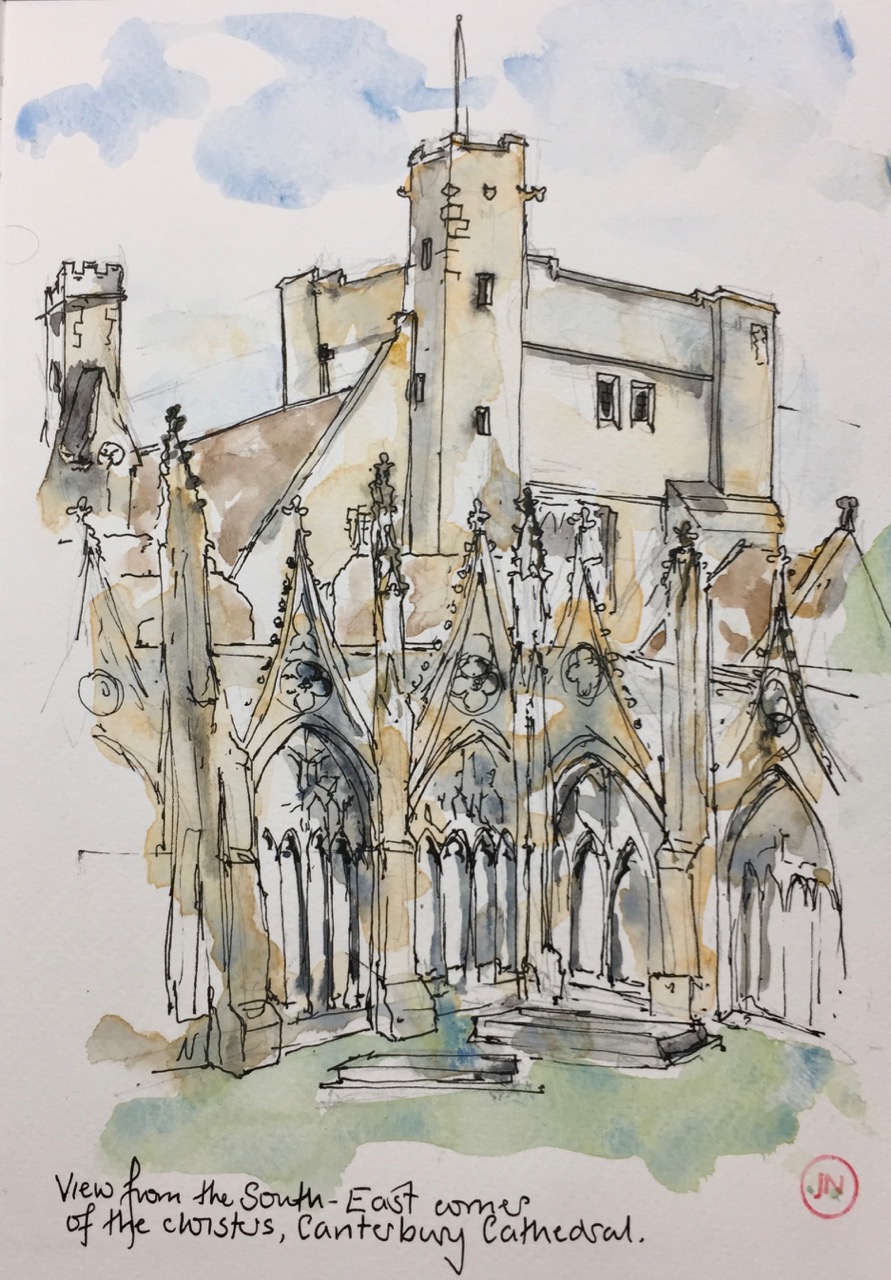
I drew a picture from the cloisters.
It was perhaps unwise to start drawing those ogee* arches with their crocketing**, but I accepted the challenge. The building in the background is The Old Palace, which is the main residence of the Archbishop of Canterbury. It was built between 1193 and 1228, and has been modified and restored since, most recently in 2006.
I drew this picture sitting on the stone surrounds of the cloisters.
Here are some maps to show where I was drawing.
Here is work in progress. The drawing took an hour, pen and ink and watercolour on location.
*ogee arches are arches with those fine points
**crocketing is the series of knobs which are often seen on spires and arches of gothic style buildings
Click a button below to share this post online, email it, or print it:
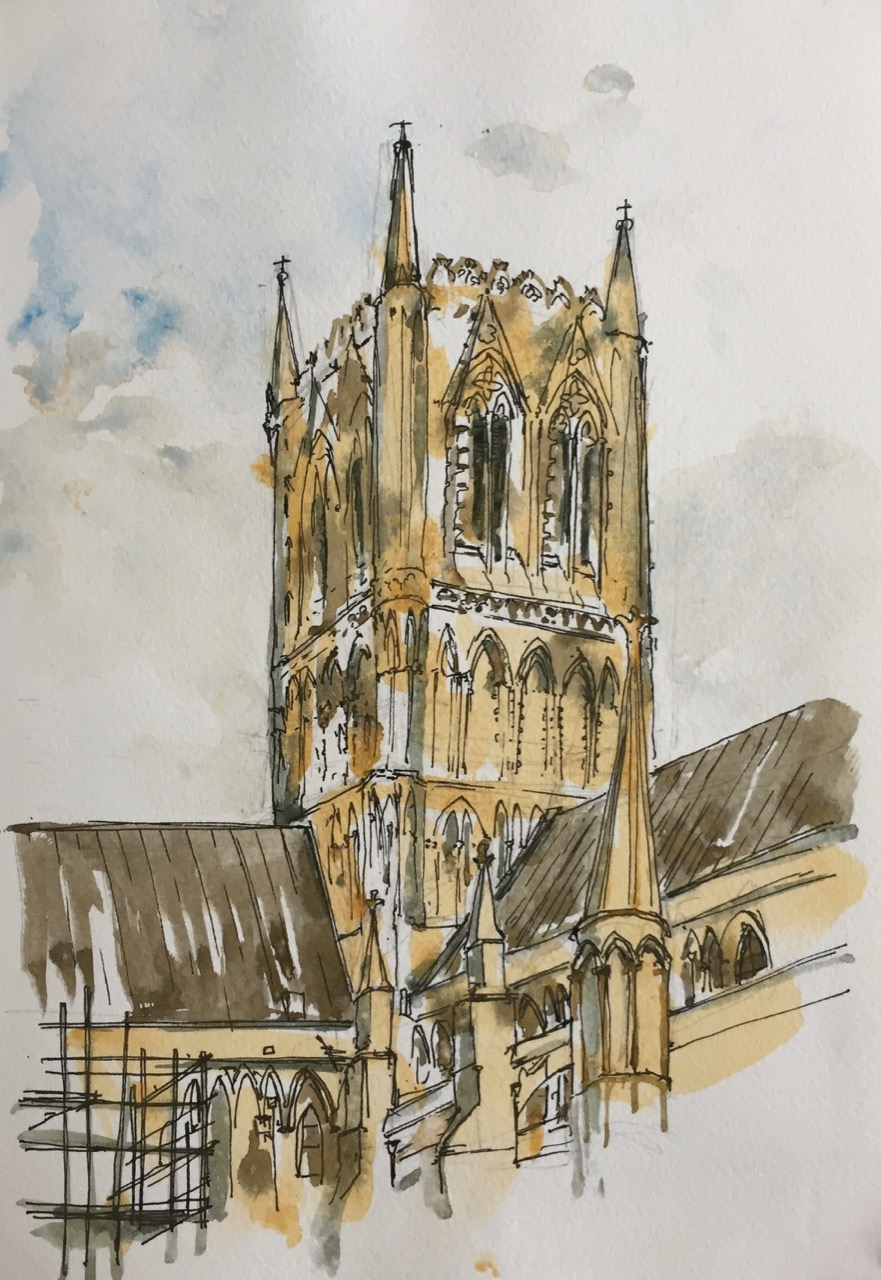
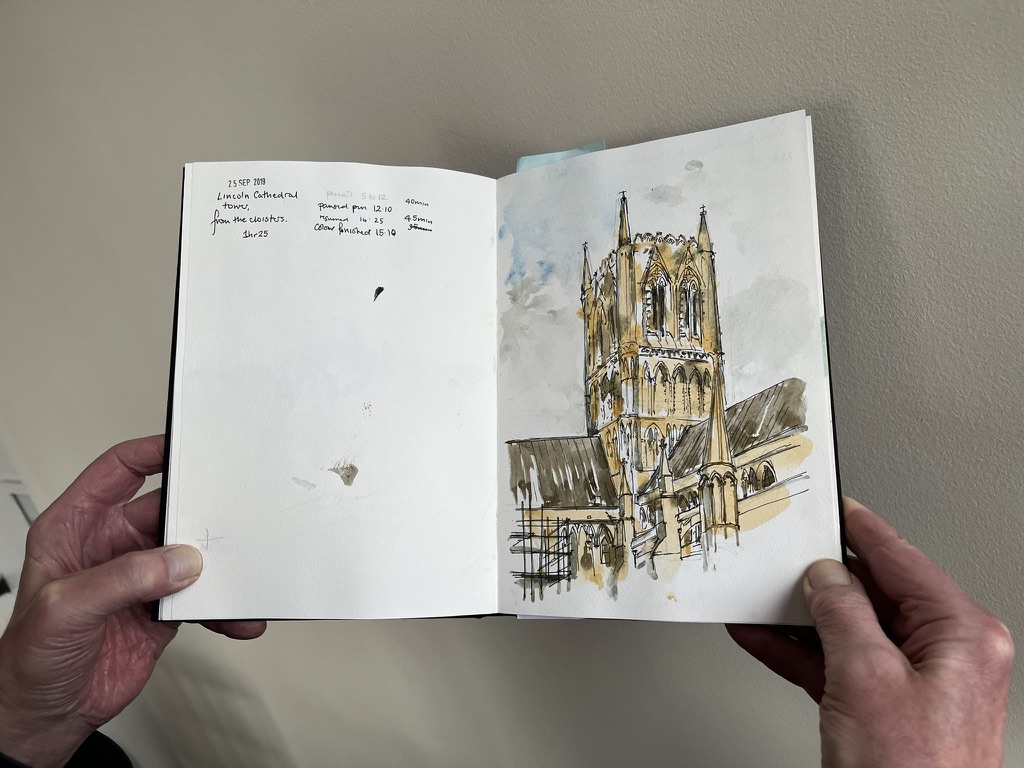
Here is a sketch of Lincoln Cathedral tower, drawn from the cloisters.
Lincoln Cathedral was originally built in 1072, as part of William the Conqueror’s programme of cathedral-building in England after his 1066 invasion.
It was partly destroyed in an earthquake in 1185. It might be more accurate to say that parts of the cathedral fell down at the time of the earthquake. The cathedral had construction faults, and the earthquake may well have triggered a collapse that was in any case imminent. The earthquake was something like 4 or 5 on the Richter scale. It’s interesting to note that such (natural) earthquakes are quite common in the UK and seem to happen every two years or so.
Then it was rebuilt in the current ornate style in around 1200.
We went on a tour. Here are some of my very quick sketches as our guide, Paul, took us around the cathedral.
Tour notes
Tour notes
Tour notes
Tour notes
Tour notes
Visitors to the cathedral
After the tour I went to the cloisters and finished my picture of the tower. Here is work in progress.
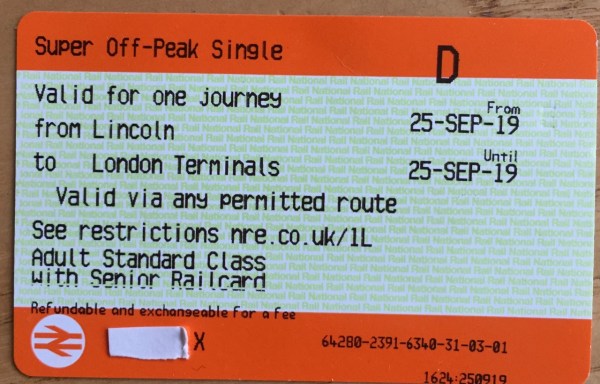
We went to Lincoln by train. It was pouring with rain but we still enjoyed the cathedral. We shall go back when we can see the sun pouring through the stained glass windows.
Finished sketch in Sketchbook 5
Click a button below to share this post online, email it, or print it:
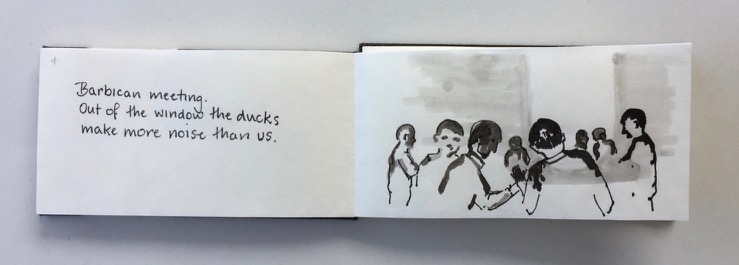
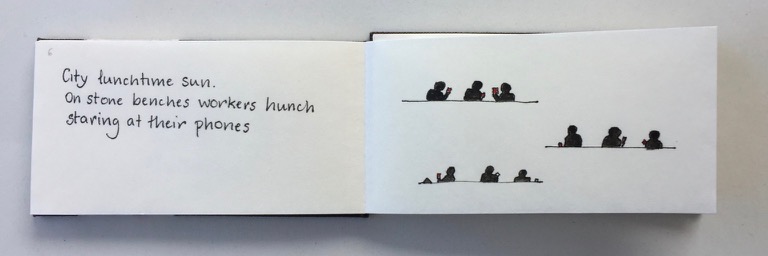
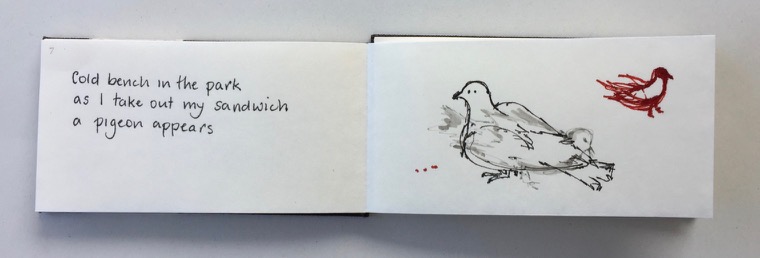
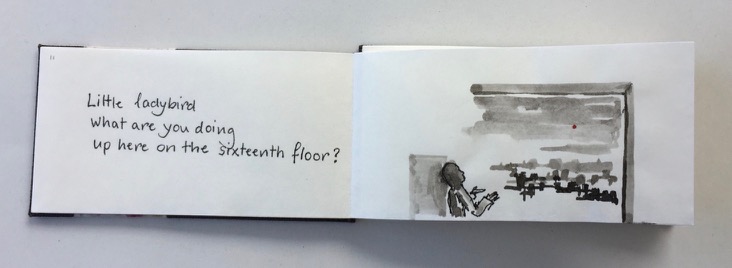
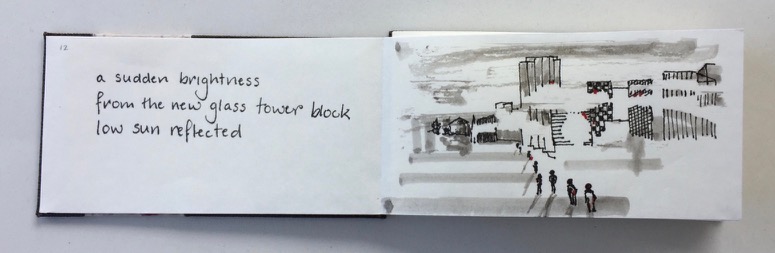
This little landscape book arrived. It arrived with a suggestion that it be used for poems or haiku, with illustrations.
Japanese lanscape book
The book is made by hand
The book is a gift from my Japanese friend and mentor, whose work can be seen on Instagram here. It is bound by hand, and contains very thin, fine paper, in a concertina, a zig-zag. In an attempt to honour the generous gift and the inspiration, I made some urban haiku, about September in London. Here they are.
My idea was to observe the following constraints. As I have said elsewhere on this blog, I am someone who finds constraints useful. Here’s the form I tried to follow:
5-7-5 syllables
some, may be oblique, reference to the season
in the present tense
nature is in there
Click a button below to share this post online, email it, or print it:
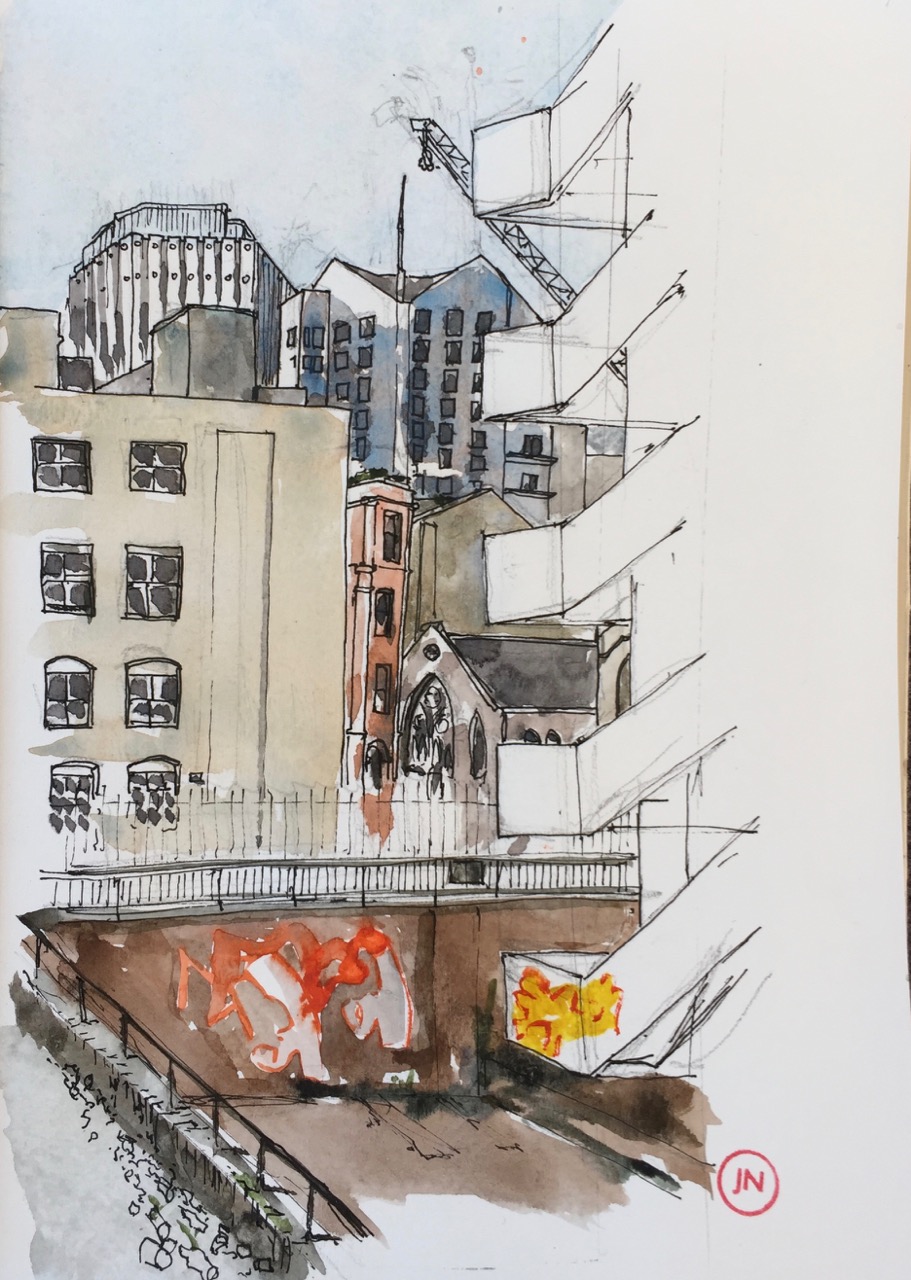
Shoreditch, in East London, is a mix of a place. In this view you see many of the constituents of the mix.
The staircase on the right is “Development House” 56-64 Leonard St. It is boarded up, and adorned with graffiti. It is not, however, empty. I saw several sets of people descend the stairs while I was drawing. It was not at all obvious what they were doing there. I could not tell if they were residents, security guards, architects, property investment professionals or graffiti artists.
There is an unremarked and very lovely statue on the side of Development House. It shows people helping each other climb a steep staircase. I can find out nothing about it. It’s an inspiring image. I hope it doesn’t get scrapped when the site is re-developed.*
Statue of the side of Development House
Statue of the side of Development House
The glorious brick wall on the left of the drawing is the back of a warehouse at 62/72 Tabernacle Street. It looks as though it might still be a warehouse, since the signboard at the front says “EMA Textiles”, and cardboard boxes are stacked behind the windows. Next to it, further left out of the picture, is 52-60 Tabernacle Street, which is also a warehouse, but that one has been renovated and all the brick is marvellously repointed and neat: “warehouse space to lease” says the notice.
The red brick building is on the opposite side of Tabernacle Street. It is “McQueen” which is a night club and bar. The gap between Development House and the nightclub is what looks like an old bomb site. It is now a car park, and is a sunken area, with remnants of walls, and buddlia bushes. It all looks rather provisional, but it’s been like that for years. Sometimes there is a dance venue in the sunken area. I’ve drawn in this area before. See this post: Shoreditch skyline
The modern buildings in the background are “White Collar Factory” on the left, a multiple occupancy office space, and the Bezier Building on the right, with the flagpole or antenna. It doesn’t look like a flagpole.
The ecclesiastical building in the centre is part of the Central Foundation Boys School, a state school.
I drew this picture standing up overlooking the litter strewn area by Development House. While I was drawing, a horn bleeped. A car drew up, running its engine. The bleep had come from a motorbike behind the car. I saw to my astonishment that the back of the car was connected to the motorbike by a strap. The car was trying to tow the motorbike. This was obviously not working out well. They had stopped to reconsider. The motorcyclist dismounted and removed his helmet. Manoeuvring followed. I returned to my drawing. They tried this twice more before giving up.
When I’d finished the pen and ink I crossed the road to a little restaurant with wooden slatted tables outside. I gestured to the table, and smiled at two people of asian appearance behind the window. They nodded and smiled and continued their dialogue with the mobile phone screen. I sat down and got out my watercolours. Before long, a smiling person appeared and asked what I wanted. I said tea. She said “Bubble tea?”. I did not know bubble tea. It was 4pm and I am English so I said “ordinary tea”. This caused her to nod, smile and disappear. She came back with a menu. I pointed to the only tea I recognised, which was “oolong tea”. “With sugar?” she said. I smiled and said no thankyou. I went on with my painting.
What appeared at my table was not what I expected. I was expecting a teapot, or a mug. Steaming. Hot. Fragrant. With a spoon, perhaps. No. What appeared was a bottle. Chilled. “Oolong tea, no sugar,” announced the server, placing the bottle ceremoniously on the table. She smiled. I smiled. She went back inside. I cautiously opened the bottle. It was indeed tea. Cold tea in a bottle. Not what I expected, but pleasant, and plentiful.
Cold tea in a bottle.
The restaurant was “Buy and Bite: Popular Taiwanese Street Food”. A new experience for me. And only a short walk from home. The food looked really good. To try. Another time. Amazing London.
Sketch map of the area
Work in progress
Work in progress
*Redevelopment of “Development House”
Online I found a planning application [Development House, 55-64 Leonard Street, London Borough of Hackney Local planning authority reference: 2017/4694]for demolition and rebuilding on this site, dated 2017. Here’s what the proposed building will look like:
But since the website declares “completion in 2018” and it is now 2019, there may be a subsequent scheme. Here’s an extract from the Allford Hall Monaghan Morris website.
Allford Hall Monaghan Morris (architects)
Completion:2018
Melvale Holding Ltd with client representative Darmouth Capital
The proposal for the new Development House will replace the tired and almost empty existing building with a new 100,000sqft per nine storey building of office with A1 activities at ground floor that will activate the frontage along Leonard Street and Circus.
Melvale Holding Limited is a company incorporated in Jersey, with a registered office in Jersey which has an address in common with a large number of other registered companies: Equity Trust (Jersey) Limited. “Melvale Group”, which may well be related, describes itself as ” a diversified management, international trade, foreign direct investment and financial advisory consulting organisation and we work for both the Private and Public enterprises and institutions.”. But I am no further on. This Melvale Group has an address in Cobham in Surrey.
Dartmouth (not Darmouth) Capital is based in the City of London. They list “Development House” in their “portfolio”, and say about it, on their website:
The scheme prepared by local architect Waugh Thiselton is for an impressive new office development of circa 90,000 sq ft which will include ancillary retail space at ground floor level. The Shoreditch area is at the heart of the Technology, Media and Telecoms sector and enjoys demand for offices, particularly for unique buildings, and is a market with limited supply.
The scheme by Waugh Thiselton is quite different from the scheme above, and pre-dates it. Here’s their 2016 proposal:
They say:
“This nine-storey timber-framed office block will be the tallest engineered timber building in London, and a beacon building for Shoreditch.”
They propose a whole lot of green and environmental ideas. But since the Allford Hall Monaghan Morris proposal is later, then that’s the one we’ll get, most likely. The street which goes back on the left of the building in their drawing is the one where I had my oolong tea, and did my drawing. None of these proposals say what is going to happen to the statue.
Click a button below to share this post online, email it, or print it:
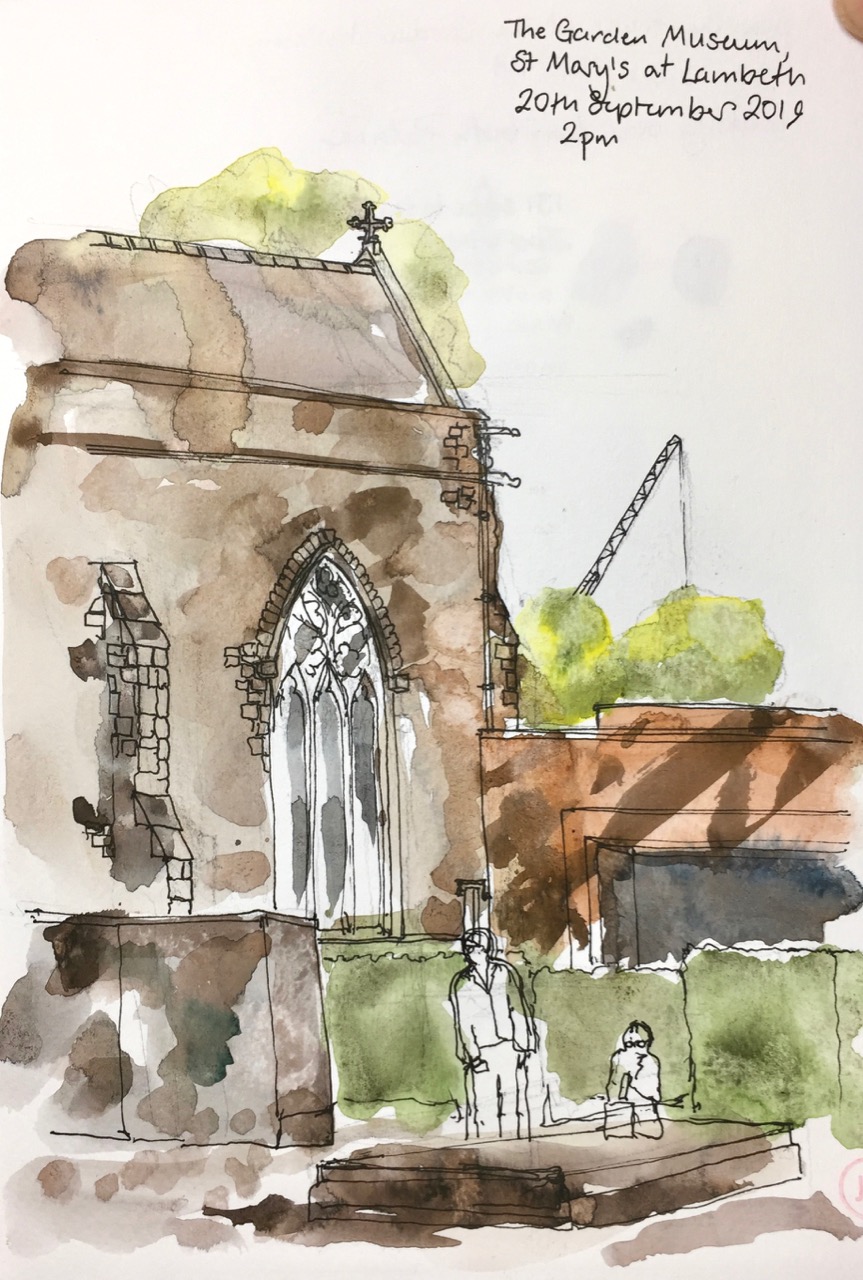
I drew a picture waiting outside the Garden Museum in Lambeth.
The Garden Museum is inside St Mary’s Church. The upmarket restaurant attached to the garden museum is the bronze-coloured cuboid on the right. The slab of stone which the tourist is sitting on is a tomb.
Prompted by an article in a newspaper, we were at the “Garden Museum” in Lambeth to see an exhibition of the art in Ladybird Books. I learned to read with Ladybird Books, as did so many others of my age. Here are pages from “Shopping With Mother”, one I remember with particular clarity. These are photos of the copy I still have, published 1958.
“Shopping With Mother” 1958
“Shopping With Mother” 1958
Note that Mother is wearing a hat and white gloves.
Since the exhibition was at the Garden Museum, they showed the art in the Ladybird Books of Trees, of Garden Flowers, and so on.
From the FT 10th Aug 2019
From the FT 10th Aug 2019
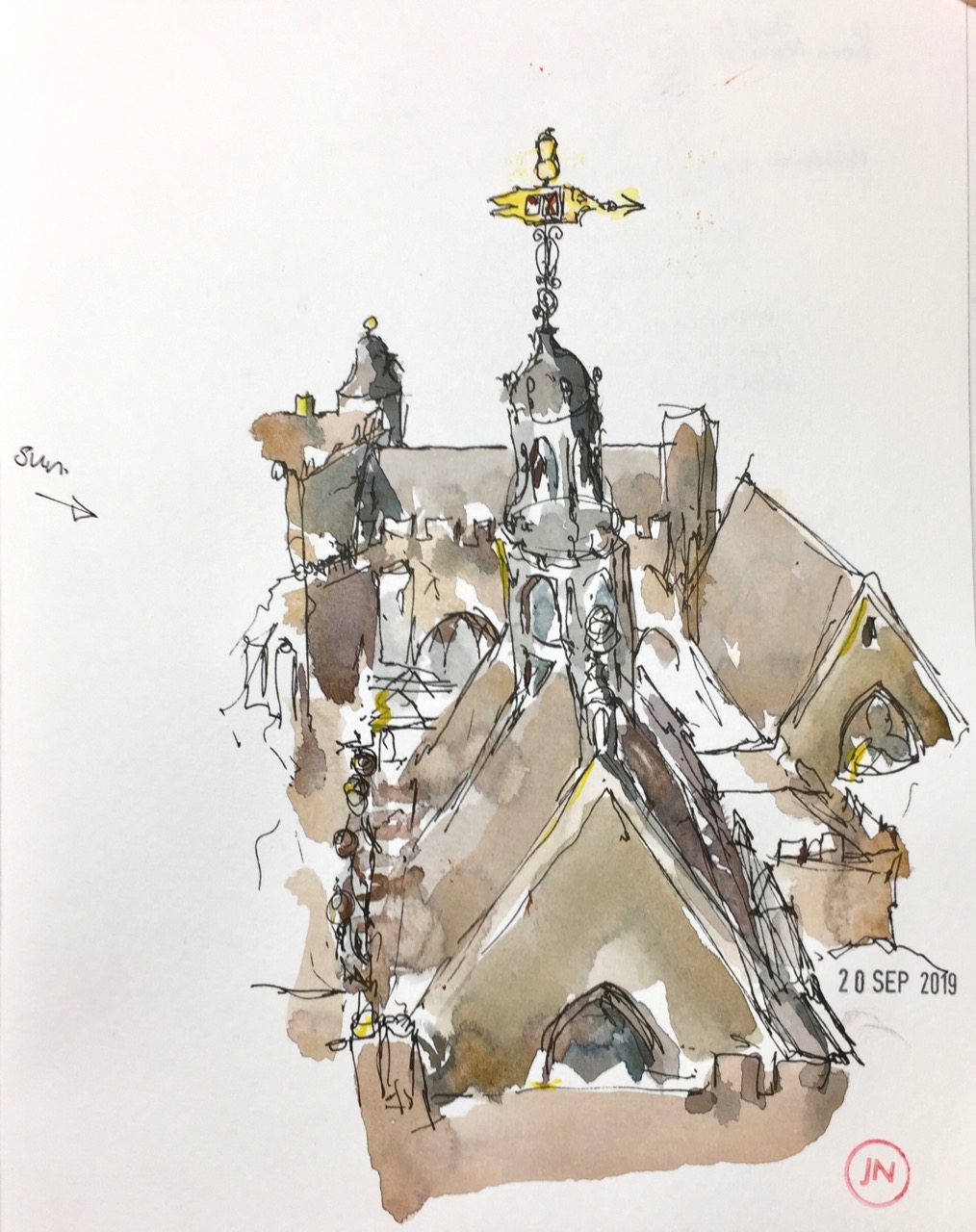
We also went up the tower of St Mary’s Church. It is 131 narrow steps. At the top it was very windy and we had a superb view. Here is what Lambeth Palace looks like from the tower.
In Victoria Tower Gardens, next to the Houses of Parliament, there was a huge demonstration to draw attention to Climate Change. The loudspeakers from speeches at the demonstration were accompanied by car horns and swearing of angry drivers, caught in traffic jams in the surrounding roads, and the wails of sirens as ambulances tried to reach St Thomas’ Hospital which is nearby. It was a soundscape of competing interests.
Click a button below to share this post online, email it, or print it:
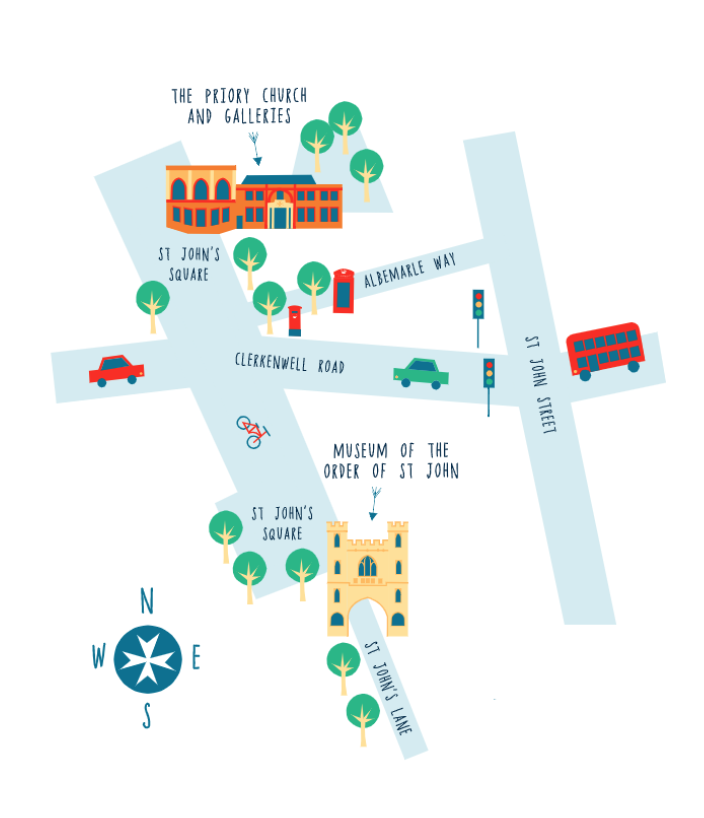
I drew this in the Cloister Garden of the Museum of the Order of St John, Clerkenwell, a beautiful tranquil place on a hot day.
It was a very hot day, and I’d left the flat in some irritation, after a series of frustrations, mostly computer-related. Then one of my favourite cafés charged me far too much for a coffee, and added service charge without telling me. So I went to the garden.
Because I’d left the flat in such haste, I’d forgotten to bring my water pot, which was going to be a problem. However by the time I’d done the pen sketch, the woman on the bench opposite had finished her lunch, and I was able to ask her for her empty drinks bottle. This she graciously gave me, commenting on how pleased she was that it was going to be re-used. If you are reading this, thank you.
The logo of the Order of St John
The modern Order of St John is a charitable foundation. They are behind the St John Ambulance. This latter organisation has the commendably clear strapline: “We Save Lives”. They do this by educating people in first aid, and providing highly trained volunteers at events and disasters.
The Cloister Garden is by the Priory Church.
Map credit: website of the Museum of the Order of St John.
Click a button below to share this post online, email it, or print it:
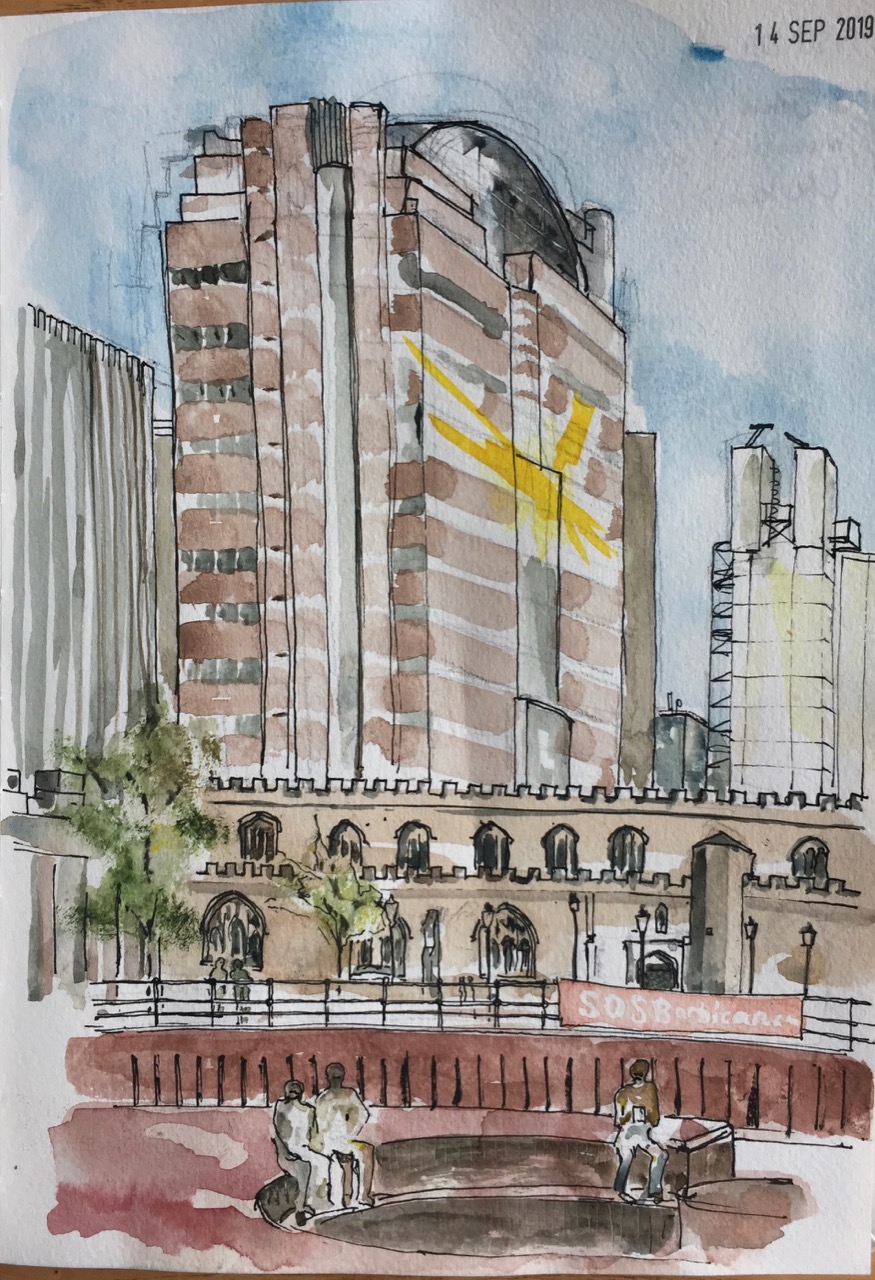
This is a drawing on one of those hot days last week.
I sat at one of the tables on the Barbican Lakeside Terrace and drew what I saw. The massive building is 125 London Wall, a multi-occupancy monolith. Behind, to the right is 88 Wood Street, designed by Richard Rogers (“Rogers Stirk Harbour + Partners”). It’s a bit like the Lloyds Building, with transparent walls and lifts you can see going up and down. On the left is the new building at One London Wall Place.
In front of all that is the side of St Giles’ church, with its castellations. There was a celebration going on: Barbican@50.
The banner you can see fastened to the railings says “SOSBarbican.com”. It is placed by objectors to the proposed extension of the Girls School.
1 hour 20.
Click a button below to share this post online, email it, or print it:
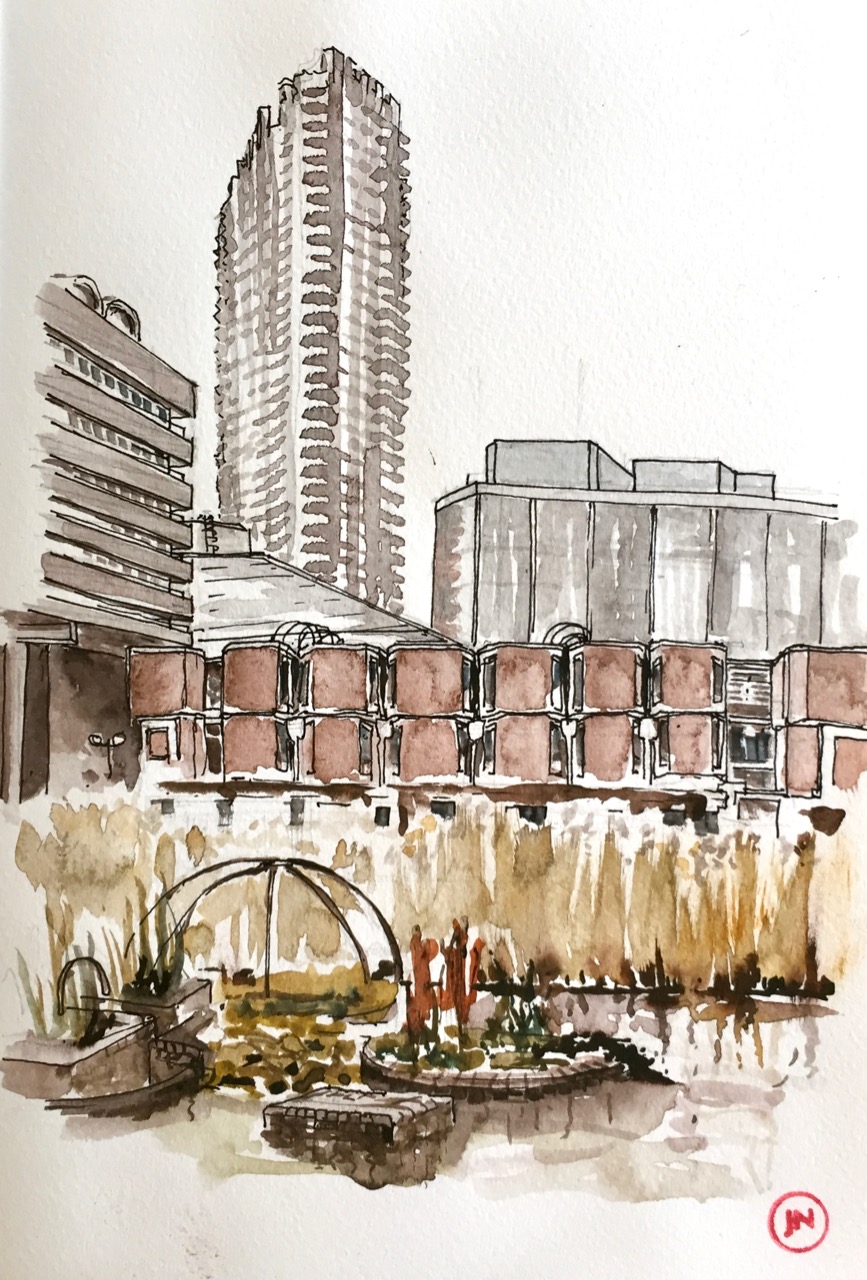
Here is the Guildhall School of Music and Drama, seen from across the Barbican Lake. I drew this sitting on a ventilator grille in an alcove of the residential flats in Andrewes House.
The Tower in the distance is Cromwell Tower. The sloping glass roof is the Barbican Conservatory. Gilbert House is the residential block on the left. In the foreground is the magical sunken garden, a planted area whose walkways are below the level of the lake.
As I drew, I was watched with interest by mallard ducks. One settled at my feet, in a proprietorial way.
I had not noticed before that the Guildhall School is built as a series of blocks, rather like a container park. The top row and the bottom row don’t quite match. The second row has a series of upright concrete beams, which I’ve shown, between the blocks.
I saw that the windows are angled. The inhabitants of one block must be able to see, in a sideways sort of way, into the next block. I’ve never been inside the School, so I don’t know how this works out in practice. But after all, this is a school of performing arts, so it’s rather good if you can see your fellow students through a window: every window a stage.
However the angling of the windows meant that from outside I couldn’t see inside. I have to wait until the performers are ready to present their pieces on a public stage. Still, from time to time I heard a flight of notes on a saxophone. Perhaps they had opened the window of one of the practice rooms.
About 2 hours, including a chat to a fellow resident who stopped by.
Predominantly just two colours: Perinone Orange and Prussian Blue, with a tiny bit of Mars Yellow in the rushes.
Click a button below to share this post online, email it, or print it:







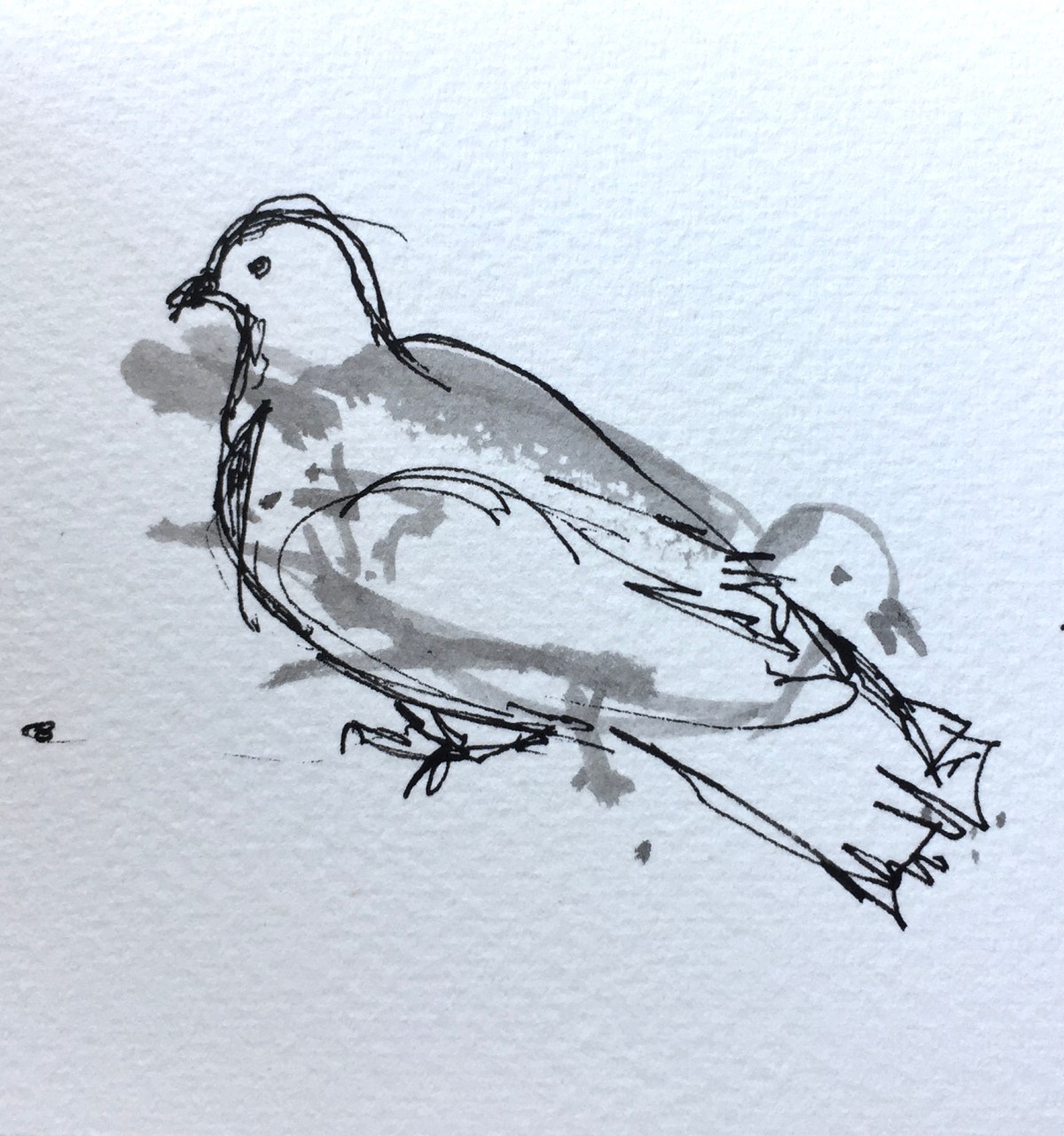
















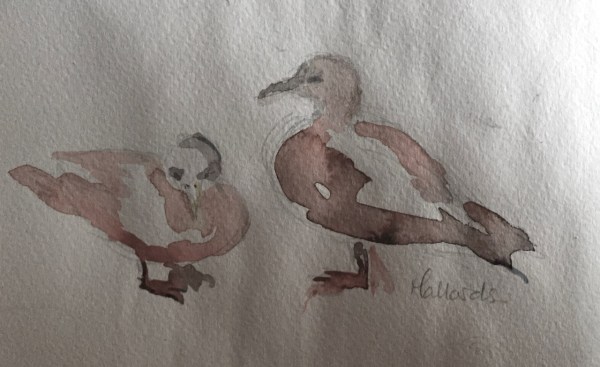 As I drew, I was watched with interest by mallard ducks. One settled at my feet, in a proprietorial way.
 Jane Sketching