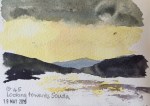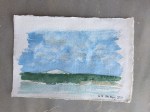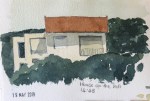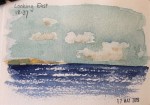
Penzance and Newlyn, Cornwall

IMG_2499

Here in the view from the windows of “Lovetts” in Newlyn. They served me avocado on IMG_2433toast, and a good strong coffee in a pottery cup. This place opposite is labelled “Barclay and Son”, the name cut in stone in 1916. Now it is labelled “The Strand” in less durable lettering painted above the door. It sells a compendium of miscellaneous objects, furniture, crockery, badges, old ship bouys. Also outside are some flower pots. The coffee shop proprietor walked across the road to buy one for a small plant. She just left the coffee shop door open, me drawing at the window, while she did so. This is Cornwall.

The next day I was to swim 10 kilometres. So I was pacing myself, and not embarking on epic walks. The next drawing I did was from the small courtyard at the back of the hotel in Penzance.
IMG_2497

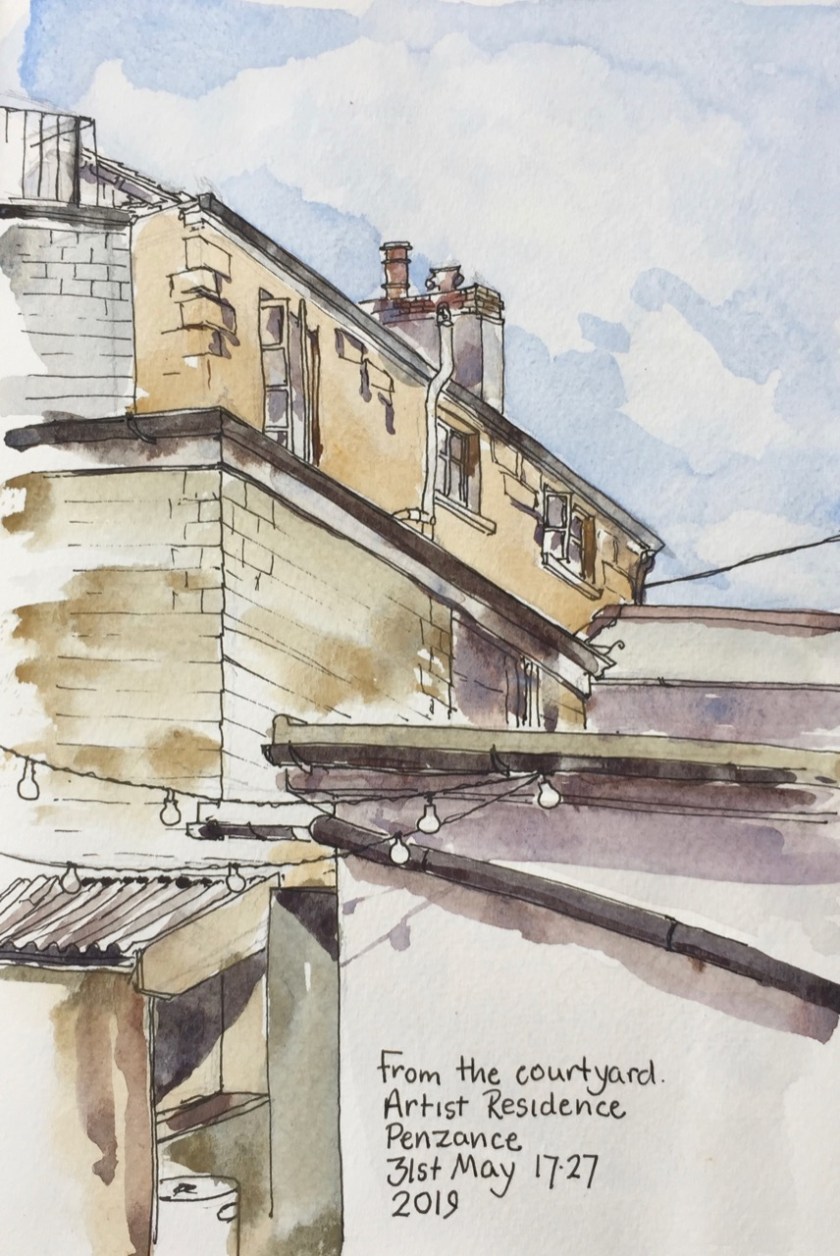
Here you see the roofs of the hotel and adjacent houses. The walls are hung with slates, like scales. The style of covering is called “shingles”, as in “a slate shingled wall”. You see one in the top left corner of the picture.

The two highest chimneys are splendid examples of the chimney-pot maker’s art. The one on the right has two downward pointing holes, and must have been hard to form in terracotta. Maybe I am the first person for decades to appreciate these chimneys and admire the workmanship.

The swim was an event organised by Tom and Jo of “Sea Swim Cornwall“. Forty assorted people swam in 4 different bays, around an island, and up and down a river, “The Gannel”. It was well organised, friendly and fun. And totally exhausting.

So the next day I strolled around Penzance and drew pictures. Here’s a view from St Mary’s Churchyard in Penzance.IMG_2495
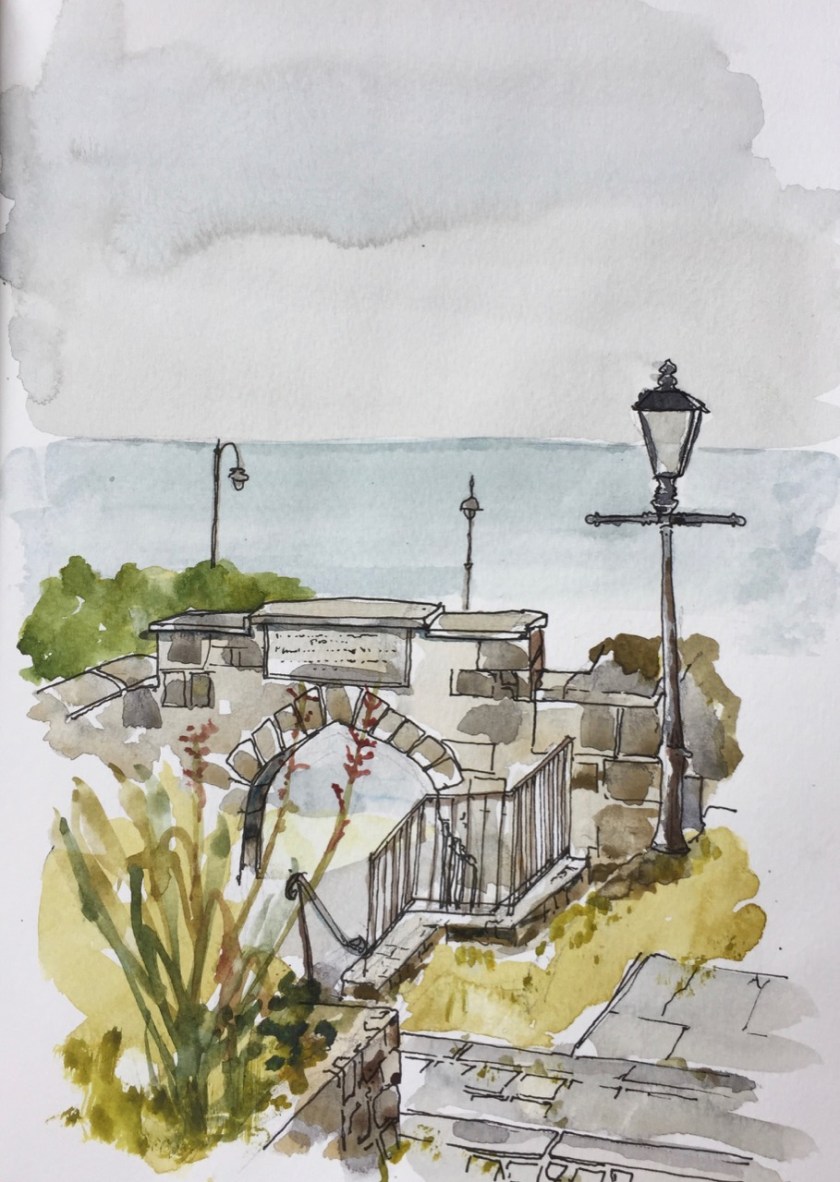
Above the arch the stone tablet reads:

HUNC LAPIDEM POSVIT PHILLIPPVS HEDGELAND IN ARTIBUS MAGISTER PREBENDABIVS EXONIENSIS ECCLESIAE PAROCHIALIS SANTAE MARIAE VICARIVS PRIMUS

I work this out as: “This stone was placed here by Phillip Hedgeland, Master of Arts, a cleric (Prebend) of Exeter, who was the first vicar of this Church, St Mary’s.” If anyone’s Latin can offer a better translation, please let me know. On the side of the arch facing the sea was the date: 1883.

The picture, though, is really about the lamp-post. This looks like the one in the Narnia Stories. It is numbered 164AZ with a tag round its middle. After I drew it, I went to check it was a real cast-iron lamp-post and not a fibreglass replica. It was indeed a reassuring cold cast iron, and the maker had put their name in capitals in two places: HOLMAN & SONS PENZANCE”.

By the door of the church I encountered a beautifully engraved tombstone, with Art Nouveau flourishes. It told a sad story though:

In memory of HENRY M FUDGE,
son of the late HENTRY FUDGE MASTER MARINER
who departed this life Oct 2nd 1822 aged 2 years and 5 months
also S S.F. EDDY daughter of Richard Sally Eddy of this town who died 23 June 1835 aged 1 month.

I drew this picture entirely in three colours: Prussian blue, Alizarin Red, and Indian yellow, from Watercolour box 1. 


Insects Collage

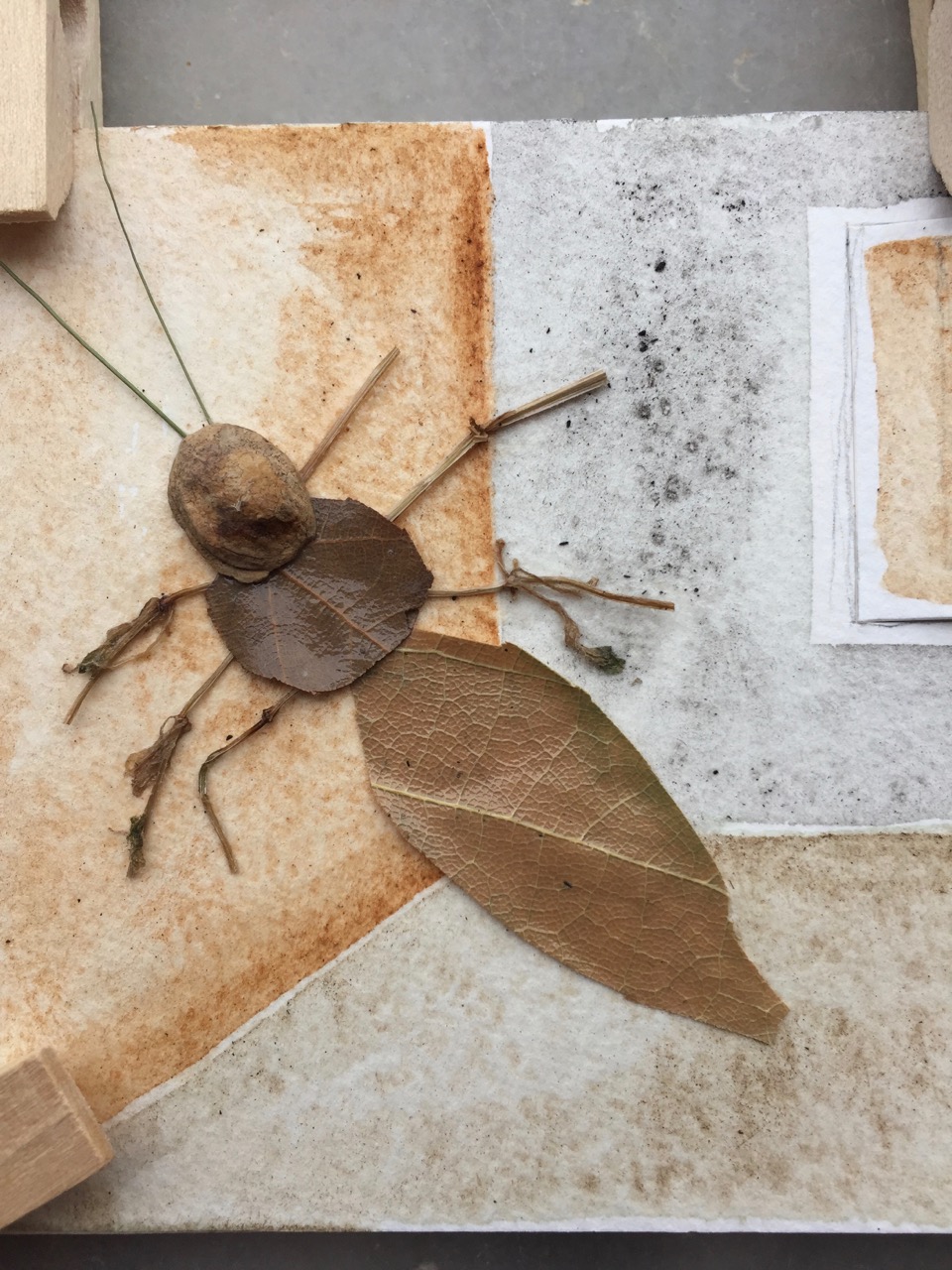
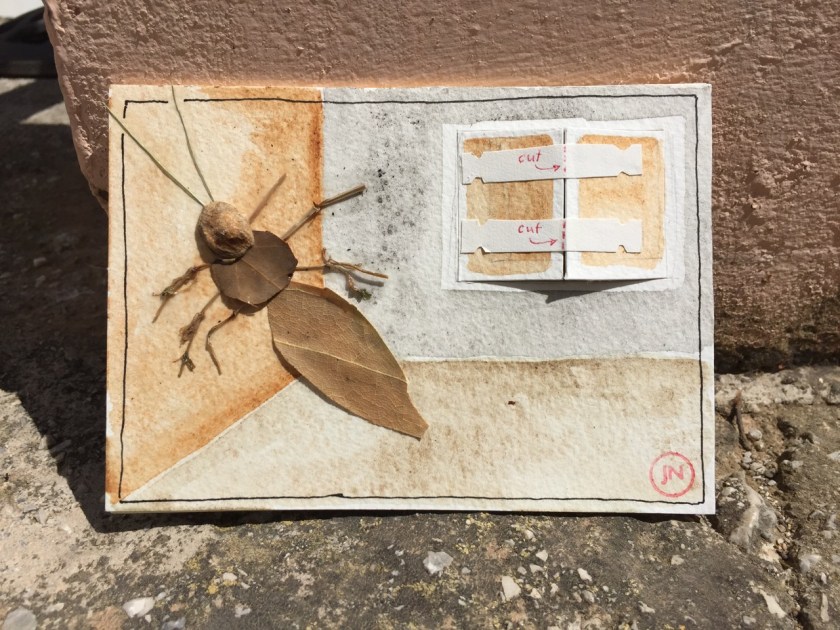
I made a postcard for friends in Basel. It shows the insect life in Crete.

IMG_2252

Here are some details, and the work under construction.


The idea was that the flies would jump out of the window when it was opened. The postcard is painted using pigments made from the earth.

IMG_2225

Update 28th May: I learned by email that all insects arrived intact, and are now dangerously positioned next to a Gecko.

This collage postcard is inspired by the work of https://sendmeapostcart.com

Sketching in Crete 2019

The air in Crete was warm and damp. This affected the paper. See how the ink has spread in this pen and ink sketch at the airport:

IMG_2301

This is De Atramentis Black document ink on high quality watercolour paper, Saunders Waterford, in a small book 6″ by 4″ from the Vintage Paper Company.

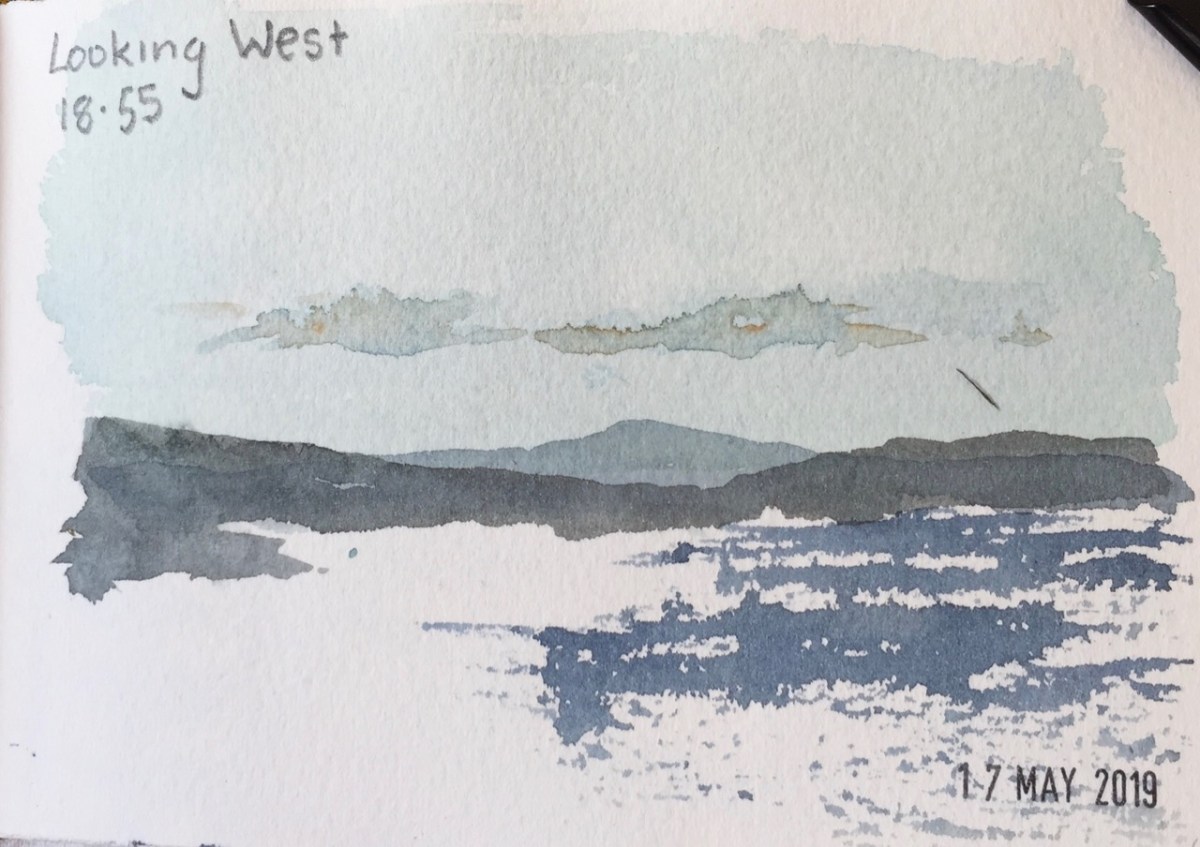
After that, I used pencil and watercolour only. Here is a view of the Akrotori peninsula. The warship is lurking in the NATO base.

We lived with insects. At a hand movement, other movements occurred, in the air, on the kitchen surfaces, on the floor. Ants made their way across the breadboard, collecting crumbs or notifying HQ of the location of the honey drip. Beetles arrived suddenly, folded their wings and inspected the floor. I tried drawing them.

Two geckos made their miraculous appearance some evenings and early mornings. They emitted small squeaks.

These are images made on “sun print” paper, using plants, and cut-out paper shapes. The geckos are a species of nocturnal reptile: Hemidactylus turcicus or Mediterranean House Gecko. They are insectivorous, eating, amongst other things, moths. I wondered if they would like to live in the Barbican ducts. It must be quite warm in there, and they would be entirely welcome to devour the moths.

They stick to the walls not with suckers but with hairs on their feet. The feet of geckos are subject of intense scientific interest, I read, since these hairs are so configured that they get close to the wall on an atomic scale (10 nanometers or so). At this distance the molecules of the feet attract, rather than repel, the molecules of the wall. There is a whole compendium of physics effects which make this possible: quantum mechanical, electrostatic, surface tension.  There could be an entire undergraduate course on the feet of the Gecko.

Outdoors there is landscape…

…and a garden.

I am learning to draw clouds. There were a lot of them.

I am learning to draw quickly. Here are some very quick sketches from cafés.

The grass was cut around the lower buildings in ancient Aptera, revealing arches.

Arches make poetry in the Agia Triada monastery: a pre-departure pause….

…before the airport.

Technical details

Pictures done in sketchbooks:

Using Watercolour box 1:

IMG_4455

Sun print paper was from Cowling and Wilcox on the Kingsland Road. It is called “Sunography”. I printed it on both sides.

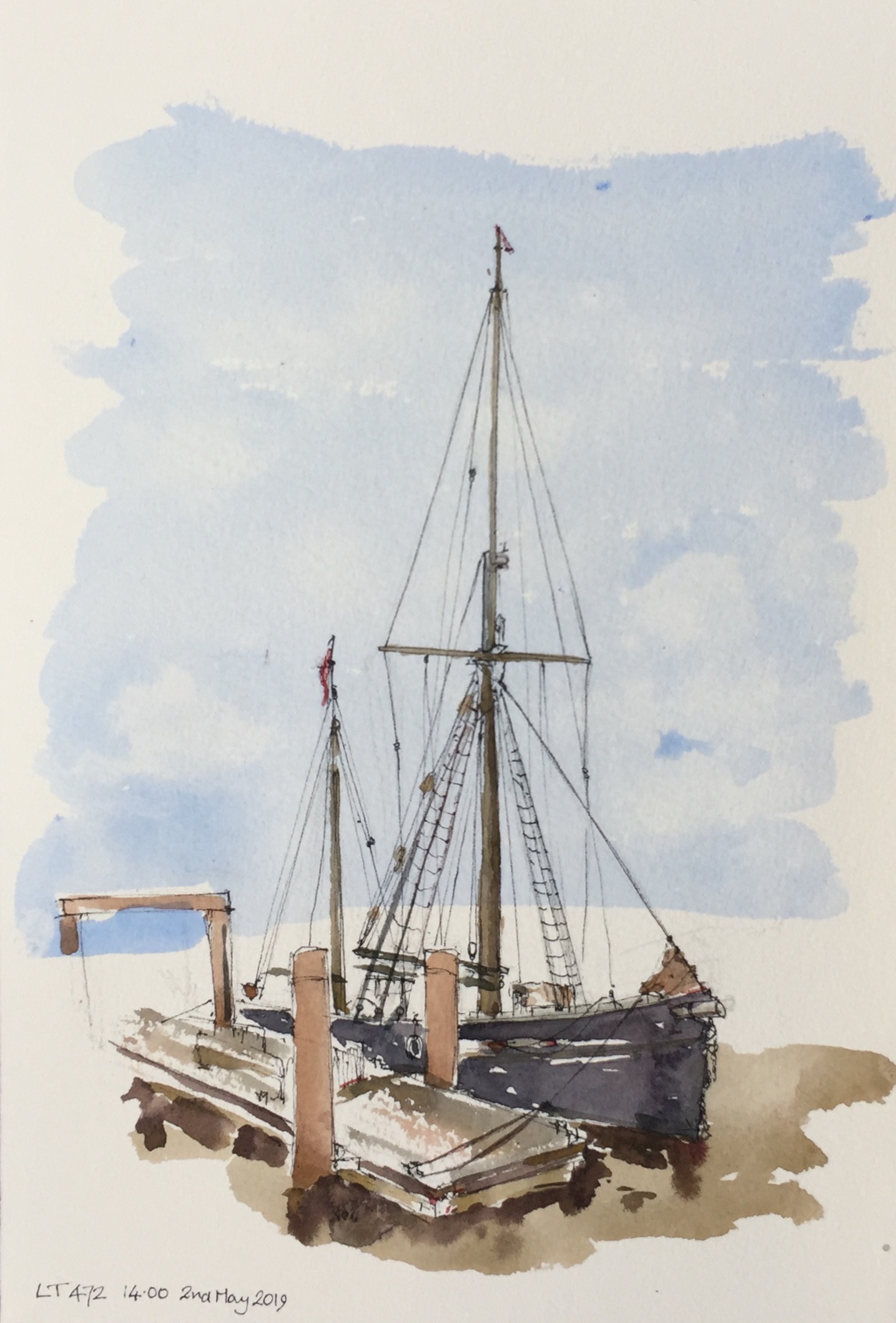
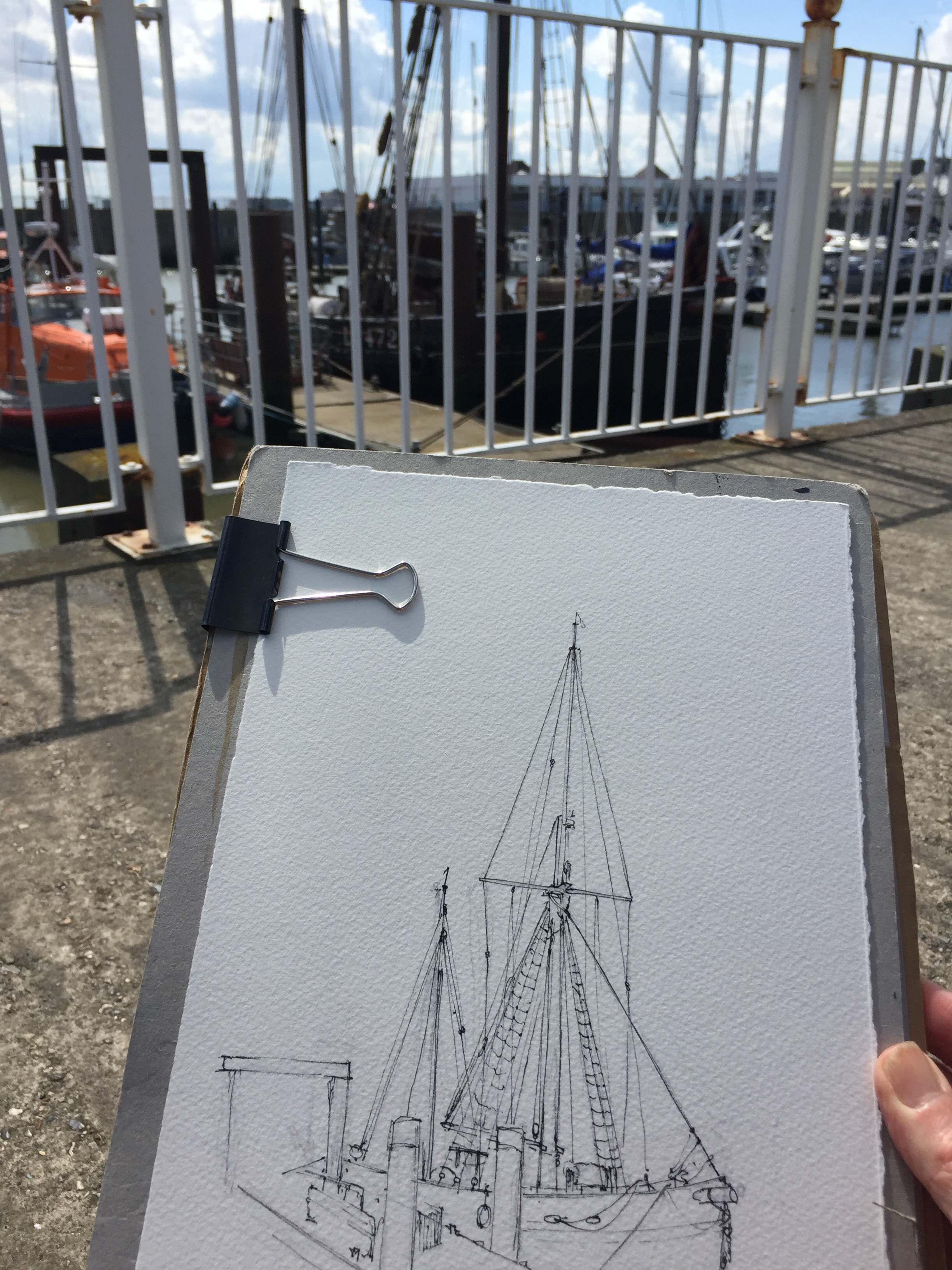
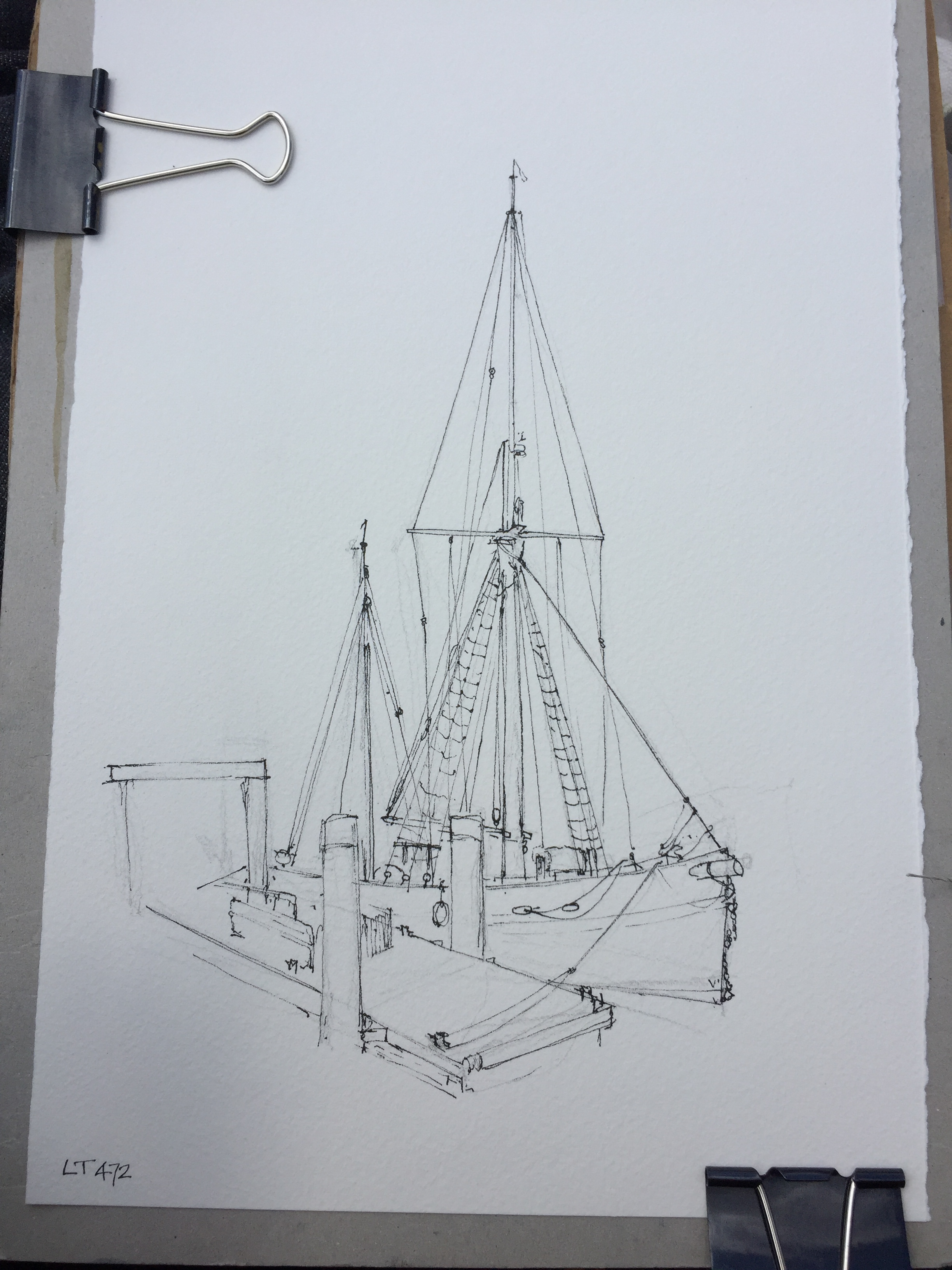
Excelsior, LT472, Lowestoft

I sketched “Excelsior” which was moored in Lowestoft Heritage Quay.

She is a former fishing smack, built 1921, now a training vessel based at Lowestoft.

fullsizeoutput_33d2
LT472 Excelsior 9″x7″ watercolour [original sketch SOLD, prints available]

The water was very muddy because a dredger was at work in the river channel, providing education and entertainment to those on the jetty.

It took me 1 hour 15 minutes to draw Excelsior. I was sitting on the concrete, facing away from the dredger entertainment and looking at Excelsior through a fence.

Here is work in progress.

Coal Drops Yard N1C from the Skip Garden

Here is the view from high up in the marvellous Skip Garden at Kings Cross. Coal Drops Yard roofs are in the background, behind the crane.

IMG_2061

I did this picture with just three colours: cobalt blue, yellow ochre, and alizarin crimson. The yellow ochre and cobalt blue refused to make green. They made grey.

Here is the picture under construction.

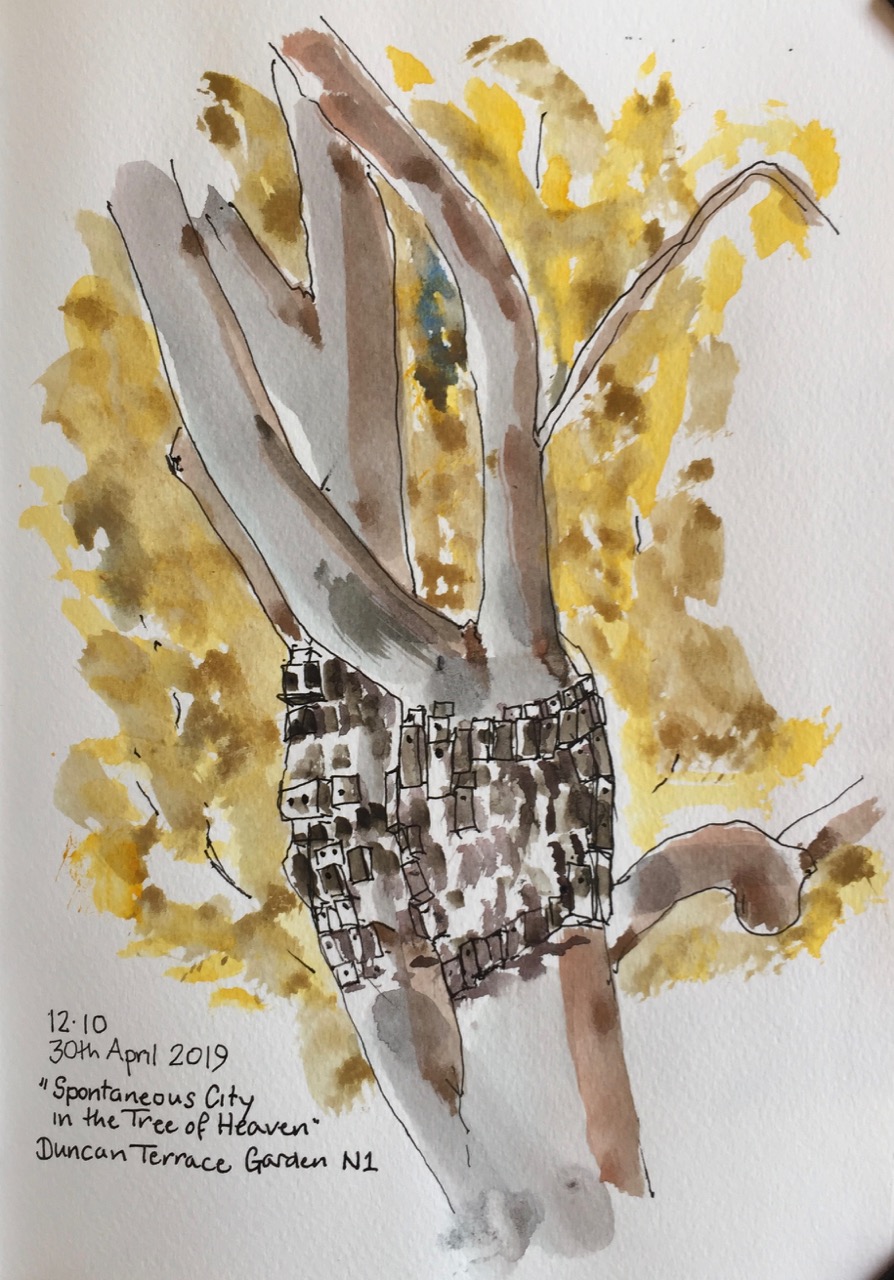
IMG_2060On the way to Kings Cross I passed through Duncan Terrace Gardens, in Islington, where there is an extraordinary “bird hotel” in one of the gigantic trees. It was made by “London Field Works” and consists of 300 specially made bird boxes, all different sizes, fitted round the tree.

A nearby notice assured me: “The method of installation has been designed in close consultation with the Forestry Commission and the borough’s ecology dept to enable the tree to continue to grow and expand.”

99 Leman Street E1 – Co-operative Wholesale Society (CWS)

This huge redbrick building in Leman Street stands proudly amongst the 21st century steel and glass. Inscribed round its windows and above its door in letters a foot high are the words “Co-operative Wholesale Society Limited”. The words are spelled out in full, and written in stone. Oh, those confident and visionary Victorians!

The Co-operative Wholesale Society’s  London Branch headquarters were built to designs by J. F. Goodey of 1885. At the formal opening on 2 November 1887, the CWS announced that it should ‘be their aim to make this beautiful building a common home for all the various movements having for their object the interest and advancement of the working people. They had with them their friend, the Rev. S. A. Barnett, and they hoped to work hand in hand with him and the residents of Toynbee Hall, in giving a message of hope to the people of the neighbourhood’

from the “Survey of London” [https://surveyoflondon.org/map/feature/1264/detail/]

IMG_2035

A thin plastic sign by the street door says “Sugar House”. It is now apartments.

This drawing done very quickly, in about 10-15 minutes, as the sun was setting and I was tired and cold. From the junction of Chamber St and Leman St.

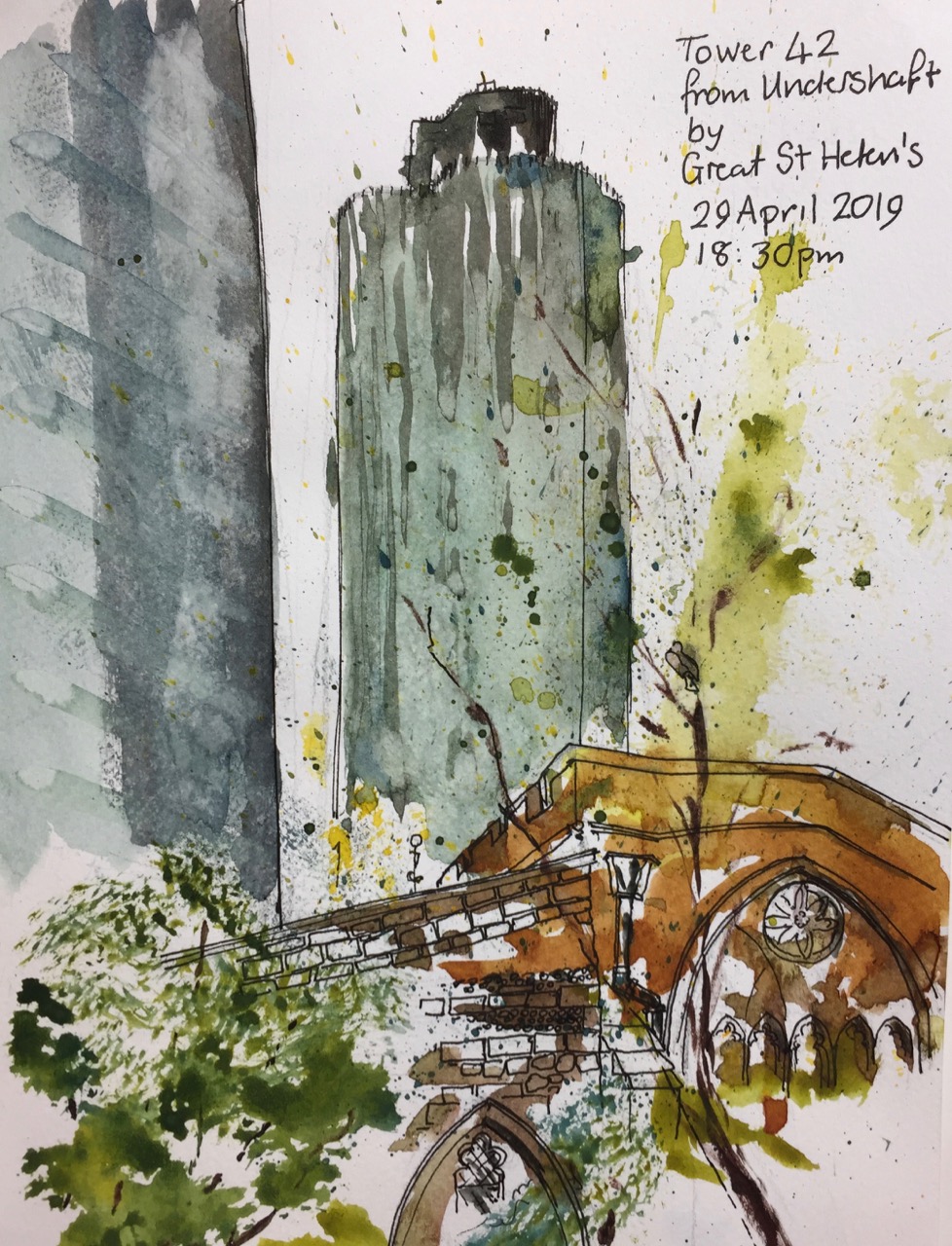
Tower 42 from Undershaft

This is looking West from “Undershaft”, which is the small road going west from the Gherkin. Appropriately enough, perhaps, it now disappears down into an underground car-park.

Tower 42 (formerly the “NatWest Tower”) is in the back centre, and the new tower “TwentyTwo”, 62 storeys, at 22 Bishopsgate, is on the left.

In the foreground is Great St Helen’s Church. The roof really was at this wonky angle. The East window has plain glass. All the medieval stained glass was shattered in an IRA bombs in 1992 and 1993.

IMG_2034

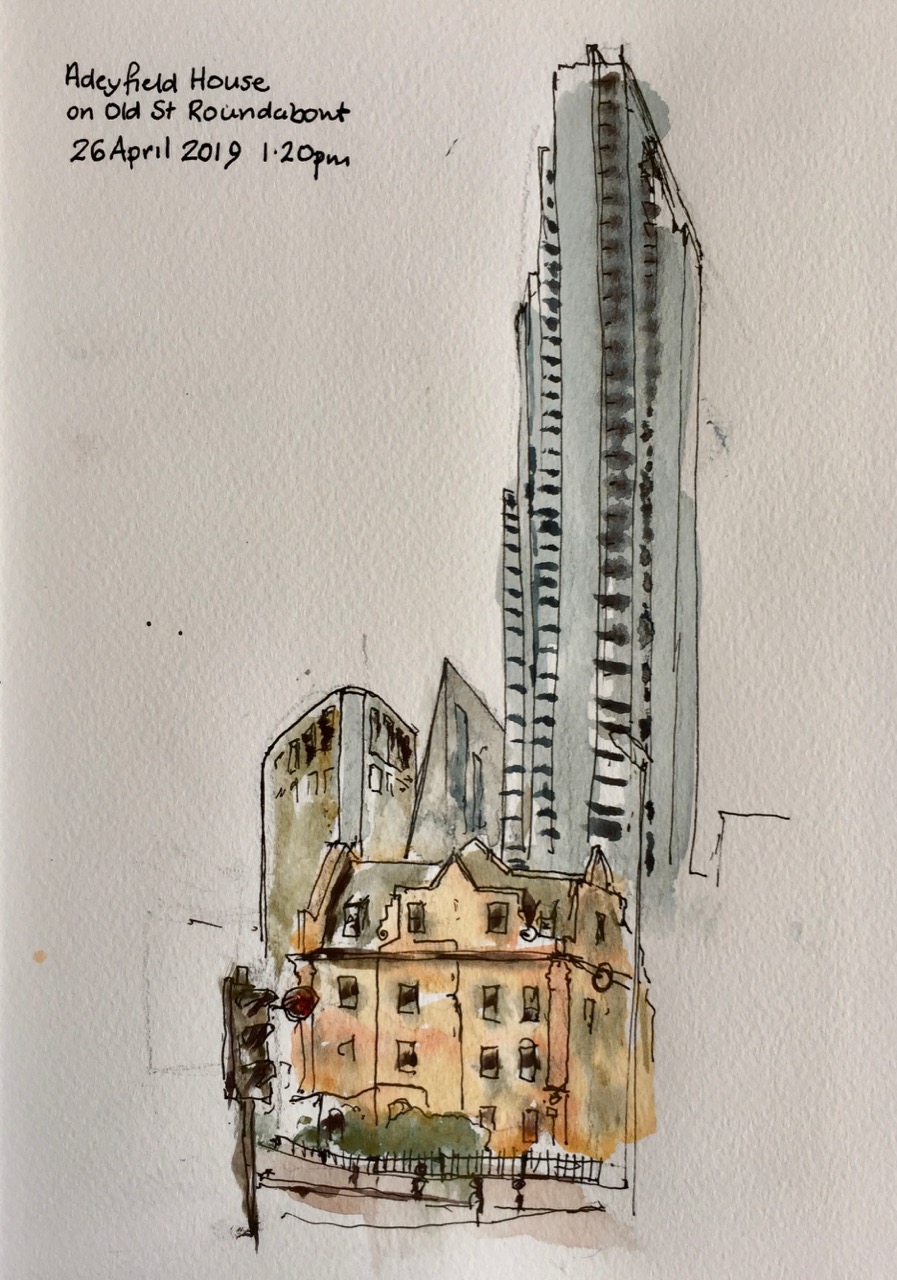
Old Street Roundabout: Adeyfield House

I saw this redbrick building on the Old Street Roundabout.

Above it are the huge developments on City Road. From left to right they are Eagle Point, M by Montcalm, and the Atlas Building.

Adeyfield House is residential, part of the Sutton Estate, managed by Islington Council.

IMG_2009

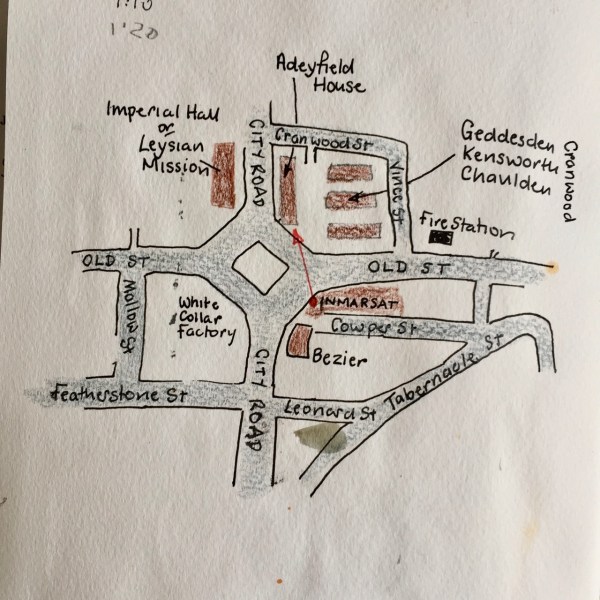
The Old Street roundabout was sometimes called “silicon roundabout” because of the high-tech start-ups in the surrounding area. I haven’t heard that term used for a while though. There are certainly many incubator-type office blocks. One is called “White Collar Factory” and was near to where I was standing outside Inmarsat. Inmarsat is a satellite data company.

IMG_2010

Old Street roundabout is about to be re-configured to make it more agreeable for pedestrians and cyclists. At the moment it is noisy, polluted, dangerous to cyclists and difficult to navigate on foot.

Huge numbers of pedestrians passed by me on the pavement, talking of investments, employment opportunities, stock options, and where to go for lunch.


The Eastern Cluster from the Barbican Podium

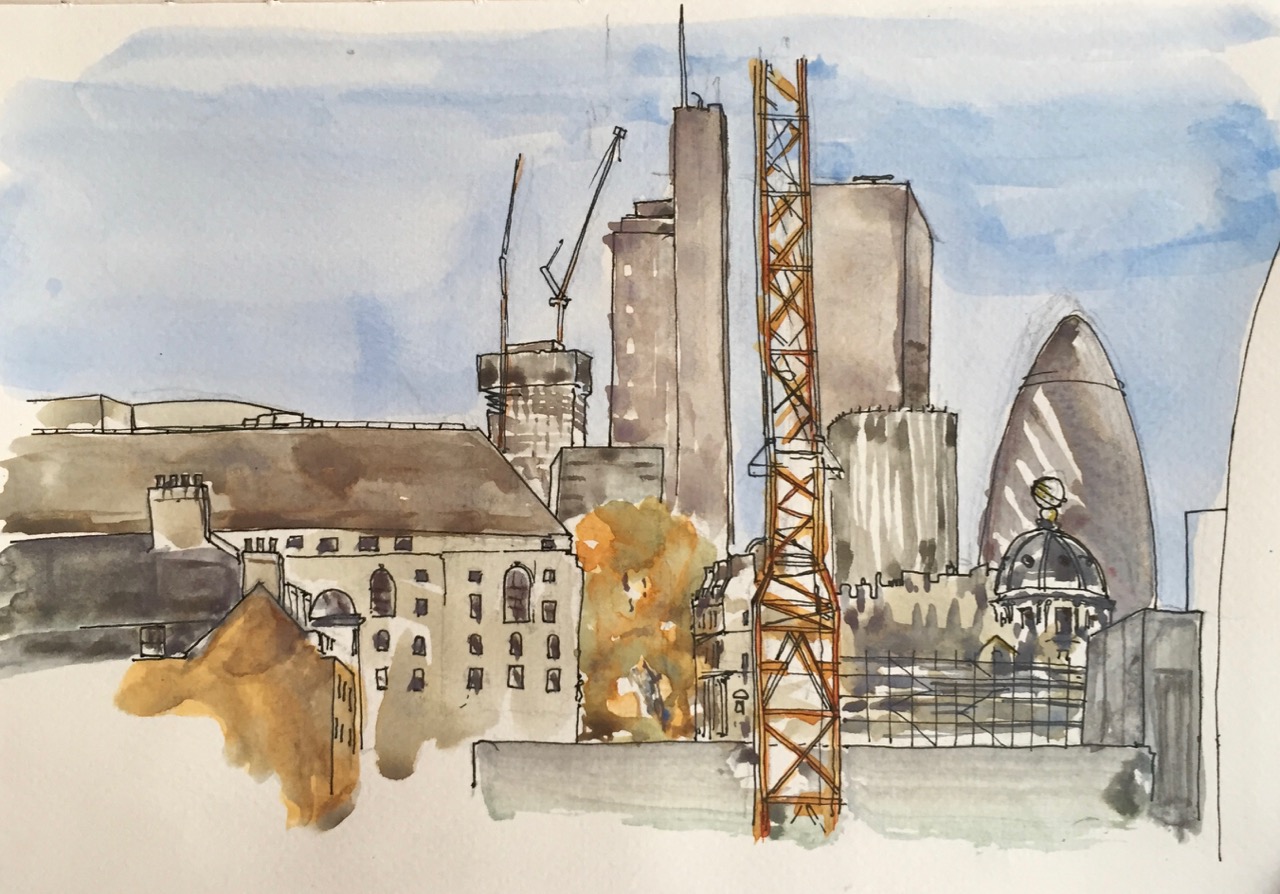
From the Barbican Podium underneath Willoughby House you can look East across the Crossrail site. Soon this view will be obliterated by the tall building on top of the Moorgate Crossrail station. But just now, this is what you can see:

IMG_1970 (1)

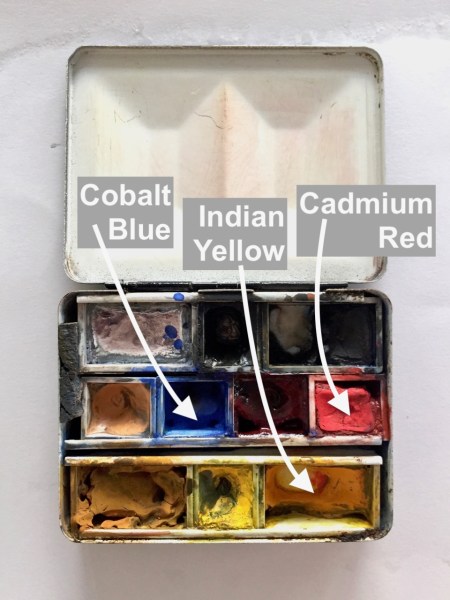
I drew this picture with just three colours:

  • IMG_1990Cadmium Red (Rembrandt)
  • Cobalt Blue (Jacksons)
  • Indian Yellow (Jacksons)

This was following the advice of Teoh Yi Chie of Parkablogs, in one of his Youtube posts, called “How I choose which colours to use”. He advises limiting the number of colours, and choosing just one red, one yellow and one blue for a picture. As you see, it is possible to create a wide range of colours from just three, including all the greys you see in the picture.

I was particularly pleased with the sheen on The Gherkin, which happened as the colours granulated and dried out.

The Towers in the picture are part of the emerging “Eastern Cluster”. This is a region of skyscrapers in the City of London. More will be added, according to the Eastern Cluster Strategy (try this link: City of London Eastern Cluster Strategy).

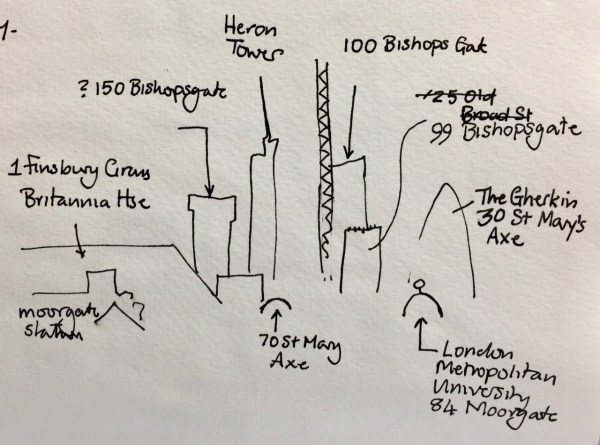
Here are the ones I could identify:

IMG_2031

Here are photos of the picture being drawn:


About 1½ hours, drawn and coloured standing on the podium, leaning the sketchbook on the concrete of the podium. Warm breeze. Sun. I needed the sunhat.


Shiplake House, Arnold Circus

This is the “Boundary Estate”, Britain’s first council estate, opened in 1900. It was built to the design of Owen Fleming and his team.  Fleming was a member of the Housing of the Working Classes branch of the LCC’s* Architecture department. He was 26 years old.

The aim of Boundary Estate project was to replace slums, in an area of disease, want, squalor and crime known as “Old Nicol”. The slums were pulled down, and replaced  by dwellings that were more healthy, and more pleasant to live in. The area was also provided with schools, a laundry, shops and clubrooms. The problem was, of course, that these dwellings were more expensive than the previous slums. The former inhabitants of the area couldn’t afford the rent, and had to go elsewhere. Better-off workers in stable employment moved in.

Here’s what one part of it looks like now.

IMG_1952
Shiplake House, Arnold Circus, in Sketchbook 4, 10″ x 7″

This is Shiplake House, on Arnold Circus. It didn’t look in very good repair. The paint was flaking. As you see, the outside was festooned with wires, some going no-where. The windows were dirty, though none were actually broken. This disrepair was surprising, as these are sturdy buildings, close to trendy Shoreditch High St, Brick Lane, and the City.

IMG_1955
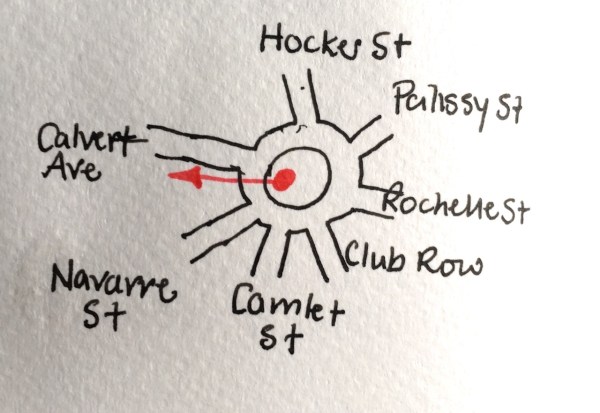
Arnold Circus, showing my direction of view for the picture of Shiplake House.

Shoreditch High St is visible from the little hill which is Arnold Circus, where I sat to draw the picture. There are seven roads which meet at Arnold Circus. Is this a record?

I read about the Boundary Estate in “Municipal Dreams, the rise and fall of council housing” by John Boughton. This is a fascinating book, answering my questions about why governments over the decades have, and have not, built council houses. Why did they do it, and why did they stop doing it? His website Metropolitan Dreams is also a great read and recommended.

Here is the drawing before the colour went on, showing Shiplake House in the background.

IMG_1946

*LCC= London County Council, disbanded in 1965, and replaced by the GLC = Greater London Council which covered a larger area. The GLC was itself abolished in 1986, and its powers went to the London Boroughs. It was abolished largely because its leader, Ken Livingstone, was a high-spending Labour politician whose policies were opposed to those of Prime Minister Margaret Thatcher. Then when the GLA= Greater London Authority was established in 2000 the first Mayor elected was Ken Livingstone.  He began his victory speech with the words: “As I was saying before I was so rudely interrupted 14 years ago …”