Council housing, Lower Green, Esher KT10

Esher is an area of Greater London, half an hour’s train ride from Waterloo. It is a place of diverse architecture: magnificent Arts-and-Crafts villas, modernist mansions, and a row of “stockbroker Tudor” houses.

Stockbroker Tudor houses, Esher.

On the other side of the railway tracks, in the low ground near the industrial estate and the waterworks, there is a council estate. This is “Lower Green”. It was built towards the end of the 1940s. This was an era of visionary town planning and utopian ideals, eloquently described in the book “Municipal Dreams” by John Boughton, Chapter 3. On page 66 Boughton quotes the town planner Patrick Abercrombie who sought a plan for Plymouth

“which allows for a higher standard of living well within our grasp, with its call for space and beauty rather than for mere economy”

J. Paton Watson and P. Abercrombie “A Plan for Plymouth” 1943.

The new towns were built around this time, including Stevenage, Crawley, Hemel Hempstead, Harlow, Welwyn Garden City, and Hatfield. Lower Green has many characteristics of those new towns: two storey “cottage style” houses with a front garden and a back garden, arranged behind wide verges, with trees and plenty of green space. The houses were designed by the architect George Blair Imrie (1885–1952), for Esher Urban District Council.

Round symbol on the houses: E for Esher, “UDC” = Urban District Council. Esher is now under “Elmbridge Borough Council”. See the interesting texture of the bricks.

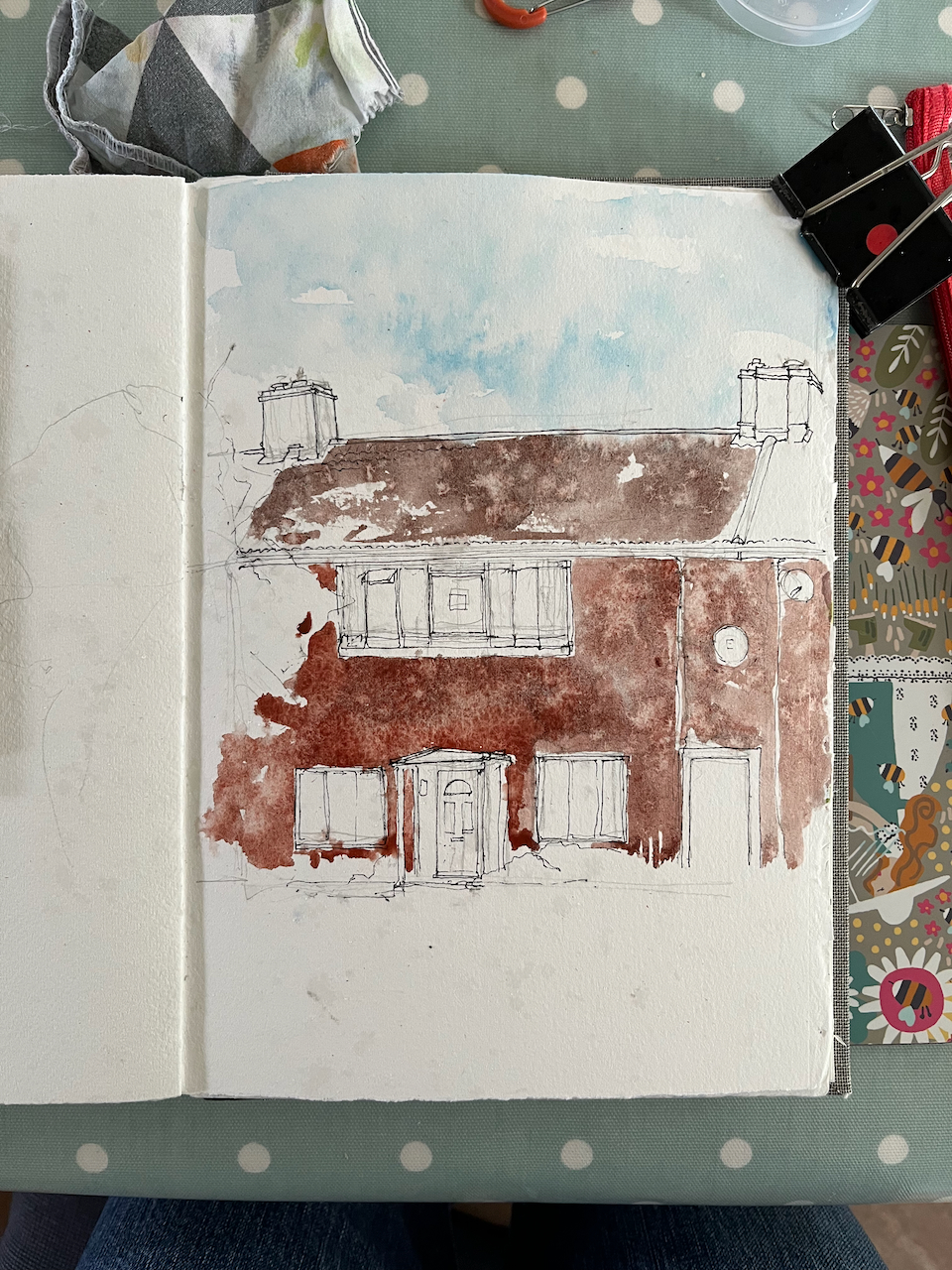
My watercolours show houses on Douglas Road, Lower Green. Here, the land was acquired by the council in 1949. It was a compulsory purchase under the 1936 Housing Act. The vendor was the farmer, Sydney Edward Parkes. I have this detailed information thanks to an owner and resident of one of the houses, who kindly showed me their title deeds.

Here is the basic design of the houses.
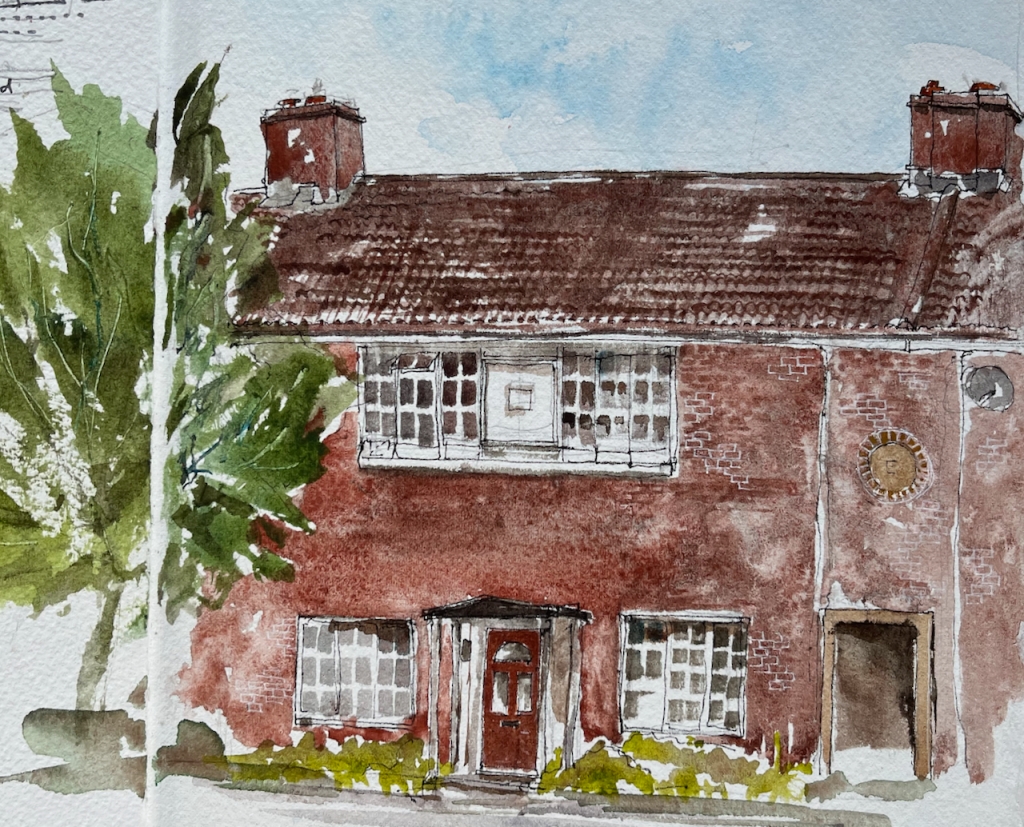
A house in Douglas Road, Lower Green, Esher, KT10. Watercolour and ink, Sketchbook 14

The geometry is perfect: the side edges of the upper windows are aligned with the centres of the lower windows. The upper edges of the lower windows, the door lintel and the passage are all in a neat line.

What you can’t see in my painting is that this house stands behind a wide verge and trees, which separate it from the road.
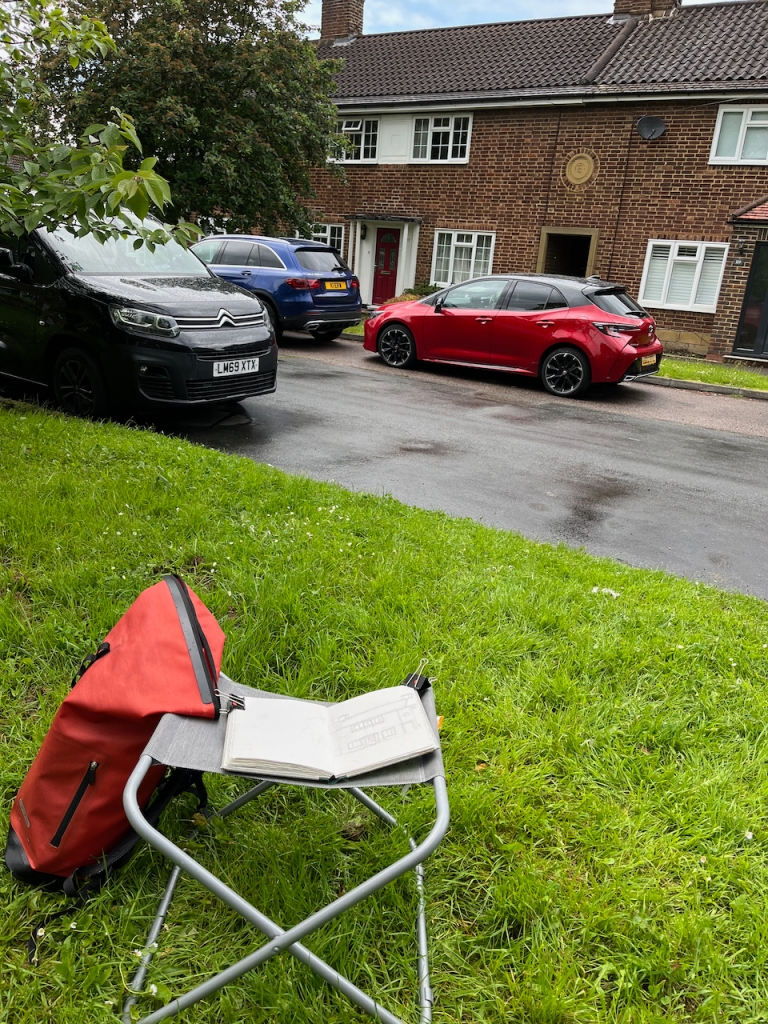
Painting location for the picture above.

There is a passage through the terrace of houses, on the right in my picture. This passage takes you through to “the back” where you can store your bicycle, and your dustbins.

Another feature of the estate is the arrangement of houses round a square.
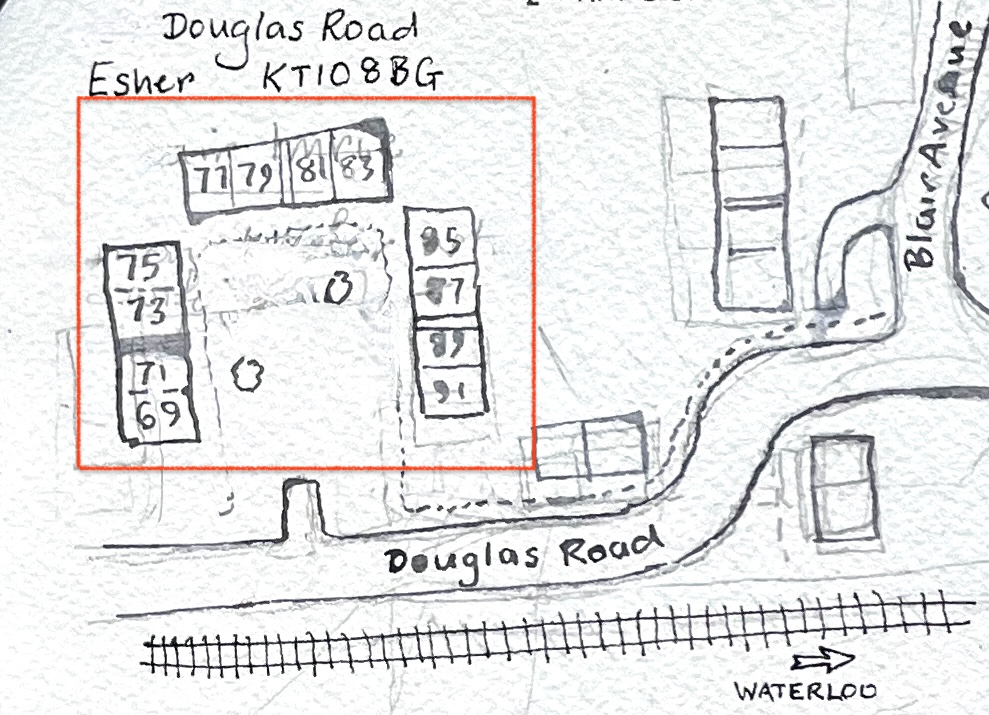
Here is a painting of some of the houses round the corner of a square: numbers 69 to 77 (odd numbers) Douglas Road:

69-77 (odd numbers) Douglas Road, Esher. Watercolour and ink, in Sketchbook 14

Painting of odd numbers 69-77 Douglas Road Esher, seen across the huge green public space.

There are three such squares, all large green spaces. It’s one of the “patterns” in this estate, to use the concept described by Christopher Alexander, in the 1977 book “A Pattern Language”.

“A Pattern Language” by Christopher Alexander and others (1977), page 304, Pattern number 60 “Accessible Green”

I didn’t see anyone using the green space. But this was a Tuesday afternoon, in term time, and it was raining. Perhaps they were enjoying looking out across it from their windows. If they were, they were probably wondering what the strange woman was doing, sitting there on a metal camping stool under the tree, staring at their house.

This estate was originally intended as rental accommodation. It was owned by Esher Urban District Council and residents paid rent to the council. Nowadays, some of these former council houses are in private freehold ownership, having been sold under the “right to buy” scheme. There are also a lot more cars. The estate was built at a time when most people did not not own cars. The houses do not have garages.

The architect, George Blair Imrie, designed many houses in the area. His wikipedia page lists the large houses he designed for the wealthy. His work on the council housing estate of Lower Green is also remarkable, and not mentioned. So I am glad of the opportunity to draw attention to it here.

I drew these pictures between rainstorms, finally completing them under a borrowed umbrella.

Blair Imrie’s work, including his work on Lower Green, is mentioned the 100th newsletter of the The Esher Residents Association, January 2020. See pages 4 and 5:
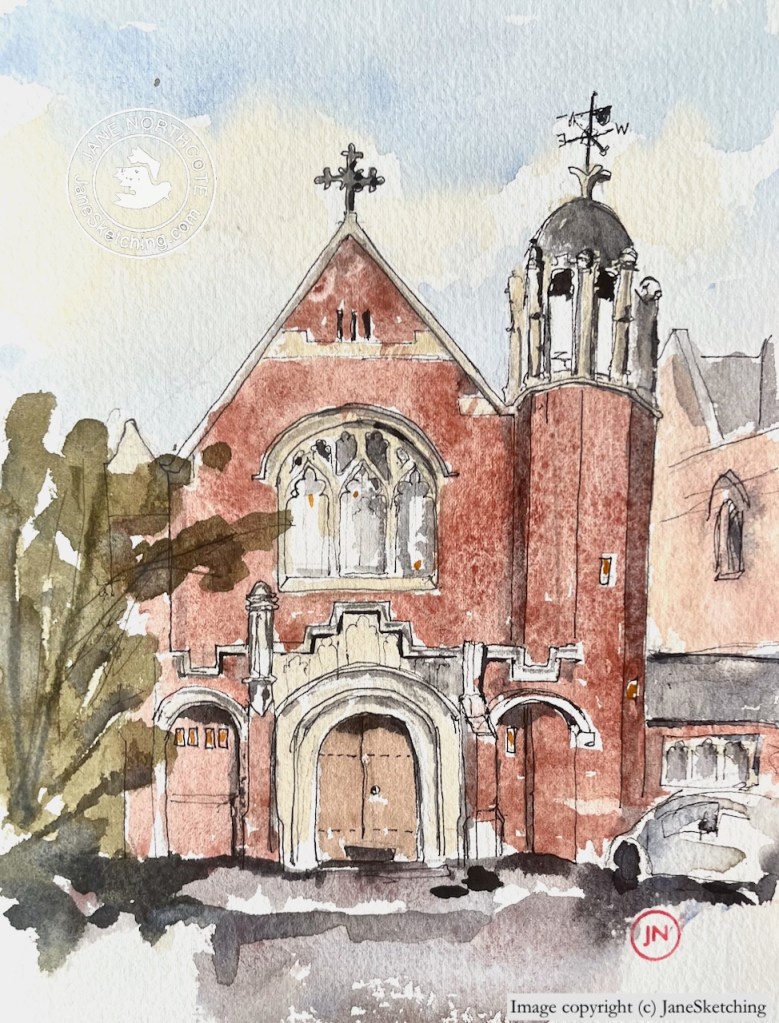
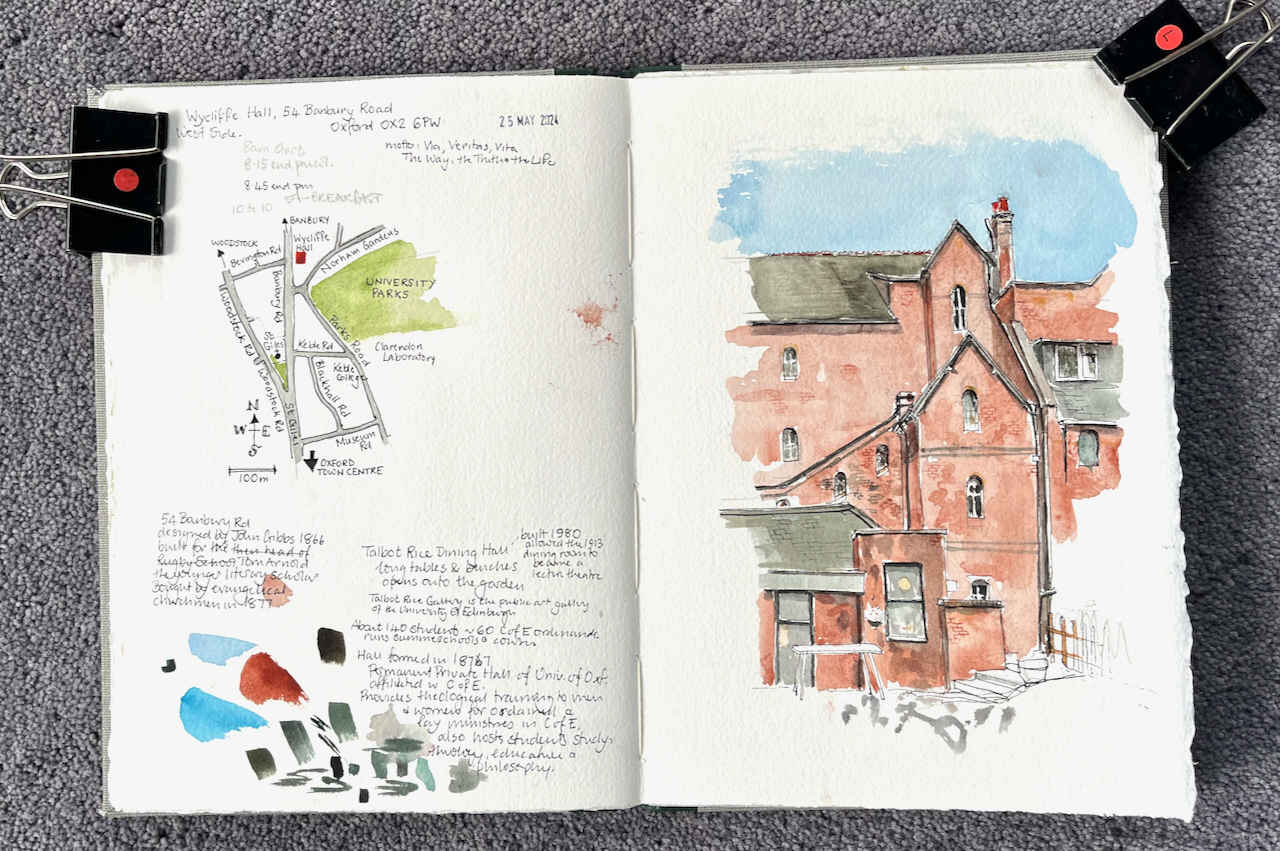
Wycliffe Hall west side, Oxford OX2

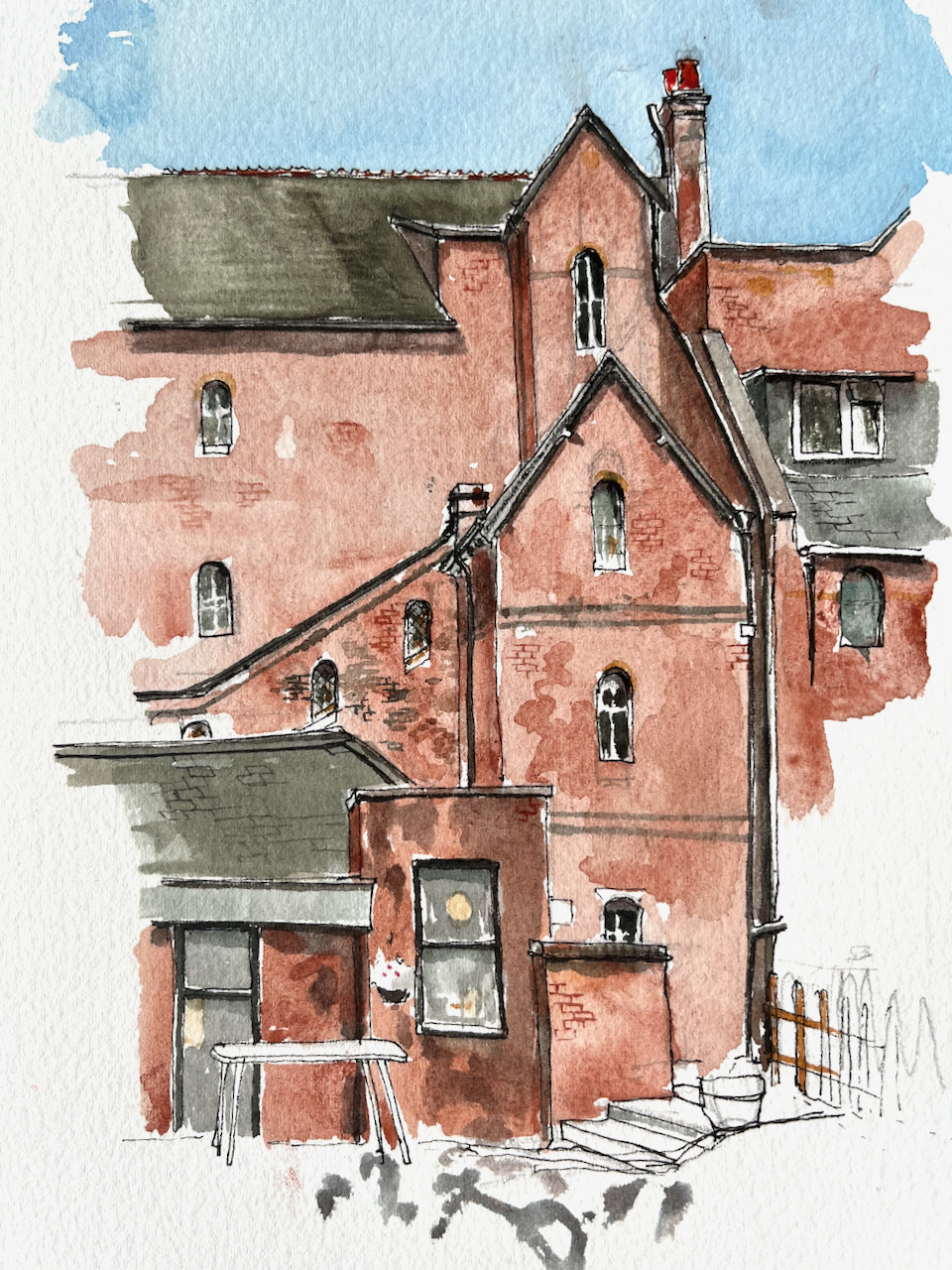
Wycliffe Hall is a “permanent private hall” in the University of Oxford. A permanent private hall is like a college, in that it provides accommodation and tuition for its students. The difference is that a college is governed by its Master and Fellows, whereas the Hall is governed, at least in part, by the Church of England. It is an Anglican theological college, offering courses in philosophy and theology, and preparing people for ordination into the Church of England. John Wycliffe was a 14th century Bible translator, scholar and churchman.

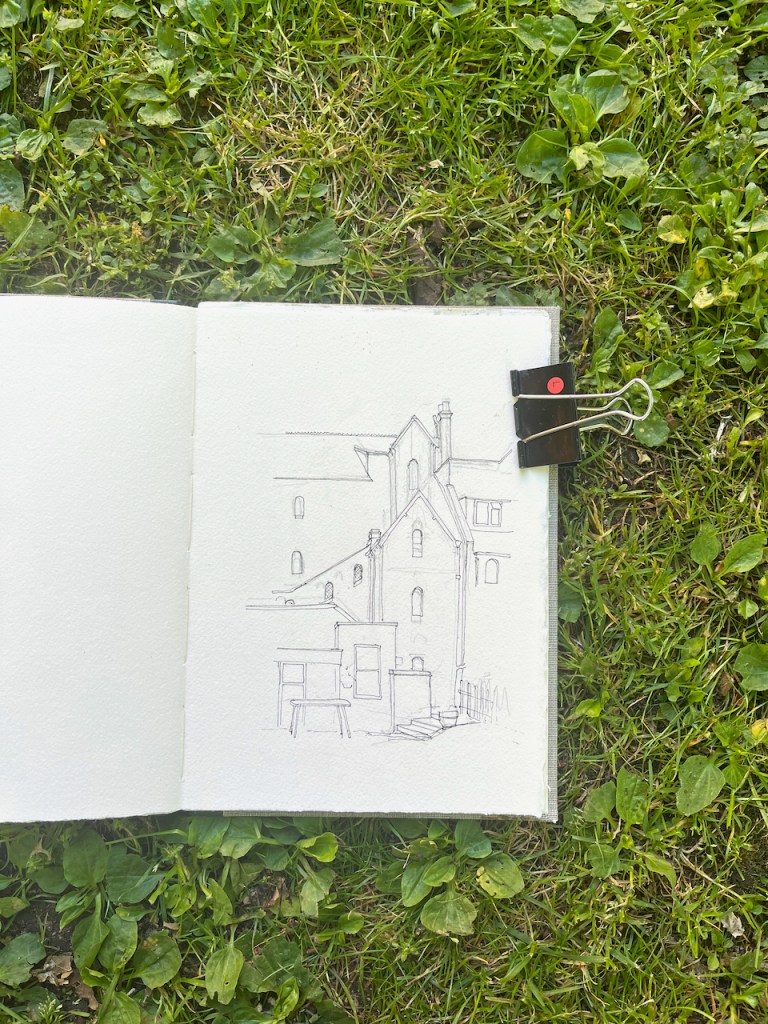
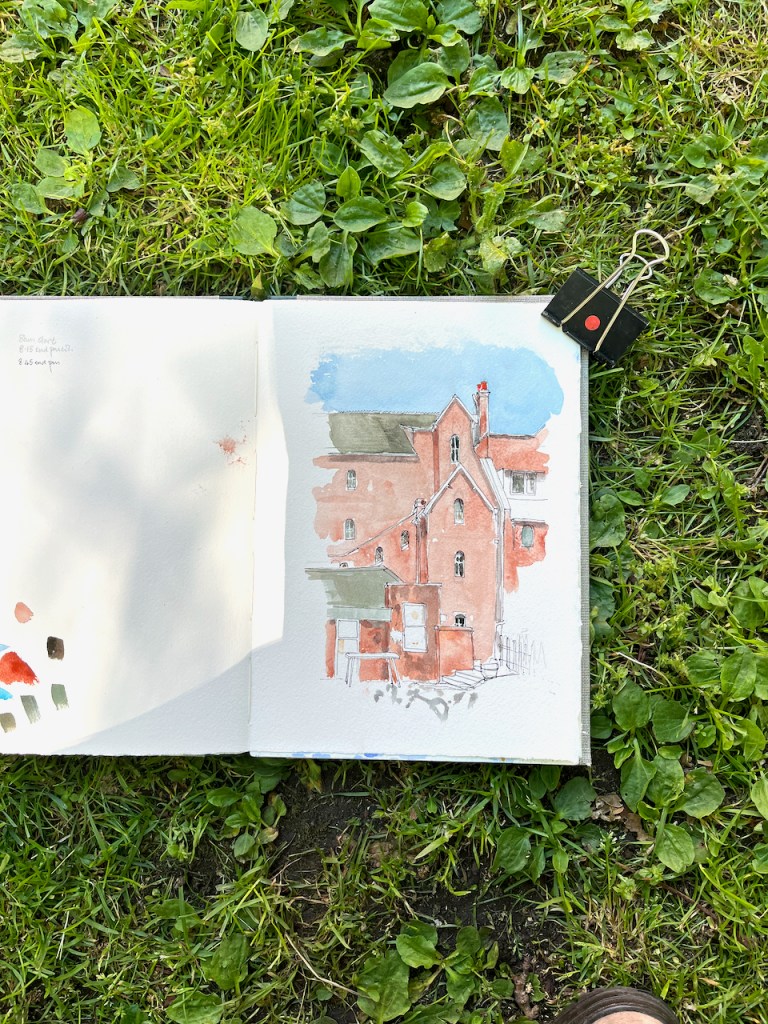
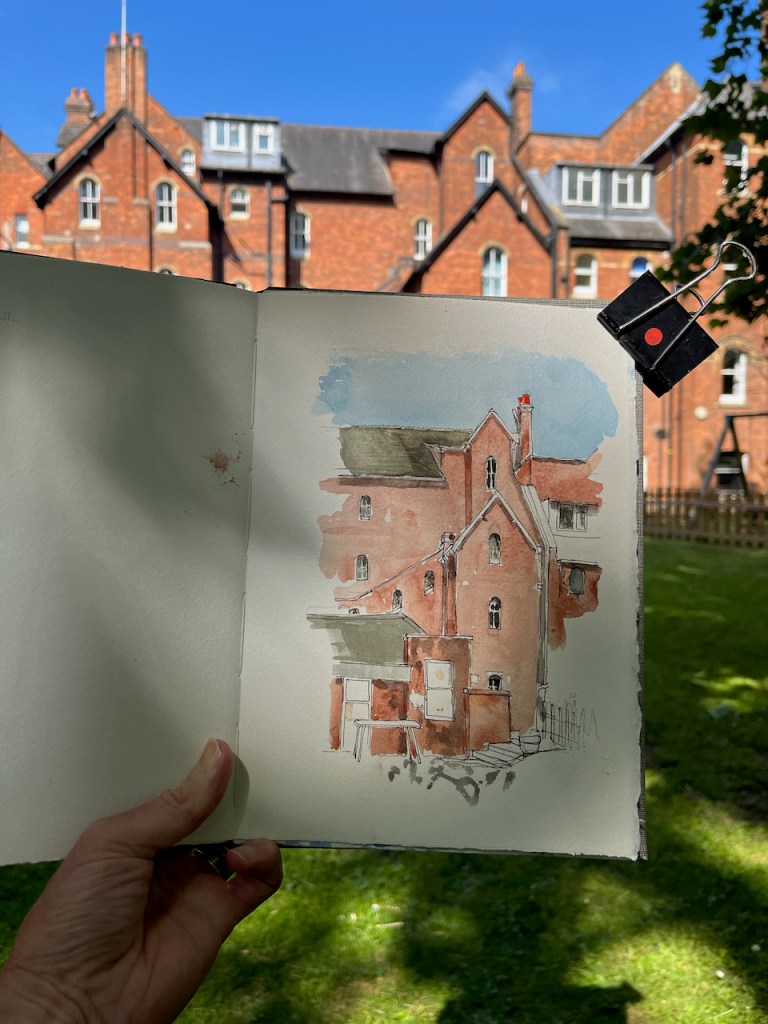
I stayed there as a bed-and-breakfast guest, and sketched this picture from a bench beneath the branches of the plane tree in the gardens. Breakfast is served in the Talbot Rice Dining Room, shown on the bottom left of the picture. I was waiting for it to open.

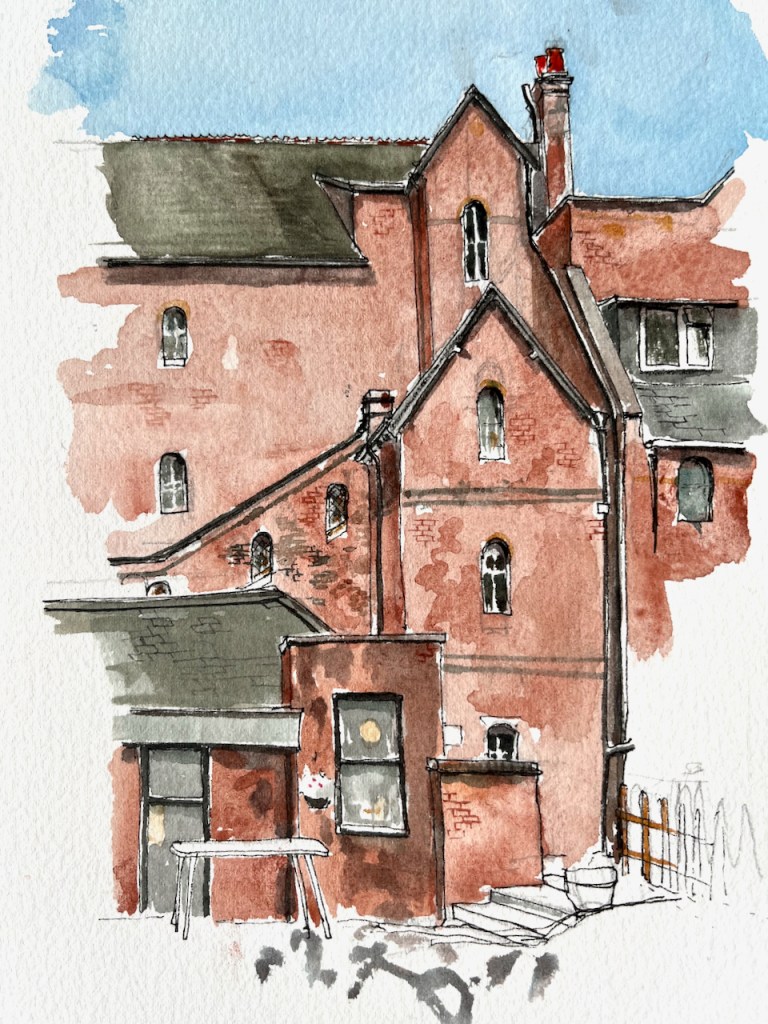
Wycliffe Hall, West side, 09:40. In Sketchbook 14, 25 May 2024.

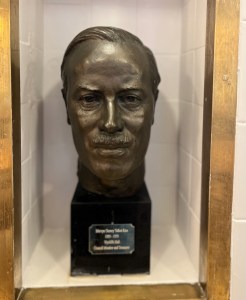
The “Talbot Rice Dining Hall” was built in 1980. The “Bulletin of the Association of British Theological and Philosophical Libraries” volume 16 number 2 dated June 2009*, contains a history of Wycliffe Hall, which informs me that this dining hall is named after Mervyn Talbot Rice (1899-1979), a “friend of Wycliffe”.

Sculpture portrait of Mervyn Gurney Talbot-Rice, in the dining room at Wycliffe Hall (Photo: Feb 2025)

When they say “friend of Wycliffe”, they must mean a friend of the the Hall, as John Wycliffe died 600 years ago. The Talbot Rice art gallery in Edinburgh is named after David Talbot Rice, one of Mervyn’s sons.

The breakfast room opened, and I took my place at one of the long tables. Behind me, three, or possibly four, men were already engaged in a serious conversation about Middle Eastern politics. Judging by the various accents, at least one of them was American. They took different points of view, and argued from personal experience, with courtesy. At another table, a group of young men and women were working out complicated logistics to do with rowing. Who was to be cox? Who was rowing? When? Where? Another man engaged the member of staff in a lively conversation on management techniques prevalent in a particular football team and how this may or may not affect their chances.

Between them all, I finished my porridge and headed back out to the plane tree to continue my picture.

I’ve sketched at Wycliffe Hall before. Click the image below to go to the post.

Wycliffe Hall Chapel

*The link to the Bulletin is here. Or if that doesn’t work, the pdf is below. The history of Wycliffe Hall starts on page 19.

E5 Bakehouse, London E8

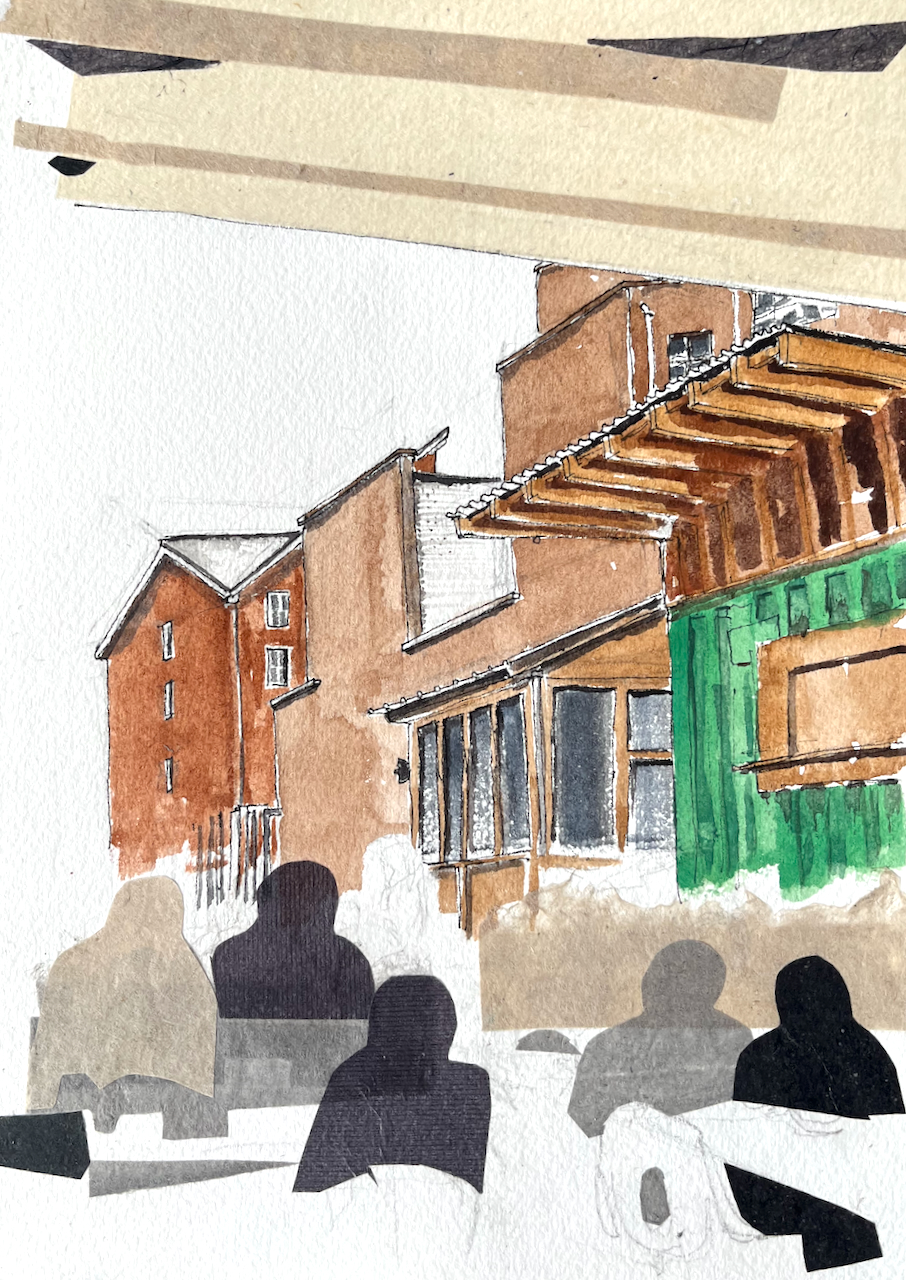
Sometimes I go out and find a view for my sketch. Sometimes the view is determined simply by where I find myself. Here is one of those occasions.

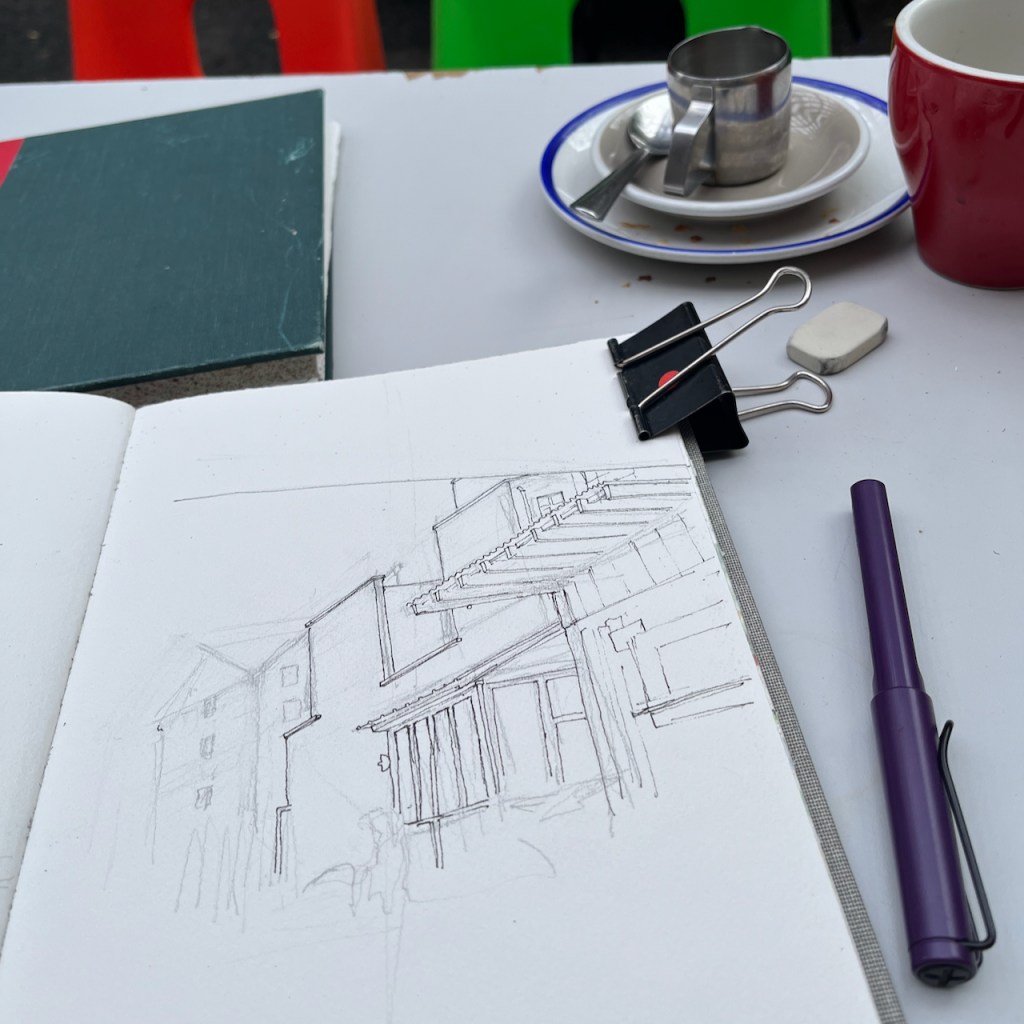
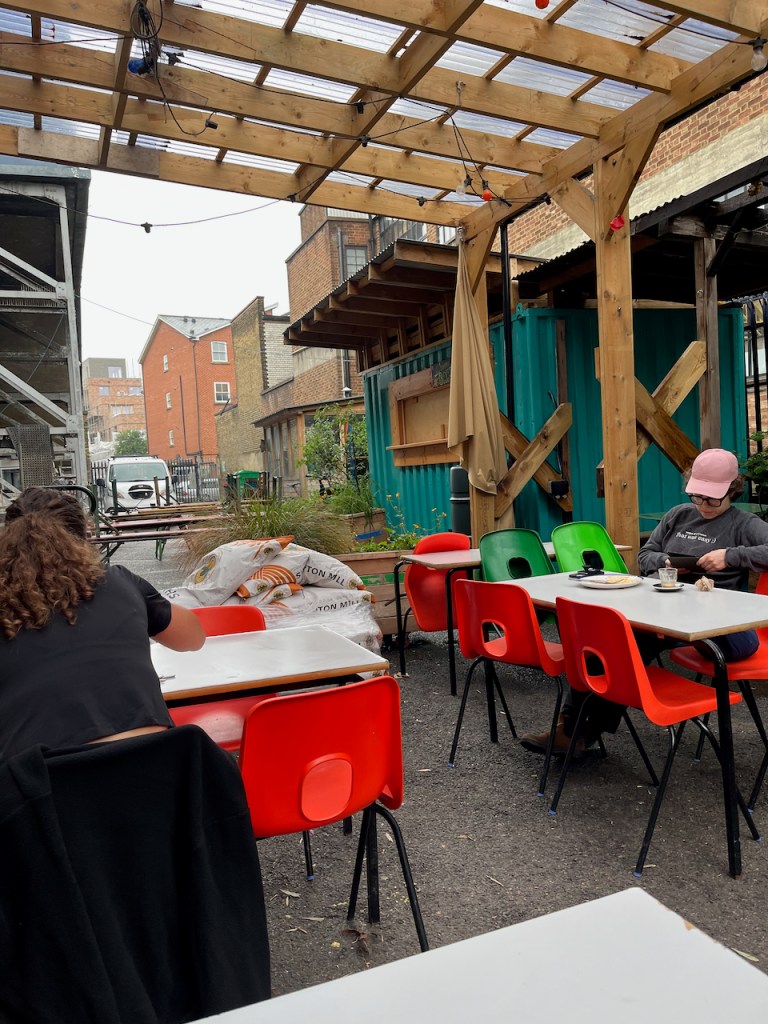
I had breakfast in the seating area at the back of E5 Bakehouse. At 09:15 I was the only person out there. I looked at the view. The various roofs made interesting angles. The cyclist who delivers their bread arrived and loaded up his formidable cargo bike. Customers arrived, and came outdoors. The tables filled up, each new arrival nodding a greeting to those of us already there. People made room for each other. It was quiet, no background music, perfect. I went back to the counter and bought another Gilchester bun. Time to do a sketch.

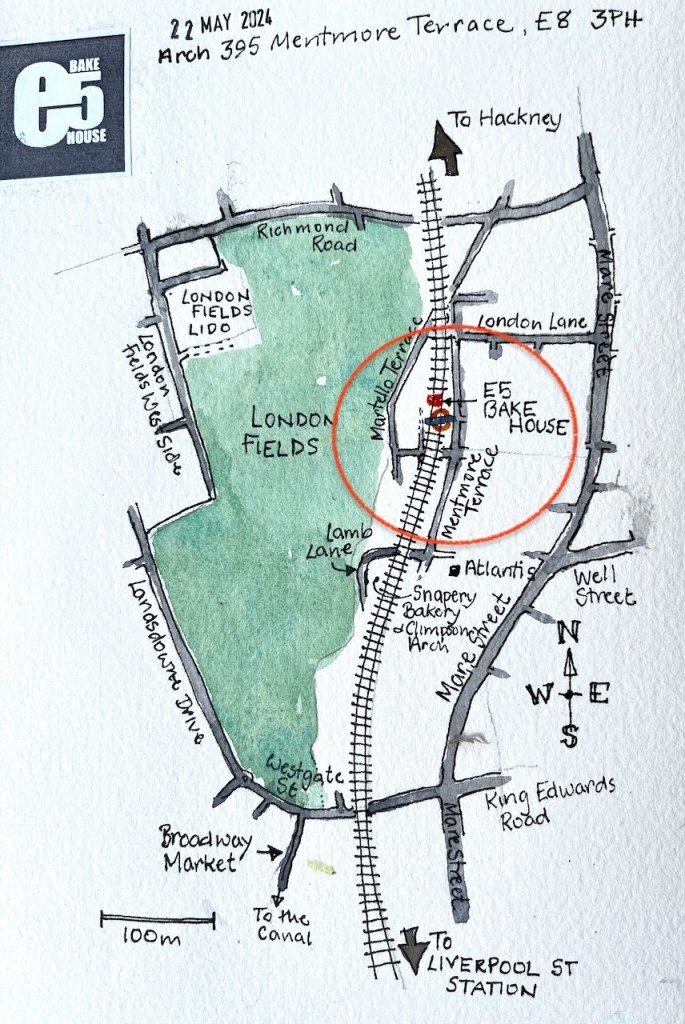
E5 Bakehouse is not in E5 but in E8, right next to London Fields Overground Station, on the line out of Liverpool Street. Their website says

“The name E5 is a nod to our former local postcode and our intention to remain rooted in our community.”

They produce wonderful bread and pastries. My fellow customers were enjoying substantial breakfasts of eggs and all sorts of greens, or a kind of piled up yogurt and fruit dish. My favourite is the Gilchester bun: the archetypal currant bun – “Made using Gilchester’s organic flour , these are so simple and so tasty you can eat them on their own, or toasted even just with butter is all you need!”

A colleague of mine once told me that the way he judged a hotel was to ask for a glass of orange juice. The orange juice told him all he needed to know, he asserted. Was it fresh pressed, or out of a bottle? Was it served in a glass or a paper cup? Did they provide a spoon to stir up the bits?

For me, a currant bun is the test of a bakery. Those at E5 set the standard for currant buns the world over. The currants are numerous, the bread is soft and all the sweetness is from the currants. They are just superb. So that’s why I needed another one.

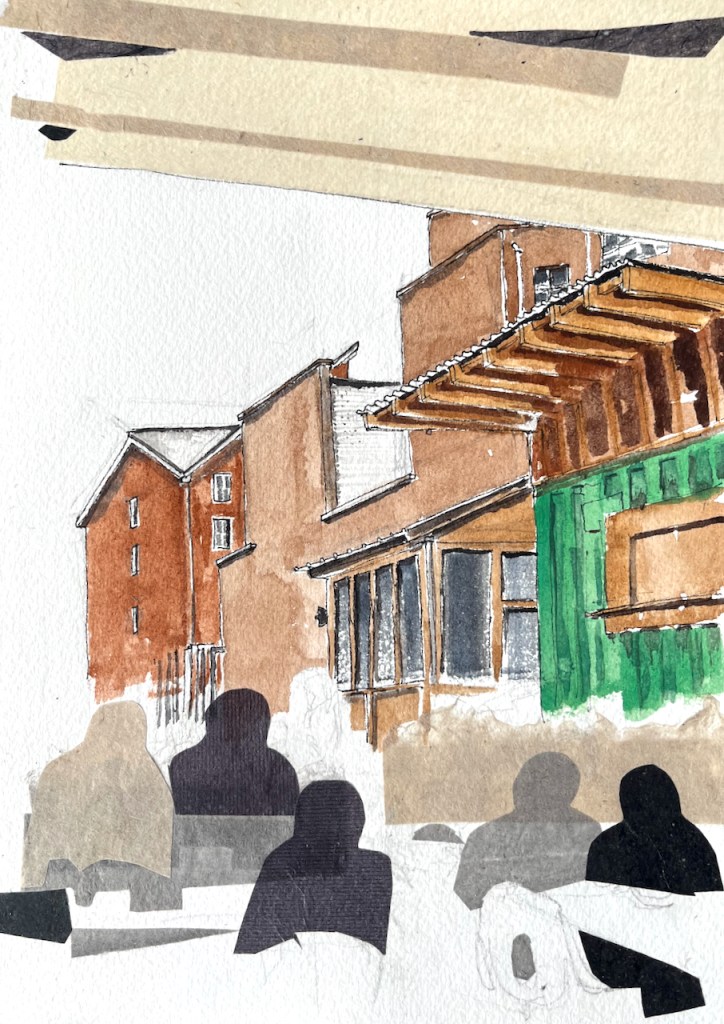
Here’s the finished picture. I added the collage at my desk at home.

Breakfast at E5 Bakehouse, watercolour and collage, 10″ x 7″ in sketchbook 14.
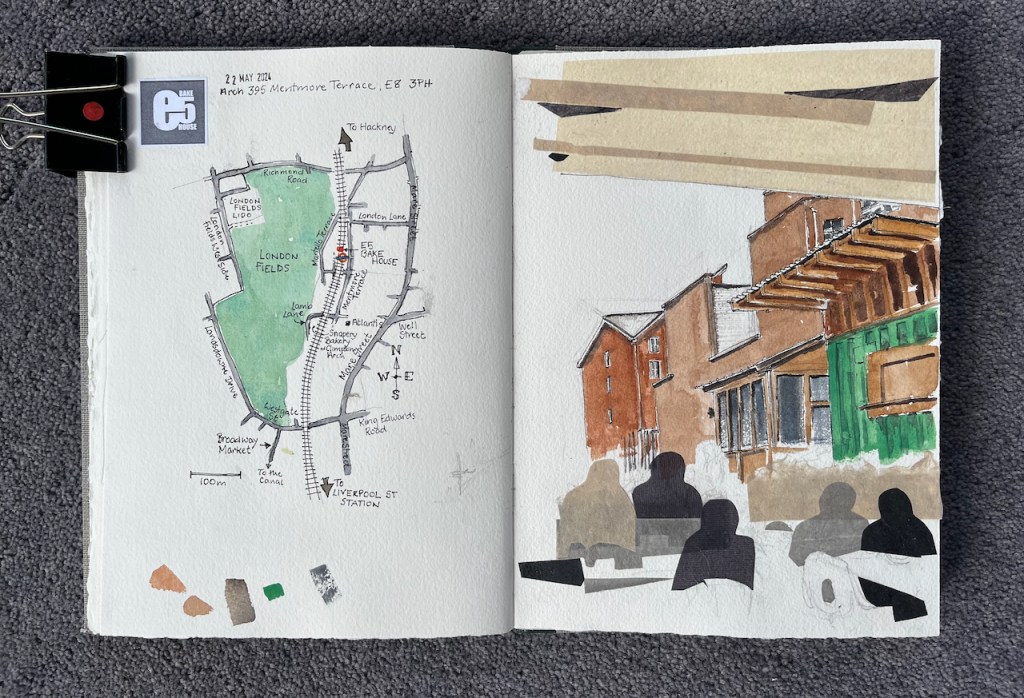
Page spread: sketchbook 14

City Road 400kV Substation EC1

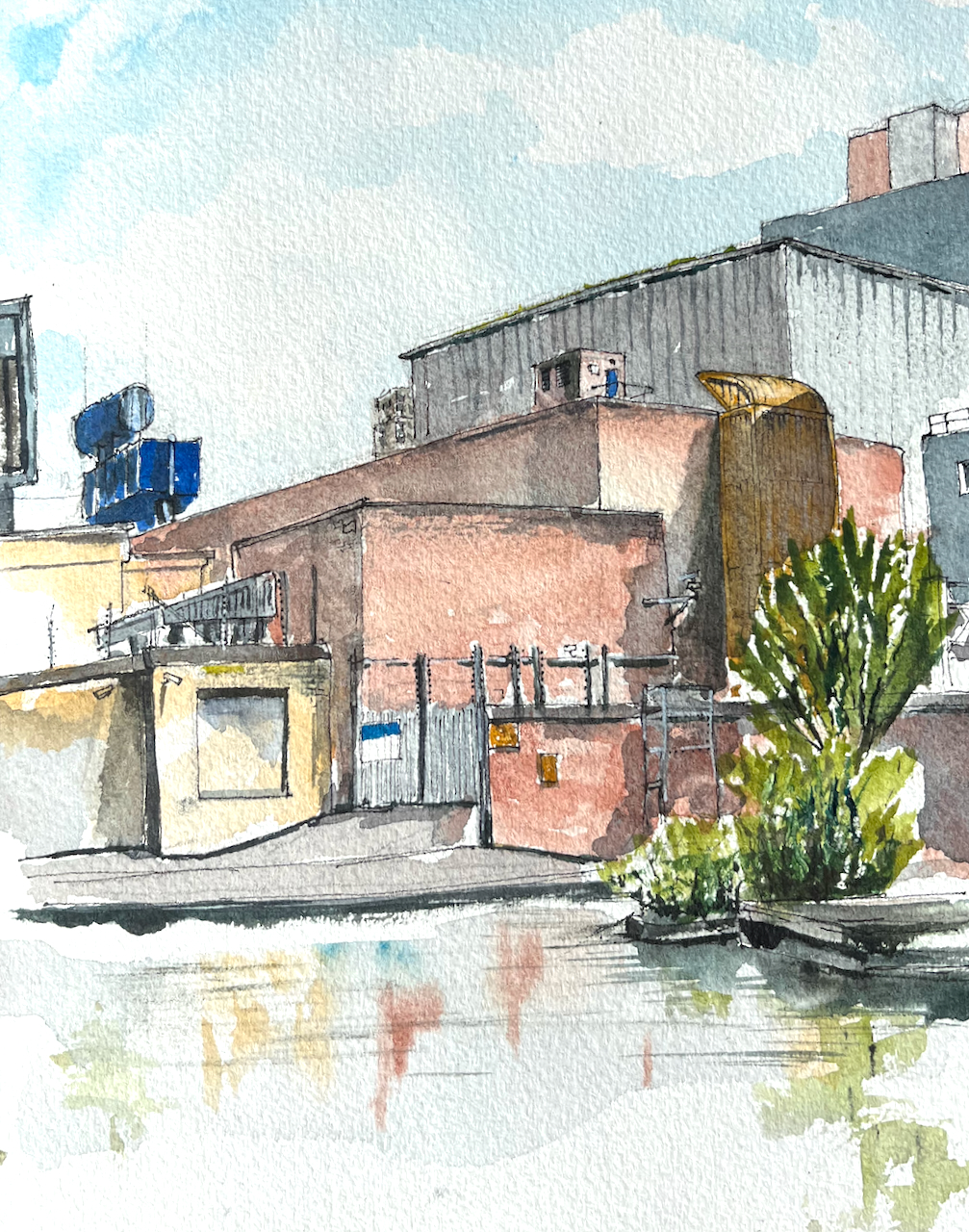
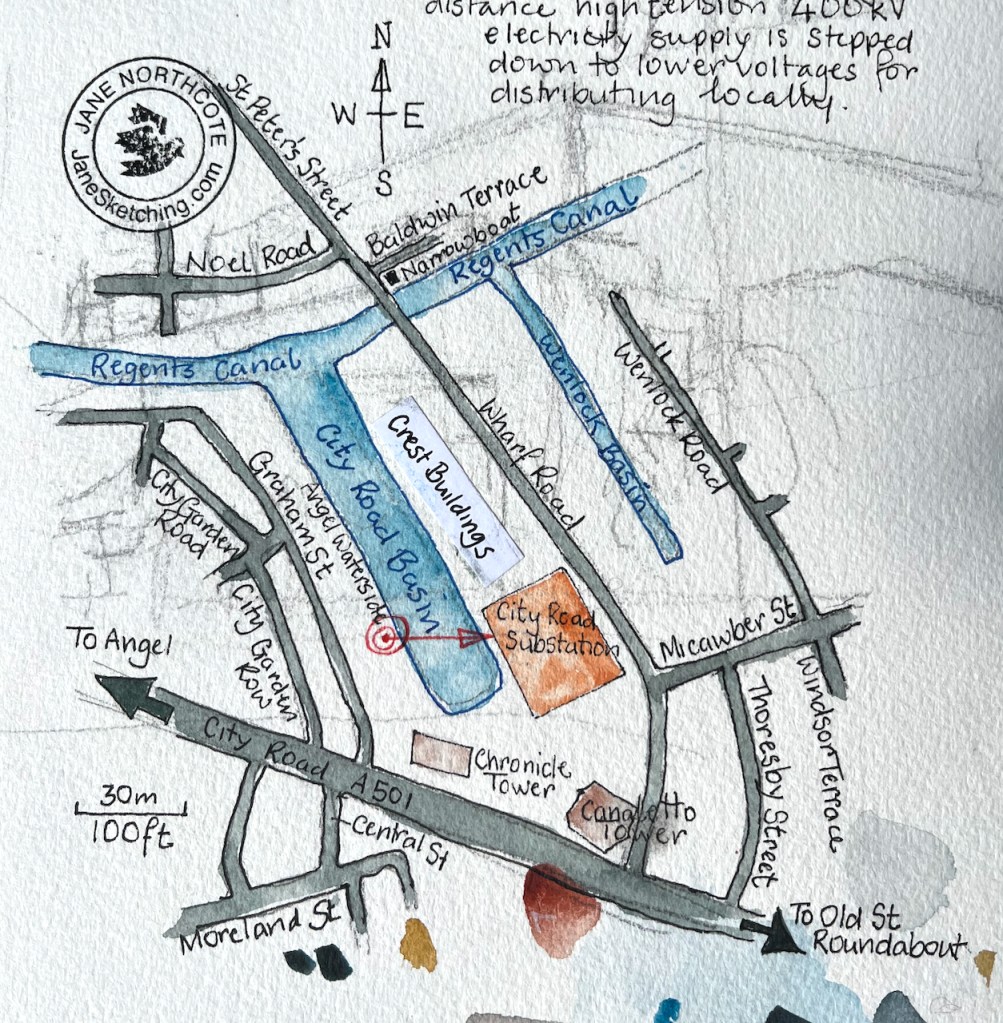
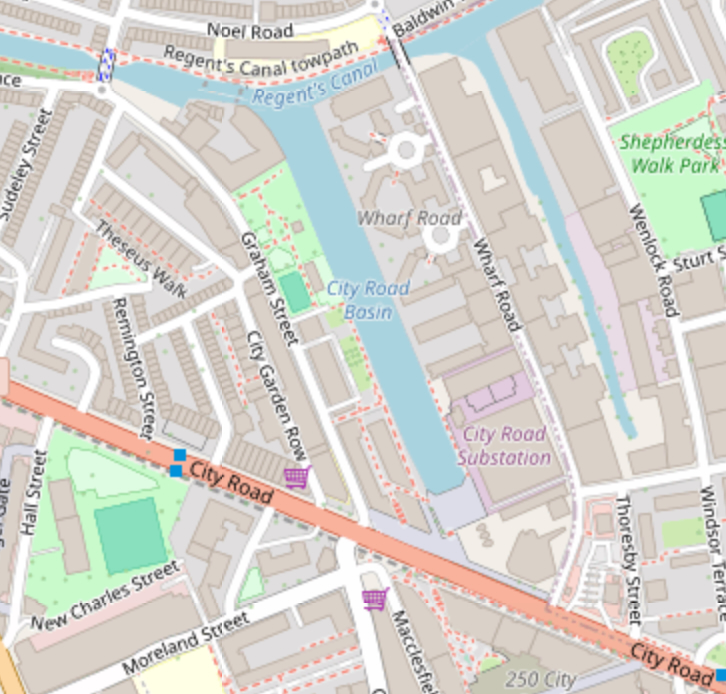
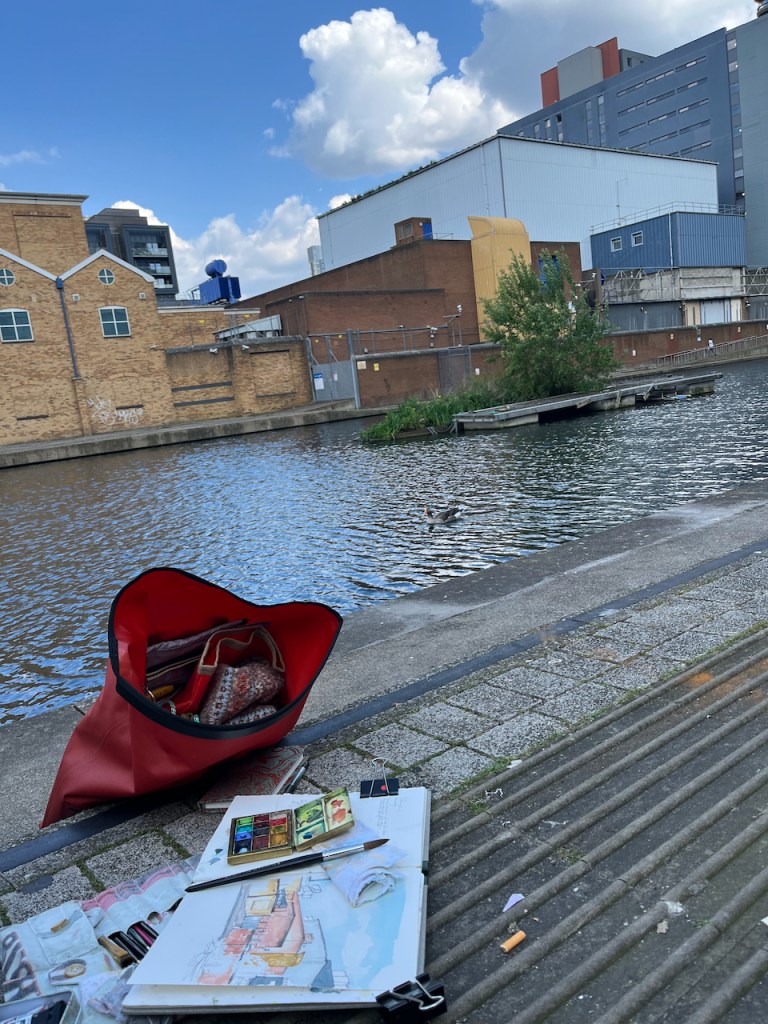
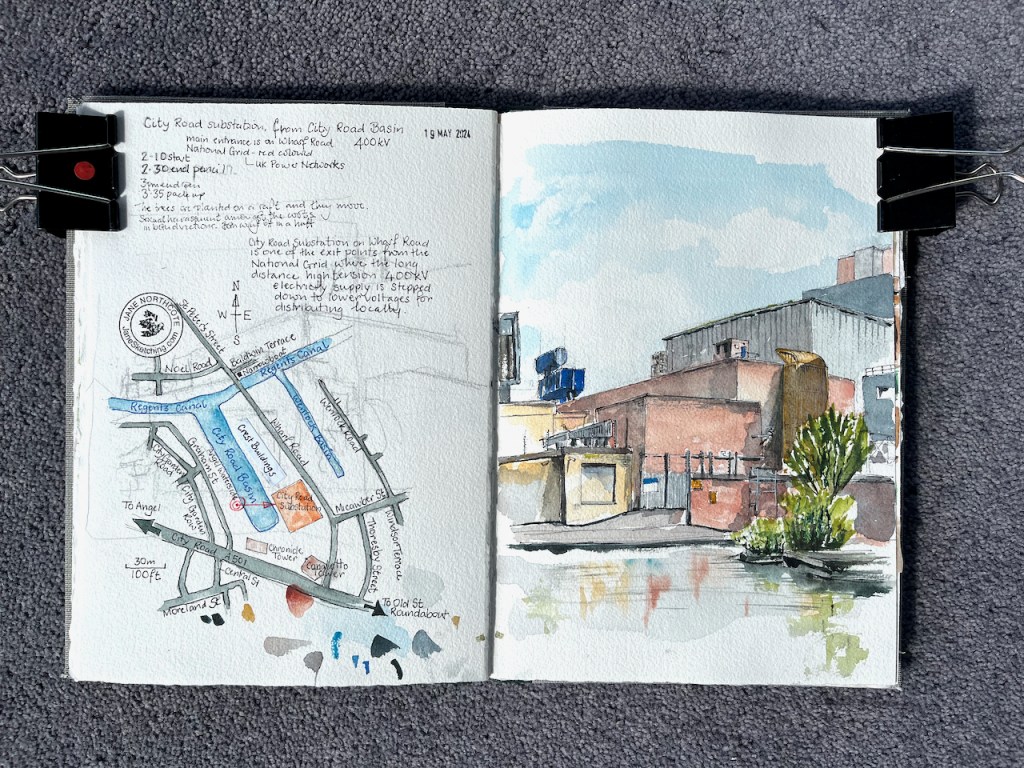
Here is a view of the City Road 400kV Substation, sketched from the other side of City Basin.

City Road 400kV Substation from “Angel Waterside” City Basin, 19th May 2024 in sketchbook 14

This is a monumentally large building, a last remaining representative of heavy industry, in an area now mainly residential. All around are the new tower blocks containing luxury apartments, made of shapes and designs aiming for visual appeal. Chronicle Tower and Canaletto Tower are just off the picture to the right. The sub-station is robustly functional. I enjoyed its forthright no-nonsense appearance.

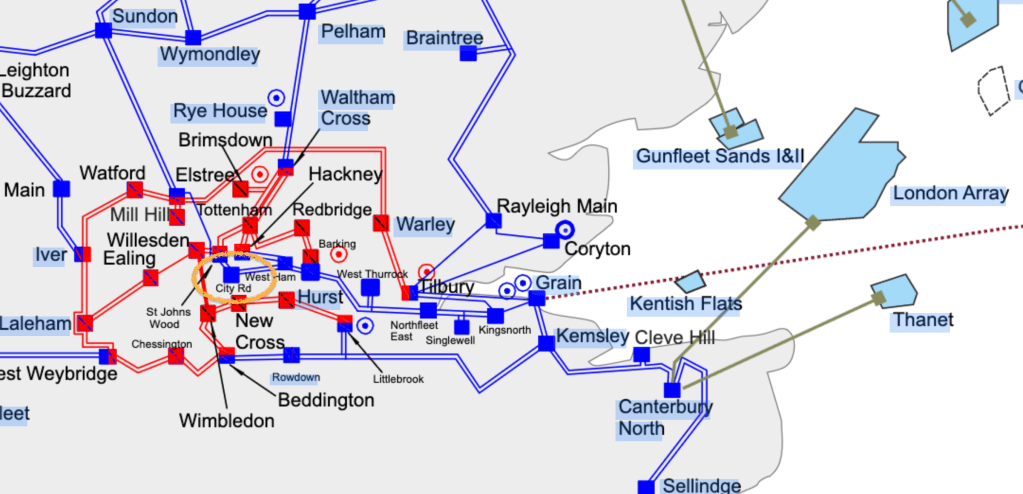
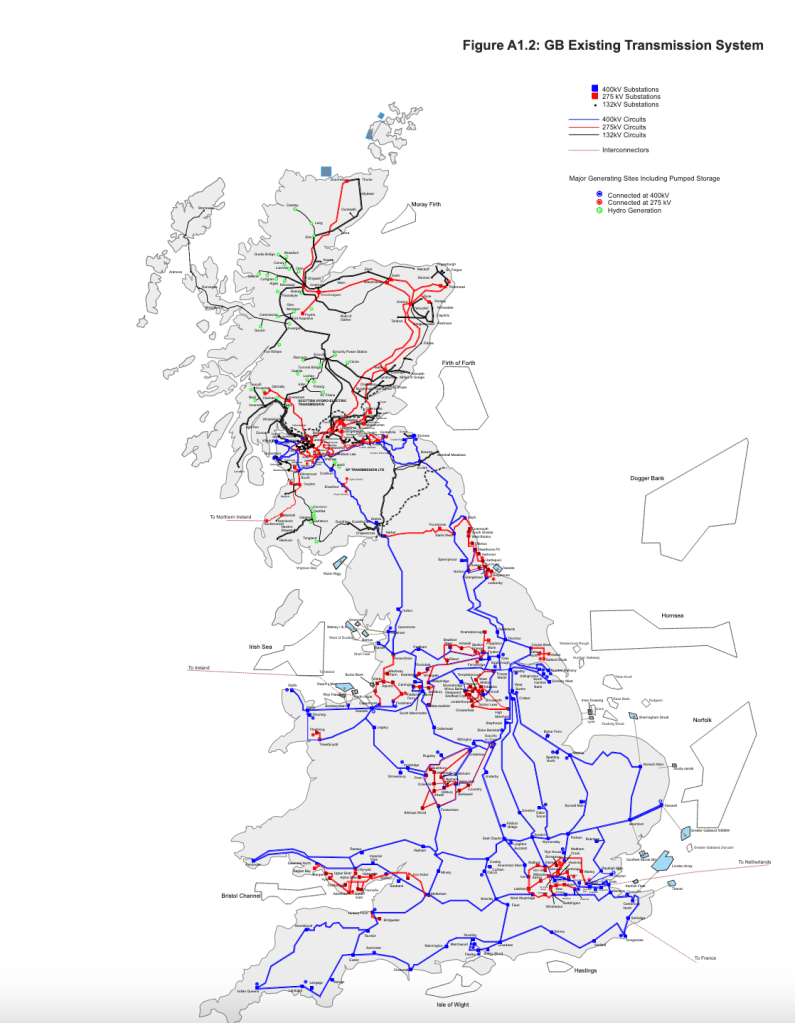
It’s built like a fortress, as well it should be. It is part of the UK power distribution system, connecting us in London to, amongst other power sources, the off-shore windfarms in the North Sea, an interconnector off across to Europe, and power stations on the Isle of Grain.

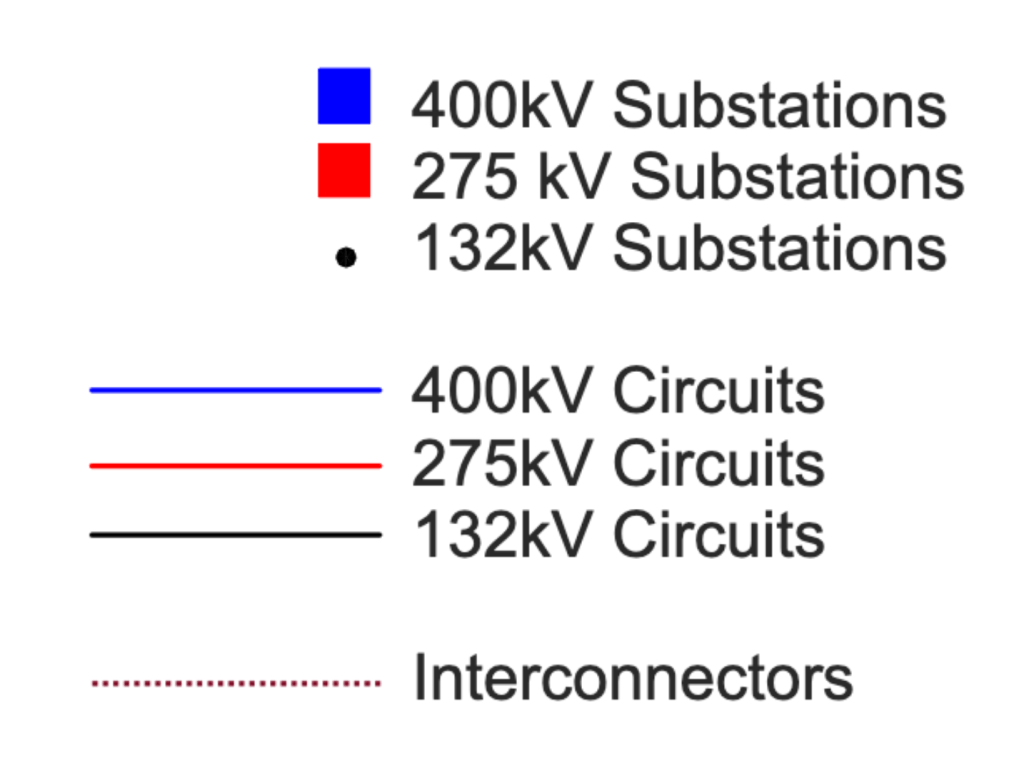
These diagrams come from a National Grid document on this link. The document is “Electricity Ten Year Statement 2012, Appendix A1”. It’s over 12 years old so there may be different connections now.

Despite the uncompromising appearance of the substation, the edge of its higher roof was softened with a subtle fringe of grass. I don’t know if this was a deliberate attempt at a “green roof” or if the grass planted itself there of its own volition.

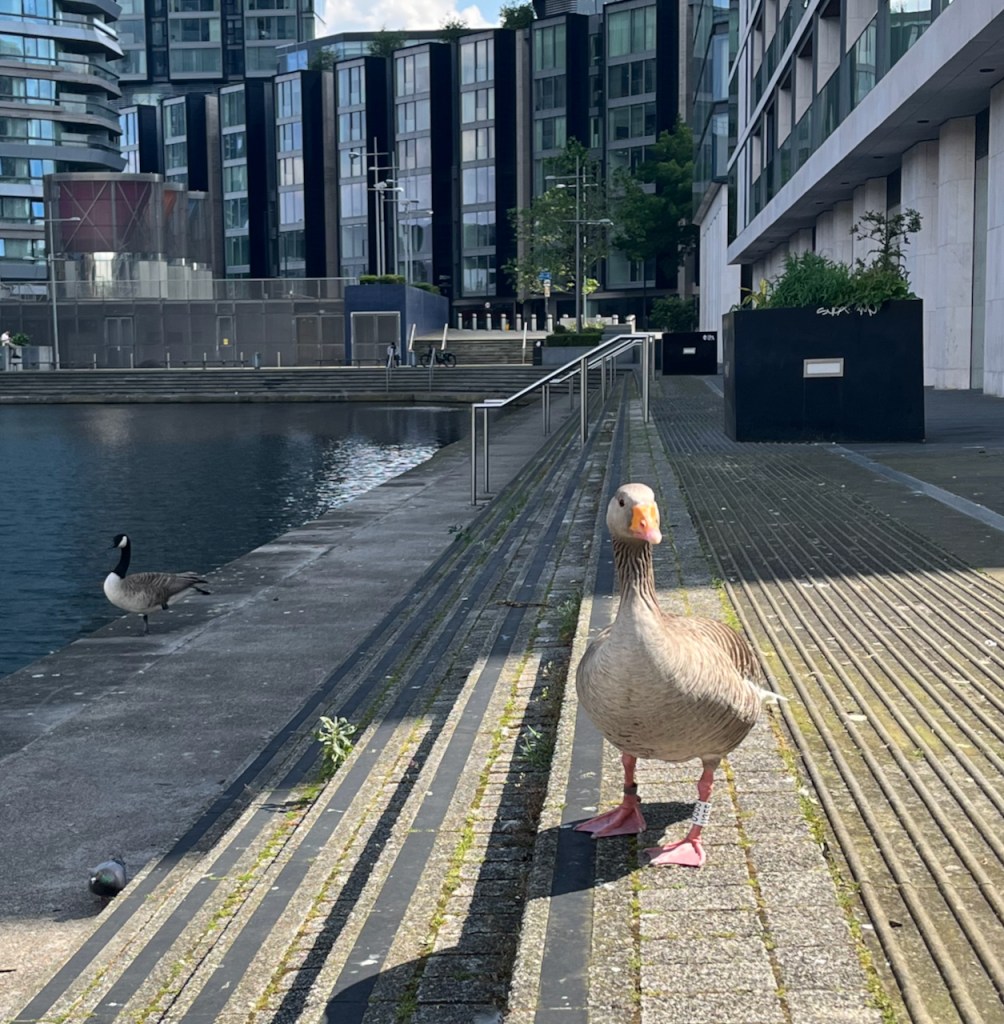
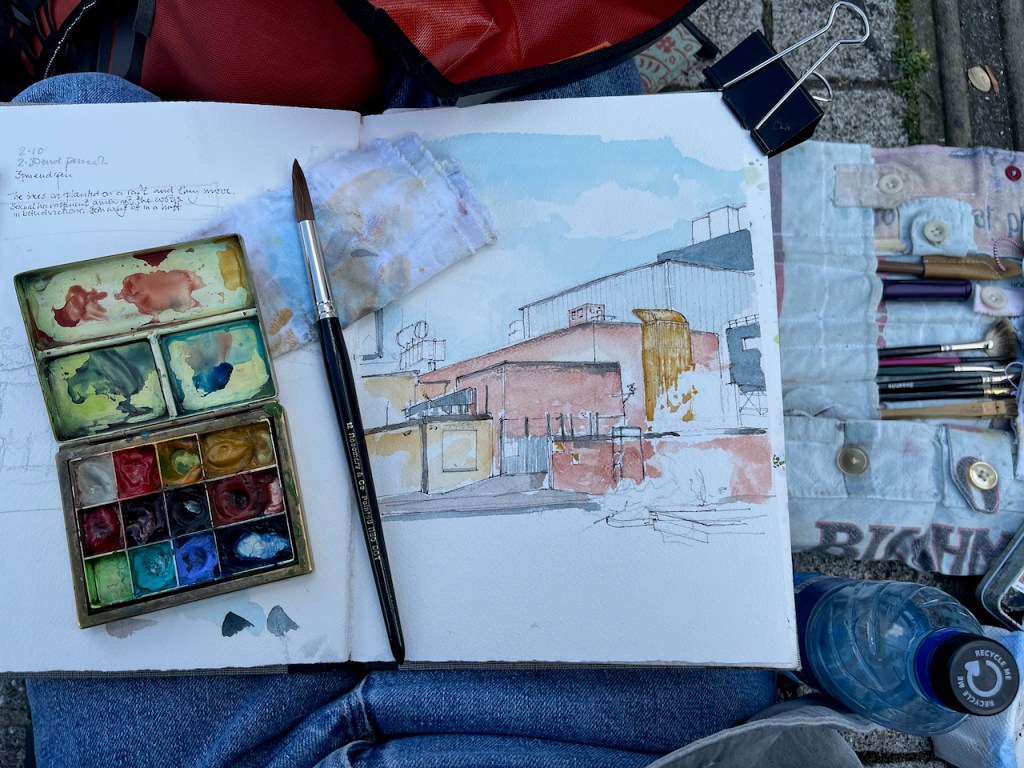
I made this sketch sitting by the water observed by geese. It took me a little while to establish that the tree in the picture was on a raft, and therefore it moved. One does not expect trees to shift around from place to place. I would put it in the sketch, and look up again, and find I had mysteriously got it wrong, again. The geese, obviously, always knew it was a raft, and cackled.

The colours here are:

  • Phthalo Turquoise Blue for the sky (with some Ultramarine Blue)
  • Fired Gold Ochre for the bricks
  • Mars Yellow, with Fired Gold Ochre, for the paler brickwork
  • Ultramarine Blue for the cylindrical construction on the roof (middle left)
  • Serpentine Genuine for the tree
  • All greys and blacks are combinations of the above, plus Burnt Umber.

Colours are all Daniel Smith. The paper is Arches Aquarelle 300gsm in a sketchbook by Wyvern Bindery.

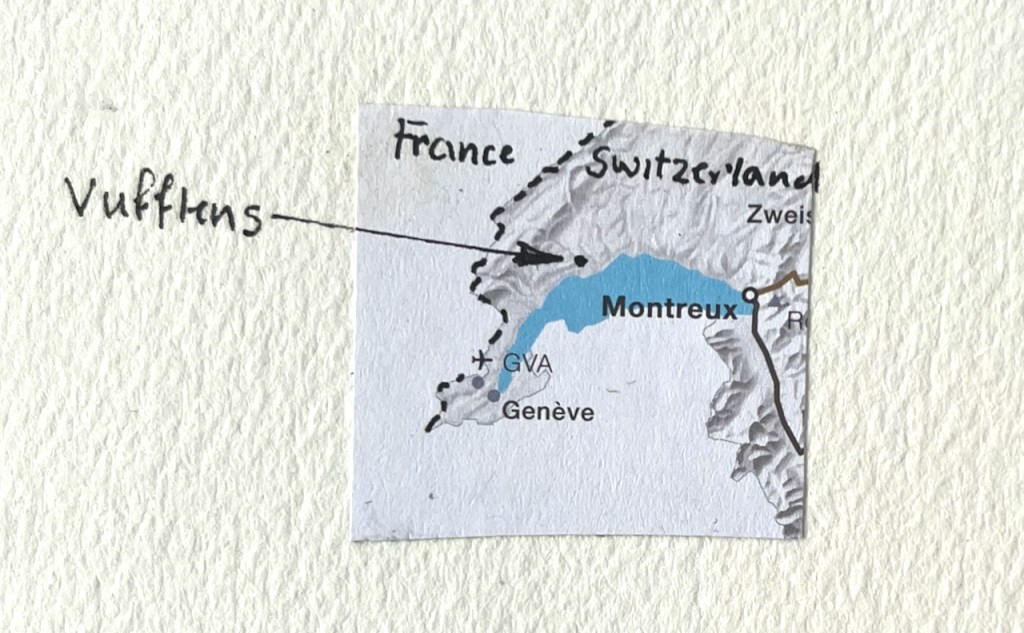
Château de Vufflens, Vaud, Switzerland

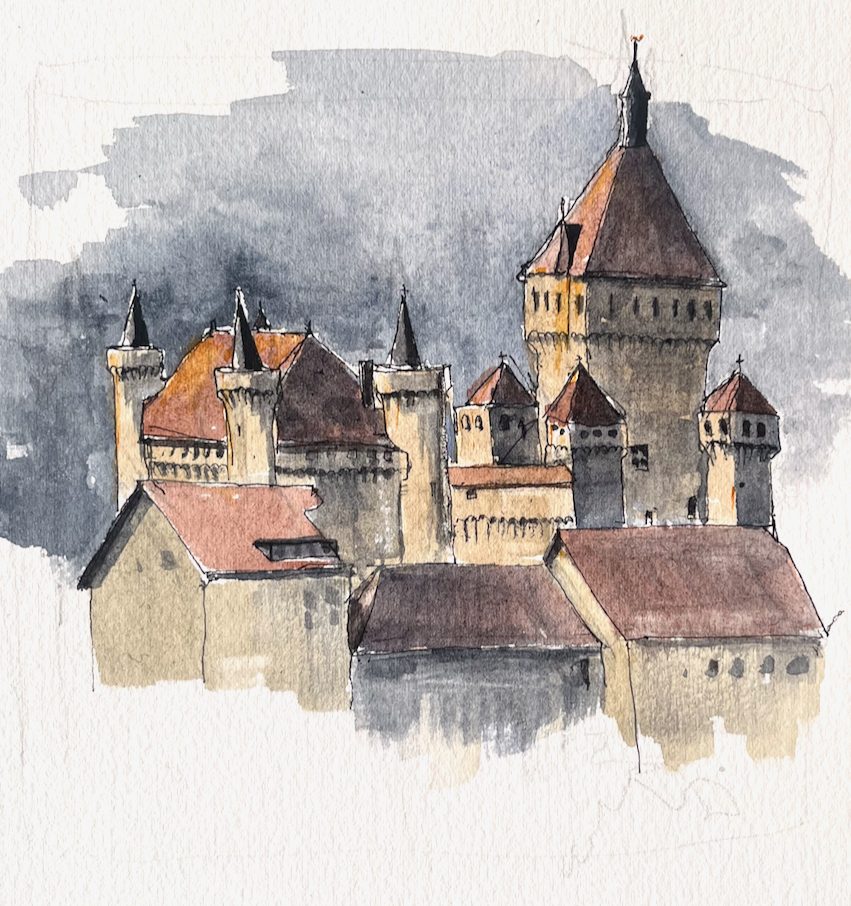
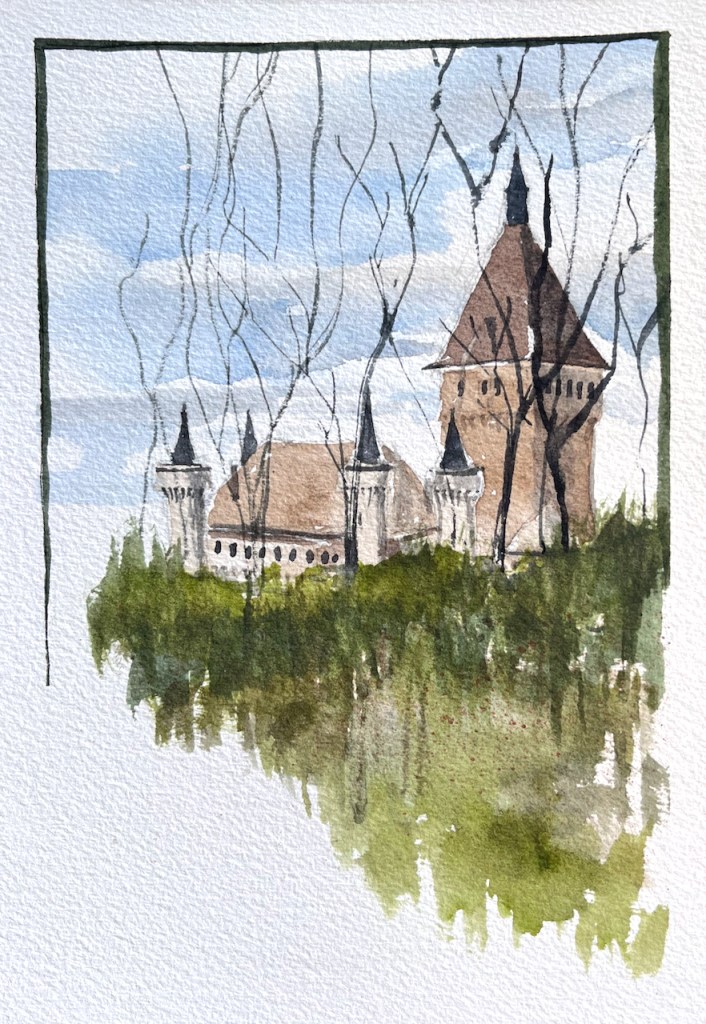
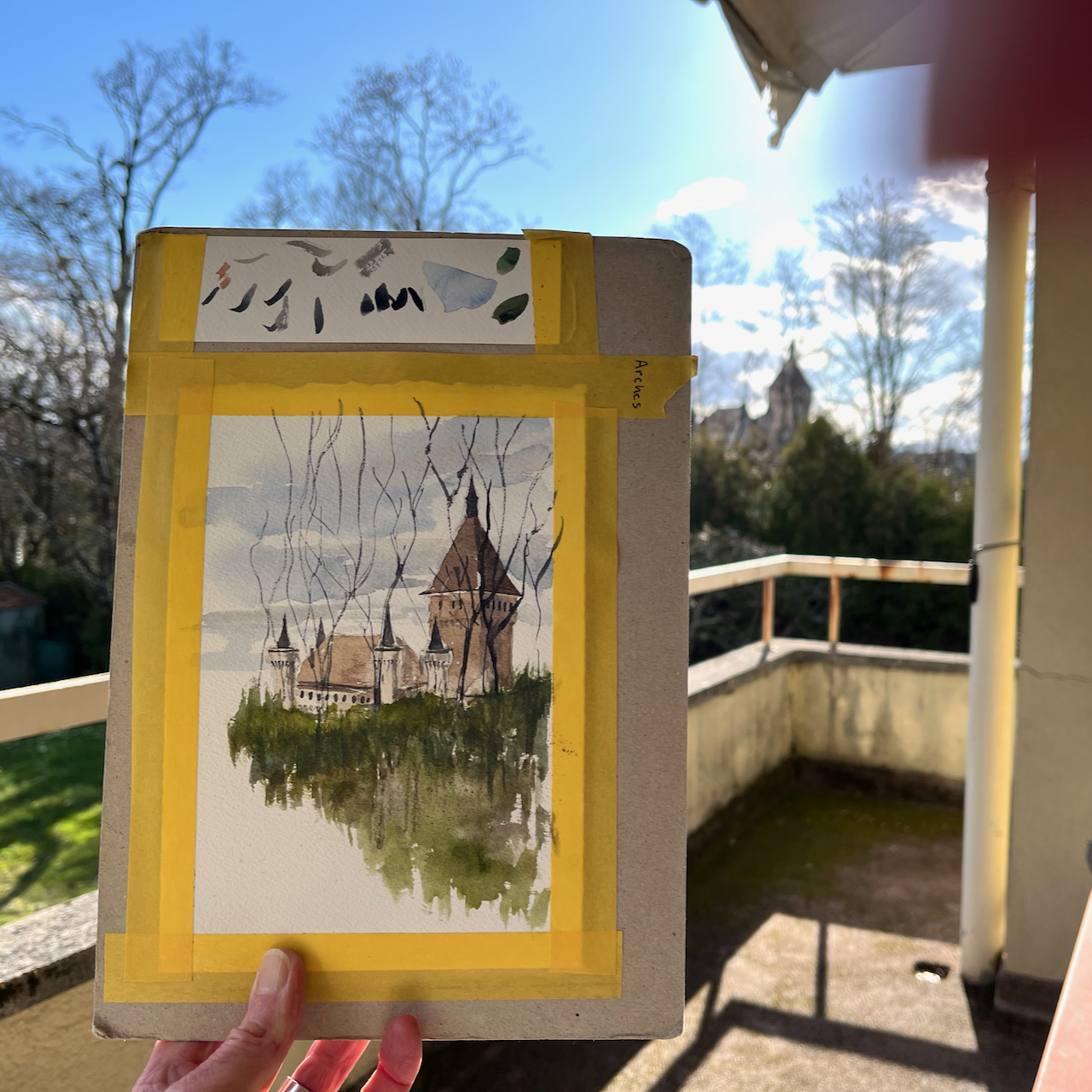
Fine rain started as I sketched the Château de Vufflens. At first I thought I could keep sketching. But then rain arrived in large-size drops, some containing ice. I took refuge under an archway. There was a view of the castle from there, but a different view. Also, standing there, I was, very possibly, in someone’s garden. I am not sure about Swiss laws on trespass. All I was sure of was that there would be laws. I assembled suitable French phrases in my head, to be ready to explain and apologise. And I restarted the sketch from this new angle. Then the rain stopped.

I inspected the sky suspiciously. I watched the cloud movements. Clouds just appear here, over the mountains, as from a volcano. They don’t proceed in an orderly succession as they do over the Atlantic. However all seemed more lightweight and friendly than it did earlier. I exited from the archway, and resumed my place on the public roadway. There are probably laws about sketching on the public roadway too.

But no-one even walked past. Not a car. Not a person. Not a dog. So that was alright. I finished the sketch. And then the rain started again.

Château de Vufflens in the morning, 24 March 2024 11:15 in Sketchbook 14

This castle is privately owned. It is on a rock in the valley, surrounded by high walls. Houses cluster at the bases of the walls. if you know the work of Mervyn Peake, think “Gormenghast”.

It was originally constructed in the middle ages, 1420-1430, for Henri de Colombier, an adviser to Duke Amadeus VIII of Savoy, I was told. It looks well maintained, and vast.

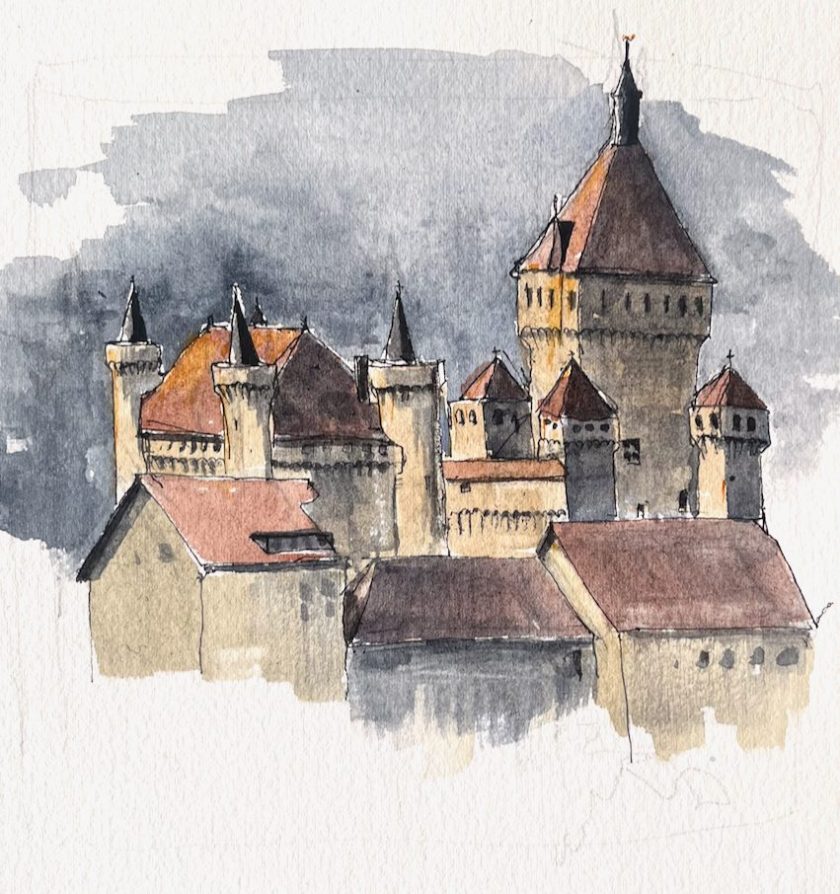
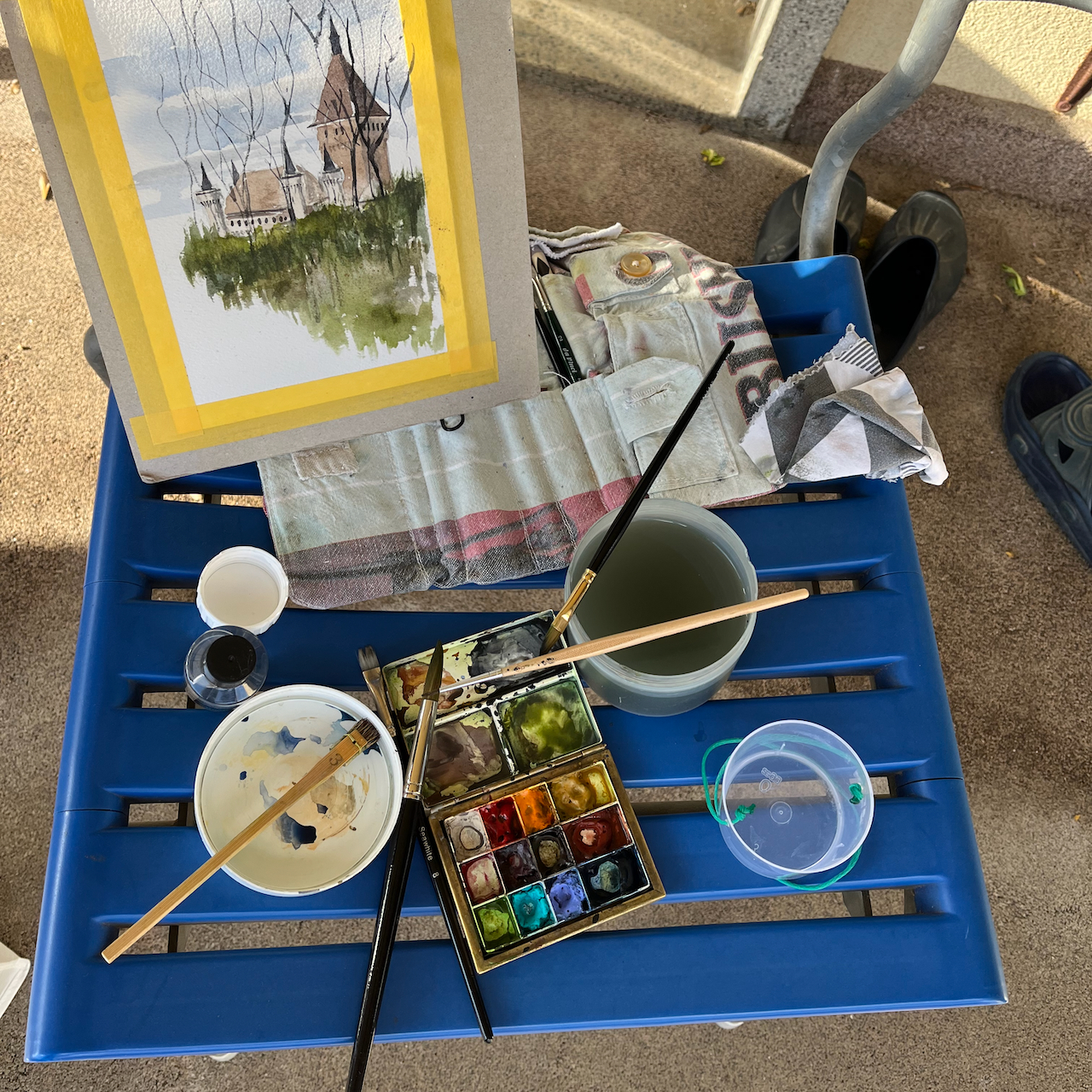
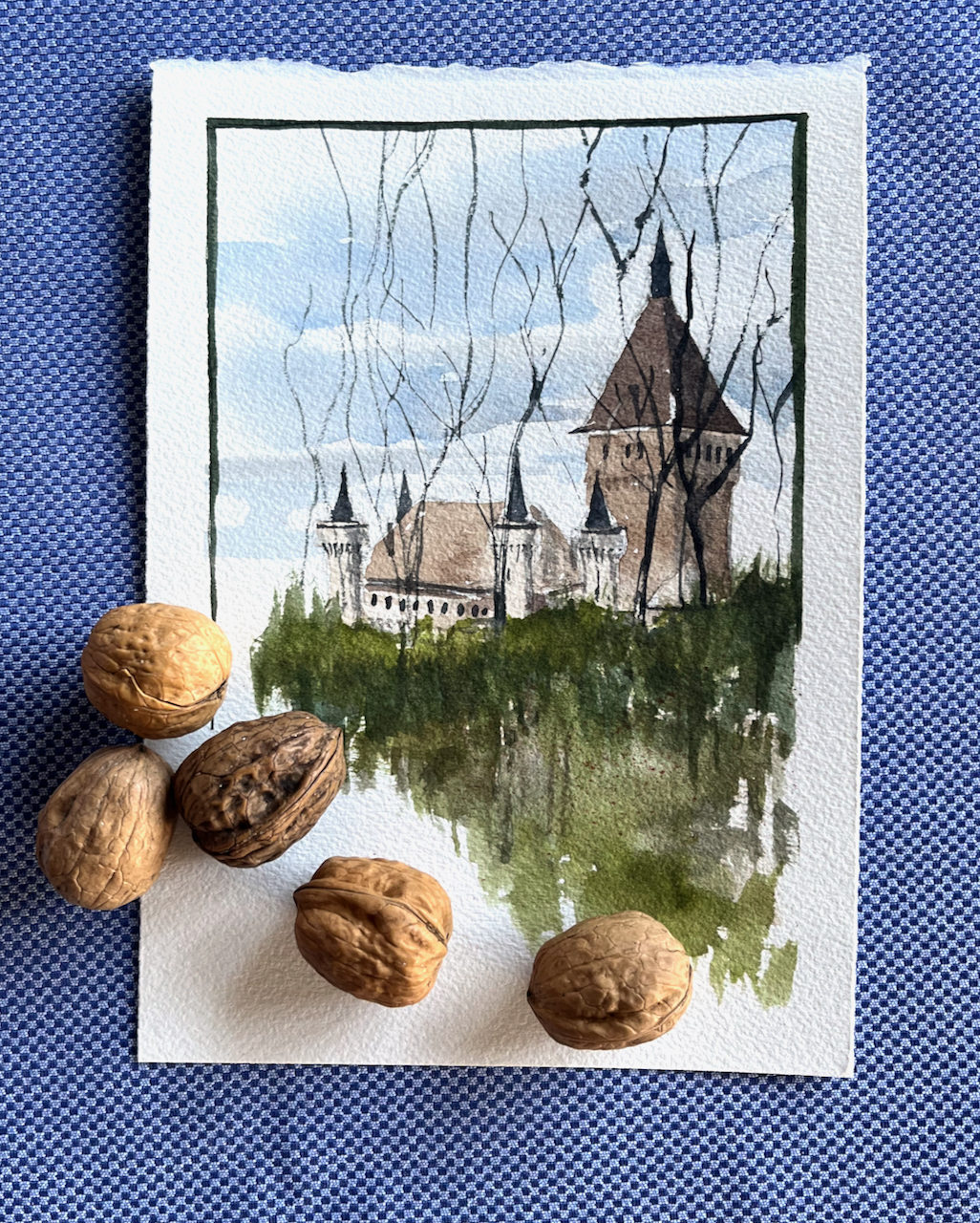
Later that day I made another attempt at drawing the castle, from a different angle. From this new viewpoint I could be under cover, but there were trees. I put the trees in.

Château de Vufflens in the afternoon. 24th March 2024, 4pm. 6″ x 8″ on Arches Aquarelle card

The walnuts came from the trees.

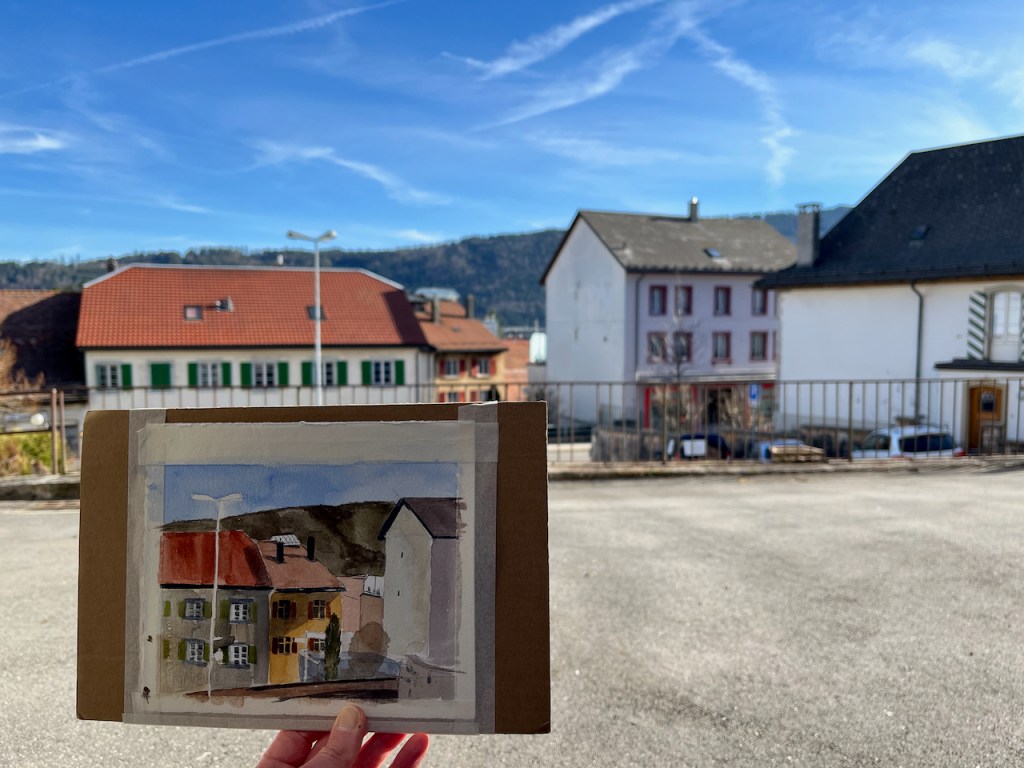
Sainte-Croix houses

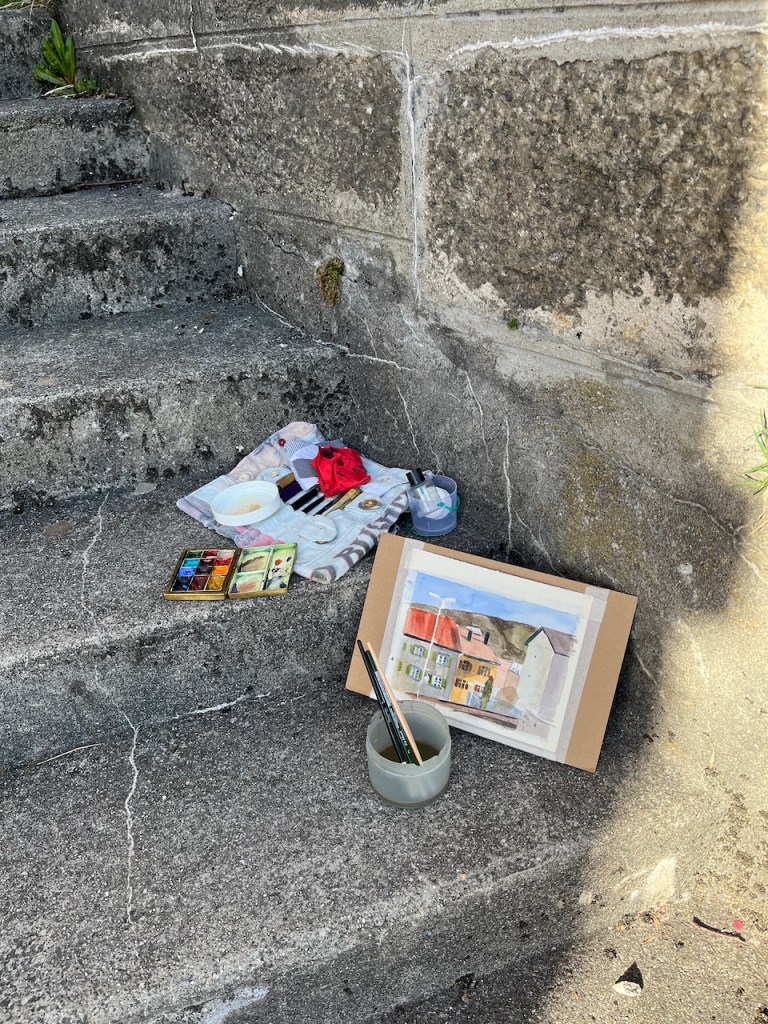
In the afternoon I sat down on the stone steps and sketched the houses that were in front of me.

Sainte-Croix houses, 8″ x 6″ postcard on Arches Aquarelle 300gsm paper. March 2024

I was struck by how the afternoon sun cast shadows on that glass screen, centre left, and illuminated the little greenhouse-type roof on the house in the centre. These are solid Swiss houses, with heavy tiled roofs and properly operational shutters. Some of the metalwork, such as the guttering and the surroundings of the chimney stacks, is in actual copper. Even the downpipes are copper.

One tree was a fir tree and was opaque. The other tree was twigs, and was transparent.

Although it was spring, this is at 1200m, and it was cold. The deciduous trees are still bare. The hill is the background is Mont-de-Baulmes. Many of the trees up there are deciduous larch.

I painted this picture in watercolour-only. Usually I use pen. Here, I did a quick pencil sketch and then straight on with the colour. It was too cold to try to get any details or do any penmanship. The solid plainness of the houses seemed to demand flat colour washes. I deliberately left lines of white between the slabs of colour – the sun always catches edges.

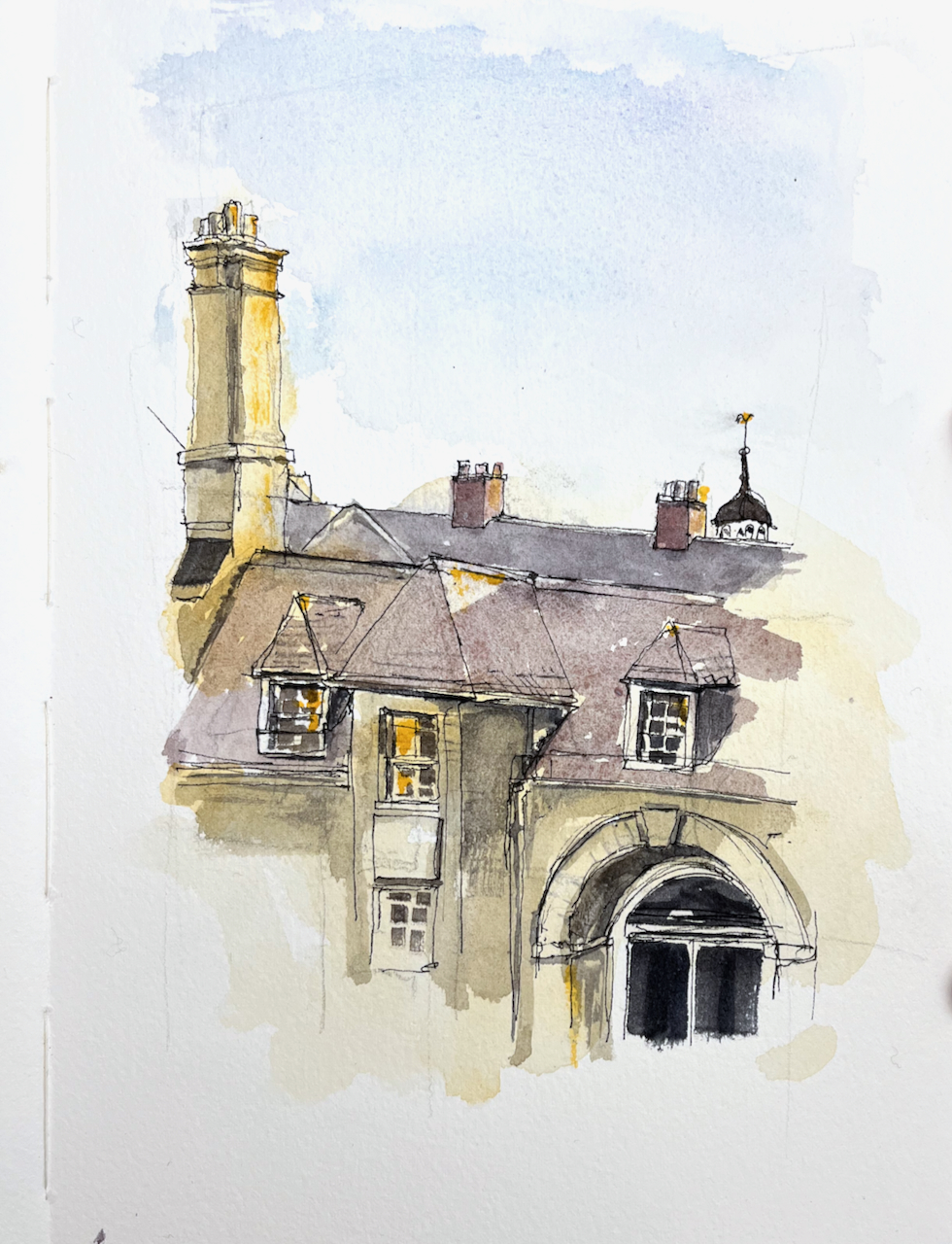
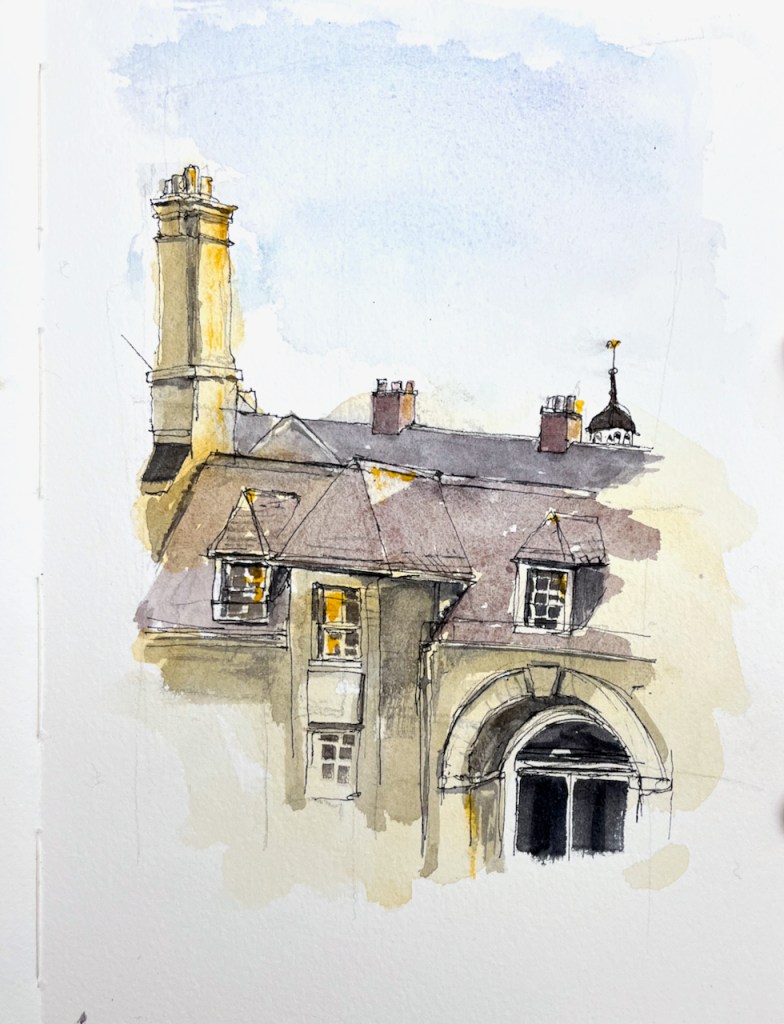
Somerville College, Oxford: Porters’ Lodge

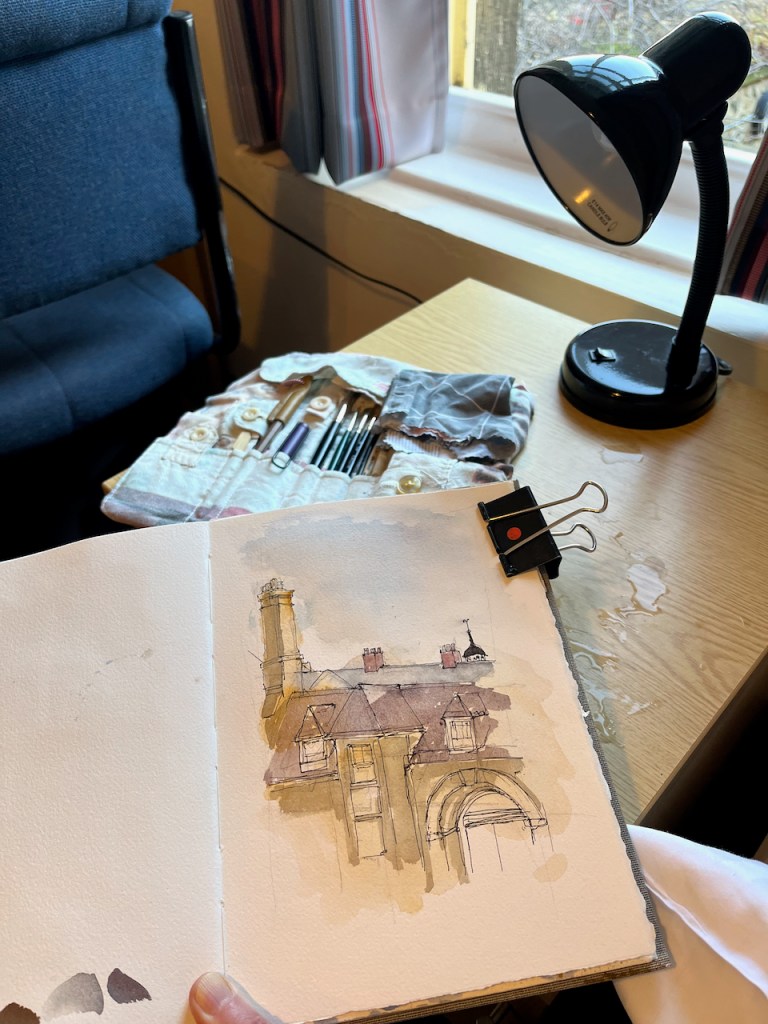
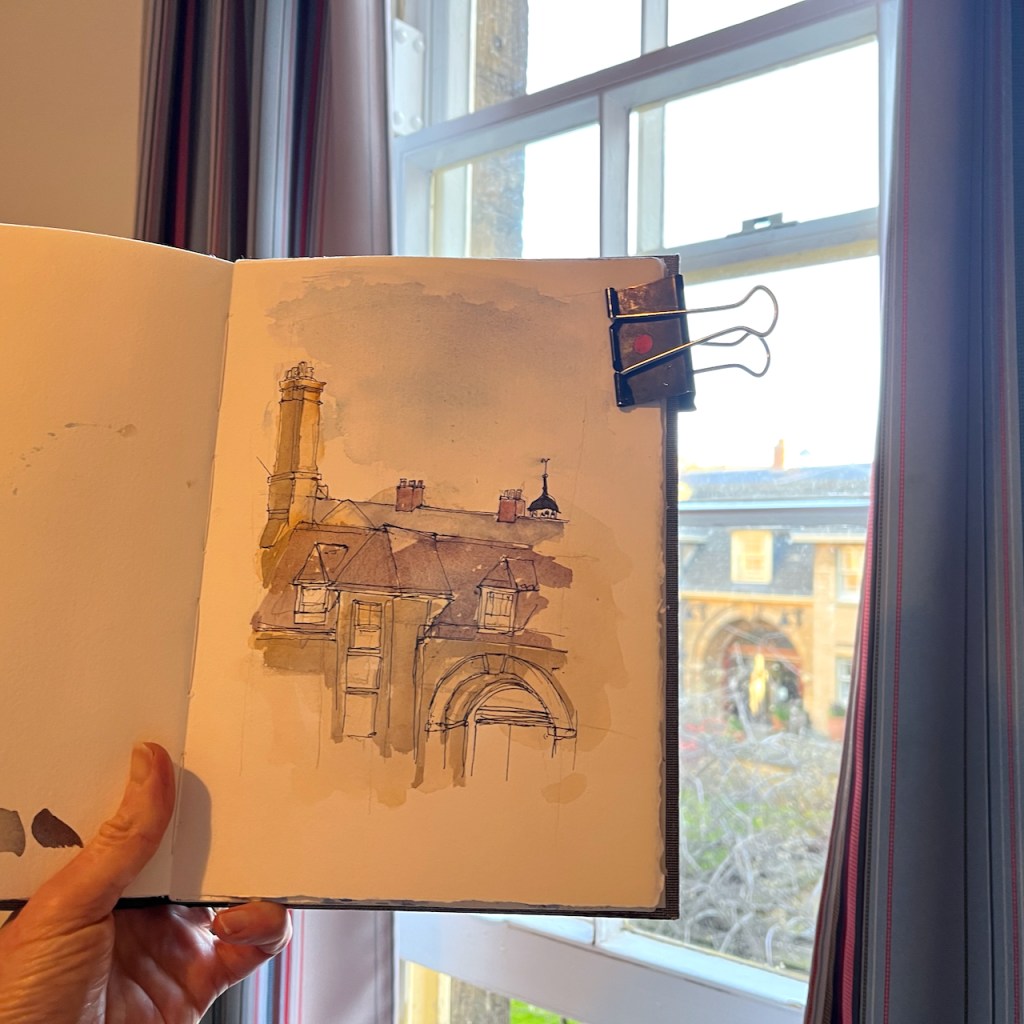
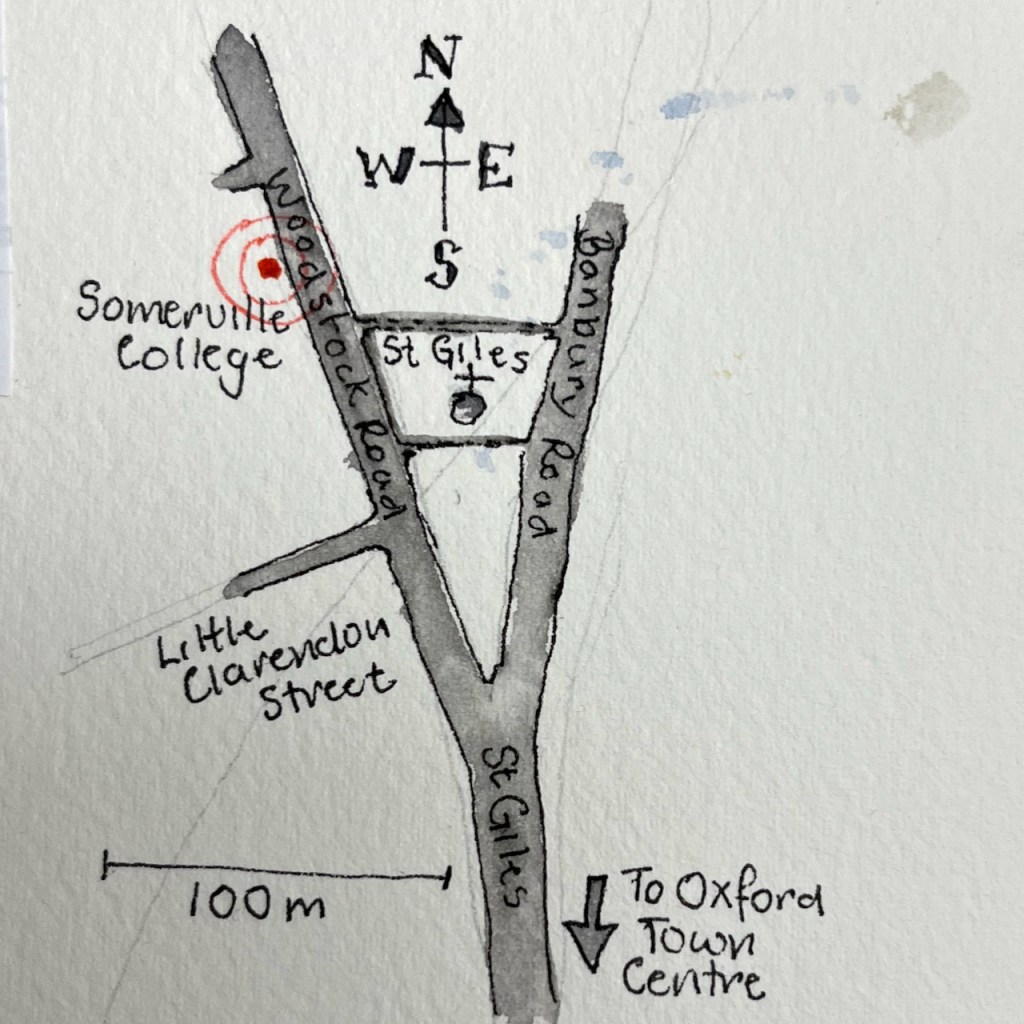
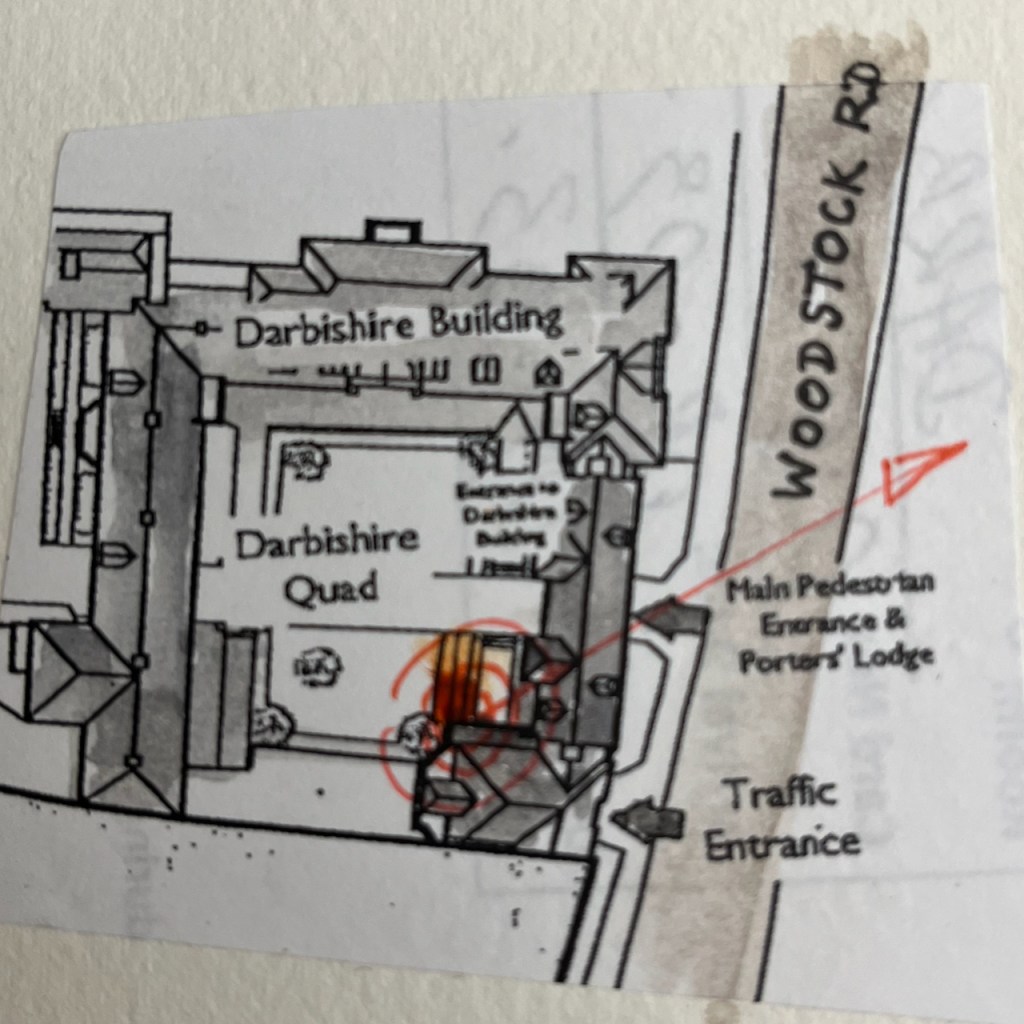
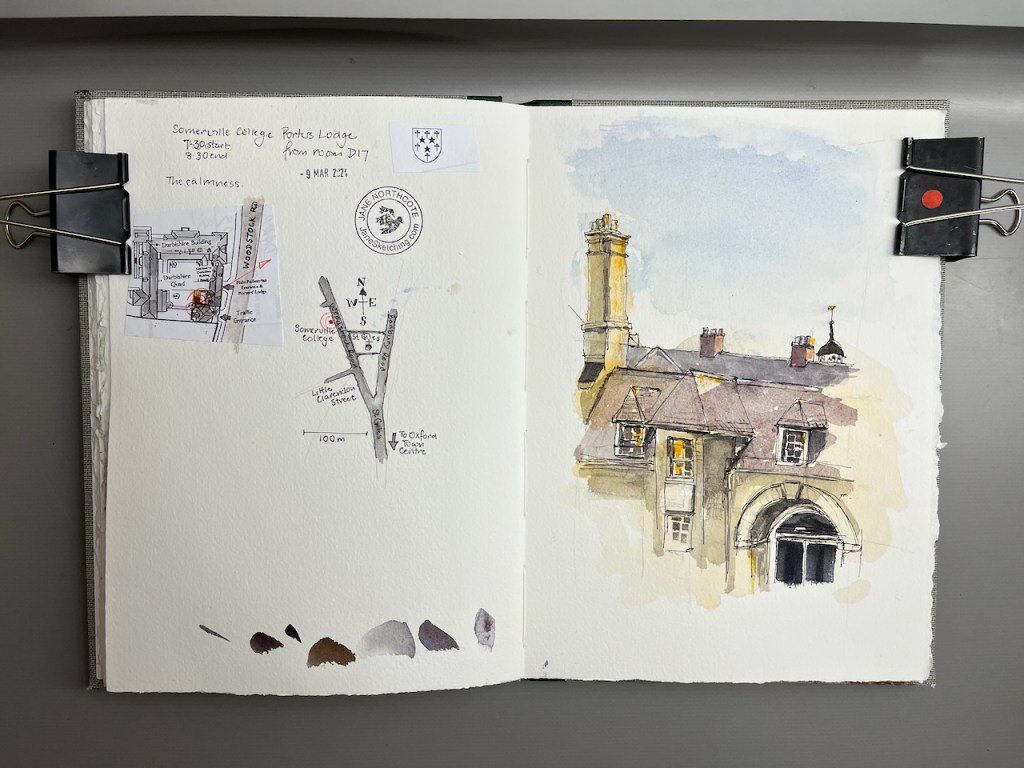
Here is the view from room D17 in Somerville College, OX2 6HD.

View from D17, Somerville College Porters’ Lodge. 9th March 2024, 07:30am, in Sketchbook 14

I sketched it quickly, before leaving, just as the sun was coming up.

Somerville College was women-only for the first 115 years of its existence. It started to admit men in 1994.

Vauxhall Tea House Theatre SE11

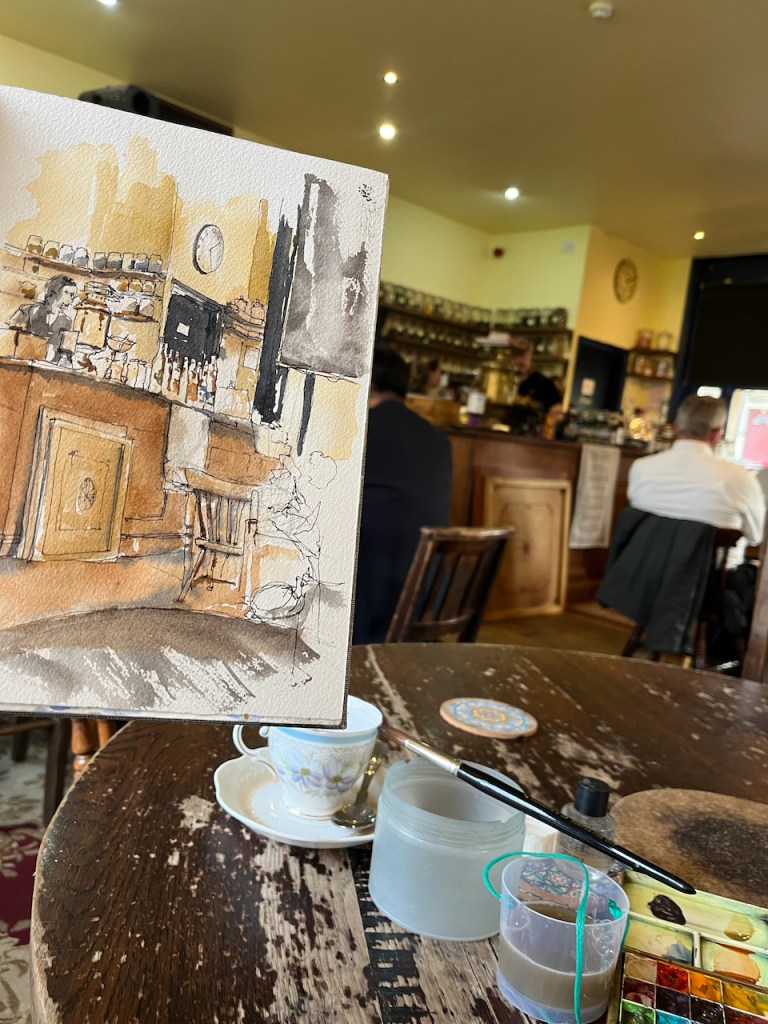
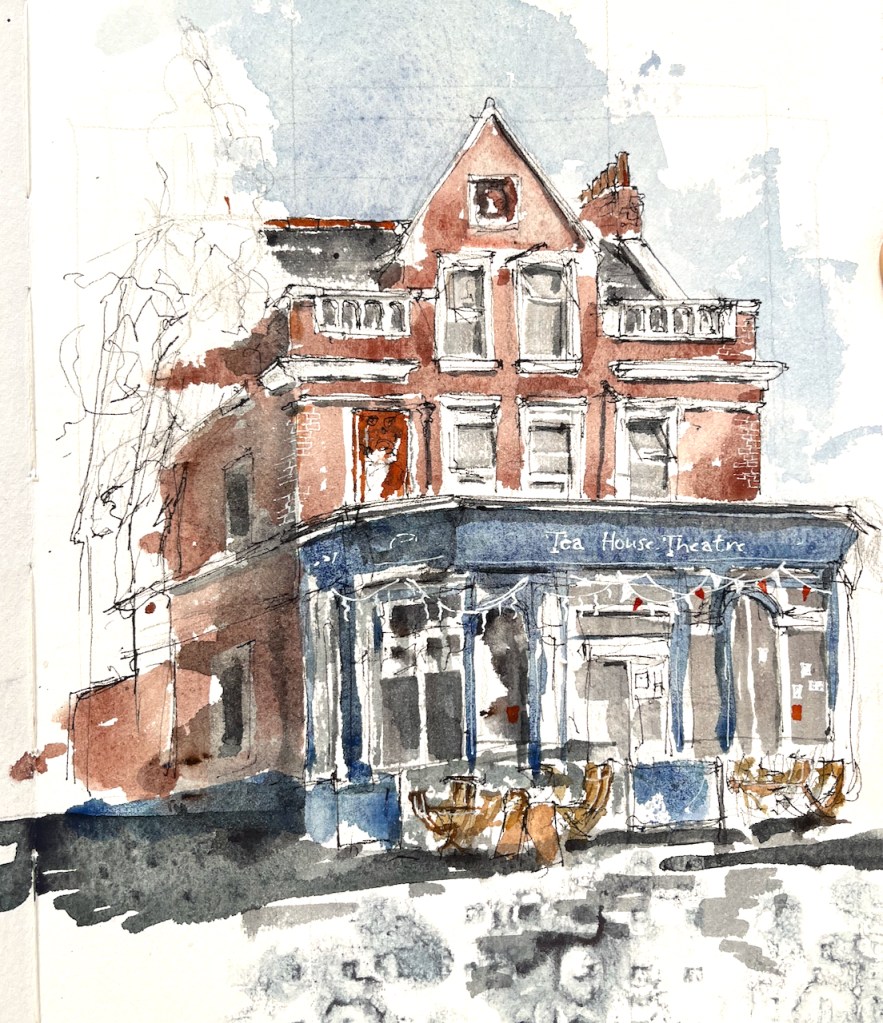
Here is a civilised place in London. It’s the Vauxhall Tea House Theatre.

This is a picture I sketched there last week:

Vauxhall Tea House – 2:30pm 7 March 2024, in sketchbook 14

The tea I drank was their “Russian Smoky Tea”.

I’ve visited the Tea House many times. Here is an outside view from June 2022

Tea House Theatre, external view, June 2022 in Sketchbook 12

They have all sorts of theatrical events on their tiny stage. I enjoy “Don’t Go Into The Dungeon” where talented actor Jonathan Goodwin plays all of the characters to amazing effect. He specialises in Victorian mysteries. The next one is “The Hound of the Baskervilles”. Dinner is served before the performance. With scones for dessert.

Here’s where it is, just a 5 minute walk from Vauxhall Station.

And in more detail:

Here’s my sketchbook page:

Sketchbook 14

St George’s Esher, Old Church, KT10 9PX

After sketching the Tin Tabernacle in Esher West End, I walked into the town centre to sketch another St George’s: St George’s Old Church.

St George’s, Esher, Old Church. Sketched February 2024 in Sketchbook 14

Here is the notice by the door:

ST GEORGE ESHER
This church is cared for by
The Churches
Conservation Trust
.
Although no longer needed for regular worship, it remains a consecrated building, a part of England’s history, maintained for the benefit of this and future generations.

Here is the notice hanging from a post by the gate:

Welcome to ST. GEORGE’S CHURCH

Esher’s oldest public building and one of the earliest Anglican churches.
Most of the structure is 16th Century Tudor Two 18th Century features of te Church are a 3-decker pulpit and the Newcastle chamber pew designed by Sir John Vanburgh for Thomas Pelham., Duke of Newcastle and his brother Henry: both served as Prime Minister.
Princess Charlotte – heir to George IV – and Prince Leopold – who became the first King of the Belgians – worshipped here when they lived at Claremont after their marriage in 1816.
Queen Victoria, Leopold’s niece attended services when visiting her uncle and later came with Prince Albert.
When Christ Church was completed in 1854 St George’s ceased to be the Parish Church.
Restored by the community in 1965 it remains a consecrated building now in the care of the Churches Conservation Trust. Several services are held each year. It is also a venue for music and the arts.

I sketched it from the graveyard, as the sun set. So many angles and views! It has been altered and added to and mended, yet is graceful and somehow perfect.

Behind the church there were crocuses.

A wonderful place! Tranquillity just off the main road.

Here’s a map. I walked here from the St Georges West End, along the route marked with a red line on the map: a half hour’s walk, just over a mile.

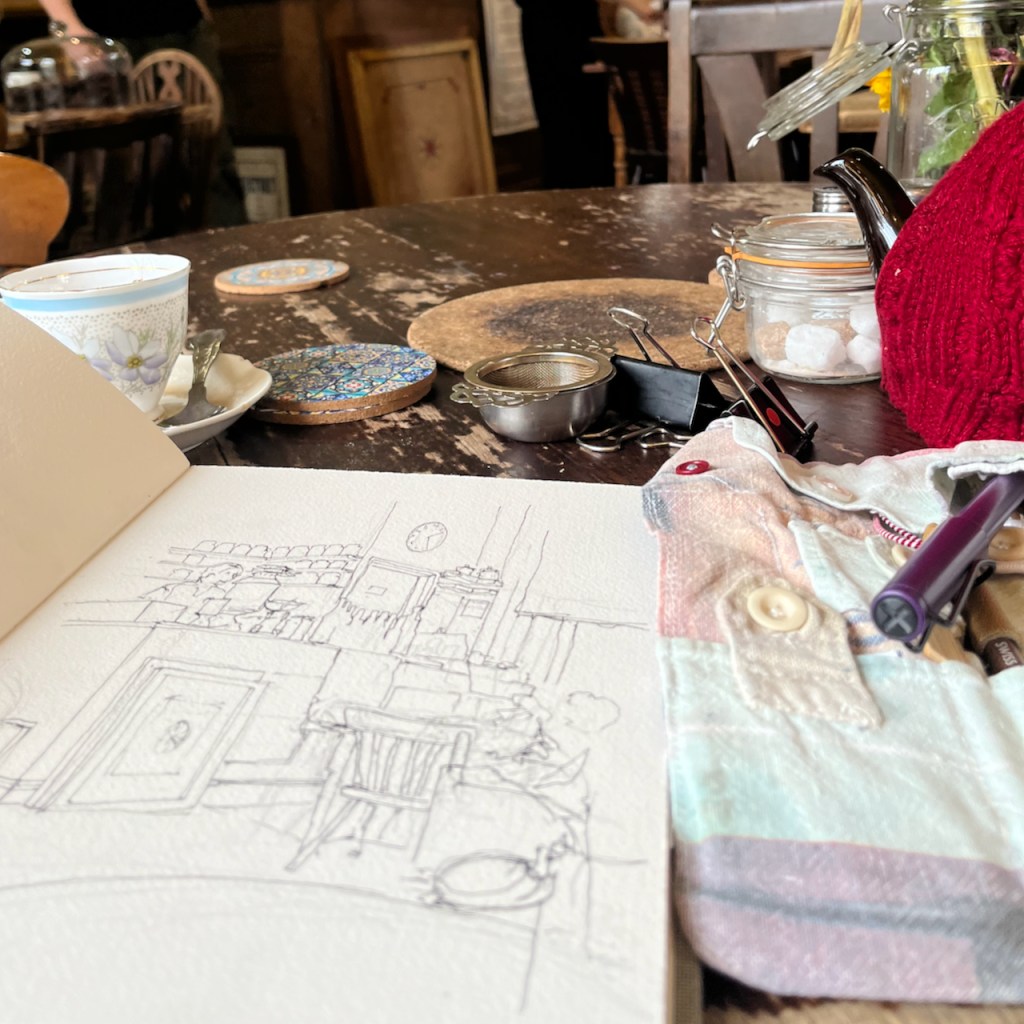
Here is work in progress on the drawing.

Tin Tabernacle, St George’s West End, Esher KT10 8LF

Beside the green on the West side of Esher stands this iron church, St George’s West End.

St George’s West End, Esher. Sketched on location February 2024, in Sketchbook 14

It has a single bell in its small bell tower, and a fence made in a particular way, which I tried hard to show. I wondered if it is intentionally in the shape of a line of crosses, appropriate for a Christian church.

This is one of dozens of “tin tabernacles” or iron churches across the UK. Wikipedia has a whole list. Some of them are strikingly similar to this one.

They were built in the late 19th century, in response to expanding demand, using the new technology of corrugated iron. Many of them, including this one, were pre-fabricated.

According to a 2004 article on this church by Angela Stockbridge the land was donated by Queen Victoria in 1878. “A need was felt to make provision for “the spiritual wants of the “Aged, Poor and Infirm of West End”” and to spare them from the steep and often muddy climb into Esher” she writes. It was intended to be a temporary church. 145 years later, here it is, still standing, and still hosting services.

The church is dedicated to St George. Above the porch is a stained glass window, evidently showing the Knight slaughtering the Dragon. I could just make him out standing on the stirrups of his white horse. The church was closed when I visited, but I hope to go inside on a future occasion. I am told that inside it is cladded with white-painted wood panelling.

I sketched the church from the village green opposite. It was damp and muddy. When I’d had enough, I retreated to the “Prince of Wales” for some lunch. Then I went on to sketch the church in Esher town centre: another St George’s.

Esher is to the West of London, with a main line railway station in to Waterloo.

“They do tend to heat up in summer and stay cold in winter, and the rain makes a noise on their roofs, but they have proved remarkably sturdy. As one commentator writes, “Tin Tabernacles are an important if brief and overlooked episode in the history of church architecture,” and have a claim to “be recognised as listed buildings, particularly as examples of prefabrication” (Dopson 204-05).”
Dopson, Laurence. “Tin Tabernacles.” Words from “The Countryman”. Ed. Valerie Porter. Newton Abbot: David & Charles, 2007. 204-05.

https://victorianweb.org/art/architecture/churches/58.html
In the “Prince of Wales”