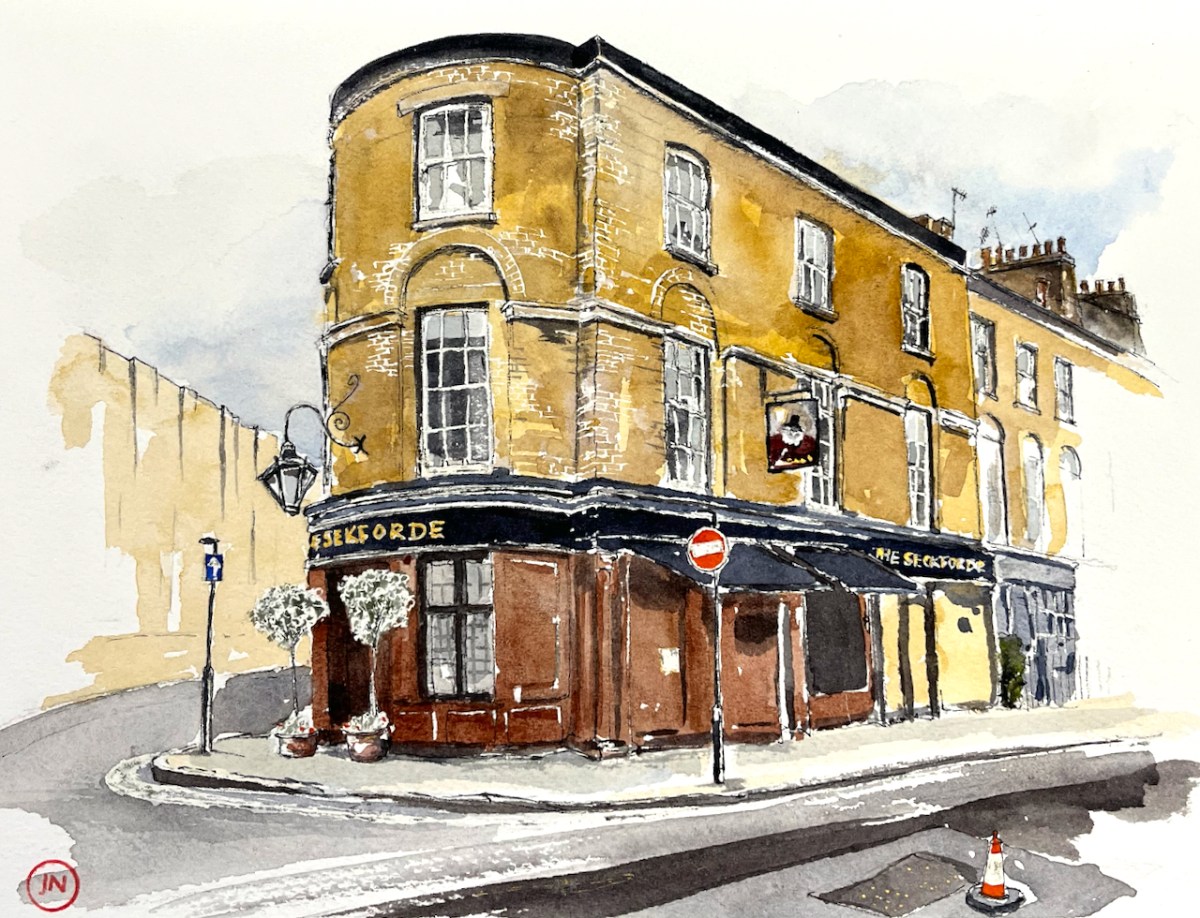
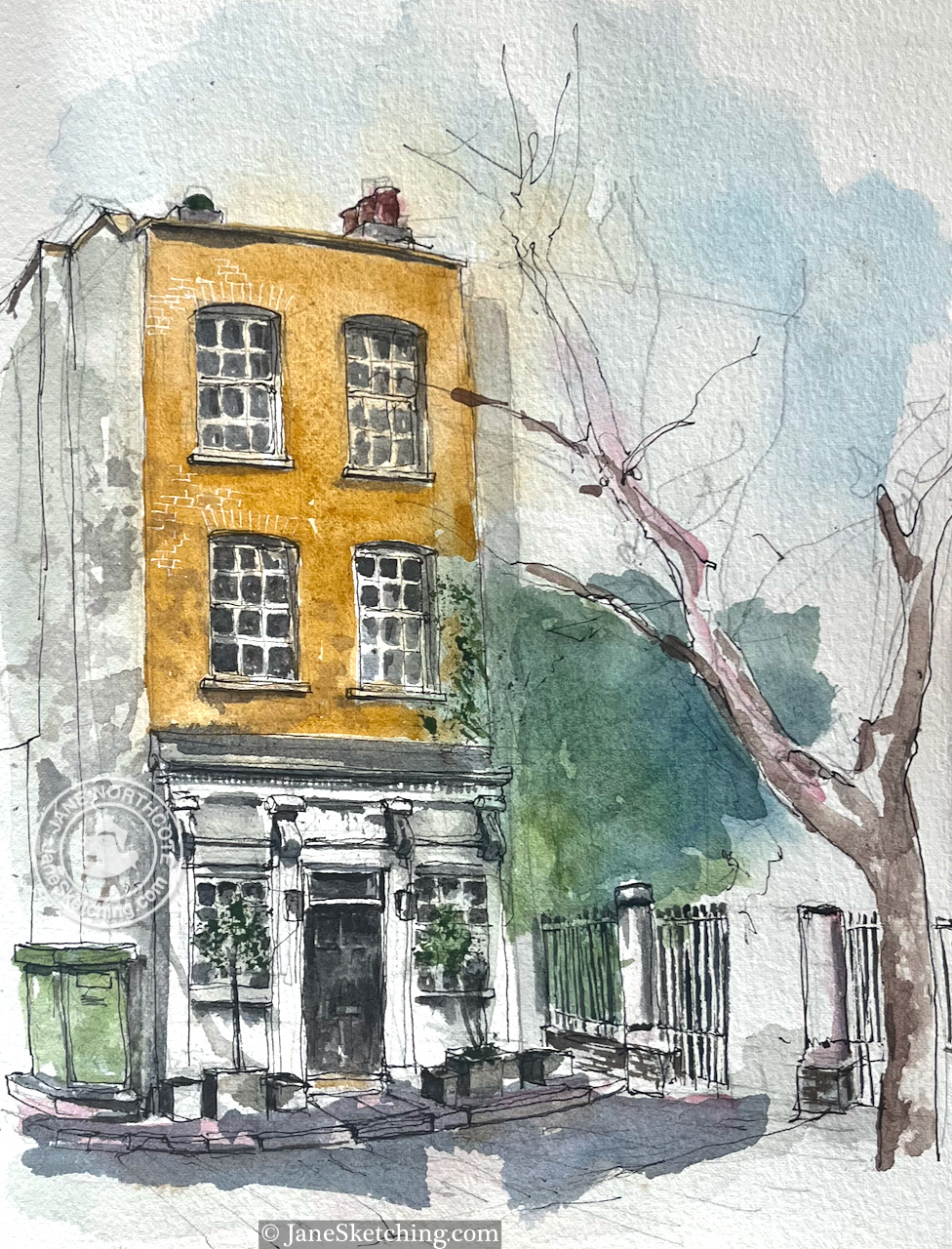
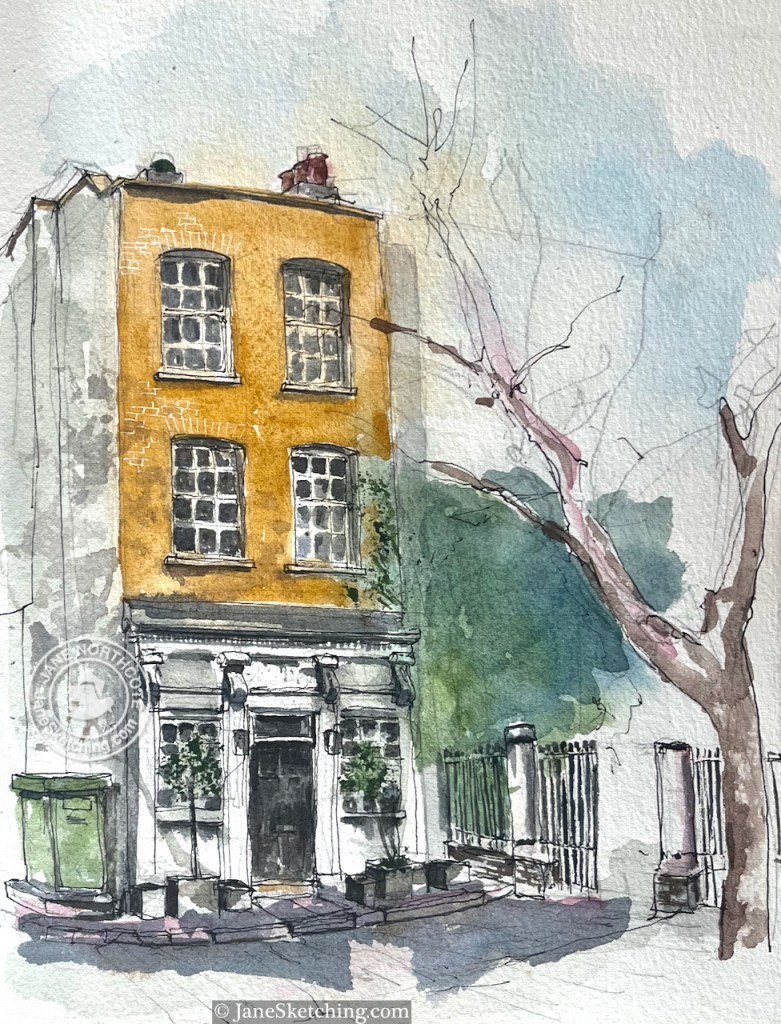
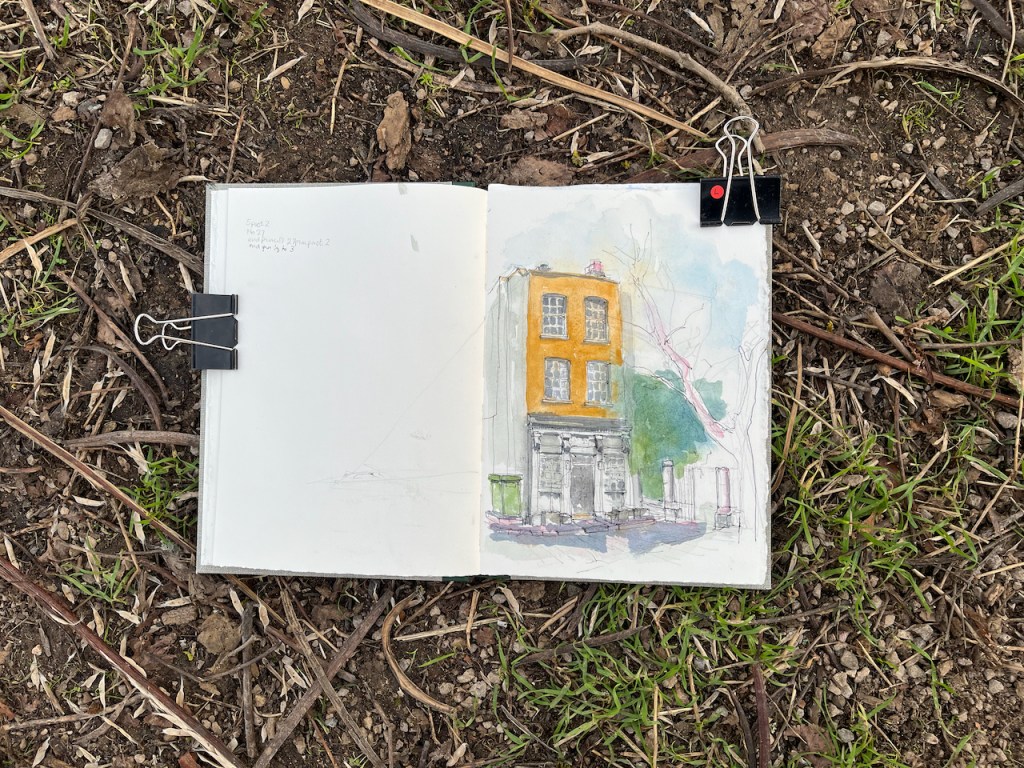
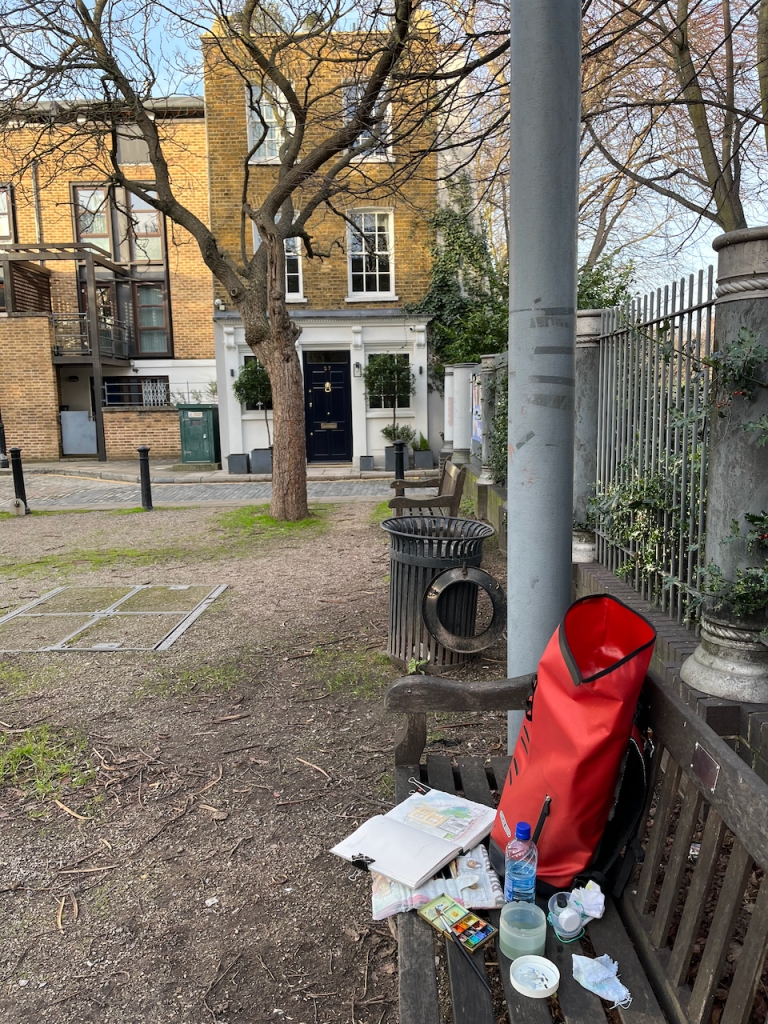
The Sekforde EC1R 0HA, Clerkenwell, sketched March 2024 12″ x 9″ [commission]
This watercolour was specially commissioned to celebrate a happy event.
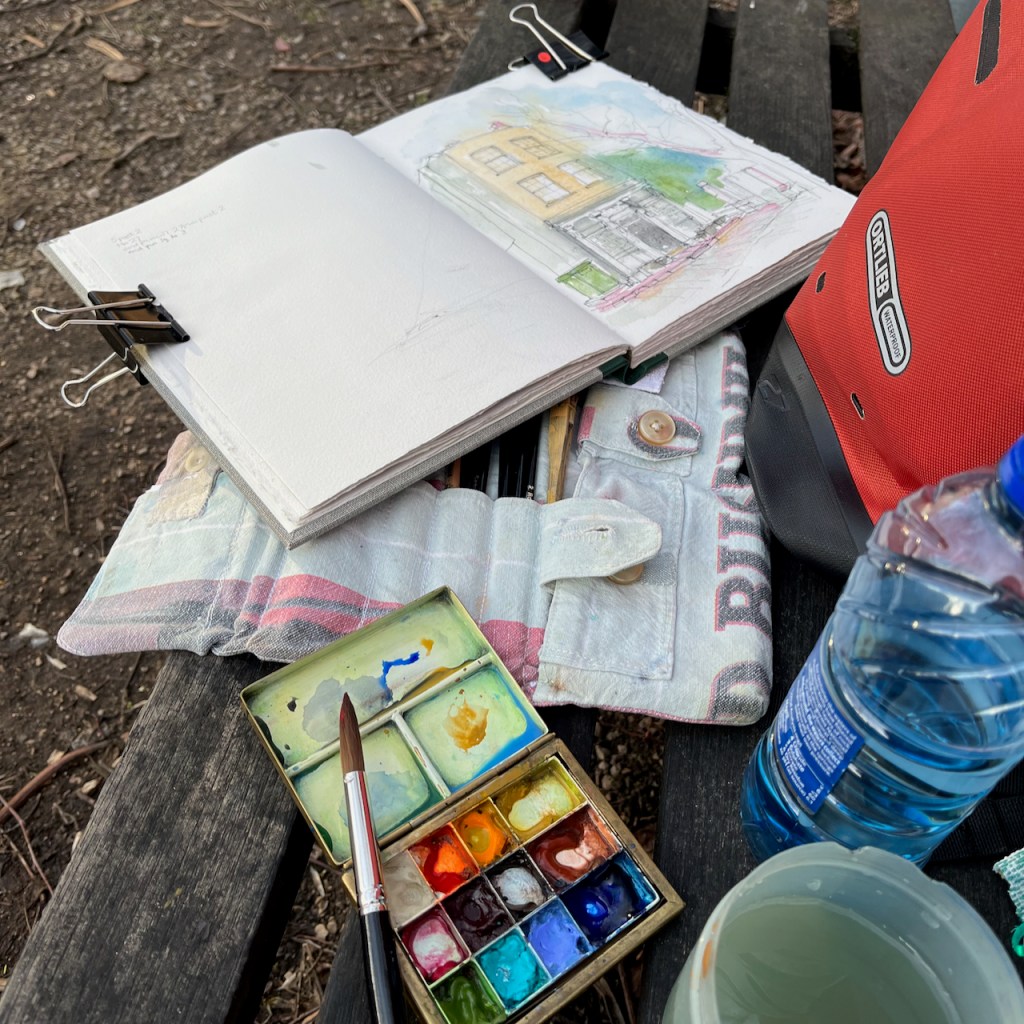
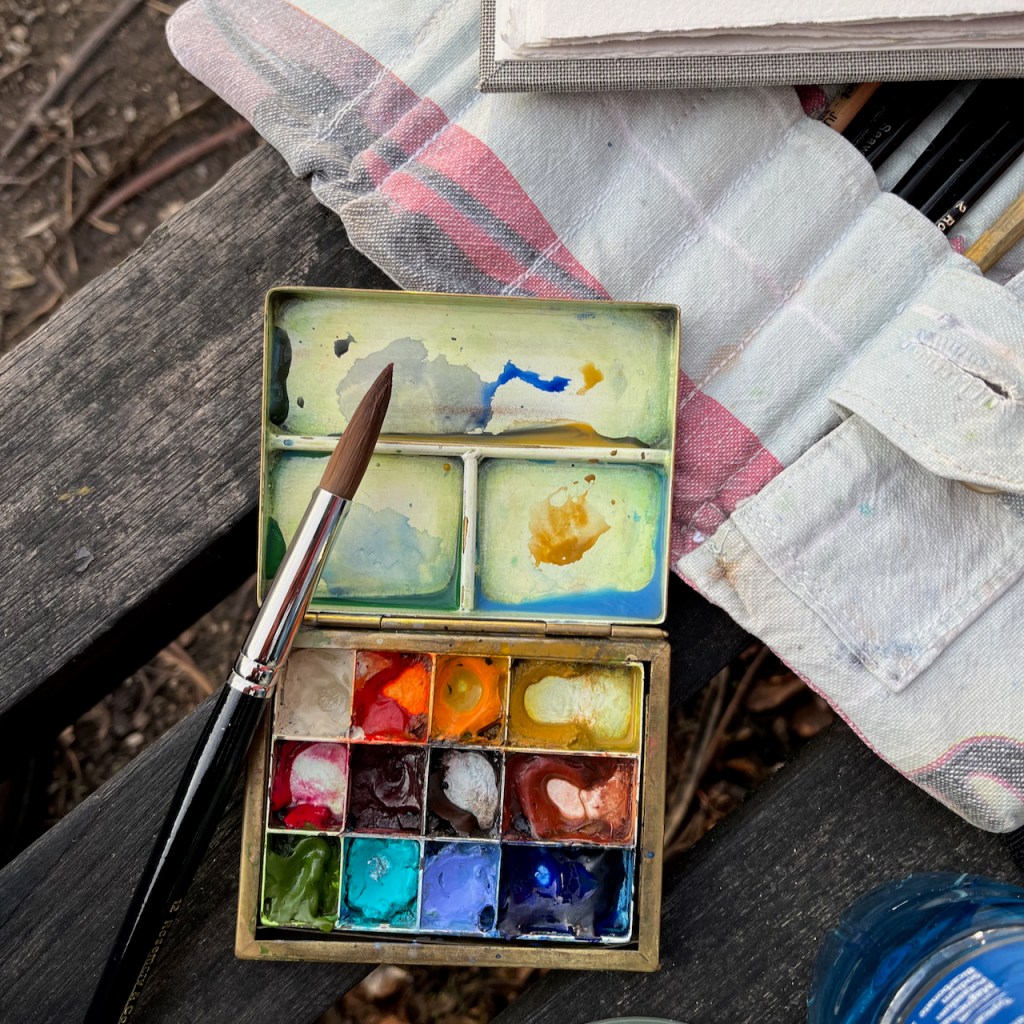
The colours are:
Mars Yellow
Fired Gold Ochre
Ultramarine Blue
Burnt Umber
plus some Horadam Random Grey, some Daniel Smith Green Serpentine Genuine, and Pyrrol Red for the street sign and road marker.
Gold paint for the lettering.
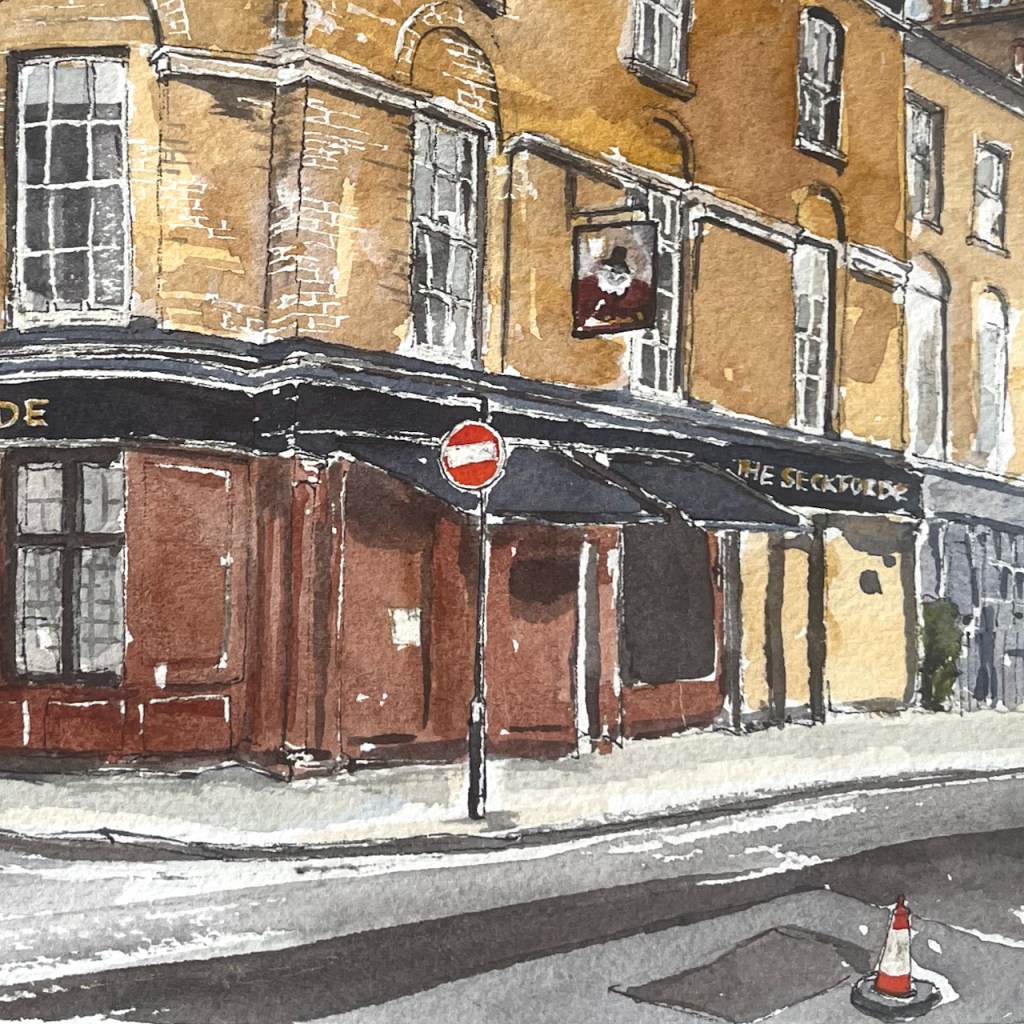
Admire the bricks! I am very pleased with this effect. It was done by applying a rubber resist, “pebeo drawing gum” to the paper before I did any painting. The paint does not adhere to the rubber resist. When I had done all the colour, I rubbed off the rubber resist and hey presto! bricks.
Thank you to my client for their encouraging words and for inspiring me to make this picture of The Sekforde. Here are some details of the drawing.
Vauxhall Tea House – 2:30pm 7 March 2024, in sketchbook 14
The tea I drank was their “Russian Smoky Tea”.
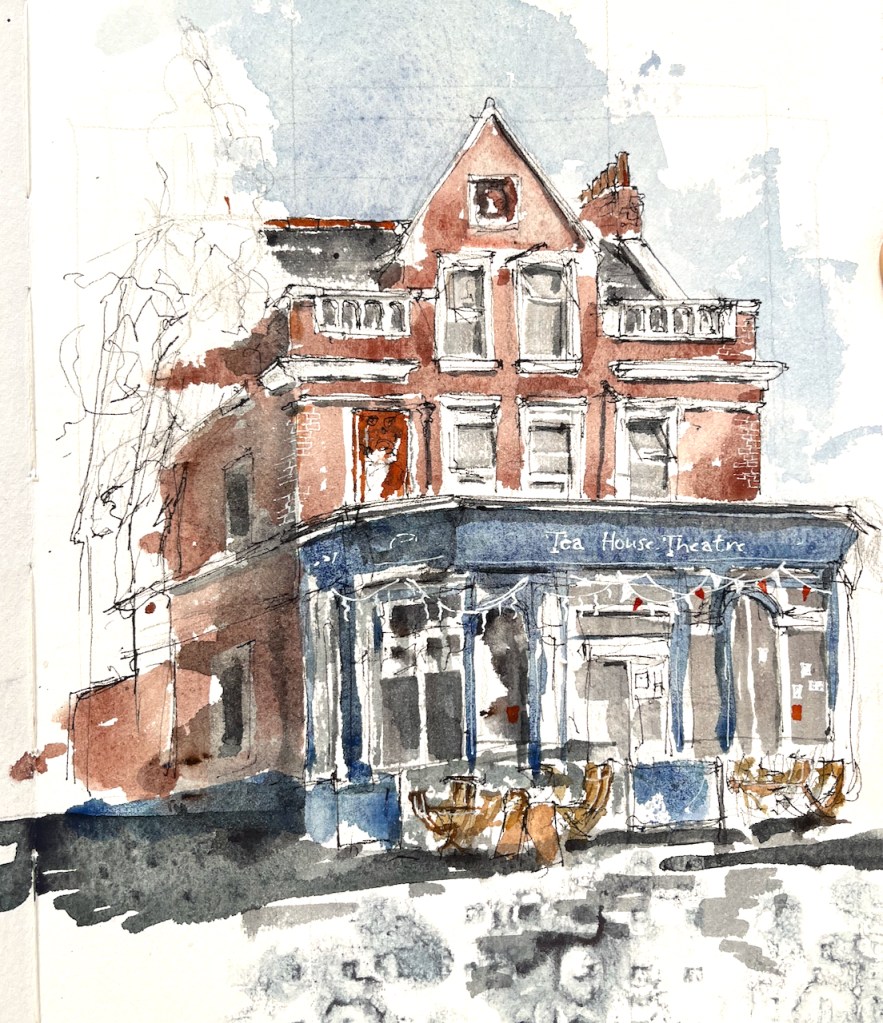
I’ve visited the Tea House many times. Here is an outside view from June 2022
Tea House Theatre, external view, June 2022 in Sketchbook 12
They have all sorts of theatrical events on their tiny stage. I enjoy “Don’t Go Into The Dungeon” where talented actor Jonathan Goodwin plays all of the characters to amazing effect. He specialises in Victorian mysteries. The next one is “The Hound of the Baskervilles”. Dinner is served before the performance. With scones for dessert.
Here’s where it is, just a 5 minute walk from Vauxhall Station.
And in more detail:
Here’s my sketchbook page:
Sketchbook 14
Click a button below to share this post online, email it, or print it:
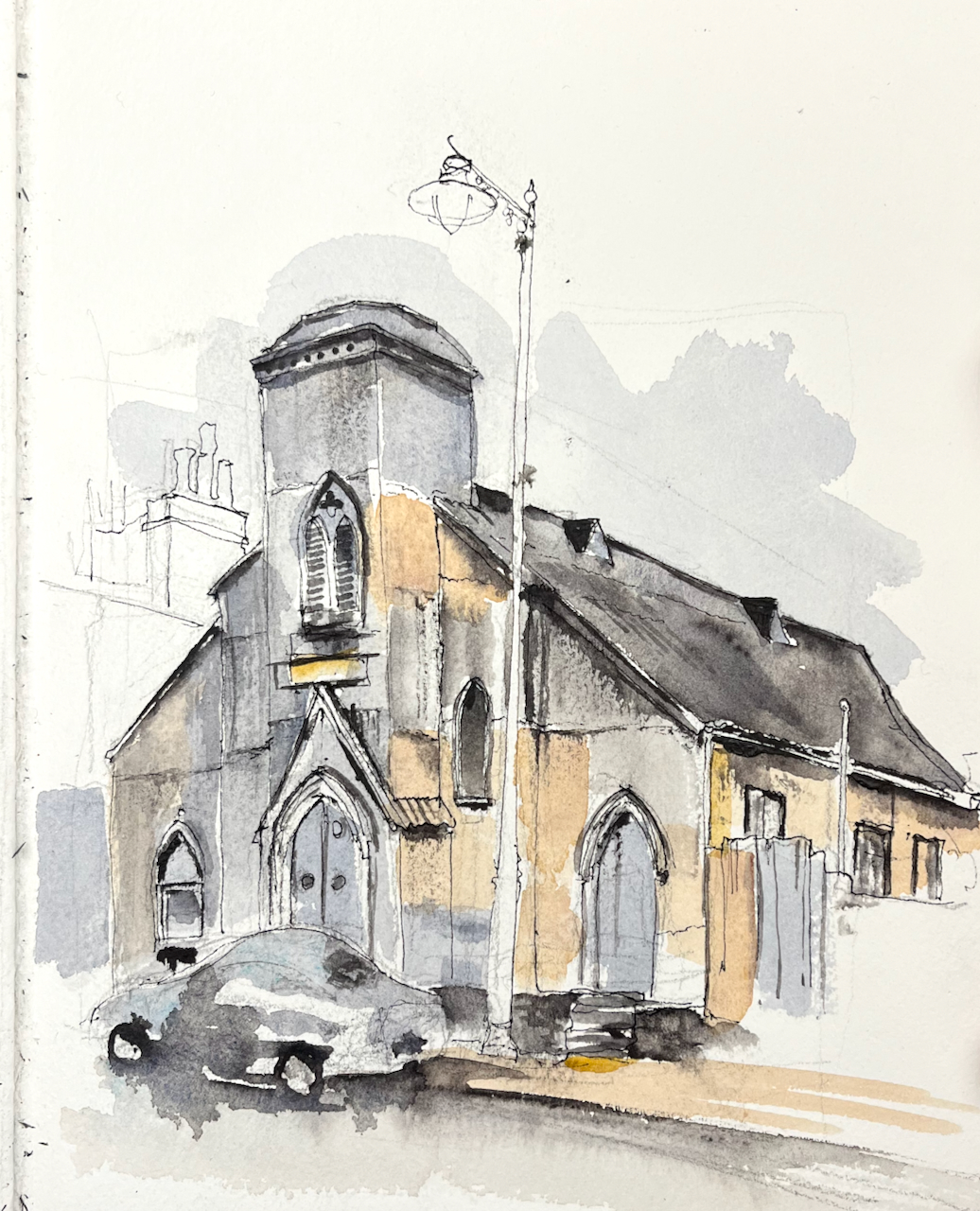
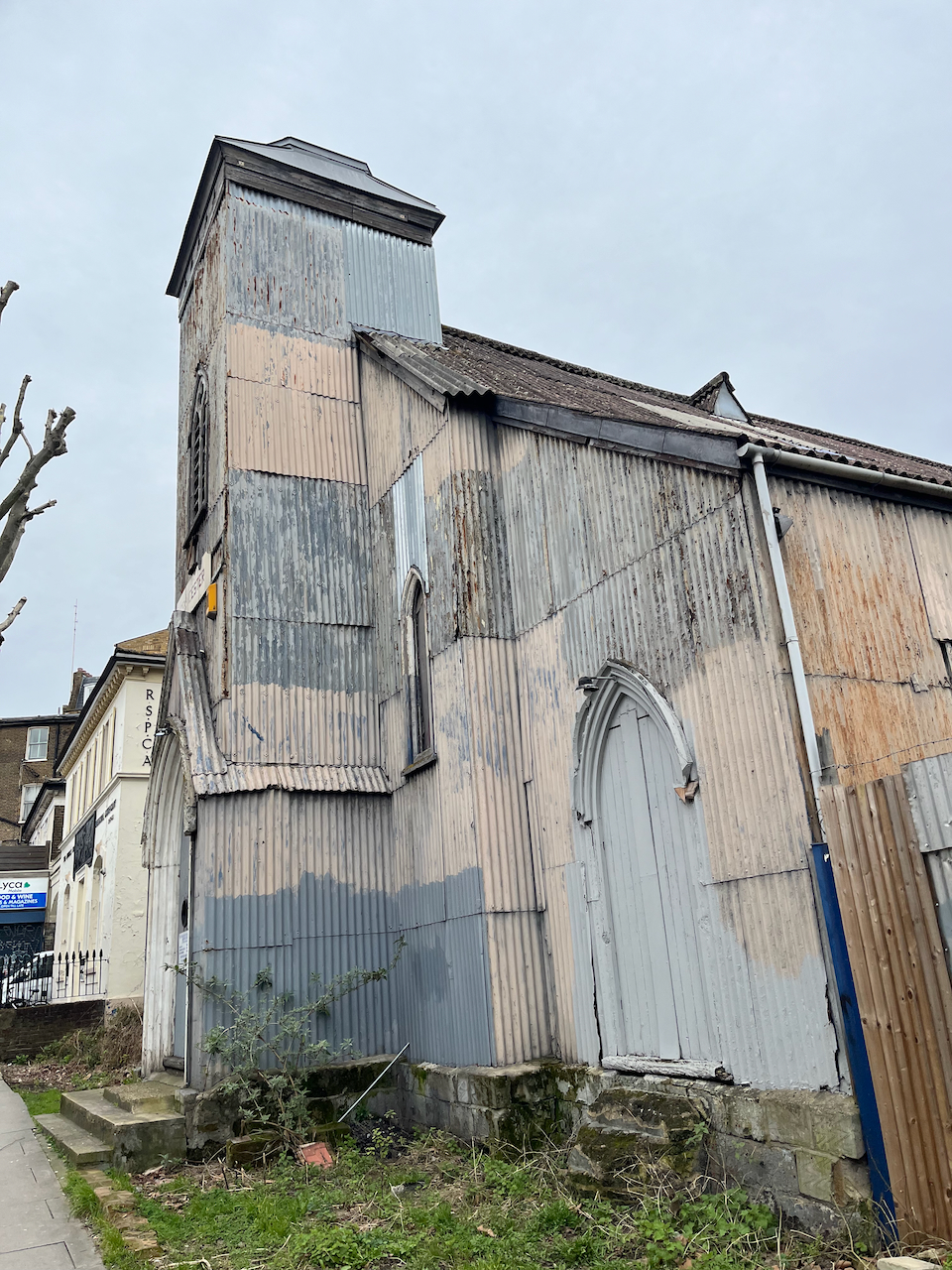
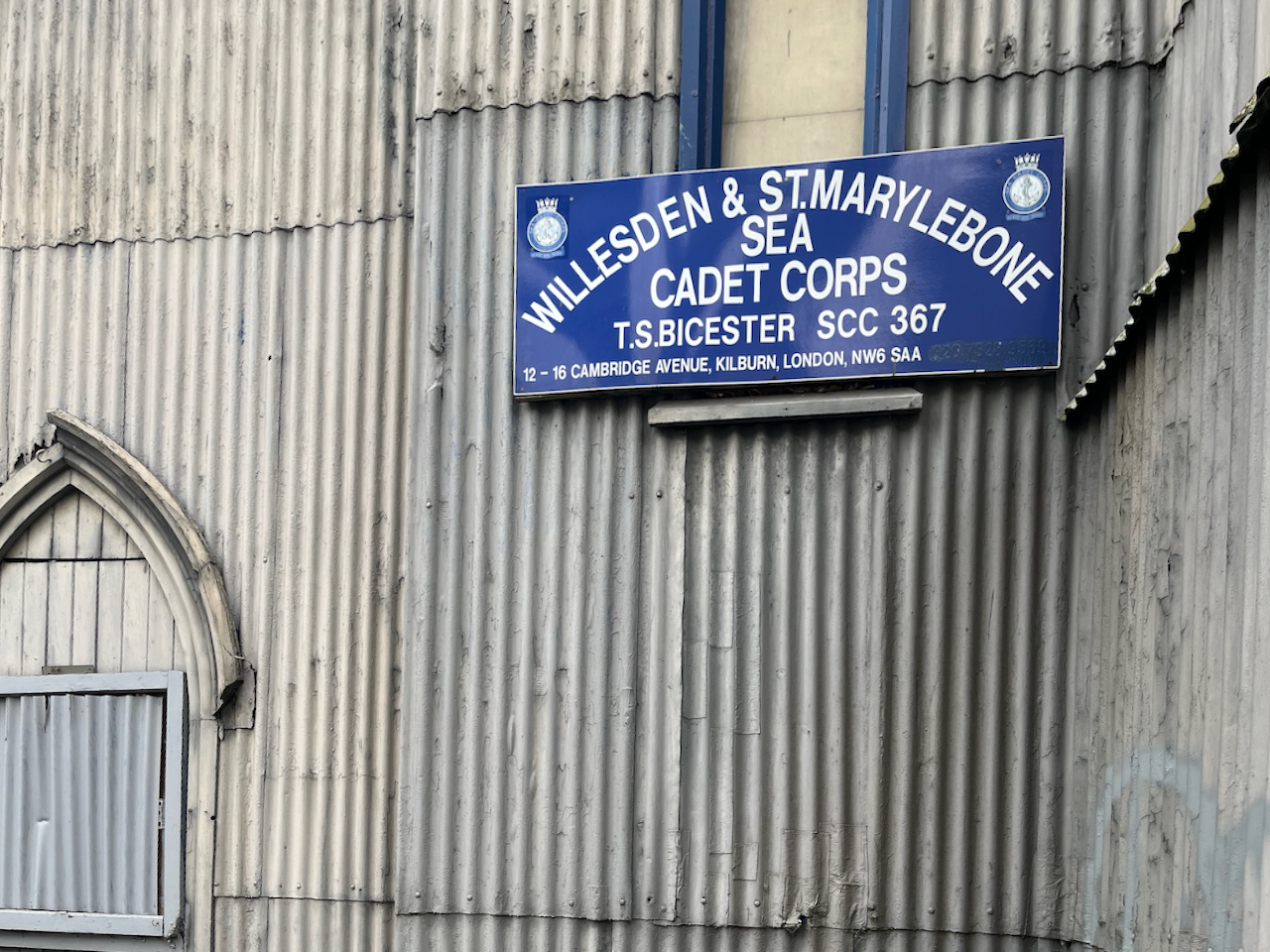
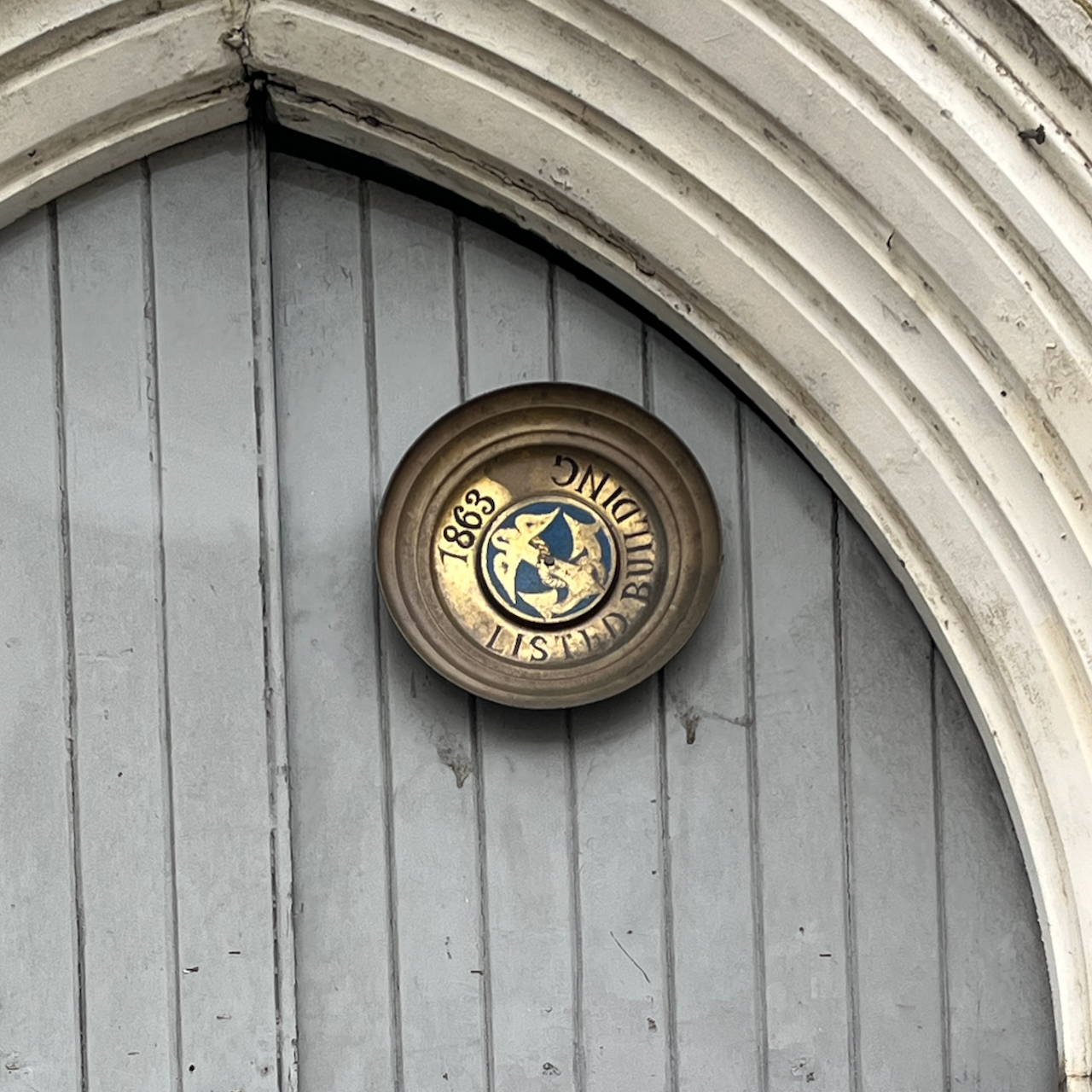
I was reading about “tin tabernacles” having sketched the “Tin Tabernacle” in Esher. I discovered, via a Historic England blog article, that there is a Tin Tabernacle in Kilburn in London. So I went to have a look. It is an “iron church” built of galvanised corrugated iron in 1863. It used to have a steeple, but that has disappeared.
Here it is now:
Cambridge Hall, Cambridge Avenue, Kilburn NW6 5BA, sketched 28 February 2024 3pm in sketchbook 14
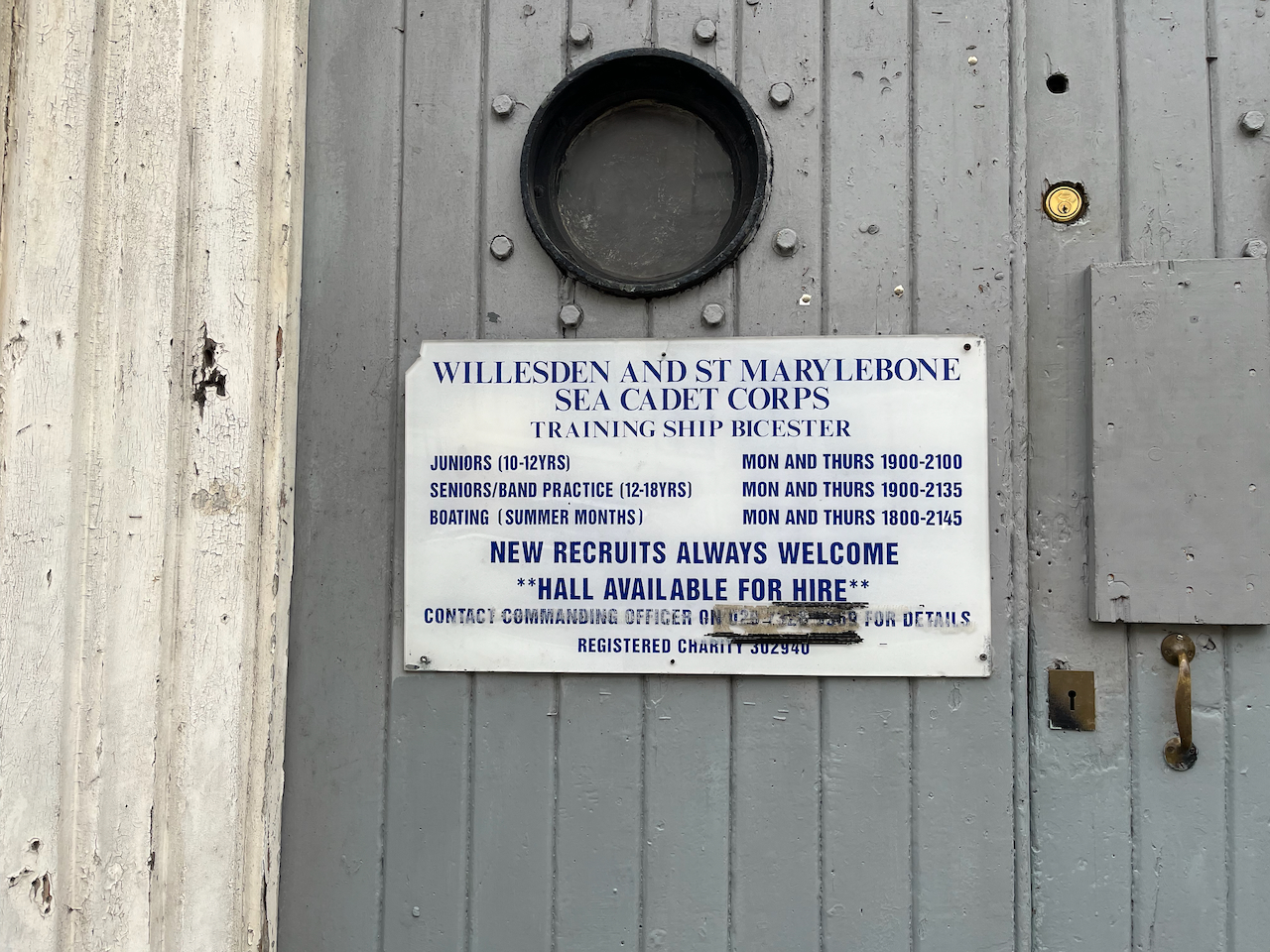
The building was built as a church, and more recently was a centre for Sea Cadets. Its future is under discussion, according to an article on the London Historic Buildings Trust site (LHBT).
The site is owned by Notting Hill Genesis Housing Association (NHG). LHBT are currently working with NHG and the Sea Cadets, supported by Historic England and the Conservation Officer at Brent Council, to explore how the building can be stabilised and used in the future.
The latest date mentioned in this article is 2021, so I guess the exploration is still going on. It’s listed as a “current project” on their website. The building was looking a little precarious when I visited this year (February 2024). An alarm was sounding inside.
It is Grade II listed, and on the Heritage at Risk Register. The listing is on this link. It is currently an events venue, the website is: http://tintabernaclekilburn.org/
Here are some photos of the outside:
The building is about 150m north of Kilburn Park underground station on the Bakerloo Line.
It’s a building with a varied history. I wonder what will happen to it?
Sketch and notes in sketchbook 14
UPDATE: 6th March 2026
An article on “Ian Visits” says that the Ministry of Defence is funding the removal of the two training guns inside the church:
Their removal is now expected to make it easier to pursue restoration works and attract the significant external funding needed to repair the building and secure a sustainable future. The London Historic Buildings Trust is leading the restoration work with the aim of opening the Tin Tabernacle as an active community asset for Kilburn.
After sketching the Tin Tabernacle in Esher West End, I walked into the town centre to sketch another St George’s: St George’s Old Church.
St George’s, Esher, Old Church. Sketched February 2024 in Sketchbook 14
Here is the notice by the door:
ST GEORGE ESHER This church is cared for by The Churches Conservation Trust. Although no longer needed for regular worship, it remains a consecrated building, a part of England’s history, maintained for the benefit of this and future generations.
Here is the notice hanging from a post by the gate:
Welcome to ST. GEORGE’S CHURCH
Esher’s oldest public building and one of the earliest Anglican churches. Most of the structure is 16th Century Tudor Two 18th Century features of te Church are a 3-decker pulpit and the Newcastle chamber pew designed by Sir John Vanburgh for Thomas Pelham., Duke of Newcastle and his brother Henry: both served as Prime Minister. Princess Charlotte – heir to George IV – and Prince Leopold – who became the first King of the Belgians – worshipped here when they lived at Claremont after their marriage in 1816. Queen Victoria, Leopold’s niece attended services when visiting her uncle and later came with Prince Albert. When Christ Church was completed in 1854 St George’s ceased to be the Parish Church. Restored by the community in 1965 it remains a consecrated building now in the care of the Churches Conservation Trust. Several services are held each year. It is also a venue for music and the arts.
I sketched it from the graveyard, as the sun set. So many angles and views! It has been altered and added to and mended, yet is graceful and somehow perfect.
Behind the church there were crocuses.
A wonderful place! Tranquillity just off the main road.
Here’s a map. I walked here from the St Georges West End, along the route marked with a red line on the map: a half hour’s walk, just over a mile.
Here is work in progress on the drawing.
Click a button below to share this post online, email it, or print it:
Beside the green on the West side of Esher stands this iron church, St George’s West End.
St George’s West End, Esher. Sketched on location February 2024, in Sketchbook 14
It has a single bell in its small bell tower, and a fence made in a particular way, which I tried hard to show. I wondered if it is intentionally in the shape of a line of crosses, appropriate for a Christian church.
This is one of dozens of “tin tabernacles” or iron churches across the UK. Wikipedia has a whole list. Some of them are strikingly similar to this one.
They were built in the late 19th century, in response to expanding demand, using the new technology of corrugated iron. Many of them, including this one, were pre-fabricated.
According to a 2004 article on this church by Angela Stockbridge the land was donated by Queen Victoria in 1878. “A need was felt to make provision for “the spiritual wants of the “Aged, Poor and Infirm of West End”” and to spare them from the steep and often muddy climb into Esher” she writes. It was intended to be a temporary church. 145 years later, here it is, still standing, and still hosting services.
The church is dedicated to St George. Above the porch is a stained glass window, evidently showing the Knight slaughtering the Dragon. I could just make him out standing on the stirrups of his white horse. The church was closed when I visited, but I hope to go inside on a future occasion. I am told that inside it is cladded with white-painted wood panelling.
I sketched the church from the village green opposite. It was damp and muddy. When I’d had enough, I retreated to the “Prince of Wales” for some lunch. Then I went on to sketch the church in Esher town centre: another St George’s.
Esher is to the West of London, with a main line railway station in to Waterloo.
“They do tend to heat up in summer and stay cold in winter, and the rain makes a noise on their roofs, but they have proved remarkably sturdy. As one commentator writes, “Tin Tabernacles are an important if brief and overlooked episode in the history of church architecture,” and have a claim to “be recognised as listed buildings, particularly as examples of prefabrication” (Dopson 204-05).” Dopson, Laurence. “Tin Tabernacles.” Words from “The Countryman”. Ed. Valerie Porter. Newton Abbot: David & Charles, 2007. 204-05.
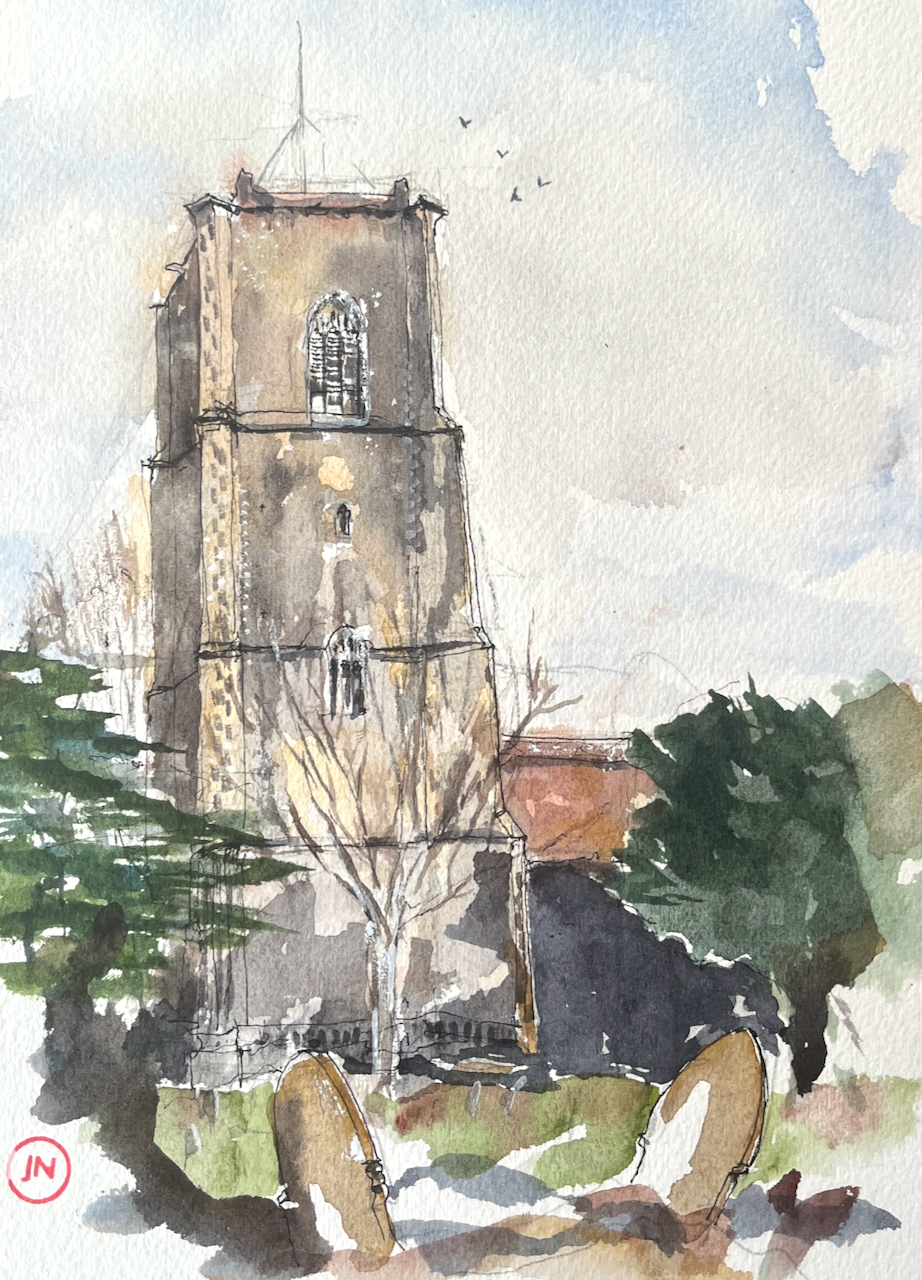
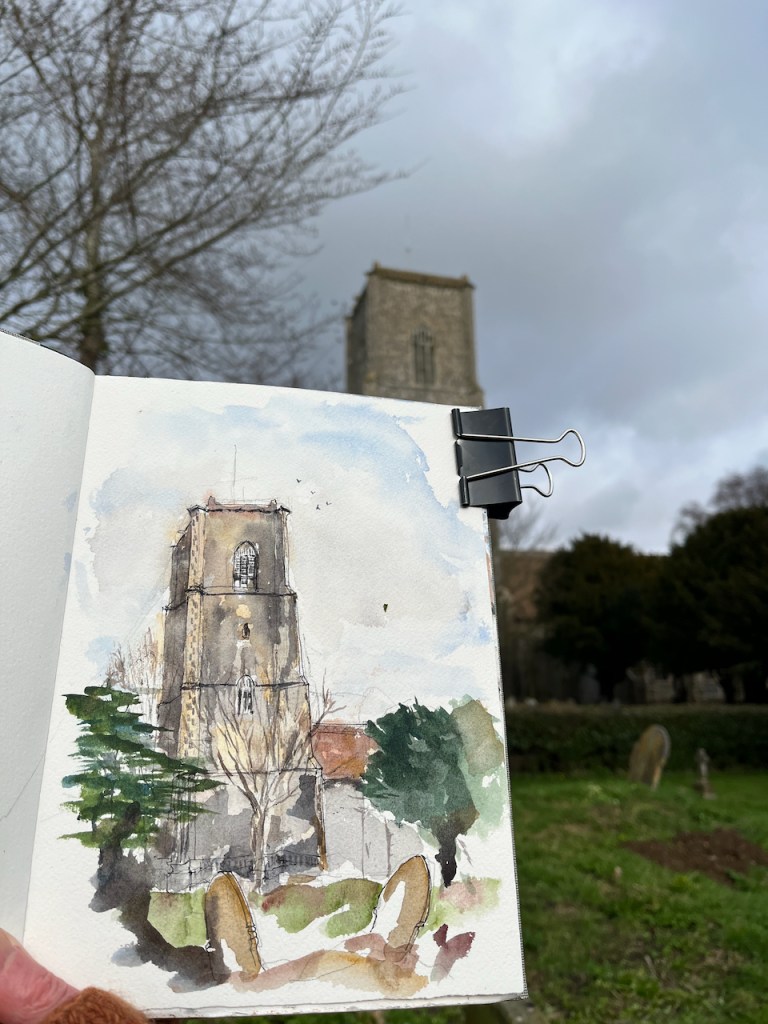
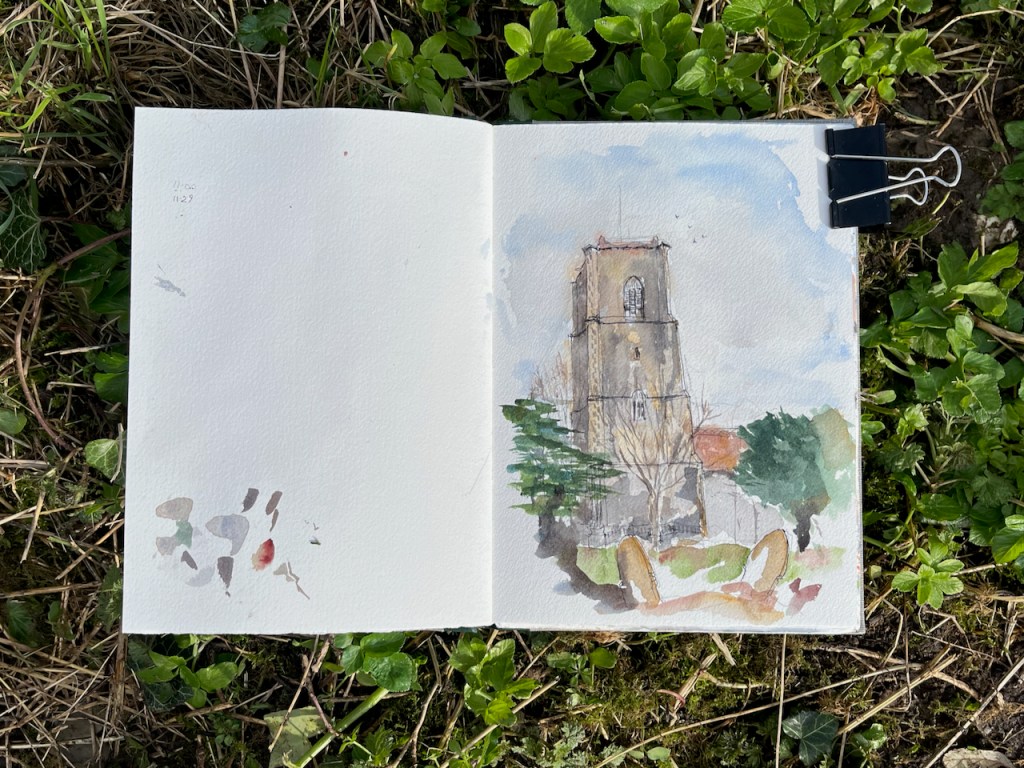
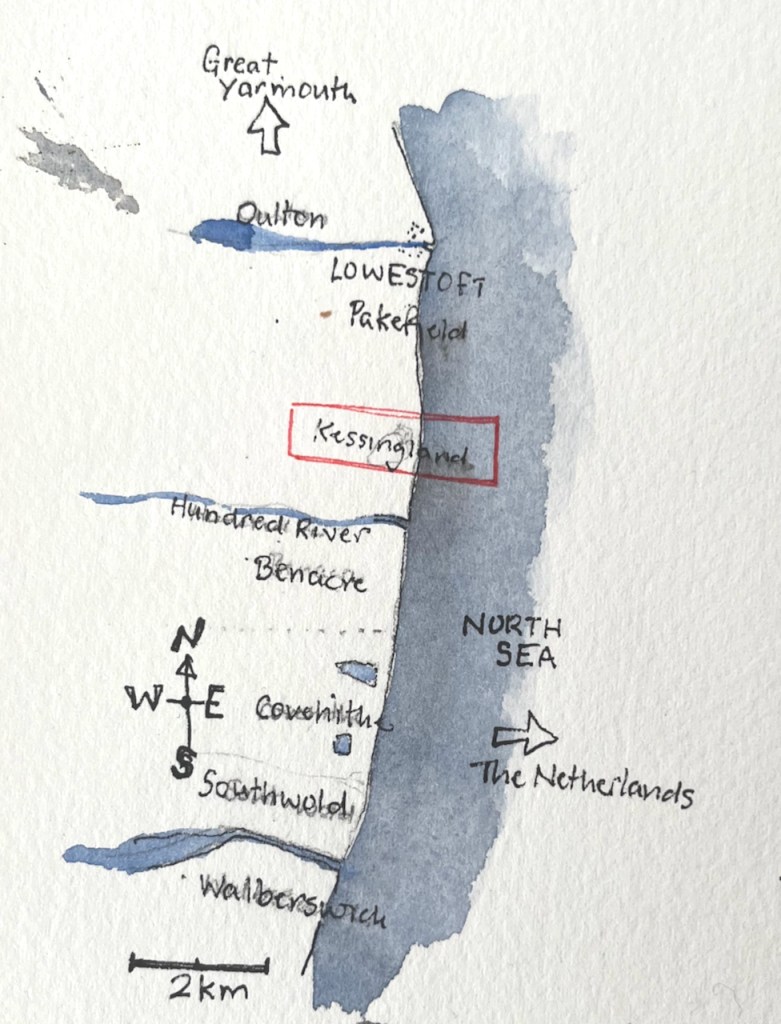
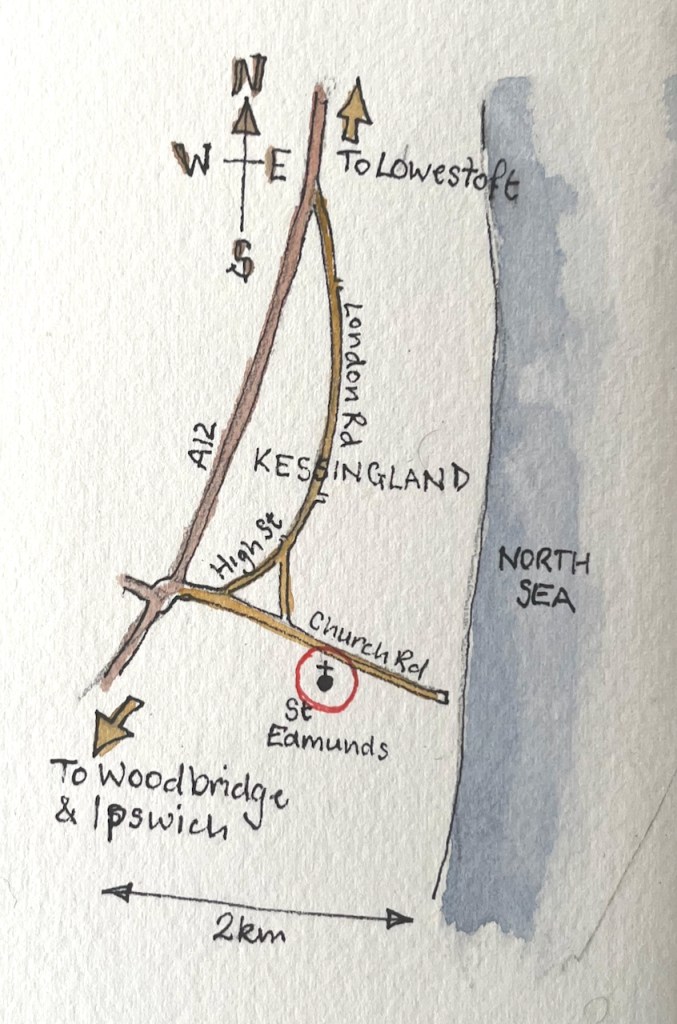
Here is the church of St Edmund, Kessingland, seen from the south.
Church of St Edmund, Kessingland. Sketched 11 February 2024, 12:30 in Sketchbook 14
I was a guest of the bell ringers, who kindly invited me to their loft. There are six bells. I witnessed their splendid peals, which made the tower shake slightly under my feet. This was a surprise to me, as the walls of the tower are about three foot thick. But apparently it’s perfectly normal. Then I went outside and sketched the church from the south.
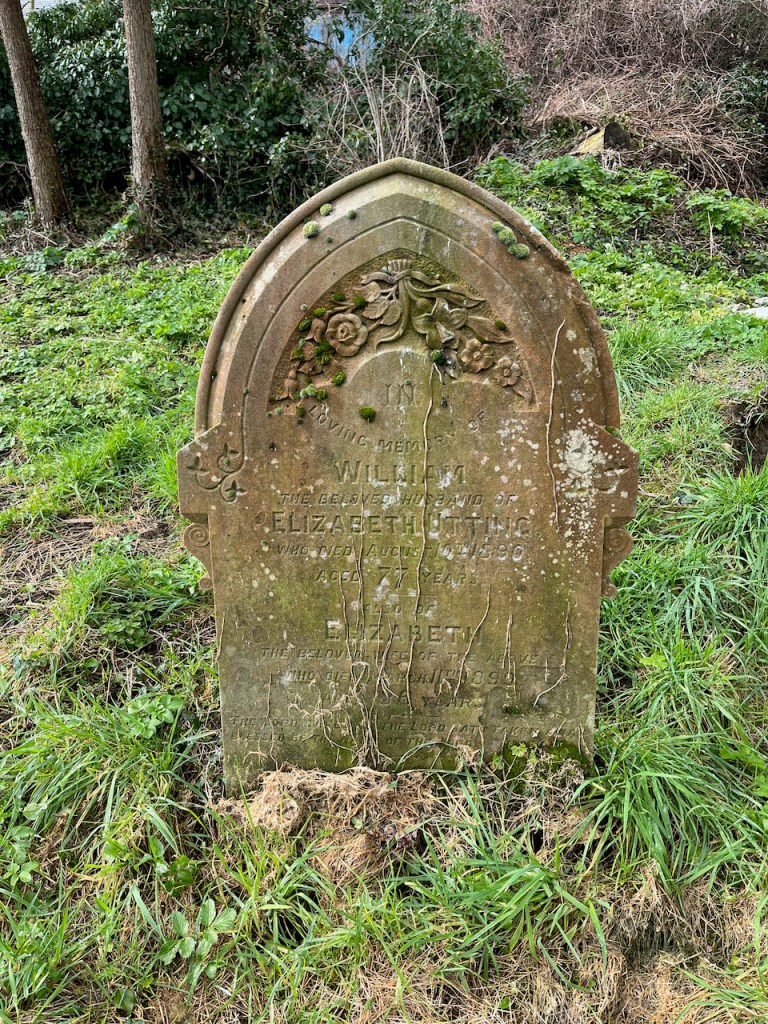
It was a beautiful place to stand and sketch: a peaceful country churchyard. The gravestone in front of me, in the foreground in the picture, carried stone carved flowers, and cushions of moss.
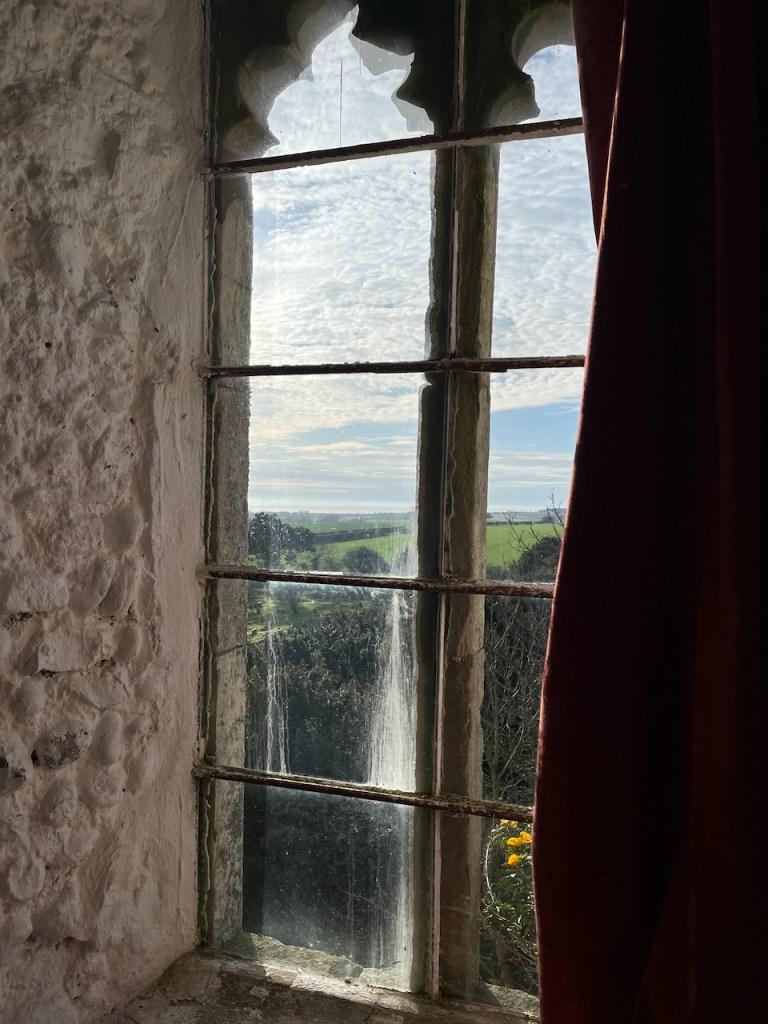
view from the bell ringers’ loft
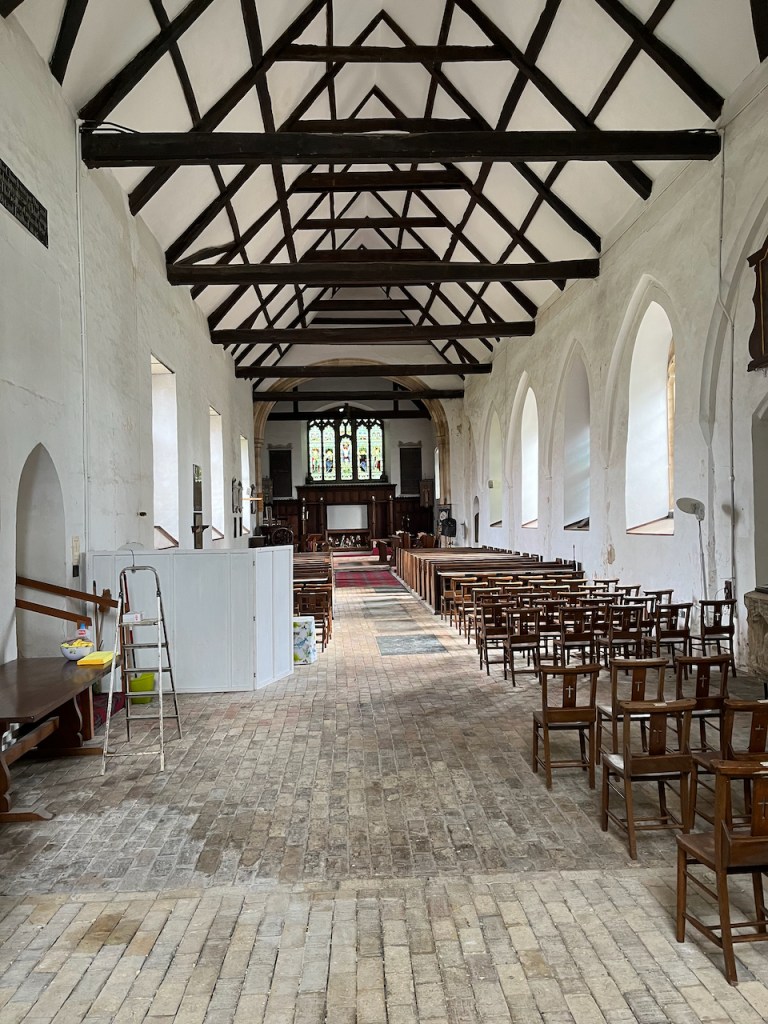
This tower is very old. According to the Historic England listing, the tower is from the 15th century and Grade I listed. There is neat flint work, in a chequerboard pattern higher up and in vertical lines lower down, with a horizontal border at ground level. The nave is thatched! It has recently received new thatch, in a glowing russet colour which you can just see to the right of the tower.
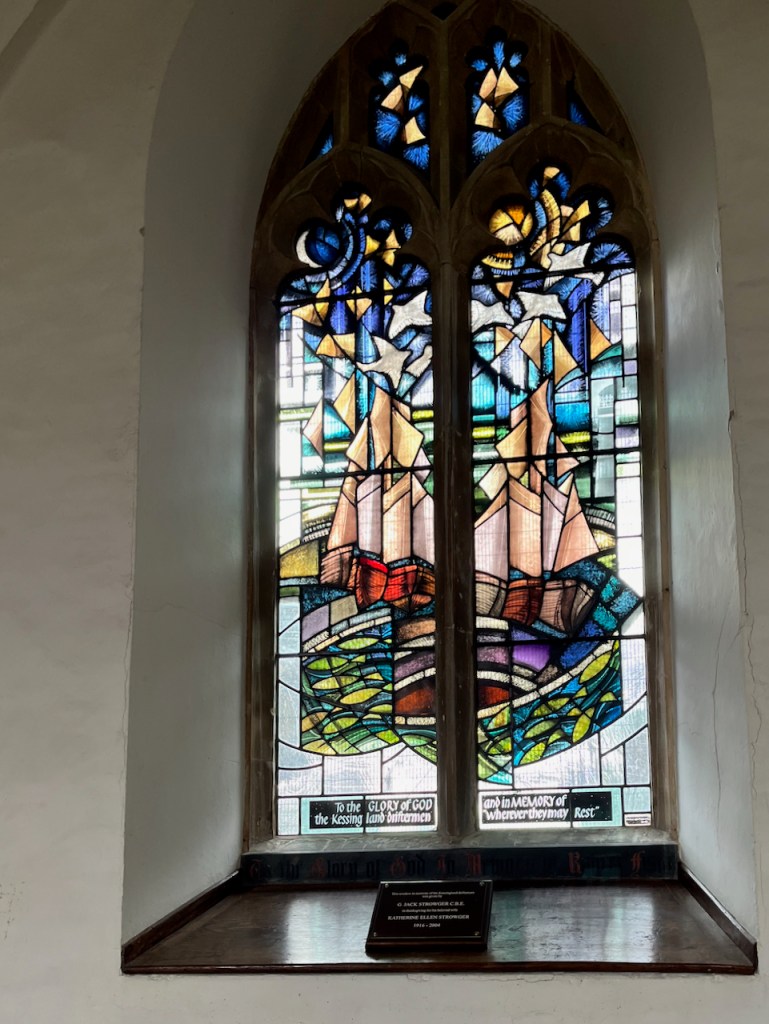
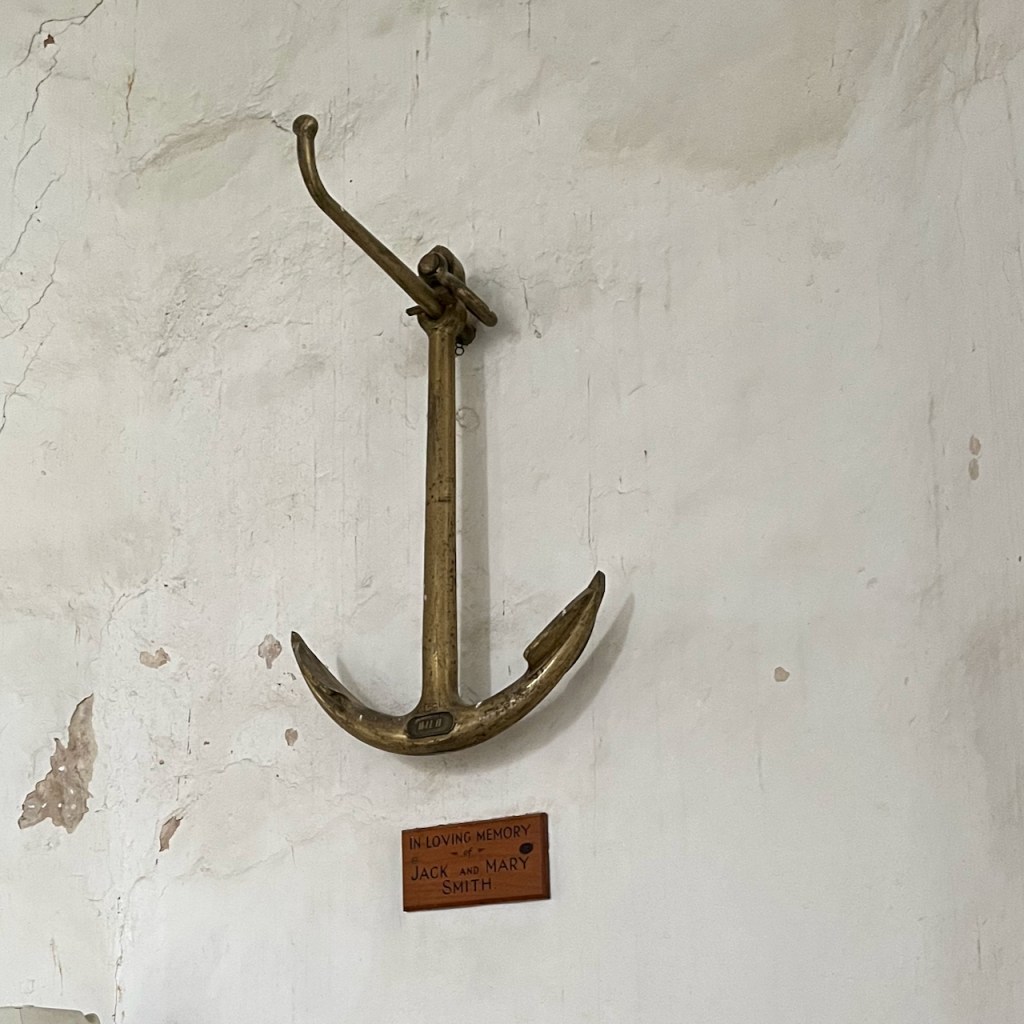
The church is about half a mile from the sea. There is a stained glass window, dated 2007, by Nicola Kantorowicz, dedicated to the “Glory of God and the memory of Kessingland driftermen, ‘where ever they may rest'”. It was given by G. Jack Strowger in memory of his wife Katherine. There is a ship’s wheel on the wall, and another on a low pulpit. An anchor hangs from the wall, “in loving memory of Jack and Mary Smith”.
The nave of the Church of St Edmund, Kessingland, looking east.
It’s well worth a visit if you are in the area.
Click a button below to share this post online, email it, or print it:
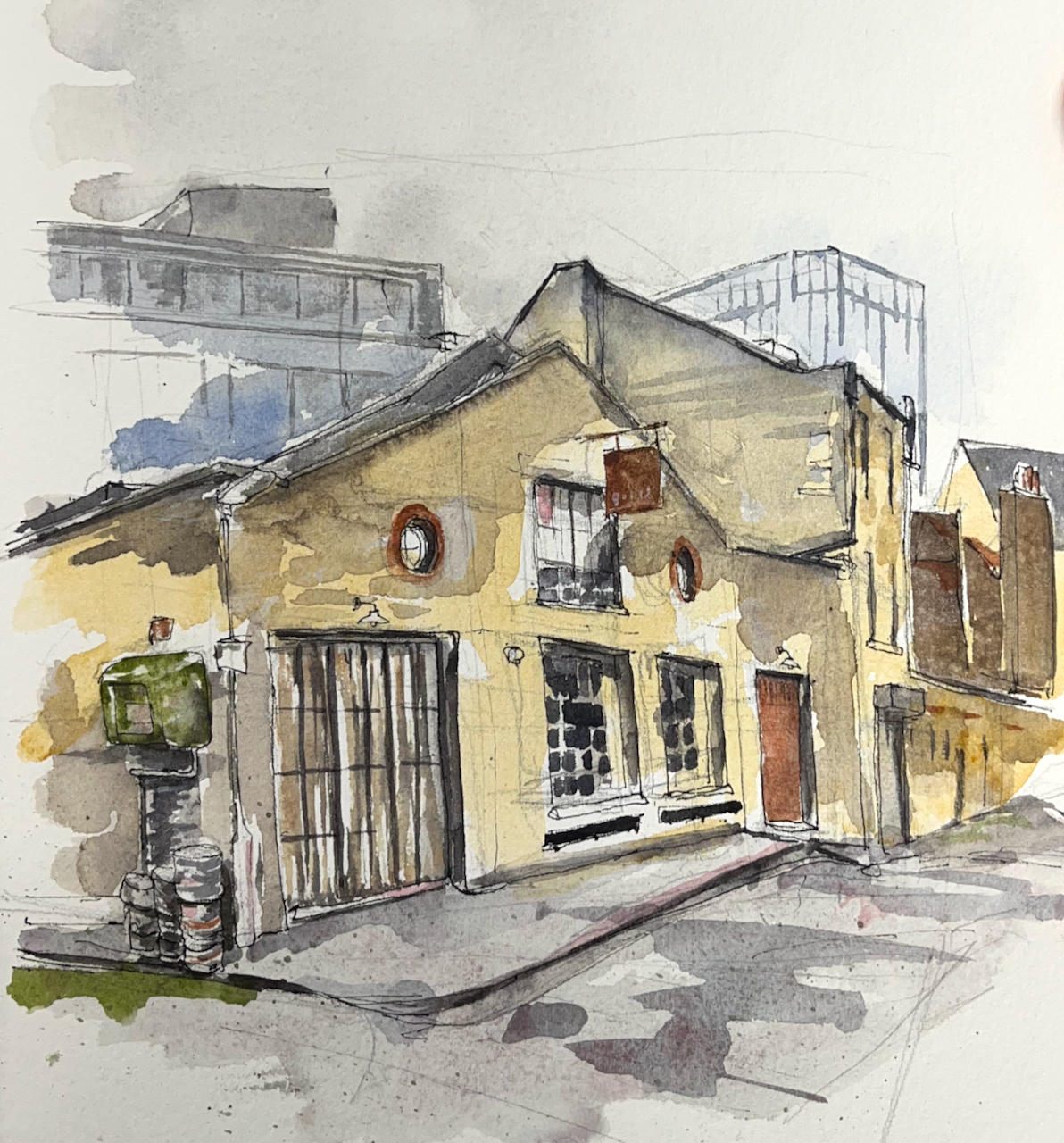
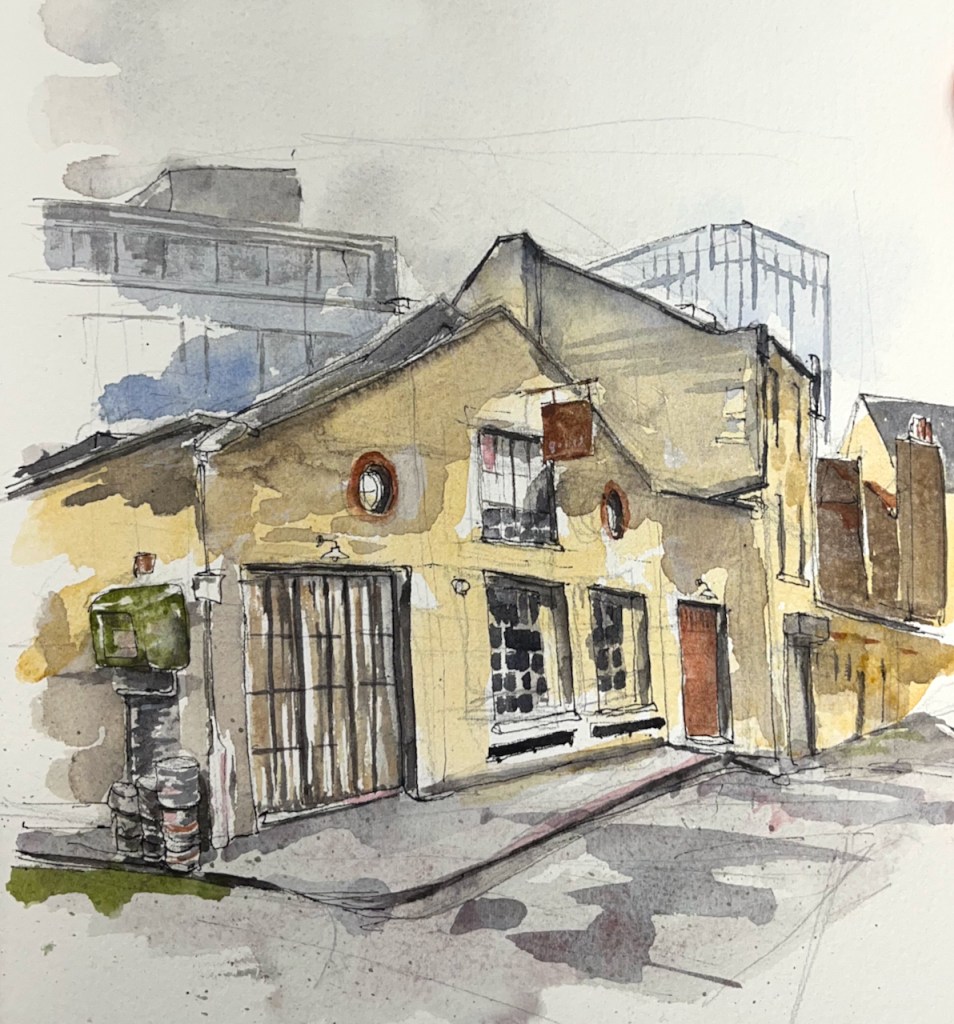
I was expecting the hidden alleyway to be deserted on a Tuesday lunchtime, and so it was for the first hour. But then it became suddenly busy. A small ambulance backed carefully down the alleyway in front of me and parked. Its doors opened and two paramedics went round to the back of the car. They lifted out their equipment and walked calmly off down the alley. After that excitement, a certain calm returned to the alley, insofar as calm is possible a few hundred metres from Kings Cross.
I carried on sketching, now working on the beer barrels to the left of the picture. But the calm did not last long. Two cars arrived and people dressed in orange hi-vis vests scrambled out. They unlocked a gate off the picture to the left, and went in, leaving their car on the pavement. Then a van arrived, it parked directly in front of me, and a further person in a hi-vis outfit got out. He looked across the bonnet of his van and saw me sketching. “Oh, sorry,” he said, “Am I in your way?” I said that yes, he kind of was. I stood ready, however, to concede the space to him, as he looked important and determined in his bright orange overalls and hard hat. But to my surprise he grinned at me, “Ten minutes! I’ll be just ten minutes!”. He rushed off through the gate where the other people had gone. I abandoned the beer barrels and worked on the roofs.
The roofs were quite a challenge, and they productively occupied the 8 minutes until the driver came rushing back out, looking triumphant, accompanied by a selection of the people who’d arrived earlier. “I told this woman I’d be ten minutes,” he explained to his entourage. He raised a hand to me in greeting, got into his car and rumbled off, leaving the other people standing on the cobbles. I asked them what they were working on. “The bridge,” they said. Oh yes, I was standing on a bridge. The train lines were below.
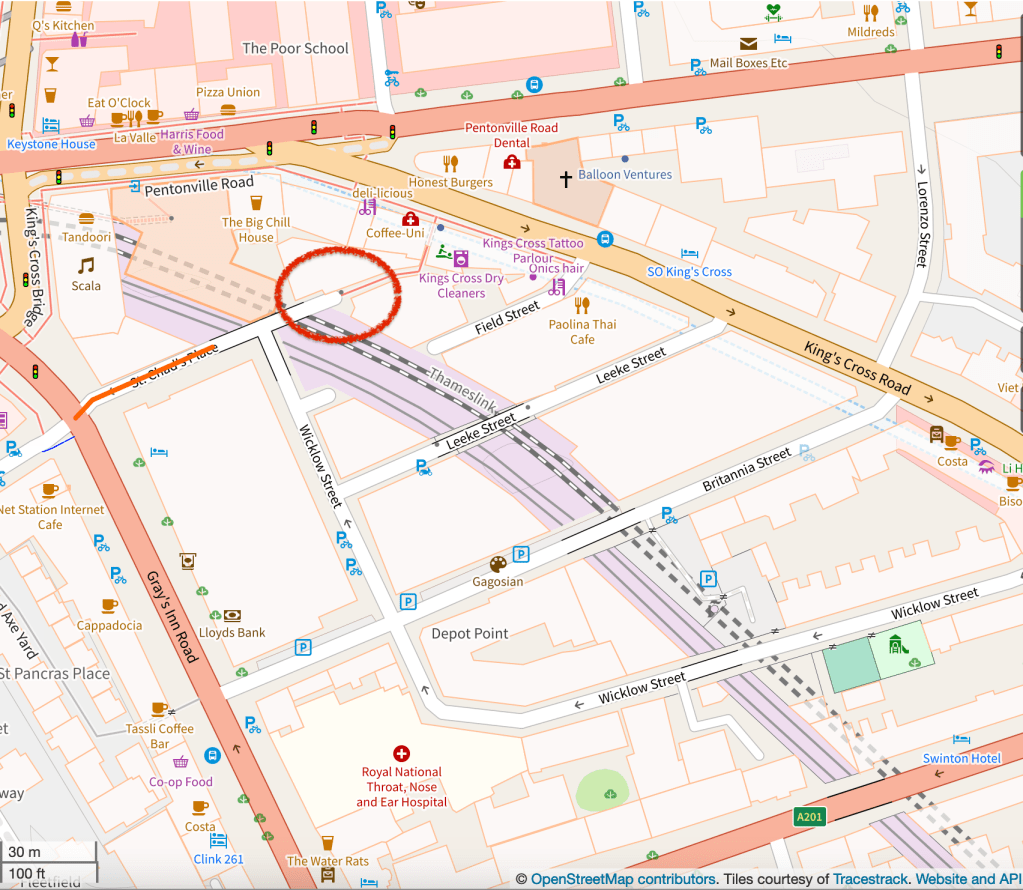
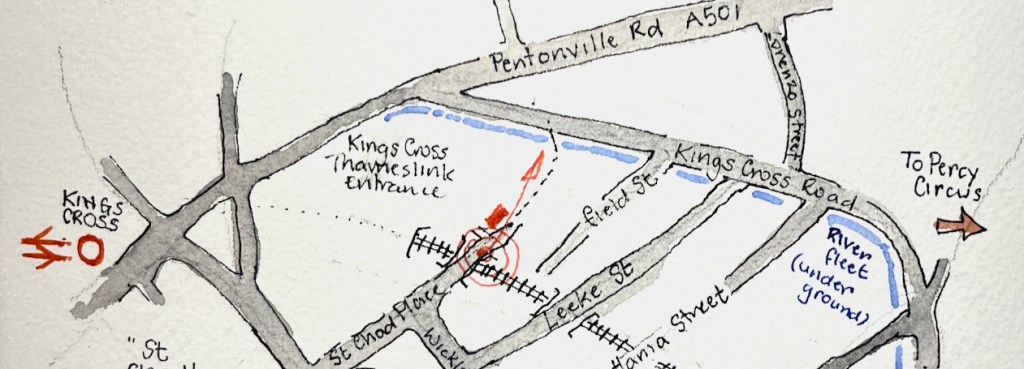
Annotated Google map of the location.
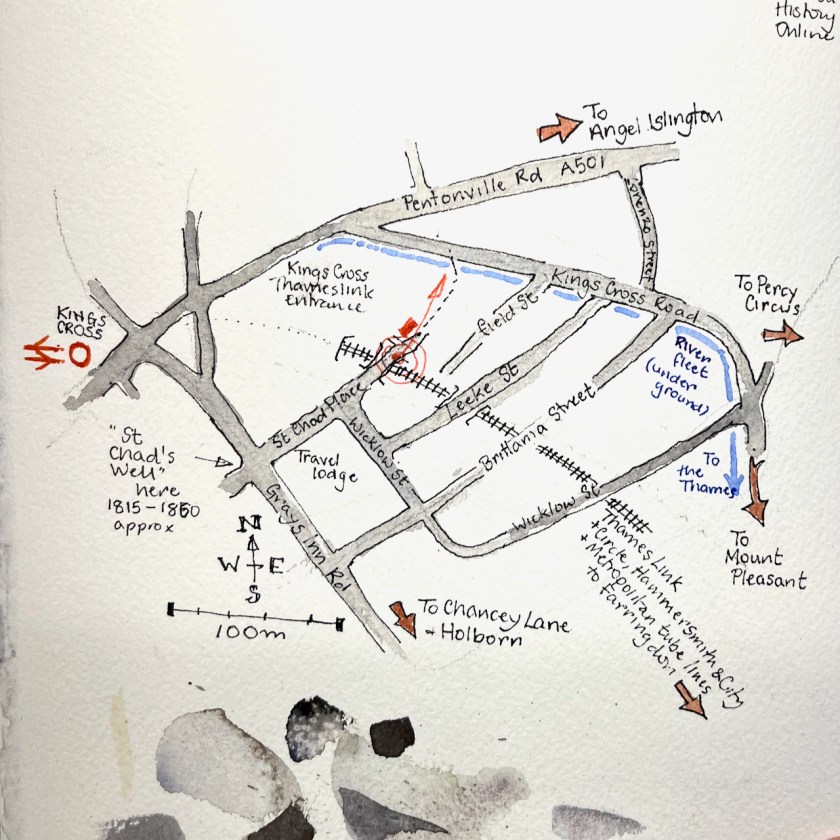
It’s in a labyrinth of roads and railway lines just to the east of Kings Cross mainline station.Here are some maps to show the location. Walk east from Kings Cross, about 10 minutes.
On the maps, the blue line represents the River Fleet, which is alongside the Kings Cross Road, underground. It flows from left to right across the map (West to East) and then heads South down to join the Thames beneath Blackfriars Bridge.
The river Fleet, before it became an underground sewer in 1825, flowed along the western side of Pancras Road and then eastward along the south side of the common, crossing the old highway (now Gray’s Inn Road) north of St. Chad’s Place.
‘Battle Bridge Estate’, in Survey of London: Volume 24, the Parish of St Pancras Part 4: King’s Cross Neighbourhood, ed. Walter H Godfrey and W McB. Marcham (London, 1952), pp. 102-113. British History Online http://www.british-history.ac.uk/survey-london/vol24/pt4/pp102-113 [accessed 7 February 2024].
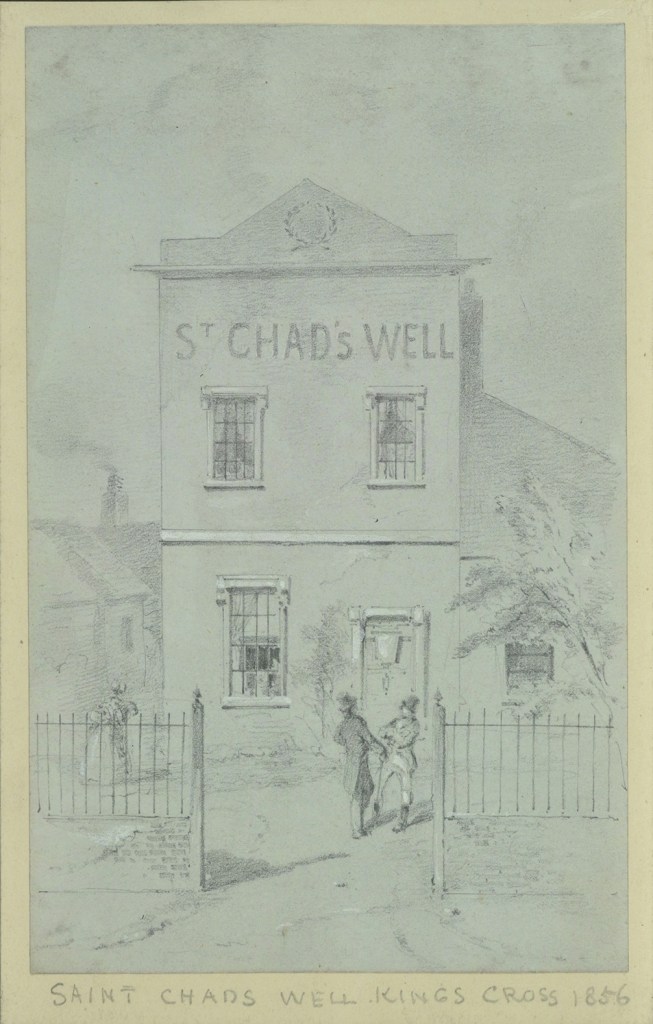
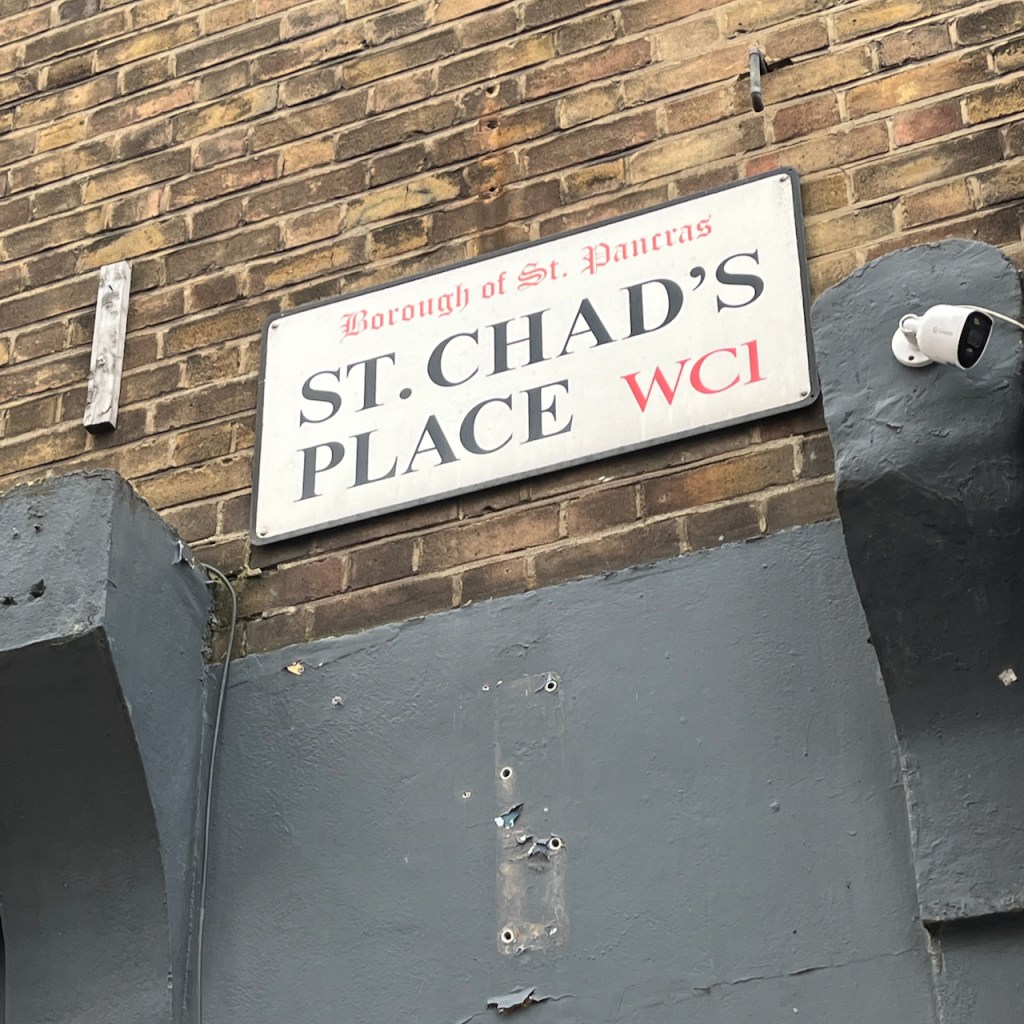
St Chad’s Place slopes down towards the River Fleet. This area was once the location of St Chad’s Well, a spring said to have health-giving properties. It operated from about 1815 to 1860. I found a picture in the London Picture Archives, reproduced below with their permission.
A river, a bridge, a well, a passage and a music venue. It’s amazing what you find.
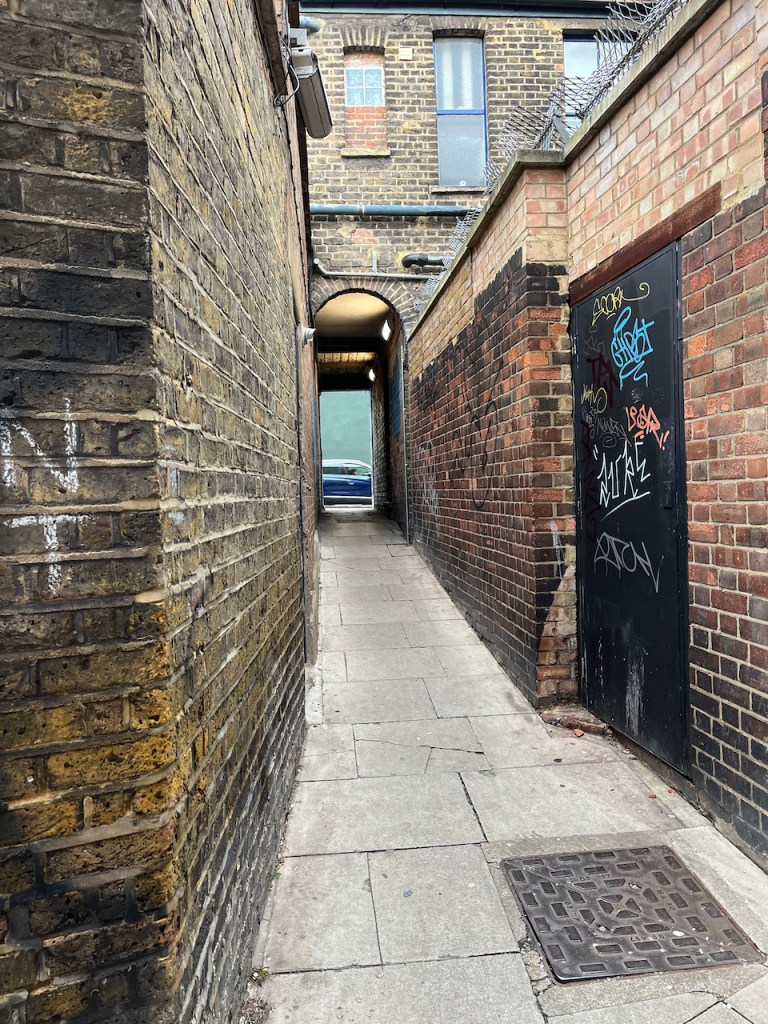
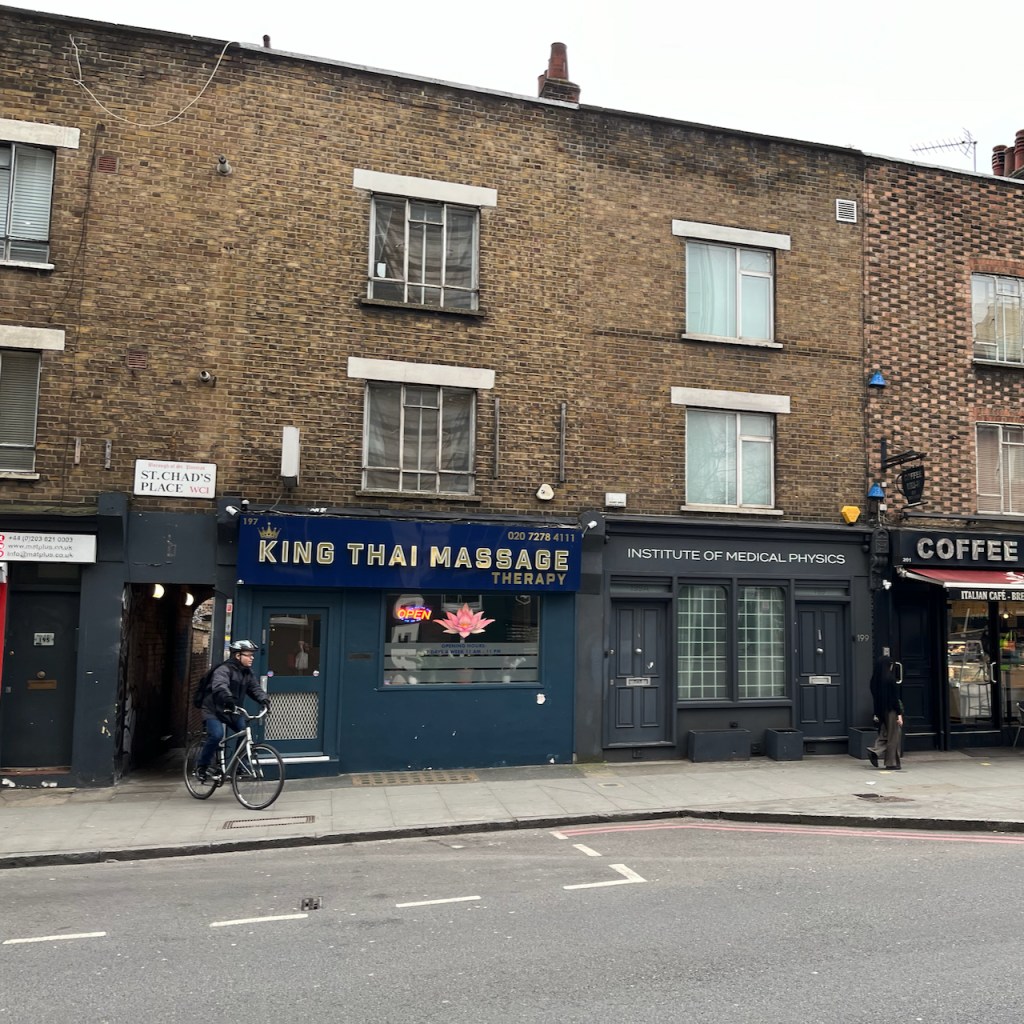
Looking east from where I was sketching. Street art in St Chad’s PlaceIn St Chad’s Place, looking North towards the Kings Cross Road.North entrance of St Chad’s Place. The cyclist is coming out of St Chad’s Place and into the Kings Cross Road.Street name in the Kings Cross Road
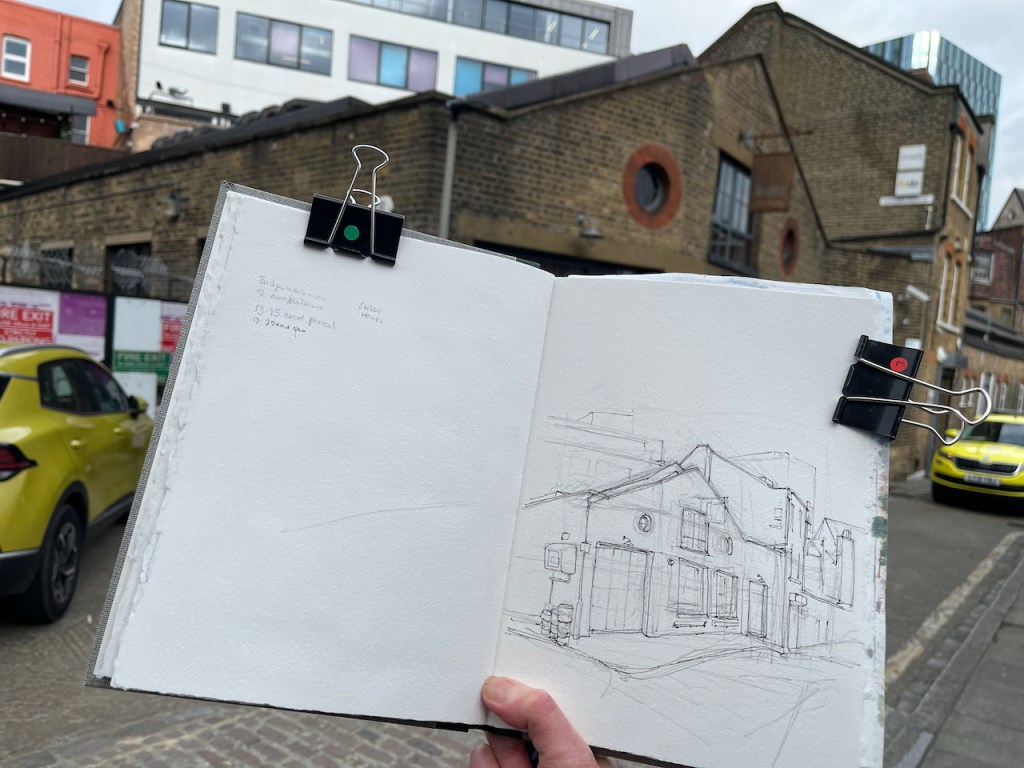
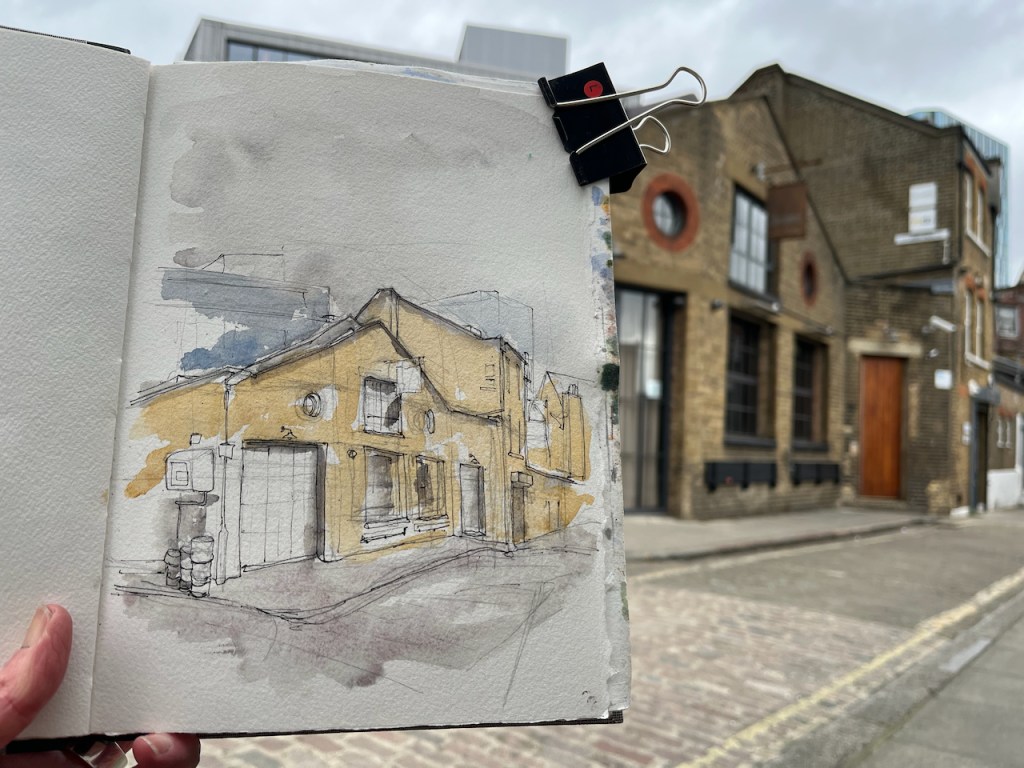
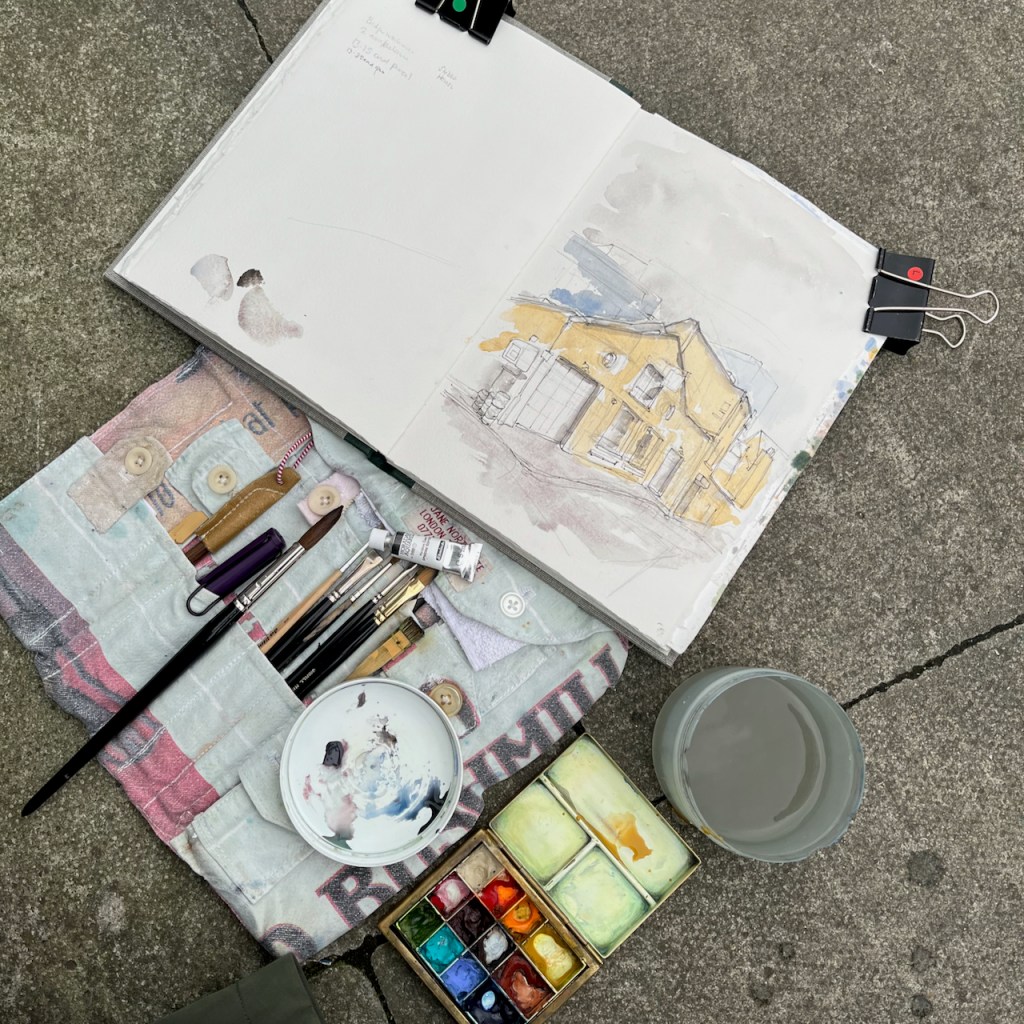
Here is work in progress on the sketch:
The colours are:
For the sky and pavement – a special new colour, Schminke Horadam “Random grey” – “formulated each year from surplus pigments”. This is the 2022 edition.
Rose madder permanent – also on the pavement
Mars Yellow
Ultramarine Blue
Green Serpentine Genuine
Buff Titanium
Fired Gold Ochre in the brickwork
Burnt Umber
Arches Aquarelle paper in a sketchbook made by Wyvern Bindery (Sketchbook 14).
Click a button below to share this post online, email it, or print it:
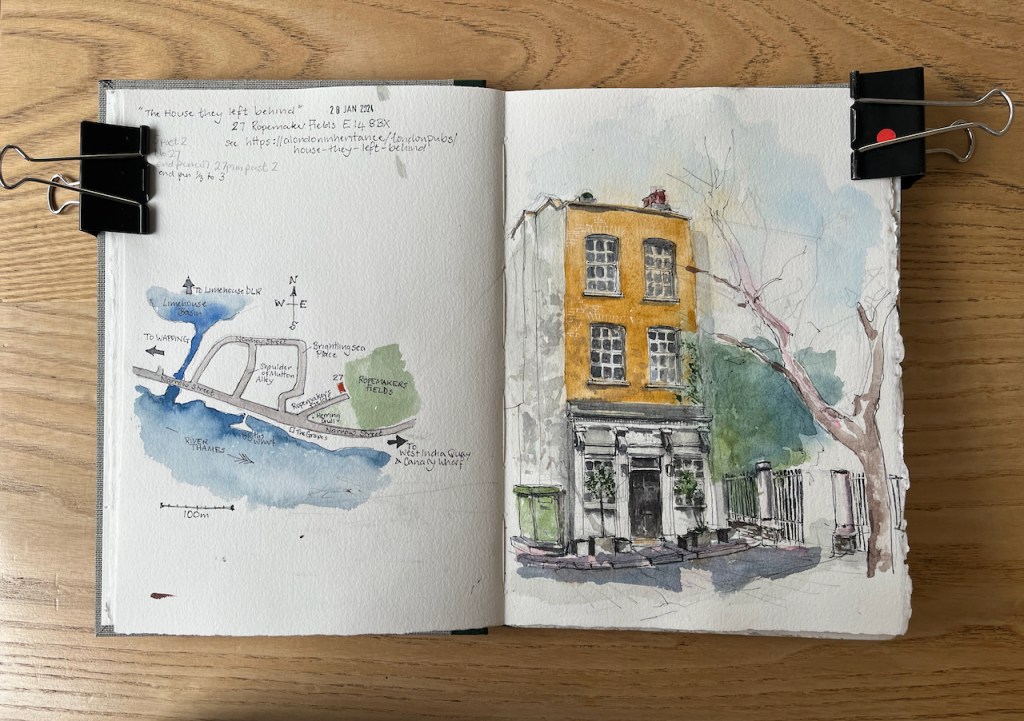
“The House they left Behind”, 27 Ropemakers Fields, London E14 8BX, sketched in Sketchbook 14 28th Jan 2024 at 2pm (Image copyright JaneSketching.com)
The London Inheritance article shows a 1986 photo taken by the author’s father. Painted on the side of the building was the sign:
THE HOUSE THEY LEFT BEHIND
BUILT 1857
RESTORED 1985
The sign has now been painted over. The wall, which is on the left of my drawing, is now completely white. But the name lives on and appears on current maps. Here is a map showing where the house is.
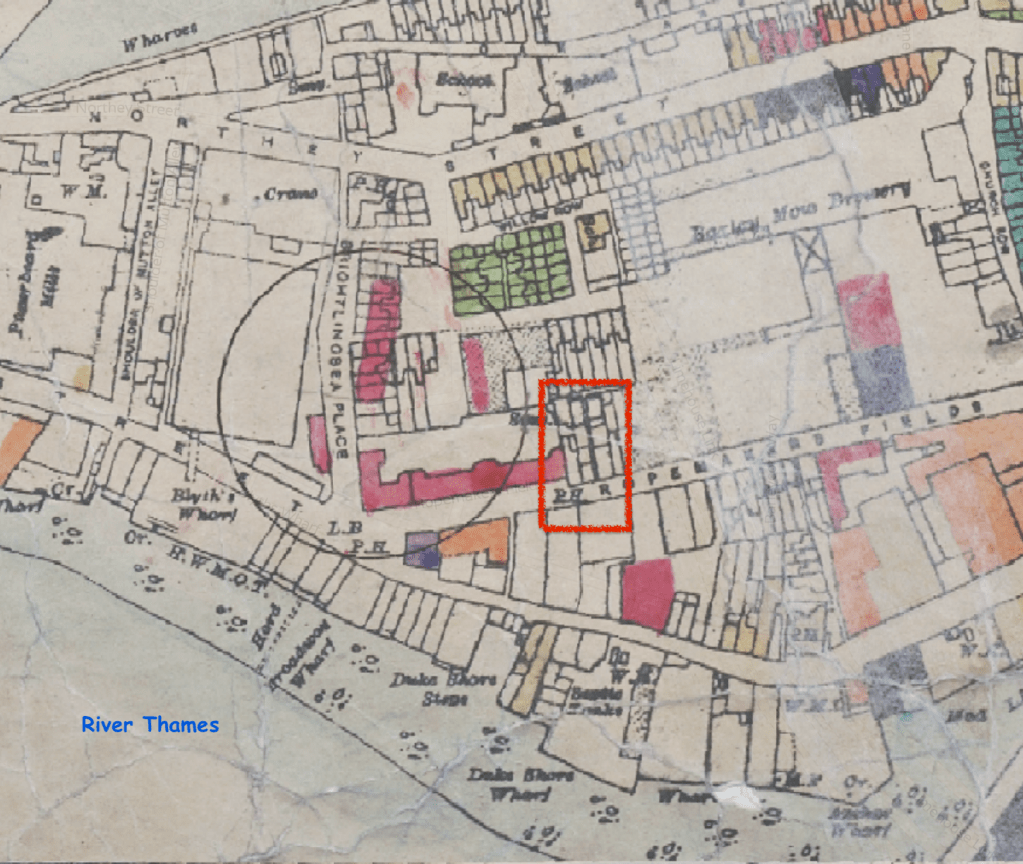
The building is now residential, but was previously a pub. It was “left behind” by the bombs dropped on London by the Luftwaffe in the 1939-45 conflict. The website “Layers of London” provides maps of bomb damage in London. Here is the area.
Map showing bomb damage. Classified from Total Destruction (Black), through Seriously Damaged (Dark Red) to Clearance Areas (Green). credit: https://www.layersoflondon.org/map/overlays/bomb-damage-1945 Map provided by London Metropolitan Archives. Geo-referenced with the support of the National Library of Scotland
The map is based on 1:2500 Ordnance Survey sheets originally published in 1916. The bomb damage was recorded on these maps by hand soon after it happened. The circle represents where a V2 rocket landed. The red area shows buildings that were classified as “seriously damaged – doubtful if repairable”. As you see, the pub, labelled “P.H.”and outlined in red, is shown as undamaged.
I found more information on Bomb Damage Maps from a National Geographic article on a book about the maps. This article also provides a detailed key to the colours on the map. The book is “The London County Council Bomb Damage Maps” by Laurence Ward.
“A diary entry included in the book, from architect Andrew Butler on April 20, 1941, gives an idea of what the work was like:
For the block I have started on—eight floors high with two flats on each floor—has had its whole face ripped off … I found it possible to stand on part of the roof. So, clutching a broken chimney, I surveyed the damage there. My notebook became very messy. What with the dust and soot, wet filth and the perspiration of fluster on my hands, it was difficult to read what I wrote. The notes served their purpose however when, after drying the book, I had to transcribe them into a report.”
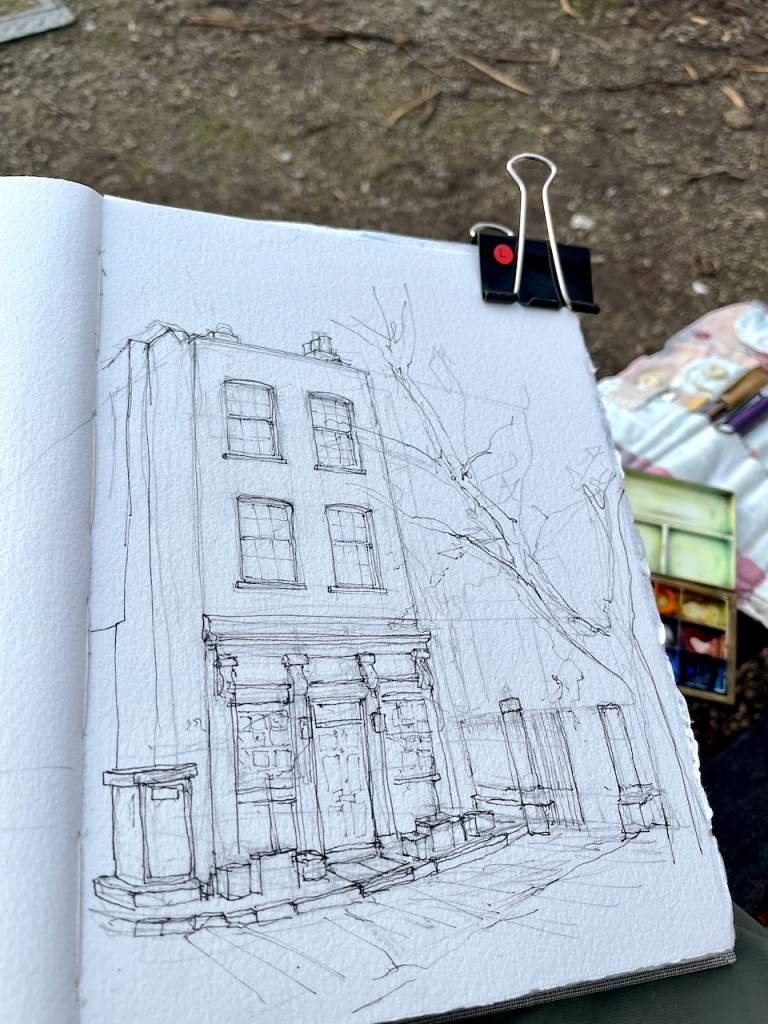
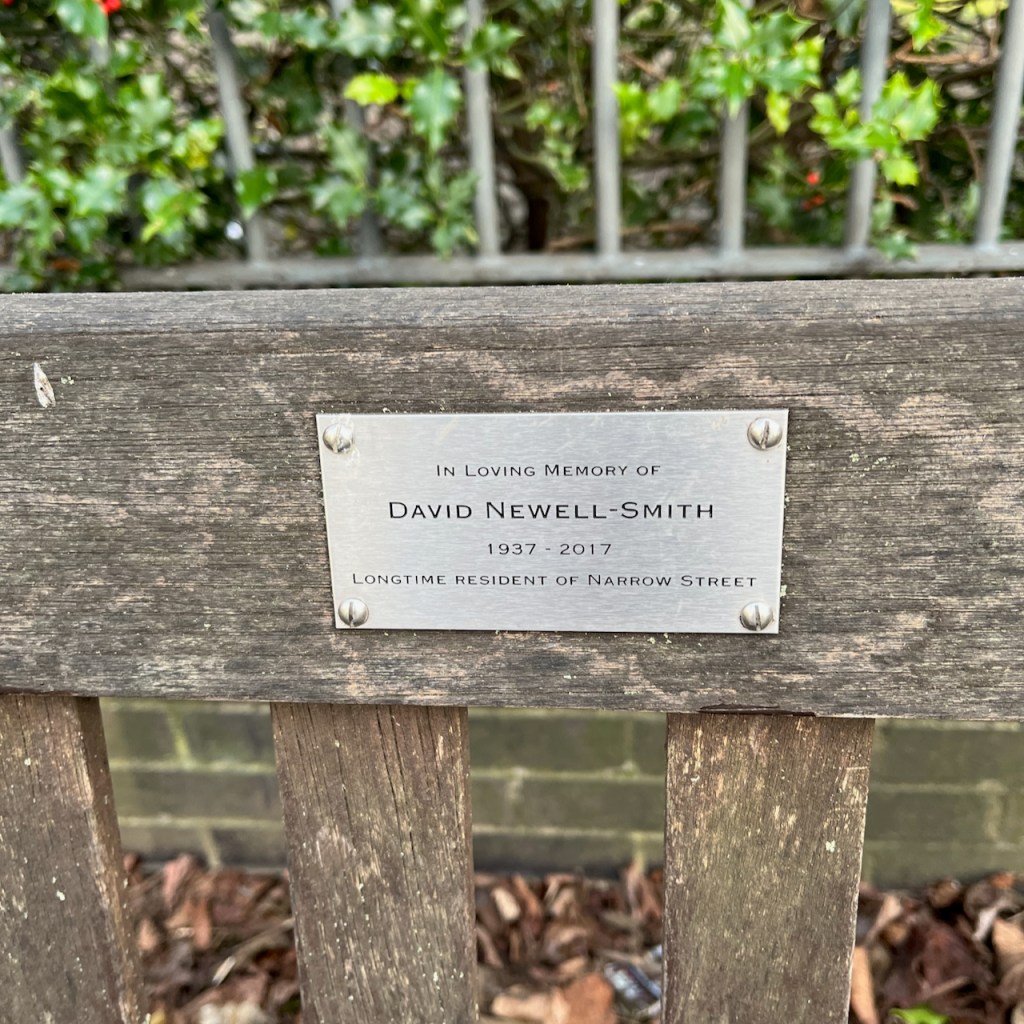
Here is my work in progress on the sketch. Thank you to the author of “A London Inheritance” for providing the stimulus for this expedition. Thank you also to the friends and family of local resident David Newell-Smith, on whose memorial bench I completed the sketch. His dates are given as 1937-2017. He would have been a boy when the bombs were falling.
Click a button below to share this post online, email it, or print it:
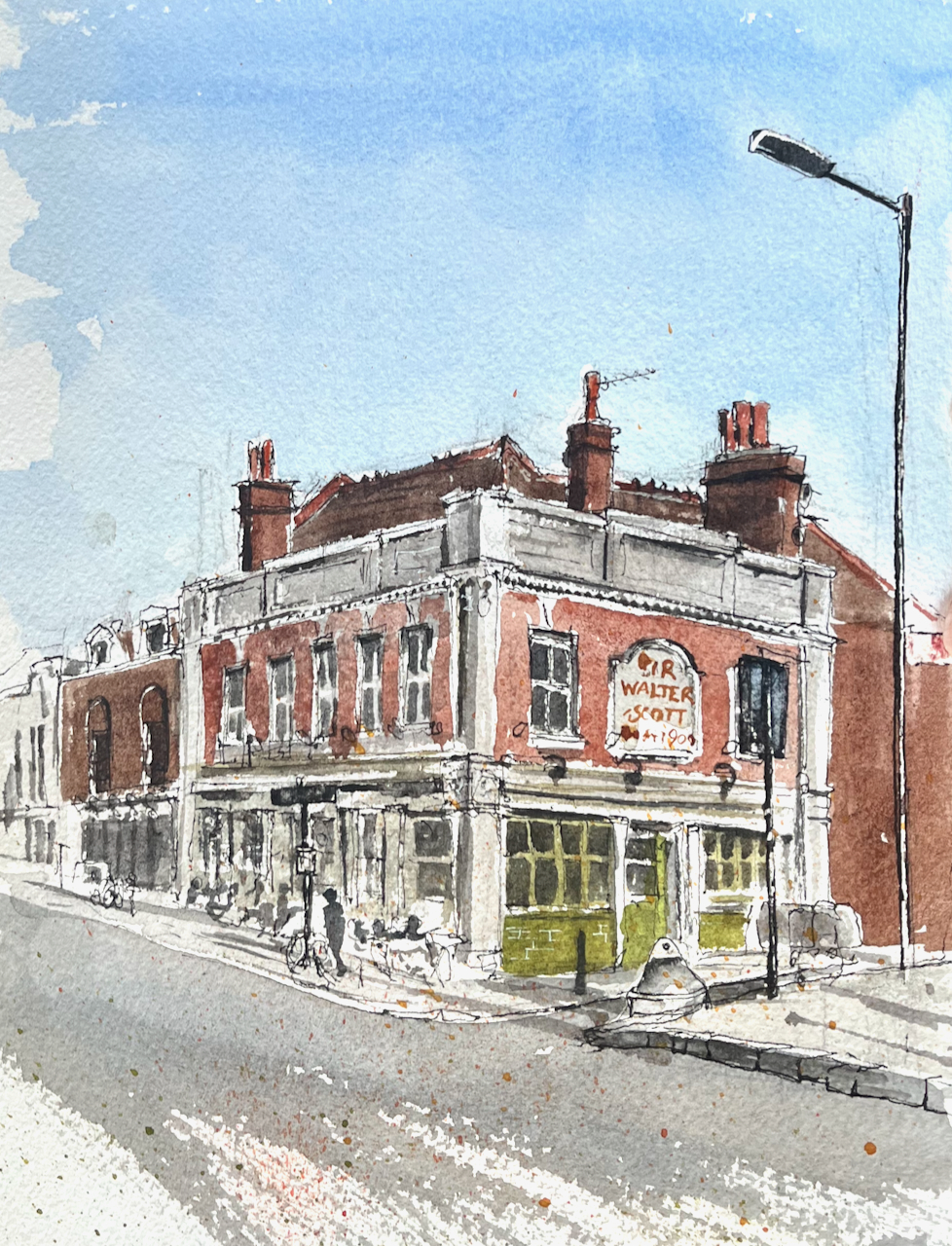
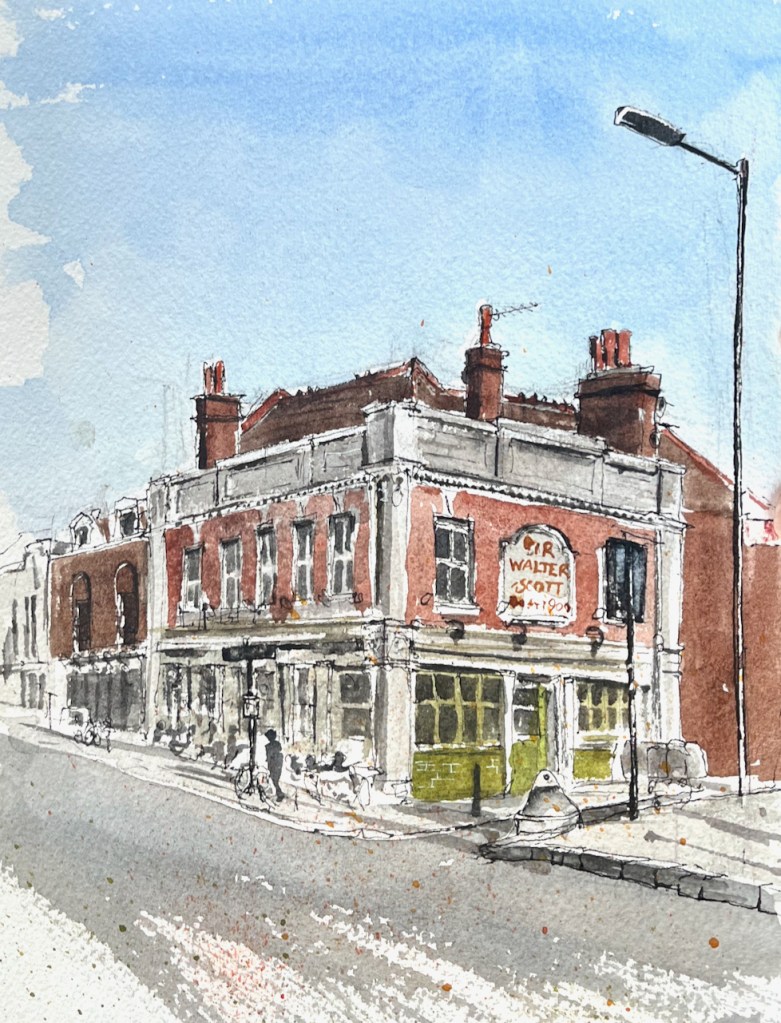
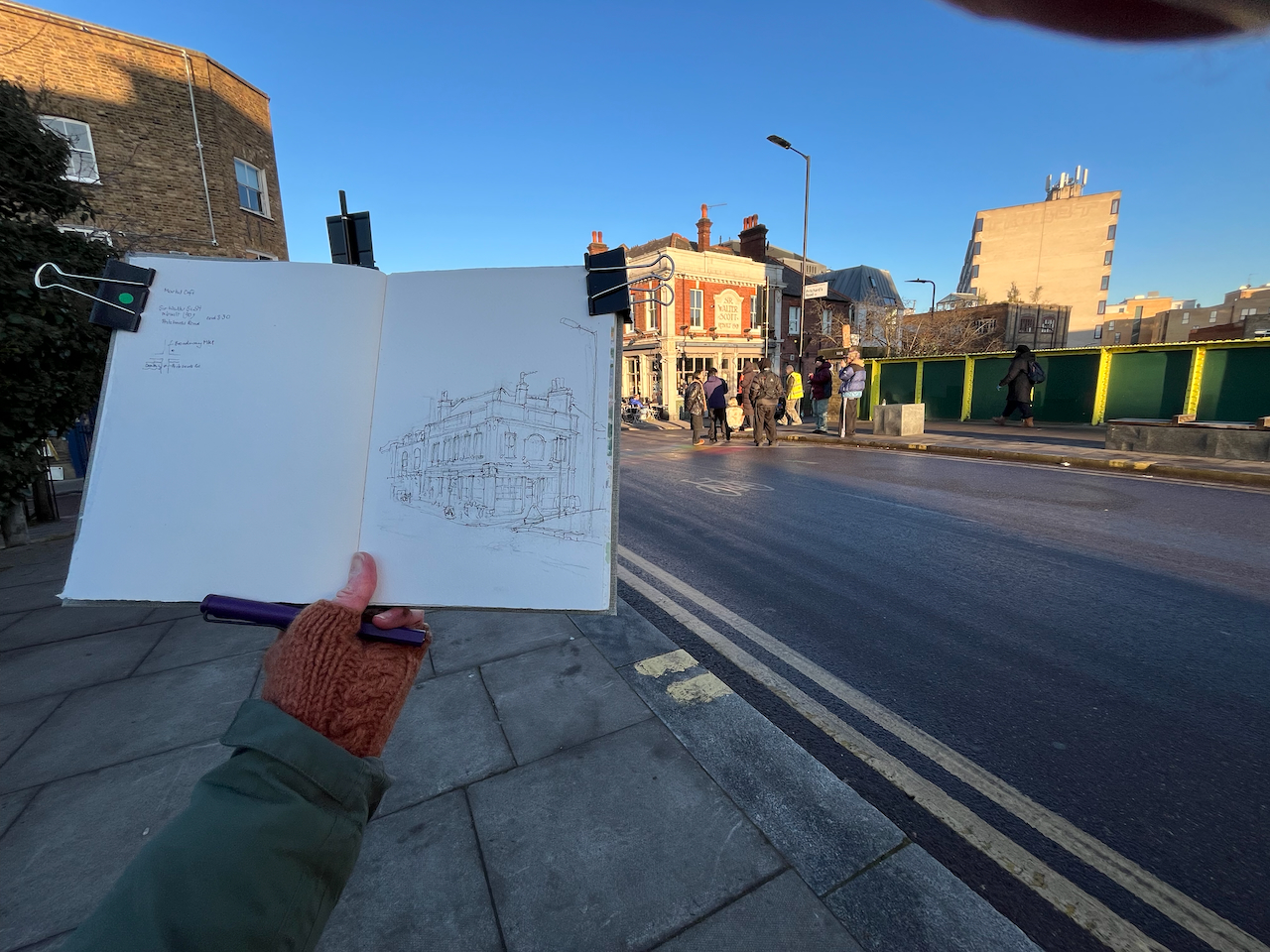
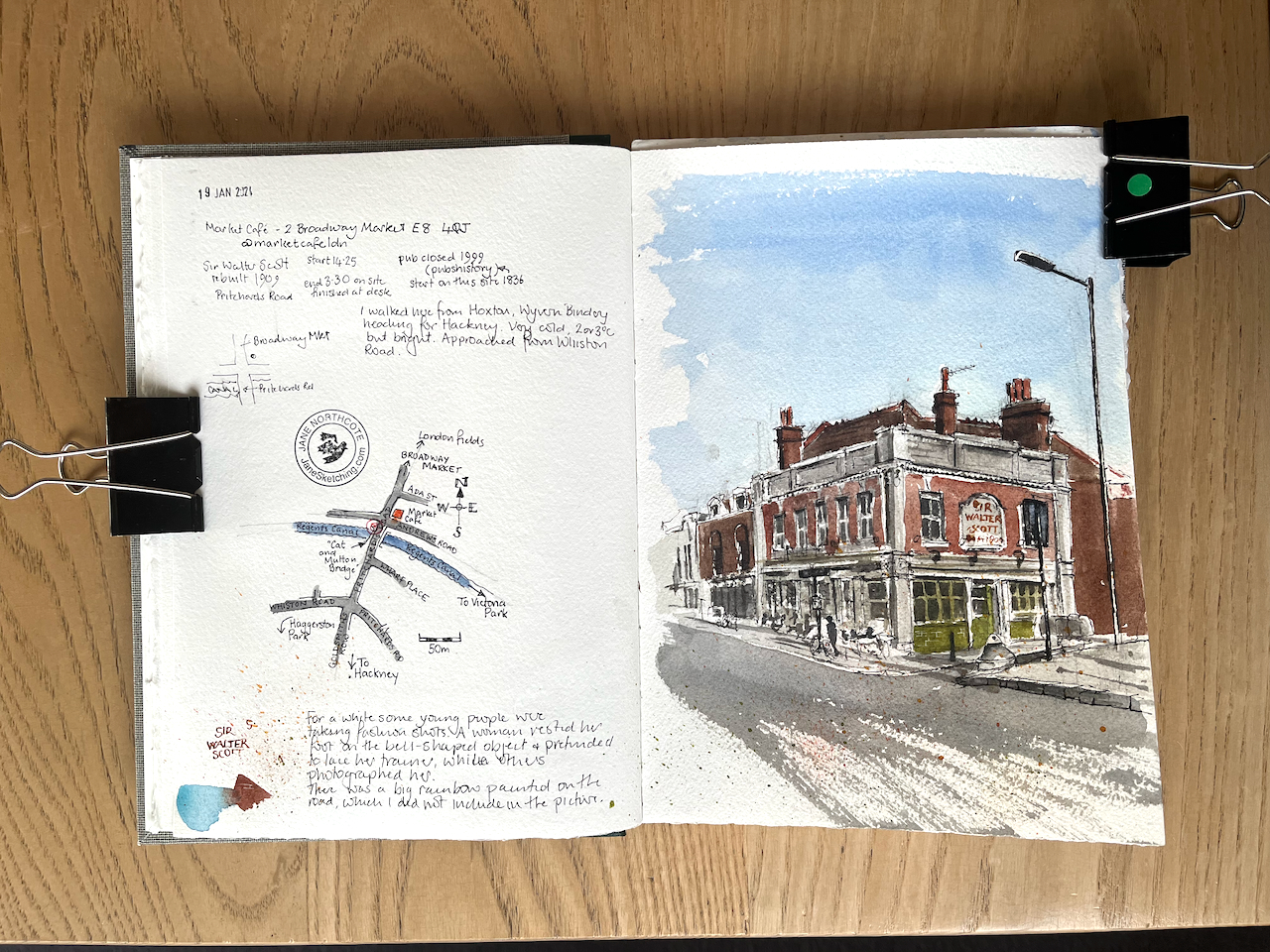
Here is the Market Café, sketched from the “Cat and Mutton Bridge” on 19th January 2024.
Market Café, 2 Broadway Market, London E8. Sketched 19th January 2024, 15:30, in Sketchbook 14.
As you see, this building is the former pub, the “Sir Walter Scott”. A pub was on this site in 1836. The wording on the building says “rebuilt 1909”. It closed as a pub in 1999 according to “pubhistory.com”. The Market Café now operates from the ground floor.
The website of Broadway Market gives a history of this area. In the early 19th century, the canal was the major means of freight transport, until the coming of the railways in the 1840s.
In 1812 “The Regent Canal Act” was passed and the Regent’s Canal constructed. This final link was direct into the River Thames at Limehouse, completing the passageway of heavy freight to Birmingham Manchester and the entire industrial North. (It should be noted that this was at the time of horse-drawn stage coaches and ox-laden wagons).
The new Regents Canal became a central pivot for industry and supplies. Timber warehouses grew, Gas light and Coke companies were established and this once rural backwater had become a major hub of enterprise.
This “once rural backwater” evidently needed a pub. Sir Walter Scott was a Scottish historian, novelist, poet, and playwright. He died in 1832, which must have been around the time this pub was named and the area was growing in population and importance.
The National Library of Scotland provides a wonderful side-by-side map, so you can see how the area looked previously, alongside a modern map. Click the image below to go to their marvellous site. You can shift the images around and expand them: both maps change at once. It’s fascinating.
I had a look at an 1870 OS map. The Public House “P.H.” existed here in 1870. The road currently called Broadway Market was called “Pritchards Road” then. You can see the rows of terraced houses along the canal, gone now, and the “Coal Wharf” and “Wood Wharf” which used to be on the south side of the canal.
Broadway Market is now a street of modern coffee shops and small enterprises, with a street market of stalls down the middle. The jeweller William Cheshire has a workshop at the south end of the street. Climpson Coffee are further up. There are bakers, grocers, greengrocers and an opticians. At the North end, Broadway Market gives onto London Fields, a lovely park, with a lido.
It’s a great area to explore.
Click a button below to share this post online, email it, or print it:



























 Jane Sketching