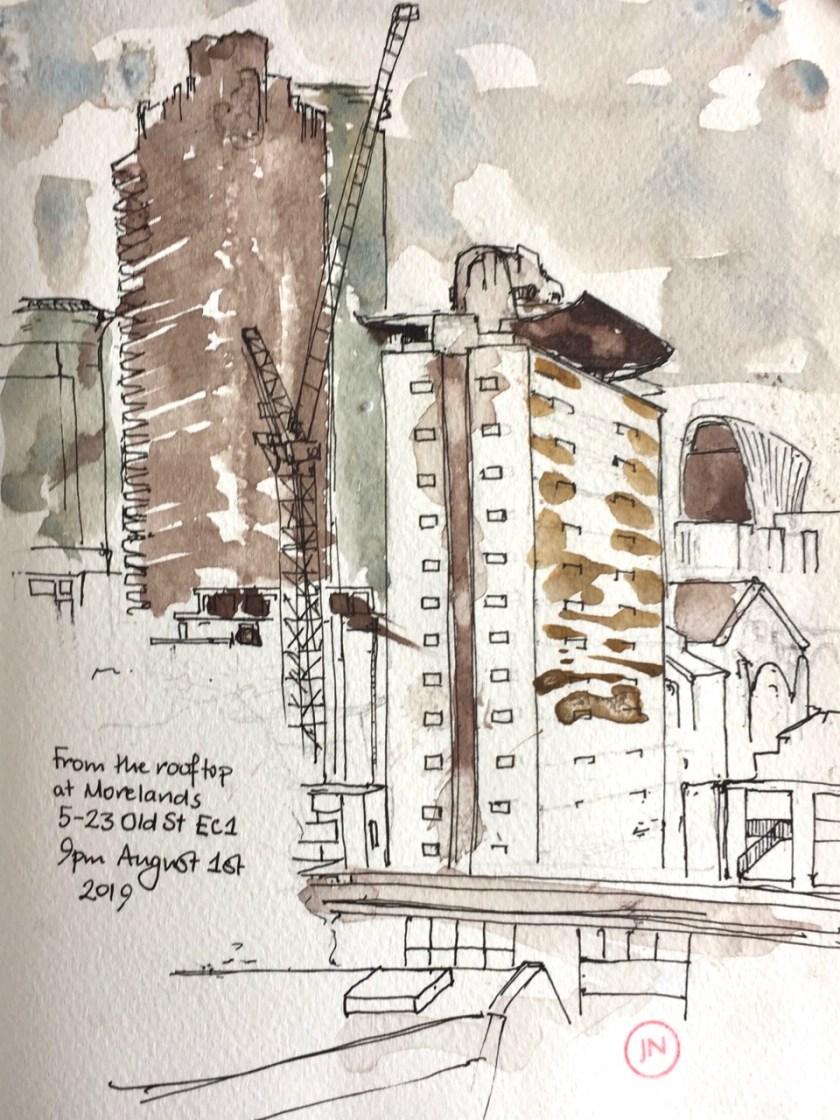
This was an event organised by RIBA* and Phil Dean a.k.a “Shoreditch Sketcher”. Morelands is a modern office block on Old St.
I looked south, and drew Cromwell Tower and Great Arthur House. This sketch took about 45 minutes, as darkness fell.
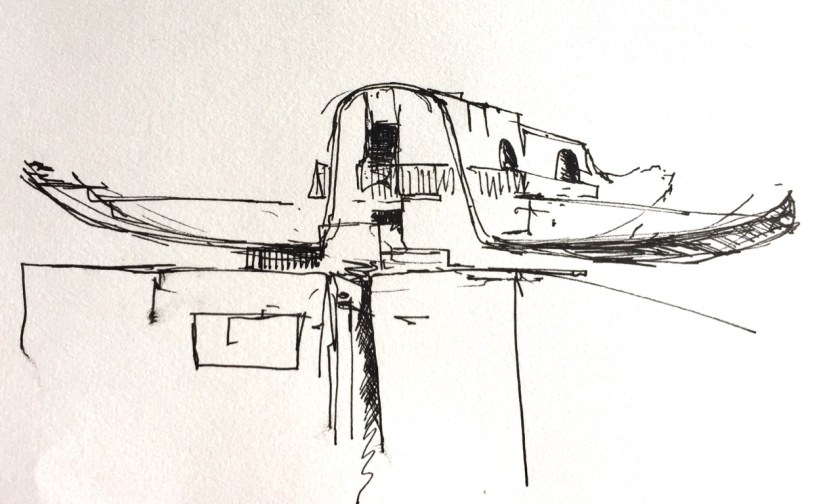
The “brise soleil” on top of Great Arthur House must be one of the most difficult things to draw. That, and the dome of St Pauls. Because it’s curved, and the curve needs to be right.
Earlier, I did a sketch of the “brise soleil” on its own. I had not noticed before that there is a sort of balcony.
Today I found another view of the view under Mountjoy. This is from the high walk that goes north from the Museum of London, looking East.
Under the Mountjoy Highwalk there are a number of “framed” pictures. The old London Wall fortification is visible. The sun reflected from the lake and threw patterns onto the old stone. I couldn’t get all that in the picture so you have to take my word for it.
A group of tourists stopped on the “Wallside” highwalk. You can see them in the centre right of the picture.
These “windows” will all be obliterated by the proposed City of London School for Girls expansion.
This view is from the place where the north bound highwalk turns abruptly left (click map to expand it).
This picture took about an hour. I tried hard not to overdo it.
At the top of the picture are the flats of Mountjoy House, with their impressive window boxes.
Click a button below to share this post online, email it, or print it:
This is the view that will be lost if the City of London School for Girls expansion proposal goes ahead.
UPDATE (2020): the proposal has been shelved, and alternatives are sought. But we must remain vigilant. The article below was written in August 2019, when the threatened development looked as though it would go ahead. Widespread protest ensued.
The view that will be lost if the CLSG expansion goes ahead. See “SOSBarbican.com”
I spent time today paying attention to this view, because that is what I need to do, to draw it. The pillars are reflected in the water. The enormous flight of steps is like that in a fairy story, so wide and grand. There’s a massive three-dimensional sculpture of concrete, of light and dark. Flat spaces and lines don’t quite join up but are nonetheless connected, like rhythmic music. Framed by the 20th century brutalist columns you see an older more ornamented building, and trees. You can even see right through to the other side of Aldersgate. This is a magnificent view.
The interesting blotchy effect on the pillars is rain falling on the picture. I started this picture at 09:30. Then it started to rain. The fine rain speckled my picture. Bigger drops diluted the paint in the palette and made the paints shift about. Then it started pouring down with menace. I scrabbled my things together and dashed into St Giles’ Church which was behind me. Inside the church, people moved purposefully about, and all was calm. And it was dry. I took a deep breath and kept my drawing horizontal. There was a table next to the door. A woman looked at me over the table. I felt the need to explain. “I’m sheltering from the rain,” I told her.
Her response was calm and logical, “Would you like a cup of coffee?”
“I would,” I said. Her companion at the table offered me a biscuit. Grateful to the Royal Society of Organists for their hospitality, I sat on a wooden bench and let my drawing dry off. Experimental short tunes from the organ floated quizzically in the air.
Then I went out again. I wanted to finish my picture. I stood in the porch of the church and looked at the rain. “Every decision is a moral decision.” I believe that. Should I pack up the drawing and go home? I could use the time before the Planning Meeting to do the supermarket shop, deal with the plumbing problem, and process the sourdough.
Or should I continue the drawing?
What principles are at stake here? I finish drawings that I start. I don’t mind the rain. My ink and watercolour does mind the rain, though. So I’ll draw the picture under an umbrella.
This was surprisingly effective. I managed to get all the ink drawn before 10:45, when I packed up again, to go to the Planning Meeting. During this time I was approached by a flustered gentleman in a smart suit, who wanted to “get across the lake”. He was hopelessly disoriented, pointing South-West, when he should have been heading North-East. I re-directed him and he dashed off towards the Barbican Hall.
The Planning Committee Meeting at 11am was the City of London Planning and Transportation Committee. This was their July meeting. In their September meeting, if things go according to the plan put forward by the School, this same Committee is due to approve a plan for a building which will totally block out the view I have drawn. The proposed new structure would cover the steps, build round the pillars, and put in an industrial kitchen. Residents in Mountjoy House, directly above my picture, are understandably dismayed. The Barbican Association, representing Barbican residents, is leading a campaign to prevent to save the view, and stop the expansion. Here is their postcard/flyer.
On the way back from the planning meeting, I went back to the view, and put the colour.
Spending time looking at this view, these pillars, these shapes, I realise how magnificent it is, and how talented the architects were. This view is worth fighting for.
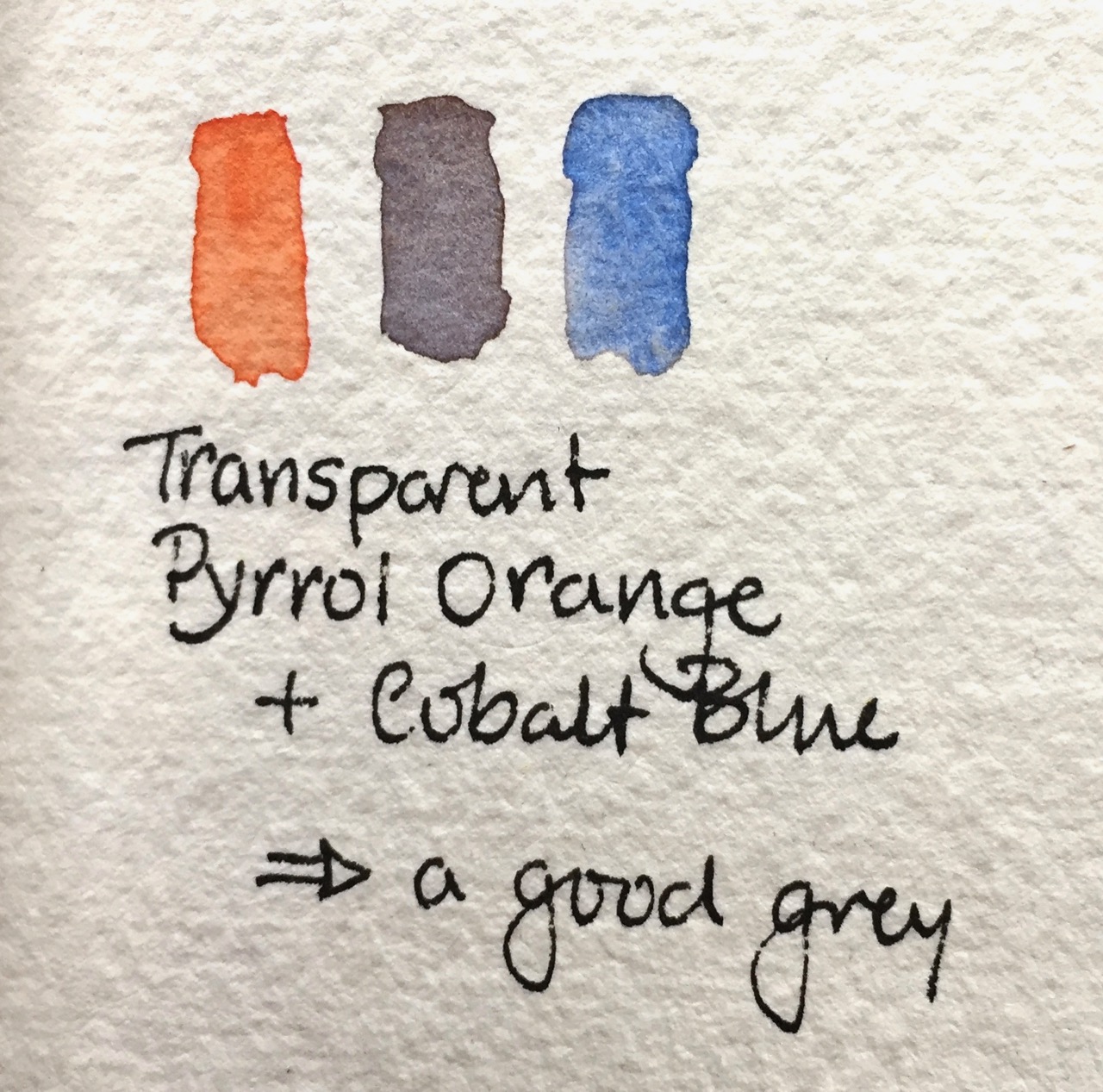
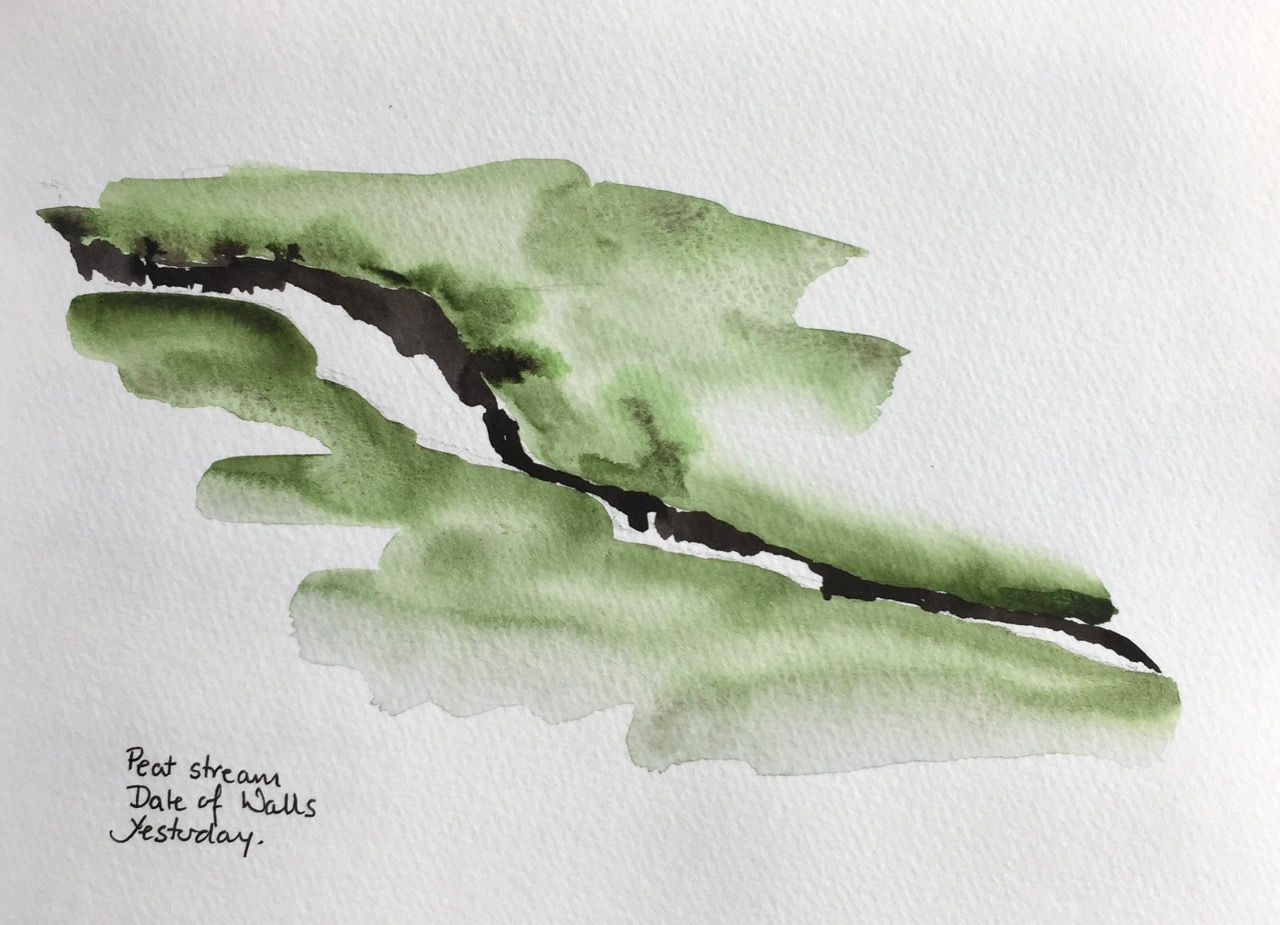
Yesterday I was experimenting with Daniel Smith watercolours. The aim was to get a really good deep black with just two colours.
The Perinone Orange with Prussian Blue is particularly magic. Two quite pale colours suddenly combine to a carbon black. It’s like watching a chemical process. Although it is, of course, a physical process. These two colours are complementary, and together they absorb all the visible spectrum. Impressive.
I did other experiments:
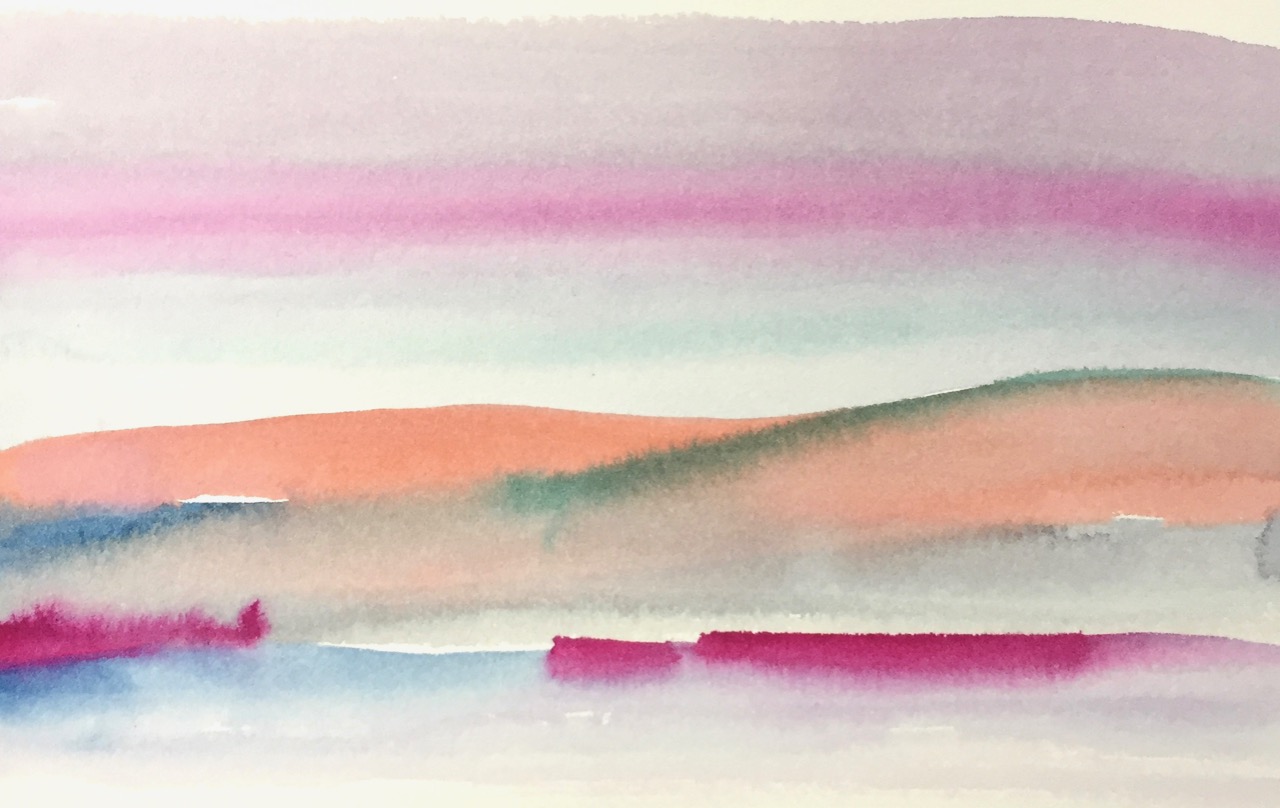
Then I had a lot of colours left in the mixing tray. I didn’t want to throw them away, they looked so lovely and jewel-like in the mixing tray. So I made some sci-fi landscapes.
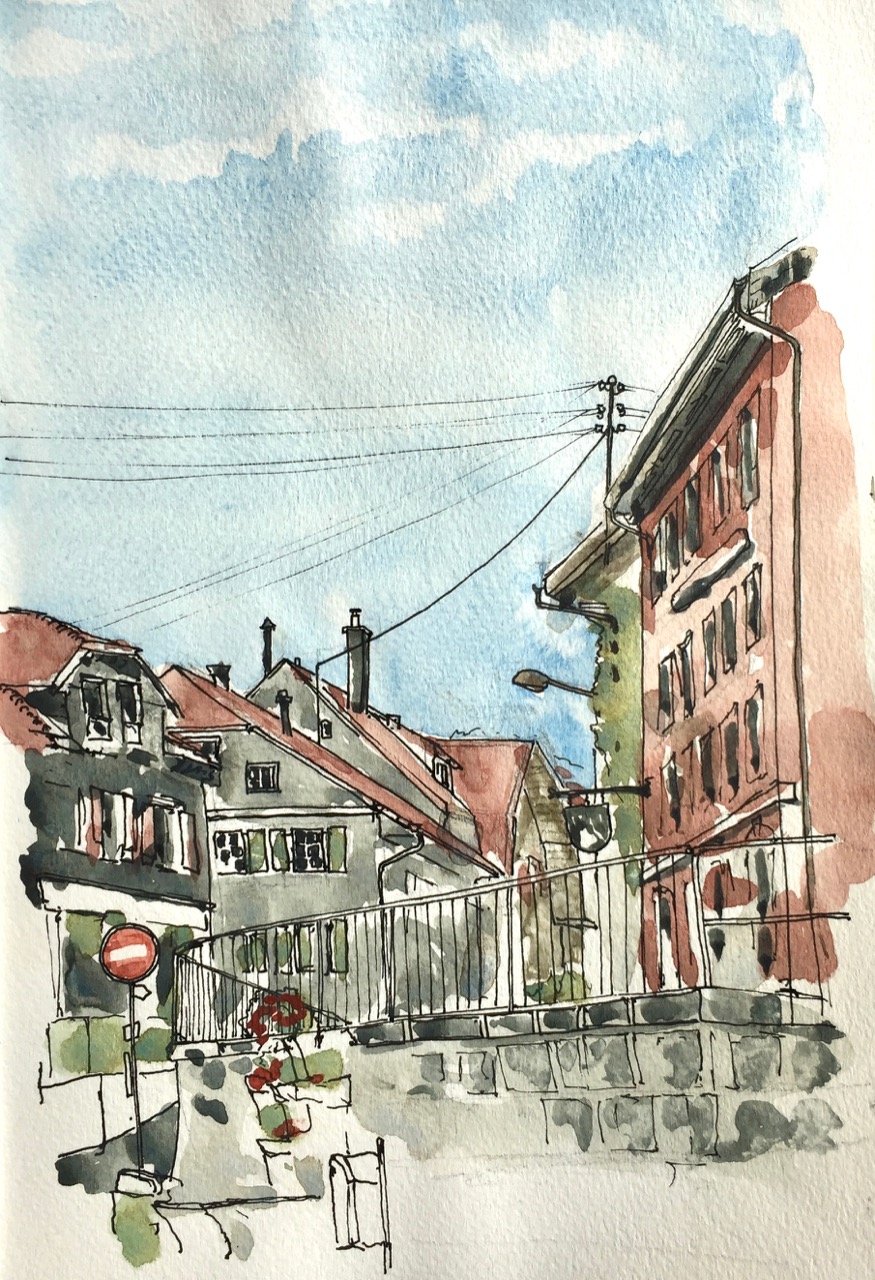
I had been travelling since 5am. So I just rested. I looked out of the hotel window. I saw chimney pots.
With the wind and snow in Switzerland, it’s worth a lot of effort on the part of the chimney pot designer to get it right. Clearly, though, much experimentation is required. Every one in this drawing is different.
Switzerland is the only place I know where copper is a construction material. The rest of us use it to make small domestic items, or jewellery. But here, the whole of the chimney pot stack with the cylindrical top, in the middle of the picture, is made of copper. Also copper is the guttering which runs across the middle foreground, and some of the down pipes.
Later, in a pause, I made another drawing, this time from the terrace of the Hôtel de France. This time I was tuned in to chimney pots. See the marvellous construction on the skyline! It is even furnished with a set of steps, so the chimney pot repairer is provided for. Or perhaps the chimney sweep.
Another day I searched for chimney pots again, since this was becoming a theme. Here is the view from the same place, looking a slightly different direction.
Here is the picture under construction.
The item in the middle of the base of the picture is a letter box. I posted a few postcards:
Pen and ink sketches are a good way to fill in the time waiting while travelling:
And I did some sketching at the breakfast table.
Breakfast room, Hôtel de France, 11th July 2019
Click a button below to share this post online, email it, or print it:
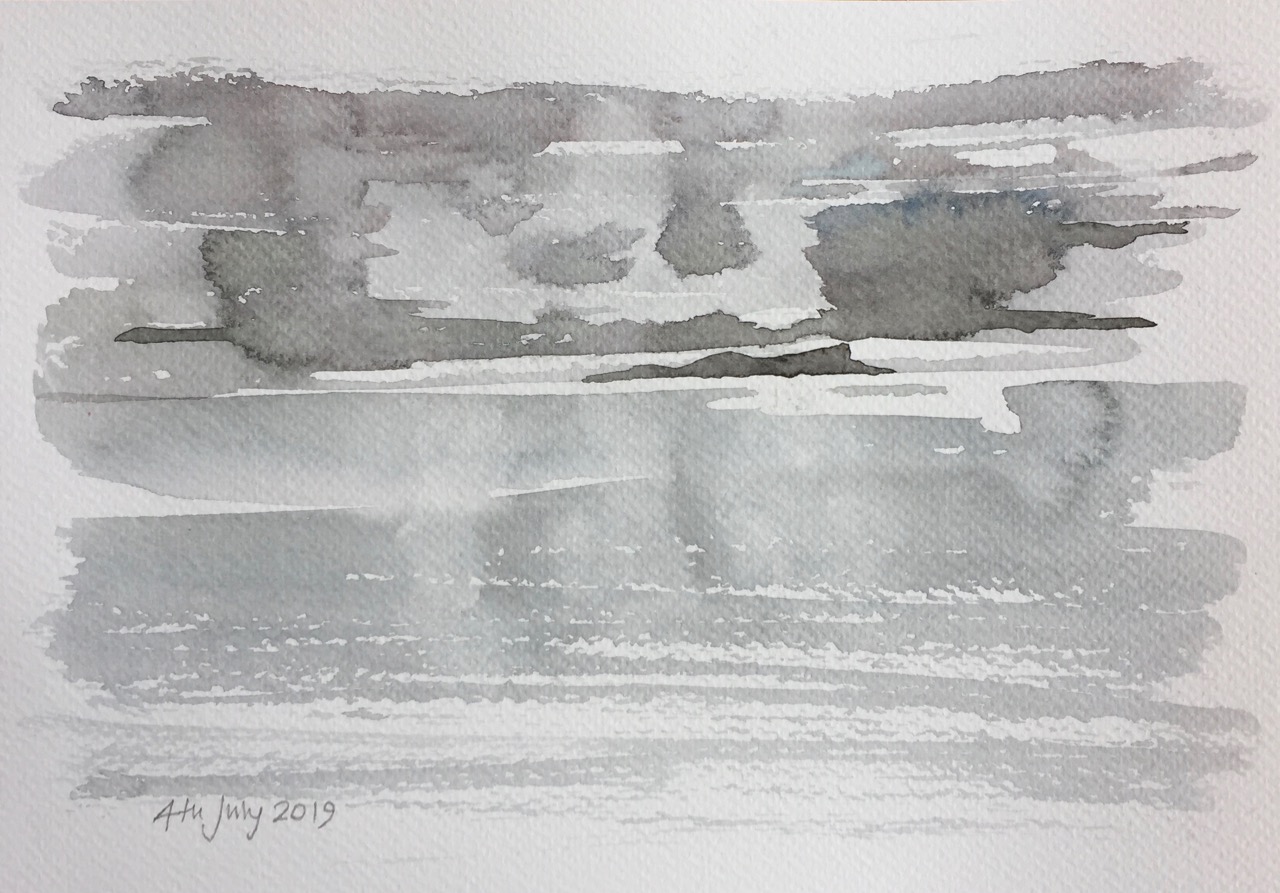
Shetland is a place of sky and water. I was working on reflections.
Experimenting with reflections
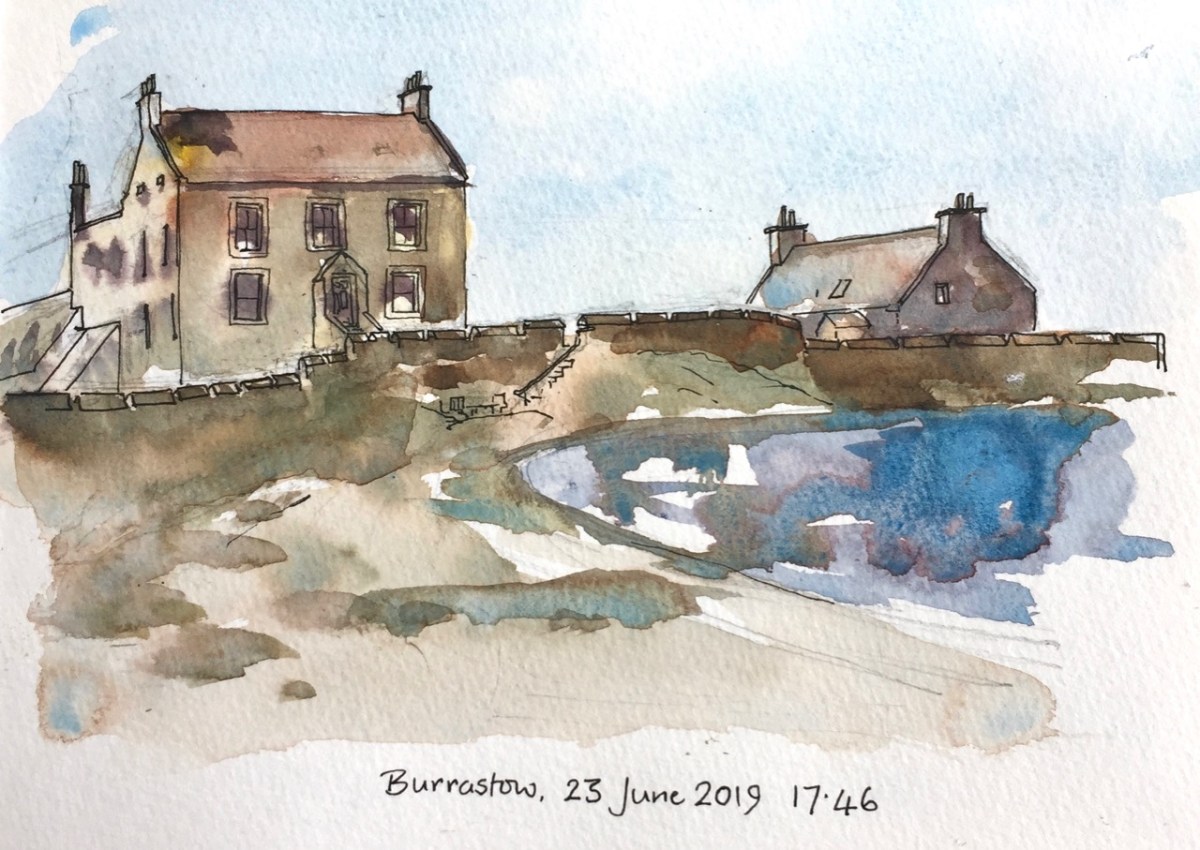
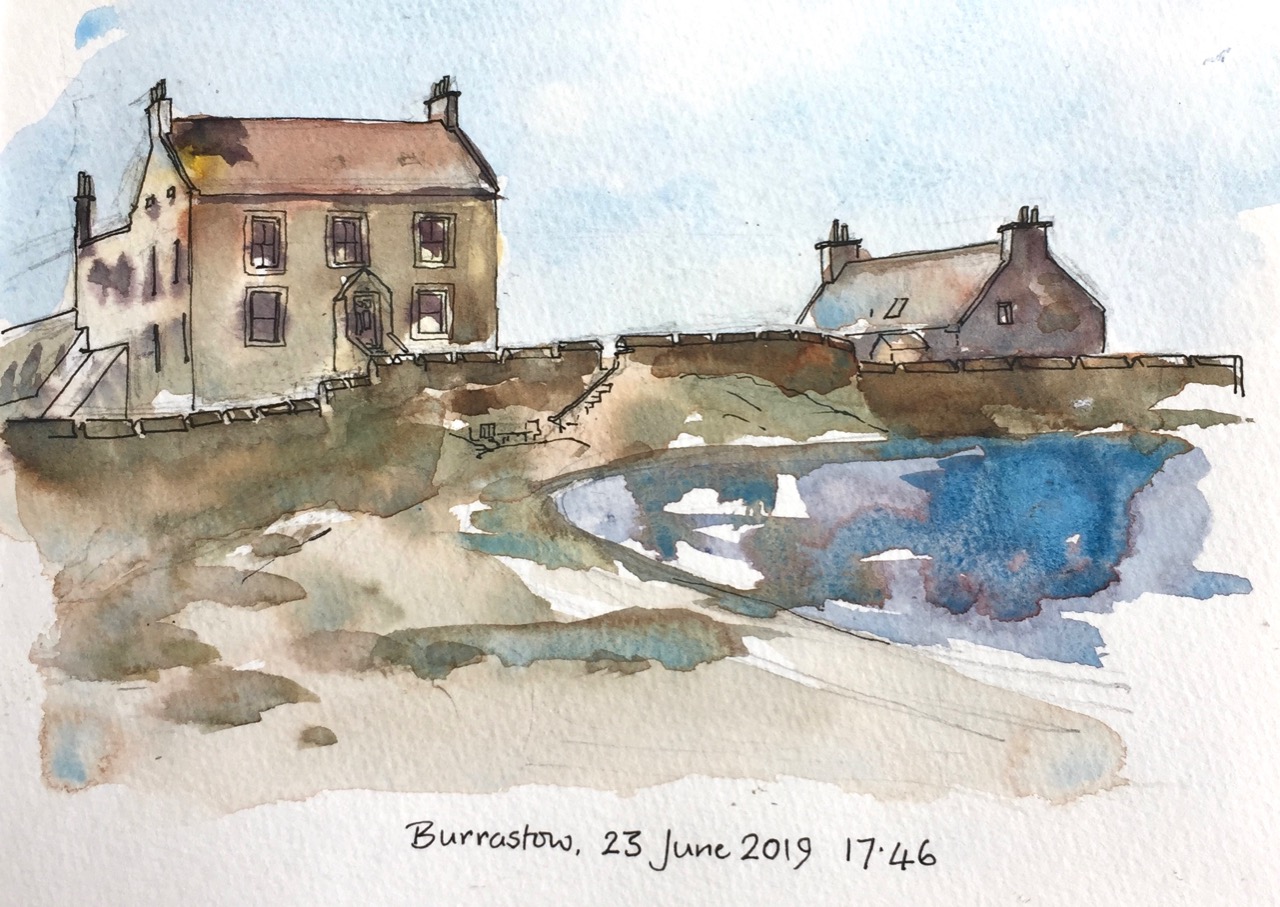
A sketch done on the beach at Burrastow
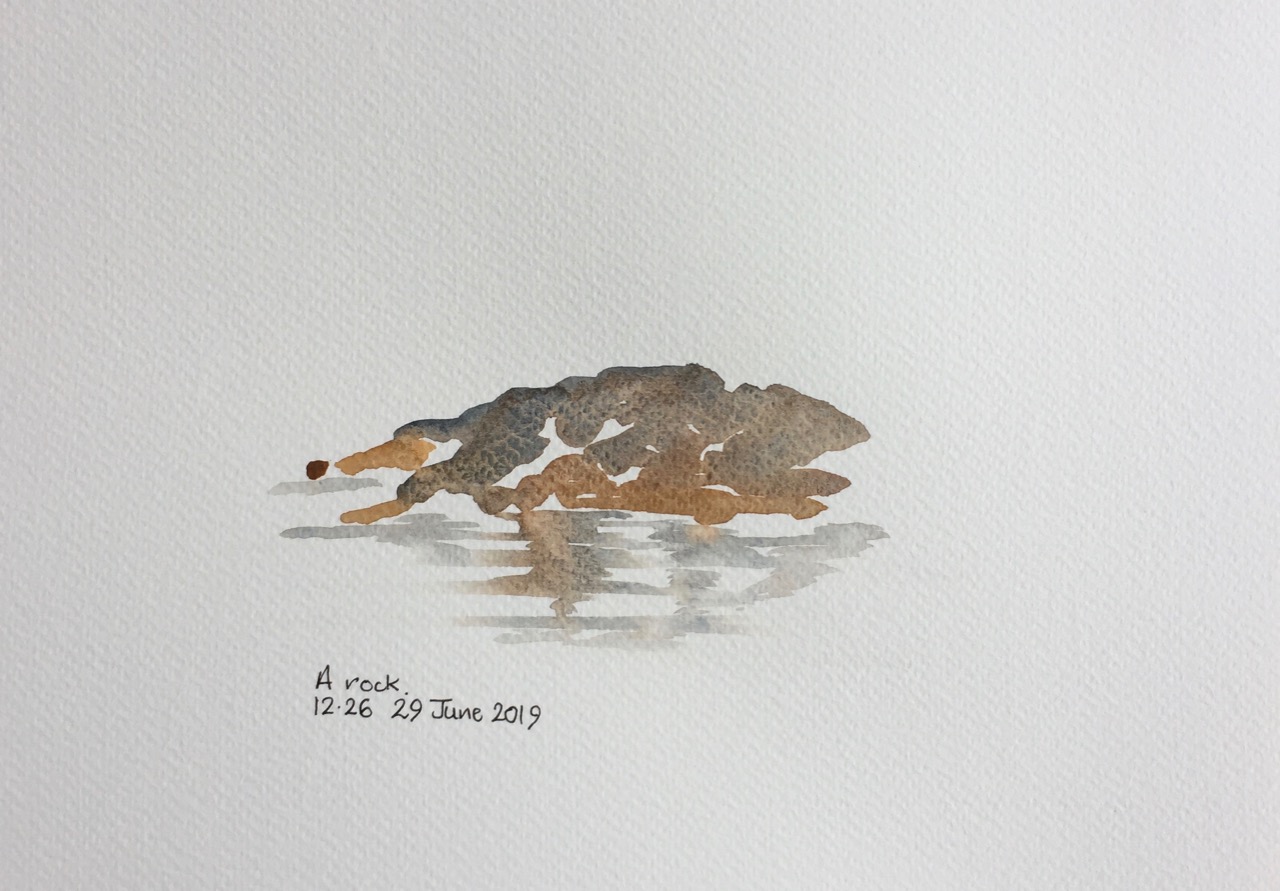
Here are reflections of rocks:
Here’s one that is almost abstract. Perhaps it reflects a mood.
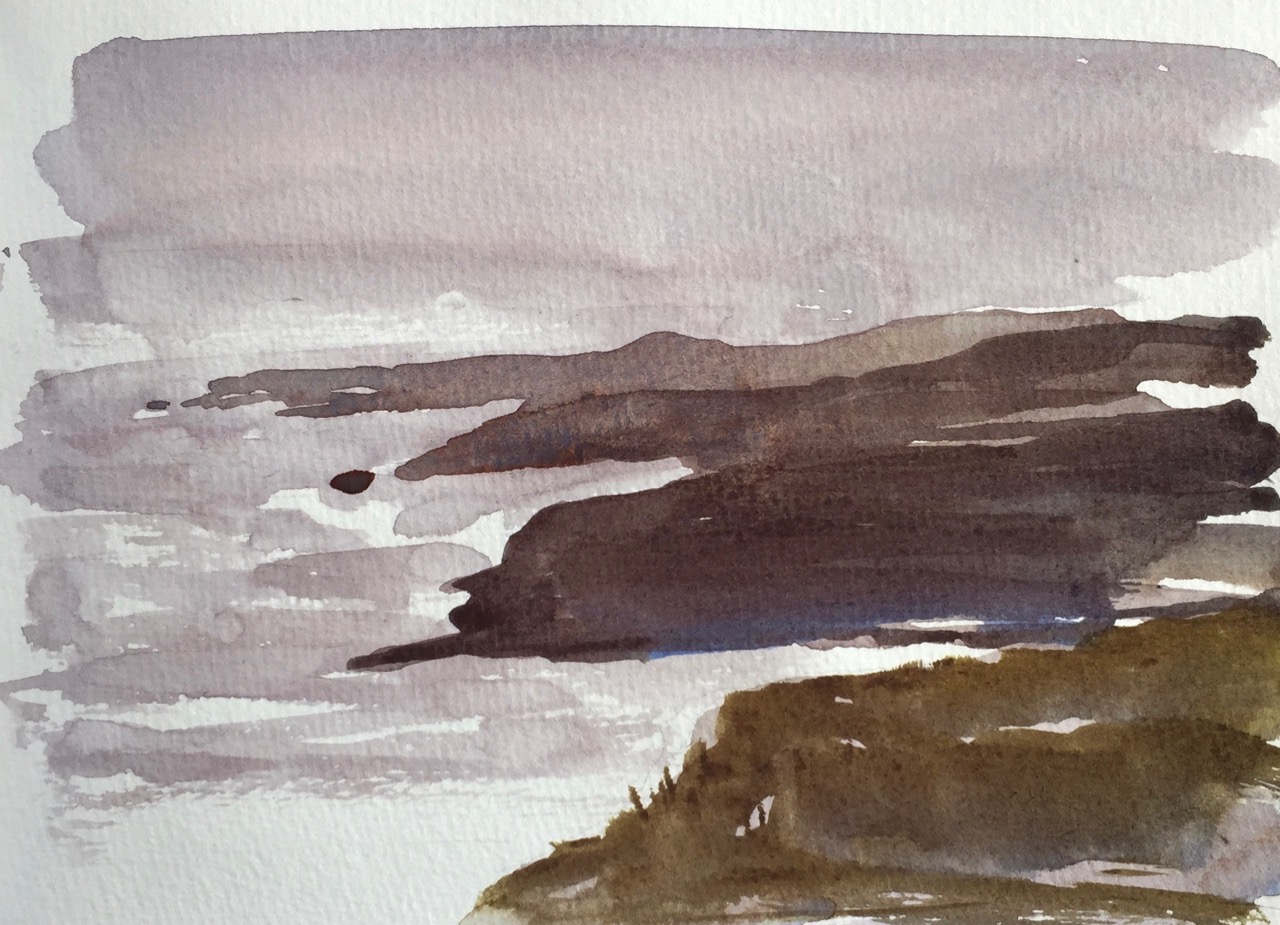
The rocks round Burrastow each have a skirt of yellow and brown seaweed. So does the pier. There are lobsters down there.
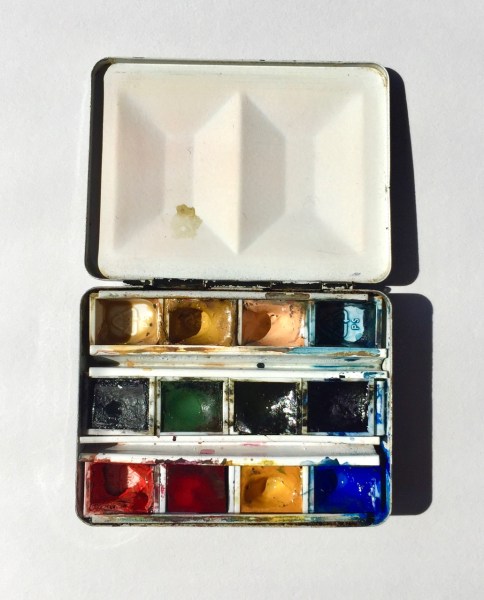
I am using a new paintbox and experimenting with the colours.
You see the brown seaweed on the shore.
The island of Foula is sometimes visible from nearby cliffs. It is about 20 miles away, so it floats on the horizon. Foula is a mysterious place.
Here is another picture of Foula. The island disappeared while I was making these photos of my painting things.
Foula, from Uskie Geo
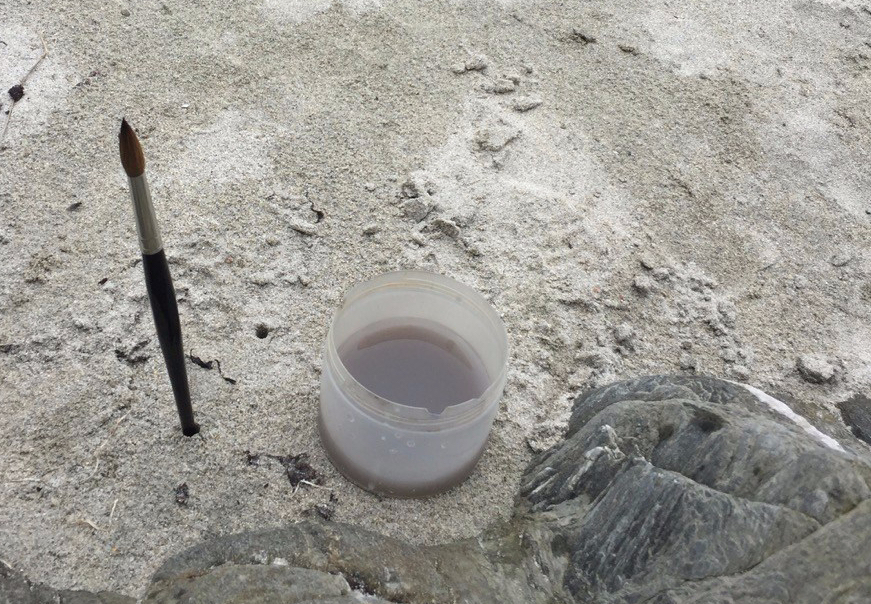
Painting things at Uskie Geo
Watercolour Box 3, Uskie Geo
I walked to Footabrough. Here’s the route, and some pictures of Footabrough.
A walk from Burrastow to Footabrough
Footabrough
Footabrough
On the way, there is a lagoon where the seals live. The arrow on the map shows the direction of the view in this drawing. The weird dots on the map are because I drew it on the left hand page of the sketchbook. I’d previously used that left-hand page to try out colours (see photo below). Note I am wearing gloves. This is July, in Shetland.
Lagoon of the seals, postcard sketch.
Lagoon of the seals, sketchbook sketch
Here are the headlands north of Footabrough. They have marvellous names: Knowe of Banascord, The Hamar and West Stack, Gerdipaddle, Skerries of Watsness. The picture is from Braganess, south of Footabrough.
Headlands north of Footabrough
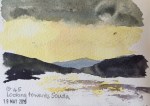
This is a characteristic Shetland scene. It shows the remembered view across the Weisdale Voe.
As you see, there was a lot of wind and fine rain. Here are some local drawings around Burrastow (click to enlarge).
Lera Voe
Islands in the fog, Holm of Briebister
From Burrastow Beach
Low tide at Lera Voae
Mooring Line
Holm of Breibister (postcard)
Holm of Breibister (sketchbook)
On the way to Burrastow I stayed in my favourite Shetland B&B: Hayhoull, in Bigton in South Mainland. It is right next to the amazing St Ninian’s Isle, which is connected to the Mainland by a strip of sand.
On this trip I also did quick sketches using pen and ink. Each of these takes about 10-20 minutes.
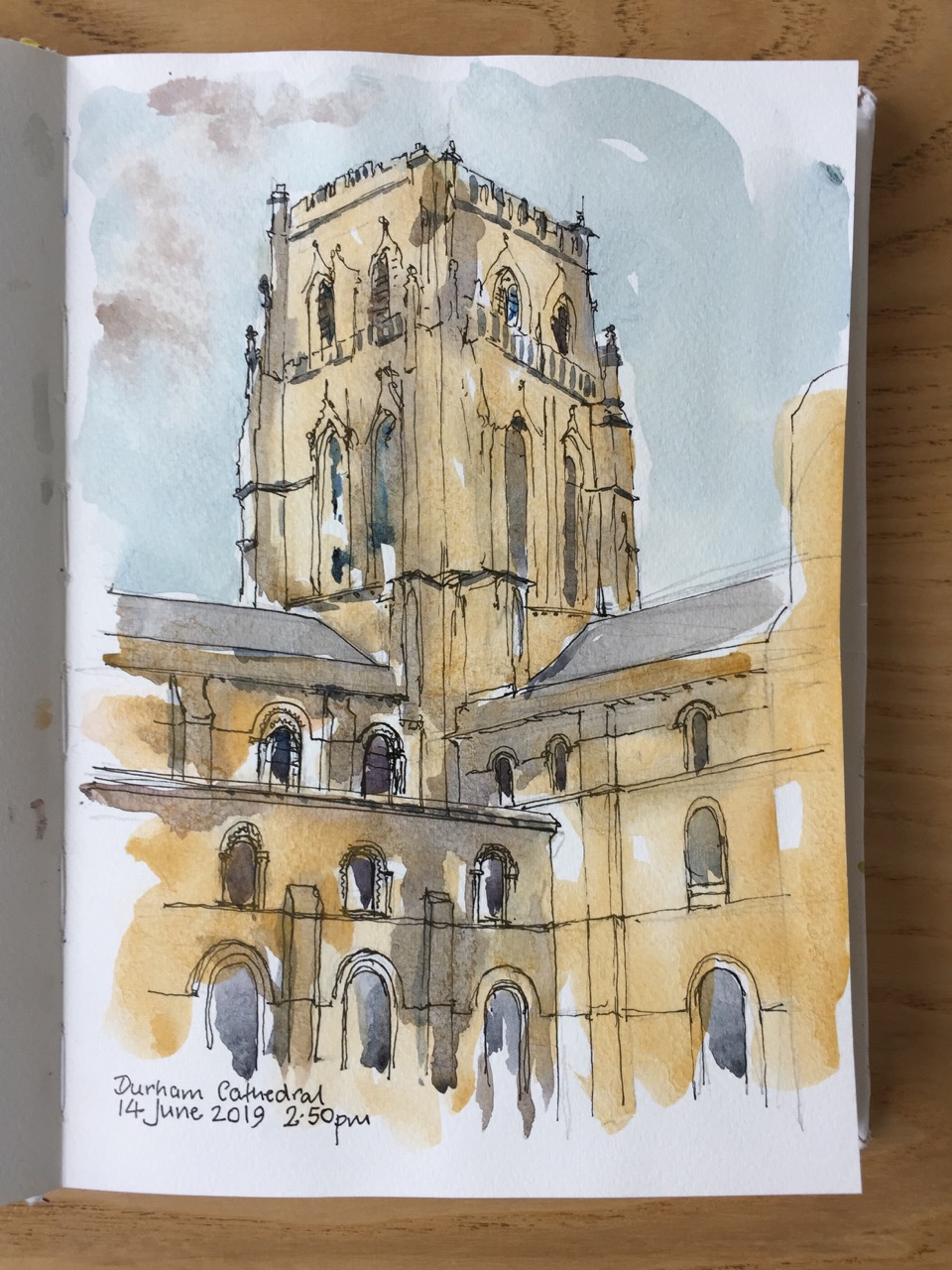
Durham Cathedral was built in 1093AD, and is a shrine to St Cuthbert. The extraordinary stonework is all original. Even more impressive is the roof. There is a stone roof which is up there and has been up there for nearly 1000 years. The engineering! The artistry! The courage! The organisation!
Looking upwards, while the choir sang
Stone pillars nearly 1000 years old.
The place is active. Evensong is sung. Flowers are arranged. The shrine is venerated. Around the simple tomb of St Cuthbert, people sit, in awe, at the age of the place, at the stillness, at the soaring architecture, at the thought of the simple monk whose remains lie here.
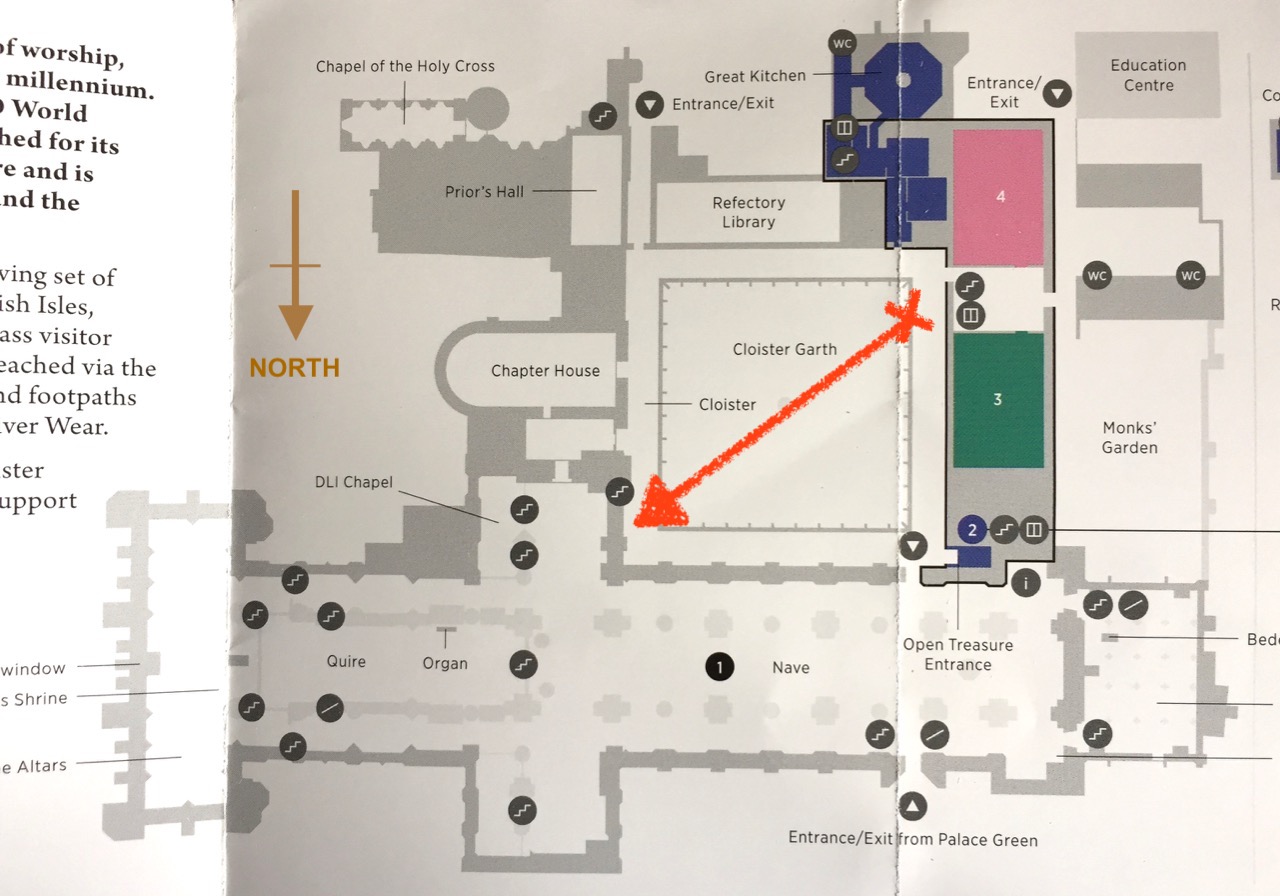
I too sat on the polished wood seat. Flowers stems were scattered on the floor, a pick-a-stick of blossoming stalks, in the process of being placed into the vase, one by one, by a careful woman. The snapped flower stems smelt of woodland. Or perhaps that was the furniture polish. A loudspeaker announced….something, the sound echoing and incomprehensible. And because it’s Durham, suddenly I was in conversation with the woman arranging the flowers. The modern stained glass window, just visible from the shrine, is in memory of a student. It looks towards the university, which is to the North. Even though it’s North facing, the glass gleams.
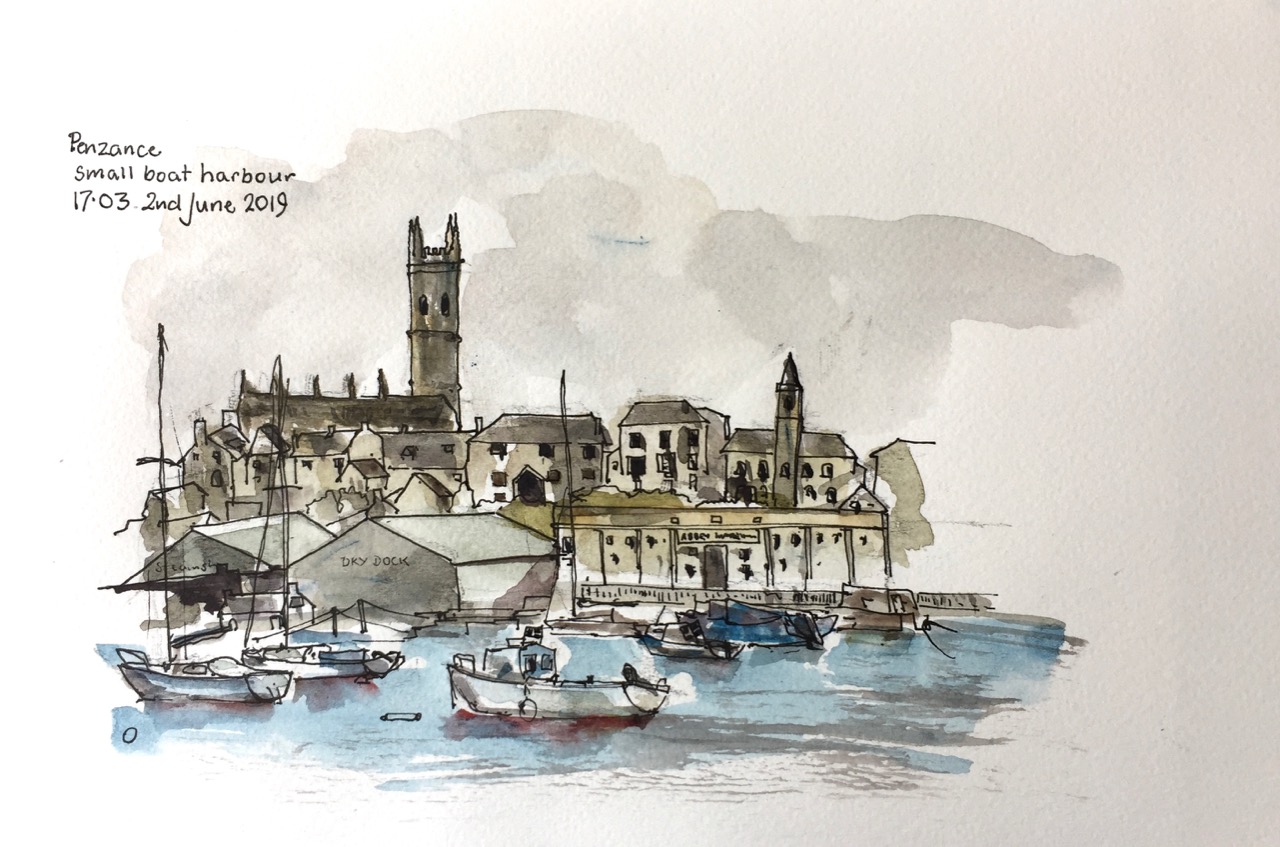
The tower on the left is St Mary’s Church where I drew a picture earlier. The tower on the right is “The Bell Tower”. According to Trip Adviser, you can rent a holiday flat there.
Drawing on the quay
Work in progress
There were people swimming in the harbour. Some one was getting dressed on steps next to the sheds in the picture. In an inner harbour, in front of Abbey Warehouse, young children dropped into the water from the road, and were recouped by a teenager on a paddle board.
Click a button below to share this post online, email it, or print it:
Here in the view from the windows of “Lovetts” in Newlyn. They served me avocado on toast, and a good strong coffee in a pottery cup. This place opposite is labelled “Barclay and Son”, the name cut in stone in 1916. Now it is labelled “The Strand” in less durable lettering painted above the door. It sells a compendium of miscellaneous objects, furniture, crockery, badges, old ship bouys. Also outside are some flower pots. The coffee shop proprietor walked across the road to buy one for a small plant. She just left the coffee shop door open, me drawing at the window, while she did so. This is Cornwall.
The next day I was to swim 10 kilometres. So I was pacing myself, and not embarking on epic walks. The next drawing I did was from the small courtyard at the back of the hotel in Penzance.
Here you see the roofs of the hotel and adjacent houses. The walls are hung with slates, like scales. The style of covering is called “shingles”, as in “a slate shingled wall”. You see one in the top left corner of the picture.
The two highest chimneys are splendid examples of the chimney-pot maker’s art. The one on the right has two downward pointing holes, and must have been hard to form in terracotta. Maybe I am the first person for decades to appreciate these chimneys and admire the workmanship.
The swim was an event organised by Tom and Jo of “Sea Swim Cornwall“. Forty assorted people swam in 4 different bays, around an island, and up and down a river, “The Gannel”. It was well organised, friendly and fun. And totally exhausting.
So the next day I strolled around Penzance and drew pictures. Here’s a view from St Mary’s Churchyard in Penzance.
Above the arch the stone tablet reads:
HUNC LAPIDEM POSVIT PHILLIPPVS HEDGELAND IN ARTIBUS MAGISTER PREBENDABIVS EXONIENSIS ECCLESIAE PAROCHIALIS SANTAE MARIAE VICARIVS PRIMUS
I work this out as: “This stone was placed here by Phillip Hedgeland, Master of Arts, a cleric (Prebend) of Exeter, who was the first vicar of this Church, St Mary’s.” If anyone’s Latin can offer a better translation, please let me know. On the side of the arch facing the sea was the date: 1883.
The picture, though, is really about the lamp-post. This looks like the one in the Narnia Stories. It is numbered 164AZ with a tag round its middle. After I drew it, I went to check it was a real cast-iron lamp-post and not a fibreglass replica. It was indeed a reassuring cold cast iron, and the maker had put their name in capitals in two places: HOLMAN & SONS PENZANCE”.
By the door of the church I encountered a beautifully engraved tombstone, with Art Nouveau flourishes. It told a sad story though:
In memory of HENRY M FUDGE,
son of the late HENTRY FUDGE MASTER MARINER
who departed this life Oct 2nd 1822 aged 2 years and 5 months
also S S.F. EDDY daughter of Richard Sally Eddy of this town who died 23 June 1835 aged 1 month.
I drew this picture entirely in three colours: Prussian blue, Alizarin Red, and Indian yellow, from Watercolour box 1.
My stroll. X marks St Mary’s Church.
The sad story.
Click a button below to share this post online, email it, or print it:
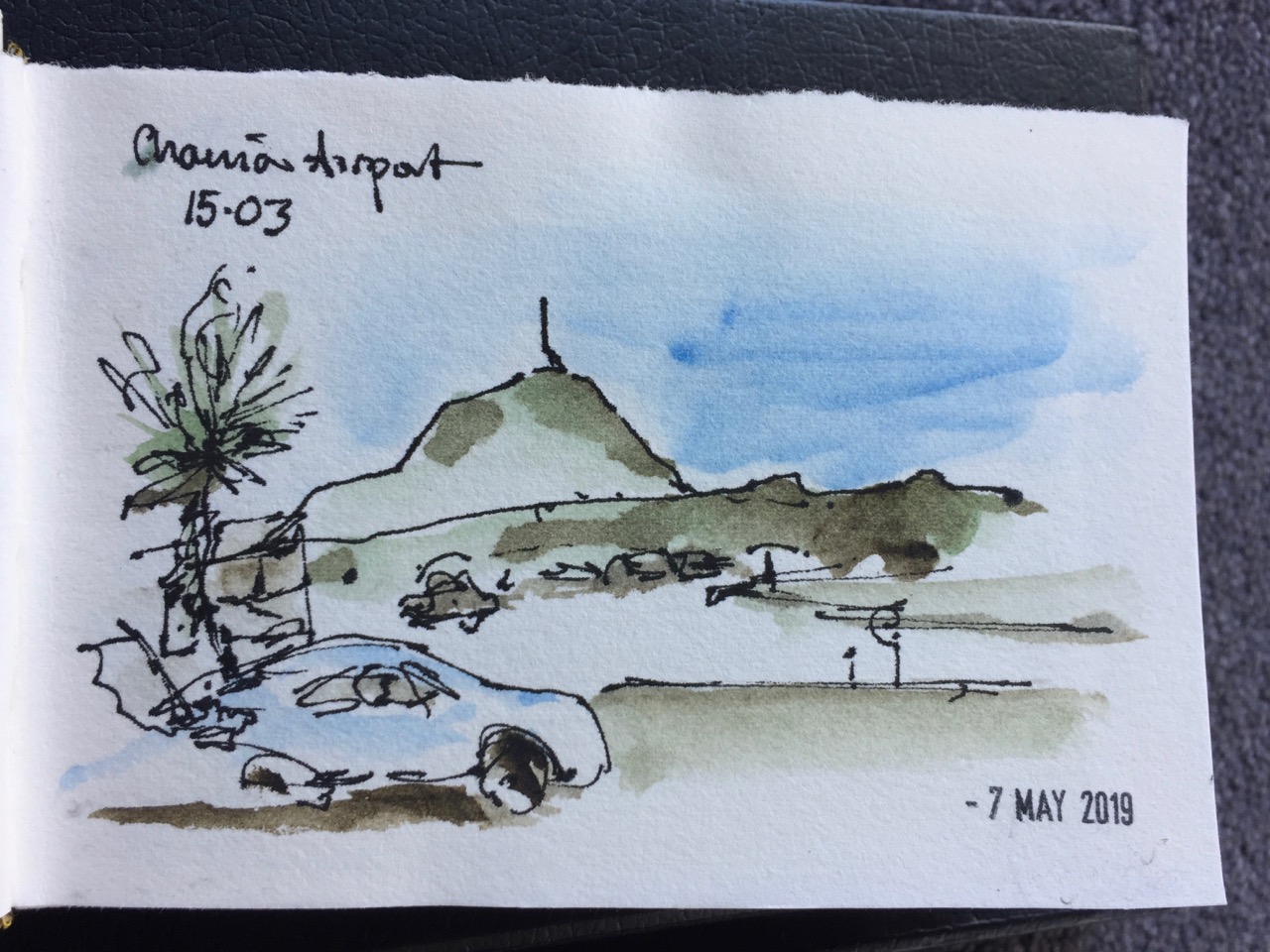
The air in Crete was warm and damp. This affected the paper. See how the ink has spread in this pen and ink sketch at the airport:
This is De Atramentis Black document ink on high quality watercolour paper, Saunders Waterford, in a small book 6″ by 4″ from the Vintage Paper Company.
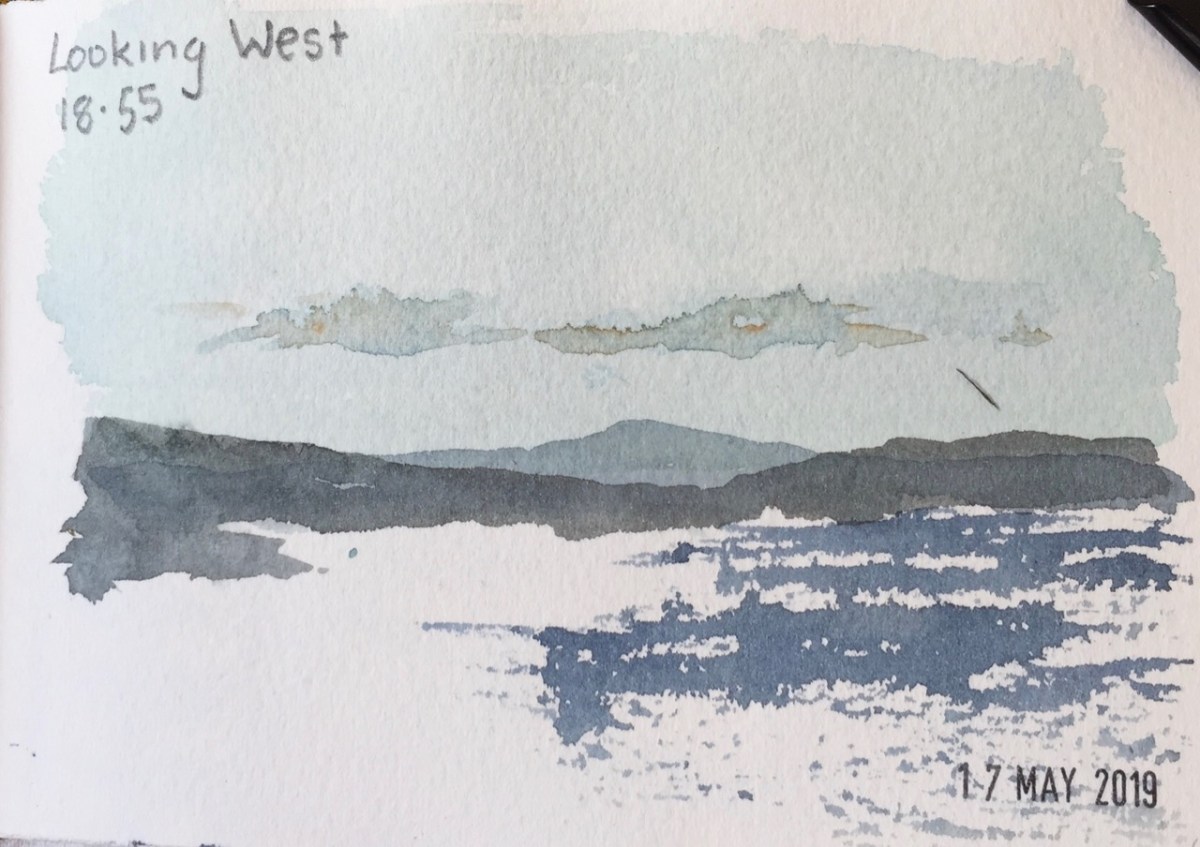
After that, I used pencil and watercolour only. Here is a view of the Akrotori peninsula. The warship is lurking in the NATO base.
US Navy ship in the NATO base
We lived with insects. At a hand movement, other movements occurred, in the air, on the kitchen surfaces, on the floor. Ants made their way across the breadboard, collecting crumbs or notifying HQ of the location of the honey drip. Beetles arrived suddenly, folded their wings and inspected the floor. I tried drawing them.
Beetle
Flying insects
Two geckos made their miraculous appearance some evenings and early mornings. They emitted small squeaks.
These are images made on “sun print” paper, using plants, and cut-out paper shapes. The geckos are a species of nocturnal reptile: Hemidactylus turcicus or Mediterranean House Gecko. They are insectivorous, eating, amongst other things, moths. I wondered if they would like to live in the Barbican ducts. It must be quite warm in there, and they would be entirely welcome to devour the moths.
They stick to the walls not with suckers but with hairs on their feet. The feet of geckos are subject of intense scientific interest, I read, since these hairs are so configured that they get close to the wall on an atomic scale (10 nanometers or so). At this distance the molecules of the feet attract, rather than repel, the molecules of the wall. There is a whole compendium of physics effects which make this possible: quantum mechanical, electrostatic, surface tension. There could be an entire undergraduate course on the feet of the Gecko.
Outdoors there is landscape…
…and a garden.
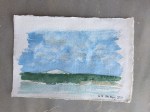
I am learning to draw clouds. There were a lot of them.
I am learning to draw quickly. Here are some very quick sketches from cafés.
The grass was cut around the lower buildings in ancient Aptera, revealing arches.
Arches make poetry in the Agia Triada monastery: a pre-departure pause….
…before the airport.
Technical details
Pictures done in sketchbooks:
Small watercolour sketchbook from the Vintage Paper Company.



 This was surprisingly effective. I managed to get all the ink drawn before 10:45, when I packed up again, to go to the Planning Meeting. During this time I was approached by a flustered gentleman in a smart suit, who wanted to “get across the lake”. He was hopelessly disoriented, pointing South-West, when he should have been heading North-East. I re-directed him and he dashed off towards the Barbican Hall.




























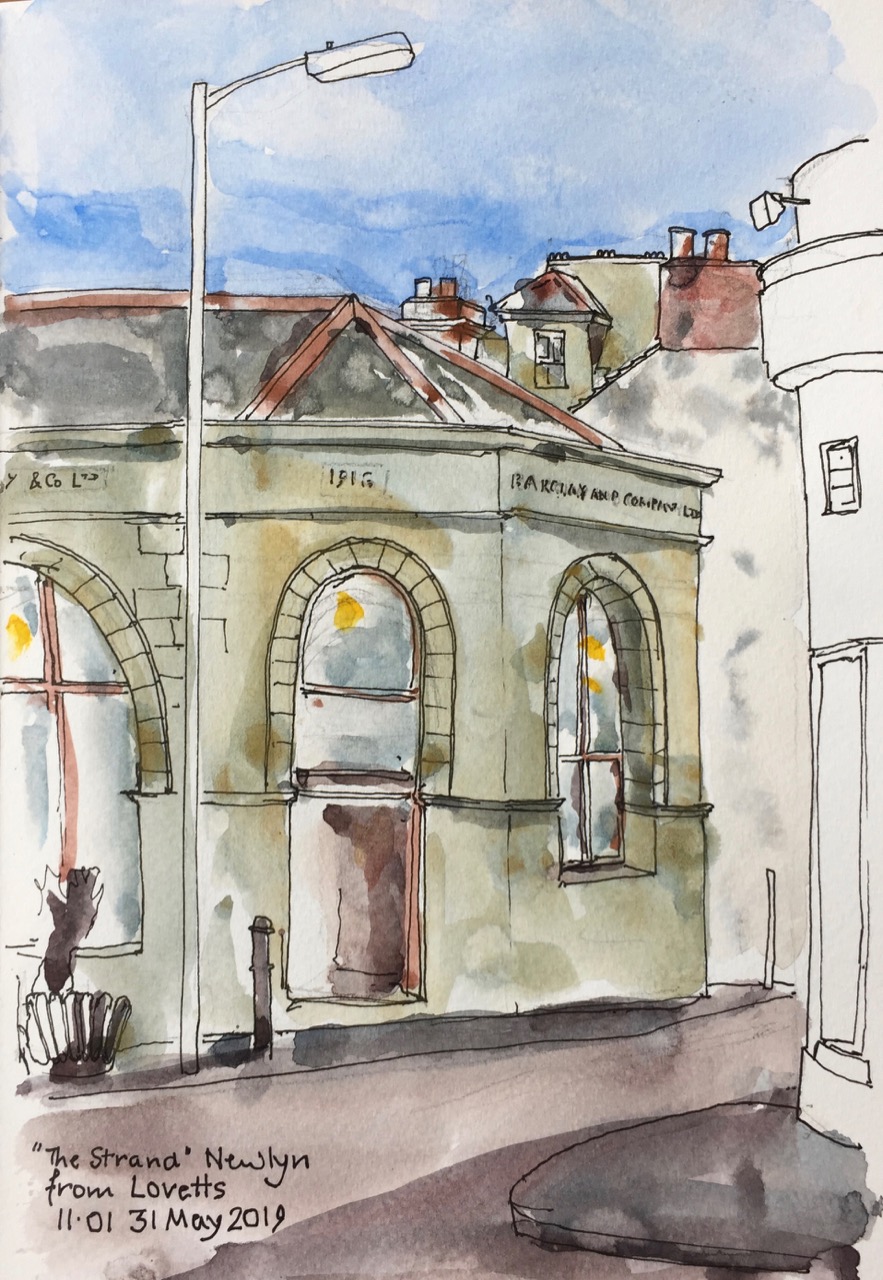
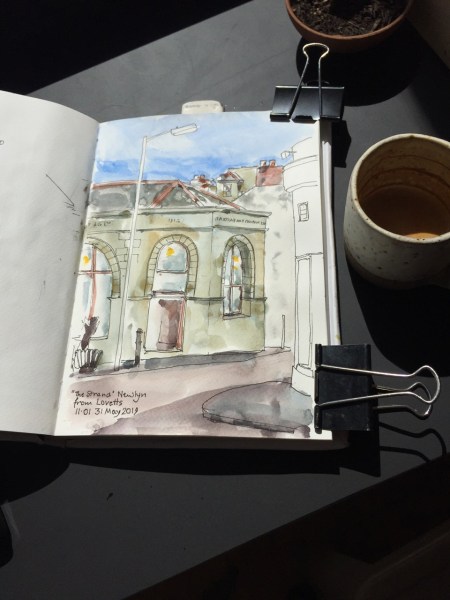 toast, and a good strong coffee in a pottery cup. This place opposite is labelled “Barclay and Son”, the name cut in stone in 1916. Now it is labelled “The Strand” in less durable lettering painted above the door. It sells a compendium of miscellaneous objects, furniture, crockery, badges, old ship bouys. Also outside are some flower pots. The coffee shop proprietor walked across the road to buy one for a small plant. She just left the coffee shop door open, me drawing at the window, while she did so. This is Cornwall.






 Jane Sketching