I was experimental. I had a large sketchbook with rough pages, given to me for my birthday. I turned over the pages and tried things.
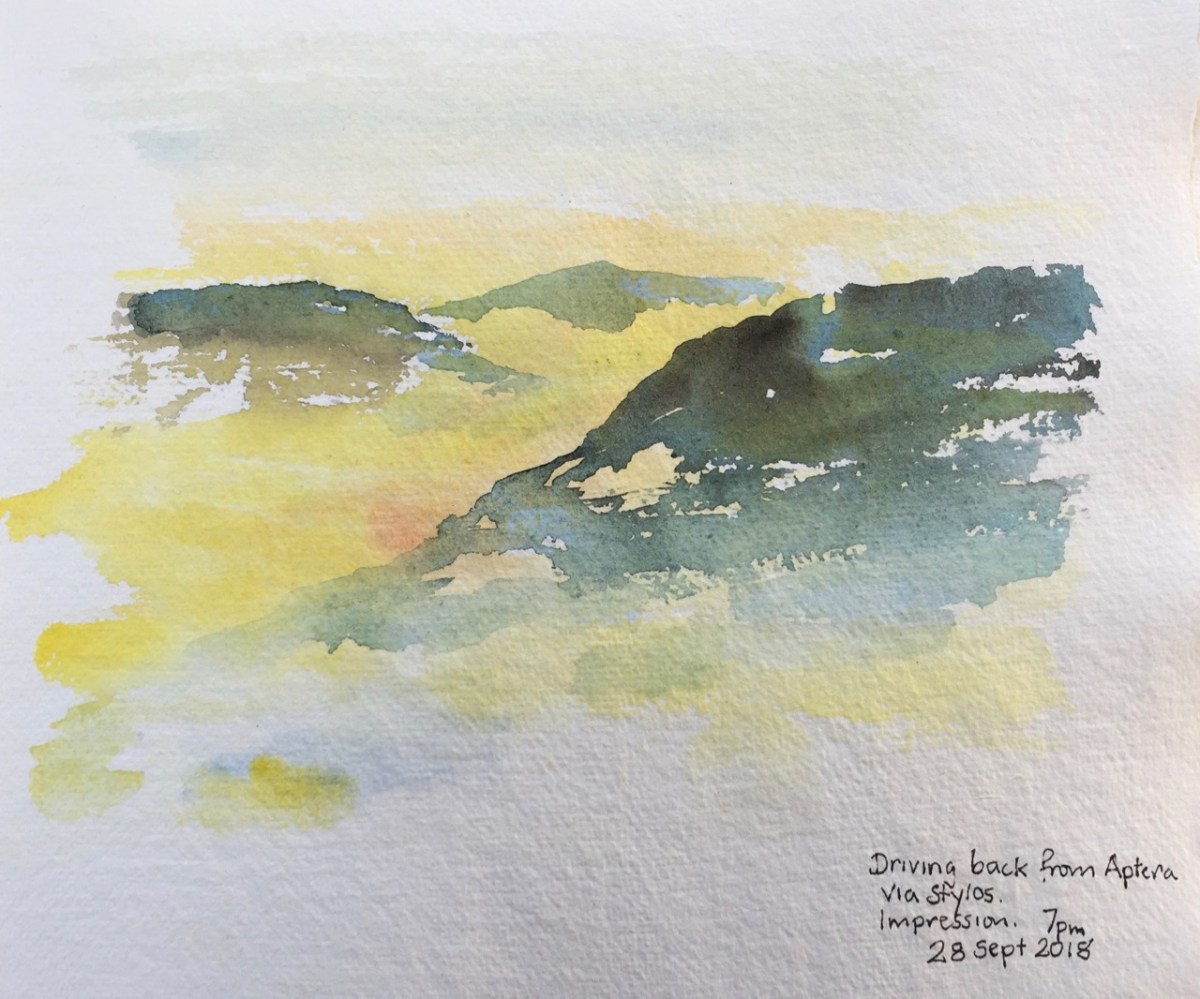
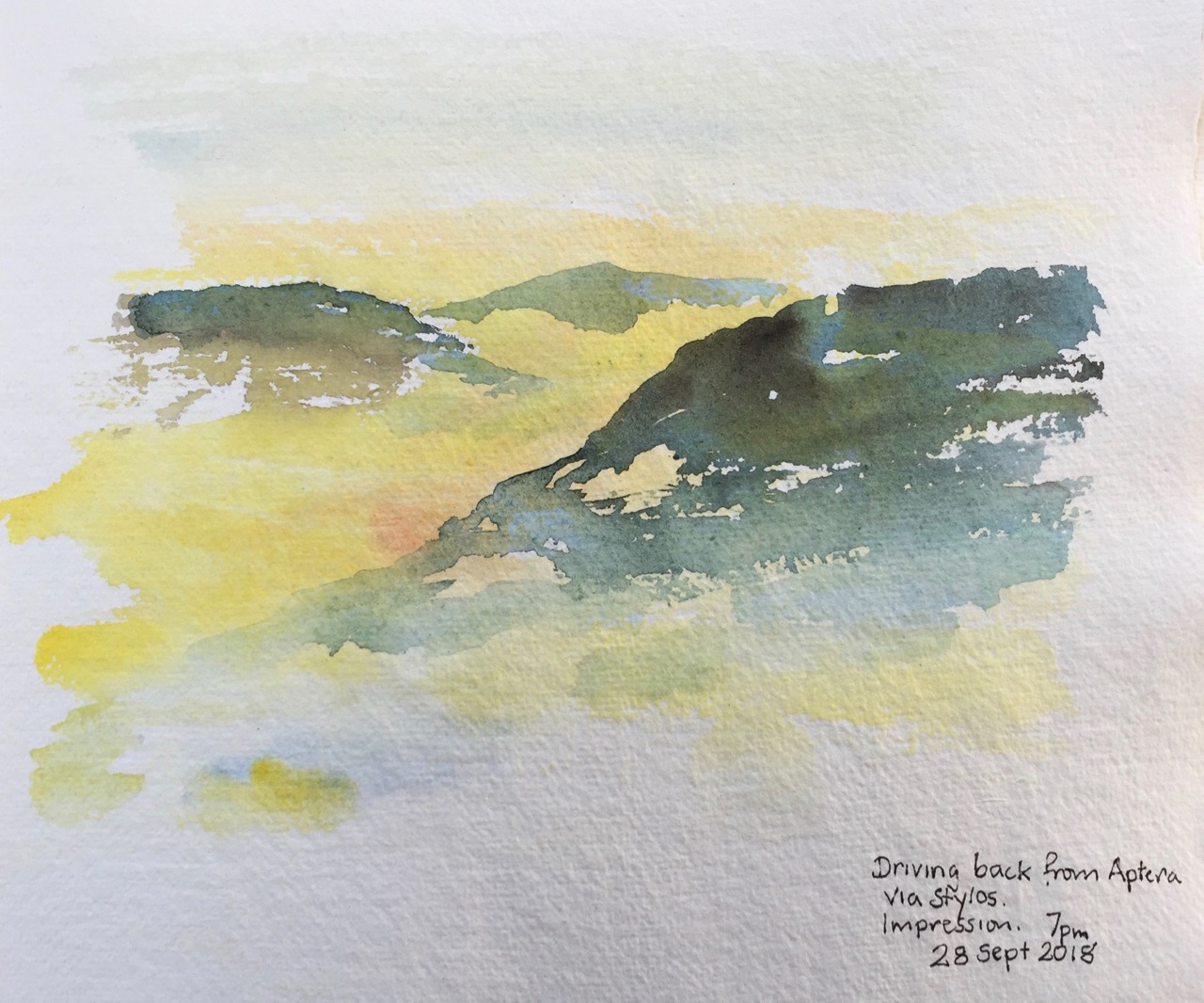
As we drove back from Aptera one evening, the sun was setting and fired up the mist between the hills. Back at the kitchen table, I had a go:
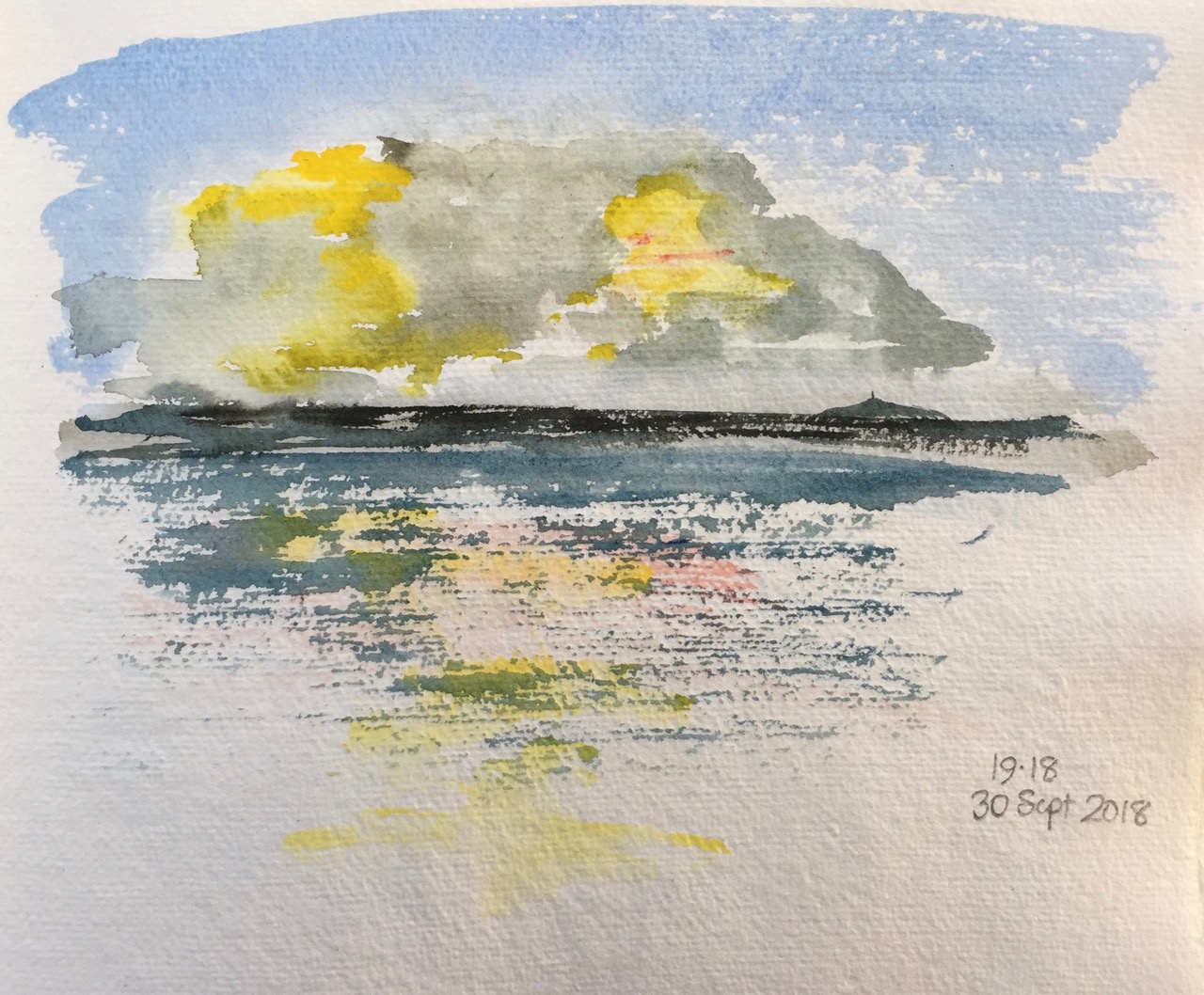
It was stormy. We had some amazing sunsets.
I did a lot of quick sketches with some special Koh-i-noor sketching pencils that friends brought me from the Czech Republic:
Sketching the Hill over Souda
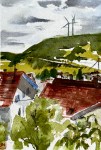
The hill over Souda
John’s boots
People at the airport
John resting
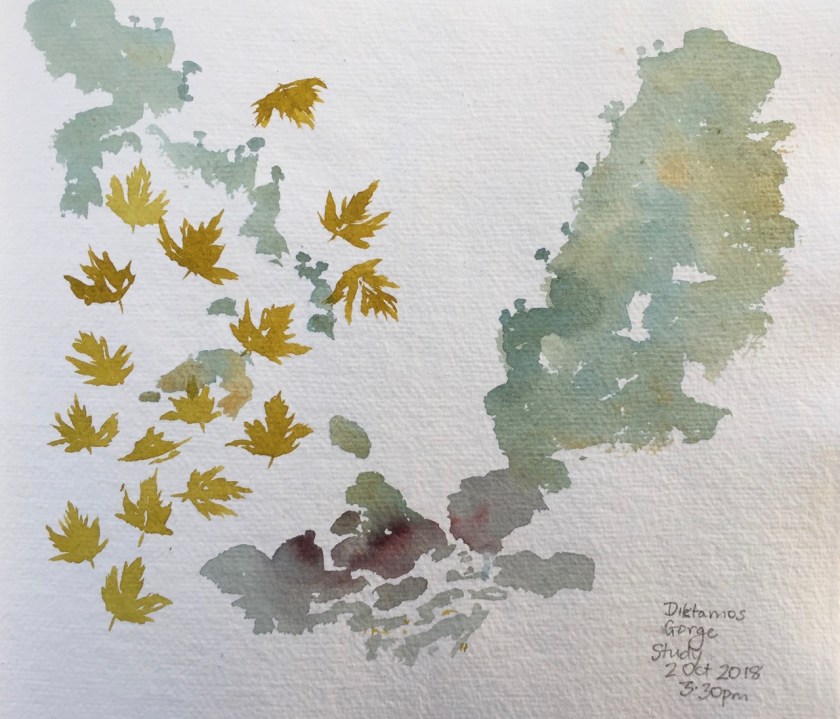
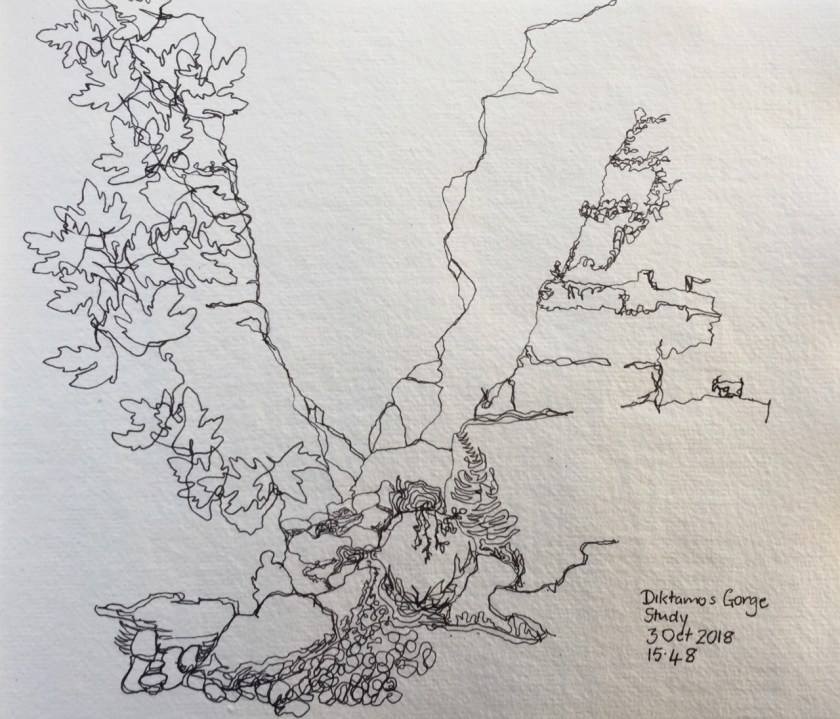
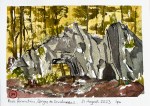
We walked up the Diktamos gorge. It is deep and leafy. Here is an impression drawn that evening, trying to show you the dark depths of the gorge, the high rocky walls, and the leaves. John is shown, sitting on a stone, bottom centre left.
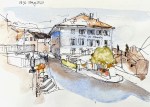
On the way to the airport we stopped in Agia Triada. I had 45 minutes to do a sketch. This is pen and ink.
It’s a three hour flight. One has to do something. I revisited the Diktamos gorge in pen and ink. The game was to use as few lines as possible, by not taking the pen off the paper. This is 3 lines.
Click a button below to share this post online, email it, or print it:
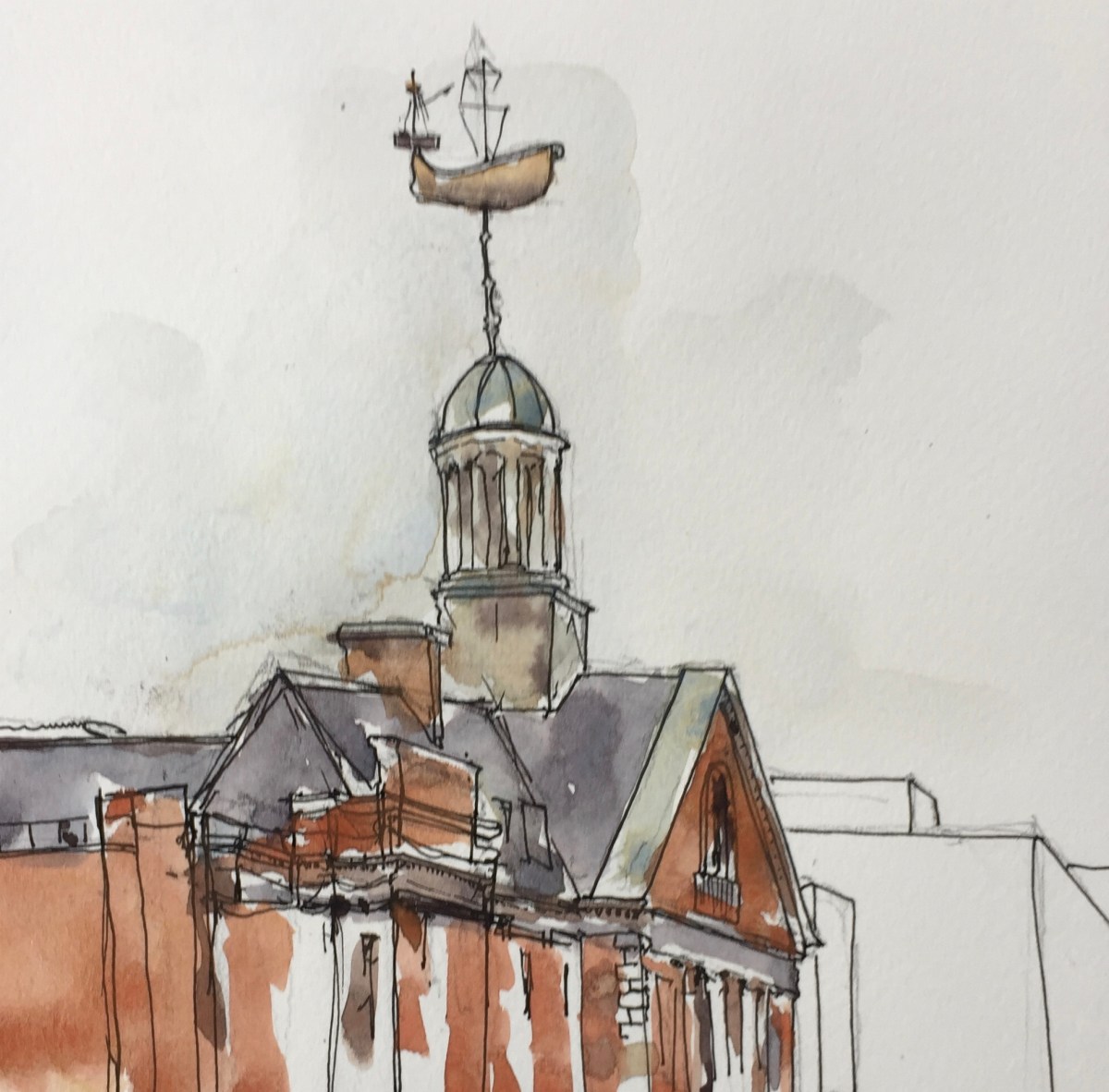
I cycled down Whiston Road last week and spotted this amazing boat, high up above the roofs. Today I returned to sketch it, and investigate further.
Whiston Road E2 is in Hackney, going off the Queensbridge Road.
I sketched outside Bryant Court. Then I went down “Swimmers Lane” and had a look at the back of the building. It’s a huge place. Clearly a former swimming pool, hence, presumably, Swimmers Lane.
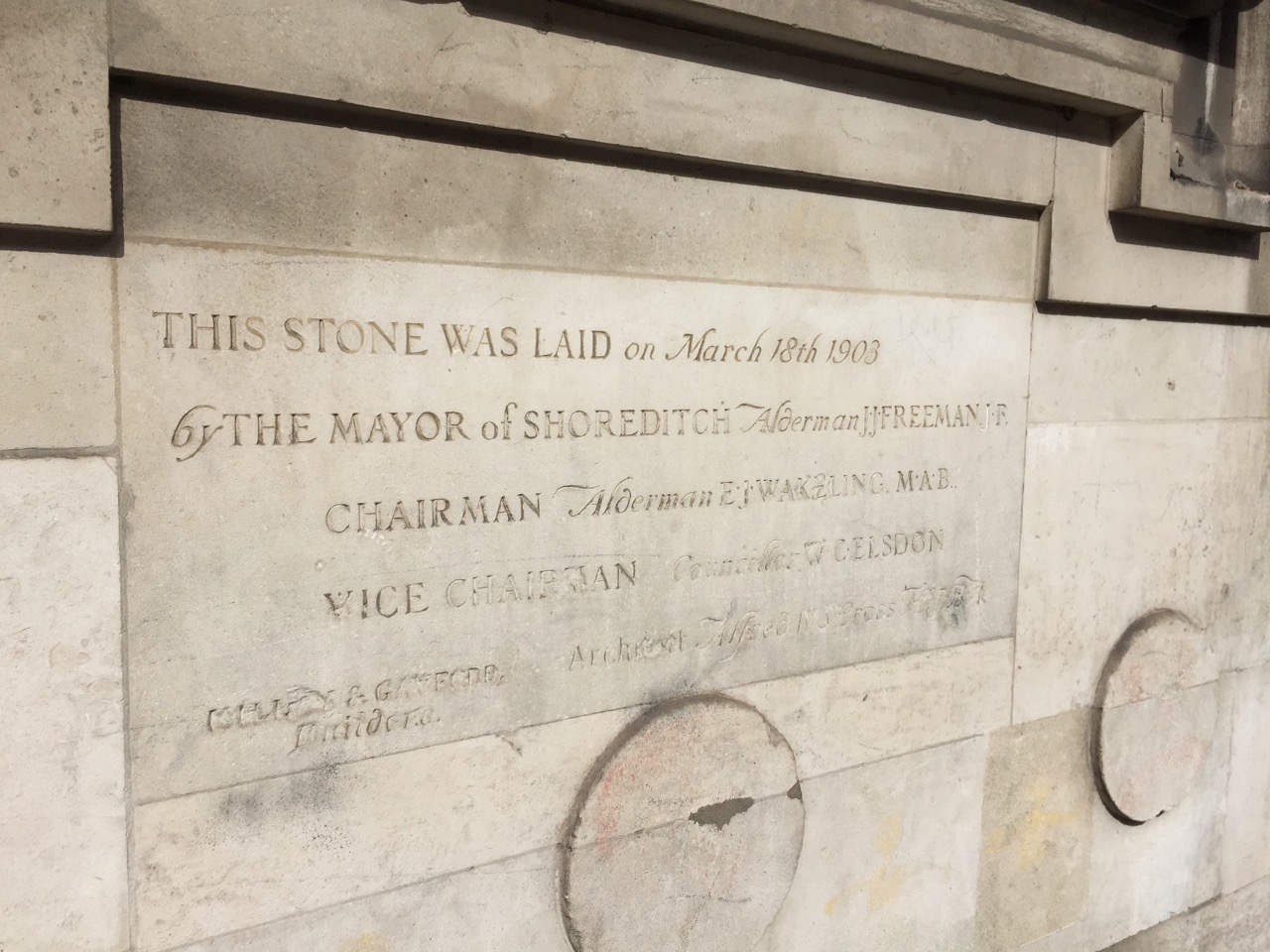
On the front is the Foundation stone, laid in 1903.
Foundation Stone (click to enlarge image)
There are also huge entrance doors labelled “MEN” and “WOMEN”.
The whole place is sadly neglected.
I went and looked at the ship from the other side.
Boat on Haggerston Baths, from the Queensbridge Road
While I was drawing, birds settled on the rigging.
At home, I found that this is “Haggeston Baths”. It closed in 2000, due to underfunding and neglect. Many were sad and they protested. In November 2017 Hackney Council accepted a proposal to redevelop the building. But it will not be a pool any more. Here is the Mayor of Hackney, Philip Glanville, writing on the Hackney website November 28th 2017:
“Hackney Council has chosen a preferred bidder to refurbish and redevelop the Haggerston Baths building. The agreement to lease will allow Castleforge Partners to apply for listed building consent and planning permission for a scheme to incorporate space for businesses, shops and a café, as well as community uses such as a clinic, health centre, day care centre or public hall.”
Mr Glanville continues:
“I know that local residents were keen to restore the swimming pool, so the council spent the best part of a year negotiating with a bidder whose proposals included a pool. As I said when we consulted on the shortlist, we could not get the reassurances we needed that the scheme with a pool would actually be delivered.”
He makes no mention of the boat. What will happen to it?
Stone, art, in Swimmers Lane
Someone found some money for strange stone artworks, clearly referencing the pool.
Both sketches done on location, the first one about an hour, the second one 35minutes.
Click a button below to share this post online, email it, or print it:
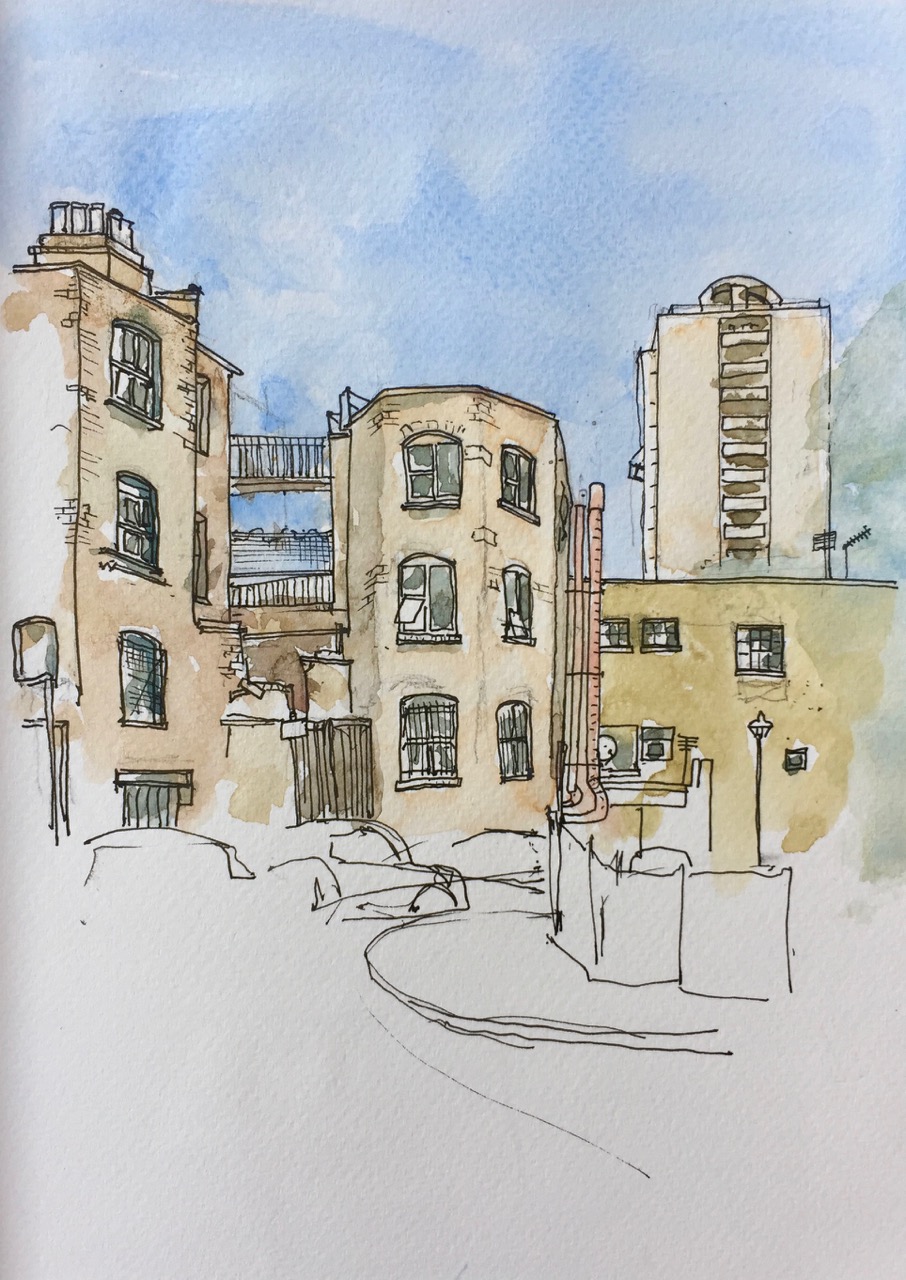
Here is a view looking North from Seward Street EC1 up the wonderfully named “Mount Mills Road”.
On the left are the backs of houses which front onto the Goswell Road. See the aerial walkways!
These houses are very old and much altered, somewhat provisionally. On the extreme left, for example, a drainpipe seems to have been routed right across a door. No doubt they said to each other “We’ll sort that out later.” Below the window on the second floor is one of those extensible clothes dryers. The vertical red pipes seem to be flues from a café, but it’s difficult to tell.
Turnpike House is part of the “Kings Square Estate” managed by Islington. It has 20 floors and was built in the 1960s as council housing. There is a current renovation programme, which is why there is scaffolding down the left hand edge of the tower in the drawing.
About 1 hour, drawn and coloured on location.
Click a button below to share this post online, email it, or print it:
At the Wellcome Collection there was a special exhibition on colour. It was called “The Pharmacy of Colour”. A short film pointed out that certain substances used as pigments were also used as medicine. A red pigment called lac, produced from grinding up lac insects, was also used as a medicine. Saffron is both a dye and a medicine. And the terribly poisonous Red Lead was also cheerfully described as a red paint on medieval manuscripts, mixed with egg yolk. Don’t lick the pages. It was also, alarmingly, used for treating intestinal disorders. A cabinet held jars of bright pigment, well protected behind glass. Yellow Ochre was there, and Ultramarine Blue, both of which I use. I’ve often wondered about the colours in my box, and the real chemistry behind the names.
Interesting though this was, it didn’t take long to look at, and it had been a long walk to the Wellcome Collection. So I went to their other current exhibition “Teeth”. This was mainly about dentistry through the ages. The images were alarming and I was unprepared. I found some of the exhibits calming though. Here is “Junior Dental Chair” from the 1950s. It reminds me of my very first dentist, Mr Gant. He must have had one of these. I can almost smell it, the leather at the back, and that hard, sculpted, bow in which you rested your head.
There were many people drawing in there. An art class, perhaps.
The equipment was strangely humanoid.
I read that “Patients from the 1960s and 1970s, when amalgam filling use peaked, are known to dentists as the “heavy metal generation”. That would be me then. Amalgam is mercury, silver, tin and copper.
I also read that “Tooth decay is the number one reason for child admissions to hospital.” I paused at that statistic. The woman next to me was reading it too. I commented that I found it surprising. She said it was because “People can’t afford to take their children to the dentist.” She spoke with authority. Dental charges have gone up, she explained. The hospital is part of the NHS and so is free of charge at the point of use. “So people wait until it’s really bad, and then take the child to A&E,” she said, speaking as though a practitioner. She smiled grimly and walked away. A strong woman, upright, informed, articulate, opinionated, caring. A dentist herself, perhaps, or an NHS administrator, or medical person, I thought.
Click a button below to share this post online, email it, or print it:
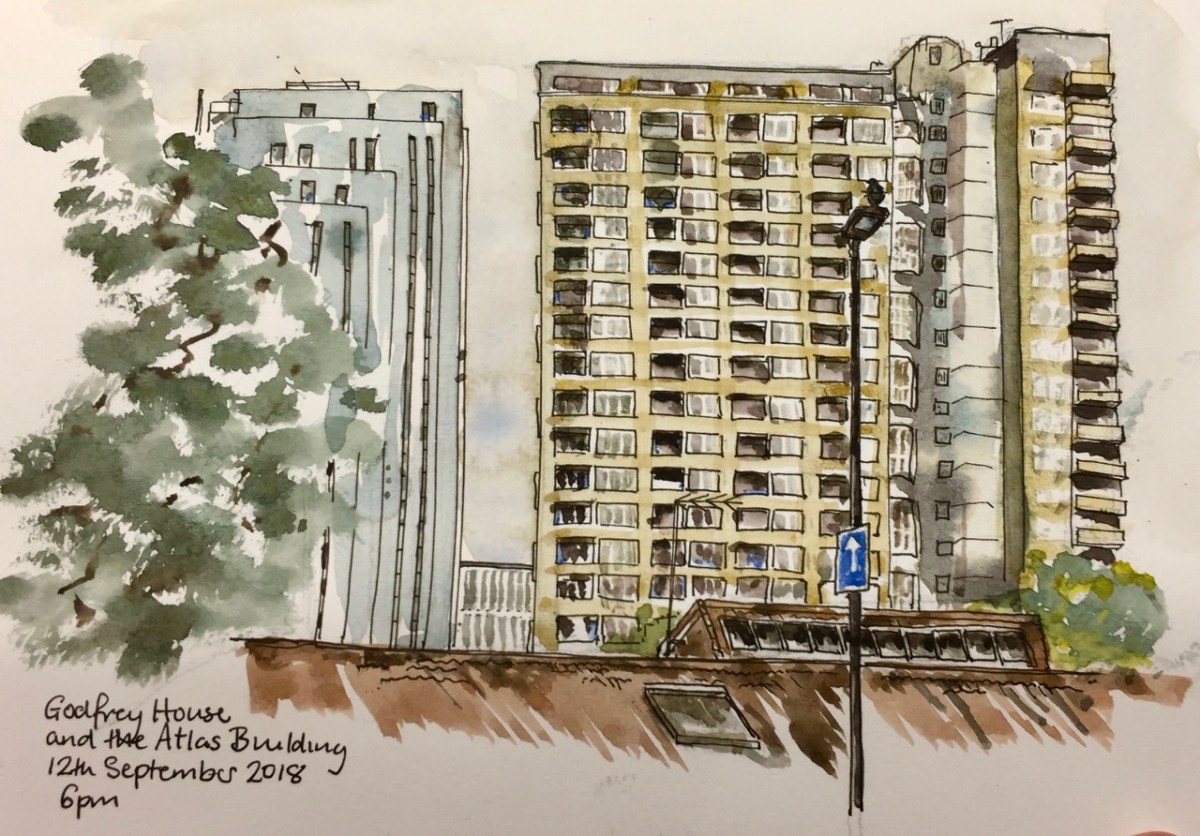
On the right is Godfrey House, Bath Street, Islington, part of the St Luke’s Estate managed by the London Borough of Islington. It’s former “council housing” built in 1965. Today many of the flats are privately owned, as is evident from the number listed for sale.
On the left is the Atlas Building, on City Road, nearing completion. Atlas is taller than Godfrey House, but further away. Atlas Building is 52 floors, of which 38 are residential, Godfrey House is 21 floors.
“Atlas epitomises luxury-living in an exciting and vibrant urban landscape. Standing tall with 38 residential floors of exquisite apartments, Atlas stretches across London’s prominent skyline” (from the Atlas Building website)
In the foreground is the roof of Saint Luke’s Church of England School.
I drew this picture sitting on a stone in Radnor Street Gardens, off Lizard Street. After a while I noticed that the place smelt of dog excrement. It has rained recently, after a dry spell.
At 6pm a personal training session started behind me. A large man was training a slim woman. They were doing kick-boxing. Between rounds, she told him about government procedures to find out about your earned income, and thus check your tax payments. They can access your bank accounts, she warned him. He laughed and said, “Hey, that’s not making me feel good. I thought you’d have some good news for me.”
“Tower Block UKis a project supported by the Heritage Lottery Fund, bringing together public engagement and an openly-licensed image archive in an attempt to emphasise the social and architectural importance of tower blocks, and to frame multi-storey social housing as a coherent and accessible nationwide heritage.”
Here is a link to a Freedom of Information request which gives a very detailed map of the estates in Islington (2010): FOI request from Mr I Agar
Click a button below to share this post online, email it, or print it:
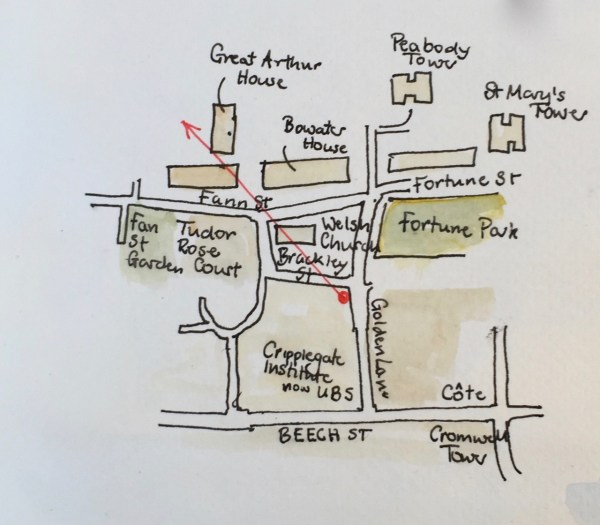
Here is the Welsh Jewin Church seen from Brackley Street.
This is one of those ephemeral views: a huge new building is about to go up behind the hoarding, and this view will be completely obscured.
The church is Eglwys Jewin, the Welsh Church. I have drawn it before, from Fortune Park. Here’s the link – Eglwys Jewin from Fortune Park
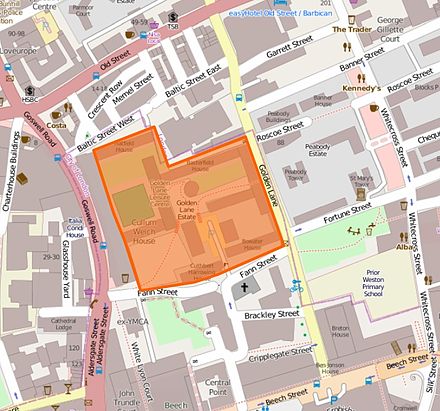
Map showing Golden Lane Estate. credit: Wikipedia.
In the background is Great Arthur House, on the Golden Lane Estate. This estate was designed by Chamberlain Powell and Bon, before they did the Barbican Estate.
As I was drawing, a man came and told me about Great Arthur Tower. It was the tallest residential building at the time of its completion (1957). At the top is that strange construction which I was told was described by the architects as a “brise de soleil”, a sun shade. Nicholas Pevsner, the architectural writer, was scathing about it, saying that there wasn’t much sun. However, as the man and I agreed, today was very sunny, and the sun shade was needed.
Great Arthur House has recently been refurbished.
“JRA has designed the new curtain walling to replace the original cladding, mirroring the bright yellow panels that have distinguished it since the 1950s. The Grade II listed residential tower had become environmentally inefficient in recent years leading to the residents’ discomfort due to water ingress, heat loss and condensation. Replacement curtain walls for the West and East elevations, double glazed timber balcony doors, external redecorations, localised external concrete repairs, and a cleaning and maintenance system for the new façade are also being provided to help revive the landmark building.” JRA website, 30th Sept 2016
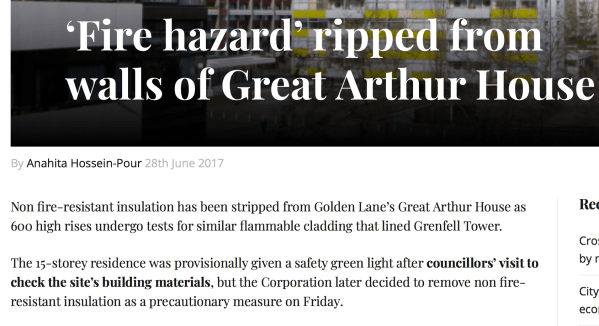
And then insulation was removed after the Grenfell Tower fire. Here’s a cutting from CityMatters, the local paper:
As I was packing up a woman came and asked, “Can I be curious?” I said she could indeed, and showed her the picture, which she admired. She looked at other pictures in the book, including one of Peabody Tower. “I look at that, from my window”, she said, “I’d love to live there. I see a balcony with flowers….”. I said it was called Peabody Tower, and the other, similar one was St Mary’s Tower. “Oh! Are they Peabody buildings?” she asked. I said they were, part of the Banner Estate. She lives in Tudor Rose Court. This is the building on the left of the picture, in yellow brick. She’d just been to see a film. She found the ticket to show me the title. It was “Distant Voices, Still Lives”, about a family in Liverpool, she told me. She loves Liverpool.
This picture drawn and coloured on location, about 1 hour and 45 minutes.
Click a button below to share this post online, email it, or print it:
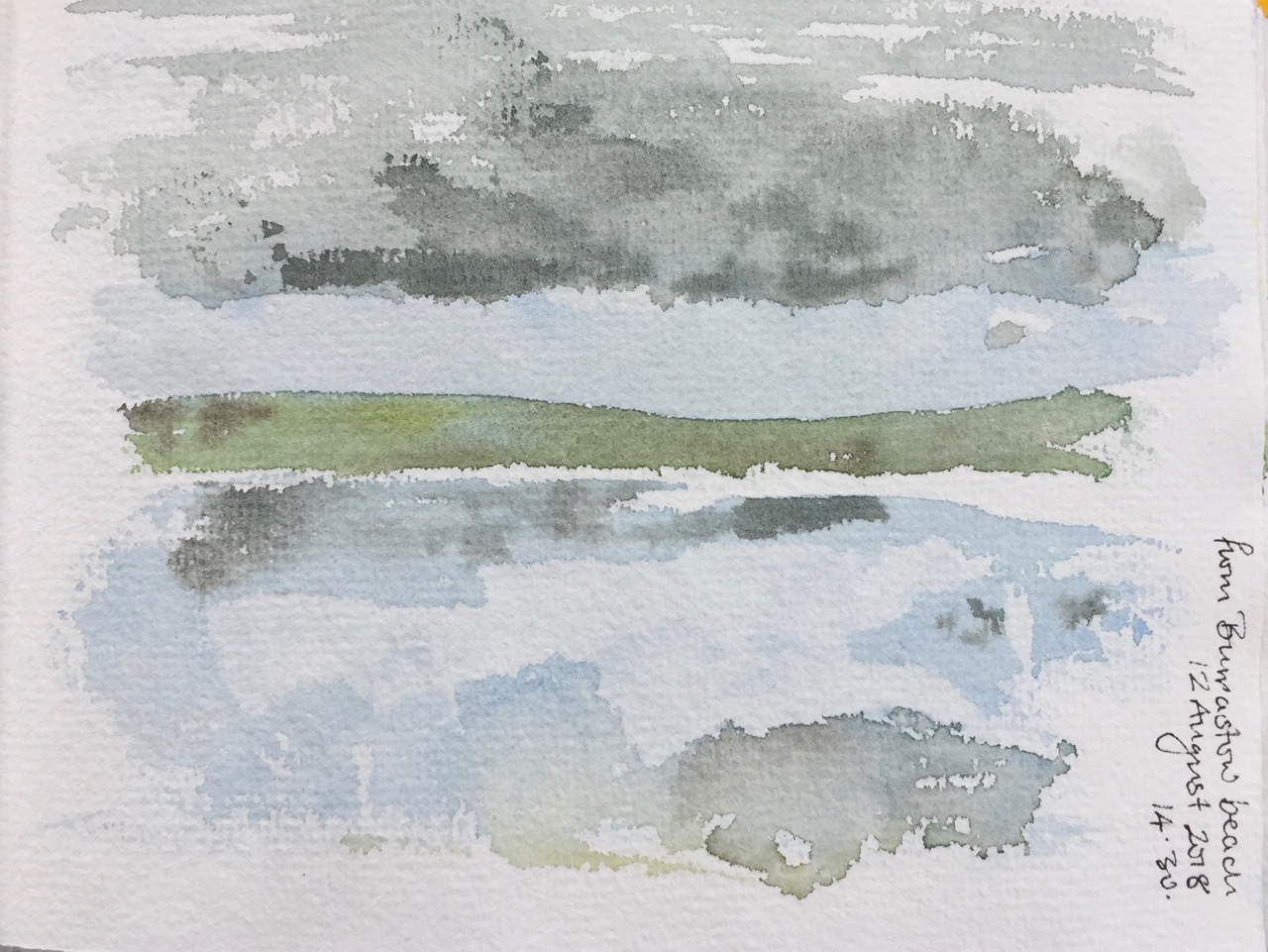
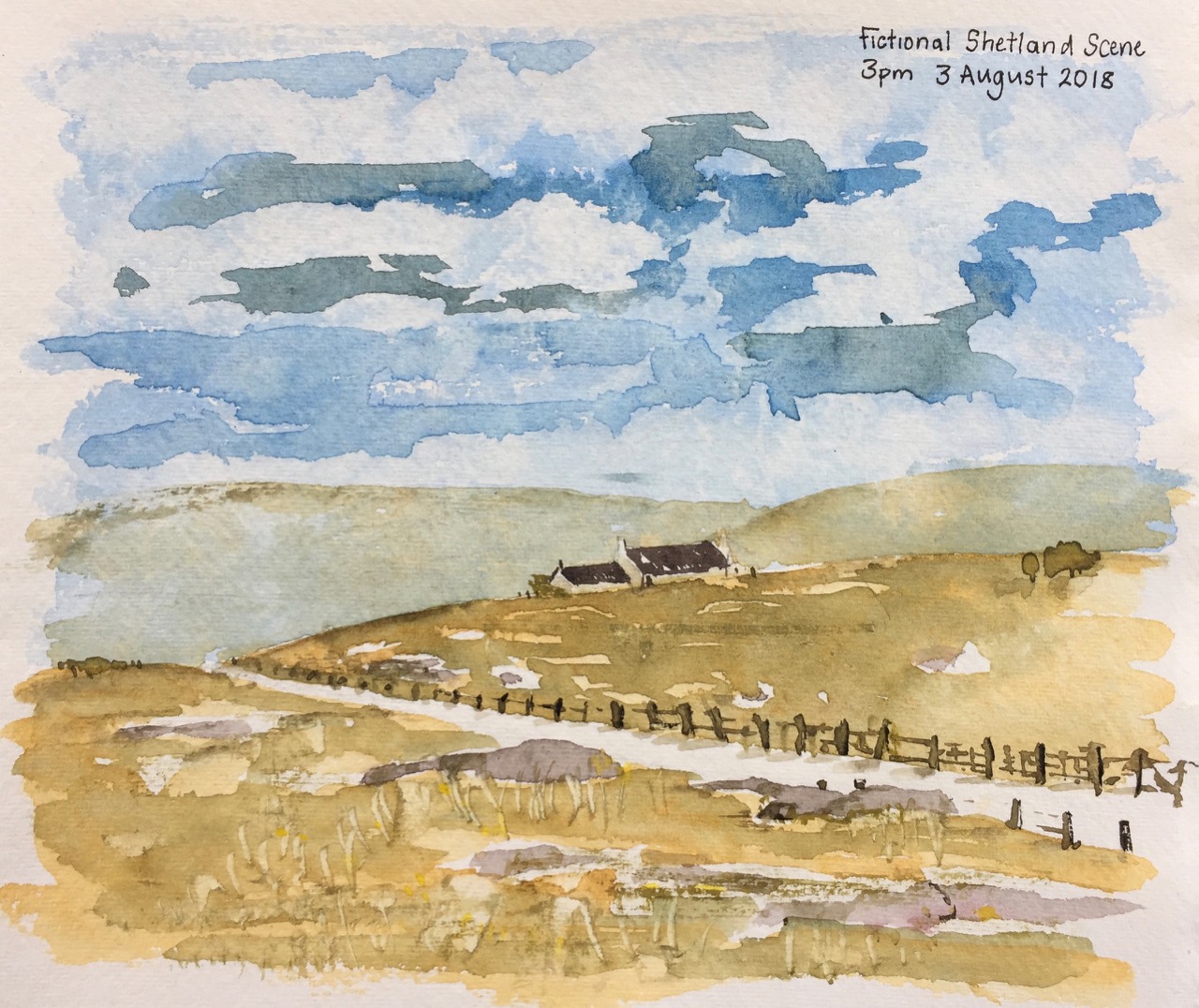
In Shetland I was learning to paint clouds. Here’s one of the pictures I like best, also the simplest.
Sometimes the clouds are lighter than the rest of the sky:
Sometimes very dark:
Sometimes rather complicated:
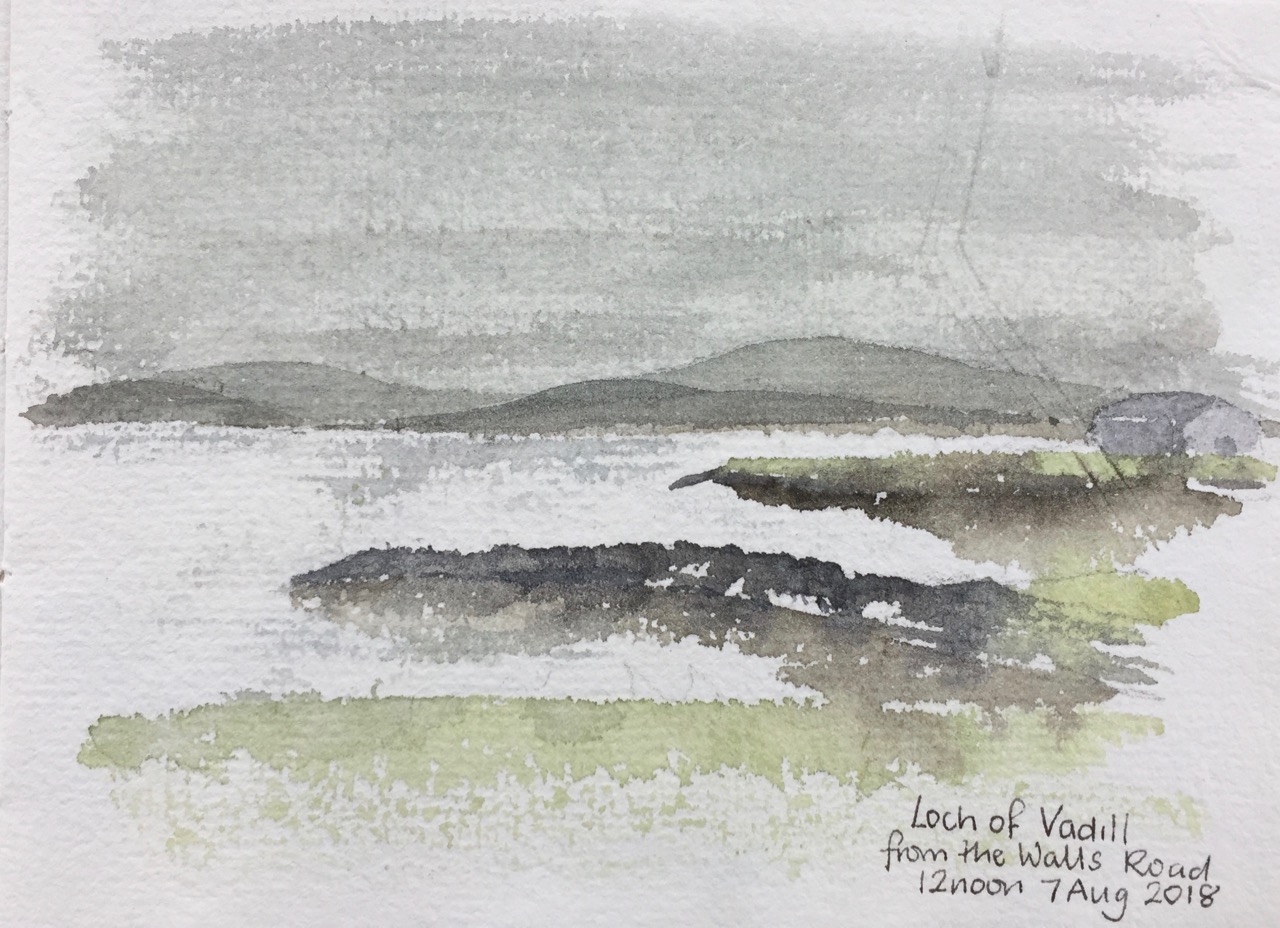
Below is a picture drawn in the rain. I was using a sketchbook which had very heavily sized pages. In light Shetland rain, the pages became damp, and were absorbent.
The water is brighter than the sky: a Shetland phenomenon.
See how this heavily sized paper lets me put layers of colour on.
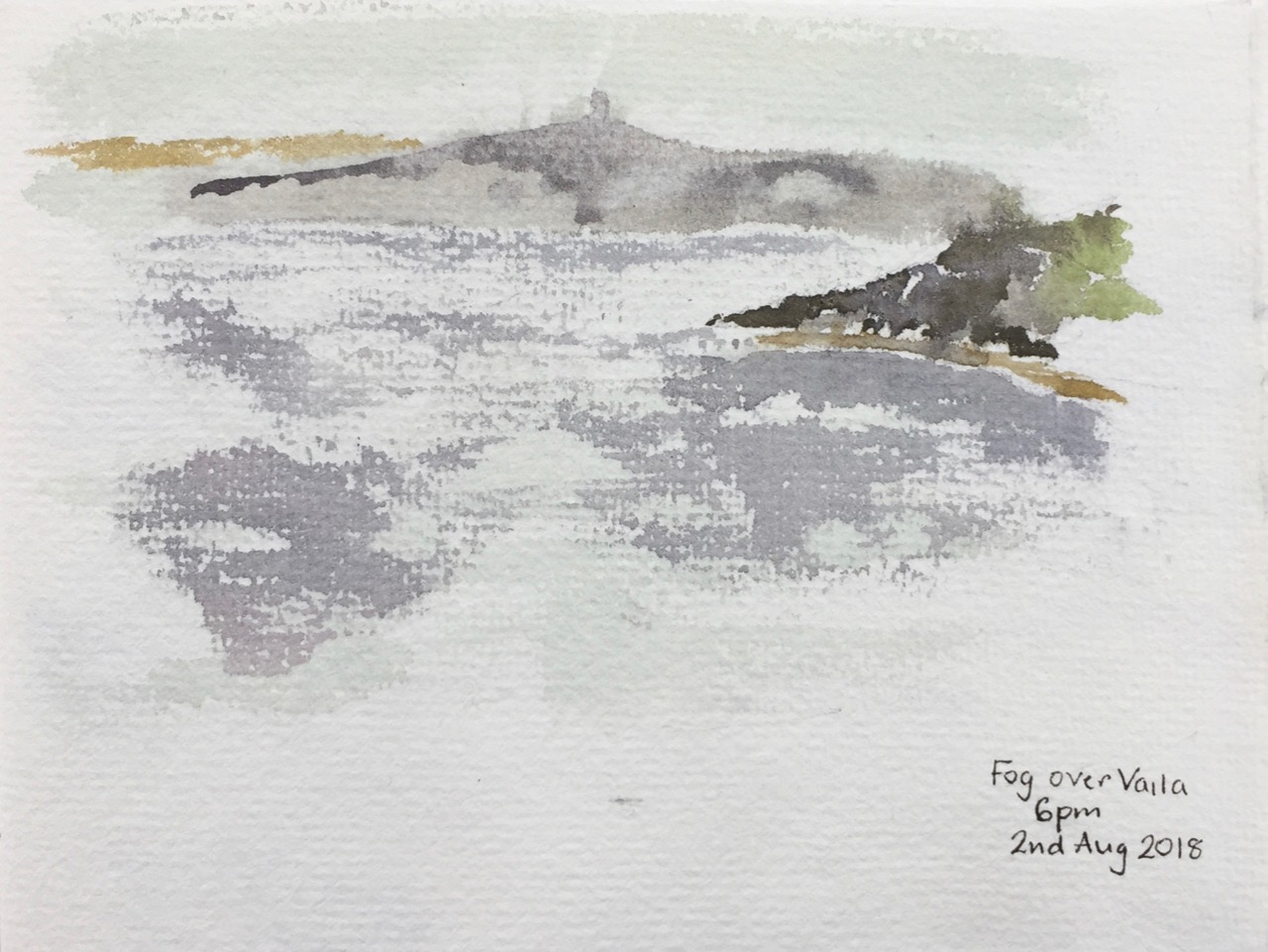
Here’s another picture in the same sketchbook. See the colours in the sea.
This was a sketchbook from the Vintage Paper Company, based, appropriately enough, in Orkney. The paper is described on their website:
“The paper was made in the 1950s in Somerset, England. It’s a 180gsm, 90lb rough surfaced paper ideal for drawing, ink and of course, watercolour. Made from cotton rag and gelatine sized, it’s a dream to paint on. “
It took a bit of getting used to.
I found it didn’t take the paint very well, until it was damp. Here’s an early attempt. See how I struggled to get the paint to adhere to the paper.
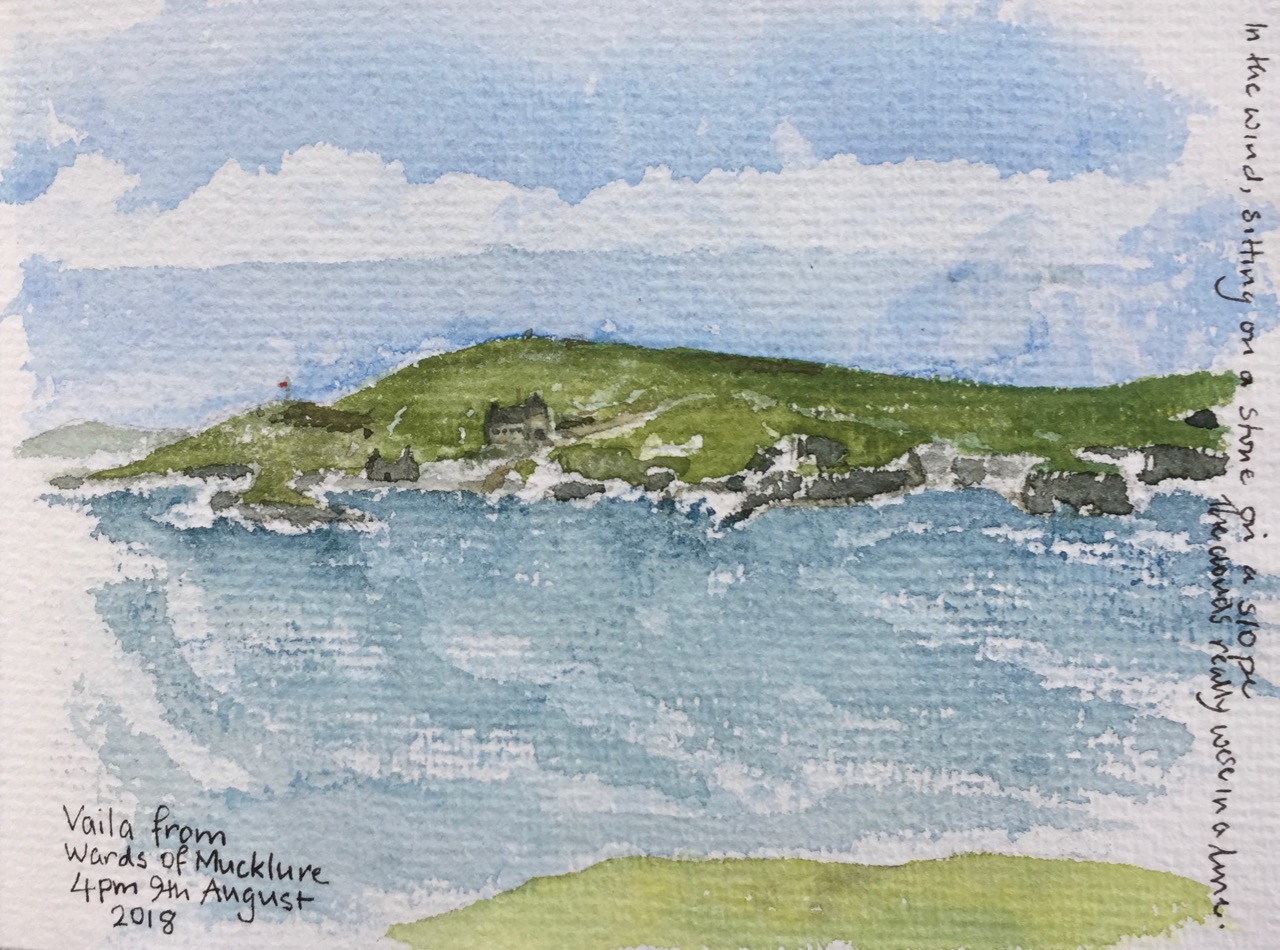
This was painted in a strong wind from the edge of a hill. At first I thought this picture was a total failure. But later, it seemed to have captured something. perhaps you can see the rocks, the dry grass, the shifting sky and sea?
Later pictures were a bit better, especially if I kept things simple:
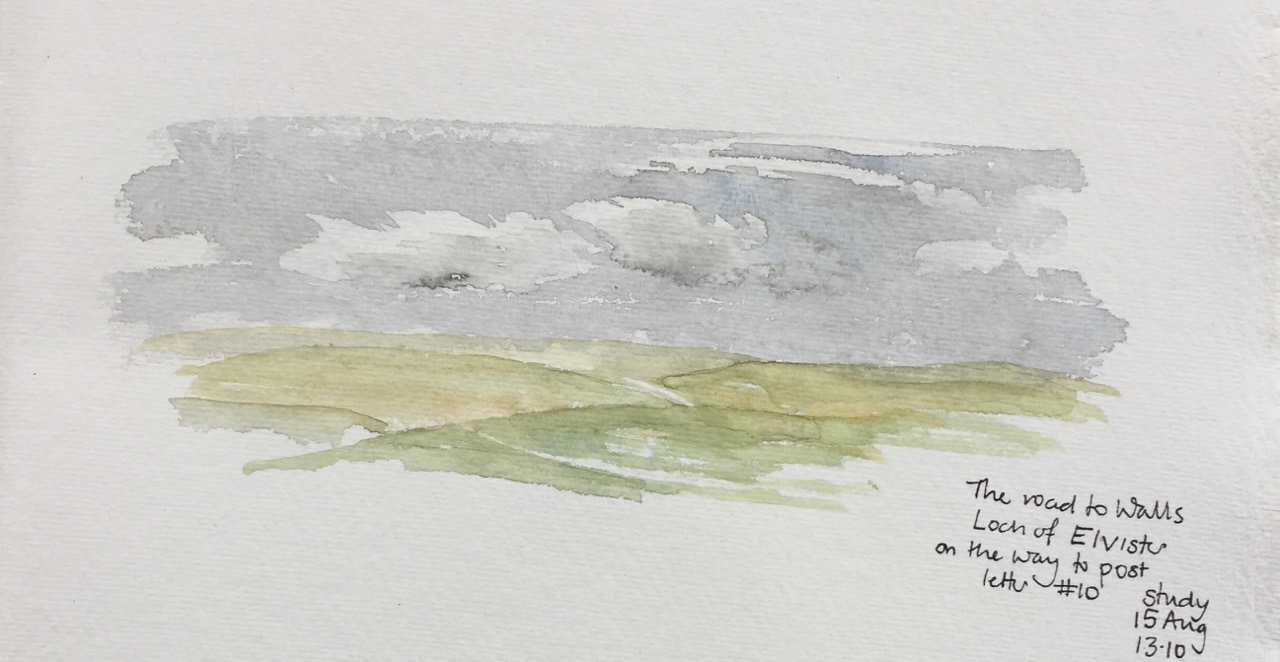
The other sketchbook I used was a Khadi cotton paper, much more absorbent. Below is a picture of the roads of West Mainland. The roads are calligraphic strokes on the landscapes.
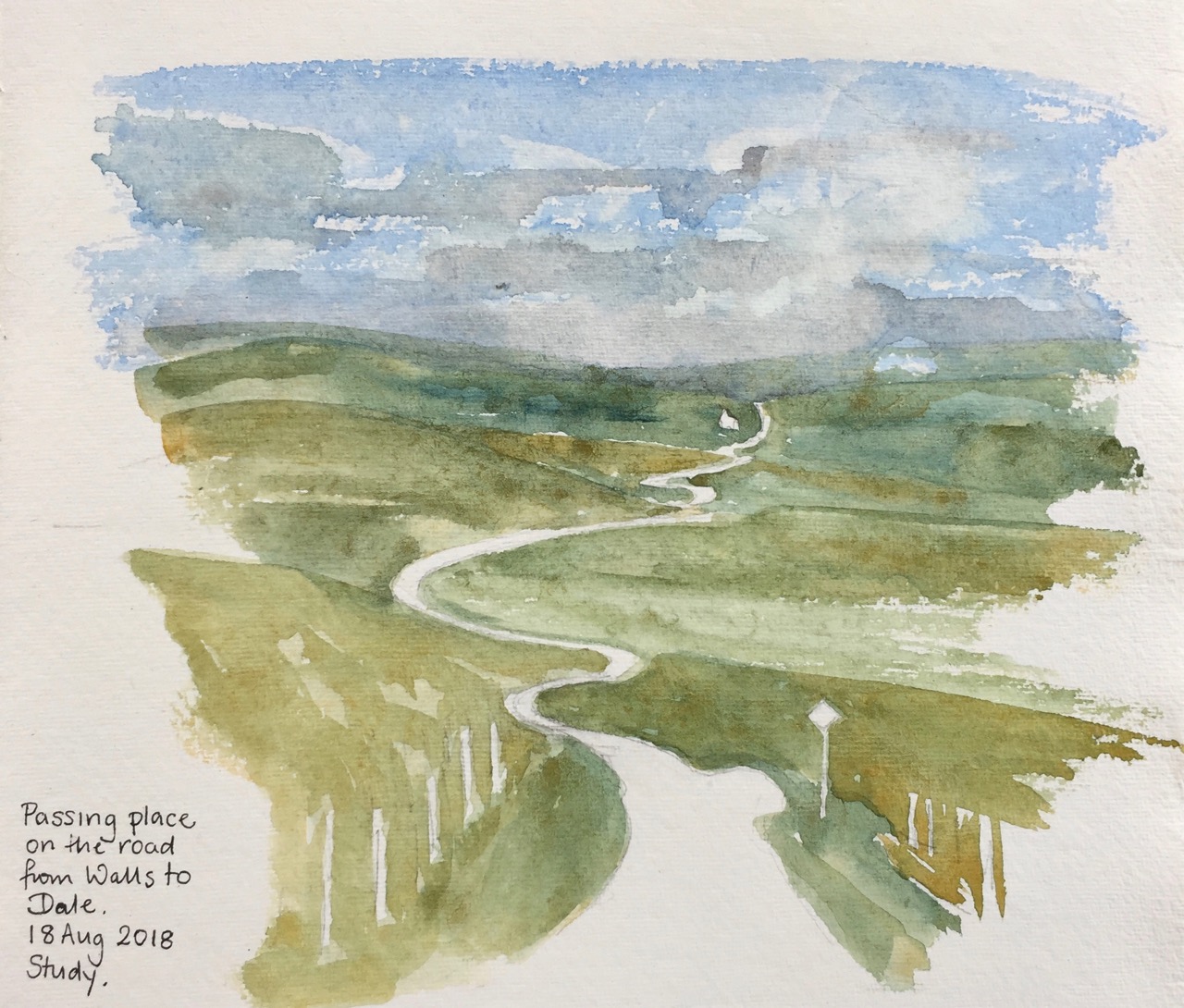
Here’s anther picture of the roads:
I also drew birds:
Redshank
Herring Gull
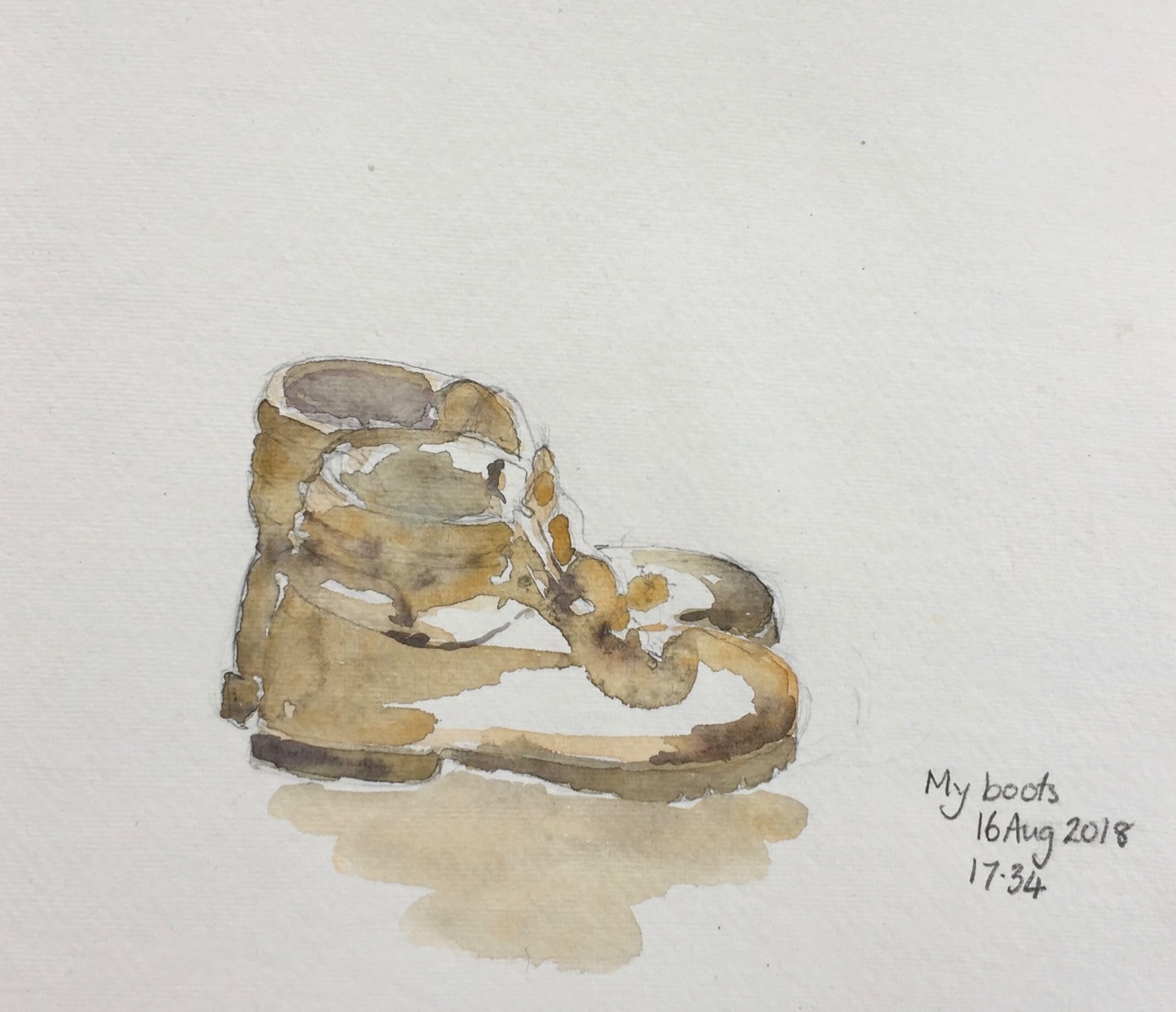
On a day it was raining outside, I drew my boots:
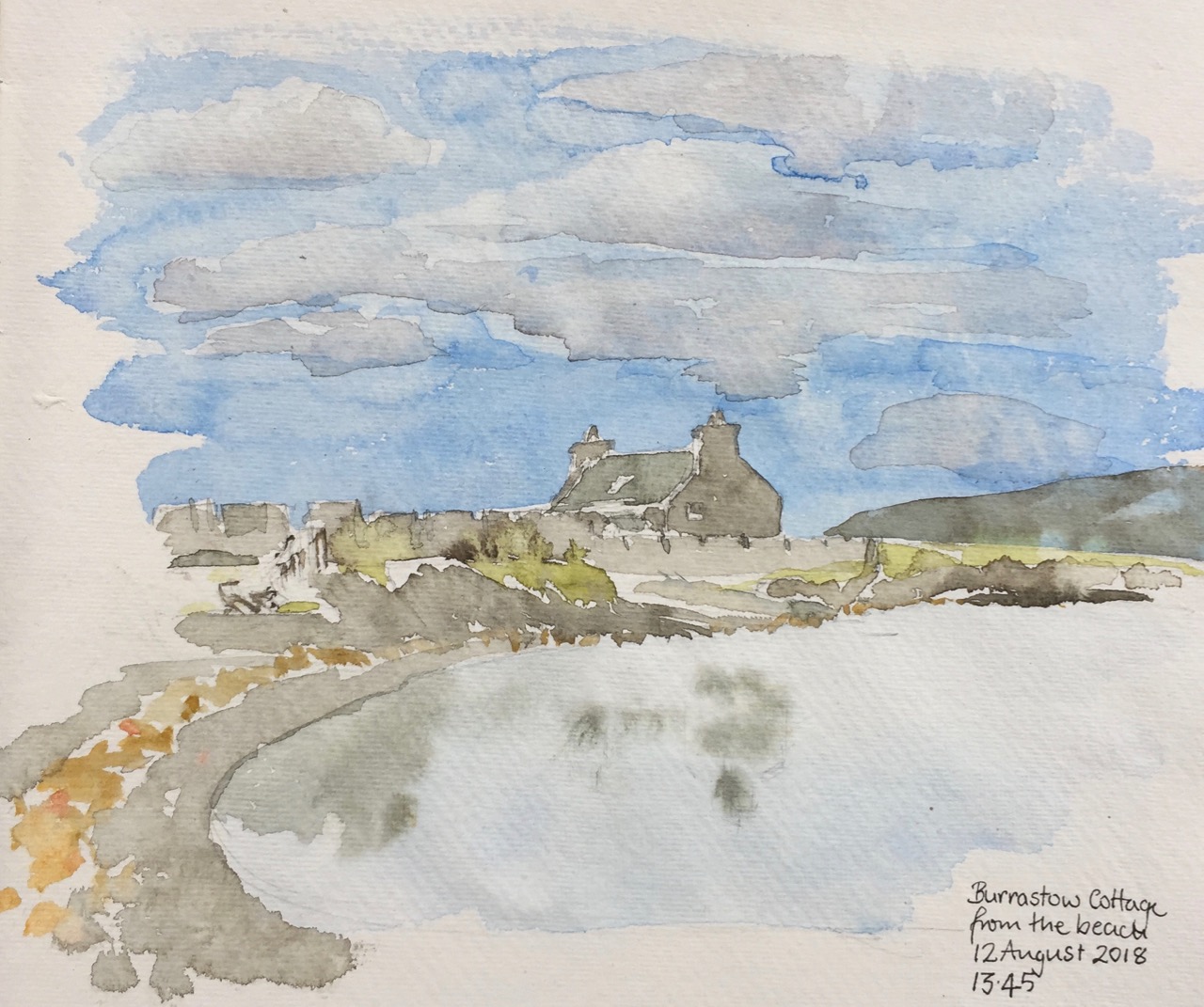
Below is a picture of Burrastow Cottage, where I was staying. I swam in that bay. Despite the blue sky, the water was cold. I rate it somewhere between “refreshing” and “challenging”. That is, probably about 12 degrees Celsius.
I had a wonderful time.
60.529651 -1.265941
Click a button below to share this post online, email it, or print it:
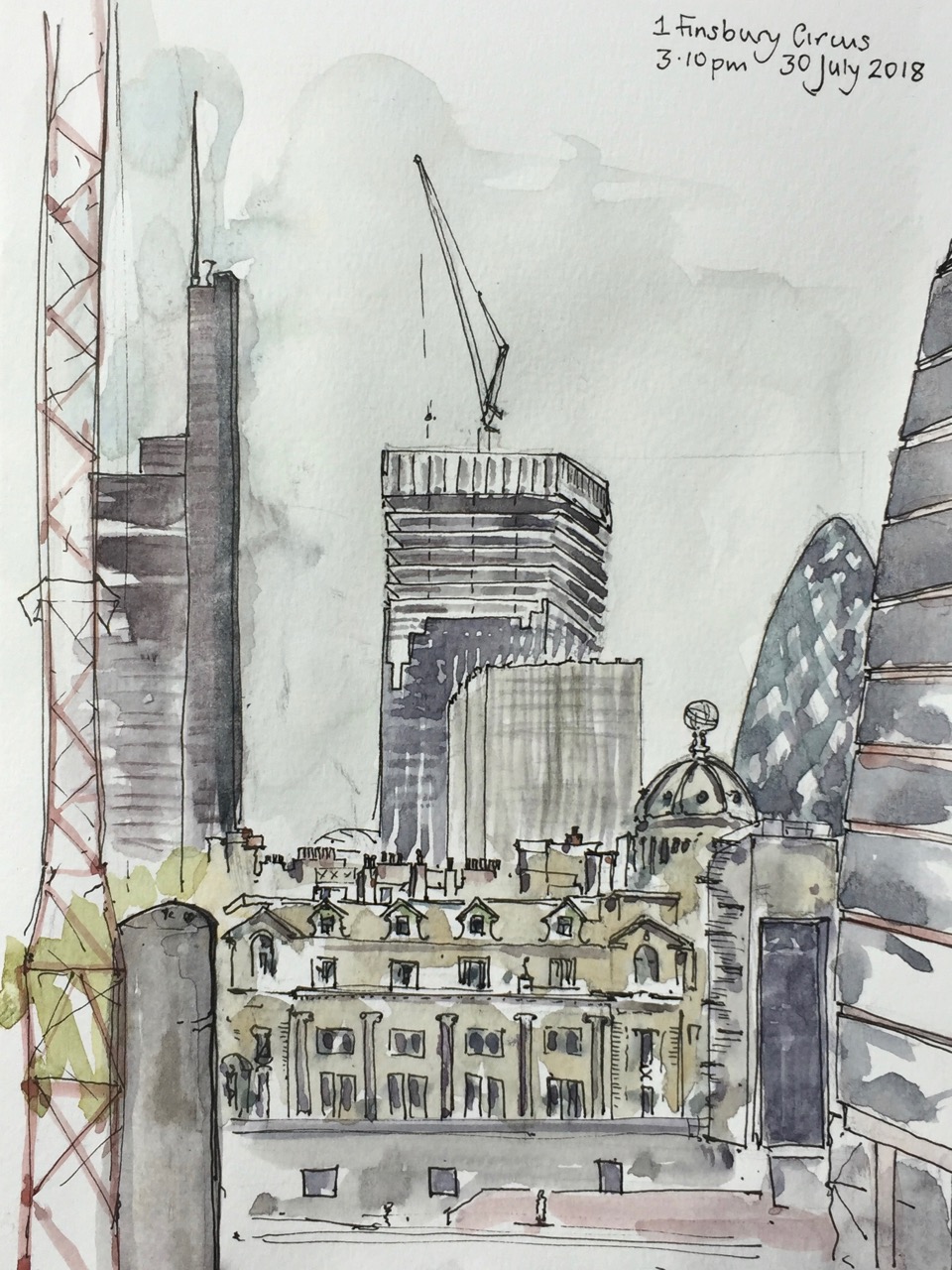
Here is the building 1 Finsbury Circus, called “Britannia House”:
“Fronting the northwest quadrant of the oval, with fronts on roads entering the Circus from the west stands Edwin Lutyens’s massive Britannic House (1921–25, listed Grade II), designed for the Anglo-Persian Oil Company, which became BP; its free-standing architectural sculptures are by Francis Derwent Wood. It was built on the site of the last remaining original houses, and is now home to international law firm Stephenson Harwood.” (Wikipedia)
Behind it, buildings under construction on Bishopsgate, and the Gherkin on the right.
I enjoyed the contrast between the careful detail on the Lutyens building (1920s), and the more brutal façades of the 21st century buildings. The totally functional windows of the temporary construction buildings are in front.
The black thing on the left is some sort of storage tank.
Drawn from the Barbican podium, looking East across the Moorgate Crossrail site.
About 1 hour.
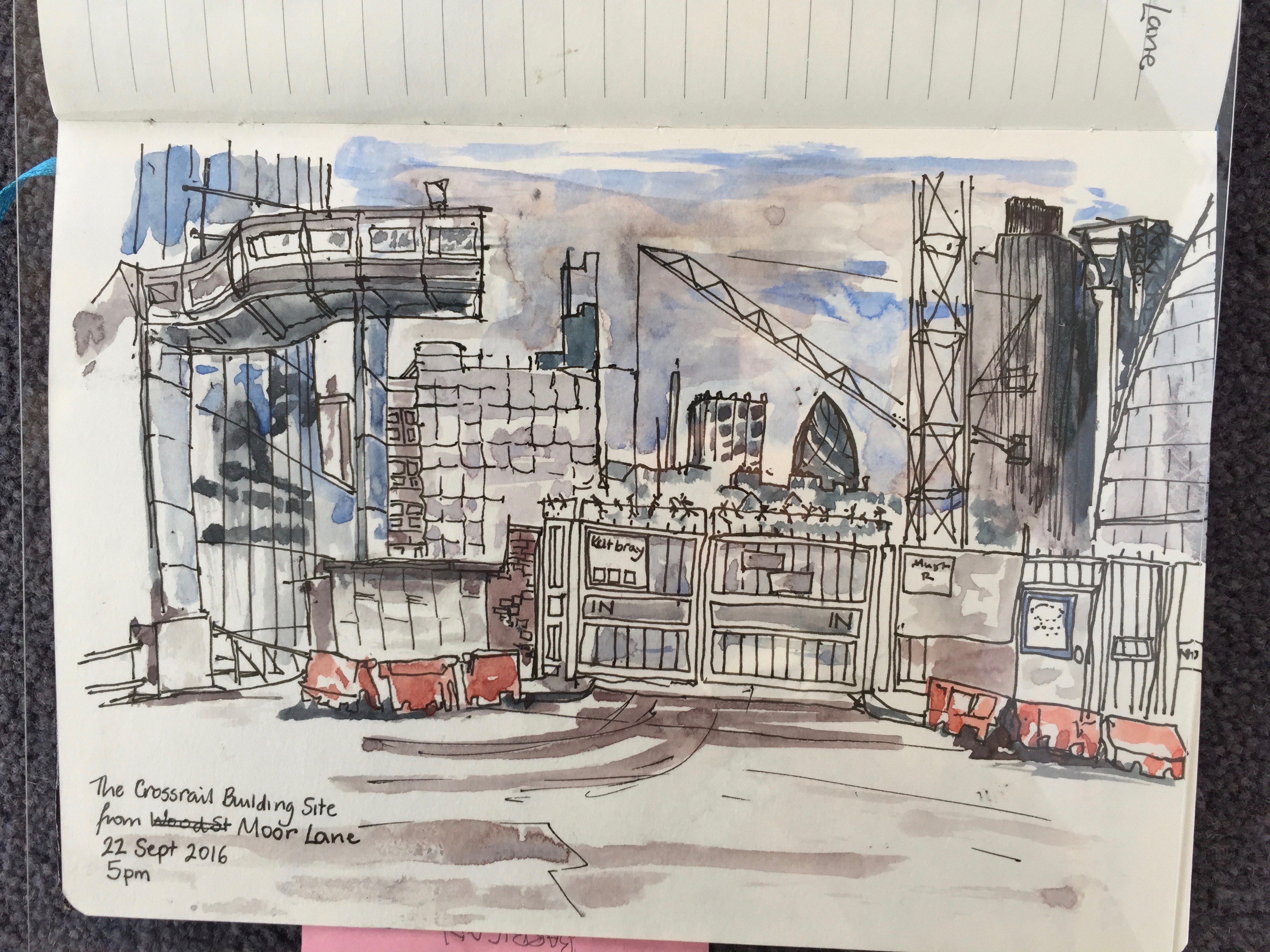
Here is another drawing of the Crossrail site I did a while back, showing the bridge across New Union Street:
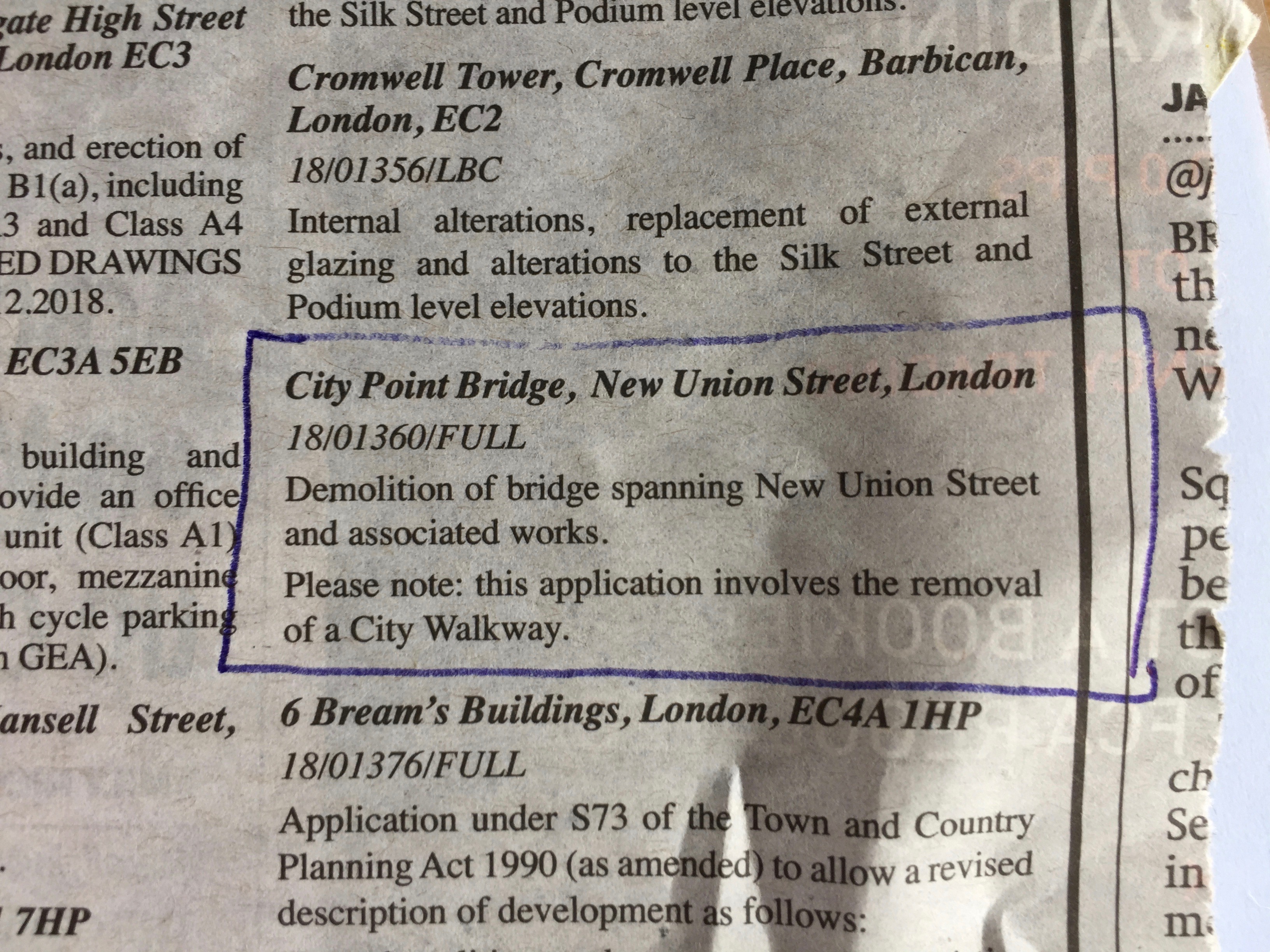
This bridge is due to be removed:
CityAM 22nd January 2019
Click a button below to share this post online, email it, or print it:
I’m just back from another visit to Sainte-Croix in Vaud, Switzerland. Mostly I was working, but I managed to do a few sketches.
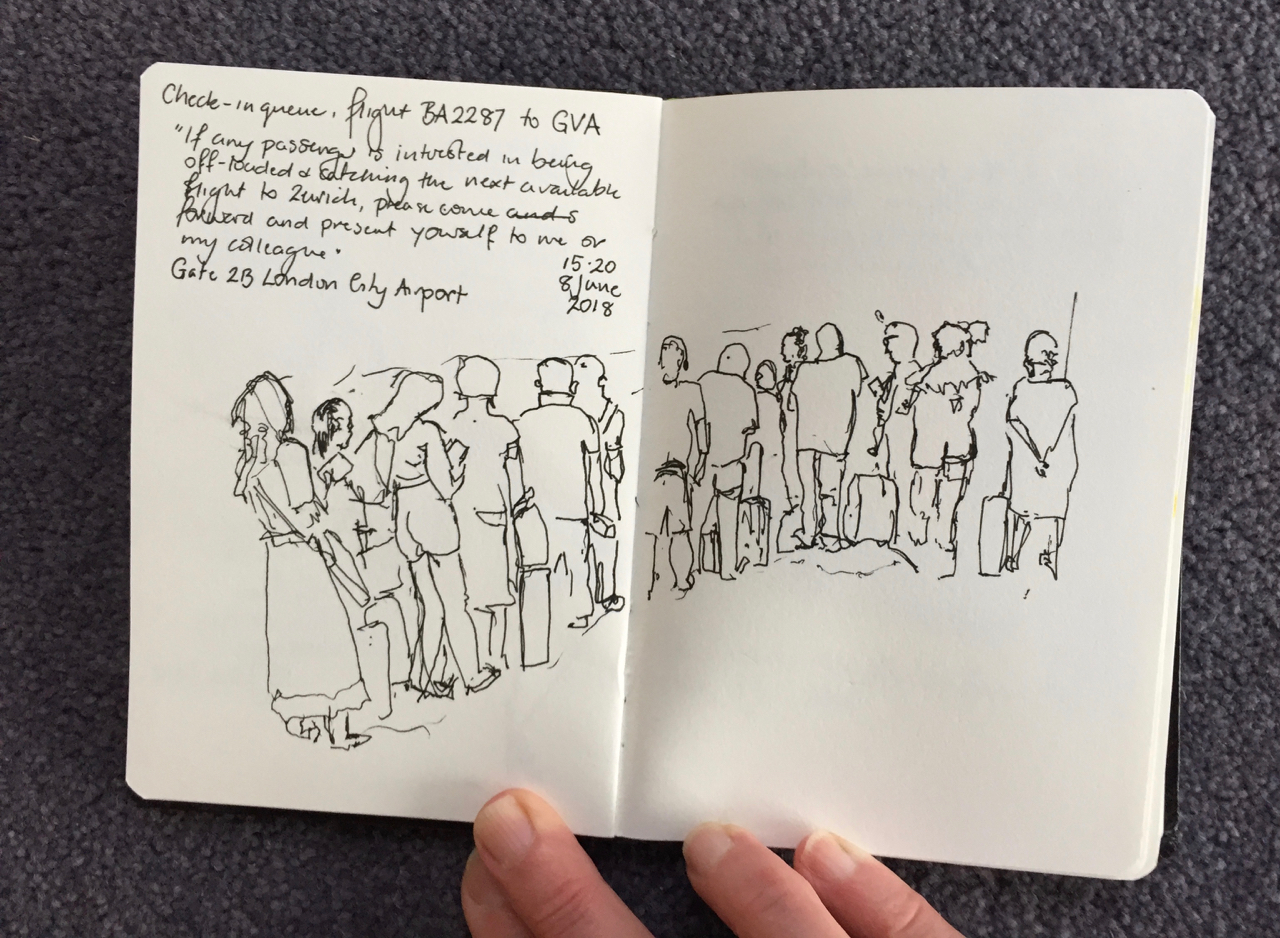
I started sketching at the airport. The flight was full.
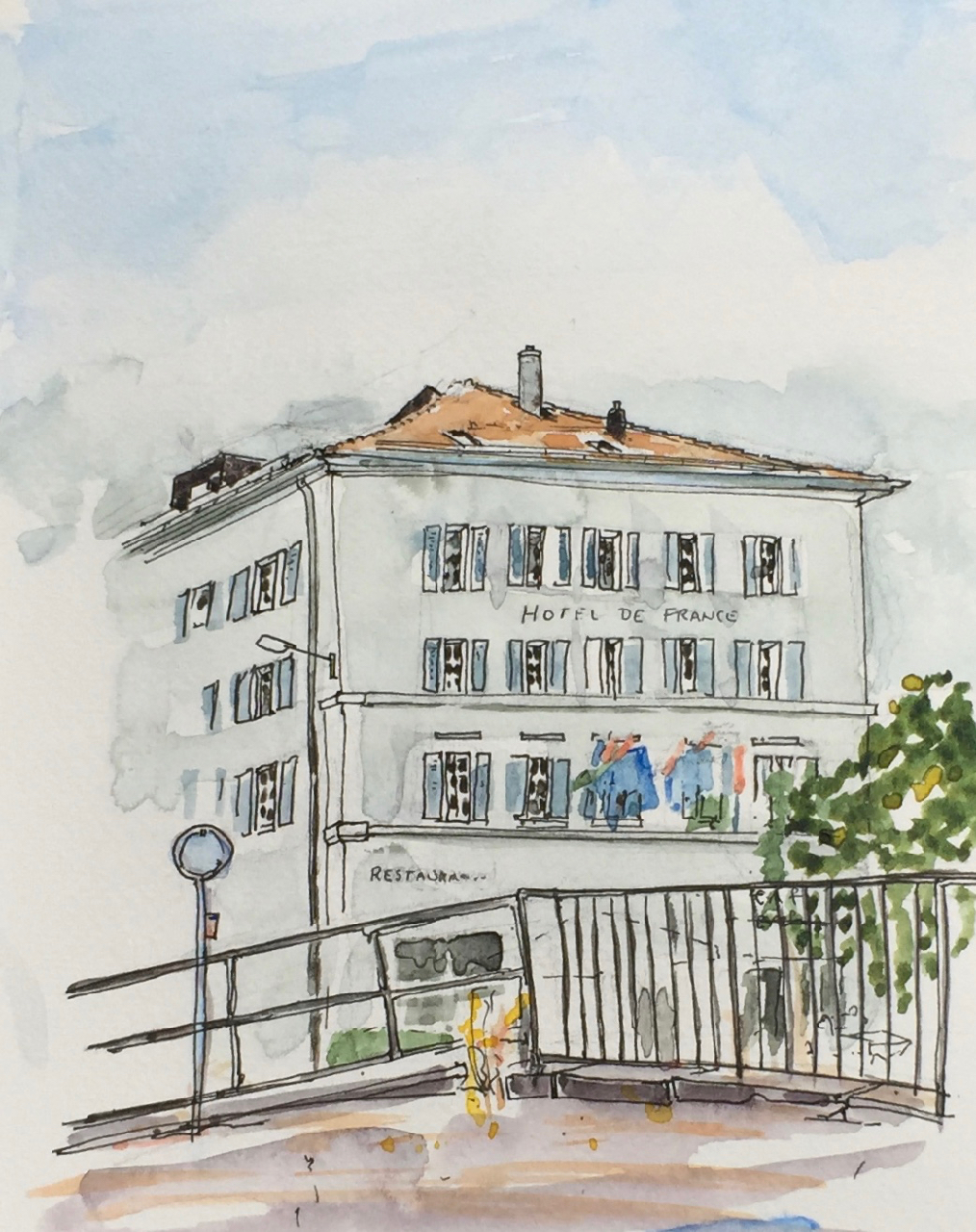
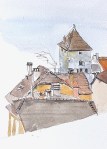
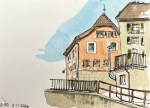
Here’s one of the outside of the hotel, done in 1 hour and 50 minutes, sitting on the pavement in the sun.
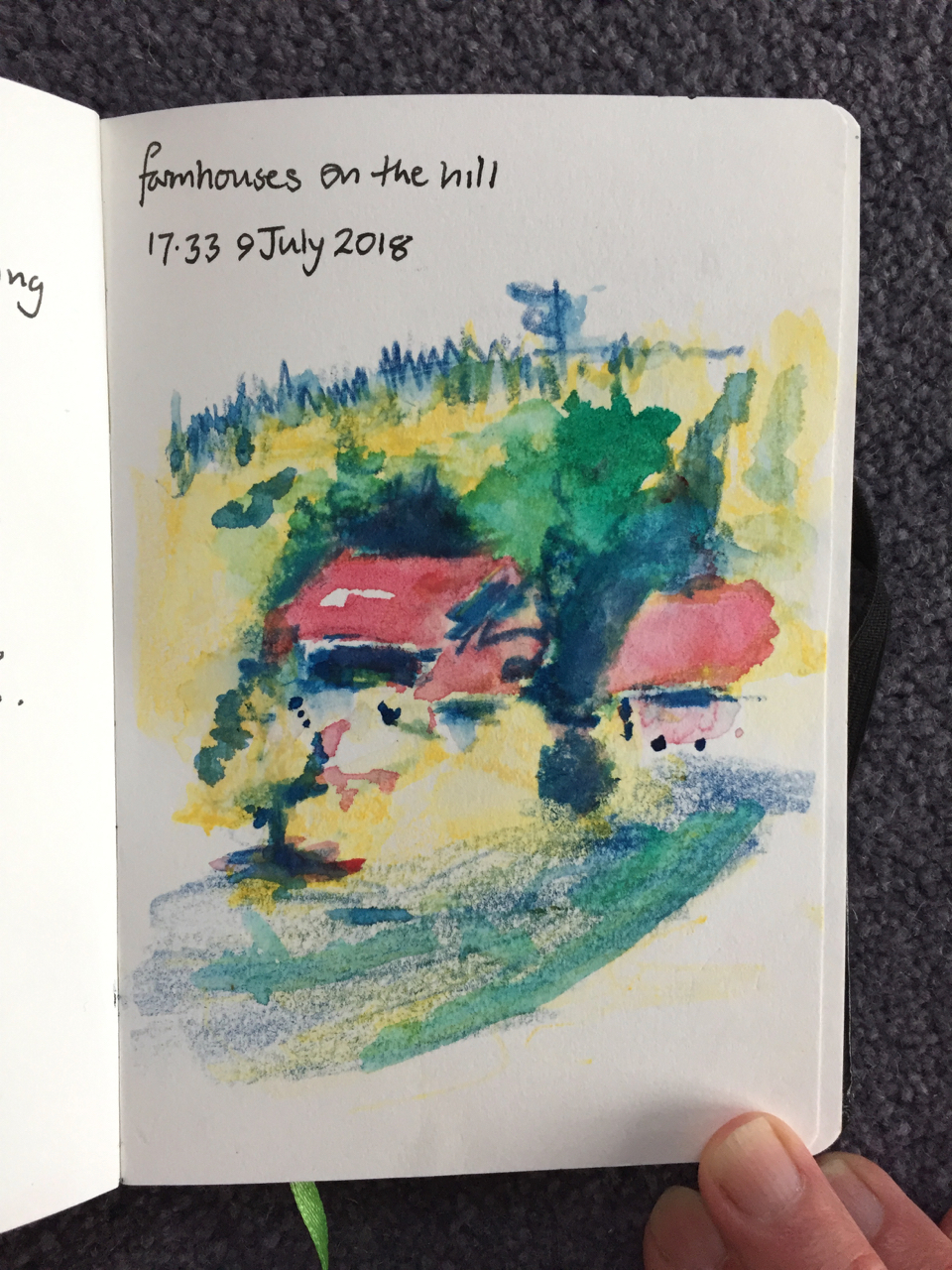
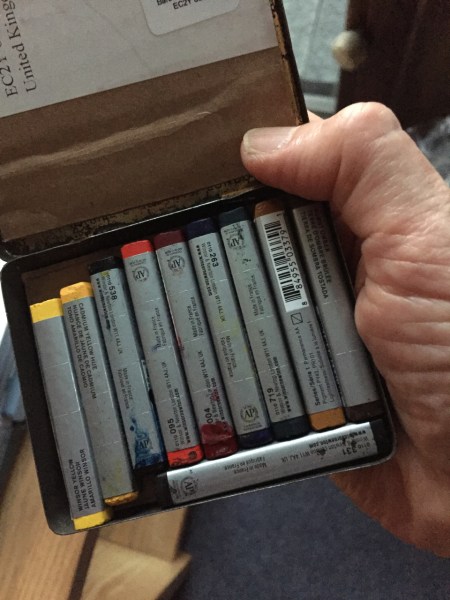
In between work on the computer and discussions, I made small quick sketches of what was in front of me. I experimented with watercolour sticks, which are very messy, but deliver strong bright colour.
Breakfast: Ovomaltine container and cup, done with watercolour sticks.
Tea tray
Experimental study of breakfast items, using watercolour sticks.
Flags on the outside of the hotel.
Here’s another experiment with the watercolour sticks. I was walking back from the swimming pool, and saw this sweep of land and the farmhouse sheltered by trees. I was shortly due back at the hotel, so I made this sketch in about 10 minutes, sitting on the road. The watercolour sticks throw the colour on very quickly, and don’t allow me to fuss.
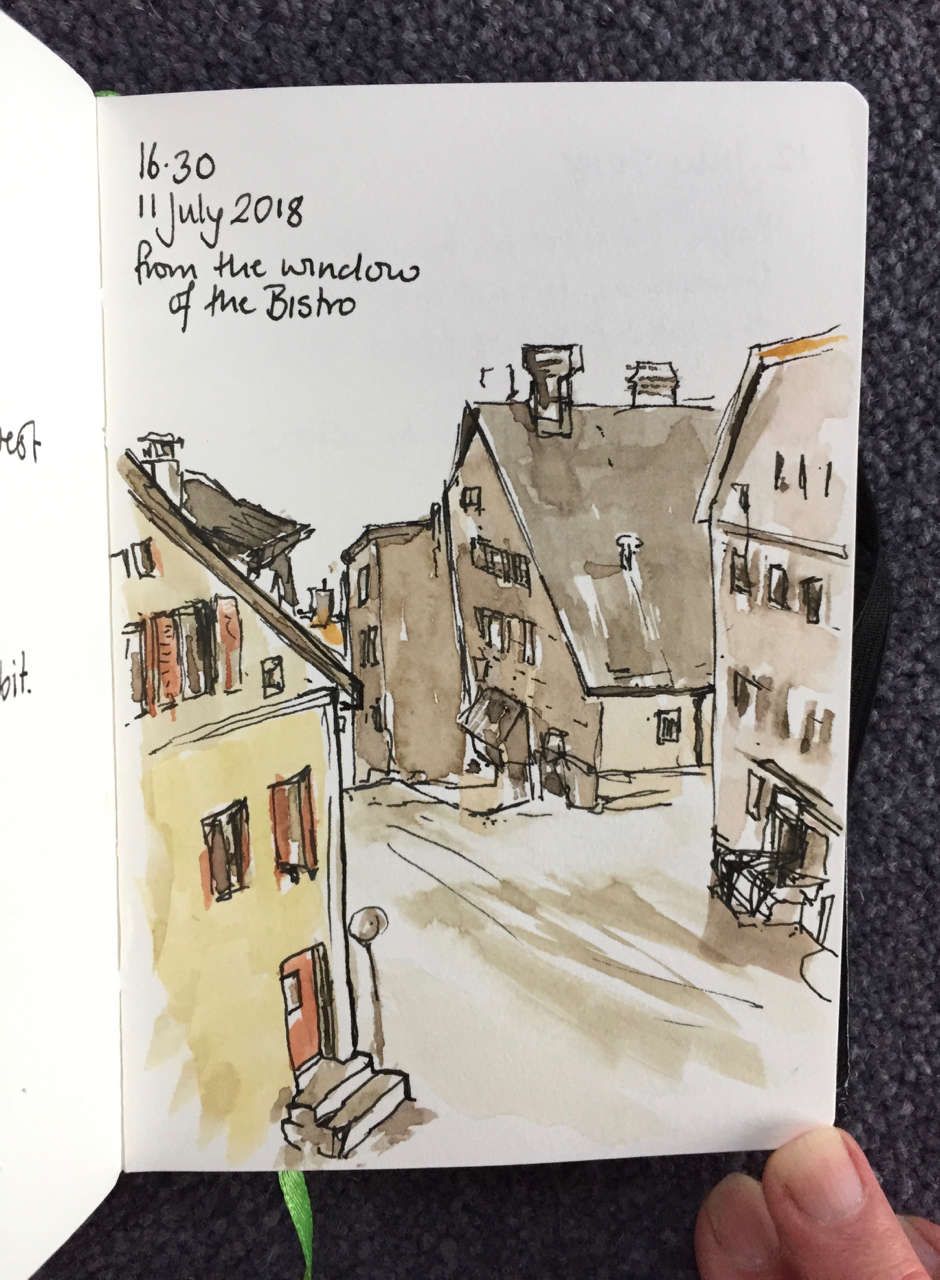
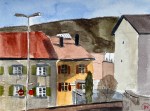
Here is a sketch made in about 20 minutes, while waiting for a meeting to start. I was looking out of the window…..
At the end of my visit I sat at a table on the terrace and looked across to the Mont de Baulmes.
Pen and wash, 20 minutes plus 20 minutes later.
Here are the watercolour sticks in their new/old box. It’s an old cigarette box. I just discovered they all fit into it nicely.
Here’s a drawing on location:
With thanks to Marina and Rolf, proprietors of the Hôtel de France, 25 rue Centrale, Sainte-Croix, Vaud, Switzerland. www.hotelfrance.ch
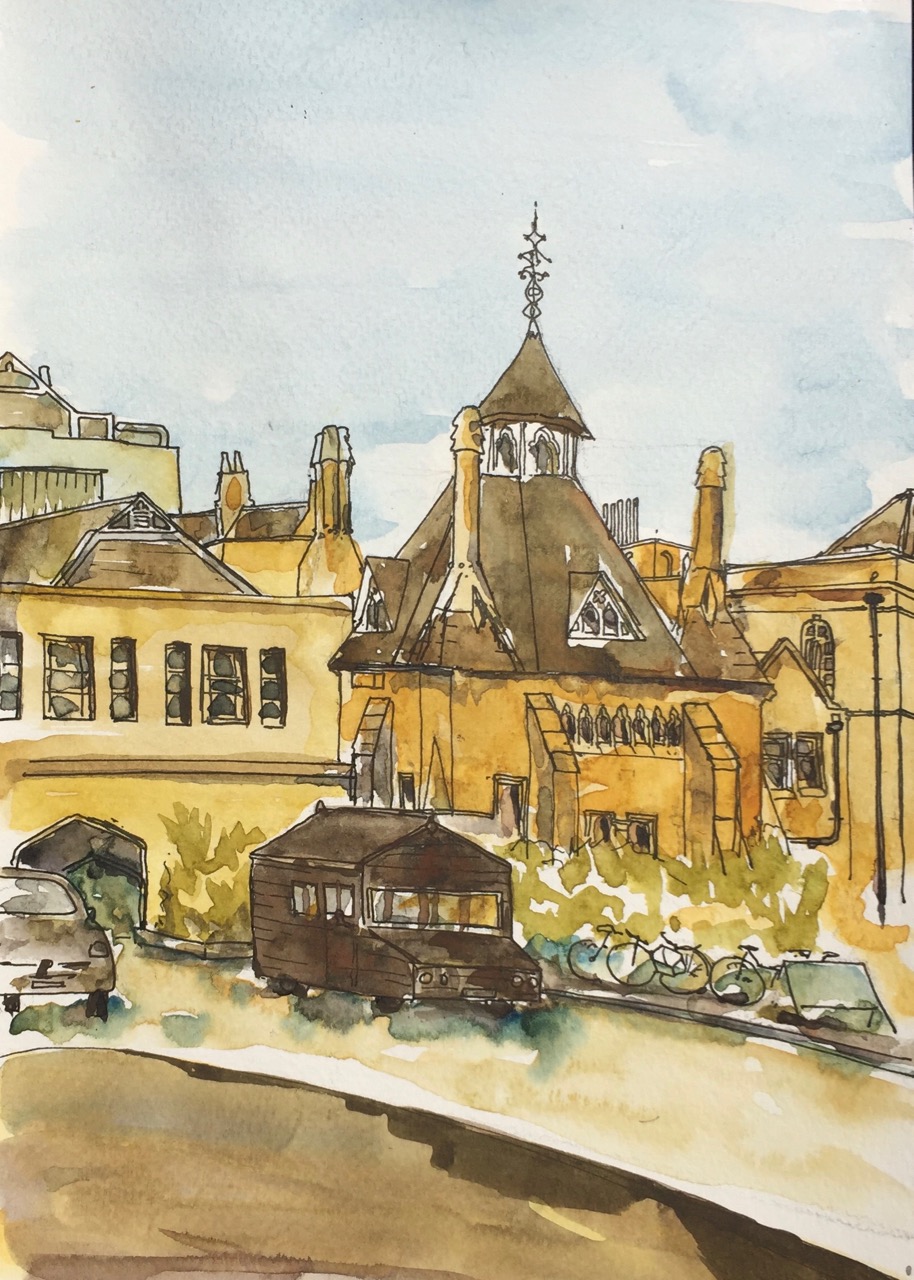
This little building to the right (South) of the Pitt Rivers Museum has often intrigued me. It has four chimneys. one in each corner.
After I’d drawn it, I went to try to find out what it is. It appears to be connected to the Pitt Rivers Museum, but has no special name itself, and its purpose was not stated. Since I finished the drawing at about half past seven in the evening, the door was closed and locked and no-one was about. It is in the same style as the main Pitt Rivers Museum.
“The new Museum building was structurally completed in 1860, and is now considered a gem of middle Victorian neo-Gothic architecture”
says the museum’s website.* In the background you can see the roofs and pipework of the science site. On the right is the Radcliffe Science library.
The strange vehicle in the foreground trundled in while I was drawing. It looks like a garden shed on wheels. The registration number is: Q710 LBW.
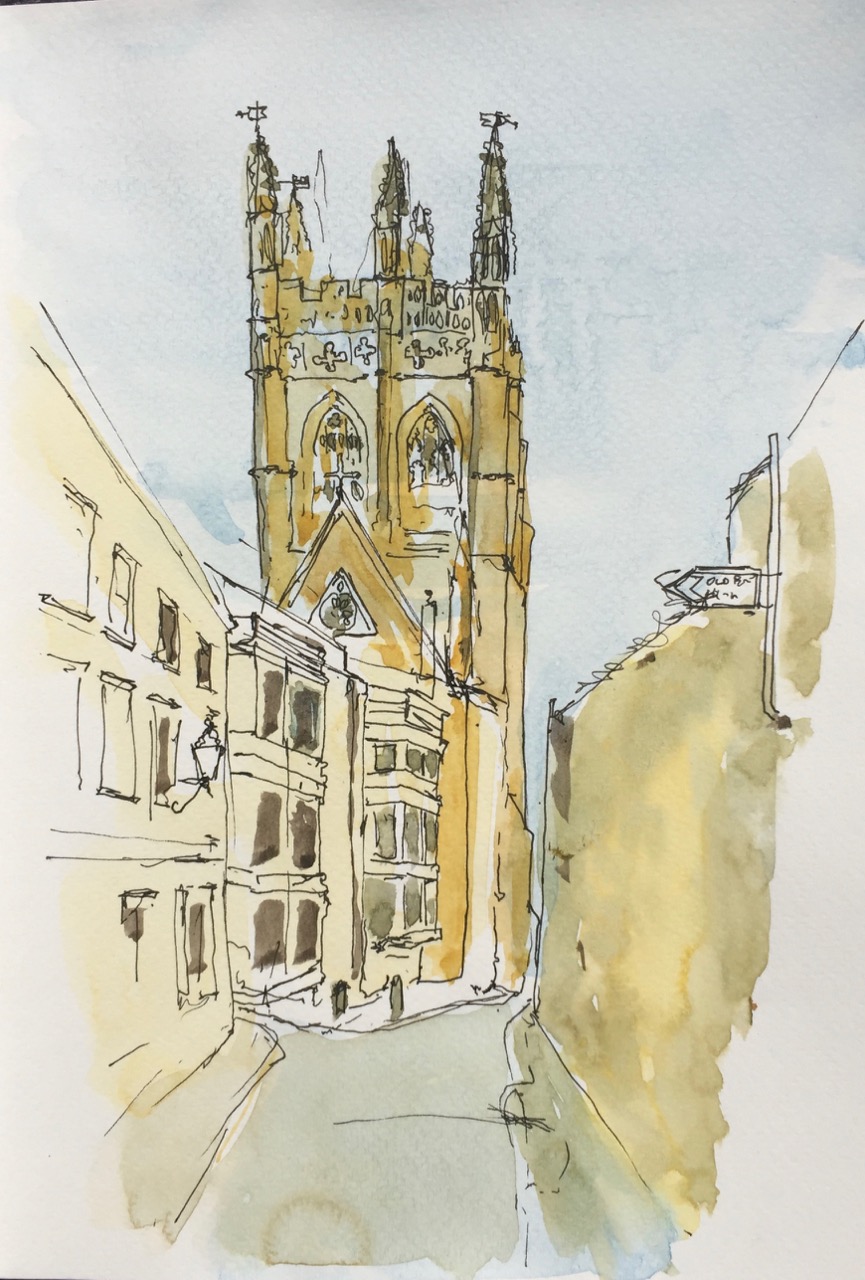
On my way home after the lecture I drew this quick sketch of Merton Chapel looking down the marvellously named “Magpie Lane” off the High Street.
Pitt-Rivers Annex: 1 hour 40mins
Merton Chapel: 40 mins
Both in Jacksons Watercolour Sketchbook. Pen and wash.











 I drew this picture sitting on a stone in Radnor Street Gardens, off Lizard Street. After a while I noticed that the place smelt of dog excrement. It has rained recently, after a dry spell.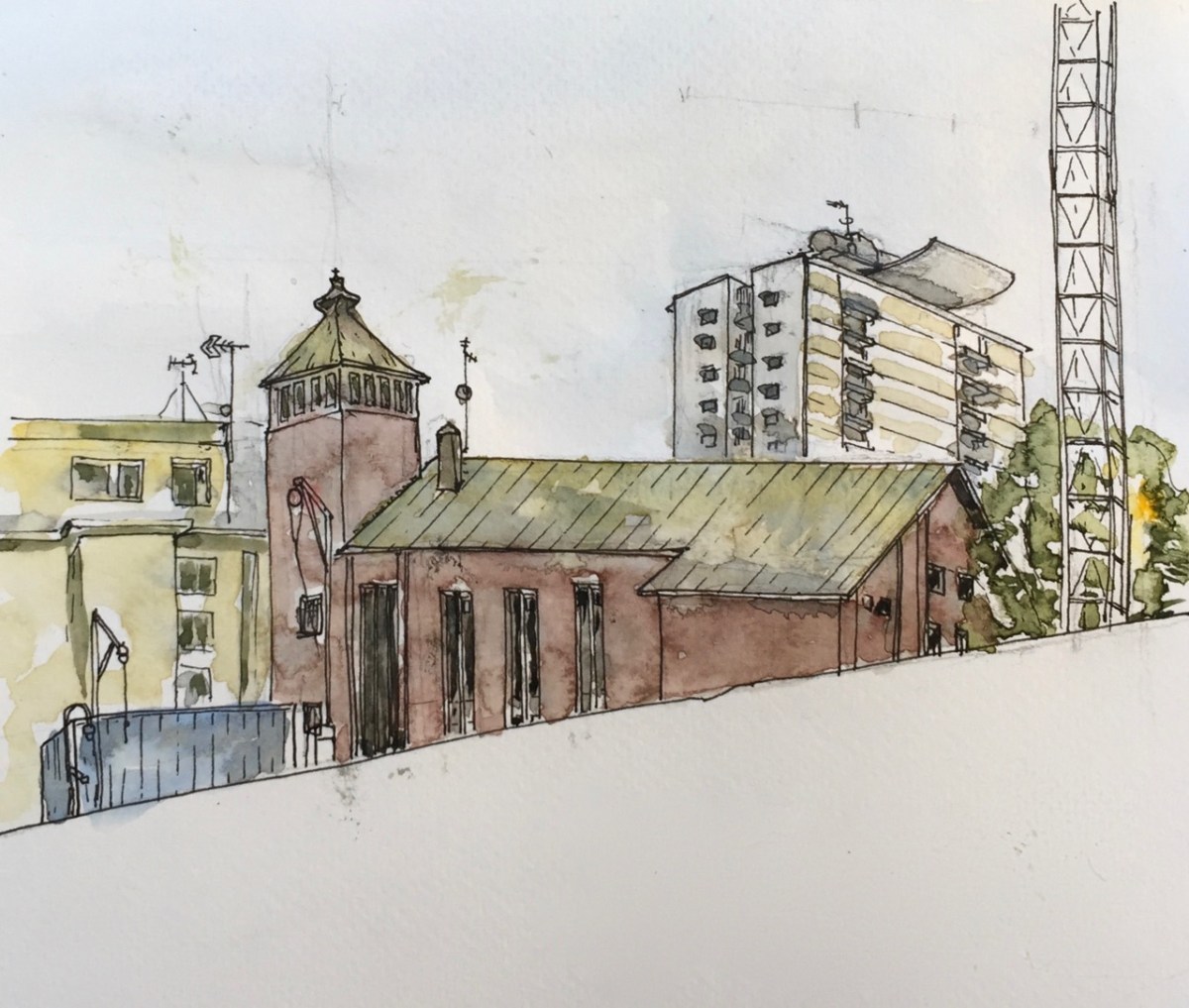




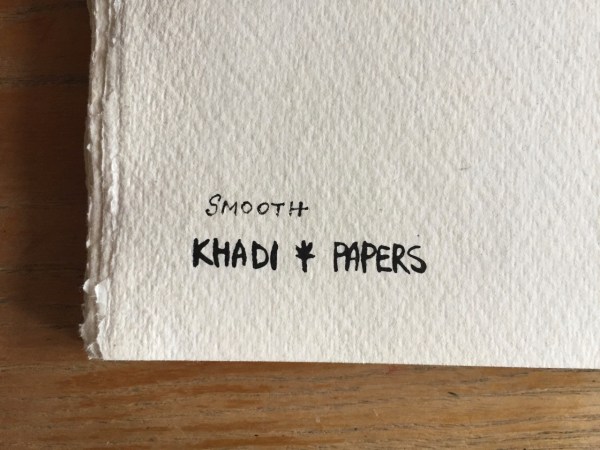 The other sketchbook I used was a Khadi cotton paper, much more absorbent. Below is a picture of the roads of West Mainland. The roads are calligraphic strokes on the landscapes.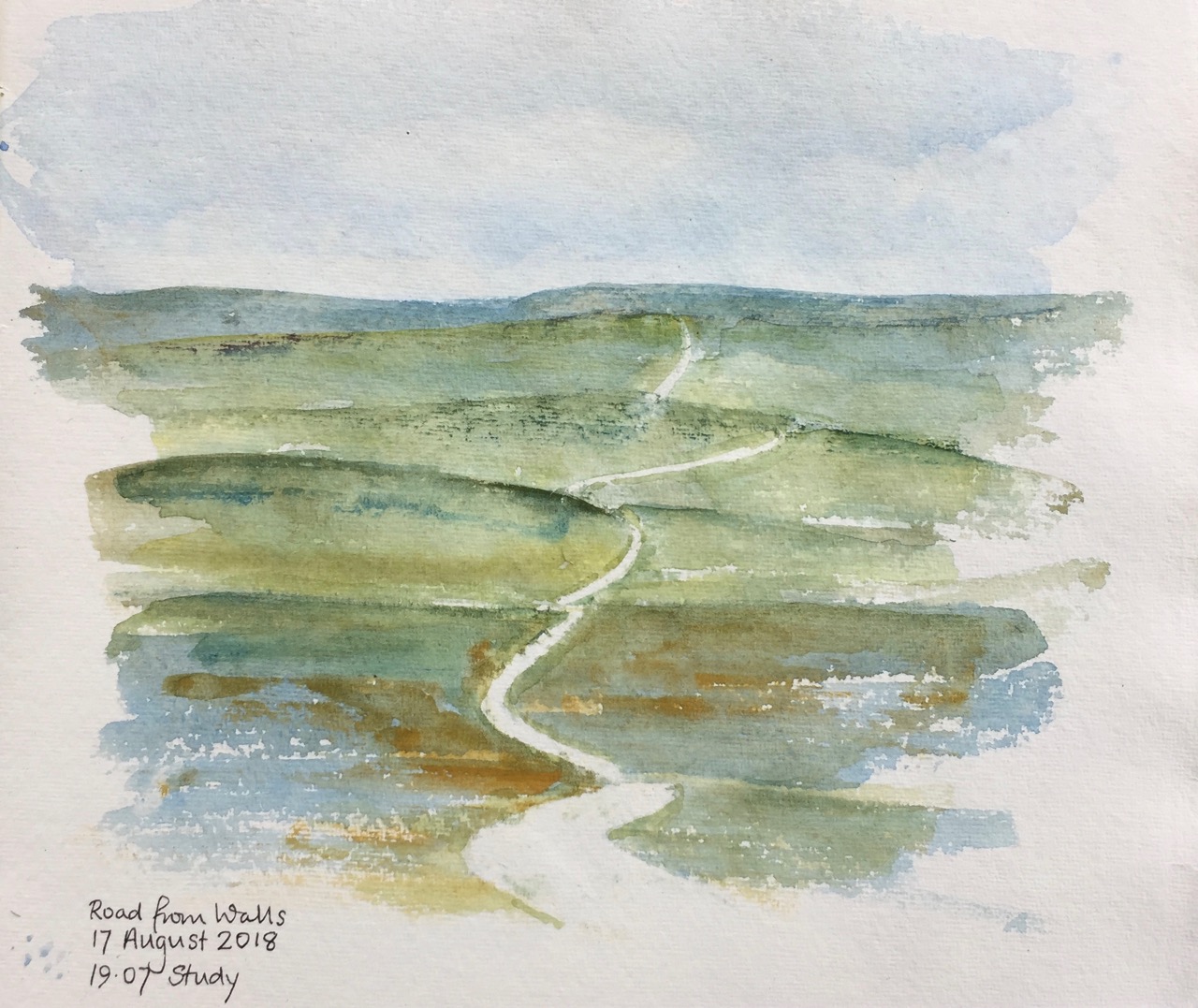










 Jane Sketching