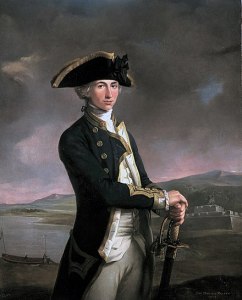
Captain Horatio Nelson, painted by John Francis Rigaud in 1781, with Fort San Juan in the background.
For our Boxing Day walk, John researched places in London associated with Vice-Admiral Horatio Nelson (29 September 1758 – 21 October 1805).
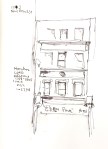
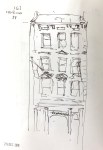
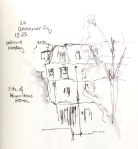
First we saw some houses of the period, and then went to the various places that Nelson lived or visited in London. My mission was to draw very quick pictures. We had a lot of places to visit, and I didn’t want to hold up the expedition. Here are my sketches, in the order of our visits.
11 Cavendish Square, a Georgian House of the period
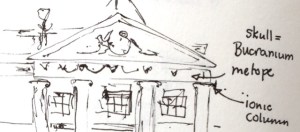
Stratford House built 1771-6, another example of a Georgian House of the period
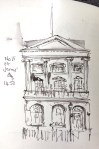
103New Bond Street. Nelson lived here in 1798
147 New Bond Street. Nelson lived here later.
22 Grosvenor Square. Lord and Lady Hamilton lived in a house on this site.
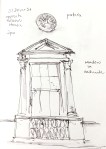
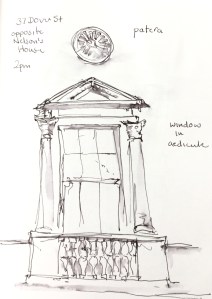
A window in 37 Dover Street, opposite Nelson’s House
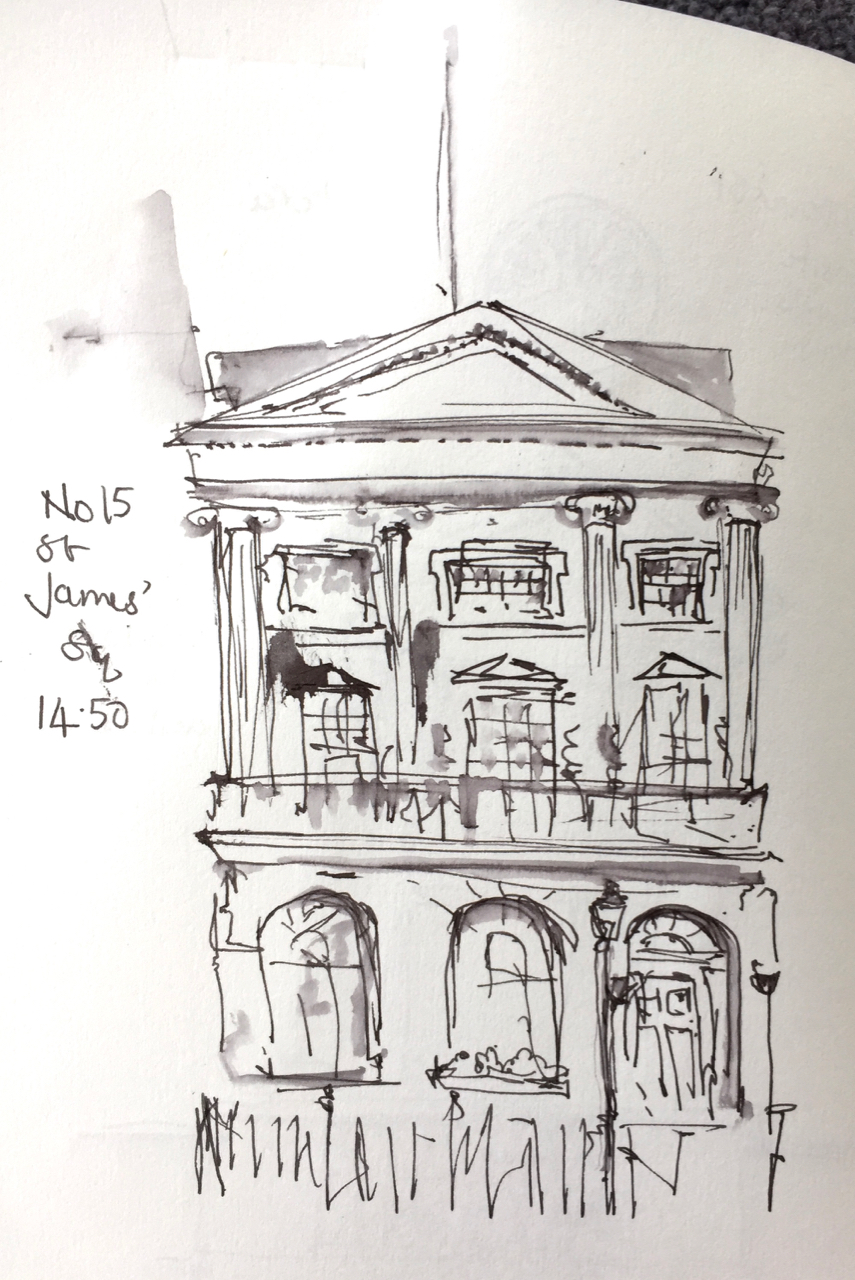
Number 15 St Jame’ Square, a “pure Palladian mansion” of the period.
We saw and named architectural details. On 11 Cavendish Square we noted the “blocked vermiculated columns”
“Vermiculated” means wormlike. It’s a really useful adjective. “I found it impossible to follow his vermiculated arguments.” ” After navigating the vermiculated back alleys, we emerged at last onto the main square.”
We saw ionic columns on Stratford House. These are the ones with scrolls at the top. Above the columns is the “metope” or frieze. On this there were “bucrania” which are bulls skulls.
An “aedicule” is a house shape with columns each side. At 37 Dover Street we saw a window in an aedicule.
A window in 37 Dover Street, opposite Nelson’s House
Here is our route:
It took us 5 hours and was 14km.
After the Georgian London visits in the West End, we walked to Trafalgar Square to see Nelson’s Column, and then along the Strand, where we saw the site of a silversmith he visited. Nelson went along the Strand in his carriage to receive his “Freedom of the City of London”. At Temple, the cheering crowds unhitched his horses and hauled his carriage themselves.
We arrived at St Paul’s Cathedral, where Nelson is interred.
I used Organics Studio arsenic gray ink, and a Lamy Safari pen with fine nib, from The Writing Desk. The book is a sketchbook from Seawhite of Brighton.
Ink: it’s not waterproof. It does not contain arsenic.
Lamy Safari pen.
Seawhite of Brighton sketchbook
Sketchbook: hardbook.
Click a button below to share this post online, email it, or print it:
St Bartholomew the Less is a Chapel of Ease in St Bartholomew’s Hospital in the City. It’s just to the right of the main entrance from Smithfield. You might not notice the door in the wall. Sometimes they put a board outside. I’ve been in a number of times. It’s a very peaceful, welcoming, place. Somehow, one feels the need to visit a place of prayer before, or after, a hospital visit.
I was invited to draw pictures of the church. The City Music Foundation, a charity, wants to use my pictures in its publicity. They are going to be based in St Bartholomew the Less. So the Managing Director of the Foundation, Clare Taylor, contacted me. She’d seen the pictures I’d done of The Charterhouse.
Here are the first two pictures of St Bartholomew the Less:
It was founded in 1123, by Rahere, a “courtier of Henry I“, according to the leaflet. The tower dates from the 15th century. “The three bells in the tower include one dating from 1380 and another from 1420” says the leaflet. I was interested in Rahere, because there is a Rahere St and a Rahere House which I have drawn.
Since the Foundation is a music foundation, I thought it would be a fun idea to draw the bells. By kind permission of the Parochial Church Council (PCC), whose representative efficiently produced a key, I was able to go up into the belfry. Bells, I found, are not so easy to draw as you might think. Like the human form, they have curves. And unless you get the curves exactly right, they look like a different character. Also, the belfry contained not only very ancient bells, but also 600 years of dust. It was indescribably dirty. But amazing. And very quiet inside, with all the noise going on outside. I wedged myself into the wooden frame, braced my back against a metal rod, and got started.
The platform into which I was wedged was not very big. I manoeuvred very slowly because I didn’t want to knock anything, such as a paintbrush, down into the depths. The best medium seemed to be black ink. Ink is a bit dodgy to manage at the best of times. But keeping it upright on an ancient wooden raft, in the semi-darkness, verged on the farcical. No-one was there to sympathise, except the bells, and they’d seen it all before.
Click a button below to share this post online, email it, or print it:
Galway House is one of the two Towers on the Pleydall Estate just North of Old Street. The other tower is Grayson.
I drew this from behind Grayson House. There was a ferocious cold wind. I seemed to have picked the place where all the winds met. Here are maps showing the direction I was looking.
Here are the blocks in the picture. It almost looks as though the Atlas Building continues the march of these majestic 1960s blocks. But it doesn’t, not really.
In the drawing you can see the scaffolding on the Atlas Building, and the external lift that was going up and down as I was drawing.
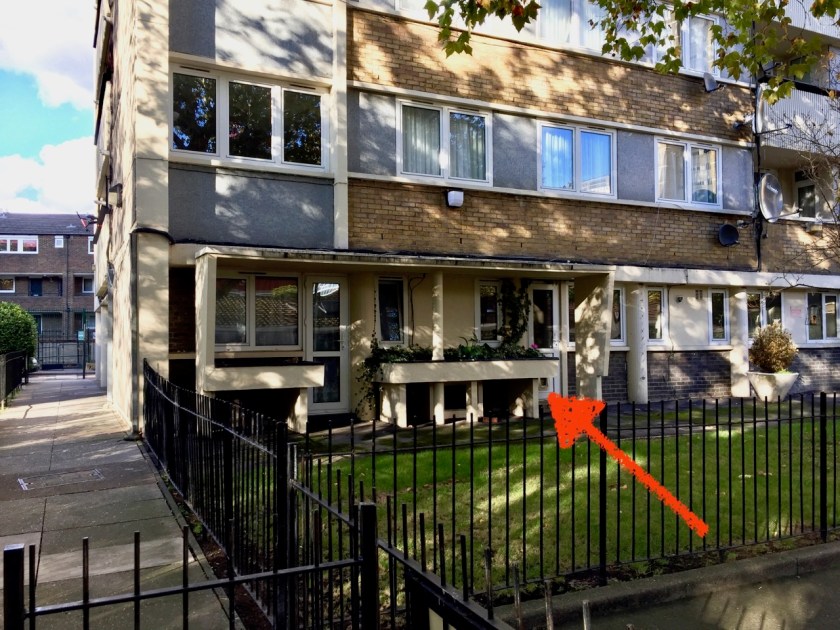
I was interested to see that the inhabitants of Galway Tower made use of their flower beds.
Raised flower beds in Galway House, South side.
I’ve seen the same arrangement of raised flower beds next to the flats in Rahere House, where the beds were more exposed, and not used.
This whole area underwent huge changes in the twentieth century, although the street layout is unchanged.
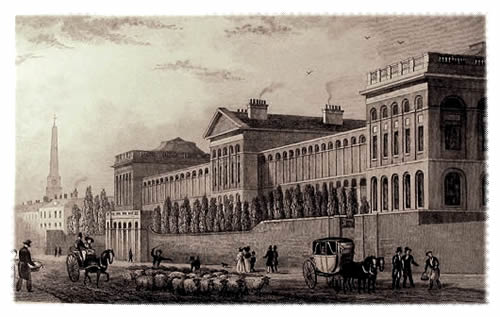
From 1751, on Old Street, there was a huge hospital for the mentally ill: St Luke’s Hospital for Lunatics.
St Luke’s Hospital for Lunatics on Old Street. The obelisk in St Luke’s Gardens is in the background. Image credit: Wikipedia
This hospital was closed in 1916 and the residents moved out. The building was acquired by the Bank of England and used for printing bank notes.
Bank of England Printing Works on Old Street, 1925, image credit: Bank of England Museum.
You see Galway Street on the crease of the map, in the centre about a quarter of the way down. Below it, to the right is the “Bank Printing Works”.
In 1959 the London County Council sought to purchase the Printing Works site and use it as an annexe to Covent Garden. This was opposed by Michael Cliffe, MP for Finsbury and Shoreditch, on the grounds that it would create unacceptable traffic congestion, especially at the Old Street Roundabout.
Mr Cliffe is quoted in Hansard:
“…London County Council (General Powers) Bill, …. The Council, through the Bill, sought powers to acquire and redevelop St. Luke’s Printing Works as an annexe of Covent Garden Market….. I would ask the Minister what is the point of spending millions of pounds in trying to solve the problem of congestion in Central London if we are to convert the St. Luke’s Printing Works as an annexe to Covent Garden in an area where we know it must inevitably cause the kind of congestion that we are trying to avoid and which we are discussing every day. As the number of vehicles increases, further problems will have to be solved. Surely we do not want to create further difficulties after our experience gained in the past?” [Hansard: HC Deb 17 December 1959 vol 615 cc1738-47]
Mr Cliffe must have prevailed. I feel an affinity with him because earlier this week I drew Michael Cliffe House.
The Printing Works building was demolished in 1963. At around that time Finsbury Council was building council houses, including the 4 tower blocks in the area: Gambier House, Grayson House, Godfrey House and Galway House. So somehow the Council must have acquired the Print Works site. I can’t find the history online so I’m going to visit the London Metropolitan Archives and the Islington Museum.
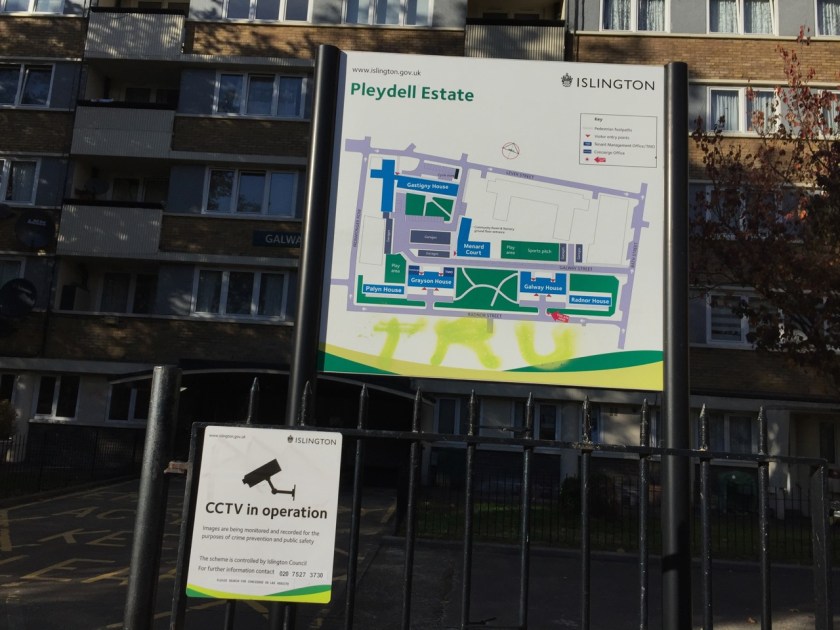
The Towers also were allocated to different Estates: Galway is in the “St Luke’s Estate” which includes the Printing works Site, Gambier is in the City Road Estate and Grayson and Galway are in the Pleydell Estate.
From “Streets with a story, The book of Islington” (1986) by Eric A Willats FLA I learn that: “Messrs. Emberton, Franck & Tardrew were the architects of Galway House (Pleydell Estate)”.
From a map sent to Mr I Agar in 2010 in response to a Freedom of Information request [FOI 340742.pdf]The Pleydell Estate, Galway House in the Background.
Click a button below to share this post online, email it, or print it:
Here is Michael Cliffe House, in the Finsbury Estate, from Tysoe Street.
The lower level block in the low centre of the picture is Joseph Trotter Close, also part of the Finsbury Estate.
While I was drawing the picture a man came and told me that he had seen the original architect’s drawing of this low level block. In the architect’s vision it was “sleek and wonderful”. But the man said the reality was very different. The concrete had worn badly and the building had not succeeded, in his opinion.
Earlier a woman came when I was at the pen-and-ink stage. She said that her 11 year old grandson had started painting, which pleased her very much. She bought paints for him. I asked if she painted too. She said no, but she was inspired by her grandson and might now have a go herself. “After all,” she said, ” he just paints anything, and I could do that too!”. I agreed.
The drawing took two hours. After I finished I went to have a look at Joseph Trotter Close. I saw a low-level set of bungalows, all very much inhabited, with children’s play things and outdoor chairs on the lawn. It may not be sleek, but it looked as though people enjoyed living there.
The entrance to Michael Cliffe House was cramped and congested, with cars manoeuvring awkwardly and a dark, obscured, entrance. Lovely typeface though.
Joseph Trotter Close on the left
Entrance to Michael Cliffe House
Entrance to Michael Cliffe House
The real surprise was inside the entrance. There, uncelebrated in the underpass, were some amazing mosaics of dancers.
Michael Cliffe (1903-1964) was a Labour councillor for Finsbury, Mayor of Finsbury (1956-7), and an active Labour MP (1958-64).
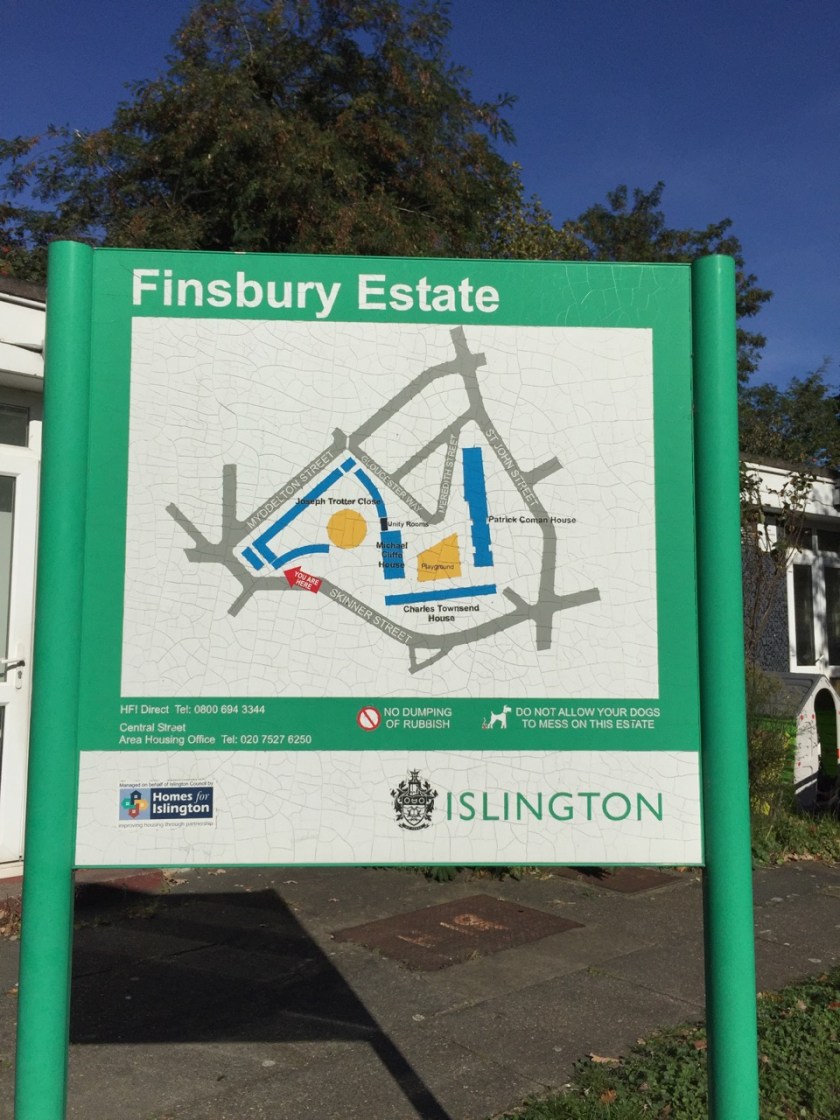
The Finsbury Estate was built by Finsbury Borough Council in 1965. The architects were Emberton, Franck & Tardrew. Finsbury Borough council was absorbed by Islington.
Later note (7th Feb 2019): There is detailed information on the Finsbury Estate on “British History online” – try this link, which starts with a history of Spa Green, and goes on to describe the Finsbury Estate.
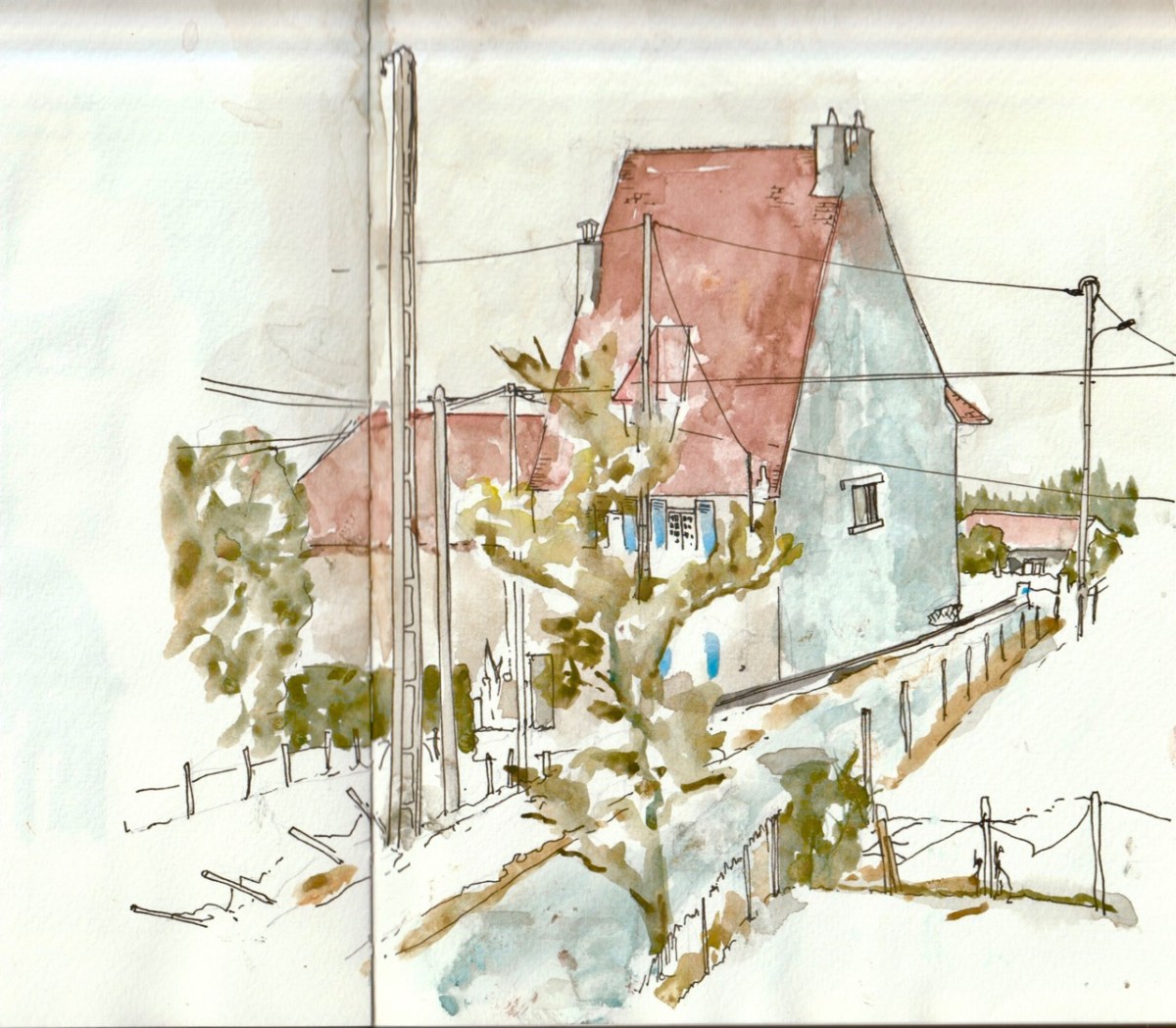
The village of Montcigoux has a house with a long roof.
Note also the extraordinary number of electricity cables. The plan is to put them underground. This was in progress. But so far not on this side of the village.
The queue at Limoges airport Passport Controle took 1 hour. There were only two officials and a huge number of people on the aircraft.
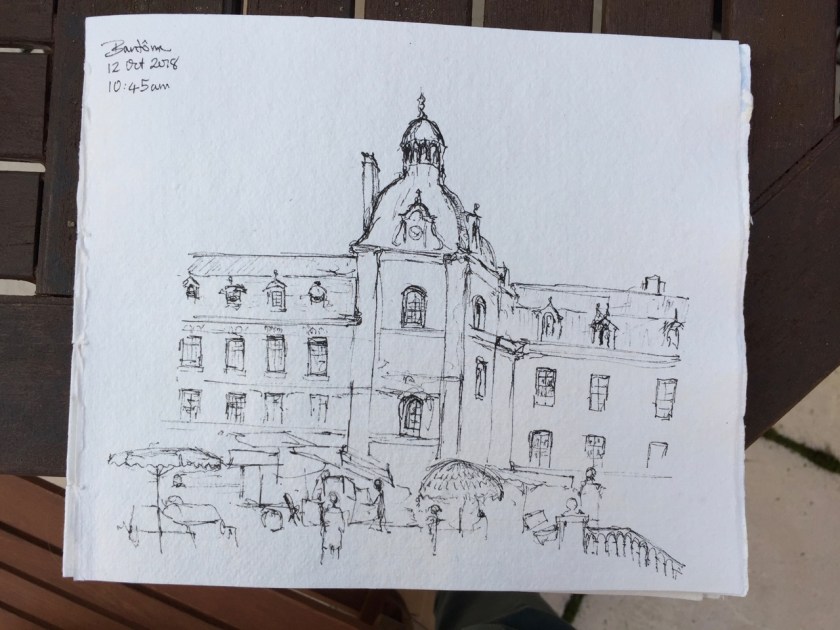
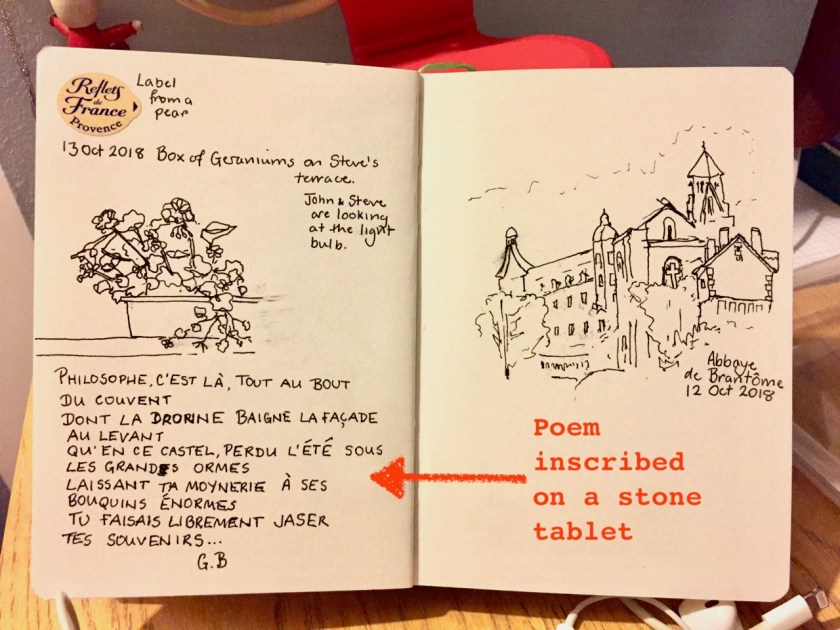
We went to Brantôme, a town on the River Dronne. It’s on an island in the river. There’s a food market on Fridays. At the cafe I sketched the Abbey.
We walked by the river and found a poem on a stone tablet. I wrote it in my notebook.
With the help of friends, I am still puzzling out what the poem says. Here’s the latest attempt:
Philosopher, it is there, right at the end of the convent Whose façade is washed by the River Dronne in flood That in this enclave, having spent the summer under the majestic elm trees While leaving your monastic cell to its gigantic books You would be in free dialogue with your memories.
All suggestions, improvements and interpretations welcome. The verb “jaser” seems to mean “gossip”, but perhaps “faire jaser” has a different meaning. Any ideas? I also assumed that the “G.B.” was the writer “Brantôme”. Georges Brantôme I guessed. But no, the writer Brantôme is Pierre. Here’s what Wikipedia says:
Pierre de Bourdeille, seigneur de Brantôme (c. 1540 – 15 July 1614), also known as the abbé de Brantôme, was a French historian, soldier and biographer.
I rather get the impression from his Wikipedia entry that the abbé de Brantôme was more of a chronicler than a poet. So who is “G.B.”? I definitely need to go back to Brantôme to have a closer look at that stone plaque. And to buy more of that cheese with nettles in, made by a Dutchman who has settled in France, and sold to us by his son.
“Is it French cheese?” I asked.
“Well,” he said, in the manner of someone embarking on a long explanation, “the milk is from French cows, and it was made in France….”. But, evidently, it was made by his father, a Dutch man, using a Dutch process. So is the cheese French? Is that even a useful question?
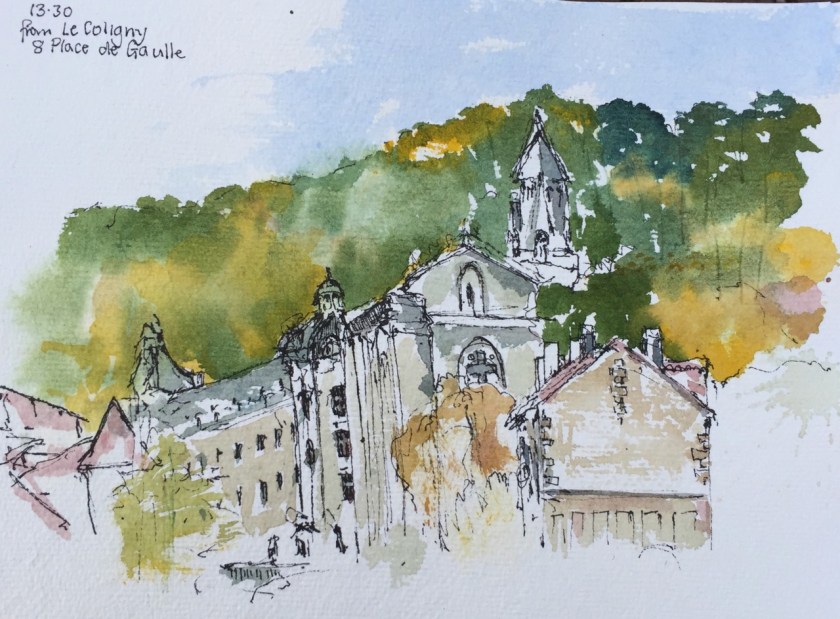
Here’s a view of the abbey from the restaurant where we had lunch:
I sketched in Périgord last year. See this link: Montcigoux
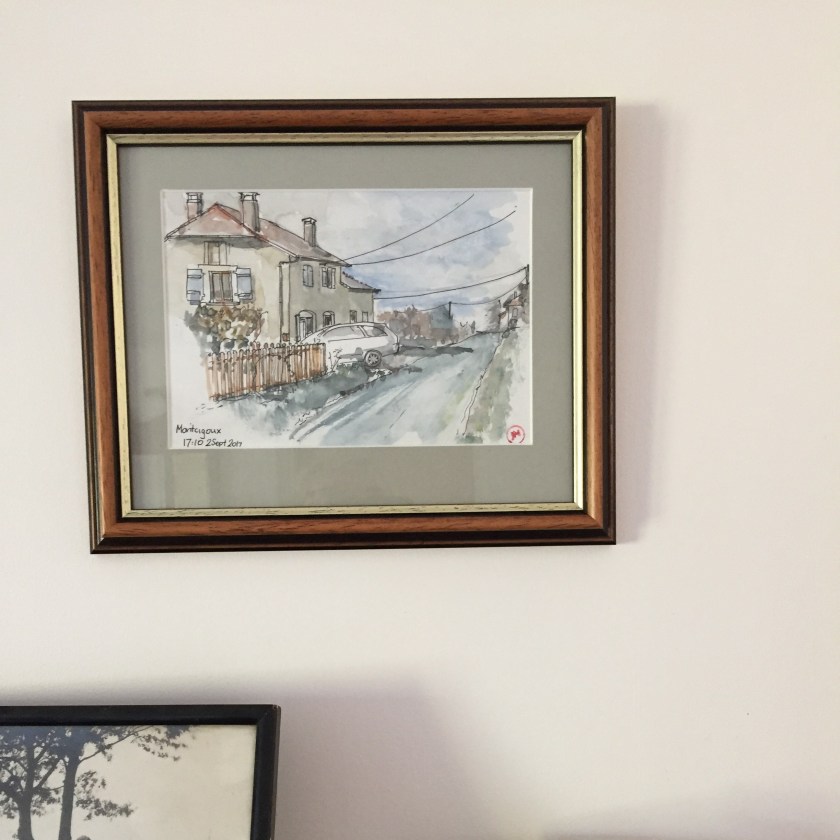
One of my pictures is now on the wall of the house it depicts.
Original Watercolour framed
Click a button below to share this post online, email it, or print it:
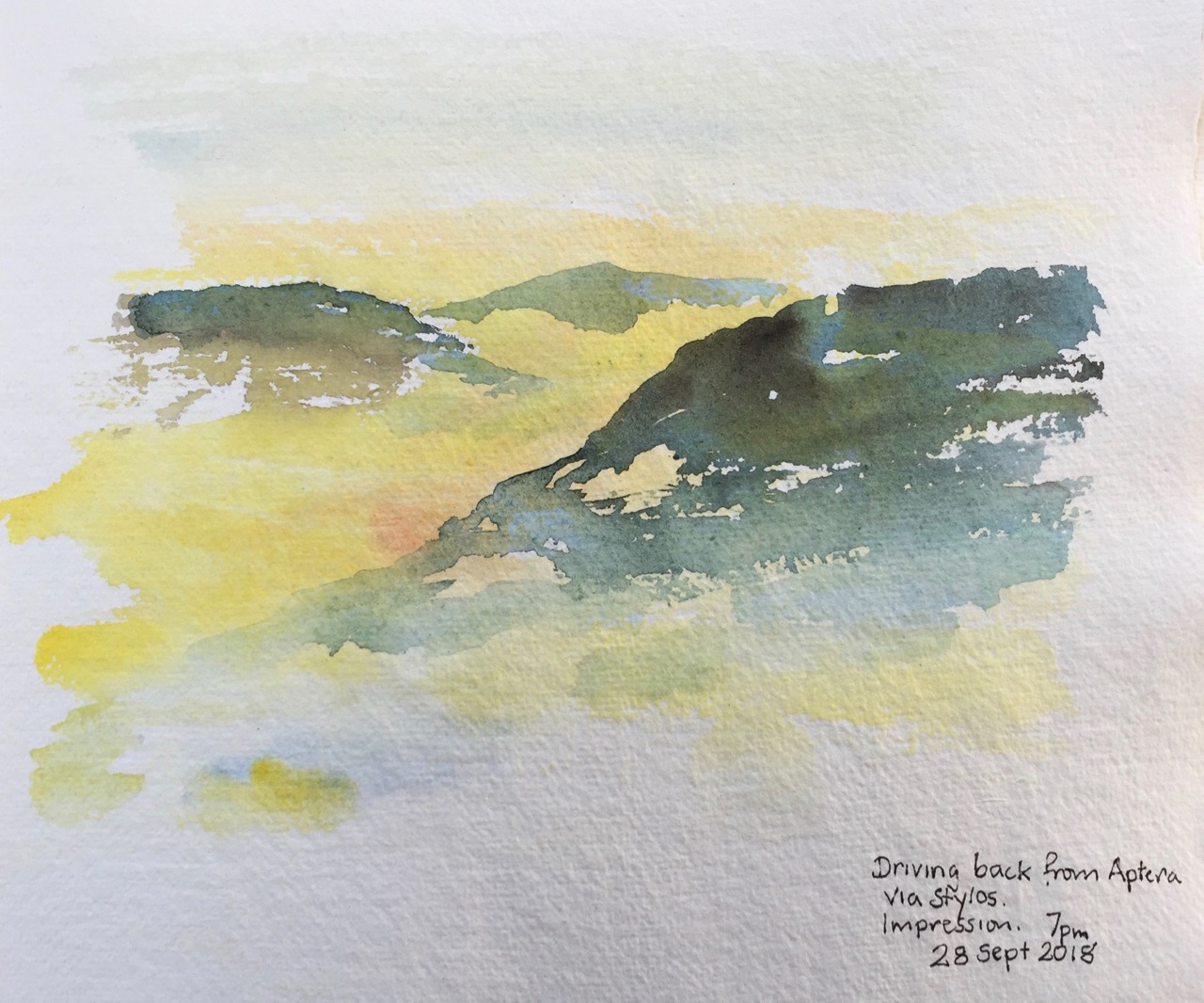
I was experimental. I had a large sketchbook with rough pages, given to me for my birthday. I turned over the pages and tried things.
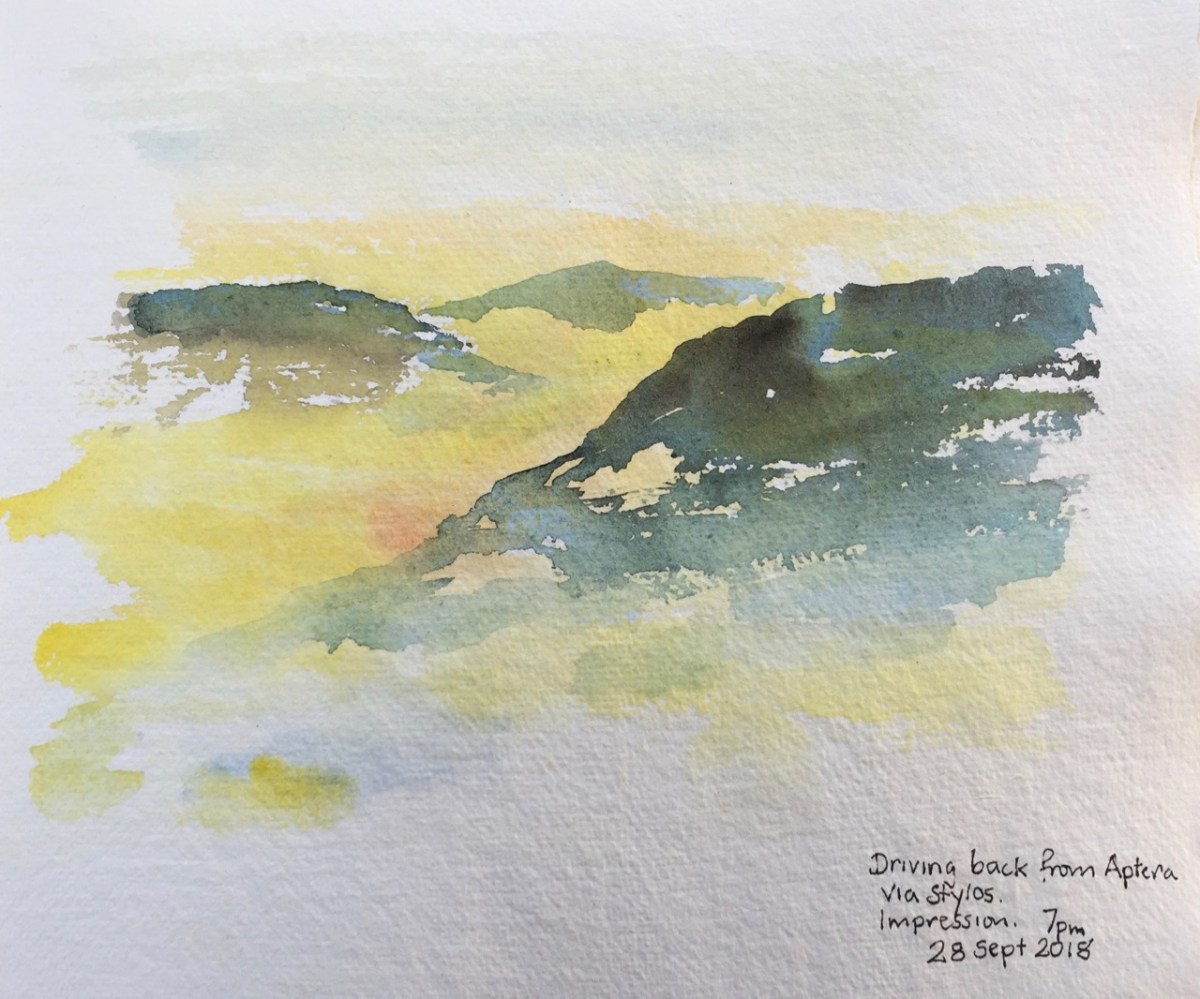
As we drove back from Aptera one evening, the sun was setting and fired up the mist between the hills. Back at the kitchen table, I had a go:
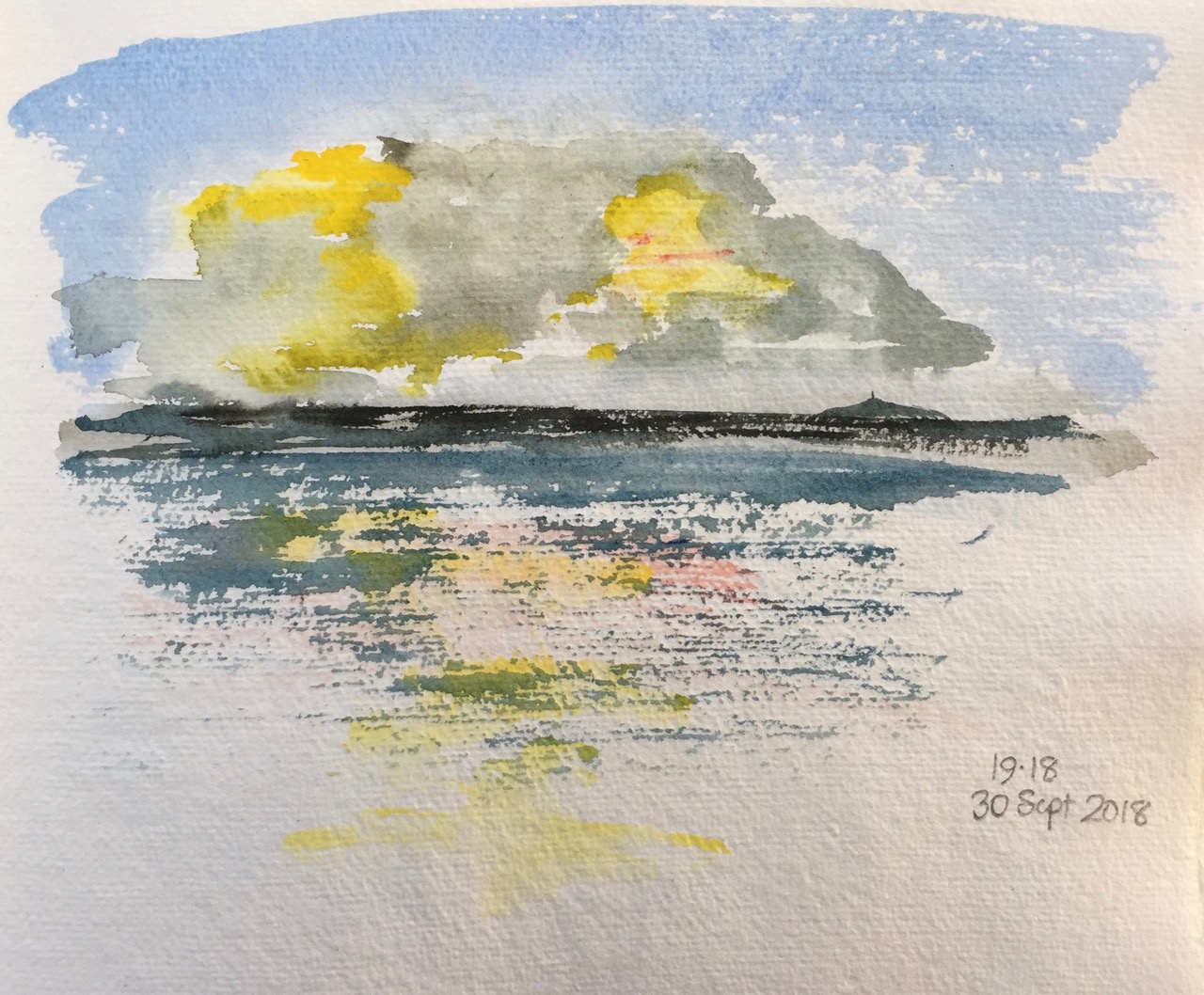
It was stormy. We had some amazing sunsets.
I did a lot of quick sketches with some special Koh-i-noor sketching pencils that friends brought me from the Czech Republic:
Sketching the Hill over Souda
The hill over Souda
John’s boots
People at the airport
John resting
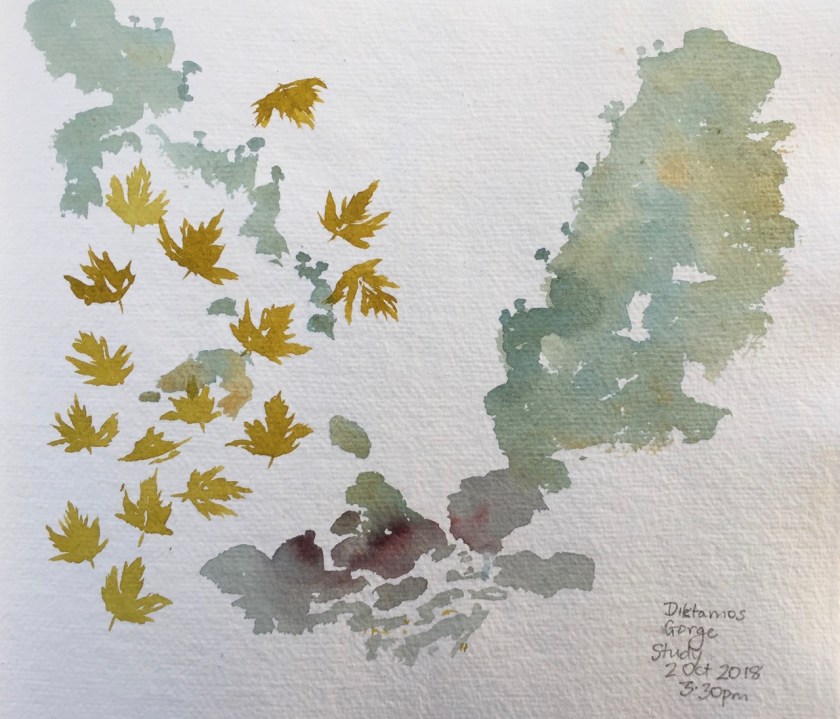
We walked up the Diktamos gorge. It is deep and leafy. Here is an impression drawn that evening, trying to show you the dark depths of the gorge, the high rocky walls, and the leaves. John is shown, sitting on a stone, bottom centre left.
On the way to the airport we stopped in Agia Triada. I had 45 minutes to do a sketch. This is pen and ink.
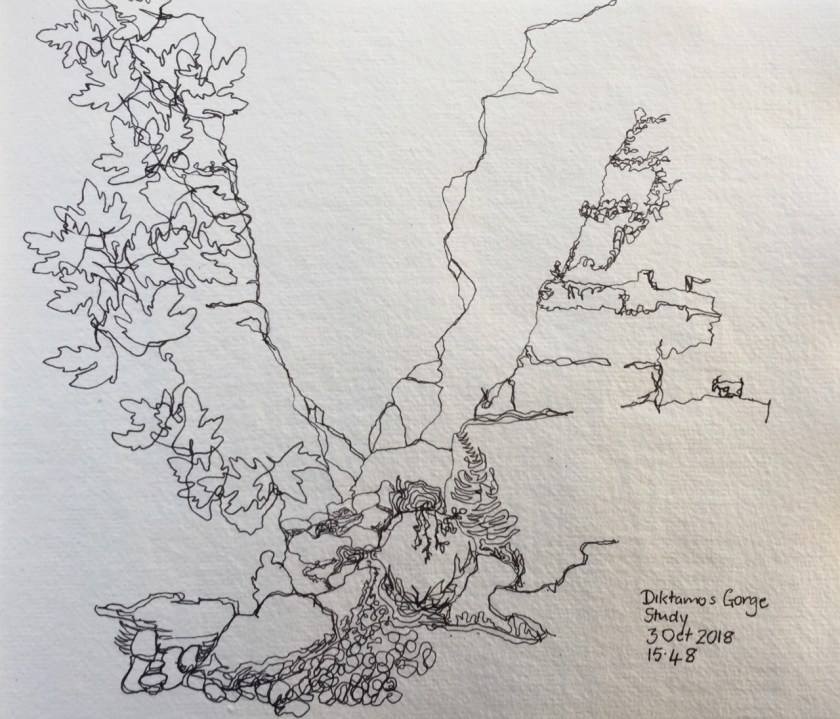
It’s a three hour flight. One has to do something. I revisited the Diktamos gorge in pen and ink. The game was to use as few lines as possible, by not taking the pen off the paper. This is 3 lines.
Click a button below to share this post online, email it, or print it:
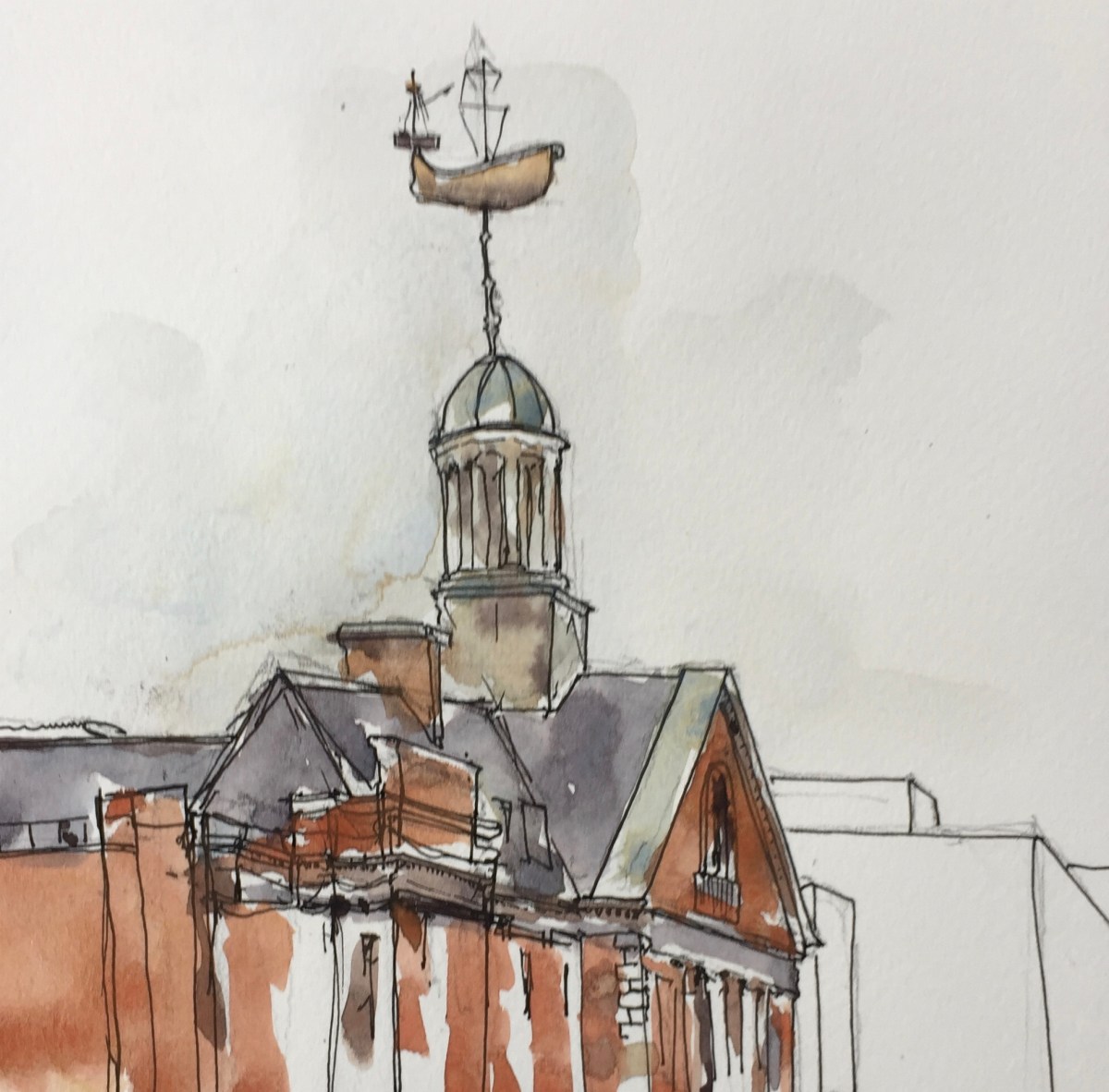
I cycled down Whiston Road last week and spotted this amazing boat, high up above the roofs. Today I returned to sketch it, and investigate further.
Whiston Road E2 is in Hackney, going off the Queensbridge Road.
I sketched outside Bryant Court. Then I went down “Swimmers Lane” and had a look at the back of the building. It’s a huge place. Clearly a former swimming pool, hence, presumably, Swimmers Lane.
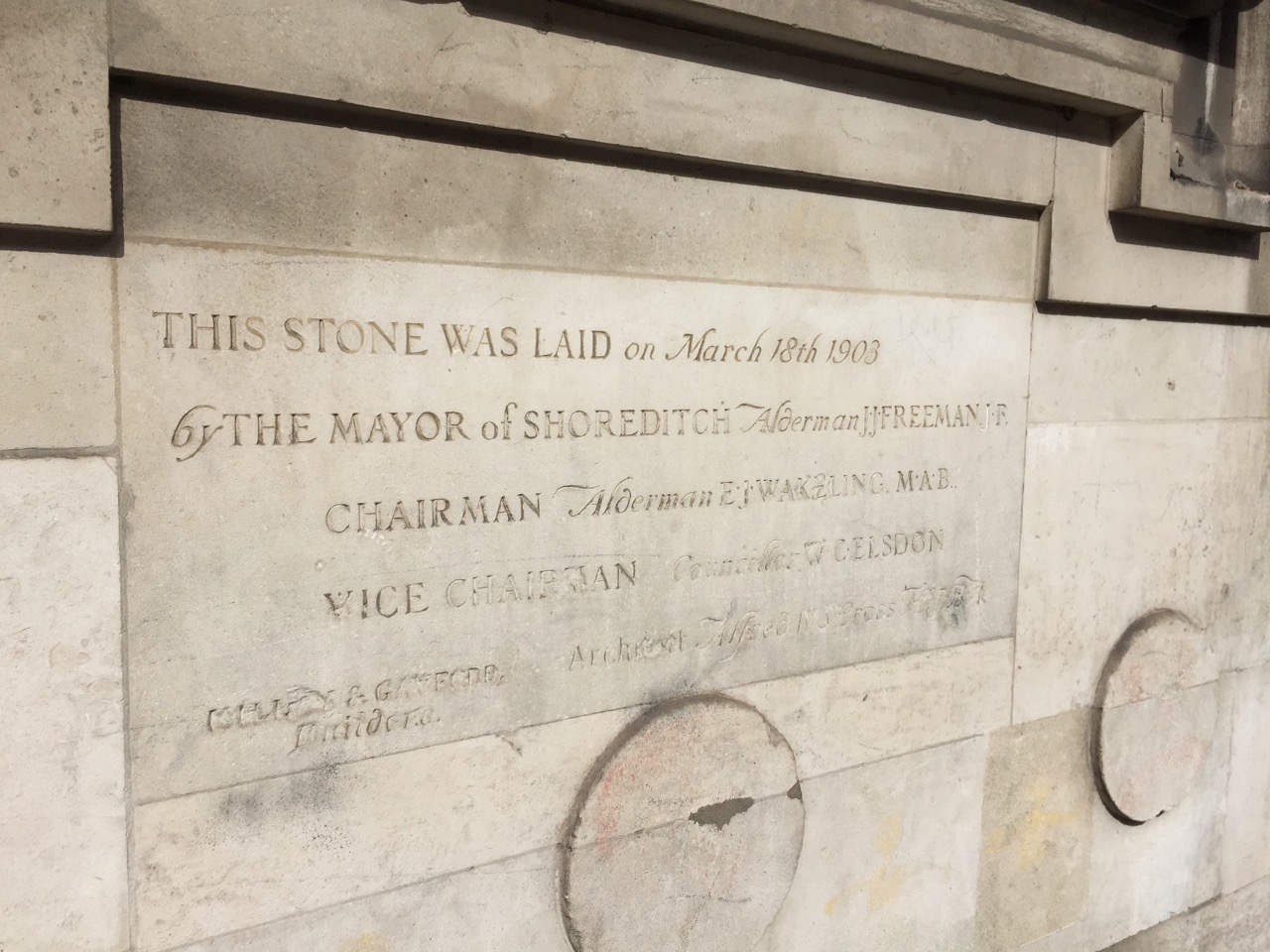
On the front is the Foundation stone, laid in 1903.
Foundation Stone (click to enlarge image)
There are also huge entrance doors labelled “MEN” and “WOMEN”.
The whole place is sadly neglected.
I went and looked at the ship from the other side.
Boat on Haggerston Baths, from the Queensbridge Road
While I was drawing, birds settled on the rigging.
At home, I found that this is “Haggeston Baths”. It closed in 2000, due to underfunding and neglect. Many were sad and they protested. In November 2017 Hackney Council accepted a proposal to redevelop the building. But it will not be a pool any more. Here is the Mayor of Hackney, Philip Glanville, writing on the Hackney website November 28th 2017:
“Hackney Council has chosen a preferred bidder to refurbish and redevelop the Haggerston Baths building. The agreement to lease will allow Castleforge Partners to apply for listed building consent and planning permission for a scheme to incorporate space for businesses, shops and a café, as well as community uses such as a clinic, health centre, day care centre or public hall.”
Mr Glanville continues:
“I know that local residents were keen to restore the swimming pool, so the council spent the best part of a year negotiating with a bidder whose proposals included a pool. As I said when we consulted on the shortlist, we could not get the reassurances we needed that the scheme with a pool would actually be delivered.”
He makes no mention of the boat. What will happen to it?
Stone, art, in Swimmers Lane
Someone found some money for strange stone artworks, clearly referencing the pool.
Both sketches done on location, the first one about an hour, the second one 35minutes.
Click a button below to share this post online, email it, or print it:
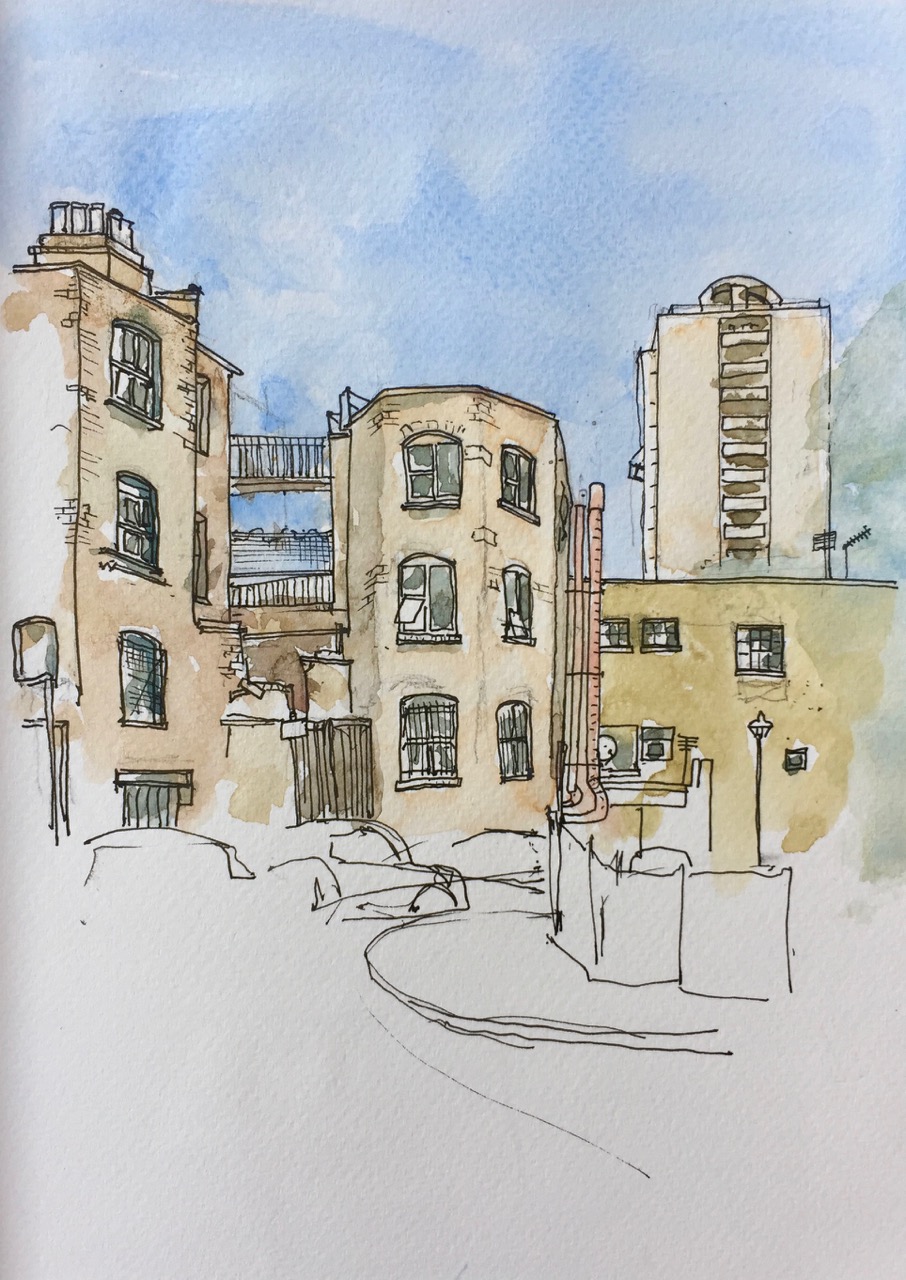
Here is a view looking North from Seward Street EC1 up the wonderfully named “Mount Mills Road”.
On the left are the backs of houses which front onto the Goswell Road. See the aerial walkways!
These houses are very old and much altered, somewhat provisionally. On the extreme left, for example, a drainpipe seems to have been routed right across a door. No doubt they said to each other “We’ll sort that out later.” Below the window on the second floor is one of those extensible clothes dryers. The vertical red pipes seem to be flues from a café, but it’s difficult to tell.
Turnpike House is part of the “Kings Square Estate” managed by Islington. It has 20 floors and was built in the 1960s as council housing. There is a current renovation programme, which is why there is scaffolding down the left hand edge of the tower in the drawing.
About 1 hour, drawn and coloured on location.
Click a button below to share this post online, email it, or print it:
At the Wellcome Collection there was a special exhibition on colour. It was called “The Pharmacy of Colour”. A short film pointed out that certain substances used as pigments were also used as medicine. A red pigment called lac, produced from grinding up lac insects, was also used as a medicine. Saffron is both a dye and a medicine. And the terribly poisonous Red Lead was also cheerfully described as a red paint on medieval manuscripts, mixed with egg yolk. Don’t lick the pages. It was also, alarmingly, used for treating intestinal disorders. A cabinet held jars of bright pigment, well protected behind glass. Yellow Ochre was there, and Ultramarine Blue, both of which I use. I’ve often wondered about the colours in my box, and the real chemistry behind the names.
Interesting though this was, it didn’t take long to look at, and it had been a long walk to the Wellcome Collection. So I went to their other current exhibition “Teeth”. This was mainly about dentistry through the ages. The images were alarming and I was unprepared. I found some of the exhibits calming though. Here is “Junior Dental Chair” from the 1950s. It reminds me of my very first dentist, Mr Gant. He must have had one of these. I can almost smell it, the leather at the back, and that hard, sculpted, bow in which you rested your head.
There were many people drawing in there. An art class, perhaps.
The equipment was strangely humanoid.
I read that “Patients from the 1960s and 1970s, when amalgam filling use peaked, are known to dentists as the “heavy metal generation”. That would be me then. Amalgam is mercury, silver, tin and copper.
I also read that “Tooth decay is the number one reason for child admissions to hospital.” I paused at that statistic. The woman next to me was reading it too. I commented that I found it surprising. She said it was because “People can’t afford to take their children to the dentist.” She spoke with authority. Dental charges have gone up, she explained. The hospital is part of the NHS and so is free of charge at the point of use. “So people wait until it’s really bad, and then take the child to A&E,” she said, speaking as though a practitioner. She smiled grimly and walked away. A strong woman, upright, informed, articulate, opinionated, caring. A dentist herself, perhaps, or an NHS administrator, or medical person, I thought.
Click a button below to share this post online, email it, or print it:
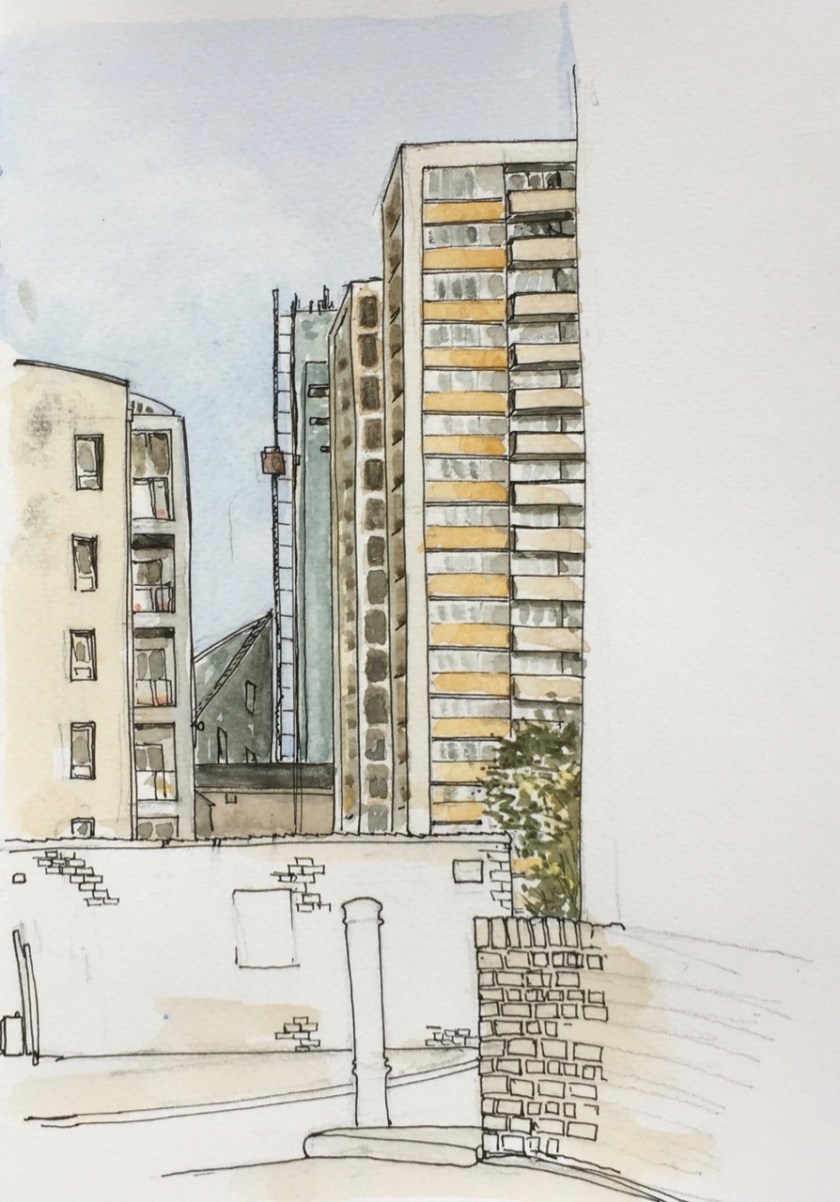
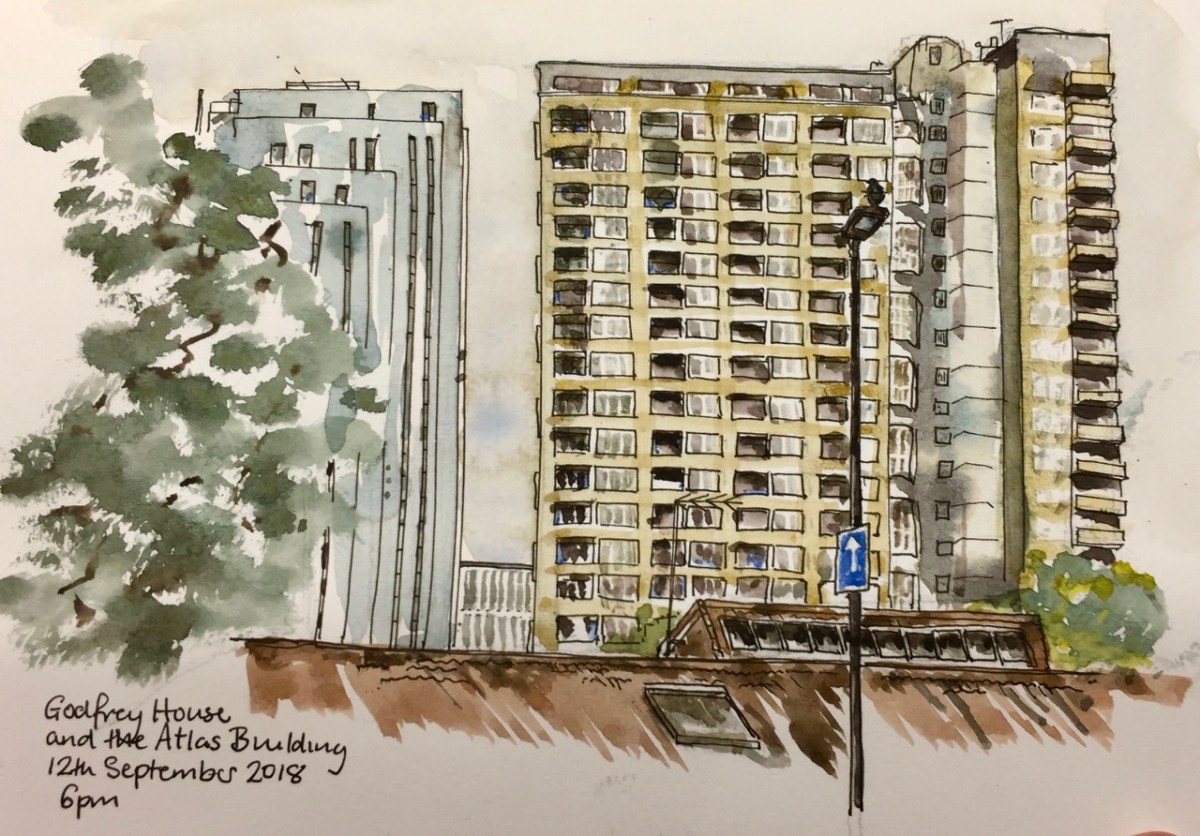
On the right is Godfrey House, Bath Street, Islington, part of the St Luke’s Estate managed by the London Borough of Islington. It’s former “council housing” built in 1965. Today many of the flats are privately owned, as is evident from the number listed for sale.
On the left is the Atlas Building, on City Road, nearing completion. Atlas is taller than Godfrey House, but further away. Atlas Building is 52 floors, of which 38 are residential, Godfrey House is 21 floors.
“Atlas epitomises luxury-living in an exciting and vibrant urban landscape. Standing tall with 38 residential floors of exquisite apartments, Atlas stretches across London’s prominent skyline” (from the Atlas Building website)
In the foreground is the roof of Saint Luke’s Church of England School.
I drew this picture sitting on a stone in Radnor Street Gardens, off Lizard Street. After a while I noticed that the place smelt of dog excrement. It has rained recently, after a dry spell.
At 6pm a personal training session started behind me. A large man was training a slim woman. They were doing kick-boxing. Between rounds, she told him about government procedures to find out about your earned income, and thus check your tax payments. They can access your bank accounts, she warned him. He laughed and said, “Hey, that’s not making me feel good. I thought you’d have some good news for me.”
“Tower Block UKis a project supported by the Heritage Lottery Fund, bringing together public engagement and an openly-licensed image archive in an attempt to emphasise the social and architectural importance of tower blocks, and to frame multi-storey social housing as a coherent and accessible nationwide heritage.”
Here is a link to a Freedom of Information request which gives a very detailed map of the estates in Islington (2010): FOI request from Mr I Agar
Click a button below to share this post online, email it, or print it:


























 I drew this picture sitting on a stone in Radnor Street Gardens, off Lizard Street. After a while I noticed that the place smelt of dog excrement. It has rained recently, after a dry spell.
 Jane Sketching