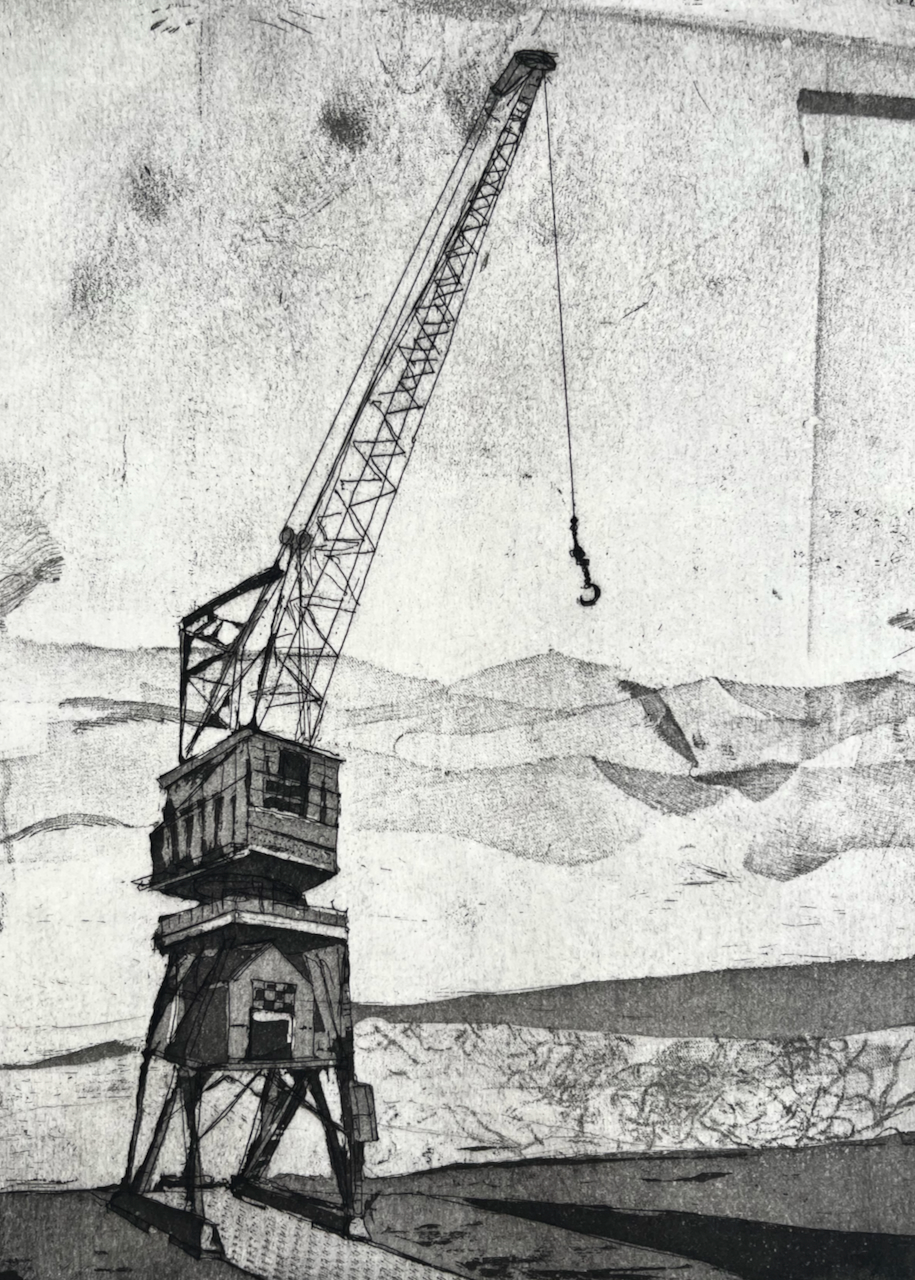
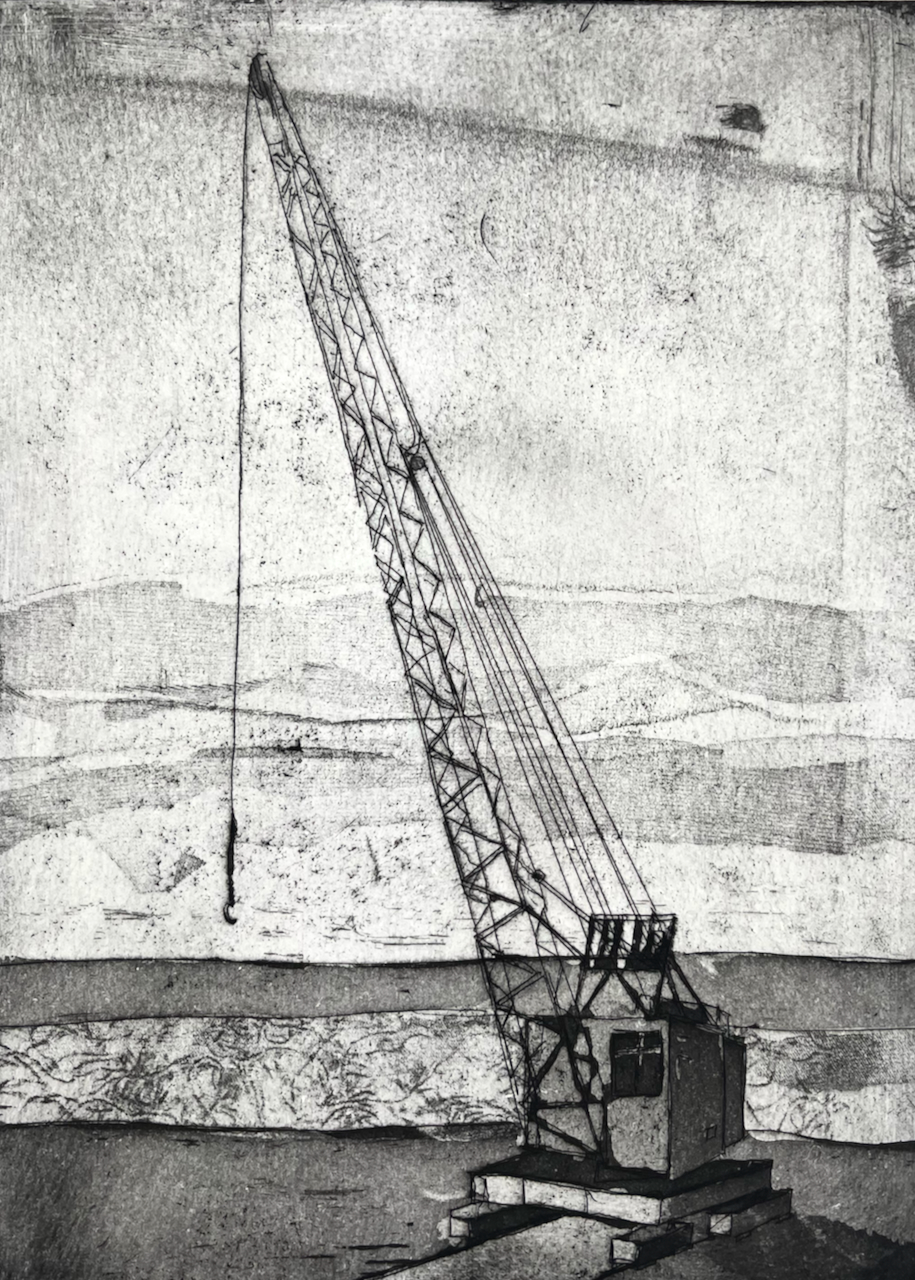
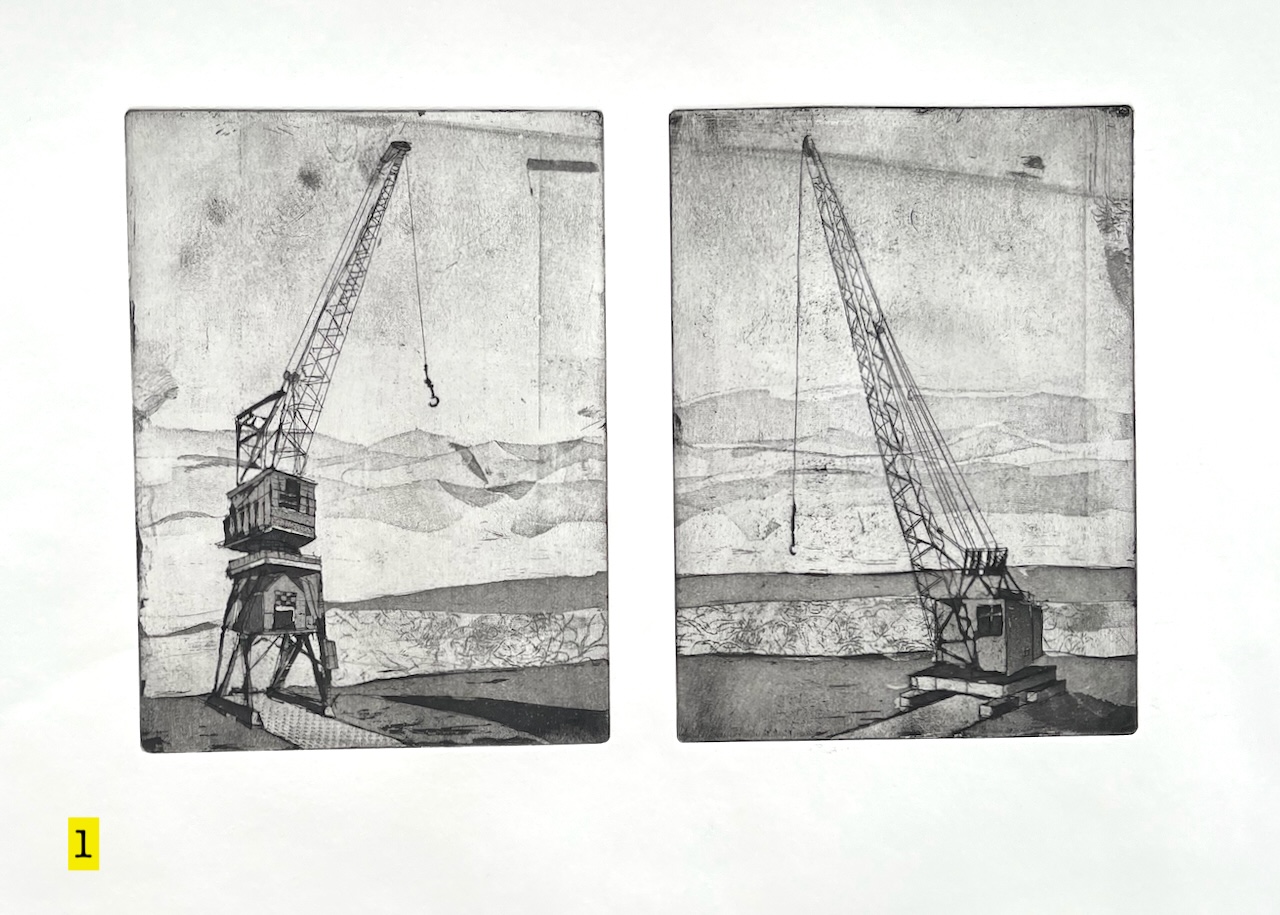
They stand by the river, ready for work. They are old cranes. It’s a long time since they lifted loads. But they hold themselves ready, should the call come. While they wait, they talk to each other.
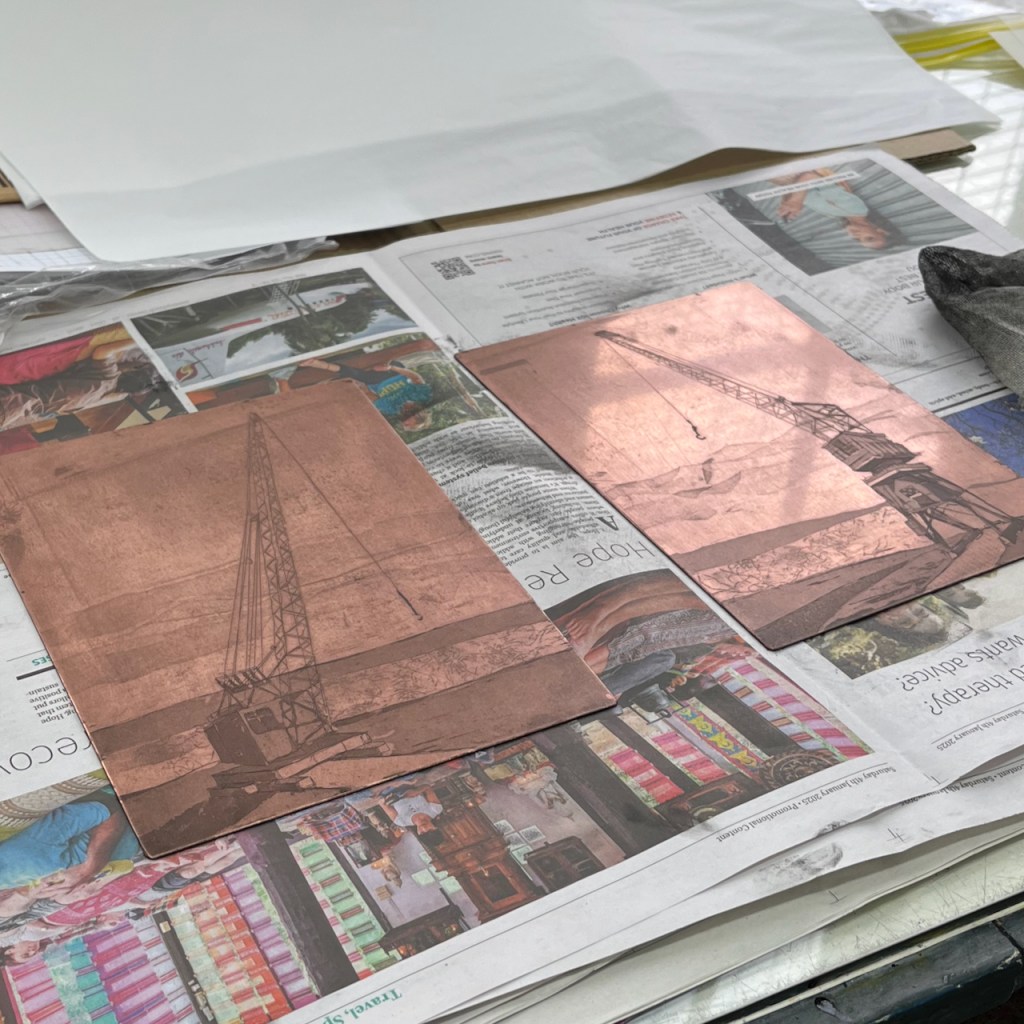
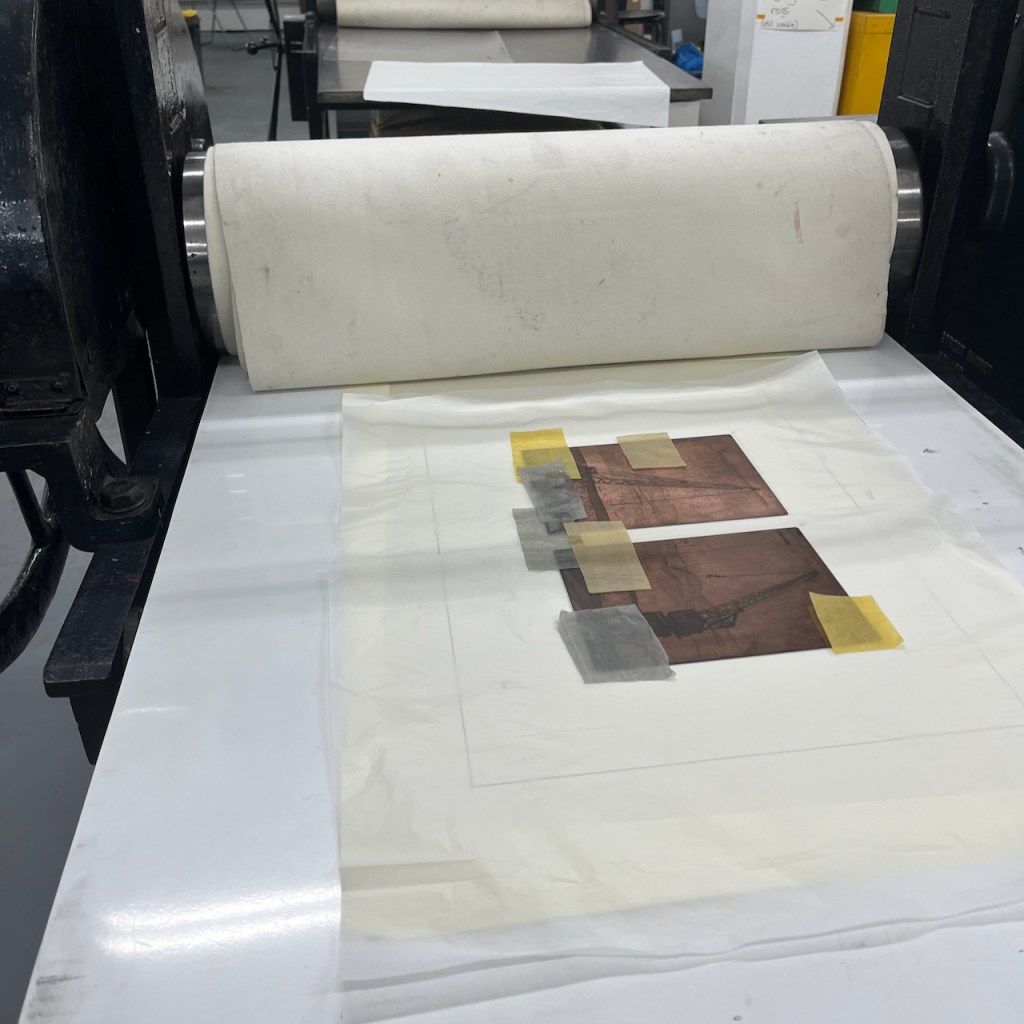
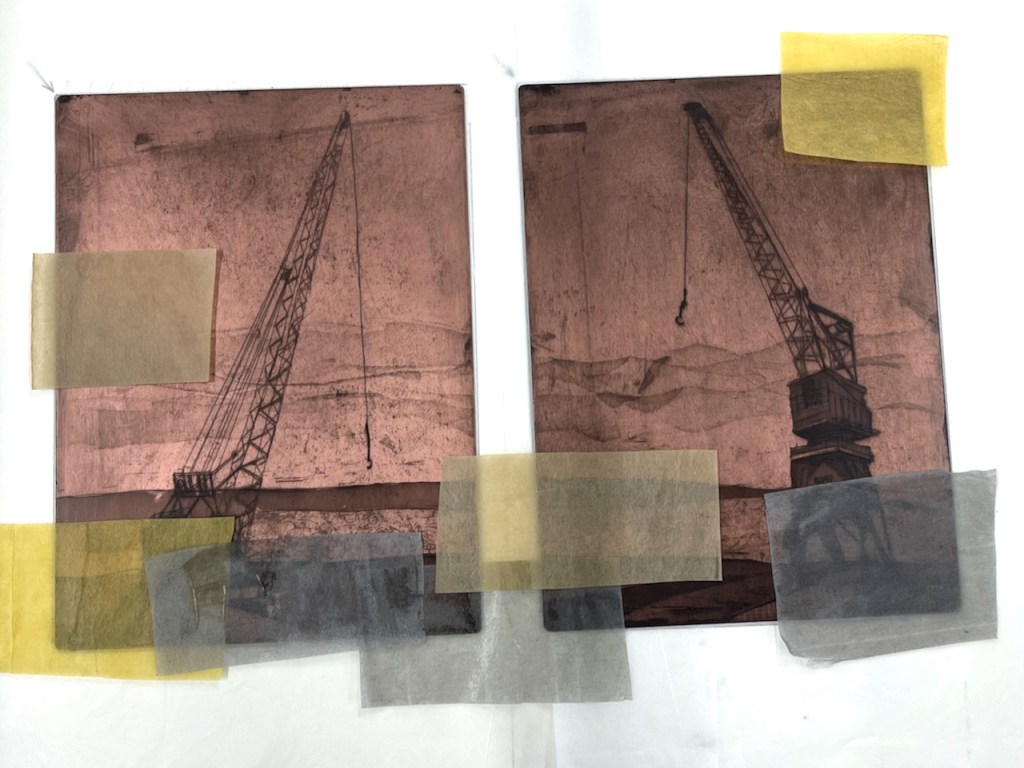
So I put them on the same sheet, they go together through the etching press.
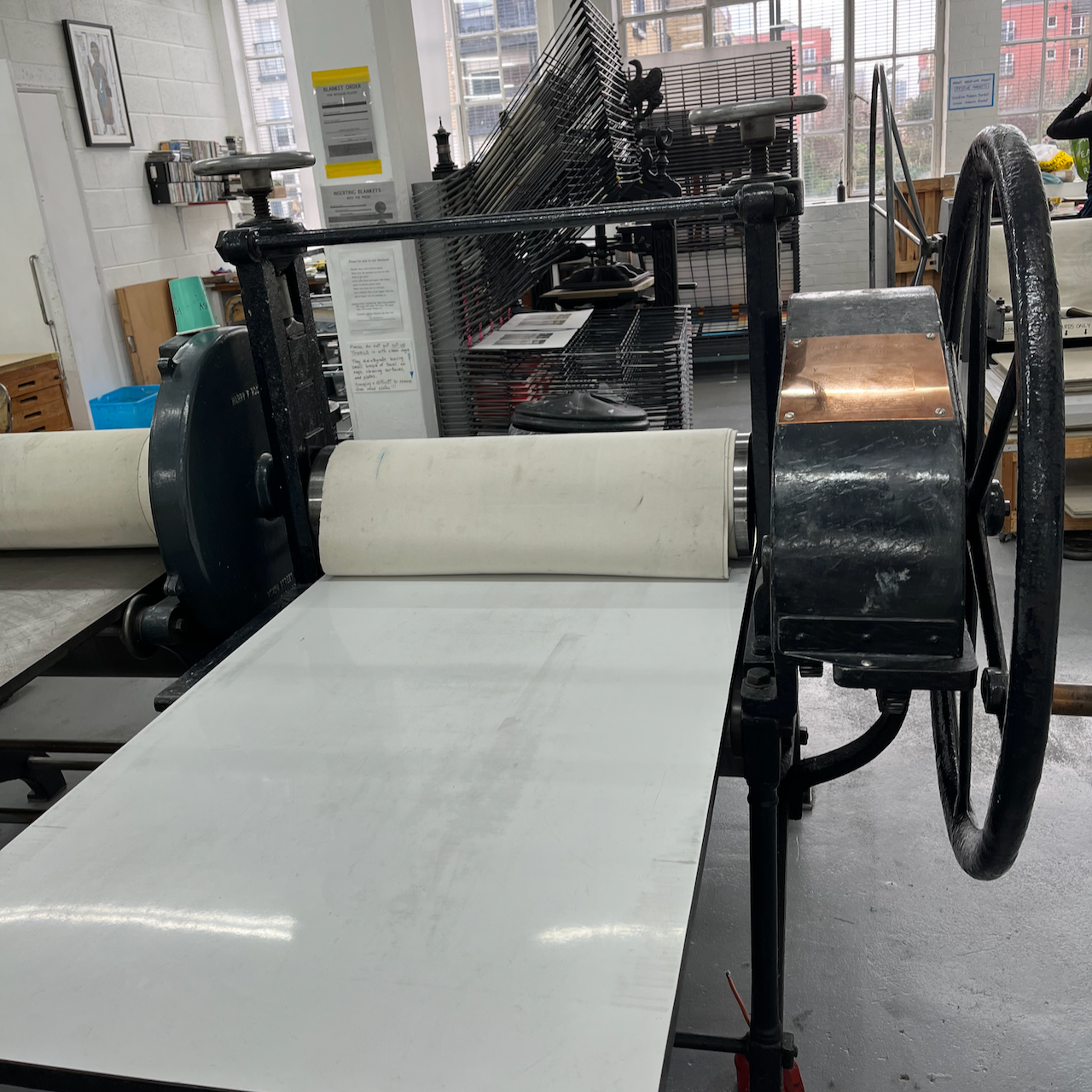
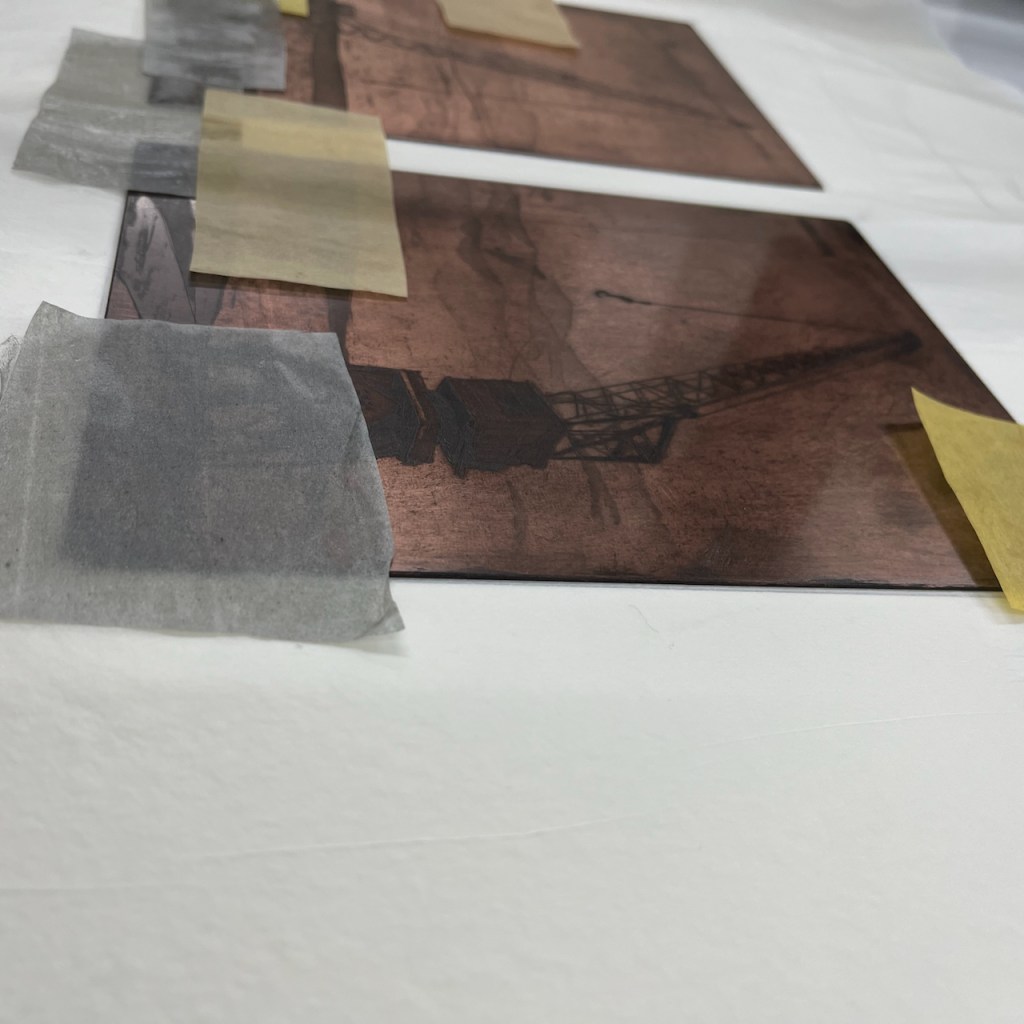
Copper platesPrinting pressPlates on the press (print #2)print #5 drying
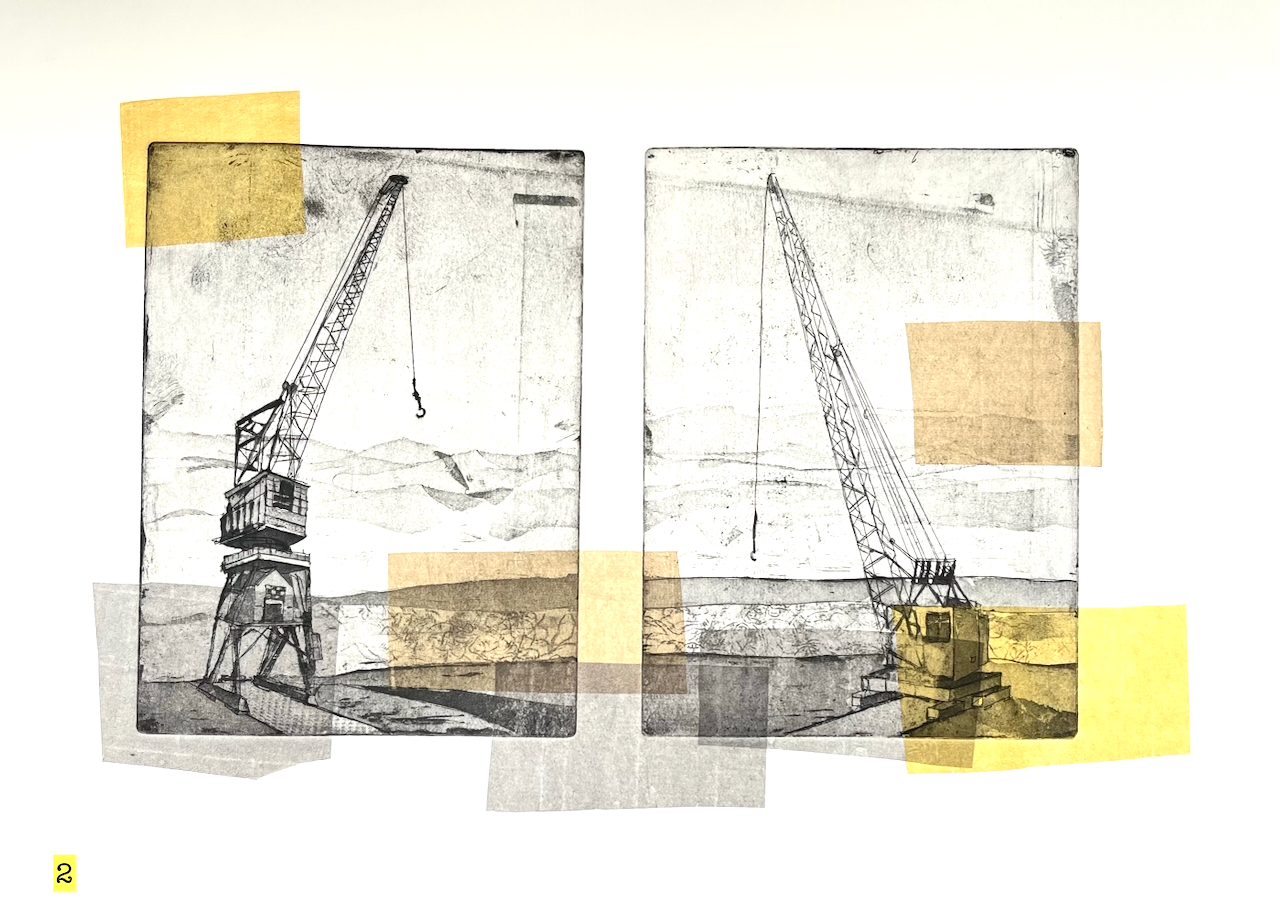
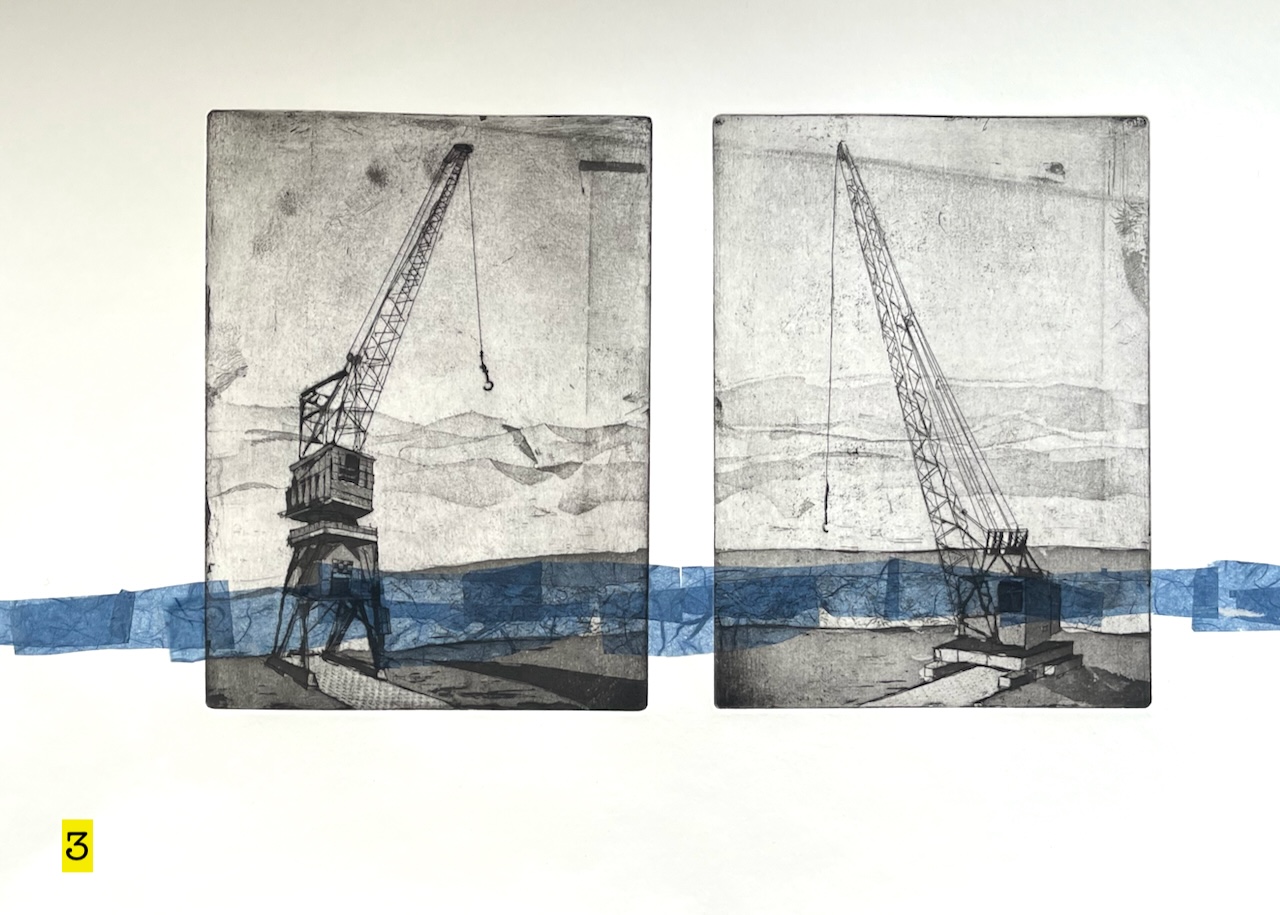
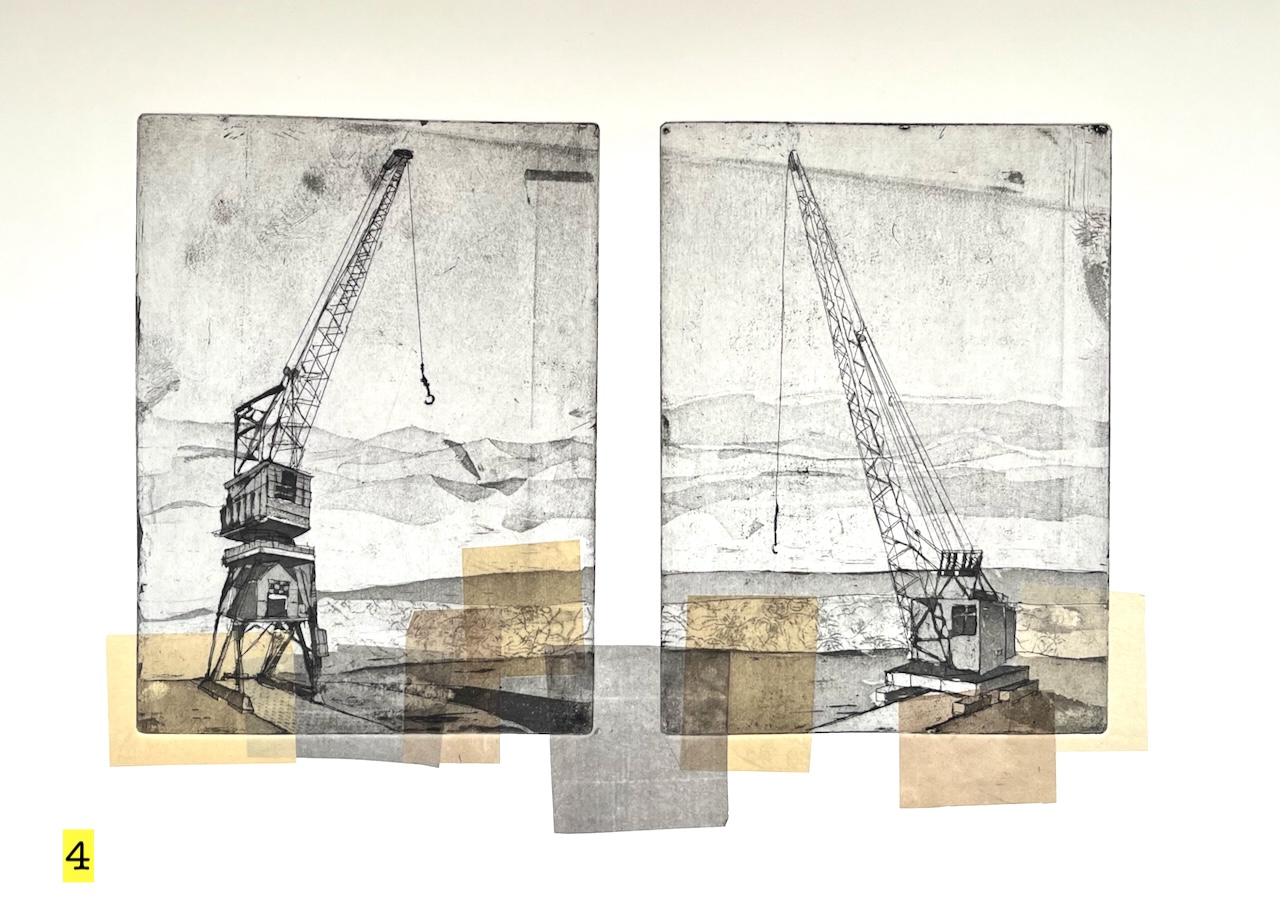
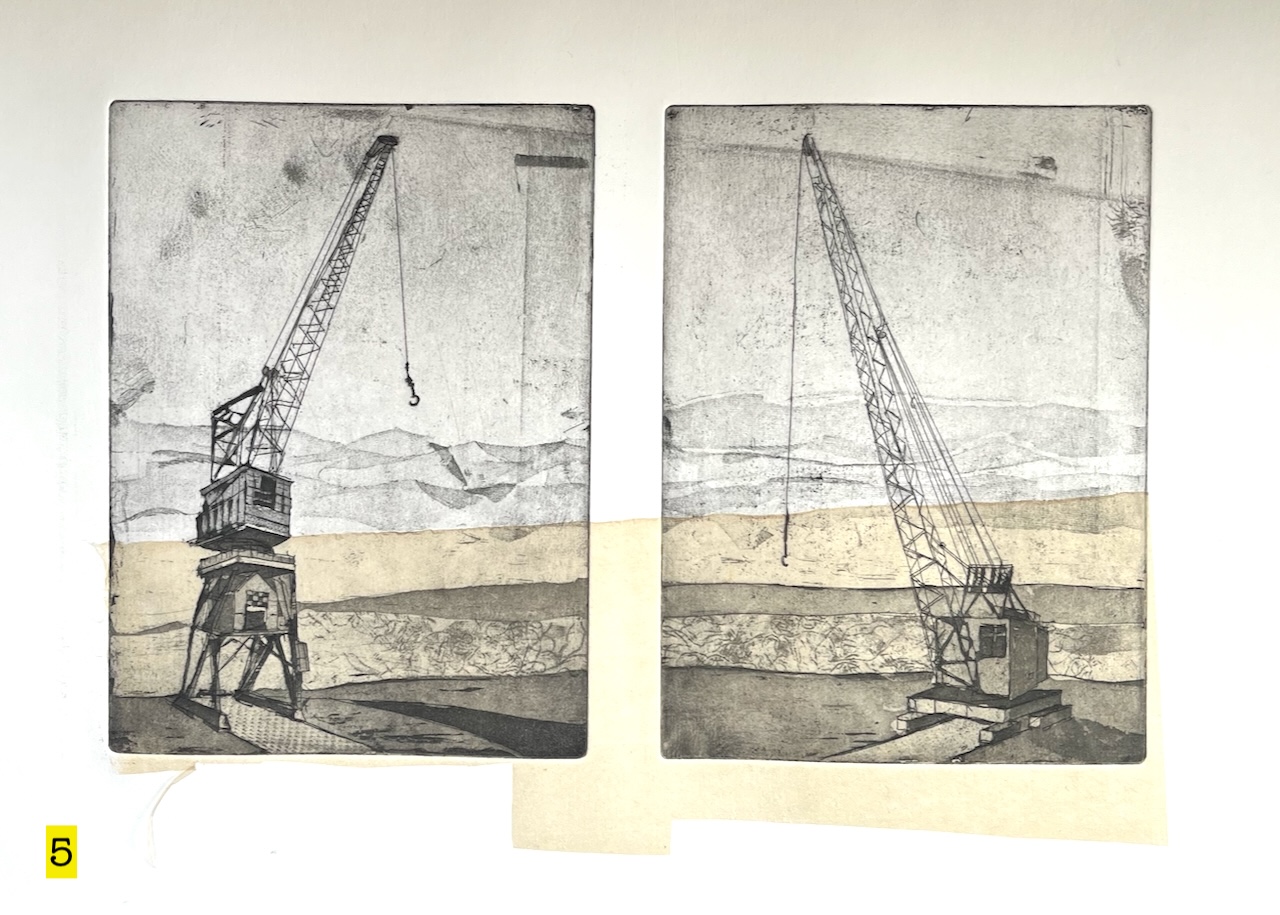
I made five prints of these cranes. The colour is added using the “chine colle” technique.
“Chine collé” means putting paper on top of the plate before it goes into the press. I have written about it on this page.
Here is the paper on top of the plate. It has glue on the top surface. The paper is very lightweight Japanese paper. It’s quite hard to get it to stay in position.
Here is a video of this plate after it’s been through the press:
Printing “Two Cranes”: thanks to friends at East London Printmakers for helping me with the video
I etched the plates and made these prints at East London Printmakers, Stepney. The techniques for making the plates are hard ground, soft ground, aquatint and dry point. The ink is Intaglio Printmakers Shop Mix Bone Black.
The cranes are at The Historic Dockyard, Chatham, Kent ME4 4TE
Let me know if you’d like a “Two Cranes” print? The sheet is about A2 size.
Click a button below to share this post online, email it, or print it:
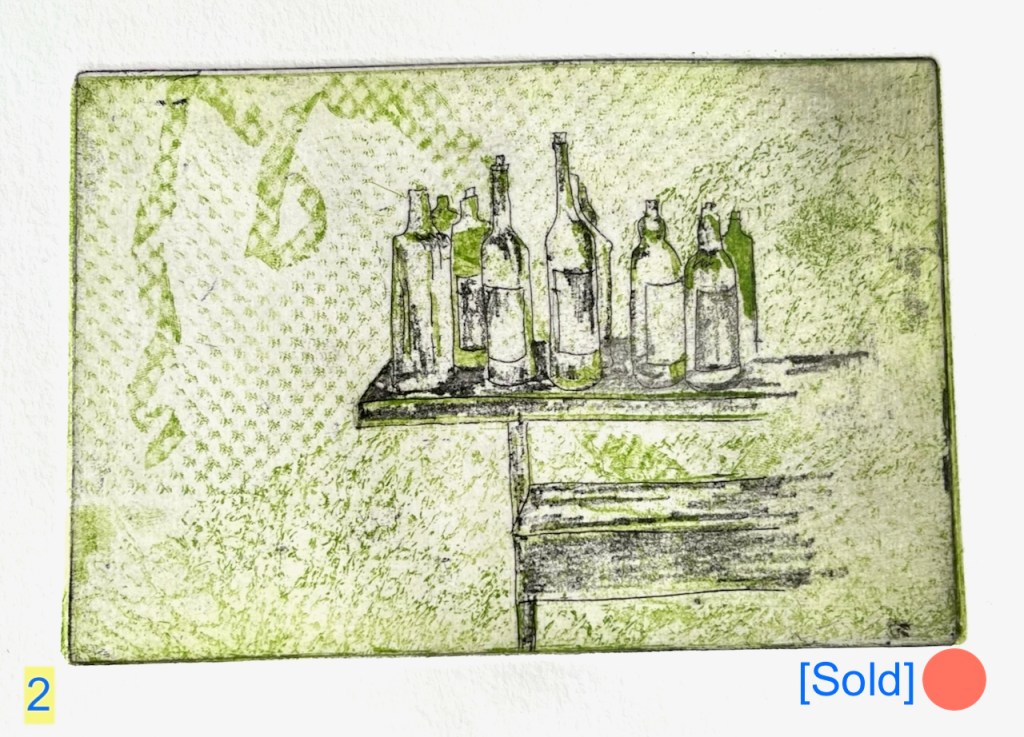
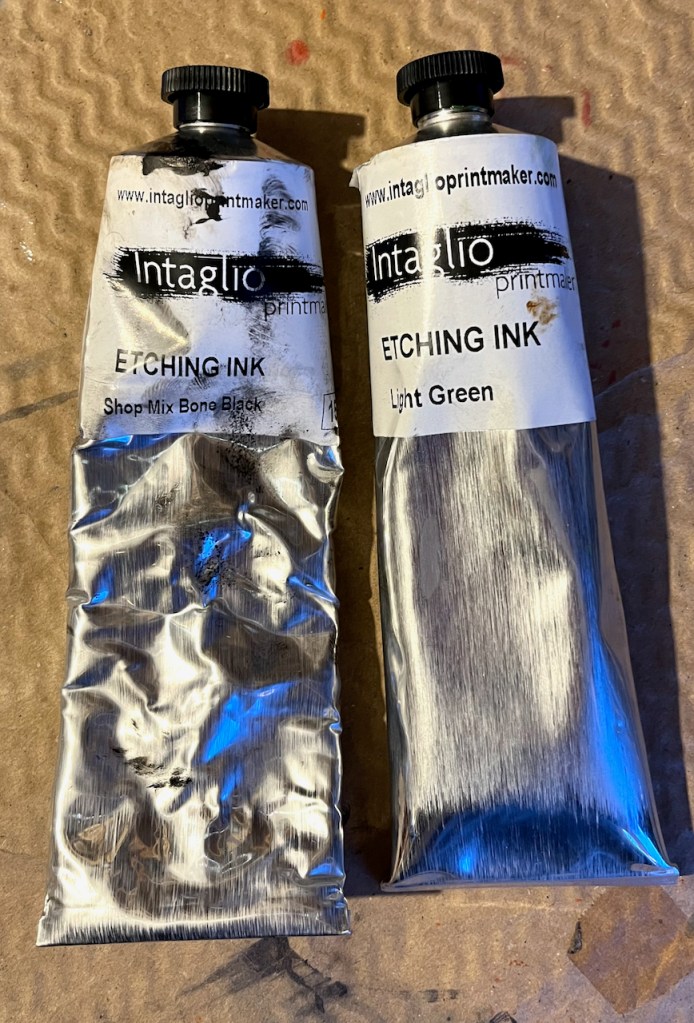
The ink is Intaglio Printmaker etching ink: Bone Black Shop Mix, and Light Green. Print 3 is made from two etched copper plates: first I printed the background pattern using green ink, then I printed the bottles and table, using black ink on another plate.
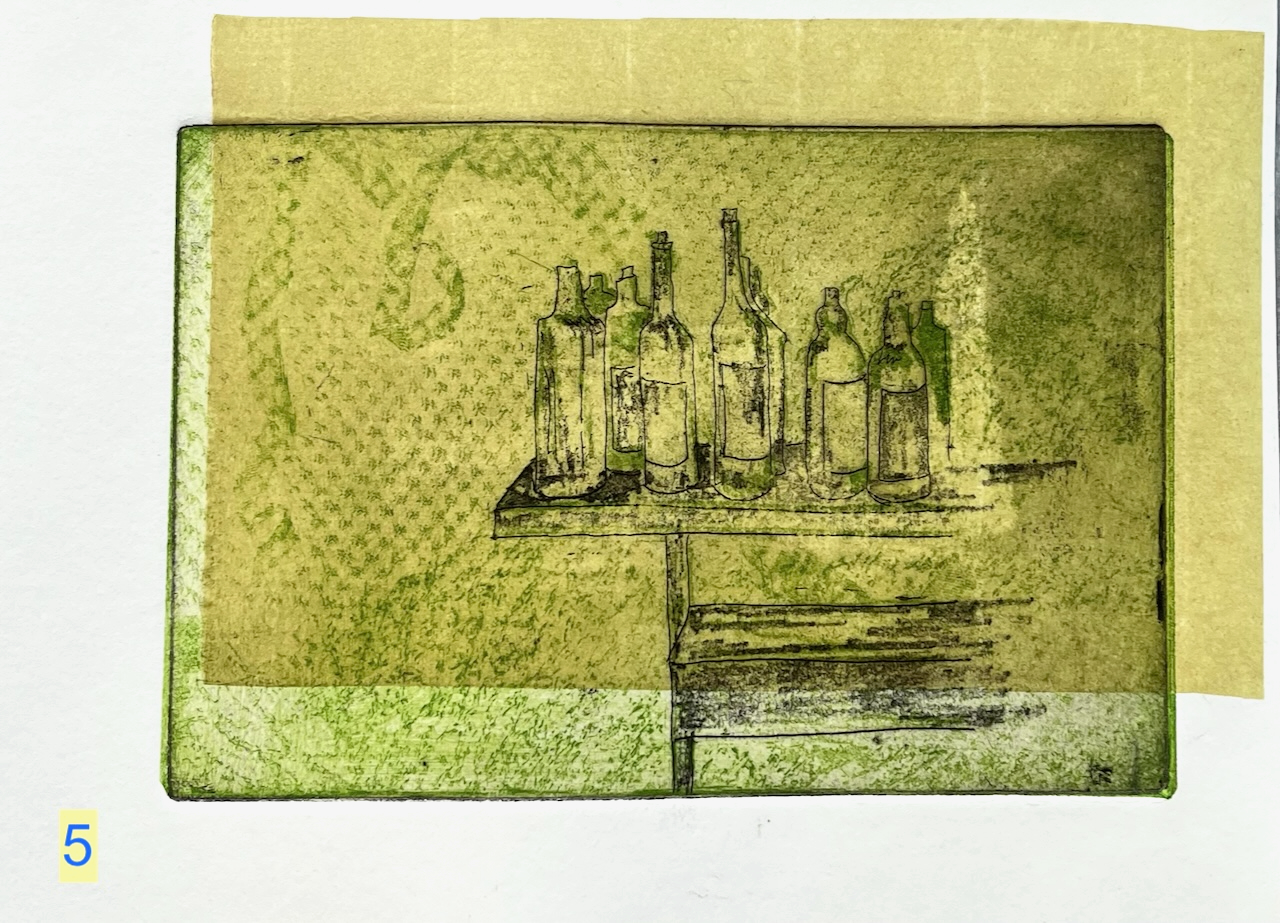
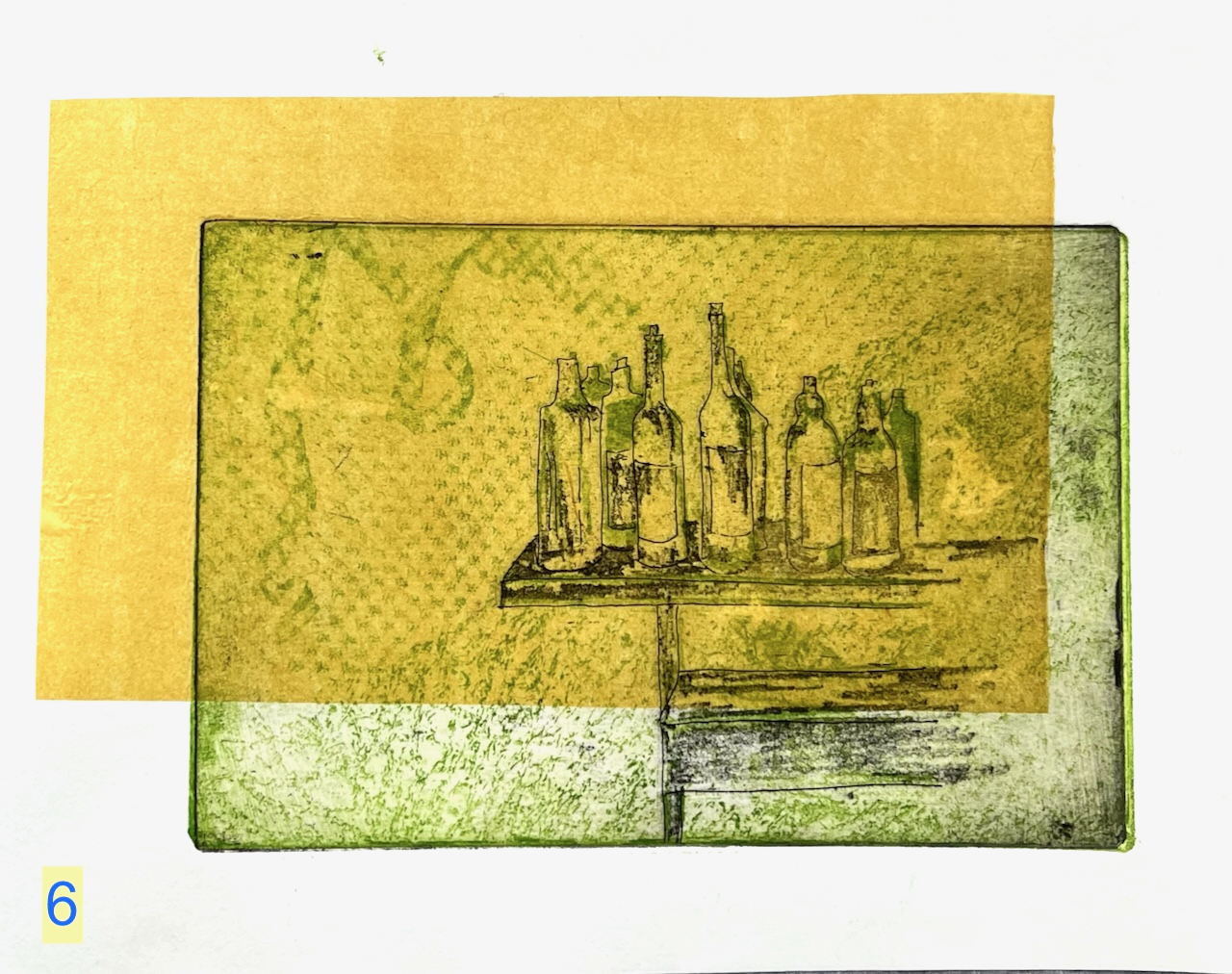
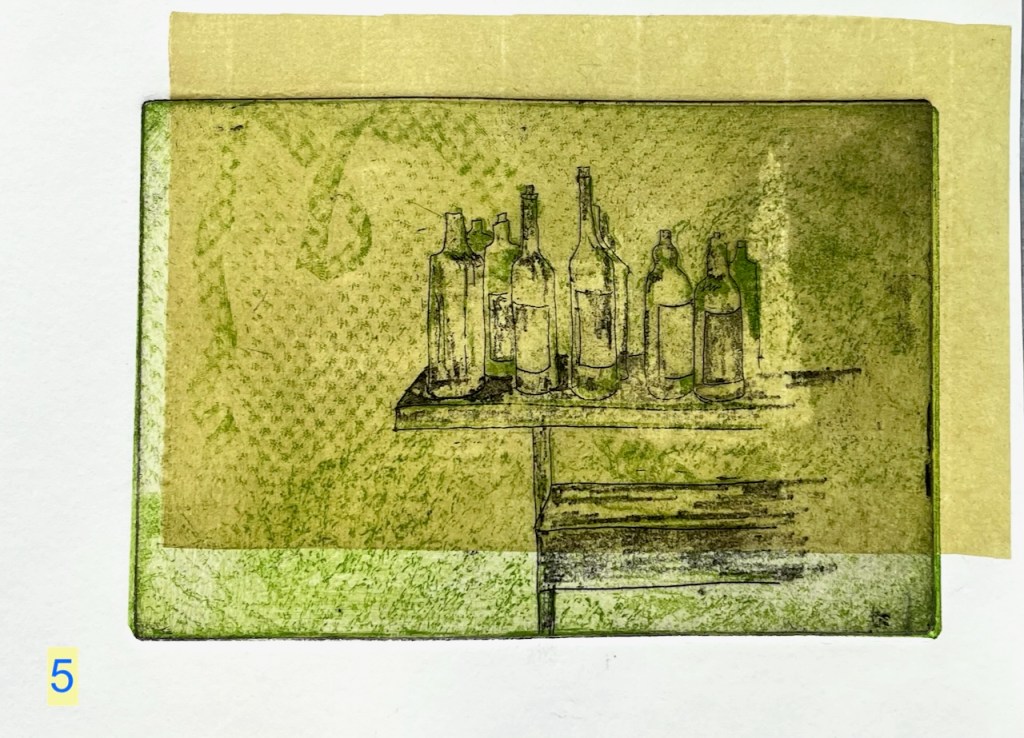
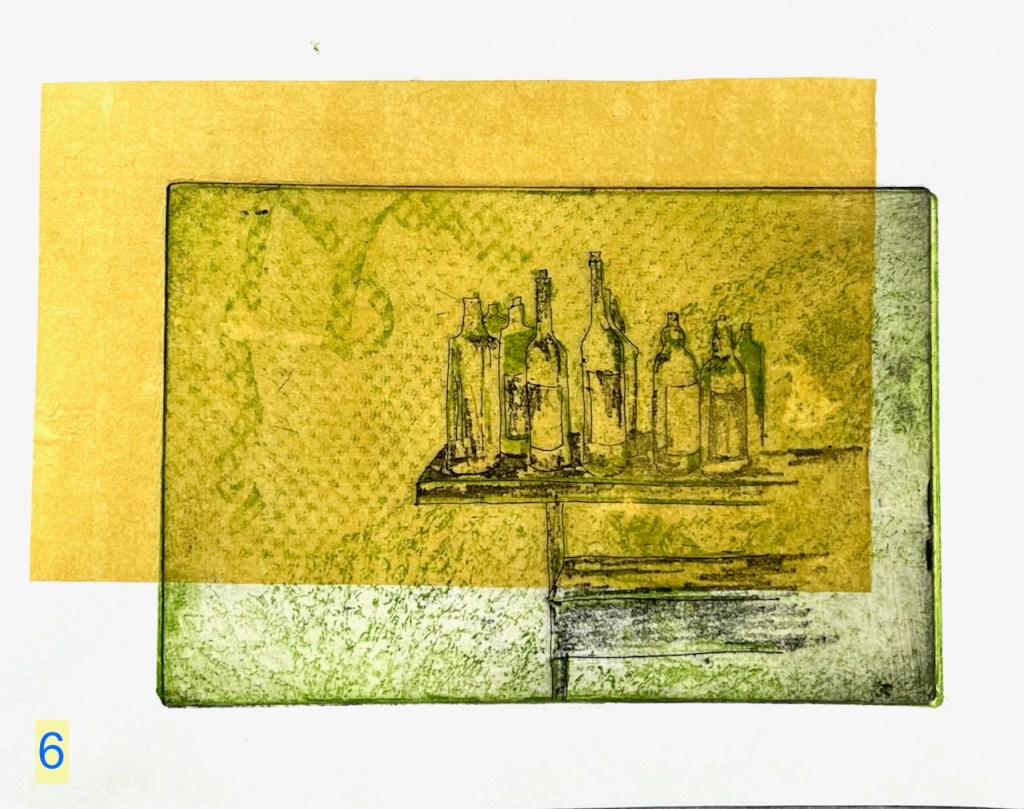
Then I made some more prints adding chine collé. Here are prints 5 and 6.
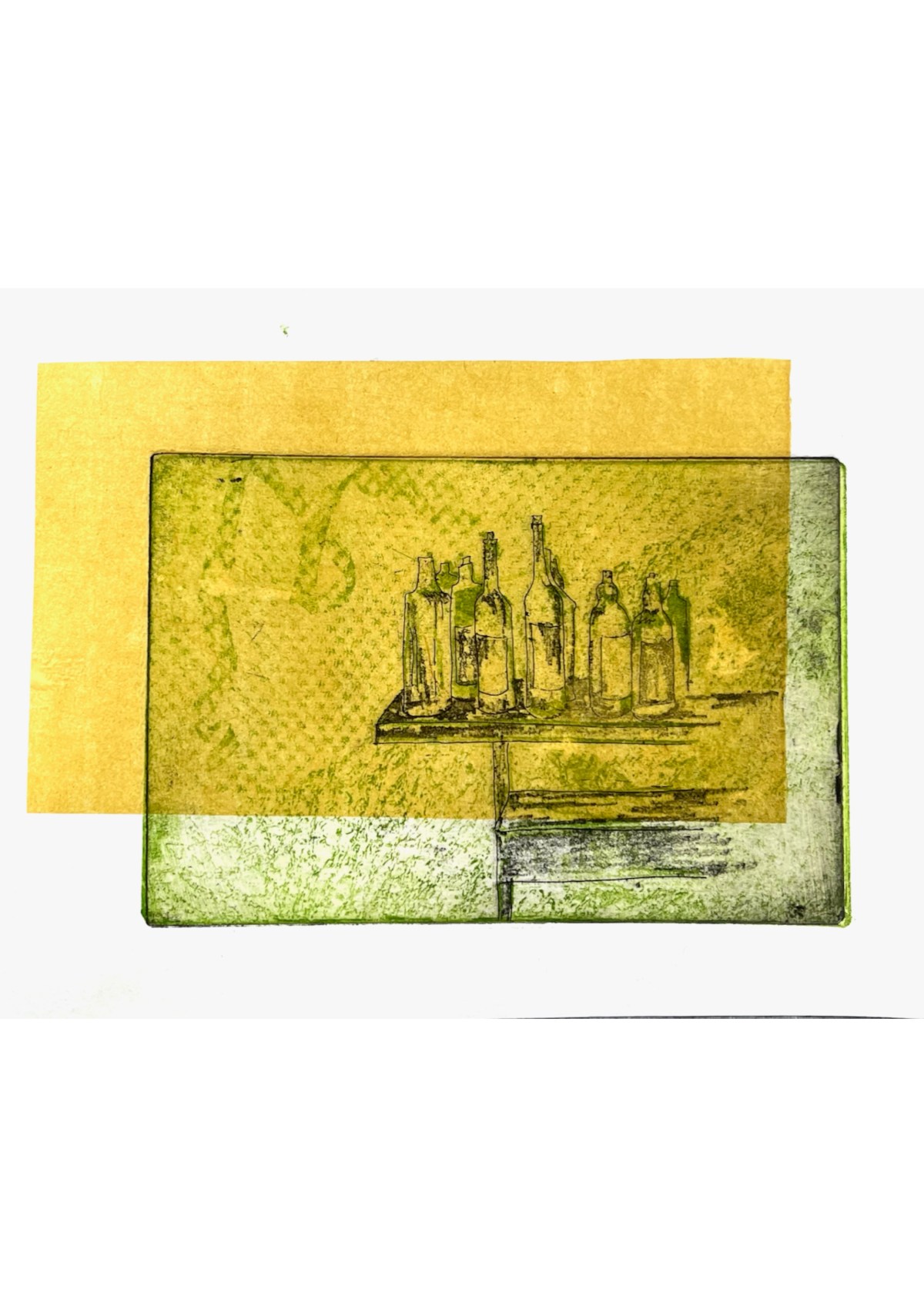
Chine collé is thin paper. I put it on the plate before the print roller goes over. The heavy rollers squeeze the coloured paper onto the picture, giving the yellow rectangles on the images of prints 5 and 6. The yellow rectangles give a sense of depth – maybe you are looking at these bottles through a window. Or maybe there is a window above casting a sunlit patch.
Prints 5 and 6 are made using two plates and chine collé. The process is lengthy and fraught with potential error:
put the glue on the yellow chine collé paper. Let it dry.
ink the green plate, the background
ink the black plate, the foreground. (don’t get them the wrong way round)
put the green plate on the press, inked side up (not inked side down)
put the white paper on top of it (don’t get ink smudges on the white paper)
roll the press across the plate, and keep the end of the paper under the roller so it doesn’t move while you….
…remove the green plate, and replace it with the black plate (get it oriented exactly where the green plate was, and the right way up, and the right way round)
put the glued chine collé paper on the black plate, glue side up (it is very lightweight and drifts about when someone walks past)
let the white print paper fall on top (as it falls it wants to dislodge the layers underneath)
roll the print press
remove the finished print ( examine – did it work?)
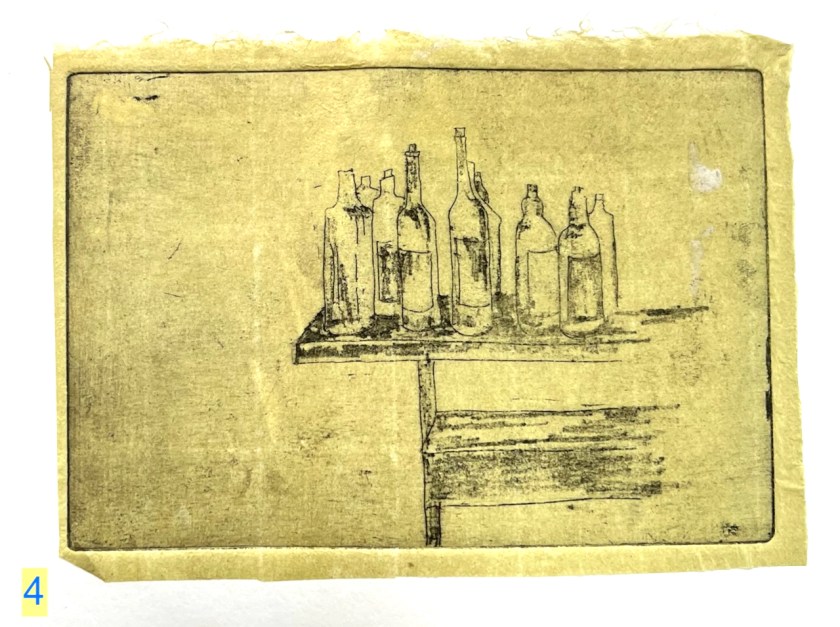
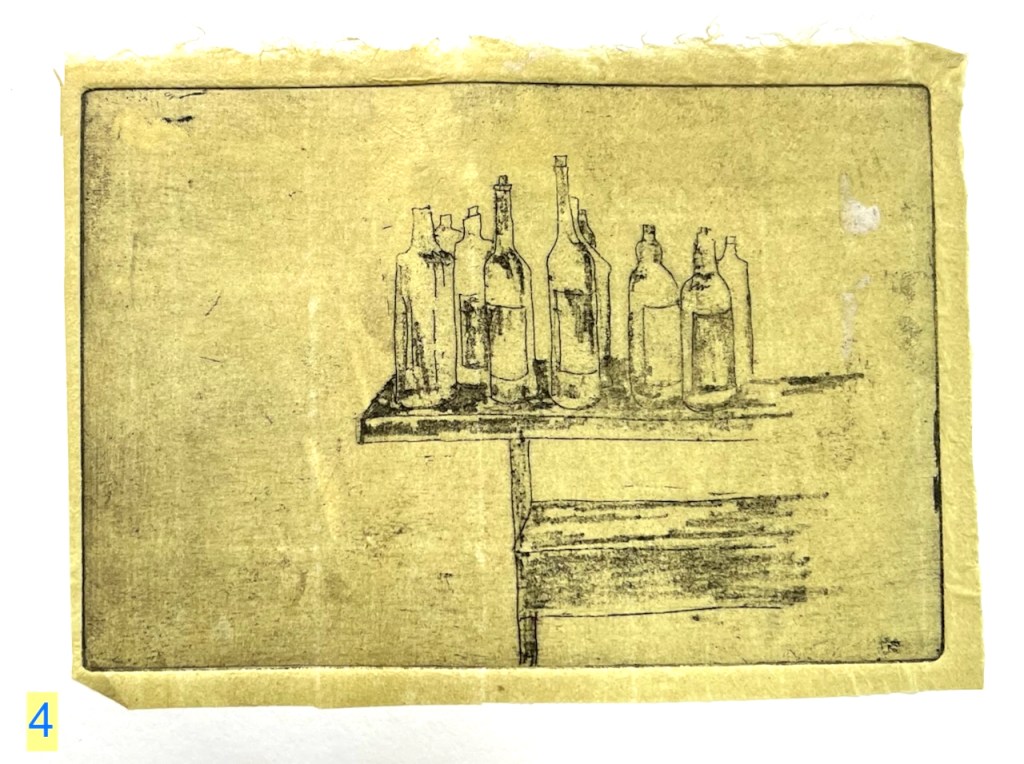
It is also possible to use the chine collé to provide a background for the whole image. Here is print 4. This is made using chine collé and one plate.
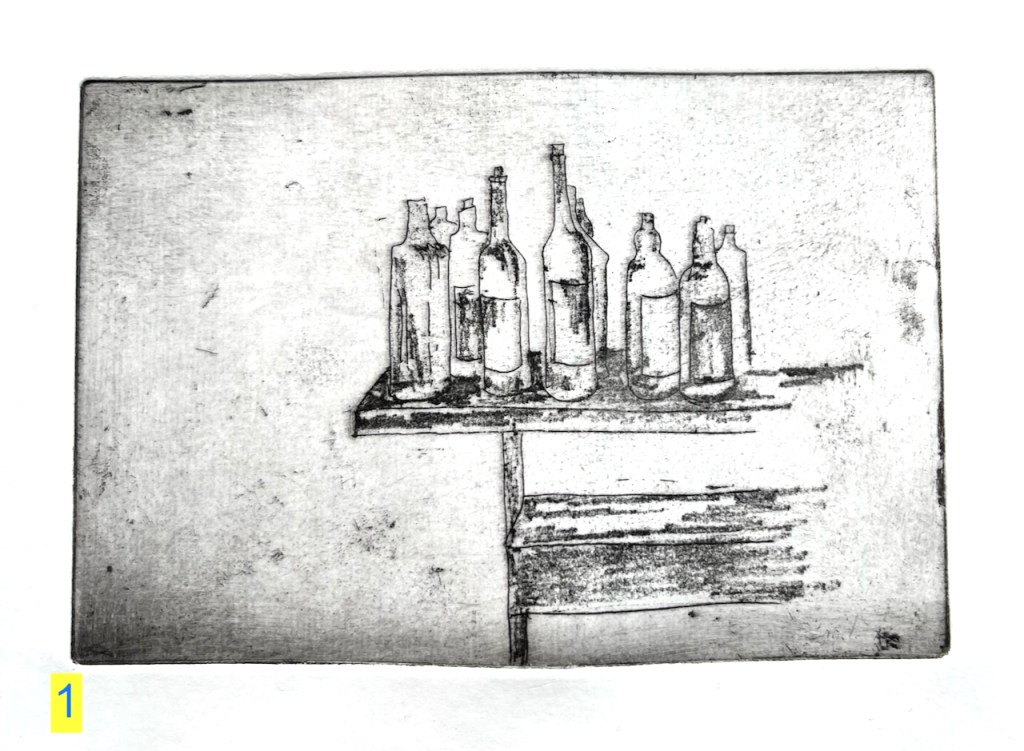
All these prints are made using heavyweight Fabriano Unica printing paper. It can be folded in half to make an A5 card to send to the absinthe enthusiast or wine drinker in your life. Or you can cut it down and frame it to make a small picture for your kitchen. The image itself is about postcard size: 10cm x 15cm. Let me know if you would like one? £25 + postage.
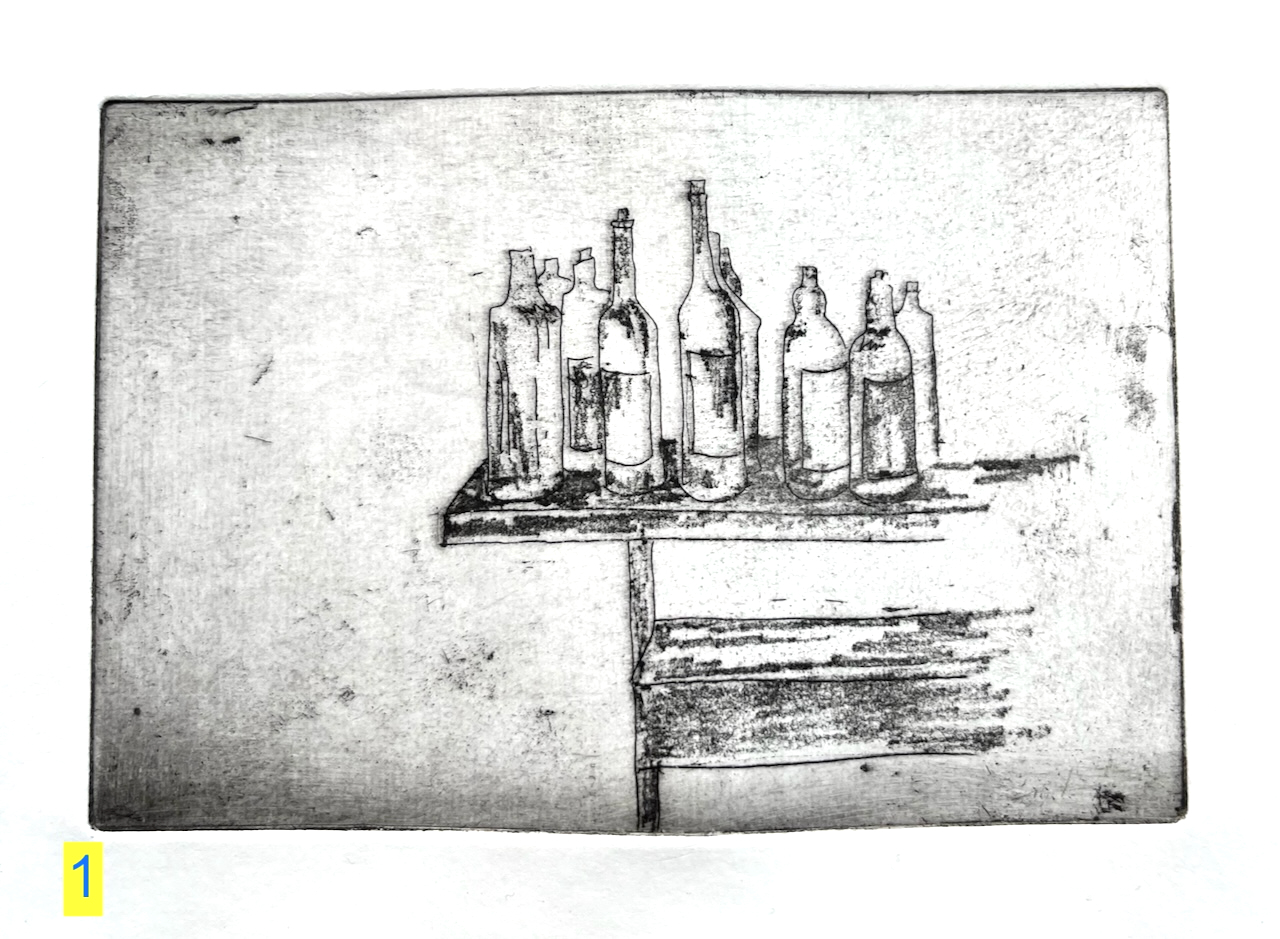
Here is a gallery of all six prints from this second series. These are all handmade prints from the etching press – not digital prints. I’ve numbered the prints in this post for easy reference. The numbers do not appear on the print you will receive. I can sign them if you like or not if you prefer them blank.
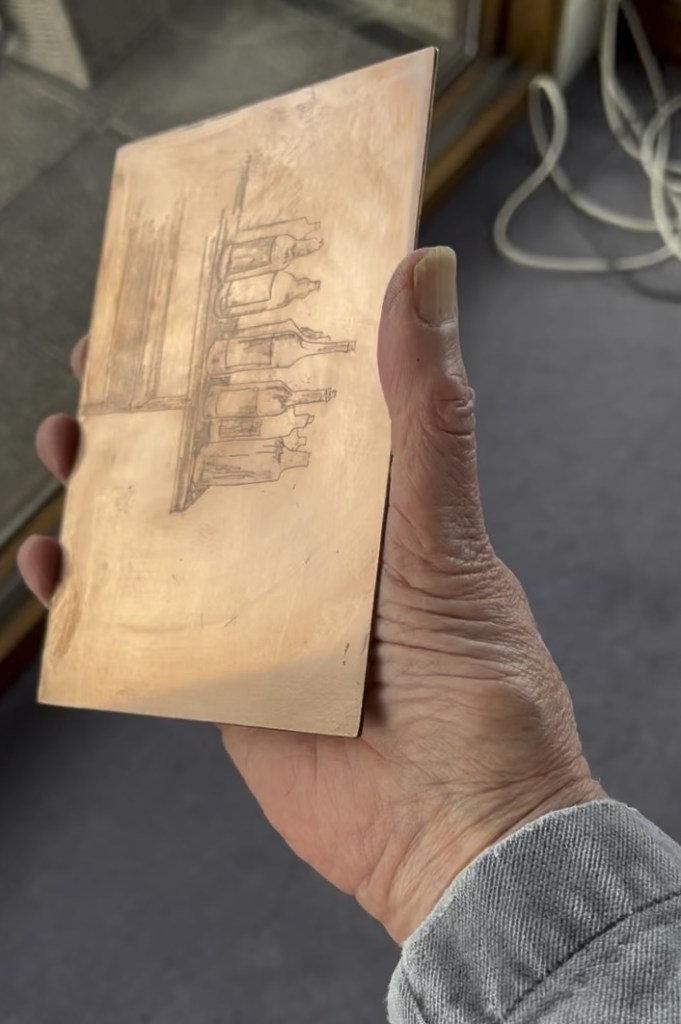
Here’s the copper plate I used for the black foreground:
Click a button below to share this post online, email it, or print it:
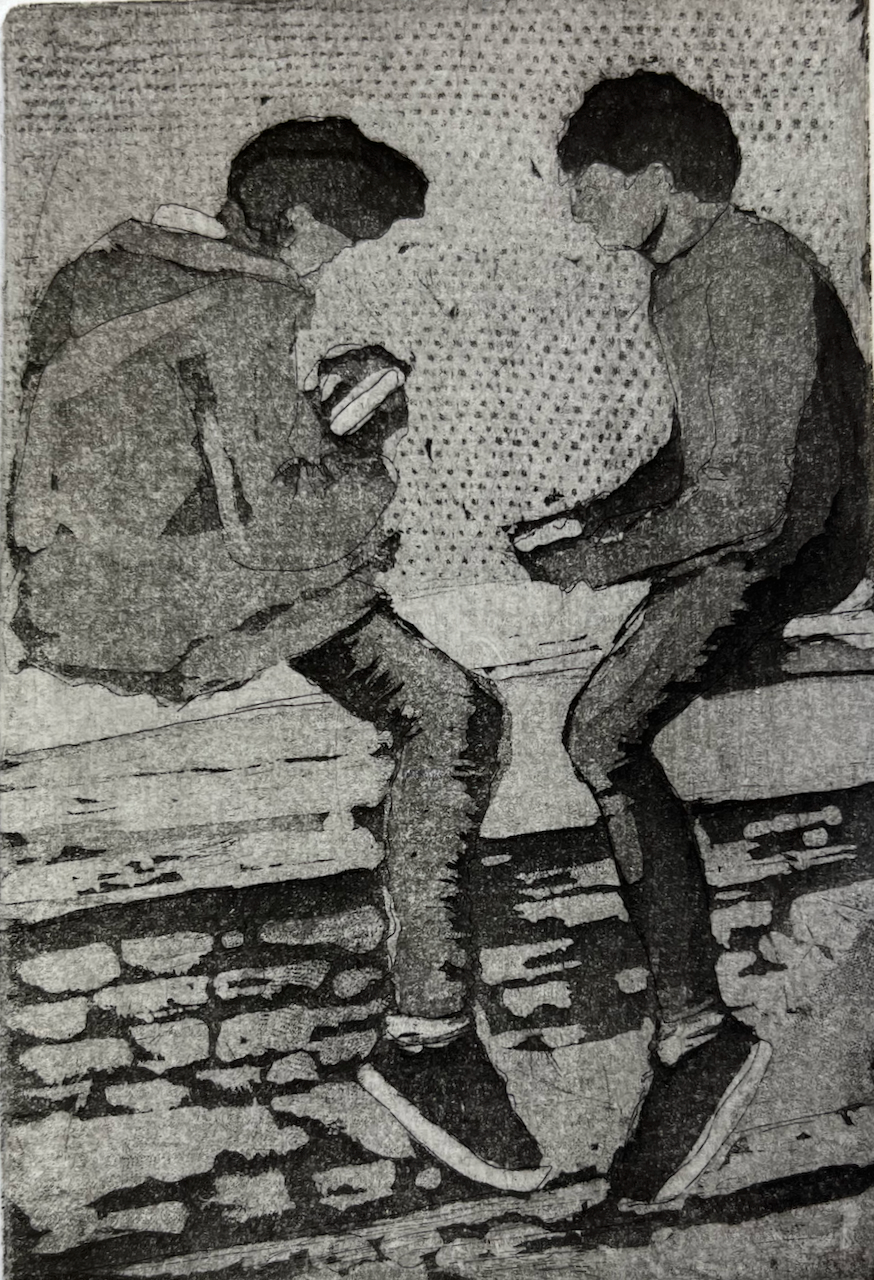
Here’s a print I made at East London Printmakers last week.
Two boys, etching, image size about 5inches by 3inches
I wanted to show how concentrated these people were, immersed in what they were doing, sitting on the wall.
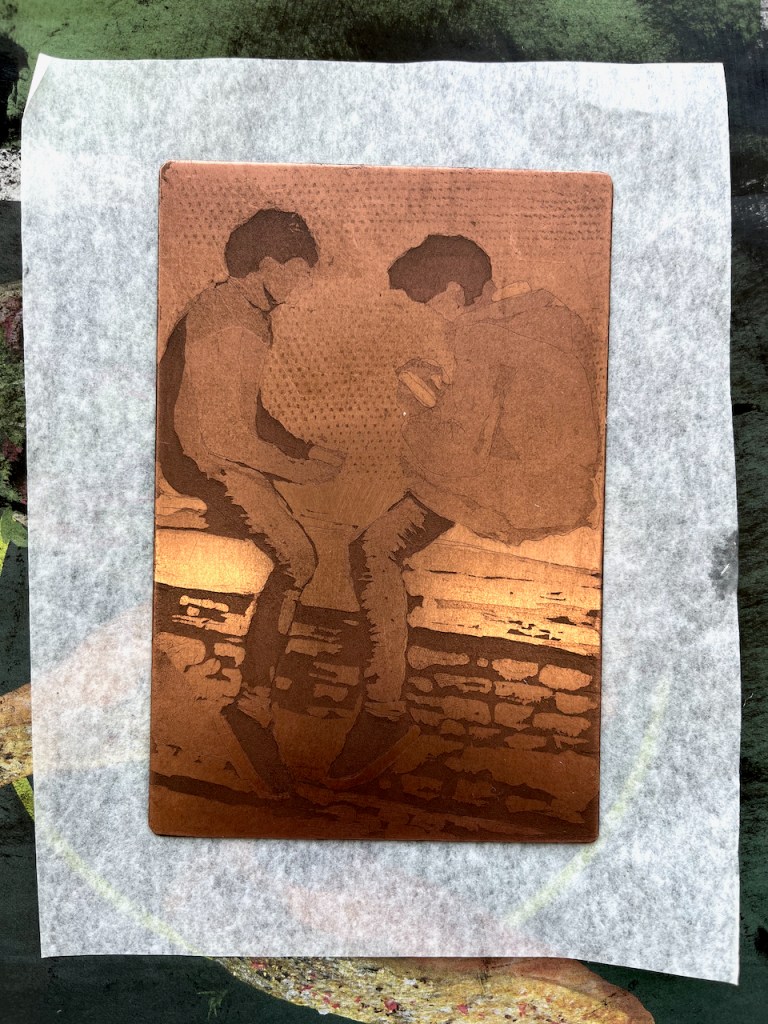
It is printed on Fabriano Unica paper, using Charbonnel F66 traditional etching ink. Here is the copper plate:
The plate is made with hard ground lines, soft ground patterns, and three aquatint sessions.
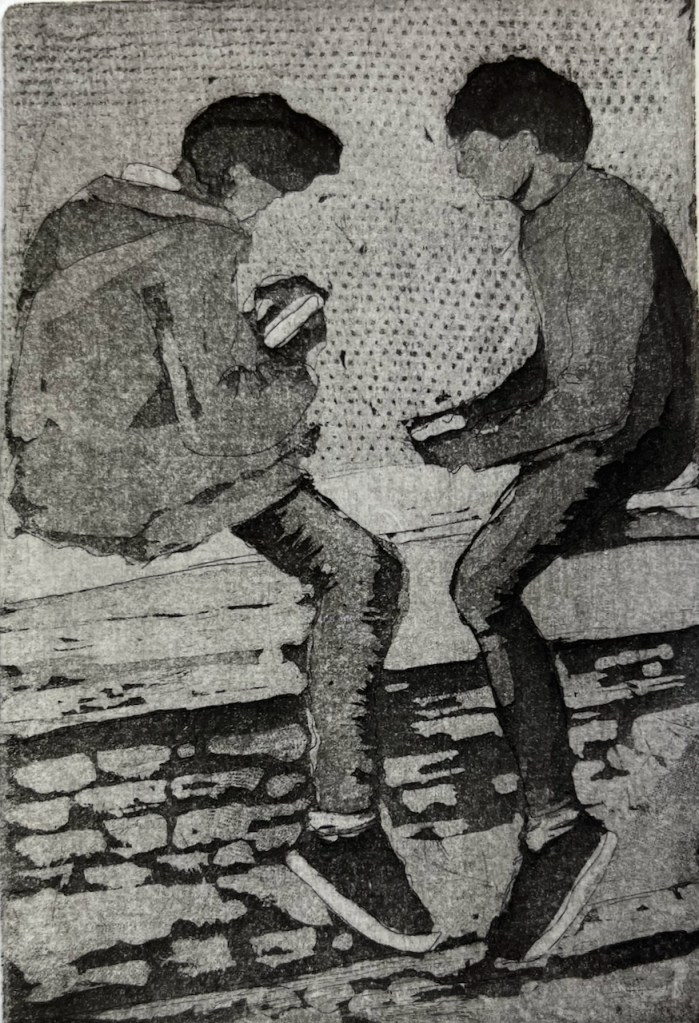
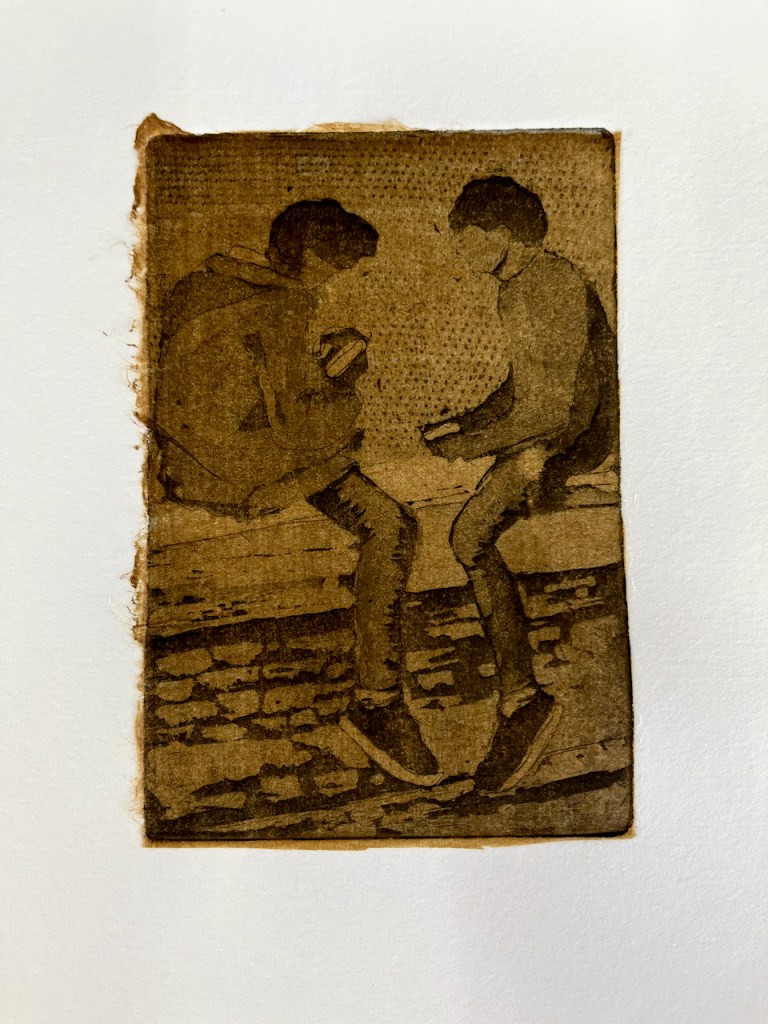
I made some variations of this print. Here is one, using chine-collé.
Two boys, warm brown chine-collé
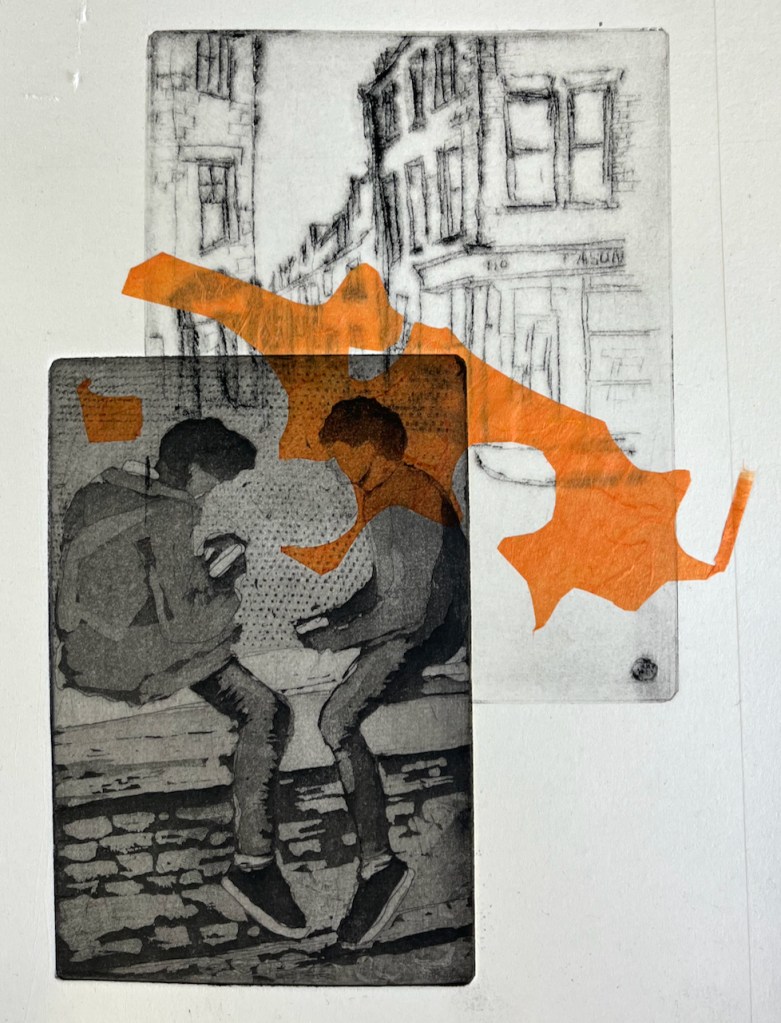
Sometimes in the printing process, magic happens. As I was packing for this print session, searching for paper, tissues, gloves, and other printing essentials, I encountered a thick envelope labelled “Old Prints”. I pulled out one of those, a street scene, with a vague idea of overprinting it. It is a drypoint I made years ago. The vague idea turned into a plan, and then a print. Here it is. I was really pleased with how it came out. The chine-collé is also a leftover from another project.
Two boys and street, combined image size about A5. Etching, drypoint and chine-collé.
Click a button below to share this post online, email it, or print it:
This print shows a dialogue, or perhaps an exploration. Are they perhaps looking down a tunnel? Or watching a sunset?
This is a chine collé print from a copper etched plate. The paper is thin Japanese paper brought to me by kind friends directly from “Paper Nao” in Tokyo. You can see how the plate was made on this link: Strange landscapes from wood
The plain print, with no chine collé, looks like this:
The coloured bits are placed on top of the plate, glue side up. I’ve described the process on this link: The chine collé process
Here is work in progress:
Ink: Gutenberg black from Intaglio Printmaker.
Glue the little bits of paper on the *top*. Note the tweezers.
The coloured paper is “fibre silk” paper from “GreatArt.com”
I lift it with tweezers and put it to dry on another piece of newsprint. When dry, I move it carefully to the plate: glue side UP.
Click a button below to share this post online, email it, or print it:
This morning I made an etching based on a sketch of St Bartholomew the Less.
Here’s the original sketch, which was made from the top of Maggie’s Centre in St Bartholomew’s hospital, by kind permission of the staff of the Centre.
The sketch was to explore the proportions, before making the more detailed watercolour drawings on this post:
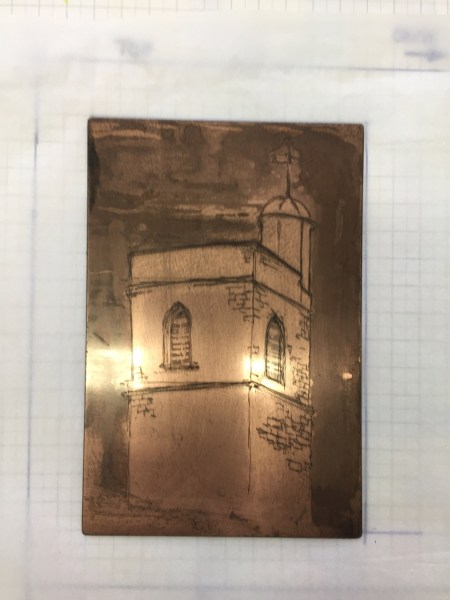
I thought the sketch was rather lively and might make a good etching. Here’s the copper plate I made:
And here are some of today’s prints: (click to enlarge)
Etching – lines on hard ground
With aquatint background
With aquatint background
The plate needs a bit more work I think. The background could be darker and perhaps some shading on the tower itself. My idea is that I will print it with perhaps chine-collé. So I want to keep the design simple.
I just had the morning at the print studio today.
The paper is Chinese paper from Great Art. Numbers 11369 (soft), and 11565 (white, with a slight grid). The ink is Intaglio Printmaker Shop Mix Bone Black. The plate is 10cmx15cm copper plate from Great Art, which I prepared with hard ground 28 June 2018. I used the Rochard press at East London Printmakers.
Update:
14 March 2019 – Chine Collé
Click a button below to share this post online, email it, or print it:
On a recent walk in Hoxton, I picked up a piece of wood. Perhaps it was part of a crate. It had interesting grain.
John cut it into smaller pieces with a saw.
Wood pieces
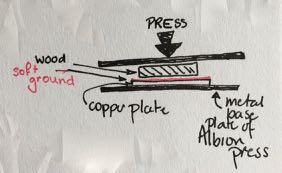
I was going to use them as relief blocks. Then I got talking to a fellow printer at East London Printmakers. She suggested I press them into soft ground and make an etching plate. Then I thought I’d use the Albion press to get sufficient pressure.
The technician, Dan, asked if I had aquatint on there, and I hadn’t. Can you put aquatint on top of soft ground? We went off to consult the studio co-ordinator. She said yes, aquatint was good idea.
So here’s the process:
Prepare plate with soft ground
Press wood into soft ground using the Albion Press. This makes an impression with darker places where the wood was.
Put aquatint (dust) onto the plate, and fuse it with the gas burner. The soft ground burns and goes brown. The aquatint fuses onto the plate in the darker places.
Etch in acid, Edinburgh etch, for two minutes.
Clean off the plate and print.The aquatinted areas are dark.
Here’s the result.
Wood block into soft ground. Printed from copper plate. “Strange landscapes”, on drying rack. Prussian blue ink on Vintage Paper Co paper.
Here’s the other block, with chine collé stripes added. I’m not sure which way up it should be. Since this whole session was experimental, I also used some experimental paper from the Vintage Paper Company. They say on the package: “This was made some time between 1969 and 1973 as waterleaf (unsized) printing paper by J Green and Sons (brilliant but now extinct British papermakers). I had it gelatine sized in December 2017 by Two Rivers Paper (brilliant and very much alive and kicking British papermakers” and they ask for feedback. I think it worked really well, and I’m now off to write them an email.
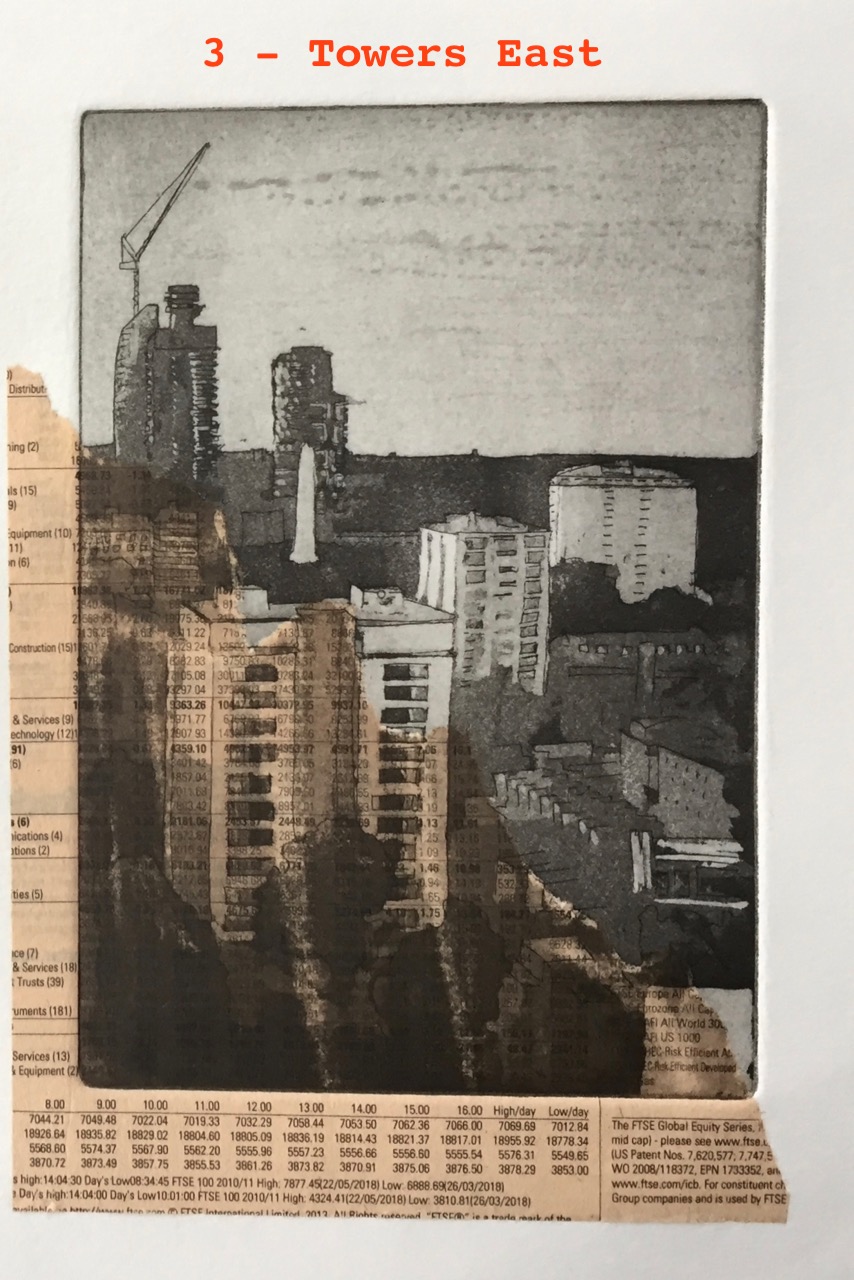
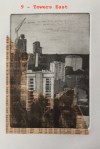
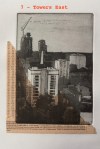
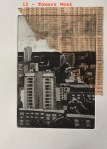
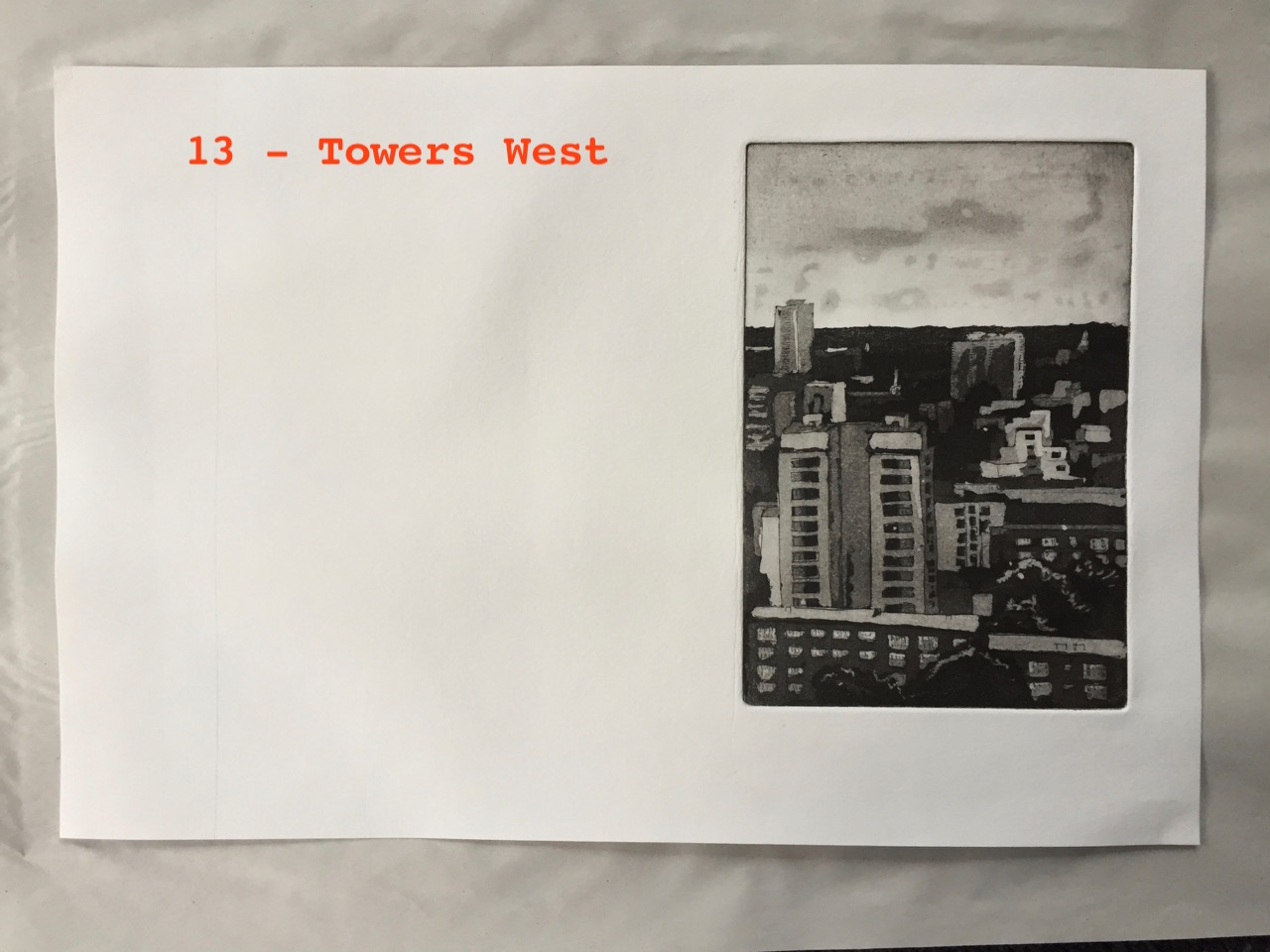
The Towers are St Mary’s Tower and Peabody Tower, just to the North of the Barbican.
I made 14 reasonable prints, and 2 out-takes. I glued the out-takes into my notebook. I make one page per print session, and record what I did, what paper and ink I used, what worked and what didn’t. This is in an attempt to learn and improve my printing technique.
Here are the 14 reasonable prints, numbered 1 to 14. Numbers 1-13 are on card 20cm by 30cm. This card size is intended as a greeting card. When folded it fits neatly into an A5 envelope. Number 14 is on larger paper. All are for sale, £5 each plus postage. Please contact me by email via the contacts page, or leave a comment on this page. The red writing is on the online image here, not on the print.
Click on an image to enlarge it. It may take a little while to load.
These are all part of my “Towers Project” leading to an exhibition in the Barbican Library February 2019.
I work in the print studio at East London Printmakers. Prints are on Fabriano Unica Paper, using Intaglio Printmaker Bone Black ink. They are printed by hand on the Henderson press. Each print takes about half an hour to print.
Click a button below to share this post online, email it, or print it:
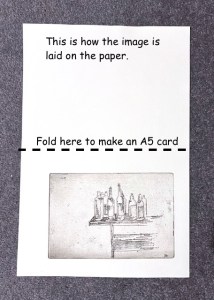
They are all for sale! Please let me know if you would like to buy one. All are printed on etching paper “Fabriano Unica”. They are intended to be used as greetings cards. So the print is to the side like this:
They fold in half to make a greeting card which fits in a C5 envelope.
Folded to make A5 card
Folded to make A5 card
Fits in C5 envelope
Fits in C5 envelope
Equally they can be folded in half or cut, and put in a frame size A5.
If you’d like to buy one, please contact me, and say which one you’d like. They are numbered – click the images in the gallery above. £5 each + postage. These are handmade items by me, an amateur printer. Thumb marks, imperfections, ink smudges and other defects reflect the handmade nature of the items and, as they say, “should not be regarded as defects”.
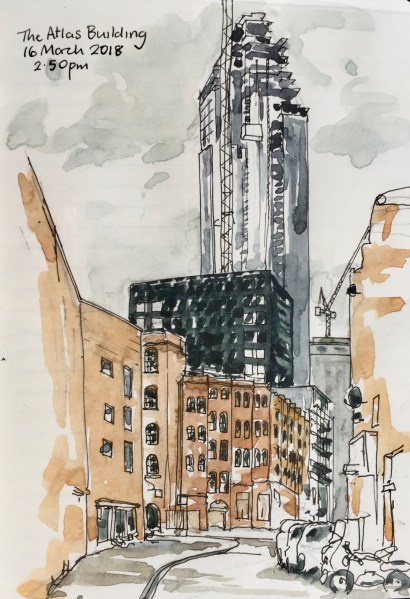
Today I worked on a print of the Atlas Building. This is based on a watercolour I did in March this year in a peregrination around City Road.
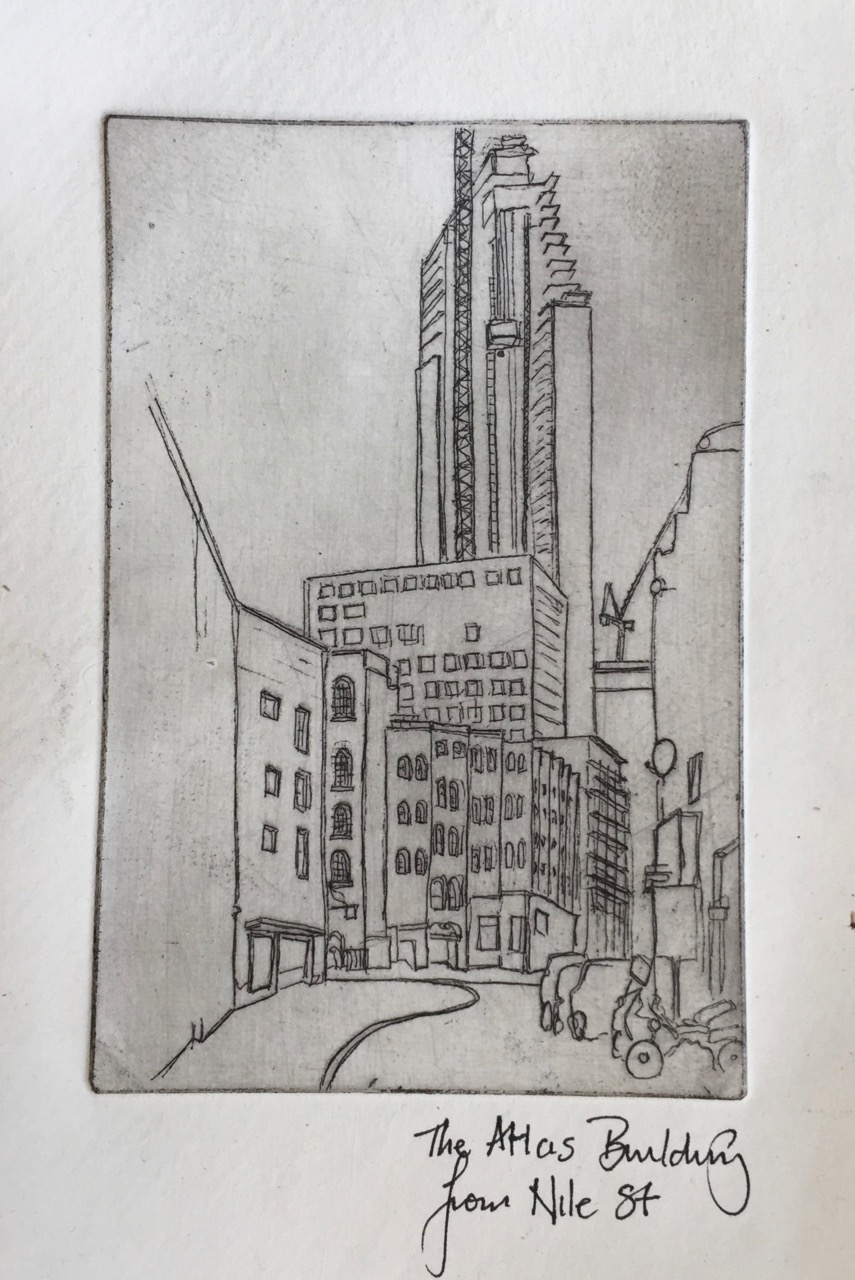
Here the hard ground print:
Then aquatint:
This was an aquatint with 6 tones, which is about the maximum I can achieve. On the 4th and 5th dip it’s difficult to see what I’m doing.
These pictures are postcard-size, with the intention of making cards.
Here’s the test plate print.
I’m in the question about whether the aquatint needs more work. I thought it did when I first saw it, but now I’m not so sure. It isn’t as dark as the photo looks. Comments welcome.
Aquatint and test plate on Khadi handmade paper. Hard ground print on handmade paper from Paperchase. Printing done at East London Printmakers. Ink is Intaglio Printmaker “Shop Mix Bone Black” from a tube. Etching on 10cm x 15cm copper plate using Edinburgh Etch.
Here are the copper plates:
Click a button below to share this post online, email it, or print it:








 I was going to use them as relief blocks. Then I got talking to a fellow printer at East London Printmakers. She suggested I press them into soft ground and make an etching plate. Then I thought I’d use the Albion press to get sufficient pressure.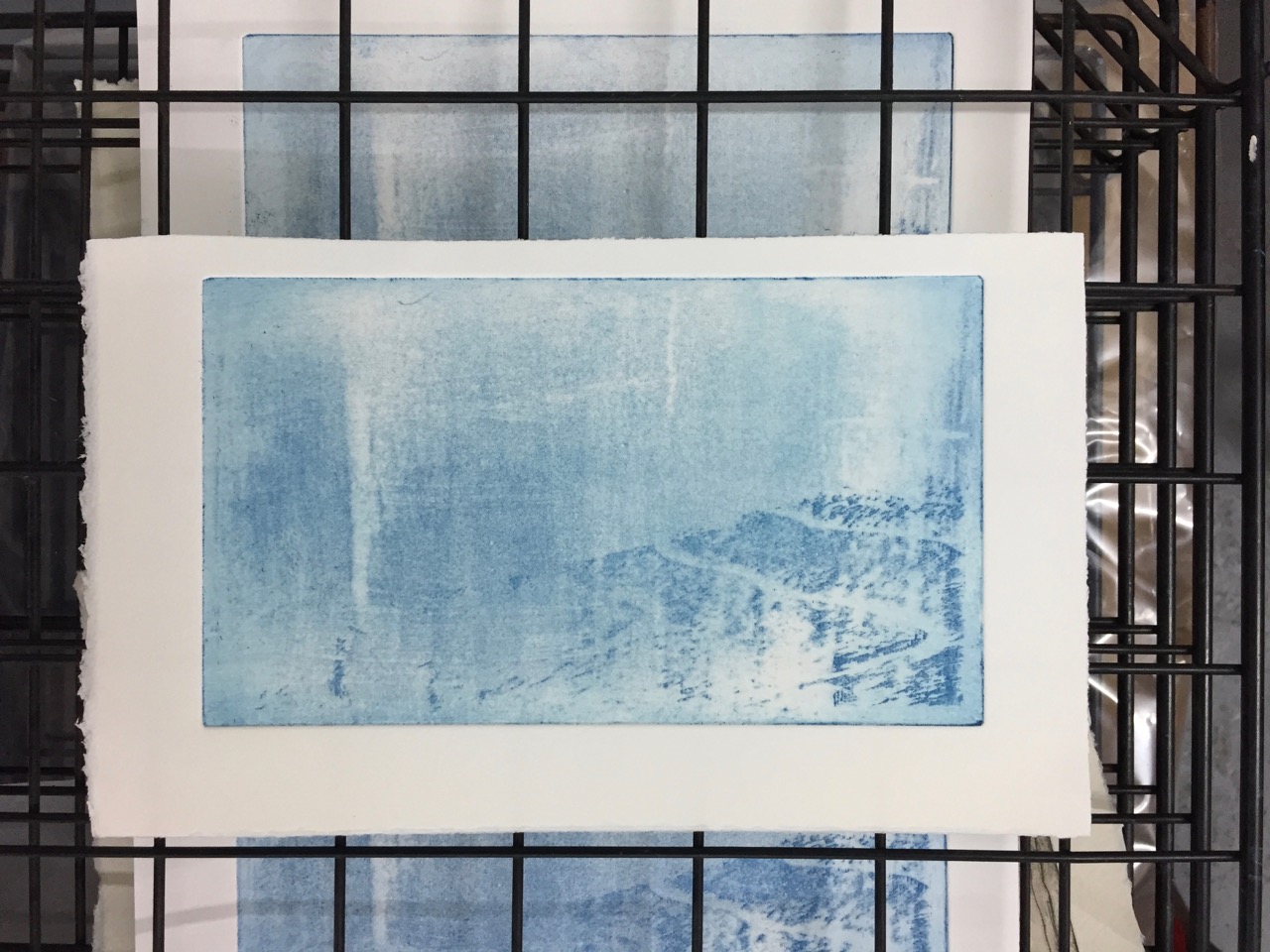
 Since this whole session was experimental, I also used some experimental paper from the Vintage Paper Company. They say on the package: “This was made some time between 1969 and 1973 as waterleaf (unsized) printing paper by J Green and Sons (brilliant but now extinct British papermakers). I had it gelatine sized in December 2017 by Two Rivers Paper (brilliant and very much alive and kicking British papermakers” and they ask for feedback. I think it worked really well, and I’m now off to write them an email.








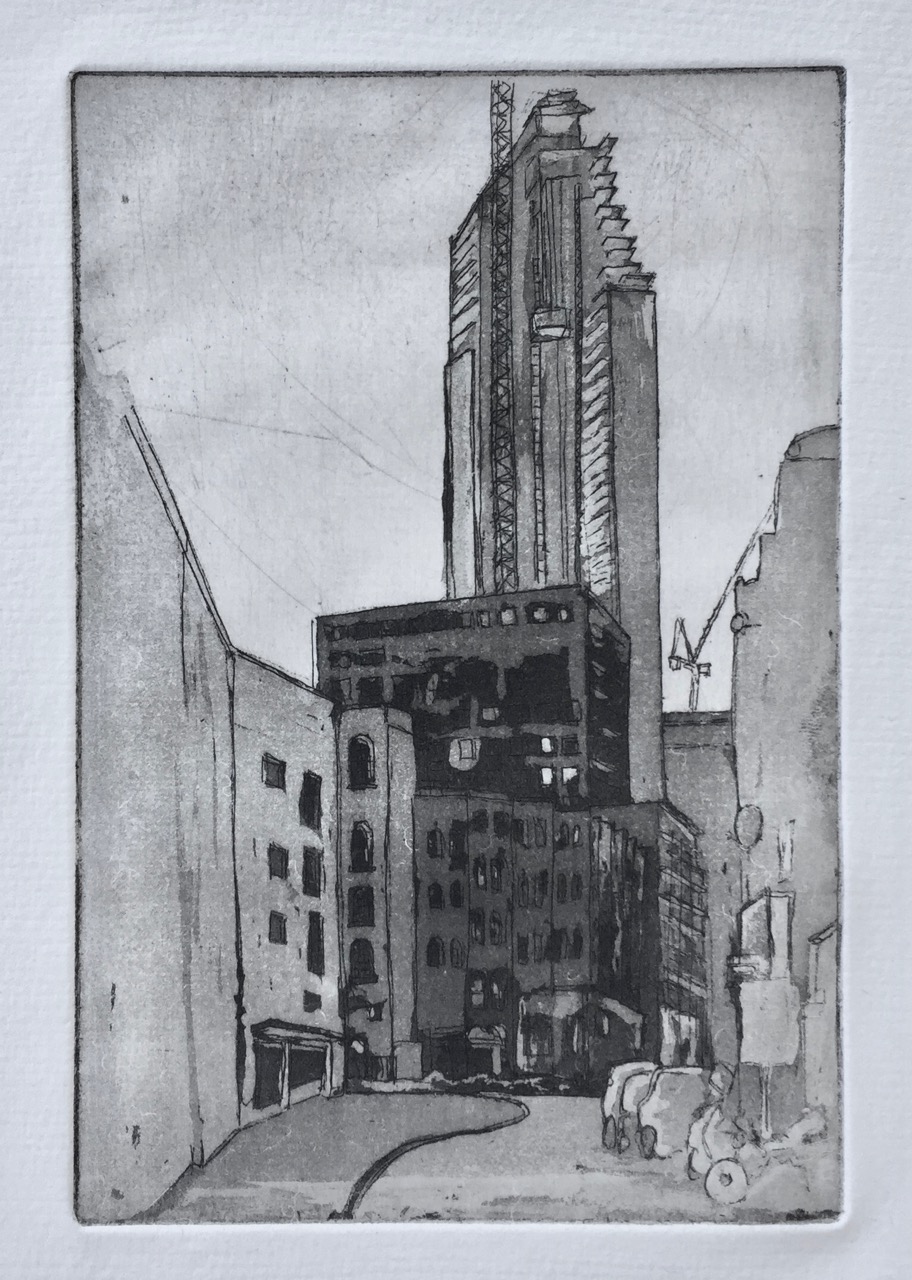
 This was an aquatint with 6 tones, which is about the maximum I can achieve. On the 4th and 5th dip it’s difficult to see what I’m doing.
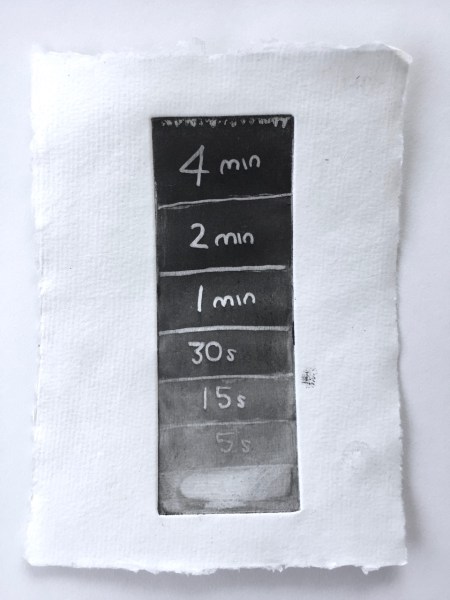 Here’s the test plate print.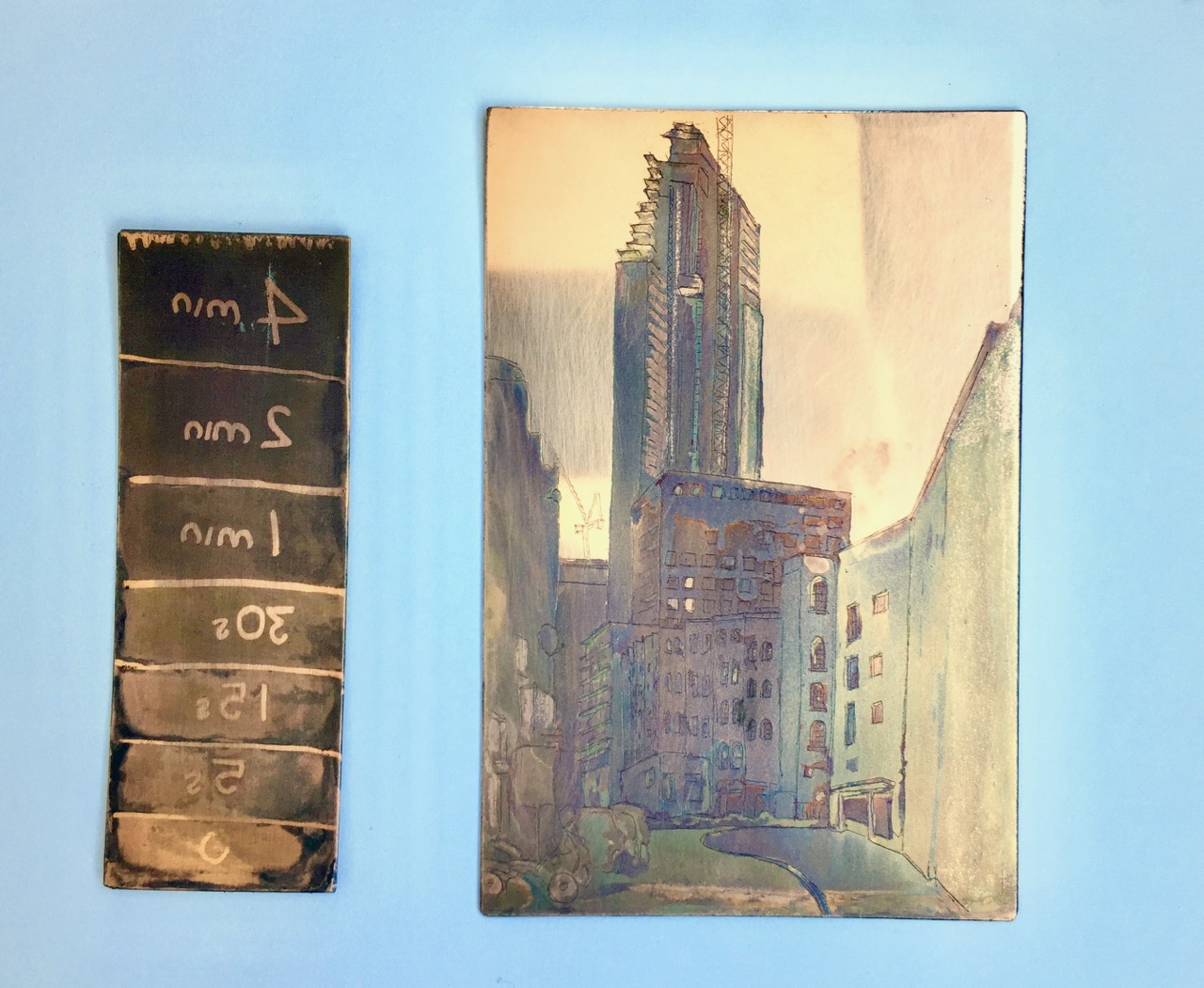
 Jane Sketching