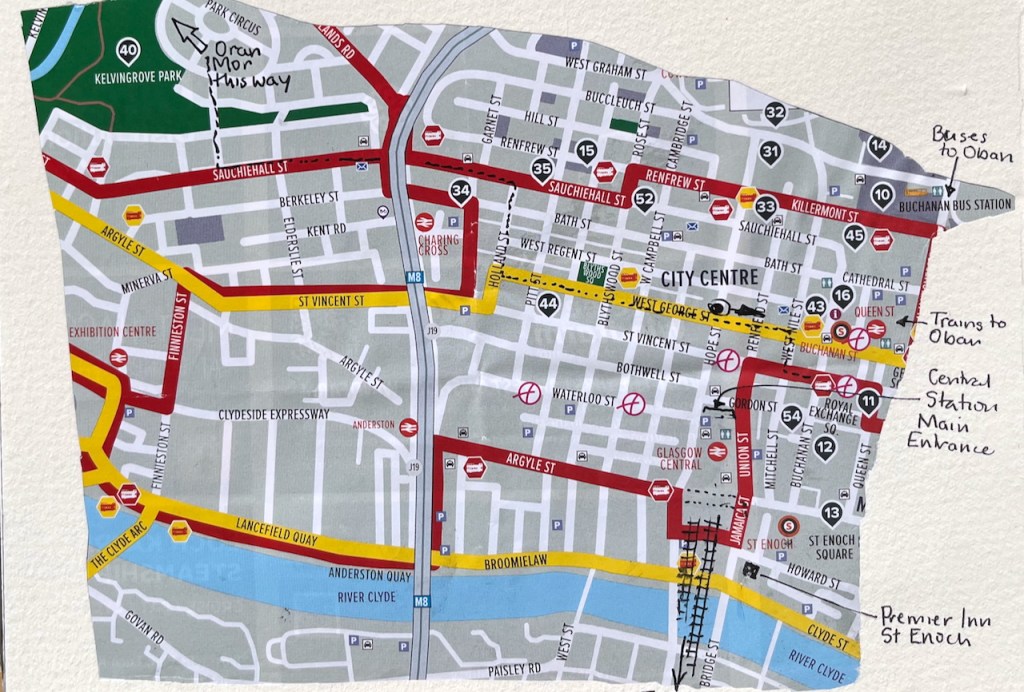
On the way to and from Sketch and Sail last week, my journey took me through Glasgow. I spent a few hours walking around that city, sketchbook in hand.
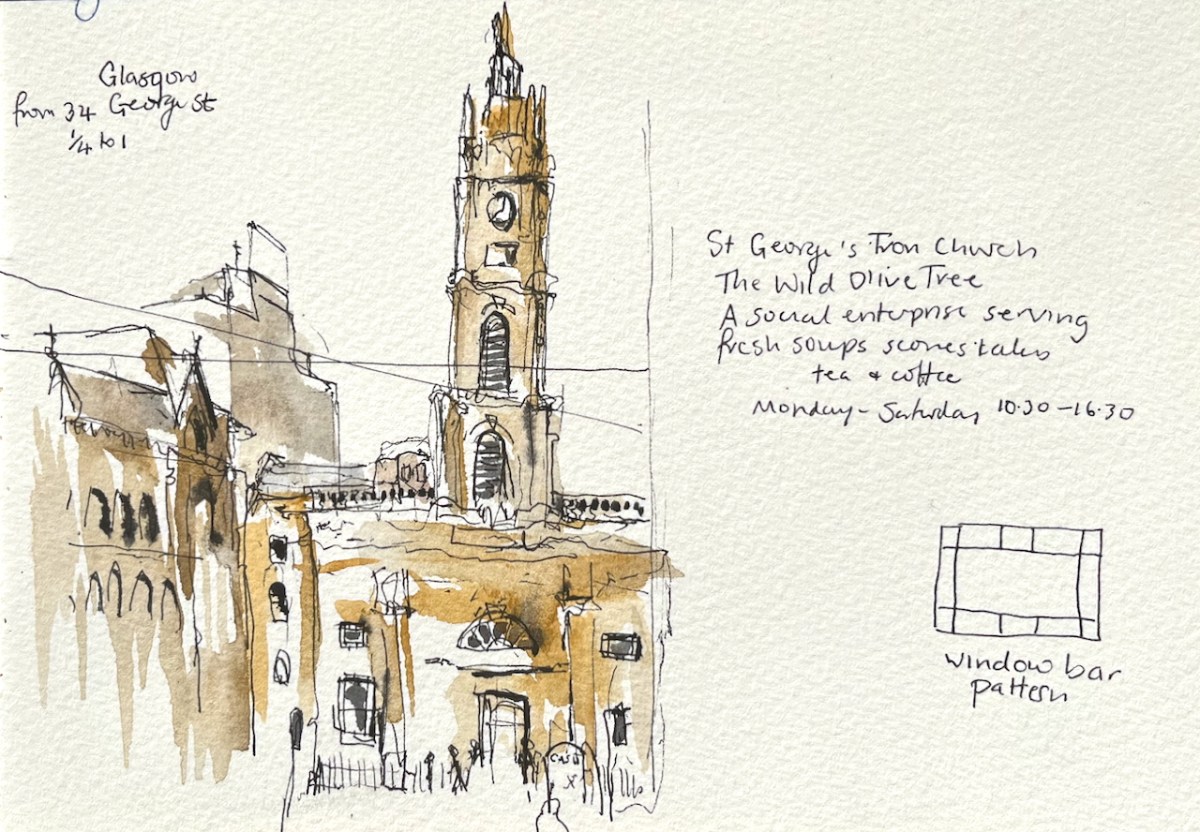
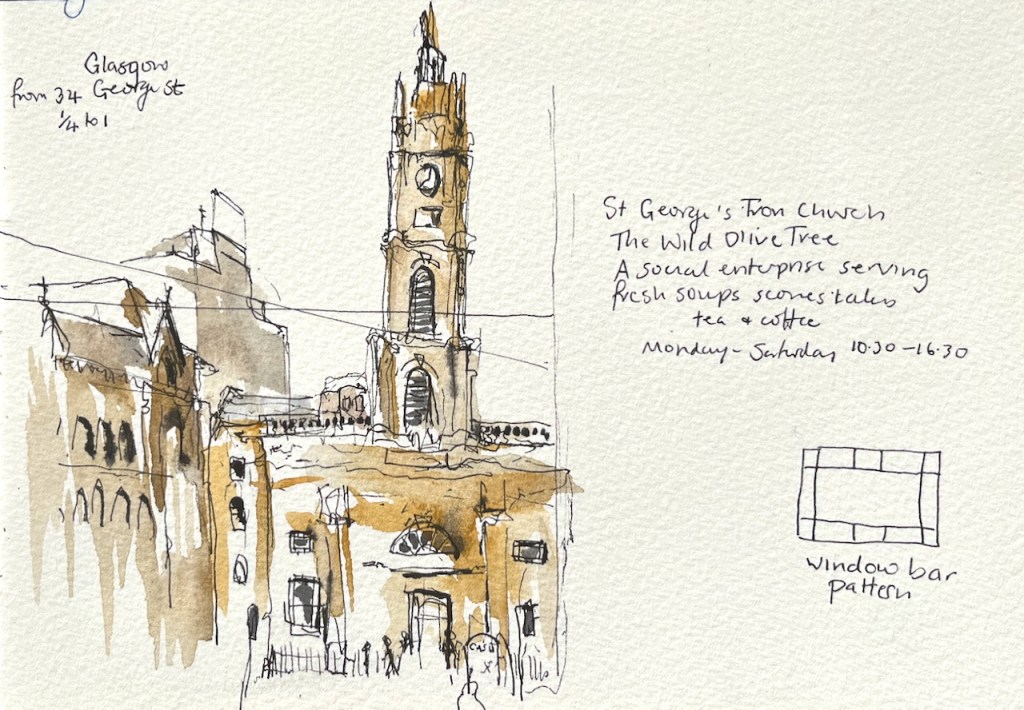
Here is West George Street, looking east, downhill towards St Georges Tron Church.
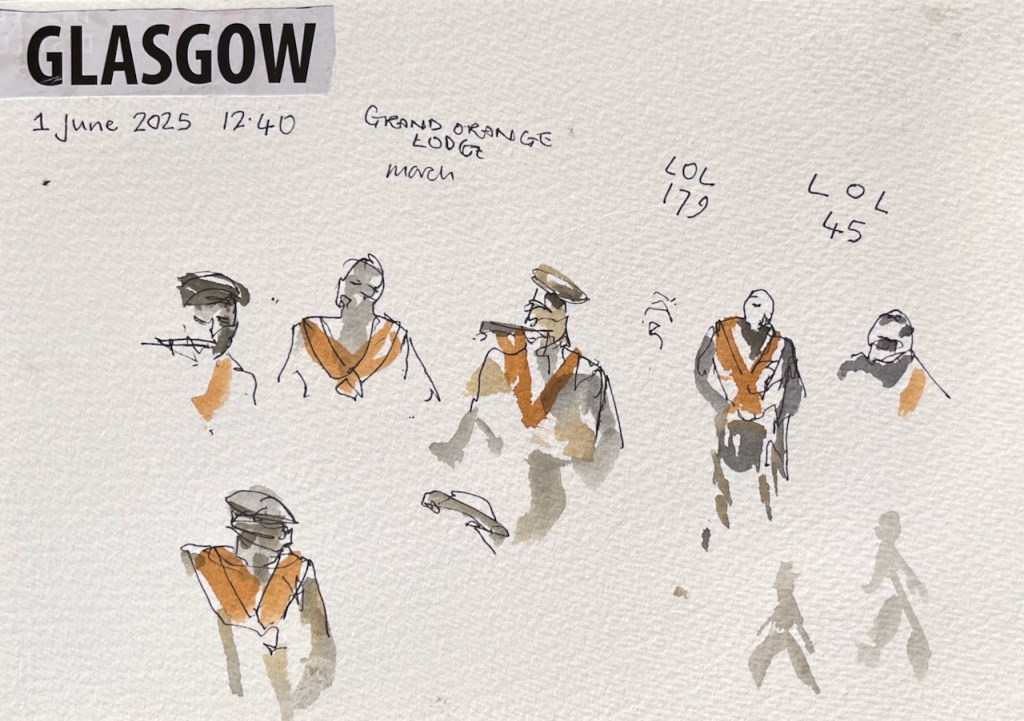
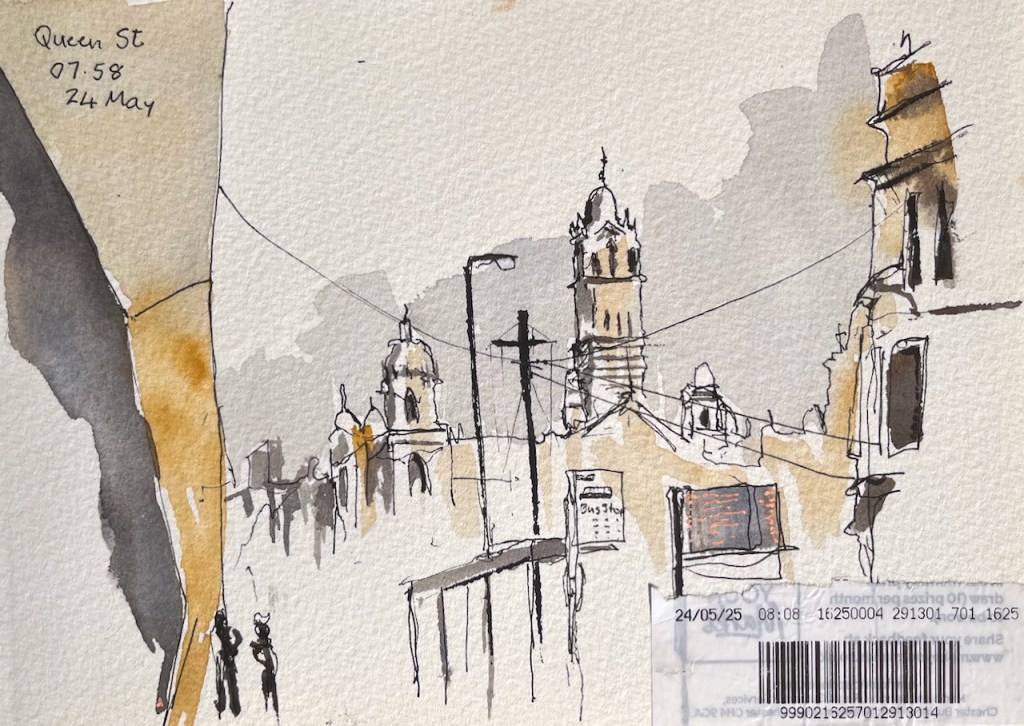
This was a Sunday. Glasgow was quiet. Until there was the sound of flutes, or perhaps more accurately fifes. And then a procession. I tried to sketch the people as they walked by.
Who were they? What was it about? I had sort of guessed, before I asked the police officer. “The Grand Orange Lodge” he told me. So this was an Orange March, a procession by Protestant fraternal societies. I had heard of them in the news as taking place in Northern Ireland, but I had not heard of them in Glasgow, or anywhere else. They arouse contention in some contexts. This procession seemed low-key and passed through peacefully, gone almost before I had thought through what I was looking at.
I walked on, in the opposite direction, towards the West End of Glasgow.
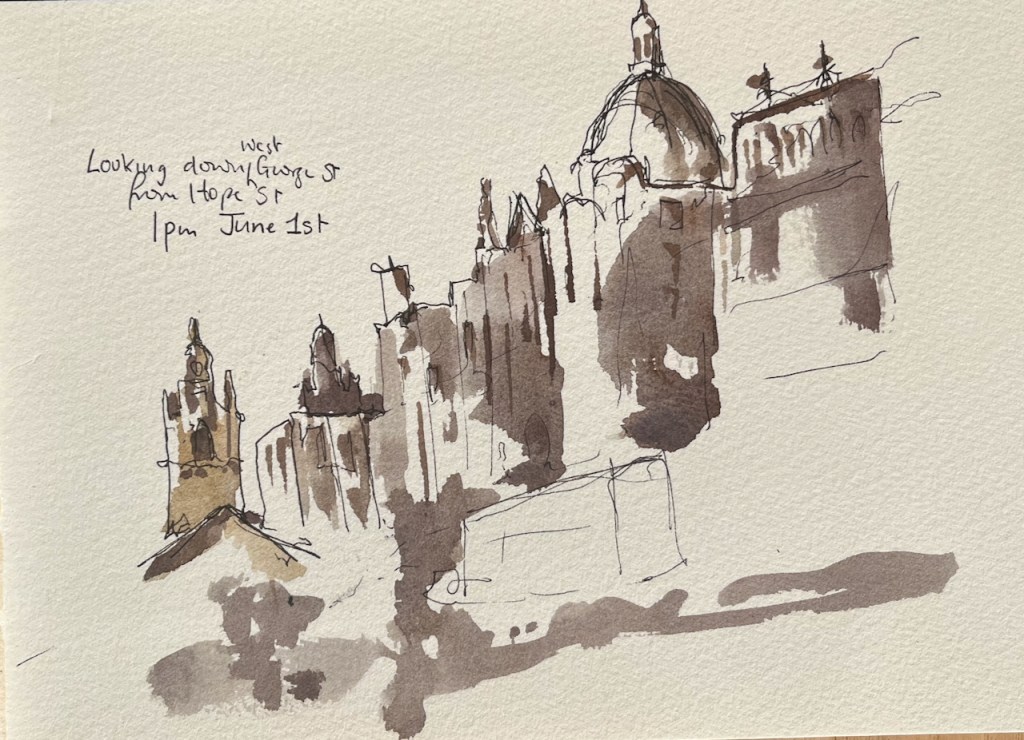
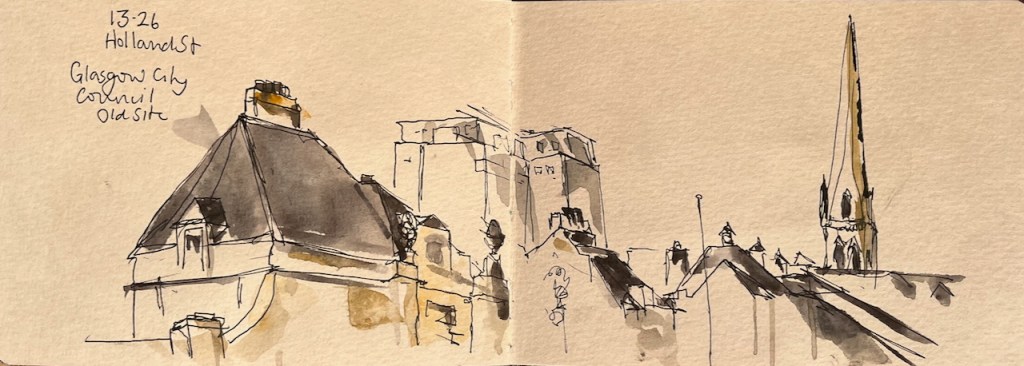
In Glasgow there are magnificent Victorian buildings, some of them strangely derelict and empty. Here is the roofscape of the former buildings of Glasgow City Council: huge empty buildings around a vast courtyard.
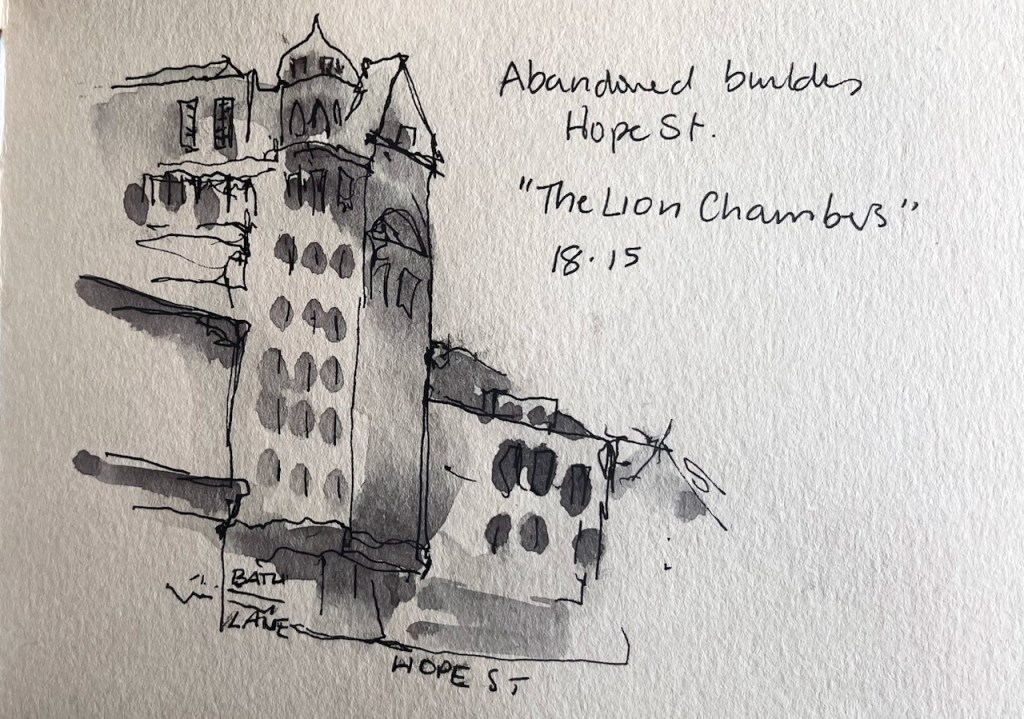
Here is an eight storey building on Hope Street: “The Lion Chambers”, perhaps a former legal practice.
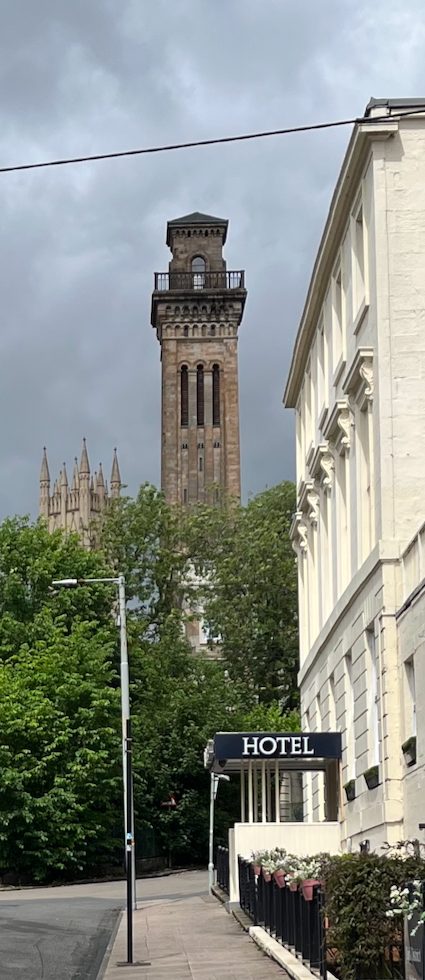
One of the joys of walking in cities is that you pass through invisible membranes, barely detectable boundaries between the derelict areas and the areas that have been reinvigorated, or between the commercial areas and the residential districts. As I walked West I saw a tower on the horizon, with a parapet.
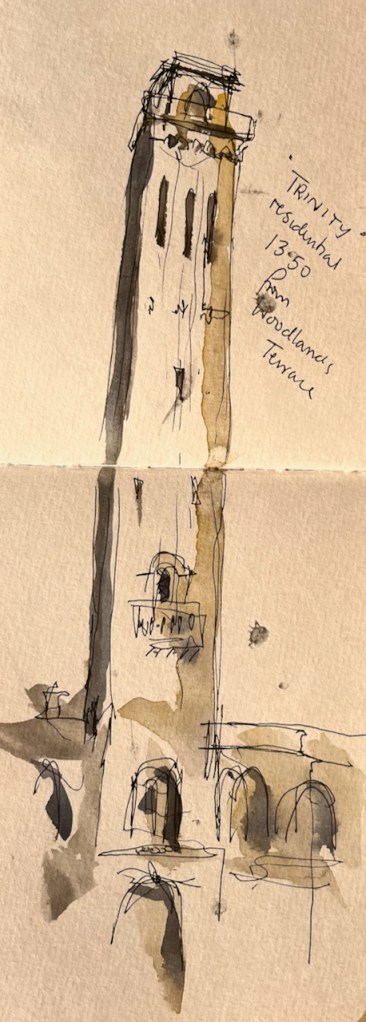
This looked like the type of tower I have sketched in London at St Thomas’ hospital.
But on closer inspection it turned out to be a church. Or rather, it had been a church. Now it is a residential tower called “Trinity”, looking very smart.
I was sketching between rainstorms. By this time I was high up overlooking the city.
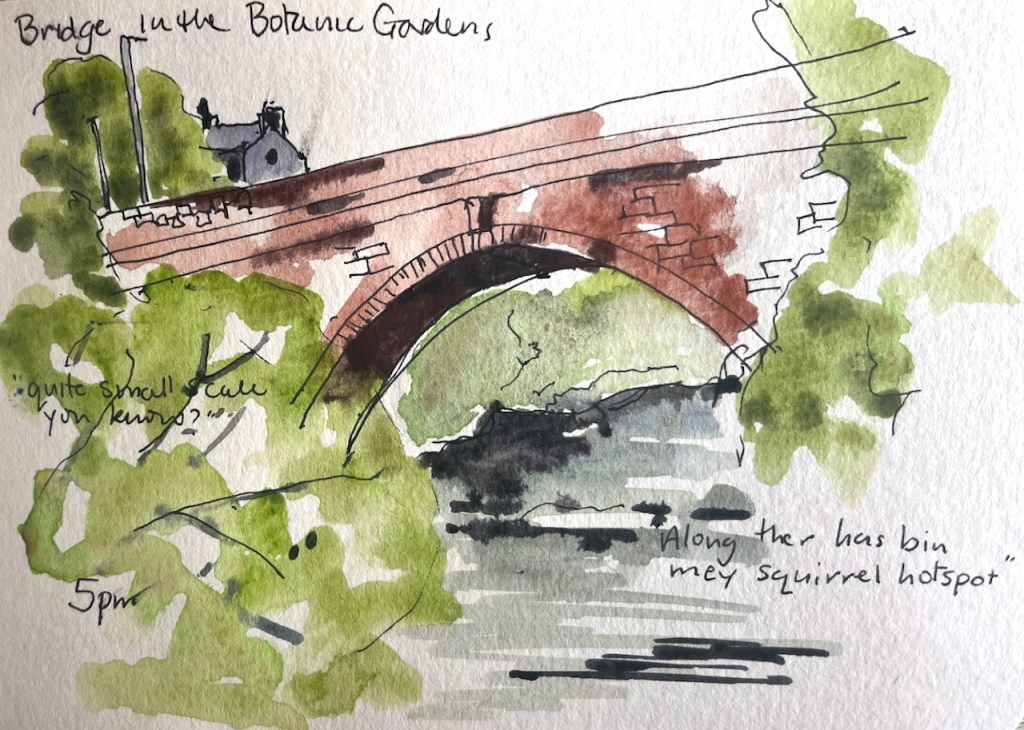
A bit further on there is the botanic gardens. The rain stopped and suddenly the place looked like a sunlit utopia, with people of all kinds and all ages out sitting on benches and chatting to each other amongst flowers and cultivated trees. Further on still, I came to a river.
It was time to turn around and head back East. I became comprehensively lost amongst the pedestrian underpasses knotted around the M8 motorway. But an elderly gentleman put me right, turning around and walking with me to the summit of a bridge, from which vantage point he could indicate the correct route with his walking stick.
It’s a city of many cities, is Glasgow. Wealth and dereliction, renovation and decay. There is a sense of waves of renewal, ups and downs. Or perhaps that was just because I was returning from a sea trip, and the pavement was not yet entirely steady under my feet.
Click a button below to share this post online, email it, or print it:
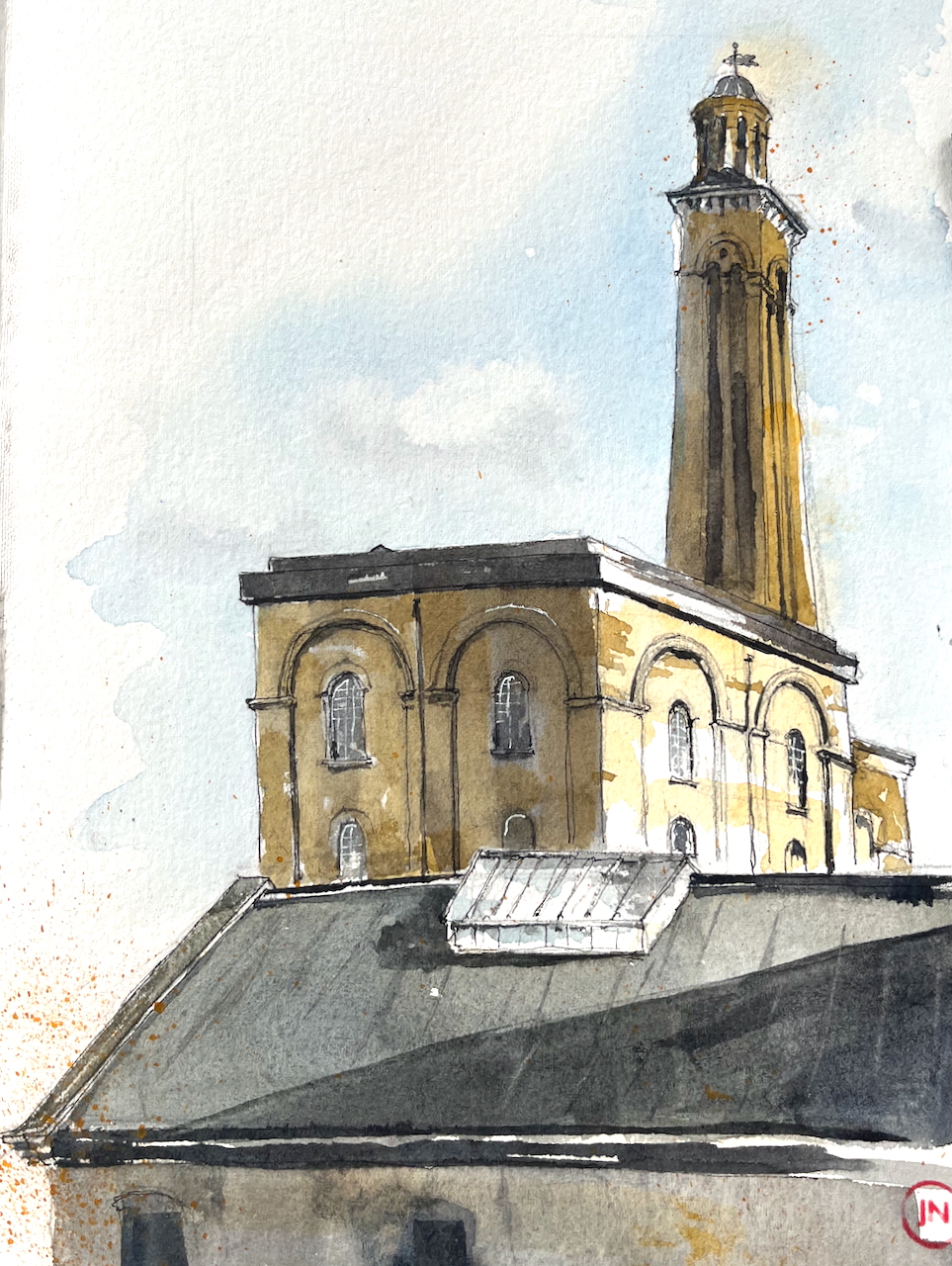
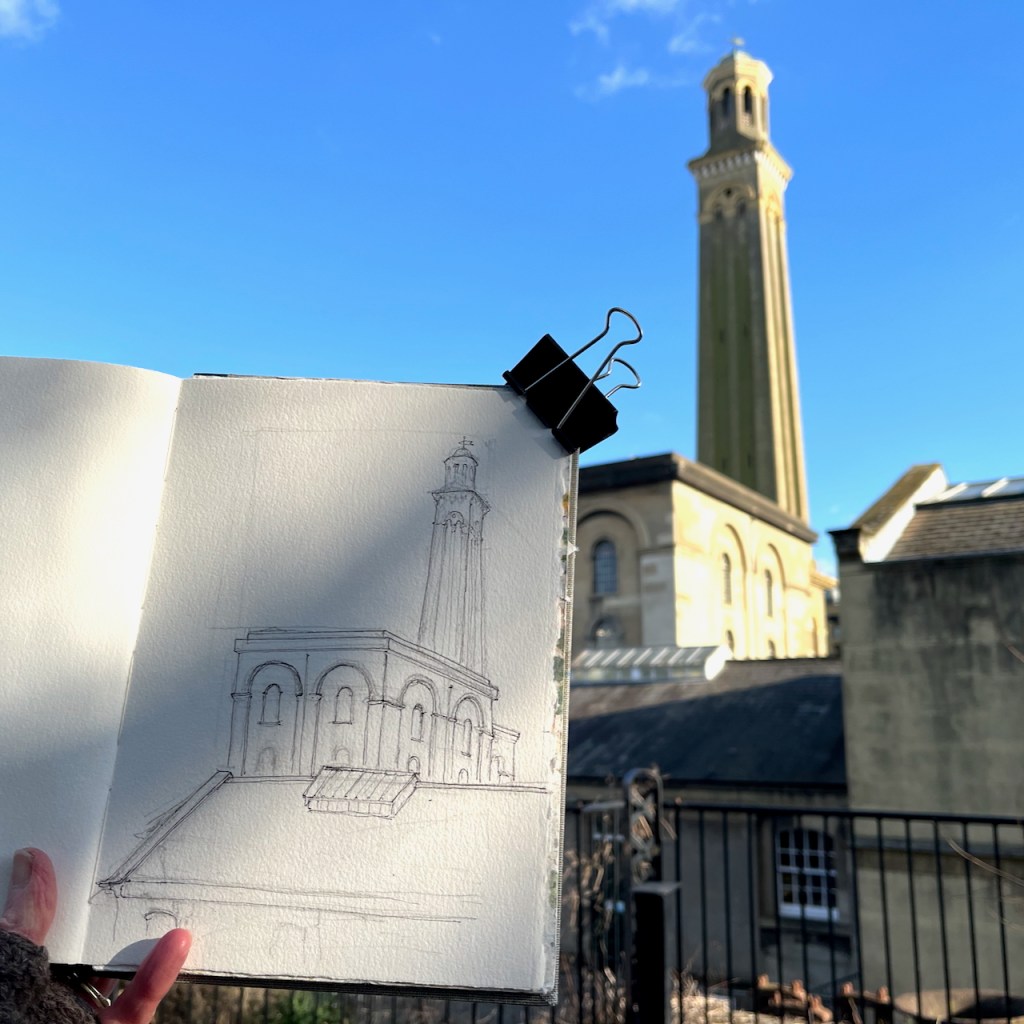
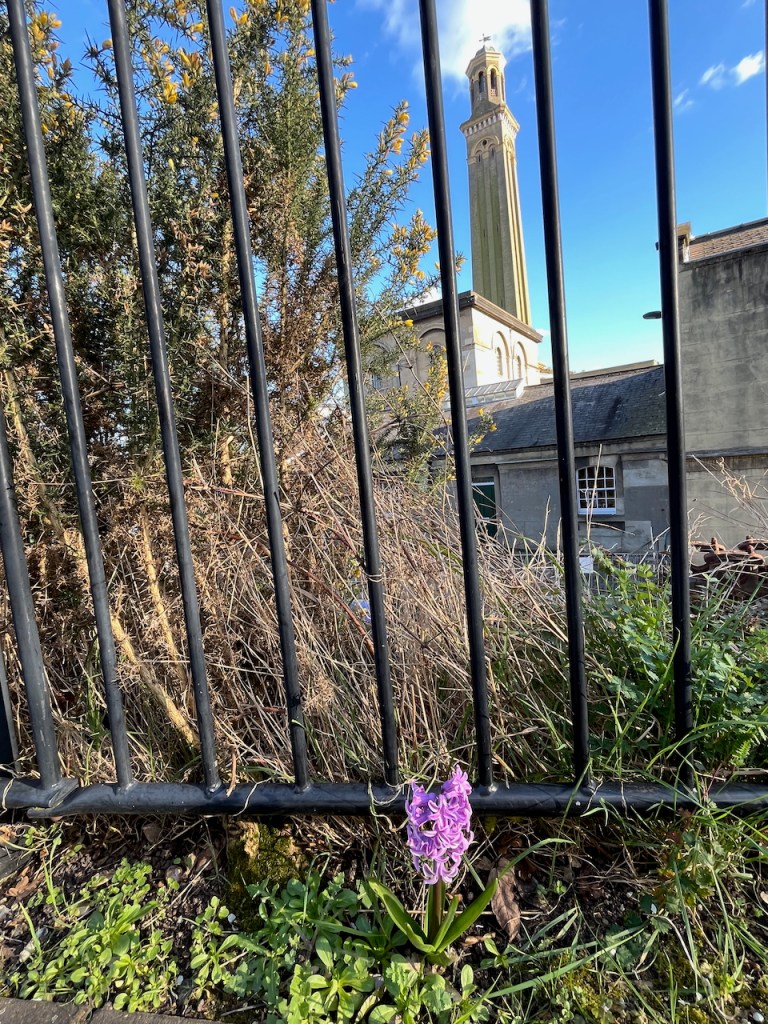
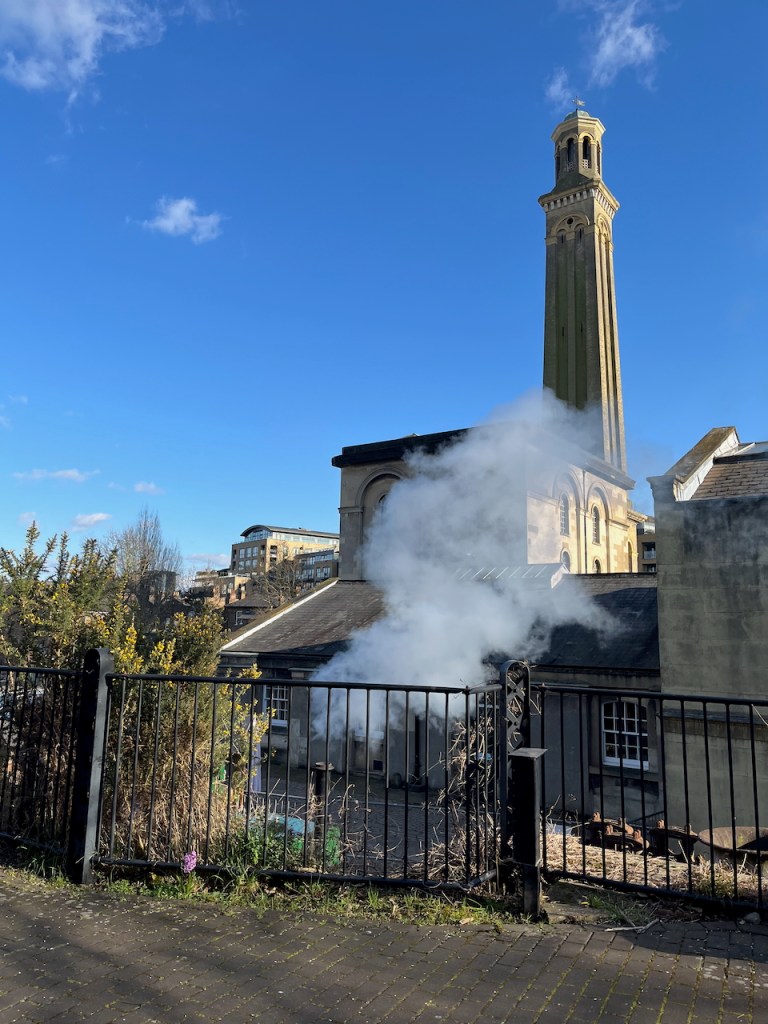
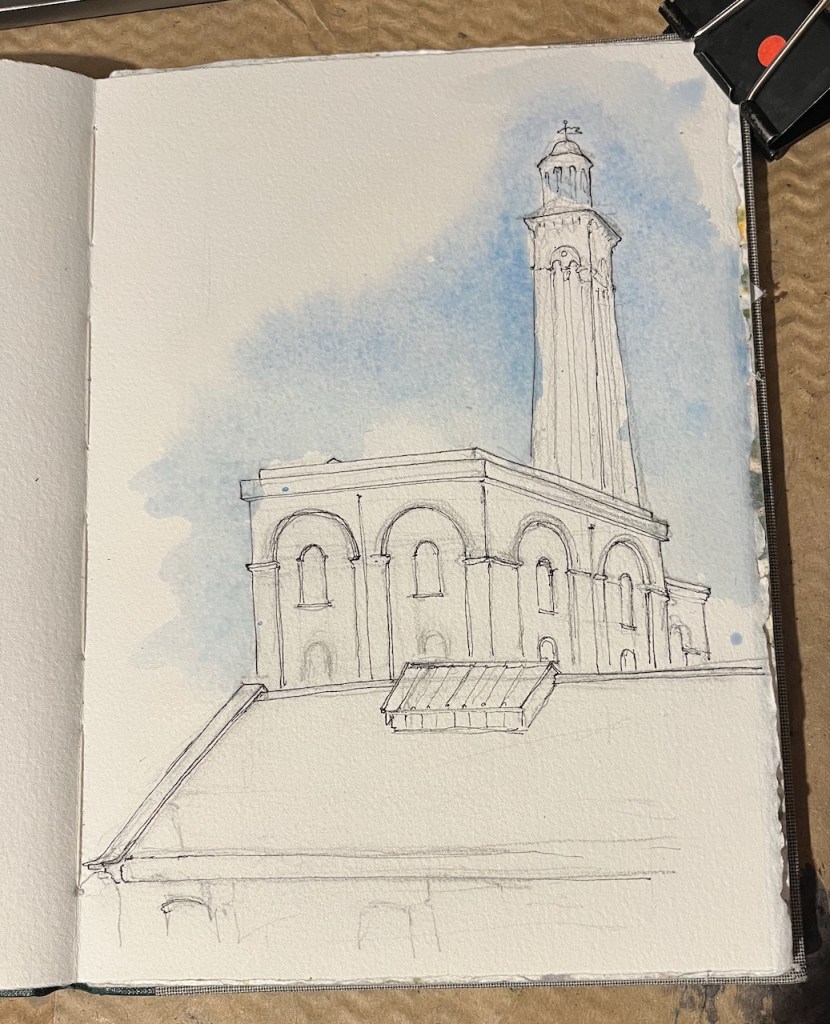
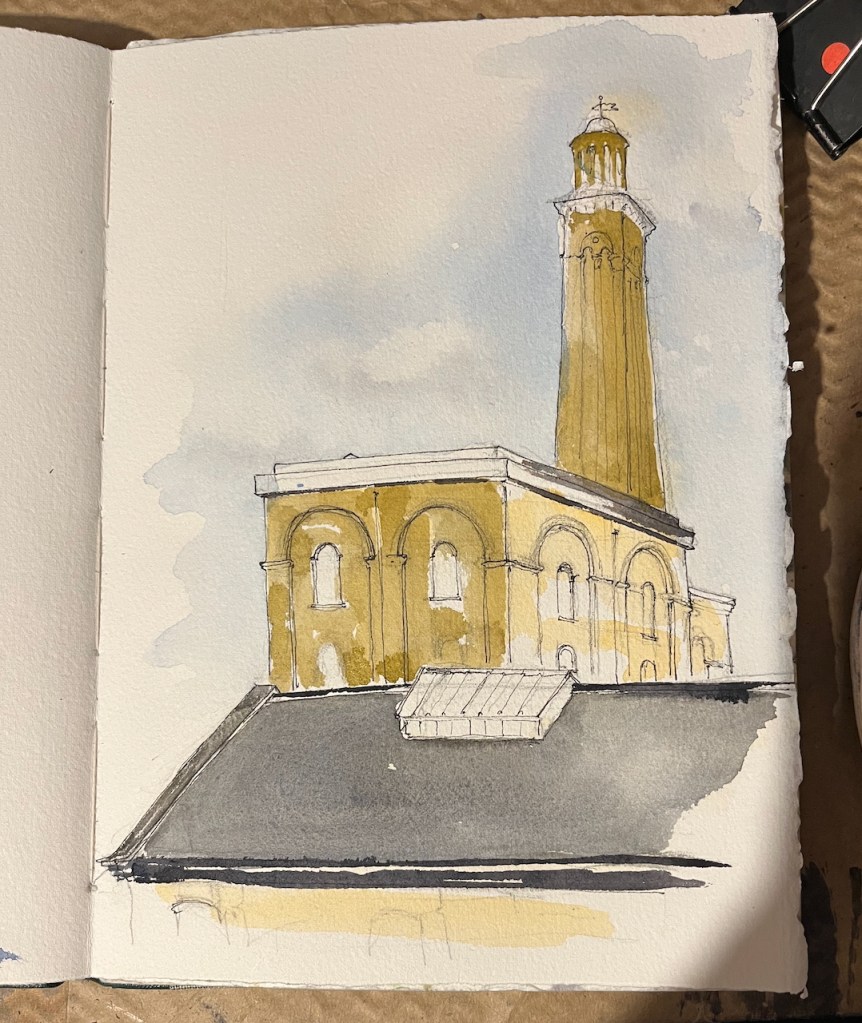
Here is the magnificent London Water and Steam Museum.
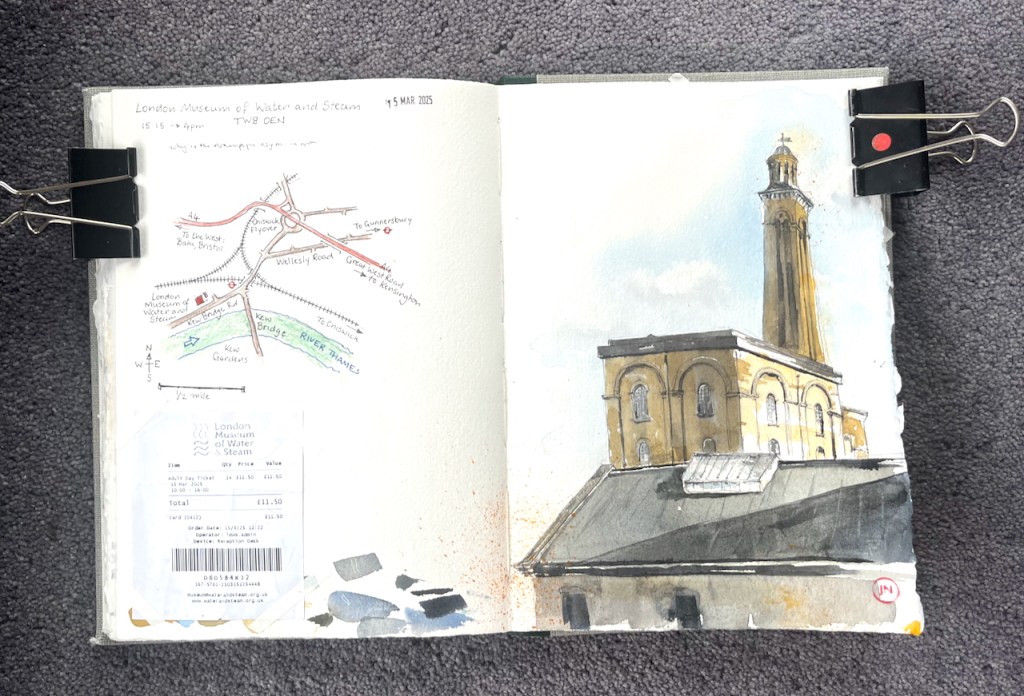
London Water and Steam Museum, sketched 15th March 2025, 4pm in sketchbook 15.
It’s definitely worth a visit if like me you are fascinated by steam engines. But there’s more. This museum is a whole education in the London drinking water and sewerage system: past and present.
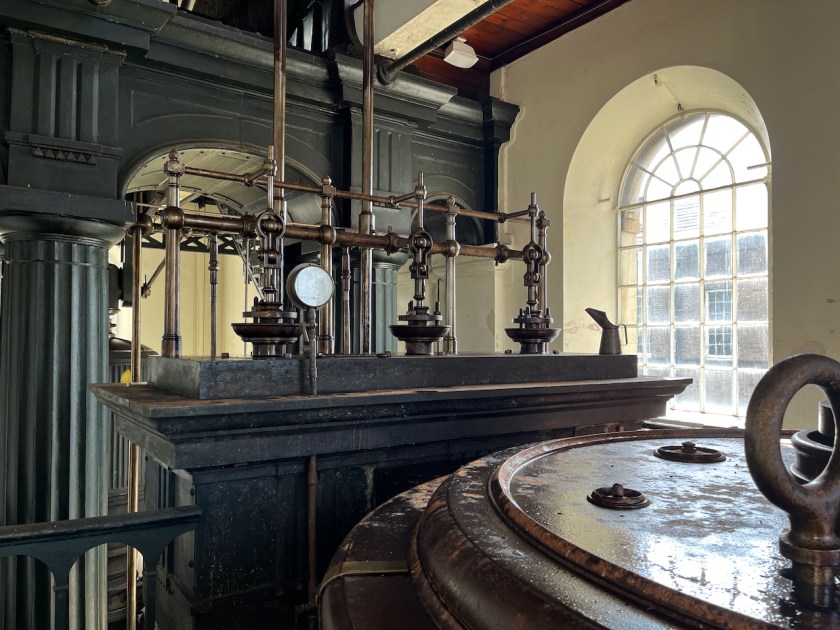
The building I’ve sketched houses the “100 inch pumping engine” and the “90 inch pumping engine”. These are steam pumps over a hundred years old. The inches refer to the diameter of the pump cylinder. Their job was to pump drinking water from the Thames to premises in London. The 90 inch engine started working in 1846 and the 100 inch started in 1871. They both retired in 1943, by which time the 90 inch had been going 97 years. The 100 inch gave a demonstration in 1958, which was the last time it pumped water. The 90 inch was restored to working order by enthusiasts in 1973, and now gives demonstrations in the museum. The 100 inch has yet to be restored.
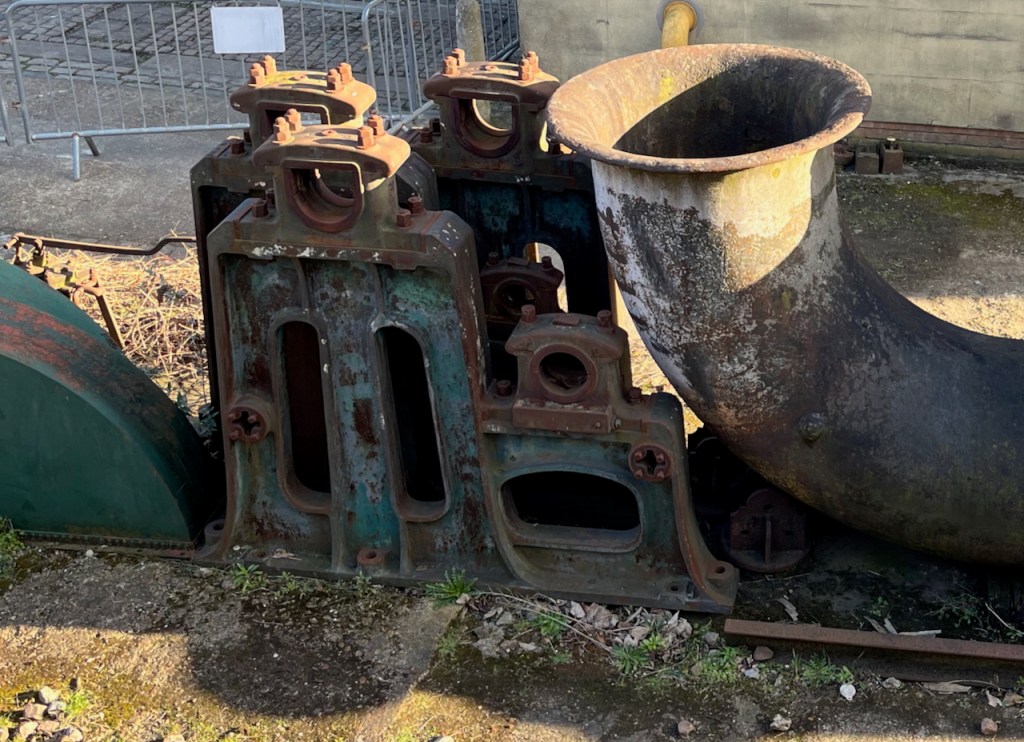
A glimpse of part of the 100 inch engine
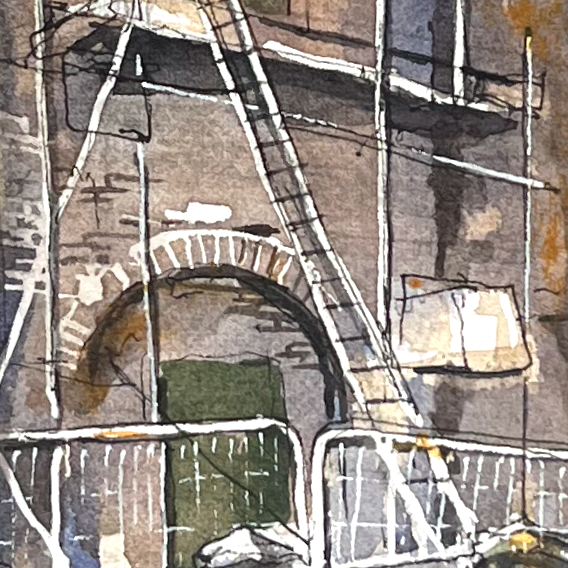
The tower in my sketch is not a chimney. It is a “standpipe tower”. It holds big vertical pipes and a reservoir to store water and regulate the pressure. The strokes from the steam engines created powerful surges of water. You don’t want those powerful surges going directly into the mains water supply, and as they might damage the pipes and surprise consumers. So the steam engines pumped the water up this tower instead. From there, the water flowed out to consumers smoothly.
Providing running water was a whole big problem in the Victorian era. The machines were gigantic so that they could generate sufficient water pressure to get the water up to the second floor of the new Victorian houses which had bathrooms upstairs. That’s not something we normally think about: but I can see it’s an issue.
a glimpse of the 90 inch engine
Then there was the whole big issue of the purity of the water, and whether it was actually drinkable. There were a number of private water companies at the time, in competition with each other, and vying for business, making claims for their water quality, and returning dividends to their shareholders. This was the late 19th century – 100 or so years ago.
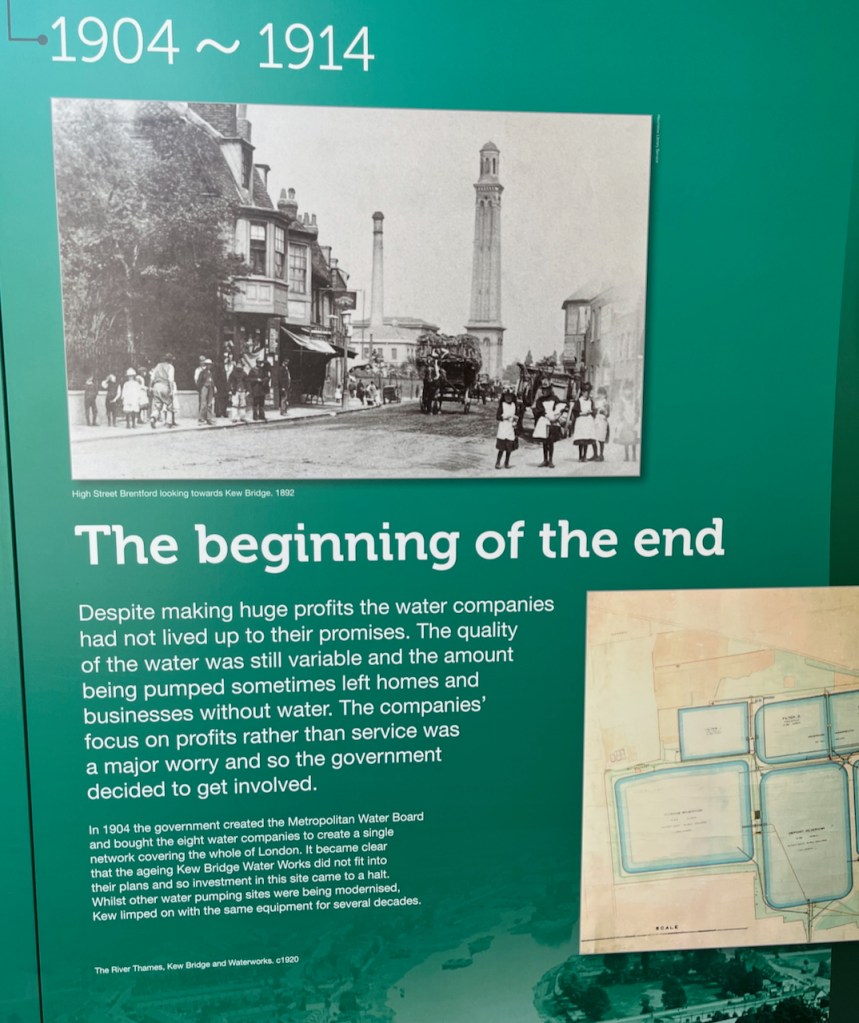
A display panel soberly tells us:
“Despite making huge profits the water companies had not lived up to their promises. The quality of the water was still variable and the amount being pumped sometimes left homes and businesses without water. The companies’ focus on profits rather than service was a major worry and so the government decided to get involved. In 1904 the government created the Metropolitan Water Board and bought the eight water companies to create a single network covering the whole of London. …
Display panel: “The companies’ focus on profits rather than service was a major worry and so the government decided to get involved.…”
As well as history, I learned about today’s drinking water.
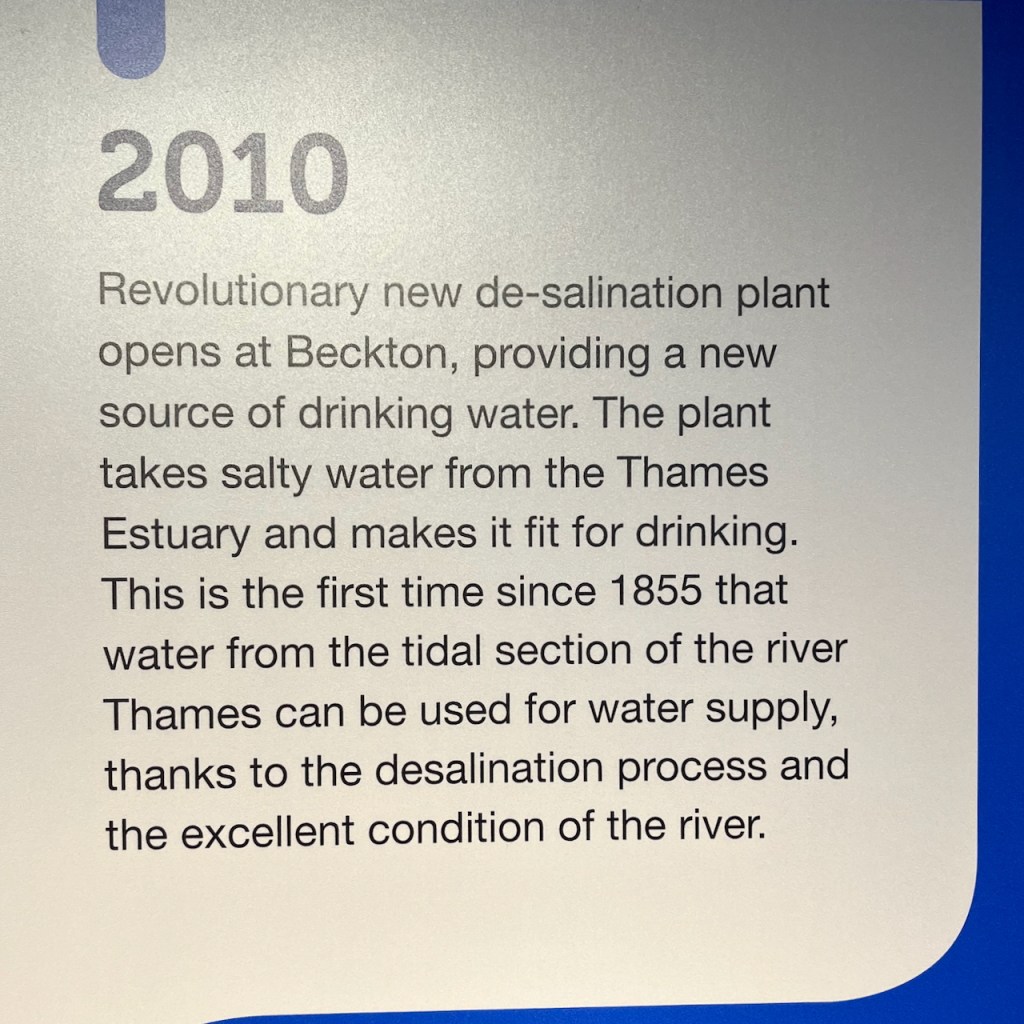
For example: did you know that 10% of London’s drinking water is de-salinated water from the Thames estuary? The “revolutionary new de-salination plant” opened in 2010:
I watched a gripping – and somewhat alarming – video of heroic engineers cautiously making their way down soaking brick-lined pipes in the sewers below London streets. They were down there to inspect and clear blockages. I also saw the “rat” robots that can be sent down the smaller sewers – it’s a tough environment for technology.
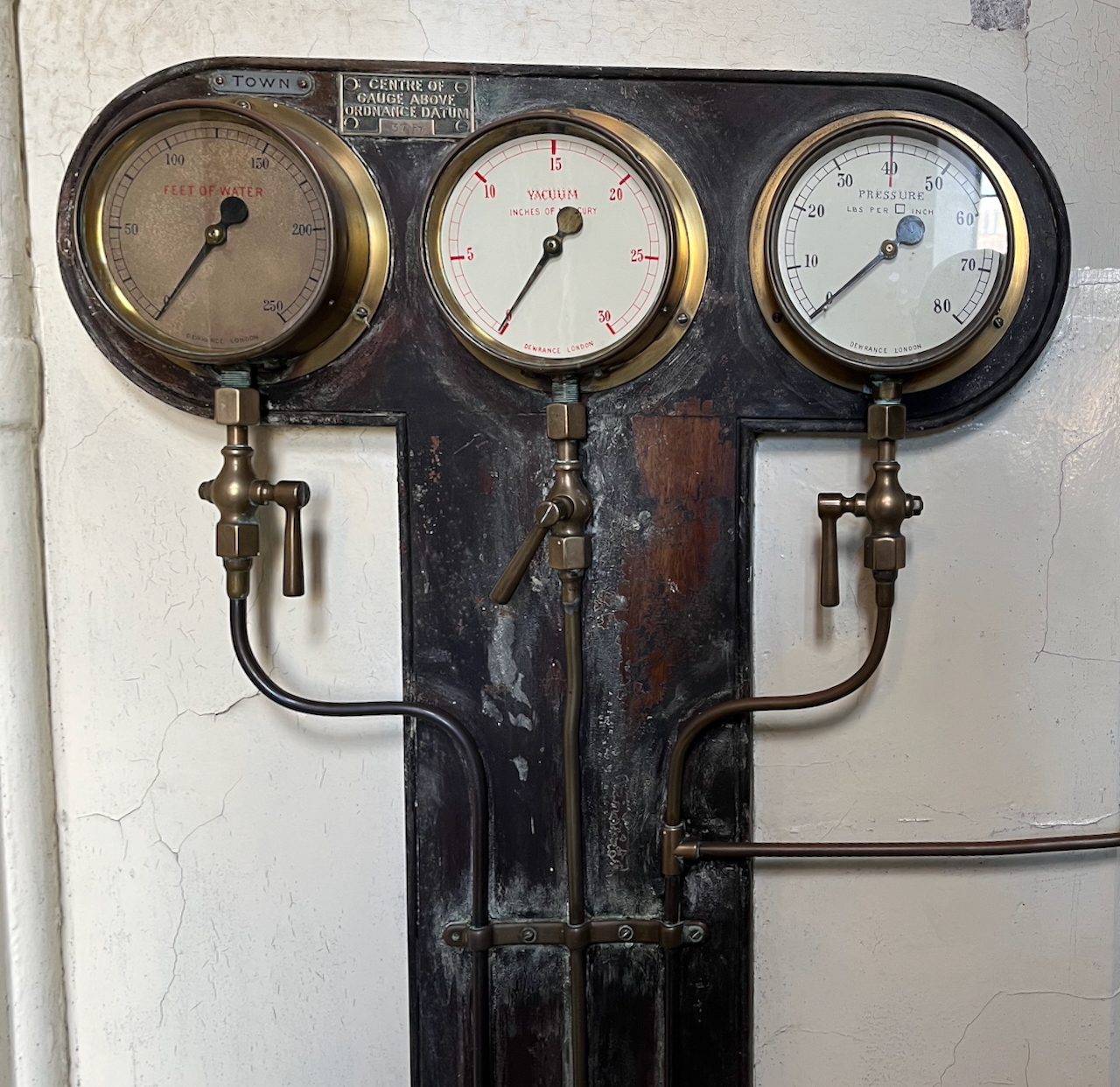
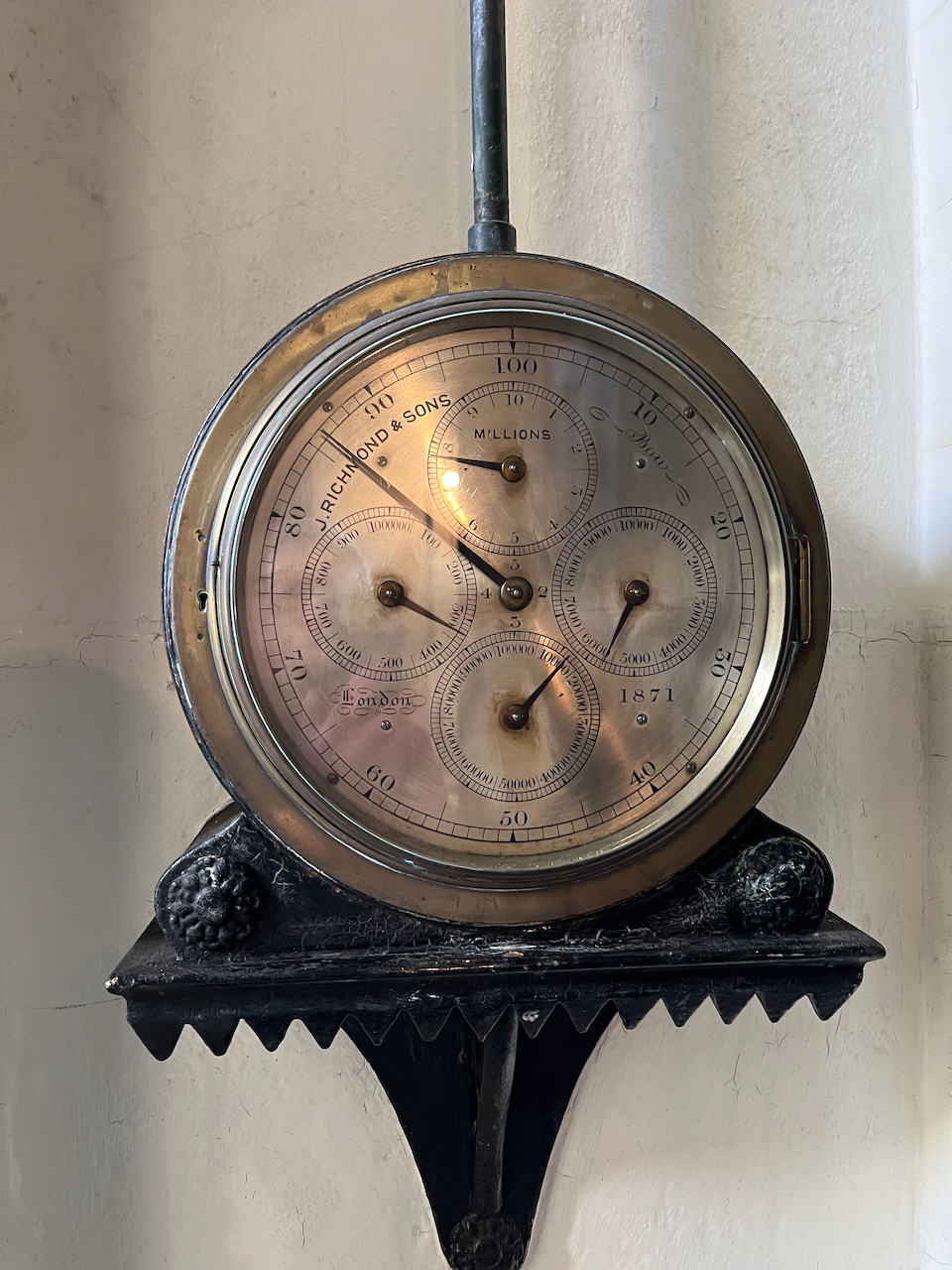
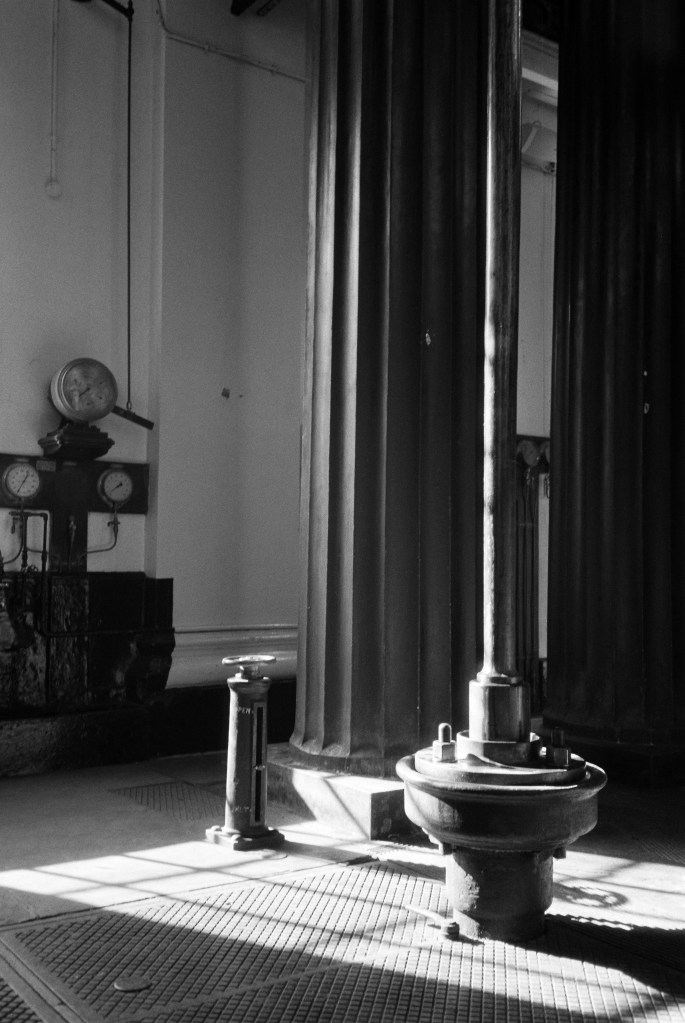
As well as all this gripping factual information, there’s much of strange beauty in the machinery. I particularly enjoyed the devices and dials.
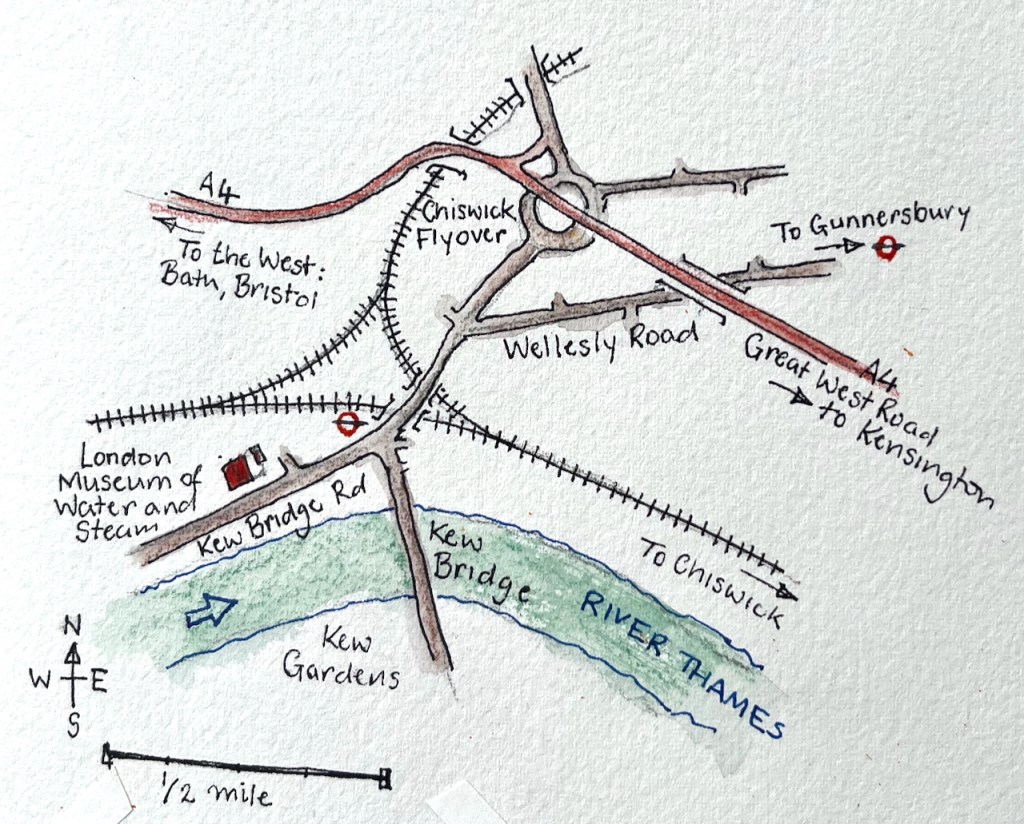
Definitely recommended. It’s on the underground. No café: take a picnic to eat at their indoor tables.
It closes at 4pm – I managed to do the sketch from the garden, just before they closed the gates.
Sculptural debris in yardThe steam train in the grounds: returning to the shed at the end of the day.
I added the colour later.
Sketchbook 15Part of the 90 inch pump: analogue film photo, Olympus XA2 using Kentmere Pan 400 b/w film. 15th March 2025
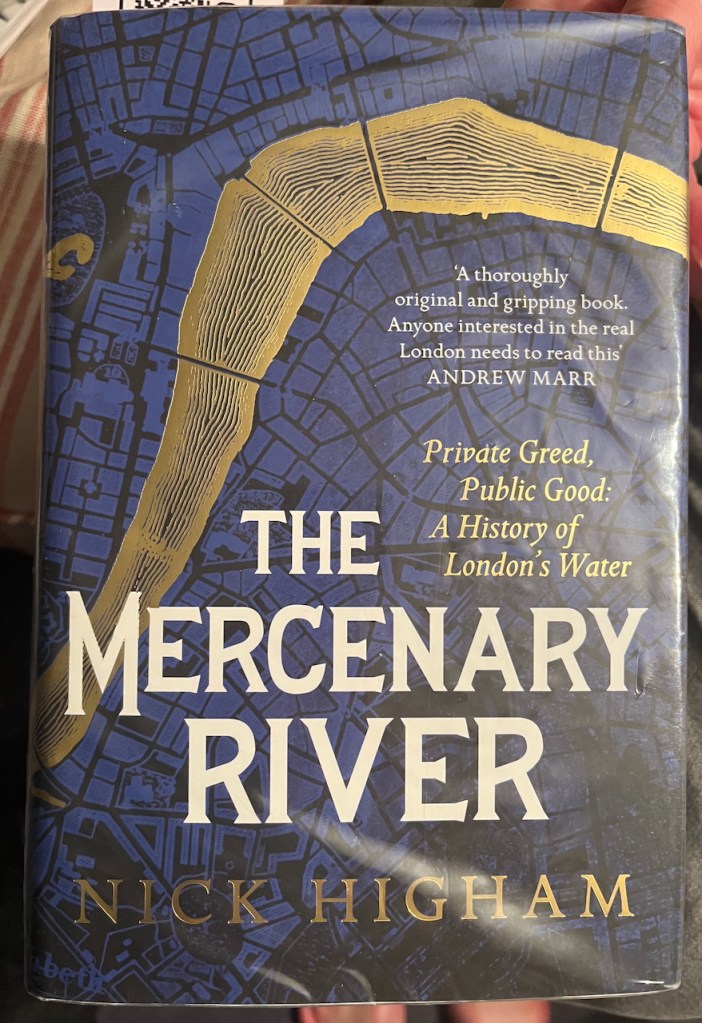
Information in this post is from placards in the museum or from their website. Inspired by my visit to the museum, I read this excellent book about London’s water supply:
“The Mercenary River” by Nick Higham
Click a button below to share this post online, email it, or print it:
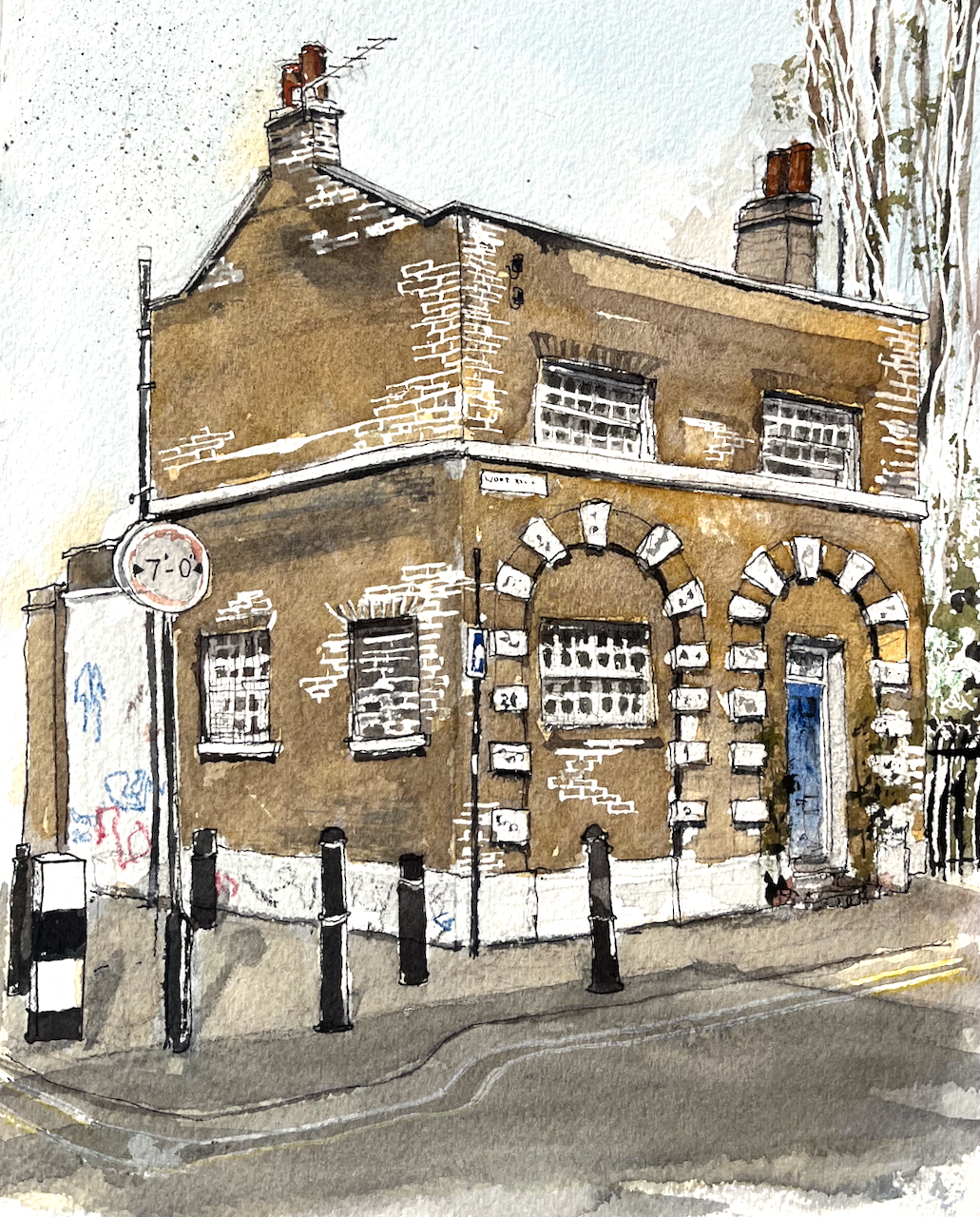
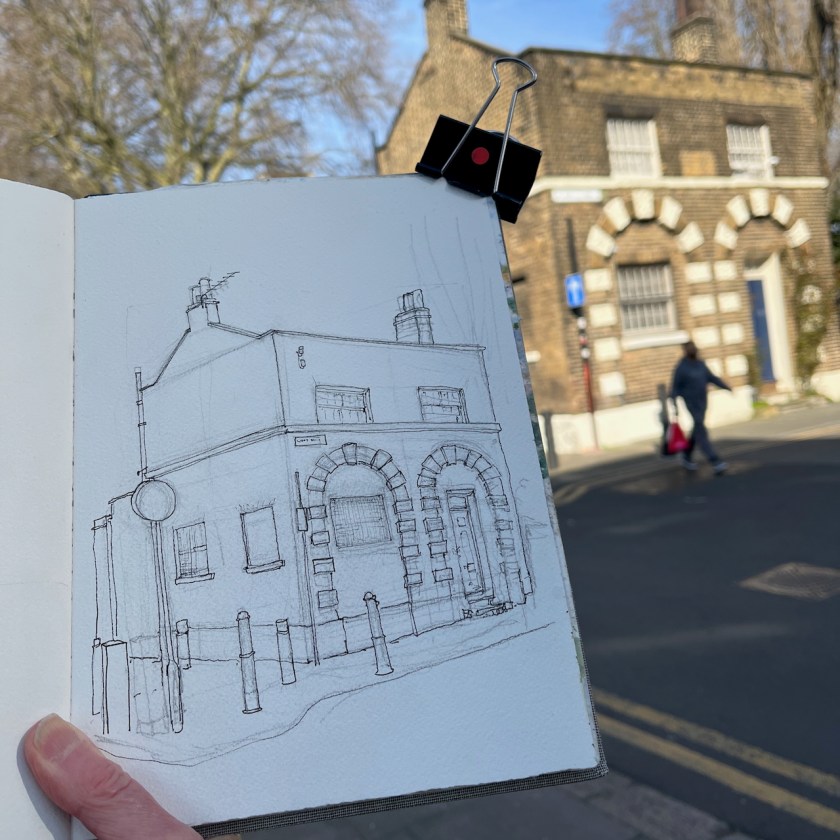
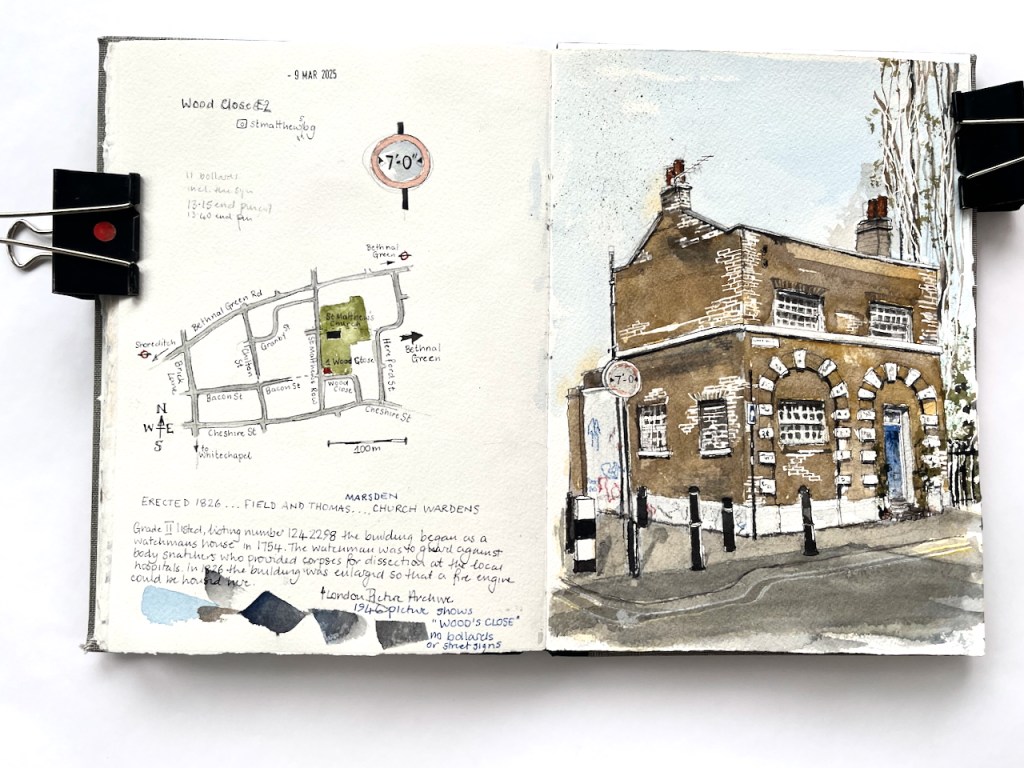
See this interesting building! It’s just a few hundred yards from Brick Lane in East London.
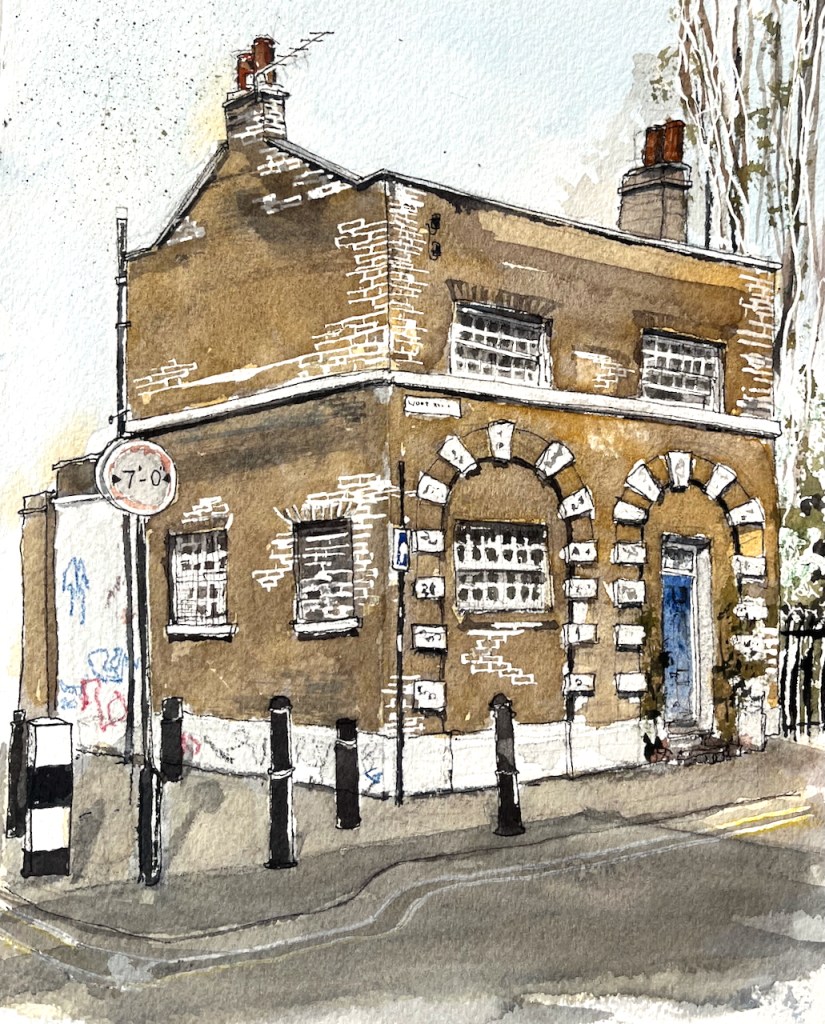
1 Wood Close E2, sketched around midday, 9th March 2025 in sketchbook 15
I’d walked past it a few days previously, when I had been taking a circuitous route through East London on the way back from Hackney Wick. It’s an unusual building for the neighbourhood, most of which is terraces or blocks of post-war flats. This building stood out, on its own, at a street corner. What is it doing there?
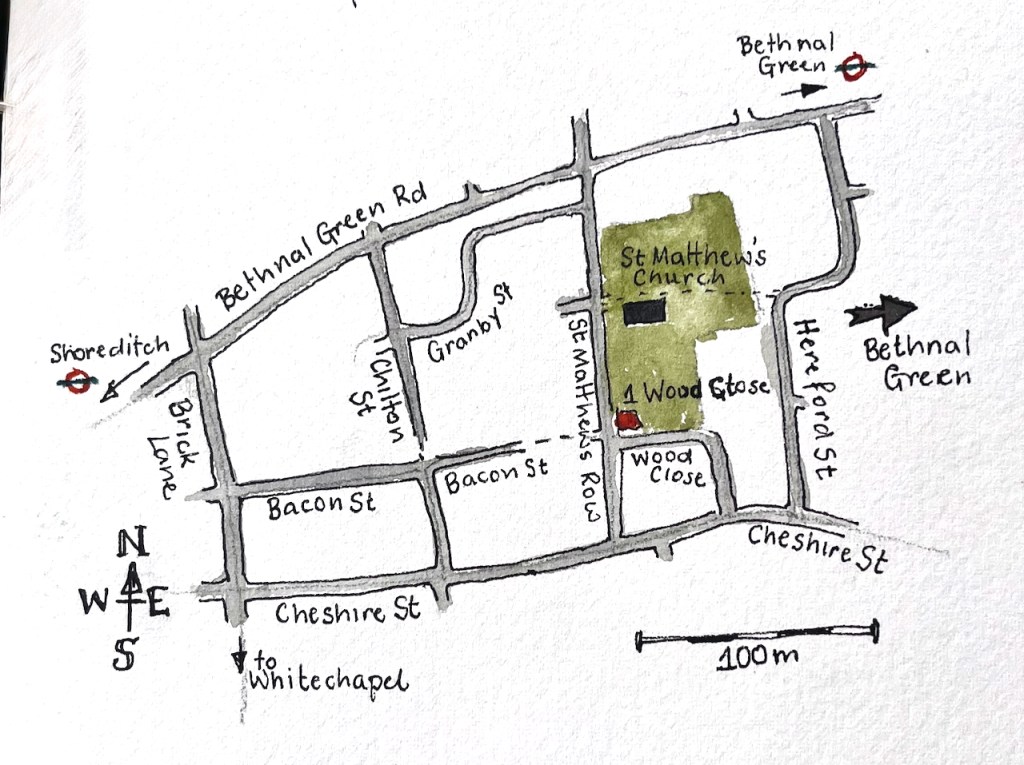
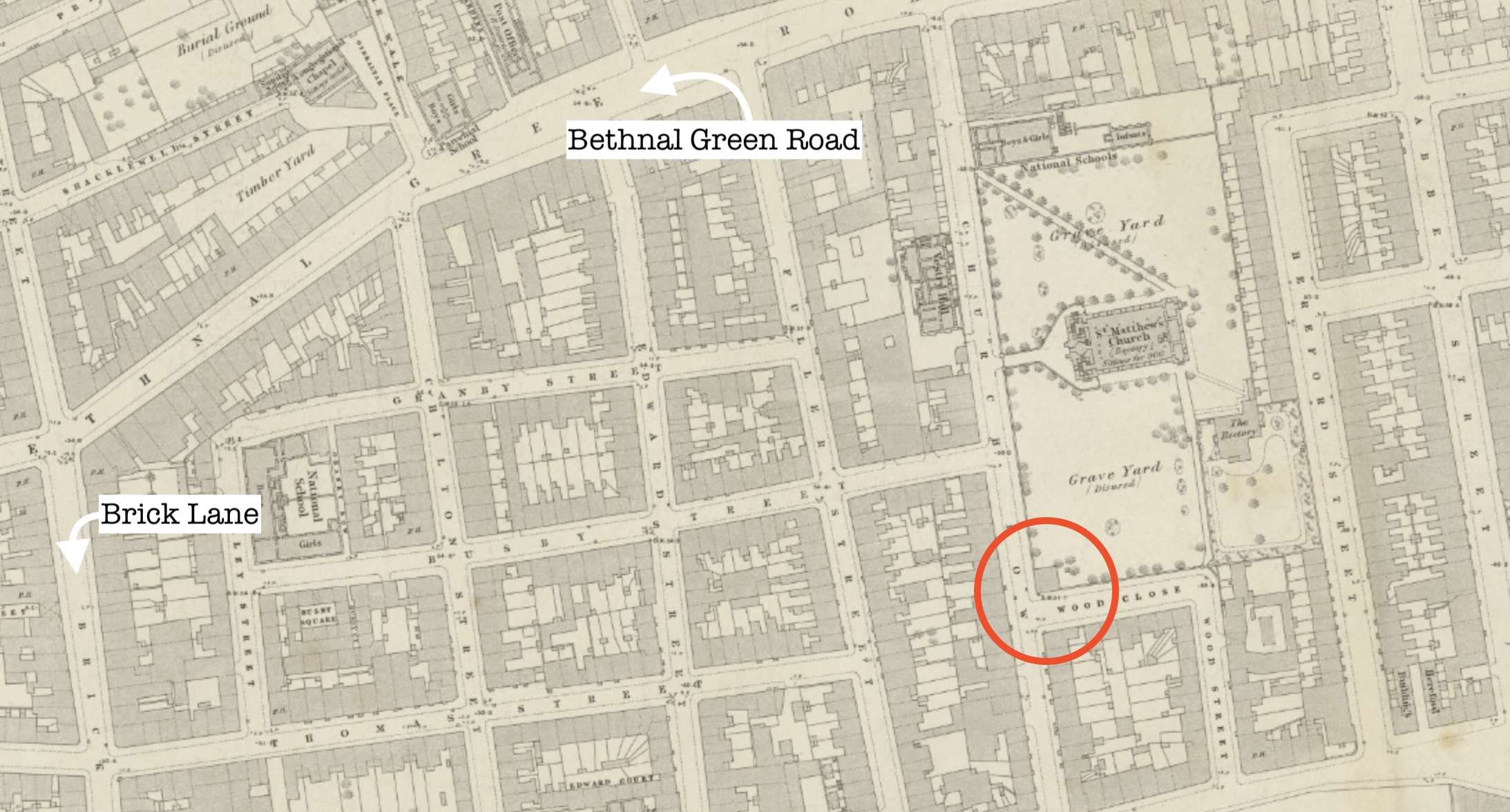
Sketch map showing the location of Wood Close: just to the east of Brick Lane.
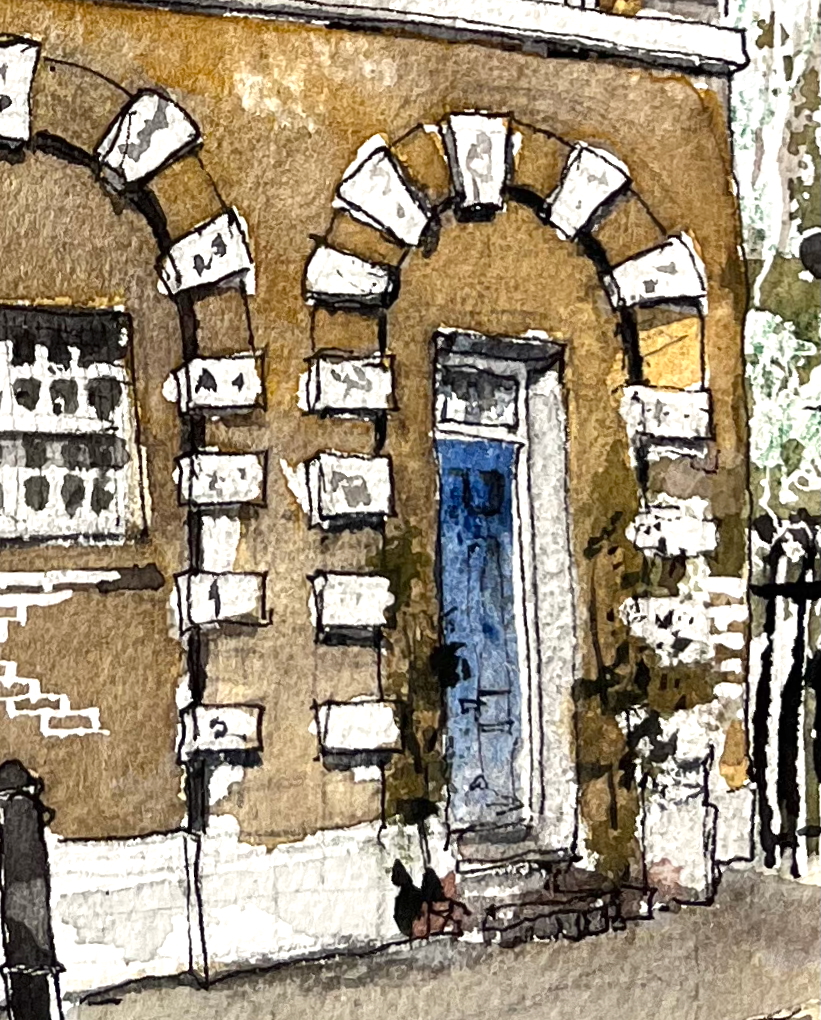
I went back a few days later for a closer look. On the white band at the front of the building I could decipher some words: “ERECTED 1826 [something] FIELD AND THOMAS [something] CHURCH WARDENS”
London Picture Archive has a photo of this building from 1946. The words on the front were a little clearer in 1946, so I can read that Thomas’ second name was MARSDEN. The London Picture Archive caption says that “the building began as a watchman’s house in 1754. The watchman was to guard against body snatchers who provided corpses for dissection to local hospitals. ” So that’s what it was doing: it was guarding the graveyard.
The London Picture Archive caption goes on to say that “In 1826 the building was enlarged so that a fire engine could be housed there.” That’s the building we see now, labelled 1826. It doesn’t look big enough for a fire engine.
19462025
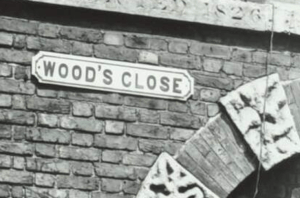
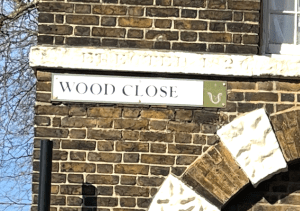
In the London Picture Archive photo from 1946, the street name affixed to the building says “Wood’s Close” which would indicate it was named after someone called Wood. Today the street name on the building is “Wood Close”
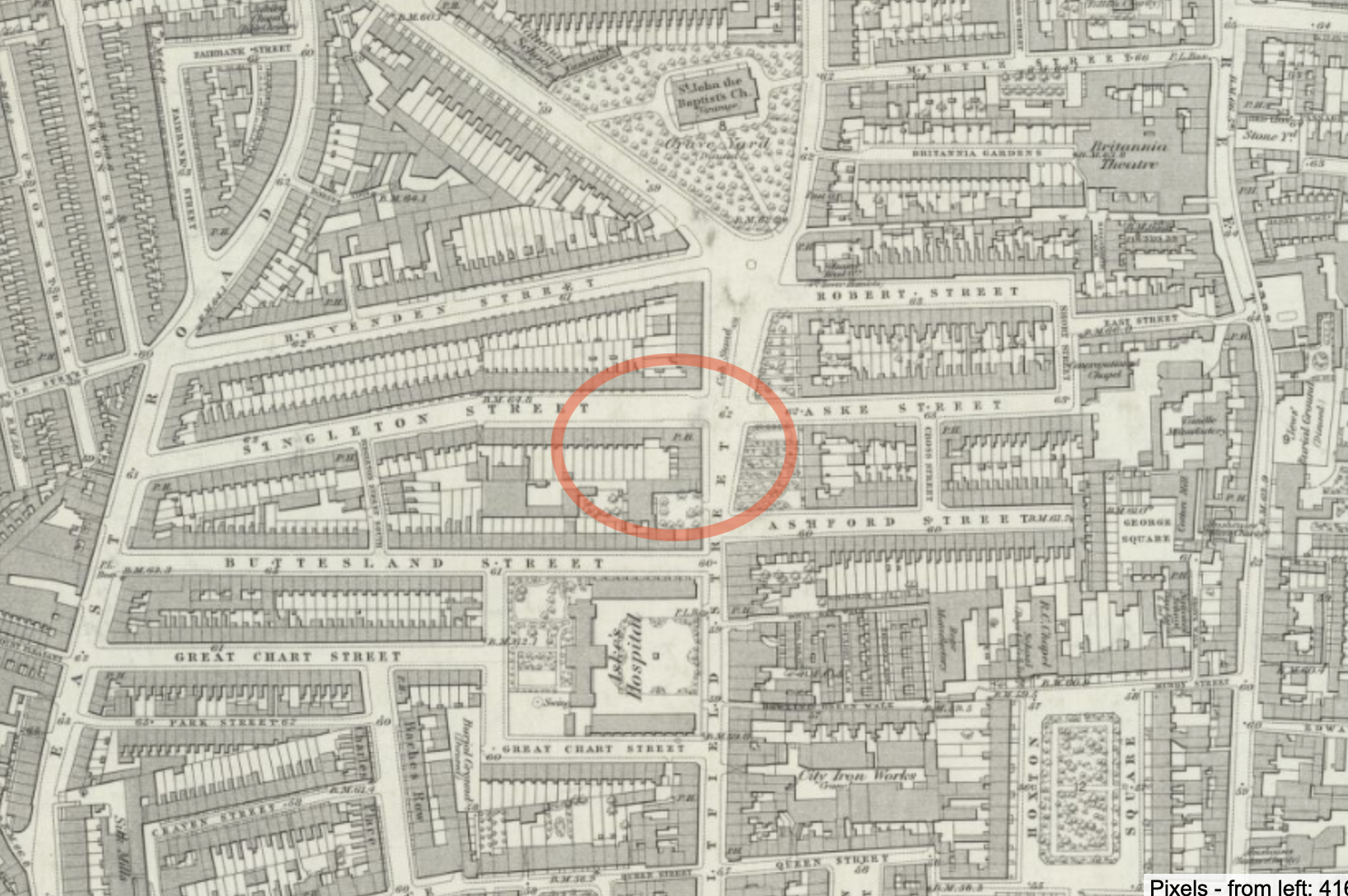
This link shows a 1872 map. Here’s an extract. Click the map to go to the National Library of Scotland map which is very detailed. The street is called “Wood Close” on this map. You can see the “Grave Yard (disused)”. The Watch House, circled in red below, is in the corner of the graveyard, which makes sense.
Area around Wood Close: 1872. Reproduced with the permission of the National Library of Scotland CC-BY(NLS)
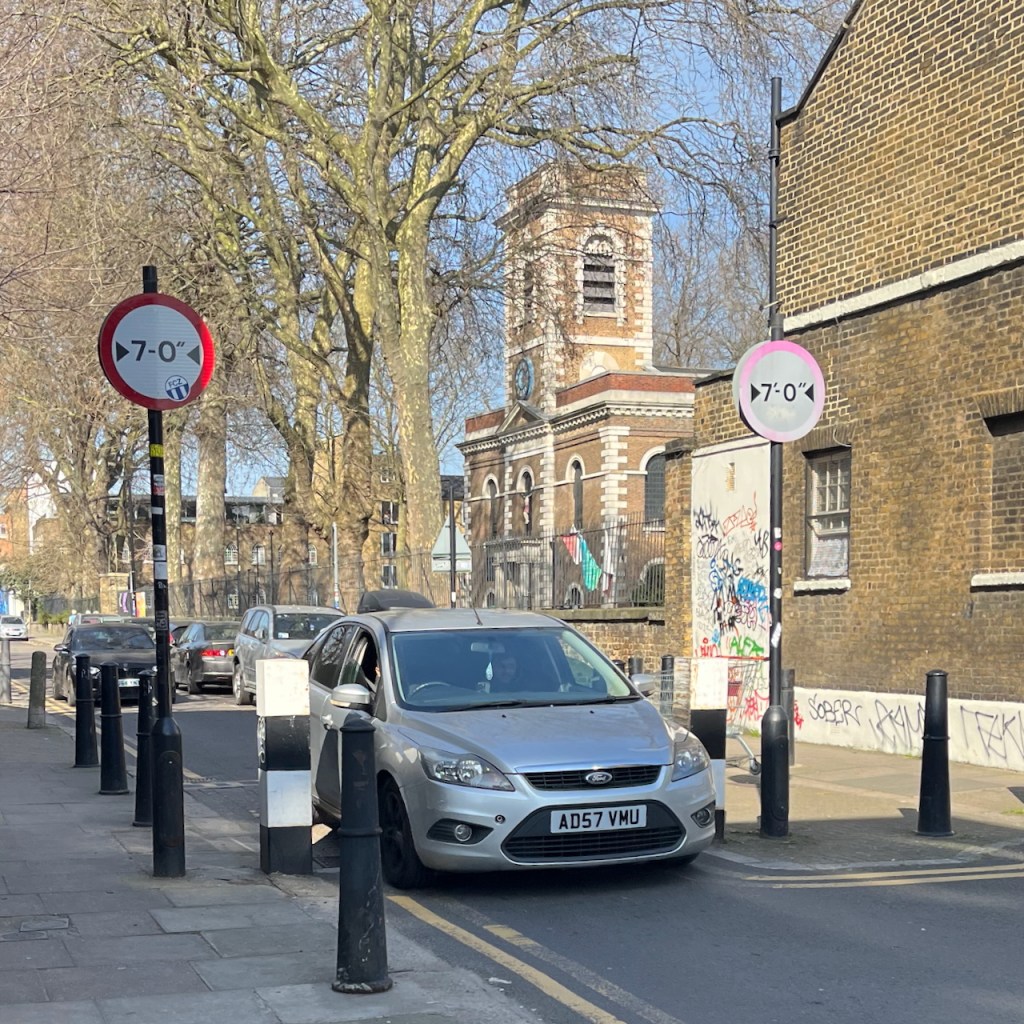
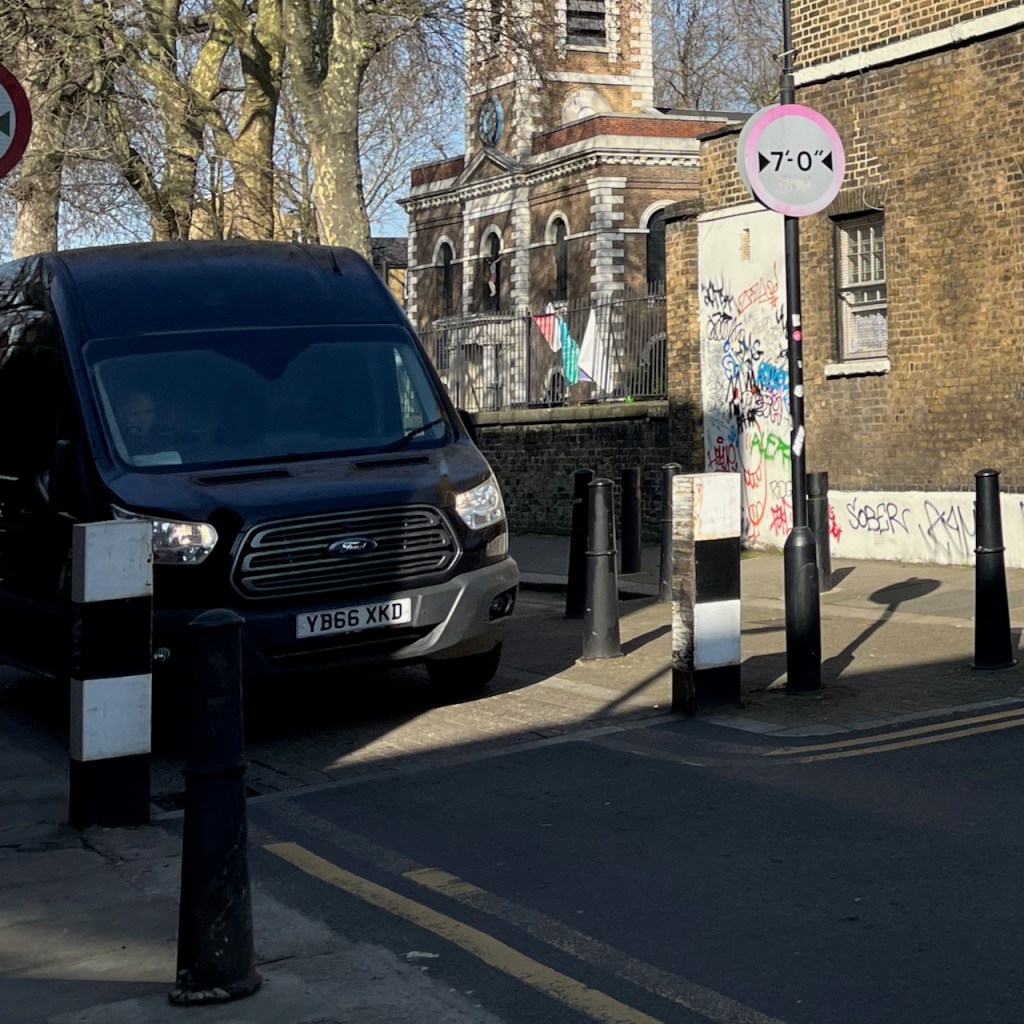
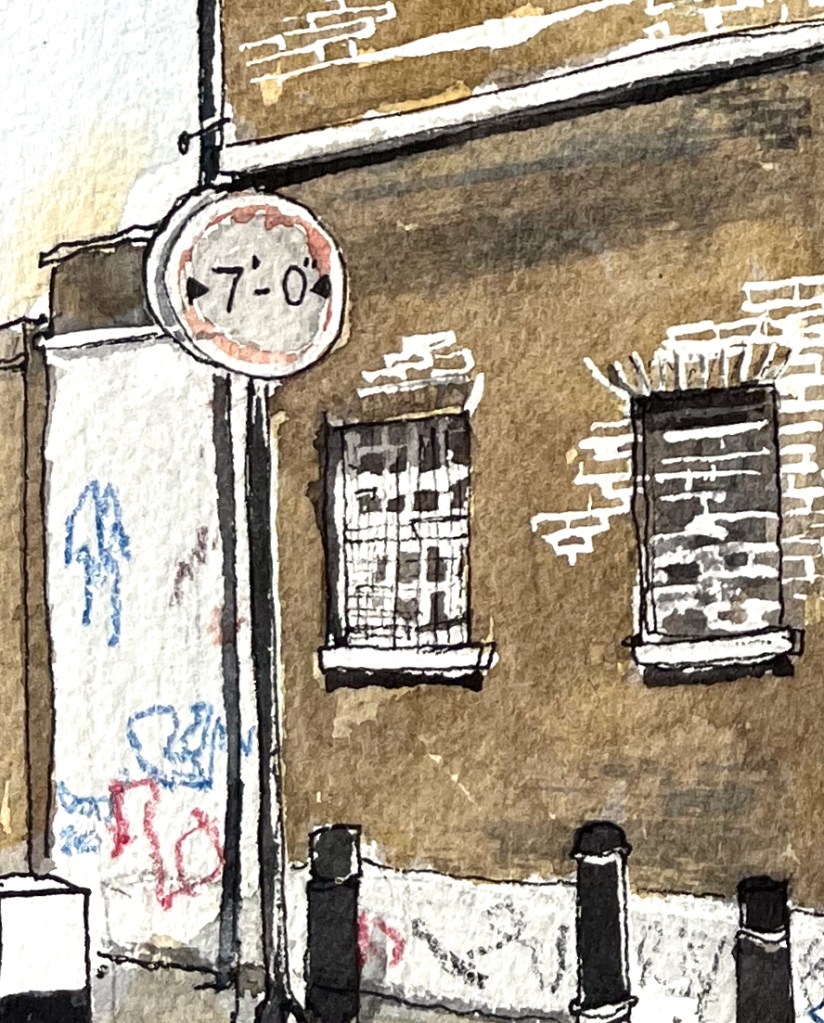
As you see in my sketch, there are now a prodigious number of bollards in front of the house. I counted ten of them, standing like an amused crowd next to the “7′-0” sign . While I was standing there sketching, I saw why. The idea is to restrict the width of St Matthew’s Row so that vehicles have to slow down or stop, and cars can’t sneak round the edges. I watched agog as huge limousines edged between the bollards.
A large car navigates the bollards. St Matthew’s Church is in the background. A van only just fits through.
This Watch House, and the nearby Parish Hall are owned by St Matthews Church:
The Church also own the Watch House on Wood Close, which is currently let out to private tenants, and the Parish Hall on Hereford Street, currently let out to State51.
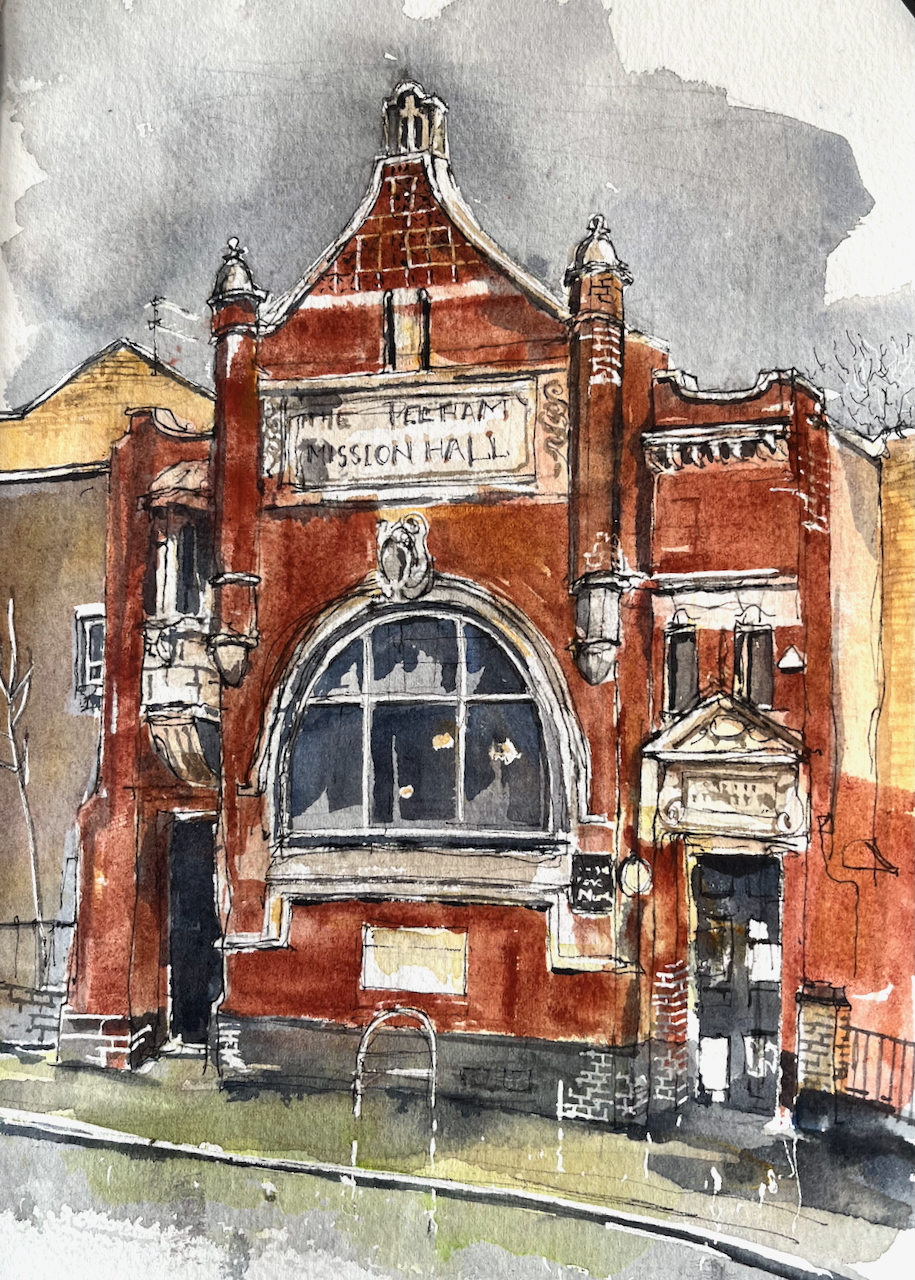
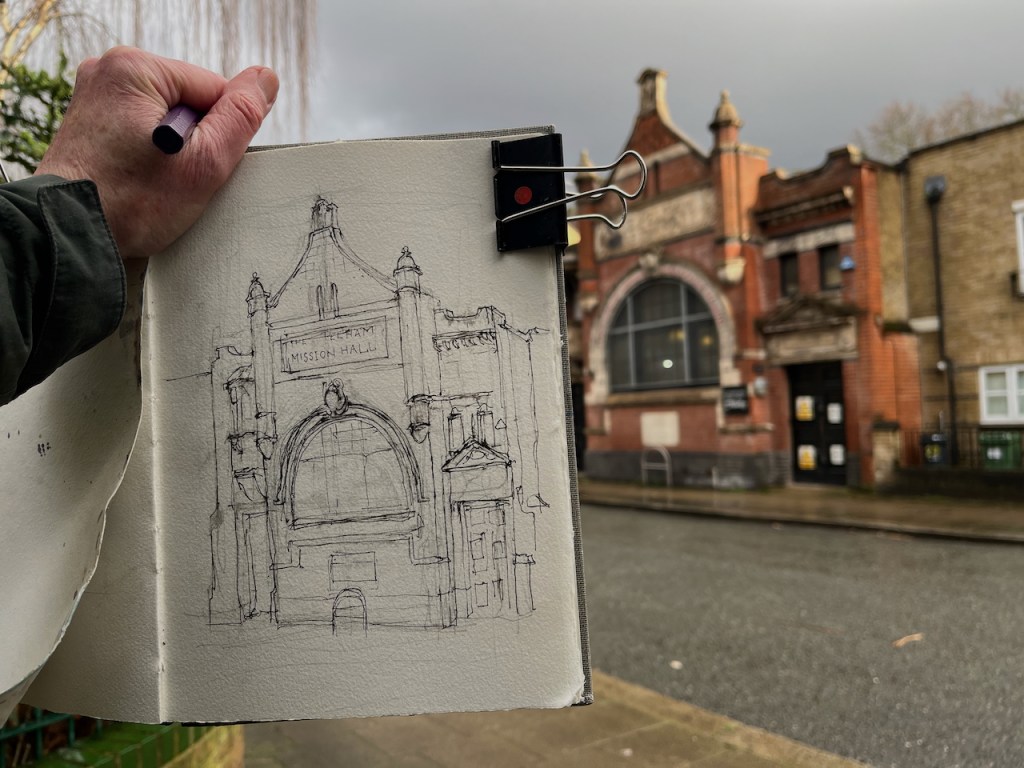
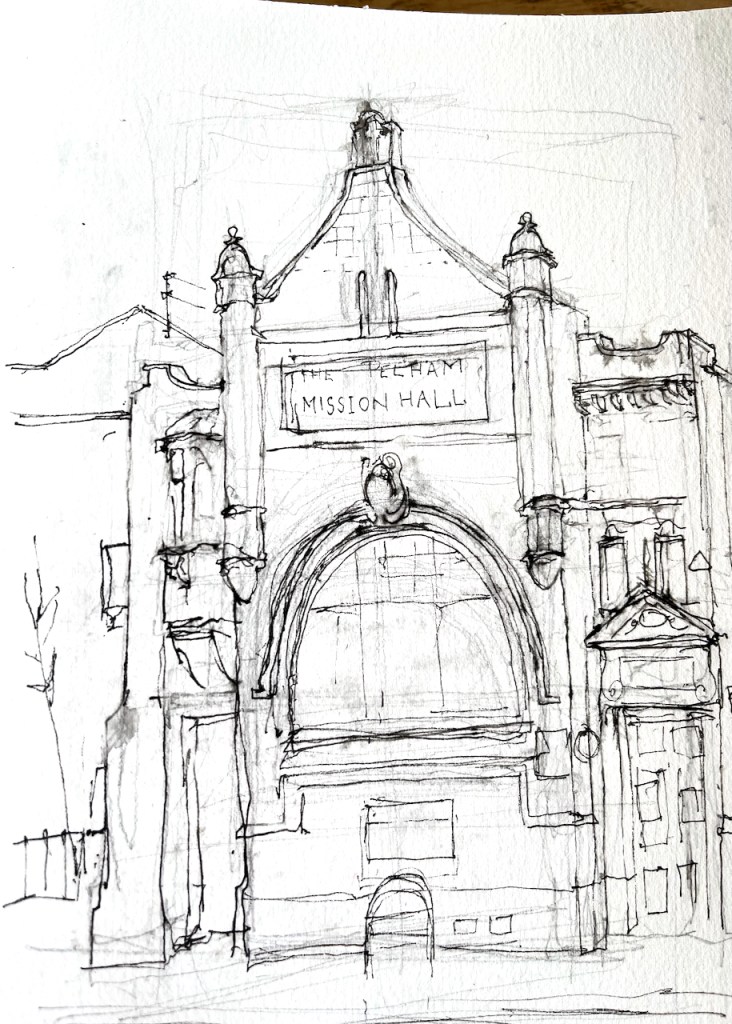
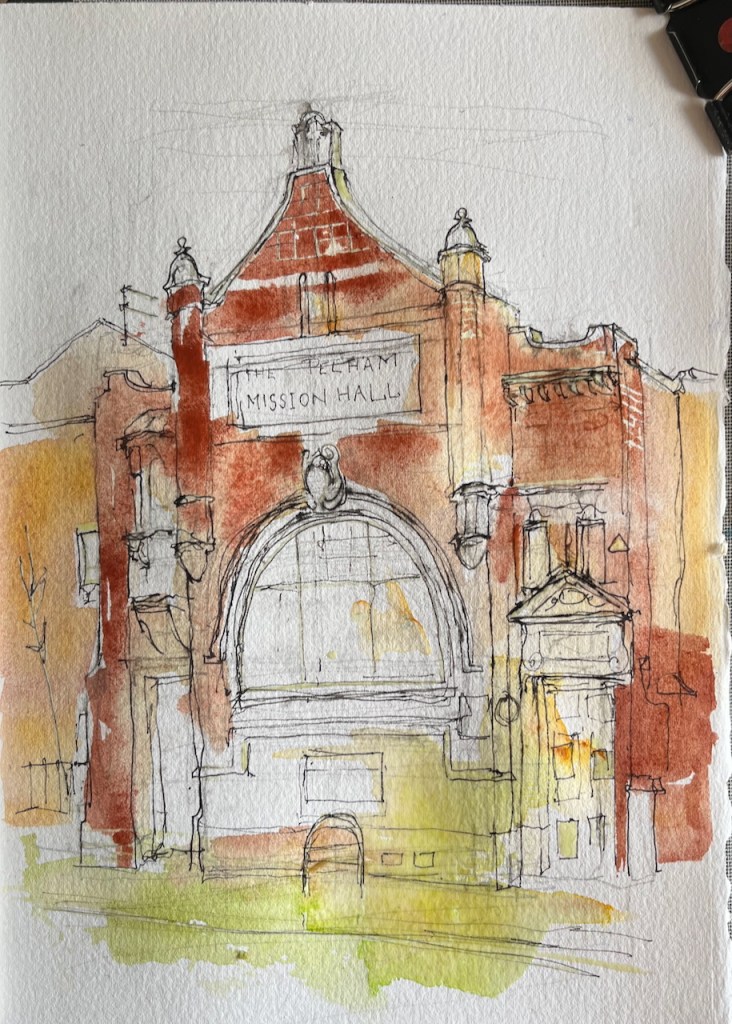
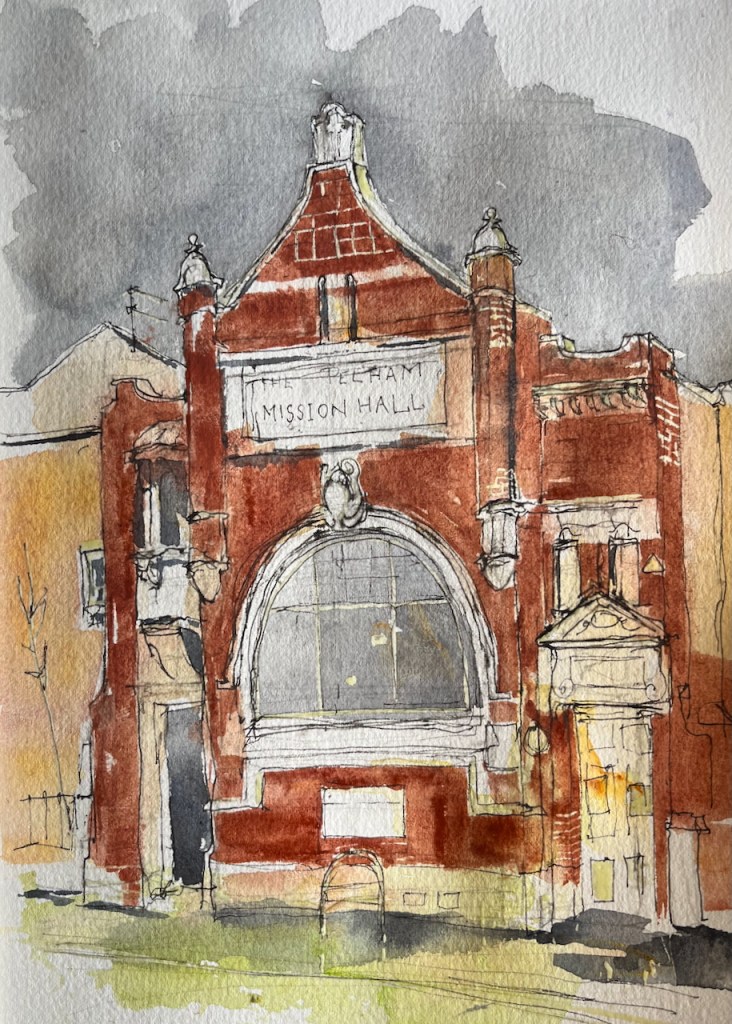
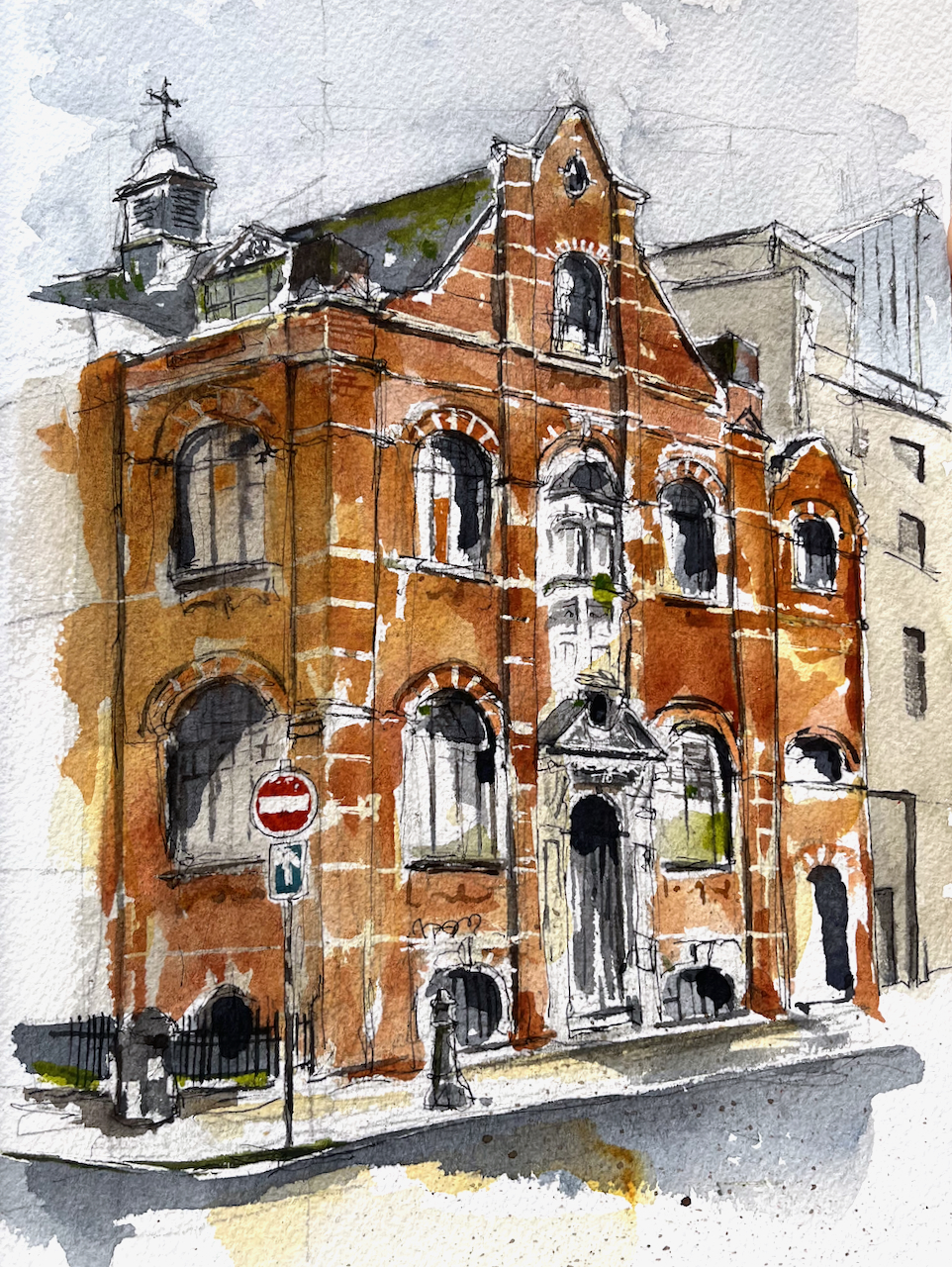
This ornate building stands out amongst the plain and functional housing along Lambeth Walk. I walked past it on my way to the Vauxhall Tea House.
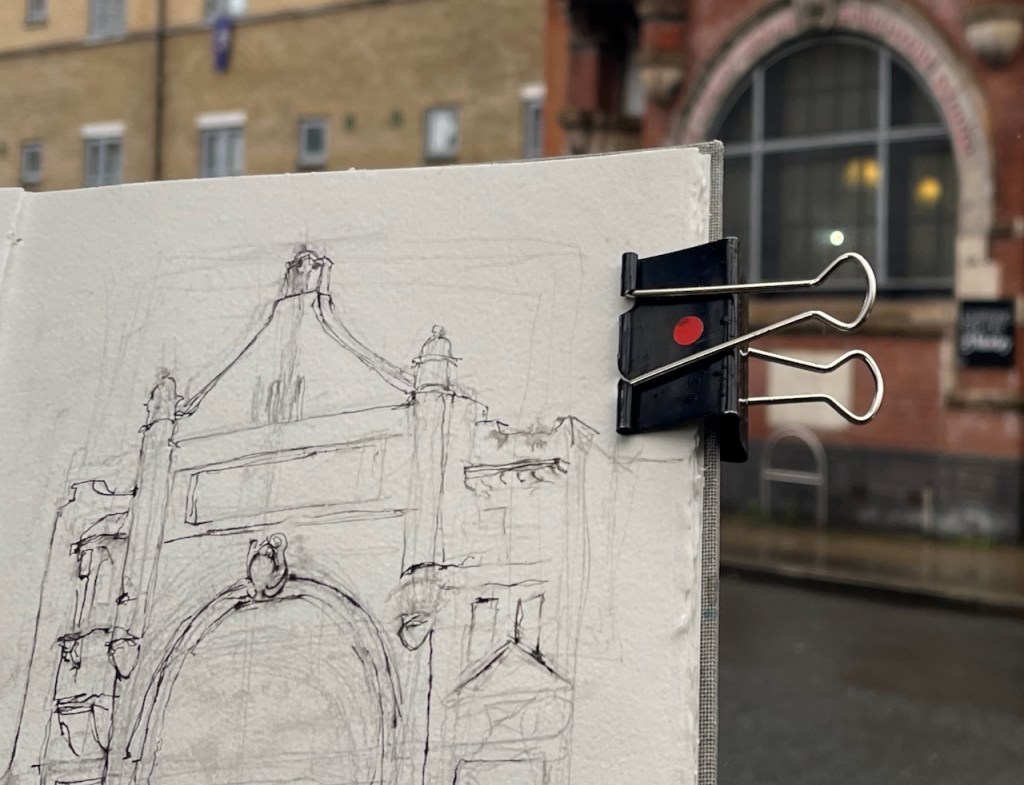
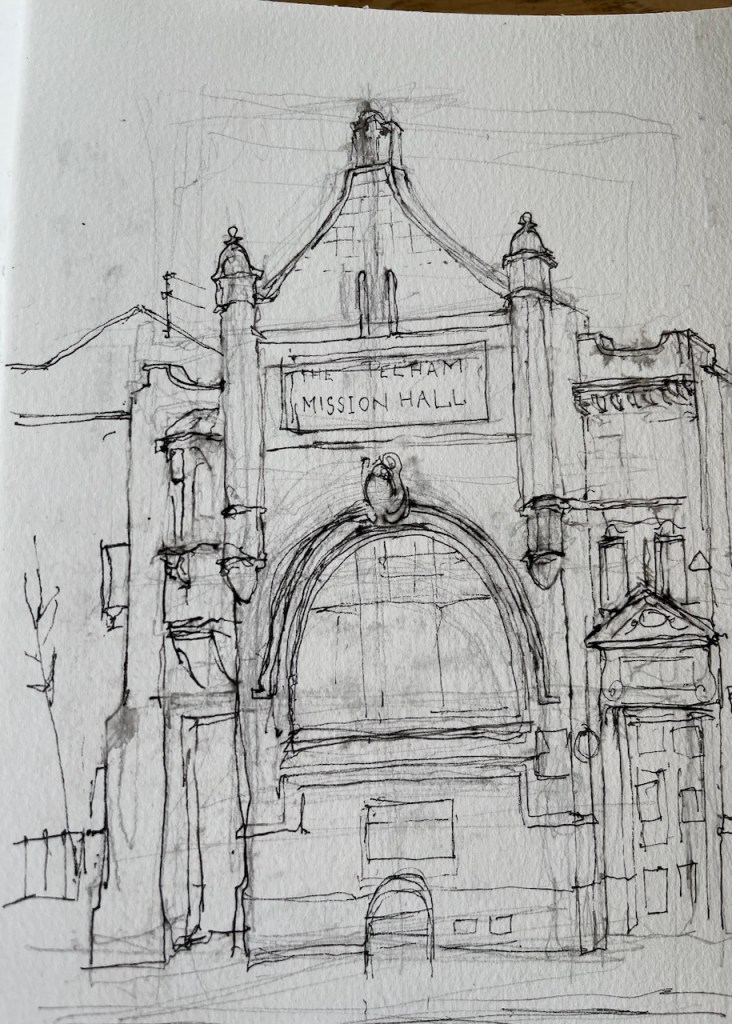
Pelham Mission Hall, Lambeth Walk, Lambeth SE11. in Sketchbook 15, 26 Feb 2025
Canopy
Rain threatened, but I started the sketch anyway. I was sheltering underneath a sort of canopy on the opposite side of the road. This canopy had the significant disadvantage that it was perforated with a pattern of decorative holes.
I sketch using a pen which has waterproof ink. The ink is waterproof once ithas dried. But if I try sketching when the paper is wet, the ink runs. I continued until the pen protested that it couldn’t make marks under these conditions.
The paper I use is Arches Aquarelle. It is “heavily sized”, which means it throws off the water, at least at first. But after sustained drizzle, it starts to become absorbent.
All these things started to happen. The paper became spongy. The pen spluttered. Rain sneaked through the perforated canopy and dripped down the inside of my coat. Water slid off the leaves into my bag. I tried to wrap the sketchbook up and I crammed it into my backpack. I have a waterproof backpack. It was already wet on the outside. Now it was becoming wet on the inside. I stood in the rain and considered. I breathed using a yoga technique. Yoga breathing techniques are quite effective in the rain. There was a rhythm to the drips.
Then the rhythm slowed. Perhaps I could just do a bit more drawing? Slowly, I extracted and unwrapped my book. I flicked the pen to get the ink to flow again. I made each pen stroke count.
The rain eased enough.
This was as far as I got.
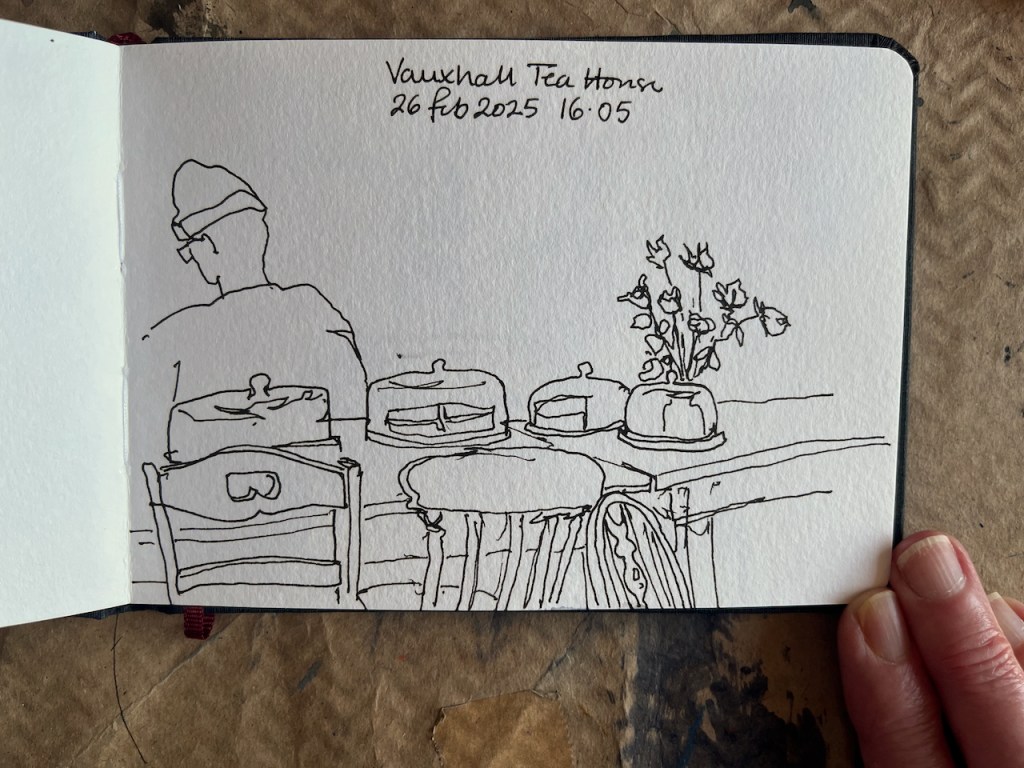
Then I went to the Vauxhall Tea House to warm up.
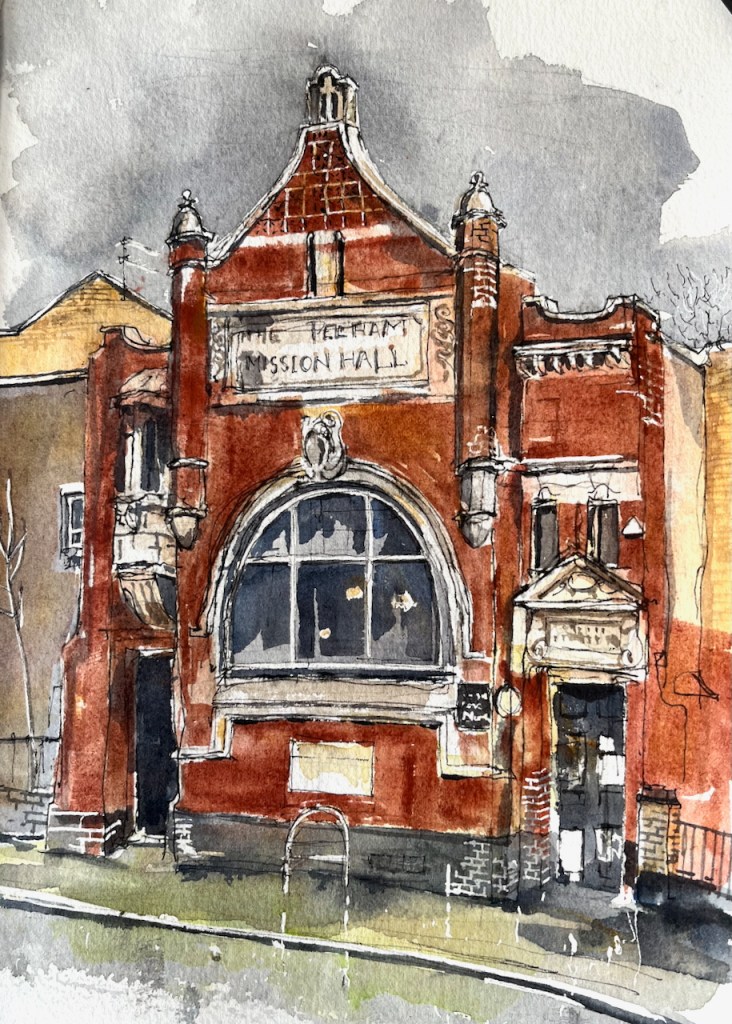
I finished the drawing of Pelham Mission Hall later at my desk.
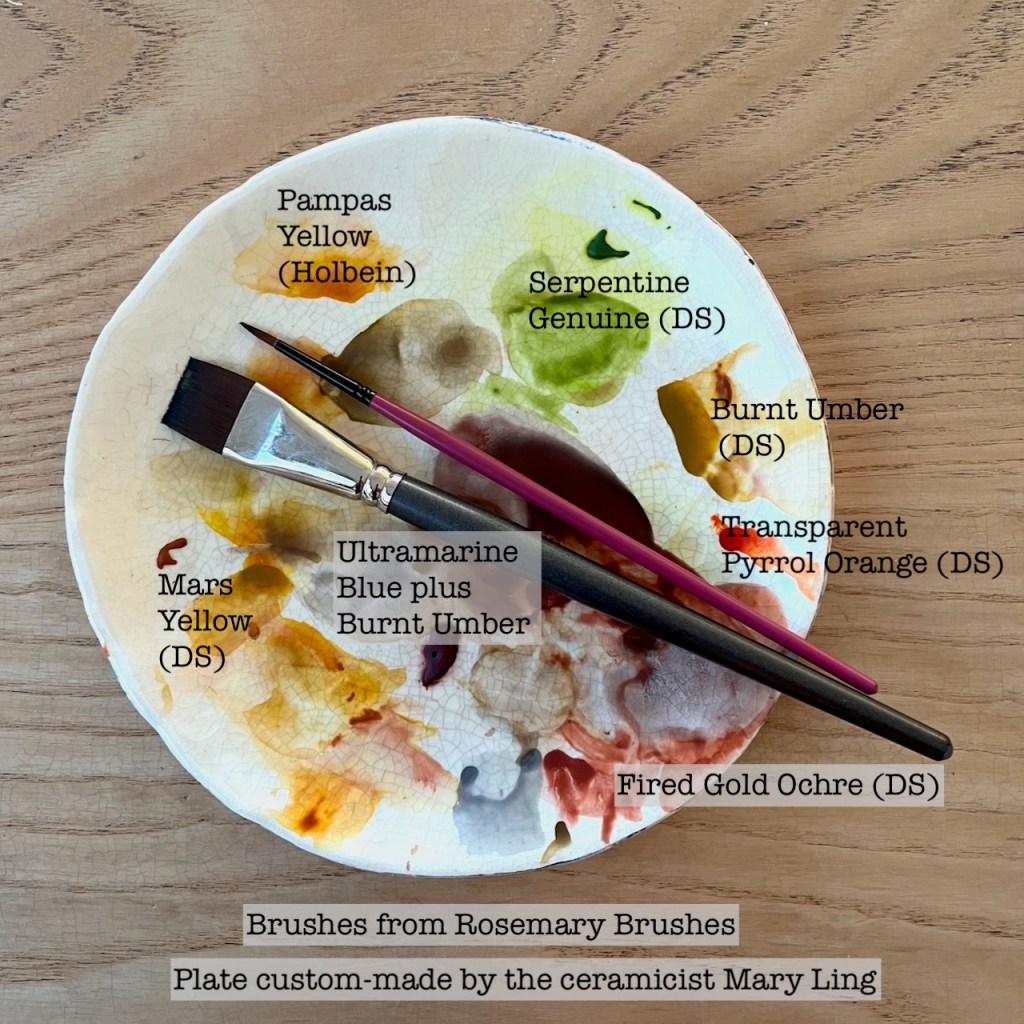
1.ink2. Early wash3. More washes4. Final detail
Here are the colours I used:
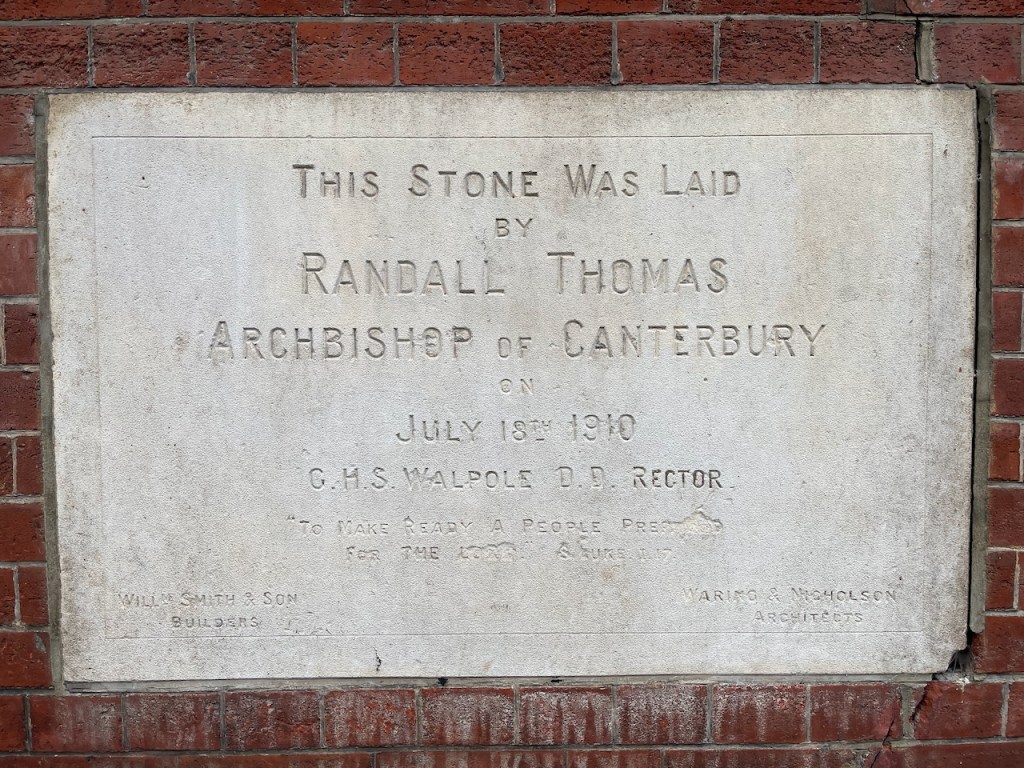
Pelham Mission Hall was completed in 1910. The text on the big stone slab under the window tells me this.
Foundation stone: This stone was laid by Randall Thomas, Archbishop of Canterbury, on July 18th 1910. G.H.S. Walpole D. D. Rector. “To make ready a people for the Lord” Luke 1.17 Waring and Nicholson architects. William Smith and Son Builders.
Buildings often have a foundation stone. Usually they just say who, and when. This one also says why. Its mission, as stated on the stone, was “To make ready a people for the Lord”. This is a line from a verse in St Luke’s gospel in the Christian Bible. The context is this:
And he shall go before him in the spirit and power of Elias, to turn the hearts of the fathers to the children, and the disobedient to the wisdom of the just; to make ready a people prepared for the Lord.
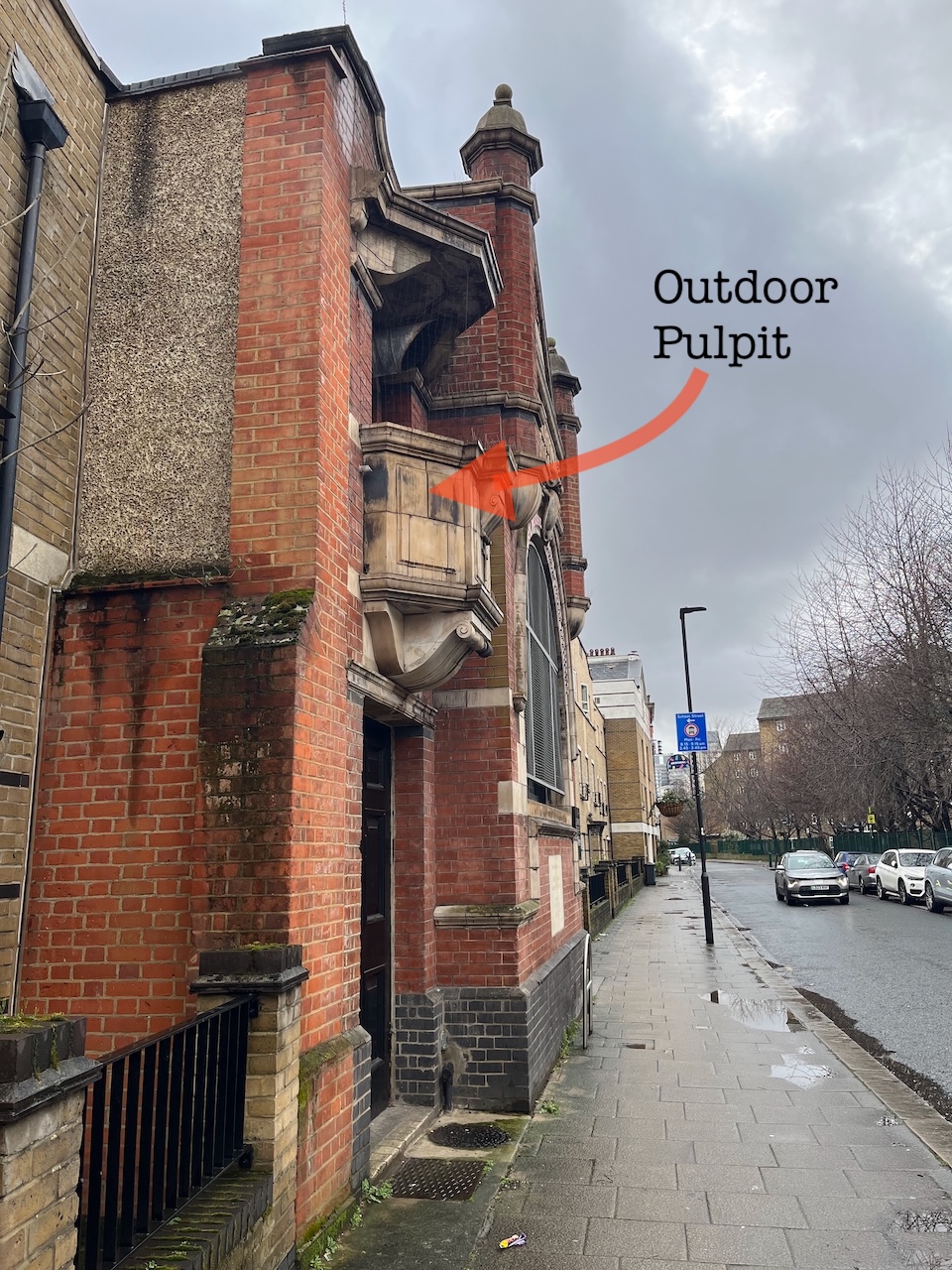
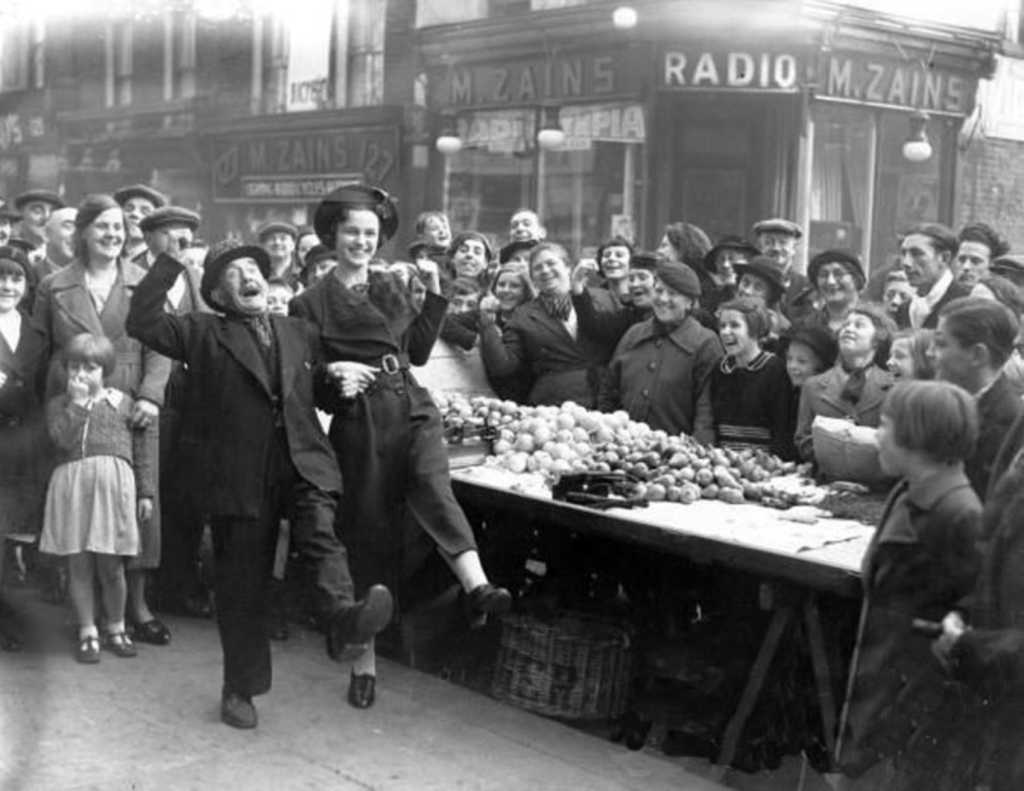
This building was created as an urban missionary post. There was a street market along Lambeth Walk at the time, and up to the 1960s. 2 I imagine the missionaries preaching from their outdoor pulpit to the street traders and their customers. It must have been hard for the preacher to make themselves heard.
View of the Pelham Mission Hall showing the covered outdoor pulpit. Photo (c) JaneSketching, February 2025Picture taken in Lambeth Walk in the 1938, entitled ‘A Crowd Looks on as Miss Dipper Does the Lambeth Walk with Billy Pease the Peanut and Toffee King’. 3
The Hall is named for Francis G. Pelham 1844-1905, 5th Earl of Chichester, educated Eton and Cambridge, who was rector of Lambeth 1884-1894. 4
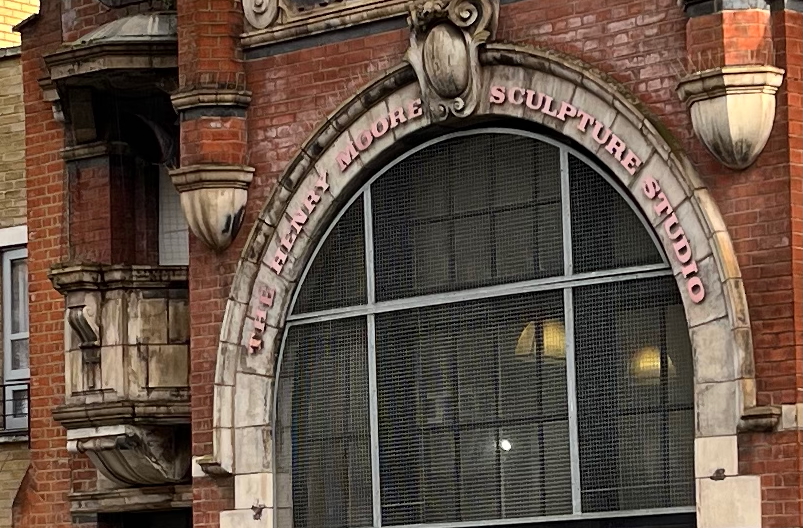
The building is now the “Henry Moore Sculpture Studio at Pelham Hall” part of Morley College. The sculptor Henry Moore donated a small sculpture to Morley College in 1977, which was sold at auction and helped to raise money for the lease of Pelham Hall. In return, the College named the sculpture studio after him, as written on the front of the building5.
Pelham Mission Hall, now The Henry Moore Sculpture Studio. The outdoor pulpit is on the left.
A ventilation pipe from the sculpture studio now exhausts through the outdoor pulpit.
While I was in the Vauxhall Tea House, the sun came out. It was calm in there. A few moments of paradise.
I find the King James’ version here a little ambiguous here in the pronouns. Who is the “he”, who is the “him”? A modern translation: ‘John will prepare the people for the Lord to come to them. The Holy Spirit will lead John as he led Elijah. John will do powerful things as Elijah did. He will help fathers to love their children. He will teach people who do not obey God. Then they will know what things are right. And they will do them. Then they will be ready when the Lord comes.’. Translation: “The Easy Bible”. Thank you to http://www.biblegateway.com for sorting that out. ↩︎
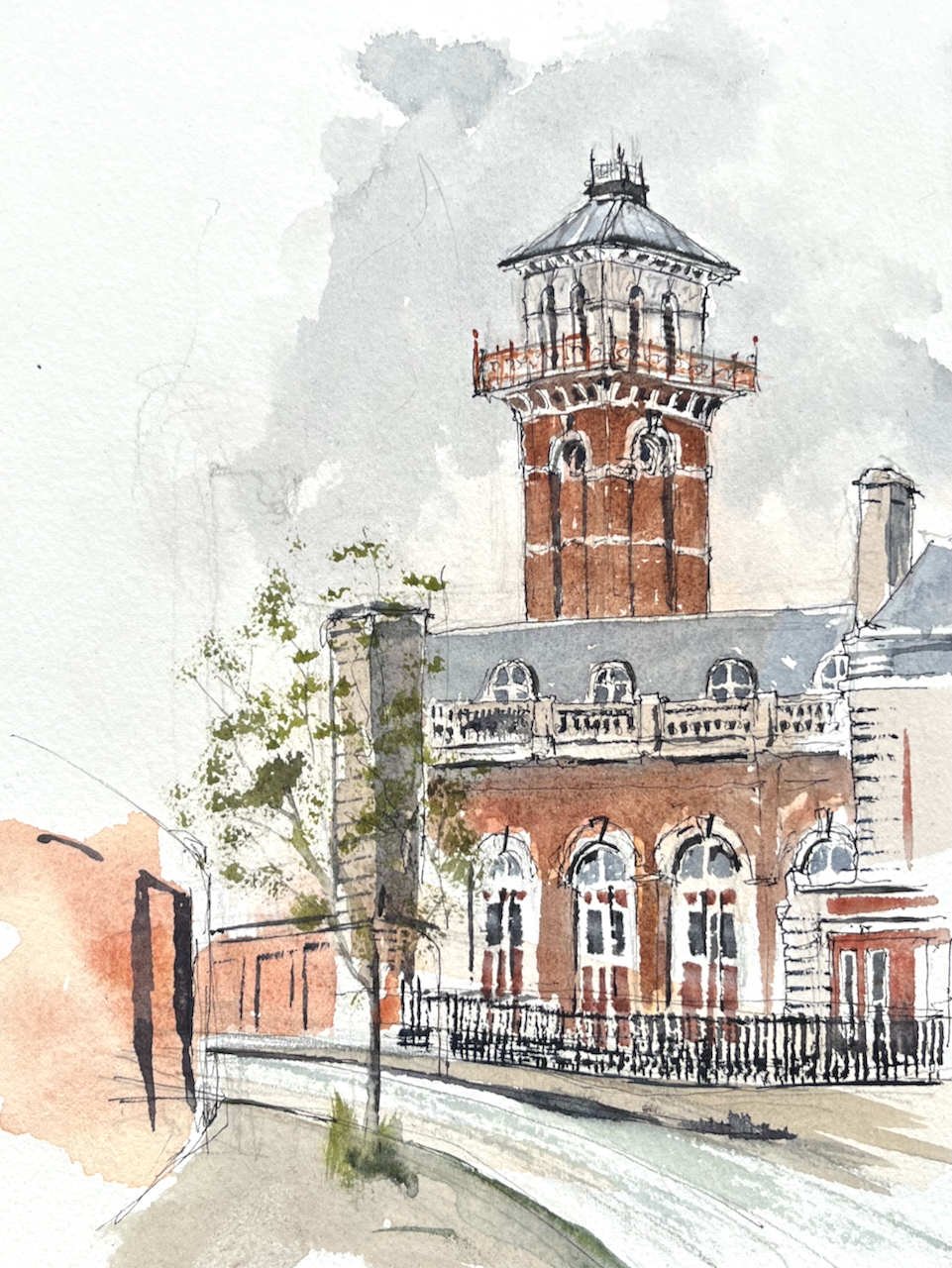
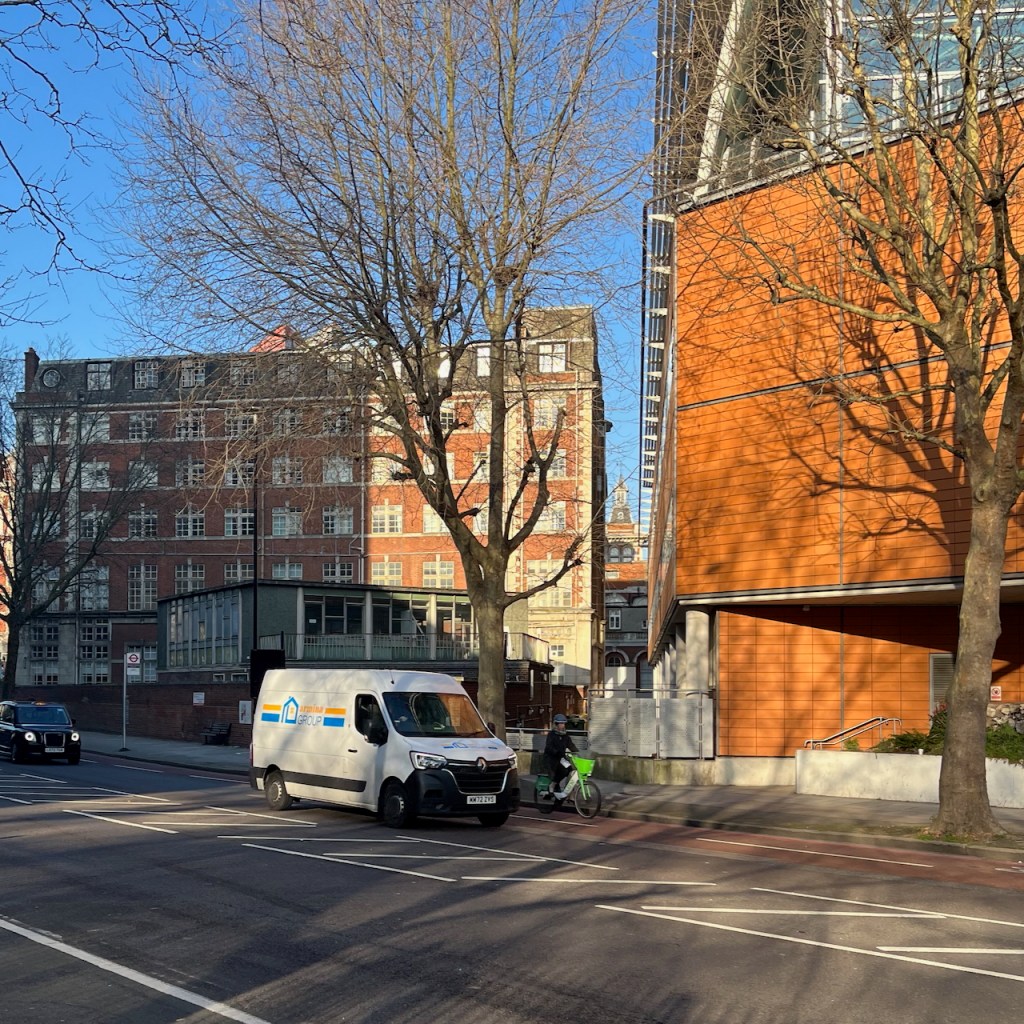
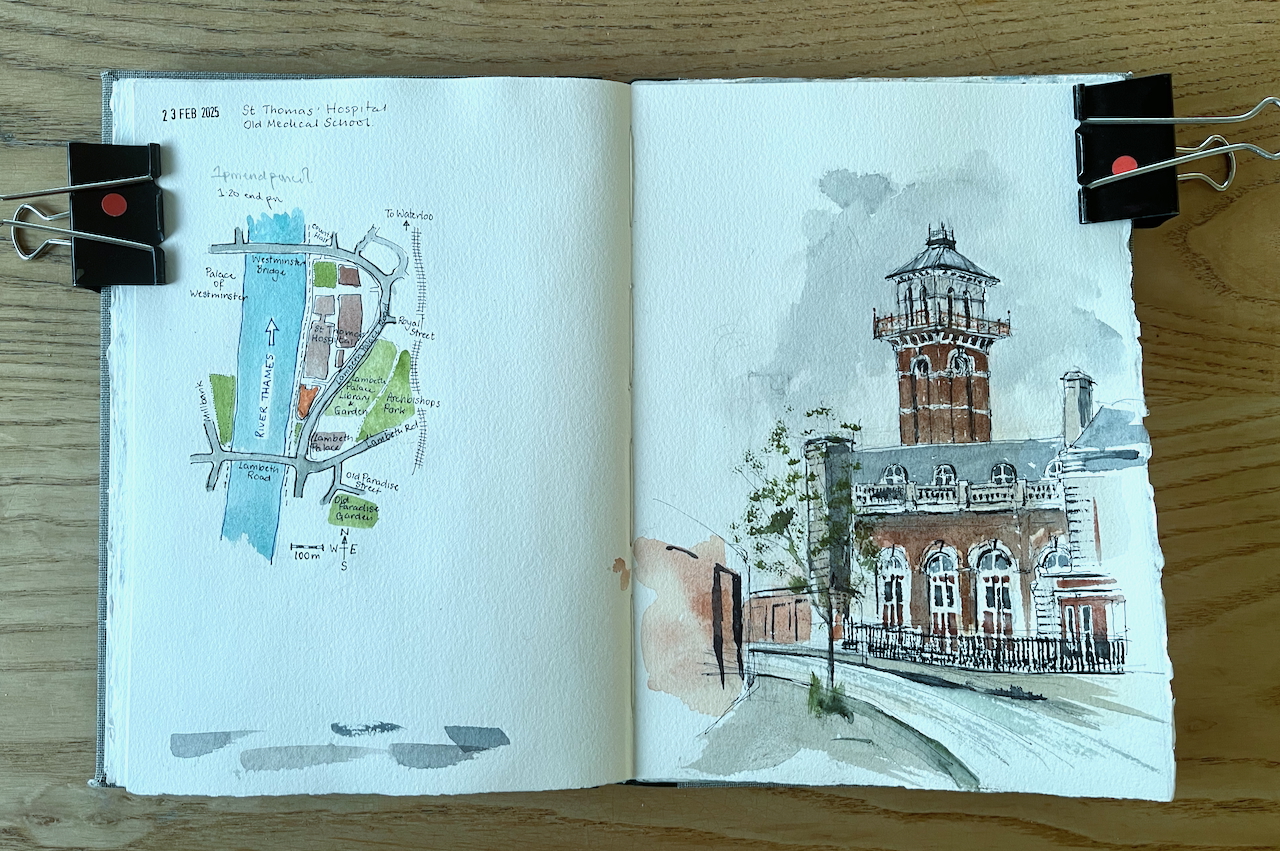
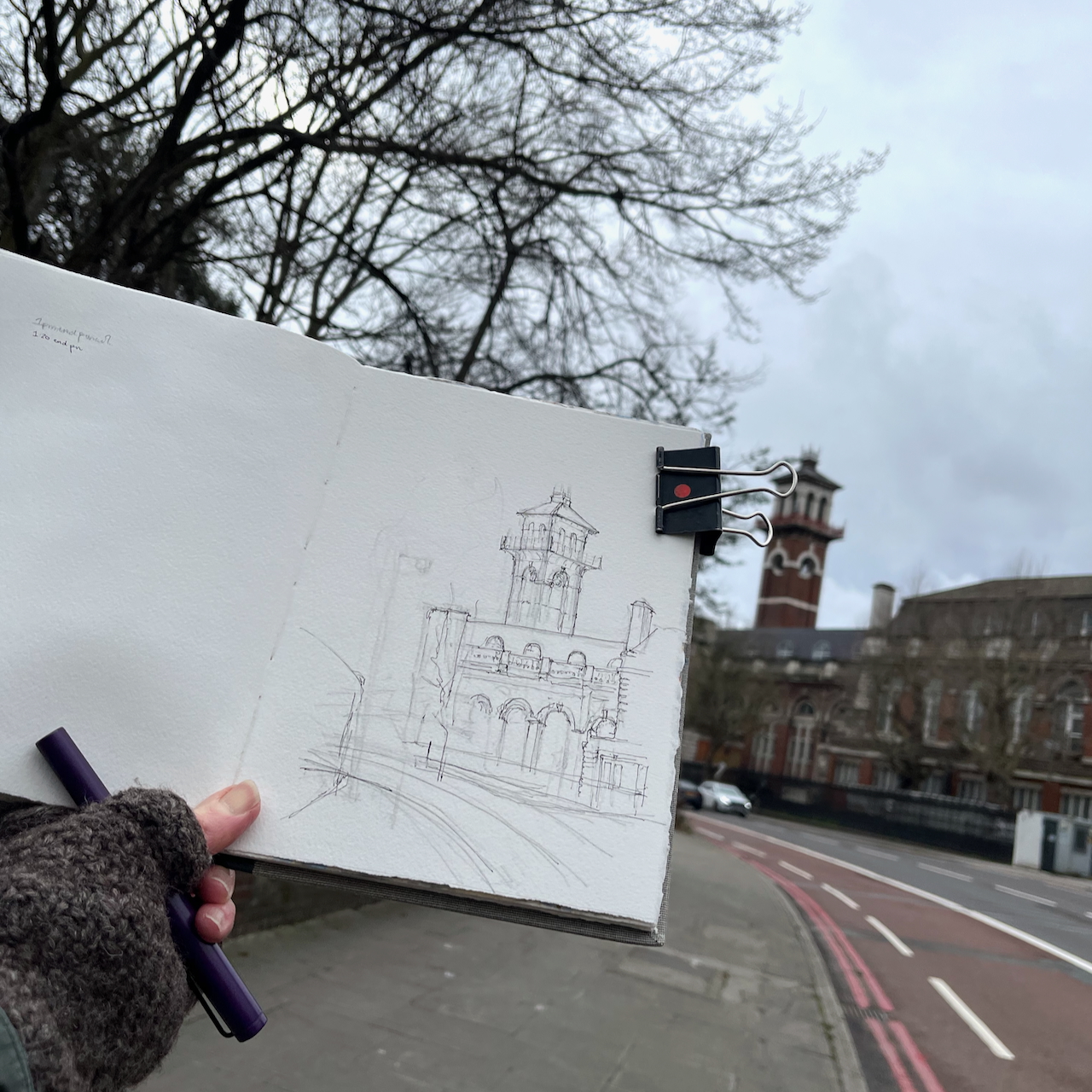
There is a splendid tower south of St Thomas’ Hospital on the South bank of the River Thames. Here it is, sketched from the Lambeth Palace Road.
St Thomas’ hospital medical school, from the Lambeth Palace Road SE1, sketched 23rd February 2025 in sketchbook 15
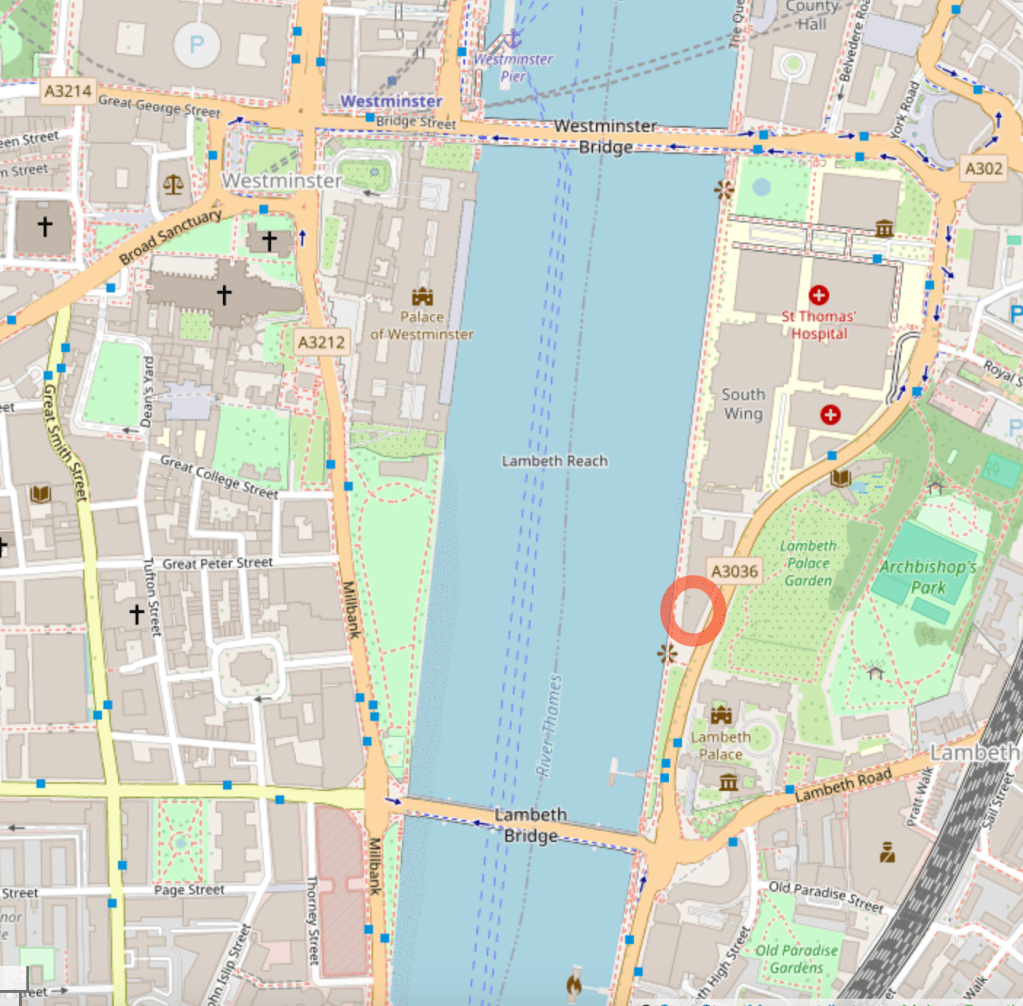
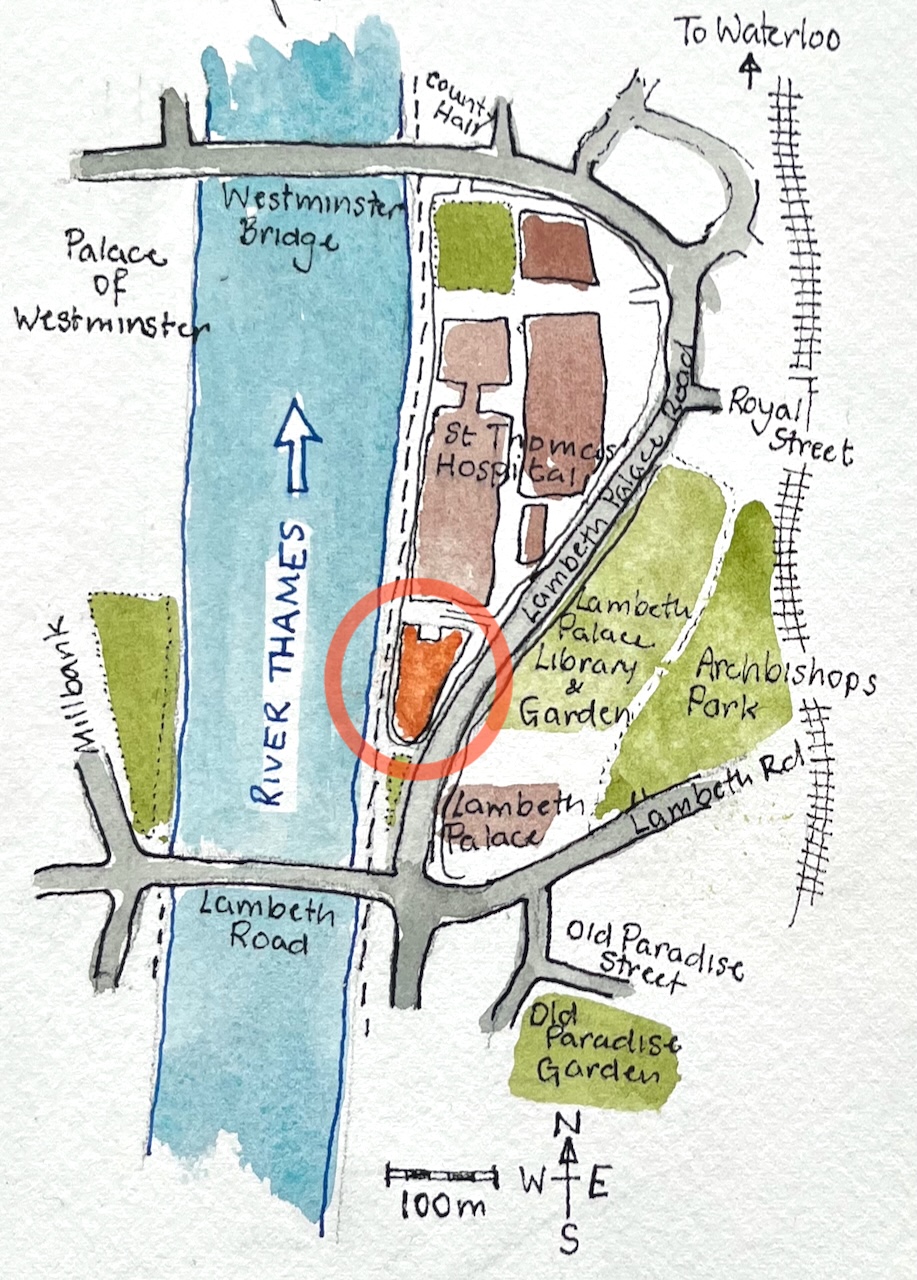
This tower, and the buildings below it, are right next to the Thames, opposite the Houses of Parliament. It is a splendid position.
Position of St Thomas’ medical school (circled): opposite the Palace of Westminster. Map (c) Openstreetmap contributors. Click to enlarge.
Given this prominent central location, I was astonished to discover that these buildings are derelict.
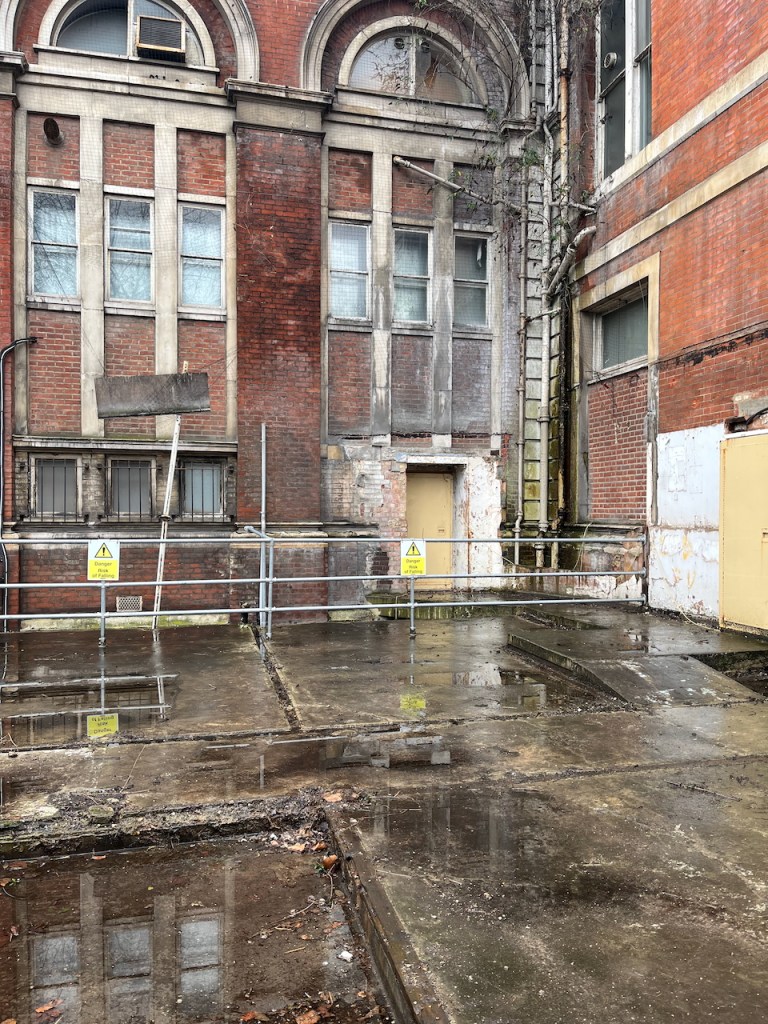
If you look through the railings which are in my drawing, this is what you see:
Block 9, St Thomas’ Hospital, 23 Feb 2025, photo (c) JaneSketching.
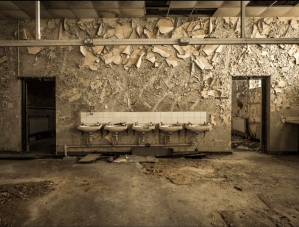
Inside the old medical school: photo from Dibsphotography.com . Click the image to go to their site: many more photos are there.
Urban explorers have posted pictures of the sadly decayed interior. For example on this link and this link and this link. Some have ascended the tower and posted pictures taken from up there. Their photographs show an abandoned lecture theatre, peeling plaster, elegant fireplaces covered in dust and mould, laboratory samples lying about gathering dust, molecule trees in a tangled heap, test tubes and old notes.
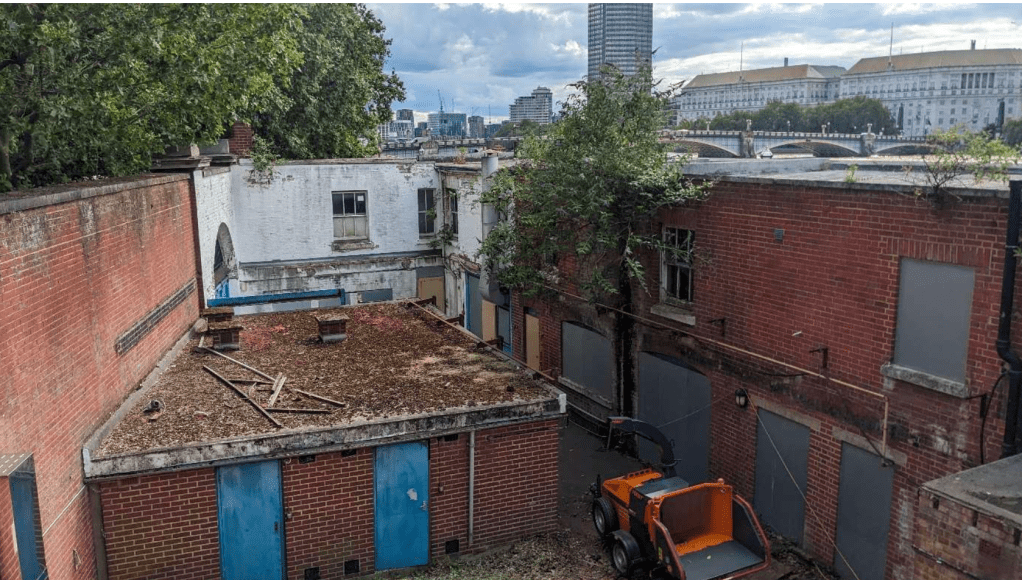
As well as the grand buildings, there are low-level houses within the site.
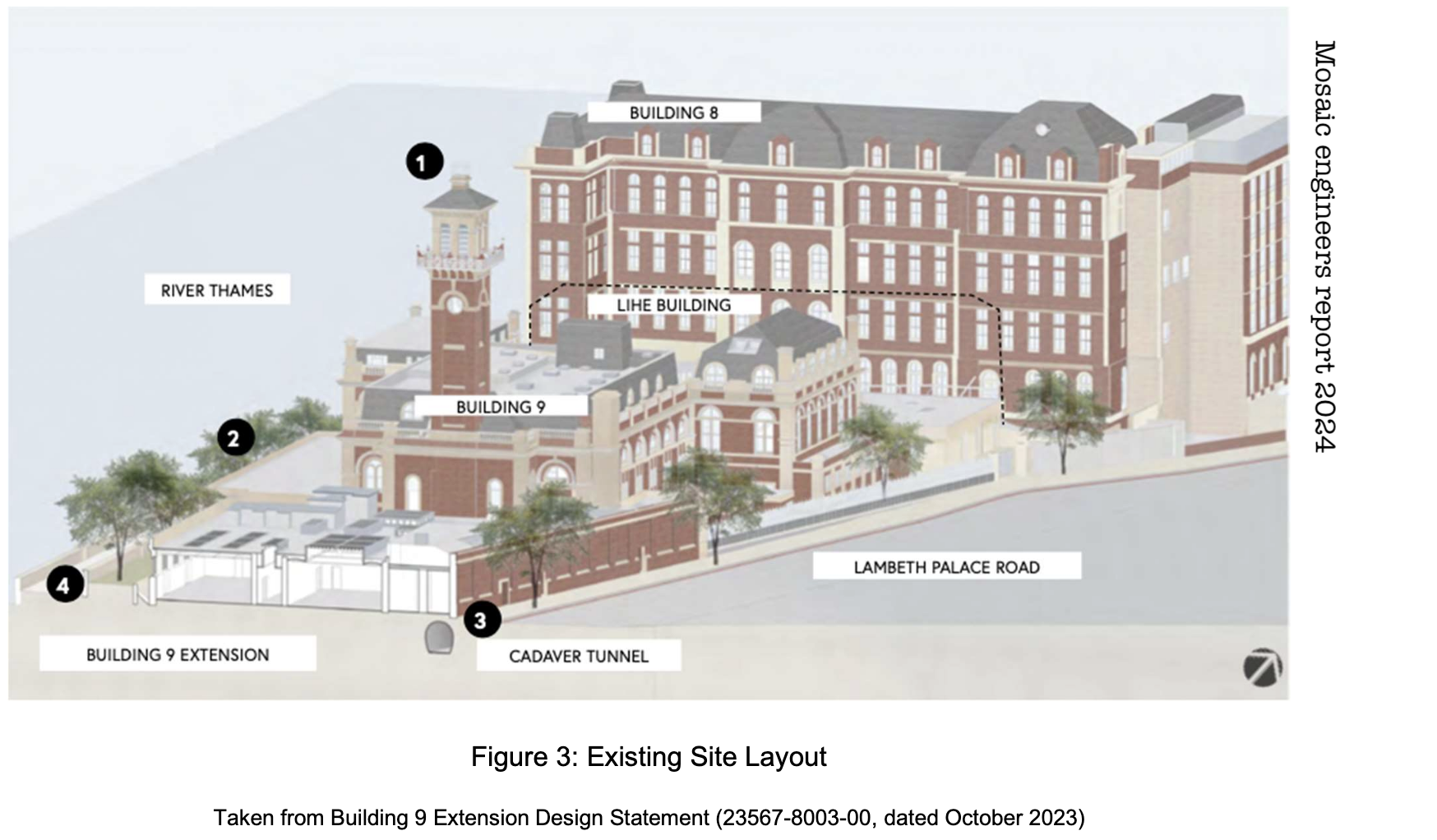
Looking South, below the tower. Picture from Mosaic Engineers report, see note 1
So what’s going on?
This part of St Thomas’ hospital was a medical school and library since the hospital was built here in around 1870. This part of the site was abandoned 20 years ago, as medical schools moved and merged. Then, it seems, nothing happened for 10 years, as the lecture theatres, laboratories and corridors gradually decayed.
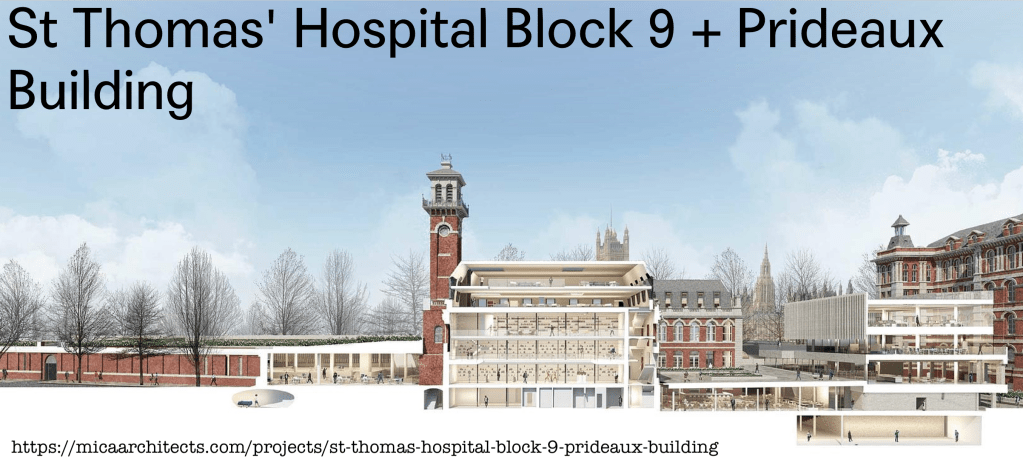
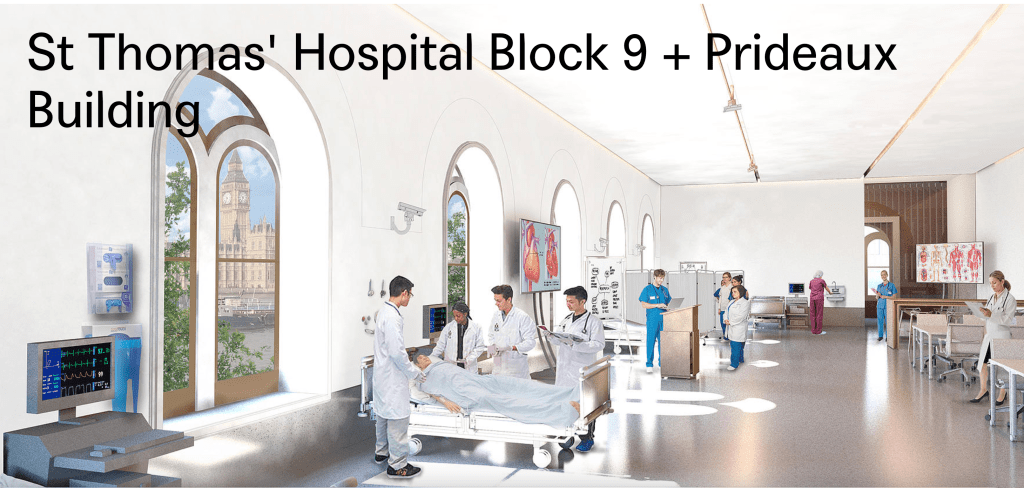
In 2015, there was a plan. The website for MICA architects shows a proposal for a new medical school on this site. This proposal is dated “2015-ongoing”. Click the image below to see their drawings of radical new buildings, and future medical students engaged in lectures and conversations, with spectacular views of the Houses of Parliament through the huge windows.
Lambeth Council granted planning permission in 2016, reference 16/02387/FUL. That was nearly ten years ago. Still the site remains derelict.
However, now it seems that progress is happening. On the Lambeth Council planning site, there is an impressive in-depth survey of the site by Mosaic Civil engineers, dated July 2024. They look at the Geology, Soil Chemistry, Hydrogeology, Hydrology, Flood Risk, Unexploded Ordnance, Ground Stability, and Invasive Weed, to name but a few. Hydrogeology seems to be answering the question: are there any aquifers or wells here? (answer: no). Hydrology is answering the question: how does the water flow around here, and will any sewage or nasty chemicals wash into the site? (answer: well, there is a Thames Water “storm sewage overflow” pipe into the Thames just upstream from here….). This report also contains photos, and a useful history of the site (Note 1).
St. Thomas´ Hospital was constructed in its current location in 1871 following the construction of the Albert Embankment (which required reclamation of land from the River Thames)and the demolition of old boatbuilding and barge house sites which dated back to the 1680s.” (page 6, history of the site)
Mosaic engineers report page 6, history of the site
The volume “London – South” of the Pevsner architectural guides, says that St Thomas’ was..
…built on the current site by Henry Currey 1868-71, one of the first civic hospitals in London to adopt the principle of “Nightingale” wards to allow maximum ventilation and dispersal of foul air.
Florence Nightingale (1820–1910) was a pioneering nurse and reformer of the profession. She had a profound impact on the architecture of hospitals.
“The first principle of hospital construction is to divide the sick among separate pavilions,” she wrote in her 1863 ‘Notes on Hospitals’. Pavilions were large, rectangular, open-plan wards that made it easier for nurses to supervise all patients. These wards became known as Nightingale Wards.”
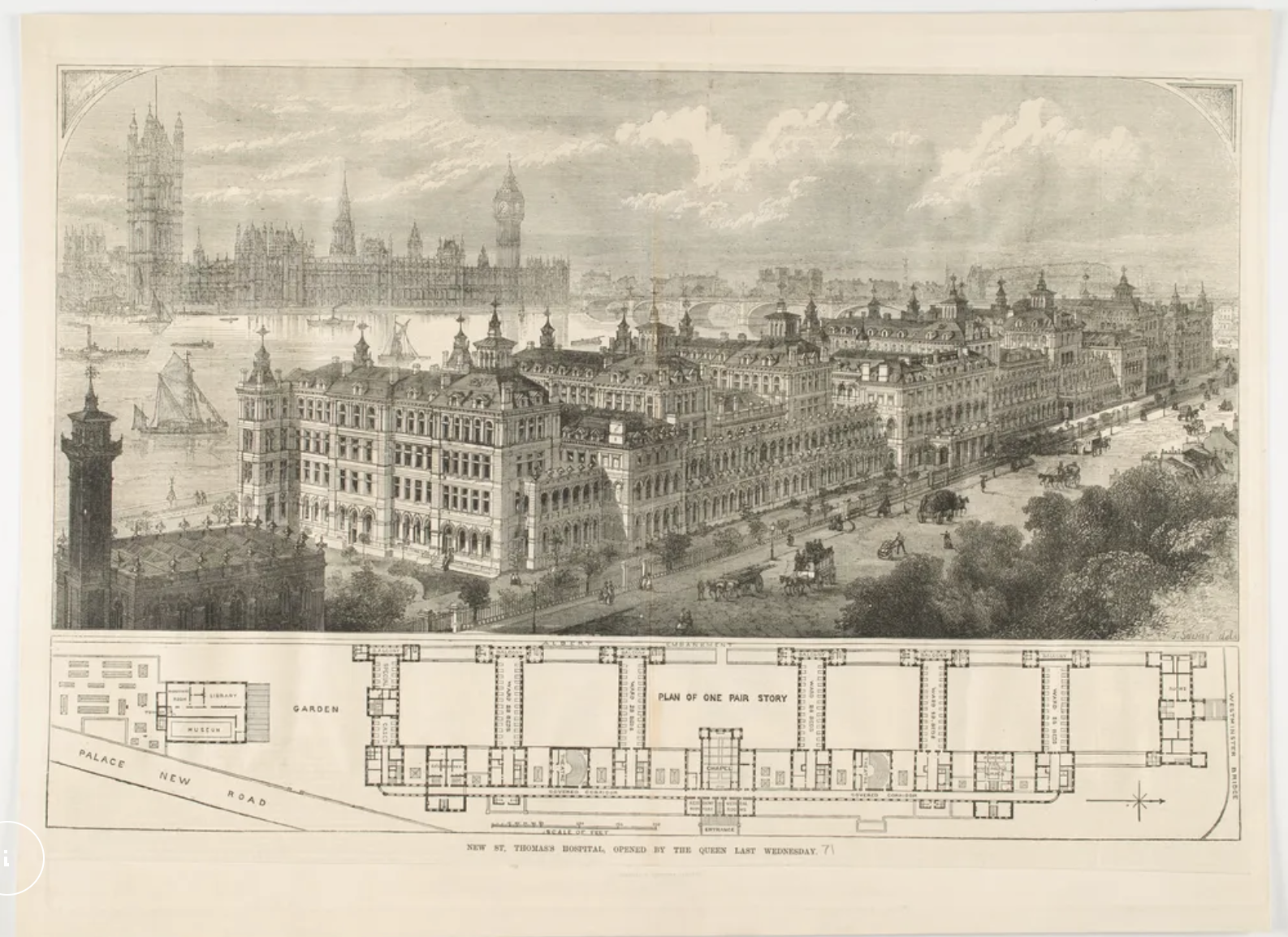
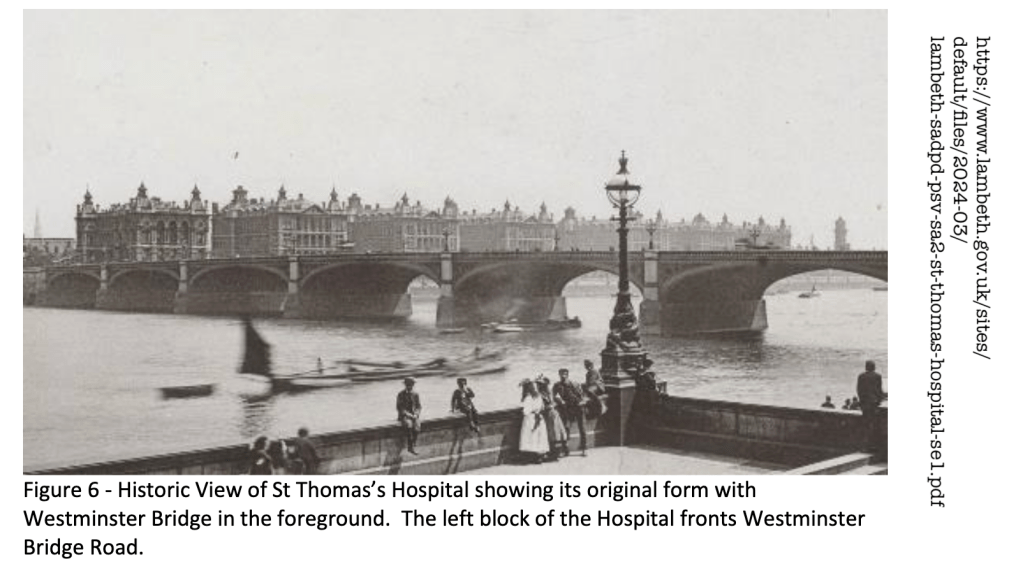
The London Museum website presents a picture of St Thomas’ hospital as an example of this architecture. There were seven such pavilions. As you see in the pictures below, the hospital rivalled the Houses of Parliament in its size and pinnacled magnificence.
“St Thomas’ hospital opened by the Queen last Wednesday”. This picture is from the London Museum website. The Tower I sketched is on the left.
Here is a historic photo from the other side of the river. Westminster Bridge spans the river. The tower I sketched is on the right.
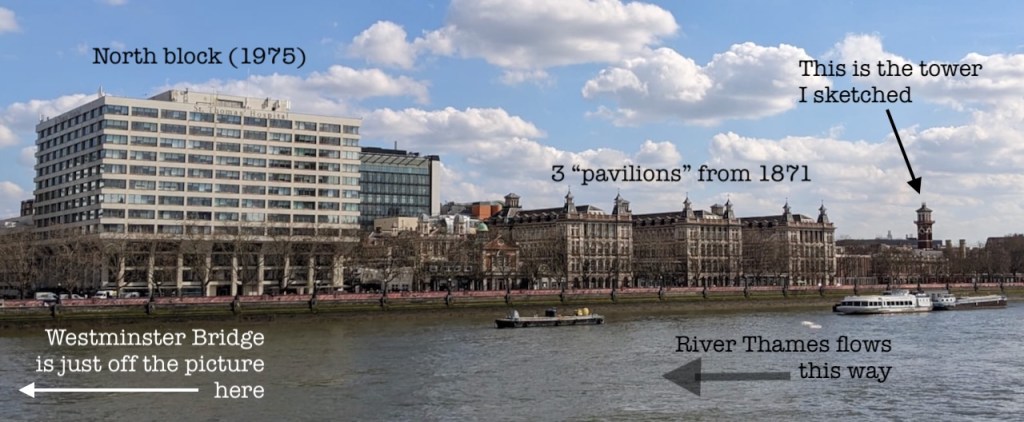
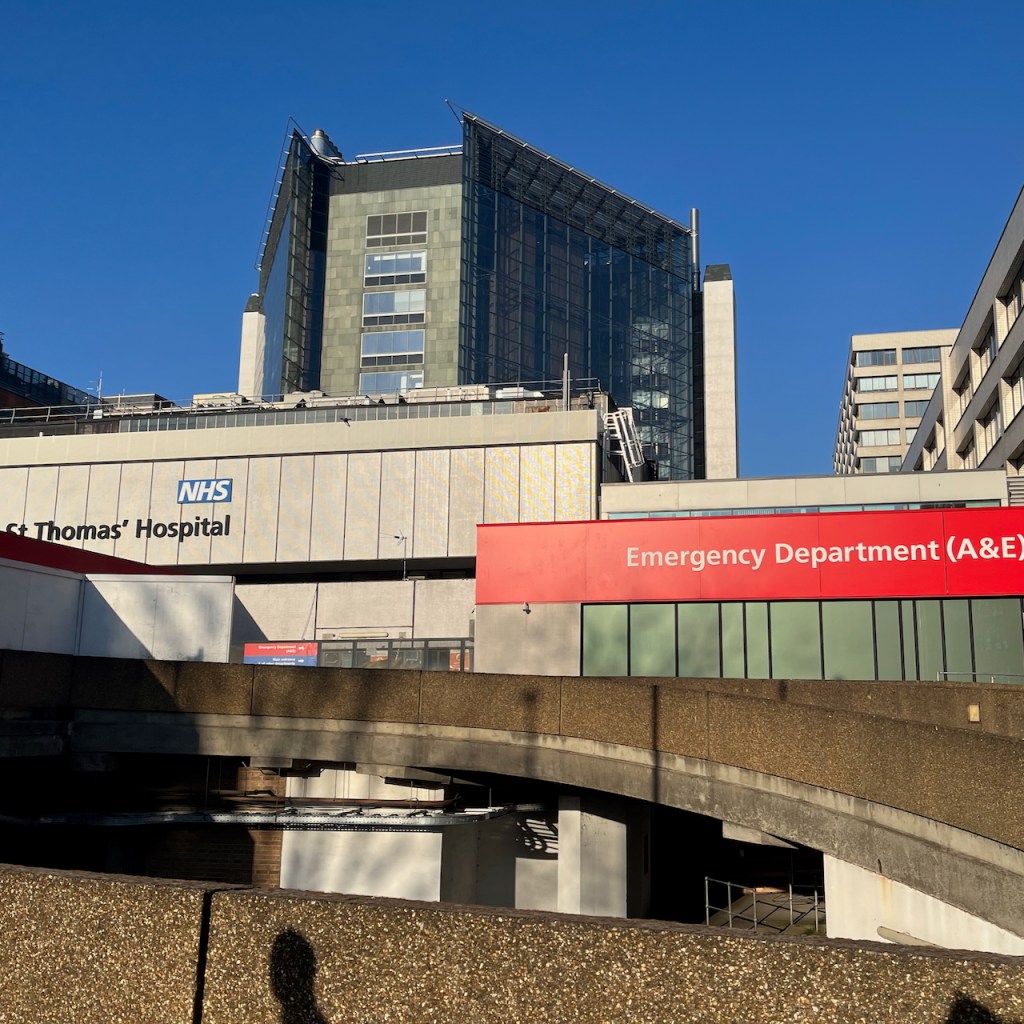
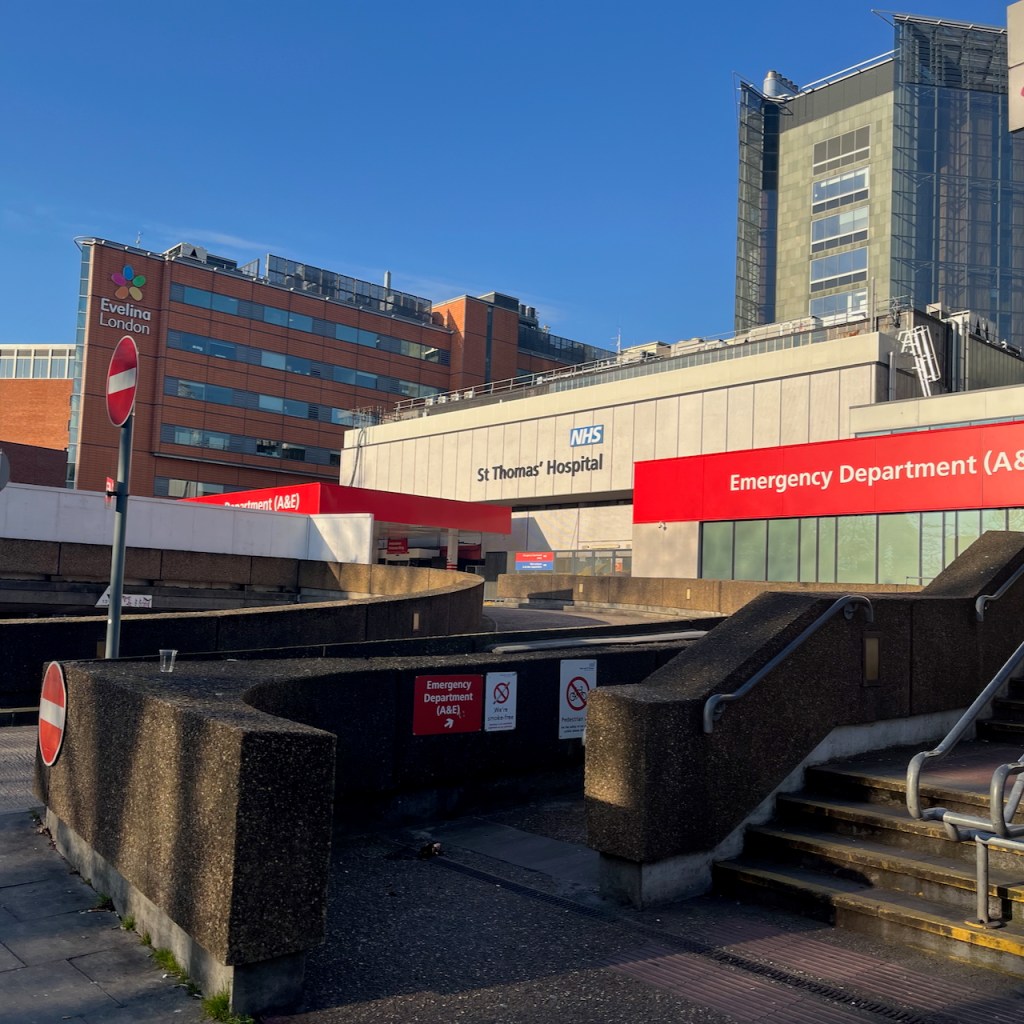
The hospital looks different today. The North pavilion was destroyed by enemy action in the 1939-45 conflict, and other parts of the building were damaged beyond repair. The only part remaining was the Tower to the south, and 3 of the southernmost pavilions. A large block was built in 1975 to replace the north pavilion. The website “Ebb and Flow” has some excellent pictures from 2023, showing the 1975 building in detail, and paying tribute to the dedicated people who work in this building.
View of St Thomas’ Hospital from the North Bank. March 2025. Photo (c) JaneSketching
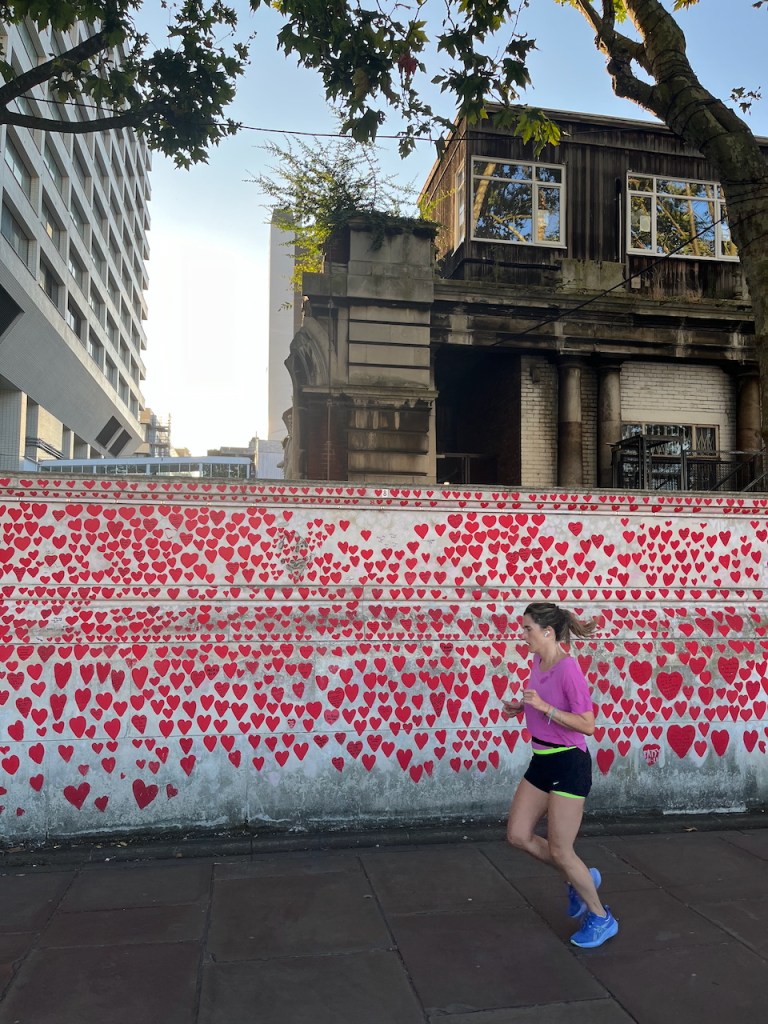
Below is a photo from August last year. The 1975 buildings are on the left, the original buildings, still derelict, are on the right. In front is the National Covid Memorial Wall.
View of St Thomas’ from the Thames path, August 2024. (Photo (c) JaneSketching. )
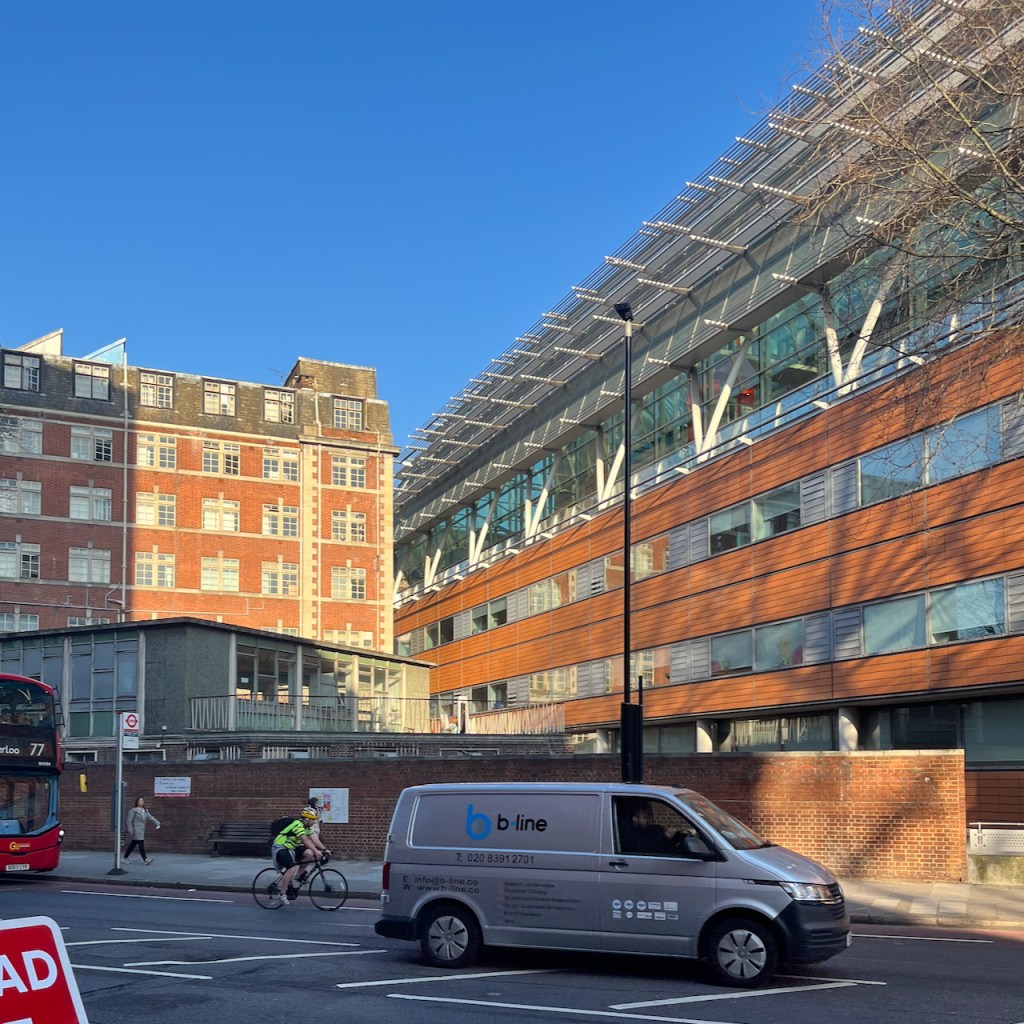
Evelina building on the right, close to the old buildingMix of old and new buildings at St Thomas’A&E deptEvelina hospital on the left.St Thomas’ hospital, views of old and new buildings, from Lambeth Palace Road.
Now we can expect the renovation of the southern part of the hospital.
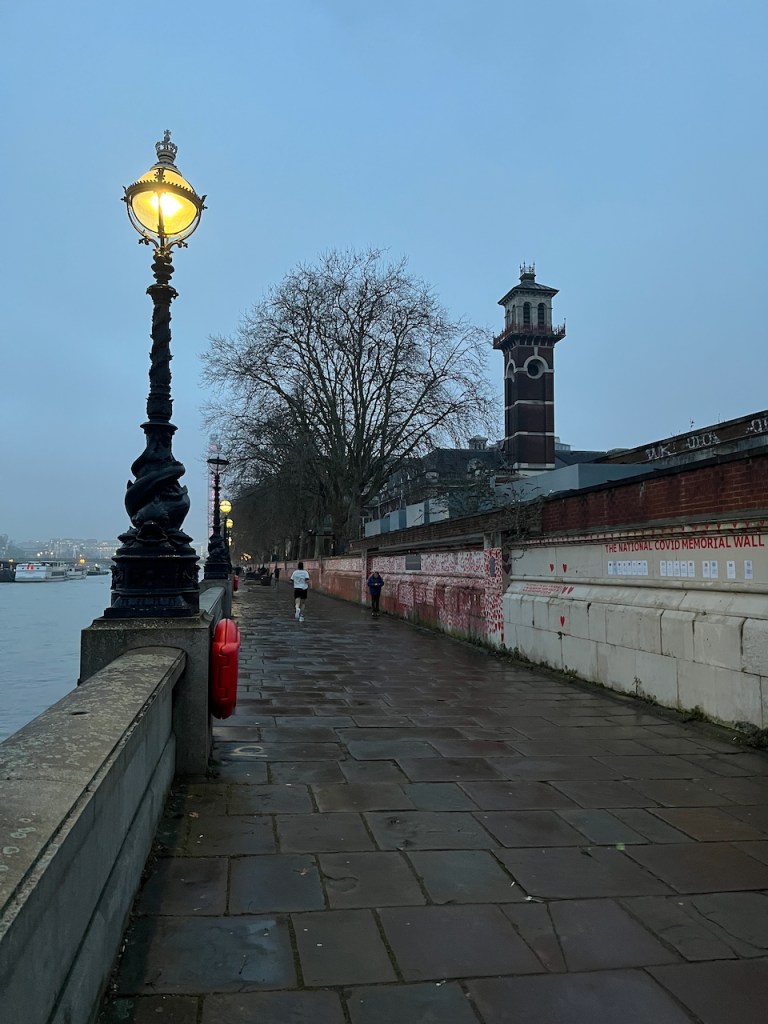
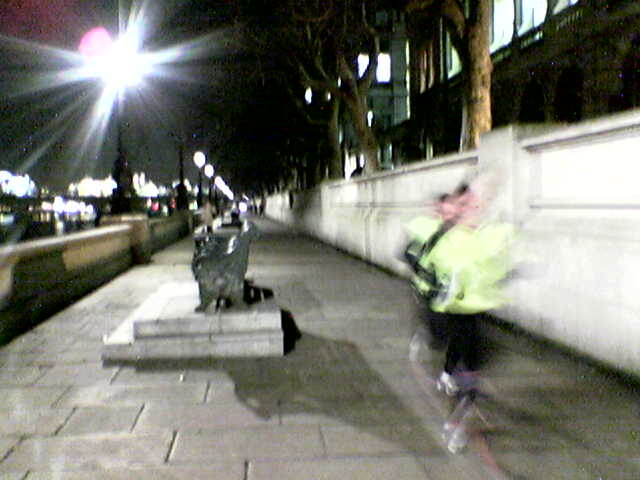
I have run and walked past this building for twenty years. I’m so glad that doing the sketch has prompted me to discover what’s going on behind the high walls. Here are some snapshots from the embankment. The hospital is on the right, behind the wall.
Early morning, 17th March 2025Early morning 12 January 2006. Mobile phones weren’t so great at taking photos then.
I thank the ambulance staff, administrators and medical professionals of St Thomas’ hospital who were there when needed after a terrifying incident. We all have such incidents in our lives. The hospital is more than a building. It is a place of caring, a community and a store of knowledge, from Nightingale to now.Thank you NHS.
Note 1: The report from Mosaic civil engineers is called “Mosaic Civil and Structural engineers report FINAL REPORT PHASE 1 PRELIMINARY CONTAMINATION RISK ASSESSMENT REPORT 01/07/2024″
It is on this link, as part of the ongoing planning proposal.
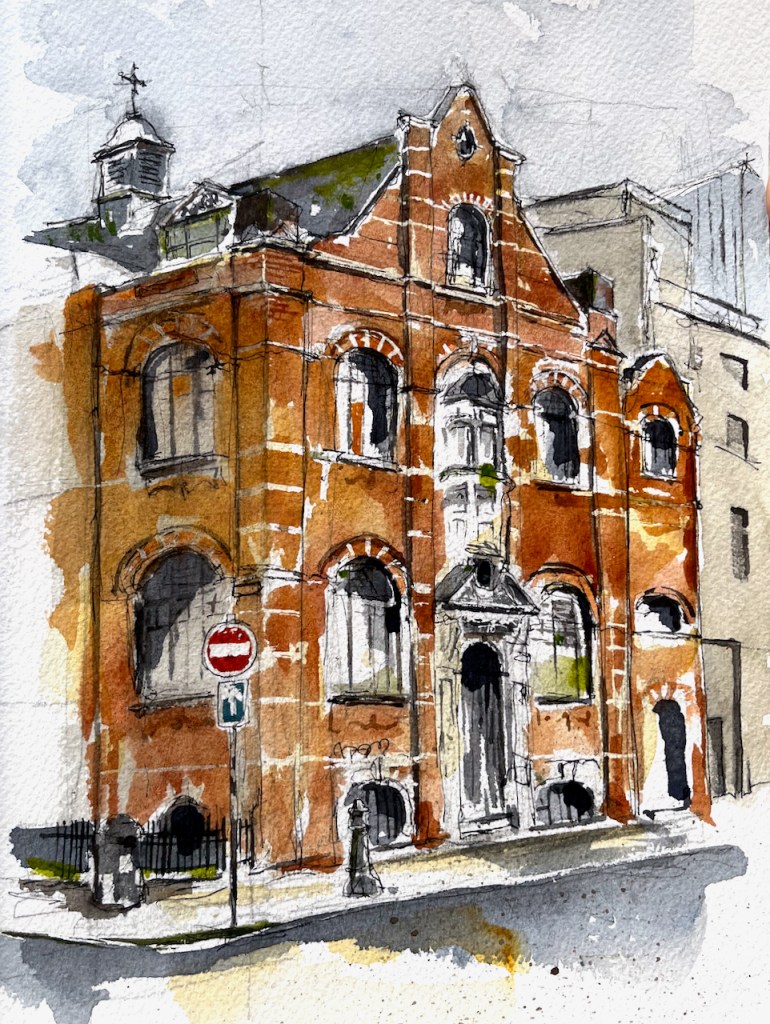
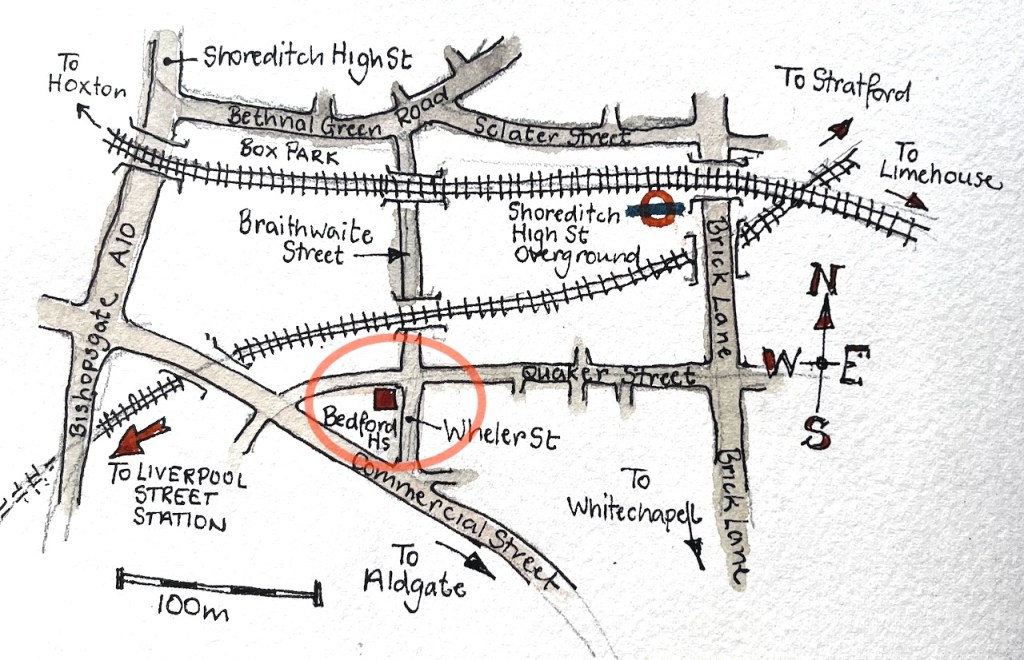
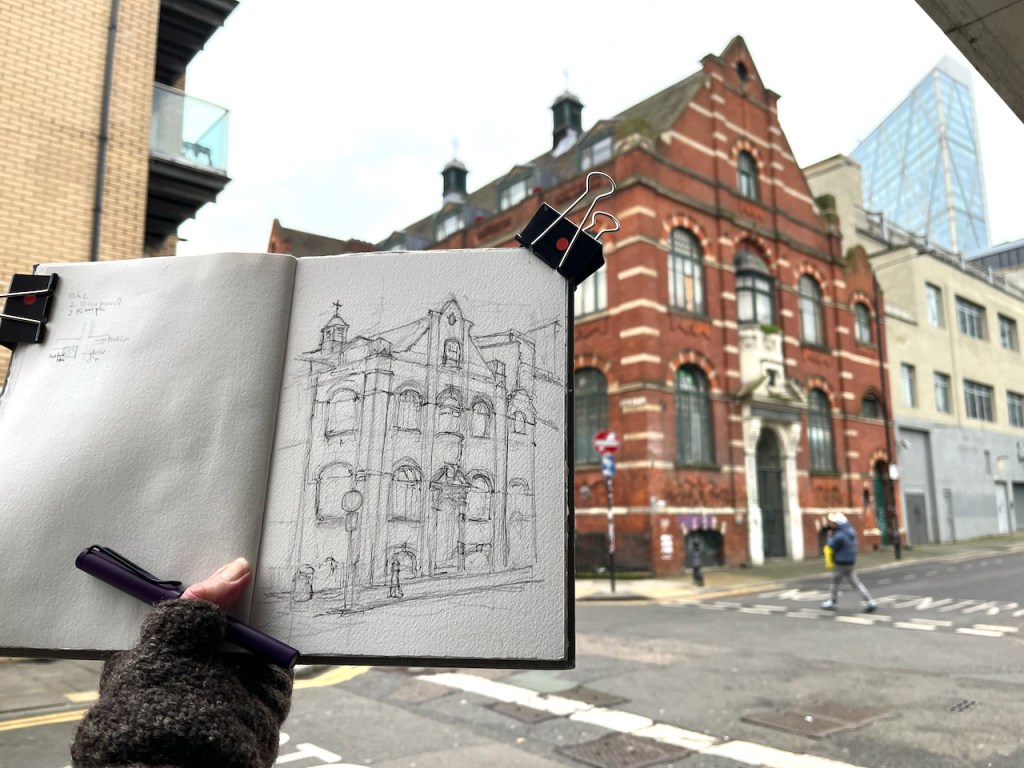
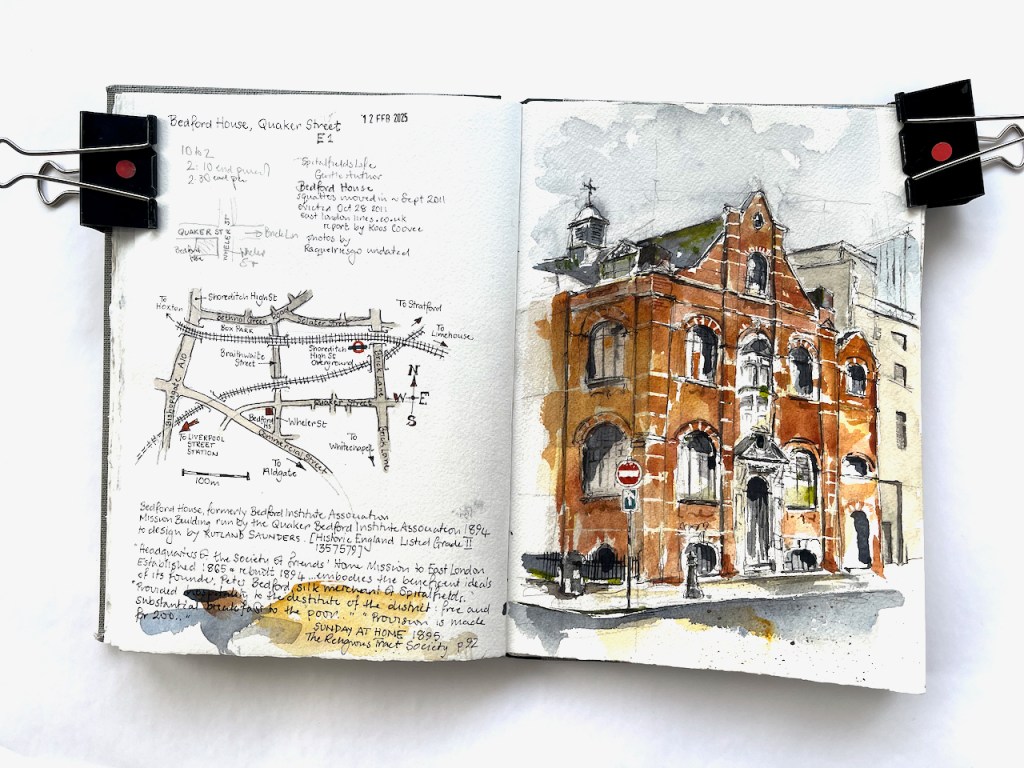
This magnificent building is on the corner of Quaker Street and Wheler Street, in east London, near Liverpool Street Station.
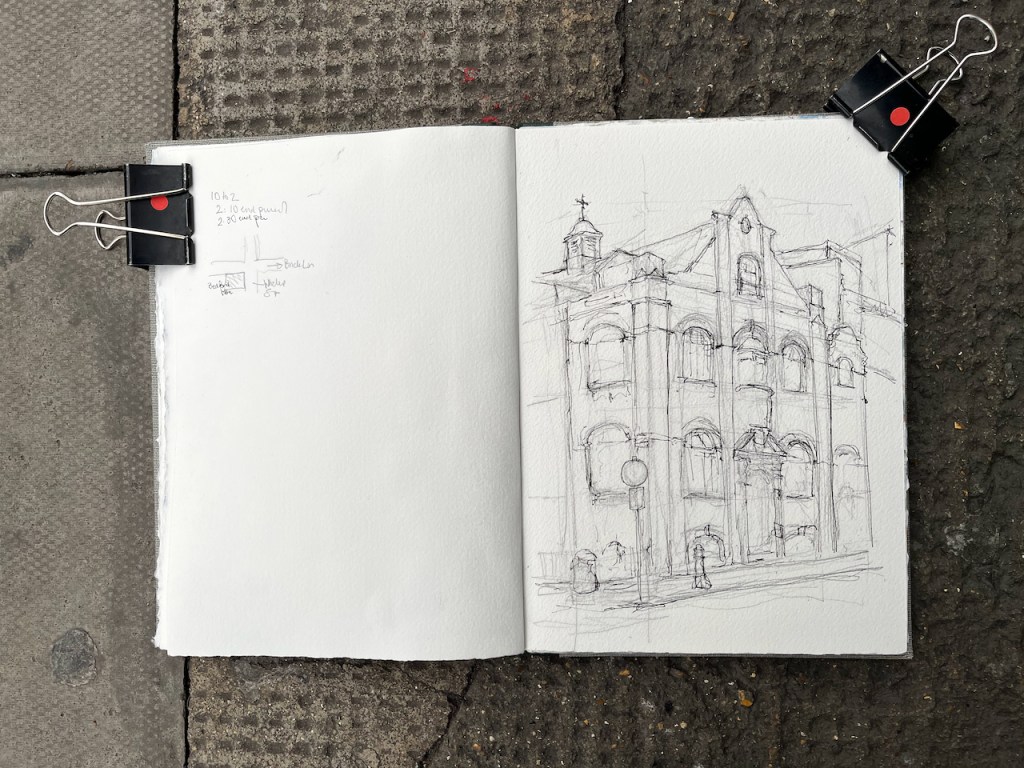
Bedford House, Quaker Street. Sketched 12 February 2025 in Sketchbook 15
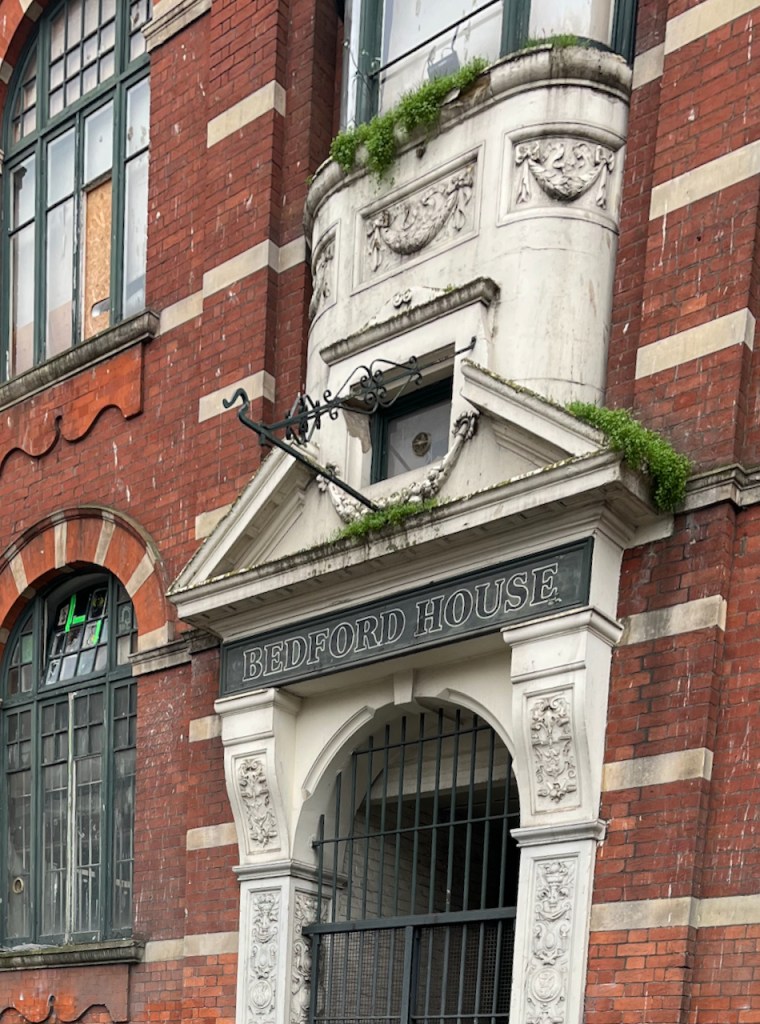
It is intriguing: grand but dilapidated. Grass grows from the ledges, windows are broken and patched. The front door is blocked with a waste bin. But it has style.
At one time it was bright, new, clean and purposeful. This was the headquarters of a Quaker mission in east London: the Bedford Institute Association. It was built in 1894 replacing a previous building.
The lofty, picturesque, red-brick building, with its gables and tall roof, is constructed and equipped with solidity, and liberality and far-sightedness which distinguish all the admirable buildings erected by the trustees.”
“Sunday at Home” published by the Religious Tract Society, 1895, Volume 42, page 92
This issue of “Sunday at Home” published in 1895, goes on to describe the work which was undertaken in the building, which was less than a year old at the time of writing. Its purpose was to provide hospitality and education for the destitute of the locality.
“The Sunday begins with a well-planned hospitality to the destitute of the district – a free and substantial breakfast to the poor whose poverty is nowhere seen in a more aggravated form than in Spitalfields.
Provision is made for two hundred, who are supplied with tickets of admission by those who well know the district […] The large lower room in which they are received and comfortably seated is built for purpose, and is itself a lesson in cleanly living as well as of hospitality. The needful ventilation of a room crowded by two hundred guests, entirely devoid of any resources for personal cleanliness, is supplied by rapidly revolving steam fans placed over the doorways…
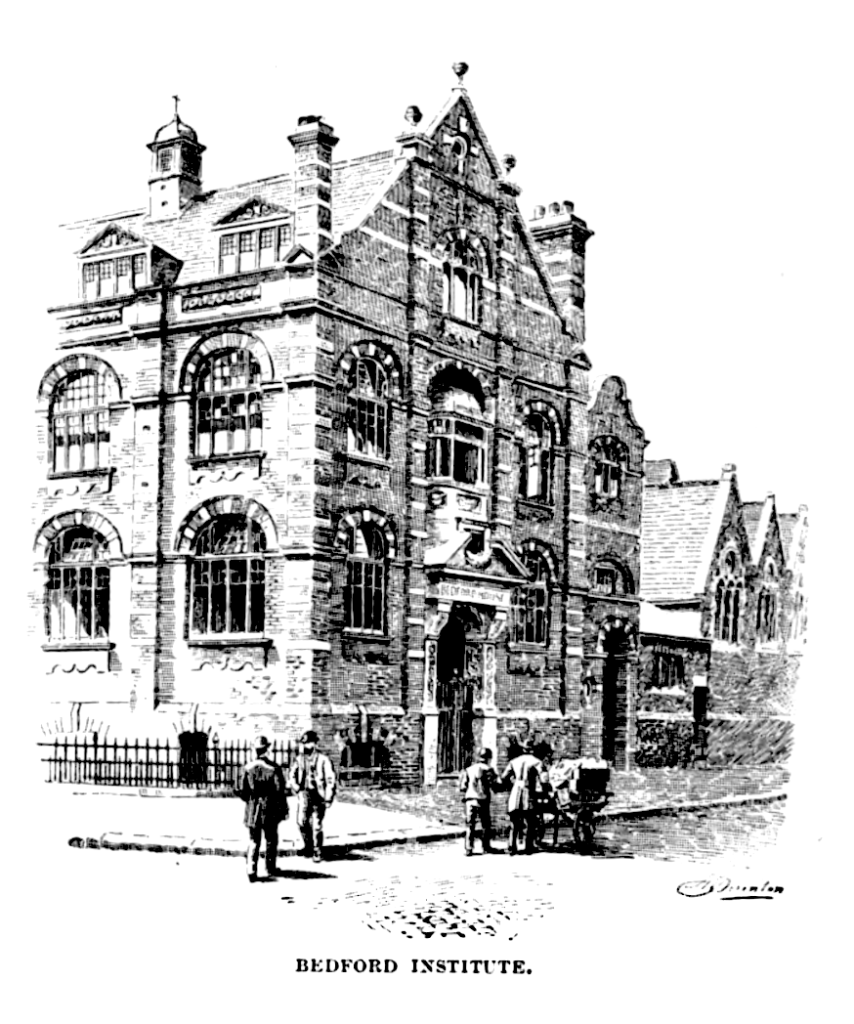
The article contains a picture, drawn from almost exactly the same spot where I was standing:
At that time there were tall chimneys on the front corners of the building, now reduced to stumps, as you see in my picture. Otherwise the building looks unchanged, on the outside at least. Even the cast-iron railings, centre left, are still there. The adjacent buildings on the right, with the ecclesiastical pointed windows, have been replaced by modern buildings, taller and boxier, with rectangular windows.
Although I was able to read in detail about the use of the building in 1895, I have been unable to discover much of its more recent history. In 2011, for a few months, squatters lived there. “The Gentle Author” visited the house during their occupation1 A photographer, Raquel Riesgo, documented her life during the squat. The squatters were evicted on October 28th 2011.
But what happened next? This building was created to serve destitute people in Spitalfields. Does it continue its mission?
If anyone knows what’s happening there now, I’d be really interested. Please comment below or get in touch.
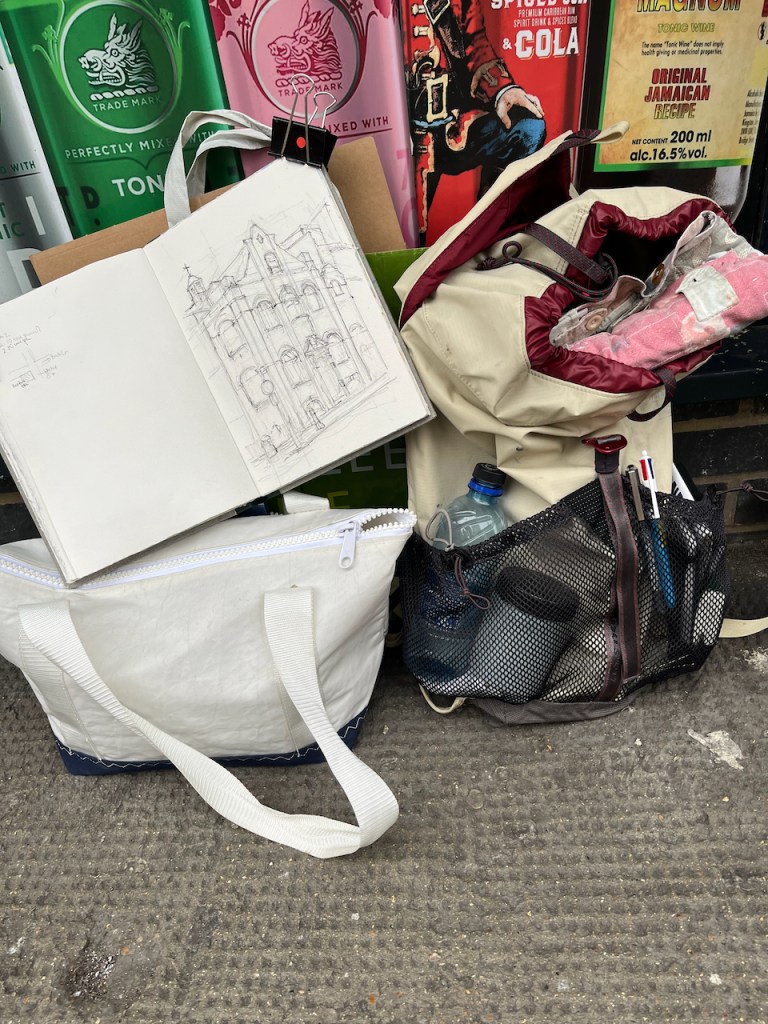
Sketching in Quaker Street, 12th February 2025Adding the colour at my desk.
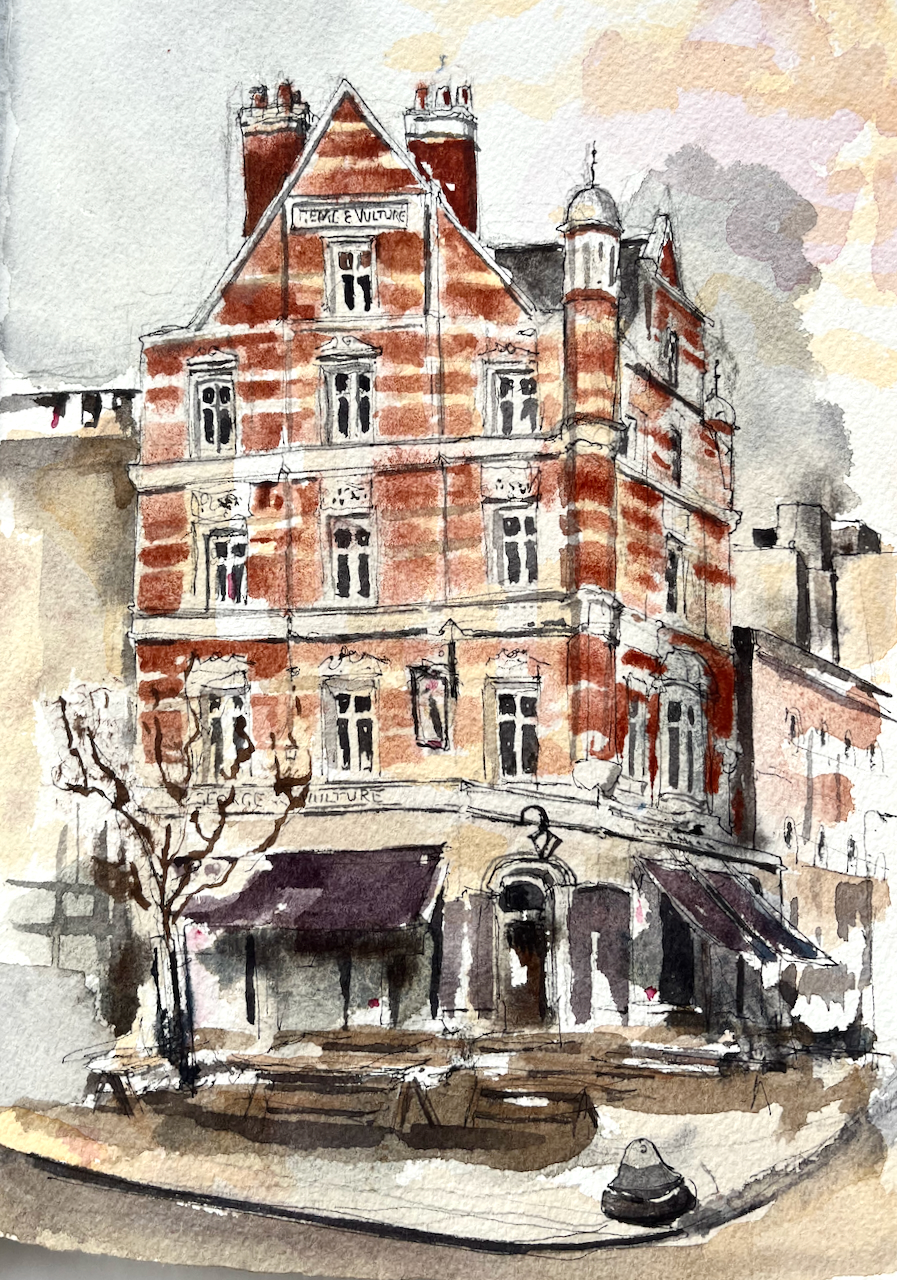
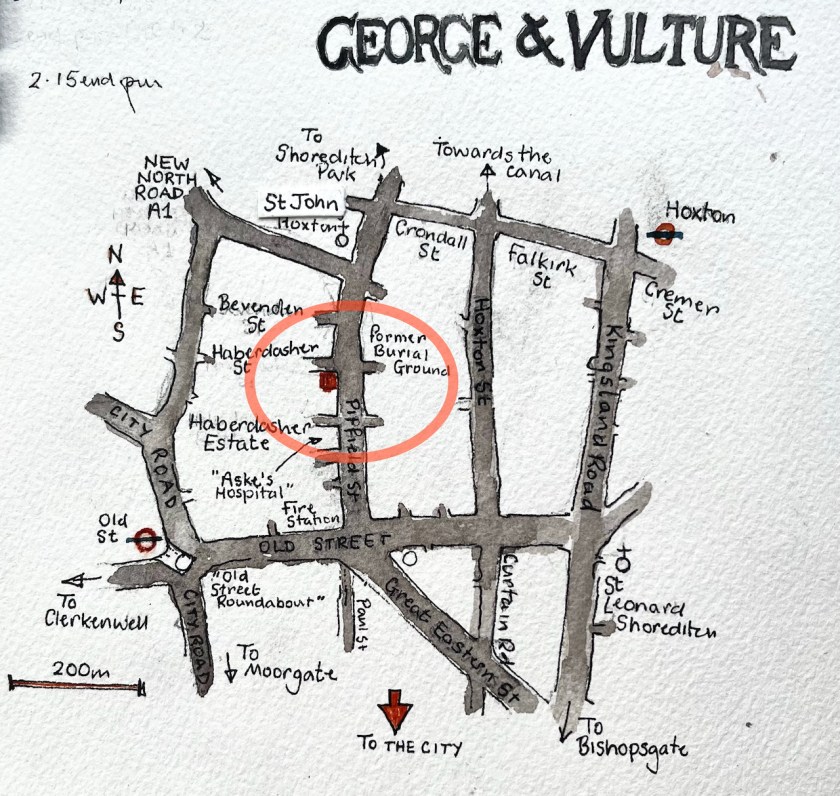
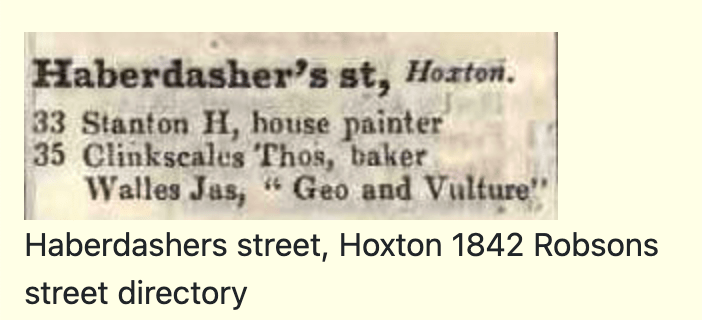
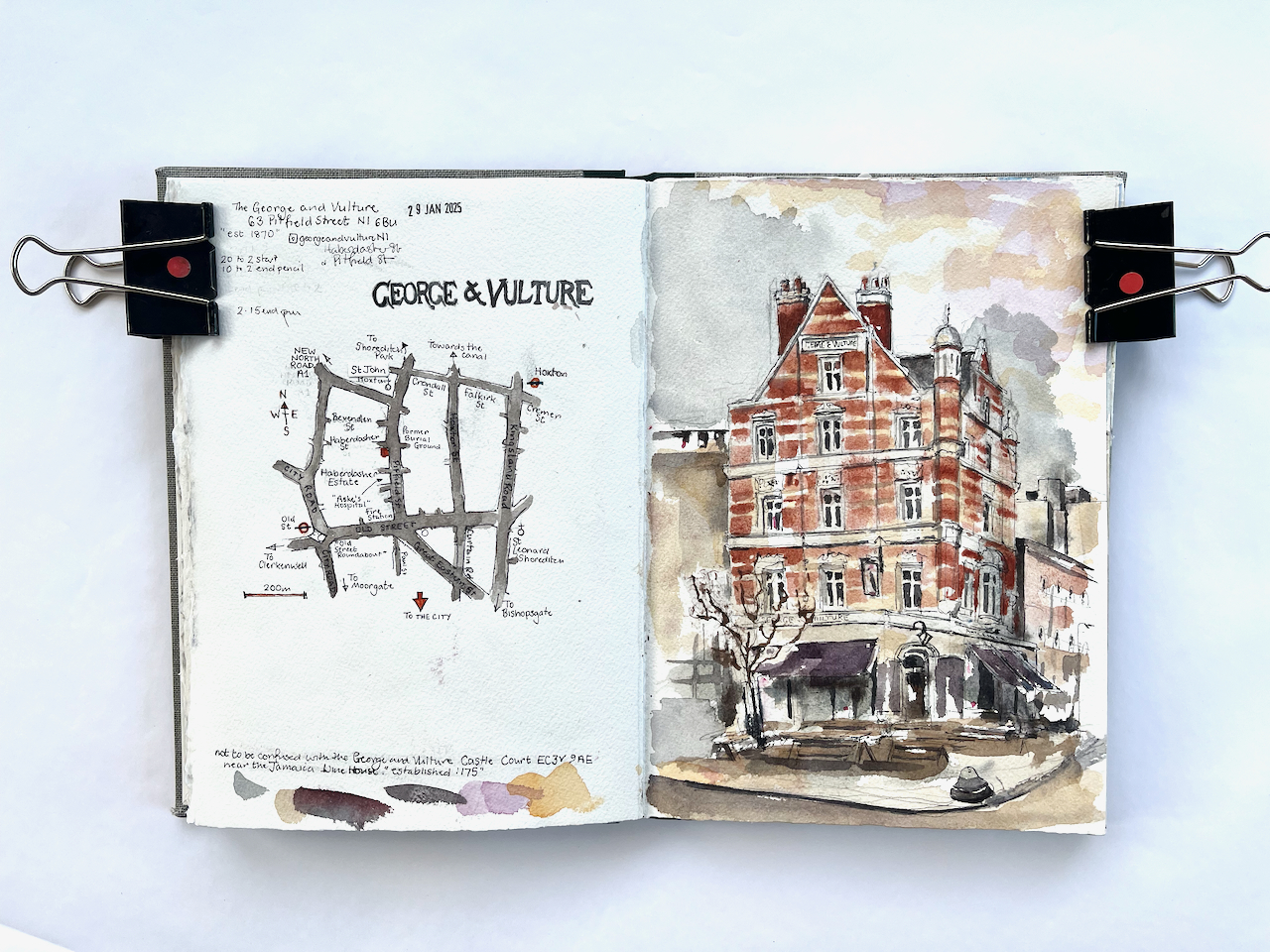
The original address of the pub was 35 Haberdashers Street. Much of the land round here was owned by the Haberdashers Livery company, bequeathed to them by Robert Aske, a merchant (1619-1689). In 1862 the Haberdashers company offered new leases on properties here:
Haberdashers’ Estate, Hoxton. A free public-house, adjoining the high road, and 66 dwelling-houses. To be let, by tender, by the worshipful Company of Haberdashers, Governors of Aske’s Charity Estate, Hoxton, on repairing leases, for 21 years, from Midsummer, 1863:— The free public-house, known as the “George and Vulture,” situate in Haberdashers’ Street, which might be enlarged so as to form a corner house to the main street. Also 12 houses, Nos. 1 to 12, Haberdashers’ Place, which may be converted into shops, at the option of the lessee. Also 19 houses, Nos. 1 to 19, on the south side of Aske’s Terrace; and 35 houses, Nos. 1 to 35, on the north and south sides of Haberdashers’ Street, in the parish of St. Leonard, Shoreditch, in the county of Middlesex. Plans of the property, and specifications of the repairs to be performed, may be seen at the offices of Mr. William Snooke, the surveyor to the governors, No. 6, Duke Street, London Bridge, between the hours of 10 and 4 o’clock. Tenders, in writing only, are to be sent in to Haberdashers’ Hall, Gresham Street West, on or before Thursday, the 27th day of November 1862.
City of London Livery Companies Commission, ‘Report on the Charities of the Haberdashers’ Company: Appendix’, in City of London Livery Companies Commission. Report; Volume 4(London, 1884), British History Online https://www.british-history.ac.uk/livery-companies-commission/vol4/pp478-486 [accessed 30 January 2025].
One of the properties to be let, as you see, was “The free public-house, known as the “George and Vulture,” situate in Haberdashers’ Street, which might be enlarged so as to form a corner house to the main street.”
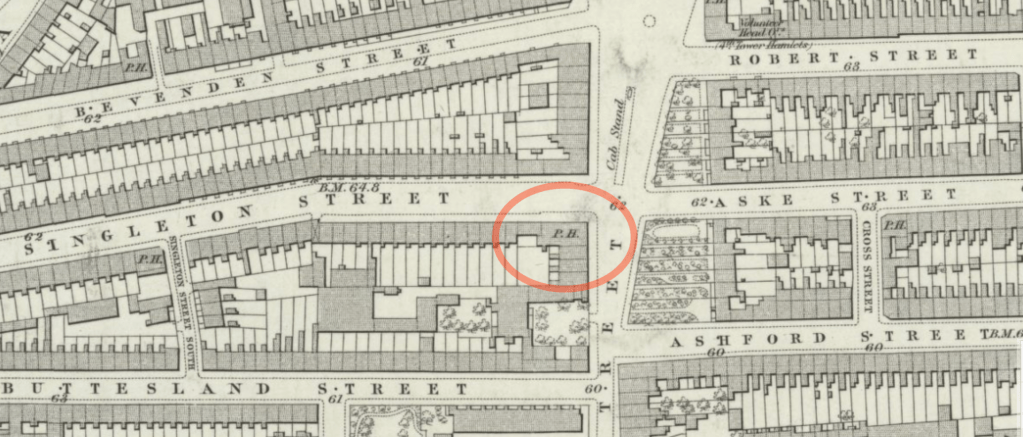
Evidently the lessee enlarged the pub, as the Haberdashers Company suggested, and it does indeed form a corner house to the main street. The address of the pub is now 63 Pitfield Street. Here is the 1877 map which shows the pub as a “corner house”. The road layout on the west of Pitfield Street is largely unchanged. Singleton Street is now called Haberdasher Street.
1972 Ordnance Survey map, from the National Library of Scotland, re-use: CC-BY (NLS)
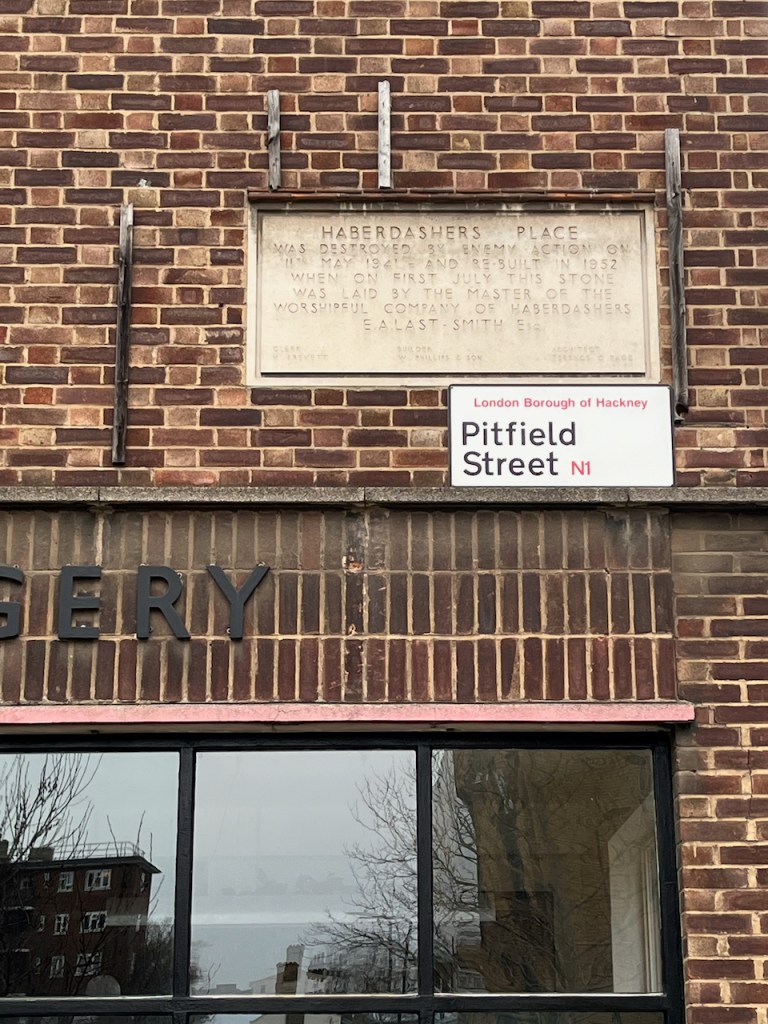
The area was bombed extensively in the 1939-45 conflict, but the pub survived. Bomb maps show that the area adjoining Aske Street on the other side of Pitfield Street was damaged beyond repair. A plaque on the row of shops just North of the pub describe the re-building.1
“Haberdashers Place was destroyed by enemy action on 11 May 1941 and re-built in 1952 when on first July this stone was laid by the master of the Worshipful Company of Haberdashers S.A. Last-Smith. Clerk W B(?)revett – Builder W Philips & Son -Architect Terence C Page” Photo: January 2025
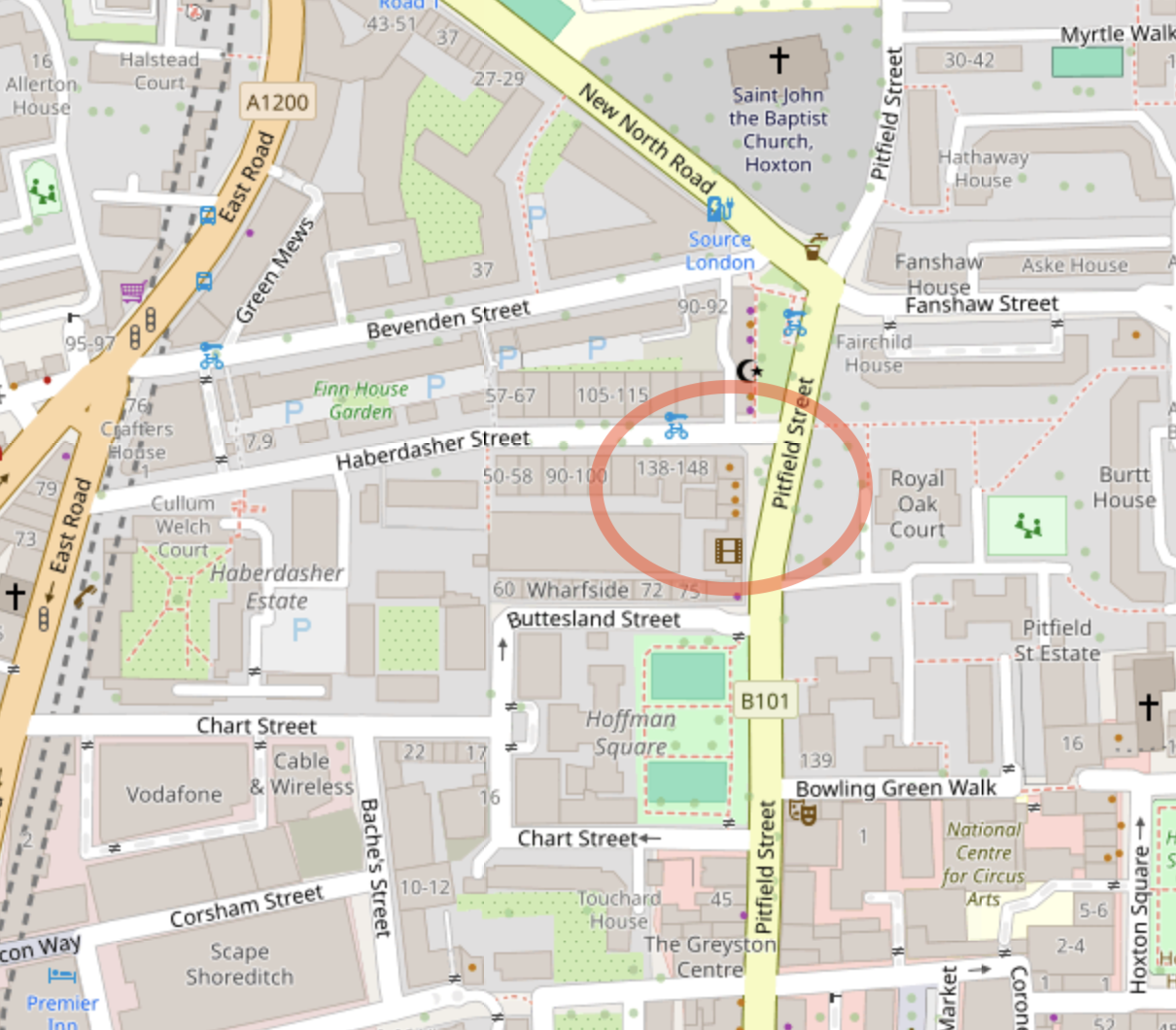
Here is the 1872 map alongside a modern map. You see that the rows of terraced houses on the east of Pitfield Street have gone, and are replaced by low-level residential housing blocks with a different layout.
(c) openstreetmapcontributorsNational Library of Scotland CC-BY(NLS)
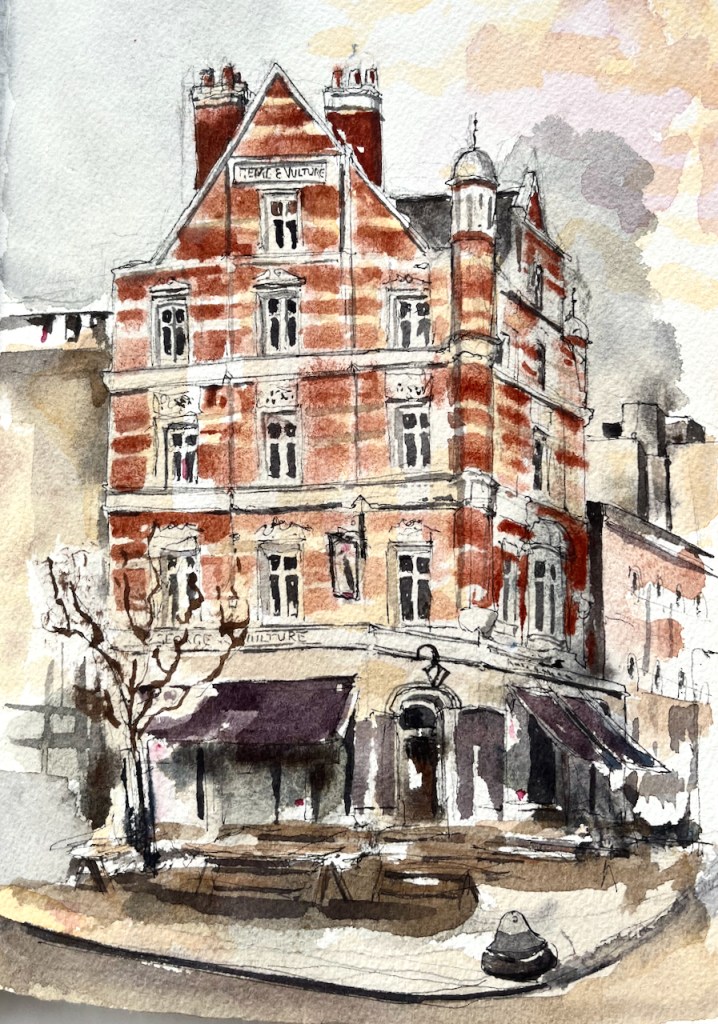
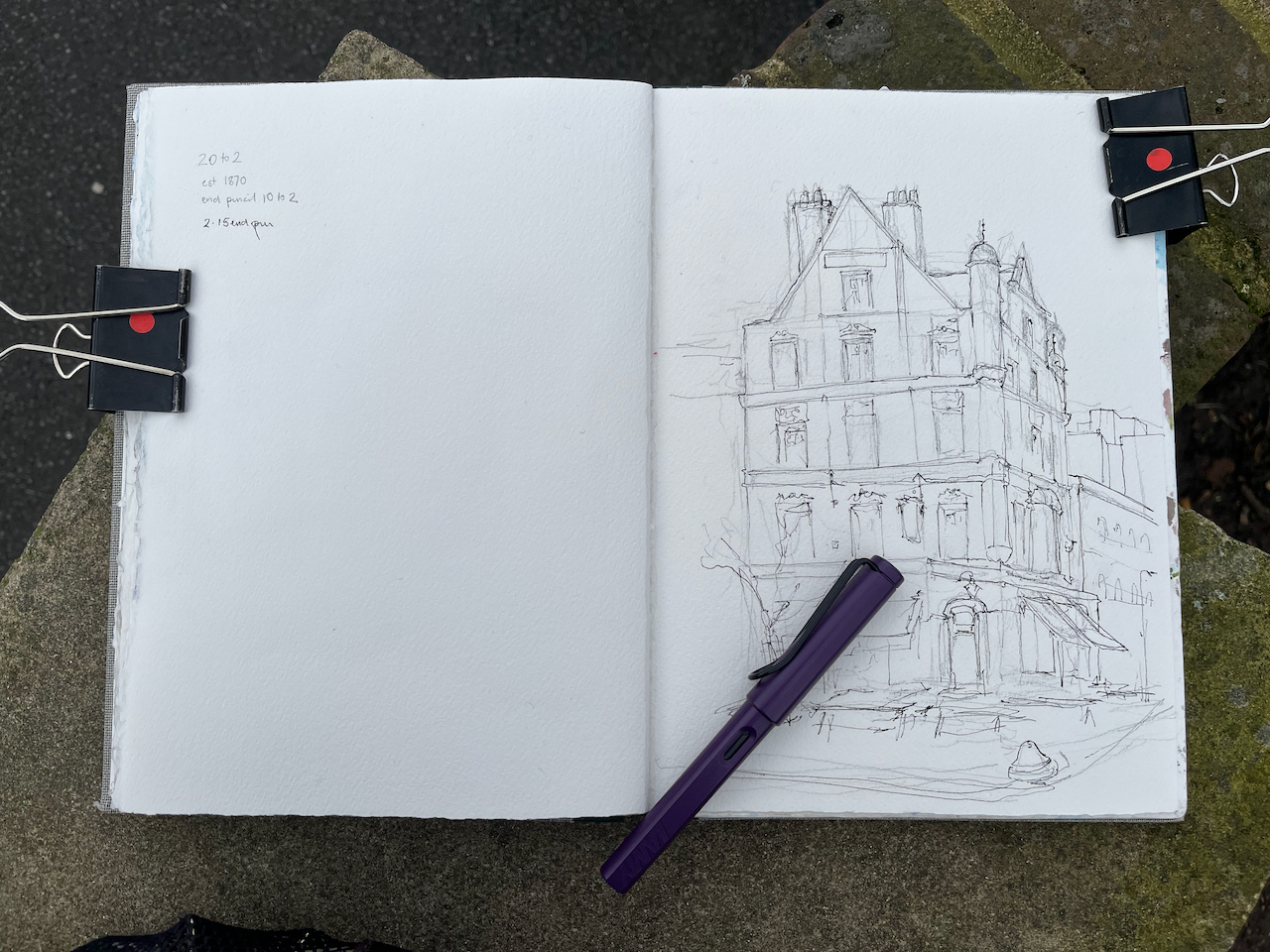
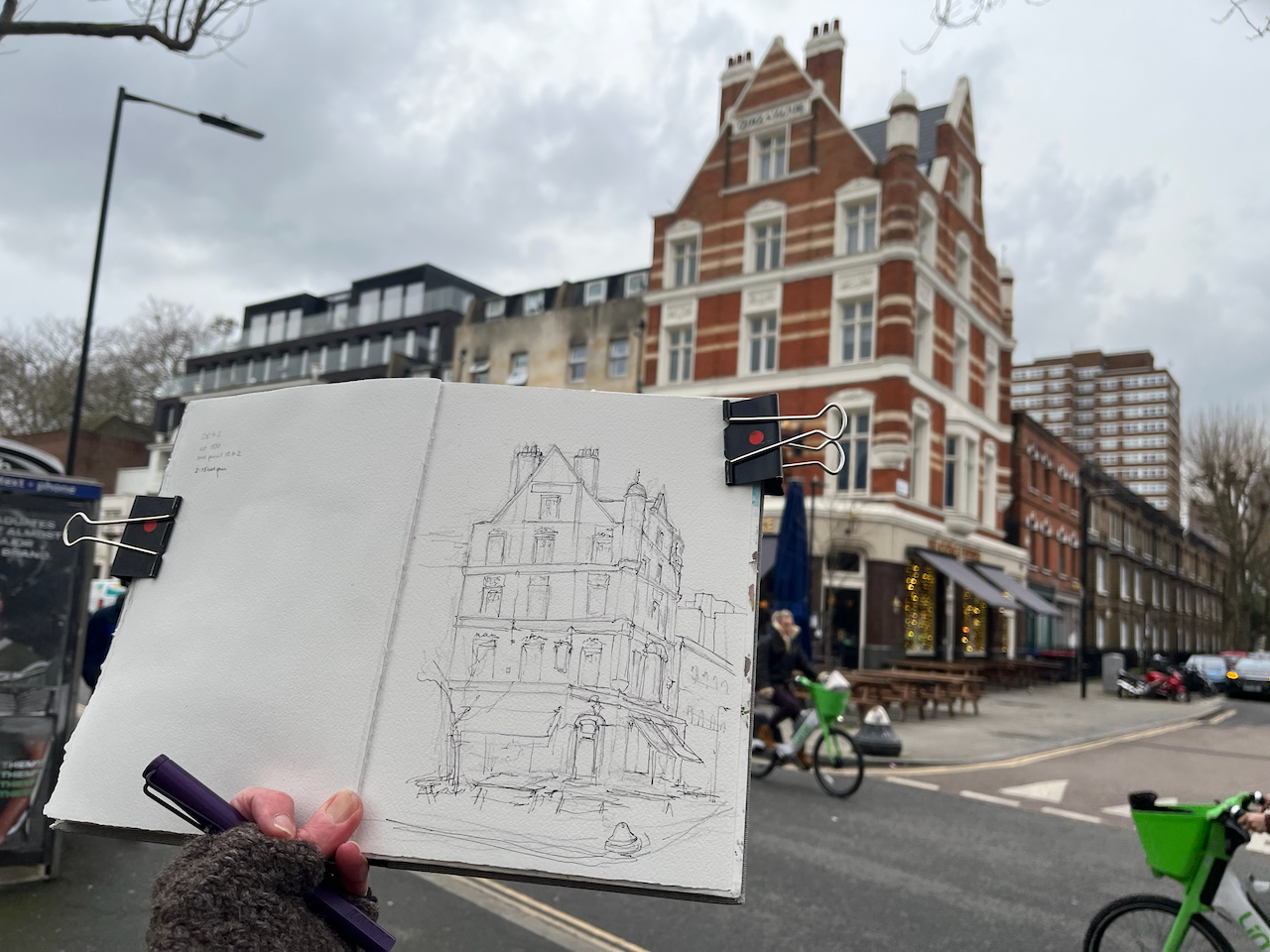
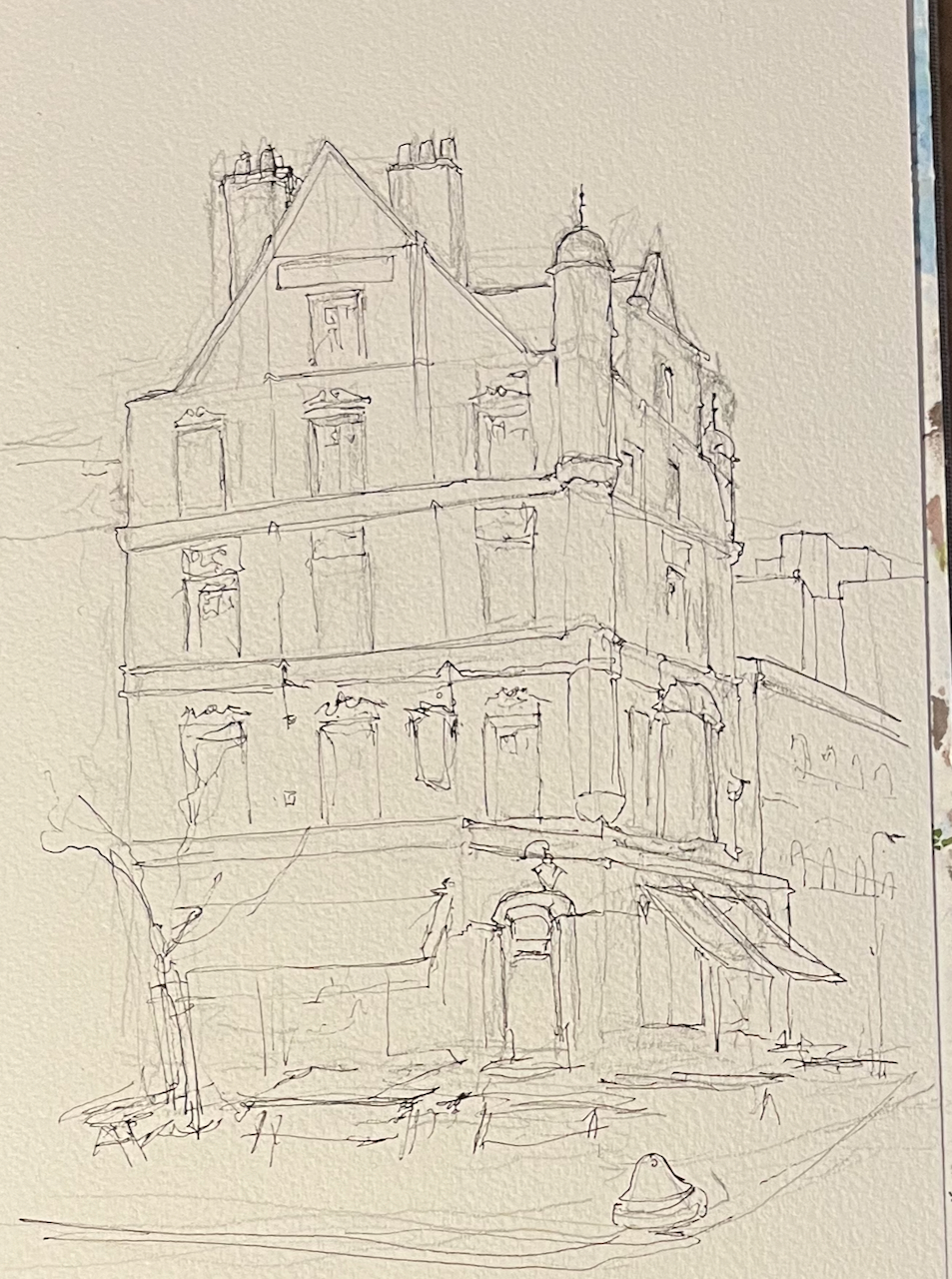
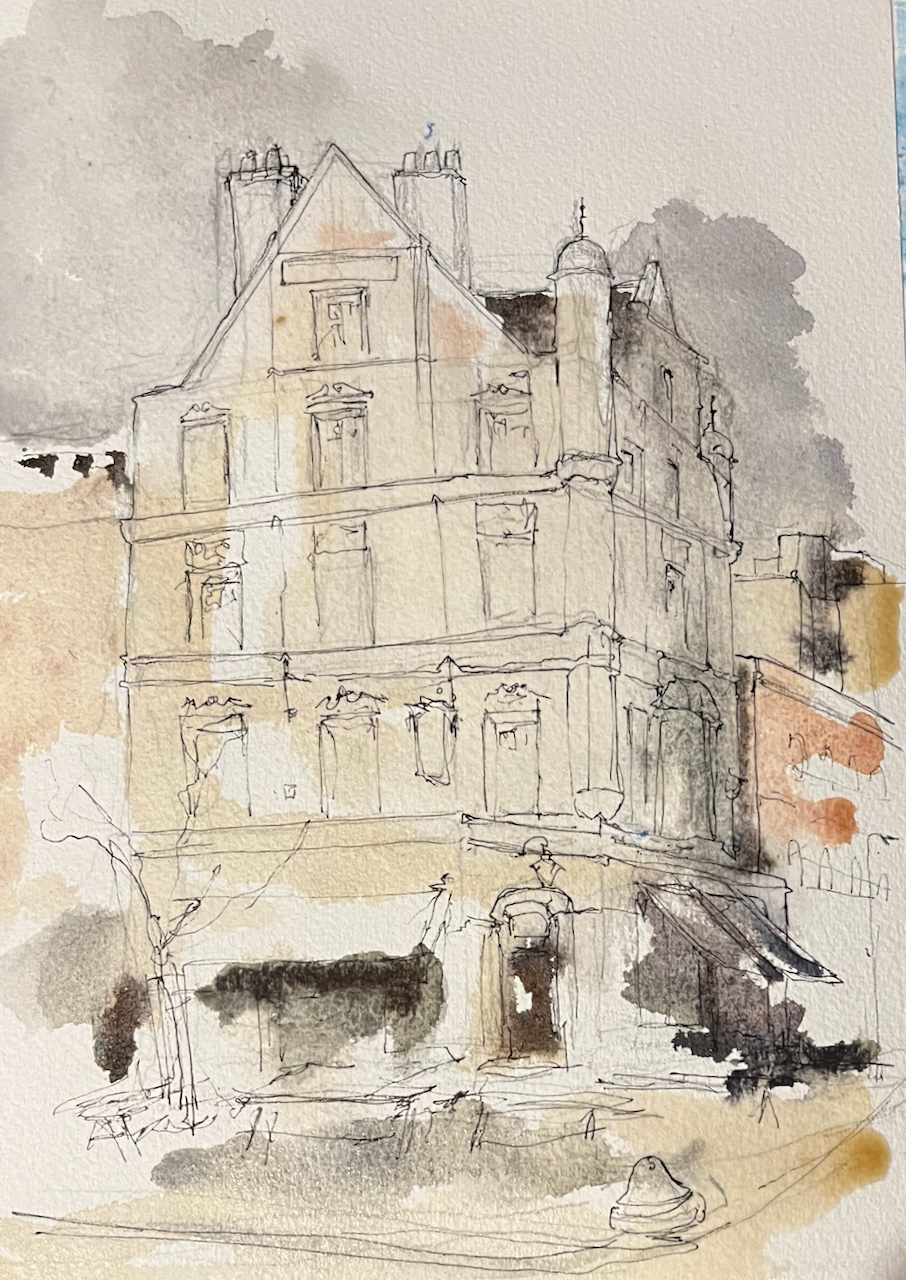
I sketched the pub on a cold January day. I did the pen and ink on location and then retreated to my desk to do the colour.
Sketchbook 15
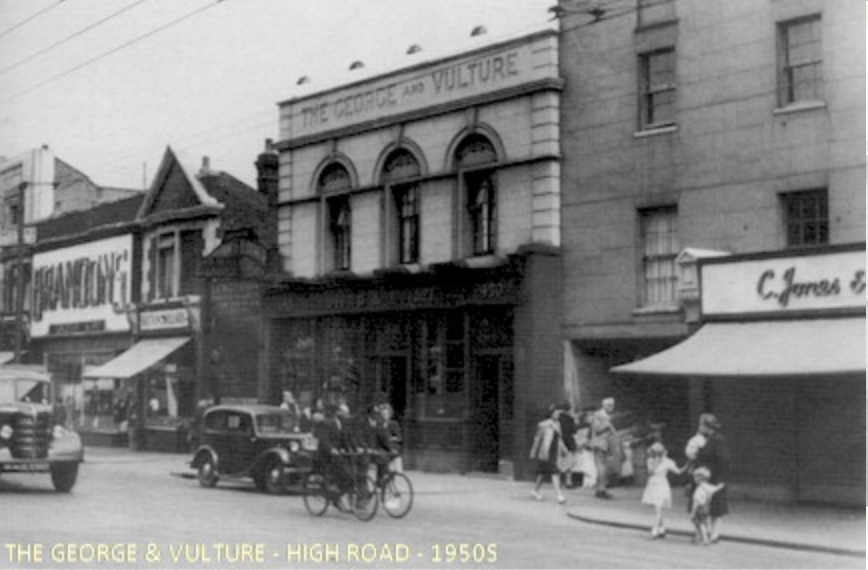
I cannot discover why the pub is called the “George and Vulture”. Why “vulture”? There is another pub in London of the same name, in the alleys of the City close to the Jamaica Wine House. That one was established in 1175. There was also a George and Vulture in Tottenham, 490 High Road, N172, from around 1759, now demolished.
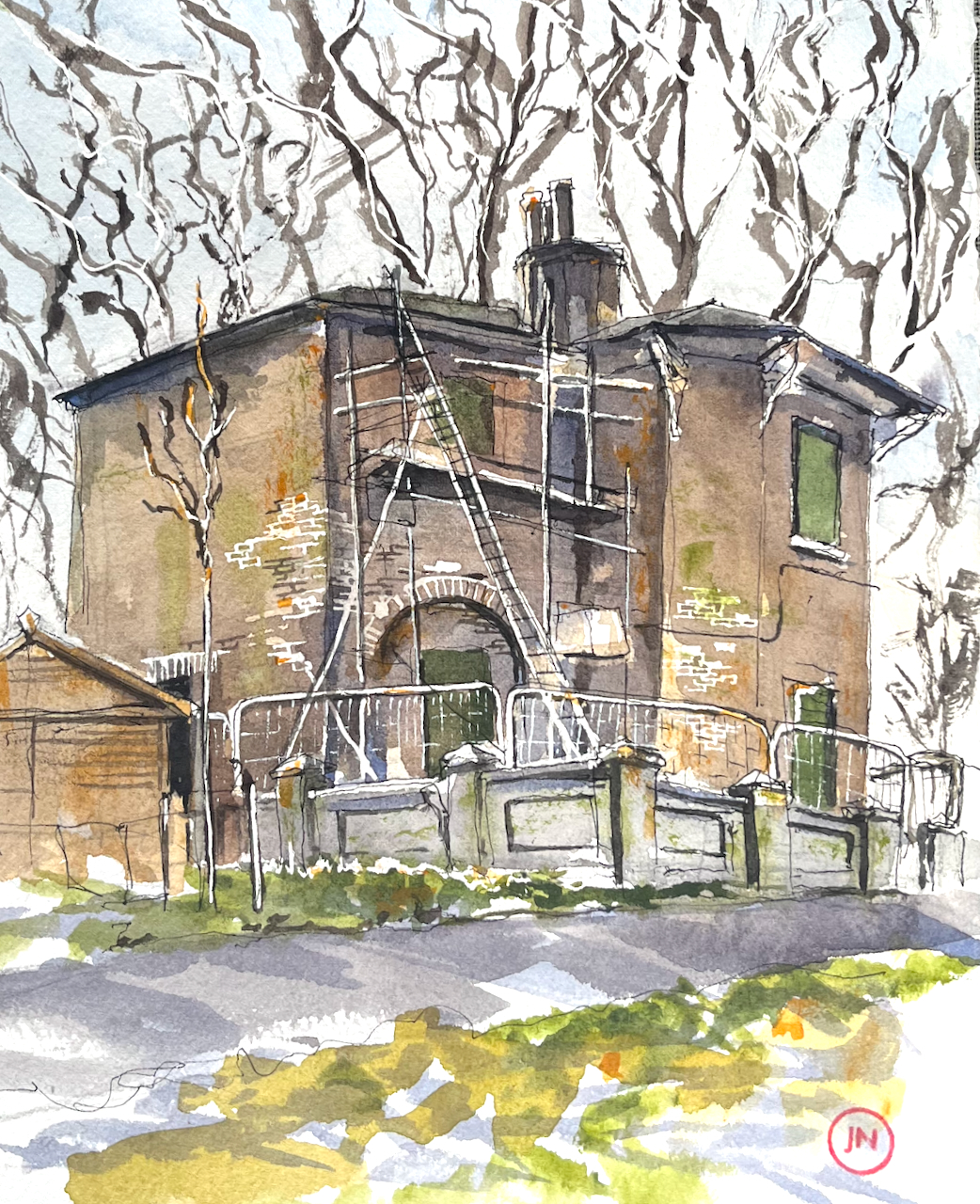
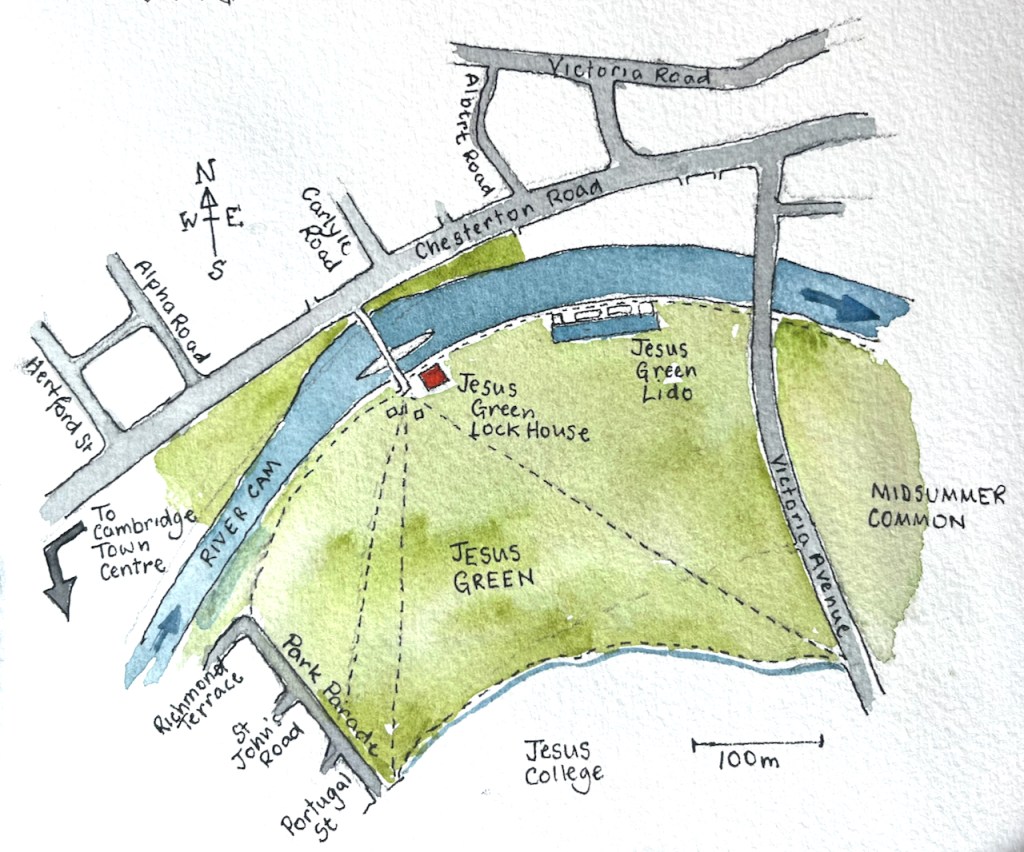
A house stands by Jesus Lock on the River Cam. I have walked by it so many times, over decades, that it holds a magical place in my mind. In the dimness of a childhood memory, I am looking over the wall. I remember flowers in the window boxes, a garden. Then somehow it became ignored, scruffy, derelict, vandalised. Then nothing happened, and it just stood there. Each time I saw it, it was slightly more dilapidated. But it remained in my memory, a beautiful house, in a lovely location. Surely someone will do something with it?
And last time I visited Cambridge, I found that, miraculously, yes!, someone is renovating it.
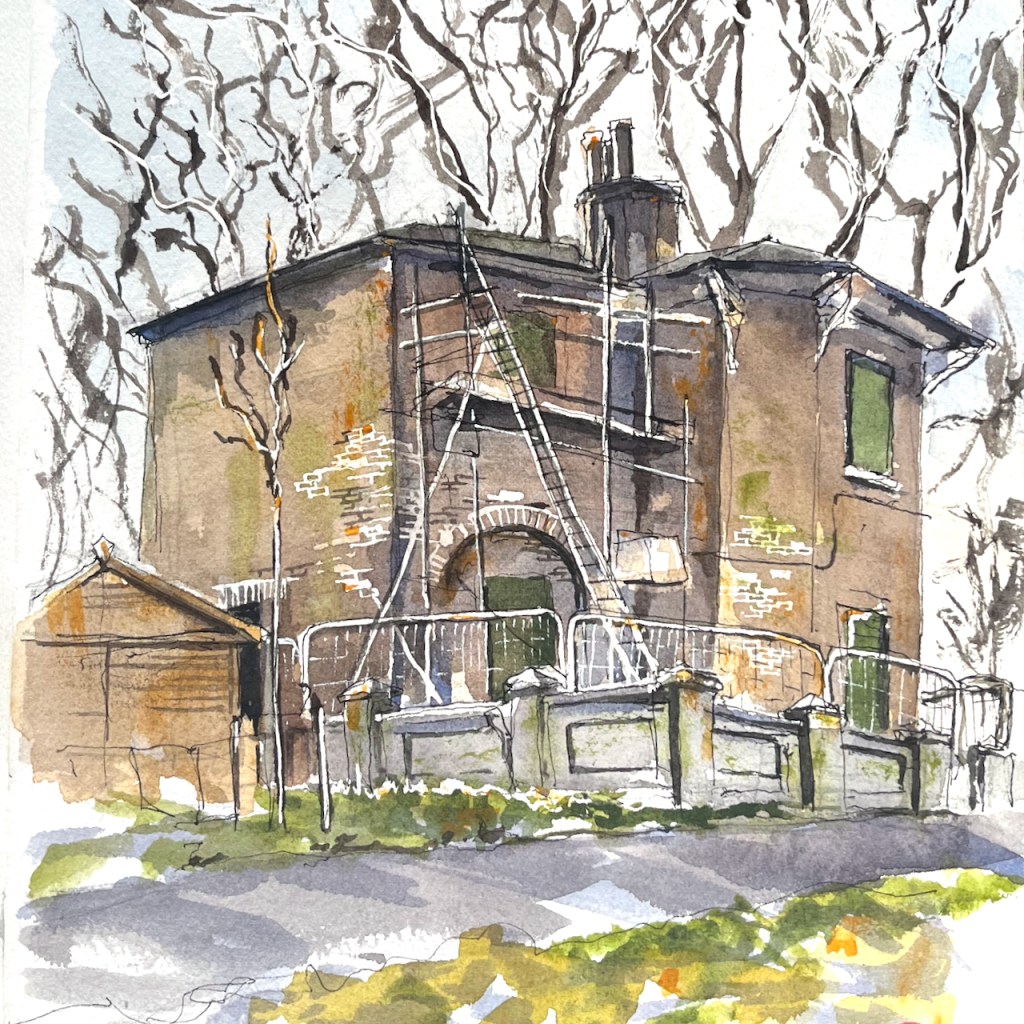
Jesus Green Lock House being renovated. Sketched from Jesus Lock, 24 January 2025, in sketchbook 15
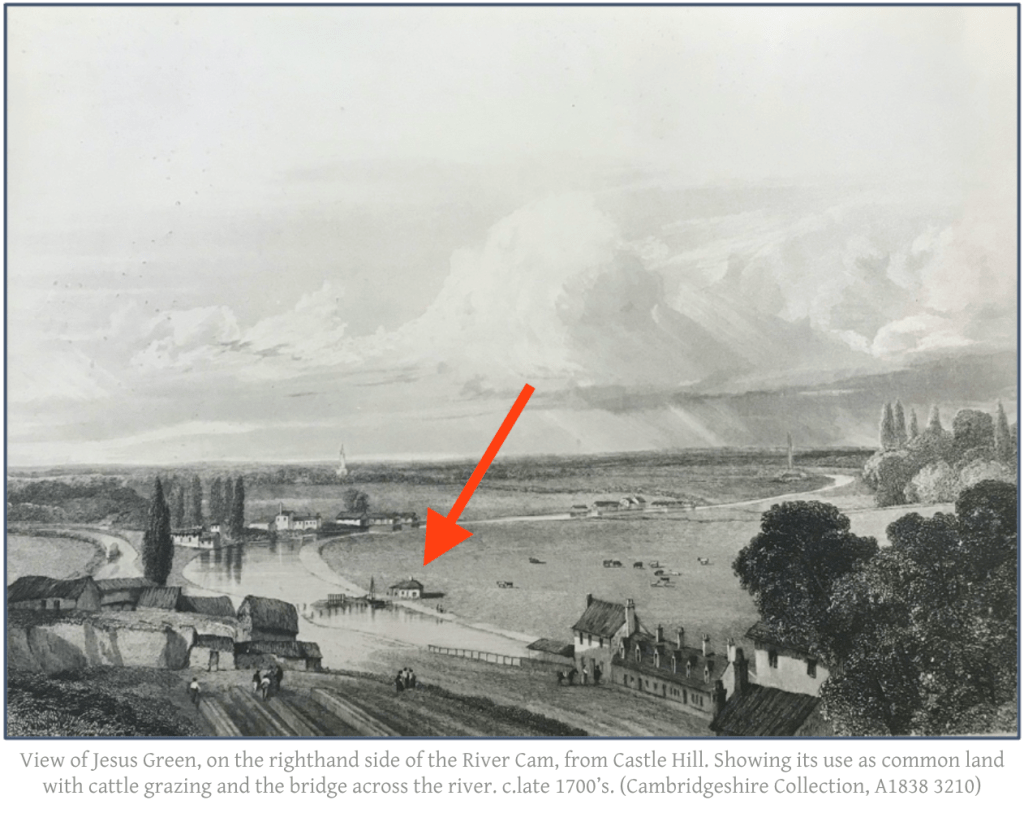
This picture from the website of Michelle Bullivant1 shows Jesus Green in the 1700s. The little house by the river, arrowed, looks to me to be in the same position as the current Lock House, and you can see a bridge or ford across the river Cam at this point. I recognise the houses on the bottom right, which look like the terrace of houses on Chesterton Road which is still there.
Image from Michelle Bullivant, Local Historian
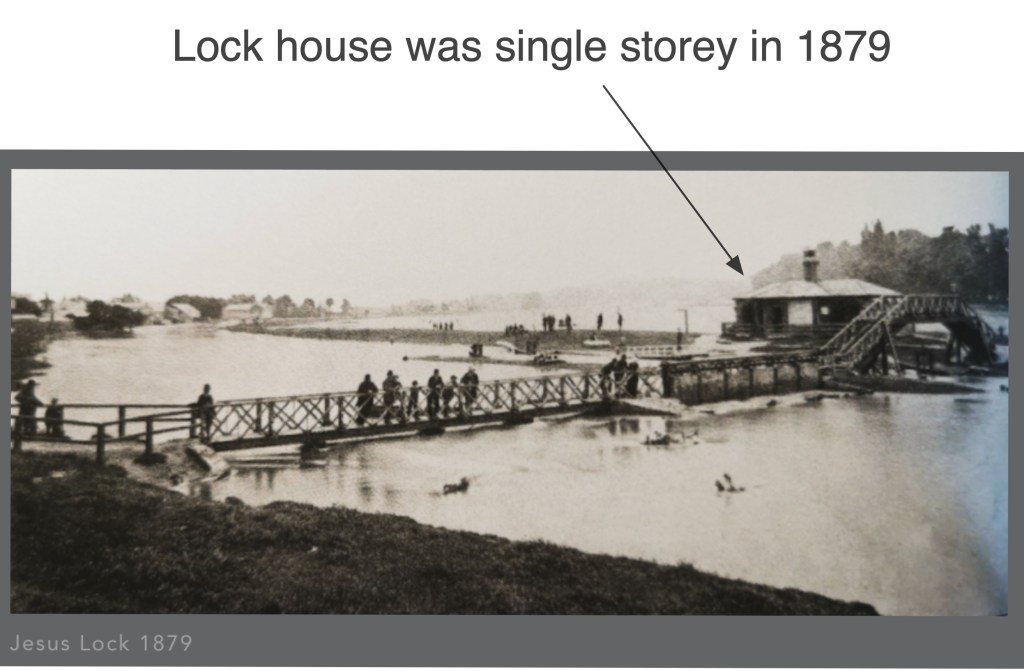
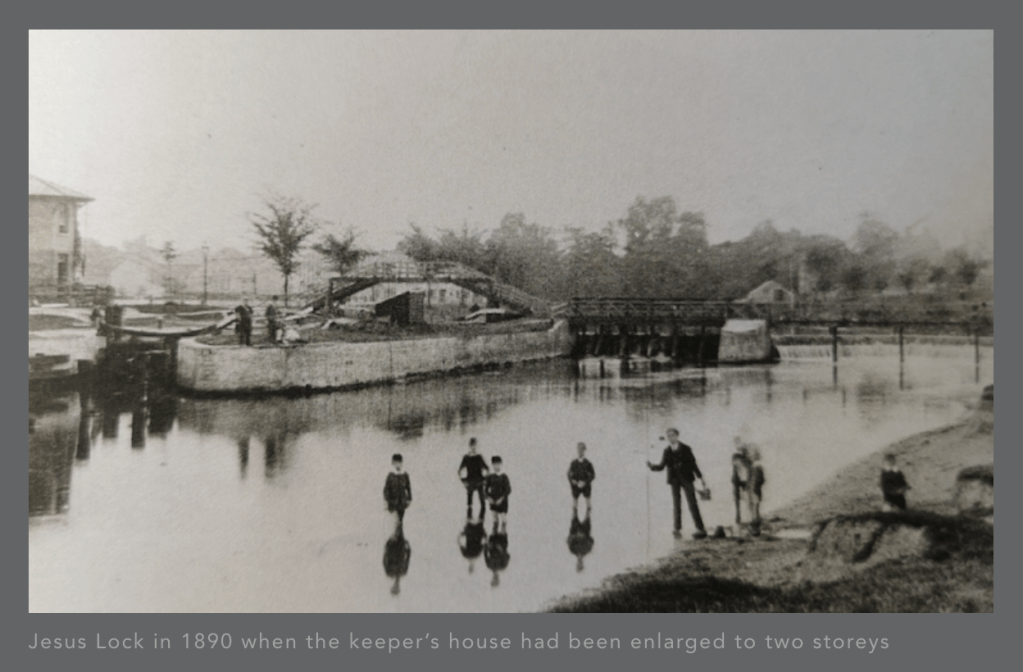
This photo of an old postcard shows that, in 1879, the lock house was single story.
Jesus Lock in 1879 – showing the floods. Image from capturingcambridge.org licensed under creative commons CC BY-NC-SA 4.0
During the 19th century, it was rebuilt. This picture shows the two-storey lock-keeper’s house on the left:
Image from capturingcambridge.org licensed under creative commons CC BY-NC-SA 4.0
It was listed Grade II in 19722. In the 1990’s the final lock keeper moved away3 The house then became a house of multiple occupation (HMO), for students. These was an application in 2016 to turn it into a café, reference 16/0001/FUL. Its use was listed as “HMO” at that time. But this application was refused.
In 2021, the house was bought by its current owners, who have been bravely going ahead with a renovation to transform this listed building once again into a residential dwelling, with an aspiration also to host community events4
“Eventually it will be a beautiful place and a better place”
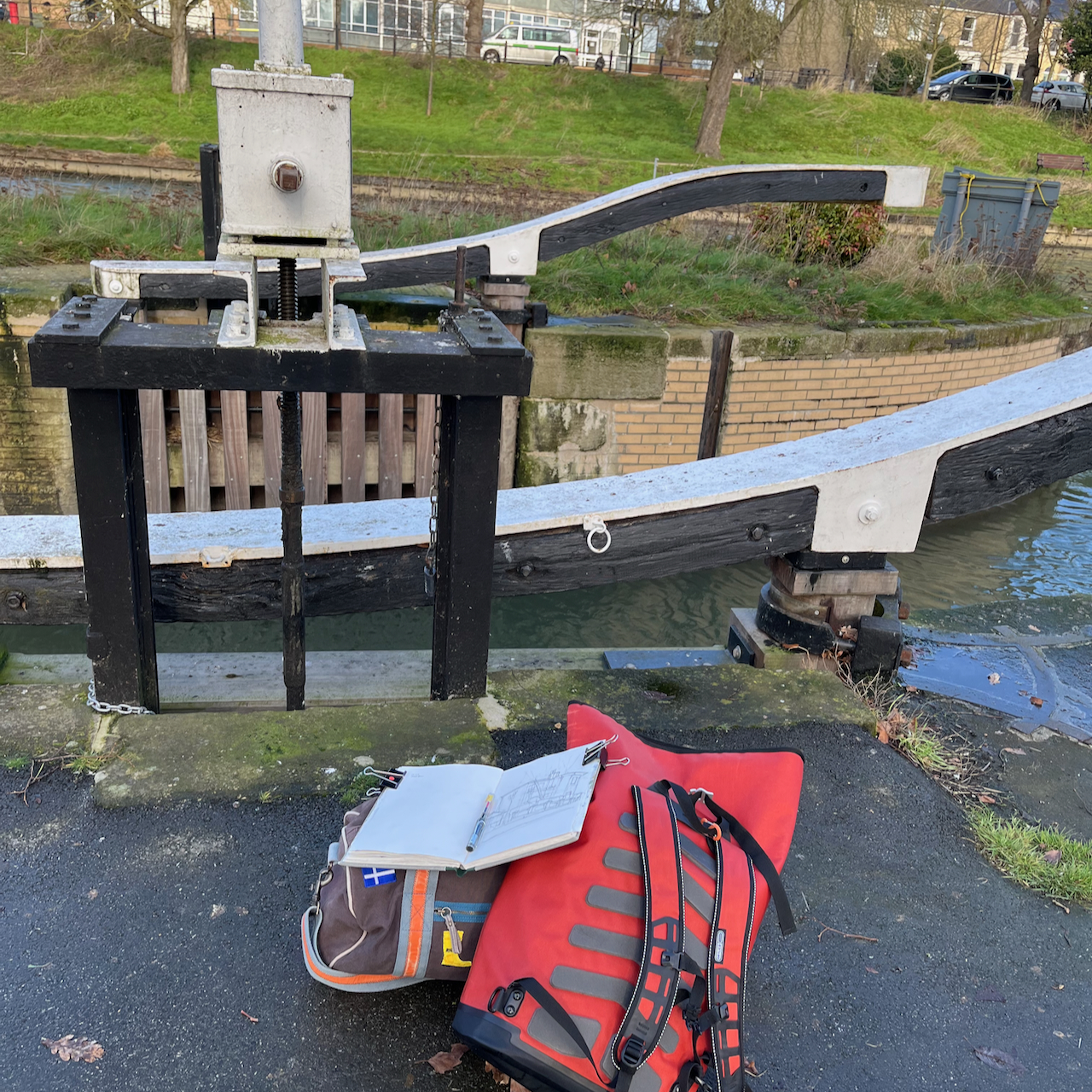
I sketched the house on a very cold day in January. There was a strong wind which not only threatened to throw my sketchbook into the Cam, but also made my eyes water so I couldn’t see properly. I finished the pen and ink, and decided that was enough. Then, by a happy chance, I encountered the current owner unlocking the fence gate. Hence I learned about the efforts of this mother and daughter team, who are determinedly navigating the difficulties of an old building, listed consents, and many other obstacles. But they make amazing progress! See their instagram account for more information.
Sketching the Jesus Green Lock Housesketching by Jesus lockdetail from the sketch
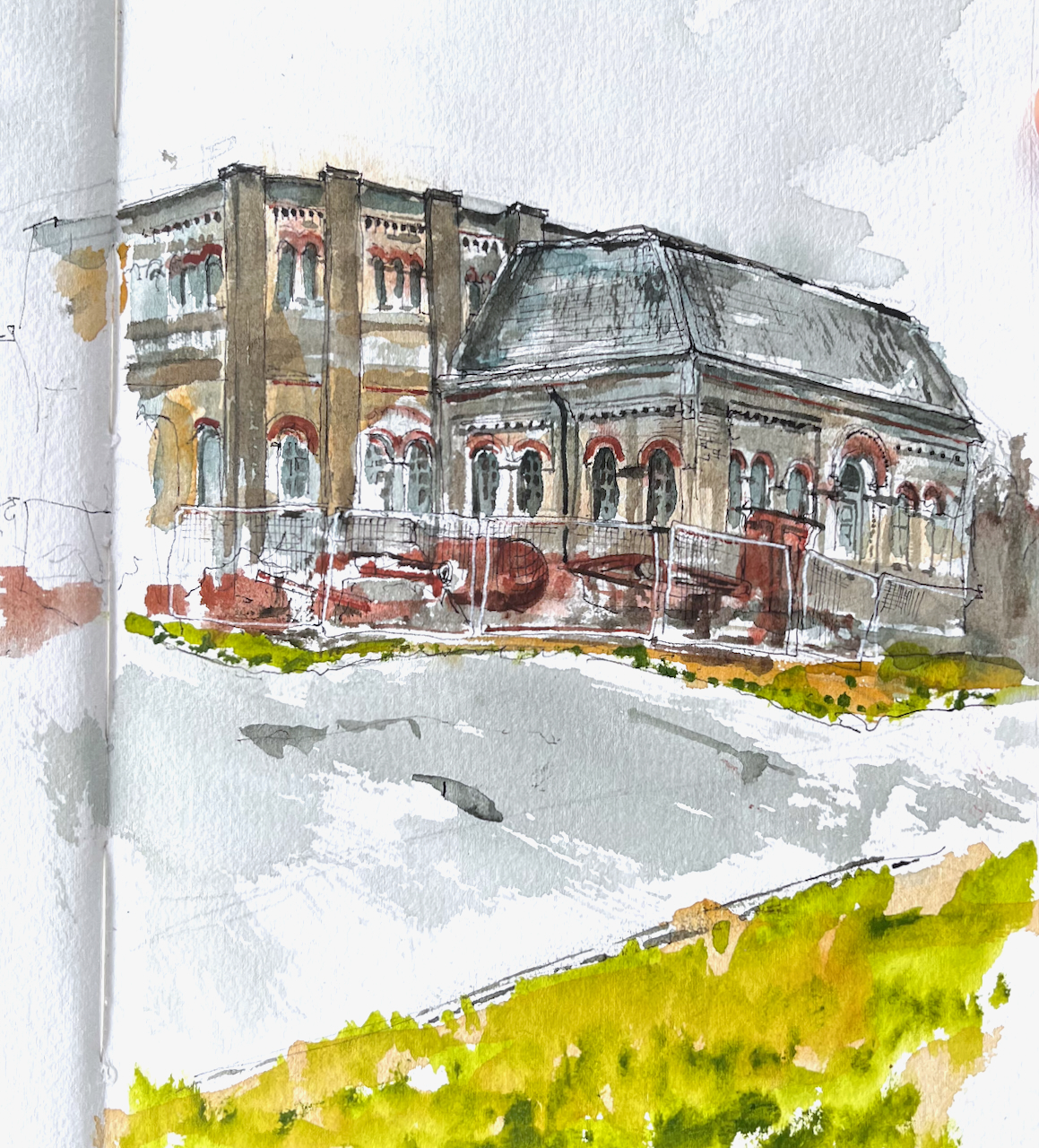
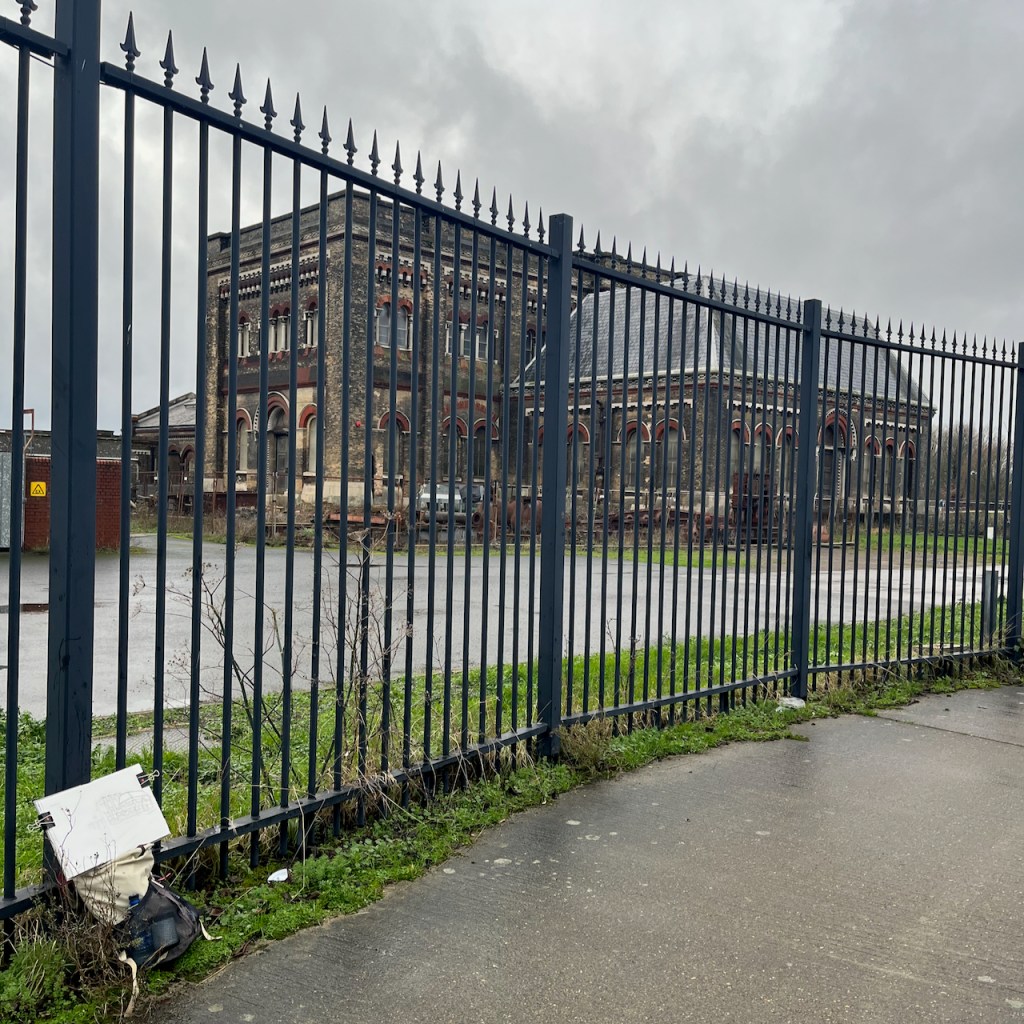
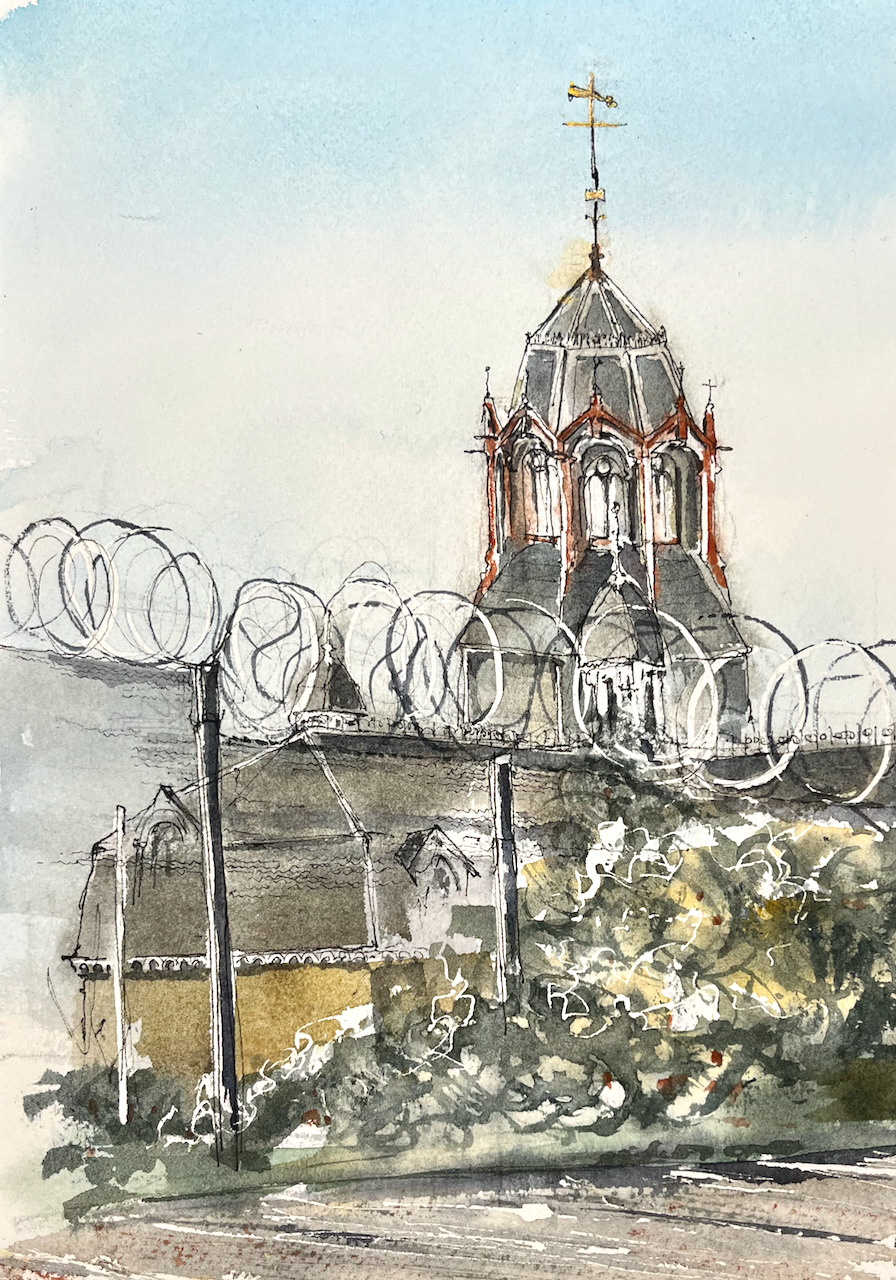
Here is a view of the old engine house of Crossness Pumping Station, on the South bank of the River Thames.
Crossness Engine House, sketched 5th January 2025 from the Thames Path
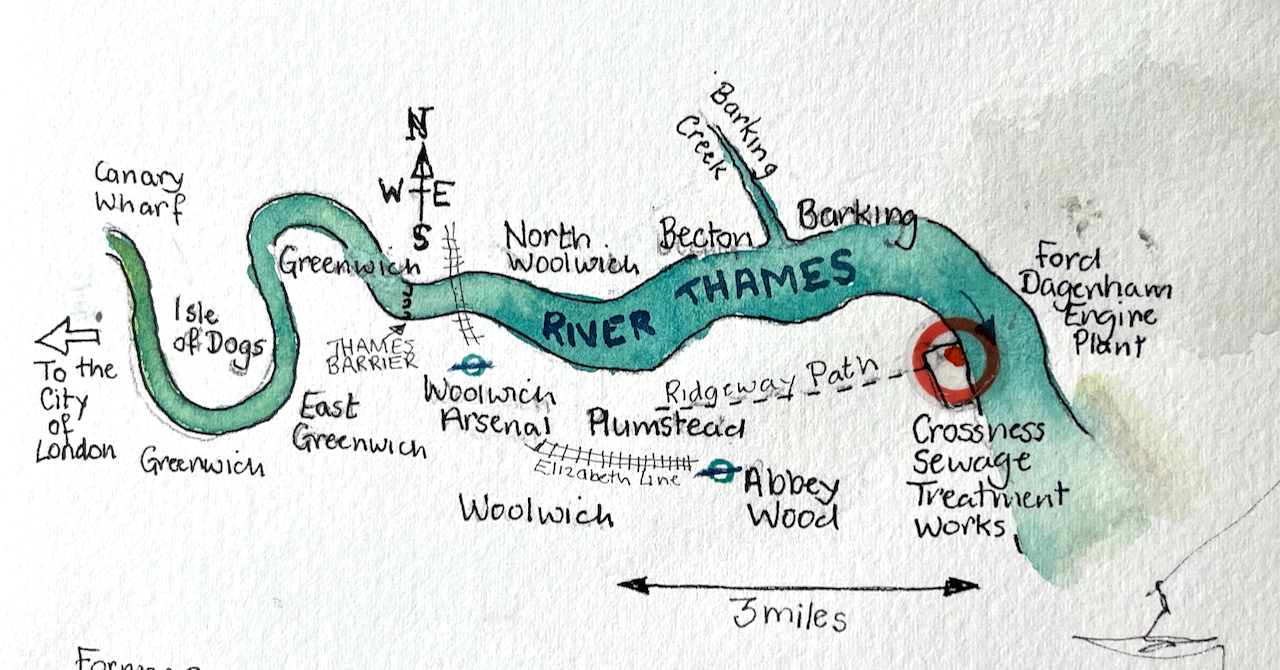
This is a former sewage pumping station. It was designed by the engineer Joseph Bazalgette and opened on the 4th April 18651 . It is the equivalent for South London of the Abbey Mills sewage pumping station on the North side of the Thames, which I have sketched previously.
Sketch map showing the location of Crossness Sewage Treatment Works
These two pumping stations were important components of Bazalgette’s plan to rid London of cholera by removing sewage from central London. His idea was to pump the sewage from the conurbations in central London and shift it to Crossness and Beckton. This did indeed solve the problem of cholera in the city. It did not solve the problem of untreated sewage in the Thames: it just moved it downstream and away from the main residential areas of the time. Untreated sewage was pumped into the river at Crossness and Beckton on the ebb tide.
The exact number of passengers on board the Princess Alice during that fatal voyage is unknown, as is the number lost, but it is thought that around 640 people drowned, making this Britain’s worst inland waterway disaster.
This terrible tragedy and the consequent public outcry prompted the authorities to shift the problem even further downstream. Sewage boats were used to transport raw sewage into the Thames estuary and dump it in the North Sea. Amazingly, this continued until 1998:
The tragedy prompted the introduction of what became known as ‘Bovril boats’ (due to the unfortunate colour and consistency of their cargo), which carried sewage sludge out to the Thames Estuary and North Sea, disposing of it there.This continued until 1998, when EU legislation forbade it due to contamination of beaches.
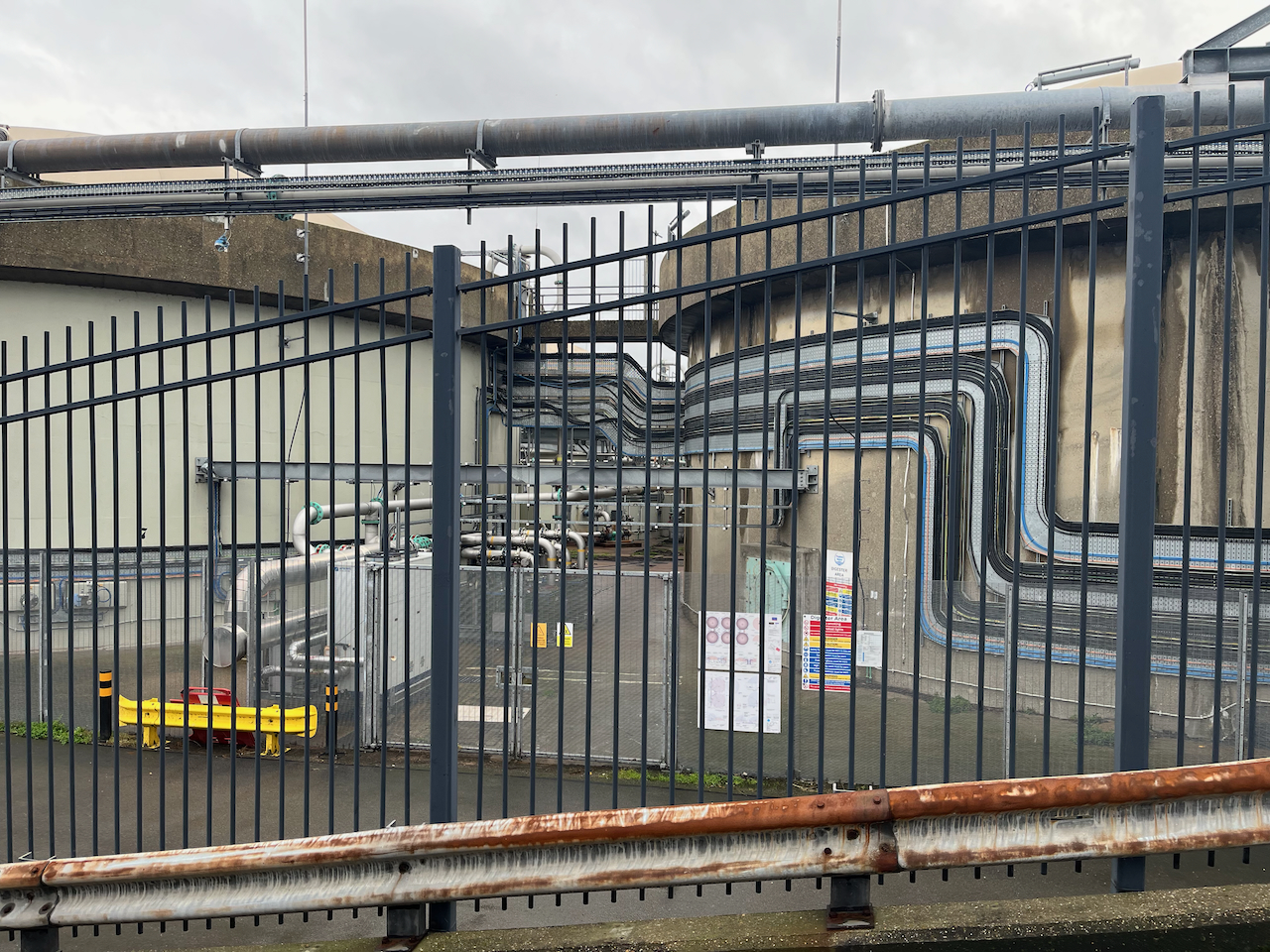
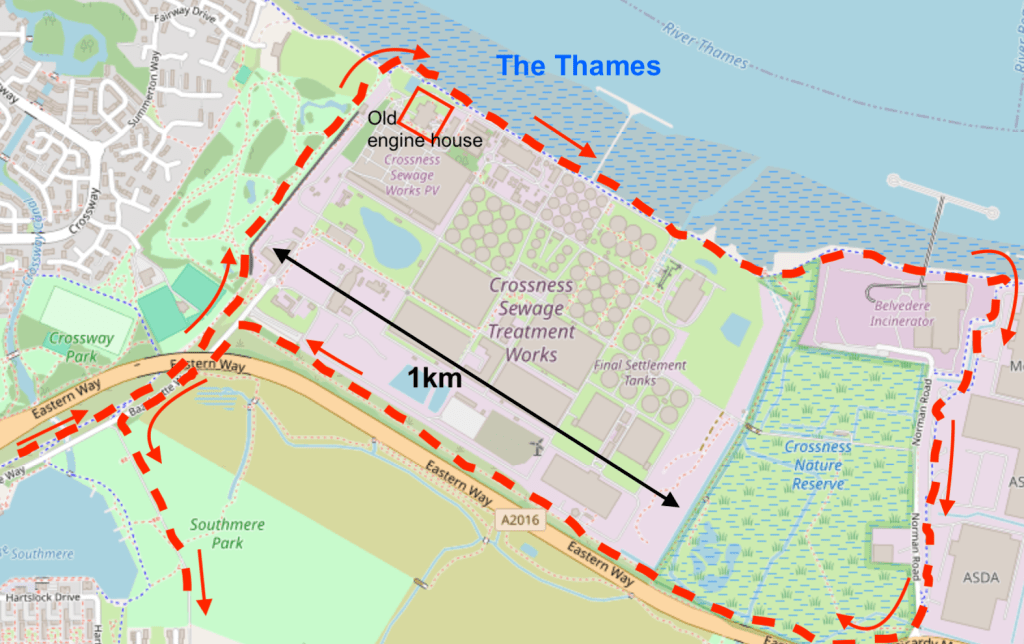
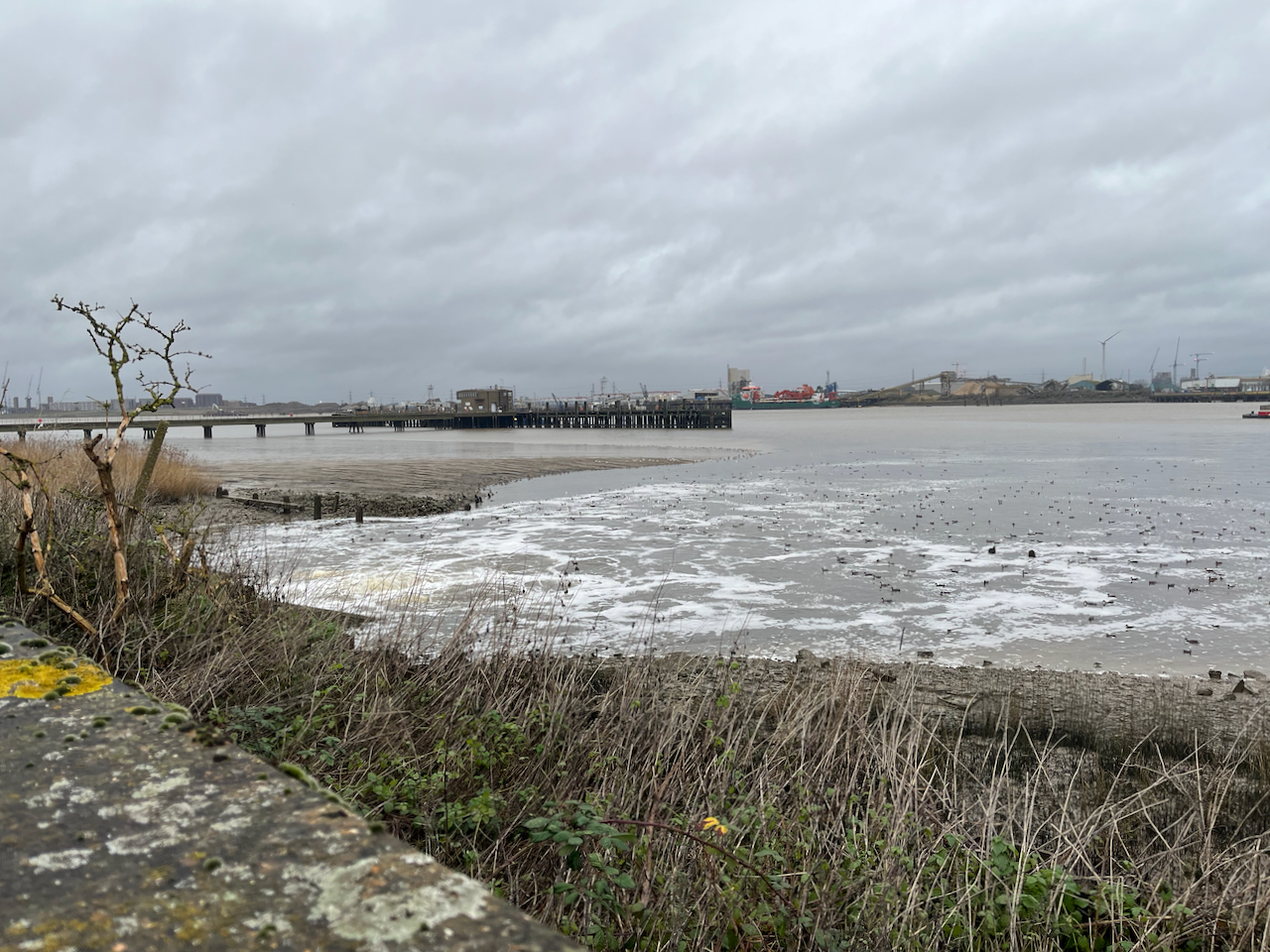
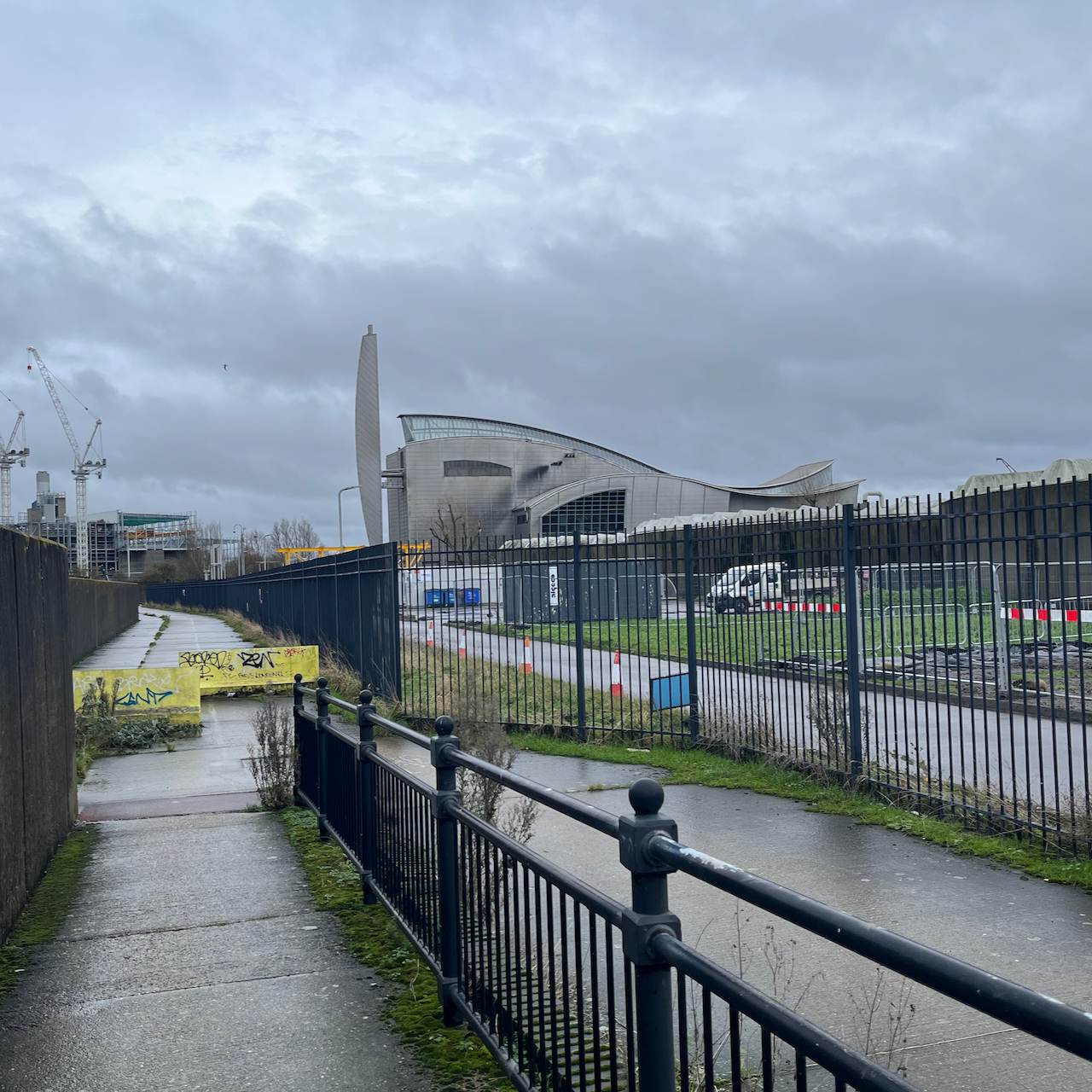
These days the sewage is treated3 (mostly). Next to the Victorian pumping station I sketched, there is a vast modern sewage treatment works belonging to Thames Water. Sewage is transformed by bacterial action and filtering. It becomes water and “sludge”. The water goes into the Thames. The sludge is used as agricultural fertiliser or burned for electrical power generation.
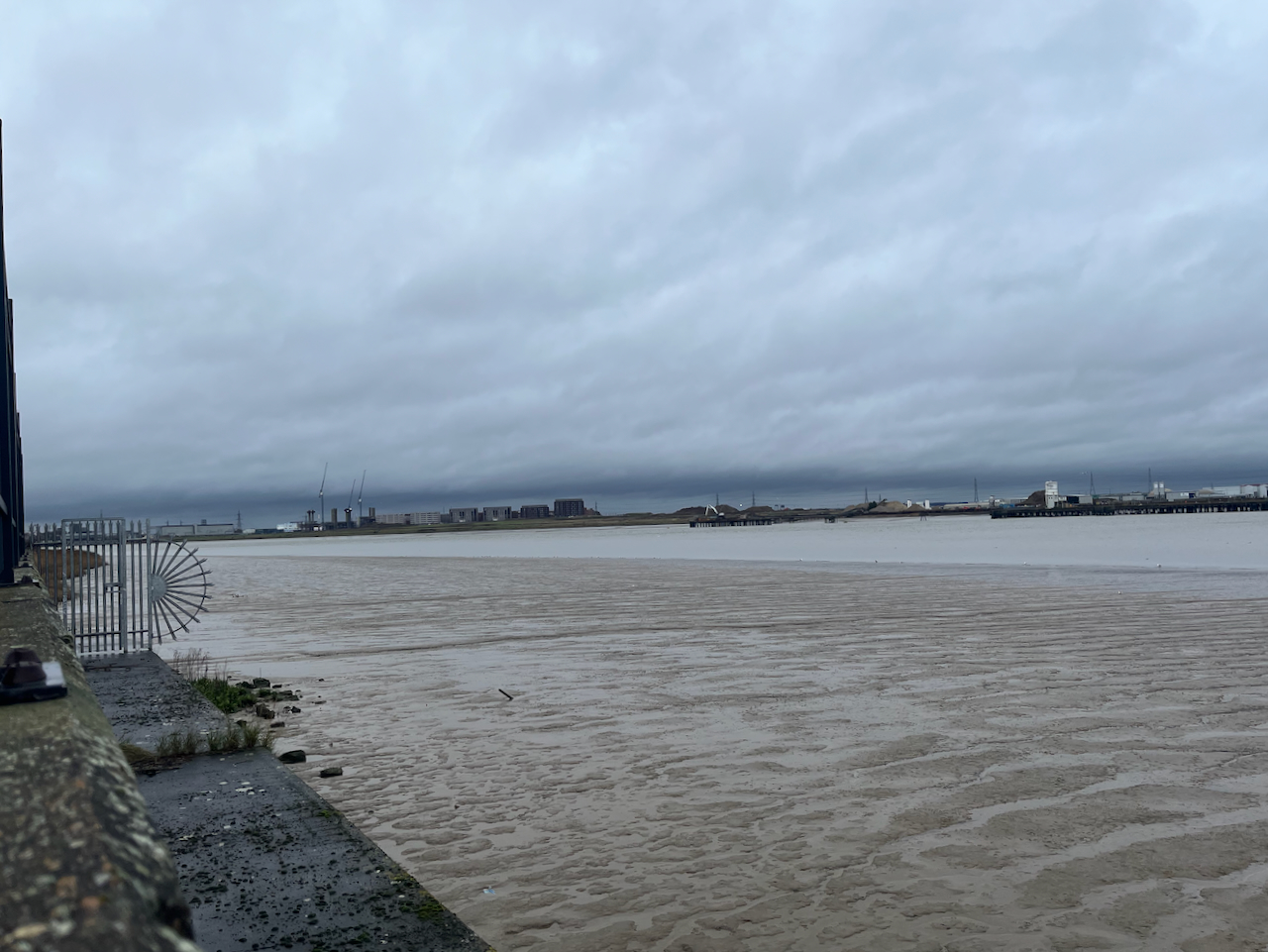
Modern sewage treatment works, Crossness, seen from the Thames path.
On my walk I circumnavigated this enormous treatment plant. It hardly smelt atall.
The Thames is vast here.
Looking across to North WoolwichBirds flock on the outfall from the treatment worksViews from the Thames path at Crossness Sewage works
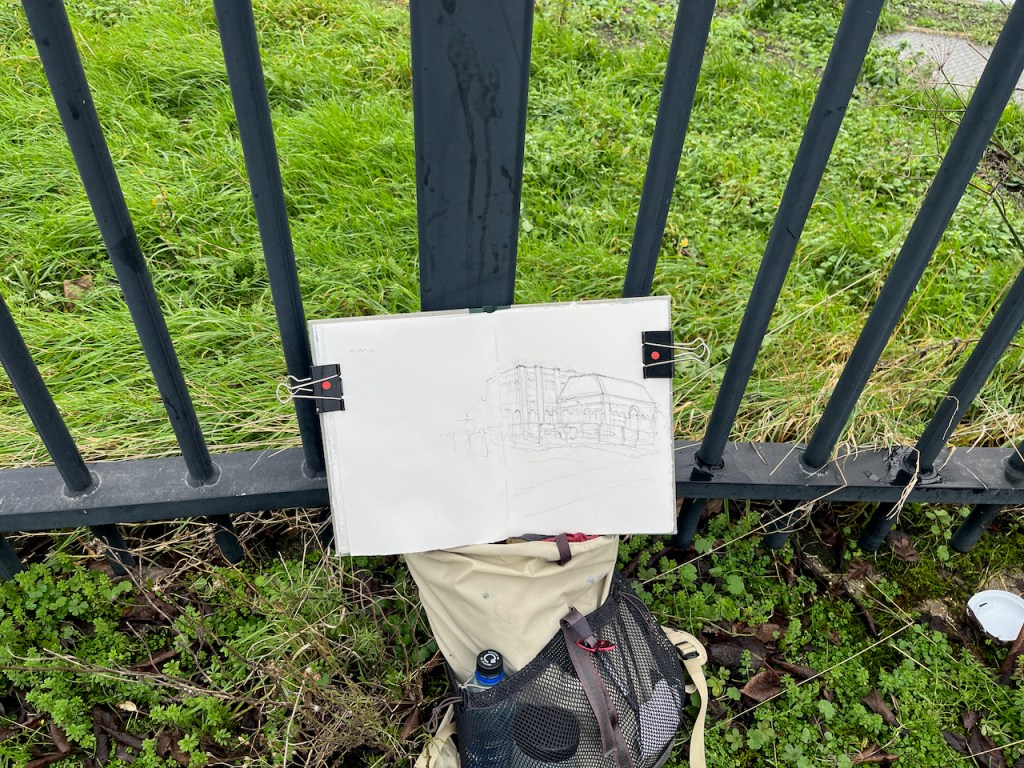
I sketched the Engine House from the Thames Path. It is behind some tall and strong fencing, which I did not put in the picture.
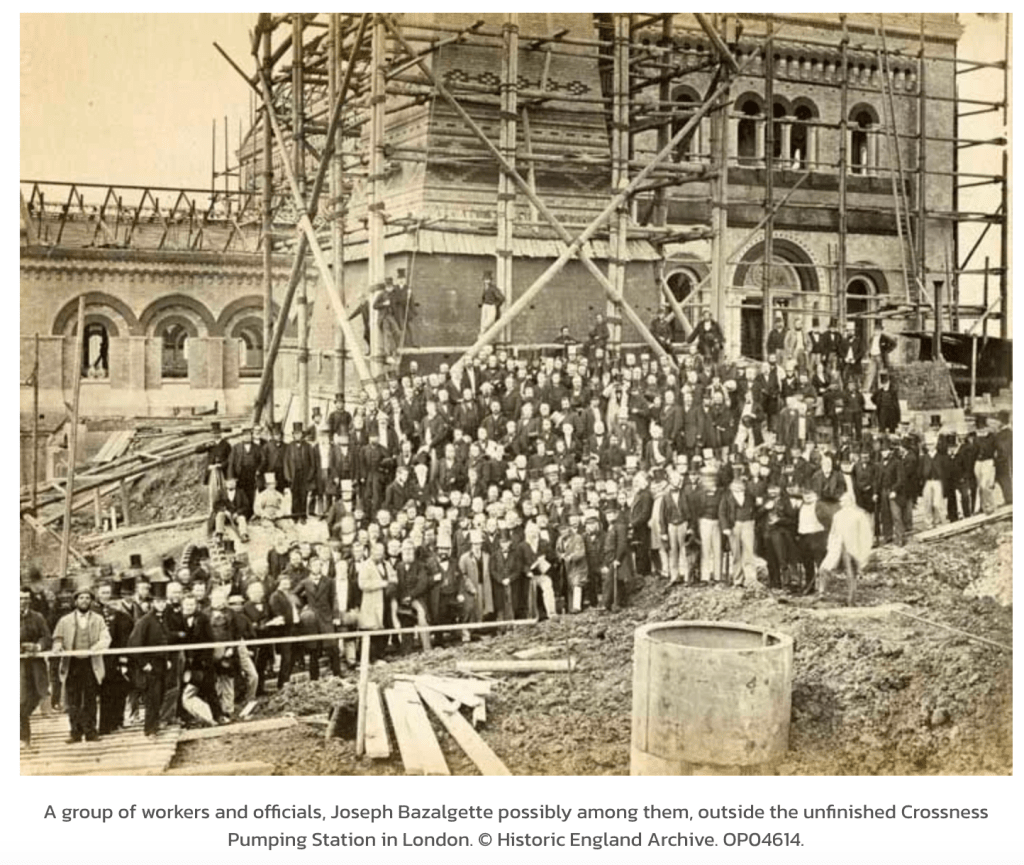
Source: Historic England Archive, used with permission.
The photo is more-or-less the same viewpoint as my sketch. I hope that the workers in this picture felt proud of their achievement, and would be glad to know that their work has been honoured, and building continues on the site.
20th century sludge incinerator, Crossness, and a further incinerator plant under construction, far left
Here is Abbey Mills Pumping Station, seen from The Greenway.
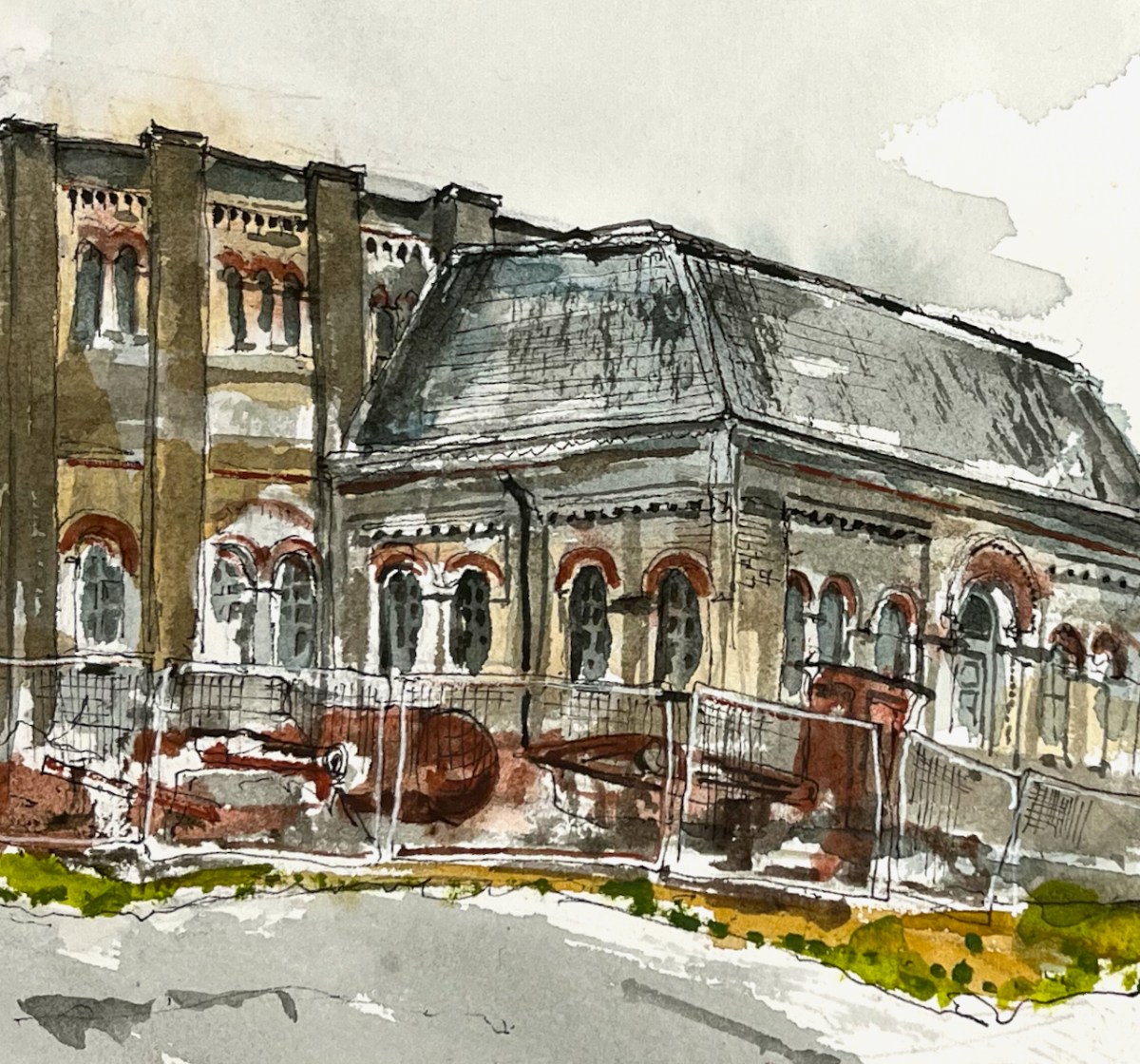
Abbey Mills Pumping Station, London E15, sketched from The Greenway, January 2025 in Sketchbook 15
Abbey Mills is a sewage pumping station1. It lifts the sewage from lower level sewers, and pumps it 40 feet uphill to the Northern Outfall Sewer. The Greenway path is on top of the Northern Outfall Sewer.
This system was created by the visionary Victorian engineer Joseph Bazalgette (1819 – 1891). The pumping stations and the Northern Outfall Sewer are part of a grand construction of sewers and water management works instigated in the 1860s after the “Great Stink” of 1858. The problem of untreated sewerage being discharged into the Thames had been causing disease and bad smells for some time. When the smell and fear of disease affected Parliament, which is located next to the Thames, the government of the day took action.
“On 15 June Disraeli tabled the Metropolis Local Management Amendment Bill, a proposed amendment to the 1855 Act; in the opening debate he called the Thames “a Stygian pool, reeking with ineffable and intolerable horrors”. The Bill put the responsibility to clear up the Thames on the MBW [Metropolitan Board of Works], and stated that “as far as may be possible” the sewerage outlets should not be within the boundaries of London; it also allowed the Board to borrow £3 million, which was to be repaid from a three-penny levy on all London households for the next forty years.”
So this loan, and the 3d levy on Londoners was used in 1865 to construct the pumping stations and a new sewerage system.
The Victorian sewers are still in use, and are now gradually being upgraded by Thames Water.2 According to the video on their site, the Northern Outfall Sewer constructed by Bazalgette’s team is being left in place. Thames Water are pushing a lining into it, made of 21st century materials. They reckon this will last another 100 years. 3
I sketched Abbey Mills Pumping Station while exploring the Greenway from Hackney Wick to Becton.
“Thank you Sadiq”
The Greenway is a well-used pathway and running route. While I was sketching, a wiry grey-haired runner stopped to chat. He was a cheerful person, sharing my enthusiasm for the transformation of Hackney Wick. He had much praise for the improvements in London, specifically on air quality. Air quality is much better, he said. “I no longer get asthma,” he told me, “even though I still run!” He surveyed the clean path and the view, ” Thank you Sadiq!” he exclaimed. Sadiq Khan is the Mayor of London, and has introduced and supported air quality improvement measures such as the congestion charge and the Ultra-Low Emission Zone (ULEZ).
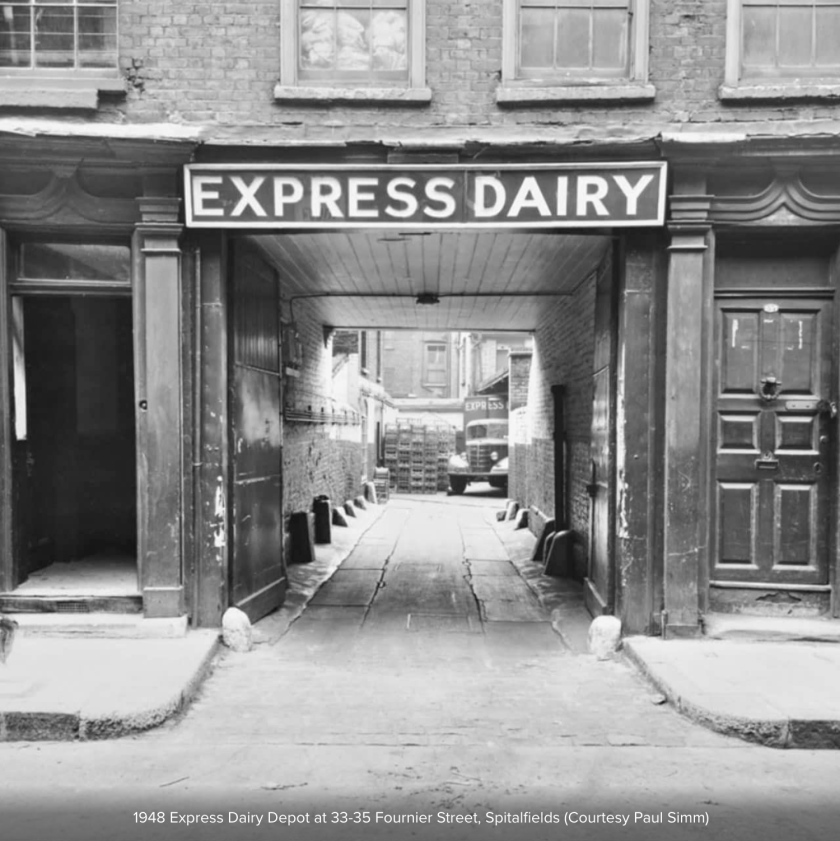
My new friend had been a skip-truck driver. He’d worked everywhere, he told me. Constructing the Olympic Park had been a big job. Examining my sketchbook, he saw the sketch of Fournier Street. “I recognise that!” he said. And then, looking closer, “There’s an Express Dairy depot just up the street.”
If you know Fournier Street, you will know that this seems extremely unlikely. Fournier Street is in a residential area, somewhat densely packed, and apparently not a place for a goods yard of any type. However he seemed sure, and I didn’t contradict him. I thought he might have mistaken the location: there are a lot of Georgian terraces in London.
35 Fournier St (1948)
When I was back at my desk I did a search4. Sure enough, just a few houses along from my sketch, there had been an Express Dairy Depot, just as he said. It’s shown in the “history” section of the Express Dairy site. The London Picture Archive shows it. I should not have doubted him. The wide entrance is still there.
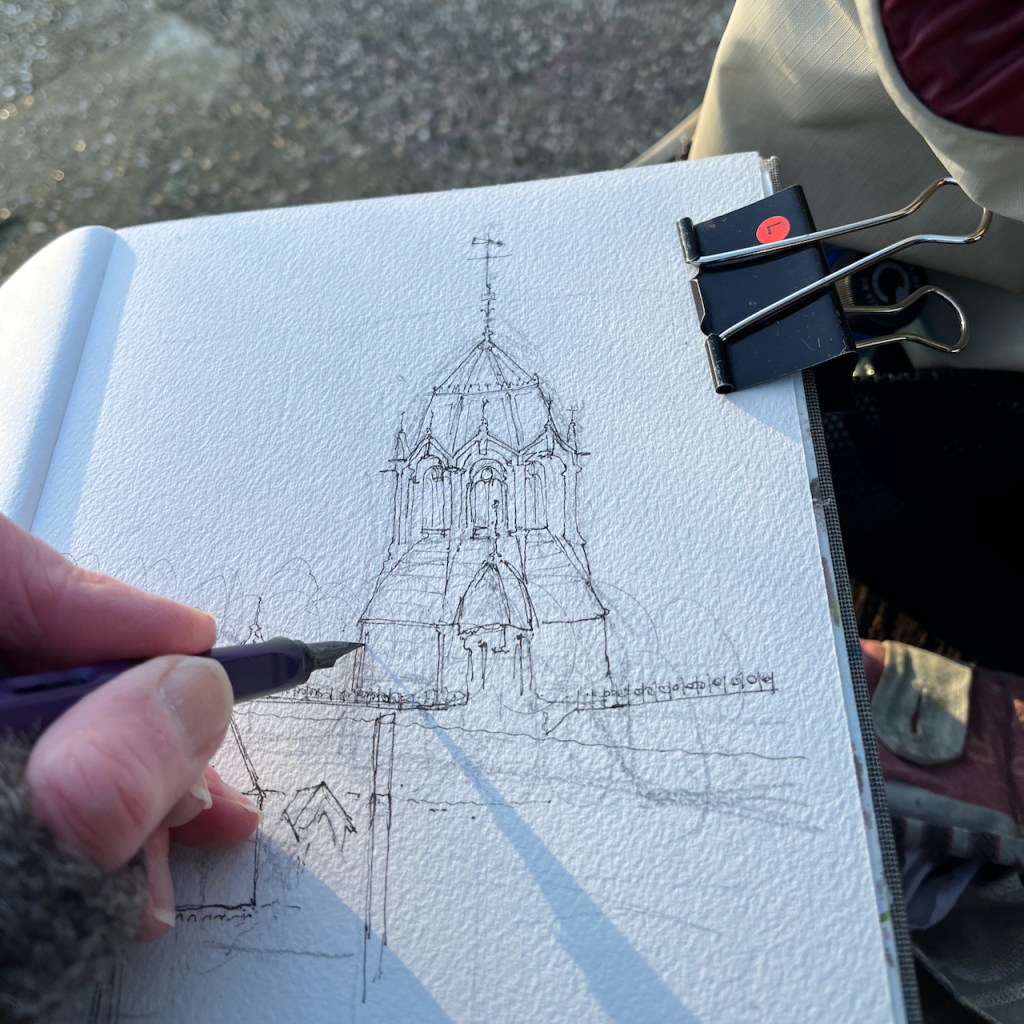
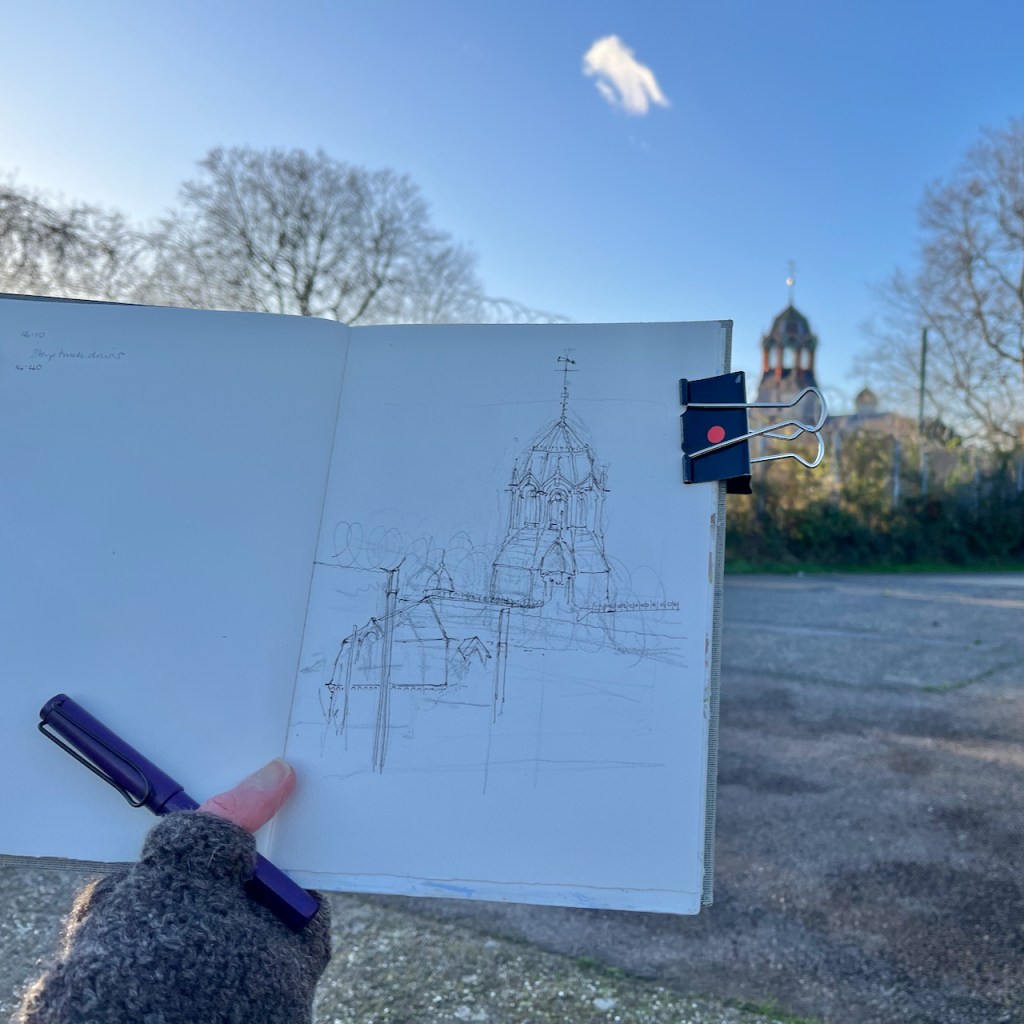
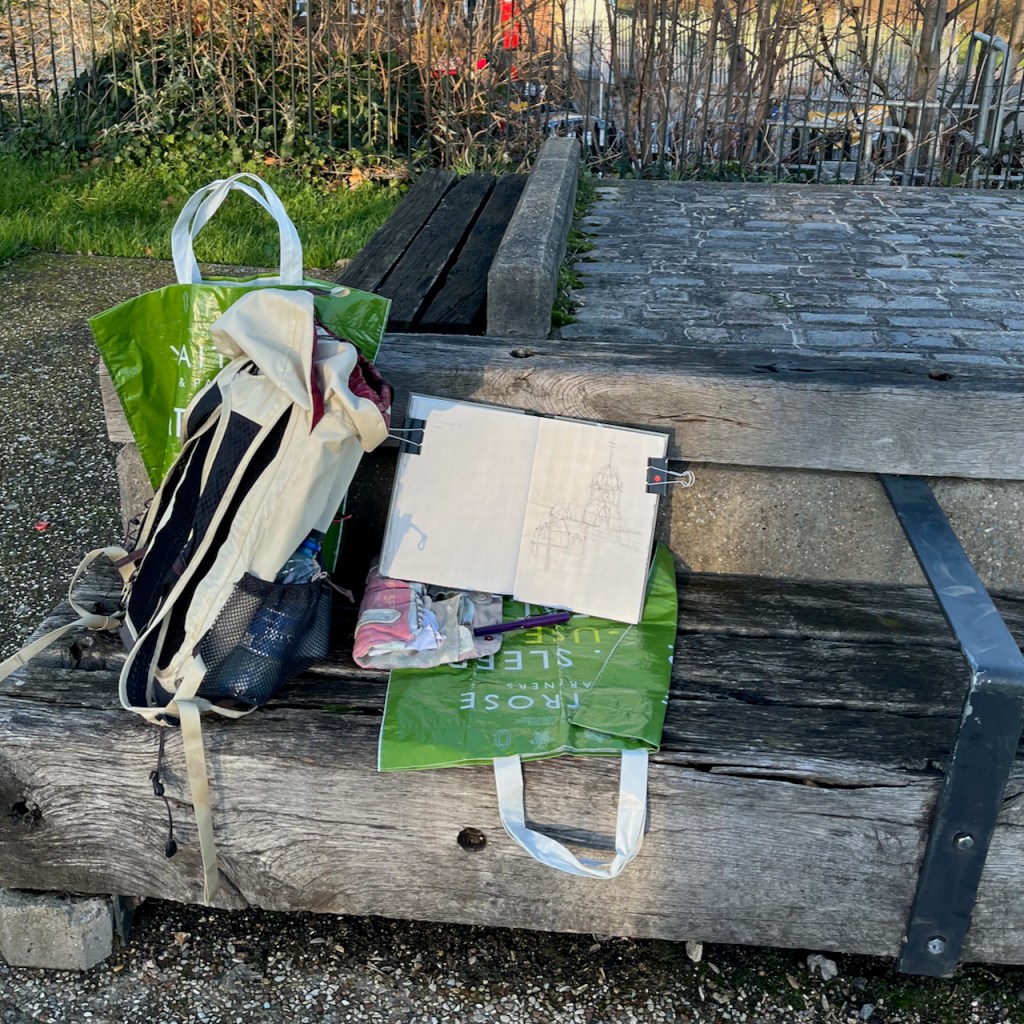
I completed the ink sketch on location and then packed up to continue my walk. I still had a good 3 miles to go and it was getting dark, and cold.
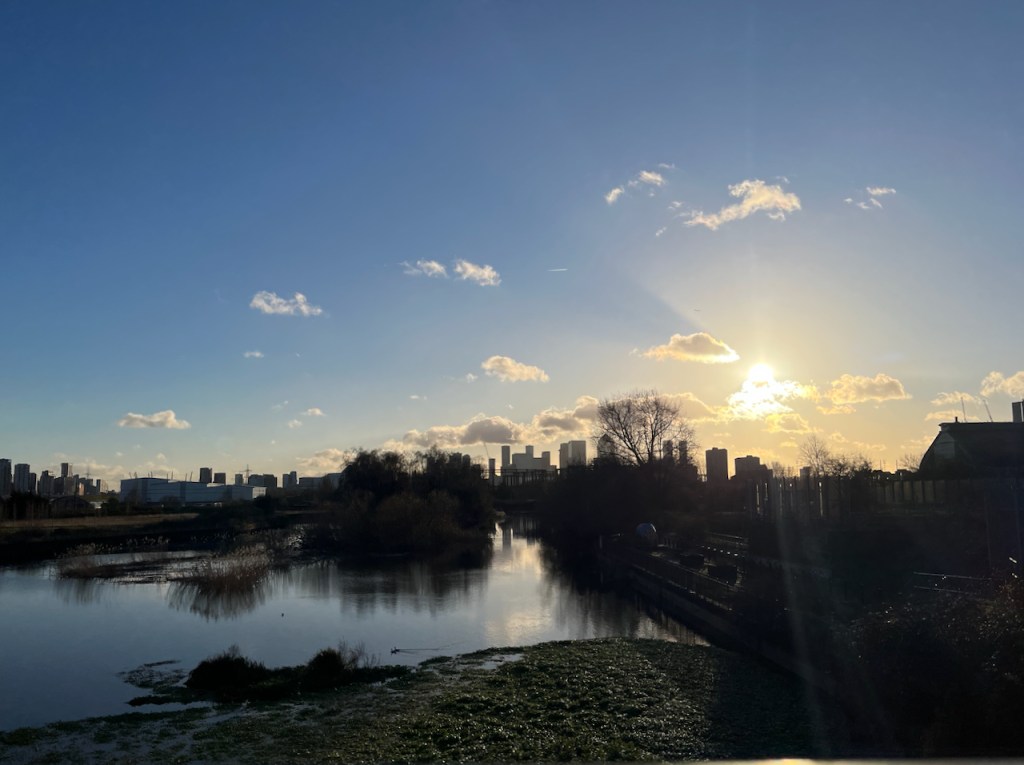
View from The Greenway: Channelsea
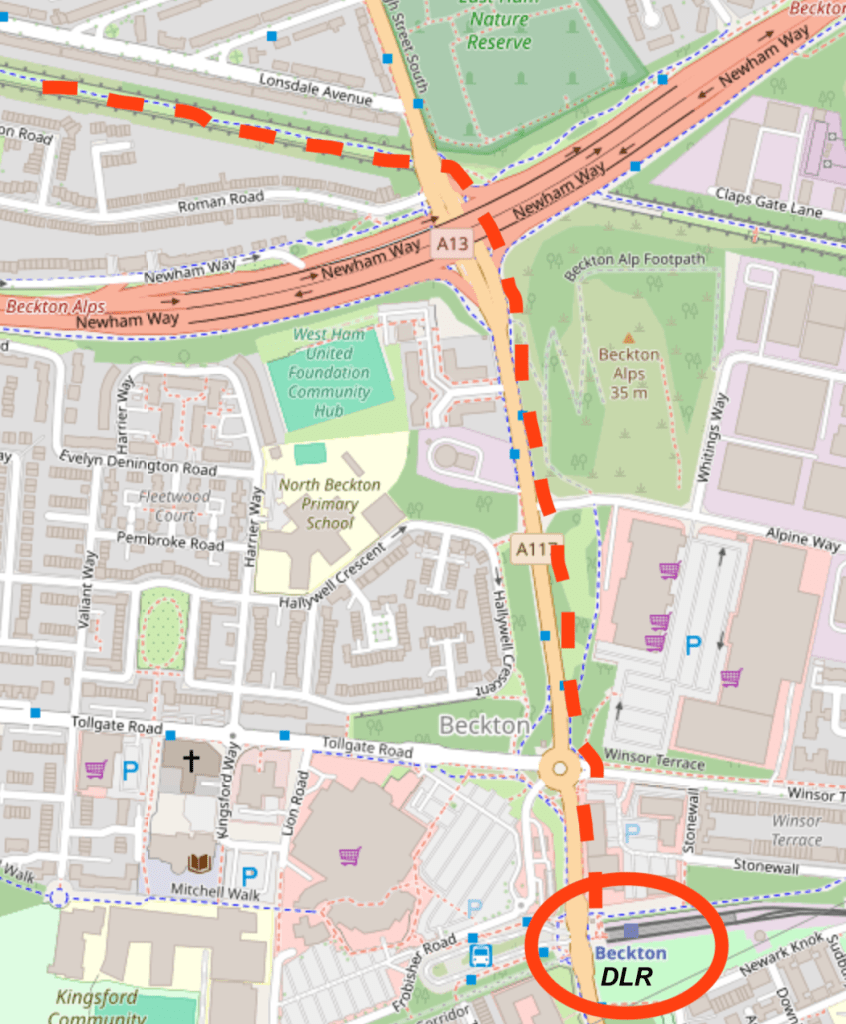
It was dark when I reached Beckton. I left the Greenway as it crossed the A13.
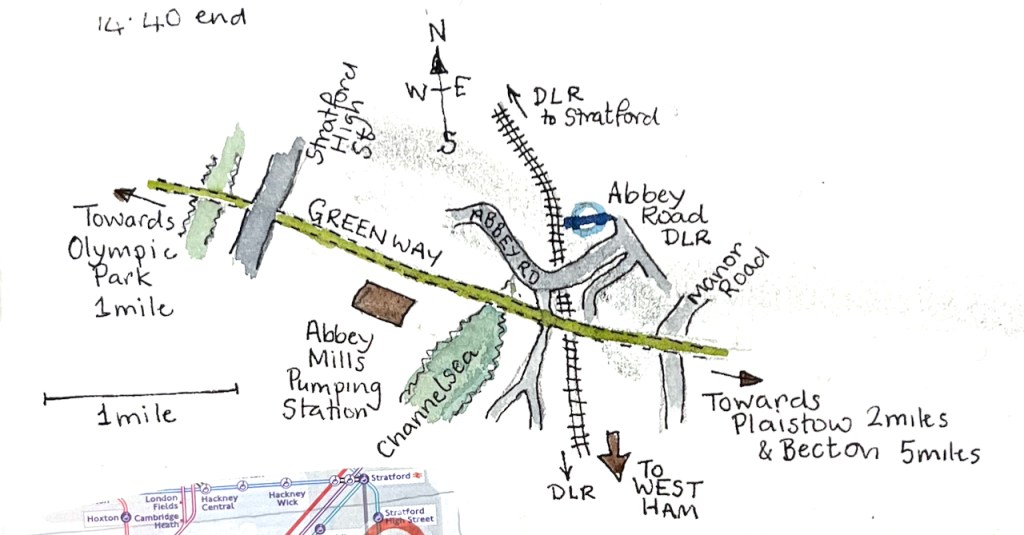
Greenway to Beckton DLR. Map (c) OpenStreetMap contributors.
If you’d like to follow my route along the Greenway, in the file below is my idiosyncratic description of the route and my walk. The below file is 6 pages printable pdf. The Greenway is part of the Capital Ring, a long-distance walking route.
Abbey Mills is a working Pumping station and not open to individual visitors. It is open to groups from time to time. The organisation “Subterranea Britannica” was invited for such a visit in 2012, which they wrote up in their journal Subterranea, Issue 30. The article describing their visit is by Martin Williams and Alex Lomas. See this link: https://www.subbrit.org.uk/sites/abbey-mills-pumping-station/ ↩︎
Major £70million upgrade to Stratford’s Victorian sewer system Press release from Thames Water: Tuesday 17 January 2023 13:09. https://www.thameswater.co.uk/news/70million-stratford-sewer-upgrade “A giant Victorian sewer in East London is being upgraded as Thames Water continues its investment in infrastructure across the capital. The UK’s largest water and wastewater company is investing £70million over the next three years to upgrade the Northern Outfall Sewer and ensure its pipes are resilient for future generations. The sewer, which serves over 4 million people, runs from Wick Lane to Beckton Sewage treatment works, the largest in Europe. ….” ↩︎
YouTube video “on Tap” from Thames Water, describes the work being done in 2023 to upgrade the Northern Outfall Sewer. It also contains great photos of the inside of Abbey Mills Pumping Station, and amazing aerial views of the Greenway. https://youtu.be/d628Y0dh2sA↩︎











 Jane Sketching