Royal Festival Hall and the London Eye

I went up to the marvellous roof garden, on top of the Queen Elizabeth Hall on the South Bank.

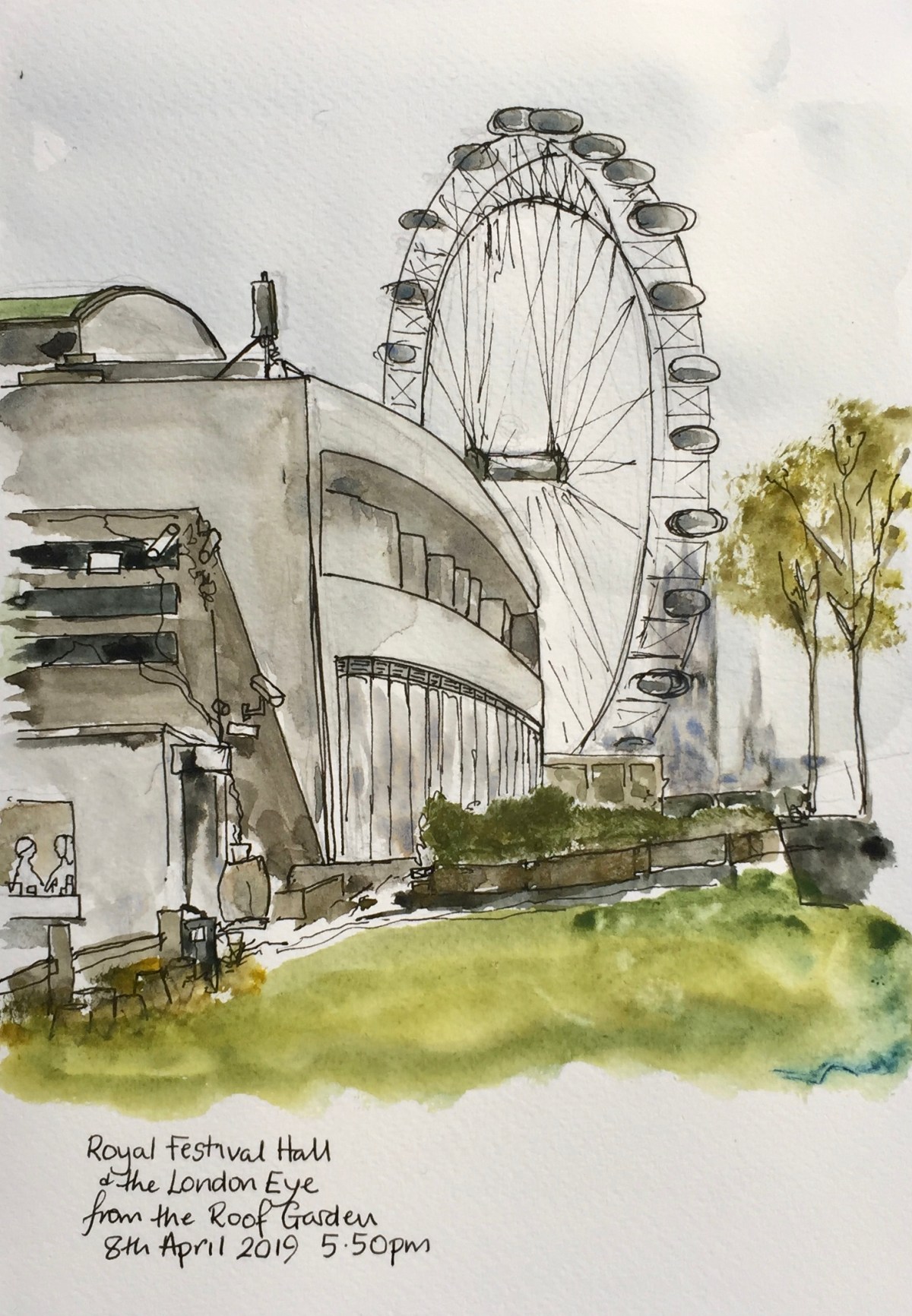
Here is a picture of the Royal Festival Hall, with the London Eye behind it. The tower of Westminster looms behind the wheel.

fullsizeoutput_337a

This roof garden seems to be a place for serious discussions. Some people at the next bench were discussing whether to stay employed or not. One of the options was to “go travelling”. Another, as far as I could work out, was to “get married”. It was hard to keep track of their wide ranging conversation, because I had to concentrate on the beautiful curve on the front of the Royal Festival Hall. It was a luxury to be there, and to appreciate the lines of the architecture. The lines were somewhat compromised at this roof level by the many creeping plants, floodlights, and surveillance cameras which you see encrusting the ventilation shaft in the foreground. Also note the prominent mobile phone mast on top of the Royal Festival Hall. I would not have granted planning permission for that.

The roof garden is a wonderful invention, and well done. By the time I’d finished the drawing, many people had made their way up, and were discussing work, and relationships, all very earnest. I discovered that I was sitting in the smoking area, which is adjacent to the vaping area. Marijuana smells wafted up from somewhere, perhaps from the skateboarding area in the Undercroft below. I could hear the crashes and the calls. But there was also a smell of grass, actual green grass, as in the picture.

Here is work in progress and a photo of my sketchbook on the concrete:

The drawing took 1hr30mins.
Screen Shot 2019-04-10 at 12.09.00.png
The London County Council (LCC), as it then was, initiated the building of the Royal Festival Hall as their contribution to the Festival of Britain. The foundation stone was laid by the Prime Minister Clement Atlee in 1949 and a mere 18 months later, in 1951, the concert hall opened with a gala concert, which shows what can be done if you are determined and have a deadline.

The project was initially led by the LCC chief architect Robert Matthew, then later by Leslie Martin, with Edwin Williams and Peter Moro. It was built on the site of the Lion Brewery, which was built in 1837.

[this information from the Royal Festival Hall website, and the Twentieth Century Society]

Barbican Towers in winter

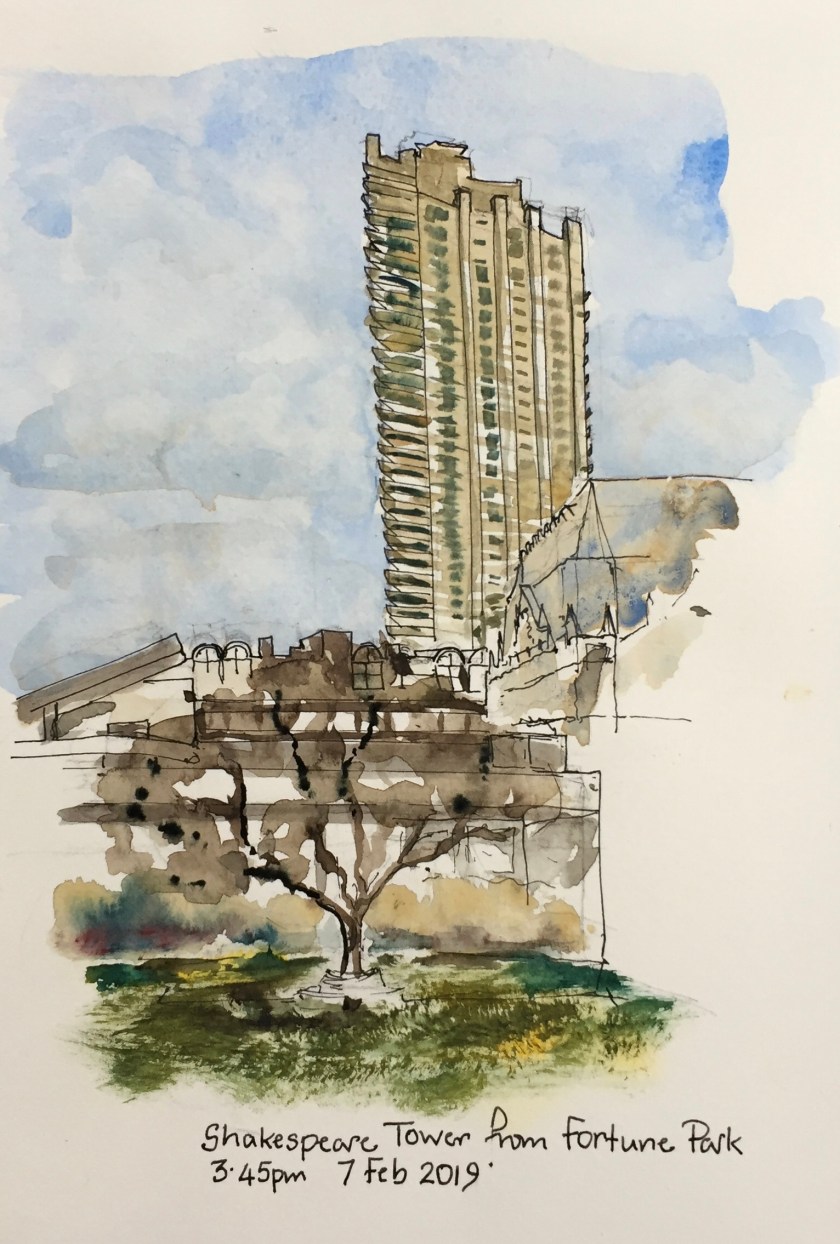
Here is a sketch I made yesterday showing Shakespeare Tower, the middle one of the Barbican Towers.

fullsizeoutput_329d

I drew it sitting on a bench in Fortune Park.

fullsizeoutput_329aWhen I sat down, there was an agitated rustle under the bench, and a blackbird emerged onto the grass, looking rumpled. Another squawked among the leaves. I had the distinct impression that I had disturbed the creation of the next generation of blackbird. He, on the grass, squawked his annoyance at me.

I offered crumbs from the rock cake which I had bought from Big John on Whitecross Street market. The blackbird accepted the crumbs, fluttered a little way away to enjoy them, but was not appeased. His mate, having adjusted her make-up, hopped out, and asked for some rock cake too.

This picture took 1hr 15, drawn and coloured on location.


Here is a picture I’d done 2 days before, from an extremely cold and windy position on Chiswell Street. From left to right, Cromwell, Shakespeare, Lauderdale.

fullsizeoutput_329c

You see the infamous “Beech Street Tunnel”. This is an area of illegally high pollution levels, as the street is usually full of vehicles, and is covered. I haven’t shown the vehicles. Or the numerous pedestrians.

The odd circular tower type thing on the left of the tunnel is the vent to the car parks below. It is an architectural feature.

This was a much quicker picture as I was very cold and the location was busy and difficult to work in. 15 min on location and 15 min to do the colour at my desk.

fullsizeoutput_329b

Britannic House and Angel Court

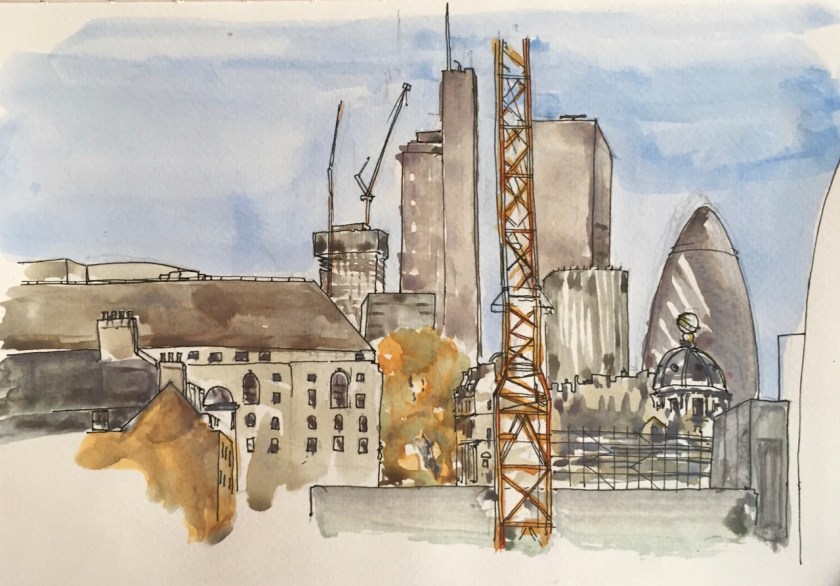
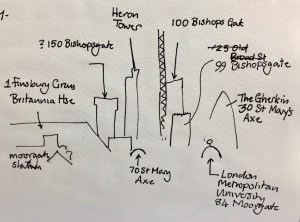
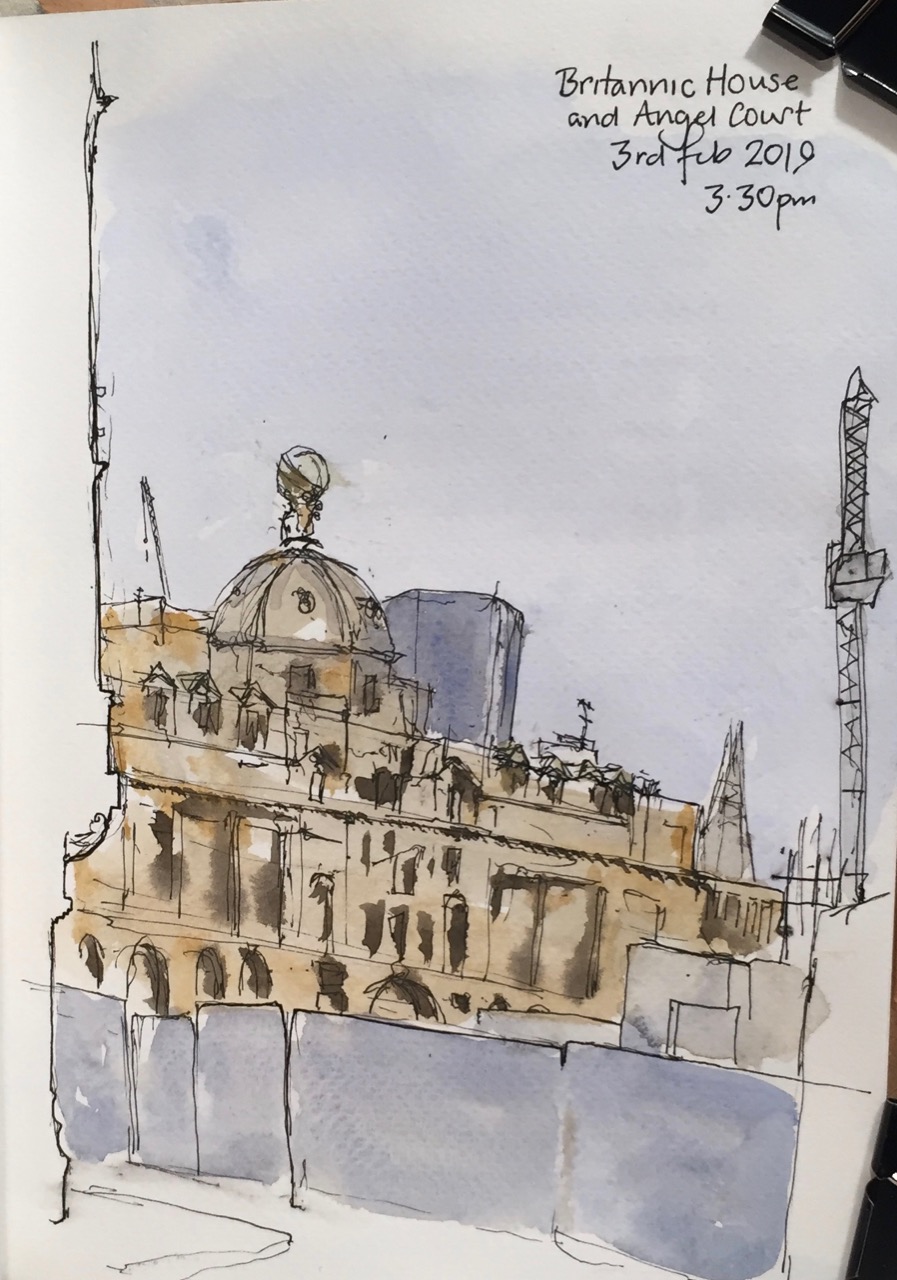
Here is a view of Britannic House, 1 Finsbury Circus, from the back entrance of Moorgate Station.
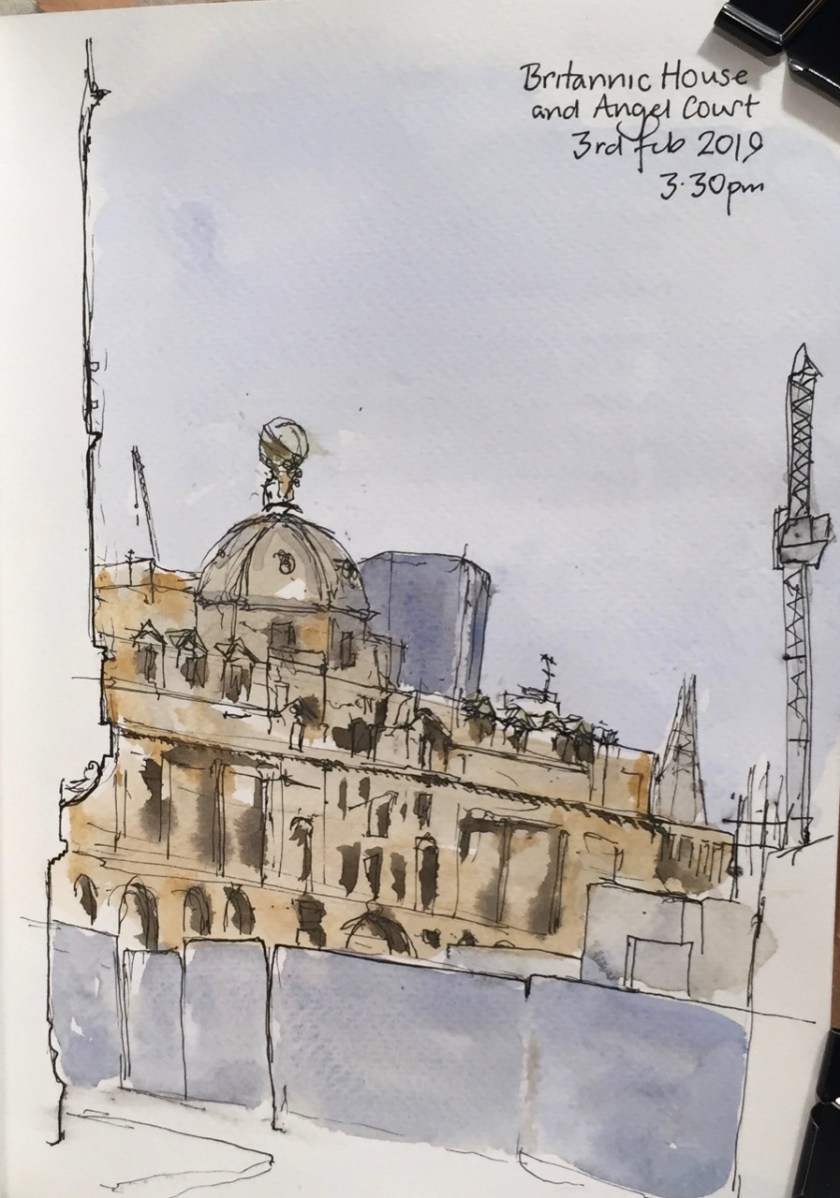
IMG_1238

It was 5 degrees C. I was standing outside 45 Moorfields, at the junction with New Union Street.

Behind the blue hoardings is the Crossrail site. When the buildings above Crossrail are finished, this view will have gone.

As I was drawing, young people emerged at intervals from Moorgate Station, pointing their mobile phones like laser guns. They glanced up from the screen, and chose New Union Street. This is a poor choice. New Union Street doesn’t go anywhere you want to go. It joins Moor Lane about half way along Willoughby House in the Barbican. Then you have to turn either left or right. Either way is a long draughty walk.

Nobody asks for directions these days. Eventually a young woman hesitated. My curiosity overcame me. I asked if she needed directions. “No”, she said, “I’m just going to “Bad Egg”. It’s that way, isn’t it?” She pointed down New Union Street, no doubt following the advice of her phone. “Well, no,” I said, “You’re best off going this other way, and across the Piazza”. She looked doubtful, and glanced again at her phone as if asking it for permission. But she followed my instructions. She will get there ahead of the people in front who are walking three sides of a square. The phone doesn’t know about the Piazza in front of City Point, which is where “Bad Egg” is located. “Bad Egg” is a very noisy restaurant. I walk past it on the way to Moorgate.

I carried on drawing. More young people emerged and set off down New Union Street. I let them go. Then a woman emerged and walked in the other direction, pointing her phone at the Moorgate Crossrail site. She kept walking until she was right close to the hoardings, and then stopped. She looked accusingly at the hoardings. They should not be there. She should be able to walk south unimpeded. But there is a huge Crossrail site in the way. Evidently this feature was not apparent on the online map. She rotated gently, but still the reality on her phone refused to match the reality on the ground. She made an impatient gesture and walked out of sight, towards Moorgate.

After I finished the drawing I wondered what the tower was that is behind Britannic House. So I walked in that direction, and found it is “Angel Court Bank”, a multi-use office space.

It soars up, planted in a very ancient part of the city, near the Bank of England. Angel Court itself is an alley way which joins Copthall Avenue with Lothbury.

I liked the disjunction between the smooth modern architecture and the decorated banking halls on the other side of the alley. The black thing on the pavement is a hunk of black granite intended as a bench. It has slots cut in the side to stop skateboarders using it as a jump.
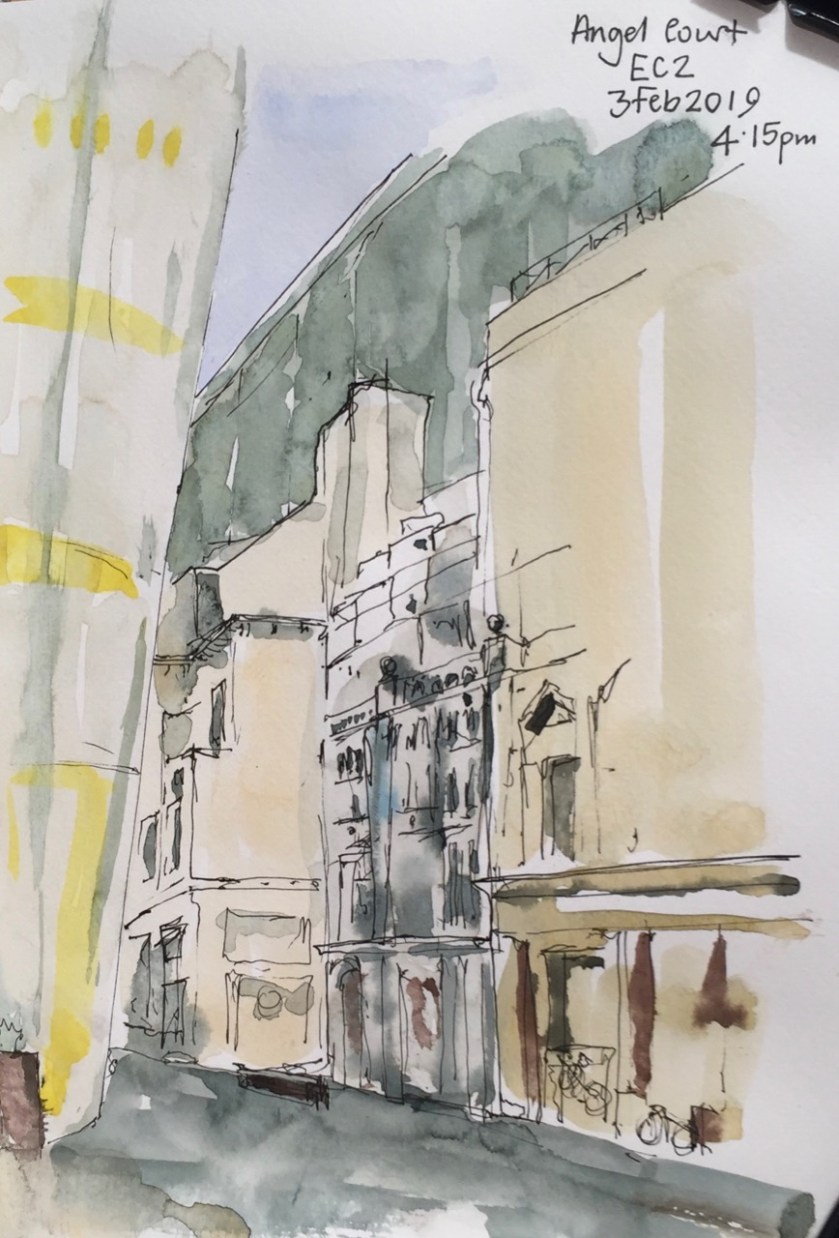
IMG_1236

In this picture you see the modern tower “angel court bank” on the left. It is also called “One Angel Court”. It slopes outwards, as you see, and is totally smooth, made of curved glass, which must have been really hard to assemble. On the other side of the street are old banking halls, once grand. Number 11 is the one which is ornate, in the centre of the picture. It is dilapidated, apparently empty. Its pillars really are green and white marble, albeit that one of them is held together with a rusty iron band. On the right of the picture is Numbers 9-10. I was surprised to see the bikes locked to its iron railings, as this practice is generally frowned on, and bikes are cut down. This building also looks empty, but a notice in the window declared that it was inhabited by “live-in guardians”. A note on the letter box instructed the Royal Mail where to put the post for residents. The bikes, evidently, belonged to the live-in guardians. They have great place to live, for the time being.

I was really cold by this time and my eyes were streaming. So I came home.

I have down Britannic House before:

1 Finsbury Circus, across the Crossrail site


Here’s a bit, from the “Open House” site, on Angel Court:

Original design
Fletcher Priest Architects, 2017
Refurbishment
Fletcher Priest Architects, 2017
Type
Restaurant/bar, Offices
Period
Contemporary
  • Overview

    Fletcher Priest has completed Angel Court for Mitsui Fudosan UK and development partner Stanhope. The last tower of the ‘first generation’ of tall buildings in the Bank of England Conservation Area, Angel Court is located at heart of the City’s financial district.

  • Refurbished

    Extensive studies were initially carried out to examine new-build, re-build and refurbishment options for the 1970s structure before it was decided to replace all but the core and foundations of this 25-storey building, increasing the net area by 60%. The new tower hovers above pedestrianised Angel Court, formerly a cut-through from Lothbury to Copthall Avenue, now improved to create 40% more public realm.

  • The Translucent Building

    The most noticeable aspect of the tower is its skin, which flows as a softly curved homogenous surface around the walls and roof of the original octagonal form. During the day, glimpsed through the close-knit grain of the City’s streets, its translucency gives it a distinctive, light presence. These effects come from a double frit, a ceramic dot baked onto the glass surface, which allows views from inside to out and offsets solar gain. The sculpted lower garden floor buildings with deep-set windows faced in rough-hewn Carlow Blue limestone sit comfortably in their context and contrast with the softly curved tower. At night, the tower transforms to reveal a simple square grid to match the lower buildings, unifying the whole composition.


St Giles and Bastion House

Today Urban Sketchers London held a “sketch crawl” in the Barbican. So I joined them. An astonishing number and diversity of people assembled inside the entrance of the Barbican Centre at the appointed time of 11am. I counted about 35 and then another dozen or so joined. All shapes and sizes of people, tall, short, studious-looking or flamboyant, quiet or talkative, smart or windblown, old or young, all were there. I knew I was at the right place because everyone had a very obvious “drawing bag” or rucksack, and some were sporting a neat red Urban Sketch London badge.

img_1150

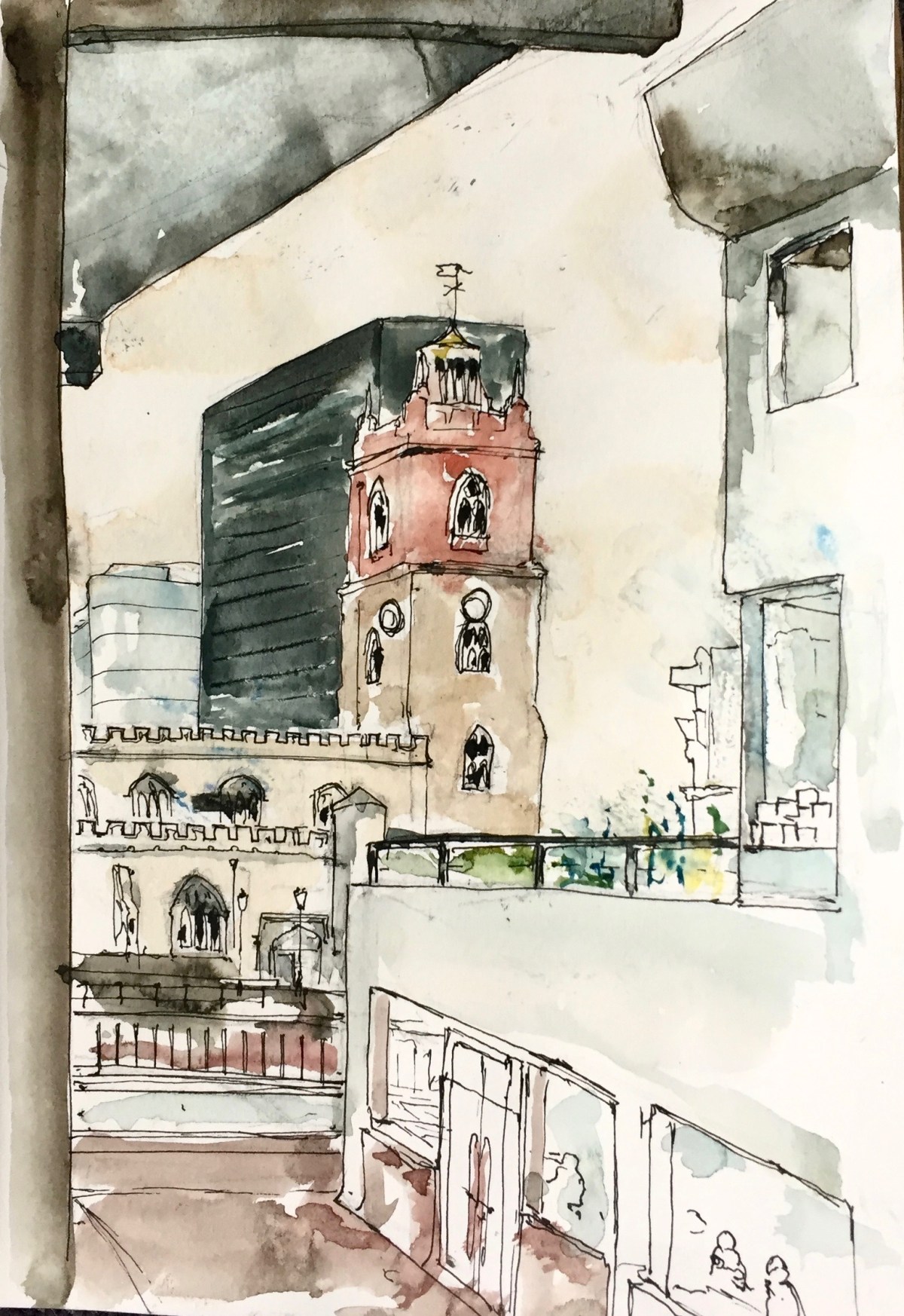
A few words and then off we all dispersed. To my surprise I found a good place very quickly. A wall, at ground level, looking over the Lakeside Terrace and St Giles. I liked the way St Giles was surrounded by Bastion House, and framed by the massive concrete of Gilbert Bridge. I also thought I would be sheltered from the wind. I was wrong about that. In fact, the location seemed to be at the bottleneck of a wind-funnel, and at times the wind was painful, as well as being very inconvenient for my drawing materials, which shifted about and jumped down off the wall.

img_1149

Another Urban Sketcher came up and elected to draw the same view. She had an interesting concertina type sketch book, which she said was her “collage sketchbook”. The wind very soon got under that and unravelled the concertina right across the walkway. She got it under control though, and finished her sketch. She was doing a number of sketches in different locations. I did just the one.

I finished it at 12:50. By that time I was thoroughly cold, and glad to go back inside the Barbican Centre. All the levels were by now densely populated with people participating in all sorts of events. The Urban Sketchers, by some alchemy, found each other again and we put up our sketch books for everyone to see.

Everyone’s sketches were of interest. People had done very different things. I suppose that’s obvious, but it was startling how different they were. One person had made very precise and delicate engineering drawings of brackets. Another had a wonderful atmospheric wash of the church. Someone else had done the fountains and their environment, in firm black lines against a shadowy orange background with white water. Others had outline drawings in crayon, or detailed drawings in sepia ink, and someone had done a sketch on their iPad.

One of the organisers made a panoramic film of the drawings so I look forward to seeing them on the Urban Sketch London website.

It was a good experience and I’ll aim to go to another later in the year.

Great Arthur House from the Barbican Podium

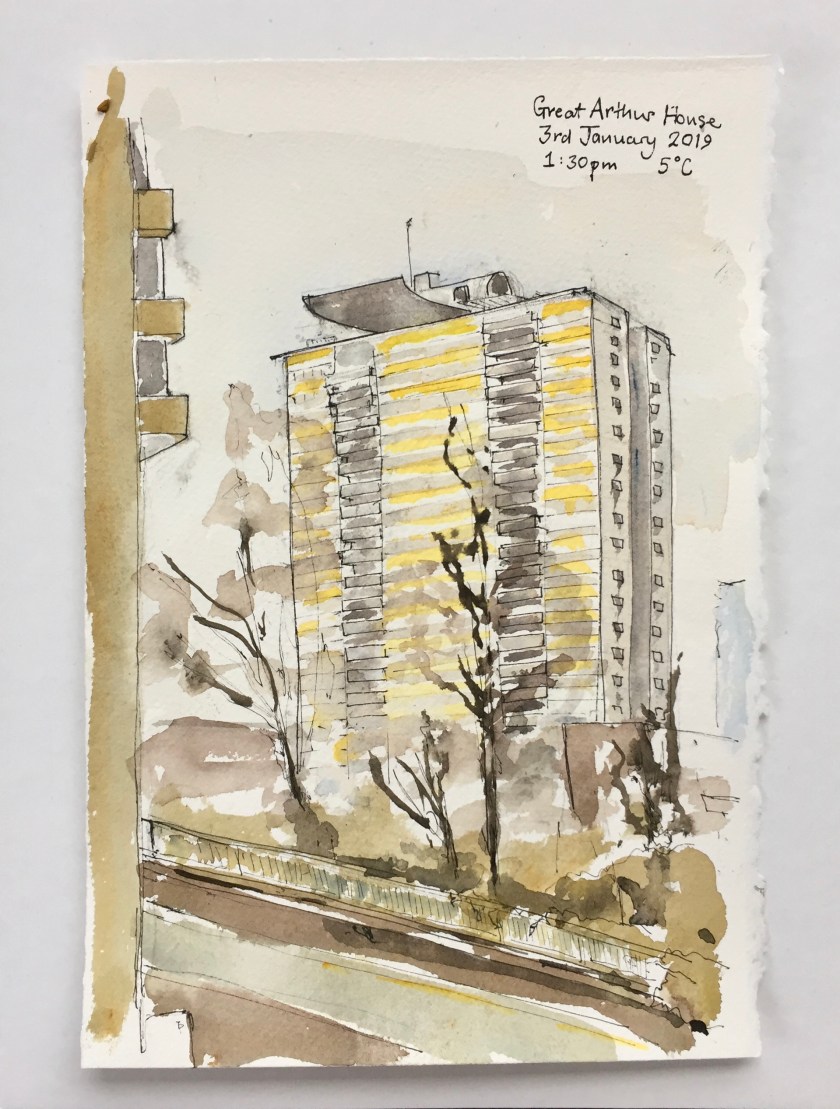
Here is Great Arthur House from the podium ramp near Blake Tower. You can see Blake Tower on the left. At the bottom of the picture is the ramp that goes down into the Car Park at Bunyan Court.

Several stories below me, at ground level, there was an assortment of discarded furniture and paint tins, and a huge skip full of Christmas Trees being collected for recycling.

fullsizeoutput_31dd

It was really cold out there. I saw a black cat sliding in between the debris.

This picture done on Fabriano Artistico loose sheet,  8inches by 10 inches. About an hour, on location.

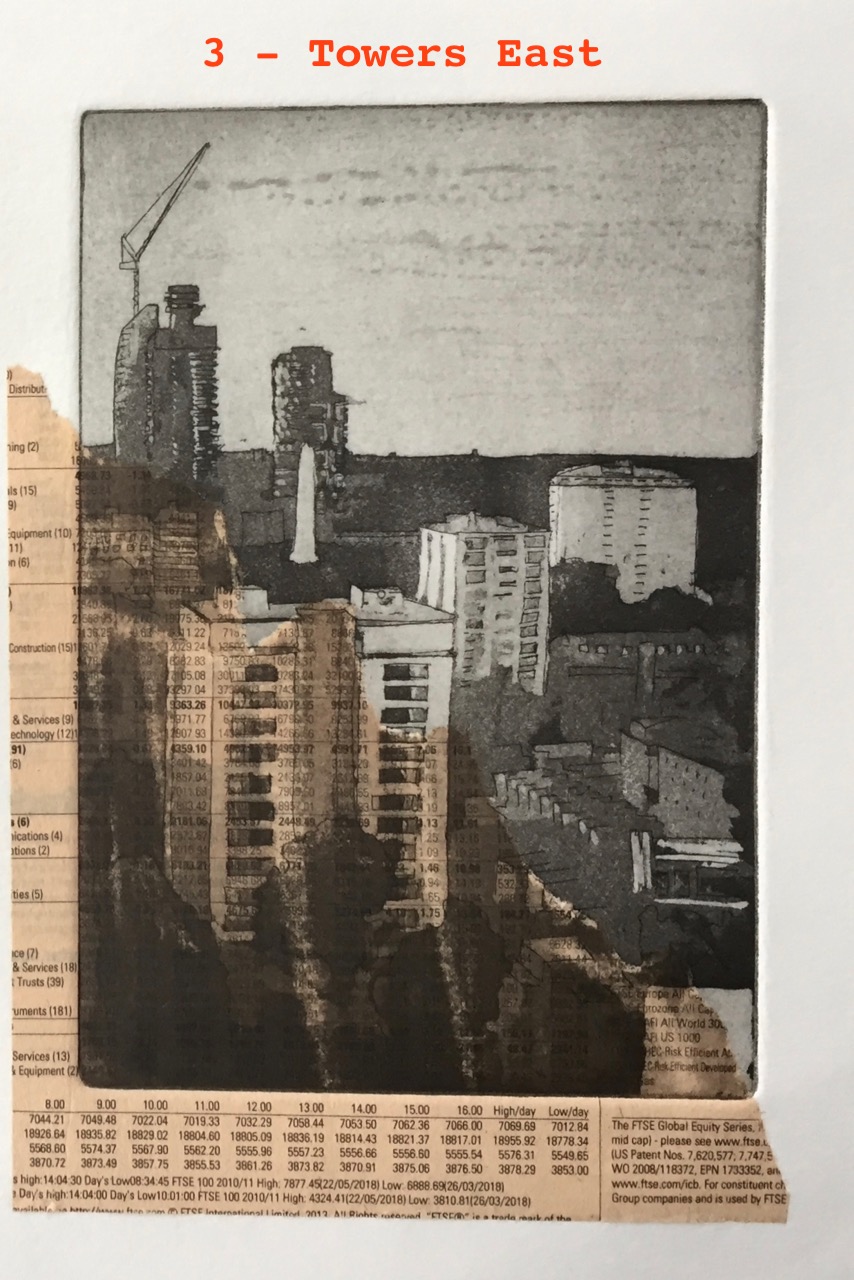
Towers East and Towers West – multiple prints

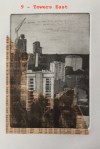
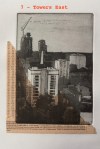
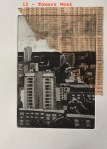
My idea was to produce multiple copies of “Towers East” and “Towers West”. These are aquatint plates I prepared a few months ago.  This post describes the process to produce the plates: Towers East and Towers West

The Towers are St Mary’s Tower and Peabody Tower, just to the North of the Barbican.

I made 14 reasonable prints, and 2 out-takes. I glued the out-takes into my notebook. I make one page per print session, and record what I did, what paper and ink I used, what worked and what didn’t. This is in an attempt to learn and improve my printing technique.

IMG_0656

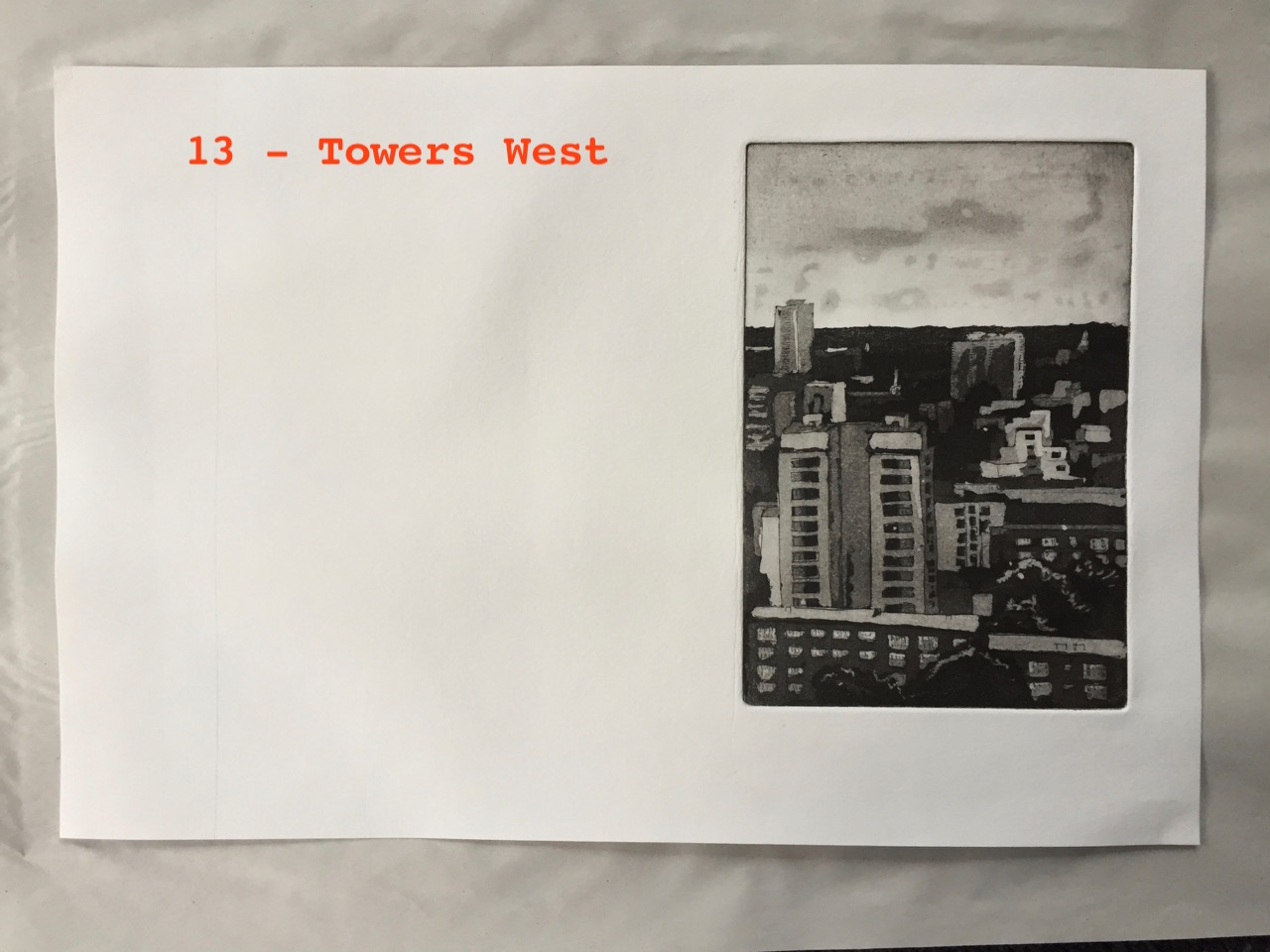
Here are the 14 reasonable prints, numbered 1 to 14. Numbers 1-13 are on card 20cm by 30cm. This card size is intended as a greeting card. When folded it fits neatly into an A5 envelope. Number 14 is on larger paper. All are for sale,  £5 each plus postage. Please contact me by email via the contacts page, or leave a comment on this page. The red writing is on the online image here, not on the print.

Click on an image to enlarge it. It may take a little while to load.

The technique is “chine-collé” which is described here: The chine collé process

Here’s number 13 so you can see the format:

IMG_0642

Here is number 14 on the larger paper:

IMG_0644

These are all part of my “Towers Project” leading to an exhibition in the Barbican Library February 2019.

I work in the print studio at East London Printmakers. Prints are on Fabriano Unica Paper, using Intaglio Printmaker Bone Black ink. They are printed by hand on the Henderson press. Each print takes about half an hour to print.

Galway House

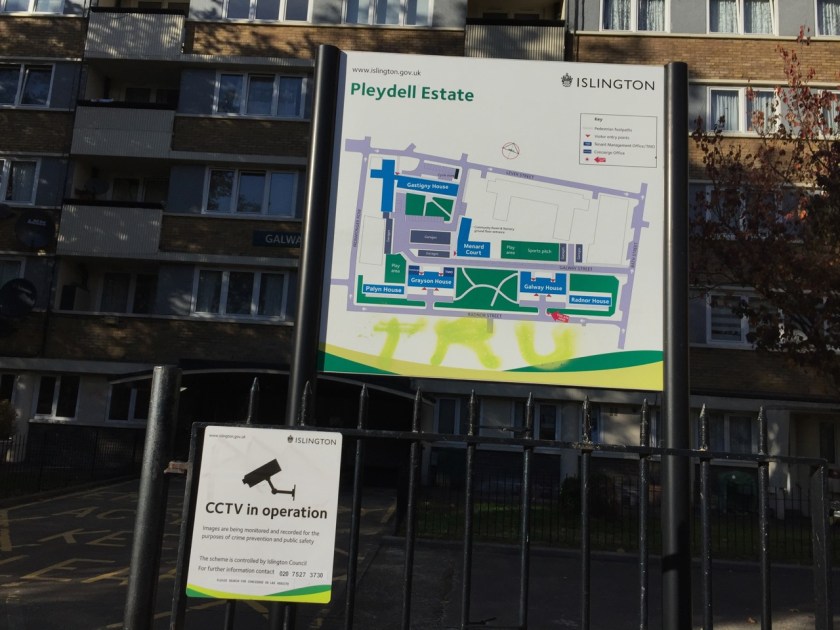
Galway House is one of the two Towers on the Pleydall Estate just North of Old Street. The other tower is Grayson.

IMG_0408

I drew this from behind Grayson House. There was a ferocious cold wind. I seemed to have picked the place where all the winds met. Here are maps showing the direction I was looking.


Version 2

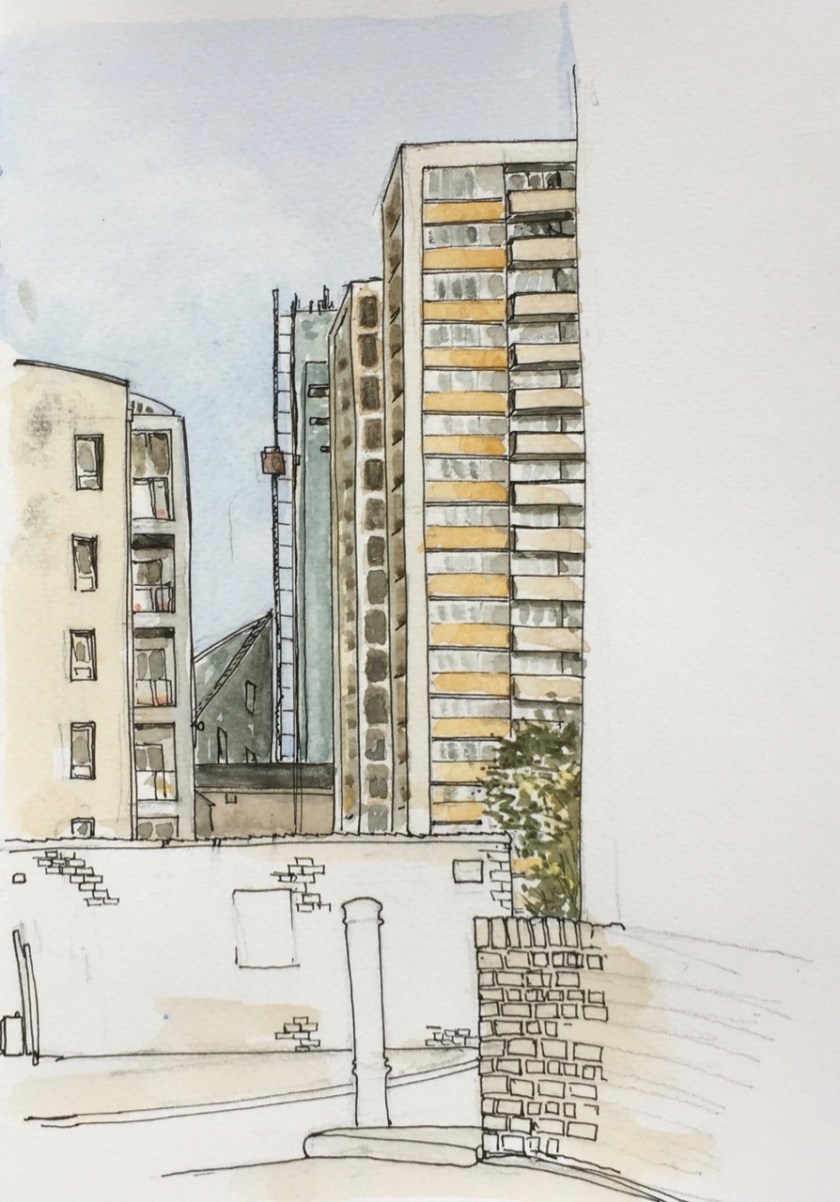
Here are the blocks in the picture. It almost looks as though the Atlas Building continues the march of these majestic 1960s blocks. But it doesn’t, not really.

In the drawing you can see the scaffolding on the Atlas Building, and the external lift that was going up and down as I was drawing.

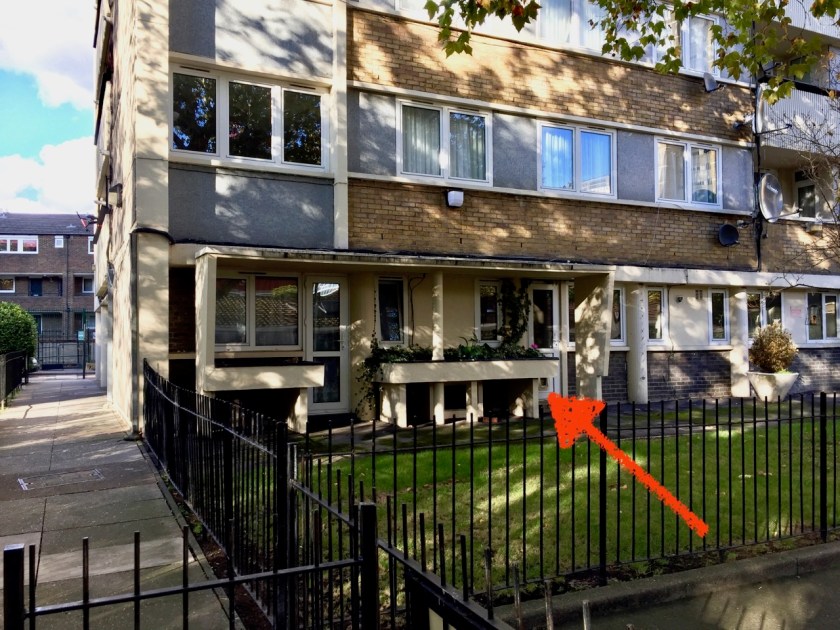
I was interested to see that the inhabitants of Galway Tower made use of their flower beds.

IMG_0399
Raised flower beds in Galway House, South side.

I’ve seen the same arrangement of raised flower beds next to the flats in Rahere House, where the beds were more exposed, and not used.

This whole area underwent huge changes in the twentieth century, although the street layout is unchanged.

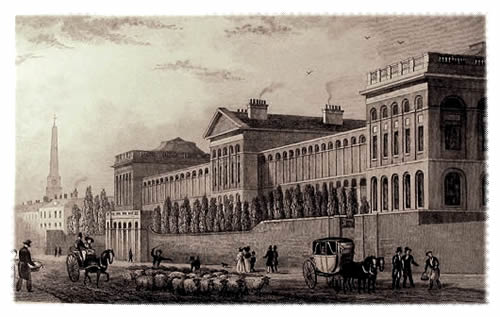
From 1751, on Old Street, there was a huge hospital for the mentally ill: St Luke’s Hospital for Lunatics.

St_Lukes_Hospital_for_Lunatics,_London.jpg
St Luke’s Hospital for Lunatics on Old Street. The obelisk in St Luke’s Gardens is in the background. Image credit: Wikipedia

This hospital was closed in 1916 and the residents moved out. The building was acquired by the Bank of England and used for printing bank notes.

CTsnwiBXAAA0b_S
Bank of England Printing Works on Old Street, 1925, image credit: Bank of England Museum.

Here is the area in 1940: map from http://www.maps-of-london.com, click to enlarge.

Screen Shot 2018-10-27 at 14.36.42
The Pleydell Estate area, Finsbury, in 1940. Picture credit: http://www.maps-of-london.com

You see Galway Street on the crease of the map, in the centre about a quarter of the way down. Below it, to the right is the “Bank Printing Works”.

In 1959 the London County Council sought to purchase the Printing Works site and use it as an annexe to Covent Garden. This was opposed by Michael Cliffe, MP for Finsbury and Shoreditch, on the grounds that it would create unacceptable traffic congestion, especially at the Old Street Roundabout.

Mr Cliffe is quoted in Hansard:

“…London County Council (General Powers) Bill, …. The Council, through the Bill, sought powers to acquire and redevelop St. Luke’s Printing Works as an annexe of Covent Garden Market….. I would ask the Minister what is the point of spending millions of pounds in trying to solve the problem of congestion in Central London if we are to convert the St. Luke’s Printing Works as an annexe to Covent Garden in an area where we know it must inevitably cause the kind of congestion that we are trying to avoid and which we are discussing every day. As the number of vehicles increases, further problems will have to be solved. Surely we do not want to create further difficulties after our experience gained in the past?” [Hansard: HC Deb 17 December 1959 vol 615 cc1738-47]

Mr Cliffe must have prevailed. I feel an affinity with him because earlier this week I drew Michael Cliffe House.

The Printing Works building was demolished in 1963. At around that time Finsbury Council was building council houses, including the 4 tower blocks in the area: Gambier House, Grayson House, Godfrey House and Galway House. So somehow the Council must have acquired the Print Works site. I can’t find the history online so I’m going to visit the London Metropolitan Archives and the Islington Museum.

The Towers also were allocated to different Estates: Galway is in the “St Luke’s Estate” which includes the Printing works Site, Gambier is in the City Road Estate and Grayson and Galway are in the Pleydell Estate.

From “Streets with a story, The book of Islington” (1986) by Eric A Willats FLA I learn that: “Messrs. Emberton, Franck & Tardrew were the architects of Galway House (Pleydell Estate)”.

Screen Shot 2018-10-27 at 15.30.41.png
From a map sent to Mr I Agar in 2010 in response to a Freedom of Information request [FOI 340742.pdf]
IMG_0398
The Pleydell Estate, Galway House in the Background.

Michael Cliffe House

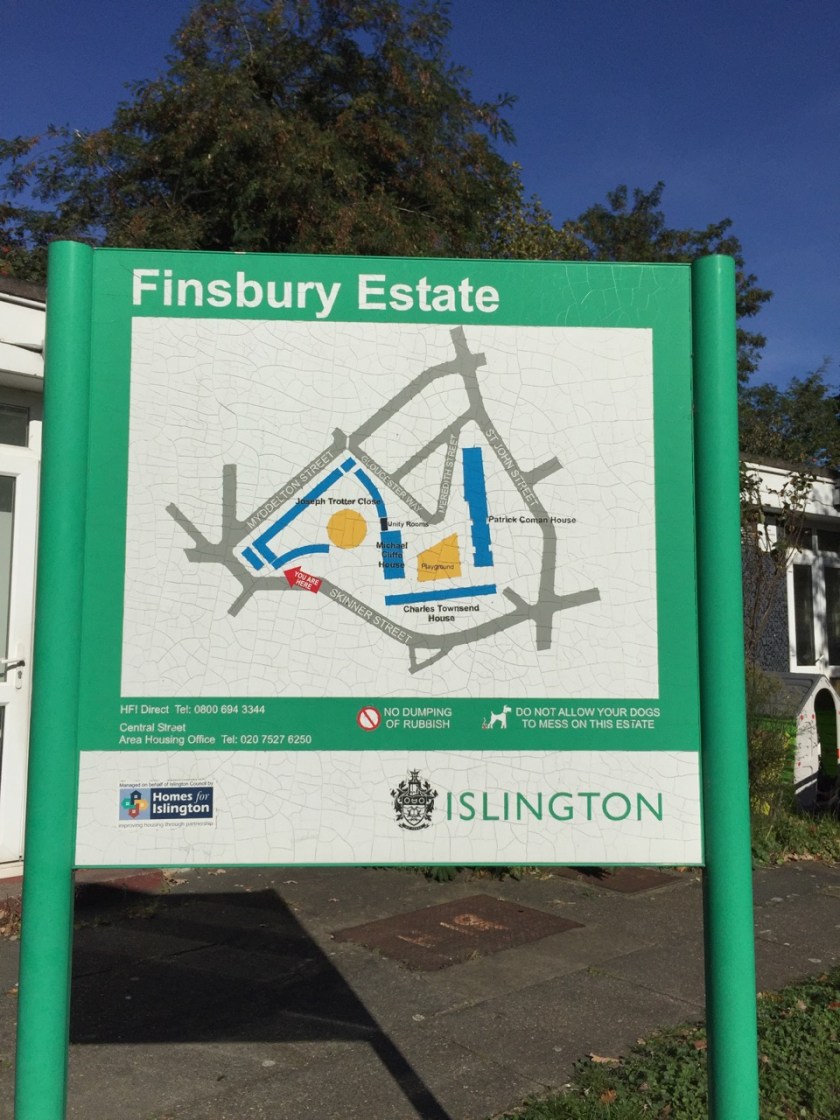
Here is Michael Cliffe House, in the Finsbury Estate, from Tysoe Street.

IMG_0368.jpg
The lower level block in the low centre of the picture is Joseph Trotter Close, also part of the Finsbury Estate.

While I was drawing the picture a man came and told me that he had seen the original architect’s drawing of this low level block. In the architect’s vision it was “sleek and wonderful”. But the man said the reality was very different. The concrete had worn badly and the building had not succeeded, in his opinion.

Earlier a woman came when I was at the pen-and-ink stage. She said that her 11 year old grandson had started painting, which pleased her very much. She bought paints for him. I asked if she painted too. She said no, but she was inspired by her grandson and might now have a go herself. “After all,” she said, ” he just paints anything, and I could do that too!”. I agreed.

IMG_0370.jpg

The drawing took two hours. After I finished I went to have a look at Joseph Trotter Close. I saw a low-level set of bungalows, all very much inhabited, with children’s play things and outdoor chairs on the lawn. It may not be sleek, but it looked as though people enjoyed living there.

The entrance to Michael Cliffe House was cramped and congested, with cars manoeuvring awkwardly and a dark, obscured, entrance. Lovely typeface though.


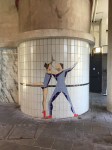
The real surprise was inside the entrance. There, uncelebrated in the underpass, were some amazing mosaics of dancers.


Michael Cliffe (1903-1964) was a Labour councillor for Finsbury, Mayor of Finsbury (1956-7), and an active Labour MP (1958-64).

The Finsbury Estate was built by Finsbury Borough Council in 1965. The architects were Emberton, Franck & Tardrew. Finsbury Borough council was absorbed by Islington.

IMG_0356

Later note (7th Feb 2019): There is detailed information on the Finsbury Estate on “British History online” – try this link, which starts with a history of Spa Green, and goes on to describe the Finsbury Estate.

Welsh Church and Great Arthur House

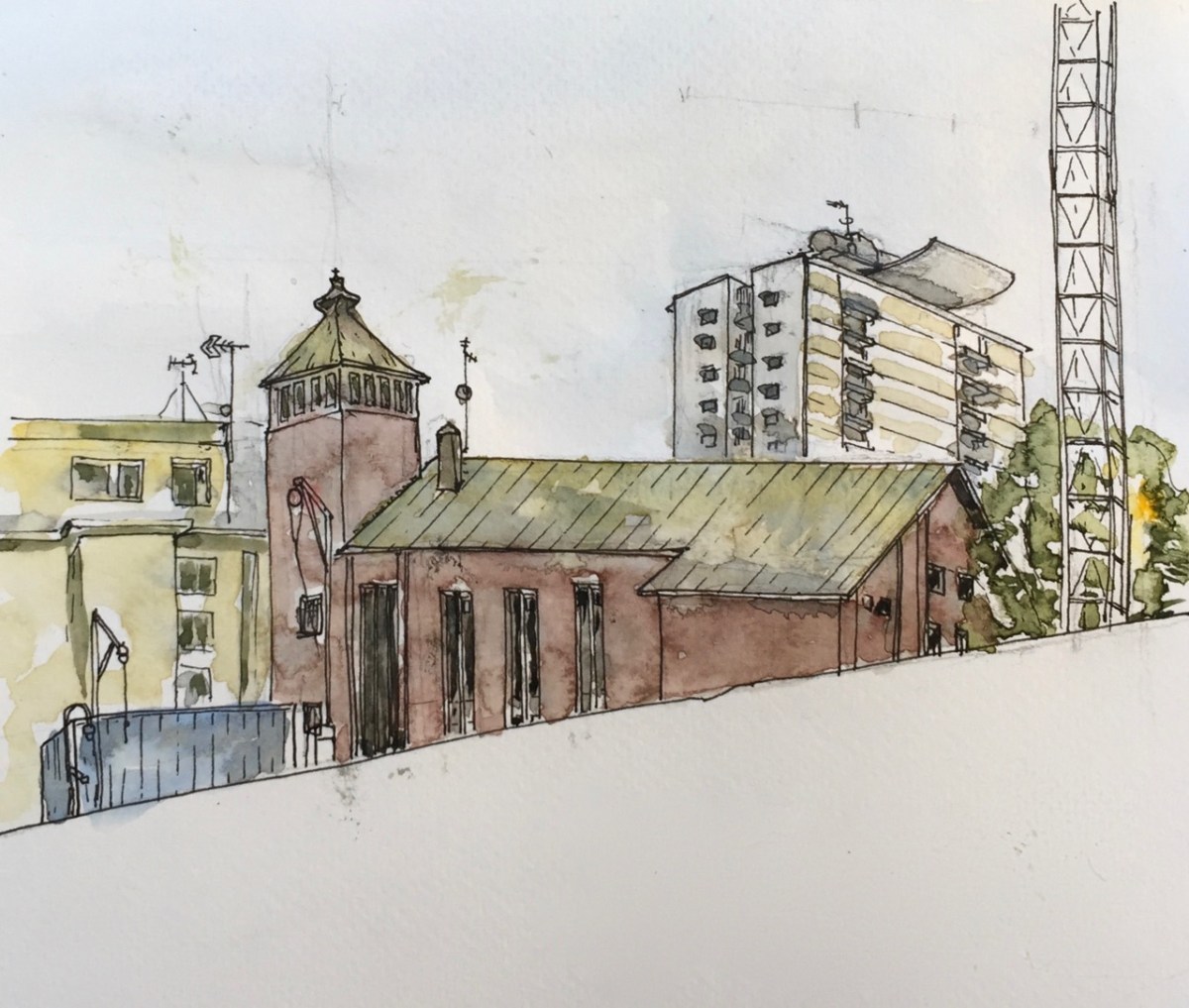
Here is the Welsh Jewin Church seen from Brackley Street.

IMG_5326

This is one of those ephemeral views: a huge new building is about to go up behind the hoarding, and this view will be completely obscured.

The church is Eglwys Jewin, the Welsh Church. I have drawn it before, from Fortune Park. Here’s the link – Eglwys Jewin from Fortune Park

Golden_Lane,_London
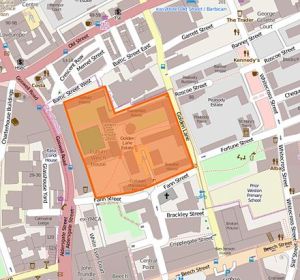
Map showing Golden Lane Estate. credit: Wikipedia.

In the background is Great Arthur House, on the Golden Lane Estate. This estate was designed by Chamberlain Powell and Bon, before they did the Barbican Estate.

As I was drawing, a man came and told me about Great Arthur Tower. It was the tallest residential building at the time of its completion (1957).  At the top is that strange construction which I was told was described by the architects as a “brise de soleil”, a sun shade. Nicholas Pevsner, the architectural writer, was scathing about it, saying that there wasn’t much sun. However, as the man and I agreed, today was very sunny, and the sun shade was needed.

Great Arthur House has recently been refurbished.

“JRA has designed the new curtain walling to replace the original cladding, mirroring the bright yellow panels that have distinguished it since the 1950s. The Grade II listed residential tower had become environmentally inefficient in recent years leading to the residents’ discomfort due to water ingress, heat loss and condensation. Replacement curtain walls for the West and East elevations, double glazed timber balcony doors, external redecorations, localised external concrete repairs, and a cleaning and maintenance system for the new façade are also being provided to help revive the landmark building.” JRA website, 30th Sept 2016

Screen Shot 2018-09-01 at 19.13.00

And then insulation was removed after the Grenfell Tower fire. Here’s a cutting from CityMatters, the local paper:

As I was packing up a woman came and asked, “Can I be curious?” I said she could indeed, and showed her the picture, which she admired. She looked at other pictures in the book, including one of Peabody Tower. “I look at that, from my window”, she said, “I’d love to live there. I see a balcony with flowers….”. I said it was called Peabody Tower, and the other, similar one was St Mary’s Tower. “Oh! Are they Peabody buildings?” she asked. I said they were, part of the Banner Estate. She lives in Tudor Rose Court. This is the building on the left of the picture, in yellow brick. She’d just been to see a film. She found the ticket to show me the title. It was “Distant Voices, Still Lives”, about a family in Liverpool, she told me. She loves Liverpool.
This picture drawn and coloured on location, about 1 hour and 45 minutes.

IMG_5327

Grayson House

Grayson House is part of the Pleydell Estate.

IMG_4325 (1)

1 hr 40 mins from the small park called Radnor Street Gardens.

Grayson House on the left, and Gambier House in the background.

Next to me, for the entire duration of the drawing two men played ping-pong. The children came out of school at 4pm, and wanted to use the ping-pong table. But the men said no.

IMG_4605

I drew Gambier House from the same park, in March, on  a peregrination around City Road

fullsizeoutput_1b96

Later note:
I discover from the amazing “Streets with a story, The book of Islington” by Eric A Willats FLA, that “Grayson House (1961)” was ” named after Frederick George Grayson, a superintendent of Radnor Street Sunday Schools and Mission, formerly in Radnor Street.”

Mr Willats’ book lists streets and some buildings in Islington, including as he says “what has come to my notice up to the early summer of 1986.” It is in the Islington Museum.