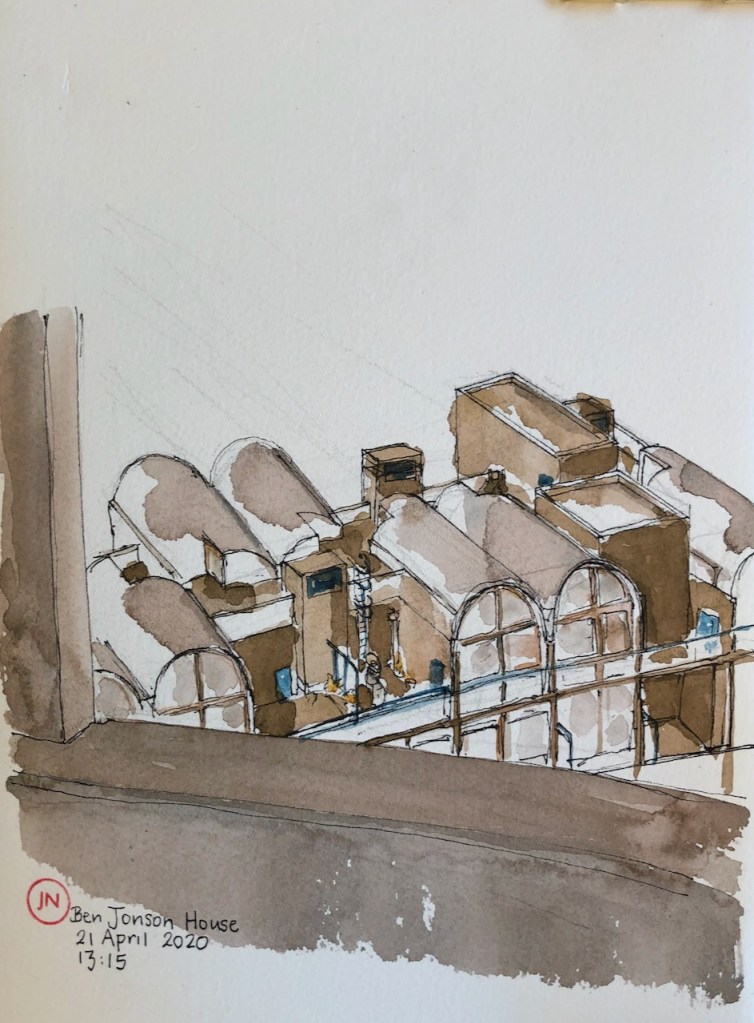
Sketching from the window, here is Ben Jonson, part of the Barbican estate.
The people who live on the top floor of Ben Jonson have sunlit roof gardens. You can see one person enjoying his garden. He sits just at the bottom of the blue fire escape ladder.
There is also an interesting void space shown in the lower right of the picture. It was empty when I was drawing, but sometimes someone’s legs are visible, using the space for sunbathing. Sometimes they set up a table and chairs there.
Here is work in progress. I used colours: Mars Yellow, Burnt Umber, Prussian Blue and a bit of Perinine Orange.
Click a button below to share this post online, email it, or print it:
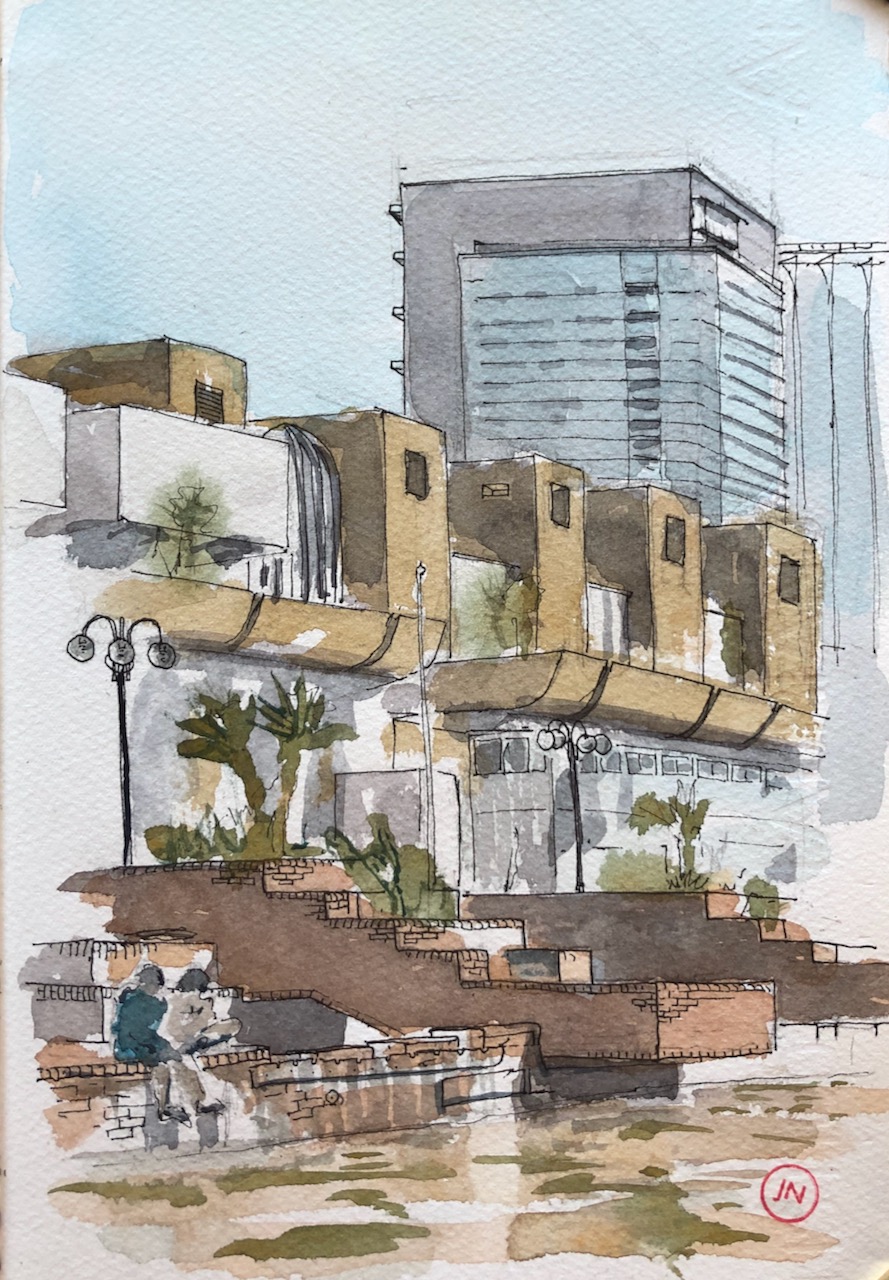
The building in the background is the Heron Building, luxury flats above the Milton Court Concert Hall, Guildhall School of Music and Dance. This building opened in September 2013. It replaced a public building, which was in the brutalist design of the Barbican and designed by Chamberlain Powell and Bon, It housed a fire station, Coroner’s Court, mortuary, office of weights and measures and a civil defence school, and was connected to the Barbican by a bridge at Podium level. This building was demolished in 2008, in the face of opposition from the Twentieth Century Society amongst others, and was replaced by the steel and glass tower. This new building has no bridge to the Barbican, which is a pity, in my view.
At the extreme right is City Point.
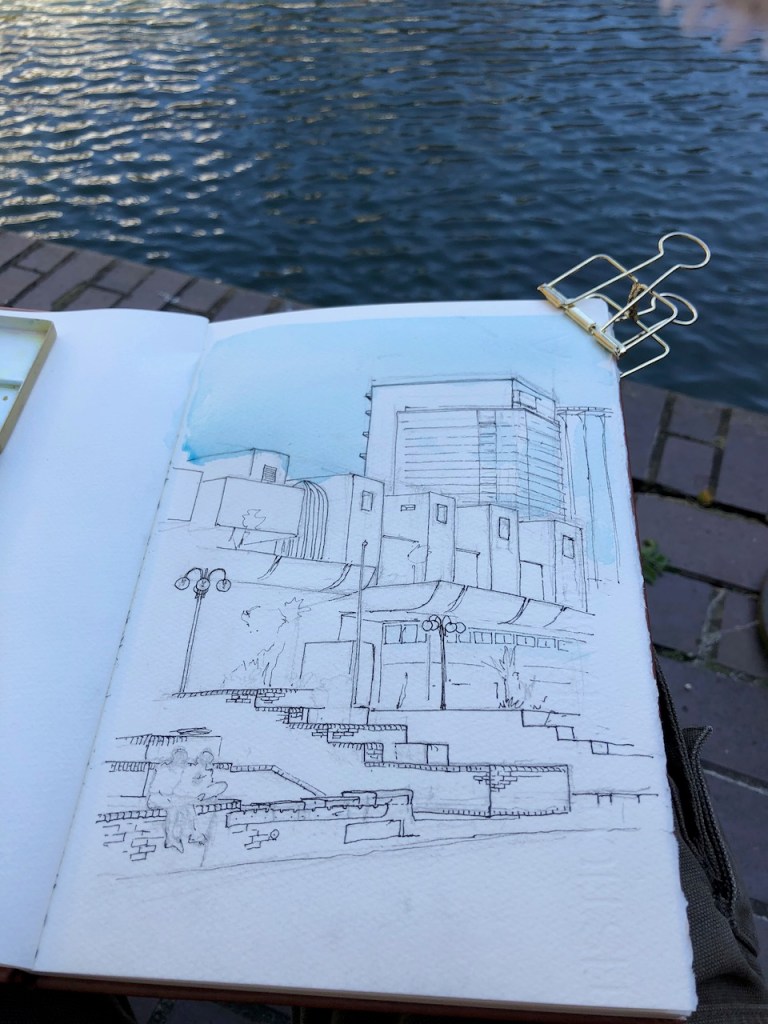
Here is work in progress:
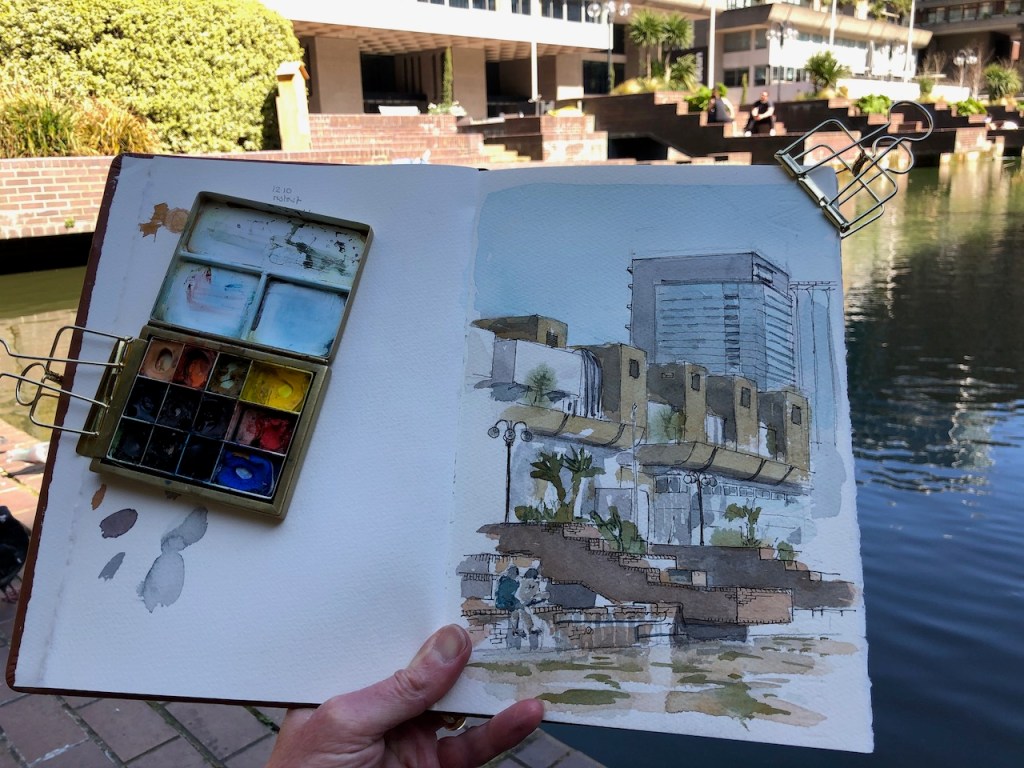
This drawing took ages. I couldn’t get the steps right. After 30 minutes of drawing and rubbing out I restarted at 12:10 and finished 1hour30mins later.
Click a button below to share this post online, email it, or print it:
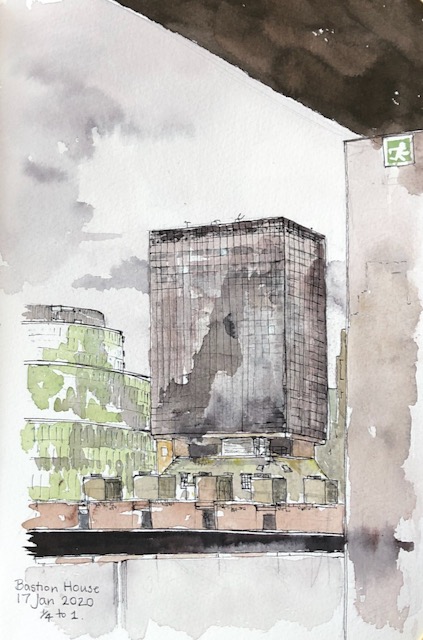
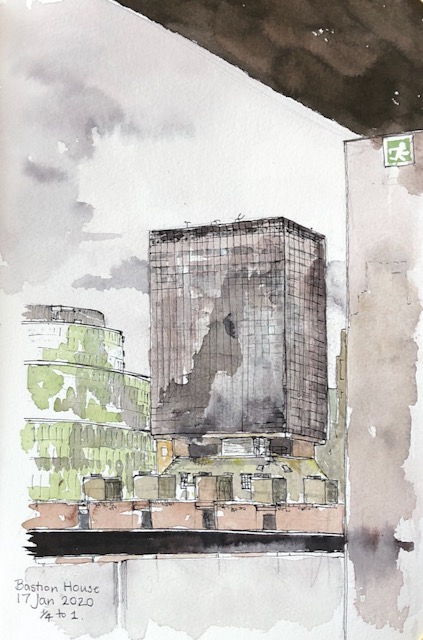
I hastened to draw the magnificent Bastion House, on London Wall. It is due for demolition.
In the foreground you see the balcony and privacy screen of the flat in Andrewes, whose leaseholder had kindly hosted me.
The line of red brick, and what looks like chimneys, in the foreground are the rooftops of a part of the Barbican, “The Postern”. Behind them is the Barber-Surgeons’ Hall on Monkwell Square, where I have been to give blood. The curved green building on the left is on the other side of London Wall. It is “One London Wall” near the Museum of London Rotunda: multi-use office space.
Bastion House is the huge monolith in the centre of the drawing. It reminds me of the monolith in the 1968 film “2001 – A Space Odyssey”, and indeed it dates from that period. It was proposed in 1955, and started in 1972, completed in 1976. The architect was Philip Powell of Powell and Moya. This practice also designed the Skylon for the 1951 South Bank Festival of Britain, and Churchill Gardens in Pimlico.
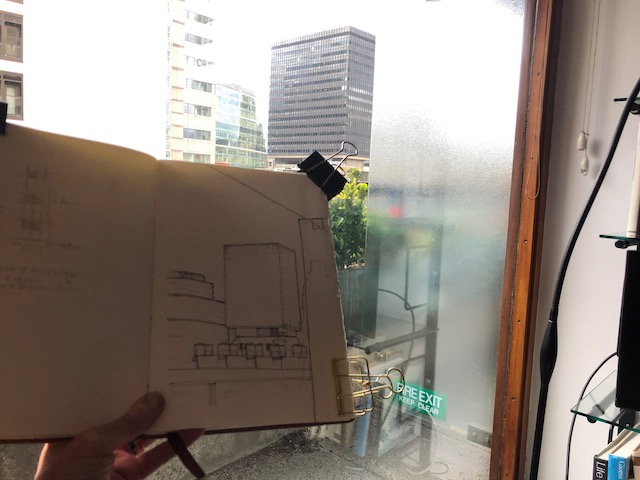
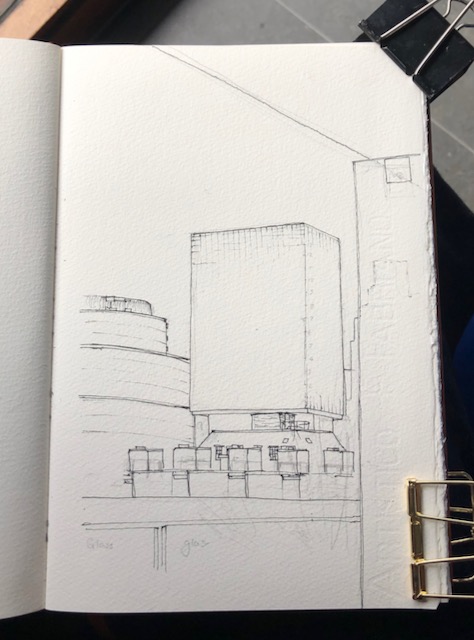
Here is drawing work in progress.
Work in progress
This drawing took me about 2 hours. This is my first drawing in a new sketchbook: the “Perfect Sketchbook” from Etchr. This will be Urban Sketching sketchbook number 6.
Bastion House aka 140 London Wall is a huge modernist monolith, reminiscent of the monolith in “2001 – A Space Odyssey”. I couldn’t find a site to draw the monolith part today, so here is a view at Podium Level, looking West towards the Museum of London. You see the dark undercroft, walkways and a…
Today Urban Sketchers London held a “sketch crawl” in the Barbican. So I joined them. An astonishing number and diversity of people assembled inside the entrance of the Barbican Centre at the appointed time of 11am. I counted about 35 and then another dozen or so joined. All shapes and sizes of people, tall, short,…
Click a button below to share this post online, email it, or print it:
The Hallfield Estate is a modernist estate in Bayswater, W2 6EH. It’s a short walk south from Royal Oak Station on the Hammersmith and City Line.
It was constructed in the 1950s, to a design of Berthhold Lubetkin. The construction was supervised by Lindsey Drake and Denys Lasdun. Now it’s Grade 2 listed. Here’s what the listing says:
Reasons for Designation
The fourteen blocks and laundry at Hallfield Estate are listed at Grade II for the following principal reasons:
Architectural interest: a sophisticated and distinctive aesthetic approach to social housing, whereby the facades are treated like works of abstract art;
Planning: the estate fulfilled its brief to provide mass housing and open space in a crowded urban borough, in a plan inspired by Le Corbusier’s ‘Radiant City’
Authorship: designed by Berthold Lubetkin and Tecton, and constructed under the supervision of Lindsay Drake and Denys Lasdun, the estate is the work of some of the C20’s most significant architects;
Historic interest: a seminal post-war housing estate that was widely exhibited and published, and provoked divergent contemporary responses which illuminate post-war architectural theory.
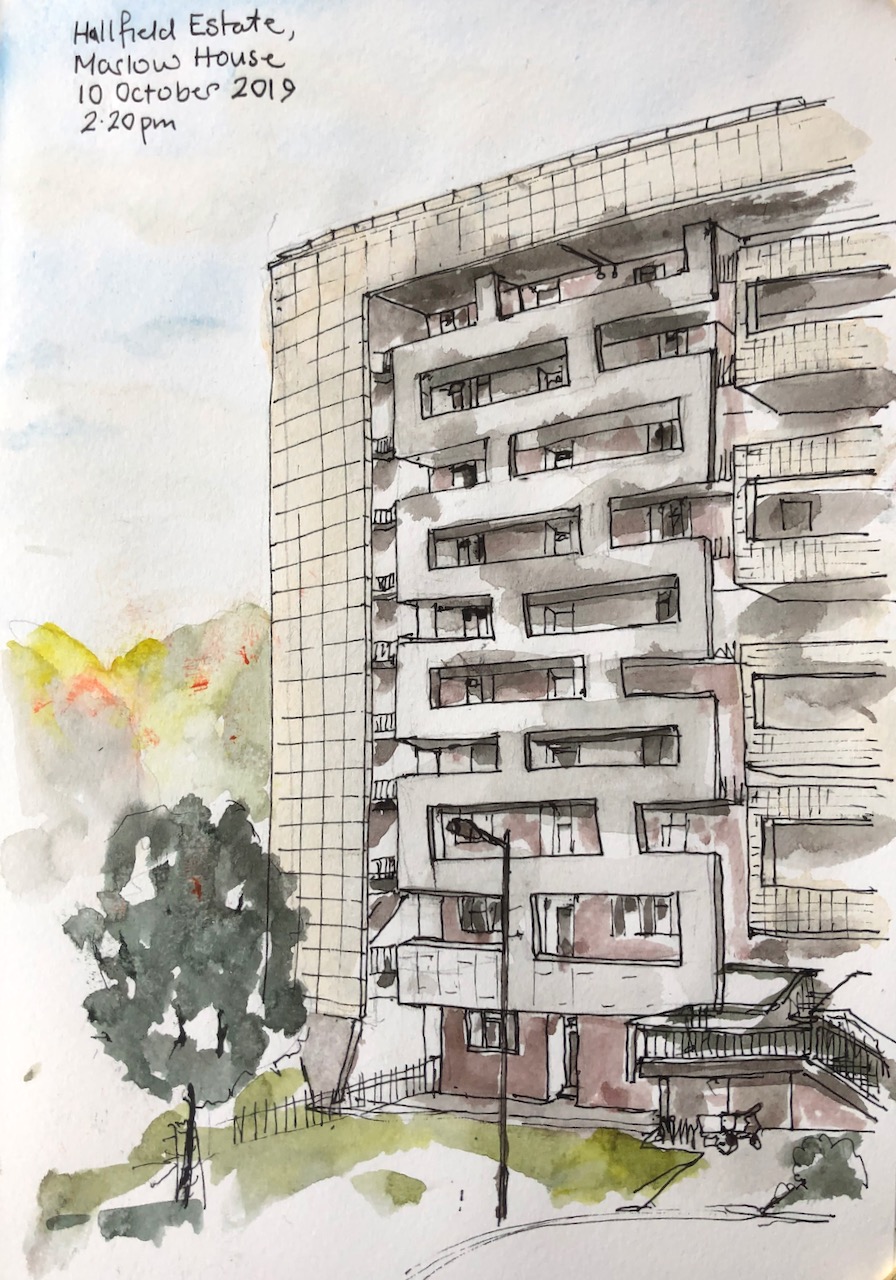
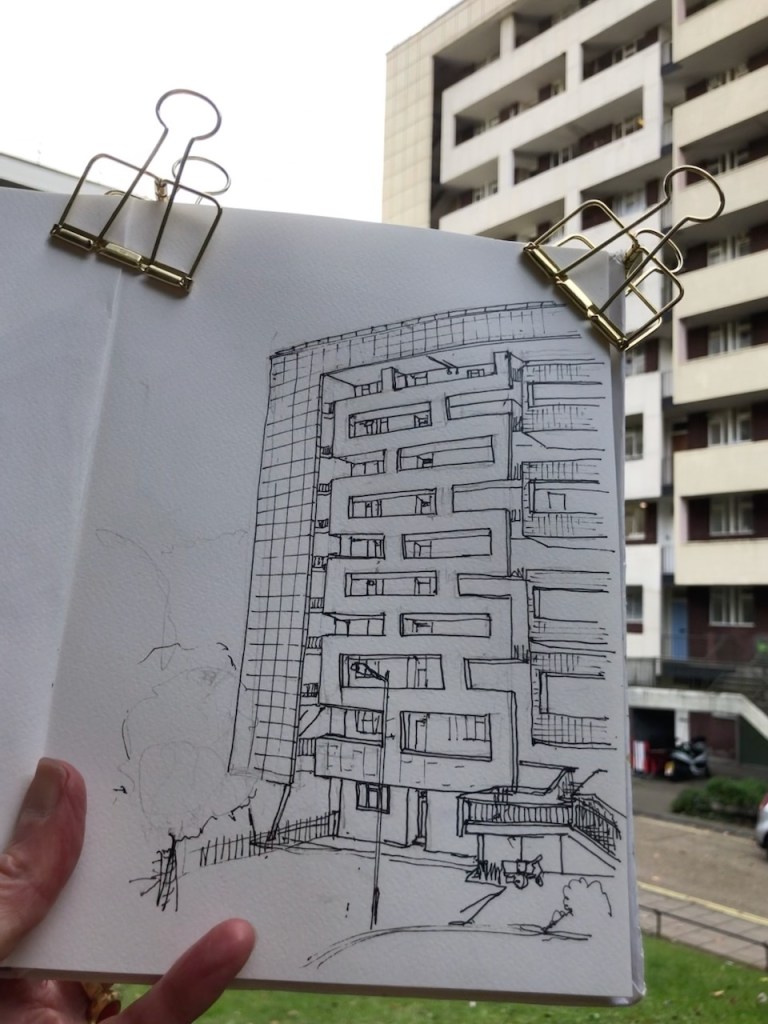
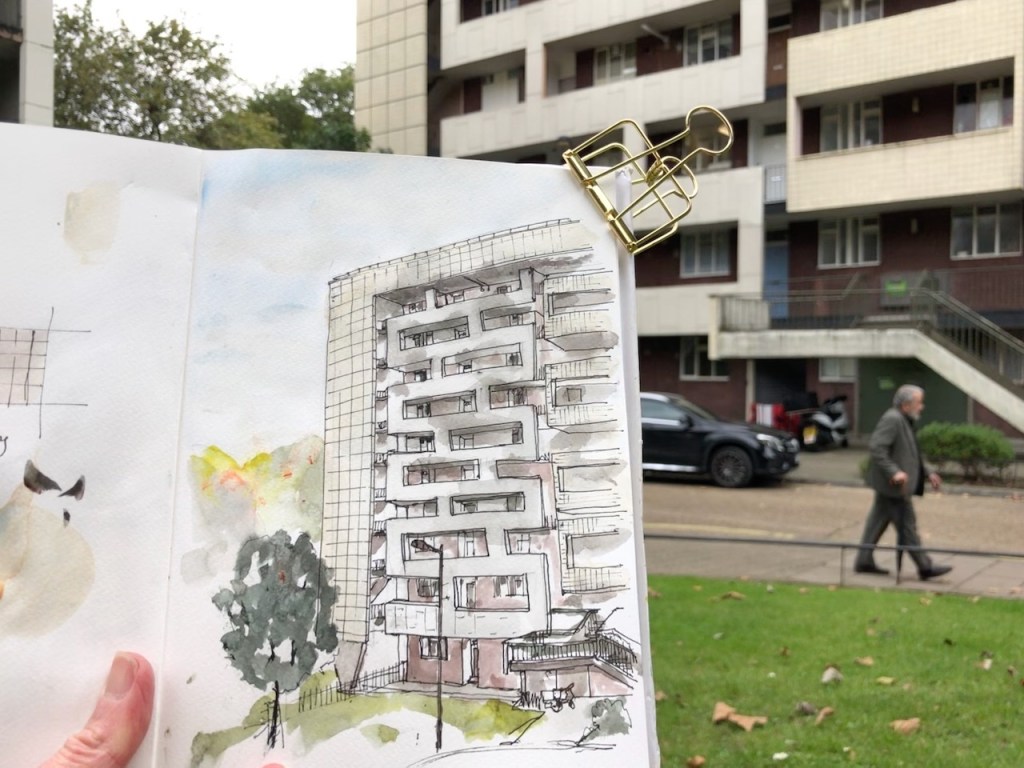
Here is a sketch of Marlow House. I drew it standing on a strange hummock, a small hill, inside the estate near the Battle Bridge Road.
Marlowe house sketched on location 19th October 2019 in sketchbook 5
“The estate presents a convincing riposte to criticism that postwar council housing is grey, drab and utilitarian. At Hallfield, the exteriors of each block are treated like works of abstract art – some are patterned with a chequerboard of blue and red brickwork; others have a zigzagging screen of white concrete panels. The estate now exists amongst an elite group of 16 listed post warhousing estates estate in London – estates that are successful as places to live and are cared for by their residents.” Hannah Parham, the English Heritage Designation Advisor (2011).
Shown in my picture is the “zigzagging screen of white concrete panels”.
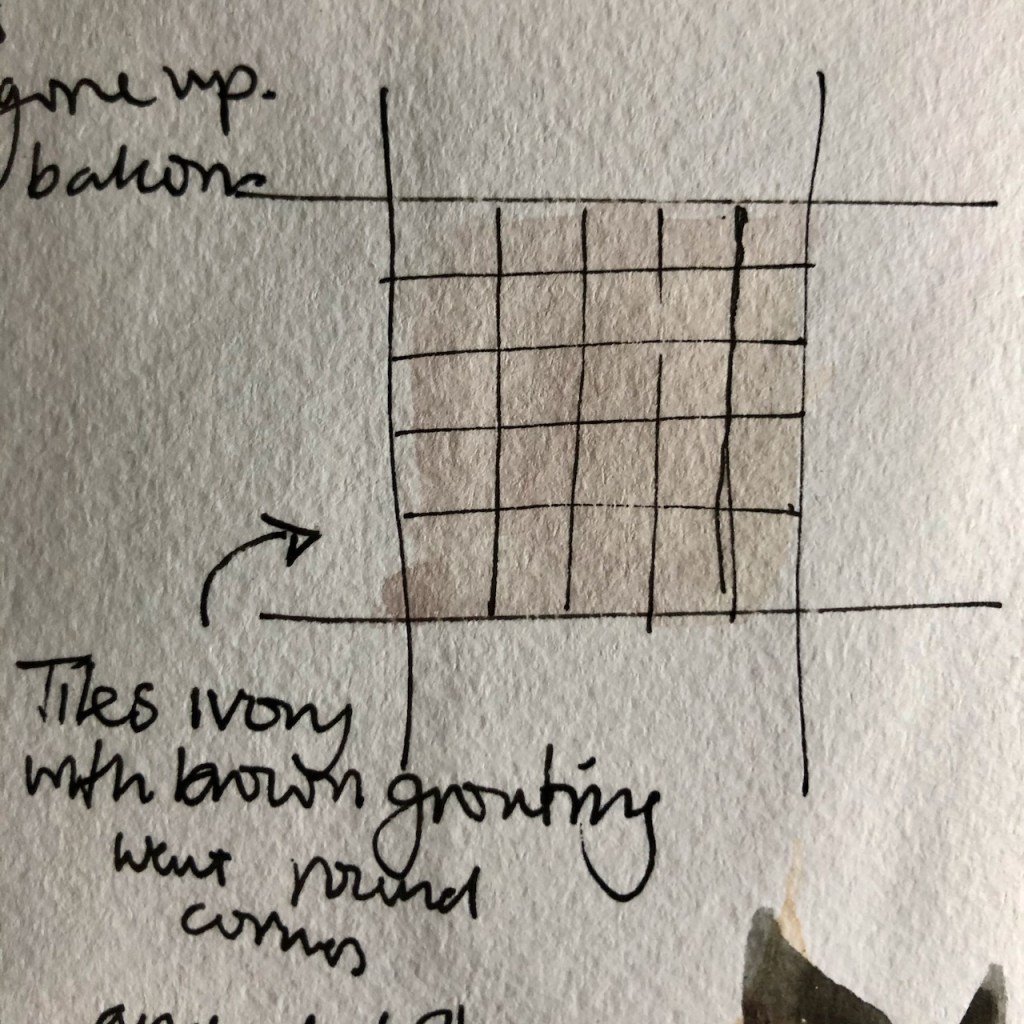
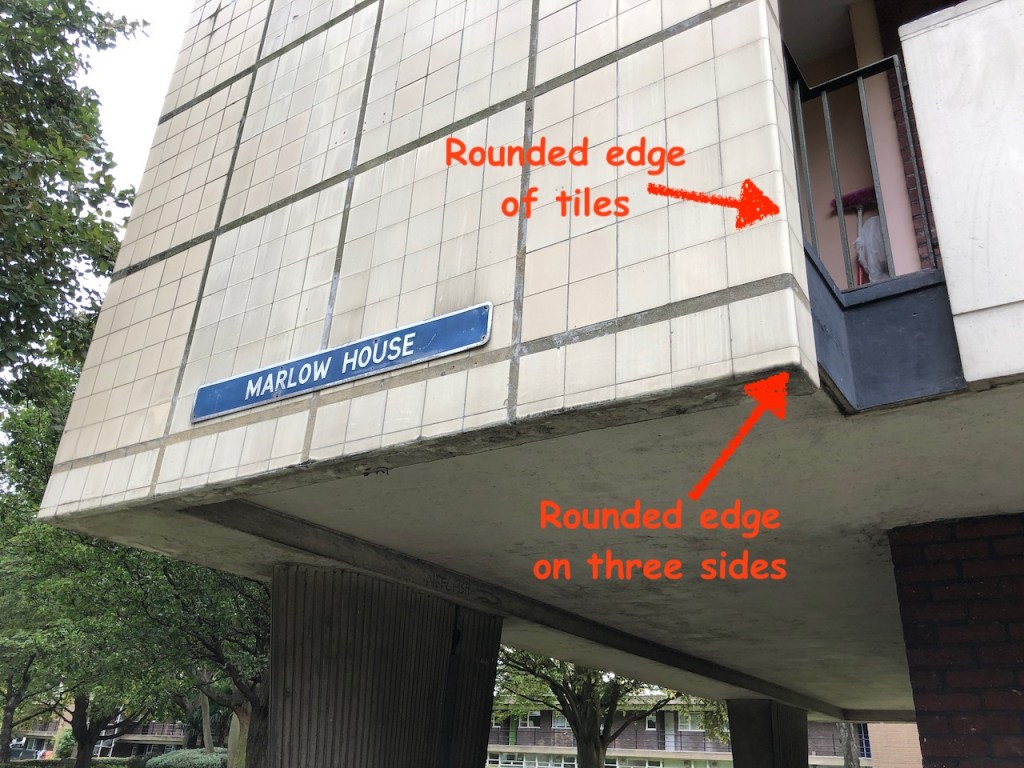
The gardens were beautiful, and well maintained. The buildings themselves are showing signs of wear. Tiles are chipped and cracked at the edges, and staircases look covered in soot from a previous era. But it’s still a stately collection of buildings. The white tiling is a work of art. On Marlowe House, the frame of the building is covered in ivory tiles, in squares of 25 tiles arranged in 5×5 grids, which are themselves arranged in a grid. So the effect is that of graph paper. I was impressed that these tiles are carefully made, and the edge ones are shaped, with rounded edges.
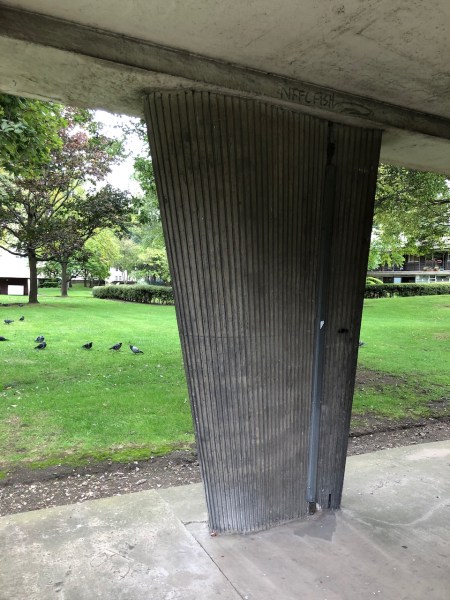
I also enjoyed the pillar, in the lower left of my drawing. It is fluted.
Fluted pillar. The lighting conductor rather mars the effect.
The stairwells are completely open. I could have gone up, but I didn’t. The postman did, however. While I was drawing I saw him doing his rounds, his black woollen hat moving along the balconies, passing behind the facade and down the stairs.
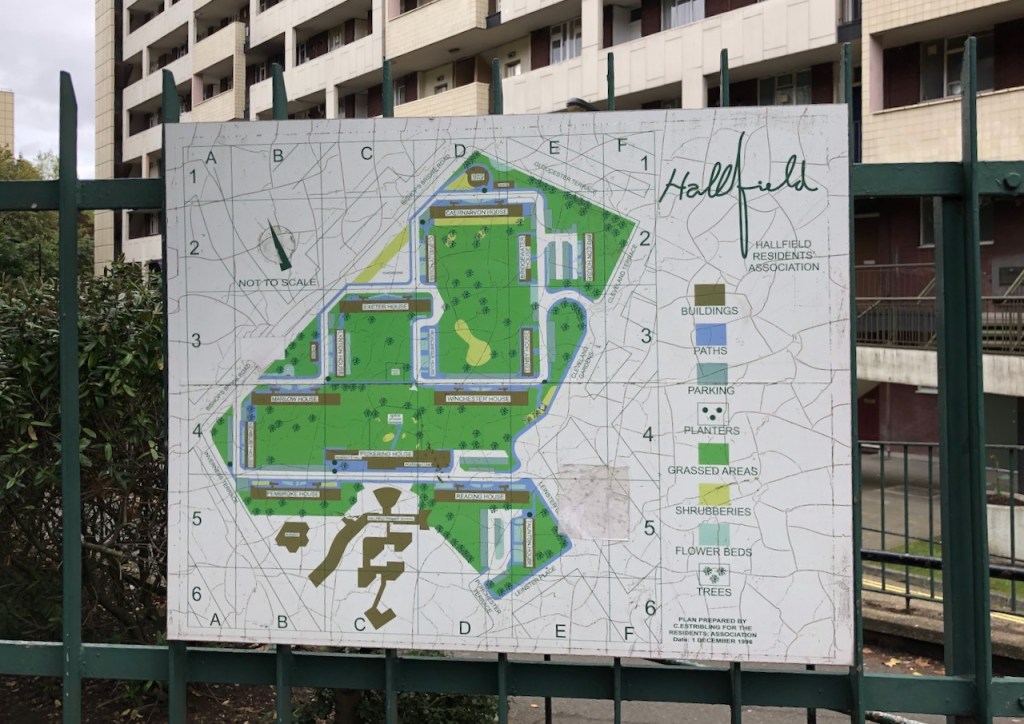
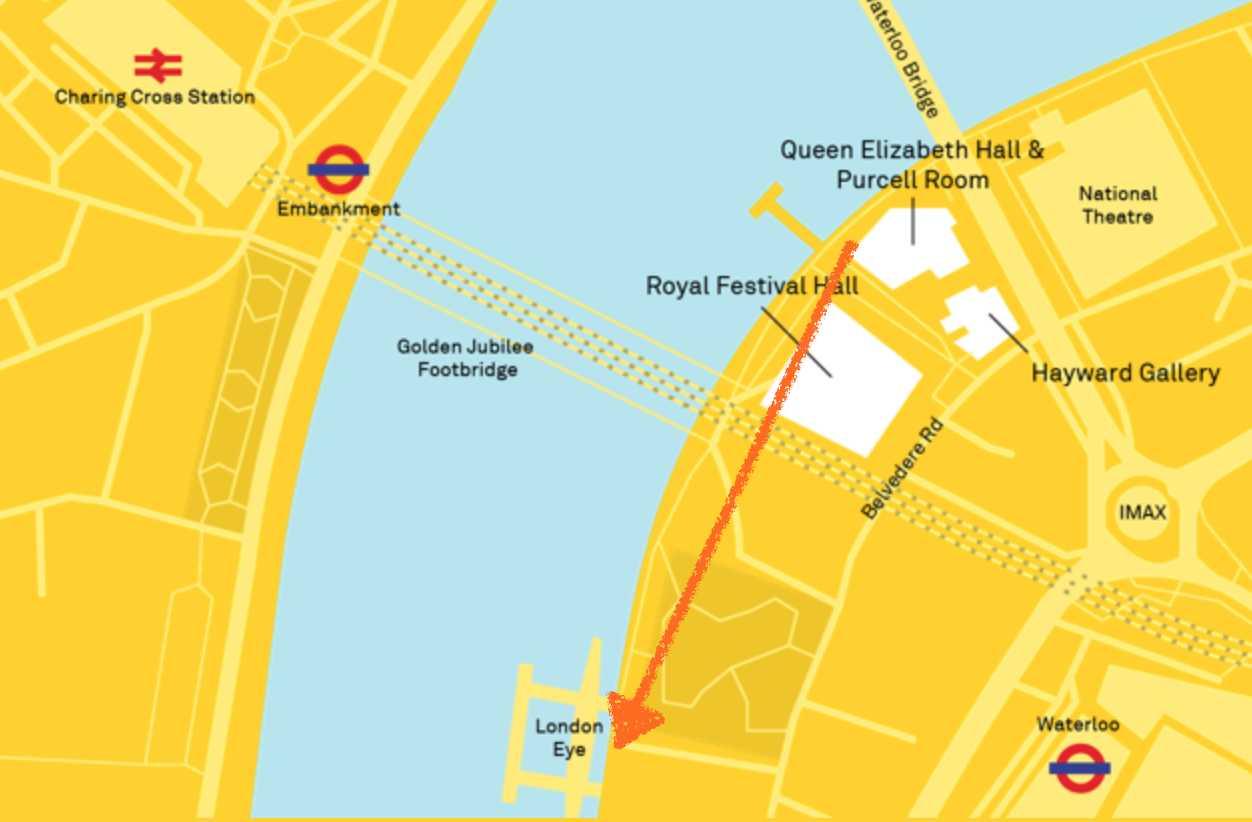
Here is a map and work in progress. Click to expand the picture.
Drawing took 1½ hours, drawn and coloured on location.
Click a button below to share this post online, email it, or print it:
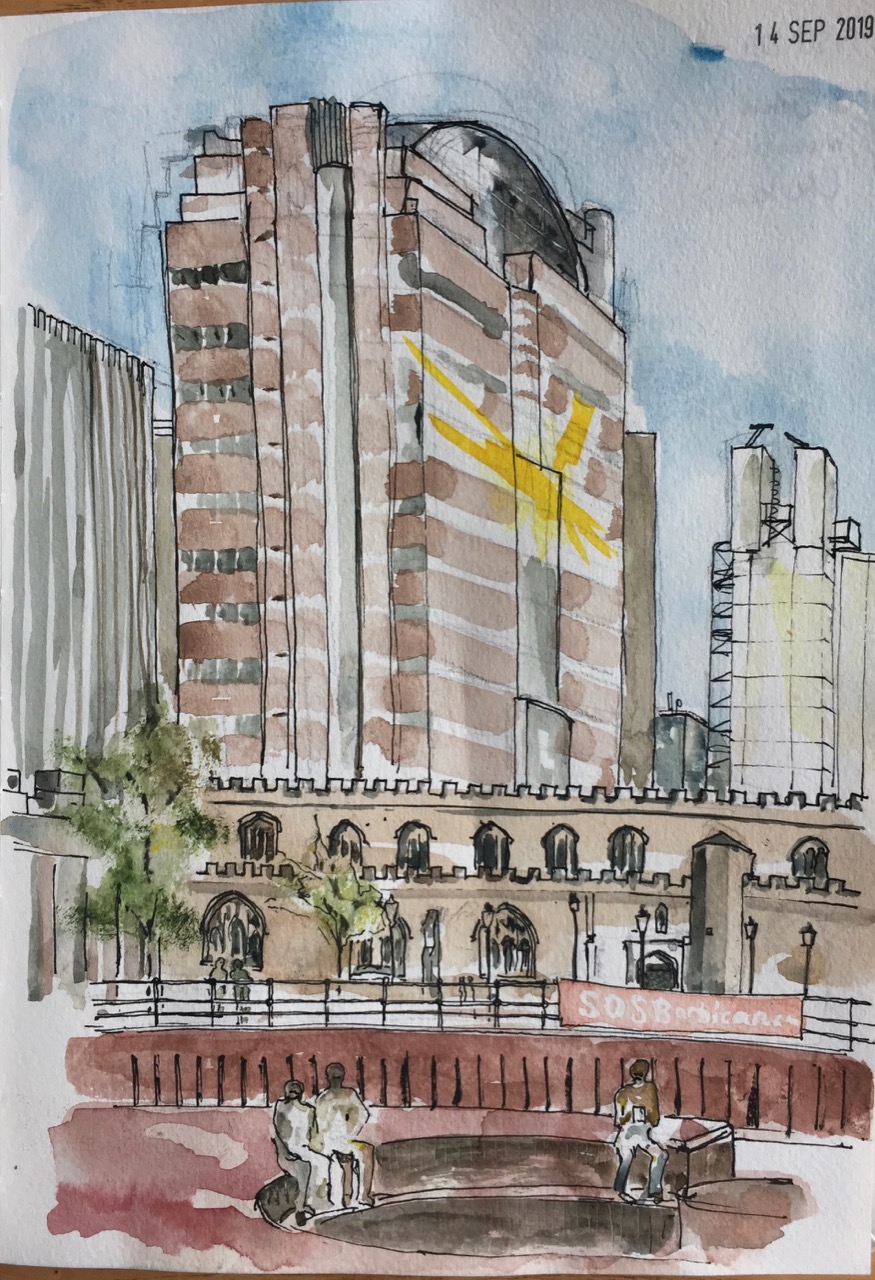
This is a drawing on one of those hot days last week.
I sat at one of the tables on the Barbican Lakeside Terrace and drew what I saw. The massive building is 125 London Wall, a multi-occupancy monolith. Behind, to the right is 88 Wood Street, designed by Richard Rogers (“Rogers Stirk Harbour + Partners”). It’s a bit like the Lloyds Building, with transparent walls and lifts you can see going up and down. On the left is the new building at One London Wall Place.
In front of all that is the side of St Giles’ church, with its castellations. There was a celebration going on: Barbican@50.
The banner you can see fastened to the railings says “SOSBarbican.com”. It is placed by objectors to the proposed extension of the Girls School.
1 hour 20.
Click a button below to share this post online, email it, or print it:
Here is the Guildhall School of Music and Drama, seen from across the Barbican Lake. I drew this sitting on a ventilator grille in an alcove of the residential flats in Andrewes House.
The Tower in the distance is Cromwell Tower. The sloping glass roof is the Barbican Conservatory. Gilbert House is the residential block on the left. In the foreground is the magical sunken garden, a planted area whose walkways are below the level of the lake.
As I drew, I was watched with interest by mallard ducks. One settled at my feet, in a proprietorial way.
I had not noticed before that the Guildhall School is built as a series of blocks, rather like a container park. The top row and the bottom row don’t quite match. The second row has a series of upright concrete beams, which I’ve shown, between the blocks.
I saw that the windows are angled. The inhabitants of one block must be able to see, in a sideways sort of way, into the next block. I’ve never been inside the School, so I don’t know how this works out in practice. But after all, this is a school of performing arts, so it’s rather good if you can see your fellow students through a window: every window a stage.
However the angling of the windows meant that from outside I couldn’t see inside. I have to wait until the performers are ready to present their pieces on a public stage. Still, from time to time I heard a flight of notes on a saxophone. Perhaps they had opened the window of one of the practice rooms.
About 2 hours, including a chat to a fellow resident who stopped by.
Predominantly just two colours: Perinone Orange and Prussian Blue, with a tiny bit of Mars Yellow in the rushes.
Click a button below to share this post online, email it, or print it:
Today I found another view of the view under Mountjoy. This is from the high walk that goes north from the Museum of London, looking East.
Under the Mountjoy Highwalk there are a number of “framed” pictures. The old London Wall fortification is visible. The sun reflected from the lake and threw patterns onto the old stone. I couldn’t get all that in the picture so you have to take my word for it.
A group of tourists stopped on the “Wallside” highwalk. You can see them in the centre right of the picture.
These “windows” will all be obliterated by the proposed City of London School for Girls expansion.
This view is from the place where the north bound highwalk turns abruptly left (click map to expand it).
This picture took about an hour. I tried hard not to overdo it.
At the top of the picture are the flats of Mountjoy House, with their impressive window boxes.
Click a button below to share this post online, email it, or print it:
This is the view that will be lost if the City of London School for Girls expansion proposal goes ahead.
UPDATE (2020): the proposal has been shelved, and alternatives are sought. But we must remain vigilant. The article below was written in August 2019, when the threatened development looked as though it would go ahead. Widespread protest ensued.
The view that will be lost if the CLSG expansion goes ahead. See “SOSBarbican.com”
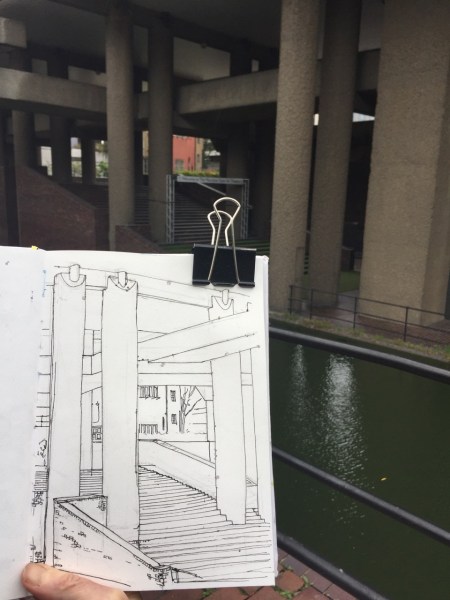
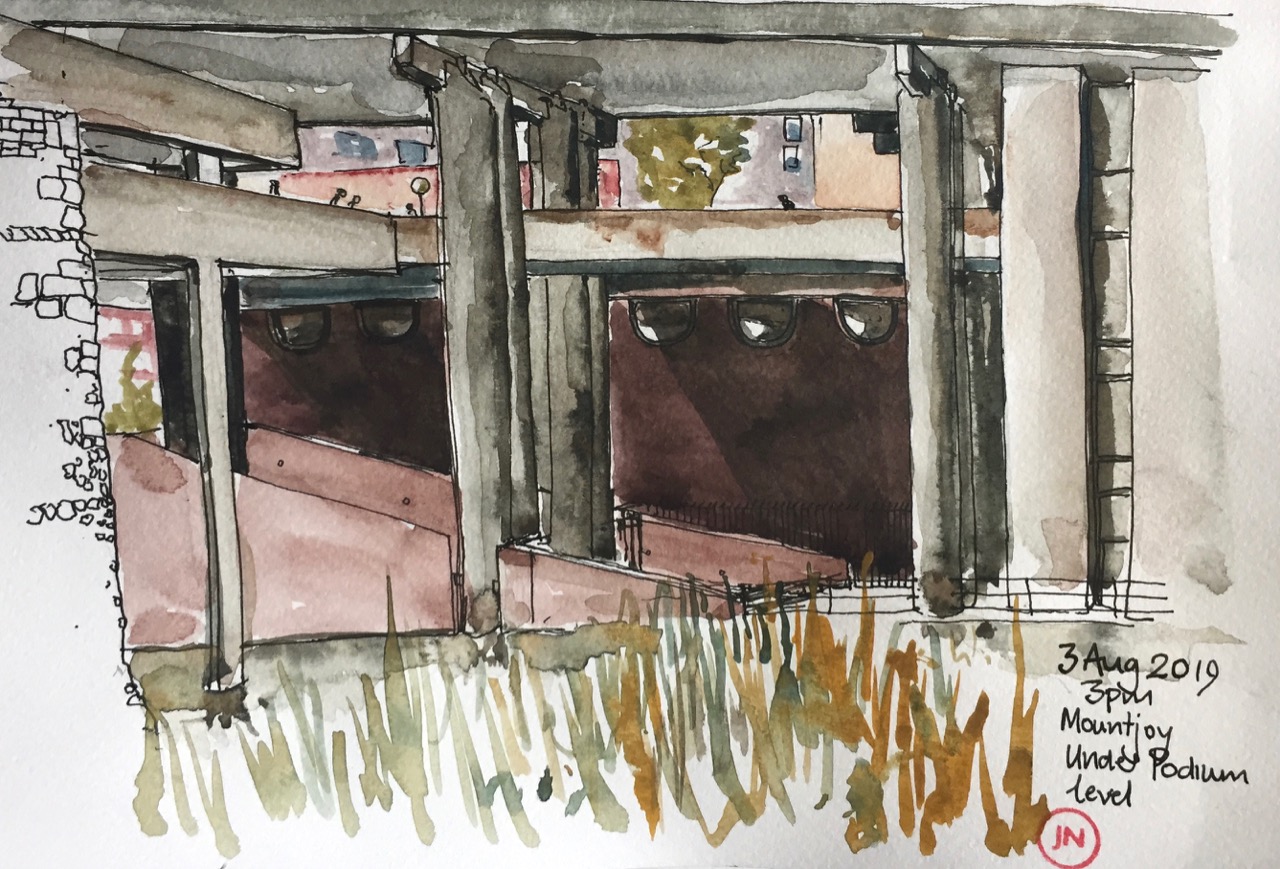
I spent time today paying attention to this view, because that is what I need to do, to draw it. The pillars are reflected in the water. The enormous flight of steps is like that in a fairy story, so wide and grand. There’s a massive three-dimensional sculpture of concrete, of light and dark. Flat spaces and lines don’t quite join up but are nonetheless connected, like rhythmic music. Framed by the 20th century brutalist columns you see an older more ornamented building, and trees. You can even see right through to the other side of Aldersgate. This is a magnificent view.
The interesting blotchy effect on the pillars is rain falling on the picture. I started this picture at 09:30. Then it started to rain. The fine rain speckled my picture. Bigger drops diluted the paint in the palette and made the paints shift about. Then it started pouring down with menace. I scrabbled my things together and dashed into St Giles’ Church which was behind me. Inside the church, people moved purposefully about, and all was calm. And it was dry. I took a deep breath and kept my drawing horizontal. There was a table next to the door. A woman looked at me over the table. I felt the need to explain. “I’m sheltering from the rain,” I told her.
Her response was calm and logical, “Would you like a cup of coffee?”
“I would,” I said. Her companion at the table offered me a biscuit. Grateful to the Royal Society of Organists for their hospitality, I sat on a wooden bench and let my drawing dry off. Experimental short tunes from the organ floated quizzically in the air.
Then I went out again. I wanted to finish my picture. I stood in the porch of the church and looked at the rain. “Every decision is a moral decision.” I believe that. Should I pack up the drawing and go home? I could use the time before the Planning Meeting to do the supermarket shop, deal with the plumbing problem, and process the sourdough.
Or should I continue the drawing?
What principles are at stake here? I finish drawings that I start. I don’t mind the rain. My ink and watercolour does mind the rain, though. So I’ll draw the picture under an umbrella.
This was surprisingly effective. I managed to get all the ink drawn before 10:45, when I packed up again, to go to the Planning Meeting. During this time I was approached by a flustered gentleman in a smart suit, who wanted to “get across the lake”. He was hopelessly disoriented, pointing South-West, when he should have been heading North-East. I re-directed him and he dashed off towards the Barbican Hall.
The Planning Committee Meeting at 11am was the City of London Planning and Transportation Committee. This was their July meeting. In their September meeting, if things go according to the plan put forward by the School, this same Committee is due to approve a plan for a building which will totally block out the view I have drawn. The proposed new structure would cover the steps, build round the pillars, and put in an industrial kitchen. Residents in Mountjoy House, directly above my picture, are understandably dismayed. The Barbican Association, representing Barbican residents, is leading a campaign to prevent to save the view, and stop the expansion. Here is their postcard/flyer.
On the way back from the planning meeting, I went back to the view, and put the colour.
Spending time looking at this view, these pillars, these shapes, I realise how magnificent it is, and how talented the architects were. This view is worth fighting for.
I went up to the marvellous roof garden, on top of the Queen Elizabeth Hall on the South Bank.
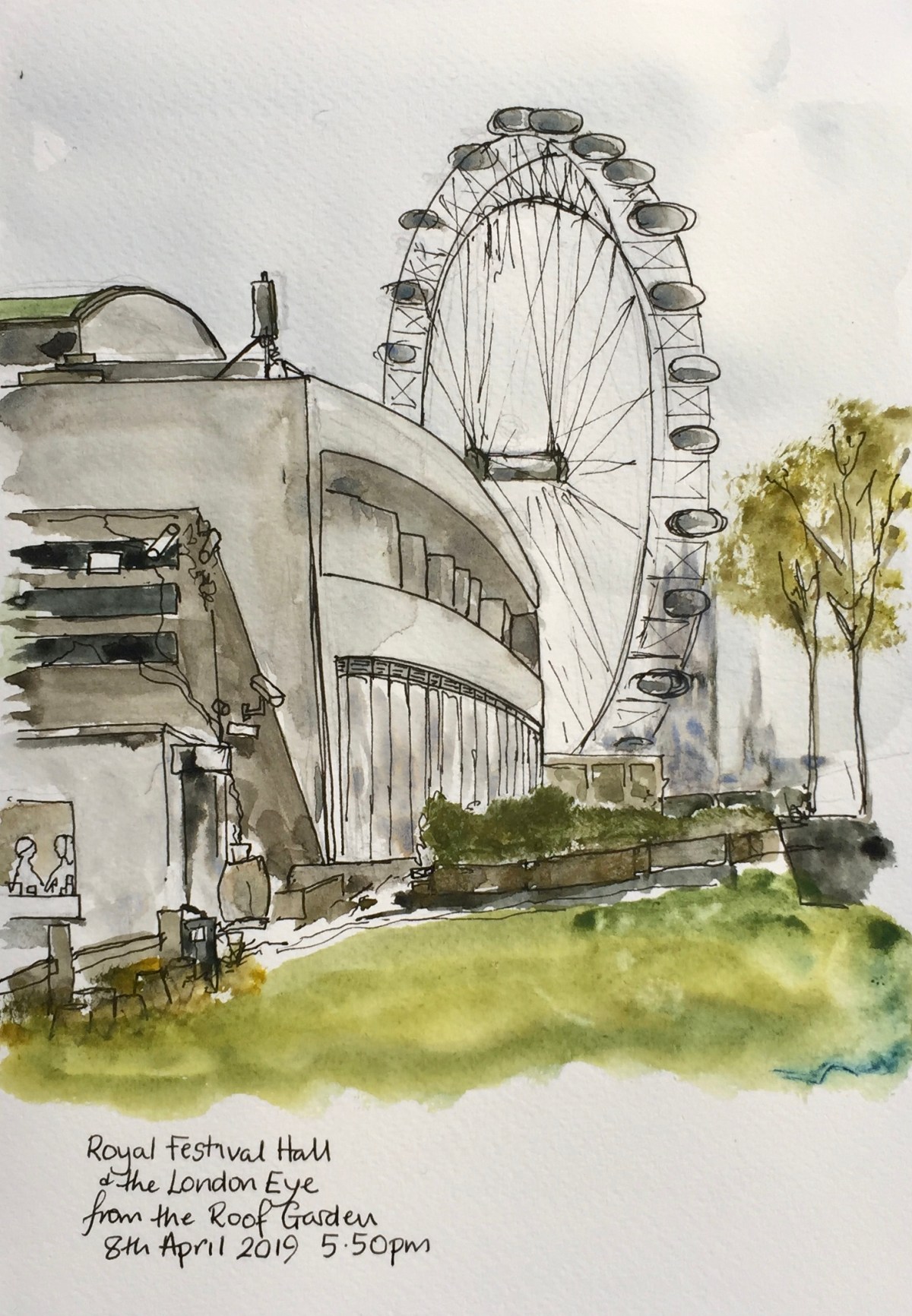
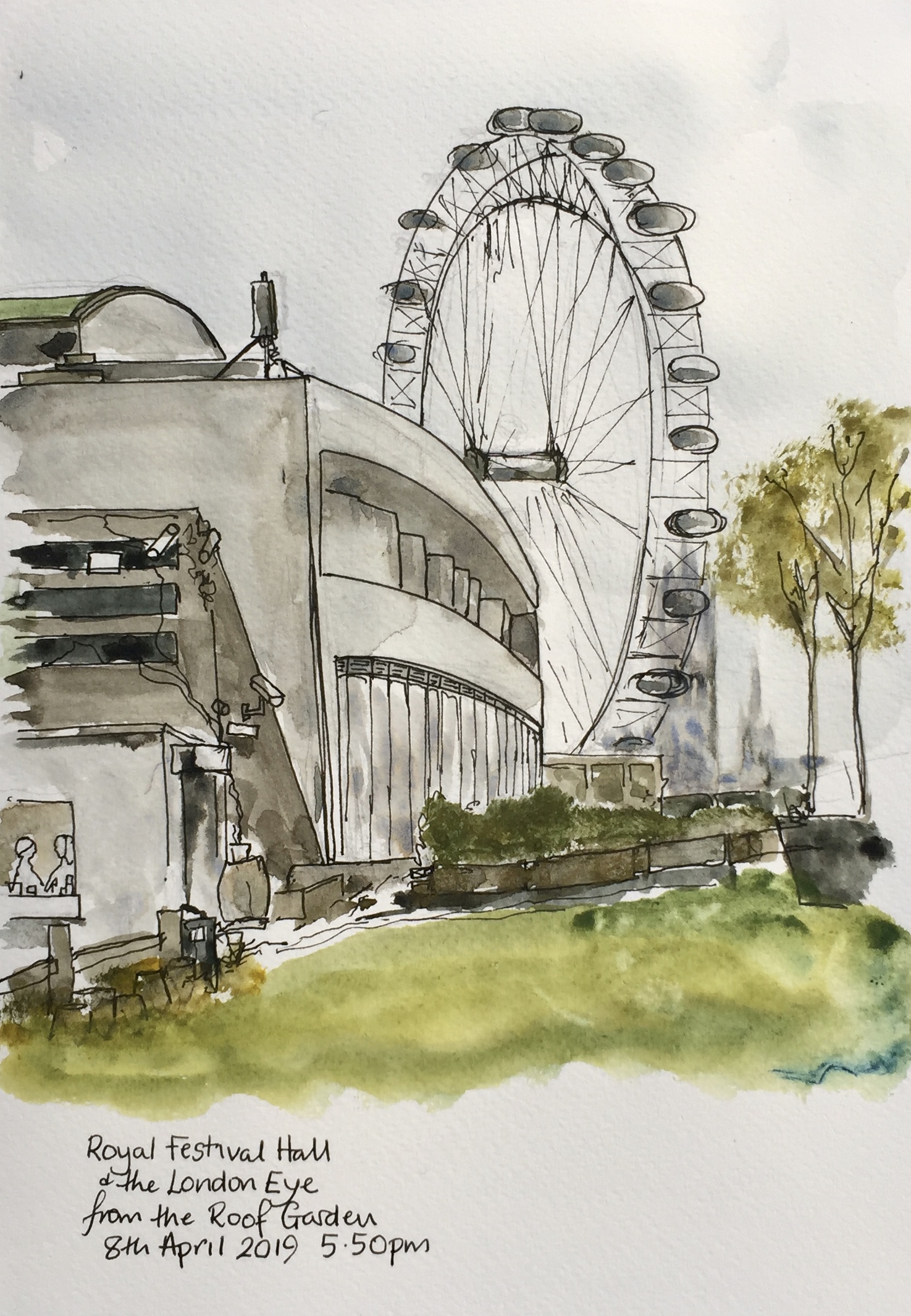
Here is a picture of the Royal Festival Hall, with the London Eye behind it. The tower of Westminster looms behind the wheel.
This roof garden seems to be a place for serious discussions. Some people at the next bench were discussing whether to stay employed or not. One of the options was to “go travelling”. Another, as far as I could work out, was to “get married”. It was hard to keep track of their wide ranging conversation, because I had to concentrate on the beautiful curve on the front of the Royal Festival Hall. It was a luxury to be there, and to appreciate the lines of the architecture. The lines were somewhat compromised at this roof level by the many creeping plants, floodlights, and surveillance cameras which you see encrusting the ventilation shaft in the foreground. Also note the prominent mobile phone mast on top of the Royal Festival Hall. I would not have granted planning permission for that.
The roof garden is a wonderful invention, and well done. By the time I’d finished the drawing, many people had made their way up, and were discussing work, and relationships, all very earnest. I discovered that I was sitting in the smoking area, which is adjacent to the vaping area. Marijuana smells wafted up from somewhere, perhaps from the skateboarding area in the Undercroft below. I could hear the crashes and the calls. But there was also a smell of grass, actual green grass, as in the picture.
Here is work in progress and a photo of my sketchbook on the concrete:
The drawing took 1hr30mins.
The London County Council (LCC), as it then was, initiated the building of the Royal Festival Hall as their contribution to the Festival of Britain. The foundation stone was laid by the Prime Minister Clement Atlee in 1949 and a mere 18 months later, in 1951, the concert hall opened with a gala concert, which shows what can be done if you are determined and have a deadline.
The project was initially led by the LCC chief architect Robert Matthew, then later by Leslie Martin, with Edwin Williams and Peter Moro. It was built on the site of the Lion Brewery, which was built in 1837.
[this information from the Royal Festival Hall website, and the Twentieth Century Society]
Click a button below to share this post online, email it, or print it:
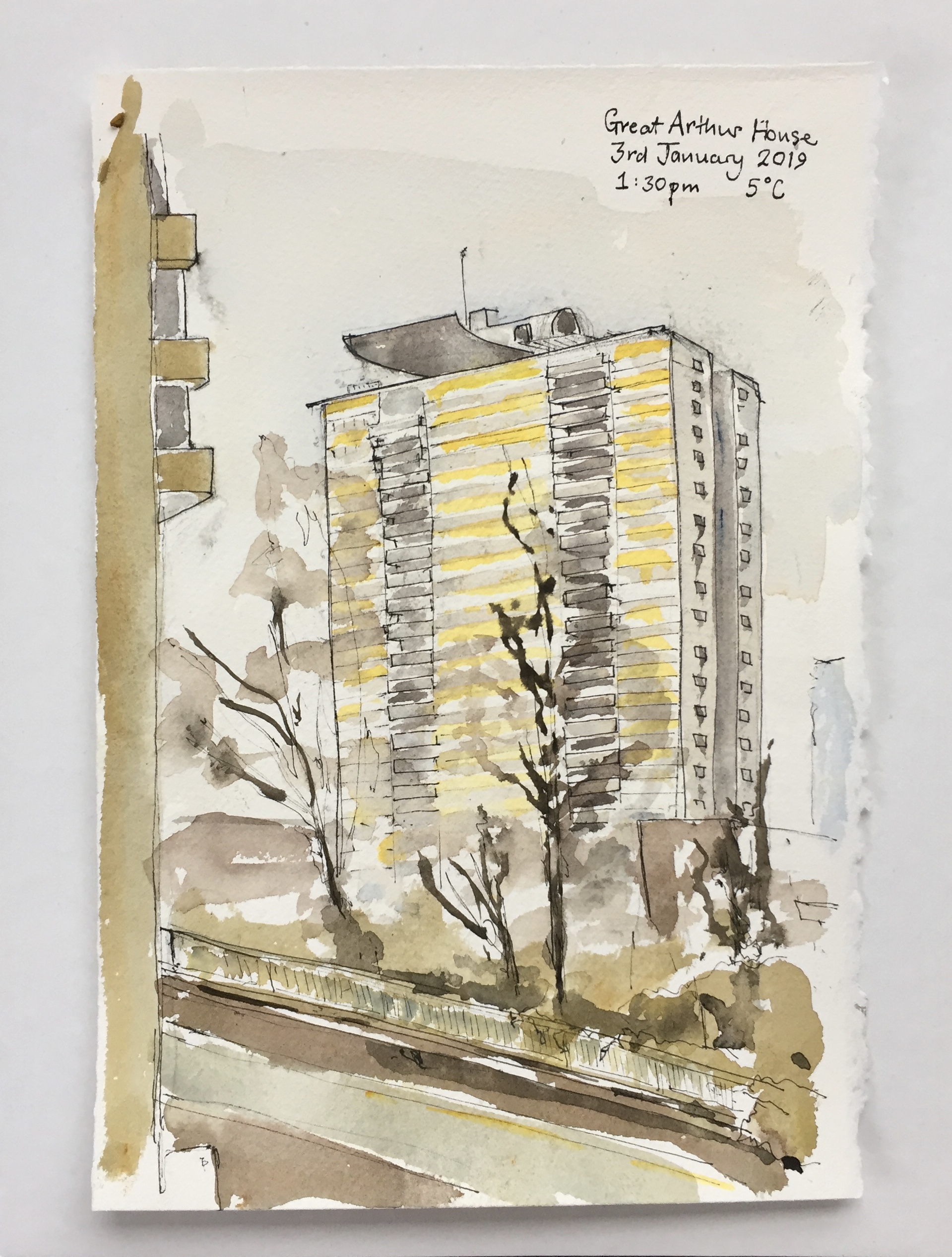
Here is Great Arthur House from the podium ramp near Blake Tower. You can see Blake Tower on the left. At the bottom of the picture is the ramp that goes down into the Car Park at Bunyan Court.
Several stories below me, at ground level, there was an assortment of discarded furniture and paint tins, and a huge skip full of Christmas Trees being collected for recycling.
It was really cold out there. I saw a black cat sliding in between the debris.
This picture done on Fabriano Artistico loose sheet, 8inches by 10 inches. About an hour, on location.
Click a button below to share this post online, email it, or print it:








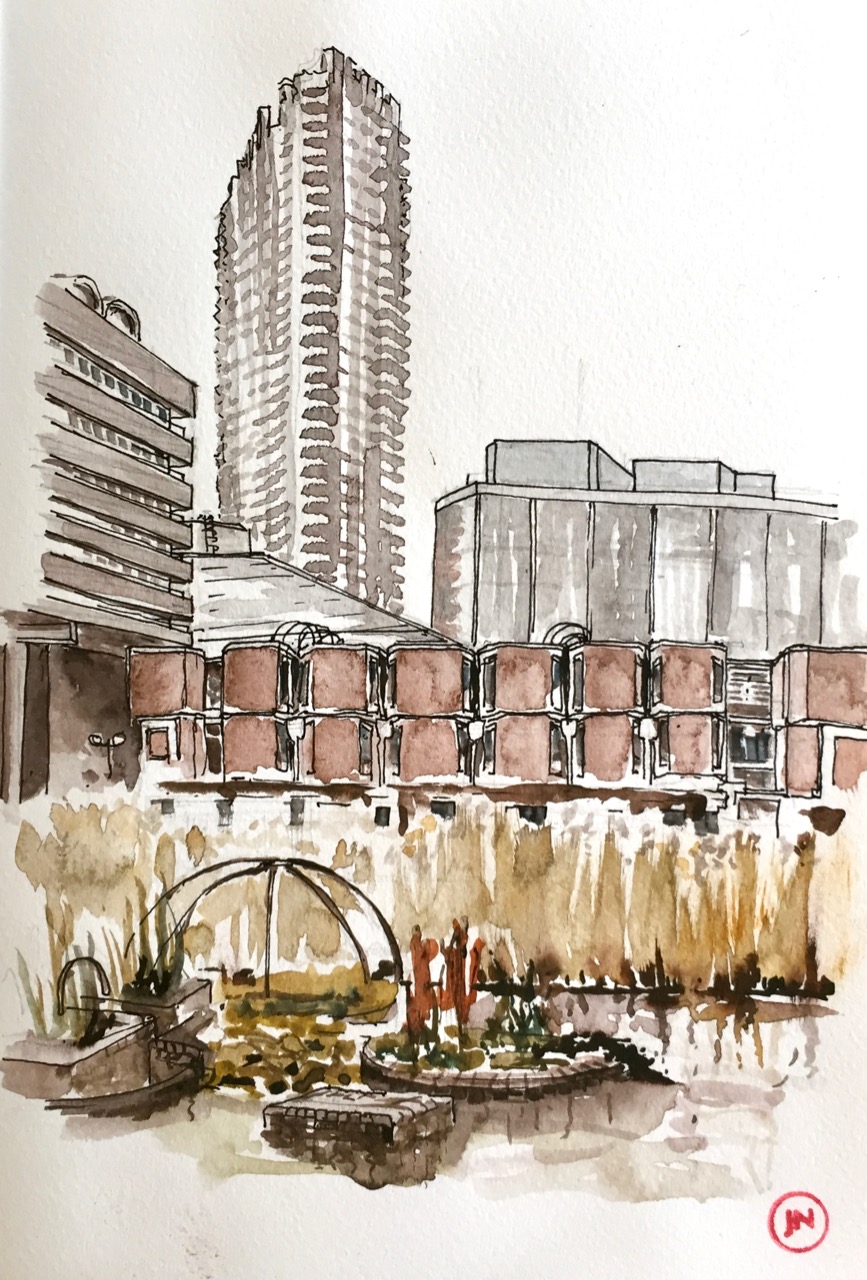
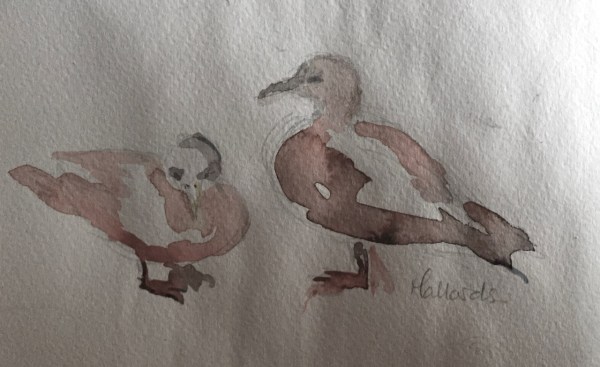 As I drew, I was watched with interest by mallard ducks. One settled at my feet, in a proprietorial way.
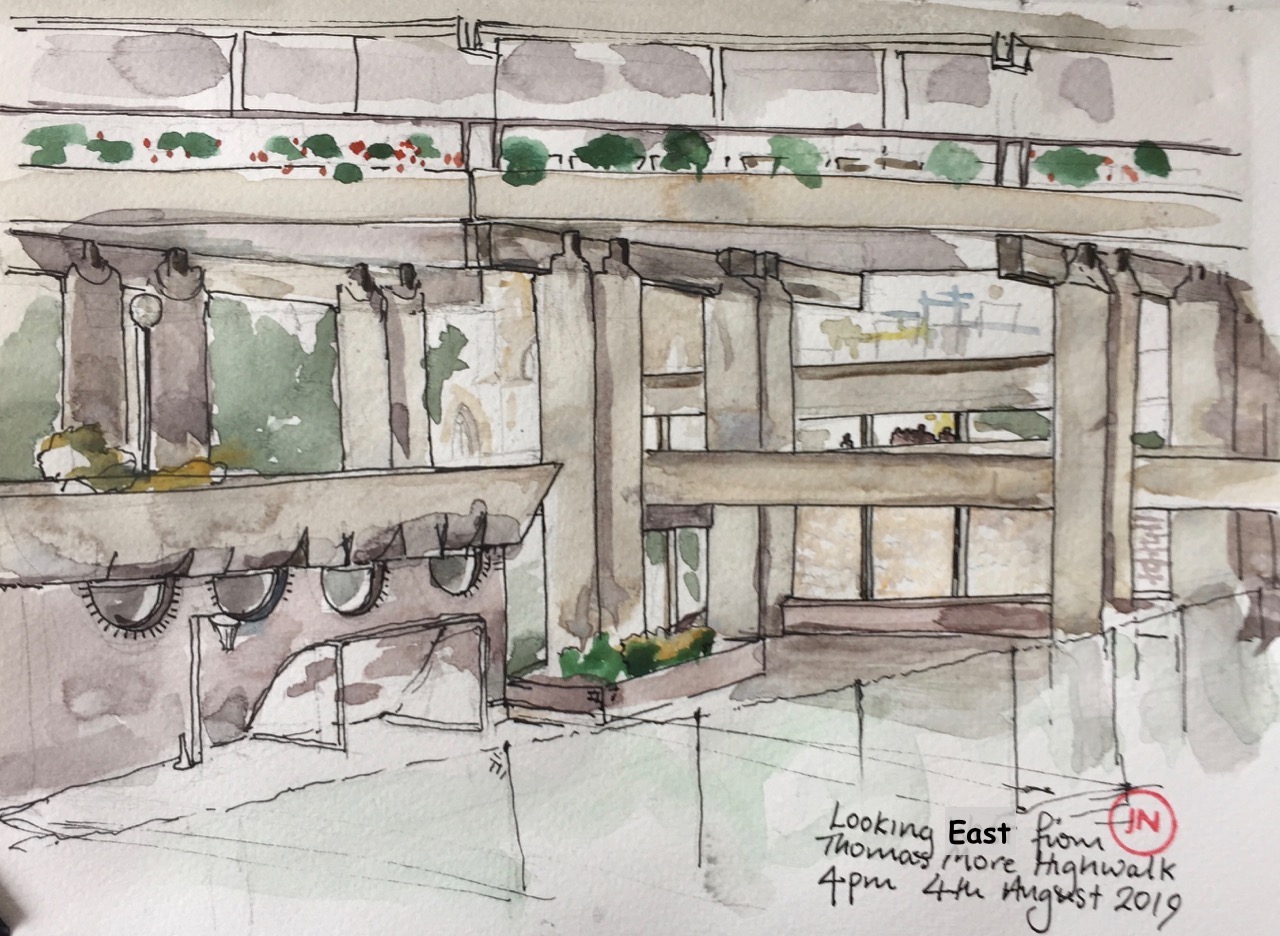
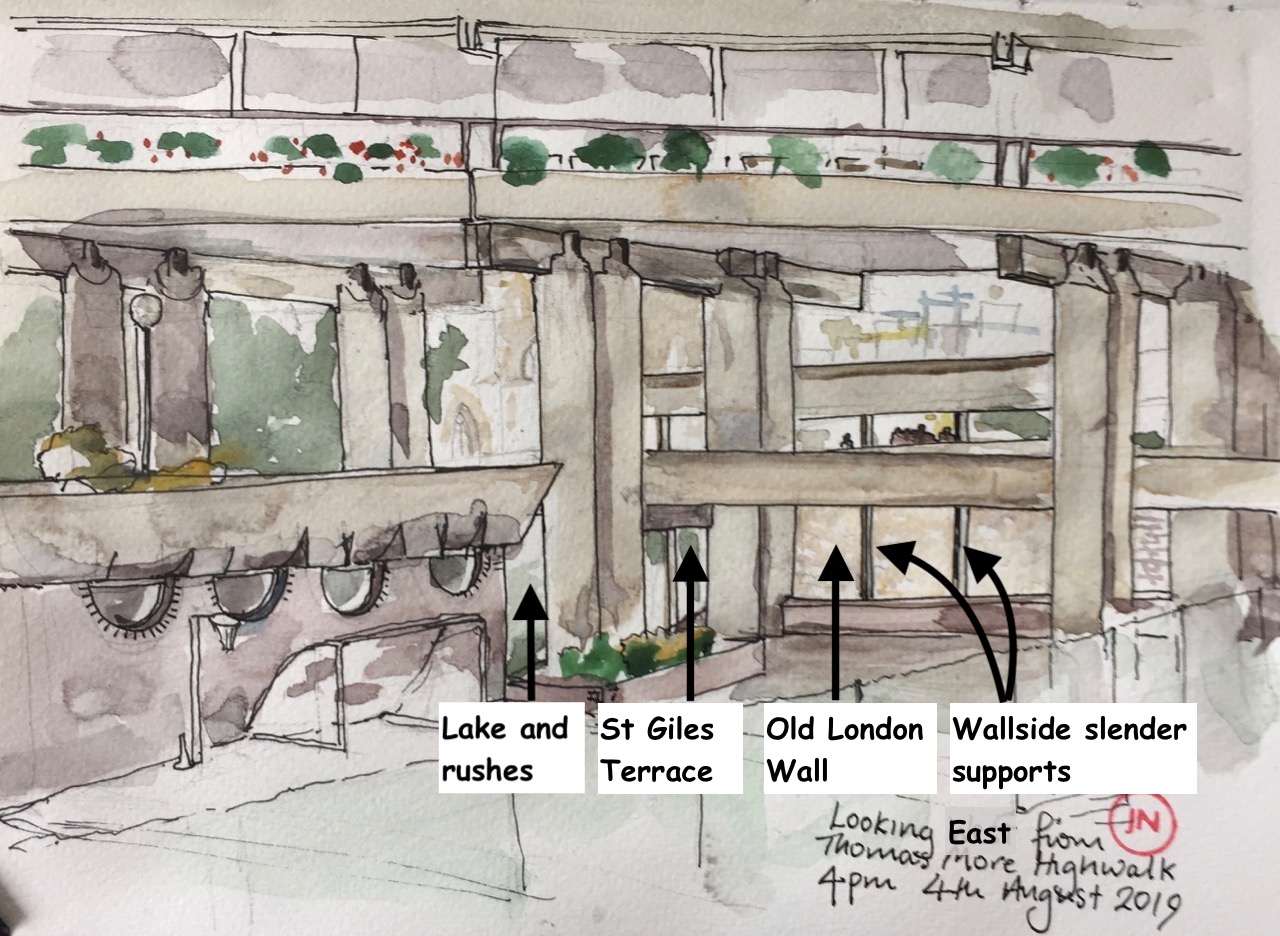


 This was surprisingly effective. I managed to get all the ink drawn before 10:45, when I packed up again, to go to the Planning Meeting. During this time I was approached by a flustered gentleman in a smart suit, who wanted to “get across the lake”. He was hopelessly disoriented, pointing South-West, when he should have been heading North-East. I re-directed him and he dashed off towards the Barbican Hall.





 Jane Sketching