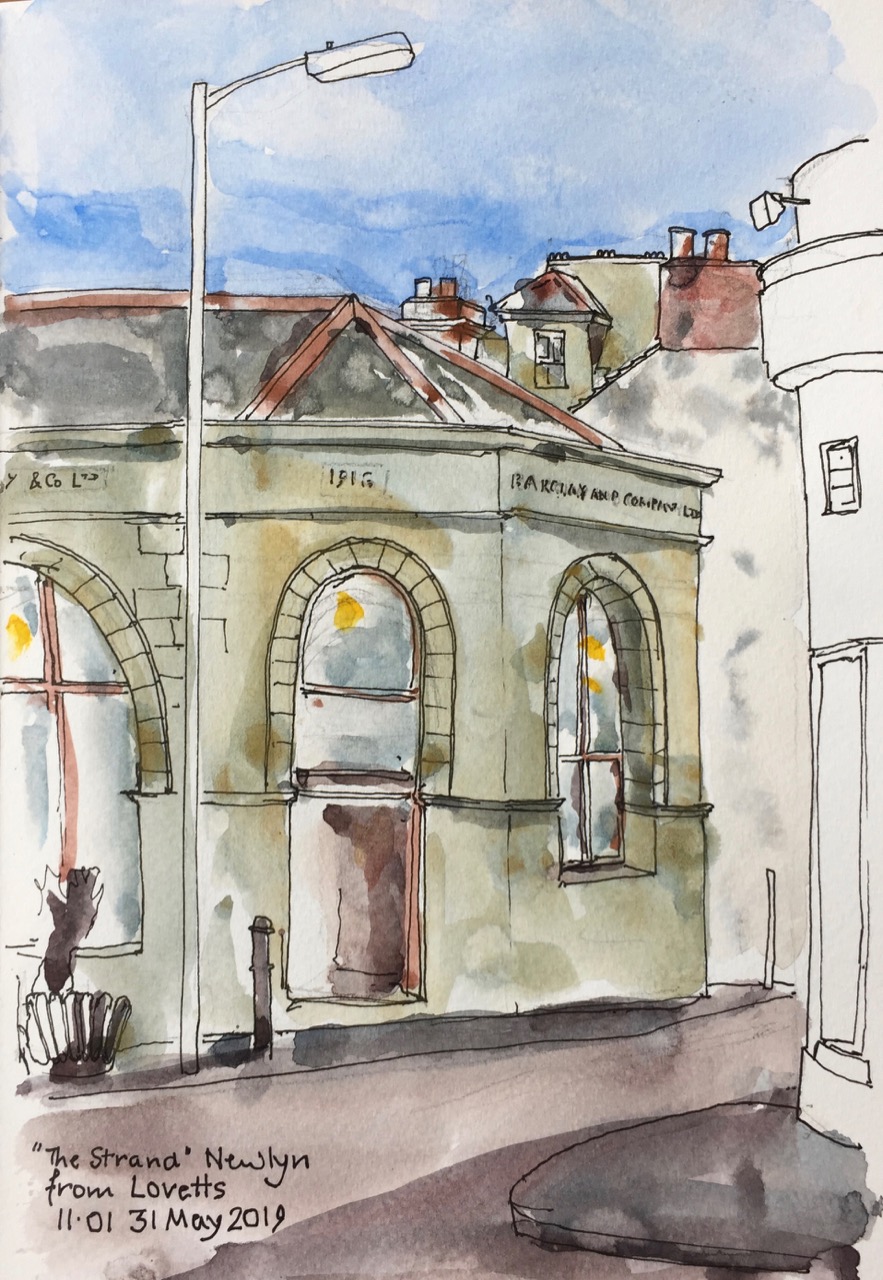
Shetland: Foula on the horizon

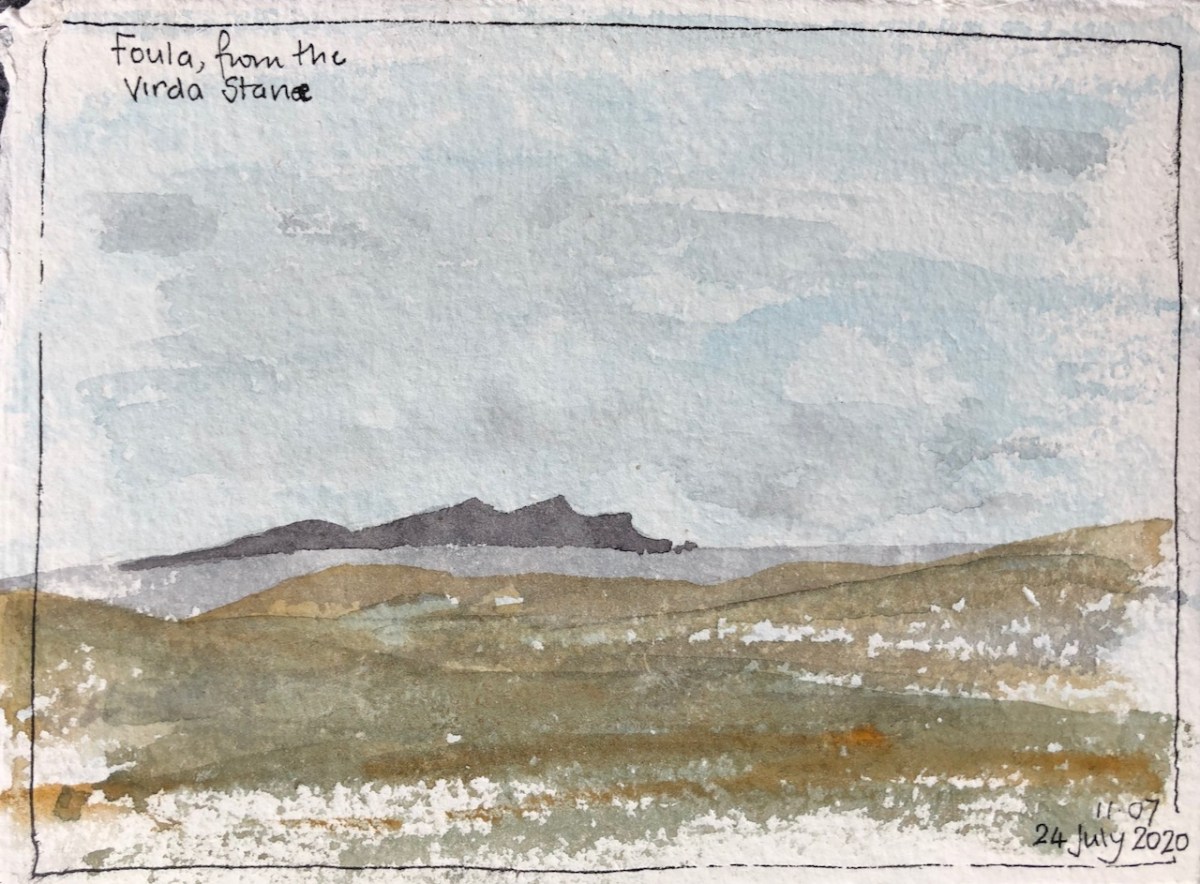
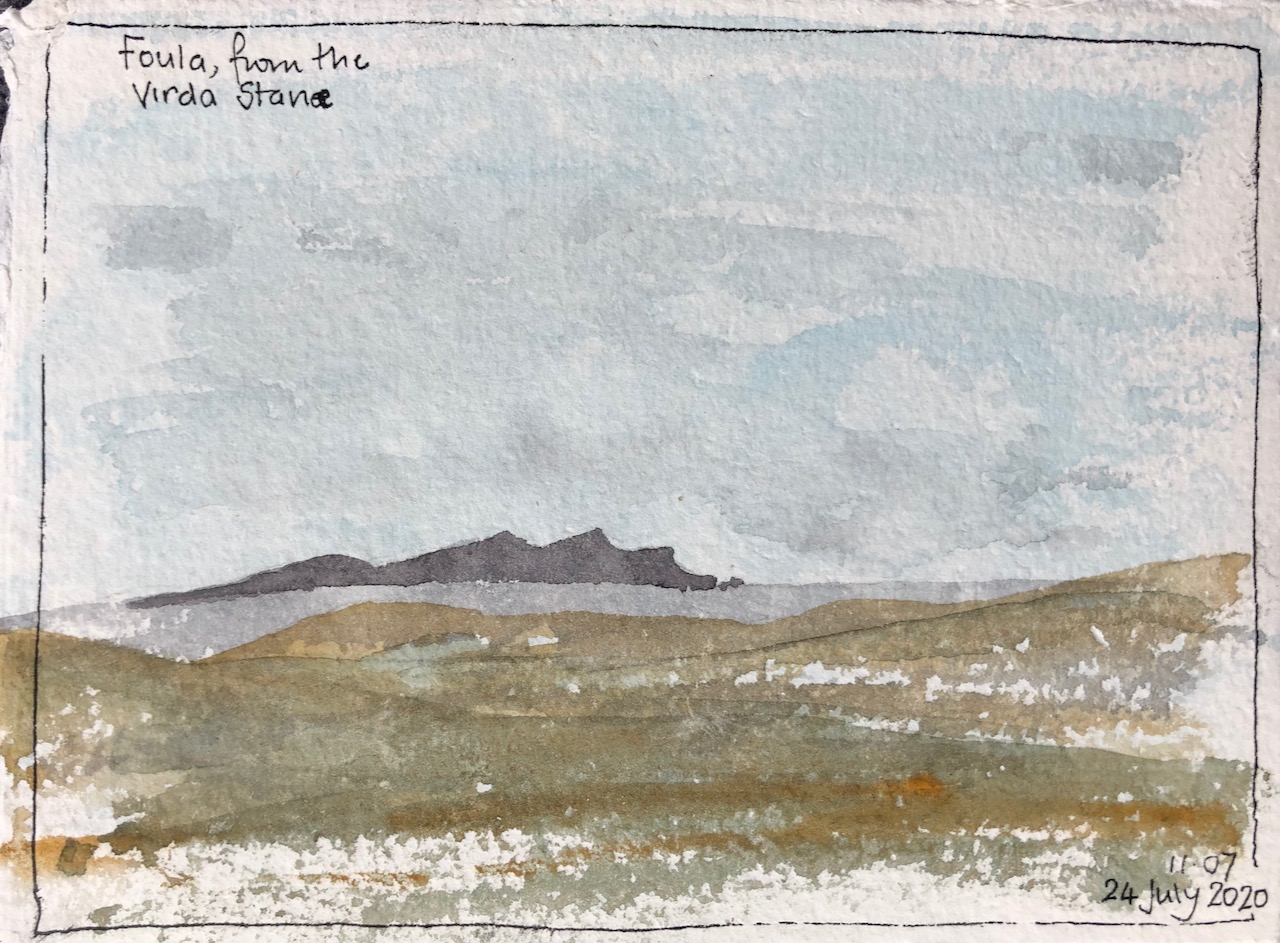
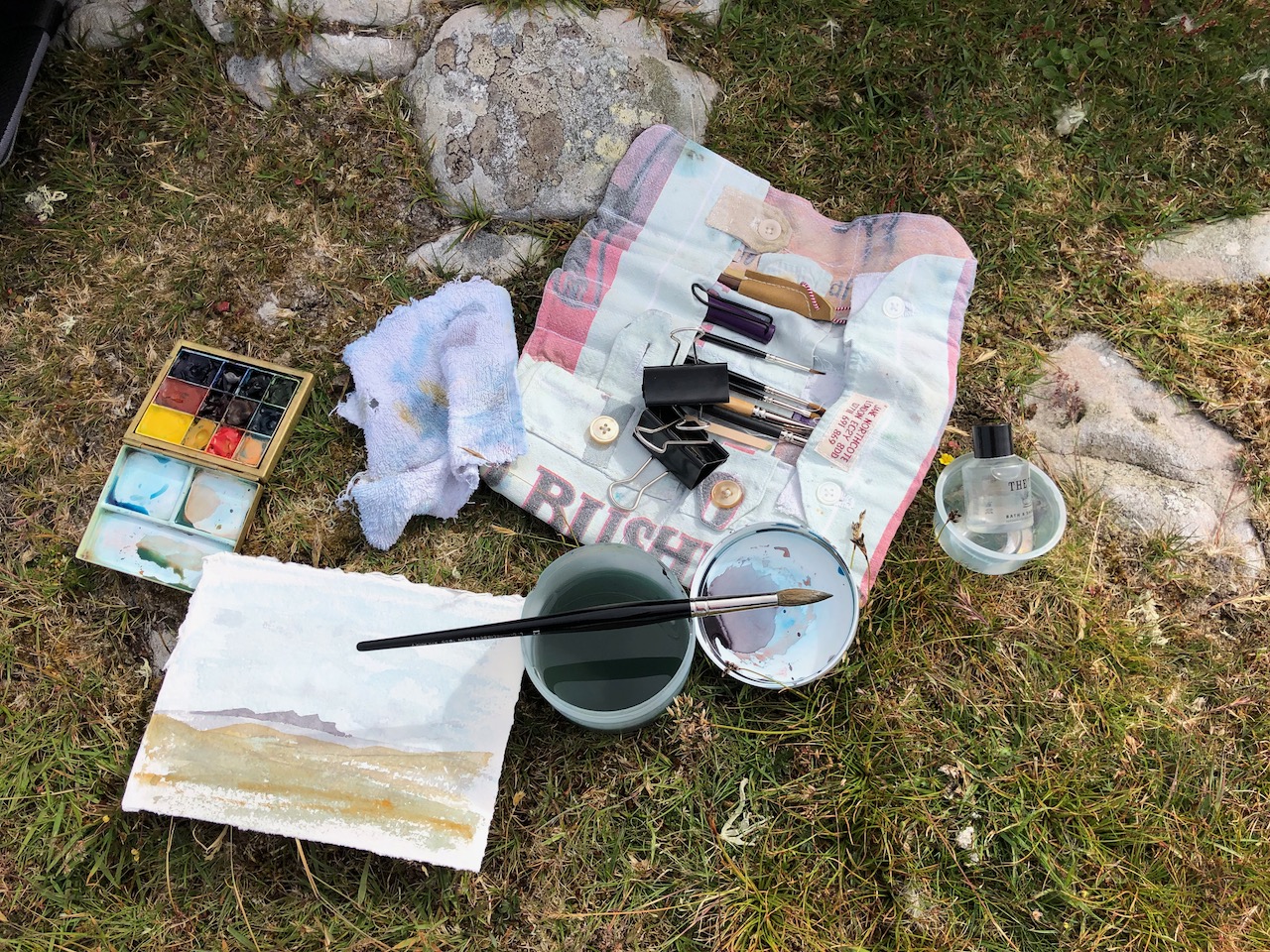
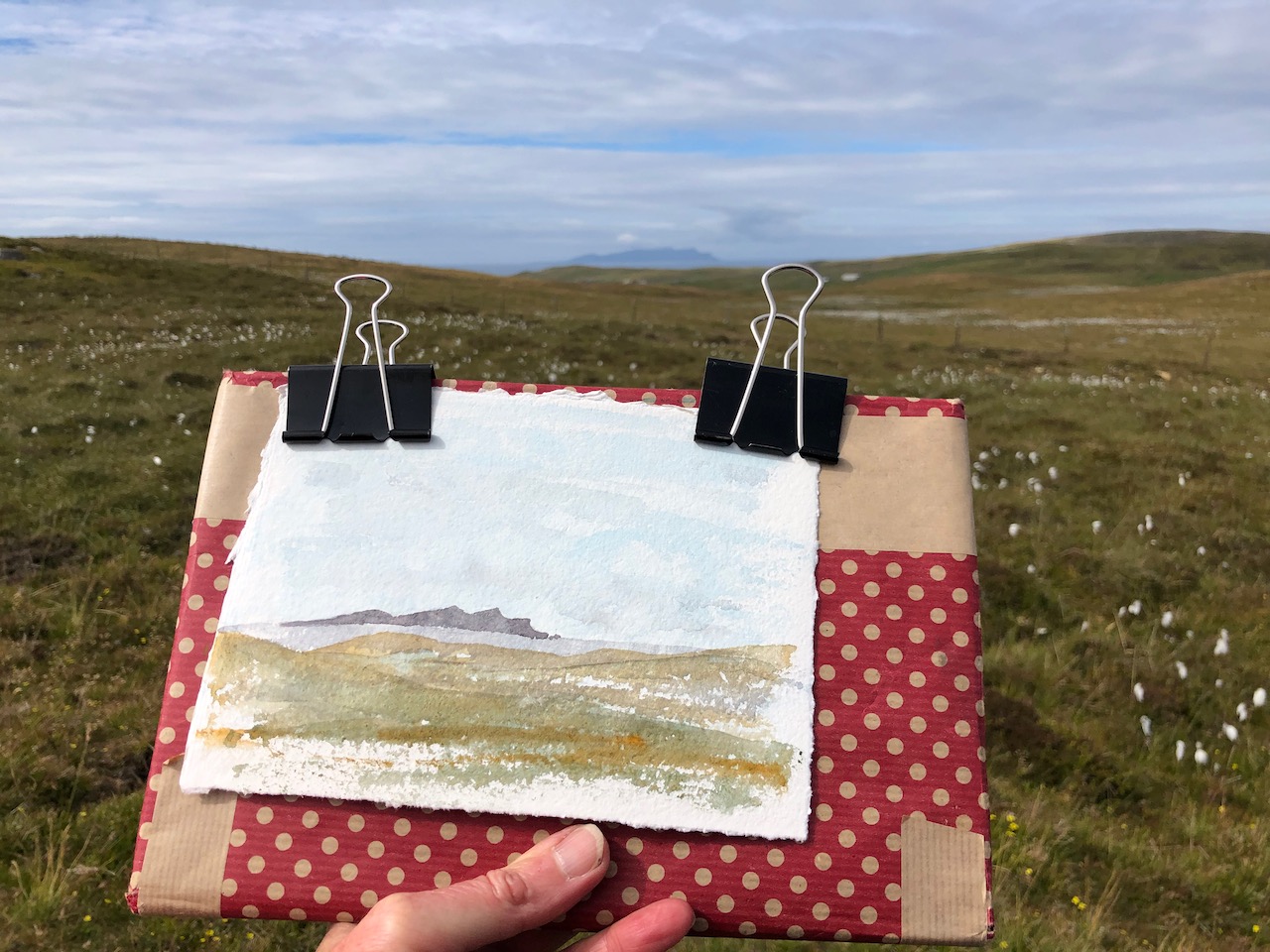
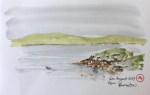
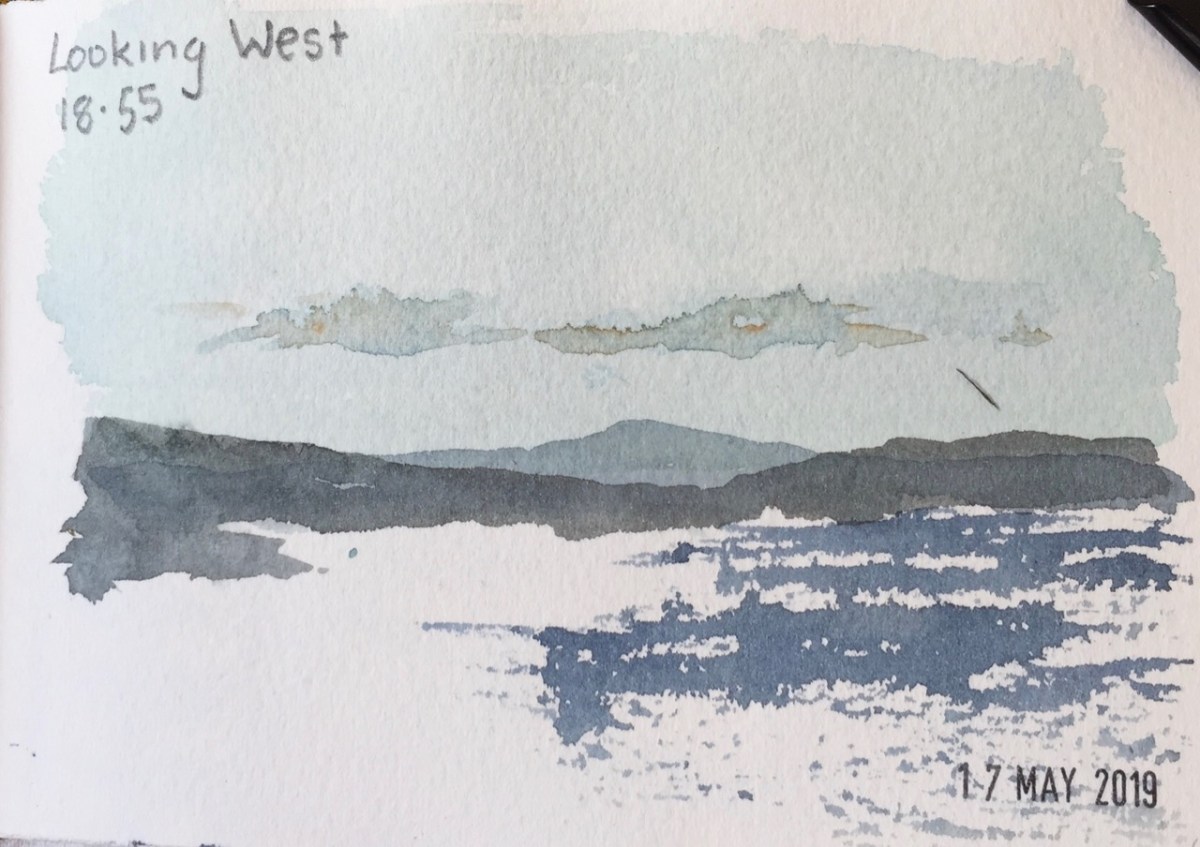
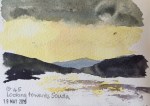
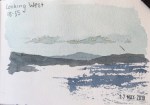
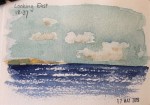
Here is a sketch of the mysterious island of Foula.

Foula on the horizon

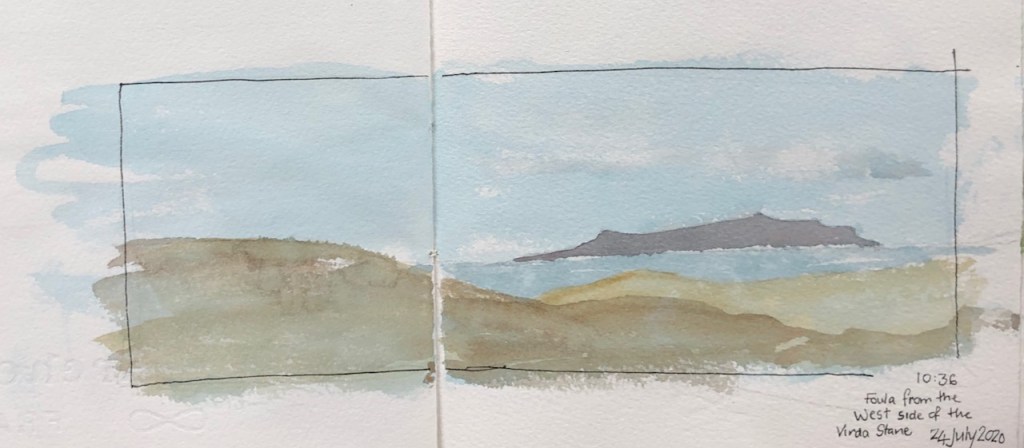
Foula is about 20 miles away from Shetland Mainland, so it hovers on the horizon, often with its own special cloud.

This is a view from the Virda Stane, which is at the top of a hill. It’s a rare view: normally at this stage on the walk I would hunkered down on the East side of the stone, with its bulk sheltering me from the howling West wind. However on this particular day, there was eerily little wind. So I could sit on the West side, and observe Foula, before it disappeared in the fog.

Shetland: Rocks and Headlands

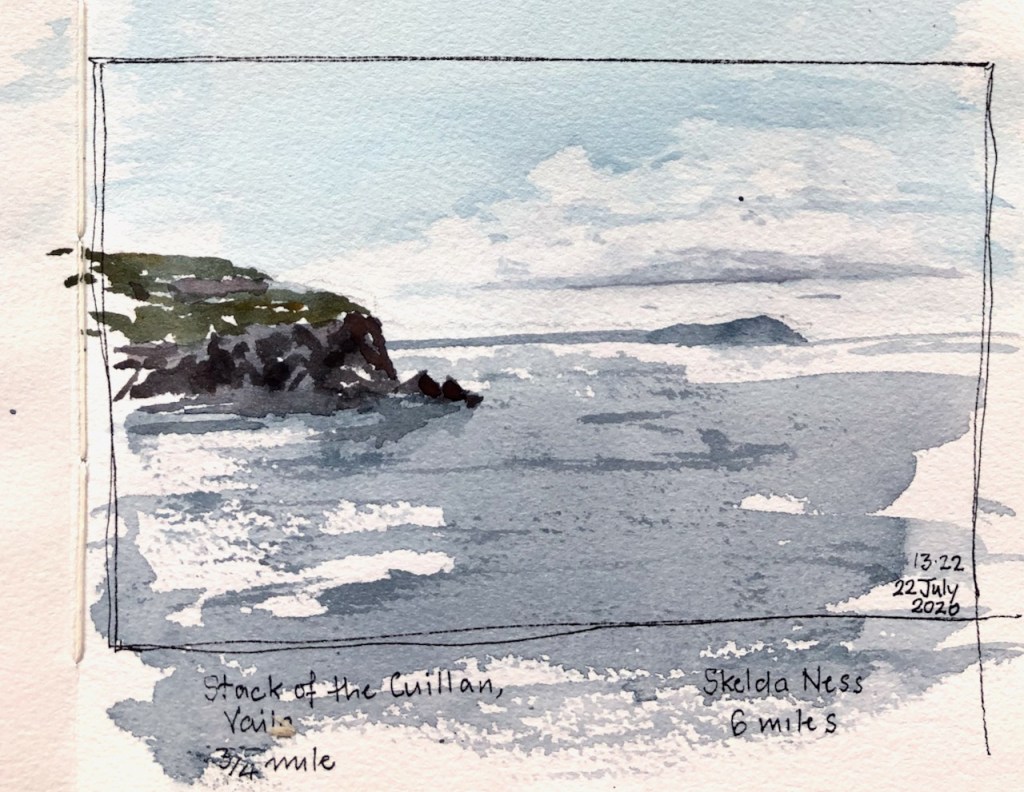
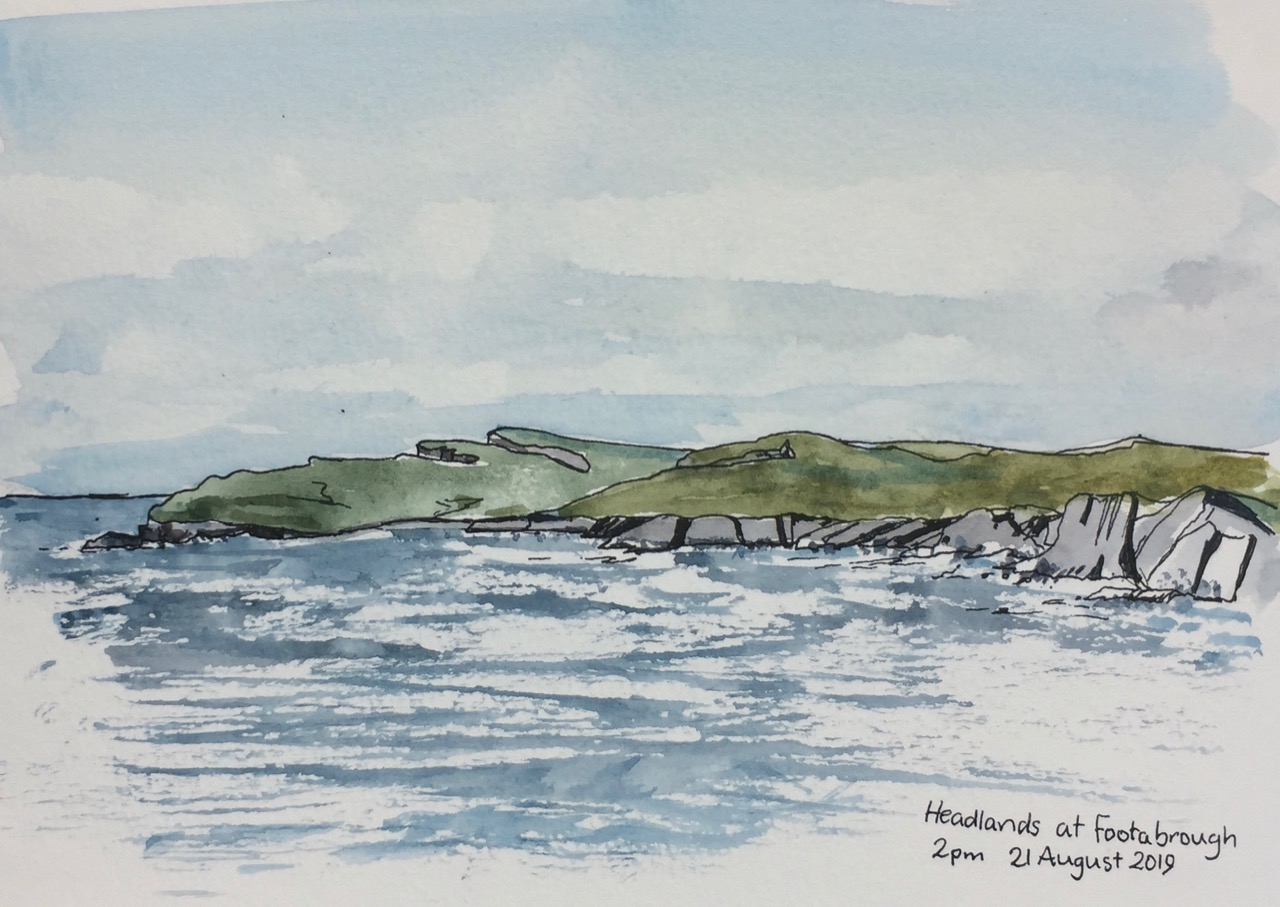
On a long walk to Footabrough, I paused to do a drawing of a distant headland.

From Uskie Geo

The drawing shows the West corner of the island of Vaila, with the wonderfully named “Stack of the Cuillan”, which are the rocks forming a small island at the base of the cliffs. In the distance is a headland. The question is: what is the headland?

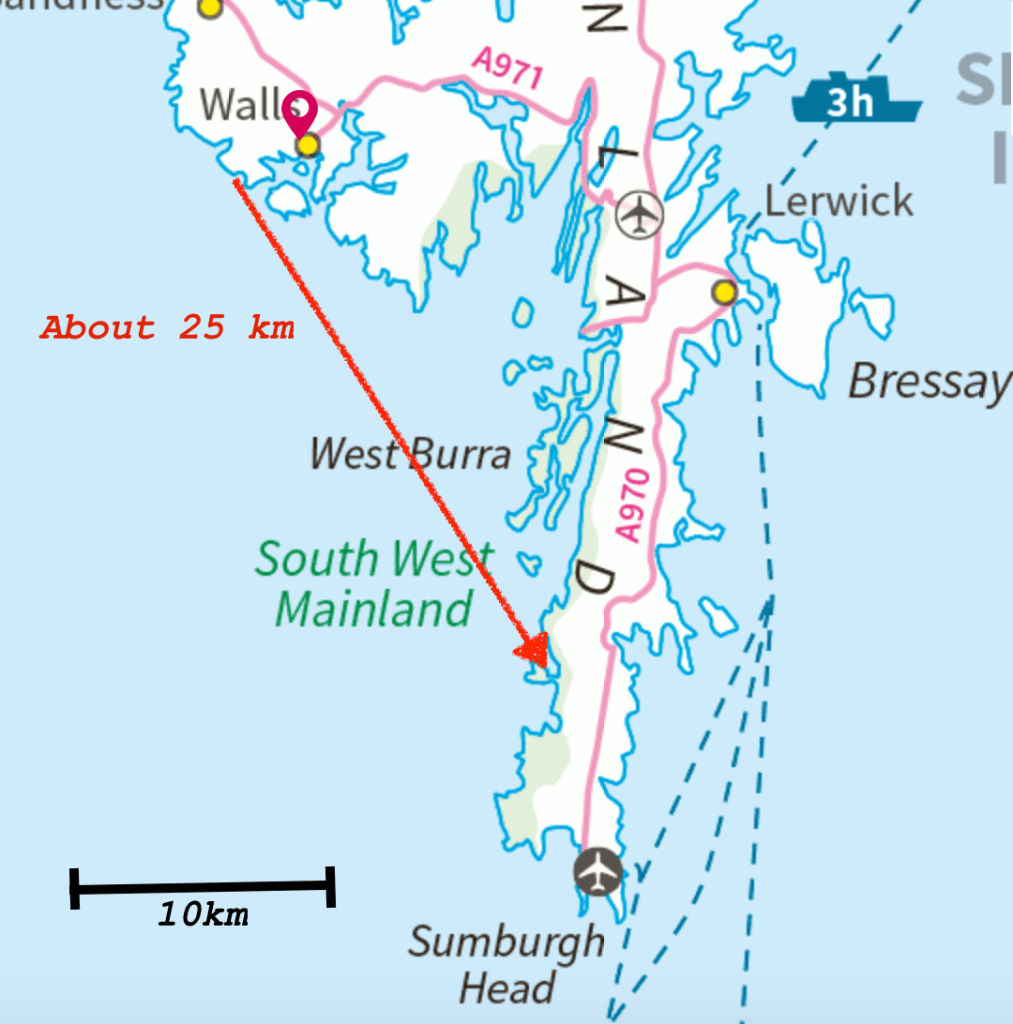
When I was drawing it, I thought it must be Skelda Ness, some 6 or 7 km away. But that might be hidden behind Vaila. So is that distant headland Sumburgh Head, 25km away?

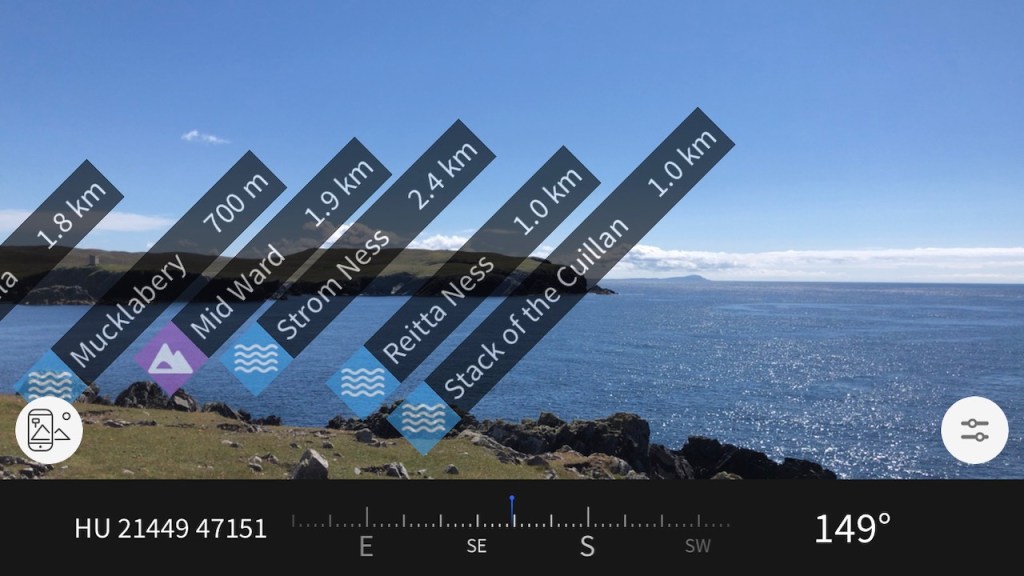
It occurred to me that the phone might know. I have the OS Maps app. But evidently it didn’t think I was interested in any feature so far away.

Screenshot from the OS Maps App. It helpfully identifies the local features, but not the distant headland.
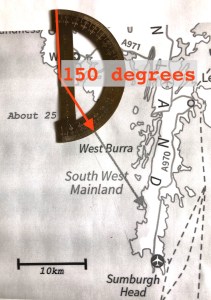
150 degrees bearing from where I drew the picture.

However it did give me the bearing: 149 degrees, as you see. So now back in London I can use my old school protractor.

It’s Sumburgh Head in the picture. I’m glad we sorted that out!

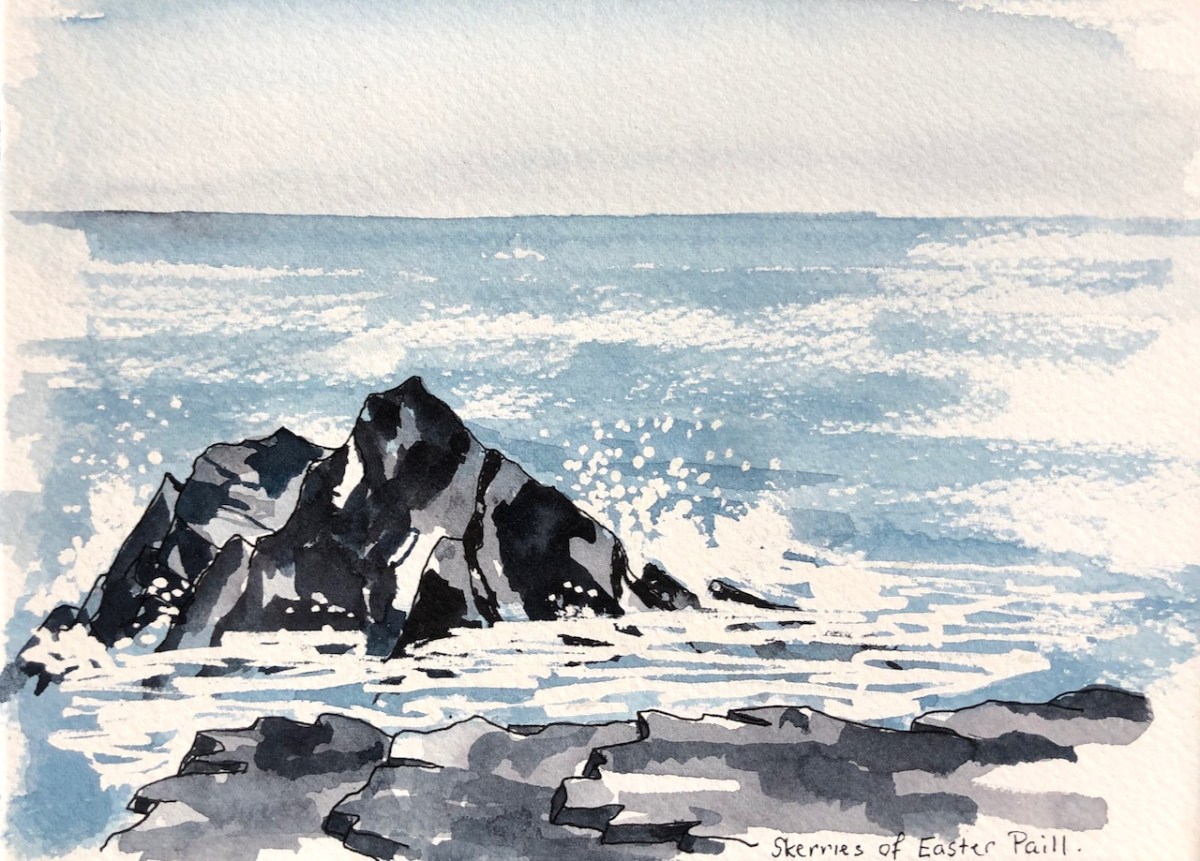
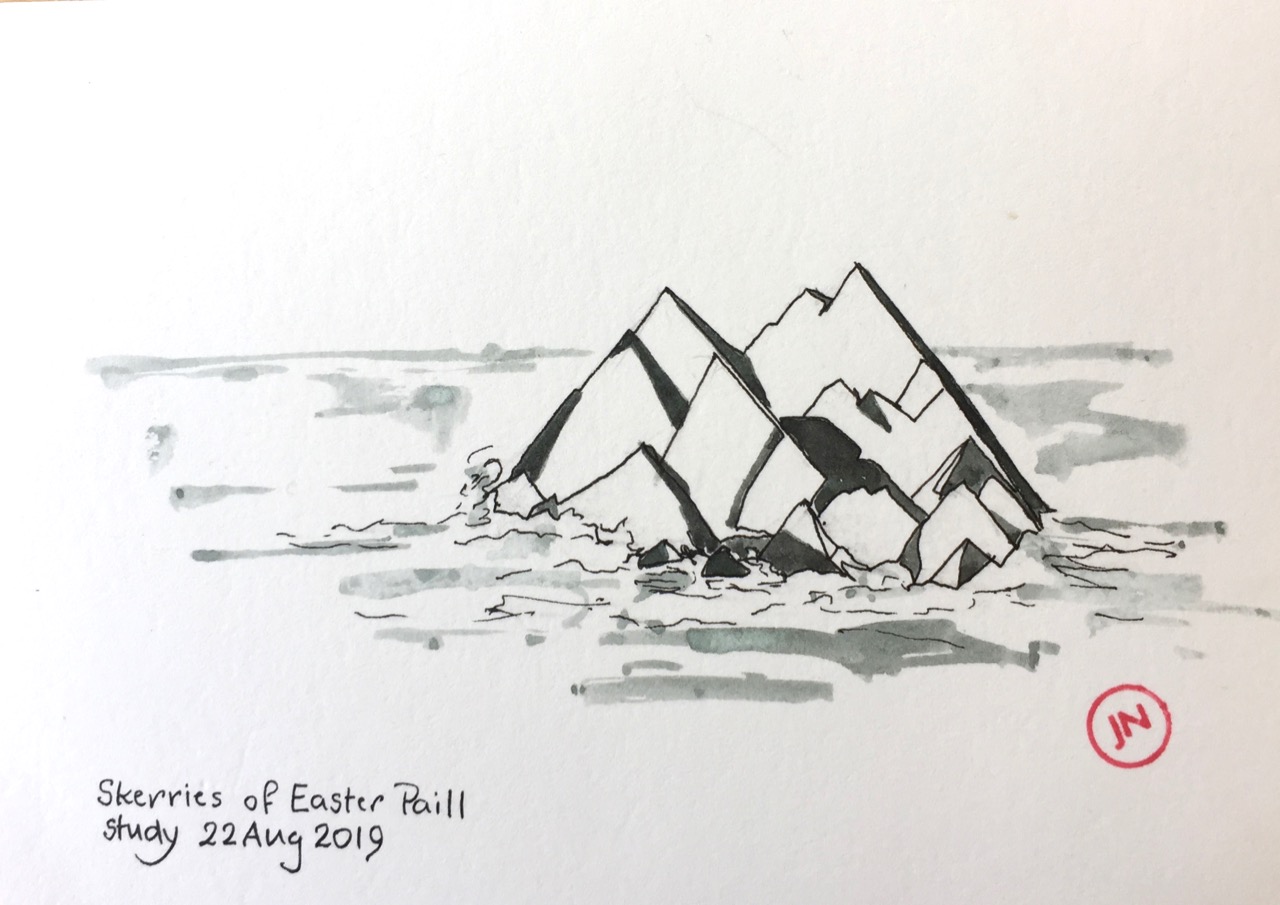
Further on towards Footabrough are the Skerries of Easter Paill.

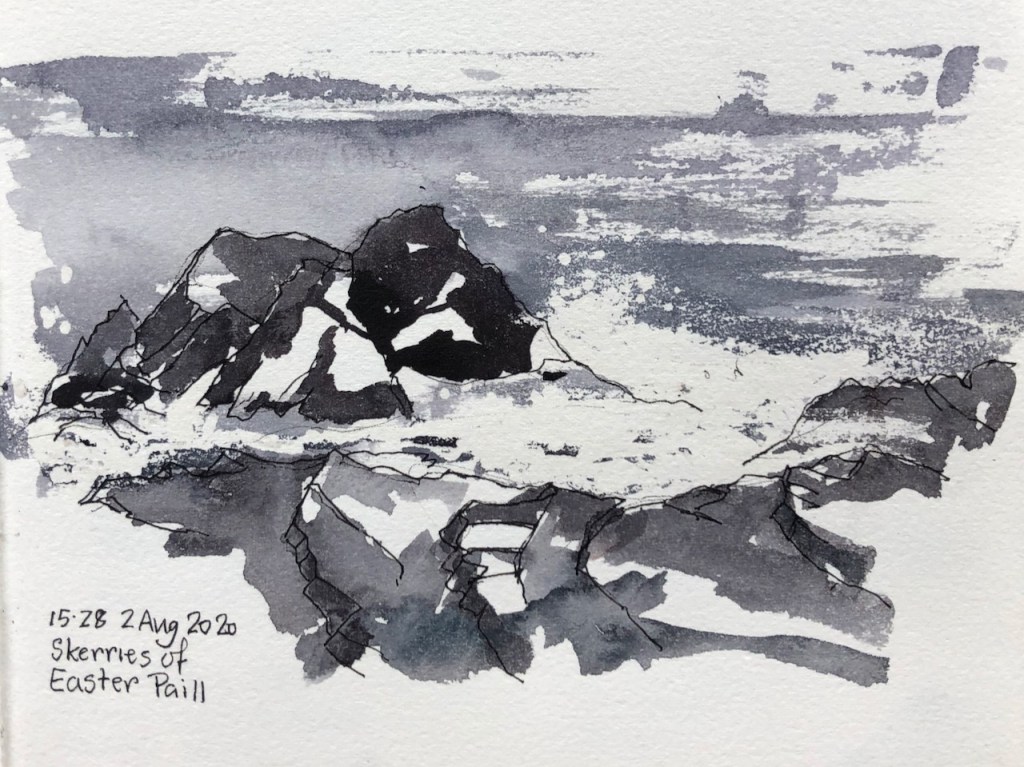
Skerries of Easter Paill, drawn on location.

The word “Easter” here does not relate to the Christian festival, but to the fact that these small islands are the ones on the East. I guess this implies there must be a “Wester Paill” somewhere but I haven’t found it.

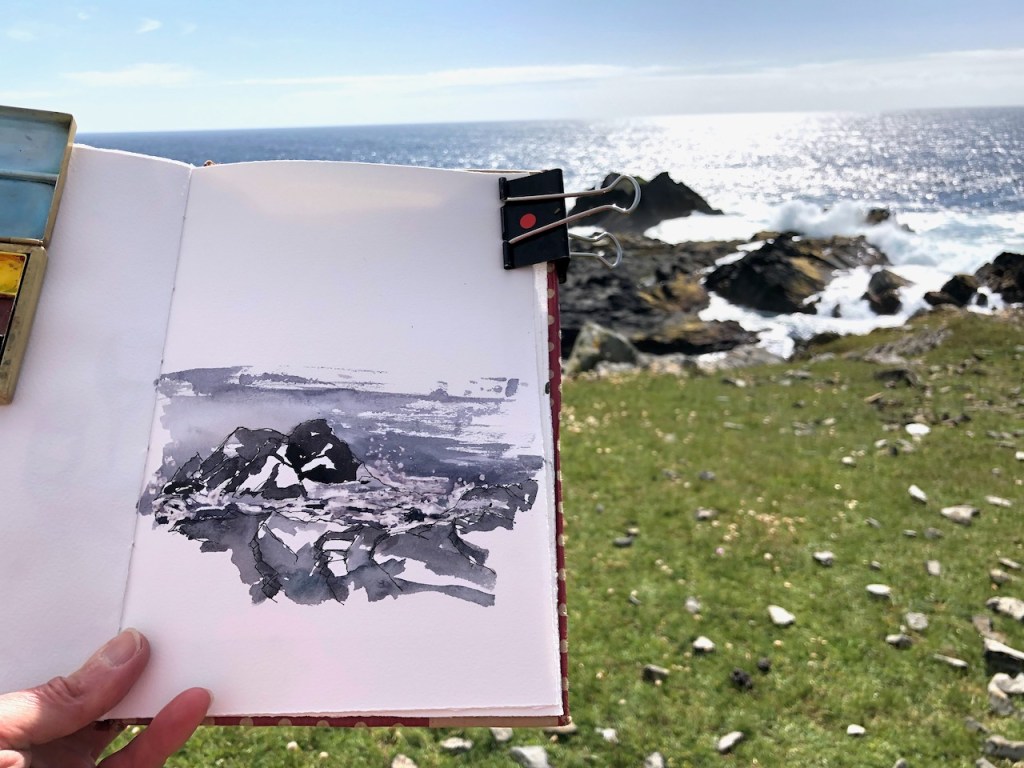
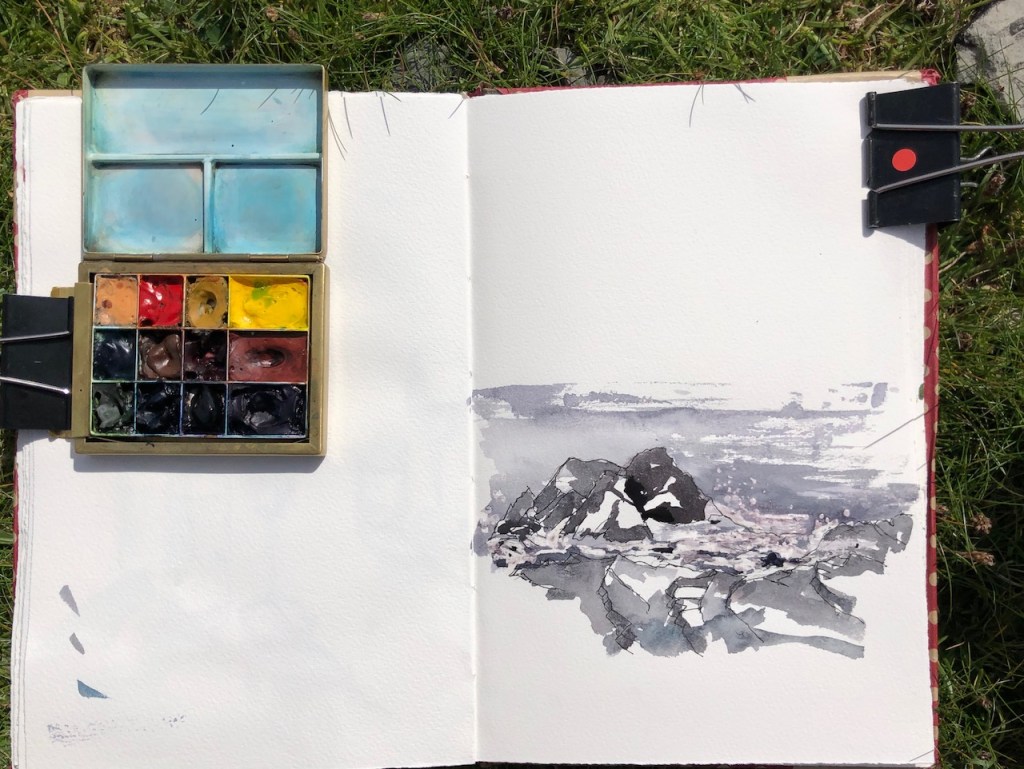
I drew this on location in my sketchbook.

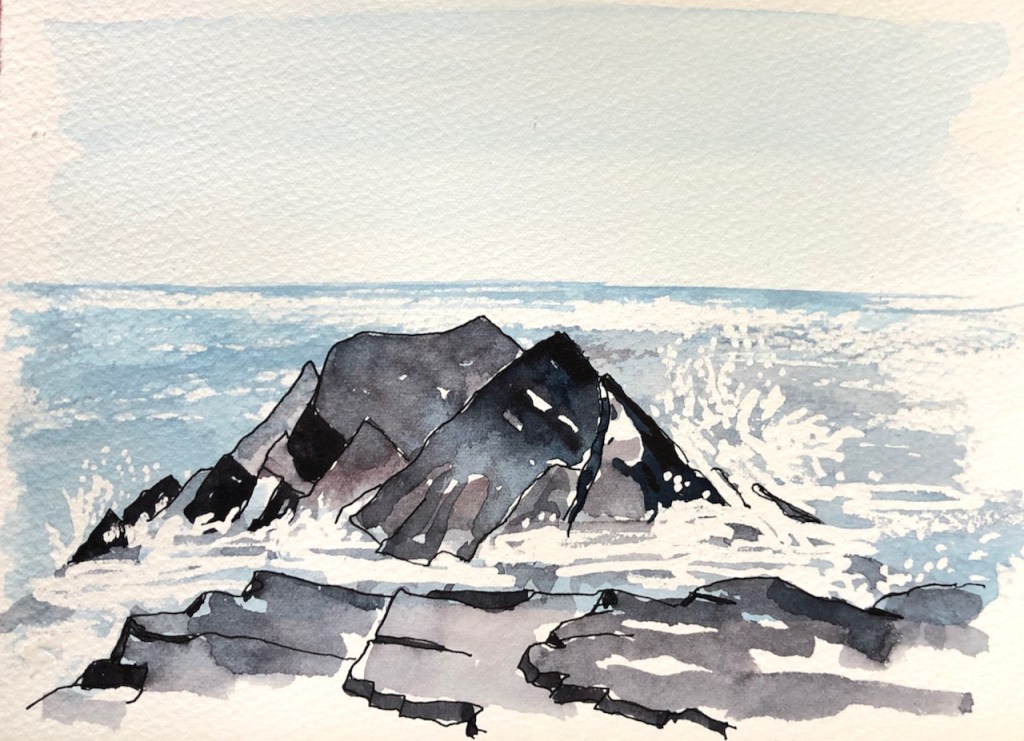
The waves are done with watercolour resist. The resist is a kind of rubber solution a bit like Typex. The air was somewhat damp, despite the fine weather. I applied the resist before the paint was entirely dry, and then the resist didn’t dry properly either. I walked along for while with the sketchbook open, flapping it, much to the consternation of nearby terns. Then the terrain became more complicated, and too rocky to scramble over carrying an open sketchbook in one hand. I sat down on a stone and rubbed the resist off, which reveals the white bits. I was pleased with the result, obtained even in these adverse conditions. The product I was using is “Schminke Rubbelkrepp neutral”, in a tiny 20ml jar, applied with a brush.

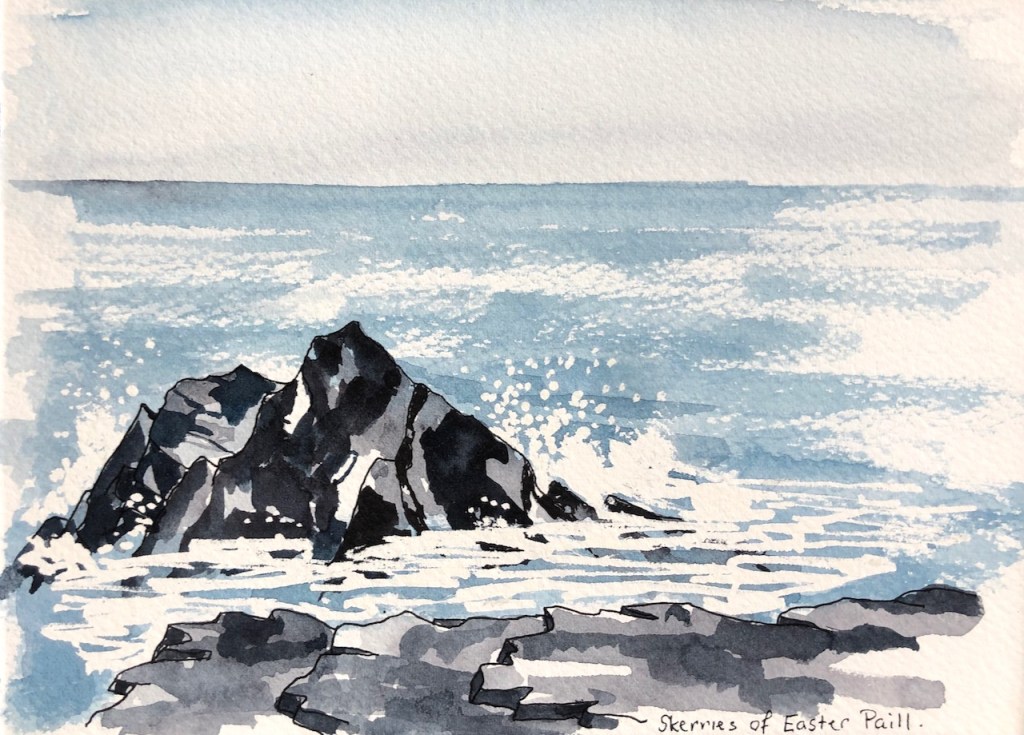
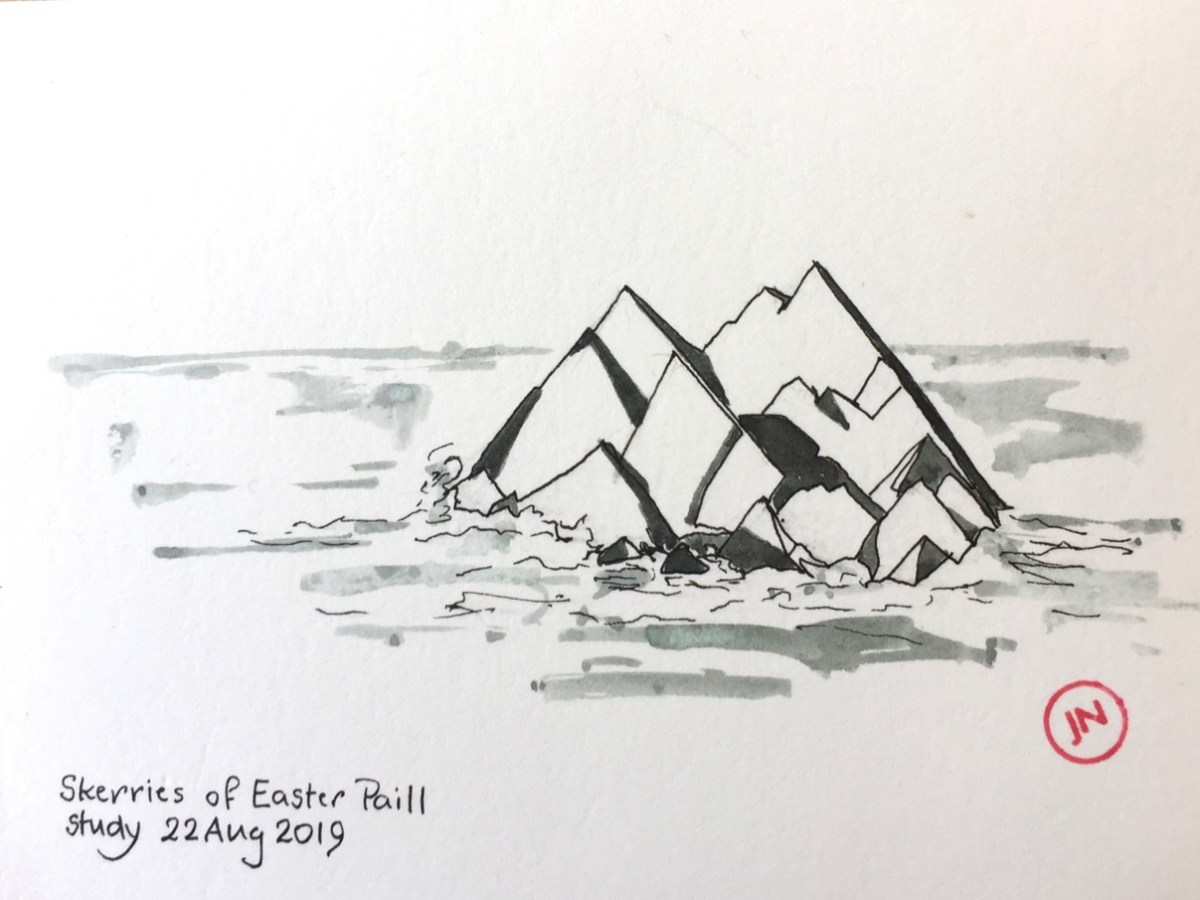
In the evening I had another go, this time trying to describe also the brilliant light of the day, and the clarity of the water, as well as the pointedness of the rocks, and their regular angles.

Skerries of Easter Paill, drawn at my desk, based on the sketch on location.

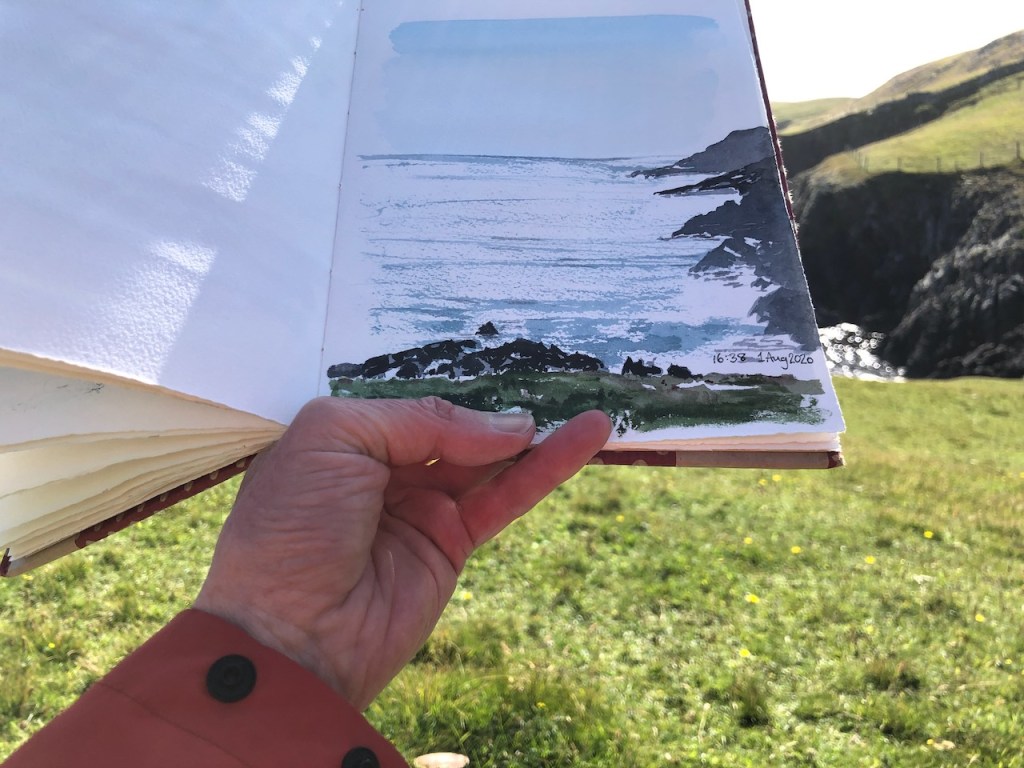
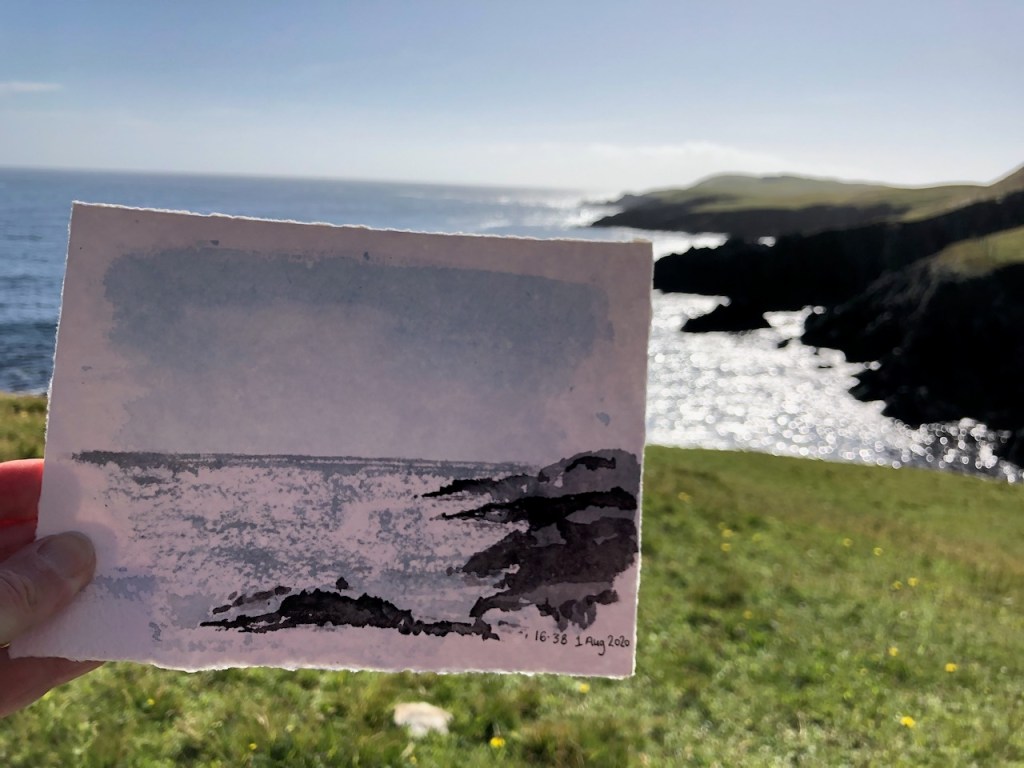
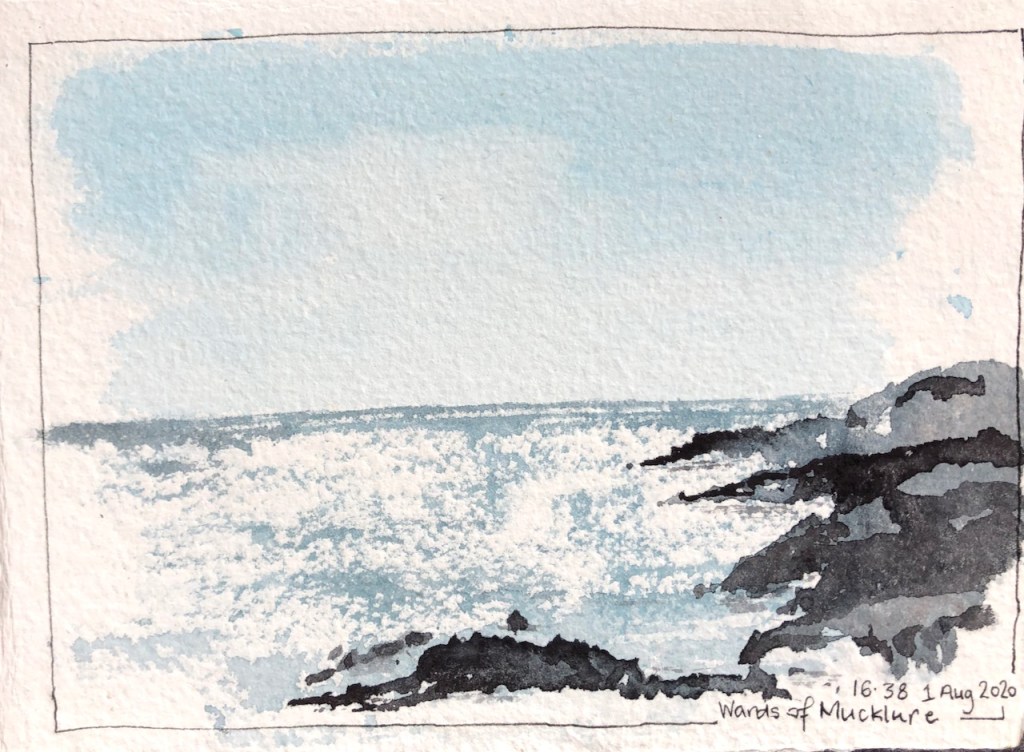
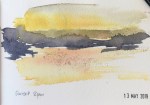
On another walk, I drew the headlands of Mucklure.

The dark is terrifyingly black, and the glitter from the sea is blindingly bright. It’s impossible to draw. But it’s so arrestingly beautiful that I had to have a go.

This scenery demands to be drawn.

Here are some blog posts from previous expeditions to Shetland. You can also see a collection of Shetland Landscapes (2017) on this link.

Shetland, Skerries of Easter Paill

The rocks off the ward of Mucklure are almost geometrical in their formations. They make abrupt right angles. Here are the Skerries of Easter Paill, small rocks in the sea off Dounawall and The Hamar. Here is another drawing of the same location. It’s hard to get an idea of the scale. Here’s a map…

Shetland 2019 – pen and wash

Here are some pictures I drew in pen and wash. I spent a lot of time drawing rocks. The rocks are overwhelming in their detail. Not every thing I saw is in the picture. But every thing in the picture, I saw. Here are some pictures I drew on the journey going back South: And…

Shetland: Towards Vaila

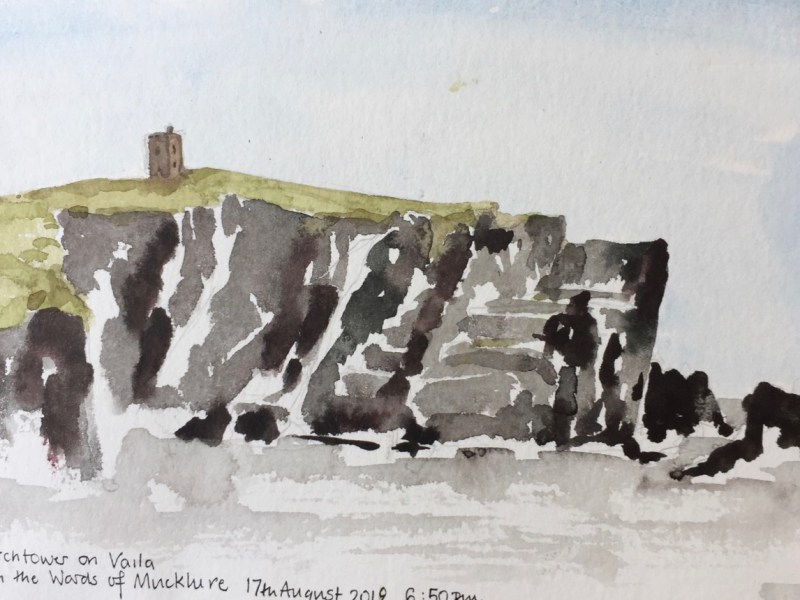
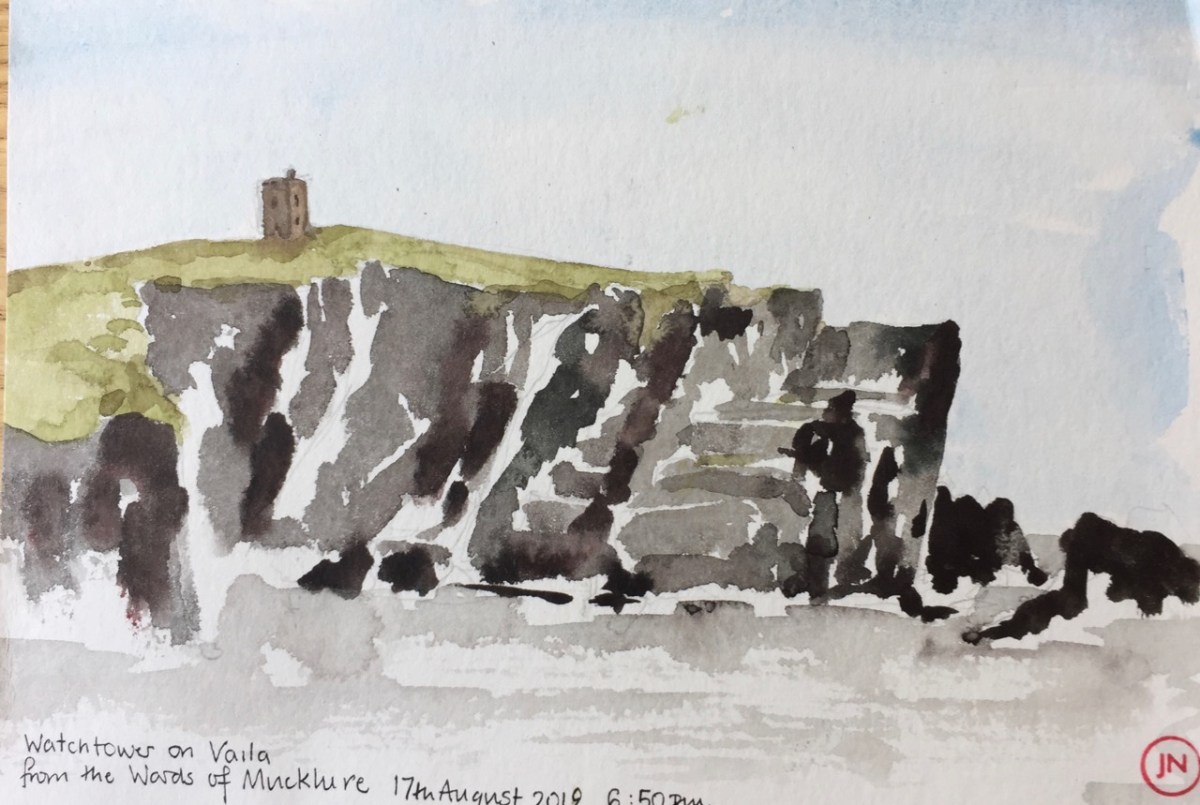
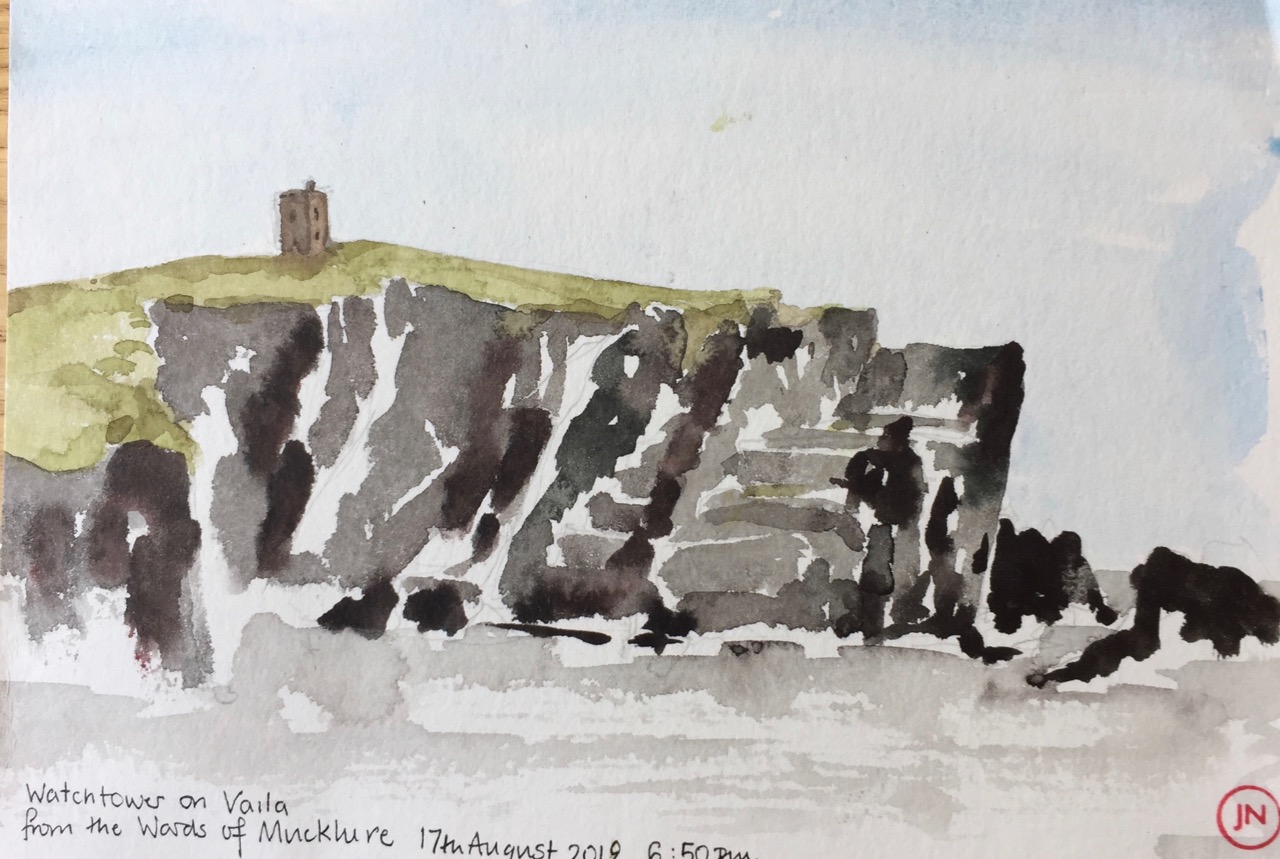
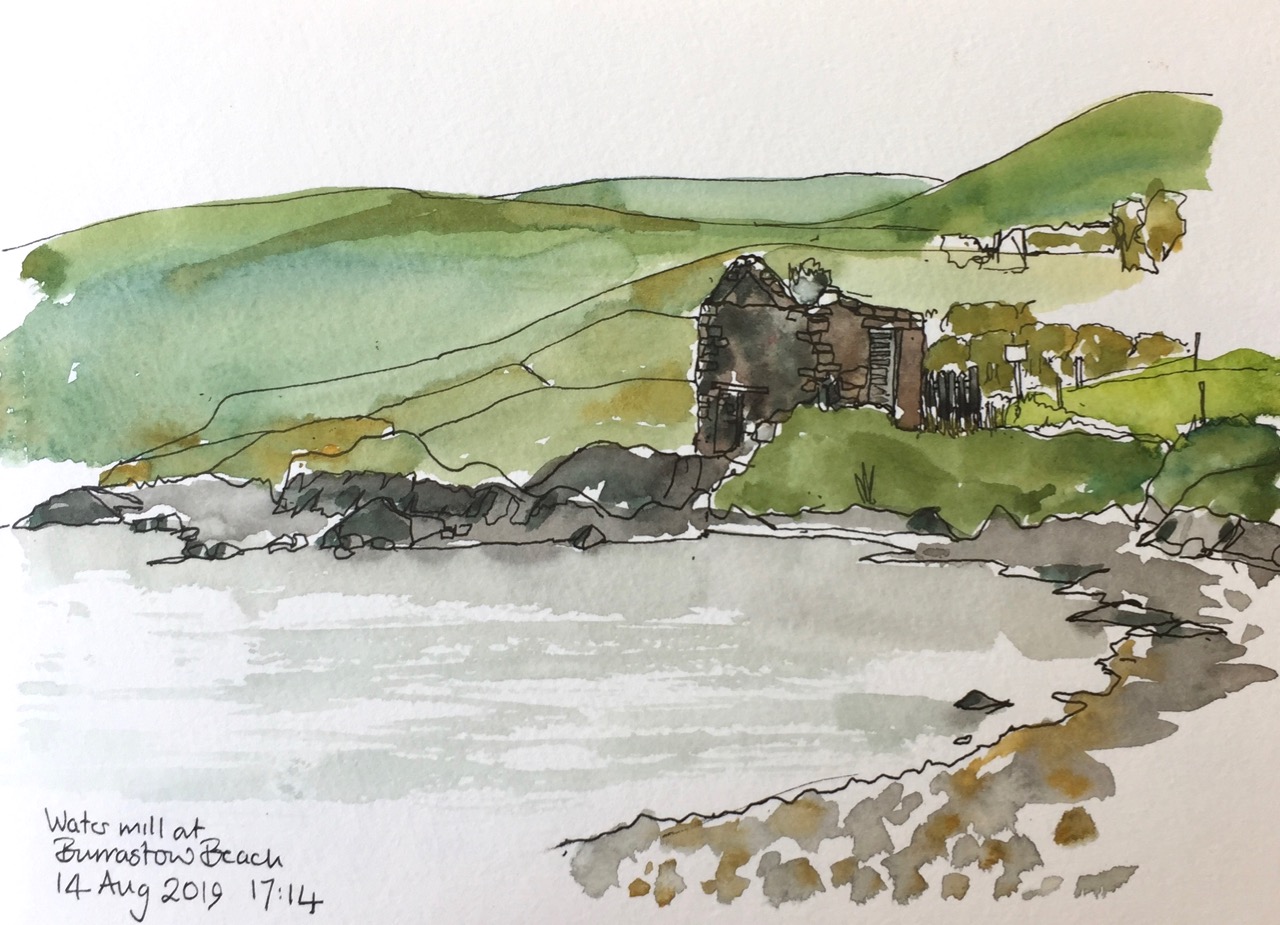
There’s a beach near Burrastow that looks towards the Island of Vaila. Here’s a sketch I made from the cliffs above the beach. Those cliffs look steep and dark. The tower is a “watch tower”, I’m told, built by the Laird back in the day (1700s) to watch over his fishing operations. The story I…

Shetland, Historic site walk

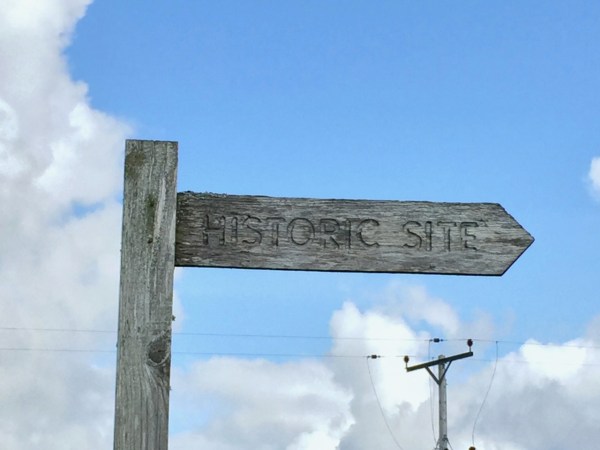
The wooden sign from the main road said “Historic Site”, and pointed up a small road that lead steeply uphill. I was on my morning run and felt energetic, so I set off up there, keen to see the Historic Site. In Shetland, Historic Sites are often at the top of hills. At the top…

Shetland landscapes

Here is a collection of landscapes all done directly in watercolour with no pen and ink. I am using Daniel Smith Watercolours, and trying different mixing combinations. All of these pictures are done with three or fewer colours, alone or mixed together. It seems to me that the fewer the better. The picture hangs together…

Here’s another attempt at the skerries of Easter Paill:

Shetland: Towards Vaila

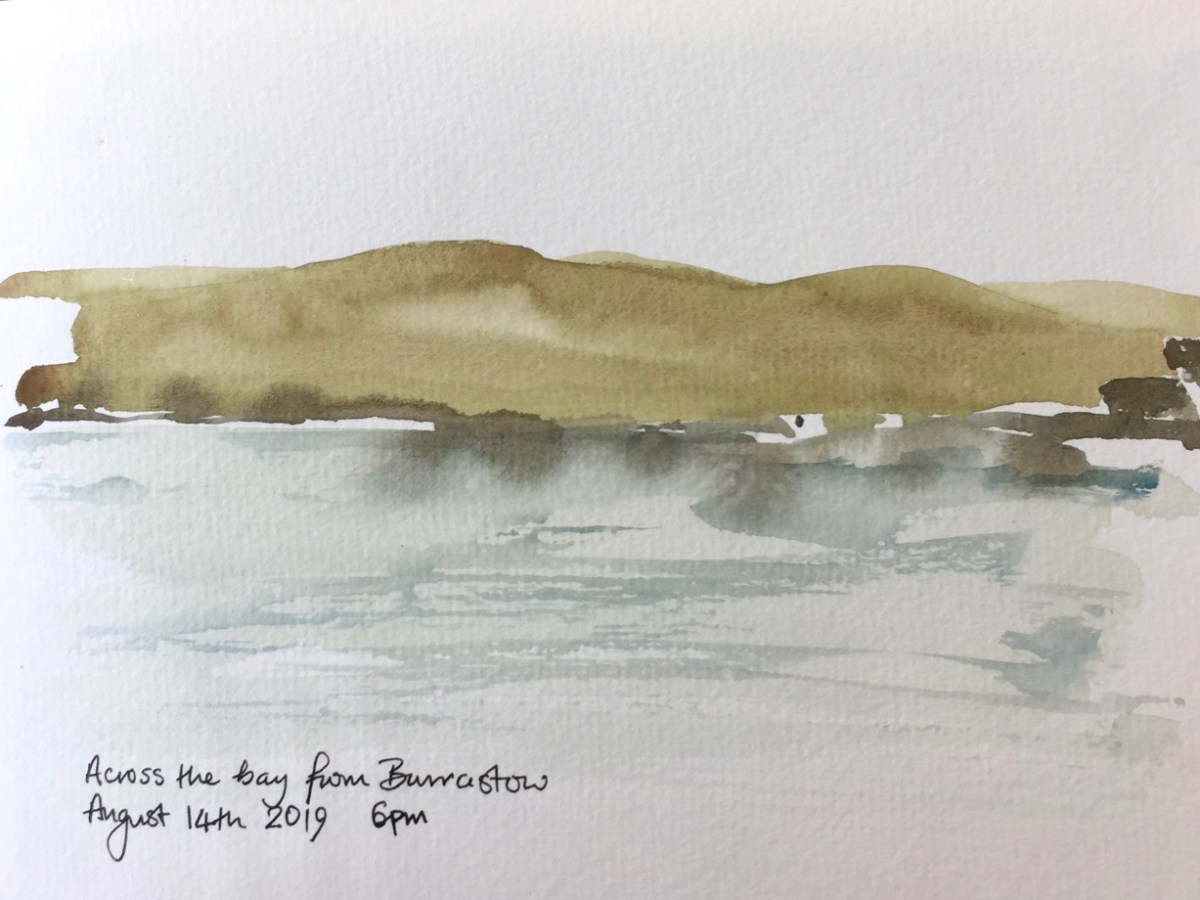
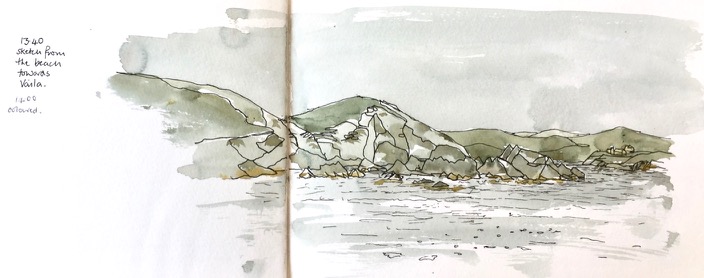
There’s a beach near Burrastow that looks towards the Island of Vaila.

Here’s a sketch I made from the cliffs above the beach.

IMG_3489

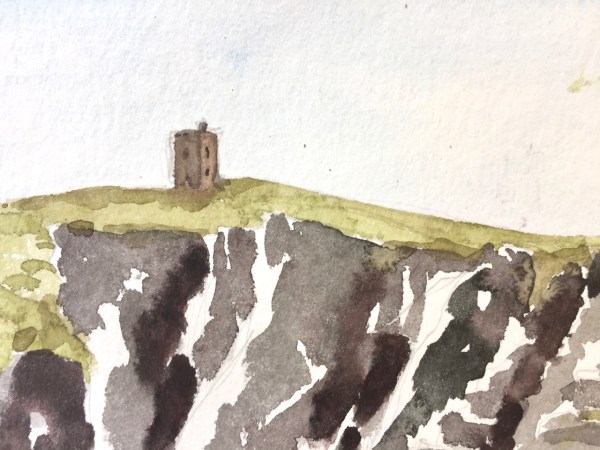
Those cliffs look steep and dark. The tower is a “watch tower”, I’m told, built by the Laird back in the day (1700s) to watch over his fishing operations. The story I was told was that the Laird’s tenants were selling their catch to Icelandic vessels out there in the bay. Then they returned with a meagre stock for the Laird. Or at least he suspected them of doing IMG_3490this. After all, he gave them very little, if anything for their catch. And the Icelanders would pay.

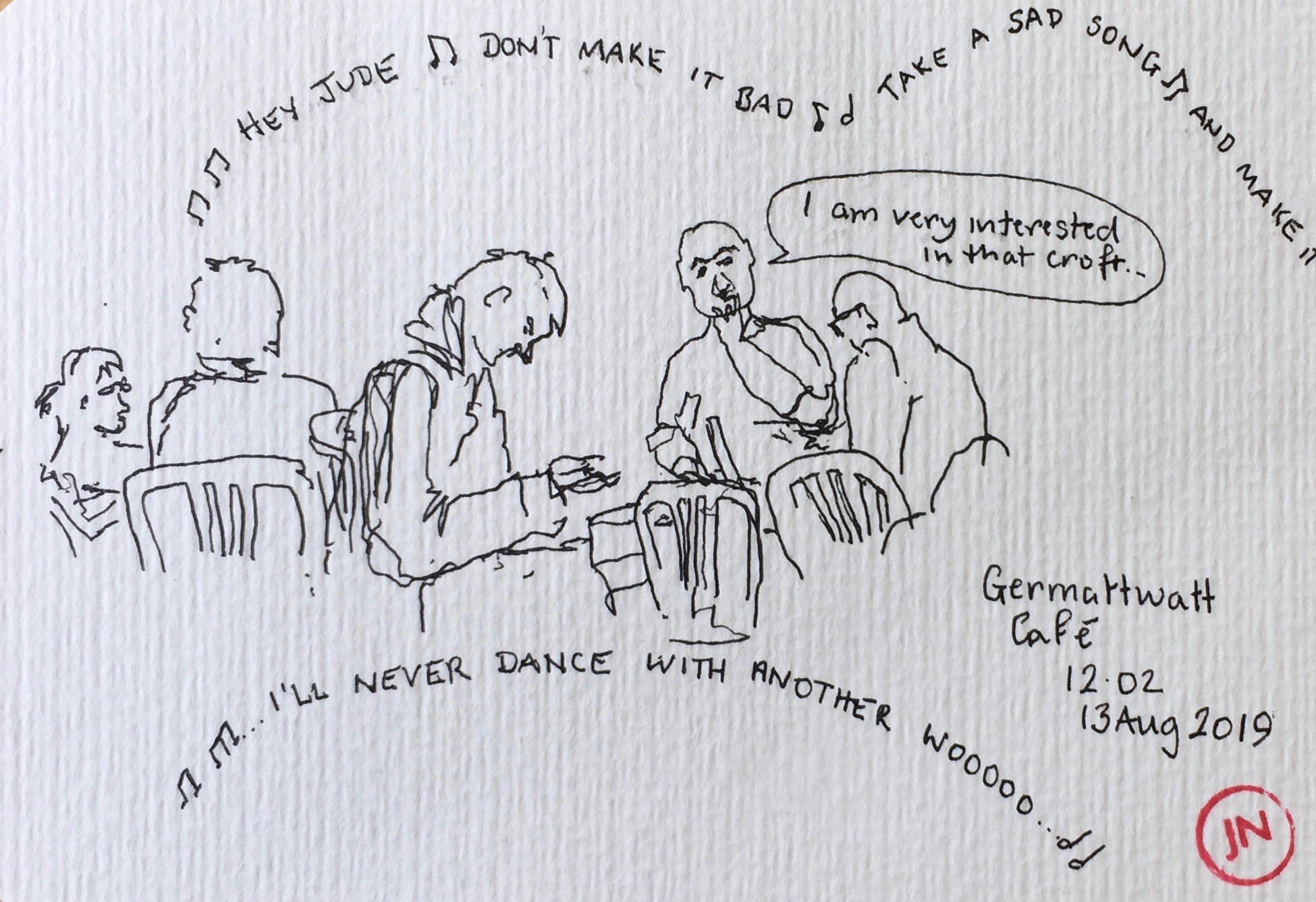
So he made the watchtower for surveillance. I was told this story in the Germattwatt café in Walls. The people made it sound as though it was living memory. But it was many generations ago, even if true. They also pointed out to me the place on the nearby hill where the miscreants were hanged, and left hanging, as an example.

The tower is listed as a project on the website of “Groves Raines Architects” as “Mucklaberry Tower, C19th 2-storey square plan Baronial reconstruction” . Their project was to refurbish it as a retreat, along with renovation of Vaila Hall.

On another day, from the beach, I determined to draw the rocks.

It was a very windy day, the wind blowing over the top of me.


IMG_3467 (1)

My rule for drawing rocks is this: everything that’s drawn is there, but not everything that’s there is drawn.


Shetland landscapes

Here is a collection of landscapes all done directly in watercolour with no pen and ink. I am using Daniel Smith Watercolours, and trying different mixing combinations. All of these pictures are done with three or fewer colours, alone or mixed together. It seems to me that the fewer the better. The picture hangs together better if I don’t use many colours. And it’s faster.

Click the picture to expand it.

Shetland, Skerries of Easter Paill

The rocks off the ward of Mucklure are almost geometrical in their formations. They make abrupt right angles.

Here are the Skerries of Easter Paill, small rocks in the sea off Dounawall and The Hamar.IMG_3492

Here is another drawing of the same location. It’s hard to get an idea of the scale.

Here’s a map showing the location. I drew the picture sitting on a rock that was not pointed but smooth and rounded, at a convenient height. In fact, I saw the convenient rock first, and then thought, what can I draw from here?

IMG_3496

I had spotted a few items of plastic waste on the beach at the Seal Lagoon and intended to put them in my rucksack. But there was more and more, until they didn’t fit in my rucksack and I had a whole dustbin bag full. Then I realised I didn’t know what I was going to do with the bag. I carried it for the next hour, until I reached civilisation again, and found a bin. Moral of the story: don’t start collecting plastic waste until you have worked out a forward plan for the next step. This is a general life lesson, I think.


Shetland 2019 – pen and wash

IMG_3471

Here are some pictures I drew in pen and wash.

I spent a lot of time drawing rocks.

IMG_3473
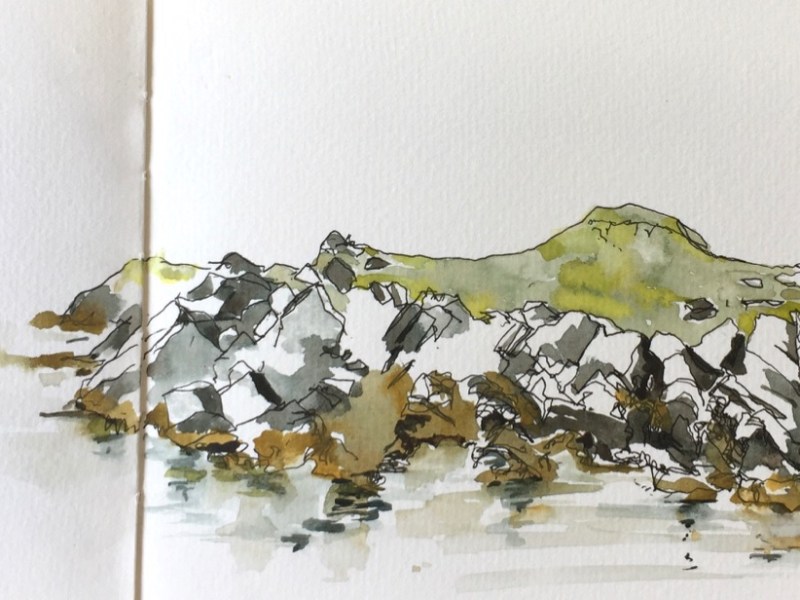
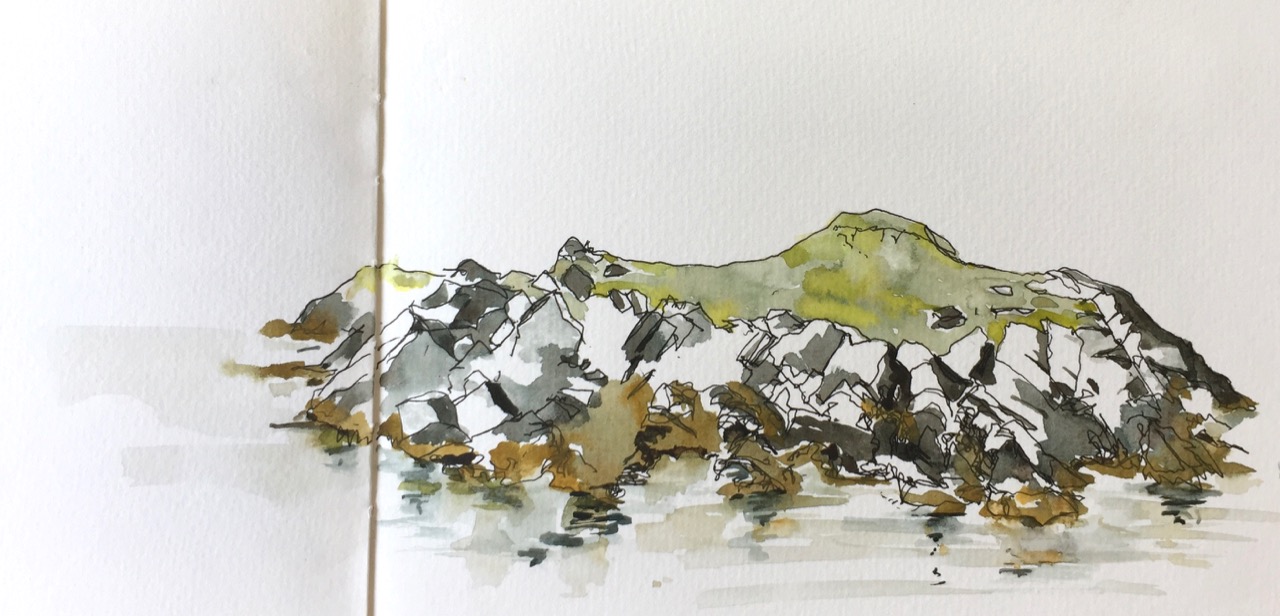
Rocks off Burrastow

The rocks are overwhelming in their detail. Not every thing I saw is in the picture. But every thing in the picture, I saw.

IMG_3465

IMG_3476

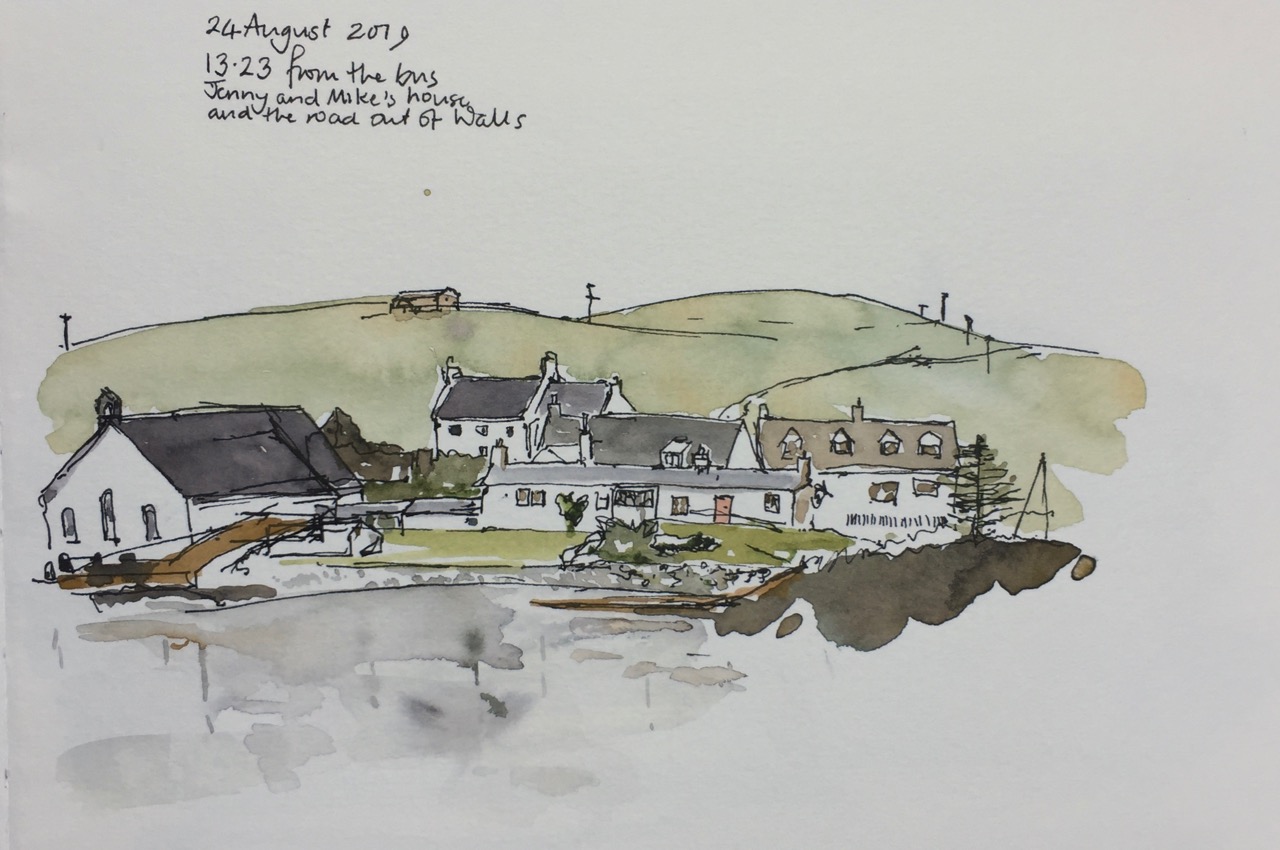
Here are some pictures I drew on the journey going back South:

IMG_3478
From the bus stop in Walls

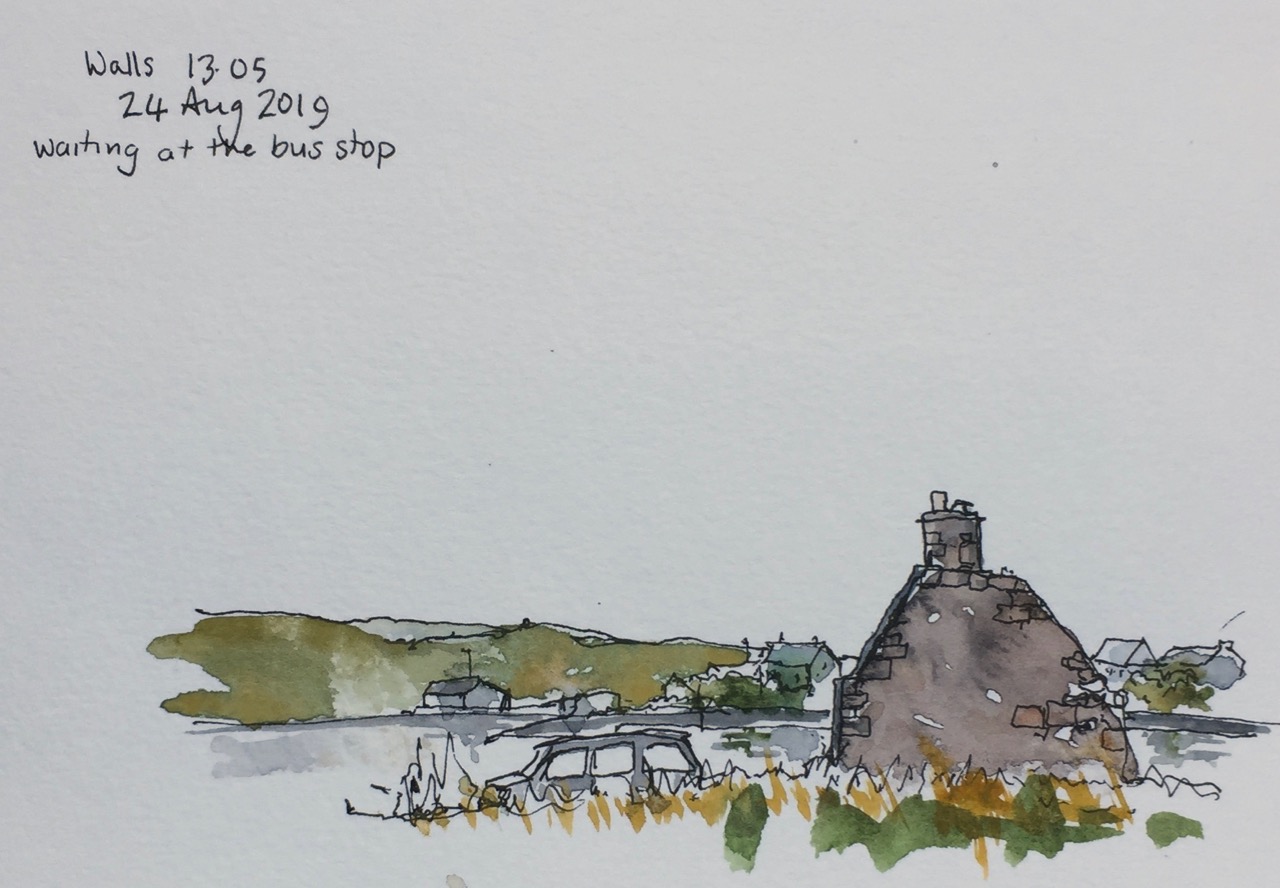
And another one, really quick sketches:

IMG_3477
Another sketch from the bus stop in Walls

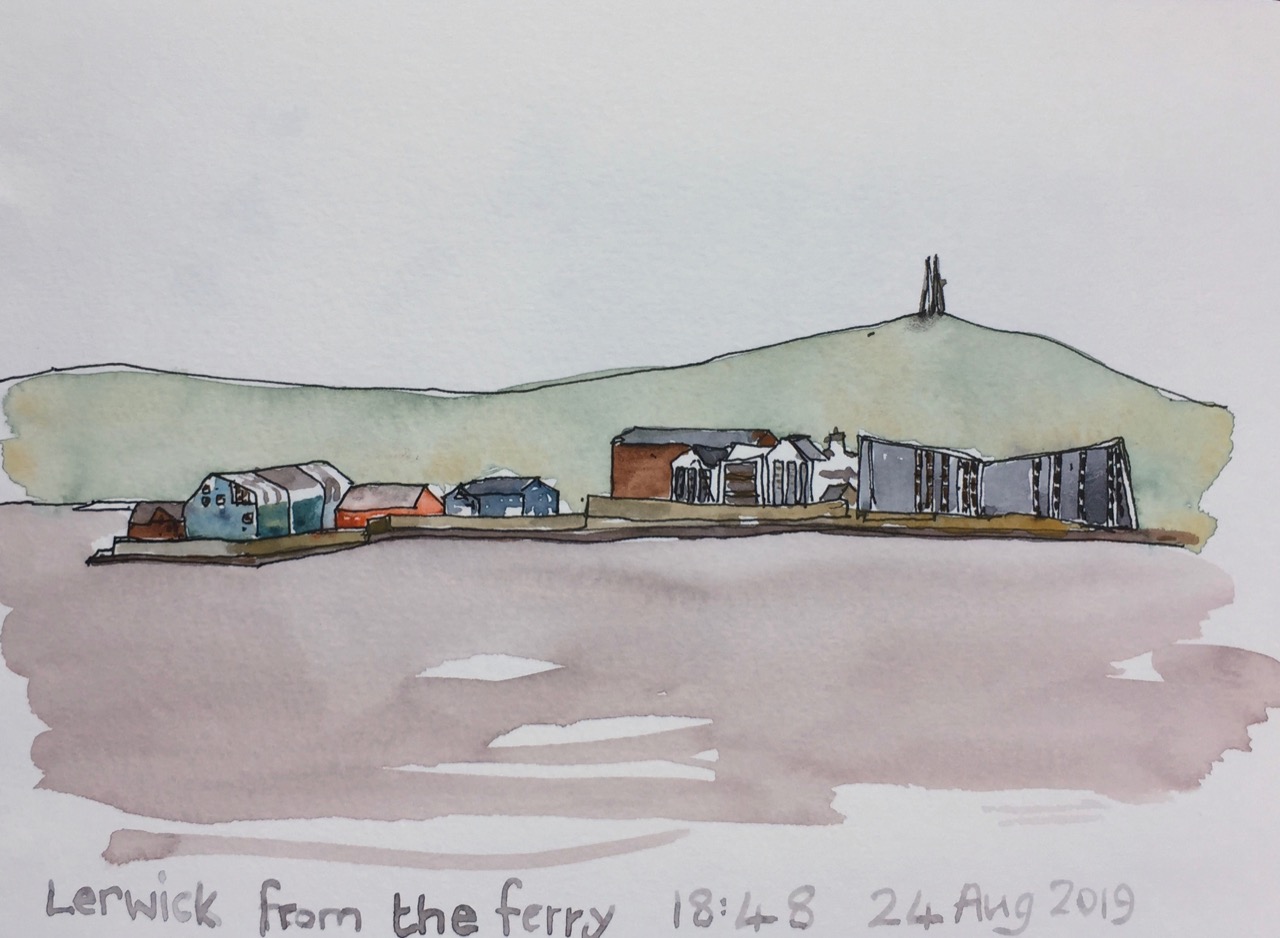
And here’s a sketch I did looking out of the window from my cabin on the boat.

IMG_3479

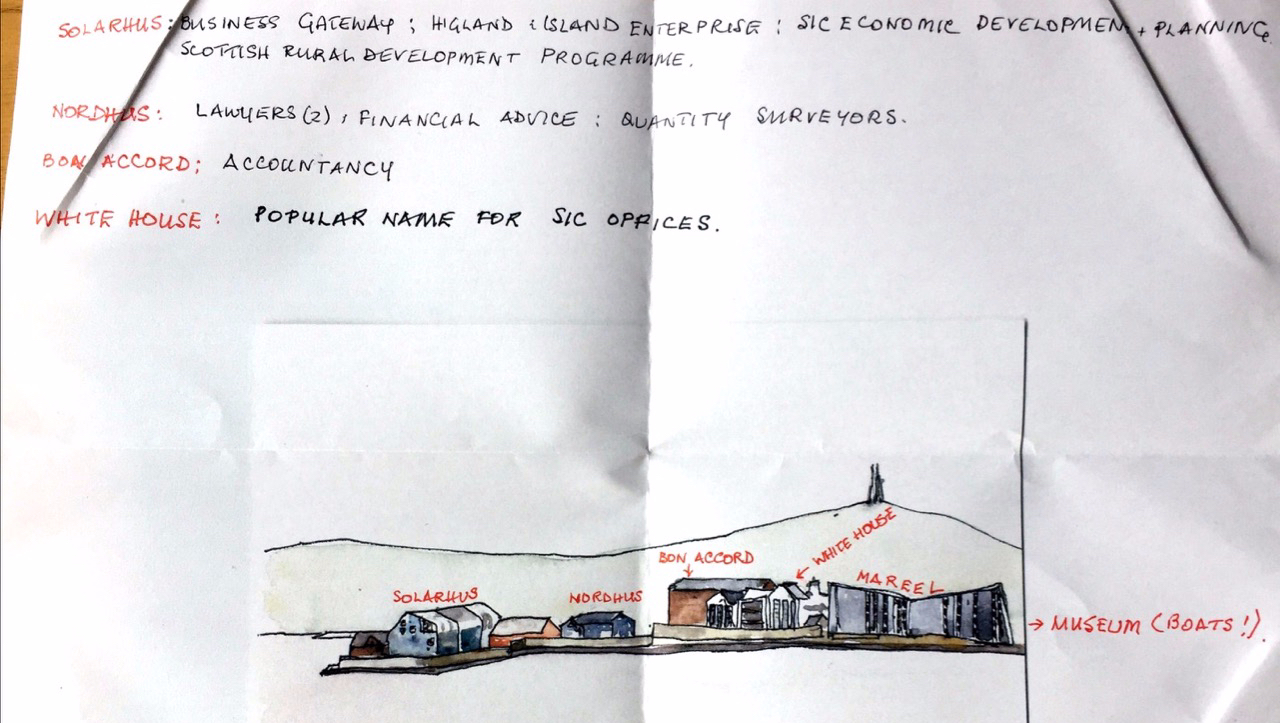
I sent a copy of this to PS, a magical person I met on Shetland. I was thrilled when she replied with a letter and a chart identifying the buildings:

Letter from PS.

On my next visit I shall walk over there and take a look.

Shetland, Historic site walk

IMG_3182The wooden sign from the main road said “Historic Site”, and pointed up a small road that lead steeply uphill. I was on my morning run and felt energetic, so I set off up there, keen to see the Historic Site. In Shetland, Historic Sites are often at the top of hills.

At the top of the first hill, there was no Historic Site, but a view of the next summit. I carried on. At the second summit there was no Historic Site either, just undulating hills in all directions. I was disheartened. I was also a long way from home base.

I turned around. In the distance was the island of Foula, which lurks on the horizon, looking menacing. Usually it’s seen across the sea. But from that second summit, Foula hovered above the green hills, too large,  too grey, too abrupt in its cliffs. As I started running back downhill, Foula sank reluctantly, until it disappeared below the horizon and all around was again soft green hills, and sheep.

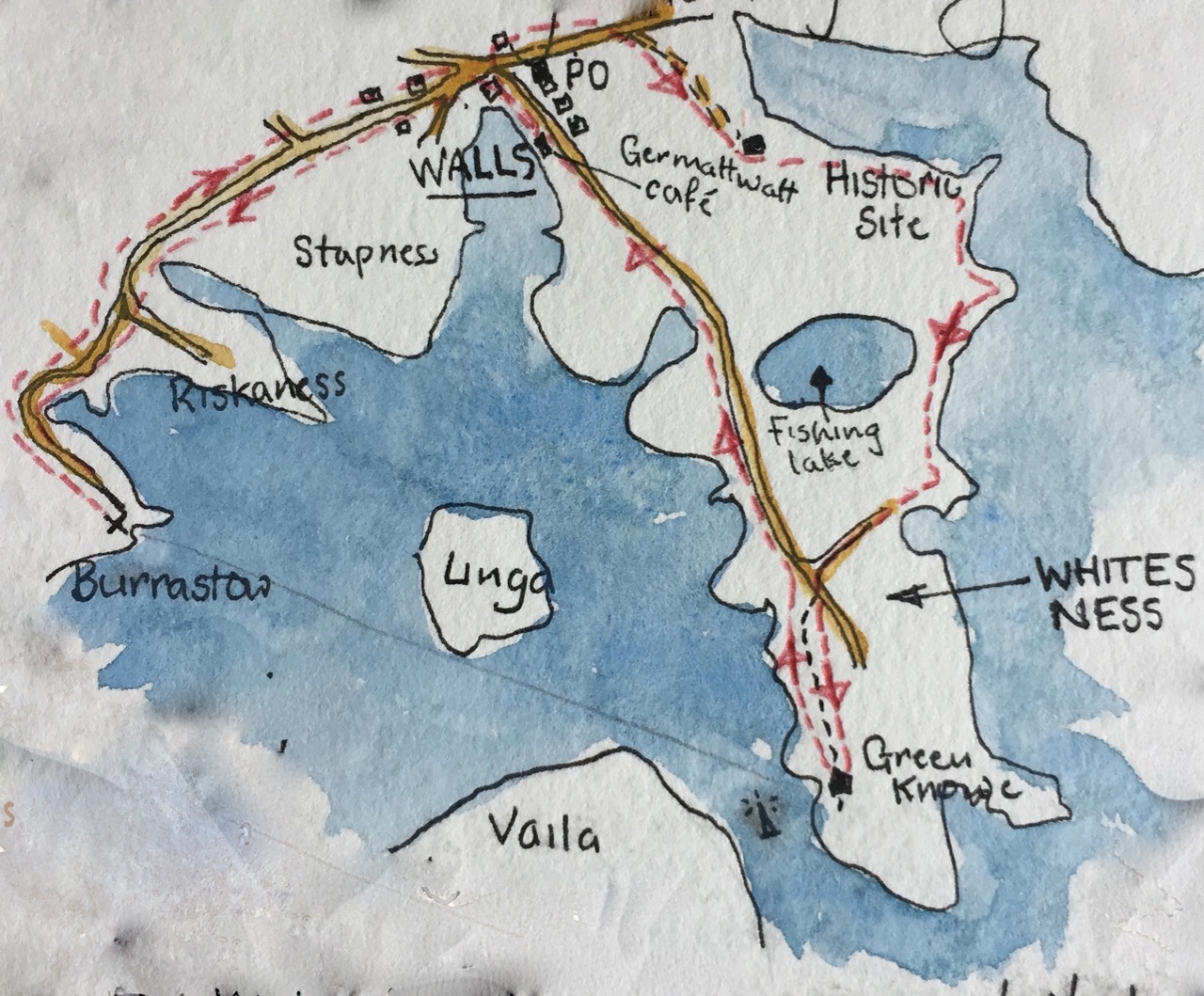
The next day I resolved to find the Historic Site. I went on a mega-walk. Here is my route:

IMG_3495

You see marked the “Germattwatt Café” where I stopped on the way.

IMG_3486

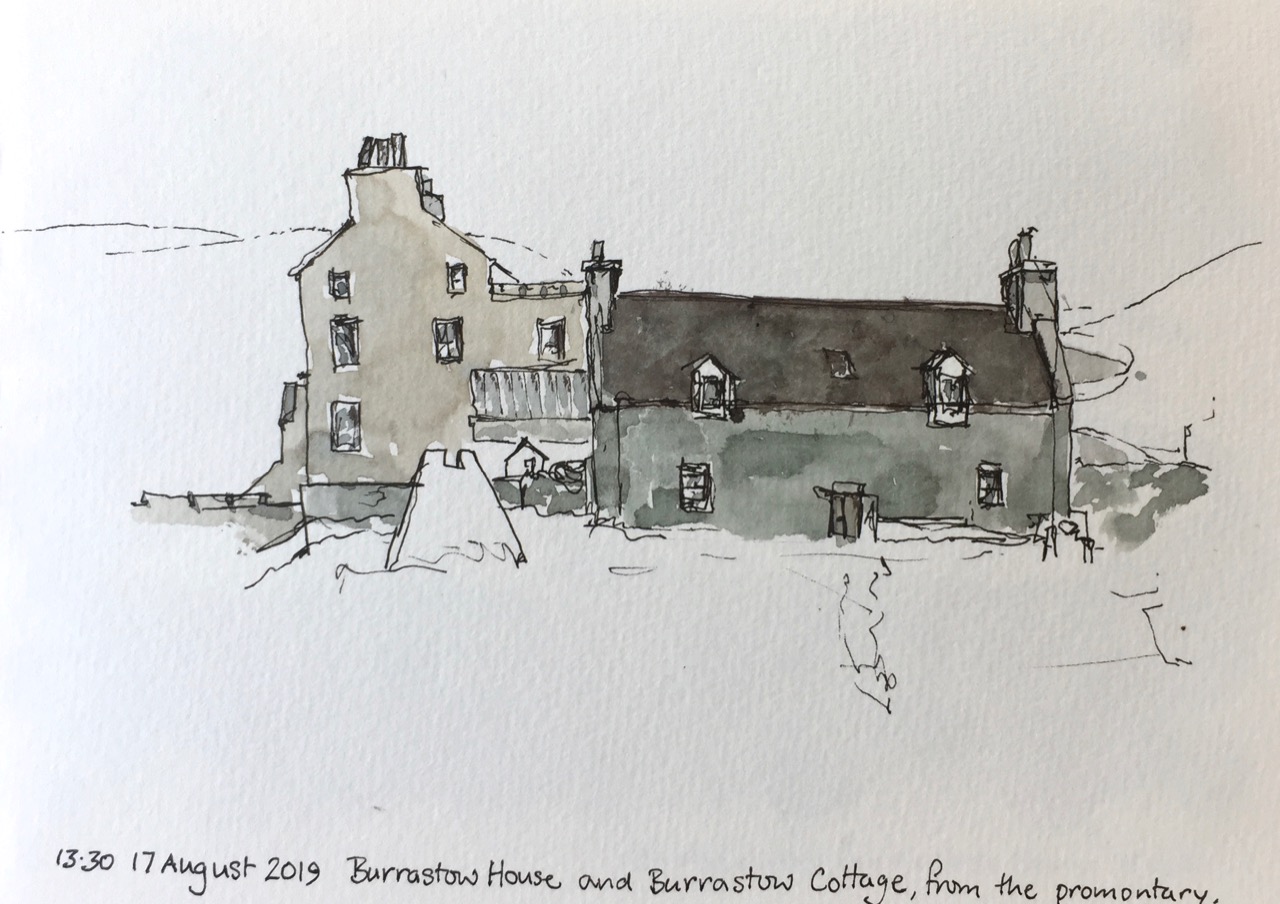
I found the Historic Site which, against all expectations and precedent, was not at the top of any hill, but low down. near the sea, on a promontory, and near a fishing lake. There were low ancient walls, and the distinctive patterns of undulations that indicate a dwelling, property divisions, field boundaries.

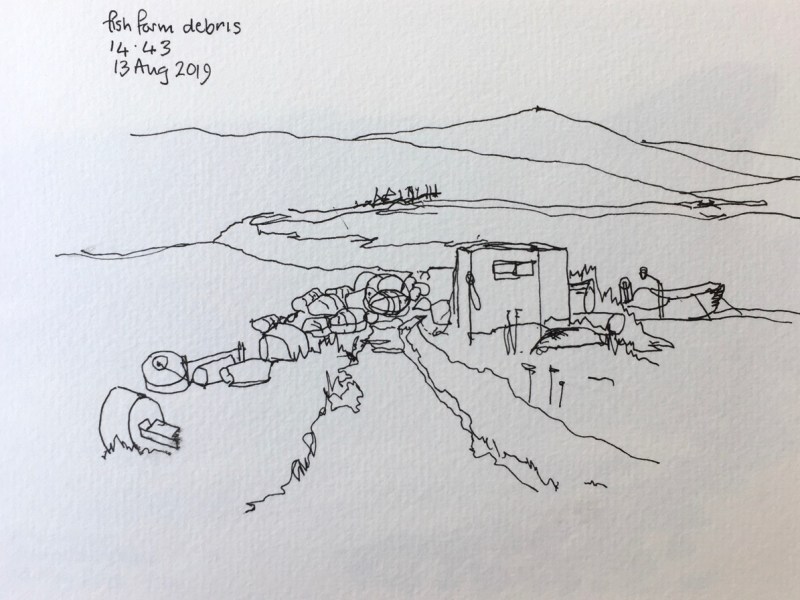
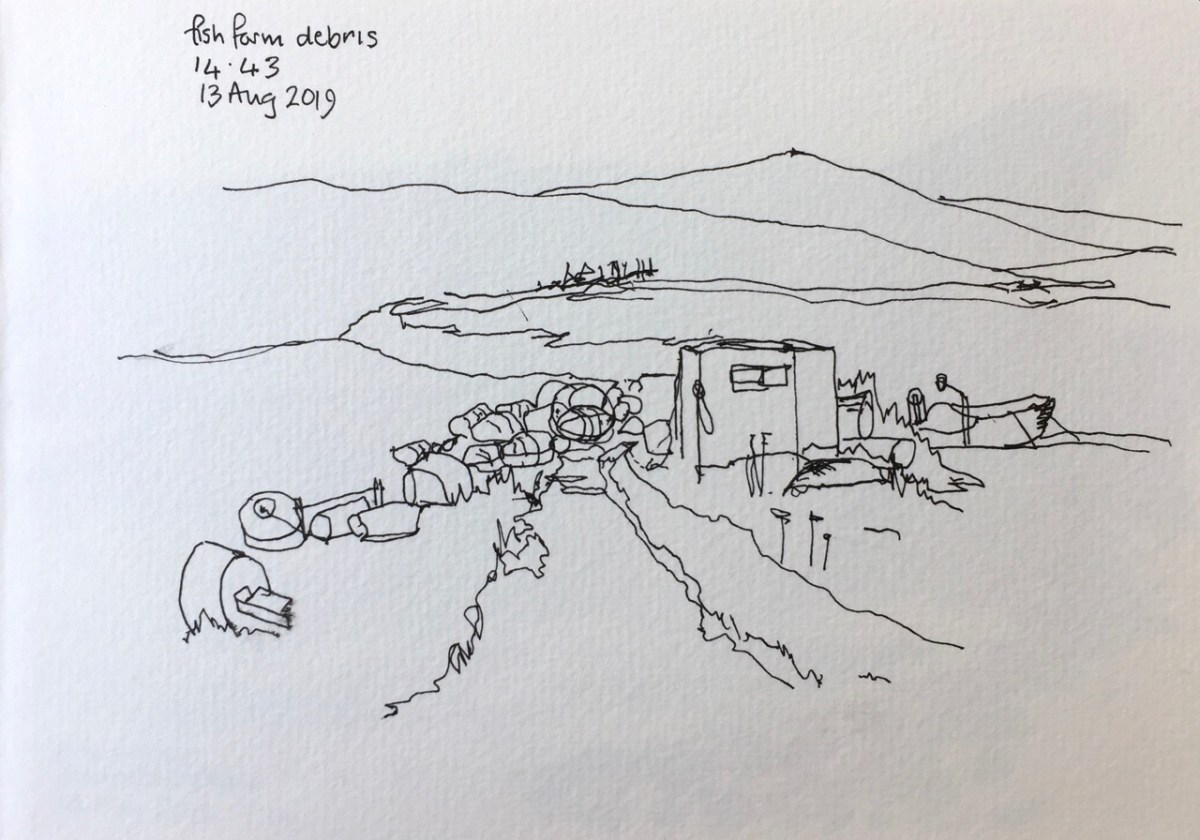
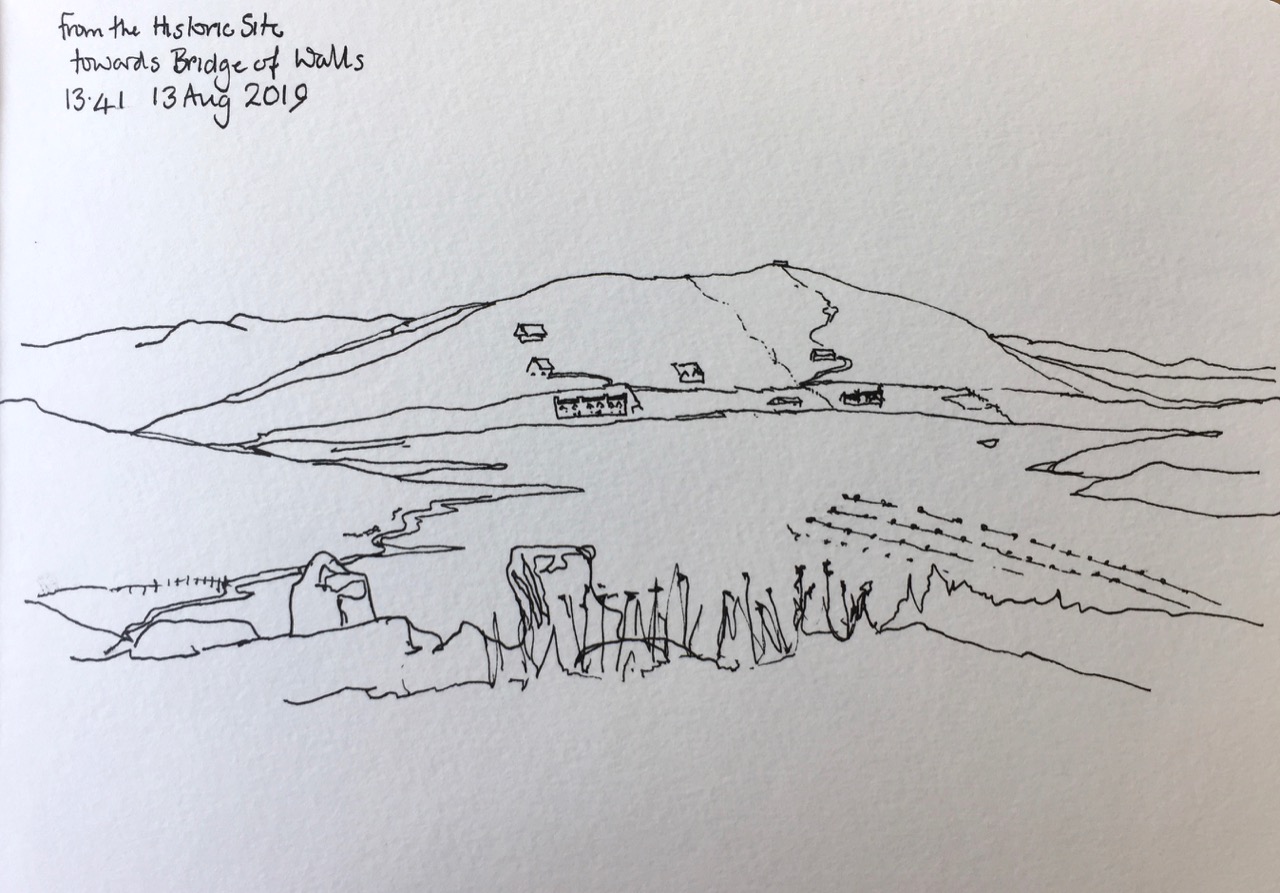
In tribute to the wisdom of the ancestors who chose this place I stopped a while. There was a good view up and down the estuary. Good fishing was to be had, both freshwater in the lake, and salt water in the sea. Such fishing was still being had. In the sea was the fish farm and the mussel farm. I drew a picture:

IMG_3463

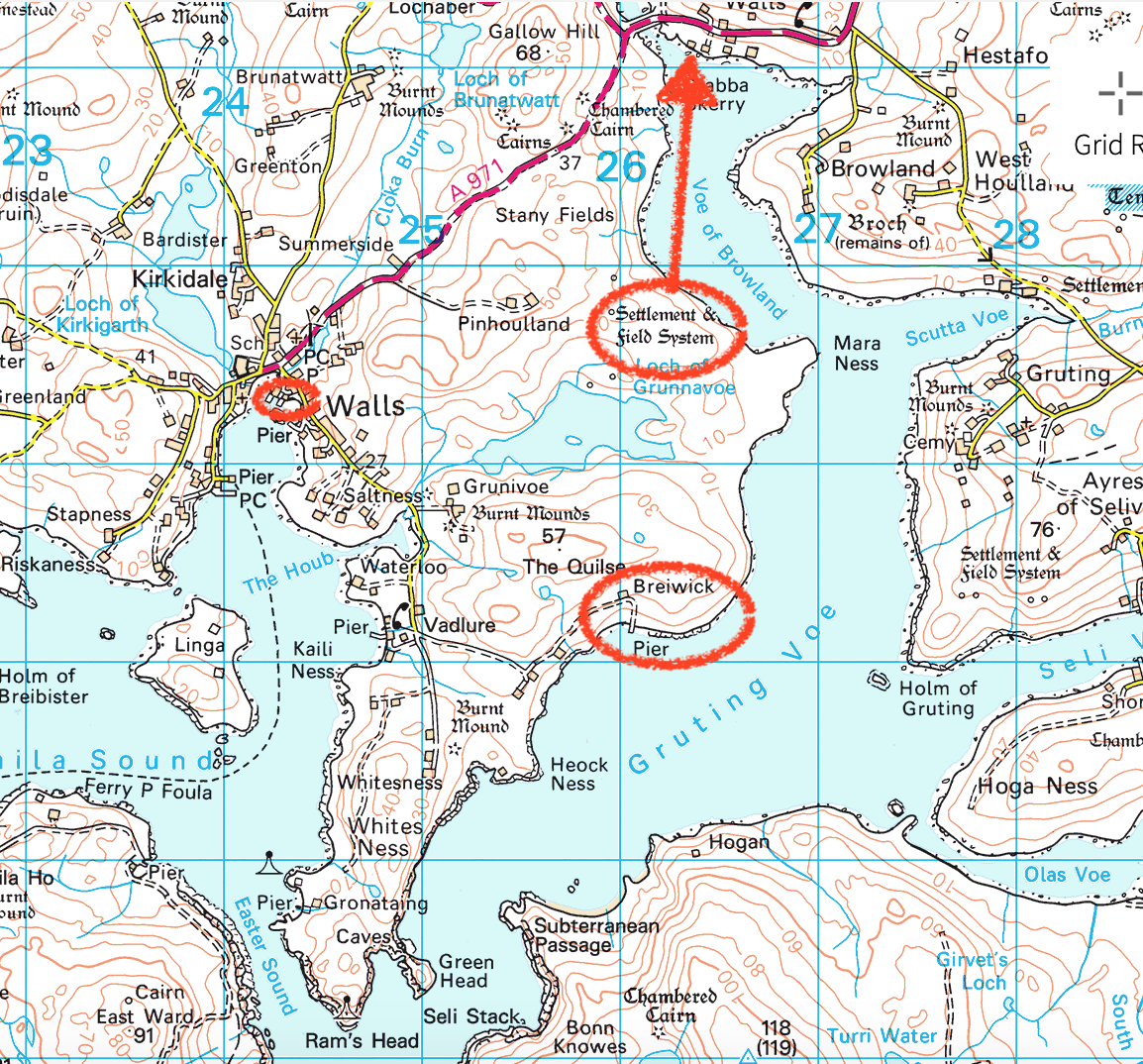
You see the stones of the Historic Site in the foreground. In the distance the “A971” makes its way East at the foot of the hill. The lines in the sea are the mussel farm. The high hill is  the Ward of Browland. Here’s the Ordnance Survey Map. The arrow shows the direction I was looking when drawing the picture.

Screen Shot 2019-08-27 at 16.30.38

Then I walked on, following the sea. Here’s a drawing near the “pier” circled in red on the map.

The whole walk was 22km, and took 8 hours, including two hours of stops for drawing, refreshment and looking at the view.


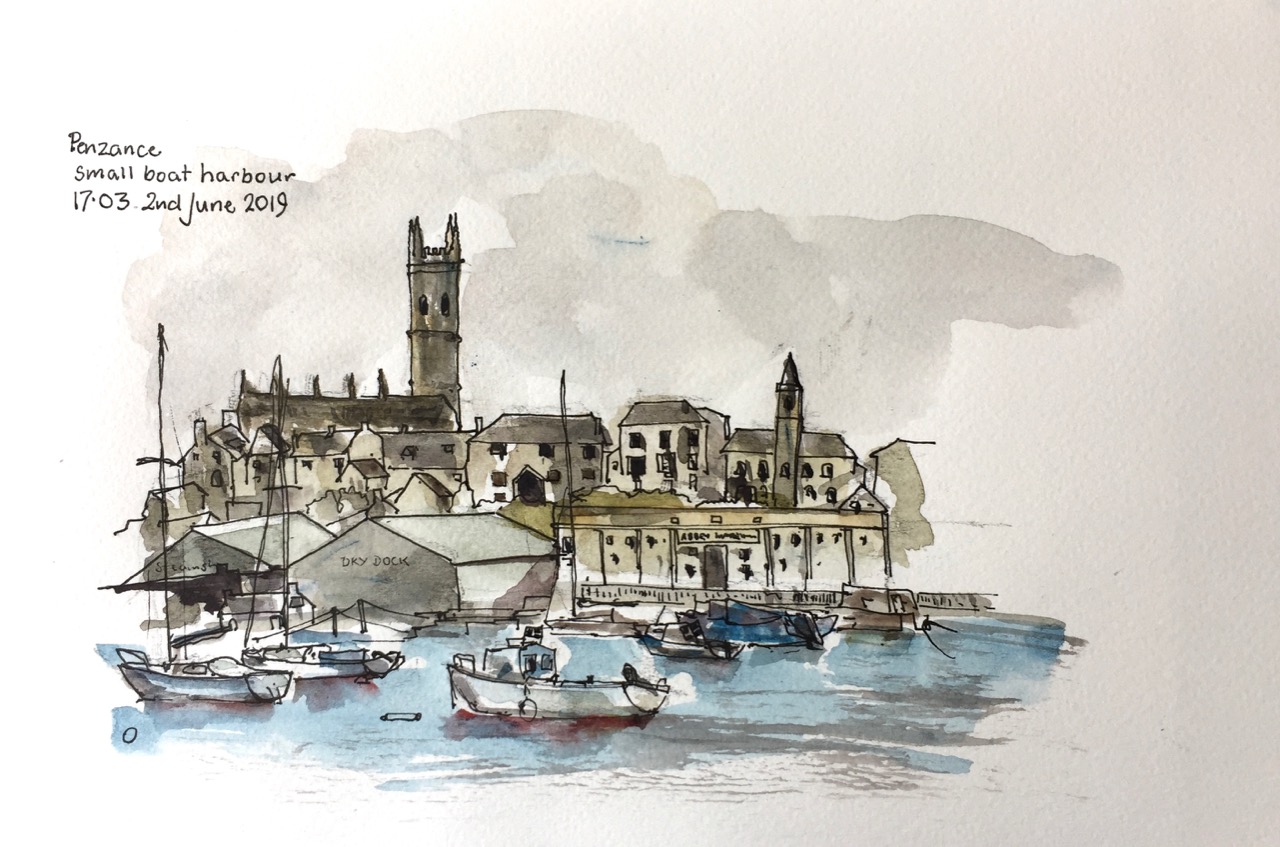
Penzance small Boat Harbour

I ate a Cornish pasty watching the boats.

IMG_2494 (1)

The tower on the left is St Mary’s Church where I drew a picture earlier. The tower on the right is “The Bell Tower”. According to Trip Adviser, you can rent a holiday flat there.

There were people swimming in the harbour. Some one was getting dressed on steps next to the sheds in the picture. In an inner harbour, in front of Abbey Warehouse, young children dropped into the water from the road, and were recouped by a teenager on a paddle board.

Penzance and Newlyn, Cornwall

IMG_2499

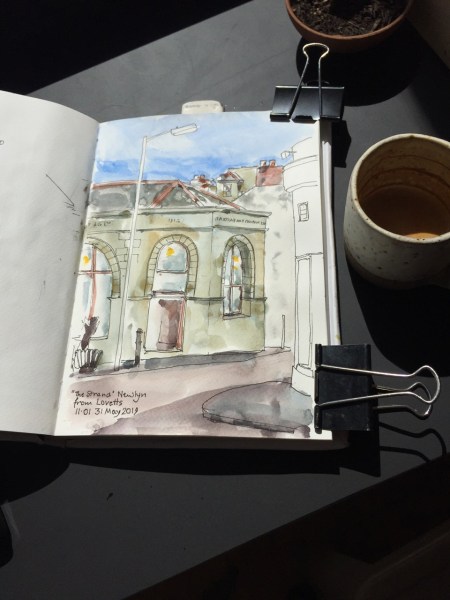
Here in the view from the windows of “Lovetts” in Newlyn. They served me avocado on IMG_2433toast, and a good strong coffee in a pottery cup. This place opposite is labelled “Barclay and Son”, the name cut in stone in 1916. Now it is labelled “The Strand” in less durable lettering painted above the door. It sells a compendium of miscellaneous objects, furniture, crockery, badges, old ship bouys. Also outside are some flower pots. The coffee shop proprietor walked across the road to buy one for a small plant. She just left the coffee shop door open, me drawing at the window, while she did so. This is Cornwall.
The next day I was to swim 10 kilometres. So I was pacing myself, and not embarking on epic walks. The next drawing I did was from the small courtyard at the back of the hotel in Penzance.

IMG_2497

Here you see the roofs of the hotel and adjacent houses. The walls are hung with slates, like scales. The style of covering is called “shingles”, as in “a slate shingled wall”. You see one in the top left corner of the picture.

The two highest chimneys are splendid examples of the chimney-pot maker’s art. The one on the right has two downward pointing holes, and must have been hard to form in terracotta. Maybe I am the first person for decades to appreciate these chimneys and admire the workmanship.

The swim was an event organised by Tom and Jo of “Sea Swim Cornwall“. Forty assorted people swam in 4 different bays, around an island, and up and down a river, “The Gannel”. It was well organised, friendly and fun. And totally exhausting.

So the next day I strolled around Penzance and drew pictures. Here’s a view from St Mary’s Churchyard in Penzance.IMG_2495

Above the arch the stone tablet reads:

HUNC LAPIDEM POSVIT PHILLIPPVS HEDGELAND IN ARTIBUS MAGISTER PREBENDABIVS EXONIENSIS ECCLESIAE PAROCHIALIS SANTAE MARIAE VICARIVS PRIMUS

I work this out as: “This stone was placed here by Phillip Hedgeland, Master of Arts, a cleric (Prebend) of Exeter, who was the first vicar of this Church, St Mary’s.” If anyone’s Latin can offer a better translation, please let me know. On the side of the arch facing the sea was the date: 1883.

The picture, though, is really about the lamp-post. This looks like the one in the Narnia Stories. It is numbered 164AZ with a tag round its middle. After I drew it, I went to check it was a real cast-iron lamp-post and not a fibreglass replica. It was indeed a reassuring cold cast iron, and the maker had put their name in capitals in two places: HOLMAN & SONS PENZANCE”.

By the door of the church I encountered a beautifully engraved tombstone, with Art Nouveau flourishes. It told a sad story though:

In memory of HENRY M FUDGE,
son of the late HENTRY FUDGE MASTER MARINER
who departed this life Oct 2nd 1822 aged 2 years and 5 months
also S S.F. EDDY daughter of Richard Sally Eddy of this town who died 23 June 1835 aged 1 month.

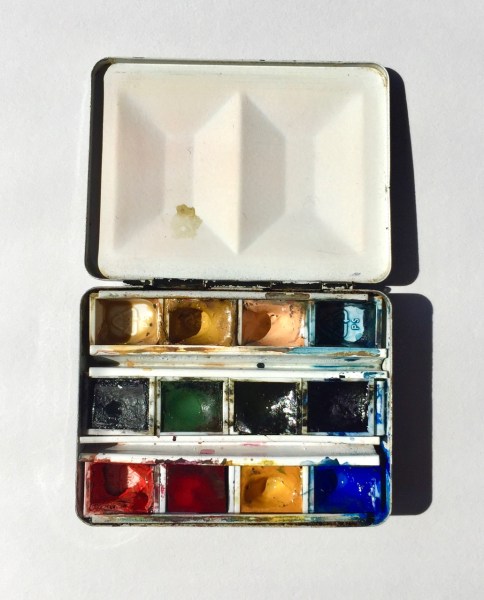
I drew this picture entirely in three colours: Prussian blue, Alizarin Red, and Indian yellow, from Watercolour box 1. 


Sketching in Crete 2019

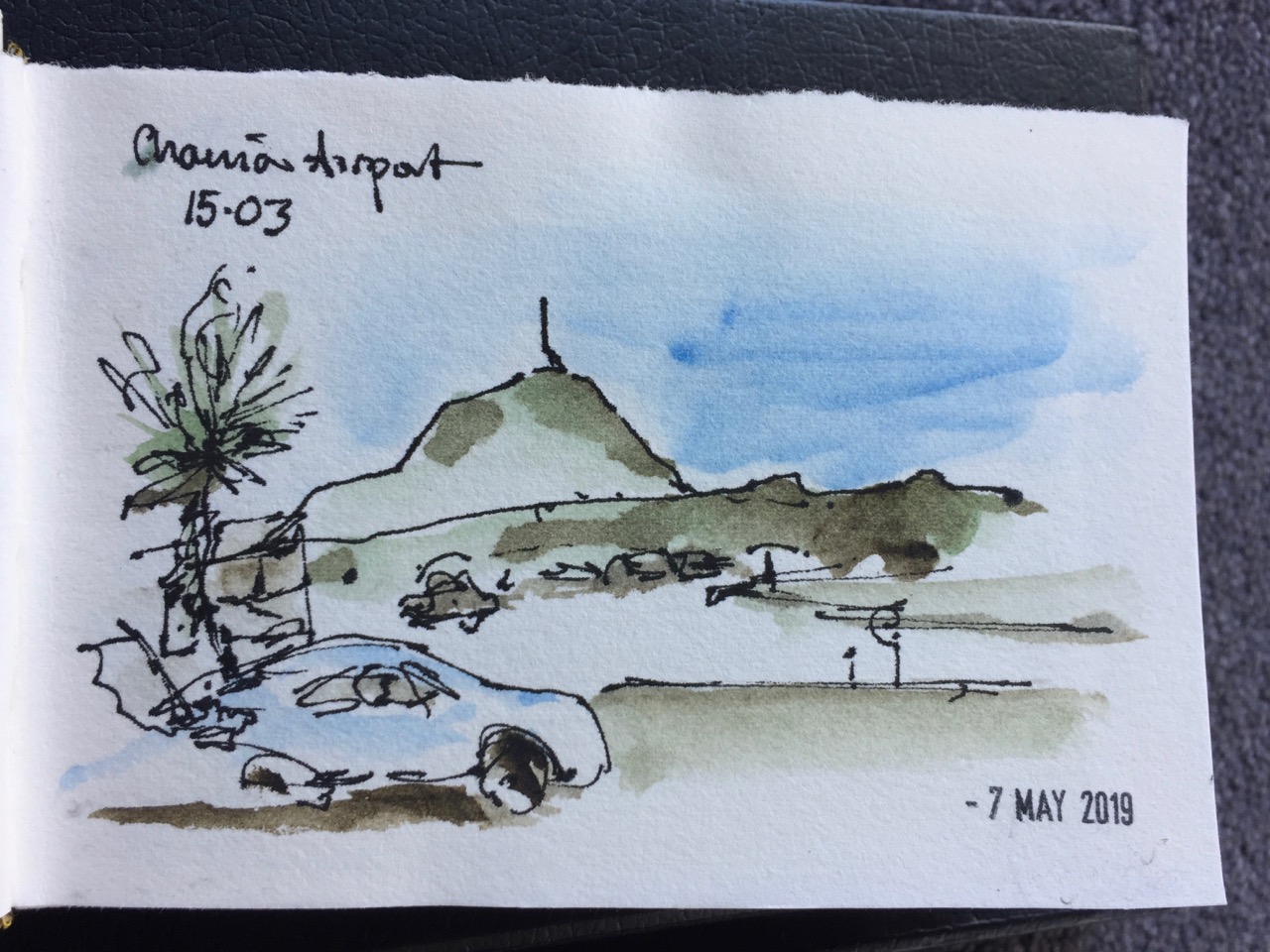
The air in Crete was warm and damp. This affected the paper. See how the ink has spread in this pen and ink sketch at the airport:

IMG_2301

This is De Atramentis Black document ink on high quality watercolour paper, Saunders Waterford, in a small book 6″ by 4″ from the Vintage Paper Company.

After that, I used pencil and watercolour only. Here is a view of the Akrotori peninsula. The warship is lurking in the NATO base.

We lived with insects. At a hand movement, other movements occurred, in the air, on the kitchen surfaces, on the floor. Ants made their way across the breadboard, collecting crumbs or notifying HQ of the location of the honey drip. Beetles arrived suddenly, folded their wings and inspected the floor. I tried drawing them.

Two geckos made their miraculous appearance some evenings and early mornings. They emitted small squeaks.

These are images made on “sun print” paper, using plants, and cut-out paper shapes. The geckos are a species of nocturnal reptile: Hemidactylus turcicus or Mediterranean House Gecko. They are insectivorous, eating, amongst other things, moths. I wondered if they would like to live in the Barbican ducts. It must be quite warm in there, and they would be entirely welcome to devour the moths.

They stick to the walls not with suckers but with hairs on their feet. The feet of geckos are subject of intense scientific interest, I read, since these hairs are so configured that they get close to the wall on an atomic scale (10 nanometers or so). At this distance the molecules of the feet attract, rather than repel, the molecules of the wall. There is a whole compendium of physics effects which make this possible: quantum mechanical, electrostatic, surface tension.  There could be an entire undergraduate course on the feet of the Gecko.

Outdoors there is landscape…

…and a garden.

I am learning to draw clouds. There were a lot of them.

I am learning to draw quickly. Here are some very quick sketches from cafés.

The grass was cut around the lower buildings in ancient Aptera, revealing arches.

Arches make poetry in the Agia Triada monastery: a pre-departure pause….

…before the airport.

Technical details

Pictures done in sketchbooks:

Using Watercolour box 1:

IMG_4455

Sun print paper was from Cowling and Wilcox on the Kingsland Road. It is called “Sunography”. I printed it on both sides.