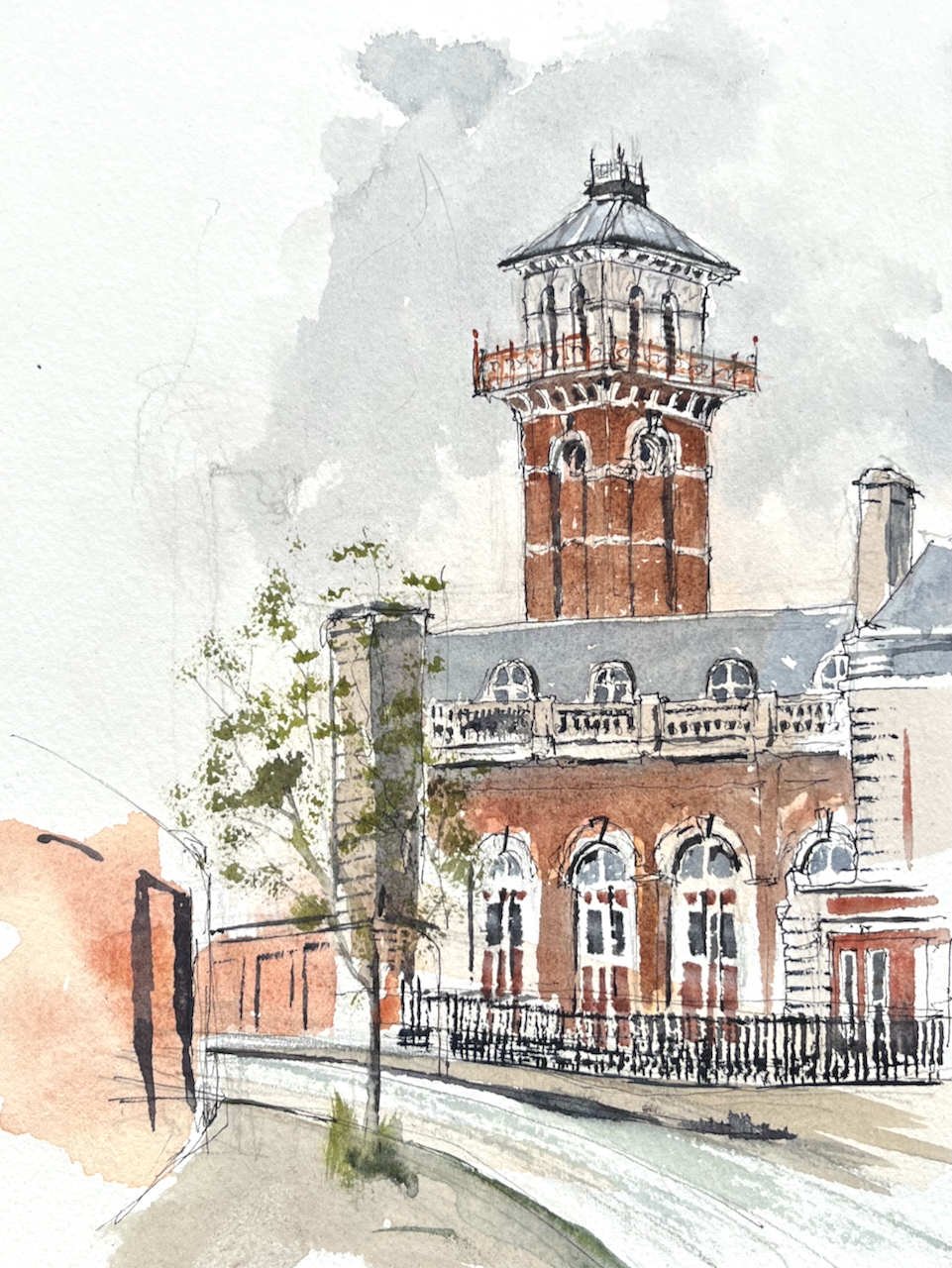
Abbey Mills E15: sewage pumping station

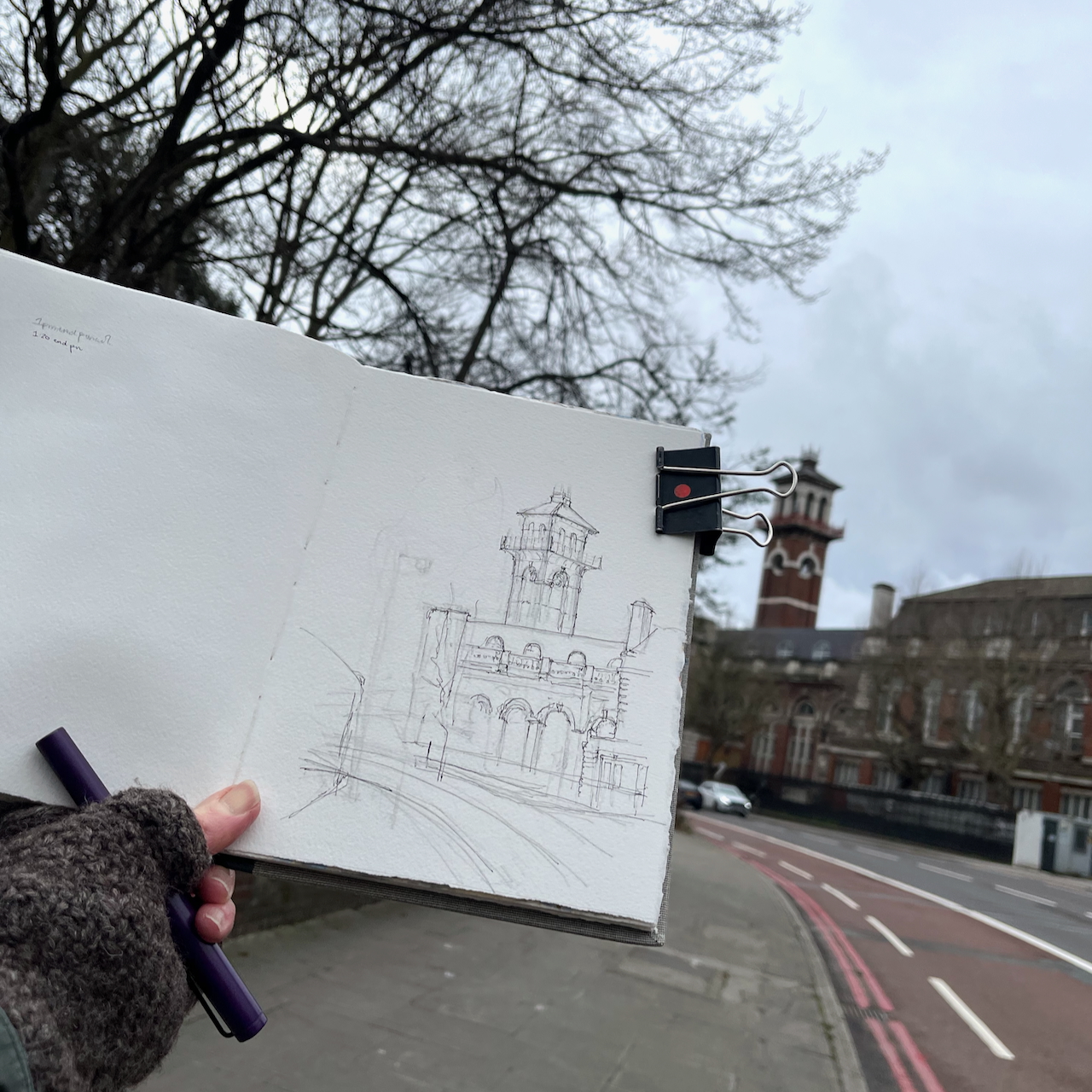
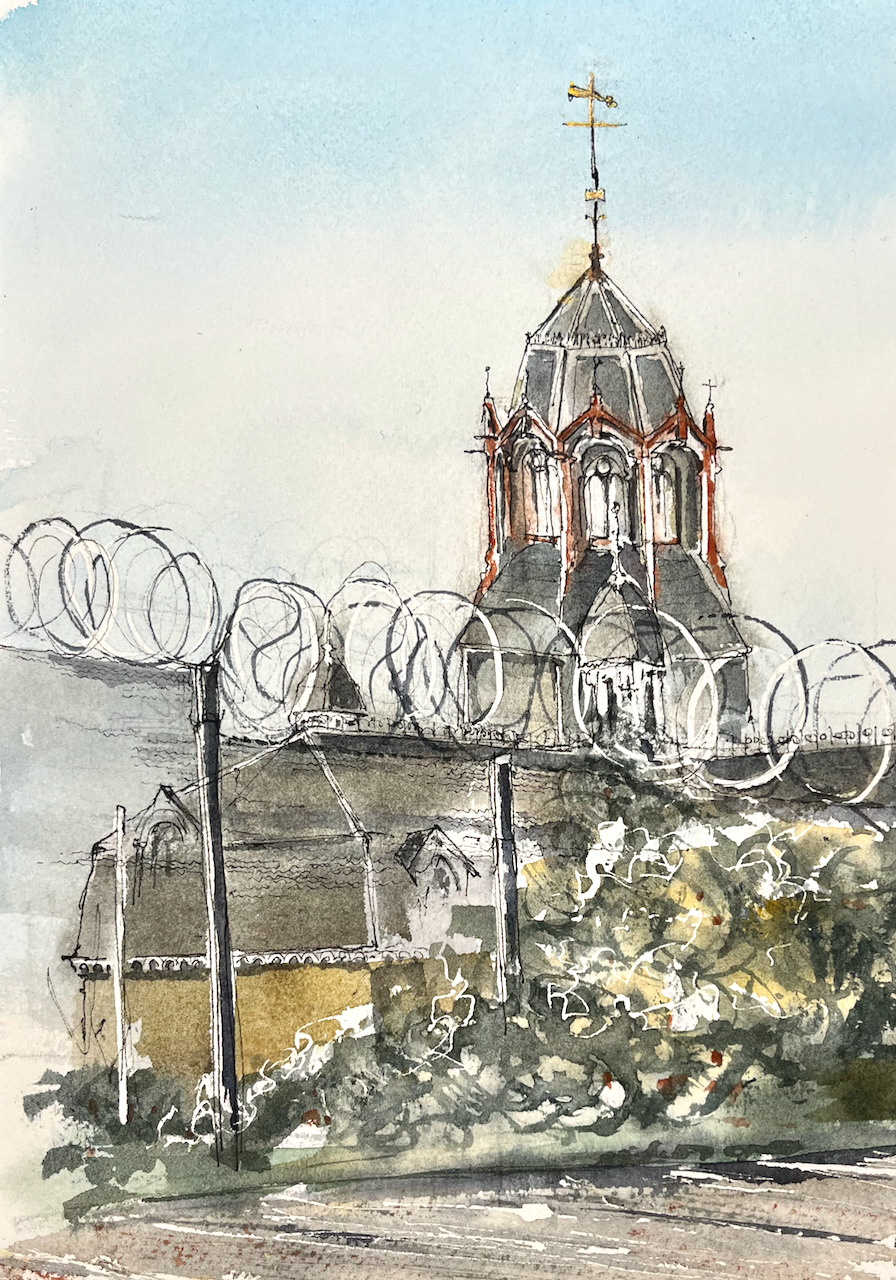
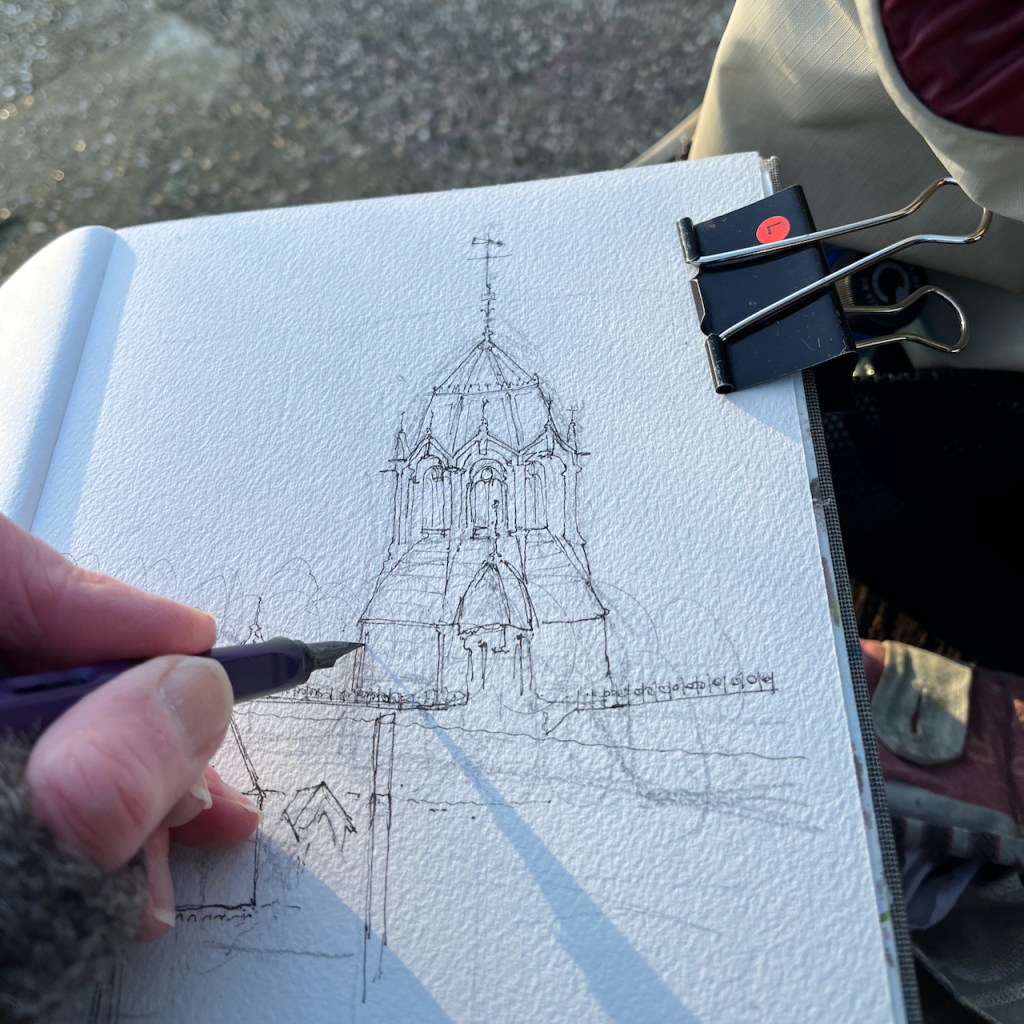
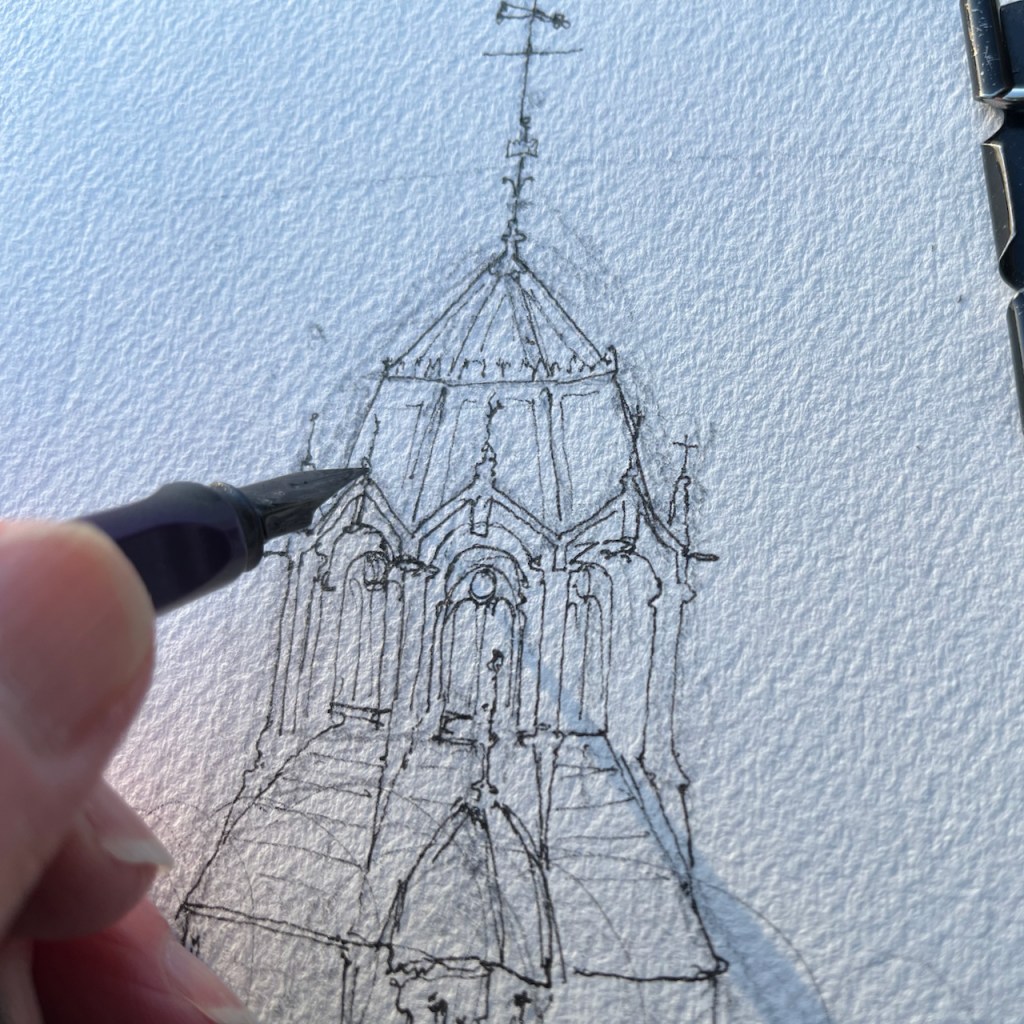
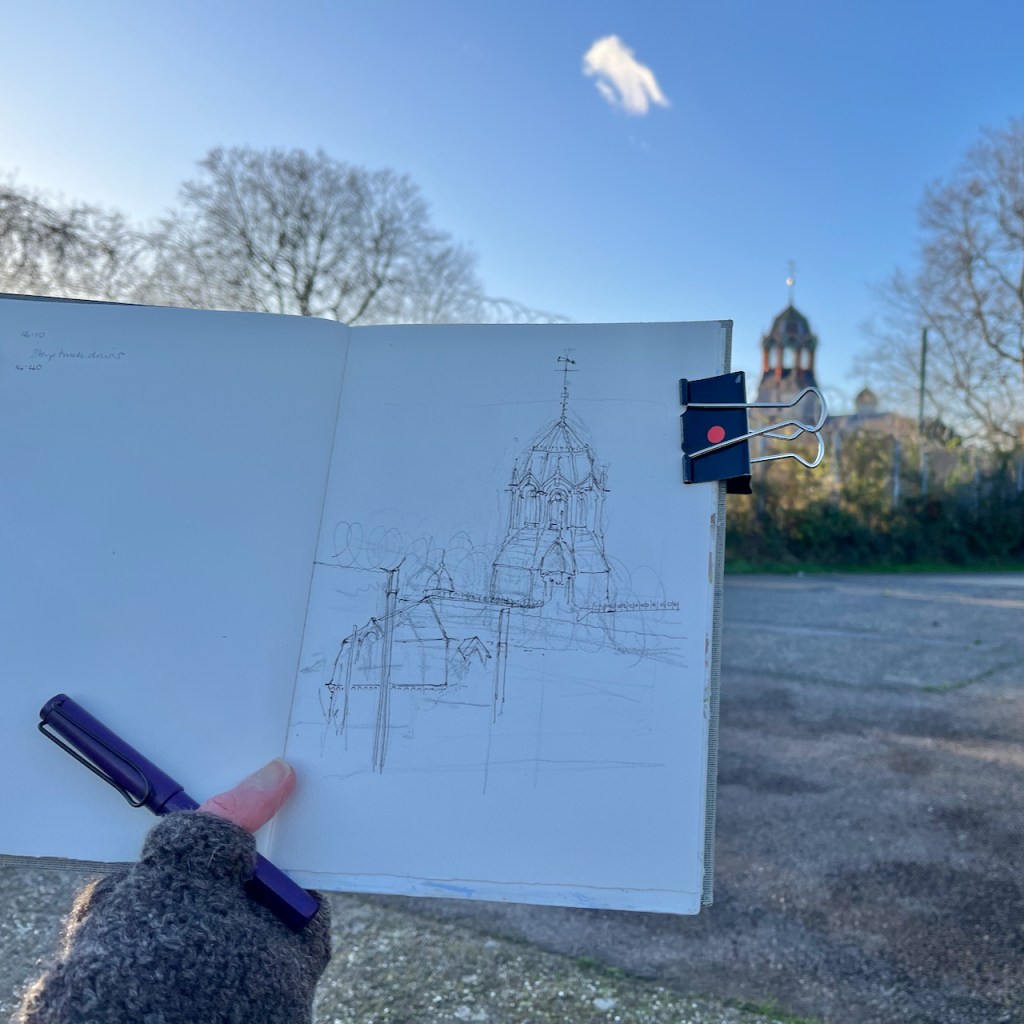
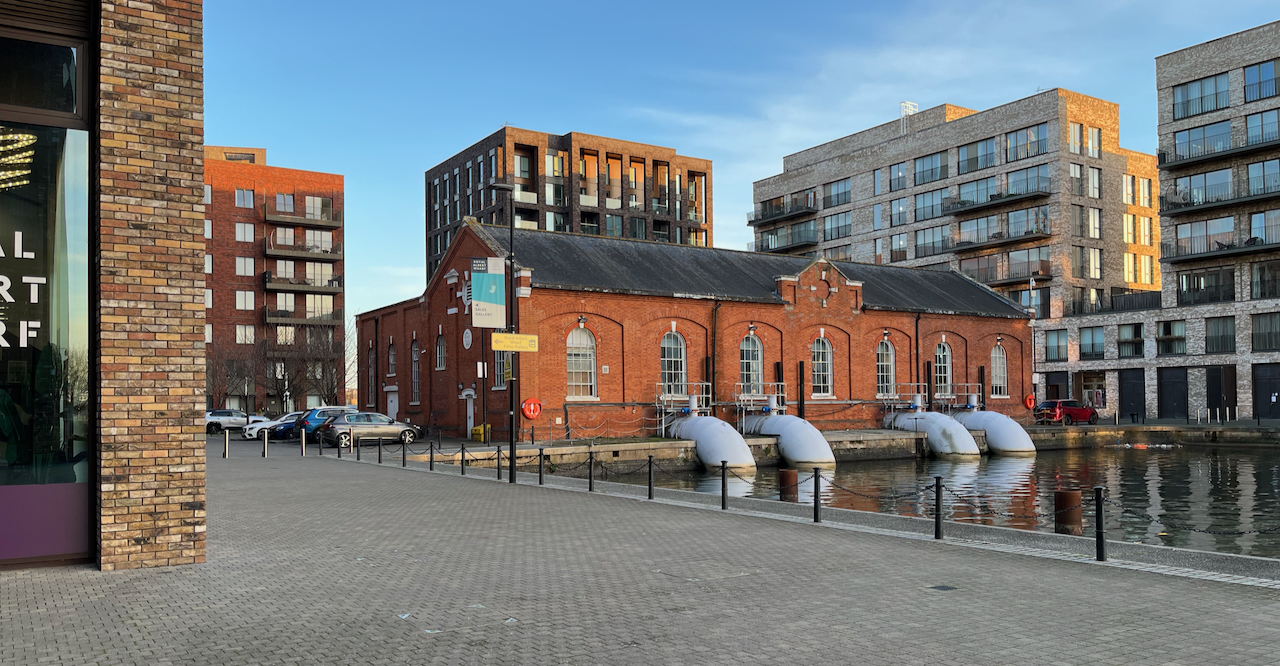
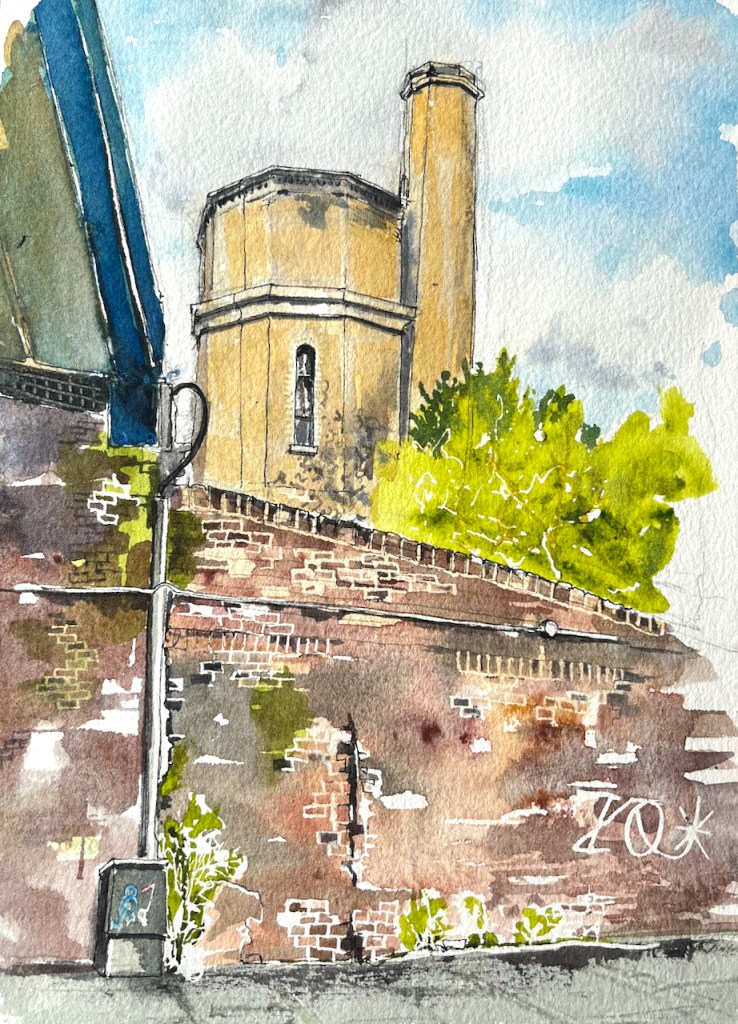
Here is Abbey Mills Pumping Station, seen from The Greenway.

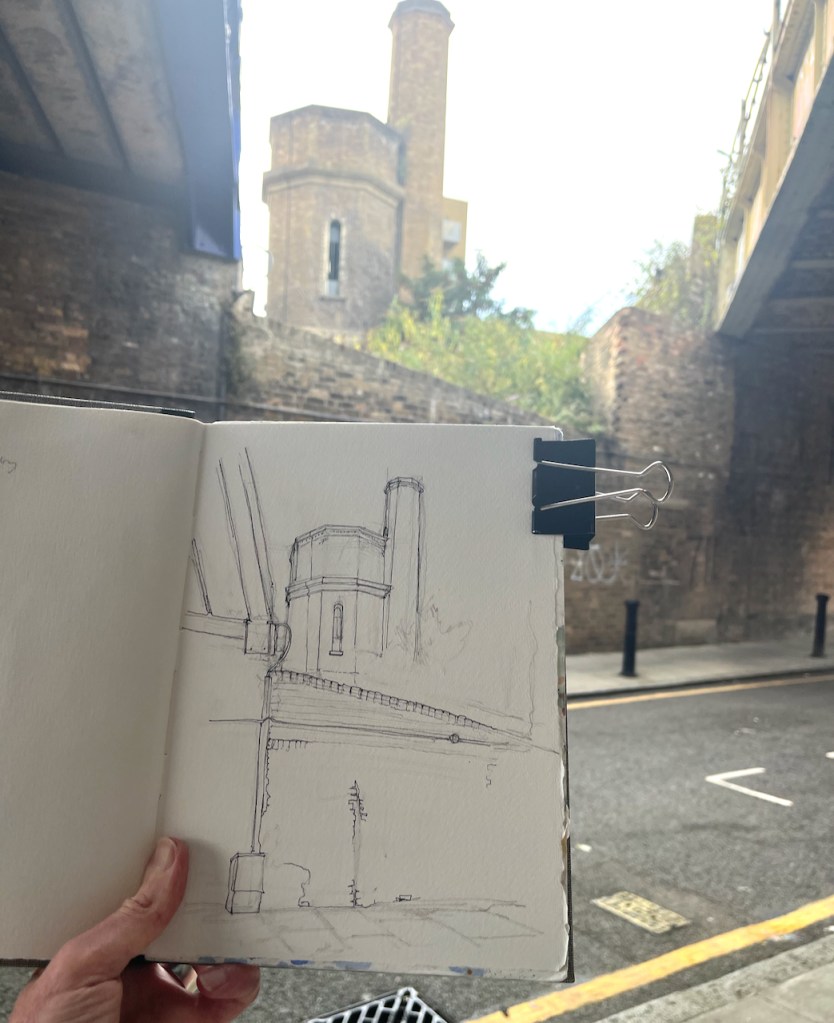
Abbey Mills Pumping Station, London E15, sketched from The Greenway, January 2025 in Sketchbook 15

Abbey Mills is a sewage pumping station1. It lifts the sewage from lower level sewers, and pumps it 40 feet uphill to the Northern Outfall Sewer. The Greenway path is on top of the Northern Outfall Sewer.

This system was created by the visionary Victorian engineer Joseph Bazalgette (1819 – 1891). The pumping stations and the Northern Outfall Sewer are part of a grand construction of sewers and water management works instigated in the 1860s after the “Great Stink” of 1858. The problem of untreated sewerage being discharged into the Thames had been causing disease and bad smells for some time. When the smell and fear of disease affected Parliament, which is located next to the Thames, the government of the day took action.

“On 15 June Disraeli tabled the Metropolis Local Management Amendment Bill, a proposed amendment to the 1855 Act; in the opening debate he called the Thames “a Stygian pool, reeking with ineffable and intolerable horrors”. The Bill put the responsibility to clear up the Thames on the MBW [Metropolitan Board of Works], and stated that “as far as may be possible” the sewerage outlets should not be within the boundaries of London; it also allowed the Board to borrow £3 million, which was to be repaid from a three-penny levy on all London households for the next forty years.”

https://en.wikipedia.org/wiki/Great_Stink

So this loan, and the 3d levy on Londoners was used in 1865 to construct the pumping stations and a new sewerage system.

The Victorian sewers are still in use, and are now gradually being upgraded by Thames Water.2 According to the video on their site, the Northern Outfall Sewer constructed by Bazalgette’s team is being left in place. Thames Water are pushing a lining into it, made of 21st century materials. They reckon this will last another 100 years. 3

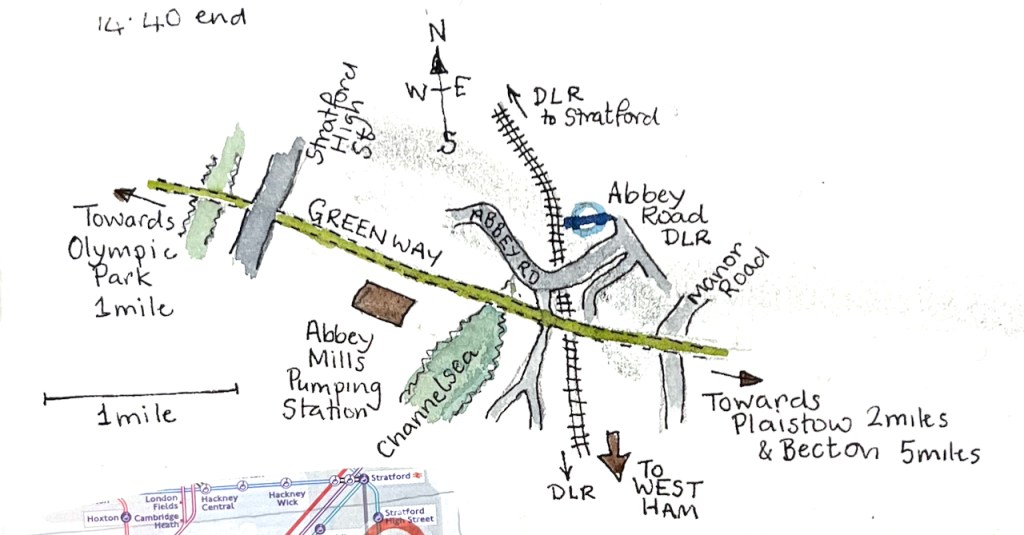
I sketched Abbey Mills Pumping Station while exploring the Greenway from Hackney Wick to Becton.

“Thank you Sadiq”

The Greenway is a well-used pathway and running route. While I was sketching, a wiry grey-haired runner stopped to chat. He was a cheerful person, sharing my enthusiasm for the transformation of Hackney Wick. He had much praise for the improvements in London, specifically on air quality. Air quality is much better, he said. “I no longer get asthma,” he told me, “even though I still run!” He surveyed the clean path and the view, ” Thank you Sadiq!” he exclaimed. Sadiq Khan is the Mayor of London, and has introduced and supported air quality improvement measures such as the congestion charge and the Ultra-Low Emission Zone (ULEZ).

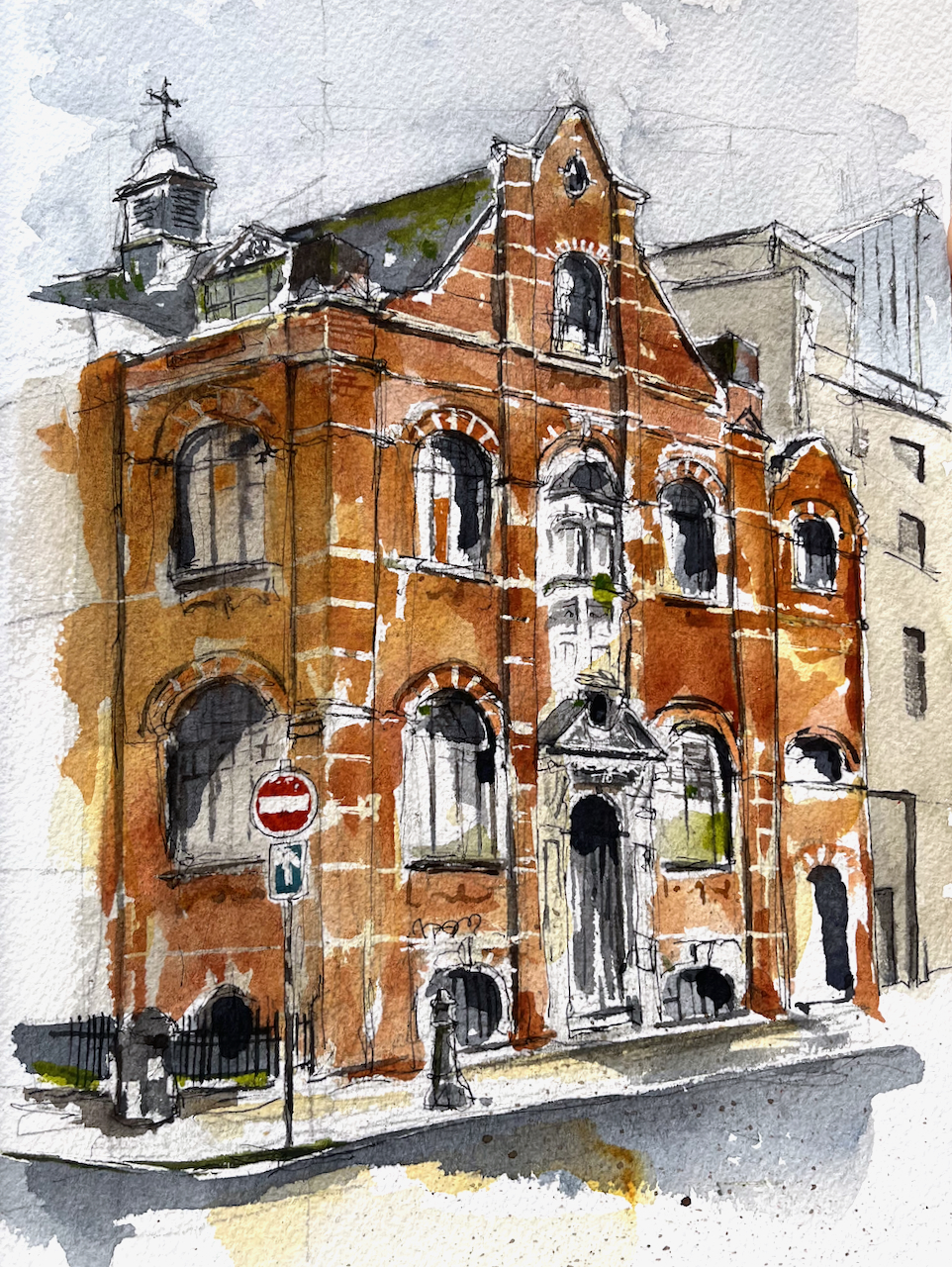
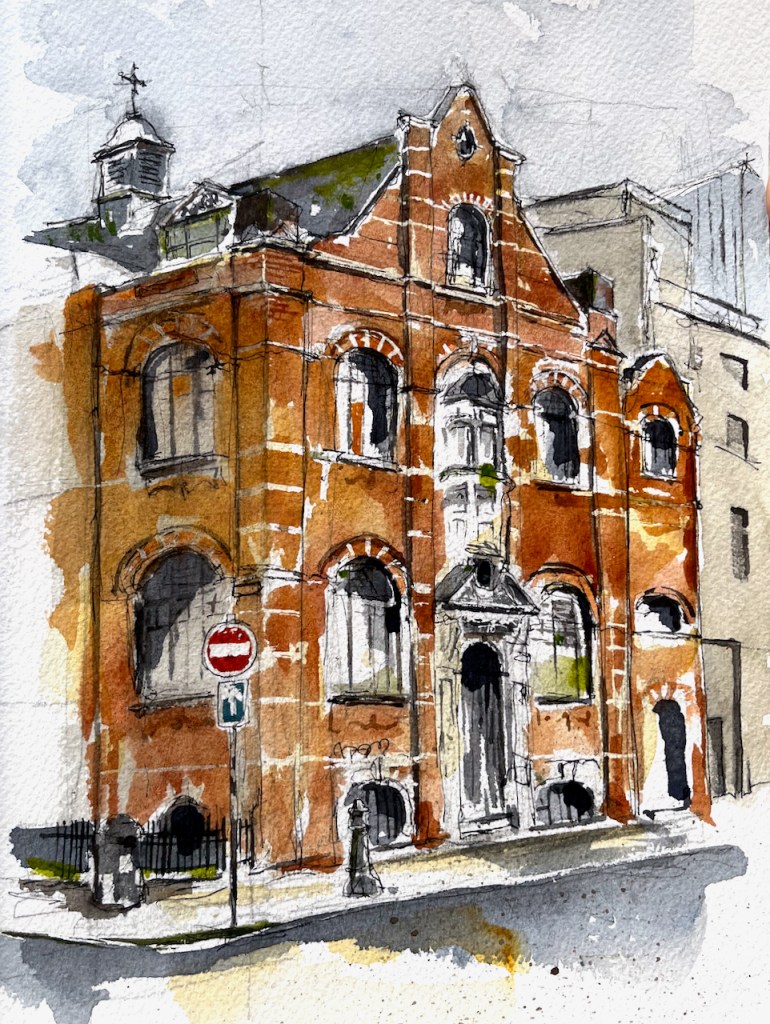
My new friend had been a skip-truck driver. He’d worked everywhere, he told me. Constructing the Olympic Park had been a big job. Examining my sketchbook, he saw the sketch of Fournier Street. “I recognise that!” he said. And then, looking closer, “There’s an Express Dairy depot just up the street.”

If you know Fournier Street, you will know that this seems extremely unlikely. Fournier Street is in a residential area, somewhat densely packed, and apparently not a place for a goods yard of any type. However he seemed sure, and I didn’t contradict him. I thought he might have mistaken the location: there are a lot of Georgian terraces in London.

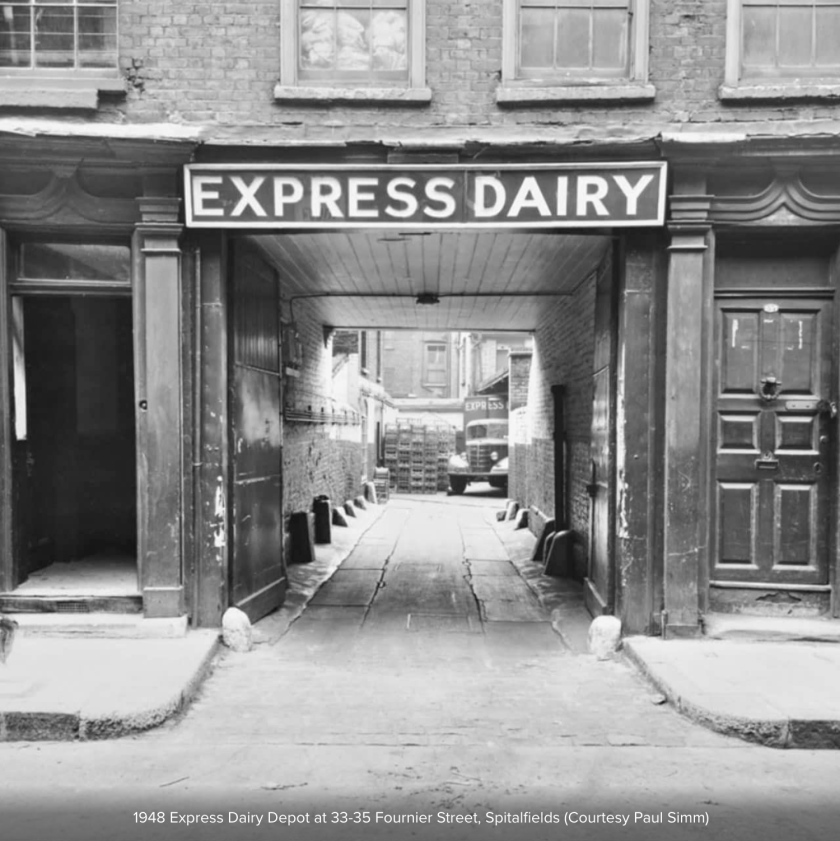
35 Fournier St (1948)

When I was back at my desk I did a search4. Sure enough, just a few houses along from my sketch, there had been an Express Dairy Depot, just as he said. It’s shown in the “history” section of the Express Dairy site. The London Picture Archive shows it. I should not have doubted him. The wide entrance is still there.

I completed the ink sketch on location and then packed up to continue my walk. I still had a good 3 miles to go and it was getting dark, and cold.

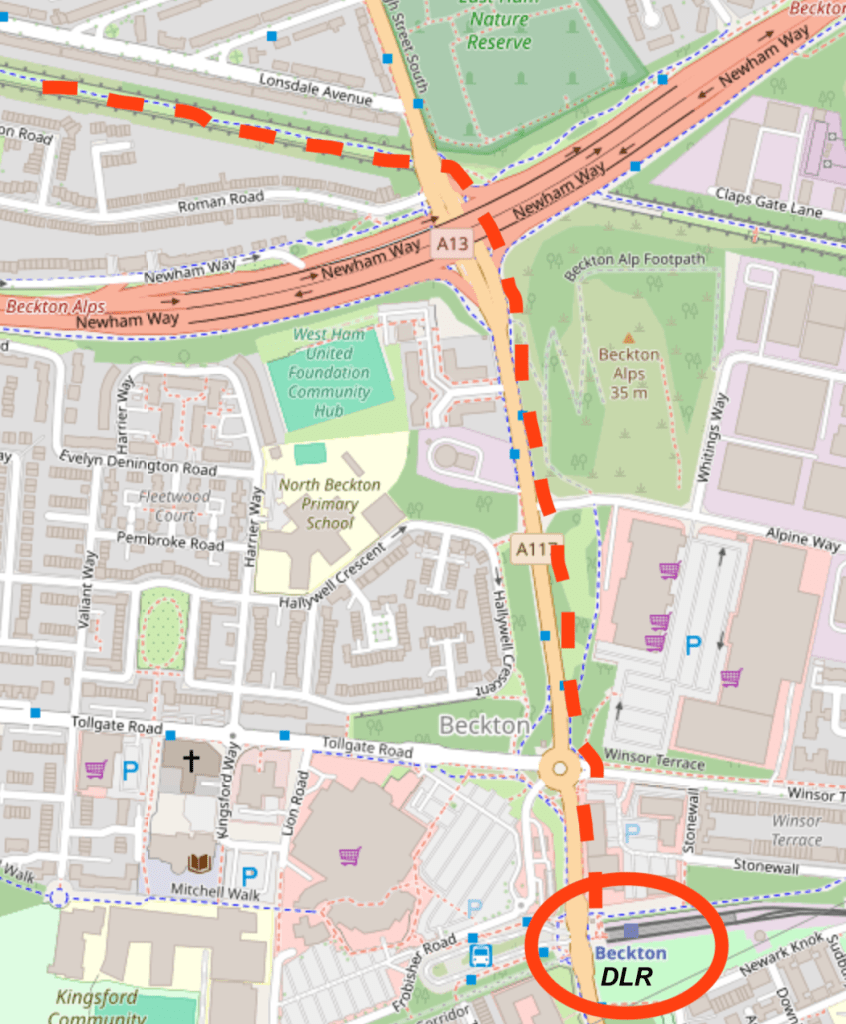
It was dark when I reached Beckton. I left the Greenway as it crossed the A13.

Greenway to Beckton DLR. Map (c) OpenStreetMap contributors.

If you’d like to follow my route along the Greenway, in the file below is my idiosyncratic description of the route and my walk. The below file is 6 pages printable pdf. The Greenway is part of the Capital Ring, a long-distance walking route.

  1. Abbey Mills is a working Pumping station and not open to individual visitors. It is open to groups from time to time. The organisation “Subterranea Britannica” was invited for such a visit in 2012, which they wrote up in their journal Subterranea, Issue 30. The article describing their visit is by Martin Williams and Alex Lomas. See this link:
    https://www.subbrit.org.uk/sites/abbey-mills-pumping-station/
    ↩︎
  2. Major £70million upgrade to Stratford’s Victorian sewer system
    Press release from Thames Water: Tuesday 17 January 2023 13:09.
    https://www.thameswater.co.uk/news/70million-stratford-sewer-upgrade
    “A giant Victorian sewer in East London is being upgraded as Thames Water continues its investment in infrastructure across the capital. 
    The UK’s largest water and wastewater company is investing £70million over the next three years to upgrade the Northern Outfall Sewer and ensure its pipes are resilient for future generations. 
    The sewer, which serves over 4 million people, runs from Wick Lane to Beckton Sewage treatment works, the largest in Europe.   ….”

    ↩︎
  3. YouTube video “on Tap” from Thames Water, describes the work being done in 2023 to upgrade the Northern Outfall Sewer. It also contains great photos of the inside of Abbey Mills Pumping Station, and amazing aerial views of the Greenway.
    https://youtu.be/d628Y0dh2sA ↩︎
  4. The Express Dairy depot in Fournier Street is shown in a photo on the Express Dairy site.
    https://expressdairytales.uk/ed-retail-london-and-south-1974-and-before
    1948 Express Dairy depot at 33-35 Fournier Street. Photo by Paul Simm.
    and
    London Picture Archive
    https://www.londonpicturearchive.org.uk/view-item?i=121843&WINID=1735932557537
    1955 view of the same premises. ↩︎

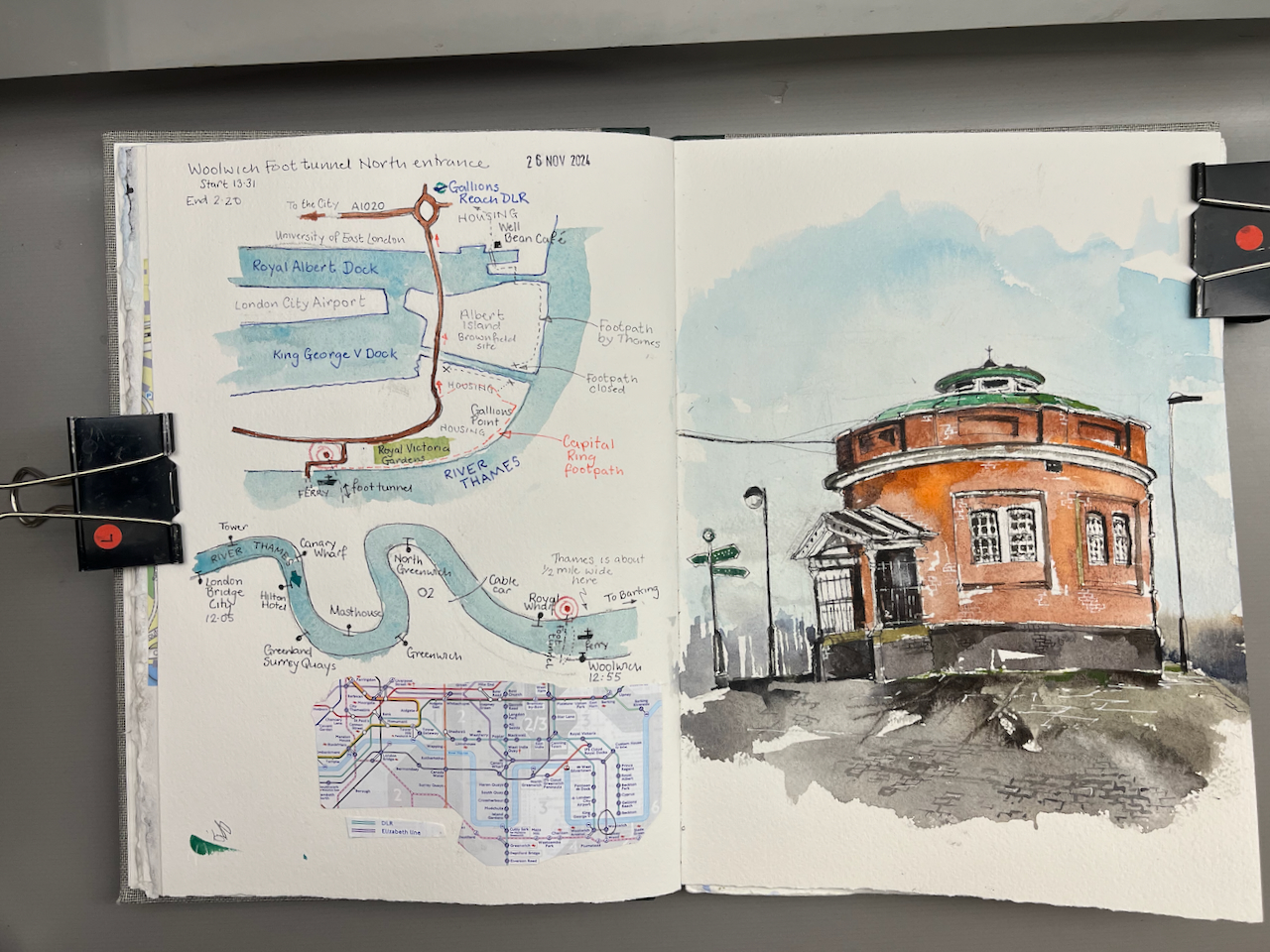
North entrance to the Woolwich Foot Tunnel, E16

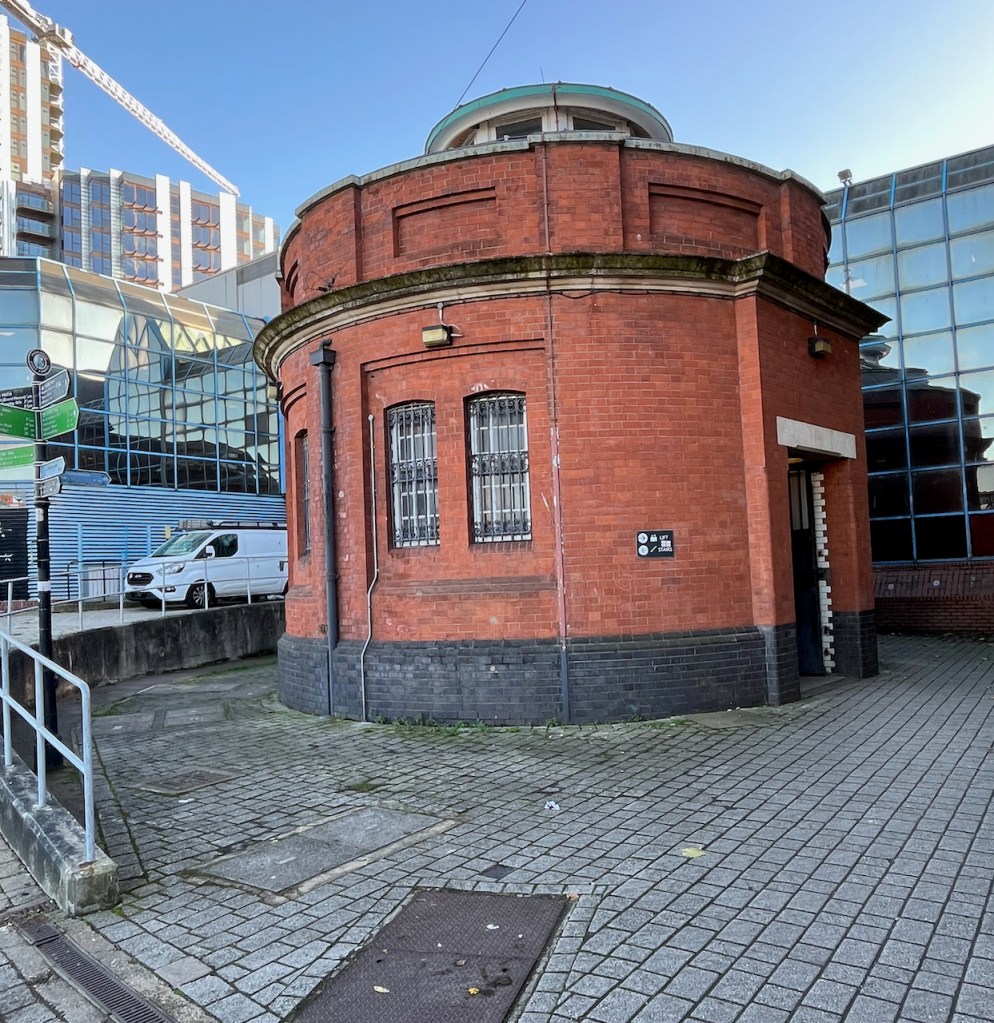
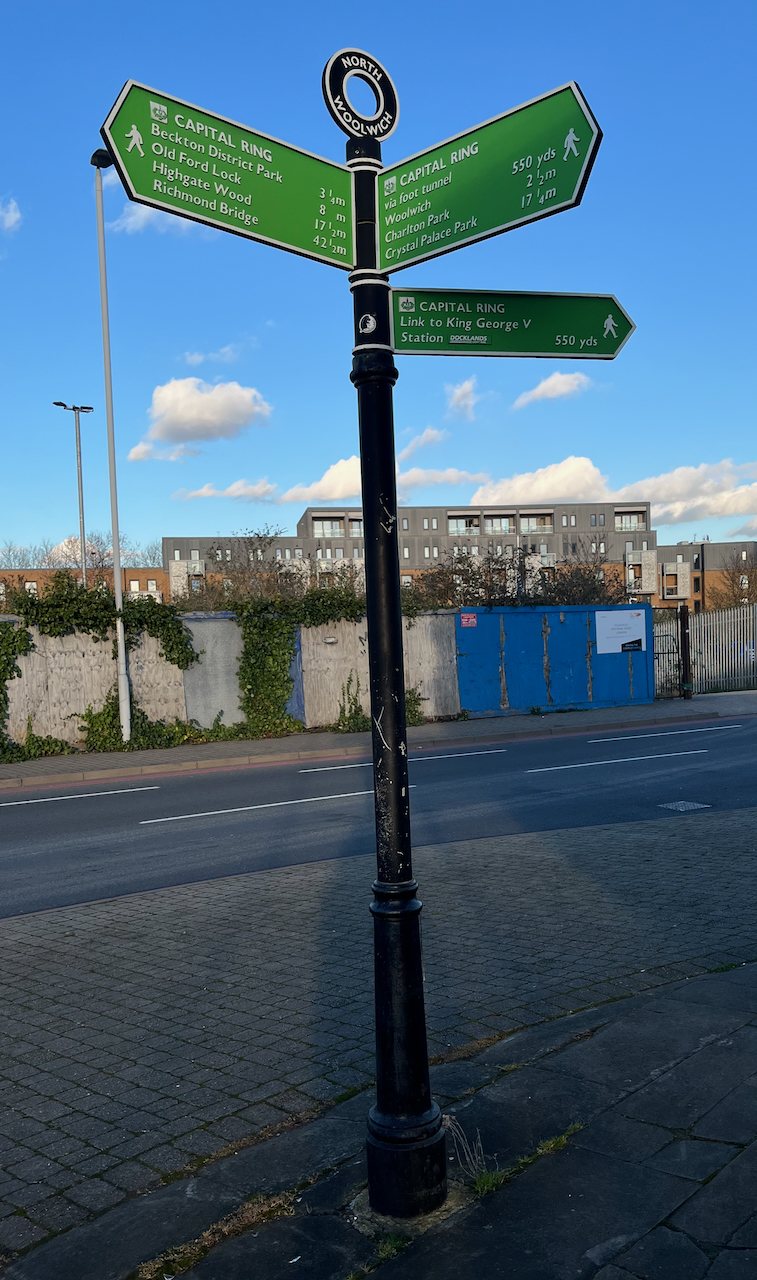
The North entrance to the Woolwich foot tunnel stands isolated on a traffic island.

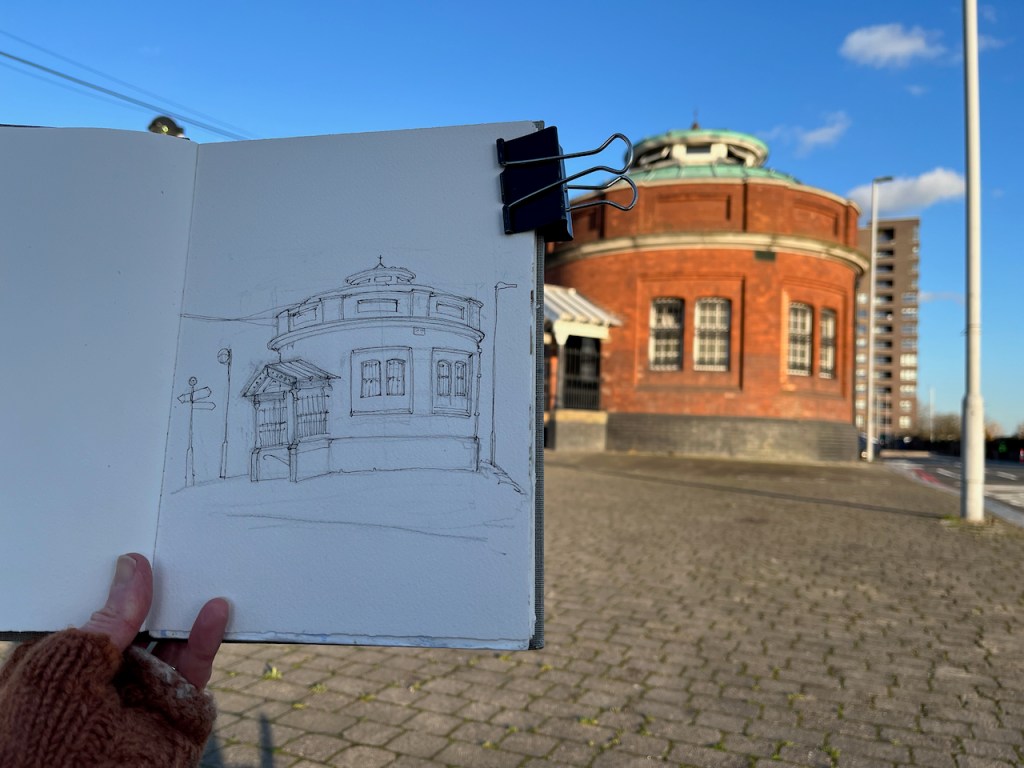
North entrance to the Woolwich Foot Tunnel, sketched 26th November 2024 in Sketchbook 15

The Woolwich Foot Tunnel opened in 1912, and is still open today, 24 hours a day. It connects the North and South sides of the River Thames.

I walked through the tunnel on an adventure exploring Docklands, inspired (once again!) by a fascinating article on the “London Inheritance” site.

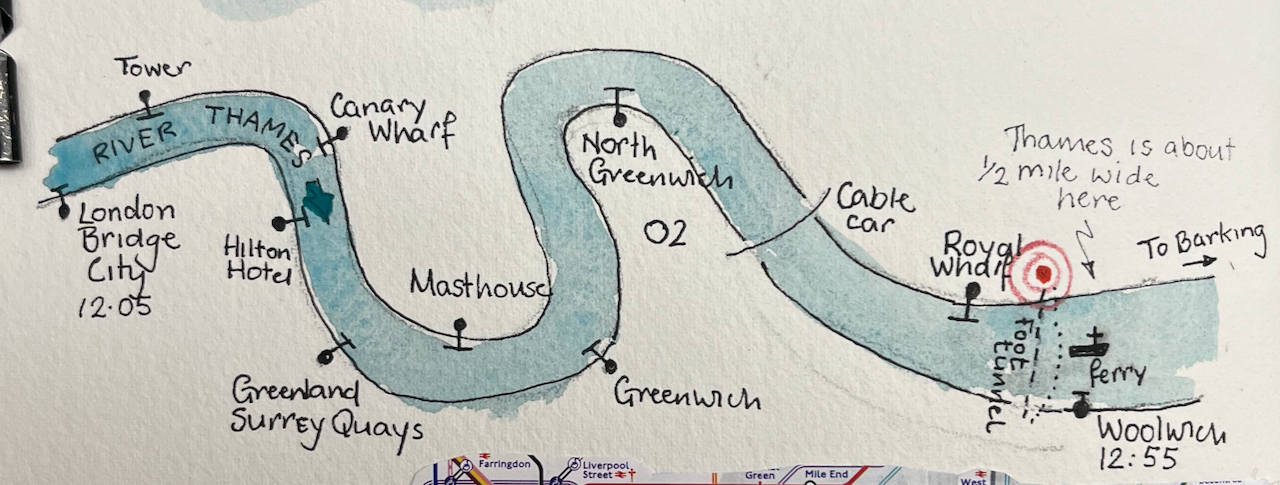
My expedition started at London Bridge pier, with a trip down the Thames on the riverboat. This seemed the simplest way to get to the docks. It takes about 50 minutes to go from London Bridge to Woolwich.

The route of the riverboat from London Bridge to Woolwich.

Everyone gets out at Greenwich, but it’s well worth going a bit further. The boat is empty, the Thames is huge, and the sky opens out.

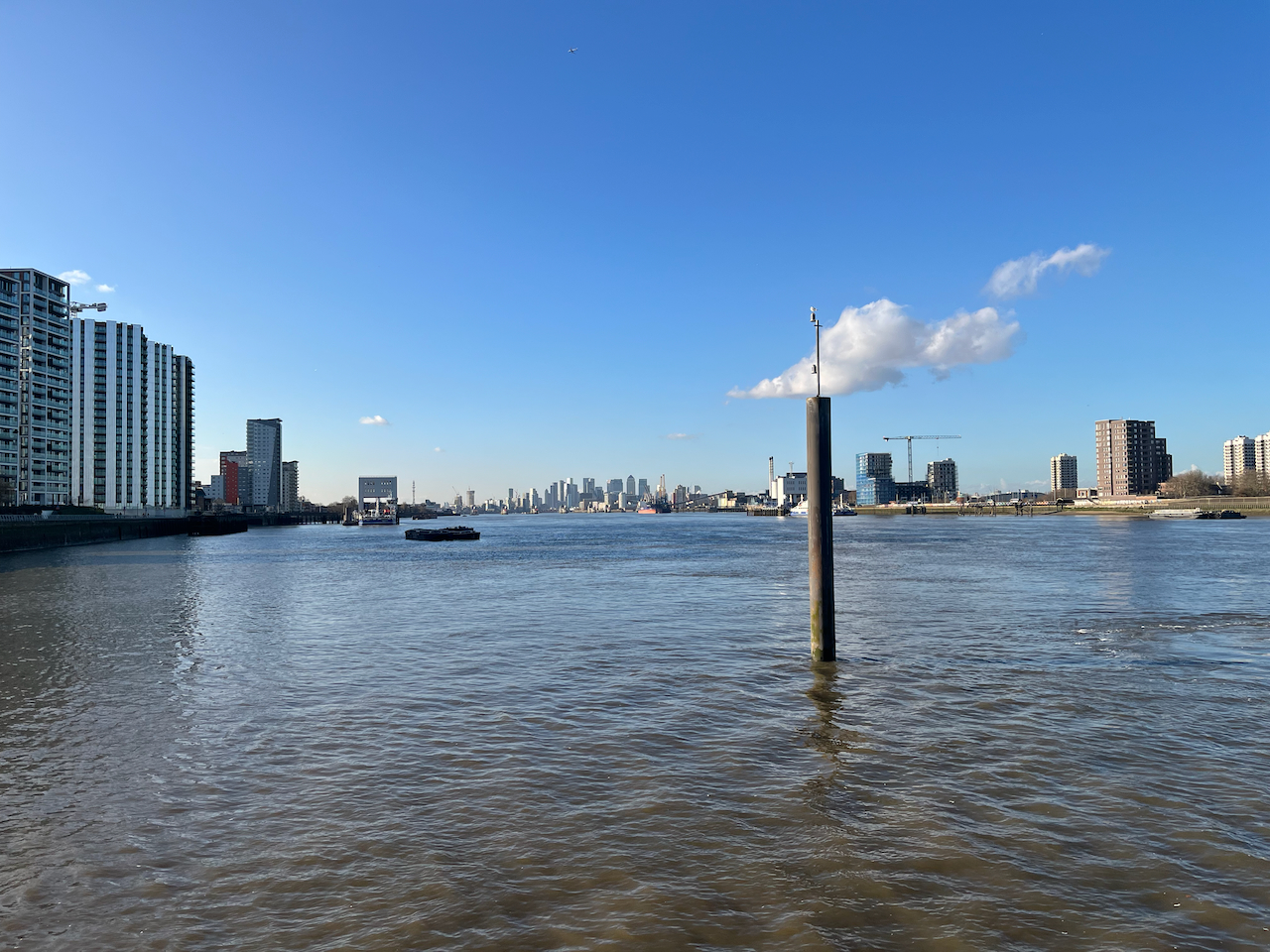
The City of London seen in the distance, from the Woolwich Royal Arsenal Pier

The river boat pier at Woolwich is on the South side of the river. I was keen to explore the North side, so I walked a little way to find the entrance to the foot tunnel. There is also a ferry, but I wanted to experience the foot tunnel.

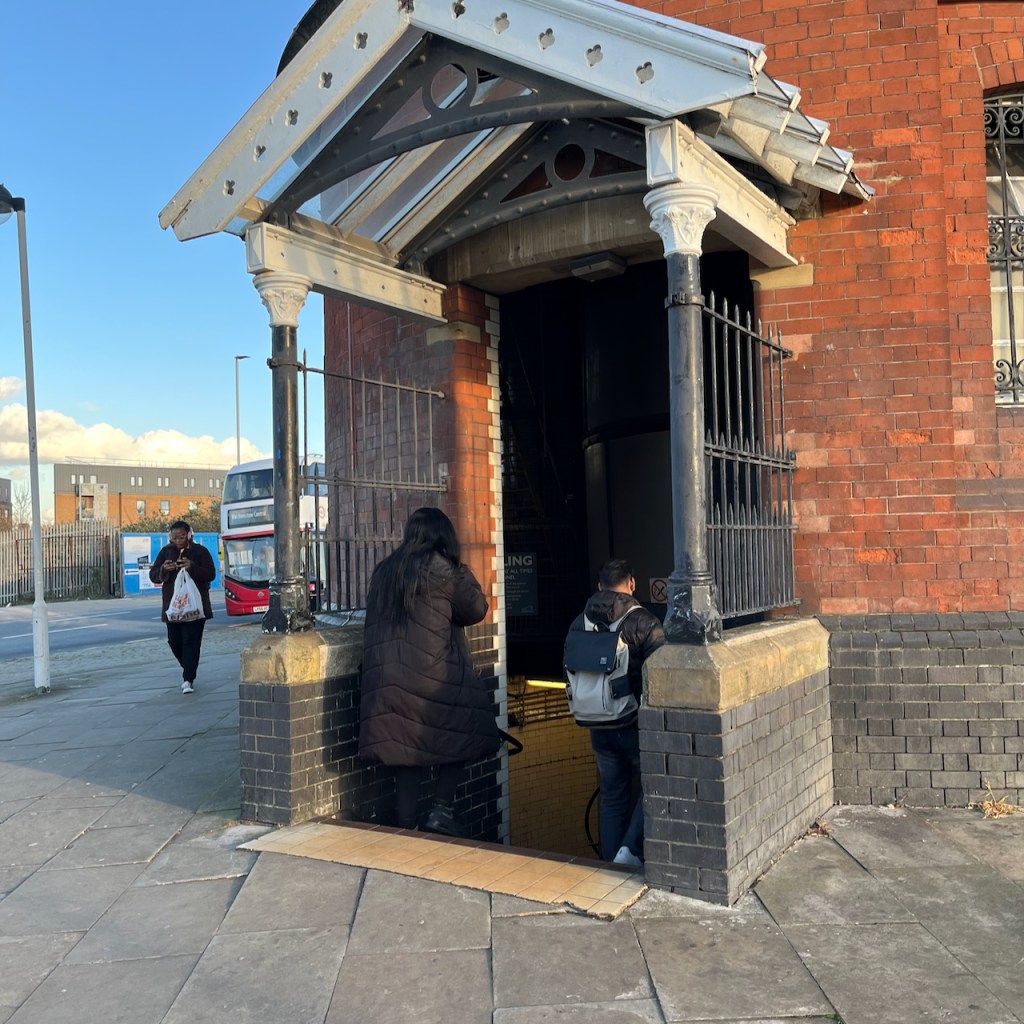
The South entrance to the foot tunnel is hard to find. It’s crammed into a dark space behind the leisure centre. It looks somewhat dingy and derelict.

South entrance of the Woolwich Foot tunnel, hemmed in by 1970s buildings.

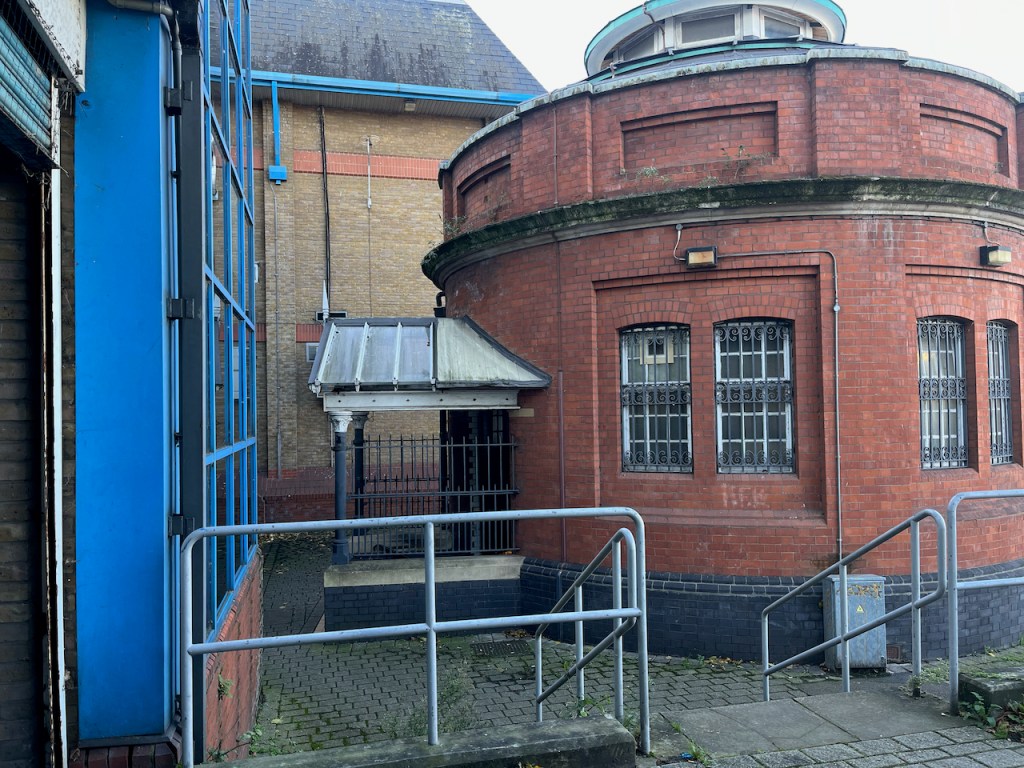
You have the option of the lift or the stairs. I followed the arrow to the stairs. The stairs are round the back. You have to find your way in, sidling between the wall of the leisure centre and the columned entrance to the tunnel. I can’t help feeling that the constructors of the tunnel would be appalled that their ornate entrance had been obstructed in this way.

Entrance to the stairs, under the canopy. Leisure Centre is the blue part on the left.

By this time I was rather doubting the wisdom of this undertaking, as the old building seemed so abandoned, and the entrance was so dark. However, the stairs were brightly lit, and it all seemed feasible. So down I went.

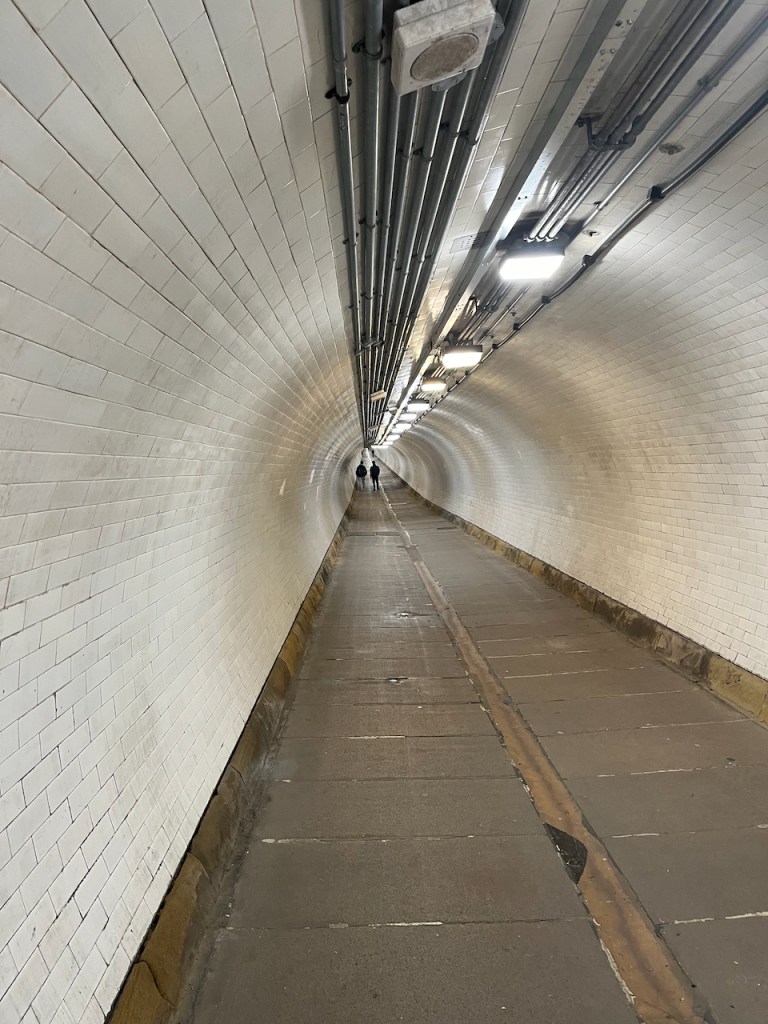
The tunnel itself is marvellous: all bright and clean, with amazing acoustics. I could hear the distant voices of people ahead of me.

Inside the Woolwich Foot Tunnel

On the North side there is a different world. The North entrance, unlike its Southern counterpart, stands proud and isolated on an expanse of concrete. I sat down and sketched it.

The building stands on a traffic island which is a junction of many routes. The A117 takes heavy traffic onto the pier, to load onto the Woolwich Ferry. There’s a bus, the Superloop SL2 ,which goes to Walthamstow. People walk from the bus to the foot tunnel.

North entrance to the foot tunnel. The Superloop bus from Walthamstow is in the background.

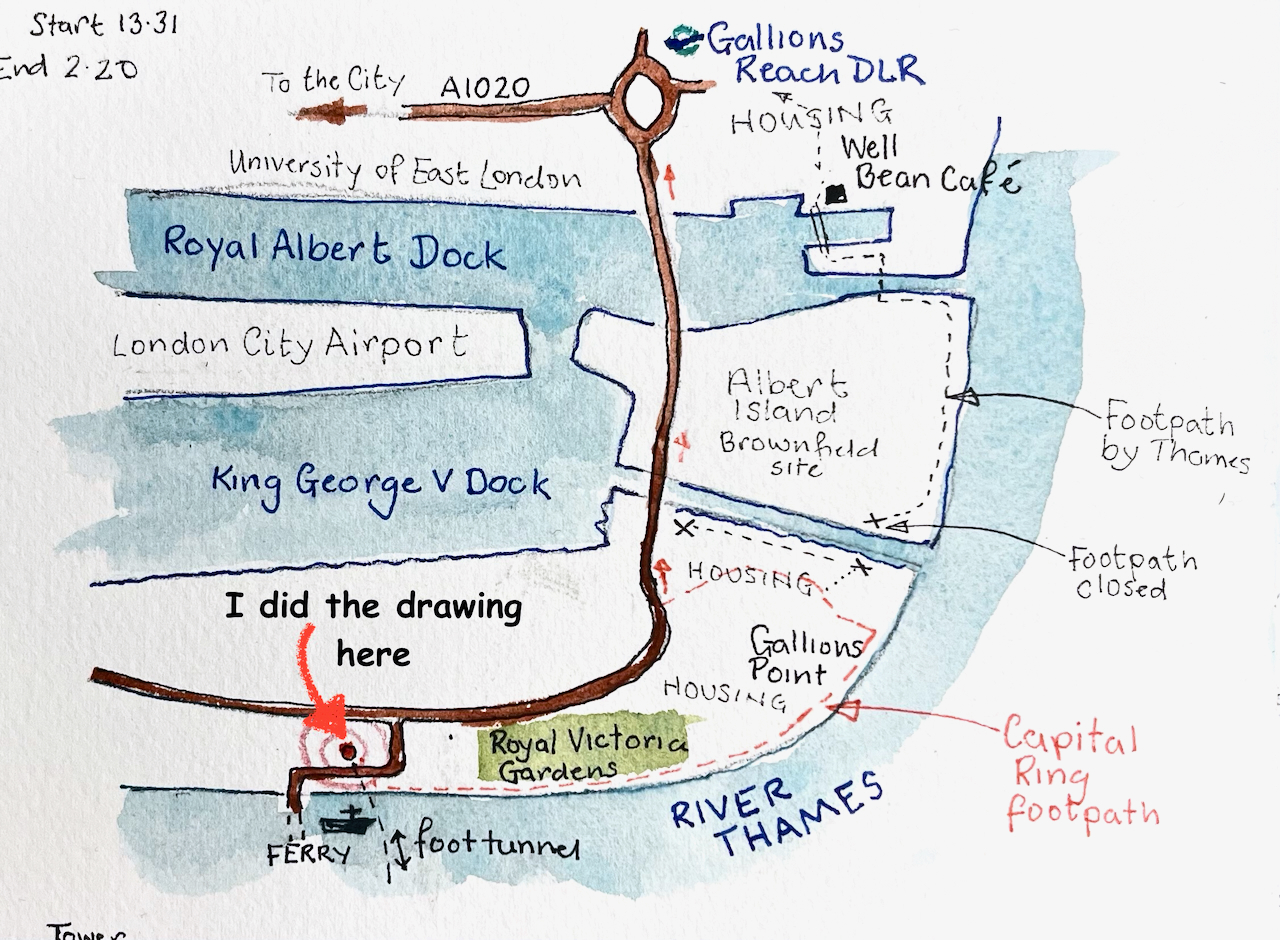
The signpost on the left of my drawing indicates the long distance footpath “The Capital Ring”. I followed this route along the Thames a little way. The path is cut off after the Galleons Point Housing development. Signs say that the lock gates are being maintained. So the route returns to the main road and passes over the spectacular bridges across the docks.

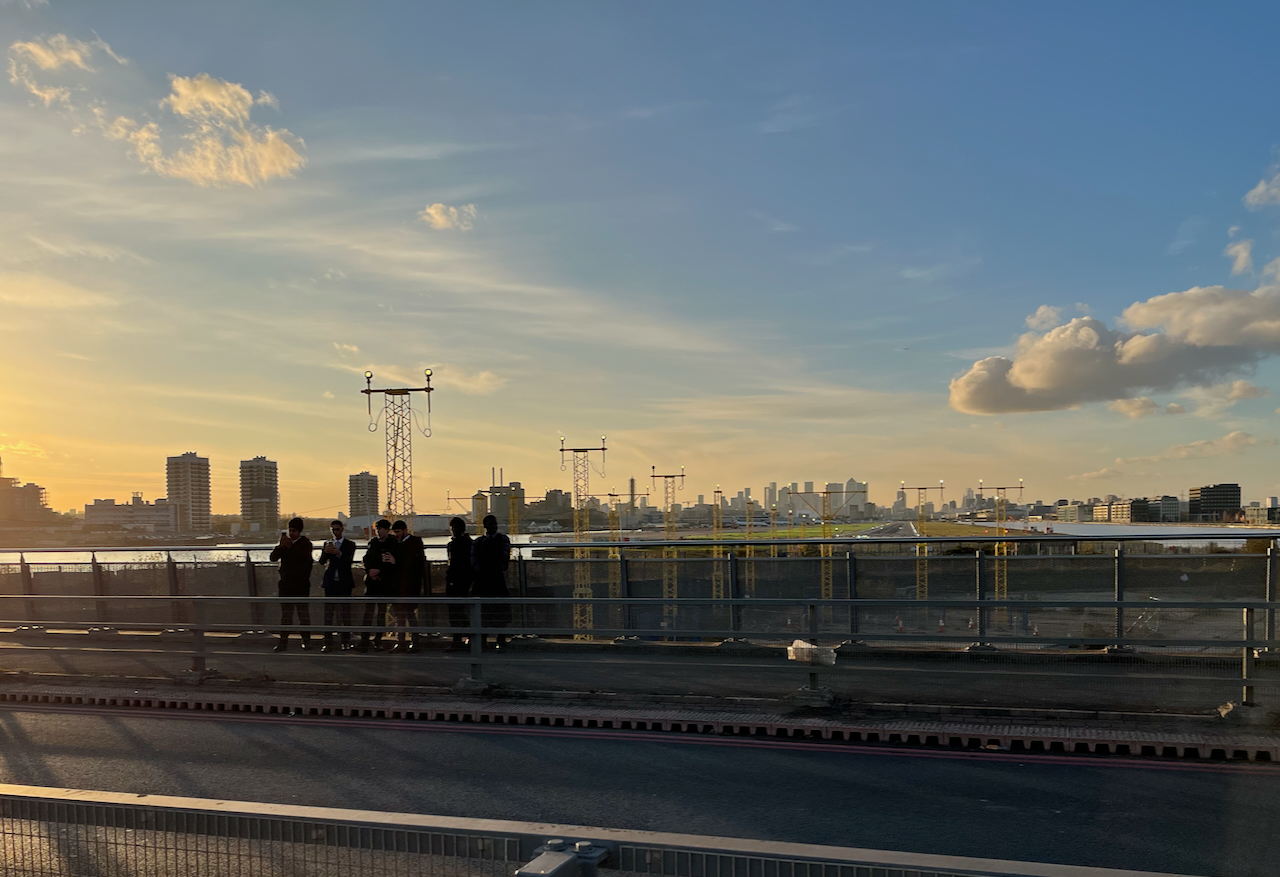
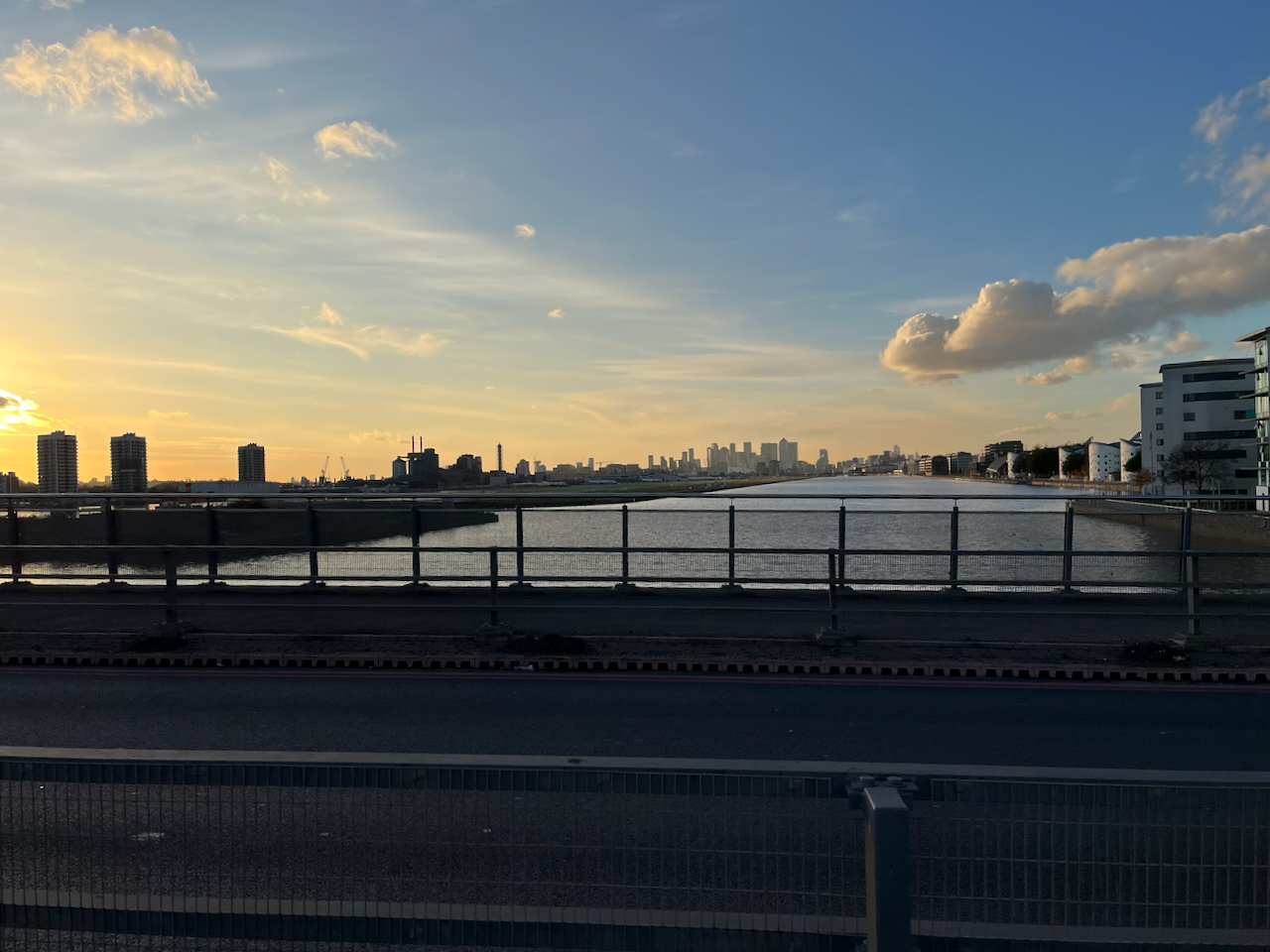
The bridges offer a view directly down the runway of London City Airport. When I walked past, some boys were enthusiastically photographing the aircraft on their mobile phones.

Plane spotters on the bridge over the Royal Albert Dock. City of London in the distance.

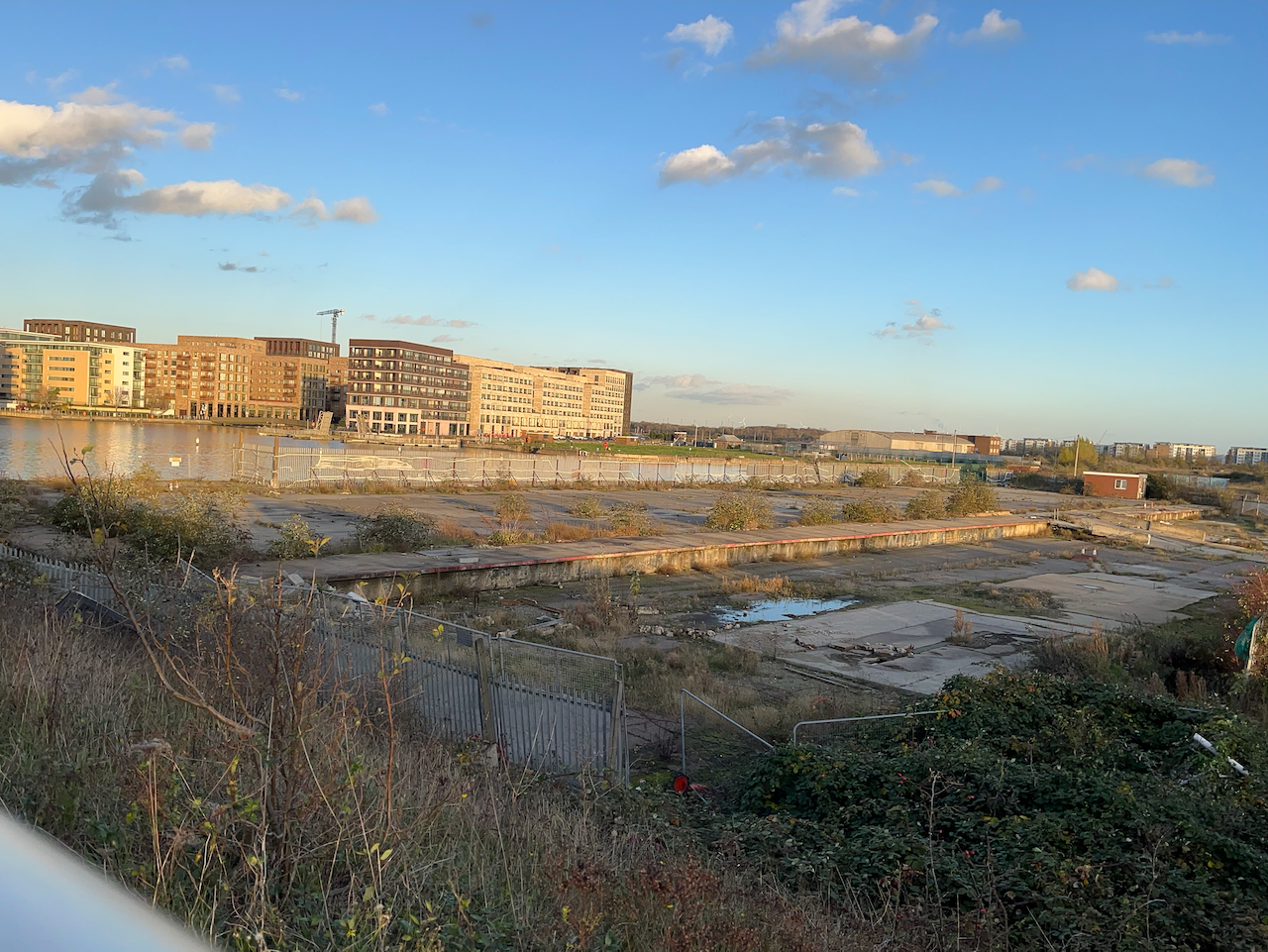
The other direction from the airport, looking toward the Thames, is a scene which seems to define what we mean by “brown field site”.

A brown field site: Albert Island, North Woolwich. This photo was taken from the same spot as the one above, but looking the other way.
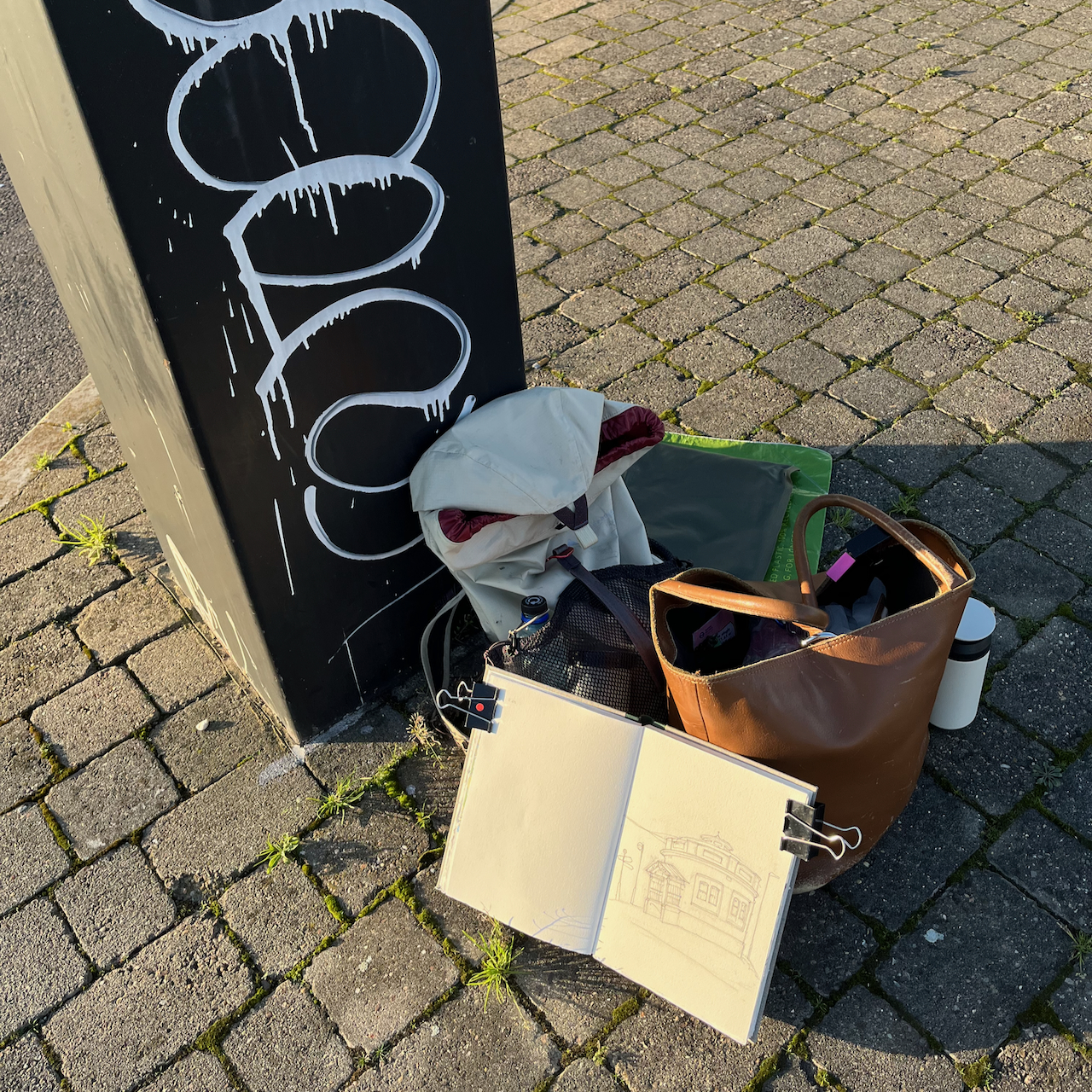
In the distance on the left, you see the housing developments round Gallions Reach. The quantity of space round here is astounding. And the docks are enormous.

Royal Albert Dock from the Steve Redgrave Bridge. The dock is about a mile long. The University of East London is on the right, City Airport on the left, City of London towers in the distance.

I walked on over these immense bridges over the docks. An oncoming bus tooted cheerfully. I looked up to see the driver smiling a friendly greeting. Perhaps I looked a little lonely and cold. The bus rushed on. I felt warmer.

On the other side of the bridge I warmed up in the “Wild Bean Café” (recommended) and then made my way to Gallions Reach DLR station and thence to central London.

If in need of wide open spaces and a bit of distance from the problems of the City, then a trip downriver is definitely the thing.

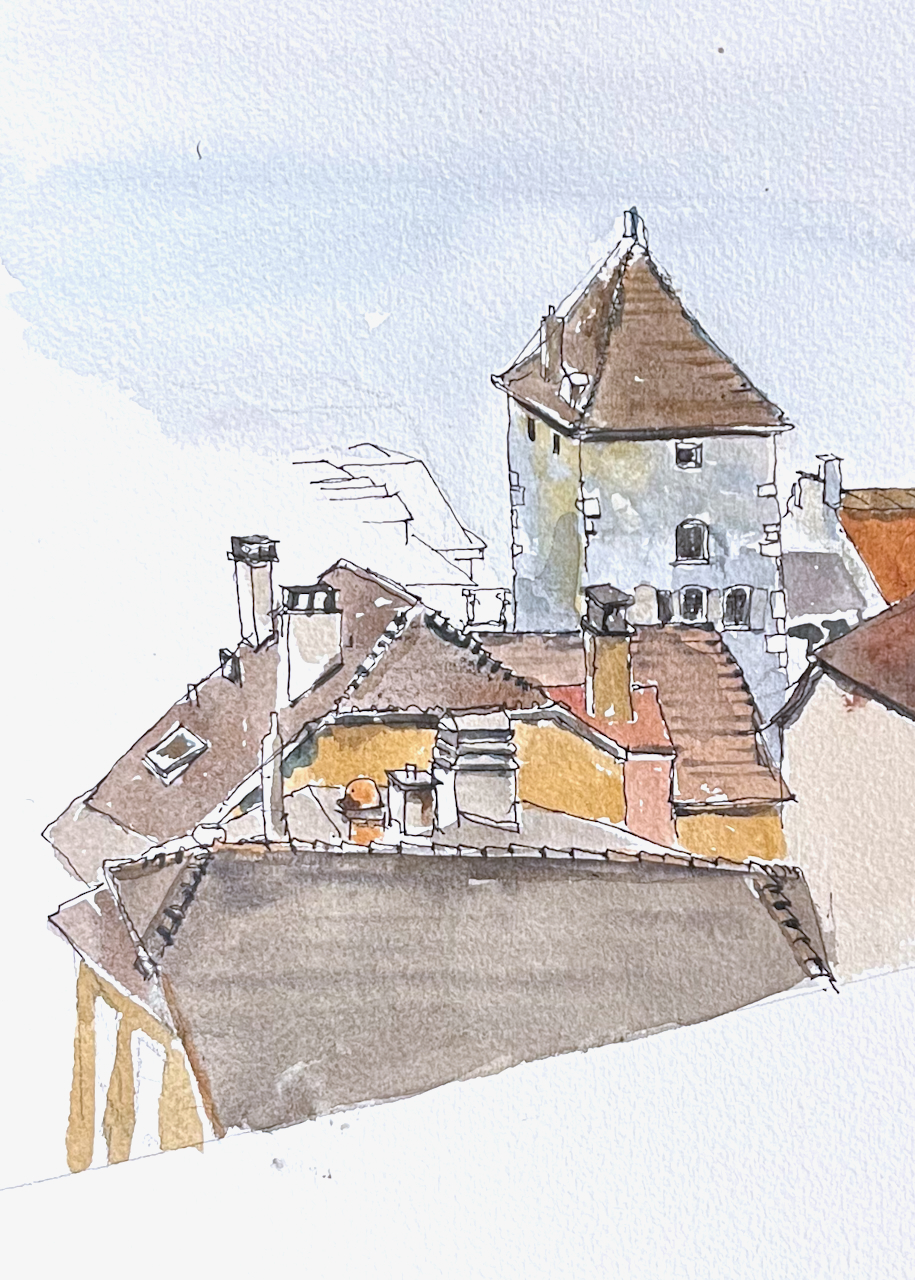
Nyon, view from the castle

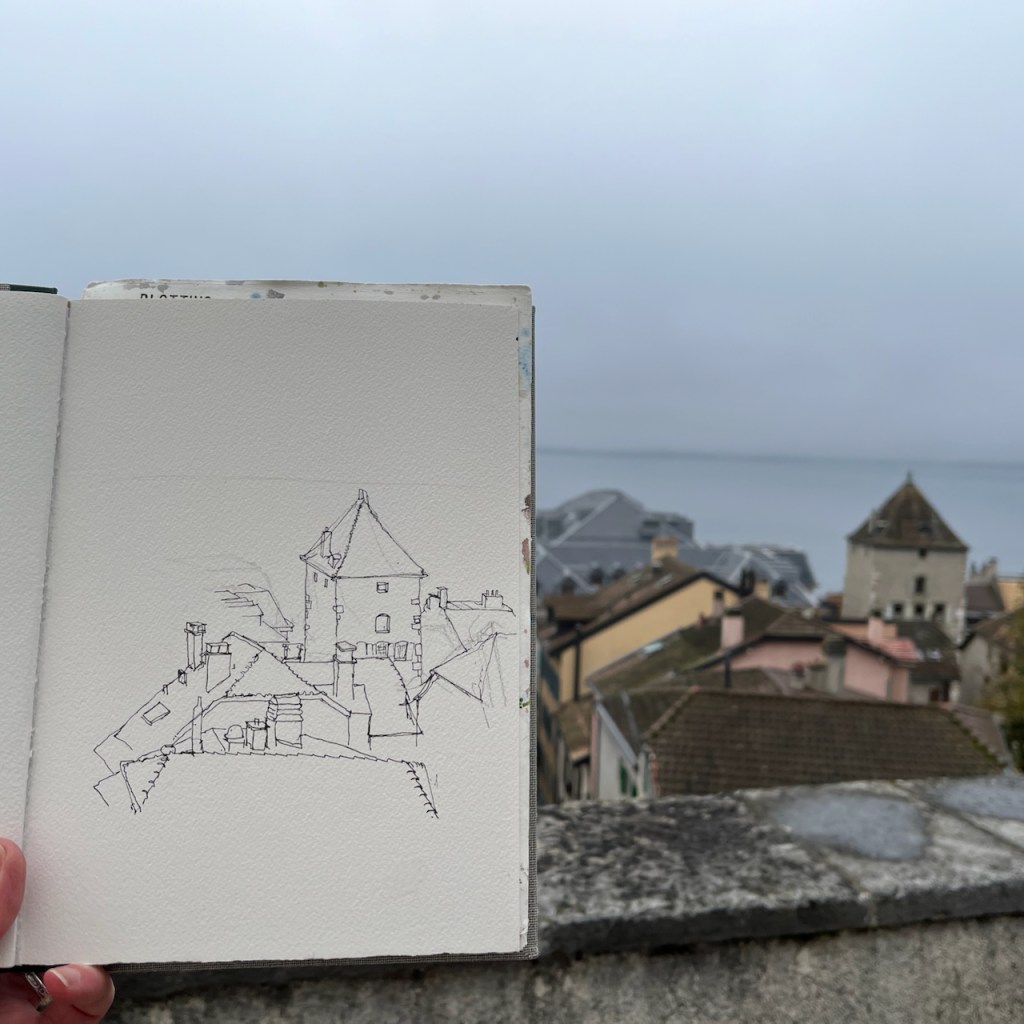
Standing on the ramparts of the castle at Nyon, I look towards Lake Geneva.

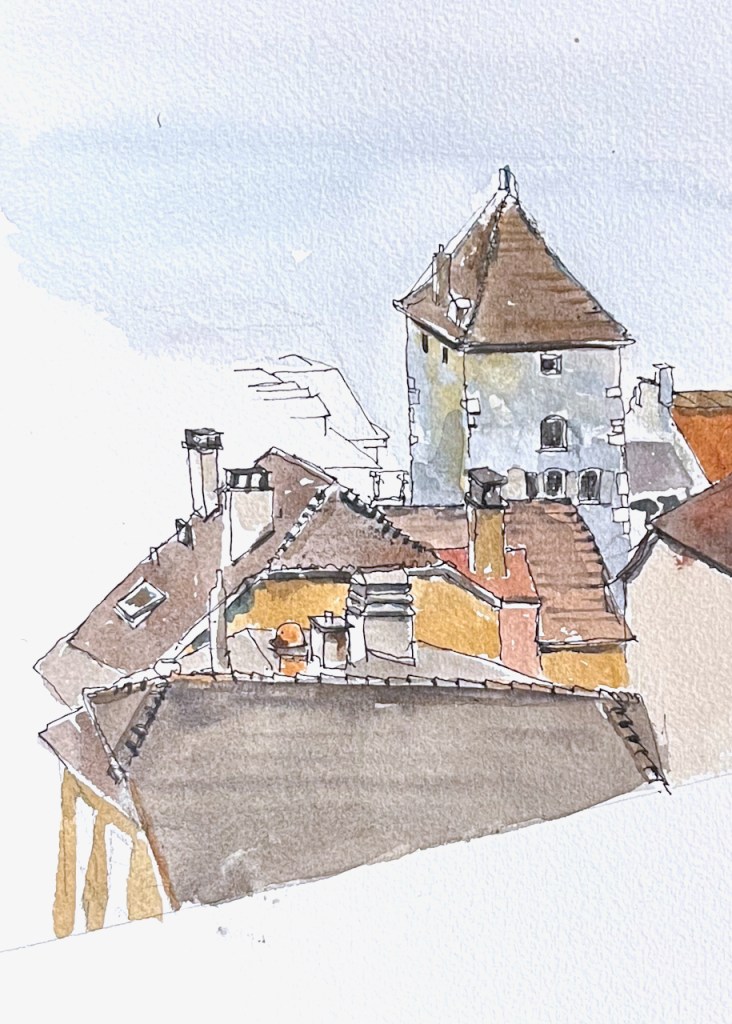
Rooftops from Nyon Castle, 29 October 2024 in Sketchbook 15

The tower in the picture is at the junction of Rue de Rive and Passage des Pirates, Place Abraham HERMANJAT 1862-1932. I can find its position on a map, but it is unremarked and seems not to have a name. If there is any citizen of Nyon out there who can identify it, I’d be very grateful.

Lake Geneva is in mist, in the background of the picture. The mist came and went as I was sketching. It was extremely cold.

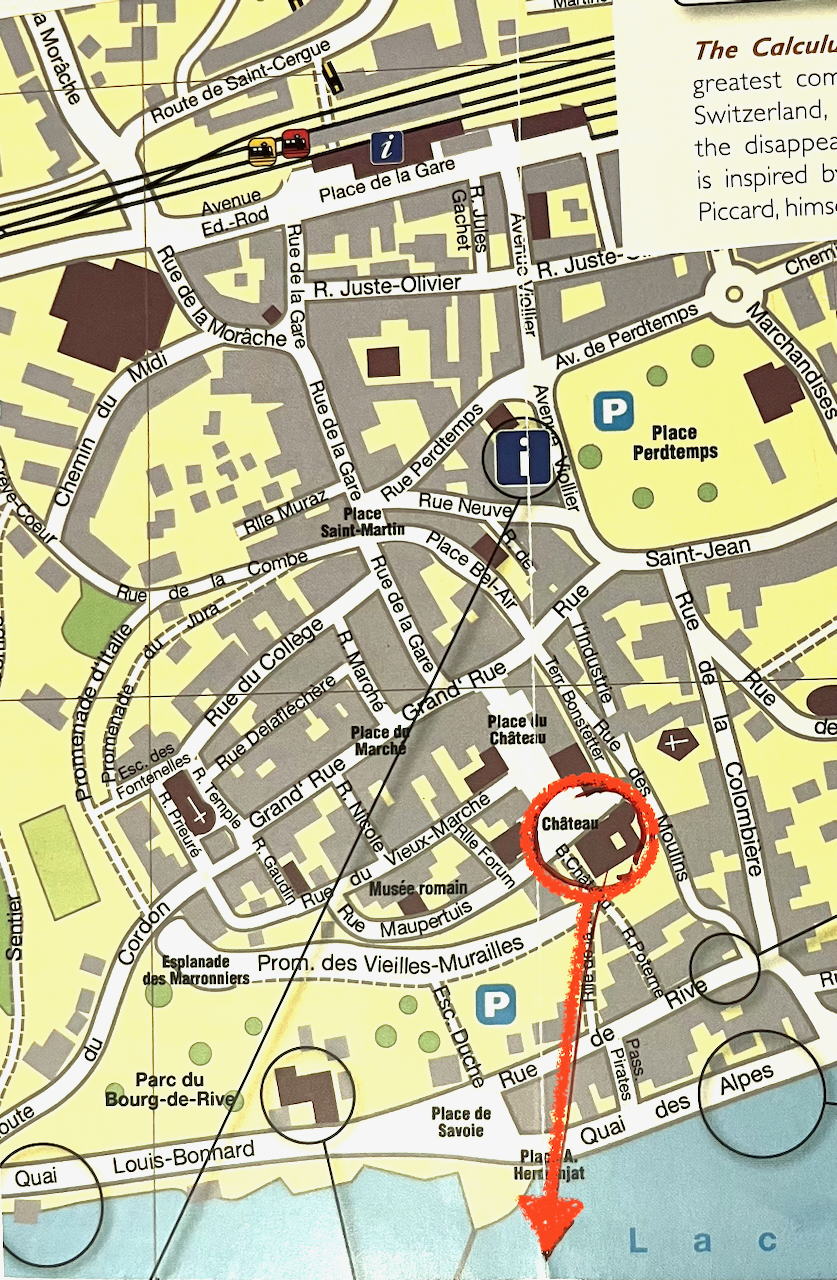
Map from Nyon tourist office, showing the sightline of the drawing.

Nyon is easy to navigate because it is on a slope, from the train station at the top of the map down to Lake Geneva at the bottom of the map.

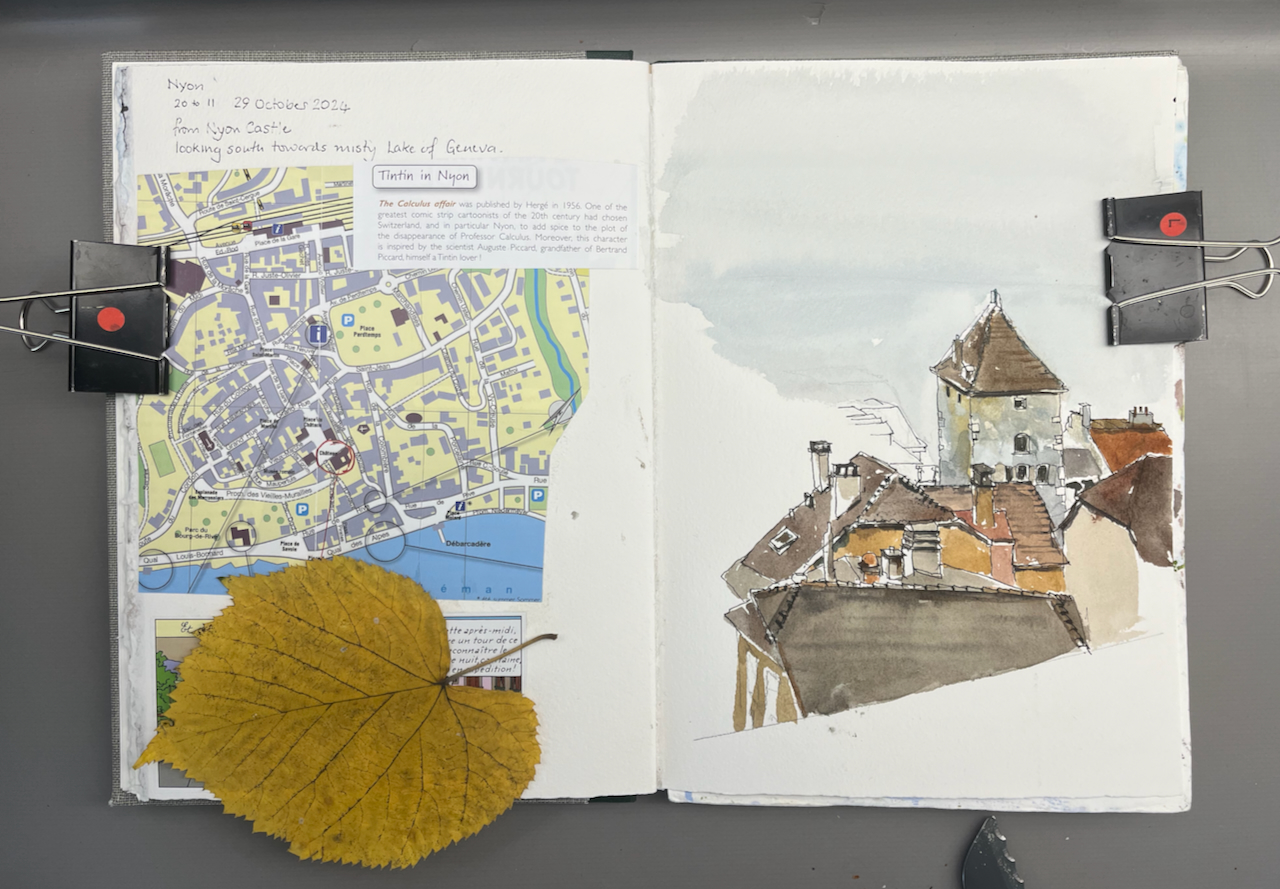
The map above came from the Nyon Tourist Office who also offered a leaflet reminding me that part of the action in the Tintin book “L’Affaire Tournesol” took place in Nyon. This book is called “The Calculus Affair” in English. On page 21, you can see the the white car which takes Tintin and Haddock along the lake. It has Vaud number plates (“VD”).1 The fire engine which rescues them from the ruins of the house on page 27 is, according to the tourist office, carefully preserved in a local museum.

I read the Tintin books assiduously as a child, and again, in French, years later. I think the pictures influenced my drawing style, and may be why I like to draw in pen and wash today. So as well as being a record of a moment spent on the freezing battlements of Nyon Castle, the drawing above is my small homage to the great Hergé.

Sketchbook 15, with items from the leaflet “Tintin in Nyon”, and a leaf.
  1. The images from the Tintin books are protected by copyright, so I am not including them here. But do have a look if you have a copy of the book at home. ↩︎

Hoxton Trust Community Garden – Clock Tower, London N1

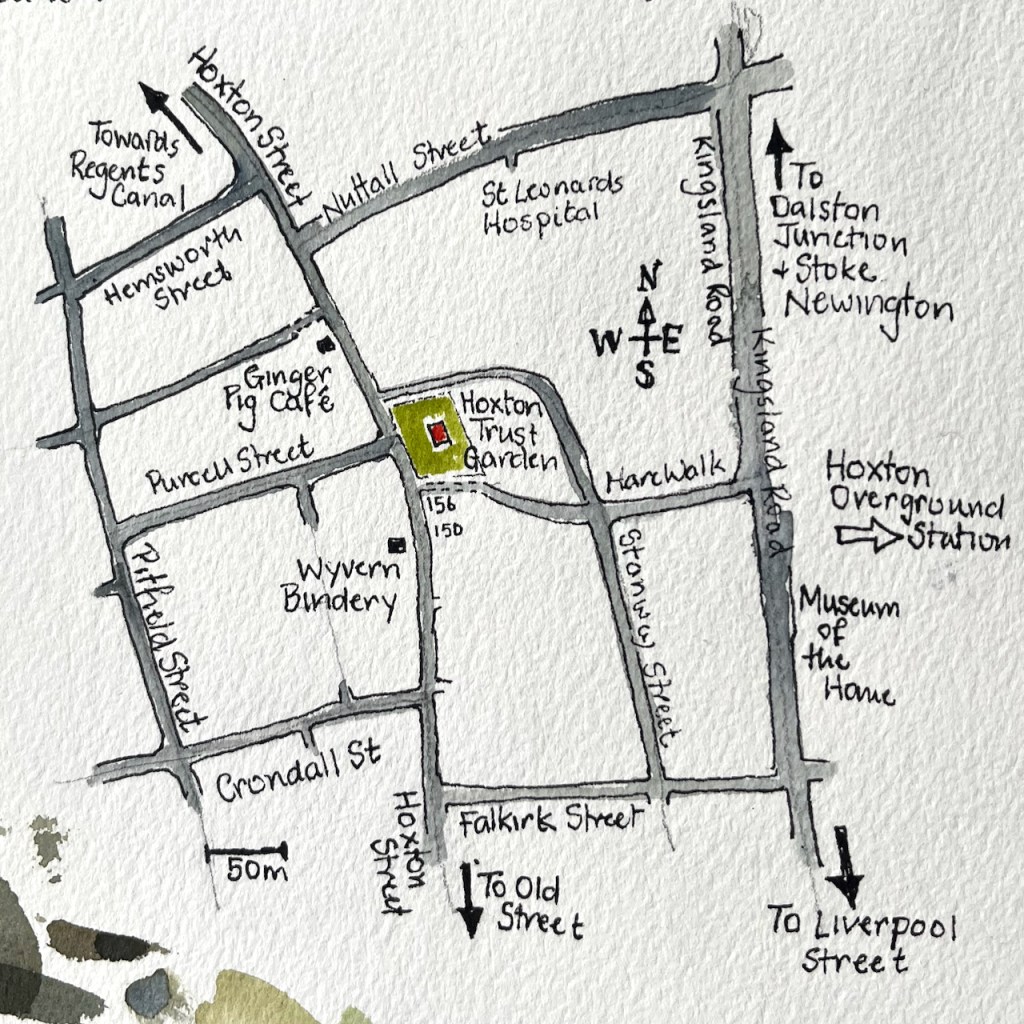
Hoxton Street is busy with market stalls, shops, cafés. People walk to and fro. If you walk North, there’s a small garden on the right, behind a fence. Above the trees there’s this odd white tower. What is it? The gate is open and you can go in.

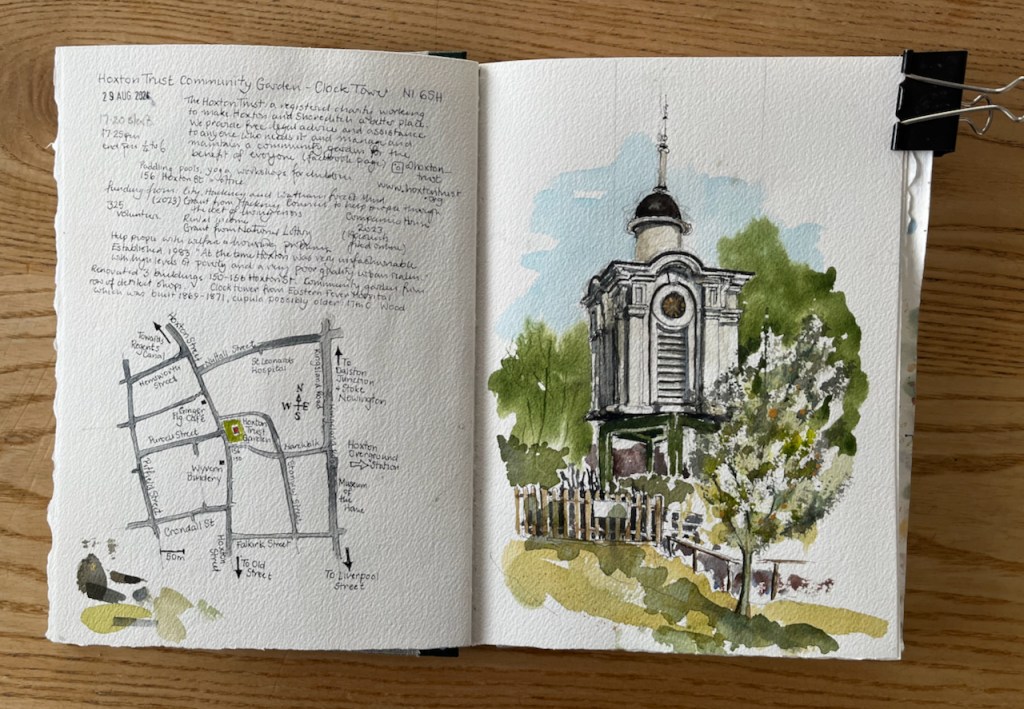
Hoxton Trust Community Garden N1- Clock Tower, sketched 29 August 2024 in Sketchbook 15

This is the Hoxton Trust Community Garden. Their website tells me that the Clock Tower was rescued from the Eastern Fever Hospital which was built 1869-1871. It is made of wood, and is possibly older than the hospital.

The clock tower sits on a framework made of steel girders. On the day I was there, the clock had stopped at half-past six. So in a timeless interlude, I sketched from a wooden bench amongst the trees.

Near the bench is a small monument to the “Hoxton Five”. Who were they?

“One was stabbed, and his four friends were killed in a car crash returning from the funeral.”

The Hoxton Community Trust is a registered charity “working to make Hoxton and Shoreditch a better place”. According to their website, they provide free legal advice and assistance to people who need it. They maintain this community garden for the benefit of everyone. The charity was established in 1983: “At the time, Hoxton was very unfashionable, with high levels of poverty and a very poor quality urban realm”, their website says. They bought and renovated three buildings, 150-156 Hoxton Street, adjacent to the garden. These buildings are now let out. Rents from these buildings supplement the income of the Hoxton Trust, which is also funded by grants from the National Lottery, Hackney Council, and other sources (2023). The work of the Trust is also supported by volunteers, some of whom work in the garden.
The garden is lovely. There are fruit trees and a herb garden, and plenty of seats. A sanctuary.

Sketching in the Hoxton Community Trust Garden.
Sketchbook 15

Limehouse Accumulator Tower, E14

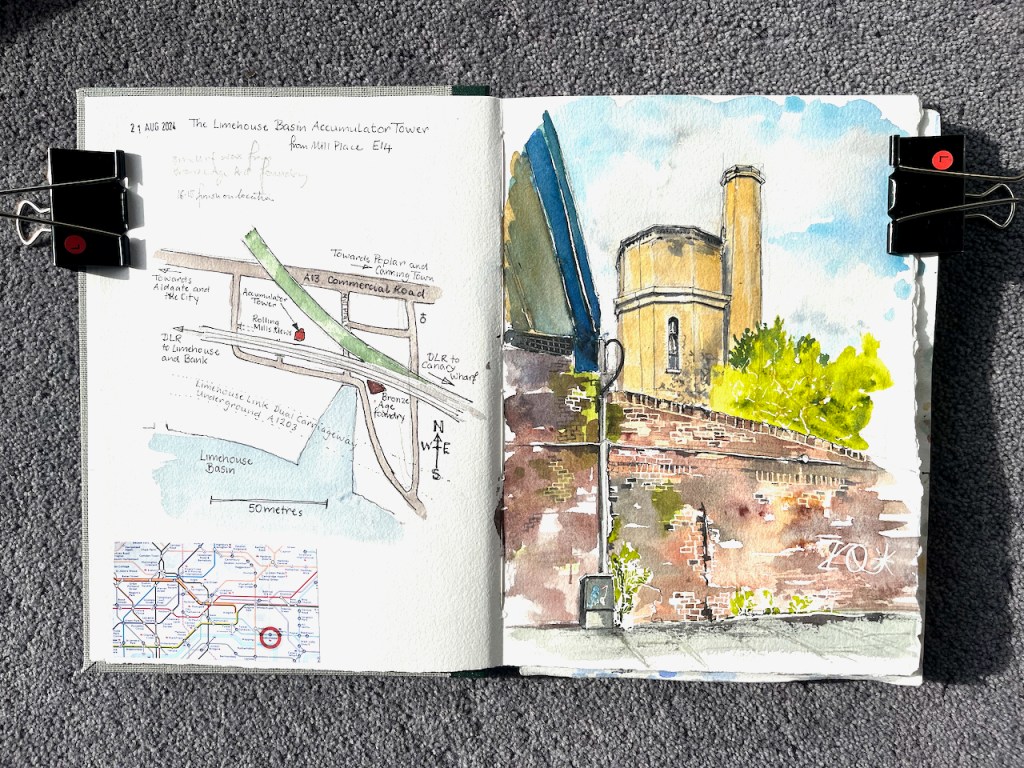
This is the Limehouse Accumulator Tower, seen from Mill Place, London E14.

Limehouse Accumulator Tower, sketched 21 August 2024, in Sketchbook 15

In the 19th century, this building provided hydraulic power to machinery in the Limehouse docks. Hydraulic power is a way of transmitting energy from one place to another.

The problem at the time was that steam engines could generate motive force, but only where they were. You could build a big powerful steam engine, but you couldn’t put a steam engine next to every crane, capstan, or set of lock gates. You also didn’t want to fire up a steam engine every time someone wanted to use the lock gates. So you had to find a way of transmitting the power from the steam engine to the machinery which used it. And you had to find a way of storing the power so it was available on demand. Before the use of electricity was common, power was transmitted using pressurized water.

The steam engine located in this building was used to pump water into the adjacent accumulator tower, by lifting a heavy weight. The heavy weight was a neat fit on top of the water inside the tower and pushed the water down. Water does not compress. So the weight just sat there, applying pressure to the water. The pressurised water was distributed around the docks in thick cast-iron pipes. When the lock-keeper wanted to operate the lock gates they opened a tap and the force of the pressurized water opened the gates. Then they closed the taps. Far away, the weight moved down very slightly in the accumulator tower. Eventually the steam engine was used to pull the weight up to the top again.

That’s 19th century hydraulic power. Power is transmitted by pressurised water in cast-iron pipes: the original, functional, steam-punk.

I find it marvellous. I’ve drawn the much bigger London Hydraulic Power station here. The Limehouse building is smaller. It was built in 1869, one of several in the area at the time. It was restored in 1994/5, but sadly the weight and machinery are removed. There is a detailed history of the building on this link from the Greater London Industrial Archaeology Society.

Sketching the Limehouse Accumulator Tower. The modern Docklands Light Railway lines run over the Victorian bridge to the left, the bridge to the right is disused.

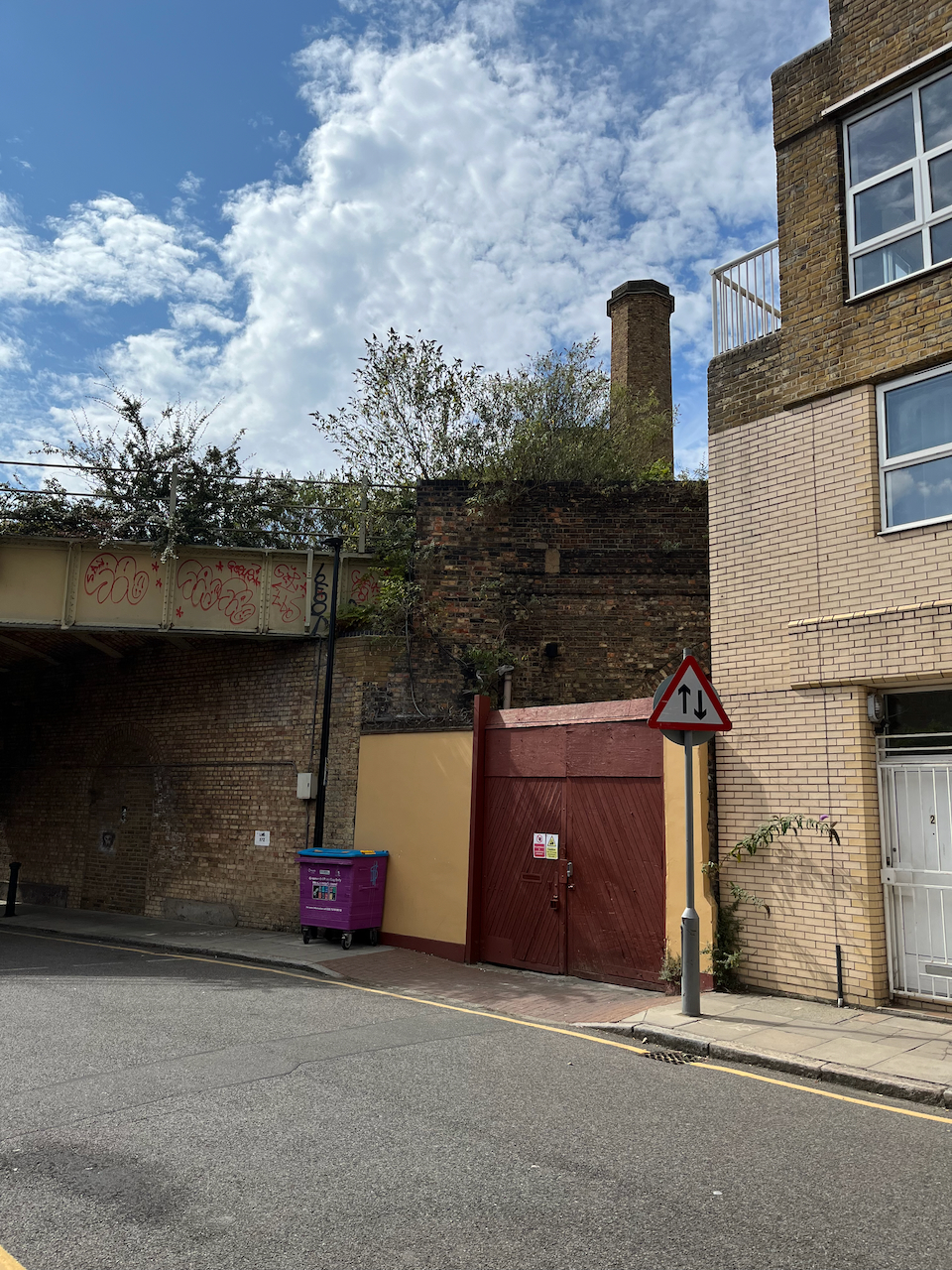
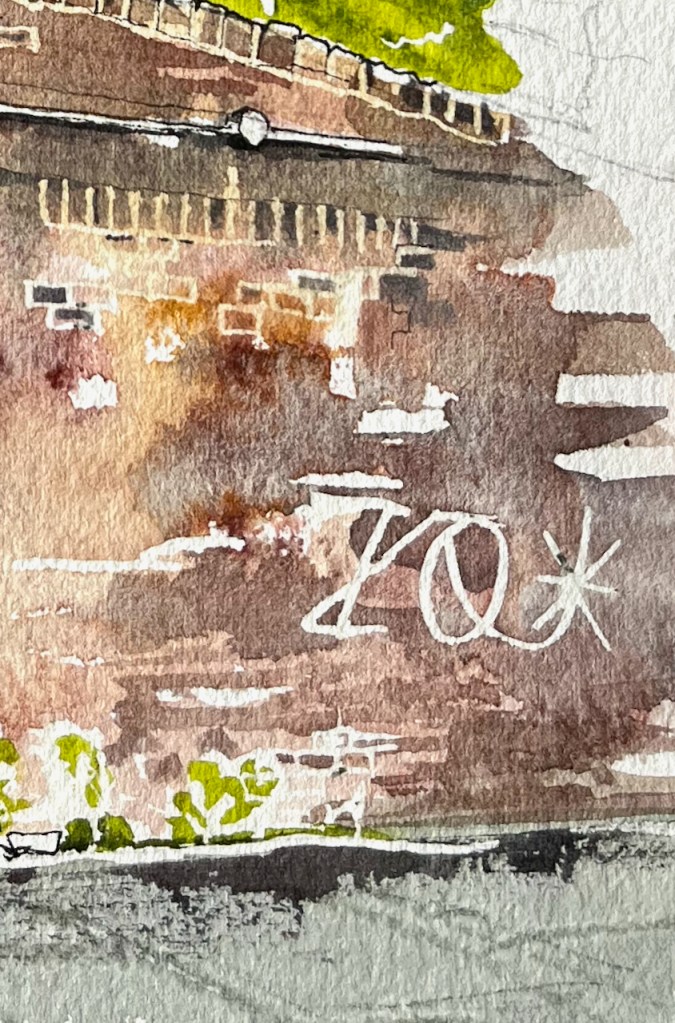
Standing in Mill Place to make this sketch, I became aware of all the history that is embedded in walls. The one in front of me had been altered, rebuilt, and amended several times. A bit had been added on top. Plants lived there. A graffiti artist had made their mark on the crumbling stone.

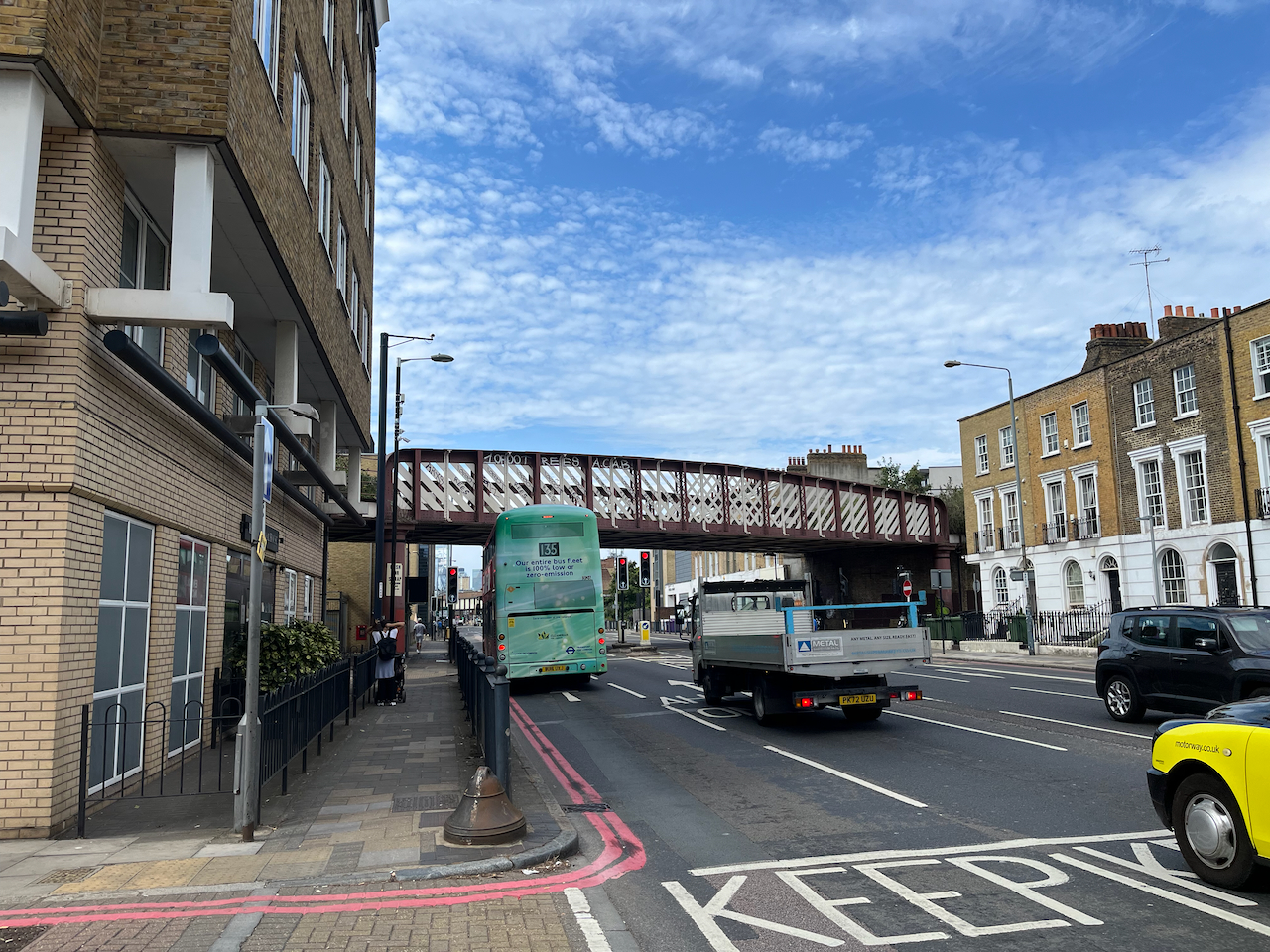
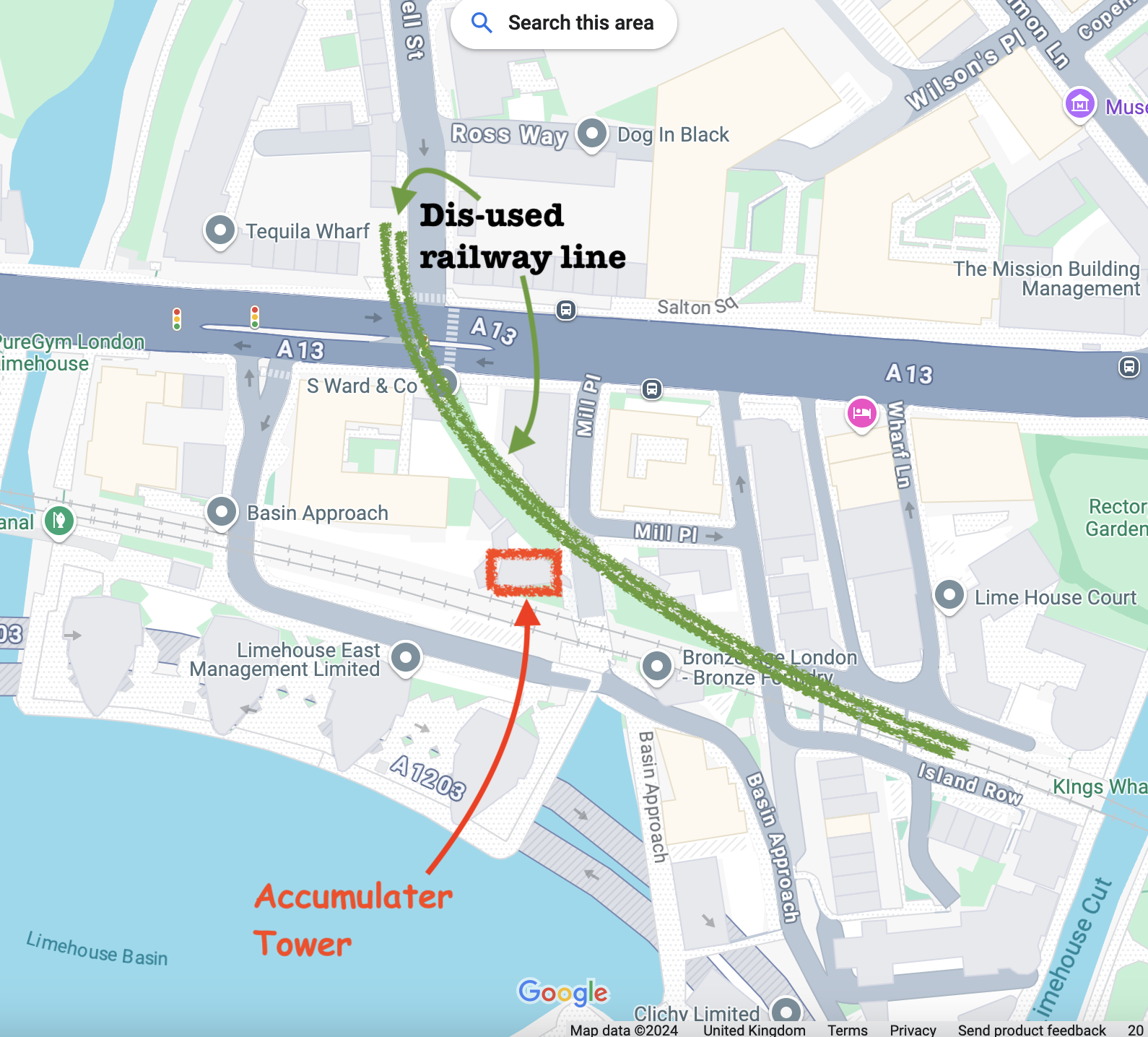
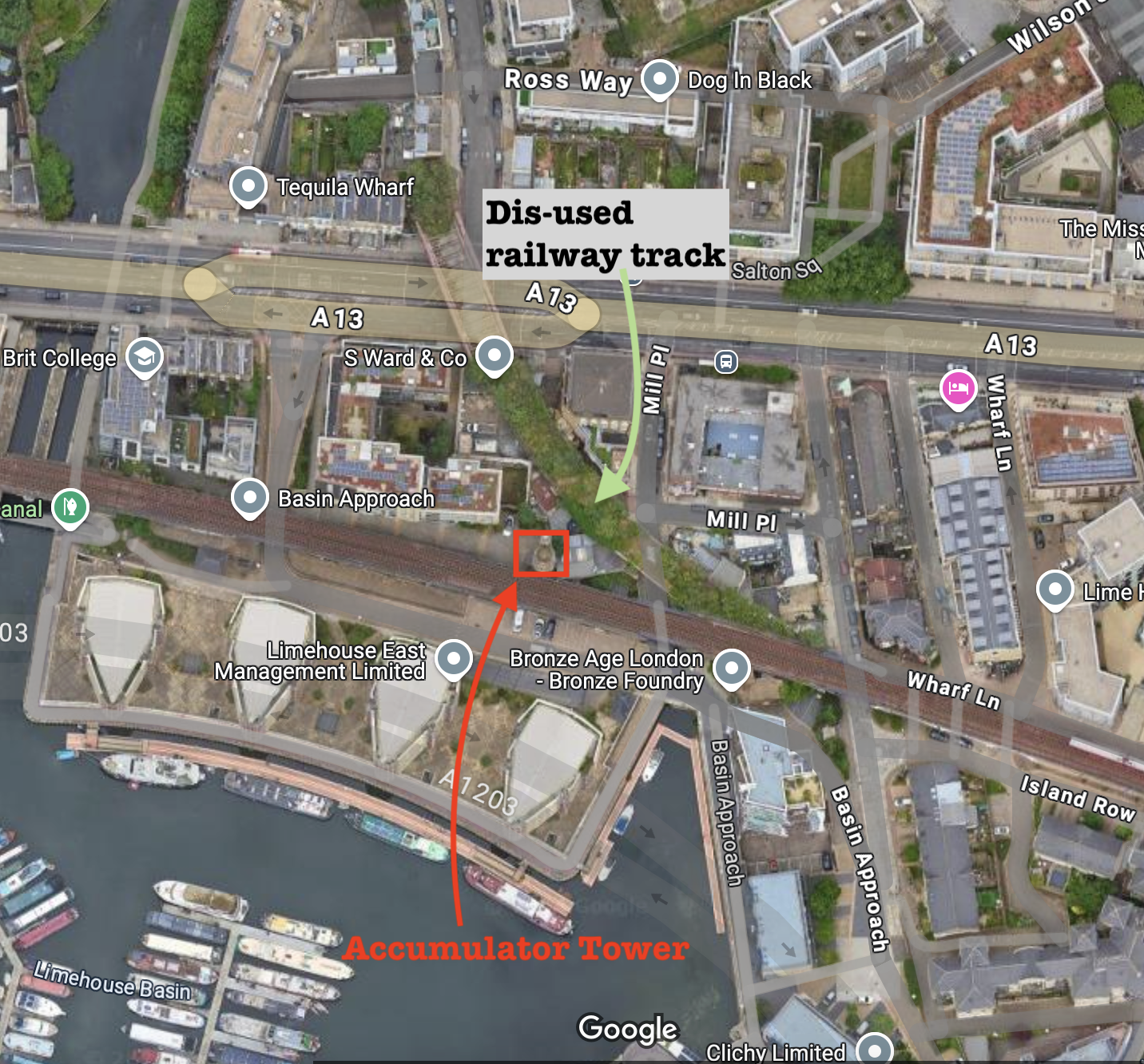
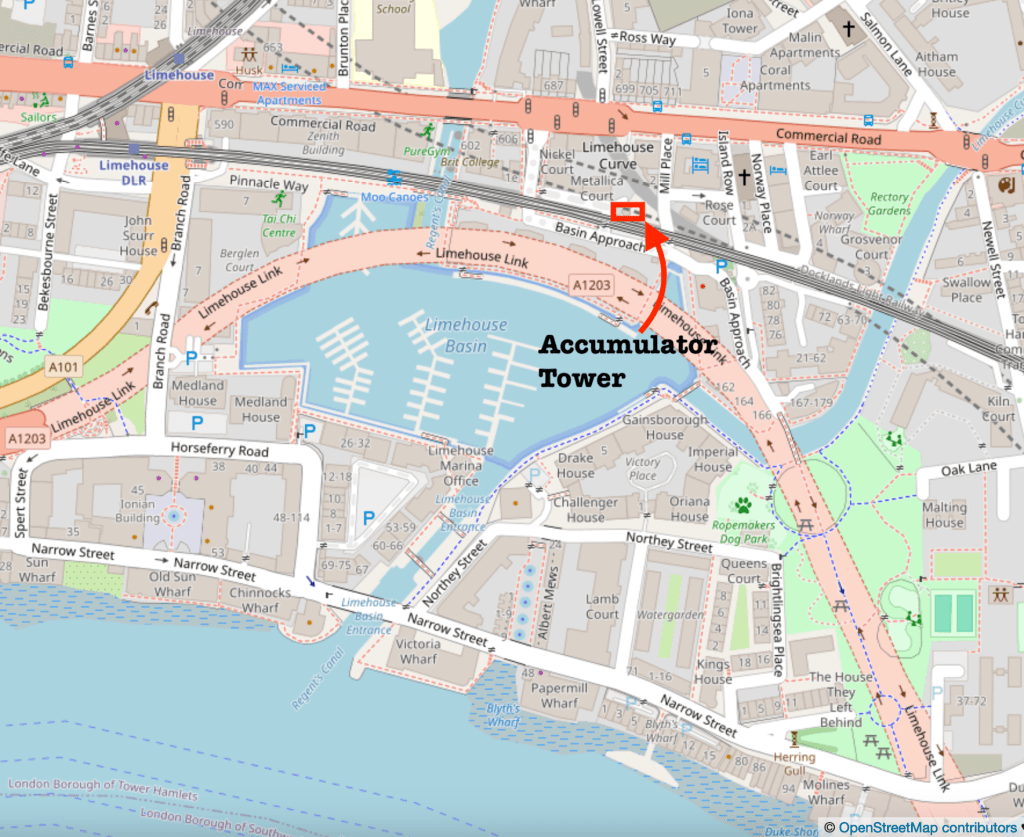
I was standing under two bridges, both 19th century. Both survivors. One holds the modern Docklands Light Railway. The other had wonderful strong vaulting. But it held no railway. I walked around trying to find out where it went. The Google aerial view confirms what I suspected: it is a ghost railway. On the bridge there is verdant greenery where the railway used to be. It goes across a second sturdy bridge, over the A13, and then stops.

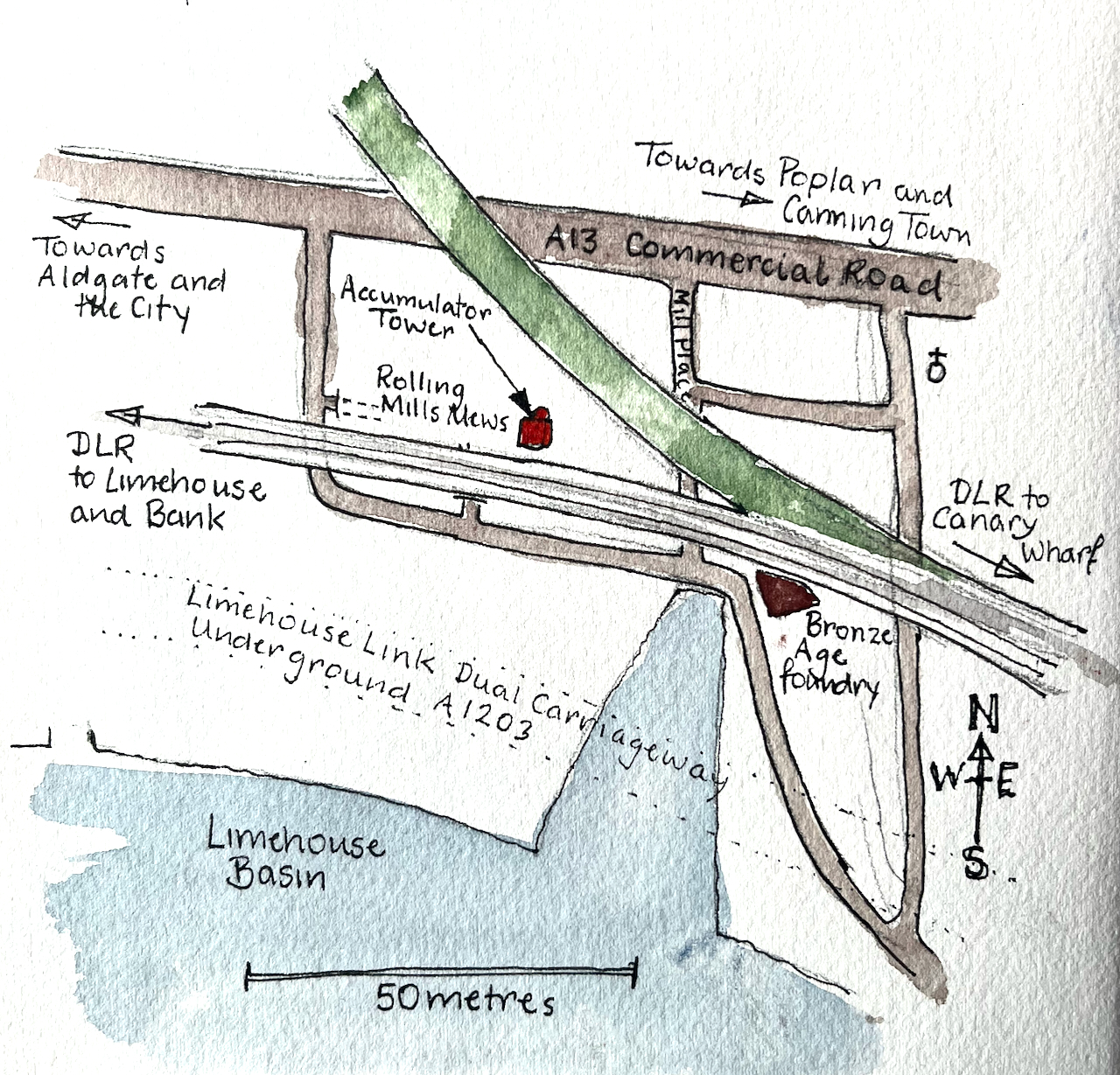
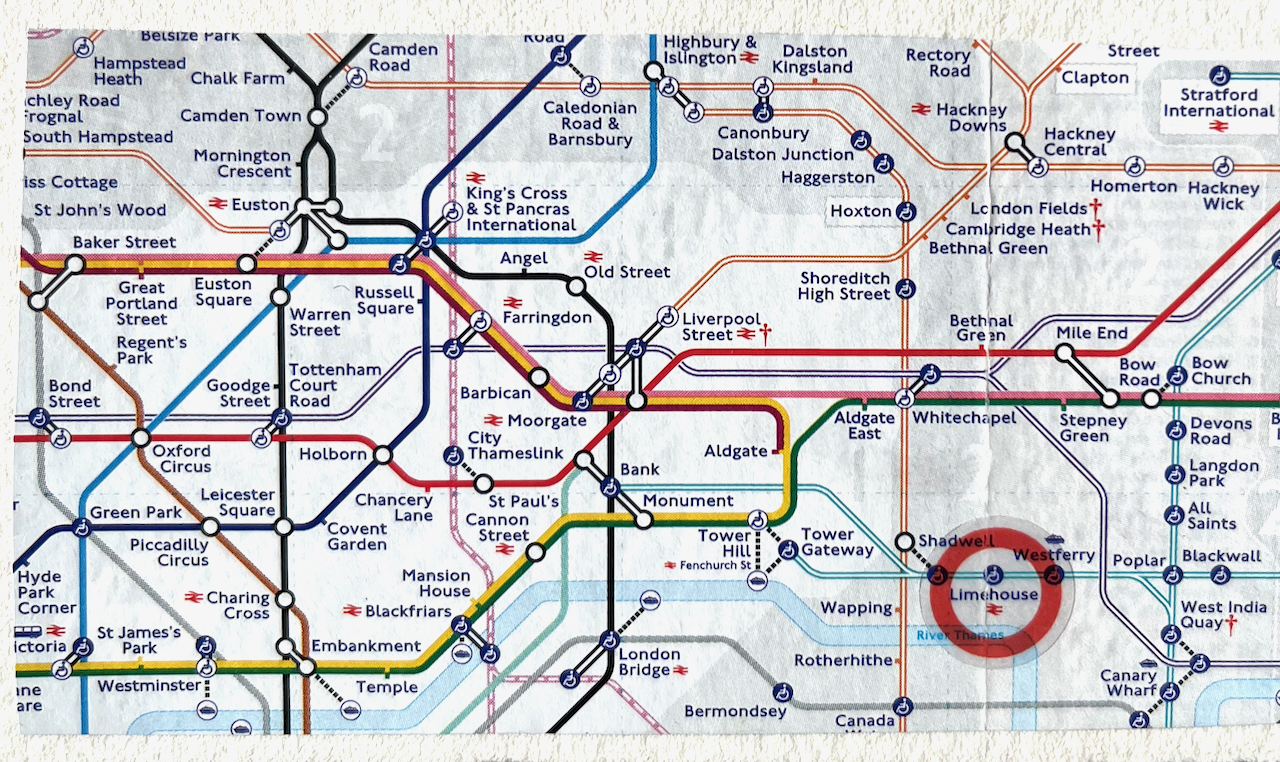
Here are some maps which show the position of the Accumulator Tower and the absence of a railway (click to enlarge).

In this whole area the works of Victorian engineers make themselves felt. Each bridge is a triumph of the bricklayers’ skill: not only strikingly beautiful, with clean curves and neat detailing, but also enduring, powerful and functional 150 years later.

Sketchbook 15
map (c) OpenStreetMap contributors: click to go to the map

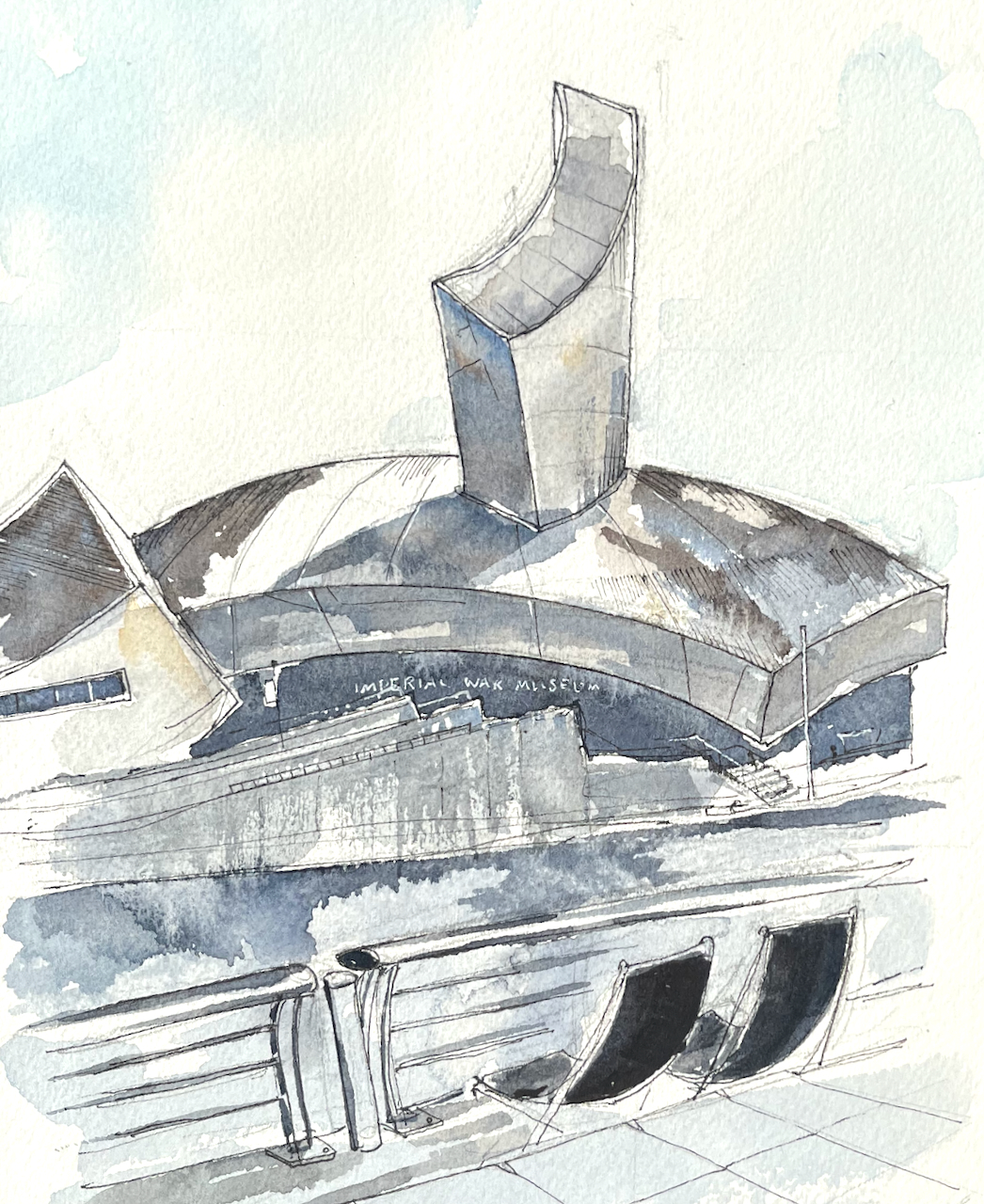
Imperial War Museum North, Manchester, M17

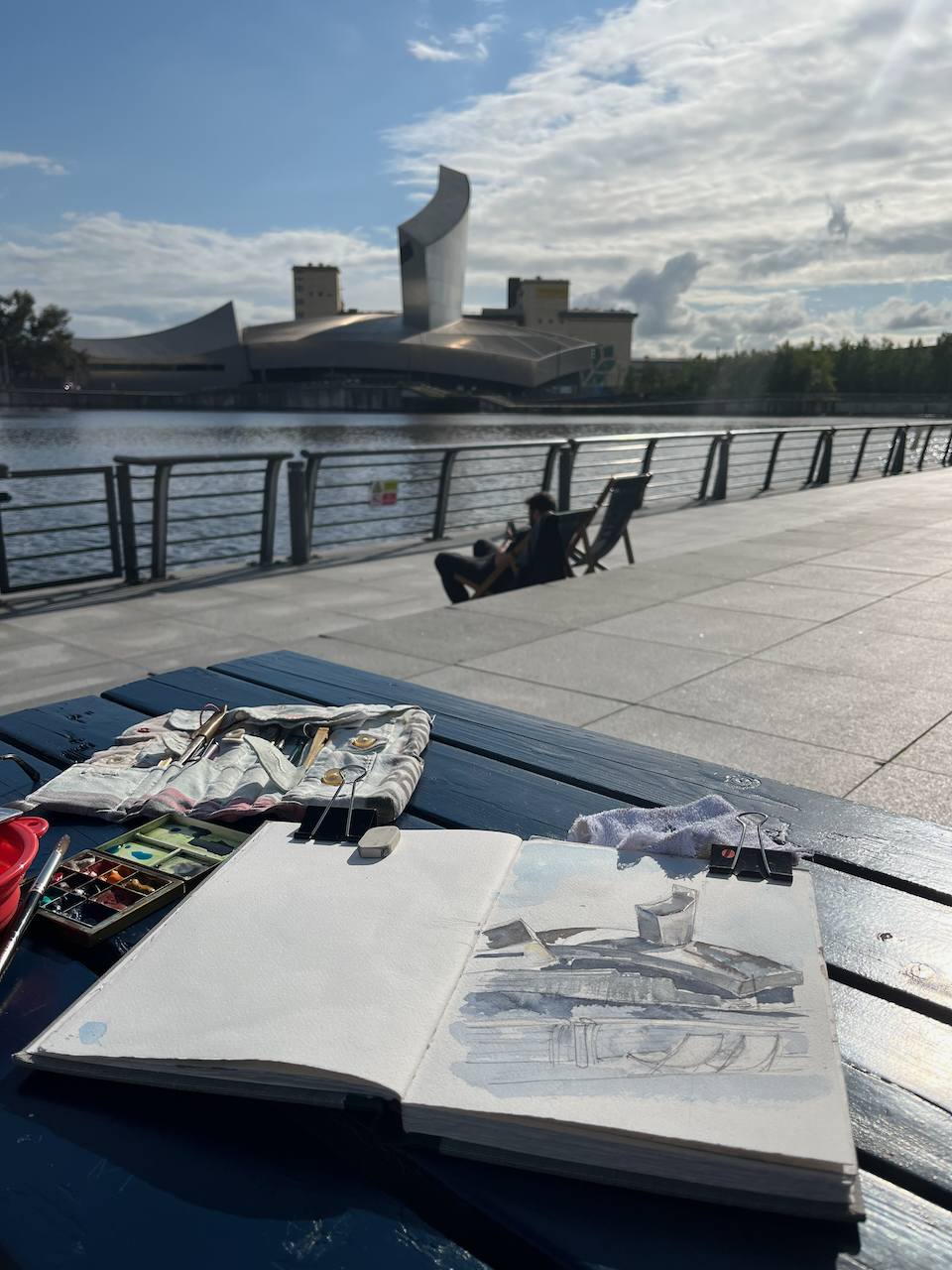
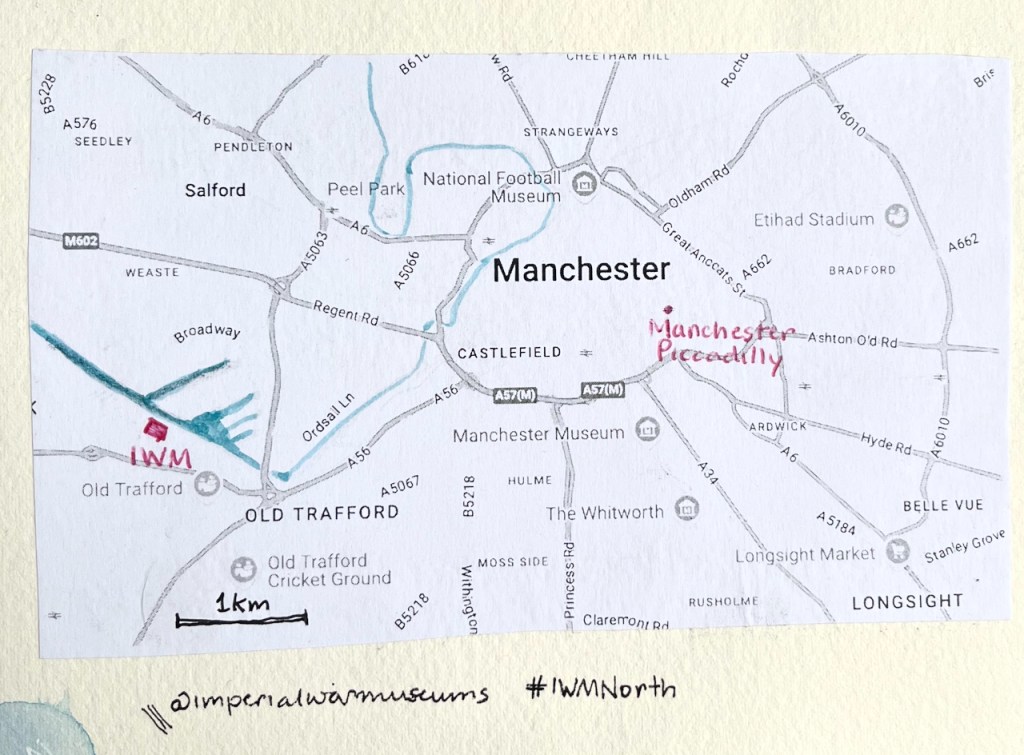
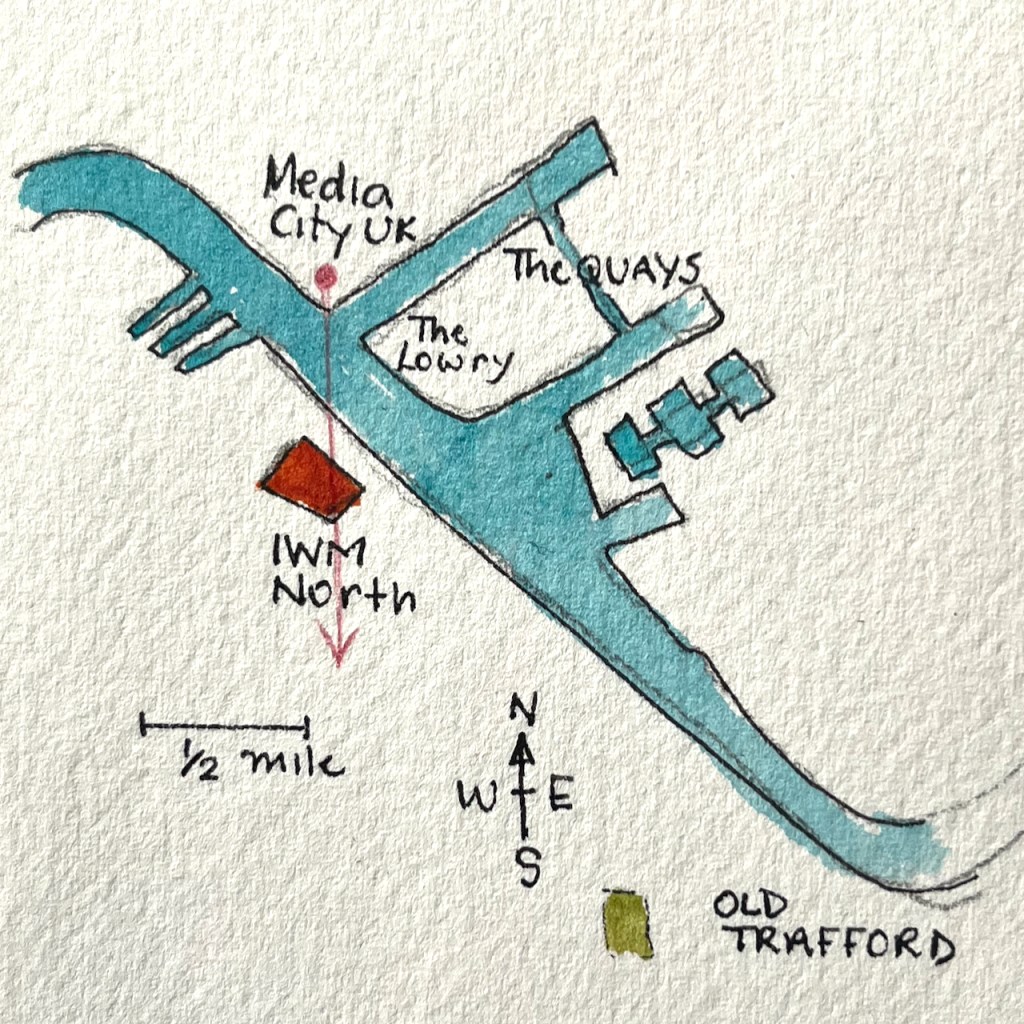
Across the water from Media City UK, is this striking building.

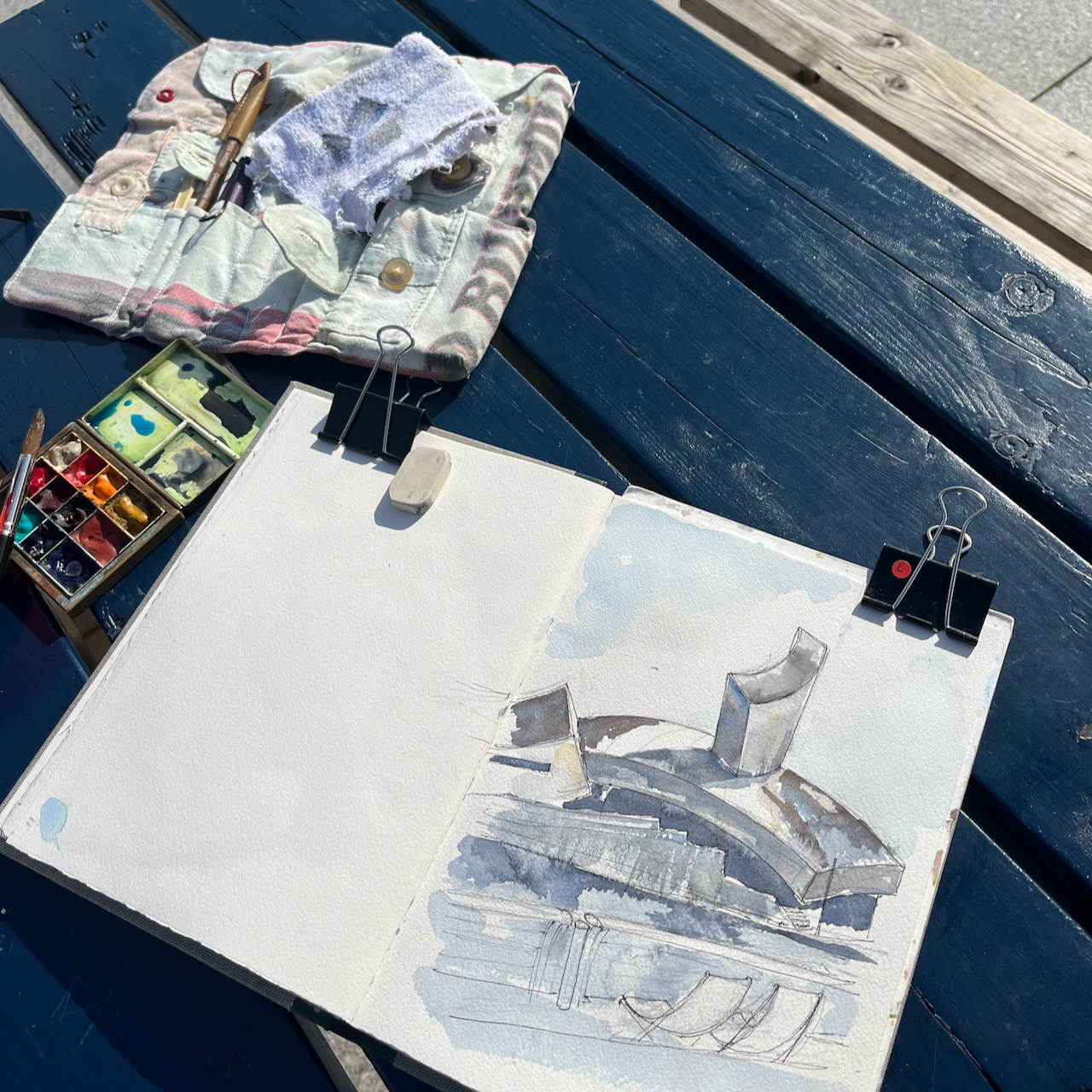
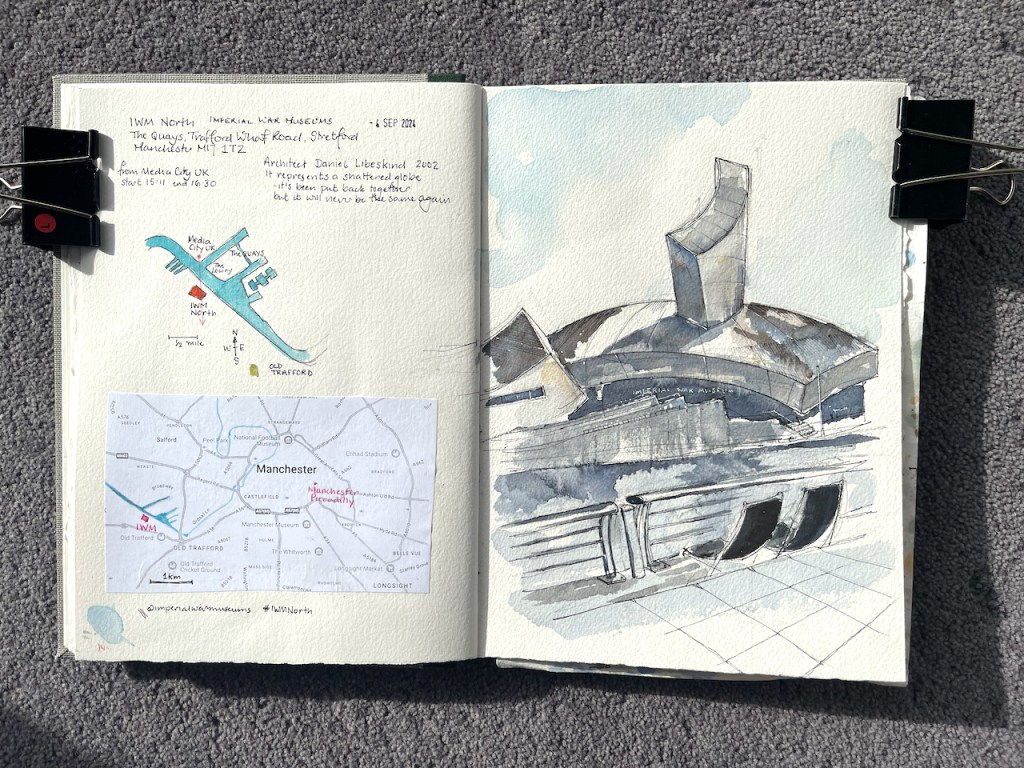
IWM North, sketched from Media City UK in Sketchbook 15

This is “IWM North“. I enjoyed the way the vast curves of the building were echoed in the humble shape of the deckchairs.

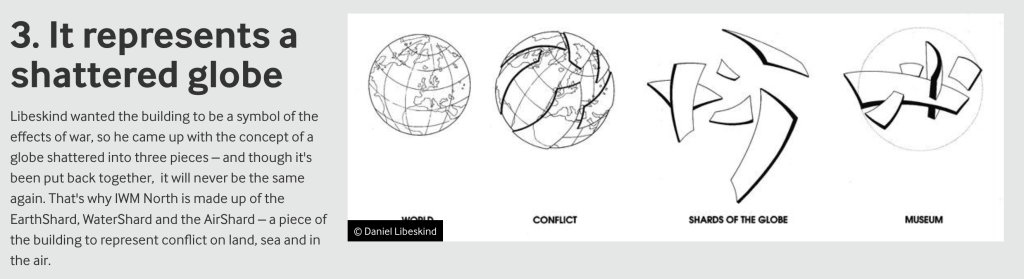
The architect is Daniel Libeskind. It was his first UK building, constructed in 2002. It represents a shattered globe: it’s been put back together, but it will never be the same again.

From the IWM North website

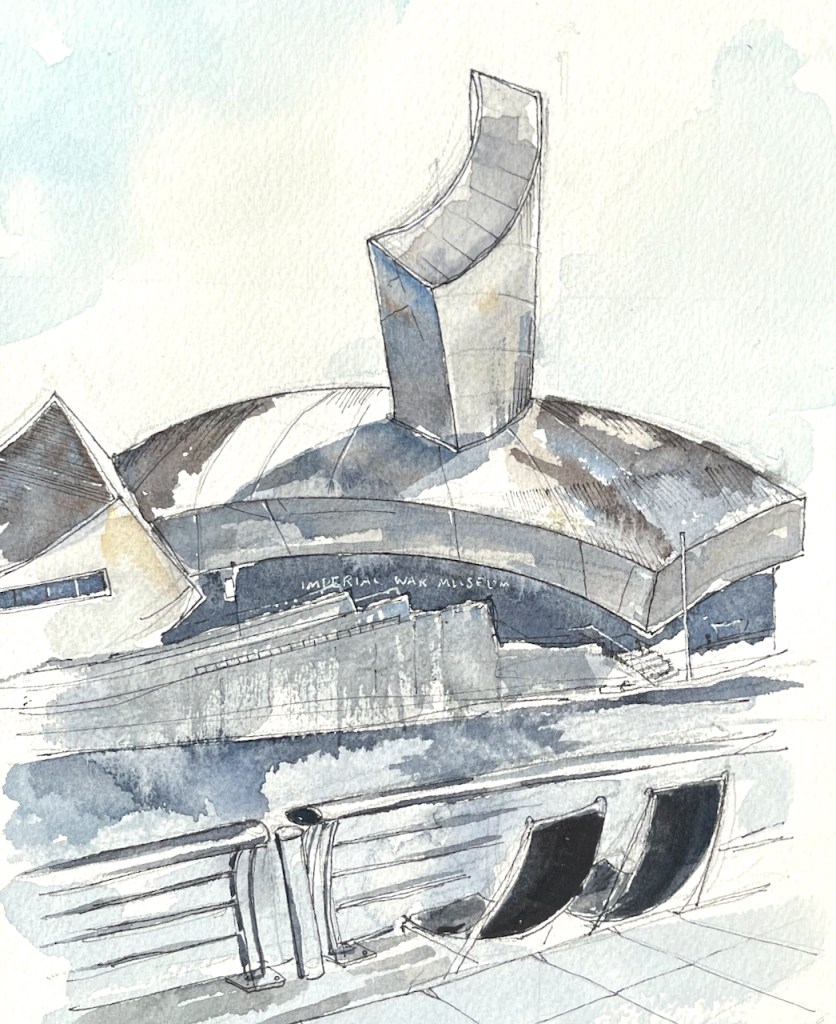
Here is work in progress on the sketch, the view across the water:

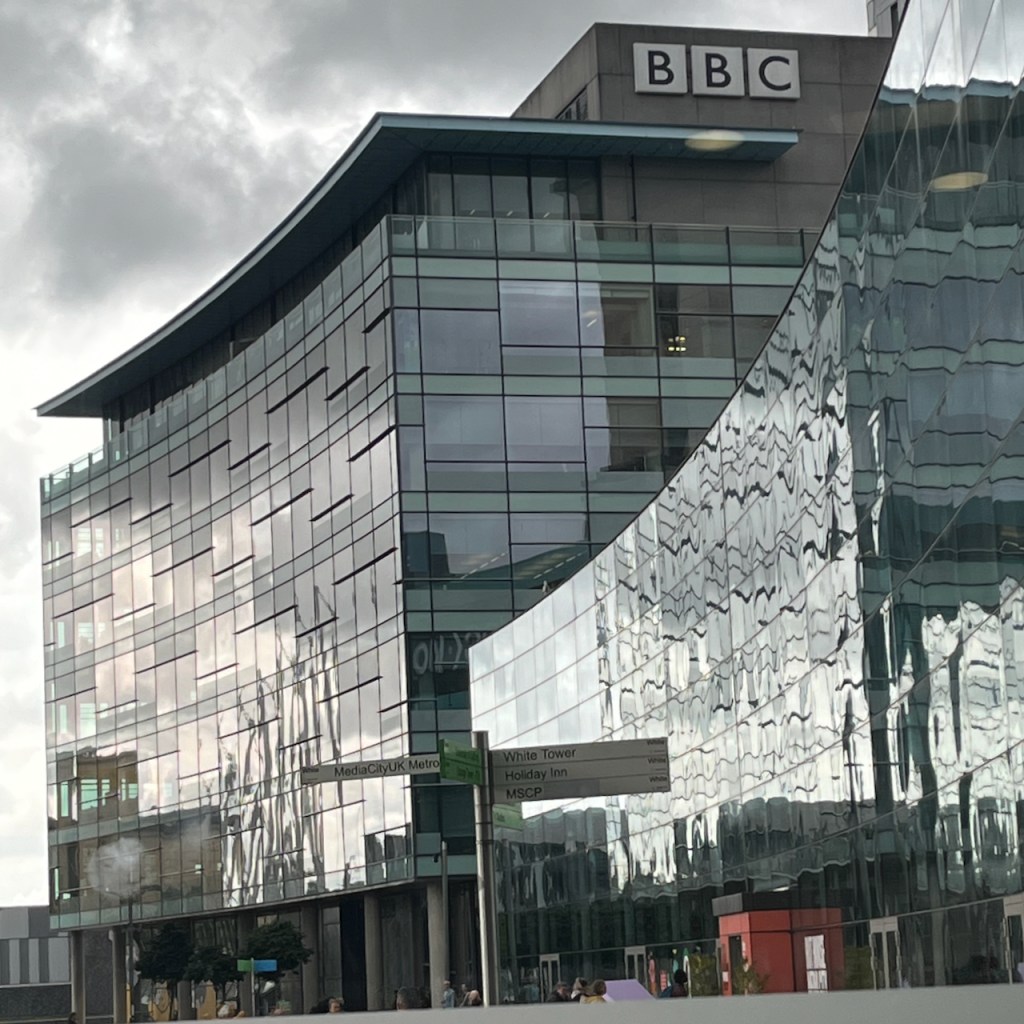
The marvellous curves of Media City UK

On the radio many years ago, I heard a director of the Imperial War Museum say that he was director of an establishment whose name contained three words each with negative connotations: “Imperial” “War” and “Museum”.
I note with interest, therefore, that it is now branded “IWM”.
“Imperial War Museums” has 5 sites: IWM London (in Lambeth), HMS Belfast on the Thames, the aircraft museum in Duxford, The Churchill War Rooms in Whitehall, and this one, the IWM North.

Sketchbook 15

Tragedy, for me, is not a conflict between right and wrong, but between two different kinds of right.

Peter Shaffer, playwright.

“The Roundhouse”, Pocra Quay, Aberdeen

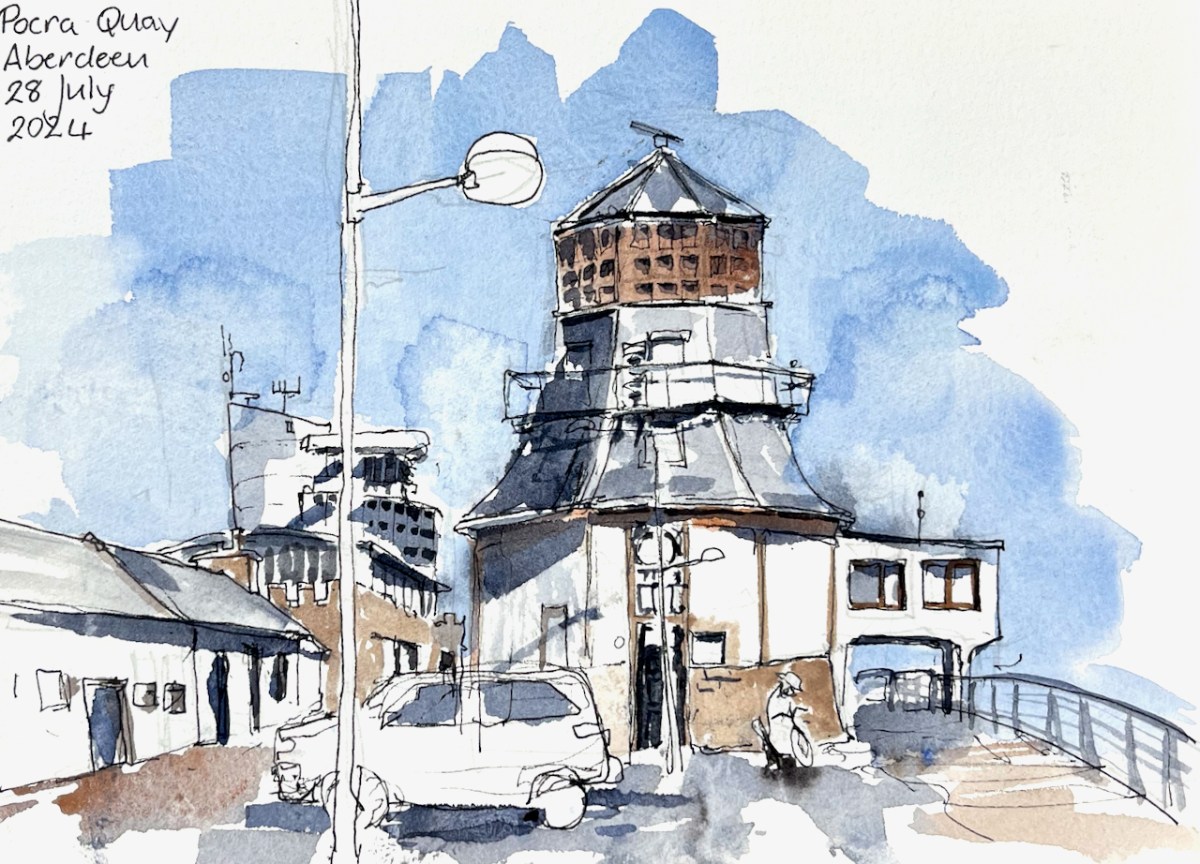
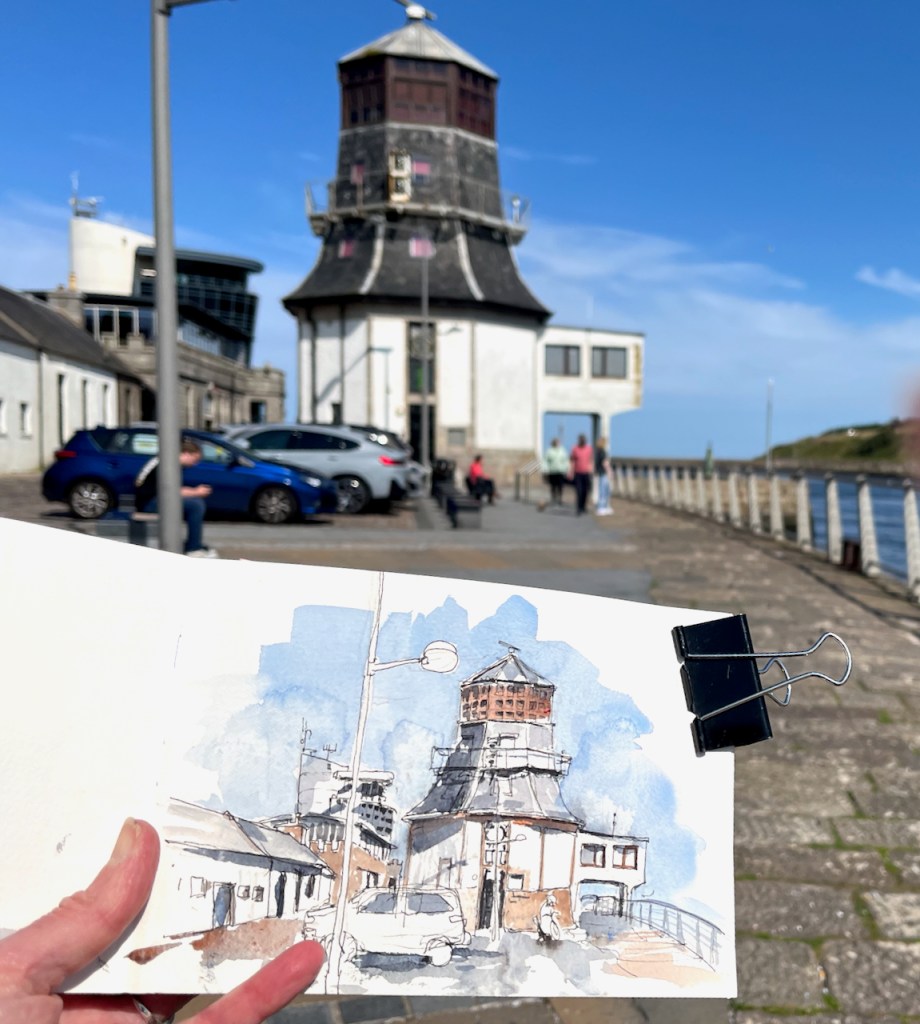
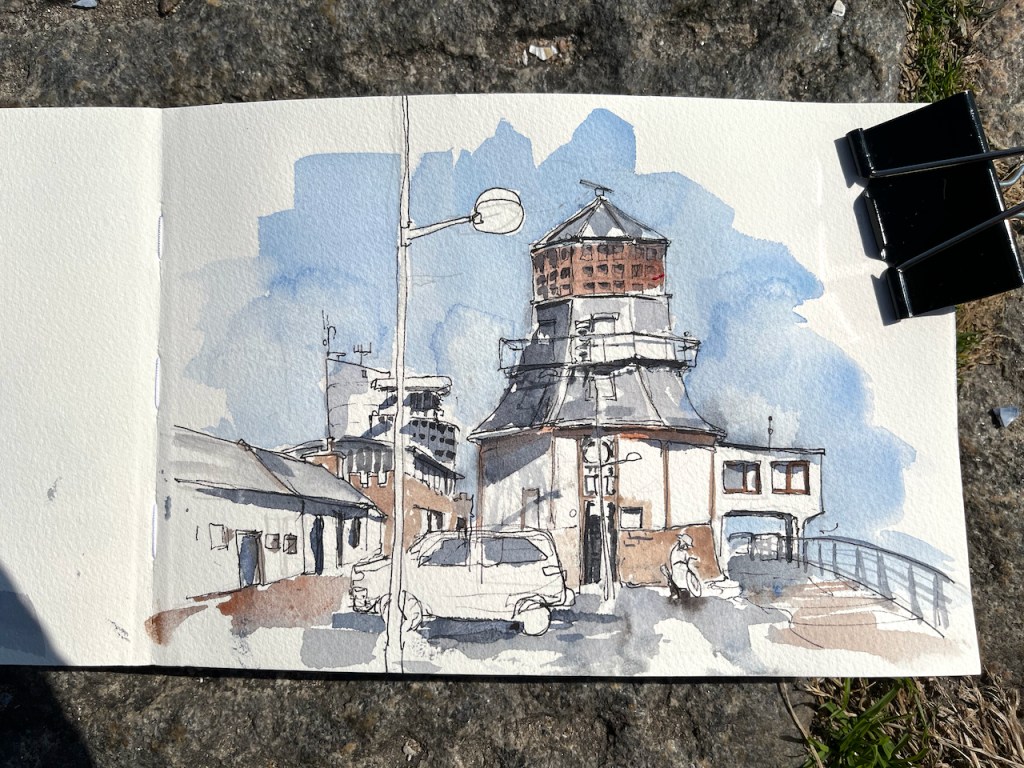
This is the watchtower near the entrance to the harbour of Aberdeen, known as “the Roundhouse”.

The Roundhouse, Pocra Quay, 28 July 2024, A5 in JP Purcell Sketchbook

It is octagonal. According to the listing on the Historic Environment Scotland site it was:

“[built] to guide vessels to port, this was originally carried out by the harbour pilots via loudhailer from a platform built into the roof of the original 2-storey structure, or by a system of wicker balls suspended from a pole rising from the platform.” [1]

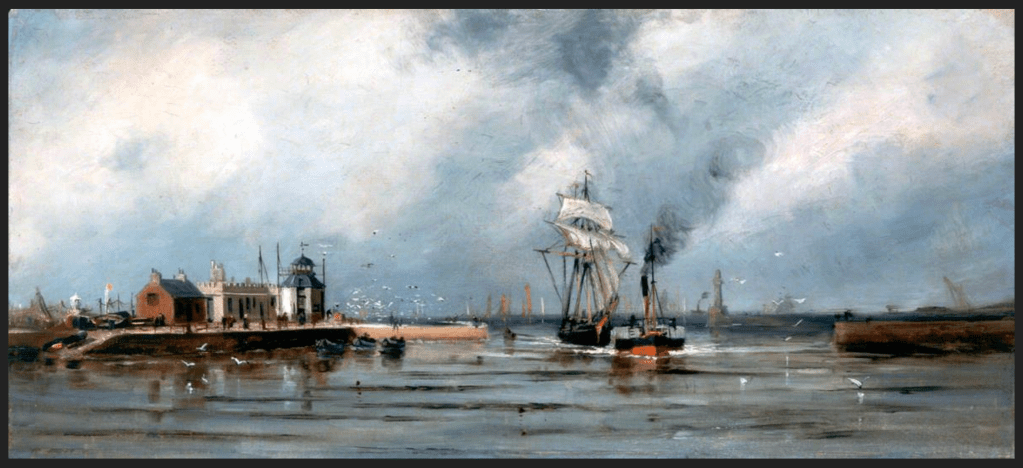
“Entrance to Aberdeen Harbour” by James Cassie (1819–1879)
image copyright: Aberdeen Maritime Museum


“The control tower was added in 1966 and a radar system was introduced in 1974. The structure was further updated in 1986 at which time the Queen unveiled a plaque, situated to the right of the main entrance to the tower, commemorating ‘850 years of Harbour History’.” [1]

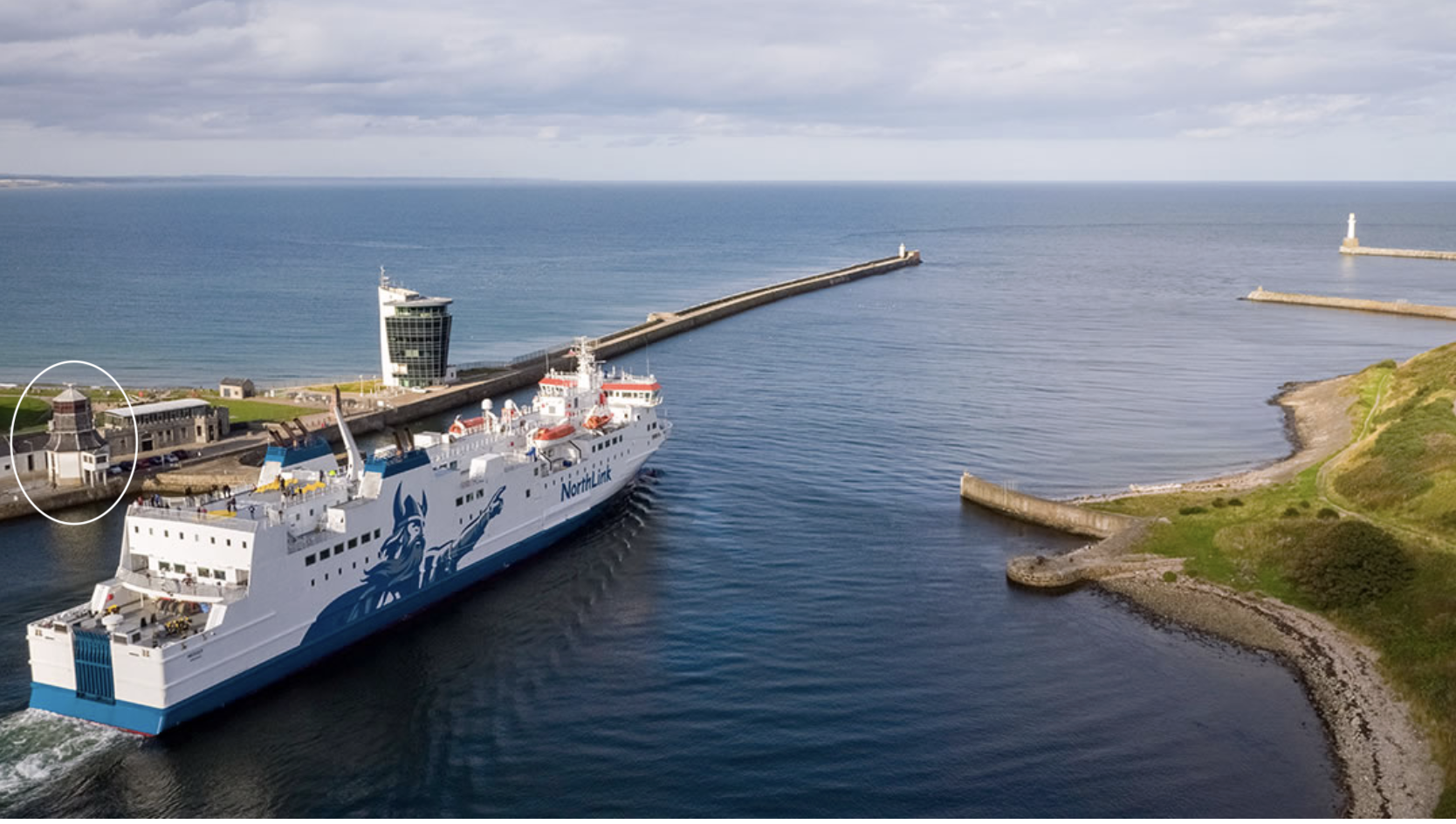
It was in use until the Marine Operations Centre opened in 2006 [4]. This is nearer the sea, just visible behind the lamp-post in my drawing. It handles about 25000 boat movements a year, which averages at 60 a day [2]. For comparison, Heathrow air traffic control centre handles abut 200000 aircraft movements a year or 500 a day [3]. The area managed by the Marine Control Centre extends 2.3 nautical miles around the headland to the South of the harbour [5]. So the Operations Centre handles not just boats going in and out, but boats moving around inside and outside the harbour as well.

MV Hrossey leaving the port of Aberdeen, photo copyright southspear media, used with permission [6]
The Roundhouse, circled, is on the left, and the Marine Operations Centre is above the centre of the ship. This is the Northlink ferry, sailing to the Northern Isles.

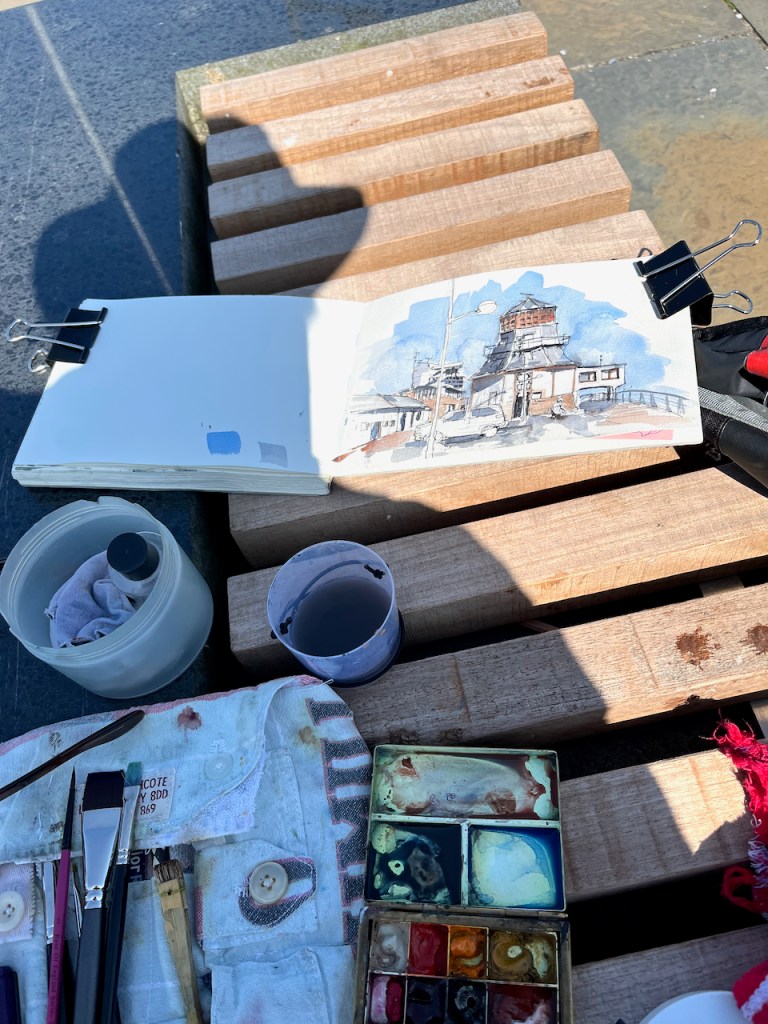
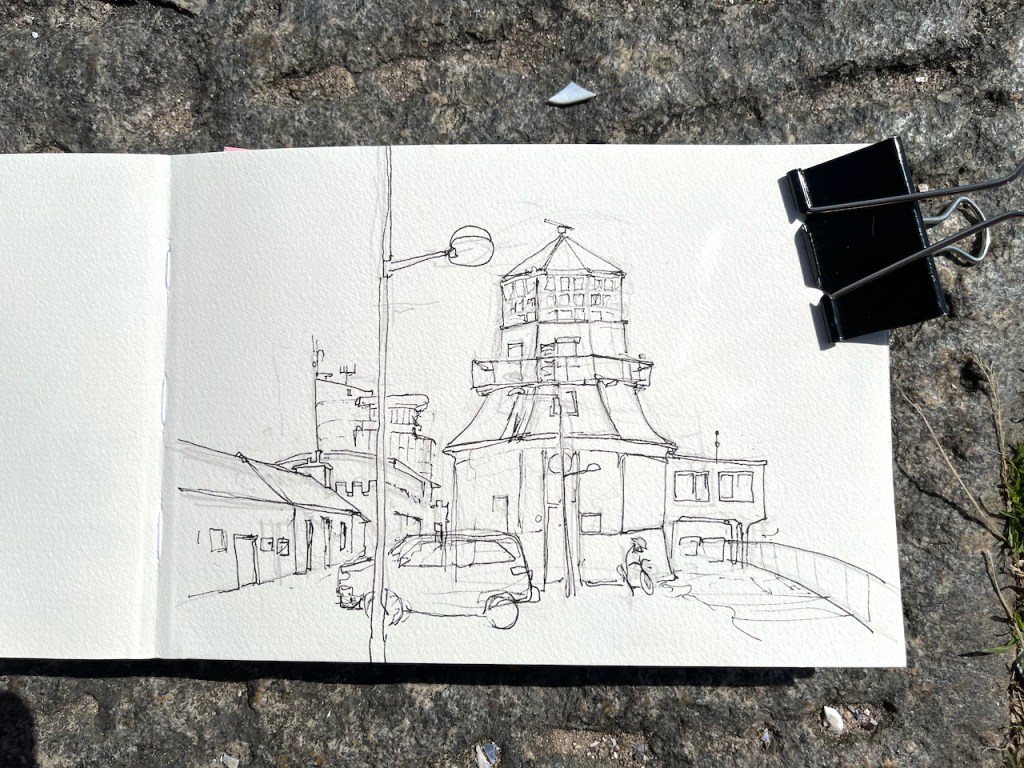
I sketched this on a stunning hot day, sitting on a bench by the quay.

The Roundhouse. The modern Marine Operations Centre is the tall white building behind and to the left. In front of it, and lower down behind the cars, is the restaurant “The Silver Darling”.

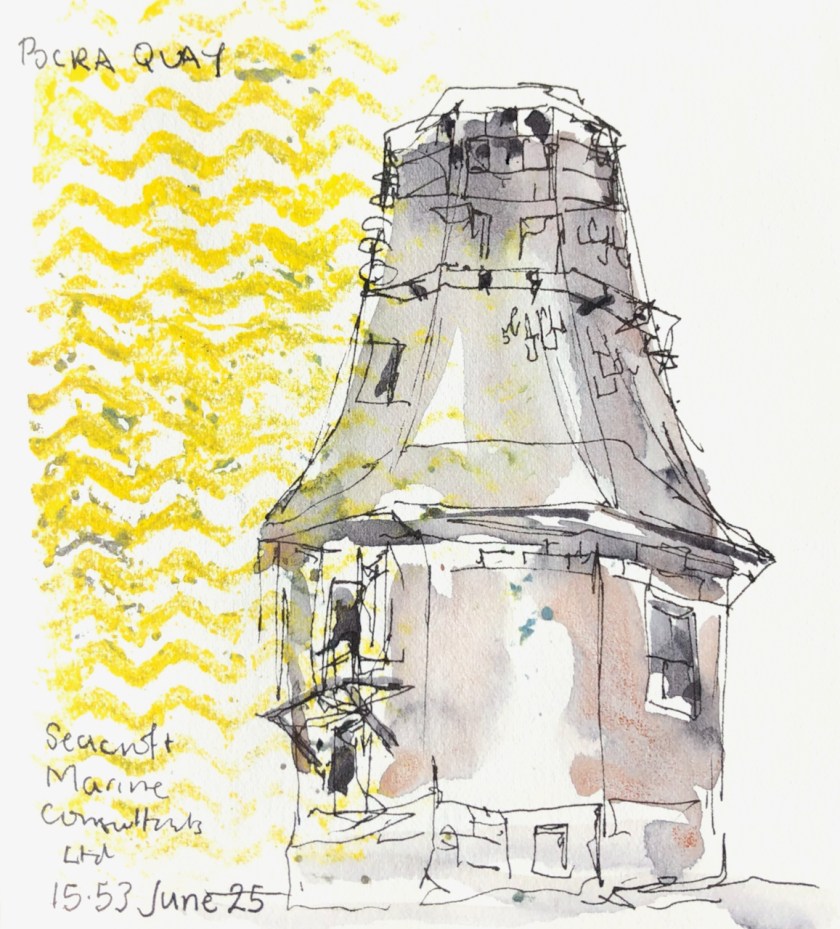
Three years ago, on a very different day, I made a much quicker sketch:

A quick sketch on a stormy rainy day, sketching from the shelter of a doorway. June 25th 2021.

References:

(1) Historic Environment Scotland listing: http://portal.historicenvironment.scot/designation/LB50941 FOOTDEE, POCRA QUAY, NAVIGATION CONTROL CENTRE (FORMER PILOT HOUSE)LB50941 downloaded 30 August 2024

(2) Aberdeen Maritime Trail leaflet, Aberdeen City Council – 100023401 – 2019: https://www.aberdeencity.gov.uk/sites/default/files/2020-09/Maritime%20Heritage%20Trail.pdf

[3] Heathrow Aircraft movement 2021 numbers from Heathrow facts and figures: https://www.heathrow.com/company/about-heathrow/facts-and-figures

[4] Gazetteer of Scotland https://www.scottish-places.info/features/featurefirst19543.html

[5] Port of Aberdeen Vessel Traffic Services extent: “All shipping movements within the Aberdeen VTS area (within 2.3nm from Girdleness) are controlled by Aberdeen VTS. Participation with VTS is mandatory, for further details please see ALRS Vol.6.” https://www.portofaberdeen.co.uk/port-information/marine

[6] Thank you to Nick McCaffrey of Southspear media for permission to use his amazing photograph of MV Hrossey leaving the port of Aberdeen.

Mercat Building, Glasgow, G1 5AB

On my way up to the West of Scotland I had a day in Glasgow. The overnight train had arrived at 07:30 and the bus to Oban didn’t leave until 18:05. I emerged from Glasgow Central into the mist and fine rain, and walked up the hill to find the “Buchanan Bus Station”. My idea was to stash my bag in the Left Luggage facility and then spend my time exploring Glasgow.

Glasgow at 07:30 on a wet morning in March is not so very enticing. I had the lowest possible expectations as I entered the bus station. Although huge, the bus station had been difficult to find, hidden as it is behind a monumental building called “Buchanan Galleries”. This is neither a “gallery” of the art sort, nor a shopping centre, as far as I could work out. It is a multi-story car-park. Every shop I had passed on the way up had been closed, possibly permanently, or so it seemed to me. There was a wind, I was getting wet, and I was hungry. Despite the confident announcements on its website, I was starting to think that the Left Luggage at Buchanan Bus Station would be closed.

But, contrary to all expectations, the Left Luggage Office was lit up, the door open, and everything looked new and clean inside. Even better, a cheerful man in a beanie hat soon appeared behind the desk, took charge of my pack, and efficiently operated the locker system. I exchanged a £5 note for a receipt with a code, put the receipt deep within my pockets, and set off into the grey morning feeling a lot more cheerful.

This came to typify my experience of Glasgow: a grey and wet city enlivened by cheerful welcoming people.

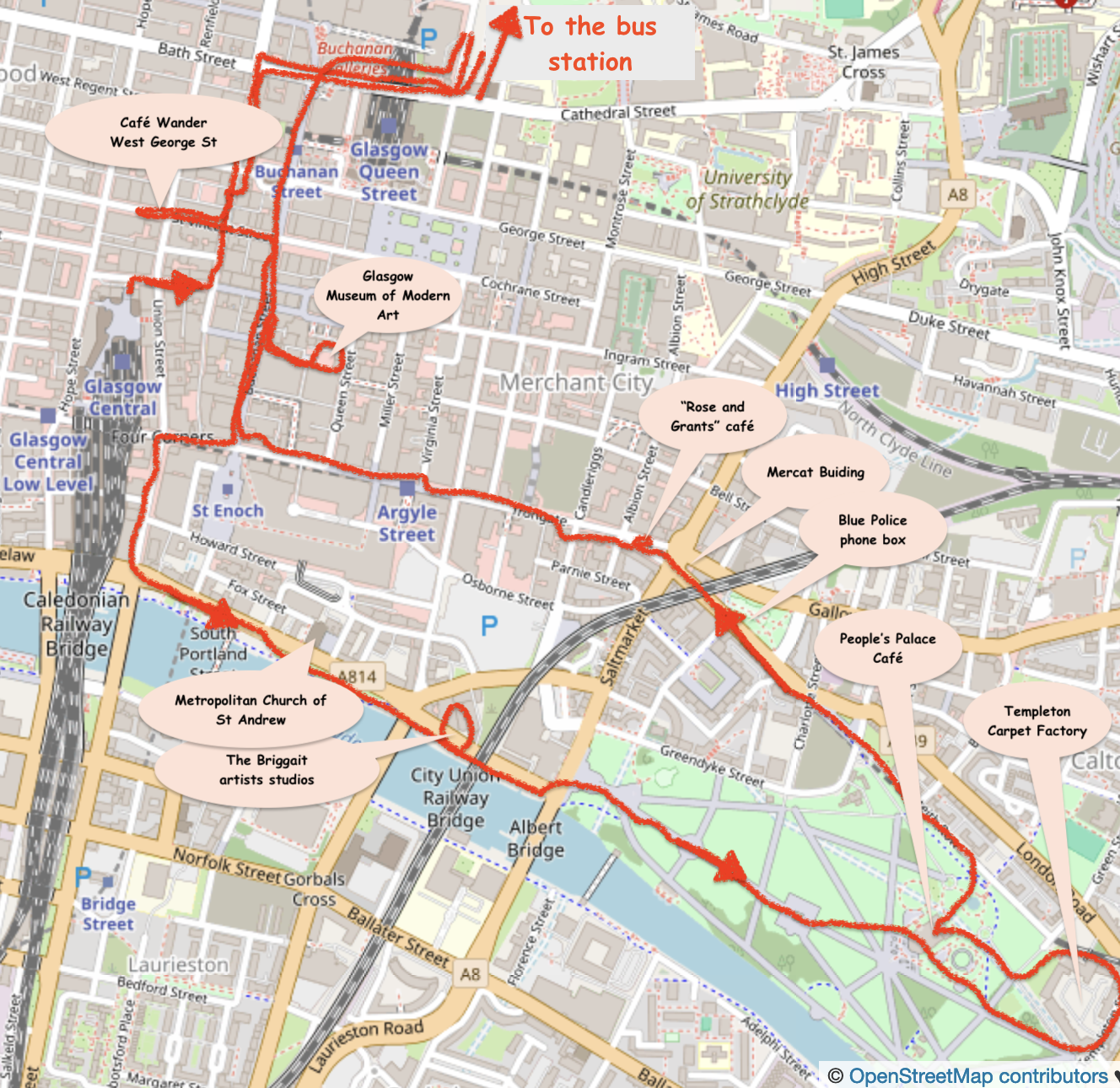
My wanderings around Glasgow. Positions of monuments and cafés are approximate. Map (c) Open Street Map Contributors.

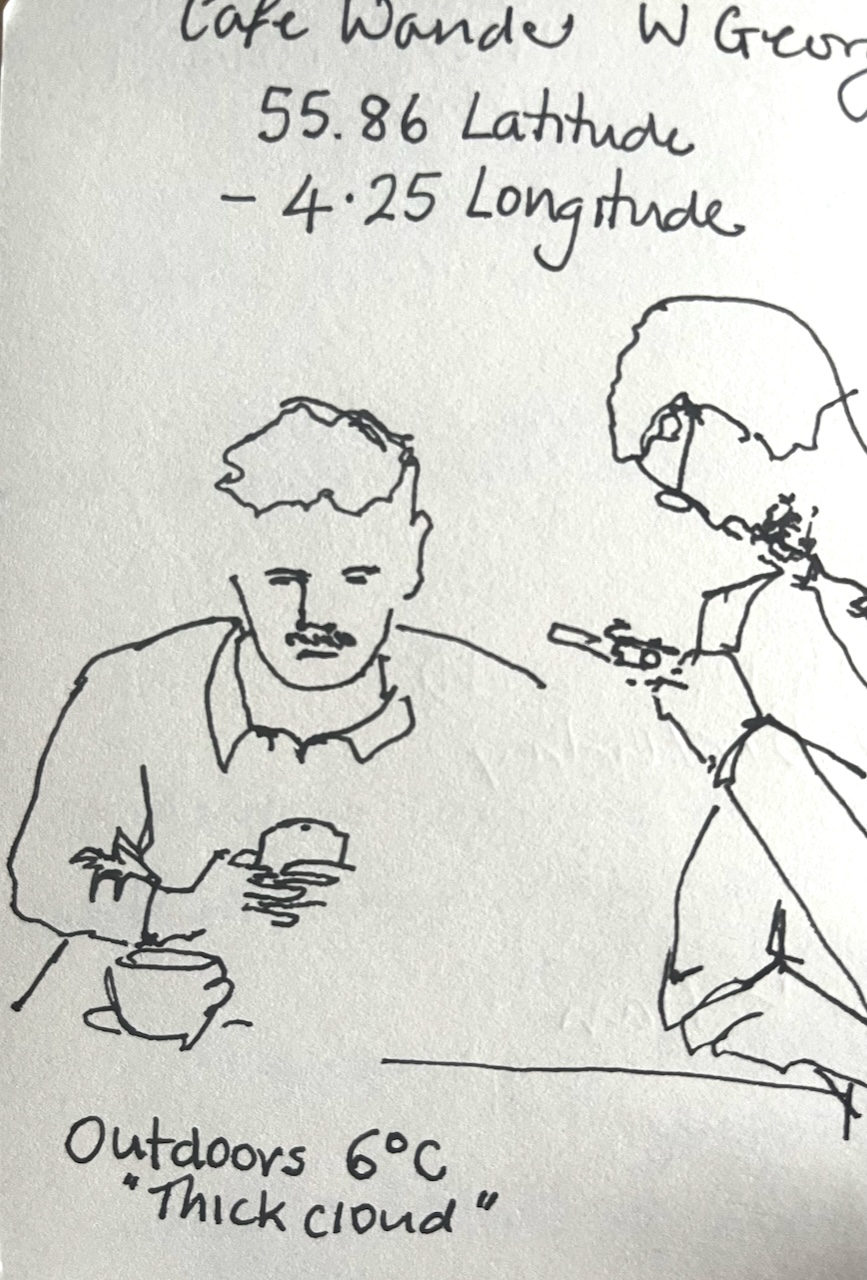
Walking out of the bus station, and wandering at random through the grid of streets, I spotted the “Café Wander” in a basement. This is at 110 West George St and was a great find: welcoming people, a big mug of tea, food, and a charging point for my phone. No rush, I could think and sketch, and feel as though I’d arrived. I decided to head for the river. A river tells you about a city.

The amazing thing about Glasgow is that there are these magnificent buildings, and a lot of them are apparently empty. Or at least they are empty from the 2nd floor up. At street level there is a band of multi-coloured shopfronts, some shuttered. Higher up the Victorian optimism and wealth proclaims itself in ornamented facades, fancy windows, sculptures, and carved names of proud institutions: “St Vincents Chambers”, “Bank of Scotland”. But these higher floors are deserted. The windows are dusty, the facades chipped, the statues dark with dust. But still.

The river told me nothing about Glasgow, except that Glasgow seems to ignore its river. There is a main road, a magnificently restored catholic church, and a succession of buildings which in London would be converted to luxury flats but which in Glasgow remain as buildings awaiting their future. By the time I reached the park, I was really cold. Hacking my way against what was now a biting wind, I encountered a small round woman with a small round dog, coming the other way. She caught my eye and laughed, holding firmly on to the dog’s lead as though it anchored her to the ground. “Bitter!” she announced, still laughing. I agreed that it was.

I wanted to ask her some important questions, such as whether the “People’s Palace” had a café, and what was that brightly coloured building in the misty distance? But conversation was going to be impossible in that wind, so she and I passed each other in amicable silence, allies against the elements.

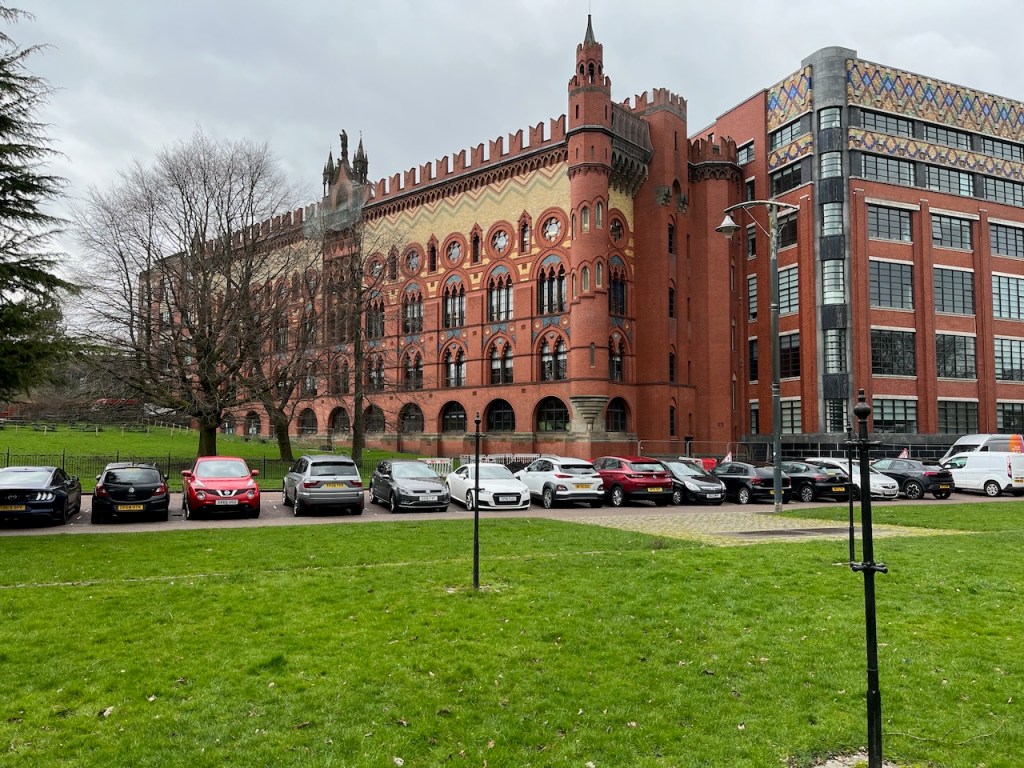
The brightly coloured building was called “Templeton Buildings”. It had no café, and no information. There was a bar, predictably closed. I circumnavigated it, and then set off for the “People’s Palace”. In the distance I’d seen someone come out, but they could have been a builder or a janitor.

It was now raining in earnest. All my papers, tickets and art equipment were in dry-bags inside my backpack, which had been a good precaution. I’ve been in Scotland before. The People’s Palace appeared out of the mist, a huge Victorian edifice, looking formidable and very closed. It was not closed. There was a board outside. A café! I pushed open the door, ready to be rebuffed at any moment, but no, inside was warmth and light, a museum of some sort, public toilets, and a café.

The “People’s Palace” Glasgow Green.

I more or less fell into the café. The friendly person at the counter gave me a guided tour of the home-made cakes, evidently from personal experience. Since he looked like someone who knew his cakes, I accepted his recommendation for the coconut sponge and took a window seat by an old fashioned radiator that was pumping out heat. From there, I watched through the window at coach tours who arrived to look at a fountain in the rain. This is the Doulton Fountain, gifted to Glasgow in 1888 by the Doulton Pottery in Lambeth, London. It would look very nice in the sun: a good sketching subject.

The friendly cake-expert directed me to information panels which told me about Templeton Buildings. This is the former Templeton Carpet Factory, which ceased operation only in 1980.

photo of Templeton Buildings

Eventually, fortified by cake, I was off again in the rain which had abated slightly. I was determined to sketch at least one of the Glasgow buildings. I came to the end of a long road, there was the Mercat Building.

Mercat Building, 26-36 Gallowgate, Glasgow, G1 5AB: 1928-31 designed by Andrew Graham Henderson who lived and worked in Glasgow 1882 – 1963

This was a very quick sketch, on an A5 card, done from a doorway as the rain came down. I stopped before all the colours ran together and retreated into “Rose and Grant”, another welcoming café where the people were not atall put out by my washing my brushes in their water glass and spreading out my watercolour equipment on the table, making copious use of the supplied paper napkins for art purposes.

My tour of Glasgow included the Museum of Modern Art, which has a peaceful library in the basement, as well as small galleries where the pictures have commendably large-type curation. Not crowded. Easy to navigate. Friendly.

I ended up back at Buchanan Street Bus Station, successfully retrieved my pack and was early for my bus.

Glasgow is definitely a City to return to.

Château de Vufflens, Vaud, Switzerland

Fine rain started as I sketched the Château de Vufflens. At first I thought I could keep sketching. But then rain arrived in large-size drops, some containing ice. I took refuge under an archway. There was a view of the castle from there, but a different view. Also, standing there, I was, very possibly, in someone’s garden. I am not sure about Swiss laws on trespass. All I was sure of was that there would be laws. I assembled suitable French phrases in my head, to be ready to explain and apologise. And I restarted the sketch from this new angle. Then the rain stopped.

I inspected the sky suspiciously. I watched the cloud movements. Clouds just appear here, over the mountains, as from a volcano. They don’t proceed in an orderly succession as they do over the Atlantic. However all seemed more lightweight and friendly than it did earlier. I exited from the archway, and resumed my place on the public roadway. There are probably laws about sketching on the public roadway too.

But no-one even walked past. Not a car. Not a person. Not a dog. So that was alright. I finished the sketch. And then the rain started again.

Château de Vufflens in the morning, 24 March 2024 11:15 in Sketchbook 14

This castle is privately owned. It is on a rock in the valley, surrounded by high walls. Houses cluster at the bases of the walls. if you know the work of Mervyn Peake, think “Gormenghast”.

It was originally constructed in the middle ages, 1420-1430, for Henri de Colombier, an adviser to Duke Amadeus VIII of Savoy, I was told. It looks well maintained, and vast.

Later that day I made another attempt at drawing the castle, from a different angle. From this new viewpoint I could be under cover, but there were trees. I put the trees in.

Château de Vufflens in the afternoon. 24th March 2024, 4pm. 6″ x 8″ on Arches Aquarelle card

The walnuts came from the trees.

The Temple Church, Temple, London EC4

The Inns of Court are an ancient area of London, around Fleet Street, close to the Royal Courts of Justice. It’s an area of narrow lanes and quiet courtyards. Lawyers’ practices are there.

In amongst the buildings is this church, which opened on 10 February 1185.

Temple Church, 14th February 2023, in sketchbook 13

The church is open to visitors. I went in. It’s a splendid space, very calm, beautifully vaulted. You can even go up a narrow winding staircase inside the round structure I have drawn. Here are some photos of the inside.

Here’s a map and a photo of the Norman arch on the outside

Here are some work-in-progress photos.