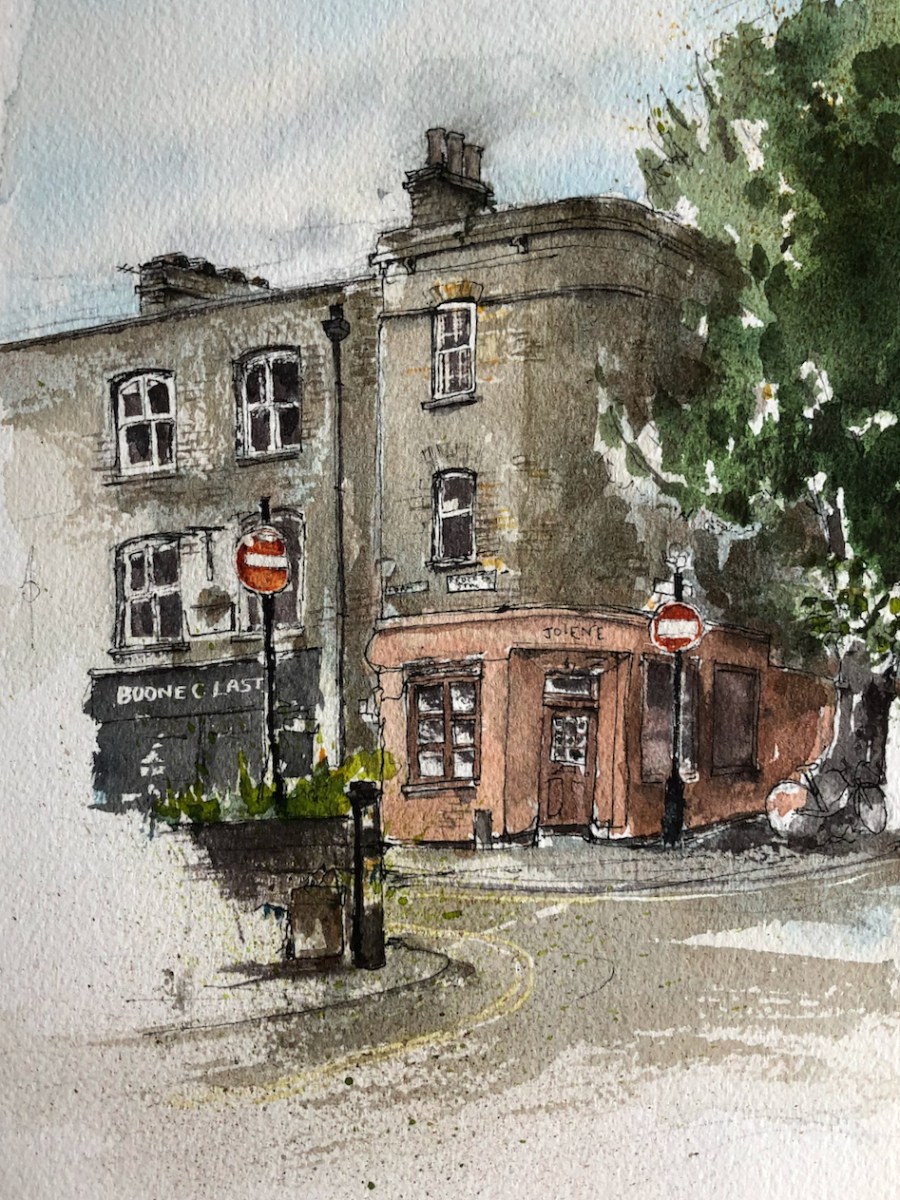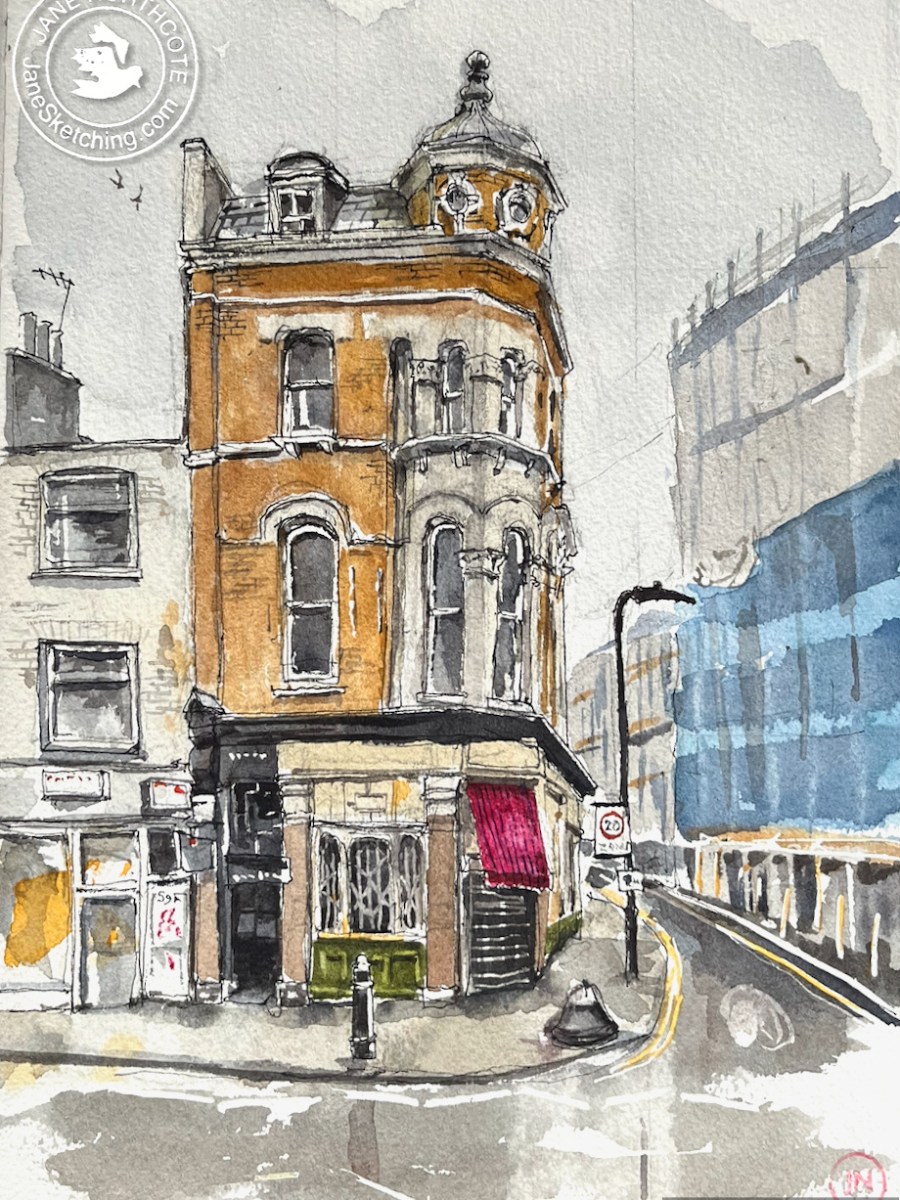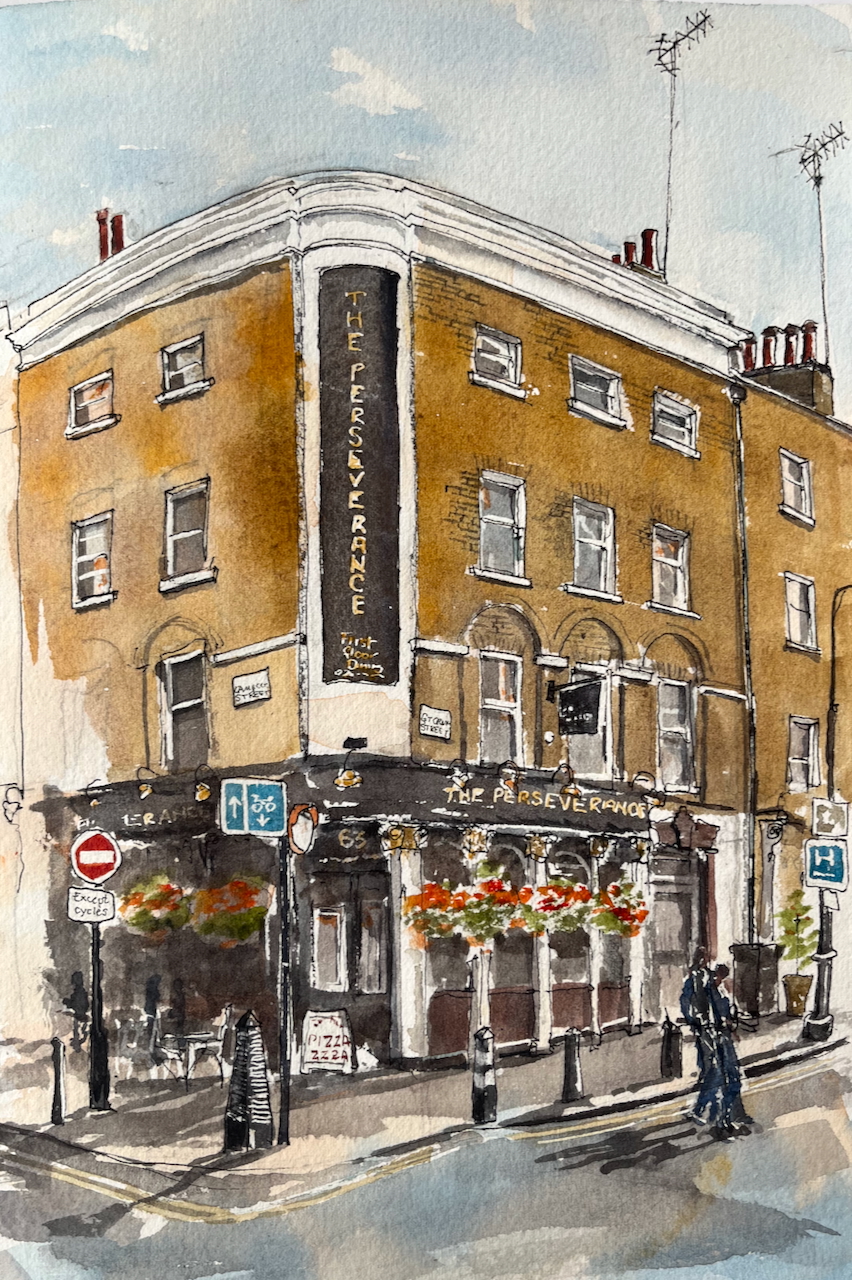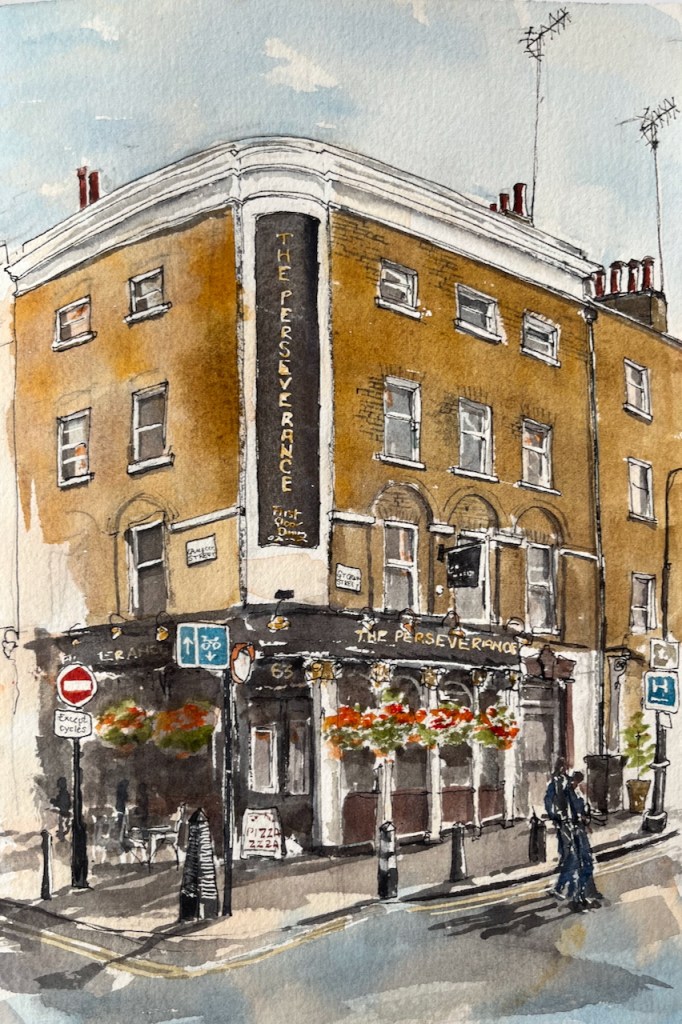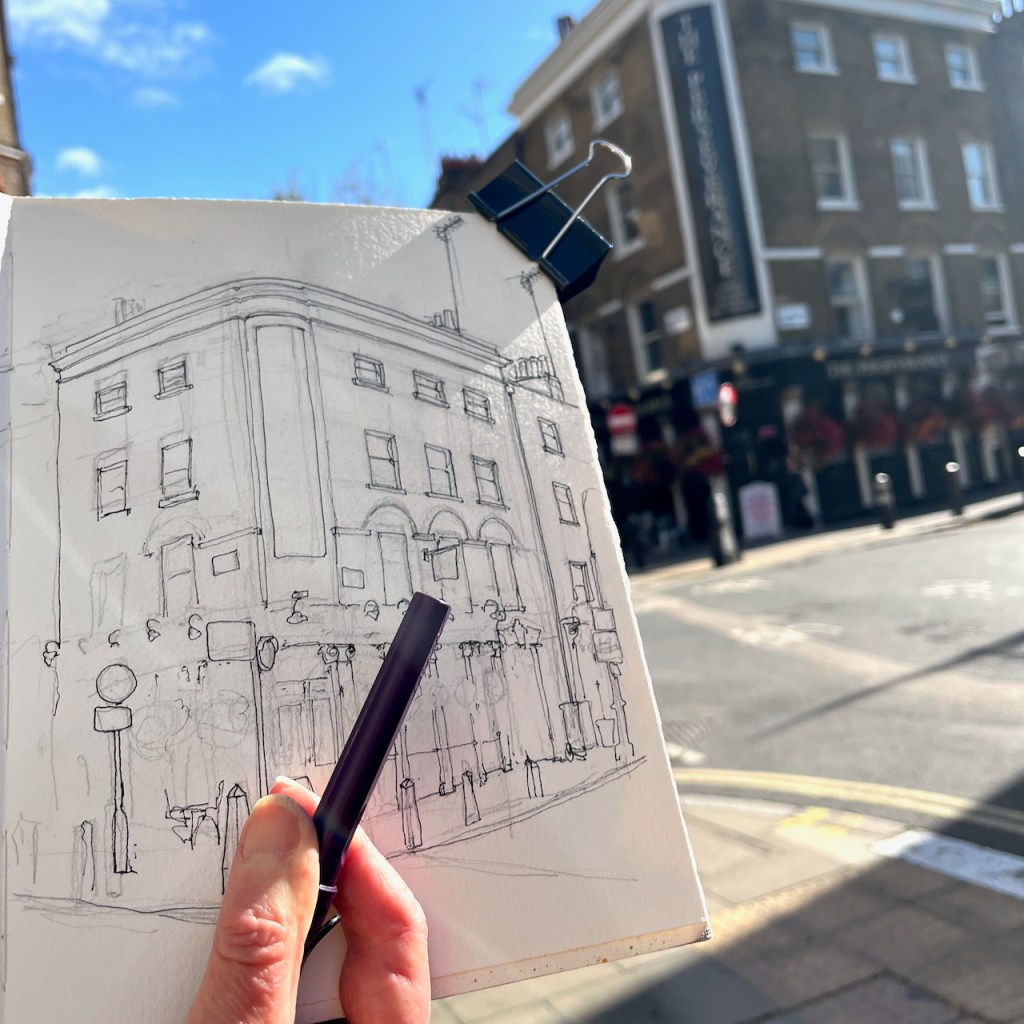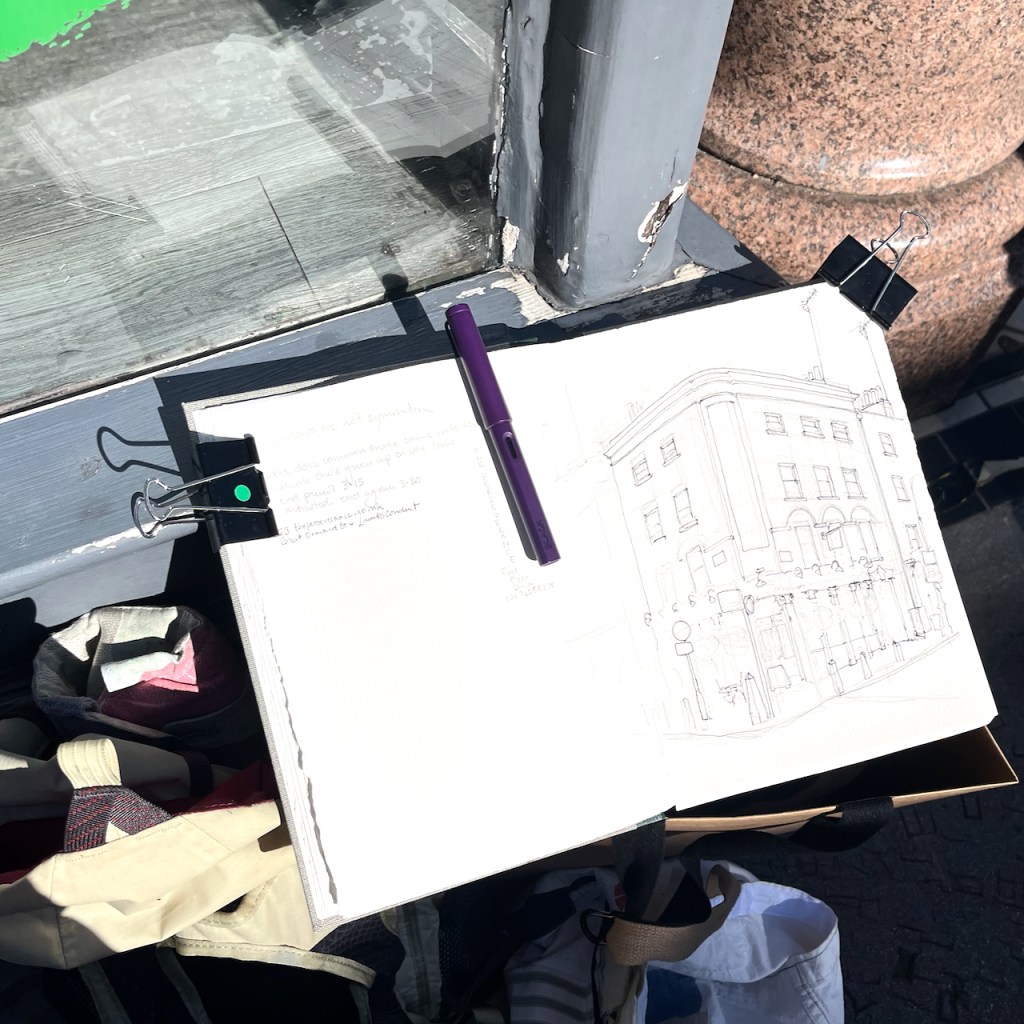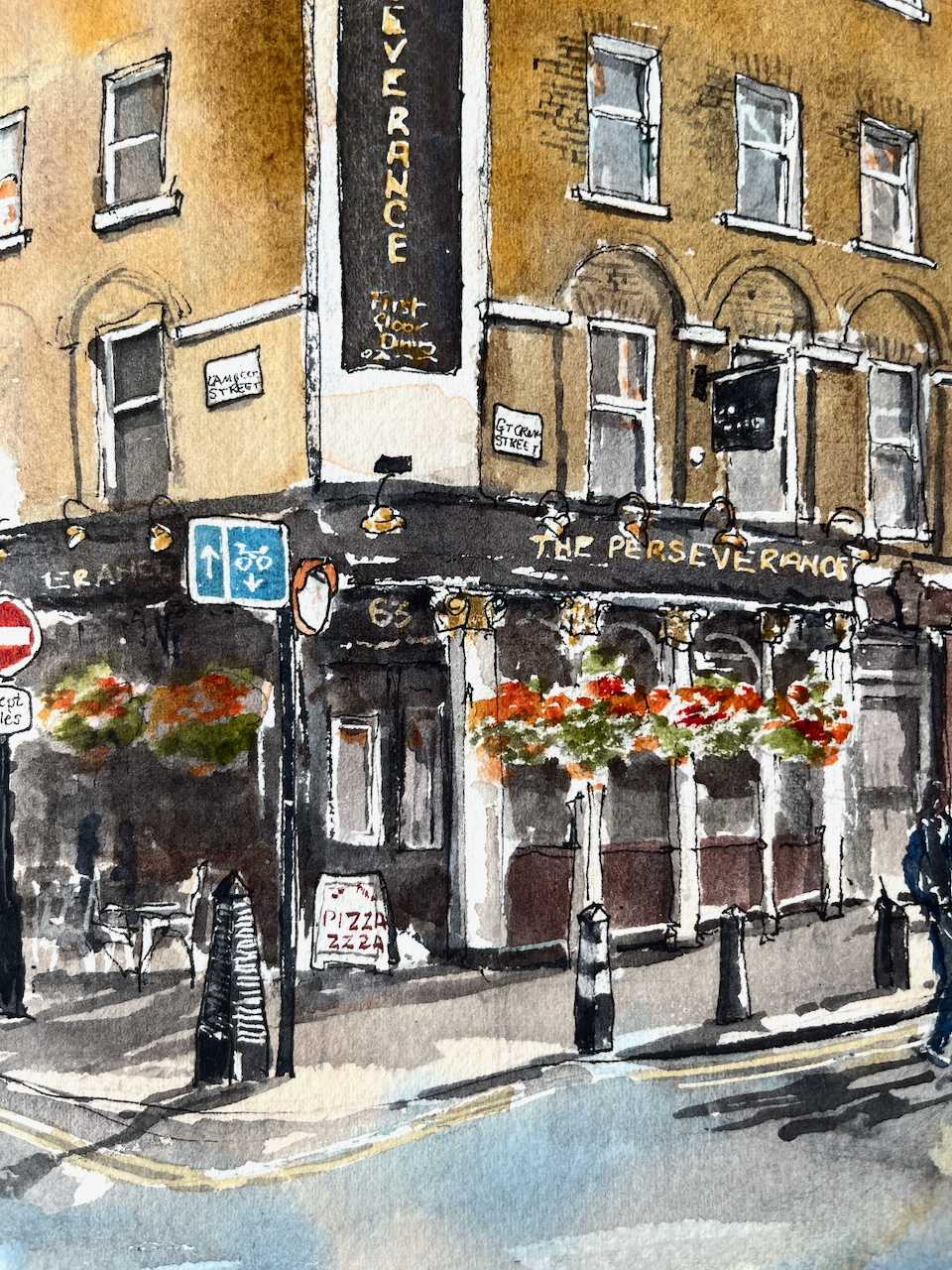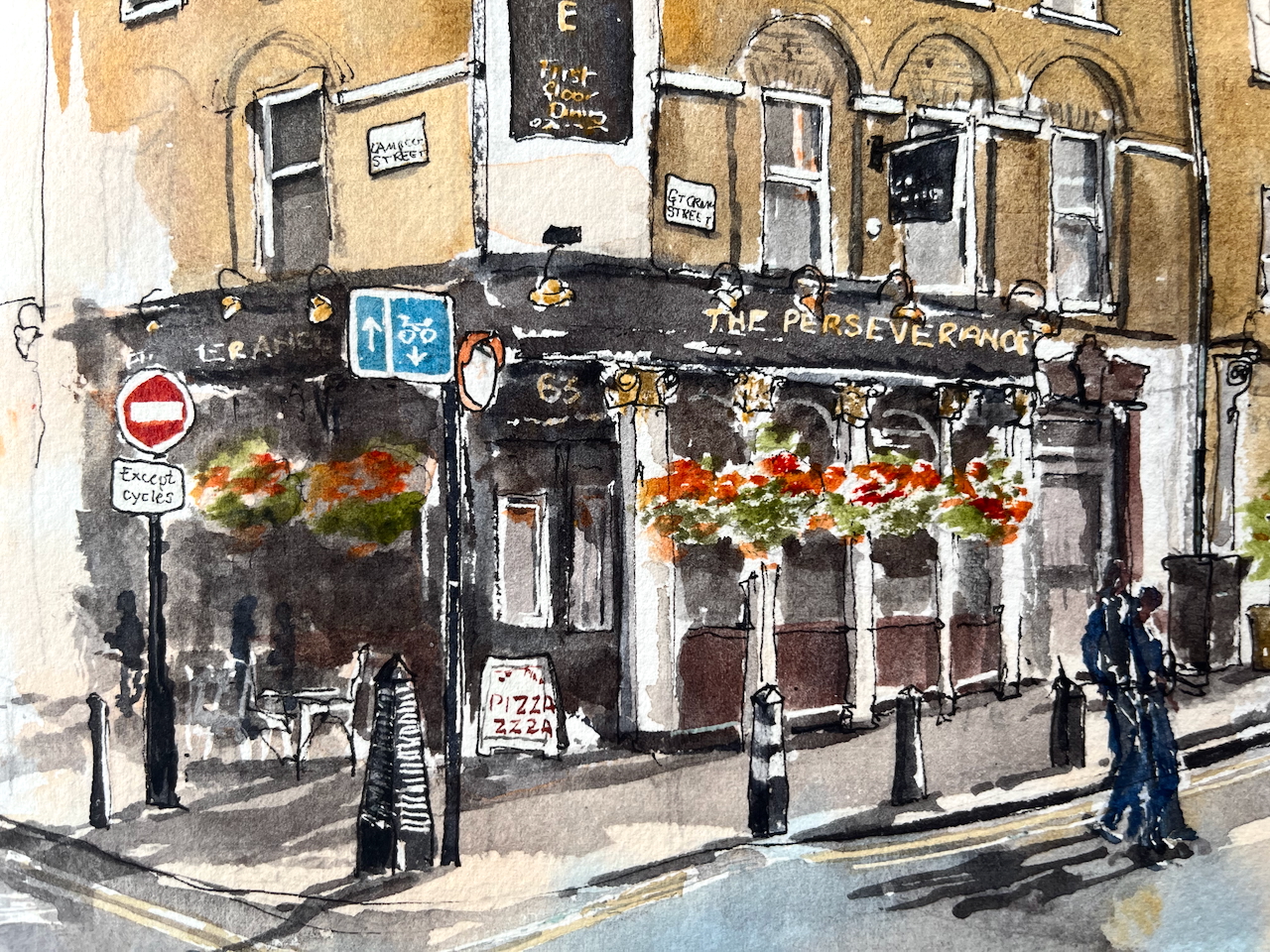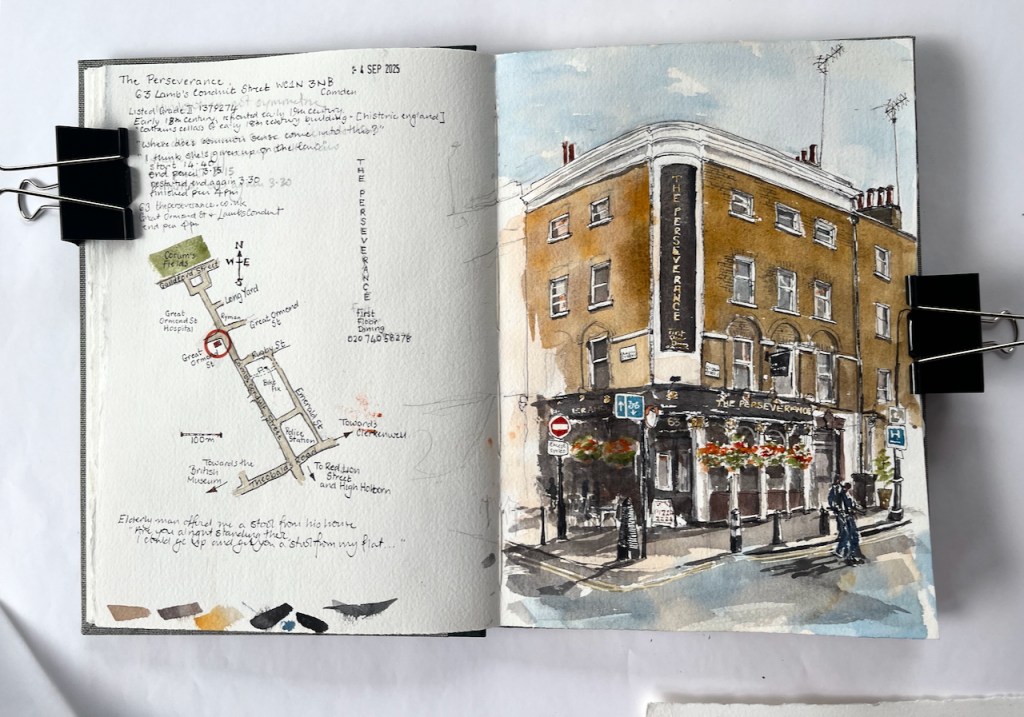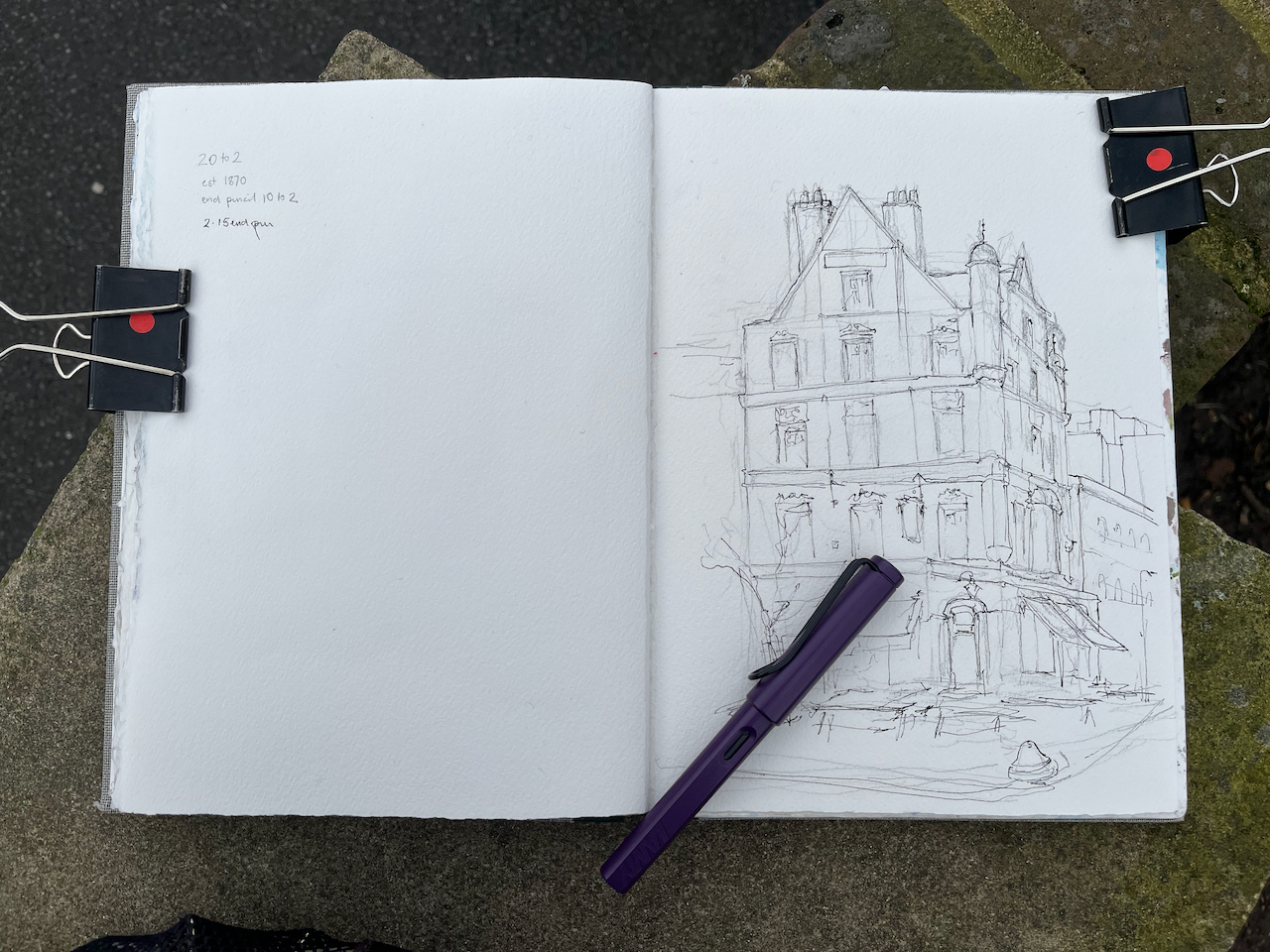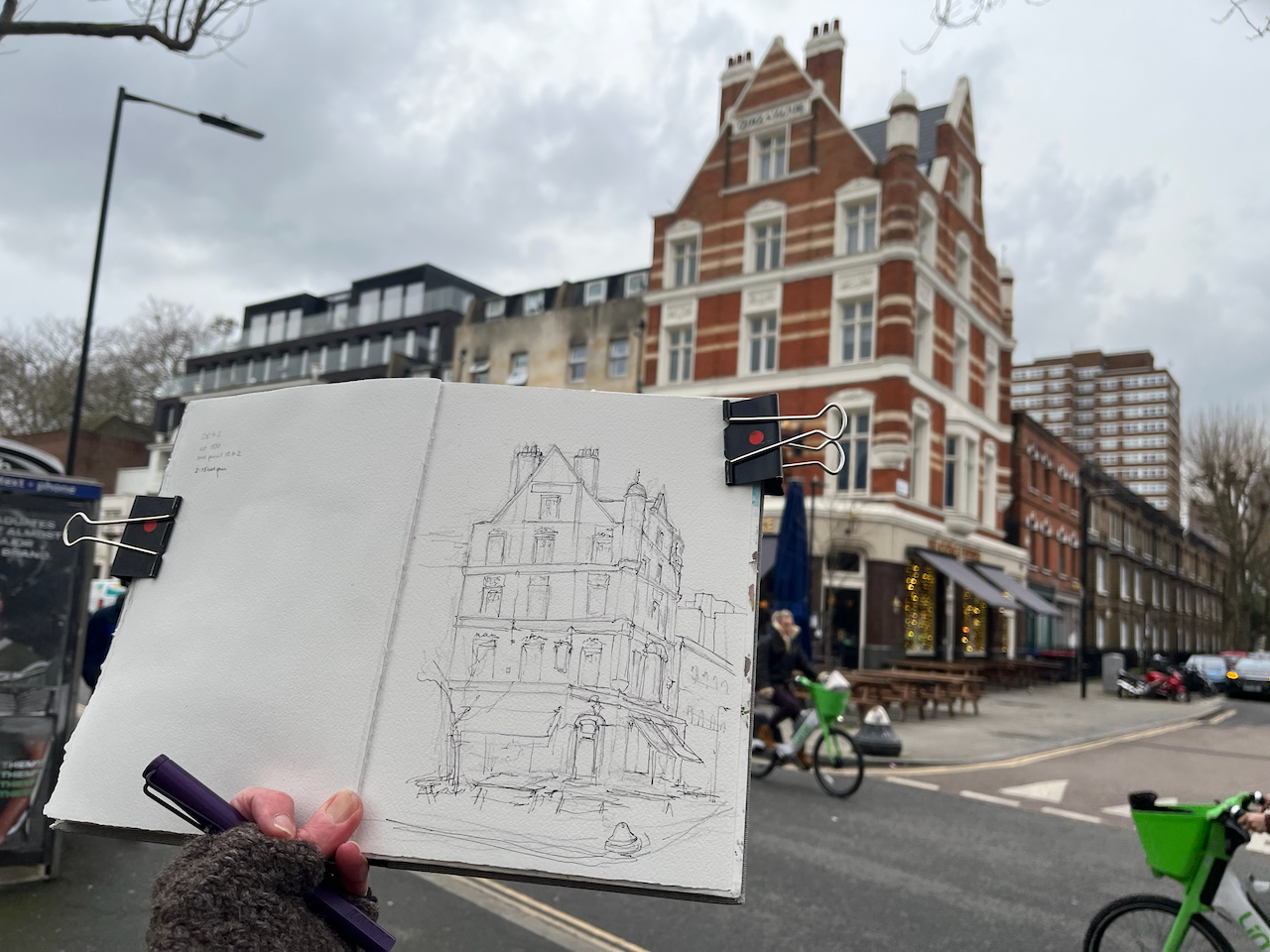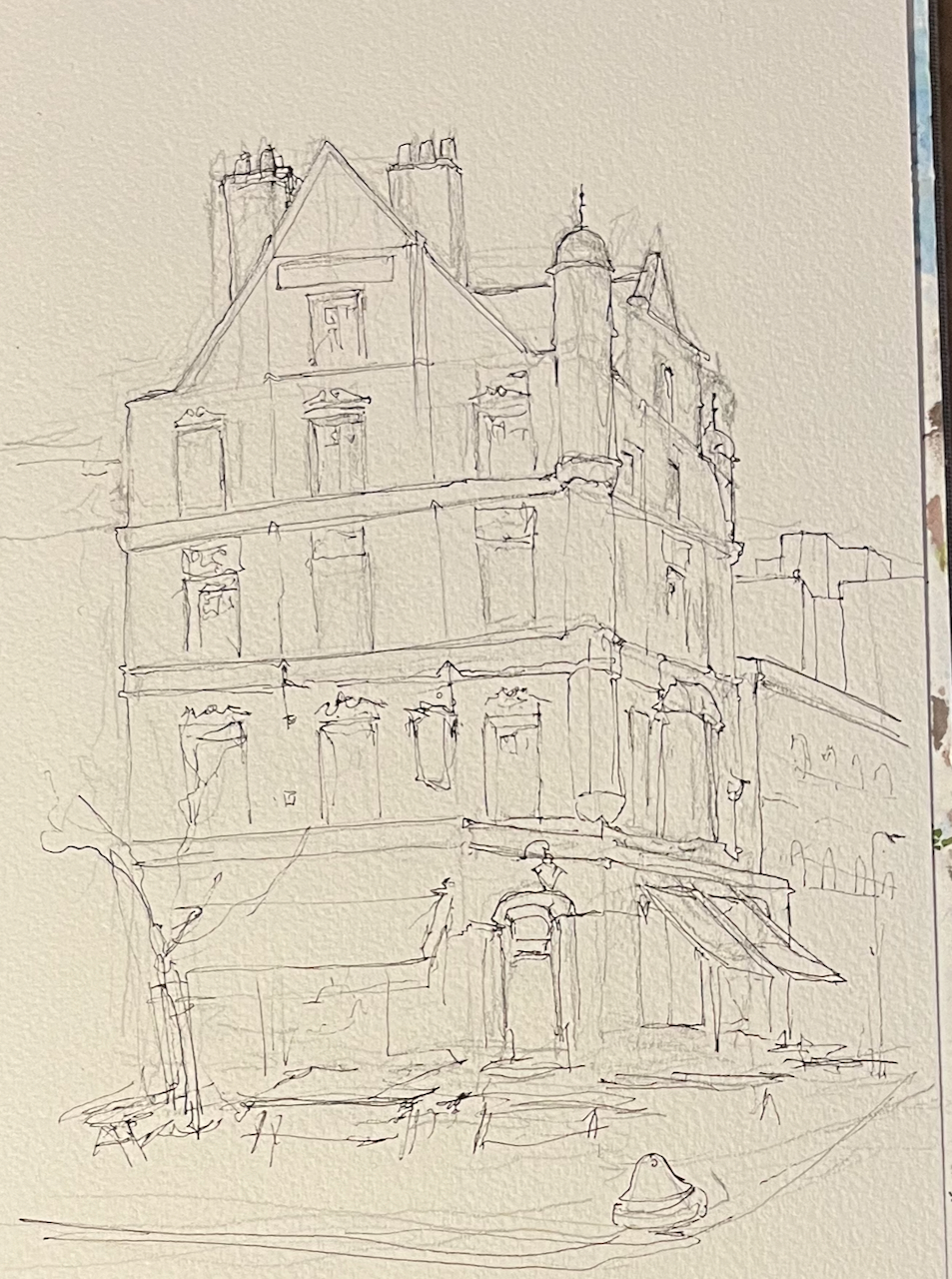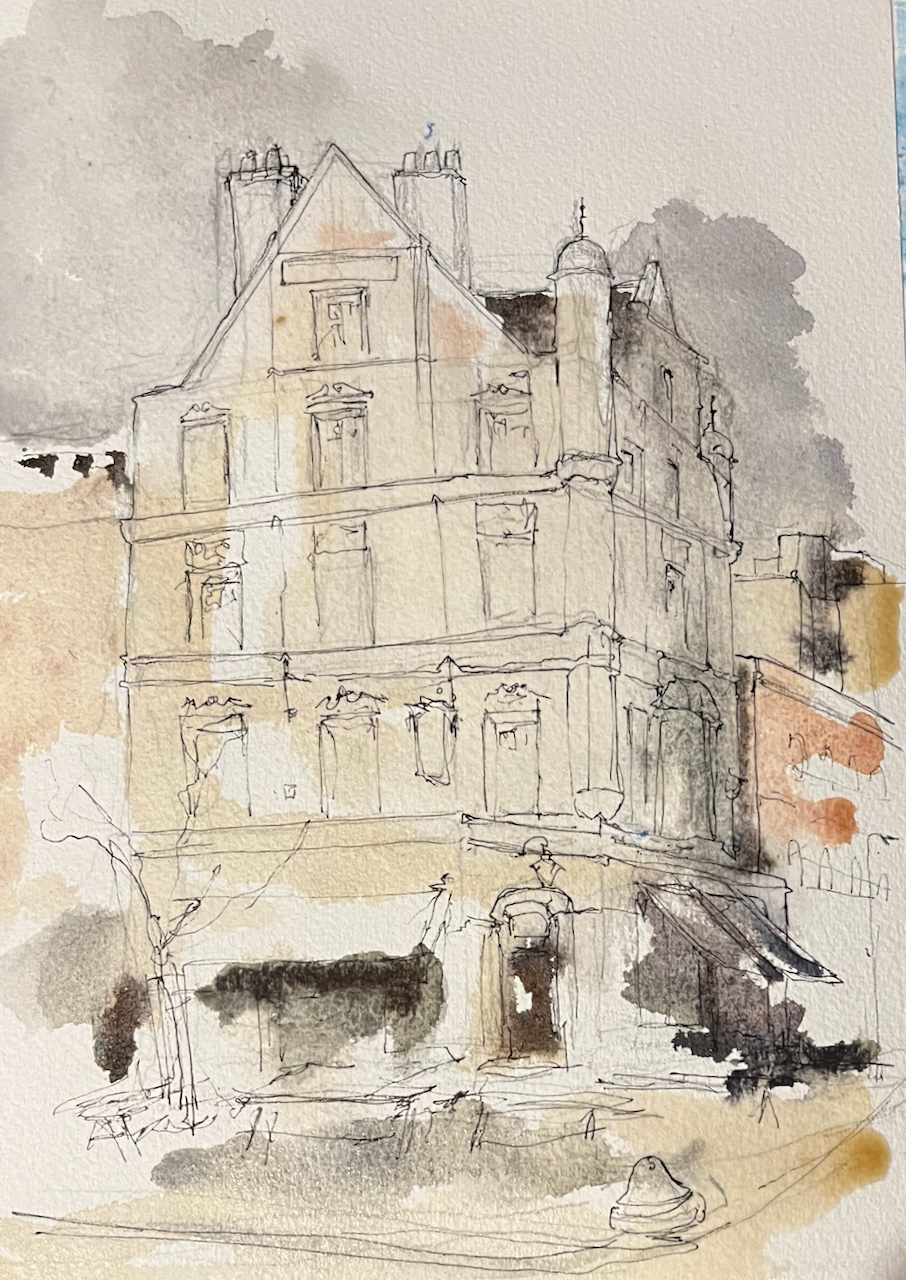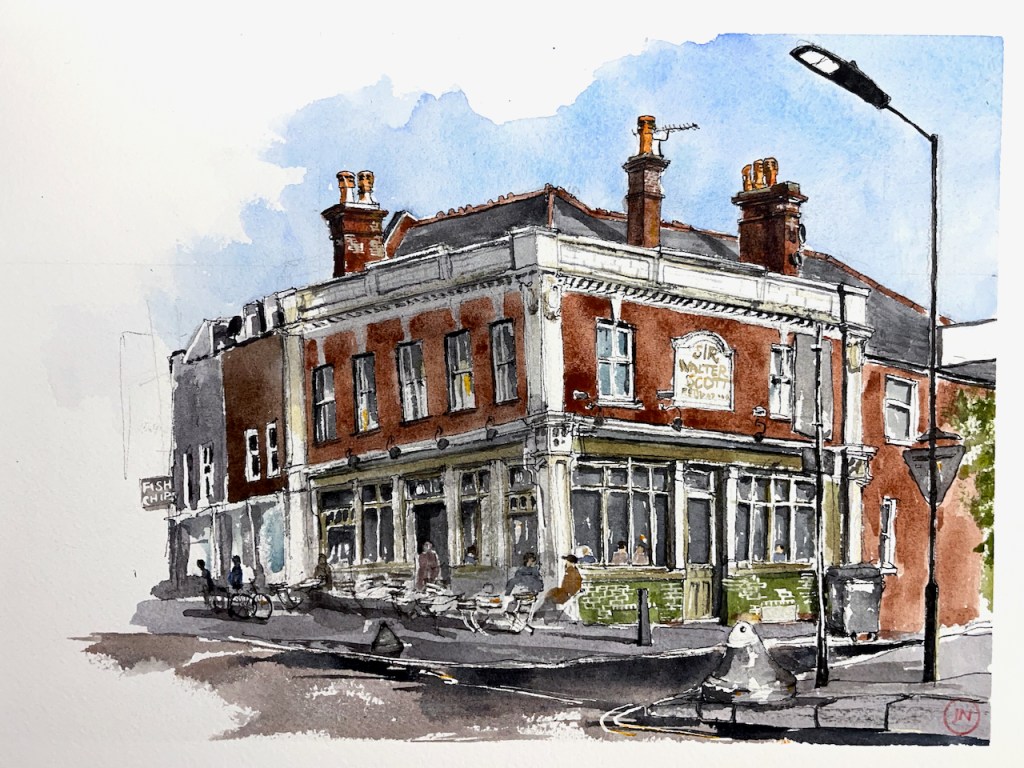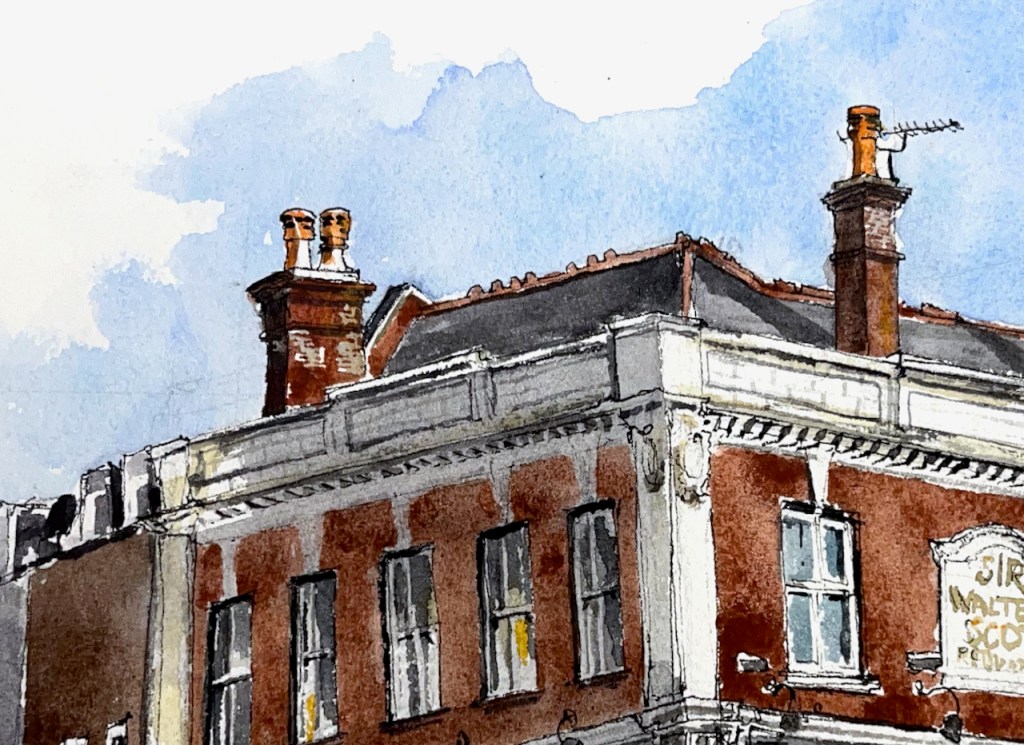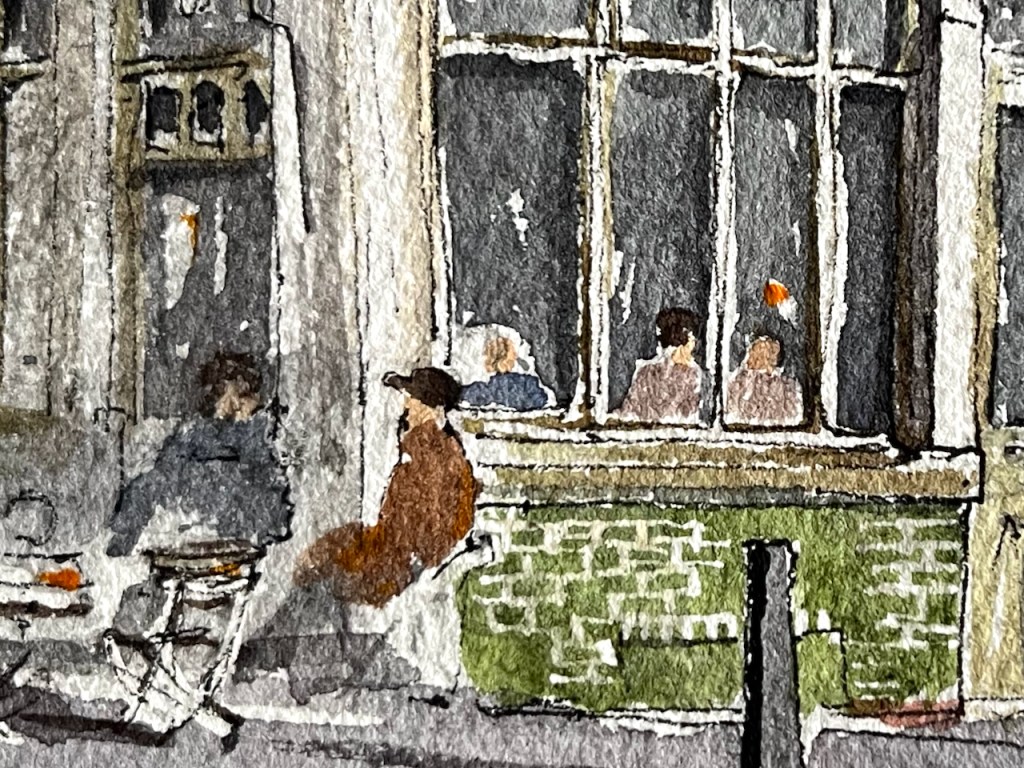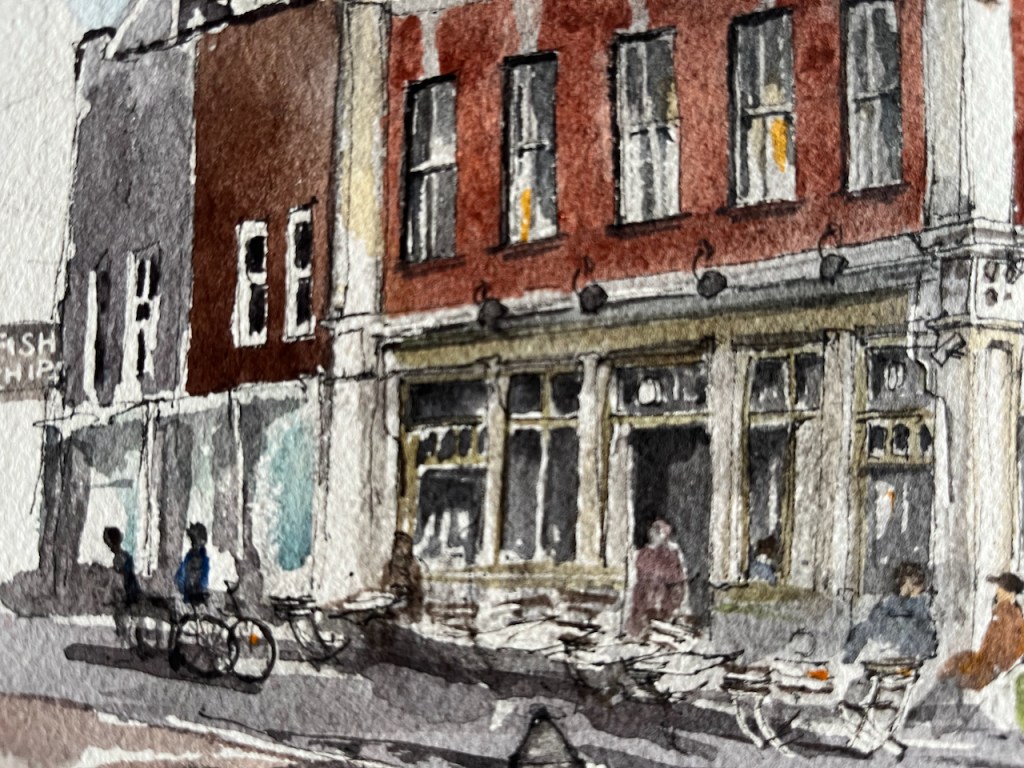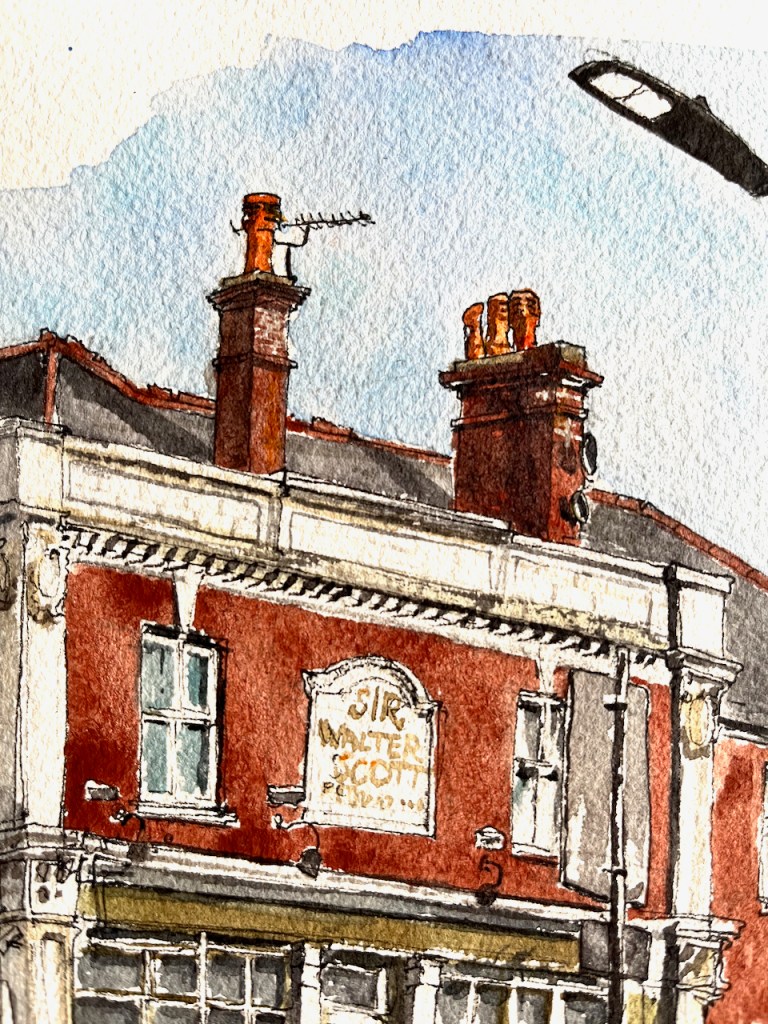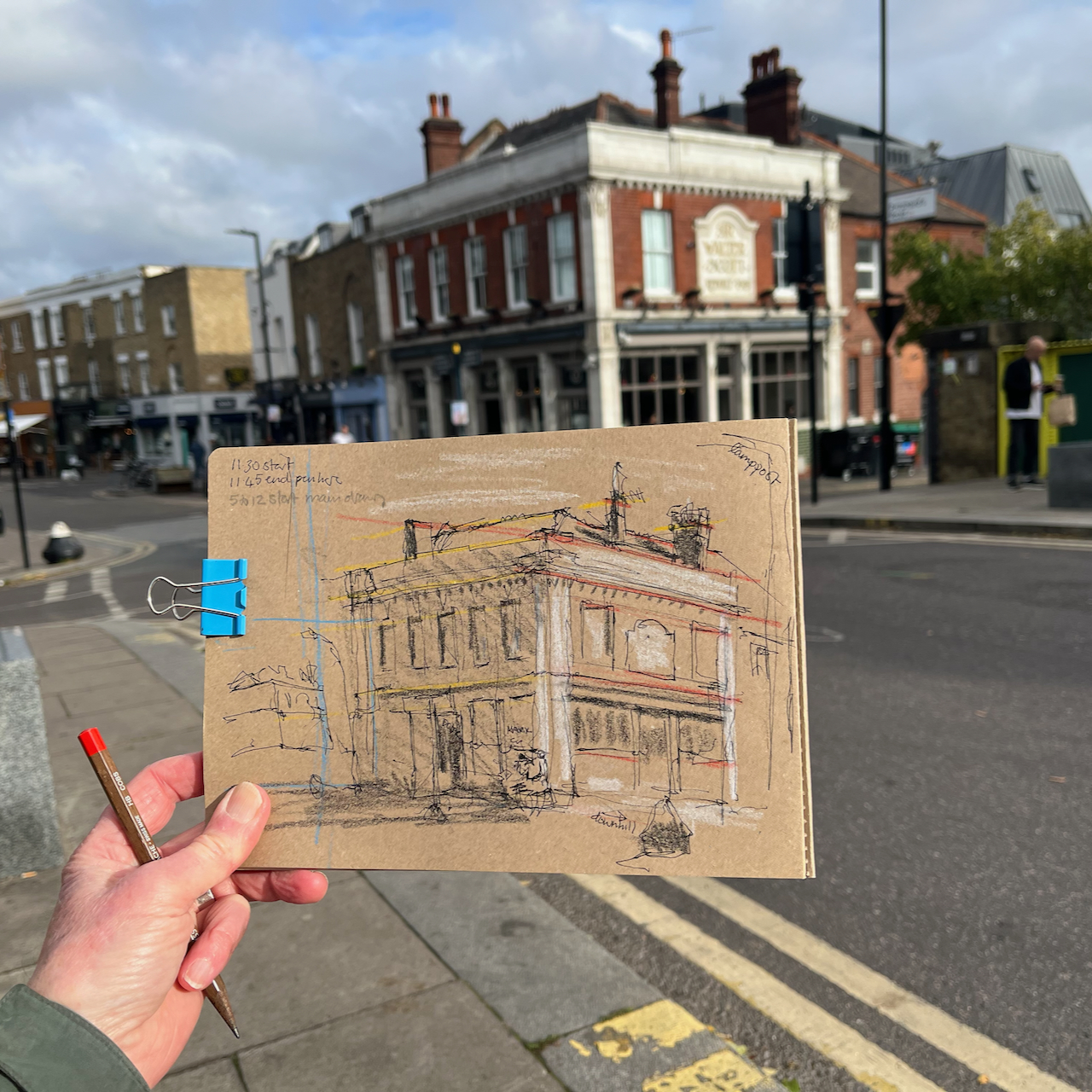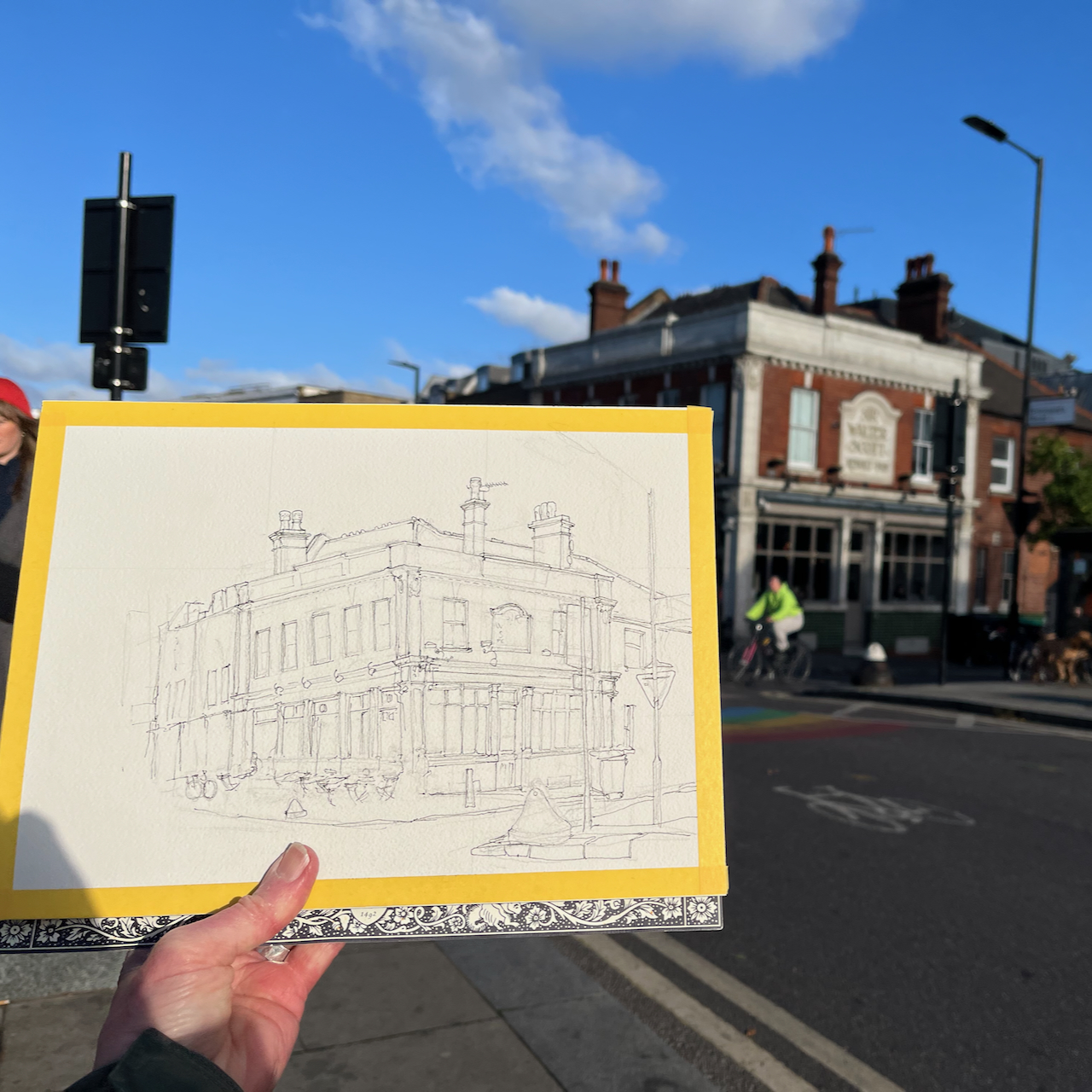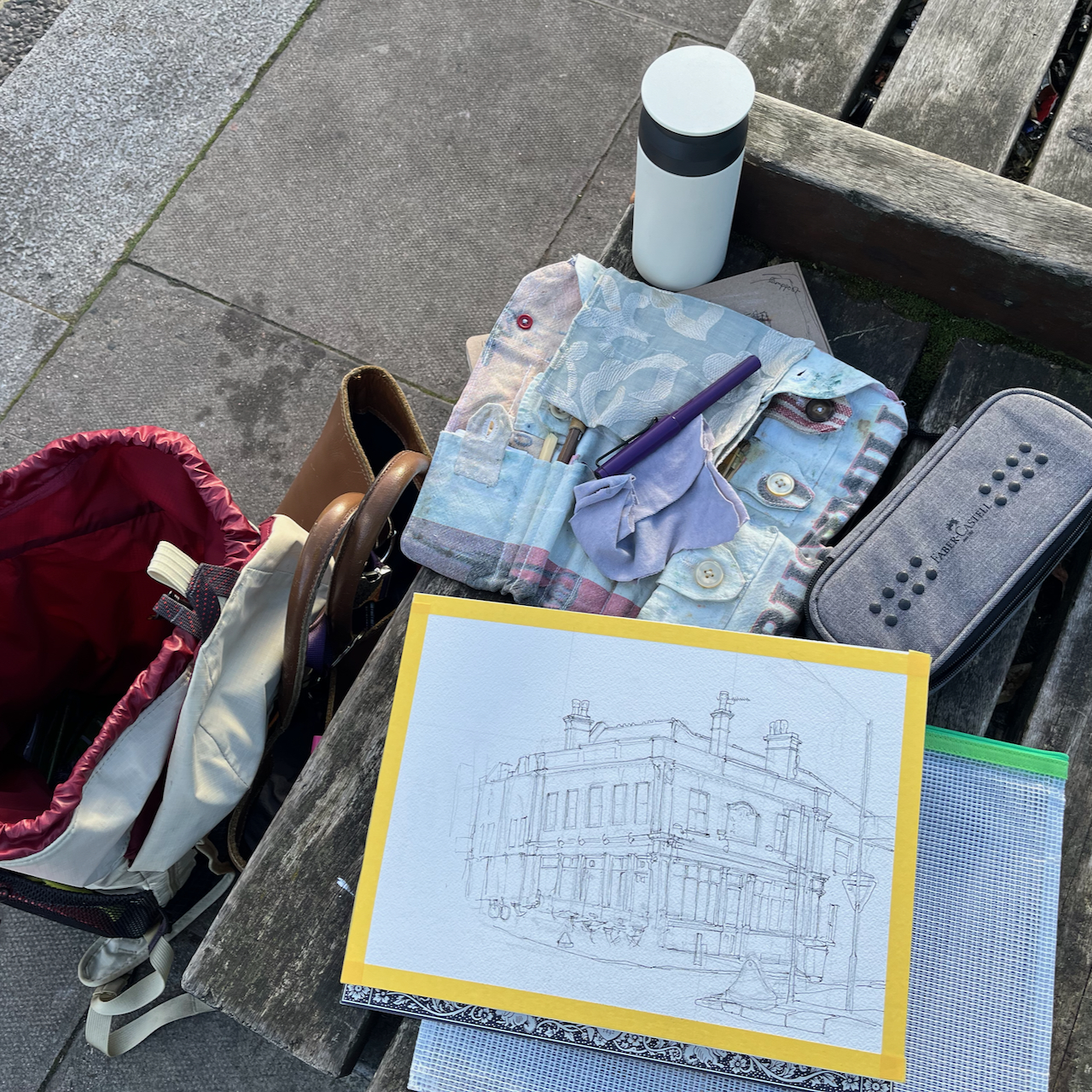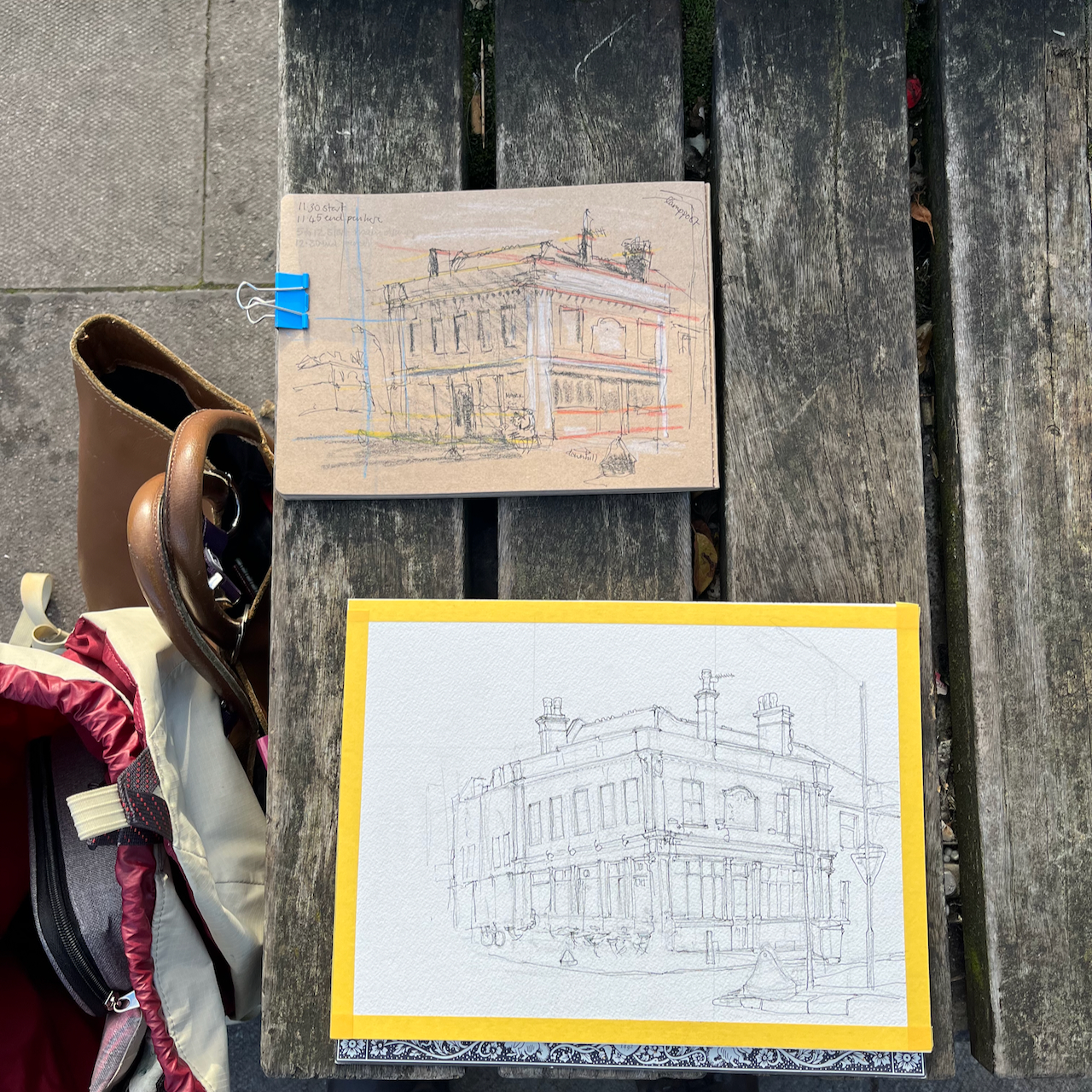
Here is The Perseverance, on the corner of Great Ormond Street and Lamb’s Conduit Street.
The Perseverance, 63 Lamb’s Conduit Street WC1N 3NB, sketched 4th September 2025 in Sketchbook 16
This pub was formerly The Sun, and had a magnificent painting on the corner. There are pictures and history on this detailed post from The London Inheritance. The many comments on the London Inheritance blog post describe happy memories of The Sun and its numerous Real Ale pumps.
The pub is listed Grade II reference 1379274. It was built in the early 18th century and the front was renewed in the 19th century. It was The Sun until the 1990s when the name was changed a few times, becoming the Perseverance around 2005/6.
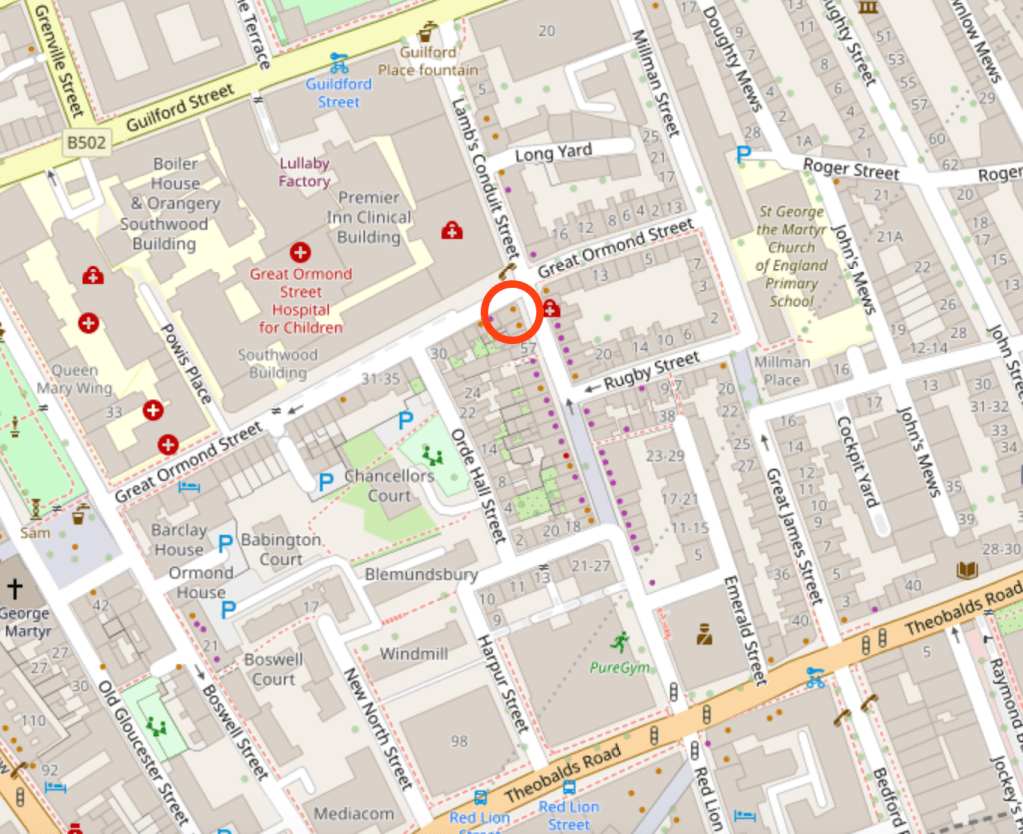
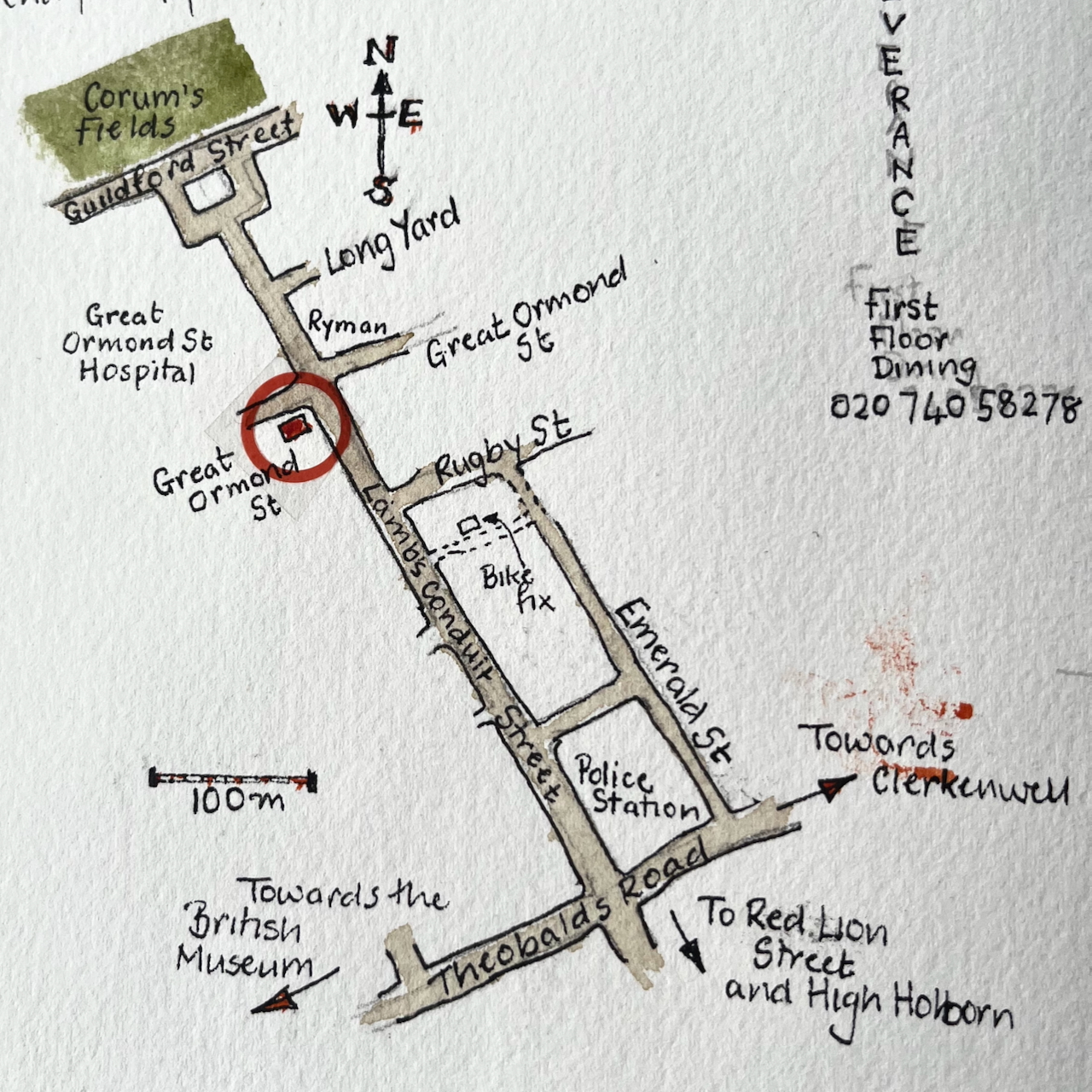
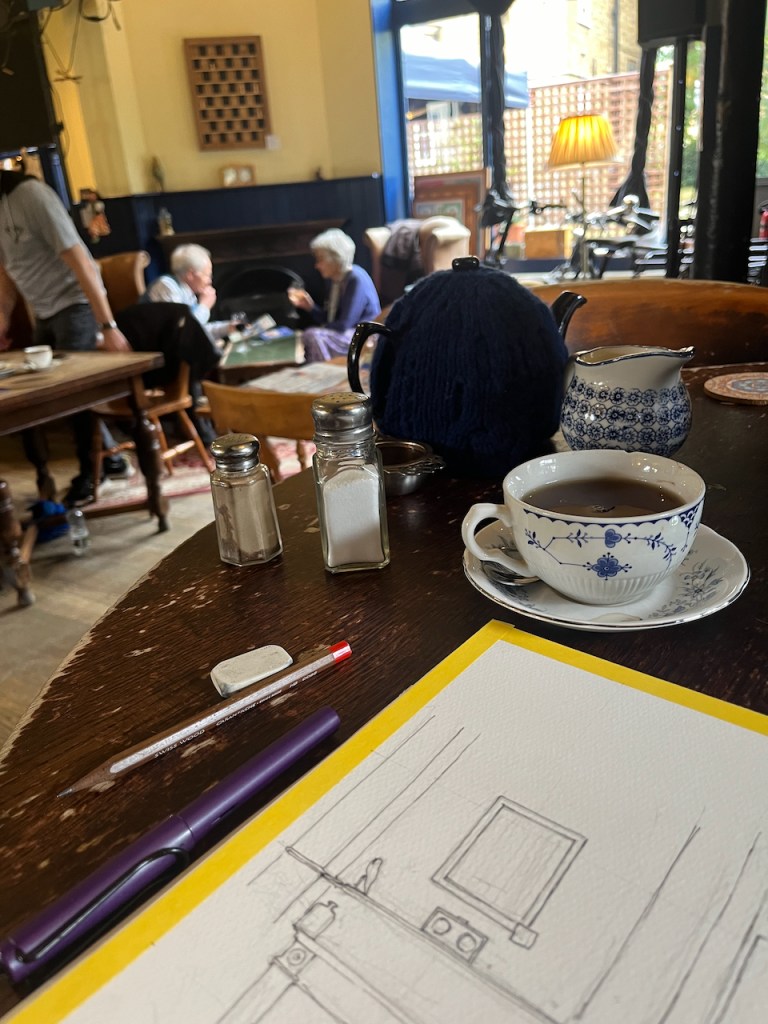
I sketched it from the “Rymans” stationery shop which is on the opposite corner of the crossroads. People walked past me, deep in conversation, casting shadows in the afternoon sun. But one elderly man stopped, and looked up at me. His back was slightly bent. “Are you alright standing there?” he asked. I said I was, wondering what he meant. “Because,” he continued, “I could go up and get you a stool from my flat. It’s just up there.” He pointed heavenwards, to the windows above the shops. People are so kind. This man was so kind. It’s moments like this which make the sun rise on humanity. I was in fact quite tired, and would have liked to sit down, but my drawing was very nearly finished. I hesitated to send this helpful individual back up his stairs. So I declined his thoughtful offer, as politely as I knew how, and continued my drawing standing upright in the sun.
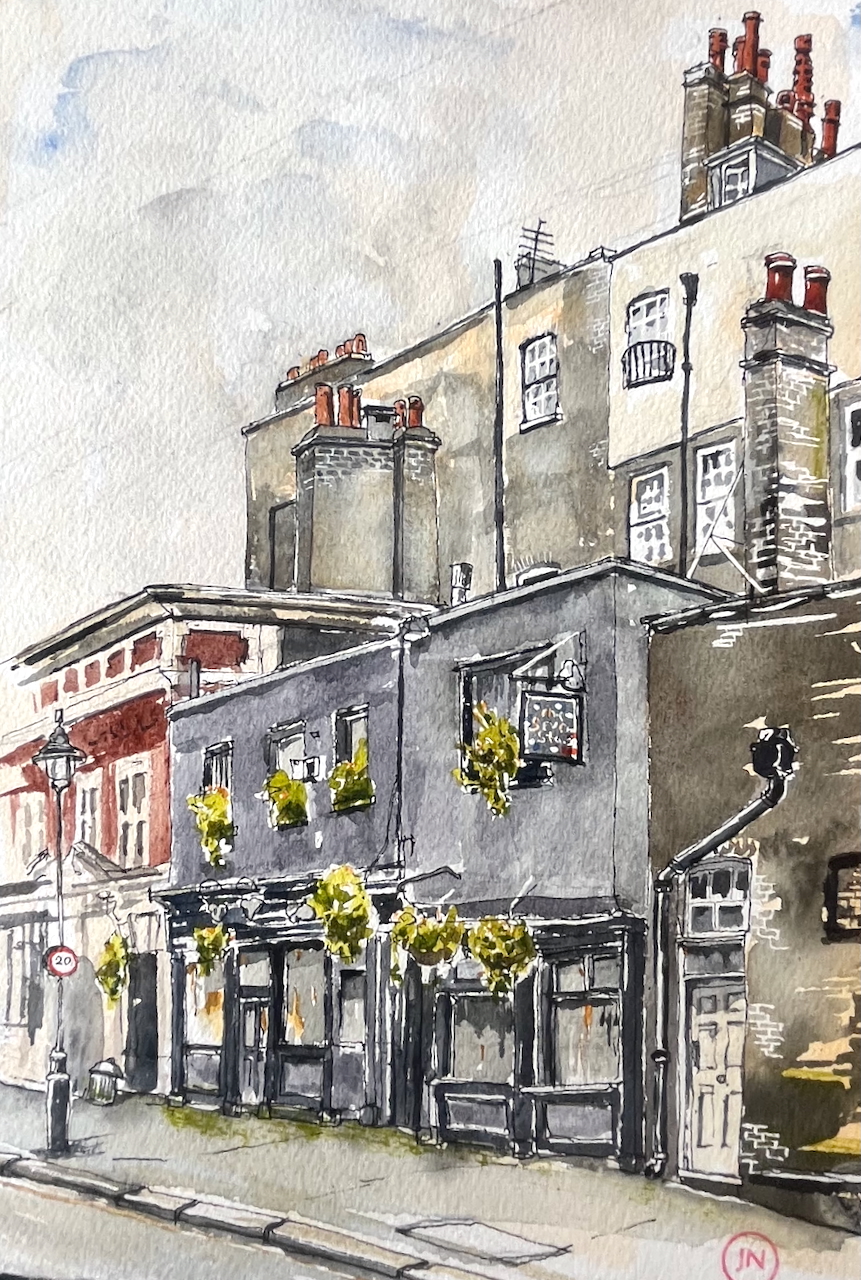
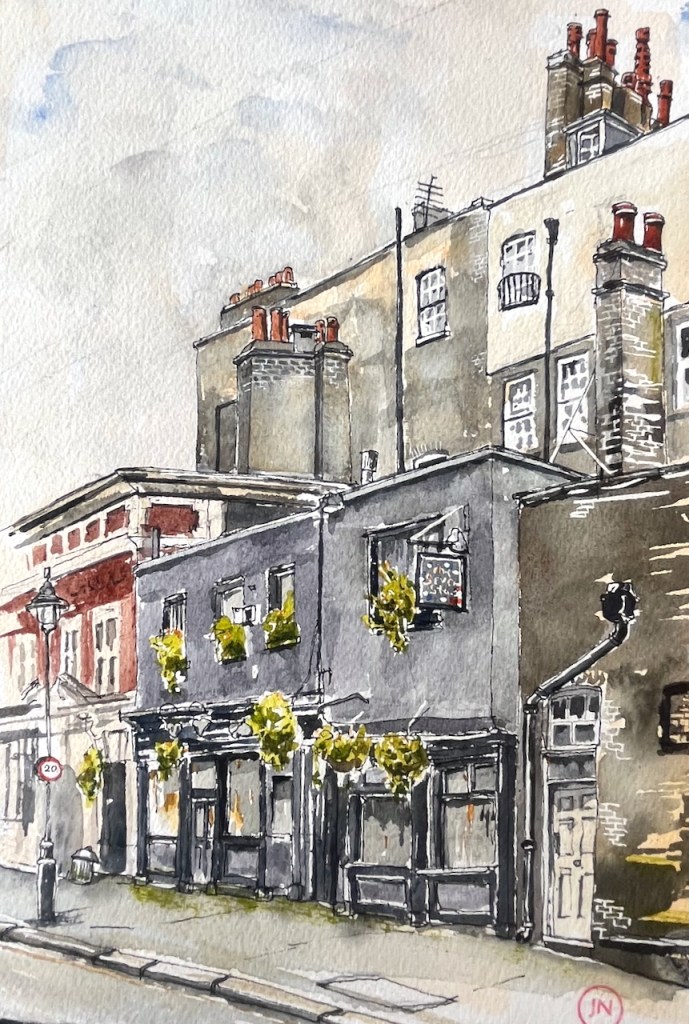
This drawing took 1 hour and 20 mins on location, plus another hour and a half at my desk later. The colours are:
Mars Yellow (brickwork)
Ultramarine Blue and Burnt Umber (mixed, for the greys and blacks)
Phthalo Blue Turquoise and Ultramarine Blue for the sky and the street, and the street signs
Transparent Pyrrol Orange for the “No Entry” sign and the flowers
Serpentine Genuine Green for the plants
A tiny bit of Permanent Yellow deep for the yellow line on the road, and other small touches
All whites are the paper.
Ink lines are De Atramentis Document black ink in an Extrafine Lamy Safari fountain pen
Paper is Arches Aquarelle 300gsm Cold pressed in a sketchbook made by the Wyvern Bindery in Hoxton.
Here are maps (click to enlarge):
(c) OpenstreetMap Contributors
Here is the sketchbook, size 7″ x 10″.
Click a button below to share this post online, email it, or print it:
My idea that day was to sketch some interesting corner pubs in Bloomsbury.
By the time I had emerged from my flat and was on the street, the bright autumn day had turned stormy. After a few paces, the rain started falling. Everyone dashed for cover. I sheltered in a doorway, together with another woman, two strangers in a refuge, grinning and rolling our eyes. “Well, it is September”. At a pause in the deluge, we both emerged and went our separate ways. I went doggedly towards the West, but no, the rain returned, seemingly even more torrential. I dashed from doorway to doorway, like a fugitive in a spy novel, finding cover where I could. Then I spotted the generous overhang of Smithfield Market and rushed underneath, the rain spattering on the glass above. There was no sign of the deluge ceasing, so I considered, as you do in these strange interim conditions: to go on? to go back? Or to stay where you are?
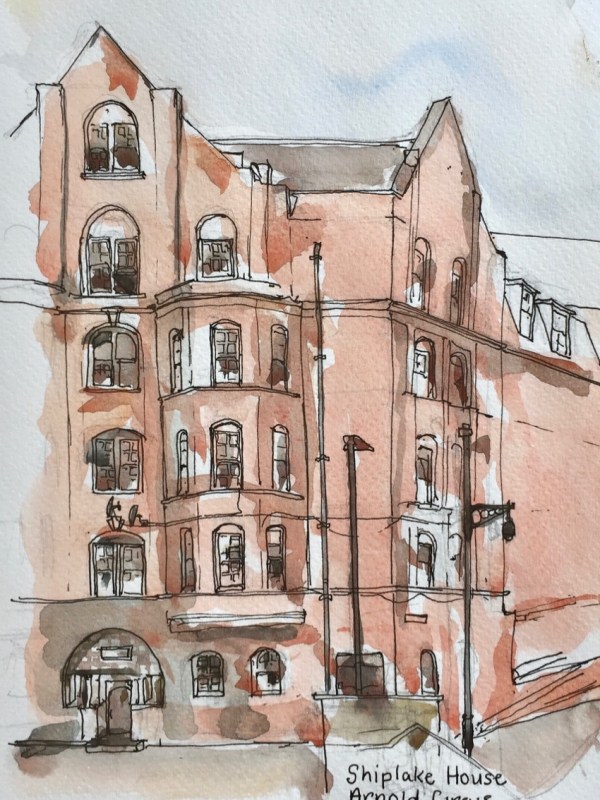
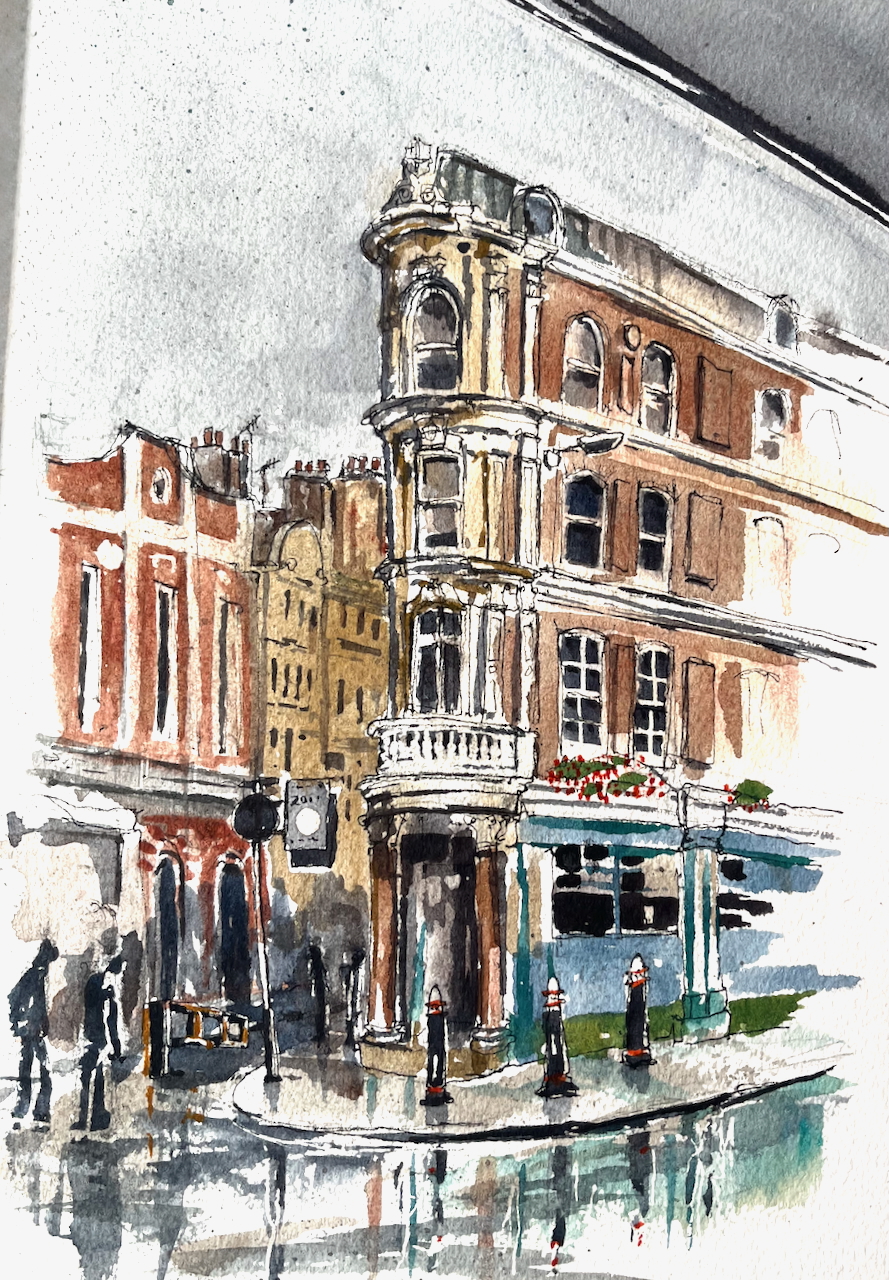
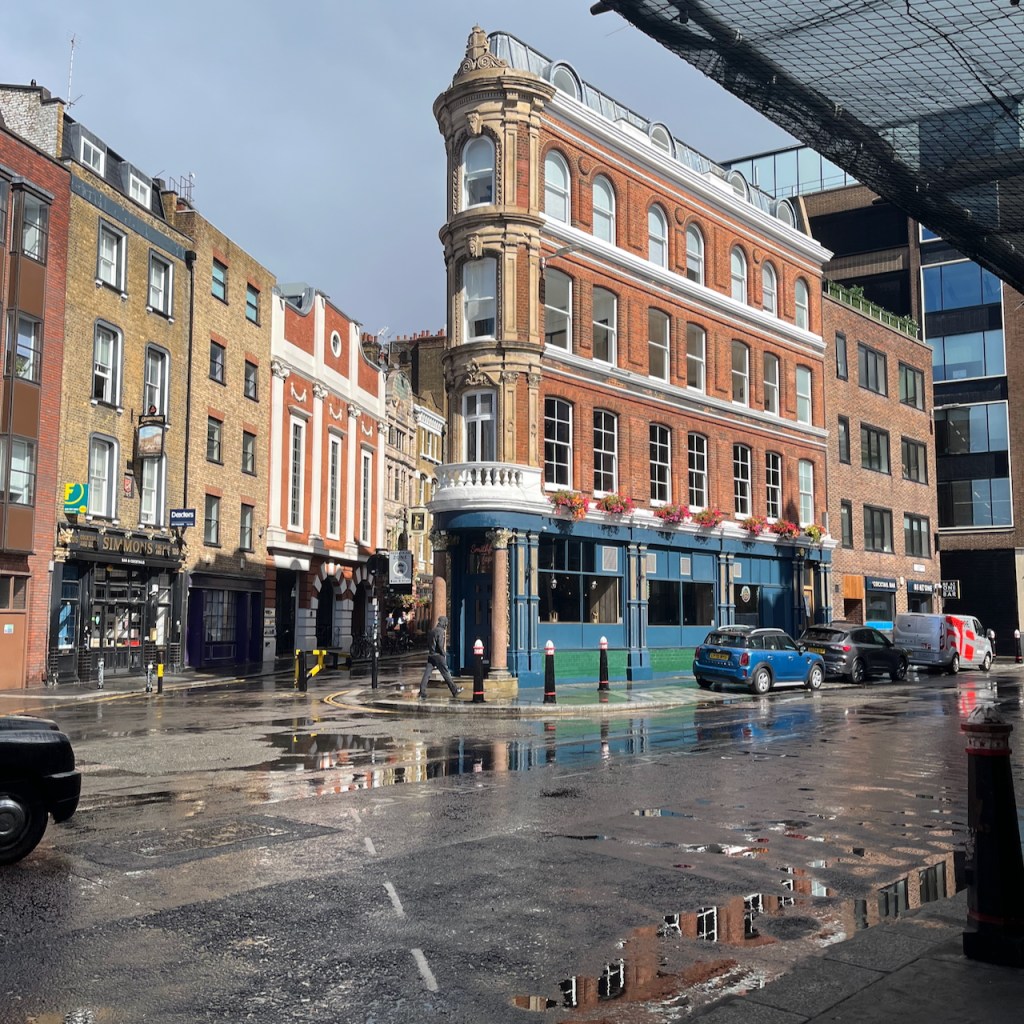
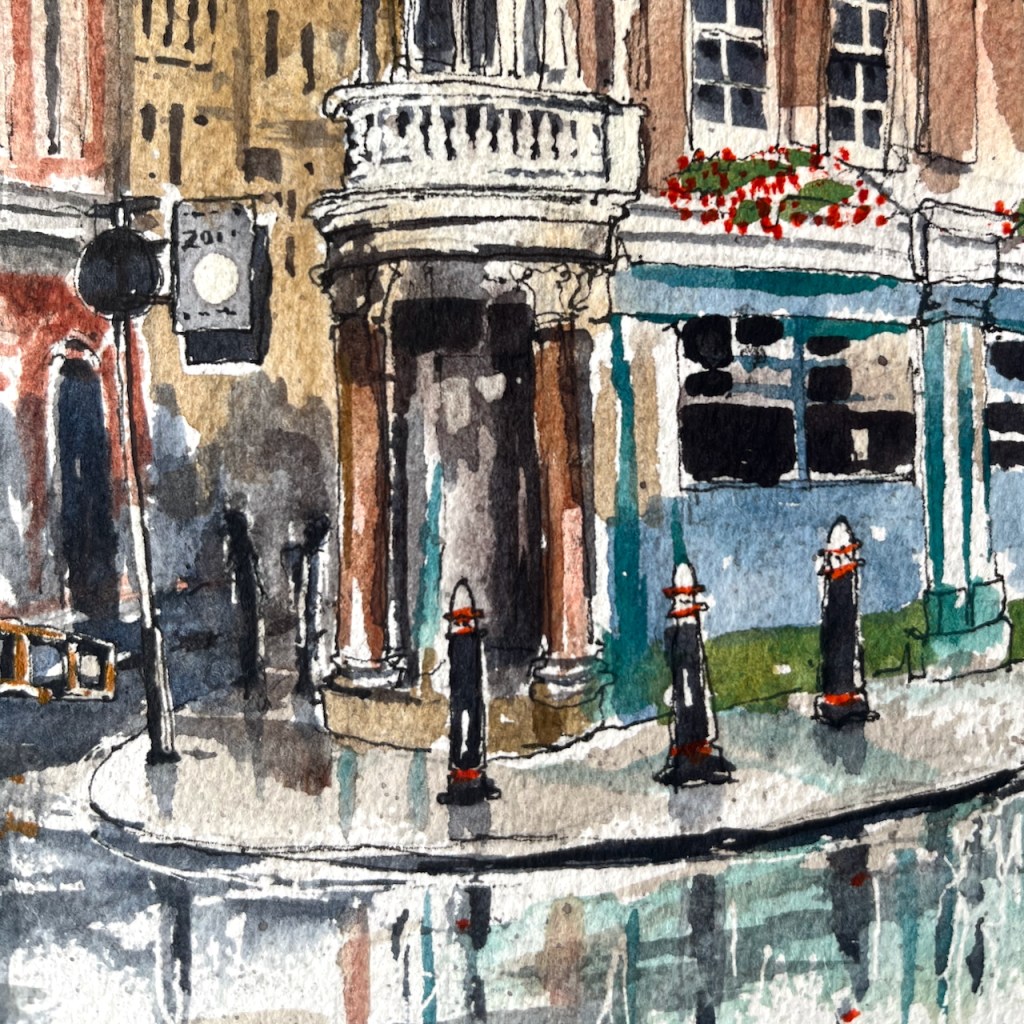
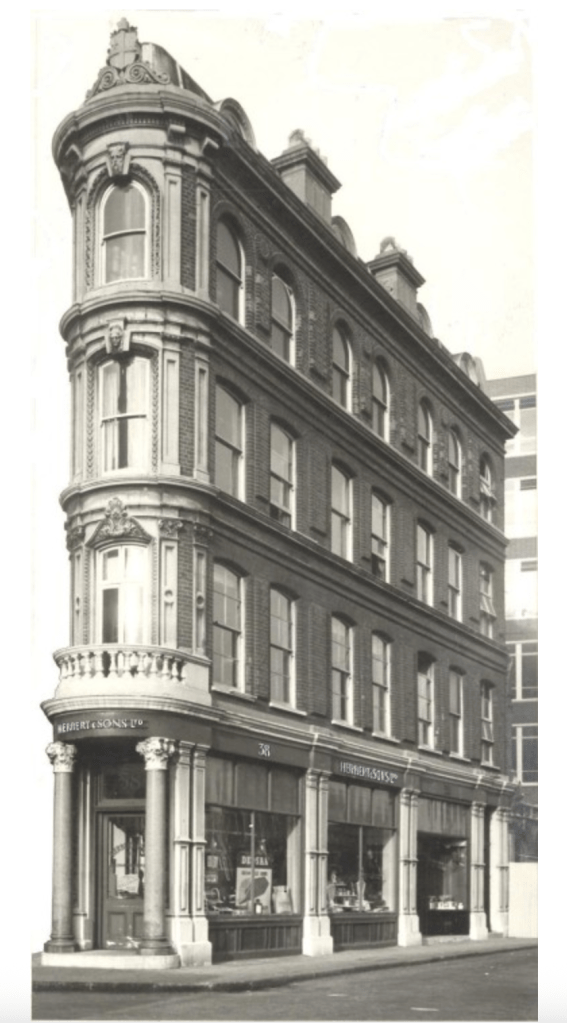
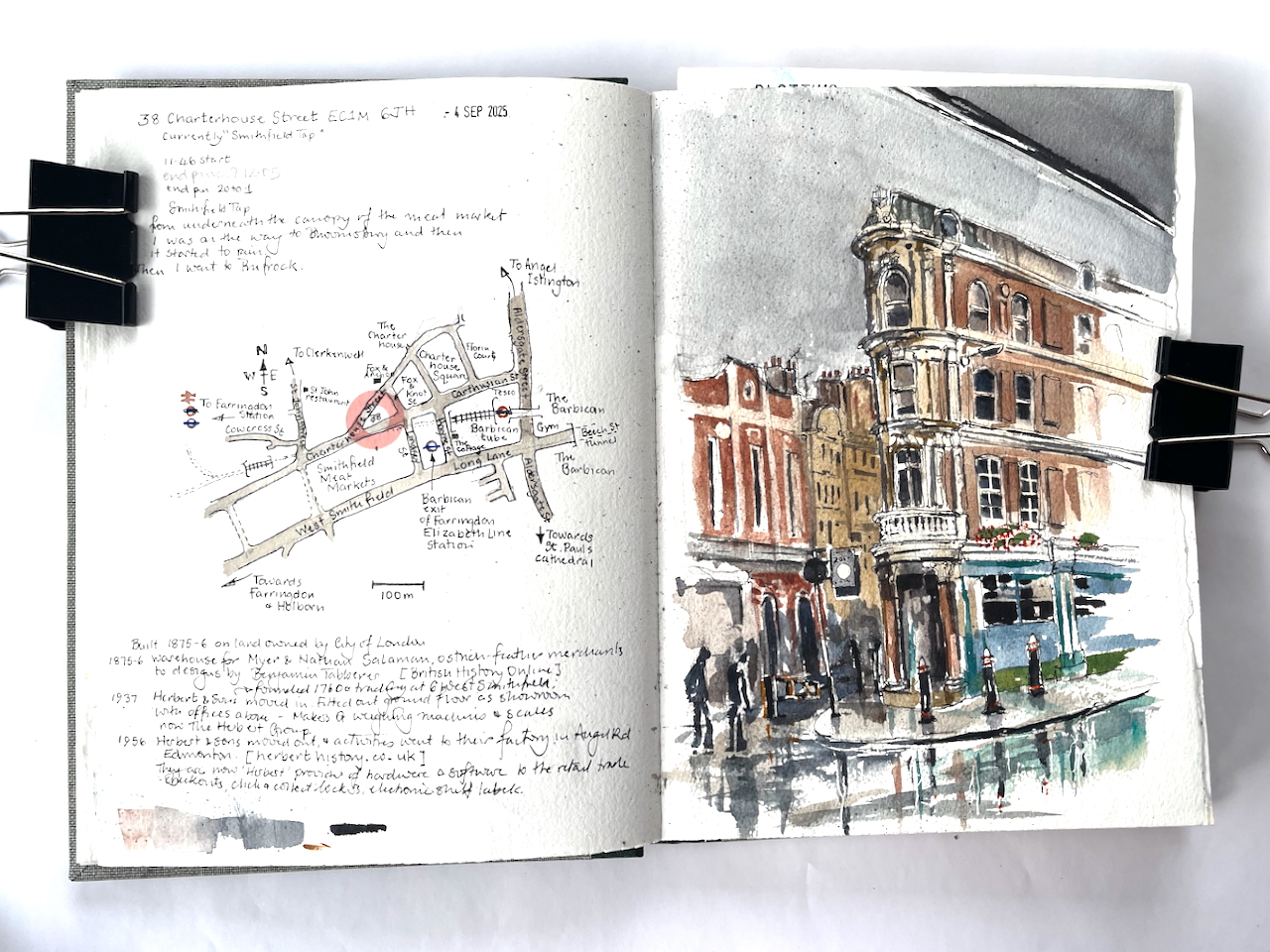
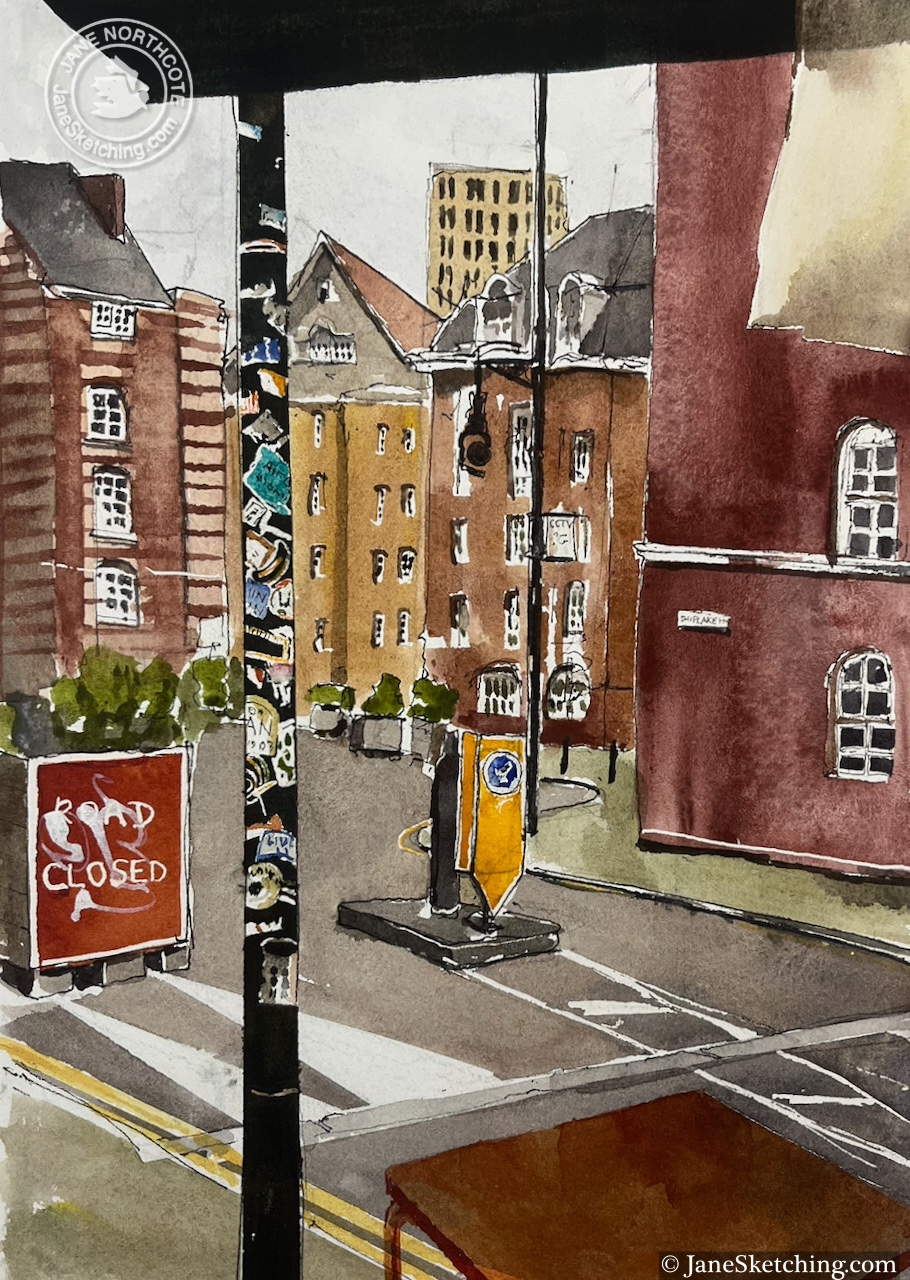
Why not do the drawing right here? Over the other side of the road is a building occupying an acute angle between roads. It wasn’t in my plan, but by this time I had abandoned my plan. So here is 38 Charterhouse Street, sketched from the shelter of the Smithfield Meat Market canopy.
38 Charterhouse Street, EC1M 6JH sketched 4th September 2025 in Sketchbook 16
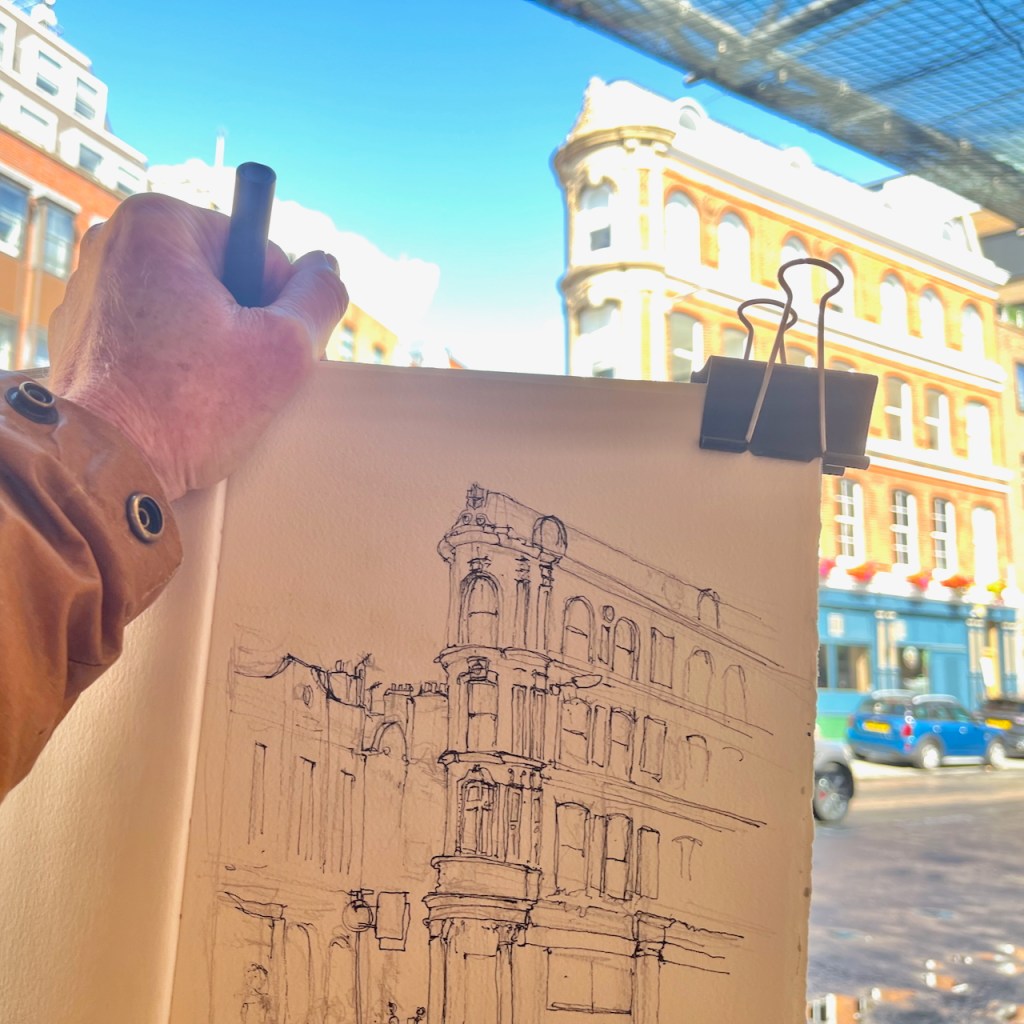
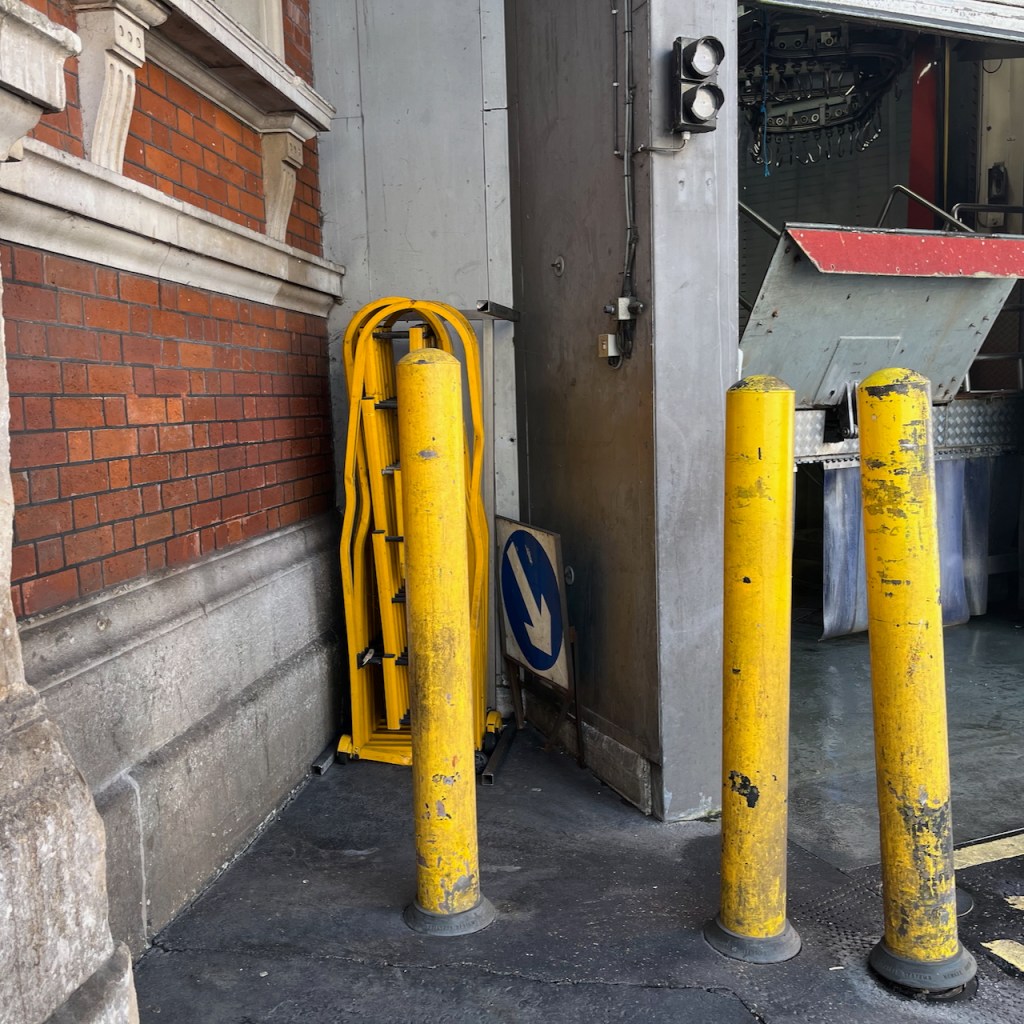
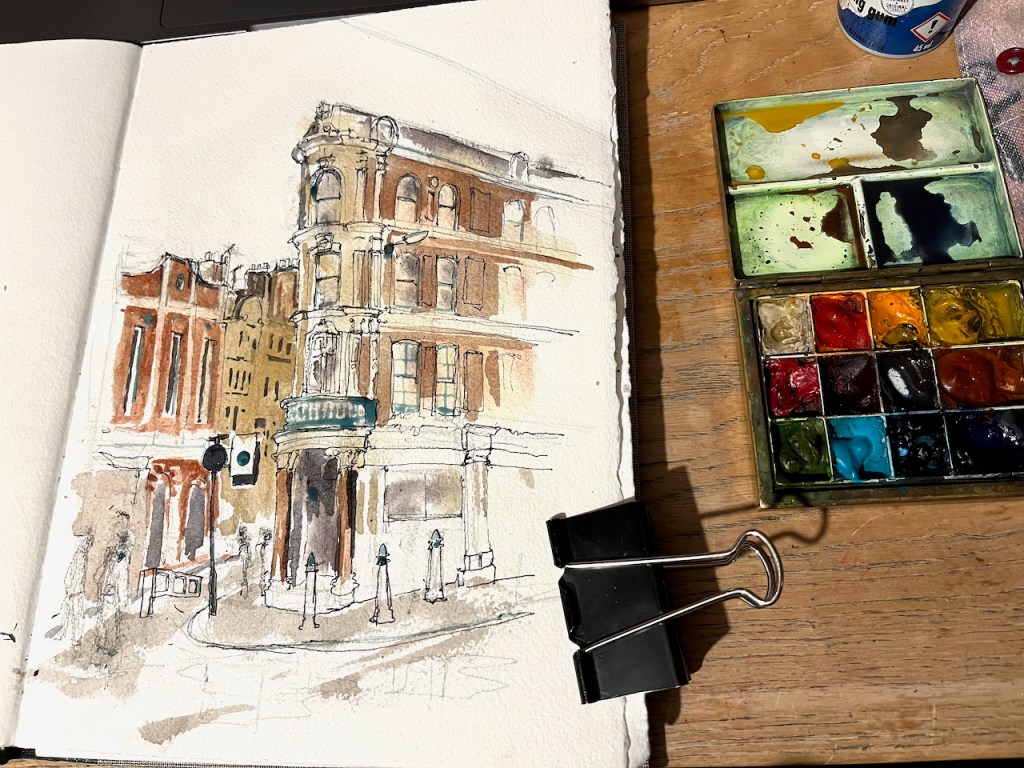
I sketched it in pen on location. Part way through the process, a group of workers started to clean the area behind me, using high-pressure water hoses. A fine mist appeared in the air, adding to the general dampness. I finished the drawing later that evening, in my warm dry room.
38 Charterhouse Street, photoDrawing in progress on locationDetail of finished drawingThis was where I was standing to sketch, this area was cleaned with high-pressure water hoses.
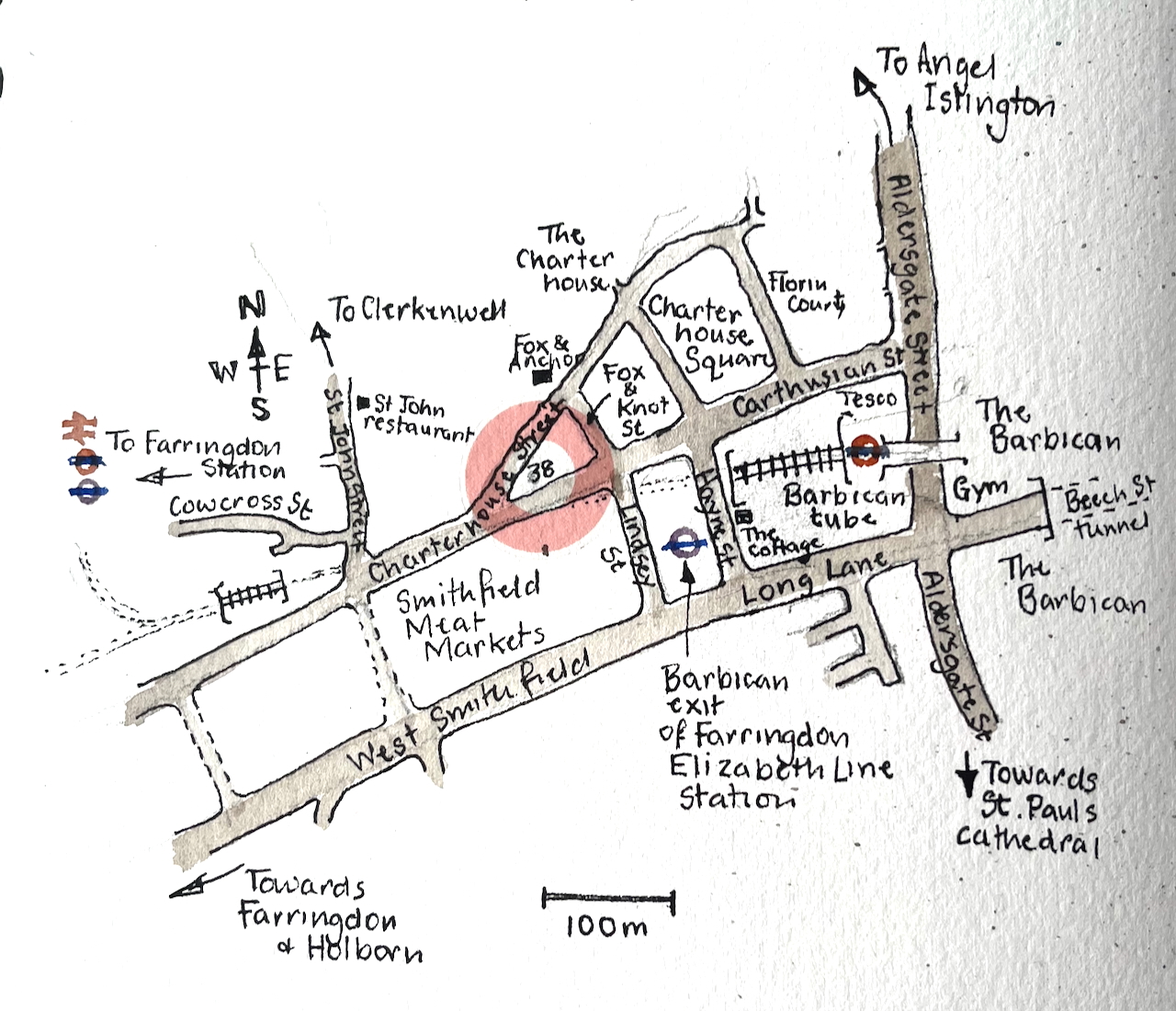
Here is a map.
As you see, number 38 stands on a little triangle of land, bounded by Charterhouse Street, Carthusian Street and the tiny alley called Fox and Knot Street.
British History Online offers some history for this triangular plot. In the 1860s the City of London redeveloped the Smithfield Meat Market. At the time it had been mostly an open-air market. The City turned it into the covered market it is today. The surrounding lanes and buildings were also affected, both by the redevelopment and the increased trade.
In 1869–70, with the new market building complete, it was resolved to take the new road along the north side of the market further east into the square itself, carried out in 1873–4. The road was called Charterhouse Street, apparently at the suggestion of the Charterhouse, Whereas in 1860 Charterhouse Lane enjoyed a mix of businesses, in 1876 half of the sixteen surviving houses were occupied by meat and poultry traders. The same trades dominated the new buildings put up, though there were also coffee rooms to rival the two remaining pubs and a large bank at the corner with St John Street. By the time of the Second World War most of the buildings west of the Fox and Anchor at No. 115 were purpose-built cold stores. Only with the decline of Smithfield Market did the grip of the meat trades loosen. Today restaurants and bars have largely supplanted them.
The Fox and Anchor pub and the former cold stores are on the left of my drawing. I’ve drawn the marvellous frontage of the Fox and Anchor here.
British History Online describes the block on the corner, number 38:
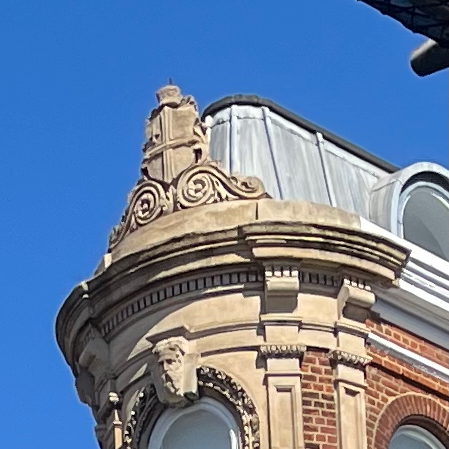
The City of London arms on the building today.
The remnant of ground at the angle between the old and new roads was laid out for a small block of buildings and allotted the numbers 38–42 (even) Charterhouse Street, behind which a tiny street, Fox and Knot Street, was cut through in 1871. The name was taken from Fox and Knot Yard, a court obliterated by the new market.
The small triangular block west of Fox and Knot Street […] just within the City boundary, belongs to the land acquired by the Corporation of London in the 1860s for the Smithfield Market development. Set out for building in 1871–2, it remained empty until 1875–6. At the apex a warehouse (No. 38), was then built for Myer and Nathan Salaman, ostrich-feather merchants, to designs by Benjamin Tabberer. […] It is four storeys high, of red brick with regular fenestration; all the ornamentation is concentrated on the narrow corner. For many years there were coffee-rooms here.
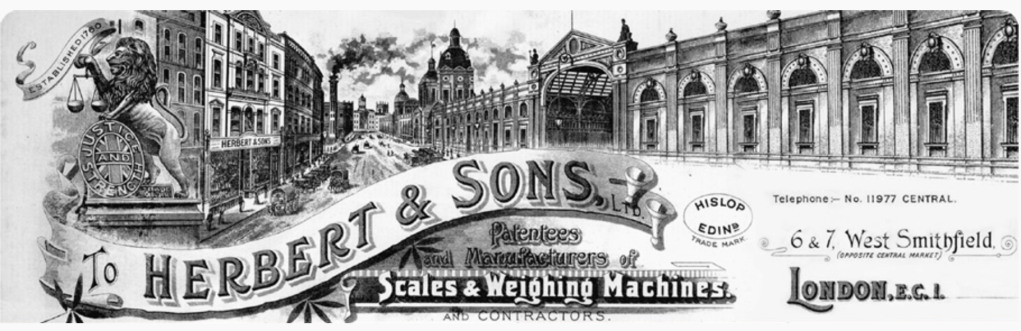
So, in 1875 it was an ostrich-feather warehouse, which must have been a great place to visit. The next mention of the building is on the website of Herbert, a present-day supplier of technology to retail businesses. They have a section of their website devoted to their long history. In the early twentieth century they were supplying weighing machines and balances from their offices in West Smithfield and a factory in Edmonton.
Herbert and Son moved out in 1956 and consolidated their operations into their Edmonton site. Since then, the building has been a coffee house, and, more recently, various bars. It is now the “Smithfield Tap”.
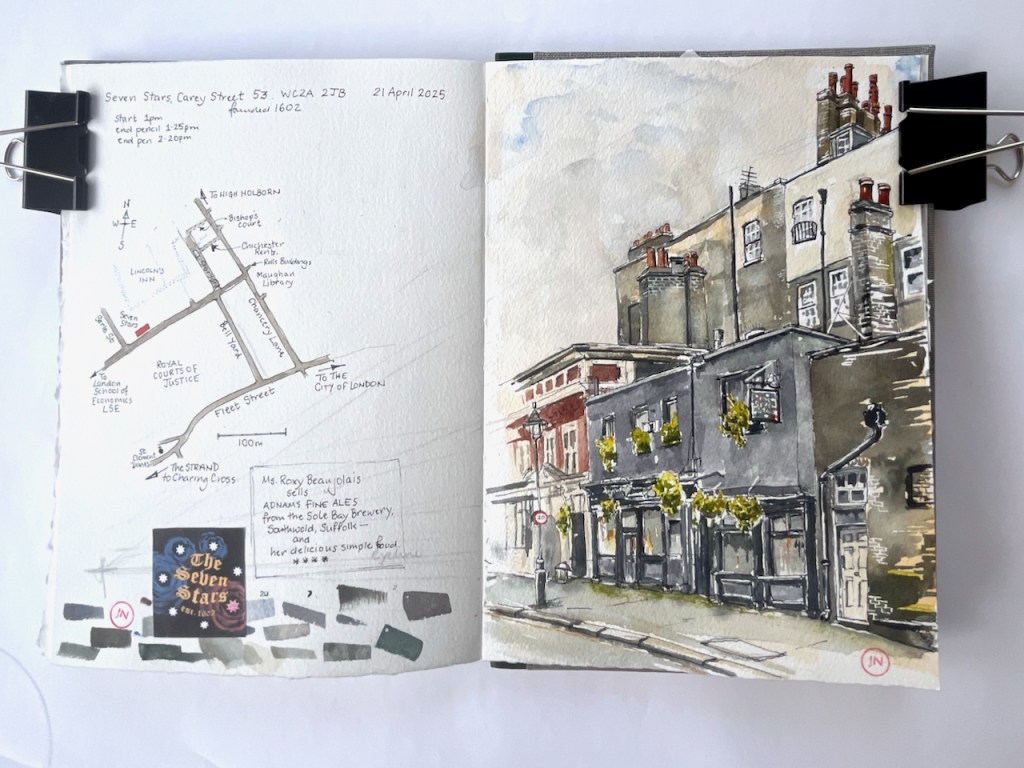
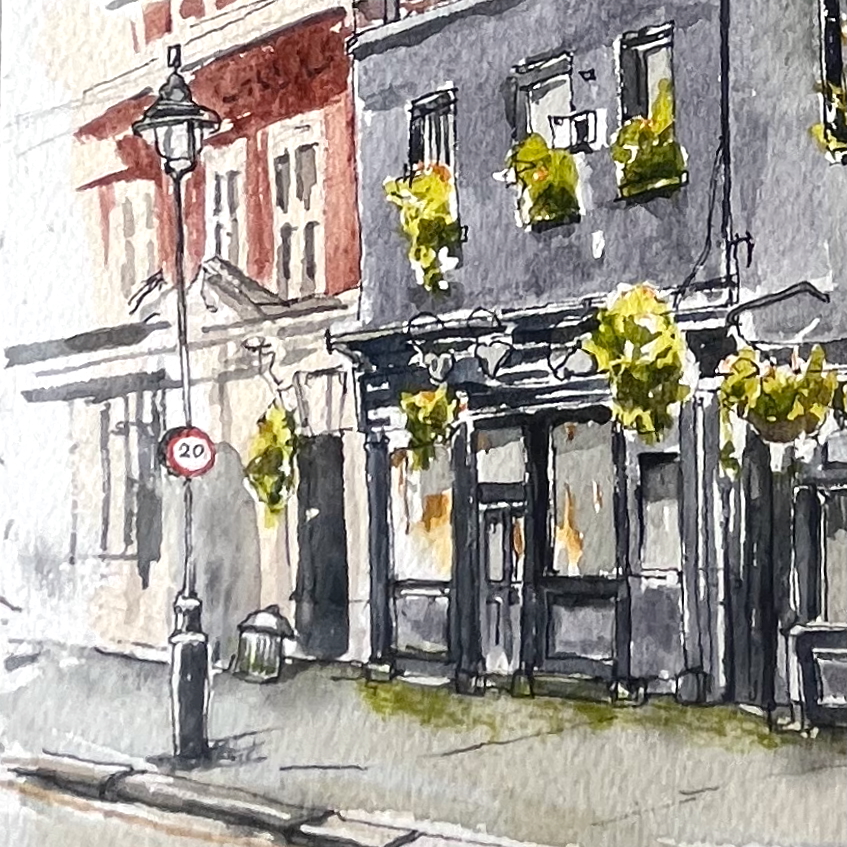
“This tranquil little pub now faces the back of the Royal Courts of Justice, the esteemed Gothic Revival building opened by Queen Victoria in 1882. Within The Seven Stars’ ancient charm of three narrow rooms that make up its public area, drinking in Queer Street (as Carey Street has often been called because of the bankruptcy courts) is contrarily pleasant. One can linger over gastronomic pub food and real ales behind Irish linen lace curtains that are being twitched by litigants, barristers, reporters, LSE students, church musicians, and West End show brass sections. Then, one might navigate to the lavatories up the comically narrow Elizabethan stairs. There are antique Cabinets of Curiosity in the pub’s front windows, and alongside Spy prints of former judges, there are posters of “Brothers in Law,” “A Pair of Briefs,” and other bygone British legal films.”
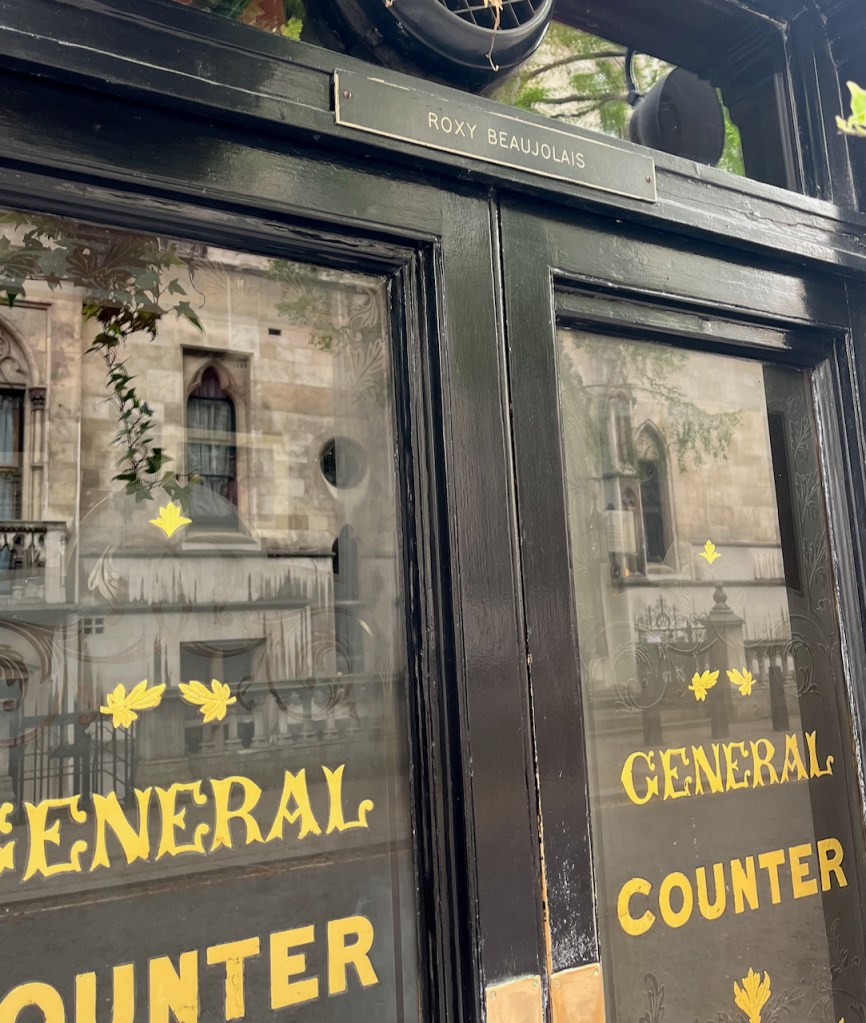
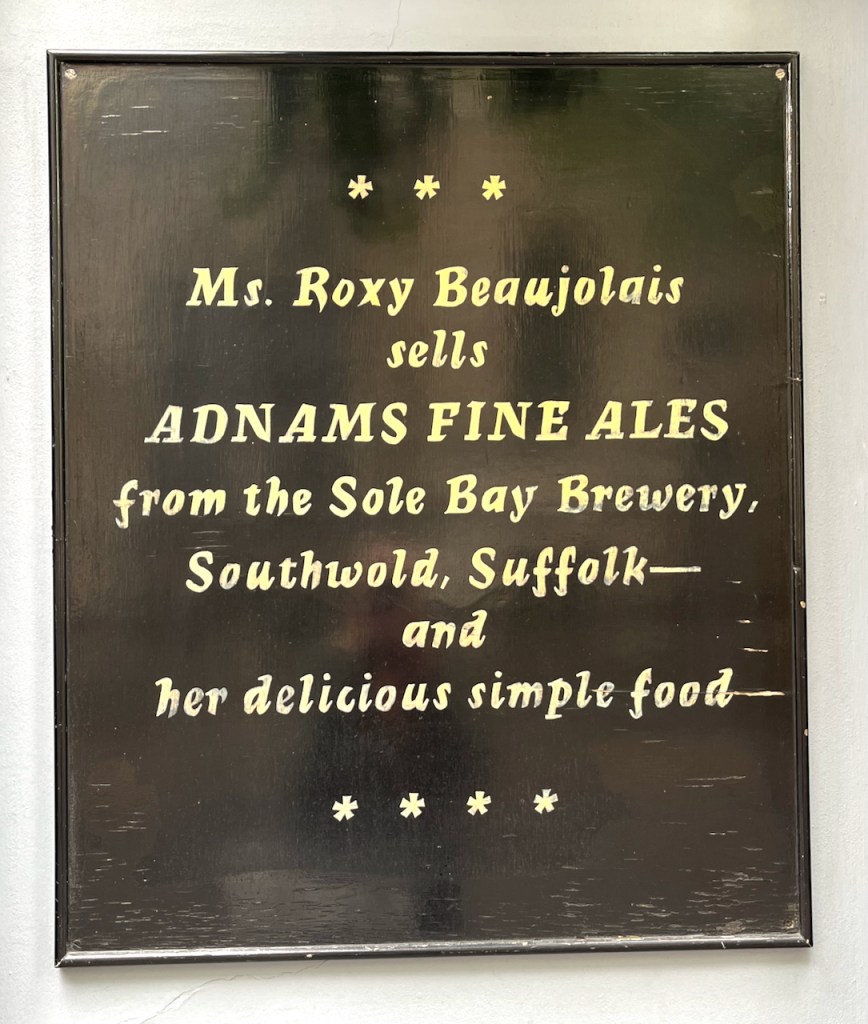
The licensee is the marvellously named Roxy Beaujolais.
Again quoting from the pub website:
In February 2006, FancyAPint listed The Seven Stars as one of “London’s Top Ten Pubs.” A 2006 review in On Trade, a pub industry organ, told it like this:
“We are here to be adored, not ignored,” says Roxy imperiously. “We sell fabulous beer with proper, homecooked food; and I expect my customers to appreciate both of those things.” In the current climate of customer satisfaction at all costs, her words may sound nigh on heretical. But this is a woman utterly qualified to call her own shots, and anyway – her combination of buxom presence, top class conversation, beautifully cared for ale, and sumptuous food is such a winning one that few would feel inclined to argue.
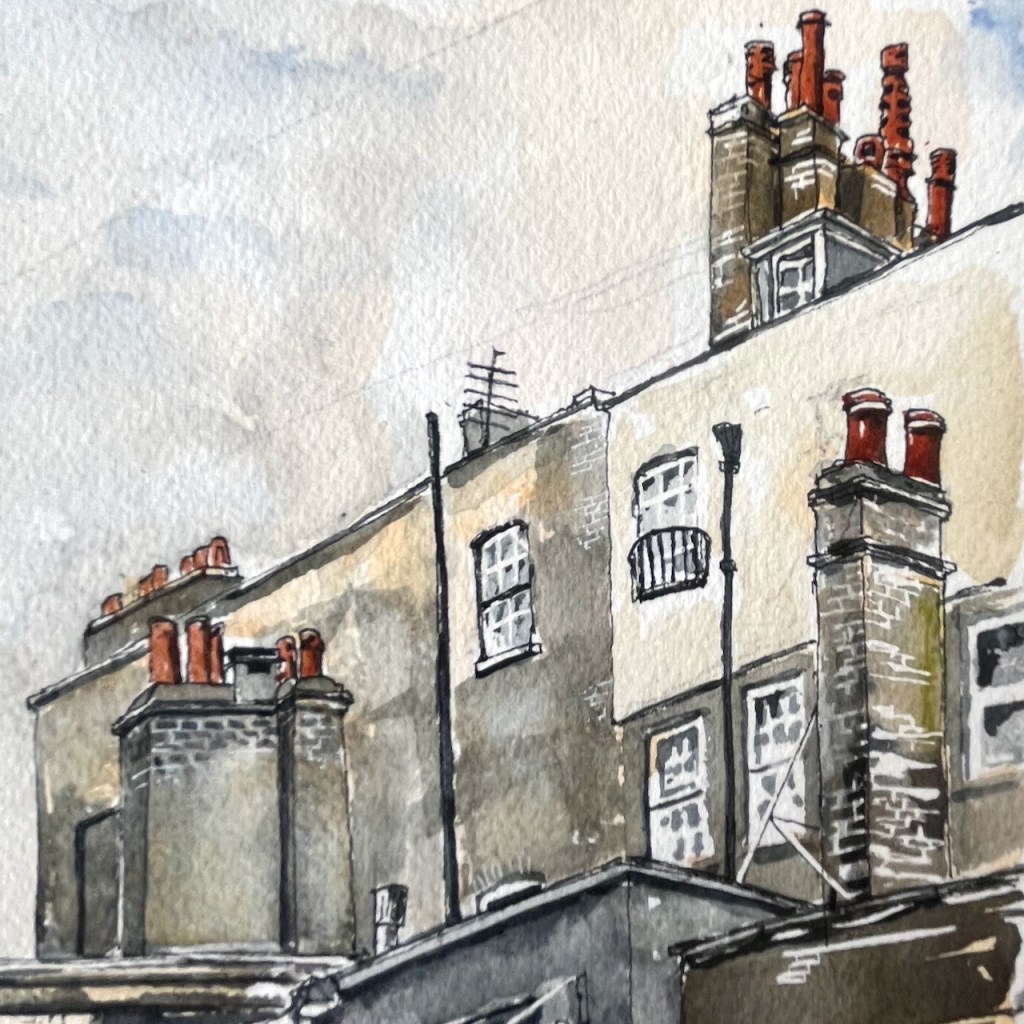
Sketching the pub, I enjoyed the landscape of chimneys. The art of the chimney-maker is not enough noticed. They are unsung sculptors. All those legal offices and chambers behind the Seven Stars must have plenty of fireplaces. Hence the chimneys, here present in great numbers and in extraordinary variety.
Chimneys seen from Carey Street.
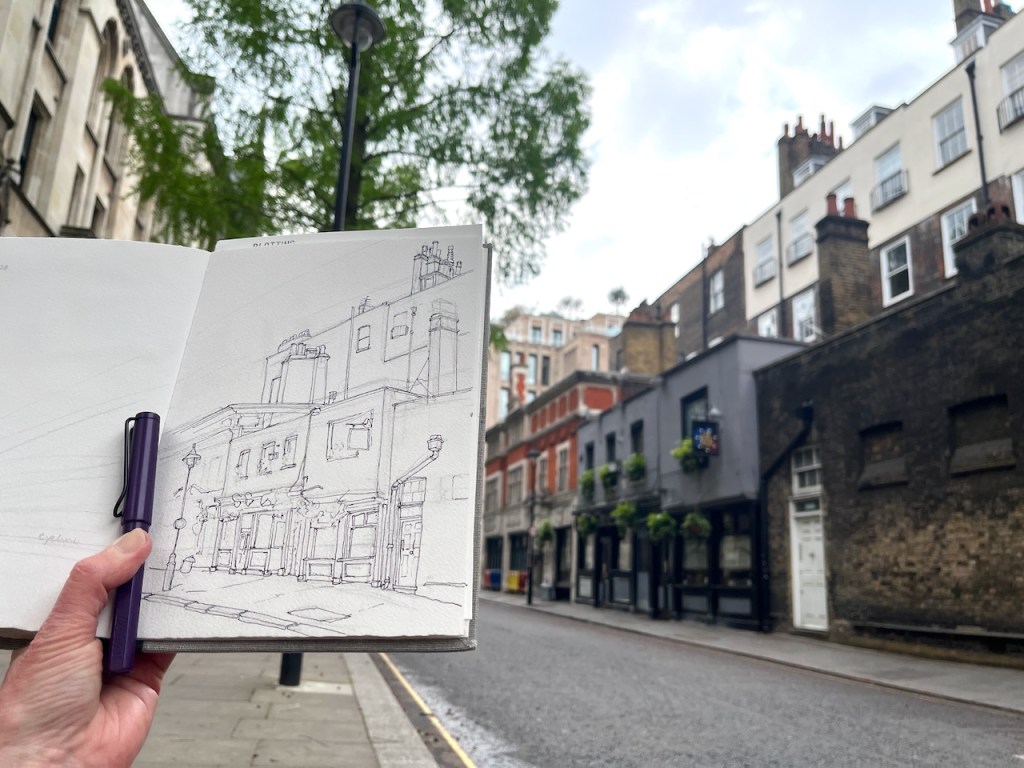
This sketch took about an hour and a half on location, and I finished the colour at my desk.
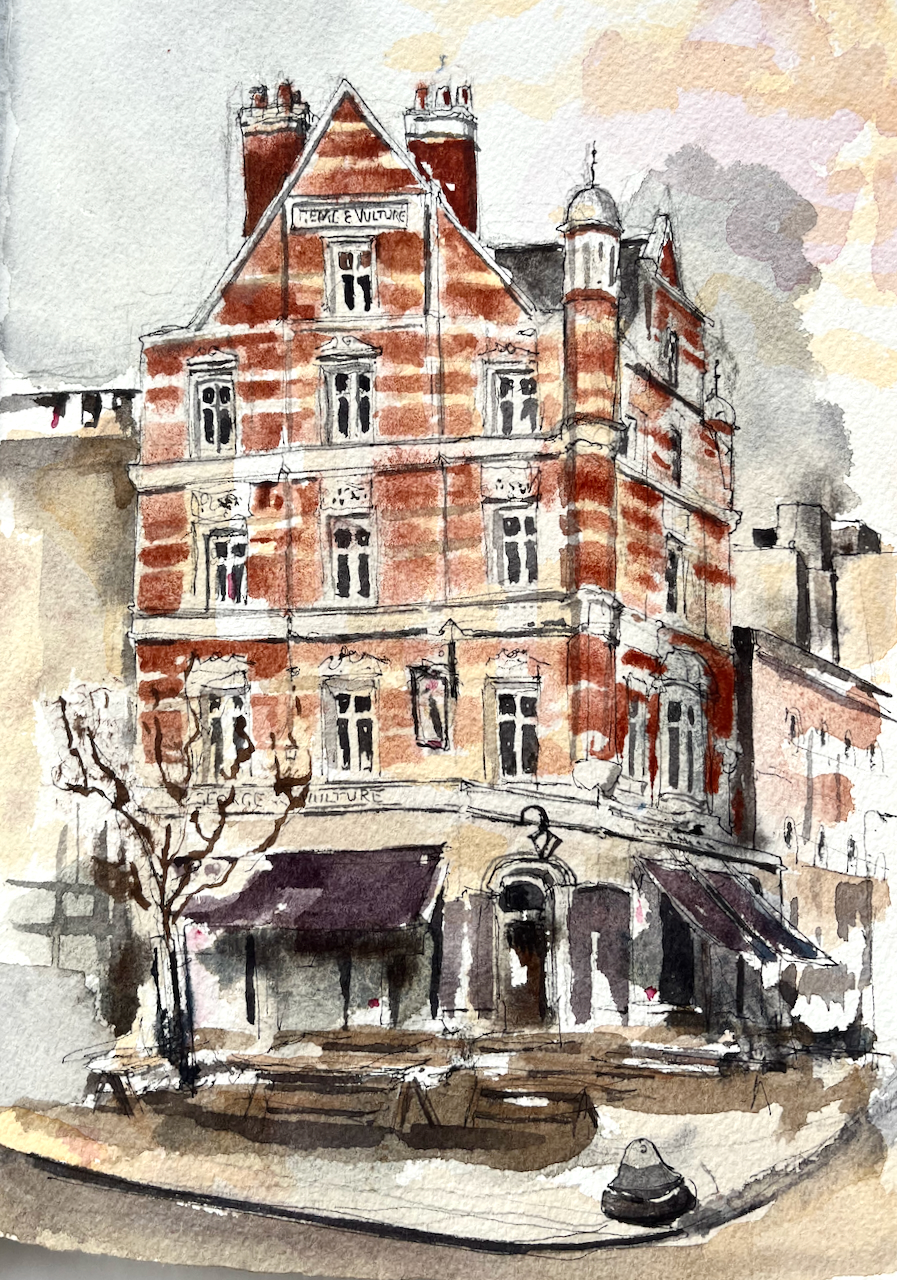
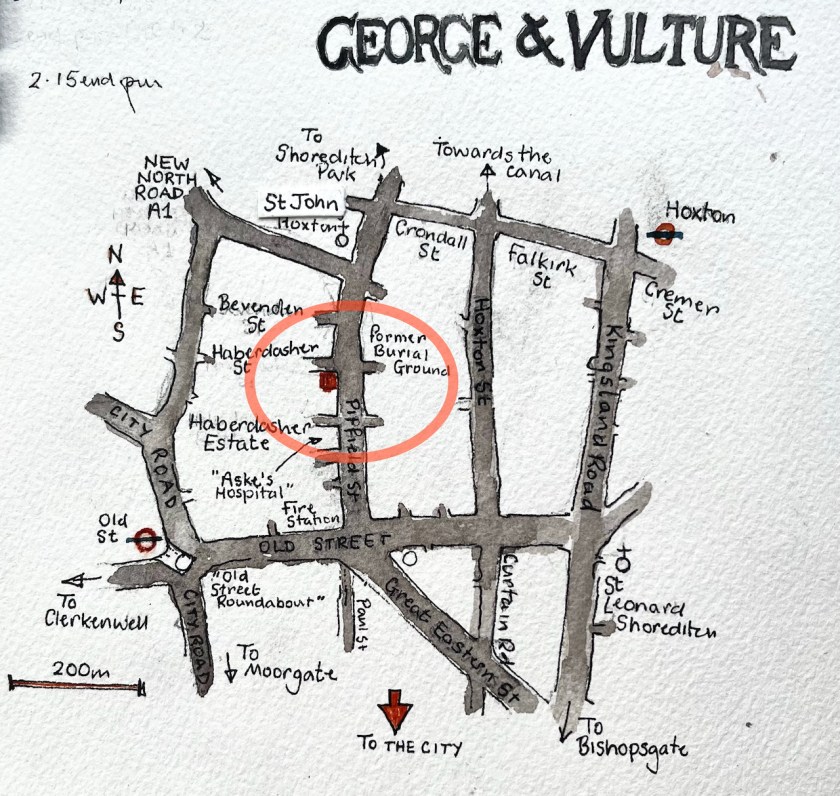
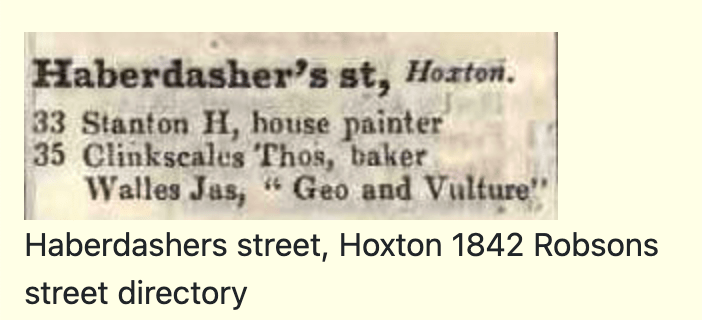
The original address of the pub was 35 Haberdashers Street. Much of the land round here was owned by the Haberdashers Livery company, bequeathed to them by Robert Aske, a merchant (1619-1689). In 1862 the Haberdashers company offered new leases on properties here:
Haberdashers’ Estate, Hoxton. A free public-house, adjoining the high road, and 66 dwelling-houses. To be let, by tender, by the worshipful Company of Haberdashers, Governors of Aske’s Charity Estate, Hoxton, on repairing leases, for 21 years, from Midsummer, 1863:— The free public-house, known as the “George and Vulture,” situate in Haberdashers’ Street, which might be enlarged so as to form a corner house to the main street. Also 12 houses, Nos. 1 to 12, Haberdashers’ Place, which may be converted into shops, at the option of the lessee. Also 19 houses, Nos. 1 to 19, on the south side of Aske’s Terrace; and 35 houses, Nos. 1 to 35, on the north and south sides of Haberdashers’ Street, in the parish of St. Leonard, Shoreditch, in the county of Middlesex. Plans of the property, and specifications of the repairs to be performed, may be seen at the offices of Mr. William Snooke, the surveyor to the governors, No. 6, Duke Street, London Bridge, between the hours of 10 and 4 o’clock. Tenders, in writing only, are to be sent in to Haberdashers’ Hall, Gresham Street West, on or before Thursday, the 27th day of November 1862.
City of London Livery Companies Commission, ‘Report on the Charities of the Haberdashers’ Company: Appendix’, in City of London Livery Companies Commission. Report; Volume 4(London, 1884), British History Online https://www.british-history.ac.uk/livery-companies-commission/vol4/pp478-486 [accessed 30 January 2025].
One of the properties to be let, as you see, was “The free public-house, known as the “George and Vulture,” situate in Haberdashers’ Street, which might be enlarged so as to form a corner house to the main street.”
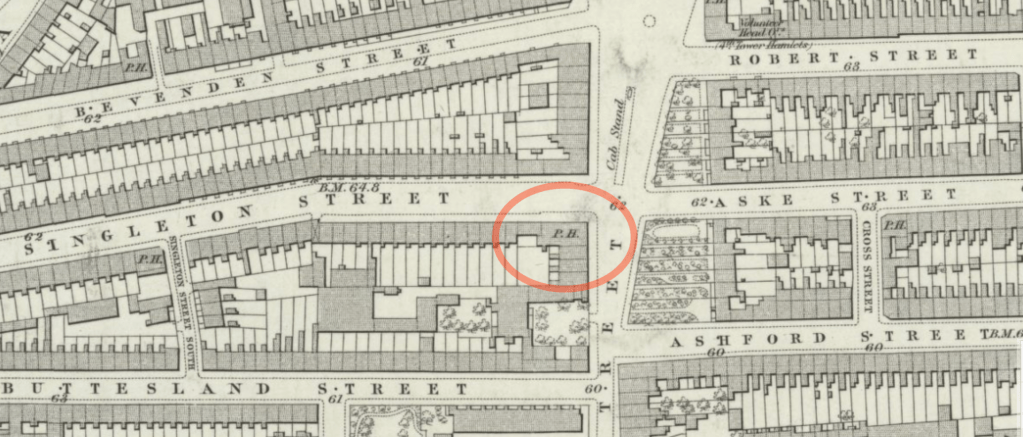
Evidently the lessee enlarged the pub, as the Haberdashers Company suggested, and it does indeed form a corner house to the main street. The address of the pub is now 63 Pitfield Street. Here is the 1877 map which shows the pub as a “corner house”. The road layout on the west of Pitfield Street is largely unchanged. Singleton Street is now called Haberdasher Street.
1972 Ordnance Survey map, from the National Library of Scotland, re-use: CC-BY (NLS)
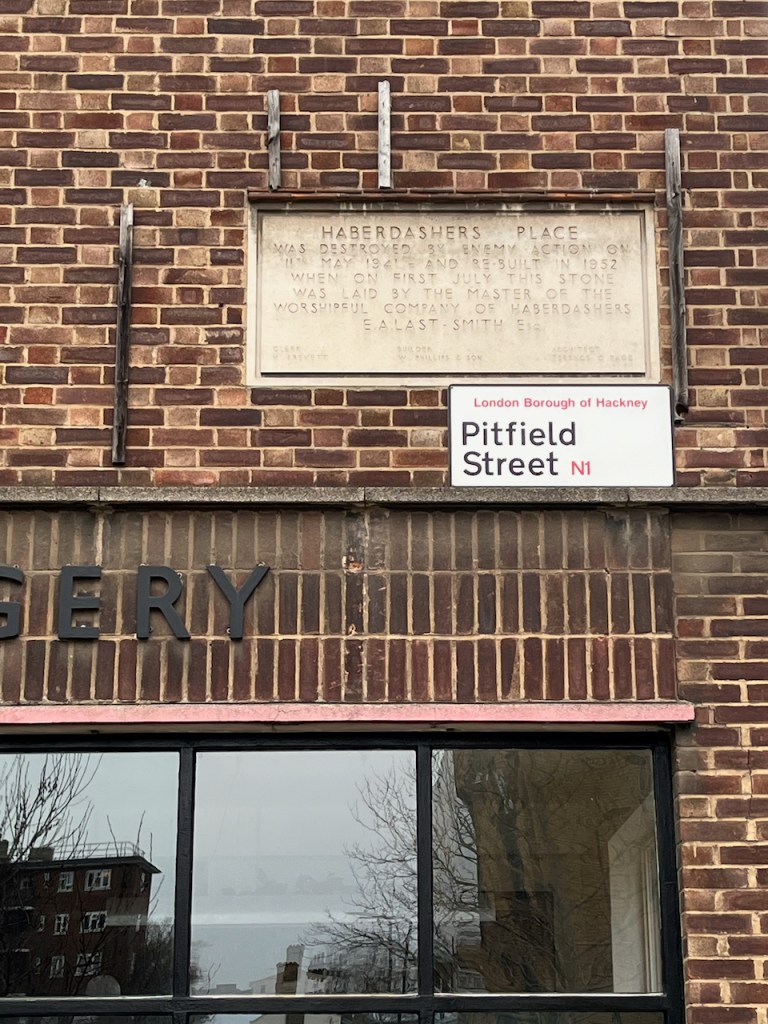
The area was bombed extensively in the 1939-45 conflict, but the pub survived. Bomb maps show that the area adjoining Aske Street on the other side of Pitfield Street was damaged beyond repair. A plaque on the row of shops just North of the pub describe the re-building.1
“Haberdashers Place was destroyed by enemy action on 11 May 1941 and re-built in 1952 when on first July this stone was laid by the master of the Worshipful Company of Haberdashers S.A. Last-Smith. Clerk W B(?)revett – Builder W Philips & Son -Architect Terence C Page” Photo: January 2025
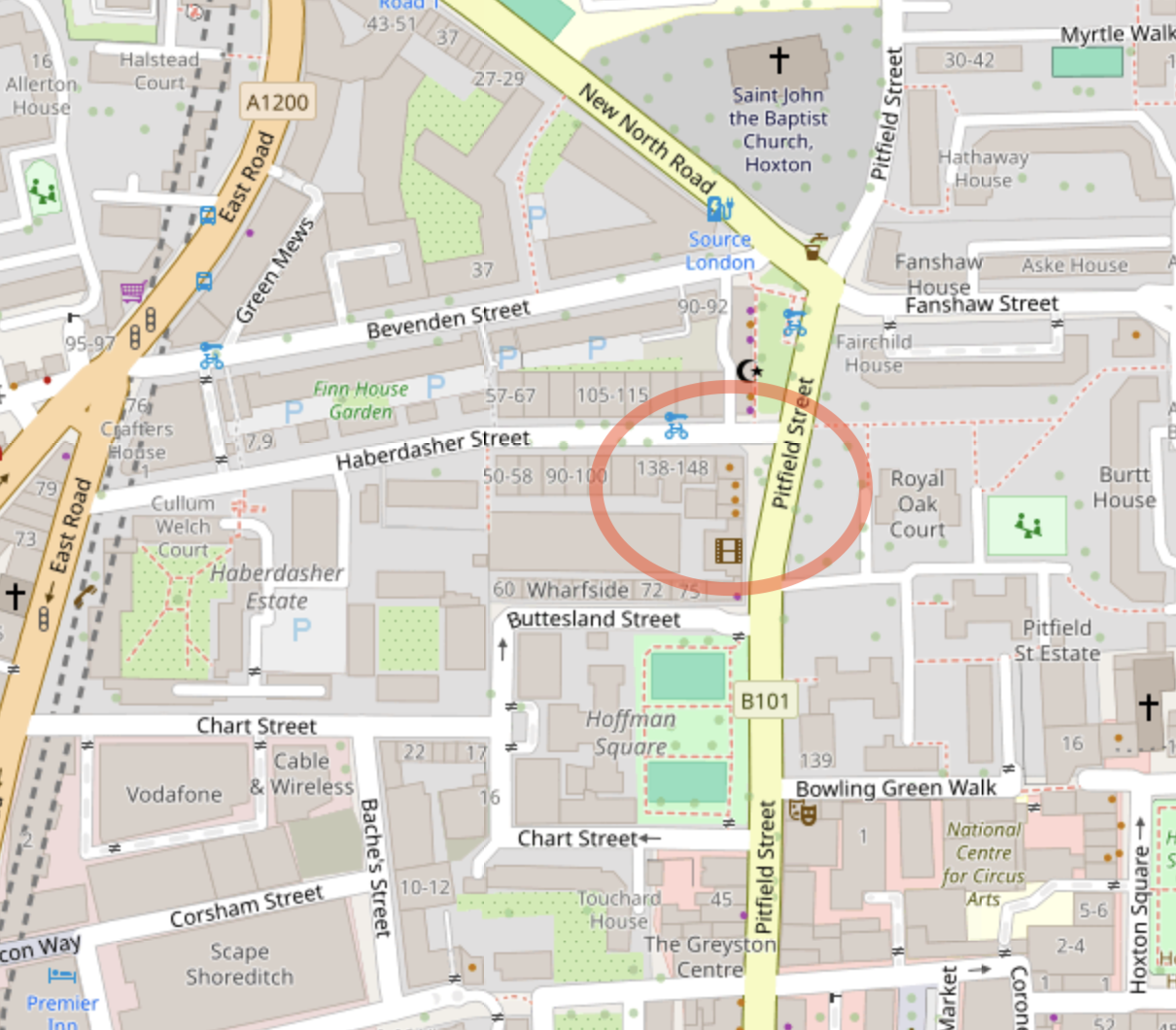
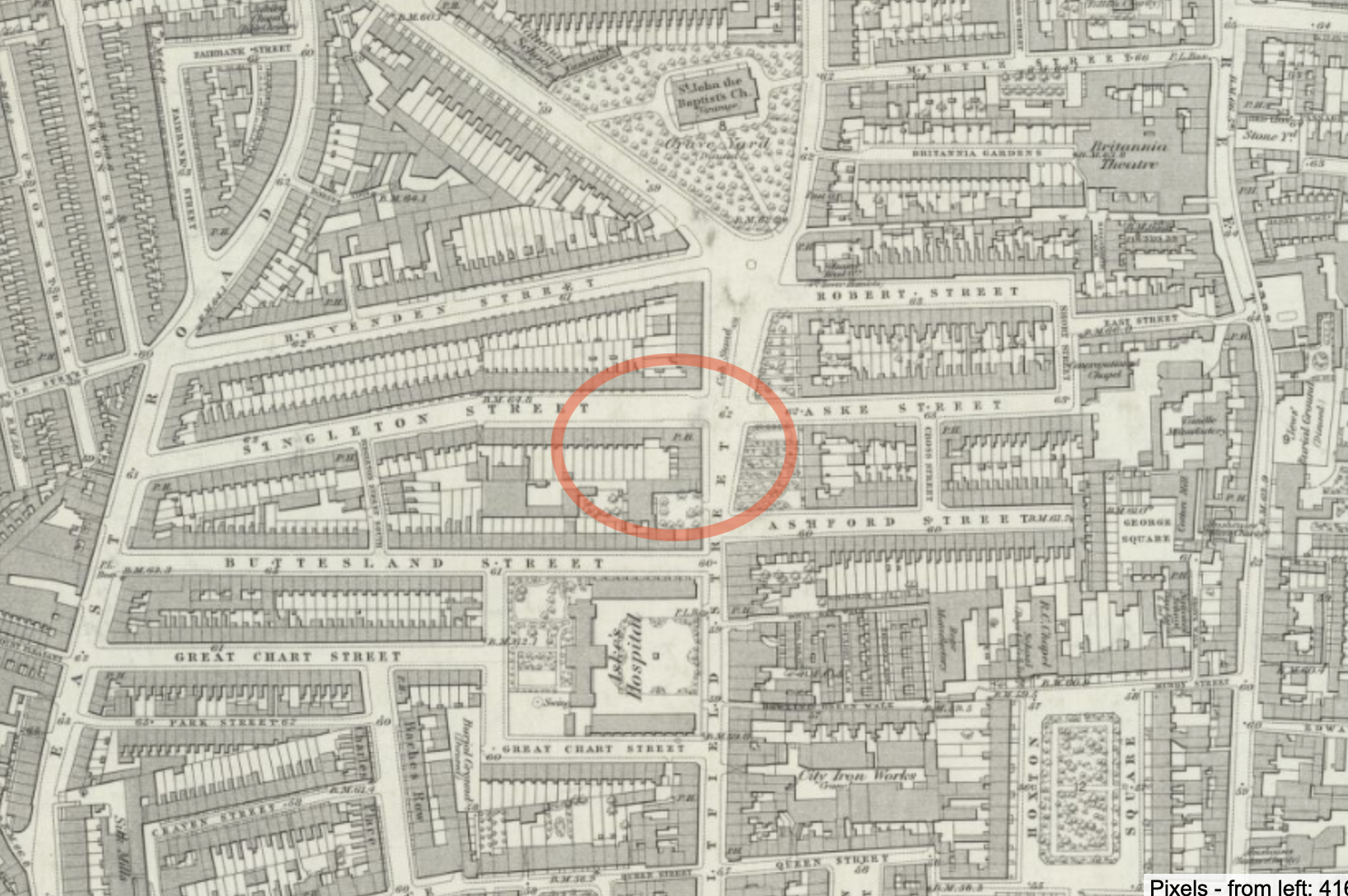
Here is the 1872 map alongside a modern map. You see that the rows of terraced houses on the east of Pitfield Street have gone, and are replaced by low-level residential housing blocks with a different layout.
(c) openstreetmapcontributorsNational Library of Scotland CC-BY(NLS)
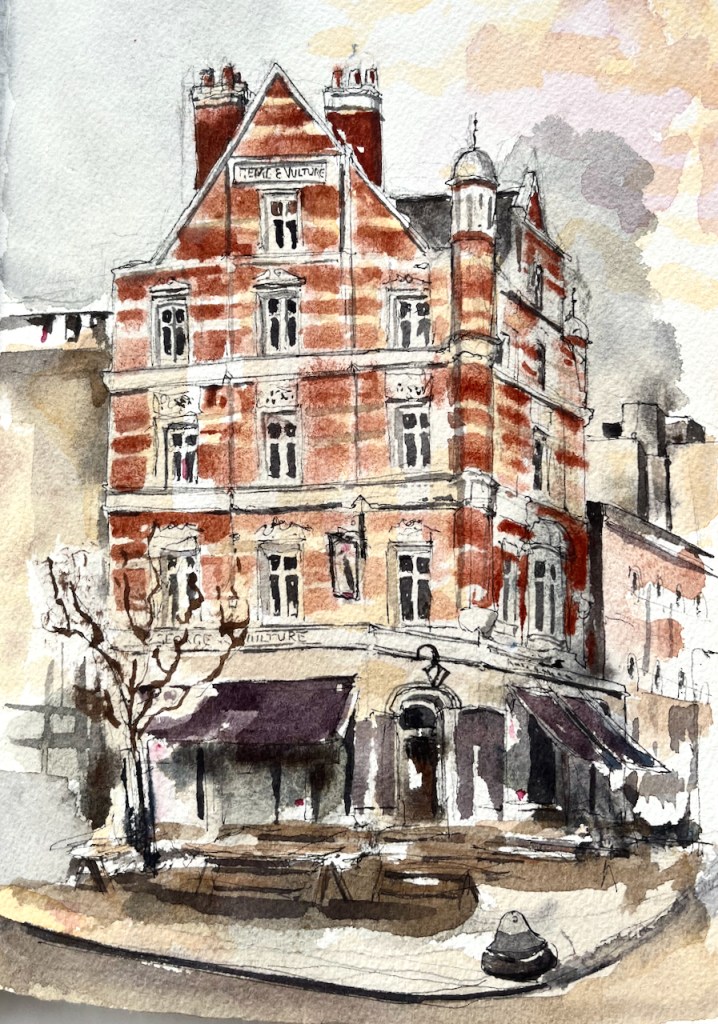
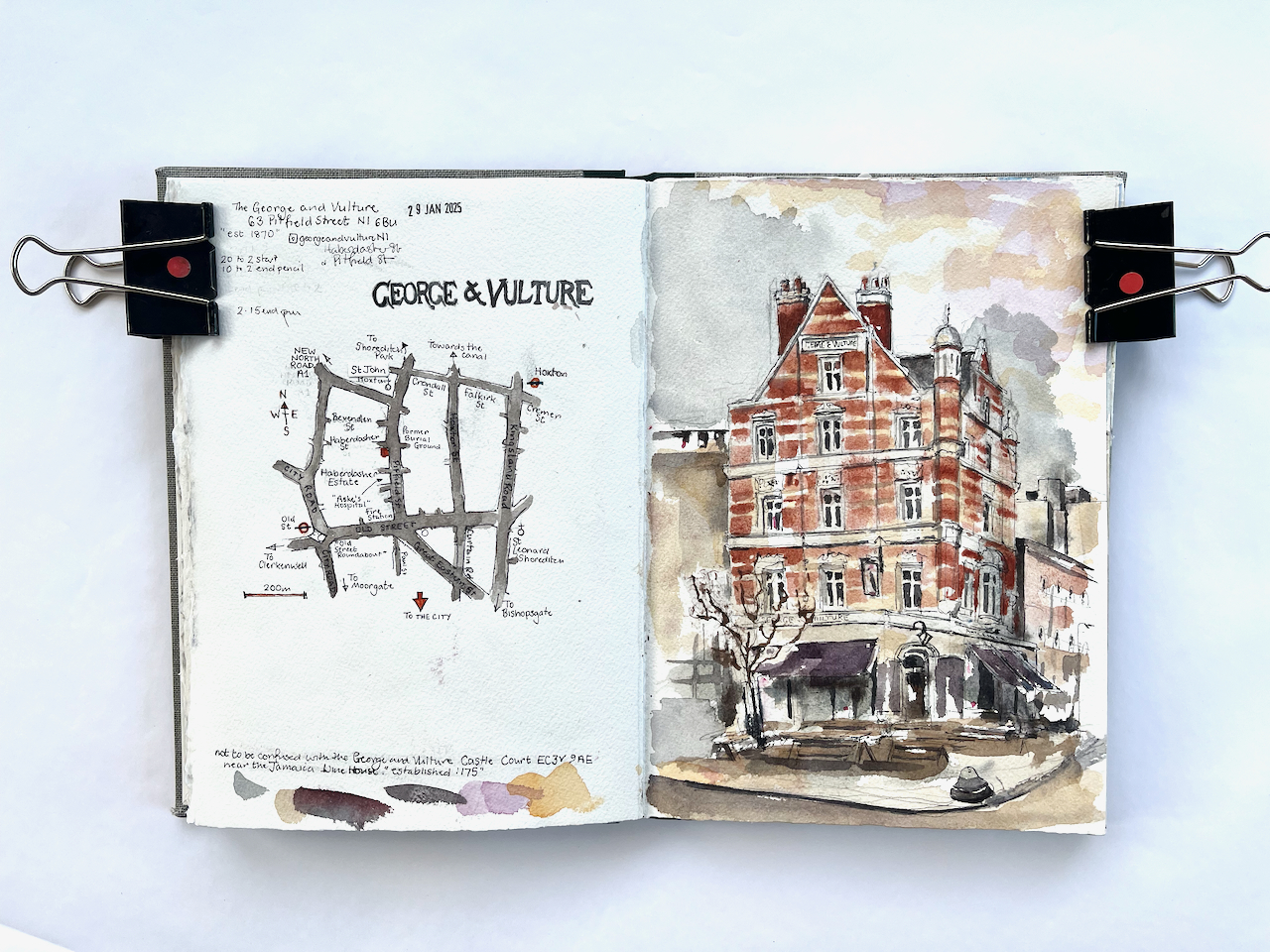
I sketched the pub on a cold January day. I did the pen and ink on location and then retreated to my desk to do the colour.
Sketchbook 15
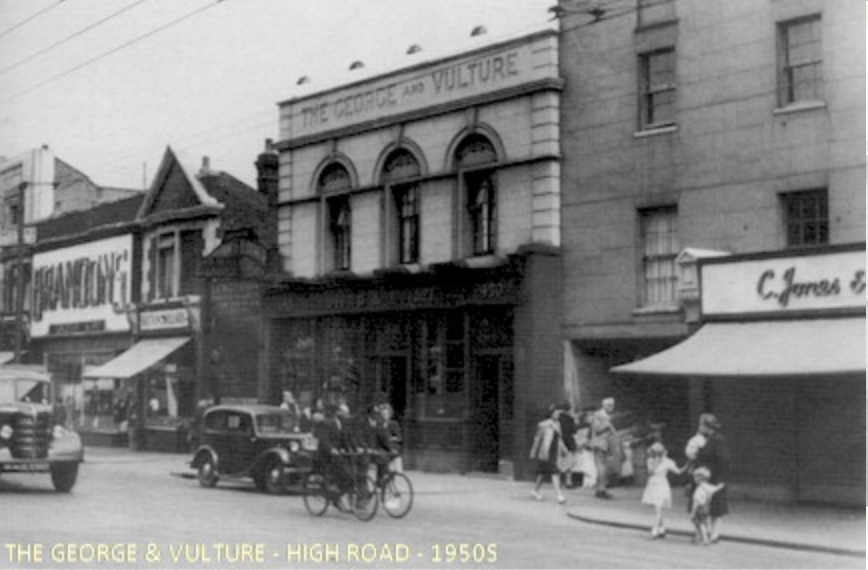
I cannot discover why the pub is called the “George and Vulture”. Why “vulture”? There is another pub in London of the same name, in the alleys of the City close to the Jamaica Wine House. That one was established in 1175. There was also a George and Vulture in Tottenham, 490 High Road, N172, from around 1759, now demolished.
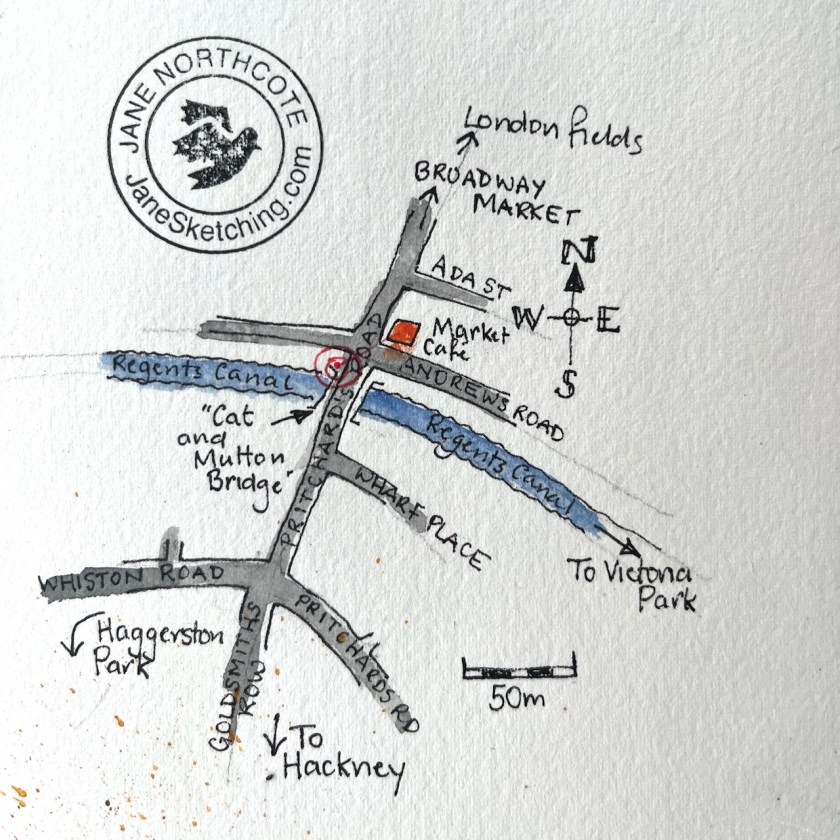
Here is the Market Café, which is at the South end of Broadway Market, near the canal.
Market Café, Broadway Market, Hackney E8, sketched 12 November 2024, 12″ x 9″ [sold]
I’ve sketched the Market Café before, and written about it on this post. This latest sketch was a commission to celebrate a happy event which took place there.
Here are some details from the sketch:
It was a bright and cold day. I did the pen and ink on location.
preliminary sketchPacking up.Working on location
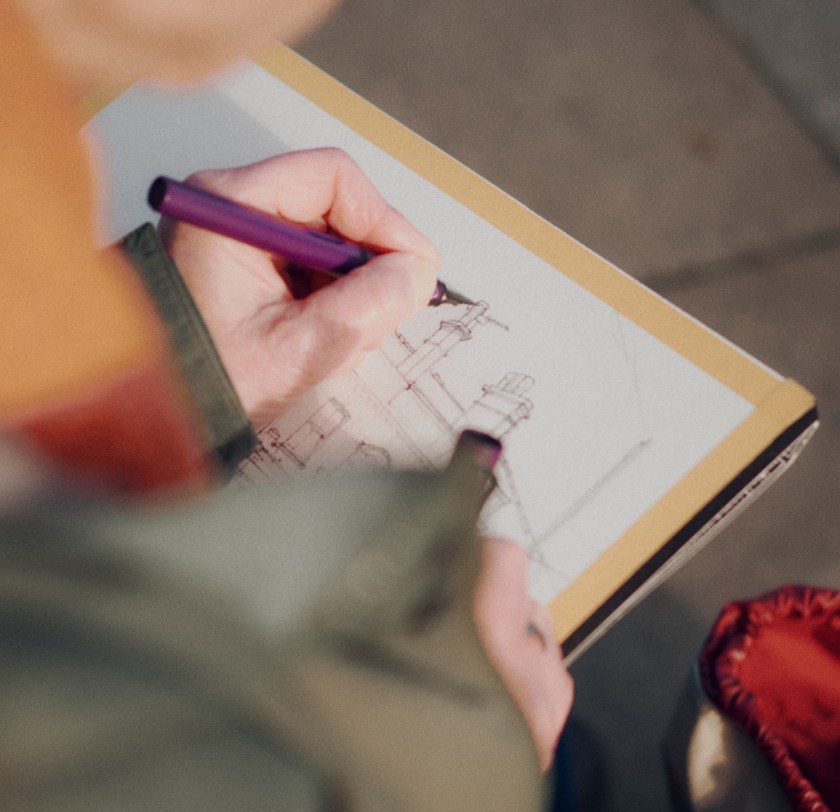
The photographer Nick Hillier came by and took some photographs of me working, which he kindly sent me later.
Sketching on location, image credit: Nick Hillier. Pen is a Lamy Safari.
I added the colours at my desk. The colours are:
for the brickwork: Fired Gold Ochre
all the greys and blacks are: Ultramarine Blue plus Burnt Umber
the sky is Phthalo Blue Turquoise
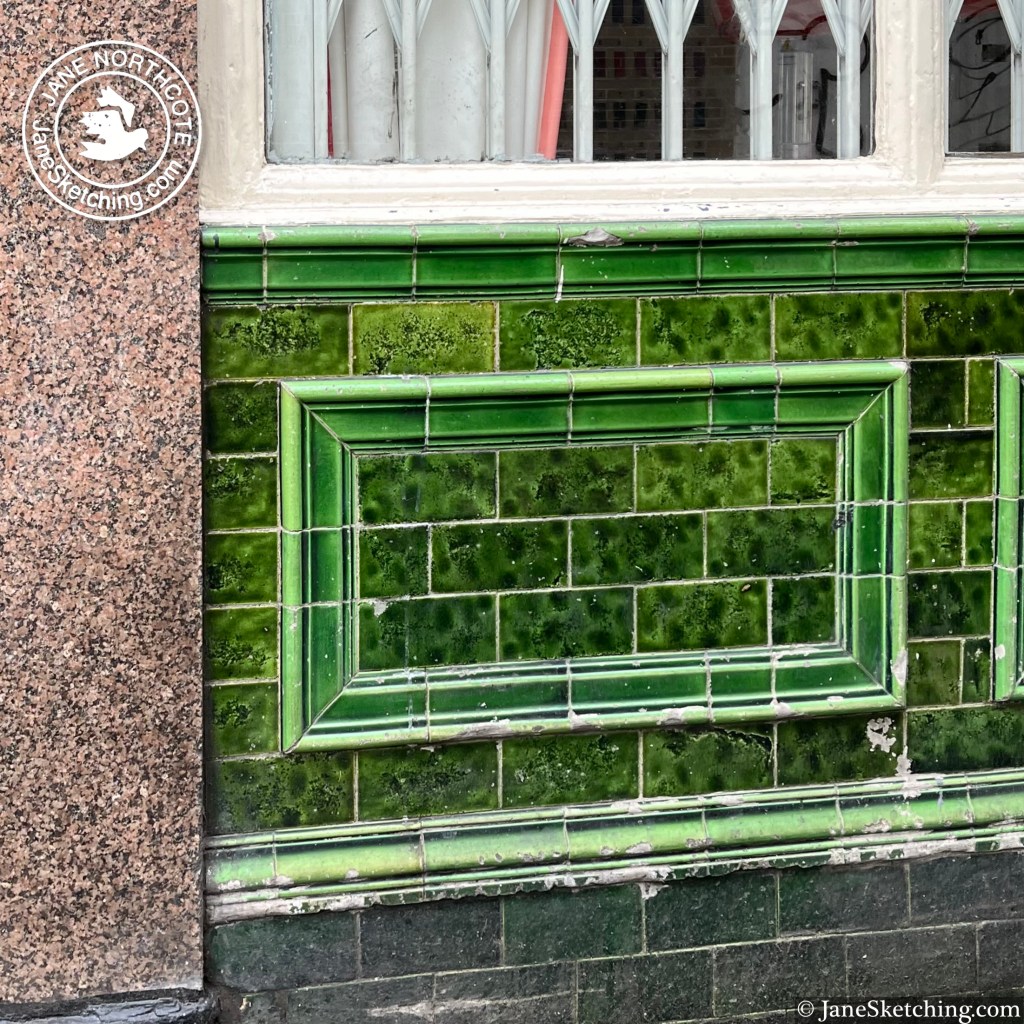
the green tiles are Serpentine Genuine
there’s a bit of Permanent Yellow Deep on some of the highlights and some dots of Transparent Pyrrol Orange
the fine white lines are made by using a rubber resist gum. I use Pebeo drawing gum.
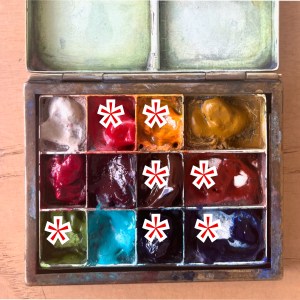
For my current palette see this link. I have 12 colours in my palette. For most pictures I fewer colours. This picture used about 7 colours.
Thank you to my client H for the commission and for allowing me to post this image here.
I’ve sketched around the Broadway Market area before. See this link for a sketch of Climpson Coffee, and here is a sketch done at E5 bakery on the other side of London Fields.
Sketch location
Click a button below to share this post online, email it, or print it:
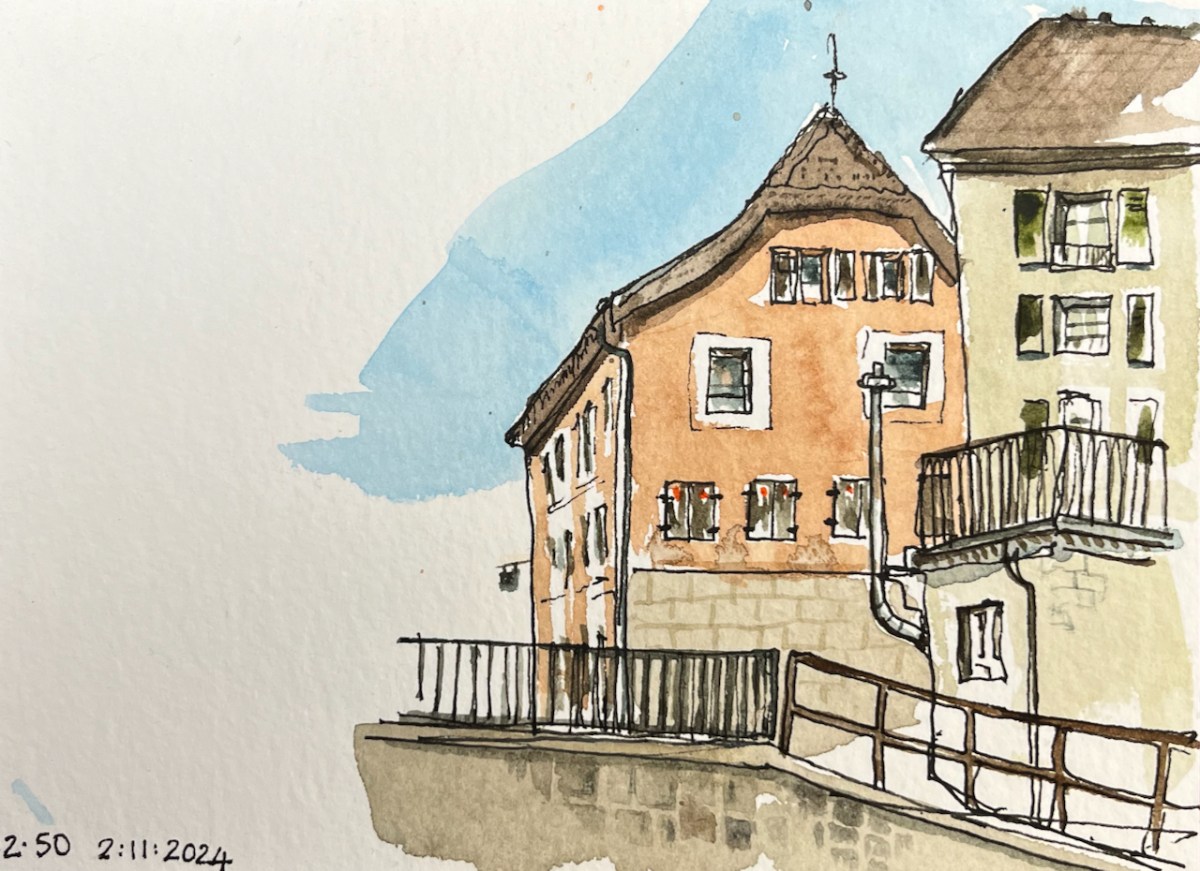
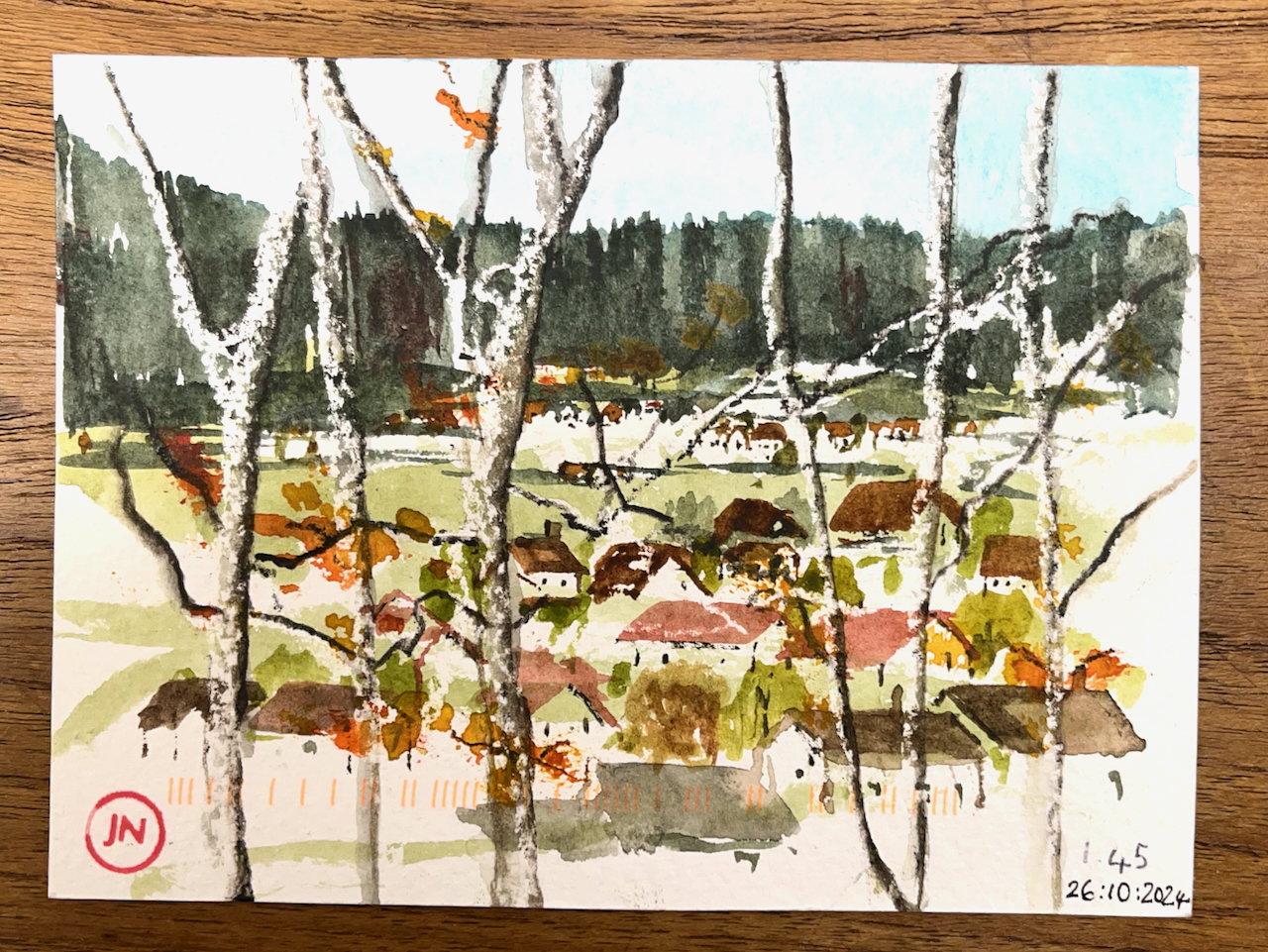
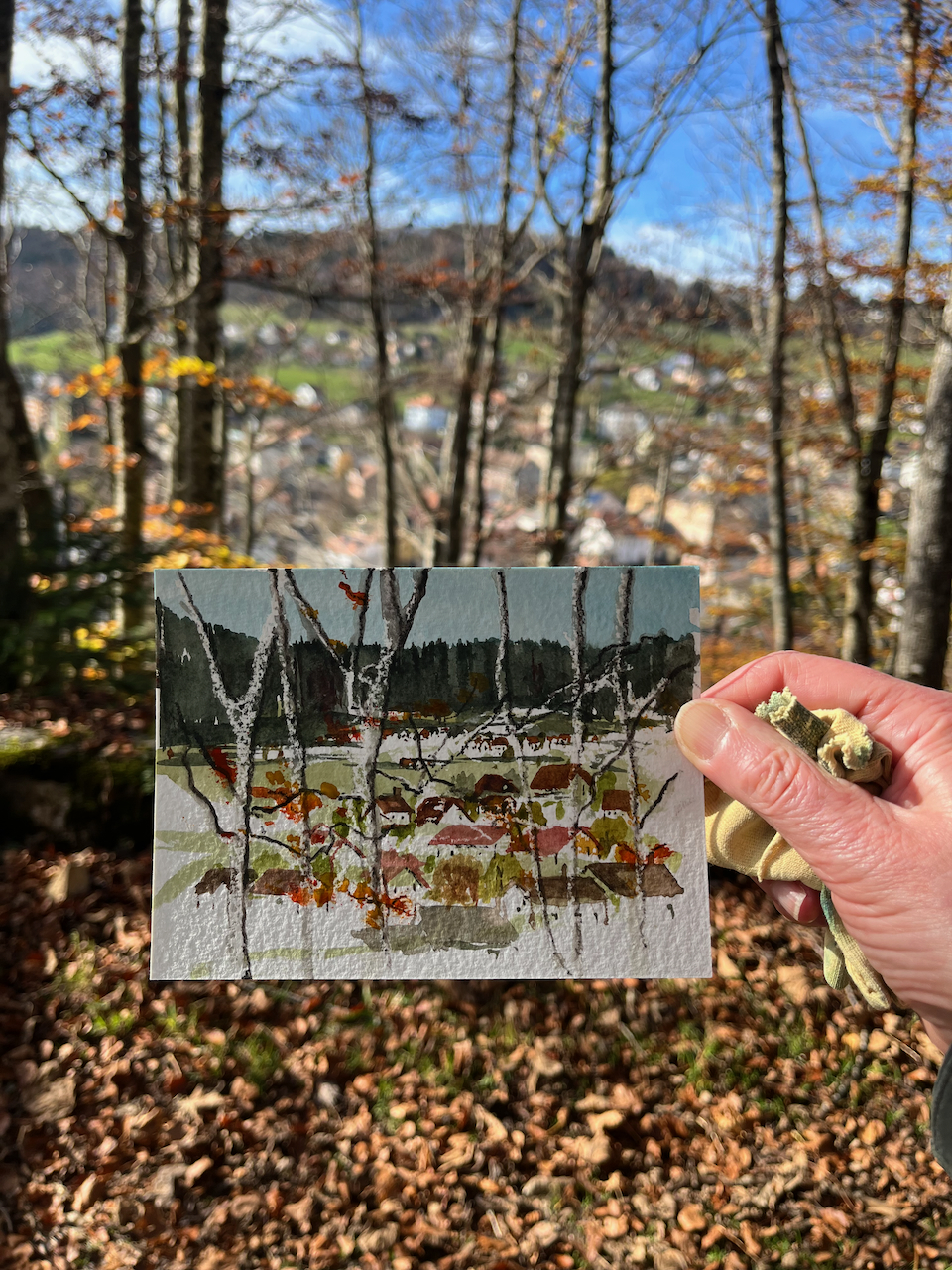
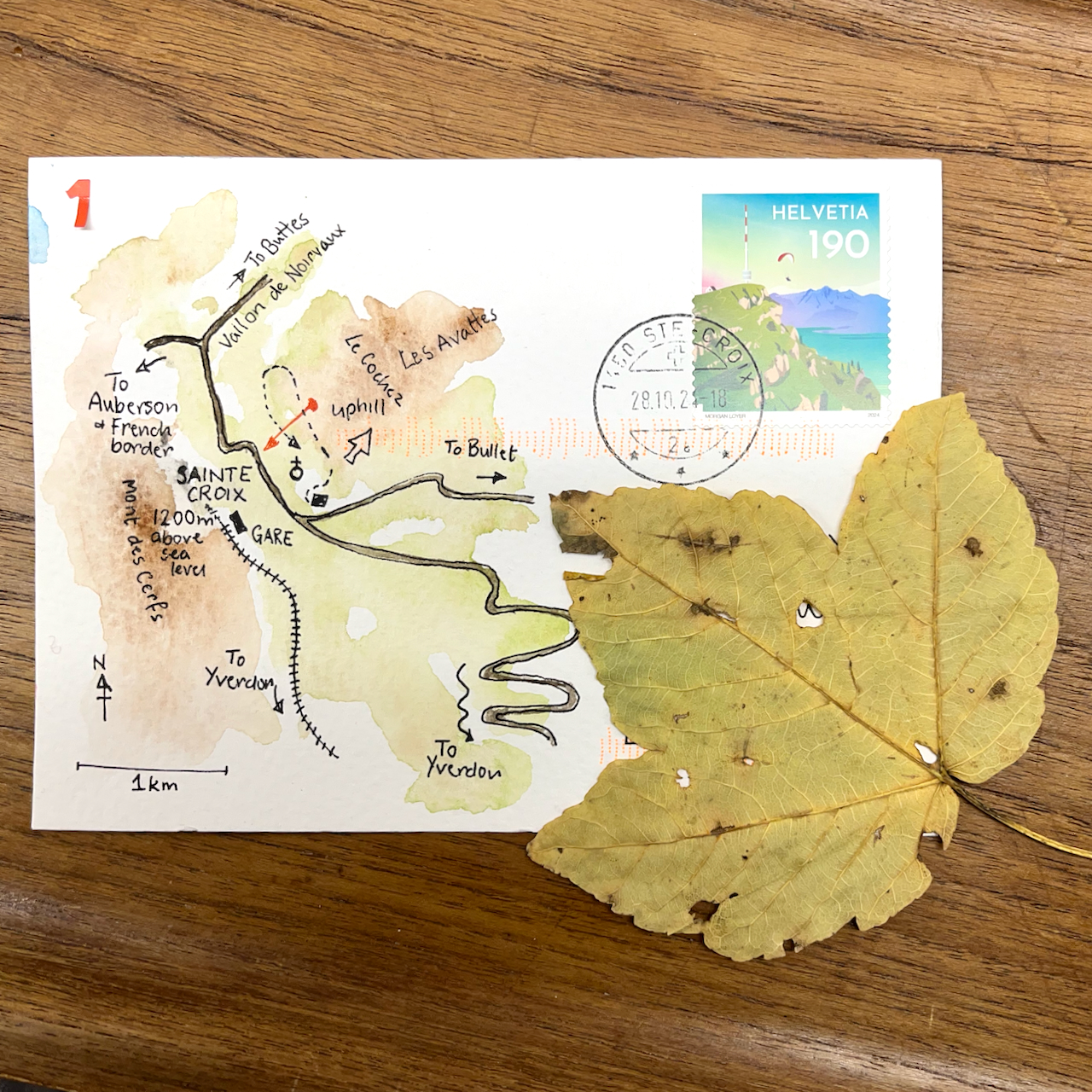
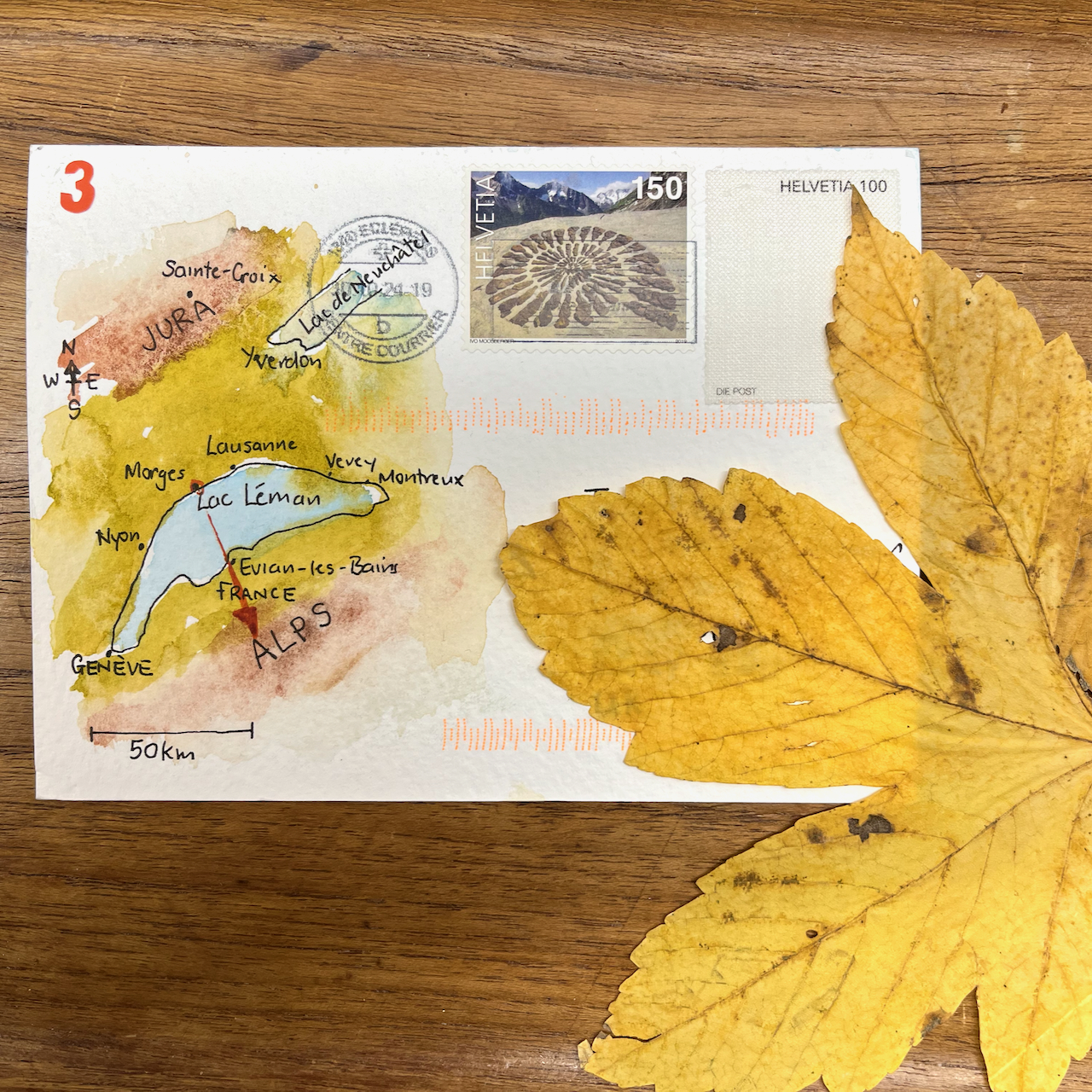
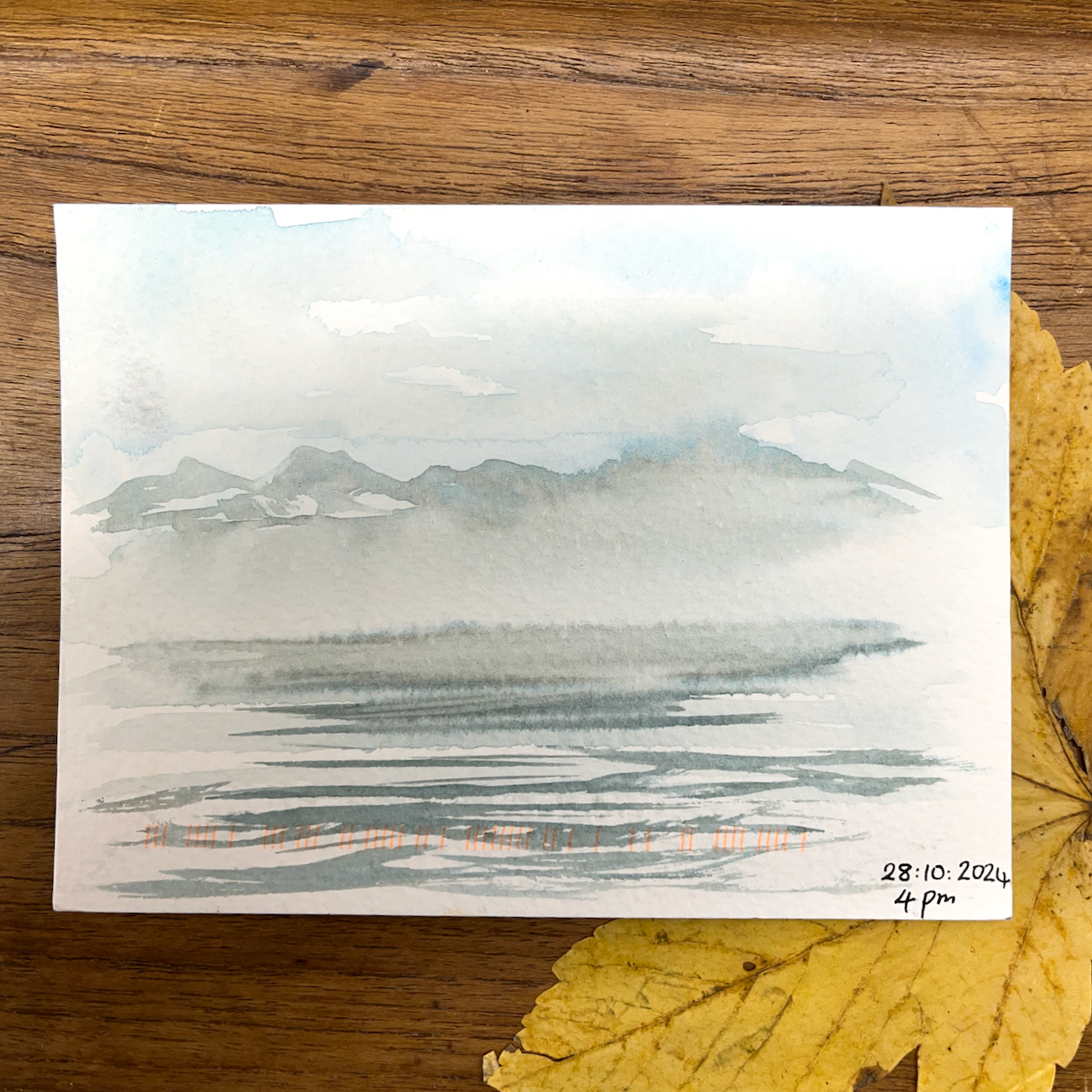
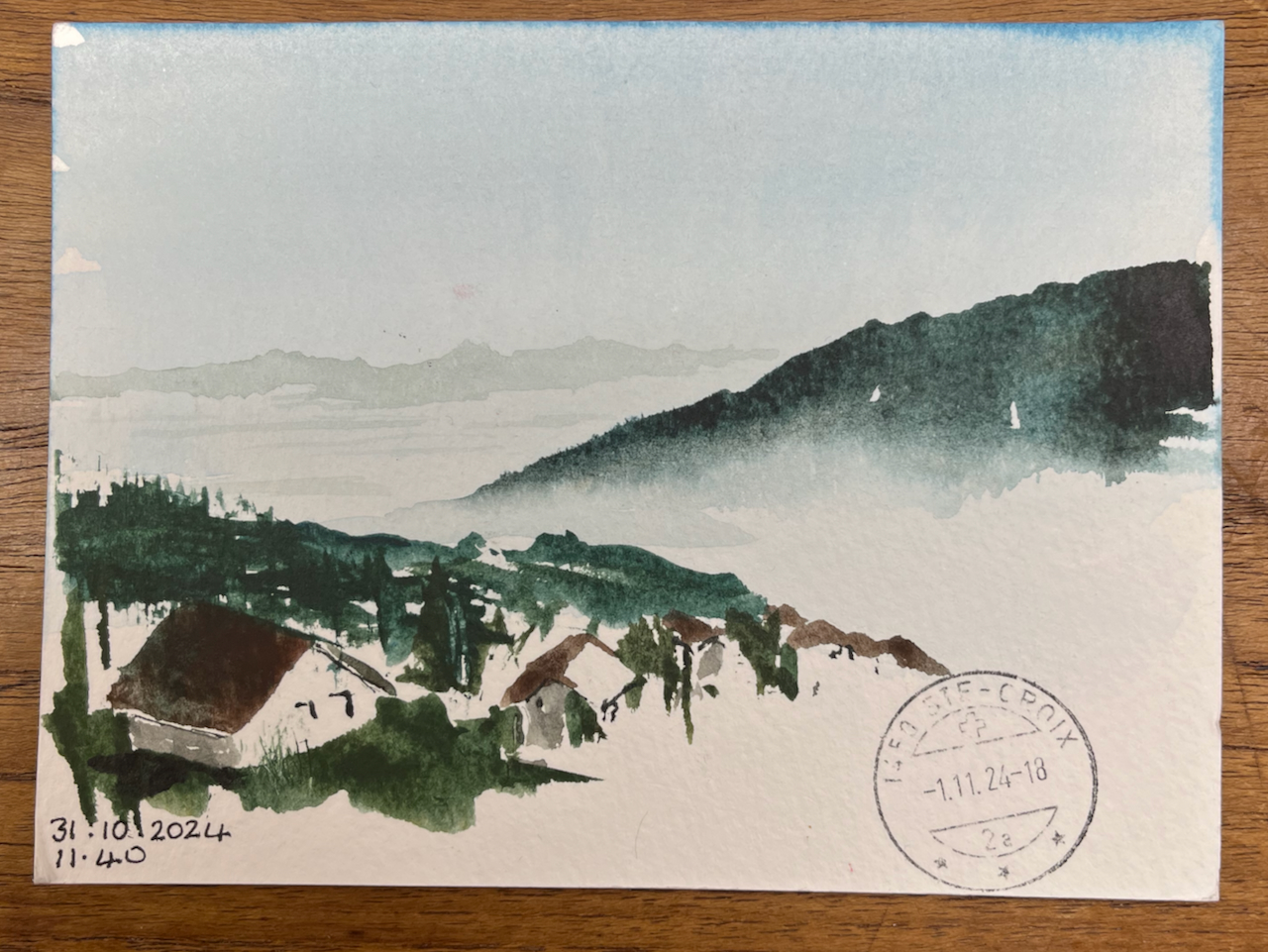
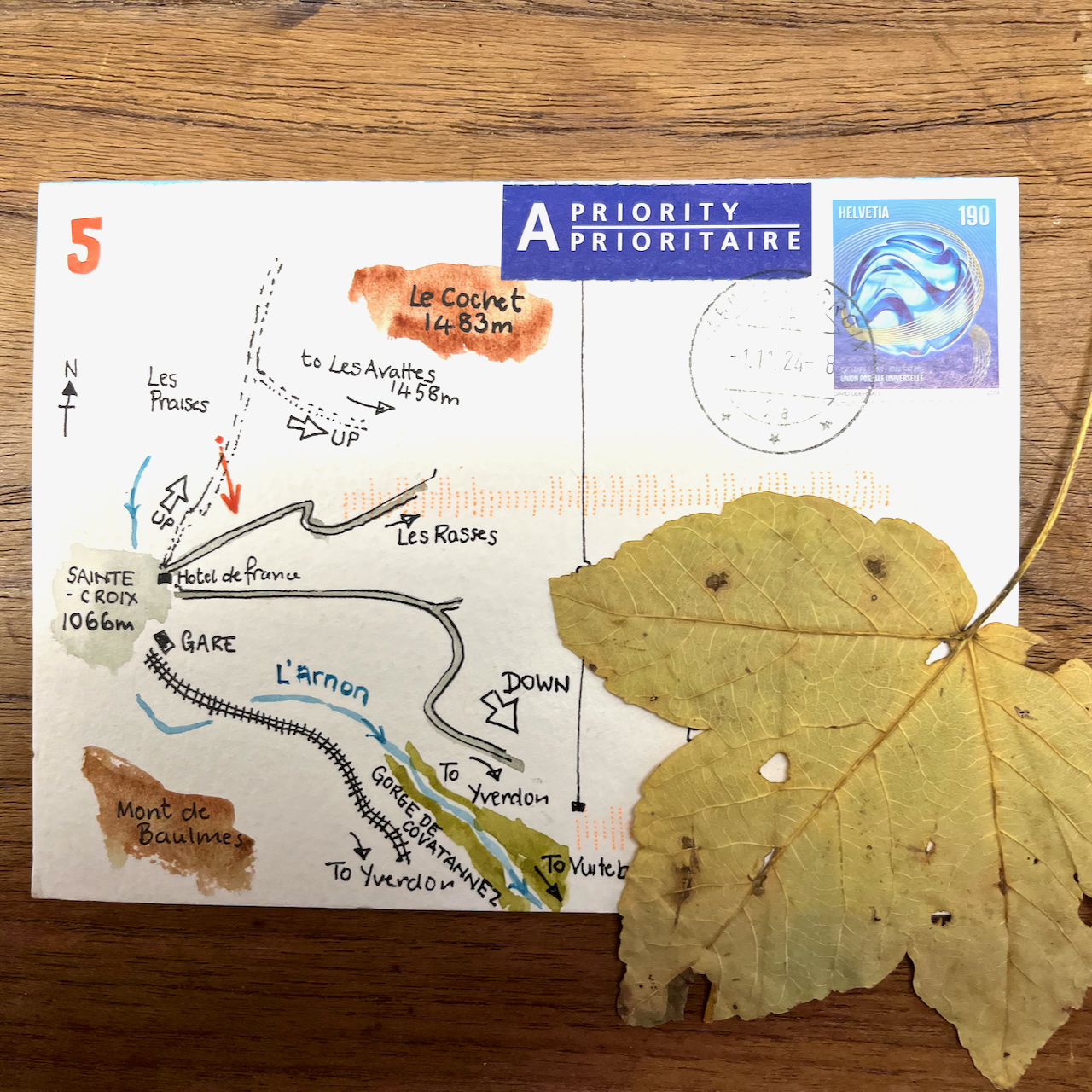
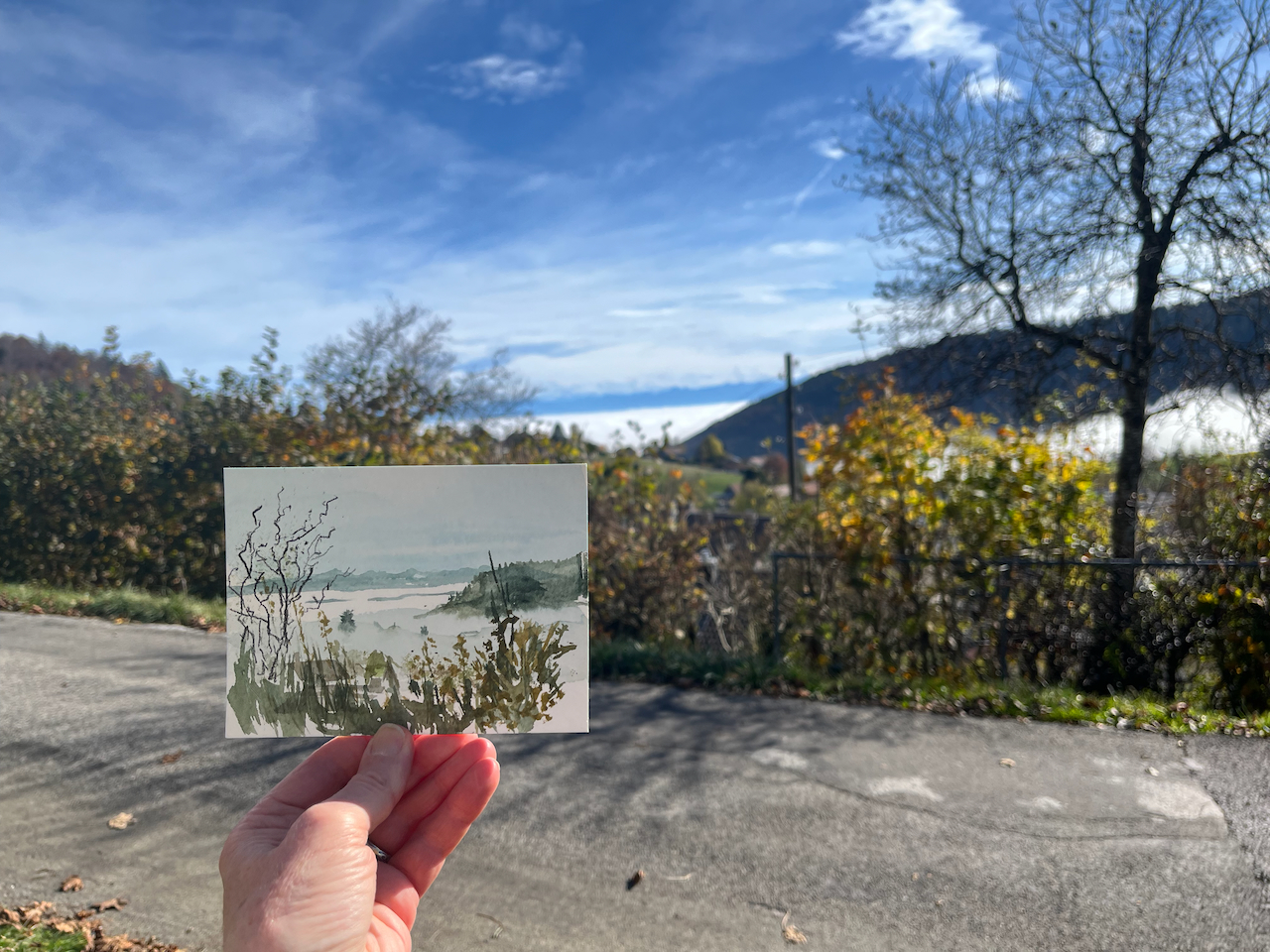
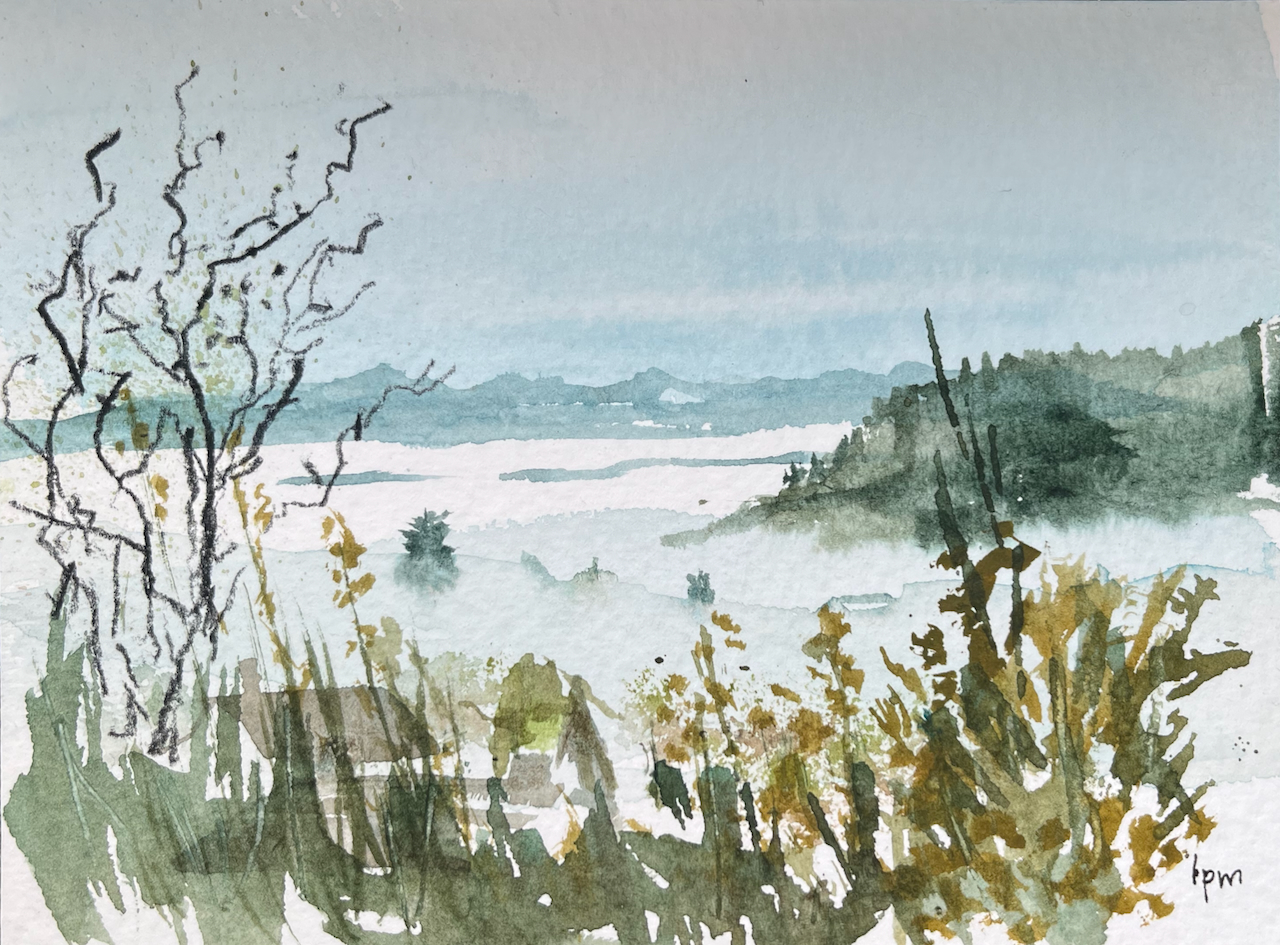
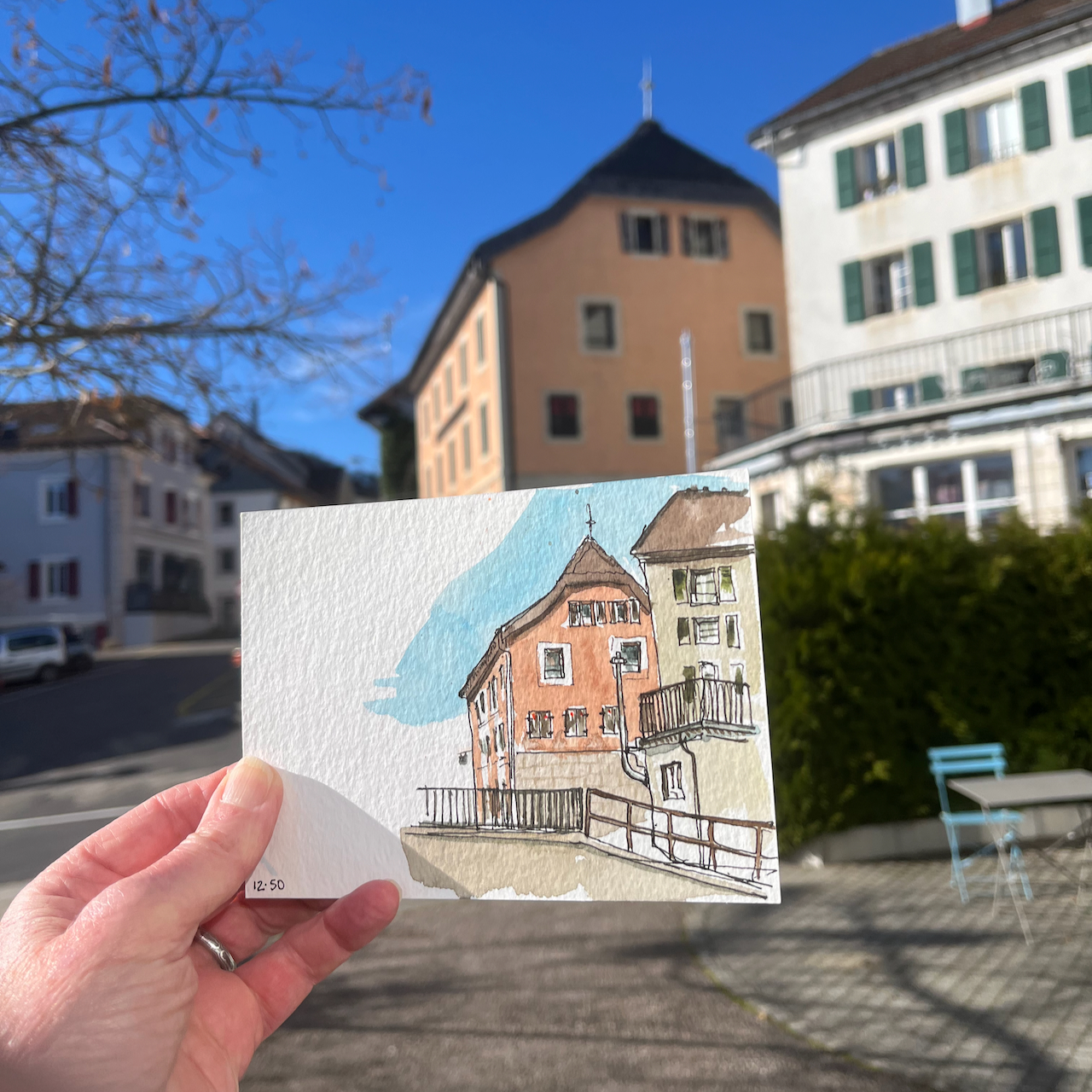
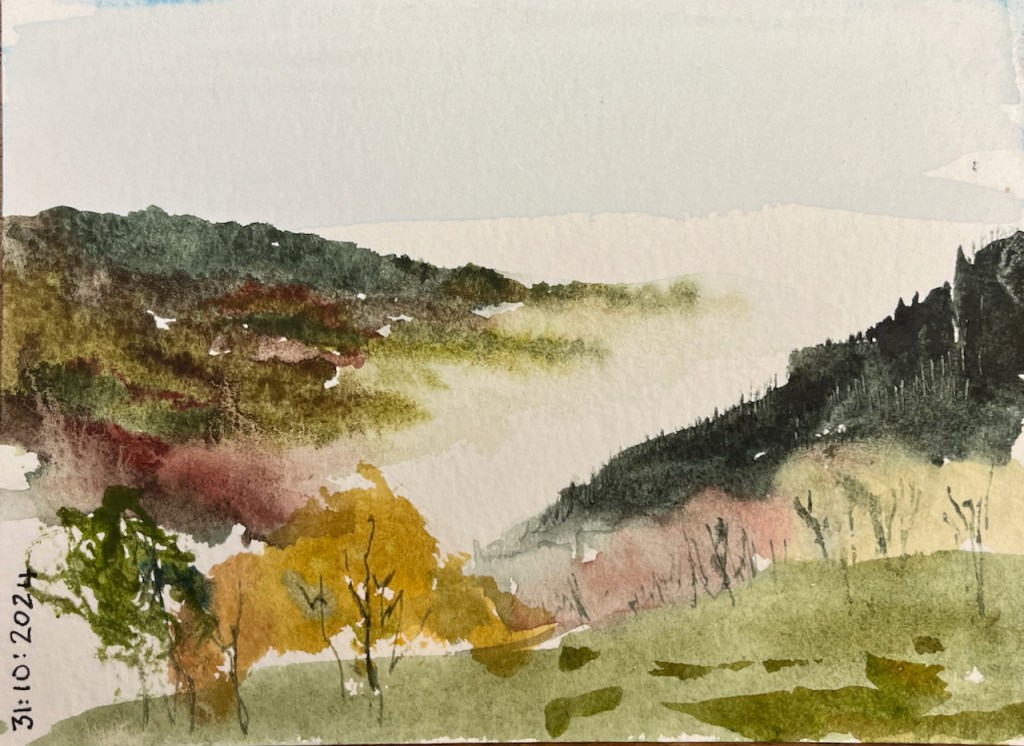
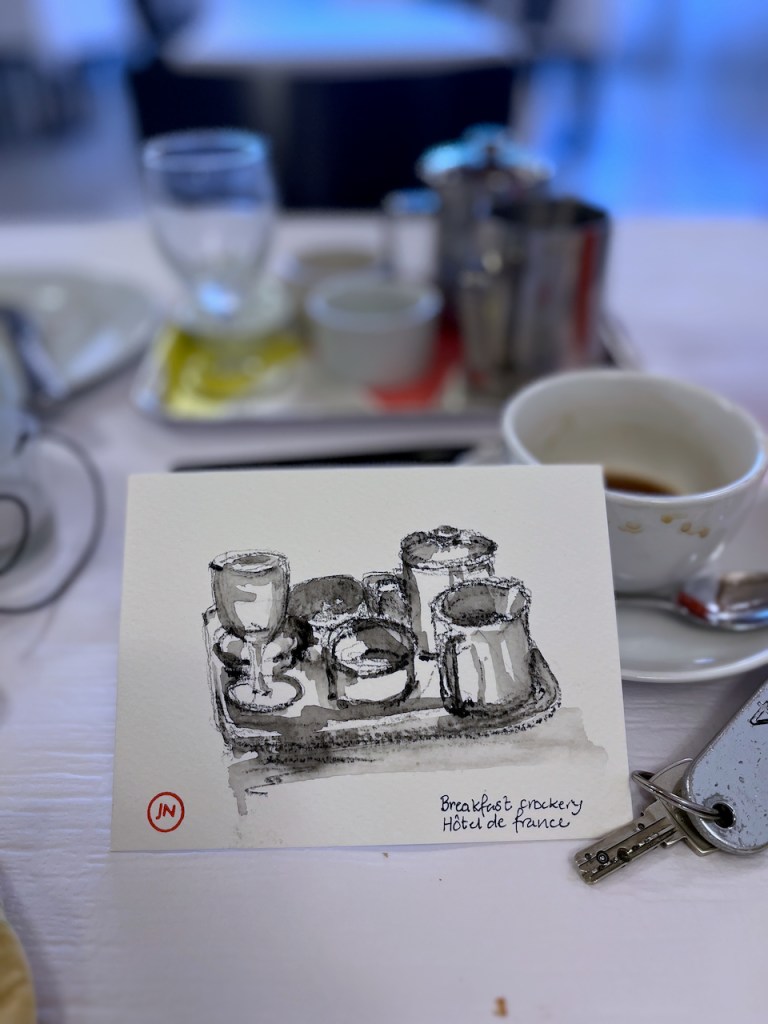
Here are postcards from Switzerland, sketched quickly on 4″ x 6″ watercolour postcards.
A walk above the villageLooking across Lake Geneva from MorgesFrom Les Praises, looking across to the Alps The Alps above the fogSketching in Sainte-Croix, Vaud (1000m)
It was foggy in the valley, and clear at 1000m.
One day, starting early, my hosts dropped me in the village of Vuiteboeuf, which is at the lower end of the Gorges de Covatannaz. I walked up, through the fog. It took about an hour and a half. I’d intended to sketch and I had my watercolours with me. But the fog made it surprisingly cold, and I didn’t want to stop or I would freeze. I was warm so long as I kept walking. So I made very quick sketches using Derwent “inktense” watercolour pencils. Here are my sketches in video format.
Here is the view over the Gorge, from the fields at the top.
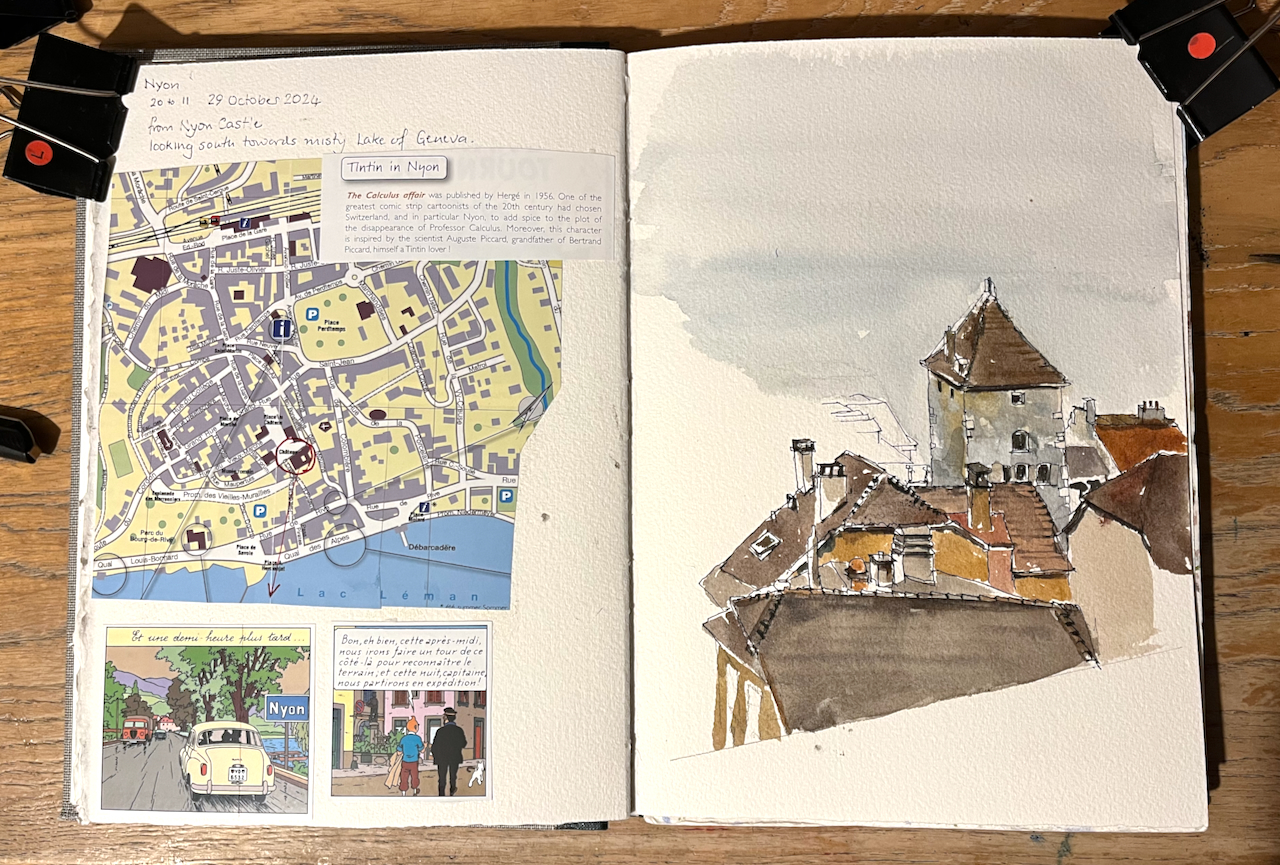
My visit took me to Nyon, on the shores of Lake Geneva. I made a quick sketch from the walls of the castle. Did you know that the Tintin story, “The Calculus Affair” was set in Nyon? The tourist office made much of this connection.
Sketchbook 15, Nyon page spread.
Switzerland is beautiful in the Autumn. Thanks to my hosts at the Hotel de France, Vaud, for their hospitality.
Click a button below to share this post online, email it, or print it:
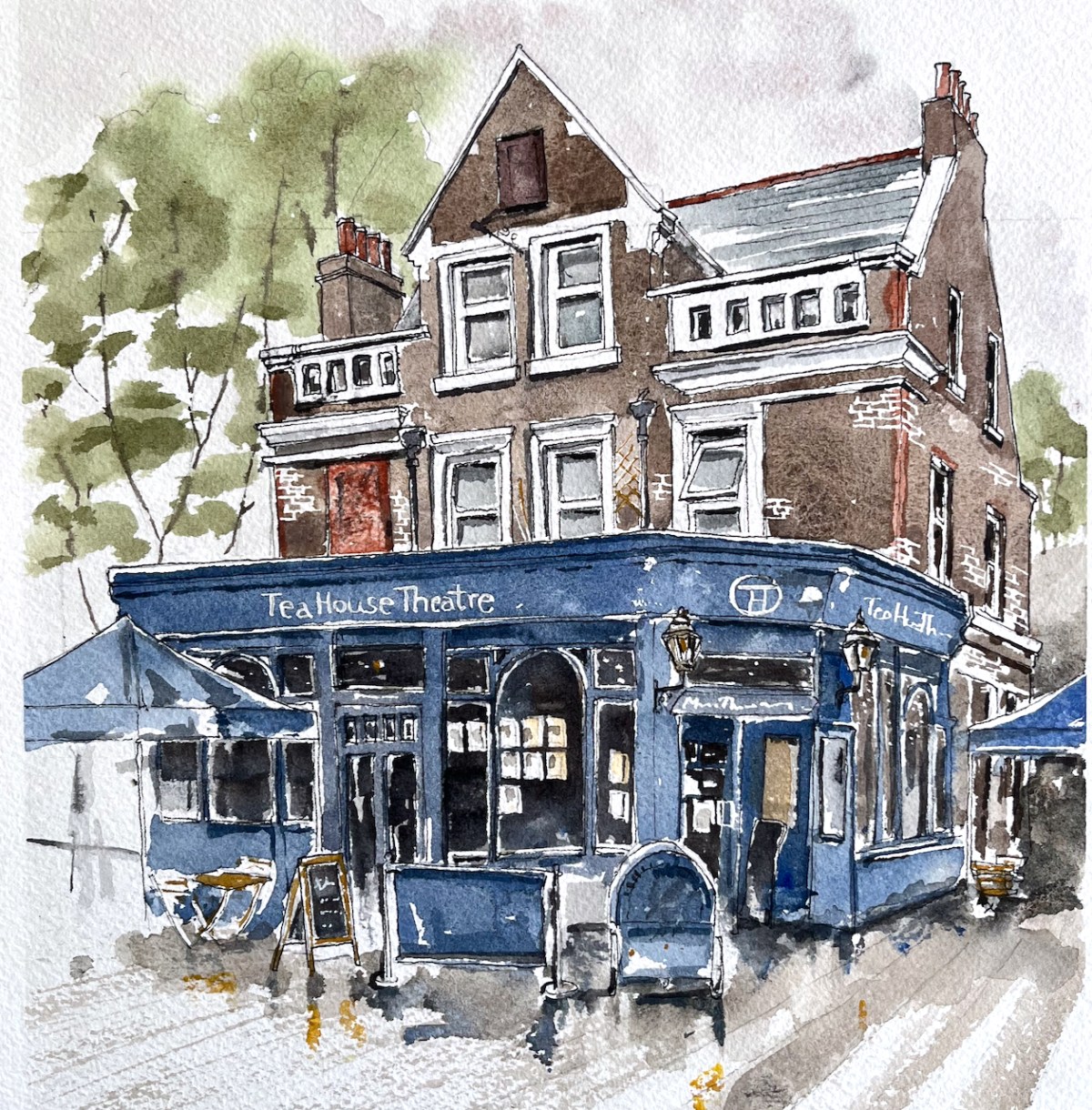
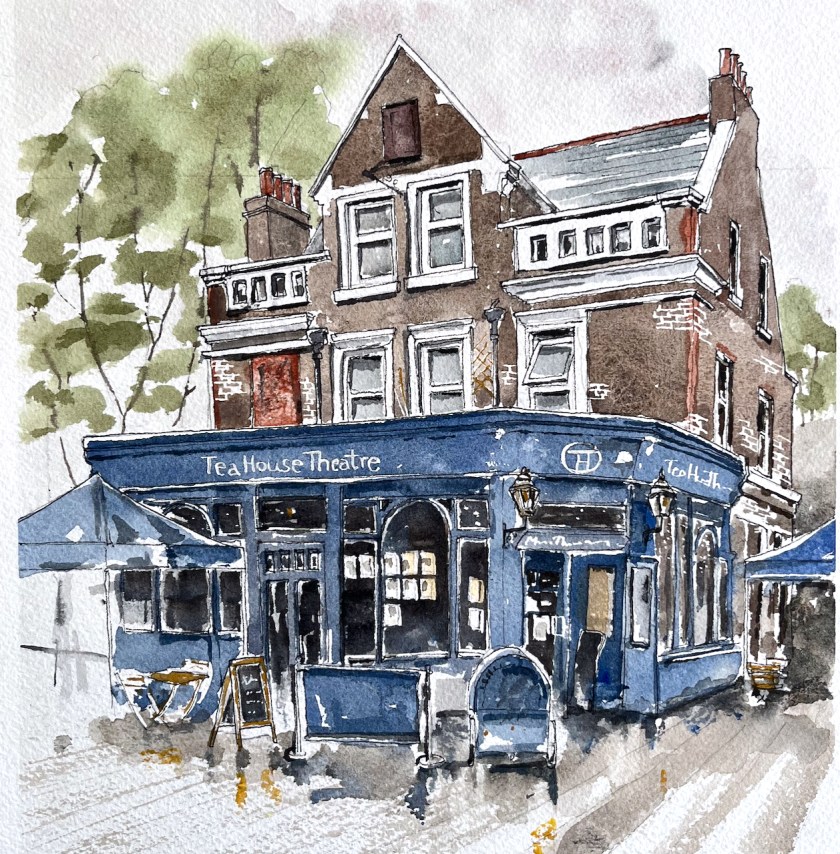
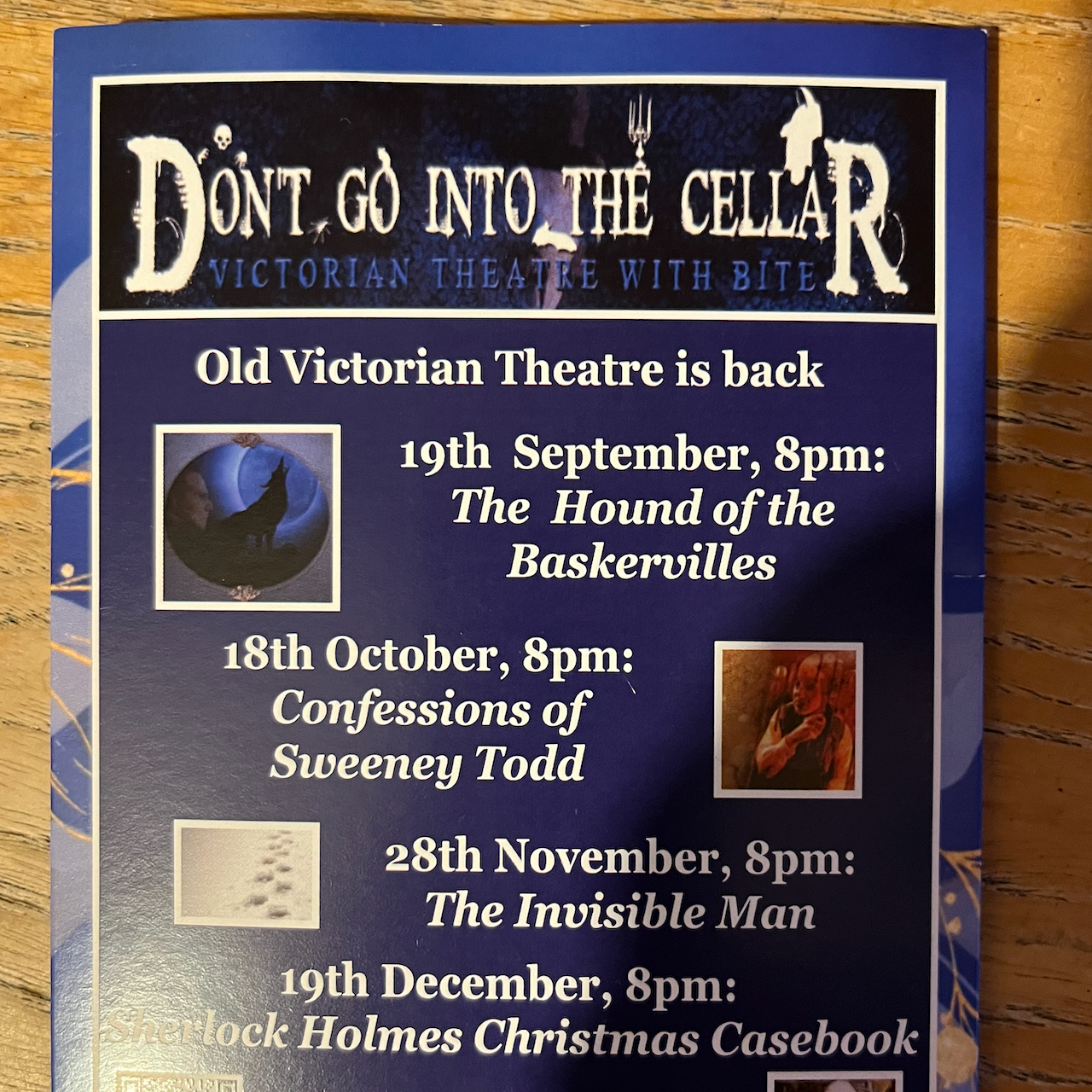
The Vauxhall Tea House Theatre is one on my favourite places. It is a “tea house by day, theatre by night”. Here is a sketch of the outside:
Vauxhall Tea House Theatre, 12″ x 9″ pen and wash original. [sold]
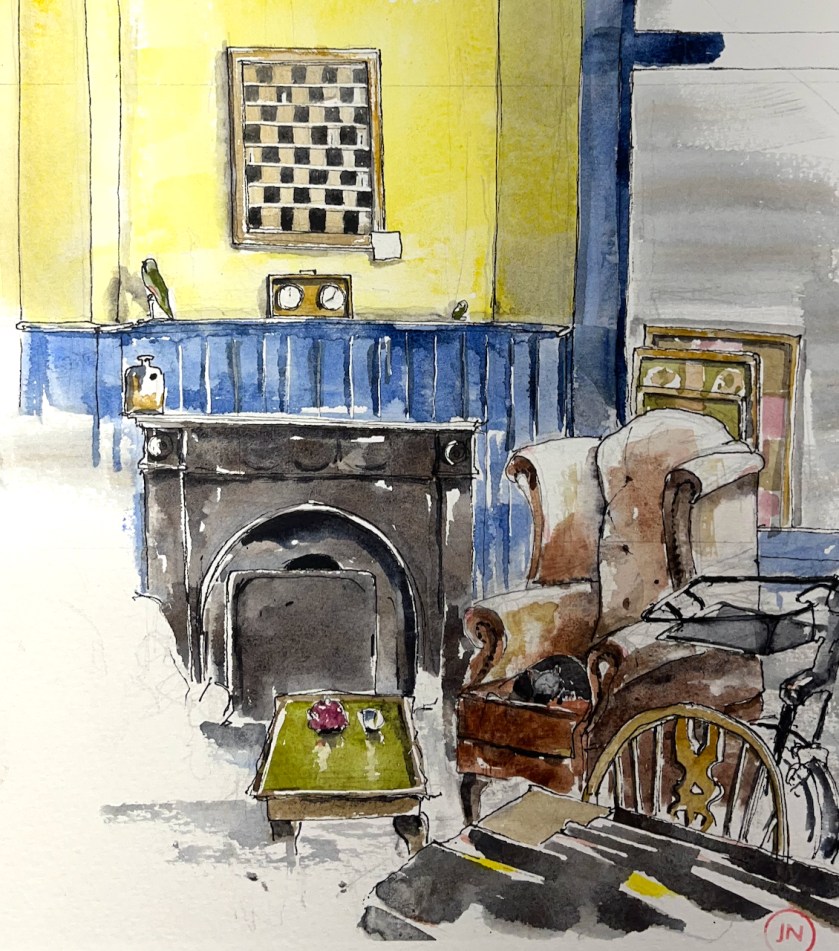
Here is a sketch of the interior by day:
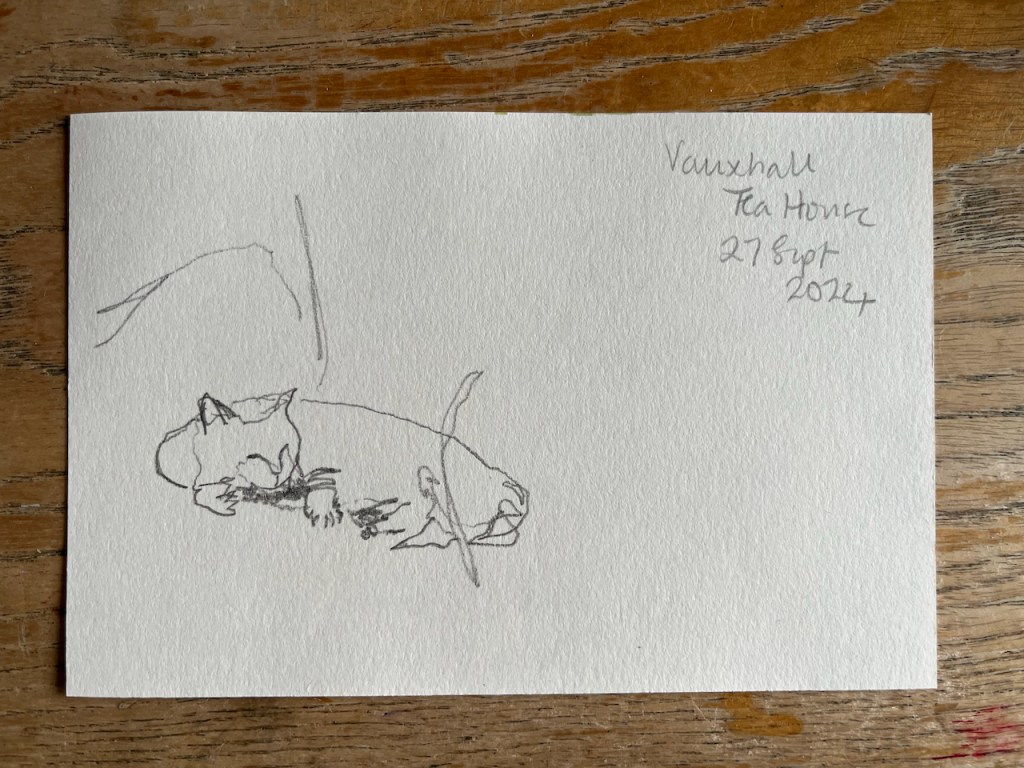
Vauxhall Tea House Theatre, interior with cat. 12″ x 9″ pen and wash original. [Sold]
There are winged chairs you can sink into, wooden tables you can work at, magazines and newspapers you can read. There is tea. There is cake. There is at least one cat.
It’s a short walk from Vauxhall station. Definitely worth a visit.
“We are trying to be different. We will not hurry you. If you visit us on your lunch break, then have one, you will be more productive in the afternoon. If you want to have a meeting, we will not disturb you. If you are ‘working from home’, we have wifi. If you have children, we have highchairs, a chest of toys, and milkshakes. We always have the daily papers, so please, relax, and share in what we are trying to create, take a load off, and have a cuppa.”
Magnificent!
Click a button below to share this post online, email it, or print it:
Here is a sketch of the remarkable pub, The Lord Napier, now the Lord Napier Star.
As you see, the top of the pub is covered in street art. I had fun trying to copy it. The original art is done at large scale with a spray can. My drawing is at small scale with watercolour and gel pens.
The pub has history. It has been a working pub, derelict, a rave venue, a squat. Now it is back to being a pub again.
Hackney Wick is in East London between Victoria Park and the Olympic Park.
Hackney Wick is on the East side of London, 20 min walk from the Stratford railway station, and on the Hackney Wick overground.Hackney Wick is between the Olympic Park and Victoria Park.
I have walked and run through there at intervals over the last twenty years. It has changed remarkably. The company I use for printing my artwork moved over there about 5 years ago, from a location in central London. I thought “what!” and “why?”. Now I realise that they were at the start of a trend. They were wise. The area is on the up. It used to be somewhat derelict and somewhat dodgy. Now the old buildings are taken over by new businesses, and there are cranes everywhere, constructing buildings where there were coal depots, docks, builders yards, heavy industry.
Map at the bridge to the Olympic Park.
There are new residential buildings, at human scale of 3 to 5 stories, with footpaths and green spaces in between, and commerce at ground level. The commerce is, yes, coffee shops, but also gyms, shared office spaces, businesses to do with the film industry, music and film studios, a bakery, and what looked like scenery painting studios. It felt as though real things happened there, new businesses moving in, people living near where they worked, businesses springing up to serve the people who live there.
New businesses adapting the spacesNew housing, built and under constructionNew businesses in old buildingsDwellings in old buildingsNew businesses in old buildingsA peaceful cafe “The Ethical Bean” Dace RoadA walk around Hackney Wick
I found it cheering and energising. And I recommend the café I found: “The Ethical Bean” on Dace Road.
Click a button below to share this post online, email it, or print it:
Here is the “Prospect of Whitby” pub by the Thames in Wapping.
“The Prospect of Whitby” sketched 21 August 2024 at 2pm, the first picture in Sketchbook 15
The “Prospect of Whitby” is the name of a ship.
The coal boat, “Prospect of Whitby”, from the pub sign.
There is an informative entry about the whole area in “The London Inheritance” website. He writes:
“The pub was originally called The Pelican and the alley and stairs down to the river at the side of the pub to the right are still named Pelican Stairs.“
This is the Sutton Arms in Clerkenwell, 16 Great Sutton Street, EC1.
Sutton Arms, 16 Great Sutton Street, EC1V 0DH, sketched 10 August 2024 in Sketchbook 14
I sketched it towards the end of a sunny afternoon in August, sitting on steps outside number 6 Berry Street. As you see, the sun streamed in from the west. The trees in the distance, on the left of the drawing, are on Clerkenwell Road. Behind them is The Charterhouse, fulfilling its ancient tradition as an arms house and sanctuary for the elderly and frail.
From 1611 to 1995, The Charterhouse owned the whole of this area.
Great Sutton Street area. The broken red line indicates the extent of the former Charterhouse estate. Image from British History Online [reference 2] annotated.
The Charterhouse sold this land in 1995. A developer bought up the land and built factories and warehouses. In the 21st century a new wave of developers transformed former warehouse blocks into apartments and offices. I sketched sitting outside one such: 6 Berry Street is residential apartments. This is now an area for architects and interior designers.
There was a pub here by 1825 [1]. It was rebuilt in 1897 [2]. It’s now a Free House. It’s clearly well looked after and well patronised. Definitely to be visited! The flowers are spectacular.
Spectacular flowers of the Sutton Arms.
Thomas Sutton (1532-1611) was the founder of the Charterhouse, hence the name of the road and the name of the pub. This is the Sutton Arms in Clerkenwell, north of The Charterhouse. There is also a Sutton Arms south of The Charterhouse, in Carthusian Street, near Barbican tube.
The pub sign is Sutton’s coat of arms. His motto is:
DEO DANTE DEDI
The translation is “God having given, I give”, or “As God has given to me, so I give in my turn”, a good motto for the benefactor that he was. The pub sign misses off the “O” in DEO and the “I” in DEDI.
Sutton Arms pub sign: “DE[o] DANTE DED[i]”Thomas Sutton’s Coat of Arms. See the greyhound. Source: Charterhouse School on Wikipedia
The “Survey of London ” [2] gives a detailed history of this area, which has alternately flourished and decayed over the centuries. It is currently flourishing.
I completed the ink on location and finished the colour at my desk. The colours are:
Fired Gold Ochre (bricks)
Ultramarine Blue and Phthalo Blu (Green shade) (sky)
Serpentine Genuine (trees)
Mars Yellow (road and bricks)
Ultramarine Blue plus Burnt Umber (blacks and greys)
Transparent Pyrrole Orange (flowers, street signs)
The changing fortunes of the Great Sutton Street area.
In the 14th century this area was fields, owned by a Carthusian Priory. There was a mortuary chapel, called “Pardon Chapel” for saying the last rites for criminals and suicides. Henry VIII eradicated the Carthusian Priory in 1538 (“Dissolution of the Monasteries”) and it passed into private hands, along with the land. It became known at “The Charterhouse”. Thomas Sutton, a wealthy businessman, bought the Charterhouse in 1611. He died that year. His will provided for the hospital and almshouse that are still there. The Charterhouse leased the land outside its walls to developers, who built houses. “By 1687, when the Charterhouse estate was thoroughly mapped by William Mar, almost the whole had been laid out in streets of small terrace houses—242 houses in all, with yards, gardens and sheds.” [2] These terraces set the street pattern for the small streets that are there today. The lattice continued to the walls of The Charterhouse. Clerkenwell Road was cut through much later, in the 1870s. Then commerce moved in and a hundred years passed. By the 1700s, the area was a mix of residences and industries: “In 1731 Philip Humphreys, the Charterhouse gardener [..]complained of the adverse effect on his crops of smoke ‘from so many neighbouring Brewhouses, Distillers and Pipe-makers lately set up’ in the vicinity.” Thus we see that NIMBYism is not a new phenomenon. A new developer (Pullin) came in and rebuilt, and more and larger factories were built. Again, the neighbours complained: “Already by the 1820s some houses were giving way to further industrial developments, including slaughterhouses, a dye-house, breweries, and vinegar, vitriol and gas works. Complaints were made to the Charterhouse in 1832 about the nuisance of these works and their steam engines, and to the Vestry in the 1850s about the ‘boiling of putrid meat and other offal’ and blood running into the drains.” Building continued. Eventually government intervened: “Extensive redevelopment of the Charterhouse estate followed remarks in 1884–5 by the Royal Commission on the Housing of the Working Classes as to the badness of the houses there. […] Charterhouse was criticized for allowing [..]the incidence of house-farmers, severe overcrowding and badly constructed, poorly ventilated housing to continue on its property. One house in Allen Street was found to be occupied by thirty-eight people, eleven of them in one small room; similar conditions were found in the cottages of Slade’s Place. Many of these properties were occupied by costermongers with ‘very precarious’ earnings (whom the Commission felt would do better ‘if they kept from drink’).[2]” The Charterhouse governors eventually took action. The small houses were demolished, and replaced by factories and warehouses. This time the trades were less polluting: “Among early occupants were clothing manufacturers: milliners, mantle-makers and collar-makers, leather manufacturers, glove-makers and furriers. The printing trade was also well represented, along with book-binding, engraving and stationery manufacture. Continuing a long-standing tradition were several butchers and tripedressers.” By now we are in the early 1900s. About a dozen buildings were destroyed by bombing in the 1939-45 conflict, and replaced in the 1950 and 1960s by factories and warehouses. The Survey of London [2] reports that the area was “considerably run down” in 1995 when the Charterhouse sold it to developers. The developers started a programme of warehouse conversions, to apartments and offices, which transformed the area, and moved it back upmarket. And that’s where we are today. (The above is my summary of the more detailed description in reference [2])
[Reference 2 fig 402] Warehouse developments of the 1890s by Mark and Albert Bromet and others at the corner of Berry Street (Nos 12–14, left) and Great Sutton Street (Nos 44–49)The same site today. (Google Street view). Above street level, this is residential. I met one of the residents while sketching. I was sitting on the steps of the entrance to her block, centre left.
[2] British History Online: ‘Great Sutton Street area’, in Survey of London: Volume 46, South and East Clerkenwell, ed. Philip Temple( London, 2008), British History Online https://www.british-history.ac.uk/survey-london/vol46/pp280-293 [accessed 2 September 2024].