St Giles and Bastion House

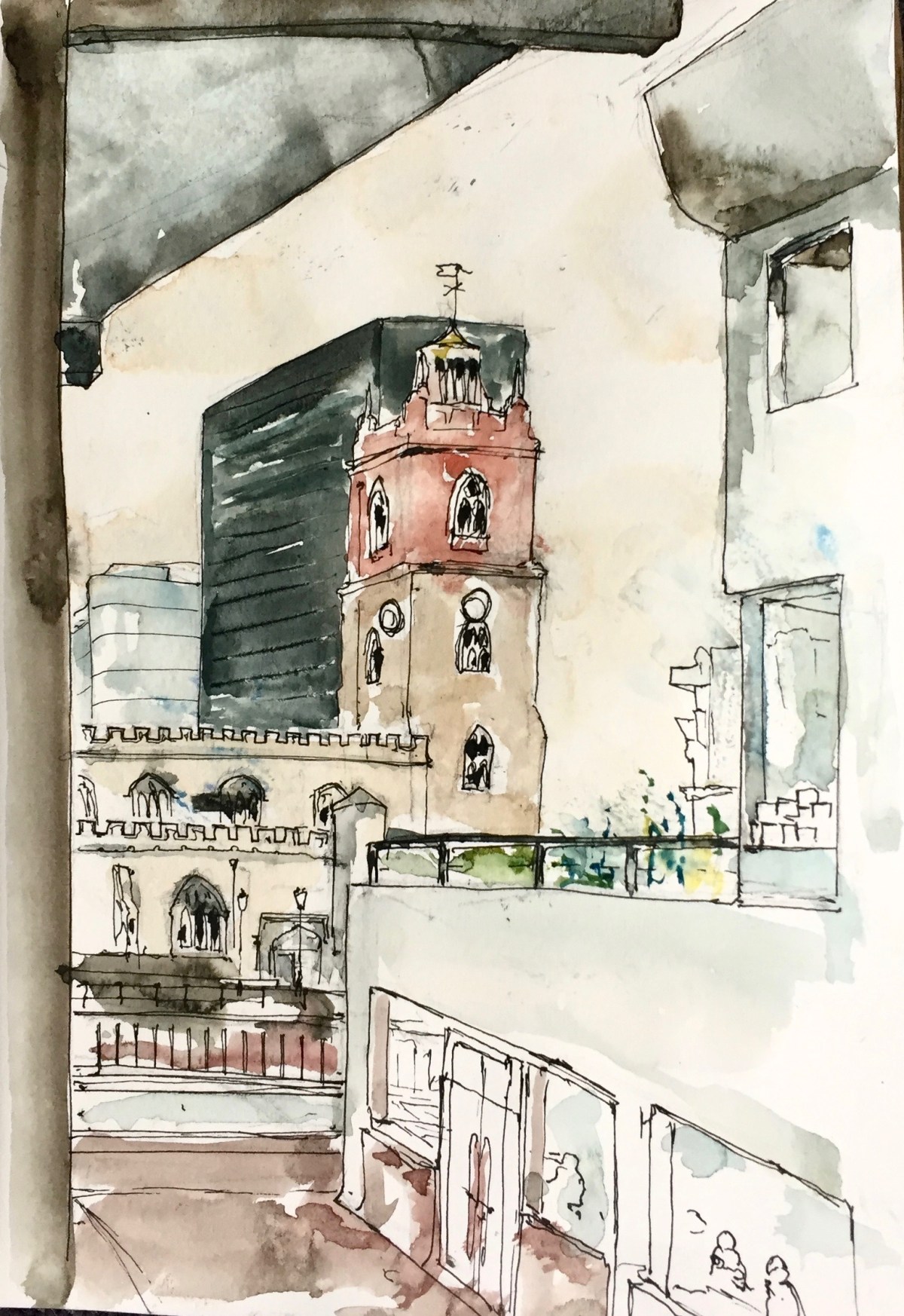
Today Urban Sketchers London held a “sketch crawl” in the Barbican. So I joined them. An astonishing number and diversity of people assembled inside the entrance of the Barbican Centre at the appointed time of 11am. I counted about 35 and then another dozen or so joined. All shapes and sizes of people, tall, short, studious-looking or flamboyant, quiet or talkative, smart or windblown, old or young, all were there. I knew I was at the right place because everyone had a very obvious “drawing bag” or rucksack, and some were sporting a neat red Urban Sketch London badge.

img_1150

A few words and then off we all dispersed. To my surprise I found a good place very quickly. A wall, at ground level, looking over the Lakeside Terrace and St Giles. I liked the way St Giles was surrounded by Bastion House, and framed by the massive concrete of Gilbert Bridge. I also thought I would be sheltered from the wind. I was wrong about that. In fact, the location seemed to be at the bottleneck of a wind-funnel, and at times the wind was painful, as well as being very inconvenient for my drawing materials, which shifted about and jumped down off the wall.

img_1149

Another Urban Sketcher came up and elected to draw the same view. She had an interesting concertina type sketch book, which she said was her “collage sketchbook”. The wind very soon got under that and unravelled the concertina right across the walkway. She got it under control though, and finished her sketch. She was doing a number of sketches in different locations. I did just the one.

I finished it at 12:50. By that time I was thoroughly cold, and glad to go back inside the Barbican Centre. All the levels were by now densely populated with people participating in all sorts of events. The Urban Sketchers, by some alchemy, found each other again and we put up our sketch books for everyone to see.

Everyone’s sketches were of interest. People had done very different things. I suppose that’s obvious, but it was startling how different they were. One person had made very precise and delicate engineering drawings of brackets. Another had a wonderful atmospheric wash of the church. Someone else had done the fountains and their environment, in firm black lines against a shadowy orange background with white water. Others had outline drawings in crayon, or detailed drawings in sepia ink, and someone had done a sketch on their iPad.

One of the organisers made a panoramic film of the drawings so I look forward to seeing them on the Urban Sketch London website.

It was a good experience and I’ll aim to go to another later in the year.

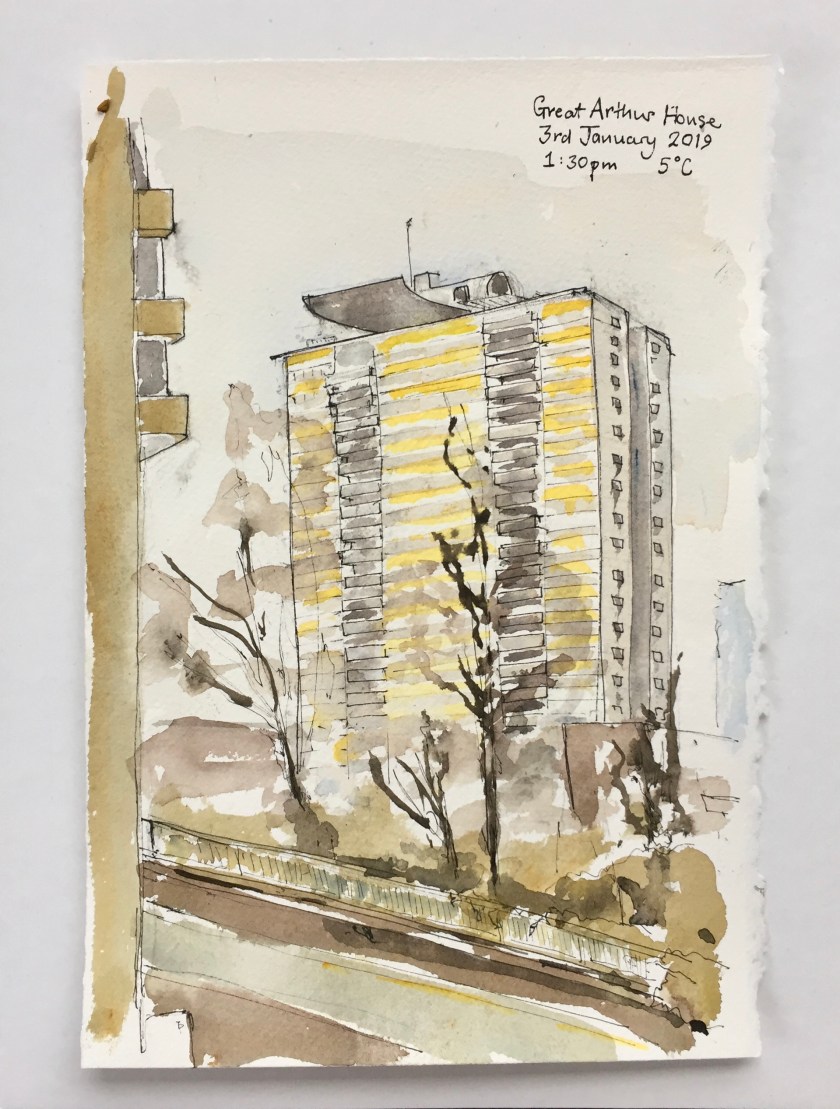
Great Arthur House from the Barbican Podium

Here is Great Arthur House from the podium ramp near Blake Tower. You can see Blake Tower on the left. At the bottom of the picture is the ramp that goes down into the Car Park at Bunyan Court.

Several stories below me, at ground level, there was an assortment of discarded furniture and paint tins, and a huge skip full of Christmas Trees being collected for recycling.

fullsizeoutput_31dd

It was really cold out there. I saw a black cat sliding in between the debris.

This picture done on Fabriano Artistico loose sheet,  8inches by 10 inches. About an hour, on location.

St Alphege, London Wall

St Alphege (“Ælfheah”) was a Bishop of Winchester, later Archbishop of Canterbury. He was captured by Viking raiders in 1011 and killed by them the following year after refusing to allow himself to be ransomed. Alphege was canonised as a saint in 1078.

The church was built around then, according to Wikipedia:  “The first church was built adjoining the London Wall, with the wall forming its northern side.The churchyard lay to the north of the wall.The earliest mention of this church dates to c. 1108–25, though it is said that it was established before 1068.”

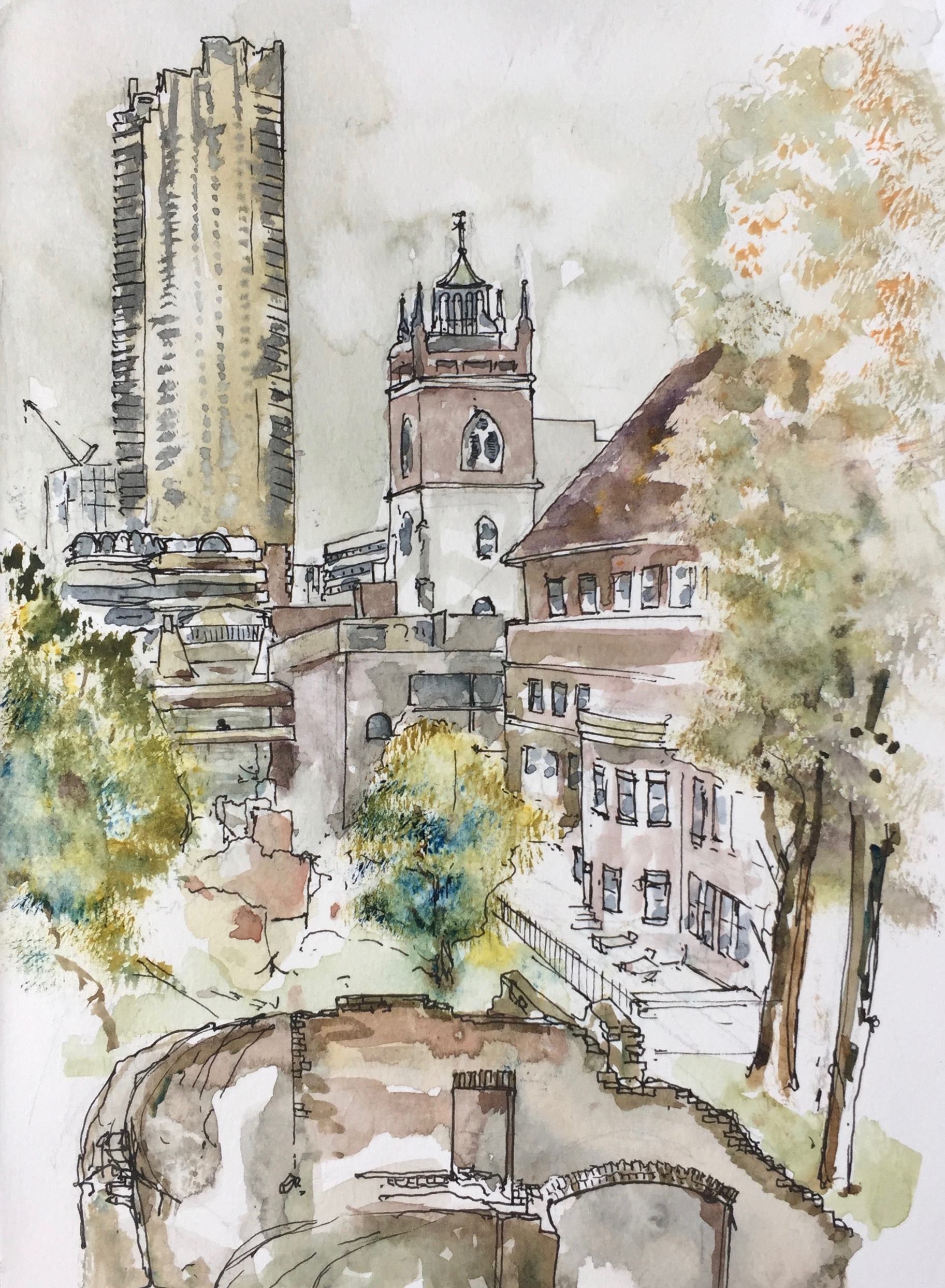
The ruins of the Church have recently been made beautiful, and accessible, by the wonderful new public space around One London Wall Place. Here is is a sketch done from one of the wooden benches close to the church:

IMG_4173

You see the marvellous new high walks, which curve in the sky.

Until I started drawing them, I had not realised that the walls of the highwalk vary in height. The highwalk is made of some material which rusts, to give this bright orange colour.

On the right of the picture is the red brick of the old London Wall. The building in the background is Roman House, on Wood Street, a residential block.

The architects of One London Wall are MAKE architects.

About 2 hours, drawn and coloured on location, in Jackson’s watercolour sketchbook.

St Giles’ and Cromwell Tower

Here is today’s sketch showing:IMG_4081(annotated)

  • London Wall – 2nd century AD
  • Barber-Surgeons Hall – current building 1969, first hall, on this site 1441
  • St Giles Church – current building 1966, first church on this site by 1090
  • Barbican, Cromwell Tower,  Wallside and Arts Centre – 1965-82
  • Braithwaite House – completed around 1963
  • White Collar Factory – finished 2017
  • Atlas Building under construction

IMG_4081

Done in one hour 40 min from the high walk next to 140 London Wall, 4th June 2018. Finished 12:10. It was very cold and windy on the high-walk.

This completes a series:

St Giles’ Church and Shakespeare Tower

St Giles Church and Lauderdale Tower

St Giles’ Church and Shakespeare Tower

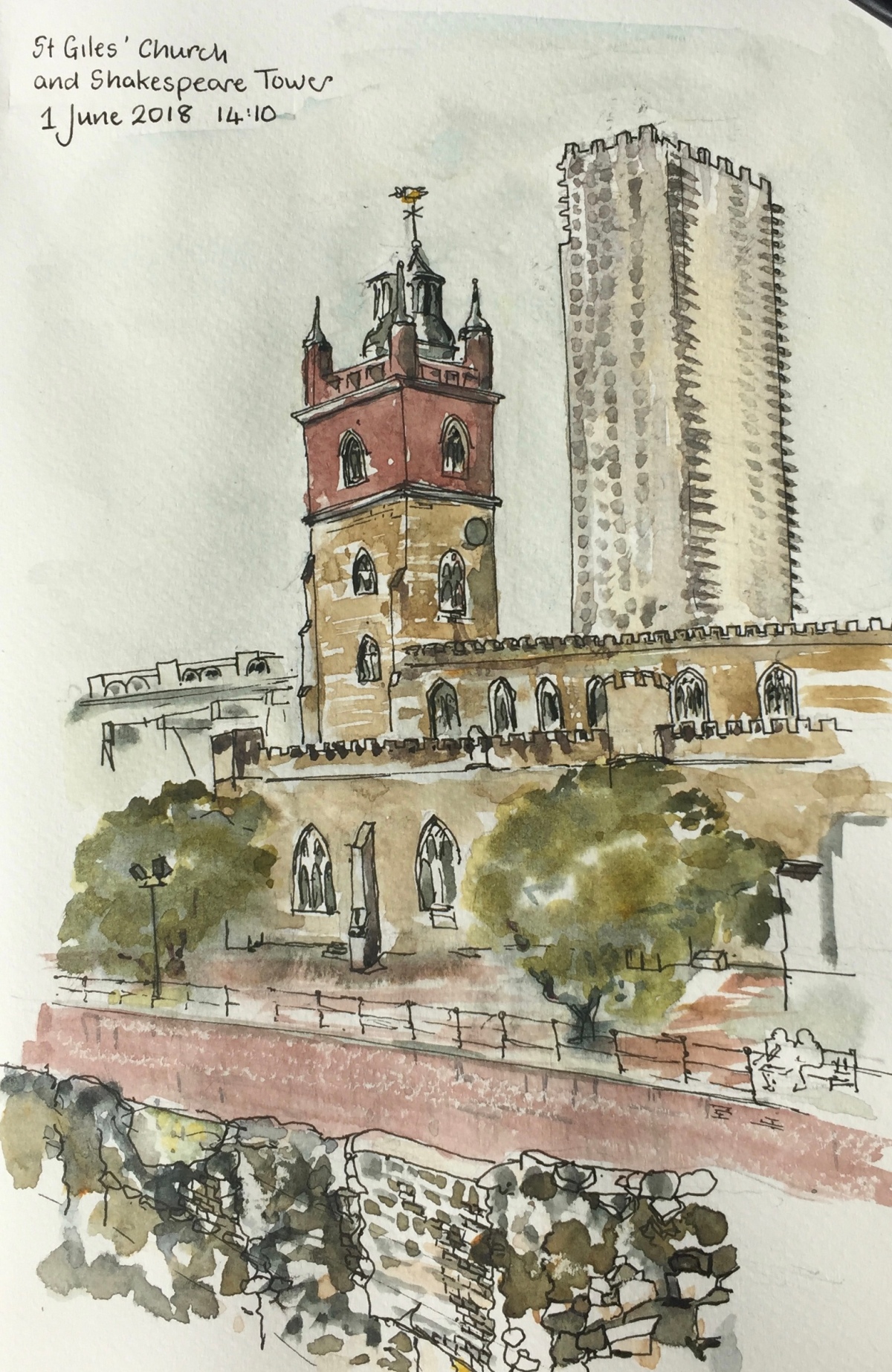
Here is a sketch from a staircase from the Barbican Podium, just outside the Dentists but just inside the old London Wall.

fullsizeoutput_1cc2

Parts of the Roman London Wall are in the foreground, 2nd century AD.

St Giles’ has Roman foundations and is much rebuilt. The church we see now is the 1966 restoration following designs of  architect Godfrey Allen (1891-1986). He used historic plans to make the church as much as possible like the medeival original.  It had been burned by incendiary bombs in 1940.

In the background is Shakespeare Tower, Barbican, completed 1976, to the designs of Chamberlain, Powell and Bonn.

St Giles’ Church is “St Giles’-without-Cripplegate”. As you can see from the picture, the Church is outside London Wall. Here is an extract from the St Giles’ website.

The foundations are generally Roman but higher up, the structure dates from various times as it was regularly strengthened and rebuilt….
As the population of the parish increased, the church was enlarged and it was rebuilt in the Perpendicular Gothic style in 1394, during the reign of Richard II. The stone tower was added in 1682. The church was damaged by fire on three occasions – in 1545, 1897 and 1940…The church was designated a Grade I listed building on 4 January 1950 and it was extensively restored in 1966.  

The bombing of Cripplegate in 1940 was so extensive that barely any buildings remained standing in the entire ward. By 1951, only 48 people were registered as living within the ward. It was this widespread devastation which led to planners envisaging and eventually building the modern Barbican estate and arts centre, starting in 1965.

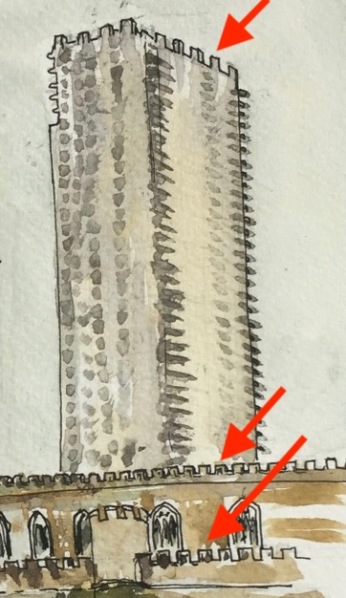
As I was drawing, I saw that the crenellations on St Giles were echoed high up on Shakespeare Tower.

IMG_4066

The drawing took two hours, pen and wash, in a Jackson’s Watercolour Sketchbook.

7 inches by 10 inches.

I’ve drawn St Giles and Lauderdale Tower: From St Alphage Highwalk EC2

Lauderdale Tower from St Alphage Highwalk EC2

IMG_3285

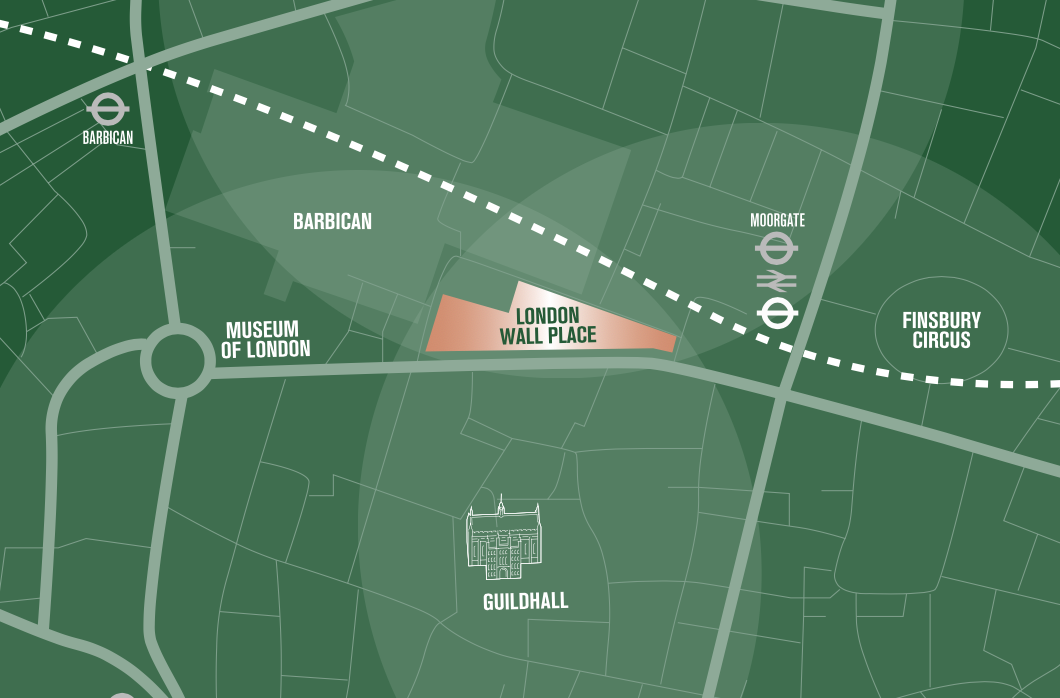
This is a view from the wonderful new highwalks under “London Wall Place”, the office development.

Screen Shot 2018-04-04 at 12.42.07

Here is the drawing in situ on the high walk:


Preachers Court in the snow

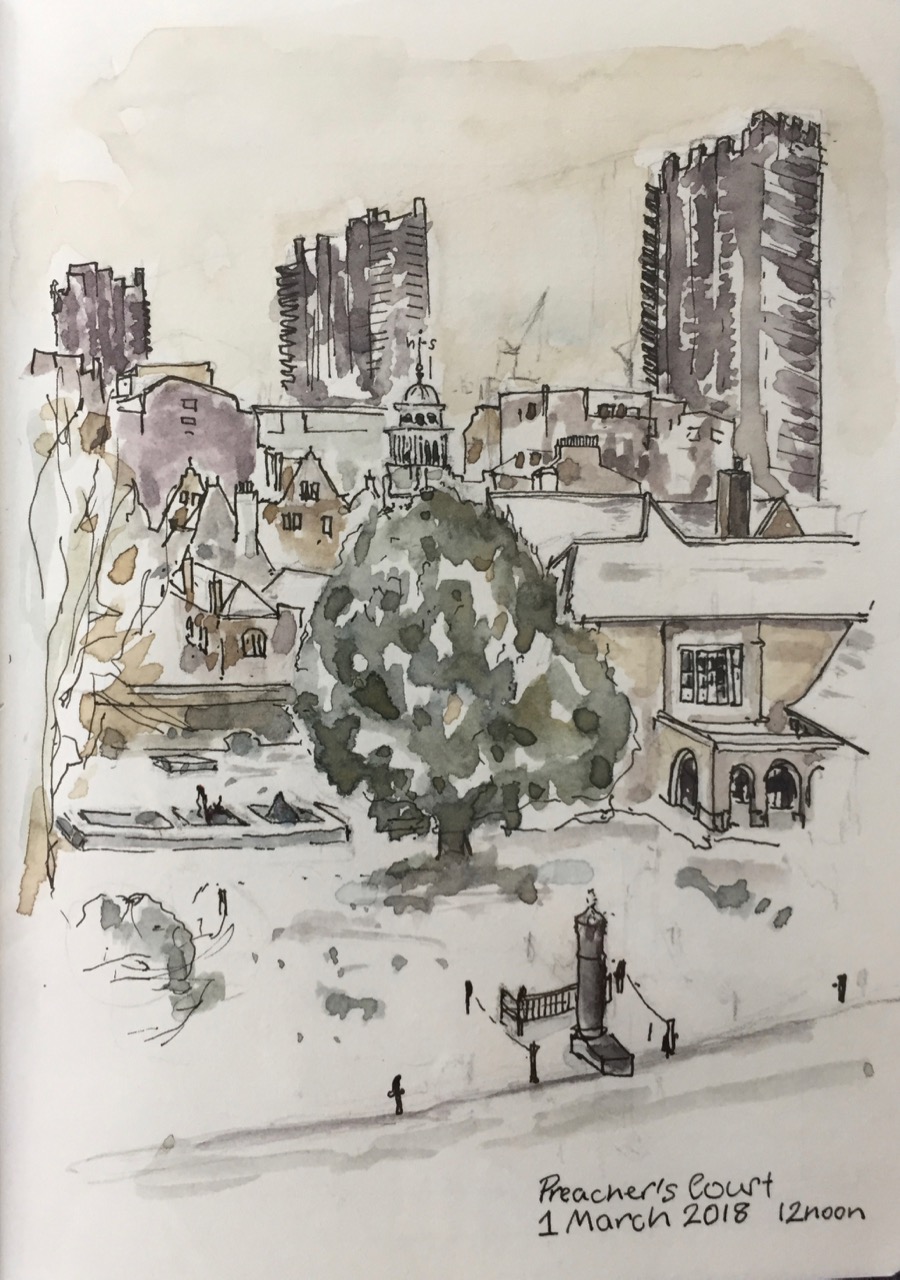
It has been snowing now for several days. Robin invited me to sketch The Charterhouse in the snow, and suggested a viewpoint from the second floor of the Infirmary.

March 1st 2018 (Preachers Court in the snow)

From here I could see all three of the Barbican Towers. Someone was clearing snow in the foreground, but they moved on before I could get them in the picture.

It was a good place to sketch, warm and quiet. I could hear the muffled sounds of the nurses moving about below, and of the Brothers who were in the infirmary. Sometimes they called out.

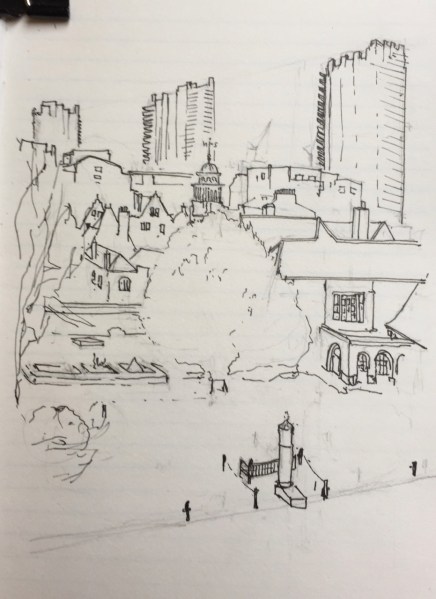
Here is what the picture looked like before the colour went on.

March 1st 2018 (Preachers Court in the snow)BW

This picture took about 2 hours: One hour for the pencil outline, half an hour for the pen, and half an hour for the colour – roughly. It took ages to get the proportions right. Especially in the snow, the eye sees detail in far-away objects, so the temptation is to draw them too big.

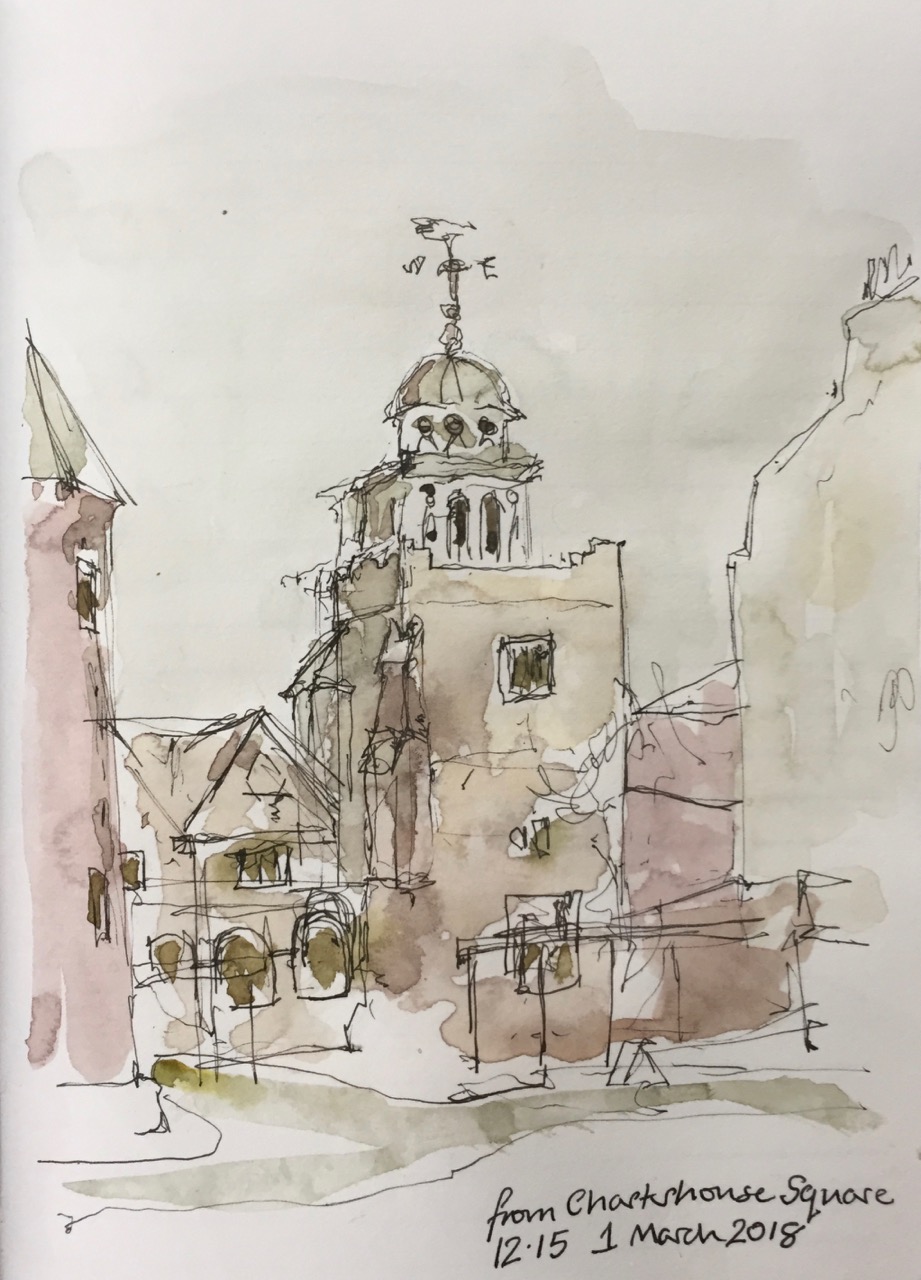
After I handed in my visitor’s badge at the gate, I went out into Charterhouse Square. I looked back at the Chapel. And did a quick pen sketch, standing in the snow.

March 1st 2018 (Chapel from Charterhouse Square)

This took about 10 minutes, coloured later on my desk at home.

Thank you to Robin, and to the Brothers, Master and staff at the Charterhouse for their hospitality.


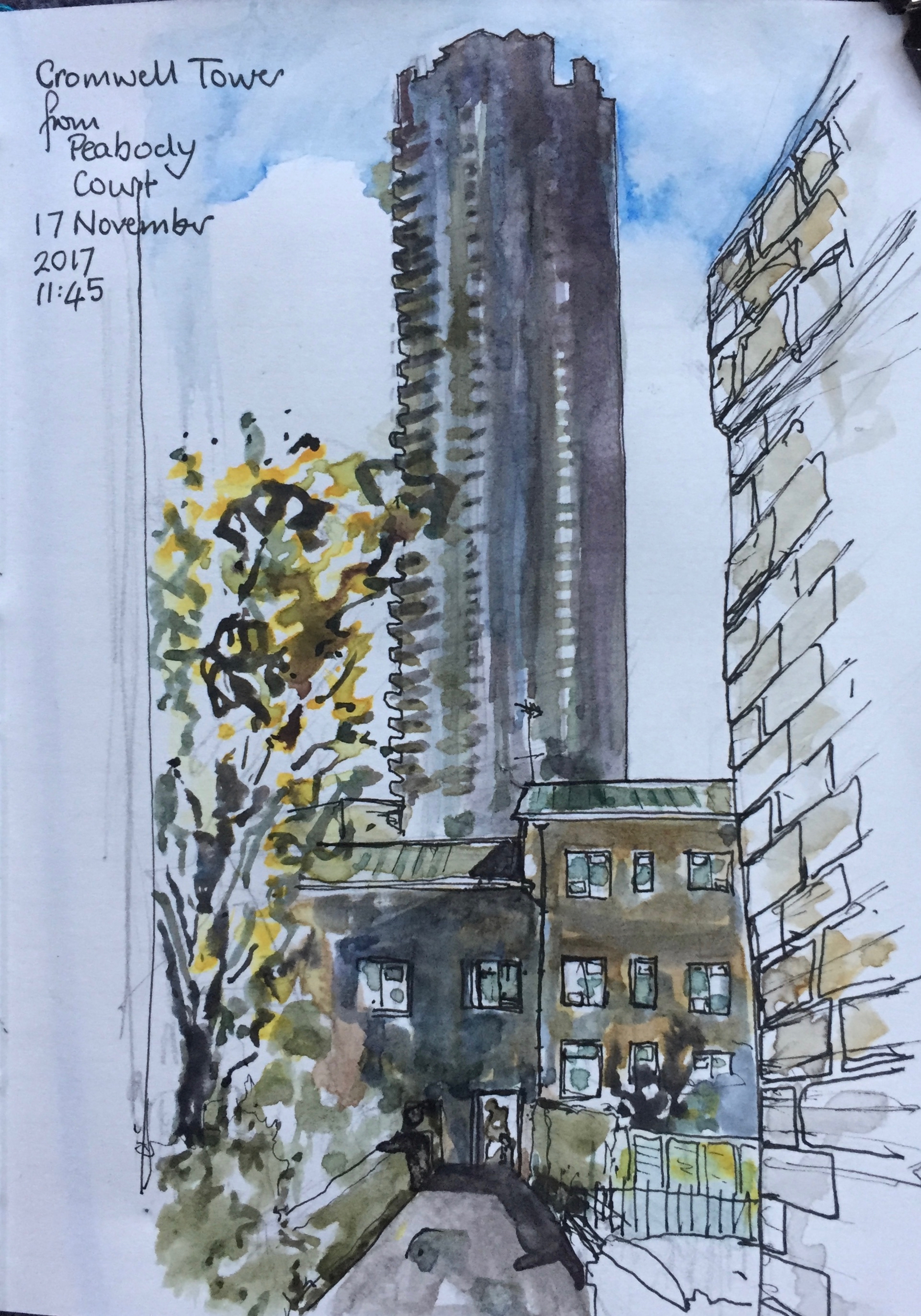
Cromwell Tower from Peabody Court

On a beautiful autumn day I went out to do a local sketch. I only had an hour, before I was due at the gym.

IMG_2059

Bastion House from Podium Level

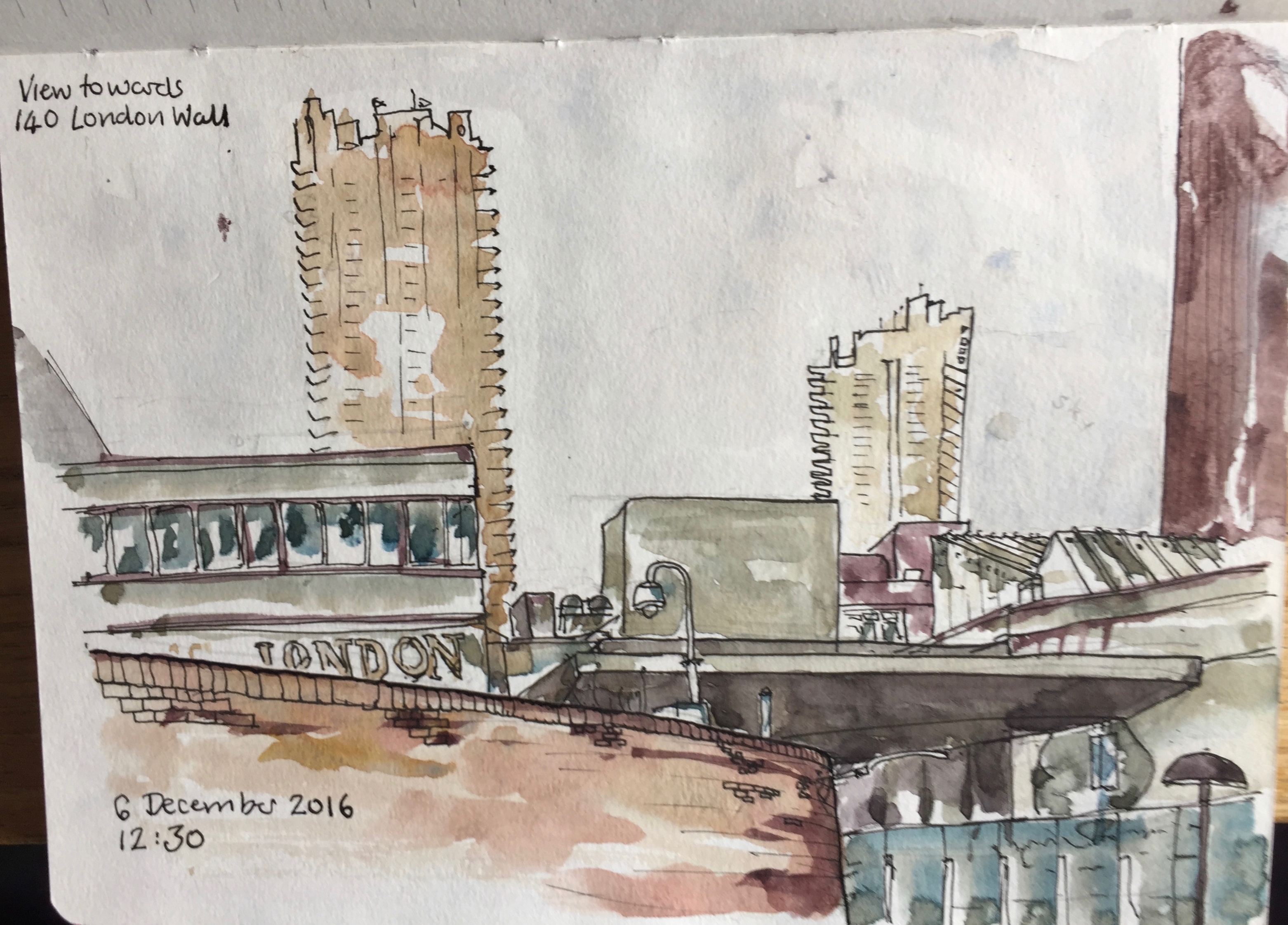
Bastion House aka 140 London Wall is a huge modernist monolith, reminiscent of the monolith in “2001 – A Space Odyssey”. I couldn’t find a site to draw the monolith part today, so here is a view at Podium Level, looking West towards the Museum of London.

IMG_1348

You see the dark undercroft, walkways and a road to a car park. Also you see the bridge that crosses London Wall.

http://postwarbuildings.com describes it thus:

“London Wall was part of a movement of amazing optimism and faith in the ideology of architectural modernism and its promise of a new built form for the city following the devastation of the blitz. It demonstrates what was possible within the breadth of vision following the Second World War and the new powers of centralised planning control. The London that emerged from the ruins of war was to be the remedy to the haphazard milieu of previous. London Wall emerged as a segment of architectural clarity, symbolic of the efforts of the public body to exercise control over the built environment and crucially attempts on the private sector.”

Architects: Powell and Moya, 1972

Here are some images of the monolith in the film “2001 – A Space Odyssey” (1968) which surely influenced, or was influenced by, architecture of the period.


I recently learned that Bastion House is going to be demolished, along with the Museum of London which is adjacent. That’s why I rushed out to draw it. The building is not listed. Here is the “immunity” listing, which is the reverse of a listing:

Screen Shot 2017-09-19 at 16.32.36
downloaded from: https://historicengland.org.uk/listing/the-list/list-entry/1427161

I drew Bastion House from a very convenient ledge behind an iron gate. About an hour and 20mins.

Here is a drawing of the Museum of London which I did last year:

IMG_1349

Bastion House is just off to the right.

London Wall Place from Salters Hall Garden

I sketched this after a visit to Salters Hall as part of “Open House London”.
Salters Hall is one of the London Livery companies, very ancient. The building was completed in 1976 to the designs of Sir Basil Spence. It was refurbished, with substantial alterations, in 2014. The architects for the alterations were de Metz Forbes Knight. There is a new entrance pavilion added on the East side, and they filled in the “undercroft” or open area that had been created by the 1970s architect. The Hall is off the drawing, to the left. I shall return to draw it.

The garden is open to the public. It will be even more accessible and obvious once the London Wall Place development is done.

No. 1 London Wall Place is in the back of the drawing. It is a development by Brookfields, The original Roman London wall is on the right, partly covered in scaffolding and plastic sheeting.
“London Wall Place is a 500,000 sq ft scheme designed by MAKE” says the website.

I have previously drawn the new bridge across Wood Street, which is part of this development.