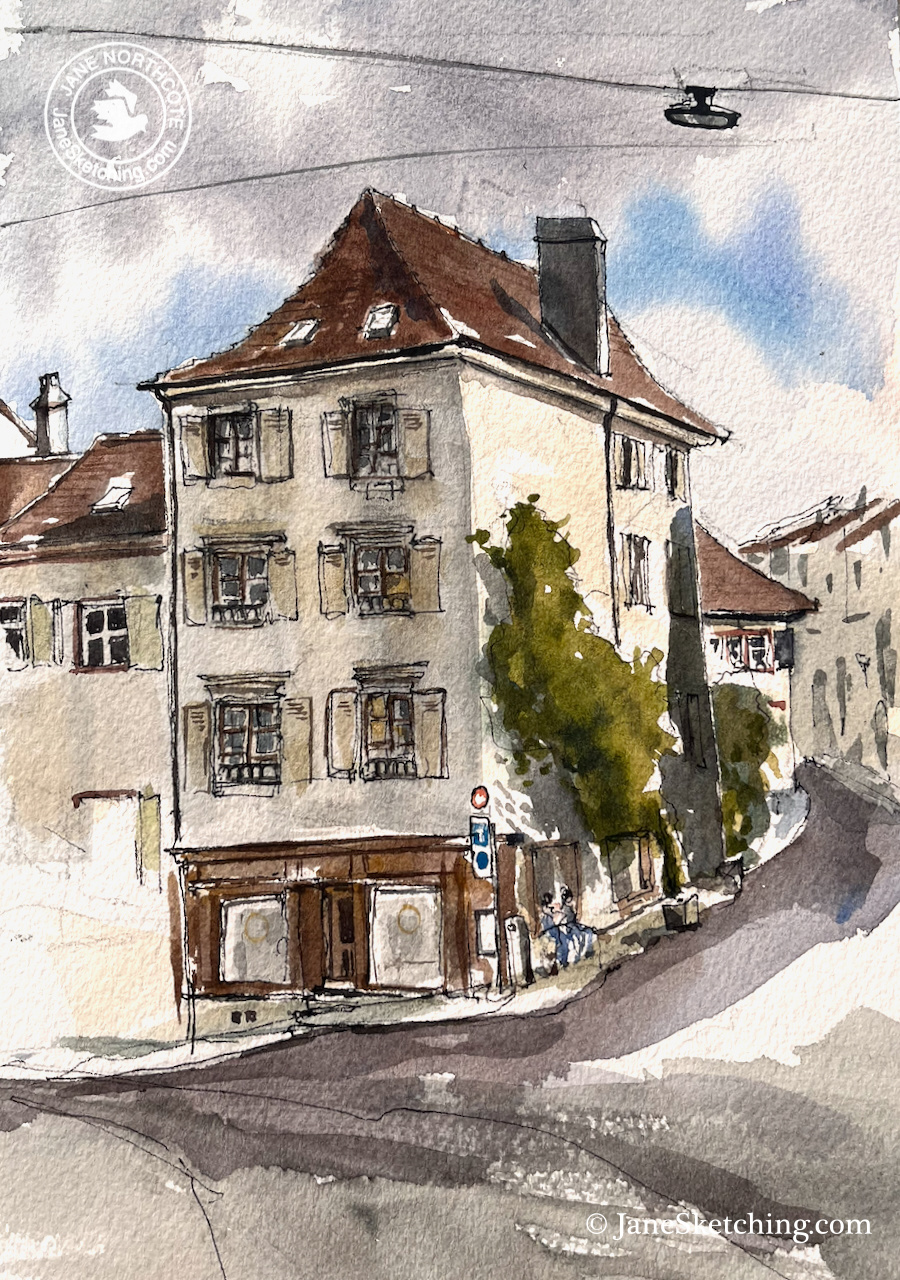
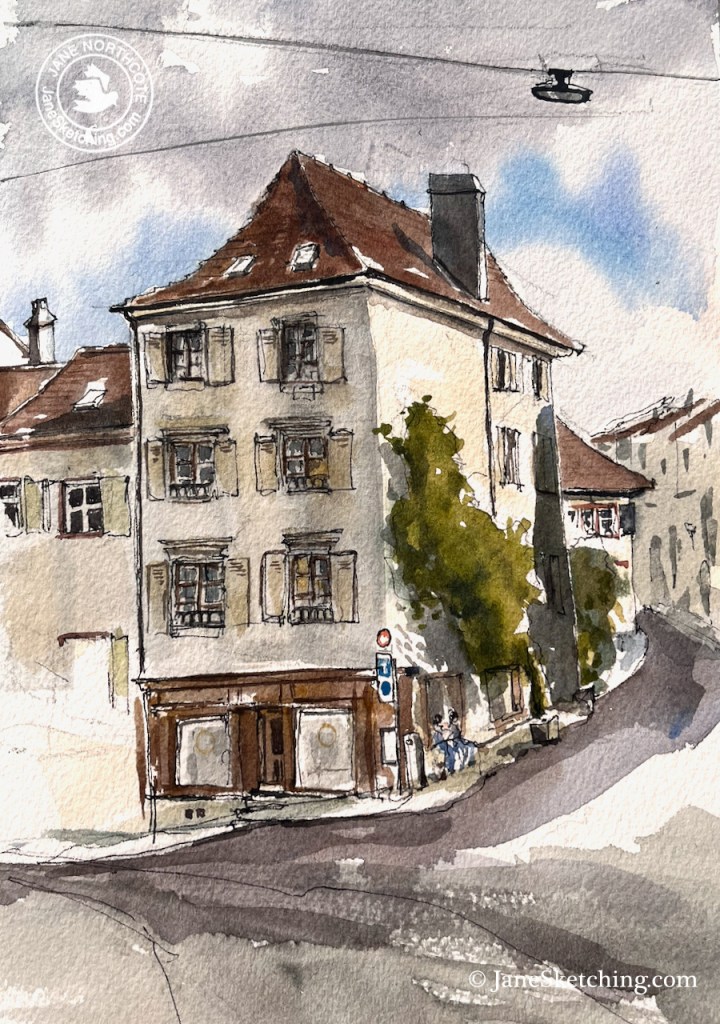
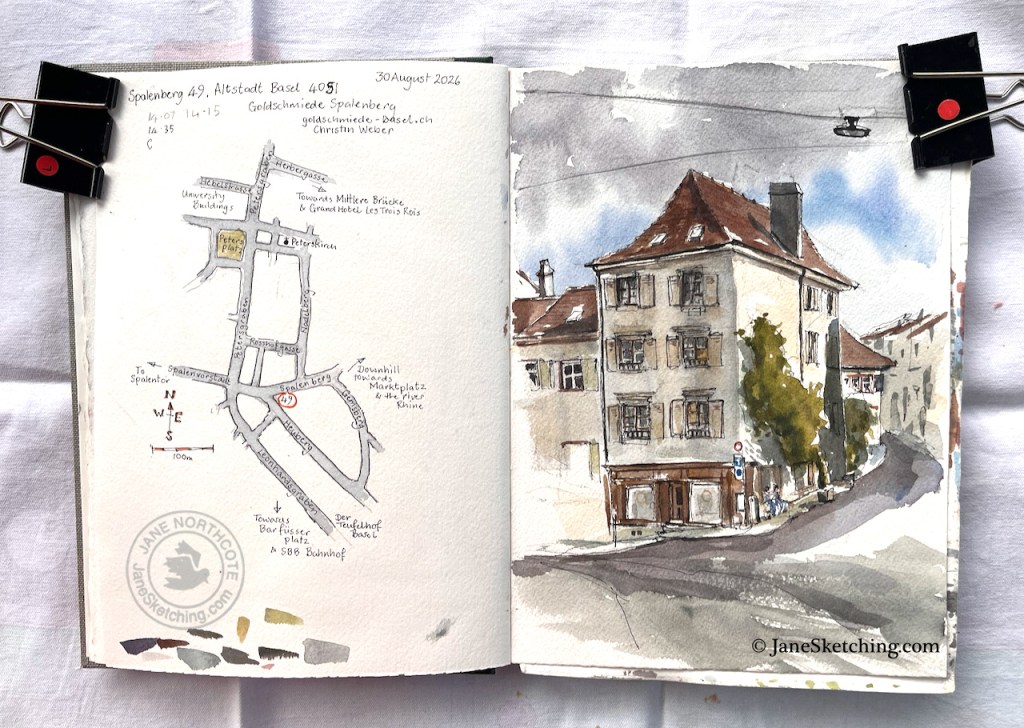
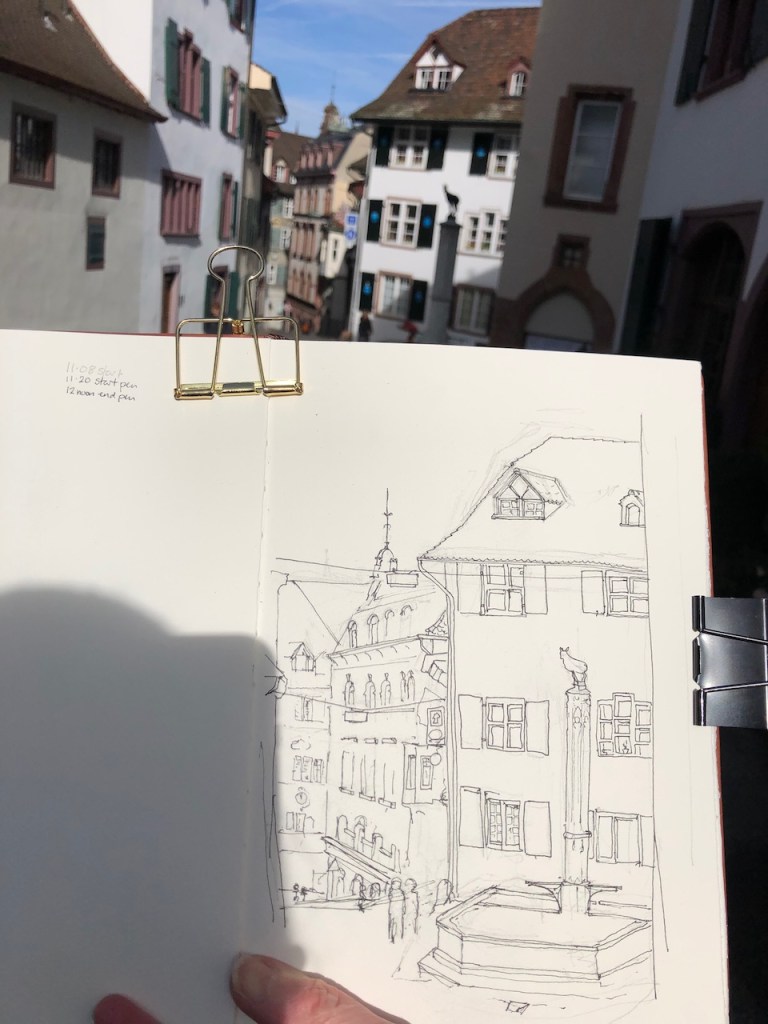
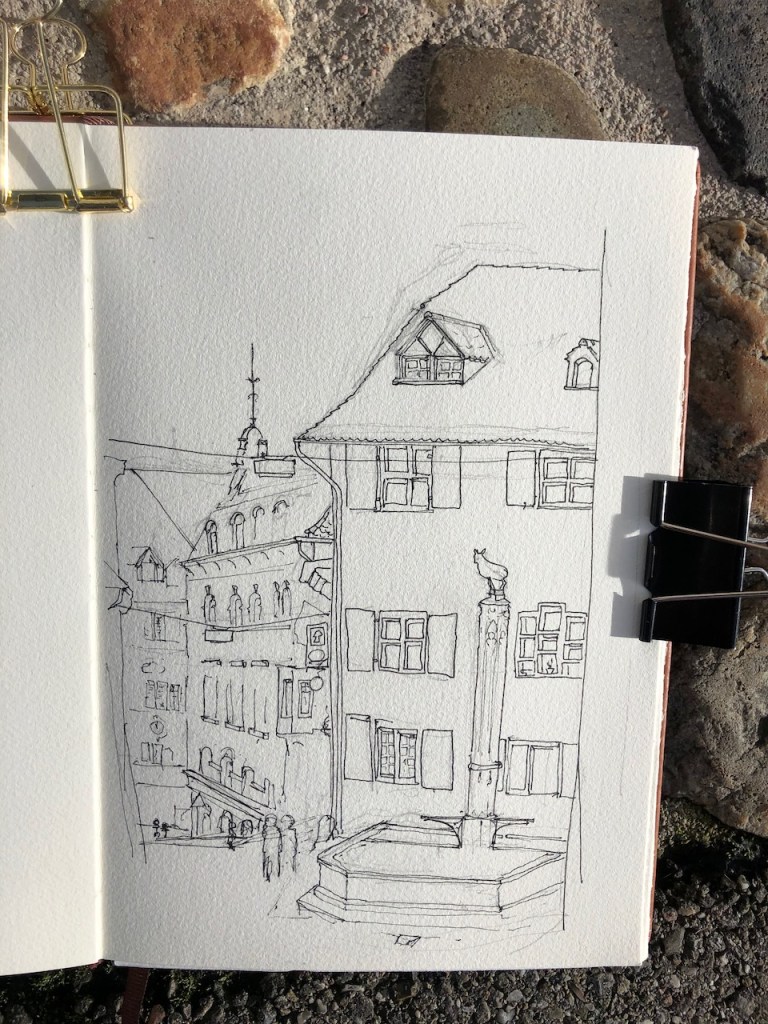
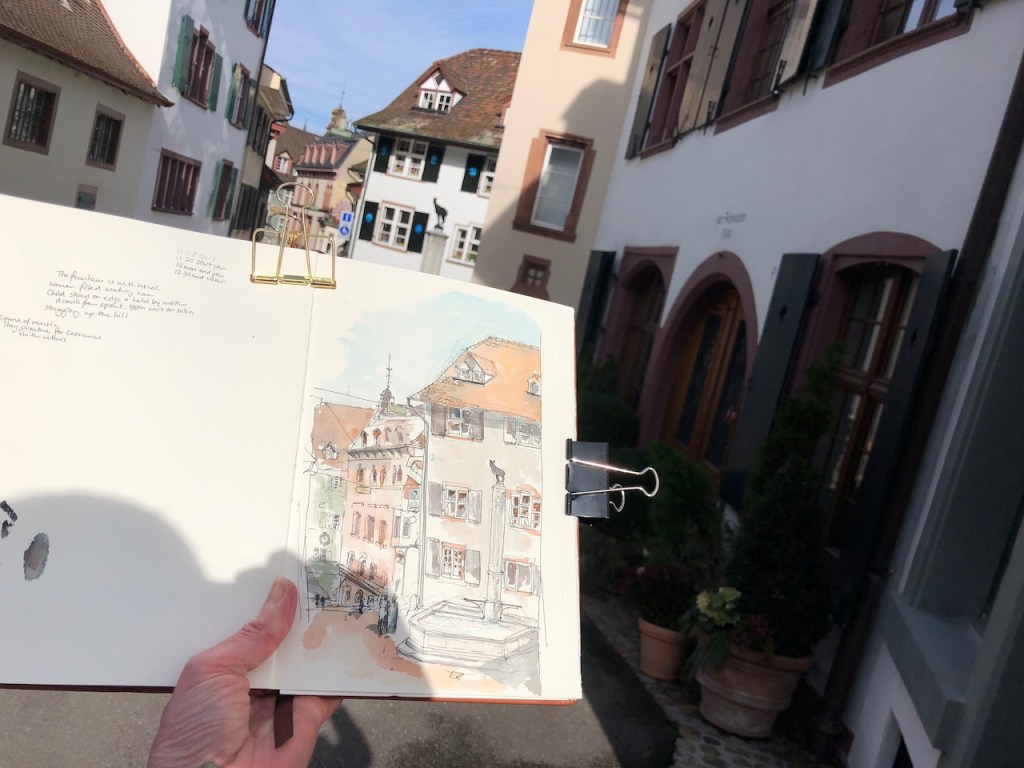
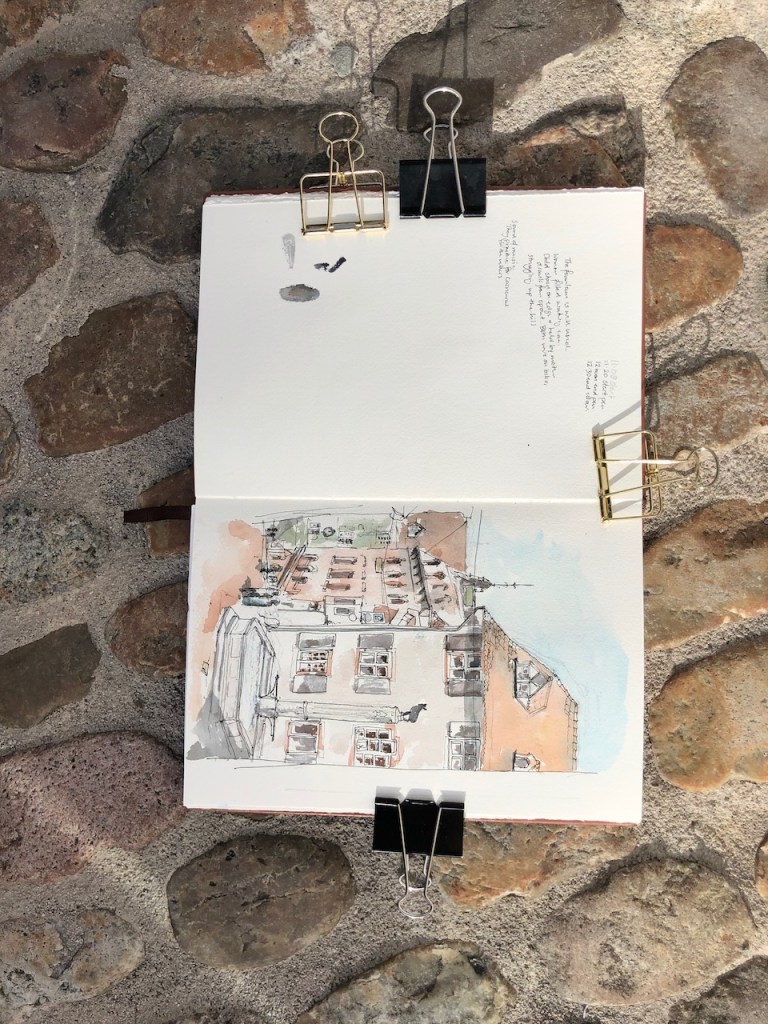
Here is a view looking into Basel old town. The house is number 49 Spalenberg. At street level is a goldsmith: Goldschmiede Spalenberg (https://goldschmiede-basel.ch).
Spalenberg 49, Altstadt Basel, CH-4051 sketched 30 August 2026 in Sketchbook 17
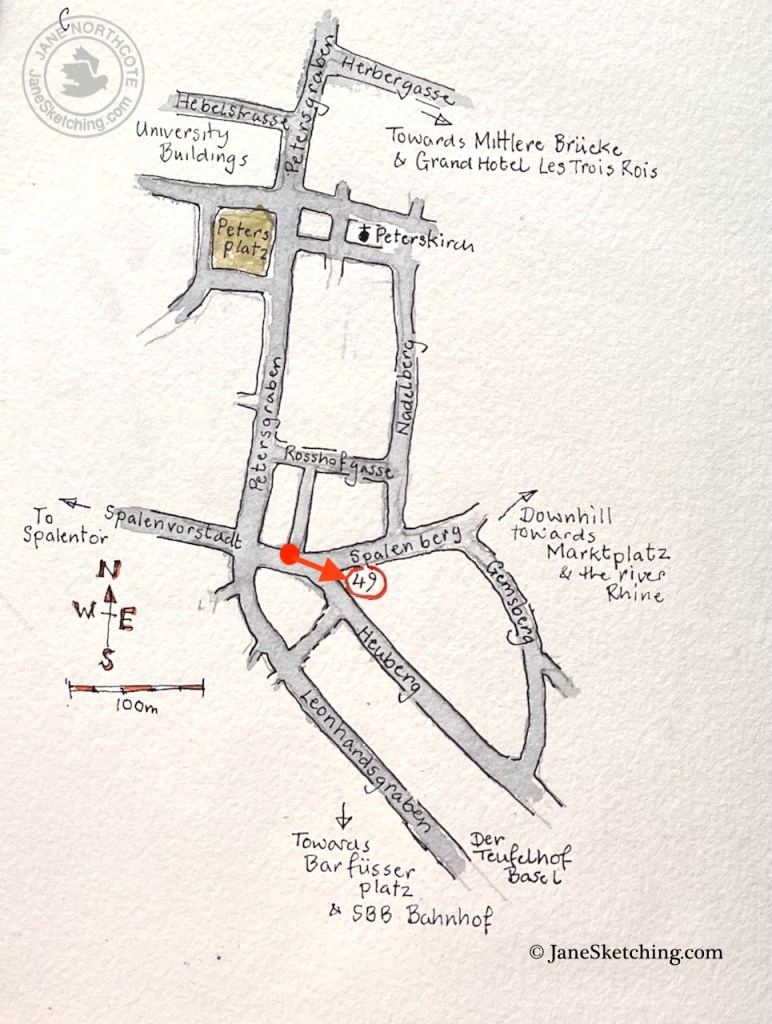
Spalenberg slopes downhill to the left, towards Marktplatz and the river Rhine. Here’s a map:
Map showing the location of 49 Spalenberg, and the sketch sightline.
This was a quick sketch on location, pen and ink, finished later in my hotel room.
Basel is a historic town. The old town retains its medieval street pattern. As well as the ancient streets, there is much to admire elsewhere.
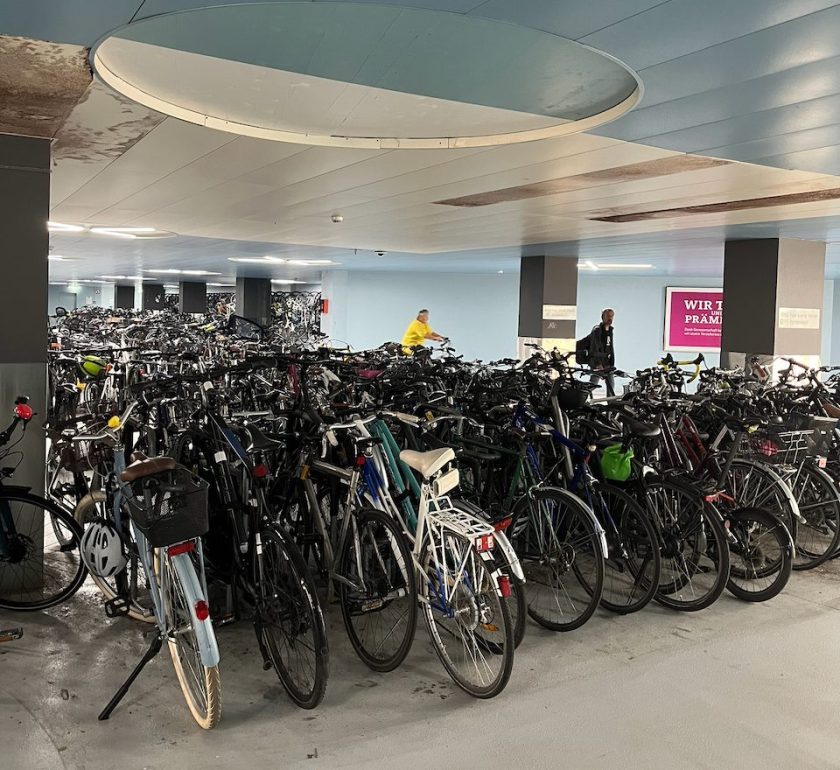
There is a huge underground bicycle car park next to the main railway station. beautifully clean, dust free and quiet.
21st century bike parking near the train station
The glorious kinetic fountains next to the Theatre are still working. This chap has been scooping water for fifty years.
All of Tinguely’s kinetic works of art require ongoing care and maintenance. «All that is fixed decays – all that is movement endures.» Jean Tinguely
Fountain character by Jean Tinguely, created 1975 to 1977
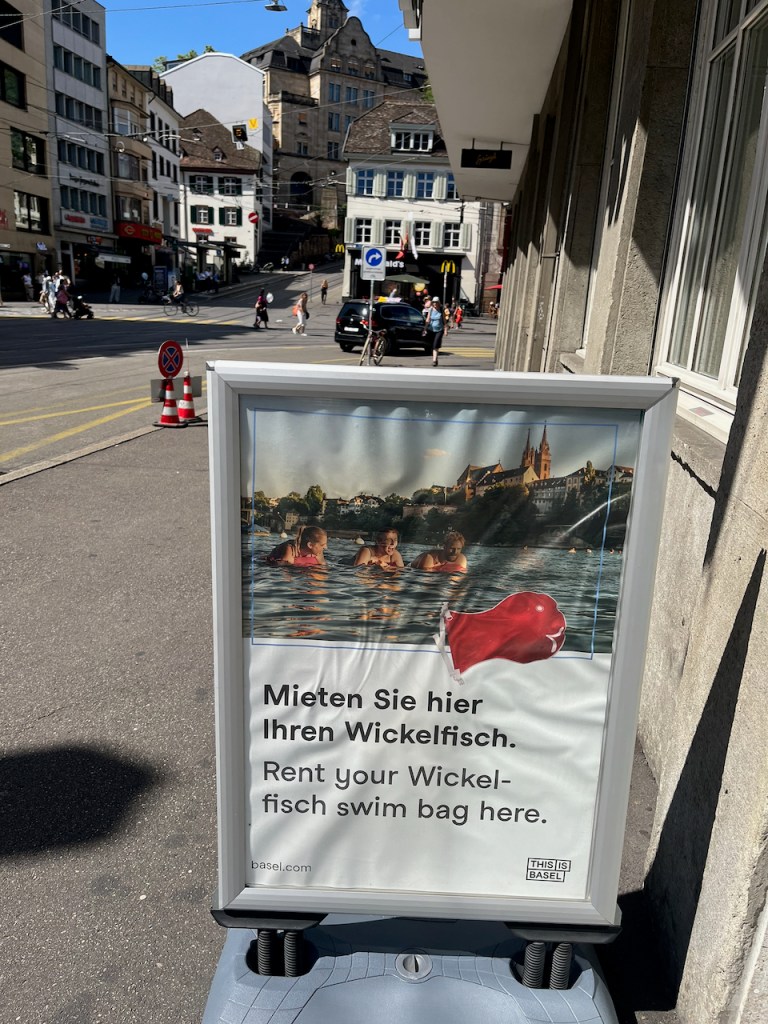
And, amazingly, swimming is not only allowed in the Rhine, it is actively encouraged! Here is the sign outside the Tourist Office. Barfüsserplatz and the Old Town are in the background.
Rent your swimming float here. Float down the Rhine, under bridges and past the Old Town. The tourist shop also sells waterproof bags to put your clothes in.
And, still, the old city retains its calmness.
“In Basel, you can hear your footsteps”
Someone said this to me over twenty years ago, and it is my abiding memory of Basel. Metaphorically, and in reality, I can hear my footsteps in Basel.
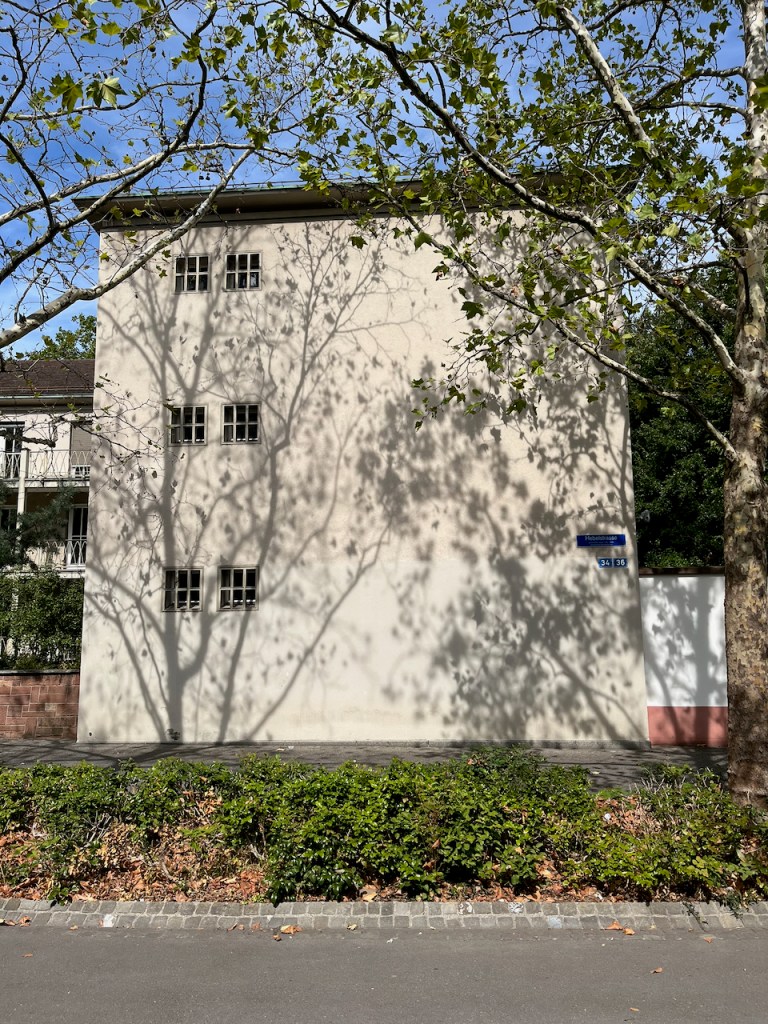
Hebelstrasse, University area, Basel. August 2026
Click a button below to share this post online, email it, or print it:
In the streets of Basel, you can hear your own footsteps.
There are fountains.
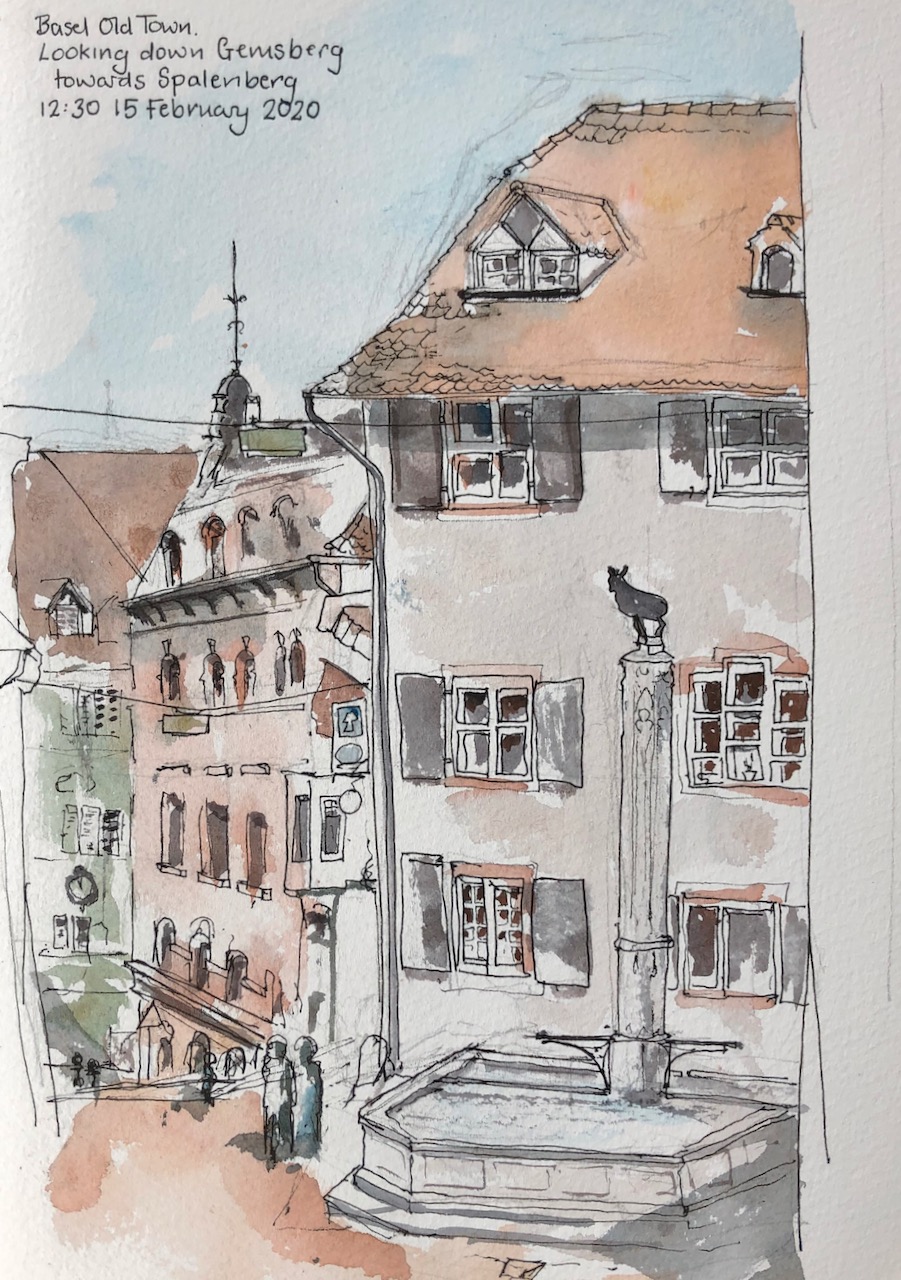
Gemsberg, Basel Old Town, 7″ x 10 ” on Fabriano Artistico paper, [sketchbook 6]
In the hour and half that it took me to draw this picture, people made use of the fountain. Someone came out of one of the adjacent houses and filled a watering can. A woman helped a child to stand on the white marble edge and then to walk cautiously on the iron bars across the water. The child dipped her hands in the flowing water and drank. She played with the water that came from the spouts. Then the woman and the child returned to their bicycles, and continued their ascent of the hill. Elderly people, climbing the hill, paused here to rest. A runner lent over the water and sluiced his face, before pacing on up the slope towards me.
This part of town is very old. Basel has the fine custom of telling you a little about each street, on the street sign. The one for Gemsberg says:
“Zum Gemsberg, 1661 erstmals erwähnter Hausname”
So this street was named after a house which stood here in 1661. [German speakers reading this: please correct me if I got that wrong!]
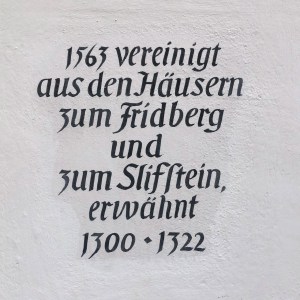
The house on the right has an inscription in magnificent script. My German-speaking consultant enables me to state with some confidence that this reads as “In 1563 [this house was created] by joining together two houses: “To the Fridberg” and “To the Slifstein”, both mentioned in 1300-1322″
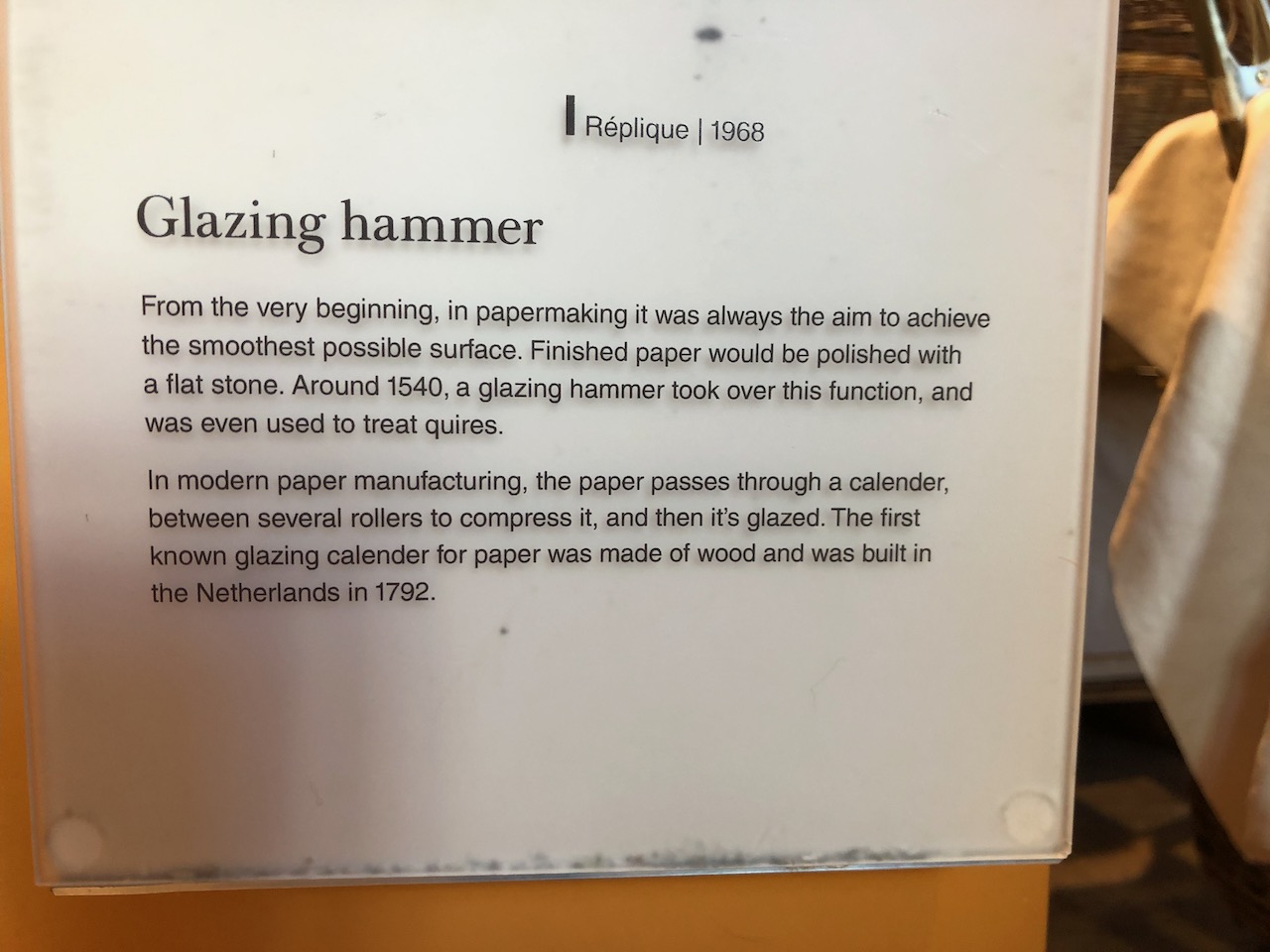
“Fridberg” might mean “Tranquil mountain” and “Slifstein” might mean polishing stone, or polished stone. Perhaps these were people’s names. I learned at the Basel Paper Mill that in those times smooth stones were used to polish paper, so may be Herr or Frau Slifstein was a paper polisher. But that’s just surmise.
Caption beneath a reproduction of a glazing hammer, Basel Paper Mill.
Here’s work in progress on the drawing.
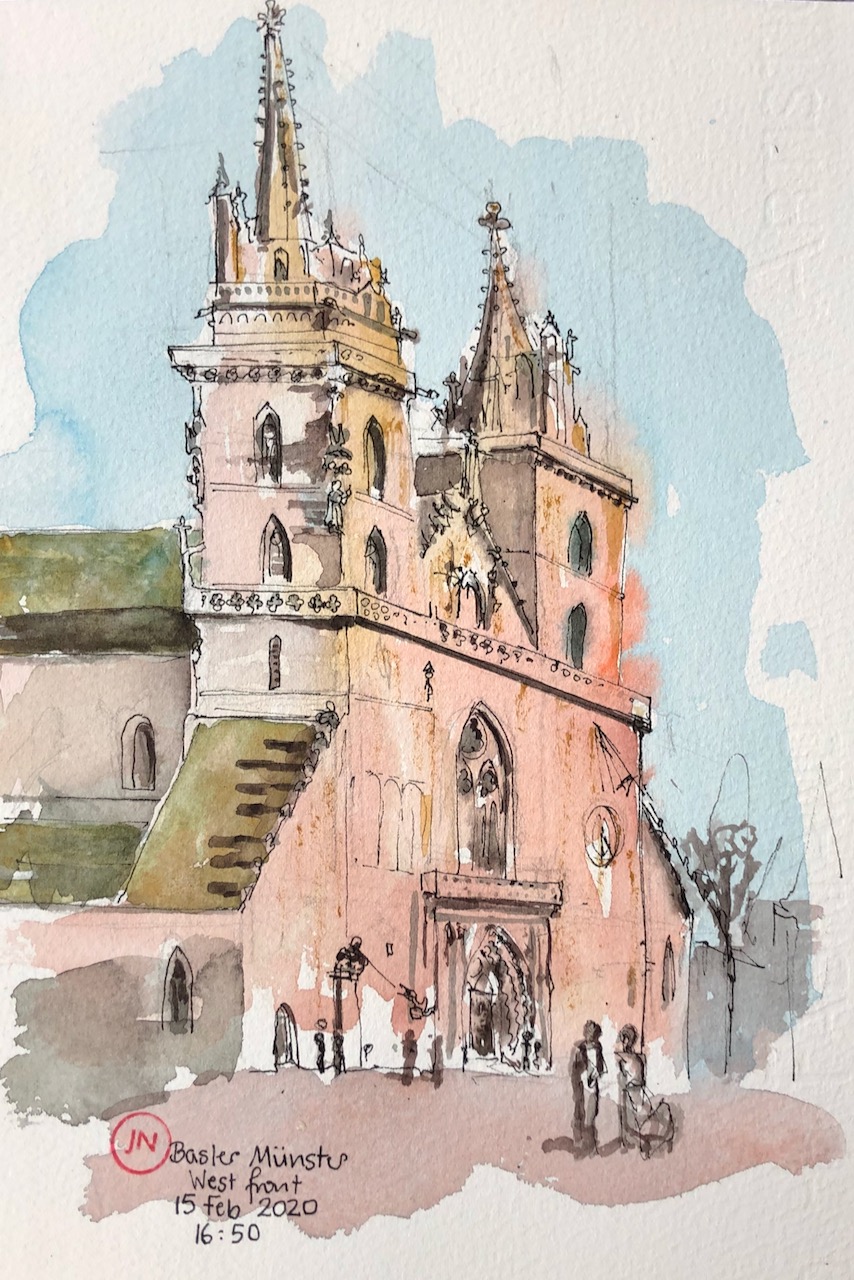
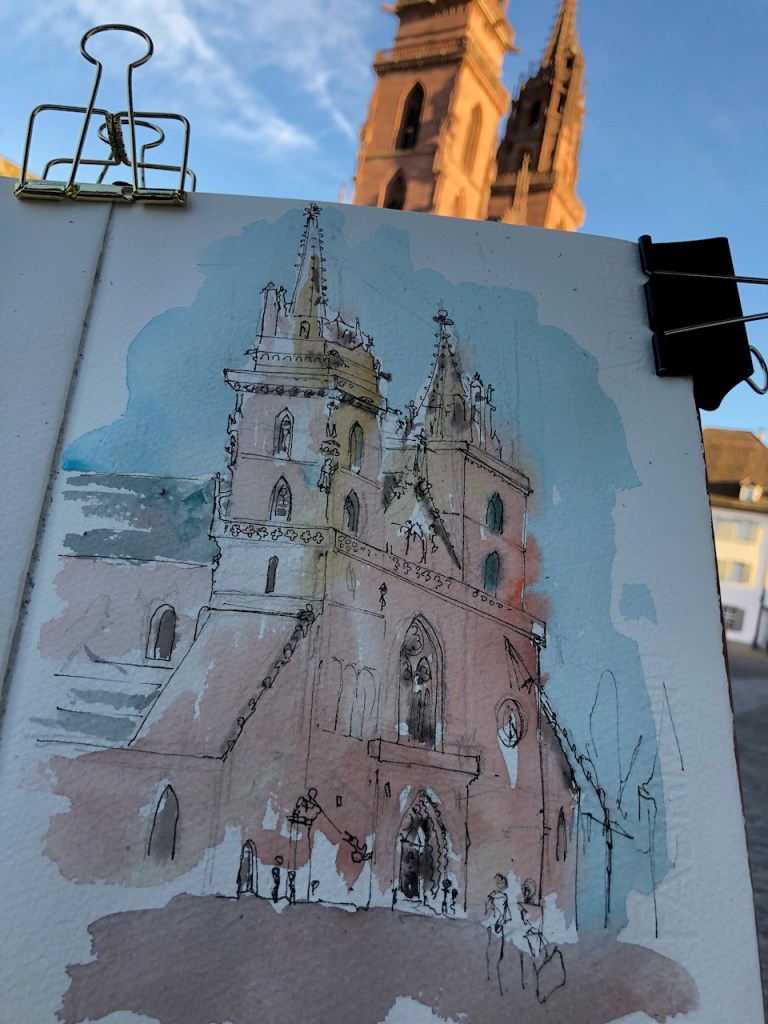
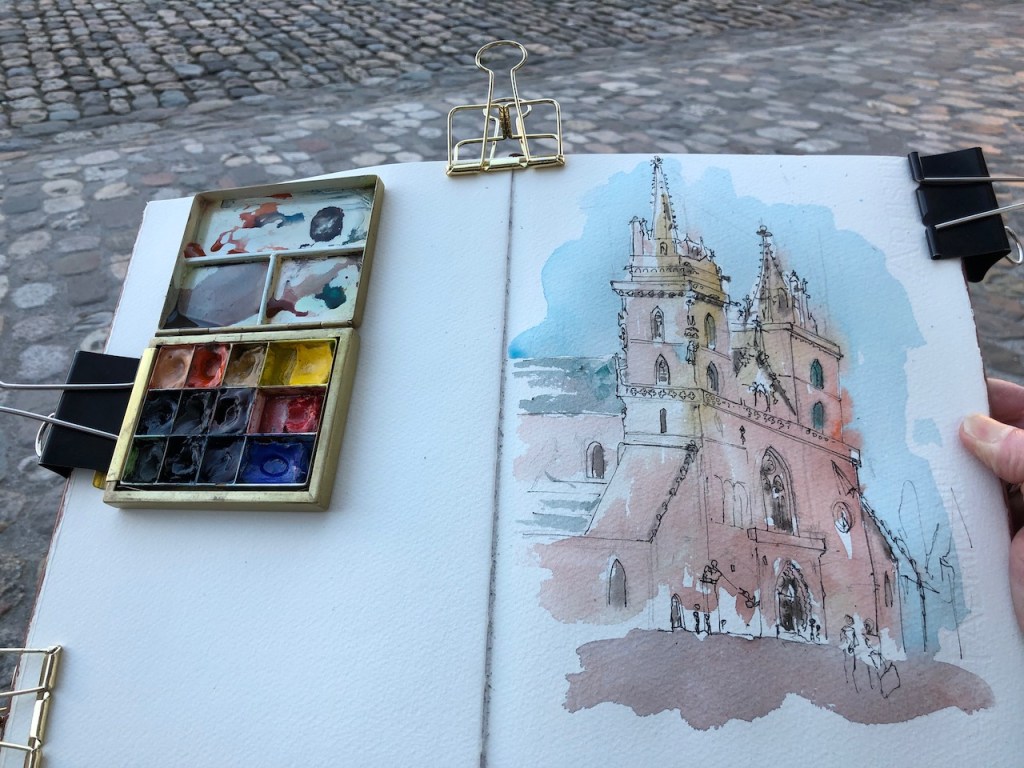
Later I tackled a tough assignment: Basel Cathedral, “Basler Münster”.
Basler Münster, West Front, 7″ x 10 ” on Fabriano Artistico paper, [sketchbook 6]
This is a magnificent medieval construction, the present building dates from about 1500. It is a real challenge for the Urban Sketcher. Each edge is decorated. Each corner hosts a saint, or often two. Every planar surface has decoration, low relief, a statue. Not content with simply a sundial, they added also a clock. And on top of all this, the two towers are by no means identical. They each support a forest of spires, some octagonal. The main spire on the right seems to have curving edges, unless that was a cunning optical illusion. Even the roof is decorated with a pleasing coloured diamond pattern in tiles. I did my best, but those medieval stonemasons got the better of me.
To the left of the door is St George and the Dragon, a very realistic statue which I had to put in. St George’s horse prances on a firm plinth. St George himself wields a real metal lance, copper or some copper-containing alloy, since it is green. The dragon, some distance away, is made to balance on a precarious shelf, endangered by the thrust of the lance. It’s a dynamic and three dimensional scene.
Here is work in progress on the drawing.
Drawing the West front of Basel Münster.
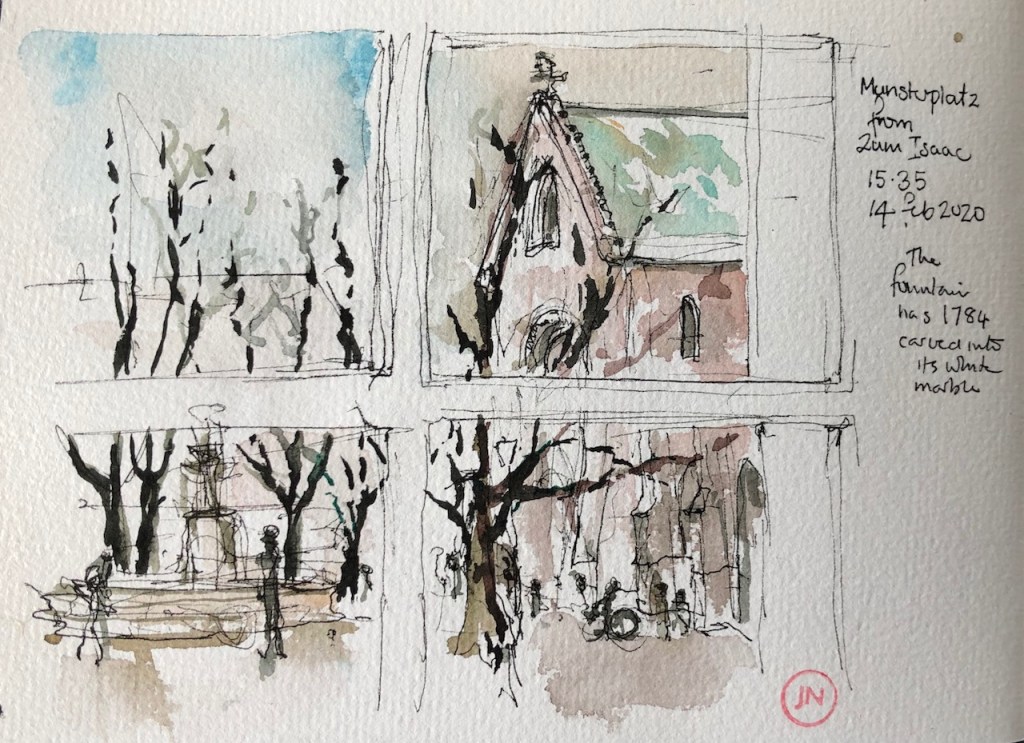
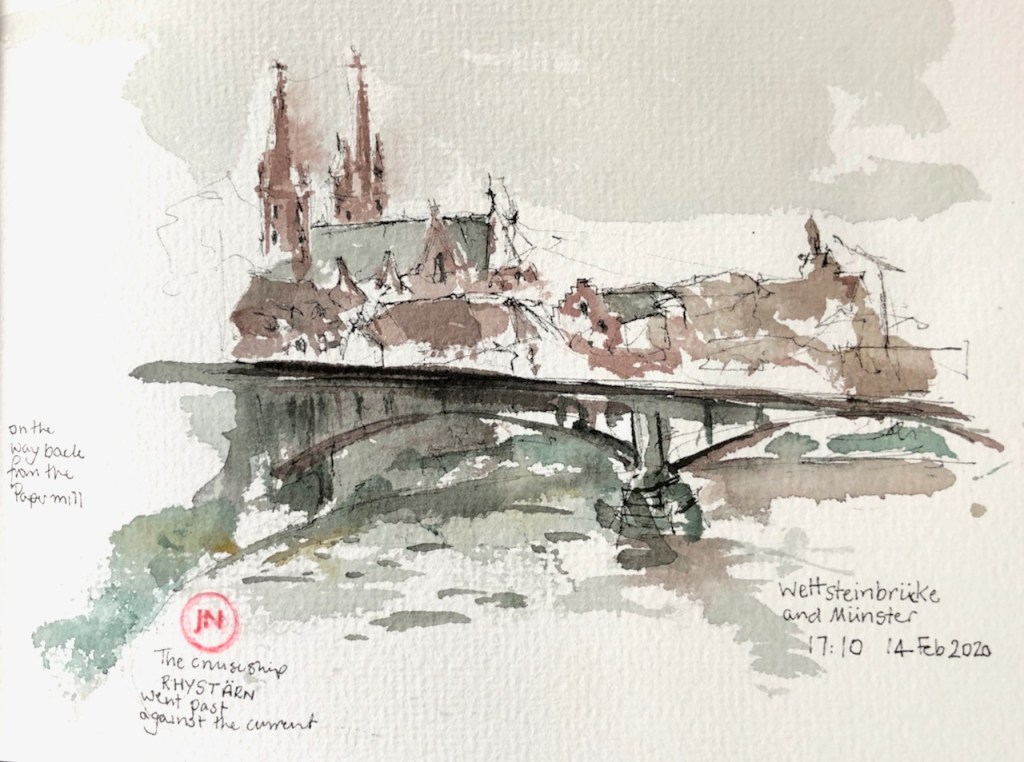
I made more sketches around the city:
Münsterplatz from ‘Zum Isaac’
Basler Münster and the Wettsteinbrücke
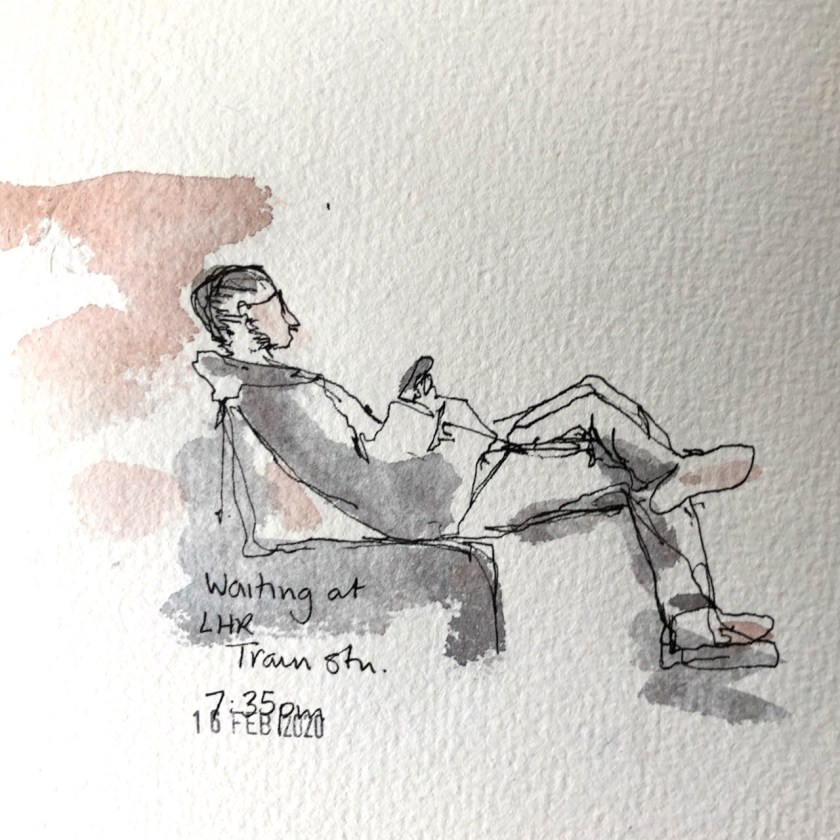
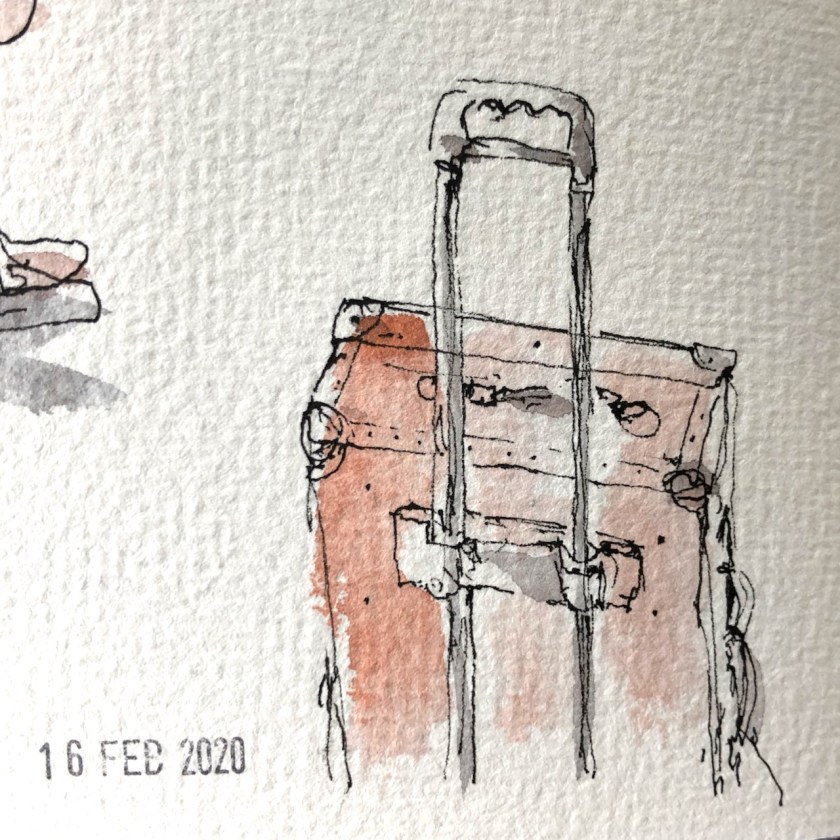
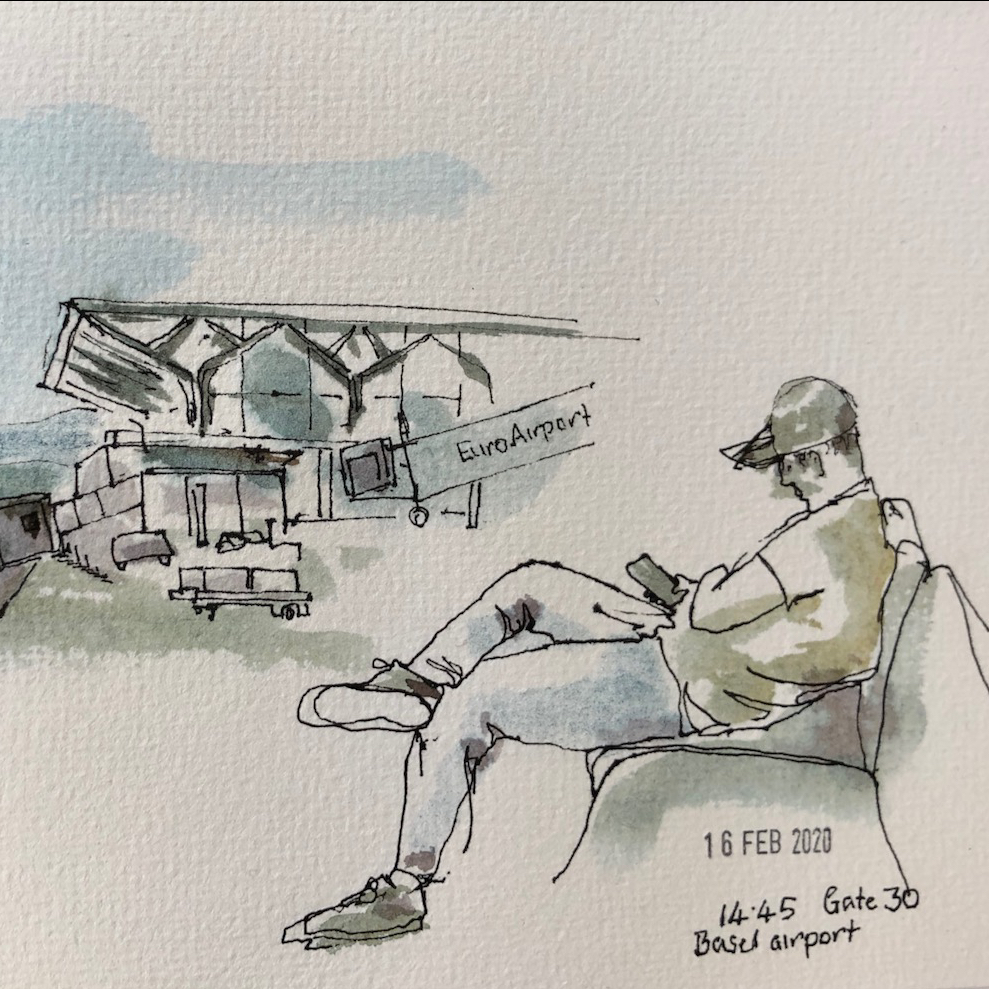
On the long journey home, I sketched the people, and my luggage.
Click a button below to share this post online, email it, or print it: