Le Thoronet Abbey, Var, Provence, 83340 France

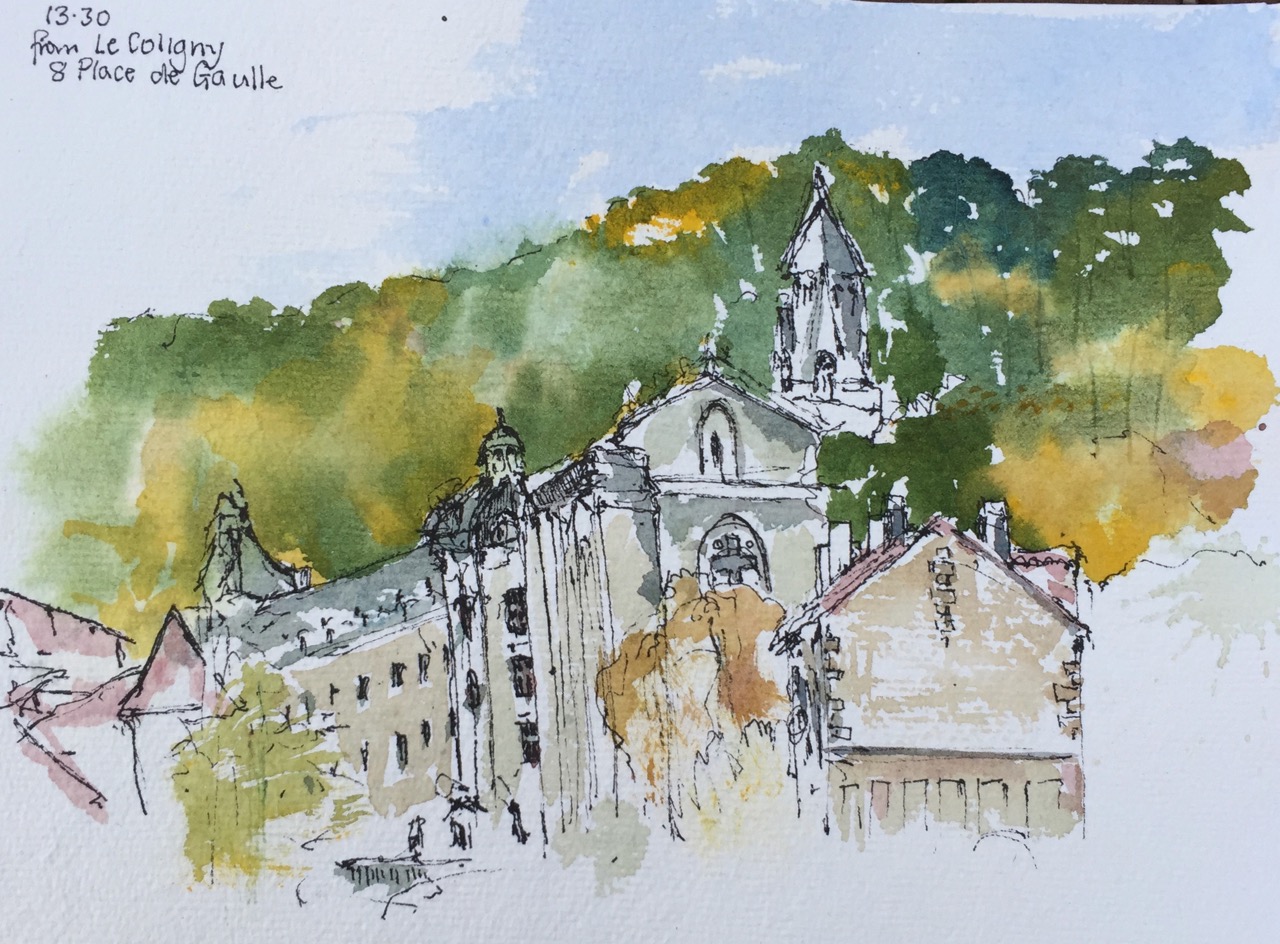
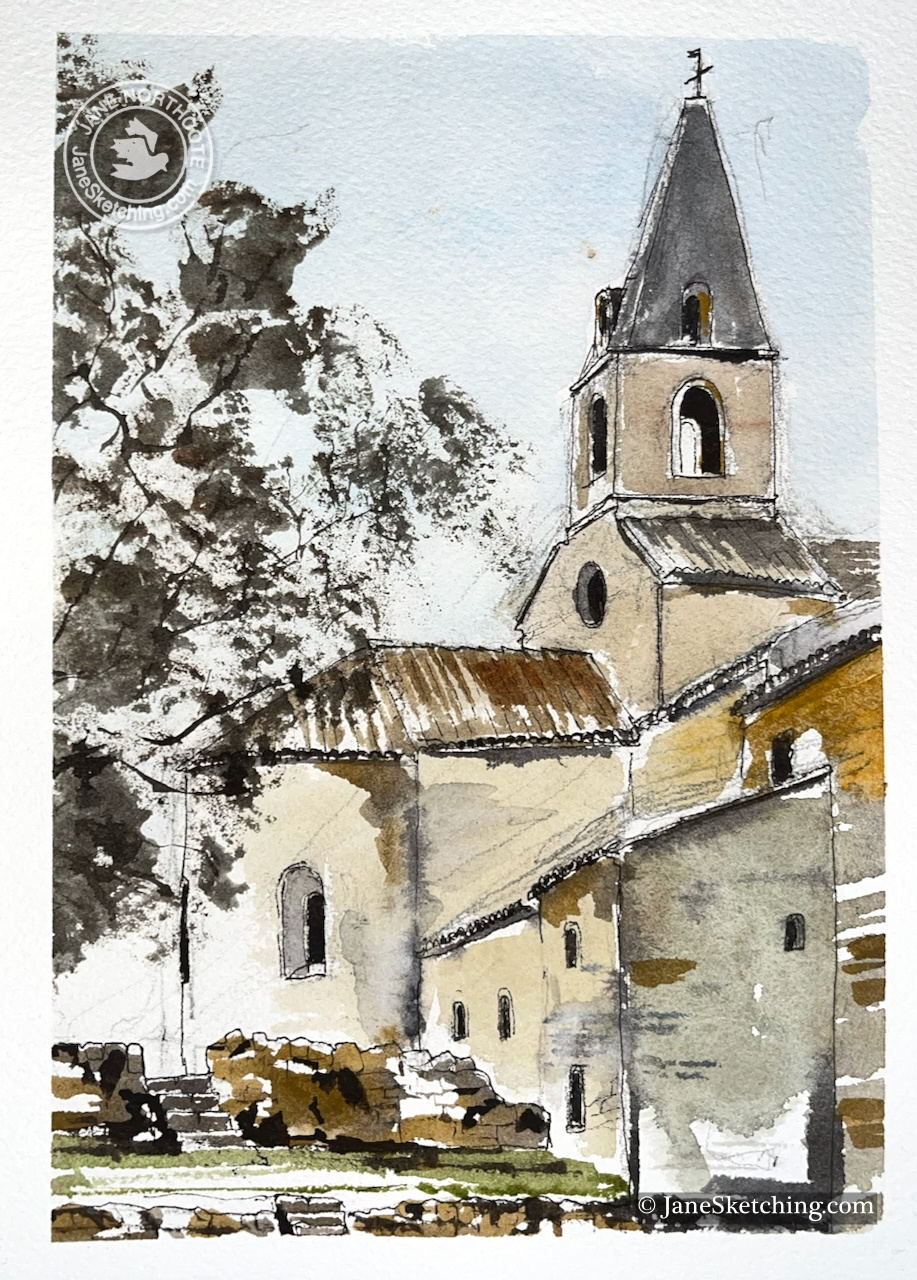
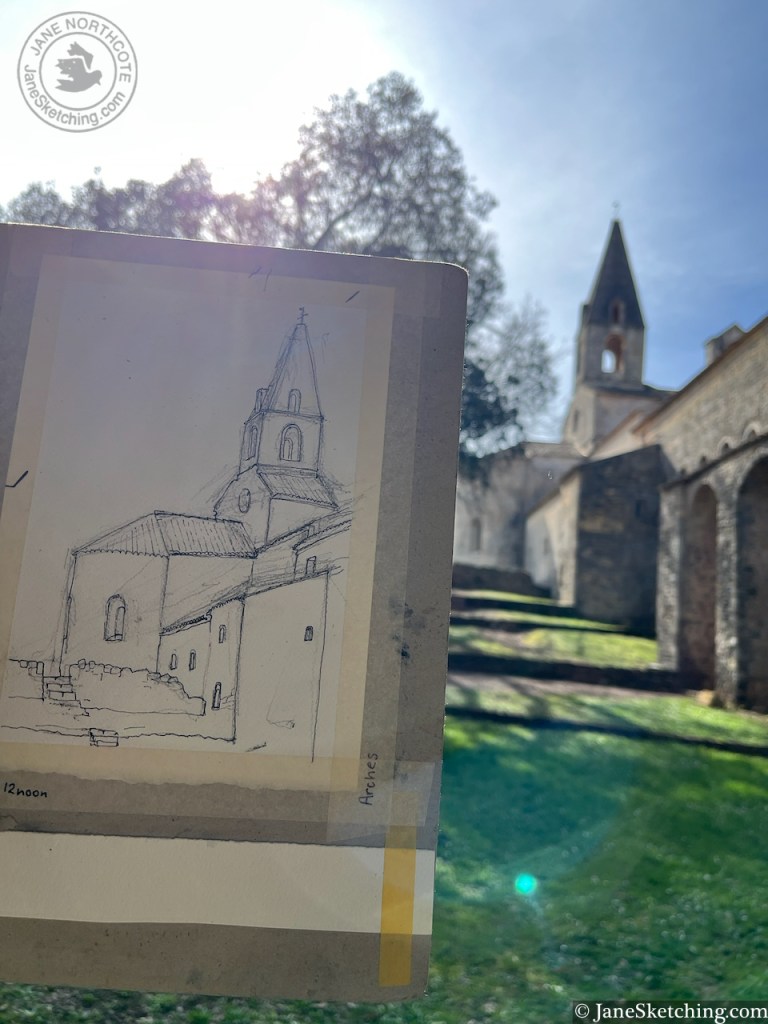
On a perfect day in Provence, I leaned against a wall and sketched a view of Le Thoronet.
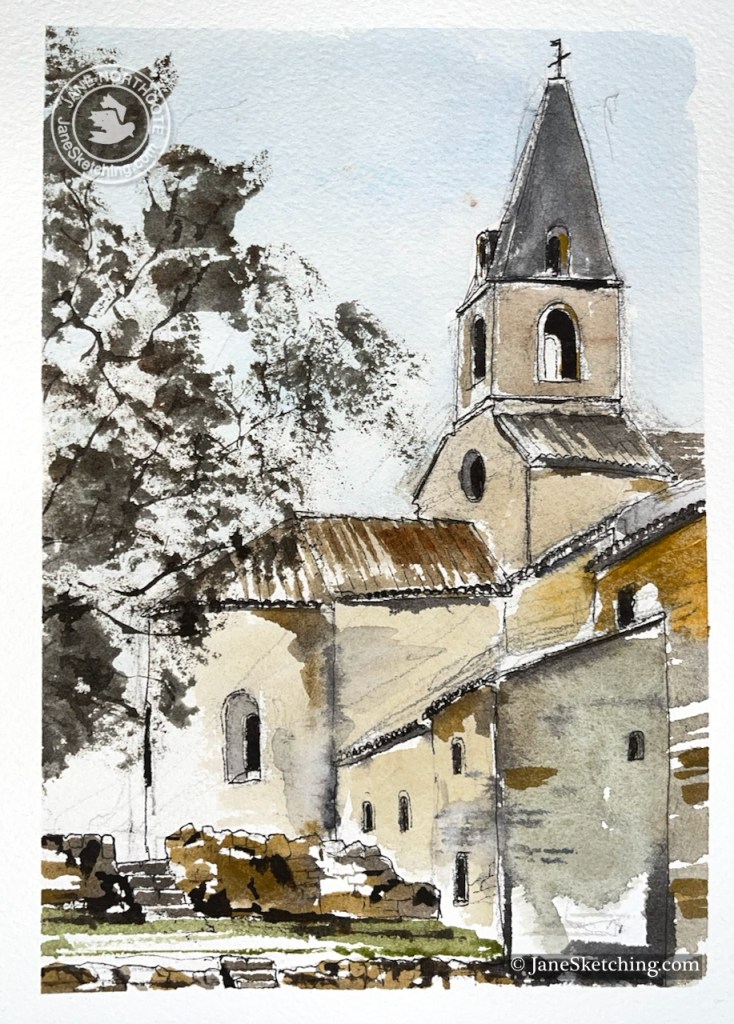
Le Thoronet Abbey, Var, Provence, 83340 France sketched 15th February 2026 on Arches 300gsm watercolour paper, size A5

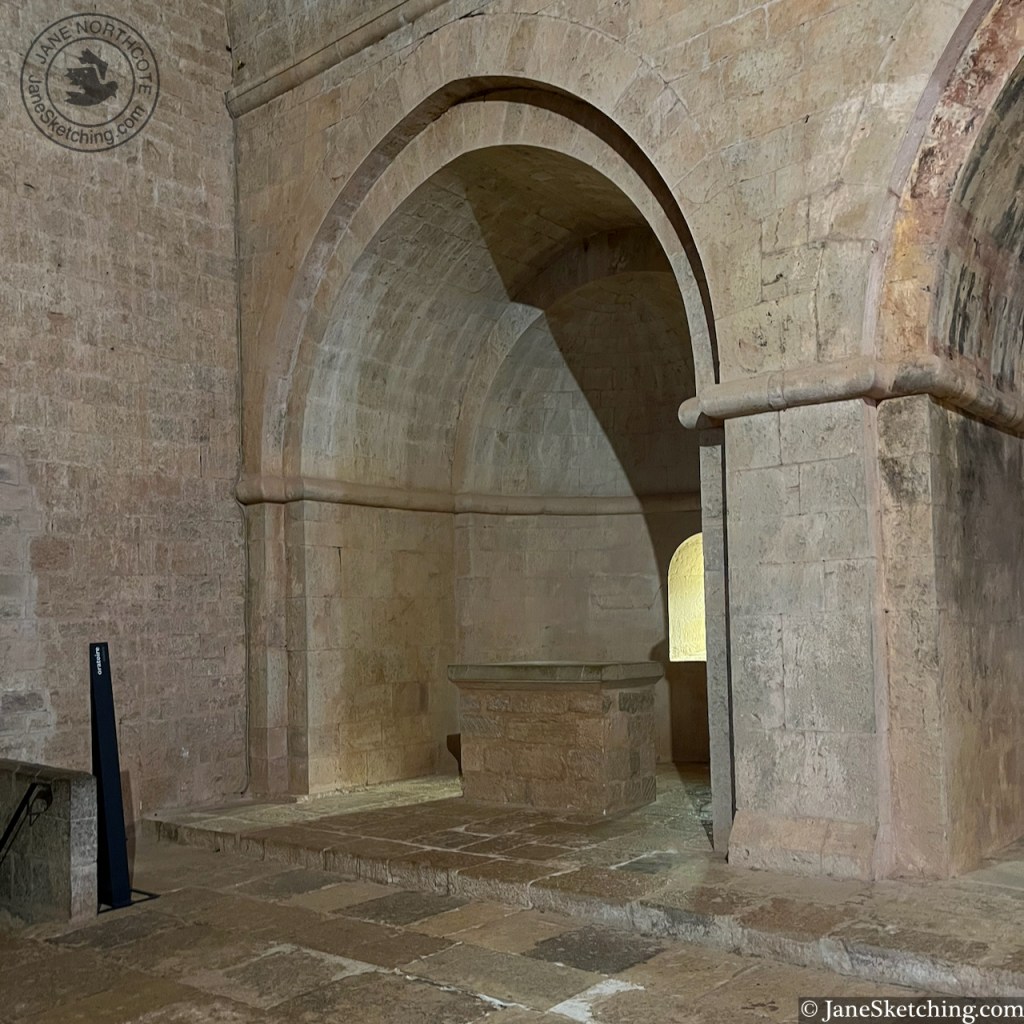
I loved this place because of its mathematical precision. As I sketched, I noticed that the tower is an isosceles triangle on top of a square. The windows are semicircles on top of rectangles. Some of the windows are circular.

The whole building has similar satisfying geometry.
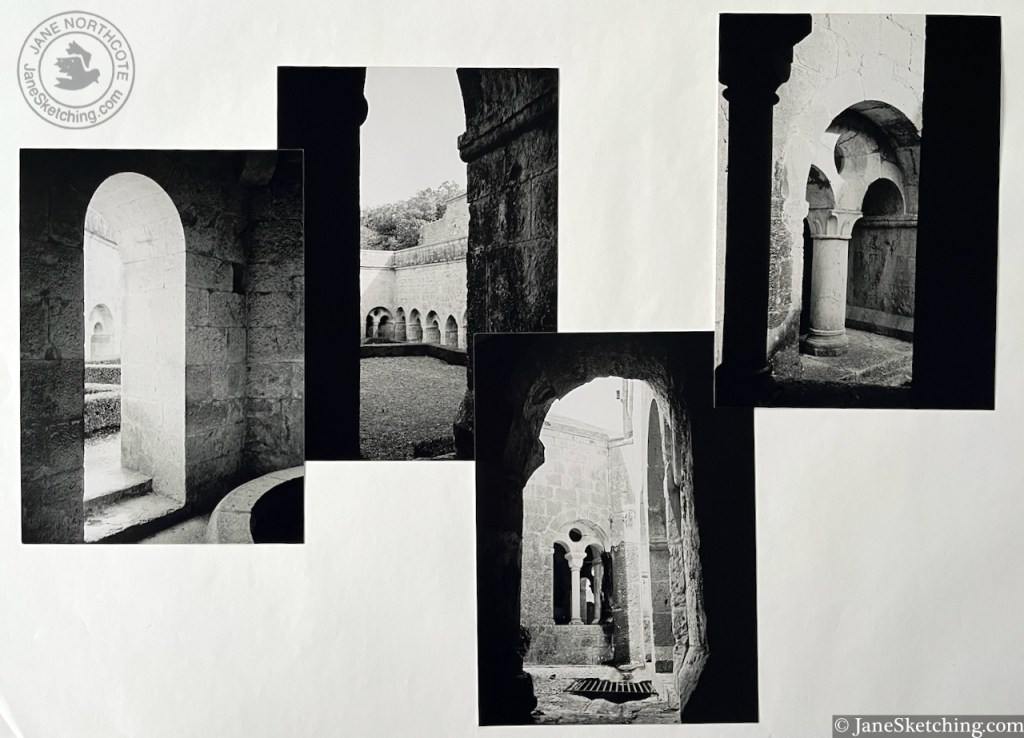
Le Thoronet Abbey, 7×5 photographs on Ilford XP2 film with an Olympus XA2 point-and-shoot camera, film developed by filmprocessing.co.uk. Film reference 201.

This is a Cistercian abbey, founded in 1136. It was built between 1160 and 1230. “restoration work began in 1841 and continues today” says the leaflet. The building is now State-owned. While we were there, a service was taking place in its austere geometric chapel.

Le Corbusier visited the Abbey in 1953.

He wrote of the Abbey of Le Thoronet: ” Light and shadow are the loudspeakers of this architecture of truth, calm and strength “.

Quoted on the Abbey website on this link
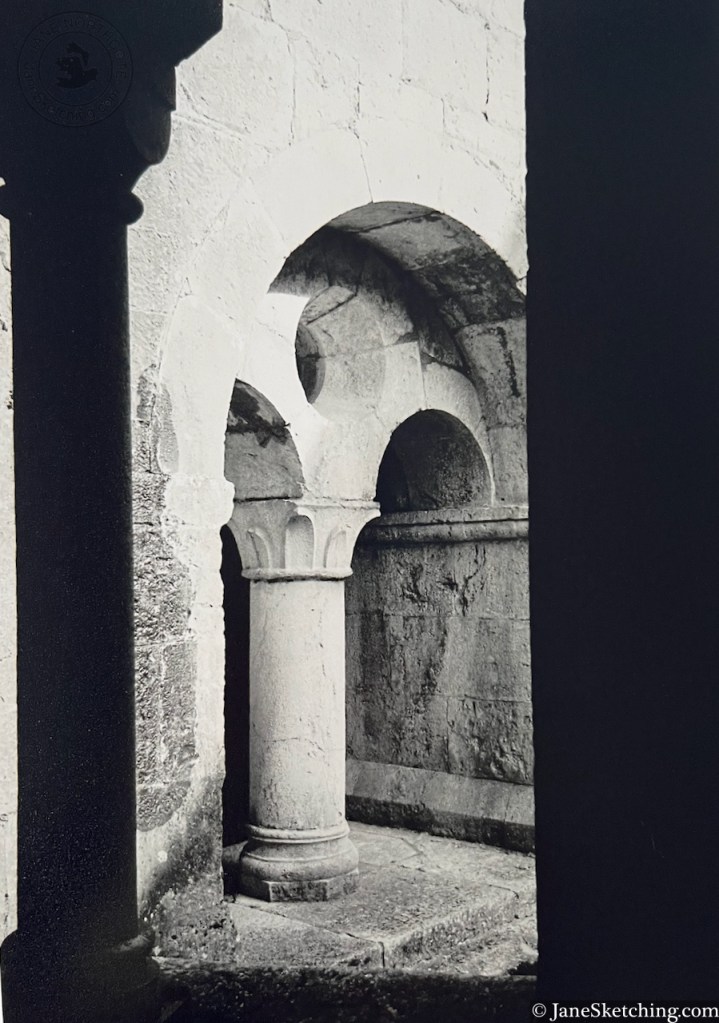
Le Thoronet Abbey, photograph on Ilford XP2 film with an Olympus XA2 point-and-shoot camera, film developed by filmprocessing.co.uk. Film reference 201.

References and links:

Novel, by Fernand Pouillon (1912-1986), about the building of the Abbey, and the struggles faced by the construction workers: “Les Pierres Sauvages” (1960)

An article in the Journal “Drawing Matter” about the drawings of Fernand Pouillon: https://drawingmatter.org/fernand-pouillons-survey-of-the-abbey-of-le-thoronet/

Reference to Le Corbusier’s visit in 1953 from the website of the Abbey shop: https://www.boutiquedupatrimoine.fr/en/content/58-abbaye-du-thoronet.html

Click below to download a scan of the leaflet from the Abbey.

Sketching at Le Thoronet Abbey
A glimpse of the unadorned interior. Digital photograph.

Périgord, France – Sept 2018

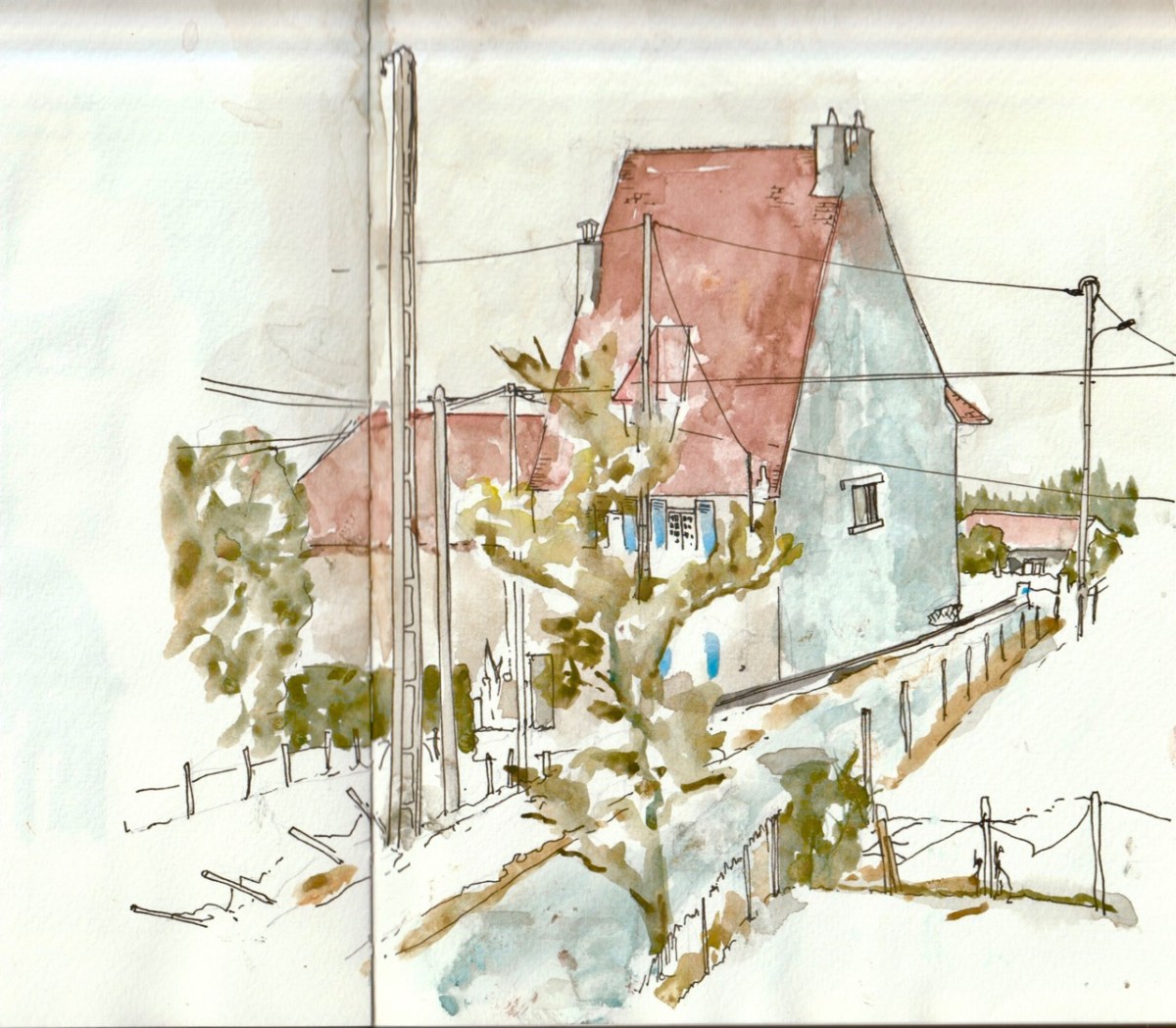
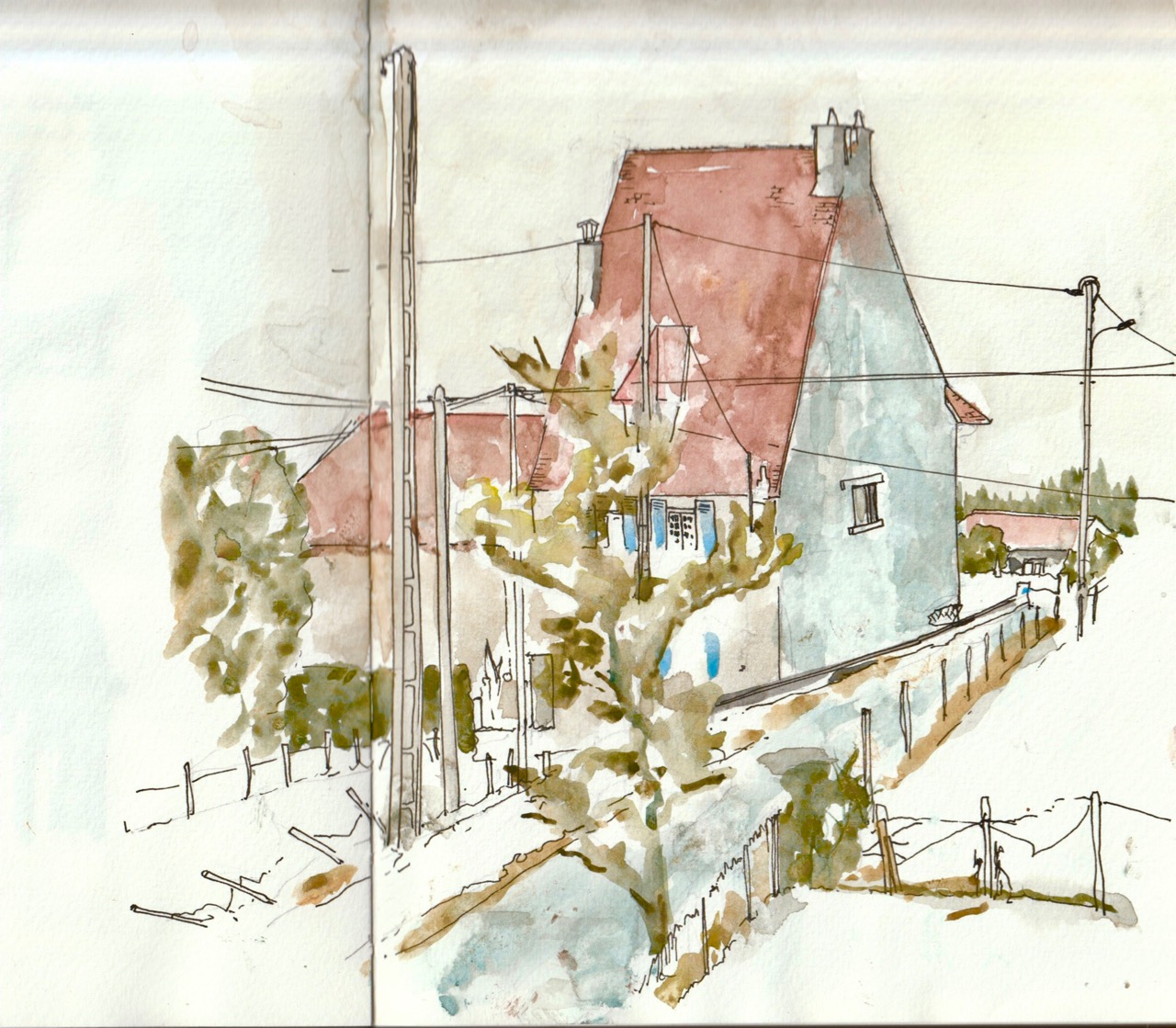
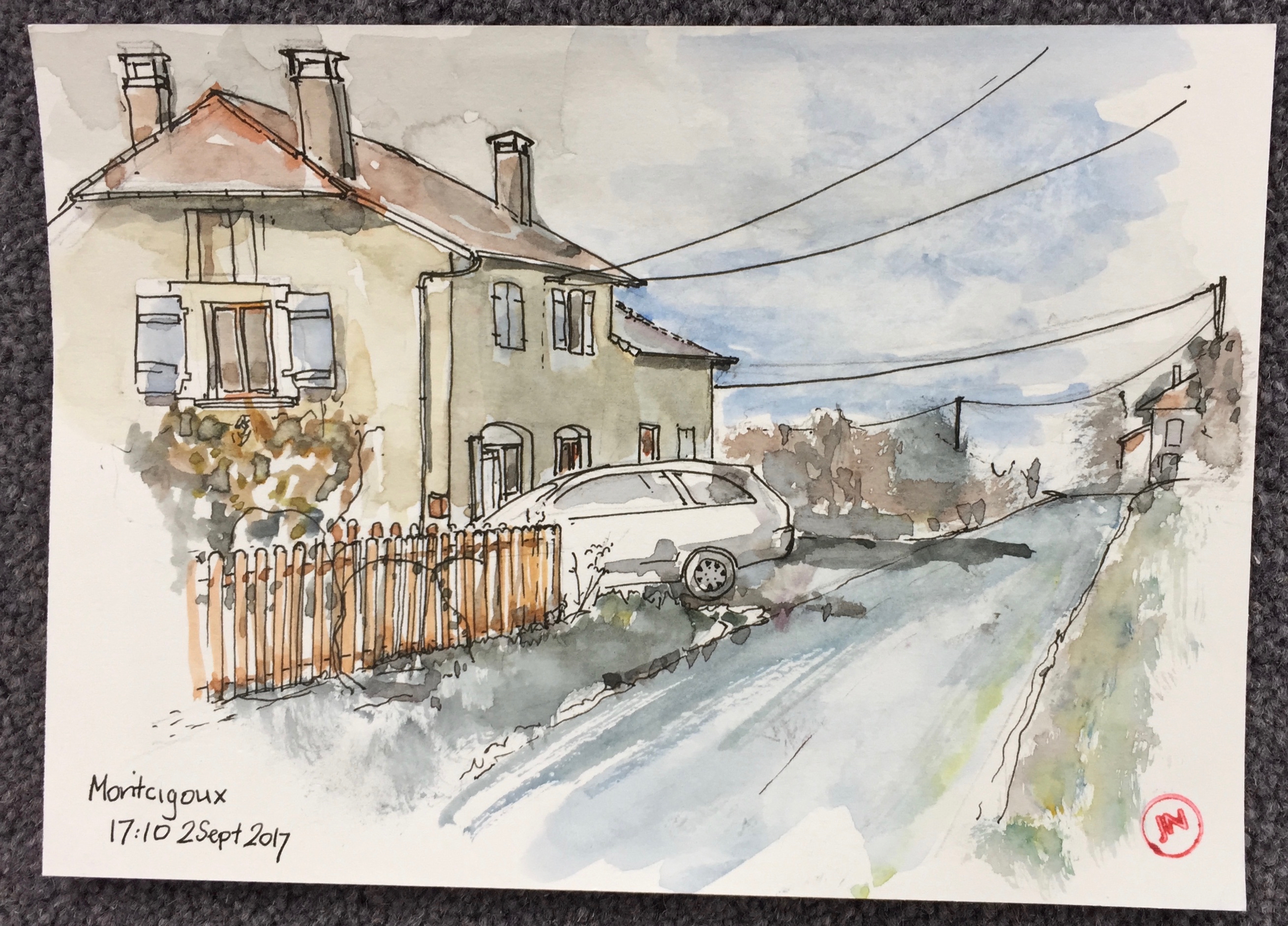
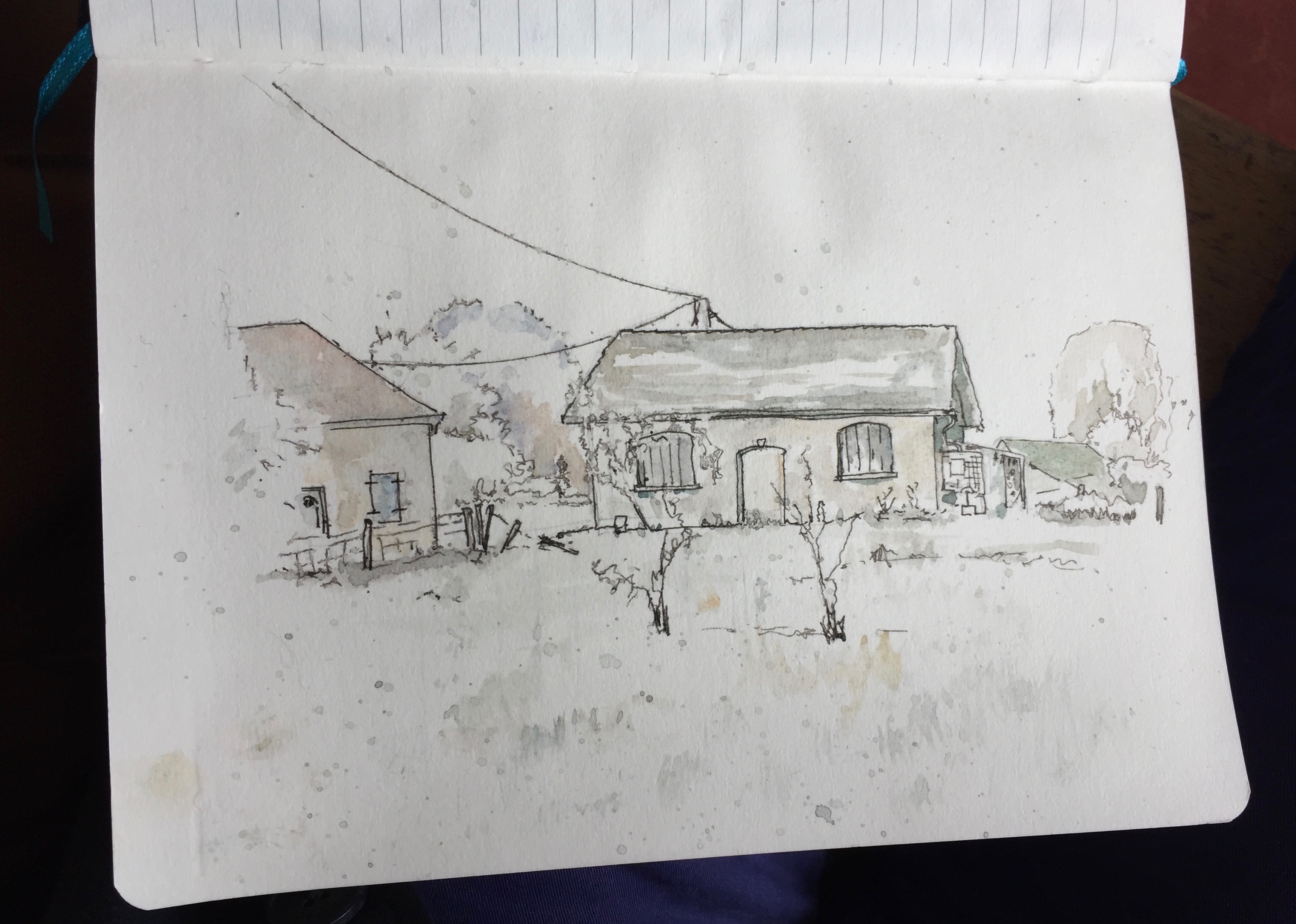
The village of Montcigoux has a house with a long roof.

Scan 5

Note also the extraordinary number of electricity cables. The plan is to put them underground. This was in progress. But so far not on this side of the village.

IMG_0297

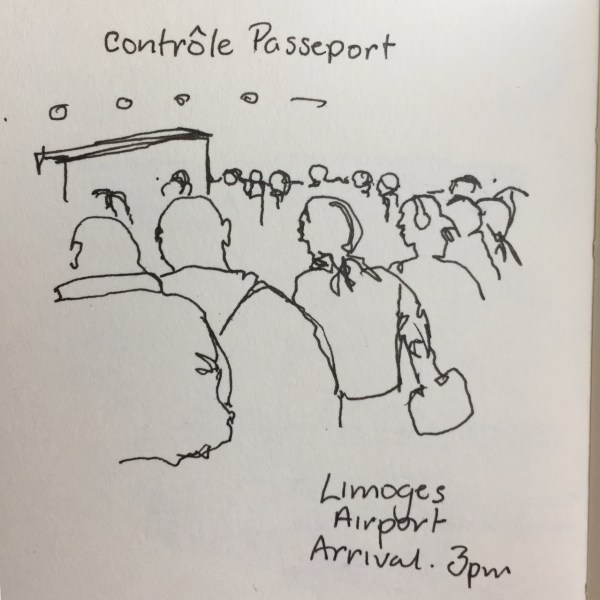
The queue at Limoges airport Passport Controle took 1 hour. There were only two officials and a huge number of people on the aircraft.

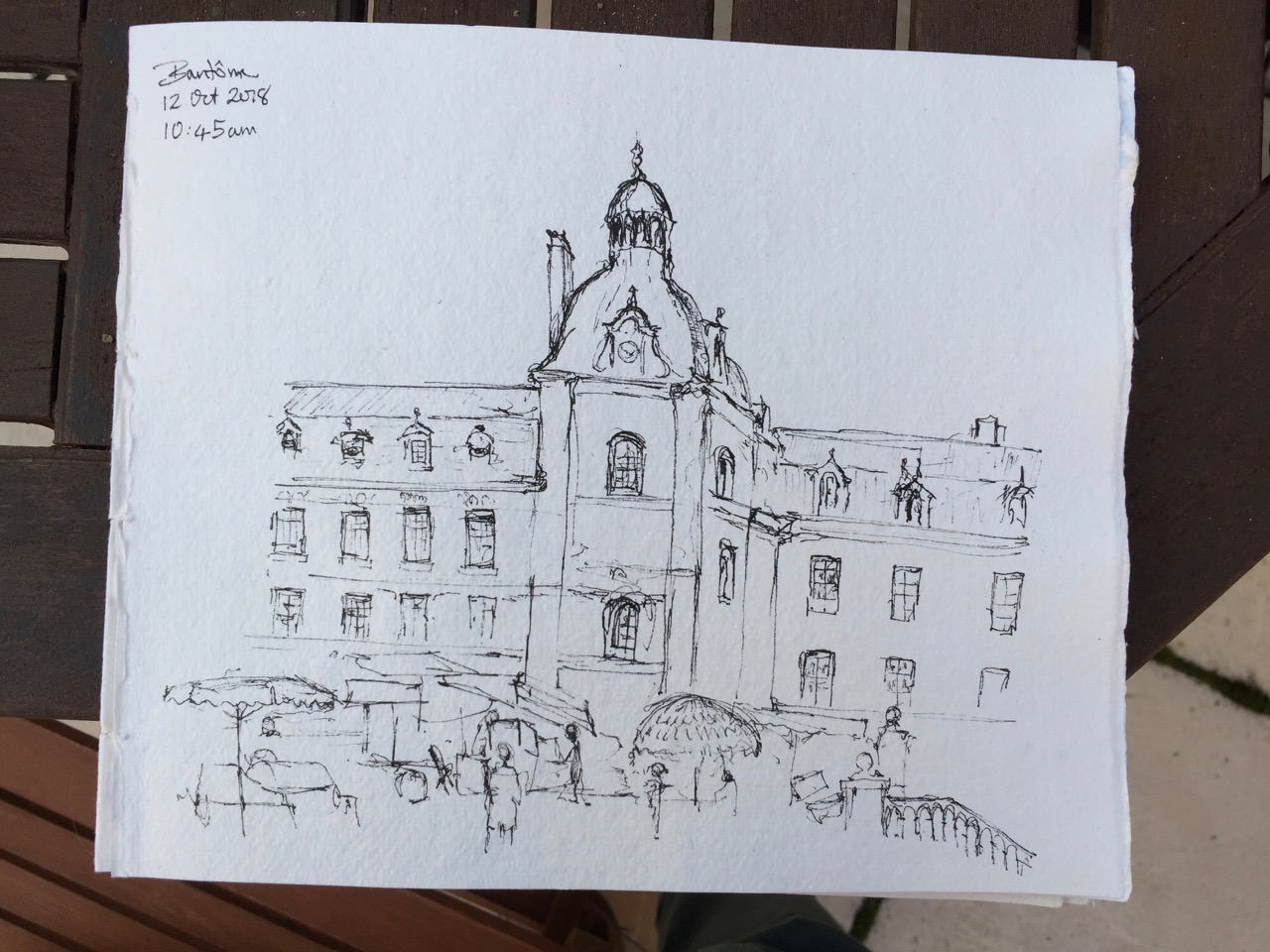
We went to Brantôme, a town on the River Dronne. It’s on an island in the river. There’s a food market on Fridays. At the cafe I sketched the Abbey.

IMG_0288

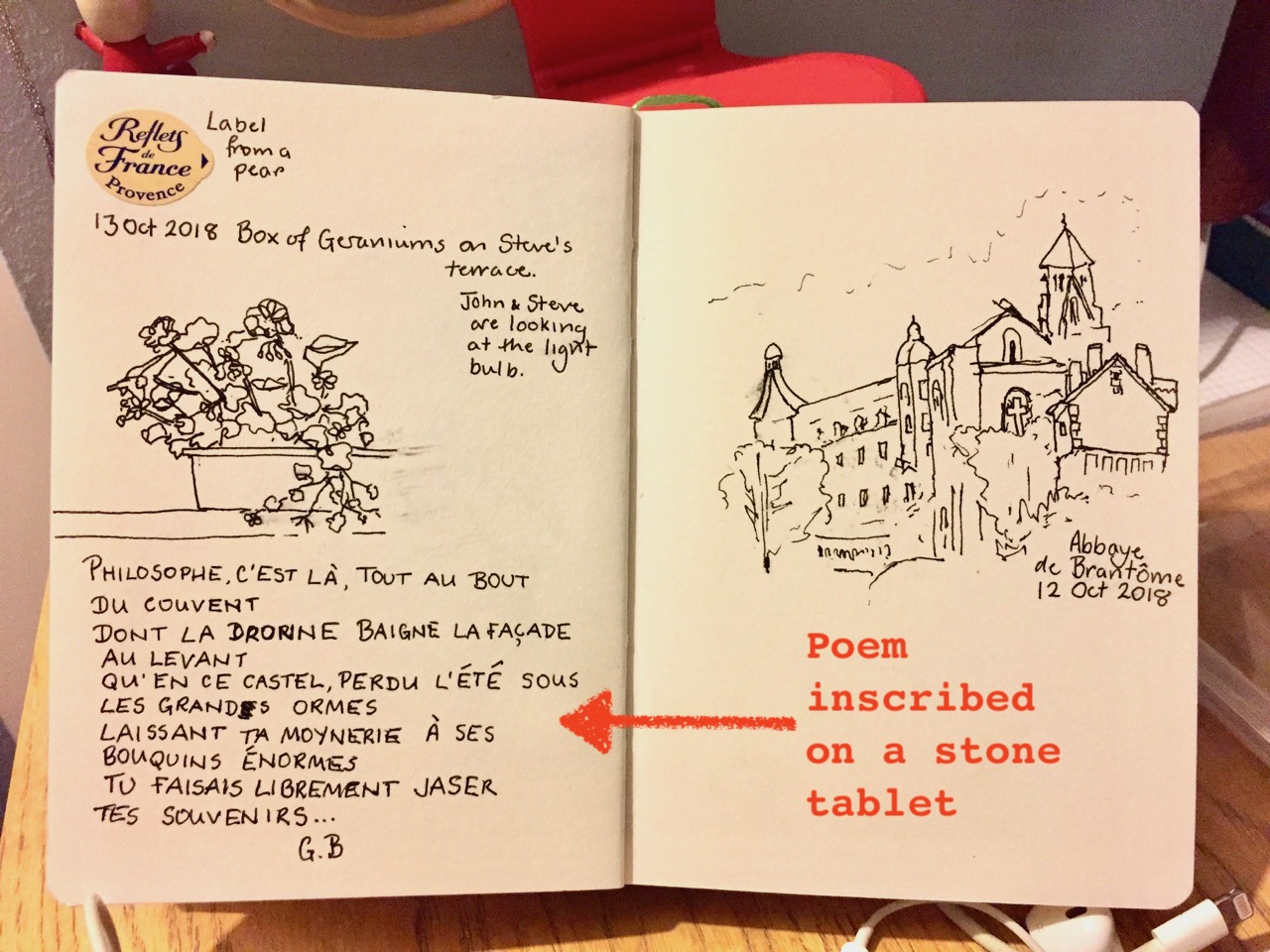
We walked by the river and found a poem on a stone tablet. I wrote it in my notebook.

IMG_0307

With the help of friends, I am still puzzling out what the poem says. Here’s the latest attempt:

Philosopher, it is there, right at the end of the convent
Whose façade is washed by the River Dronne in flood
That in this enclave, having spent the summer under the majestic elm trees
While leaving your monastic cell to its gigantic books
You would be in free dialogue with your memories.

All suggestions, improvements and interpretations welcome. The verb “jaser” seems to mean “gossip”, but perhaps “faire jaser” has a different meaning. Any ideas? I also assumed that the “G.B.” was the writer “Brantôme”. Georges Brantôme I guessed. But no, the writer Brantôme is Pierre. Here’s what Wikipedia says:

Pierre de Bourdeille, seigneur de Brantôme (c. 1540 – 15 July 1614), also known as the abbé de Brantôme, was a French historian, soldier and biographer.

I rather get the impression from his Wikipedia entry that the abbé de Brantôme was more of a chronicler than a poet. So who is “G.B.”? I definitely need to go back to Brantôme to have a closer look at that stone plaque. And to buy more of that cheese with nettles in, made by a Dutchman who has settled in France, and sold to us by his son.

“Is it French cheese?” I asked.

“Well,” he said, in the manner of someone embarking on a long explanation, “the milk is from French cows, and it was made in France….”. But, evidently, it was made by his father, a Dutch man, using a Dutch process. So is the cheese French? Is that even a useful question?

Here’s a view of the abbey from the restaurant where we had lunch:

IMG_0289

I sketched in Périgord last year. See this link:  Montcigoux

One of my pictures is now on the wall of the house it depicts.

IMG_0261
Original Watercolour framed

Montcigoux

IMG_1242

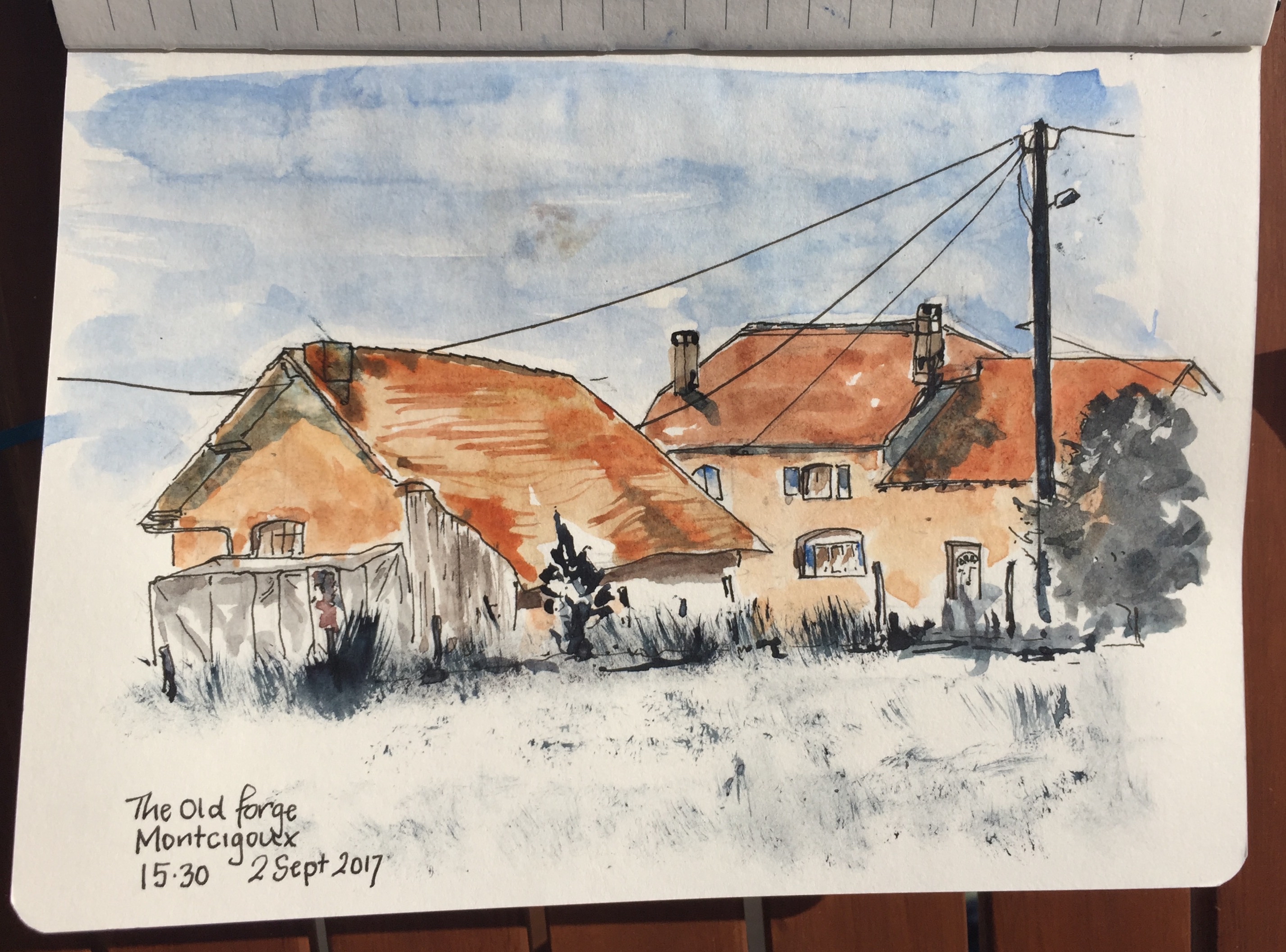
The red tiled roofs are a characteristic of the area. The low roof of the Old Forge is rickety. Mme Sauté cultivates tomatoes in the plastic greenhouse on the left.

Here is Steve’s house. His Audi is parked conspicuously, because he is expecting a visitor, and he told them to look out for the car.

IMG_1271

See all the overhead cables. There is a plan to put all these underground: both the electricity and the telephone cables.

On the Sunday I set out to draw a picture of the Old Forge from another angle. An elderly man trundled his walking frame all across the grass to come and talk to me. He described how Steve’s house had previously been the grocer, café and ballroom. There were dances there. The man had a long career. He was the son of the gardener in the château. He had installed electricity in the local town, Limoges. There was a whole narrative about the maquis,  which word I couldn’t understand in context. I knew it was a description of the land in the South of France: the dried out grass and low bushes. Then, as he was talking, I remembered it was also the word for a fighting force. He had fought all the way up to La Rochelle. This was Resistance fighters in the Second World War.

I had managed only the pencil outline of my picture.

I finished it on the Monday. By then it was raining.

IMG_1267

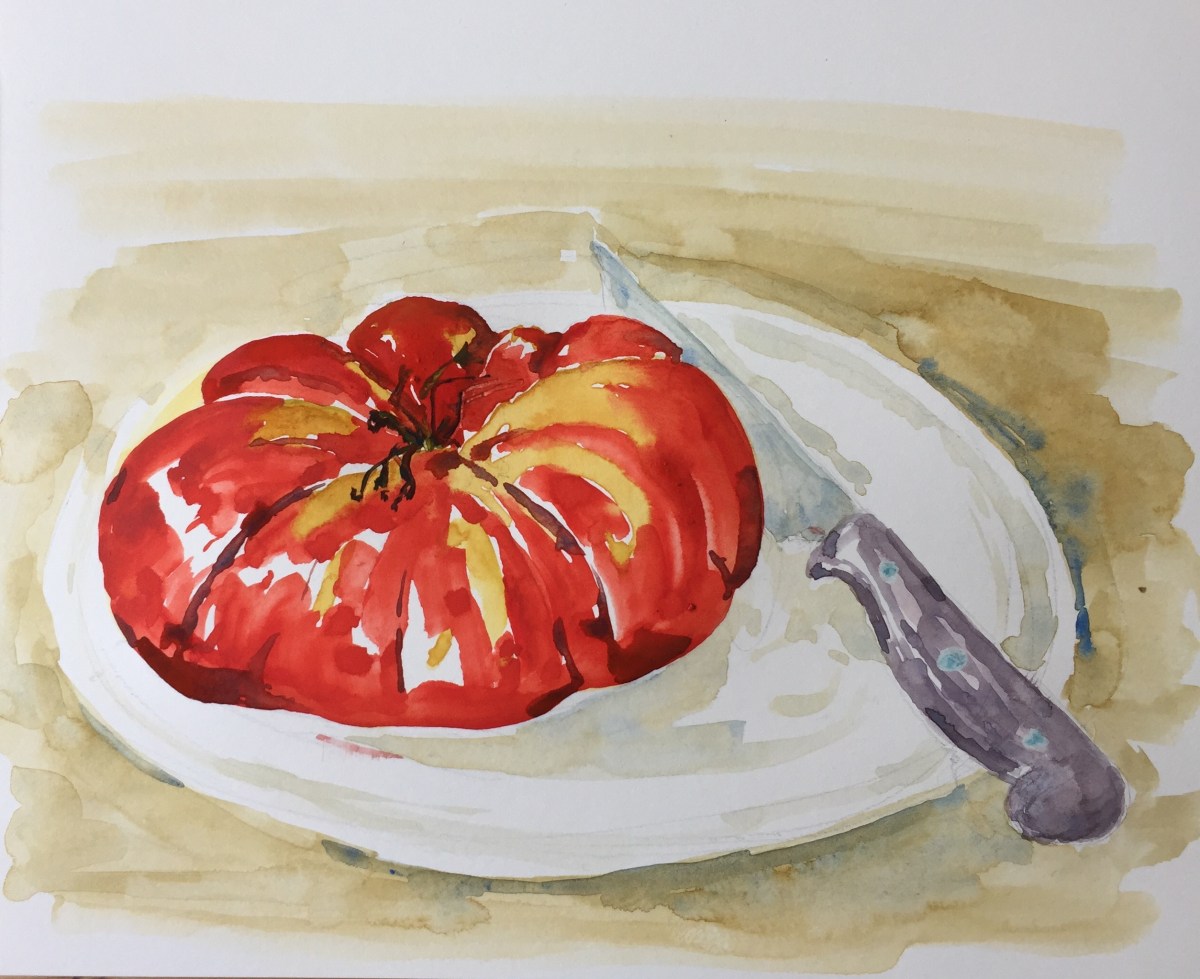
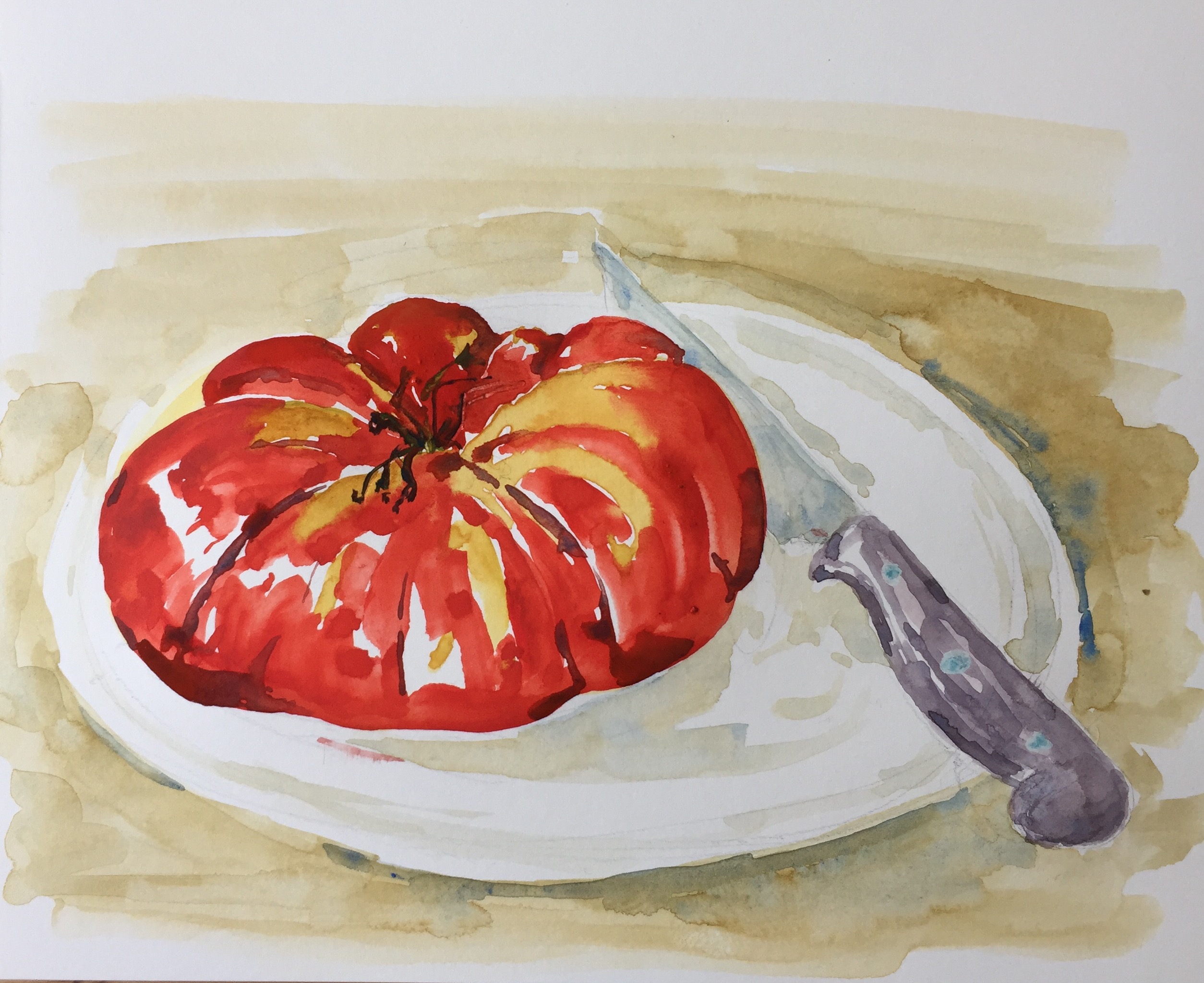
When I got home I painted one of the tomatoes Mme Sauté had given me.


Tomato from Montcigoux

fullsizeoutput_18ae

I had to sketch it before we ate it.

This tomato was cultivated by Madame Sauté of Montcigoux, in the commune of Saint-Pierre-de-Frugie in Dordogne, France.

Watercolour on Fabriano Studio Watercolour 300gsm Hot press paper. 8″x10″. About 30minutes.

IMG_1276