A very cold and blustery day.
Drawn from Ironmonger Passage, beside St Luke’s Gardens. My watercolour bag blew onto the ground, and the street sweeper, speaking Polish into his mobile phone, swept it up amongst the leaves. I raced after him to retrieve it, and he was very polite and apologetic.
“Gambier House was constructed in 1968 and is a 20 storey tower block, comprising 115 flats. The block is located on a triangular site between Mora Street and Lever Street. A small park is immediately adjacent to the south whilst surrounding properties, of between two and seven storeys, are in both commercial and residential uses. “
Gambier House was subject of a Planning Application in 2014, to install cladding. The above is an extract from this Planning Application. Here is a link to the document:
Last Thursday I made more prints for my “Towers” project.
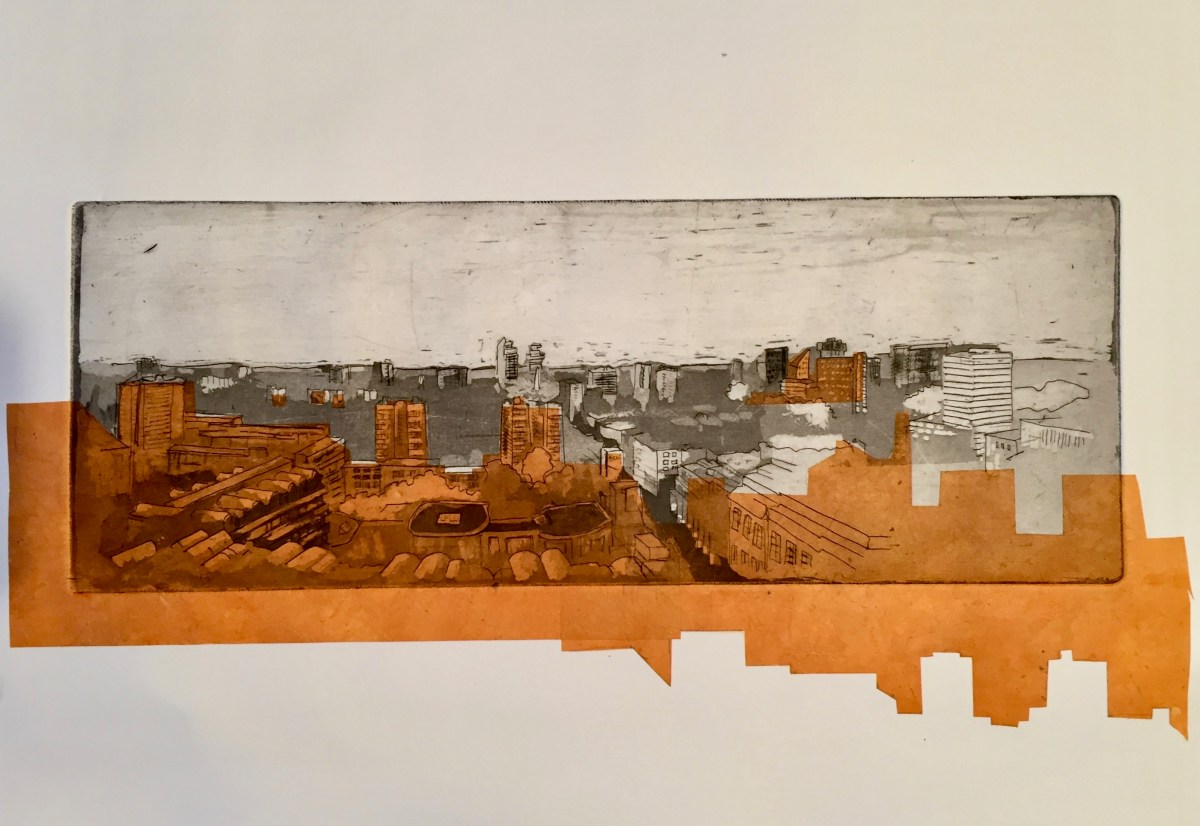
I improved a plate I made last September, “Skyline”, using a dry point tool, and a marvellous rolling tool called a roulette. The idea was to add more detail.
The drypoint tool, above, and the roulette, below.
I used chine collé to make a yellow shape. Chine collé is paper. It is put on the inked plate, glue side up, which as you can imagine is quite tricky. Then I carry the whole lot to the press, trying not to let the sticky yellow bits float away. The print paper goes on top, then tracing paper to protect the blankets, then the blanket which the press needs, and then I roll it through the press.
Here’s the result:
Skyline, Chine collé, 4th January 2018
This is the view out of my window. When I look out, I can see shadow of my building and other buildings. The yellow outline reminds me of this effect, and of all the other buildings whose metaphorical shadow is here: the buildings demolished or bombed down, and the buildings to come.
I also made Chine collé prints of Towers East and Towers West.
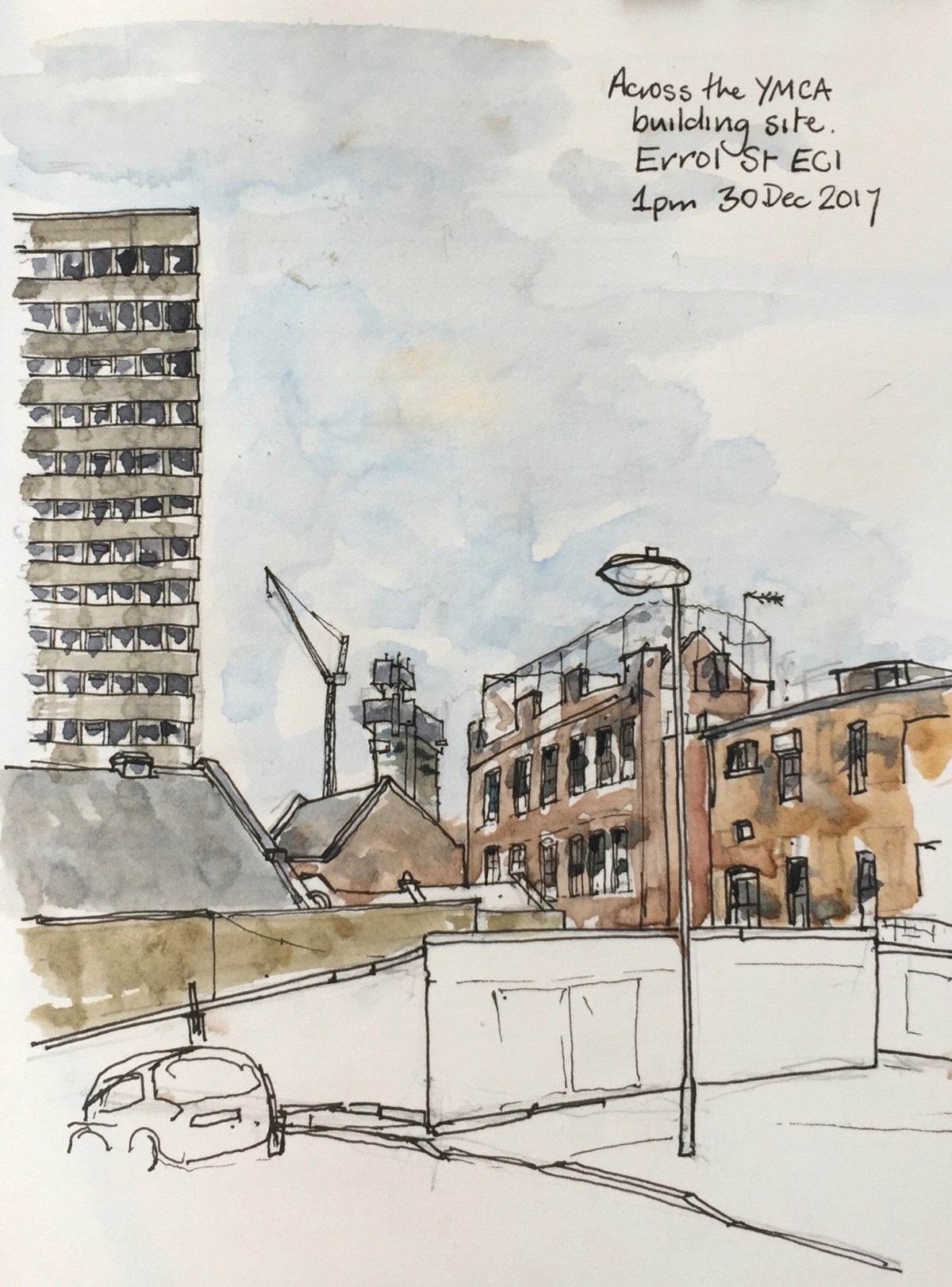
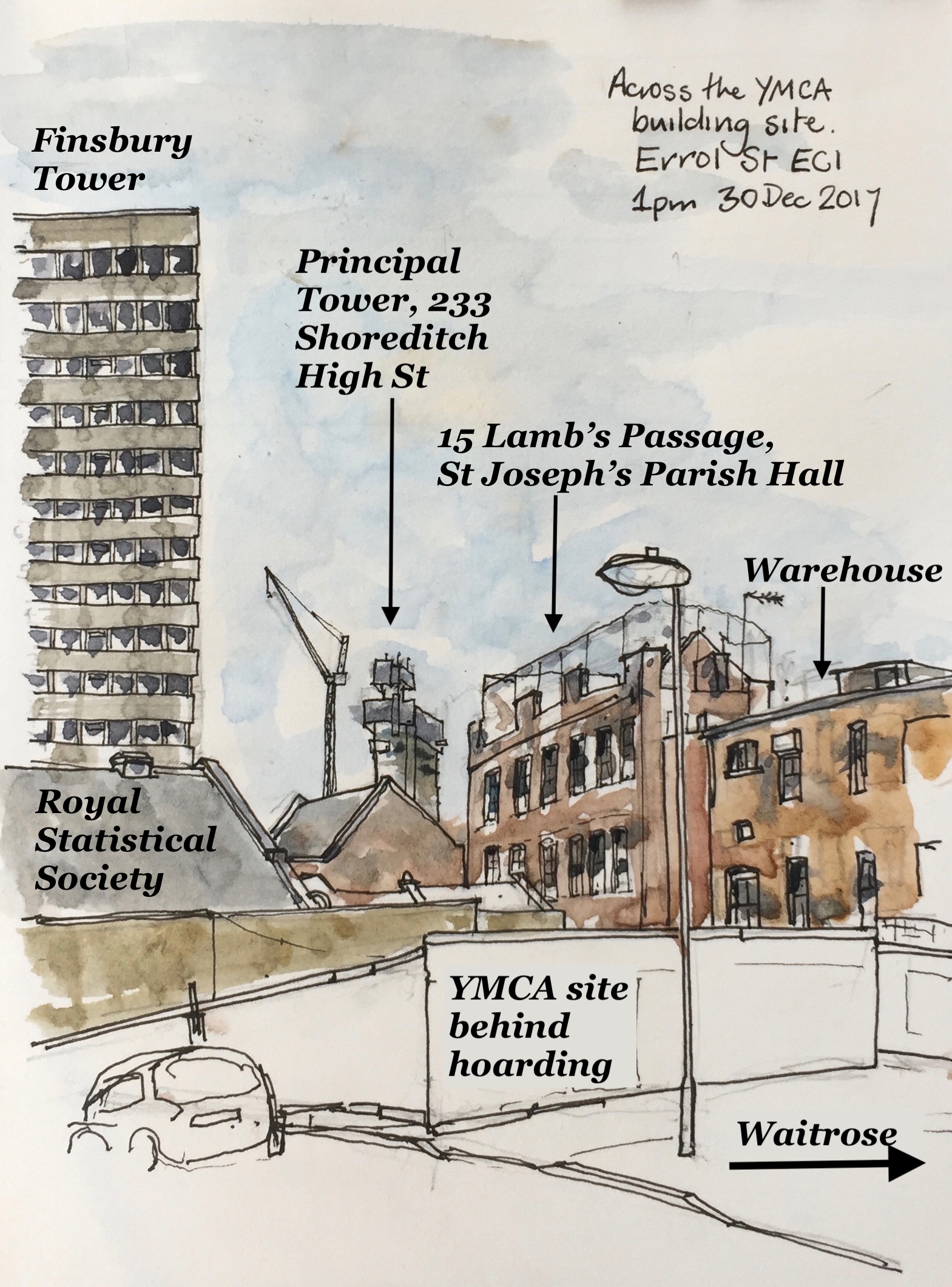
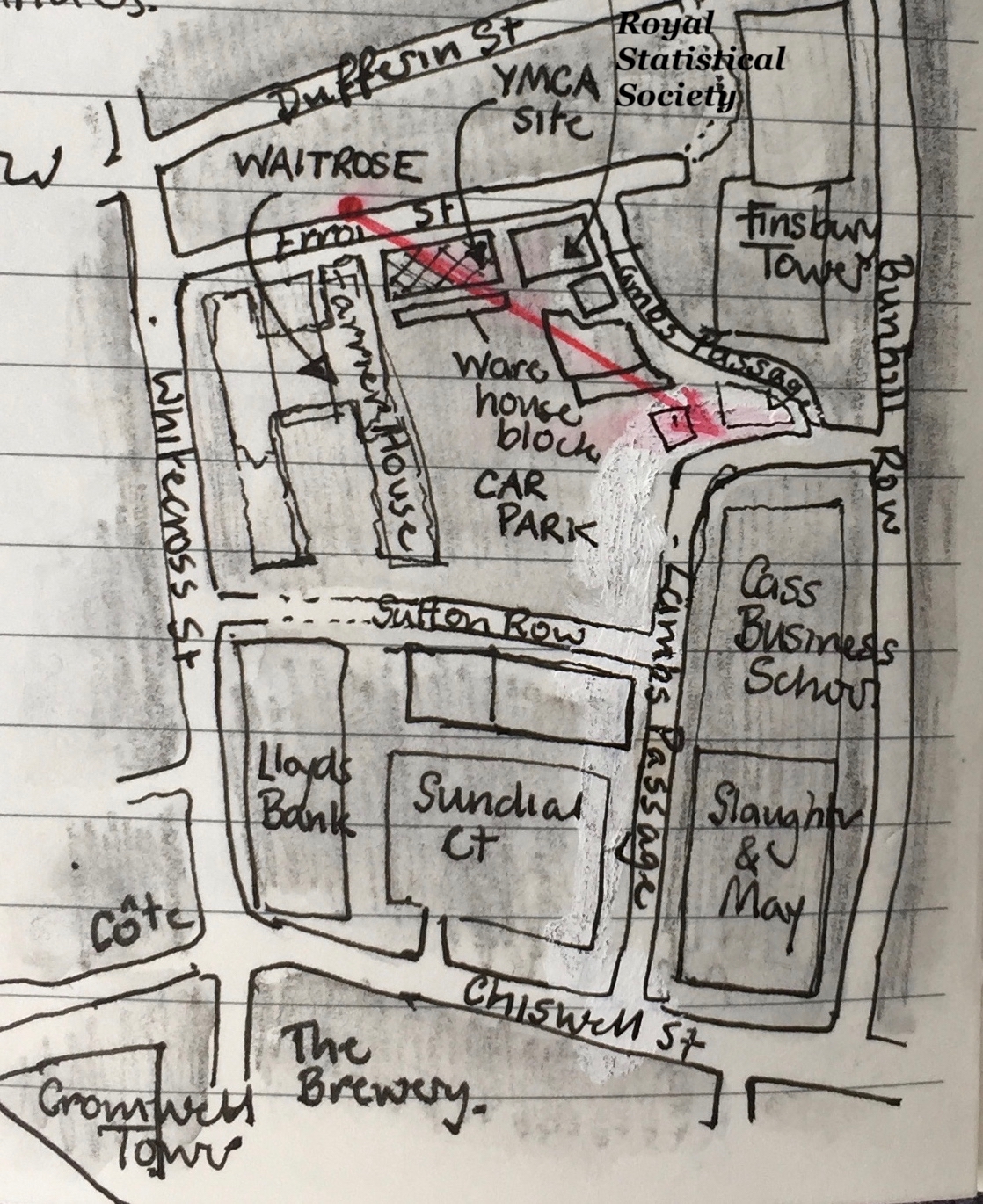
This site is a few minutes walk from where I live. There will be a “new home for young homeless Londoners”. “146 beds, 10 000 lives, 60 years”, says the text on the hoarding.
There will be 146 en-suite rooms, an “affordable gym for the whole community” and a “social enterprise unit”. You can see none of this in the picture. It is a building site. The old YMCA building has come down, revealing a temporary skyline. I hastened out to draw this skyline before it is obscured by the new building.
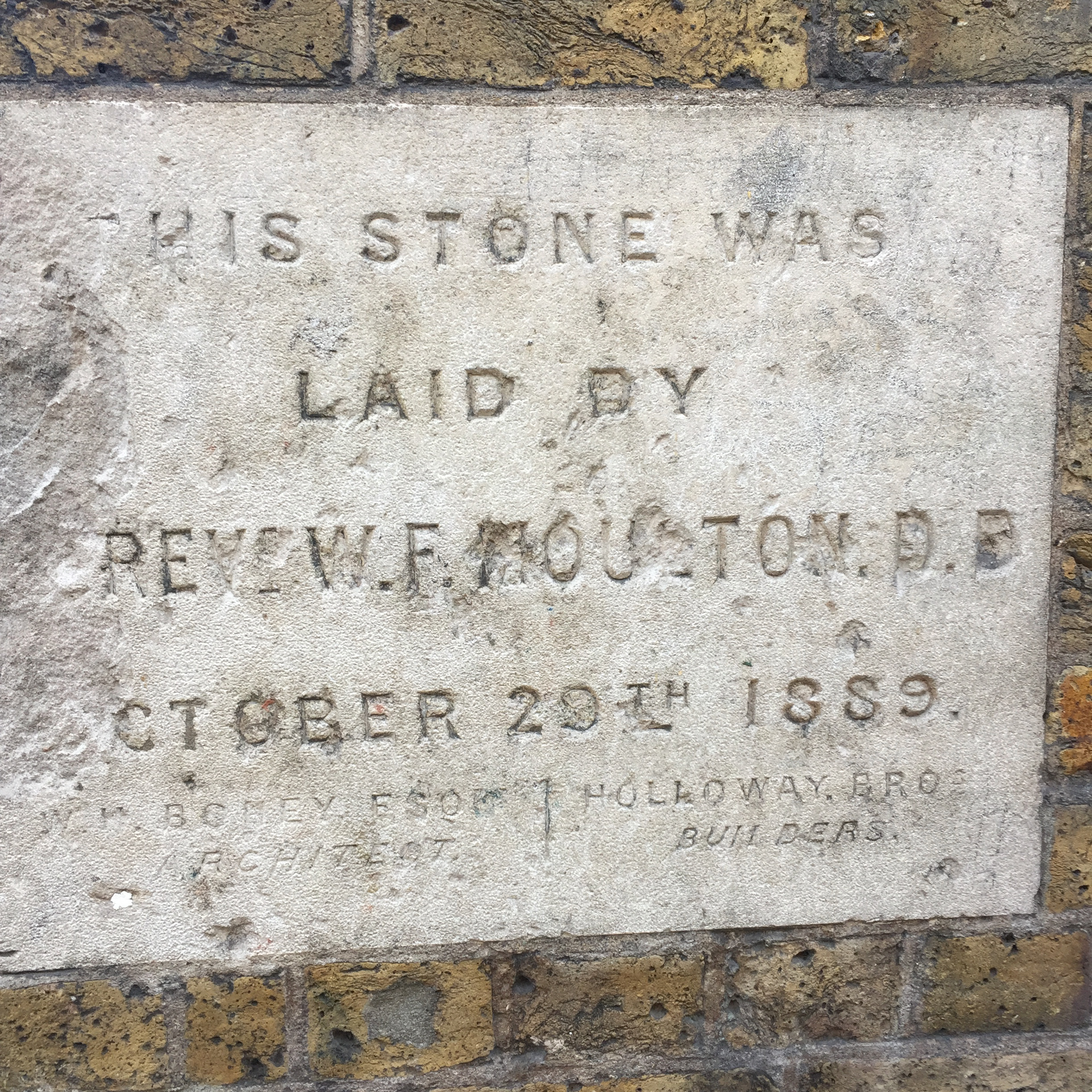
In this view the huge diversity of London life is visible. On the left, Finsbury Tower houses the Cass Business School. The grey sloping roof below it is the Royal Statistical Society, whose main entrance is on Errol Street. This is an old Victorian building, clearly previously ecclesiastical. The three foundation stones are all dated 29th October 1889. They were laid, from left to right by Rev WF Moulton, Mrs ES Whelpton, and Mrs EA Holman. The names of the architects and builders are written on the left hand stone: WH Boney Esq, Architect, and Holloway Bros, Builders.
The building with the pitched roof, in the centre, is part of St Joseph’s Catholic Church. The Church itself is mostly underground. Right now they have a crib which you can visit.
On the right, the tall building with the wire netting on top, looks like an old school. It is in poor repair: the paint on the window frames is flaking, and the rooms look dark. But it is occupied. There was a light on in one of the windows, and Christmas decorations visible in the gloom behind the dusty window panes. Part of the building is “St Josephs Parish Hall”, accessible from the other side, with a modern lift. A notice by the door said “National Association for People Abused in Childhood”, but the notice looked very old, and I can’t find any reference to it on the web.
At the base of this building is a lovely garden, open during certain hours in the summer. It is in memory of Basil Hume “Monk and Shepherd”.
In the centre background is the huge residential tower that is being built in Shoreditch: the “Principal Tower” 50 stories.
This picture took an hour and a half, drawn and coloured on location.
Click a button below to share this post online, email it, or print it:
I continue to work on my “Towers Project”. The idea is to document the towers of Finsbury, Islington and Camden, or at least the ones I can see from my window.
I did a “Skyline” previously which you can see on this link.
Here are two smaller etchings, Towers East and Towers West, both 10.5cm by 15cm. I finished Towers West yesterday.
Towers West
Towers East
These two together form a panorama. I used Towers East in a Chine Collé course. See this link.
The two prominent towers at the front are part of a Peabody Estate, the “Roscoe Estate” on Roscoe Street. The one on the left is “Peabody Tower” and the one on the right is “St Mary’s Tower”. The low house at the very front on the left is Fortune House, on Fortune Street. I have drawn Peabody Tower in an urban sketch, see this link.
These etchings are aquatint on copper. Here is work in progress on “Towers West”.
Drawing “Towers West” on hard ground using an etching spike.
“Towers West” print: hard ground etching
I drew the picture in hard ground using an etching spike, then etched it in acid called “Edinburgh Etch” for 20minutes. The resulting print is shown above on the right.
Then I put resin dust, called Aquatint, on the plate, and set it with a gas burner. I paint varnish on top of the Aquatint, to make the shapes, then dip in acid, then paint more, then dip. Towers West is 6 dips. The sky is a technique called “spit bite”: I just paint the acid on, wait 20 seconds, and wash it off.
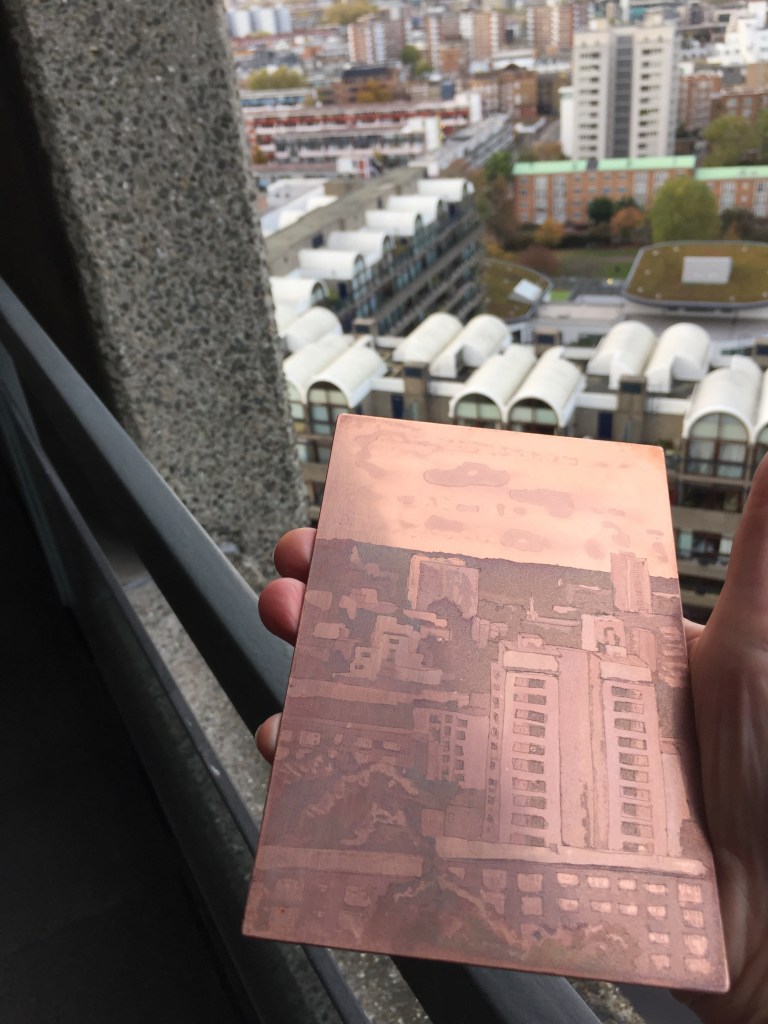
Here’s the copper plate for Towers West:
Towers West, copper plate
Click a button below to share this post online, email it, or print it:
I have been trying to find good views of Rahere and Kestral Houses, two Towers of Finsbury which I can see from my window.
From “King Square Estate Regeneration, Summer 2015 Issue 4” by Islington Council.
Rahere is in the King Square Estate. This estate was built by Islington Council in 1959-61. The architects were Emberton, Franck and Tardew. Franck had worked for Tecton, the firm who designed the Spa Green Estate. King Square Estate is currently subject of improvements including addition of new dwellings.In between all the blocks is St Clements Church.
Rahere House is just visible to the left. The new tower, Lexicon, is above it on the left. Carerra House, of the 250 City Road development, is under construction, visible to the right of the spire.
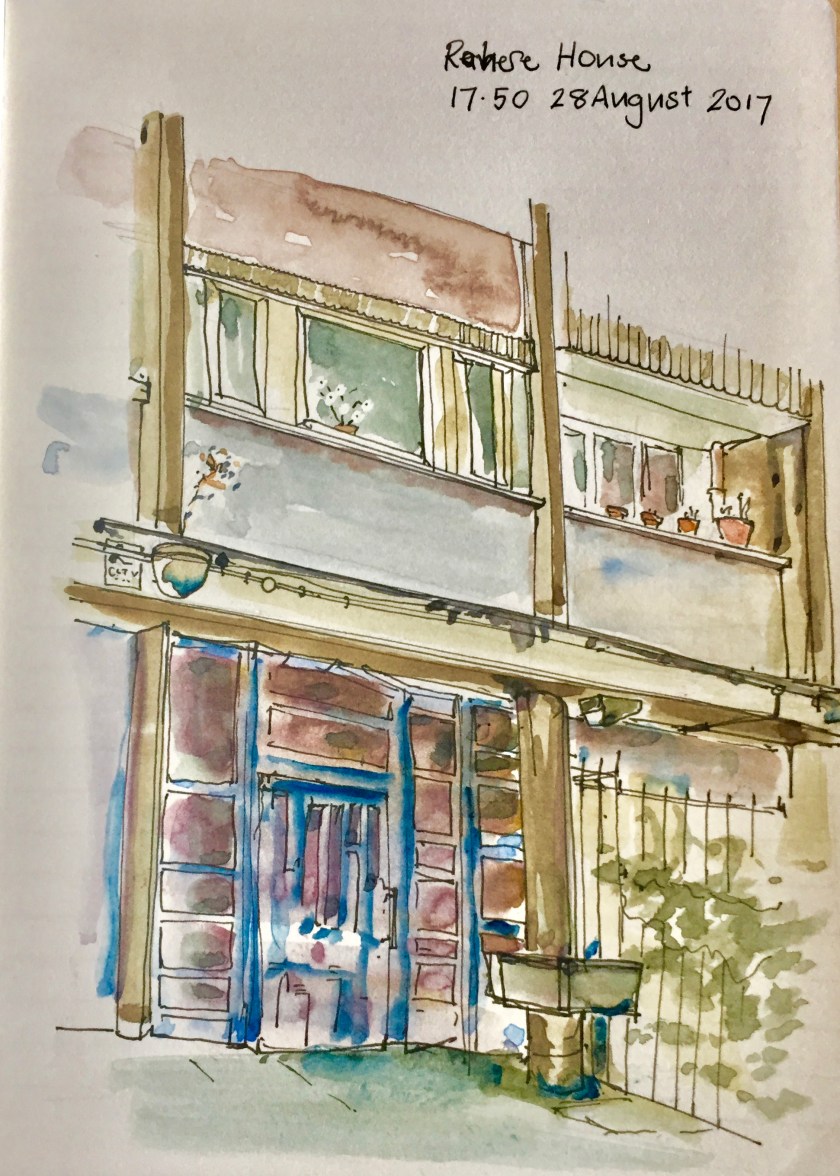
I couldn’t find a distant view of Rahere House, so here is a close-up.
This is one of the back doors. The architects thoughtfully provided lead-lined troughs, at waist height, for flower pots, I assume. One of these is shown in the drawing, to the right of the door. Off the picture to the left, these continue as long boxes, like water-troughs. None of them are used, presumably because the council don’t do flowers and the temptation for vandals is too great.
Instead, residents have their own plants, inside their windows and out on the balcony. See also the feral plant, growing out of the concrete above the door, top left.
Turnpike House is on the same King Square estate. Turnpike I have drawn before.
Turnpike House, King Square Estate, from the Goswell Road
To the North of Rahere is Kestrel House. This tower is on Moreland Street and City Road. It is currently surrounded by building work associated with the Bunhill Heat and Power. This scheme takes energy from braking Tube trains and uses it to heat local houses and schools.
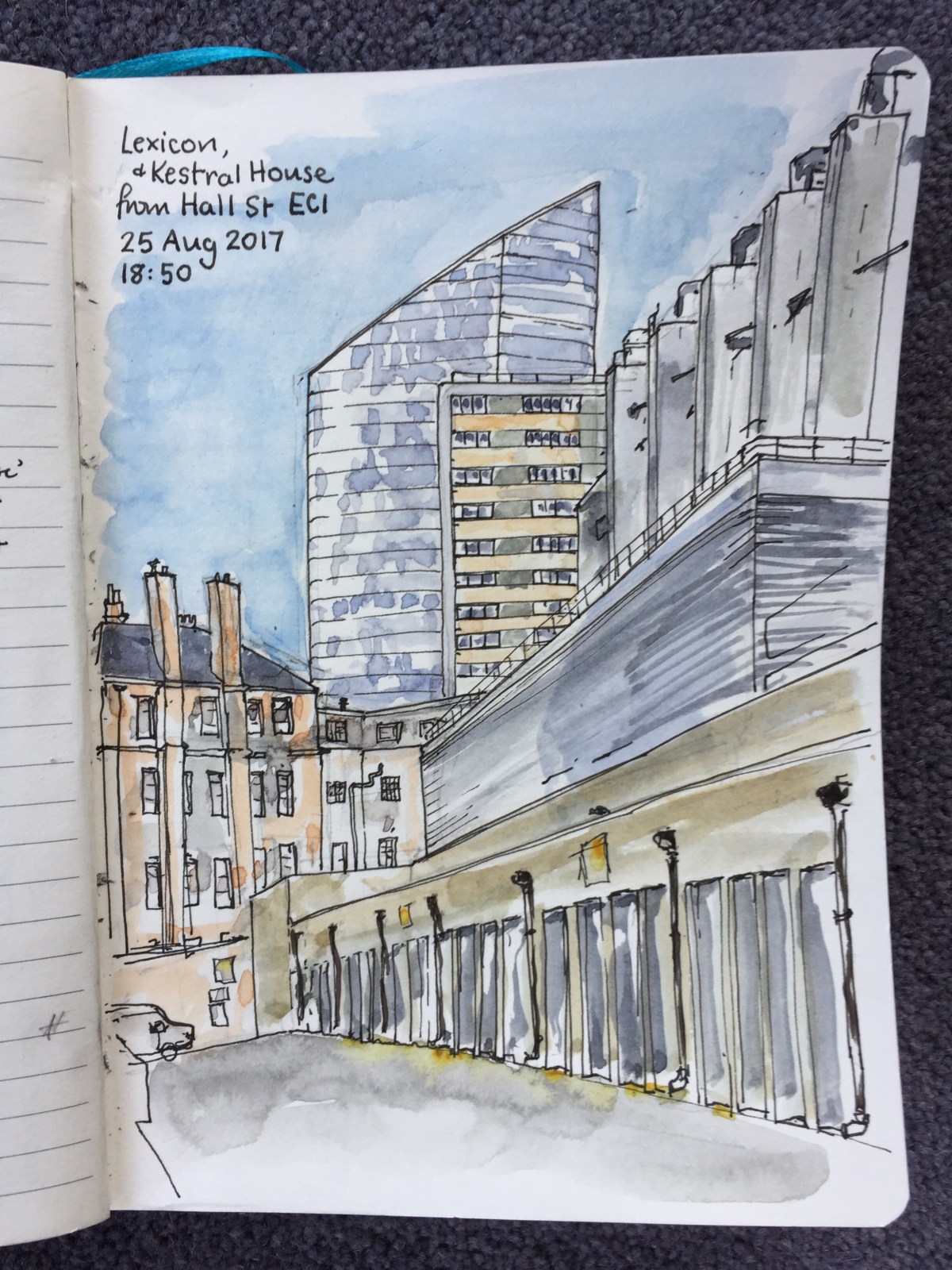
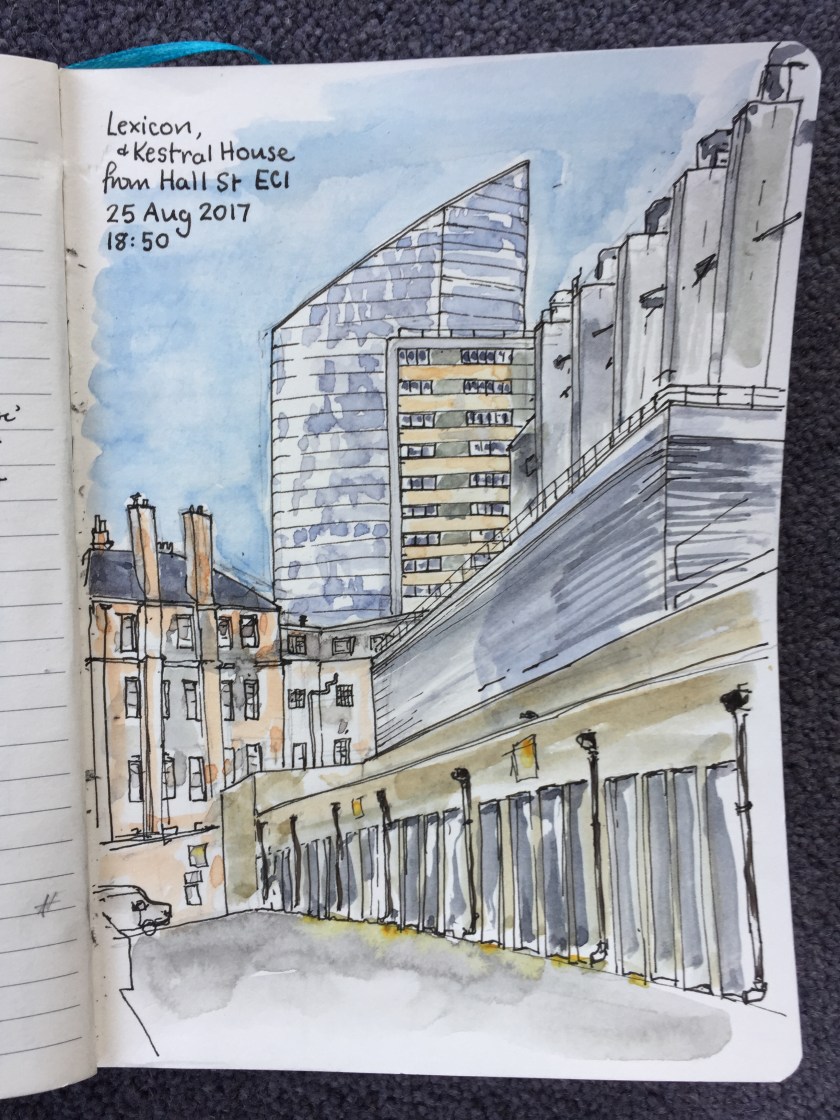
Kestrel House is on the “City Road Estate”. I found a view of of it from Hall Street: it’s the rectangular tower block in the middle. The Lexicon, otherwise known as “Chronicle Tower”, a new development by “Mount Anvil” is the sloping building behind.
The building which dominates this drawing, on the right, is the premises of “Level(3)”. I walked round the block a couple of times to see what it was. The windows on the street side are high, and there are serious steel shutters over every entrance. Note the huge ventilation shafts. It looks somehow as though it’s ventilating a larger volume than the building, as though it goes down a number of stories below ground. The business of Level(3), according to a web search, is “Connecting and Protecting the Networked World”.
The red-brick building straight ahead was previously “St Marks Hospital Nurses Home”. This is cast into the stone work above a former door on Pickard Street. The door is no longer in use, and fenced off. “Founded 1835, Erected 1853”. The main entrance now is on City Road. It looks disused. Fallen leaves clutter the steps, the grass wafts unmown. But there is a car park, so perhaps there’s another entrance from there that I couldn’t see. It’s “300 City Road”, which appears online as Citidines Serviced apartments.
Behind me when I drew this was Peregrine House, another tower, very high.
Later I went back to try to get views of Peregrine House.
President House, left, Peregrine House, centre.
I forgot to take my drawing book.
I’ll have another go at these towers.
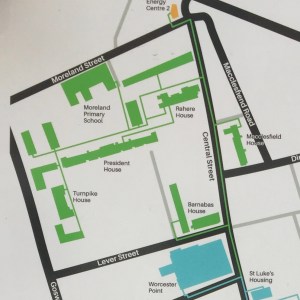
Buildings served by “Bunhill Heat and Power 2” – in green.
Click a button below to share this post online, email it, or print it:
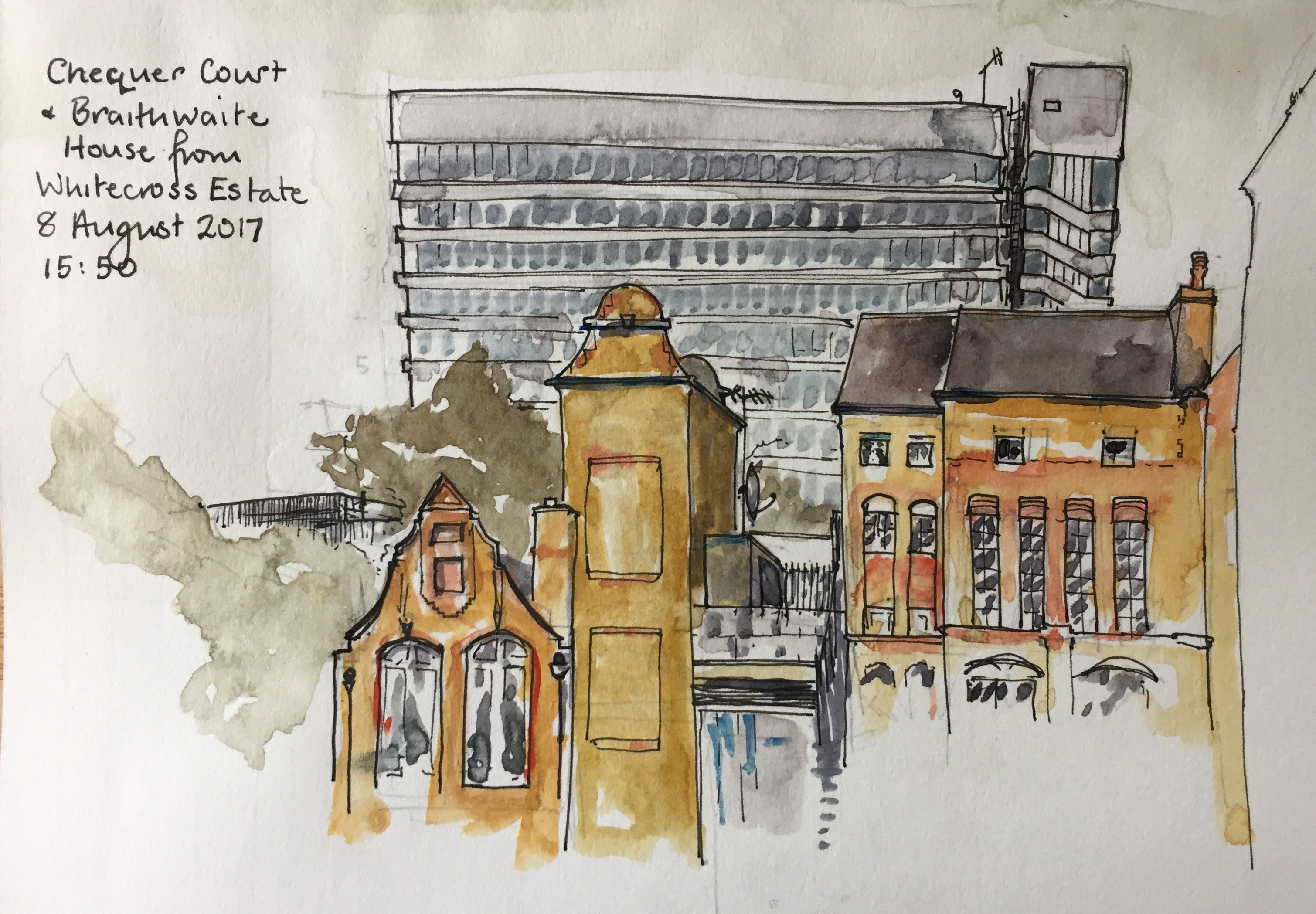
The drawing shows the lovely brick building, now called “Chequer Court”, with Braithwaite House behind.
I drew the picture from Whitecross Estate East, in a quiet courtyard off Chequer Street. A record three people came to talk to me. Arabella was tending her garden flowers in pots and crumbling wooden boxes, on the other side of the courtyard. She came over and told me that the brick building used to be the community centre. She had done oil painting there. Previous to that, it had been a school. She described the marvellous high windows, and large rooms. There was a café.
She said, “Do you like the buildings?”, indicating the Peabody buildings surrounding us. When I said that I did, she said they were “like prisons”. “They are all different inside, of course.” she added. She explained that there were going to be changes, they were going to build another block on top of the low-level office in front of us. “So you should come back,” she said, “This is a historic view.”
She said that underneath the square was all hollowed out, for bomb shelters. Construction work was going on behind us. “They have demolished the pram sheds”. Arabella was irritated that, in doing so, they had strewn rubble over the planted boxes.
Another woman approached me much later. She also remembered the community centre. She did yoga there. “It was only 20 years ago.” She was concerned lest I was the harbinger of “another plan”.
“No,” I said, “Not another plan. Just a drawing.” I showed her the drawing, to reassure her.
As I packed up my things, a third woman came to say hello. She wanted to see the drawing, and said it was very good. Her small white dog tugged at her and slowed her up as we walked. Eventually he stopped her altogether and I walked on.
Later, online, I found the plan to which the second woman referred. There is a plan by Islington dated March 2017 to improve the public areas of the West and East Whitecross Estates.
The brick building was indeed a school. It seems to have been known as Northampton Secondary Technical School, which was in existence in 1924, and certainly up to the early 1960s. Searching online I found references to a “Bunhill Row Chequer Street Council School” whose records, 1928-1933 are in the National Archive, Kew ref ED 21/34646, but no further details. In 1998 “negotiation was completed for the sale of the Bunhill Row site for £22 million” according to “City and Islington College, the First 20 years” by Tom Jupp and Andrew Morris. Now it is luxury flats, and is called Chequer Court.
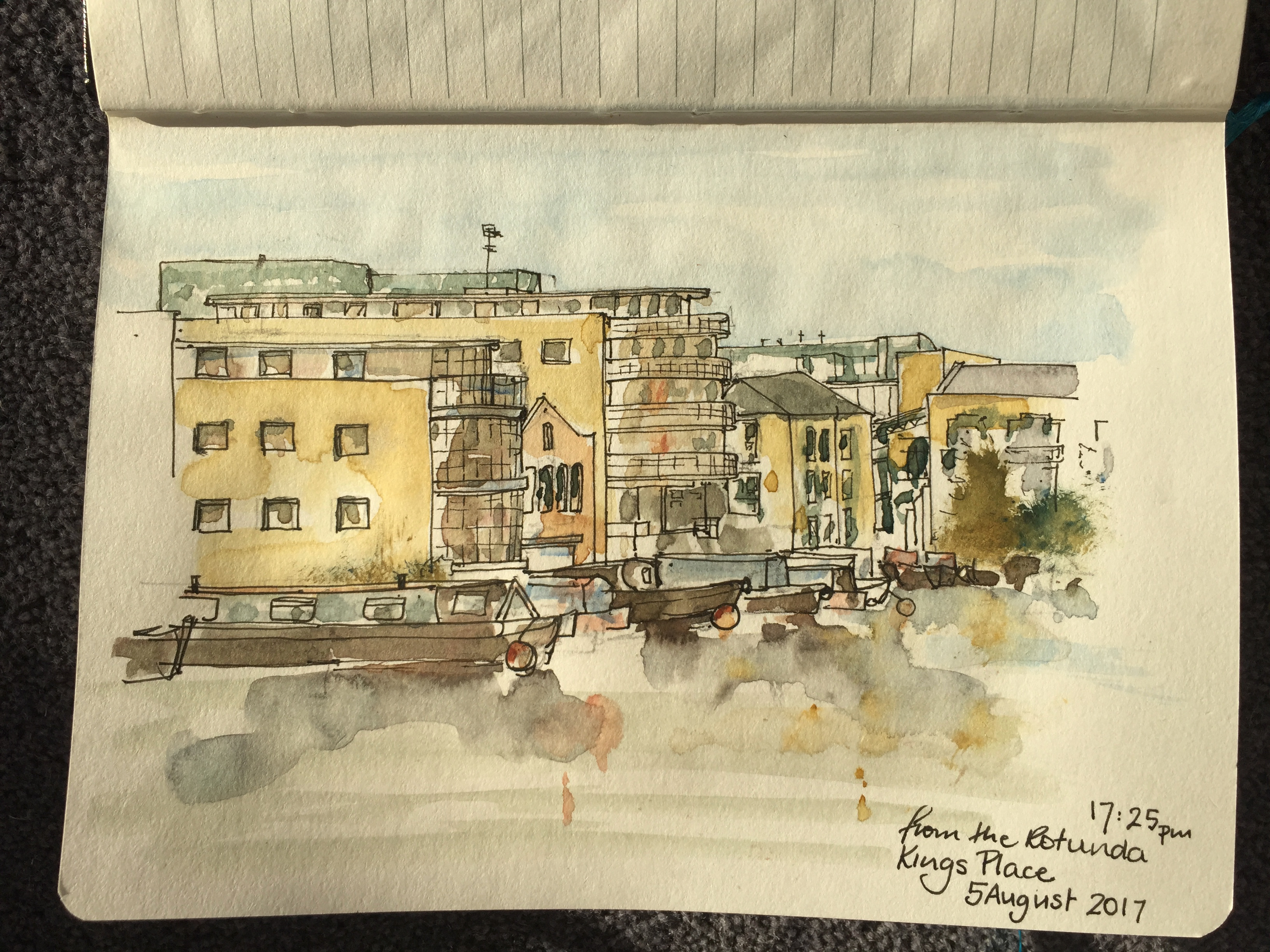
I drew this from the Rotunda restaurant in Kings Place, looking across Battlebridge Basin. The low building in the middle with the pointed roof is the London Canal Museum.
The coffee was excellent, and we were made very welcome by the restaurant manager Mark.
After this, we went for a walk around the new Kings Cross developments on the other side of York Way.
Click a button below to share this post online, email it, or print it:
















 Jane Sketching