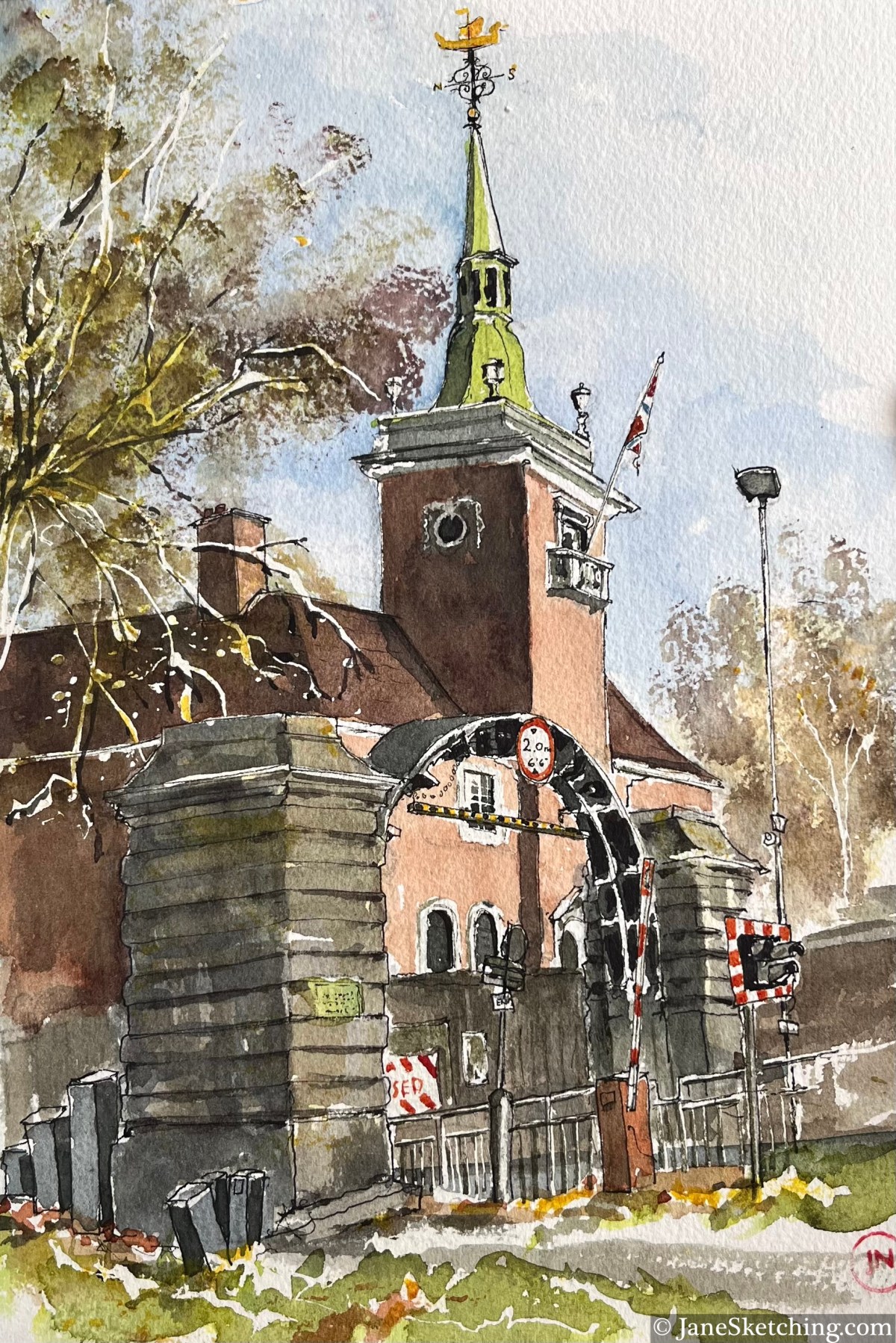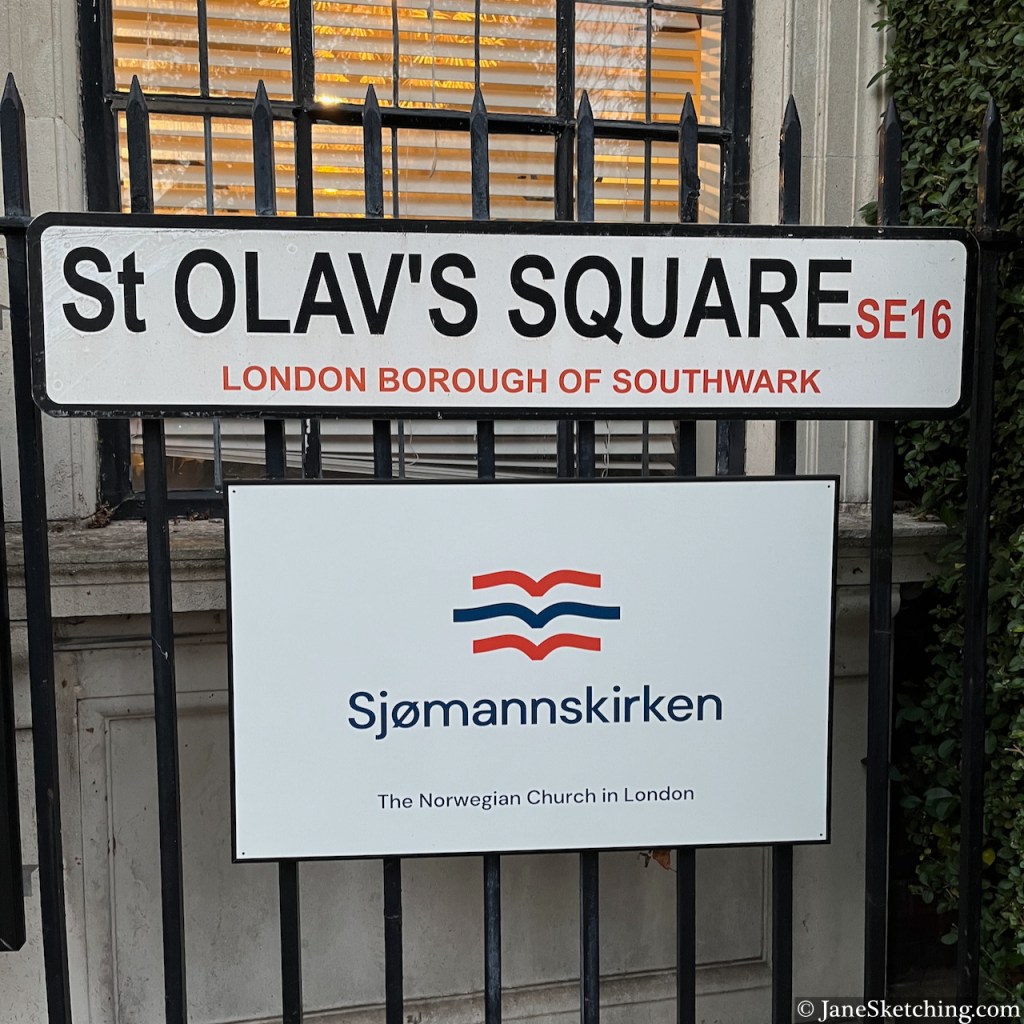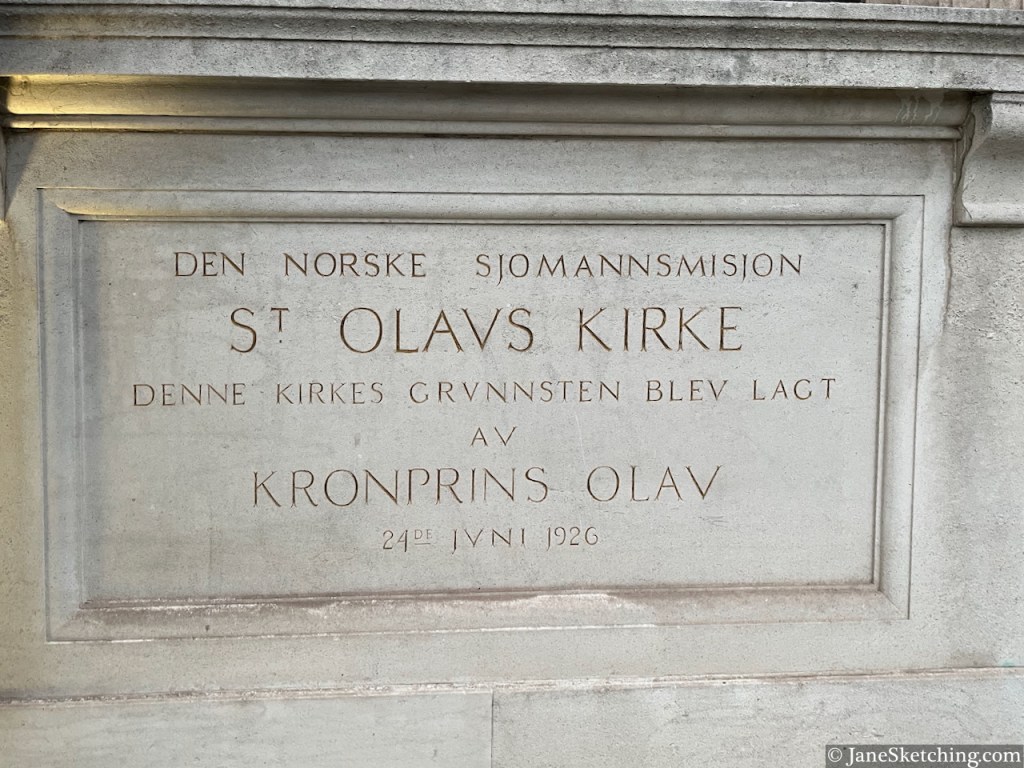
Rotherhithe Tunnel Shaft 2, London E16

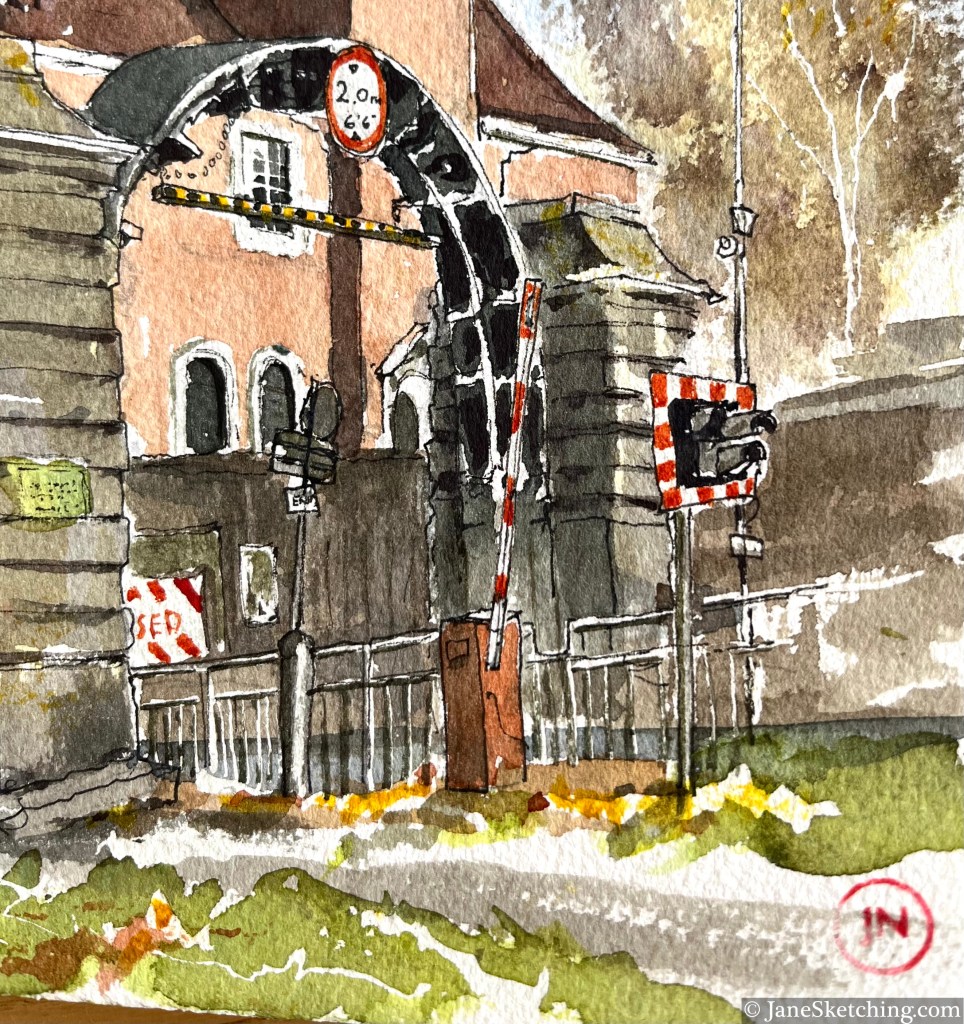
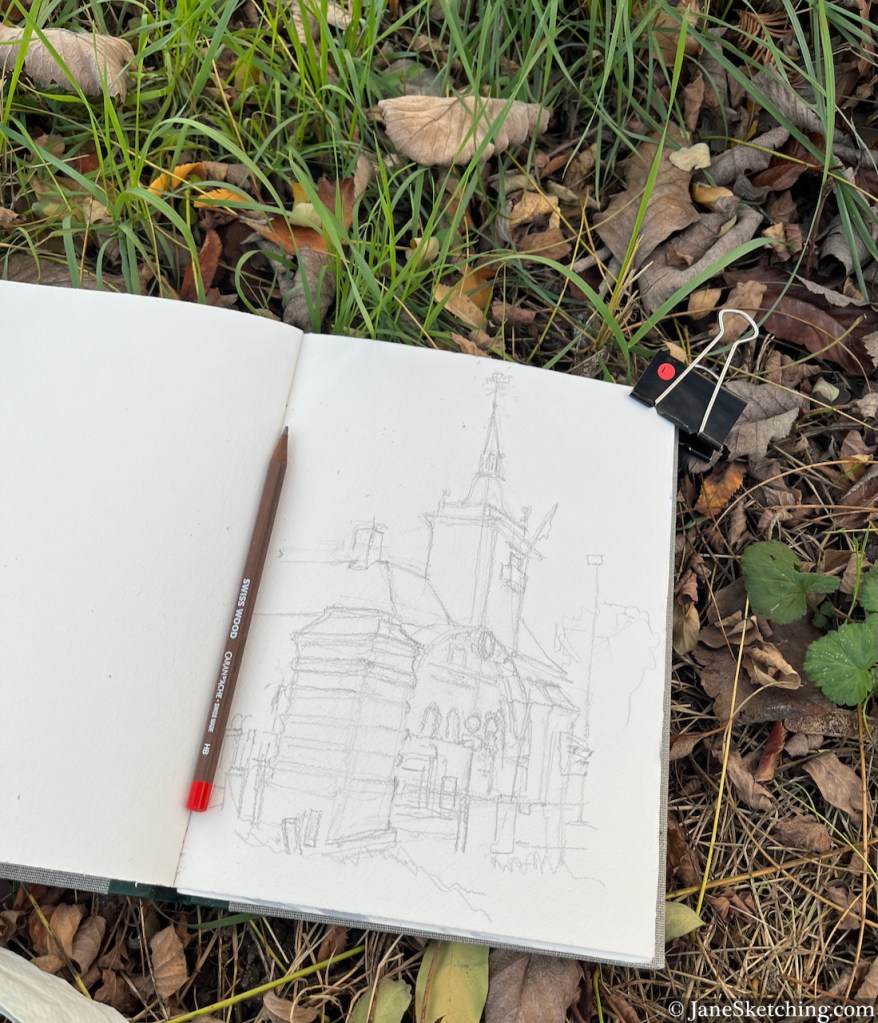
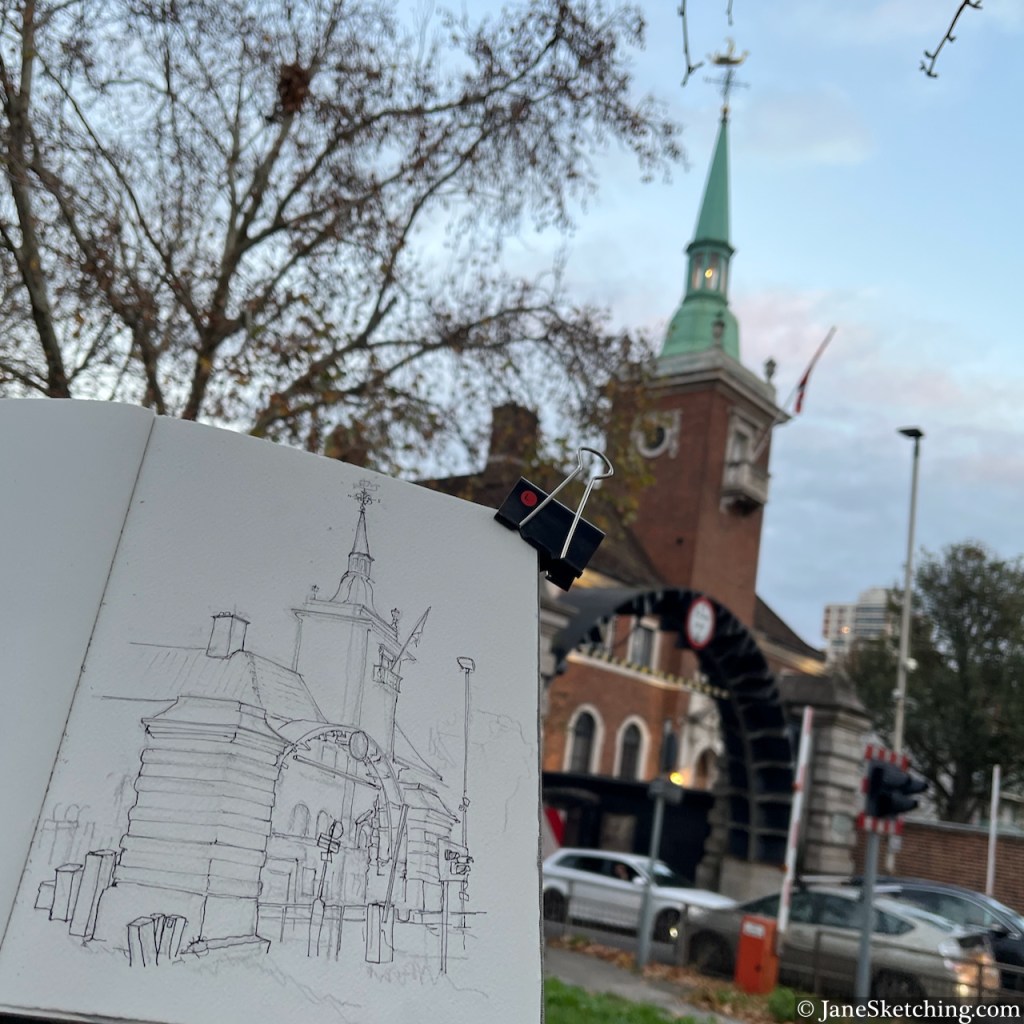
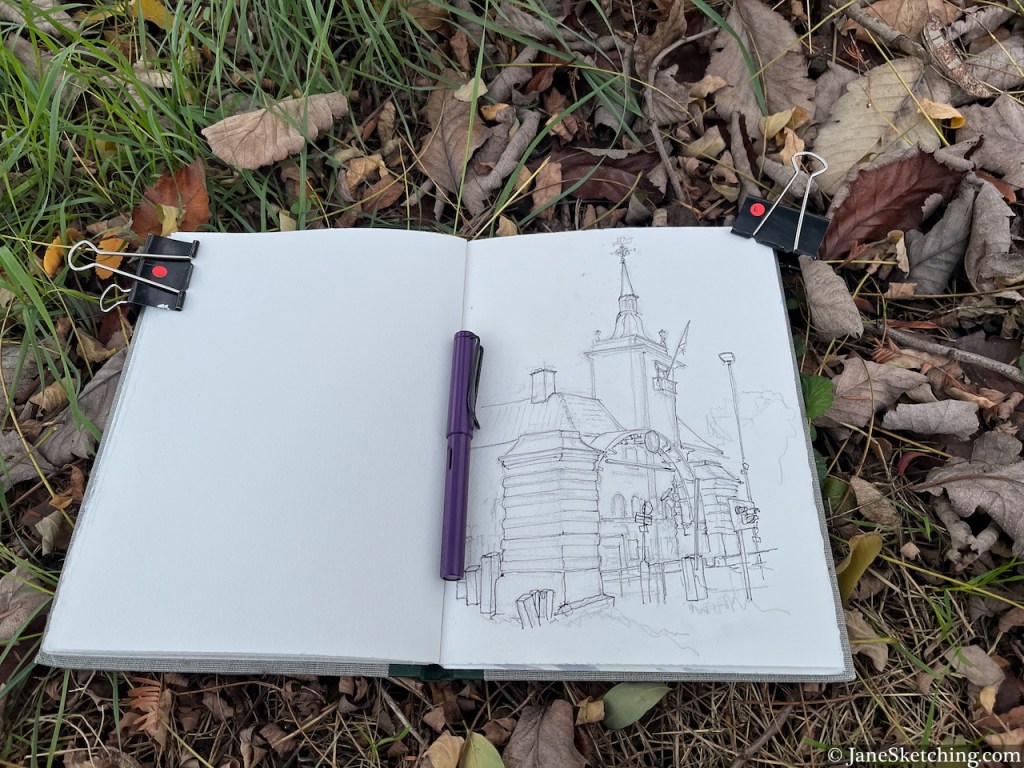
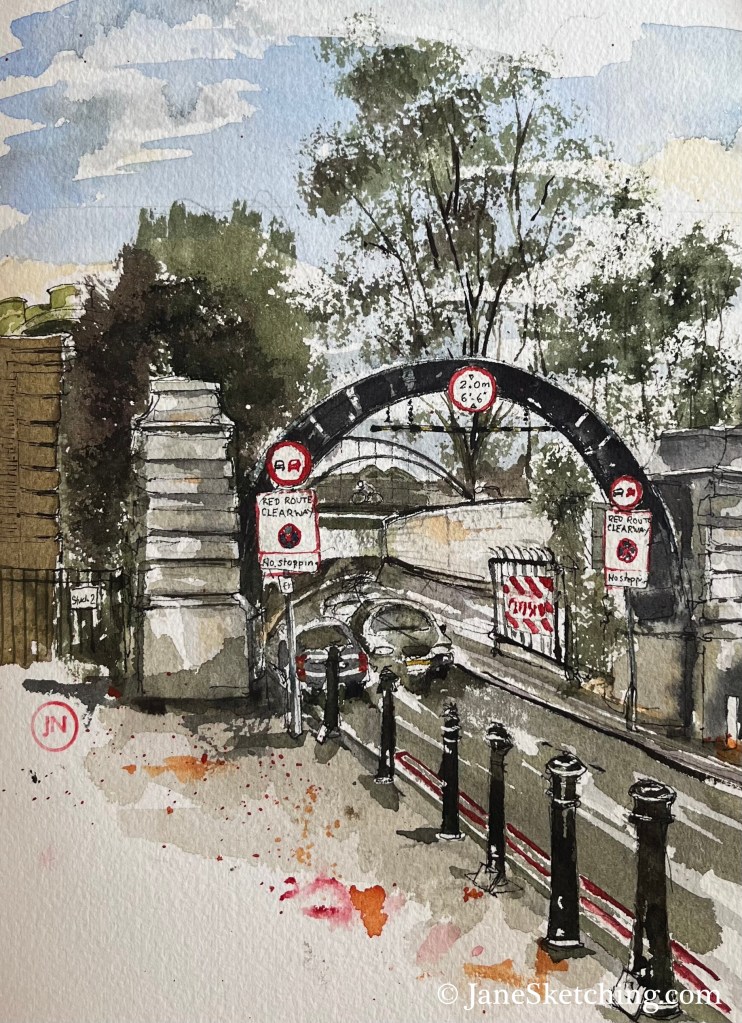
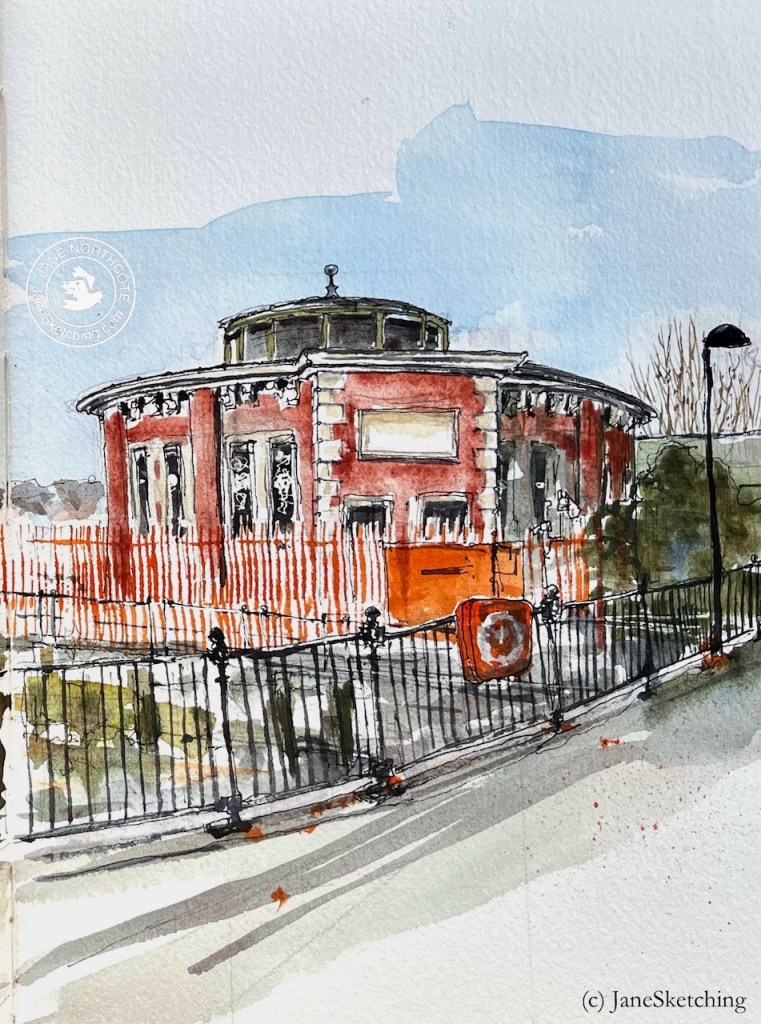
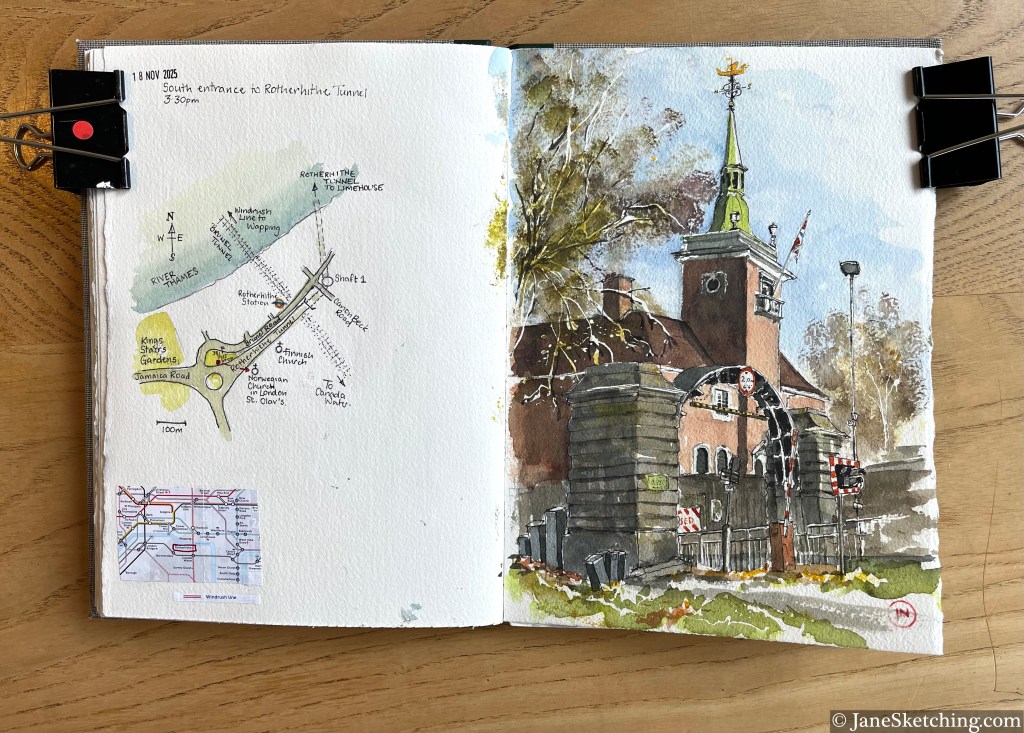
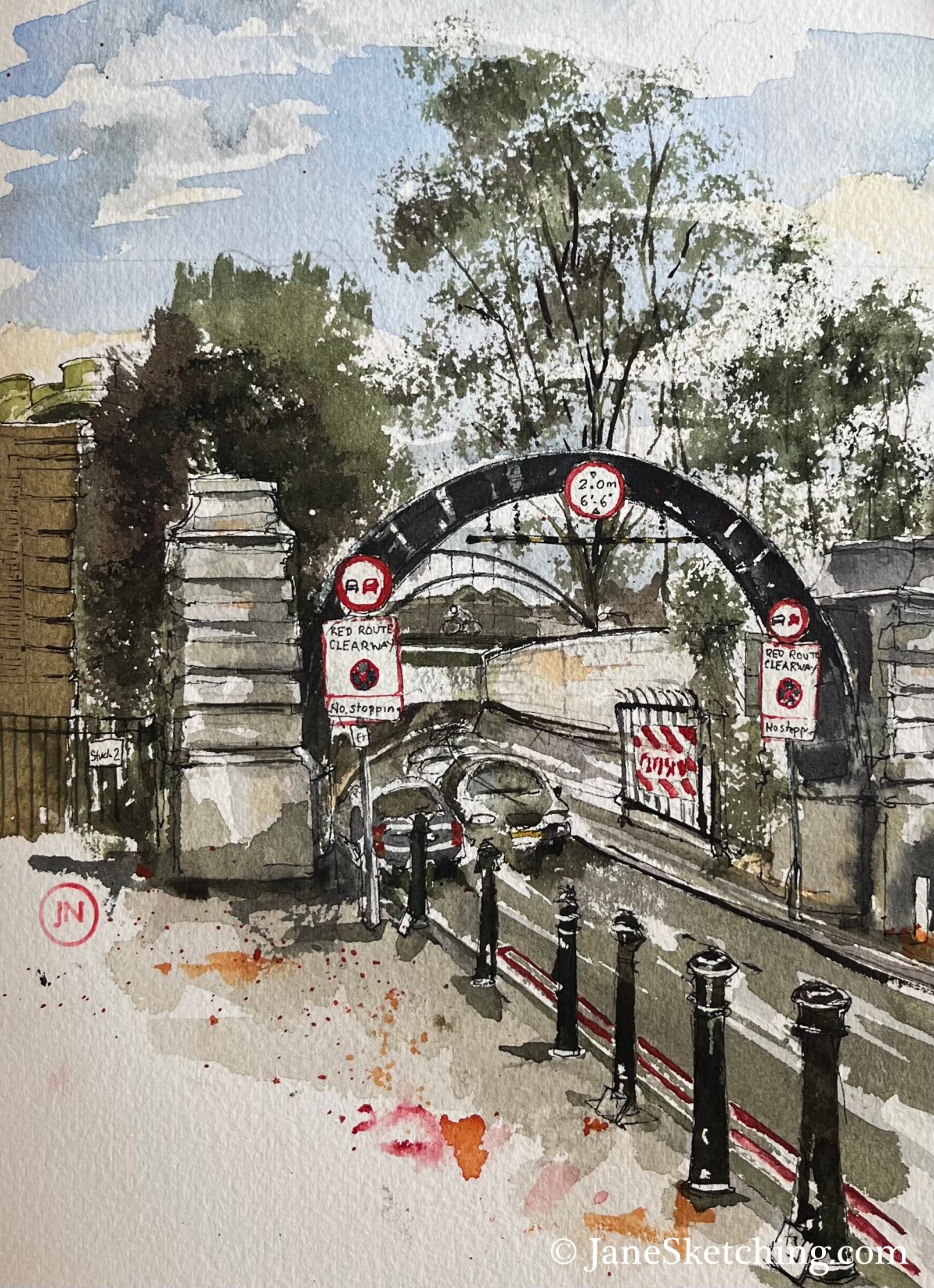
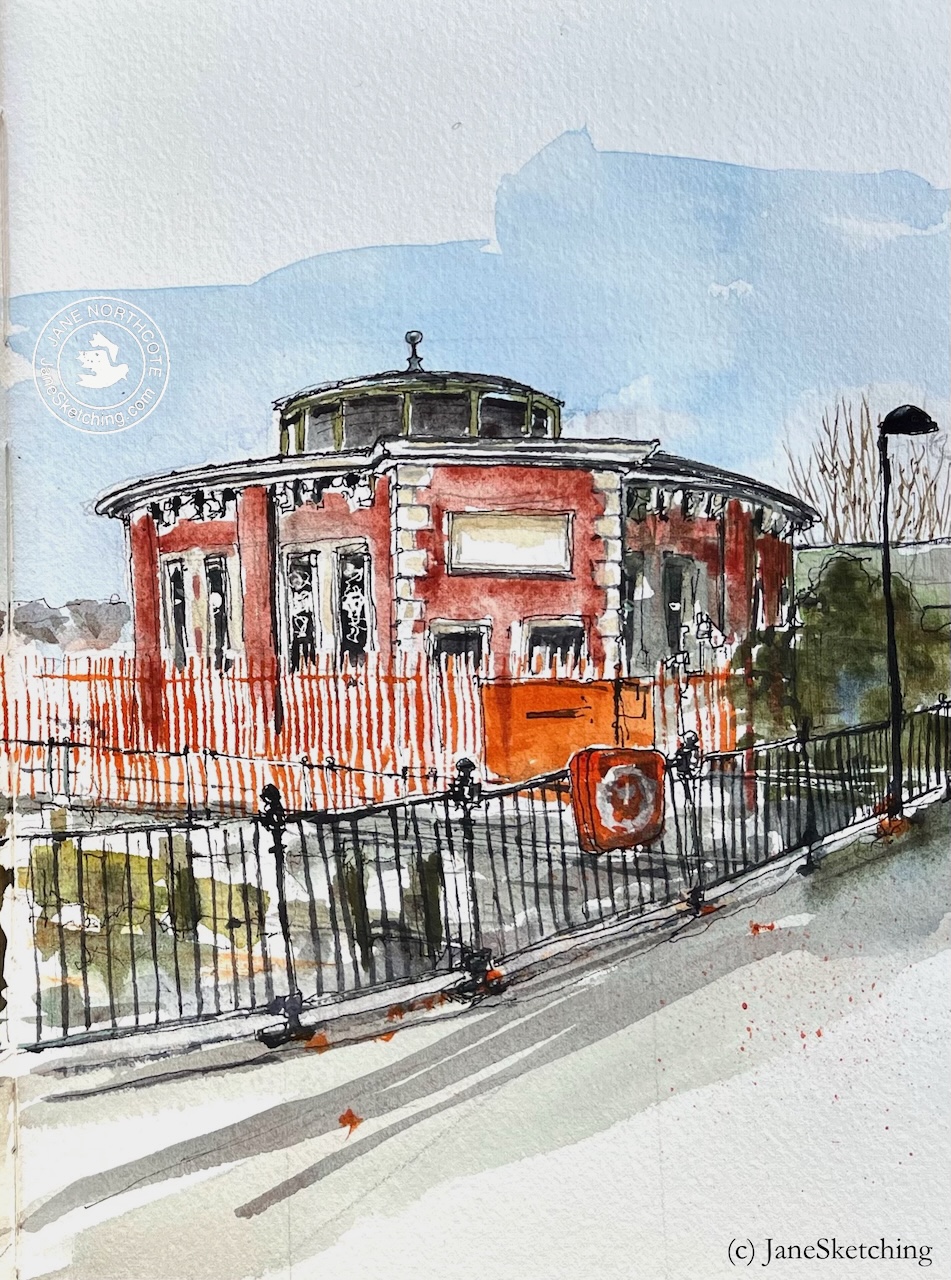
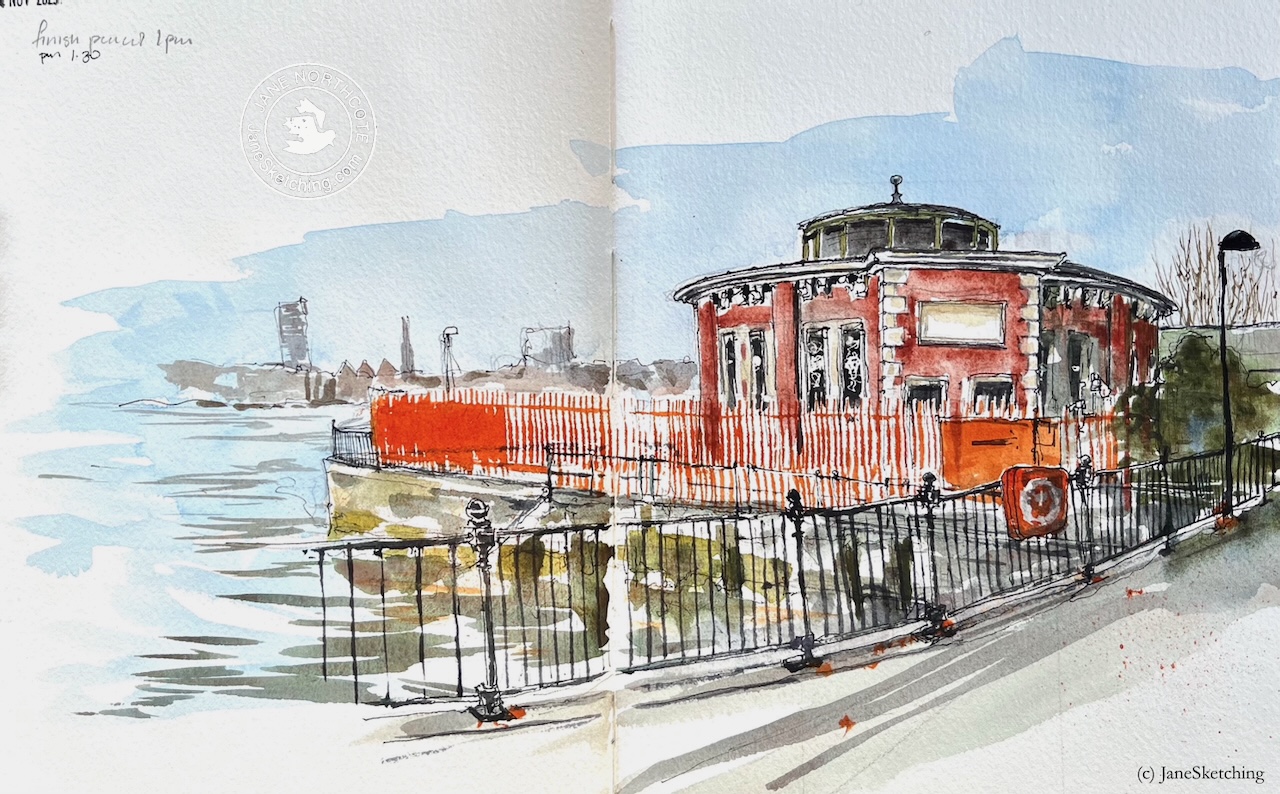
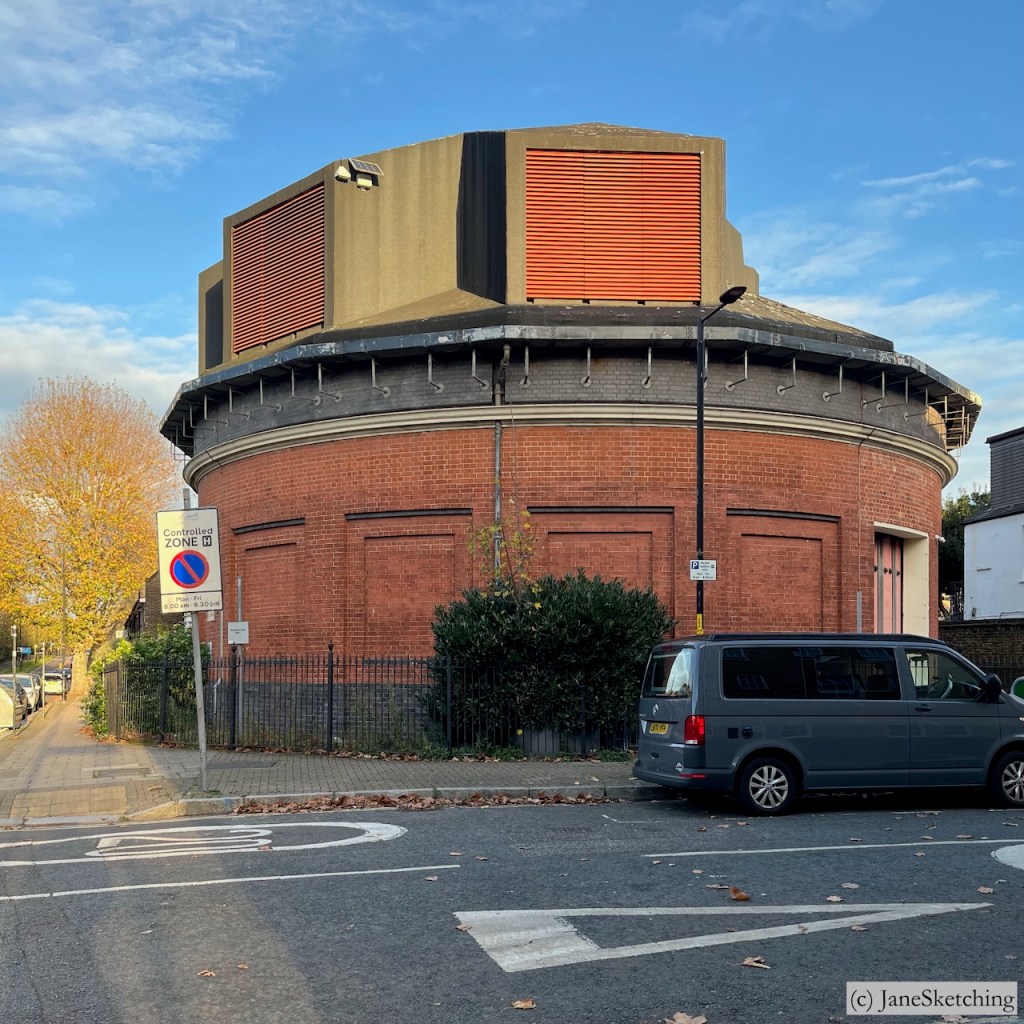
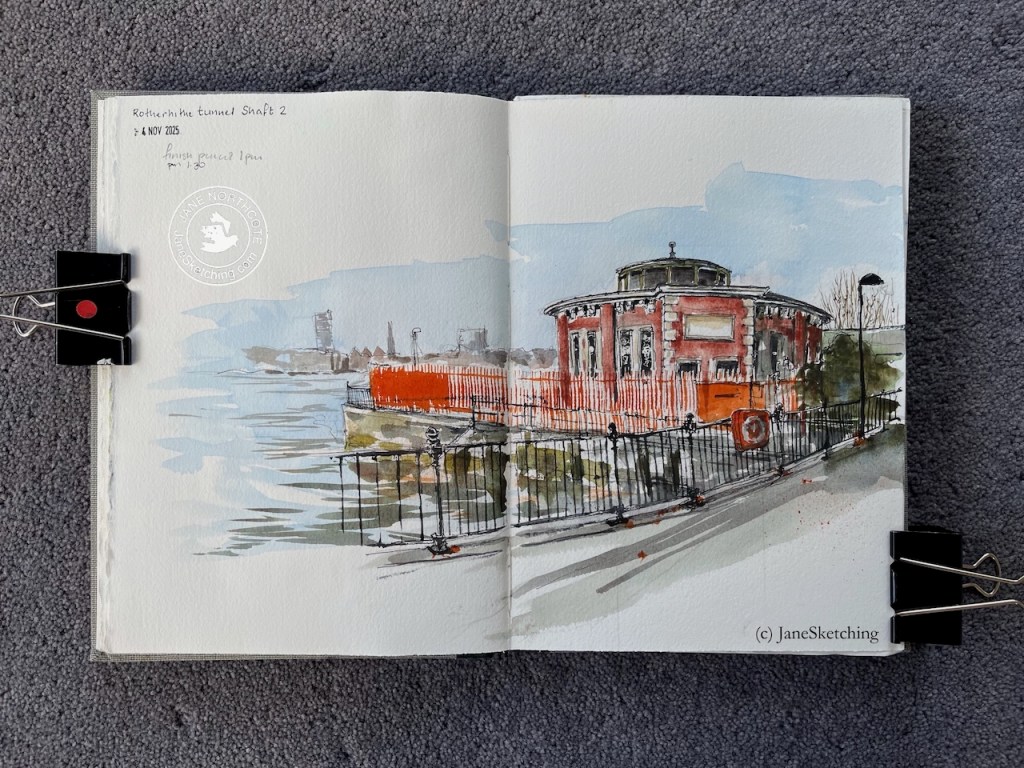
I have sketched the Rotherhithe Tunnel Ventilation Shaft on the North Bank of the Thames. So I went on an expedition to sketch its sister shaft on the South side. Here it is.

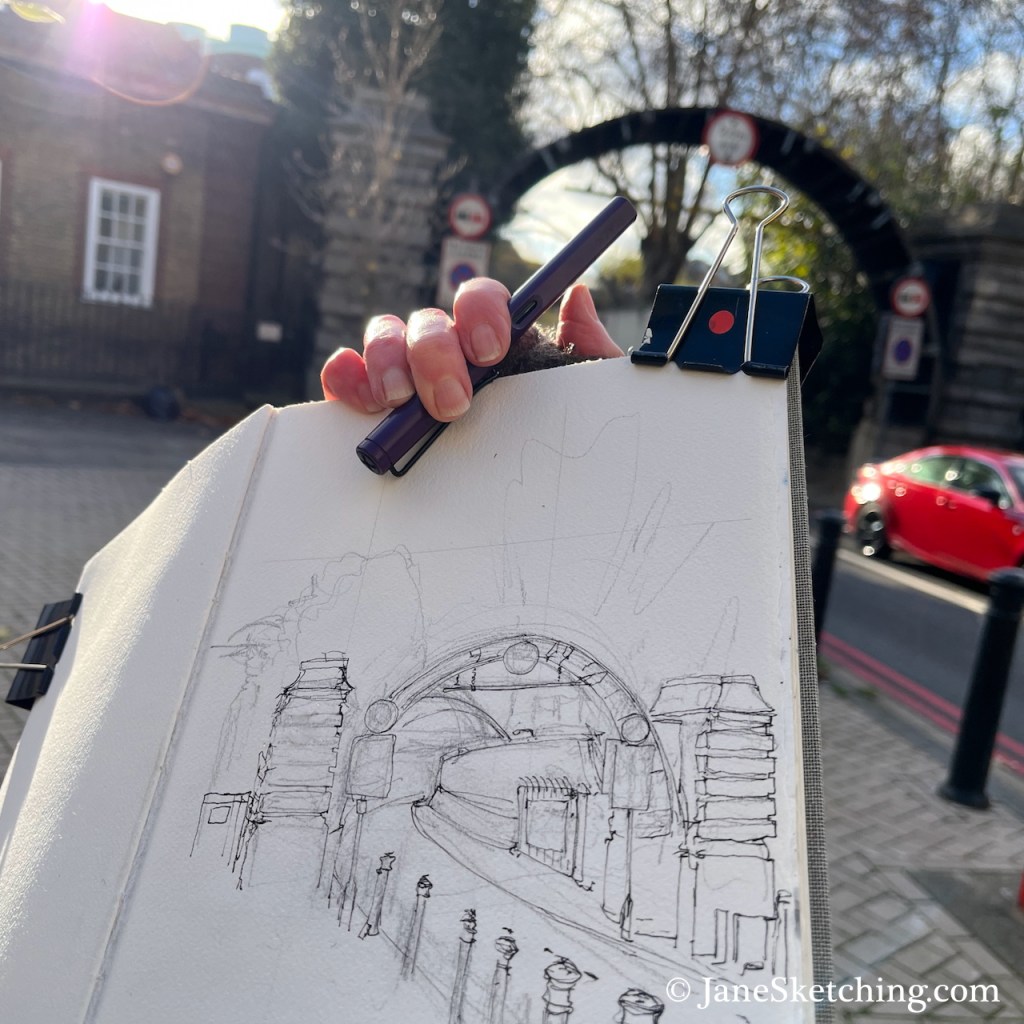
Rotherhithe Tunnel Shaft 2, sketched 4 November 2025 in Sketchbook 16 (c) JaneSketching

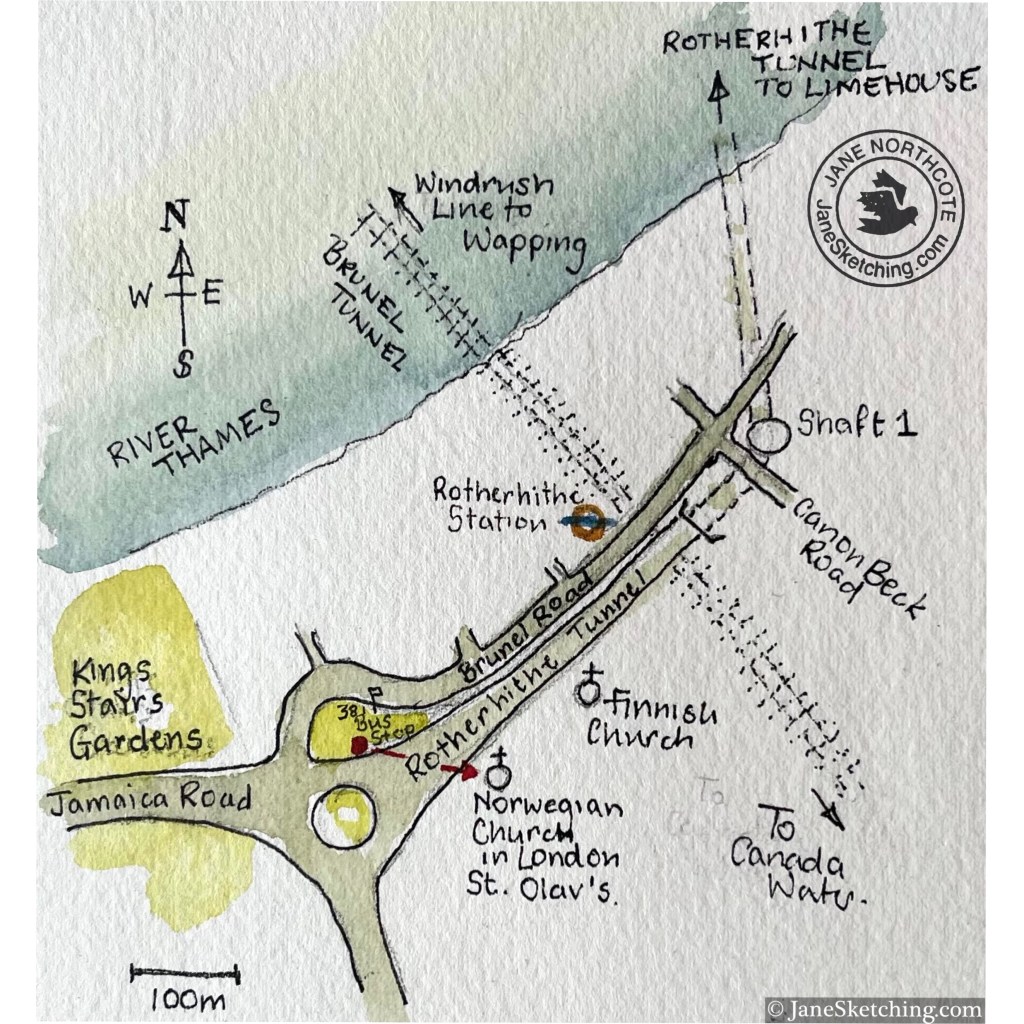
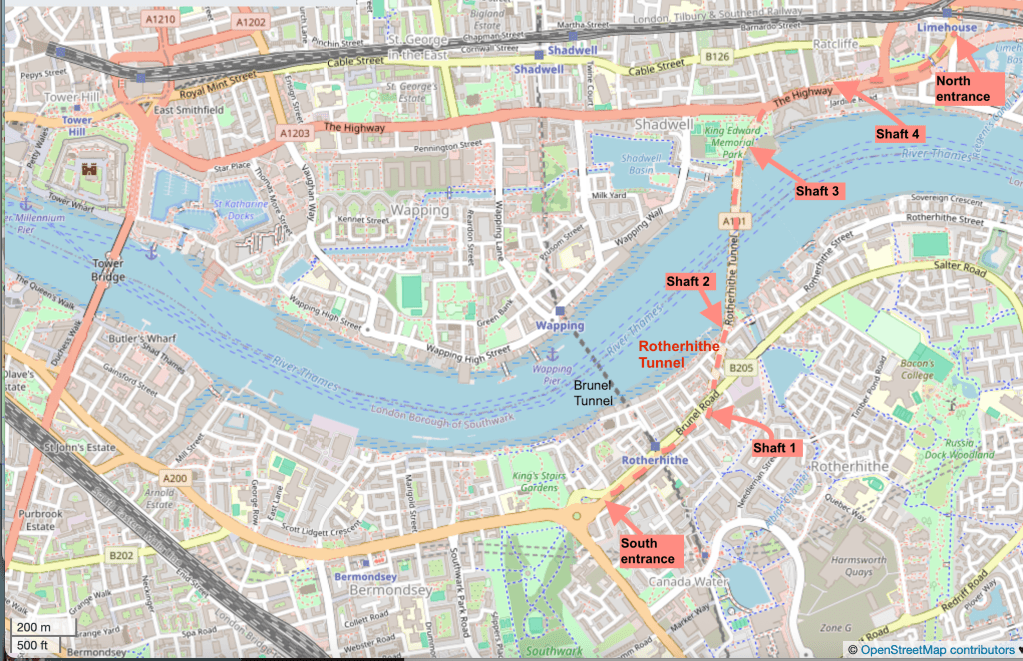
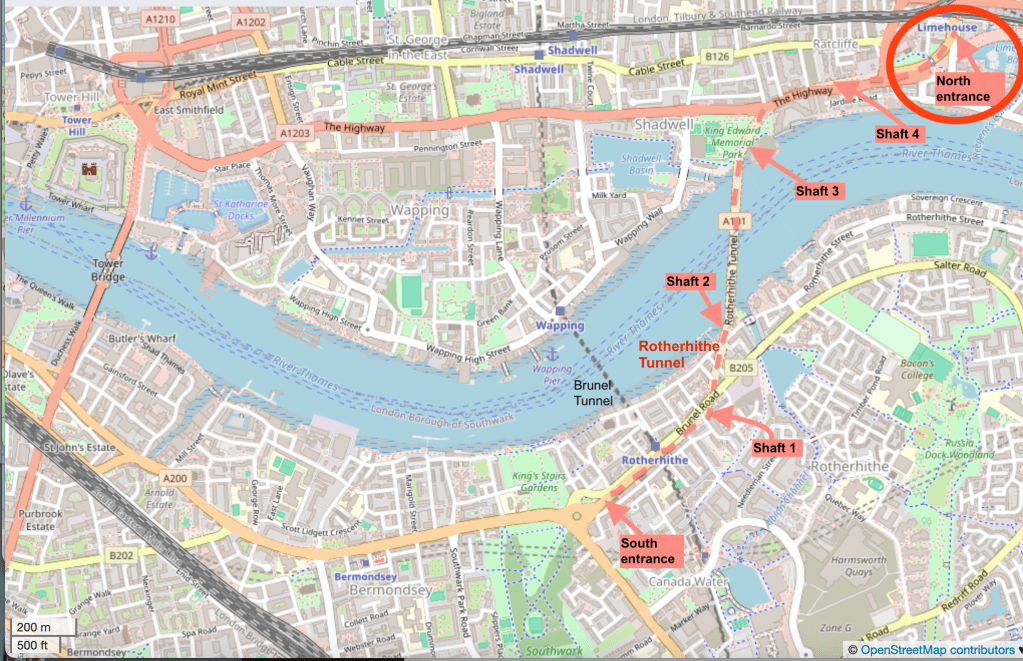
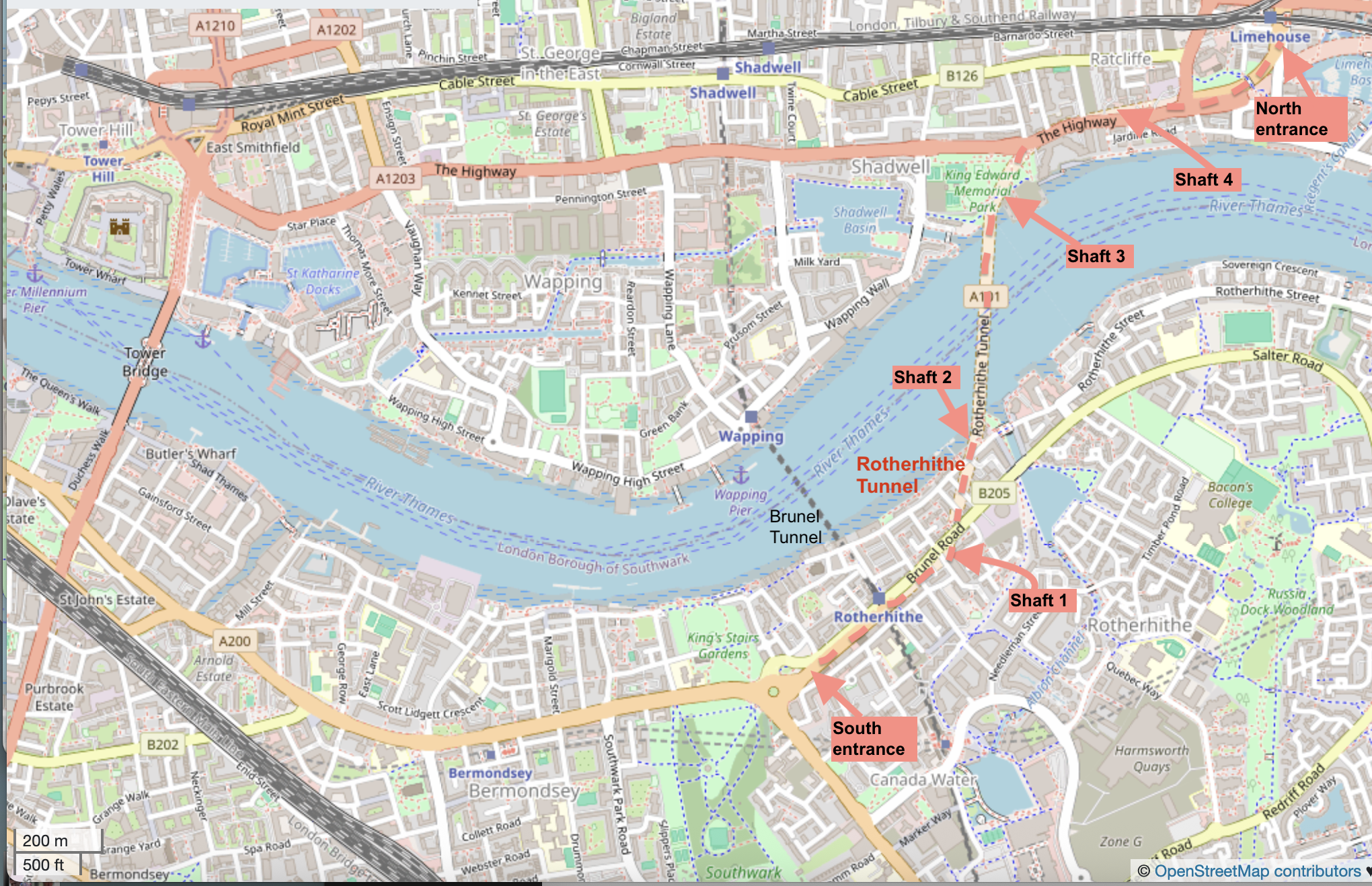
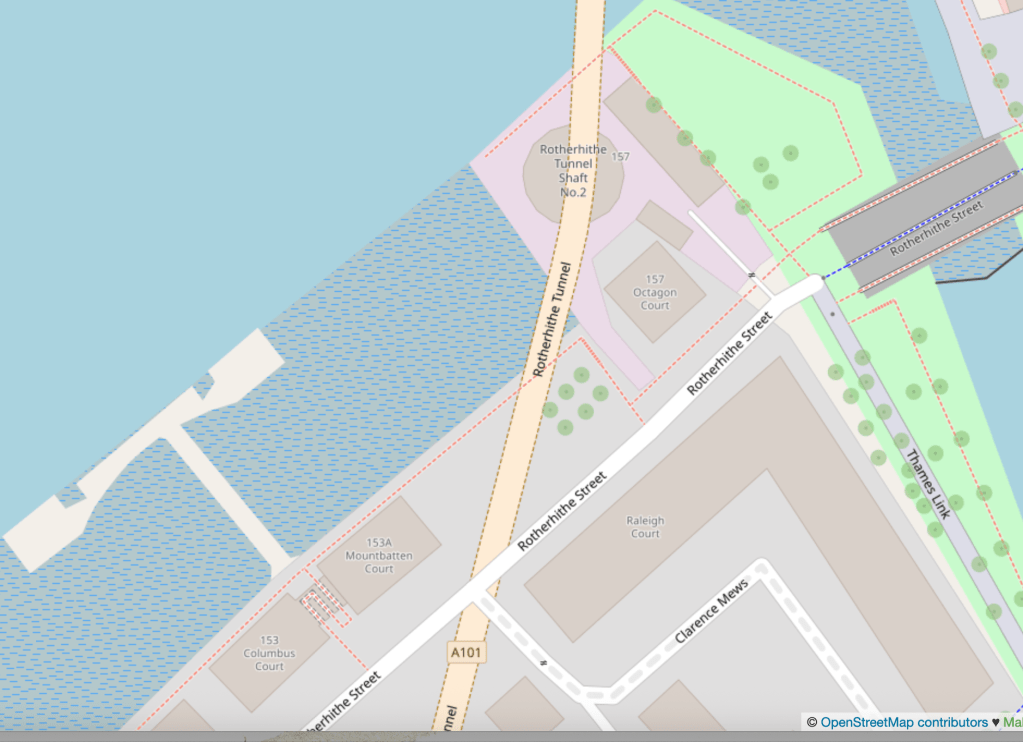
Here’s a map showing the river downstream of Tower Bridge, and the location of these structures. Click to enlarge.
Map showing the Rotherhithe tunnel, all 4 shafts, and the entrances. Click to enlarge.
(c) OpenStreetMapcontributors

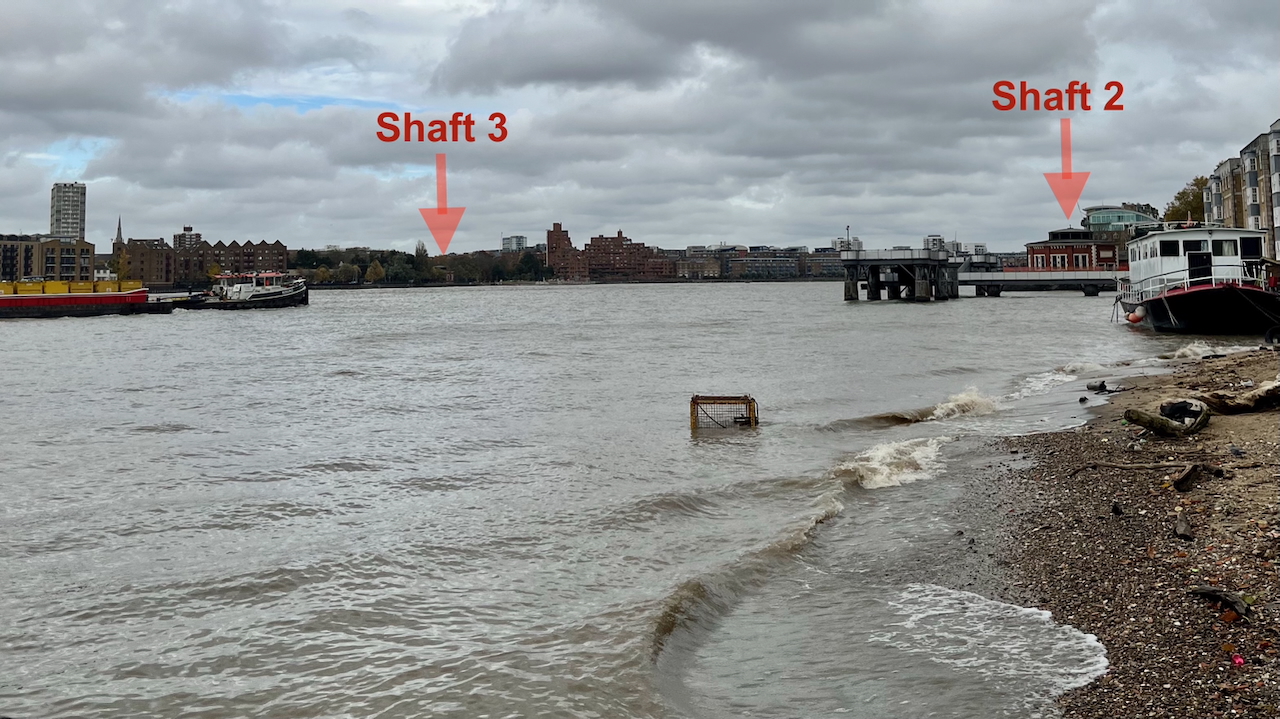
You can see one shaft from the other. Here’s a picture looking North across the Thames, just before I started the sketch. The light wasn’t great, but you can still see both shafts 2 and 3. See how wide the river is at this point! The distance between the two shafts is around 1500ft (500 metres).
Photo looking north across the Thames at Rotherhithe 4th November 2025 (c) JaneSketching

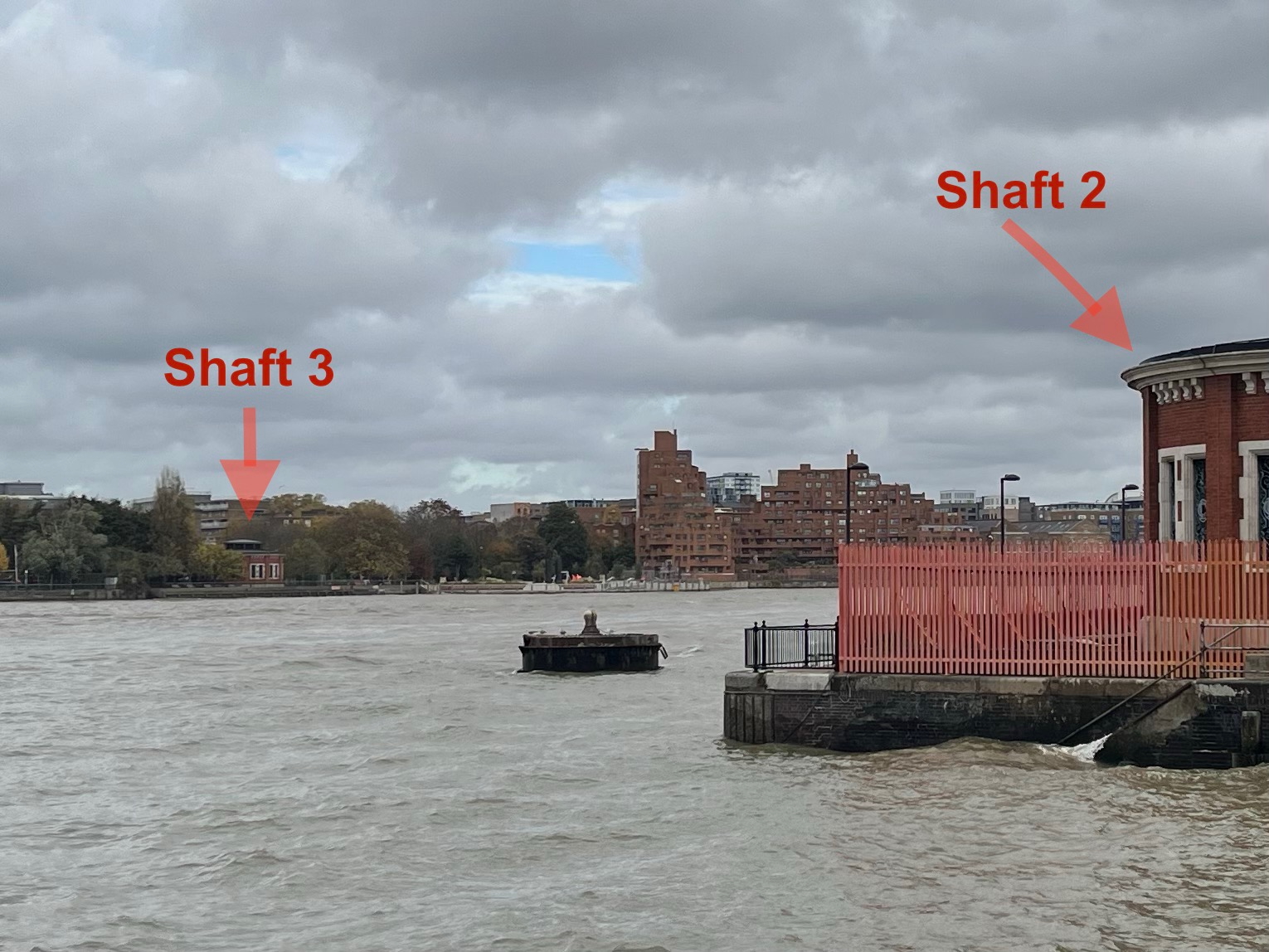
Here’s a photo from closer:

Photo looking north across the Thames at Rotherhithe 4th November 2025 (c) JaneSketching

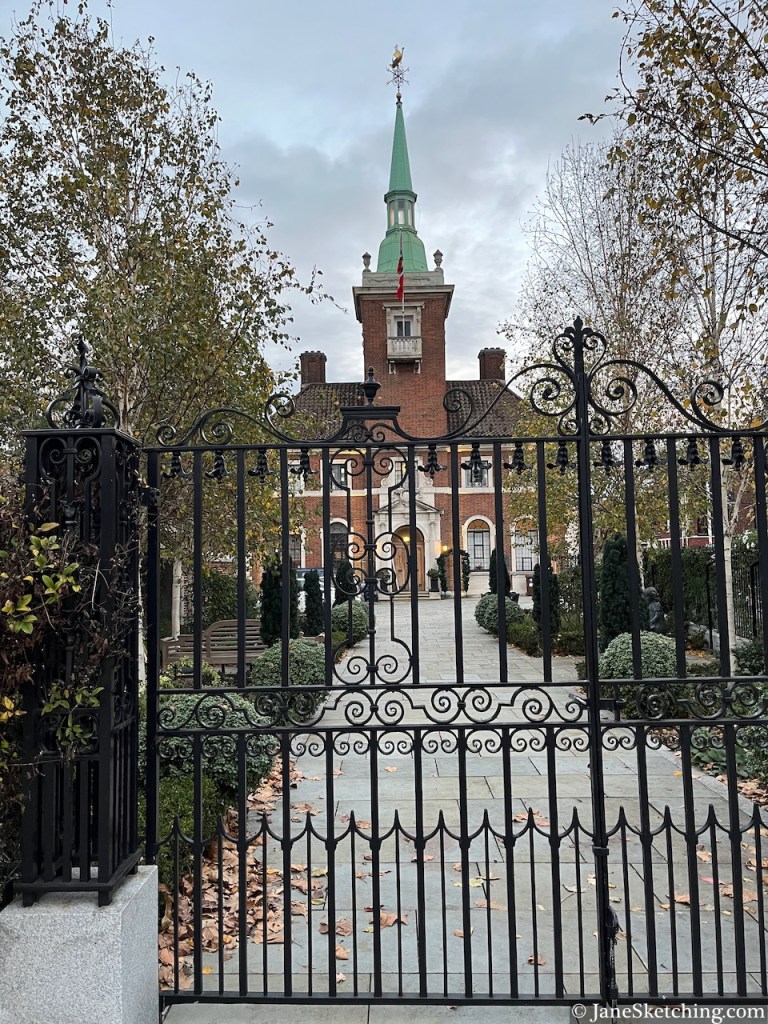
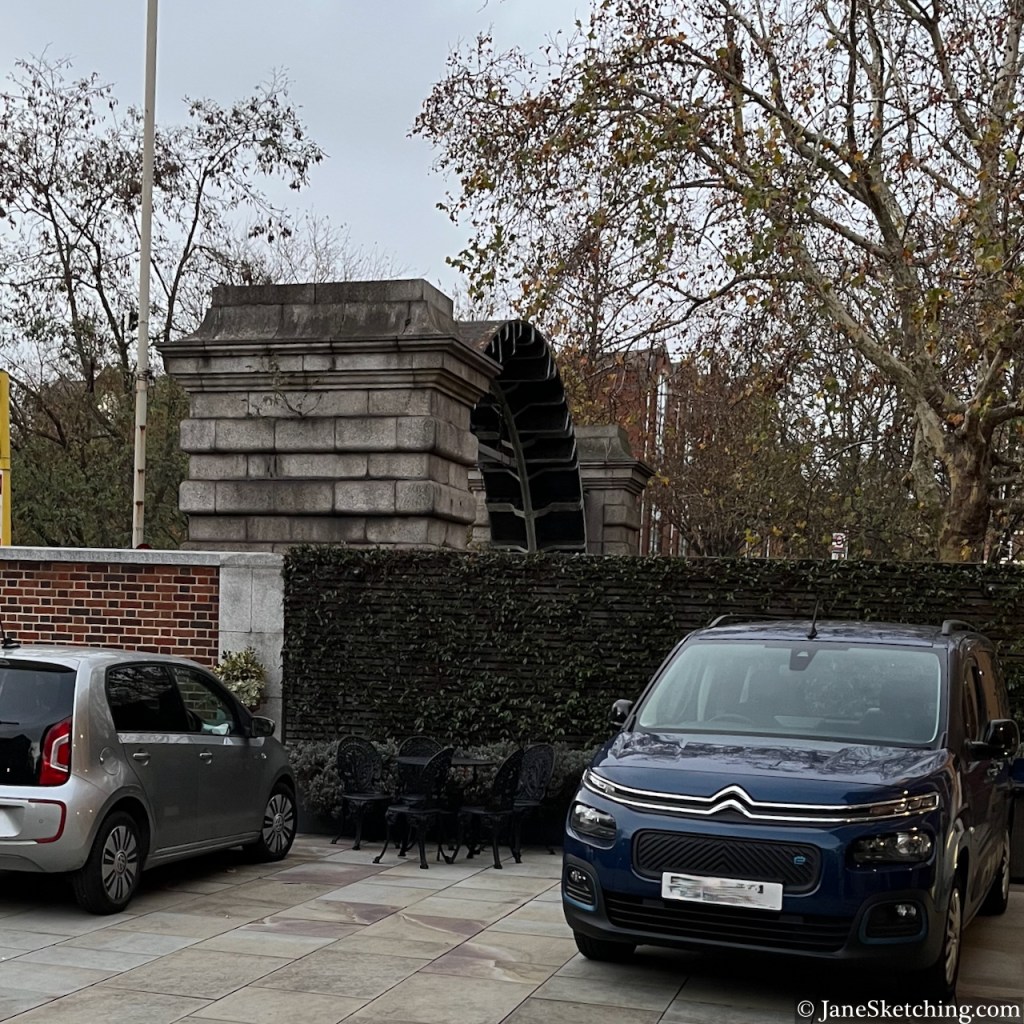
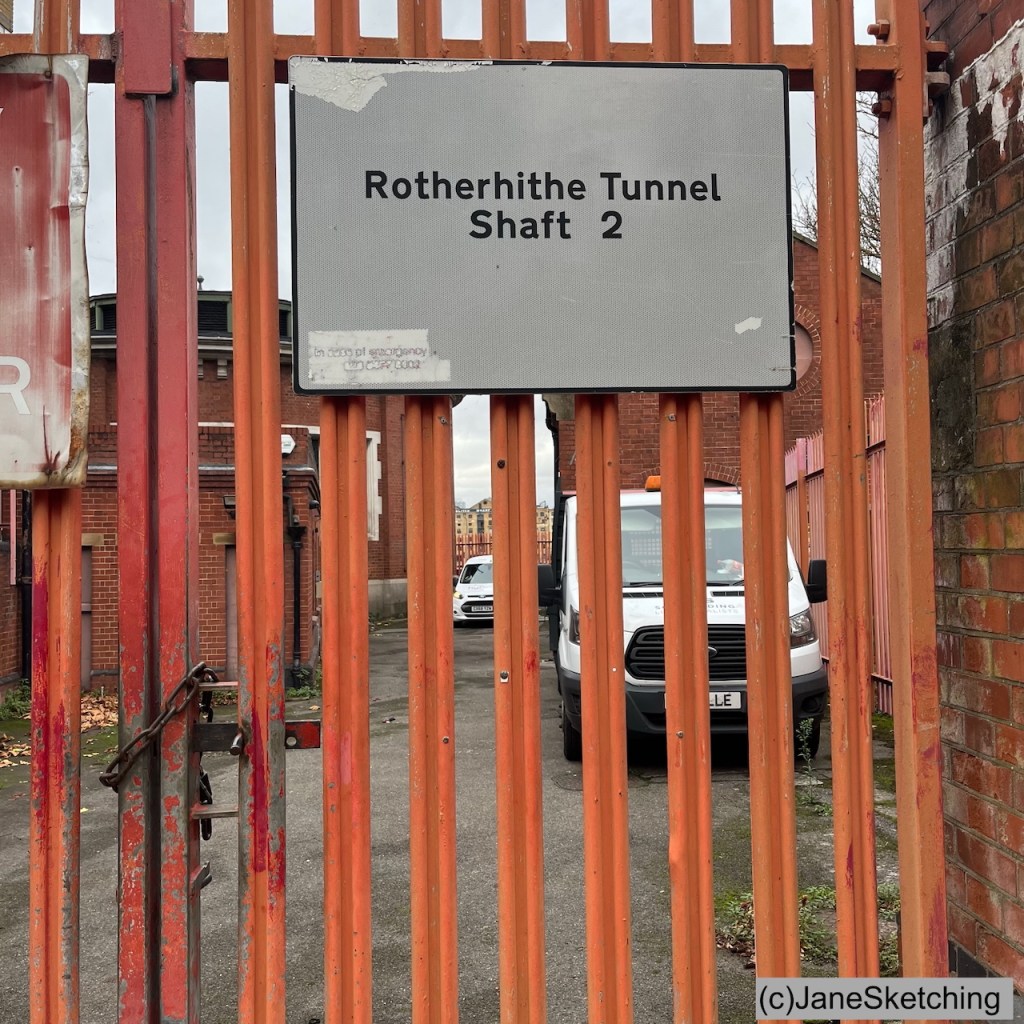
Shaft 2 is hidden behind high orange fences as you see. On the inland side it is behind a residential building at 157 Rotherhithe Street.

The Rotherhithe tunnel has 4 shafts. Shafts 2 and 3 are the round shapes and resemble each other. Both are Grade II listed.

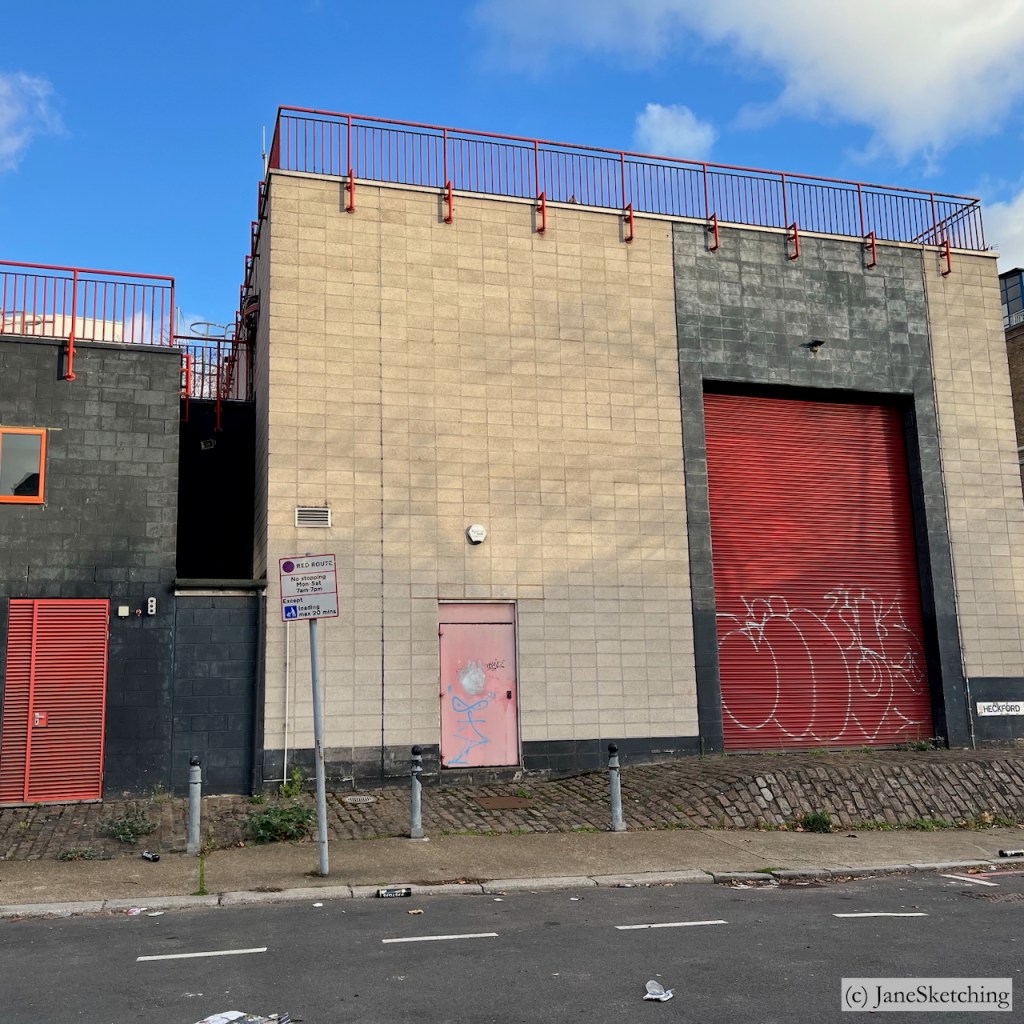
Shafts 1 and 4 have been modernised.

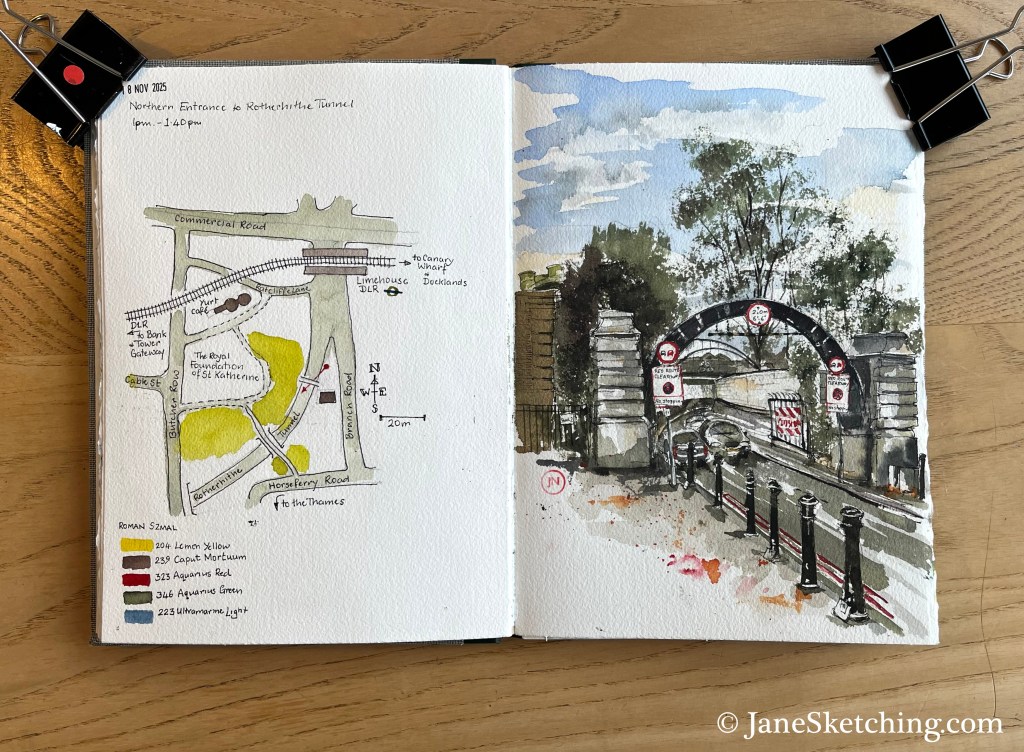
My next expedition will be to sketch the entrances to the tunnel.

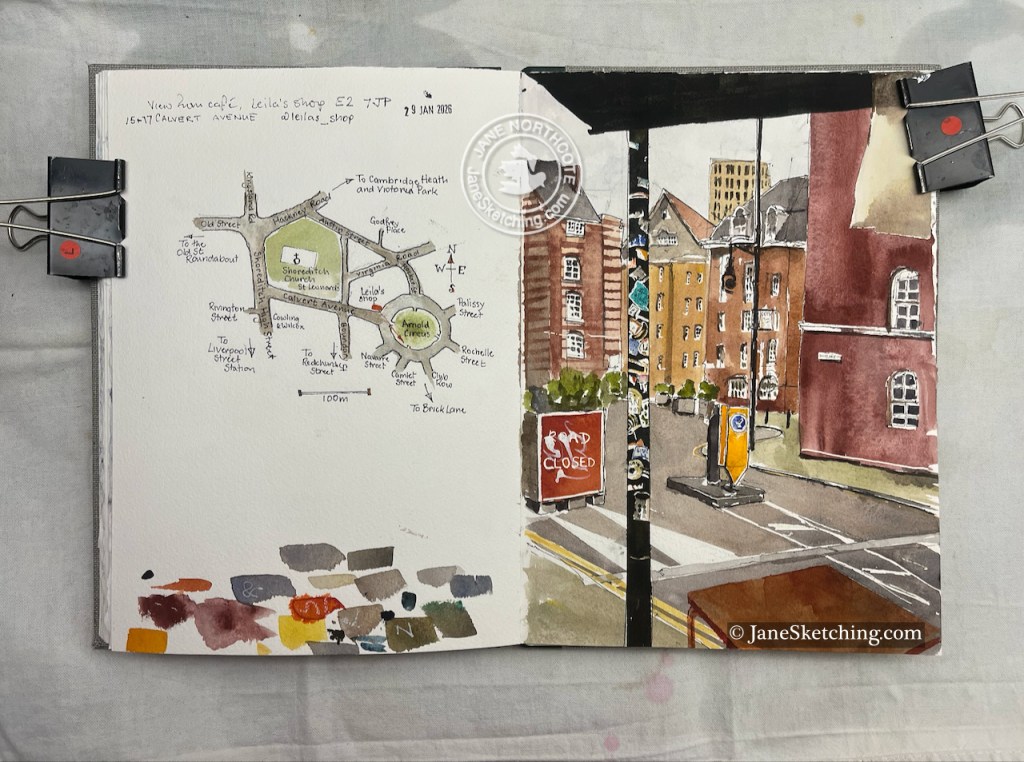
Sketchbook 16 spread

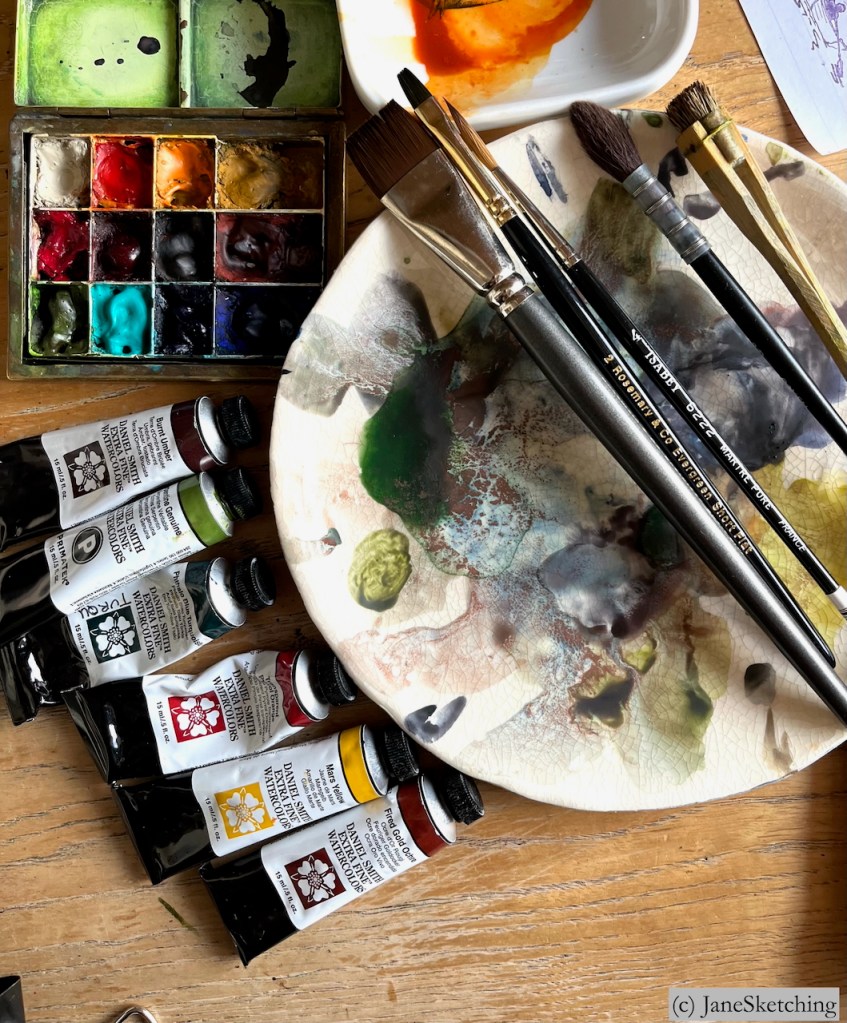
Watercolours by Daniel Smith :
– Burnt Umber
– Serpentine Genuine
– Phthalo Blue Turquoise
– Transparent Pyrrol Orange
– Mars Yellow
– Fired Gold Ochre

Colours and brushes used for this picture. Colours by Daniel Smith. Brushes by Rosemary Brushes. Ceramic palette by Mary Ling. Brass Palette by Classic Paintboxes.

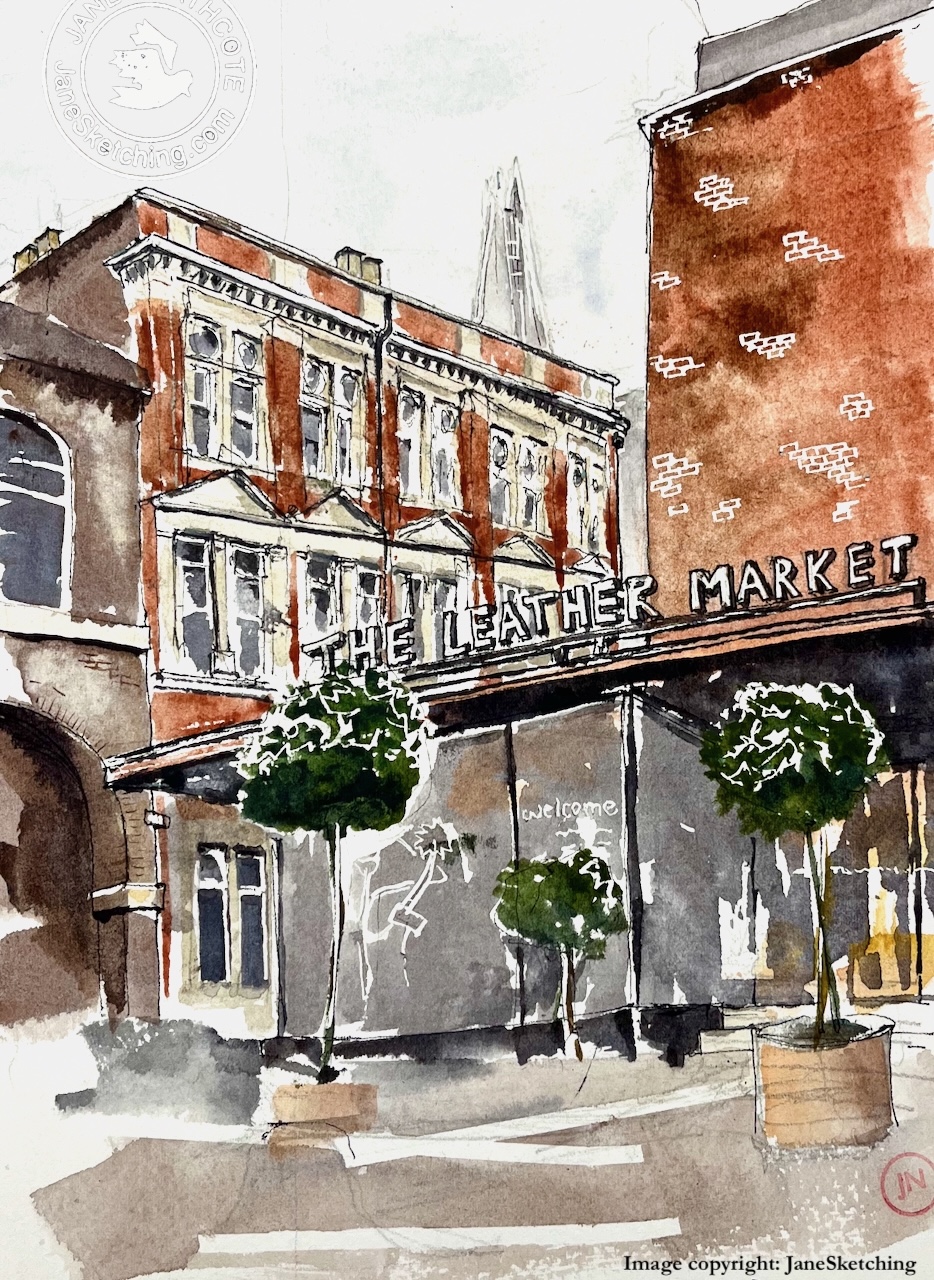
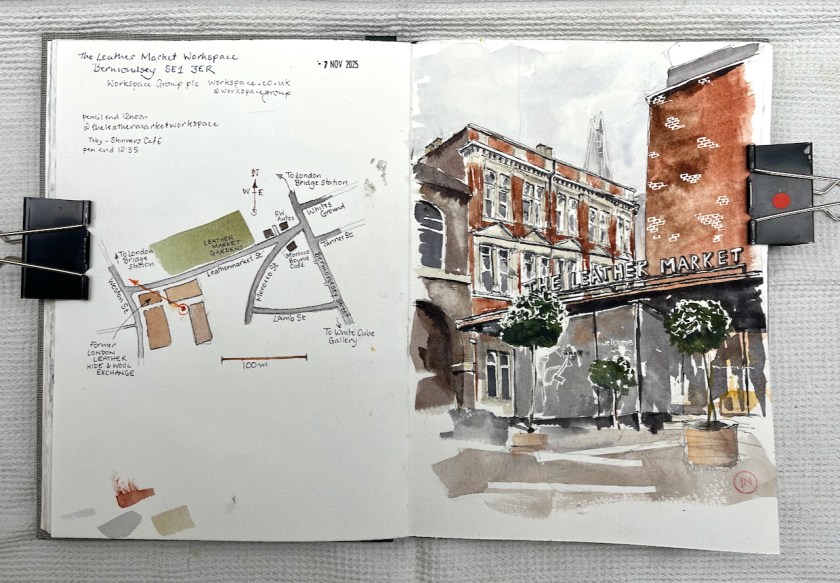
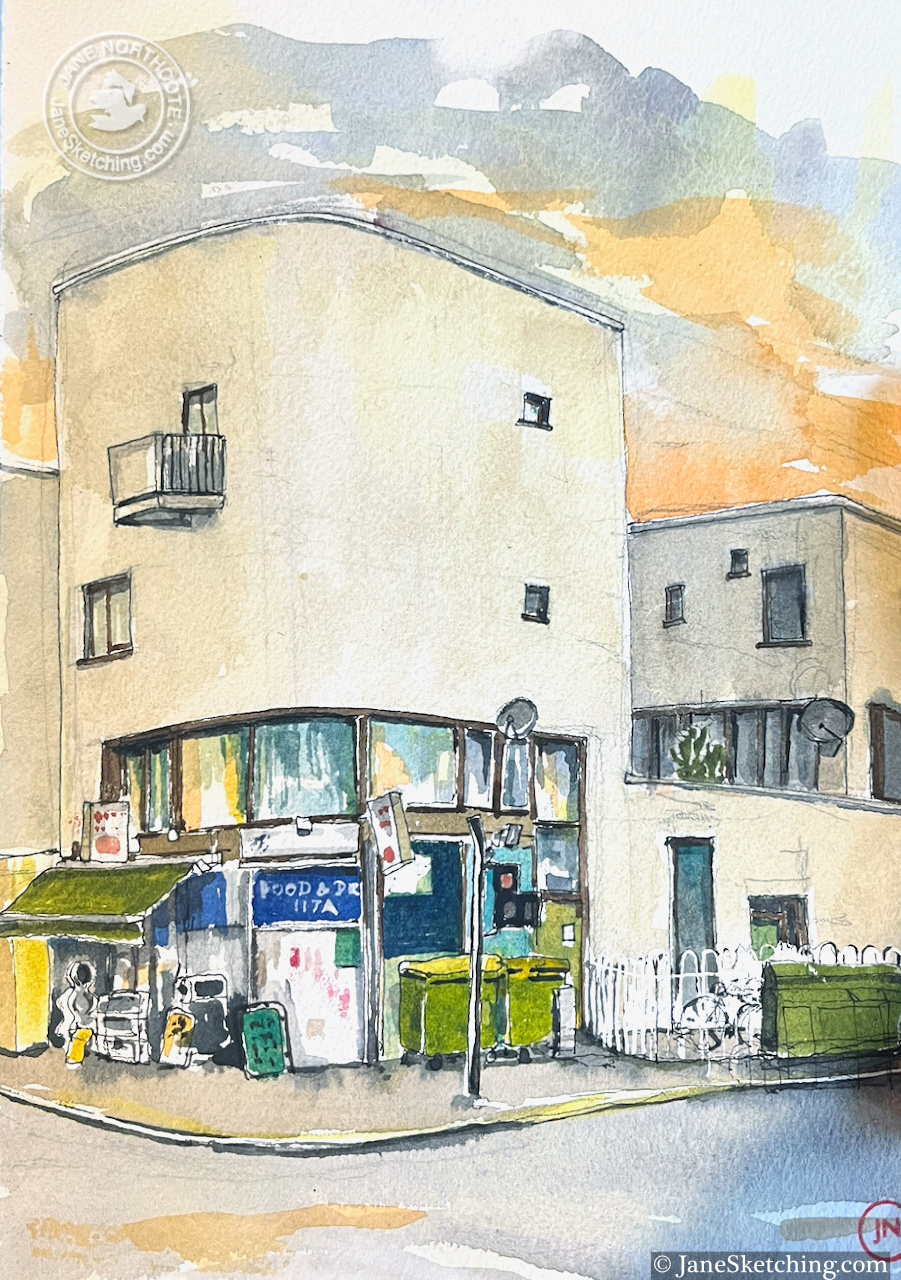
The Leather Market Workspace, Bermondsey, SE1 3ER

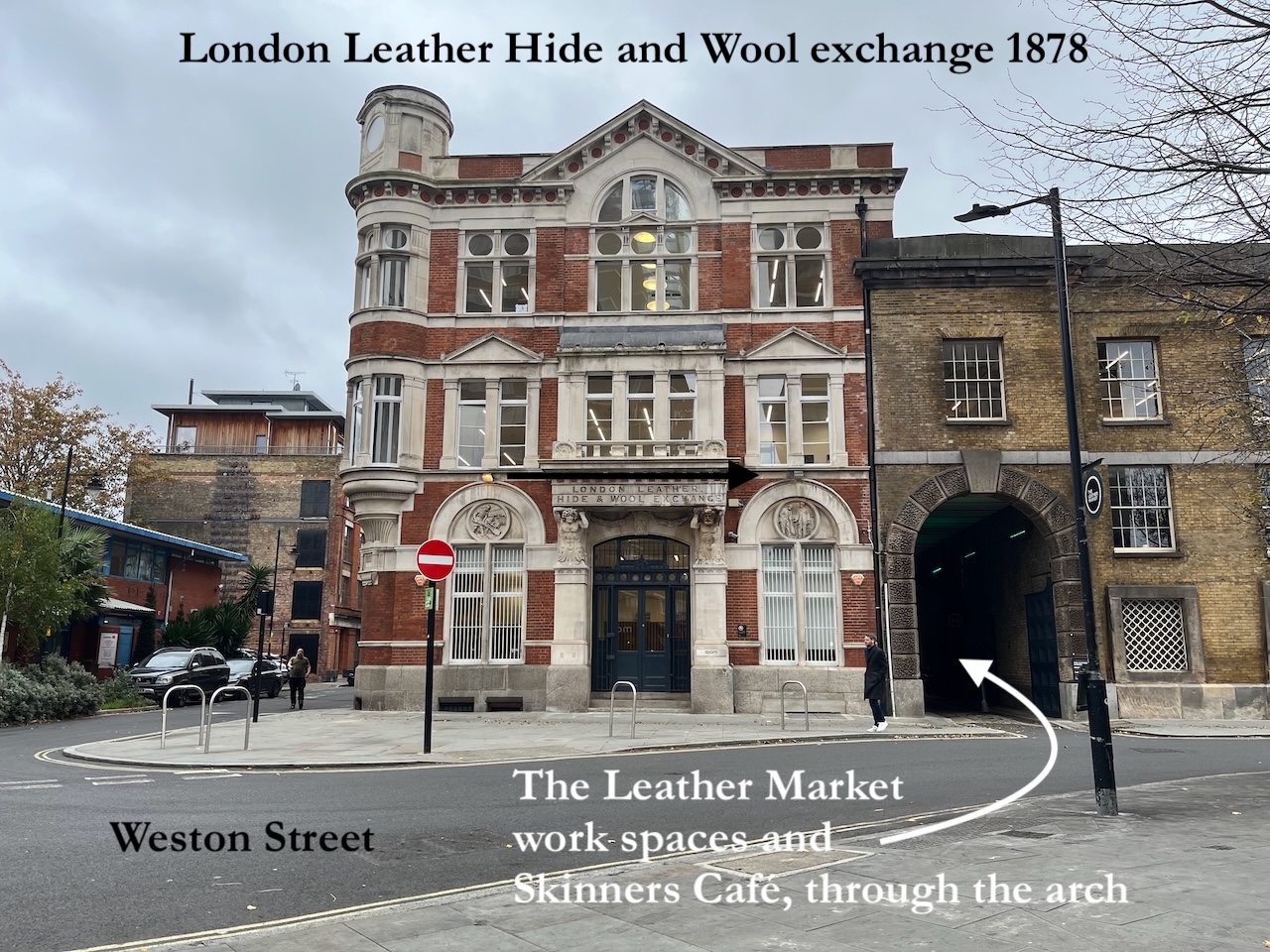
Here is The Leather Market Workspace. The Victorian building on the left is the back of the Grade II listed former “London Leather, Hide & Wool Exchange”, 1878, designed by George Elkington and Sons.

My idea had been to sketch the front of the Victorian building from Weston Street. But the front was obscured by delivery vans.

We were on the point of abandoning the project, when Toby appeared.

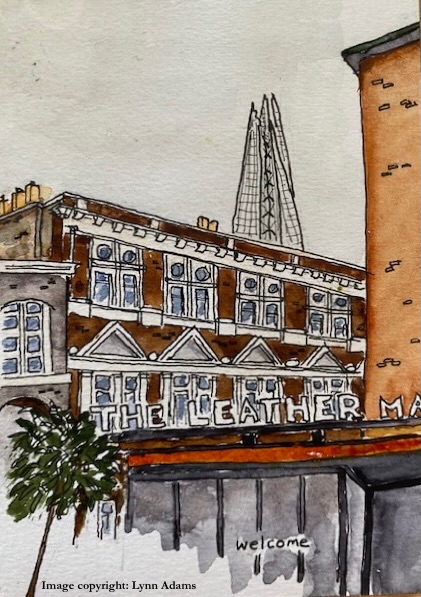
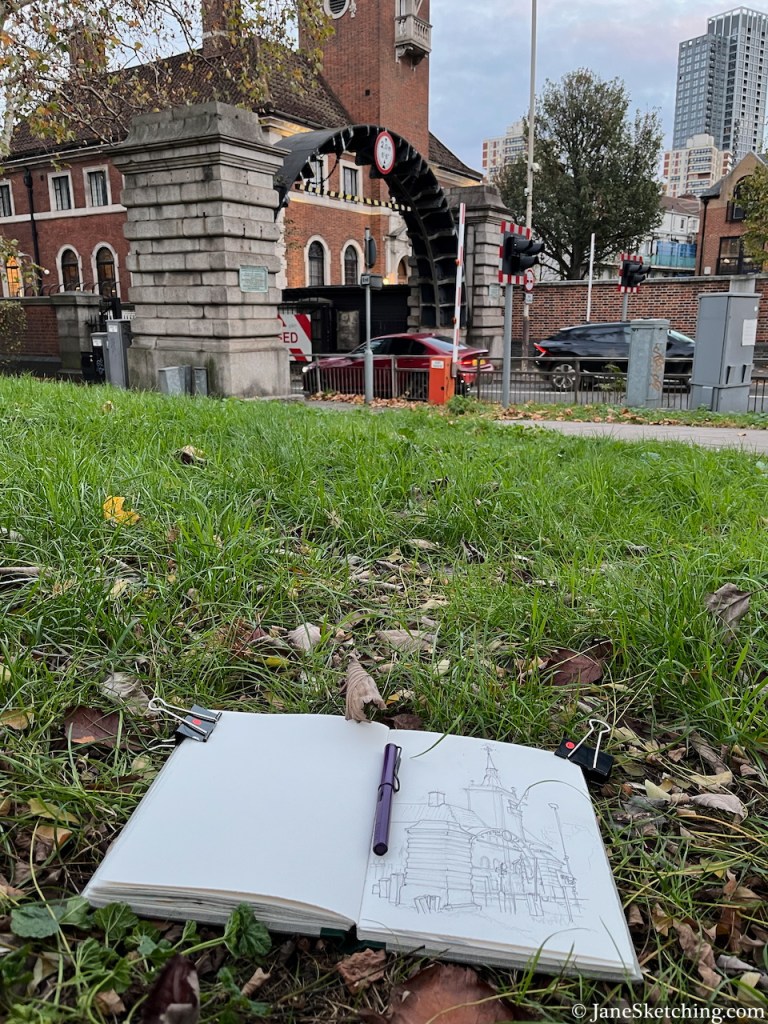
Toby, it turns out, is in charge of a café. He was standing on the pavement next to a huge arch by the Victorian frontage. Come in! he suggested. Lynn and I followed him through the arch. The space opened out into a large yard, with seats. Toby went into his café and we walked around the yard, sizing up the artistic possibilities. Lynn uttered a shriek of delight. She had discovered a point at the edge of the courtyard with an unexpected view of The Shard. And trees. This was her quest. She settled down to sketch while I went to procure coffee from Toby and his team. Then I started sketching too.

“The Leather Market” is one of a collection of co-working spaces managed by Workspace Group plc. We sketched and drank our coffee in the calm yard. Workers passed by and made encouraging comments.

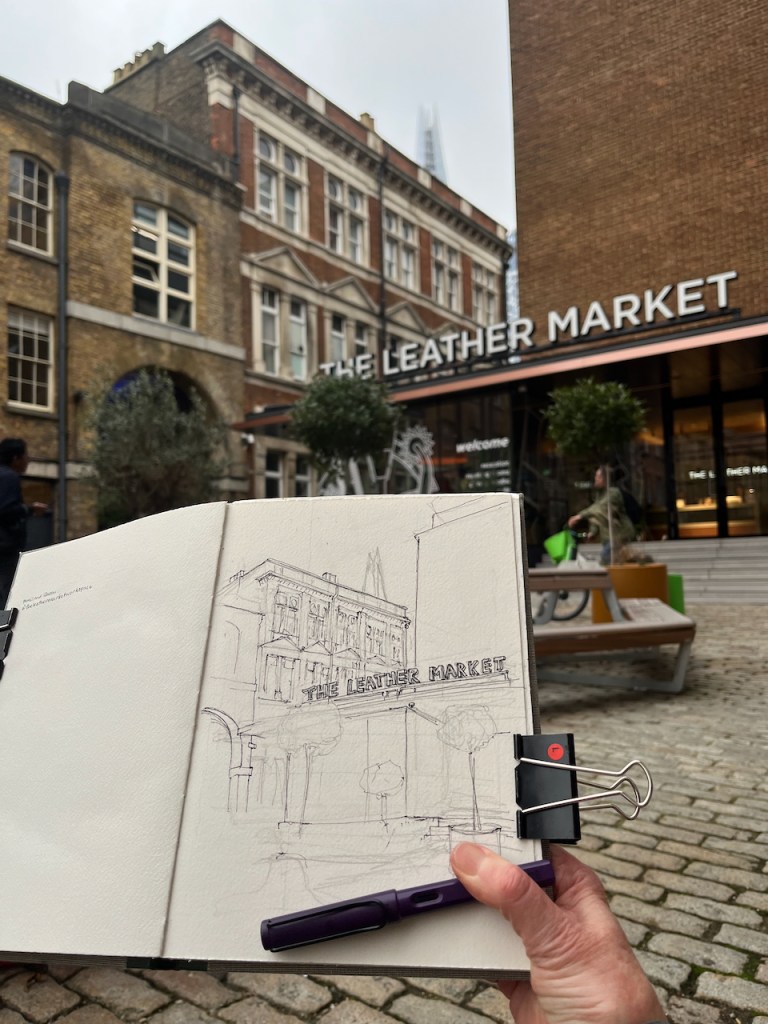
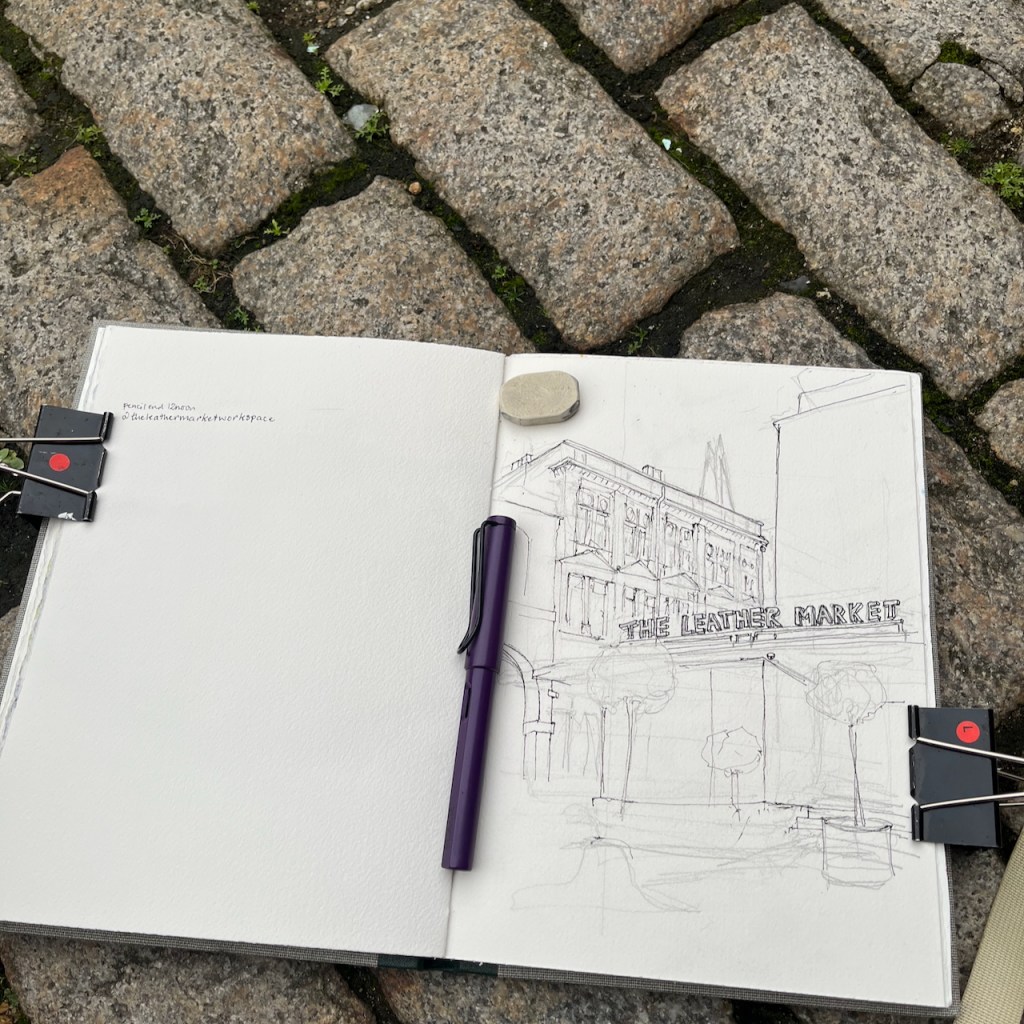
Working on a sketch of The Leather Market. Pen: Lamy Safari fountain pen

We returned our coffee cups to the friendly café, and set off to explore more of Bermondsey. By the time we emerged out through the arch, the delivery vans had gone from the front of the building.

Thank you to Toby and his team from Skinners Café for making us so welcome!
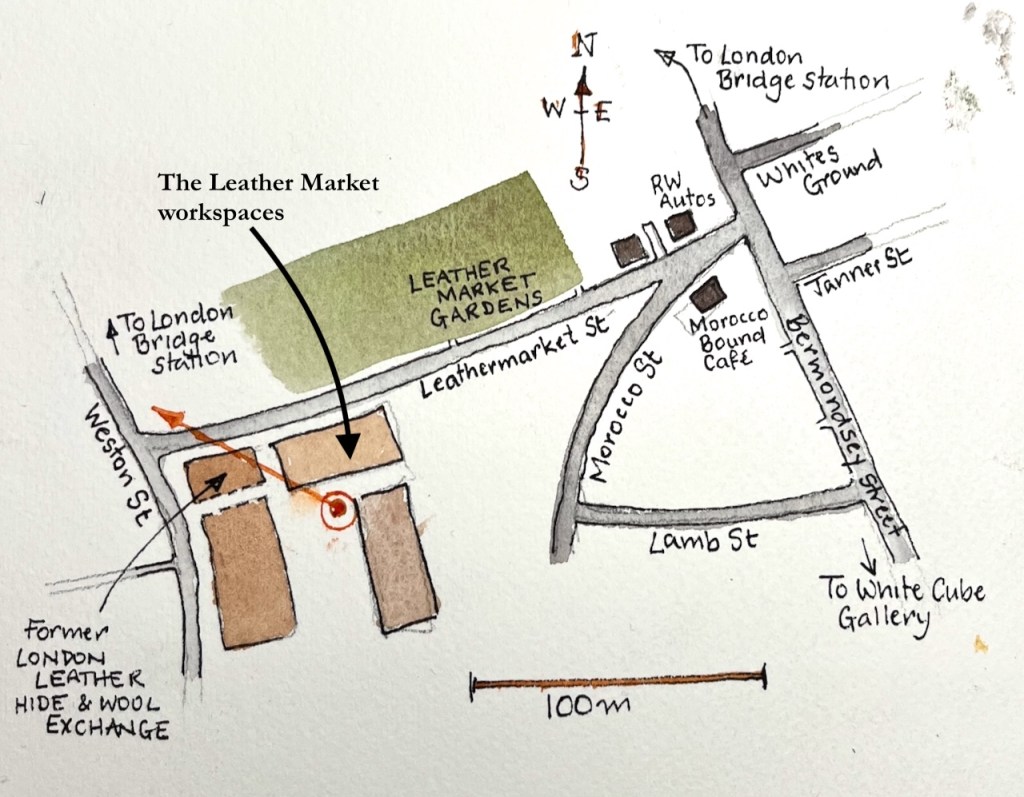
Here’s a map:

Colours, all Daniel Smith watercolours:

  • Fired Gold Ochre for the bricks
  • Burnt Umber and Ultramarine Blue for the grey and blacks
  • Serpentine Genuine for the greens
  • Some Transparent Pyrrol Orange and Mars Yellow for the light indoors
  • all the whites are the paper, fine lines achieved using masking tape and rubber resist.

My pen is a Lamy Safari with EF nib, and De Atramentis Document Black waterproof ink. Paper is Arches Aquarelle 300gsm CP, in a book made by Wyvern Bindery of Hoxton

I have sketched in Bermondsey before:

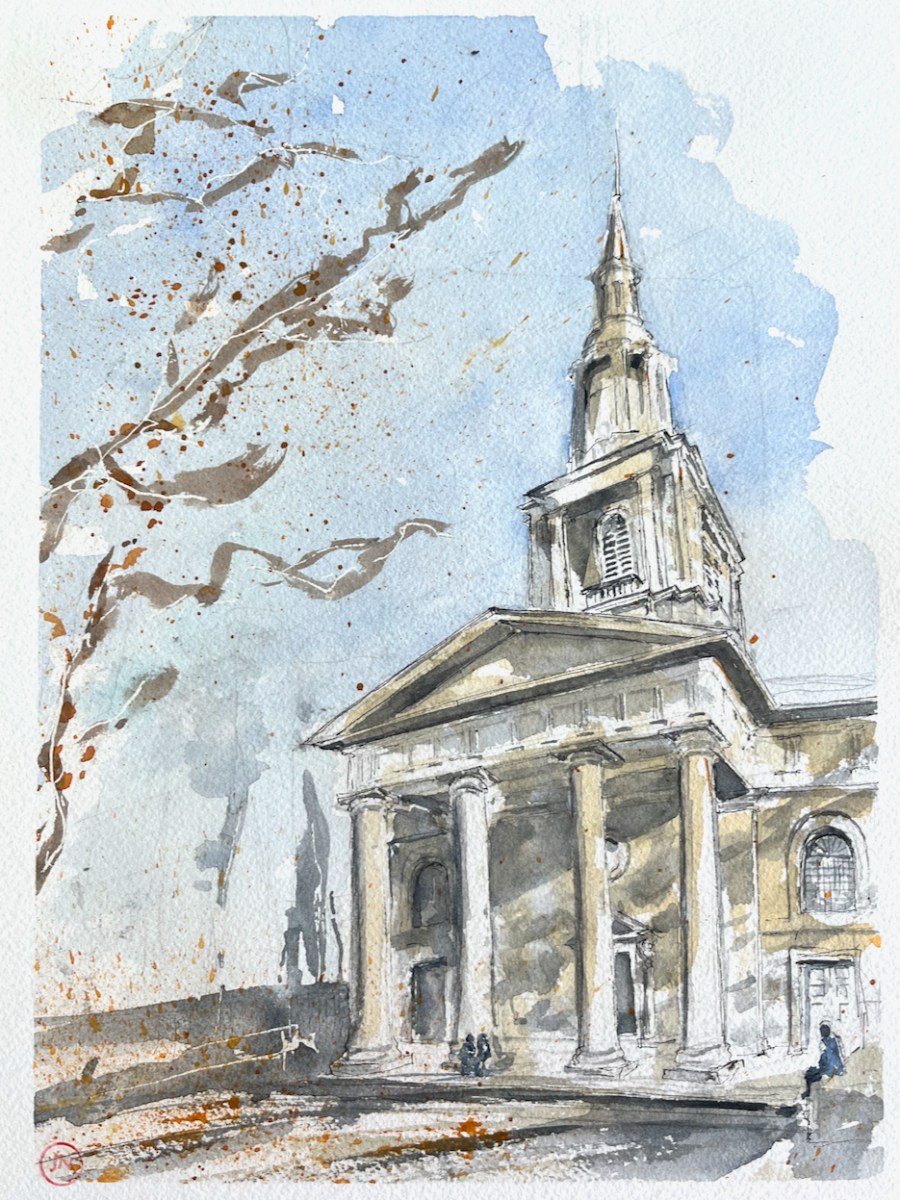
St James Bermondsey SE1

Walking back from the Little Bread Pedlar with my bag of goodies, I came to a standstill in front of St James’ Church, Bermondsey. This is a…

keep reading

Rotherhithe Tunnel Shaft 3, King Edward Memorial Park, E14

A tale of two tunnels

Construction work for the Thames Tideway tunnel surrounds this small round building on the north side of the Thames, near Shadwell.

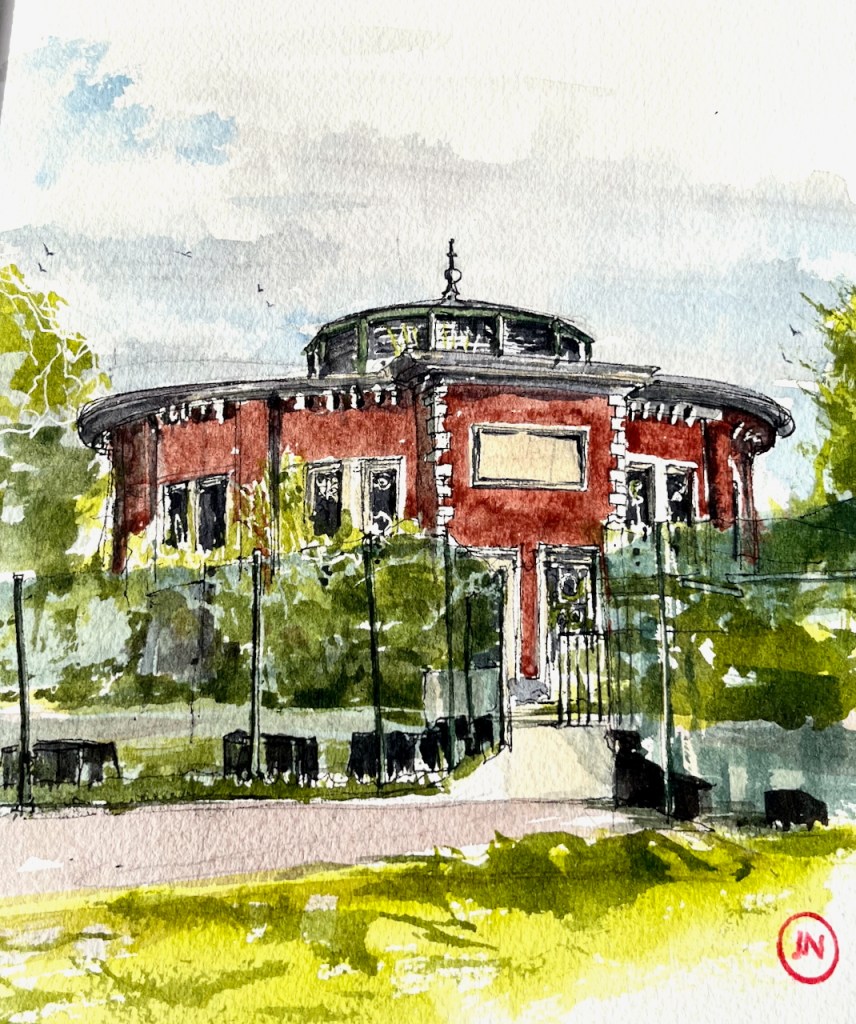
Rotherhithe Tunnel Shaft 3, King Edward VII Memorial Park, sketched 9th September 2025 in Sketchbook 16

This building is an air shaft and access point access for the Rotherhithe tunnel. The Rotherhithe Tunnel carries road traffic between Rotherhithe on the south of the river and Limehouse on the north. It was constructed between 1904 and 1908, for horses and carts. The designer was Sir Maurice Fitzmaurice.

The tunnel links Limehouse on the north of the river to Rotherhithe on the south. Built originally for horse-drawn carriages and pedestrians, the tunnel now carries far more traffic than it was designed for, which requires careful day to day management by TfL to ensure safety.

Transport for London press release 20181

This circular building is one of four shafts giving access to the tunnel. It contains a spiral staircase, which was in use from when the tunnel was opened in 1908 until the 1970s2. This access is now closed to the public. The shaft building and the staircase are Grade II listed3.

The roof in my picture dates from a refurbishment in 20074. Originally there was a glass dome5.

Location of Rotherhithe Tunnel Shaft 3, map (c) OpenStreetMap contributors.

The fences in my drawing are the perimeter of a Thames Tideway tunnel construction site. The Thames Tideway Tunnel carries sewage from central London to Becton Sewage Treatment Works. It runs under the Thames. At various points there is a junction between this main sewer and a local sewerage system. The site at King Edward VII is one such junction.

The Thames Tideway tunnel runs longitudinally along the Thames, so it crosses the Rotherhithe tunnel, which goes across the Thames. But this is not a problem, as the Thames Tideway tunnel is 60m6 below the Thames and the Rotherhithe tunnel is just 23m down7. So they do not bump into each other.

Sketchbook 16 spread

I’ve read that you can walk through the Rotherhithe Tunnel starting from one of the the tunnel entrances and passing under the shaft I’ve drawn. Those who have tried it8, even during the pandemic, do not recommend the experience. The tunnel is highly polluted from the vehicle fumes, and the pavement is narrow. It’s even pretty terrifying to drive through it in a car. Close the windows and the air vents, and stay alert while driving. If you’d like to walk a Thames tunnel, I recommend the Greenwich Foot Tunnel, or the Woolwich Foot tunnel, both of which I’ve walked. They are fun, eerie and have no traffic to pollute the air. You can read about my excursion to the Woolwich Foot Tunnel here.

Disambiguation: The Rotherhithe Tunnel I’m talking about in this post is not the same as an earlier tunnel built between 1825 and 1843 by Marc Brunel, and his son, Isambard. This Brunel tunnel was a little further upstream, and is now used as a railway tunnel only.


References:

  1. Transport For London Press release 12 June 2018 contains data about the numer of vehicles using the tunnel: https://tfl.gov.uk/info-for/media/press-releases/2018/june/rotherhithe-tunnel-celebrates-110-years-of-transporting-people-across-the-thames ↩︎
  2. Access to the tunnel via the shafts was from 1908 until the 1970s. FOI FOI-0398-2526 confirms the presence of stairs inside the shaft building: TfL Freedom of information request FOI-0398-2526: https://tfl.gov.uk/corporate/transparency/freedom-of-information/foi-request-detail?referenceId=FOI-0398-2526 ↩︎
  3. Historic England Listing: https://historicengland.org.uk/listing/the-list/list-entry/1260101?section=official-list-entry ↩︎
  4. Roof replacement 2007 confirmed by King Edward VII park “Management Plan” 2008 page 15: “The park surrounds the tunnel vent and access shaft to the Rotherhithe Tunnel. The tunnel was opened in 1908, the vent was present before the park was constructed, and early images of the park show that it visually dominated the site. The tunnel vent remains an important feature, but is no longer so visually dominant due to the present day maturity of trees in the park. The Rotherhithe Tunnel was refurbished in 2007 and a replacement roof was installed as part of these works.”
    Link: https://www.towerhamlets.gov.uk/Documents/Leisure-and-culture/Parks-and-open-spaces/king-edward-management-plan.pdf ↩︎
  5. Roof of the shaft:
    1908 – glass dome,
    by 1946 – no roof (removed in the 1930s),
    from 2007 – current roof as in my drawing.
    Evidence:
    London Picture Archive has a picture of the shaft in 1921, where you can see the glass dome that covered the shaft. Record number 118817, Catalogue number SC_PHL_01_392_A360 See this link: https://www.londonpicturearchive.org.uk/view-item?WINID=1762114518393&i=121045. They also have photographs from 1971 where it’s clear that the roof has been removed completely. See photo on this link, record number 237845, catalogue number SC_PHL_02_0666_71_35_217_30A: https://www.londonpicturearchive.org.uk/view-item?i=239938
    “A London Inheritance” post contains an aerial picture from 1946 showing that the roof had been removed by that date. See this link. This post says: ” The following photo dated 1946 from Britain from Above shows the park at lower left. Note the round access shaft to the Rotherhithe tunnel. In the photo the shaft has no roof. The original glass roof was removed in the 1930s to improve ventilation. The current roof was installed in 2007.” ↩︎
  6. Thames Tideway Tunnel information from the Tideway tunnel website: https://www.tideway.london/locations/king-edward-memorial-park-foreshore/ ↩︎
  7. Depth of the Rotherhithe Tunnel is from the website of the Rotherhithe & Bermondsey  Local History Society on this link: https://www.rbhistory.org.uk/rotherhithe-road-tunnel ↩︎
  8. Walking through the Rotherhithe tunnel: see for example “Ian Visits” : https://www.ianvisits.co.uk/articles/walking-through-a-tunnel-under-the-thames-part-1-11764/ ↩︎

2 Leathermarket Street, Bermondsey, SE1

From the café “Morocco Bound” I sketched the distinctive building across the street.

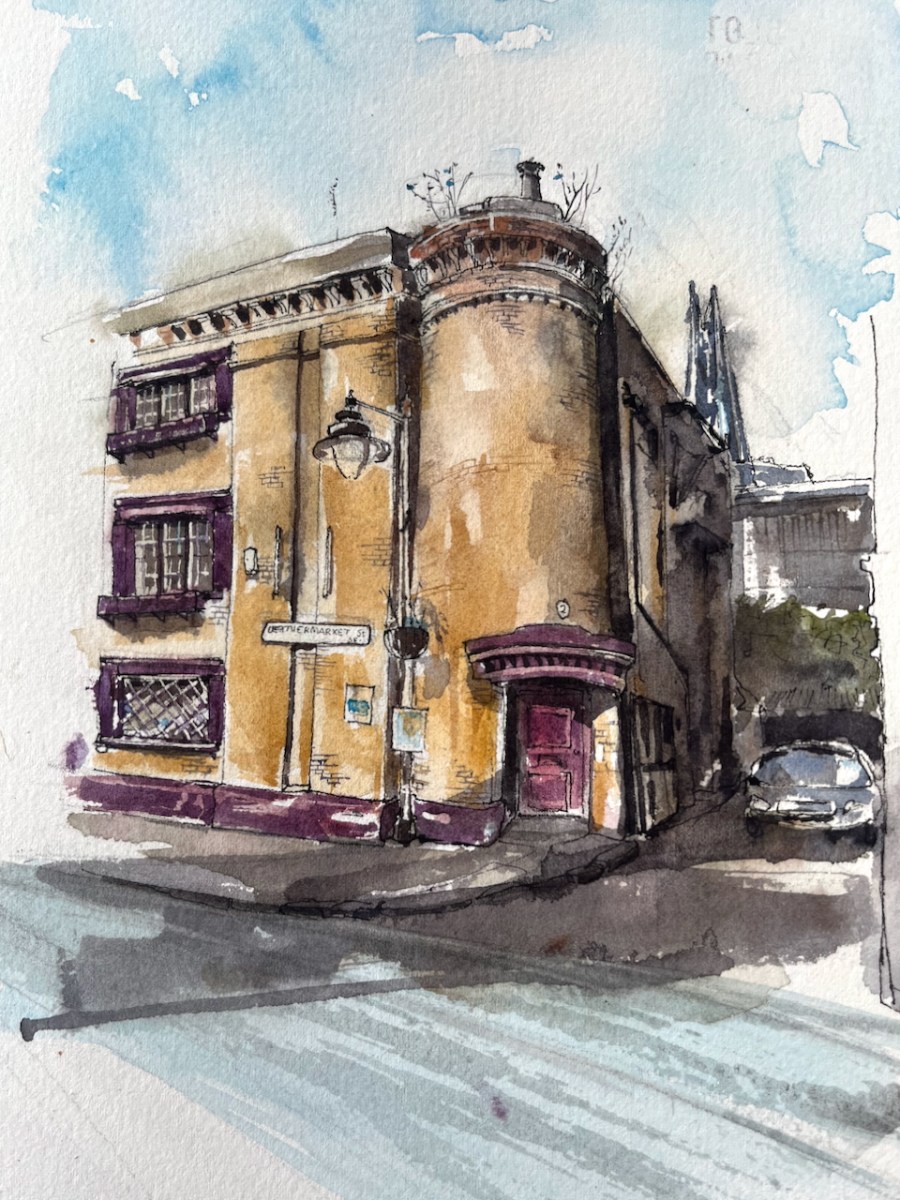
This is 2 Leathermarket Street:

2 Leathermarket Street, London SE1 3HN. Sketched 5th September 2025 in Sketchbook 16

In the distance you see The Shard, at London Bridge Station.

This was the leathermaking district up to the beginning of the twentieth century. We have Leathermarket St, Morocco St, and Tanner St. The former “Leather Hide and Wool Exchange” is further up Leathermarket Street, towards Borough, to the west.

The building was listed Grade II in 1972. It is early 19th century, according to the listing.

Here is the area in 1976, in a picture from the London Archives, used with permission:

1976 photo, Building in Morocco Street, record number 51956
image source: (c) The London Archives (City of London Corporation), picture used under licence reference #007089
https://www.londonpicturearchive.org.uk/view-item?i=54304&WINID=1730309548612

The windows are all still there as in 1976, with the same window frames, now painted purple. Even the weird little chimneypot on the top of the turret is still there, as it was 50 years ago. In this 1976 picture the placard between the windows says “Ryedene Ltd” but I have been unable to discover if this company was in the leather business. There is no placard now.

“The Department” now occupies this building. Their business, according to their website, is:

https://www.the-department.co.uk/services/ downloaded 31 October 2025

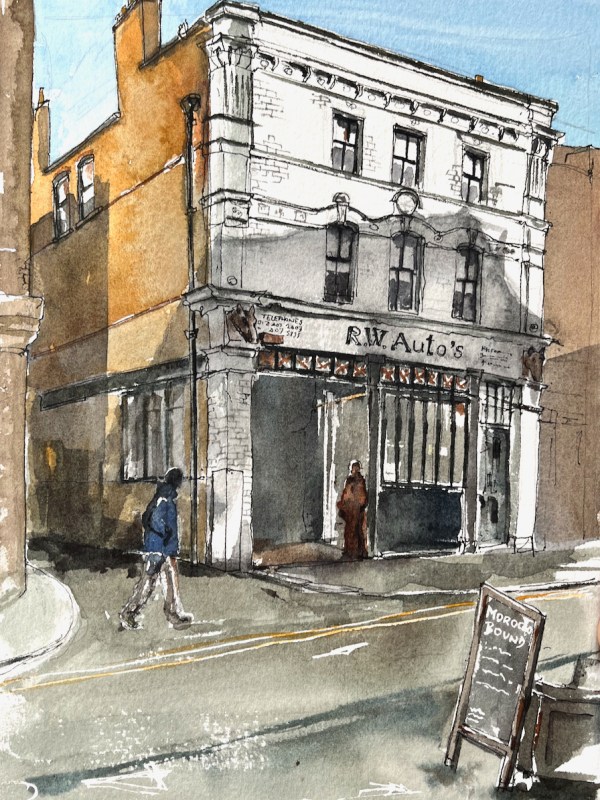
To the right of 2 Leathermarket Street is a garage, “R.W. Auto’s” which I have sketched previously:

2 Morocco Street, sketched from “Morocco Bound”, 18th October 2024, 2pm in Sketchbook 15

Thank you to “Morocco Bound” for their hospitality while I sketched these pictures. It’s a calm and welcoming bookshop and café in an interesting location. I’ll be back!

Page spread, Sketchbook 16

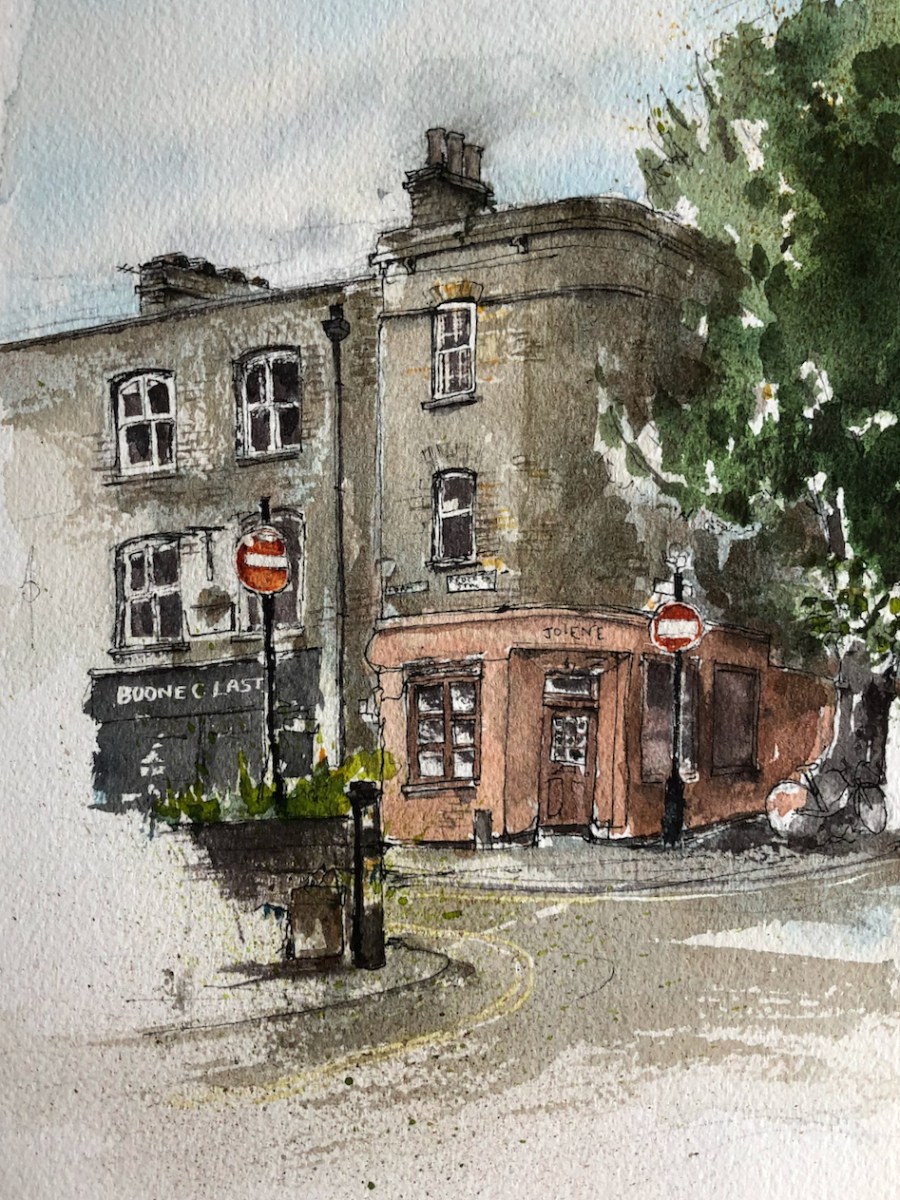
The Perseverance, formerly The Sun, Lambs Conduit Street WC1

Here is The Perseverance, on the corner of Great Ormond Street and Lamb’s Conduit Street.

The Perseverance, 63 Lamb’s Conduit Street WC1N 3NB, sketched 4th September 2025 in Sketchbook 16

This pub was formerly The Sun, and had a magnificent painting on the corner. There are pictures and history on this detailed post from The London Inheritance. The many comments on the London Inheritance blog post describe happy memories of The Sun and its numerous Real Ale pumps.

The pub is listed Grade II reference 1379274. It was built in the early 18th century and the front was renewed in the 19th century. It was The Sun until the 1990s when the name was changed a few times, becoming the Perseverance around 2005/6.

I sketched it from the “Rymans” stationery shop which is on the opposite corner of the crossroads. People walked past me, deep in conversation, casting shadows in the afternoon sun. But one elderly man stopped, and looked up at me. His back was slightly bent. “Are you alright standing there?” he asked. I said I was, wondering what he meant. “Because,” he continued, “I could go up and get you a stool from my flat. It’s just up there.” He pointed heavenwards, to the windows above the shops. People are so kind. This man was so kind. It’s moments like this which make the sun rise on humanity. I was in fact quite tired, and would have liked to sit down, but my drawing was very nearly finished. I hesitated to send this helpful individual back up his stairs. So I declined his thoughtful offer, as politely as I knew how, and continued my drawing standing upright in the sun.

This drawing took 1 hour and 20 mins on location, plus another hour and a half at my desk later. The colours are:

  • Mars Yellow (brickwork)
  • Ultramarine Blue and Burnt Umber (mixed, for the greys and blacks)
  • Phthalo Blue Turquoise and Ultramarine Blue for the sky and the street, and the street signs
  • Transparent Pyrrol Orange for the “No Entry” sign and the flowers
  • Serpentine Genuine Green for the plants
  • A tiny bit of Permanent Yellow deep for the yellow line on the road, and other small touches
  • All whites are the paper.
  • Ink lines are De Atramentis Document black ink in an Extrafine Lamy Safari fountain pen
  • Paper is Arches Aquarelle 300gsm Cold pressed in a sketchbook made by the Wyvern Bindery in Hoxton.

Here are maps (click to enlarge):

Here is the sketchbook, size 7″ x 10″.

38 Charterhouse Street, London EC1

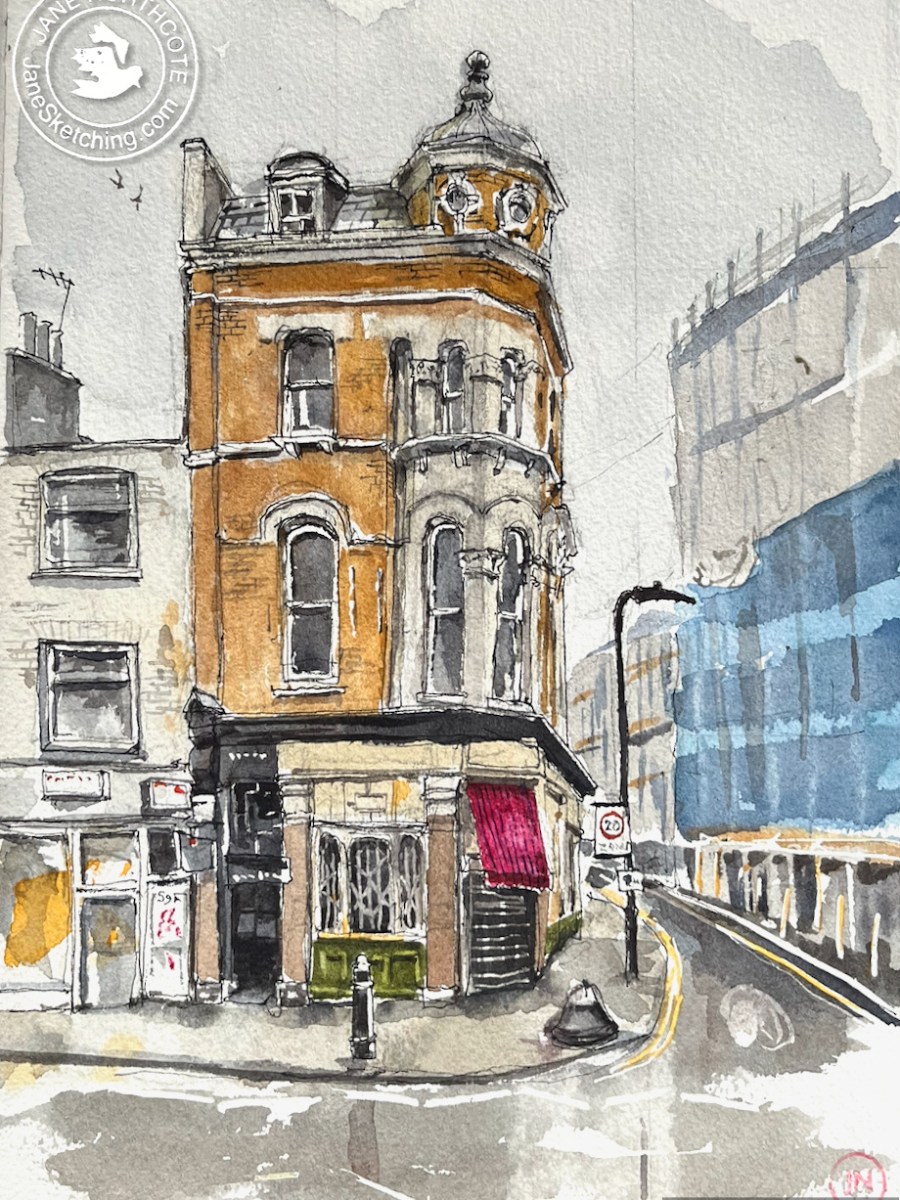
My idea that day was to sketch some interesting corner pubs in Bloomsbury.

By the time I had emerged from my flat and was on the street, the bright autumn day had turned stormy. After a few paces, the rain started falling. Everyone dashed for cover. I sheltered in a doorway, together with another woman, two strangers in a refuge, grinning and rolling our eyes. “Well, it is September”. At a pause in the deluge, we both emerged and went our separate ways. I went doggedly towards the West, but no, the rain returned, seemingly even more torrential. I dashed from doorway to doorway, like a fugitive in a spy novel, finding cover where I could. Then I spotted the generous overhang of Smithfield Market and rushed underneath, the rain spattering on the glass above. There was no sign of the deluge ceasing, so I considered, as you do in these strange interim conditions: to go on? to go back? Or to stay where you are?

Why not do the drawing right here? Over the other side of the road is a building occupying an acute angle between roads. It wasn’t in my plan, but by this time I had abandoned my plan. So here is 38 Charterhouse Street, sketched from the shelter of the Smithfield Meat Market canopy.

38 Charterhouse Street, EC1M 6JH sketched 4th September 2025 in Sketchbook 16

I sketched it in pen on location. Part way through the process, a group of workers started to clean the area behind me, using high-pressure water hoses. A fine mist appeared in the air, adding to the general dampness. I finished the drawing later that evening, in my warm dry room.

Here is a map.

As you see, number 38 stands on a little triangle of land, bounded by Charterhouse Street, Carthusian Street and the tiny alley called Fox and Knot Street.

British History Online offers some history for this triangular plot. In the 1860s the City of London redeveloped the Smithfield Meat Market. At the time it had been mostly an open-air market. The City turned it into the covered market it is today. The surrounding lanes and buildings were also affected, both by the redevelopment and the increased trade.

In 1869–70, with the new market building complete, it was resolved to take the new road along the north side of the market further east into the square itself, carried out in 1873–4. The road was called Charterhouse Street, apparently at the suggestion of the Charterhouse,
Whereas in 1860 Charterhouse Lane enjoyed a mix of businesses, in 1876 half of the sixteen surviving houses were occupied by meat and poultry traders. The same trades dominated the new buildings put up, though there were also coffee rooms to rival the two remaining pubs and a large bank at the corner with St John Street. By the time of the Second World War most of the buildings west of the Fox and Anchor at No. 115 were purpose-built cold stores. Only with the decline of Smithfield Market did the grip of the meat trades loosen. Today restaurants and bars have largely supplanted them.

British History online

The Fox and Anchor pub and the former cold stores are on the left of my drawing. I’ve drawn the marvellous frontage of the Fox and Anchor here.

British History Online describes the block on the corner, number 38:

The remnant of ground at the angle between the old and new roads was laid out for a small block of buildings and allotted the numbers 38–42 (even) Charterhouse Street, behind which a tiny street, Fox and Knot Street, was cut through in 1871. The name was taken from Fox and Knot Yard, a court obliterated by the new market.

The small triangular block west of Fox and Knot Street […] just within the City boundary, belongs to the land acquired by the Corporation of London in the 1860s for the Smithfield Market development. Set out for building in 1871–2, it remained empty until 1875–6. At the apex a warehouse (No. 38), was then built for Myer and Nathan Salaman, ostrich-feather merchants, to designs by Benjamin Tabberer. […] It is four storeys high, of red brick with regular fenestration; all the ornamentation is concentrated on the narrow corner. For many years there were coffee-rooms here.

So, in 1875 it was an ostrich-feather warehouse, which must have been a great place to visit. The next mention of the building is on the website of Herbert, a present-day supplier of technology to retail businesses. They have a section of their website devoted to their long history. In the early twentieth century they were supplying weighing machines and balances from their offices in West Smithfield and a factory in Edmonton.

Advertisement from the Herbert History site, showing Smithfield Market.

In 1937 they moved into 38 Charterhouse Street which became a showroom.

The Herbert and Son showroom, circa 1940s.

Herbert and Son moved out in 1956 and consolidated their operations into their Edmonton site. Since then, the building has been a coffee house, and, more recently, various bars. It is now the “Smithfield Tap”.

I wonder what will happen to it next?

Sketchbook 16

References

British History Online reference: https://www.british-history.ac.uk/survey-london/vol46/pp265-279
Charterhouse Square area: Charterhouse Street and other streets’, in Survey of London: Volume 46, South and East Clerkenwell, ed. Philip Temple (London, 2008), British History Online https://www.british-history.ac.uk/survey-london/vol46/pp265-279 [accessed 6 September 2025].

Herbert history reference: http://www.herberthistory.co.uk/cgi-bin/sitewise.pl?act=det&pt=&p=279&id=herbhis

Putting on the colour at my desk.

Colours, all Daniel Smith unless otherwise stated:

  • Fired Gold Ochre (bricks)
  • Ultramarine Blue Finest (Schmincke Horadam) + Burnt Umber = grey/black
  • Phthalo Blue Turquoise (reflections, water)
  • Mars Yellow (bricks)
  • Serpentine Genuine (Green tiles)
  • Buff Titanium (cream-coloured stonework)
  • Transparent Pyrrol Orange (highlights of red on the bollards)

7 Herbrand Street, London WC1

In a backstreet in Camden is a magnificent Art Deco building.

7 Herbrand Street WC1N 1EX, sketched 30 August 2025 in Sketchbook 16

This was built of re-inforced concrete in 1931, to the designs of architects Wallis, Gilbert and Partners. The style is called “Streamline Moderne” and includes fun details.

7 Herbrand Street, details

It was originally used as the headquarters of Daimler Hire Cars. It includes a spiral ramp, off to the right of my picture. This was where the cars entered and drove up to the garage.

General view of 7 Herbrand Street showing the former garage entrance (centre right). The spiral ramp was in the curved part of the building to the right.

As I was sketching, a passer-by approached me to tell me the history of the building. She worked for Daimler Hire, in the offices on the upper floors. Her husband was a driver, she told me. Later the building was used as the headquarters of the London Taxi Company, and by Hertz car rentals. The basement was occupied by Frames Rickard Coaches.

The building was listed Grade II in 1982, number 1378855. The listing calls it “Frames Coach Station and London Borough of Camden Car Park”. It is now occupied by a fintech company called “Thought Machine” who provide banking software. The spiral ramp has been removed.

This building with its curves was tricky to draw and took me a long time. The person who had approached me to describe the history returned back up the street. She held out a hand containing fresh hazel nuts she had collected from the pavement. “I don’t think Camden Council realise they have planted hazelnut trees” she said.

Once the pen drawing was finished, I ate a sandwich from nearby Fortitude Bakery, and walked home to finish the drawing at my desk.

Sketchbook 16

Back Hill Substation EC1

This imposing building presides over an entire block, in the back-streets of Camden. I’ve admired its austerity and unadorned walls, amongst the much more elaborate buildings around. This is an electricity substation, very functional. I’d noticed it while sketching The Coach, a nearby pub.

There were many more pipes and connectors than I could fit into the drawing. They all looked important. This is a serious building. The sign on the wall says “Danger of Death”. But the pipework has a certain lighthearted steampunk appeal. The arrangement has lamps, ladders and valves in odd places, and inexplicable vents, as though it might huff and exude puffs of steam. But when I saw it, the whole structure was silent and still.

“silent and still”

The building is from the 1950s.

This complex dates mostly from 1956–7, when the London Electricity Board extended an earlier yard established in the late 1920s by its predecessor, the London County Council’s County of London Electric Supply Co. The 1950s buildings, designed by the LEB’s Architect’s Section, are of reinforced-concrete and steel frame construction with elevations of buff-coloured brick and glass block. They match the original building in the southeastern corner of the site ….

‘West of Farringdon Road’, in Survey of London: Volume 47, Northern Clerkenwell and Pentonville, ed. Philip Temple (London, 2008), British History Online https://www.british-history.ac.uk/survey-london/vol47/pp22-51 [accessed 11 September 2025].

It is very much in active use and currently being enhanced. Planning notices fastened to the main gates informed me that:
“The customer at 21 Moorefield’s [sic], London EC2… requested a 10MVA supply from the City of London 33kV network providing enhanced level of security of supply.”
They don’t want any fluctuation in the power supply, then, and no power cuts.

At the moment:
“Back Hill 33KV substation does not currently have adequate capacity headroom to fully meet the customer’s requirements…” and “The substation capacity is currently limited by the transformers, incoming 132kV circuits and 132KV switchgear..”

So they have to replace the transformers, cabling and switchgear, to “allow the 21 Moorefield’s customer connection,” the notice says.

21 Moorfields is the building above Moorgate Elizabeth line station, just to the East of the Barbican.

21 Moorfields, from the Barbican Highwalk under Willoughby House.

“Electrical Contracting News” provides a more general description:

Almost 10,000 customers from Farringdon, Clerkenwell and key buildings in City of London are to benefit from a multi-million pound investment to upgrade the electricity network.

Work is currently underway to install the first of three new transformers – a device which steps down the power voltage so electricity can be safely delivered to local properties. The transformer, along with new switchgear equipment, will be installed at UK Power Networks’ substation to meet greater energy demand in the area.
The £24 million project started in October 2021 and is due to finish in early 2026. As part of the scheme, the firm has consulted local councils and other interested parties to ensure that people experience as little disruption as possible while the work takes place.
Euan MacRae, Project Manager at UK Power Networks, says: “This substation upgrade is part of our ongoing investment in the network to maintain safe and reliable power supplies and future-proof the network. The City of London is home to some of the capital’s most iconic buildings, so in collaboration with our alliance partner The Clancy Group this project is committed to carrying out a staged replacement of the major electricity assets at Back Hill Substation, some of which date back to 1956 and have been well maintained over the years.
“We are excited to be installing innovative equipment which will allow the substation to provide double the previous level of power and will improve the resilience of power supplies across the network in London.”

Electrical Contracting News, April 2022 (https://electricalcontractingnews.com/news/city-of-london-residents-to-benefit-from-24-million-power-scheme/)

I was pleased with my sketch of the substation, and I enjoyed trying to follow the lines of the pipes.

I find it fascinating to realise that there is enormous work going on to keep the electricity flowing, with very little fanfare. There are these silent buildings sitting amongst the offices and flats, doing their job.

Here is a sketch map to show where the substation is:

The location of Back Hill Substation.
Back Hill substation, page spread, Sketchbook 16

I’ve sketched the nearby pubs, the Gunmaker’s Arms here, and The Coach here.

I’ve sketched another substation here:

The Dairy at Kenwood House

Lady Anne Innes-Ker, 1911 by John Singer Sargent

Kenwood House is a mansion at the top of Hampstead Heath, to the North of London. It is managed by English Heritage. At the moment there is an exhibition “Heiress: Sargent’s American Portraits”. Fantastic oil paintings, each woman with a history, echoes of the time of Henry James. Even more than the oil paintings, I enjoyed the charcoal portraits. See the character of the sitter! See the skill of the artist! Recommended: it’s on until 5th October 2025.

After that, we walked out into the late afternoon sun. Kenwood is a large building. It was too much to take on the house as a sketch project at that time of day. So I sketched a small building I’d spotted on the way in. This is “Kenwood Dairy”. I sketched just a part of it.

Kenwood Dairy, south pavilion, sketched 18 August 2025 in Sketchbook 16, approx size 9″ x 9″.

You can see the whole dairy in this oil painting of 1797 by Julius Caesar Ibbetson:1

Ibbetson, Julius Caesar; Three Long-Horned Cattle at Kenwood; English Heritage, Kenwood; http://www.artuk.org/artworks/three-long-horned-cattle-at-kenwood-191767

The pavilion I sketched is the one on the left. There were sadly no cattle, long-horned or otherwise, for me to put in my sketch.

The dairy was built in 1795, just a two years before Ibbotson’s oil painting. It was a working dairy, built to the designs of George Saunders, for Louisa, the wife of David Murray, 2nd Earl of Mansfield. It was fashionable for 18th century upper-class ladies to run dairies.

a dairymaid.. lived in the cottage and produced the fresh butter, cream, puddings and ice-cream enjoyed by the family and their guests.

English Heritage noticeboard near the dairy

These buildings are now used as a base for volunteers at Kenwood and Hampstead Heath.

Here is work in progress on the drawing:

It was quite tricky to follow the line of that roof. I managed to get the ink lines done, then it was time to go home. I added the colour later at my desk.

Kenwood dairy, finished drawing in Sketchbook 16

While I was drawing the dairy, John was drawing me, from a nearby bench.

Picture credit: John Ramsey

  1. https://commons.wikimedia.org/wiki/File:Julius_Caesar_Ibbetson_(1759-1817)_-_Three_Long-Horned_Cattle_at_Kenwood_-_88029298_-_Kenwood_House.jpg ↩︎

The Seven Stars, Carey Street, WC2

Here is the famous “Seven Stars” on Carey Street, just to the North of the Royal Courts of Justice in London.

The Seven Stars, Carey Street WC2A 2JB, sketched 21 April 2025, in Sketchbook 15

The pub website is a great read. Here’s a sample:

“This tranquil little pub now faces the back of the Royal Courts of Justice, the esteemed Gothic Revival building opened by Queen Victoria in 1882. Within The Seven Stars’ ancient charm of three narrow rooms that make up its public area, drinking in Queer Street (as Carey Street has often been called because of the bankruptcy courts) is contrarily pleasant. One can linger over gastronomic pub food and real ales behind Irish linen lace curtains that are being twitched by litigants, barristers, reporters, LSE students, church musicians, and West End show brass sections. Then, one might navigate to the lavatories up the comically narrow Elizabethan stairs. There are antique Cabinets of Curiosity in the pub’s front windows, and alongside Spy prints of former judges, there are posters of “Brothers in Law,” “A Pair of Briefs,” and other bygone British legal films.”

The licensee is the marvellously named Roxy Beaujolais.

Again quoting from the pub website:

In February 2006, FancyAPint listed The Seven Stars as one of “London’s Top Ten Pubs.” A 2006 review in On Trade, a pub industry organ, told it like this:

“We are here to be adored, not ignored,” says Roxy imperiously. “We sell fabulous beer with proper, homecooked food; and I expect my customers to appreciate both of those things.” In the current climate of customer satisfaction at all costs, her words may sound nigh on heretical. But this is a woman utterly qualified to call her own shots, and anyway – her combination of buxom presence, top class conversation, beautifully cared for ale, and sumptuous food is such a winning one that few would feel inclined to argue.

Sketching the pub, I enjoyed the landscape of chimneys. The art of the chimney-maker is not enough noticed. They are unsung sculptors. All those legal offices and chambers behind the Seven Stars must have plenty of fireplaces. Hence the chimneys, here present in great numbers and in extraordinary variety.

Chimneys seen from Carey Street.

This sketch took about an hour and a half on location, and I finished the colour at my desk.

Sketch of the The Seven Stars – detail

See this post and this post for sketches of the Royal Courts of Justice.