

Since I live in a flat, “stay at home” means “stay indoors”.
I started drawing the scenes around the flat.
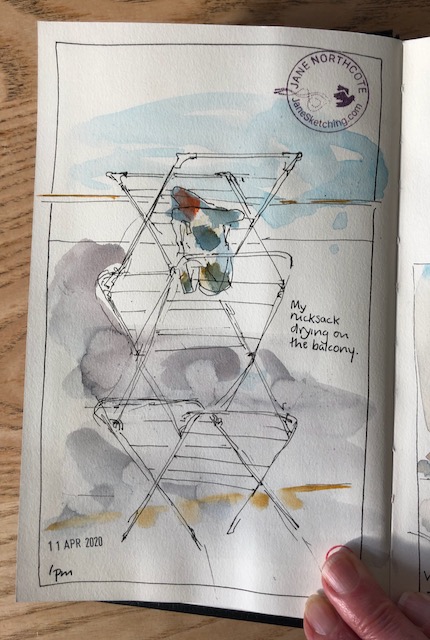
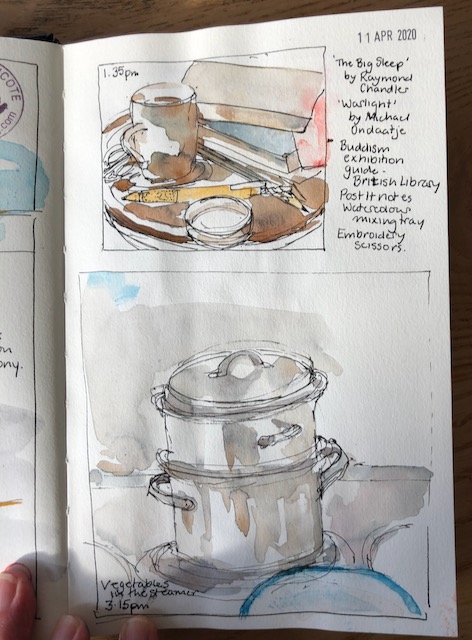
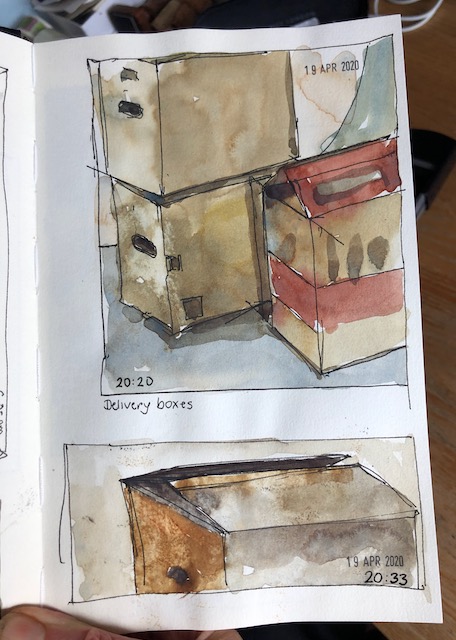

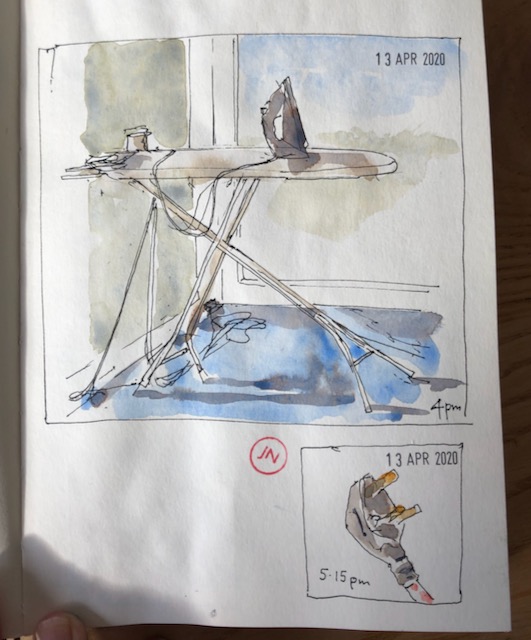


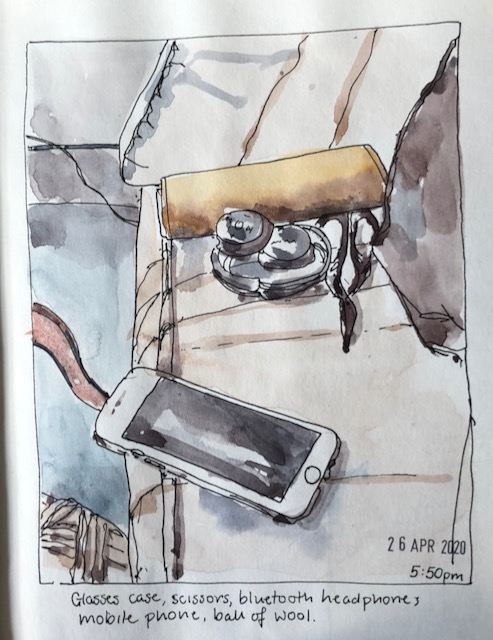

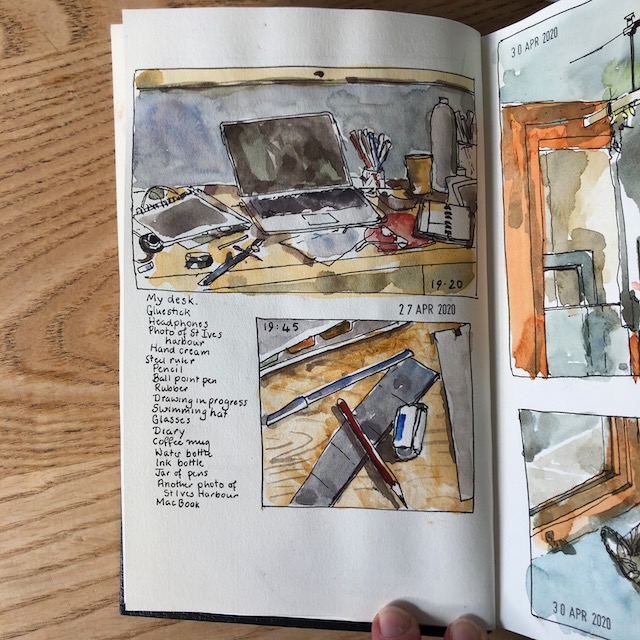
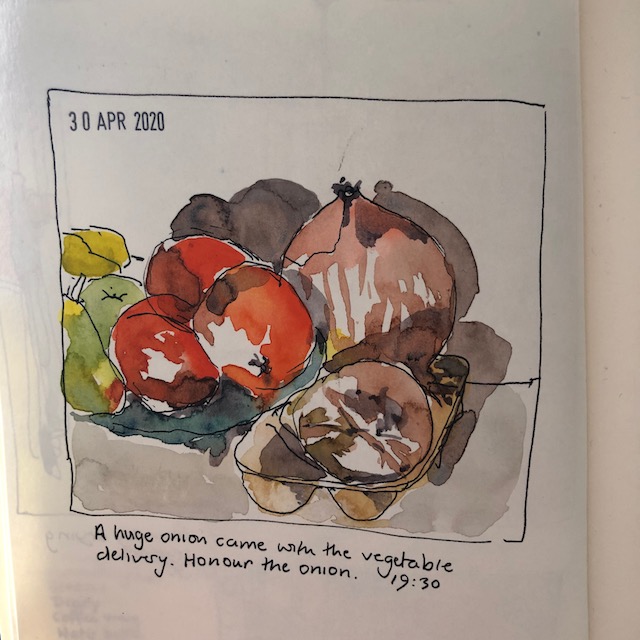
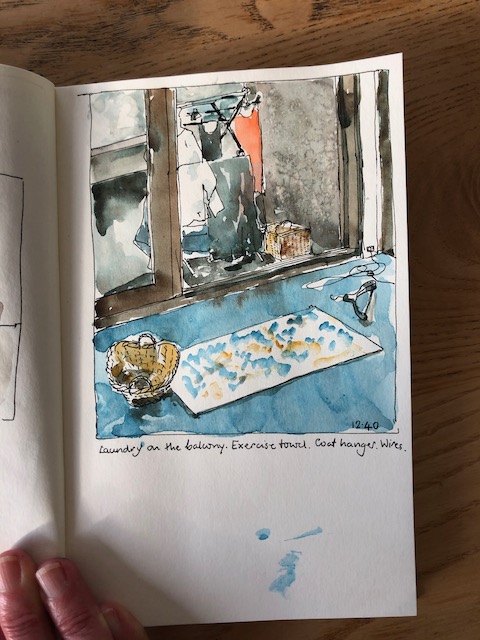
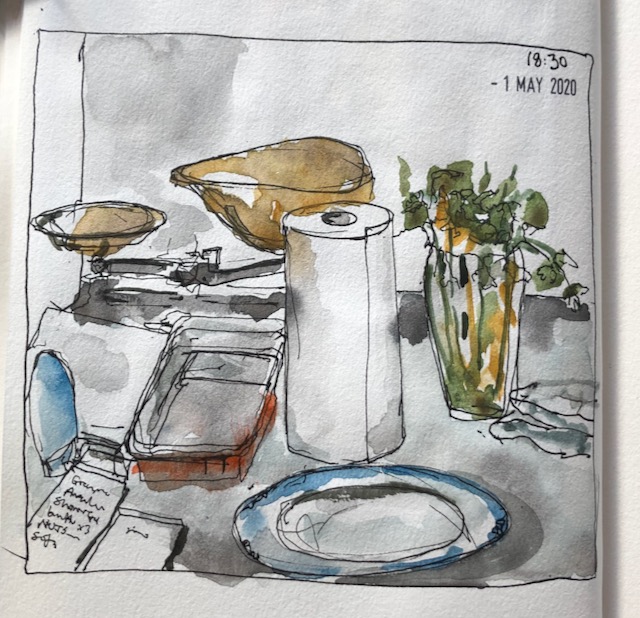
These are the drawings up to today, 1st May.
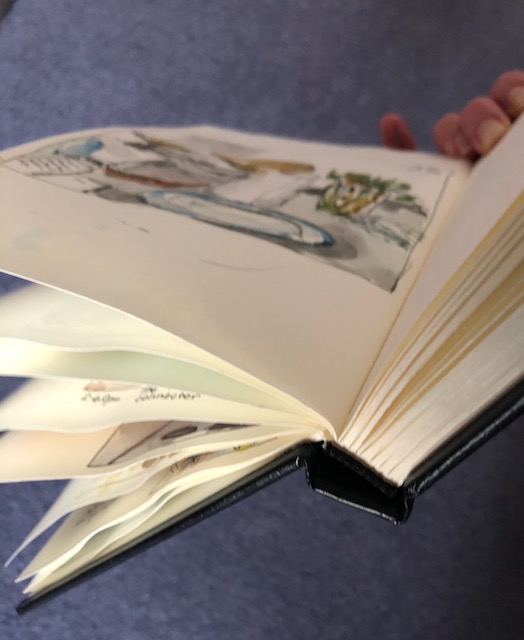
Since I live in a flat, “stay at home” means “stay indoors”.
I started drawing the scenes around the flat.
These are the drawings up to today, 1st May.
Here is a postcard from indoors:

It shows a corner of the flat. You see the sun outside, and birds, and the city. You see parks, rivers and the great outdoors. But mostly, you see the sun on the carpet.
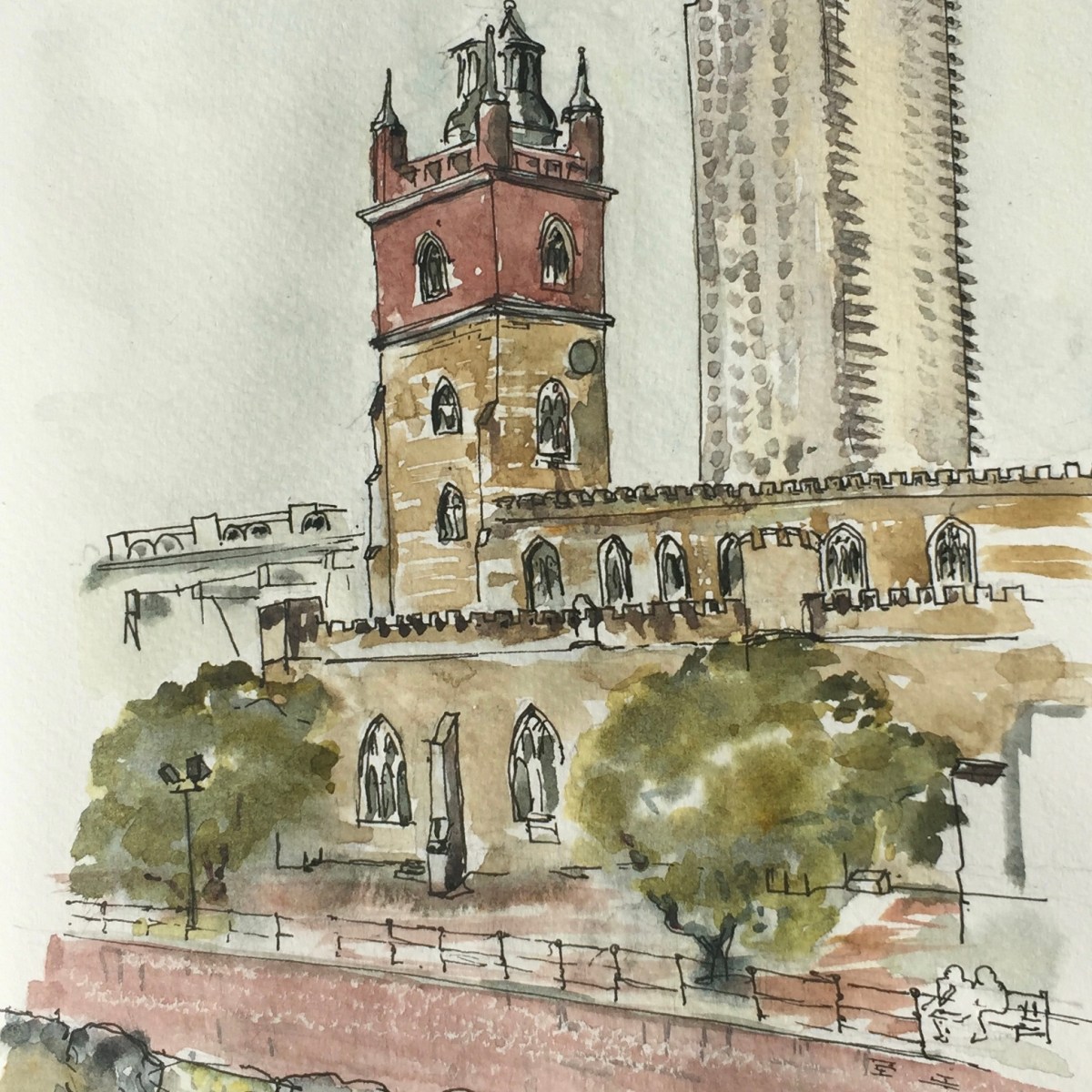
I drew St Giles’ Cripplegate, as seen from the window of the flat.
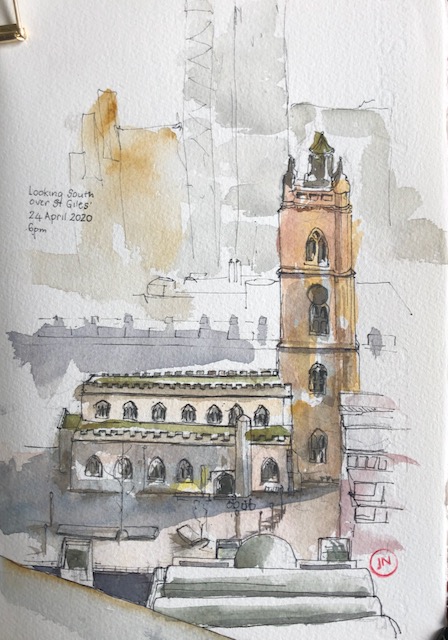
The church is surrounded by the buildings of the Barbican estate. To the right of the church is the City of London School for Girls. Behind it in the picture you see a representation of the Barbican block called “Wallside”, and then behind that, are the office blocks of the City. In the foreground is Frobisher Crescent.
St Giles’ was damaged by enemy action in the 1939-45 conflict. Artists showed the damage. I was particularly struck by the work of Sam Carter, and William Coldstream, shown by the East London Group in their excellent and informative Twitter stream (@EastLondonGroup) – their tweets are embedded below, if you scroll down. Here’s the picture by William Coldstream, 1946:

As you see in the picture above by William Coldstream, in 1946 the church itself was damaged, and it was surrounded by rubble. This picture must have been painted from the current location of the Museum of London. The damage was done in a bombing raid in about 1940. The plants have had 6 years to grow.
The Barbican was built on the area destroyed by bombing. St Giles was rebuilt.
Here is my view and my drawing in progress.


I have drawn St Giles before:
Here is St Giles Church from the Lakeside Terrace of the Barbican. While I drew this, three men were shovelling mud from the bottom of the lake. The mud is black and viscous and the men were remarkably cheerful in their task. They would have made good subjects for a drawing too. But for now,…
Today Urban Sketchers London held a “sketch crawl” in the Barbican. So I joined them. An astonishing number and diversity of people assembled inside the entrance of the Barbican Centre at the appointed time of 11am. I counted about 35 and then another dozen or so joined. All shapes and sizes of people, tall, short,…
Here is today’s sketch showing: London Wall – 2nd century AD Barber-Surgeons Hall – current building 1969, first hall, on this site 1441 St Giles Church – current building 1966, first church on this site by 1090 Barbican, Cromwell Tower, Wallside and Arts Centre – 1965-82 Braithwaite House – completed around 1963 White Collar Factory…
Here is a sketch from a staircase from the Barbican Podium, just outside the Dentists but just inside the old London Wall. Parts of the Roman London Wall are in the foreground, 2nd century AD. St Giles’ has Roman foundations and is much rebuilt. The church we see now is the 1966 restoration following designs…
Here are the tweets from the East London Group:
Sketching from the window, here is Ben Jonson, part of the Barbican estate.
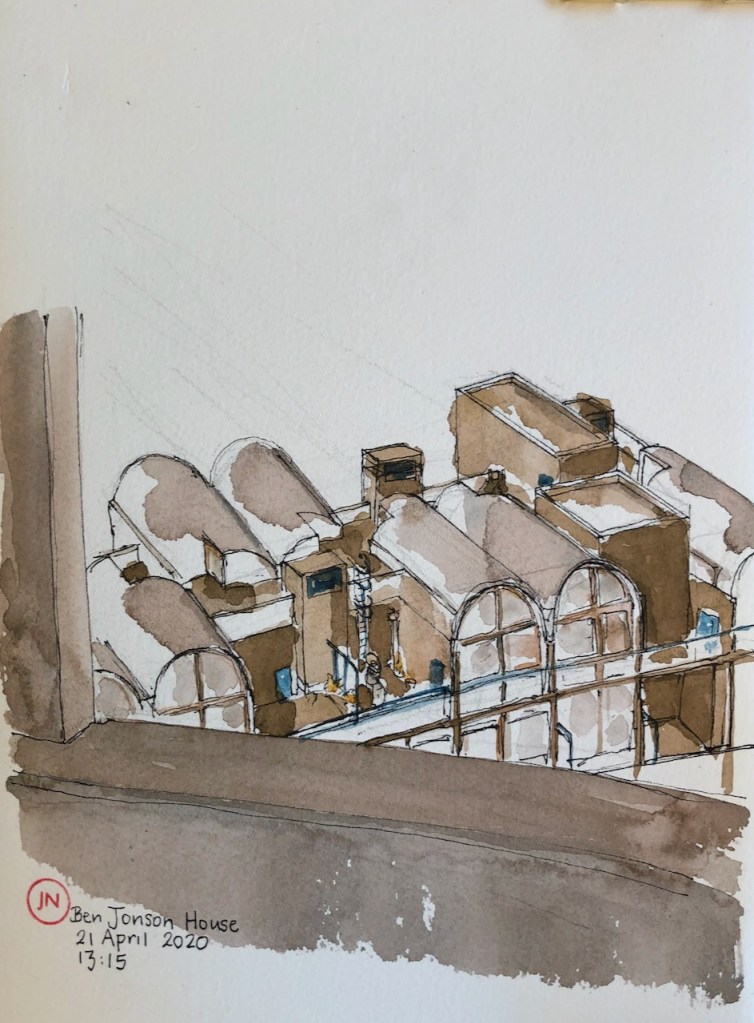
The people who live on the top floor of Ben Jonson have sunlit roof gardens. You can see one person enjoying his garden. He sits just at the bottom of the blue fire escape ladder.
There is also an interesting void space shown in the lower right of the picture. It was empty when I was drawing, but sometimes someone’s legs are visible, using the space for sunbathing. Sometimes they set up a table and chairs there.
Here is work in progress. I used colours: Mars Yellow, Burnt Umber, Prussian Blue and a bit of Perinine Orange.

The view looking west:
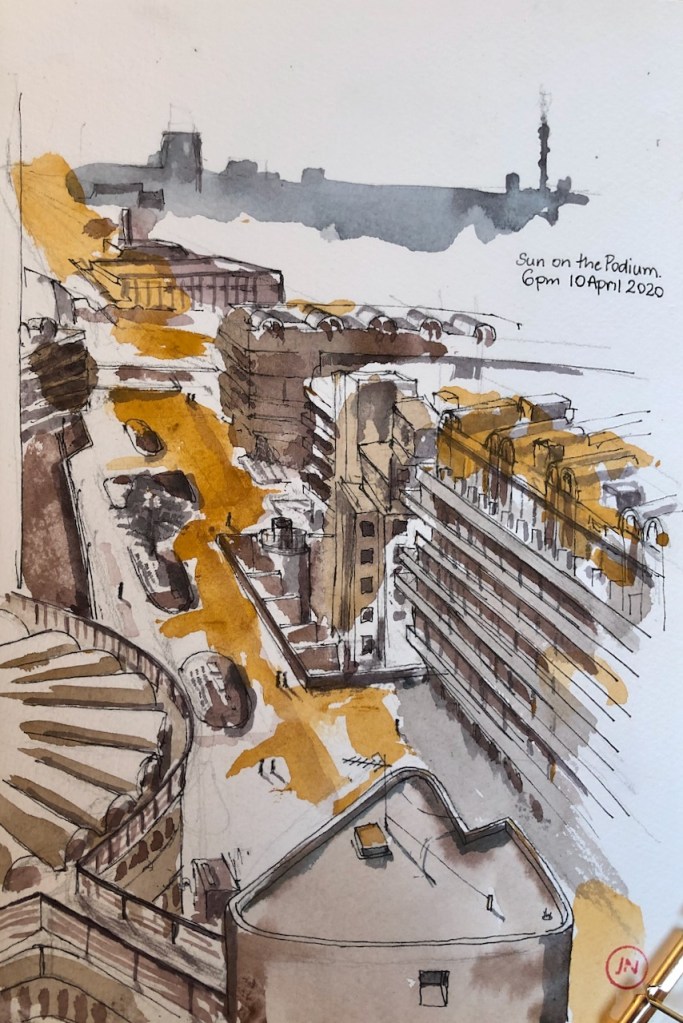
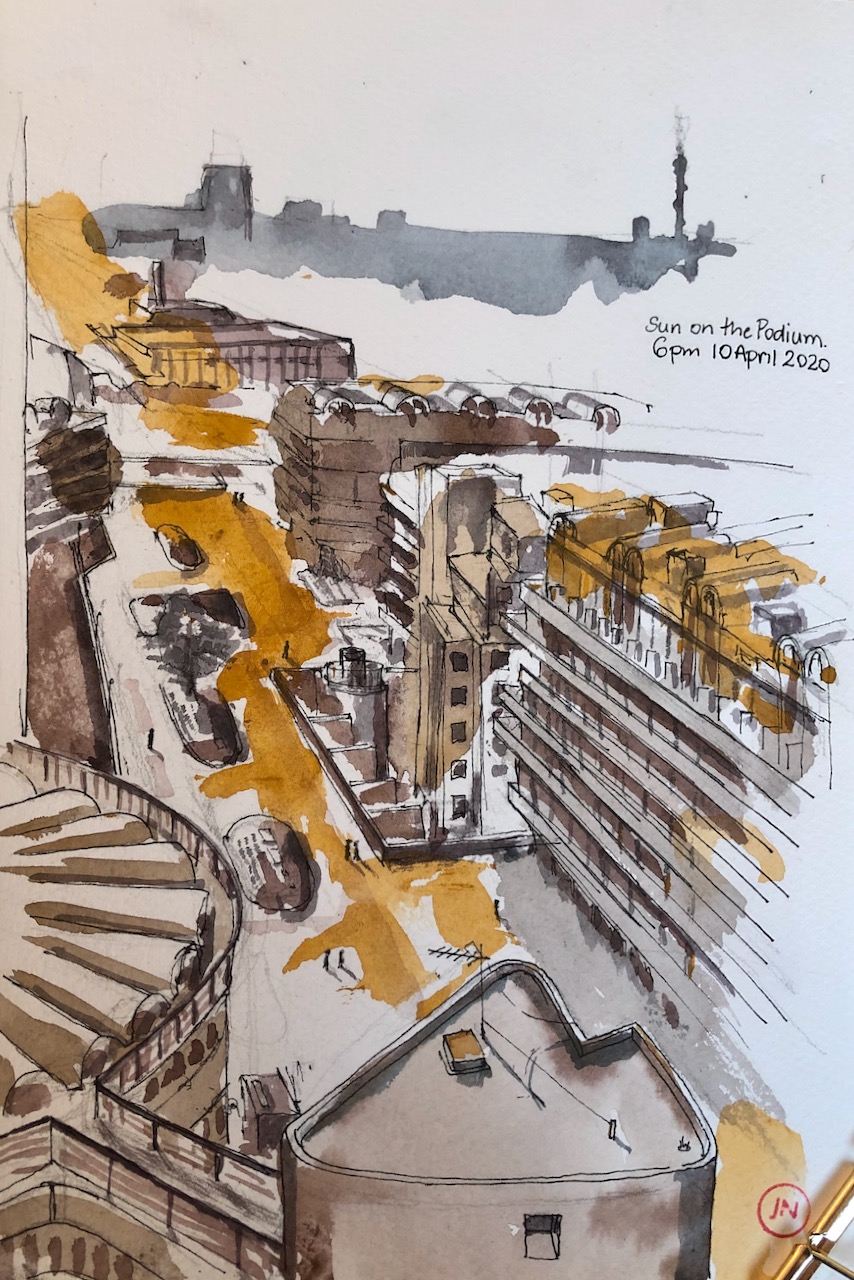
This is looking down on the Barbican Podium.
The tower in the foreground is part of Frobisher Crescent. Frobisher Crescent itself is on the left. Ben Jonson House is on the right. On the horizon you can see Centrepoint, and the Post Office Tower.
This took 2 hours. The sun moved, of course.
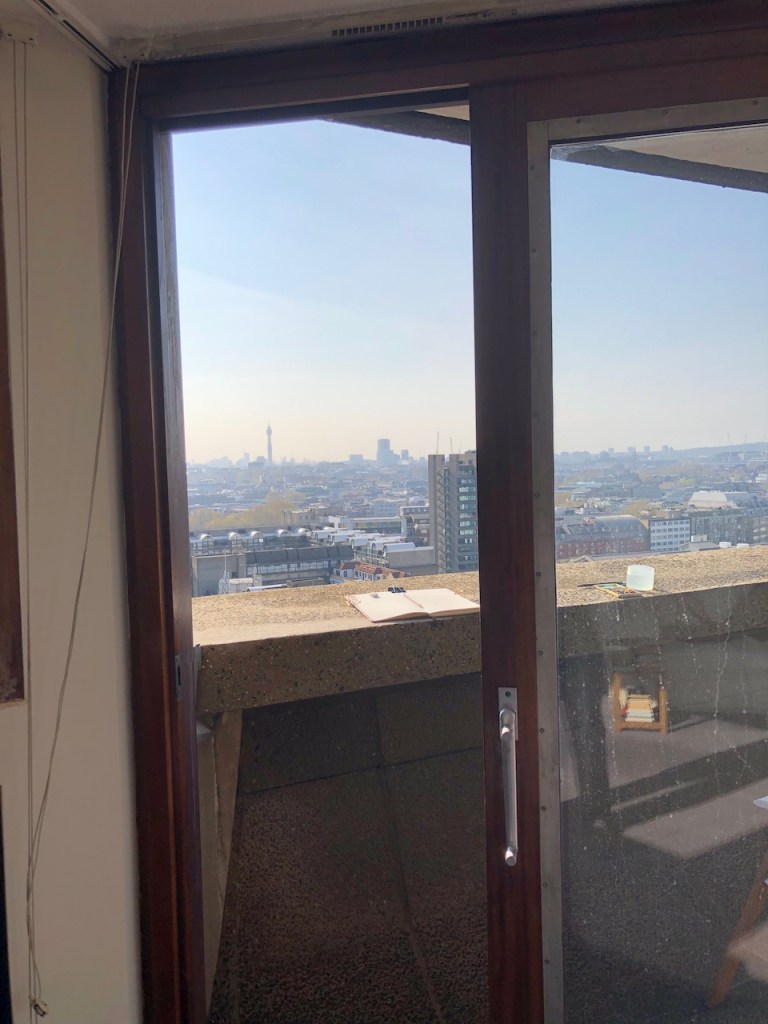
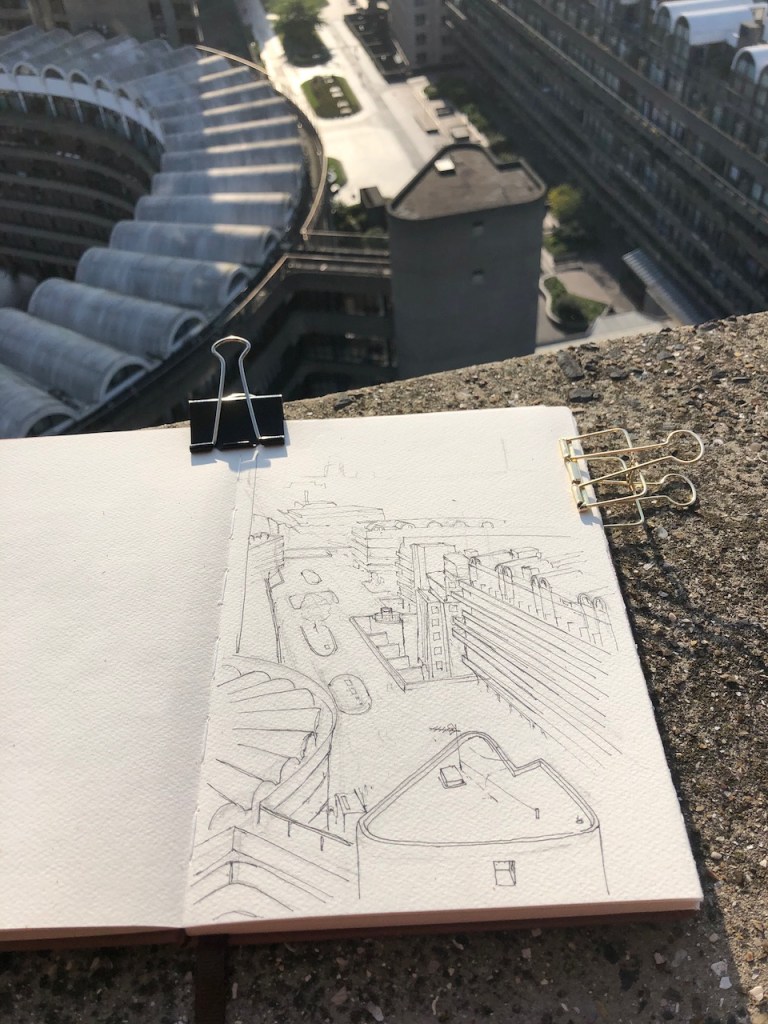
Colours: Mars Yellow, Perylene Maroon, Prussian Blue, all Daniel Smith watercolours.
This is Whitecross Street. The people are in the well-managed queue for the Waitrose supermarket, which is underneath the building to the right.
In the foreground: Ben Jonson House, Barbican. On the left, behind Ben Jonson, in pink, is a children’s playground at first floor level, part of Prior Weston School.
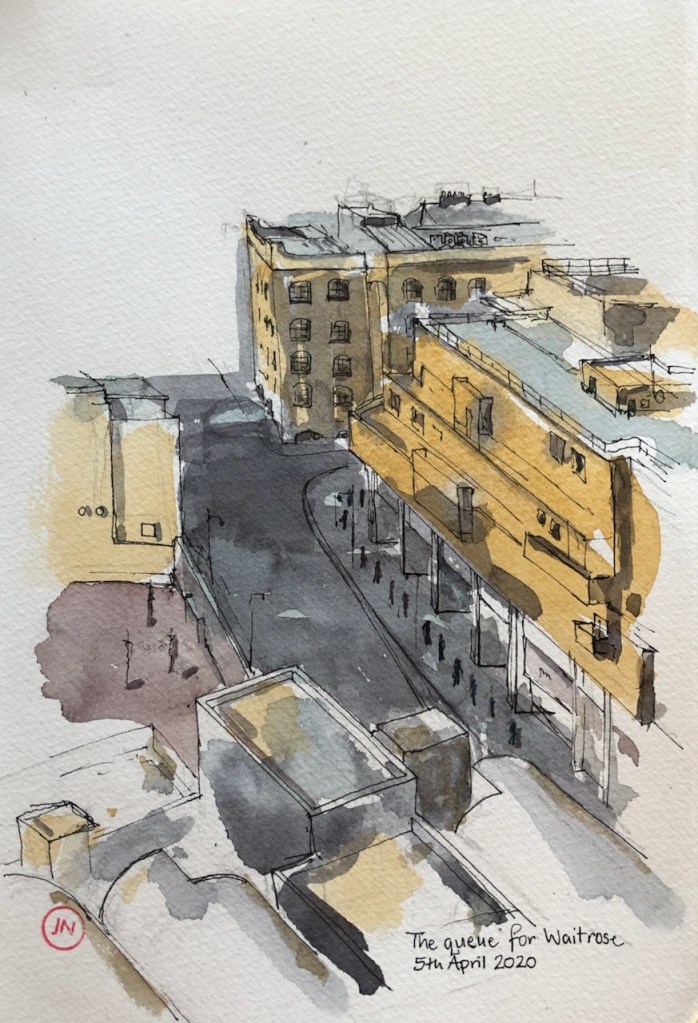
Drawn looking out of the window, about an hour and a half including a phone call from a friend.
The friend called to tell me the answer to a crossword clue which had defeated me.
Colours: Mars Yellow (DS), Perylene Maroon (DS), Phthalo Turquoise (W&N)
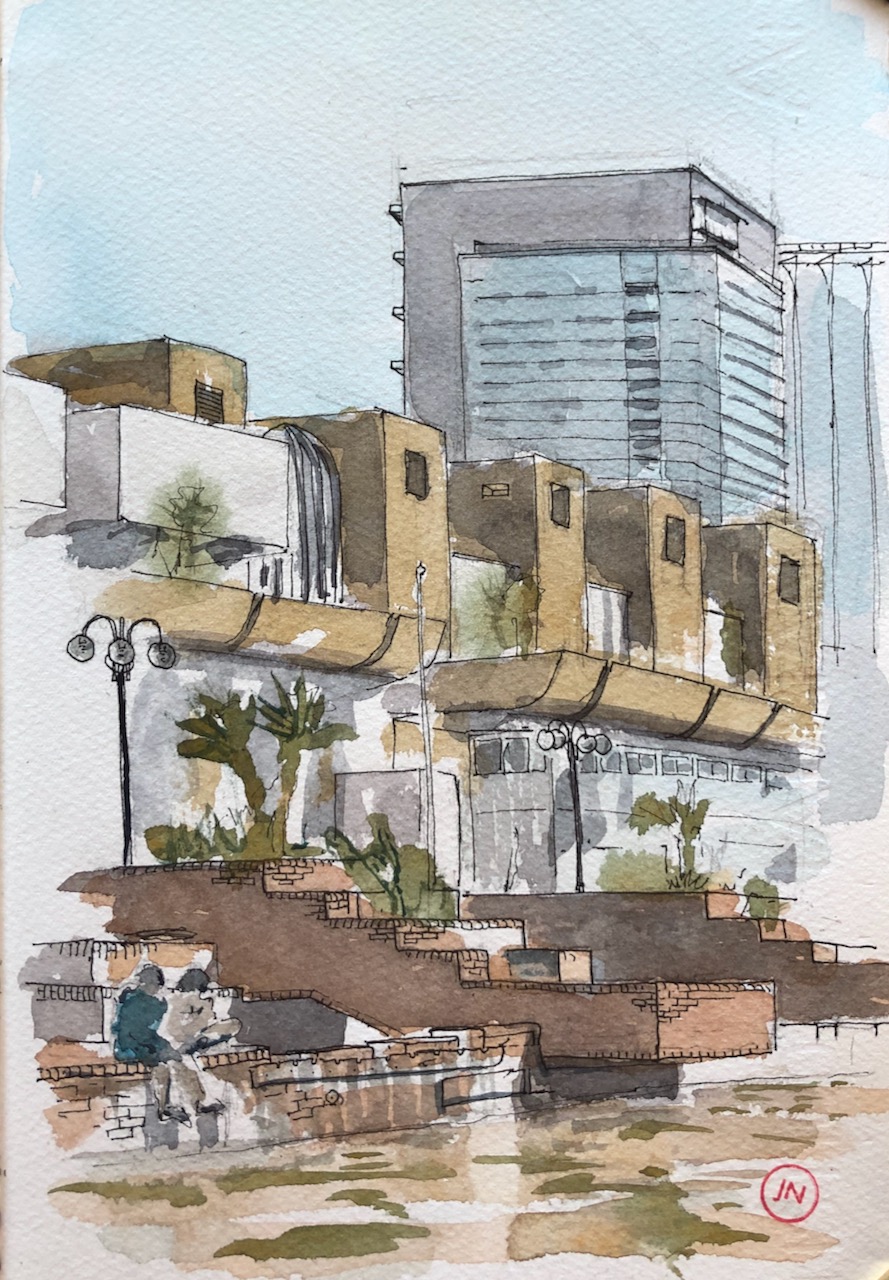
A view from the residents’ gardens.

The building in the background is the Heron Building, luxury flats above the Milton Court Concert Hall, Guildhall School of Music and Dance. This building opened in September 2013. It replaced a public building, which was in the brutalist design of the Barbican and designed by Chamberlain Powell and Bon, It housed a fire station, Coroner’s Court, mortuary, office of weights and measures and a civil defence school, and was connected to the Barbican by a bridge at Podium level. This building was demolished in 2008, in the face of opposition from the Twentieth Century Society amongst others, and was replaced by the steel and glass tower. This new building has no bridge to the Barbican, which is a pity, in my view.
At the extreme right is City Point.
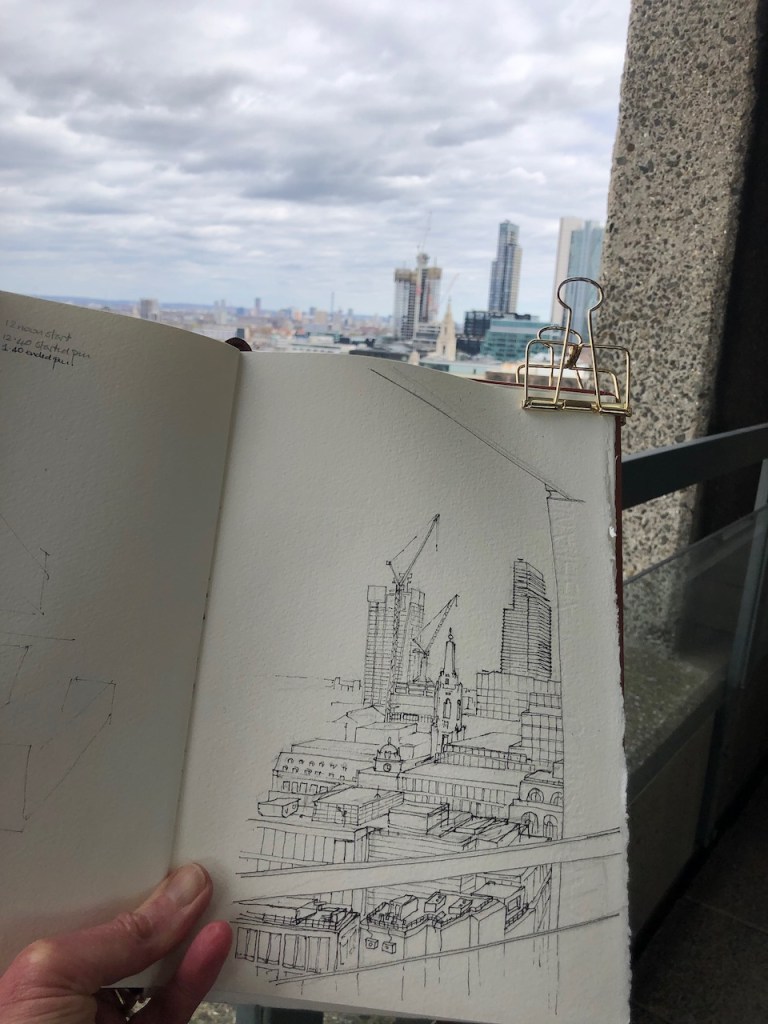
Here is work in progress:
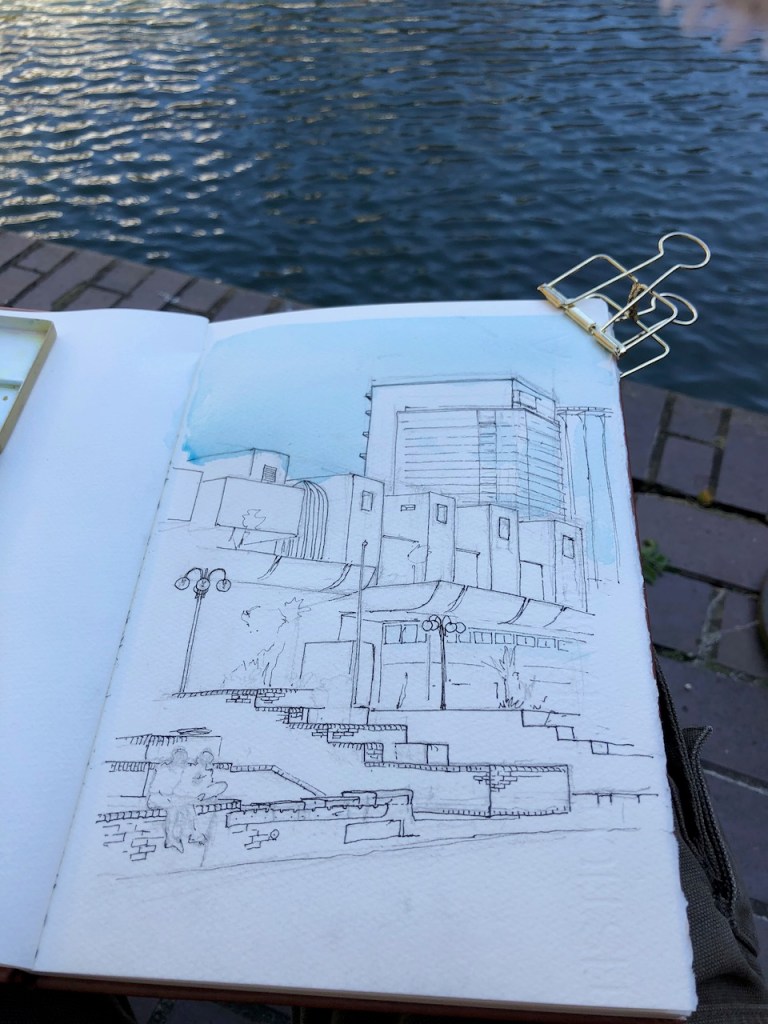

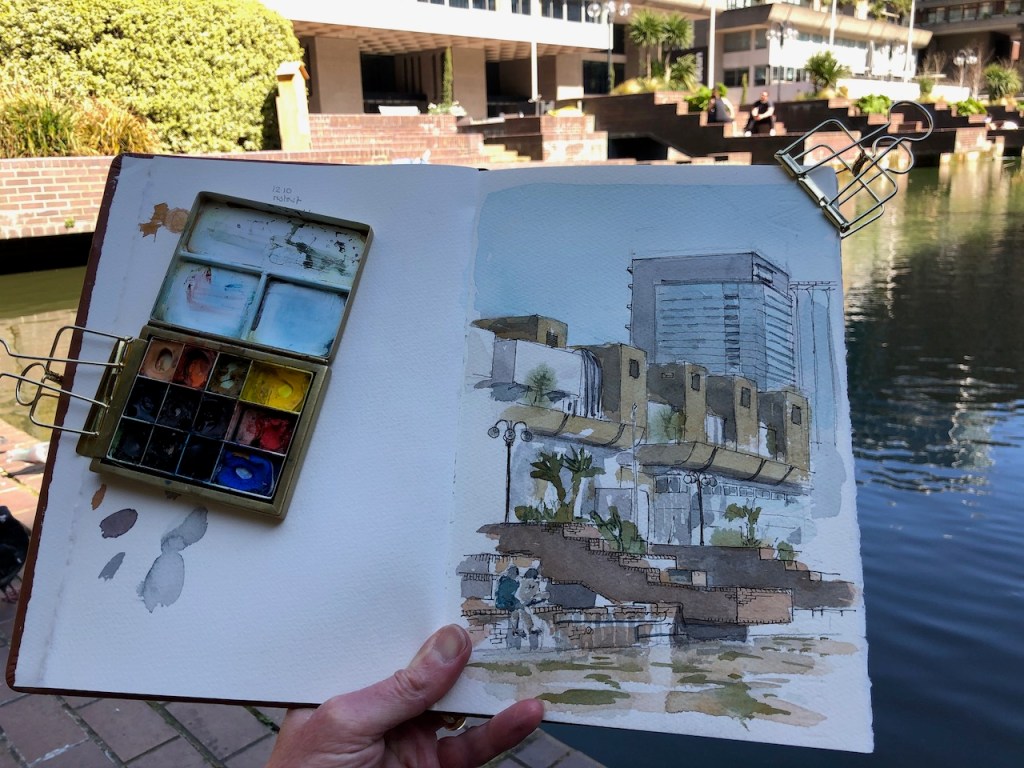
This drawing took ages. I couldn’t get the steps right. After 30 minutes of drawing and rubbing out I restarted at 12:10 and finished 1hour30mins later.
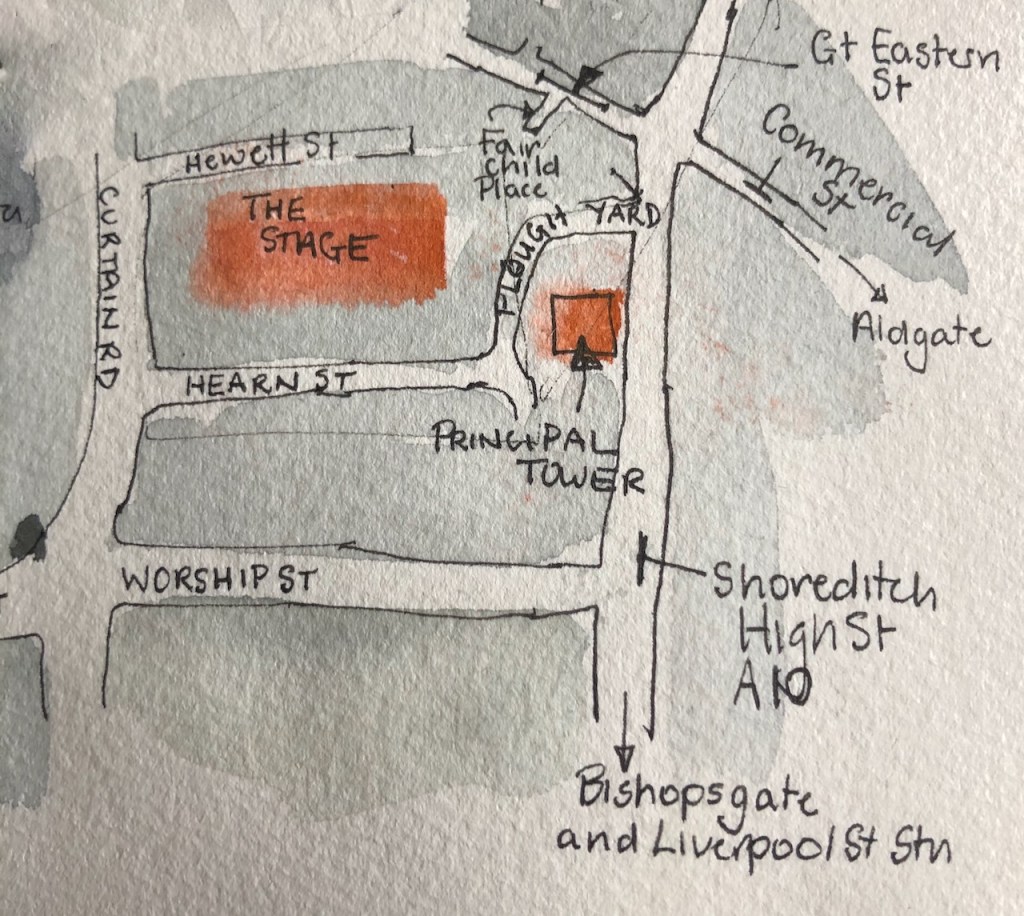
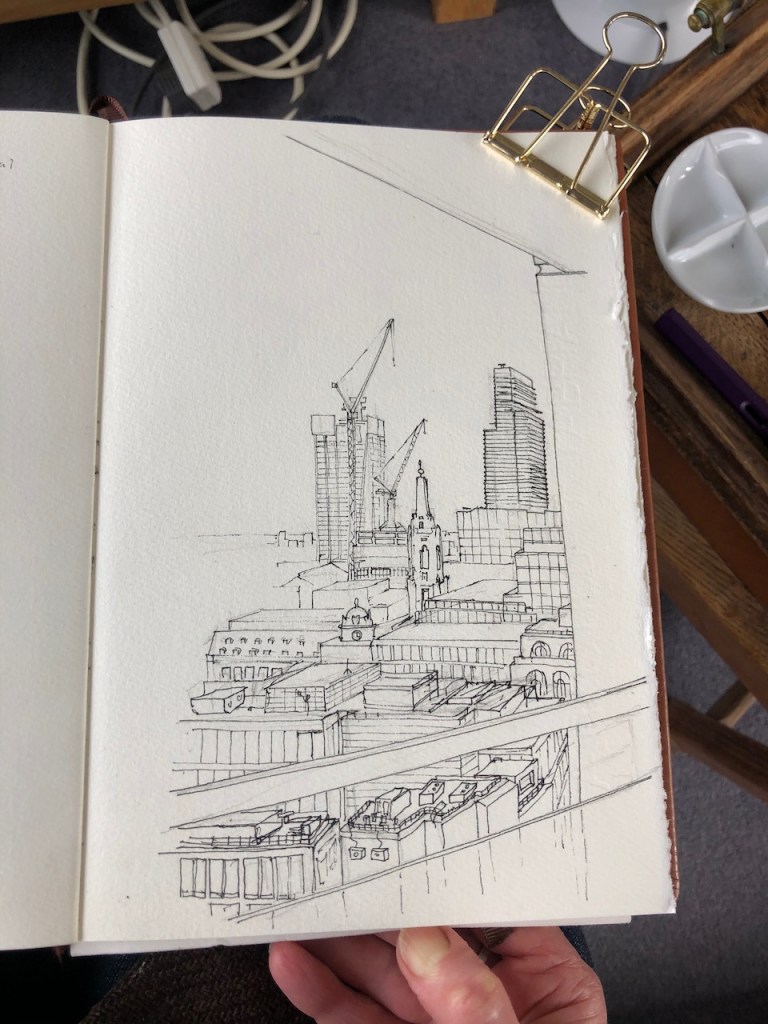
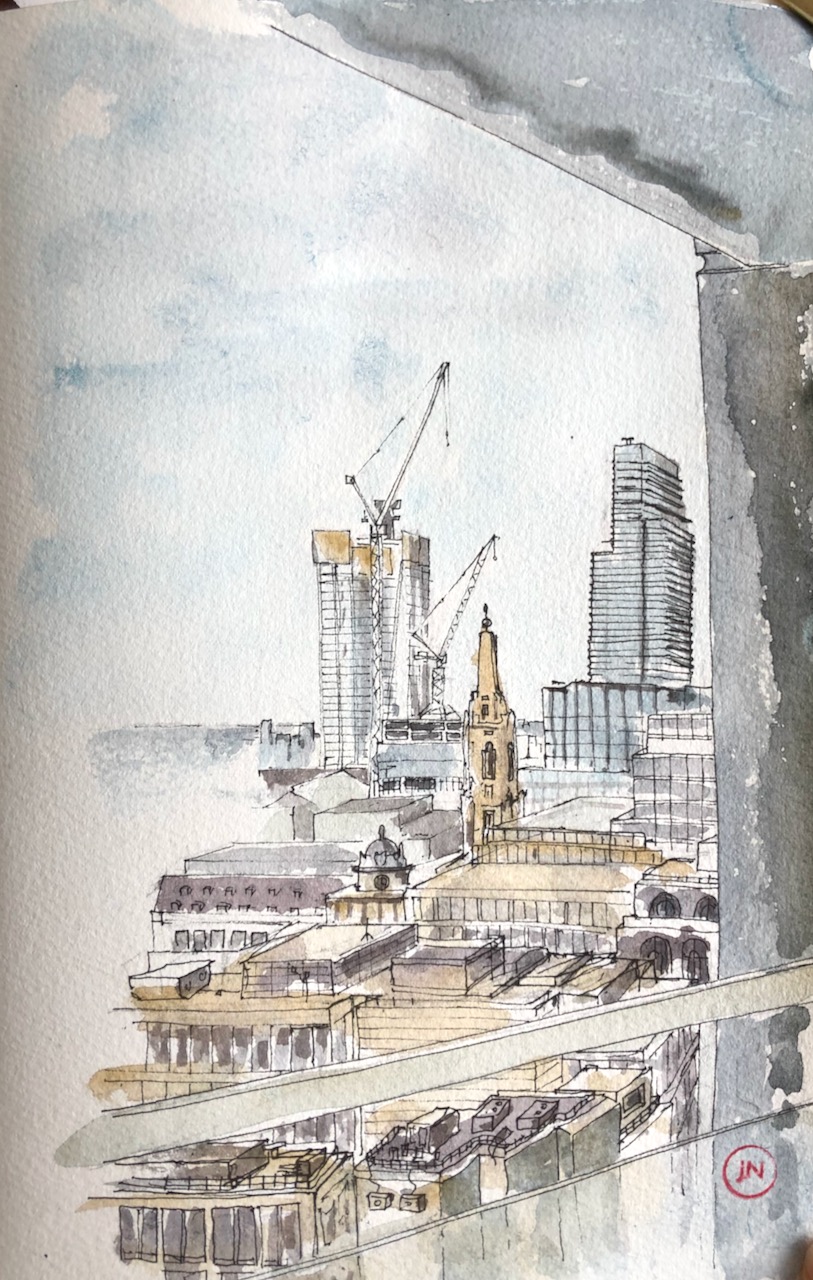
If I look East, along a narrow angle, I can see two new tall buildings in Shoreditch: the “Principal Tower”, and “The Stage”. They are on adjacent sites, about a mile away.
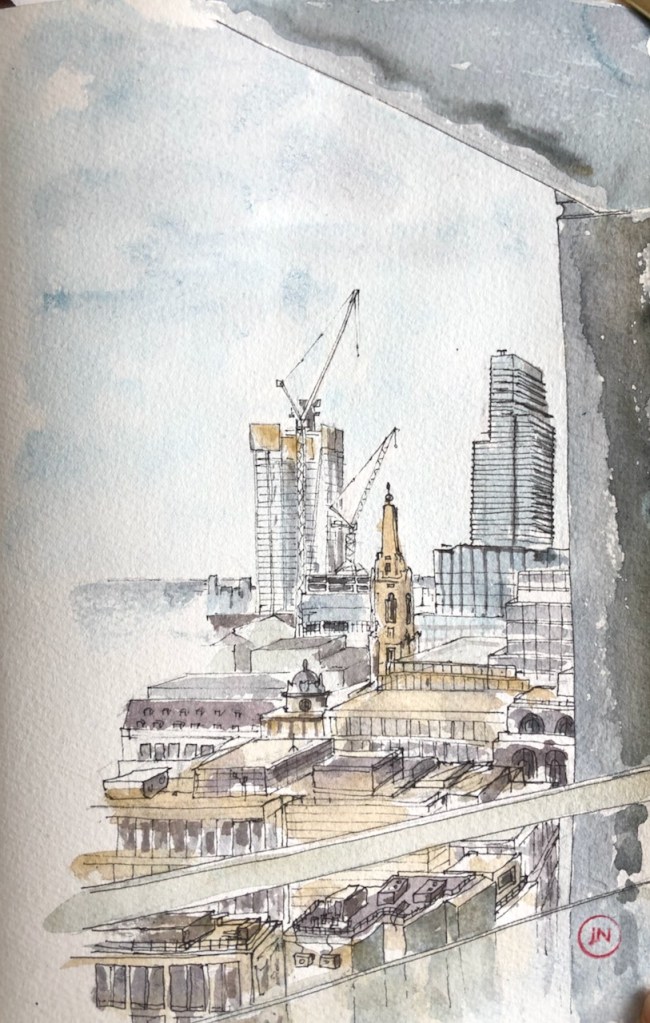
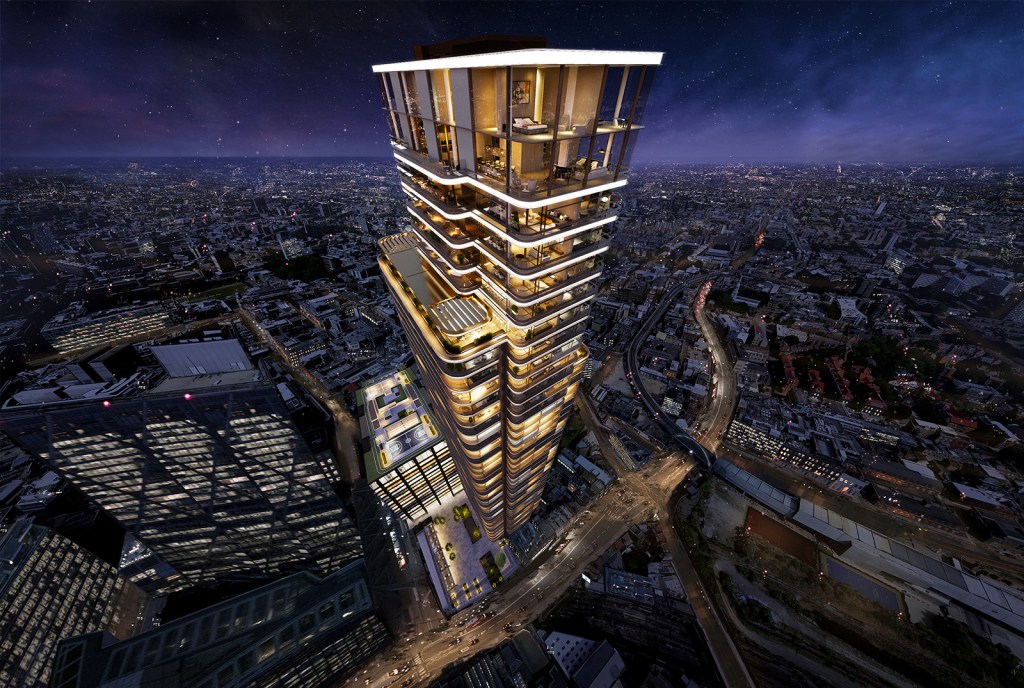
The Stage is the tall building on the left, under construction. Their website tells me this will be a “dynamic 37 level landmark for luxury living”. The reason it’s called The Stage is because the remains of the Curtain Theatre were discovered on the site. This theatre was a location for the staging of Shakespeare’s plays, and dates back to 1577. The tower is provides luxurious accommodation. The planning report says:
The scheme does not include any affordable housing, and the viability appraisal confirms that it is not possible to deliver any due to the financial burdens of excavation and archaeological work to the remains of Curtain Theatre in order to create a cultural facility.
planning report D&P/2975/02 18 December 2013, Mayor’s decision*
The architects are Perkins+Will. The developer cited on the planning application was Plough Yard Developments Ltd. That company was dissolved on 23rd Aug 2019. The current owner/developer is “The Stage Shoreditch Development Limited” according to the website “New London Development”.
The building with the truncated spire in front of The Stage is “Triton Court”, which is on the North side of Finsbury Square. The little dome is part of the same building. This dome in on the older, western, part, which was built in 1904-5. The taller part with the spire was later, 1929-30. It was the headquarters of the Royal London Mutual Assurance Society. The building interior was redeveloped in 2013-15 and is now an office development called “Alphabeta”
The tall block on the skyline to the right of picture is “Principal Tower”. This is a residential tower which, according to the website:
“..offers the opportunity to own an architectural masterpiece, equivalent to a priceless piece of art that will give constant pleasure and lasting value.”
from the sales website: PrincipalTower.com, copied on 2nd April 2020
The architect is Foster+Partners. The developer is Brookfield Property Partners. Alongside and beneath the residential tower are offices and shops, in a space called “Principal Place”. One tenant of the office space is Amazon.
Here are some pictures from the sales website:

Here are some maps:
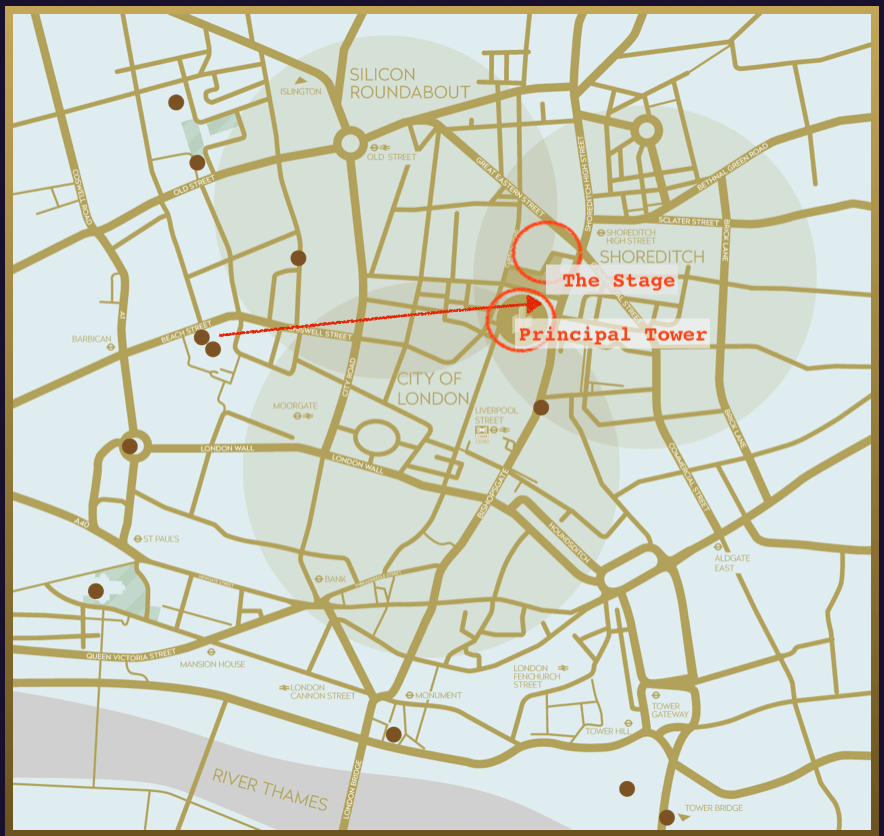
The drawing took just over 2 hours. The colours are: Phthalo Turquoise (W&N), Mars Yellow(DS), Perylene Maroon (DS) and a bit of Perinone Orange (DS).
*The document is on the http://www.london.gov.uk site at this link: (downloaded 2nd April 2020) Planning Application 2012/3871
Click to access the_stage_curtain_road_report.pdf
You can download the document here:
Sketching from home: here is a view of the chimney pots on the Peabody buildings of Errol St:
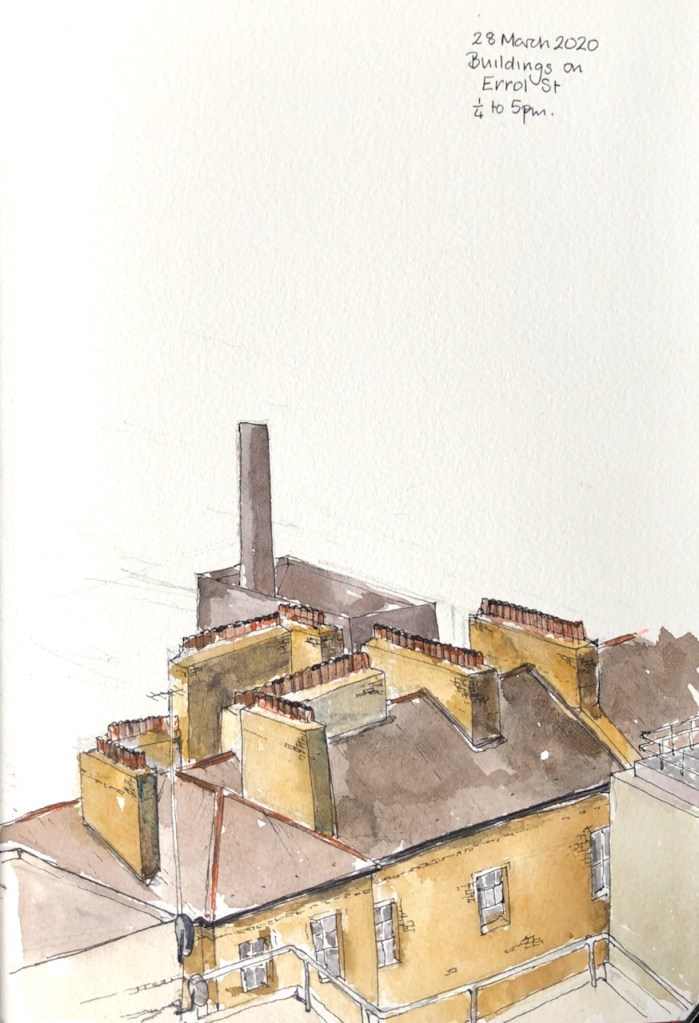
These chimney pots are interesting because they are all single rows. Also the chimney stacks are arranged in several different ways: along the ridge of the roof, across the ridge of the roof, up from the side of the roof, and along the structural wall between blocks. There must be a lot of fireplaces in these buildings.

These blocks are part of the “Roscoe St Estate”, still managed by Peabody. I think this is blocks E and D, but I’m ready to be corrected. I don’t know what the tall industrial chimney is. If you know, please tell me.
This perspective was a challenge. Also the blocks are quite a distance away, and so it was hard work to pick out which set of chimney pots was which. After a while my concentration lapsed, and it all went into a blur. So this picture took about 3 hours elapsed time, including breaks for lunch, exercises, phone calls, and strolling about the flat.
Here are some photos of work in progress.
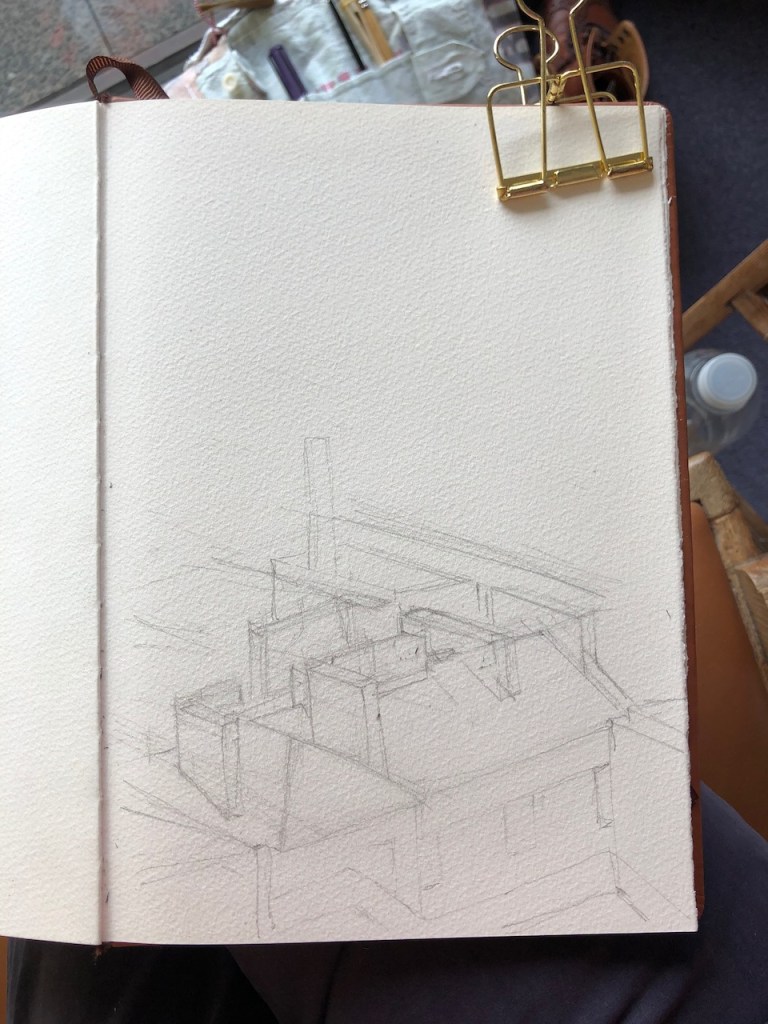


Colours used: Prussian Blue, Mars Yellow, Burnt Umber, Perinone Orange. I made the black for the guttering from Prussian Blue and Perylene Maroon.
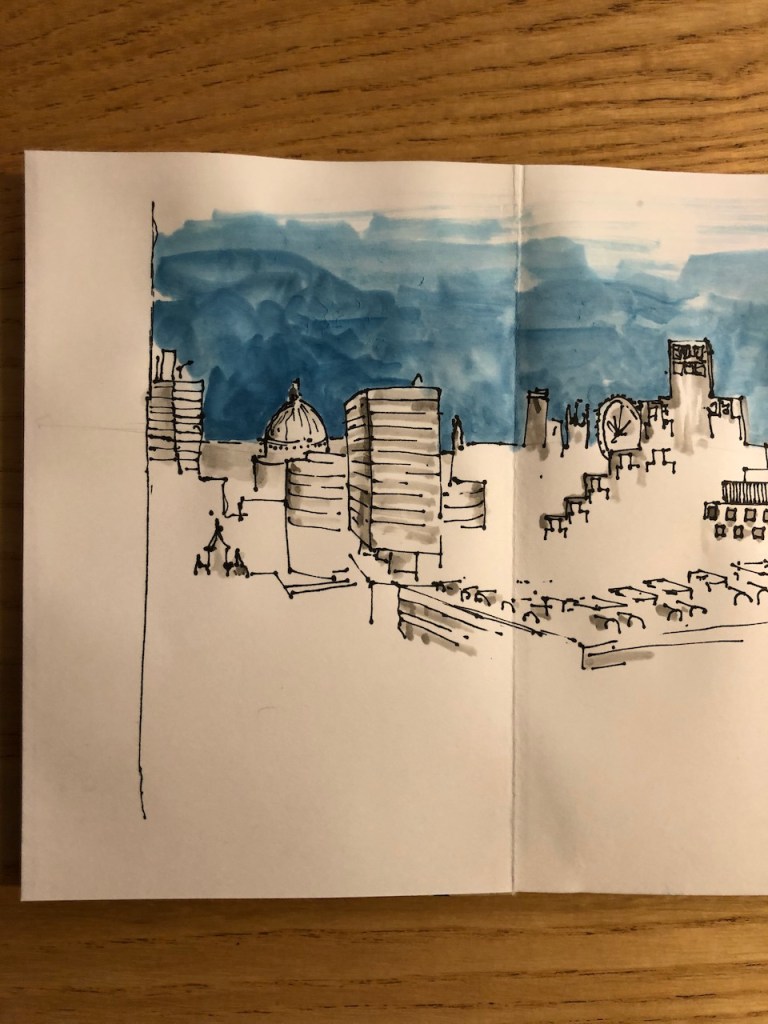
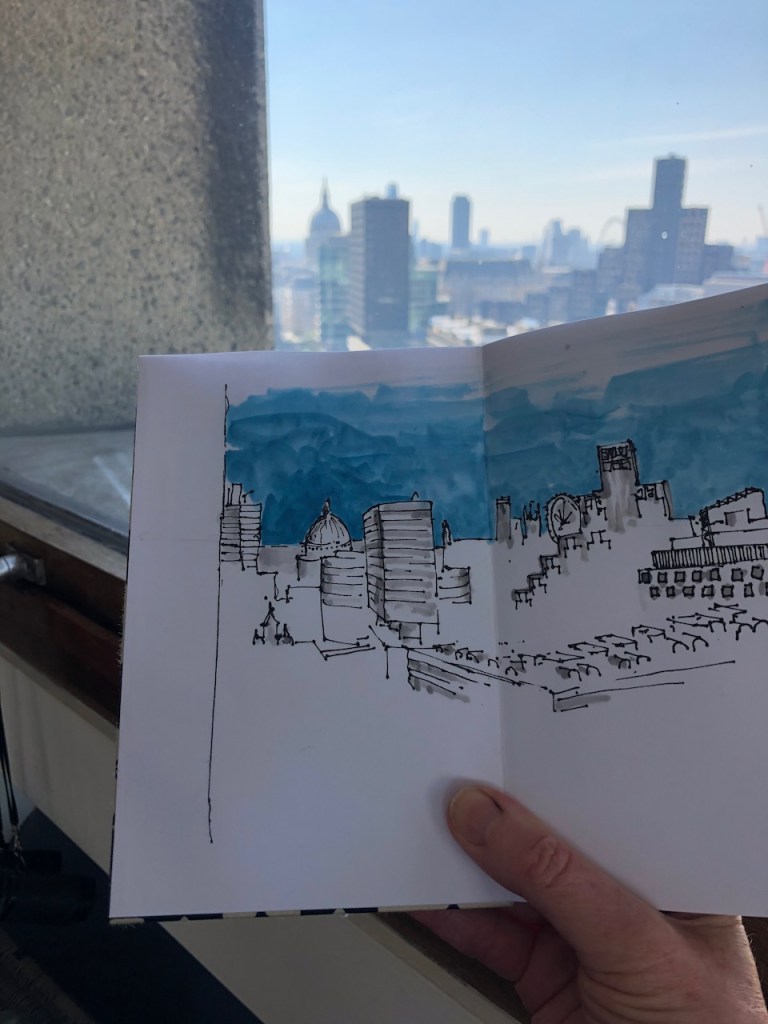
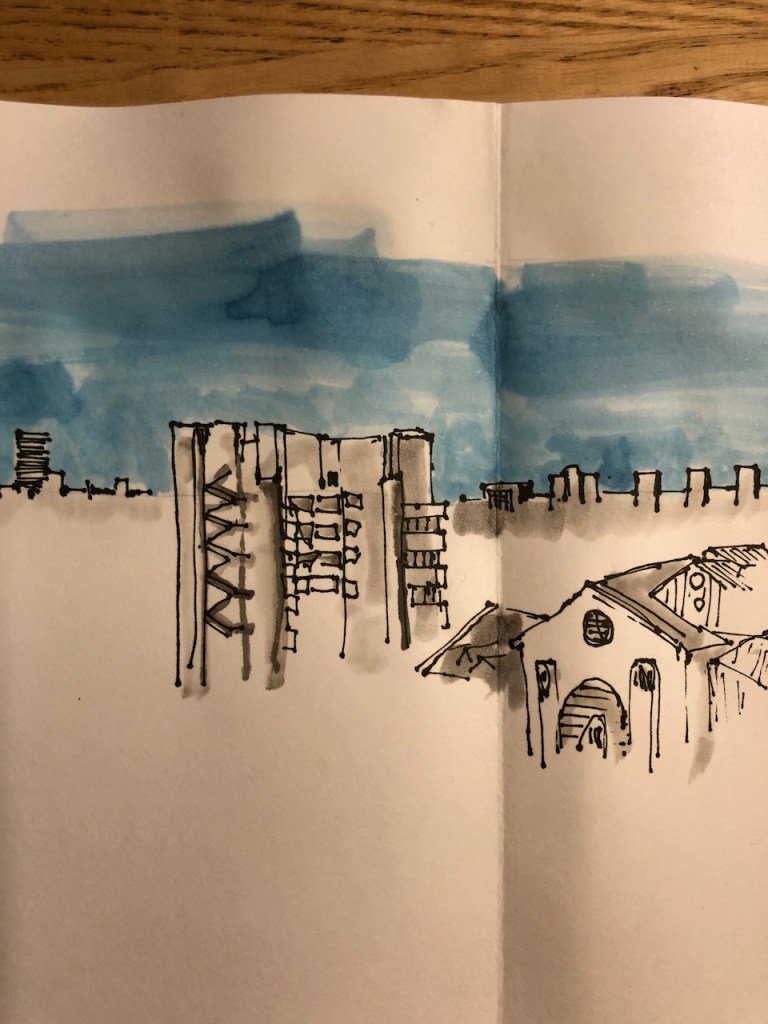
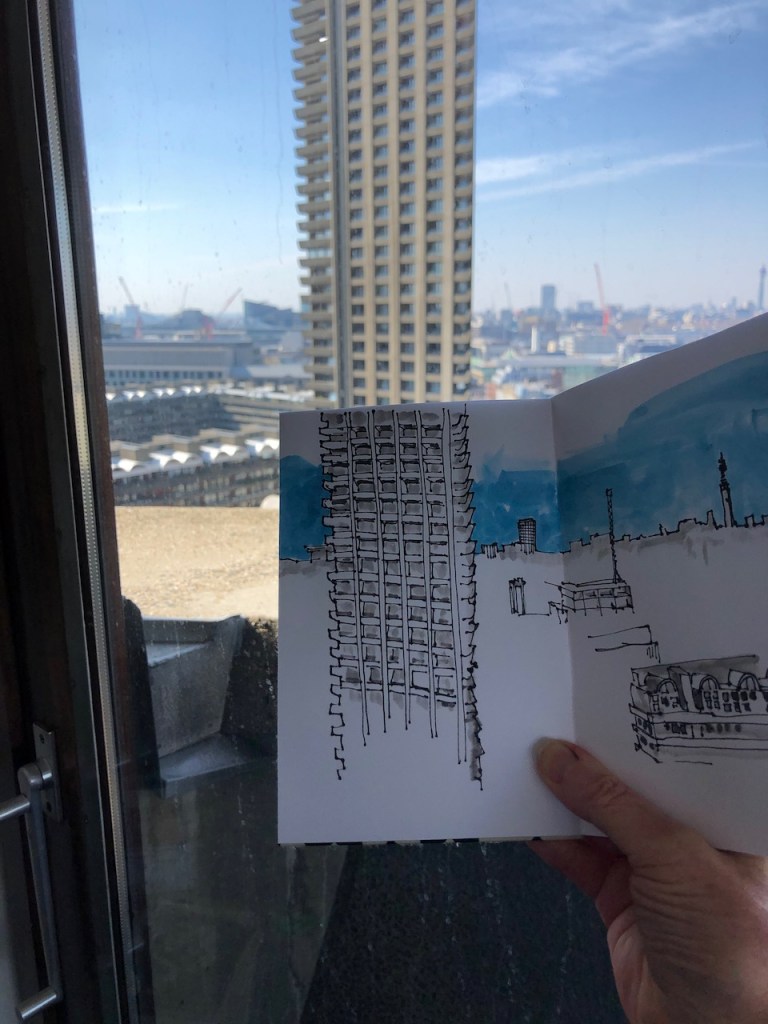
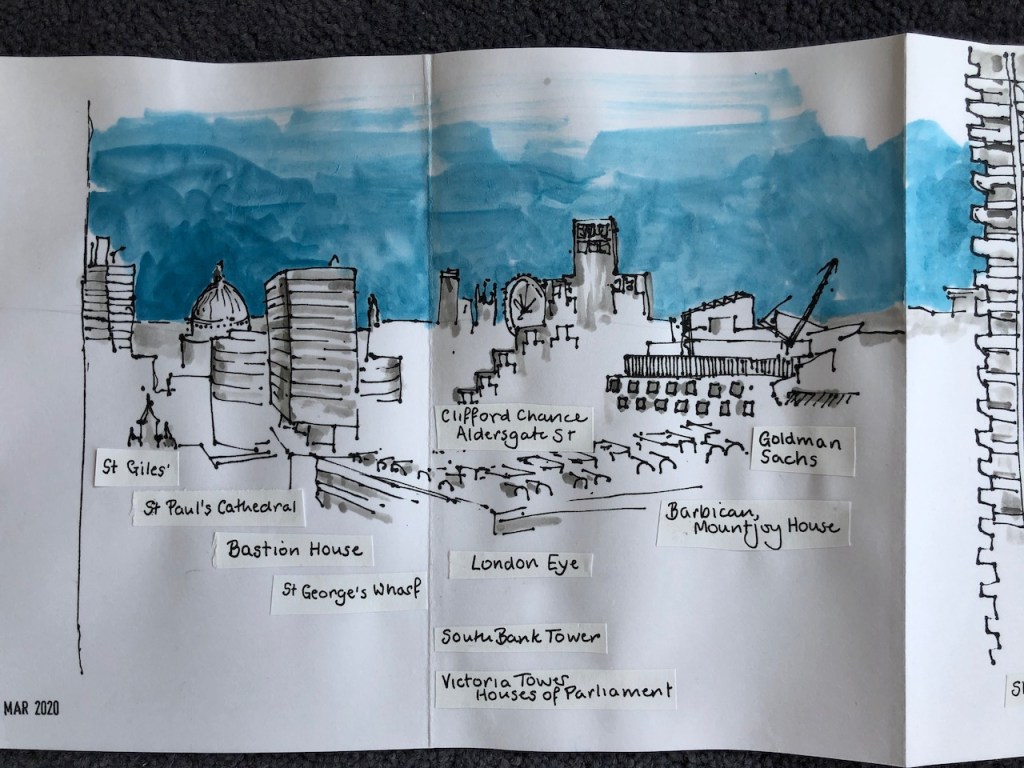
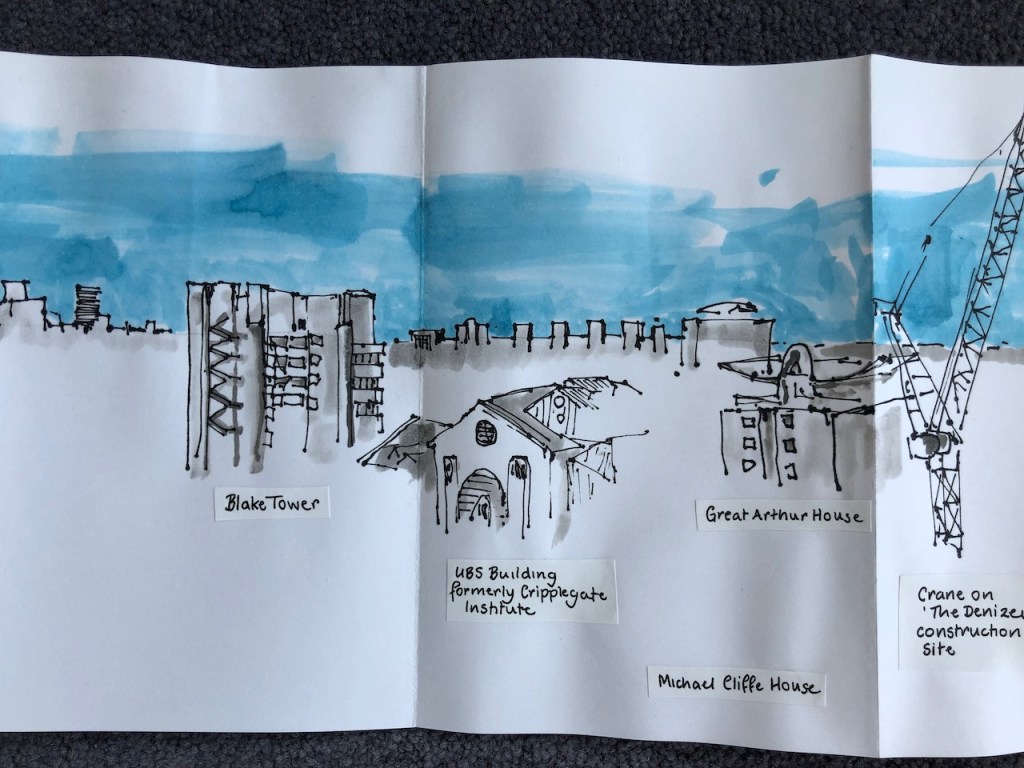
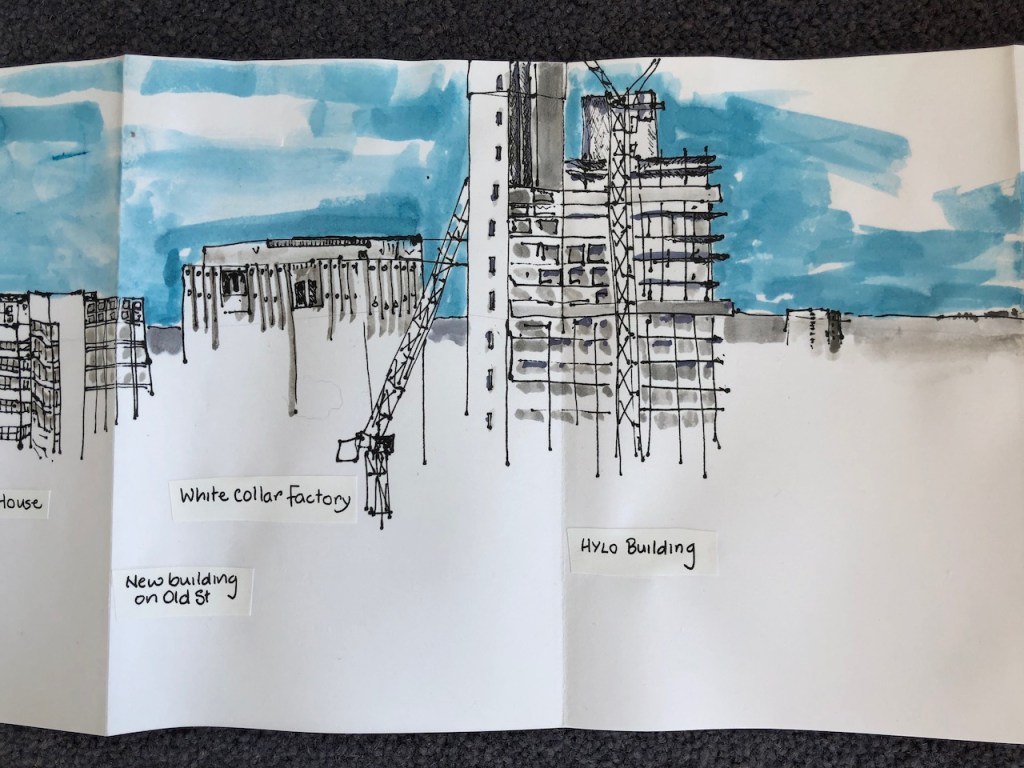
Some time ago, I was given a Japanese sketchbook, which was in the form of a concertina of doubled paper. In the last few days I drew the world outside, as seen from the windows of this flat. It’s about a 270 degree view, mostly over West and North London.

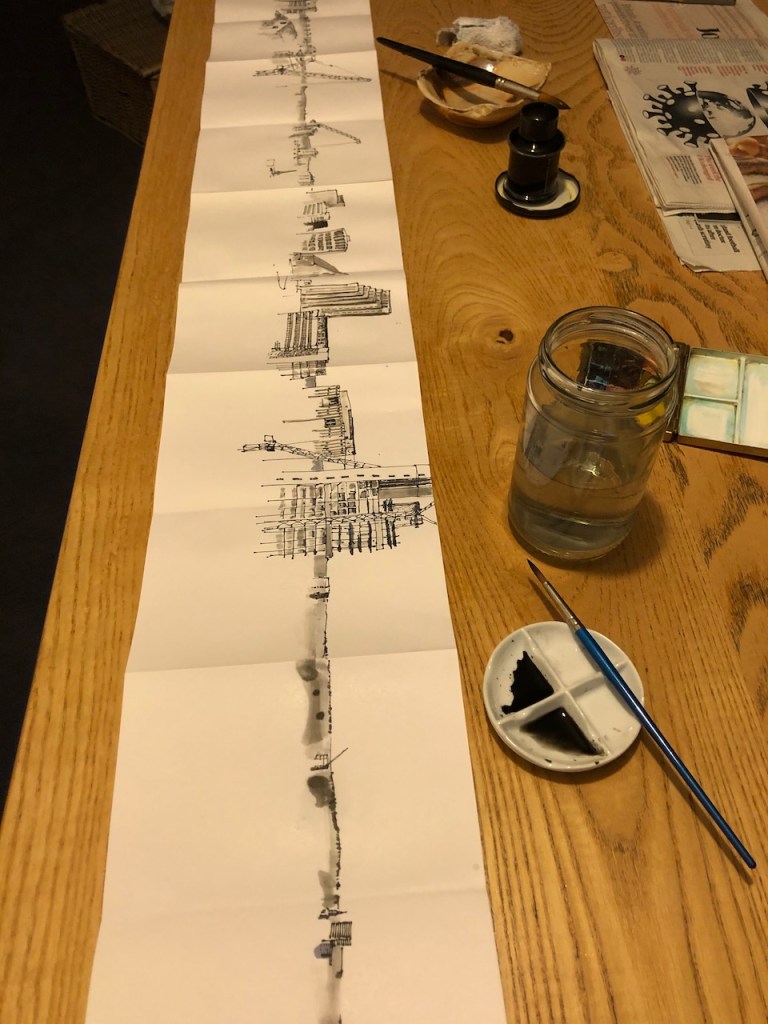
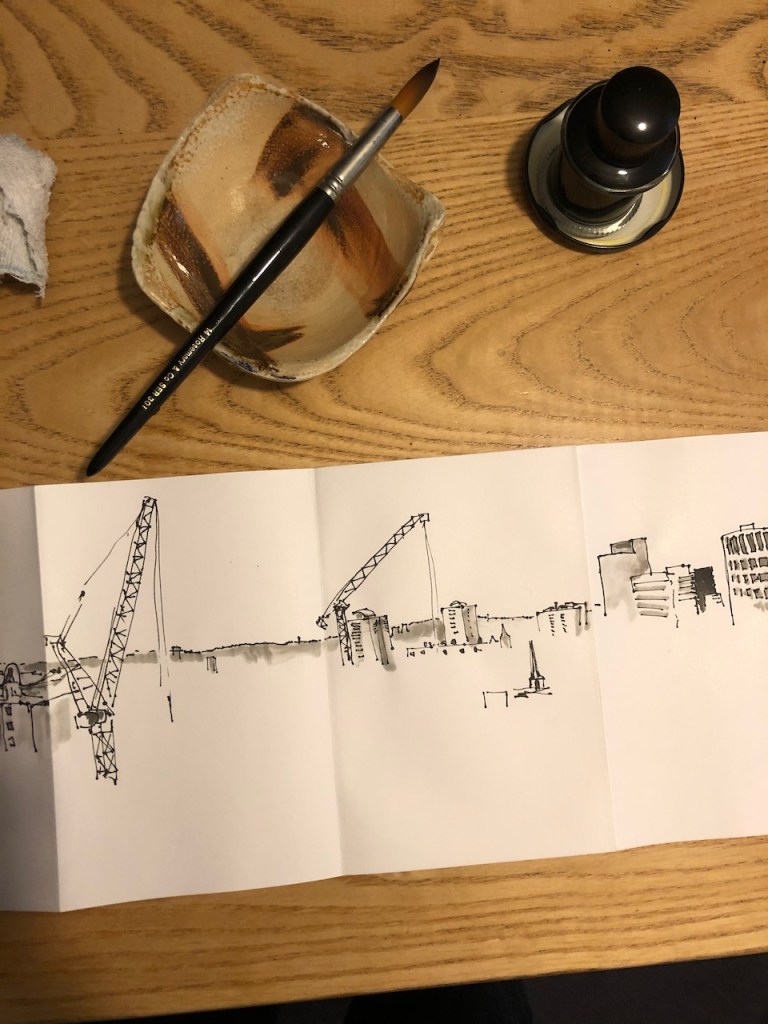

During these days of indoor confinement, the weather outside has been beautiful. Stunning blue skies. So I put that in using Phthalocyanine Turquoise watercolour.






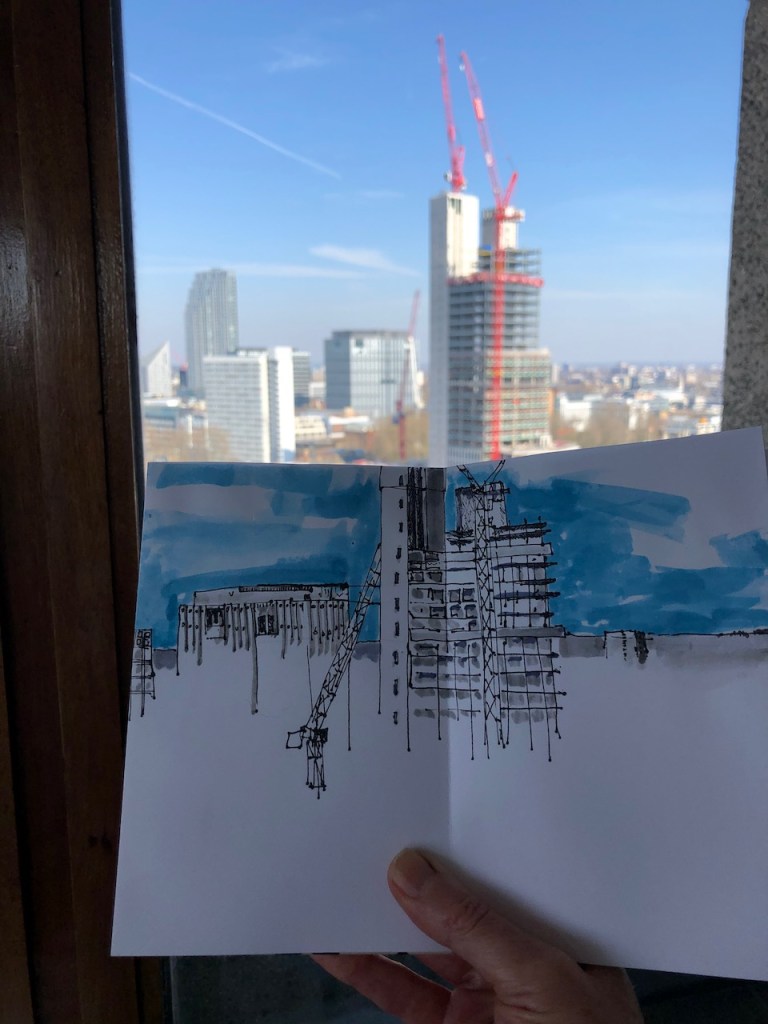

Then I made a videos. The first one, with the pointer, has an audio commentary. It’s quite quiet, you may need to turn the sound up. The second one is silent. This is the first time I’ve put videos on this site. Let me know if it works.
I added written captions also, as you see in the second video.
Here are still pictures from the panorama with captions.







 Jane Sketching