This huge redbrick building in Leman Street stands proudly amongst the 21st century steel and glass. Inscribed round its windows and above its door in letters a foot high are the words “Co-operative Wholesale Society Limited”. The words are spelled out in full, and written in stone. Oh, those confident and visionary Victorians!
The Co-operative Wholesale Society’s London Branch headquarters were built to designs by J. F. Goodey of 1885. At the formal opening on 2 November 1887, the CWS announced that it should ‘be their aim to make this beautiful building a common home for all the various movements having for their object the interest and advancement of the working people. They had with them their friend, the Rev. S. A. Barnett, and they hoped to work hand in hand with him and the residents of Toynbee Hall, in giving a message of hope to the people of the neighbourhood’
I saw this redbrick building on the Old Street Roundabout.
Above it are the huge developments on City Road. From left to right they are Eagle Point, M by Montcalm, and the Atlas Building.
Adeyfield House is residential, part of the Sutton Estate, managed by Islington Council.
The Old Street roundabout was sometimes called “silicon roundabout” because of the high-tech start-ups in the surrounding area. I haven’t heard that term used for a while though. There are certainly many incubator-type office blocks. One is called “White Collar Factory” and was near to where I was standing outside Inmarsat. Inmarsat is a satellite data company.
Old Street roundabout is about to be re-configured to make it more agreeable for pedestrians and cyclists. At the moment it is noisy, polluted, dangerous to cyclists and difficult to navigate on foot.
Huge numbers of pedestrians passed by me on the pavement, talking of investments, employment opportunities, stock options, and where to go for lunch.
Click a button below to share this post online, email it, or print it:
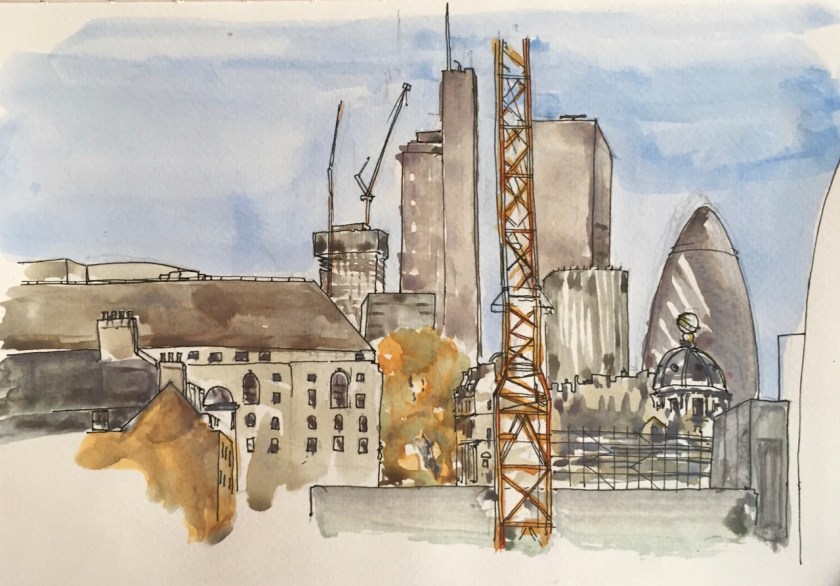
From the Barbican Podium underneath Willoughby House you can look East across the Crossrail site. Soon this view will be obliterated by the tall building on top of the Moorgate Crossrail station. But just now, this is what you can see:
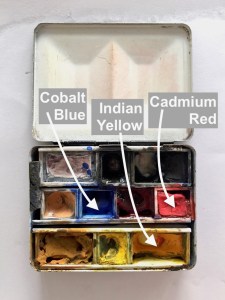
I drew this picture with just three colours:
Cadmium Red (Rembrandt)
Cobalt Blue (Jacksons)
Indian Yellow (Jacksons)
This was following the advice of Teoh Yi Chie of Parkablogs, in one of his Youtube posts, called “How I choose which colours to use”. He advises limiting the number of colours, and choosing just one red, one yellow and one blue for a picture. As you see, it is possible to create a wide range of colours from just three, including all the greys you see in the picture.
I was particularly pleased with the sheen on The Gherkin, which happened as the colours granulated and dried out.
The Towers in the picture are part of the emerging “Eastern Cluster”. This is a region of skyscrapers in the City of London. More will be added, according to the Eastern Cluster Strategy (try this link: City of London Eastern Cluster Strategy).
Here are the ones I could identify:
Here are photos of the picture being drawn:
About 1½ hours, drawn and coloured standing on the podium, leaning the sketchbook on the concrete of the podium. Warm breeze. Sun. I needed the sunhat.
Click a button below to share this post online, email it, or print it:
This is the “Boundary Estate”, Britain’s first council estate, opened in 1900. It was built to the design of Owen Fleming and his team. Fleming was a member of the Housing of the Working Classes branch of the LCC’s* Architecture department. He was 26 years old.
The aim of Boundary Estate project was to replace slums, in an area of disease, want, squalor and crime known as “Old Nicol”. The slums were pulled down, and replaced by dwellings that were more healthy, and more pleasant to live in. The area was also provided with schools, a laundry, shops and clubrooms. The problem was, of course, that these dwellings were more expensive than the previous slums. The former inhabitants of the area couldn’t afford the rent, and had to go elsewhere. Better-off workers in stable employment moved in.
Here’s what one part of it looks like now.
Shiplake House, Arnold Circus, in Sketchbook 4, 10″ x 7″
This is Shiplake House, on Arnold Circus. It didn’t look in very good repair. The paint was flaking. As you see, the outside was festooned with wires, some going no-where. The windows were dirty, though none were actually broken. This disrepair was surprising, as these are sturdy buildings, close to trendy Shoreditch High St, Brick Lane, and the City.
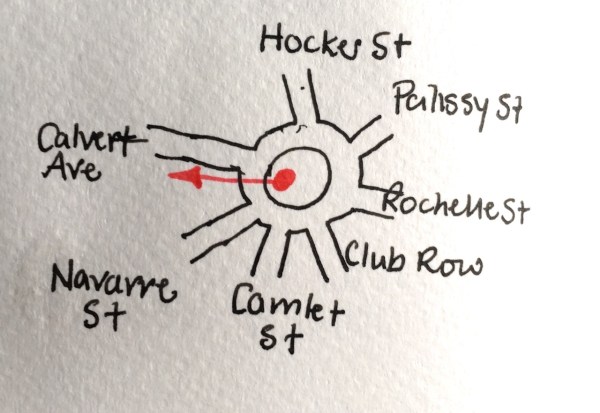
Arnold Circus, showing my direction of view for the picture of Shiplake House.
Shoreditch High St is visible from the little hill which is Arnold Circus, where I sat to draw the picture. There are seven roads which meet at Arnold Circus. Is this a record?
I read about the Boundary Estate in “Municipal Dreams, the rise and fall of council housing” by John Boughton. This is a fascinating book, answering my questions about why governments over the decades have, and have not, built council houses. Why did they do it, and why did they stop doing it? His website Metropolitan Dreams is also a great read and recommended.
Here is the drawing before the colour went on, showing Shiplake House in the background.
*LCC= London County Council, disbanded in 1965, and replaced by the GLC = Greater London Council which covered a larger area. The GLC was itself abolished in 1986, and its powers went to the London Boroughs. It was abolished largely because its leader, Ken Livingstone, was a high-spending Labour politician whose policies were opposed to those of Prime Minister Margaret Thatcher. Then when the GLA= Greater London Authority was established in 2000 the first Mayor elected was Ken Livingstone. He began his victory speech with the words: “As I was saying before I was so rudely interrupted 14 years ago …”
Click a button below to share this post online, email it, or print it:
Here is the view from Graham St Garden, Finsbury, on the way to Kings Cross.
I sat on a bench dedicated to the memory of someone called Rick Clarke. It was a new bench, in a lovely position. May Rick Clarke rest in peace. I am grateful to those who knew him for putting the bench there.
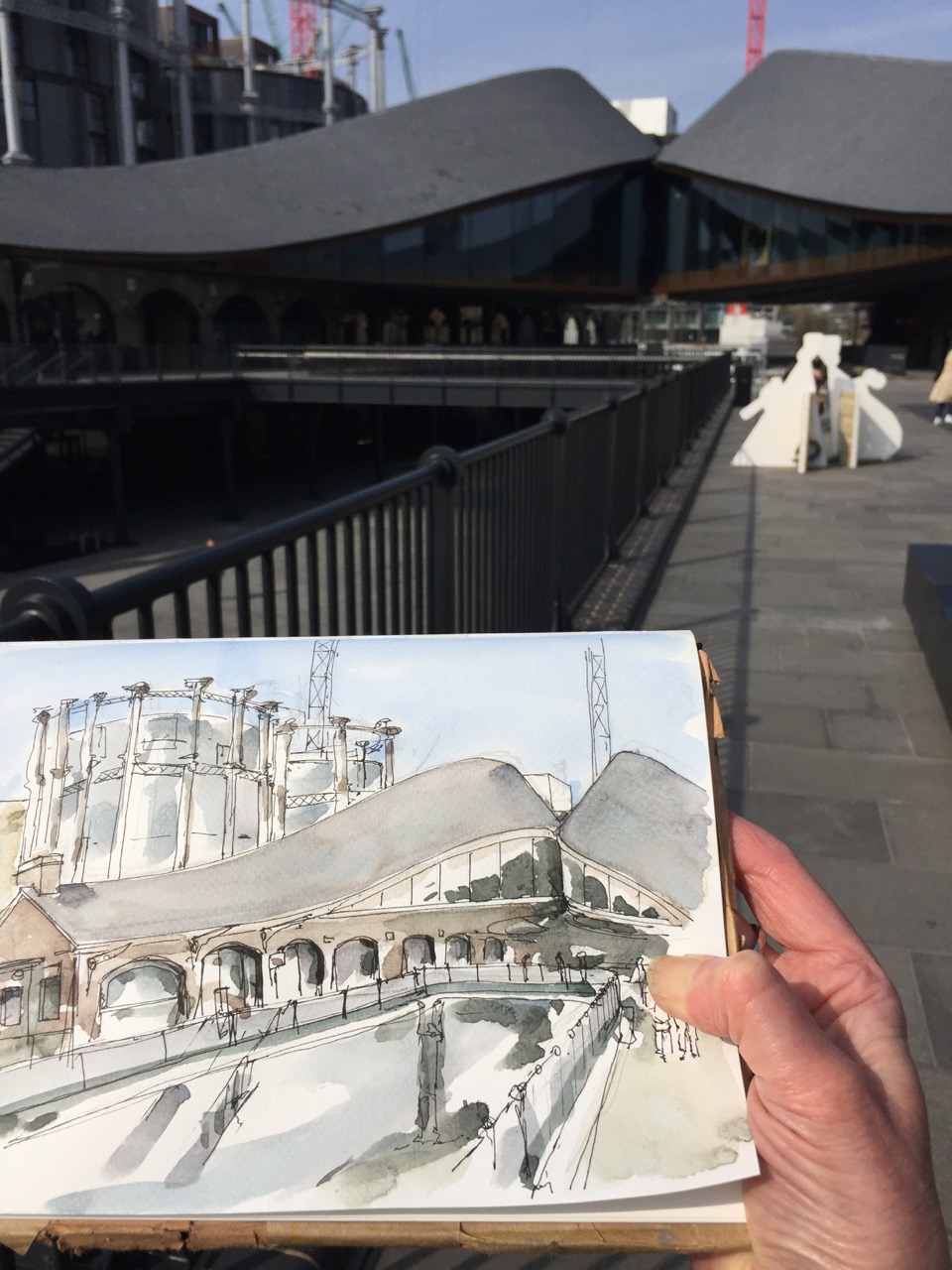
Graham St is the extension of Central St northwards, and I was on my way north to Kings Cross to meet someone at the Skip Garden. But the Skip Garden was closed on Mondays, and my friend was waiting outside. We adjourned to the marvellous new development “Coal Drops Yard”. This is a 21st century adaptation of old coal sheds. The old sheds are turned into two levels of shops and restaurants, but in the modern way, old brickwork and chunks of Victorian cast iron are retained. Most spectacular is the roof.
The architects were Heatherwick Studio. On the right of the drawing people were experimenting with strange rotating chairs, also designed by Heatherwick Studio, and other people were watching them.
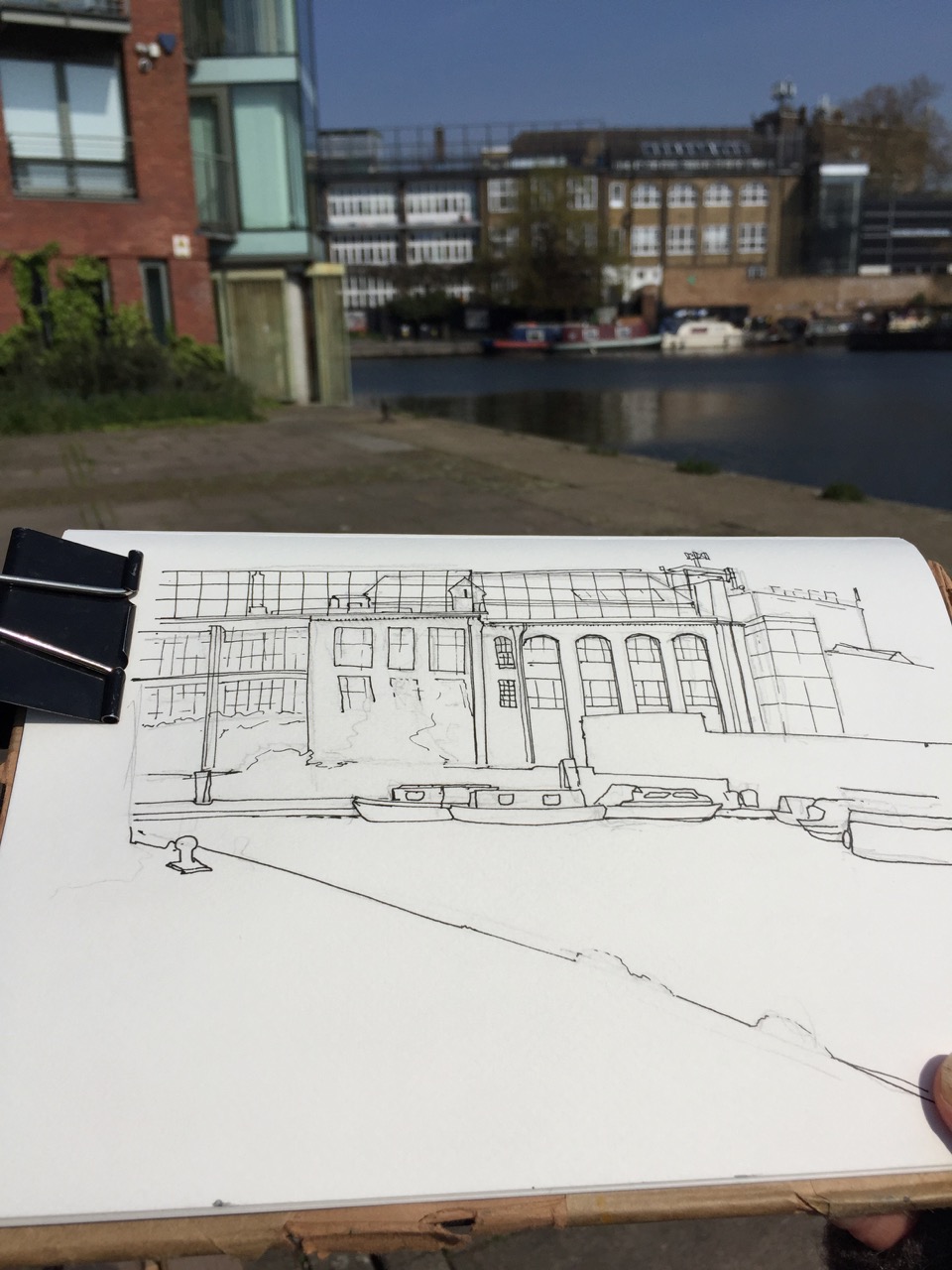
Here is work in progress on the drawings.
Click a button below to share this post online, email it, or print it:
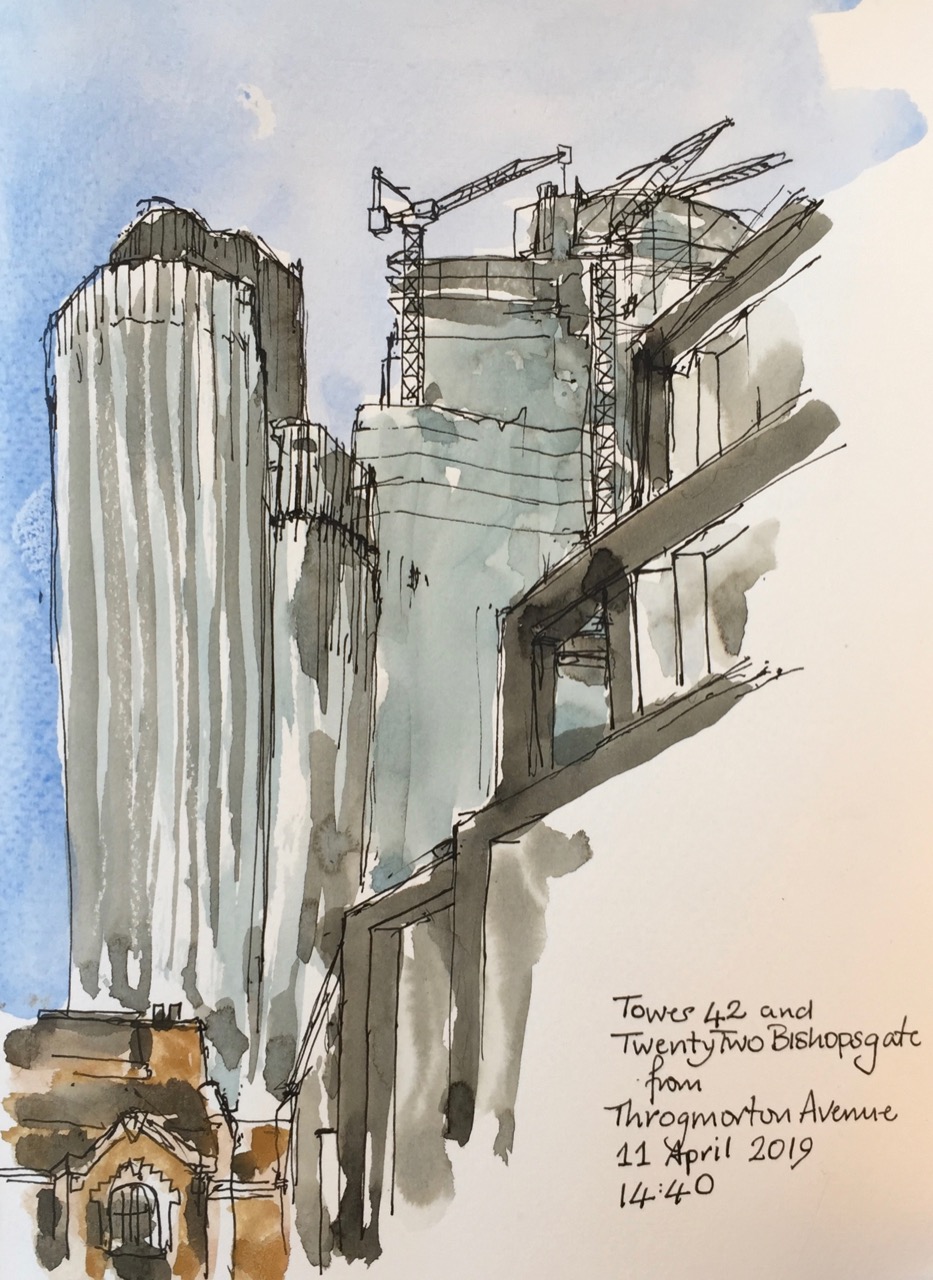
Here is the stunning view looking east from outside 12 Throgmorton Ave.
TwentyTwo Bishopsgate now rises above Tower 42. I have previously drawn both these towers as part of a skyline from Lauderdale Place: From Lauderdale Place: Eastern Cluster.
This was a quick sketch, perhaps 25 minutes. The moon hung just above Tower 42, as you can just see in the picture, and in this short time, it moved until it was over TwentyTwo.
I was on my way to see if the new rooftop garden on 120 Fenchurch Street was open to the public as advertised. With very low expectations I found my way between the immense towers of the insurance district, and presented myself, in my anorak with my rucksack, at what I deemed was the correct entrance. It looked like a corporate reception area, with a person in uniform with a label round their neck. Expecting to be asked my business and turned away, I asked politely if I could go up. “Yes of course,” said the uniformed individual, smiling broadly, “Just put your bag through the scanner.” It was as easy as that. I was amazed. More uniformed people were on hand to welcome me into the lift and out when I reached the 15th floor.
This roof garden is stunning. The sun was shining, and a estuarine wind ruffled the heads of the tulips. People were standing about on the clean concrete areas as though in an architectural layout. 120 Fenchurch Street is not particularly high, on the grand overall scale of things, but the view is spectacular because it is embedded within other towers, so it’s like being in a sculpture park. The Gherkin, the Scalpel, and TwentyTwo Bishopsgate are all round it, and there’s the Lloyds Building, and a distant view of St Pauls, and the glint of the Thames.
I decided I would be selective, and not try to draw a wide view. So I settled out of the wind, on the West side, and drew this.
I enjoyed the chasm, and the roof paraphernalia. The drain pipes were much in the steampunk tradition. They took flamboyant routes over the brick, with far more right angles than is strictly necessary. See also the iron staircases and platforms, more like the set of “Streetcar Named Desire” than office blocks in the financial district.
Here is work in progress, and the sketchbook on the paving of the roof garden.
Pencil
Pen
Colour
Finished
The drawing took 1hour 15 minutes.
Here are maps showing where I was.
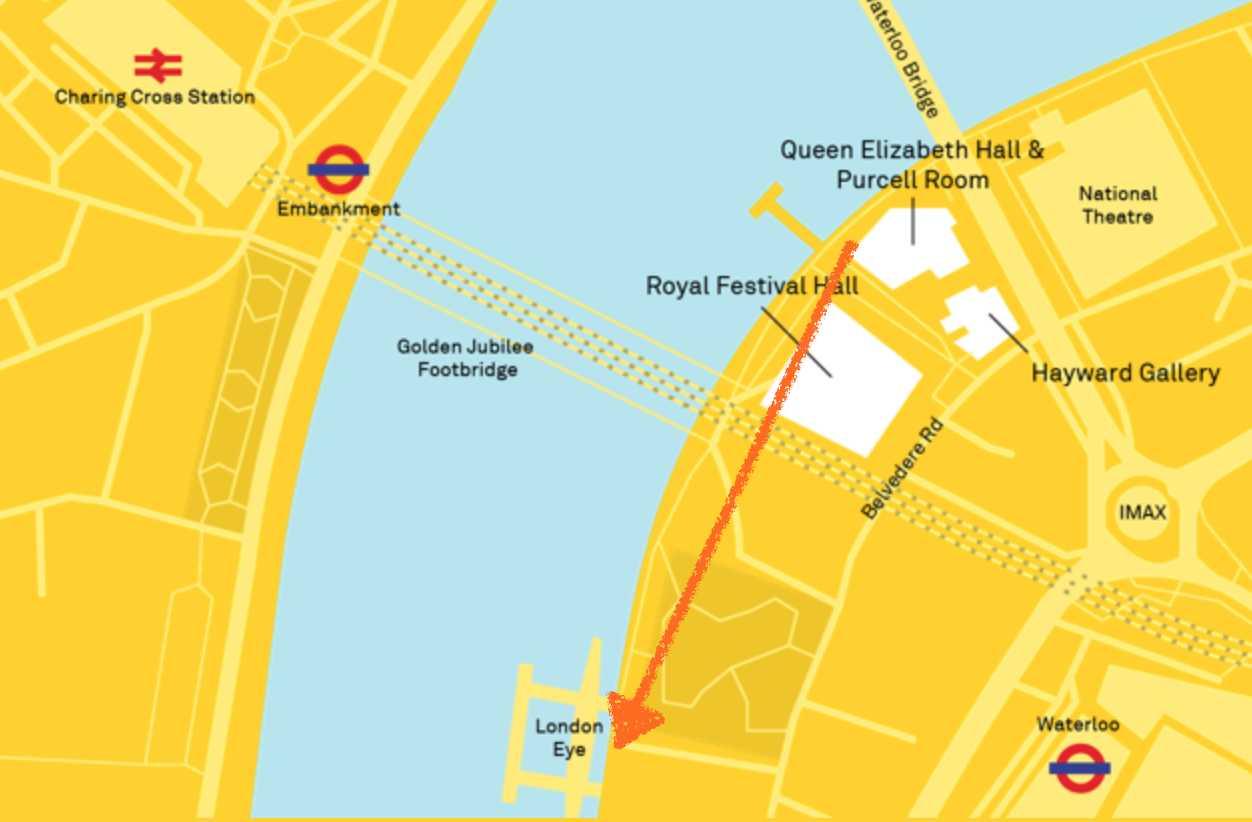
Here’s the direction I was looking from Throgmorton Avenue
Here is the direction I was looking from 120 Fenchurch St
Click a button below to share this post online, email it, or print it:
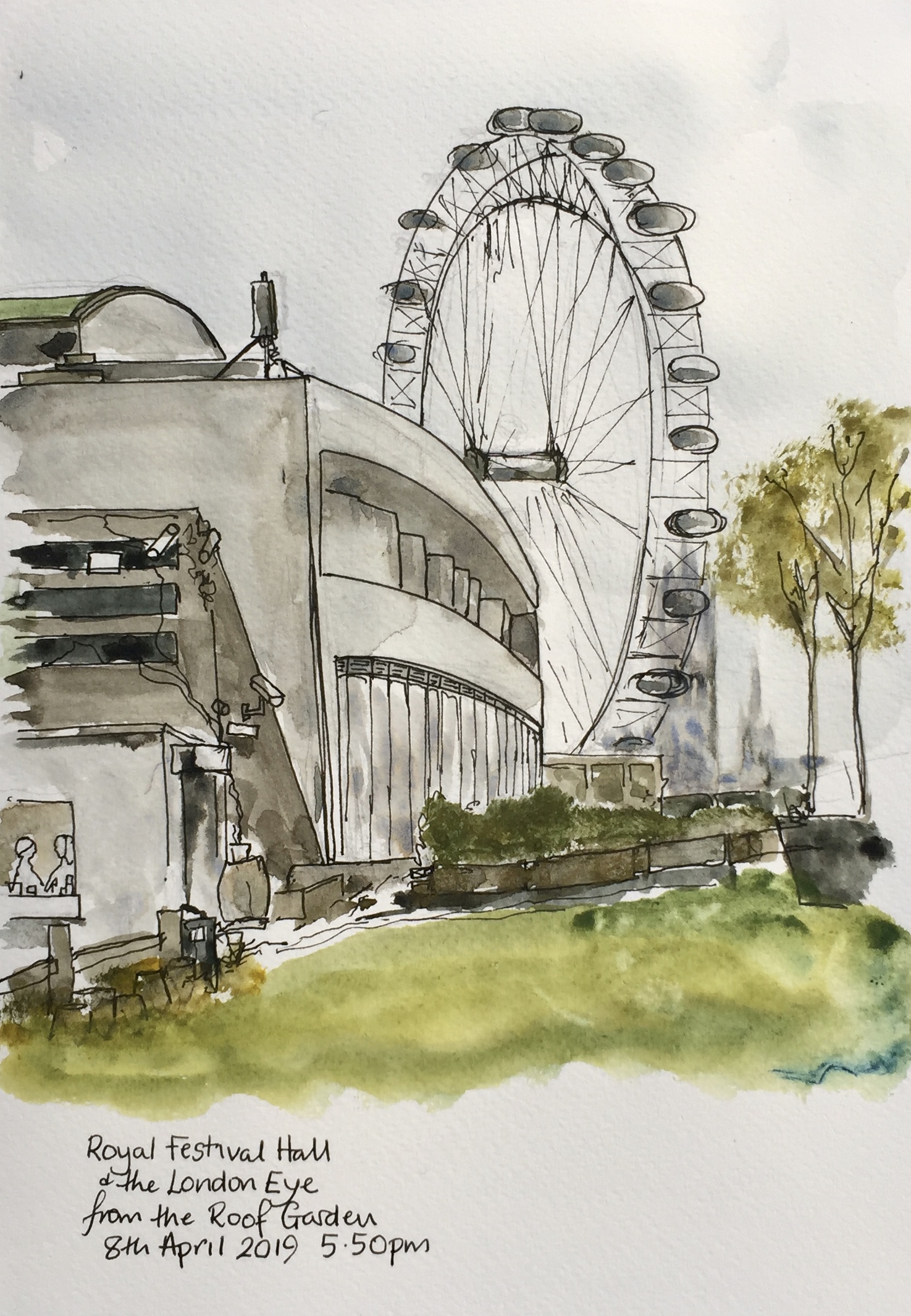
I went up to the marvellous roof garden, on top of the Queen Elizabeth Hall on the South Bank.
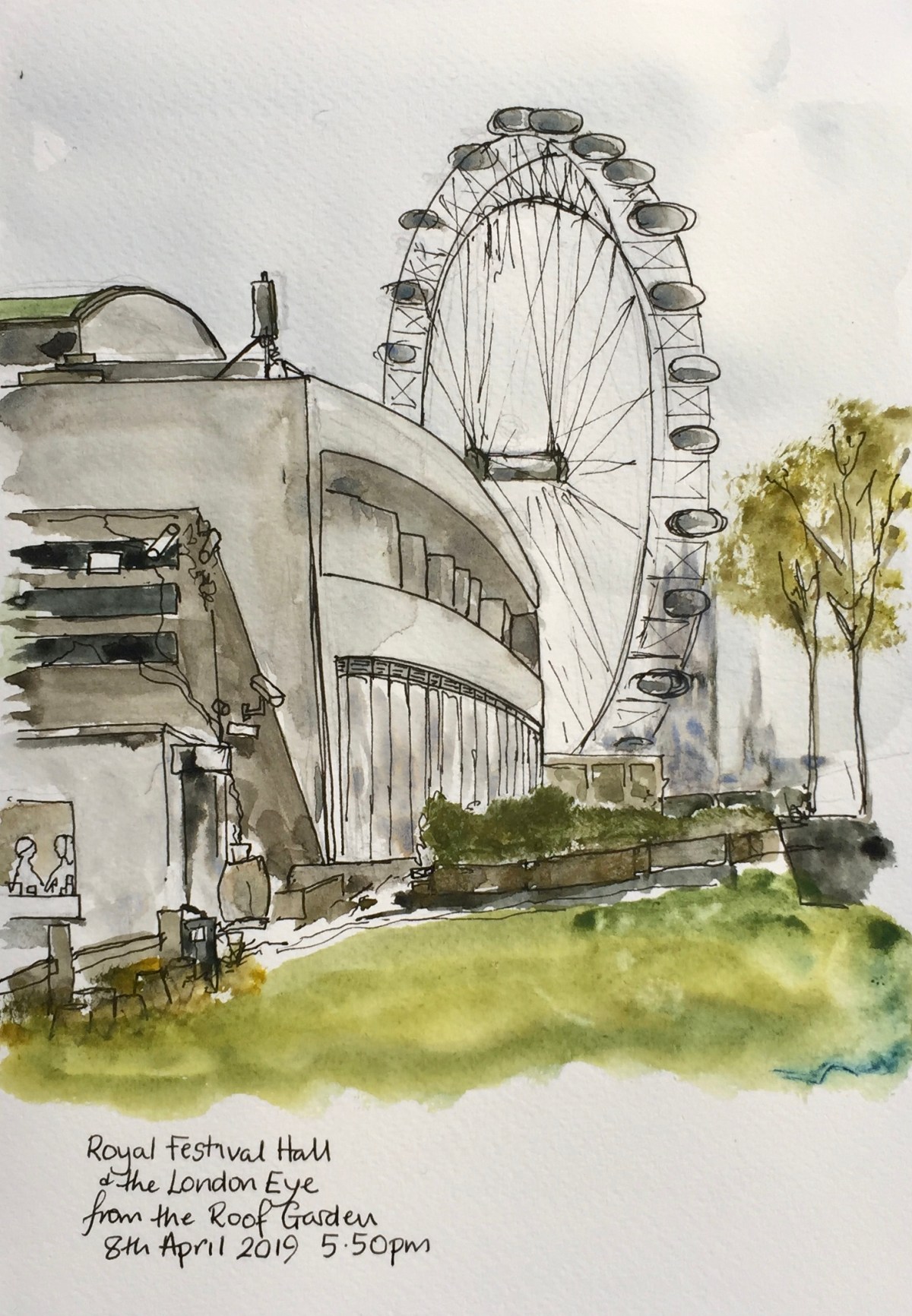
Here is a picture of the Royal Festival Hall, with the London Eye behind it. The tower of Westminster looms behind the wheel.
This roof garden seems to be a place for serious discussions. Some people at the next bench were discussing whether to stay employed or not. One of the options was to “go travelling”. Another, as far as I could work out, was to “get married”. It was hard to keep track of their wide ranging conversation, because I had to concentrate on the beautiful curve on the front of the Royal Festival Hall. It was a luxury to be there, and to appreciate the lines of the architecture. The lines were somewhat compromised at this roof level by the many creeping plants, floodlights, and surveillance cameras which you see encrusting the ventilation shaft in the foreground. Also note the prominent mobile phone mast on top of the Royal Festival Hall. I would not have granted planning permission for that.
The roof garden is a wonderful invention, and well done. By the time I’d finished the drawing, many people had made their way up, and were discussing work, and relationships, all very earnest. I discovered that I was sitting in the smoking area, which is adjacent to the vaping area. Marijuana smells wafted up from somewhere, perhaps from the skateboarding area in the Undercroft below. I could hear the crashes and the calls. But there was also a smell of grass, actual green grass, as in the picture.
Here is work in progress and a photo of my sketchbook on the concrete:
The drawing took 1hr30mins.
The London County Council (LCC), as it then was, initiated the building of the Royal Festival Hall as their contribution to the Festival of Britain. The foundation stone was laid by the Prime Minister Clement Atlee in 1949 and a mere 18 months later, in 1951, the concert hall opened with a gala concert, which shows what can be done if you are determined and have a deadline.
The project was initially led by the LCC chief architect Robert Matthew, then later by Leslie Martin, with Edwin Williams and Peter Moro. It was built on the site of the Lion Brewery, which was built in 1837.
[this information from the Royal Festival Hall website, and the Twentieth Century Society]
Click a button below to share this post online, email it, or print it:
Today was a beautiful day. It was a day to go for a walk.
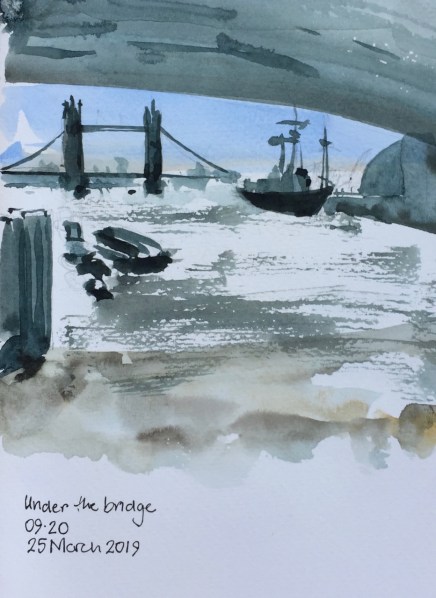
I went to the river. Near Old Billingsgate I looked under London Bridge and saw Tower Bridge and HMS Belfast. This is a 15 minute sketch, watercolour-only, no pen.
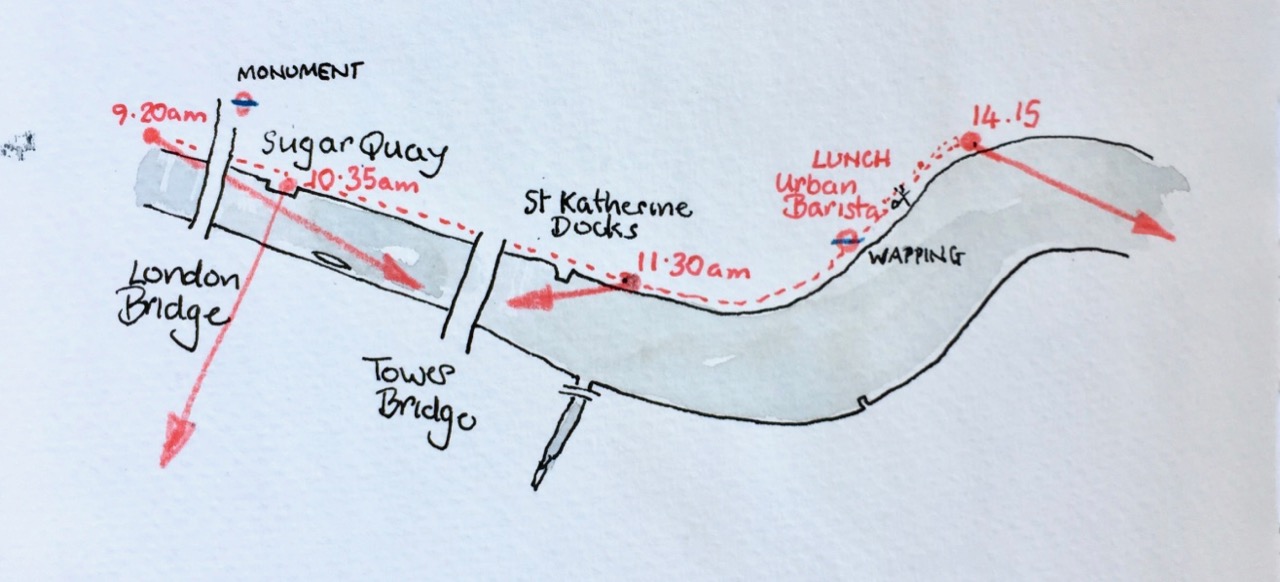
Onwards towards the East, I stood on Sugar Quay, which has only just re-opened after years of being closed while the nearby hotel is built.
Here is the Shard, in context, from a wooden bench on Sugar Quay.
This map shows my walk:
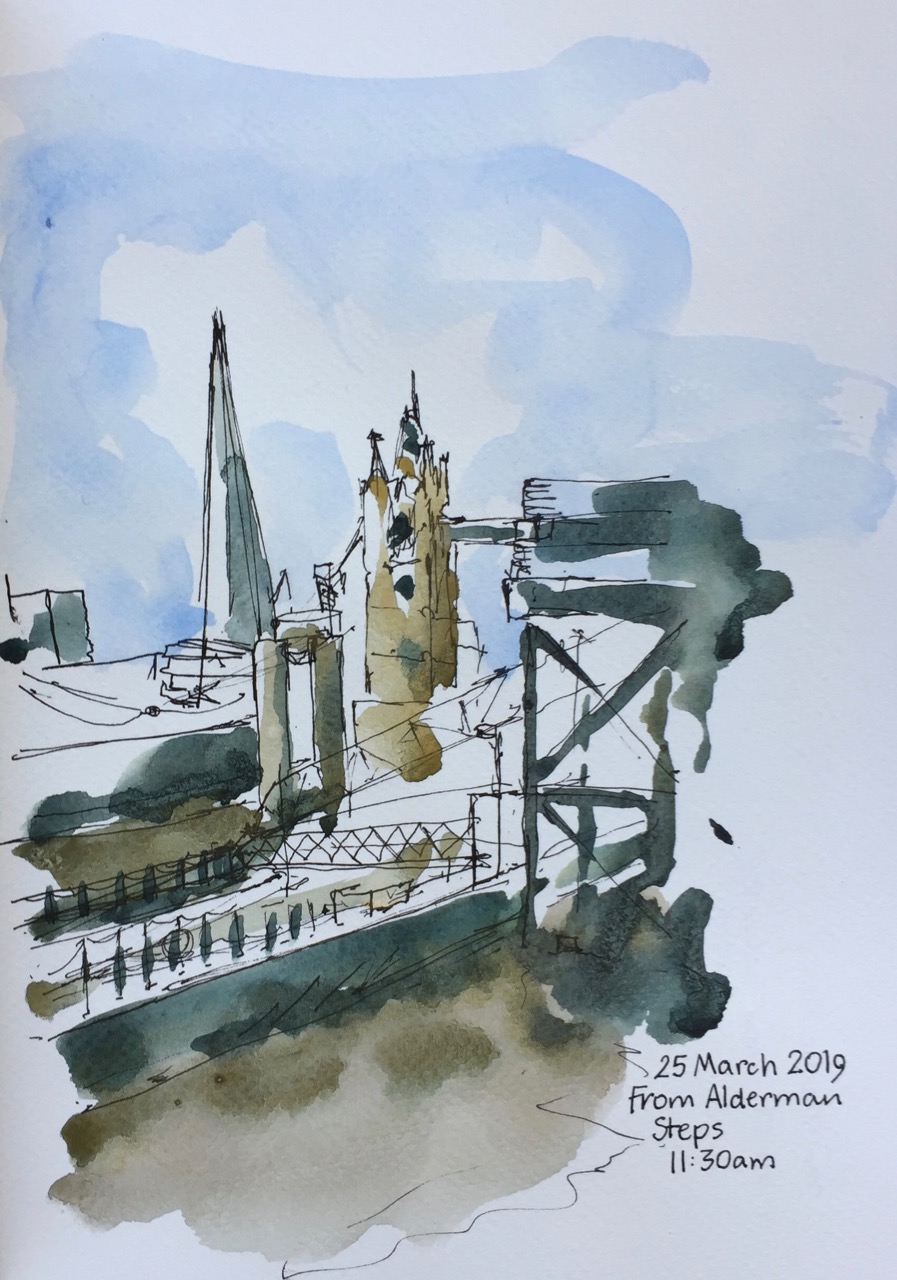
Tourists congregate around Tower Bridge. East of Tower Bridge, after St Katherines Dock, there are no tourists at all. It was suddenly very quiet. I went down “Alderman Steps”. There was this great view. The wind was fierce, and my eyes were streaming. I had a go anyway. Two mallards bobbed around amongst the floating quays, chatting away, looking around as if searching for something lost.
Then I went on East. I had lunch in a hipster café called “Urban Baristas” on Wapping High Street.
Lunch at the hipster café “Urban Baristas”
A man at the next table discussed flats on his mobile phone. He said Shoreditch was too expensive, so he was looking in Wapping. He’d found a good place, a view of the river, open plan, lots of space. Maybe it was offices he was describing, not flats.
Then I went on East. The river opens out here, it starts to feel more like an estuary. There are 1980s flats, brick-built, but in the river shores are the remains of the old trade: the old chains, the stanchions, huge shafts of timber, rotting piers.
Then the river bends again, and there’s a magnificent view of Canary Wharf.
I drew this in about an hour, sitting in sunlight spiked with the smell of someone else’s fish and chips.
Here is work in progress:
Here is me drawing:
Click a button below to share this post online, email it, or print it:
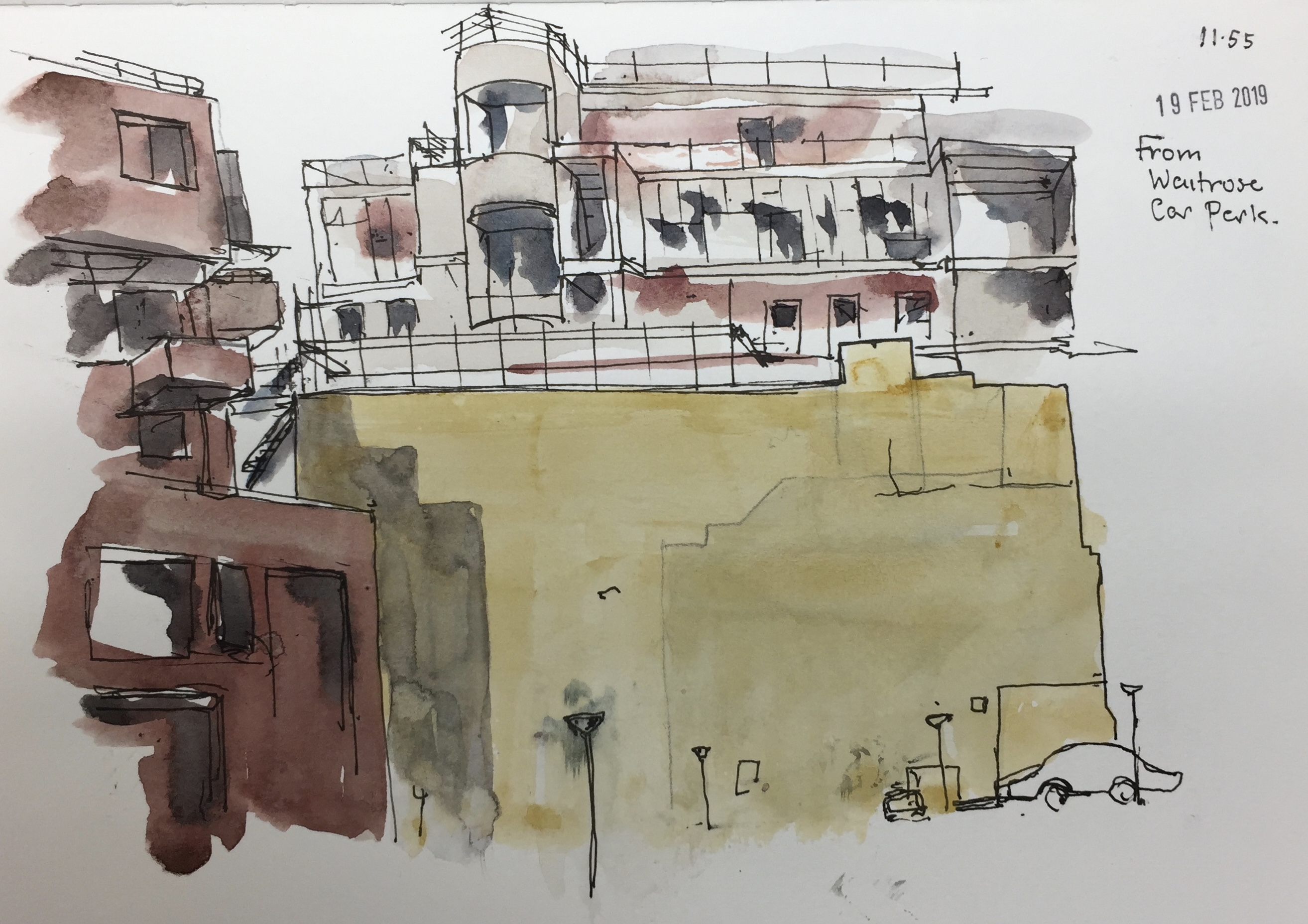
I like pictures of walls. It seems to me they have much to say. This one, for example, talks of the house that it once supported, of the concrete small bunkers that were at its base. It has been there longer than the development called “Cherry Tree Walk” which is above Waitrose, to the left. And now, behind and above, is the new YMCA hostel.
This wall is brick. It must have taken a long time to build. And it’s still there.
I drew the YMCA hostel from the other side, in December 2017:
Today was a glorious sunny day. I walked out into the sun and everywhere was worthy of a sketch.
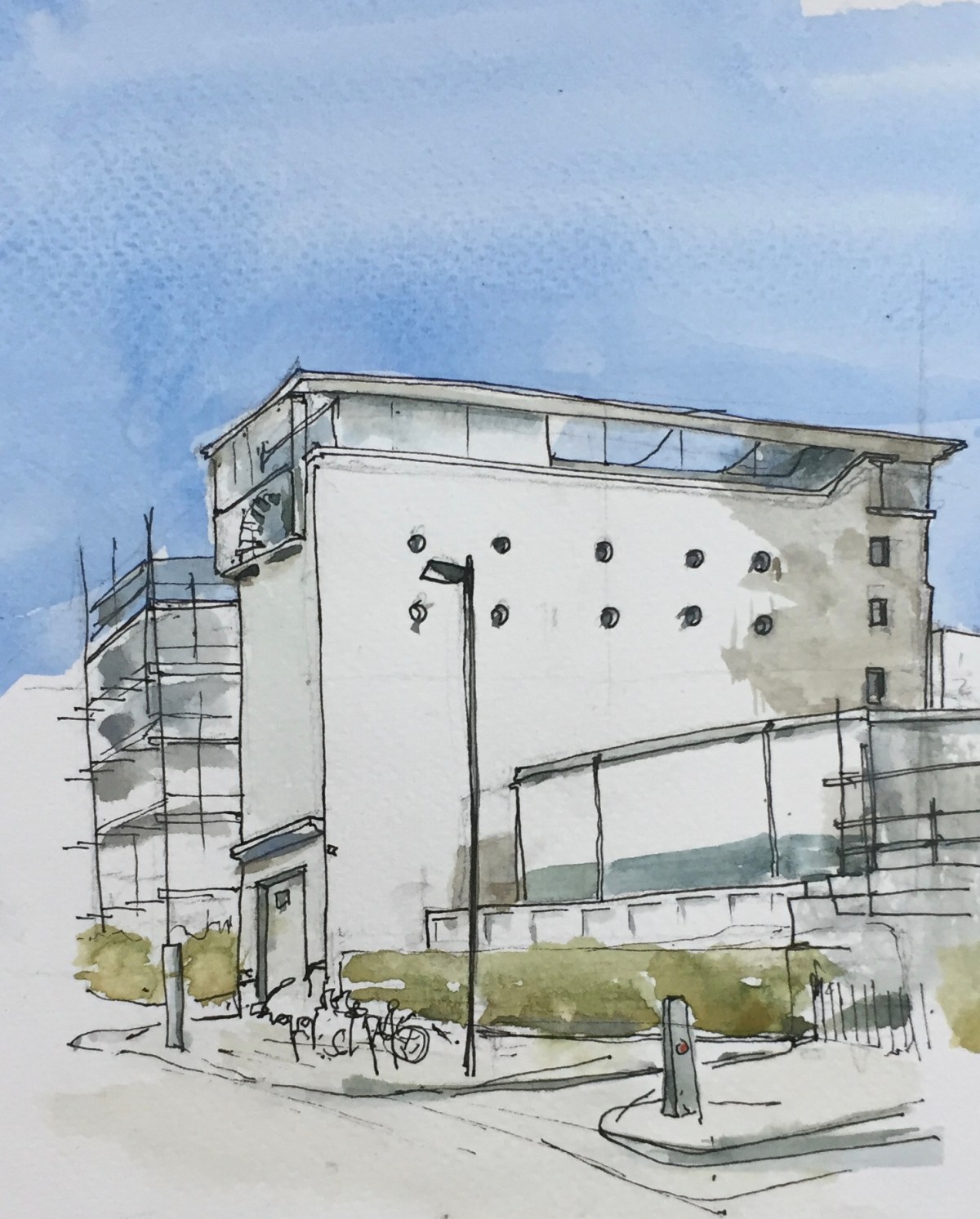
Here is 88 Golden Lane, a strange thin building. It is an architects’ practice: Blair Architecture.
I sketched this standing on the side of the road in the sun, then retreated to sit on my case by a nearby wall to add the colour.
It must have looked as though I was sitting on the pavement. An elderly woman, pushing a shopping basket on wheels, stopped and asked me if I was alright. I said I was, and explained that I was drawing a picture. “Oh,” she said, “because I was going to say that if you needed a sit down, there a bench just around the corner here.”
I gestured to the building I was drawing. “Ah yes, you wouldn’t be able to see that if you went round the corner.” She told me she had wanted to be an artist. She always got the art prize at school. But then the schools closed. “We were blocked,” she said. I didn’t know what she meant. “I’m old,” she said, smiling at my blank expression, “the war.”
Because the school closed, she left at 14. “I wanted to go to the art school, St Martins, but that was closed because of the war.” So, she said she’d be a typist. Then the firm she worked for closed down because of the war. “So I went on War Work,” she declared. “Oh, I’ve had a good life. I’m 93. Although people say I don’t look it.” She certainly didn’t look it.
I suggested she take up art now.
“I can’t,” she said, “it’s the hands.” She held up her arms. Her hands were balls, in gloves. “Arthritis,” she said. “But I’m alright. I was ill. And I recovered. So now I think, well, I’ve got a new life. Get on with it.”
She waved her balled hands cheerfully and pushed her trolley on. She turned round. “I hope to see you again,” she said.
Click a button below to share this post online, email it, or print it:



 Cadmium Red (Rembrandt)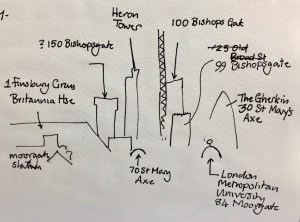












 Jane Sketching