Royal Festival Hall and the London Eye

I went up to the marvellous roof garden, on top of the Queen Elizabeth Hall on the South Bank.

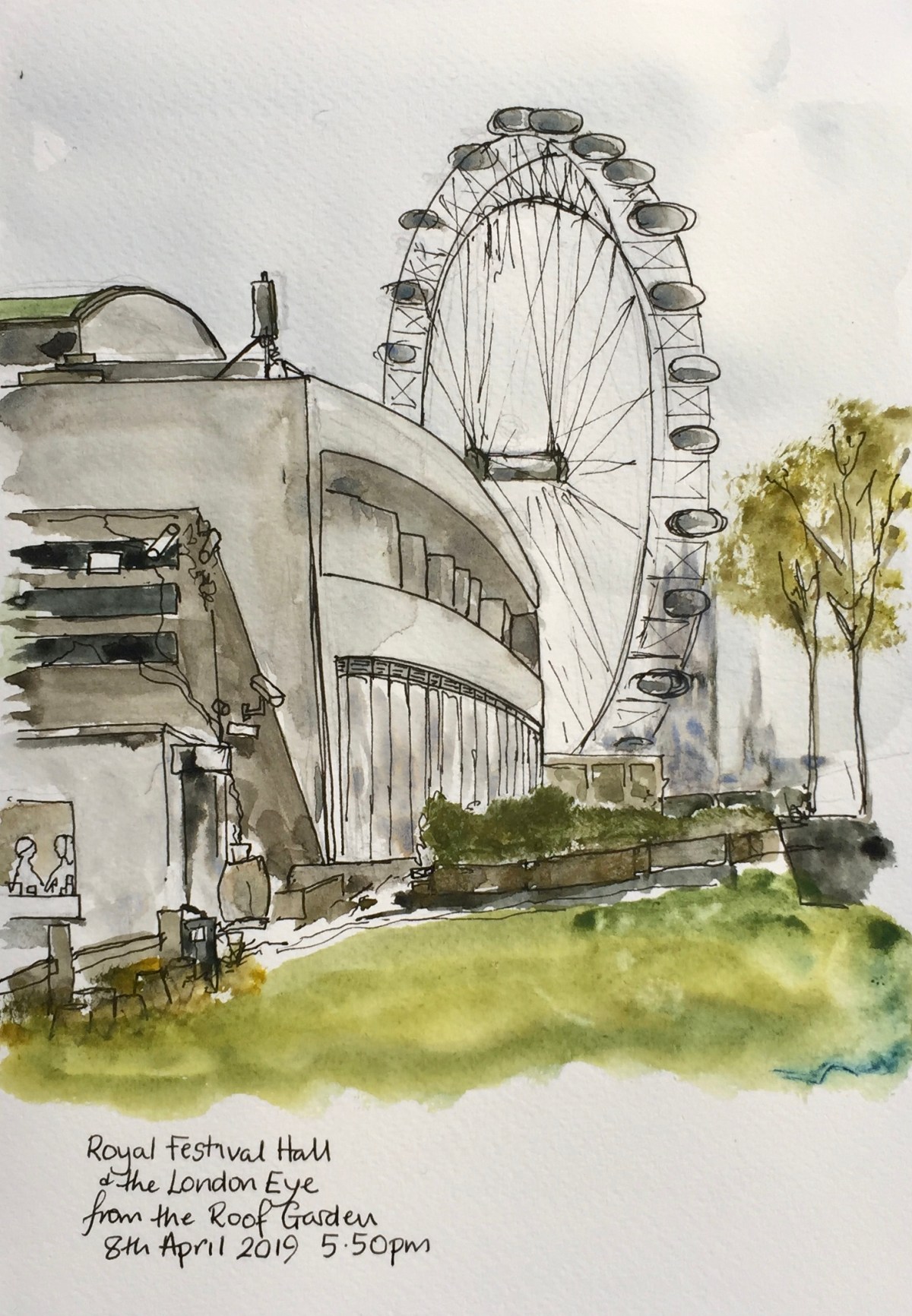
Here is a picture of the Royal Festival Hall, with the London Eye behind it. The tower of Westminster looms behind the wheel.

fullsizeoutput_337a

This roof garden seems to be a place for serious discussions. Some people at the next bench were discussing whether to stay employed or not. One of the options was to “go travelling”. Another, as far as I could work out, was to “get married”. It was hard to keep track of their wide ranging conversation, because I had to concentrate on the beautiful curve on the front of the Royal Festival Hall. It was a luxury to be there, and to appreciate the lines of the architecture. The lines were somewhat compromised at this roof level by the many creeping plants, floodlights, and surveillance cameras which you see encrusting the ventilation shaft in the foreground. Also note the prominent mobile phone mast on top of the Royal Festival Hall. I would not have granted planning permission for that.

The roof garden is a wonderful invention, and well done. By the time I’d finished the drawing, many people had made their way up, and were discussing work, and relationships, all very earnest. I discovered that I was sitting in the smoking area, which is adjacent to the vaping area. Marijuana smells wafted up from somewhere, perhaps from the skateboarding area in the Undercroft below. I could hear the crashes and the calls. But there was also a smell of grass, actual green grass, as in the picture.

Here is work in progress and a photo of my sketchbook on the concrete:

The drawing took 1hr30mins.
Screen Shot 2019-04-10 at 12.09.00.png
The London County Council (LCC), as it then was, initiated the building of the Royal Festival Hall as their contribution to the Festival of Britain. The foundation stone was laid by the Prime Minister Clement Atlee in 1949 and a mere 18 months later, in 1951, the concert hall opened with a gala concert, which shows what can be done if you are determined and have a deadline.

The project was initially led by the LCC chief architect Robert Matthew, then later by Leslie Martin, with Edwin Williams and Peter Moro. It was built on the site of the Lion Brewery, which was built in 1837.

[this information from the Royal Festival Hall website, and the Twentieth Century Society]

A walk to Wapping

Today was a beautiful day. It was a day to go for a walk.

I went to the river. Near Old Billingsgate I looked under London Bridge and saw Tower Bridge and HMS Belfast. This is a 15 minute sketch, watercolour-only, no pen.

IMG_1730

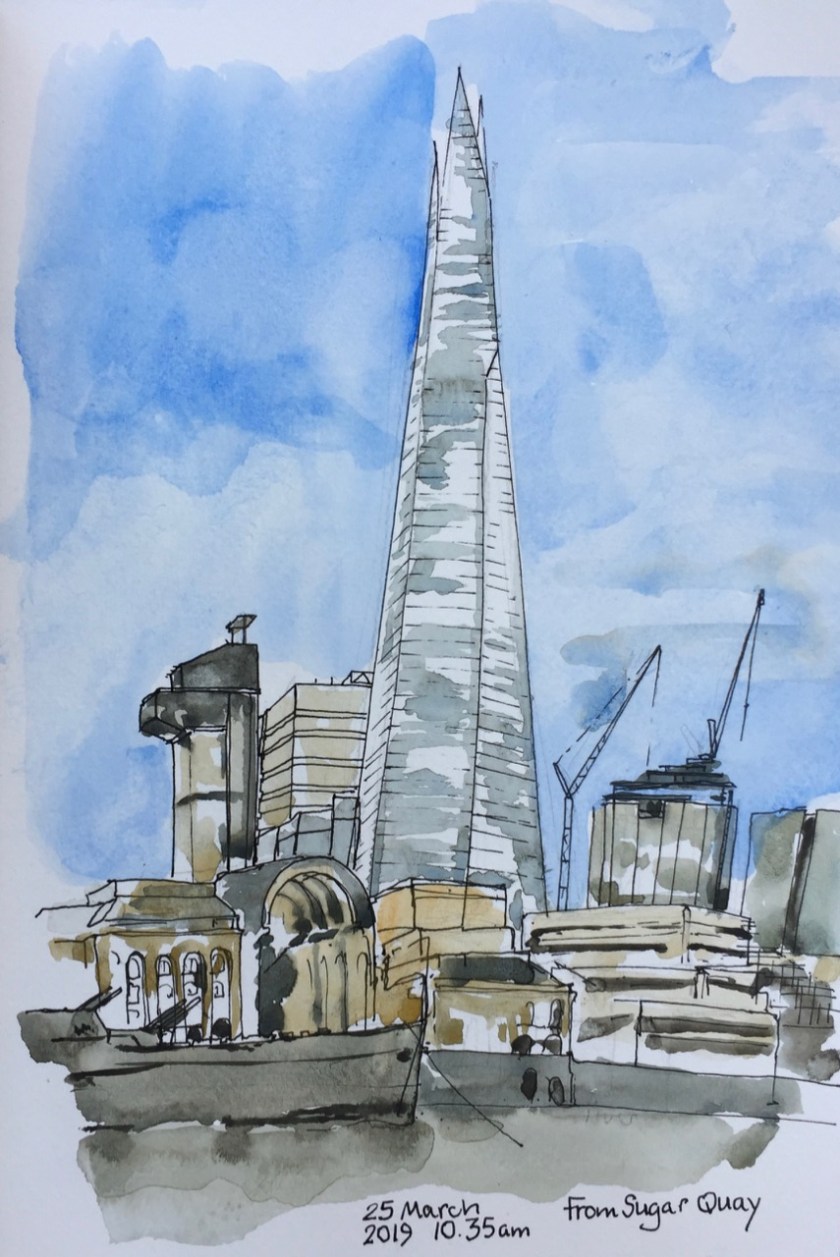
Onwards towards the East, I stood on Sugar Quay, which has only just re-opened after years of being closed while the nearby hotel is built.

Here is the Shard, in context,  from a wooden bench on Sugar Quay.

IMG_1729

This map shows my walk:

IMG_1731

Tourists congregate around Tower Bridge. East of Tower Bridge, after St Katherines Dock, there are no tourists at all. It was suddenly very quiet. I went down “Alderman Steps”. There was this great view. The wind was fierce, and my eyes were streaming. I had a go anyway. Two mallards bobbed around amongst the floating quays, chatting away, looking around as if searching for something lost.

IMG_1728

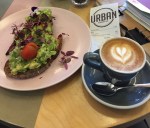
Then I went on East. I had lunch in a hipster café called “Urban Baristas” on Wapping High Street.

IMG_1677
Lunch at the hipster café “Urban Baristas”

A man at the next table discussed flats on his mobile phone. He said Shoreditch was too expensive, so he was looking in Wapping. He’d found a good place, a view of the river, open plan, lots of space. Maybe it was offices he was describing, not flats.

Then I went on East. The river opens out here, it starts to feel more like an estuary. There are 1980s flats, brick-built, but in the river shores are the remains of the old trade: the old chains, the stanchions, huge shafts of timber, rotting piers.

Then the river bends again, and there’s a magnificent view of Canary Wharf.

IMG_1727

I drew this in about an hour, sitting in sunlight spiked with the smell of someone else’s fish and chips.

Here is work in progress:

Here is me drawing:

IMG_1715

A wall in Waitrose Car Park

fullsizeoutput_331a

I like pictures of walls. It seems to me they have much to say. This one, for example, talks of the house that it once supported, of the concrete small bunkers that were at its base. It has been there longer than the development called “Cherry Tree Walk” which is above Waitrose, to the left. And now, behind and above, is the new YMCA hostel.

This wall is brick. It must have taken a long time to build. And it’s still there.

I drew the YMCA hostel from the other side, in December 2017:

YMCA site, Errol St EC1

88 Golden Lane

Today was a glorious sunny day. I walked out into the sun and everywhere was worthy of a sketch.

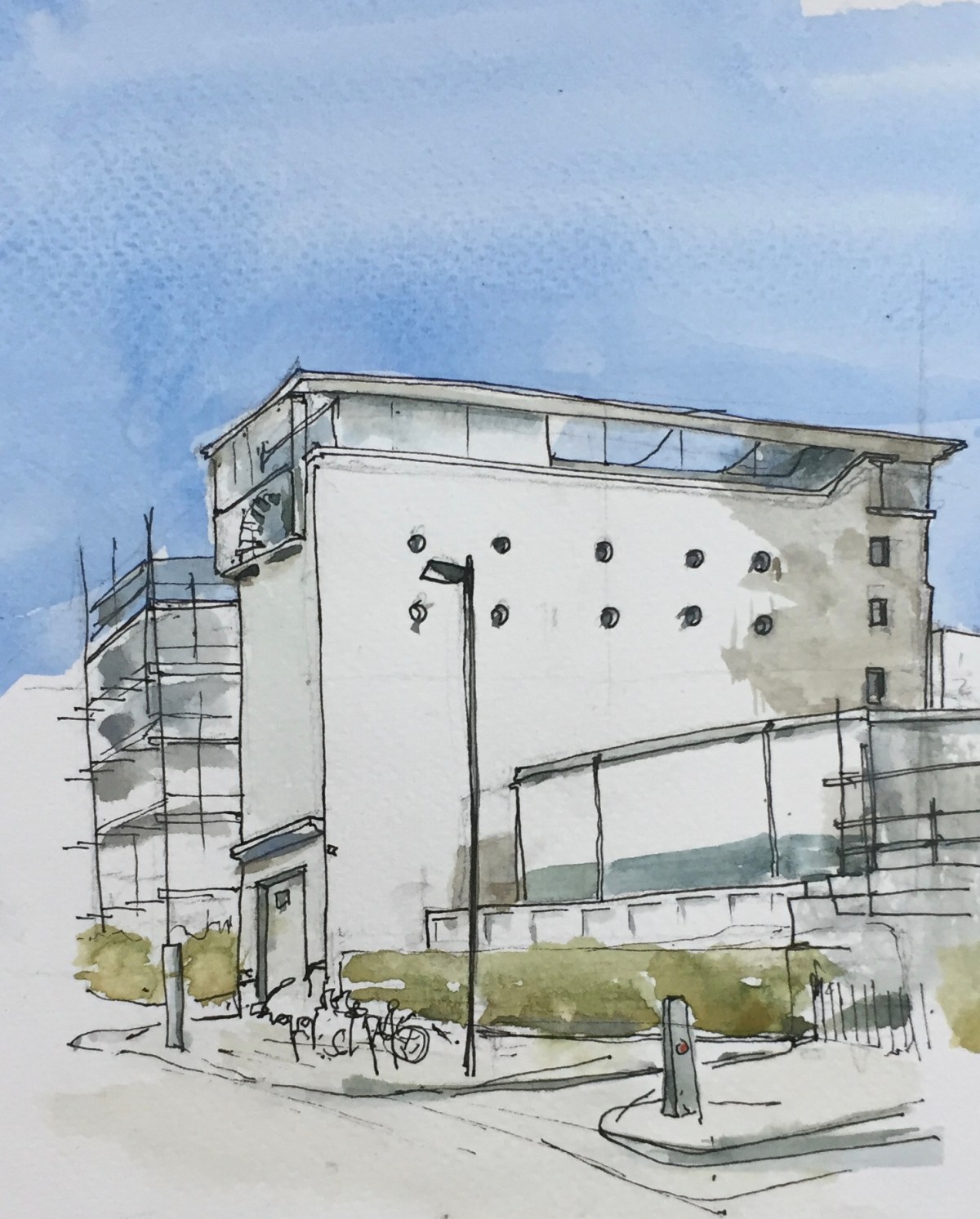
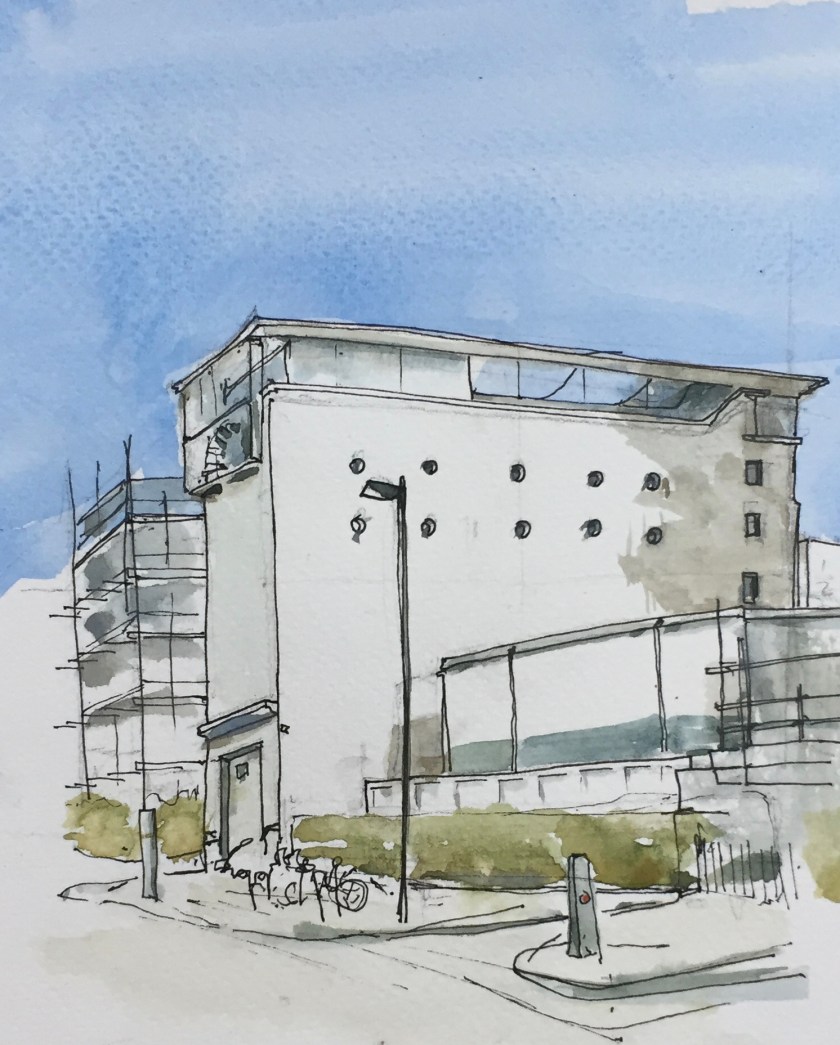
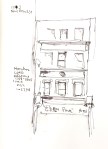
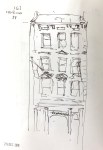
Here is 88 Golden Lane, a strange thin building. It is an architects’ practice: Blair Architecture.

fullsizeoutput_32af

I sketched this standing on the side of the road in the sun, then retreated to sit on my case by a nearby wall to add the colour.

It must have looked as though I was sitting on the pavement. An elderly woman, pushing a shopping basket on wheels, stopped and asked me if I was alright. I said I was, and explained that I was drawing a picture. “Oh,” she said, “because I was going to say that if you needed a sit down, there a bench just around the corner here.”

I gestured to the building I was drawing. “Ah yes, you wouldn’t be able to see that if you went round the corner.” She told me she had wanted to be an artist. She always got the art prize at school. But then the schools closed. “We were blocked,” she said. I didn’t know what she meant. “I’m old,” she said, smiling at my blank expression, “the war.”

Because the school closed, she left at 14. “I wanted to go to the art school, St Martins, but that was closed because of the war.” So, she said she’d be a typist. Then the firm she worked for closed down because of the war. “So I went on War Work,” she declared. “Oh, I’ve had a good life. I’m 93. Although people say I don’t look it.” She certainly didn’t look it.

I suggested she take up art now.

“I can’t,” she said, “it’s the hands.” She held up her arms. Her hands were balls, in gloves. “Arthritis,” she said. “But I’m alright. I was ill. And I recovered. So now I think, well, I’ve got a new life. Get on with it.”

She waved her balled hands cheerfully and pushed her trolley on. She turned round. “I hope to see you again,” she said.


Great Arthur House from the Barbican Podium

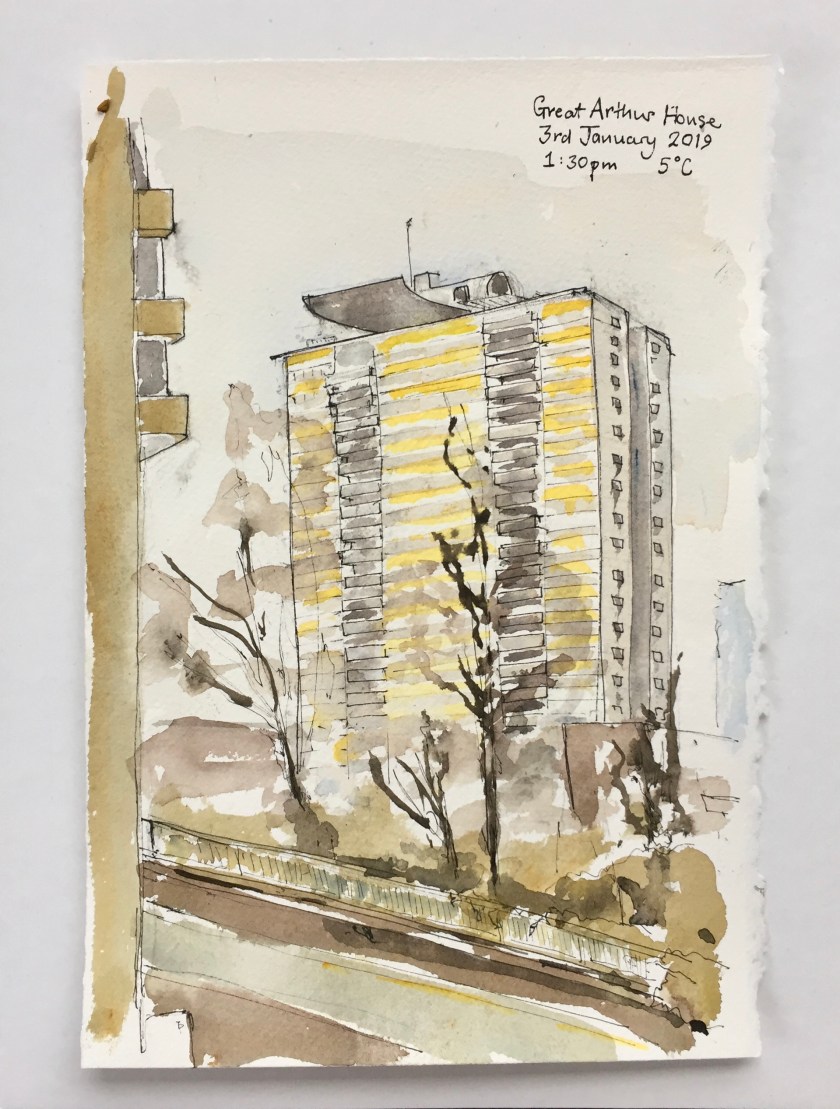
Here is Great Arthur House from the podium ramp near Blake Tower. You can see Blake Tower on the left. At the bottom of the picture is the ramp that goes down into the Car Park at Bunyan Court.

Several stories below me, at ground level, there was an assortment of discarded furniture and paint tins, and a huge skip full of Christmas Trees being collected for recycling.

fullsizeoutput_31dd

It was really cold out there. I saw a black cat sliding in between the debris.

This picture done on Fabriano Artistico loose sheet,  8inches by 10 inches. About an hour, on location.

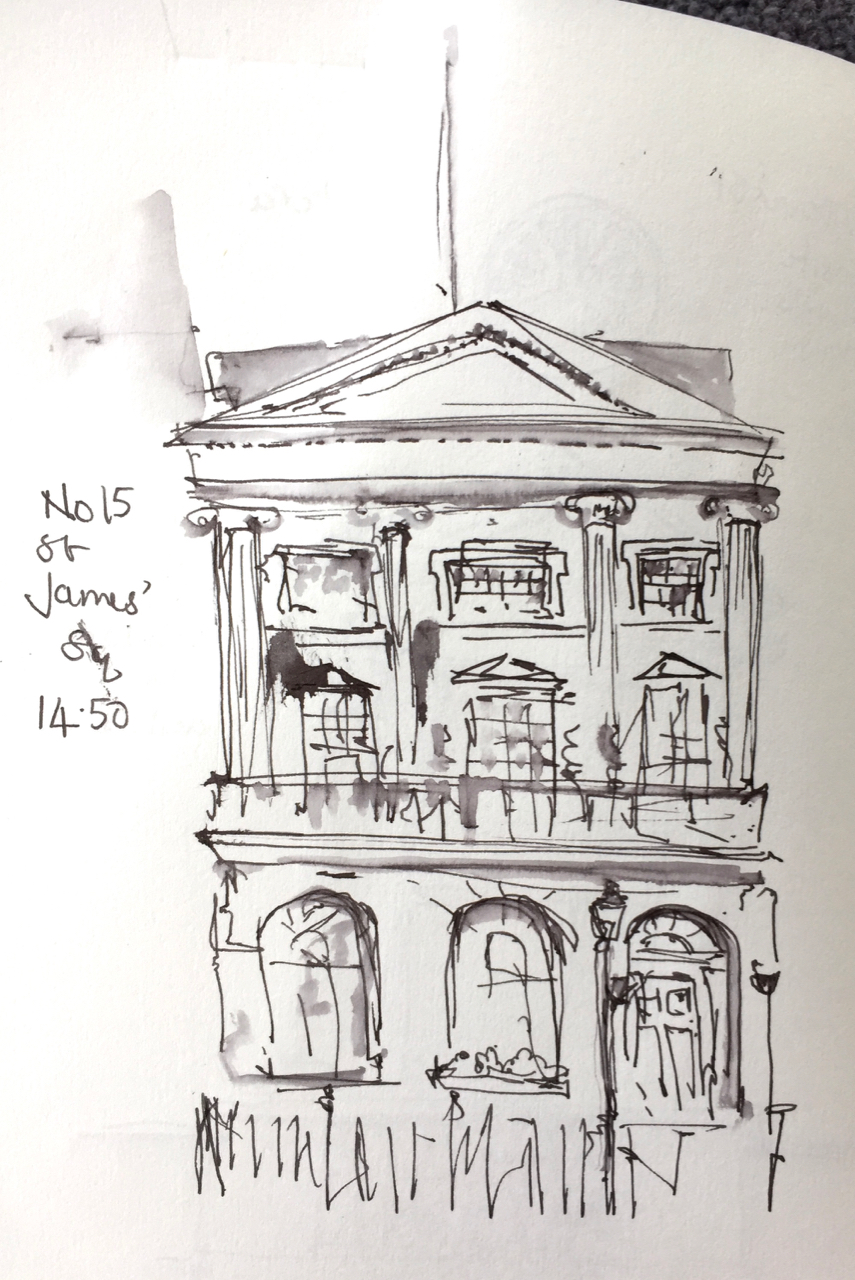
In the footsteps of Nelson

440px-Young_Nelson
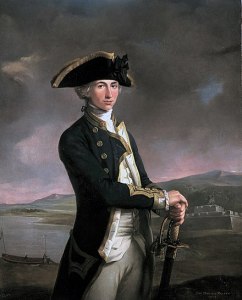
Captain Horatio Nelson, painted by John Francis Rigaud in 1781, with Fort San Juan in the background.

For our Boxing Day walk, John researched places in London associated with Vice-Admiral Horatio Nelson (29 September 1758 – 21 October 1805).

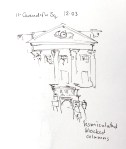
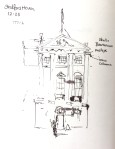
First we saw some houses of the period, and then went to the various places that Nelson lived or visited in London. My mission was to draw very quick pictures. We had a lot of places to visit, and I didn’t want to hold up the expedition. Here are my sketches, in the order of our visits.


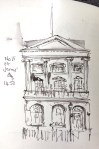
We saw and named architectural details.  On 11 Cavendish Square we noted the “blocked vermiculated columns”
IMG_0925 (1)
“Vermiculated” means wormlike. It’s a really useful adjective. “I found it impossible to follow his vermiculated arguments.” ” After navigating the vermiculated back alleys, we emerged at last onto the main square.”

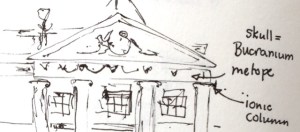
We saw ionic columns on Stratford House. These are the ones with scrolls at the top. Above the columns is the “metope” or frieze. On this there were “bucrania” which are bulls skulls.
IMG_0926 (1)

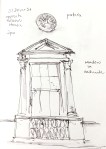
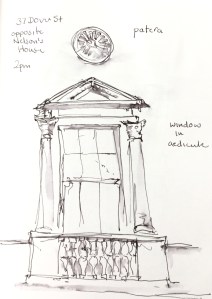
An “aedicule” is a house shape with columns each side. At 37 Dover Street we saw a window in an aedicule.

IMG_0931
A window in 37 Dover Street, opposite Nelson’s House

Here is our route:

Screen Shot 2018-12-27 at 09.25.32

It took us 5 hours and was 14km.

After the Georgian London visits in the West End, we walked to Trafalgar Square to see Nelson’s Column, and then along the Strand, where we saw the site of a silversmith he visited. Nelson went along the Strand in his carriage to receive his “Freedom of the City of London”. At Temple, the cheering crowds unhitched his horses and hauled his carriage themselves.

We arrived at St Paul’s Cathedral, where Nelson is interred.

I used Organics Studio arsenic gray ink, and a Lamy Safari pen with fine nib, from The Writing Desk. The book is a sketchbook from Seawhite of Brighton.

Galway House

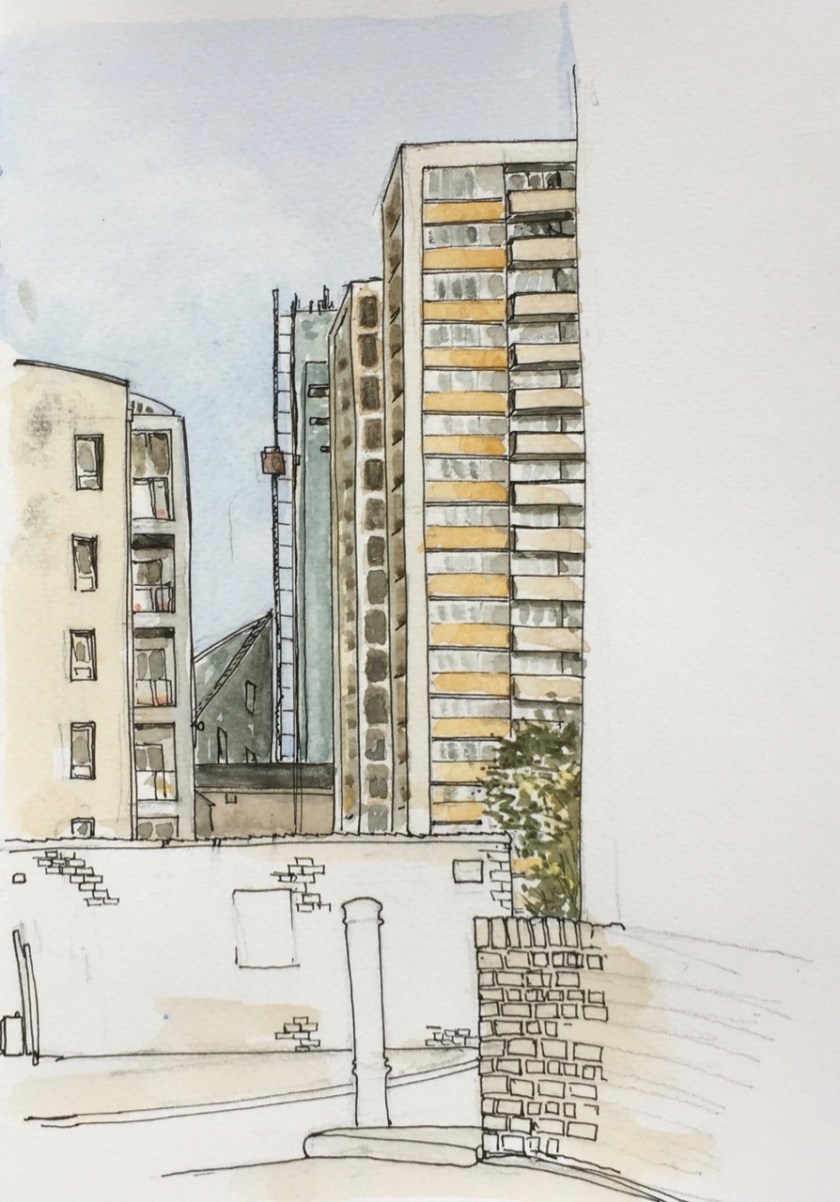
Galway House is one of the two Towers on the Pleydall Estate just North of Old Street. The other tower is Grayson.

IMG_0408

I drew this from behind Grayson House. There was a ferocious cold wind. I seemed to have picked the place where all the winds met. Here are maps showing the direction I was looking.


Version 2

Here are the blocks in the picture. It almost looks as though the Atlas Building continues the march of these majestic 1960s blocks. But it doesn’t, not really.

In the drawing you can see the scaffolding on the Atlas Building, and the external lift that was going up and down as I was drawing.

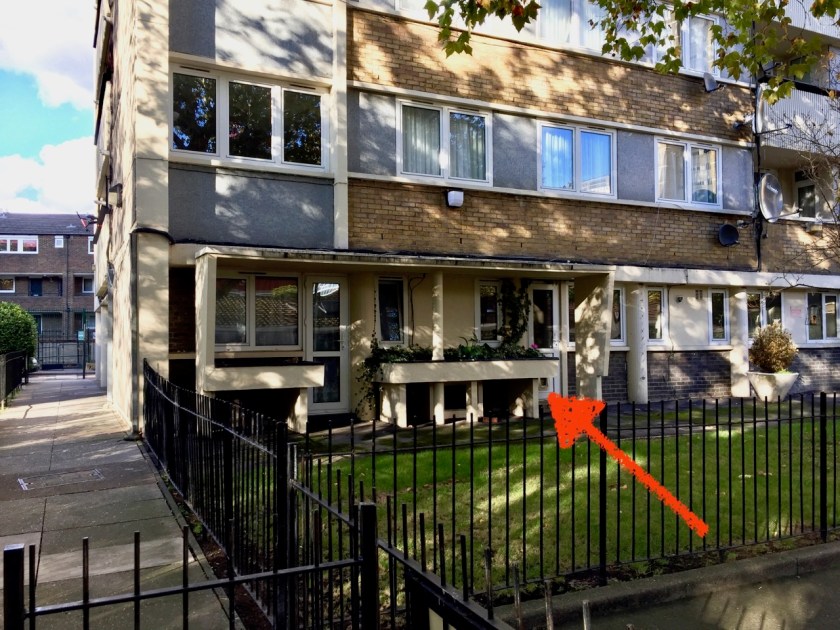
I was interested to see that the inhabitants of Galway Tower made use of their flower beds.

IMG_0399
Raised flower beds in Galway House, South side.

I’ve seen the same arrangement of raised flower beds next to the flats in Rahere House, where the beds were more exposed, and not used.

This whole area underwent huge changes in the twentieth century, although the street layout is unchanged.

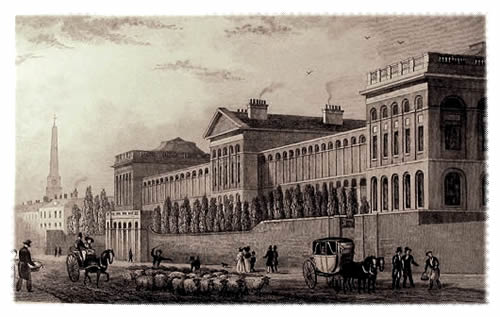
From 1751, on Old Street, there was a huge hospital for the mentally ill: St Luke’s Hospital for Lunatics.

St_Lukes_Hospital_for_Lunatics,_London.jpg
St Luke’s Hospital for Lunatics on Old Street. The obelisk in St Luke’s Gardens is in the background. Image credit: Wikipedia

This hospital was closed in 1916 and the residents moved out. The building was acquired by the Bank of England and used for printing bank notes.

CTsnwiBXAAA0b_S
Bank of England Printing Works on Old Street, 1925, image credit: Bank of England Museum.

Here is the area in 1940: map from http://www.maps-of-london.com, click to enlarge.

Screen Shot 2018-10-27 at 14.36.42
The Pleydell Estate area, Finsbury, in 1940. Picture credit: http://www.maps-of-london.com

You see Galway Street on the crease of the map, in the centre about a quarter of the way down. Below it, to the right is the “Bank Printing Works”.

In 1959 the London County Council sought to purchase the Printing Works site and use it as an annexe to Covent Garden. This was opposed by Michael Cliffe, MP for Finsbury and Shoreditch, on the grounds that it would create unacceptable traffic congestion, especially at the Old Street Roundabout.

Mr Cliffe is quoted in Hansard:

“…London County Council (General Powers) Bill, …. The Council, through the Bill, sought powers to acquire and redevelop St. Luke’s Printing Works as an annexe of Covent Garden Market….. I would ask the Minister what is the point of spending millions of pounds in trying to solve the problem of congestion in Central London if we are to convert the St. Luke’s Printing Works as an annexe to Covent Garden in an area where we know it must inevitably cause the kind of congestion that we are trying to avoid and which we are discussing every day. As the number of vehicles increases, further problems will have to be solved. Surely we do not want to create further difficulties after our experience gained in the past?” [Hansard: HC Deb 17 December 1959 vol 615 cc1738-47]

Mr Cliffe must have prevailed. I feel an affinity with him because earlier this week I drew Michael Cliffe House.

The Printing Works building was demolished in 1963. At around that time Finsbury Council was building council houses, including the 4 tower blocks in the area: Gambier House, Grayson House, Godfrey House and Galway House. So somehow the Council must have acquired the Print Works site. I can’t find the history online so I’m going to visit the London Metropolitan Archives and the Islington Museum.

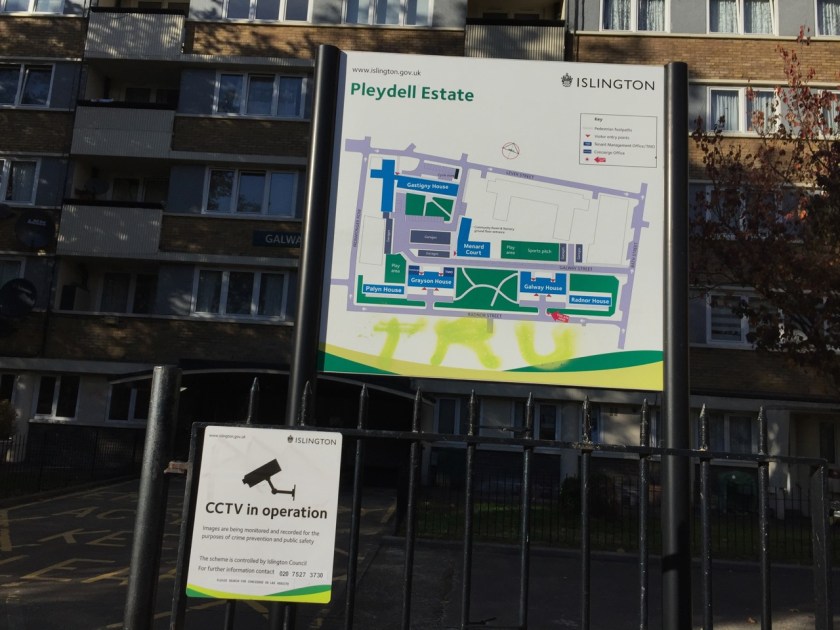
The Towers also were allocated to different Estates: Galway is in the “St Luke’s Estate” which includes the Printing works Site, Gambier is in the City Road Estate and Grayson and Galway are in the Pleydell Estate.

From “Streets with a story, The book of Islington” (1986) by Eric A Willats FLA I learn that: “Messrs. Emberton, Franck & Tardrew were the architects of Galway House (Pleydell Estate)”.

Screen Shot 2018-10-27 at 15.30.41.png
From a map sent to Mr I Agar in 2010 in response to a Freedom of Information request [FOI 340742.pdf]
IMG_0398
The Pleydell Estate, Galway House in the Background.

Michael Cliffe House

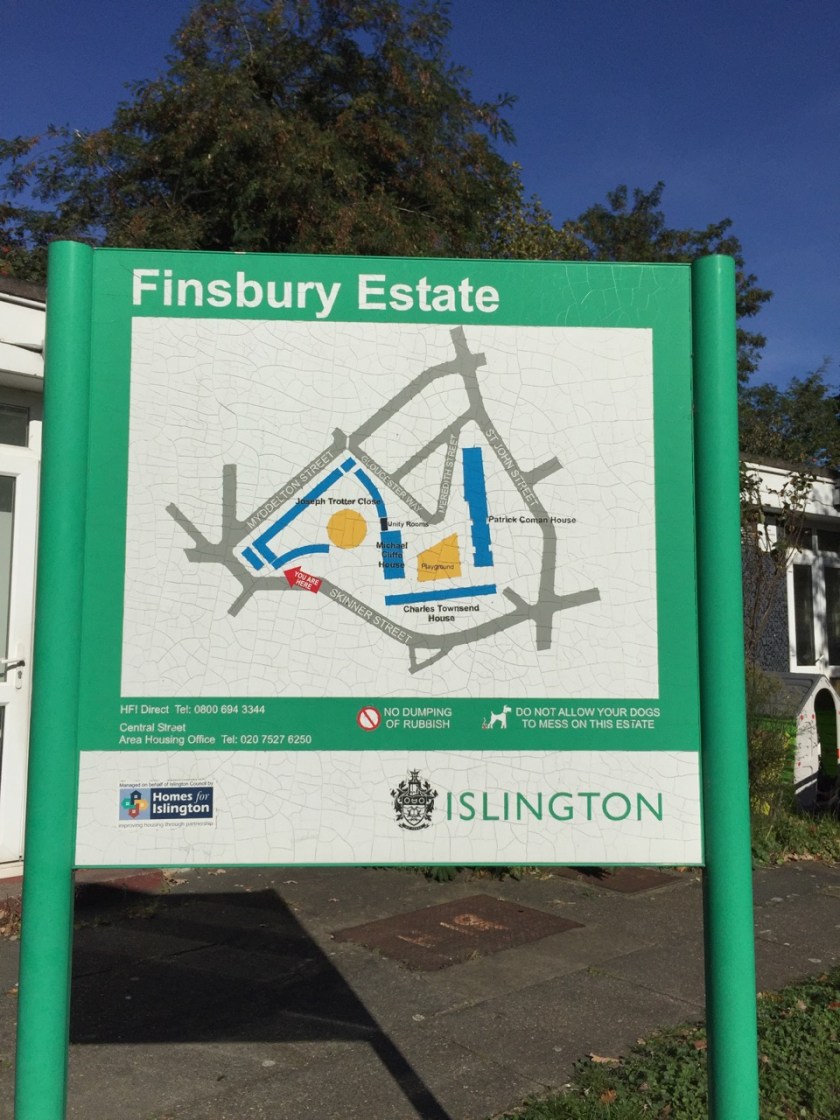
Here is Michael Cliffe House, in the Finsbury Estate, from Tysoe Street.

IMG_0368.jpg
The lower level block in the low centre of the picture is Joseph Trotter Close, also part of the Finsbury Estate.

While I was drawing the picture a man came and told me that he had seen the original architect’s drawing of this low level block. In the architect’s vision it was “sleek and wonderful”. But the man said the reality was very different. The concrete had worn badly and the building had not succeeded, in his opinion.

Earlier a woman came when I was at the pen-and-ink stage. She said that her 11 year old grandson had started painting, which pleased her very much. She bought paints for him. I asked if she painted too. She said no, but she was inspired by her grandson and might now have a go herself. “After all,” she said, ” he just paints anything, and I could do that too!”. I agreed.

IMG_0370.jpg

The drawing took two hours. After I finished I went to have a look at Joseph Trotter Close. I saw a low-level set of bungalows, all very much inhabited, with children’s play things and outdoor chairs on the lawn. It may not be sleek, but it looked as though people enjoyed living there.

The entrance to Michael Cliffe House was cramped and congested, with cars manoeuvring awkwardly and a dark, obscured, entrance. Lovely typeface though.


The real surprise was inside the entrance. There, uncelebrated in the underpass, were some amazing mosaics of dancers.


Michael Cliffe (1903-1964) was a Labour councillor for Finsbury, Mayor of Finsbury (1956-7), and an active Labour MP (1958-64).

The Finsbury Estate was built by Finsbury Borough Council in 1965. The architects were Emberton, Franck & Tardrew. Finsbury Borough council was absorbed by Islington.

IMG_0356

Later note (7th Feb 2019): There is detailed information on the Finsbury Estate on “British History online” – try this link, which starts with a history of Spa Green, and goes on to describe the Finsbury Estate.

The boat on top of Haggerston Baths

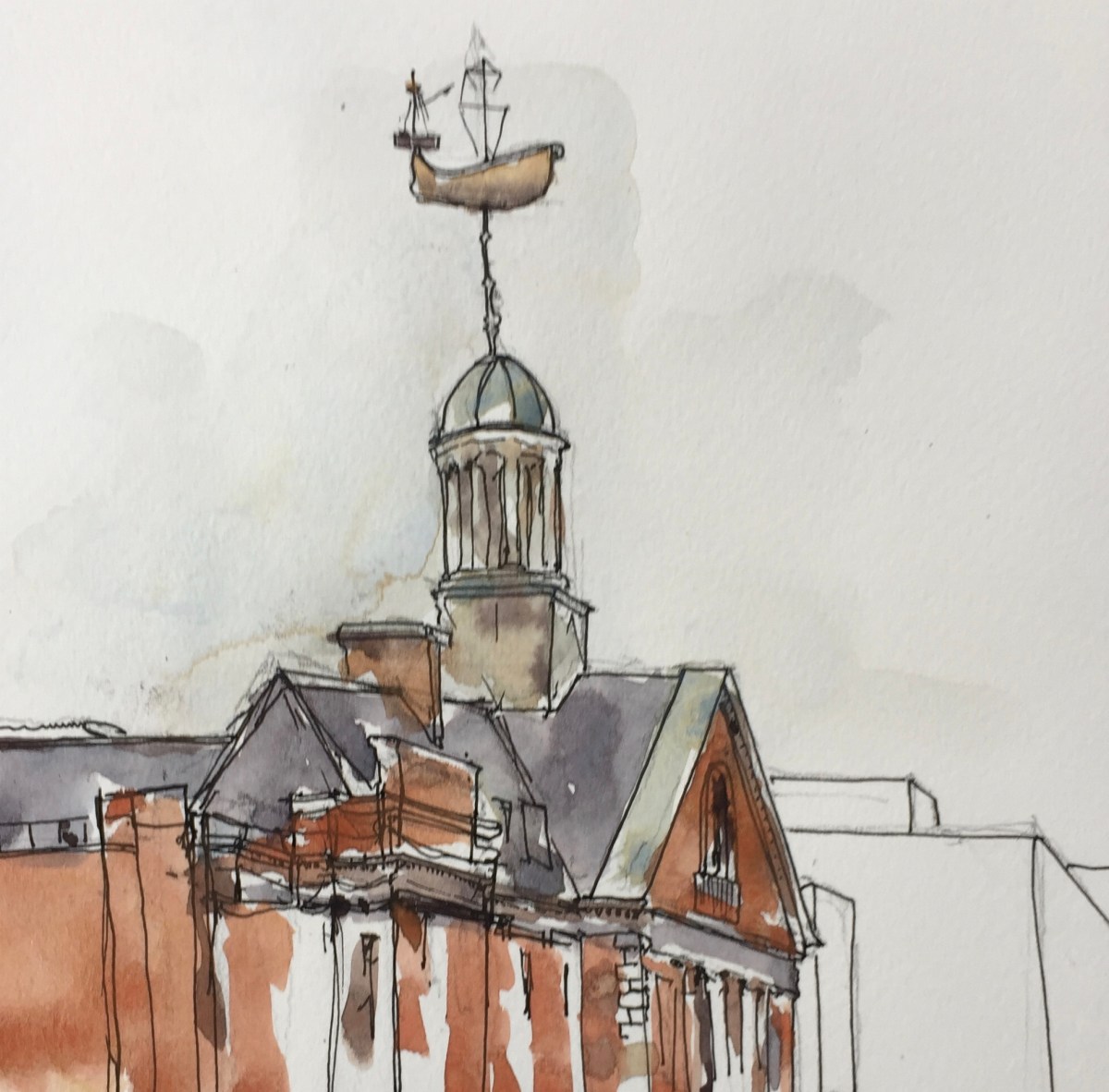
I cycled down Whiston Road last week and spotted this amazing boat, high up above the roofs. Today I returned to sketch it, and investigate further.

fullsizeoutput_307d

Whiston Road E2 is in Hackney, going off the Queensbridge Road.

I sketched outside Bryant Court. Then I went down “Swimmers Lane” and had a look at the back of the building. It’s a huge place. Clearly a former swimming pool, hence, presumably, Swimmers Lane.

IMG_0079 (1)

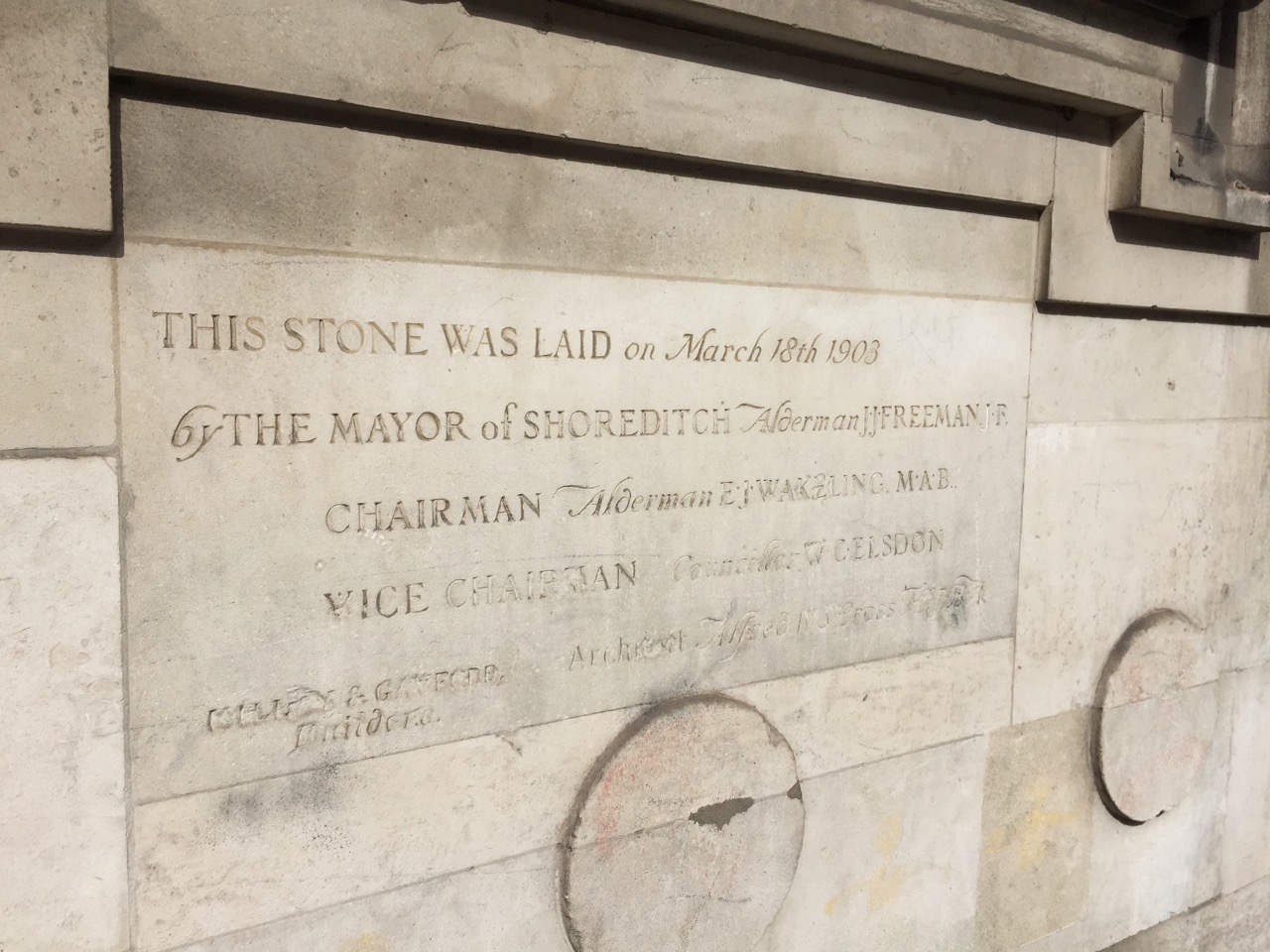
On the front is the Foundation stone, laid in 1903.

IMG_0068
Foundation Stone (click to enlarge image)

There are also huge entrance doors labelled “MEN” and “WOMEN”.

The whole place is sadly neglected.

I went and looked at the ship from the other side.

fullsizeoutput_307b
Boat on Haggerston Baths, from the Queensbridge Road

While I was drawing, birds settled on the rigging.

At home, I found that this is “Haggeston Baths”. It closed in 2000, due to underfunding and neglect. Many were sad and they protested. In November 2017 Hackney Council accepted a proposal to redevelop the building. But it will not be a pool any more. Here is the Mayor of Hackney, Philip Glanville, writing on the Hackney website November 28th 2017: 

“Hackney Council has chosen a preferred bidder to refurbish and redevelop the Haggerston Baths building. The agreement to lease will allow Castleforge Partners to apply for listed building consent and planning permission for a scheme to incorporate space for businesses, shops and a café, as well as community uses such as a clinic, health centre, day care centre or public hall.”

Mr Glanville continues:

“I know that local residents were keen to restore the swimming pool, so the council spent the best part of a year negotiating with a bidder whose proposals included a pool. As I said when we consulted on the shortlist, we could not get the reassurances we needed that the scheme with a pool would actually be delivered.”

He makes no mention of the boat. What will happen to it?

IMG_0073
Stone, art, in Swimmers Lane

Someone found some money for strange stone artworks, clearly referencing the pool.

Both sketches done on location, the first one about an hour, the second one 35minutes.


Godfrey House and the Atlas Building

IMG_0015

On the right is Godfrey House, Bath Street, Islington, part of the St Luke’s Estate managed by the London Borough of Islington. It’s former “council housing” built in 1965. Today many of the flats are privately owned, as is evident from the number listed for sale.

On the left is the Atlas Building, on City Road, nearing completion. Atlas is taller than Godfrey House, but further away. Atlas Building is 52 floors, of which 38 are residential, Godfrey House is 21 floors.

“Atlas epitomises luxury-living in an exciting and vibrant urban landscape. Standing tall with 38 residential floors of exquisite apartments, Atlas stretches across London’s prominent skyline” (from the Atlas Building website)

In the foreground is the roof of Saint Luke’s Church of England School.

IMG_0011I drew this picture sitting on a stone in Radnor Street Gardens, off Lizard Street. After a while I noticed that the place smelt of dog excrement. It has rained recently, after a dry spell.

At 6pm a personal training session started behind me. A large man was training a slim woman. They were doing kick-boxing. Between rounds, she told him about government procedures to find out about your earned income, and thus check your tax payments. They can access your bank accounts, she warned him. He laughed and said, “Hey, that’s not making me feel good. I thought you’d have some good news for me.”

The stone I was sitting on was damp.

1hour 45 minutes, drawn and coloured on location.

Data about Godfrey House from the “Tower Block UK” website of the University of Edinburgh: Contractor Kirk and Kirk, Committee approved 1965, 120 dwellings on the St Luke Printing Works Site.

 “Tower Block UK is a project supported by the Heritage Lottery Fund, bringing together public engagement and an openly-licensed image archive in an attempt to emphasise the social and architectural importance of tower blocks, and to frame multi-storey social housing as a coherent and accessible nationwide heritage.”

Here is a link to a Freedom of Information request which gives a very detailed map of the estates in Islington (2010):  FOI request from Mr I Agar